Where can buy Thoughtful images: illustrating philosophy through art thomas e. wartenberg ebook with
Thoughtful Images: Illustrating Philosophy Through Art Thomas E. Wartenberg
Visit to download the full and correct content document: https://ebookmass.com/product/thoughtful-images-illustrating-philosophy-through-art-t homas-e-wartenberg/
More products digital (pdf, epub, mobi) instant download maybe you interests ...
A Sourcebook on Byzantine Law : Illustrating Byzantine Law through the Sources Daphne Penna
Oxford University Press is a department of the University of Oxford. It furthers the University’s objective of excellence in research, scholarship, and education by publishing worldwide. Oxford is a registered trade mark of Oxford University Press in the UK and certain other countries.
Published in the United States of America by Oxford University Press 198 Madison Avenue, New York, NY 10016, United States of America.
All rights reserved. No part of this publication may be reproduced, stored in a retrieval system, or transmitted, in any form or by any means, without the prior permission in writing of Oxford University Press, or as expressly permitted by law, by license, or under terms agreed with the appropriate reproduction rights organization. Inquiries concerning reproduction outside the scope of the above should be sent to the Rights Department, Oxford University Press, at the address above.
You must not circulate this work in any other form and you must impose this same condition on any acquirer.
CIP data is on file at the Library of Congress
ISBN 978–0–19–765054–7
DOI: 10.1093/oso/9780197650547.001.0001
Printed by Integrated Books International, United States of America
In memory of my grandmother, Rosa Oleynick Schiller, who took me to see The Responsive Eye many years ago
Figure
Illustrations
Figure 4.2 Thetis, Frontispiece to Book 1 of Emile by Jean Jacques Rousseau
Figure 7.1 Sol LeWitt, Wall Drawing
Figure
Plates (located between pages 150 and 151)
Plate 1 Tom Phillips, “The Schismatics” from Dante’s Inferno
Plate 2 Titian, The Rape of Europa
Plate 3 The Three Types of Friendship in Aristotle’s Nicomachean Ethics
Plate 4 The Nature of Justice in Aristotle’s Politics
Plate 5 Raphael Santis, School of Athens
Plate 6 Rembrandt van Rijn, Aristotle Contemplating a Bust of Homer
Plate 7 Jacques-Louis David, The Death of Socrates
Plate 8 Raphael Santis, Transfiguration
Plate 9 Vincent Van Gogh, Shoes
Plate 10 Diego Velasquez, Las Meninas
Plate 11 Jackson Pollock, White Light
Plate 12 Adrian Piper, Cornered
Plate 13 Joseph Kosuth, One and Three Chairs
Plate 14 Joseph Kosuth, On Color Blue
Plate 15 Bruce Nauman, A Rose Has No Teeth
Plate 16 Mel Bochner, If the Colour Changes #1
Plate 17 Jasper Johns, Seasons (“Spring”)
Plate 18 Maria Bußmann, Drawing to Wittgenstein’s “Tractatus”
Plate 19 Maria Bußmann, Tractatus 3.324
Plate 20 Eduardo Paolozzi, He Must, So to Speak
Plate 21 Eduardo Paolozzi, Parrot
Plate 22 Mel Bochner, “T” Branch
Plate 23 Mel Bochner, Diamond Branch
Plate 24 Mel Bochner, Fourth Range
Plate 25 Mel Bochner, Range
Plate 26 Albert Lewis Kanter, “Hist! Look There!,” Classics Illustrated No. 4, Last of the Mohicans
Plate 27 David Barsalou, WHAMM!, Deconstructing Roy Lichtenstein
Preface: How I Came to Write This Book
The question lying at the heart of Thoughtful Images is this: Can the visual arts—painting, drawing, etching, sculpture, etc.—produce works that function as illustrations of philosophical texts? Since this book presents an affirmative answer to this question, a second issue emerges: What is involved in illustrating a given philosophical idea or theory? More specifically, can a visual artwork actually make an innovative contribution to philosophy? Spoiler Alert: The book also proposes an affirmative answer to this second question, for I see the arts as, among other things, a way to reflect upon philosophical questions or, to use Robert Pippin’s pregnant phrase, philosophy done by other means (Pippin 2021).
Since few philosophers have written about illustration, I want to explain the circuitous path that led me to write this book. I first became interested in illustration as the result of my participation in the debate concerning whether films can make substantive contributions to philosophy. In reflecting upon that issue, I was struck by the fact that both the advocates for and the critics of the idea of “cinematic philosophy” claimed that a film that illustrated a philosophical theory or claim was not relevant to the debate, since merely illustrating a philosophical position was not the same thing as actually doing creative philosophy. In Thinking on Screen: Film as Philosophy (Wartenberg, 2007), I devoted a chapter to a discussion of the concept of illustration, arguing that an illustration can be a significant philosophical achievement, not something to be blithely dismissed by preceding it with the adjective “mere.” My discussion of Charlie Chaplin’s Modern Times (1936) as an illustration of Karl
Marx’s theory of alienation seems to have struck a chord with many readers by demonstrating how a comedy could make a serious philosophical point.
As a result of his reading that chapter as well as subsequently talking with me about our shared interest in comics, Aaron Meskin asked me to write a chapter on visual images in comics for the anthology he was editing. The chapter that I wrote compared the images that grace the pages of illustrated books with those in comics. I wound up making the somewhat paradoxical sounding claim that comics do not standardly contain illustrations, a claim that I will explain and defend in the ninth chapter of this book.
Writing that essay fueled my interest in the topic of illustration itself. As I began to research the issue, I discovered that there was very little philosophical literature devoted to the topic. As a result, I decided to teach a seminar on the philosophy of illustration and was pleased that Mount Holyoke College agreed to hire Barry Moser, the well-known book illustrator, to co-teach with me. In preparing the course, I felt it incumbent on me to see whether there were original works of philosophy that included illustrations by established artists. Initially, I was able to find only one such book, Ludwig Wittgenstein’s On Certainty; it was published in a beautiful edition by Arion Press that included Mel Bochner’s illustrations of the text.
Although Bochner’s illustrations were quite abstract and difficult to understand, after extended study I came to see them as providing illustrations of some of the central ideas Wittgenstein advanced in On Certainty. I wound up writing an essay on some of the images in the book (Wartenberg, 2015a) as well as the catalogue essay for the exhibition of Bochner’s Wittgenstein Illustrations that I curated at the Mount Holyoke College Art Museum (Wartenberg, 2015b). I discuss Bochner’s illustrations in chapter 8 of this book.
While preparing to teach the course and then writing the catalogue essay for the exhibition, I discovered other works of art that
illustrated philosophy, such as the famous frontispiece for Thomas Hobbes’s Leviathan that the artist and printmaker Abraham Bosse created with input from Hobbes (see figure 4.1). At the same time, I discovered a number of book-length comics—I eschew the term “graphic novel” for reasons I explain in chapter 9—that illustrated philosophy in different ways.
Next, Noël Carroll and Jonathan Gilmore asked me to write a chapter about art as philosophy for their anthology on the philosophy of painting and sculpture (Wartenberg, 2023a). While writing that chapter, I realized that there was sufficient material to justify writing a book about art that illustrates philosophy. The one you are either holding in your hands or looking at on your device’s screen is the result of that realization.
Although my initial idea had been to write a book on the philosophy of (book) illustration, I came to see that the real issue that interested me was the various different ways in which visual artists had engaged with philosophy from the time of the Ancient Greeks to the present. Thoughtful Images is my attempt to document and analyze the rich tradition of interaction between visual artists and philosophy (and philosophers!) that deserves more attention than it has received.
There is one terminological issue that I need to raise. This book includes both written text and images. This makes it problematic to refer to the readers of this book, for they are as much viewers as they are readers. I attempt to solve the problem of how to refer to the book’s audience members by using a number of different terms. Sometimes, I say reader-viewers to emphasize the dual nature of the text; other times, I talk of the book’s audience to avoid prioritizing either the text or the images. I do occasionally refer to viewers or readers when I am thinking primarily of a visual or a written text. But throughout, the audience for this book will be simultaneously viewers of its images and readers of its text who integrate both of those roles.
A brief caveat is also in order. The subtitle of this study, Illustrating Philosophy Through Art, suggests that it will be a comprehensive examination of how philosophy has been transformed into art. This is misleading in that both the works of art and the philosophical theories that will be considered belong exclusively to the Western tradition. There are, of course, traditions of philosophy other than the Western one, including those found in China, India, and Africa. I have not included illustrations of philosophy in such traditions primarily because of my own ignorance. I do not know enough about those traditions—either philosophical or artistic—for it to make sense for me to have attempted to include them in this study. I can only hope that others more conversant with those traditions will be inspired by this book to investigate how those philosophical traditions have been illustrated.
Acknowledgments
I want to thank a number of people without whom this study would never have been written. First, thanks to my friend and co-teacher, the esteemed book illustrator Barry Moser, for many hours of fascinating discussions about the nature of art, as well as for introducing me to a range of illustrations I hadn’t known about. Mel Bochner was extremely generous with his time and helped me as I tried to unpack the significance of his own illustrations of philosophy. Andrew Witkin of the Krakow-Witkin Gallery provided me with assistance at an early stage in this project and has continued to be very supportive of my efforts. The entire staff of the Mount Holyoke College Museum of Art assisted me along the way. Although John R. Stromberg, then the director of the museum, came to fear my increasingly demanding requests for his help with my project—what began with my simply asking whether the Museum could buy the Arion edition of On Certainty eventually turned into a request for an exhibition and then a catalogue—he and the entire museum staff remained supportive and enthusiastic about my work. Hannah Blunt deserves special praise for helping me curate the exhibition of Bochner’s works as well as write the catalogue essay. Without the assistance and encouragement of everyone at the Museum, I would not have been able to develop this project.
Lucy Randall, my editor at Oxford, was convinced of the importance of this book and helped shepherd it into production. I am grateful for her perseverance and her guidance. Throughout the delays caused by COVID, she remained positive about the book. Her reassurances were crucial as I persevered in the writing
the manuscript and waited to receive permissions to publish the images.
My partner, Jane Garb, has been unflinchingly supportive during the lengthy process of revising the manuscript and getting permissions for the images. She also helped me devise the final title. Without her love and support, this project might not have been completed. I hereby express my gratitude for all she has done to help me, both to get this book into print and more generally.
A variety of grants from Mount Holyoke College provided funding for the images included in this book. Two students served as research assistants during the publication process. Julia Bender, a graduate student in Art at the University of MassachusettsAmherst, helped secure permissions for the images and Vivian Dong, an undergraduate at Mount Holyoke College, provided help with the chapter summaries. Both of them were supportive and helpful during the final phases of this project.
A number of people read parts or all of this book in various stages. Jeffrey Strayer gave me the benefit of his vast knowledge of contemporary art and helped to strengthen many of the chapters. His assistance was invaluable. I am very grateful to the Propositional Attitudes Task Force for reading an entire draft of the book. Comments by the members of the group were very helpful: Ernie Alleva, Bruce Aune, Howard Burrows, John Connolly, Owen Freeman-Daniels, Lennie Kaumzha, Thomas McCarthy, and Bill Rohan. Robert Wicks gave me helpful suggestions for chapters 5 and 6. Alexander George helped me avoid misleading statements about Wittgenstein’s philosophy in chapters 7 and 8. Some of my ideas were the results of conversations with my friends and colleagues, Joe Moore and Aaron Meskin. Thomas Khurana helped unpack the meaning of the German in If the Color Changes. A special word of thanks to my long-time friend and colleague Jay Garfield who read the entire manuscript, giving important advice about how to improve it. Roberta Israeloff gave me useful suggestions for improving the flow of the text. I have also benefitted immensely from the
very detailed and erudite suggestions made by the anonymous reviewers for Oxford University Press. They have saved me from making many erroneous claims and have also suggested additional materials that I have incorporated into the book.
At different stages of its preparation, various portions of this manuscript were read at the American Society for Aesthetics, the British Society of Aesthetics, and the Philosophy Departments of Mount Holyoke College and the University of Georgia. The comments made at these readings were uniformly helpful to me.
The first half of chapter 9 was drawn from a previously published paper, “Wordy Pictures: Theorizing the Relationship between Image and Text in Comics” in Aaron Meskin and Roy Cook, eds., The Art of Comics: A Philosophical Approach (Blackwell, 2012), pp. 87-104. Some sections from the catalogue essay in Mel Bochner: Illustrating Philosophy (South Hadley: Mount Holyoke College Museum of Art, 2015) are included in chapter 8. Some of the ideas in chapters 3, 4, 5, 6, 7, and 8 are briefly discussed in “Philosophical Works of Art” in The Routledge Companion to the Philosophy of Painting and Sculpture, Noël Carroll and Jonathan Gilmore, eds. (New York: Routledge, 2022).
I want to thank Barry Moser, Mel Bochner, and Maria Bußmann for giving me permission to publish images based on their artworks.
1 Introduction
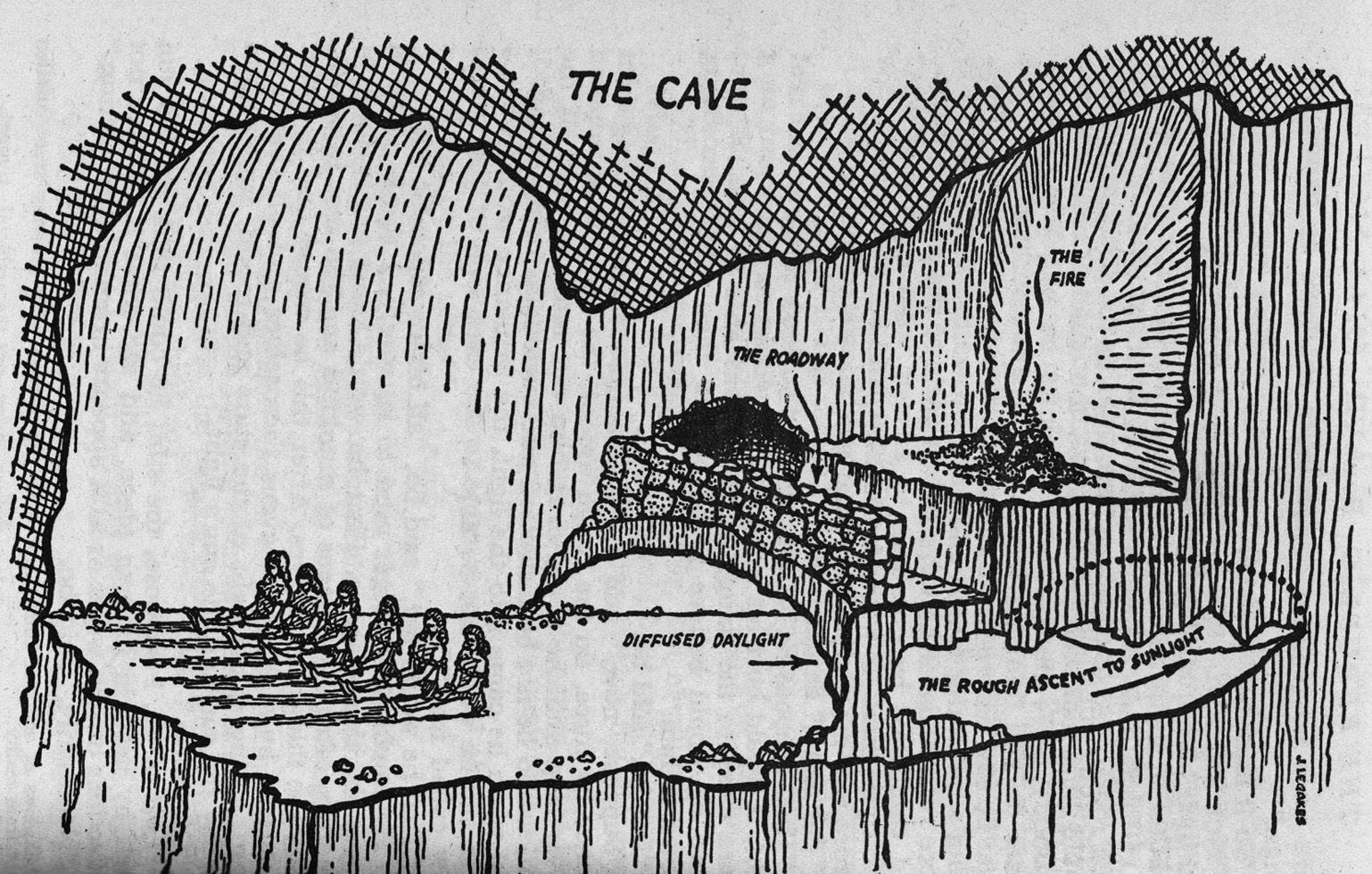
Visual illustrations of philosophy abound. For example, virtually every introductory philosophy textbook that includes Plato’s famous “Allegory of the Cave” also features a diagram of the Cave. Providing a visual rendering of the Cave helps beginning students understand the complex situation Plato describes in The Republic. (See an example in figure 1.1.) The diagram shows a group of prisoners bound together facing a wall of the Cave onto which a fire projects the shadows of various physical objects. Since Plato provides a clear verbal description of this scene (Republic, 514a–520a), the diagram is based on the description given in the written text. A visual rendering of the scene helps its audience easily and accurately envision it.
A skeptic about the possibility of visual illustrations of philosophy might respond as follows: Sure, it’s possible to illustrate the Allegory of the Cave, but that’s only because it’s an allegory, a narrative that is itself an illustration of Plato’s actual metaphysical and epistemological views. It’s not possible, however, to illustrate Plato’s actual metaphysics, with its claim that reality consists of purely intelligible objects rather than just the colorful literary tropes he introduces to make his views more accessible.
Consider, our skeptic might continue, another of Plato’s wellknown literary images, the Divided Line. The passage in The Republic begins as follows: “It is like a line divided into two unequal parts, and then divide each section in the same ratio, that is, the section of the visible and that of the intelligible” (510d). Plato goes on to explain that the first section of the visible consists of images and
1.1 Plato’s Cave. Great Dialogues of Plato, W. H. D. Rouse, trans., Eric H. Warmington and Philip G. Rouse, eds., New York: Penguin, 1956 and 1984.
the second of ordinary objects like plants and manufactured things. He then comments that the division of visible objects corresponds to a distinction between imagination and opinion, two different mental operations.
The line segment that stands for intelligible objects has a similar division. Plato distinguishes between investigations that draw conclusions from hypotheses and those that lead to first principles, a distinction he characterizes as one between reasoning and understanding. Plato explains the distinction using geometry. Geometers assume the existence of geometrical objects like plane figures and then reason to conclusions. In doing so, they may use images, but these images are not the actual mathematical objects, for those are purely intelligible. Philosophical knowledge, on the other hand, is about the Forms, the intelligible objects that stand to ordinary objects in the same relationship as ordinary objects do to their images. These things
Figure
cannot be known by vision but only by the intellect via the process Plato calls “dialectic.”
Plato’s division of knowledge into four levels, our skeptic would say, provides the materials for an argument against the possibility of illustrating philosophy. Certainly, it is possible to present an illustration that explains the Divided Line. In fact, many translations of The Republic do just that. (See, for example, Plato [1974, p. 164].) And it is possible to illustrate the different objects of imagination and opinion, images and ordinary things. But when it comes to purely intelligible objects, be they those of mathematics or those of metaphysics (the Forms), there is no way to illustrate these. Since the real subject matter of philosophy is the intelligible objects Plato calls “Forms,” philosophy itself cannot be illustrated but only the literary tropes by means of which it is conveyed to less knowledgeable audiences.1
Our skeptic has provided a strong argument against the possibility of illustrating philosophy. The case could be strengthened even more by an examination of Anthony Kenny’s The Oxford Illustrated History of Philosophy (1994). Although the book contains nearly 150 illustrations, most of them are simply portraits of famous philosophers in the Western tradition. It does include an illustration of the tree of knowledge from a scholastic textbook (Kenny, p. 114) and Kenny asserts that a drawing by M. C. Escher demonstrates the falsity of Frege’s claim that the imagination is governed by the laws of geometry (Kenny, p. 249), indicating that some illustrations can serve philosophical purposes. But because the illustrations are mostly portraits, the book supports the skeptical claim that philosophy itself cannot be illustrated.
One might reply to the skeptic by noting that some well-known philosophical texts include visual images as a central feature of
1 The Divided Line has actually been illustrated by Joseph Kosuth, Intellect to Opinion (2017). I discuss his work in chapter 7.
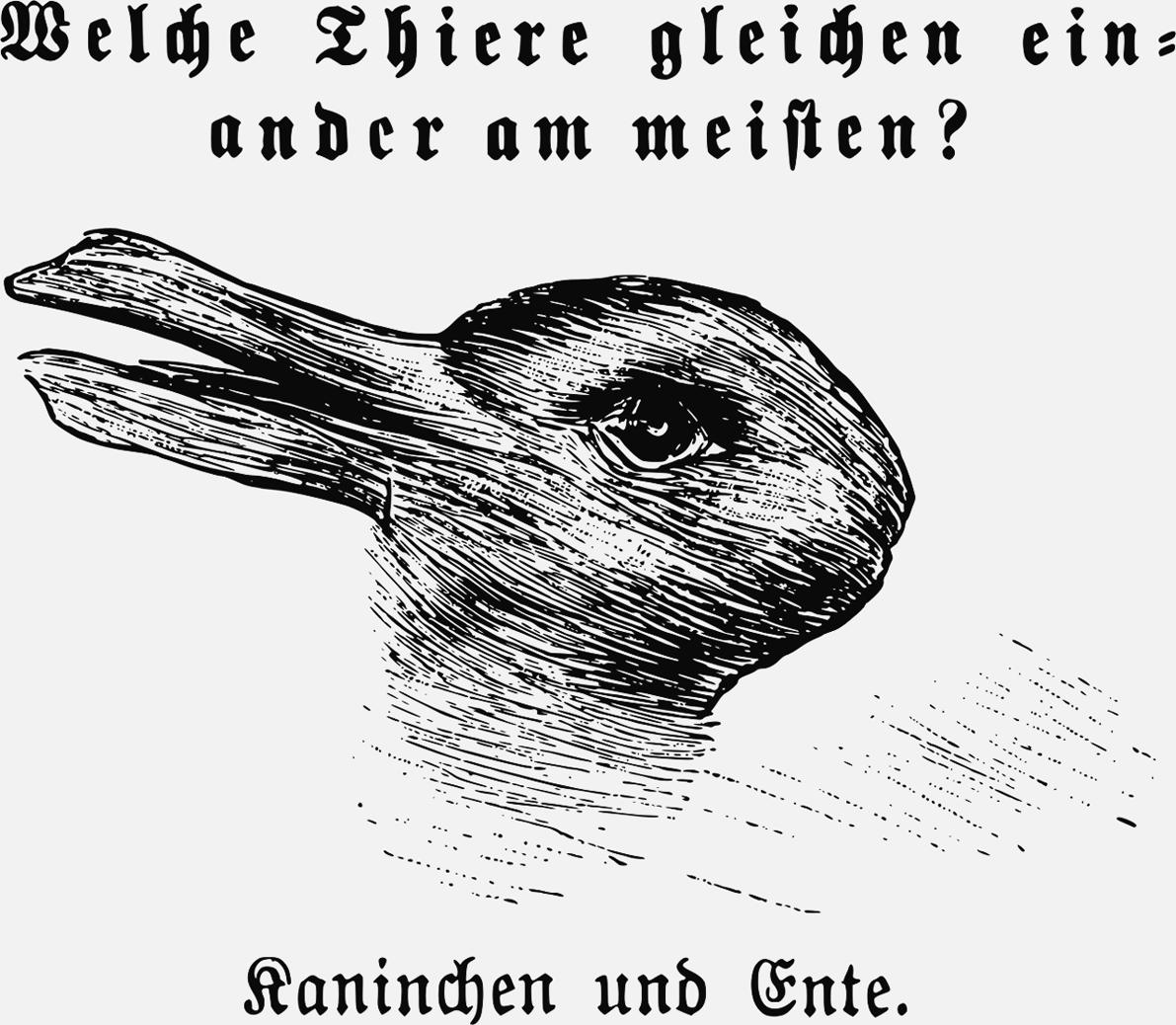
Figure 1.2 The Duck-Rabbit. October 23, 1892, issue of Fliegende Blätter.
their arguments. Probably the best known is the “duck-rabbit” in Wittgenstein’s Philosophical Investigations (Wittgenstein, 2009, Part II, ¶118) (see figure 1.2). In part II of the Investigations, while discussing the nature of seeing-as or aspect seeing, Wittgenstein introduces this drawing—it is actually one of several occurring in this section of the Investigations—as an example of an image that can be seen in two different ways, i.e., as a duck or as a rabbit, but never both simultaneously.
In my remarks, the following figure, derived from Jastrow, will be called “the duck-rabbit.” It can be seen as a rabbit’s head or as a duck’s. And I must distinguish between the “continuous seeing”
of an aspect and an aspect’s “lighting up.” (Wittgenstein, 2009, Part II, ¶118)
I will discuss this image more fully in chapter 7. For now, I want to point out that this image plays an integral role in Wittgenstein’s argument. He uses it to explain the phenomenon to which he is drawing the reader’s attention, not to illustrate a point he makes in the text independently of the image. The duck-rabbit is a visual image that Wittgenstein uses to get readers to understand his philosophical thesis concerning seeing an aspect. It suggests that philosophy can indeed be illustrated.
There is an even more significant problem with the skeptics’ argument. Their challenge gains traction by illicitly taking a particular type of illustration as definitive of the notion as a whole. Most of us are used to thinking of illustrations as text-based, as literally presenting a picture whose central features are specified by a text. The diagram of Plato’s Cave (figure 1.1) is a good example of such an illustration, for it consists of a picture whose central features— the bound prisoners, the wall on which images are projected, etc.—are derived from Plato’s description of the Cave. The skeptic assumes there are only illustrations of this type, making the idea of illustrating an abstract philosophical claim appear completely implausible.
There are, however, other types of illustrations. One type I discuss in this book is what I call a concept-based illustration. A conceptbased illustration does not attempt to illustrate a segment of text but an abstract philosophical concept or idea.2 I will argue that a
2 The distinction I draw between different types of illustration is related to the distinction that James O. Young makes between semantic and illustrative representation (Young, 2001, p. 26). However, Young fails to see the possibility of semantic representations functioning as illustrations, probably because he takes all illustrations to be pictorial. Koen Vermeir (2005) discusses the notion of an “analogical demonstration” in the late seventeenth century. He claims that Pierre le Lorraine, Abbé de Vallemont, used such demonstrations to render the invisible visible. This involves a similar strategy to the one I am attributing to artists like Phillips and Bochner.
visual image is able to illustrate an abstract philosophical view because it presents an analogy to the position it illustrates. In the course of this book, I will have occasion to discuss a number of such concept-based illustrations, such as Tom Phillips’s illustration of the Schismatics in Dante’s Inferno (chapter 2) and Mel Bochner’s illustrations of Ludwig Wittgenstein’s On Certainty (chapter 8). Even if the skeptic was correct in claiming that it is not possible for there to be text-based illustrations of abstract philosophical claims—a view I dispute at various points in this book—they have not provided a justification for denying the possibility of conceptbased illustrations of abstract philosophical claims. The apparent plausibility of the skeptic’s position rests upon too narrow a conception of illustration.
But what’s the difference between a typical textbook illustration of Plato’s Cave and a work of art that also illustrates that section of The Republic? Characterizing a visual image as a work of art involves evaluating it, treating it as a distinct type of entity. This is what distinguishes works of art from drawings that serve a merely pedagogical, utilitarian, or heuristic function, such as the Cave diagram I have discussed. Those are not works of art because they primarily seek to convey information. Works of art attempt to do something else. Arthur Danto characterizes that “something else” as “embodying a meaning” (Danto, 2003, p. 25).
Other philosophers of art see other properties as crucial for works of art. They all agree, however, that works of art do more than convey information.
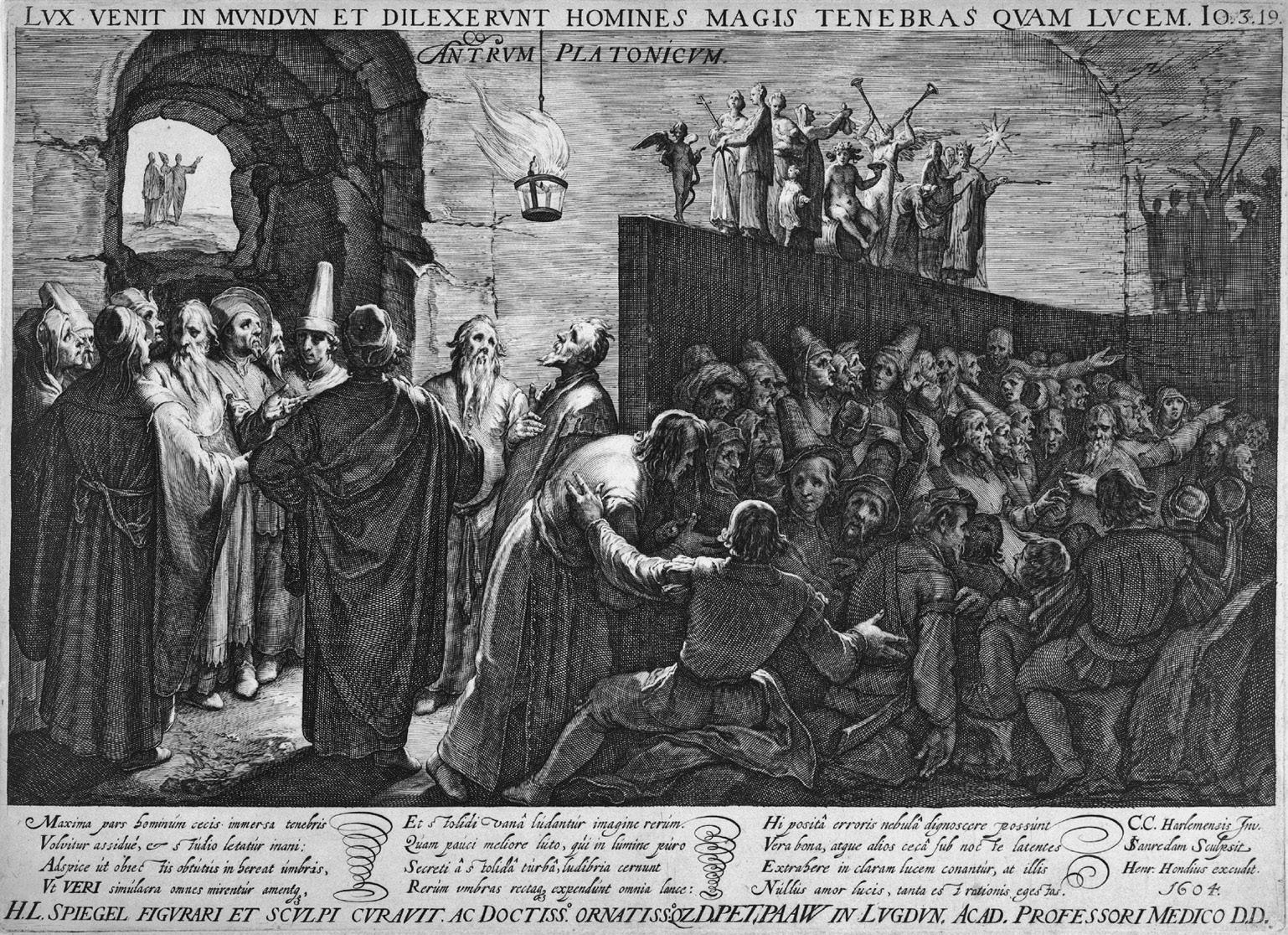
An example of a work of art that is also an illustration of the Cave is Antrum Platonicum [Platonic Cave] (1604), an engraving by Jan Saenredam based on a lost painting by Cornelis Cornelisz of Haarlem (figure 1.3).3 The work was commissioned and published
3 This claim is made by the British Museum on the webpage for the work. See https://www.britishmus eum.org/col lect ion/obj ect/P_1852-1211-120. There is an earlier work that is attributed to the Flemish painter Michiel Coxie that is also an
by the poet, Hendrik Laurenszoon Spiegel, who probably also gave detailed instructions about its composition and who is thus responsible for some of its deviations from Plato’s description of the Cave (McGrath, pp. 228–232). The engraving illustrates a later passage from Plato’s Allegory than that shown in the diagram. In it, Plato describes how, after having escaped his imprisonment in the Cave and having seen the world of real things illuminated by sunlight, one of the prisoners returns to the Cave to enlighten his fellow prisoners about the nature of reality. A tumult ensues among the prisoners who debate the veracity of their fellow’s testimony. Most of the Cave dwellers are skeptical of his report and, as the supertitle
illustration of Plato’s Cave, De grot von Plato (sixteenth century). This work depicts the same scene as that depicted in the diagram using the artistic techniques of the high Renaissance.
to the illustration says, “the light has come into the world, and men loved darkness rather than the light.”4 Plato is here explaining the reticence of his fellow Athenians to accept his philosophy as well as their hostility to his teacher Socrates.
What is the difference between Antrum Platonicum and the textbook illustration of the Cave? The textbook diagram of the Cave serves primarily a utilitarian function: helping a reader understand the situation that Plato describes. For this reason, it is stripped of all details other than those that visually render the scene Plato describes verbally. Saenredam’s work, in contrast, seeks to convey the impact that the escaped prisoner’s return has on his fellows. He portrays the chaos resulting from the prisoner’s message. In doing so, he uses spatial recession as well as the contrast between shadow and light to give a sense of the emotional impact the former prisoner’s tale has on his fellows. The viewers of this work gain a clearer understanding of the prisoners’ reactions even if the details of Plato’s verbal description are rendered less prominently than in the diagram.5
Works of art that illustrate philosophy, like Antrum Platonicum, are not as numerous as drawings that serve the more utilitarian purpose of providing a visual rendition of verbal information conveyed by a text. Nonetheless, there is a significant tradition of visual
4 This quotation comes from John 3.19 and allies Plato’s myth with Christianity.
5 Plato’s Cave remains an interesting subject for artists to use in their work. One prominent example is Robert Motherwell’s series In Plato’s Cave. It has been suggested that Motherwell’s works present viewers with the shadows that the inhabitants of the Cave take to be real. (Thanks to Jeffrey Strayer for bringing this series to my attention.) A recent exhibition at the Getty Museum, curated by Donatien Grau, Plato in L.A.: Contemporary Artists’ Visions (2018), includes three works that employ the Cave: Mike Kelley’s Exploring from Plato’s Cave, Rothko’s Chapel, Lincoln’s Profile (1985), which depicts a more realistic cave than Plato’s; Raymond Pettibone’s modernization of the Cave, No Title (Lightly, Swiftly, Absolutely) featuring three people looking up through a tunnel into the light; and Huang Yong Ping’s Caverne 2009 (2009) in which the viewer looks into a cave in which there are statues of Buddhas and Talibans. It’s not clear to me that the cave pictured in all of these works is Plato’s, and those that do portray Plato’s Cave seem to use it more as a reference point than as an image to be illustrated. Unfortunately, I found out about this exhibition too late to incorporate all of the works exhibited in it into this book. I hope to discuss illustrations of Plato in future work.
works of art—etchings, drawings, prints, paintings, sculptures, installations, etc.—that illustrate philosophy. This bald statement may come as a surprise to many readers. To make it more plausible, consider a work that clearly is an illustration of philosophy, Raphael Sanzio’s School of Athens (Plate 5), the marvelous fresco located in the Vatican. It is one of the best-known works of art with clear philosophical content, depicting virtually all the great Ancient Greek philosophers. The painting is claimed to depict the difference between the metaphysical positions of its two central figures, Plato and Aristotle, as Plato, the idealist, is pointing to the heavens while Aristotle, the empiricist, gestures to the earth.6 This fresco is a good example of a work of art that provides a pictorial illustration of philosophy, though it is not text-based. I will discuss it in more detail in chapter 5.
It’s not at all obvious what is required for a painting or other visual artwork to illustrate a philosophical thesis or theory. Is it sufficient to show famous philosophers gesturing in significant ways as Raphael has done? If not, what more is required for an image to count as one that illustrates philosophy? Answering these questions is the central task I undertake in Thoughtful Images.
Given the existence of a rich tradition of visual illustrations of philosophy, it is surprising that it has not received more attention from philosophers. That there is such a tradition will be demonstrated in the balance of this book. Art historians have focused on visual works that illustrate philosophy more than philosophers have. For example, Susanna Berger’s The Art of Philosophy analyzes “visual thinking in Europe from the Late Renaissance to the Early Enlightenment,” as the book’s subtitle says. (That book will be discussed in chapter 3.) Another example is Claire Richter Sherman’s (1995) examination of the illustrations of Aristotle’s ethical and political treatises, a work that I also
6 Paul Taylor argues that the fresco presents the philosophers in a negative light, as more interested in arguing than discovering the truth. See, especially, pp. 187–189.
discuss in the third chapter. But these art historical studies focus on a limited set of works that illustrate philosophy and not the entire tradition.
There is only one book I know of devoted to illustration as a philosophical topic. It’s Illustration by the deconstructionist literary critic J. Hillis Miller, and only the second half of it is actually devoted to the topic. While it contains a great deal of useful information, the book does not address the central question raised in this study: How can a work of visual art illustrate philosophy?
As I mentioned in the preface, there is a rich philosophical literature about the relationship between philosophy and other artforms. While the thesis that literature can provide important philosophical insight has been hotly debated, numerous philosophers and literary scholars have argued for the relevance of literature to philosophy. Martha Nussbaum is probably the best known (see Nussbaum, 1992, for example). But there are others. Gilbert Ryle’s wonderful essay on Jane Austen (1966) is a classic example of a philosopher demonstrating the philosophical significance of a literary work. Similarly, there is a rich debate focused on the question of whether films can actually contribute to philosophy. The debate’s initial focus was Stephen Mulhall’s claim that film is “philosophy in action” (Mulhall, 2002, p. 2). Paisley Livingston rejected what he called “the bold thesis,” namely, that films can make innovative contributions to philosophy that are not possible via the written word (Livingston, 2006, p. 11). Many others responded and a significant debate ensued that continues to this day.7 Like literature, film is an artform that has spawned a great deal of discussion as to its philosophical relevance.
So, it is surprising that philosophers have not provided more discussions of whether works of visual art can illustrate philosophy, let alone actually provide innovative philosophical insights that are
7 One example of this debate are the contributions by Murray Smith and myself to Thomson-Jones (2016).
independent of written philosophical texts.8 This, despite the fact that one of the most important philosophers of art of the twentieth century, Arthur Danto, argues that some of Andy Warhol’s most significant works of art are genuine works of philosophy. (For more on Danto and Warhol, see chapter 6.)
Art historians, as I have said, have discussed the topic of the relationship between works of art and philosophy. Hanneke Grootenboer (2020) argues that certain works of art, those that she characterizes as pensive images, actually are an embodied form of thinking. She attempts to clarify that notion through reference to Caravaggio’s Death of the Virgin (1606) and Jean-Luc Nancy’s essay on it. Nancy proposes that the figure of John the Evangelist represents “the ‘thought’ of this painting.” Grootenboer rejects this, saying, “This would be thought expressed in an image, or as image. What I have in mind is pensiveness as a quality of the image that causes it to remain inexpressive” (p. 24). Her idea is that there are certain images that resist our attempt to find meaning in them but that nonetheless give rise to thinking.
Grootenboer is an example of an art historian who has been influenced by the writings of Continental philosophers like Heidegger and Derrida. She sees her idea of pensive images as derived from the work of these philosophers who do see art as capable of philosophical insights. (I discuss some of them in chapter 5.) But Grootenboer is not interested in the types of works of art I discuss in this book, that is, works that have philosophy in them, as she makes clear in the previous quotation. These are precisely the works that form the subject matter of Thoughtful Images, which focuses on visual works of art that have clear philosophical content embodied in them.
In raising the question of visual artworks that illustrate philosophy, this book addresses three fundamental issues. First, is it
8 Although philosophers have not discussed this relationship very much, the same cannot be said of historians, many of whom have written about the relationship between visual art and philosophy. Among the art historians who have written on this topic are Horst Bredekamp, Elizabeth McGrath, and W. J. T. Mitchell.