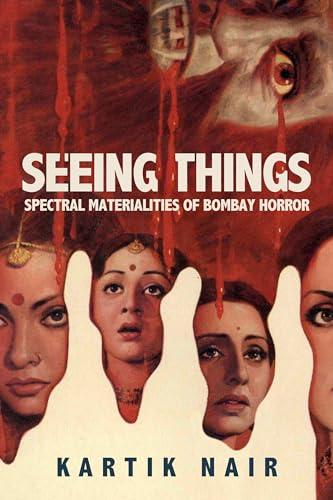
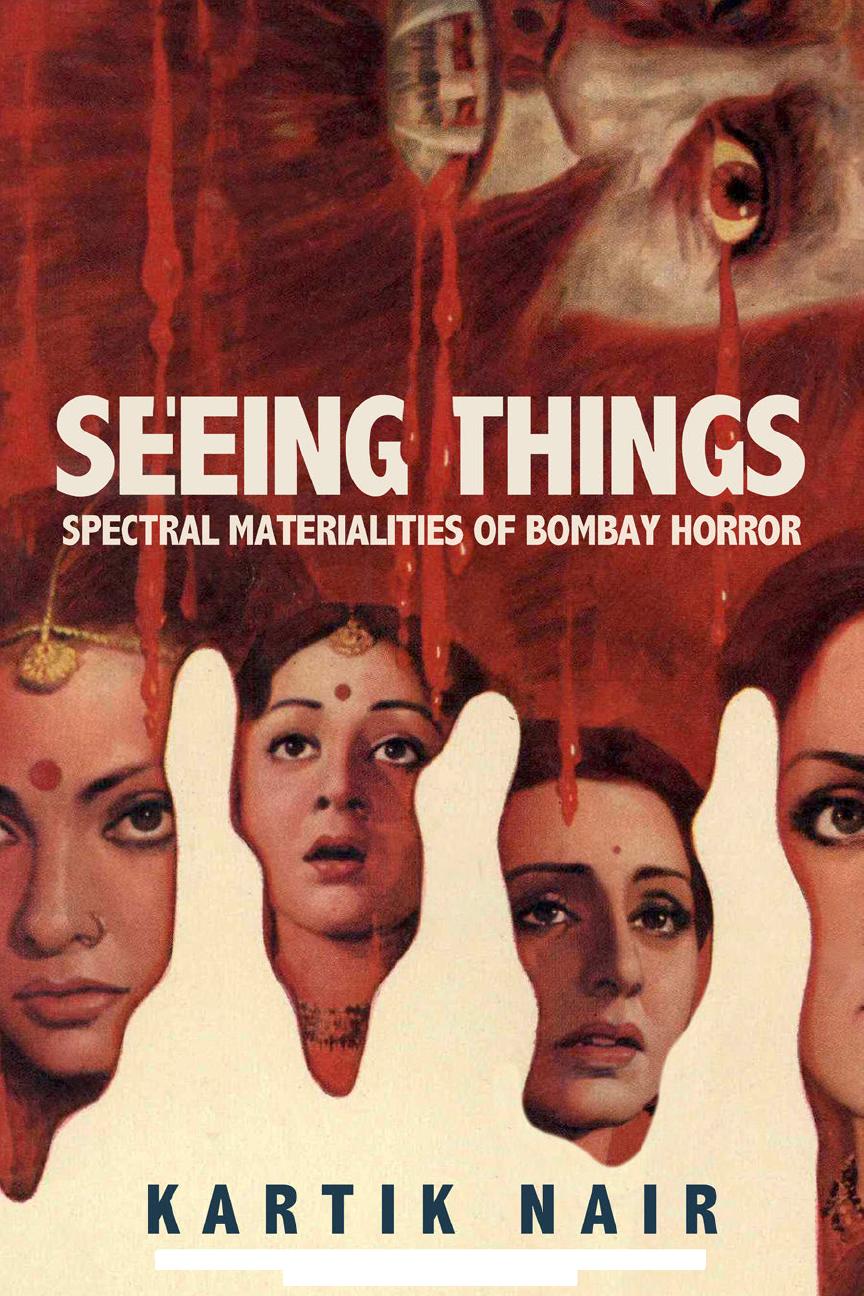
Seeing Things
Spectr A l M A teri A litie S of Bo MBA y h
orror
Kartik Nair
u niver S ity of cA liforni A p re SS
University of California Press Oakland, California
© 2024 by Kartik Nair
Library of Congress Cataloging-in-Publication Data
Names: Nair, Kartik, 1985– author.
Title: Seeing things : spectral materialities of Bombay horror / Kartik Nair.
Other titles: South Asia across the disciplines.
Description: Oakland, California : University of California Press, [2024] | Series: South Asia across the disciplines | Includes bibliographical references and index.
Identifiers: lccn 2023019898 (print) | lccn 2023019899 (ebook) | isbn 9780520392274 (cloth) | isbn 9780520392281 (paperback) | isbn 9780520392298 (ebook)
Subjects: LCSH: Horror films—India—Mumbai—20th century. | Artists’ materials—India—Mumbai. | Horror films—Production and direction— India—Mumbai. | Cinematography—Special effects—20th century
Classification: lcc pn1995.9.h6 n325 2024 (print) | lcc pn1995.9.h6 (ebook) | ddc 791.43/61640954792—dc23/eng/20230802
LC record available at https://lccn.loc.gov/2023019898
LC ebook record available at https://lccn.loc.gov/2023019899
Manufactured in the United States of America
33 32 31 30 29 28 27 26 25 24 10 9 8 7 6 5 4 3 2 1
For my parents, Anu and Govind
1.Paper Cuts: Inside the Bureaucratic Encounter with Darwaza
2.Celluloid Splatter: The Graphic Violence of Jaani Dushman 79
3.Unsettling Design: Built Atmosphere in Purana Mandir 111
4.Making Monsters: Veerana and the Craft of Excess
5.Hidden Circuits: Kabrastan from Film to Videotape
Acknowledgments
This book began as a research project in the School of Arts and Aesthetics at Jawaharlal Nehru University (JNU), where Ranjani Mazumdar and Ira Bhaskar have established a peerless cinema studies program. After supervising a dissertation on the Ramsay Brothers, Ranjani served on my doctoral dissertation committee and as a reader in a manuscript workshop focused on the book. In other words, Ranjani has helped make the many iterations of this project (and of my life since) possible. From her, I am still learning how to channel intense cinephilia and political commitment into the “invisible work” of reading, writing, and teaching, though it is her generosity that I most wish to emulate.
In the Department of Cinema Studies at New York University, Richard Allen was my dissertation adviser and strongest advocate. For their mentorship then and ongoing support now, I thank Tejaswini Ganti, Anna McCarthy, Antonia Lant, Dana Polan, and Dan Streible. I am grateful for the continued presence of friends from within and across cohorts, including Neta Alexander, Bruno Guaraná, Linnéa Hussein, Laliv Melamed, and Jaap Verheul. Early financial support for dissertation research came from the Corrigan Fellowship at NYU, followed by a Junior Research Fellowship from the American Institute of Indian Studies. I was hired by the
School of Film and Media Studies at Purchase College while still a graduate student. Teaching alongside Paula Halperin, Shaka McGlotten, Anne Kern, Michelle Stewart, Agustin Zarzosa, and Ling Zhang, I came to understand the labor of pedagogy even as I fell in love with the classroom. My teaching and research have been inseparable since.
At Temple University, I thank my colleagues in the screen studies program. Nora Alter unreservedly welcomed me into her home as a colleague and friend, and Chris Cagle has been the kindest mentor I could have hoped for. I am deeply appreciative of the collegiality of Warren Bass, Rod Coover, Peter D’Agostino, Sarah Drury, LeAnn Erickson, Michael Kuetemeyer, Afia Nathaniel, Eran Preis, Elisabeth Subrin, Rea Tajiri, and Lauren Wolkstein. The administration of a large research university is no easy task, and I am grateful to the chair of my department, Chet Pancake, former chairs Paul Swann and Jeff Rush, as well as Alison Crouse, Meag Jae Kaman, Sammip Parikh, and (the now-retired) Rita Kozen for the work they do to ensure that the Department of Film and Media Arts thrives. At the Center for Performing and Cinematic Arts, Dean Robert Stroker, Beth Bolton, Sue Alcedo, and Jason Horst have supported my career on the tenure track. An invaluable yearlong sabbatical from teaching and service allowed me to draft the manuscript in timely fashion, while a daylong manuscript workshop allowed me to improve it in revision. The Vice Provost for the Arts Grant and Summer Research Awards enabled me to return to India to complete archival research and pay for production services on the book. The Center for the Humanities, under director Kimberly Williams, provided a yearlong fellowship; its salutary benefits included a course release and the company of junior faculty across the humanities at Temple. As I write these acknowledgments, Temple faculty are set to enter negotiations with the university over the terms of their contract. I thank TAUP for fighting the important fight.
The story I tell in this book came into sharper focus every time I shared it, and I was fortunate to receive generous speaking invitations from the School of Arts and Aesthetics, JNU; the Cinema Studies Colloquium at the University of Pennsylvania; the Department of Cinema Studies at the University of Toronto; the Moving Image Workshop conducted by the film studies program at Michigan State University; the Department of Film and Media Studies at Colorado College; and the Film and Media Studies
Speaker Series at Lafayette College. Many devoted precious time and energy to reading (and sometimes, rereading) drafts of the book. For their immense contributions, I thank Arielle Xena Alterwaite, Nicholas Baer, Piyali Bhattacharya, Bud Bynack, Manuela Coppola, Pardis Dabashi, Kirsty Dootson, Sahana Ghosh, Justin Gifford, Nitin Govil, Radhika Govindarajan, Monica Hahn, Rebeca L. Hey- Colón, Lotte Hoek, Kathleen Karlyn, Suvir Kaul, Ranjani Mazumdar, Laliv Melamed, Debashree Mukherjee, Emily Neumeier, Jess Marie Newman, Pallavi Pinakin, Francis Russo, Terenjit Sevea, Samhita Sunya, and Kuhu Tanvir.
After talks, during walks, and over meals, at conference panels and in between them, comments, questions, and reading suggestions from the following individuals decisively improved the manuscript and my day: Pritika Agarwal, Alexander Alberro, Kaveh Askari, Harry Benshoff, Debjani Bhattacharya, Kaushik Bhaumik, Tupur Chatterjee, Iftikhar Dadi, Neal Dhand, James Leo Cahill, Iggy Cortez, Jennifer Fay, Marc Francis, Smita Gandotra, Sabeena Gadihoke, Nicola Gentili, Shohini Ghosh, Michael Gillespie, Sangita Gopal, Lalitha Gopalan, Veena Hariharan, Maggie Hennefeld, Priya Jaikumar, Kajri Jain, Shikha Jhingan, Carolyn Kane, Scott Krzych, Lawrence Liang, Bliss Cua Lim, Rich Lizardo, Ania Loomba, Rochona Majumdar, Neepa Majumdar, Meta Mazaj, Ellen McCallum, Monika Mehta, Cain Miller, Justin Morris, Madhuja Mukherjee, Rahul Mukherjee, Mike Phillips, Swarnavel Eswaran Pillai, Brian Price, Karen Redrobe, Meghan Romano, Kate Russell, Jeff Scheible, Jordan Schonig, Joshua Schulze, Meheli Sen, Shaunak Sen, Megha Sharma Sehdev, Anooradha Iyer Siddiqi, Kyle Stevens, Ravi Sundaram, Mayur Suresh, Ishita Tiwary, Jean-Thomas Tremblay, Julie Turnock, and Elizabeth Wijaya. I thank the organizers and audiences of the annual conference of the Society for Cinema and Media Studies and the Conference on South Asia, two events from which I derive so much intellectual and social sustenance. Hat tip to the conveners of the De-Westernizing Horror Conference at King’s College—Iain Robert Smith, Zubair Shafiq, and Alice Haylett—as well as Jessamyn Abel and Leo Coleman, who organized the Global Asias Summer Institute on Infrastructure. Students at NYU, SUNY, and JNU, as well as those attending guest lectures at Delhi University, Jamia Millia Islamia, and Boston University, have proved the most reliable sounding boards for my ideas in their exploratory phase. I owe a
debt to all my students, but especially those in The Horror Film (2022), who energized me with their love of the genre.
Several libraries and archives enabled the writing of this book, including the National Film Archive of India in Pune, the Nehru Memorial Museum & Library and Soochna Bhawan in Delhi, the New York Public Library and Elmer Holmes Bobst Library in New York City, and the Charles Library at Temple University in Philadelphia. I recognize the hard work done by archivists and librarians at these institutions, including Aruna Magier and Brian Boling.
I feel so very lucky to have published my first book with University of California Press. Since she heard the pitch, my editor Raina Polivka has guided the project with enthusiasm and care. Editorial assistants Madison Wetzell and Sam Warren shepherded the book in and out of review. Jeff Anderson and Jon Dertien ensured a smooth production process. Sharon Langworthy’s painstaking copyedits have made this a better read, and the comprehensive index at the end of the book is the singular work of Sarah Osment. I am honored that Seeing Things appears in the illustrious South Asia Across the Disciplines series, and I thank series editors Gauri Viswanathan and Robert Goldman for their words of support. Francis Russo designed that sumptuous cover, giving stylish expression to the book’s argument on a tight timeline. For their advocacy of the manuscript in various ways, I am indebted to Usha Iyer, Sudhir Mahadevan, Cecilia Sayad, Robert Spadoni, and Caetlin Benson-Allott. Caetlin’s championing of junior scholars and editorial labor while at JCMS provide a model of service to the field. Over the years, I have become especially grateful to those whose camaraderie has made it easier for me to come into my own: Nick, Harry, Chris, Iggy, Marc, Daniel Howell, Kareem Khubchandani, David Lugowski, Jeff, Kyle, and Jaap.
This book is about the making of horror films in 1980s Bombay and centers on a small but influential group of filmmakers. I give thanks to some of the most recognizable names in the horror business for taking the time to speak to me, including the late Tulsi Ramsay, Mohan Bhakri, and Vinod Talwar. As this book came together in its final stages, research queries and production questions were answered with help from the everreliable Aditya Basu, as well as A seem Chandaver, Brian Collins, Shamya Dasgupta, Neal Dhand, Nadia Hironaka and Matthew Suib, Erica Jones,
Aditi Sen, Deborah Stoiber, Anand Theraney, Rosie Thomas, Aparna Subramanian, Balbir Ward, and Kyle Westphal. For a typically revelatory reading that rescued the book’s introduction at a crucial stage (and for everything before then), I thank Nitin Govil.
In the midst of the demands of the book, Friday morning meetings with my fellow BioScope editors kindled happiness in the hard work that is putting every issue together. It has been a privilege to work at BioScope for the past decade, alongside Ravi Vasudevan, Rosie Thomas, S. V. Srinivas, Lotte Hoek, Salma Siddique, Vebhuti Duggal, and Debashree Mukherjee.
Piyali Bhattacharya is living proof of the nicest surprise a peripatetic life such as this can bring: new places will become home because of old friends. Piyali, Tariq Thachil, Kasturi Sen, Nazia Kazi, Neesha Shah, Ania Loomba, Suvir Kaul, and Chris Devine are some of the best things about living in Philadelphia. In New York, I found home because of Nilanjana Bose, Jakub Ciupiński, Josh Kaplan, Rasha Dalbah, Amit Bhatia, the Ganti family, Maryam Jahanshahi, Anthony Miler, and the Center on 13th Street. Since they’ve moved to Boston, I have missed Manuela Coppola and Teren Sevea dearly. When I’m in Delhi, Arunoday Mukharji and Neha Poonia make me wish I lived closer. College friends who, happily, have become college professors too— Sahana Ghosh, Kuhu Tanvir, Aliya Rao, Dwai Banerjee, Gaurav Khanna, and Aditi Saraf—are reliable sources of sagacity and levity. Debashree Mukherjee shows me how to live with intellectual and ethical conviction, while the sheer silliness of our phone calls lightens my life. There is no one like her.
Members of my family have made the process of writing a little less lonely. I am astonished by the unending hospitality of Nirmal Rajagopalan; Gita, Maitri, and Jagdish Dore; Valeria Roasio and Giuseppe Pissinis (grazie Beppe!). Lara Chandni accompanied me on one final research trip to an old palace on the sea, but she has been with me every step of the way even when she was halfway around the world. I met Bhavya Dore twenty years ago, and we have been the very best of friends since—a researcher second to none, she has saved the book many times, and me many times more.
In the years leading up to the publication of this book, my family weathered major health challenges. I celebrate my mother for her resilience and for always supporting my interest in this thing called “film studies.” My
father set an early example of following one’s passion, and I marvel at a former fighter pilot who remains the very image of calm. Gayatri Nair is an older sister in every sense of that word: it feels good to have her as a mutual witness to this life and to know I will grow older still with her watching. The best man I know has moved across countries and between continents when I couldn’t and stilled my frantic heart with his hazel eyes, fine Italian cuisine, and brilliant writing advice. The book is done now, Andrea: let’s swim into the ocean and watch the sun set.
An earlier version of chapter 4 appeared as “Unfinished Bodies: The Sticky Materiality of Prosthetic Effects,” in Journal of Cinema and Media Studies (formerly Cinema Journal), 60, no. 3 (Spring 2021): 104–128. An earlier version of chapter 1 appeared in A Companion to Indian Cinema (edited by Neepa Majumdar and Ranjani Mazumdar) as “Scenes of Horror: Reading the Documents of Indian Film Censorship” (Wiley Blackwell, 2022, 170–195).
Introduction
Acci D ent A l e xpo S ure S
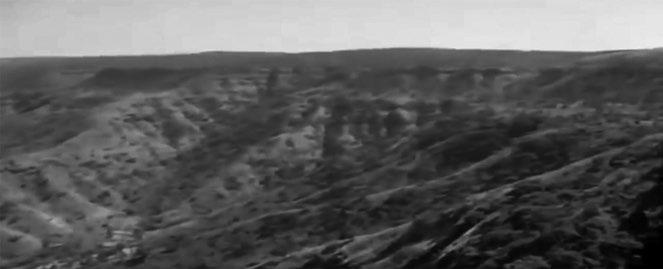
As the sun sets and night falls, a vampire rises from his crypt. Emerging from a cave deep inside the mountains, the shaitan (demon) is desperate to quench his thirst for human blood. His eyes are red, and his fangs are sharp. The vampire looks out over the dark valley that lies before him and takes flight into the night (see figure 1). So begins the Ramsay Brothers’ Bandh Darwaza (Closed door, 1990), one entry in a cycle of Hindi-language horror films made in India between the late 1970s and the early 1990s. During this time, a few filmmakers shot dozens of horror films in the decrepit colonial mansions and empty industrial mills of Bombay and in the forested hills and seaside palaces surrounding the city. Foremost among these filmmakers were the seven siblings known as the Ramsay Brothers, who made “India’s First Horror Film,” Darwaza (Door, 1978). Working with enthusiastic actors and skilled technicians, the Ramsay Brothers and their contemporaries produced a wave of horror movies about soul-sucking witches, knife-wielding psychopaths, and dark-caped vampires. Thrilled audiences turned some of these films into box office hits, but critics routinely disparaged the films as “second-hand imitations of third-grade foreign horror movies,” while the Indian government censored them for their graphic violence.1 As the Bombay film business transformed into Bollywood, a global

culture industry known for lavish melodramas, the horror wave dissipated, and the Ramsay Brothers disbanded.
The films they made have not been forgotten. A modest hit when it first opened in a few theaters in Bombay, Bandh Darwaza has since then traveled far beyond the city (renamed Mumbai in 1995) via successive releases on videotape, disc, and online. In 2023 a new transfer of the film from the original negative was released on Blu-ray by the cult film label Mondo Macabro, while on YouTube, different versions of the film have collectively tallied more than one hundred million views. Meanwhile, contemporary directors who came of age watching 1980s horror films seek to evoke in their own work the atmosphere that makes them effective. Horror films often immerse us in faraway worlds and distant pasts in order to induce terror, anxiety, discomfort, disorientation, and disgust—the syndrome of responses with which the genre is identified. Bandh Darwaza accomplishes its aim by accumulating small details: the milky fog that envelops the mountains; the deep silence into which the vampire’s coffin creaks open; and the long, gnarled fingers of the vampire as he crawls out from inside the crypt. Such details make the nightmare feel real: like we are deep inside the dark cave, able to touch the vampire’s body and be touched by him.
Consider, however, another detail: as the vampire awakens in the murkiness of night, we are shown the territory he will hunt. Surveying what the stentorian voiceover describes as a land shrouded in the “darkness of
Figure 1. Vampire surveying the darkness: detail from Bandh Darwaza (1990).
Source: Ramsay Pictures.
death,” we see rolling hills, their green valleys brightly dappled in daylight (see figure 2). This daylight doesn’t destroy the vampire, though it does somewhat upset the illusion. Erupting into the nocturnal mood Bandh Darwaza conjures from so many textured images and sounds, the daylight exemplifies a second class of details frequently encountered in Bombay horror: failures. A film may suddenly lose resolution or fill with noise; feature a continuity error or celluloid damage; or betray a botched special effect, incomplete makeup, or lame performance. Such failures may be fleetingly visible, but they encourage us to see things a bit differently.
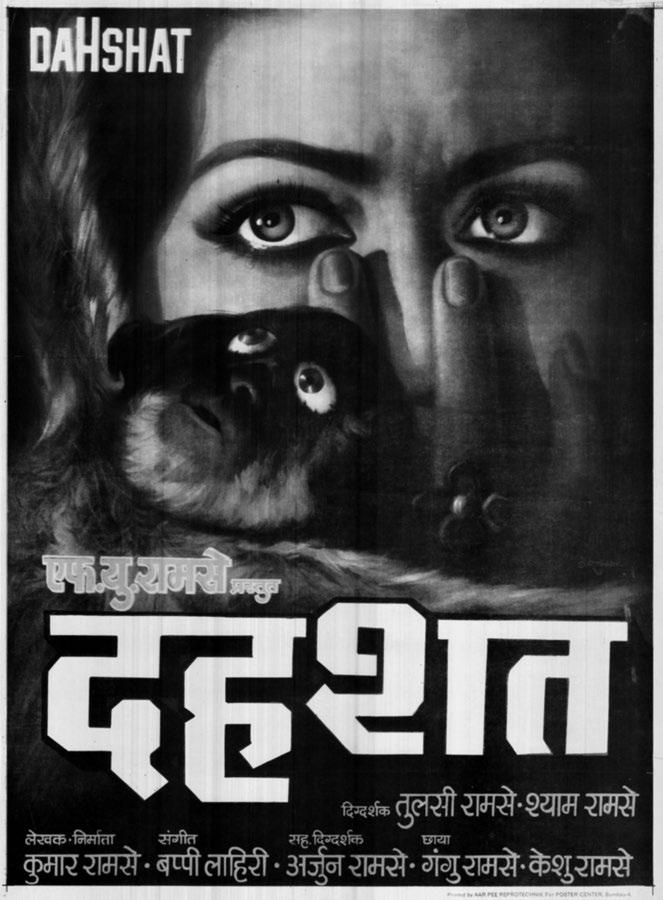
It is a convention of Bombay horror that all strange visions must first be dismissed. Because what they see—a flitting shadow, a reflection in a mirror, a face in the window—pressures the limits of temporal and spatial presence, the protagonists of Bombay horror must weather a duration of uncertainty in which friends, family, and the film’s viewers wonder if they are in the grip of a vehem (superstition), sapna (dream), or paagalpan (madness). But they persist, trying to close the gap between what they have seen and what they can say about it (see figure 3). For the heroines of horror films, as Bliss Cua Lim has written, space turns out to be a “spectral surface of only limited opacity, behind which other times and places are poignantly apparent.”2 Slowly, seeing gives way to doing: examining old photographs, asking questions, and undertaking journeys. When they return to the site of haunting with aging witnesses, yellowing newspapers, or just a sledgehammer, their progressive investment in the past pays off with a public
Figure 2. Daylit hills: detail from Bandh Darwaza (1990). Source: Ramsay Pictures.
Figure 3. Seeing with the visionary heroines of Bombay horror (
Source: Author’s collection.
Dahshat, 1981).
exhumation of something buried: hidden acts of violation, murder, and dismemberment so traumatic they spawned ghosts to possess the present. This book follows the intrepid ghost hunters and paranormal mediums of horror films. Ghost stories have something to teach historians: to “see the past in the shape of something odd” and “stake their historical claims on it.”3 The failures of Bombay horror are reminders and remainders of the mundane resources from which the fantastic was secured onscreen. Seeing Things reads failures as historiographic clues—to the conditions in which the films were once made, censored, and seen—and as aesthetic cues—in my experience of horrific story worlds. What I call the spectral materialities of Bombay horror are both sensuous and significant, because they mark the spectral presence of cinema’s material pasts at the scene of horror. Like the phantom in Jadu Tona (Black magic, Ravikant Nagaich, 1978) or the living corpse in Khooni Panja (Killer claw, Vinod Talwar, 1991), the spectral materialities of Bombay horror too exist at the edges of ordinary perception and encourage imaginative explanations of their origins. The ghosts I hunt in this book thrive in the corners of frames and lurk between reels: a man is seen crouched above a monster’s lair, positioning a spotlight, or an inexplicable jump cut suddenly reorders the lair’s layout. Seeing things in scenes of horror reveals that creators of the films reused latex masks and props till they fell apart, that state censors destroyed some images entirely while mangling others visibly, and that viewers handled the films as junk prints and worn-out videocassette copies. In this way, Seeing Things tracks the felt physicality that informs the genre’s globally familiar conventions and gives visceral force to our experience of horror’s possessed bodies, gothic landscapes, and graphic violence. Combining close analysis with extensive archival research and original interviews, the book reveals the material histories encrypted within the genre’s spectral visions. Following Priya Jaikumar’s suggestion to read visual space as sites “where histories reside,” Seeing Things brings into view the tactile practices of production, regulation, and circulation that have shaped the world’s largest film culture.4
Bo MBA y h orror
By 1980, India was the largest producer of films in the world: approximately 1,000 films were released that year alone, among them 150 from
the Bombay film industry. In a “vast country like India, where 80 percent of the population cannot even read,” declared a government report, cinema exerts an “exceptionally powerful hold on the Indian public.”5 Yet the report noted that cinema “continues to be treated almost as a subculture” by members of the cultural intelligentsia, critics in the quality press, and the state.6 The report was prepared in the shadow of Sholay (Embers, Ramesh Sippy, 1975), an exhilarating, big-budget revenge picture. By the time the report was published in 1980, the film had become the biggest hit in the history of Indian cinema. Audiences returned for multiple viewings, memorizing lines of dialogue, the lyrics of its songs, and body language of its stars. In the wake of Sholay’s success, the production of “masala” genre films exploded. Aiming to replicate Sholay’s canny combination of a familiar menu—action, romance, comedy, and song and dance—with conventions of the Western, these producers found success repackaging other globally circulating genres in films like the spy thriller Agent Vinod (Deepak Bahry, 1977), the dance film Disco Dancer (Babbar Subhash, 1982), and the gangster film Parinda (Bird, Vidhu Vinod Chopra, 1989).
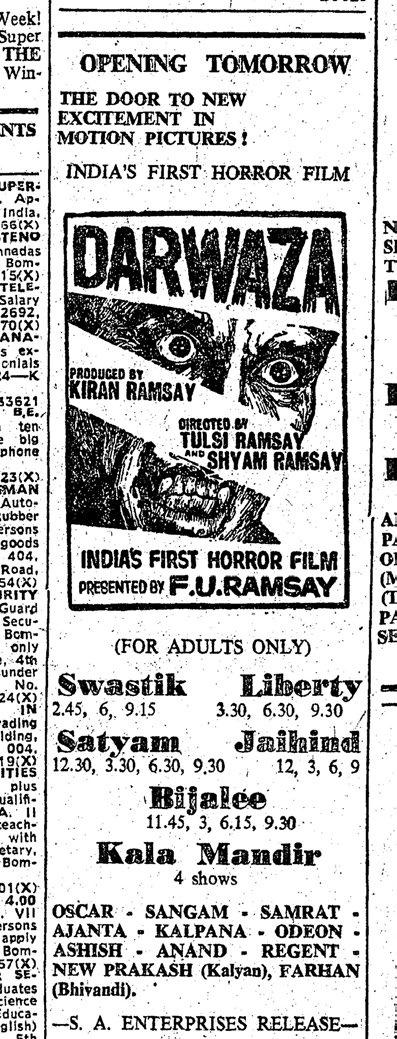
Advertised as “India’s First Horror Film” (see figure 4), Darwaza (Door, Shyam and Tulsi Ramsay, 1978) begins when a cruel thakur (baron) murders a peasant devotee of the goddess Kali for fomenting resistance to his exploitative regime. Setting the young man on fire before the droughtstricken farmers whose crop he commands, the baron’s cruelty in turn draws a curse from the martyr’s mother: “Oh, Thakur, the way you’ve set my child on fire, I wish extinction on your family!” The curse cast by a powerless woman haunts the baron’s son. As he comes of age, the son has nightmares of a woman’s wail, a cobwebbed cave, of lightning striking in the dead of night—all beckoning him to return to the maw of ancestral violence and open the haveli (mansion) door behind which a cursed monster lurks.
That ancestral haveli supplies Darwaza’s opening shot: an establishing view of the mansion at night. The shot draws me in to the here and now of its storyworld (this house, this night) but it is also an opening into other times. In films such as Bombay Talkies’s Mahal (Palace, Kamal Amrohi, 1949), Madhumati (Bimal Roy, 1958), Kohraa (Fog, Biren Nag, 1964), and Woh Kaun Thi? (Who was she?, Raj Khosla, 1964), protagonists and viewers were likewise lured to rural mansions. Through sensuous sound
Figure 4. Publicity for Darwaza (1978). Source: Times of India, 23 February 1978.
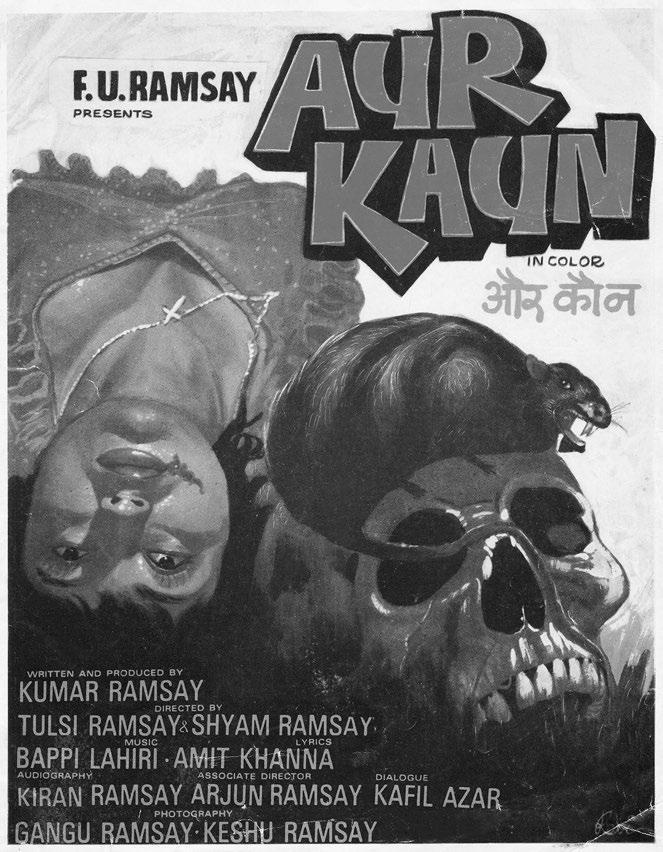
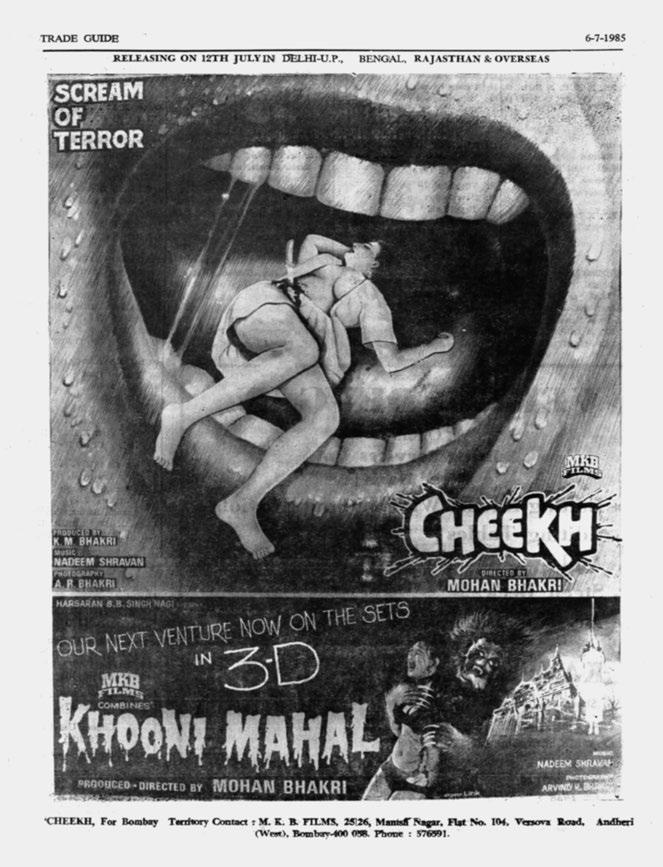
and gorgeous black- and- white photography, such films exercised the “mesmeric lure of the ghost story.”7 Pulled into the gravitational orbit of a lush and decrepit haveli, the viewer accompanied the hero on a journey back to a placeless, timeless world of curses, cobwebs, shadows, and siren songs. Darwaza’s establishing shot is thus a generic image of the past, an unremembered memory of gothic thrillers made during the “golden age” of Bombay cinema. While in the older films monsters and ghosts were usually revealed as actors, plots and illusions staged to avenge crimes of violence and greed committed in the haveli long ago, similar misdeeds unleash a very real monster in Darwaza. With an opening shot that sweeps us (back) into the haveli, this time in color—where a blood-red chandelier sways above and a claw-footed monster roams below—Dar waza is better understood as the first horror film for a new generation of moviegoers. Darwaza was quickly followed by Haiwan (Monster, Ram Rano, 1978), Jadu Tona, Aur Kaun (Who else?, 1979, Shyam and Tulsi Ramsay; see figure 5), and Jaani Dushman (Mortal enemy, Rajkumar Kohli, 1979). The Ramsay Brothers gained early control of the theatrical market with loyal distributors and exhibitors, but viable competitors arose after their box office smash Purana Mandir (Old temple, Shyam and Tulsi Ramsay, 1984): director-producers like Mohan Bhakri, starting with Cheekh (Scream, 1985), and Vinod Talwar, with Raat Ke Andhere Mein (In the dark of the night, 1987). An issue of the industry periodical Trade Guide from 1985 indicates the frenzied rate of production: full-page advertisements for Saamri, a sequel to Purana Mandir (“From the Only Genuine Makers of Horror Films in India”) jostle with notices for Joginder Shelly’s Pyasa Shaitan (Thirsty demon) and Mohan Bhakri’s Cheekh and Khooni Mahal (Bloody palace)—“Our Next Venture Now on the Sets,” declares an advertisement for the latter film (see figure 6).8
Despite the intensity of audience interest, the longevity of the genre was uncertain. Every year may have brought a film advertised as “The Final Horror,” as was the case with 1985’s Tahkhana (Dungeon, Shyam and Tulsi Ramsay).9 In a 1987 article, Filmfare wryly commented on the “fast-multiplying clan of Ramsays,” a school of producers adept at imitating the “Ramsay Brothers’ time-worn strategy of scaring people for a fast buck.” 10 Saat Saal Baad (Seven years later, S. U. Syed, 1987) was followed in 1988 by Bees Saal Baad (Twenty years later, Rajkumar Kohli), and in
Figure 5. Song booklet for Aur Kaun (1979), an early entry in the Bombay horror cycle. Source: National Film Archive of India, Pune.
Figure 6. “Our Next Venture Now on the Sets”: horror booms in the mid-1980s.
Source: Trade Guide, 6 July 1985.
1989 by Sau Saal Baad (Hundred years later, Mohan Bhakri). Perhaps predictably, audience appetite was depleted by film after film, and the life of the genre began to resemble a cycle that could be “financially viable for only five to ten years.”11 The end of Bombay horror was coming, with films like the prophetically titled Aakhri Cheekh (The last scream, 1991, Kiran Ramsay). Talwar and Bhakri moved out of horror films, while a few of the Ramsay Brothers parlayed their film career into a move to television. On the Zee Horror Show (1993–97), Shyam and Tulsi Ramsay reused many of the same props and locations first seen in their films and devised multiepisode narratives that resembled their films. Gangu Ramsay, who had served as cinematographer on Bandh Darwaza, took his skills outside the family studio, while Kiran Ramsay became a significant sound designer of the 1990s.
Between Darwaza and Bandh Darwaza, approximately fifty horror films were made in Bombay. These were, effectively, what the horror film was in 1980s India. The most successful of them shared thematic, stylistic, and narrative characteristics. At the source of haunting lies a decadent feudal order, at the top of which sits a thakur. The depredations of this land-owning caste are visited upon helpless peasants and young village women in the film’s prologue and reverberate down the thakur’s family line and follow it to the city. In returning to the ancestral palace, the horror hero explicitly acknowledges the sins of his father. By vanquishing whatever cave-dwelling monster or black magic the thakur’s misdeeds caused to exist, our hero also clears cobwebs and renews the feudal order. Benign yet righteously violent climaxes follow, in which a monster is fatally pierced with a holy trishul (trident) or a chudail (witch) is hanged in the village square. These conventions recur in many of the films, though there are significant variations: in the bloody slasher film Jaani Dushman, a werewolf kills women in a mountain valley; in Cheekh, a gloved serial killer attacks while heroes and heroines shimmy at the discotheque; in Kabrastan (Graveyard, Mohan Bhakri, 1988), a television screen and a Sony Walkman beam messages from the beyond, eventually possessing the body of their user.
The horror film’s “countless scenes of violence, cruelty and horror,” the state-run censor board once warned, “would offend the sensibilities of an average citizen.”12 As Bombay’s first horror films were reaching their
audiences, the Ministry of Information and Broadcasting revised the censorship code for the first time in almost two decades; a new category, “scenes of horror,” moved to the proscriptive fore. Many horror films were “banned,” or refused clearance to release; others were released with disclaimers appended about the fictionality of ghosts and monsters. Along with the 1980s’ cycle of rape-revenge thrillers such as Insaf Ka Tarazu (The scales of justice, B. R. Chopra, 1980) and Zakhmi Aurat (Wounded woman, Avtar Bhogal, 1988), the horror film was one of the most surveilled genres at the Bombay office of the censor board.
The veteran film critic Khalid Mohammed decried how strictly horror films were being regulated. The censors, he wrote, “evidently do not care a whit about the new concerns or the shifting styles of international cinema. To them, horror is dirty business. And that’s it.”13 “What do they expect?”
Mohammed asked exasperatedly. “A song by the lakeside or mealymouthed sermons in the tradition of Rajshri Pictures?”14 Like the Ramsay Brothers, Rajshri Pictures was a family-run studio that had been commissioning thrifty genre films: the spy film Agent Vinod, the religious devotional film Gopal Krishna (Vijay Sharma, 1979), and the domestic drama Saaransh (Gist, Mahesh Bhatt, 1984). By the end of the 1980s, however, the studio was responsible for what became the highest-grossing release of the decade: the romantic melodrama Maine Pyar Kiya (I have loved, 1989, Sooraj Barjatya). The film’s gargantuan success predicted an array of expensive song-and-dance spectaculars centered on family, love, and marriage, such as Hum Aapke Hain Koun! (Who am I to you?, Sooraj Barjatya, 1994) and Dilwale Dulhania Le Jayenge (The braveheart will take the bride, Aditya Chopra, 1995). Like these films, Bombay’s horror films too featured lakeside songs and sermons, but privileged the disruptive shocks and unsettling ambience afforded by horror. In Saat Saal Baad, for example, the lake is where the film’s undead killer surfaces from, upturning boats and dragging victims down with him.
The final victim in Saat Saal Baad was played by Sharmila Tagore, now past her reign as the darling of Bombay romances of the 1960s, and almost three decades after she debuted in Satyajit Ray’s Apur Sansar (Apu’s World, 1959). At the peak of Bombay horror’s popularity, marquee names appeared in the films. Mithun Chakraborty starred in Bees Saal Baad in 1988, by which time his Disco Dancer had outstripped Sholay to become
the highest grossing Indian film of all time, setting box office records in the Soviet Union and China. But Chakraborty and Tagore were outliers in a genre that was minting its own stars. The pinup-friendly Hemant Birje, who had a buff start in Adventures of Tarzan (Babbar Subhash, 1985), was a principal in the Ramsays’ Veerana and Tahkhana, as well as Bhakri’s Kabrastan and Sau Saal Baad. Tina Ghai was cast in Veerana, Sau Saal Baad, and then Khooni Murda (Killer corpse, Mohan Bhakri, 1989), in which her head is smashed into a television screen by the ghost of a serial killer. Madhu Malhotra acted in Cheekh and the Ramsays’ Telephone (1985) after she appeared in Pyasa Shaitan, in the opening minutes of which she is trapped in the woods and raped by the vines of a demonic tree.
These images might recall memories of other 1980s horror movies like Evil Dead (Sam Raimi, 1981), Friday the 13th (Sean Cunningham, 1981), and Nightmare on Elm Street: Dream Warriors (Chuck Russell, 1987). Bombay horror had little investment in producing a folk form; instead, filmmakers deliberately alluded to other horror films from Bombay and around the world, alternately paying tribute to or subtly undermining their contemporaries and competition. Bandh Darwaza, for example, limns a “visual genealogy of transnationalism,” evoking vampire films shot in and around Berlin, Los Angeles, London, Rome, Lahore, and Mexico City over the decades.15 These films span the canon of horror, from foundational texts such as the German expressionist Nosferatu (F. W Murnau, 1922) and Hollywood studio film Dracula (Tod Browning, 1931) to the British Horror of Dracula (Terence Fisher, 1958), Italian Mask of Satan (Mario Bava, 1960), Pakistani Zinda Laash (Living corpse, Khwaja Sarfraz, 1967), and Mexican Alucarda (Juan López Moctezuma, 1977). Writing about the “semiotic osmosis” of Bandh Darwaza, Usha Iyer has noted how the film blends the global trappings of the cinematic vampire with Indian cinema’s popular iconography of tantrism.16 Tulsi Ramsay himself made no secret of having watched videotape after videotape for “ideas aur gadgets” (“ideas and gadgets”), in the process ensuring that Bombay’s horror films blended repetition and variation in the way that audiences of genre films enjoy.17
Yet the charge of plagiarism aggressively stalked the films, and film critics and industry insiders have long referred to Bombay horror as “spurious desi by-products,” “second-hand imitations,” and “ bad copies” of
foreign horror films.18 In fact, the films are reminders that the horror film was different things in different places at different times. Bombay horror generates the states of fear, anxiety, and disgust associated with horror but also induces the pathos of melodrama, the amorousness of romance, and the levity of comedy—it moves viewers through a cycle of feelings over two hours in which horror is produced by juxtaposition. Bandh Darwaza features a bloodthirsty vampire, but also other attractions: action, such as when the hero comes to fisticuffs with the vampire’s henchmen; song-and-dance romance, such as the number “Bheega Bheega Mausam Tadpaye”; and slapstick comedy, courtesy of the house servant, played by Johnny Lever. Such combinations could leave viewers cold or confused. A “veritable hotchpotch in search of a genre” is how a critic in the trade journal Screen dismissed Purana Mandir in 1984.19 But an essay published the following year in a different Screen might have helped the critic make sense of what they saw.
In her 1985 essay, “Indian Cinema: Pleasures and Popularity,” in the academic journal of film studies Screen, Rosie Thomas focused on the flexible assemblage of masala films, which she cautioned made “Hollywood genre classification quite inappropriate to Hindi cinema.”20 Arguing that a carefully “ordered succession of modes of affect” constitutes masala cinema, Thomas helped lay the foundation of Indian film studies as an academic subfield.21 Since then, scholars seeking to understand what makes Indian popular cinema distinctive have historicized, contextualized, and theorized its “interrupted,” “omnibus,” and “disaggregated” format as a meaningful and pleasurable mélange born of South Asian performance traditions, financial speculation, and state imperatives. 22 “Horror appeared late in the history of Indian cinema, and when it did so,” writes Sangita Gopal, “it was not as a full-blown genre but as a variation on the dominant masala format.”23
As Bombay horror, Gopal concludes, horror was “incomplete,” the genre not yet having “found its true form” in Hindi cinema.24 That “true form,” she suggests, arrived in the 1990s with “new horror,” beginning with Raat (Night, Ram Gopal Varma, 1991): the performance of an international style of horror addressed to a cosmopolitan consumer class in India’s rapidly transforming cities.25 Ditching song-and-dance routines while adopting digital special effects, new horror films of the 1990s and afterward target
audiences in upscale multiplex theaters: ghosts haunt cellphone screens and chic apartments, surfacing “anxieties buried in the delirium of middleclass consumerism, globalization, and the new media sensorium.”26 The gentrification of horror continues into the contemporary era, with landmarks extending from the theatrical hit Bhoot (Ghost, Ram Gopal Varma, 2003) to Bulbbul (Songbird, Anvita Dutt, 2020), a glossy horror film produced and distributed globally by the streaming service Netflix.
In other parts of the internet, something else brews. A “wave of cinephiliac B-movie desire has erupted across social media platforms,” writes Vibhushan Subba, in which the “universe of the low-budget Bombay film runs silent, runs deep.”27 Viewers are discovering what Bombay cinema once was (and could still be): “avenging amazons in leopard print leotards,” “wild jungle fantasies with stuffed tigers,” “violated men in cheap Halloween costumes,” and “draculas with Styrofoam wings.”28 Where the films are lost, posters, song booklets, and other “scraps” of films like the sea monster movie Gogola (Balwant Dave, 1966) have become collector’s items.29 The fascination is shared by film scholars, who are publishing “revisionist historiographies” of Bombay cinema’s first century.30 Stunt films of the 1920s, 1930s magic films, 1940s adventure films, 1960s wrestling films, and 1970s devotional films—these genres, their makers, and their audiences are indications of diverse histories missed by a focus on the respectable genres of the mythological, the social, or the family melodrama.31 The academic study of Indian popular cinema has been visibly remade by an inverted “axis of taste,” in which “cinematic value” and “scholarly value” are reciprocally related: “the lower-brow the object” from Bombay cinema’s past, the “more interesting it is as an object of study” for film scholars working across institutional and geographical locations.32 Horror films too help expose the hierarchies of taste, which regulate the ranks of the respectable genres of Bombay film history.
Seeing Things focuses on films that have been eclipsed in the industrial, journalistic, and scholarly focus on Bollywood—a big-budget, star-driven cinema of song-and-dance spec tacle in frictionless circulation around the world. Bombay cinema of the 1980s remains, in Tejaswini Ganti’s words, “emblematic of Hindi cinema’s uncool past.”33 During her interviews with filmmakers in the Bombay film industry of the 1990s and after, Ganti observed the persistence of a discourse that figured the 1980s as “a