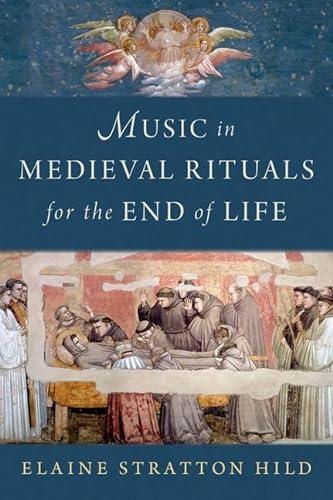
Music in Medieval Rituals for the End of Life
ELAINE STRATTON HILD
Oxford University Press is a department of the University of Oxford. It furthers the University’s objective of excellence in research, scholarship, and education by publishing worldwide. Oxford is a registered trade mark of Oxford University Press in the UK and certain other countries.
Published in the United States of America by Oxford University Press 198 Madison Avenue, New York, NY 10016, United States of America.
© Oxford University Press 2024
All rights reserved. No part of this publication may be reproduced, stored in a retrieval system, or transmitted, in any form or by any means, without the prior permission in writing of Oxford University Press, or as expressly permitted by law, by license, or under terms agreed with the appropriate reproduction rights organization. Inquiries concerning reproduction outside the scope of the above should be sent to the Rights Department, Oxford University Press, at the address above.
You must not circulate this work in any other form and you must impose this same condition on any acquirer.
Library of Congress Cataloging-in-Publication Data
Names: Hild, Elaine Stratton, author.
Title: Music in medieval rituals for the end of life / Elaine Stratton Hild. Description: [First edition]. | New York, NY : Oxford University Press, 2024. | Includes bibliographical references and index.
Identifiers: LCCN 2023042133 (print) | LCCN 2023042134 (ebook) | ISBN 9780197685914 (hardback) | ISBN 9780197685921 (epub) | ISBN 9780197685938 (ebook) | ISBN 9780197685945 (ebook)
Subjects: LCSH: Gregorian chants—History and criticism. | Death—Religious aspects—Christianity—History—To 1500. | Death—Social aspects—Europe—History—To 1500. | Funeral rites and ceremonies, Medieval—Europe—History.
Classification: LCC ML3082 .H52 2023 (print) | LCC ML3082 (ebook) | DDC 781.5/880902—dc23/eng/20230922
LC record available at https://lccn.loc.gov/2023042133
LC ebook record available at https://lccn.loc.gov/2023042134
DOI: 10.1093/oso/9780197685914.001.0001
Printed by Integrated Books International, United States of America
The Press is grateful to Notengrafik Berlin for the creation of custom music examples for this book.
Images of Biblioteca Apostolica Vaticana, Arch. Cap. S. Pietro F 11 pt. A are reproduced by permission of the Vatican Apostolic Library, all rights reserved.
for Florian
Contents
Acknowledgments ix
Editorial Symbols Used in Music Transcriptions xi
Introduction: Contemporary Approaches to Medieval Rituals for the Dying 1
1. Religious Elites: Rome, “Old Roman” Tradition 14
Manuscript Source: Vatican, Biblioteca Apostolica Vaticana, Arch. Cap. S. Pietro F 11 pt. A (SP F 11)
2. Political and Religious Leaders: Sens, Cathedral of Saint Stephen 59
Manuscript Source: Paris, Bibliothèque nationale de France, lat. 934 (Paris 934)
3. With the Laity: Orsières, Switzerland 83
Manuscript Source: Bourg-Saint-Pierre, Hospice du Grand-Saint-B ernard, ms. 3 (ancien 10091) (GSB 3)
4. Among Women: Abbey of Saint Mary the Virgin and Saint Francis without Aldgate (England) 110
Manuscript Source: Reigate (Surrey), Parish Church of St Mary Magdalene, Cranston Library, Ms. 2322 (Cranston 2322)
5. Analysis: Variation and Continuity within the Liturgical Tradition
Final Considerations: Why Sing?
Acknowledgments
Undertaking this research project has been possible because of the eleven years (and counting) that I have been a part of Corpus monodicum, a longterm scholarly program housed at the Universität Würzburg and dedicated to producing editions of previously unpublished medieval plainchant. It has been a privilege to learn the intricacies of medieval notations and scribal practices from leading scholars and from countless hours working with medieval manuscripts. My gratitude goes to my colleagues and mentors, most particularly Wulf Arlt, Charles Atkinson, Gunilla Björkvall, David Catalunya, Andreas Haug, Felix Heinzer, Gunilla Iversen, Ritva Maria Jacobsson, Isabel Kraft, Lori Kruckenberg, Michael Norton, Nils Holger Petersen, Andreas Pfisterer, Susan Rankin, Konstantin Voigt, and Hanna Zühlke, for the standards you have modeled and the collegial co-learning.
Completing this research project has been possible because of the support I received from the University of Notre Dame’s Institute for Advanced Study, including the institute’s leadership—Brad Gregory, Carolyn Sherman, and Donald Stelluto—as well as Harvey Brown, J. Patout Burns, Eric Chaisson, Francis X. Clooney, Xinyu Dong, Daniel Hinshaw, Luc Jaeger, Jarek Jankowski, Robin Jensen, Claire Taylor Jones, Henrike Lange, Yutong Liu, Janice Gunther Martin, Tom McLeish, and Finola Prendergast. During my semester in residence, the wider Notre Dame community provided a rich environment for study and conversation, and I am thankful to Lacey Ahern, Kimberly Belcher, Philip Bess, Jeffrey Bishop, Calvin Bower, Thomas Burman, Michael Driscoll, Margot Fassler, Jonathan Hehn, Daniel and Halle Hobbins, Peter Jeffery, Patrick Kronner, Stephen Little, Timothy O’Malley, Andrea Riedl, Artur Rosman, and Julia Schneider for their insights and encouragement.
This publication has benefited from presentations and discussions in several additional academic communities: North American Academy of Liturgy, particularly the Issues in Medieval Liturgy Seminar; Kenyon College, with Benjamin Locke and Lucy Barnhouse; IMS study group Cantus planus meeting in Växjö, Sweden, with Joseph Dyer, Luisa Nardini, and Rebecca Maloy; University of Saint Thomas (Houston), with Randall Smith and Tamara
Nicholl-Smith; Loveland Classical Schools, with Ian Stout, Rebecca FaustFrodl, and Timothy Smith; Universität Freiburg, with Konstantin Voigt, Janine Droese, and Konrad Küster; Colorado State University, with Joel Bacon; the University of Colorado at Boulder, during Patrick Geary’s visit and lecture; and in my own neighborhood, during long walks with the evercurious and thoughtful Tobias Hild.
Katarina Ster, Lori Jones, and Nükhet Varlık supported my initial publications on medieval liturgies for the dying with their editorial guidance. I am also indebted to Miklós István Földváry (Eötvös Loránd University, Budapest) for generously allowing use of the Usuarium database to locate manuscript sources. Timothy Smith offered expert feedback on Latin translations, and my invaluable colleague Andreas Pfisterer reviewed the book’s music transcriptions and appendix. The music transcriptions were typeset by Thomas Weber of Notengrafik Berlin using customized engraving software.
Manuscript images and permissions were provided by Biblioteca Apostolica Vaticana, Bibliothèque nationale de France, and Jean-Pierre Voutaz of the Archives du Gd-St-Bernard (facilitated by Alexis Deforge and Bryan Smith). I am also indebted to Anne Bagnall Yardley for facilitating access to images of the Cranston 2322 manuscript.
Norman Hirschy and Rachel Ruisard of Oxford University Press have offered skillful and timely editorial support, and I am also grateful to the anonymous reviewers of this book’s earlier drafts. Their careful readings and thorough responses greatly improved the work.
Unfailing encouragement and good guidance from my academic mentors, Rebecca Maloy and Elissa Guralnick, and friends and family members Florian and Tobias Hild, Bryan and Allyson Smith, Arlene Seeber, Timothy and Delia Smith and Kathryn Harrison, John and Dorothy Stratton, and Catherine Stratton Treadway have nurtured the project from beginning to end.
My sincerest thanks and gratitude to each of you.
Introduction
Contemporary Approaches to Medieval Rituals for the Dying
“We study the past for the ways it can shock us.”1 Caroline Walker Bynum’s words resonate as I remember the beginnings of this research project. Shock—even disbelief—formed my first reaction when I learned of the medieval practice of singing for a person at the moment of death. The contrast with our contemporary end-of-life care, with its focus on technology, medications, and medical professionals, amazed me.
Yet extant manuscripts reveal clearly that for centuries of European history, a sung liturgy was considered the exemplary accompaniment to a life’s ending.2 Rituals for the dying were well developed, practiced widely, and thoroughly integrated with music. Indeed, through these rituals, music held a privileged position at the time of death. Melody was, ideally, the final sensation of a human life. It is this music—the chants intended to accompany the final agony and the final breath—that forms the subject of the following study. Through detailed investigations of liturgical manuscripts, this book examines and recovers, to the extent possible, the music sung at the end of an individual’s life during the Middle Ages.
1 “[W]e study the past for the ways it can shock us into diagnosing what is oddest, most perplexing, and yet most glorious and enduring in our own situation,” Caroline Walker Bynum, The Resurrection of the Body in Western Christianity, 200–1336 (New York: Columbia University Press, 2019), xxvii.
2 I use the term “liturgy” as is common in musicological scholarship: to indicate a series of items (often prayers, chants, and gestures) conducted or “performed” as a religious ceremony. The term “liturgy” implies both a prescription by an institutional authority and an expectation that the items will be performed in a largely predetermined way. As Dyer puts it: “approved by competent ecclesiastical authorities, international, national, or local” and with “a certain level of structural or verbal fixity” (Joseph Dyer, Kenneth Levy, and Dimitri Conomos, “Liturgy and Liturgical Books,” in Oxford Music Online: Grove Music Online [2001], https://www-oxfordmusiconline-com.proxy.library. nd.edu/grovemusic/). Booth and Tingle offer additional, succinct terminology to describe end-oflife liturgies: “the institutional framework established for the consolation of the dying.” Philip Booth and Elizabeth C. Tingle, eds., A Companion to Death, Burial, and Remembrance in Late Medieval and Early Modern Europe, c. 1300–1700 (Leiden: Brill, 2021), 2.
Music in Medieval Rituals for the End of Life. Elaine Stratton Hild, Oxford University Press. © Oxford University Press 2024. DOI: 10.1093/oso/9780197685914.003.0001
Medieval deathbed liturgies have been the subject of academic research, but previous publications have focused on aspects of the rituals apart from their music. Fundamental questions remain. Which melodies were sung at the time of death? Were these chants taken from other liturgies, or did they form a unique repertory, created specifically for the end of life? To what extent did the people of different geographic areas and religious institutions maintain their own, “local” versions of deathbed rituals and chants? Amid the diversity of rituals for the dying evident in medieval manuscripts, one commonality is the use of song. Why was music given such a prominent position within these liturgies? What functions did the chants perform? In other words: why did communities gather and sing when a loved one was dying?
The robust, high-quality corpus of scholarship on the rituals’ texts enables this study of their music. Frederick Paxton’s pivotal publication Christianizing Death traces the development of European deathbed rites from late Antiquity through the Carolingian era, when their overall structures became largely fixed.3 His work reveals significant innovations that occurred during the late eighth and ninth centuries in Frankish regions. Damien Sicard examined rituals in 139 manuscript sources, documenting the transmission patterns of individual prayers and chant texts and assessing the likelihood of their Roman origins.4 Andrieu’s earlier edition of a medieval rite for the death of an individual (which he termed Ordo XLIX) provided an important impulse for Sicard’s work.5 The extensive source base used by Sicard (which includes manuscripts from religious institutions and orders throughout Western Europe, dating into the seventeenth century) reveals the geographic breadth and longevity of the liturgical tradition. Early sources without music notation containing liturgical material for an individual’s death have been edited by Férotin, Chavasse, Mohlberg, Frank, Deshusses, Dumas, and Heiming, among others.6 (Most of these early sources are sacramentaries; some are
3 Frederick S. Paxton, Christianizing Death: The Creation of a Ritual Process in Early Medieval Europe (Ithaca, NY: Cornell University Press, 1990).
4 Damien Sicard, La liturgie de la mort dans l’église latine des origines à la réforme carolingienne (Münster, Westfalen: Aschendorffsche Verlagsbuchhandlung, 1978).
5 Michel Andrieu, Les Ordines Romani du haut moyen âge: Les Textes; Ordines XXXV–XLIX (Louvain: Spicilegium Sacrum Lovaniense, 1956), 523–530. Andrieu edited Ordo XLIX from the eleventh-century manuscript Vatican, Biblioteca Apostolica Vaticana, Ott. lat. 312 (hereafter referred to as Vatican 312).
6 Paxton provides a bibliography of editions of these early sources in Christianizing Death, 211–213. Some of the most significant are: Marius Férotin, ed., Le liber ordinum en usage dans l’église wisigothique et mozarabe d’Espagne du cinquième au onzième siècle (Rome: Centro Liturgico Vincenziano Edizioni Liturgiche, 1996); Antoine Chavasse, ed., La Sacramentaire Gélasien (Vaticanus Reginensis 316): sacramentaire presbytéral en usage dans les titres romains au VIIe siècle (Tournai: Desclée, 1958); Leo Cunibert Mohlberg, ed., Liber sacramentorum romanae aeclesiae
fragmentary libelli.) Van Dijk’s work establishes the earliest versions of the deathbed rituals of the Franciscan Order, and Donohue considers several medieval rites as sources for the ritual published by the Roman Catholic Church in the early 1980s.7 Most recently, Paxton has produced an edition and in-depth analysis of the medieval rites for the dying from the abbey of Cluny, France, and Susan Boynton has done the same for the abbey of Farfa.8 By identifying manuscript sources and establishing textual readings and transmission patterns, these publications provide a foundation from which to investigate and secure the rituals’ extant melodic content.9
Like many of the contributions cited above, this study limits itself to the European, Christian liturgical tradition that existed prior to the Ars moriendi
ordinis anni circuli (Cod. Vat. Reg. lat. 316/Paris Bibl. Nat. 7193, 41/56; Sacramentarium Gelasianum) (Rome: Casa editrice Herder, 1960); Hieronymus Frank, “Der älteste erhaltene Ordo defunctorum der römischen Liturgie und sein Fortleben in Totenagenden des frühen Mittelalters,” Archiv für Liturgiewissenschaft 7 (1962): 360–415; Jean Deshusses, ed., Le sacramentaire grégorien (Fribourg [CH]: Éditions universitaires, 1971–1982); Antoine Dumas, ed., Liber sacramentorum Gellonensis (Turnhout: Brepols, 1981); and Odilo Heiming, ed., Liber sacramentorum augustodunensis (Turnhout: Brepols, 1984).
7 S. J. P. Van Dijk and J. Hazelden Walker, The Origins of the Modern Roman Liturgy: The Liturgy of the Papal Court and the Franciscan Order in the Thirteenth Century (London: Darton, Longman & Todd, 1960), 280–291. A critical edition of the ritual is provided by: S. J. P. van Dijk, Sources of the Modern Roman Liturgy: The Ordinals by Haymo of Faversham and Related Documents (Leiden: E. J. Brill, 1963), 2:390–392. James Michael Donohue, “The Rite for the Commendation of the Dying in the 1983 Pastoral Care of the Sick: Rites of Anointing and Viaticum: A Study through a Comparison with Its Counterparts in the 1614 Rituale Romanum and in the 1972 editio typica of Ordo unctionis infirmorum eorumque pastoralis curae” (PhD diss., Catholic University of America, 2000).
8 Frederick S. Paxton, “Death by Customary at Eleventh-Century Cluny,” in From Dead of Night to End of Day: The Medieval Customs of Cluny, ed. S. Boynton and I. Cochelin (Turnhout: Brepols, 2005), 297–318; Frederick S. Paxton, The Death Ritual at Cluny in the Central Middle Ages (Turnhout: Brepols, 2013); Susan Boynton, “A Monastic Death Ritual from the Imperial Abbey of Farfa,” Traditio 64 (2009): 57–84; Susan Boynton, Shaping a Monastic Identity: Liturgy & History at the Imperial Abbey of Farfa, 1000–1125 (Ithaca, NY: Cornell University Press, 2006). Paxton’s most recent overview of medieval liturgies for the dying will be published as “Sickness, Death, Burial,” in Brill Handbook of Medieval Latin Liturgy, ed. Daniel DiCenso and Andrew Irving (Leiden: Brill, forthcoming). On the Sarum rite, see J. Wickham Legg, ed., The Sarum Missal: Edited from Three Early Manuscripts (Oxford: Clarendon Press, 1916); Matthew Cheung Salisbury, The Secular Liturgical Office in Late Medieval England (Turnhout: Brepols, 2015); and Madeleine Gray, “Deathbed and Burial Rituals in Late Medieval Catholic Europe,” in A Companion to Death, Burial, and Remembrance in Late Medieval and Early Modern Europe, c. 1300–1700, ed. Philip Booth and Elizabeth C. Tingle (Leiden: Brill, 2021), 106–131. Osten-Hoschek has completed a new study on the Dominican rites for the dying: Andrea Osten-Hoschek, Reform und Liturgie im Nürnberger Katharinenkloster: Die Sterbeund Begräbnisliturgie des 15. Jahrhunderts; Edition und Kommentar (Berlin: De Gruyter, 2023).
9 These textual editions and analyses are referenced throughout the following discussions. Research on death and dying in the Middle Ages using other types of source material “has produced an enormous body of scholarship over the last thirty years and remains vigorous” (Booth and Tingle, A Companion to Death, Burial, and Remembrance, 1); these editors provide an extensive overview and evaluation of such scholarship, 3–30. See also Caroline Walker Bynum and Paul Freedman, eds., Last Things: Death and the Apocalypse in the Middle Ages (Philadelphia: University of Pennsylvania Press, 2000), 2–10.
publications of the fifteenth century; prior to the development of rites in vernacular languages prompted by the sixteenth-century reformation; and prior to the publication of the Rituale of 1614 by the Roman Catholic Church, which standardized deathbed liturgies and replaced local versions.10 The liturgical tradition studied in this book is also distinguishable from the meditations on death and the afterlife prescribed by theologians during the Middle Ages.11
One further limitation of this study concerns the amount of material contained in the medieval sources. The manuscripts often present an extended series of items intended for the entirety of a life’s ending: the final agony, death, the washing and preparation of the body, transporting the body to church, the vigil with the body, the funeral Mass, transportation to the grave, and burial, as well as commemorative services. Rubrics frequently coordinate sections of this material to specific moments in the progression from sickbed to grave, but the different sections seem to have been understood as parts of a whole. A single liturgy accompanied the soul from its residence in a human body to its residence in the heavenly community, and this same liturgy guided the human community through the loss of a member and the appropriate handling of the corpse. This study focuses on the liturgical items prescribed specifically for the gathering at the deathbed and the time period immediately following death,12 rather than the services held in the church between death and burial or the items that accompanied the procession to the grave and the burial. The music indicated for this particular use—as an accompaniment to the final moments of life and the first moments after life—is least known in scholarship, having never been the subject of a
10 For a comprehensive examination of the seventeenth-century Roman Catholic version of the rite (as well as the earlier sources from which it drew), see Donohue, “The Rite.”
11 See particularly Mark Chinca, Meditating Death in Medieval and Early Modern Devotional Writing: From Bonaventure to Luther (Oxford: Oxford University Press, 2020).
12 The “rites of separation,” in the terminology developed by Arnold van Gennep and systematically applied to the medieval deathbed rituals of Western Europe by Fredrick Paxton and Paul Binski. Arnold van Gennep, Les rites de passage; étude systématique des rites de la porte et du seuil, de l’hospitalité, de l’adoption, de la grossesse et de l’accouchement, de la naissance, de l’enfance, de la puberté, de l’initiation, de l’ordination, du couronnement des fiancailles et du mariage, des funérailles, des saisons, etc. (Paris: E. Nourry, 1909). Translated as The Rites of Passage (Chicago: University of Chicago Press, 1960). See also Paxton, Christianizing Death, 5–7; and Paul Binski, Medieval Death: Ritual and Representation (Ithaca, NY: Cornell University Press, 1996), particularly 29–30. On the subsequent reception and re-evaluation of van Gennep’s work, see the dedicated issue of the Journal of Classical Sociology, which includes Nicole Hochner, “On Social Rhythm: A Renewed Assessment of Van Gennep’s Rites of Passage,” Journal of Classical Sociology 18, no. 4 (November 2018): 299–312.
dedicated study.13 It also holds special interest, since it fulfilled additional functions than did the music of the Mass, Office, and processions. This music served not only as part of a liturgy, but also as a type of aid to a suffering person and the attending community.
As a musicological project, this study breaks new ground. With good reasons, chant scholars have focused primarily on the music sung at the liturgies of the Mass, Office, and processions. The music sung outside of these liturgies, and the music of liturgies sung outside of church buildings, is largely uncharted territory.14 This book attempts to gain a more comprehensive understanding of the historic deathbed rituals by integrating one of their essential elements—music. But it also brings a previously undiscussed repertory of medieval plainchant into scholarly discourse and provides editions of previously unedited and unanalyzed chants. For these reasons, I hope it provides a beginning for scholarly conversations and an impetus for further studies.
The good reasons that have confined musicologists to the study of the Mass, Office, and processions point to the difficulties of investigating the music in deathbed liturgies. While copious numbers of manuscript sources survive for the Mass, Office, and processional liturgies, the same is not the case for the deathbed rites. These rituals were often recorded in portable, unbound libelli, meant to be carried to the bedsides of the dying. Such documents survive in smaller numbers than bound manuscripts that were housed and protected in churches and libraries. In many instances, particularly with the laity, practices
13 Ottosen investigates related material—the chants of the Office of the Dead—in Knud Ottosen, The Responsories and Versicles of the Latin Office of the Dead (Aarhus, Denmark: Aarhus University Press, 1993); see also Michel Huglo, “Remarques sur les mélodies des répons de l’Office des Morts,” Nordisk Kollokvium IV i Latinsk Liturgiforskning 4 (1978): 118–125. Rutherford offers a comprehensive study of postmortem liturgies: Richard Rutherford, The Death of a Christian: The Rite of Funerals (New York: Pueblo Publishing Company, 1980). See also Karen B. Westerfield Tucker, “Christian Rituals Surrounding Death,” in Life Cycles in Jewish and Christian Worship, ed. Paul F. Bradshaw and Lawrence A. Hoffman (Notre Dame, IN: University of Notre Dame Press, 1996), 196–213. Engels investigates chants in Mass and Office liturgies that deal with the topics of death and the apocalypse: Stefan Engels, “Dies irae, dies illa,” in Krisen, Kriege, Katastrophen, ed. Christain Rohr, Ursula Bieber, and Katharina Zeppezauer-Wachauer (Heidelberg: Universitätsverlag, 2018), 379–460.
14 Exceptions are Richard Rastall’s work on the music of medieval “plays” (The Heaven Singing: Music in Early English Religious Drama I [Cambridge: D. S. Brewer, 1996] and Minstrels Playing: Music in Early English Religious Drama II [Cambridge: D. S. Brewer, 2001]), and the pioneering study on music sung in medieval refectories by Tova Leigh-Choate (“Singing for their Supper: Chant in the Medieval Refectory” [Paper presented at the international conference of Cantus Planus, Dublin, 2–7 August 2016]). Courtly music, sung in the vernacular, has also been a focus of study for medieval musicologists. Two contributions in The Cambridge History of Medieval Music, ed. Mark Everist and Thomas Forrest Kelly (Cambridge: Cambridge University Press, 2018), provide recent surveys of scholarship: Elizabeth Aubrey, “Vernacular Song I: Lyric,” 382–427; and Anne IbosAugé, “Vernacular Song II: Romance,” 428–450.
at the deathbed likely went entirely unrecorded. Surviving documentation of deathbed rites proves to be the exception, not the norm. Three of the four manuscripts used in this study (SP F 11 in Chapter 1, Paris 934 in Chapter 2, and GSB 3 in Chapter 3) preserve the deathbed rites in a book type referred to as a “ritual” (a manuscript containing liturgies performed by a priest away from the altar). The Augustinian canonry of Klosterneuburg recorded its rites for the sick and dying in similar collections.15 The women’s community of Aldgate preserved its deathbed rites in a book intended for the use of a cantrix, the woman responsible for leading liturgical chant. (Manuscript Cranston 2322 is investigated in Chapter 4.) The rites for the sick and dying promulgated by the Franciscan Order were included in breviaries, in order to allow the friars to travel and maintain their own devotions, while also being ready to minister to the needy.16 Convenience for each book’s intended user was likely the motivating impulse for including the deathbed rituals within these manuscripts. But the rituals’ incorporation into larger, bound collections of material also led to their preservation in these instances. Although melody was an essential part of the deathbed rituals, the surviving sources often contain no music notation, or notation that provides only a partial representation of the melodies. These documents tended to be created and notated pragmatically. Scribes generally included only what a celebrant was expected to need in order to conduct the ritual successfully. If the melodies were considered well-known, a scribe did not need to include them. Such documents rarely provide descriptive information for someone unfamiliar with the rituals and their chants. The relatively late development of pitch-specific notation places an additional constraint on the available source material: only with documents created after the mid-eleventh century can one expect to find music notation that indicates the specific pitches of melodies, and is thus transcribable into contemporary notation.17 These conditions greatly reduce the source material available for a study of the
15 Klosterneuburg, Augustiner-Chorherrenstift, Cod. 628, 629, 1022A, and 1022B, examined in Elaine Stratton Hild, “Rites for the Sick and Dying in Sources from Klosterneuburg,” De musica disserenda 14, no. 2 (2018): 7–24.
16 Van Dijk and Donohue connect the innovative book type—a breviary with rites for the sick and dying—with the itinerant ideals and ministries of the Franciscans: “The new combination . . . is typical of the apostolic and itinerant life of the Order” (Van Dijk, Sources, 138). “The Franciscans’ need for a portable Office book in the thirteenth century was the chief reason why the breviary, rather than the missal, became connected with ‘going out’ and the former became the logical book to contain a ritual for the last sacraments” (Donohue, “The Rite,” 201).
17 Rankin provides a history of the development of music writing in Western Europe: Susan Rankin, Writing Sounds in Carolingian Europe: The Invention of Musical Notation (Cambridge: Cambridge University Press, 2018).
deathbed rituals’ music. From a small pool of eligible sources, I have chosen four of the earliest available that represent a diverse range of communities within the liturgical tradition.
Structure of the Book
Close readings of the deathbed rituals in these four manuscripts provide the foundation for the following study. The book is structured to offer a view of a repertory—the chants of the medieval deathbed liturgies—through the sources of individual institutions. The first four chapters thus contain a series of “case studies”: analyses of single rituals, each as it appears in a single source. The rituals’ chants are transcribed into modern notation and analyzed, both for their relationships between text and melody and for their functions within the rituals. Rather than conflating multiple manuscript versions into critical editions, I have chosen to edit chant texts and melodies as they appear in these single sources.18 Each manuscript’s idiosyncrasies of melody and textual orthography are preserved in the transcriptions and discussions. (Standardized spellings are used in discussions of a chant’s broader transmission patterns.) This approach seems necessary and preferable for several reasons. The rituals for the time of death, along with their constituent chants, differ substantially from one another. Even when the same chant text is found in multiple manuscripts, the melodic contents of the different versions vary significantly. Yet each deathbed liturgy, and each chant, functioned as a coherent whole for the scribe who recorded them and the community that used them. Investigating each ritual and chant as an entity in its own right provides the greatest insight into the liturgical ideals—and possibly the liturgical practices—of individual communities.
The deathbed rituals have nothing to do with the precise boundaries separating our contemporary academic disciplines; they fall within the interest and purview of many fields of study. For this reason, I have tried to keep specialized musicological vocabulary to a minimum, without sacrificing the detailed observations necessary for credible argument and insight. Parenthetical comments supply basic definitions for the few musicological
18 In creating a “source edition,” I follow the editorial principles of Corpus monodicum, a longterm research and editorial project housed at the Universität Würzburg (Germany) and sponsored by the Akademie der Wissenschaften und der Literatur, Mainz. A description of the project is available at https://www.musikwissenschaft.uni-wuerzburg.de/forschung/corpus-monodicum/
terms that appear; footnotes cite reference works that can give interested readers more information on musical topics. An appendix at the end of the volume provides a concise overview of each ritual: an inventory of contents, including rubrics, individual items, and the positions where music notation appears.
Each of the sources examined in Chapters 1 to 4 presents a different vantage point from which to observe medieval chants for the dying. Chapter 1 focuses on a manuscript connected with the most elite practitioners of medieval Christianity: Vatican, Biblioteca Apostolica Vaticana, Arch. Cap. S. Pietro F 11 pt. A (SP F 11). The twelfth-century manuscript is considered to be a witness to the “Old Roman” tradition (associated with the most prominent religious institutions in Rome), and it contains a unique ritual. It shares none of its chant melodies and only one of its chant texts with other deathbed liturgies.19
Chapter 2 examines the deathbed ritual in a late twelfth-century manuscript from the cathedral of Sens (Paris 934). It is the earliest manuscript I have found that preserves the melodies for the chants of the Ordo XLIX tradition.20 The chants of this widespread and influential tradition are evident in manuscripts from the late eighth century, but in these older sources, only the chants’ texts were recorded. With its clear, pitch-specific notation, Paris 934 is an important witness to the chants’ melodies.
The manuscript studied in Chapter 3 (GSB 3) contains no music notation with its deathbed ritual, but it provides significant insight into the practices of a lay community far from urban centers. Scholars associate the manuscript with Orsières, a small village located in the Swiss Alps near the pass of GrandSaint-Bernard. Coming from a small, rural community, the manuscript gives substantive evidence for a topic of great interest to historians: whether a gap existed between the religious practices and understandings of elite practitioners (educated clerics and monastics of major religious institutions) and those of the laity (particularly those who were less educated). Manuscript GSB 3 indicates that the practices of the “folk” shared many essentials with the practices of the “elites”: their respective rituals share individual items, images of the afterlife, and tasks for the gathered community.
19 See Chapter 1 for scholars’ considerations on the specific Roman institutions that might have made use of the manuscript. Chapter 5 provides a detailed analysis of the chants’ transmission patterns.
20 The deathbed ritual known in scholarship as Ordo XLIX is discussed in Chapters 2 and 5.
The deathbed ritual from a community of women—the Franciscan convent of Aldgate, England—forms the focus of Chapter 4. Manuscript Cranston 2322 contains a version of the thirteenth-century deathbed ritual promulgated by the Franciscan Order, complete with notated chants. This thirteenth-century Franciscan version became widely known throughout Europe—through the work of the friars—and later served as a source for the seventeenth-century version disseminated by the Roman Catholic Church. Cranston 2322 not only offers a detailed look at this influential ritual, it also provides an opportunity to see the adaptations made to it by a community of women. As contemporary scholars consider instances of autonomy practiced by women in the Middle Ages, the deathbed ritual in Cranston 2322 gives specific, credible insights.
Coming from such diverse communities, the four deathbed rituals studied in this book present an opportunity to observe liturgical similarities and differences among a variety of institutional types and societal groups. Created for the powerful and the poor, the educated and the uneducated, women and men, monastics, clerics, and laity, the rituals in these four manuscripts offer a glimpse into the religious practices that both distinguished communities from one another and bound them together within a single tradition.
Chapter 5 takes a broader analytical perspective, using the material and insights from the four case studies of Chapters 1 to 4 to consider questions that arise when comparing the rituals of individual communities. Did commonalities exist? To what extent did specific geographical areas and institutions maintain their own versions of the deathbed rituals? Conversely, to what extent did standardization occur?
The chapter also uses evidence provided by the musical material to revisit questions that scholars have previously posed to the deathbed rituals. To what extent is it possible to determine the practice (or practices) of the medieval Roman church? Is there a particular ritual (and accompanying chant repertory) that seems to have originated in Rome? Were the chants prescribed in the rituals for the dying borrowed from other liturgies, or were they created specifically for the time of an individual’s death?
Additionally, Chapter 5 considers the ways in which the deathbed rituals intersect with queries of current interest in scholarly discourse. As one example, the rituals allow for investigations into medieval conceptions of the afterlife. In their texts, the deathbed liturgies convey depictions—“imaginative structures”—of the soul’s experiences following the death of the
body.21 Ottosen, in particular, has considered the extent to which sung liturgical texts can be used as sources for understanding the multiple, changing conceptions of the afterlife that existed in the Middle Ages.22 While Ottosen’s work focuses on chant texts in the Office of the Dead, the rituals for the dying also provide insights. As discussed in Chapter 5, this study shows that the chants of the deathbed liturgies continued to convey older, positive images of the afterlife, even when conceptions of purgatory and particular judgment had become widespread.
Furthermore, the chants of the deathbed rites have much to contribute to a topic of perennial interest for musicologists: the relationships between melody and text in medieval plainchant, specifically, the ways in which melodic material articulates sung words.23 Singing is a performance of a text, and a melody tightly controls the manner in which a text is delivered. Musicologists consider which textual aspects a melody orients itself toward and thus, underscores, in performance. As one example, musical settings can articulate individual syllables of words. When a melody emphasizes the syllables typically accented in a spoken performance, it creates a speechlike declamation of a text (promoting its comprehensibility during the sung performance). Melodic elements can also emphasize meaningful groups of words—a text’s syntactic units, such as clauses and sentences. With poetic texts, melodies can articulate aspects of verse structure, such as line endings, rhymes, or internal caesurae. It is also possible for plainchant melodies to
21 The term “imaginative structures” is from Peter Brown, “The Decline of the Empire of God: Amnesty, Penance, and the Afterlife from Late Antiquity to the Middle Ages,” in Last Things: Death and the Apocalypse in the Middle Ages, ed. Caroline Walker Bynum and Paul Freedman (Philadelphia: University of Pennsylvania Press, 2000), 41–59.
22 Ottosen used the texts of responsories and versicles in the Office of the Dead to refine Le Goff’s understanding of the development of the conception of purgatory: Ottosen, Responsories and “Liturgy as a Theological Place: Possibilities and Limitations in Interpreting Liturgical Texts as Seen for Instance in the Office of the Dead,” in Liturgy and the Arts in the Middle Ages, ed. Eva Louise Lillie and Nils Holger Petersen (Copenhagen: Museum Tusculanum Press University of Copenhagen, 1996), 168–180; Jacques Le Goff, La naissance du purgatoire (Paris: Gallimard, 1981), translated as The Birth of Purgatory by Arthur Goldhammer (London: Scolar Press, 1984). Isabel Moreira focuses on earlier sources, particularly from the seventh and eighth centuries, in Heaven’s Purge: Purgation in Late Antiquity (Oxford: Oxford University Press, 2010) and “Visions and the Afterlife,” in The Oxford Handbook of the Merovingian World, ed. Bonnie Effros and Isabel Moreira (New York: Oxford University Press, 2020), 988–1011. See also Bynum and Freedman, Last Things. These collected essays (including Brown’s, cited above) explore the interrelated medieval depictions of the experiences of the soul after an individual’s death, the collective resurrection of bodies, and apocalyptic end times.
23 This topic has stimulated research for generations of plainchant scholars and has produced a body of publications too extensive to cite here. Please see DiCenso for a recent literature review and a thoughtful analysis of scholarly tendencies: Daniel J. DiCenso, “Moved by Music: Problems in Approaching Emotional Expression in Gregorian Chant,” in Emotion and Medieval Textual Media, ed. Mary C. Flannery (Turnhout: Brepols, 2018), 19–50.
orient themselves toward the semantic contents of words. A melody can even create a “mimetic” relationship by sonically imitating an aspect of a textual image. (This is sometimes referred to as “word painting.”)
Indeed, the musical layer of a chant forms a dynamic and prominent element that decisively influences a text’s performance, including which words, images, and ideas are emphasized. Musical settings have multiple ways of creating emphasis:
1. The number of pitches conveying syllables. If a syllable is conveyed with multiple pitches, while the surrounding syllables are conveyed with single pitches, the syllable sung with multiple pitches gains prominence in performance. (The term melisma refers to the multiple pitches that convey a single syllable.)
2. Melodic movement. The progressions between notes (technically termed intervals) can consist of steps or leaps, and leaps—particularly large ones—are attention-getters in performance, emphasizing the words they convey.
3. Relative pitch content. Each note in the melody is either higher, lower, or the same as those that precede and follow. A melody draws attention to syllables conveyed with relatively high or low pitches. Such micro-level changes in pitch content—particularly changes to higher pitches—can underscore syllables and words in performance.
4. Relative pitch content, large-scale changes. The pitch content of a musical setting can engage in macro-level changes as well. A melody can inhabit one area of pitch content—a particular range of pitches—to convey one portion of a text, and then make a large-scale change to convey the next portion of text with an area of pitch content that is relatively higher or lower. Such shifts in pitch content can create distinctive sonic “spaces” in the performance, providing audibly different conveyances for different portions of the text. (The term ambitus refers to the range of pitches presented in a chant.)
5. Musical endings. Each genre of music—including the medieval plainchant examined in this study—has characteristic gestures that appear at the endings of sections. (These are often referred to as cadential gestures). Where such gestures occur, they create a type of musical ending, lending a sense of finality and closure to the words they convey.
6. Repetition. Repeated musical gestures can create connections between words. By conveying different words with the same (or similar) music,
the melody relates the words to one another in performance and creates an impulse for listeners to consider their connections.
With all these musical elements, it is important to note that scholarly analysis of medieval plainchant focuses solely on the music reflected in a manuscript’s notation. The analyses in the following chapters are not assumptions about how a chant was actually sung, but rather observations on a written record. The notation for each chant documents only one performance: that which occurred when the scribe wrote the melody on the page.24 Determining if any particular chant was actually performed by a community and determining the extent to which those performances resembled the written record are separate considerations, which usually fall outside of the boundaries of possible historical inquiry. (Some manuscripts in this study do show specific signs of use, and these are noted in the following chapters.) This study examines each liturgical source as a reflection of possible practices at the deathbed, but the performance being analyzed—by necessity—is the performance depicted in the manuscript. Even with these inherent limitations, an analysis of the music notation in the deathbed rituals yields clear findings. Far from being an incidental or neutral component, music shaped the performance of each text—and consequently, each ritual—in substantial ways. Occasionally, a musical setting prioritizes the comprehensibility of a text by rendering it more speech-like (with relatively high and low pitches emphasizing the syllables accented in spoken performance, and with cadential gestures and melismas articulating the endings of a text’s syntactic units). But most often, the melodies are strikingly oriented toward the sung words’ semantic contents. The melodies of the deathbed rituals promote specific interpretations of their sung texts. They emphasize individual words and draw connections between words with melodic repetition. Melodic movement sometimes mimics the movement depicted in a textual image, as when an ascending musical gesture conveys a portrayal of the soul ascending to God. The music of the deathbed rituals intrigues, not only because of the circumstances in which the chants were sung, and not only because the repertory is unknown to chant scholars, but also because the melodies form an active, interpretive element of the chants, articulating and emphasizing specific images and theological understandings.
24 Leo Treitler describes the act of writing a chant as a “vicarious performance” in “Observations on the Transmission of Some Aquitanian Tropes,” Forum musicologicum 3 (1982): 11–60, esp. 48. (Reprinted with additional commentary in With Voice and Pen, 252–297. The term cited here occurs on page 287.)
In their nuanced conveyances of texts, the melodies promote reassurance. Merciful images of God and serene depictions of the soul’s afterlife are musically underscored. As I will argue in the following chapters, the melodies of the deathbed rituals seem to have served the functions of comforting the dying and promoting encouraging theological understandings of the afterlife. Paxton has already noted that the deathbed rituals show a care for the dying as much as a concern with the afterlife of the soul. Beginning with the late eighth-century rituals, Paxton observes a “change of emphasis from the exclusive concern with the fate of the soul to the needs of the dying person.”25 Eschatological affairs are interwoven with expressions of comfort. The following study shows that the rituals’ chants served as vehicles for offering consolation. The chants’ texts convey reassuring, peaceful images of the afterlife; the chants’ music underscores the peaceful images. In studying the music of the rituals, we study beauty offered to console the dying and the bereaved. We also glimpse how communities of that time “enacted, asserted, confronted, lived, and gave meaning to” the awful and awe-filled moment when a body fails, a life ends, a loved one dies.26 We “encounter people who struggle as we struggle” with one fact that we cannot change: my life, and the life of each person I love, will end.27 We are finally impotent when faced with death. I value the study of the medieval deathbed rituals not only as part of an academic discourse with its own inherent value, but also because these rituals show us how others chose to fight the losing fight. They show us how others engaged with death—the opponent that eventually, inevitably, wins. Singing a deathbed liturgy was an action undertaken by communities whom we might consider (mistakenly?) to have been powerless, since they lacked meaningful medical capabilities. Yet in these liturgies, the medieval sources reveal people who gathered, rather than staying away; people who acknowledged the end of life, rather than denying it; people who found the breath to sing at the very moment of loss. Even as we wield the astonishing resources of contemporary medical technology, the image of those people, gathering and singing at the deathbed, humbles and fascinates.
25 Paxton, Christianizing Death, 205–206.
26 “What religion does (and one must therefore define the phenomenon of religion very broadly) is to enact, assert, confront, live, and give meaning to such irresolvable contradictions [such as life and death]” (Bynum, Resurrection of the Body, xix–xx).
27 In her call for a sophisticated and nuanced approach to studying the Middle Ages—an approach that neither demonizes nor idolizes the time and its sources—Bynum states: “If we are committed to encountering as full a range of medieval theory and practice as we can discover in our sources, then we will encounter people who struggle as we struggle” (Bynum, Resurrection of the Body, xv–xvi).
1 Religious Elites
Rome, “Old Roman” Tradition
Manuscript Source: Vatican, Biblioteca Apostolica Vaticana, Arch. Cap. S. Pietro F 11 pt. A (SP F 11)
Death was not private. According to a manuscript used by some of the most elite religious practitioners of medieval Europe, a dying member of the community became the focal point of a liturgical gathering. The twelfth-century manuscript Archivio del Capitolo di San Pietro F 11 pt. A (hereafter SP F 11) is understood by most scholars to have been used at Saint Peter’s Basilica at the Vatican; a recent study suggests that it may instead have been used at a different Roman institution, possibly the church dedicated to Saints Cyrus and John in the Via Biberatica.1 At either institution, the manuscript served a
1 Boe’s careful work reveals discrepancies between the feast days represented in the collects of SP F 11 and the feast days understood to have been celebrated at Saint Peter’s Basilica in the twelfth century (John Boe, “Votive-Mass Chants in Florence, Biblioteca Riccardiana, MSS 299 and 300 and Vatican City, Biblioteca Apostolica Vaticana, Archivio San Pietro F 11: A Source Study,” in Western Plainchant in the First Millennium: Studies in the Medieval Liturgy and Its Music, ed. Sean Gallagher, James Haar, John Nádas, and Timothy Striplin [Bookshelf.vitalsource.com: Routledge, 2017], 259–316). Boe cautiously suggests the church of Saints Cyrus and John de Militiis as an alternative place of origin and usage for the manuscript, based on what he calls the “flimsy” evidence of the use of capital letters in the rubric and collect for the feast day of Saints Cyrus and John (“Votive-Mass Chants,” 280). He further suggests that an investigation of the Office of the Dead within the manuscript might offer better indications of an alternative place where the manuscript was used. Yet the most complete investigation of the Office of the Dead in SP F 11 (conducted by Ottosen, Responsories) points back to Saint Peter’s Basilica at the Vatican. Based on the particular characteristics of its Office of the Dead, Ottosen includes SP F 11 in a category with other manuscripts of the Old Roman tradition, including the antiphoner from Saint Peter’s Basilica (Vatican, Biblioteca Apostolica Vaticana, Arch. Cap. S. Pietro B 79, see especially Responsories, 325–328); he even suggests that the papal influence of Stephen IX can be seen in the readings chosen for the Office of the Dead in SP F 11 (Responsories, 83). These two credible studies—each focusing on different parts of the manuscript—counter each other, and the scholarly discussion regarding SP F 11’s specific place of origin and usage stands unresolved. This present study makes use only of conclusions that have maintained a scholarly consensus: All investigations, including Boe’s, posit an elite institution of Rome as the place where SP F 11 was used, and all agree that the manuscript’s material represents the Old Roman tradition. Future research might offer possible explanations for why a manuscript created and used at Saint Peter’s contains collects for a calendar of feast days that differs from those found in other manuscripts from the institution. Alternatively, future investigations might reveal additional indications of a place of origin and usage different from Saint Peter’s Basilica.
Music in Medieval Rituals for the End of Life. Elaine Stratton Hild, Oxford University Press. © Oxford University Press 2024. DOI: 10.1093/oso/9780197685914.003.0002
liturgically sophisticated and skilled community. SP F 11 was created as a resource for priests: in addition to the deathbed ritual examined in this chapter, the manuscript contains items for the Mass, baptismal rites, and rites for anointing the sick. Yet a close examination indicates that the liturgy for the dying was not designed for a single officiant to perform by himself. Instead, the deathbed ritual prescribes an active role for additional participants; it assumes that the officiant will be joined at the bedside by others. If used by the community of Saint Peter’s Basilica, the participants likely included clerics and ecclesiastical officials residing in the Vatican. (The presence of scholars and apprentices within the Vatican leaves open the possibility that these young men also participated.2) For the community using the manuscript—at Saint Peter’s Basilica or the church of Saints Cyrus and John—the deathbed temporarily superseded the altar as a gathering place and center for liturgical activity.
Concerning the manuscript’s dating, Ottosen considers SP F 11 to have been created between 1100 and 1130 (Responsories, 172); Cutter also considers the manuscript to have been created at the beginning of the twelfth century (Paul F. Cutter, Musical Sources of the Old-Roman Mass: An Inventory of MS Rome, St. Cecilia Gradual 1071; MS Rome, Vaticanum latinum 5319; MSS Rome, San Pietro F 22 and F 11 [Neuhausen-Stuttgart: American Institute of Musicology, Hänssler Verlag, 1979], 14–15). Boe prefers a slightly later date of the mid-twelfth century (“Votive-Mass Chants,” 270). Sicard (Liturgie, xviii) incorporates the manuscript as Ro; Klaus Gamber, Codices liturgici latini antiquiores (Freiburg Schweiz: Universitätsverlag Freiburg Schweiz, 1968), as number 1540. See also Pierre Salmon, Les manuscrits liturgiques latins de la Bibliothèque vaticane (Vatican City: Biblioteca Apostolica Vaticana, 1968–1972), 1:75, II:4, III:88; Michel Huglo, “Le chant ‘vieux romain’: Liste des manuscrits et témoins indirects,” Sacris Erudiri 6 (1954): 101 and 113–114; PierreMarie Gy, “Collectaire, rituel, processional,” Revue des sciences philosophiques et théologiques 44, no. 3 (July 1960): 441–469; here, 454. Digital images of the manuscript are provided by the Biblioteca Vaticana, “DigiVatLib: Manoscritto Arch.Cap.S.Pietro.F.11.pt.A,” https://digi.vatlib.it/view/MSS_ Arch.Cap.S.Pietro.F.11.pt.A. The library also provides digital images of Stornajolo’s handwritten manuscript description: Cosimo Stornajolo, “Inventarium codicum manuscriptorum Archivii Sancti Petri, tomus II, litterae E-H” (unpublished manuscript, early 20th century), accessed July 9, 2023, at “DigiVatLib: Arch.Cap.S.Pietro.H.100,” https://digi.vatlib.it/mss/detail/Arch.Cap.S.Pie tro.H.100), f. 445. Stornajolo’s and Salmon’s findings concerning the manuscript are summarized at: OpacVatLib, “Manuscripts: Arch.Cap.S.Pietro.F.11.pt.A,” https://opac.vatlib.it/mss/detail/ 228024 accessed February 6, 2021. On the history and liturgy of Saint Peter’s, see Rosamond McKitterick, John Osborne, Carol M. Richardson, and Joanna Story, eds., Old Saint Peter’s, Rome (Cambridge: Cambridge University Press, 2013), particularly Peter Jeffery, “The Early Liturgy of Saint Peter’s and the Roman Liturgical Year,” 157–176. Boe offers a succinct documentation of the changing status of the church of Saints Cyrus and John de Militiis in “Votive-Mass Chants,” 269.
2 On the inclusion of boys in the Schola cantorum (in preparation for clerical careers), see Joseph Dyer, “Boy Singers of the Roman Schola Cantorum,” in Young Choristers, ed. Susan Boynton and Eric Rice (Woodbridge: Boydell Press, 2008), 19–36. See also Dyer, “The Schola Cantorum and Its Roman Milieu in the Early Middle Ages,” in De musica et cantu: Studien zur Geschichte der Kirchenmusik und der Oper: Helmut Hucke zum 60. Geburtstag, ed. P. Cahn and A.-K. Heimer (Hildesheim: Olms, 1993), 19–40; and Andreas Pfisterer, “Origins and Transmission of FrancoRoman Chant,” in The Cambridge History of Medieval Music, ed. Mark Everist and Thomas Forrest Kelly (Cambridge: Cambridge University Press, 2018), 69–91 (here, 72–75).
The ritual for the dying preserved in SP F 11—along with its distinctive and rich chant repertory—has no duplicate among the surviving sources of the Middle Ages. Musicologists recognize the manuscript as a witness to the “Old Roman” chant tradition; it appears to be the only surviving source representing this tradition that contains a deathbed ritual.3 One notable feature of this deathbed liturgy is the foundational role given to music. The ritual prescribes singing as one of the primary tasks for the gathered community. In addition to psalms and a litany, which were conveyed with simple, formulaic melodies, the ritual contains thirteen chants with distinctive texts and melodic content. (The Appendix contains an inventory of the ritual’s contents; Chapter 5 contains documentation and discussion of the chants’ transmission patterns.)
Why gather and sing for a person suffering through the death agony? The following discussion offers a close reading of the ritual, in order to consider both the functions performed by the community and the functions performed by the melodies themselves, as they conveyed—and interpreted— the ritual’s texts. What responsibilities did the community take on during the ritual for the end of life? And why sing, rather than speak?
An analysis reveals that the liturgy offered a formalized structure with which participants could support the dying person in specific ways. In singing the seven penitential psalms, the gathered community openly acknowledged the dying person’s suffering and asserted trust in a God who could relieve it. In the litany, the participants petitioned the heavenly community for assistance on the dying person’s behalf. Taken together, the ritual’s components provided a comprehensive, vivid understanding of death by describing the journey of the soul, its heavenly protectors, and its destination in the afterlife.
An analysis also reveals the significant functions of music within the ritual. In the repertory of thirteen chants, musical settings sometimes prioritize their texts’ comprehensibility (by articulating accented syllables and
3 Pivotal contributions to scholarly discourse on the Old Roman tradition are compiled in Thomas Forrest Kelly, ed., Chant and Its Origins (Farnham, Surrey: Ashgate, 2009); see particularly Andreas Pfisterer, “Origins and Transmission,” 82–88; and Joseph Dyer, “Sources of RomanoFrankish Liturgy and Music,” 92–122, particularly 113–116. See also Edward Nowacki, “Studies on the Office Antiphons of the Old Roman Manuscripts” (PhD diss., Brandeis University, 1980); and Andreas Pfisterer, Cantilena Romana: Untersuchungen zur Überlieferung des gregorianischen Chorals (Paderborn: Ferdinand Schöningh, 2002). Maloy provides a succinct overview of musicological considerations on the Old Roman chant tradition in Inside the Offertory: Aspects of Chronology and Transmission (Oxford: Oxford University Press, 2011), especially 3–12. Please see Chapter 5 for an extended discussion of what might have constituted “Roman” practices of deathbed liturgies.
syntactic units). But more frequently, the melodies seem attuned to the words’ semantic contents. Using multiple means of creating emphasis, the melodies promote specific interpretations of the texts, often underscoring comforting images of a God who is able and willing to relieve the suffering of humans. The chants are permeated with audible images of answered prayers.
The Penitential Psalms: Acknowledging Suffering
In primis dicantur vii psalmi speciales cum letania
First are sung the seven penitential psalms with the litany
The ritual’s succinct opening rubric, prescribing the seven penitential psalms, seems ambiguous regarding some fundamental questions:
1. Who participated in the ritual? One cleric, or multiple participants?
2. How was the material performed? Dicantur is a neutral verb—in this context, does it indicate singing, speaking, or something in between?
3. When did the “commendation of the soul” begin? In other words, how was the ritual coordinated to the dying process?
Considering the rubric in the context of other liturgical manuscripts and our knowledge of customary performance practices allows for specific inferences.
Although this rubric does not explicitly coordinate the ritual’s opening to a precise moment in the dying process, it seems likely that the liturgy began during the final moments of life. The next rubric in the ritual that offers a point of orientation reads Antiphona per uiam (“Antiphon for the way”), indicating a time after death had occurred, when the body was moved from its place of cleansing and preparation to the place of the funeral service. Between these two rubrics, an extensive amount of material appears. This material could potentially have been considered appropriate not only for the final agony, but also for the moment of death, as well as the washing and preparation of the body. However, the material’s content (which takes on the voice of a suffering person and encourages the soul to depart) combined with its quantity (seven psalms, a litany, as well as a substantial collection of prayers) suggests that it was intended to accompany the potentially long