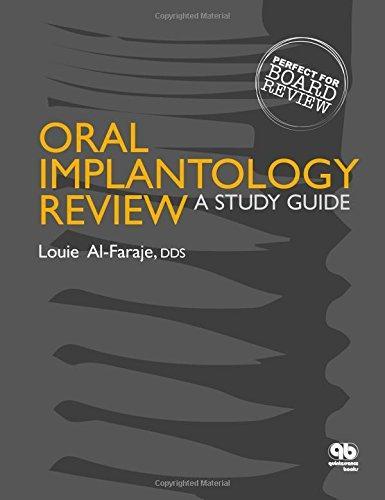
ORAL IMPLANTOLOGY REVIEW A STUDY GUIDE
Louie Al-Faraje, dds
Founder and Director
California Implant Institute San Diego, California
Quintessence Publishing Co, Inc
Chicago, Berlin, Tokyo, London, Paris, Milan, Barcelona, Istanbul, Moscow, New Delhi, Prague, São Paulo, Seoul, and Warsaw
Library of Congress Cataloging-in-Publication Data
Names: Al-Faraje, Louie, author.
Title: Oral implantology review : a study guide / Louie Al-Faraje.
Description: Hanover Park, IL : Quintessence Publishing Co., [2016] | Includes bibliographical references.
Identifiers: LCCN 2016023521 (print) | LCCN 2016025048 (ebook) | ISBN 9780867157215 (pbk.) | ISBN 9780867157413 ()
Subjects: | MESH: Dental Implantation | Oral Surgical Procedures, Preprosthetic | Examination Questions
Classification: LCC RK667.I45 (print) | LCC RK667.I45 (ebook) | NLM WU 18.2 | DDC 617.6/93--dc23
LC record available at https://lccn.loc.gov/2016023521
©2016 Quintessence Publishing Co, Inc
Quintessence Publishing Co Inc 4350 Chandler Drive Hanover Park, IL 60133 www.quintpub.com
5 4 3 2 1
All rights reserved. This book or any part thereof may not be reproduced, stored in a retrieval system, or transmitted in any form or by any means, electronic, mechanical, photocopying, or otherwise, without prior written permission of the publisher.
Editor: Leah Huffman
Design/Production: Angelina Schmelter
Printed in the USA
Dedication vii
Preface viii
Contributors x
1 Medical Evaluation of the Implant Patient 1
Topics include:
Medical history • General health evaluation • Oral health evaluation • Hypertension • Chest pain • Allergic reactions • Bone pathologies • Long-term systemic glucocorticosteroid therapy • Cushing’s syndrome • Bleeding disorders • Tic douloureux • Laboratory tests • Bacteremia • Infective endocarditis • Antibiotic prophylaxis • Angina • Thyroid crisis • Local anesthetic toxicity and overdose • Medical emergencies in the dental office
2 Oral Evaluation and Treatment Planning 27
Topics include:
Bone modeling and remodeling • Alveolar bone density • HU values • Stress, bruxism, and other parafunctions • Absolute and relative contraindications to implant therapy • Diagnostic wax-up • Implant therapy risk factors (gingival, dental, bone, and esthetic) • Immediate versus delayed implant placement decision-making guidelines • Radiologic evaluation • CT scan evaluation
3 Head and Neck Anatomy 47
Topics include:
Bony anatomy of the oral and facial regions • Arterial anatomy • TMJ • Muscles of facial expression • Muscles of mastication • Cranial nerves • Anatomy of the nasal cavity • Maxillary sinus anatomy and physiology • Radiologic anatomy of the oral and sinus cavities • Buccal fat pad • Nasopalatine canal • Lingual nerve • Inferior alveolar nerve • Mental nerve • Nerve injury etiology • Mandibular incisive canal • Submandibular fossa • Anatomy for venipuncture
4 Surgical Procedures and Complications 79
Topics include:
Placement guidelines • Vertical and horizontal spaces of occlusion • Surgical procedures • Maxillary sinus diseases • Surgical complications • Nerve injury management • Effect of soft tissue biotype • Mandibular fracture • Implant fracture • Implant stability • Tissue emphysema • Incision line reopening • Mucositis • Peri-implantitis • Hyperbaric oxygen in implant therapy • Complications of sinus augmentation • Bisphosphonate-related complications and management • Radiosurgery
5 Pharmacology 121
Topics include:
Antibiotics • Oral versus sublingual routes • Pharmacologic antagonists • Drug potency • Cumulative interceptive supportive therapy • Treating peri-implant infections • NSAIDs • Local anesthetics • Epinephrine • Management of the pregnant patient • Anticoagulants • Management of the anaphylactic episode • Painkillers
6 Biomechanics 155
Topics include:
Wolff’s law • Strain • Torque • Misfit of the implant prosthesis framework • Fatigue curve • Occlusal overload • Law of beams • Off-axial loading • Tripod configuration placement • Cantilevers • Number of implants • Tilted implants
7 Implant Prosthodontics 173
Topics include:
Loss of posterior support • Guidelines for the All-on-4 prosthesis • Master cast accuracy • Vertical alveolar bone reduction • Causes of excessive gingival display and management • Anteroposterior spread • Implant-supported overdentures • Cementretained versus screw-retained prostheses • Screw loosening • Impression techniques • Radiographic stents • Biologic seal • Emergence profile • Wide-body implants • Dental materials • Custom abutments • Short implants
Bibliography 217
Dedicated to Ibn Zuhr (1094–1162)
Biography
Abu-Marwan Abd-al-Malik ibn Zuhr Al Eyadi Al-Ishbily (Avenzoar) was a Muslim Arab physician and surgeon who was influential in advancing the progress of surgery. His major work, Al-Taysıˉr fil-Mudaˉwaˉt wal-Tadbıˉr (Book of Simplification Concerning Therapeutics and Diet), reflects Ibn Zuhr’s reliance on his own clinical observations, skill in differential diagnosis, and interest in clinicopathologic correlations. Based on his own experience, he staged and classified diseases in a practical way relevant to their management and prognosis. Furthermore, he enriched surgical and medical knowledge by describing many diseases never described before, including pericarditis, mediastinitis, mediastinal tumors, empyema, meningitis, intracranial thrombophlebitis, inflammation of the middle ear, pharyngeal and esophageal paralysis, verrucous malignancy of the colon, fecal fistula, Peyronie’s disease, purpuric skin rash, and scabies.
Contributions
1. Experimental surgery: Ibn Zuhr introduced animal testing as an experimental method of testing surgical procedures before applying them to human patients to know if they would work, performing the first experimental tracheotomy on a goat before performing it on humans. He was the first surgeon of his time to apply experimental methodology in evaluating new or controversial surgical procedures. Hence, he was given the title “The Father of Experimental Surgery.”
2. Clinical anatomical knowledge: Ibn Zuhr emphasized the great importance of a practical knowledge of anatomy for the surgical trainee. Here is a translation of his words regarding the management of inflammatory swellings of the neck that are ripe and ready for bursting/ drainage:
And in case you have mastered the science of dissection then drain by the scalpel in the way that you will not come across a vein, artery or a nerve or anything that its injury will lead to an extra harm to the patient. But if you were one of the group like me and did not practice dissection but knew it only by imitation, keep away from the knife as nothing you know by mere imagination will be the same in real life; especially in the case of small organs.
According to Ibn Zuhr, only the practitioner who has practiced dissection himself and mastered the science is entitled to perform an operative intervention. He therefore advocated that mastering anatomy is essential training for a surgeon.
3. Adequate supervised training: Ibn Zuhr insisted on an adequately supervised and structured training program for the surgeon-to-be before allowing him to operate independently.
4. Established limits: Ibn Zuhr drew emphatic red lines at which a physician should stop during his general management of a surgical condition. This was a major step forward in the evolution of general surgery as a specialty of its own. Here is a translation of an example of Ibn Zuhr’s demarcation:
If the wound caused by a sharp iron has taken into the bones and not extended to the interior, then the treatment I just mentioned is enough for you, so stick to it. However, if it did penetrate the bone then in such a case, the surgeon should come and see.
Legacy
Ibn Zuhr was the most well-regarded physician of his era, and his ideas about medicine and surgery helped to shape our modern concept of standard care. He is an inspiration to those of us who seek to make the best decisions for our patients and our discipline.
Preface
The goal of this book is to present a study guide for practicing oral implantologists seeking credentials in this field. The aim was not to encompass the entire scope of oral implantology but rather to focus on the essential and core knowledge required by the American Board of Oral Implantology (ABOI) certification examination. Based on the test specifications for this particular examination, the questions contained herein provide a good review in preparation for any credentialing examination in oral implantology. Because a true oral implantologist is involved in both the surgical and prosthetic phases of dental implant treatment, both aspects are covered extensively in this book.
As important as certification is to professional development, the main goal for any oral implantologist is not to pass a test but to provide the best treatment possible for our patients. To that end, the following considerations are critical:
• Thorough treatment planning is key: Implant dentistry is neither a prosthetic discipline with a surgical component nor a surgical discipline with a prosthetic component. It is a surgicalprosthetic discipline. Both aspects are equally important for clinical success. For example, what is the point of spending hours developing a prosthetic plan only to find out at the CT examination that the existing bone does not support that plan? Prosthetic and surgical considerations both inform the treatment plan and the clinical outcome, so both must be given equal weight.
• Oral implantology is complex: Many factors must be taken into consideration when developing a treatment plan involving dental implants. These factors include but are not limited to the general health of the patient, bone density, horizontal and vertical spaces of occlusion, soft tissue biotype, parafunctions (if any), smile line, patient’s age, patient’s sex and size, opposing dentition, and the location of the implants in the mouth (posterior versus anterior placement). Any one of these factors, if overlooked, can impact the success of the clinical outcome. My 2012 book Oral Implantology Surgical Procedures Checklist (Quintessence) systematically outlines all of these treatment-planning factors.
• Every patient is an individual: Mainstreaming treatment protocols can be helpful, but it is not always practical or possible for patients seeking dental implant treatment. For example, is it okay to place only four implants in an edentulous arch and restore them with a full-arch fixed implant prosthesis? The answer in general is no, but if the patient is on the older side with opposing removable prostheses, and if those implants are of good size and placed in dense bone without the need for a cantilever in the prosthetic design, then the answer may be yes. Based on the evaluation factors mentioned above, not every patient is suited for the same treatment plan, so the specific conditions of the patient should inform an individualized treatment plan.
• Anatomy matters: Proper anatomical review is vital before engaging in the surgical aspect of oral implantology. This book offers sufficient anatomical review to prepare you for a certification examination, but further study and review are always wise, especially if you are just beginning in oral implantology. My 2013 publication Surgical and Radiologic Anatomy for Oral Implantology (Quintessence) is a great resource for anatomical study.
• Surgical execution is paramount: Implant surgery starts with numbing the patient and continues with the incision and flap elevation, implant placement with or without bone grafting, flap release and suturing, provisionalization, and finally postoperative instructions, follow-up, and prescription of the right medication(s). Every step in this sequence must be done to the best of your ability. Giving proper postoperative instructions and delivering a proper provisional appliance are as vital to the surgical outcome as executing the surgical protocol itself.
• Complications happen: Do not feel intimidated by complications. Implant dentistry is very predictable as long as the surgical and prosthetic rules/protocols are followed. Most complications are very easily resolved. What is important to know here is that when you encounter a complication, you basically have three choices: (1) prescribe medications, (2) surgically intervene, and/or (3) refer the patient in a timely manner to a general dentist, periodontist, oral and maxillofacial surgeon, or ear, nose, and throat doctor, depending on the type of complication. You must act quickly and decisively when a complication arises.
• Training is crucial: Dentists who are making an entry into oral implantology have a multitude of options when it comes to good implant training programs. It is important to acquire an adequate amount of surgical training before engaging in the practice of oral implantology. Supervised live patient training is a must until you feel comfortable going solo.
Implant dentistry is changing at a startling rate, primarily driven by the results of modern research. Only by updating our knowledge base constantly will we be able to keep pace with current trends. This book provides an overview of the discipline of oral implantology as it is practiced today. It is my hope that it will prepare the next generation of oral implantologists not only to pass certification examinations but also to improve patient care.
Acknowledgments
As always, several people need to be acknowledged for their help in producing this book:
I would like to thank Christopher Church for contributing the maxillary sinus questions, Mamaly Reshad for most of the prosthodontic chapter, and Jim Rutkowski for the pharmacology chapter.
I would like to thank Lisa Bywaters from Quintessence Publishing for selecting me for this book. As with my earlier publications, she helped to make this book possible through her technical expertise, accuracy, and perseverance. She offered valuable suggestions on how to present the material most effectively. It was an honor and privilege to work with her again.
I would also like to thank Leah Huffman for doing a great job editing and contributing to the organization and design of this book.
I would be remiss not to include my wife, Rana, and our angels Nadia, Omar, and Tim. Their support was invaluable.
My prime motivations for writing this book, however, are my students at the California Implant Institute, who inspired me to ensure that a new generation of oral implantologists benefit from this book. My honest hope is that its readers will find it a useful resource and valuable addition to their practice and knowledge base.
Medical Evaluation of the Implant Patient 1
An accurate and thorough medical evaluation is a critical component of implant therapy. This chapter discusses the many medical factors that must be considered when a patient presents for treatment, including pathologic conditions, bleeding risk, allergy, and medical contraindications. Implant therapy is not without risk, and medical emergencies can occur even when the proper precautions are followed; it is therefore imperative that all clinicians understand what to do in such situations, especially for individuals already compromised by certain medical conditions.
1. What key medical considerations must the clinician take into account when formulating a treatment plan for a dental implant patient?
a. Hemostasis
b. Drug actions and/or interactions
c. Predisposition to infection
d. All of the above
d: All of these could have a profound effect on the healing response and thereby compromise the treatment result. If there is a hemostasis problem, excessive bleeding may result. Drug actions may interfere with proper healing, and drug interactions may affect cardiovascular integrity. A compromised immune system could lead to postoperative infections.
2. The risk of a dental practitioner encountering a medical emergency during placement of a dental implant is related to:
a. The clinician’s medical training
b. The patient’s medical health
c. Staff training
d. Complexity of the procedure
e. All of the above
b: The patient’s systemic health will dictate how well he or she will be able to sustain the stress of the procedure and the response to administered medications.
3. Which of the following are essential components of a medical history? (MULTIPLE ANSWERS)
a. Medications
b. Previous hospitalizations, illnesses, and/or surgeries
c. Information regarding prosthetic joint replacements
d. Childhood immunizations
e. All of the above
a, b, c: A complete medical history should include an organ systems review, height, weight, exercise tolerance, present illnesses, as well as any medications the patient is taking, any previous hospitalizations or illnesses, and information regarding prosthetic joint replacements. The medical history can be done as an interview of the patient or as a printed questionnaire that the clinician reviews with the patient.
4. According to the ASA (American Society of Anesthesiologists) Physical Status (PS) classification, what would the classification be for a patient who can walk up a flight of stairs or the equivalent of two city blocks but has to stop along the way because of distress or shortness of breath?
a. ASA I
b. ASA II
c. ASA III
d. ASA IV
c: ASA III is defined as a patient with severe systemic disease. A consultation with this patient’s physician is recommended prior to initiating dental treatment for this individual. Perioperative sedation and special monitoring may be necessary in the treatment of ASA III patients.
5. What would the ASA classification be for a patient who is able to walk up a flight of stairs or the equivalent of two city blocks but has to rest at the end of the walk because of distress?
a. ASA I
b. ASA II
c. ASA III
d. ASA IV
b: ASA II is defined as a patient with mild systemic disease.
6. A healthy 38-year-old woman presents for a dental implant. She takes no medications and is not anxious about the treatment. What is her ASA classification?
a. ASA I
b. ASA II
c. ASA III
d. ASA IV
a: ASA I is defined as a nor mal healthy patient.
7. What would the ASA classification be for a patient with well-controlled diabetes who is insulin dependent?
a. ASA I
b. ASA II
c. ASA III
d. ASA IV
c: ASA III
8. What would the ASA classification be for a patient whose diabetes is well controlled with diet and oral hypoglycemic agents?
a. ASA I
b. ASA II
c. ASA III
d. ASA IV
b: ASA II
9. What percentage of patients, when asked “Are you in good health?”, respond “yes” but are actually found to be medically compromised on closer examination?
a. 10%
b. 20%
c. 30%
d. 40%
c: Studies reveal that 30% of patients who respond in the affirmative are actually deemed medically compromised by the treating clinician. (Source: Brady WF, Martinoff JT. Validity of health history data collected from dental patients and patient perception of health status. J Am Dent Assoc 1980;101:642–645.)
10. When a patient presents with a bur ning mouth or tongue, which of the following could be the possible medical cause?
a. Alcoholism
b. Neoplasm
c. Renal failure
d. Primary or secondary neuropathy
d: Patients with primary or secondary neuropathy often present with the symptom of a burning mouth or tongue.
11. When a patient presents with gingival overgrowth, which of the following could be a possible medical cause?
a. Leukemia
b. Gastroesophageal reflux disease (GERD)
c. Immune suppression from HIV
d. Mouth breathing
a: Gingival overgrowth can be a sign of leukemia.
12. When a patient presents with rampant dental caries, which of the following could be a possible medical cause?
a. Addison’s disease
b. Sjögren’s syndrome
c. Vitamin deficiency
d. Liver cirrhosis
b: Patients with Sjögren’s syndrome often present with a dry mouth that leads to rampant dental caries. In elderly patients, it often presents as root caries.
13. When a patient presents with ptosis of the chin, which of the following could be a possible medical cause?
a. Anemia
b. Use of skeletal muscle relaxants
c. Scleroderma
d. Myasthenia gravis
d: Myasthenia gravis is a neuromuscular disease that results in muscle fatigue and weakness. Patients with myasthenia gravis will have decreased muscle tone that can result in ptosis.
14. When a patient presents with a radiographic finding of reduced cortical bone density, which of the following could be a possible medical cause?
a. Primary hyperparathyroidism
b. Scleroderma
c. Osteoarthritis
d. Multiple myeloma
a: Hyperparathyroidism results in the secretion of excess parathyroid hormone, which stimulates osteoclast catabolic effects on bone, resulting in the loss of calcium and density.
15. When a patient presents with a radiographic finding of degenerative damage to the condyle or temporomandibular joint (TMJ), which of the following could be a possible medical cause?
a. Osteonecrosis
b. Paget disease
c. Hyperparathyroidism
d. Rheumatoid arthritis
d: Rheumatoid arthritis has an unknown etiology; however, genetic, environmental, hormonal, and immunologic factors as well as infection are possibly involved in the process. A genetic susceptibility may provoke an autoimmune reaction that leads to hypertrophy of the synovial lining of the TMJ and endothelial cell activation that results in an uncontrolled inflammatory response and destruction of the bone.
16. When a patient presents with a radiographic finding of carotid artery calcification, which of the following could be a possible medical cause?
a. Cardiac disease
b. Sickle cell anemia
c. Hyperparathyroidism
d. Renal disease
a: Carotid artery calcium deposits have been identified as an independent predictor of coronary heart disease events. Therefore, clinicians should be surveying panoramic radiographs and computed tomography (CT) scans that are obtained for dental reasons for these calcium deposits in the coronary artery.
17. When assessing the bleeding risk for a dental implant procedure, the clinician must consider which of the following?
a. Inherited defects of hemostasis
b. Medications
c. Acquired defects of hemostasis
d. All of the above
d: Each of these factors can interfere with coagulopathy.
18. On review of the medical history, you find that the patient has severe Addison’s disease. Why is severe adrenal insufficiency significant?
a. The stress of an extensive dental implant surgical procedure may induce cardiovascular collapse.
b. Soft tissue healing will be severely compromised.
c. Implants may not integrate.
d. The patient may experience a hypertensive crisis with the administration of more than 72 μg of epinephrine within a 10-minute time period.
a: A patient with Addison’s disease will not be able to release the extra cortisol needed to deal with the stress of the surgical procedure. Cortisol is a glucocorticosteroid that is responsible for glucose metabolism as well as potentiation of catecholamines that will assist in maintaining circulatory pressure.
19. What oral clinical finding may indicate that a patient has adrenal insufficiency?
a. Severe tooth erosion
b. Sloughing of the buccal mucosal tissues
c. Hyperpigmentation of the buccal or labial mucosal tissues
d. Gingival hyperplasia
c: Increased diffuse melanin pigmentation is a documented sign of Addison’s disease.
20. What is a medical reason for a patient to take long-ter m systemic glucocorticosteroids?
a. Liver, lung, or heart transplant recipient
b. Lupus erythematosus
c. Inflammatory bowel disease
d. All of the above
d: Long-ter m glucocorticosteroid therapy is indicated for each of these conditions. Dental clinicians should consider increasing the patient’s normal daily steroid dose when the patient undergoes a surgical or stressful dental procedure.
21. Which of the following blood tests are generally thought to identify a patient with a possible bleeding disorder? (MULTIPLE ANSWERS)
a. Complete blood count (CBC) and platelet count
b. Prothrombin time (PT) and partial thromboplastin time (PTT)
c. Lipoprotein panel
d. Bleeding time
e. White blood cell (WBC) count
f. All of the above
a, b, d: Each of these laboratory tests will act as a screening test for possible bleeding disorders. The sum of these tests will measure platelet activity and coagulation factors.
22. Classic hemophilia (type A) is a deficiency of which clotting factor?
a. Factor VII
b. Factor VIIa
c. Factor VIII
d. Factor VIIIa
c: Factor VIII
23. Type B hemophilia is a deficiency of which clotting factor?
a. Factor IX
b. Factor IXb
c. Factor X
d. Factor Xb
a: Factor IX
24. The dental implant patient who presents with chronic liver failure should have which of the following hematology tests performed prior to the surgical procedure?
a. CBC, platelet count, PT
b. CBC, bleeding time, PTT
c. Platelet activation study (PAS), platelet count, WBC
d. PAS, bleeding time, PTT
a: Patients with chronic liver failure are likely to have problems with blood coagulation. The CBC, platelet count, and PT will evaluate the coagulation factors that can be affected by the liver. The CBC and platelet count will screen for anemia and thrombocytopenia, while the PT will confirm a deficiency of vitamin K.
25. “Ageusia” refers to which of the following?
a. Diminished taste
b. Altered or distorted taste
c. Salty taste
d. Absence of taste
d: The tongue loses the ability to taste sweetness, sour ness, bitterness, and saltiness. Complete or true ageusia is rare, and what patients most often have is the partial loss of taste, known as hypogeusia.
26. “Dysgeusia” refers to which of the following?
a. Diminished taste
b. Altered or distorted taste
c. Salty taste
d. Absence of taste
b: Altered or distorted taste
27. What are the most common reasons for alteration in taste? (MULTIPLE ANSWERS)
a. Autoimmune disease
b. Periodontal disease
c. Infection
d. Poor oral hygiene
e. GERD
f. All of the above
b, c, d: Periodontal disease, infection, and poor oral hygiene are known to alter the sensation of taste.
28. “Tic douloureux” is also known as which of the following?
a. Idiopathic trigeminal neuralgia
b. Bell’s palsy
c. Facial paralysis
d. Trigeminal dysesthesia
a: Tic douloureux, or idiopathic trigeminal neuralgia, is a condition that creates episodes of acute-onset, severe facial pain. It is most frequently found in patients of middle to old age. Intraoral or facial trigger points initiate the pain, which can be excruciating but is usually not long lasting. The trigeminal nerve’s mandibular branch is most often involved, but the etiology is unknown.
29. Which of the following endogenous pigmentation sources is the most common?
a. Melanin
b. Bilirubin
c. Iron
d. Heavy metals
a: Melanin is a ter m used to describe natural pigments in the body. It is produced by melanocytes via the oxidation of tyrosine.
30. Which of the following diseases can cause an abnormal melanin deposit in the oral mucosa?
a. Diabetes mellitus type 1
b. Acute myelogenous leukemia (AML)
c. Addison’s disease
d. Thrombocytopenia purpura
c: Patients with Addison’s disease frequently have bluish-black or dark-brown areas on the buccal or labial mucosa and possibly on the gingiva.
31. Which of the following laboratory tests measures the intrinsic coagulation pathway?
a. PT
b. PTT
c. International normalized ratio (INR)
d. PAS
b: The PTT is a measure of the efficacy of the intrinsic pathway that mediates fibrin clot formation. All coagulation factors are measured by this test except factor VII. Normal values are between 25 and 40 seconds. Values that are extended by 5 to 10 seconds represent a mild bleeding disorder; those values beyond 10 seconds may be an indicator of a clinically significant bleeding problem.
32. What is the recommended INR therapeutic range for standard oral anticoagulant therapy?
a. 1.0 to 2.0
b. 1.5 to 2.5
c. 2.0 to 3.0
d. 2.5 to 3.5
c: A value between 2.0 and 3.0 is the recommended therapeutic range for the prevention of deep vein thrombosis, pulmonary embolism, hypercoagulable states, transient ischemic attack, atrial fibrillation, dilated cardiomyopathy, rheumatic mitral valve disease, and stroke.
33. A patient who presents with a prosthetic heart valve replacement should have an anticoagulant therapeutic range (INR) of:
a. 1.0 to 2.0
b. 1.5 to 2.5
c. 2.0 to 3.0
d. 2.5 to 3.5
d: 2.5 to 3.5
34. Known risk factors for ischemic heart disease (IHD) include which of the following?
a. Smoking
b. Obesity
c. Diabetes mellitus
d. All of the above
d: Each of these conditions can either decrease the oxygen supply to the heart or increase the cardiac workload.
35. An implant patient presents with a recent history of myocardial infarction (MI). At what time point post MI is the typical cardiac patient’s normal reinfarction risk level back to baseline?
a. 3 months
b. 4 months
c. 5 months
d. 6 months
d: The highest risk of reinfarction is between 0 and 3 months post MI. A lower risk is present from 3 to 6 months post MI, with the risk returning to baseline after 6 months. Naturally, this is somewhat patient dependent.
36. Stage 1 hypertension is associated with which of the following?
a. Systolic blood pressure 130–139 mm Hg, diastolic blood pressure 90–99 mm Hg
b. Systolic blood pressure 140–159 mm Hg, diastolic blood pressure 90–99 mm Hg
c. Systolic blood pressure 160–179 mm Hg, diastolic blood pressure 90–99 mm Hg
d. Systolic blood pressure 180–189 mm Hg, diastolic blood pressure 90–99 mm Hg
b: Systolic blood pressure 140–159 mm Hg, diastolic blood pressure 90–99 mm Hg
37. Stage 2 hypertension is associated with which of the following?
a. Systolic blood pressure 170–179 mm Hg, diastolic blood pressure ≥ 100 mm Hg
b. Systolic blood pressure 180–189 mm Hg, diastolic blood pressure ≥ 100 mm Hg
c. Systolic blood pressure ≥ 160 mm Hg, diastolic blood pressure ≥ 100 mm Hg
d. Systolic blood pressure ≥ 170 mm Hg, diastolic blood pressure ≥ 110 mm Hg
c: Systolic blood pressure ≥ 160 mm Hg, diastolic blood pressure ≥ 100 mm Hg