
D. Carter
Visit to download the full and correct content document: https://ebookmass.com/product/the-price-of-peace-money-democracy-and-the-life-of-j ohn-maynard-keynes-1st-edition-zachary-d-carter/
More products digital (pdf, epub, mobi) instant download maybe you interests ...
The Economics of John Maynard Keynes Fabio Terra
https://ebookmass.com/product/the-economics-of-john-maynardkeynes-fabio-terra/
The Truth of Liberal Economy: Jacques Rueff and John Maynard Keynes Yasuo Gonjo
https://ebookmass.com/product/the-truth-of-liberal-economyjacques-rueff-and-john-maynard-keynes-yasuo-gonjo/
Classical Economics, Keynes and Money Essays in Honour of Carlo Panico John Eatwell
https://ebookmass.com/product/classical-economics-keynes-andmoney-essays-in-honour-of-carlo-panico-john-eatwell/
The Creators of Inside Money 1st ed. Edition D. Gareth
Thomas
https://ebookmass.com/product/the-creators-of-inside-money-1sted-edition-d-gareth-thomas/
The Fiscal Theory of the Price Level John Cochrane
https://ebookmass.com/product/the-fiscal-theory-of-the-pricelevel-john-cochrane/
The Fiscal Theory of the Price Level John H. Cochrane
https://ebookmass.com/product/the-fiscal-theory-of-the-pricelevel-john-h-cochrane/
ReFocus: The Films of William Wyler John Price (Editor)
https://ebookmass.com/product/refocus-the-films-of-william-wylerjohn-price-editor/
Explorations in Marx's Theory of Price — Why Marx Is Still Relevant for Understanding the Modern Economy. Volume I: Money and Money Prices 1st Edition Howard Nicholas
https://ebookmass.com/product/explorations-in-marxs-theory-ofprice-why-marx-is-still-relevant-for-understanding-the-moderneconomy-volume-i-money-and-money-prices-1st-edition-howardnicholas/
The Greek Life of Adam and Eve 1st Edition John R. Levison
https://ebookmass.com/product/the-greek-life-of-adam-and-eve-1stedition-john-r-levison/
Copyright © 2020 by Zachary D. Carter
All rights reserved.
Published in the United States by Random House, an imprint and division of Penguin Random House LLC, New York.
RANDOM HOUSE and the HOUSE colophon are registered trademarks of Penguin Random House LLC.
Library of Congress Cataloging-in-Publication Data
Names: Carter, Zachary D., author.
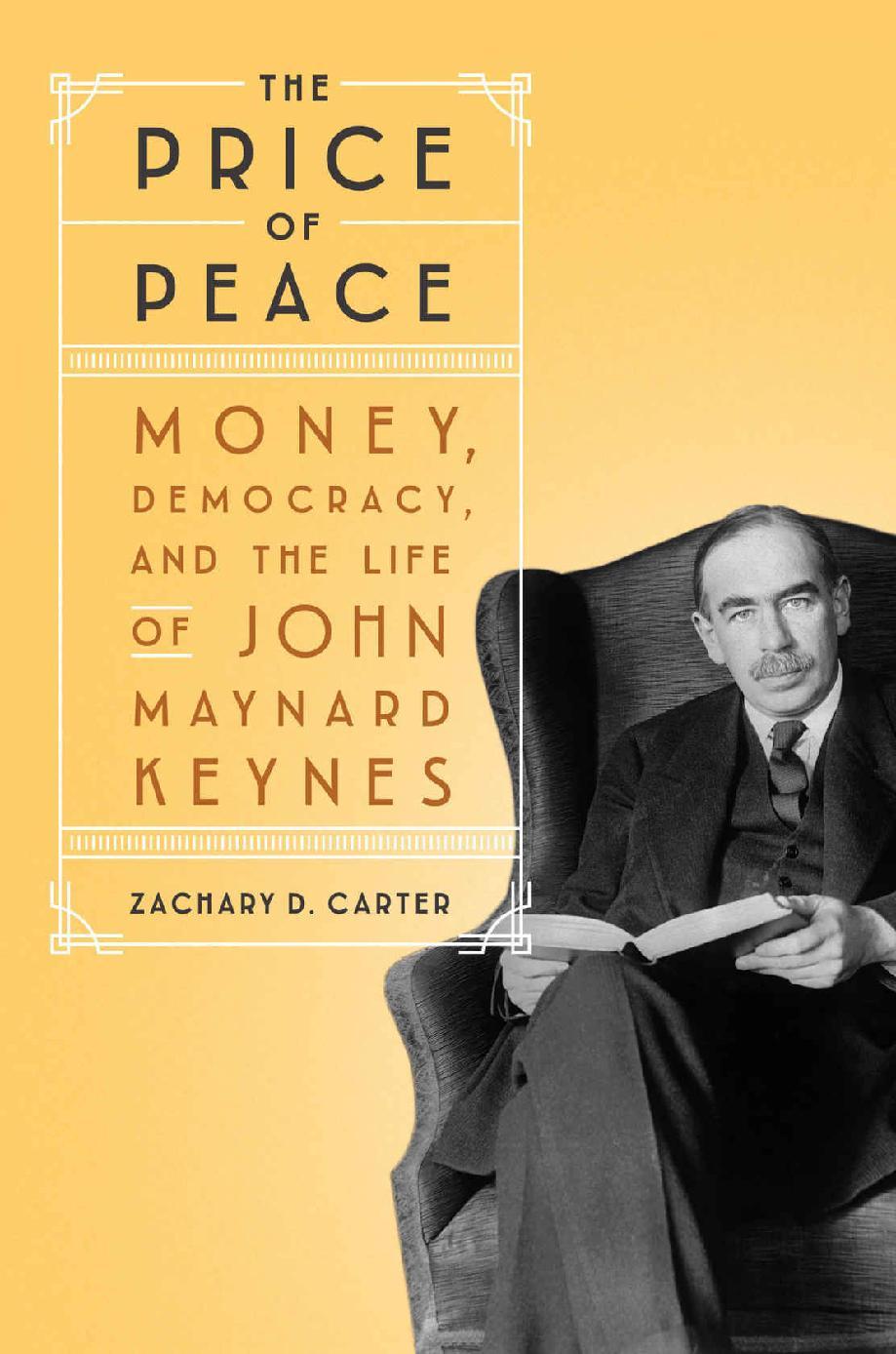
Title: The price of peace : money, democracy, and the life of John Maynard Keynes / Zachary D. Carter.
Description: First edition. | New York : Random House, 2020 | Includes bibliographical references and index.
Identifiers: LCCN 2019037057 (print) | LCCN 2019037058 (ebook) | ISBN 9780525509035 (hardcover) | ISBN 9780525509042 (ebook)
Subjects: LCSH: Keynes, John Maynard, 1883–1946. | Economists—Great Britain—Biography. | Economics—History—20th century. | Bloomsbury group.
Classification: LCC HB103.K47 .C376 2020 (print) | LCC HB103.K47 (ebook) | DDC 330.15/7092 [B] dc23
LC record available at https://lccn.loc.gov/2019037057
LC ebook record available at https://lccn.loc.gov/2019037058
Ebook ISBN 9780525509042
randomhousebooks.com
Book design by Caroline Cunningham, adapted for ebook
Cover design: Lucas Heinrich
Cover photograph: Bettmann/Getty Image
ep prh 5.5.0 c0 r0
Contents
Cover
Title Page
Copyright
Epigraph
Introduction
Chapter One: After the Gold Rush
Chapter Two: Blood Money
Chapter Three: Paris and Its Discontents
Chapter Four: Consequences
Chapter Five: From Metaphysics to Money
Chapter Six: Prolegomena to a New Socialism
Chapter Seven: The Great Crash
Chapter Eight: Phoenix
Chapter Nine: The End of Scarcity
Chapter Ten: Came the Revolution
Chapter Eleven: War and Counterrevolution
Chapter Twelve: Martyr to the Good Life
Chapter Thirteen: The Aristocracy Strikes Back
Chapter Fourteen: The Affluent Society and Its Enemies
Chapter Fifteen: The Beginning of the End
Chapter Sixteen: The Return of the Nineteenth Century
Chapter Seventeen: The Second Gilded Age
Conclusion
Dedication
Acknowledgments
Photo Insert Notes
Selected Bibliography About the Author
In the long run, we are all dead.
—J
OHN MAYNARD KEYNES, December 1923
In the long run almost anything is possible.
JOHN MAYNARD KEYNES,
April 1942

IN THE SPRING OF 1922, John Maynard Keynes was in love. He was terrified.
Ever since boarding school, Maynard, as his friends called him, had been almost exclusively interested in men. Suddenly at age thirty-eight, he was besotted with a woman nearly a decade his junior: Russian ballet starlet Lydia Lopokova. “I’m entangled—a dreadful business—and barely fit to speak to,” he wrote to his friend Lytton Strachey.1
To Maynard’s confidants in London’s cultured enclave of Bloomsbury, the infatuation made no sense. “What are we all coming to, pray?” Lytton wondered. “The Universe totters.”2 Virginia Woolf was appalled by the thought of Maynard being “controlled” by a lover.3 His days of wild romance were supposed to be long buried in the past. As he had told Lytton two years earlier, in matters of the heart, he could be drawn only into “shallow waters.” “Up to the middle, not head over ears at my age.”4 He preferred dispassionate, on-again-off-again affairs, like his relationship with the psychologist Sebastian Sprott, whom he
was still seeing when he found himself abruptly overwhelmed by Lydia.
Gender and passion accounted for only part of the shock. Maynard was a man of the world. A respected economist and former Treasury official, he had garnered great fame and not a little fortune for the precise clarity of his mind. The august bankers in the City of London and titled aristocrats who followed his work in the financial pages could not believe their ears when they heard that the great Keynes had fallen for, in the words of one earl, “a chorus girl.”5 Even Virginia’s sister, Vanessa Bell, an artist of middle-class stock, was annoyed by the way Lydia chatted up household servants as though they were social equals.
But Lydia dazzled Maynard. Her wit was as nimble as her limbs. He had watched her perform night after night as the Lilac Fairy in the Ballets Russes rendition of Tchaikovsky’s Sleeping Beauty. He had visited with her backstage, invited her to lunch, stayed out into the small hours of the morning laughing at her jokes, and rented her a flat in the same London square as his own—all within the span of a few short weeks. To Maynard, she was not merely a dancer but an artist, fluent in the high cultural lexicon that linked St. Petersburg, Paris, London, and New York. Though a pending jaunt to India with a British cabinet minister presented him with an opportunity to cool his fevered passions, Maynard found himself unable to break away. He canceled the trip and took Lydia sightseeing around London in a hired car instead. “I’m in a terribly bad plight,” he confessed to Vanessa. “She seems to me perfect in every way.”6
Perfect, but very different. As a child, Lydia had shared a cramped St. Petersburg apartment with four siblings before an audition with an imperial dance academy had rescued her from poverty. Maynard came from a comfortable academic household in Cambridge and made his international reputation working in British government. “Is there any resemblance between you and me?” Lydia asked. “No! So different it becomes attractive.”7 And
to Maynard, the enchanting Russian ballerina was more than a talented, talkative artist; she was the living embodiment of an ideal he thought he had lost eight years earlier at the outbreak of the Great War.
Bloomsbury had always been a tiny, insular haven for artists and intellectuals, but paradoxically, it had connected Maynard to a wider, vibrant world beyond London and across oceans. Before the war, Vanessa had visited Pablo Picasso’s studio in Montparnasse; Maynard’s friend and sometime lover Duncan Grant had stayed with Gertrude Stein in Paris.8 Maynard himself had been good friends with the Austrian philosopher Ludwig Wittgenstein, and Bloomsbury’s art openings, garden parties, and evenings of debate had helped him appreciate other cultural movements whose power transcended language and nationality, from French Postimpressionism to German romanticism and the novels of the Russian pacifist Leo Tolstoy. Through Bloomsbury, Keynes joined an international community of progressive intellectuals who believed themselves to be breaking down the crude medieval barriers between peoples through the power of love and beauty.
The war had shattered that collective illusion. And its fractured, bitter aftermath seemed to show that the golden years of Maynard’s youth had been little more than the trivial diversions of the British leisure class at the apex of British colonial hegemony. Now, for the first time in years, Lydia offered Maynard hope—not the abstract, probabilistic optimism he typically carried, but a powerful, almost religious hope—that the dream he had lived as a young man could be realized once again. Whatever vendettas Europe’s leaders might pursue, the wild, impossible love between Lydia and Maynard was proof that the world was filled with beautiful potential. Beneath the ugly, cynical empires of money and politics lay a deeper, more powerful empire of ideas waiting to unite humanity across borders and languages.
The life of John Maynard Keynes was filled with turning points. Few citizens of the twentieth century reinvented themselves with the regularity that Keynes did over the course of his nearly sixtythree years. But the unexpected blossoming of his romance with Lydia Lopokova was the decisive juncture that made him a force in the history of ideas. When Keynes finally did break away from Lydia for a few weeks in April and May of 1922, it was to embark on a new project that, in a turn nearly as surprising as his recent outbreak of love, would establish him as the most important economic thinker of his day.
Keynes was off to the Italian city of Genoa that spring. He did not leave intending to write his first great work of economic theory. He was hoping to make his name as a journalist and perhaps reestablish a place for himself as an adviser to the power brokers of Europe. It was a career experiment born of necessity. Less than three years earlier, Keynes had been exiled from Whitehall and Parliament over the publication of The Economic Consequences of the Peace—his devastating attack on the Treaty of Versailles, the compact which had set the terms of peace at the close of the Great War. His book had exposed the underhanded machinations of Keynes’ own government at the 1919 peace conference and predicted that the treaty’s financial arrangements would march Europe to economic ruin, dictatorship, and war.
To the surprise of both Keynes and his publisher, this grim tract had been an international bestseller, vaulting Keynes to the celebrity status of European nobility and American motion picture stars. Over the ensuing three years, his reputation soared to still greater heights as his predictions began to take on the aura of prophecy: ruthless unemployment fueled labor strikes in Britain, riots across Italy, and a wave of political assassinations in Germany. And now newspaper publishers from Vienna to New York were betting that he could repeat the success of his famous book.
Central bankers, treasury officials, and heads of state were gathering in Genoa for what was to be the most important financial conference since the end of the war—the first meeting of the victorious Allies and the vanquished Germans since Versailles. It was to be European diplomacy on the grandest scale. Even the deviant new socialist government of Russia would be sending a delegation. Newspapers in New York, Manchester, and Vienna offered Keynes the astounding sum of £675—over $45,000 in today’s money—to cover the conference; his transcontinental audience would number in the millions.9 This was not merely a contract offered to a talented reporter; his publishers hoped that Keynes would infuse his dispatches with the detailed flair and ferocity that had made his book a sensation.
Keynes did not share his publishers’ confidence in his abilities. He was still new to popular writing and worried that Economic Consequences had been a fluke. As a young man, he had fired off academic articles with carefree confidence; as he entered middle age, he struggled to translate his complex ideas into something ordinary people might actually understand. It was a frustrating, degrading experience for someone who had long been celebrated for his brilliance. “Journalism eats one up; leaves no energy for higher matters,” he once wrote to Lydia.10 And the stratospheric paychecks for his work in Genoa only intensified his anxieties. It was too much money to turn down, but it established impossibly high expectations. If he couldn’t deliver the goods, his name might never recover.
But as Keynes walked Genoa’s corridors of power, his new love helped embolden his self-confidence. Maynard and Lydia exchanged a daily correspondence bursting with sexual and intellectual energy, infused with Lydia’s gift for metaphor and the unusual cadences of a woman still finding her bearings in English. “I blend my mouth and heart to yours,” she wrote.11 His dispatches from the conference were “like clear compact buildings.” Although she found it “annoying that financial experts
do not want stabilization” of the world’s major currencies, she insisted that her new lover’s keen analysis would bring them around: “To-days article on the reparation problem is very energetic, when the conference experts read it they will adopt the right course.”12
Most important, her letters reminded Keynes what he was in Genoa to achieve. This was not merely a gathering of banking experts assembled to debate interest and principal; it was Europe’s last, best hope to save itself from an authoritarian future. And it was Keynes’ chance to show that the little world of art, beauty, and cross-cultural understanding he and Lydia had created could be replicated in economic diplomacy.
Armed with his massive audience, Keynes found himself newly appreciated by the men of power who surrounded him. His ideas were serious, his proposals important. The British delegation even gave brief consideration to an overhaul of the international currency system Keynes had devised to ameliorate the monetary mayhem of inflation, deflation, and devaluation that had taken hold since the end of the war.
But the conference was not going well. “Under the surface, amidst dark intrigue, the European diplomatists are playing their old games,” Keynes warned in the pages of The Manchester Guardian. “Combinations are being tentatively formed…which may, left to themselves, produce as inflammable a Europe as in 1914. The old political ideas, which for a thousand years have periodically devastated Europe, are not dead.”13
British diplomats did not conceal their contempt for their German counterparts. One British official called Weimar foreign minister Walther Rathenau a “bald-headed Jewish degenerate,” while Soviet commissar for foreign affairs Georgy Chicherin was ridiculed as “the degenerate he is”—Chicherin was gay—“and of course except for himself and Krassin…the [Russian delegates] are all Jews.”14
These poisonous sentiments infected debate over the astronomical debts that had arisen out of the Great War. To Keynes, the debts were not merely an economic problem but a political wildfire waiting to ignite. Europe’s war-ravaged economy, he believed, was too weak to support massive payments to war creditors. The fact that the debts were owed to foreign banks and governments was inflaming old rivalries, setting peoples against each other. Money shipped to creditors overseas could not be spent on reconstruction projects or public aid at home, and people knew it. A nationalist backlash was already in motion, sowing the seeds of another war. To Keynes, the purpose of the conference was to get past the debts or at least create a new framework for cooperation that might lead to their elimination. “I will be no party to the continuation of a European blood-feud, however great the past guilt,” he had written to a friend a year earlier.15
But for France and Great Britain, war debts were both a burden and a source of income.16 Both nations had borrowed enormous amounts from the United States, but both had also loaned extraordinary sums to the tsarist regime in Russia during the early years of the war. Now Vladimir Lenin’s Bolshevik government had repudiated those debts. And so once all of the grandees had assembled in Genoa, Britain and France announced that the Soviet government would be required to acknowledge the legitimacy of the tsar’s financial contracts as a precondition for participation in the talks. The Bolsheviks might do what they liked with their internal economic program, but in matters of international diplomacy, the customs of nineteenthcentury capitalism would have to be observed. Debts must be honored, revolution or no.
Keynes was outraged. Russia was in the middle of a famine that would eventually claim five million lives. It was both a humanitarian crime and a monetary delusion to believe it could hand over the equivalent of billions of dollars to France and Britain. The money would never be paid, whatever arrangement
might end up on paper. “We act as high priests, not as debt collectors,” he wrote. “It is a religious ceremony we are demanding at Genoa….instead of trying to disentangle the endless coil of impossible debt, [the conference] merely proposes to confuse it further.”17
The conference had descended into a referendum on socialism. To Keynes, it was the wrong problem. Socialism was a practical question to be resolved among people of goodwill—a dispute within the broad family of Enlightenment liberalism. The real danger was from those who rejected international harmony for national glory—the violent ultranationalist movements rising across the continent. “Many apprehend the issue of the near future as between the forces of Bolshevism and those of the bourgeois states of the nineteenth-century type,” Keynes wrote from Genoa. “I do not agree. The real struggle of today…is between that view of the world, termed liberalism or radicalism, for which the primary object of government and of foreign policy is peace, freedom of trade and intercourse, and economic wealth, and that other view, militarist, or, rather, diplomatic, which thinks in terms of power, prestige, national or personal glory, the imposition of a culture, and hereditary or racial prejudice.”
If militarists were to prevail, Keynes told his readers, “sooner or later an economic disease spreads which ends in some variant of the delirium tremens of revolution.” The great threat facing liberalism was not socialism but the thirst for military domination. “Soldiers and diplomatists—they are the permanent, the immortal foe.”18
Keynes underestimated the Soviet government’s potential for paranoid brutality. But his warnings about the momentum for revolution on the right were prescient. His impassioned dispatches from Genoa were published six months before Benito Mussolini’s Blackshirts would march on Rome, nine months before the French invasion of the Ruhr, and nineteen months before Adolf Hitler’s Beer Hall Putsch in Munich. And yet Keynes’
words at the conference fell on deaf ears. He had reestablished himself among the power elite, but the elite were not yet ready to accept his advice.
Keynes’ work did not end when the diplomats packed their bags and retreated to their various corners of Europe. Reunited with Lydia in London, he assembled his favorite dispatches from Genoa and spent weeks revising and supplementing them with masses of new material. By the time he was finished, what had begun as an intimidating foray into popular journalism had transformed into his first major work of economic theory. Published in December 1923, A Tract on Monetary Reform was, like its predecessor, a deceptively technical title filled with shocking ideas.19 It was not merely the sanctity of international debt contracts that must be abandoned, Keynes informed his readers, but the entire global financial system that had established the foundation of free exchange between nations. The gold standard, the benchmark of economic sanity for as long as anyone could remember, had become a barrier to peace and prosperity—a “barbarous relic” incompatible with “the spirit and the requirements of the age.”20 One by one, Keynes was taking aim at the sacred tenets of nineteenth-century capitalism. The world was about to change.
Today, Keynes is remembered as an economist because it was through the field of economics that his ideas exercised their greatest influence. College students are taught that he urged governments to accept budget deficits in a recession and spend money when the private sector cannot. But his economic agenda was always deployed in service of a broader, more ambitious social project. Keynes was a philosopher of war and peace, the last of the Enlightenment intellectuals who pursued political theory, economics, and ethics as a unified design. He was a man whose chief project was not taxation or government spending
but the survival of what he called “civilisation”—the international cultural milieu that connected a British Treasury man to a Russian ballerina.21 A decade after Genoa, when a reporter asked him if the world had ever seen anything like the unfolding Great Depression, Keynes replied in perfect sincerity: “Yes. It was called the Dark Ages, and it lasted 400 years.”22
Keynes first saw the darkness encroaching at the outbreak of war in 1914. He gave his opponents different names —“militarists” and “imperialists” in the years before the Second World War, “brigand powers” and even “enemies of the human race” in those that followed.23 Any idea or tactic was fair game so long as it protected his community of art, letters, and fine living from the march of authoritarianism. At different stages of his career, he embraced everything from free trade to stiff tariffs as potential remedies. His best-known work, The General Theory of Employment, Interest and Money, was not just an effort to provide theoretical justification for public works projects but a frontal assault in his crusade against militarism—a book he hoped would be used as kind of tool kit for anti-imperialist policy making. “If nations can learn to provide themselves with full employment by their domestic policy,” he wrote in the book’s conclusion, “there need be no important economic forces calculated to set the interest of one country against that of its neighbours.”24
To his students at the University of Cambridge in the 1930s, many of whom would go on to implement his ideas around the world, the book contained an entire philosophy of life. In the words of one such student, David Bensusan-Butt, “The General Theory was to us less a work of economics theory than a Manifesto for Reason and Cheerfulness, the literary embodiment of a man who, to those who ever saw him, remains the very genius of intellect and enjoyment. It gave a rational basis and moral appeal for a faith in the possible health and sanity of contemporary mankind.”25
That was not an easy belief to sustain amid the rise of fascism in the 1930s. Nor is it easy to maintain in our own time, as new bastions of authoritarian extremism consolidate power across Europe, the United States, Latin America, the Middle East, and Asia. But it is an essential faith for any who hope to address the world’s problems through persuasion and the written word—and a conviction fundamental to the practice of democracy itself. As democratic institutions again find themselves under assault in the early twenty-first century, there is no intellectual from the twentieth century whose thought—its triumphs, its failures, and its fragilities—is more relevant than that of John Maynard Keynes.
Keynes was a tangle of paradoxes: a bureaucrat who married a dancer; a gay man whose greatest love was a woman; a loyal servant of the British Empire who railed against imperialism; a pacifist who helped finance two world wars; an internationalist who assembled the intellectual architecture for the modern nation-state; an economist who challenged the foundations of economics. But embedded in all of these seeming contradictions is a coherent vision of human freedom and political salvation. Keynes died before he could systematize those ideas into a singular, definitive philosophical statement—even the heights of ambition on display in The General Theory formed only one piece of the broader Keynesian project. This book is an effort to assemble it from the essays, pamphlets, letters, and books he left to posterity—and to show its still transformative implications for our own time.
It is also an attempt to chart the history of what became known as Keynesianism as it crossed the Atlantic and metamorphosed into a distinctly American political ethos. Here, too, there is no shortage of irony. Keynes never liked America— the weather was always too hot and there weren’t enough birds in the countryside—or Americans, who were at once too brash and too sensitive. Yet without the political support his ideas won in the United States, Keynes and his work would be a minor curiosity for professional intellectuals.
Unlike his eventual marriage to Lydia, the union between Keynes and the United States was always difficult and unhappy. Leaders of the emerging hegemon had little interest in the antiimperialist dimensions of Keynesian thought as they adapted The General Theory to the task of erecting a new global order around U.S. power. Influential American economists, more than their peers across the pond, were eager to view their work as politically neutral, an expert mathematical science far removed from the speculative ruminations of the Enlightenment philosophers Keynes had venerated. Even had they wished to act on such ideas, his more philosophically inclined successors— most notably John Kenneth Galbraith—found their work constrained by the political horizons of the American empire even as they sought to deploy Keynesian thought as a tool against empire itself.
And so the history of Keynesianism is an intellectual history of American power, both its promise and its abuse. Keynesianism took on a life of its own Keynes himself could scarcely have predicted. It is a history in which battles over textbooks on college campuses play as prominent a role as military deployments, election results, and stock market crashes—a history of numbers and equations but also of ballerinas and animal spirits.
In the spring of 1934, Virginia Woolf sketched an affectionate three-page “biographical fantasy” of her great friend, attempting to encompass no less than twenty-five themes, which she jotted down at its opening: “Politics. Art. Dancing. Letters. Economics. Youth. The Future. Glands. Genealogies. Atlantis. Mortality. Religion. Cambridge. Eton. The Drama. Society. Truth. Pigs. Sussex. The History of England. America. Optimism. Stammer. Old Books. Hume.” Like the life Woolf imitated, her narrative jaunted from a farm in East Sussex to King’s College, Cambridge, to the opera at Covent Garden to a rare bookshop before reaching her final, intimate homage: “He heard them crying the news in the street. And shrugging his shoulders applied himself
to the great green board on which were pinned sheets of symbols: a frolic of xs controlled by ys and embraced by more cryptic symbols still: which, if juggled together would eventually, he was sure, positive, produce the one word, the simple, the sufficient the comprehensive word which will solve all problems forever. It was time to begin. He began.”26
JOHN MAYNARD KEYNES WAS not an athletic man. Though a spirited debater, he had always suffered from fragile health. Overworked by choice and underexercised out of habit, he had acclimated himself to living in the constant shadow of head colds and influenza attacks. He was thirty-one years old on the first Sunday of August 1914 and had lived nearly all of those years at Cambridge, where, like his father before him, he held a minor academic post. His friend and mentor Bertrand Russell was accustomed to seeing the younger man reviewing figures or buried in papers on weekend afternoons. A King’s College man, Keynes might, in moments of extreme restlessness, calm himself with a walk through the Great Court of Russell’s Trinity College, taking in the turreted medieval towers of King’s Gate, the soaring gothic windows of the chapel built during the reign of Queen Elizabeth, and the steady waters of the fountain designed when William Shakespeare had composed Hamlet. Keynes was a man who savored tradition and contemplation. He was perfectly suited for a life at the timeworn university.
But there was Keynes, hustling down the weathered flagstones that afternoon, tearing past the lush, closely cropped green lawns. Russell stopped his young friend to ask what was wrong. Keynes, with a brusque flutter of words, told him he needed to get to London. “Why don’t you go by train?” the philosopher asked.
“There isn’t time,” Keynes replied to the baffled Russell and hurried along.
There were more curiosities to come. Keynes left the court and approached a motorcycle belonging to his brother-in-law, Vivian Hill. Keynes—who was nearly six feet seven—folded his long legs into the sidecar, and the two proceeded to putter and jostle their way sixty miles to the capital.1 Their odd, frantic journey would change the fate of the British Empire.
England was in the fifth day of the most violent financial crisis it had ever experienced—one that threatened to tear its economy apart even as the nation’s leaders wrestled over the most momentous diplomatic question of their generation: whether to enter the war breaking out on the European continent. Though none of the foreign policy experts and financial engineers huddled in London recognized it at the time, the economic system that had fed and fueled Europe for the past half century had just come to a sudden, cataclysmic end.
Since the close of the Franco-Prussian War in 1871, the world’s great powers—and many of its minor players—had grown to depend on complex international trade arrangements to provide their citizens with everything from basic foodstuffs to heavy machinery. It was an era of ostentatious prosperity for both the aristocracy and an expanding, increasingly powerful middle class, a period future generations would romanticize with names like “La Belle Époque” and “The Gilded Age.”2 In England, factory workers spun Egyptian cotton and New Zealand wool into
fineries that decorated homes all over the continent. The well-todo and the up-and-coming adorned themselves with diamonds and ivory from South Africa embedded in settings crafted from gold mined in Australia. In Paris, the Hôtel Ritz served afternoon tea from India, while a new mode of haute cuisine spread through the luxury hotels of Europe, combining ingredients from the New World with what had once been regional specialties of France, Italy, and Germany.3
“In this economic Eldorado, in this economic Utopia,” Keynes would later recall, “life offered, at a low cost and with the least trouble, conveniences, comforts, and amenities beyond the compass of the richest and most powerful monarchs of other ages.”4
The cultural explosion was the product of empire. England, Spain, France, Germany, Russia, Belgium, the Netherlands, the Ottoman Empire, and even the adolescent United States all deployed military force to cultivate power over the people and resources of other continents. Keynes was aware of the brutalities that accompanied British imperialism, once earning a rebuke from a top official at the India Office for issuing a report that depicted a “coldblooded” British response to a plague that had “terribly ravaged” India.5 But Keynes did not consider such events an integral element of the world’s economic structure. They were instead unfortunate impurities, flaws that would eventually be distilled away by the engines of progress. “The projects and politics of militarism and imperialism, of racial and cultural rivalries, of monopolies, restrictions, and exclusion, which were to play the serpent to this paradise, were little more than the amusements of [the] daily newspaper, and appeared to exercise almost no influence at all on the ordinary course of social and economic life.”6
What fascinated Keynes as a young economist was not the manner in which this new material abundance was extracted by European powers but the “the easy flow of capital and trade” among them. All across the continent new financial contracts had
been woven into the patterns of global commerce. Companies were accustomed to borrowing money in one country, selling their products in another, and purchasing insurance in yet another. The proud, beating heart of this order was the City of London, the financial district of the British capital, where fully half of the world’s business affairs were financed.7 Whatever their nationality, the storied banking dynasties of the age—the transcontinental Rothschilds, the French Lazards, the Schröders of Hamburg and the American House of Morgan—all set up critical operations in London, where more than a billion dollars in foreign bonds were issued every year to private enterprise and sovereign governments alike.8 This financial power had transformed London into the thickest bustling metropolis on the planet, with a population of more than six million, nearly double that of 1861.9
For all its complexity, the system London oversaw had enjoyed a remarkable stability. Trading accounts between nations were balanced, capital flows were steady and predictable, and financial disruptions in the Old World were brief affairs, always quickly corrected. Measured against such fabulous symmetries, most members of the leisure class considered even the underbelly of this system—domestic industrial poverty, a twenty-year agricultural depression in America—to be inconsequential. “The inhabitant of London could order by telephone, sipping his morning tea in bed, the various products of the whole earth, in such quantity as he might see fit, and reasonably expect their early delivery upon his doorstep,” Keynes wrote. “Most important of all, he regarded this state of affairs as normal, certain, and permanent, except in the direction of further improvement.”10
The new financial reality had spawned its own political ideology. In 1910, the British journalist Norman Angell published The Great Illusion, a book claiming to demonstrate that the international commercial entanglements of the twentieth century had made war economically irrational. No nation, Angell argued, could profit by subjugating another through military conquest.
Even the victors would suffer financial harm, whatever the spoils might be.11
Angell was wrong—and, worse, misunderstood. His book sold millions of copies, developing a cult following of influential public officials who came to believe that because war was financially counterproductive, it was now a problem of the past. That was not what Angell himself actually preached; “irrational” did not mean “impossible.” But in an age possessed by an ideal of enlightened, rational government, many political leaders came to believe that the prospect of war was becoming “more difficult and improbable” by the day.12 It was an early version of the doctrine New York Times columnist Thomas L. Friedman would eventually formulate in a bestseller of his own a century later, when he declared that “no two countries that are both part of a major global supply chain…will ever fight a war.”13
But the unthinkable event had in fact arrived. On July 28, 1914, a teenage Yugoslav nationalist murdered Archduke Franz Ferdinand, the heir to the throne of the Austro-Hungarian Empire, during a visit to Sarajevo, and the empire retaliated by declaring war on Serbia. Armies were now mobilizing from France all the way to Russia. As the thicket of political alliances appeared certain to draw empire upon empire into the looming conflict, the seemingly impregnable payment system that had made London the center of the economic universe abruptly collapsed.
The chaos began in the Vienna stock market and spread to every European capital within days. When banks and investors suffered heavy losses in one city, they withdrew money from others, forcing further liquidations abroad. By Thursday, July 30, London and Paris were the only trading centers open in Europe, as governments tried to stop the sudden plunge in securities prices by shutting down stock exchanges entirely. That only intensified the pressure on the French and British markets as foreign investors placed orders in London to sell off securities at almost any price, sending stock values into free fall.
This was bad enough—but the bigger problem was the sudden halt to the flow of payments the City typically received from overseas. Millions of pounds’ worth of debts were due in London every day, and the war declarations suddenly made it impossible for even solvent foreign debtors to pay their obligations in London. Countries on one side of the budding conflict forbade investors to pay firms on the other side. The cost of insuring international gold shipments exploded, making it impossible to move money abroad. Shipping routes were interrupted, and world trade began to break down. Paris withdrew £4 million in gold from the Bank of England in an effort to shore up French banks.14 Money was going out, but it wasn’t coming in. Great Britain was under financial bombardment.15
That placed the entire international monetary system—the gold standard—in peril. “The influence of London on credit conditions throughout the world was so predominant that the Bank of England could almost have claimed to be the conductor of the international orchestra,” Keynes later wrote.16 If London were to go down, global finance would go down with it.
The Bank of England was not a bank in the traditional sense. It didn’t accept deposits from workers, issue mortgages to families, or lend money to shopkeepers. Instead, it managed the British currency system by setting interest rates—a powerful tool that determined the price of credit in the economy, which, in turn, dictated the pace of economic growth, overall wage levels, and, critically, the flow of imports and exports. It was the world’s most prominent central bank and served as a model for the Federal Reserve, which President Woodrow Wilson had recently established in the United States.
The Bank of England managed all of this by transacting with the ordinary banks that did business with customers, who, in turn, performed the real commercial activity of society. Its most important resource for those transactions was gold, the ultimate measure of economic might in the Gilded Age. The currencies of major countries were issued in gold coin or in paper notes that
could be exchanged for a specific amount of gold. This was the Bank of England’s only major obligation to consumers. Anyone who presented the Bank with legitimate paper money had to be paid in gold, on demand.
The more currency a country circulated, the more economic activity it could support—so long as there was a corresponding amount of gold stored away in bank vaults to back up its bills. The financial thinkers of the day believed that without gold to give money some value independent of a government’s say-so, issuing fresh currency could not ultimately boost the economy. Instead, it would cause inflation, an overall increase in prices that would devalue the savings people had previously accumulated and eat away at the purchasing power of their paychecks.
Britain’s vast political empire gave the Bank of England advantages that other central banks couldn’t access. It could purchase raw gold directly from mines in South Africa at favorable prices to bolster its reserves.17 That often came in handy, but it was a slow and clumsy process that couldn’t respond to the daily demands of global commerce, much less the rapid currents of a financial crisis.
In fact, though gold anchored the international currency regime, relatively little was shipped back and forth between nations to balance trading accounts. Instead, central banks regulated their gold hoards with interest rates. If its gold reserves were decreasing, the Bank of England would raise interest rates, encouraging people to keep their money in British currency by increasing the return on everything from bank deposits to the corporate bonds of British businesses. Gold did not earn interest; its value was permanently fixed at a specific unit of currency. But the prospect of higher interest rates on the pound could convince skittish investors to keep their money in London instead of cashing it out for gold that could be reinvested in francs or dollars.
Raising interest rates also levied a toll on the domestic economy by making it more expensive for retailers and
manufacturers to borrow money, increasing their costs. But as the Bank of England’s gold position strengthened due to higher rates, it could relax the rates, easing the pressure on domestic business. Those maneuvers enabled central banks to deal with many everyday international payments by keeping accounts for foreign central banks in their own vaults, literally pushing gold across the room to keep track of transactions. International gold shipments were reserved for settling large, long-term balances between nations—or for unseen emergencies.
What terrified policy makers in August 1914, however, was the fact that high interest rates weren’t working. The Bank of England had more than tripled the interest rate over the final week of July to an astronomical 10 percent, but nothing, it seemed, would stop the outflow of gold.
The sudden halt in foreign payments to London created an immediate crisis for the City’s “acceptance houses”—entities that specialized in helping foreigners move their money into the British banking system. The acceptance houses had large accounts with stockbrokerages, firms that bought and sold stocks on the exchange for their investor clients. The brokerages, in turn, had significant debts to the major banks. The system had to keep money moving in order for everyone to stay in business; each institution depended on payments from others to make good on its liabilities to other firms. If the acceptance houses collapsed, it could trigger a chain reaction that would bring down the entire London financial complex—a calamity that a nation on the verge of war quite literally could not afford.
The dominoes were already falling. Foreign bank branches headquartered in the City began selling off their assets to send money—gold—home.18 To save their own skins, City stockbrokers were forced to dump valuable long-term securities in order to get their hands on quick cash. Six brokerage firms failed in the span of just a few days, and the rush to sell at some price, any price, sent the market into free fall. That made stocks a bargain—but any businessman with the luxury to think beyond
the immediate chaos was confronted with vast knots of commerce tying together six continents. It was simply impossible to untangle them and calculate the potential risks the war might pose to any particular firm or sector. In less than a week, the predictable and prosperous global economy had dissolved into a swamp of uncertainty.
So the British money men did what any other reasonable people would have done: They panicked. The Bank of England lost two-thirds of its gold reserves in just three days as financiers cashed in anything they could for gold, hoping to replace their suddenly unstable paper with the one asset universally recognized across national boundaries. Fearing for their own solvency, the banks hoarded gold and began refusing to advance funds to stockbrokers seeking short-term cash to weather the storm.19 Clients who had been trusted for decades were turned away. The banks even stopped paying out gold coins to local depositors hoping to make withdrawals for daily shopping—a maneuver the titans of Lombard Street had, until that day, viewed as a disgrace to their personal character and moral integrity.20
The Bank of England enjoyed no such discretion. In an unmistakable sign of imminent catastrophe, hundreds of anxious customers formed a long line outside the central bank’s doors, clogging pedestrian traffic throughout the day as they waited to receive their coinage.21
The British Treasury responded to the mayhem by shutting down the stock market and declaring a four-day bank holiday— the longest in the nation’s history. The top Treasury official, Chancellor of the Exchequer David Lloyd George, imposed a onemonth stay of any financial claims against the quaking acceptance houses. But the emergency maneuver that would eventually carry the weightiest consequences was a seemingly random personnel decision: enlisting an unrenowned thirty-oneyear-old academic to fight the panic.
Keynes was an unlikely character to be drawn into the high strategy sessions of the Great War. His Cambridge degree was in mathematics, not economics, and he preferred the company of artists to that of bureaucrats. His social engagements were typically organized around highbrow debates over aesthetics, conversations among friends who swapped lovers and opened their marriages, insisting to others in their tight community that such romantic chaos was itself an act of social progress, a purge of the Victorian prudery that had strangled England’s creative souls at the turn of the century. This society of novelists, painters, philosophers, poets, and art critics referred to itself as the Bloomsbury set, named for the London neighborhood where its central figures lived together, exchanging ideas and sharpening personal rivalries in an endless cycle of tea and dinner parties. In time they would become notorious for their outrageous personalities, collectively impressing the famed American journalist Walter Lippmann as, in the words of his biographer, “mad and perverse, given to wearing strange costumes, practicing elaborate jokes, and speaking in riddles.”22
But for all their sexual and intellectual fecundity, the members of this whirlwind collective had accomplished very little as they approached middle age. One of Maynard’s closest friends, Virginia Woolf, fancied herself a writer but had never published a book. Lytton Strachey, his most influential companion since their days in an undergraduate secret society, still depended on a financial lifeline from his widowed mother. Keynes himself had endured a brief and uneventful tenure at the British government’s India Office, a bureaucratic post that had never required him to leave London.
He summarized what he’d learned on the job in his first book, Indian Currency and Finance. Published in early 1913, it was a technical work of modest ambition. Over the course of 260 pages, he argued that India’s currency didn’t need to be
convertible into gold within India to support everyday commerce. The ability to cash in money for gold was important only for international trade, where merchants needed some objective measurement of value that could be applied consistently across different currencies.23 As a young man, Keynes accepted the empire as a fact rather than a moral dilemma. He believed he had a responsibility to improve the quality of British governance and respect local authorities, but he did not question Great Britain’s right to rule. He was interested in the details of Indian commercial exchange, not the power relations or human rights questions underlying those economic arrangements. The book had sold just 946 copies, and Keynes had slipped back to his alma mater, where he was now working on an abstract treatise about mathematical probability, receiving comments and advice from Russell, a versatile intellectual eleven years his senior.24
In the summer of 1914, Keynes was an obscurity. He was also a genius. “Keynes’s intellect was the sharpest and clearest that I have ever known,” Russell wrote.25 “When I argued with him, I felt that I took my life in my hands, and I seldom emerged without feeling something of a fool.”
The sheer power of his mind impressed itself on everyone he came into close contact with, from Cambridge to the India Office. Basil Blackett had been working at the British Treasury for a decade when the war broke out and had served with Keynes for a few months on a royal commission dealing with Indian finance. He was sufficiently impressed with his colleague to write him on Saturday, August 1, as the financial meltdown threatened to overwhelm a bureaucracy that had never experienced anything approaching its speed and intensity.
“I wanted to pick your brains for your country’s benefit and thought you might enjoy the process,” Blackett wrote. “If by chance you could spare time to see me on Monday I should be grateful, but I fear the decisions will all have been taken by then.”26