Teaching to Change the World 5th Edition – Ebook PDF Version Visit to download the full and correct content document: https://ebookmass.com/product/teaching-to-change-the-world-5th-edition-ebook-pdf-v ersion/
More products digital (pdf, epub, mobi) instant download maybe you interests ...
Teaching to Change the World- 5th Edition -2018, Ebook PDF Version
https://ebookmass.com/product/teaching-to-change-the-world-5thedition-2018-ebook-pdf-version/
The Teaching of Instrumental Music- 5th Edition -2017, Ebook PDF Version
https://ebookmass.com/product/the-teaching-of-instrumentalmusic-5th-edition-2017-ebook-pdf-version/
Introduction to 80×86 Assembly Language and Computer Architecture – Ebook PDF Version
https://ebookmass.com/product/introduction-to-8086-assemblylanguage-and-computer-architecture-ebook-pdf-version/
Functions Modeling Change: A Preparation for Calculus, 5th Edition – Ebook PDF Version
https://ebookmass.com/product/functions-modeling-change-apreparation-for-calculus-5th-edition-ebook-pdf-version/
Pathways to Astronomy 5th Edition – Ebook PDF Version
https://ebookmass.com/product/pathways-to-astronomy-5th-editionebook-pdf-version/
Principles of Biochemistry (5th Edition – Ebook PDF
Version) 5th Edition – Ebook PDF Version
https://ebookmass.com/product/principles-of-biochemistry-5thedition-ebook-pdf-version-5th-edition-ebook-pdf-version/
Managing Innovation: Integrating Technological, Market and Organizational Change, 5th Edition – Ebook PDF Version
https://ebookmass.com/product/managing-innovation-integratingtechnological-market-and-organizational-change-5th-edition-ebookpdf-version/
McKeachie’s Teaching Tips 14th Edition – Ebook PDF
Version
https://ebookmass.com/product/mckeachies-teaching-tips-14thedition-ebook-pdf-version/
The Law of Higher Education, 5th Edition – Ebook PDF
Version: Student Version Edition – Ebook PDF Version
https://ebookmass.com/product/the-law-of-higher-education-5thedition-ebook-pdf-version-student-version-edition-ebook-pdfversion/
FocalPoints 11StudentBillofRights
21The“InvisibleKnapsack”ofWhitePrivilege(Excerpt)
31JamesBank’sFiveDimensionsofMulticulturalEducation
41PolicyAlternativestoHigh-StakesTestingforGradePromotion
42TheNegativeEffectsofHigh-StakesTestingonCurriculumandTeaching
51TeachingSocialJusticebytheNumbers
52Un-standardizingtheCurriculum
53ScienceandSocialJustice
61HowStatusBecomesPublicintheClassroom
62ACooperativeLearningLesson
71StandardsforEducationalandPsychologicalTesting
72UnitedOptOut
73ProductandPerformanceTic-Tac-Toe
81ClassroomManagement100YearsAgo
82ZeroTolerance
83SocialandEmotionalLearning
84RestorativeJusticePrograminAction
85SuccessfulTeachersofAfricanAmericanStudents:AnExcerptFromTheDreamkeepers
86ExamplesofCriticalCurricularResources
87CriticalPedagogyinaFirst-GradeClassroom
91TheEdwardsMiddleSchool:ExpandedLearningTime
92DeborahMeieronCreatingDemocraticSmallSchools
93ToolsforTalkingAboutRace
94LGBTQTermsandTools
95AThird-YearTeacheronSeptember11,2001
96CommunityCommitmenttoEducationinNewOrleans’sLowerNinthWard
97ACaringSchoolCulture:TheChulaVistaLearningCommunityCharterSchool
101DetrackinginRockvilleCentre
102LinkedLearningatStanleyFosterConstructionTechAcademy
111ElPuenteAcademyforPeaceandJustice
112BridgingSchoolsandCommunities
113PadresyJóvenesUnidos
121FindingHopeintheFutureGeneration
122Teachers’UnionsOrganizingforProgressiveEducationandConditionsforTeaching
123TeachersandStudentsTakingActionTogether
124HerbertKohlReflectsonTeachingforSocialJustice
Preface Thisbookprovidesacomprehensiveintroductiontoteachingintwenty-first-centuryAmericanschoolsBothfoundationalandpractical,thechapters addressconventionaltopicshistory,philosophy,curriculum,instruction,classroommanagement,schoolculture,policy,andsoon
Thebookalsohasapointofview:ahopeful,democraticfutureneedsschoolsthatprovideallstudentswithasociallyjusteducationincludingrigorous, authenticlearningexperiences
Sociallyjusteducationrequiresthatteacherslookbeneaththesurfaceofschoolstructuresandpracticesand considerthevaluesandpoliticsthatpervadeeducation,alongwiththetechnicalissuesofteachingandorganizingschools; askcriticalquestionsabouthowconventionalthinkingandpracticecametobe,andwhoinsocietybenefitsfromthem;and payattentiontoinequalitiesassociatedwithrace,socialclass,language,gender,andothersocialcategories,whilelookingforalternativestothose inequalities
Rigorous,authenticlearningexperiencesrequirethatteachers,schools,andthelargereducationsystem usecurricula,teachingpractices,andassessmentapproachesthatpromoteintellectualdevelopmentandpreparestudentstobeknowledgeable citizens,capableworkforceparticipants,contributingmembersoffamiliesandcommunities,andempoweredagentsofchangeintheirlivesandthe livesofothers;and providelearningopportunitiesthatengagestudentsinconstructingknowledgewherebytheyactivelyintegratenewknowledgewiththeirprior learningandexperiencesincontrasttoteacherstransmittingknowledgewherebystudentsarepassiverecipientsoffactstheirteachersgiveto them
Accordingly,thisbookdoesnotofferasmorgasbordofeducationaltheoriesandpracticesthatreaderscanbrowseandthenchoosefromassuitstheir preferencesWehavetriedtobediligentinfaithfullydescribingprominenttheories,philosophies,andpracticeshistoricalandcurrentthatcomprise educationintheUnitedStatesButwewouldbeneitherhonestnorobjectiveifwedescribedschoolinginaneutralmannerJustastheworldisnotaneutral place,teachingisnotaneutralprofession
Makingchoicesthatadvancesocialjusticeandpromoterigorous,authenticlearningrequiresofteacherscertainpersonalqualitiesintegrity,decency,the capacitytoworkveryhard,andsoonThisbookhopestobolsterthesepersonalqualitieswithprofessionalandscholarlyinsightsdrawnfromsocialtheory broadly,andeducationalresearchinparticularIndeed,groundingteachinginadeeperunderstandingofthetheoryandevidencethatunderlieeducation practicesmakesteachers’decisionsabouttheirownworkcredibletoothersand,justasimportant,sustainableforthemselves
OverviewoftheBookandItsOrganization Thetwelvechaptersofthisbookaregroupedintothreeparts:
1Thefoundationsofeducation,whichprovidesanoverviewofthehistory,philosophy,politics,andpolicyofschoolingintheUnitedStates
2Thepracticeofteaching,whichaddressessubjectmatter,instruction,assessment,andclassroommanagementallimportantaspectsofteachers’ day-to-daywork
3Thecontextsforlearningandleading,whichexploresissuesrelatedtoschoolcultureandorganization,thelocalcommunity(specifically,the relationshipbetweenfamiliesandteachers,communitiesandschools),andtheprofession
Eachofthesepartsisprecededbyashortintroductionthatorientsthereader,offersmoredetailabouttheensuingchapters,andeasesthetransitionfrom onepartofthebooktothenext
Becauseofthebook’sintegrated,thematicapproach,therearenoseparatechaptershereonmulticulturaleducation,bilingualeducation,orspecial educationRather,thebooktreatsdiversityandinclusionasintegraltoallaspectsofeducationcurriculumandinstruction,classroommanagement, assessmentandtesting,grouping,schoolculture,andsoonandthusintegratesattentiontothemineverychapter
Similarly,throughoutthebookweemphasizethesociological,historical,andphilosophicalfoundationsofeducationThefirstthreechaptersforeground thesefoundationsButbecausefoundationsmakethemostsensewhenwecanseehowtheysupportactualpracticesandconcerns,eachchapteralso includesthehistory,philosophicalpositions,andsocialtheoriesmostrelevanttothatchapter’stopicSomechapterspresententirelynewfoundational material;othersofferanewviewofmaterialpresentedearlier
AChorusofTeachers’Voices Throughoutthebook,wealsoincludetheobservationsofteachersusingtheirownwordsThewordsofmostteacherswhomwecitecomefromtheir UCLAmaster’sdegreeportfoliosMost,butnotall,oftheirobservationswerewrittenduringtheirfirstyearofteachingFouroftheseteachersare introducedinsomedetailinChapter1,sincetheyandtheirstudentsappearinphotographsandexcerptsscatteredthroughoutthebook
Wewouldexpecttheseteachers,likemostnewteachers,toexperiencesomestrugglesrelatedtolessonplanning,classroomandtimemanagement, paperwork,schoolbureaucracy,andsoonAnd,ofcourse,theydoButlistencarefullytotheirvoices;whatiscrucialisnotjustthattheystruggle,butthe qualityoftheproblemswithwhichtheystruggleTheirstrugglesreflecttheircommitmentstorigorous,authenticlearningexperiencesandtothepursuitof socialjusticeAndtheircommentsrevealtheprofoundrelevanceofeducationaltheorytotheirteachingpracticesandtheirproblem-solvingefforts Werecommendthatallpotentialteacherswriteabouttheirexperiences,thoughts,andobservations,astheteachersquotedinthisbookhavedone Whetherapersonaljournaloraportfoliothatpresentsafullrecordofateacher-candidate’sintellectualandprofessionalgrowth,awrittenrecordinevitably providesrichopportunitiesforreflectionandlearning
OnlineResources:“DiggingDeeper”and“ToolsforCritique” PastreadershavefoundTeachingtoChangetheWorldprovocativeandchallenging,butalsoengagingandinterestingtoreadandlearnfromThatsaid, makingthemostofthebookrequiresmorethansimplysummarizingthematerialItrequiresthatreadersfurnishwhatthebookitselfcannotprovide discussion,reflection,andelaborationthatpressreaderstomakesenseofthematerialinlightoftheirownexperiences,observations,andpriorknowledge Tohelpreadersgetstartedwiththatdiscussion,weoffertwoonlineresourceslocatedonthebook’swebsiteat wwwroutledgecom/cw/teachingtochangetheworldByplacingtheseresourcesonline,wehopetomakethemmoreaccessibletoreaders,whocanfindthem wherevertheyhaveInternetaccessWeb-basedtoolsarealsoeasiertoupdate,whichmeanswecanprovidepertinentresourcesastheybecomeavailable, ratherthanwaitingforpublicationofthebook’snextedition
Thefirstonlineresourceiscalled“DiggingDeeper”Itincludeschapter-by-chapterliststhatreaderscanconsultiftheywanttodigmoredeeplyintothe chapter’scontentTheselistsidentifyscholarswhoarestudyingorworkingonpracticalapplicationsofissuesweraise,andsomeofthebooksandarticles thatreadersmightfindinterestingandusefulWhenapplicable,thelistsalsoincludeprofessionalorganizationsandactivistgroupsworkingtomake educationpolicyorschoolpracticesmoreconsistentwithandsupportiveofsociallyjustteachingAnd,whenpossible,weincluderesourcesthatcurrentand futureteacherscanuseintheirclassrooms
Thesecondonlineresourceiscalled“ToolsforCritique”Itprovidesasetofpromptsandactivitiesmeanttoprovokethinkingaboutthetopicsandpoints ofviewinthebookItschapter-specificoverviews,andadditionalresourcescanserveasaspringboardforsupportingreaderstothinkcriticallyaboutand getthemostoutofthetextPromptsmightask,forexample,Whatmemoriesofyourownschoolingorotherexperiencesdoesthebookstirup?What,if any,aspectsofthetextmakeyouangry?Whatsoundsreasonable,butyoucan’tbelieveitistrue?Whathaveyoualwaysknown,butyoudidn’tknowyou knewit?Whatdoyouimagineyouracquaintanceswouldthinkaboutthematerial?Whatquestionsareyouasking?
TowardTeachingtoChangetheWorld Theultimategoalofthisbookanditsaccompanyingresourcesistohelpnewteacherstakethefirststepstoward“teachingtochangetheworld”JudySmith, oneoftheteachersquotedinthisbook,describesherexperiencetakingthesefirststepsWewishjustsuchbeginningsforallthereadersofthisbook
TeachingchallengesmyeveryfiberfromlessondesigntoclassroommanagementMyfirstyearintheclassroomshowedmethetremendousjoyofteachingandtheworkthat mustbedonetobethebestteacherIcanbeThroughconstantself-reflection,studentworkassessment,andprofessionaldevelopment,Iamlearningthecrafttobetterbridgetheory andpracticeandtobetterbridgestudentsparentsandthecommunityThroughacademicallyrigorousandculturallyresponsivecurriculummystudentsandIcanbeginto transformtheschoolandthecommunityIndeed,thefocusofmyclassroomisonallofourresponsibilitytomakethecommunityandtheworldabetterplace
JudySmith Highschoolsocialstudies
NewtotheFifthEdition TeachingtoChangetheWorldhasanewpublisherWearepleasedtojoinRoutledge,aleadingacademicpublisherinthehumanitiesandsocialsciencesA divisionoftheTaylor&FrancisGroup,Routledgepublishesbooksandjournalseachyearforscholars,instructors,andprofessionalcommunitiesaroundthe worldChangesinthetextitselfincludethefollowing:
Up-to-datestatistics,graphsandfigures,andtimeline Updatedcontentwithspecialattentionto
keyeducationpolicyinitiativesliketheEveryStudentSucceedsAct,aswellastheshiftsinfederaleducationpolicypreferencesfollowingthe 2016presidentialelection,suchasschoolchoice,vouchers,andprivatization; thedevelopmentof,implementationof,andcontroversiesaroundtheCommonCoreStateStandardsandalignedassessments; theheatedpublicdiscourseaboutteachersandteachingspecifically,debatesaboutteacherquality,teachereducation,andteacher evaluation;and thegrowinginfluenceofeducationorganizingthatbringscommunitymembersandteacherstogetheraroundthecommoncauseofensuring thatallyouthhaveaccesstojustandequitableschoolingexperiences
Anew,moreextensive,open-accessonlinesupplementthatincludeschapter-by-chapter“DiggingDeeper”listsand“ToolsforCritique,”bothof whichincorporateanextendedrangeofsuggestedreadings,resources,andorganizationsthatprofessors,teachers,andteachereducationstudents candrawonintheirworkAvailableatwwwroutledgecom/cw/teachingtochangetheworld
AbouttheAuthors JeannieOakesisPresidentialProfessor(Emeritus)inEducationalEquityatUCLA’sGraduateSchoolofEducationandInformationStudies,whereshewas thefoundingdirectorofUCLA’sCenterX:WhereResearchandPracticeIntersectforUrbanSchoolProfessionalsHermorethan100scholarlybooksand articlesexaminetheimpactofsocialpoliciesontheeducationalopportunitiesandoutcomesoflow-incomestudentsofcolorOnebook,KeepingTrack: HowSchoolsStructureInequality,hasbeenhonoredasoneofthetwentiethcentury’smostinfluentialbooksoneducation,andasecond,BecomingGood AmericanSchools:TheStruggleforCivicVirtueinEducationReform(withKarenHunterQuartz,SteveRyan,andMartinLipton),wontheAmerican EducationalResearchAssociation’sOutstandingBookAwardOakes’smanyotherhonorsincludetheSouthernChristianLeadershipConference’sRalph DavidAbernathyAwardforPublicServiceandtheWorldCulturalCouncil’sJoseVasconcelosWorldAwardinEducationOakesbeganhercareerin educationasamiddle-schoolandhighschoolteacherFrom2008to2014,sheservedasthedirectorofEducationalOpportunityandScholarshipatthe FordFoundationinNewYorkSheistheformerpresidentoftheAmericanEducationalResearchAssociationandamemberoftheNationalAcademyof Education
MartinLipton,formerpublichighschoolteacher,hashadaparallelcareerasaneducationwriterandconsultantandworkedfortenyearsasa communicationsanalystatUCLA’sInstituteforDemocracy,Education,andAccessAmonghispublicationsareLearningPower:Organizingfor EducationandJustice,withJeannieOakesandJohnRogers,andBecomingGoodAmericanSchools:TheStruggleforCivicVirtueinEducationReform, withJeannieOakes,KarenHunterQuartz,andSteveRyanLipton’sphotographs,appearinginthisbookandelsewhere,portraythepossibilitiesfor educationaljusticeinurbancommunities
LaurenAndersonisanassociateprofessorofeducationatConnecticutCollegeAformerupper-elementaryteacherandsupportproviderforK–6public schoolteachers,Laurenhaslived,worked,andconductedresearchinthecountry’sthreelargesturbanschooldistricts:NewYorkCity,Chicago,andLos AngelesLauren’sresearchcollaborationsfocusonthepreparationandearly-careerexperiencesofequity-mindededucators,includingteachereducators ShehaswrittenforanumberofeducationaljournalsandrecentlycoauthoredthebookTeachingforEquityinComplexTimes:NegotiatingStandardsin aHigh-PerformingBilingualSchool(withJamyStillman)
JamyStillmanisanassociateprofessorofeducationalequityandculturaldiversityattheUniversityofColoradoBoulderAformerbilingualelementary teacher,sheworkedasasupportprovidertopublicschoolteachersofEmergentBilingualsformorethanfifteenyearsShehasalsoworkedasateacher educatorandconductedresearchonteachereducationinCalifornia,Colorado,andNewYork,inbothurbanandruralsettingsJamy’sresearchand teachingfocusprimarilyonthepreparationofteacherstoservediverselearners,withanemphasisonhowschoolsandteacherscaneffectivelymeetthe needsofEmergentBilingualstudentsShehaspublishedseveralbookchaptersandanumberofarticlesineducationaljournalsthatexplorethe
relationshipbetweenteacherlearning,languageandliteracyinstruction,andteachers’navigationofeducationalpoliciesSherecentlycoauthoredthe bookTeachingforEquityinComplexTimes:NegotiatingStandardsinaHigh-PerformingBilingualSchool(withLaurenAnderson)
Acknowledgments Themostimmediateinspirationforthisbookwasthecourage,passion,andhardworkoftheUCLAgraduateswhosewordsandphotographsappear throughoutthechaptersWeareenormouslyappreciativeoftheircommitmenttostudentsandtomakingtherhetoricofsociallyjusteducationrealWeare indebtedtoUCLA’steachereducationfaculty,notablyMeganFranke,EloiseMetcalfe,JodyPriselac,andotherCenterXfacultywhoreadandcommented insightfullyonthebook,alongwiththenoviceandresidentteachersatUCLATheirreflectionsonteachingprovidedilluminatingdirectionTeachers MauroBautista,MarkHill,KimberlyMin,andJudySmith,whoarefeaturedthroughoutthebook,deservespecialthanksforwelcomingusintotheir classroomsandansweringallourquestionssogenerouslyandopenlyWethankourformereditorDeanBirkenkamp,nowatRoutledge,whoremainsa thoughtfulandenergeticchampion,aswellasourcurrenteditor,CatherineBernard,forherongoingencouragement,support,andpatienceWewouldalso liketothankthemanyteachereducatorsacrossthecountrywhohaveofferedhelpfulfeedbackonprioreditionsofthistexttoonumeroustoname
Wearealsogratefultothemanyscholarswho,overtheyears,havecontributedtotheideasandapproachwetakehereThesecolleagues’richideasand generousconversationshaveshapedourthinkinginsubtleandnot-so-subtlewaysWehavealsolearnedagreatdealaboutschoolingandthestrugglefor socialjusticefromformerandcurrentdoctoralstudentsandpostdoctoralscholarswhoseacademicworkhasenrichedourownThanks,too,areduetothe manygenerousfunderswhohavesponsoredourresearch
MartinandJeannie’sfamilyprovidesbothasolidrockofsupportandsubstantivecontributions:LisaOakesbroughtherconsiderableexpertiseasa developmentalpsychologistandprovidedmanyhelpfulsuggestionsandexamplesofthelearningtheorythatunderliesteaching;TracyOakesBarnett offeredinspiringanecdotesandtheconstantreminderofhowmuchfunteachingforsocialjusticecanbe;LowellLipton,anaficionadoofrhetoricand composition,contributedafreshlookatthepostmodernstruggleformeaning;andEthanLipton,afellowwriter,extendedknowingencouragementand gooddinnercompanythroughoutthewritingprocessTheirspouses,SteveLuck,RonBarnett,andReneHuey-Lipton,havebeenwonderfulfriendsaswell asspectacularparentstoourgrandchildrenEmilyandHaleyBarnett,AlisonandCarterLuck,andMaxandSophiaLiptonremindusofwhythismattersso muchWethankthemall
Finally,awordofthankstoJamy’sandLauren’srespectivefamilies,especiallyJamy’shusband,CharlesFramularoanddaughter,SashaFramularo,and Lauren’spartner,ChrisBarnard;allwere(asusual)loving,encouraging,patient,andgenerousduringtheproductionofthismostrecentedition
Democracy,Diversity,andInequity InearlyMay2017,theforty-fifthpresidentoftheUnitedStatesstoppedbyandcheeredaWhiteHouseeventwhereSecretaryofEducationBetsyDeVoshad gatheredagroupoflocalchildrenandparentsHergoalwastopersuadeCongresstocontinuefundingaprogramthatusespublicdollarstopayprivate schooltuitionforschoolchildreninthenation’scapitalItwasacallforsupportthatreflectedwellthebroadsuiteofeducationreformsfavoredbythenew administrationpublicfinancingofprivatealternativestopublicschools,includingcorporate-runcharterschools,publiclysubsidizedhomeschooling,and voucherplansmuchliketheDC-basedoneatthecenteroftheday’sevent
Meanwhile,halfwayacrossthecountryinChicago,Illinois,acoalitionofgrassrootsorganizationsfromtwenty-fourcities,theJourneyforJustice(J4J) Alliance,wasadvocatingforaverydifferentapproachtosecuringhigh-qualityeducationforthenation’smostvulnerablechildrenInfact,inJ4J’sview, choiceandprivatizationareabigpartoftheproblemfacingpubliceducation,ratherthanviablesolutionsforimprovingitJ4J’sdirector,JituBrown,who hasworkedforyearsasanorganizerandeducatorintheKenwoodOaklandneighborhoodofChicago,laidoutJ4J’sperspectiveinaChicagoReporter opinionpiece,publishedjustafewdayslaterandentitled,“SchoolChoiceIsaScaminSegregatedNeighborhoods”
“Wefeelthesameurgencytotransformstrugglingschools,”Brownwroteaboutthenewadministration’sproposals“Butweunderstandthatimposing failed,top-downcorporateeducationinterventionsoncommunitiesofcolorismerelythestatusquo,amplified”Drawingfromthelivedexperienceof thousandsofresidentsoflow-incomecommunitiesofcolor,J4J’scampaign#WeChoose:EducationalEquity,NottheIllusionofSchoolChoicearguesthat publicschools“arebeingkilledbyanallianceofmisguided,paternalistic‘reformers,’educationprofiteers,andthosewhoseektodismantletheinstitutionof publiceducation”1WhatJ4JwantsforchildreninKenwoodOaklandandcommunitieslikeitacrossthecountryisnotchoiceandcompetition(orthe unevennessandinstabilitytheyassure),butwhatfamiliesinmoreaffluentcommunitiescansimplycounton:well-resourced,stable,sustainable, government-supported,communityschools
Inshort,publiceducationtodayiscaughtinthecrosshairsofadeepculturaldivideIt’sadividethatwillinfluencethecareersofnewteachersformany yearstocomeIndeed,teachers’workisalwaysshaped,interpreted,inspired,andconstrainedbytheparticularitiesofitshistoricalmomentAndwhilethis momentisaparticularone,thiscountryhasalwayshaditsdeepdisagreementsabouteducationConsider,forexample,theblatanteviloflawfulsegregation thatkeptourcountry’schildrenseparatedbyrace,themanywhobattledforandagainstitsdejuredismantling,andthemanywhoarebattlingforand againstitsdefactorealizationstill
Thisbookprovidesfoundationalknowledgethatexplainswhypublicschoolsarewhattheyaretoday,andwhypubliceducationisaninstitutionworth savingandimproving,worthfightingfor,andworthchoosingasacareerInthefirstsection,weintroducethebroaderdemographic,historical, philosophical,andpoliticalcontextWeapplyacriticalapproachmeanttoprovidereaderswithnewinsightsandusefultoolsthatwillsupportthemtomake positivecontributionstocontemporarypublicschooling
Chapter1,“TheUSSchoolingDilemma:Diversity,Inequity,andDemocraticValues,”looksatwhocontemporaryUSstudentsareandwhatbasic conditionstheyencounterintheirlives,bothinsideandoutsideschoolWepayattentiontothestructuralinequitiesandopportunitygapsthatstudents experienceintheeducationalsystem
Chapter2,“HistoryandCulture:HowExpandingExpectationsandPowerfulIdeologiesShapeSchoolingintheUnitedStates,”presentsanoverviewof importanteventsinthehistoryofschoolingintheUnitedStatesThechaptersketchesouthowexpectationsforschoolshaveincreasedoverthepast200plusyearsItalsodiscussestwopowerfulandpervasiveideologiesmeritocracyandracialsuperioritythathaveshapedandcontinuetoshapeschoolingin thiscountry
Chapter3,“PoliticsandPhilosophy:TheStruggleOvertheSchoolCurriculum,”exploreshowpeopleinWesternsocietiesthinkaboutknowledgeand schoolingWereviewtraditionalandprogressiveeducationalphilosophiesandtheroletheyhaveplayedinstrugglesoverwhatschoolsshouldteach,how theyshouldteachit,andtowhomThesephilosophieshaveconsequencesexploredthroughoutthebookthatshowupineveryaspectofpubliceducation, includingschoolpolicies,curriculum,teacherpreparation,relationshipsbetweenstudentsandteachers,andsoon
Chapter4,“PolicyandLaw:RulesThatSchoolsLiveBy,”unpackshowlocal,state,andfederalgovernments,includingthecourts,translateourevergrowingexpectationsforpubliceducationintoeducationpolicyandlawThisincrediblycomplexprocessrequirespolicymakersandjudgestojugglethe competingsocial,historical,philosophical,andpoliticalforcesdescribedinChapters1–3ThechapteralsoidentifieshowAmericans’idealizationof economicenterpriseexertsahugeinfluenceintheeducationpolicymakingprocess
PartIintroducesbig,historicalideasattheheartofAmericanschoolingideaslikediversity,equity,anddemocracy,aswellasmeritocracy,racial superiority,andprivilegeWedon’tleavetheseideasbehindwhenwemoveontoPartIIThere,ourattentiontothetheoryandpracticeoflearningand teachingrecallsthetensionoverthemissionandpurposeofpublicschoolsLookingattheusualeducationaldivisionssuchassubjectmatter,instruction, assessment,classroommanagement,andsoforth,wemakethecasethatequityisessential,intheoryandinpracticethatasocialjusticeperspectivedoes notcompromise,butratherdrivesteachersandschoolstoward,quality
PartIIIattendstotheteachingprofessionmorebroadly;indoingso,however,itprofilesspecificteacherswhodescribetheirphilosophiesandhowthey putthemintopracticeasprofessionalsTheseprofilesgivereadersasenseofthechallengesandinspirationsthatteachersfindintheirprofessionTheyalso givereadersasenseofwhat’spossibleinotherwords,howrealteachersaredrawingonanddeepeningtheirfoundationalknowledgeaboutUSschooling (PartI)andtheirknowledgeofteachingandlearning(PartII)astheynavigateconditionsinthepresent,worktotransformeducationalinequities,andstrive tomakeschoolsandtheteachingprofessionwhatsociallyjust,democraticprinciplessuggesttheycanandshouldbe
1JourneyforJusticeAlliance, Death by a Thousand Cuts: Racism, School Closures, and Public School Sabotage,2014, wwwissuelaborg/resource/deathbyathousandcutsracismschoolclosuresandpublicschoolsabotage
Chapter1 TheU.S.SchoolingDilemma Diversity,Inequity,andDemocraticValues Whatdoesitmeantobeasociallyjustteacherinasociallyunjustworld?Whatdoallstudentsdeserve?
IgrewupinahouseholdthatdiscussedthesequestionsMyfather,anaccountant,andmymother,aprofessionaleducator,alwaysledmetobelievethateducationcouldsolve justaboutanyproblemintheworldAtmealtimesweoftentalkedaboutthestateofeducation,thegrossinequitiesmymotherobservedbetweenurbanandsuburbanschools,and thereformeffortsIknewthatsomedayIwantedtobeateacher
Schoolinginoursociety,thoughinherentlydemocratic,needstodirectstudentstowardcriticalconsciousnessoftheirpotential,oftheirfreedom,ofongoinginjustices,andof theobligationtoensureourdemocracyandimproveuponitforfuturegenerations
JudySmith Highschoolsocialstudies
TeacherJudySmithgrappleseverydaywithoneofthemostchallengingteachingdilemmasofourtime:makinggoodonthepromiseofequaleducationin asocietythatisprofoundlyunequalTeacherslikeJudyandtheothersyou’llmeetinthisbookrecognizetherelationshipbetweenthenation’sdiversityand itsinequity;theyunderstandthehistoryofthisrelationshipandknowwhyschoolinginequalitiespersistTheyhaveknowledge,skills,andasenseof possibilitythatequipthemtobeagentsforeducationalequityastheysupportstudents’socialandemotionaldevelopment,intellectualcuriosity,and academiccompetenceTheyteachtochangetheworld
ChapterOverview Thischapterfocusesoninequitiesthatshapestudents’livesItprovidesanumericalbreakdownthatdescribestoday’sstudentsandtherelationshipbetween students’diversecharacteristicsandtheireducationalexperiencesandoutcomesMostpeopleintheUnitedStates,andcertainlyallteachers,haveheard aboutthenation’sracialandeconomicachievementgapsThosegapsreflectequallyimportantopportunitygapsAsweshowinwhatfollows,persistent patternsofunequalconditions,resources,andopportunitiesinandoutsideofschoolunderliethegaps,ordisparities,instudents’achievement EducatorslikeJudySmithdon’tjustwanttounderstandtheseinequities;theyalsowanttohelpremedythemThisactivistgoalisencompassedinteacher educatorandcriticalscholarGloriaLadson-Billings’sideaofaneducationdebt“Debt”asksustounderstandthatahigh-quality,equitableeducationisnot somethingthatyouthmustearnorprovetheydeserve,butsomethingthatsocietyowestothemTooweorrepaymeanswemustfirstlookbeyondthe classroom,thecommunity,andthenation,andintohistoryitself,tounderstandlong-livedandnewinequalitiesthatstudentsfaceinsideandoutsideof school“Educationdebt”alsopointsto“equity”ratherthan“equality”astheappropriateapproachforrepaymentMakingschoolingopportunitiesequalisa worthygoal,butit’snotenoughtoremedyharmsthathaveaccumulatedovergenerationsEquityrequiresprovidingwhatstudentsneedtothriveand succeedThatmeansfarmoremustbeprovidedtothechildrentowhomweowethedebtthantootherswhohavebeensparedgenerationsofinequality Wemarshaleveryconceivableskill,resource,andcommitmentwithinourreachtoalignlearningandteachingwithdemocraticandjustaspirationsinstead ofconformingtopasthabitsandinjusticeTheteachersprofiledthroughoutthisbookbelievethatthereexistsnoworthierpursuitthantransformingthe worldofschoolingasitisandre-creatingitasitshouldbe
Startingwithabroad,demographiclookatstudentsintheUnitedStates,inthisfirstchapterwesetthenationalcontextofstudents’livesoutsideof schoolandtheinequalitiestheyexperiencewithintheeducationalsystemWeconcludethechapterbyintroducingJudySmithandthreeotherteacherswho recognizeandembracetheirstudents’diversity,acknowledgetheirstruggles,andworktobringsocialjusticeandacademicexcellencetotheirclassrooms
WhoAreAmericanStudents? In2016,anestimated55millionyoungpeoplewereenrolledinelementaryandsecondaryschoolsanincreaseofabout10millionoverthepastthirtyyears Withsmallincreasesexpectedeveryyear,projectionsarethattheschoolpopulationwillgrowto579millionchildrenby20241
WhereDoUSStudentsLiveandGotoSchool? Muchofthenation’spopulationgrowthoverthepastthirtyyearshasbeenintheSouth,whereschoolsnowteachabout39percentofthecountry’s studentsSchoolsintheWest,whichenrollaboutaquarterofthenation’schildren,haveexpandedaswellThesearealsotheregionswherefuturegrowth isexpectedSuchshiftsposechallengesforsouthernandwesternstates,whichtendtohavefarlesswealthintermsoftaxrevenuethannortheasternstates, wherethefewestschoolchildrenreside
Amongthe55millionstudentsintheUnitedStates,roughly50millionareenrolledinpublicschoolsThoughcharterschoolsschoolsthatreceivepublic fundingbutoperateoutsidethetypicalschooldistrictstructurereceivemuchattentioninthemediaandhavegrownconsiderablyoverthepastdecade, theystillrepresentarelativelysmallproportion(27millionin2014,orabout5percent)ofpublicschoolenrollmentSlightlymorethan5million,or10 percent,ofschool-agechildrenintheUnitedStatesattendprivateschools,and38percentofthemareinCatholicschoolsPrivateschoolenrollments,in declinesince1989,areprojectedtodiminishfurtherbetweennowand20242Despiteallofthebudgetproblemsandcriticismpublicschoolshavefacedin thepasttwodecades,theproportionofstudentstheyservehasincreasedcomparedtoprivateschools
About34percentofstudentsatotalof18millionin2012werehomeschooledThesestudentsreceivedinstructionundertheirparents’guidanceat homeandspentfewerthantwenty-fivehoursaweekatapublicorprivateschoolAlthoughstillasmallfractionofallstudents,homeschooledchildren increasedfrom850,000in1999,thefirsttimethesedatawererecorded,to13millionin20153
HowDiverseAreStudentsintheUnitedStates? Today’sUSschoolchildrenareadiversegroupLonggonearethedayswhenUSpublicschoolstudentswereoverwhelminglyWhite,nativeborn,and EnglishspeakingImmigrationstatus,religiousness,familycomposition,sexualorientation,anddisabilitystatusallrepresentimportantdimensionsof studentidentityandexperienceConsider,forexample,thediversityreflectedinfirst-yearteacherMichelleCalva’sdescriptionbelow
MostofmystudentseitherarerecentimmigrantsfromLatinAmerica(mostfromMexico)withlimitedprioracademicexperienceorarelowacademicachieversforavarietyof reasonsOutoftwenty-ninestudents,oneisvisionimpaired,threeattendresourcespecialistclassesdaily,oneattendsspeechtherapyweekly,andtworeceivespecialmath assistancetwodaysaweekAllofmystudentscomefromeconomicallydisadvantagedhomeseveryonereceiveseitherfreeorreduced-pricelunchesatschoolandtwelvereceive freebreakfastTwenty-eightareMexicanAmericans,andoneisofPuertoRicandescentManyofmystudents’parentshavelimitededucation;noneattendedschoolsintheUnited StatesTwospeakEnglish
Whatexactlyisourobligationtopreparemystudentsforthefuture?Ihopethattheeverydaylessonsofmath,languagearts,socialstudies,andscience,whichrequirethe majorityofmyattention,arehelpingtopreparethemfortheworldoutsideofourclassroomButIbelievethatbecomingbiculturalrequiresmorethanjustreadyingtheindividual forthedominantsocietyItalsorequirespreparingsocietyfortheminoritymembersIcanonlyguidemystudentsintheirquesttobecomeindividualsIcanhelpthemdefine valuableassetswithintheirownculture,Icanprovidethemwithassistanceinachievingpersonalsuccess,buteventuallytheywillhavetofacetherestofsocietywithoutmeor othereducatorsattheirsides
MichelleCalva First-yearteacher,grades4,5,and6
ClassroomslikeMichelle’sareprevalentincitieslikeLosAngeles,NewYork,Chicago,andMiamiandincreasinglycommoninsmallandmidsizecities, aswellasinruralandsuburbanareasForteacherstoday,multiculturalismcannotbereducedtoalesson,acurriculum,ateachingstyle,orevena philosophyMulticulturalismisafactafundamentalconditionthatcharacterizesourculture
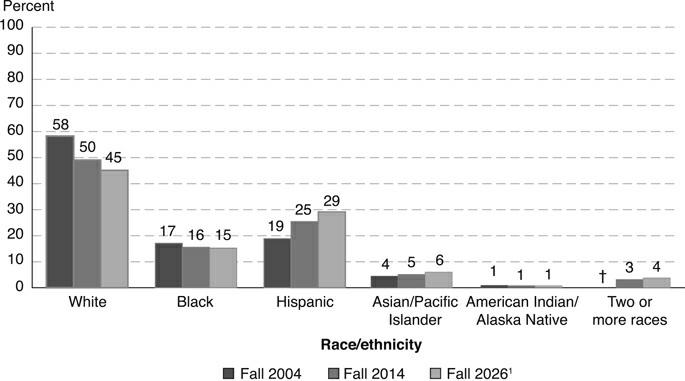
Race In2014,Whitestudentsmadeup50percentofschool-agechildrenintheUnitedStates;25percentwereHispanic(orLatinx4),16percentAfricanAmerican, and5percentAsian5Thisamountstoahugeshiftsincethe1970sLatinxstudentshavetripledtheirrepresentation,whileWhitestudents’proportionofthe totalhasdecreasedabout30percentAlthoughstillrelativelysmallproportionally,Asianenrollmenthasalsogrownrapidlyoverthepastthirtyyears,and thesetrendsareprojectedtocontinue(SeeFigure11)
Inaddition,studentswhoidentifyasbiracialormultiracialnowaccountforroughly3percentofenrollment6Whilerepresentingarelativelysmallchunk ofschoolchildren,multiracialbabiesbornintheUnitedStatesincreasedfrom1to10percentbetween1970and2013,makingmultiracialyouththefastestgrowingyouthsubgroupinthecountry7
Althoughracialgroupsarenotdistributedevenlyacrossthecountry,everyregionhasexperiencedgrowthinstudentsofcolorIn2014,Whitestudents weretheminorityinboththeWestandtheSouthIntheWest,Whitestudents,at38percent,representedasmallershareofthestudentpopulationthan Latinxstudents,at42percentinthesameyearIntheNortheast,theSouth,andtheWest,LatinxstudentsnowoutnumbertheirBlackpeers8
Figure11
PercentageDistributionofStudentsEnrolledinPublicElementaryandSecondarySchoolsbyRace/Ethnicity
†Notapplicable
1Datafor2026areprojected
Note:RacecategoriesexcludepersonsofHispanicethnicityPriorto2008,separatedataonstudentsofTwoormoreraceswerenotcollectedAlthough roundednumbersaredisplayed,thefiguresarebasedonunroundedestimatesDetailmaynotsumtototalsbecauseofrounding
Source:USDepartmentofEducation,NationalCenterforEducationStatistics,CommonCoreofData(CCD),“StateNonfiscalSurveyofPublicElementary andSecondaryEducation,”2004–05and2014–15;andNationalElementaryandSecondaryEnrollmentbyRace/EthnicityProjectionModel,1972through 2026SeeDigestofEducationStatistics2016,table20350
ProportionatelymorestudentsofcolorattendpublicschoolsthanprivateschoolsIn2012,privateschoolstudentswere72percentWhite,about20percent “Whiter”thanpublicschools9HomeschooledchildrenarepredominantlyWhiteaswell,83percentin201210
Immigration ImmigrantsaresomuchapartofUShistory,witheverygenerationseekinganewbeginningseekingabetterqualityoflifeforthemselvesandtheir familiesManyimmigrantsarerefugees,orpeopleseekingasylumfrompersecutionintheirhomecountries
ThreetimesasmanyimmigrantsenteredtheUnitedStatesinthe2000scomparedwiththenumberthatarrivedinthe1960s,andtodaytheUnitedStates ishometo433millionimmigrantsHowever,thepercentageofforeign-bornresidentsisonlyslightlylargerthaninthe1950sabout9percentthen, comparedwithalmost135percentin2015RecentestimatesputtheundocumentedimmigrantpopulationintheUnitedStatesatover11millionabout one-quarterofthetotalforeign-born11
Between1970and2000,theproportionofstudentsinK–12schoolswhowerechildrenofimmigrantstripledIn2015,179millionchildrenlivedwithat leastoneimmigrantparentTheyaccountedfor26percentofchildrenunderage18intheUnitedStates12Nolongerdomostimmigrantsheadfor California,NewYork,Texas,Florida,NewJersey,andIllinois;inthepastdecade,immigrantshaveincreasedtheirpresenceinstatesintheSoutheast, Midwest,andRockyMountainregionaswellInaddition,thenumberofrefugeestudentsisontherise,too,invariousregionsoftheUnitedStatesIn2015, toporigincountriesforimmigrantswere,inorder,India,China,andMexicoToporigincountriesforrefugeesintheUnitedStatescurrentlyincludeIraq, Somalia,Syria,Afghanistan,andSudan,amongothers13Ofundocumentedimmigrants,71percenthailedfromMexicoandCentralAmericaIn2015,itwas reportedalsothatmorethan62,000unaccompaniedyouths,manyescapingviolenceand/oreconomicdespair,weredetainedattheMexico-USborder ManysuchyouthhavesubsequentlybeenreleasedtosponsorsandarenowenrolledinschoolsnationwideThehighestconcentrationsofsuchstudentsare inCalifornia,Florida,NewYork,andTexas14DespitetheprimeplaceofimmigrantsinUShistory,andaswediscussinlaterchapters,suchdemographic shiftsoftenbringtothesurfacesomeofthemorexenophobictendenciesstillpermeatingUSculture
Language
Today’sschoolsincludejustunder12millionstudentswhospeaklanguagesotherthanEnglishalsocalledheritagelanguagesathome15In2015,this groupaccountedfor22percentofschool-agechildren,upfrom10percentin1980Approximatelythree-quartersoftheseyoungpeoplecomefromhomes whereSpanishisspoken,withtheremainingquarter(approximately3million)fromhomeswhereotherlanguagesarespoken,withArabic,Vietnamese,and Chinesebeingthenextmostcommon16
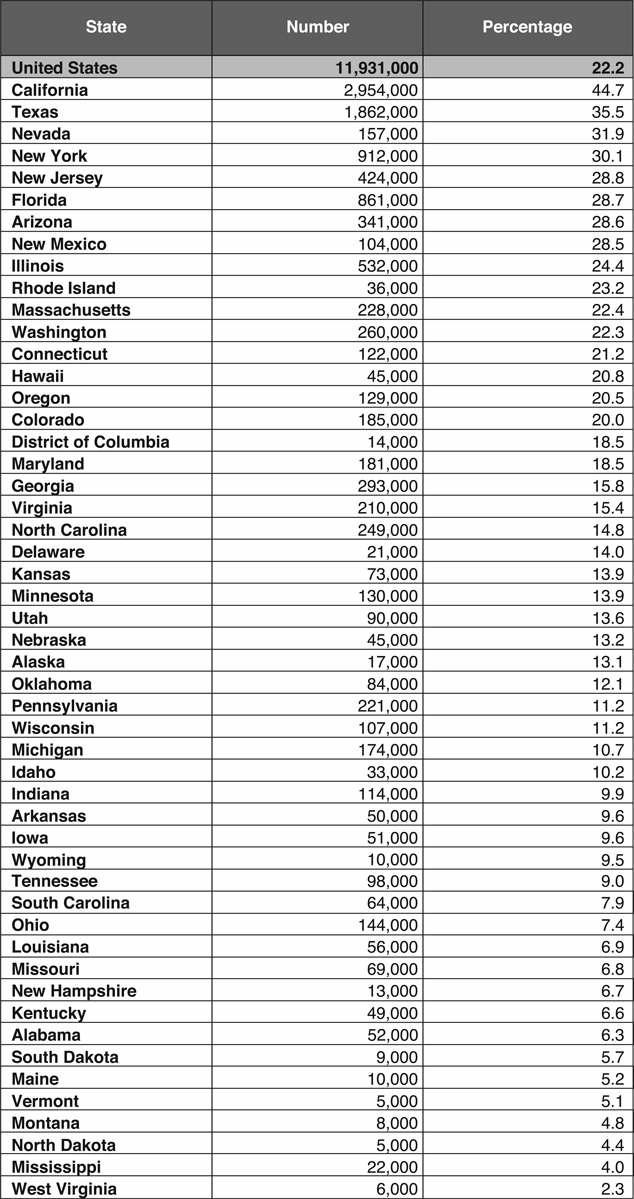
AsFigure12indicates,statesvaryenormouslyintheirpercentagesofstudentsfromhomeswherelanguagesotherthanEnglisharespokenForfifteen statesin2015,20percentormoreoftheirstudentswereinthiscategorytoppedbyahighof45percentinCalifornia17Onlyfourstateshadfewerthan5 percentofstudentsfromhomeswithlanguagesotherthanEnglishspoken,andinallstatesthenumberofstudentswhospeaklanguagesotherthanEnglish was(andis)increasingrapidly
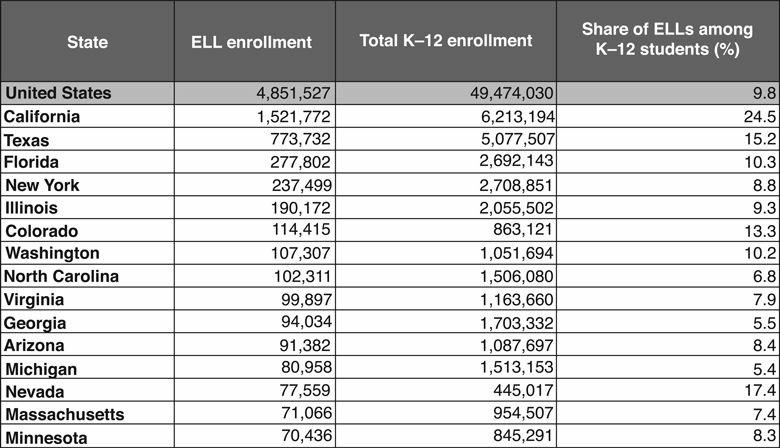
WhenschoolsdeterminethatastudentdoesnotyetspeakEnglishproficiently,thelabelEnglishLearneristypicallyassignedEnglishLearnersarethe fastest-growingstudentgroupintheUnitedStatesIn2012–2013,485millionstudents,or10percentoftheK–12studentpopulation,wereidentifiedas EnglishLearners18Thesestudentsattendschoolsinallfiftystates,but,asFigure13indicates,studentenrollmentsbystatevaryconsiderably
Figure12K–12StudentsWhoSpeakaLanguageOtherThanEnglishatHome,2015
Source:KidsCountDataCenter,2015AmericanCommunitySurvey,http://datacenterkidscountorg/data/tables/81-children-who-speak-a-language-other-than-english-athome#detailed/1/any/false/57386936868867/any/396397
Figure13
TopFifteenStatesWithHighestEnglishLanguageLearner(ELL)StudentEnrollmentinPublicSchools,SchoolYear2012–2013
Source:MigrationPolicyInstitute(2015)ELLInformationCenterFactSheetSerieswwwmigrationpolicyorg/research/states-and-districts-highest-number-and-share-english-languagelearners
DespitetheprevalenceoftheEnglishLearnerlabel,itisincreasinglycommontorefertothisstudentgroupasEmergentBilingualsorDualLanguage LearnersThisshiftreflectsgrowingunderstandingsaboutthebenefitsofsupportingstudents’developingbilingualism;italsochallengesmonolingualand English-onlyideologiesthatprivilegestudents’acquisitionofEnglishoverspeakingorretainingtheirheritagelanguages19Thenewerterminologyalso respondstothechangingdemographicsofthisstudentgroup,71percentofwhomarenative-bornUScitizens20Whilemanyofthesestudentspreviously enteredschoolassequentialbilinguals,meaningtheyhadcommunicatedpredominantlyintheirheritagelanguageandexperiencedlittletonoexposureto Englishbeforeenteringschool,manyenterschooltodayassimultaneousbilingualsThesestudentshavebeenexposedtoandhavecommunicatedinEnglish andtheirheritagelanguagessince(ornearlysince)birth,andenterschoolsintheUnitedStateswithvaryingdegreesofproficiencyinbothlanguages
Aswediscusslaterinthischapterandothers,thepathsofEmergentBilingualsthroughUSschoolsmuchlikethepathsofimmigrantsthroughUS societyareoftendifficult,asevidencedinnewteacherKarenRecinos’sdescriptionofherownexperiencesandthoseofherfamily
WhenIimmigratedtothiscountryasa13-year-old,oneofthemostdifficulthurdlesIhadtoovercomewasthatoflearningasecondlanguageIknewIhadtotakeadvantageof thepricelessgiftmymotherhadgivenmebybringingmetothiscountryFromthedaymydaddiedsheworkedtirelesslytoprovideformytwoyoungerbrothersandmyselfShe leftusinGuatemalatopursuetheAmericandream,adreamthatcausedhertoshedmanytearsForeightyears,sheworkedlongdaystosenddollarssowecouldhavefoodon thetableandreceiveagoodeducationShedreamedofonedaybringingustotheUnitedStateswherewewouldhaveabetterlife,afuturewithmorepossibilitiesItwasnoteasy forhertoaccomplishthatdream,butshediditToday,elevenyearslater,IhavetheprivilegeoftellingmystoryandwhatIhadtoovercomeonceIgottothelandof opportunities”
KarenRecinos First-yearteacher
StudentsWithDisabilities In2015,about13percent(approximately66million)ofstudentsinkindergartenthroughgrade12inUSpublicschoolswereclassifiedashavingdisabilities relatedtolearningMost(about35percent)ofthesestudentswereidentifiedaslearningdisabledAnother20percentwereidentifiedashavingspeech impairments,andanother13percentasexperiencingotherhealthimpairmentsthatinterferewithlearningStudentswithdisabilitiessuchasautism(autism spectrumdisorder),emotionaldisturbances,intellectualdisabilities,anddevelopmentaldelayseachaccountedforbetween5and9percentofchildrenserved undertheIndividualsWithDisabilitiesEducationAct(IDEA)21
Whiletermssuchas“learningdisabled”areincommonuse,manyeducatorsprefertoavoidthisgenerallabelingwhentheycan,insteadreferringto “childrenwithlearning(orhearingordevelopmental)disabilities,”thusseparatingonecharacteristicofthechildfromthetotalindividualThisisoften referredtoasusing“people-first”languageInrecentyears,manyalsohavecometoquestiontaken-for-granted,sociallyconstructedunderstandingsofwhat itmeanstobe“able”orhave“ability”Asweaddressinlaterchapters,classificationsrelatedtodisabilityarehotlydisputed
Referralpracticeshaveledtodisproportionatedesignationsofdisabilityamongstudentsfromcertaingroups;boysofcolor,forexample,areamongthose mostlikelytobereferredforandsubsequentlydiagnosedashavingattention-deficit/hyperactivitydisorderand/oremotionaldisturbance22Conversely,they aremuchlesslikelyasarelow-incomechildrentoberepresentedamongthosedesignatedas“gifted”Infact,moststudentsqualifiedforandplacedin giftedprogramsandadvancedclassesareWhiteorAsian,whileBlackstudentsremainsignificantlyunderrepresented23Becauseoflonghistoriesof discriminationandtheirconcentrationinunderfundedschooldistrictsaphenomenonweaddresslaterinthischaptercertaingroupsofchildrenare disproportionatelyatrisk,forvariousreasons,ofhavingtheirlearningneedssignificantly(andtotheirdetriment)misdiagnosed
Religion PerhapsduetothestatedseparationofchurchandstateintheUnitedStates,religionisoftensidelinedinconversationsaboutstudentdiversityAnd althoughreligionhasbecomesomewhatlessimportant(formanypeople)inrecentyears,thevastmajorityofadultsintheUnitedStatesreportreligious affiliations,andmorethanhalfreportthatreligionisveryimportantintheirlives24WhileChristiansaccountfor71percentoftheadultpopulation, religiousdiversityoverallandwithinthebroadcategoryofChristianisontherise25Increasingly,themediaandpublicdiscoursefindsalientsocialand
politicaldifferencesbetweenwhataretermed“fundamental”or“evangelical”Christiansand“traditional”Christians
Membersofvariousfaiths,includingJudaism,Buddhism,Islam,andHinduism,constitute6percentofthepopulationThosereportingnoreligious affiliationaccountfortheremainingroughly23percenta7percentincreasesince2007withyoungerpeoplebornafter1980lesslikelytoclaimreligious affiliationthanoldergenerations26
Americans’religiousbeliefsandpracticesdonotfitneatlyintoconventionalcategoriesIncreasingnumbersoffamiliesreportengaginginmultipleand mixedpractices,notsurprisinggiventhatroughly39percentofmarriedadultshavespouseswhoaffiliatewithareligionordenominationdifferentfrom theirownEvenwithsuchshifts,however,exclusionaryviewsofreligion’sroleinpubliclifehaveincreasedIn2014,forexample,morethanhalfofpeople surveyedsaidChristianfaithwasanimportantattributeofbeing“trulyAmerican”27
Thesestatisticsspeaktoreligiousdiversityamongadults;indoingso,theyrevealtrendsthatnodoubtinfluencethebeliefsandbehaviorschildrenbring toschool,perhapsespeciallysoinourcurrentpoliticalclimateOrganizationssuchastheSouthernPovertyLawCenter,forexample,havereportedspikesin bullyingandhatecrimesagainstMuslimstudentsInfact,inonerecentsurvey,42percentofMuslimswithchildreninK–12schoolsreportedthattheir childrenhadbeenbulliedbecauseoftheirfaith,comparedwith23percentofJews,20percentofProtestants,and6percentofCatholics28Somehaveargued that,withoutintentionalsupportsputinplacebyjudiciouseducators,Muslimyouthareatriskofsufferingdiscriminatorytreatmentgiventhe“perfect storm”29ofeconomicdownturn,anti-immigrantsentiment,USmilitaryactioninpredominantlyMuslimcountries,andmainstreamconflationofIslam withterrorism30
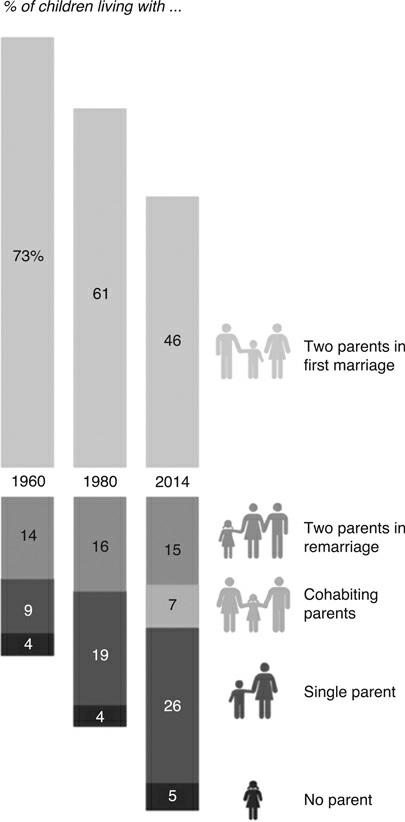
FamilyComposition FamiliesintheUnitedStatescomeinallshapesandsizesInmanyways,thetraditionalimageofafamilyawomanandamanofthesameracewhoare marriedandbothbiologicallyrelatedtotheirchildrenrepresentsoutdatedassumptionsaboutwhoraiseschildren,how,andinwhatconfigurations nationwide31In2014,lessthanhalf46percentofchildrenwerelivingwithtwoparentswhowerebothintheirfirstmarriagedownfrom61percentin 1980and73percentin196032Thatlikelymeansthatmorethanhalfoftoday’syoungpeoplehaveexperiencedshiftsinfamilystructureandroutinesbefore orduringtheirtimeinK–12schools
Infact,roughlyone-fourth(26percent)ofchildren18orunderarelivingwithasingleparent,and5percentarelivingwithneitheroftheirparents Meanwhile,asubstantialpercentageofchildren(16percentin2014)arelivinginblendedfamiliesthatincludestepparents,halfsiblings,and/orstepsiblings (SeeFigure14)In2009,18millionchildrenlivedwithadoptiveparents,upfrom11millionin199133In2015,roughly427,000childrenlivedinfostercare eachday,withatotalof671,000childreninthefostercaresystemthatyear34In2015,29millionchildrenwerebeingraisedbygrandparents35 Inaddition,multiracialfamiliesareontherise;oneineightnewmarriagesoccursbetweenspousesofdifferentracesandethnicities36Growingnumbers ofchildrenarealsobeingraisedbysame-sexparentsAlthoughmoreconcentratedinparticularmetropolitanareas,approximately600,500households headedbysame-sexcouplesresideacrosseverystateandnearlyeverycountynationwide37
SexualOrientationandGenderExpression CharacterizingdiversityalongthelinesofsexualorientationremainsdifficultbecauseoflimitednationalsurveydataA2016studyfindsthatabout10 millionpeopleintheUnitedStatesidentifyaslesbian,gay,bisexual,ortransgender(LGBT)Thisconservativeestimatetranslatestoabout41percentof adultsidentifyingasLGBT38Interestingly,whenpolled,USadultsestimatedin2011thatamuchhigherpercentage25percentofthepopulationisgayor lesbian39Today,63percentofAmericanssayhomosexualityshouldbeacceptedbysociety,and55percentsaytheyfavorallowingsame-sexmarriage40 Despiteincreasingacceptanceofhomosexuality(particularlyamongyoungadults),halfofstatesstilldonotincludesexualorientationorgender expressioninthelanguageofnondiscrimi-nationlawsthatapplytoschools41Sinceterminologyshiftsandchanges,afewdefinitionsarehelpfulhere Sexualorientation,familiartomostAmericans,referstohowpeoplethinkofthemselvesintermsofwhotheyareattractedtoromanticallyorsexually Genderexpressionreferstothewayindividualsperformtheirgenderroles;itmayormaynotcorrelatewiththegenderthatindividualsclaimtohave,or withtheirsexualorientationNotably,astransgenderandgendernonconformingstudentshavebecomemorevisible,somestatesandschooldistrictshave takenactiontoensuretheyareprotectedfromdiscriminatoryspeechandacts
Figure14Children’sFamilyArrangements:GrowingDiversity42
Note:Basedonchildrenunder18Dataregardingcohabitationarenotavailablefor1960and1980Inthoseyears,childrenwithcohabitingparentsare includedin“oneparent”For2014,thetotalshareofchildrenlivingwithtwomarriedparentsis62percentafterroundingFiguresdonotaddupto100 percentduetorounding
Source:PewResearchCenteranalysisof1960and1980decennialcensusand2014AmericanCommunitySurvey(IPUMS)
Theabsenceofsuchlegislationhasbeenasourceofgrowingconcerninlightofhigh-profilehatecrimescommittedagainstLGBTstudents(While statisticshavenotquitecaughtup,LGBThasgainedsomenewletters,QIA,inrecentyears,whichweaddressmorefullyinChapter9)In2015,nearlynine outoftenLGBTmiddleandhighschoolstudentsreportedverbaland/orphysicalharassmentatschoolinthepastyear,nearlythree-quartersfeltunsafe becauseoftheirsexualorientation,andnearlyathirdhadskippedatleastonedayofschoolinthepastmonthbecauseofsafetyconcerns43Bullyingonthe basisofgenderexpressionislikewiseanareaofgrowingconcern44
Class
Socialandeconomicclassareimportantaspectsofidentity,andtheystructurestudents’schoolingexperiencesandoutcomesSometimessocialclassis treatedobjectivelysuchaswhenpeoplearesortedaccordingtoanincomeand/orwealthscaleThus,anindividualorfamilybecomes“poor”or“upper middleclass”onthebasisoftheirincomeand/orwealthInsuchsorting,otherobjectivefactorsthosethatcanbemeasuredempirically,likeyearsof schoolingmightalsobeincludedButasanaspectofidentityanddiversity,classhassubjectiveandculturaldimensionsthatarefarmorecomplexthan thosethatcanbemeasuredempiricallySocialclassdifferencescontributetothedifferentkindsofknowledge,preferences,andtendenciesthatstudents bringintotheclassroomand,therefore,thewaystudentsultimatelyexperienceschool
Asoneexample,sociologistAnnetteLareauhasstudiedtheexpectationsandparentingpracticesofparentsfromdifferentsocialclassbackgrounds45 Lareaufoundthatupper-middle-incomeandhigh-incomeparentsdedicatedacertainkindofattentionwhatshecalls“concertedcultivation”topreparing theirchildrenforhabitsandbehaviorsthatensuredschoolsuccessTheseparentsscheduledplaydates,enrolledchildrenin(oftencostly)extracurricular activities,andotherwisefosteredchildren’stalentsthroughparent-organizedactivityMeanwhile,working-classparentstendedtogranttheirchildrenmore unstructuredtimeandfreedomforself-directedactivitywhatLareaucalls“theaccomplishmentofnaturalgrowth”46
Importantly,Lareaushowshowthesetendenciesactually,child-rearingpreferencesarerelatedtothedifferentamountsofmoneyandfreeorflexible timeparentshadtostructurechildren’sactivitiesShealsoshowsthatwhilebothapproacheshavebenefitsanddrawbacksforchildren’sdevelopment, concertedcultivationprepareschildrentobeabettermatchwithwhatmainstreamschoolinglooksforinschoolreadinessandsuccessThus,thechildrenof advantagedmiddle-classandaffluentparentsoftenfinditeasiertoacclimatetoschools’expectationsfor“good”studentbehaviorForexample,these childrenmightbewellpracticedinmovingfromactivitytoactivityunderanadult’sdirectionandininteractingwithpeersaccordingtothehighly specializedrulessharedbyschoolsTheimportanttakeawayhereisthatwhatmightlooklikerelativesuccessatschoolisoftenafunctionnotofstudents’
skillsorsmartsbutofthesynergyalongclasslinesbetweentheirfamiliesandtheirschools
RecognizingtheComplexityofIdentity Ofcourse,thedataandstatisticsjustrevieweddon’tdescribereal,“whole”peopleorthecomplexsocialdynamicsthatshapetheirlivesDatapointsare reductivebynatureNoonepersonisonlyawomanoronlyheterosexualoronlyanativeSpanishspeakeroronlyAsianAmericanoronlymiddleclass Likewise,datacan’ttelluseverysalientdetailAchildmightliveina“single-parenthousehold”withhisdadandhisdad’sunmarriedpartner,whilegoing tohisgrandparents’houseafterschooluntildinner
Weallidentifyourselvesandareidentifiedbyothersusingmultiple“official”demographiccategoriesorlabels(eg,categoriesrelatedtorace,gender, age,educationlevel,language,andincome),eachofwhichencompassesenormousvariationIndeed,race,genderidentification,language,wealth,andthe resteachexistontheirowncontinuum,andthecombinationsareinfiniteWaltWhitmanfamouslywrote,“Iamlarge,Icontainmultitudes”47Infact,weall containmultitudesmultipleidentitiesthatintersectandinterrelate,andthathaveprofoundimplicationsforhowweexperiencetheworld,including schooling
SocialtheoristshavedevisedconceptsthathelpeducatorsunderstandsomeofthesecomplexitiesHybridityanddynamismdescribehowthebiological andculturalmixing(hybridity)andconstantchange(dynamism)thatcharacterizemanysocietiescanpreserveculturesandenrichthematthesametime Forexample,SpanglishisnowspokenwithprideonEnglish-languagesitcoms,NewYorkCity“fusion”restaurantsserveDominicanandChinesefood,and growingnumbersofmultiracialfamiliesarebringingtogetherdiversehistoriesandheritagesandcreatingnewtraditions
Intersectionality,meanwhile,describestheconnectionsamongoppressivebeliefs,habits,andsocialstructuressuchasracism,sexism,homophobia, religiousdiscrimination,andsoonIntersectionalityemphasizesthatthese-ismsdonotexistinisolation;rather,theyintersectandoperatetogetherIn doingso,theycontributetosystemsofprivilegeandoppression,layersofdiscrimination,andpatternsofsocialinequality
TeacherMarkHillgivesconcreteexamplesofhowtheseconceptsofidentity,hybridity,andintersectionalitymanifestinthelivesandlearningofteachers andstudents
WhenIthinkaboutcultureIfeelthatIsitinauniquespaceWhileitisagiventhatasindividualsweallhaveauniqueupbringing,Ihaveyettofindanyone’squiteassingularas myownMyfamilyconsistsofmyself,mytwinbrother,andmymotherandfatherWhenmymother,whoisWhite,marriedmyfather,whoisBlack,herfamilyimmediately disownedher
AsapersonofcolorIamassumedtohavegrownupwithallthetypicalassumptionsAmericanshaveforBlackpeople,butIhavefewmemoriesofanysuchexperiencesIgrew upinapoor,raciallymixedneighborhood,butIwasneverallowedoutofthehouseorthewalled-upbackyard,andweneverhadanyvisitorsThus,myculturalidentitywas formedalmostsolelybasedonmymother,aWhiteJewIlitthecandlesofourmenorahonHanukkah,celebratedRoshHashanah,andamsympathetictoIsraelintheMiddleEast conflict
IhavefoundthatthisexperiencehelpsmetorelatewithallofmystudentsIrememberasachildwantingothersto“see”methesamewayIsawmyselfBecauseofthisImakea tremendouseffortto“see”studentsasindividualsandacceptthemontheirownterms,regardlessofpreconceivednotionsofrace,gender,orage
MarkHill Highschoolmathematics
Whetherdiversevoices,perspectives,andlanguagesareheardorignoredinclassrooms,theyarethere;theywillnotbesilencedorassimilatedoutof existenceSometeacherswillviewthetremendousdiversityofthechildrenintheirmidstasanasset;others,sadly,willnotSometeachers,likeMarkHill, MichelleCalva,andJudySmith,willstruggletoconstructsomethingwholeandwonderfulthatconnectsindividualsandgroupsacrossdifferences;others won’tWehopemostdo,becausewebelievethatthisistheonlywaytoprovideafreeandequaleducationtoallThatsaid,theinequalitiesofAmerican societyandschoolsthatdisadvantagesomanychildrencertainlymakethejobsoftoday’steachersespeciallychallenging;ofcourse,theyalsomake teachers’jobsallthemoreimportant
InequityOutsideofSchool “GenerationsofAmericanshavebeentoldthattheyliveintheworld’srichestnationButtheUnitedStatestodaymightmoreaccuratelybedescribedasthe nationwiththeworld’srichestrichpeople,”observedtheauthorsofareportoninequalityintheUnitedStates48Youmightbewondering:whydidtheysay this?Infact,amongthetwentyrich,industrializedcountriesthatbelongtotheOrganizationforEconomicCooperationandDevelopment(OECD),the UnitedStatesrankshighestinincomeperperson49Despiteitsriches,however,theUnitedStatesisoneofthemosteconomicallyunequalcountriesinthe world,withpovertyratesunmatchedinotherwealthycountriesChildren,morethananyothergroup,beartheburdenofthisinequality
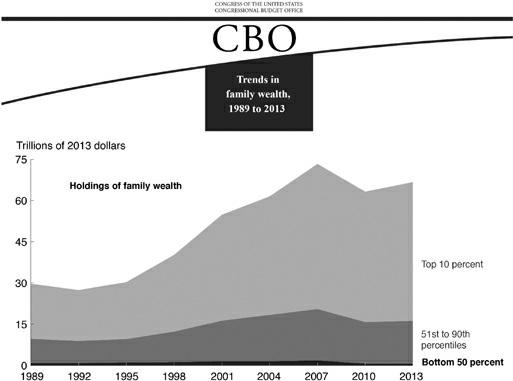
EconomicInequality ThegapbetweenthewealthyandthepoorisenormousAsFigure15shows,thetop10percentofUSfamiliesown76percentofthenation’swealth Meanwhile,thebottom50percentoffamiliessharetheremaining1percentoftotalwealth50Althoughsomeinthemediafeaturetheseandotherstark differences,smallerandseeminglylessdramaticgapsalsoprofoundlyimpactAmericans’dailylivesForexample,thedifferencebetweenlivinginpoverty andearninga“livingwage”canappeartrivialinthecontextofmacroeconomicdata,butforafamilythatdifferencecanmeanhavingornothavingfood securityandsafeshelterManyfamiliesonceassumedtobe“middleclass”nowfindthemselvesonthemarginsofbeingabletoaffordcollegefortheir children
Figure15DistributionofWealthintheUnitedStates
Source:CongressionalBudgetOffice,TrendsinFamilyWealth,1989to2013,August2016,wwwcbogov/sites/default/files/114th-congress-2015-2016/reports/51846-familywealthpdf
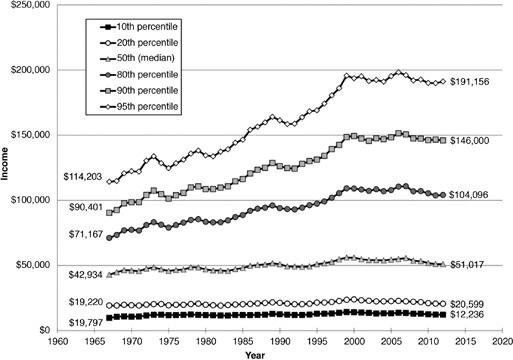
TheacceleratinggapbetweenrichandpoorintheUnitedStatesisn’tjustaconsequenceofthewealthybecomingricher,butoftherelativeincome stabilityofthosewhohavefarlessFigure16showsthatin2012high-incomehouseholdsinthetop5percentoftheincomedistributionreceivedalmost sixteentimestheincomeoflow-incomehouseholdsinthebottom10percent51Also,mostmiddle-tolow-incomefamilieshavemadeonlymodestincome gainsoverthepastthirtyyears,andtheaverageincomeinthelowestquintilehasbarelybudged52Mostincomegainsresultfromfamiliesworkinglonger hours,oftenbyaddingasecondwageearnerIn2009,marriedwomeninthemiddlethreeincomegroupsworkedalmosteightweeksmoreayear,on average,thantheydidin1979Inaddition,ithasbecomeincreasinglymoredifficultforparentstoaffordtimeofftocarefortheirchildrenintheUnited StatesthaninmostotherOECDcountries,becausetheUnitedStatesistheonlyonethatdoesnotmandatepaidmaternityorpaternityleave53
Figure16RealFamilyIncomebyIncomePercentile,1967–2012(in2012dollars)
Source:DatafromCDeNavas-Walt,BDProctor,andJCSmith,USCensusBureau,CurrentPopulationReports,P60-245,Income,Poverty,andHealthInsuranceCoverageinthe UnitedStates:2012,September2013,TableA-2
Increasingly,peoplewhoarefullyemployeddonotearnenoughtokeeptheirfamiliesoutofpovertyhencethetermtheworkingpoorIt’snotthatUS workersearnlessbecausetheyworklessInfact,workersintheUnitedStates,onaverage,workabout1,768hoursperyear,morethantheircounterpartsin otherOECDcountries(exceptGreece)54Alltold,povertyratesarehigher,andlivingstandardsarelower,forthepoorintheUnitedStatesthantheyarefor thepoorestpeopleinotherindustrializedcountries55Comparativelyspeaking,thosewhoarepoorintheUnitedStatesalsotypicallyremainpoorforlonger periodsoftime,andwithlessopportunitytomoveupoutofpoverty,aswell56
Whilestatisticsindicatesomeimprovementssuchastheofficialpovertyratedroppingfrom148in2014to135percentthefollowingyearpovertystill impactsanenormousandunacceptablenumberofAmericans,especiallychildrenThishaslongbeenaconcern Inthemid-andlate1990s,Clinton-eraDemocratsfoundcommongroundwithconservativepoliticiansandinstitutedsignificantchangestowelfare policiesThosechangesreducedbenefitsandestablishedmorestringenteligibilityrequirementsforAidtoFamiliesWithDependentChildren,foodstamps, andotherpublicassistanceforpoorchildrenIntheinterveningyears,theeffectsofthesechangesontheoveralleconomyhavebeenhotlydebated,butthey havedonenothingtostemchildhoodpovertyOneinfouryoungchildrenintheUnitedStatesnowlivesinpovertyThenumberoflow-incomestudents receivingfreeorreduced-pricelunchatschoolincreasedfrom18millionin2006–2007to31millionin2012,andnowmorethanhalfofstudentsinthe UnitedStatesqualifyfortheprogram57
Despitetherecoveryfromtherecessionof2008,45millionchildrenunderage18werelivinginpovertyin2015,representing231percentofthetotal populationand336percentofthoselivingbelowthepovertyline58Thesepovertyratesweremoreacuteforcertainchildren,affectingapproximately12 percentofWhitechildren,5936percentofAfricanAmericanchildren,30percentofLatinochildren,and32percentofAmericanIndianchildren60
Thesediscrepanciesreflectsocioeconomicinequalitythatincludesandgoesbeyondfood,shelter,health,andeducationinsecurityforthecurrent generationThegapsrepresentcross-generationalchallenges;somegroupshavesignificantwealthandothersupportstopassontotheirchildren,while othergroupshavefarlessIn2013,forexample,theaveragewealthforWhitefamilieswasseventimeshigherthanforBlackfamilies,61andtentimesthatof Latinxhouseholds62
EaseoffindingemploymentlikewisediffersalongraciallinesAfricanAmericanswithhighschooldiplomasandcollegedegreesareunemployedat nearlytwicetherateoftheirWhitecounterparts63Ofcourse,theseandotheremploymentdiscrepancieshaveatrickle-downimpactonchildren’slivesand livelihoodsIn2015,forexample,BlackandLatinxchildrenwerelesslikelythanWhitechildrentohaveaparentworkingyear-round,full-timeSeventysevenpercentofWhitechildren,about66percentofLatinxchildren,and55percentofAfricanAmericanchildrenhadparentswithsecureemployment64
WagedisparitiesalsocontributetothehigherratesofpovertyamongchildrenofcolorForexample,in2015,Blackmenmade22percentlessinaverage hourlywagesthanWhitemenwiththesameeducationandexperience65
Inaddition,althoughthegendergaphasdiminished,womenstillmakelowerwagesthanmen,evenwhentheyholdthesamequalificationsandworkthe samehoursTheyarealsomorelikelytobeheadingupsingle-parenthouseholdswithdependentchildrenGiventheintersectionsofraceandgender, womenofcolorare,inturn,amongthosemostlikelytoearnpoverty-levelwagesIn2013,36percentofAfricanAmericanworkersand42percentofLatinx workersearnedpoverty-levelwages,comparedto23percentforWhites;inallcases,theserateswerehigherwhileaveragewageswerelowerforwomen thanmenwithinracialsubgroups66
Racialdisparitiesinwealthandincome,asdescribedaboveandinwhatfollows,leadtocorollarydisparitiesinchildren’saccesstothebasicsoflifefood, healthcare,housing,andsafetyaswellasaccesstohigh-qualityschooling
InequityintheBasicsofLife OnDecember10,1948,theGeneralAssemblyoftheUnitedNationsadoptedandproclaimedtheUniversalDeclarationofHumanRightsFollowingthis historicact,theassemblycalledonallmembercountriestopublicizethetextofthedeclarationand“tocauseittobedisseminated,displayed,readand expoundedprincipallyinschoolsandothereducationalinstitutions,withoutdistinctionbasedonthepoliticalstatusofcountriesorterritories”67Article25 ofthedeclarationstates:
Everyonehastherighttoastandardoflivingadequateforthehealthandwellbeingofhimselfandofhisfamily,includingfood,clothing,housingandmedicalcareandnecessary socialservices,andtherighttosecurityintheeventofunemployment,sickness,disability,widowhood,oldageorotherlackoflivelihoodincircumstancesbeyondhiscontrol68
TheUnitedStateswasoneoftheoriginalsignersofthedeclaration,andyetmanyAmericanswouldlikelydisagreewithitsprovisions;otherswouldseeit asaworthystatementofprincipleapplyingmostlytoothercountries;andstillotherswouldtakeitasacalltoactionAllwouldhavetoagreethatit remainsunrealized;accesstothemostbasicsocialsupportsintheUnitedStates(eg,adequatefood,healthcare,andhousing)dependsonwealthand incomeAsonereportoninequalityphrasedit,“IntheUS,perhapsmorethaninanyotherprosperoussociety,inequalityreachesintodimensionsoflife wheremostpeoplewouldprefertobelievethatmoneydoesnotrule”69
Food InterviewedbyBillMoyersin2013,JoelBerg,asheadoftheNewYorkCityCoalitionAgainstHunger,explainedthewebofconsequencestochildrenwho livewith“foodinsecurity”
Foodinsecuremeansfamiliesdon’thaveenoughmoneytoregularlyobtainallthefoodtheyneedItmeanstheyarerationingfoodandskippingmealsItmeansparentsaregoing withoutfoodtofeedtheirchildrenItmeanskidsaremissingbreakfastsAnd,ironically,becausehealthyfoodisusuallymoreexpensivethanjunkfood,andbecausehealthier optionsoftendon’tevenexistinlow-incomeneighborhoods,itmeansthatfoodinsecurityandobesityareflipsidesofthesamemalnutritioncoin,sofoodinsecuritymayactually increaseafamily’schanceoffacingobesityanddiabetesFiftymillionAmericans,includingnearly17millionchildren,nowliveinfoodinsecurehomes70
Giventhepovertystatisticssharedinpriorsections,it’snotsurprisingandyetstillshockstheconsciencethatin201527percentofAfricanAmerican and27percentofLatinxchildrenwerelivinginhouseholdswheretheycouldnotcountonhavingenoughfoodforanactive,healthylifeforeveryonein theirfamily71
Health Children’shealthintheUnitedStatesishighlyrelatedtotheirfamilies’incomestatus72Asthmaandleadexposurebothassociatedwithenvironmental toxins,includingpollutionandunsafebuildingmaterialsarejusttwoofthehealthproblemsthataffectlower-incomechildrenathigherratesInone dramaticexample,thepercentageofchildreninFlint,Michigan,withelevatedlevelsofleadintheirbloodknowntolowercognitivefunctioningand increaselearningproblemsnearlydoubledaftertheleadstartedleachingoutofthecity’soldleadwaterpipesin201473Morethan40percentofFlint’s residentslivebelowthepovertyline
Keytomaintainingchildren’shealthandpreventingtheirillnessistheiraccesstoahealthcaresystemAlthoughlocal,state,andnationalhealth insuranceandservicesareaccessibletomost,manylackgoodhealthcare,andthisisespeciallytrueforthenation’spoorestchildrenWerecentlysaw historicallylowratesofuninsuredchildren,inpartduetotheObamaadministrationpoliciesTheKaiserFamilyFoundationreportedthefollowingin2017:
Followingdecadesofsteadyprogress,largelydrivenbyexpansionsinMedicaidandCHIP[Children’sHealthInsuranceProgram],thechildren’suninsuredratehasreachedanalltimelowof5MedicaidandCHIParekeysourcesofcoverageforournation’schildrencoveringnearlyfourinten(39percent)childrenoverallandoverfourinten(44percent) childrenwithspecialhealthcareneedsMedicaidservesasthebaseofcoverageforthenation’slow-incomechildrenandcovered368millionchildreninfiscalyear2015CHIP, whichhad84millionchildrenenrolledinfiscalyear2015,complementsMedicaidbycoveringuninsuredchildrenaboveMedicaideligibilitylimits74
ThesegainsareinperilinthepoliticalbacklashagainstuniversalhealthcareLookingahead,theKaiserreportidentifiedseriousconcernsgrowingoutof thepoliticallandscape,includingpotentialcoveragelossesforchildren,morelimitedbenefitsandhigherout-of-pocketcostsforchildren’scoverage,reduced accesstocareforchildren,andincreasedfinancialpressureonstatesandproviders75Thereismuchtobeconcernedabout
Housing In2013,40percentofUShouseholdswithchildrenhadaserioushousingproblemTheseproblemsincludedphysicallyinadequatehousing,overcrowded housing,orhousingthatcostmorethan30percentofhouseholdincome76Approximately16percentofhouseholdsspendmorethanhalfoftheirincomeon housing,77leavinglittleforotherbasicnecessities,suchasfoodandhealthcare
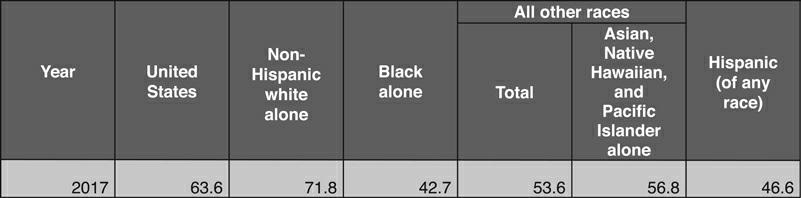
AfricanAmericanandLatinxfamiliesarefarmorelikelytoexperiencehousingproblemsthanareWhitefamilies,asareimmigrantfamilies78In2017, whennearly72percentofWhitesownedtheirhomes,lessthanhalfofAfricanAmericansorLatinxwerehomeowners79(SeeFigure17)Inaddition, familiesofcolorhavesuffereddisproportionatelyintherecenthousingcrisisTheyhavebeentargetedbypredatorylendersandsubjectedtohigh-interest adjustableratemortgages,andtheyareamongthoseexperiencingthehighestratesofforeclosure80Children,ofcourse,arenotimmunetothenegative effectsofthese“adult”issues
Infact,thehomelesspopulationintheUnitedStatesisincreasinglymadeupoffamilieswithchildren,andthiswilllikelycontinuegiventherecent economicdownturnandhousingcrisisAsof2008,familieswithchildrenaccountedfor32percentofthehomelesspopulation,a9percentincreasesince 200781During2013,anestimated138,000children(2per1,000children)werefoundtobehomelessatasinglepointintime,82and25percentofelementary andsecondarystudentswereidentifiedashomelessin2015School-agehomelesschildrenfacebarrierstoenrollingandattendingschool,including transportationproblems,residencyrequirements,inabilitytoobtainpreviousschoolrecords,andlackofclothingandschoolsupplies
Figure17HomeownershipRatesbyRaceandEthnicityofHouseholder,2017
Source:USCensusBureau,QuarterlyResidentialVacanciesandHomeownership,FirstQuarter2017,wwwcensusgov/housing/hvs/files/currenthvspresspdf
Clearlythen,youngpeoplecompriseasignificantproportionoftheUShomelesspopulation;amongthoseontheirownaresignificantnumbersofLGBT youthResearchsuggeststhatroughlyoneinfourLGBTyouthwhocomesouttohisorherparentsistoldtoleavehome83Forthisandotherreasons,about 40percentofallhomelessyouthidentifyasLGBT,comparedtolessthan10percentoftheoverallyouthpopulation
Safety In2012,oneinfour(23percenteach)BlackandLatinxchildrenlivedinneighborhoodsreportedbytheirparentstobeneveroronlysometimessafe, comparedwithonly7percentofWhitechildrenChildrenlivingatorbelowthepovertylineweremorethanthreetimesaslikelyasbetter-offchildrento liveinsuchneighborhoodsIt’slongbeenknownthatunsafeneighborhoodshavehigherratesofinfantmortalityandlowbirthweight,aswellaschild abuseandneglect;childrentherewatchmoretelevision(frequentlyasaferpastimethangoingoutside),participatelessinafter-schoolactivities,andhave lowerschoolachievementandhighschoolgraduationratesYoungpeoplegrowingupinneighborhoodswithhighlevelsofcrimeandgunviolenceare themselvesmuchmorelikelytobecomevictimsorperpetratorsofviolentcrimeTheyarealsomorelikelythanchildreninsaferneighborhoodsto experiencetraumaresultinginsocialandemotionalproblems84
Newsreportsremindusofanotherkindoftruththatsomeyoungpeoplearealsoatgreaterrisk,asaretheirfamilies,ofexperiencingdiscriminatory publicpoliciesandpractices,includingpolicingpracticesthatputtheminsignificantdanger85ThenumberofpoliceshootingsofyoungBlackmenin2016 (ages15–34)wasninetimesgreaterthanforotherAmericans,andfourtimestherateforyoungWhitemen86TragicinstancesofunarmedBlackteenagers beingkilledbypoliceinChicago,Illinois;Ferguson,Missouri;Cleveland,Ohio;Dallas,Texas;andTerrebonne,Louisiana,havebeenprofiledinthemedia
andbeenthesubjectofsignificantactivismonthepartofcommunitymembersconcernedforthesafetyoflocalyoungstersBlackLivesMatter,which beganasahashtagonTwitterfollowingthenot-guiltyverdictinthekillingof17-year-oldTrayvonMartininFlorida,becamearallyingcryafterthepolice shootingofMichaelBrowninFergusonandevolvedintoanationalmovementagainstbothpolicebrutalityandabroadersetofracialinjustices
GeographicandEconomicIsolation Disparitiesinchildren’saccesstobasiclifenecessitiesarecompoundedbythesegregationoflow-incomechildrenandstudentsofcolorinlargeurban centers,andincreasinglyinresidentiallysegregatedsuburbanandruralneighborhoods,tooOneparticularlywell-documentedtrendhasbeenformiddleandworking-classfamiliesminoritized87andWhitetomoveawayfromcentralcities,leavingtheremainingresidentstofaceproblemsofunemployment, poverty,racialisolation,andcrumblingschoolsAscitysmokestackindustriescontinuetobe“down-sized,”gooverseas,ordisappearentirely,jobshavealso movedbeyondtheurbancore
Thejobsremaininginthecitytendtobe“neweconomy”jobsininformationandhigh-techindustriesthataremoredifficulttoqualifyforthanjobsin the“oldeconomy”factoriesFewinner-cityresidentsespeciallythelargenumberofnewlyarrived,hardworkingimmigrantsqualifyforthesejobsMost settleforirregular,part-timeworkinservicesandlacksecurity,benefits,andalivingwageatermusedtodescribetheincome,calculatedforeach community,thatensuresthatapersonworkingfull-timewillnotfallbelowthepovertyline
Theseemploymentconstraints,commonininnercities,togetherwithhousingpoliciesandthepreferencesofWhitefamiliestobuyhomesinschool districtsthatarepredominantlyWhite,meanthat,despiteincreasedracialdiversityintheUnitedStates,mostyoungpeopleliveinhighlysegregated neighborhoodsWhitechildrentypicallyliveincommunitieswherethevastmajorityofpeopleareWhiteAfricanAmericanchildren,onaverage,livein neighborhoodswheremostoftheotherchildrenareBlackorLatinx;Latinxchildrentypicallyalsoliveinplaceswheretheyareinthemajority88
SchoolingInequities In2002,SenatorChristopherDoddandCongressmanChakaFattahintroducedintoCongresslegislationthatwouldensurethatbasiceducational opportunitiesareavailabletoallUSstudentsTheirStudentBillofRightswouldholdstatesaccountableforprovidingallstudentswiththe“fundamentals ofeducationalopportunity,”89includinghighlyqualifiedteachersandguidancecounselors,challengingcurricula,up-to-datetextbooksandmaterials,and smallclassesTheseareresourcesknowntohaveanenormouspositiveimpactonachievement,especiallyfordisadvantagedstudentsSeeFocalPoint11to readthetextofthislegislation
OnemightthinkthatsuchabillofrightswouldbeunnecessaryintheUnitedStates,givenitswealthandlonghistoryofpubliceducation,butmanyof thenation’schildrendonotroutinelyexperiencethesebasicelementsofeducationintheirpublicschoolsThisdeclarationofstudentrightshasyettobe passed
SegregatedSchools Overthepastdecades,racialsegregationhascontinuedtohaveprofoundeffectsonpublicschools;sotoohasthecontinuedexistenceandexacerbationof divisionbetweenpoorcities(andcitycenters)andsurroundingaffluentneighborhoods,includingouter-urbanandsuburbancommunitiesAsaresult,more thansixtyyearsafterBrownvBoardofEducation, 90manycities’publicschoolsystemsremainpredominantlyattendedbystudentsofcolorMiddle-class Whitesinthoseurbancentersoftenolderthanotherparentsofschool-goingchildrenandmoreaffluentincreasinglychooseprivateeducationfortheir ownkidsSomeseekprivateschoolsfortheresources,status,andprivilegeOtherspraisetheidealofintegrationbutworrythatintegrationinpractice wouldtriggerdecliningschoolqualityStillothersfearfortheirchildren’ssafetyWhateverthereasons,withdrawalofsupportbythemiddleclasshasleft manyurbanpublicschoolsresource-pooranddecayingAtthesametime,demographicshiftshavebroughtlower-income,morediversepopulationsintothe suburbanandsometimessegregatedringaroundcitiesnotwithoutsomepredictable(anddeeplyproblematic)backlash91
FocalPoint11StudentBillofRights HR236
StudentBillofRights
IntheHouseofRepresentatives
ToprovideforadequateandequitableeducationalopportunitiesforstudentsinStatepublicschoolsystems,andforotherpurposes BeitenactedbytheSenateandHouseofRepresentativesoftheUnitedStatesofAmericainCongressassembled,SEC112StateEducational AdequacyAndEquityRequirements(a)FundamentalsofEducationalOpportunityAStateshallprovideforallpublicschoolsintheStateaccess,at levelsdefinedbytheStateundersection113asidealoradequate,toeachofthefollowingfundamentalsofeducationalopportunity:(1)high-quality classroomteachersandschooladministrators(2)rigorousacademicstandards,curricula,andmethodsofinstruction(3)smallclasssizes(4)quality facilities,textbooks,andinstructionalmaterialsandsupplies(5)up-to-datelibraryresources(6)up-to-datecomputertechnology(7)qualityguidance counseling
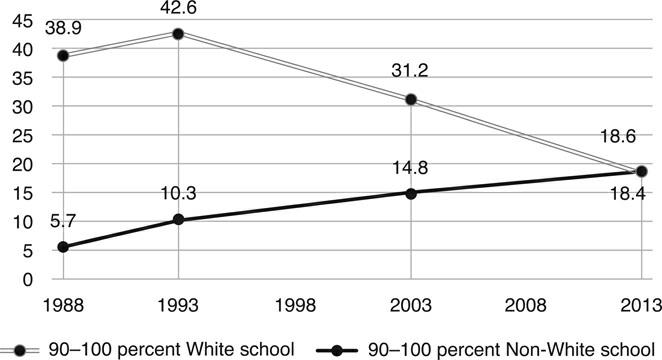
Overall,schoolsegregationhasincreasedsincethel980s,especiallyforBlackandLatinxstudents92Moststriking,thepercentageofschoolswith enrollmentsof90–100percentstudentsofcolorhastripledinthattime(seeFigure18)In2013,38and43percentofBlackandLatinxstudents,respectively, attendedschoolswherethestudentbodywas90to100percentminoritizedstudentsForGaryOrfieldandhiscolleaguesattheUCLACivilRightsProject, theseshiftsrepresenta“striking”andconsequentialriseinsegregationbyraceandpovertyforAfricanAmericanandLatinxstudentsinschoolsthat“rarely attainthesuccessfuloutcomestypicalofmiddleclassschoolswithlargelyWhiteandAsianstudentpopulations”93Thisincreasedracialandsocioeconomic separationisfollowedbyunequalaccesstoeducationalresources,opportunities,andoutcomes
UnequalSpending In2014,per-pupilspendingrangedfromahighof$18,165inNewYorktoalowof$5,838inIdahoInbothhigh-andlow-spendingstates,however,schools typicallyspendlessonlow-incomechildrenandchildrenofcolorthantheyspendoneconomicallyadvantagedandWhitestudents94
Figure18Percentageof90–100PercentWhiteSchoolsand90–100PercentNon-WhiteSchoolsintheUnitedStates1988–2013
Individualstatesvarygreatly;somearemuchbetter,andsomearemuchworseAhandfulofstatesDelaware,Minnesota,NewJersey,and MassachusettshavegenerallyhighfundinglevelsandalsoprovidesignificantlymorefundingtodistrictswherestudentpovertyismoreprevalentTwentyonestates,however,providelessfundingtoschooldistrictswithhigherconcentrationsoflow-incomestudentsInWyoming,high-povertydistrictsreceive 70centsforeverydollarallottedtolow-povertydistrictsInNevada,high-povertydistrictsreceiveonly59centstothatdollar95
ConceptTable11Per–StudentFundingGapsAddUp
Forexample,whenyouconsiderthe cost–adjustedper–studentfundinggap forlow–incomestudentsin
Betweentwotypical classroomsofstudents,that translatesintoadifference of
Betweentwotypicalelementaryschoolsof schoolsof400students,thattranslatesthat translatesintoadifferenceof
Betweentwotypicalhighschoolsof schoolsof1,500students,that translatesintoaintoadifferenceof
Source:TheEducationTrust,TheFundingGap,2006,wwwedtrustorg/dc/publication/the-funding-gap-O/
TheEducationTrust,anadvocacyandresearchorganization,calculatedtheimpactofthefundinggapforindividualschools(SeeConceptTable11)It foundthatinNewYork,almost$58,000lessperyearwouldbespentonaclassroomoftwenty-fivestudentsinahigh-povertydistrict,almost$1millionless peryearwouldbespentatahigh-povertyelementaryschoolof400students,andover$34millionlessperyearwouldbespentatahigh-povertyhigh schoolof1,500students96TheEducationTrustasksanobviousandimportantquestion:“Considerthedailystruggleforprogressthatoccursinmanyofour poorestschoolsWhatcouldthoseschoolsdowithanother$1millionperyearresourcesthattheirmorewealthypeersalreadyenjoy?”97
Althoughthisanalysisisatleastadecadeold,thepatternsstillholdWhilepostrecessionspendinghasincreasedoverallinmanystates,asnotedabove, twenty-onestatescontinuetospendlessinhigh-povertyschooldistricts
UnequalOpportunitiestoLearn Thefifth-gradeclasswasrelocatedintoportablesinOctoberTheportablesarehalfthesizeoftheregularclassroomThereisbarelyenoughroomtowalkaroundbecauseallbooks andsuppliesarenestledaroundtheperimeteroftheroomonthefloorTherearenocabinetsTherearenowindowsThedistrictisinsuchdirefinancialstraitsthattheteachers can’tmakephotocopies;wedon’thaveoverheadprojectors,nordowehaveenoughspaceforthechildren
StevenBranch First-yearteacher,grade5
Theboys’andgirls’bathroomshadbeenfloodedforovertwomonthsAftertwomonthsofsickeningsmellandslimyscum(literally,thestudentswerewalkinginslime),the bathroomswerefixedFortwodaysalldaylong,therewasajackhammergoingoffinthebackofmyroomCouldn’ttheyhavedonethisworkafter2PM?Orduringrecessand lunchtime?OrgivenmesomeadvancenoticesothatIcouldhavemadesomeoutdoorplans?Ilosttwodaysoflearning
JenniferHaymore First-yearteacher,grade4
StevenBranch’sandJenniferHaymore’sexperiencesincityschoolsystemsarenotuniqueJonathanKozol’swrenchingaccountfromtheearly1990s, SavageInequalities,portraysinequalitiesthatmanystudieshavesincedocumentedKozolfoundthatBlackandLatinxstudentsinCamden,NewJersey, werelearningkeyboardingwithoutcomputers,sciencewithoutlaboratories,andothersubjectswithoutenoughtextbookstogoaroundSevenminutesaway intheWhite,affluentcommunityofCherryHill,studentsenjoyedwell-keptfacilities,includingagreenhouseforthoseinterestedinhorticulture,and abundantequipmentandsuppliesSincethepublicationofSavageInequalities,journalistsandscholarshaveincreasedthepublic’sawarenessofdisparities inschoolconditions,andactivistsinmanystateshavepursuedlegalactiontocorrectthem
In1997,forexample,theLosAngelesTimespublishedahumiliatingstoryoftextbookshortagesinthecity’sschoolsFremontHighSchool,attended almostentirelybyLatinxyouth,reportedneeding7,200textbookssimplytocomplywithstatelawForits1,200tenthgraders,Fremontownedonly210 EnglishtextbooksAndFremontwashardlytheonlyhighschoolinthedistrictwrestlingwithseriousbookshortagesItisdifficulttoimaginethataschool ordistrictwithmostlyaffluentWhitestudents,anywhere,wouldeverfacesuchaproblemWithinafewweeksoftheexposé,thenewspaperwasfilledwith
reportsofschooldistrictmoney,privatedonations,andactionatthestatelevel,alongwithlargephotosshowingstacksofnewbooksatFremont98Yetthese stopgapmeasuresonbehalfofoneschooldidlittletoaddressthebroadersetofinequitiesfacingsomanyofthecity’sstudents
In2000,someangryCaliforniansaskedthecourtstoremedysuchinequitiesAgroupofyoungpeopleandtheirparentsfiledsuitinthenameofEliezer Williams,anAfricanAmericanstudentataSanFranciscomiddleschoolNearlyalloftheforty-eightstudentplaintiffsnamedinthecasewereBlack, Latinx,orAsian/PacificIslander,andtheyallattendedschoolsfilledwithfellowstudentsofcolorfromlow-incomecommunitiesTheysuedCalifornia’s governor,thestateboardofeducation,andthesuperintendentofpublicinstruction
TheWilliamsplaintiffsclaimedthatthey,andmanystudentslikethem,attended“schoolsthatshocktheconscience”99Theyprovidedevidencethat schoolsacrossthestatelacked“trainedteachers,necessaryeducationalsupplies,classrooms,evenseatsinclassrooms,andfacilitiesthatmeetbasichealth andsafetystandards”Theyalsoshowedthattheseschoolingbasicsweresystematicallylessavailabletolow-incomestudentsofcolor,andthataschool experiencingoneoftheproblemswasmuchmorelikelytoexperiencemoreorallofthemTheWilliamsstudentsarguedthat,bypermittingsuchschools, California’seducationalsystemfailedtomeetitsconstitutionalobligationtoeducateallstudentsandtoeducatethemequallyIn2004,thegovernorof Californiaagreedtosettlethecase,allocating$1billionanddevelopingstandardsrequiringthatallstudentshavequalifiedteachers,instructionalmaterials, anddecentandsafeschoolbuildings
SuchschoolinginequalitieswerenotthenandarenotnowconfinedtoCalifornia,norweretheyentirelyremediedeveninCaliforniaAcrossthenation, studentsathigh-povertyschoolshavefewerwell-qualifiedteachersthantheirWhitecounterpartsinaffluent,suburbanschoolsTheirschoolsalsosuffer moreteachingvacancies,whichprincipalsthenhaveatoughertimefilling
Inpartbecauseofthescopeoftheseissuesnationwide,theUSDepartmentofEducationrequiredin2015thateachstatefileanequityreport documentingthedistributionofteachersacrossvariousstudentpopulationsThosereportsrevealedthat,acrossthecountry,unqualified,inexperienced,or out-of-fieldteacherswerefoundindisproportionatelyhighnumbersinhigh-povertyschoolsand/orschoolsservingstudentsofcolorFigure19showsthe numbersofstateswhereaccesstoqualifiedteachersremainsaseriousproblem
Intotal,fortystatesreportedinequitableaccesstoexperiencedteachersforlow-incomestudentsandstudentsofcolorLikewise,twenty-ninestates reportedthatunqualifiedteachersmoreoftenteachlow-incomeand/orminoritizedstudents100
Lessqualifiedteachersareaparticularproblembecausestudyafterstudyshowsthat,ofalltheresourcesschoolsprovide,highlyqualifiedteacherswith expertiseintheirsubjectareasarethemostimportantforstudentlearning,andunderqualifiedteachersareparticularlydamagingforchildrenwhoalsoface inequitiesoutsideofschool
Figure19QualifiedTeachers:NumberofStatesWhereAccessIsProblematic
Source:USDepartmentofEducation,OfficeofElementaryandSecondaryEducation,StatePlanstoEnsureEquitableAccesstoExcellentEducators,2015, www2edgov/programs/titleiparta/resourceshtml
Moreover,havingenoughteachersalsomattersInfact,childrenfromlow-incomefamilieshavehigherratesofachievement,andsufferlessofan achievementgap,whentheirstatestargetstaffingincreasestotheirown(highest-needs)schools101
It’snotjustwhoteachersare,buthowtheyteachthatmattersforstudentlearningInschoolsservinglow-incomecommunitiesandcommunitiesofcolor, teacherswhomayhavelessexperienceandexpertise,givenstaffingissuesaddressedabovetendtoplacelessemphasisoninquiryandproblem-solving skillsandofferfeweropportunitiesforactivelearning102This,too,putsstudentsinthoseschoolsatadisadvantage
Furthermore,whatistaughtmatters,tooSchoolsattendedpredominantlybyBlackandLatinxstudentsoftenofferfewercriticalcollege“gatekeeping” coursessuchasadvancedmathematicsandscienceFigure110showsthedisparitiesamongschoolswithdifferentpopulationsinadvancedmiddleandhigh schoolmathematicsNotably,thereisa30percentgapbetweenlow-andhigh-povertyschoolswhenitcomestoseventhandeighthgraders’accessto algebra
Advancedplacement(AP)coursesthatenhancestudents’college-goingopportunitiesarealsounevenlydistributedIn1999,RashedaDaniel,aworkingclassAfricanAmericanteenager,suedherschooldistrictandthestateofCaliforniabecauseherhighschooldidnotoffertheadvancedclassesthatshe neededtoattendthestate’suniversityasasciencemajorNobodythoughtshewaswrong,andnobodythoughtshewasanisolatedcaseDaniel’ssuit promptedthestatelegislaturetoprovidenewfundingtoschoolslikeherssotheycouldbeginofferingtherequisiteadvancedcourses