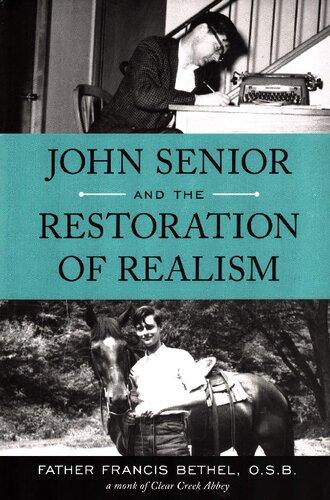
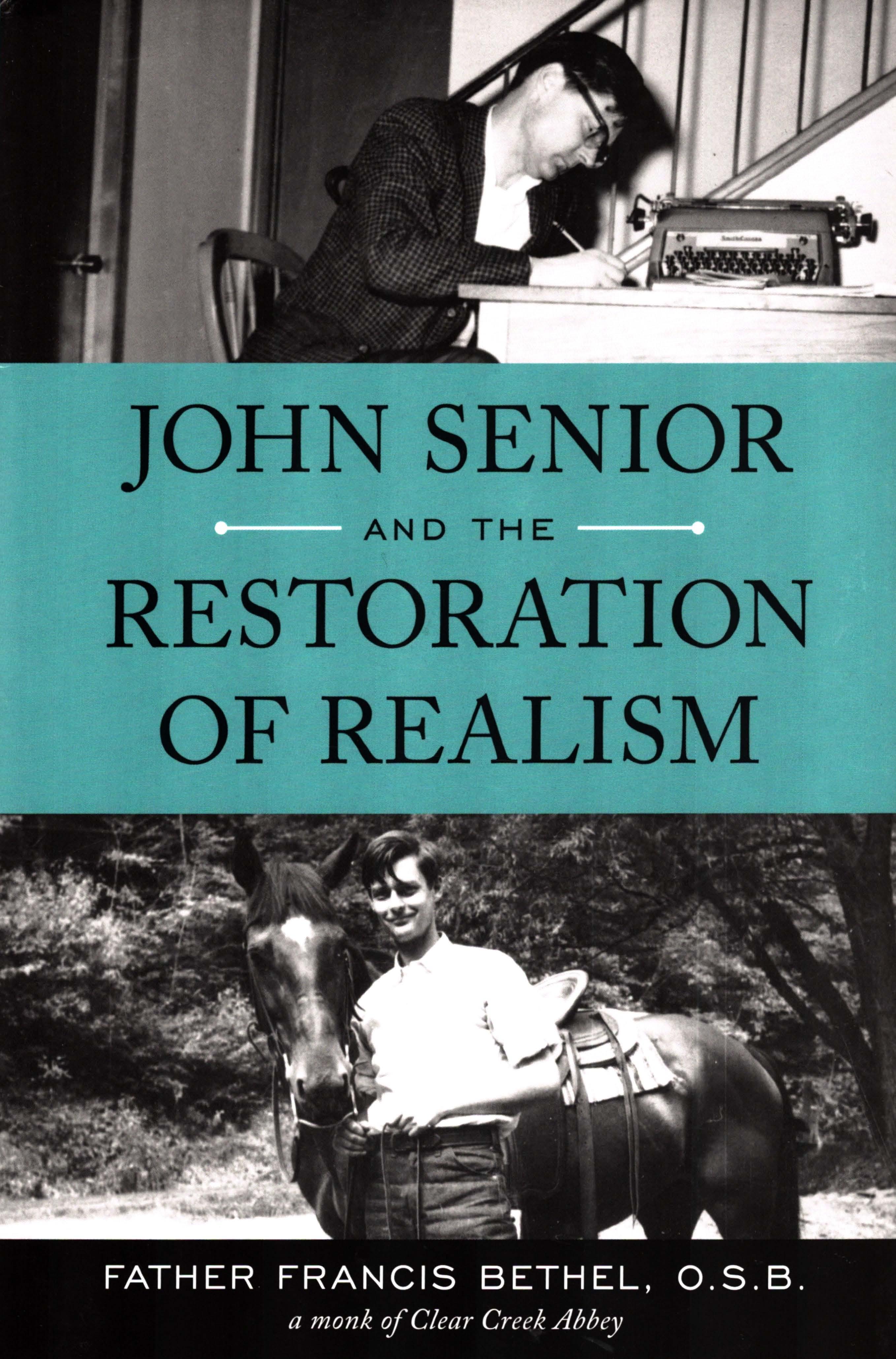
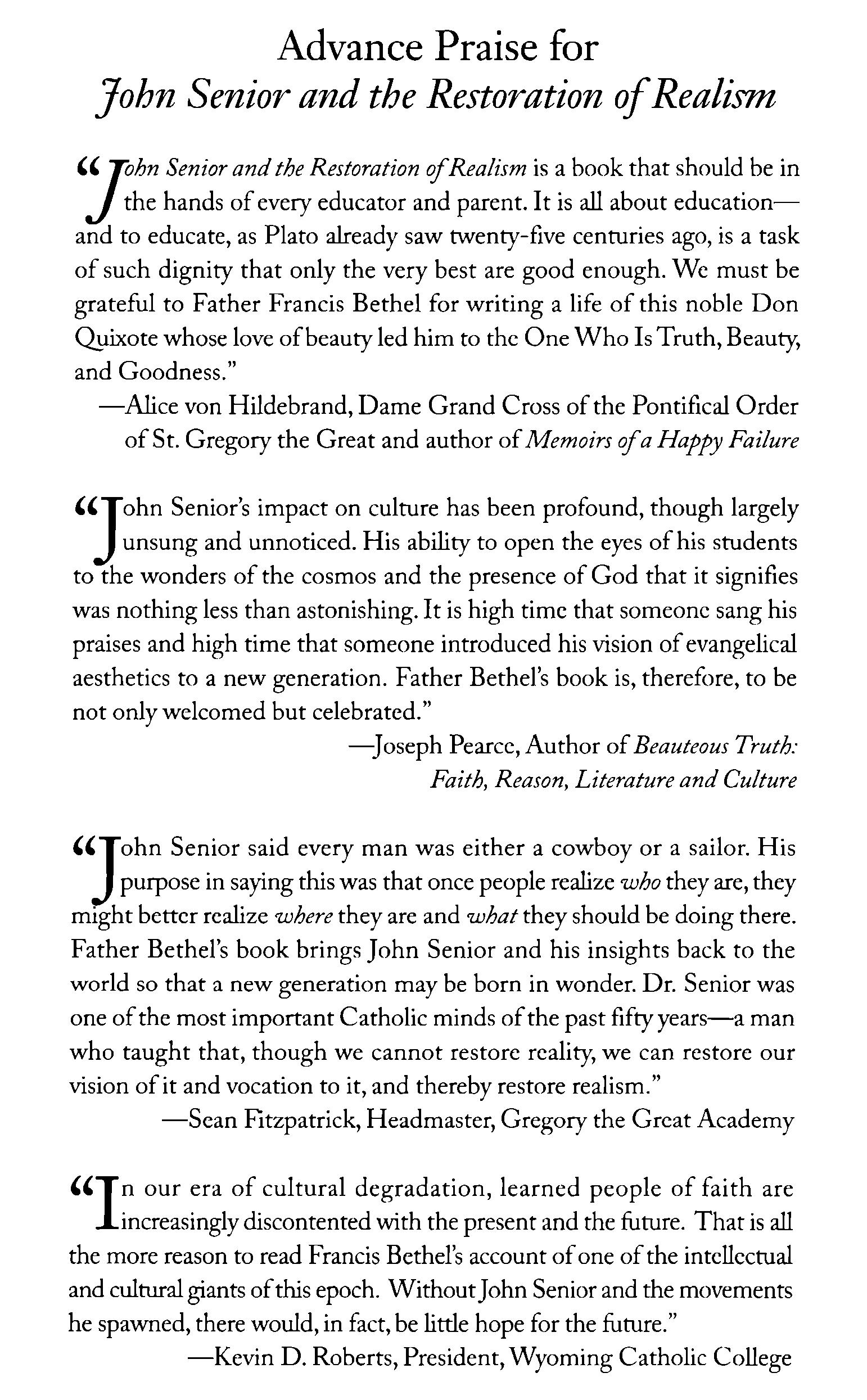
Advance Praise for John Senior and the Restoration of Realism
" fohn Senior and the Restoration ofRealism is a book that should be in J the hands of every educator and parent. It is all about educationand to educate, as Plato already saw twenty-five centuries ago, is a task of such dignity that only the very best are good enough. We must be grateful to Father Francis Bethel for writing a life of this noble Don Qyixote whose love of beauty led him to the One Who Is Truth, Beauty, and Goodness."
-Alice von Hildebrand, Dame Grand Cross of the Pontifical Order of St. Gregory the Great and author of Memoirs ofa Happy Failure
"John Senior's impact on culture has been profound, though largely unsung and unnoticed. His ability to open the eyes of his students to the wonders of the cosmos and the presence of God that it signifies was nothing less than astonishing. It is high time that someone sang his praises and high time that someone introduced his vision of evangelical aesthetics to a new generation. Father Bethel's book is, therefore, to be not only welcomed but celebrated."
-Joseph Pearce, Author of Beauteous Truth: Faith, Reason, Literature and Culture
"John Senior said every man was either a cowboy or a sailor. His purpose in saying this was that once people realize who they are, they might better realize where they are and what they should be doing there. Father Bethel's book brings John Senior and his insights back to the world so that a new generation may be born in wonder. Dr. Senior was one of the most important Catholic minds of the past fifty years-a man who taught that, though we cannot restore reality, we can restore our vision of it and vocation to it, and thereby restore realism."
-Scan Fitzpatrick, Headmaster, Gregory the Great Academy
"In our era of cultural degradation, learned people of faith are increasingly discontented with the present and the future. That is all the more reason to read Francis Bethel's account of one of the intellectual and cultural giants of this epoch. Without John Senior and the movements he spawned, there would, in fact, be little hope for the future."
-Kevin D. Roberts, President, Wyoming Catholic College
"John Senior was the teacher modernity desperately needed---and needs. His learning, wisdom, faith, and eloquence supplied the essential corrective to our era's withered soul and imagination. In this intellectual biography, Father Bethel effectively restores Senior to us and makes us see again both the man and the poetic reality he grasped so firmly."
-David M. Whalen, Provost and Professor of English, Hillsdale College
"JohnSenior was a gifted professor of classics, a writer, poet, thinker and a student of culture. He was my godfather and, more than anyone else-besides Our Lady and the Holy Spirit, of course-he led me into the Roman Catholic Church. He used to tell his students: "I am simply the janitor. It is my job to open the door and show you the riches and treasures of the best that has been written and said down through the centuries."Dr. Senior loved his students and we loved him. Father Bethel has written a book that unlocks the mystery of the man who was John Senior. His spiritual and intellectual journey is fascinating. Father Bethel has given a synthesis of John Senior's insightful views on education and culture, and has traced how his philosophy and this synthesis grew out of Senior's own life.John Senior was a realist, but he pondered the permanent things in life with a curiosity and childlike wonder. John Senior was well aware that we are all broken creatures, living in a wounded and sinful world. Oscar Wilde once said that, "we are all in the gutter, but some of us are looking up at the stars."John Senior was always looking up at the stars, and he helped all of us to turn our gaze upwards, toward the stars. I highly recommend this book not only as an introduction to John Senior's thought, but also as an important message, especially in our times, about education and culture."
-Most Reverend James D. Conley, Bishop of Lincoln, Nebraska and Founder of the Newman Institute for Catholic Thought & Culture
All rights reserved. No part of this publication may be reproduced or transmitted in any form or by any means electronic or mechanical, including photocopy, recording, or any information storage and retrieval system now known or to be invented, without the permission in writing from the publisher, except by a reviewer who wishes to quote brief passages in connection with a review written for inclusion in a magazine, newspaper, or broadcast.
Cataloging-in-Publication Data on file with the Library of Congress
ISBN 978-0-9973140-0-7
Published in the United States by
Thomas More College Press
Thomas More College of Liberal Arts
6 Manchester Street Merrimack, New Hampshire 03054
Thomas More College Press SAN 990-1108
The publisher wishes to thank Gareth Genner Frank Hanna III Charlie McKinney for their roles in helping to establish Thomas More College Press
To all the students efJohn Senior
There is something destructive-destructive of the human itse!f-in cutting us ojffrom the earth from whence we come and the stars, the angels, and God himselfto whom we go.
-JOHN SENIOR, The Restoration of Christian Culture
Dictatorial Relativism
fOHN SENIOR and the Restoration ofRealism is a book that should J be in the hands of every educator and every parent. It is all about education-and to educate, as Plato already saw twenty-five centuries ago, is a task of such dignity that only the very best are good enough. Gardeners treat their flowers with tenderness and wisdom. We cannot set the bar too high for gardeners of the human soul, made to God's image and likeness.
Great things are never easy, Plato tells us and, alas, great educators are rare. Many are mediocre; some are poisonous and if they happen to have rhetorical talents, they are like vampires that suck the blood out of their victims. Nobody better than Chesterton has pinpointed this deadly danger. He writes:" ... the dangerous criminal is the educated criminal. We say that the most dangerous criminal now is the entirely lawless modern philosopher. Compared to him burglars and bigamists are essentially moral men; my heart goes out to them." 1 The so-called philosopher he is referring to, far from being "a lover of wisdom" is an impostor for he views objective truth as his deadly enemy. He is the man who, knowing that religious and philosophical truths demand obedience, shuns them with dread while trying to convince his hearers that he is offering them a broader view of life, a more "advanced," a more "modern" and "liberating" approach to intellectual problems. His gospel is "all truth is relative." Acceptance of this leaky philosophy should be enthusiastically endorsed in a world of conflicts: for it offers the only possible way to peace and harmony. Tolerance, understanding for "other points of view," they say, testifies to a generous broad-mindedness. After all, is it not arrogant and
pretentious to claim that one has the truth? Any intelligent person should understand that "my" truth need not be "your" truth. The president of a large secular university told me that she had "become a much better person" the day she discovered that "everything is relative."The poison of Relativism is rampant in many societies, but there are historical moments when it conquers schools, colleges and universities and inevitably leads to the demise of those societies.
Born in 1923, John Senior could not escape being influenced by Relativism, for which, in the best of cases, any affirmation can only be "relatively true." Like most people of his generation, he had to struggle and make detours before his gifts were liberated from the nets of confusion and error. Even though the cancer called Relativism was not apparent at the beginning of the twentieth century, the poison was already spreading in schools and universities before its destructive power conquered society at large through the news media.
Richly endowed, deeply longing for truth, moved by beauty and sensitive to goodness,John Senior nevertheless had to struggle long and hard before finding the meaning of life. His sense for beauty attracted him to nature early in life. Aged thirteen, he ran away from home to escape to a ranch in North Dakota, where he shared the lives of cowboys whose stories had fascinated him. When finally found and back with his family, his parents convinced him to pursue his studies, while allowing him to spend his summers in the west, doing hard work on a ranch, and enjoying physical contact with the earth.
As might be expected, the generous young man was attracted to Marxism and the promise of working toward the realization of a better world, a world of peace and justice. He gave it a chance and was disappointed. He seems to have looked also toward Freud for a time, but greater things were awaiting him.
He attended Columbia University in New York, and was fortunate to take the courses of Mark Van Doren, whose eminent teaching talents were universally recognized. English literature was Senior's field, and the young man nurtured and deepened his passion for poetry. In those days, he discovered Plato, who convinced him of the reality of the spiritual.
Married young, he started teaching while still pursuing his graduate studies. His hungry soul was seeking further. Most universities at the time were under the sway of Oriental mysticism; its mysterious poetry was exercising a powerful influence on the young: it emanated a strong perfume that had a note of enchantment, mystery and depth. It had a powerful appeal for starving souls. John Senior indeed flirted with Hinduism but discovered that its glow of spirituality was in fact a fata morgana. Oriental mysticism was an escape from the dry scientific approach to life he detested. It was a tempting illusion, but soon the sincere and truthhungry young man discovered that it actually led to nihilism. Ultimately, being and nonbeing were identical, and he found himself as hungry as before. The Oriental spirituality suffered from a metaphysical "thinness" that left him starving.
He found the intellectual harbor he was seeking in the philosophy of Thomas Aquinas, whose realism and conviction that truth is objective and could be found finally led him into the Catholic Church. At the age of thirty-seven, while teaching at Cornell, he, with his wife and three children, entered the blessed Ark of the Bride of Christ. He was home at last.
Allergic to the noise and increasing industrialization of the East coast, he decided to accept a teaching position in Wyoming. But rightly disappointed upon the appointment of a new president-clearly not made for the job--he moved to the University of Kansas. It is there that his extraordinary talents were to blossom fully.
A teacher-like a doctor-must first and foremost make a right diagnosis of his "patients."The task was both sad and easy: fed on materialism, impregnated by Relativism and blase, the average student escaped into cheap enjoyments. Not recognizing the deep hunger for truth within themselves, like starving people who are not given healthy food, they gulped down spiritual junk food that made them fall into the illusion that their hunger had been satisfied. Students suffered from a sickness that we might call "spiritual obesity,"which prevented them from growing wings, and ascending toward the stars.
Today the task of the educator is arduous: the young plants coming into his hands are often wilted. To quote the psalm: "they have eyes and
do not see; they have ears and do not hear." They must first be purged of the poison on which they have been fed in our anti-culture. To put it differently, let me quote C. S. Lewis: "... a hard heart is no infallible protection against a soft head." 2 Lewis further laments the fact that "the task of the modern educator is not to cut down jungles, but to irrigate deserts." 3
John Senior was fully aware of the immensity of the task to which he was called. A faithful instrument in God's hands, he trusted in His help. The first step was to liberate his students from the world of artificiality in which they lived. Cheap books, vulgar music, loud fun, alcohol and drugs kept their souls and their minds in a state of stupor. Like a talented violinist, he knew how to vibrate the chords of their souls and to attune them to the beauty for which they were yearning.
God brought John Senior to forge a friendship with two other KU professors oflike mind: Franklyn Nelick and Dennis Qyinn. They, too, knew how serious the educational crisis was. Animated by the same love for "the true, the good and the beautiful," they took the opportunity offered them to start a "college within the college" on the model of Oxford. It was approved by the dean, and a new program was started: the Pearson Integrated Humanities Program. At first, it was limited to some twenty students, but soon the news spread that three professors had enkindled in them enthusiasm for learning and for life. The professors were on fire for "truth, goodness and beauty," and had an extraordinary talent to communicate their love. And the PIHP quickly drew more students.
Starting with great classical works (Homer, the Greek tragedies) the students-for the first time in their lives-discovered that there was beauty, poetry, nobility that were veiled in the gray world in which they had been living. For the first time, they were led out of the "dark den" of Plato's Republic (book VII) and into the light. They were encouraged to learn great poems by heart, to watch the stars, to establish a living contact with "the real."They were taught to read the book of nature-as St. Bonaventure put it. They were given real bread. In no time the program, which had started modestly, attracted two hundred students. One would expect that such success would meet with approval. Those who naively
assume that this was the case have little knowledge of university life where mediocrity is honored. Anybody who stands out is a living reproach to his colleagues. One only need recall the world of Shakespeare in Othello on "the green eyed monster ofjealousy."Jealous people always spy on those of whom they are jealous. Soon, the rumor spread that the three professors were injecting religion into their teaching. They were imposing their ideas upon their gullible students, convincing them of the objectivity of truth. They were therefore sowing narrow-mindedness; they presented their personal ideas as the one and only truth; this was unprofessional and arrogant. Other points of view were anathematized.
Worse was to come; some of the students entered the Roman Catholic Church. This was serious: the separation of church and state was being sinned against. A hypocritical way of stopping this outrage was to deny the program the right to fulfill credit requirements for the students taking the course. Inevitably, the number of students who would have loved to enter the course of the three culprits hesitated to do so. Eager to graduate, they did not want to prolong their student days. When it was discovered that some ofJohn Senior's students had gone to a venerable old Benedictine abbey in Fontgombault, France, and that-horror of horrors-some of them were considering becoming monks, all hell broke loose. The news media expressed their outrage at the brainwashing that was being permitted at KU. The noble work of the three lovers of truth was doomed.
It is noteworthy that when students lose their faith while in college (years ago, the chaplain of the Newman club at Hunter College confided to me that 65 percent of Catholics lose their faith by their senior year), no one objects or even bats an eyelid. After all, the world tells us, colleges should open the minds of their students, and help them to get rid of their childish prejudices. Had students joined an oriental sect, become Buddhists or adepts of New Age, the news media would have remained silent. Had many of them shifted from one Protestant sect to another, it would not have been worth mentioning. But to become Roman Catholic, to enter into this dark fortress that robs people of their freedom and plunges them into a world of darkness and medieval ignorance:
this was scandalous. Such people must be "saved" from intellectual slavery. The work of the three professors-whose crime was to believe in the objectivity of truth and the universal validity of moral values-was destroyed.
Were these three professors surprised? Faithful followers of Christ, they knew that disciples should not be better treated than their Master, who had dared proclaim that He was the Truth. They had sown the good seed; they knew it would blossom in some mysterious way.
But such grief would not be the only one suffered by John Senior in his later days. This ardent Catholic who had a holy love for the Bride of Christ, her holy teaching, her sublime Liturgy, her Sacraments, was to witness the devastation that took place in the wake of Vatican II. Many of us-like him-shed abundant tears over the desecration: the iconoclasm, the irreverence, the hatred of sacred traditions. He suffered and he prayed. The sublimest act on earth, the Holy Sacrifice of the Mass, was too precious of a treasure for him to bear to see defaced.
Before his death, however, he was to experience a great consolation. In April 1999, he learned that a group of his KU students who had become monks in Fontgombault twenty-five years previously were now to establish a monastery in nearby Oklahoma. He passed away to Eternity before this happened, but from Heaven he certainly prays for this foundation, in some ways the fruit of his own labor of love. In their turn, the monks of Clear Creek Abbey pray daily for a man whom God used to bring them into the Holy Ark of the Church.
We must be grateful to Father Francis Bethel for writing the life of this noble Don Qyixote whose love of beauty led him to the One Who Is Truth, Beauty and Goodness. The book is strongly recommended. It had to be written, and will benefit all those who-like St. Augustine and John Senior-long for truth.
-Alice von Hildebrand
Made for the Stars but Rooted in the Soil
IN 1999, thirteen Benedictine monks from France arrived at the backlands of Oklahoma to establish a monastery along a remote streamlet, Clear Creek. While they issued from the venerable abbey of Notre Dame de Fontgombault,* one could say that the beginnings of their foundation lay, in fact, in the United States, not so far from Clear Creek, shaped by Providence in the halls of the University of Kansas and set in motion when two of its students knocked at Fontgombault's doors twenty-seven years before. In many ways the monks' foundation was the final outcome of a quest that had begun in the 1970s, when some of the same men, immersed in the anti-culture of the day, entered the university's Integrated Humanities Program (IHP). Designed and conducted by Professors Dennis Qyinn, Frank N click, and John Senior, the program was built upon a most revolutionary tenet: reality is real. And the means for communicating this fact was quite simply Western culture-prose and poetry, music, architecture and art-bolstered by the book of Nature. This volume focuses on the life and work of perhaps the most influential of the Kansan professors,John Senior, whose own quest-begun in the occult and ended in the arms of the Catholic Church-impacted the lives not only of the repatriated American monks, but also of hundreds of other IHP students, each one in his or her own way.
• The Benedictine abbey of Our Lady at Fontgombault was founded in 1091. After flourishing in the 1''1iddle Ages, it suffered decline in the eighteenth centur;· and was closed even before the onslaught of the French Revolution. I\ lonasric life was reestablished there in 1948 bv the abbey of Saint Peter ofSolesmes. Fontgomhault subsequently made four foundations: Randol (1971), Triors (1984), Donezan (1994) in France and Clear Creek (1999) in the United States. All arc now abbeys in their own right. In 2013, Fontgombault also took over the monastery of St. Paul ofWisqucs.
At the time they enrolled in the Integrated Humanities Program, most were typical students of the 1970s, their vision molded by the deconstructionist trends of the day, believing Western ideals and institutions to be outmoded and empty conventions. They knew not where to turn except to what the moment had to offer. Scarcely any realized the immensity of what awaited them; yet very early in the coursework, something awoke in their slumbering souls. Led on by their professors, they discovered, to their surprise, that the old Western tradition was full of treasures, a deep goldmine to be explored. They came to recognize that there are true, good, and beautiful realities which give meaning to life-that indeed there are things greater than self which are worth living for. For a multitude of students, the IHP class was a turning point in their lives. They acquired convictions that continue to guide and stimulate them in their decisions even today.
There are some rather spectacular statistics pointing to the religious effect of this program taught in the context of a secular university. An unofficial count numbers some two hundred among its students who entered the Catholic Church, as well as dozens who returned to the Catholic Faith they had abandoned. Among IHP graduates, as of 2012, there is an archbishop, a bishop, an abbot, a prior and a prioress; two have been religious superiors, another the rector of a seminary; three have been novice masters; one served the Holy See's Congregation of Catholic Bishops for ten years. The secular world has also profited. Former students include a judge, lawyers, school principals, teachers and medical doctors; one alumnus was the head of a U.S. presidential council. Flourishing schools have been inspired by the program; many groups have tried to imitate it. And of course many large, healthy families have sprung up from it.
How did the IHP bring about the extraordinary and unexpected intellectual and spiritual flowering of young lives? Qyinn, Nelick and Senior were in agreement regarding the basic needs of education, given the prevailing crisis in learning and culture. In particular, they recognized that Relativism was at the root of the students' disorientation. Most of their generation had fallen into the prevailing philosophy of the times:
the conviction that there is no permanent, universal truth. Each so-called "truth," they assumed, was subjective, restricted to one's own choices. Allan Bloom began his book on university education, The Closing ifthe American Mind, with this attestation:
There is one thing a professor can be absolutely certain of: almost every student entering the university believes, or says he believes, that truth is relative. If this belief is put to the test, one can count on the students' reaction: they will be uncomprehending. That anyone should regard the proposition as not self-evident astonishes them as though he were calling into question 2+2 = 4. These are things you don't think about. 1
Given this state of affairs, the three professors knew that the first thing needed was a "conversion" to truth as such, to reality itself Nothing constructive in education could be accomplished until students would accept the fact that there is a difference between truth and error. In fact, the entire IHP project can be summarized as a nurturing of Realism, taking this latter term not in the sense of a particular philosophical system or school, but simply as the conviction that there is an absolute truth, that the exterior world can be known in itself, and that the mind depends on the senses to know it.
At the beginning of the twentieth century, two other movements of religious conversion were likewise set in motion by efforts toward an intellectual return to reality. In France, Henri Bergson worked to show his students that human knowledge is not limited to measurements, that there exists something deeper than quantity. And in Germany, Edmund Husserl longed to escape from centuries of philosophical idealism and "get back to things themselves," as he put it. By breaking down the mental barriers that artificially separated their students from things, Bergson and Husserl enabled them to rediscover the taste for reality and truth. This led many students, through various paths and by God's grace, to accept Christ and enter His Church. It was the case, for example, with Bergson's students Jacques Maritain and Charles Peguy, and
Husserl's Edith Stein (St. Teresa Benedicta of the Cross) and Dietrich von Hildebrand.
Whereas these European conversion movements grew from philosophical studies, the three IHP professors had to operate at a more elementary level. Relativism had been ingrained in their students, not only by their education and by modern culture in general, but also by the artificial world in which they moved. Immersed as they were in an electronic universe of television and rock music, the students were largely cut off from tangible reality. They first had to realize that "stones are hard and water is wet," as the professors liked to say quoting Winston, a character in George Orwell's 1984 (who kept repeating this to himself in order to maintain his sanity under Party propaganda). 2 They had to get a feel for concrete things and thus regain the innate, spontaneous conviction of the existence of reality. They had to rediscover that things are real.
The program took as the means for this rediscovery not philosophy, but the great imaginative literature and poetry of the West, and activities such as song, dance and stargazing. In their teaching, the professors brought out vital human questions present in the readings-what is a home, what is friendship, what is justice, what is healthy work, what is the happy life-dealing with them in concrete ways. They told pertinent stories and quoted literature and poetry, striving to invite their students to taste the mysterious beauty at the heart of these values more than to be able to define them. Above all, they had to instill in this youth the awareness that things are delightful and wonderful, beautiful, good and true.
To understand the IHP adventure, one must delve into John Senior's thought and what led him to help start such an institution. He alone of the three professors elaborated in some detail the theory of this prephilosophical, pre-scientific education.
Senior wrote about culture in general, of which academia is only one aspect. For him, the pre-philosophical need to reconnect to reality extended far beyond the boundaries of the classroom. He recognized that our whole life-in the home, in the community, at work-must return to reality. When
his two books on culture* were first published, in the late '70s and early '80s, some readers thought Senior ranted rather excessively about the woes of our times. However, one can perceive now that he was in fact a prophet of the practical nihilism that has issued from the drastic cultural decline he chronicled. He also provided a radical remedy for it. Although he saw the crisis in contemporary society as one of faith, he had a firm grasp of the principle that grace builds on nature and recognized that natural order and reason are gravely compromised today. He made this comparison: "Faith perfects reason in a manner analogous to the way a sculpture perfects a stone-but if the stone is pulverized, the form is empty air." 3 We need Realism for the good use of our reason and ultimately to provide a healthy ground for faith: "The facts of Christianity," he wrote, "are not real to us because nothing is real to us. We have come to doubt the very existence of reality." 4 And to attain to Realism, we must reconnect sensibly and emotionally with reality. We must restore a healthy imagination. Similar conclusions had already been drawn by two of the most wellknown Catholic converts of the last two centuries. Blessed John Henry Cardinal Newman grasped the importance of imagination and emotion in rendering Christ real to modern man, in helping him realize that He is a living person. Senior considered Newman something of a prophet in that the latter foresaw the almost complete absence of Christ from the twentieth-century imagination and the grave danger entailed in this: "It is not so much reason that is against us as imagination," the cardinal wrote 125 years ago, referring to the difficulty of the modern scientific mentality to partake in the world of the Bible. 5 Coming a little later than Newman, G. K. Chesterton, like Senior, had first to devote himself to leading people to the reality of things themselves. Senior quoted Chesterton: "Insanity is not losing your reason, but losing everything else except your reason."6 A madman may remain quite logical, but he has lost commonsense contact with reality. His mind turns in a disconnection with things.
• The Death a/Christian Culture (New Rochelle, NY: Arlin1,>1:on House, 1978; republished Norfolk, VA: IHS Press, 2008) and The Restoration if Christian Culture (San Francisco: Ignatius Press, 1983; republished Norfolk, VA: !HS Press, 2008).
Newman, Chesterton and Senior all agree that we must restore a culture that forms our imagination and emotions in accordance with reality and Christ.
Senior's doctrine is vigorous and clear, simple and practical. Many have recognized that it contains a crucial message for our day. Here are appreciations, not from some local friend, but from two Frenchmen of worldwide renown who knew Senior only through his books. Writing about Senior's The Death of Christian Culture, the philosopher Marcel Clement had this to say: "We have here a great book. Each sentence or almost is a lesson of wisdom .... It is a most remarkable diagnostic of the intellectual state of the West." 7 And Father R. L. Bruckberger, OP, noted of The Restoration of Christian Culture: "I read John Senior's book in one sitting. I was so far from expecting a book of this quality that I am still stupefied. I have my classifications of books, of great books. I put this one in the category of The Imitation of Christ .. .. I truly love the United States where I spent eight years that were decisive for me. Never, never could I have imagined that one day an American would write such a book." 8
John Senior's work has also served as an inspiration to the Spanish writer Natalia Sanmartin Fenollera, whose recent novel The Awakening ofMiss Prim has become an international bestseller. The novel features a main character who rediscovers the Faith of his childhood and decides to take up residence in a remote European village near a Benedictine abbeythis, after participating in a seminar at the University of Kansas. Fenollera reveals her indebtedness to Senior in an interview: "The reference to the University of Kansas is a discreet homage to John Senior, an exceptional figure who directed a Humanities program outside of the ordinary and whose lucid vision of western culture seems to me absolutely brilliant and finds an echo in my book." 9
John Senior certainly did not intend to frame a new theory. Qyite prudently in our revolutionary and uprooted day, he held that "nobody in his right mind would want to be 'original' or 'innovative' at a time like this." 10 Avoiding novelty was also a matter of conviction: "In the large sense, philosophy and theology have been done; granted there are still
important disputed areas, but the continents are spanned, the lay of the land has been mapped." 11 It often happens, however, that the person who wants only to be a disciple is the one who truly advances doctrine. Senior's deep and ardent assimilation of Western masters enabled him to draw from tradition certain fundamental points that needed to be elaborated and applied to the circumstances of our times.
I was a student of Senior's in the early 1970s. I kept up friendly contact with him all through the years by correspondence, and avidly devoured his writings as soon as I could get my hands on them. I have always reflected on what I received from him and the IHP, especially in the light of my later studies in philosophy. Although Senior regularly laid out philosophical principles in class, he did not teach philosophy per se or write a treatise. His writings were, rather, poetic or rhetorical. He modestly considered himself only an amateur philosopher, teaching elementary things presupposed by philosophy: "The ordinary is the province of the schoolmasters like myself who from their low vantage, while in the high and palmy ways of science and theology they know little or nothing, know the things that everybody must do first." 12 Nevertheless, a well thoughtout philosophical framework supported his doctrine. The goal of the following pages is to unfold that doctrine.
Senior once said that Shakespeare's plays, in relation to the lyric poetry they contain, are like a Gothic church that exists for its stained-glass windows. Qyotations from Senior are certainly the stained-glass windows of the present work. I will proceed mainly by quoting the professor and then providing commentary that will mostly demonstrate how the philosophical synthesis behind his teaching is rooted in Plato, Aristotle, St. Thomas Aquinas and Newman. I will occasionally develop a point on my own, because the ultimate goal of the present work is not simply to understand Senior's thought, but to advance in Realism ourselves. Senior should be less the object than the guide for a study of Realism to encourage our own ascent to the stars.
While this book is not a biography in the strict sense of that term but rather a study of John Senior's thought, it will nevertheless have a biographical character, as his deep convictions and doctrine grew out of his
personal intellectual and spiritual journey: from a Marxist materialism that denied spiritual realities, through an Oriental spiritualism that strove for the spiritual stars by discarding man's roots in sensible realities, to Realism and ultimately to the Catholic Church. The title of this introduction-Made far the Stars but Rooted in the Soil-represents the pivotal philosophical point of that pilgrimage as well as the crux of all of Senior's thought. He realized by his own experience that the human plant, in order to tend to the stars, must be nourished in the soil of this world. His turnabout and then his work with students deeply impressed on him that we must ground all intellectual and affective life on the experiential and imaginative level. This concrete way of nourishing Realism underlay everything he taught and the way he taught it. It is the key to entering into a deep understanding of his doctrine.
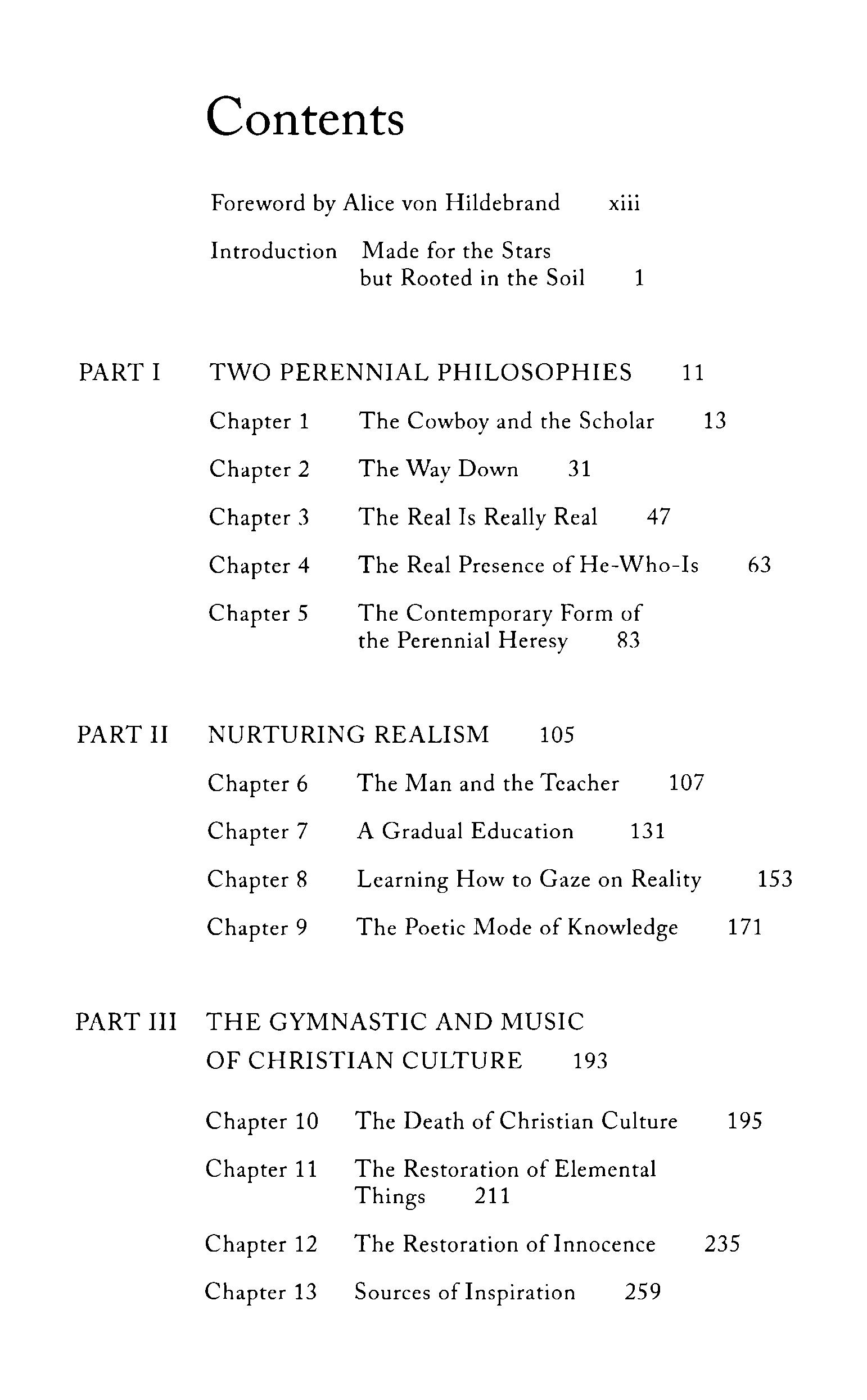
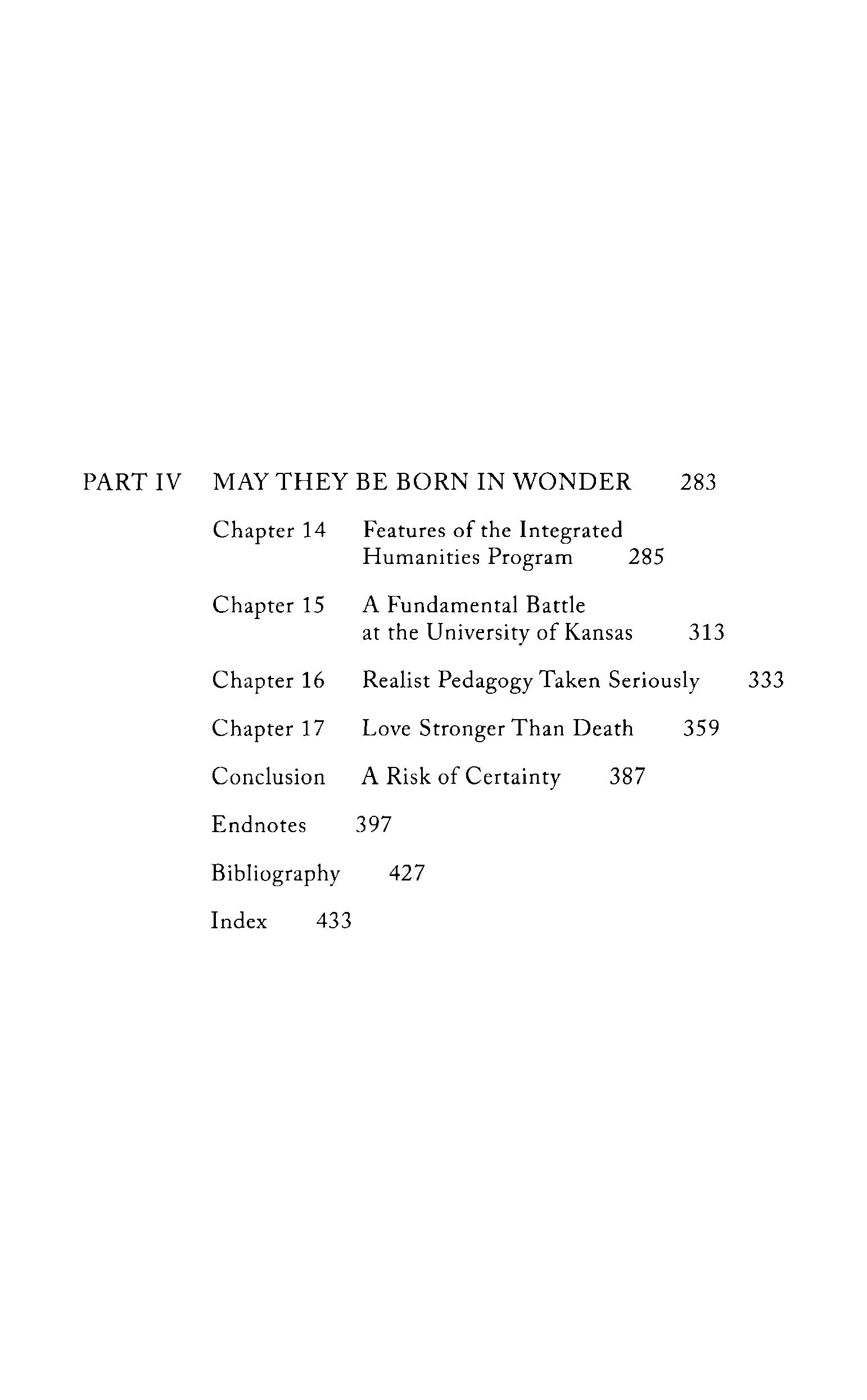
Part I of our book will follow Senior through the 1950s, from his youth through his first teaching assignments and the completion of his doctorate. His intellectual and spiritual conversions will give us the opportunity to uncover the principles behind the two fundamental positions of human thought: "Realism," and what can be termed "Anti-Realism," the first holding that the real is real, beautiful, good and true, the latter, that it is an illusion. With Senior, we will examine the history of the war between these two spheres, starting with the ancient Greeks but focusing in detail on what has led to our contemporary Anti-Realist climate. Parts II and III will refer especially to the 1960s, when Senior's positions on education and culture matured at the University of Wyoming. Part II considers the theory of Realism itself and how Senior came to it, while Part III covers Senior's ideas for applying the theory in the home, school and general culture. Part IV discusses how Senior, with Professors O!iinn and Nelick, implemented his educational ideas in the 1970s at the University of Kansas and describes the fate of the IHP, an episode that so aptly illustrates the perennial war between Realism and Anti-Realism.
The reader already may have noticed that the many references to cited works are provided in endnote form, while notes providing content of more immediate interest are denoted by asterisks and appear as footnotes. This has been done so as not to interrupt or distract the reader.
I want to thank those who looked over all or part of the manuscript at various stages of its development, notably Katie Miller, with whom I discussed ideas as well, Chris Owen, who much encouraged me, and Charles Pendergast, as well as Kelly Boutross, Annie Calovich, and Ken Craven. Also, my special gratitude goes to Kirk Kramer for some zealous research and to Maria Gerber for always being so available to help with editing. I thank William Fahey for shepherding the book to publication, and his wife Amy for the final editing. I also thank Senior's colleagues and students of before my time who told of him in the 1950s and 1960s, and members of his family who gave me views of Senior's life outside the range of a student's experience, especially his daughter Penny Fonfara and his late sister Mary Cornish. Finally, I express my gratitude to Father Abbot and the monks of Clear Creek for bearing with me during these long months.
Let me close this introduction by applying to this present work a poem Senior wrote in conscious imitation of Geoffrey Chaucer's own famous Retraccioun to usher in his book of poetry:
Retraction
If any of these rhymes sownen· into sin, blame it on the times that let such notions in. If it's on the poet's part, commend him to the Sacred Heart.
• The l\liddlc English sownen, Senior noted, comes directly from Chaucer's Retraffioun and means "lead someone into."