Published by Wiley India Pvt. Ltd., 4436/7, Ansari Road, Daryaganj, New Delhi - 110002.
No part of this publication may be reproduced, stored in a retrieval system or transmitted in any form or by any means, electronic, mechanical, photocopying, recording, scanning or otherwise, except as permitted under Sections 107 or 108 of the 1976 United States Copyright Act, without either the prior written per-mission of the Publisher, or authorization through payment of the appropriate per-copy fee to the Copy-right Clearance Center, 222 Rosewood Drive, Danvers, MA 01923, (978) 750-8400, fax (978) 646-8600, or on the web at www.copyright.com. Requests to the Publisher for permission should be addressed to the Permissions Department, John Wiley & Sons, Inc., 111 River Street, Hoboken, NJ 07030, (201) 7486011, fax (201) 748-6008, or online at http://www.wiley.com/go/permissions.
e publisher and the author make no representations or warranties with respect to the accuracy or completeness of the contents of this work and specically disclaim all warranties, including without limitation warranties of tness for a particular purpose No warranty may be created or extended by sales or promotional materials.e advice and strategies contained herein may not be suitable for every situation.is work is sold with the understanding that the publisher is not engaged in rendering legal, accounting, or other professional services. If professional assistance is required, the services of a competent professional person should be sought. Neither the publisher nor the author shall be liable for damages arising here from.e fact that an organization or Website is referred to in this work as a citation and/or a potential source of further information does not mean that the author or the publisher endorses the information the organization or Website may provide or recommendations it may make. Further, readers should be aware that Internet Websites listed in this work may have changed or disappeared between when this work was written and when it is read.
Trademarks: Wiley, the Wiley logo, and related trademarks are trademarks or registered trademarks of John Wiley & Sons, Inc. and/or its affiliates.e GMAC and GMAT logos, GMAC®, GMAT®, Graduate Management Admission Council®, and Graduate Man-agement Admission Test® are registered trademarks of the Graduate Management Admission Council® (GMAC) in the United States and other countries. All other trademarks are the property of their respective owners. John Wiley & Sons, Inc., is not associated with any product or vendor mentioned in this book.
John Wiley & Sons, Inc., also publishes its books in a variety of electronic formats and by print-on-demand. Not all content that is available in standard print versions of this book may appear or be packaged in all book formats. If you have purchased a version of this book that did not include media that is referenced by or accompanies a standard print version, you may request this media by visiting http://booksupport.wiley com. For more information about Wiley products, visit us at www.wiley.com.
First Edition: 2017
Second Edition: 2020
ISBN: 978-81-265-5236-8
ISBN: 978-81-265-9011-7 (ebk)
www.wileyindia.com
Printed at:
Preface
Dear BBA Entrance Exam Aspirant,
This exclusive book has been written keeping in mind the needs of those of you who wish to streamline your preparation strategy for the various BBA entrance examinations and are looking for a focused and intensive practice-based approach towards these tests.
BBA Entrance Exams guide is a comprehensive and structured approach to understanding the fundamental concepts assessed in the various BBA entrance exams such as DU JAT, IPU CET, NPAT, SET, UGAT and others. To attain a high score in these examinations, you will need to build a strong theoretical foundation and get hands-on practice on relevant questions that test you on the key concepts expected from a BBA exam aspirant.
This is exactly what this book will help you achieve!
The book covers syllabus for entrance exams of BBA, BBM and BBS and provides ample practice in the form of fully solved past years’ papers with detailed answer explanations and analysis along with exhaustive model test papers based on previous years’ papers for additional practice.
In addition, it follows a methodical structure wherein key concepts are refreshed and are followed by a battery of practice tests for immediate practice and retention of learning.
The book also contains section-specific and question-specific strategies to provide you that winning edge that is so essential to set one up for success in a competitive examination.
With all the above features — review of key concepts, targeted practice tests, exhaustive model tests, answer explanations and analysis of all questions along with strategies to crack the exams — this book is a definitive guide that will equip you with the required skill set that is expected in a potential BBA exam aspirant.
We wish you the best for your Test preparation!
Wiley ExamXpert Team
SECTION 3: QUANTITATIVE APTITUDE
5:
SECTION 6: MOCK TESTS
SECTION 1
INTRODUCTION
About BBA Examinations
INTRODUCTION
BBA stands for Bachelor of Business Administration. It is a three year degree program in commerce and business administration offered by several prestigious universities across India. The course aims at providing fundamental education combined with practical training in business and management principles.
Through BBA courses, students can gain knowledge of business practices and processes, understand the role of economics in the world marketplace, and acquire an awareness of global business issues. They can pursue business education and learn skills that will help them perform various management and administrative roles within a company.
BBA acts as a foundation for Masters in Business Administration; it can be regarded as a more professional form of B.Com. Normally, the BBA programme is spread out over three years, which are split into six semesters. There are a few institutes that offer a four year long honors program as well. The syllabus of these programmes encompasses the following subjects:
BBA COLLEGES
There are many BBA colleges in India. Each college has a different selection process and unique style of imparting knowledge
Each college requires a different skill set and strategy to crack and the primary purpose of this book is to help you identify these unique elements and plan accordingly.
Here is a list of the top BBA colleges in India:
1. Delhi University Joint Admission Test (DU JAT)
2. Narsee Monjee College of Commerce and Economics (NMCCE), Mumbai
3. Christ University, Bangalore
4. Indraprastha University Common Entrance Test (IPU CET)
5. Symbiosis Entrance Test (SET)
6. St. Xavier’s College, Mumbai
7. Under Graduate Aptitude Test (UGAT)
KEY FEATURES OF THE BOOK
Now let us understand how this book will assist in your preparation. The defining feature of this book is its practical, practice-driven orientation wherein there are numerous examples and practice tests provided in order to enhance the application and usage of concepts. It adopts a two-pronged approach towards preparation for the BBA entrance exams revisiting the theory and working extensively with each question type in the different sections.
This book aims to cater to the needs of those students who wish to streamline their preparation strategy for the various BBA entrance exams. It shall prove to be a formidable tool for those self-motivated students who follow a dedicated practice based approach towards this particular test.
As described above, the book is an application driven guide aimed at aligning your test preparation with a focus on the BBA entrance exams.
STRUCTURE OF THE BOOK
This book covers the key areas tested in BBA. These include:
1. English Language (General English, Verbal Logic and Reading Comprehension)
2. Quantitative Aptitude (Inclusive of Data Interpretation and Data Sufficiency)
3. Analytical and Logical Reasoning
4. General Awareness (GK and Management Aptitude)
Every key area has a separate section devoted to it. The structure of each section is as follows:
1. Concept Review
2. Practice Tests
3. Solutions
The four sections are followed by three mocks that replicate the important BBA entrance exams with respect to their structure, question types and difficulty levels
HOW TO USE EACH SECTION
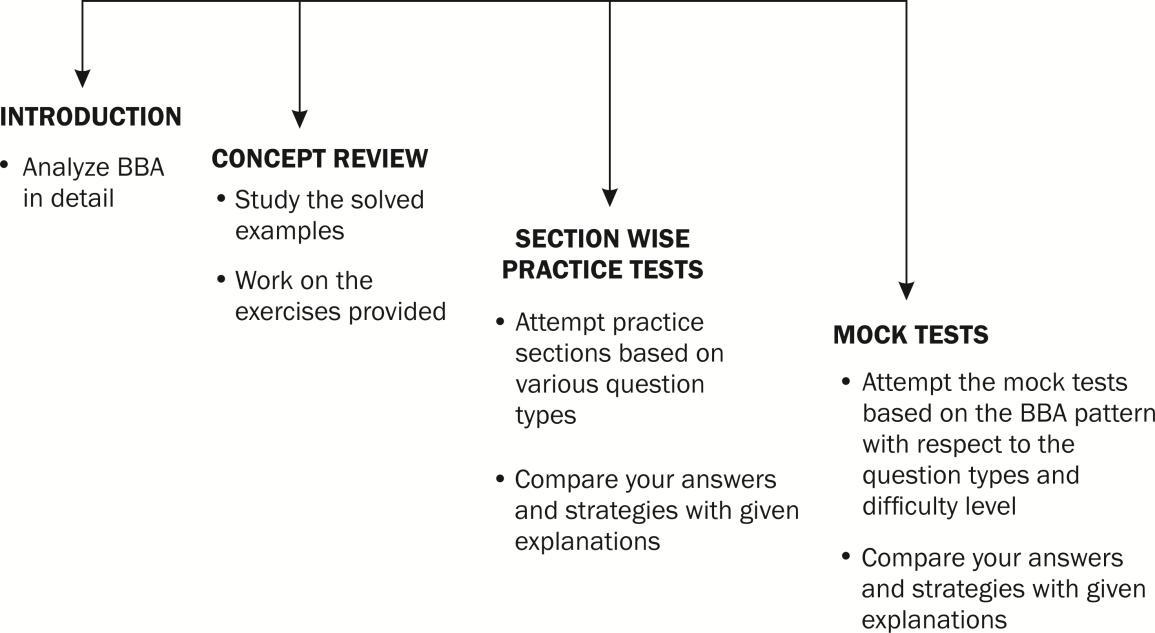
Introduction
Before you begin your preparations, go through this section in detail to understand:
1. An analysis of the BBA course and its implications
2. What is expected of you in the various entrance examinations
3. The distinguishing features of the key entrance examinations
4. Some key strategies to keep in mind as you begin your preparation
Concept Review
Each section begins with an in-depth review of concepts. This involves a comprehensive revision of the various concepts with special focus on the requirements of the entrance exams. The section not only revisits the concepts but also provides examples to reinforce the concept’s application.
Practice Tests
The Concept Review is followed by a series of practice tests. The answers to these tests are given at the end of the respective section, along with a detailed explanation on how to arrive at that particular answer.
It is recommended that you solve all the practice tests and check the solutions provided at the end of the section. Please ensure that you read the explanations, as they provide important strategies, tips and guidance on how your thought process should work when solving the questions.
Doing this will help you assess your comfort level with the different topics, identify your weak spots and develop bespoke strategies to approach each question type.
Mock Tests
The practice tests are followed by three mock tests that replicate the more important BBA entrance exams with regards to the structure of the paper, question types, difficulty level and range of questions. These will give you a flavour of actual BBA questions; and will also let you benchmark yourself against authentic scores.
Each paper comprises:
1. Question Paper
2. Answers and Explanations
Take these tests once you are comfortable with the question types and are satisfied with your section practice. Practicing these papers will help you gauge your performance level with respect to the actual admission test and further streamline the application of concepts as well as strategies.
This book is a combination of a reference book and a workbook. In order to gain the maximum benefit from the book, we would recommend that you treat it like a journey, a process. Rather than just reading it, engage with it. Practice the various exercises, complete the tests and do make it a point to go through the answers and explanations. Happy Learning!
EXAMINATION PATTERN
Every major BBA entrance examination follows a unique pattern. However, the syllabus with respect to the domains tested in these examinations remains more or less consistent. There are primarily four sections as following:
1. English Language
2. Quantitative Aptitude
3. Analytical and Logical Reasoning
4. General Awareness
The IP University Common Entrancne Test (IPU CET) features a section on Management Aptitude that combines elements of business awareness and management concepts. A quick reckoner for the same has been enclosed in the book for your perusal.
The details of the four sections are provided as following:
English Language
This section of the exam assesses the English language ability of a student. Most questions in this section are based on vocabulary. Following topics are covered under this section:
Vocabulary
Synonyms and Antonyms
English comprehension
Fill in the blanks
Idioms and Phrases
One word substitution
Analogies
Quantitative Aptitude
Spelling Mistakes
Rearrangement of word in sentences
Para Jumbles
English Usage errors
Cloze test
Spotting errors
Inappropriate usage of words
The section on Quantitative Aptitude comprises questions on mathematics from class VI to X. One needs to be conversant with the basic principles of the subject and revise the fundamentals. Topics that form this section are mentioned below:
Number Theory
Square Roots
HCF and LCM
Data Sufficiency Test
Profit and Loss
Surds and Indices
Simplification
Percentage
Approximation
Quantitative Comparison
Average
Logarithms
Fraction and Decimals
Analytical and Logical Reasoning
Commercial Math
Ratio and Proportion
Data Interpretation
Compound and Simple Interest
Partnership
Mensuration Area
Volume
Data Comparison
Discounts
Analytical and logical reasoning is a section that examines your aptitude for business studies. It’s meant to test your general aptitude. This section needs preparation to score well. You can practice logical reasoning questions from last years’ papers and practice papers. The topics assessed in this section are:
Number Test
Analogy Test
Insert Missing Sequence Test
Direction and Distance Test
Classification (Odd Man Out) Test
Logical Word Sequence Test
Coding and Decoding Test
Mathematical Operations
Series Test
Data Arrangement Test
Ranking Test
Logical Diagram (Venn Diagram)
General Awareness
Relationship Test
Alpha Numeric Symbol Sequence
Alphabet Test
Cubes and Cubical Dice Test
Time Sequence Test
Statement Arguments
Statement Conclusion
Data Sufficiency Test
Logic Test
Statements Assumptions
Statement Action
BBA entrance exams check your general knowledge as well as business knowledge. Make it a habit to stay updated by following the news channels and reading the newspapers. Pay special attention to the following topics to cover this section:
Business and General Awareness
Business
Trade awareness of the world and India
Geography
Economic Study
General Polity
Science
Computer Science
Sports
Awards
Current Events
History
PLANNING AND PREPARATION
Now that you have an understanding of the structure and composition of the BBA exam, let us discuss a few targeted strategies to aid your preparation.
While familiarity with previous year exam patterns and cut-offs helps, too much scrutiny of trend analysis may prove to be counterproductive. The biggest challenge for a test-taker is to strike a judicious balance between strategy and adaptability. While it is extremely important to develop a comprehensive strategy by practicing extensively across various sections and question types, it is equally important to maintain flexibility and not approach the exam with preconceived notions. A student can adopt a multi-pronged approach towards preparation for the BBA entrance exams. This approach is defined by three key elements:
1. Review of concepts
2. Intensive practice
3. Increased awareness
An integrated application of these three elements will provide a competitive edge to a candidate preparing for the BBA entrance exams. Let us understand how.
During the examination, quickly scan the question stems, identify the question types/themes that are your strong points and attempt them first.
English Language
With respect to the General English section, the Reading Comprehension passages are generally easymoderate in their difficulty level. The word limit of these passages is also usually between 500–700 words, making it easier for a candidate to attempt them quickly. The Vocabulary, Grammar and Usage based questions test your basic understanding of the rules of context, appropriateness and correctness as well as the fundamentals that constitute the language.
It is recommended that you revise the core concepts of grammar, correct usage, vocabulary and practice a few questions every day. Theory on idioms and phrasal verbs, figure of speech, correct usage should also be reviewed.
Quantitative Aptitude
Quantitative ability, Data Interpretation and Data Sufficiency generally appear in the same section in the BBA entrance exams. Data Interpretation questions are usually easy. The Quantitative Ability portion reflects a good mix of questions across topics. Hence, a review and revision of the core concepts will prove highly beneficial for attempting this section. You should also aim to practice different question types extensively. Revision of basic formulae, enhanced comfort with calculations, adoption of effective short cuts all of this will help improve your efficiency and efficacy in this section.
In Data Interpretation and Data Sufficiency, avoid spending a large amount of time on caselets that appear to provide ambiguous solutions.
Analytical and Logical Reasoning
The Analytical and Logical reasoning section is generally of a higher difficulty level. However, this section can also contribute tremendously towards the overall score, provided the candidate practices the different question types extensively.
In this section, questions based on arrangements, grouping and selection can generally be attempted accurately in a short time. Questions based on Verbal Reasoning including Critical Reasoning are also reasonably easy. Questions based on Visual Reasoning, though few in number, are generally tougher and should be attempted carefully. Practice questions on arrangements, family trees, complex data situations, etc A good working knowledge of different types of syllogisms, implicit statements and arguments will also prove helpful.
General Awareness
The General Awareness section of the BBA exam is quite difficult and requires an extensive awareness of the socio-political-economic environment. It demands familiarity with both static and current components of the environment.
BBA is a test of your ability to strike a balance between accuracy and speed. You will need to increase your speed while maintaining high levels of accuracy.
In a nutshell, revise the core concepts, practice extensively, enhance your speed, keep yourself updated with regards to current affairs and finally, believe in yourself!
All the best!
SECTION 2
ENGLISH LANGUAGE
C h a p t e r
2
English Language Ready Reckoner
INTRODUCTION
Reading Comprehension or the ability to read, analyse and discern the meaning of written text, is an integral part of management entrance tests.
The word comprehension means ‘the act or action of grasping with the intellect: understanding’ As stated above, Reading Comprehension is one of the most commonly tested skills in every BBA entrance examination.
In Reading Comprehension, students have to read passage(s) and answer questions that follow the passages This area tests the ability of the student to quickly grasp what is being said in the passage before answering the questions. Some of the questions test your ability to recognize implications and draw inferences Others test your ability to understand and critique the ideas and information provided in the passage; while some might require an application of the logic used in the passage.
One can expect 1–2 Reading Comprehension passages in the various BBA entrance tests, with the number of questions ranging from 5–15. The passages are sourced from varied fields, with lengths ranging from 350–550 words.
This section aims to provide a quick revision of the various concepts related to reading and comprehension. It shall further explain, in detail, the various types of questions and effective strategies to answer them. The purpose is to provide a comprehensive and concise guide to all problems pertaining to Reading Comprehension.
The difficulty level of the questions in the section ranges from moderate–difficult, with several questions being direct lifts from the passage. The trick lies in enhancing both the speed and range of your reading in order to be equipped with the skills required to attempt this paper.
Let us begin with a quick revision of the basics.
READING COMPREHENSION
Speed Reading
We all have various comfort levels. How comfortable are you in a crowd of people? How comfortable are you on an airplane? How comfortable are you speaking in public? How comfortable do you feel driving fast? 60 kilometres per hour? 85? 120? What about 180 kilometres per hour, the speed many race car drivers travel? You might not like going that fast, but racers have learned to drive at top speeds because they have raised their comfort level.
Comfort zone speed is the speed at which people read any text as if they are in no hurry and claim that they achieve their highest level of comprehension at this speed. Imagine finishing a thin book like Harry Potter and the Chamber of Secrets in a month! The question that begs to be asked is, would reading at a low, comfortzone speed ensure success in the Reading Comprehension section? The answer is definitely no. If one has a very slow speed then one would manage to finish only a portion of the RC section.
Speed reading is essentially a method of reading rapidly by taking in several words or phrases at a glance or by skimming. Speed reading increases the reading rate and furthers comprehension of the text.
Why is it important?
To be able to read fast is an important skill in today’s world. As students and also as professionals, we read large amounts of material on a daily basis. Thus, improving our speed-reading technique is something each and every one of us should not only do, but also maintain.
A person who has an average reading speed can read 250 to 350 words per minute By practicing speed reading strategies, a person can increase their reading capabilities to 400 to 600 words per minute while retaining good comprehension. As already discussed, Reading Comprehension passages can be lengthy and have a moderate-difficult comprehension level. In such a scenario, the ability to read at a competitive speed while enhancing comprehension is imperative.
There are five factors that adversely affect comprehension and speed:
1. Poor Vocabulary
2. Difficulty in understanding idiomatic and figurative usages
3. Inability to relate two sentences or ideas
4. Inability to organize information
5. Lack of concentration
Skimming and scanning
Skimming and scanning are two very different strategies for speed reading They are each used for different purposes, and they are not meant to be used all the time.
Skimming refers to looking only for the general or main ideas, and works best with non-fiction (or factual) material. With skimming, your overall understanding is reduced because you do not read everything. You read only what is important to your purpose.
Unlike skimming, when scanning, you look only for a specific fact or piece of information without reading everything. You scan when you look for your friend’s phone number in the telephone list, and for the sports scores in the newspaper. For scanning to be successful, you need to understand how your material is structured as well as comprehend what you read so you can locate the specific information you need. Scanning also allows you to find details and other information in a hurry.
Skip small words
Each word requires a different amount of time to process. In fact, some words are so intuitive; they can be skipped without losing the meaning of the sentence. Most native English readers do this instinctively to some degree, but this technique can be improved through practice. To understand how this works, go through the example discussed below.
The underlining hand motion/pointer method
This is a great beginner technique to force your eyes to adapt to a faster reading speed.
1. Grab a pen, chopstick or other thin stick-like object (your finger works too, but a pen works better because of its sharper tip).
2. Trace under the words and let the tip guide your eyes. The pen is just a guide; do not draw on the book.
3. Trace at a pace that is ~10 to 20% faster than your typical reading speed. Continually push yourself by speeding up once you’ve adapted.
The pointer method has three distinct advantages:
1. It ensures that you read at or near your current top speed
2. It helps you maintain a consistent speed
3. It reduces instances of you losing your place
If you are the type that always seems to get distracted and lose your place in the text, the pointer method has a more meaningful impact on your reading speed.
Regression
The tendency to go back to the parts of the passage or re-read the text is called regression. Regression unnecessarily slows you down and also affects your comprehension as a result of frequent jumps in your understanding while reading.
Readers should focus on reading a passage completely even though they feel that their concentration has temporarily wandered or they have missed something. Remember that the brain is very good at filling in learning gaps. Staying focused on the line of words that is currently being read before continuing can also increase their comprehension of the text and its meaning. Additionally, important concepts are frequently repeated in a text all the time.
Reading and comprehension speed is cut down by at least 30 percent if a person stops or regresses more than two times in every row.
Active Reading
To make the most of the time you spend studying, you need to read actively.
Active reading simply means reading something in order to gain enhanced clarity and understanding of the material, as per your requirements. It is different from passive reading. It is an important skill that aids your comprehension. An active reader applies certain questions and theories that help enhance clarity. It involves applying logical and rhetorical skills.
If you just read passively, then you are dealing only with the superficial aspect of the text. This allows you to answer certain types of questions. But typical RC passages represent a wide variety of questions and in order to tackle all of them you need the ability to read critically.
Active reading enables a reader to comprehend the underlying structure – tone, inference and organization that allows him/her to answer all types of questions.
The following techniques can help you read actively:
Looking for keywords
Identify and highlight key words and phrases as you read. These will assist you in identifying the ideas and developing an ability to understand the link between them. Some ways to identify these are:
Correlating sets of words
Correlating words refer to the use of synonyms, antonyms, nouns, adverbs, verbs and adjectives to describe ideas and/or arguments in the passage. Identifying the related words helps you come closer to the main idea of the passage. Be selective – too much highlighting won't help.
Connecting words and their function
Certain words function as a link between various ideas expressed by the author. These words are of high importance as they bring in the contrast/link between the ideas, opinions and thoughts expressed in the passage. Link words are many and can be categorized in terms of the function they serve in the overall progression of the thought process.
Cause – Because, Thereby
Consequence – Thus, Therefore
Time Sequence – While, When
Concession – Nevertheless, However
Opposition – But, Against
Ideas that recur
Just like similar words are used to re-emphasize an idea, ideas reappearing in a passage reiterate a point. Authors use this technique to build the main idea or concept. Look for 'guideposts' that help you understand the text phrases like 'most importantly', 'in contrast', 'on the other hand'.
Analyzing the argument
Summarize the main points; question the material, jot down examples, and so on. This shall involve you in a constructive dialogue with the content and help you comprehend and retain it more efficiently.
Some questions that can be posed while reading are – Who wrote it? When? Who is the intended audience? Why do you think it was written? Is it an excerpt from a longer piece of text?
Keeping pace with inferences
Inferences use logical thought to arrive at a point. Every piece of text progresses in a logical manner and these areas in a passage are fertile ground for questions, especially, inferential questions, which judge the readers’ ability to comprehend the reasoning of the author. Some common ways in which an author proceeds to build inferences are – contrast, cause, consequence, purpose and explanation.
Paying attention to the opening paragraph
The manner in which the author introduces the text reveals a lot about the writers’ attitude, aim, viewpoint or approach. Writers use different ways to introduce texts. For example, a text can be introduced with the help of analogies, anecdotes, examples, contrasts, etc. An analogy is a comparison in which an idea or a thing is compared to another thing that is quite different from it. It aims at explaining that idea or thing by comparing it to something that is familiar. An anecdote is a short account of an amusing or interesting incident which helps enliven the text.