The Tools & Techniques of Charitable Planning, 3rd Edition (Leimberg
https://ebookmass.com/product/the-toolstechniques-of-charitable-planning-3rd-editionleimberg/

Download more ebook from https://ebookmass.com
More products digital (pdf, epub, mobi) instant download maybe you interests ...

Energy Management in Plastics Processin: Strategies, Targets, Techniques, and Tools 3rd Edition Robin Kent
https://ebookmass.com/product/energy-management-in-plasticsprocessin-strategies-targets-techniques-and-tools-3rd-editionrobin-kent/

Tools, Techniques and Protocols for Monitoring Environmental Contaminants 1st Edition Satinder Kaur Brar (Editor)
https://ebookmass.com/product/tools-techniques-and-protocols-formonitoring-environmental-contaminants-1st-edition-satinder-kaurbrar-editor/
Atlas of Osteopathic Techniques 3rd Edition, (Ebook PDF)
https://ebookmass.com/product/atlas-of-osteopathictechniques-3rd-edition-ebook-pdf/

The
Future of Sales: The 50+ Techniques, Tools, and Processes Used by Elite Salespeople John Asher
https://ebookmass.com/product/the-future-of-salesthe-50-techniques-tools-and-processes-used-by-elite-salespeoplejohn-asher/
In Search of Ancient Tsunamis: A Researcher's Travels, Tools, and Techniques James Goff
https://ebookmass.com/product/in-search-of-ancient-tsunamis-aresearchers-travels-tools-and-techniques-james-goff/
Vocabulary in Curriculum Planning: Needs, Strategies and Tools 1st ed. Edition Marina Dodigovic
https://ebookmass.com/product/vocabulary-in-curriculum-planningneeds-strategies-and-tools-1st-ed-edition-marina-dodigovic/
The Artist's Manual: The Definitive Art Sourcebook: Media, Materials, Tools, and Techniques Rob Pepper
https://ebookmass.com/product/the-artists-manual-the-definitiveart-sourcebook-media-materials-tools-and-techniques-rob-pepper/
The Artist's Manual: The Definitive Art Sourcebook: Media, Materials, Tools, and Techniques Rob Pepper
https://ebookmass.com/product/the-artists-manual-the-definitiveart-sourcebook-media-materials-tools-and-techniques-rob-pepper-2/

Project Management ToolBox: Tools and Techniques for the Practicing Project Manager 2nd Edition, (Ebook PDF)
https://ebookmass.com/product/project-management-toolbox-toolsand-techniques-for-the-practicing-project-manager-2nd-editionebook-pdf/
Another random document with no related content on Scribd:
Fig. 10. Sketch map of the marble-producing districts of the Apuan Alps. p. 121
Fig. 11. Two views of unfinished Greek marble statue blocked out on the ancient system. In quarries on Mount Pentelicus, Athens. (From a photograph kindly furnished by M. Georges Nicole.) p. 193
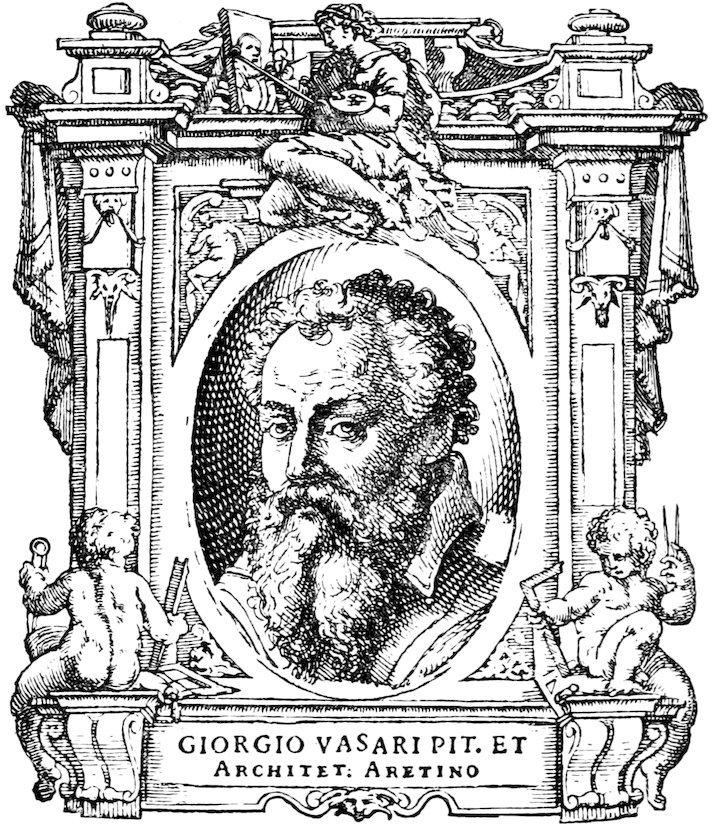
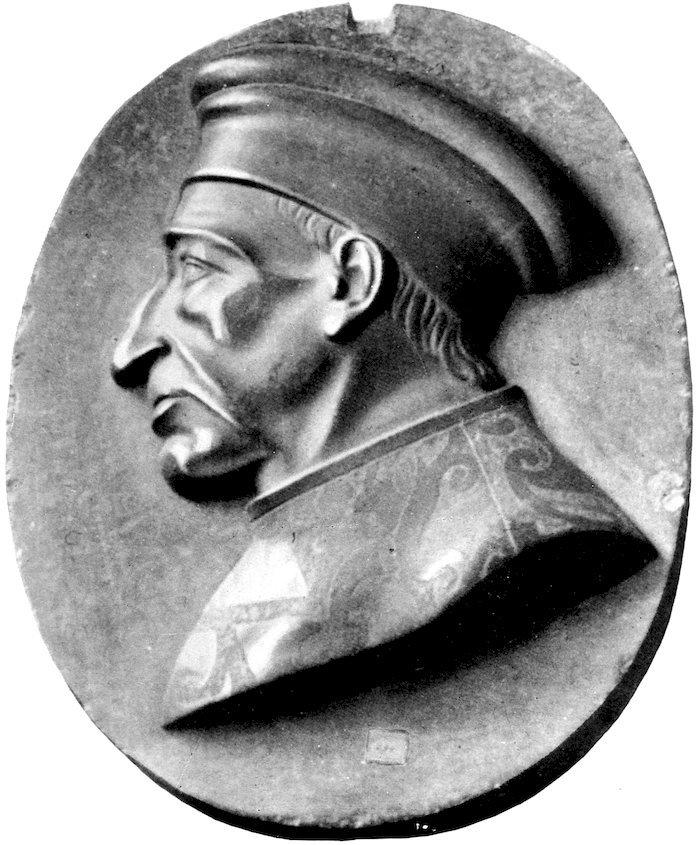
PORTRAIT OF VASARI, FROM THE EDITION OF 1568, probably by a German artist, called in Italy ‘Cristoforo Coriolano’.
INTRODUCTORY ESSAY
When Vasari published in 1550 his famous Lives of the Artists, he prefixed to the work an Introduction, divided into three parts headed respectively Architecture, Sculpture, and Painting. In the text of the Lives he refers more than once to this preliminary matter under the terms ‘parte teorica’ and ‘capitoli delle teoriche,’ but as a fact it only consists to a small extent in ‘theory,’ that is in aesthetic discussions on the general character of the arts and the principles that underlie them. The chief interest of the chapters is technical. They contain practical directions about materials and processes, intended in the first place to enlighten the general reader on subjects about which he is usually but little informed; and in the second, to assist those actually engaged in the operations of the arts.
To some of the readers of the original issue of Vasari’s work these technical chapters proved of special interest, for we find a Flemish correspondent writing to him to say that on the strength of the information therein contained he had made practical essays in art, not wholly without success. This same correspondent, as Vasari tells us in the chapter on Flemish artists at the end of the Lives, hearing that the work was to be reprinted, wrote in the name of many of his compatriots to urge Vasari to prefix to the new edition a more extended disquisition on sculpture, painting, and architecture, with illustrative designs, so as to enforce the rules of art after the fashion of Alberti, Albrecht Dürer, and other artists. This seemed however to Vasari to involve too great an alteration in the scheme of his work, and in the edition of 1568 he preserved the original form of the Introduction, though he incorporated with it considerable additions. It is worth noting that the increase is chiefly in the earlier part, as if Vasari began his revision with the intention of carrying out the suggestion of his correspondents, but gave up the idea of substantial
enlargement as he went on. For example the first chapter in the ‘Introduction’ to Architecture is half as long again in the second as in the first edition, and Architecture generally is increased by a third part, while in Sculpture the additions are trifling. The total additions amount to nearly one seventh of the whole. The matter thus added is in general illustrative of the previous text, and adduces further examples of work under review. It is this extended Introduction of the second, or 1568, edition, which is now completely translated and issued with the needful commentary.
The reputation of the writer and the value of his world-renowned biographies naturally give importance to matter which he has deliberately prefixed to these, and it is somewhat surprising that though the text has been constantly printed it has not been annotated, and that it has never yet been rendered as a whole into English, nor, as far as can be ascertained, into any other European language.
Ernst Berger, in his learned and valuable Beiträge zur Entwicklungs-Geschichte der Maltechnik, vierte Folge, München, 1901, does justice to Vasari’s Treatise, of which, as he says, ‘the thirty-five chapters contain a complete survey of the manual activities of the time, in connection with which Vasari gives us very important information on the condition of technique in the sixteenth century,’ and he translates the chapters relating to painting with one or two useful notes. There was apparently an intention of editing Vasari’s Introduction in the Vienna series of Technical Treatises (Quellenschriften) but the project was not carried out. Anglo-Saxon readers will note that the chapters do not appear in the classic English translation by Mrs Jonathan Foster, nor in the American reprint of selected Lives lately edited with annotations by Blashfield and Hopkins; they are omitted also from the French translation by Leclanché, and from that into German by Ludwig Schorn. Mrs Foster explains that she only meant to translate the Lives and not Vasari’s ‘other works’; while the German editor, though he admits the value of the technical chapters to the artist, thinks that the latter ‘would have in any case to go to the original because many of the technical terms would not be intelligible in translation.’
On this it may be remarked that the chapters in question are not ‘other works’ in the sense in which we should use the term in
connection with Vasari’s Letters, and the ‘Ragionamenti,’ or description of his own performances in the Palazzo Vecchio at Florence, that are all printed by Milanesi in the Sansoni edition of Vasari’s works. The chapters are distinctly a part, and a valuable part, of the main work of the author, and it is difficult to see any valid reason why they should ever have been dissociated from it. With regard to the reason for omission given by the German editor, surely the resources of the translator’s art are not so limited as he supposed! It may be claimed, at any rate, that in what follows a conscientious effort has been made to find technical terms in English equivalent to Vasari’s, and yet intelligible to the reader. Where such terms do not seem to be clear, a footnote has been added in explanation.
It is probable that the real reason of the neglect of Vasari’s Introduction by his translators has been the fact that when these translations were made, more than half-a-century ago, not much interest was taken by the reading public in the technical processes of the arts, and this part of Vasari’s work was passed over in order not to delay the reader anxious for the biographical details the author presents in so lively a fashion. At the present time, largely as a result of the inspiring influence of William Morris alike upon the craftsmen and the artistic public, people have been generally awakened to the interest and importance of these questions of technique, and a new translator of Vasari would certainly not be betrayed into this omission. The present translation and commentary may therefore claim to fill a gap that ought never to have been suffered to exist, and on this ground to need no explanation nor apology. Some English writers on the technique of the arts, such as Mrs Merrifield and the late G. T. Robinson, have made considerable use of the material that Vasari has placed before students in these Introductory Chapters, and the practical service that they have thus rendered is an additional reason why they should be brought as a whole in convenient form before English readers.
Readers familiar with Vasari’s Lives will miss in the technical Introduction much of the charm and liveliness of style in which they have been wont to delight. Vasari indeed had a natural gift for biographical writing. He had a sense of light and shade and of contrast in colouring that animates his literary pictures, and is the
secret of the fascination of his work, while it explains at the same time some of its acknowledged defects. Above all things he will have variety. If one artist have been presented to the reader of the Lives as a man of the world in constant touch with his fellows, the next artist who comes forward on the stage is a recluse. If one be open and free, another is secretive and brooding; the artist jealous of his brother’s fame and envious of his secrets is contrasted with the genial companion ready to impart all he knows to his less fortunate compeer. In bringing out these picturesque comparisons, the writer sometimes forces the note, and is a little more regardful of effect than of strict biographical accuracy,[1] and this accounts for some of the censure which in the modern critical age has fallen to the lot of the Aretine.
The technical disquisitions in the Introduction afford little opportunity for picturesque writing of this kind, and they must be judged from another standpoint. They have certain obvious defects that are however counterbalanced by qualities of much value. Vasari’s treatment in many parts lacks system and completeness, his statement is wanting in clearness, his aesthetic comments are often banal. On the other hand there are sections or chapters of great, even enthralling, interest, as when he discourses with all a Florentine’s enthusiasm on the virile and decided handling of a master in fresco painting; or lets us follow step by step from the small sketch to the finished casting the whole process of making a great bronze statue. Throughout the treatise moreover, we have the advantage of hearing a practical craftsman speaking about the processes and materials with which he is himself familiar, for Vasari, though he did not put his own hand to nearly all the kinds of work he describes, yet was all his life a professional, in intimate touch with craftsmen in every branch of artistic production. If he did not make painted glass windows, he at any rate designed for them. His mural work involved modelled and stamped plaster enrichment and wood carving, while his sections on different processes of decoration for temporary purposes derive a personal interest from the fact that the writer was a famous expert in the construction and adornment of showy fabrics for pageants and state entries, of which his own letters give us many details. If he be unavoidably tedious in his description of the Orders of Architecture, he enlivens this by a digression on his own devices in the masonry of the Uffizi palace. The august figure of Michelangelo
sometimes crosses the page, and in the midst of the rather copious eulogies of which Vasari is lavish, we find here and there some record of a word or work of Buonarroti which reminds us of the author’s intimate personal relation to the master whom he calls in a letter ‘il mio rarissimo e divinissimo Vecchio.’
Vasari’s general intention in this Introduction he explains at the close of the ‘Proemio’ to the whole work that precedes the technical chapters. The Introduction is primarily to instruct ‘every gracious spirit in the most noble matters that appertain to the artistic professions’; and next in order, ‘for his delight and service, to give him to know in what qualities the various masters differed among themselves, and how they adorned and how they benefitted each in his own way their country’; and finally to enable any one that wills to gain advantage from the labour and cunning of those who in times past have excelled in the arts. Architecture will be shown to be the most universal, the most necessary, and the most useful of human arts, for whose service and adornment the other two arts exist; the different qualities of stones will be demonstrated, with the styles of building and their proper proportions, and the characteristics of good designs and good construction. Next in order comes Sculpture, and here will be shown the manner of working statues, in their correct forms and proportions, and the qualities that make sculpture good, ‘with all the directions for work that are most secret and most precious.’ Lastly, the treatment of Painting will include design; the methods of colouring and of carrying out a picture; the characteristics of painting and its subordinate branches, with mosaics of every sort, niello work, enamels, damascening, and finally engravings after pictures.
Vasari’s treatise does not stand alone but is only one among many technical and theoretical essays which have come down to us from various epochs both of the middle ages and of the Renaissance. The nature and the value of it will be best understood if we compare it with one or two representative publications of a similar kind, contemporary with it or of earlier date. The comparison will serve to show the spirit in which Vasari writes, and to exhibit the strong and the weak points in his work.
About the middle of the last century, a number of technical treatises and collections of recipes, from MSS. of the twelfth to the
eighteenth centuries, were edited and published by Mrs Merrifield, and the acumen and accuracy with which she fulfilled her laborious task are warmly eulogized by Dr Albert Ilg, the learned editor of Theophilus and Cennini in the Vienna Quellenschriften. The most important of existing treatises of the kind are however not included in Mrs Merrifield’s work, though they have been translated and edited separately both by her and by other scholars. The recent publication by Ernst Berger noticed above gives the most complete account of all this technical literature. Those of the early treatises or tracts that consist in little more than collections of recipes need not detain us, and the only works of which we need here take account are the following: (1) The Schedula Diversarum Artium of Theophilus, a compendium of the decorative arts as they were practised in the mediaeval monastery, drawn up by a German monk of the eleventh or twelfth century; (2) Il Libro dell’ Arte, o Trattato della Pittura of the Florentine painter Cennino Cennini, written in the early part of the fifteenth century; (3) The De Re Aedificatoria and the tracts Della Pittura and Della Scultura, written rather later and in quite a different vein, by the famous Florentine humanist and artist Leon Battista Alberti; (4) Benvenuto Cellini’s treatises, Sopra l’ Oreficeria e la Scultura, that belong to the same period as Vasari’s own Introduction, and partly cover the same ground. There are later treatises, such as Borghini’s Il Riposo, 1584; Armenini’s Dei veri Precetti della Pittura, 1587; Pacheco’s Arte de la Pintura, 1649; Palomino’s El Museo Pictorico, etc., 1715–24, which all contain matter of interest, but need not be specially noticed in this place. Some of these later writers depend very largely on Vasari.
The fact just stated about the treatises of Cellini and Vasari suggests the question whether the two are independent, or, if borrowing existed, which treatise owes most to this adventitious aid. The dates of Vasari’s two editions have already been given. Cellini’s two Trattati first appeared in 1568 the same year as Vasari’s second edition, and there exists a second recension of his text which formed the basis of Milanesi’s edition of 1857, republished in 1893. It is worth noting that Vasari’s account of bronze casting, in which we should expect reliance on Cellini, appears in full in the first edition of 1550, and the same applies to the account of die-sinking. On the other hand Cellini’s notice of the Tuscan building stones, pietra serena, etc., seems like a clearer statement of what we find in Vasari’s
edition of 1550. On the whole it was Cellini who used Vasari rather than Vasari Cellini, though the tracts can be regarded as practically independent. The Trattati of Cellini are really complementary to Vasari’s ‘Introductions.’
Vasari, as he says of himself, was painter and architect, while Cellini was sculptor and worker in metal. In matters like die-sinking, niello work, enamelling, and the making of medals, Cellini gives the fuller and more practical information, for these were not exactly in the province of the Aretine, while Vasari on his side gives us much information, especially on the processes of painting and on architectural subjects, for which we look in vain to Cellini.
Allowing for these differences, the two treatises agree in the general picture that they give of the artistic activity of their times, and they faithfully reflect the spirit of the High Renaissance, when the arts were made the instruments of a dazzling, even ostentatious, parade, in which decadence was unmistakeably prefigured. From this point of view, the point of view, that is, of the general artistic tone of an age, it is interesting to draw a comparison between the spirit of the treatises of Vasari and Cellini on the one side, and on the other the spirit of the earlier writings already referred to. If the former bring us into contact with the Renaissance in the heyday of its pride, the artistic tractates of Alberti, of a century before, show us the Renaissance movement in its strenuous youth, already selfconscious, but militant and disposed to work rather than to enjoy. Cennini’s Book of Art, though certainly written in the lifetime of Alberti, belongs in spirit to the previous, that is to the fourteenth, century. It reflects the life of the mediaeval guilds, when artist and craftsman were still one, and the practice of the arts proceeded on traditional lines in urban workshops where master and apprentices worked side by side on any commissions that their fellow citizens chose to bring. Lastly the Schedula of the monk Theophilus introduces us into quite a different atmosphere of art. Carrying us back for two hundred years, it shows us art cultivated in an ascetic community in independence of patrons or guilds or civic surroundings; on purely religious lines for the glory of the Almighty and the fitting adornment of His house.
This treatise by Theophilus is by far the most interesting and valuable of all those that have been named. No literary product of the
middle ages is more precious, for it reflects a side of mediaeval life of which we should otherwise be imperfectly informed. Can it be possible, we ask ourselves, that men vowed to religion in its most ascetic form, who had turned their backs on the world’s vain shows and whose inward eye was to see only the mystic light of vision, could devote time and care to the minutiae of the craftsman’s technique? Such however was the fact. We cannot read the first few pages of Theophilus without recognizing that the religion of the writer was both sincere and fervent, and that such religion seemed to him to find a natural outcome in art. Art moreover with the German monk was essentially a matter of technique. From end to end of the treatise there is comparatively little about art as representative. Sculpture and painting indeed in the monastic period were not capable of embodying the ideal, so as to produce on the spectator the religious impression of a Madonna by Angelico or Raphael. The art of the eleventh and twelfth centuries was decorative, and aimed at an effect of beauty with an under suggestion of symbolism. Theophilus troubles himself little about symbolism but bases everything on a knowledge of materials and processes; and in the workshop, whose homely construction and fittings he describes, we are invited to see the gold and silver and bronze, the coloured earths, the glass stained with metallic oxides, all taking shape in dainty and beautiful forms, and coming together in discreet but opulent display, till, as he phrases it, the Abbey Church which they bedeck and furnish ‘shall shine like the garden of Paradise.’ For to the mind of the pious craftsman this church is a microcosm. Creative skill has made it all beautiful within, and this is the skill of man, but it is only his in so far as man shares the nature of the Divine Artist that fashioned the vast macrocosm of the universe. Artistic knowledge and craftsmanship are a part of the original heritage of man as he was made in the image of God the creator, and to win back this heritage by patient labour and contriving is a religious duty, in the fulfilment of which the Holy Spirit will Himself give constant aid. Theophilus enumerates from St. Paul the seven gifts of the Spirit, and shows how the knowledge, the wisdom, the counsel, and the might, thus imparted to men, all find a field of exercise in the monastic workshop.
Cennino Cennini da Colle di Val d’ Elsa was not a devotee nor a man of religion, but a city tradesman and employer of labour. Art in
his time had taken up its abode in the towns that were the seat of the artistic activity of the Gothic period in France and the neighbouring countries. It was there practised by laymen in secular surroundings, but as the French Cathedrals and the work of Giotto and Simone Martini testify, on religious subjects and in a spirit of piety. Some gleams of the visionary light that irradiates the workshop of Theophilus fall across the panels which Cennini and his apprentices smooth and clamp, and prime with gesso, and paint with forms of the Madonna or the Crucified. In one of his chapters he demands for the artist a chaste and almost ascetic life, as of one who studies theology or philosophy, and again he bids him clothe himself for his art with love and obedience, with patience and godly fear. When beginning a delicate piece of manipulation Cennini bids the worker ‘Invoke the name of God,’ and it is characteristic too that he tells him that such work must not be executed in haste, but ‘with great affection and care.’ In the main however, Cennini’s treatise is occupied with a description of the processes of painting traditional in the school of Florence, that was dominated throughout the fourteenth century by the commanding figure of Giotto. We learn from the Trattato how walls were plastered and prepared for the mural painter, and can measure how far the technical practice of fresco had at the time been carried. Fresco painting, on which the reader will find a Note at the close of the ‘Introduction’ to Painting, was only the revival of an art familiar to the ancients, but the best form of the technique, called by the Italians ‘buon fresco,’ was only completely recovered in the course of the fifteenth century. In the school of Giotto, represented by Cennini, the practice was as yet imperfect, but his account of it is full of interest. Painting on panels and on the vellum of books he thoroughly understands, and his notices of pigments and media convey much valuable information. Amongst other things he seems quite au fait in the practice of oil painting, which Vasari has made many generations believe was an invention of the Flemish van Eyck.
The chief importance however of Cennini for the present purpose is to be found in his implicit reliance on authority and tradition, in which he contrasts most markedly, as we shall see, with his fellowcountryman and successor, Leon Battista Alberti. Cennini had himself worked for twelve years with Agnolo Gaddi the son of Taddeo Gaddi, for twenty-four years the pupil and assistant of
Giotto, and he warns the student against changing his teacher, and so becoming, as he calls it, a ‘phantasist.’ To quote his own words, ‘do thou direct thy course by this rule according to which I will instruct thee in the painter’s art, for Giotto the great master himself followed it. Four and twenty years was Taddeo Gaddi, the Florentine, his scholar; Taddeo’s son was Agnolo; Agnolo kept me by him twelve years, during which he taught me to paint in this manner,’ and he points the moral from his own experience, ‘At the earliest moment you can, put yourself under the best master you can find, and stay with him as long as you are able.’
Cennini, who seems to have been born about 1372, probably wrote his Trattato towards the close of his life, and there is MS. authority for dating the tract Della Pittura of Leon Battista Alberti about 1435, so that the two works may have been composed within the same generation. The contrast between them is however most striking. Cennini’s ideas are wholly those of the fourteenth century, when guild traditions were supreme over artistic practice; whereas Alberti is possessed by the spirit of the Early Renaissance, of which he is indeed one of the most representative figures. In his view the artist should base his life and his work on the new humanistic culture of the age, and build up his art on science and the study of nature and on the example of the masters of antiquity. With regard to the last, the reader, who hears Alberti invoking the legendary shades of Pheidias and Zeuxis and Apelles, may suspect that a new authority is being set up in place of the old and that the promised freedom for the arts is to be only in the name. It is of course true that the reliance on classical models, which came into fashion with the Revival of Learning, was destined in future times to lie like an incubus on the arts, and to give an occasion for many famous revolts; but these times were not yet, and with Alberti the appeal to antiquity is little more than a fashion of speech. At other epochs, when men have suddenly broken loose from some old-established authoritative system, they have turned to the classical world for the support which its sane and rationally based intellectual and political systems seemed to offer. It was so at the time of the French Revolution, and so it was earlier when the men of the fifteenth century were passing out from under the shadow of mediaeval authority. Alberti seems to find satisfaction in the thought of the existence of unquestionable models of perfection in those classical masters whose names were
current in humanistic circles, but he makes but little practical use of them. It is remarkable indeed how little direct influence in the essentials of art was exercised over the Italian painting and sculpture of the fifteenth century by the models of the past. Classical subjects come in by the side of the more familiar religious themes, and accessories in pictures are drawn largely from antique remains, but the influence does not penetrate very deep. How little there is that is classical in the spirit and even the form of the art of Donatello! How closely we have to scan the work or the utterances of Leonardo to find a trace of the study of Roman or Hellenic antiquity!
With Alberti, as with the humanists in art in general, the watchword was ‘Nature.’ As if with direct reference to what Cennini had said about adhering to a chosen master, Alberti in the third book of his Della Pittura, derides those who follow their predecessors so closely as to copy all their errors. Equally at fault are those who work out of their own head without proper models before them. The real mistress is nature. Now ever since the beginning of the Italian revival the study of nature had been set before the artist, and Cennini bids the craftsman never to pass a day without making some drawing from a natural object. The study of nature however, with Alberti and the masters of the Early Renaissance, meant something more. The outward aspect of things was to be narrowly observed, and he instances the effect of wind on the drapery of figures, but underneath this outward aspect the artist was to explore the inner structure upon which the external appearance depends. The nude figure must be understood under the drapery, the skeleton and muscular system beneath the integument. Then nature as a whole, that is to say, figures and objects in their mutual relations, must be investigated, and this on a basis of mathematical science. Alberti has a passion for geometry, and begins his treatise with a study from this point of view of visible surfaces. The relation of the eye to visual objects, and especially the changes which these are seen to undergo in their sizes and relations according as the eye is moved, lead on to the study of perspective, on which science, as is well known, depended so much of the advance in painting in the fifteenth century. Everything in a picture is to be studied from actual persons or objects. It will add life and actuality to a historical composition if some of the heads are copied from living people who are generally known, but at the same
time a common sort of realism is to be avoided, for the aim of the artist should not be mere truth to nature but beauty and dignity. It is in his conception of the artist’s character and life that Alberti is least mediaeval. Here, in the third book of Della Pittura, we see emerging for the first time the familiar modern figure of the artist, who, as scholar and gentleman, holds a place apart from and above the artizanception inspires the interesting chapter, the tenth in the ninth book, of Alberti’s more important treatise De Re Aedificatoria, where he draws out the character of the ideal architect, who should be ‘a man of fine genius, of a great application, of the best education, of thorough experience and especially of sound sense and firm judgement.’ The Renaissance artist was indeed to fulfil the idea of a perfectible human nature, the conception of which is the best gift of humanism to the modern world. As sketched in Della Pittura, he was to be learned in all the liberal arts, familiar with the creations of the poets, accustomed to converse with rhetoricians, ‘a man and a good man and versed in all good pursuits.’ He was to attract the admiring regard of his fellows by his character and bearing, and to be marked among all for grace and courtesy, for ‘it is the aim and end of the painter to seek to win for himself through his works praise and favour and good-will, rather than riches.’ Such a one, labouring with all diligence and penetration on the study of nature and of science, would win his way to the mastery possessed by the ancient painters, and would secure to himself that fame so dear to the Italian heart!
In the hundred years that intervened between the life-courses of Alberti and of Vasari, the Renaissance artist, whom the former describes in the making, had become a finished product, and the practice of the arts was a matter of easy routine. The artistic problems at which the men of the fifteenth century had laboured so earnestly were solved; the materials had become plastic to the craftsman’s will; the forms of nature were known so well that they ceased to excite the curiosity which had set Leonardo’s keenly sensitive nature on edge. At the time Vasari wrote, with the exception of the Venetians and of Michelangelo, all the men of genius who had created the art of the Renaissance had passed away, and the busy workers whose multitudinous operations he watched and chronicled were, like himself, only epigoni—successors of the great. We have only to read Vasari’s eulogy of Michelangelo’s frescoes on the vault of
the Sistine, in his Life of that master, to see how far the tone of the age in regard to art had changed from the time when Alberti was exhorting the student to work out his own artistic salvation with fear and trembling. ‘No one,’ exclaims Vasari, ‘who is a painter cares now any more to look out for novelty in inventions or attitudes or drapery, for new modes of expression, and for sublimity in all the varied effects of art; seeing that all the perfection which it is possible to give in work done in this fashion has been imparted to these figures by Michelangelo.’ The cultivation of the Michelangelesque, instead of the severe and patient study of nature, that Leonardo had called ‘the mistress of all masters,’ marks the spirit of the Florentine and Roman schools after the middle of the sixteenth century, and Vasari’s own works in fresco and oil, hastily executed and on a vast scale, but devoid alike of originality and of charm, are the most effective exponents of the ideas of his time and school. At this epoch the artist himself was no longer the dominant figure in the world of art, nor was his struggle for self-perfection in the forefront of interest for the spectator. The stage was rather commanded by the patron, the Pope Leo, the Duke Cosimo or the Cardinal Farnese of the day, at whose bidding the artist must run hither and thither, and leave one task for another, till a delicate nature like Raphael’s or Perino del Vaga’s fails under the strain, and the sublime genius of Michelangelo is thwarted in its free expression. With the exception of the Venetians, most of the more accomplished Italian masters of the period were at work on commissions set them by these wealthy patrons, who lorded it over their kind and made the arts subservient to their temporal glory. For such Vasari himself was always contentedly busy on buildings or frescoes or pageants, and for work of the kind demanded nature had exactly equipped him. He was evidently embarrassed neither by ideals nor by nerves, but was essentially business-like. Galluzzi in his History of the Grand Dukes says of him that ‘to the qualities of his profession he united a certain sagacity and alertness of spirit which gave to Duke Cosimo considerable pleasure from his company.’ He was distinguished above his fellows for the characteristic, not too common among artists, of always working to time. He might scamp his work, but he would by one method or another get it finished in accordance with his contract. His powers of application must have been of a high order, for we should remember that his literary output was by no
means inconsiderable, and with his busy life the wonder is not that he wrote rather carelessly but that he was able to do any serious literary work at all.
A favourable specimen of Vasari’s decorative painting is the fresco in the Palazzo Vecchio at Florence, given on Plate I. It represents Leo X surrounded by his Cardinals, and introduces portraits of famous men of the day. For instance, on the left above the balustrade in the upper part of the fresco against the opening, will be observed four heads of personages outside the conclave. That on the right is of Leonardo da Vinci and the one on the left Michelangelo’s, while the two men with covered heads who intervene are Giuliano de’ Medici, Duc de Nemours, and his nephew Lorenzo de’ Medici, Duca d’ Urbino, the originals of Michelangelo’s world-famous statues on the Medici tombs, that are of course treated in a wholly ideal fashion. It will be observed that among the foreground figures the heads of the second from the left and the second from the right are rendered with much more force and character than the rest. They are of Cardinal Giulio de’ Medici afterwards Clement VII, and Cardinal de’ Rossi, and Vasari has saved himself trouble by boldly annexing them, and with them the bust of the Pope, from Raphael’s Portrait of Leo X, of which, as he tells us elsewhere, he had at one time made a copy.
It has been well said of him by the continuators of his autobiography that ‘to our Giorgio nature was very bountiful in her gifts; study and good will had largely improved his natural disposition, but the taste of the times, and the artistic education he received, corrupted the gifts of nature, and the fruit of his unwearied studies.’ Vasari was not an inspired artist, and he had neither the informing mind of a master nor the judgement of a discriminating critic, but he was, as we have already pointed out, above all things a thoroughly practical craftsman in intimate touch with all the manifold artistic life of the Italy of his time. He possessed moreover a most genial personality with which it is a pleasure to come into contact, and his good temper (which only fails him when he talks about Gothic art), though it may at times slightly provoke us, accounts for not a little of the deserved popularity of his writings.[2]
Vasari has no doubt at all about the arts being in the most healthy condition in the best of all possible artistic worlds, but it is easy for us to see that this art of the High Renaissance was not of the very
best; that the spirit had died out of it almost as soon as the form had attained to outward perfection. We cannot share the facile optimism of Vasari who will admire any work, or any at least in his own school and style, in which there is initiative and force and technical mastery, and in whose eyes to paint feigned architecture on a stucco façade, provided it be deftly done, is as much a ‘cosa bellissima’ as to carve the Marsuppini sarcophagus in S. Croce. We cannot however withhold our admiration when we consider the copious artistic output of the age, the manifold forms of aesthetic expression, the easy surrender of the most intractable materials to the artist’s will. As we read Vasari’s descriptions and recipes the air all about us seems full of the noise of the mason’s hammer, the splash of plaster on the wall, the tinkle of the carver’s chisel against the marble, the grating of the chaser’s rasp upon the bronze. We feel ourselves spectators of an organized activity on a vast scale, where processes are so well understood that they go on almost of themselves. In the present day, in so much that is written about art, the personal or biographical interest is uppermost, and the lives of Italian artists, with their troubles and triumphs, absorb so much attention that one wonders whether any is left for Italian art. Hence one of the chief values of Vasari’s Technical Introduction is its insistence on artistic practice in general, as distinct from the doings of individual artists, and in this it may serve as a useful supplement or corrective to the biographical writing now in vogue. In Vasari on Technique there are no attractive personal legends, like that of Giotto’s shepherding or Donatello’s adventure with the eggs, but we learn in exchange to follow step by step the building and plastering and painting of Giotto’s chapel at Padua, and can watch Donatello’s helpers as they anxiously adjust the mould and core for casting the statue of Gattamelata.
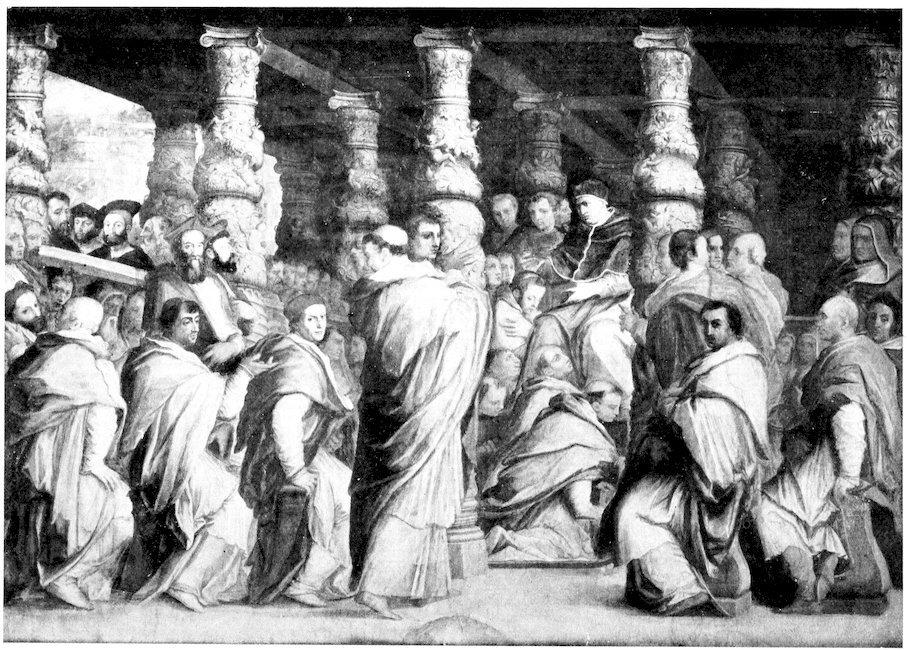
LEO X WITH HIS CARDINALS
It may assist the reader if there be here subjoined a succinct resumé of the subjects treated by Vasari in the three ‘Introductions.’
The first of these, on Architecture, opens with a long chapter on stones used in building and decoration, which is important as the fullest notice of the subject that has come down to us from the Renaissance period. Into his somewhat loose disquisitions on porphyry, marbles, travertine, and other materials, Vasari introduces so many incidental notices of monuments and personages of interest, that a somewhat extended commentary has in this part been necessary. Next follows the inevitable chapter on the five Orders, at
the close of which comes the notable passage in which Vasari adopts for late mediaeval architecture the term ‘Gothic’ that has ever since adhered to it. With Vasari the word ‘Gothic’ means ‘barbarian,’ and he holds that the style was invented by the Goths, after they had conquered the Romans and destroyed all the good antique structures. His description of what he terms the ‘abominations’ of slender shafts and niches and corbels and finials and doors that touch the roof is quite spirited, and might be learned by heart as a lesson in humility by some of our mediaeval enthusiasts. On the question whether Vasari was the first to use the term ‘Gothic’ in this sense a word will be said in the Note on the passage in Vasari’s text.
Next come chapters on the architectural use of enriched plaster; on the rustic fountains and grottoes, the taste for which was coming in in Vasari’s time, and which at a later period generated the socalled ‘rocaille’ or ‘rococo’ style in ornamentation; and on mosaic pavements. This ‘Introduction’ ends with a chapter on an interesting subject to which it does not quite do justice, the subject of ideal architecture, on which in that and the succeeding age a good deal was written.
Though Sculpture was not Vasari’s métier his account of the processes of that art is full and practical, though we miss the personal note that runs through the descriptions of the same procedure in the Trattato of Cellini. After an introductory chapter we have one on the technique of sculpture in marble, with an account first of the small, and then of the full-sized, model in clay or wax, the mechanical transfer of the general form of this to the marble block, and the completion of the statue by the use of tools and processes which he describes. Chapter three introduces the subject of reliefs, and there is here of course a good deal about the picturesque reliefs in which perspective effects are sought, that Ghiberti and Donatello had brought into vogue. The account of bronze casting in chapter four is one of the most interesting in the whole treatise, and the descriptions are in the main clear and consistent. Illustrations have been introduced here from the article on the subject in the French Encyclopédie of the eighteenth century, where is an account of the processes used in 1699 for casting in one piece Girardon’s colossal equestrian statue of Louis XIV for the Place Vendôme in Paris. A chapter on die-sinking for medals is followed by one on modelled
plaster work, for this material is dealt with in all the three sections of the Introduction; while sculpture in wood forms the subject of the concluding chapter, in which there is a curious notice of an otherwise unknown French artist, who executed at Florence a statue of S. Rocco which may still be seen in the church of the Annunziata. In various places of this ‘Introduction’ to Sculpture questions of general aesthetic interest are brought forward, and some of these are discussed in the commentary at its close.
Of the three ‘Introductions’ that on Painting is the longest and deals with the greatest variety of topics. After a preliminary chapter in which Vasari shows that he regards the art with the eyes of a Florentine frescoist, he gives a practical account of different methods of executing drawings and cartoons, and of transferring the lines of the cartoon to the fresh plaster of the wall, on which the fresco painter is to work. A chapter on colouring in mural pictures leads on to the account of the fresco process. As Vasari was in this an expert, his description and appreciation of the process form one of the most valuable parts of the treatise. He is enthusiastic in his praise of the method, which he calls the most masterly and most beautiful of all, on account of its directness and rapidity. Tempera painting on panel or on dry plaster is next discussed, and then follows a notice of oil painting on panel or canvas. The statement here made by Vasari that oil painting was invented by van Eyck is the earliest enunciation of a dogma that has given rise in recent times to a large amount of controversial writing. He goes on next to treat of the right method of mural painting in the oil medium, and in this last connection Vasari gives us the recipe he had finally adopted after years of experiment, and employed for preparing walls for the application of oil paint in the Palazzo Vecchio at Florence. The use of oil paint on a ground of slate or other kinds of stone furnishes matter for another chapter.
With chapter eleven begins what we may regard as a second division of this ‘Introduction,’ in which various processes of the decorative arts are grouped together under the head of Painting, on the ground of the pictorial effects produced by their means. Decorative painting, in the usual sense, is first described as executed in monochrome for permanence on the façades of buildings, or for temporary purposes on triumphal arches and similar structures; and then follows a chapter on what is known as ‘Sgraffito’ work, or
decoration in plaster of two colours, especially valuable as the first statement of the method and aim of this process, which had been evolved from pâte-sur-pâte pottery not long before Vasari’s time. ‘Grotesques’ in modelled and stamped plaster are next described, and the uses of colour in various ways in connection with them are noticed, though with tantalizing brevity. Recipes for gilding follow, and then with a treatment of glass mosaic we pass on to a discussion of eight different kinds of decorative work, which interest Vasari chiefly because of their pictorial possibilities. Of glass mosaic, while he gives very good advice about the sort of design suitable for it, he says that it must be so executed as to look like painting and not like inlaid work. Some, he says, are so clever that they make it resemble fresco. Floor mosaics in coloured marbles are to appear exactly like a flat picture; works in tarsia, or wood inlays, are dismissed because they cannot do more than counterfeit painting without equalling it; stained glass windows, on the other hand, are lauded because they can be carried to the same perfection as fine pictures on panel. Enamel is noticed because it is of the nature of picture-work, and even damascening on metal ‘partakes of the nature both of sculpture and of painting.’ Lastly wood-engraving is only described under the form of the Chiaroscuri, or shaded prints, introduced early in the sixteenth century, though W. J. Linton in his work The Masters of Wood Engraving regards these as merely aping drawings, and hardly coming under the engraver’s art at all!
To return for a moment in concluding to a comparison already drawn, the contrast is very significant between Vasari’s attitude towards these decorative processes and that of the mediaeval writer Theophilus. Throughout his treatise Theophilus hardly says anything about design, or what is to be represented in the various materials. It is the materials themselves that are his concern, and the end before his eyes is the effect of beauty and sumptuousness in colour and texture that their skilful manipulation will secure. To Vasari these materials are chiefly of importance as producing something of the effect of painting, and though he deals with them and their manipulation from the technical point of view, the vision of the completed result as a picture hovers always before his eyes. In this Vasari was only following in his theoretical treatment the actual facts of artistic development in his times. Since the beginning of the Renaissance period all the forms of industrial art which he describes
had been gradually losing the purely decorative character which belonged to them in the mediaeval epoch, and were being hurried along at the chariot wheels of the triumphant art of painting. This is one of the two dangers to which these forms of art are always subject. The naturalism in design, which is encouraged by the popularity of the painter’s art on its representative side, is as much opposed to their true genius as is the modern system of mechanical production, which deprives them of the charm they owe to the touch of the craftsman’s personality. History brought it about that in the century after Vasari these arts were in a measure rescued from the too great predominance of the pictorial element, though they were subjected at the same time to the other unfavourable influence just hinted at. Italy, from which the artistic Renaissance had spread to other lands, ceased in the seventeenth century to be the main centre of production or of inspiration for the decorative arts, which rather found their home in Paris, where they were organized and encouraged as part of the state system. The Manufacture des Meubles de la Couronne, a creation of Louis XIV’s minister Colbert, which had its headquarters at the Hotel des Gobelins and the Savonnerie, was a manufactory of decorative work of almost every kind and in the most varied materials. That this work, judged on an aesthetic standard, was cold and formal, and wanting in the breath of life which plays about all the productions of the mediaeval workshop, was an inevitable consequence of its systematized official character and of its environment. The lover of art will take more real pleasure in the output of the old-fashioned and more personal English craftsmanship of the seventeenth and eighteenth centuries, than in the artistic glories of the French state factories under the Ancien Régime. This native British craftsmanship was however struck into inanition a century ago by the apparition of machinery; and the result of half-a-century of the new industrial era was the Great Exhibition of 1851, wherein was displayed what was probably the greatest collection of artistic failures that the world has ever beheld. In consequence agencies were then set on foot, and engineered by the Science and Art Department, to improve the artistic quality of industrial products, but unfortunately these were based on principles not wholly sound. The shibboleths ‘Historic Ornament’ and ‘Applied Ornament’ covered the desponding view that the decorative arts were dead, and that enrichment must henceforth not be a living
thing, the concomitant and even the product of the work itself, but a dead or ‘historic’ thing, that might be procured from books or museums and then ‘applied’ as an afterthought to whatever was to be made a ‘work of art.’ The results of this system were not encouraging, and led to the revival of mediaeval ideas, which, embodied in the magnetic personality of William Morris, have done much to effect a real, though as yet not far-reaching artistic revival.
The first principle here is to discourage undue naturalism in ornamental design by withdrawing the decorative arts from the influence of painting, and attaching them rather to the arts of construction, under the beneficent control of which they did so well in the middle ages. The next principle, which is equally important, is to foster the personal element in decorative work, but at the same time to prevent individuality from becoming self-assertive and running into vagaries, by insisting on the vital connection of ornament with material and technique. For the worker to ornament a thing properly he must either have made it or at any rate be in intimate touch with the processes of fabrication, out of which the decorative treatment should grow. The fact that the more advanced Schools of Art in our own country, such as that at Birmingham, regard as essential parts of their equipment the range of workshops where technical processes are explained and studied, is an encouraging sign, and this return from the drawing-board and the book to the bench and the tool gives an additional practical value to the older treatises on the technique of the arts, of which Vasari’s Introduction is one.