This is an electronic version of the print textbook. Due to electronic rights restrictions, some third party content may be suppressed. Editorial review has deemed that any suppressed content does not materially affect the overall learning experience. The publisher reserves the right to remove content from this title at any time if subsequent rights restrictions require it. For valuable information on pricing, previous editions, changes to current editions, and alternate formats, please visit www.cengage.com/highered to search by ISBN#, author, title, or keyword for materials in your areas of interest.
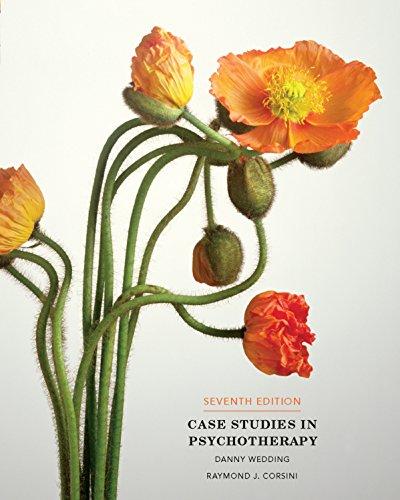
Case Studies In Current Psychotherapy,
Seventh Edition
Editors: Danny Wedding, Raymond J. Corsini
Publisher: Jon-David Hague
Editorial Assistant: Amelia Blevins
Media Editor: Elizabeth Momb
Brand Manager: Elisabeth Rhoden
Market Development Manager: Kara Kindstrom
Manufacturing Planner: Judy Inouye
Rights Acquisitions Specialist: Roberta Broyer
Text Researcher: PreMedia Global
Production Management and Composition:
Teresa Christie, MPS Limited
Copy Editor: S.M. Summerlight
Art and Design Direction: Carolyn Deacy, MPS Limited
ALL RIGHTS RESERVED. No part of this work covered by the copyright herein may be reproduced, transmitted, stored, or used in any form or by any means graphic, electronic, or mechanical, including but not limited to photocopying, recording, scanning, digitizing, taping, Web distribution, information networks, or information storage and retrieval systems, except as permitted under Section 107 or 108 of the 1976 United States Copyright Act, without the prior written permission of the publisher.
For product information and technology assistance, contact us at Cengage Learning Customer & Sales Support, 1-800-354-9706
For permission to use material from this text or product, submit all requests online at www.cengage.com/permissions
Further permissions questions can be e-mailed to permissionrequest@cengage.com
Library of Congress Control Number: 2013932881
ISBN-13: 978-1-285-17523-2
ISBN-10: 1-285-17523-9
Cengage Learning
200 First Stamford Place, 4th Floor Stamford, CT 06902
USA
Cengage Learning is a leading provider of customized learning solutions with office locations around the globe, including Singapore, the United Kingdom, Australia, Mexico, Brazil, and Japan. Locate your local office at www.cengage.com/global
Cengage Learning products are represented in Canada by Nelson Education, Ltd.
To learn more about Cengage Learning, visit www.cengage.com
Purchase any of our products at your local college store or at our preferred online store www.cengagebrain.com
In Memory of Four Giants in the World of Psychotherapy
Carl Rogers (1902–1987)
Rollo May (1909–1994)
Joseph Wolpe (1915–1997) and Albert Ellis (1913–2007)
10 family therapy
The Daughter Who Said No / Peggy Papp 149
11 contemplative psychotherapies
Using Mindfulness Effectively in Clinical Practice: Two Case Studies / Tory A. Eisenlohr-Moul, Jessica R. Peters, and Ruth A. Baer 173
12 positive psychotherapy
Strength-Based Assessment in Clinical Practice / Tayyab Rashid and Robert F. Ostermann 193
13 integrative psychotherapies
Integrative Therapy with Mr. F. H. / Larry E. Beutler 204
14 multicultural psychotherapy
Alma / Lillian Comas-Díaz 215
index 219
contributors
Ruth A. Baer
David H. Barlow
Aaron T. Beck
Larry E. Beutler
Lillian Comas-Díaz
Marie Crowe
Sally Denham-Vaughan
Tory A. Eisenlohr-Moul
Albert Ellis
Sue Luty
Michael Maniacci
Harold H. Mosak
Robert F. Ostermann
Peggy Papp
Jessica R. Peters
Tayyab Rashid
Jeremy Safran
Marjorie C. Witty
Irvin Yalom
foreword
Observing an expert perform a skills-based task has always been the most effective way for an apprentice to learn a complex procedure. For this reason, witnessing and studying the work of those who have mastered their craft have always been at the heart of the apprenticeship system. This method of training is more effective when it has been preceded by instruction that allows novices to place their observations into a meaningful conceptual context. This book, which presents case studies conducted and written by experts in specific therapeutic modalities, corresponds to the apprenticeship aspect of a training program. The primary text, Current Psychotherapies, parallels these case studies chapter by chapter. Although a reading of that text is not necessary for a fruitful reading of these case studies, it can heighten understanding of what the therapists are doing by presenting the theoretical and applied underpinnings of their systems.
All clinicians personalize the systems that they have studied and chosen to use. Their therapy reflects their personal life histories, the scripts, values, attitudes, and dispositions that form (mostly at a tacit or implicit level) the weft of that elusive fabric we call the psyche. None of us can entirely escape the conditions that have made us who we are, and our experiences inevitably get enmeshed in the treatment plan and the procedures that we use with our clients. For this reason, the therapist, as a person, becomes the primary instrument of therapy. The techniques become secondary.
Most of you who will read these case studies are motivated by an interest in improving your clinical skills. A first reading will excite a sense of profound admiration for the clinicians who worked the marvels of “therapeutic outcome” described in the studies. Their virtuosity should not discourage you from aspiring to their level of expertise. One must keep in mind that these cases are not examples of their least accomplished performances. The editors chose them precisely because they are instructive of the highly evolved clinical skills these therapists possessed at an advanced point in their careers. Although these clients challenged their resources to the utmost, they were clients who were apt, and suitable, for the treatments these therapists were prepared to provide.
Becoming a skilled clinician is like becoming skilled at any other complex human activity. It is the work of the “long-distance runner.” It is building a repertoire of techniques and broad strategies that fit a consistent theoretical paradigm, honing various clinical skills, and learning to recognize the appropriate moments to use them. It is the work of fashioning coherent treatment plans for particular individuals who will be facing us filled with hope and anxiety. It is becoming a therapist with a therapeutic personality—the privileged instrument of every successful therapy, polished by the inevitable stresses, frustrations, and failures of life and of our profession—for not every therapeutic relationship turns out as we had hoped it would.
This book raises questions that go far beyond the boundaries of psychotherapy as that discipline is generally construed. The concerns and the personages that are depicted in these cases implicitly evoke issues of cultural anthropology, social psychology, hermeneutics, psychopedagogy, developmental psychology, and cognitive science.
Psychotherapeutics has borrowed the terms etic and emic from cultural anthropology. The former, etic, characterizes a nomothetic or universal approach to framing theories of personality development; the latter refers to principles that are more culture sensitive and culture bound. An emic approach refrains from generalizing principles
beyond the group in which they have been found to be valid. In the limiting case, it treats each individual as possessing his or her own “culture.”
Inclusion of the case on meditation reflects the editors’ recognition of the richness that non-Occidental philosophies and approaches to healing can bring to the Western therapist. Of course, this East-West conceptualization of the culture specificity of any therapy is not a true dichotomy. Like any other psychological, anthropological, or sociological variable, culture specificity lies on a continuum. All the case studies in this book can be placed somewhere on that continuum.
Readers of this book will no doubt experience an approach-avoidance dilemma with several, if not most, of the therapies described here, for there are drawbacks and benefits for each system. The editors make no apology for that and expect both the practitioner and the trainee to struggle with the issue of choice. The decisions you make about therapy will be quite personal. Some prefer a predominantly intrapsychic approach to therapy; others a more contextual, social engineering approach. Some like the freedom of a time-unlimited model; others a time-limited, even very brief, model. Some will prefer didactic and directive methods; others will be inclined to the Socratic, client-centered approaches. Some will veer to etiological and history-focused exploration; others will prefer teleological, motivational, or even exclusively present-focused perspectives. Some will prefer a reductionistic model; others a holistic model that involves exercise, nutrition, physical fitness, medical exams, and heavy social penetration of clients’ ambient worlds. Some of you will prefer the highly cognitive; others the principally affect-centered. You will find examples of all of these among the 14 case studies of this volume.
The following case studies will be rich ore to exploit, but in mining them, you will inevitably transform them. These studies are like rushing streams, of which the Greek philosopher Heraclitus spoke, into which you can dip your foot (or even plunge). You cannot, however, do the same thing twice, not because the case history will change, but because you will have changed at a second reading. Be that as it may, you have a banquet table set before you. The chapters were a pleasurable and useful read for me. I have no doubt they will also be for you.
Frank Dumont Professor Emeritus McGill University
acknowledgments
We are grateful to dozens of colleagues and friends who have taken time to discuss psychotherapy with us and to share their ideas about how it can best be taught. Sometimes, these conversations took hours and went on late into the evening; at other times, a friend would make a casual comment that would later shape our decisions about which cases to include in Case Studies in Psychotherapy. Although Current Psychotherapies chapter authors usually selected the case study used to supplement their chapters in Case Studies in Psychotherapy, we sometimes solicited outside advice and opinions, and we are indebted to the following individuals who helped in a variety of ways with the preparation of this book.
Bernard Beitman
University of Missouri–Columbia
Juris Draguns
Pennsylvania State University
Ken Freedland
Washington University
Glenn Good
University of Florida
James Hennessy
Fordham University
Lockie Johnson
Saba University School of Medicine
Judy Kuriansky
Columbia University
Tony Marsella
University of Hawaii
Richard Nelson-Jones
Cognitive Humanistic Institute, Chiang Mai, Thailand
Tom Oltmanns
Washington University
Paul Pedersen
University of Hawaii
Chris Pearce
California School of Professional Psychology
Paul Priester
University of Wisconsin–Milwaukee
Morgan T. Sammons
California School of Professional Psychology
Sombat Tapanya
Chiang Mai University
Robert Woody
University of Nebraska–Omaha
Christoph Zepeda
California School of Professional Psychology
Another random document with no related content on Scribd:
This eBook is for the use of anyone anywhere in the United States and most other parts of the world at no cost and with almost no restrictions whatsoever. You may copy it, give it away or re-use it under the terms of the Project Gutenberg License included with this eBook or online at www.gutenberg.org. If you are not located in the United States, you will have to check the laws of the country where you are located before using this eBook.
1.E.2. If an individual Project Gutenberg™ electronic work is derived from texts not protected by U.S. copyright law (does not contain a notice indicating that it is posted with permission of the copyright holder), the work can be copied and distributed to anyone in the United States without paying any fees or charges. If you are redistributing or providing access to a work with the phrase “Project Gutenberg” associated with or appearing on the work, you must comply either with the requirements of paragraphs 1.E.1 through 1.E.7 or obtain permission for the use of the work and the Project Gutenberg™ trademark as set forth in paragraphs 1.E.8 or 1.E.9.
1.E.3. If an individual Project Gutenberg™ electronic work is posted with the permission of the copyright holder, your use and distribution must comply with both paragraphs 1.E.1 through 1.E.7 and any additional terms imposed by the copyright holder. Additional terms will be linked to the Project Gutenberg™ License for all works posted with the permission of the copyright holder found at the beginning of this work.
1.E.4. Do not unlink or detach or remove the full Project Gutenberg™ License terms from this work, or any files containing a part of this work or any other work associated with Project Gutenberg™.
1.E.5. Do not copy, display, perform, distribute or redistribute this electronic work, or any part of this electronic work, without prominently displaying the sentence set forth in paragraph 1.E.1
with active links or immediate access to the full terms of the Project Gutenberg™ License.
1.E.6. You may convert to and distribute this work in any binary, compressed, marked up, nonproprietary or proprietary form, including any word processing or hypertext form. However, if you provide access to or distribute copies of a Project Gutenberg™ work in a format other than “Plain Vanilla ASCII” or other format used in the official version posted on the official Project Gutenberg™ website (www.gutenberg.org), you must, at no additional cost, fee or expense to the user, provide a copy, a means of exporting a copy, or a means of obtaining a copy upon request, of the work in its original “Plain Vanilla ASCII” or other form. Any alternate format must include the full Project Gutenberg™ License as specified in paragraph 1.E.1.
1.E.7. Do not charge a fee for access to, viewing, displaying, performing, copying or distributing any Project Gutenberg™ works unless you comply with paragraph 1.E.8 or 1.E.9.
1.E.8. You may charge a reasonable fee for copies of or providing access to or distributing Project Gutenberg™ electronic works provided that:
• You pay a royalty fee of 20% of the gross profits you derive from the use of Project Gutenberg™ works calculated using the method you already use to calculate your applicable taxes. The fee is owed to the owner of the Project Gutenberg™ trademark, but he has agreed to donate royalties under this paragraph to the Project Gutenberg Literary Archive Foundation. Royalty payments must be paid within 60 days following each date on which you prepare (or are legally required to prepare) your periodic tax returns. Royalty payments should be clearly marked as such and sent to the Project Gutenberg Literary Archive Foundation at the address specified in Section 4, “Information
about donations to the Project Gutenberg Literary Archive Foundation.”
• You provide a full refund of any money paid by a user who notifies you in writing (or by e-mail) within 30 days of receipt that s/he does not agree to the terms of the full Project Gutenberg™ License. You must require such a user to return or destroy all copies of the works possessed in a physical medium and discontinue all use of and all access to other copies of Project Gutenberg™ works.
• You provide, in accordance with paragraph 1.F.3, a full refund of any money paid for a work or a replacement copy, if a defect in the electronic work is discovered and reported to you within 90 days of receipt of the work.
• You comply with all other terms of this agreement for free distribution of Project Gutenberg™ works.
1.E.9. If you wish to charge a fee or distribute a Project Gutenberg™ electronic work or group of works on different terms than are set forth in this agreement, you must obtain permission in writing from the Project Gutenberg Literary Archive Foundation, the manager of the Project Gutenberg™ trademark. Contact the Foundation as set forth in Section 3 below.
1.F.
1.F.1. Project Gutenberg volunteers and employees expend considerable effort to identify, do copyright research on, transcribe and proofread works not protected by U.S. copyright law in creating the Project Gutenberg™ collection. Despite these efforts, Project Gutenberg™ electronic works, and the medium on which they may be stored, may contain “Defects,” such as, but not limited to, incomplete, inaccurate or corrupt data, transcription errors, a copyright or other intellectual property infringement, a defective or
damaged disk or other medium, a computer virus, or computer codes that damage or cannot be read by your equipment.
1.F.2. LIMITED WARRANTY, DISCLAIMER OF DAMAGES - Except for the “Right of Replacement or Refund” described in paragraph 1.F.3, the Project Gutenberg Literary Archive Foundation, the owner of the Project Gutenberg™ trademark, and any other party distributing a Project Gutenberg™ electronic work under this agreement, disclaim all liability to you for damages, costs and expenses, including legal fees. YOU AGREE THAT YOU HAVE NO REMEDIES FOR NEGLIGENCE, STRICT LIABILITY, BREACH OF WARRANTY OR BREACH OF CONTRACT EXCEPT THOSE PROVIDED IN PARAGRAPH
1.F.3. YOU AGREE THAT THE FOUNDATION, THE TRADEMARK OWNER, AND ANY DISTRIBUTOR UNDER THIS AGREEMENT WILL NOT BE LIABLE TO YOU FOR ACTUAL, DIRECT, INDIRECT, CONSEQUENTIAL, PUNITIVE OR INCIDENTAL DAMAGES EVEN IF YOU GIVE NOTICE OF THE POSSIBILITY OF SUCH DAMAGE.
1.F.3. LIMITED RIGHT OF REPLACEMENT OR REFUND - If you discover a defect in this electronic work within 90 days of receiving it, you can receive a refund of the money (if any) you paid for it by sending a written explanation to the person you received the work from. If you received the work on a physical medium, you must return the medium with your written explanation. The person or entity that provided you with the defective work may elect to provide a replacement copy in lieu of a refund. If you received the work electronically, the person or entity providing it to you may choose to give you a second opportunity to receive the work electronically in lieu of a refund. If the second copy is also defective, you may demand a refund in writing without further opportunities to fix the problem.
1.F.4. Except for the limited right of replacement or refund set forth in paragraph 1.F.3, this work is provided to you ‘AS-IS’, WITH NO OTHER WARRANTIES OF ANY KIND, EXPRESS OR IMPLIED,
INCLUDING BUT NOT LIMITED TO WARRANTIES OF MERCHANTABILITY OR FITNESS FOR ANY PURPOSE.
1.F.5. Some states do not allow disclaimers of certain implied warranties or the exclusion or limitation of certain types of damages. If any disclaimer or limitation set forth in this agreement violates the law of the state applicable to this agreement, the agreement shall be interpreted to make the maximum disclaimer or limitation permitted by the applicable state law. The invalidity or unenforceability of any provision of this agreement shall not void the remaining provisions.
1.F.6. INDEMNITY - You agree to indemnify and hold the Foundation, the trademark owner, any agent or employee of the Foundation, anyone providing copies of Project Gutenberg™ electronic works in accordance with this agreement, and any volunteers associated with the production, promotion and distribution of Project Gutenberg™ electronic works, harmless from all liability, costs and expenses, including legal fees, that arise directly or indirectly from any of the following which you do or cause to occur: (a) distribution of this or any Project Gutenberg™ work, (b) alteration, modification, or additions or deletions to any Project Gutenberg™ work, and (c) any Defect you cause.
Section 2. Information about the Mission of Project Gutenberg™
Project Gutenberg™ is synonymous with the free distribution of electronic works in formats readable by the widest variety of computers including obsolete, old, middle-aged and new computers. It exists because of the efforts of hundreds of volunteers and donations from people in all walks of life.
Volunteers and financial support to provide volunteers with the assistance they need are critical to reaching Project Gutenberg™’s goals and ensuring that the Project Gutenberg™ collection will
remain freely available for generations to come. In 2001, the Project Gutenberg Literary Archive Foundation was created to provide a secure and permanent future for Project Gutenberg™ and future generations. To learn more about the Project Gutenberg Literary Archive Foundation and how your efforts and donations can help, see Sections 3 and 4 and the Foundation information page at www.gutenberg.org.
Section 3. Information about the Project Gutenberg Literary Archive Foundation
The Project Gutenberg Literary Archive Foundation is a non-profit 501(c)(3) educational corporation organized under the laws of the state of Mississippi and granted tax exempt status by the Internal Revenue Service. The Foundation’s EIN or federal tax identification number is 64-6221541. Contributions to the Project Gutenberg Literary Archive Foundation are tax deductible to the full extent permitted by U.S. federal laws and your state’s laws.
The Foundation’s business office is located at 809 North 1500 West, Salt Lake City, UT 84116, (801) 596-1887. Email contact links and up to date contact information can be found at the Foundation’s website and official page at www.gutenberg.org/contact
Section 4. Information about Donations to the Project Gutenberg Literary Archive Foundation
Project Gutenberg™ depends upon and cannot survive without widespread public support and donations to carry out its mission of increasing the number of public domain and licensed works that can be freely distributed in machine-readable form accessible by the widest array of equipment including outdated equipment. Many
small donations ($1 to $5,000) are particularly important to maintaining tax exempt status with the IRS.
The Foundation is committed to complying with the laws regulating charities and charitable donations in all 50 states of the United States. Compliance requirements are not uniform and it takes a considerable effort, much paperwork and many fees to meet and keep up with these requirements. We do not solicit donations in locations where we have not received written confirmation of compliance. To SEND DONATIONS or determine the status of compliance for any particular state visit www.gutenberg.org/donate.
While we cannot and do not solicit contributions from states where we have not met the solicitation requirements, we know of no prohibition against accepting unsolicited donations from donors in such states who approach us with offers to donate.
International donations are gratefully accepted, but we cannot make any statements concerning tax treatment of donations received from outside the United States. U.S. laws alone swamp our small staff.
Please check the Project Gutenberg web pages for current donation methods and addresses. Donations are accepted in a number of other ways including checks, online payments and credit card donations. To donate, please visit: www.gutenberg.org/donate.
Section 5. General Information About Project Gutenberg™ electronic works
Professor Michael S. Hart was the originator of the Project Gutenberg™ concept of a library of electronic works that could be freely shared with anyone. For forty years, he produced and distributed Project Gutenberg™ eBooks with only a loose network of volunteer support.
Project Gutenberg™ eBooks are often created from several printed editions, all of which are confirmed as not protected by copyright in the U.S. unless a copyright notice is included. Thus, we do not necessarily keep eBooks in compliance with any particular paper edition.
Most people start at our website which has the main PG search facility: www.gutenberg.org.
This website includes information about Project Gutenberg™, including how to make donations to the Project Gutenberg Literary Archive Foundation, how to help produce our new eBooks, and how to subscribe to our email newsletter to hear about new eBooks.