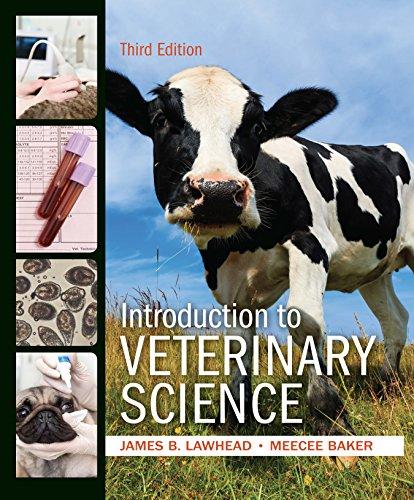
Agriscience programs vary nationwide and most have undergone extensive curricular changes within the past decade. Many include advanced placement-type coursework, such as veterinary science. While teaching agricultural education at Greenwood High School in Millerstown, Pennsylvania, Dr. Baker searched for materials to be used in a new veterinary science course. After a futile hunt, and hearing similar concerns from other instructors, Dr. Baker teamed with Dr. Lawhead, a practicing veterinarian who served the local area where she taught, in an effort to author a veterinary science text that was both student and teacher friendly.
The authors believe that two of the most useful features in this book are the “A Day in the Life” of a veterinarian, coupled with the “Clinical Practice” chapter features. These two elements tie the real-life work of a veterinarian, which can have less than desired outcomes, with the technical and, sometimes, dry and dif cult text material. Therefore, the next time a student says, “I want to be a veterinarian,” a venture into Introduction to Veterinary Science will provide the learner with a realistic preview of both veterinary work and the academic rigor needed to achieve success in the profession.
Simply put, the goals of this text are to afford learners a base knowledge of veterinary science by moving through topics ranging from the cell to surgery, and to provide a view of the practice of veterinary medicine through the eyes of an experienced practitioner. Chapters 1 and 2 begin the text with a comprehensive investigation of cells and tissues. Following chapters examine the musculoskeletal, circulatory, respiratory, renal, digestive, reproductive, nervous, endocrine, and immune systems. The basic physiology learned in the beginning of the text is then applied in concluding chapters covering nutrition, species differentiation in nutrition, principles and prevention of infectious disease, disease classi cation, zoonotic diseases, disease diagnosis, and surgery.
NEW TO THIS EDITION
• Additional hands-on activities that use easyto- nd materials have been added to the chapters.
These new activities will help instructors reinforce student learning using a variety of applications.
• The new safety chapter provides guidelines to help teachers ensure student safety in the classroom and eld laboratories, while another new chapter further explores veterinary careers.
• Technical material has been further explained by the author, Dr. James Lawhead. These expanded and updated explanations will help students grasp more advanced material.
• Additional photos and gures bring the veterinary practice into the classroom, helping to keep students engaged.
• The new edition discusses the most current technology used in veterinary practice, providing a look into recent advances in the eld of veterinary medicine.
EXTENSION TEACHING/LEARNING MATERIALS
Instructor’s Companion Website
The Instructor Resources are now available on the companion website. Updated for the third edition, this robust suite of teaching resources includes the following components to help minimize instructor prep time and engage students:
• Instructor’s Guide to Text—The Instructor’s Guide provides answers to the end-of-chapter questions and additional material to assist the instructor in the preparation of lesson plans.
• PowerPoint—Chapter outlines with images for each textbook chapter.
• Computerized Test Bank in Cognero—Hundreds of modi able questions for exams, quizzes, inclass work, or homework assignments, in an online platform.
• Image Gallery—Hundreds of images from the textbook that can be used to easily customize the PowerPoint outlines.
Each chapter in the textbook begins with clear educational objectives to be learned by the student in the reading, a list of important key terms, and an introduction overview of the chapter content.
CHAPTER 1
Basic Cell Biology
Objectives
Upon completion of this chapter, you should be able to:
■ Explain the molecular makeup of cells.
■ Identify the basic structures of the cell and their corresponding functions.
■ Review the basic function of the cell.
■ Describe the process of protein synthesis.
Key Terms
■ Discuss mitosis and its clinical signi cance in diseases such as cancer.
■ Detail meiosis in mammalian reproduction.
■ Connect cellular parts and function to clinical veterinary practice.
Introduction
The cell is the basic structure of animal life. However, the cell contains other structures and molecules. Cells conduct many functions and are also able to reproduce. Animals not only have millions of cells that comprise
A Day in the Life ADR—Ain’t Doin’ Right…
I remember the day in veterinary school when our stethoscopes arrived. The air lled with excitement as we listened to our own heartbeats. This instrument became a necessary tool in everyday life as I began to examine animals. I must admit I felt cool walking around the hospital in a white lab coat with a stethoscope draped around my neck! It seems like yesterday, even though more than a few years have passed.
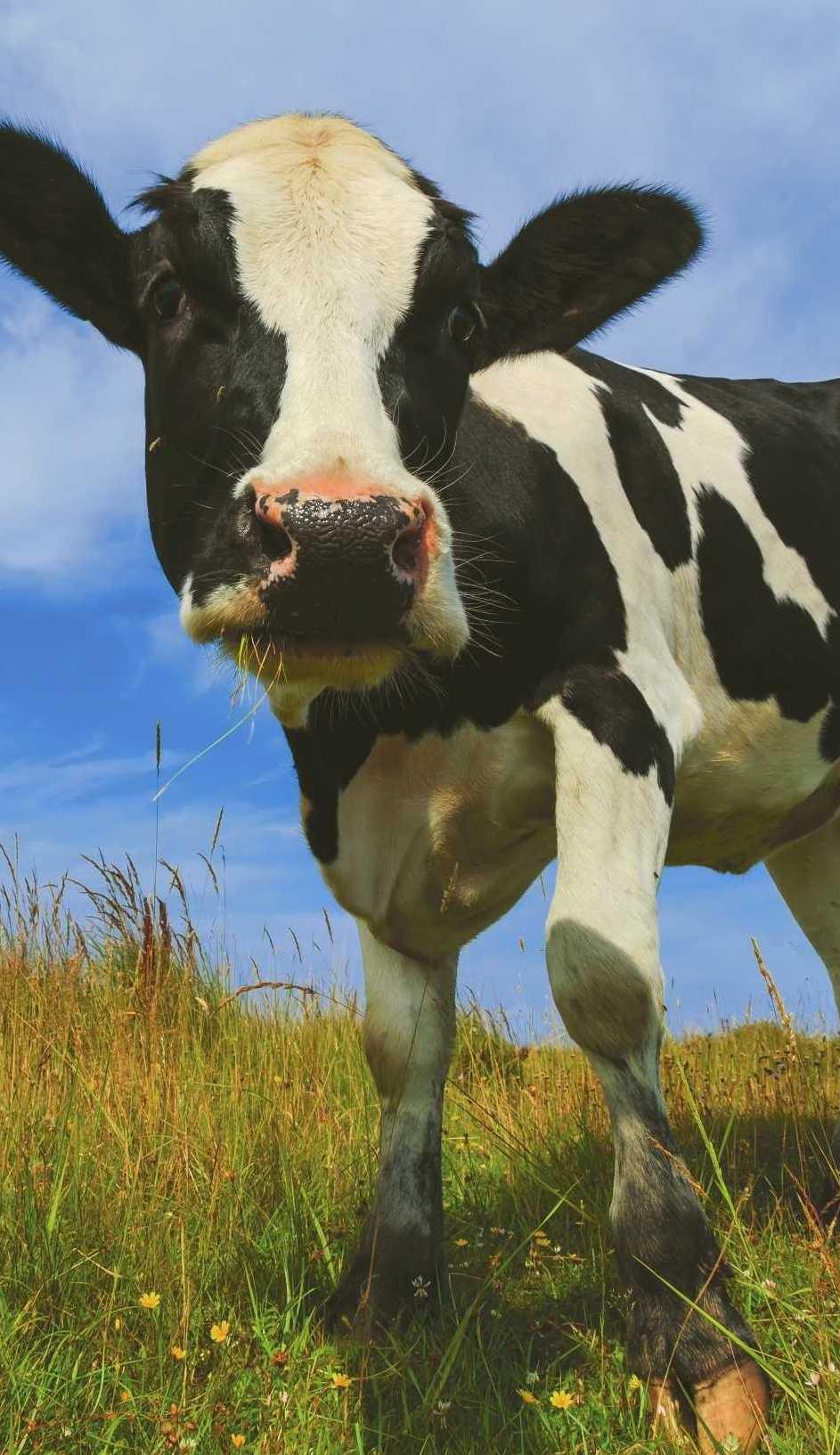
Several months ago I examined a cow that was ADR—ain’t doin’ right. As I walked into the pen, I could see she obviously wasn’t feeling well at all. She appeared quite droopy, had lost a lot of weight, and had developed a swelling under her jaw. During the physical, I listened to her heart. It sounded like the noise from a washing machine in midcycle. The heart made a sloshing sound with every beat. Using the stethoscope, I diagnosed hardware disease . The cow had eaten a piece of metal that migrated from the stomach and lodged close to the heart. The location and structure of the heart provided me with the information necessary to interpret the symptoms of this disease. Hardware disease is often found during my appointed rounds. The next diagnosis is not.
This week, Dr. Deppen and I were both doing evening small animal appointments at the office. It was snowing heavily and we were hoping to nish at a reasonable hour. Dr. Deppen was seeing Lucky, a 12-yearold Schnauzer mix that had a history of having what the owners thought was a seizure. She detected that the dog’s heart rate was too slow and the rhythm was very irregular. I had a chance to listen to the dog’s heart as well and agreed that we should do more tests to detect the underlying problem.
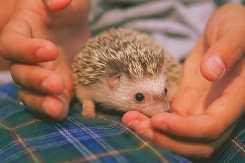
The author James Herriot portrayed veterinary work in his best-selling collection of stories, All Creatures Great and Small. Times have changed considerably since Herriot practiced. Much more information and sophisticated medicines and techniques are now readily available. Still, I cannot possibly be an expert on all animals. Last year our of ce received a call from a local school. The sixth grade class mascot, Sonic the hedgehog, had a sore foot. In this case, my experience with hedgehogs was limited to reading just one obscure
journal article. I had never even met one in real life. Therefore, I advised the teacher of my lack of experience but agreed to examine Sonic. Sonic arrived at the of ce in a cage (Figure 4–1). He looked just like a miniature porcupine. Because hedgehogs are nocturnal animals, Sonic was apparently taking his afternoon nap when he arrived at the of ce.
I disturbed him as I tried to examine his leg. Sonic jumped and snorted in an attempt to scare me. To be honest, it worked! His prickly quills were quite sharp.
My assistant and I then put on thick leather gloves and proceeded with the examination. Sonic countered with another protective measure. He rolled himself into a tight ball, so tight his legs were completely hidden. I referred to the journal article for help.
Following the recommendations, I anesthetized Sonic with an inhalant anesthetic. We placed him in the large clear mask. The anesthetic was slowly delivered with every breath. Finally Sonic relaxed enough so I was able to have a more thorough look. Once Sonic’s leg was exposed, the problem was quite obvious. The rags that Sonic used as a nest had tattered edges with loose strings. One of these strings had wrapped tightly around his foot and stopped the circulation. The foot had turned dark and was oozing. All mammals rely on circulation to maintain their bodies. What happened to Sonic’s foot when the blood supply was stopped?
the body but also many different cell types. The combination of these cell types makes an animal function. This chapter will discuss the structure of cells, and how they work.
Each chapter features “A Day in the Life” of a veterinarian vignette that relays James Herriot–type stories with relevance to clinical practice and the real-life work of a veterinarian.
55 Chapter 4 The Circulatory System
FIGURE 4–1 A hedgehog.
attach to these vertebrae, forming a sling that supports internal organs.
The sacrum, a group of three sacral vertebrae, fuses to support the pelvis (Figure 3–14). In addition, the sacrum articulates with the last lumbar vertebra and the rst caudal vertebra. The sacrum then joins with the pelvis, allowing the hind limbs to support the weight of the body. This connection can be damaged. The pelvis may split away from the sacrum when dogs and cats are hit by cars (HBC). During this type of accident, fracture of the pelvis itself is also common. Very painful lameness often results from a split pelvis or pelvic fracture. Many of these fractures heal if the animal’s activities are restricted. In severe cases, surgeries may be required.
The nal group of vertebrae is called caudal. These small vertebrae comprise the tail. As mentioned, the numbers of vertebrae vary among species and within
41 Chapter 3 The Musculoskeletal
System
a species. The typical dog has 20 caudal vertebrae, but this can range from 6 to 23. The appendicular skeleton includes the bones of the forelimbs and hind limbs. A study of this part of the skeleton provides a clear examination of comparative anatomy. Although the same anatomic terms are used for all mammals, great differences exist in the numbers and sizes of bones in the mammalian appendicular skeleton. For instance, a dog has four or ve toes, whereas a horse has only one. The forelimb, or thoracic limb, does not have a bony connection to the axial skeleton. The scapula, or shoulder blade, lies at against the rib cage (Figure 3–15). The scapula connects to the axial skeleton with a group of muscles. This attachment allows the scapula to move over the rib cage. This rotation ranges as high as 25 degrees in animals such as cats while running. This exibility is also useful in cats as they land after a jump. As the cat falls, it extends its front legs fully at both the scapula and the elbow. As the front feet hit the ground, the elbow exes and the scapula rotates. The cat makes this very coordinated act look quite graceful. Clinically, this is of signi cance when cats fall from extreme heights. In large cities, this happens often as cats tumble from balconies or windows of tall buildings. In high-rise syndrome, the falling cat rarely breaks a leg; however, it will often break its lower jaw. The high speed of the falling cat forces the jaw to contact the ground.
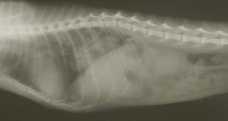
Each chapter contains combinations of charts, illustrations, photographs, radiographs, and the like that help to illustrate and enhance the concepts presented.
5 Chapter 1 Basic Cell Biology
allowing veterinarians to diagnose what speci c organism is causing the sickness.
Nucleic acids provide plans for the differing construction of proteins. Nucleic acids are fabricated with a series of nucleotides. The nucleotides are made up of a ve-carbon sugar, a phosphate group, and a nitrogen-containing base (Figure 1–5). Ribonucleic acid (RNA) claims ribose as its sugar, whereas deoxyribonucleic acid (DNA) has deoxyribose as its sugar. There are four different bases for RNA and DNA (Table 1–1).
Notice that the bases are the same except for thymine and uracil. The order of base combination determines what amino acids are used to make proteins. This information is stored in the cell’s genetic material. Both DNA and RNA have a backbone of sugar alternating with phosphate. The nitrogenous bases are attached to this backbone. In DNA, a double-stranded molecule is formed as the bases are loosely bonded together. The molecule has a twisted structure, which is described as a double helix (Figure 1–6). The bases join, speci cally, thymine to adenine and cytosine to guanine. Later in the chapter, a process of transcription will be described, in which the sequence of DNA nitrogenous bases is converted to a molecule of RNA. In this situation, adenine in the DNA molecule bonds to a uracil base of RNA. The sequence of nitrogenous bases is used to de ne the amino acids used in protein synthesis. A group of three nitrogenous bases is the code for a speci c amino acid. The order of the nitrogenous bases makes up the genetic code of the animal. Each gene provides the code for one peptide chain.
FIGURE 1–5 Chemical structure of a nucleotide.
Table 1–1 RNA and DNA Bases
Thoracic Vertebrae
Rib Sternum Lumbar Vertebrae
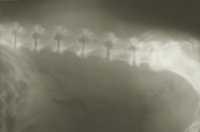
FIGURE 3–13 Radiograph of a cat, showing the thoracic and lumbar spine. Ribs and sternum are also visible.
Pelvis
Lumbar Vertebrae
FIGURE 3–14 Radiograph of the lumbar spine of a dog. A portion of the pelvis is also visible. This dog is showing an age-related change called spondylosis. In spondylosis, bone spurs are formed that can eventually bridge between vertebrae.
FIGURE 3–15 The scapula. Spine
cat from that of a horse. Having muscles closely associated with the skeleton provides movement of the bones at a joint. The movement of bones allows locomotion and function of the animal.
The strength of bones also protects more fragile tissues. The rib cage gives protection to the heart and lungs, whereas the skull protects the delicate brain.
Bone acts as a reservoir for calcium and phosphorus. In times of need, the minerals are moved from the bone and sent into the bloodstream. Excess minerals can be stored in the bone. Calcium plays an essential role in muscle contraction and enzyme activity. Phosphorus is necessary for energy metabolism within the cell. Bone, in response to several hormones, maintains a tight regulation on the blood level of these minerals. These hormones, calcitonin and parathyroid hormone, will be discussed in much greater detail in Chapter 10. The long bones are present in the legs (and arms in humans). The femur and humerus are classi ed as long bones. They have a dense outer shell and a hollow shaft. Bone marrow is made in this hollow center, the medullary cavity. Bone marrow in turn produces blood cells.
BONE STRUCTURE
Objective
■ Detail the Structure of Bone
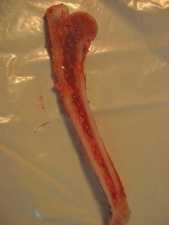
Splitting a long bone along its length shows the typical structure of bone (Figure 3–3). The outer shell is composed of dense or compact bone. The term cortical bone is also used for this region. The greater the forces placed on a bone, the thicker this layer will be. In the femur, this compact bone is thickest in the middle of the shaft, where greatest strain occurs. Within compact bone lies a more loosely arranged bone, called spongy or cancellous bone. Spongy bone is found within the long bones but not inside the at bones of the skull or pelvis. It only lls the ends of these long bones. Spongy bone is made up of tiny spicules and plates of bone. The spicules look random but are actually arranged to maximize strength. The spongy arrangement keeps the weight of the bones much lighter than that of a solid bone of the same dimension. The medullary cavity is located in the hollow center of the shaft. The bone marrow lies within the medullary cavity and the spaces of the spongy bone. As mentioned earlier, bone marrow produces blood cells. Bones are covered with a thin connective tissue called the periosteum. The periosteum blends into tendons and ligaments, binding them to the bone. The periosteum has an extensive blood and nerve supply. Hence trauma to the periosteum is quite painful. The portion of bone within the joint is covered with cartilage and not by periosteum. This articular cartilage
Articular Cartilage
Bone Marrow Cancellous or Spongy Bone
Medullary Cavity
Compact Bone Tissue Endosteum
Chapter 3 The Musculoskeletal System
Proximal Epiphysis
Physis Metaphysis
1–12
Periosteum
FIGURE 3–3 A. Illustration of bone structure. B. Photograph of the internal structure of bone.
provides protection as the bones move against one another within a joint. The open spaces within bone are covered with a similar connective tissue, the endosteum. Both the periosteum and endosteum provide cells necessary for the repair of damage.
Extracellular Fluid Cytoplasm
enzyme begins at a speci c series of bases (thymine, adenine, cytosine) called a promoter. The RNA polymerase moves along the length of the DNA molecule, creating a complementary strand of RNA. The RNA bases are added in the speci c order that bonds to the bases of the DNA. The corresponding bases were discussed earlier in the chapter. This process continues until the polymerase reaches a terminator series of bases (adenine, thymine, thymine). The mRNA is released and the DNA helix reconnects.
Extracellular Fluid Cytoplasm
(Figure 1–12). During endocytosis, the cell membrane wraps around the particle, pinches off, and moves into the cytoplasm as a vacuole. Lysosomes then join with the vacuole, providing the enzymes necessary to break down the particle. The smaller fragments produced are then released into the cell.
In cells producing protein, the opposite process occurs. In exocytosis, a membrane-bound sac containing the protein joins with the cell membrane and releases it into the ECF (Figure 1–13). These sacs are produced within the Golgi apparatus. In intestinal cells, fat droplets can be taken into the cell through endocytosis. The vacuole is transported across the cell and released into the bloodstream by exocytosis.
PROTEIN SYNTHESIS
Objective
■ Describe the Process of Protein Synthesis
As mentioned previously, every cell contains all the genetic material of the animal. The expression of certain genes produces speci c proteins that allow cell specialization. Protein synthesis begins within the nucleus on the basis of the DNA structure. During transcription, information within the DNA is transferred to a strand of messenger RNA (mRNA) that moves into the cytoplasm.
An enzyme called RNA polymerase binds to DNA, causing a separation of the double-helix strands (Figure 1–14). This pulling apart exposes a gene. The
Each chapter is further enhanced by the addition of repeat objectives to aid in student comprehension.
FIGURE
Endocytosis: A large particle is engulfed by the cell membrane and brought into the cytoplasm within a vacuole.
FIGURE 1–13
Exocytosis: A membrane-bound sac joins with the cell membrane to release the particle.
FIGURE 1–14 Transcription of mRNA: RNA polymerase separates the strands of DNA and creates a strand of mRNA coded by the nucleotides of the DNA molecule.
88 Unit 1 Comparative Anatomy and Physiology
SUMMARY
Being able to identify respiratory structures and their associated functions, from the nose to the lungs, allows veterinarians to diagnose and treat such disease conditions as pneumonia and roaring. Moreover, respiratory
REVIEW QUESTIONS
1. De ne any 10 of the following terms: respiration palpated endotracheal tube inspiration expiration cyanosis pneumonia pleural friction rub contagious roaring heaves bronchodilators
2. True or False: Mucus lines the epithelial tissue in the nostrils.
3. True or False: The cartilage rings of the trachea are shaped like an O
4. The is the common area shared by the nose and throat.
ACTIVITIES
Materials needed for completion of the activities: stethoscope balloons Y-shaped polypropylene connecting tubes
1. Use the stethoscope to listen to normal lung sounds. Have the “patient” take deep, slow breaths. The patient should breathe quietly, not making noise through the nose and mouth. The stethoscope can detect these noises. Listen to different areas on the chest, from both the front and the back.
2. Take two identical balloons and in ate them to different sizes. Slip a balloon onto an end of Y-shaped polypropylene connecting tubes. Do not
rate provides a key piece of information to practitioners when assessing the overall health of animals. The status of the respiratory system affects the breathing and therefore the total health of animals.
5. The human larynx is sometimes called the
6. The trachea branches into two
7. Gas exchanges occur in the smallest openings of the respiratory system. These openings are called the
8. The muscles between the ribs are called the
9. Name the re ex action that occurs when there is an irritation in the nose.
10. What substance lines the lungs, making them easier to in ate?
11. What controls the rate of respiration?
12. What is the normal respiration rate for a dog?
13. What plays a more signi cant role in the control of respiration, oxygen, or carbon dioxide?
14. What medical tool is used to evaluate breathing?
15. What species can develop a condition referred to as roaring?
release the balloons yet. Plug the third opening of the Y piece. Hypothesize what will happen when the balloons are released. Will the large balloon de ate and ll the smaller balloon to equalize the size? Or will the smaller balloon de ate into the other balloon? Surfactant prevents this problem from occurring between alveoli. Even though the alveoli may be of different sizes, the pressure in each is similar. Without it, the small alveoli would de ate.
3. Observe the respiratory rates of classmates and pets or livestock. Compare to the normal rates listed in Table 5–1.
A chapter summary highlights the topics that have been presented, and the end of each chapter is also followed by a series of review questions and student activities.
The new chapter on careers investigates occupations in veterinary science, including veterinary technicians, veterinary assistants, private practitioners, and veterinary specialists.
methods for prevention of rabies, and responds to questions about rabies from other public health professionals and the public.
Veterinary Surgeon
Dr. David Sweet graduated in 1989 from the University of Pennsylvania School of Veterinary Medicine. Following his graduation, Dr. Sweet pursued further training as an intern at the University of Pennsylvania and a surgical residency at the North Carolina State University. Following that training, Dr. Sweet accepted an instructorship at Washington State University and returned to the University of Pennsylvania as an assistant professor. During his training, Dr. Sweet met the rigorous quali cations necessary to become a diplomate in the American College of Veterinary Surgeons. This honor earned by Dr. Sweet distinguishes him as a surgical specialist.
Dr. Sweet works at a referral practice. The center employs veterinary specialists in many elds, including surgery. The veterinary practice provides a service that allows private practitioners to refer dif cult cases for more specialized treatment. Dr. Sweet performs both soft tissue and orthopedic surgery (Figure 21–4). He performs many complicated and dif cult surgeries. As with all veterinarians, he attends continuing education conferences to learn new procedures and information.
EDUCATIONAL REQUIREMENTS FOR VETERINARY CAREERS
Objective
■ Explain the Educational Requirements for a Variety of Veterinary Careers
Veterinary technicians must complete either a twoyear associate degree or four-year bachelor of science degree program. Further, they must pass a state licensing exam. The number of institutions offering such coursework has grown signi cantly over the past several years. Veterinary assistants are not required to complete any formal classes. However, increasing numbers of technical schools and community colleges offer veterinary assistant programs.
Both technicians and assistants help the veterinary practice by performing a wide range of tasks (Figure 21–5). These individuals may greet patients, keep records, bill clients, and restrain animals, as well as feed, exercise, and provide basic health care for patients. The responsibilities vary from employer to employer with technicians performing more technical duties. Numbers of available jobs for veterinary assistants and technicians will continue to grow with the demand for veterinarians.
Level of degree separates veterinary assistants from veterinary specialists. Almost 30 programs grant degrees in veterinary specialties. Most of these programs deliver master’s and doctorate degrees, although a few award associate and bachelor’s degrees.
Specialists may provide such supportive services as nutrition counseling, ration balancing, or radiology expertise to veterinary clinics. Conversely, other specialists may be employed in academia, where they perform research or extension duties in veterinary-related
355 Chapter 21 Careers and Decision Making in
Courtesy of Dr Cathy Hanlon.
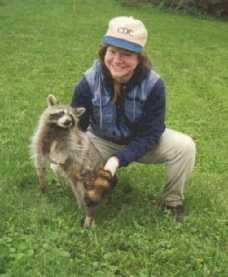
FIGURE 21–3 Dr. Hanlon working with a sedated raccoon that had been captured in a live trap.
Courtesy of Dr David Sweet.
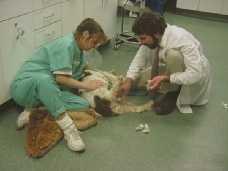
FIGURE 21–4 Dr. David Sweet, with assistance of registered veterinary technician Michele Antoch, examines a surgical incision on a dog.
A BO U T THE AUTHOR S
Dr. James Lawhead is a veterinarian in a private mixed animal practice located in Millerstown, Pennsylvania. As lead partner, he works primarily with dairy cattle, dogs, and cats. Dr. Lawhead joined this practice in 1987 following graduation from the University of Pennsylvania School of Veterinary Medicine. He gained acceptance to veterinary school following completion of his bachelor’s degree at Juniata College.
Dr. Lawhead has a special interest in dairy cattle nutrition, providing nutritional services to a number of his clients. Dr. Lawhead enjoys teaching as well and actively supports local school districts with lectures and demonstrations.
Dr. MeeCee Baker owns Versant Strategies, an agricultural and rural affairs rm that serves clients in
Harrisburg, Pennsylvania, and Washington, D.C. In addition, Dr. Baker serves as an adjunct professor at the North Carolina State University. She earned both her bachelor’s and doctorate degrees from Pennsylvania State University in agricultural education and a master’s of science degree from the University of Delaware in agricultural economics. Dr. Baker was the rst woman to be elected president of the National Vocational Agriculture Teachers’ Association (now known as the National Association of Agricultural Educators). Formerly, she taught high school agriculture and worked in the executive of ce of the Pennsylvania Department of Agriculture as coordinator of agricultural education. Dr. Baker lives on her family beef farm with her husband, Jim, and daughter, Libby.
A CKNOWLE D GMENT S
Although only two authors are listed for this text, the number of people responsible for the nal product is quite large. The authors would like to thank all of those people who supported and contributed to the text, especially the Cengage Learning Team. Cengage Learning deserves special recognition for faith in the authors.
We would like to thank all the veterinarians and staff at Millerstown Veterinary Associates for their assistance and contributions. Their help in obtaining case material and photographs for the text was invaluable. Likewise, we appreciate the support of the clients who encouraged the use of their case material for the text. Special thanks are in order for Leesa Landis, Dr. Robert Mikesell, and Krista Pontius for their long hours of technical help in putting together the text. Caleb Wright, a Versant intern and newly minted agricultural education teacher, helped to
freshen objectives and questions for the third edition. We appreciate the use of reference material supplied by Mechelle Regester. The veterinary science students at Greenwood High School completed activities, lessons, and accompanying assignments to help netune the text and ancillary material. We appreciate their thoughtful consideration.
In addition, we would like to thank Dr. David Sweet, Dr. Cathy Hanlon, Dr. Abby Maxson Sage, and Dr. Lawrence Hutchinson for their contributions of photographs and support to the project.
Having input from experts in various elds helped to strengthen the core material of the text. Our utmost thanks to Dr. William Bacha Jr., Dr. Linda Bacha, and Dr. Arthur Hattel for the photographic material provided. The histology and pathology photographs are a tremendous bene t to the text.
Comparative Anatomy and Physiology Unit I
Another random document with no related content on Scribd:
The Project Gutenberg eBook of Molly's treachery
This ebook is for the use of anyone anywhere in the United States and most other parts of the world at no cost and with almost no restrictions whatsoever. You may copy it, give it away or re-use it under the terms of the Project Gutenberg License included with this ebook or online at www.gutenberg.org. If you are not located in the United States, you will have to check the laws of the country where you are located before using this eBook.
Title: Molly's treachery
Author: Mrs. Alex. McVeigh Miller
Release date: June 17, 2024 [eBook #73856]
Language: English
Original publication: Cleveland: The Arthur Westbrook Company, 1886
Credits: Demian Katz and the Online Distributed Proofreading Team at https://www.pgdp.net (Images courtesy of the Digital Library@Villanova University.)
*** START OF THE PROJECT GUTENBERG EBOOK MOLLY'S TREACHERY ***
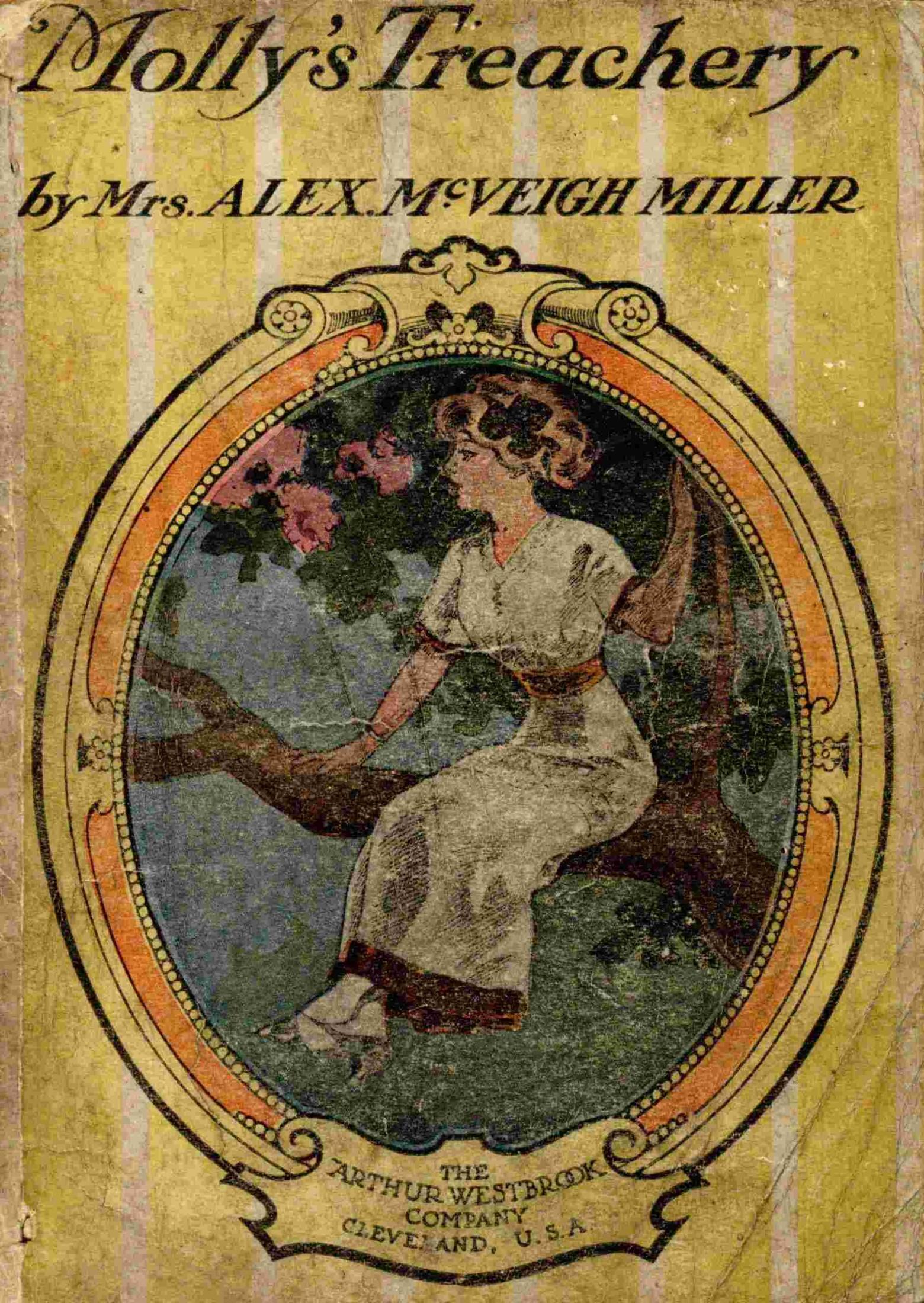
Molly’s Treachery
ByMrs.Alex.McVeighMiller
HART SERIES NO. 62
COPYRIGHT 1886 BY GEO. MUNRO
PUBLISHED BY
THE ARTHUR WESTBROOK COMPANY
CLEVELAND, O., U. S. A.
Printed in the United States of America
MOLLY’S TREACHERY
CONTENTS
CHAPTER I.
CHAPTER II.
CHAPTER III.
CHAPTER IV.
CHAPTER V.
CHAPTER VI.
CHAPTER VII.
CHAPTER VIII.
CHAPTER IX.
CHAPTER X.
CHAPTER XI.
CHAPTER XII.
CHAPTER XIII.
CHAPTER XIV.
CHAPTER XV.
CHAPTER XVI.
CHAPTER XVII.
CHAPTER XVIII.
CHAPTER XIX.
CHAPTER XX.
CHAPTER XXI.
CHAPTER XXII.
CHAPTER XXIII.
CHAPTER XXIV.
CHAPTER XXV.
CHAPTER XXVI.
CHAPTER XXVII.
CHAPTER XXVIII.
CHAPTER XXIX.
CHAPTER XXX.
CHAPTER XXXI.
CHAPTER XXXII.
CHAPTER XXXIII.
CHAPTER XXXIV.
CHAPTER XXXV.
CHAPTER XXXVI.
CHAPTER XXXVII.
CHAPTER XXXVIII.
CHAPTER XXXIX.
CHAPTER XL.
CHAPTER XLI.
CHAPTER XLII.
CHAPTER XLIII.
CHAPTER XLIV.
CHAPTER XLV.
CHAPTER XLVI.
CHAPTER I.
“F
ERNDALE,
G
REENBRIER
CO., WEST VA. June 20, 1878.
“Dear sister and Aunt Lucy, oh, please do let me come home! Ferndale is horrid, the lonesomest old hole I ever saw in my life, and Aunt Thalia is a real old dragoness! And I’m tired of behaving like a grown-up lady, and just dying for some sort of a lark. And although I don’t like her much, I hate to fool her as I’m doing. It makes me feel mean as if I were a regular little fraud. I try to keep it up for your sake, Lou, but it goes hard. Bother the money! It isn’t worth the deceit, or, as our old French governess used to say, ‘Lejeunevautpaslachandelle! ’ Can’t you let me off now? I’ve been here two weeks, and I don’t think I can stand it any longer! It’s like a catacomb, so deadly lonesome! Not a caller since I came, and I haven’t seen a man for two weeks except the gardener and the old black coach driver! But that’s all the better, since my clothes are shabby anyhow! I think Aunt Thalia must have noticed that my red cashmere is out at elbows, for this morning she actually gave me forty dollars, and told me to go into town and buy myself a summer silk and her maid would make it for me this week. But I’m going to post this letter to you instead with the money registered to you (as you told me to do). I expect she will be fearfully angry when she finds it out. No doubt she will want to drive me away, so you had better send a telegram right off for me to come home. Say that Aunt Lucy’s sick, or somebody’s dying—anything—so that you get me away at once and forever from Ferndale! I shall die of the blues if I stay any longer! With love to you both,
“MOLLY E. TRUEHEART. ”
“TO MISS LOUISE BARRY, “Staunton, Va.”
The Ferndale estate did not deserve the title “horrid old hole,” as applied to it in that gushing, school-girlish letter. On the contrary it was a magnificent place of about a hundred acres—a valley farm, situated a few miles distant from the historic old town of Lewisburg, and less than six miles distant from the Greenbrier White Sulphur Springs. The large, old-fashioned red brick mansion was almost hidden by a far-spreading grove of gigantic old forest trees, beneath whose shade, dark and damp and heavy, flourished the splendid ferns that gave the place its distinctive name. But after all, perhaps the dense shade and unavoidable dampness made the old house unwholesome, for old Mrs. Barry, its mistress, was an aged, withered crone, little more than skin and bones, with a temper none of the sweetest, and her servants as a whole were sour-tempered too, as if they did not get enough sunshine on their faces and into their souls. It was this subtle influence perhaps that made Mrs. Barry’s young guest vow to herself that she should go melancholy mad if she stayed much longer at Ferndale.
So with a heart beating high with hope she entered the oldfashioned family carriage and was driven into Lewisburg ostensibly to purchase the silk dress, but in reality to secretly register and post the letter of entreaty that was to wring her release from her probation at Ferndale and insure her speedy return to her own home.
She rather enjoyed the ride that sunny June afternoon, up hill and down dale in the jolting carriage over the rough, mountainous road, and her depressed spirits rose until she began to feel mildly jolly and hummed a little tune softly to herself that ended suddenly in an undeniable whistle of surprise as they came around a bend of the road and in sight of a picturesque plateau on which stood a beautiful country residence built of rough gray stone. There were two towers over which the pretty American ivy was picturesquely creeping, and
the oriel windows here and there, and jutting verandas, were in a style of architecture quite unusual to the country, and betokening both wealth and taste. Our heroine thought she had never seen anything prettier than the great gray stone house with its creeping ivy, and its windows glistening in the sunlight, which had free play here, for there was a sloping lawn in front of the house with just enough trees grouped here and there to add beauty to the scene without at all obstructing the view.
The girl put her pretty, dark head out of the window and said, eagerly,
“Who lives there, Uncle Abe?”
The old family servant who had spent all his life in West Virginia, and knew every place for many miles around, answered promptly:
“Dat’s de ole Laurens place, honey. Fambly’s all in Yurrup now eddicating de darters and de sons. Mighty rich and proud, all dem Laurenses, missie. Come uv old English stock and ebry now an’ den some o’ dere kin dies ober de sea and leabes dem anoder fortin.”
“Oh,” said Molly, drawing a long breath, her piquant face glowing with eager interest.
She looked in something like awe at the beautiful home of these favorites of fortune.
“I wish I was one of ‘de darters’!” she said, quaintly.
“Hi, honey!” exclaimed old Uncle Abe, quite reproachfully. “Ole Mis’ Barry’s niece just as good as dem proud Laurenses.”
“Yes, Uncle Abe,” answered Molly, demurely, the mischievous golden brown lights dancing in her big, dark eyes, and her red lips dimpling with mirth at the old negro’s family pride.
Then she said, half-questioningly:
“But of course the Laurens family are too proud to notice any of their neighbors?”
Uncle Abe was too busy with his horses to reply for a moment or two, but presently he looked around quite crossly at his interlocutor, and said, severely:
“Miss Looisy Barry, I t’ink you mus’ be c’azy. Don’t you know dere ain’t nobody better den de Barrys? I been livin’ long o’ dem as slave and freedman all my life, me an’ my ole ’oman, and de Barrys is always de top o’ de pot, or, as ole missus say, cweam dellycweam. Dat’s F’ench for top o’ de pot, you mus’ know, chile. As fo’ de Laurenses, dey hab always been hand and glove wif de Barrys! Umph, chile, you don’t seem to know nuffin’ ’tall ’bout de ’portance of your own fambly,” concluded old Abe, shaking his gray head disgustedly, and turning his attention wholly to his horses for they had left the gray stone house out of sight, and were descending a steep hill now.
Molly Trueheart sat quite still with a distinctly wistful expression on her lovely girlish face.
“What do I care about the importance of the Barrys? I know that one of them at least can stoop to selfish scheming!” she muttered, impatiently. “Oh, I wish I was well out of this scrape. It is not so funny masquerading as I thought it would be! I nearly exploded into a confession when the poor old soul gave me that money, little fraud that I am!”
CHAPTER II.
If she was a little fraud, as she declared herself to be, she had the frankest, honestest, prettiest face in the world, and many curious and admiring eyes turned on her as she alighted from the carriage on reaching Lewisburg and tripped lightly across the narrow pavement into the post-office.
After she had duly registered the letter containing the forty dollars she went into a few stores, where she looked at summer silks; shook her dark, curly head in pretended disapproval of the prices, bought a paper of pins and a neck ribbon, then returned to the carriage before Uncle Abe, who was exchanging the compliments of the day with some gossips of his own color, was half ready to leave.
“Lor’, Miss Looisy, you aine a-gwine yit?”
“Yes, Uncle Abe.”
“Dem hosses aine got rested yit, dat’s a fac’. Doane you want stay awhile, honey, and call on sum o’ de fust famblies o’ de town?” wheedlingly.
The girl laughed merrily.
“I don’t know a person in Lewisburg from Adam,” she said. “Come on, Uncle Abe; you’ve gossiped enough this time,” and with a resigned sigh the old darky climbed to his seat again, whipped up the horses, and set off on the return journey to Ferndale.
Molly Trueheart leaned back in the carriage and gave herself up to the enjoyment of her own thoughts until they again came in sight of the Laurens estate when she called out to the old driver:
“Uncle Abe, who stays over there when the family goes abroad?”
Uncle Abe, out of humor at being separated so soon from his gossip, grunted out crossly:
“Nobody but dem sassy Laurens niggers.”
Molly felt herself snubbed and drew back her curly head, relapsing into a silence that lasted until she again crossed the threshold of Ferndale.
Mrs. Thalia Barry was sitting in the wide hall taking snuff out of a golden snuff-box.
She was a tall, spare woman with a frame that had originally been strong and stout, although now dwindled by the encroachments of age and the horrors of a chronic dyspepsia. She had thin, masculinelooking features, a false front of waved, white hair, false teeth, and her small, twinkling, greenish-gray eyes were partially hidden by gold-rimmed spectacles. She dressed habitually in soft, thick, gray silk, and pinned her collar of the yellowest old real lace with a magnificent diamond brooch. Ill-health had magnified an already imperious temper; and Molly was not far wrong when she complained that the aristocratic old lady was a perfect old dragoness, for she was the terror of her servants when in one of her “spells,” as they called them, and even her young visitor had more than once smarted under the lash of her displeasure.
But she looked up now with some eagerness, and said in her shrill, curt tone:
“Back so soon? I hope that old rascal, Abe, did not drive my horses too fast! Well, Louise, come and show me your silk.”
The pretty, dark eyed girl, in her cheap white dress and rustic straw hat, halted in the door-way with a frightened expression and gazed half appealingly into Mrs. Barry’s stern, ugly face.
“Well?” said the lady, impatiently. “Do you want some one to bring your bundle in from the carriage? Here, Ginny Ann,” to an old negro woman hovering about the back door, “go out to the carriage and get Miss Barry’s bundle!”
Molly sprang forward, her frightened expression changing to one of defiant bravery.
“Oh, aunt, she needn’t go! There’s—there’s no bundle there! I didn’t buy the dress!” she cried out, desperately.
“But why?” cried Mrs. Barry in amazement. And the girl faltered, with hot blushes.
“I didn’t need it, you know.”
Mrs. Barry flew suddenly into a fury.
“Not need the dress, you silly girl, when you have not a decent rag to your back! What do you mean?” she stormed, in loud, angry tones.
Molly’s blushes grew hotter still, but they were those of anger now, and her black eyes blazed as she retorted:
“Well, if I have nothing but rags, what more do I need in this old tomb of a place where no one ever comes from week’s end to week’s end? I know you’ll be mad, Aunt Thalia, but if you kill me for it, I’ll tell the truth at once! I sent that money to my sister!”
Mrs. Barry’s face grew purple with wrath. She stamped furiously upon the carpeted floor.
“Never say that word again!” she burst out fiercely. “You have no sister.”
A glance of concentrated scorn and anger shone on her through the glasses of Mrs. Barry.
“Louise Barry, I thought you had more pride than to claim that girl— the daughter of the low-lived actress, who wheedled your father into marrying her, his second wife—your sister! The connection is a disgrace to you.”
“Hush, Aunt Thalia. You must not talk so to me!” said the girl, sharply. She had grown quite pale, and her slender little hands were
clinched tightly together. She bit her red lips fiercely, to keep back burning words that had rushed to their portals. Mrs. Barry snorted scornfully.
“You take her part, eh? that low-born brat that her dying mother saddled on your aunt Lucy. Louise Barry, I’m ashamed of you, disappointed in you. I wish now that I had taken you here to live when your father died, then Lucy Everett would have had to send Molly Trueheart to the poor-house instead of supporting her on the money I have sent every year to you.”
The girl stood looking at her with a heaving breast and eyes dilated with anger. When her aunt paused the girlish head was lifted proudly, and the young voice trembling with passion, answered sharply:
“Molly Trueheart’s mother, the low-lived actress, as you call her, left her daughter a legacy, small, but sufficient to pay for her board and clothing. She would not have to go to the poor-house, even if Aunt Lucy turned her out-of-doors.”
“Oh, indeed; I did not know she was an heiress. I thought she was a pauper. Why did you send her the money then, since she did not need it?” sharply.
“I I owed it to her, Aunt Thalia,” said the girl with a defiant air.
“So then the allowance I have made you every year was not sufficient, and you had to borrow from that creature?”
“Ye-es, madame,” in a stifled tone.
“Very well, you shall never have that humiliation henceforth. It is not for Philip Barry’s daughter and my heiress to undergo such straits. Henceforth your home will be at Ferndale, and I’ll try to cure you of all fancy for your low-born connection. I’ll write to your aunt Lucy tonight and tell her so.”
“I—I won’t stay!” stormed the girl, in sudden passionate defiance and terror commingled. Her black eyes blazed as she fixed them on
Mrs. Barry’s face.
The old lady gazed at her silently a moment as if almost paralyzed by astonishment.
“Why, you pert little baggage!” she muttered, then she made a dart toward the girl and clutched her arm with fingers that seemed strong as iron. Molly struggled wildly to get away, but Mrs. Barry held her tightly.
“Come here, Ginny Ann, and help me!” she called to the gaping old negress, and between them they dragged the girl upstairs, where Mrs. Barry deliberately pushed her into the big garret and locked the door.
“Stay there, miss, until you come to your senses and ask my pardon for your impertinence!” she screamed through the key-hole.
Then Molly heard the departing footsteps of the grim old lady and her satellite, and realized that she was locked up like a naughty child in punishment for her misdemeanor.
She was in doubt whether to laugh or cry at the preposterousness of the whole thing.
At first she indulged in a burst of defiant laughter which soon changed to hysterical sobbing. Sinking down on an old moth-eaten sofa she covered her face with her hands, and tears rained through her fingers.
“Oh, mamma, my true, gifted, beautiful mamma, it was bitter to hear you maligned so, and you in your tragic grave!” she murmured sadly. “And I, your own daughter, I could not take your part because of the promise that bound me to keep Louise’s secret. How can I ever like that proud old woman again?”
Like a grieved child she sobbed herself to sleep in the musty, closesmelling garret, where quiet reigned supreme save for the patter of startled mice across the bare, dusty floor.
Two hours passed, and Ginny Ann, the black woman, was sent up to inquire regarding the state of mind of the imprisoned culprit.
“Ole missis wants to know is you sorry fo’ youse sassiness yet?” she bawled through the key-hole.
There was no reply, and she went down and reported that Miss Louise was sulking yet, and wouldn’t answer a word.
“Let her stay until night, then. I guess the darkness will cure her of her stubbornness,” chuckled Mrs. Barry, evilly.
But all the same she had sent Agnes Walker, her maid, back to Lewisburg with old Abe, with instructions to buy the summer silk and a white muslin besides. The old lady had very particular reasons for wanting her niece to have this finery.
And while the prisoner sobbed herself to sleep in the garret, and Agnes Walker tumbled over silks and muslins in Lewisburg, Mrs. Barry had Ginny Ann unpacking trunks in the dressing-room and hauling out finery that had not seen the light for years, but which in the revolutions of fashion’s wheel was as fashionable now as in the long ago years when Mrs. Barry had bedecked her form in the costliest fabrics and richest laces to grace the grand society in which she moved before she had settled down, a childless widow, at lonely Ferndale, her dower house, to nurse her grief for her lost partner and her chronic dyspepsia together and to make herself a terror to any one who dared dispute her despotic will.
“Lor’, ole mis, dere’s dat white satting dress you wore when you went to see de queen ober de water,” exclaimed old Ginny Ann, as she lifted out a tray and disclosed beneath a lustrous heap of yellow satin and flounces of fine point lace. “But, Lor’ A’mighty, it’s all yallered er layin’. I ’speck I kin bleach de lace all right by layin’ it out in de dew at night, but dat satting won’t wash, and it’s jes’ ruinated,” sighing heavily and rolling up the whites of her eyes.
“There, don’t touch it, you old simpleton!” cried Mrs. Barry, hastily. “That dress has sacred memories. I wore it at a Drawing-room in London when I was presented to Queen Victoria on my wedding-
tour, and on my return home at an Inauguration Ball in Washington, when our good President, Mr. Fillmore, took his seat. Shut up the trunk, Ginny Ann. I cannot cut up that dress even for my niece.”
“Dat’s so, dat’s so, ole mis. De impertent chile don’t deserbe it!” mumbled Ginny Ann.
“Hold your tongue, sauce-box!” cried her mistress, irately.
CHAPTER III.
But Molly Trueheart was not sulking in the garret as Ginny Ann had reported to her “ole miss.”
She had slept but a little while when she was awakened by a sound that made her spring to her feet with a shriek of alarm—the hurrying and scurrying of immense rats across the attic floor. Her black eyes opened wide in terror, and she sprang upon the sofa, and stood watching the loathsome animals as, startled by her scream, they scampered to their holes.
“Good gracious! There must have been a hundred of the nasty little vermin!” ejaculated Molly. In reality there had not been more than a dozen, but her terrors had magnified their numbers. “Ugh! ugh! ugh! how they make my flesh creep!” she continued, shuddering nervously and drawing her skirts close around her dainty little feet. “And to think that they might have bitten me in my sleep, the monsters! I wonder, I do wonder if Aunt Thalia intends for me to stay here all night! I sha’n’t do it! so there, no, not if Louise loses every cent of the fortune,” her eyes sparkling resentfully. “I don’t want my hair to turn white in one night from terror.”
Stillness reigned again, for the rodents, as much alarmed by her presence as she was by theirs, were trembling in their hiding-places. Molly sprang down and ran over to the window, which, without much difficulty, she flung open, letting in a flood of fresh air.
At the same moment she clapped her pretty dimpled hands together and uttered a cry of mischievous pleasure.
“Molly Trueheart, you limb of mischief, I knew you would be sure to have a lark if you stayed any longer at Ferndale!”
Close to that side of the house grew a stately oak tree that flung out its long, strong arms close to the window-sill. The large, laughing
dark eyes were fixed on the tree while she spoke, and in another moment she climbed up into the window, twined her round white arms about a stout branch, and swung herself forward with kittenlike agility into the big tree, sliding from limb to limb until she was securely seated on a stout branch with her back against the body of the oak.
“Farewell, my late companions!” she cried gayly, waving her hand at the window, and thoroughly enjoying her escapade. “Oh, how delicious this is after Aunt Thalia’s musty old garret! I think I shall sleep in this tree all night. The big limbs and thick green leaves will make me a splendid bed, and—ouch, oh, Lord have mercy! oh! oh! oh!” and as the last exclamation left her lips, Molly’s hold on the tree relaxed, and she went crashing down, with a rustle of breaking twigs and scattering leaves, through the branches to the ground, where she lay groaning on the grass amid the debris collected during her fall.
For, lifting her bright eyes to the higher branches of the tree, she had suddenly beheld an immense black snake hanging downward with his tail curled around a stout twig, and his head thrust forward toward her, while his keen little eyes glowed in the green obscurity of the thick leafage like baleful jewels.
Molly had given such a start and scream of terror that she had tumbled headlong through the tree at least twenty feet from the ground, but the soft, thick grass and the leaves that had fallen with her, had so broken the severity of the fall that after the first groan she was able to rise slowly to her feet and exclaim between laughter and tears:
“‘Och, I’m kilt intirely,’ as Paddy would say. Now I wonder if I can be having the delirium tremens, seeing rats and snakes like this! It can’t be, for I’ve never been addicted to the intoxicating glass! I believe I’ve broken my arm, it hurts so bad. Good heavens, it’s coming down the tree! It must be a racer. I’ll have to cut and run!”
This she did with surprising agility, only pausing to look behind her once when she saw his snakeship, which did indeed belong to the racer species, trailing his shining length rapidly after. With a half sob in her throat, Molly flew on and on over hay-fields and hills, fences and brooks, until she had left Ferndale a mile behind her, and came up with a jerk against some tall, white palings that inclosed the beautiful lawn she had admired while riding that day—the Laurens place, as old Abe had called it in answer to her curious questions.
CHAPTER IV.
She paused and looked behind her to see if the black snake still pursued her, but she had left it far behind in her headlong race, and to her dismay she perceived by the brilliant hues of the western sky that the sun had almost set.
Badly frightened as she had been at first, the sudden feeling of safety roused in her the sense of the ludicrous, and Molly laughed aloud at her forlorn plight. Her white dress was in rags and soiled with the mud of the little brooks through which she had splashed headlong, she was bare-headed, her hair all loose and disordered, and the perspiration ran in streams down her flushed face.
“What a beauty I must look!” she ejaculated, merrily. “And I wonder what disaster will befall me next. I shall have to go and ask one of those ‘sassy Laurens niggers,’ as Abe calls them, to go home with me, for I daren’t go alone. I might meet that old snake again. But they will be frightened, I am such a sight, and perhaps they will set the dogs on me.”
She sat down on the grass to rest herself before going in at the gate and to think over the sudden contretempsthat had befallen her after her two weeks of irreproachable good behavior.
A feeling of remorse came to her at the thought of her step-sister who might lose so much by the misdemeanor of the girl she had trusted.
“Oh, why didn’t I bear all and hold my tongue, little virago that I am?” she exclaimed. “I knew when I came that I must take a great deal. Aunt Lucy cautioned me carefully. Suppose—suppose—old Mrs. Barry should disinherit Louise for this. She wouldn’t forgive me as long as she lived, I know, and I couldn’t forgive myself, either.”
The beautiful young face wore an expression of dismay and the young heart throbbed with pain.
“Oh, how wicked I have been! How cruel to poor Louise,” she continued, springing excitedly to her feet. “My bad temper and love of fun are always leading me into mischief. But I’ll make it up, yes, I will. I’ll go and beg the old dragoness’ pardon. Not that she didn’t deserve all I said, but for Louise’s sake.”
With rapid footsteps she made her way to the servants’ quarters, which she saw some distance in the rear of the grand mansion. With some trepidation through fear of dogs, Molly approached the commodious white-washed kitchen in the door of which sat an old negress in a homely blue linsey dress with a red handkerchief twisted turban-wise about her head and a little black pipe in her mouth.
“Lor’ A’mighty, who dat?” she sputtered, as Molly came up in her ragged dress, and minus one slipper which she had dropped in her flight.
“Good-evening, auntie,” said Molly, putting on a smile like sunshine. “Don’t mind my looks, please. I fell from a tree and tore my dress, and ran from a snake and lost my slipper, and I’m so tired and hot and thirsty, please give me a drink.”
“Sartinly, chile, but did de snake bite ye? ’Cause, ef he bit you, honey, I better give you some reverend whisky to cure snake bite!”
“No, I was not bitten, auntie,” said Molly; then with a quizzical glance: “Isn’t it odd, auntie, that whisky will make men see snakes but it will cure snake bites?”
“Go ’long wid yer foolishness, chile,” said old Betsy, chuckling. She hobbled slowly to a little stone spring house near by and brought Molly a clean gourd full of cool, sparkling water. “Whut’s yer name, honey?” she continued, as Molly drank thirstily of the delicious draught.
“Will-o’-the-wisp!” said the girl, whimsically.
“Willy Whisk! Soun’s more like a boy’s den a geerl’s name. But won’t you take a cheer, honey, and tell me all about you-self?” wheedlingly.
“No, I thank you, aunt—what’s your name?”
“Aunt Betsy Bell, chile—named arter de big mountain, Betsy Bell,” said the old negress with pride.
“Well, Aunt Betsy, I’m in a great hurry. Won’t you send somebody with me to Ferndale? I’m afraid to go alone, it’s getting so dark, and that old snake is somewhere on the road waiting for me to come, I know,” with a shudder.
To her dismay the old woman shook her turbaned head and answered:
“Dere ain’t a soul on de place but me, honey. De men aine come f’om de corn-fiel’ yet, and my ole man tuck de ole mare dis morn’ and car’e’ some spring chickings down to de White Sulphur Springs, and he won’t git back till de cool o’ de night!”
“My gracious, this is awful,” said Molly, in dismay. Then she brightened and beamed on the old woman. “Won’t you go with me, Aunt Betsy?” she exclaimed.
“Lor’ me, chile, I got rheumatiz too bad! I aine walk as far ez Ferndale in two years. My laig all drawed wid rheumatiz. Set down an’ wait till de men come from de fiel’s, den you hab company to take you home.”
“How long until they come?”
“Two, free hours, I ’spect. Dey’s gwine work late, dey said, tryin’ to git all de corn plantin’ done tonight.”
Molly flung herself down tempestuously on the kitchen door-step, leaned her dark, curly head against Aunt Betsy’s linsey knee, and dissolved into stormy sobs and tears.
Aunt Betsy’s tender heart was touched to its center.
“Lor’ honey, you make me t’ink o’ my little white chillern I used to nurse, a-comin’ and layin’ deir curly heads ’g’in deir black mammy’s knee, and cryin’ and sobbin’! Hush, honey; I’ll fix a way fur ye—on’y don’t cry so, fur it makes my heart ache, t’inkin’ o’ my little white nurslin’s ober in dat furrin’ kentry. Now tell me, honey, Miss Willie Whisk, kin you ride hossback?”
“Yes, indeed,” said Molly, unblushingly; for although she had never ridden horseback in her life, she said to herself undauntedly:
“I can do it if I try.”
“All right; den I’ll lend you my ole misses’ ridin’ hoss, Miss Willie Whisk, and you kin turn him loose soon’s you git to ole Miss Barry’s gate, and dat hoss will come straight home to his stable.”
“Oh, thank you, Aunt Betsy. God bless you, you kind soul. I’ll try to pay you for this some day!” gushed Molly, gratefully, little dreaming how the keeping of that promise would come to pass.
She went with Betsy to the stable, where the old woman brought out and saddled a fine bay horse on which she mounted Molly. Then she hobbled to a gate which she threw open, saying kindly:
“Dar’s your road straight to Ferndale. Good-night, Miss Willie Whisk. Gib my ’spects to ole Miss Barry, and my lub to Ginny Ann and old Unc’ Abe, her husband, and to Nancy Jane, and all de res’, and tell ’em all to come ober.”
“I will, Aunt Betsy. Good-night to you,” Molly called back cheerily, as the bay horse pranced down the road in the deepening twilight and starlight.
CHAPTER V.
“How easy it is to ride horseback! This is perfectly delicious!” cried Molly, exultantly, as she gripped the reins in her little white hands, and gave herself up to the enjoyment of her novel adventure.
A feeling of buoyant delight came to her as she felt herself borne easily and swiftly along on the back of the gently pacing and splendid animal.
“Oh, I did not know what I missed in never learning to ride! I shall get Aunt Thalia to let me have a horse to go out every day now until Louise sends for me,” she resolved, gayly.
Alas! she felicitated herself too soon.
They had not made half the distance to Ferndale, when at a sudden turn of the road some distance ahead, Molly saw a tall, manly figure coming toward her with the inevitable fiery tip of a cigar gleaming through the semi-darkness. At sight of this pedestrian the bay horse, which had been pacing easily and beautifully, uttered a loud whinny of delight, and changed his easy gait for a sudden gallop that took Molly by surprise, and, losing her balance in the saddle, the reins slipped from her hands. Another moment and our luckless heroine went flying over the head of her noble steed and landed ignobly on her face in the dust of the road.
The bay horse stopped perfectly still with wonderful equine intelligence and the pedestrian dropped his cigar and rushed to the rescue.
As he came upon the scene the animal again uttered a whinny of delight and poked his cold nose into the new-comer’s hand.
“What, Hero, old fellow, glad to see me back?” the gentleman said, with a hasty caress on the graceful head.
Then he stooped over the heap of huddled-up humanity in the road.
“What mischief have you done in your haste to bid me welcome?” he continued, lifting Molly’s dark head out of the dust.
A moment’s examination assured him that the fall had either stunned or killed her outright.
“This is dreadful; and whom can it be, anyhow, riding my mother’s favorite bay?”
While he spoke he was carrying her across the road to a little spring bubbling between the rocks and ferns.
He laid her down then on the grass and bathed her face and hands with water.
But Molly lay for many minutes still and speechless, and he began to grow very anxious as well as curious over the girl whose face as seen by the light of the rising moon looked very lovely with its clearcut, piquant features, round, dimpled chin, and slender black brows and thick, fringed lashes.
The man leaning over her was as handsome in his way as she in hers was lovely. He was tall and stately looking, with a splendid physique, and a noble, high-bred face, large eyes that looked black by night, but by day were blue as the violets of his native hills. His hair was of a chestnut tinge, and lay in luxuriant masses about his temples. It was the face of a man about thirty years old, and the golden brown mustache shaded lips that were strong, and grave, and proud, and perhaps a little stern. In dress and manner he was the perfect gentleman.
“Whom canshe be? I am quite certain that she belongs to no one in the neighborhood,” he was thinking for at least the twentieth time, when suddenly a sigh heaved Molly’s breast, and the dark eyes opened wide on the face of the stranger.
At first she regarded him in dreamy surprise. Her head lay on his arm, but she did not seem to notice it, only murmured, quaintly, and with an air of relief:
“I thought I was dead!”
“I thought so, too, but I am very happy to find that you are not,” said the stranger in a pleasantly musical voice. “Tell me, do you feel any pain?”
Molly groaned as she half lifted her form from where it rested against him.
“I feel as if all my bones were broken. I fell out of a tree, you know,” she said.
An expression of uneasiness crossed his face.
“It was a horse you fell from—don’t you remember?” he asked.
“It was not a horse, it was a tree. I think I ought to know!” returned belligerent Molly.