Supplements for Students
Human Anatomy Laboratory Manual with Cat Dissections, Eighth Edition
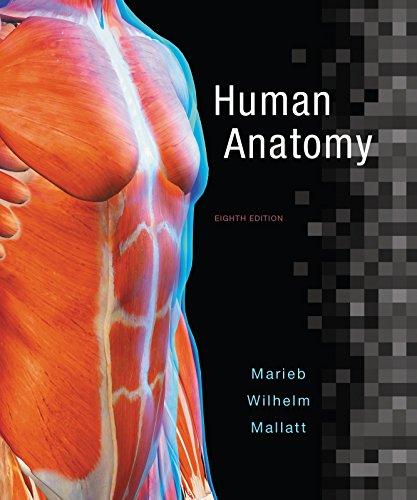
Human
Anatomy
By Elaine N. Marieb and Lori A. Smith
0-134-25558-5 / 978-0-134-25558-3
This lab manual contains 30 gross anatomy and histology exercises for all major body systems, featuring 24 cat dissection photos. Illustrated in full color, with convenient spiral binding and an Instructor’s Guide, the lab manual is an excellent accompaniment to Human Anatomy for lab.
A Photographic Atlas for Anatomy & Physiology
By Nora Hebert, Ruth Heisler, Karen Krabbenhoft, Olga Malakhova, and Jett Chinn 0-321-86925-7 / 978-0-321-86925-8
NEW! Visual lab study tool that helps students learn and identify key anatomical structures. Featuring photos from Practice Anatomy Lab™ 3.0 and other sources, the Atlas includes over 250 cadaver dissection photos, histology photomicrographs, and cat dissection photos plus over 50 photos of anatomical models.
Practice Anatomy Lab™ 3.0 DVD
By Ruth Heisler, Nora Hebert, Jett Chinn, Karen Krabbenhoft, and Olga Malakhova 0-321-68211-4 / 978-0-321-68211-6
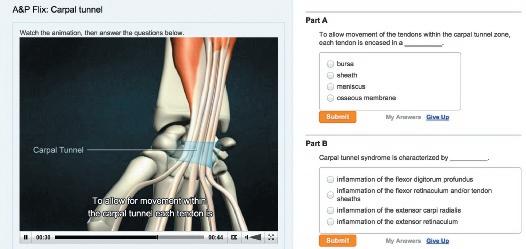
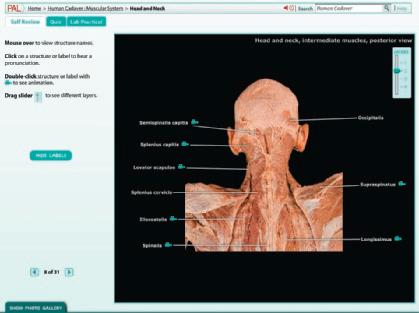
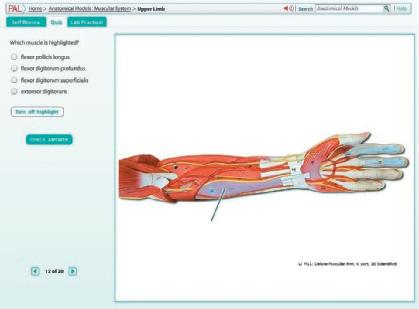
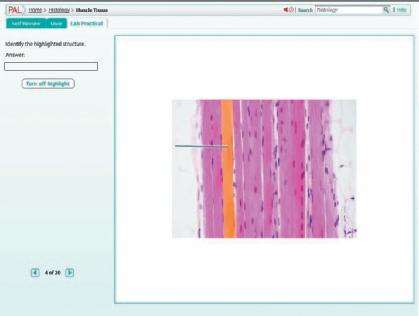
PAL 3.0 is an indispensable virtual anatomy study and practice tool that gives students 24/7 access to the most widely used lab specimens, including the human cadaver, anatomical models, histology, cat, and fetal pig. Practice Anatomy™ (PAL™) 3.0 Lab Guide
By
Ruth Heisler, Nora Hebert, Karen Krabbenhoft, Olga Malakhova, and Jett Chinn
Without PAL 3.0 DVD (0-321-84025-9); with PAL 3.0 DVD (0-321-85767-4)
The PAL 3.0 Lab Guide enhances students’ virtual anatomy lab experience by helping them explore anatomical structures through a series of labeling activities and quizzes using the images from PAL. Get Ready for A&P, Third Edition
By Lori K. Garrett
0-321-81336-7 /
This book and online component were created to help students be better prepared for their course. Features include pre-tests, guided explanations followed by interactive quizzes and exercises, and end-of-chapter cumulative tests. Also available in the Study Area of MasteringA&P®.
The Anatomy Coloring Book, Fourth Edition
By Wynn Kapit and Lawrence M. Elson
0-321-83201-9 / 978-0-321-83201-6
For over 35 years, The Anatomy Coloring Book has been the #1 best-selling human anatomy coloring book. A useful tool for anyone with an interest in learning anatomical structures, this concisely written text features precise, extraordinary hand-drawn figures that were crafted especially for easy coloring and interactive study. Organized according to body systems, each of the 162 spreads featured in this book includes an ingenious color-key system where anatomical terminology is linked to detailed illustrations of the structures of the body.
Hebert Heisler Krabbenhoft Malakhova Chinn
The general philosophy behind this Eighth Edition of Human Anatomy remains the same as in the previous editions. As an instructor, you know that teaching anatomy is not just the presentation of facts. You must provide information in a framework that encourages genuine understanding, devise new presentations to help students remember large amounts of material, and help students apply what they have learned to new situations. All the while you hope that you inspire in the students a love of the subject.
After many years of teaching human anatomy, we became convinced that new approaches to the subject could excite and challenge the students’ natural curiosity. That is why we decided to write this book. We are fortunate to have collaborated with Pearson Education, a publisher that shares our goal: to set a new standard for pedagogical and visual effectiveness in an anatomy text.
This book is designed for one-semester or one-quarter introductory anatomy courses that serve students in prenursing, pre-medical, pre-physical therapy, radiological technology, physician assistant training, pre-dentistry, pharmacy, and other allied-health fields, as well as physical education, athletic training, and nutrition.
Unique Approach to Anatomy
Since its inception, we have worked diligently to distinguish Human Anatomy from the many other anatomy books currently available. This book explains anatomy thoroughly, and its discussions are not merely brief summaries of the art. We have striven to present the basic concepts of anatomy—gross, microscopic, developmental, and clinical—in a manner that is clearly written, effectively organized, up to date, and well illustrated. We realize that learning anatomy involves assimilating gargantuan amounts of material, and we have tried to make our presentation as logical and accessible as possible. To this end, we present anatomy as a “story” that can be explained and understood—convincing the students that the structure of the body makes sense.
Although descriptive gross anatomy is a relatively static science, knowledge is growing quickly in the subfields of functional anatomy, neuroanatomy, developmental anatomy, and the functional aspects of tissue and cellular anatomy. This text strives to keep up with the knowledge explosion in these subfields and to present anatomy in a way that allows modern biology students, whose training is becoming ever more molecular and cellular, to anchor their biochemical and medical training in the physical context of the human body.
Functional Approach
We strongly emphasize the functional anatomy theme, giving careful consideration to the adaptive characteristics of the anatomical structures of the body. Wherever possible, we explain how the shape and composition of the anatomical
structures allow them to perform their functions. Such functional anatomy is not physiology (which focuses on biological mechanisms), but is more akin to “design analysis.” This approach is unique for a text at this level.
Microscopic Anatomy
We have worked to provide an especially effective treatment of microscopic anatomy. Many undergraduate texts treat histology as a specialized and minor subfield that takes a back seat to gross anatomy. This is unfortunate, because most physiological and disease processes take place at the cellular and tissue level, and most allied-health students require a solid background in histology and subcellular structure to prepare them for their physiology courses.
Embryology
Our text is designed to present embryology in the most effective and logical way. We are convinced that the fundamentals should be presented early in the text, before the more advanced discussions of the developing organ systems in the relevant chapters. Therefore, we wrote Chapter 3 as a basic introduction to embryology. Because a comprehensive presentation of embryology early in the book could be intimidating to some students, we have used a “velvet glove approach,” providing only the most important concepts in a concise, understandable way, visually reinforced with exceptionally clear art.
Life Span Approach
Most chapters in this book close with a “Throughout Life” section that first summarizes the embryonic development of organs of the system and then examines how these organs change across one’s life span. Diseases particularly common during certain periods of life are pointed out, and effects of aging are considered. The implications of aging are particularly important to students in the health-related curricula because many of their patients will be older adults.
Helpful Presentation of Terminology
The complex terminology of anatomy is one of the most difficult aspects of the subject to make interesting and accessible. To this end, we highlight important terms in boldfaced type, and we provide the pronunciations of more terms than do many competing texts. Also, we include the Latin or Greek translations of almost every term at the point where the term is introduced in the text. This promotes learning by showing students that difficult terms have simple, logical derivations. The anatomical terms used in this text are consistent with the terms accepted by the International Federation of Associations of Anatomists (IFAA). Clinical terminology is also presented in the Related Clinical Terms section found at
Another random document with no related content on Scribd:
Sugar-works at Glasgow, ii. 455.
Summaries:
Reign of Mary, 1561-1565, i. 7; Regency of Moray, 1567-1570, 43; Regencies of Lennox and Mar, 1570-1572, 61, 62; Regency of Morton, 1572-1578, 82, 83; Reign of James VI. 1578-1585, 126-129; 1585-1590, 160, 161; 1591-1603, 219-221; 1603-1625, 379-381. Reign of Charles I., 1625-1637, ii. 1-3; 1637-1649, 105-113; Interregnum, 1649-1660, 174-177; Reign of Charles II., 1660-1673, 255-261; 1673-1685, 349-355; Reign of James VII., 469-475; concluding remarks, 496-499.
Sun, total eclipse of the, i. 296. Celebrated eclipse of, ii. 215.
Suns, curious appearance of three, ii. 9. Sunday, observance of, i. 329-333.
Superstitions and superstitious practices, i. 322-326.
Suppers, laudable custom of, revived, ii. 267.
Surgeons exempted from serving as jury-men, i. 42.
SUTHERLAND, Earl of, overtaken by a snow-storm, i. 363; contributions of tenantry to, 517.
SUTHERLAND of Duffus, his quarrel with Gordon of Enbo, ii. 5, 6.
Swans on Linlithgow Loch, anecdotes of, ii. 267, 268.
Swearing, fines for, i. 342.
Sweden, king of, troops levied in Scotland for, i. 445; unfortunate issue, 446.
Sword-dance, description of the, ii. 67, 68.
SYDSERF, Thomas, editor of the MercuriusCaledonius, ii. 271; his theatre, 324.
TAILIEFEIR, Bessie, sentenced to be brankit, i. 46.
Tailors, petition against outlandish, ii. 253, 254.
Tallow, laws against exporting, ii. 5.
Tarugo’sWiles, Sydserf’s play called, ii. 324.
Taxes, allocation of, to various towns, ii. 7.
Tay, remarkable flood in the, i. 525-527.
TAYLOR, John the Water-poet, his visit to Scotland, i. 493-500.
Tea, in Scotland, its first introduction, ii. 405.
TENNANT, Francis, hanged for his pasquils against the king and progenitors, i. 320.
Tercel called for by James VI., i. 391.
Test, magistrates of Peebles in a puzzle about the, ii. 429; burlesque of, 433.
Thanksgiving-day, on settlement between King and Estates, ii. 140.
Theatre, first, in Edinburgh established about 1679, ii. 400.
Theatricals in Scotland, toleration of, i. 306, 307.
ThirteenDriftyDays, Hogg’s account of the, ii. 365-367.
THOMSON, Annaple, and others, worried and burnt as witches, ii. 405, 406.
THOMSON, Gavin, assaulted by Thomas Pringle, i. 418.
THOMSON, Margaret, her complaint against Tutor of Calder, ii. 154.
Thumbikens, an instrument of torture so called, ii. 460.
Tide, remarkable swelling of the, at Leith, &c., i. 476.
Tobacco, Murray’s patent for importing, i. 531, 532. Licence for sale of, ii. 74; tax on, 332; first practitioner of tobacco-spinning in Leith, 346.
Toe-writing, singular instance of, ii. 253.
Toleration, want of, in Scotland, i. 244; imputation of toleration indignantly repudiated by King James, 533.
Declared against by the Presbyterian kirk, ii. 180; granted by James VII., 470; want of, at the Revolution, 498.
Tories, first introduction of the word into Scotland, ii. 227.
TORTHORALD, Lord, stabbed by William Stewart, i. 415.
Town-guard of Edinburgh, origin of the, ii. 438.
Trade, decree against freedom of, i. 458. Interesting particulars regarding, in Scotland, ii. 248, 249.
Transmigration of witches to distant places, &c., disputation on, i. 305.
Traquair, burning at Peebles of popish relics found at, ii. 499-501.
TRAQUAIR, Countess of, and her son, ii. 336.
——, first Earl of, anecdote of, ii. n.88; his death and character, 251, 252.
Travelling, anecdotes of, i. 299, 381, 493; ii. 218, 247, 391, 476.
TremblingExies, a disease so called, ii. 222.
Trough, Children of the (a singular anecdote), i. n.234.
Tulyiesor combats in Edinburgh, i. 47, 185, 258, 318.
TumblingLassieand Reid the mountebank, ii. 487.
TURNBULL and SCOTT, hanged for publishing a libel against Morton, i. 125.
TURNBULL, Andrew, beheaded, i. 320.
—— of Airdrie, abduction of his daughter, i. 419.
Turners, a base coin so called, ii. 128.
TWEEDIES and VEITCHES, feud between, i. 200-202; James VI. endeavours to suppress, 432.
Universities, order against receiving fugitive students at, i. 439.
URQUHART of Craigston, singular fortunes of his grandson, ii. 81-83.
USHER, Adie, a Border-thief, hanged; his son Willie, i. 546.
Usury severely punished, ii. 298.
VALLAM, James and George, hanged for robbery, i. 364.
VAUTROLLIER, a French Protestant, prints a volume of poems for James VI., i. 154.
VEITCHES and TWEEDIES, feud between, i. 200-202, 432.
Victory, naval, over the Dutch, rejoicings at, ii. 303.
Vintners and Butchers, outcry against extortion of, ii. 489, 490.
Visions in the air, ii. 313-315.
VOIS, Cornelius de, his gold and silver licence, i. 50.
Wages of skilled artisans in Scotland, ii. 235.
WALDEN, Lord, his journey of pleasure in Scotland, i. 454, 455.
WALKER, Patrick, his account of illusive psalm-singing, ii. 314; of visions of bonnets and weapons at Crossford, 485.
WALLACE, Margaret, worried and burnt for witchcraft, i. 527-529.
WALSINGHAM, Sir Francis, a councillor of Queen Elizabeth, his mission to James VI., i. 152.
Waly,waly!a popular ballad, composed on the Marchioness of Douglas, ii. 340.
Wame-illor land-ill, also called the PestilencebutMercy, i. 57.
Wappinshaw, why so called, i. 542.
Watch, a body of men appointed to keep peace in the Highlands, ii. 306.
WATSON, William, minister of Burntisland, i. 467.
WATT, John, shot dead on the Burgh-moor, i. 349.
WAUGH, Robert, hanged for rebuking the Regent Morton, i. 80.
Weather, the, i. 107, 112, 259, 286, 421, 431, 457, 458, 523, 541; ii. 4, 12, 17, 28, 61, 79, 83, 113, 115, 122, 134, 149, 199, 217, 222, 224, 234-236, 240, 253, 298, 299, 305, 313, 319, 324, 358, 365-367, 371-373, 426, 454, 462.
WEIR, Bessie, hanged as a witch, ii. 377-379.
——, John, tried for ‘incest,’ for marrying the relict of his granduncle, ii. 28.
WEIR, Major, strangled and burnt, ii. 332.
——, of Cloburn, a boy of fourteen, taken to Ireland, and married to a daughter of Laird of Corehouse, i. 454.
Wells of Edinburgh run dry, ii. 226.
WEMYSS, Countess of, death and extravagance of the, ii. 215.
WEMYSS of Logie, Mrs Margaret Twinstoun contrives his escape from confinement, i. 238.
West Indies, deportation of poor people to the, ii. 304, 305.
WESTERHALL, Laird of, slain by the Hamiltons, i. 99.
Whale captured by the English at Leith, ii. 218.
Whales, fourteen killed at Dornoch, i. 319.
Wheat, Council grants licence for exporting 4000 bolls, ii. 54.
Whig, origin of the term, ii. 171, 172.
Whilliwha’s, swindlers so called, i. 468.
WIGTON and CASSILLIS, Earls of, dispute between, ii. 30.
Wind, tremendous storm of, i. 421.
Wine, its importation into Western Isles restricted, i. 531.
WIRTEMBERG, Duke of, visits Scotland, i. 418.
WISHART, Janet, burnt for witchcraft, i. 278, 279.
Witchcraft, act against, i. 24;
William Stewart, Lyon King-of-arms hanged for, 60; witches of Athole, 70; Bessie Dunlop, burnt for, 107-110; Alison Peirson, burnt for, 183; trials of Lady Foulis and Hector Monro, 202-206; Bessie Roy tried for, 206; extraordinary trials for, 210-218; devil preaching to witches, illustration, 215; numerous cases of, 257; barbarous legal procedure in cases of, 273; remarkable trials in Aberdeen, 278-285; ‘the great witch of Balwery,’ 291; wood-cut of a witch seated on the moon, 378; the Broughton witches, 420; Margaret Barclay, executed for, 488; John Stewart, tried for, 488; Margaret Wallace, worried and burnt for, 527-529; Bessie Smith, of Lesmahago, 539; Thomas Grieve, strangled and burnt, 540; Privy Council’s doubts regarding, 548. Various cases of, ii. 31-34; John Balfour, a discoverer of, 61; William Coke and Alison Dick, burnt for witchcraft, their bill of expenses, 70, 71; case of Agnes Finnie and others, 149-154;
conference of ministers on, 180; several trials and burnings for, 186-189; presbytery of Lanark and the eleven witches, 194, 195; proceedings of Cromwell’s law-commissioners for Scotland, 219, 220; burnings for, 243, 244; numerous trials for, at the Restoration, 277-279; confessions of Isobel Gowdie and Janet Braidhead, 285-291; M‘Leans and others tortured for, 293-295; more cases of, 330; Jean Weir hanged, 333; curious cases of, 376-381; another witch-storm, 385, 386; anecdotes of, 393-395; Katherine Liddel persecuted for, 396; curious witch-trial at Borrowstounness, 405, 406; Marion Purdie imprisoned for, 462; books on, 475.
WOGAN, Captain, his daring march to the north, ii. 223; verses quoted from Waverleyon his death, 224.
WOOD, George, threatened arrestment of his corpse, ii. 328, 329.
WOOD, James, heir of Bonnington, beheaded, i. 350.
Wool, prohibition against exporting, &c., i. 475; Petition for dressing and refining of, ii. 346.
Wreckers of Dunbar and Western Islands, Council’s proceedings against, ii. 94, 95.
Writs, several persons hanged for making false, i. 260, 296.
YESTER, Master of, and Stewarts of Traquair, feud between, i. 168170.
YORK, James, Duke of. See JamesVII.
YOUNG, Isobel, burnt for witchcraft, ii. 31.
——, John, his attack on Richard Bannatyne, ii. 16.
YOUNG, Margaret, petitions Privy Council against false imprisonment, ii. 153.
END OF VOL. II.
Edinburgh: Printed
by W. and R. Chambers.
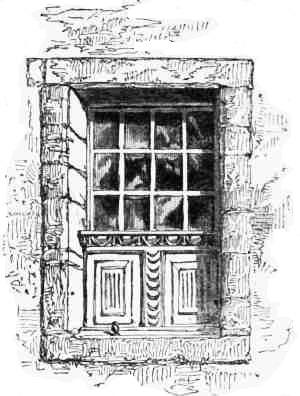
Half-glazed Window of Seventeenth Century.—See page 283.
Transcriber’s Notes:
The original accentuation, and spelling has been retained. Hyphenation has been made consistent as far as possible. New original cover art included with this eBook is granted to the public domain.
*** END OF THE PROJECT GUTENBERG EBOOK DOMESTIC ANNALS OF SCOTLAND FROM THE REFORMATION TO THE REVOLUTION, VOLUME 2 (OF 2) ***
Updated editions will replace the previous one—the old editions will be renamed.
Creating the works from print editions not protected by U.S. copyright law means that no one owns a United States copyright in these works, so the Foundation (and you!) can copy and distribute it in the United States without permission and without paying copyright royalties. Special rules, set forth in the General Terms of Use part of this license, apply to copying and distributing Project Gutenberg™ electronic works to protect the PROJECT GUTENBERG™ concept and trademark. Project Gutenberg is a registered trademark, and may not be used if you charge for an eBook, except by following the terms of the trademark license, including paying royalties for use of the Project Gutenberg trademark. If you do not charge anything for copies of this eBook, complying with the trademark license is very easy. You may use this eBook for nearly any purpose such as creation of derivative works, reports, performances and research. Project Gutenberg eBooks may be modified and printed and given away—you may do practically ANYTHING in the United States with eBooks not protected by U.S. copyright law. Redistribution is subject to the trademark license, especially commercial redistribution.
START: FULL LICENSE
THE FULL PROJECT GUTENBERG LICENSE
PLEASE READ THIS BEFORE YOU DISTRIBUTE OR USE THIS WORK
To protect the Project Gutenberg™ mission of promoting the free distribution of electronic works, by using or distributing this work (or any other work associated in any way with the phrase “Project Gutenberg”), you agree to comply with all the terms of the Full Project Gutenberg™ License available with this file or online at www.gutenberg.org/license.
Section 1. General Terms of Use and Redistributing Project Gutenberg™ electronic works
1.A. By reading or using any part of this Project Gutenberg™ electronic work, you indicate that you have read, understand, agree to and accept all the terms of this license and intellectual property (trademark/copyright) agreement. If you do not agree to abide by all the terms of this agreement, you must cease using and return or destroy all copies of Project Gutenberg™ electronic works in your possession. If you paid a fee for obtaining a copy of or access to a Project Gutenberg™ electronic work and you do not agree to be bound by the terms of this agreement, you may obtain a refund from the person or entity to whom you paid the fee as set forth in paragraph 1.E.8.
1.B. “Project Gutenberg” is a registered trademark. It may only be used on or associated in any way with an electronic work by people who agree to be bound by the terms of this agreement. There are a few things that you can do with most Project Gutenberg™ electronic works even without complying with the full terms of this agreement. See paragraph 1.C below. There are a lot of things you can do with Project Gutenberg™ electronic works if you follow the terms of this agreement and help preserve free future access to Project Gutenberg™ electronic works. See paragraph 1.E below.
1.C. The Project Gutenberg Literary Archive Foundation (“the Foundation” or PGLAF), owns a compilation copyright in the collection of Project Gutenberg™ electronic works. Nearly all the individual works in the collection are in the public domain in the United States. If an individual work is unprotected by copyright law in the United States and you are located in the United States, we do not claim a right to prevent you from copying, distributing, performing, displaying or creating derivative works based on the work as long as all references to Project Gutenberg are removed. Of course, we hope that you will support the Project Gutenberg™ mission of promoting free access to electronic works by freely sharing Project Gutenberg™ works in compliance with the terms of this agreement for keeping the Project Gutenberg™ name associated with the work. You can easily comply with the terms of this agreement by keeping this work in the same format with its attached full Project Gutenberg™ License when you share it without charge with others.
1.D. The copyright laws of the place where you are located also govern what you can do with this work. Copyright laws in most countries are in a constant state of change. If you are outside the United States, check the laws of your country in addition to the terms of this agreement before downloading, copying, displaying, performing, distributing or creating derivative works based on this work or any other Project Gutenberg™ work. The Foundation makes no representations concerning the copyright status of any work in any country other than the United States.
1.E. Unless you have removed all references to Project Gutenberg:
1.E.1. The following sentence, with active links to, or other immediate access to, the full Project Gutenberg™ License must appear prominently whenever any copy of a Project Gutenberg™ work (any work on which the phrase “Project
Gutenberg” appears, or with which the phrase “Project Gutenberg” is associated) is accessed, displayed, performed, viewed, copied or distributed:
This eBook is for the use of anyone anywhere in the United States and most other parts of the world at no cost and with almost no restrictions whatsoever. You may copy it, give it away or re-use it under the terms of the Project Gutenberg License included with this eBook or online at www.gutenberg.org. If you are not located in the United States, you will have to check the laws of the country where you are located before using this eBook.
1.E.2. If an individual Project Gutenberg™ electronic work is derived from texts not protected by U.S. copyright law (does not contain a notice indicating that it is posted with permission of the copyright holder), the work can be copied and distributed to anyone in the United States without paying any fees or charges. If you are redistributing or providing access to a work with the phrase “Project Gutenberg” associated with or appearing on the work, you must comply either with the requirements of paragraphs 1.E.1 through 1.E.7 or obtain permission for the use of the work and the Project Gutenberg™ trademark as set forth in paragraphs 1.E.8 or 1.E.9.
1.E.3. If an individual Project Gutenberg™ electronic work is posted with the permission of the copyright holder, your use and distribution must comply with both paragraphs 1.E.1 through 1.E.7 and any additional terms imposed by the copyright holder. Additional terms will be linked to the Project Gutenberg™ License for all works posted with the permission of the copyright holder found at the beginning of this work.
1.E.4. Do not unlink or detach or remove the full Project Gutenberg™ License terms from this work, or any files
containing a part of this work or any other work associated with Project Gutenberg™.
1.E.5. Do not copy, display, perform, distribute or redistribute this electronic work, or any part of this electronic work, without prominently displaying the sentence set forth in paragraph 1.E.1 with active links or immediate access to the full terms of the Project Gutenberg™ License.
1.E.6. You may convert to and distribute this work in any binary, compressed, marked up, nonproprietary or proprietary form, including any word processing or hypertext form. However, if you provide access to or distribute copies of a Project Gutenberg™ work in a format other than “Plain Vanilla ASCII” or other format used in the official version posted on the official Project Gutenberg™ website (www.gutenberg.org), you must, at no additional cost, fee or expense to the user, provide a copy, a means of exporting a copy, or a means of obtaining a copy upon request, of the work in its original “Plain Vanilla ASCII” or other form. Any alternate format must include the full Project Gutenberg™ License as specified in paragraph 1.E.1.
1.E.7. Do not charge a fee for access to, viewing, displaying, performing, copying or distributing any Project Gutenberg™ works unless you comply with paragraph 1.E.8 or 1.E.9.
1.E.8. You may charge a reasonable fee for copies of or providing access to or distributing Project Gutenberg™ electronic works provided that:
• You pay a royalty fee of 20% of the gross profits you derive from the use of Project Gutenberg™ works calculated using the method you already use to calculate your applicable taxes. The fee is owed to the owner of the Project Gutenberg™ trademark, but he has agreed to donate royalties under this paragraph to the Project Gutenberg Literary Archive Foundation. Royalty
payments must be paid within 60 days following each date on which you prepare (or are legally required to prepare) your periodic tax returns. Royalty payments should be clearly marked as such and sent to the Project Gutenberg Literary Archive Foundation at the address specified in Section 4, “Information about donations to the Project Gutenberg Literary Archive Foundation.”
• You provide a full refund of any money paid by a user who notifies you in writing (or by e-mail) within 30 days of receipt that s/he does not agree to the terms of the full Project Gutenberg™ License. You must require such a user to return or destroy all copies of the works possessed in a physical medium and discontinue all use of and all access to other copies of Project Gutenberg™ works.
• You provide, in accordance with paragraph 1.F.3, a full refund of any money paid for a work or a replacement copy, if a defect in the electronic work is discovered and reported to you within 90 days of receipt of the work.
• You comply with all other terms of this agreement for free distribution of Project Gutenberg™ works.
1.E.9. If you wish to charge a fee or distribute a Project Gutenberg™ electronic work or group of works on different terms than are set forth in this agreement, you must obtain permission in writing from the Project Gutenberg Literary Archive Foundation, the manager of the Project Gutenberg™ trademark. Contact the Foundation as set forth in Section 3 below.
1.F.
1.F.1. Project Gutenberg volunteers and employees expend considerable effort to identify, do copyright research on, transcribe and proofread works not protected by U.S. copyright
law in creating the Project Gutenberg™ collection. Despite these efforts, Project Gutenberg™ electronic works, and the medium on which they may be stored, may contain “Defects,” such as, but not limited to, incomplete, inaccurate or corrupt data, transcription errors, a copyright or other intellectual property infringement, a defective or damaged disk or other medium, a computer virus, or computer codes that damage or cannot be read by your equipment.
1.F.2. LIMITED WARRANTY, DISCLAIMER OF DAMAGES - Except for the “Right of Replacement or Refund” described in paragraph 1.F.3, the Project Gutenberg Literary Archive Foundation, the owner of the Project Gutenberg™ trademark, and any other party distributing a Project Gutenberg™ electronic work under this agreement, disclaim all liability to you for damages, costs and expenses, including legal fees. YOU AGREE THAT YOU HAVE NO REMEDIES FOR NEGLIGENCE, STRICT LIABILITY, BREACH OF WARRANTY OR BREACH OF CONTRACT EXCEPT THOSE PROVIDED IN PARAGRAPH 1.F.3. YOU AGREE THAT THE FOUNDATION, THE TRADEMARK OWNER, AND ANY DISTRIBUTOR UNDER THIS AGREEMENT WILL NOT BE LIABLE TO YOU FOR ACTUAL, DIRECT, INDIRECT, CONSEQUENTIAL, PUNITIVE OR INCIDENTAL DAMAGES EVEN IF YOU GIVE NOTICE OF THE POSSIBILITY OF SUCH DAMAGE.
1.F.3. LIMITED RIGHT OF REPLACEMENT OR REFUND - If you discover a defect in this electronic work within 90 days of receiving it, you can receive a refund of the money (if any) you paid for it by sending a written explanation to the person you received the work from. If you received the work on a physical medium, you must return the medium with your written explanation. The person or entity that provided you with the defective work may elect to provide a replacement copy in lieu of a refund. If you received the work electronically, the person or entity providing it to you may choose to give you a second opportunity to receive the work electronically in lieu of a refund.
If the second copy is also defective, you may demand a refund in writing without further opportunities to fix the problem.
1.F.4. Except for the limited right of replacement or refund set forth in paragraph 1.F.3, this work is provided to you ‘AS-IS’, WITH NO OTHER WARRANTIES OF ANY KIND, EXPRESS OR IMPLIED, INCLUDING BUT NOT LIMITED TO WARRANTIES OF MERCHANTABILITY OR FITNESS FOR ANY PURPOSE.
1.F.5. Some states do not allow disclaimers of certain implied warranties or the exclusion or limitation of certain types of damages. If any disclaimer or limitation set forth in this agreement violates the law of the state applicable to this agreement, the agreement shall be interpreted to make the maximum disclaimer or limitation permitted by the applicable state law. The invalidity or unenforceability of any provision of this agreement shall not void the remaining provisions.
1.F.6. INDEMNITY - You agree to indemnify and hold the Foundation, the trademark owner, any agent or employee of the Foundation, anyone providing copies of Project Gutenberg™ electronic works in accordance with this agreement, and any volunteers associated with the production, promotion and distribution of Project Gutenberg™ electronic works, harmless from all liability, costs and expenses, including legal fees, that arise directly or indirectly from any of the following which you do or cause to occur: (a) distribution of this or any Project Gutenberg™ work, (b) alteration, modification, or additions or deletions to any Project Gutenberg™ work, and (c) any Defect you cause.
Section 2. Information about the Mission of
Project Gutenberg™ is synonymous with the free distribution of electronic works in formats readable by the widest variety of computers including obsolete, old, middle-aged and new computers. It exists because of the efforts of hundreds of volunteers and donations from people in all walks of life.
Volunteers and financial support to provide volunteers with the assistance they need are critical to reaching Project Gutenberg™’s goals and ensuring that the Project Gutenberg™ collection will remain freely available for generations to come. In 2001, the Project Gutenberg Literary Archive Foundation was created to provide a secure and permanent future for Project Gutenberg™ and future generations. To learn more about the Project Gutenberg Literary Archive Foundation and how your efforts and donations can help, see Sections 3 and 4 and the Foundation information page at www.gutenberg.org.
Section 3. Information about the Project