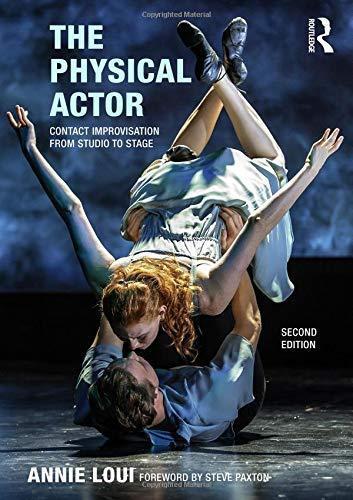
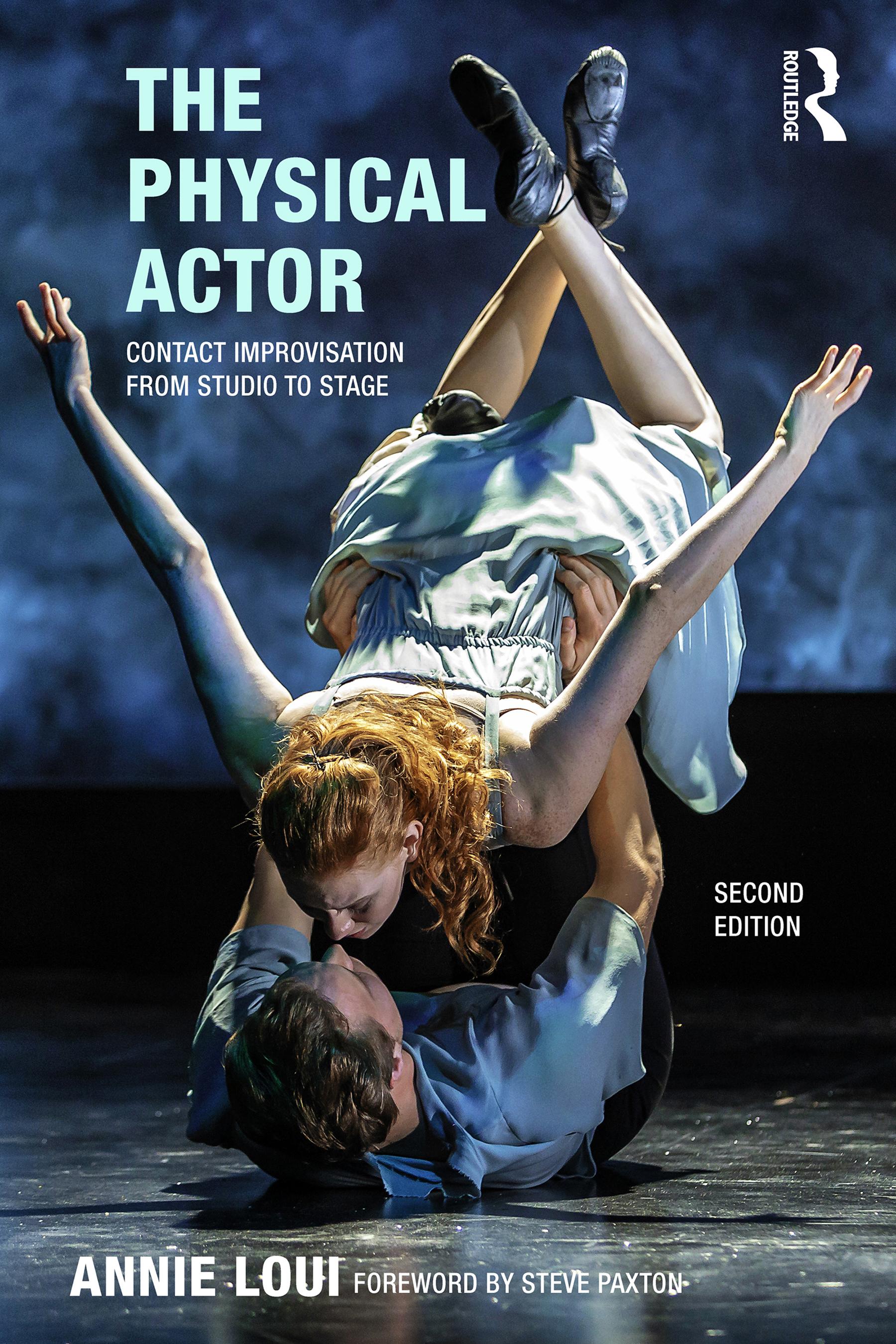
The Physical Actor is a comprehensive book of exercises for actors. It is carefully designed for the development of a strong and flexible physical body able to move with ease through space and interact instinctively on stage. Annie Loui draws on her training with Etienne Decroux, Carolyn Carlson, and Jerzy Grotowski to bring contact improvisation (CI) into the theatrical sphere. She explains how it can be used to develop alert and embodied listening skills in the actor, and how to apply it working with texts on stage.
This book will guide the reader through a full course of movement skills, including:
• Partnering skills
• Spatial awareness for groups and individuals
• Fine motor control through mime
• Heightened coordination and sustained motion
New for this edition are additional partnering exercises, in-depth applications of contact improvisation to monologues and scenes, and a chapter on devising physical theatre performances.
Annie Loui works as a director/choreographer and is the Artistic Director of CounterBalance Theater. Her original physical theater pieces have been seen in France, Monaco, West Germany, Italy, and the United States. She runs the Movement Program for MFA Actor Training at the University of California, Irvine.
The Physical Actor Contact Improvisation from
Studio to Stage
Second Edition
Annie Loui
Second edition published 2019 by Routledge
2 Park Square, Milton Park, Abingdon, Oxon, OX14 4RN
and by Routledge
711 Third Avenue, New York, NY 10017
Routledge is an imprint of the Taylor & Francis Group, an informa business
The right of Annie Loui to be identified as author of this work has been asserted by her in accordance with sections 77 and 78 of the Copyright, Designs and Patents Act 1988.
All rights reserved. No part of this book may be reprinted or reproduced or utilised in any form or by any electronic, mechanical, or other means, now known or hereafter invented, including photocopying and recording, or in any information storage or retrieval system, without permission in writing from the publishers.
Trademark notice : Product or corporate names may be trademarks or registered trademarks, and are used only for identification and explanation without intent to infringe.
First edition published by Routledge 2009
British Library Cataloguing-in-Publication Data
A catalogue record for this book is available from the British Library
Library of Congress Cataloging-in-Publication Data
A catalog record has been requested for this book
ISBN: 978-1-138-29184-3 (hbk)
ISBN: 978-0-415-78934-9 (pbk)
ISBN: 978-1-315-22284-4 (ebk)
Typeset in Univers by codeMantra
Warm -up: what we do and how we approach it 5
Warm-up sequence 8
The c at 8
The bridge 10
Neck stretch 13
The butterfly 14
The plough 18
Sternum lift 20
Spine undulation 23
Floating 24
Fast abs 26
Realign against the floor 27
Spine twist 28
Milling exercise 3 33
Passing diagonals 34
Amoeba exercise: “instant art” 36
Fishes exercise 37
Trust/nod exercise 1 38
Trust/nod exercise 2 39
Environment/group exercise 40
Parallel walking exercise 41
Samurai warrior 43
Freeze frames 44
Freeze frame exercise 1: physical extremes 44
Freeze frame exercise 2: given circumstances 45
Freeze frame exercise 3: partnering with imagery 46
Freeze frame exercise 4: intimacy 47
3 mI me
Why study mime? 49
Alignment 51
Isolations: to drill 52
Head 53
Shoulder 59
Chest 63
Pelvis 65
Direct application: improvisation 66
Bus stop improvisation 66
Isolation circle toss exercise 67
Isolation leading exercise 68
Mannequin exercise 69
Statuary garden exercise 70
Mime illusions: articulated action 72
Hand and wrist articulation exercises 72
Wall illusion 73
Small-object-drop illusion 74
Ball drop illusion 75
Ball throw to the sky illusion 76
Ball toss side to side illusion 76
Ball toss improvisation 77
Fixed Points 78
Slow motion 82
The three-minute sit 83
Crane rotation 84
Crane rotation inverted 85
Real time versus slow motion 87
4 p artne r I ng 89
The arc and the exercises 90
Group 1 exercises: weight and counterbalance 90
Group 2 exercises: weight support (skeleton) 94
Group 3 exercises: floor support 101
Group 4 exercises: lifts 114
5 c onta ct I mprov IS at I on pr act I ce a nd S cene S t udy 133
C ontemporary comedy: out of contact into realism 187
Monologues in contact 191
Monologue: out of contact into realism 195
How to get there 198
Devising
Movement theater creation: the early work 201
Generating original work 202
Preliminary exercises 202
Structural elements: building blocks for construction 204
Movement theater: the guidelines 206
Critique 207
Devising with a group:
CounterBalance Theater examples 208
Jane Eyre : our practical creative process in adapting literature for the stage 209
The Iliad: Menin (Rage) : slow motion as a combat tool 215
Reading Frankenstein : causality between live performers and technology 217
Elsewhere : isolations and physical theater as a metaphor 219
She : spatial orientation in staging 221
CounterBalance: steal from us! 222
Foreword
I have been invited to contribute a comment on contact improvisation (CI) and speaking. I have little direct experience of this apparently disparate mix. But looking at daily life, I see lots of examples. They are not so disparate. Conversation is mostly improvisational, as are many of the movement events with which we are involved. It is common to sing while working. It is natural to converse while engaged in activities from gardening to housecleaning to paperwork. If the physical continuum of CI becomes embodied, it is possible to converse or deliver a text without much influencing the flow of the improvisational movement nor having the movement much disrupt the flow of the voice.
One experience I did have in this was early CI demonstrations. My partner and I would discuss the principles of CI while performing it. However, later one of the teachers, Peter Ryan (now Lola), who witnessed that demonstration began to teach delivery of a set text during full-on CI. The texts were Shakespearean dialogues. I was surprised how fresh and recast the texts became when the bodies of the actors were fully involved in the nuance and sheer survival of duet improvisational movement.
To the students of this approach, I would say this: study of one’s own body as a medium is normally a very lengthy event due to the factor of having to grow the brain and body to perform advanced physical feats. Many martial arts for instance require years of study and not only for the development of the body to high levels of strength and reflex but also for the development of neurons that correspond to the ability to perform these previously unknown accomplishments. Ballet is said to require ten years.
The skills of CI are natural ones; the skills of speaking are also natural, and it won’t take long to get the coordination going. I think the element you might attend to is time. CI employs reflexes, very fast if still within conscious observation. In CI, however, I use standing to explore time; time, that is, as subjectively known, because “the stand” is maintained by miniscule movements which micro-adjust the skeleton to maintain balance. As you experience it, they can be seen to become smaller; your mind will see a larger pattern at first, but as you observe, it will be revealed that the reflexes are firing very subtly all over the body all the time. It is a window into the physical world. It remains for you to make what you will of this substrate of our movement spectrum. An essay or a teacher can only show you materials and help you practice. I will advise you to practice seriously. The body learns by activity, so do what you can to gently guide its growth, learning by doing, failing, improving—remembering that the goal you imagine can be reached by perseverance, which is the job of consciousness.
Steve Paxton
Acknowledgments
Thanks to my parents, the theater director Wayne Loui and Professor Tuck Loui, for being shining examples, and always encouraging their children to create.
Thanks to my colleagues at UC Irvine for their congenial support especially Robert Cohen and Richard Brestoff for sage advice, friendly coffee, and c areful reading. Large thanks are due to Talia Rodgers, my editor, who had faith. This second edition was supported by the patient Stacey Walker, gracious technical editing of Franc Chamberlain, and thoughtful comments from my colleagues in movement practice, Charlie Oates, Loretta Livingston, Dick McCaw, and Libby Worth. Thanks for technical support from Carmen Burgess and Adalid Aguilar.
A nd finally, thanks to my students over the years of practice in the studio. If you had not gone on the journey, this book would not exist.
Illustrative photos: Michael Lamont and Skye Schmidt.
Practitioners: Annie Loui, Karin Hendricks, Evans Jarnefeldt, and Ethan Sawyer.
Additional practitioners: Michael Calacino, Kayla Kearney, Chris Mansa, Gavin Mueller, Xander Ritchey, Grace Theobald, and Thomas Varga.
Additional contact improvisation photos: Adrian Alita and Sean Tarrant.
This manuscript was written in Torre San Severo, Italy, and in Silverado, California.
Endorsements
The Physical Actor might well be titled “Actor as Dancer,” so choreographically honed are its descriptions and analyses. At once manual and survey, the book is an engaging and inclusive overview of body techniques and their emotional connotations. In its specificity and precision, The Physical Actor is an essential resource for anyone who aspires to act or move.
Yvonne Rainer (choreographer)
Annie Loui’s remarkable new book not only offers a unique step-by-step approach for integrating movement training with an actor ’s text, it also teaches actors how to live a deep moment-to-moment life with their scene partners physically. By clearly detailing a technique that connects impulse-driven contact improvisation with scene work in styles ranging from Shakespeare to Chekhov, Loui shows actors something new: how to listen with their bodies. An indispensable book.
Richard Brestoff (actor and author, The Camera Smart Actor )
When I got a callback for the Angels in America revival on Broadway, the first person I told was Annie Loui. The re-imagining of the Angel in this production was intensely physical utilizing all my contact improv and devising skills as well as puppetry and the ability to integrate all of this with text It ’s as if Annie knew one day I’ d be asked to wear all of these hats at once and systematically prepared me for that moment in time. I wrote to her again to tell her I’ d booked the job and to thank her for the care she put into our time together and for the courage her work continues to inspire in mine.
Beth Malone (Tony Award nominee)
Annie Loui is the real deal. I love her insights into the craft and her reminders of why we do this and why the physical work is important to the actor. Physical awareness is one of the elements of the craft that you must experience in order to recognize its importance and power in your work. When we watch artists who understand their bodies and physicality we are drawn to the story and that actor in particular. The physical actor completes the image, the story, the moment. While I am no longer a performer, I continue to use the training and awareness that I learned from working with Annie Loui every day.
Elliot Fox (Co-Director of the Fordham/ Primary Stages MFA in Playwriting)
Another random document with no related content on Scribd:
“The book is avowedly written with the classroom’s needs in view, as well as those of the inquiring general reader, and the former aim to some extent vitiates the author’s treatment by imposing too eclectic an ideal upon him. The book is a résumé of poetics rather than a personal confession.” Llewellyn Jones
Freeman
2:235 N 17 ’20 1500w
“No critic since Matthew Arnold seems to us to have so positively as Mr Perry the capacity to make us see more clearly and think more accurately and sensibly about poetry and at the same time make the seeing and the thinking increase our enthusiasm for the vital things.”
C. F. L.
Grinnell
R 16:308 D ’20 640w
“In the long run his book is not simple enough. He will be useful to a certain kind of teacher; but he will move few students and he will enkindle no poets.” Mark Van Doren
Nation 112:sup241 F 9 ’21 120w
“The fault of the book is that it contains too many long quotations from other critics. But this very fault, in the present instance, makes the book a presentation of the best modern critical thought on the lyric. He will be a bold man who attempts to cover Professor Perry’s field for many years to come. ” C.
E. Andrews
N Y Evening Post p5 O 23 ’20 1100w
“Professor Perry’s volume is suggestive and stimulating. It will be useful to the classroom teacher, to the solitary student and to the average reader, who will gain from it knowledge certain to increase his enjoyment of verse. ” Brander Matthews
N Y Times p6 S 12 ’20 2000w
“He gives an unusually clear analysis, supported by rich and apt quotation, of the effects of poetry upon the reader. The value of his essay lies in its vivid ability to provide us with those moments of lucid understanding in which poetic experience is restored to us. ” L. R. Morris
Outlook 126:377 O 27 ’20 400w
“He is first of all a collector, secondly, an assayer, thirdly, and a little less willingly, an arbiter, and, only incidentally and reluctantly, a reasoner or controversialist.” O. W. Firkins
Review 3:501 N 24 ’20 2000w
For the game ’ s sake. (Fair play ser.) il *$1.65 Scribner
20–15706
“Half a dozen tales, each having to do with some special form of athletics, make up Mr Lawrence Perry’s little volume entitled ‘For the game ’ s sake.’ The first tells of a football ‘star’ who, being also ‘The spoiled boy,’ broke training and misbehaved himself until the coach found it necessary to put him off the team. But there was a sensible
and eloquent girl in the case, who brought the culprit to book in a manner which convinced him of the error of his ways. Another tale has to do with an international tennis tournament. Baseball of course is not neglected. Each of the tales presupposes a fairly close acquaintance on the reader’s part with that particular game with which it has to do.” N Y Times
N Y Times p27 S 26 ’20 230w
“The book stands for clean playing in every sport. Each story works up thrillingly to a dramatic climax where victory comes by the narrowest of margins.”
(STERN)
(MRS GEORGE HOUGH PERRY). Palmetto. *$1.90 (1c) Stokes
20–15507
Palmetto, as a child of thirteen, runs away from the only parents she has ever known, but whom she instinctively feels are only foster parents. She finds a refuge in New Orleans with a kindly fisherman who adopts her and brings her up as his own daughter. Associated with him is David Cantrelle, a lad of good birth whose family is genuinely shocked at his choice of occupation. He loves Palmetto from the first, and when her heart awakens and responds to his, they become engaged. But his family objects to the match, on account of
+ the mystery of her birth and she determines to show them she is worth while. So she goes to New York where she makes a conspicuous success as an actress. One of her southern admirers follows her there, makes ardent love to her and almost succeeds in replacing David in her heart. But she learns in time that her love for David is deeper than any Hartley can command. The mystery of her birth is eventually cleared up and she finds she has as good blood in her veins as either David or Hartley.
“The greatest defect in this romance of the bayou region of Louisiana is that it is somewhat overlong. Individual sentences and paragraphs are frequently overgrown with too rank a growth of adjectives.” N Y Times p20 D 5 ’20 500w
PETERSON, SAMUEL. Democracy and government. *$2 Knopf 321.8
20–104
According to the author’s initial assumption that “ a government carries into effect ideas,” the book naturally falls into two parts: What persons should have the legal right to determine finally the ideas to be carried into effect; and in what manner the ideas to be carried into effect should be selected, and how they should be carried into effect. Accordingly part 1, The ruling power of the state, discusses the difference between autocracy, oligarchy and democracy as one of conditions rather than of law, and defines a democratic government as a government of the intelligent members of the ruling race. Part 2, The organization of the government, is an inquiry into how the ideas to be carried into effect may be selected as reliably and
carried into effect as certainly and efficiently as possible. The contents under part 2 are: Governmental functions; Legislative organization; Administrative organization; Judicial organization; Direct legislation. There is an index.
Booklist 16:331 Jl ’20
N Y P L Munic Ref Lib Notes 7:39 O 20 ’20 60w
Outlook 126:558 N 24 ’20 180w
R of Rs 61:560 My ’20 50w
R of Rs 62:672 D ’20 30w
“A book which, while blazing no new paths, is well designed to assist the reader in forming a reasonably critical view of the state is Samuel Peterson’s ‘Democracy and government’ which treats fundamental political theories with knowledge of their historical importance, yet with hard-headed sociological insight. The author is always frank, and, while he has pronounced views of his own, he cannot be called a doctrinaire.”
Springf’d
Republican p8 Ap 13 ’20 400w
“His criticisms of the present governmental machinery are generally just, but the remedies suggested might prove to be worse than the disease. The book shows hard work and earnestness throughout, however, and should prove a valuable contribution to the literature on the subject.” A. G. Dehly
Survey 44:307 My 29 ’20 200w
PETRUCCI, RAPHAËL. Chinese painters; a critical study; tr. by Frances Seaver; with a biographical note by Lawrence Binyon. il *$2
Brentano’s 759.9
20–7443
“The book comprises a comprehensive and yet compact study of painting in China. His survey takes us back to the dim ages long before the appearance of Buddhism in China, and then brings the reader to the present time.” (Outlook) “It explains briefly the principles of technique and then, as it sketches the historical evolution of painting, reveals its dominating philosophical idea, the search for abstract form. The author was an authority on oriental art. There are numerous pleasing reproductions, bibliography, index of painters and periods.” (Booklist)
“Concise and illuminating volume.”
Booklist 16:336 Jl ’20
“Happily the author writes for the general reader and the lover of art rather than for the elect; his treatment of a large theme shows the advantage of one who has a gift for luminous condensation.”
125:541 Jl 21 ’20 170w
“For the uninitiated in these matters, ‘Chinese painters’ is a necessary education. For him who understands already the beauty of the masters of China, the book is valuable.”
Springf’d Republican p6 Ag 26 ’20 280w
PETTIGREW, RICHARD FRANKLIN. Course of empire; introd. by Scott Nearing. il *$4.50 Boni & Liveright 815
20–12790
“The author of this volume held a seat in the United States senate during the ’90s of the last century. He was active in the senate at a turning point in the career of the nation, a period when the frontier was disappearing, when the great oligarchies of capital were organizing, and when the United States became a colonial power. In short, his public career is identical with the origin of imperialism in the United States. The book consists of a compilation of the speeches of ex-Senator Pettigrew in the senate on these imperialist policies as they were forming. They fall into three groups those dealing with the annexation of the Hawaiian islands; those dealing with the conquest of the Philippines; and those dealing with the antagonism of the West to the banking and trust groups of the East. Accompanying the addresses which reveal a wide variety of information on the part of the author, are many documents of much historical value to the reader.” N Y Call
“These speeches, both concerning Hawaiian affairs and those in the Philippines, are useful as a matter of record; they will be very valuable to the future historian, who desires to understand the
obstacles encountered by the nation in its movement toward an expanded civilization and world power. ” E. J. C.
Boston Transcript p6 O 13 ’20 660w
“The addresses show that the author during his public career had that capacity which is so rare in the men of a later generation who have served in Congress. His mind was always open, and he advanced with the progress of his time.” James Oneal
N Y Call p10 N 21 ’20 940w
“Although the book comprises a vivid study of the development of imperial policy in the United States it might better have been compressed into half the size for the benefit of the general reader. There are too many and too liberal quotations from Mr Pettigrew’s own speeches.”
Springf’d Republican p6 D 27 ’20 570w
PHELPS, EDITH M., comp. Selected articles on the American merchant marine. (Debaters’ handbook ser.) *$1.50 Wilson, H. W. 387
20–4721
To this second edition of a handbook published in 1916 nearly one hundred pages of reprinted matter have been added. This matter is designed to cover events since the publication of the first edition, including the assembling of a large merchant fleet and the question of its disposal, together with arguments for and against government
Ann Am Acad 90:172 Jl ’20 40w
Booklist 16:291 My ’20
“A volume covering intelligently and with reasonable fulness the history and present status of the commercial fleet of the United States.”
+ ownership and operation. The bibliography has been enlarged and brought down to date, and the introduction and briefs have been rewritten.
Springf’d Republican p10 Ap 30 ’20 280w
PHELPS, EDITH M., ed. University debaters’ annual; constructive and rebuttal speeches delivered in debates of American colleges and universities during the college year, 1919–1920. v 6 *$2.25 Wilson, H. W.
808.5
Seven subjects of timely importance are included in this volume of the debaters’ annual: Government ownership and operation of coal mines; The Cummins plan for the control of railroads; Affiliation of teachers with the American federation of labor; Compulsory arbitration of railway labor disputes; Compulsory arbitration of labor disputes; The closed shop; Suppression of propaganda for the
overthrow of the United States government (two debates). Each debate is accompanied by briefs and a selected bibliography. “The bibliographies have been compiled mostly by the editor, and are not limited to the material actually used in the debate, as their main purpose is helpfulness to the prospective debater.” (Preface) The volume is indexed.
PHILLPOTTS, EDEN. As the wind blows. *$1.50 Macmillan 821
20–18071
“Mr Phillpotts sings a good deal about his beloved Dartmoor, but he tells of other subjects, too Gallipoli, the grave of Keats, etc. and he has one descriptive piece from the jungle called ‘Tiger,’ and a longish blank verse poem staging Adam and Eve in Paradise.” The Times [London] Lit Sup
“Of some of his pieces one has the impression that they were written as an exercise in verse. But in others a genuine inspiration is apparent. ‘The neolith’ and ‘Tiger’ contain fine things.”
Ath p718 My 28 ’20 70w
“It is the reality of the atmosphere rather than the circumstance that gives Mr Phillpotts’s verse its individuality; the taste, smell, contour of locality, rather than the sharp and sudden force of either crisis or event in human action that gives the unique character to his rhythmic expression.” W. S. B.
Boston Transcript p6 Jl 24 ’20 1750w
“He writes in the great English tradition, but brings a note that is essentially his own at the same time.”
N Y Times p16 N 7 ’20 290w
“It is always difficult to analyse charm, but in this instance the effect of the attraction is that we are apt to like poems that have very palpable faults.”
Spec 124:86 Jl 17 ’20 430w
The Times [London] Lit Sup p443 Jl 8 ’20 60w
PHILLPOTTS, EDEN. Evander. *$2 Macmillan
20–4895
“Evander is an apostle of plain living and high thinking in the early days when the gods of Olympus had not settled their respective rights in the hierarchy of worship and when marriage was still a rare thing among humble folk. Festus and Livia were perhaps the first among their neighbours to wed, under the auspices of Bacchus, while Evander, as the votary of Apollo, endeavours to convert her to the higher worship of his god. He succeeds for a time in gaining her allegiance, and she leaves her husband to follow him, but finds the mental atmosphere too rarefied for her, and finally returns to her home and husband, Bacchus being able to show his half-brother the unwisdom of vengeance on Festus.” Sat R
“The delicate, bright atmosphere in which this enchanting book is bathed must be left for the reader to enjoy.” K. M.
Ath p15 Ja 2 ’20 650w
“The dialogue is full of witty and amiable satire of our own times, the barb being especially sharp for the ‘intelligentzia’ of all times.” H. W. Boynton
Bookm 51:340 My ’20 460w
“It is impossible to overlook the roguish satire upon social affairs of the present day that Mr Phillpotts has woven into his story. The very presence and name of Bacchus proves that he has reference to the immediate present in writing of the far-away past.” E. F. E.
Boston Transcript p6 F 18 ’20 1600w
Dial 68:664 My ’20 80w
“The trouble with the book is the same as with all of Mr Phillpotts’s books a lack of felicity which is not compensated for, as it is in the case of his master, Hardy, by a dour grandeur. ‘Evander’ particularly needed grace and there is none. ”
Nation 110:304 Mr 6 ’20 400w
“The tale would, indeed, be worth reading merely for the grace and charm of its style, and its flexible, deft, and effective phrasing.”
N Y Times 25:89 F 15 ’20 900w
“A bit of irony impishly humorous, entirely delightful.”
N Y Times 25:190 Ap 18 ’20 20w
“The vein is one of mild social satire; the touch is light and easy; and here also is the charm of imagination and fancy.”
Outlook 124:430 Mr 10 ’20 80w
“We should like to congratulate the author on his success in a rather limited style of fiction. We can remember nothing in English at all equal to it since Dr Garnett’s ‘Twilight of the gods,’ while it has much in common with Anatole France in the satire of the foibles of the philosopher which lies at its root. It may be perceived we are giving Mr Phillpotts high praise.”
Sat R 129:40 Ja 10 ’20 150w
“A pretty, though often rather cheap, little story.”
+ − |Spec 123:822 D 13 ’19 100w
“Mr Phillpotts’s literary cunning makes an agreeable tale out of all this picturesque and quietly humorous.”
PHILLPOTTS, EDEN.
Macmillan
20–3882
Miser’s money. *$2
“The characters [of this novel] are drawn with realism and subtlety. More especially that of David Mortimer, the hard-bitten old miser, whose cheese-paring, hatred of women, and cynical disbelief in everybody and everything are so cleverly defended that they almost capture the young soul of his nephew Barry Worth, who lives with him and works his farm. David leaves his money to Barry on condition that he doesn’t marry, the fact that Barry was ‘tokened’ to a buxom barmaid having been concealed from him. Barry is true to Marian; the will is void; and the money divided between the miser’s brother and two sisters. But the lawyer who handed the will to Barry delivered at the same time a bulky letter from David to be read in solitude. In that letter is contained the mystery, the heart of the matter which makes the novel.” Sat R
“The characters are interesting and the story moves along pleasantly and very calmly. There is less humor than in some of the earlier work.”
Booklist 16:283 My ’20
“After all, Mr Phillpotts has said his say about human nature on Dartmoor, and he has little new to offer in type or situation. It is pleasant and comfortable to meet some more of his people now and then and that is all.” H. W. Boynton
Bookm 51:339 My ’20 520w
“The story as a whole is an excellent example of Mr Phillpotts’s style at its best.” E. F. E.
Boston Transcript p4 Mr 17 ’20 1200w
“The novel is beautifully written. All Mr Phillpotts’s readers know how fine are his descriptions of his dearly loved Dartmoor, though there are fewer of them in this his latest novel than in the majority of his Dartmoor books.”
N Y Times p116 Mr 14 ’20 1150w
“An excellent example of the author’s quiet, subtle, and humorous exposition of contrasted character.”
Outlook 124:657 Ap 14 ’20 100w
“It is as charming a novel, and as telling a picture of family life on ‘Dartymoor’ as we ever read, or as Mr Phillpotts has ever written. Worthy to rank with the best of his many delightful novels.”
Sat R 129:333 Ap 3 ’20 440w
“The different veins of his talent, tragic and humorous, are here fused with happy results. ‘Miser’s money ’ shows him at his mellowest and best as artist and observer.”
Spec 125:215 Ag 14 ’20 530w
“The plot is simple and rather erratic, but taken as a whole the story displays that excellence of craftsmanship which long since placed the author in the forefront of his peculiar field.”
Springf’d Republican p13a Ap 18 ’20 750w
“Mr Phillpotts keeps us almost too near to life. He presents us with one more faithful and consistent study of Dartmoor people, but of Dartmoor people principally in their heavier and less significant moments. The plot, though simple and pastoral, is a very good plot; but no plot could survive this flood of conversation.” The Times [London] Lit Sup p186 Mr 18 ’30 400w
PHILLPOTTS, EDEN.[2] West country pilgrimage.
il *$9 Macmillan 914.2
“A by-product of Mr Phillpotts’s researches into the lore of Devonshire has been put together in a volume entitled ‘A west country pilgrimage,’ with sixteen illustrations in color by A. T. Benthall. Here he sketches in a series of sixteen essays the scenes of heath and river, of village and shore as they meet the eye of the traveller through or the sojourner in that corner of England.”— Boston Transcript
“The book represents the happiest combining of language, printing, and art.” Margaret Ashmun
Boston Transcript p7 O 30 ’20 260w
“Some of the water colors by A. T. Benthall are unusually fine, and they all display a decided originality of talent. To many, perhaps, the illustrations will seem preferable to the text, for they achieve their intended result with less effort.” B. R. Redman
“An attractive book for lovers of Devon and Cornwall.”
“A thin blue volume entitled ‘A reasonable revolution,’ filled with economic principles and suggestions, has just been brought out by Macmillan company. It is an ardent and eager defense of the state bonus for motherhood and national minimum income scheme as evolved by Dennis Milner, the head of the state bonus league of England. This book is written by Bertram Pickard, who has been a co-worker with Milner for some time.” (Springf’d Republican) “Briefly, the scheme is for a national appropriation of 20 per cent of all incomes, without consideration of other taxes or burdens on them; the resulting fund to be pooled and redistributed in such a way
as to provide every individual and family with a national minimum sufficient to sustain national standards of comfort, health, education and other essentials of a full and efficient life.” (Survey)
Ath
p570
Jl 4 ’19 50w
“Mr Pickard is thoroughly conversant with his subject, looks at it tirelessly from every point of view and appears to answer every possible question with which a careful student of economics might attack the scheme.”
Springf’d Republican p10 Mr 12 ’20 220w
Survey 43:194 N 29 ’19 440w
PILLSBURY, WALTER BOWERS.
Psychology of nationality and internationalism. *$2.50 (3½c) Appleton 321
20–458
For descriptive note see Annual for 1919.
“The argument is well-reasoned throughout.” C. G. Fenwick
Am Pol Sci R 14:340 My ’20 90w
“Following upon much political disputation on nationality and internationality, it is very clarifying to follow this psychologist through his discussion of the mentality of nations.”
Booklist 16:190 Mr ’20
“His belief in the integrity of the national state does not take into account that growing regionalism which challenges the authority of the state at the same time that it denies the false unity of belligerent nationalism. And the temperate lucidity of the author’s psychological exposition does not equate his superficial examination of the historical groundwork of nationality and internationalism.”
Dial 68:404 Mr ’20 150w
“The reviewer found the most interesting chapter the one on Hate as a social force.” Ellsworth Faris
Int J Ethics 30:339 Ap ’20 330w
Reviewed by Joseph Jastrow
Nation 112:185 F 2 ’21 450w
Springf’d Republican p11a My 16 ’20 300w
“Dr Pillsbury’s chapter on Hate as a social force is very apposite and suggestive. The chapter on The nation and mob consciousness is an excellent criticism of LeBon’s group psychology. The chapter on Nationality and the League of nations is the least satisfactory.”
PINKERTON, MRS KATHRENE SUTHERLAND (GEDNEY), and PINKERTON,
ROBERT EUGENE. Long traverse. il *$1.50 (2c)
20–12811
When Bruce Rochette comes into the northland he comes with a deadly hatred of the Hudson’s Bay Company and a determination to avenge his mother’s death which he holds the fur trading company responsible for. He wins the confidence of the Hudson’s Bay Company’s manager, Herbert Morley, and then uses every trick and stratagem at his command to establish a rival post at Fort Mystery. Everything is going well, until he meets Evelyn Morley, and falls in love with her. Judged by her absolute standards of right and wrong, his policy of all’s fair in war condemns him in his own eyes as well as hers. In an endeavor to straighten matters out, he very nearly loses his self respect, his girl, his job, and even his life. But finally everything is restored to him that is necessary for his happiness and Evelyn’s.
“A pleasantly written tale.”
Booklist 17:35 O ’20
PINKERTON,
MRS KATHRENE SUTHERLAND
(GEDNEY), and PINKERTON, ROBERT EUGENE. Penitentiary Post. il *$1.50 (2c) Doubleday
20–10313
A story of the Hudson’s Bay Company. Phil Boynton is sent to take charge of the fort known as Penitentiary Post, a place with an evil reputation. Behind him at Savant House, he leaves the girl he loves, knowing that John Wickson, the man who is sending him north, also loves her and is determined to win her, and half suspecting that personal motives were back of the appointment. At Penitentiary Post he finds himself fully occupied with the mystery of the “weeteego,” or evil spirit, that haunts it. His Indians desert the place in fear and the fur hunters refuse to come near it. Joyce Plummer, hearing tales of what he is undergoing, comes alone through the storm to find him, and Wickson follows. The three, who are forced to make common cause against hunger, come to an understanding, and the poor, crazed Indian who had watched his family die of starvation and is taking a weird revenge on the white man, meets his own fate.
Booklist 17:35 O ’20
“This book first appeared serially in El Norte Americano. Mr Pinochet is a Chilean and the author of seven books on government and kindred subjects. He came to this country some years ago for the expressed object of learning to understand the United States that he might tell his countrymen about us. He has selected an entertaining manner of setting forth the views of the two Americas. He has made no attempt to make a story of his book, yet he has introduced two distinct characters. The first is a Latin-American man, who, being in the United States, writes letters to his wife at home about whatever interests him in this country. The woman is an American, a member of the censor ’ s department during the war. She reads the letters of the husband and in her turn writes an accompanying letter, discussing the same subject.”—Boston Transcript
“The surprising thing about the book is that Mr Pinochet should so have entered into the United States point of view as to make one believe, while reading his instructive volume, that a native of this country had risen in its defense.”
Bookm 52:368 D ’20 300w
“The book should prove a link in the chain which should finally bind closer the two continents, so many of whose interests are the same. ”
Boston Transcript p7 N 24 ’20 390w
“Both the imaginary writers are interesting and neither writes a page that one can go to sleep over. ”
N Y Times p7 Ja 9 ’21 1750w
“The book has a temporary flavor, being written before the adoption of the suffrage amendment and more recent events. But it will prove interesting to anyone who wishes to know how a highly intelligent ‘foreigner’ judges our country from the front it presents to him.”
Springf’d Republican p7a D 26 ’20 290w
PINSKI, DAVID. Ten plays. *$2 Huebsch 892.4
20–9850
These ten one-act plays have been translated from the Yiddish by Isaac Goldberg. They depict the various weaknesses and passions of men: greed, selfishness, war hysteria, lust, war ’ s devastation, with at the end a dramatization of the Midrash legend. The titles are: The phonograph; The god of the newly rich wool merchant; A dollar; The cripples; The Inventor and the king’s daughter; Diplomacy; Little heroes; The beautiful nun; Poland 1919; The stranger.
“Plays which are often unpleasantly grim though not sordid. There is the same keen analysis of human nature as in earlier plays. The method is symbolic rather than literal, and sometimes the meaning is blurred.”
Booklist 16:338 Jl ’20
“Brilliant but not always clear.”
Cleveland p87 S ’20 20w
“There are few of his ‘Ten plays’ which can wholly escape the murkiness of inferior translation.” K.
M.
Freeman 1:548 Ag 18 ’20 450w
“Mr Pinski has become an unswerving symbolist. He has deliberately silenced the voice of nature that sounded so clearly in his earlier plays. He still cultivates the ironic anecdote in dramatic form but his mind is more fixed on the bare intention than on the stuff of life. His peculiar dangers are the fantastic and the obscure, and these make several of his plays ineffectual.”
Nation 110:693 My 22 ’20 250w
“Pinski may lack certain graces, especially graces of lightness and saving humor. But passion and power he does not lack, whether he writes in one-act or three. No American dramatist today gives such an effect of surging vitality. It will be a great pity if he does not identify himself more closely with American life and write ultimately for English-speaking audiences direct.” W. P. Eaton
N Y Call p10 Jl 18 ’20 350w
“The shortest of the ten plays, ‘Cripples,’ is the strongest. Force, indeed, gnarled and ungainly, is characteristic of Mr Pinski’s drama at its best. This force, however, is accompanied by a heaviness of tread and a density of fibre which are prolific of trials for the sensitive reader.”
Review 3:133 Ag 11 ’20 320w
“Every play in the volume is readable, most of them are actable. It would, in fact, be safe to say that they would all be actable if they were in the hand of the players of the Jewish art theatre, who know as well as Pinski does how to make the quick transitions native to the Jewish mind and heart—from tragedy to comedy, from irony to philippic, from joy to the depths of sorrow. ”
Arts Magazine 4:225 Jl ’20
PITT, FRANCES. Wild creatures of garden and
hedgerow. il *$4 (7c) Dodd 590.4
20–27527
A collection of papers by an English naturalist, who says, “The following account of some of the commoner birds and beasts around us is written in the hope of interesting boys and girls, and some of the older people too if possible, in the wild life of garden, hedgerow, and field.” (Preface) Contents: Bats; The bank vole; Two common birds (blackbird and thrush); Shrews; Toads and frogs; The longtailed field mouse; ‘The little gentleman in the black velvet coat’; Thieves of the night; Some garden birds; The hedgehog; Three common reptiles; The short-tailed field vole. The illustrations are from photographs.
“Her first-hand records are set out in an easy unpretentious style, and on obscure points she makes suggestions as illuminating as they are modest.” E. B.
p303 S 3 ’20 720w
Booklist 17:100 D ’20
“Miss Pitt’s book is beautifully printed and handsomely illustrated and is especially of value for the reading of young people, many of whom are glad to make friends with the living things of the world about them.”
Boston Transcript p4 D 11 ’20 400w
“Miss Pitt is to be congratulated on a book which takes its place in the first rank of works on field natural history. It is a personal record of clever, patient, and sympathetic observation.” J. A. T.
Nature 106:246 O 21 ’20 1700w
“The author’s work is not inspired or inspiring, but it is clean of sentimentality and of spurious nature philosophy, pleasant reading, and informative.”
N Y Evening Post p29 O 23 ’20 130w
Reviewed by E. L. Pearson
Review 3:376 O 27 ’20 50w
Spec 125:710 N 27 ’20 30w
“The photographs of the little creatures in their haunts are most cleverly taken.”
“Even if they sometimes carry a rather too large conclusion, these histories of birds and beasts and creeping things are full of fine insight and the right enthusiasm.”
20–17152
A book of advice on writing for the professional stage. The author says “I do most fervently believe that the dry bones of stage technique can be taught—in fact, all my personal experience goes to prove this. I have been handling plays now for more years than I care to remember, and have found in case after case that a little technical adjustment will turn an unmarketable play into a commercial proposition.” Among the topics covered are: What the public want; Things that are essential in a good play; How to choose a plot; How to select and differentiate the characters; Humour; How to sell a play when finished; Casting and production. A glossary of stage terms comes at the end. The author is an English woman writing with London conditions in mind but most of her discussion is general in nature.
“A beginner, provided he were only a beginner with no idea of the drama, would do well to read this book.”
N Y Evening Post p10 D 31 ’20 180w
PLUMB, CHARLES SUMNER. Types and breeds of farm animals. (Country life educ.
ser.) rev ed il *$3.80 Ginn 636
20–8897
A revision of a work published in 1906. The new edition contains “ a more detailed discussion relative to the great breeds, and considerable space is devoted to families of importance and to noted individuals. A large amount of new data has been collected relating to various phases of production, although it is a hopeless task to bring such records down to date.... The number of chapters remains the same, but several obsolete breeds have been omitted and other new and more important ones have been substituted. Maps and many illustrations have been added.” (Foreword)
“The book gives probably the best account published of modern farm animals and there are good illustrations. Another very interesting feature is the history of the families which the author has diligently worked out.” E. J. R.
+ + + Ath p384 Mr 19 ’20 50w
Nature 106:659 Ja 20 ’21 210w
POLLAK, GUSTAV. International
minds and the search for the restful. $1.50 Nation press 814
19–16675
The collection of essays in this book are gathered from articles contributed to the Evening Post and the Nation before the war. As the title indicates, they fall into two groups. The first group bears out the author’s claim “that intellect recognizes no distinctions of nationality, race, or religion.” He has selected a representative of each, from the literatures of Germany, Austria, France and America in the persons of Goethe, Grillparzer, Sainte-Beuve and Lowell and points out a certain similarity of attitude toward life and literature, of perception of the dignity of literary achievement, of keen-eyed observation and of a self-contained repose. The second group of essays is devoted to Ernst, Baron von Feuchtersleben, and his book on the “Hygiene of the soul” which of late years has achieved a new fame. One of the essays gives a resumé of the book. The titles of the essays are: Literature and patriotism; Goethe’s universal interests; Grillparzer’s originality; Sainte-Beuve’s unique position; Lowell: patriot and cosmopolitan; Permanent literary standards; Feuchtersleben the philosopher; The hygiene of the soul; Feuchtersleben’s aphorisms; Feuchtersleben’s influence.
POLLARD,
ALBERT FREDERICK.
Short history of the great war. *$3.25 Harcourt 940.3
20–26545
“Although several histories of the war have already appeared, only a few of them have been written by men who had an ante-war historical reputation. Dr Pollard is one of this small group. For many years he has held the chair of English history in the University of
London, and is the author of numerous historical works, besides having served as assistant editor of the ‘Dictionary of national biography.’ His record of the war is chronologically complete, and includes the work of the peace conference.” R of Rs
“Simply as an account of military events the volume leaves something to be desired, in spite however of what the book does not contain and one cannot say everything in four hundred pages the volume is well worth reading.” A. P. Scott
Am Hist R 26:331 Ja ’21 470w
“An excellent feature of Professor Pollard’s evenly balanced and temperately written narrative is that it corrects several popular misapprehensions.”
Ath p431 Mr 26 ’20 260w
Booklist 16:309 Je ’20
“An excellent record of the facts, combined with a true representation of their relative importance. Some of his opinions will not be generally accepted, and he has a strong prejudice against the present prime minister. Original views will not, however, detract from the great and patriotic interest of the book. The style is vigorous and sometimes eloquent.”
G. B. H.
Eng Hist R 35:477 Jl ’20 190w
“In contrast with some other writers on the subject, he has succeeded in being more historical than hysterical. Having mastered the sources, as far as they are available, he presents his conclusions