Advantages and Disadvantages of Media Selections 58
NEGOTIATING MEDIA BUYS 62
Evaluating Your Media Buys 63
BUYING THE INTERNET 64
Whom Will You Be Talking To? 64
What Media Will Help Accomplish Your Objectives? 64
Tool-Specific-Options 65
LEARNING TO ADAPT 66
KEY TERMS 66
CHAPTER 5 Media Relations and Placement 67
WHAT IS NEWS? 68
WORKING WITH THE MEDIA 69
Get to Know Journalists’ Jobs 69
Get to Know Journalists as People 69
Guidelines for Dealing with the Media 70
Guidelines for Interviews 71
Guidelines for Correcting Errors 73
MEDIA PLACEMENT 73
Deciding Where to Place Your Message 73
Getting Your Message to the Media 75
Fitting Your Information to Your Outlet 76
MEDIA KITS 78
DIGITAL MEDIA KITS 82
Guidelines for Building a Digital Media Kit 82
CREATING AN ONLINE NEWSROOM 84
What to Include in Your Online Newsroom 85
Online Newsrooms to Study 87
THE SOCIAL MEDIA APPROACH 87
Cooperation Is the Key 90
KEY TERMS 90
CHAPTER 6 Writing for Web and Social Media 91
THE CHANGING LANDSCAPE 92
A Quick Word about Writing for Websites 93
OK, Let’s Get on with Web 2.0 95
BLOGS AND BLOGGING 96
What to Blog About 97
Writing Blog Posts 98
How to Write Comments on Blogs 99
Micro-Blogging and Twitter 102
How to Write Twitter Posts 102
KEY TERMS 104
CHAPTER
7 News Releases and Related Materials 105
WHAT IS A NEWS RELEASE? 106
WRITING A NEWS RELEASE 107
The Lead 107
Quotations and Attributions 109
Local Interest 111
NEWS RELEASE FORMAT 112
Timing and Dating Releases 114
Datelines 114
Exclusives and Specials 115
TYPES OF NEWS RELEASES 115
Product Releases 115
Event Announcements 119
Personnel Releases 119
Tips/Hints Releases 124
WRITING NEWS RELEASES FOR BROADCAST 124
PITCH LETTERS AND MEDIA ADVISORIES 129
Pitch Letters 129
Media Advisories 132
THE DIGITAL NEWS RELEASE 134
Standard Release Format 136
CHAPTER 8
Search Engine Optimized Releases 136
Social Media Release 138
How to Write a Social Media Release 139
The Inbound Marketing News Release 144
BACKGROUNDERS 146
FACT SHEETS 147
KEY TERMS 153
Controlled Publications 154
NEWSLETTERS 155
Types of Newsletters 155
Why a Newsletter? 156
Content 159
Objectives 160
Scheduling and Budgeting 160
Articles 160
Story Ideas 162
Researching Stories 164
Design Considerations 164
Style Sheets 165
CREATING A DIGITAL NEWSLETTER 165
Online Versions 167
E-mail Versions 169
MAGAZINES 172
Content and Format 172
Types of Articles 174
TRADE JOURNALS 174
FEATURE WRITING FOR NEWSLETTERS AND MAGAZINES 175
Feature Style 175
Writing the Feature Story 178
Common Types of Features 184
EDITORIAL CONSIDERATIONS FOR DISPLAY
COPY 190
Writing Headlines 190
Writing Subheads and Crossheads 191
Writing Captions 191
Writing Pull Quotes 192
EDITING YOUR ARTICLES 192
EVALUATION 193
Methods of Evaluation 193
Evaluating Your Production Schedule 196
BROCHURES 202
Planning Your Brochure 203
Fitting It All Together 206
OTHER INFORMATION PIECES 217
Flyers 217
Posters 219
Booklets and Hybrids 221
The Nonprofit Annual Report 223
KEY TERMS 228
CHAPTER 9 Design, Printing, and Desktop Publishing 229
DESIGN: WHAT IT IS AND WHY IT MIGHT BE GREEK TO YOU 230
DESIGNING PUBLIC RELATIONS MATERIALS 231
PRINCIPLES OF DESIGN 234
Balance 234
Proportion 235
Sequence and Emphasis 237
Unity 241
Grids 244
Alignment 244
Type and Typefaces 246
WORKING WITH PROFESSIONAL PRINTERS 249
Printing Processes 250
Paper Choice 252
Ink Choice 255
Binding 256
Swipe Files 256
Submitting your Layout for Printing 257
A WORD ON DESKTOP PUBLISHING 258
PRINT SCHEDULING AND BUDGETING 260
Scheduling 260
Budgeting 261
KEY TERMS 263
CHAPTER 10 Television and Radio 264
REACHING BROADCAST AUDIENCES 265
Video News Releases 265
Radio and Television Actualities 267
Interviews and Talk Shows 267
Corporate Advertising and Public Service Announcements 267
WRITING FOR TELEVISION 268
Basic Concepts 268
Writing for the Eye 270
Television Scripts 270
WRITING FOR RADIO 283
Types of Radio Announcements 284
How to Get Your Public Service Announcements on the Air 286
KEY TERMS 290
CHAPTER 11 Speeches and Presentations 291
TYPES OF SPEECHES 292
MODES OF DELIVERY 292
PREPARATION AND WRITING 293
Specifying Your Purpose 293
Analyzing Your Audience 293
Organizing Your Speech 294
Supporting Your Ideas 297
DELIVERY 297
THE QUESTION-AND-ANSWER SESSION 298
PRESENTATION MATERIALS 298
Preparing Audiovisual Materials 299
Scripting for Audiovisuals 301
KEY TERMS 303
Glossary 305 Index 317
PREFACE
Preface
This is a handbook for those who, by intention or by accident, find themselves in the position of writing for public relations. In my years of experience, I have had as many questions concerning public relations writing from those not in public relations as from those in the field. Countless inquiries have come from those who, suddenly having been “appointed” publicity chair for a committee, find they don’t know the first thing about publicity; or the office manager who has been assigned, ad hoc, the job of putting out a newsletter; or the small-company president who wants to create her own brochures on the new desktop publishing software, which she just acquired, but doesn’t have the faintest idea how to proceed. That’s why you’ll find this book begins with the basics and pretty much sticks with them.
It is designed to aid both the beginner and the advanced public relations writer. In it you will find most of the forms of public relations writing, including news releases, backgrounders, broadcast scripts, magazine and newsletter articles, brochures, and Web and social media copy.
This latest edition has been updated to include more information on writing for digital environments and using social media to communicate. There is still a chapter on the basics of writing for the Web and for social media, including advice for blogging and micro-blogging (Twitter, etc.), and how to get the most out of online tools like Facebook, LinkedIn, and others. In addition, many of the chapters now include companion sections on how to produce digital versions of traditional forms. For example, Chapter 7 on news releases includes a section on digital releases, Search Engine Optimized (SEO) releases, and Social Media Releases (SMR). Likewise, Chapter 8 on controlled publications includes advice on how to write for and produce online and digital newsletters.
Other changes to this edition include a section on ethics in Chapter 2 for public relations writers working in digital forms including blogging and word-ofmouth marketing codes, and best practices. Chapter 4 includes a new section on buying the Internet. And, in Chapter 5 on media relations and placement, you
will find information on creating online newsrooms and a new section on producing digital media kits.
Many of the recommendations contained in this book are based on years of experience as a writer, both in public relations and in general business practice. It is my belief that any public relations writer worthy of the name should become familiar with all forms of writing. After all, good writing is good writing, no matter what the form. The truly good writer can work in any medium, like the good artist.
This book is an attempt to put most of the reference material that you, as a public relations writer, would need to successfully complete the work which is so vital a part of your chosen profession—writing.
Acknowledgments
A number of people have helped make this new edition possible. John Mitchell, a longtime friend and faithful user of this book, was especially helpful with his many examples of fine work. Marilyn Milne, a professional and friend, provided examples of pitch letters and advisories. Seth Walker, formerly of Intel, provided me with numerous examples of that organization’s fine work. My brother, Chris, also provided me with a number of examples from his vast design repertoire for a varied clientele. I am also indebted to the educators who reviewed the last edition of the book and made incredibly constructive suggestions for this latest edition: Sallyanne Holtz, University of Texas at San Antonio; Amiso M. George, Texas Christian University; Amber Erickson, University of Cincinnati; Robert M. Kucharavy, Syracuse University; Katrina Marie Olson, University of Illinois at Urbana-Champaign; and Mary Frances Casper, Boise State University. Every new item and nearly every change that appear here are based on their recommendations.
I am also grateful to Nicole Bridge, at McGraw-Hill for her suggestions, foresight, and diligence in keeping me on schedule. And, I can’t forget my excellent project manager, Jessica Portz, she caught every detail. Finally, I am grateful to the many professionals around the country whose ideas and creativity inspired and contributed to much of this revision. They have been uniformly generous in their willingness to share their work with me. Nearly every time you see a footnote in this book, it is there to thank those generous individuals and organizations. This new edition is truly a result of their hard work as well as my own. My thanks go to them all. They share in whatever usefulness this book provides to you, the reader.
About the Author
Thomas H. Bivins is a professor and the John L. Hulteng Chair in Media Ethics in the School of Journalism and Communication at the University of Oregon. He received his PhD in 1982 in telecommunication from the University of Oregon and taught for 3 years at the University of Delaware before returning to the University of Oregon. Bivins received a BA in English and an MFA in creative writing from the
University of Alaska, Anchorage, and has over 30 years of professional media experience, including work in radio, television, advertising, public relations, graphic design, and editorial cartooning.
Additional Resources
An Online Learning Center for this text is available at www.mhhe.com/bivins8e. This Website contains a workbook for students and a password-protected manual for instructors. Please ask your McGraw-Hill representative for access information.
This text is available as an eTextbook at www.CourseSmart.com. At CourseSmart your students can take advantage of significant savings off the cost of a print textbook, reduce their impact on the environment, and gain access to powerful Web tools for learning. CourseSmart eTextbooks can be viewed online or downloaded to a computer. The eTextbooks allow students to do full text searches, add highlighting and notes, and share notes with classmates. CourseSmart has the largest selection of eTextbooks available anywhere. Visit www.CourseSmart.com to learn more and to try a sample chapter.
1
Writing for Public Relations
In This Chapter, You Will Learn
• Why good writing is important to a public relations professional.
• The difference between uncontrolled and controlled information.
• The most often–used tools of public relations writing and how they differ.
• The process of public relations writing.
WHAT IS PUBLIC RELATIONS?
Before we begin to discuss writing for public relations, it’s probably a good idea to get a grip on exactly what public relations is. That’s not an easy question to answer. If you were to think that public relations is about putting a client’s best foot forward, you’d be right. If you proposed that public relations is about dealing with the media (either keeping your client’s name in the media or out of it), you’d be right as well. If you believe that public relations is helping clients and organizations get along with their constituencies, you’d be right again. In fact, public relations is all of these and more. Public relations is everything from planning entire communications campaigns to writing a letter to the editor. It involves any activity that enhances the reputation of your client, mediates disputes between various publics and your client, helps achieve mutual understanding among all parties involved in an issue, advocates on behalf of a client or cause, provides guidance and direction, and results in positive and mutual wellbeing. A quick query on Google nets the following definitions for public relations found on the Web:
d The business of generating goodwill toward an individual, cause, company, or product (www.motto.com/glossary.html)
d The acts of communicating what you are to the public. This is not to be confused with publicity, which is just one of the methods used in communicating the image (www.nejaycees.org/about/jargon.asp)
d Activity, communications, or press coverage that is designed to enhance the prestige or goodwill of a company (http://rdsweb2.rdsinc.com/help/bi_ct_ expdef.html)
d Any activities or events that help promote a favorable relationship between a company and its customers and prospects; activities used to influence the press to print stories that promote a favorable image of a company and its products or services (www.garyeverhart.com/glossary_of_advertising_terms.htm)
d Communication with various sectors of the public to influence their attitudes and opinions in the interest of promoting a person, product, or idea (http:// fourps.wharton.upenn.edu/advertising/dictionary/p.htm)
d An activity meant to improve the project organization’s environment in order to improve project performance and reception (www.mccombs.utexas. edu/faculty/Linda.Bailey/glossary.htm)
d Professional services in promoting products by arranging opportunities for exposure in the media (http://freespace.virgin.net/brendan.richards/glossary/ glossary.htm)
d A deliberate, planned, and sustained effort to institute and maintain mutual understanding between an organization and its publics (Institute of Public Relations definition) (http://wps.pearsoned.co.uk/wps/media/ objects/1452/1487687/glossary/glossary.html)
d A promotion intended to create goodwill for a person or institution (http:// wordnet.princeton.edu/perl/webwn)
d Public relations deals with influencing public opinion, through the presentation of a client’s image, message, or product (http://en.wikipedia.org/wiki/ Public_relations)
In fact, modern public relations is an eclectic package encompassing a great many job descriptions, titles, and functions. The federal government even forbids the use of the term public relations to refer to roles whose functions in the business world would be identical. The practice is rife with terms synonymous with yet subtly different from public relations. Press agentry, for instance, is usually taken to mean the role of providing media exposure, whereas promotion combines media exposure with persuasion. Public affairs most often refers to those who deal with community or government relations; and the federal government’s decided-upon replacement term is public information.
Despite the myriad terms applied to the practice, there does appear to be a rather limited number of actual functions assigned to these roles. Nearly 30 years ago, James Grunig and Todd Hunt proposed a set of four models, and although these have undergone some changes over the years, they remain relatively accurate today.1 The models are press agentry/publicity, public information, two-way asymmetric, and two-way symmetric. In the press agentry/publicity model, the practitioner acts as a one-sided propaganda specialist. The public information model presents the practitioner as journalist, carefully disseminating balanced information to the public. Practitioners in a two-way asymmetric model are seen as “scientific persuaders,” using social science techniques to gather information on attitude and behavior characteristics of their publics and then adjusting their messages accordingly to influence those publics. Finally, the two-way symmetric model uses practitioners as mediators between organizations and their publics.
A broader categorization views the roles of public relations divided neatly into communications manager and communications technician. Managers analyze, plan, carry out, and evaluate public relations campaigns. Technicians provide the support for the programs in the form of writing, design, layout, production, and publication within all of the possible delivery systems. Thus, the role of the public relations writer is generally that of communications technician. However, that is not to say that there is always a clear divide between the two roles. No respectable communications manager would be incapable of writing a news release, and frequently communications technicians are involved in various stages of the planning process, as we will see. All public relations practitioners write at some time. Public relations is, after all, communication, and the basic form of communication is still the written word.
Regardless of the prevalence of television, radio, cable, satellite television, and the Internet, the written word is still powerful. Even the events we witness on television and hear on the radio were written down originally in the form of scripts. News anchors on television are not recounting the day’s events from memory; they are reading from a teleprompter. Nearly every entertainment
1James E. Grunig and Todd Hunt, Managing Public Relations (New York: Holt, Rinehart and Winston, 1984), 21.
program is precisely scripted—from your favorite sitcom to the MTV Video Music Awards. And although it may not seem so, most of what you see on the Internet has been carefully thought out and written prior to its placement on the Web, or should be, especially if you're a professional working in public relations.
It is no wonder today’s employers value employees who can communicate through the written word. Employers want people who can write and communicate ideas—who can pull complex or fragmented ideas together into coherent messages. This requires not only technical skill but also intelligence. It requires a love of writing as well. Be forewarned: The subjects of public relations writing can seem to many to be crashingly dull; however, for writers who love their craft, the duller the subject, the greater the challenge. Even the most mundane subject can shine with the right amount of polish.
So, the place of writers in public relations is assured. From the president or vice president of public relations to the support staff, writing will be a daily part of life. From enormously complex projects involving dozens of people and whole teams of writers to the one-person office cranking out daily news releases, editing weekly newsletters, or updating Web pages, writing will continue to be the number-one concern of public relations. Through it, your publics will come to know you and, for better or worse, develop a permanent image of who you are. It is in your best interest and that of the people for whom you work to ensure that this image is the one you want to portray.
What is needed before you begin to write, however, is knowledge. Being able to spell and string words together effectively does not make a good writer. First and foremost, a good writer must be able to think. To be a good writer you must be aware of the world around you and understand how your writing is going to affect that world.
It is essential that you think before you write; otherwise, your writing will be only empty words, disconnected from reality, or, worse, unintentionally misleading or false.
WHAT IS PUBLIC RELATIONS WRITING?
All public relations writing attempts to establish positive relations between an organization and its various publics, usually through image-building techniques. Most writing in the realm of public relations falls into two rather broad categories: uncontrolled information and controlled information.
Uncontrolled Information
Information that, once it leaves your hands, is at the mercy of the media is uncontrolled information. In other words, the outlet in which you want the information placed has total editorial control over the content, style, placement, and timing. Such items as news releases are totally uncontrolled. For example, you may write what you think is the most effective, well-thought-out news release ever presented to your local paper, but you never see it in print. Or maybe the paper does use it, but leaves out all of your skillfully crafted sentences
Another random document with no related content on Scribd:
a belt of cocoanut palms, amongst which, as well as on the hillsides, the little white houses are prettily dotted. All are surrounded by gardens, so full of flowers that the bright patches of colour were plainly visible even from the deck of the yacht. The harbour is large, and is exposed only to one bad wind, which is most prevalent during the winter months....
It was half-past nine before we were all mounted and fairly off. The first part of our way lay along the flat ground, gay with bright scarlet Guernsey lilies, and shaded by cocoanut-trees, between the town and the sea. Then we struck off to the right, and soon left the town behind us, emerging into the open country. At a distance from the sea, Hilo looks as green as the Emerald Isle itself; but on a closer inspection the grass turns out to be coarse and dry, and many of the trees look scrubby and half dead. Except in the “gulches” and the deep holes, between the hills, the island is covered with lava, in many places of so recent a deposit that it has not yet had time to decompose, and there is consequently only a thin layer of soil on its surface. The soil being, however, very rich, vegetation flourishes luxuriantly for a time; but as soon as the roots have penetrated a certain depth, and have come into contact with the lava, the trees wither up and perish, like the seed that fell on stony ground.
The ohiatrees form a handsome feature in the landscape, with their thick stems, glossy foliage, and light crimson flowers. The fruit is a small, pink, waxy-looking apple, slightly acid, pleasant to the taste when you are thirsty. The candle-nut trees attain to a large size, and their light green foliage and white flowers have a very graceful appearance. Most of the foliage, however, is spoiled by a deposit of a black dust, not unlike what one sees on the leaves of a London garden. I do not know whether this is caused by the fumes of the not far-distant volcano, or whether it is some kind of mold or fungus. After riding about ten miles in the blazing sun we reached a forest, where the vegetation was quite tropical, though not so varied in its beauties as that of Brazil, or of the still more lovely South Sea Islands. There were ferns of various descriptions in the forest, and
many fine trees, entwined, supported, or suffocated by numerous climbing plants, amongst which were blue and lilac convolvulus, and magnificent passion-flowers. The protection from the sun afforded by this dense mass of foliage was extremely grateful; but the air of the forest was close and stifling, and at the end of five miles we were glad to emerge once more into the open. The rest of the way lay over the hard lava, through a desert of scrubby vegetation, occasionally relieved by clumps of trees in hollows. More than once we had a fine view of the sea, stretching away into the far distance, though it was sometimes mistaken for the bright blue sky, until the surf could be seen breaking upon the black rocks, amid the encircling groves of cocoanut-trees.
The sun shone fiercely at intervals, and the rain came down several times in torrents. The pace was slow, the road was dull and dreary, and many were the inquiries made for the “Half-way House,” long before we reached it.
Directly we had finished our meal—about three o’clock—the guide came and tried to persuade us that, as the baggage mules had not yet arrived, it would be too late for us to go on to-day, and that we had better spend the night where we were, and start early in the morning. We did not, however, approve of this arrangement, so the horses were saddled, and leaving word that the baggage-mules were to follow us on as soon as possible, we mounted, and set off for the “Volcano House.” We had not gone far before we were again overtaken by a shower, which once more drenched us to the skin.
The scene was certainly one of extreme beauty. The moon was hidden by a cloud, and the prospect lighted only by the red glare of the volcano, which hovered before and above us like the Israelites’ pillar of fire, giving us hope of a splendid spectacle when we should at last reach the long wished-for crater. Presently the moon shone forth again, and gleamed and glistened on the raindrops and silver grasses till they looked like fireflies and glowworms. When we emerged from the wood, we found ourselves at the very edge of the old crater, the bed of which, three or four hundred feet beneath us,
was surrounded by steep and in many places overhanging sides. It looked like an enormous caldron, four or five miles in width, full of a mass of coloured pitch. In the centre was the still glowing stream of dark red lava, flowing slowly towards us, and in every direction were red-hot patches, and flames and smoke issuing from the ground. A bit of the “black country” at night, with all the coal-heaps on fire, would give you some idea of the scene. Yet the first sensation is rather one of disappointment, as one expects greater activity on the part of the volcano; but the new crater was still to be seen, containing the lake of fire, with steep walls rising up in the midst of the sea of lava....
The grandeur of the view in the direction of the volcano increased as the evening wore on. The fiery cloud above the present crater augmented in size and depth of colour; the extinct crater glowed red in thirty or forty different places; and clouds of white vapour issued from every crack and crevice in the ground, adding to the sulphurous smell with which the atmosphere was laden. Our room faced the volcano: there were no blinds, and I drew back the curtains and lay watching the splendid scene until I fell asleep.
Sunday, December 24th (Christmas Eve).
I was up at four o’clock, to gaze once more on the wondrous spectacle that lay before me. The molten lava still flowed in many places, the red cloud over the fiery lake was bright as ever, and the stream was slowly ascending in every direction, over hill and valley, till, as the sun rose, it became difficult to distinguish clearly the sulphurous vapours from the morning mists. We walked down to the Sulphur Banks, about a quarter of a mile from the “Volcano House,” and burned our gloves and boots in our endeavours to procure crystals, the beauty of which generally disappeared after a very short exposure to the air. We succeeded, however, in finding a few good specimens, and, by wrapping them at once in paper and
cotton-wool and putting them into a bottle, hope to bring them home uninjured.
On our return we found a gentleman who had just arrived from Kan, and who proposed to join us in our expedition to the crater, and at three o’clock in the afternoon we set out, a party of eight, with two guides, and three porters to carry our wraps and provisions, and to bring back specimens. Before leaving the inn the landlord came to us and begged us in an earnest and confidential manner to be very careful to do exactly what our guides told us, and especially to follow in their footsteps exactly when returning in the dark. He added: “There never has been an accident happen to anybody from my house, and I should feel real mean if one did: but there have been a power of narrow escapes.”
First of all we descended the precipice, 300 feet in depth, forming the wall of the old crater, but now thickly covered with vegetation. It is so steep in many places that flights of zigzag wooden steps have been inserted in the face of the cliff in some places, in order to render the descent practicable. At the bottom we stepped straight on to the surface of cold boiled lava, which we had seen from above last night. Even here, in every crevice where a few grains of soil had collected, delicate little ferns might be seen struggling for life, and thrusting out their green fronds towards the light. It was the most extraordinary walk imaginable over that vast plain of lava, twisted and distorted into every conceivable shape and form, according to the temperature it had originally attained, and the rapidity with which it had cooled, its surface, like half-molten glass, cracking and breaking beneath our feet. Sometimes we came to a patch that looked like the contents of a pot, suddenly petrified in the act of boiling; sometimes the black iridescent lava had assumed the form of waves, or more frequently of huge masses of rope, twisted and coiled together; sometimes it was piled up like a collection of organpipes, or had gathered into mounds and cones of various dimensions. As we proceeded the lava became hotter and hotter, and from every crack arose gaseous fumes, affecting our noses and throats in a painful manner; till at last, when we had to pass to
leeward of the molten stream flowing from the lake, the vapours almost choked us, and it was with difficulty we continued to advance. The lava was more glassy and transparent-looking, as if it had been fused at a higher temperature than usual; and the crystals of sulphur, alum, and other minerals, with which it abounded, reflected the light in bright prismatic colours. In places it was quite transparent, and we could see beneath it the long streaks of a stringy kind of lava, like brown spun glass, called “Pélé’s hair.”
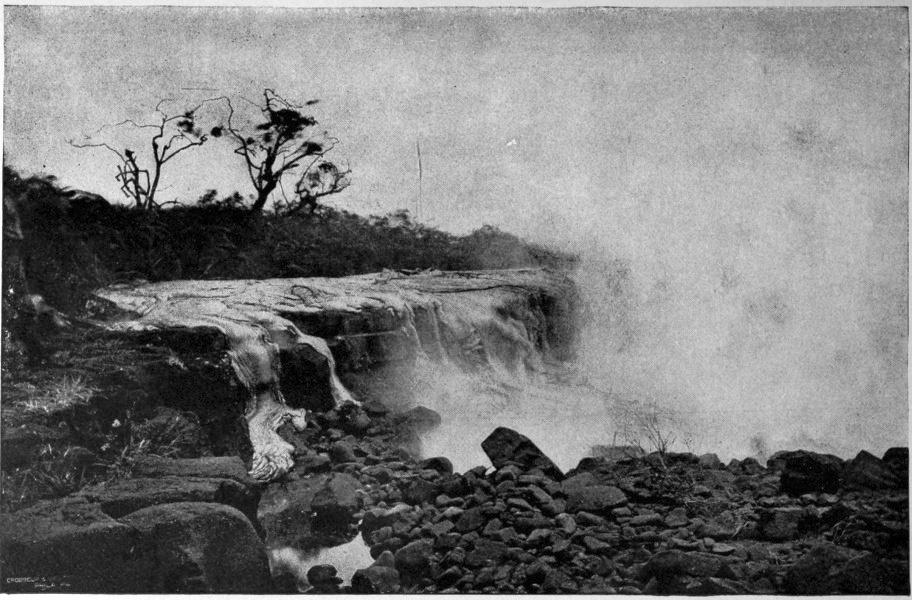
LAVA CASCADE FLOW.
At last we reached the foot of the present crater, and commenced the ascent of the outer wall. Many times the thin crust gave way beneath our guide, and he had to retire quickly from the hot, blinding, choking fumes that immediately burst forth. But we succeeded in reaching the top; and then what a sight presented itself to our astonished eyes! I could neither speak nor move at first, but could only stand and gaze at the terrible grandeur of the scene.
We were standing on the extreme edge of the precipice, overhanging a lake of molten fire, a hundred feet below us, and nearly a mile across. Dashing against the cliffs on the opposite side, with a noise like the roar of a stormy ocean, waves of blood-red, fiery, liquid lava hurled their billows upon an iron-bound headland, and then rushed up the face of the cliffs to toss their gory spray high in the air. The restless, heaving lake boiled and bubbled, never remaining the same for two minutes together. Its normal colour seemed to be a dull, dark red, covered with a thin grey scum, which every moment and in every part swelled and cracked, and emitted fountains, cascades, and whirlpools of yellow and red fire, while sometimes one big golden river, sometimes four or five flowed across it. There was an island on one side of the lake, which the fiery waves seemed to attack unceasingly with relentless fury, as if bent on hurling it from its base. On the other side was a large cavern, into which the burning mass rushed with a loud roar, breaking down in its impetuous headlong career the gigantic stalactites that overhung the mouth of the cave, and flinging up the liquid material for the formation of fresh ones.
It was all terribly grand, magnificently sublime; but no words could adequately describe such a scene. The precipice on which we were standing overhung the crater so much that it was impossible to see what was going on immediately beneath; but from the columns of smoke and vapour that arose, the flames and sparks that constantly drove us back from the edge, it was easy to imagine that there must have been two or three grand fiery fountains below. As the sun set, and the darkness enveloped the scene, it became more awful than ever. We retired a little way from the brink, to breathe some fresh air, and to try and eat the food we had brought with us; but this was an impossibility. Every instant a fresh explosion or glare made us jump up to survey the stupendous scene. The violent struggles of the lava to escape from its fiery bed, and the loud and awful noises by which they were at times accompanied, suggested the idea that some imprisoned monsters were trying to release themselves from
their bondage with shrieks and groans, and cries of agony and despair, at the futility of their efforts.
Sometimes there were at least seven spots on the borders of the lake where the molten lava dashed up furiously against the rocks— seven fire-fountains playing simultaneously. With the increasing darkness the colours emitted by the glowing mass became more and more wonderful, varying from the deepest jet-black to the palest grey, from darkest maroon through cherry and scarlet to the most delicate pink, violet, and blue; from the richest brown, through orange and yellow, to the lightest straw-colour. And there was yet another shade, only describable by the term “molten-lava colour.”
Even the smokes and vapours were rendered beautiful by their borrowed lights and tints, and the black peaks, pinnacles, and crags, which surrounded the amphitheatre, formed a splendid and appropriate background. Sometimes great pieces broke off and tumbled with a crash into the burning lake, only to be remelted and thrown up anew. I had for some time been feeling very hot and uncomfortable, and on looking round the cause was at once apparent. Not two inches beneath the surface, the grey lava on which we were standing and sitting was red-hot. A stick thrust through it caught fire, a piece of paper was immediately destroyed, and the gentlemen found the heat from the crevices so great that they could not approach near enough to light their pipes.
One more last look, and then we turned our faces away from the scene that had enthralled us for so many hours. The whole of the lava we had crossed, in the extinct crater, was now aglow in many patches, and in all directions flames were bursting forth, fresh lava was flowing, and smoke and steam were issuing from the surface. It was a toilsome journey back again, walking as we did in single file, and obeying the strict injunctions of our head guide to follow him closely, and to tread exactly in his footsteps. On the whole it was easier by night than by day to distinguish the route to be taken, as we could now see the dangers that before we could only feel; and many were the fiery crevices we stepped over or jumped across. Once I slipped, and my foot sank through the thin crust. Sparks
issued from the ground, and the stick on which I leaned caught fire before I could fairly recover myself.
Monday, December 25th, (Christmas Day).
Turning in last night was the work of a very few minutes, and this morning I awoke perfectly refreshed and ready to appreciate anew the wonders of the prospect that met my eyes. The pillar of fire was still distinctly visible, when I looked out from my window, though it was not so bright as when I had last seen it: but even as I looked it began to fade, and gradually disappeared. At the same moment a river of glowing lava issued from the side of the bank which we had climbed with so much difficulty yesterday, and slowly but surely overflowed the ground we had walked over. I woke Tom, and you may imagine the feelings with which we gazed upon this startling phenomenon, which, had it occurred a few hours earlier, might have caused the destruction of the whole party.
AVoyageintheSunbeam(London, 1878).
TROLLHÄTTA
HANS CHRISTIAN ANDERSEN
Whom did we meet at Trollhätta? It is a strange story. We will relate it.
We landed at the first sluice and immediately stood in a kind of English garden; the broad pathways are covered with gravel and rise in low terraces between the green sunlit greensward. It is charming and delightful here, but by no means imposing; if one desires to be excited in this manner, he must go a little higher up to the old sluices, that have burst, deep and narrow, through the hard rock. Nature is magnificent here, and the water roars and foams in its deep bed far below. Up here one looks over valley and river; the bank of the river on the other side rises in green undulating hills, with clusters of leafy trees and wooden houses painted red; rocks and pine forests hem in the landscape. Through the sluices steamboats and sailing vessels are ascending; the water itself is the attendant spirit that must bear them up above the rock. And from the forest it issues, buzzing, roaring, and blustering. The din of the Trollhätta Falls mingles with the noise of the sawmills and the smithies.
“In three hours we shall be through the sluices,” said the Captain, “and then you shall visit the Falls. We shall meet again at the inn above.”
We went along the path that led through the forest and thickets; a whole flock of bare-headed boys surrounded us, all wishing to be our guides; each one outscreamed the other, and each gave contradictory explanations of how high was the water and how high it did not or could rise; and here was also a great difference of opinion among the learned. Soon we came to a halt on a large
heather-covered rock, a dizzying eminence. Before us, but deep below, the foaming, roaring water—the Hell Fall, and over this, cascade after cascade, the rich, swelling, rushing river, the outlet of the largest lake in Sweden. What a sight, what a foaming above and below! It is like the waves of the sea, or like effervescing champagne, or like boiling milk; the water rushes around two rocky islands above so that the spray rises like mist from a meadow, while below, it is more compressed, and, hurrying away, returns in circles; then it rolls down in a long wave-like fall, the Hell Fall. What a roaring storm in the deep—what a spectacle! Man is dumb. And so were also the screaming little guides; they were silent, and when they renewed their explanations and stories, they did not get far before an old gentleman, whom none of us had noticed, although he was here among us, made himself heard above the noise with his peculiarly shrill voice; he spoke of the place and its former days as if they had been of yesterday.
“Here on the rocky isles,” said he, “here in olden times the warriors, as they are called, decided their disputes. The warrior, Stärkodder, dwelt in this region, and took a fancy to the pretty maid Ogn; but she fancied Hergrimer the more, and in consequence he was challenged by Stärkodder to a duel here by the Falls and met his death; but Ogn sprang towards them, and, seizing her lover’s bloody sword, thrust it into her heart. Stärkodder did not get her. So a hundred years passed and another hundred; the forest became heavy and thick, wolves and bears prowled here summer and winter, and wicked robbers hid their booty here and no one could find them; yonder, by the Fall before Top Island, on the Norwegian side, was their cave; now it has fallen in—the cliff there overhangs it!”
“Yes, the Tailors’ Cliff!” screamed all the boys. “It fell in the year 1755!”
“Fell!” cried the old man as if astonished that any one could know of it but himself. “Everything will fall: the tailor also fell. The robbers placed him upon the cliff and told him that if he would be liberated for his ransom he must sew a suit of clothes there; he tried to do it,
but as he drew out his thread at the first stitch, he became dizzy and fell into the roaring water, and thus the rock got the name of The Tailors’ Cliff. One day the robbers caught a young girl, and she betrayed them; she kindled a fire in the cavern, the smoke was seen, the cavern was discovered, and the robbers imprisoned and executed; that outside there is called The Thieves’ Fall, and below, under the water, is another cave; the river rushes in there and issues out foaming; you can see it well up here and hear it too, but it can be heard better under the stony roof of the mountain sprite.”
And we went on and on along the waterfall towards Top Island, always on smooth paths covered with saw-dust to Polhelm’s-Sluice; a cleft has been made in the rock for the first intended sluice-work, which was not finished, but on account of which has been shaped the most imposing of all the Trollhätta Falls; the hurrying water falls perpendicularly into the dark depth. The side of the rock here is connected with Top Island by means of a light iron bridge, which seems to be thrown over the abyss; we venture on this swaying bridge above the rushing, whirling water, and soon stand on the little rocky island between firs and pines that dart out of the crevices; before us rushes a sea of waves, broken as they rebound against the rock on which we stand, spraying us with their fine eternal mist; on each side the torrent flows as if shot from a gigantic cannon, waterfall upon waterfall; we look above them all and are lulled by the harmonic tone that has existed for thousands of years.
“No one can ever get to that island over there,” said one of our party, pointing to the large island above the highest fall.
“I know one who got there!” exclaimed the old man, and nodded with a peculiar smile.
“Yes, my grandfather got there!” said one of the boys, “but for a hundred years scarcely any one else has reached it. The cross that stands there was set up by my grandfather. It had been a severe winter, the whole of Lake Venern was frozen, the ice dammed up the outlet, and for many hours the bottom was dry. Grandfather has told us about it: he and two others went over, set up the cross, and
returned. Just then there was a thundering and cracking noise just like cannon, the ice broke up and the stream overflowed meadows and forest. It is true, every word I say!”
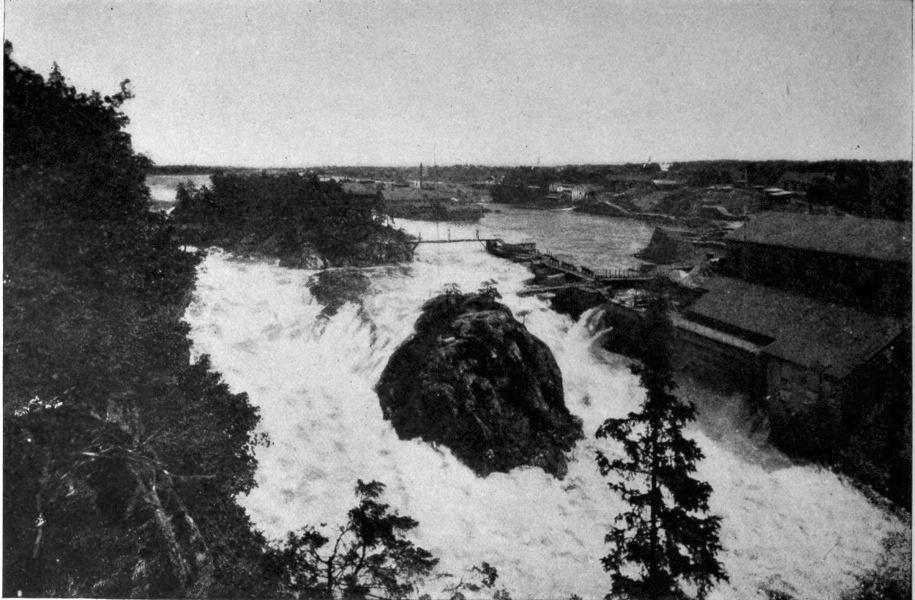
TROLLHÄTTA.
One of the travellers cited Tegner:
“Vildt Göta stortade fran Fjallen, Hemsk Trollet fran sat Toppfall röt!
Men Snillet kom och sprängt stod Hallen, Med Skeppen i sitt sköt!”
“Poor mountain sprite,” he added, “thy power and glory are failing! Man flies beyond thee—Thou must learn of him!”
The garrulous old man made a grimace, and muttered something to himself—but we were now by the bridge before the inn, the
steamboat glided through the open way, every one hurried on board and immediately it shot above the Fall just as if no Fall existed.
It was evening; I stood on the heights of Trollhätta’s old sluices, and saw the ships with outspread sails glide away over the meadows like large white spectres. The sluice-gates opened with a heavy, crashing sound like that related of the copper gates of the Vehmgericht; the evening was so still; in the deep silence the tone of the Trollhätta Fall was like a chorus of a hundred water-mills, ever one and the same tone and sometimes the ringing of a deep and mighty note that seemed to pass through the very earth—and yet through all this the eternal silence of Nature was felt;—suddenly a great bird with heavily flapping wings flew out of the trees in the deep woods towards the waterfall. Was it the mountain sprite? We must believe so.
PicturesofSweden(Leipzig, 1851).
THE GRAND CANYON OF THE COLORADO
(UNITEDSTATES)
C. F. GORDON-CUMMING
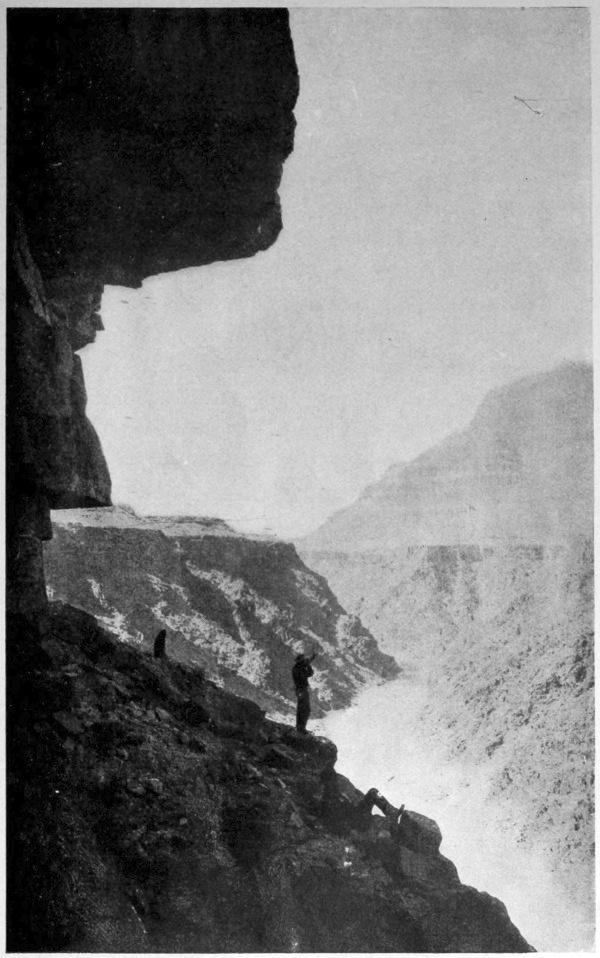
Probably the greatest chasm in the known world is the grand canyon of the Colorado river (the Rio Colorado Grande), which is a gorge upward of two hundred miles in length, and of tremendous depth. Throughout this distance its vertical crags measure from one to upwards of six thousand feet in depth! Think of it! The highest mountain in Scotland measures 4,418 feet. The height of Niagara is 145 feet. And here is a narrow, tortuous pass where the river has eaten its way to a depth of 6,200 feet between vertical granite crags!
Throughout this canyon there is no cascade; and though the river descends 16,000 feet within a very short distance, forming rushing rapids, it is nevertheless possible to descend it by a raft—and this has actually been done, in defiance of the most appalling dangers and hardships. It is such a perilous adventure as to be deemed worthy of note even in this country, where every prospector carries his life in his hand, and to whom danger is the seasoning of daily life, which, without it, would appear positively monotonous.
I suppose no river in the world passes through scenery so extraordinary as does the Colorado river, in its journey of 2,000 miles from its birthplace in the Rocky mountains, till, traversing the burning plains of New Mexico, it ends its course in the Gulf of California. Its early career is uneventful. In its youth it bears a maiden name, and, as the Green river, wends it way joyously through the upper forests. Then it reaches that ghastly country known as the mauvaisesterresof Utah and Arizona—a vast region—
extending also into Nevada and Wyoming, which, by the ceaseless action of water, has been carried into an intricate labyrinth of deep gloomy caverns.
For a distance of one thousand miles the river winds its tortuous course through these stupendous granite gorges, receiving the waters of many tributary streams, each rushing along similar deeply hewn channels.
In all the range of fiction no adventures can be devised more terrible than those which have actually befallen gold-seekers and hunters who, from any cause, have strayed into this dreary and awesome region. It was first discovered by two bold explorers, by name Strobe and White, who, being attacked by Indians, took refuge in the canyons. Preferring to face unknown dangers to certain death at the hands of the enemy, they managed to collect enough timber to construct a rude raft, and determined to attempt the descent.
Once embarked on that awful journey, there was no returning—they must endure to the bitter end.
On the fourth day the raft was upset. Strobe was drowned, and the little store of provisions and ammunition was lost. White contrived to right the raft, and for ten days the rushing waters bore him down the frightful chasm, seeing only the perpendicular cliffs on either side, and the strip of sky far overheard—never knowing, from hour to hour, but that at the next winding of the canyon the stream might overleap some mighty precipice, and so end his long anguish. During those awful ten days of famine, a few leaves and seed-pods, clutched from the bushes on the rocks, were his only food.
At length he reached a wretched settlement of half-bred Mexicans, who, deeming his escape miraculous, fed him; and eventually he reached the homes of white men, who looked on him (as well they might) as on one returned from the grave. The life thus wonderfully saved, was, however, sacrificed a few months later, when he fell into the hands of his old Indian foes.
The story of White’s adventure was confirmed by various trappers and prospectors, who, from time to time, ventured some little way into this mysterious rock-labyrinth; and it was determined to attempt a government survey of the region. Accordingly, in 1869, a party, commanded by Major J. W. Powell, started on this most interesting but dangerous expedition. Warned by the fate of a party who attempted to explore the country in 1855, and who, with the exception of two men (Ashley and another), all perished miserably, the government party started with all possible precautions.
THE GRAND CAÑON OF THE COLORADO.
Four light Chicago-built boats were provisioned for six months, and, with infinite difficulty, were transported 1,500 miles across the desert. On reaching their starting-point, they were lowered into the awful ravines, from which it was, to say the least, problematic whether all would emerge alive. The dangers, great enough in reality, had been magnified by rumour. It was reported, with every semblance of probability, that the river formed terrible whirlpools— that it flowed underground for hundreds of miles, and emerged only to fall in mighty cataracts and appalling rapids. Even the friendly Indians entreated the explorers not to attempt so rash an enterprise, assuring them that none who embarked on that stream would escape alive.
But in the face of all such counsel, the expedition started, and for upwards of three months the party travelled, one may almost say in the bowels of the earth—at least in her deepest furrows—through canyons where the cliffs rise, sheer from the water, to a height of three-quarters of a mile!
They found, as was only natural, that imagination had exaggerated the horrors of the situation, and that it was possible to follow the rock-girt course of the Colorado through all its wanderings—not without danger, of course. In many places the boat had to be carried. One was totally wrecked and its cargo lost, and the others came to partial grief, entailing the loss of valuable instruments, and almost more precious lives. Though no subterranean passage was discovered, nor any actual waterfall, there were, nevertheless, such dangerous rapids as to necessitate frequent troublesome portage; and altogether, the expedition had its full share of adventure.
The ground was found to vary considerably. In some places the rock is so vivid in colour—red and orange—that the canyons were distinguished as the Red Canyon and the Flaming Gorge. Some are mere fissures of tremendous depth; while in other places, where the water has carved its way more freely, they are broad, here and there expanding into a fertile oasis, where green turf and lovely groves are
enclosed by stupendous crags—miniature Yosemites—which to these travellers appeared to be indeed visions of Paradise.
GraniteCrags(Edinburgh and London, 1884).
THE ROCK OF GIBRALTAR
(SPAIN)
AUGUSTUS J. C. HARE
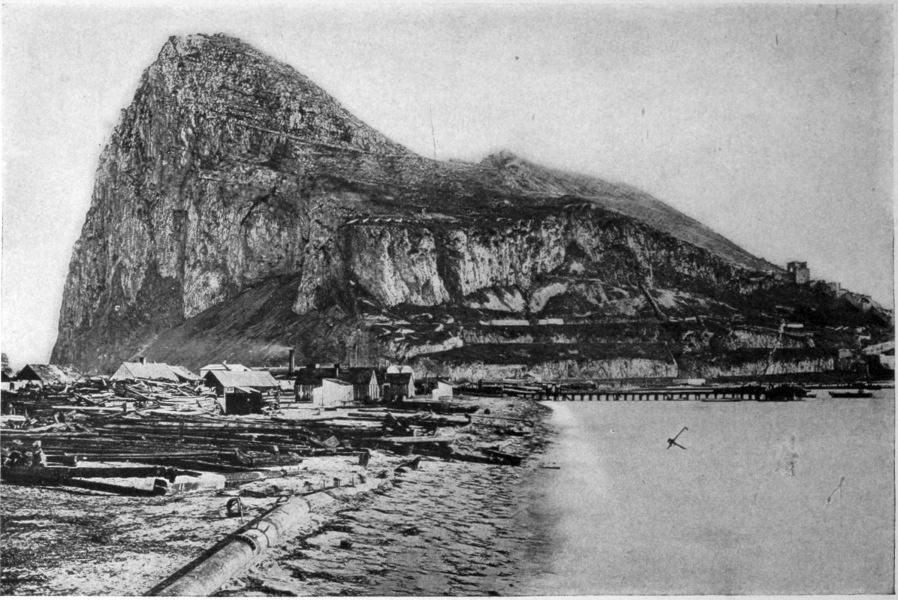
It was a lovely day, and a calm sea, which was a great subject of rejoicing, for even as it was the rickety Spanish vessel rolled disagreeably. Owing to the miserable slowness of everything, we were eleven hours on board. There was little interest till we reached the yellow headland of Trafalgar. Then the rugged outlines of the African coast rose before us, and we entered the straits, between Tarifa sleeping amid its orange groves on the Spanish coast, and the fine African peak above Ceuta. Soon, on the left, the great rock of Gibraltar rose from the sea like an island, though not the most precipitous side, which turns inwards towards the Mediterranean. But it was already gun-fire, and too late to join another steamer and land at the town, so we waited for a shoal of small boats which put out from Algeciras, and surrounded our steamer to carry us on shore.
Here we found in the Fonda Inglesa (kept by an English landlady), one of the most primitive but charming little hotels we ever entered. The view from our rooms alone decided us to stay there some days. Hence, framed by the balcony, Gibraltar rose before us in all the glory of its rugged sharp-edged cliffs, grey in the morning, pink in the evening light, with the town at its foot, whence, at night, thousands of lights were reflected on the still water. In the foreground were groups of fishing-boats at anchor, and, here and there, a lateen sail flitted, like a white albatross, across the bay. On the little pier beneath us was endless life and movement, knots of fishermen, in their blue shirts and scarlet caps and sashes, mingling with solemn-looking Moors in turbans, yellow slippers, and flowing burnouses, who were watching the arrival or embarcation of their
wares; and an endless variety of travellers from all parts of Europe, waiting for different steamers, or come over to see the place. Here an invalid might stay, imbibing health from the fine air and sunshine, and never be weary of the ever changing diorama. In every direction delightful walks wind along the cliffs through groves of aloes and prickly-pear, or descend into little sandy coves full of beautiful shells. Behind the town, a fine old aqueduct strides across the valley, and beyond it the wild moors begin at once sweeping backwards to a rugged chain of mountains. Into the gorges of these mountains we rode one day, and most delightful they are, clothed in parts with magnificent old cork-trees, while in the depths of a ravine, overhung with oleander and rhododendron, is a beautiful waterfall.
THE ROCK OF GIBRALTAR.
It was with real regret that we left Algeciras and made the short voyage across the bay to Gibraltar, where we instantly found ourselves in a place as unlike Spain as it is possible to imagine. Upon the wharf you are assailed by a clamour of English-speaking porters
and boatmen. Passing the gates, you come upon a barrack-yard swarming with tall British soldiers, looking wonderfully bright and handsome, after the insignificant figures and soiled, shabby uniforms of the Spanish army. Hence the Waterport Street opens, the principal thoroughfare of the town, though from its insignificant shops, with English names, and its low public-houses, you have to look up at the strip of bright blue sky above, to be reminded that you are not in an English seaport.
Just outside the principal town, between it and the suburb of Europe, is the truly beautiful Alameda, an immense artificial garden, where endless gravel paths wind through labyrinths of geraniums and coronella and banks of flame-coloured ixia, which are all in their full blaze of beauty under the March sun, though the heat causes them to wither and droop before May. During our stay at Gibraltar, it has never ceased to surprise us that this Alameda, the shadiest and pleasantest place open to the public upon the Rock, should be almost deserted; but so it is. Even when the band playing affords an additional attraction, there are not a dozen persons to listen to it; whereas at Rome on such occasions, the Pincio, exceedingly inferior as a public garden, would be crowded to suffocation, and always presents a lively and animated scene.
One succession of gardens occupies the western base of the Rock, and most luxuriant and gigantic are the flowers that bloom in them. Castor-oil plants, daturas, and daphnes, here attain the dignity of timber, while geraniums and heliotropes many years old, so large as to destroy all the sense of floral proportions which has hitherto existed in your mind. It is a curious characteristic, and typical of Gibraltar, that the mouth of a cannon is frequently found protruding from a thicket of flowers.
The eastern side of the Rock, in great part a perpendicular precipice, is elsewhere left uncultivated, and is wild and striking in the highest degree. Here, beyond the quaint Jewish cemetery of closely set gravestones, bearing Hebrew inscriptions on the open hillside, a rugged path winds through rocks and tangled masses of flowers and
palmists, to a curious stalactitic cavern called Martin’s Cave. On this side of the cliff a remnant of the famous “apes of Tarshish” is suffered to remain wild and unmolested, though their numbers, always very small, have lately been reduced by the very ignorant folly of a young officer, who shot one and wounded nine others, for which he has been very properly impounded.
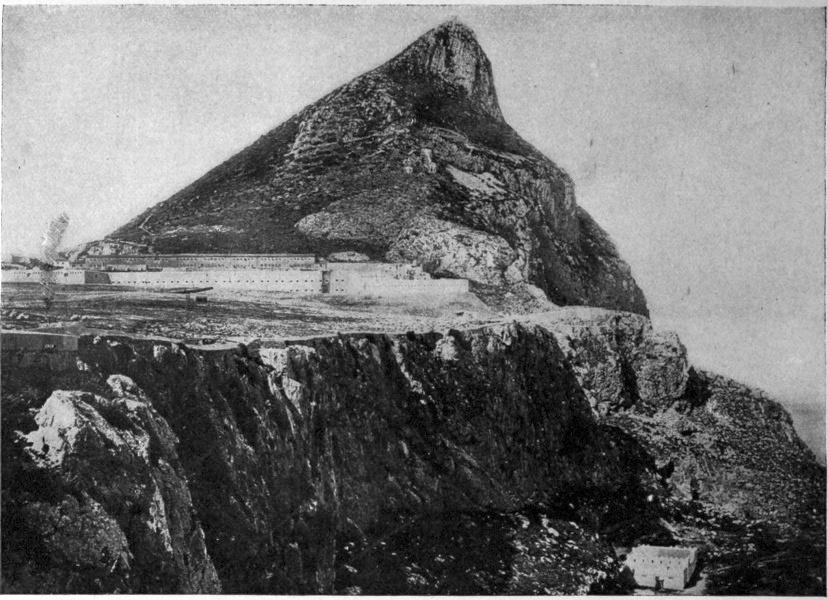
On the northern side of the Rock are the famous galleries tunnelled in the face of the precipice, with cannon pointing towards Spain from their embrasures. Through these, or, better, by delightful paths, fringed with palmettos and asphodel, you may reach El Hacho, the signal station, whence the view is truly magnificent over the sea, and the mountain chains of two continents, and down into the blue abysses beneath the tremendous precipice upon which it is placed.
THE ROCK OF GIBRALTAR.
The greatest drawback to the charms of Gibraltar has seemed to be the difficulty of leaving it. It is a beautiful prison. We came fully intending to ride over the mountain passes by Ronda, but on arriving we heard that the whole of that district was in the hands of the brigands under the famous chief Don Diego, and the Governor positively refused to permit us to go that way. Our lamentations at this have since been cut short by the news of a double murder at the hands of the brigands on the way we wished to have taken, and at the very time we should have taken it. So we must go to Malaga by sea, and wait for the happy combination of a good steamer and calm weather falling on the same day.
Late in the afternoon of the 15th of March we embarked on board the Lisbonin the dockyard of Gibraltar. It had been a lovely day, and the grand Rock had looked its best, its every cleft filled with flowers and foliage. The sun set before we had rounded Europe Point, and the precipitous cliffs of the eastern bay rose utterly black against the yellow sky.
WanderingsinSpain(London, 1873).
THINGVALLA
(ICELAND)
LORD DUFFERIN
At last I have seen the famous Geysers, of which every one has heard so much; but I have also seen Thingvalla, of which no one has heard anything. The Geysers are certainly wonderful marvels of nature, but more wonderful, more marvellous is Thingvalla; and if the one repay you for crossing the Spanish Sea, it would be worth while to go round the world to reach the other.
Of the boiling fountains I think I can give you a good idea, but whether I can contrive to draw for you anything like a comprehensible picture of the shape and nature of the Almanna Gja, the Hrafna Gja, and the lava vale, called Thingvalla, that lies between them, I am doubtful. Before coming to Iceland I had read every account that had been written of Thingvalla by any former traveller, and when I saw it, it appeared to me a place of which I had never heard; so I suppose I shall come to grief in as melancholy a manner as my predecessors, whose ineffectual pages whiten the entrance to the valley they have failed to describe.
After an hour’s gradual ascent through a picturesque ravine, we emerged upon an immense desolate plateau of lava, that stretched away for miles and miles like a great stony sea. A more barren desert you cannot conceive. Innumerable boulders, relics of the glacial period, encumbered the track. We could only go at a footpace. Not a blade of grass, not a strip of green, enlivened the prospect, and the only sound we heard was the croak of the curlew and the wail of the plover. Hour after hour we plodded on, but the grey waste seemed interminable, boundless: and the only consolation Sigurdr would vouchsafe was that our journey’s end lay
on this side of some purple mountains that peeped like the tents of a demon leaguer above the stony horizon.
As it was already eight o’clock, and we had been told the entire distance from Reykjavik to Thingvalla was only five-and-thirty miles, I could not comprehend how so great a space should still separate us from our destination. Concluding more time had been lost in shooting, lunching, etc., by the way than we supposed, I put my pony into a canter, and determined to make short work of the dozen miles which seemed still to lie between us and the hills, on this side of which I understood from Sigurdr our encampment for the night was to be pitched.
Judge then of my astonishment when, a few minutes afterwards, I was arrested in full career by a tremendous precipice, or rather chasm, which suddenly gaped beneath my feet, and completely separated the barren plateau we had been so painfully traversing from a lovely, gay, sunlit flat, ten miles broad, that lay,—sunk at a level lower by a hundred feet,—between us and the opposite mountains. I was never so completely taken by surprise; Sigurdr’s purposely vague description of our halting-place was accounted for.
We had reached the famous Almanna Gja. Like a black rampart in the distance, the corresponding chasm of the Hrafna Gja cut across the lower sloop of the distant hills, and between them now slept in sunshine and beauty the broad verdant plain[4] of Thingvalla.
Ages ago,—who shall say how long,—some vast commotion shook the foundations of the island, and bubbling up from sources far away amid the inland hills, a fiery deluge must have rushed down between their ridges, until, escaping from the narrow gorges, it found space to spread itself into one broad sheet of molten stone over an entire district of country, reducing its varied surface to one vast blackened level.
One of two things then occurred: either the vitrified mass contracting as it cooled,—the centre area of fifty square miles burst asunder at either side from the adjoining plateau, and sinking down
to its present level, left the two paralleled Gjas, or chasms, which form its lateral boundaries, to mark the limits of the disruption; or else, while the pith or marrow of the lava was still in a fluid state, its upper surface became solid, and formed a roof beneath which the molten stream flowed on to lower levels, leaving a vast cavern into which the upper crust subsequently plumped down.
But to return where I left myself, on the edge of the cliff, gazing down with astonished eyes over a panorama of land and water imbedded at my feet. I could scarcely speak for pleasure and surprise; Fitz was equally taken aback, and as for Wilson, he looked as if he thought we had arrived at the end of the world. After having allowed us sufficient time to admire the prospect, Sigurdr turned to the left, along the edge of the precipice, until we reached a narrow pathway accidentally formed down a longitudinal niche in the splintered face of the cliff, which led across the bottom, and up the opposite side of the Gja, into the plain of Thingvalla.
Independently of its natural curiosities, Thingvalla was most interesting to me on account of the historical associations connected with it. Here, long ago, at a period when feudal despotism was the only government known throughout Europe, free parliaments used to sit in peace, and regulate the affairs of the young Republic; and to this hour the precincts of its Commons House of Parliament are as distinct and unchanged as on the day when the high-hearted fathers of the emigration first consecrated them to the service of a free nation. By a freak of nature, as the subsiding plain cracked and shivered into twenty thousand fissures, an irregular oval area, of about two hundred feet by fifty, was left almost entirely surrounded by a crevice so deep and broad as to be utterly impassable;—at one extremity alone a scanty causeway connected it with the adjoining level, and allowed of access to its interior. It is true, just at one point the encircling chasm grows so narrow as to be within the possibility of a jump; and an ancient worthy, named Flosi, pursued by his enemies, did actually take it at a fly: but as leaping an inch short would have entailed certain drowning in the bright green waters that sleep forty feet below, you can conceive there was never much
danger of this entrance becoming a thoroughfare. I confess that for one moment, while contemplating the scene of Flosi’s exploit, I felt, like a true Briton,—an idiotic desire to be able to say that I had done the same;—that I survive to write this letter is a proof of my having come subsequently to my senses.
This spot, then, erected by nature almost into a fortress, the founders of the Icelandic constitution chose for the meetings of their Thing, or Parliament; armed guards defended the entrance, while the grave bonders deliberated in security within: to this day, at the upper end of the place of meeting, may be seen the three hummocks, where sat in state the chiefs and judges of the land.
But those grand old times have long since passed away. Along the banks of the Oxeraa no longer glisten the tents and booths of the assembled lieges; no longer stalwart berserks guard the narrow entrance to the Althing; ravens alone sit on the sacred Logberg; and the floor of the old Icelandic House of Commons is ignominiously cropped by the sheep of the parson. For three hundred years did the gallant little Republic maintain its independence—three hundred years of unequalled literary and political vigour. At last its day of doom drew near. Like the Scotch nobles in the time of Elizabeth, their own chieftains intrigued against the liberties of the Icelandic people; and in 1261 the island became an appendage of the Norwegian crown. Yet even then the deed embodying the concession of their independence was drawn up in such haughty terms as to resemble rather the offer of an equal alliance than the renunciation of imperial rights.
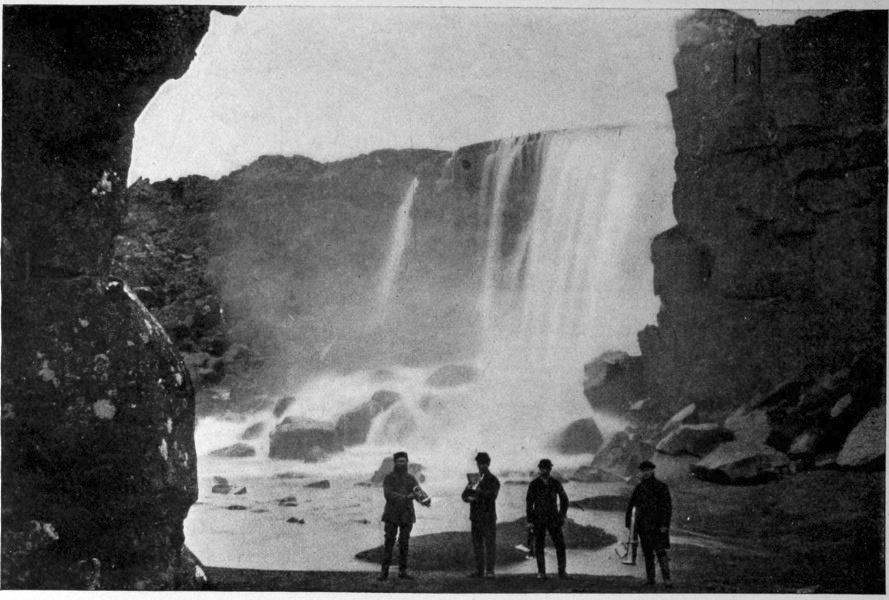
THINGVALLA.
As I gazed around on the silent, deserted plain, and paced to and fro along the untrodden grass that now clothed the Althing, I could scarcely believe it had ever been the battle-field where such keen and energetic wits encountered,—that the fire-scathed rocks I saw before me were the very same that had once inspired one of the most successful rhetorical appeals ever hazarded in a public assembly.
From the Althing we strolled over to the Almanna Gja, visiting the Pool of Execution on our way. As I have already mentioned, a river from the plateau above leaps over the precipice into the bottom of the Gja, and flows for a certain distance between its walls. At the foot of the fall, the waters linger for a moment, in a dark, deep, brimming pool, hemmed in by a circle of ruined rocks; to this pool, in ancient times, all women convicted of capital crimes were immediately taken, and drowned. Witchcraft seems to have been the principal weakness of ladies in those days, throughout the
Scandinavian countries. For a long period, no disgrace was attached to its profession. Odin himself, we are expressly told, was a great adept, and always found himself very much exhausted at the end of his performance; which leads me to think that, perhaps, he dabbled in electro-biology.
Turning aside from what, I dare say, was the scene of many an unrecorded tragedy, we descended the gorge of the Almanna Gja, towards the lake; and I took advantage of the opportunity again to examine its marvellous construction. The perpendicular walls of rock rose on either hand from the flat greensward that carpeted its bottom, pretty much as the waters of the Red Sea must have risen on each side of the fugitive Israelites. A blaze of light smote the face of one cliff, while the other lay in the deepest shadow; and on the rugged surface of each might still be traced corresponding articulations, that once had dovetailed into each other, ere the igneous mass was rent asunder. So unchanged, so recent seemed the vestiges of this convulsion, that I felt as if I had been admitted to witness one of nature’s grandest and most violent operations, almost in the very act of its execution. A walk of about twenty minutes brought us to the borders of the lake—a glorious expanse of water, fifteen miles long, by eight miles broad, occupying a basin formed by the same hills, which must also, I imagine, have arrested the further progress of the lava torrent. A lovelier scene I have seldom witnessed. In the foreground lay huge masses of rock and lava, tossed about like the ruins of a world, and washed by waters as bright and green as polished malachite. Beyond, a bevy of distant mountains, robed by the transparent atmosphere in tints unknown to Europe, peeped over each other’s shoulders into the silver mirror at their feet, while here and there from among their purple ridges columns of white vapour rose like altar smoke towards the tranquil heaven.
The next morning we started for the Geysers; this time dividing the baggage-train, and sending on the cook in light marching order, with the materials for dinner. The weather still remained unclouded, and each mile we advanced disclosed some new wonder in the unearthly