To my wife Jan. Thanks for your never-ending encouragement and support. Without you, this book would have never been possible. Also, thanks to all the student entrepreneurs who contributed to the chapter opening features in the book. Your stories are both insightful and inspiring.
—BruceR.Barringer
To my family: I am so proud of each of you and so blessed by your perseverance and never-ending love and support. I know that sometimes it seems as though “we lose ourselves in work to do and bills to pay and that it’s a ride, ride, ride without much cover.” But you are always in my heart, a gift for which I remain deeply grateful.
R.Duane Ireland
This page intentionally left blank
BRIEF CONTENTS
PART 1 Decision to Become an Entrepreneur1
CHAPTER 1 Introduction to Entrepreneurship 3
PART 2 Developing Successful Business Ideas39
CHAPTER 2 Recognizing Opportunities and Generating Ideas41
CHAPTER 3 Feasibility Analysis 77
CHAPTER 4 Writing a Business Plan111
CHAPTER 5 Industry and Competitor Analysis 147
CHAPTER 6 Developing an Effective BusinessModel179
PART 3 Moving from an Idea to an Entrepreneurial Firm211
CHAPTER 7 Preparing the Proper Ethical and Legal Foundation213
CHAPTER 8 Assessing a New Venture’s Financial Strength and Viability253
CHAPTER 9 Building a New-Venture Team289
CHAPTER 10 Getting Financing or Funding319
PART 4 Managing and Growing an Entrepreneurial Firm355
CHAPTER 11 Unique Marketing Issues357
CHAPTER 12 The Importance of Intellectual Property393
CHAPTER 13 Preparing for and Evaluating the Challenges of Growth431
CHAPTER 14 Strategies for Firm Growth 461
CHAPTER 15 Franchising495
Glossary535
Name Index547
Company Index551
Subject Index557
Prefacexvii
PART 1 Decision to Become an Entrepreneur1
CHAPTER 1 Introduction to Entrepreneurship 3
Opening Profile—GIFTZIP.COM: The Classic Entrepreneurial Story3
INTRODUCTION TO ENTREPRENEURSHIP4
What Is Entrepreneurship?6
Why Become an Entrepreneur?7
Characteristics of Successful Entrepreneurs9
WHAT WENT WRONG? How a Lack of Passion and Too Few Customers
Can Kill a Business12
SAVVY ENTREPRENEURIAL FIRM: Angry Birds and Zeo14
Common Myths About Entrepreneurs15
Types of Start-Up Firms17
CHANGING DEMOGRAPHICS OF ENTREPRENEURS18
ENTREPRENEURSHIP’S IMPORTANCE21
Economic Impact of Entrepreneurial Firms21
Entrepreneurial Firms’ Impact on Society22
Entrepreneurial Firms’ Impact on Larger Firms22
PARTNERING FOR SUCCESS: Working Together: How Biotech Firms and Large Drug Companies Bring Pharmaceutical Products to Market23
THE ENTREPRENEURIAL PROCESS23
Decision to Become an Entrepreneur (Chapter 1)24
Developing Successful Business Ideas (Chapters 2–6)24
Moving from an Idea to an Entrepreneurial Firm (Chapters 7–10)25
Managing and Growing an Entrepreneurial Firm (Chapters 11–15)26
Application Questions239 | You Be the VC 7.1241 | You Be the VC 7.2242 | CASE 7.1242 | CASE 7.2244
ENDNOTES247
Appendix 7.1249
CHAPTER 8 Assessing a New Venture’s Financial Strength and Viability253
Opening Profile—KLYMIT: The Critical Importance of Cash Flow253
INTRODUCTION TO FINANCIAL MANAGEMENT255
Financial Objectives of a Firm256
The Process of Financial Management257
PARTNERING FOR SUCCESS: Organizing Buying Groups to Cut Costs and Maintain Competitiveness258
FINANCIAL STATEMENTS AND FORECASTS259
Historical Financial Statements260
SAVVY ENTREPRENEURIAL FIRM: Know the Facts Behind the Numbers262
Forecasts267
PRO FORMA FINANCIAL STATEMENTS271
WHAT WENT WRONG? Be Careful What You Wish For: How Growing Too Quickly Overwhelmed One Company’s Cash Flow272
Pro Forma Income Statement273
Pro Forma Balance Sheet273
Pro Forma Statement of Cash Flows275
Ratio Analysis277
Chapter Summary278 | Key Terms278 | Review Questions279 Application Questions279 | You Be the VC 8.1281 | You Be the VC 8.2281 | CASE 8.1282 | CASE 8.2284
ENDNOTES286
CHAPTER 9 Building a New-Venture Team289
Opening Profile—SCRIPPED: Hitting the Ground Running289
CREATING A NEW-VENTURE TEAM291
The Founder or Founders292
WHAT WENT WRONG? Devver: How Miscues in Regard to the Composition and Management of a New-Venture Team Can Kill a Start-up293
Recruiting and Selecting Key Employees296
SAVVY ENTREPRENEURIAL FIRM: Overcoming a Lack of Business Experience297
The Roles of the Board of Directors300
ROUNDING OUT THE TEAM: THE ROLE OF PROFESSIONAL ADVISERS302
Board of Advisers302
Lenders and Investors303
PARTNERING FOR SUCCESS: Need Help with Product Development? Consider Establishing a Customer Advisory Board304
Other Professionals306
Chapter Summary307 | Key Terms308 | Review Questions308 Application Questions308 | You Be the VC 9.1310 | You Be the VC 9.2311 | CASE 9.1311 | CASE 9.2313
ENDNOTES316
CHAPTER 10 Getting Financing or Funding319
Opening Profile—INDINERO: Raising Money Carefully and Deliberately319
THE IMPORTANCE OF GETTING FINANCING OR FUNDING321
Why Most New Ventures Need Funding321 Sources of Personal Financing322
Preparing to Raise Debt or Equity Financing324
PARTNERING FOR SUCCESS: TechStars and Y Combinator: A New Breed of Start-Up Incubators328
SOURCES OF EQUITY FUNDING329
Business Angels329
Venture Capital330
SAVVY ENTREPRENEURIAL FIRM: Open Angel Forum and AngelList: New Options for Getting in Front of Angel Investors332
WHAT WENT WRONG? How One Start-Up Caught the Attention of VCs, Raised Money, and Still Failed334
Application Questions344 | You Be the VC 10.1345 | You Be the VC 10.2346 | CASE 10.1347 | CASE 10.2349
ENDNOTES352
PART 4 Managing and Growing an Entrepreneurial Firm355
CHAPTER 11 Unique Marketing Issues357
Opening Profile—TRUE YOU COSMETICS: Creating a New Brand in the Cosmetics Industry357
SELECTING A MARKET AND ESTABLISHING A POSITION359
Segmenting the Market359
Selecting a Target Market360
Establishing a Unique Position361
BRANDING362
WHAT WENT WRONG? How Failing to Establish a Clear Position in the Marketplace Forced an Adorable Robotic Dinosaur to Fall Silent363
SAVVY ENTREPRENEURIAL FIRM: How Airbnb Used Blogs as a Stepping-Stone to Generate Substantial Buzz About Its Service366
THE 4PS OF MARKETING FOR NEW VENTURES367
Product367
Price368
Promotion370
PARTNERING FOR SUCCESS: How Landing a Partnership with an Influential Web Site and Soliciting Feedback from Customers Can Accelerate a Start-Up’s Visibility and Growth376
Application Questions382 | You Be the VC 11.1384 | You Be the VC 11.2384 | CASE 11.1385 | CASE 11.2388
ENDNOTES390
CHAPTER 12 The Importance of Intellectual Property393
Opening Profile—METROLEAP MEDIA, INC.: The Key Role of Intellectual Property in Its Early and Ongoing Success393
THE IMPORTANCE OF INTELLECTUAL PROPERTY395
Determining What Intellectual Property to Legally Protect396 WHAT WENT WRONG? Dippin’ Dots: Why the USPTO Invalidated Its Patent and It Now Has Two New Competitors398
The Four Key Forms of Intellectual Property399
PATENTS399
Types of Patents401
Who Can Apply for a Patent?402
The Process of Obtaining a Patent403
SAVVY ENTREPRENEURIAL FIRM: Knowing the Ins and Outs of Filing a Provisional Patent Application405
PARTNERING FOR SUCCESS: Individual Inventors and Large Firms: Partnering to Bring New Products to Market407
Patent Infringement407
TRADEMARKS408
The Four Types of Trademarks408
What Is Protected Under Trademark Law?409
Exclusions from Trademark Protection410 The Process of Obtaining a Trademark411
COPYRIGHTS412
What Is Protected by a Copyright?413
Exclusions from Copyright Protection414 How to Obtain a Copyright414
Copyright Infringement414
Copyrights and the Internet416
TRADE SECRETS416
What Qualifies for Trade Secret Protection?417
Trade Secret Disputes417
Trade Secret Protection Methods418
CONDUCTING AN INTELLECTUAL PROPERTY AUDIT419
Why Conduct an Intellectual Property Audit?419
The Process of Conducting an Intellectual Property Audit420
Application Questions422 | You Be the VC 12.1424 | You Be the VC 12.2424 | CASE 12.1425 | CASE 12.2427
ENDNOTES428
CHAPTER 13 Preparing for and Evaluating the Challenges of Growth431
Opening Profile—PURBLU BEVERAGES, INC.: Growing in a Cautious, Yet Deliberate Manner431
PREPARING FOR GROWTH433
Appreciating the Nature of Business Growth433 Staying Committed to a Core Strategy435
PARTNERING FOR SUCCESS: How Threadless Averted Collapse by Bringing on a Partner with Back-End Operational Expertise436 Planning for Growth437
REASONS FOR GROWTH438
SAVVY ENTREPRENEURIAL FIRM: Dogfish Head Brewery: How a Simple Initiative Can Contribute to a Start-Up’s Early Growth439
MANAGING GROWTH441
Knowing and Managing the Stages of Growth442
CHALLENGES OF GROWTH444
Managerial Capacity445
Day-to-Day Challenges of Growing a Firm446
WHAT WENT WRONG? How Trying to Build Out Its Own Capabilities in a Key Area Contributed to the Failure of a Promising Firm447
Chapter Summary449 | Key Terms450 | Review Questions450 Application Questions450 | You Be the VC 13.1452 | You Be the VC 13.2453 | CASE 13.1453 | CASE 13.2456
ENDNOTES459
CHAPTER 14 Strategies for Firm Growth 461
Opening Profile—PHONE HALO: Pivoting to Pursue New Strategies for Growth461
INTERNAL GROWTH STRATEGIES463
New Product Development464
SAVVY ENTREPRENEURIAL FIRM: SwitchFlops: How to Create Built-In Avenues for Future Growth465
Other Product-Related Strategies467
International Expansion470
EXTERNAL GROWTH STRATEGIES472
Mergers and Acquisitions474
WHAT WENT WRONG? Be Careful What You Wish For: How StumbleUpon’s Founder Sold His Company to eBay and Two Years Later Bought It Back Again476
Licensing477
Strategic Alliances and Joint Ventures479
PARTNERING FOR SUCCESS: Three Steps to Alliance Success480
Application Questions484 | You Be the VC 14.1485 | You Be the VC 14.2486 | CASE 14.1487 | CASE 14.2489
ENDNOTES492
CHAPTER 15 Franchising495
Opening Profile—COLLEGE NANNIES & TUTORS: Franchising as a Form of Business Ownership and Growth495
WHAT IS FRANCHISING AND HOW DOES IT WORK?497
What Is Franchising?497
How Does Franchising Work?498
ESTABLISHING A FRANCHISE SYSTEM501
When to Franchise501
SAVVY ENTREPRENEURIAL FIRM: Wahoo’s Fish Taco: A Moderate-Growth Yet Highly Successful Franchise Organization502
Steps to Franchising a Business503
Selecting and Developing Effective Franchisees504
Advantages and Disadvantages of Establishing a Franchise System505
BUYING A FRANCHISE507
WHAT WENT WRONG? Trouble at Curves International508 Is Franchising Right for You?509
The Cost of a Franchise509
PARTNERING FOR SUCCESS: Using Co-Branding to Reduce Costs and Boost Sales512
Finding a Franchise513
Advantages and Disadvantages of Buying a Franchise513
Steps in Purchasing a Franchise514
Watch Out! Common Misconceptions About Franchising516
LEGAL ASPECTS OF THE FRANCHISE RELATIONSHIP517
Federal Rules and Regulations518
State Rules and Regulations520
MORE ABOUT FRANCHISING520
Franchise Ethics520
International Franchising521 The Future of Franchising523
Chapter Summary524 | Key Terms525 | Review Questions525 Application Questions526 | You Be the VC 15.1527 | You Be the VC 15.2528 | CASE 15.1529 | CASE 15.2531
ENDNOTES533
Glossary535
Name Index547
Company Index551
Subject Index557
PREFACE
INTRODUCTION
We are truly excited about the fourth edition of our book and the promise it brings to you. A key reason for this is that in many parts of the world, studying and practicing entrepreneurship are very exciting and potentially highly rewarding activities for entrepreneurs and the nations in which they launch their ventures and conduct their operations. In this sense then, across the world, even during what are challenging economic conditions on a global basis, entrepreneurial ventures are creating and bringing to market new products and services that make our lives easier, enhance our productivity at work, improve our health, and entertain us in new and fascinating ways. As you will see from reading this book, entrepreneurs are some of the most passionate and inspiring people you’ll ever meet. This is why successful firms have been launched in a variety of unexpected places such as garages and an array of coffeehouses with wireless hot spots. Indeed, we never know the amount ofsuccess the person sitting next to us drinking coffee might achieve after launching an entrepreneurial venture!
As you might anticipate, the passion an entrepreneur has about a business idea, rather than fancy offices or other material things, is typically the number one predictor of a new venture’s success. Conversely, a lack of passion often leads to entrepreneurial failure.
The purpose of this book is to introduce you, our readers and students of entrepreneurship, to the entrepreneurial process. We do this because evidence suggests that the likelihood entrepreneurs will be successful increases when they thoroughly understand the parts of the entrepreneurial process as well as how to effectively use those parts. The fact that in the United States alone roughly one-third of new firms fail within the first two years while another 20percent fail within four years of their launching is the type of evidence we have in mind. These failure rates show that while many people are motivated tostart new firms, motivation alone is not enough; indeed, motivation must becoupled with accurate and timely information, a solid business idea, an effective business plan, and sound execution to maximize chances for success. Inthis book, we discuss many examples of entrepreneurial ventures and the actions separating successful firms from unsuccessful ones.
This book provides a thoughtful, practical guide to the process of successfully launching and growing an entrepreneurial venture. To do this, we provide you with a thorough analysis of the entrepreneurial process. We model this process for you in the first chapter and then use the model’s components to frame the book’s remaining parts. Because of its importance, we place a special emphasis on the beginnings of the entrepreneurial process—particularly opportunity recognition and feasibility analysis. We do this because history shows that many entrepreneurial ventures struggle or fail not because the business owners weren’t committed or didn’t work hard, but because the idea they were pushing to bring to the marketplace wasn’t the foundation for a vibrant, successful business.
WHAT IS NEW TO THIS EDITION?
We are committed to presenting you with the most up-to-date and applicable treatment of the entrepreneurial process available in the marketplace. While serving your educational interests, we want to simultaneously increase the likelihood that you will become excited by entrepreneurship’s promise as you read and study current experiences of entrepreneurs and their ventures as well as the findings springing from academic research.
To verify currency, thoroughness, and reader interest, we have made several important changes, as presented next, while preparing this fourth edition of our book:
Opening Profile Each chapter opens with a profile of an entrepreneurial venture that was started by one or more students while completing their university-level educational experience. All 15 Opening Profiles (one for each chapter) are new to this edition. These descriptions of real-life entrepreneurs demonstrate that many of us have the ability to be entrepreneurs even while enrolled as a college student. Each profile is specific to a chapter’s topic. We completed extensive interviews with each student entrepreneur(s) to obtain the required materials. While reading each profile, imagine yourself in the role of one or more of the entrepreneurs who launched a venture as a student.
Student Entrepreneurs’Insights At the side of each Opening Profile, wepresent entrepreneurs’ answers to a series of questions. In providing answers to these questions, the entrepreneurs who launched their venture while enrolled in school express their perspectives about various issues. An important benefit associated with thinking about these responses is that those reading this book today have opportunities to see that they, too, may indeed have the potential to launch an entrepreneurial venture quicker than originally thought.
Updated Features Almost every one of the “What Went Wrong?” “Savvy Entrepreneurial Firm,” “Partnering for Success,” and “You Be the VC” features are new to this edition. The very few features we did retain have been thoroughly updated. These features present you with contemporary issues facing today’s entrepreneurial ventures. The “You Be the VC” features, for example, allow readers to decide if the potential of a proposed entrepreneurial venture is sufficient to warrant funding.
New and Updated Cases Virtually all of the pairs of end-of-chapter cases are new to this edition. Those retained have been completely updated. Comprehensive in nature, we wrote these cases with the purpose of presenting readers with opportunities to use chapter-specific concepts to identify problems and propose solutions to situations facing actual entrepreneurial ventures. Questions appearing at the end of each case can be used to stimulate classroom discussions.
Updated References The amount of academic research examining entrepreneurship topics continues to grow. To provide you, our readers, with the most recent insights from the academic literature, we draw from newly published articles in important journals such as Strategic Entrepreneurship Journal, Entrepreneurship Theory and Practice, Journal of Business Venturing, and Academy of Management Journal. Similarly, we relied on the most current articles appearing in business publications such as TheWall Street Journal and Entrepreneur among others, to present you with examples of the actions being taken by today’s entrepreneurial ventures.
HOW IS THIS BOOK ORGANIZED?
To explain the entrepreneurial process and the way it typically unfolds, we divide our book into four parts and 15 chapters. The four parts of the entrepreneurial process model are:
Part 1: Decision to Become an Entrepreneur
Part 2: Developing Successful Business Ideas
Part 3: Moving from an Idea to an Entrepreneurial Firm
Part 4: Managing and Growing an Entrepreneurial Firm
Another random document with no related content on Scribd:
The Project Gutenberg eBook of The Nibelungs
This ebook is for the use of anyone anywhere in the United States and most other parts of the world at no cost and with almost no restrictions whatsoever. You may copy it, give it away or re-use it under the terms of the Project Gutenberg License included with this ebook or online at www.gutenberg.org. If you are not located in the United States, you will have to check the laws of the country where you are located before using this eBook.
Title: The Nibelungs
Author: Ferdinand Schmidt
Translator: George P. Upton
Release date: March 21, 2024 [eBook #73227]
Language: English
Original publication: Chicago: A. C. McClurg & Co, 1906
Credits: D A Alexander, David E. Brown, and the Online Distributed Proofreading Team at https://www.pgdp.net (This file was produced from images generously made available by The Internet Archive) *** START OF THE PROJECT GUTENBERG EBOOK THE NIBELUNGS
This eBook is dedicated to the memory of D A Alexander who made it possible.
LIFESTORIESFORYOUNGPEOPLE
THE NIBELUNGS
LIFE STORIES FOR YOUNG PEOPLE
TranslatedfromtheGermanby
GEORGEP.UPTON
12 Vols. Ready
BEETHOVEN
MOZART
BACH
MAID OF ORLEANS
WILLIAM TELL
THE LITTLE DAUPHIN
FREDERICK THE GREAT
MARIA THERESA
BARBAROSSA
WILLIAM OF ORANGE
GUDRUN
THE NIBELUNGS
Illustrated,each60centsnet
A. C. McCLURG & CO., CHICAGO
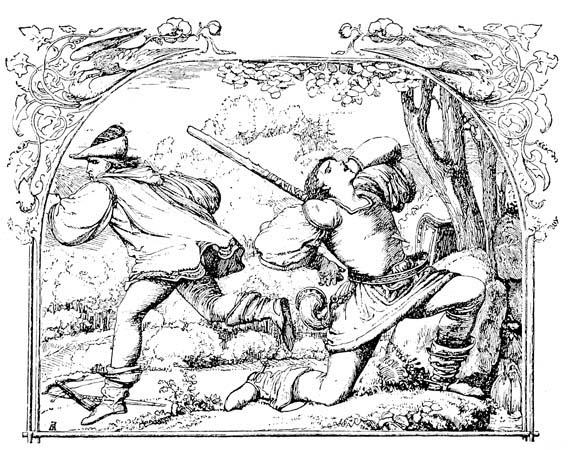
DEATHOFSIEGFRIED
LIFE STORIES FOR YOUNG PEOPLE
THE NIBELUNGS
TranslatedfromtheGermanof
FerdinandSchmidt
BY
GEORGE P. UPTON
Translatorof“Memories,”etc.
WITH FOUR ILLUSTRATIONS
C
Published September 22, 1906
THE UNIVERSITY PRESS, CAMBRIDGE, U.S.A.
Translator’s Preface
HE Nibelungen Lied (Nibelungen, name of an ancient royal race which possessed a great treasure; lied, song or ballad), one of the world’s greatest epics, made its appearance in the twelfth or thirteenth century, in South Germany. Its authorship is unknown. The writer, however, did not produce an original work, but made use of still earlier legends which had been handed down orally. The Nibelungen Lied is to be regarded, therefore, as a collection of ballads skilfully united so as to form a connected story. Its hero is Siegfried, who possessed the Nibelung hoard, which he won in Norway. Siegfried wooed Brunhild for Günther, King of Burgundy, and married the king’s sister, Kriemhild. He was treacherously slain by Hagen and the hoard was sunk in the Rhine. Kriemhild subsequently was married to Etzel (Attila), King of the Huns, and slew Hagen after he had been overcome in combat, but lost her own life at the hands of the “ancient,” Hildebrand. Both historical and mythical elements are mingled in this great poem, which should not be confounded with Wagner’s “Ring der Nibelungen,” in which he has taken many names from the German epic. The material for his famous music-dramas he found in the old Norse version, contained in the Volsunga Saga and the Edda.
The Nibelungen Lied was followed by many similar epics, among them “Gudrun,” “The Expedition of Ecken,” the tale of “King Laurin,” “Rosengarten,” and others, but The Nibelungen Lied is the greatest of all the German national traditions. One writer, in his description of the poem, says:
“Feudal loyalty and martial courage were the great virtues of these heroes. The poem contains a tale of revenge; but all the plot turns on the principle of loyalty, in obedience to which thousands lost their lives in a quarrel which had at first involved only two or three leading characters. Though this singular poem contains many traits of a warlike age, and closes with terrible scenes of carnage, it displays hardly a trace of such a motive as personal hatred, except in the character of the heroine.”
Considered as types, Siegfried stands for the enthusiasm, beauty, courage, lofty purpose, and high ambition of immortal youth; Hagen, for fierceness, boldness, savagery, and treachery; Kriemhild is the type of a gentle, loving nature roused to the highest intensity of furious longing for vengeance. Old as the poem is, it contains the development of all human passions,—manly beauty, heroism, and nobility by the side of unmanly cruelty and treachery; the blackest unfaithfulness by the side of faithfulness until death; the foulest of deeds by the side of the most loving; and the tenderest hearts combined with the most heroic souls. But among them all, no character stands out more resplendently as an exemplar for youth than Siegfried, himself the type of immortal youth.
In the making of this translation an older form of English expression has been employed as in better keeping, perhaps, with the older form of German, which was used in the original poem. Some of the more sanguinary descriptions have been toned down, some of the numerous poetical connecting links omitted as being unnecessary, and paragraphs here and there have also been omitted where this did not mar the context, so as to make the volume nearly uniform in size with the others of the series.
G. P. U.
CHICAGO, July 1, 1906.
Illustrations
The Death of Siegfried Frontispiece
Siegfried vanquishes Alberich 62
The Minstrel and Hagen 126
Death of Kriemhild 170
The Nibelungs
Chapter I
WielandtheSmith
N olden times there lived at Santen on the Rhine a noble pair, Siegmund and Sieglind, King and Queen of Niderland, to whom late in life was born a son. They named the boy Siegfried, and he throve and grew apace, so that none could equal him for beauty or strength, and in all knightly sports and exercises he soon left far behind him the other lads of his age. Now, these were the days of heroes whose fame spread far and wide throughout the world. To listen to tales of their mighty deeds gave even more joy to the bold youth than the call of the hunting-horn or the sound of the battletrumpet; while to forge good swords that, like the lions’ teeth, should pierce through bone and sinew, seemed in truth to him a noble art.
One day his father, Siegmund the King, told to him the tale of Wieland the Smith.
The giant Wadi had a son whose evil fortune it was to be lame, wherefore he besought his father to let him become a smith. “For,” said he, “since with such limbs as these it is plain I may do no knightly deeds, what better lot can be mine than to forge arms fit for heroes to wield?”
“Now hast thou well spoken,” replied Wadi, and forthwith took his son to Mime. Mime was the greatest smith in all Hunland, and he kept Wieland for three years and made him master of his art. Nor was this all; for, when the time was spent, his father sent him to two famous dwarfs who dwelt in the Kallova mountains. These dwarfs were possessed of marvellous strength and skill, and would not agree to take Wieland into their forge for a twelve-month save upon payment of a piece of gold.
At the end of the time Wadi came to fetch his son. But Wieland already surpassed the dwarfs in skill and cunning, and they would not let him go. They said to Wadi:
“Let thy son bide with us for yet another twelve-month, and thou shalt have back thy gold.” But to this they craftily added that if by any chance he should not appear at the time appointed, Wieland’s head must pay the forfeit. To this the giant agreed; but ere he set forth he spoke privately with his son, saying:
“For their own sake they will keep thee yet another year, and at the end thereof for envy they will slay thee. Nevertheless their evil designs shall avail them not. Three days before the time will I be here, but meanwhile that thou mayest not lack defence, take this sword. Be brave and fearless, and in thy hand it shall prove a sword of vengeance against the mighty dwarfs!”
Then Wadi departed; whereupon his son drove the keen blade into the ground and hid all traces of it from the sharp eyes of the dwarfs.
Now Wieland plied his craft so lustily, that he wrought many good swords and pieces of armor, and the time went swiftly by. Three days before the end of the year came Wadi; but the mountain was shut fast, and being weary he lay down before it and slept. And as he slept the dwarfs came forth and spied him; whereat they loosened a great rock from the side of the mountain, so that it rolled down upon the giant, crushing and killing him. On the third day they brought Wieland forth from the mountain and made pretence to watch for Wadi’s coming. But Wieland saw blood spots on the ground, and, looking about more closely, perceived one of his father’s feet protruding from a mass of rock. Thereupon a frenzy of grief and rage seized him, and, thrusting his hands into the earth, he drew out the great sword the giant had left him. Meanwhile the dwarfs had fetched their own swords shouting:
“Now must thou die!” But at the sight before them they were stricken with fear, lest he might be a sorcerer and blast them with his magic.
Wieland gave them no time to recover, but rushed upon them fiercely, nor could all their skill avail against his fury. Although attacked from every side and forced to spring now this way, now that, to avoid their blows, he soon overcame and slew both his foes. Thereupon, after binding up his wounds, he brought out from the mountain a great store of gold, and, loading this, with all his tools, upon a horse, set out upon his journey northward.
At last he came to the sea. Here he felled a stout tree which grew by the shore, and artfully hollowed it so that it might hold him with his tools and treasure, closing it after from within, all save some small openings which he filled with glass. And when all was done he rolled himself, with the tree, into the water, and was borne away by the wind and waves.
Thus eighteen days went by and but little was left of his store of meat and honey, when at last the island of Jutland loomed near at hand. Now it chanced that some of the King’s folk were fishing in the sea and they seized the tree-trunk and drew it to the land. When the King came to look at the strange craft he bade them cleave it asunder, but at this Wieland gave such a shout that all who heard were smitten with fear of the spirit dwelling within the tree,—for so they deemed him. Thereupon he opened the trunk himself and stepped forth, offering his service to the King; and the King, nothing loath to have such a follower, made him welcome. Henceforth he abode at the court.
Among Wieland’s other duties was the care of the King’s three best table-knives; and it chanced one day, after twelve months had passed, that the sharpest of the knives slipped from his hand and fell into the sea. He betook himself at once to the King’s smith, Amilias, and finding no one in the forge, fell to work and made a new knife so like the lost one that none could tell it was not the same. Also he wrought a curious three-edged nail, and this he left upon the anvil. Scarcely had he gone when Amilias, the smith, returned, and great was his surprise to find so strange a thing upon his anvil, nor could he guess by whose hand it had been forged.
Wieland laid the new knife upon the King’s table as was his wont, nor did the King perceive the change. But lo! as he cut his bread, the blade well-nigh pierced the board. Then the King swore that no other than Wieland, who had so skilfully fashioned the tree-boat, could have wrought such a knife, and Wieland confessed that this was so. Amilias, the smith, hearing this, was filled with envy and grew very wroth. He indignantly denied the truth of Wieland’s words, and challenged him to a trial of skill.
“Now, forsooth, I will set ye the tasks,” out-spoke the King. “Within the space of twelve moons thou, Amilias, shalt forge a helm and coat of mail, and thou, Wieland, a sword. But an thy sword cleave not Amilias’s helm and mail at one stroke, then art thou held forsworn and for that thy head shall fall!”
Forthwith Amilias betook himself to his anvil. He labored early and late till he had wrought a suit of armor so strong and heavy that the champion who should wear it must needs have the strength of three men. But when half the year was gone not a blow had Wieland dealt with his hammer. The King warned him, and caused a forge to be built for him; yet again the months slipped by and he paid no heed to his task.
At length when it lacked but two months of the appointed time, he fell to work and in seven days had forged a sword. To test its keenness, he held it in a stream wherein some handfuls of loose wool had been thrown. As they drifted against the edge of the blade they were instantly severed; whereat the King was amazed and acknowledged that never yet had such a sword been seen. Nor did his wonder lessen when Wieland began to file the blade into small bits. These he welded together again and at the end of thirteen days a second sword was made even sharper than the first. It cut through a bunch of the floating wool full two feet thick when it had scarcely touched the edge; and the King pronounced the sword a priceless treasure.
Yet once again did Wieland file it into bits, and from the pieces in three more weeks forge a third sword. The blade, richly inlaid with
gold, flashed like the lightning and would sever a hair that fell upon its edge, while the handle was set in curious fashion with precious stones. The King marvelled greatly at this wondrous feat, and would have kept the great sword, which was called Mimung, for himself; but Wieland hid it and soon made another for the King.
Meanwhile Amilias had wrought a second suit of armor still heavier and more massive than the first, and tried its strength with many weapons. But the keenest swords and heaviest battle-axes could scarce dent its surface, much less pierce or destroy it. Wherefore the smith awaited with calmness the day of the trial, never doubting he should win the test.
At last the time was come. Amilias strode haughtily into the great hall, clad in his massive armor, the mighty helm upon his head, and soon was obliged to sit upon a stool, so oppressive was their weight. Then came Wieland, and as he drew his great sword, the whole hall seemed filled with light. The King and all his chiefs formed a circle about the two smiths and again the King demanded:
“Was it thou, Wieland, who did forge the knife?”
And again Wieland answered: “Of a truth, my lord, it was I.”
Again, too, Amilias denied it, whereupon Wieland strode to his side, and flung his lying words back to him. But the smith only laughed a scornful laugh and said:
“Fool! Soon shall thy false head roll upon the ground and thereby prove me right!”
Hereupon the King gave the signal. Quick as thought the good sword Mimung flashed in the air, and descended so swiftly that none could mark its flight, cleaving Amilias in twain, through helm and head, mail and body, and even through the stool on which he sat. Then Wieland said to the smith:
“How feelest thou?”
And Amilias replied: “I feel as it were a stream of ice-cold water had been poured over my body.”
“Shake thyself!” said Wieland; and Amilias shook himself, whereat, with a great crash down fell his two halves from the stool, one to the right, the other to the left.
“It was indeed thou that forged the knife,” cried the King; “henceforth thou shalt be my master smith!”
And so it came to pass. Nor was there any in all the land to equal him for skill and cunning; and from that time Wieland was renowned as the greatest of all smiths.
Chapter II
Dietrich’sFightwithEcke
OW, it chanced one day that a knight of Siegmund’s court returned after long wandering in foreign lands, and the King sent for him forthwith, that himself and his son Siegfried might hear what was toward in the world without. Thereupon the knight told them many stirring tales of King Günther, of Hagen the Grim, of old Hildebrand, and yet others; and the last was the tale of Dietrich’s Fight with Ecke.
In a distant heathen country there dwelt three beautiful queens. One day they sat together, and with them the three mightiest champions in the land; and they fell to praising the valor of Dietrich of Bern, of whose deeds great tales were told, and they vowed he must be the bravest and strongest knight alive. This greatly vexed the three heroes, and most of all the greatest of them, who was called Ecke; and he said:
“In truth unto this day there hath been no man who could withstand me, nor shall this mighty Dietrich of Bern!”
At these bold words the queens were glad, and one said to him:
“An thou shalt overcome Dietrich and bring him to us alive, so shalt thou choose which one of us thou wilt for thy wife!”
Then Ecke began forthwith to prepare for his departure, and did but laugh to scorn a certain knight who, having seen Dietrich and knowing of his great prowess, had warned Ecke to take heed for his life. When all was ready, one of the queens bestowed on him a coat of mail, the golden links of which had been toughened by being dipped in dragon’s blood, and girded him with a shining sword; the second’s gift was a splendid shield; while the third placed upon his
head a helm of gold. And there was led forth for him their noblest steed; but this he refused, saying:
“I will not take the steed, for not long might he bear my weight; nor is it needful, since for fourteen days and nights I can fare, knowing neither hunger nor fatigue.”
Thereupon Ecke set bravely forth and was soon lost in the depths of the forest, shield and harness ringing so loudly among the trees that bird and beast fled before him in affright. After some days’ journeying he learned it was but a day since that Dietrich had been in Bern (Verona); whereat he hastened forthwith to that city. When the people beheld the gigantic hero they were stricken with terror; for the flashing of his armor in the sunlight was like fire, and they feared lest this mighty being should set the whole city ablaze. But old Hildebrand, who had been Dietrich’s master-at-arms, approached him fearlessly; whereupon Ecke asked him where Dietrich might be found, and Hildebrand said:
“It was but yestermorn that Dietrich rode hence toward the Tyrol. Seek him there an thou wilt, bold knight; methinks he will not avoid thee!”
So Ecke hastened after on the road which Dietrich had taken. But ere he had gone far he encountered a huge monster, half horse, half man, which he slew after a fierce struggle.
At last one day he came upon a horse tied to a linden tree, while on the ground near by lay a knight with wounds upon him so fearful it seemed to Ecke naught but a lightning stroke could have dealt them. But from the dying man he learned that the lightning had been no other than the stout arm of Dietrich of Bern. The knight with his three brethren had attacked Dietrich, whereby he had been wounded unto death and the three brethren slain. Then Ecke asked which way Dietrich had taken, and made off with all speed to overtake him; nor was it long ere he saw the gleam of the hero’s great helm, called Hildegrimm, among the shades of the forest. But
Ecke’s armor glittered likewise, and Dietrich becoming aware of it, he halted and waited for Ecke to draw nigh. Then Ecke asked:
“Art thou that Dietrich of Bern, the three queens so greatly desire to look upon?”
And Dietrich answered: “Many are there of that name in Bern, but an thou seekest the son of Dittmar, of a truth thou hast indeed found him.”
Then Ecke challenged him to mortal combat; but it was scarce an hour since Dietrich had fought with the four knights and vanquished them, so that he was nowise desirous for a struggle with Ecke, who in stature, moreover, was like a giant beside him. Then Ecke sought to tempt him, saying:
“Seest thou this gold armor of mine? With dragon’s blood have its links been toughened, while this helm is the work of no less cunning hands than Wieland’s, the mightiest smith in all Jutland. It was wrought from a dragon’s skull. Overlaid with gold is it, and lined with steel. They shall be thine an thou overcomest me.”
But Dietrich shook his head and made answer that his own helm and harness were good and he asked no better. None the less did Ecke still persist, and drawing his sword, said:
“Behold this wondrous blade. It was cunningly forged by dwarfs in the Tyrol. Twelve months was it in the tempering, and many it hath slain, among them the giant Grimm. From a diamond was the fastening wrought, the hilt from a griffin’s horn; inlaid with gold is the sheath, and the tip of it is a ruby. Mighty is it for length and breadth, and Sachs is its name!”
At last, seeing his boasting words were of no avail, he grew angry and cried out, scornfully: “Dietrich thou mayst call thyself, forsooth, but never art thou Dietrich of Bern, the son of Dittmar, the worldrenowned hero whom I seek. As for thee, before all men, aye and women likewise, I will hold thee up to scorn as a laggard knight!”
Then Dietrich warned him, saying: “Fool and braggart! An I deign to fight with thee but one of us shall leave this place alive!”
At this Ecke was overjoyed and he shouted: “Draw thy sword, Sir Champion, and of a truth thou shalt have need of the help of thy God!”
Now by this time it had grown so dark they could distinguish each other only by the gleam of their armor. Ecke called on God to assist Dietrich, but for himself he invoked the aid of the devil.
This roused Dietrich to anger; quickly dismounting he tied his horse to a tree and drew his sword. Thereupon they rushed at each other with such fury that even the gleam of helm and shield was no longer visible, and the air was full of flying sparks.
After they had striven for a space, Dietrich said: “Weary am I from my encounter with the four knights. Let us rest till the morning!”
To this Ecke agreed, and laying himself down forthwith, he slept while Dietrich watched beside him. Toward midnight he roused the sleeper and lay down in his turn. But Ecke burned to renew the conflict, and scarce had the east begun to redden when he awoke Dietrich with a kick, whereat Dietrich sprang to his feet in a rage and there began such a furious combat as would have filled a timid spirit with terror. The earth shook beneath the feet of the warriors, while links from their harness flew jangling into the grass and the ground was red with their blood. Now they fall, but rise again and lean on their swords a space to recover their breath; then, glaring at each other, they rush to the attack with renewed fury.
As the sun rose, Ecke grasped his great sword with both hands, and with a mighty blow clove the lion on Dietrich’s shield and shore through the shield itself, so that Dietrich was fain to seek shelter in a thicket. But Ecke so hotly pressed his yielding foe that Dietrich raised his hands on high and besought the help of God. Then he smote once with all his strength and bore Ecke to the earth. But Ecke sprang up again forthwith and dealt Dietrich so fierce a blow that it
crushed through Hildegrimm and made a great wound on his head beneath, while his steed, terrified by the sound, neighed piteously.
Once more Dietrich called on God, but Ecke on the devil; and now for a space each stood firm as a rock mid thunder and lightning, while the blows fell so fast and their blades flashed so swiftly in air, it seemed as there were a dozen swords aloft at once. Foaming with rage, Ecke reviled Dietrich and swore the devil must be helping him; but Dietrich shouted:
“God alone is my aid!” and again hurled Ecke to the ground. A second time he rose and again the fight began. At length, when the sun was far above the mountain tops, Ecke fell for the third time; whereupon Dietrich sprang upon him, tore off his helm and bade him yield. But Ecke, putting forth all his strength, gripped Dietrich with such force that the blood spurted from his wounds. Long and fiercely they strove together upon the ground, till at last Dietrich plunged his sword through a cleft in Ecke’s corselet and into the heart of his fierce foe.
Dietrich looked with awe and even with pity upon the dead form of the gigantic warrior. Seizing a fallen tree, he pried a great rock from the earth and made a grave. In this he laid the body and covered it with earth; then kneeling down he thanked God for his victory and prayed for the lost soul. The carbuncle from Ecke’s helm he set in his own cloven Hildegrimm. Then he took the sword Sachs, mounted his horse, and rode back to his own land to bide there till his wounds should be healed. And from that day he bore no other sword than that which he had so hardly won from Ecke in their terrible fight,— the wonderful great Sachs.
Chapter III
SiegfriedintheForge
ANY tales like these did Siegfried hear, of heroes, both of his own and bygone times, till he could no longer restrain his longing to go out into the world in quest of adventure. And all the more urgent was this longing, since even now, at the age of eighteen, there was not a champion in all his father’s kingdom that could equal him in the use of sword and spear. So at last he took leave of his parents; nor did they, dear as was their only son to them, deem it otherwise than meet that he should go forth to win a hero’s renown. Therefore they invoked God’s blessing on him and prayed that he might return to them rich in honor and wisdom, so as to govern well the kingdom when it should fall to him, and be a shining example to his warriors, the champion of the oppressed, and the scourge of evil-doers.
So fared the young knight forth; to him The world seemed bathed in light; A hero’s glory he would win— Or perish in the fight.
Now Siegfried had heard much of the fame of Mime, the great smith, him who had been for three years the master of Wieland, the slayer of Amilias. Thither accordingly he first betook himself, that he might learn to forge weapons. But Mime had workmen, great brawny fellows, who were evil-disposed toward Siegfried and tried to pick a quarrel with him. Soon they came to blows, but Siegfried felled them all, and the strongest one—called Eckenbrecht—he dragged from the forge by his hair. When Mime saw what he had done he was amazed at the giant strength of this youth. He set him to work forthwith and Siegfried, still furious with rage, dealt such mighty blows on the anvil that it burst asunder and was driven into
the ground, while iron bar, hammer, and tongs went flying all about the forge.
Here Siegfried abode for many weeks, roaming far and wide through the depths of the forest to chase the deer or capture wild beasts for pastime, leaving them hanging upon the trees. Now Mime, the smith, had a brother, Regin, who, by some wicked enchantment, had been changed into a dragon, and went about slaying and devouring both man and beast. Him Mime sought one day, and said:
“It is in my mind, brother, to send thee the fairest and mightiest youth in all the land that thou mayst devour him.”
Then he went home and bade Siegfried go into the forest to burn some charcoal. This he did, and when he had reached the place whereto Mime had directed him, he felled some trees and built a great fire. Thereupon he slew a boar, ripped off the bristly hide, and was about to roast it before the fire, when of a sudden out from the shadows of the forest sprang a dragon, terrible to behold. Its jaws were so huge that it could have swallowed a horse and rider; fiery sparks shot from its eyes, and steam issued from its nostrils. But Siegfried did not shrink, for he knew not fear. Having no sword, he quickly snatched from the fire a stout sapling and thrust the blazing end between the jaws of the dragon, at the same time smiting its scaly head with such force that the monster’s skull was shattered, and blood and bone flew to the tree-tops. The huge reptile rolled upon the ground lashing its tail and striking such terrible blows therewith that the earth trembled and great trees were shaken. Siegfried stood afar till the struggle was over and the monster lay dead; whereupon he struck off the head with his axe and cut out the heart, which he roasted before the fire. Now, it chanced that as the blood dripped therefrom, he dipped his finger in to taste it, but no sooner had he touched his lips with it, than lo! straightway he understood the language of the birds. And this is what they sang:
“Thou wast meant the worm to feed; Mime is thy foe. Take heed!”