Steven Jay Lynn, Joanna M. Berg, Scott O. Lilienfeld, Harald Merckelbach, Timo Giesbrecht, Dalena Van-Heugten-Van Der Kloet, Michelle Accardi-Ravid, Colleen Mundo, and Craig P. Polizzi
Cynthia M. Bulik, Lauren Breithaupt, Zeynep Yilmaz, Rachel W. Gow, Sara E. Trace, Susan C. Kleiman, and Suzanne E. Mazzeo
Joanne L. Bower and Candice A. Alfano
Natalie O. Rosen, Lori A. Brotto, and Kenneth J.
Eric F. Wagner, Michelle M. Hospital, Mark B. Sobell, and Linda C. Sobell
Stacey B. Daughters and Jennifer Y. Yi
J. Christopher Fowler, John M. Oldham, Christopher J. Hopwood, and Katherine M. Thomas
Contributors
Michelle Accardi-Ravid School of Medicine University of Washington Seattle, WA
Candice Alfano, PhD Department of Psychology University of Houston Houston, TX
Gordon Asmundson, PhD Department of Psychology University of Regina Regina, Saskatchewan, Canada
Jeffrey Bedwell, PhD Department of Psychology University of Central Florida Orlando, FL
Deborah C. Beidel, PhD Department of Psychology University of Central Florida Orlando, FL
Melanie Bennett, PhD Department of Psychiatry University of Maryland Medical School Baltimore, MD
Joanna M. Berg Center of Excellence in Substance Abuse and Treatment Education VA Puget Sound Healthcare System Seattle, WA
Jo Bower, PhD Department of Psychology University of Houston Houston, TX
Laurent Breithhaupt George Mason University Fairfax, VA
Lori Brotto, PhD Department of Psychology University of British Columbia Vancouver, BC, Canada
Cynthia Bulik, PhD Department of Psychiatry University of North Carolina-Chapel Hill Neurosciences Hospital Chapel Hill, NC
L. Kevin Chapman, PhD Park Plaza Avenue, Louisville, KY
Dennis Combs, PhD Department of Psychology University of Texas at Tyler Tyler, TX
Cristina Crego, MS Department of Psychology University of Kentucky Lexington, KY
Stacey B. Daughters, PhD Psychology Department University of North Carolina at Chapel Hill Chapel Hill, NC
Ryan C. T. DeLapp Department of Psychology University of Louisville Louisville, KY
Leilani Feliciano, PhD Psychology Department University of Colorado Colorado Springs, CO
J. Christopher Fowler, PhD Menninger Department of Psychiatry & Behavioral Sciences at Baylor College of Medicine Houston, TX
Gerald Goldstein, PhD Psychology Service VA Pittsburgh Healthcare System Pittsburgh, PA
Timo Giesbrecht Faculty of Psychology and Neuroscience Maastrict University Maastricht, the Netherlands
Rachel W. Gow, PhD Departments of Psychology and Pediatrics Virginia Commonwealth University Richmond, VA
Michael A. Gramlich Department of Psychology University of Central Florida Orlando, FL
Colette Gramszlo Department of Psychological and Brain Sciences University of Louisville Louisville, KY
Anouk Grubaugh, PhD Department of Psychiatry and Behavioral Sciences
Medical University of South Carolina Charleston, SC
Christopher J. Hopwood, PhD Department of Psychology
Michigan State University East Lansing, MI
Michelle M. Hospital, PhD School of Integrated Science and Humanity Florida International University Miami, FL
Vicie Hurst, PhD Department of Psychology University of Central Florida Orlando, FL
Sheri Johnson Downey St San Francisco, CA
Susan C. Kleiman, PhD Center for Clinical and Translational Science and Training Cincinnati Children’ s Hospital Medical Center Cincinnati, OH
Anne A. Lawrence, MD, PhD 28th Ave NE Seattle, WA
Daniel LeBouthiller Department of Psychology University of Regina Regina, Saskatchewan, Canada
Angela Lee Department of Psychological and Brain Sciences University of Louisville Louisville, KY
Scott O. Lilienfeld Department of Psychology Emory University Atlanta, GA
Steven Jay Lynn Department of Psychology Binghamton University (SUNY) Binghamton, New York
Suzanne E. Mazzeo
Departments of Psychology and Pediatrics
Virginia Commonwealth University Richmond, VA
Harald Merckelbach Faculty of Psychology and Neuroscience
Maastricht University Maastricht, the Netherlands
David J. Miklowitz, PhD Department of Psychiatry University of California at Los Angeles Los Angeles, CA
Colleen Mundo Colorado Center for Assessment and Counseling Ft Collins, CO
Sandra Morales Department of Psychology University of Texas at Tyler Tyler, TX
Kim T. Mueser Center for Psychiatric Rehabilitation Boston, MA
Anjana Muralidharan, PhD Baltimore VA Medical Center Annex Baltimore, MD
Sandra Neer, PhD Department of Psychology University of Central Florida Orlando, FL
John P. O’Donnell Department of Psychology University of Central Florida Orlando, FL
John Oldham, PhD
Menninger Department of Psychiatry & Behavioral Sciences at Baylor College of Medicine Houston, TX
Jason Peer, PhD
Baltimore VA Medical Center – VA Maryland Health Care System Baltimore, MD
Craig P. Polizzi Department of Psychology
Binghamton University Binghamton, NY
Katie A. Ragsdale
Department of Psychiatry and Behavioral Sciences
Emory University School of Medicine Atlanta, GA
Brenna N. Renn, PhD University of Washington School of Medicine Seattle, WA
Natalie Rosen, PhD Department of Psychology and Neuroscience Department of Obstetrics and Gynaecology
Dalhousie University Life Sciences Centre Halifax, Canada
Daniel L. Segal Psychology Department University of Colorado Colorado Springs, CO
Cortni Smith Department of Psychology University of Texas at Tyler Tyler, TX
Linda C. Sobell, PhD Department of Clinical and School Psychology Fort Lauderdale, FL
Mark B. Sobell, PhD Department of Clinical and School Psychology Fort Lauderdale, FL
xCONTRIBUTORS
Christophe C. Spencer Department of Psychology University of Central Florida Orlando, FL
Katherine M. Thomas Department of Psychological Sciences Purdue University West Lafayette, IN
Sara Trace, PhD South Estes Drive Chapel Hill, NC
Dalena Van-Heugten-Van Der Kloet Department of Psychology Oxford Brookes University Oxford, UK
Eric F. Wagner, PhD Department of Public Health and Social Work
Florida International University Miami, FL
Thomas A. Widiger, PhD Department of Psychology University of Kentucky Lexington, KY
Monnica T. Williams, PhD Department of Psychology University of Connecticut Storrs, CT
Janet Woodruff-Borden Department of Psychological and Brain Sciences University of Louisville Louisville, KY
Jennifer Y. Yi Psychology Department University of North Carolina at Chapel Hill Chapel Hill, NC
Zeynep Yilmaz University of North Carolina at Chapel Hill
Neurosciences Hospital Chapel Hill, NC
Kenneth Zucker, PhD Child, Youth and Family Program Centre for Addiction and Mental Health Toronto, Ontario
Preface
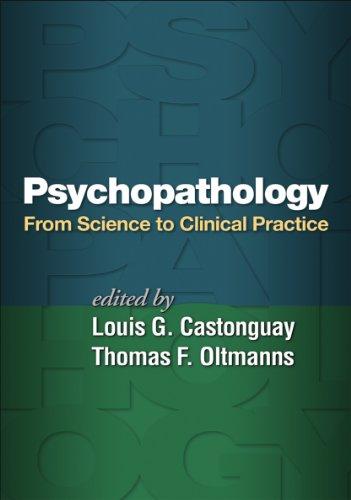
This is the eighth edition of Adult Psychopathology and Diagnosis, a series that Samuel M. Turner and Michel Hersen began in 1984, and it is the first edition without Michel’ s coeditorship.
Since publication of the previous edition, much research into the DSM-5 has been conducted and new data continue to emerge that force us to continuously reconsider how we approach and conceptualize psychological disorders. Psychopathology is a vibrant field, and ongoing discoveries regarding the roles of genetics, neurobiology, and behavior require that we continue to update this volume for students and professionals alike. We believe that our eminent authors (some of whom are contributing to this volume for the first time) have captured both major changes and more nuanced findings in their respective chapters.
As much as possible, we have asked our contributors to follow a standard format. Exceptions, of course, were granted as dictated by the data inherent in each chapter. Generally, however, each chapter has a description of the disorder, a case study, and material documenting epidemiology, clinical picture, course and prognosis, diagnostic considerations, psychological and biological assessment, and etiological considerations. Each chapter also contains a summary.
Many individuals have contributed to the e ighth edition of this book. First, we thank our experts, who agreed to share their vast knowledge about their areas of study. And, as always, we thank Patricia Rossi and her exceptionally professional staff at John Wiley & Sons for understanding the importance of this area to clinical psychology and psychiatry.
Deborah C. Beidel, Orlando, Florida B. Christopher Frueh, Hilo, Hawaii
About the Companion Website
This book is accompanied by a companion website: www.wiley.com/go/beidel/psychopathology8e The website hosts supplementary resources for students and instructors.
For Instructors:
• A testbank of multiple choice questions to accompany each chapter in the book
For Students:
• PowerPoint slides to accompany each chapter in the book
PART I
OVERVIEW
CHAPTER 1
Mental Disorders as Discrete Clinical Conditions: Dimensional Versus Categorical Classi fication
THOMAS A. WIDIGER and CRISTINA CREGO
IDSM-IV, THERE [was] “ no assumption that each category of mental disorder is a completely discrete entity with absolute boundaries dividing it from other mental disorders or from no mental disorder” (American Psychiatric Association [APA], APA, 2000, p. xxxi). This carefully worded disclaimer, however, was somewhat hollow, as it was the case that “DSM-IV [was] a categorical classi fication that divides mental disorders into types based on criterion sets with defining features” (APA, 2000, p. xxxi). The categorical model of classi fication is consistent with a medical tradition in which it is believed (and often confirmed in other areas of medicine) that disorders have speci fic etiologies, pathologies, and treatments (Guze, 1978; Guze & Helzer, 1987; Zachar & Kendler, 2007).
Clinicians, following this lead, diagnosed and conceptualized the conditions presented in DSM-IV-TR as disorders that are qualitatively distinct from normal functioning and from one another. DSM-IV-TR provided diagnostic criterion sets to help guide clinicians toward a purportedly correct diagnosis and an additional supplementary section devoted to differential diagnosis that indicated “how to differentiate [the] disorder from other disorders that have similar presenting characteristics ” (APA, 2000, p. 10). The intention of the manual was to help the clinician determine which particular mental disorder provides the best explanation for the symptoms and problems facing the patient. Clinicians devote initial time with a new patient to identify, through differential diagnosis, which specific disorder best explains a patient’ s presenting complaints. The assumption is that the person is suffering from a single, distinct clinical condition, caused by a speci fic pathology for which there will be a speci fic treatment (Frances, First, & Pincus, 1995).
Authors of the diagnostic manual devote a considerable amount of time writing, revising, and researching diagnostic criteria to improve differential diagnosis. They buttress each disorder’ s criterion set, trying to shore up discriminant validity and distinctiveness, following the rubric of Robins and Guze (1970) that the validity of a
diagnosis rests in large part on its “delimitation from other disorders” (p. 108). “These criteria should . . . permit exclusion of borderline cases and doubtful cases (an undiagnosed group) so that the index group may be as homogeneous as possible” (Robins & Guze, 1970, p. 108).
Scientists may devote their careers to attempting to identify the speci fic etiology, pathology, or treatment for a respective diagnostic category. Under the assumption that the diagnoses do in fact refer to qualitatively distinct conditions, it follows that there should be a speci fic etiology, pathology, and perhaps even a speci fic treatment for each respective disorder. The theories, hypotheses, findings, and disputes regarding the speci fic etiology, pathology, and/or treatment of a respective mental disorder largely inform the respective chapters of professional, graduate, and undergraduate texts on psychopathology, such as this current edition of Adult Psychopathology and Diagnosis.
However, the question of whether mental disorders are, in fact, discrete clinical conditions or arbitrary distinctions along continuous dimensions of functioning has been a long-standing issue (Kendell, 1975) and its significance is escalating with the growing recognition of the limitations of the categorical model (Goldberg, 2015; Hyman, 2010; Stephan et al., 2016; Widiger & Clark, 2000; Widiger & Samuel, 2005). The principal model for the validation of mental disorder diagnostic categories was provided by Robins and Guze (1970), who articulated five fundamental phases: clinical description, laboratory study, delimitation from other disorders, follow-up, and family studies. However, the research that has accumulated to date has not supported the validity of the delimitation of the disorders from one another. “Indeed, in the last 20 years, the categorical approach has been increasingly questioned as evidence has accumulated that the so-called categorical disorders like major depressive disorder and anxiety disorders, and schizophrenia and bipolar disorder seem to merge imperceptibly both into one another and into normality with no demonstrable natural boundaries” (First, 2003, p. 661). As expressed by the vice chair of DSM-5, “the failure of DSM-III criteria to speci fically define individuals with only one disorder served as an alert that the strict neo-Kraepelinian categorical approach to mental disorder diagnoses advocated by Robins and Guze (1970), Spitzer, Endicott, and Robins (1978), and others could have some serious problems” (Regier, 2008, p. xxi). As acknowledged by Kendell and Jablensky (2003), “it is likely that, sooner or later, our existing typology will be abandoned and replaced by a dimensional classi fication” (p. 8).
In 1999, a DSM-5 Research Planning Conference was held under joint sponsorship of the APA and the National Institute of Mental Health (NIMH), the purpose of which was to set research priorities that would optimally inform future classifications. One impetus for this effort was the frustration with the existing nomenclature.
In the more than 30 years since the introduction of the Feighner criteria by Robins and Guze, which eventually led to DSM-III, the goal of validating these syndromes and discovering common etiologies has remained elusive. Despite many proposed candidates, not one laboratory marker has been found to be speci fic in identifying any of the DSM-de fined syndromes. Epidemiologic and clinical studies have shown extremely high rates of comorbidities among the disorders, undermining the hypothesis that the syndromes represent distinct etiologies. Furthermore, epidemiologic studies have shown a high degree of short-term diagnostic instability for many disorders. With regard to treatment, lack of treatment specificity is the rule rather than the exception (Kupfer, First, & Regier, 2002, p. xviii).
DSM-5 Research Planning Work Groups were formed to develop white papers that would set an effective research agenda for the next edition of the diagnostic manual. The Nomenclature Work Group, charged with addressing fundamental assumptions of
the diagnostic system, concluded that it will be “important that consideration be given to advantages and disadvantages of basing part or all of DSM-V on dimensions rather than categories” (Rounsaville et al., 2002, p. 12).
The white papers developed by the DSM-5 Research Planning Work Groups were followed by a series of international conferences whose purpose was to further enrich the empirical database in preparation for the eventual development of DSM-5 (a description of this conference series can be found at www.dsm5.org). The first conference was devoted to shifting personality disorders to a dimensional model of classi fication (Widiger, Simonsen, Krueger, Livesley, & Verheul, 2005). The final conference was devoted to dimensional approaches across the diagnostic manual, including substance use disorders, major depressive disorder, psychoses, anxiety disorders, and developmental psychopathology, as well as the personality disorders (Helzer et al., 2008a).
Nevertheless, despite all this preparatory work toward a shift to a dimensional classi fication, DSM-5 retained the categorical model for all its diagnoses. The apparent failure of the categorical model of classification was at least duly noted within the introduction to DSM-5 “The historical aspiration of achieving diagnostic homogeneity by progressively subtyping within disorder categories is no longer sensible; like most common human ills, mental disorders are heterogeneous at many levels, ranging from genetic risk factors to symptoms ” (APA, 2013, p. 12). The authors of DSM-5 further suggested that “dimensional approaches to diagnosis . . . will likely supplement or supersede current categorical approaches in the coming years ” (APA, 2013, 13).
The purpose of this chapter is to review the DSM-IV-TR and DSM-5 categorical diagnostic approach. The chapter begins with a discussion of the problematic boundaries among the DSM-IV-TR and DSM-5 categorical diagnoses. We then focus in particular on depression, alcohol abuse and dependence, personality disorders, and intellectual disability. We conclude with a discussion of the shifts within DSM-5 toward a dimensional classification.
DIAGNOSTIC BOUNDARIES
In an effort to force differential diagnosis, a majority of diagnoses in DSM-III (APA, 1980) contained exclusionary criteria specifying that a respective disorder could not be diagnosed if it occurred in the presence of another disorder. These exclusions by fiat did not prove to be effective (Boyd et al., 1984) and many were deleted in DSM-III-R (APA, 1987). As expressed at the time by Maser and Cloninger (1990), “it is clear that the classic Kraepelinian model in which all psychopathology is comprised of discrete and mutually exclusive diseases must be modified or rejected ” (p. 12).
Many DSM-5 diagnostic criterion sets, however, continue to include exclusionary criteria that attempt to force clinicians to make largely arbitrary choices among alternative diagnoses (APA, 2013), and it is also evident that there will likely continue to be a highly problematic rate of diagnostic co-occurrence (Krueger & Markon, 2006; Maser & Patterson, 2002; Widiger & Clark, 2000). The term comorbidity refers to the co-occurrence of distinct disorders, apparently interacting with one another, each presumably with its own independent etiology, pathology, and treatment implications (Feinstein, 1970). If one considers the entire diagnostic manual (which has not yet been done by any epidemiological study), it would likely be exceedingly rare for any patient to meet the criteria for just one disorder, and the comorbidity rises even further if one considers lifetime co-occurrence. Brown, Campbell, Lehman, Grisham, and Mancill (2001), for instance, reported that 95% of individuals in a clinical setting who meet criteria for lifetime major depression or dysthymia also meet criteria for a current or past anxiety
disorder. Comorbidity is the norm rather than the exception (Brown & Barlow, 2009; Friborg, Martinussen, Kaiser, Øvergård, & Rosenvinge, 2013; Friborg et al., 2014; Kessler, Chiu, Demler, & Walters, 2005; Kotov, Perlman, Gámez, & Watson, 2015). The excessive comorbidity across the APA diagnostic manual may be saying more about the invalidity of existing diagnostic distinctions than the presence of multiple coexisting conditions (Krueger, 2002; Widiger & Edmundson, 2011).
Diagnostic comorbidity has become so prevalent that some researchers have argued for an abandonment of the term comorbidity in favor of a term (e.g., co-occurrence) that does not imply the presence of distinct clinical entities (Lilienfeld, Waldman, & Israel, 1994). There are instances in which the presence of multiple diagnoses suggests the presence of distinct yet comorbid psychopathologies, but in most instances the presence of co-occurring diagnoses does appear to suggest a common, shared pathology and, therefore, a failing of the current diagnostic system (Krueger & Markon, 2006; Widiger & Clark, 2000).
“Comorbidity may be trying to show us that many current treatments are not so much treatments for transient ‘state’ mental disorders of affect and anxiety as they are treatments for core processes, such as negative affectivity, that span normal and abnormal variation as well as undergird multiple mental disorders” (Krueger, 2002, p. 44).
Diagnostic criteria have traditionally been developed and subsequently modified in order to construct a disorder that is as homogeneous as possible, thereby facilitating the likelihood of identifying a specific etiology, pathology, and treatment (Robins & Guze, 1970). However, the typical result of this effort is to leave a large number of cases unaccounted for, given that many, if not most patients, have a complex, hetergenous array of symptoms. (Smith & Combs, 2010). New diagnostic categories are added to the nomenclature in large part to decrease clinicians’ reliance on the nonspecific, wastebasket label of “not otherwise specified” (NOS). NOS has been among the most frequent diagnoses within clinical populations (Widiger & Edmundson, 2011). The function of many of the new disorders that have been added to recent editions of the manual have not involved the identification of uniquely new forms of psychopathology. Their purpose was generally instead to fill problematic gaps. Notable examples for DSM-IV included bipolar II (filling a gap between DSM-III-R bipolar and cyclothymic mood disorders), mixed anxietydepressive disorder (a gap between anxiety and mood disorders), depressive personality disorder (personality and mood disorders), and postpsychotic depressive disorder of schizophrenia (schizophrenia and major depression) (Frances et al., 1995).
When new diagnoses are added to fill gaps, they have the ironic effect of creating additional boundary problems (i.e., more gaps), thereby making differential diagnosis even more problematic (Phillips, Price, Greenburg, & Rasmussen, 2003; Pincus, Frances, Davis, First, & Widiger, 1992; Pincus, McQueen, & Elinson, 2003). One must ask, for instance, whether it is really meaningful or useful to determine whether mixed anxiety-depressive disorder is a mood or an anxiety disorder, whether schizoaffective disorder is a mood disorder or a form of schizophrenia (Craddock & Owen, 2010), whether postpsychotic depressive disorder of schizophrenia is a form of depression or schizophrenia, whether early-onset dysthymia is a mood or a personality disorder (Widiger, 2003), whether acute stress disorder is an anxiety or a dissociative disorder (Cardena, Butler, & Spiegel, 2003), whether hypochondriasis is an anxiety disorder or a somatoform disorder, whether body dysmorphic disorder is an anxiety, eating, or somatoform disorder, and whether generalized social phobia is an anxiety or a personality disorder (Widiger, 2001a). In all these cases the most accurate answer is likely to be that each respective disorder includes features of different sections of the diagnostic manual. Yet the arbitrary and procrustean decision of which single section of the manual in which to place each diagnosis must be made by the authors of a categorical diagnostic
manual, and a considerable amount of effort and research are conducted to guide this decision, followed by further discussion and research to refute and debate whatever particular categorical decision was made.
There are comparable examples of what might be arbitrary splitting of categories in DSM-5 (APA, 2013). DSM-5 split out from reactive attachment disorder a new diagnosis of disinhibited social engagement disorder. Binge eating disorder (which was originally included within the diagnosis of bulimia nervosa) obtained official recognition. However, for the most part, changes that occurred in DSM-5 were consistent with the intention to shift the manual more closely toward a dimensional model. For example, there are cases in which previously “distinct” diagnoses were lumped together rather than split apart. For example, DSM-5 autism spectrum disorder subsumes within one diagnosis DSM-IV-TR autistic disorder, Asperger’ s disorder, childhood disintegrative disorder, and pervasive developmental disorder not otherwise speci fied (Lord & Bishop, 2015). The archaic subtypes of schizophrenia were deleted. “Instead a dimensional approach to rating severity of core symptoms of schizophrenia is included in DSM-5 Section III” (APA, 2013, p. 810). The problematic categorical distinction of substance abuse versus dependence was replaced by a level of severity, from mild, moderate, to severe, based simply on the number of diagnostic criteria. Included in Section III of DSM-5 is a proposed dimensional trait model that would subsume all of the existing personality disorder categories.
DEPRESSION
Mood disorders is a section of the APA diagnostic manual for which the presence of qualitatively distinct conditions is particularly difficult to defend, especially for the primary diagnoses of dysthymia and major depressive disorder (Brown & Barlow, 2009). Discussed here will be early-onset dysthymia, the continuum of depression, and subthreshold major depression, along with more general points concerning the boundary between mood and personality disorder.
There is no meaningful distinction between early-onset dysthymia, an of ficially recognized mood disorder diagnosis, and depressive personality disorder, a diagnosis proposed for DSM-IV but included within its appendix (APA, 2000). In fact, much of the empirical and conceptual basis for adding dysthymia to the DSM-III (i.e., Keller, 1989) came from research and clinical literature concerning depressive personality. As acknowledged by the principal architects of DSM-III, dysthymia is “roughly equivalent to the concept of depressive personality” (Spitzer, Williams, & Skodol, 1980, p. 159). Depressive personality disorder was included within the mood disorders section of DSM-III despite the recommendations to recognize its existence as a disorder of personality (Klerman, Endicott, Spitzer, & Hirschfeld, 1979), because it resembled the symptomatology of other mood disorders (i.e., depressed mood) more than it resembled the symptoms of other personality disorders (e.g., schizoid). However, whereas mood disorders are defined largely by similarity in content (i.e., mood being the predominant feature; APA, 2013), the personality disorders are defined largely by form (i.e., early onset, pervasive, and chronic) often with quite different content (e.g., schizoid personality disorder has little resemblance to histrionic personality disorder).
After DSM-III was published, it became evident that many of the persons who were consistently and characteristically pessimistic, gloomy, cheerless, glum, and sullen (i.e., dysthymic) had been that way since childhood and that in many cases no apparent or distinct age of onset could be established. In other words, its conceptualization as a personality disorder became apparent. DSM-III-R, therefore, added an early-onset
Another random document with no related content on Scribd:
Soon one little boy among them said, “See, there is a little girl. She is cold and is crying on the street; she is hungry too, let us help her.” They drew near, and the child, feeling comforted (she knew not why), sobbed more softly and prayed:
“O, my mamma in heaven, can you hear me and send help to brother and baby you loved us so?” Then the spirit children saw a man approaching; they fairly pushed him toward theweeping child to whom he spoke kindly asking:
“What is the matter my little girl?”
“O, sir, my mother is dead, and my brother is sick and the baby has nothing to eat. We’re so cold in that room.”
“Can you take me there?” asked the man, and he held out his hand for her to lead him. She clasped two of his fingers with her tiny hand and led him through the dark streets to a narrow alley and up some dark, creaking stairs. Yes, there was little brother crying for “mamma,” for “sister,” and the baby asleep but sobbing.
The kind-hearted man saw everything at a glance.
“Don’t cry, my little man. I’ll be back in a few minutes. Take care of them, little lady, until I come.”
The spirit children had helped, and helped; they saw the spirit mother looking very sad, bending above the baby, and then above “little brother.” They also tried to comfort him and help the little girl. They saw the man go to a telephone and talk with some one and they could see and feel the light of kindness with which he spoke and in which the answers came. How quick he was! He found a place to buy food. He came back soon, built a fire, warmed some milk, gave the other children something to ease the worst pangs of hunger. Presently a woman came—such a kind heart! She too worked fast. She gave the baby some food prepared in the milk, helped the little sick boy, who was more in need of bodily comfort than anything else, soothed and fed the little girl who, little mother that she was, at once aided in caring for the baby.
How the spirit children worked too! They had made the man see and hear the little girl, had aided in guiding her to the dismal room called “home”, had helped him find the telephone and the place to buy the food, had helped the woman to find the place, had helped take care of the children and comfort them and the spirit mother.
“Now,” said the Teacher, “we will return to our beautiful home.”
One little boy whispered to the Teacher: “I know there are more children and people who need help down there. Can we go again and help?”
“Whenever you choose to make rainbows or flowers or other beautiful things we will go.” And they rejoiced.
Lo! As they passed through the encompassing clouds circles of rainbows o’er-spanned them and paths of rainbows guided them to their spirit-home. When the other children saw them approaching they sang, “O, the rainbows! O, the rainbows! When you dry the tears of sorrow and help those in need you make rainbows.”
All spirit children are taught to visit the scenes of Earth life. The home and its loved ones, where they are missed, ever attracts them and they are taught to minister, to aid, to guard. If they had no home on Earth they try to aid those who still remain in the “orphan” realm of human life.
THERE ARE NO ORPHANS IN THE SPIRIT REALM:
Mothers whose babes are in the Earth life help to care for those “little waifs” thrust out of human existence—and for spirit children that pine for Mother love.
Children whose parents are in Earth life are taught to aid and comfort those in the home as well as those who have no home. Especially cared for are the little “waifs” who were not welcome in the Earth-forms—even those who have not seen the light of earthly day—not always from among the poor of earth were they driven, especially those abandoned by the unfortunate or misguided
mothers. These and all are “mothered” by the spirits whose hearts are filled with mother love. And here it is well to note that not all who are earthly parents are real fathers and mothers, and many who are childless—work night and day in the “asylums” on earth to save some neglected, forsaken, child. These are real parents.
What greater “punishment” could there be than when the human mother has turned away from the sacred gift of motherhood, she meets, on entering spirit life, her own neglected babe who welcomes her there? “Coals of fire!”
It is not always to visit scenes of sorrow and want that the spirit children are led to the earth: Houses, schools, playgrounds, “Lyceums,” where the little ones of earth are taught, places of entertainment and amusement where they play, and sing, and grow; there also are the playmates of the spirit-home mingling with them and endeavoring to impress them with thoughts and deeds of loving kindness with things of beauty.
Returning to the Realm of Spirit Children one finds such respite from care, such constant sources of happiness, such fashioning of forms of beauty. Oh, that all could know! Knowledge of all this has reached but few on Earth; yet more and more will human minds be pervaded by the methods of the Skies.
Those who have given new methods of “Education” to the people of Earth have been inspired somewhat by these Teachers in spirit states. Froebel, whose “Kindergarden” system was intended for “children” of all ages; A. J. Davis, whose “Progressive Lyceum” system was not intended exclusively for Sunday training of children but in its inception was a reproduction of the “teaching” in spirit states (as far as his mind and inspiration could reproduce such beautiful methods.) Even if one could give in human language the form of teaching (or methods) of the spirit states, the law of adaptation prevailing in the higher realms might not always be available in human life.
How beautiful to know that growth—and the best opportunity for the highest unfoldment with most loving teachers and Guardians surround the darlings who have passed from the households of Earth.
Here then, O human parents, O sisters and brothers, you who miss the bodily presence of the one who occupied the “vacant chair,” you who feel the pervading sense of the absence of the loved children: here they are; bringing to your very homes and hearts, could you but realize it, the love, the knowledge, the wisdom, the beauty of the skies.
BEAUTY AND HARMONY
Ever from childhood through all the years of Earth life beautiful scenery, tints of earth and sky, music, in fact all beautiful sights and sounds, strongly appealed to me. In the spirit states I noted that harmonious colors, beautiful scenes, and often exquisite music greeted me as we approached groups of radiant atmospheres, encircling spheres of light; such exquisite sounds of harmony as one dreams must be the “Music of the Spheres.” On approaching nearer I would perceive that the tintsand sounds, as they reached me, were the radiations of thought, the spirit activities of these thus ensphered who have attained real harmony. They were not MAKING beautiful colors and music, but LIVING them.
THE “ARTISTS”
Perhaps I have elsewhere written that music in spirit states does not always accompany the one who was a “musician” on Earth; and harmony of color, beautiful surroundings may ensphere one who never thought of being an “artist.” Their lives have been interwoven with sweet and loving thoughts and deeds.
That which would have been a source of surprise had I not previously known it was that “artists,” “painters,” “sculptors,”
“musicians,” and even some of the “poets,” known by those names on Earth, are not fashioning landscapes, portraits, or carving from stone the images of lovely forms, nor are they fashioning or weaving into music or verse some classical or other theme: All of those who were “geniuses,” all who were Idealists, trueloversoftheirkind, find here (in spirit life) their highest happiness in ministeringtoothers, in moving upon the minds, hearts, spirits of those to whom they are adapted, until they perceive the Soul of Beauty and fashion it into their lives. The “Masters” of art: painters, sculptors, builders, construct their temples and adorn them with lives—the true images of beauty in thought, feeling, aspiration, achievement.
Music is perfectHarmony, of one life with itself and others, of many lives in all their highest purposes. Such are the creators of the “Symphonies of the Skies.”
Those who had “Talent,” hoping to achieve the works of “Genius”— sometime, somewhere, are still intent on fashioning reproductions or imitations of natural objects and scenes, or impressing art students of Earth to produce such effects. But these are not the creators —“every ‘creation’ is from within and must live,” said my Teacher.
One wishes for a magic pen, or for a perfect Gift of Expression, to convey in language the subtle consciousness of the Beauty and Harmony that meet one as one is led to the “Atmospheres” of some of the
“CREATORS OF BEAUTY. ”
More wonderful than all else was the knowledge that many who had never painted, carved, builded, or traced the “score” of musical composition were surrounded and pervaded by such ineffable loveliness that one could weepforveryjoyon perceiving it.
“Art is Great, but the perception of the Soul of Beauty is Life!Love!” said the Guide.
One perceives in such states as were there revealed that the true “artist” has not always been known among his fellow human beings, moving upon the world of thought, influencing other lives by the beauty and harmony of their own natures, these seem, when viewed from the spirit, to constitute the real artists.
“Is not the Temple of the Soul a Living Temple, is not the art of molding the mind to perform the mandates of the spirit more to be sought for and greater when attained?” “Eternal in the Heavens” are the Temples “not made with hands,” so said the Guide and so I perceived more and more clearly.
In marked contrast to the foregoing were the thought-forms surrounding some of those who had been “artists” on Earth: broken lines, inharmonious colors, discords, sharp and jagged corners—all portraying disturbed conditions of the unruly thoughts and impulses that had possessed them in Earth life.
I had interesting glimpses of those who were “working with themselves.” One who was considered “eminent” in art on Earth was cutting, carving, breathing upon an imageofhimself.
“What ishe doing?” I exclaimed, now really surprised.
“Removing the angularities and errors of his own nature: jealousy of other artists, the deepest scar; selfish love of human praise—that overweening desire for adulation; unwillingness to accord to others appreciation of their true merits,” replied the Guide.
Later, I saw that artist self-renovated, and one whom he had envied derided and scorned, when both were in Earth life, working together, producing, through artist minds on earth, works that possess the merits of both with the added tone of harmony; the strength of one being merged in perfect accord with the grace and loveliness of the other, blending in wondrous works of Beauty.
This was a wonderful lesson, serving to illustrate that at first, and possibly for some time after entering spirit life one’s chief occupation is—or should be—removing one’s own limitations; but this cannot
begin until one is aware that one has the imperfections; to be conscious of one’s faults is half the remedy.
Bodily imperfections, infirmities and disease, unless retained psychologically by having constantly encroached upon the mind, or deformities that are dwelt upon mentally, are dropped with the body; but such infirmities of mind as are born of an undue “egotism,” undue self love, (the capital “I” around which the universe revolves), must be removed before the spirit can enter upon real work. As with artists so with those eminent in science or any department of human thought and endeavor; the truly Great are ever the most humble; realizing that however much they know, and however clearly they can think “the universe is full of things we do not know”; as one of the great ones aptly said.
I had met one—a brilliant mind—who in Earth life was gifted in many ways, chiefly mathematics. He had breakfasted on billions, dined on duodecillions, supped on sepdecillions, he wrote to the rythm of “logarithms,” and worshiped at the shrine of the calculus! I tried to imagine what he might be doing. Perhaps he was measuring the immeasurable or calculating the uncalculable! I saw him! Where was his Observatory? Where his maps, charts, instruments? The answer swept over and through me with a great thrill.
The knowledge that comes to the spirit is instantaneous—if one is ready—how can one use even the most perfect instrumentalities and methods when time and space are eliminated? Truthisperceived: in homely phrase “No ladder for the air men,” “no mathematics for the soul!” I never could have imagined how quickly he would “perceive.” He had attained the real knowledge of wisdom and love.
The poet-prophets of the world, those who have sung in immortal verse the Truths of the Skies: Truths of Freedom, Justice, Love, Spiritual Exaltation, moved by the theme of their songs, using their art as a setting to the Jewel of Truth, these endowed ones knew that without the inspiring theme, the words, the rythm would be empty bubbles, glittering nothings.
ALL ARE TEACHERS
All exalted lives (spiritually) moving and living in similar planes of thought—born of their spiritual states—are attracted to each other in spirit life for the interchange of perceptions of Truth and bearing forward the work of illuminating such minds on Earth asarereadyto receive along the lines of human progress and unfoldment, imparting “the things they are ready to know.”
Spirits, the wise ones, do not make the mistake, as many do in human life, of trying to force upon the minds of those whom they teach the truths or knowledge for which those minds are not prepared: “Arithmetic first, after that geometry and higher mathematics,” is the rule in Earth schools. So in the instruction by spirit Teachers there is adaptation to the pupil not only of the Teacher but of that which is to be taught. There are “ministering spirits” adapted to every condition.
I could but marvel at the wonderful workings of these principles that govern the influence of “mind upon mind”—really spiritupon spirit; so much more complex yet more potent than the “forces” and operation of the “laws” of the material universe—“laws” so little understood, “forces” so dimly perceived.
“Most of the people on the Earth-plane know so little even concerning the things and forces most intimately connected with their bodily existence: the sunshine, the air they breathe, the earth beneath them, the sea, and the heavens of Stars; we must not wonder over-much that they know little or nothing of this inner, though more real, realm of Spirit.”
This was from the Guide. Anticipating the question that was welling up from the mind: “Why do not those on Earth know more of these spirit states, more of their own conditions spiritually?” The answer had already been given, and as we passed on the Teacher said: “Growth, unfoldment, waiting, working.”
CO-WORKERS
Among the groups and assemblages whom I met and with whom I was most frequently in communication during this surpassing sojourn were the arisen co-workers in the “Movement” with which my life-work has been most identified:
“SPIRITUALISM”
In the work of a life-time as a chosen “instrument” to bear “glad tidings,” to promote the knowledge of spirit existence here and beyond the change called death, and the ministration from and communion with the arisen ones, I had met in outward existence every leading mind and every worker (medium) known in the Spiritualistic movement.
We were always friends, always co-workers, sisters and brothers bearing forward a great Truth. Very frequently during this wonderful visit in the realm of spirit I saw them—either alone or in smaller or larger groups, renewing the companionship that had been so beautiful and delightful when we had worked side by side in human forms.
In your memory, dear reader, or in your reading scan the list of names who were first known as “Investigators” then as “Spiritualists,” and the names of those known as MEDIUMS (there were no “Psychics” in those days.) I knew and loved them all. I met them all. Each one in spirit life is still engaged in imparting this knowledge —most important of all that human beings can receive—concerning Spiritual Truth. Existence, life, love, work beyond the change called death;
SPIRITUALISM AS A MOVEMENT,
I had ever been instructed by my Guides, was given to the world when needed, and when there were those upon the Earth who were ready, when the “ages were ripe” for its coming.
In spirit states of Earth and in the realms far beyond were those who knew the “day and hour” had come for “moving upon the minds of Earth with this new illumination.”
There was from the “smallest” to the “greatest,” from the seemingly “least” to the “most important” of the manifestations a concerted action. The “rappings” at Hydesville were no “accident,” the visions of Clairvoyant and seer, the writings and trance utterances (phenomenal) were all a part of this StupendousMovement. All, all, under guidance of those wise Spirits who knew what the people of the world needed and gave it to them according to their needs.
Necessarily many extremists and “imitators” would be attracted to the subject—like driftwood following or borne upon every new current of thought—but it is safe to say that Spiritualism during the sixty-seven years since the “Rochester Knockings” has attracted the attention of more eminent minds in every department of human research (and convinced them too) and given knowledge and consolation to a greater number of people than any movement or system of knowledge in ancient or modern times. With those who are willing and anxious to be classed as Spiritualists it is knowledge of life beyond death—and of the presence and ministration of the beloved arisen ones.
So spoke my Guide to me and to the group of co-workers who had come forward to meet and greet me. How young and beautiful they were. Always I had noted in earth life how beautiful the dear ones are when one has been for a time absent from them—and here, in this realm of perpetual youth, with the freedom from human pain and cares that some of them had so bravely borne, I could but note the beauty that is theirs.
In the interchange of thought and experiences with these arisen coworkers I could readily understand that being brought into direct
personal relationship with their “Guides,” “Inspirers,” “Teachers,” “helpers” and with each other, they had become more and more aware of the true meaning and nature of the gifts (mediumship) that were theirs when in the form, and they realized that even those “Inspirers” and “Teachers” were also the instruments of higher and wiser Spirits.
One sister worker said to me “I always wanted to seemy Guides, as you did, but I could not, for the gift of spirit vision was not mine. Now I understand what it means to ‘see with the eyes of the Spirit’ and I am satisfied.”
Those who had been my most intimate co-workers had many things to tell me of their “awakening” into added perception of spiritual things and of the work assigned them in their new state of existence; still ministering, still trying to lift the veil, mostly of ignorance, that divides mortals from their arisen ones. Many were the loving messages sent to friends and loved Companions still in Earth life.
“Tell them you saw me here in spirit life, and I am ever near them, in response to a thought, or wish or especially a need, guiding, guarding, aiding.”
It seems better to receive a message from one who has “been there,” who has actually seenand conversedwith one’s friends “face to face” and “spirit to spirit.” So, in the treasure house of my spirit are stored those messages to be given whenever I meet any of those loved ones in human life to whom I was so fortunate as to bear a message. It is to them alone that the message for them can be given.
The transcendent brightness and spiritual beauty of that assemblage of spirits—from guardian spirits of relatives and friends to the wisest and most advanced that one could see, are beyond my power of language to express.
There is no formal taking of one’s “place” or “position,” no ceremonious “assigning” of “duty” or “work,” but in groups and
larger companies, as well as in personal ministrations, a mutual understanding of purpose, according to adaptation. If a united or concerted action upon earth-minds for any given purpose is needed it is readily perceived and entered upon by all who are in accord, and is performed by such methods as enlightened spirits readily understand.
Human minds are better prepared to comprehend the methods of spirit communicating with spirit since “wireless telegraphy” and other recent scientific wonders have been achieved, not that the processis similar in any degree, but being prepared for the new revealments in science also prepares impartial minds to know of the more subtle powers of the spirit. “Volition” in its highest analysis is the one attribute of the spirit by which other spirits know—through perception, what is being imparted, but there must ever be accord, sympathy, adaptation.
From some of those who had been my friends in my early life and who were “leading minds” in this cause, and in other subjects of human interest, I received many thoughts and suggestions concerning the present status of the “movement” (Spiritualism) and what they now think of the possible and desirable results of “united action,”—“organization” for the work and the workers. These and many other themes must be left for opportunity, time and strength to reveal, as my work goes on in human life.
One notes the same minds and spirits in many assemblages of the different branches of all purposes for aiding humanity. Even as when on earth the “Pioneers” in “Anti-slavery,” “Equal Suffrage,” “Temperance,” were the same staunch body of men and women, ready now as then to respond to the call to give a voice to Truth. In the assemblies for promoting “peace” by “those who love their fellow men,” there was the universal sentiment: “Peace must be born of Justice and Justice can only come by true Fraternity.”
“My country is the world; My countrymen all mankind.”
This is the standard extending to include “All Souls.”
“It seems to inhere in the very nature of human life that men will fight for: (1) Personal liberty: freedom from physical bondage and involuntary servitude; (2) For defence of those nearest and dearest enshrined in the ‘home’; (3) For country when it represents the ‘home’ and those ‘Ideals’ to which the heart ever clings.”
To “remove the Causesof War” all selfish seeking, all aggression by any nation upon the rights of others must cease, “and this must come by growth, by enlightenment in the cardinal principles of justice, love and truth.” These and many other thoughts were given forth in that assembly.
[A]A great wave of uprising among the women of all nations was predicted in favor of conditions that would “make for peace” leading to united efforts between the most enlightened men and women of all nations to the establishment of “Peace born of Right—Not Might.”
The Peace foretold by poets and sages of all time. Yet all agree in that wonderful assemblage, that “treaties of Peace” are without avail unless the moral force of the nations—among their leaders, rulers and a majority of their people—is sufficient to dominate; and make just treaties binding.
As individuals are now expected to adjust their difference in Courts of Law (often misnamed justice), and it is the aim of a majority of citizens not to encroach upon the real rights of others, so the time mustcome when nations will agree to a similar method in adjusting possible differences that may arise; and this much can come even before the real millenium of “Peace on Earth and Love to all Mankind.” There must be some other International Tribunal than the battlefield! Earth, sea, and air, must not be held in bondage for physical carnage!
In the final “Day of Peace” even Peace Tribunals will not be needed, but now—“may Angels speed the Day of Peace born of Justice.”
In most instances I could tell the personality, or human name, of each one giving forth a particular thought, and all were in accord.
Alas, I could also perceive that they saw, in viewing the conditions of Earth that “the end is not yet.”
I cannot mar this wonderful visit—this respite from pain and cares of Earth by dwelling too long among the shadows, warclouds and darkened states of Earth life. As beyond the storm clouds of Earth’s nearest material atmosphere the sun always shines glorious and with resplendent brightness, so beyond the horrors of war the desolation and ravagement of nations incident thereto, beyond the storms, earthquakes, and cataclysmic throes of nature, the Sun of Spiritual Hope and Love ever shines surpassing fair, and all the Angelic and Spiritual Hosts are ready to aid, strengthen, succor the spirits enshrouded in time and earth conditions.
THE RETURN
More and more frequent were the summons and the visits to my mortal body, to reimbue, as it was now found possible, with my spirit, to restore with the personal presence, the body within which the vital spark had been kept alive by blessed Guardian Spirits and devoted friends on Earth.
More and more the spirit “Home friends,” the Best Beloved, and the Guides encouraged the thought of my return to fulfill the appointed work on Earth. I had prayed to be allowed to remain, to let the body pass; but now, gradually it is true, the idea of resuming the human habiliments, the garb of the material body, became less repugnant, and I finally freely said: “Yes, I will go as that is the appointed way.”
Have you, dear friend, who may be reading these imperfect fragments of a perfectexperience, (as any narrative must be) ever visited some fair garden, some sequestered home of dearest friends, a place radiant with beauty and enchantment; where there were flowers massed in rarest combinations of color and fragrance, fountains murmuring in answer to the summer winds, music, such as seemed a part of the enrapturing scene; have you enjoyed this with the chosen friends that alone could make the scene sacred, the Best
Beloved? And have you known the reluctance to return to the “outer world” of daily routine of care, perhaps of pain? Ah, then you know in the smallestdegree what it meant to me to return to my bodily form!
Yet even now the soul of all that was mine in that wonderful, surpassing state is ever with me; nor will it again be absent from me —since it is enfolded in my very being. I am more complete now, even in the body which ever divides us from the Soul of Life.
“You will be with us again and often,” they said; the Guide said no formal “farewells,” no “leavetaking,” but everywhere from every Dear and Blessed one “Blessings, Peace, Joy, and Love go with you into added Strength and Work.”
And here I am: ready to help the body to grow stronger, and to willingly, joyfully, in the future as in the past, perform the work assigned me—until—they—call—me—Home.
CORA L. V. RICHMOND.
An Added Word or Two
The possibility of the spirit “leaving the body” for a time and then returning and resuming its usual activities has been demonstrated many times. In some instances the temporary separation was caused by accident, illness, states of coma induced by anesthetics, trance, either of spirit control or hypnosis, and sometimes a voluntary absence or activity not suspending the vital functions of the body. It is also undoubtedly true that during sleep—especially that restful, dreamless sleep that betokens a normal state of mind and body, the spirit avails itself of the opportunity of restoration by spiritual methods and activities not possible while urging the body to do its bidding. Not only Spiritualists, Psychologists and Psychic Research students have well authenticated cases of the undoubted activity of the Spirit apart from the body, but many prominent physicians have recorded their experiences with patients whose bodily functions were suspended, even to seeming dissolution, and upon the unexpected resuscitation of the subject there would be a vivid account of active experiences in spirit—usually pleasant scenes and meetings with friends long passed into spirit life. These visits to “heaven” would be sometimes tinged with the religious bias of the subject, but this is not strange in view of the fact that spirit states areconditionsofthemindand spirit experiencing them.
Among the most familiar popular illustrations are those narrated by Elizabeth Stuart Phelps, especially by “Gail Hamilton” who, being thought “dead” returned to her body, narrated to her pastor the experiences she had during that period of suspended animation and resumed her pen, remaining in mortal life a considerable time thereafter.
Although not usual, this class of experiences is not so unusual as many imagine or assert. And the writer having been from childhood
accustomed to the “other state” (“Inner,” “higher”), of consciousness can distinctly trace her experiences in that inner realm as forming fully a third if not one-half of her life-experiences.
The “realm of spirit” in which she has so often found herself a participant is, therefore, no unfamiliar realm; in fact if called upon to decide which state is the reality—the life, she would unhesitatingly say: the innerstate, the super-mundanerealm.
Of the many eminent men of Science in both Europe and America who have come to a knowledge of the truths of Spirit existence, continuance of life after transition,—and the writer has known them all personally, except the one she is about to mention,—probably Sir Oliver Lodge has approached the subject of “psychic Research” (Spiritualism) with a mind the best prepared to receive (perceive) Spiritual Truth. I say this with the utmost reverence and admiration for the long list of names—eminent alike in their personal qualities and scientific attainments, whose lives have been made brighter by a knowledge of demonstrated future existence and a belief in the Immortality of the Soul. Shall I name some of them? Hare, Mapes, Denton, Wallace, Crookes, Varley, Zollner, Flammarion—the list is almost endless.
Sir Oliver Lodge has not only recently, and very publicly, announced his full belief (knowledge) of continued personal existence beyond the change called death, but the possibility of communion with those “gone before” and the certainty that he had personal evidence beyond cavil or doubt, proofs indubitable, of the presence of and communication with his particular friends, but—and this is the point I wish to emphasize—in his earlier utterances on this subject he said in effect: “When I become aware that the human spirit while still animating the body, or not released by death, has suchsurpassing powers, ‘telepathy,’ ‘voluntary action’ apart from thebody, showing conclusively that the activities of the mind are not dependent upon the physical organism—I concluded there mustbe evidence to show that the spirit can and does survive the body.” This and much more was in his published statements concerning his investigations in
connection with Psychic Research—showing that he approached the subject not only from the “effect to cause” line of usual scientific investigation, but had already in his quickened perception the vivification of a-priori knowledge leading from “causetoeffect.”
One would like to accumulate and set down in condensed manner all the available evidences of “absence from the body”—of which the writer has a large and increasing store, but this writing is more distinctly in the form of a message for this particular time.
With our own “other world” within and about us, moving “like wings of light on dark and stormy air,” with such unused, wonderful powers, what wonder that one having partaken of the bounties of that inner realm longs to awaken the “sleeping” spirits of those in human life—or, more correctly speaking, tear aside the veil and show how wonderful are the dormant powers within each person: Soulpowers more active, perhaps, than any are aware! Who can tell, until the film of mental blindness is removed, how great may be the works accomplished by the spirit when the body sleeps, when one is “absent minded,” or when thinkingintentlyof a particular friend, one finds at that very day and hour the friend had “passed away”?
It is of the “Substance that dreams are made” that we shall ultimately find our divinest realities, ourverylivesare fashioned.
This narrative of “experiences while out of my body” is only a prelude to those vaster heights, those more inner scenes, that I hope sometime to be able to record: The Symphony is Life itself whose theme of Love is Endless, Endless, Endless.
—TheAuthor .
FOOTNOTE:
[A] This was before the Woman’s “Peace Congress” had been thought of by Earth minds.
TRANSCRIBER’S NOTES:
Obvious typographical errors have been corrected. Inconsistencies in hyphenation have been standardized.
Archaic or variant spelling has been retained.
*** END OF THE PROJECT GUTENBERG EBOOK MY EXPERIENCES WHILE OUT OF MY BODY ***
Updated editions will replace the previous one—the old editions will be renamed.
Creating the works from print editions not protected by U.S. copyright law means that no one owns a United States copyright in these works, so the Foundation (and you!) can copy and distribute it in the United States without permission and without paying copyright royalties. Special rules, set forth in the General Terms of Use part of this license, apply to copying and distributing Project Gutenberg™ electronic works to protect the PROJECT GUTENBERG™ concept and trademark. Project Gutenberg is a registered trademark, and may not be used if you charge for an eBook, except by following the terms of the trademark license, including paying royalties for use of the Project Gutenberg trademark. If you do not charge anything for copies of this eBook, complying with the trademark license is very easy. You may use this eBook for nearly any purpose such as creation of derivative works, reports, performances and research. Project Gutenberg eBooks may be modified and printed and given away you may do practically ANYTHING in the United States with eBooks not protected by U.S. copyright law. Redistribution is subject to the trademark license, especially commercial redistribution.
START: FULL LICENSE
THE FULL PROJECT GUTENBERG LICENSE
PLEASE READ THIS BEFORE YOU DISTRIBUTE OR USE THIS WORK
To protect the Project Gutenberg™ mission of promoting the free distribution of electronic works, by using or distributing this work (or any other work associated in any way with the phrase “Project Gutenberg”), you agree to comply with all the terms of the Full Project Gutenberg™ License available with this file or online at www.gutenberg.org/license.
Section 1. General Terms of Use and Redistributing Project Gutenberg™ electronic works
1.A. By reading or using any part of this Project Gutenberg™ electronic work, you indicate that you have read, understand, agree to and accept all the terms of this license and intellectual property (trademark/copyright) agreement. If you do not agree to abide by all the terms of this agreement, you must cease using and return or destroy all copies of Project Gutenberg™ electronic works in your possession. If you paid a fee for obtaining a copy of or access to a Project Gutenberg™ electronic work and you do not agree to be bound by the terms of this agreement, you may obtain a refund from the person or entity to whom you paid the fee as set forth in paragraph 1.E.8.
1.B. “Project Gutenberg” is a registered trademark. It may only be used on or associated in any way with an electronic work by people who agree to be bound by the terms of this agreement. There are a few things that you can do with most Project Gutenberg™ electronic works even without complying with the full terms of this agreement. See paragraph 1.C below. There are a lot of things you can do with Project Gutenberg™ electronic works if you follow the terms of this agreement and help preserve free future access to Project Gutenberg™ electronic works. See paragraph 1.E below.
1.C. The Project Gutenberg Literary Archive Foundation (“the Foundation” or PGLAF), owns a compilation copyright in the collection of Project Gutenberg™ electronic works. Nearly all the individual works in the collection are in the public domain in the United States. If an individual work is unprotected by copyright law in the United States and you are located in the United States, we do not claim a right to prevent you from copying, distributing, performing, displaying or creating derivative works based on the work as long as all references to Project Gutenberg are removed. Of course, we hope that you will support the Project Gutenberg™ mission of promoting free access to electronic works by freely sharing Project Gutenberg™ works in compliance with the terms of this agreement for keeping the Project Gutenberg™ name associated with the work. You can easily comply with the terms of this agreement by keeping this work in the same format with its attached full Project Gutenberg™ License when you share it without charge with others.
1.D. The copyright laws of the place where you are located also govern what you can do with this work. Copyright laws in most countries are in a constant state of change. If you are outside the United States, check the laws of your country in addition to the terms of this agreement before downloading, copying, displaying, performing, distributing or creating derivative works based on this work or any other Project Gutenberg™ work. The Foundation makes no representations concerning the copyright status of any work in any country other than the United States.
1.E. Unless you have removed all references to Project Gutenberg:
1.E.1. The following sentence, with active links to, or other immediate access to, the full Project Gutenberg™ License must appear prominently whenever any copy of a Project Gutenberg™ work (any work on which the phrase “Project
Gutenberg” appears, or with which the phrase “Project Gutenberg” is associated) is accessed, displayed, performed, viewed, copied or distributed:
This eBook is for the use of anyone anywhere in the United States and most other parts of the world at no cost and with almost no restrictions whatsoever. You may copy it, give it away or re-use it under the terms of the Project Gutenberg License included with this eBook or online at www.gutenberg.org. If you are not located in the United States, you will have to check the laws of the country where you are located before using this eBook.
1.E.2. If an individual Project Gutenberg™ electronic work is derived from texts not protected by U.S. copyright law (does not contain a notice indicating that it is posted with permission of the copyright holder), the work can be copied and distributed to anyone in the United States without paying any fees or charges. If you are redistributing or providing access to a work with the phrase “Project Gutenberg” associated with or appearing on the work, you must comply either with the requirements of paragraphs 1.E.1 through 1.E.7 or obtain permission for the use of the work and the Project Gutenberg™ trademark as set forth in paragraphs 1.E.8 or 1.E.9.
1.E.3. If an individual Project Gutenberg™ electronic work is posted with the permission of the copyright holder, your use and distribution must comply with both paragraphs 1.E.1 through 1.E.7 and any additional terms imposed by the copyright holder. Additional terms will be linked to the Project Gutenberg™ License for all works posted with the permission of the copyright holder found at the beginning of this work.
1.E.4. Do not unlink or detach or remove the full Project Gutenberg™ License terms from this work, or any files
containing a part of this work or any other work associated with Project Gutenberg™.
1.E.5. Do not copy, display, perform, distribute or redistribute this electronic work, or any part of this electronic work, without prominently displaying the sentence set forth in paragraph 1.E.1 with active links or immediate access to the full terms of the Project Gutenberg™ License.
1.E.6. You may convert to and distribute this work in any binary, compressed, marked up, nonproprietary or proprietary form, including any word processing or hypertext form. However, if you provide access to or distribute copies of a Project Gutenberg™ work in a format other than “Plain Vanilla ASCII” or other format used in the official version posted on the official Project Gutenberg™ website (www.gutenberg.org), you must, at no additional cost, fee or expense to the user, provide a copy, a means of exporting a copy, or a means of obtaining a copy upon request, of the work in its original “Plain Vanilla ASCII” or other form. Any alternate format must include the full Project Gutenberg™ License as specified in paragraph 1.E.1.
1.E.7. Do not charge a fee for access to, viewing, displaying, performing, copying or distributing any Project Gutenberg™ works unless you comply with paragraph 1.E.8 or 1.E.9.
1.E.8. You may charge a reasonable fee for copies of or providing access to or distributing Project Gutenberg™ electronic works provided that:
• You pay a royalty fee of 20% of the gross profits you derive from the use of Project Gutenberg™ works calculated using the method you already use to calculate your applicable taxes. The fee is owed to the owner of the Project Gutenberg™ trademark, but he has agreed to donate royalties under this paragraph to the Project Gutenberg Literary Archive Foundation. Royalty
payments must be paid within 60 days following each date on which you prepare (or are legally required to prepare) your periodic tax returns. Royalty payments should be clearly marked as such and sent to the Project Gutenberg Literary Archive Foundation at the address specified in Section 4, “Information about donations to the Project Gutenberg Literary Archive Foundation.”
• You provide a full refund of any money paid by a user who notifies you in writing (or by e-mail) within 30 days of receipt that s/he does not agree to the terms of the full Project Gutenberg™ License. You must require such a user to return or destroy all copies of the works possessed in a physical medium and discontinue all use of and all access to other copies of Project Gutenberg™ works.
• You provide, in accordance with paragraph 1.F.3, a full refund of any money paid for a work or a replacement copy, if a defect in the electronic work is discovered and reported to you within 90 days of receipt of the work.
• You comply with all other terms of this agreement for free distribution of Project Gutenberg™ works.
1.E.9. If you wish to charge a fee or distribute a Project Gutenberg™ electronic work or group of works on different terms than are set forth in this agreement, you must obtain permission in writing from the Project Gutenberg Literary Archive Foundation, the manager of the Project Gutenberg™ trademark. Contact the Foundation as set forth in Section 3 below.
1.F.
1.F.1. Project Gutenberg volunteers and employees expend considerable effort to identify, do copyright research on, transcribe and proofread works not protected by U.S. copyright
law in creating the Project Gutenberg™ collection. Despite these efforts, Project Gutenberg™ electronic works, and the medium on which they may be stored, may contain “Defects,” such as, but not limited to, incomplete, inaccurate or corrupt data, transcription errors, a copyright or other intellectual property infringement, a defective or damaged disk or other medium, a computer virus, or computer codes that damage or cannot be read by your equipment.
1.F.2. LIMITED WARRANTY, DISCLAIMER OF DAMAGES - Except for the “Right of Replacement or Refund” described in paragraph 1.F.3, the Project Gutenberg Literary Archive Foundation, the owner of the Project Gutenberg™ trademark, and any other party distributing a Project Gutenberg™ electronic work under this agreement, disclaim all liability to you for damages, costs and expenses, including legal fees. YOU AGREE THAT YOU HAVE NO REMEDIES FOR NEGLIGENCE, STRICT LIABILITY, BREACH OF WARRANTY OR BREACH OF CONTRACT EXCEPT THOSE PROVIDED IN PARAGRAPH 1.F.3. YOU AGREE THAT THE FOUNDATION, THE TRADEMARK OWNER, AND ANY DISTRIBUTOR UNDER THIS AGREEMENT WILL NOT BE LIABLE TO YOU FOR ACTUAL, DIRECT, INDIRECT, CONSEQUENTIAL, PUNITIVE OR INCIDENTAL DAMAGES EVEN IF YOU GIVE NOTICE OF THE POSSIBILITY OF SUCH DAMAGE.
1.F.3. LIMITED RIGHT OF REPLACEMENT OR REFUND - If you discover a defect in this electronic work within 90 days of receiving it, you can receive a refund of the money (if any) you paid for it by sending a written explanation to the person you received the work from. If you received the work on a physical medium, you must return the medium with your written explanation. The person or entity that provided you with the defective work may elect to provide a replacement copy in lieu of a refund. If you received the work electronically, the person or entity providing it to you may choose to give you a second opportunity to receive the work electronically in lieu of a refund.
If the second copy is also defective, you may demand a refund in writing without further opportunities to fix the problem.
1.F.4. Except for the limited right of replacement or refund set forth in paragraph 1.F.3, this work is provided to you ‘AS-IS’, WITH NO OTHER WARRANTIES OF ANY KIND, EXPRESS OR IMPLIED, INCLUDING BUT NOT LIMITED TO WARRANTIES OF MERCHANTABILITY OR FITNESS FOR ANY PURPOSE.
1.F.5. Some states do not allow disclaimers of certain implied warranties or the exclusion or limitation of certain types of damages. If any disclaimer or limitation set forth in this agreement violates the law of the state applicable to this agreement, the agreement shall be interpreted to make the maximum disclaimer or limitation permitted by the applicable state law. The invalidity or unenforceability of any provision of this agreement shall not void the remaining provisions.
1.F.6. INDEMNITY - You agree to indemnify and hold the Foundation, the trademark owner, any agent or employee of the Foundation, anyone providing copies of Project Gutenberg™ electronic works in accordance with this agreement, and any volunteers associated with the production, promotion and distribution of Project Gutenberg™ electronic works, harmless from all liability, costs and expenses, including legal fees, that arise directly or indirectly from any of the following which you do or cause to occur: (a) distribution of this or any Project Gutenberg™ work, (b) alteration, modification, or additions or deletions to any Project Gutenberg™ work, and (c) any Defect you cause.
Section 2. Information about the Mission of
Project Gutenberg™ is synonymous with the free distribution of electronic works in formats readable by the widest variety of computers including obsolete, old, middle-aged and new computers. It exists because of the efforts of hundreds of volunteers and donations from people in all walks of life.
Volunteers and financial support to provide volunteers with the assistance they need are critical to reaching Project Gutenberg™’s goals and ensuring that the Project Gutenberg™ collection will remain freely available for generations to come. In 2001, the Project Gutenberg Literary Archive Foundation was created to provide a secure and permanent future for Project Gutenberg™ and future generations. To learn more about the Project Gutenberg Literary Archive Foundation and how your efforts and donations can help, see Sections 3 and 4 and the Foundation information page at www.gutenberg.org.
Section 3. Information about the Project
Gutenberg Literary Archive
Foundation
The Project Gutenberg Literary Archive Foundation is a nonprofit 501(c)(3) educational corporation organized under the laws of the state of Mississippi and granted tax exempt status by the Internal Revenue Service. The Foundation’s EIN or federal tax identification number is 64-6221541. Contributions to the Project Gutenberg Literary Archive Foundation are tax deductible to the full extent permitted by U.S. federal laws and your state’s laws.
The Foundation’s business office is located at 809 North 1500 West, Salt Lake City, UT 84116, (801) 596-1887. Email contact links and up to date contact information can be found at the Foundation’s website and official page at www.gutenberg.org/contact