Elementary Statistics (13th Edition) (Ebook PDF)
https://ebookmass.com/product/elementarystatistics-13th-edition-ebook-pdf/

Download more ebook from https://ebookmass.com
More products digital (pdf, epub, mobi) instant download maybe you interests ...

Trapped: Brides of the Kindred Book 29 Faith Anderson
https://ebookmass.com/product/trapped-brides-of-the-kindredbook-29-faith-anderson/

eTextbook Elementary Statistics 13th Edition
https://ebookmass.com/product/etextbook-elementarystatistics-13th-edition/

Elementary Statistics: Picturing the World 6th Edition, (Ebook PDF)
https://ebookmass.com/product/elementary-statistics-picturingthe-world-6th-edition-ebook-pdf/

Elementary Statistics (13th Edition ) 13th Edition
https://ebookmass.com/product/elementary-statistics-13thedition-13th-edition/

Neuroscience for Neurosurgeons (Feb 29, 2024)_(110883146X)_(Cambridge University Press) 1st Edition Farhana Akter
https://ebookmass.com/product/neuroscience-for-neurosurgeonsfeb-29-2024_110883146x_cambridge-university-press-1st-editionfarhana-akter/

Elementary Statistics: A Step By Step Approach 10th Edition, (Ebook PDF)
https://ebookmass.com/product/elementary-statistics-a-step-bystep-approach-10th-edition-ebook-pdf/

Gifts, Glamping, & Glocks (A Camper & Criminals Cozy Mystery Series Book 29) Tonya Kappes
https://ebookmass.com/product/gifts-glamping-glocks-a-campercriminals-cozy-mystery-series-book-29-tonya-kappes/

Elementary Statistics 11th Edition Allan G. Bluman
https://ebookmass.com/product/elementary-statistics-11th-editionallan-g-bluman/

Cardiology-An Integrated Approach (Human Organ Systems) (Dec 29, 2017)_(007179154X)_(McGraw-Hill) 1st Edition Elmoselhi
https://ebookmass.com/product/cardiology-an-integrated-approachhuman-organ-systems-dec-29-2017_007179154x_mcgraw-hill-1stedition-elmoselhi/
Another random document with no related content on Scribd:
CHAPTER VI.
DAILY BREAD.
AFTER many a weary walk in search of apartments cheap enough to suit her altered circumstances, and wholesome enough for her country plants, so suddenly transferred to a new atmosphere, Mrs. Falconer at last engaged three rooms within easy distance from one of the parks, and then began to consider how best to augment her income, and complete the education of her children. Its object now was changed; the routine which before was pursued in preparation for adorning the station in which they were born, and fitting them for its duties and responsibilities, must now be directed to some special kind of occupation for emolument, and the choice was difficult.
Hitherto Guy had enjoyed the benefit of a good school, and the advantage of assistance from the young pastor of Falcon Range, who was not only a faithful minister of Christ,
but also an accomplished scholar; and Maude had not yet passed beyond the hitherto sufficient instruction of her mother.
To enter her son at a public school, and to obtain professional help for Maude with a view to earning a livelihood, seemed the only course to pursue at present; and in order to do this, some unusual effort must be made by herself.
Chief among the attainments of earlier days was great skill, added to the natural taste of an artist; and Mrs. Falconer found encouragement from certain patrons of the Fine Arts, of which she was not slow to avail herself.
To conceal this plan from her children was next to impossible, so she resolved not to attempt it, but rather to claim their gratitude to God for such a graceful and congenial means of assistance. But to poor Guy's unsubdued spirit, the idea was intolerable, and he refused to attend any school or incur any expense to be provided for on such terms.
"I mean to work myself, mother. I have given up all thought of being a gentleman," he urged.
"My son must be a gentleman, whatever else he may be," said his mother, smiling. "I only want you to fit yourself for work, dear Guy, and when that is done, I will not refuse to profit by your labours. You do not yet recognise God's will and providence in our lot, as I had begun to hope."
"Oh, mother, it will drive me mad to see you obliged to work! I cannot bear it!" exclaimed the boy.
"Then, Guy, I must follow the troubled father to kneel at the feet of Jesus, until He in pity casts out the evil spirit
that torments my child, my only son; you cannot see and sympathise until this is done. I have no desire to over-tax my strength, or grieve my children; I am only trying to follow, as nearly as I can see it, the loving Hand that beckons in what only our own wilfulness and discontent can prevent from being a 'way of pleasantness' and a 'path of peace.'"
Maude drew closer to her mother and tenderly kissed her brow.
"Oh, Guy," said she, "why do you add to our sorrow by your naughty anger against God? Do you think He does not love this dear mother better than we do? And couldn't He have prevented all that has happened if He thought it right? Take care, dear brother, or we shall have the hard pain of finding out that she has to suffer for our sakes, because we are rebellious and proud, and must be humbled and proved, and made good somehow."
"People can be good, I suppose, without having such miserable things happening to them," said Guy.
"A trial, to be such, must strike where we feel it," said Mrs. Falconer. "Many things might have happened, and have produced no effect. This, which has altered the whole tenor of our lives, must produce some effect. Our Heavenly Father chastens only for our profit; therefore I feel He has sent us a blessing in disguise. Let us penetrate the disguise to find the blessing, and so honour Him in adversity as we should not have been able to do in our late comparative prosperity. And, Guy, if ever we should have the means of helping others, how much wiser and more tender will be our sympathy with those whom God brings low. Oh, let us be assured that He knows best the kind of discipline His people need."
"Hark! What is that for?" said Maude, as the solemn toll of a minute bell struck from the tower of a neighbouring church, soon re-echoed by others at a greater distance.
"Perhaps," said Mrs. Falconer, softly, "some whom no such trial as ours could have touched, Death has stricken. May it be in mercy to the mourners."
In a few minutes, the landlady, pale and breathless, burst into the room.
"Oh, ladies! Oh, Mrs. Falconer!" she gasped, "Have you heard? Oh, such a sorrow, such a dreadful blow!" And regardless of everything but this great sorrow, she sank into a chair and sobbed aloud.
Alas! Her news, when she could tell it, was indeed a sorrow. It thrilled the heart of England as no such event had ever done before, and from the palace to the cottage there was mourning, lamentation, and woe. * Death had stricken suddenly where no other kind of blow could have fallen with such mighty weight of trouble. And as the children each clasped the hands of their mother, and gazed in her pale sweet face, they both felt that the loss of property, position, anything they had possessed, was as nothing compared with the anguish it would have been to lose her, their tender, true, best earthly friend.
* Death of the Princess Charlotte.
Then she turned their thoughts to the suffering that no regal state could evade, no lofty titles resist; and they knelt together to pray for God's pitiful help for the stricken mourners around the lifeless form of their most deeply, dearly loved.
That afternoon, Mrs. Falconer was glad to send Guy and his sister to walk in the park and to be alone. Her heart was very full, and she needed time to think and pray, even also to weep; for the news of the morning had touched her deeply, and knew something of the agony of a separation that only death could inflict. Tears of sympathy are like a spring shower, refreshing the parched ground, to be followed by new verdure and fragrance; and in loving prayer for others, the widow almost forgot for the time her own anxieties.
One friend had sought her out, and obtained a ready welcome whenever she chose to come; for she brought in her own large heart much of the Spirit of her Master. And if it were not always manifested in the gentlest, meekest way, it was not because or any self-sufficiency or conceit of her own opinions, but rather from the quick, vigorous grasp which her mind took of things that she deemed worth thinking about. She was, moreover, a woman of business, and went straight to her point, whatever it might be, with very little courtly preface or circumlocution.
Such persons are not very common, and the world rather objects to them; but when natural quickness and decision are softened by Christian love and ruled by Christian principle, they become valuable leaders of thought and action.
God's gracious plan is not to crush out the individualism of human character, but to consecrate and utilize all that is susceptible of sanctifying influence. His gifts are manifold in natural things, and when the supernatural takes possession, it is like a new steersman taking his place at the helm of an ill-directed ship, when she is constrained to yield to a
master's hand, and to stand for the destined haven. It is the same ship, the same masts, sails, and tackling, but a new will controls; her course is altered, and all her appliances are made to serve their proper purpose. Some chains may rattle more than others, some timbers creak and strain, but they are doing their duty for all that, and the trifling jar upon sensitive ears is forgotten in their indispensable usefulness.
It is a pity when useful people do not try to be lovable also, because "God is love," and whoever belongs to Him and desires to do His work ought to imitate in his heart as well as his hand. Real kindness and positive service may lose their value in an uncouth manner or ungracious tone, and in a moment turn gratitude to gall.
But whatever might be the estimate of the Honourable Mrs. W— in committees of management (for she never gave her name where she did not intend to work), she knew well how to appreciate character, and the kind of sympathy and aid to render; and if she found some whom she was extremely disposed to snub, she knew full well when across her path came those whom her Lord and Saviour would have to be cherished and comforted.
On that day of national grief, the committee meeting of a certain institution supported by public subscription broke up in surprise and concern. And Mrs. W—, with plans maturing in her hands, and on which no decisive sentence had been passed, made her way to Mrs. Falconer's lodgings, and using the freedom of friendship, walked up unannounced. To her gentle knock, no answer was returned, and she pushed the door open. Mrs. Falconer lay asleep on a couch, tears yet undried on her cheek, and a smile of peace and tranquility on her lips.
The visitor glanced round the apartment. There was an easel bearing an unfinished picture of some lovely spot, an open portfolio of designs and copies, brushes and paints and chalks, a few books, a delicate piece of ladies' fancy work, on which Maude was sometimes employed; and from the hand of the sleeper, a little Testament had slipped.
From these surroundings, Mrs. W—'s gaze returned to that still beautiful face, and she almost shuddered to see how very worn it looked, how delicate and thin the cheek, how care-lined the brow.
"This will never do," thought she; "something must be done, or she will die." And she crept softly to a seat to await the awakening, which soon came.
"Dear friend!" exclaimed Mrs. Falconer, rising up, "what must you think of my idleness? But I was a little tired, and forgot myself."
"And a very good thing too. I wish you would forget yourself in similar ways a little oftener," said Mrs. W—; "but now you must go out of town, and get strong, and find some other occupation than this painting."
Mrs. Falconer shook her head and smiled.
"You know I tried to combine variety, but I have not yet succeeded in obtaining any pupils."
"So I supposed; and knowing that you are blessed with good sense on which Christian principle can act, I have come to say what no other lady on our committee would undertake, lest you should feel hurt and annoyed. And yet not one of them would shrink more than I from paining you."
And taking Mrs. Falconer's hand, she sat down by her side and allowed the love that filled her heart to send its sweet radiance over her face with a charm that seemed kept for special occasions.
"I know it, dear friend," said Mrs. Falconer; "but why this preface to me? You know that I should not so misapprehend you."
"Then here it comes. Take care you are not shot down with it! I want to see you in more active life—painting and working here will kill you in six months. The lady superintending our Orphan Home has resigned, will you take her place? The salary is not large, but there are airy, pleasant rooms, attendance, many comforts, and immense opportunities of usefulness. Think of it, and I will call in a few days for your answer."
Mrs. Falconer's colour rose and faded again before she spoke, but not from pride or displeasure.
"Is it possible that I could perform the duties of such an office?" she asked, timidly.
"Why, if you ruled the old Moat, tenants, schools, clergy, village, and all, I cannot see any difficulty about it," said Mrs. W—, laughing; "any other objection?"
"My children," said Mrs. Falconer.
"There is plenty of room for them. Maude may assist you, and Guy, going daily to school, will never be in your way."
"Dear, kind friend, let me think and pray over it; and if my heavenly Father guided you to make such an offer, I
cannot doubt that He will guide me to accept it; but I ought to wait and know."
"And when naming it to your children, tell them that you are invited to take charge for three months as a favour to the committee, but our present superintendent's term will not expire for two months, which must be spent in regaining your strength."
But Mrs. Falconer had engaged to execute certain paintings for a gentleman who had given a liberal order through a city agent, and she thought that the prospect of the institution, with purer air and more certain provision, combined with the hope of active usefulness, would prove tonic enough for the fulfilment of her promise.
Whatever Guy felt, he said nothing against Mrs. W—'s proposal, yielded to his mother's wish that he should attend the public school where she knew that honours might be won, and so passed a few weeks more in peace and patience.
Mrs. Falconer enjoyed her task with all an artist's enthusiasm, but she felt that her bodily strength was giving way, and began to fear for her interesting work, lest it should never be completed. One day as she sat at her easel, a faintness came over her, and when she recovered, Guy had taken the brush from her hand, and stood looking at her picture.
"It wants animation, Guy," said she; "if I am able tomorrow, I shall introduce a few sheep grazing here, and a motherly dame crossing my little bridge with a red cloak on and a plump baby in the hood."
Guy said nothing, but quietly put away the picture for that time.
And when his mother drew it forward the next day to pursue her work, there trotted a small flock of sheep in a dusty road, and a creditable little old woman in a red cloak was passing the bridge, with the plump baby crowing over her shoulder.
Maude came to look and admire, but she knew nothing of the stolen march of old woman and sheep, and suspicion could only fall upon Guy.
"Will they do, mother? Is your idea carried out at all?" he asked, when she smilingly taxed him with the addition.
"Admirably, my dear boy. I shall not think of touching them. I had no idea that you had such a correct eye, or such a skilful touch. Why, Guy, you must certainly be an artist!"
"I want to help you with the other picture, mother, so when you are tired, trust me with it a little while, and we shall soon have them all finished. Then with the money to be paid for them, you are to go somewhere into the country."
Mrs. Falconer was very conscious that her strength was failing fast, though she felt no pain, and detected no disease. Maude's once rosy face was paler and thinner, and Guy had seemed suddenly to become so tall and thin that it startled her to notice it.
She had decided to accept the superintendence of the institution for a three months' trial, and hoped the change would benefit them all; but she could not afford any other, and therefore it must not be thought of.
Mrs. W— was out of town, and there was no one to detect or remedy the state of affairs. The pictures must be
finished; the last pound of the half-year's income derived from her pension as the widow of a British officer had been broken into, and the dread of debt fell with its blighting shadow upon her spirit. Still she prayed, and trusted, and worked on; and her son worked too, but in bitterness of heart, and grew more silent and moody. While Maude retired from their presence often because tears would blind her eyes, and fear began to take sad forms in her mind.
But that dearly loved mother's faith, illustrated in the submission, patience, and humility of her life, was a "living epistle," which her children could not but read to their own profit. Never had either of them so realized what she was, or so tenderly loved and valued her. But to see her fade away before their eyes from the effect of circumstances concerning which she was blameless was a very hard, bitter trial.
"Maude," said Guy one morning, "I feel so wicked and so ill, that if the fees were not paid in advance I would not return to school at all. I would rather stay at home and finish that picture."
"Oh, Guy! I do believe if you could get rid of the wickedness, you would of the illness too," said his sister, affectionately. "Do you know, I have felt so much better since I have tried to give up."
"Give up! What do you mean? Haven't I given up too, and done just what I thought our mother wished?"
"Well, I don't know. Perhaps so, Guy, but still it doesn't seem to me quite like giving up, either. You are like the man with the iron collar round his neck, bearing it because he can't help it, and hates it all the while, and feels that he is a
martyr to some tyrant's will; there's no nice expression in his poor face."
"Well I'm sure, Maude! Do you mean to say I look like that unhappy wretch you saw in the picture the other day?"
"Not quite, no, no, dear Guy, but you remind me of him; while our mother, whose trouble is so much greater than ours, wears no iron collar, but only just the silken cord of love that binds her in willing subjection to a Father's holy will; and I think her dear face looks more and more like an angel's every day."
"And she will fly away from us one of these days, Maude; I can see it—I am sure of it."
"Oh, Guy, Guy, can you really think so? And yet you can't give up before such an awful sorrow comes on us!" And Maude burst into tears, as her brother thus confirmed the fears she had not found courage to utter.
"Why, what do you mean, sister? How could my 'giving up,' as you call it, make any difference?"
"It might, oh indeed it might, Guy. Don't you see this? God loves our mother, and hears her prayers; and she prays,—oh, I have heard her when she thought I was asleep,—she prays that the loss of your earthly inheritance may be far more than compensated by the inheritance that can never be taken away, and that under the privation of your own way and pleasure, you may be drawn to feel the need of God's lovingkindness in the way and according to the means He sees best."
"Well," said Guy, "and what then?"
"Why, you see, God will give her her heart's desire, because He has said so. 'Delight thyself in the Lord, and He shall give thee the desire of thine heart.' She 'delights' in Him, she just lives with Him. And if words won't do, you know what children must expect; and if one blow won't do, another blow must come, for God says, 'As many as I love I rebuke and chasten.' Rebuke first, then chasten. Oh, brother, can't you see now what I mean?"
Guy had turned to look wonderingly at his sister, usually so quiet and gentle, and now her countenance flushed with unusual animation.
"I never knew that you thought all these things, Maude," at last he said; "you seem to have got suddenly almost as wise as—as—" He stopped. "As our mother—" he had nearly said, but that would have been a positive admission that she was right.
"Dear Guy," said she, "haven't I been learning in God's school lately, and 'who teacheth like Him?' I only want to be His willing, obedient scholar, and to have my brother with me. And oh, if we could together say, 'Thy will be done,' we might together ask that our darling mother might be spared to us. But what if our hearts are so naughty and rebellious and so angry at not having things our own way, that our heavenly Father will be obliged to strike harder yet?"
"Not you, Maude, not you," said Guy, in a halfsuffocated voice.
"What touches my brother, touches me also," said Maude, lovingly drawing closer, and putting her arm round him; "and I know mamma would be willing to die, if she thought a sorrow like that would bring you to the Lord Jesus for forgiveness and peace. Oh, brother, we don't half
understand as she does the value of an immortal soul, or the wonderful blessing of being a child of God!"
Guy was unusually subdued, and gently returning his sister's embrace, rose and left the room.
By the side of his bed, in the little mean room he had despised, he knelt down and wept hot tears of selfcondemnation and shame. He had thought that at the tomb beneath the cedars, he had for his mother's sake laid down wrong feelings and vindictive passions; but even if he had, they were but one form of the mischief which he was allowing to riot within him, and he felt that the root remained yet. Nothing that could really help him came to mind, but the prayer he had uttered in form only, from childhood:
"Create in me a clean heart, O God, and renew a right spirit within me."
And now it seemed to breathe for him just what he wanted.
When he returned to their humble sitting-room, he looked so exhausted and ill, that Mrs. Falconer, who was preparing for a morning's work at her picture, looked anxiously at him again and again.
"I'm all right, mother," said he, cheerfully, answering the troubled gaze, "but I should like to paint for you this morning, and it won't matter about school, for there are only exercises and drill, which I I—don't care about. And I can go in the afternoon."
"You don't feel strong enough, my dear boy," said his mother; "is not that the reason?"
"Just a little queer, but nothing of any consequence, so pray don't send for a doctor," said Guy, laughing.
Mrs. Falconer felt a pang of anguish for a moment. Alas! If medical advice should be necessary, she could scarcely afford to seek it. But was not this all in her heavenly Father's hands? And "Thy will be done;" "Jehovah-jireh," whispered peace and rest to her fluttering heart.
And then Guy took the palette and brushes, and his mother watched and instructed his work as the bold foreground of a landscape which she had sketched began to assume shape and colour; while Maude devoted herself to the before mentioned piece of needlework.
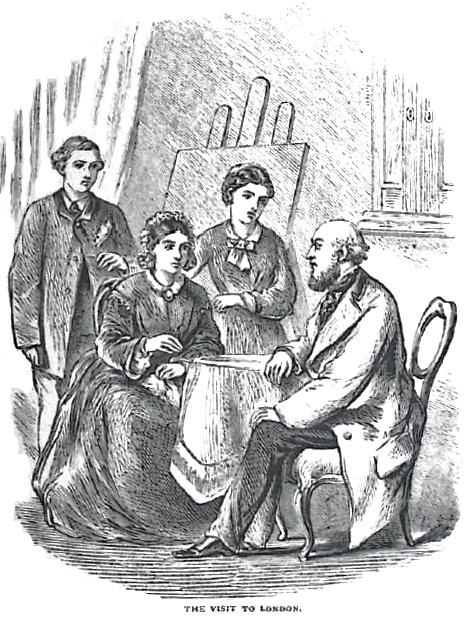
Just at such a moment, a fine, strong, sunburnt country-gentleman was puffing and flapping about in the narrow street something like a whale in shallow water, and not in the most amiable of tempers, to judge by the impatient thumping of small knockers, or pulling of broken bell-wires, as he applied at several neighbouring doors, and ended his startling summons at that of the house in which Mrs. Falconer resided.
That he had been admitted and was plunging up the dark stairs became evident, and his impression of No. 20, — Street was not complimentary to the lady of the house.
"Whew," he muttered as he stumbled behind her, "this after Falcon Range!—What a den!"
"They are good enough for your betters, sir, whoever you are," said the indignant landlady; "my rooms are the
best and cleanest in the whole neighbourhood, and I'm not to be insulted by anybody's ignorant notions."
"Well, well, my good lady, I beg your pardon I'm sure."
And the mollified landlady withdrew as the visitor turned with interest to the startled group before him.
"I must also beg your pardon, Mrs. Falconer, but I have been seeking you all the morning, and must now deliver my errand, and get home again. I regret to see that the bloom has faded from these young cheeks, but we will have it back soon; London does not suit young plants."
"They are growing fast," said Mrs. Falconer.
And a look was turned towards her which seemed to say, "And pray how do you account for your own sickly appearance? Are you growing too?"
Hat and umbrella being disposed of, and the visitor seated, there was an awkward pause.
"You are justly wondering what has brought Roger Hazelwood to London, and to you, madam," he began, "and as I never can get through a circumbendibus creditably, I must just go straight to the point. We—that is, my wife and daughter and I are very much pleased with the old Moat House; it is everything we could wish, excepting—"
"Sir, I beg your pardon," burst in Guy, hastily, "but did you come here to tell my mother this?"
"Patience, young man," said the Squire, with an amused smile, "I certainly did, though the tail of my speech is more to the purpose; only I could not thrust it in backwards. Excepting that it is a great deal too large for our small
party, and requires a comfortable merry group to make it feel warm and homely. Now for you to be shut up in this foggy hole (I beg pardon) while the whole Falcon Range is longing to have you back again, seems nothing short of insanity; so I came with our united request that you all return with me, and live where you are so well loved, and teach us how to win and wear a share of the hearts of the people around us."
Mrs. Falconer and her children sat speechless, gazing with wonder at the kind, earnest face of the Squire, who evidently meant every word he said. And what was to be said in return?
"I have been uncouth, I'm afraid, madam; my wife would have done better than I, but I could not allow her to take the journey, therefore she will talk over matters with you after you get back. You are not going to refuse my escort, I hope. Look at your son and daughter, Mrs. Falconer, look into your own mirror for a moment, and I am answered; you cannot deny that the argument is strong in my favour. Besides, my Evelyn wants a companion, that black pony of Master Guy's wants exercise, the parson wants his helpers, and the old people want their flannel things against the winter. You'll come?"
THE VISIT TO LONDON.
"Dear sir, we have really been dumb only from surprise," said Mrs. Falconer. "I do not know how to answer you."
"Mother," said Guy, "it is impossible for me. You know I must and will work."
"Bravo, young sir," said the Squire; "but you must get back the strength to do it first."
"May I ask for time to think, to consider?" said Mrs. Falconer. "It is too true that we are not in the best of health, but I have accepted an engagement which may greatly conduce to our improvement—"
"It is impossible for you to undertake anything at present, madam," said Mr. Hazelwood, rising. "You have not the strength of a kitten left amongst you, if I'm any judge of appearances. I must candidly say that I cannot breathe for a week myself in this smoky wilderness of chimneys, and mean to quit it as soon as possible. Still, I am willing to wait your pleasure, if you consent to return with me."
"Dear sir, you must be aware that to accept or refuse would be either unwise or ungrateful, without due consideration. May I write to you this evening?"
"Pray do, and I will book places by the mail to-morrow. And I would suggest, with all due respect to you, madam, that you come at once on a visit for three months, and consider the rest afterwards. I can understand some pain for a while at coming home, but I really believe that the pleasure you will confer must make some compensation. Now farewell until to-morrow."
"Sir," said Guy as the Squire gave his address in London, "I am very sorry for my rudeness, and I beg your pardon."
"Granted, young sir; and the best proof of good terms between us will be that you accept my invite, and come at once. Our good young parson will see that it is not lost time in your preparations for work. I protest against everything until we see the country bloom on your cheeks again."
"I am at a loss to thank you as I ought, Mr. Hazelwood," said Mrs. Falconer as she followed her visitor down the stairs, "but you must not think me ungrateful."
"Leave that word out of the case, if you please, madam. We are selfish, as you will find; but I wish my Dorothy had been here to show you the facts." And never in his life having been able face any eyes that glittered in tears, the Squire hastened off, to beguile his time until the Member for his county called at the hotel and took him to "the House" to hear a debate on some important question of the day.
"Dear mother, you will go," said Guy, as Mrs. Falconer returned to the room and looked anxiously at her children for some indication of their wishes.
"Dear mother, let us go as visitors," said Maude. "Has not God sent us this kind friend to show you what to do? And we shall all be strong and well again for whatever comes next?"
"Can you be happy there, my son?" said she.
"As happy, or most likely more so than anywhere else, until I can work for you, mother," said Guy. "After all, I was not the owner of the Moat, and have no right to murmur at what the real owner chose to do."
"Thank God for this, my dear child; it is health and joy to hear you say so, and I almost think we would be wrong to decline Mr. Hazelwood's generous kindness, extraordinary, unexpected though it is."
"I don't believe his Dorothy, as he calls her, could have done his errand better," exclaimed Maude, "and I can't help thinking we shall love them all. Now, mother, prepare to make the most of our unexpected holiday."
Such a cheerful voice had not saluted her mother's ears for some time past, and after thought and prayer, a letter to the Squire accepting the invitation was despatched.
The picture not being finished, and feeling unwilling to hurry over it in her present exhausted state, Mrs. Falconer could not have the benefit of the price promised for it, and when the next day she contrived her errand of explanation with her employer into the City, she took with her to a jeweller's shop one of her few costly ornaments, a memorial of happier days; and the sum offered for it provided sufficiently for the immediate expenses of the journey. But the new, strange feelings attendant on the humiliating act, thankfulness to God for all His providential care, a sense of utter prostration of bodily power, ended at last in a long faint, which terrified her children, and produced in the kindhearted landlady entire resignation to the departure of her lodgers without the usual term of notice thereof.
"Surely 'the Lord is my shepherd,'" said Mrs. Falconer; "and what a key-note is that sentence! It seems to flood the soul with promise and praise. Many may be the needful afflictions of the flock, but 'the Good Shepherd' leads them by 'the right way,' and when they are weary, His bosom is their resting-place."