PREFACE
We live in a connected age where we can snack on media 24/7, viewing what we want, when we want, and how much we want. Many of us participate with brands and content in social media and online in ways that are engaging and behavior-changing. The advertising ecosystem has changed because of the ever-evolving digital landscape. To reflect the changes in the advertising industry, I changed and expanded the third edition of Advertising by Design. This book remains the most comprehensive text on creative idea generation and designing for advertising. Its content and features make it a highly effective resource for instructors, students, or any reader interested in the creative side of advertising. In Advertising by Design, the approach is to start stories people will co-author and participate in across media channels; generate ideas that benefit people; design those ideas to grab people’s attention; build brand communities; and be creative while delivering on the brand promise.
NEW TO THIS EDITION
This new edition of Advertising by Design focuses on:
Understanding the audience in the 24/7 connected age
Knowing the strategic thinking underpinning the brand
Generating strategic, viable, and creative advertising ideas
Constructing shareworthy stories people will participate in
Designing and visualizing ad ideas for print, screen, film, and animation
The third edition offers the following essentials and enhancements:
Design principles for print, screen, animation, commercials, and social films
Typographic basics and principles for print and screen
Integrating copy and image for print, screen, and motion
Designing integrated media campaigns: print, screen, video sharing, and social media channels
Approaches to type and image constructions and integration
Guiding principles for advertising storytelling in animation and motion
Design essentials for the look of a commercial or social film
Designing mobile first, rich and ready
Social media ideas by design
Building a brand narrative in the digital age
Idea generation for integrated campaigns and all media channels
Copywriting
Creating engaging work that grabs attention and resonates
Deconstructing model frameworks
Starting stories people will co-author
Social media participation
Conceiving advertising ideas that benefit people
Imbuing advertising with social purpose and benefit
Building brand communities and brand advocates
Sourcing data to create useful brand apps, experiences, and platforms
Social campaigning that maps back to the brand proposition
Understanding that a brand is a promise
Understanding social responsibility in practice
Learning the skills required of a junior art director
FEATURES
Comprehensive examination of designing for print and screen
Designing integrated media campaigns
Designing with type and image
Ten guiding principles for ad storytelling and design in animation
Complete guide to advertising model formats
Approaches to constructing brand narratives and constructs
Basic guide to writing headlines and taglines
Award-winning examples of classic and contemporary advertising across media channels
Interviews with esteemed advertising creatives
Case studies
Essays
Exercises and projects to jump-start creative thinking and work
Supplemental instructional materials online
Resources for Instructors
Online instructor materials include:
11-week syllabus
15-week syllabus
Additional exercises and projects
Notes on how to teach the creative side of advertising
PowerPoints
Grading rubric
Website links
Test questions for every chapter
Sample creative brief
Portfolio tips
ORGANIZATION AND FIGURES
In order to create advertising, you need to understand the basics about the people you’re advertising to, and the brand, organization, or cause you’re advertising; the strategic underpinning of the brand, organization, or cause; how to generate ideas; and how to design for different media channels. That’s a lot of content to digest in order to begin. With that in mind, I ordered this edition’s content to get you concepting and designing as quickly as possible. Ideally, it would be great if you read chapters 1 through 5 right away. It would be even better if you read chapters 1 through 7 right off.
You can read the chapters in any order that you think would best help you to understand how to generate ad ideas and design them. You’ll notice some necessary repetition about brand strategy, storytelling, and design for two main reasons: each chapter is almost a stand-alone module, and some notions and principles need to be heard in more than one context.
The examples in this edition include a few classics fromthe 1960s, the creative revolution. But most are contemporary, chosen to be timeless. This isn’t a periodical, so I chose outstanding work that would stand up to the test of a few years. I selected work fromaward-winning agencies, creative directors, art directors, copywriters, and advertising designers. You can visit agencies online to see new work, as well as visit the archives of the One Show, the Clio Awards, the Art Directors Club Awards, Cannes Lions, Favourite Website Awards (FWA), and other respected award archives.
There are more informational and instructional resources available to you on the John Wiley & Sons website: www.wiley.com. On the Advertising by Design, 3rd edition, companion site you will find an advertising historical perspective, PowerPoint slides, resources, portfolio
tips, a sample creative brief, and additional exercises and projects.
Generating advertising ideas that resonate with people is challenging. However, if you enjoy thinking creatively and strategically, it is a rewarding endeavor. Be patient and immerse yourself in the discipline by looking at award-winning work, visiting professional advertising organizations’ archives, reading, sketching, watching good films, thinking about what people want and why they want it, and being a student of human nature, popular culture, and visual communication.
Best wishes for a rich and enjoyable career!
1
ADVERTISING IS…
Advertising doesn’t only compete with other advertising for people’s attention. It also competes with everything online, in print, on television, and everywhere else, with the best entertainment and information available. To effectively reach the right audience, to reach people where they spend the most time and where they value brand experiences, advertising has to be relevant, resonate, engaging, and worth their time. Advertising has to start meaningful conversations with people, fire connections, fuel communities, and be shareworthy.
Are you on two or more screens simultaneously? Do you watch TVwith your mobile in hand or nearby? Only a few years ago, the heart of the advertising ecosystemwas TVcommercials which is advertising that is pushed at people, marketing that disrupts programming. That ecosystemis shifting to a more interactive and mobile-ready model. The change in distribution of advertising messages fromprint and broadcast channels (TVand radio) to interactive media channels (mobile, social, and web) in turn has changed how advertising creative professionals conceive and execute ideas. It has also changed how we need to prepare, what we need to know, and the required thinking and design skills.
Advertising is …
Starting stories people will coauthor and participate in across media channels
Service and actions: advertising ideas that benefit people and that people can participate in
Doing something to benefit society, not just selling more brand product; brands that behave like good world citizens
Building brand communities and brand advocates and sirens
Sourcing data to informuseful brand apps, experiences, and platforms
Mobile first, mobile rich and ready
Social campaigning that maps back to the brand proposition, how a brand defines itself, the benefit it commits to delivering to you, what it promises. A brand is a promise.
The three steps for any brand messaging have not changed:
1. Get people’s attention.
2. Keep their attention.
3. Call themto action.
Digital spaces, however, have changed how we get people’s attention and engage them. Through offering entertainment, utilities, apps, games, or education, or leveraging YouTube stars, advertisers get people to notice, to pay attention, or to respond by making a purchase or taking an action.
THE PURPOSE OF ADVERTISING
Although advertising channels have multiplied, advertising still serves the same purpose. In a free-market system, advertising promotes one brand or entity over another; raises awareness about social issues and causes, individuals, and organizations; and calls people to action for charitable or nonprofit organizations.
Most competing brands are of equal quality and have equivalent defining features that is, they are parity goods or services. For example, most toothpaste brands in the same price category (perhaps even across price categories) use similar ingredients and provide equivalent results. Among parity products and services, effective advertising could persuade you that one brand is better or more appealing than its competition. An ad campaign for a toothpaste brand might convince you that its use would leave your teeth cleaner, brighter, healthier, or your mouth more fragrant than any other. For any advertising to affect you, to call you to action, it has to be relevant to you, and it has to be presented on media channels that will reach you.
In industrialized countries (and, increasingly, globally) advertising is part of daily life and inseparable frompopular culture. In many countries, advertising is the one common experience shared by a large, diverse populace. Advertising is a mass media leveler, the pop culture vehicle with which we all come into contact and know frombranded entertainment online to mobile ads to television commercials.
An advertisement (or “ad”) is a specific message constructed to inform, persuade, promote, provoke, or motivate people on behalf of a brand, entity, or cause. (In this book, “entity” designates commercial companies, government agencies, and nonprofit organizations.) An advertising campaign is a series of coordinated ads, based on an overarching strategy and an insight into the audience, connected by voice, design, style, imagery, and tagline (brand catchphrase), where each individual ad in the campaign can also stand on its own.
An integrated ad campaign has an overarching strategy and core concept and is conceived and created for audiences using specific media channels and then distributed on those channels. These might include broadcast, print, screen-based media, and out-of-home (OOH), and might include categories such as branded entertainment and content for web or social media, ambient advertising, TVcommercials, or innovative media.
BROAD ADVERTISING CATEGORIES
Public service advertising seeks to advance the common good. According to the Advertising Council, an American public service advertising organization (www.adcouncil.org): “The objectives of [public service] ads are education and awareness of significant social issues, in an effort to change the public’s attitudes and behaviors and stimulate positive social change.”
Advertising agencies donate their expertise and time to create public service advertising, commonly called PSAs, in service of a great variety of social causes and nonprofit
organizations. At times there is a facilitating organization, such as the Ad Council. According to its website, the Ad Council is “a private, non-profit organization that marshals volunteer talent fromthe advertising and communications industries, the facilities of the media, and the resources of the business and non-profit communities to deliver critical messages to the American public.” The Ad Council produces and distributes PSAs “in issue areas such as improving the quality of life for children, preventive health, education, community well being and strengthening families.”
In most countries, media outlets consider PSAs a public service to the community, and therefore they do not charge to run the PSAs on television, radio, or in print. To have more control over PSAplacement, however, some nonprofit organizations and government agencies have begun to pay for media time.
Cause advertising, though initiated by commercial concerns, seeks to raise funds for nonprofit organizations or raise awareness on social issues and runs in paid media channels. It is generally affiliated with a corporation and used in part to promote a corporation’s public image or brand, unlike public service advertising, which has no commercial affiliation. Common examples of this are brands that support existing causes, such as cancer research, or organizations that partner with brands. For instance, the World Wildlife Fund (WWF) and the Coca-Cola Company joined forces to help protect the polar bear and its habitat. According to the WWF website (http://www.worldwildlife.org/partnership-categories/marketingpartnerships), “WWF engages in a variety of cause marketing partnerships that help drive awareness of, and revenue towards, our conservation work.”
In another example of cause marketing, in the early 2000s Dove set out to widen the definition of beauty with a groundbreaking ad campaign. Out of that campaign came the Dove SelfEsteemProject, which was founded “to help the next generation of women grow up feeling happy and confident about the way they look” (www.dove.us/Our-Mission/Girls-SelfEsteem/Vision/). Dove has continued in that direction with campaigns such as the awardwinning “Real Beauty Sketches.”
Some brands go beyond cause marketing as an integral part of their business models. TOMS, a company that makes shoes and accessories, includes a “One for One” concept in its business model: “With every product you purchase, TOMS will help a person in need.” Similarly, Patagonia’s “Common Threads Partnership” aims to reduce its environmental impact.
Commercial advertising promotes brands, companies, individuals, and commodities. Aimed at mass audiences, commercial advertising takes many forms, fromsingle print advertisements to campaigns across media to sponsorships to branded utilities and entertainment. Within the commercial category, there are several subcategories. Consumer advertising is directed toward targeted segments of the general public and includes most of the ads shown in this book. Other types of commercial advertising include business to business (B2B), which is one company advertising to others, and trade advertising, which is consumer-product advertising intended not for the average consumer but for the various entities and experts who influence consumers (for example, health care professionals) or advertising aimed at a specific trade or profession (for example, a publisher’s ad aimed at potential authors).
Another random document with no related content on Scribd:
THE ONLY WOMAN WHO COULD TURN ME FROM BACHELORDOM
V.Flesh and Fowl
VI.Vegetables and Salads 108
VII.Eggs and Savouries 138 VIII.Sauces 159
IX.Sweets and Oddments 177
X.Amenities of the Table 192 Index 207
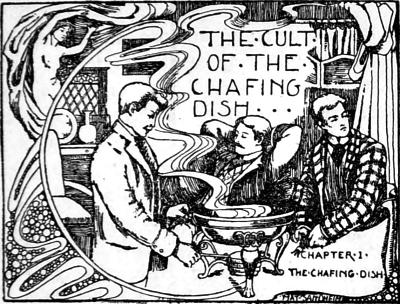
CHAPTER·1·THE·CHAFING·DISH
“There does not at this blessed moment breathe on the Earth’s surface a human being that willna prefer eating and drinking to all ither pleasures o’ body or soul.”—THE E
TTRICK SHEPHERD
.
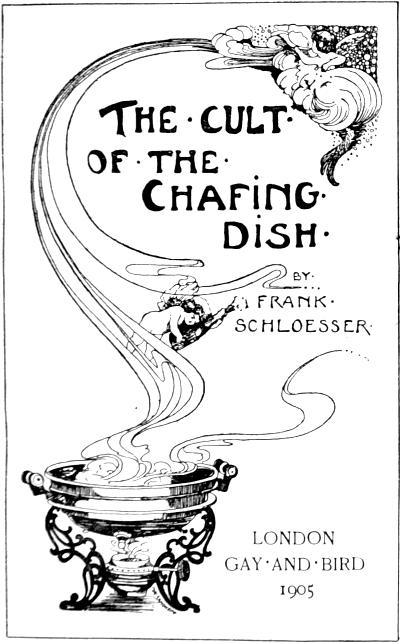
EVERY bachelor has a wife of some sort. Mine is a Chafing Dish; and I desire to sing her praises.
My better half—I love to call her Chaffinda, and to dwell upon the doubled consonant—is a nickel-plated dish on a wrought-iron stand, with a simple spirit-lamp wherewith to keep herself warm. I bought her at Harrod’s Stores for twelve shillings and ninepence—and she has sisters.
It has been borne in upon me that many quite nice folk may be glad to learn something of the possibilities of Chaffinda. Whether married or single, there are moments in the life of nearly every man and woman when the need of a quick, hot, and light little meal is worth much fine gold. To such I would politely address myself.
The ordinary domestic cook is a tireless enemy of the Chafing Dish. She calls it “fiddle-faddle.” Maybe. But inasmuch as it is clean,
economical, speedy and rather simple, it would naturally not appeal to her peculiar sense of the culinary art.
To bachelors, male and female, in chambers, lodgings, diggings, and the like, in fact to all who “batch”; to young couples with a taste for theatres, concerts, and homely late suppers; to yachtsmen, shooting-parties, and picnickers; to inventive artists who yearn for fame in the evolution of a new entrée; to invalids, night workers, actors and stockbrokers, the Chafing Dish is a welcome friend and companion.
It has its limitations, of course, but they are few and immaterial, and its obvious advantages and conveniences far outweigh its trivial drawbacks. At the same time it must be remembered that it is a serious cooking apparatus, and by no means a mere toy.
It is quite erroneous to imagine that the Chafing Dish is an American invention. Nothing of the sort. The earliest trace of it is more than a quarter of a thousand years old. “Le Cuisinier Français,” by Sieur François Pierre de la Varenne, Escuyer de Cuisine de Monsieur le Marquis d’Uxelles, published in Paris in 1652, contains a recipe for Champignons à l’Olivier, in which the use of a Réchaut is recommended. A translation of this work, termed “The French Cook,” was published in London in 1653, and the selfsame recipe of Mushrooms aftertheOliver contains the injunction to use a Chafing Dish; moreover, the frontispiece, a charmingly executed drawing, shows a man-cook in his kitchen, surrounded by the implements of his art; and on the table a Chafing Dish, much akin to our latter-day variety, is burning merrily. This was in 1653. The Mayflowersailed in 1620.
So much for the antiquity of the Chafing Dish. At the same time our mitigated thanks are due to America for its comparatively recent reintroduction, for until quite lately, in Great Britain, its use was practically limited to the cooking of cheese on the table. The Chafing Dish is much esteemed across the Atlantic, although one is forced to admit that it is sometimes put to base uses in the concoction of unholy stews, which have not the natural flavour of fish, flesh or
fowl, or even good red herring. Still, if the Americans are vague in their French nomenclature, unorthodox in their sauces, eclectic in their flavourings, and over-lavish in their condiments, yet they have at any rate brought parlour cooking to a point where it may gracefully be accepted as an added pleasure to life.
When two or three are gathered together, and one mentions the magic word “Chafing Dish,” the second invariably chimes in with “Welsh Rabbit.” This is an error of taste, but excusable in the circumstances. Chafing Dishes were not created for the exclusive canonisation of Welsh Rabbits, although a deft hand may occasionally play with one in a lightsome mood. There are other and better uses. All the same, a fragrant and delicate Rabbit is not to be despised, although it must not be made conceited by too great an elevation into the realms of high cookery.
My Chaffinda has at least seventeen hundred and four different charms, therein somewhat exceeding the average number appertaining to her sex, but it would require volumes to mention them separately, and it must suffice to indicate roughly a few of the more prominent.
I suppose that every nation has the cooks that it deserves, and, if this be accepted as an axiom, the general degeneration of the Plain Cook of the middle classes amply accounts for the growing cult of the Chafing Dish. The British school of cookery, in its mediocre form, is monotony exemplified. Too many broths spoil the cook; and hence we derive our dull sameness of roast and boiled.
Sweet are the juices of diversity, and whilst there is no reason for the Chafer to elaborate a sauce of thirteen ingredients, the cunning manipulation of three or four common articles of the domestic storecupboard will often give (intentionally or otherwise) surprising results. This I shall hope to explain more fully later on.
Imagination and a due sense of proportion are as necessary in cooking as in any other art—more so than in some, for Impressionism in the kitchen simply means indigestion. Digestion is
the business of the human interior, indigestion that of the doctor. It is so easy to cook indigestible things that a savoury cunningly concocted of Bismuth and Pepsine would seem an almost necessary adjunct to the menu (or CarteDinatoire, as the French Revolutionists called it) of the budding Chafist.
But the demon of indigestion may easily be exorcised with a little care and thought. Three great apothegms should be borne in mind. Imprimis: Never worry your food; let it cook out its own salvation. Item: Use as few highly spiced condiments as possible; and, lastly, keep to natural flavours, juices, and sauces.
Much modern depravity, for instance, I attribute to the unholy cult of Mayonnaise (or Mahonnaise, or Bayonnaise, or Magnonaise, according to different culinary authorities). At its best it is simply a saucy disguise to an innocent salmon or martial lobster, reminding the clean-palated of an old actor painted up to look young. I once knew a man who proposed to a girl at a dance-supper simply because he could not think of anything else to say, and suddenly discovered that they both hated Mayonnaise. I have no reason to suppose that they are unhappy.
At the same time I am in no wise against trying new dishes, new combinations of subtle flavours, if they do not obliterate the true taste of the basis. An experimental evening with Chaffinda, when one is not sure how things are going to turn out, is, I find, most exhilarating, and a sure cure for the blues. But I am fain to admit that on such occasions I always provide a chunk of Benoist pressed beef as a stand-by in case of emergency.
There is nothing final about the Chafing Dish.
Another point about having a wife in the shape of a Chafing Dish is somewhat delicate to explain. Coarsely indicated, it amounts to this. Continuous intercourse with such a delicious, handy and resourceful helpmeet tends to a certain politeness in little things, a dainty courtesy which could not be engendered by the constant companionship of a common kitchen-range. Chafing-Dish cookery
bears the same relation to middle-class kitchen cookery that the delightful art of fencing does to that of the broadsword. Both are useful, but there is a world of subtle differentiation between the two. The average rough and tumble of the domestic saucepan contrasts with the deft manipulation of the miniature battery of tiny pans.
And politeness always pays; moreover, it is vastly becoming. I gave a little tea-party recently to some dear children. Some of them were twins. Edith, a female twin of nine, asked me to help her to some more blackberry jam. “Certainly, Edith,” I said; “but why don’t you help yourself?” The maid was even politer than she was hungry: “Because I was afraid I should not take enough.” And thus we learn how things work among manikinkind.
There are some who delight in the flavour of onions. I do myself— but then I am a bachelor. Politeness and onions form one of life’s most persistent inconsistencies. His Most Gracious Majesty King George IV., it is recorded, attempted to kiss a royal housemaid, who said: “Sir, your language both shocks and appals me; besides which, your breath smells of onions!” And again, in a Cambridge diningroom, a framed notice on the wall stated: “Gentlemen partial to spring onions are requested to use the table under the far window.”
Nevertheless, the benefits of onions toward the human race are probably not less than those attendant on the discovery of steam. It is a vegetable whose manifold properties and delights have never been properly sung. As a gentle stimulant, a mild soporific, a democratic leveller of exaggeration in flavour, a common bond between prince and peasant, it is a standing protest of Nature against Art.
On my wall, as I write, hangs a delightful oil study of a clump of onions in flower, which the deft artist aptly dubs Le Fond de la Cuisine. Dr. William King said that “Onions can make even heirs or widows weep”; and the “Philosopher’s Banquet,” written in 1633, seems to meet the case excellently:
“If Leekes you like, but do their smelle disleeke,
Eat Onyons, and you shall not smelle the leeke; If you of Onyons would the scente expelle, Eat Garlicke, that shall drowne the Onyon’s Smelle.”
I would not go quite as far as the poet, but I confess to a weakness for chives. A judicious touch to many salads and made dishes is very desirable. Chives are to onions as the sucking-pig is to pork, a baby scent, a fairy titillation, an echo of the great Might Be.
Charles Lamb had a friend who said that a man cannot have a pure mind who refuses apple dumplings. In the plural, mind you, not the singular. Appetites have vastly changed since then, probably not for the better, but the test even to-day seems adequate and noteworthy. I do not propose to recommend either onions or apple dumplings as Chafing-Dish experiments, but merely adduce them as worthy examples of the toothsomeness of simplicity.
The late lamented Joseph, of the Savoy and elsewhere, once said in his wisdom, “Make the good things as plain as possible. God gave a special flavour to everything. Respect it. Do not destroy it by messing.” These are winged words, and should be inscribed (in sugar icing) above the hearthstone of every artist in pots and pans.
The Chafing Dish is a veritable Mephistopheles in the way of temptation. It is so alluringly easy to add just a taste of this or that, a few drops of sauce, a sprinkling of herbs, a suggestion of something else. But beware and perpend! Do not permit your culinary perspective to become too Japanesque in the matter of foreground. Remember your chiaroscuro, take care of the middle distance, and let the background assert its importance in the whole composition. “I can resist anything—except temptation” is the cry of the hopelessly weak in culinary morality.
Lest I should be hereafter accused of contradicting my own most cherished beliefs, let me hasten here and now to assert that condiments, esoteric and otherwise, were undoubtedly made to be used as well as to be sold; and I am no enemy of bolstering up the weak and assimilative character of—say veal, “the chameleon of
the kitchen,” with something stronger, and, generally speaking, of making discreet use of suave subtleties to give completeness to the picture. But the watchword must always be Discretion! To those who muddle their flavours I would commend the words of the Archbishop in Gil Blas: “My son, I wish you all manner of prosperity—and a little more taste!”
Sidney Smith thought Heaven must be a place where you ate pâté de foies gras to the sound of trumpets. There is a late Georgian ingenuousness about this which is refreshing. The liver of the murdered goose and the scarlet sound of brass! Nowadays a Queen’s Hall gourmet would compare the celestial regions to a continuous feast of Cailles deVigne braisées à la Parisienne to the accompaniment of Tschaikowsky’s “Casse Noisette” suite, which is more complicated, but perchance not less indigestible.
The typical crude British cookery, if carelessly performed, is a constant menace to its disciples. If well cooked there is nothing more wholesome, save perhaps the French cuisine bourgeoise, but —“much virtue in your If.” As a matter of fact, in nine households out of ten, in the middle-middle classes (and the upper too) the fare is well-intentioned in design, but deadly in execution, with a total absence of care and taste.
There is a curious old book, probably out of print nowadays, which deals tenderly, if severely, with the shortcomings of British cookery. It was published in 1853, and is called “Memoirs of a Stomach, written by Himself.” A typical passage runs: “The English system of cookery it would be impertinent of me to describe; but still, when I think of that huge round of parboiled ox-flesh, with sodden dumplings floating in a saline, greasy mixture, surrounded by carrots, looking red with disgust, and turnips pale with dismay, I cannot help a sort of inward shudder, and making comparisons unfavourable to English gastronomy.”
This is fair comment, and brings me back to the advantages of the Chafing Dish. An old German fairy tale, I think one of Grimm’s, says: “Nothing tastes so nice as what one eats oneself,” and it is certain
that if one cooks so as entirely to satisfy oneself (always supposing oneself to be a person of average good taste), then one’s guests will be equally satisfied—if not more so.
In dealing with Chaffinda we may, after a minimum of practice, be almost certain of results. If one is naturally clean, neat and dainty in one’s tastes, then one’s cooking should display the same characteristics. One’s individuality shines forth in the Chafing Dish and is reflected in one’s sauces. Chaffinda conveys a great moral lesson, and, as a teacher, should not lack in honour and reverence.
The late Prince Consort, being on a visit, wrote to a friend: “Things always taste so much better in small houses”; if one substitutes small dishes for small houses the Prince predicted the Chafing Dish.
The kitchen is the country in which there are always discoveries to be made, and with Chaffinda on a neat white tablecloth before one, half a dozen little dishes with food in various stages of preparation, a few select condiments, an assortment of wooden spoons and like utensils—and an inventive brain—there are absolutely no limits to one’s discoveries. One is bound by no rule, no law, no formula, save those of ordinary common sense, and though it might be too much to expect to rediscover the lost Javanese recipe for cooking kingfishers’ or halcyons’ nests, the old manner of treating a Hocco, or the true inwardness of “the dish called Maupygernon”; yet there are illimitable possibilities which act as incentives to the enterprising. There is a Chinese proverb to the effect that most men dig their graves with their teeth, meaning thereby that we all eat too much. This is awfully true and sad and undeniable, and avoidable. The late Lord Playfair asserted that the actual requirements of a healthy man for a seven-day week were three pounds of meat, one pound of fat, two loaves of bread, one ounce of salt, and five pints of milk. What a contrast to the chop-eating, joint-chewing, plethoric individual who averages five meals a day, and does justice to them all! Sir Henry Thompson says: “The doctors all tell us we eat too fast, and too often, and too much, and too early, and too late; but no one of them ever says that we eat too little.”
The proper appreciation of Chaffinda may ameliorate this, for in using her one speedily becomes convinced of the beauty of small portions, an appetite kept well in hand, and the manifold advantages of moderation. It is easy to feed, but nice eating is an art.
Bishop Wilberforce knew a greedy clergyman who, when asked to say grace before dinner, was wont to look whether there were champagne glasses on the table. If there were, he began: “Bountiful Jehovah”; but if he only espied claret glasses he contented himself with: “We are not worthy of the least of Thy mercies.”
Of course growing children and quite young grown-up folks require proportionately more food than real adults, for they have not only to maintain but to build up their bodies. But to such the Chafing Dish will not appeal primarily, if at all, and they may even be found impertinent enough to look upon it as a culinary joke, which it is not.
Chaffinda hates gluttons, but takes pleasure in ministering to the modest wants of the discerning acolyte, fostering his incipient talent, urging him to higher flights, and tempting him to delicate fantasies.
“Do have some more; it isn’t very good, but there’s lots of it.” So said a friend of mine to his guests about his half-crown port. This is the sentiment of the man who knows not the Chafing Dish. “Lots of it” is the worst kind of hospitality, and suggests the quantity, not quality, of the cheap-jack kerbstone butcher. Little and good, and enough to go round, is the motto of the tactful house-husband. A French cook once said that it was only unlucky to sit down thirteen at table if the food were but sufficient for twelve.
There is such a deal of fine confused feeding about the ordinary meals of even a simply conducted country house that imagination boggles at the thought of the elaboration of the daily menus. With four, or possibly five, repasts a day, few of them chaste, most of them complicated, a careful observer will note that the cook has been listening to the pipings of the Great God Sauce, and covers natural flavours with misnamed concoctions which do nothing but obliterate nature and vex the palate.
There are some few houses, great and small, town and country, where the elemental decencies of the kitchen are manfully preserved, where wholesome mutton does not masquerade as Quartierd’AgneauàlaMiséricorde, and the toothsome lobster is not Americanised out of all knowing. To such establishments, all honour and glory.
But to those whose means or opportunities do not permit of a carefully trained cook, a home-made artist, I would in all diffidence recommend the cult of the Chafing Dish, whose practical use I now propose to discuss.
CHAPTER II·PRELIMINARIES·
“Tout se fait en dinant dans le siècle où nous sommes, Et c’est par les diners qu’on gouverne les hommes.”—CH. DE MONSELET.
CHAFFINDA ’S cooking battery is small, but select. The Chafing Dish proper comprises the stand and lamp, and the dish, called the “Blazer,” which has an ebony handle; and there is an ingenious spirit diminisher which enables one to reduce the flame to a minimum, just enough to keep the flame simmering, or to put it out altogether. A second, or hot water pan, belongs to the outfit, and an asbestos toast-making tray may be bought for a trifle. In addition, a couple of green or brown dishes of French fireproof china, an egg-poacher, a marmite, and perhaps a casserole, all of which are best from Bonnet in Church Street, Soho, will come in very usefully. To these may be added the usual complement of plates and dishes and several wooden spoons of different sizes; a fish-lifter is also desirable, so is a strainer, and a pair of graters come in very handily. This practically completes the gear of the budding Chafist, though additional items may be added from time to time as occasion demands.
The makers of the Chafing Dish sell a useful methylated spirit can, with a curved spout to fill up the asbestos wick. It will be found that a good filling will burn for thirty to forty minutes, which is ample for
all ordinary purposes. Much of course depends on the quality of the spirit used, and, further, the wick will only become thoroughly saturated after half a dozen usings, and will subsequently require rather less spirit. I have found that water boils in the “Blazer,” or handled Chafing Dish, in about ten minutes, and instructions on bottled or preserved food, soups and the like, must be slightly discounted. Thus if one is told to boil for twenty minutes, it will be found that fifteen minutes in the Chafing Dish will be ample in nearly all cases.
As this is mainly a true story of my own personal adventures among the pots and pans, I can hardly do better than describe the first dish I tried my ’prentice hand upon, with the devout wish that all neophytes may be as successful therewith as I was.
Beef Strips.
The experiment, the preliminary exercise, if I may so term it, has no name, although it savours somewhat of the Resurrection Pie, unbeloved of schoolboys. Let us call it Beef Strips. Cut three thick slices from a rather well-cooked cold sirloin of beef, cut these again into strips a quarter of an inch wide and about three inches long. Take care that they are very lean. Chop up half a dozen cold boiled potatoes (not of the floury kind) into dice. Put the beef and the potatoes into the Chafing Dish. Light the lamp and see that the heat is steady, but not too strong. Add at once a good-sized walnut of butter, a teaspoon of Worcester sauce, salt and pepper. For at least ten minutes turn over the mixture continually with a wooden spoon until it is thoroughly heated. Turn it out on to a hot dish, and garnish with half a dozen tiny triangles of toast.
This is a simple luncheon or supper dish which takes little time, and —to my taste at least—is appetising and satisfying. Like all ChafingDish preparations, it can be cooked on the table, with no more protection than a tray under the wrought-iron stand, and a square of
coloured tablecloth upon your white one to receive possible splashes or drops.
Jellied Ham.
Now for exercise number two, which I have christened Jellied Ham, and commend as a dish very unlikely to go wrong in the manipulation.
Get your flame steady and true, and put a small walnut of butter in the dish. When it is fluid, add a good dessert-spoonful of red currant jelly, a liqueur glass of sherry, and three drops of Tabasco sauce. Drop into this simmering mixture a few slices of cold boiled ham cut thin and lean, and let it slowly cook for six to eight minutes. If you wish to be extravagant, then instead of the sherry use a full wineglassful of champagne. It is by no means necessary to eat this with vegetables, but if you insist on the conjunction, I would recommend a purée of spinach, directions for which appear hereafter.
This Jellied Ham is an agreeable concoction, which I find peculiarly soothing as a light supper after having seen an actor-manager playing Shakespeare. This is, however, after all only a matter of taste.
It has always seemed to me that different forms of the drama require, nay demand, different dinners and suppers, according to the disposition in which one approaches them. For instance, before an Adelphi melodrama, turtle soup (mock if necessary), turbot and rump steaks are indicated, whereas a musical comedy calls for an East Room menu, and an Ibsen or G. B. Shaw play for an A.B.C. shop or a vegetarian restaurant respectively. But I only hint at the broad outline of my idea, which is capable of extension to an indefinite limit.
Vegetarian meals do not appeal to me. There is a sense of sudden and temporary repletion followed shortly afterwards by an aching void, which can only be assuaged by a period of comparatively gross
feeding. Besides, judging from the appearance of my vegetarian friends (in whom maybe I am unfortunate) they often seem so much to resemble some of the foods they eat as to render themselves liable to be dubbed cannibals. But this is probably mere prejudice.
Minced Chicken or Game.
To resume the cult of Chaffinda. Here is another dish which I recommend to the beginner. It is a simple mince. Take any remains of chicken or game, pheasant for choice, and mince it (or have it minced) small, but not too small. Never use a mincing machine. Put the mince aside, and mix in the Chafing Dish the following sauce: a full walnut of butter, a tablespoon of flour, and a pinch of salt and pepper; add gradually about a tumblerful of milk. Keep continually stirring this and cook it well for five minutes, adding three drops of Tabasco sauce and half a tablespoon of Worcester sauce, also a squeeze of a lemon. When it is thoroughly amalgamated throw in the mince and let it get hot without burning. Serve it with toast or very crisp biscuits.
The only objection I know to this mince is that all cold birds, especially cold pheasant, are so excellent that it seems almost superfluous to hot them up. But there are occasions when the gamey fumes from Chaffinda are very alluring, and, after all, it is poor work eating cold cates at midnight, however tempting they might be at breakfast.
Our forebears were unanimous in their praise of the lordly long-tail. In a letter from Sidney Smith to “Ingoldsby” Barham, the worthy cleric says: “Many thanks, my dear Sir, for your kind present of game. If there is a pure and elevated pleasure in this world, it is that of roast pheasant and bread sauce; barndoor fowls for Dissenters, but for the Real Churchman, the Thirty-Nine times articled clerk, the pheasant! the pheasant!”
Toast.
It should perhaps be mentioned that the making of toast on the Chafing Dish is the easiest of functions. The asbestos tray, already referred to, is placed over the flame, and on the metal side the bread in rounds, triangles, or sippets; a few minutes serve to toast the one side adequately, and on being turned over it can easily be browned through. Mrs. Beeton is loquacious on the art of toastmaking, and lays down divers rules, but she knew not Chaffinda. A modern essayist who discourses learnedly and most sensibly on toast, makes a remark in his chapter on breakfasts, which although not entirely germane to my subject, is so true and, to my thinking, so characteristic, that I cannot refrain from quoting it. He is referring to marmalade. “The attitude of women to marmalade,” he says, “has never been quite sound. True, they make it excellently, but afterwards their association with it is one lamentable retrogression. They spread it over pastry; they do not particularly desire it at breakfast; and (worst) they decant it into glass dishes and fancy jars.”
How true, how profound, how typical!
But this is wandering from the point, which is cookery, not casuistry. Women are never out of place in connection with the good things of the table, although they do not often aspire to the omni-usefulness of the well-meaning, if ill-educated, lady who applied for the position of nurse to one of the field hospitals during the Boer war, and mentioned as her crowning qualification that, “like Cæsar’s wife, I am all things to all men.”
Mutton Cutlets.
After this little digression it will be well to turn to more serious things —cutlets, for instance. Obtain from the butcher a couple of welltrimmed mutton cutlets, and from the greengrocer sufficient green peas that, when shelled, you will have a breakfast-cupful. Melt a
walnut of butter in the Chafing Dish. Into the melted butter drop a tablespoonful of flour and a sprinkling of chopped chives. A teaspoonful of Worcester sauce and three drops of Tabasco, together with salt at discretion, will suffice for flavouring, and care must be taken that the mixture does not boil. Put in the cutlets, and when they begin to turn brownish add the peas, and half a cupful of milk. About fifteen minutes should cook the meat through if your spirit flame be strong, otherwise it may take somewhat longer. A very good substitute for Worcester sauce, in this connection, is Sauce Robert, which it is unnecessary to manufacture, as it can be bought ready made, and well made too, of the Escoffier brand. With certain meats it is an excellent condiment.
By the way, in some very old cookery books Sauce Robert was termed Roe-Boat sauce, an extraordinary orthographic muddle. An omelette was likewise known as a “Hamlet.”
This suggests the somewhat too sophisticated schoolboy’s description of Esau as “a hairy, humpbacked man, who wrote a book of fables and sold the copyright for a bottle of potash.”
It may be deemed superfluous, and in that case I apologise beforehand, to insist on the most scrupulous cleanliness in dealing with the Chafing Dish and its adjuncts. Not only should the dish itself be kept spotless and thoroughly scoured, but the stand, the lamp, the implements, and the glass and china should be immaculate. Servants are easily persuaded to look after the cleaning process, and do it with a certain amount of care, but it can do no harm to understudy their duties and add an extra polish all round oneself. It gives one, too, a personal interest in the result, otherwise lacking. I recommend the use of at least three dishcloths, which should be washed regularly and used discreetly. The Chafist who neglects his apparatus is unworthy of the high mission with which he is charged, and deserves the appellation of the younger son of Archidamus III., King of Sparta. Cleanliness is next to all manner of things in this dusty world of ours, and absolutely nothing conduces more to the enjoyment of a mealet that one has cooked oneself than the
knowledge that everything is spick and span, and that one has contributed oneself thereto by a little extra care and forethought.
A word of warning here. Never use “kitchen butter,” or “kitchen sherry,” or “kitchen eggs,” or “kitchen” anything else; use the very best you can afford.
An armoury of brooms, brushes, scrubbers, soap and soda is in no way necessary. A couple of polishing cloths and a little, a very little, of one of the many patent cleaners is all that is required. A clear conscience and plenty of elbow-grease does the rest.
The British equivalent of the continental charcutier is of inestimable service to the Chafist. At his more or less appetising emporium, small quantities of edibles can be purchased which are excellently well adapted for the cult of Chaffinda, especially if one be inclined towards the recooking of cold meats, instead of the treatment of them in a raw state. Both have their advantages—and their drawbacks. It is a general, but totally inaccurate, belief that meat once cooked needs only to be hotted up again. Nothing could be more fatal to its flavour and nutriment. A certain amount of the good juices of the meat must inevitably have been lost during the first process, and therefore great care must be taken in the second operation to tempt forth, and, in some cases, to restore the natural flavour. Cold cooked meat needs long and gentle cooking, a strong clear flame, without sudden differences in temperature, and it may be taken as a general rule that cold meat needs practically as long to cook as raw meat.
Browned Tongue.
For example, take half a dozen slices of cooked tongue, spread on each of them a modicum of made mustard, and let each slice repose for about two minutes in a little bath of salad oil (about enough to cover the bottom of a soup plate). Put the slices one on top of another until they make a compact little heap. Put the heap of tongue between two plates, so as to expel the superfluous oil. Let it
remain thus for half an hour. Then put a nutmeg of butter in the blazer, dismember the heap of tongue, and put the slices into the frizzling butter and turn them until they are brown. A little sauce, Worcester, Robert, or Piquant, may be added to suit individual taste. Serve very hot, with sippets of toast.
I have ventured to christen this dish Browned Tongue, which is simple and descriptive, but every Chafist is entitled to call it what he likes. There is little, if any, copyright in Chafing-Dish titles. Alexandre Dumas, author and cook, protests against the mishandling of names: “Les fantaisies de saucer, de mettre sur le gril, et de faire rôtir nos grands hommes.”
Personally I object to cooking simple fare and then dubbing it à la Quelque chose. Outside the few score well-known, and, so to say, classic titles of more or less elaborate dishes, which are practically standardised, there seems to me to be no reason to invent riddles in nomenclature when the “short title,” as they say in Parliamentary Bills, is amply descriptive.
It has been my ill-fortune to be introduced, at an otherwise harmless suburban dinner, to a catastrophe of cutlets, garnished with tinned vegetables, and to be gravely informed, on an ill-spelt menu, that it was “Cutelletesd’AgneauàlaJardinnier,” which would be ludicrous, were it not sad. Then how often does the kind hostess, without a punitive thought in her composition, write down Soufflet when she means Soufflé?
But mistakes are easily made, as witness that popular sign of a French cabaret, particularly in the provinces, Au Lion d’Or. If you look carefully at the signboard, you will find a man asleep, the punning name of the hotel implying Aulitondort.
But the whole question of Menus (Bills of Fare, if you please), and their mistranslation, is too vast to enter upon here, alluring though the subject may be. The language of the restaurant cook, save in especial instances, is as bad, although in a quite different sense, as that of the Whitechapel Hooligan. At the same time, it is absurd to
insist upon the literal translation of the untranslatable. “Out of works” for “Hors d’œuvres”; “Soup at the good woman” for “Potage à la bonne femme”; “Smile of a calf at the banker’s wife” for “Ris de veau à la financière”; and, lastly, “Anchovies on the sofa” for “Anchois sur canapé,” are all well enough in their way, but hardly an example to be followed, although they make “very pretty patriotic eating.”
It would be ridiculous to run away with the idea that because certain folk misuse the language, French should be henceforward taboo at our dinner-tables. Such a notion is ignorant and impossible. But the Gallic tongue should be used with discretion and knowledge, and if the enterprising Chafist invent a new dish of eggs, there is no law to forbid his naming it Œufs àlaTempleduMilieu. It would only show the quality of his erudition and his taste. There seems no particular reason why we should not replace Rôtiby Roast, Entréeby Remove, and Entremet by Sweet—except that it is not done; it is an affectation of humbug, of course, but the greatest humbug of all humbugs is the pretending to despise humbug.
Alderman’s Walk.
Onrevienttoujoursàsonpremiermouton—that is to say, let us get back to Chaffinda. The next dish on the experimental programme is “The Alderman’s Walk,” a very old English delicacy, the most exquisite portion of the most exquisite joint in Cookerydom, and so called because, at City dinners of our grandfathers’ times, it is alleged to have been reserved for the Aldermen. It is none other than the first, longest and juiciest longitudinal slice, next to the bone, of a succulent saddle of mutton, Southdown for choice, and four years old at that, though this age is rare. Remove this slice tenderly and with due reverence from the hot joint, lay it aside on a slice of bread, its own length, and let it get cold, thoroughly cold. Then prepare in the Chafing Dish a sauce composed of a walnut of butter, a teaspoon of Worcester, three drops of Tabasco, three chopped chives, and an eggspoon of made mustard. Stir these