Introduction-Global Burden of Disease addressed by Current Vaccines and Vaccines in the Development Pipeline
Stephen S. Lim, PhD, Christopher J.L. Murray, MD, DPhil Institute for Health Metrics and Evaluation, Seattle, WA, United States
1 INTRODUCTION
Estimates of disease burden provide critical information to guide the research, development and delivery of vaccines. In this chapter we present findings from the Global Burden of Disease (GBD) 2013 study to describe across countries, time, age, and sex, the disease burden attributable to conditions for which there are vaccines currently available as well as vaccines that are in the development pipeline.
2 THE GLOBAL BURDEN OF DISEASE STUDY
The GBD study is a powerful platform for understanding the main drivers of poor health at international, national, and local levels. Coordinated by the Institute for Health Metrics and Evaluation (IHME), GBD measures all of the years lost when people die prematurely or suffer from disability. It estimates healthy years lost from over 300 diseases, injuries, and risk factors from 1990 to 2013. The GBD findings are available for 188 countries. GBD results allow decision-makers to compare healthy years lost from fatal conditions, such as cancer, to those lost from nonfatal conditions, such as low back and neck pain. The study provides more policy-relevant information than cause of death data by shedding light on conditions that cut lives short, not just those that kill people primarily in old age. The GBD study also provides insight on potentially preventable causes of disease and injuries, known as risk factors which range from poor diets and high blood sugar to unsafe water and micronutrient deficiencies. Examining the ranking of diseases, injuries, and risk factors in a country, province, or county can help policymakers decide where to invest scarce resources to maximize health gains.
3 GLOBAL BURDEN OF DISEASE METHODS
GBD uses more than 50,000 data sources from around the world to estimate disease burden. Years of life lost (YLLs) due to premature death from different causes are calculated using data from vital registration with medical certification of causes of death. Years lived with disability (YLDs) are estimated using sources such as published studies on disease and injuries occurrence, cancer registries, data from outpatient and inpatient facilities, and direct measurements of hearing, vision, and lung function. Disability-adjusted life years (DALYs) are the sum of YLLs and YLDs. Estimates are generated using advanced statistical modeling. For more information about GBD methods, see the papers referenced at the end of this chapter.1–4
4 VACCINE-PREVENTABLE DISEASE BURDEN FROM GBD 2013
In the remainder of this chapter we briefly describe the disease burden associated with presently available vaccines and vaccines in development and highlight the use of GBD results to identify important variations in disease burden patterns. We encourage readers to use the publicly accessible visualization tools available for the GBD (http://www.healthdata.org/results/data-visualizations) to further explore disease burden patterns for specific conditions mentioned throughout this book.
Tables 1 and 2 show presently available vaccines and vaccines that are in development as denoted by the World Health Organization (WHO) 5 along with the corresponding GBD cause category. It should be noted that this is not a precise mapping of vaccines against disease burden for several reasons. Firstly, for some vaccines such as polio, GBD does not presently estimate the corresponding disease burden. Secondly, the listed vaccines may only address part of the corresponding GBD cause; for example, presently available pneumococcal vaccines address only a selected number of subtypes included under the GBD cause category of pneumococcal pneumonia and meningitis. Finally, the estimates provided in this chapter do not take into account the efficacy of the vaccine; for example, the protective efficacy of Bacillus Calmette-Guérin (BCG) vaccine in reducing tuberculosis disease burden is low as is the more recently developed malaria vaccine. In other words, we present here the full disease burden attributable to a cause, not only the fraction of the cause that is preventable by available vaccines or those under development.
4.1 Disease Burden Associated With Current Vaccines
In 2013, 4.9 million deaths globally (8.9% of all global deaths) were attributable to causes corresponding to presently available vaccines. This represents
TABLE 1 Vaccine Preventable Diseases—Current Vaccines
WHO current vaccinesa
Cholera
Dengue
Diphtheria
Hepatitis A
Hepatitis B
Hepatitis E
Haemophilus influenzae type b (Hib)
Human papillomavirus (HPV)
Influenza
Japanese encephalitis
Tick-borne encephalitis
Malaria
Measles
Meningococcal meningitis
Pertussis
Pneumococcal disease
Rabies
Rotavirus
Tetanus
Tuberculosis
Typhoid
Varicella
Yellow fever
GBD cause name
Cholera
Dengue
Diphtheria
Hepatitis A
Hepatitis B
Liver cancer due to hepatitis B
Cirrhosis due to hepatitis B
Hepatitis E
H. influenzae type b pneumonia
H. influenzae type b meningitis
Cervical cancer
Influenza
Encephalitis
Malaria
Measles
Meningococcal meningitis
Whooping cough
Pneumococcal pneumonia
Pneumococcal meningitis
Rabies
Rotaviral enteritis
Tetanus
Tuberculosis
Typhoid fever
Varicella and herpes zoster
Yellow fever
aMumps, rubella are included as part of the GBD other infectious disease category and not included here. Poliomyelitis is not estimated as part of GBD.
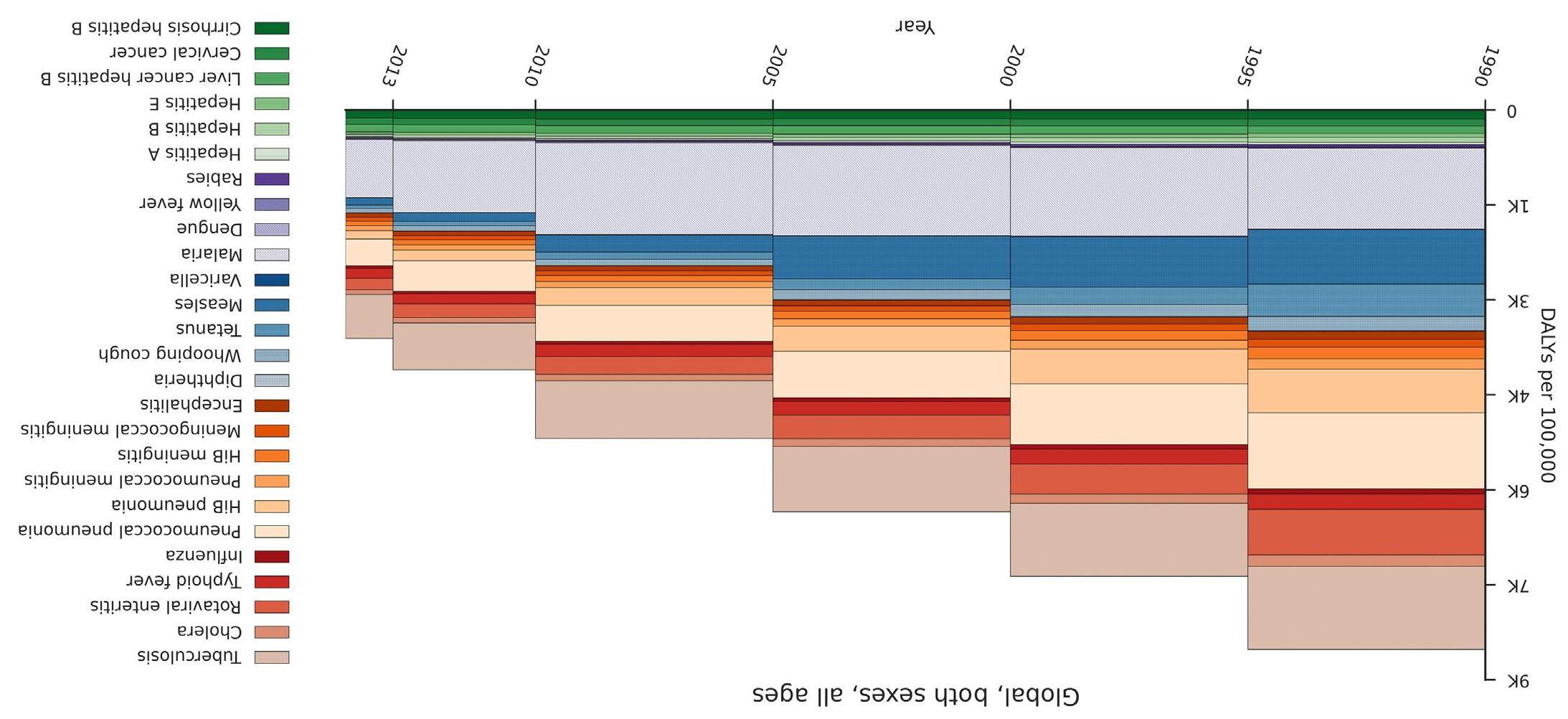
an annual decline of 3.0% from 1990 levels (Fig. 1 for deaths, Fig. 2 for DALYs); in 1990, 7.2 million deaths globally (15.1% of all global deaths) were attributable to these causes. These declines represent improvements in the original Expanded Program Immunization (EPI) vaccines included in the standardized vaccination schedule established by WHO in 1984 [BCG,
TABLE 2 Vaccine Preventable Diseases—Pipeline Vaccines
WHO pipeline vaccines*
Campylobacter
Chagas disease
Enterotoxigenic E. coli
HIV
Herpes simplex virus
Human hookwork infection
Leishmaniasis
Nontyphoidal salmonelloses
Norovirus
Paratyphoid fever
Schistosomiasis
Shigella
RSV (Respiratory syncytial virus)
GBD cause name
Campylobacter enteritis
Chagas disease
Enterotoxigenic E. coli infection
HIV/AIDS
Genital herpes
Hookworm disease
Leishmaniasis
Other salmonella infections
Norovirus
Paratyphoid fever
Schistosomiasis
Shigellosis
Respiratory syncytial virus pneumonia
*Streptococcus pyogenes are not estimated as part of GBD. Rotavirus vaccines (next generation), streptococcus pneumoniae (pediatric vaccines), tuberculosis (new vaccines), and universal Influenza vaccine are included in the corresponding GBD categories under currently available vaccines.
diphtheria-tetanus-pertussis (DPT), oral polio and measles] but also the introduction of new vaccines such as Haemophilus influenzae type b (Hib), pneumoccocal conjugate vaccine, and rotavirus vaccine. Declines also reflect other health, for example, treatment of pneumonia, and non-health interventions, for example, improvements in maternal education, that affect these conditions.
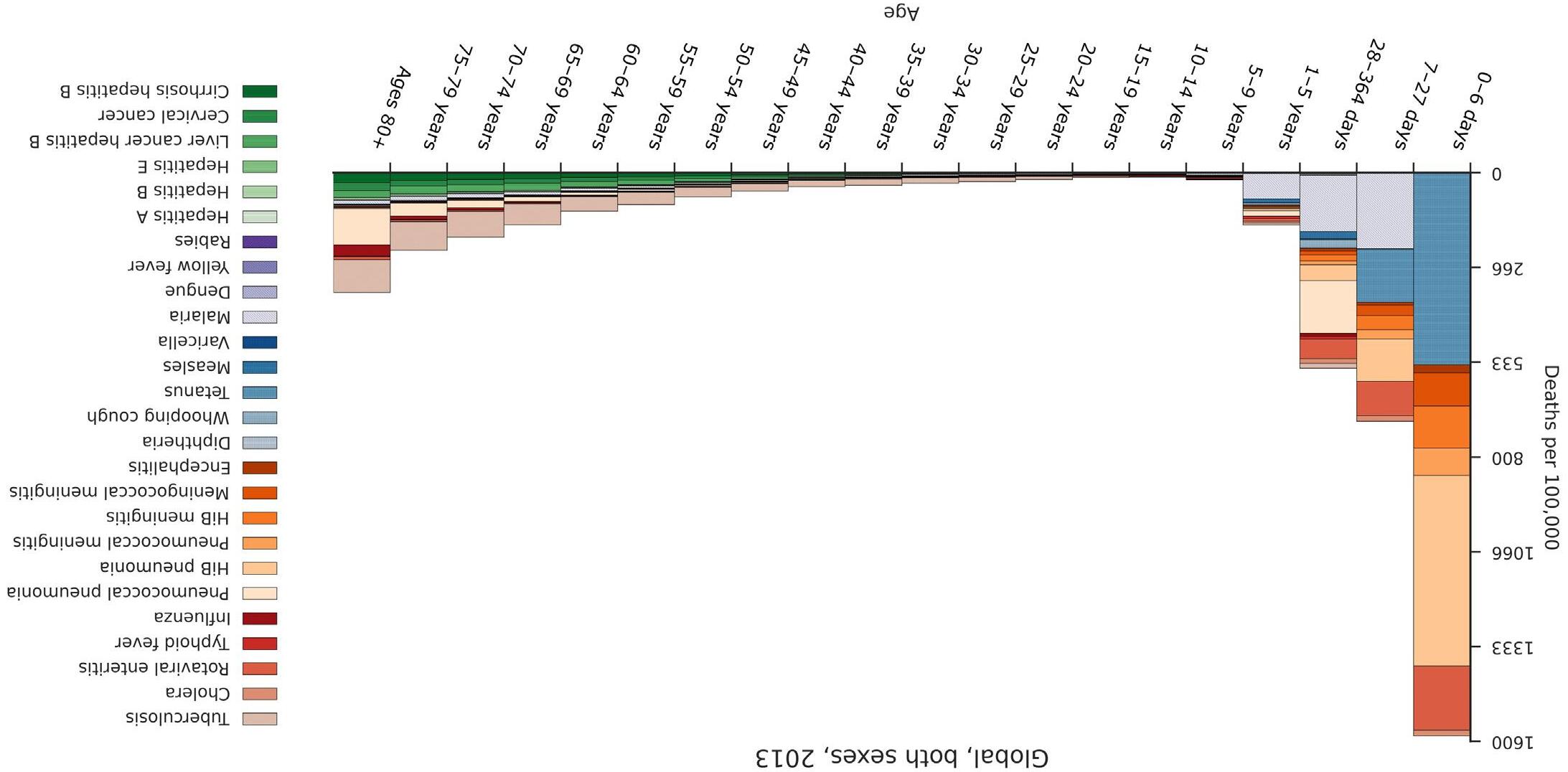
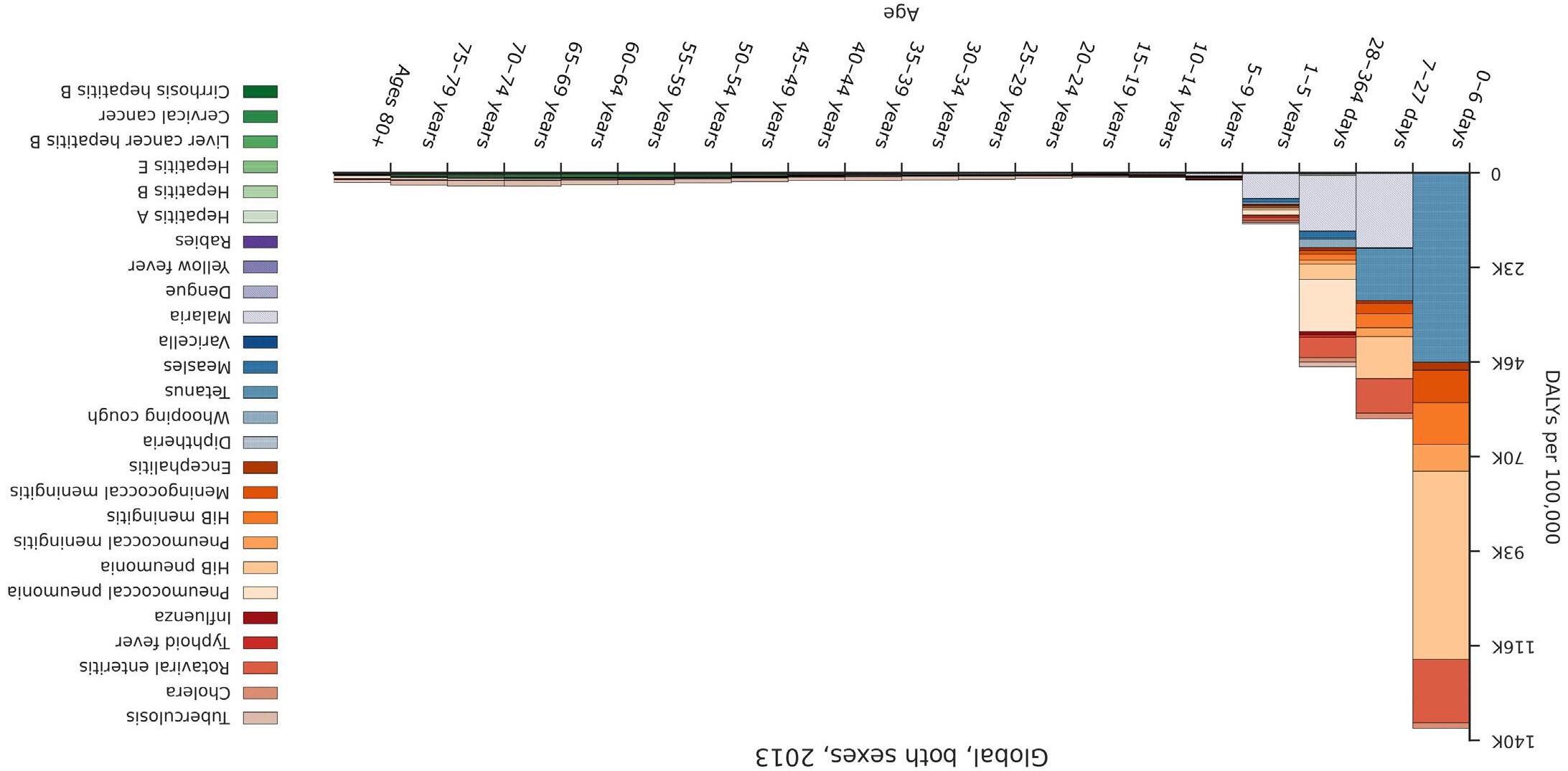
The remaining disease burden linked to presently available vaccines is primarily concentrated among children under the age of 5 years as seen in Fig. 3 which describes the number of deaths attributable by cause and age. The concentration of disease burden in the young is further accentuated when using DALYs (Fig. 4), which take into account remaining life-expectancy at the time of death and nonfatal outcomes. Disease burden associated with presently available vaccines in children under 5 years of age is accounted for primarily by causes such as pneumococcal pneumonia and meningitis, Hib pneumonia and meningitis, measles, whooping cough (pertussis), rotaviral enteritis, influenza, and malaria. Among those aged 5 years of age and over, presently available vaccines primarily address disease burden attributable to hepatitis A, B, and E, and HPV (cervical cancer). For these causes, the expected impact of these vaccines on disease burden will not be seen for many years given the more recent
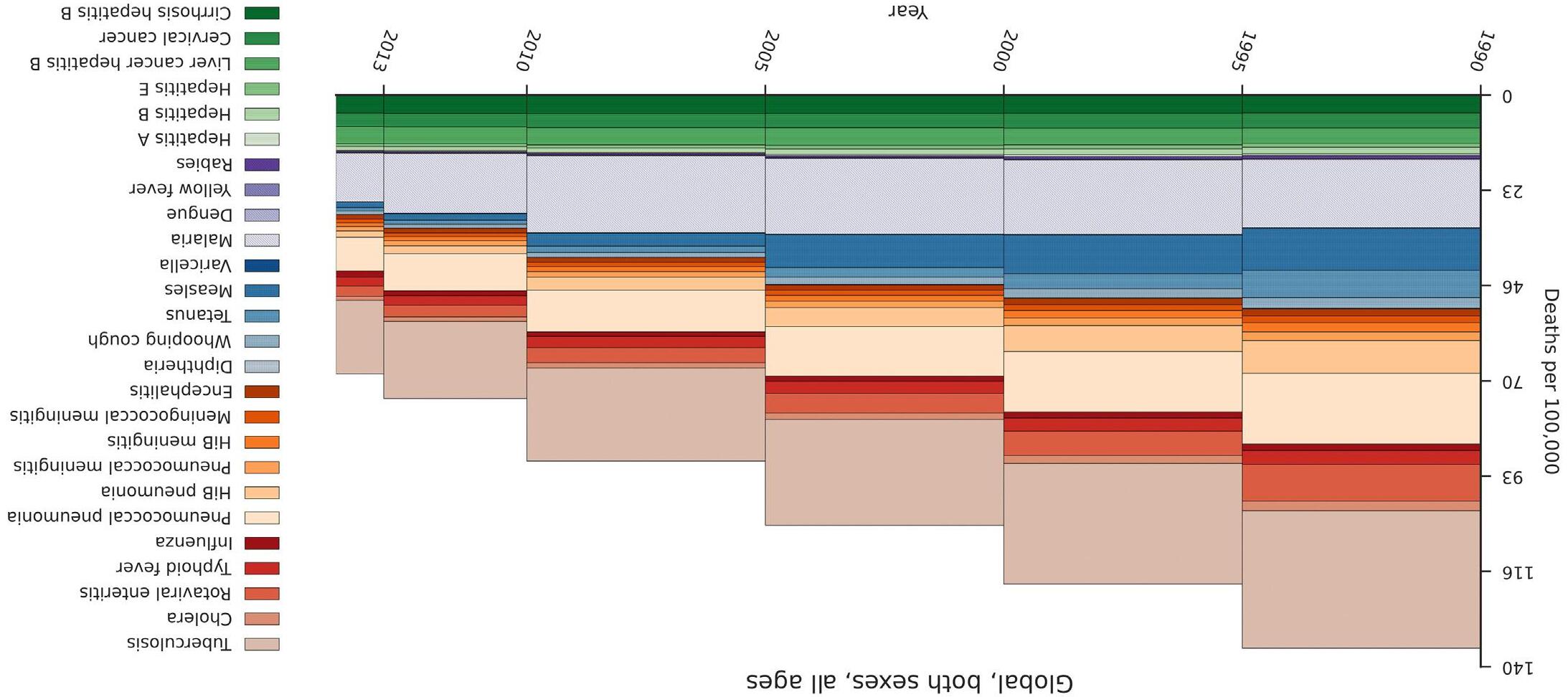
1 Global all ages death rate (per 100,000) for VPD current causes for both sexes combined in 1990, 1995, 2000, 2005, 2010, and 2013.
FIGURE
2 Global all ages DALYs rate (per 100,000) for VPD current causes for both sexes combined in 1990, 1995, 2000, 2005, 2010, and 2013.
FIGURE
3 Global all ages death rate (per 100,000) for VPD current causes by age for both sexes combined in 2013.
FIGURE
4 Global all ages DALYs rate (per 100,000) for VPD current causes by age for both sexes combined in 2013.
FIGURE
introductions in the majority of countries of hepatitis B (as part of pentavalent vaccine targeting infants) and HPV (targeting adolescents) and the low present use of hepatitis A and E vaccines. Figs. 3 and 4 also highlight the potential for the use of Pneumococcal Conjugate Vaccine (PCV) in older age adults based on the recent CAPITA trial6.
The disease burden associated with presently available vaccines differs tremendously by geography as shown in Fig. 5. Disease burden is highest in the sub-Saharan African region followed by south Asia, south-east Asia and Oceania. High-income regions (North America, Western Europe, Australasia, southern Latin America, and the high-income countries of the Asia-Pacific) as expected have the lowest burden of disease. This reflects both differences in the composition of causes linked to presently available vaccines, the corresponding underlying risk of disease as well as variability in the coverage of vaccines, particularly new vaccines such as PCV and rotavirus vaccine. These findings with disease burden skewed towards less developed regions highlights the potential of vaccines to address geographical inequalities in health.
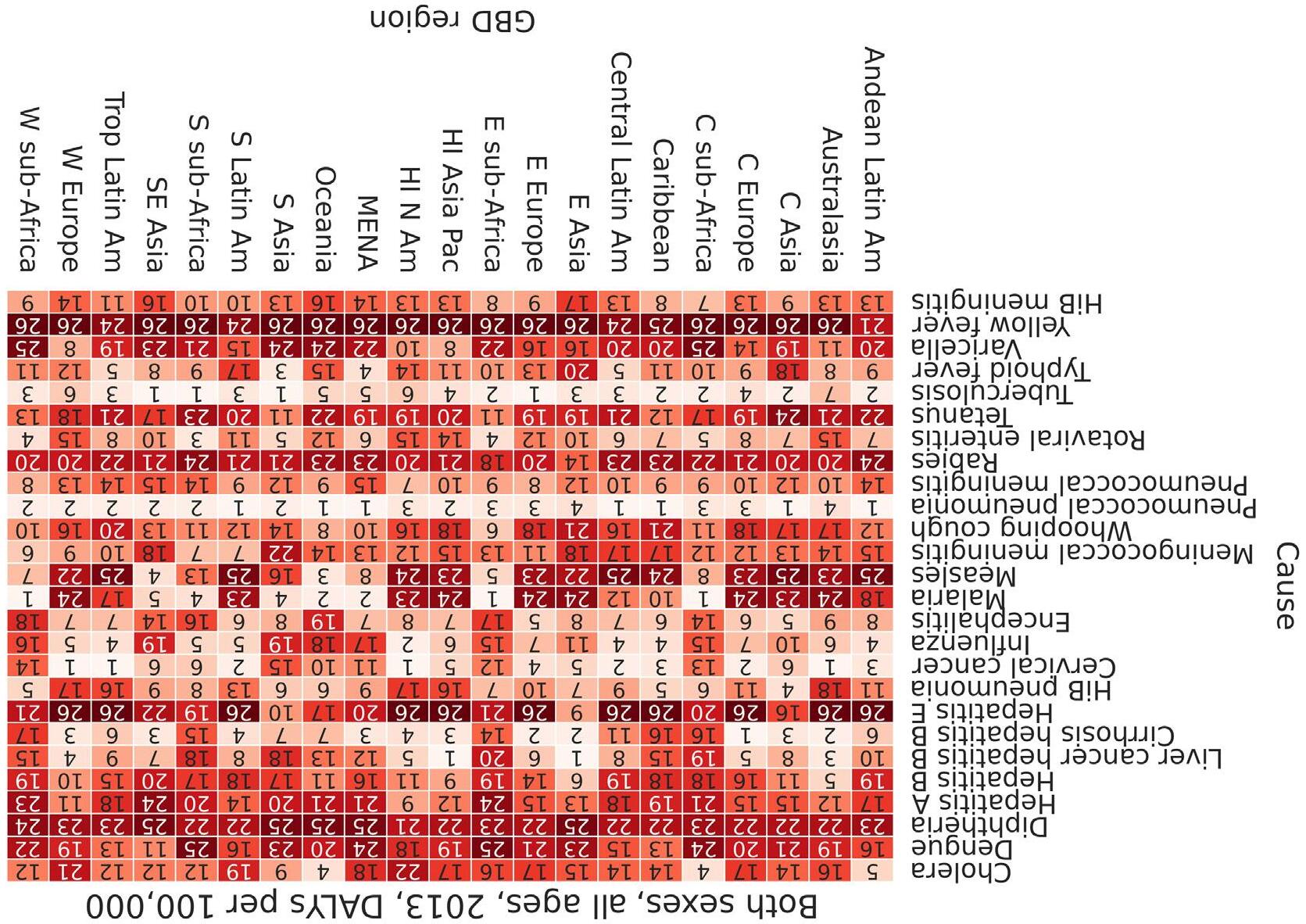
Variability in the contribution of associated causes is shown in a heat map of the rank of the different causes associated with currently available vaccines (Fig. 6). In high-income regions, disease burden is skewed more towards vaccines such as hepatitis B and HPV for adult conditions. HPV vaccine (cervical cancer) also figures prominently throughout Latin America. In sub-Saharan Africa, malaria is often the leading cause and measles remains a leading cause in sub-Saharan Africa and south-east Asia. Notably pneumococcal pneumonia is a leading cause of disease burden associated with current vaccines across all regions.
4.2 Pipeline Vaccines
In 2013, disease burden associated vaccines in the development pipeline were responsible for 1.7 million deaths globally (3.2%) and 98.0 million DALYs (4.0%). In contrast to existing vaccines, pipeline vaccines have the potential to affect a more diverse set of ages, particularly young and middle-age adults. This is primarily driven by an HIV vaccine as shown in Fig. 7 . Other pipeline vaccines target pathogens causing diarrheal disease (eg, salmonella, shigellosis, enterotoxigenic Escherichia coli ), RSV pneumonia and neglected tropical diseases which primarily affect the very young and the very old. Given the nature of the conditions targeted by pipeline vaccines, it is not surprising that disease burden associated with these vaccines is concentrated in less developed regions such as sub-Saharan Africa (Fig. 8 ), highlighting the potential for these vaccines to address geographical inequalities in health.
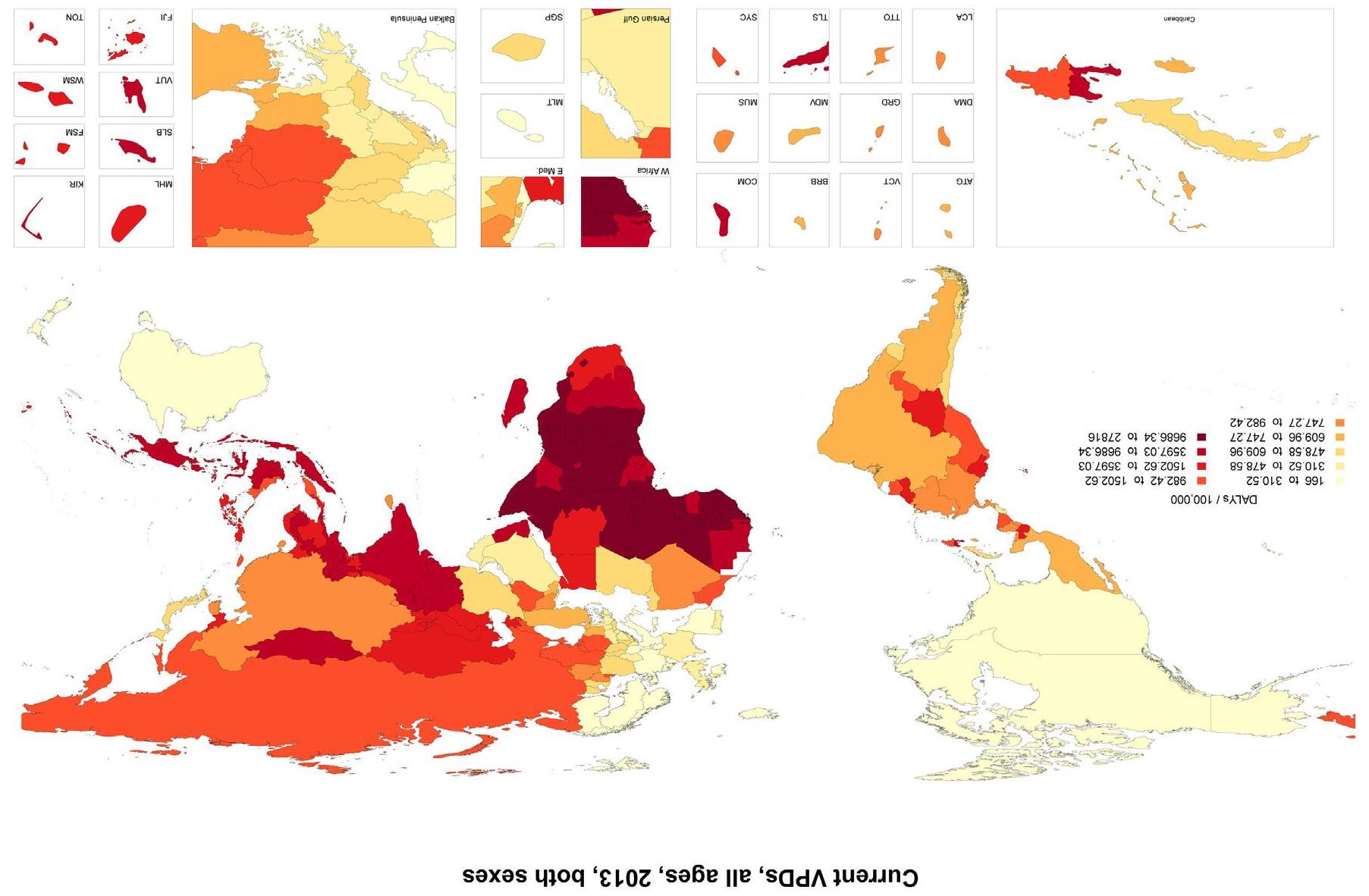
FIGURE 5 All ages DALYs rate (per 100,000) for combined VPD current causes for both sexes combined for 188 countries in 2013.
FIGURE 6 Heat map of leading causes associated with current vaccines by GBD region for both sexes combined in 2013.
Another random document with no related content on Scribd:
The Project Gutenberg eBook of The Cornhill Magazine (Vol. XLI, No. 241 new series, July 1916)
This ebook is for the use of anyone anywhere in the United States and most other parts of the world at no cost and with almost no restrictions whatsoever. You may copy it, give it away or re-use it under the terms of the Project Gutenberg License included with this ebook or online at www.gutenberg.org. If you are not located in the United States, you will have to check the laws of the country where you are located before using this eBook.
Title: The Cornhill Magazine (Vol. XLI, No. 241 new series, July 1916)
Author: Various
Release date: July 7, 2024 [eBook #73986]
Language: English
Original publication: London: Smith, Elder and Co, 1860
Credits: hekula03 and the Online Distributed Proofreading Team at https://www.pgdp.net (This book was produced from images made available by the HathiTrust Digital Library.)
*** START OF THE PROJECT GUTENBERG EBOOK THE CORNHILL MAGAZINE (VOL. XLI, NO. 241 NEW SERIES, JULY 1916) ***
[Allrights, includingtherightofpublishingTranslationsofArticlesinthis Magazine, arereserved.]
RegisteredforTransmissiontoCanadaandNewfoundlandbyMagazinePost.
BY SPECIAL APPOINTMENT
ARTISTS’ COLOURMEN TO THEIR MAJESTIES THE KING AND QUEEN AND TO H.M. QUEEN ALEXANDRA.
WINSOR & NEWTON, LIMITED,
MANUFACTURERS
OF ARTISTS’ OIL AND WATER
COLOURS of the FINEST QUALITY.
THE ‘SCHOLARS’’ BOX of ARTISTS’ MOIST WATER COLOURS.
Designed to provide an inexpensive box of Artists’ Colours with a range of tint and covering power approximately equal to the ordinary Students’ Box.
‘In developing the faculty of observation in children, Drawing and Colour Work is most essential. The Drawing and Colour materials should always be ofgoodquality, and suitable for thepurpose for whichtheyareintended.’
Scholars’ Box of Artists’ Water Colours Price 3s. net.
Containing 8 Pans and 2 Brushes.
Refills for Scholars’ Box Series 1, 2s. 6d.; Series 2, 4s.;
Series 3, 6s.; Series 4, 8s. per doz. net.
Offices RATHBONE PLACE, LONDON, W.
The Best Magazine for the Homes and Schools of the Empire.
The Review of Reviews
ILLUSTRATED. MONTHLY. PRICE 1/-
‘It will be generally conceded,’ says the WolverhamptonChronicle, ‘that this old-established periodical is making a successful attempt to give its readers, war-time notwithstanding, the best possible value. The Progress of the World is written by the Editor (E. W. Stead), and comprises a rapid and incisive survey of the principal happenings in various parts of the globe.’
A COMPREHENSIVE SELECTION OF CARTOONS FROM THE WORLD’S PRESS, A SURVEY OF FOREIGN OPINION ON THE WAR, TOGETHER WITH THE ENEMY’S VIEWS, WILL BE FOUND IN THE PAGES OF THEREVIEWOFREVIEWS.
The magazine can be obtained from Booksellers and Newsagents all over the country; single copies, 1/-. It can be sent post free for twelve months to any address for 14/6; Canada, 13/6.
Subscription Orders, enclosing Cheque or Post Office Orders, should be sent to the Manager, ‘REVIEW OF REVIEWS’ Office, Bank Buildings, Kingsway, London, W.C.
THETUTOR’SSTORY.
BY THE LATE CHARLES KINGSLEY,
REVISED AND COMPLETED BY
HIS DAUGHTER, LUCAS MALET.
Copyright by Messrs. Smith, Elder & Co. in the United States of America.
CHAPTER XXIII.
It was the beginning of the Lent term. I had stayed up during the vacation, my College being also my home. And during that vacation a weight of loneliness descended upon me. This was wrong, since had I not very much to be thankful for? My position was a secure, and, from the university standpoint, an even brilliant one. I liked my work. It interested me. Yet, in some aspects, this university life seemed to me narrow. It pained me to see old faces depart, and new ones enter who knew naught of me. Other men halted here, but for a while, on their life’s journey, moving forward to meet the larger issues, to seek ‘fresh woods and pastures new.’ And I remained—as one, held up by accident, remains at some half-way house, seeing the stream of traffic and of wayfarers sweep for ever forward along the great crowded highroad, and pass him by.
If I had not had that break in my university course, if I had not spent those two years at Hover in a society and amid interests and occupations—pleasures, let me put it roundly—foreign to my own social sphere, Cambridge, and all Cambridge stood for, would not probably have palled upon me. But I had beheld wider horizons; beheld them, moreover, through the windows of an enchanted castle. Thus memory cast its shadow over the present, making me— it was faithless, ungrateful, I had nearly said, sinful—dissatisfied and sad.
However, being in good health, I was not too sad to eat a good dinner; and so, one fine day at the beginning of term, when the bell rang for hall, I crossed the quadrangle and went in—or went rather to the door, and there stopped short. For, face to face, I met none other than Mr. Halidane, in all the glory of a freshman’s brand-new gown.
‘Ah! Mr. Brownlow,’ he exclaimed, with his blandest and most beaming smile, ‘it is indeed a gracious dispensation to meet you, sir, an old and valued friend, on my first day within these hallowed and venerable walls. I feared you might not have come up yet. Allow me to congratulate you upon your distinctions, your degree, your fellowship. With what gladness have I heard of them, have I welcomed the news of your successful progress. I trust you are duly thankful to an over-ruling providence!’
‘I trust I am,’ quoth I.
I believed the man to be a hypocrite. He had done me all the harm he could. Yet, what with my loneliness, what with my memories of that enchanted castle, I could not but be moved at this unexpected meeting with him. I choked down my disgust, my resentment for the dirty tricks he had played me, and shaking him by the hand asked what had brought him here.
‘The generosity of my pious patron,’ he answered, casting up his eyes devoutly. ‘Ah! what do I not owe—under providence—to that true ornament of his exalted station! Through his condescending liberality I am enabled to fulfil the wish long nearest my heart; and by taking, as I humbly hope in due time, Holy Orders, to enter upon a more extended sphere of Christian and national usefulness.’
I abstained from asking how he had suddenly discovered the Church of England suited his religious convictions and abilities better than the sect of the ‘Saints indeed,’ and contented myself, not without a beating heart, by enquiring after Lord Longmoor and all at Hover.
I got answers; but none that I wanted. The Earl was perfection; the Countess perfection; even for Colonel Esdaile he had three or four superlatives. The Countess, he trusted, had been lately brought to the knowledge of the truth. The Colonel only needed to be brought to it—and he was showing many hopeful signs—to be more than mortal man.—It was evidently his cue to approve highly of Hover and all dwellers therein. And when, with almost a faltering voice, I asked news of my dear boy, he broke out into fresh superlatives; from amid the rank growth of which I could only discover that Lord Hartover was a very dashing and popular young man about town, and that it served Mr. Halidane’s purpose to approve—or seem to approve—of his being such.
‘The pomps and vanities of this wicked world, you know, my dear Brownlow,’—the fellow began to drop the ‘Mr.’ now—‘the pomps and vanities—but we must make allowances for youth—and those to whom little is given, you know, of them will little be required.’
‘Little given!’ thought I with a shudder, as I contrasted Halidane’s words with my own old lessons.—God grant that this fellow may not have had the opportunity of undoing all the good which I had done! I made the boy believe once that very much had been given him.— But I said nothing. Why waste words where the conversation will never go deeper than words?
So we went in to hall together; and, what was more, came out together, for it was plainly Mr. Halidane’s plan to quarter himself upon me, physically and morally—physically, in that he came up into my rooms and sat down therein, his countenance falling when he perceived that I brought out no wine.
‘You are a Nazarite still?’ he said at last, after looking uneasily several times towards door and cupboard.
‘I am, indeed,’ I replied, amused at his inability to keep his own counsel.
‘Ah—well. All the more freedom, then, for the wine of the Spirit. I trust that we shall have gracious converse together often, my dear
Brownlow, and edify one another with talk of that which belongs to our souls’ health as we wander through this wilderness of tears.’
I replied by asking, I fear a little slyly, after Lord Longmoor’s book on prophecy.
‘As was to be expected—a success,’ he replied—‘a magnificent success, though I say so. Not perhaps in the number of copies sold. But what is worldly fame, and how can we expect the carnal man to favour spiritual things? Not, again, from a pecuniary point of view. But what is filthy lucre? His lordship’s philanthropy has enabled him, so to speak, to make the book a present, a free gift to the elect. No, not in such material gains as Christians will leave to the unsanctified, to a Scott or a Byron, does success lie; but in the cause of the Gospel. And, if humble I have been instrumental to that success, either in assisting his lordship’s deeper intellect, as the mouse might the lion, or in having the book properly pushed in certain Gospel quarters where I have a little unworthy influence—’ (Unworthy indeed, I doubt not, thought I!)—‘why, then—have I not my reward I say, have I not my reward?’
I thought he certainly had. For being aware he wrote the whole book himself, and tacked his patron’s name to it, I began to suspect shrewdly he had been franked at College as hush-money, the book being a dead failure.
And so I told the good old Master next day, who slapped his thigh and chuckled, and then scolded me for an impudent truth-speaking fellow who would come to ruin by his honesty.
I assured him that I should tell no one but him, having discovered at Hover that the wisdom of the serpent was compatible with the innocence of the dove, and that I expected to need both in my dealing with Mr. Halidane.
‘Why, I understood that he was an intimate friend of yours. He told me that your being here was one of the main reasons for his choosing this College. He entreated humbly to be allowed rooms as near you as possible. So—as he came with the highest
recommendations from Lord Longmoor—we have put him just over your head!’
I groaned audibly.
‘What’s the matter? He is not given to playing skittles, or practising the fiddle at midnight, is he?’
‘Heavens, no!’
But I groaned again, at the thought of having Halidane tied to me, riding me pick-a-back as the Old Man of the Sea did Sindbad, for three years to come. In explanation I told the Master a good deal of what I knew. About Nellie, however, I still said not one word.
The Master smiled mischievously.
‘I suspect the object of his sudden conversion from sectarianism is one of my lord’s fat livings. You may see him a bishop yet, Brownlow, for a poor opinion of his own merits will never stand in the way of his promotion.—Well, I will keep my eye on this promising convert to the Church of England as by Law Established, meanwhile—and you may do the same if you like.’
I did like—the more so because I found him, again and again, drawing round to the subject of Mr. Braithwaite and of Nellie. He slipped away smoothly enough when he saw I avoided the matter, complimenting me greasily upon my delicacy and discretion. I was torn two ways—by longing to hear something of both father and daughter, and repulsion that this man should soil the name of her whom I loved by so much as daring to pronounce it. But of all living creatures lovers are the most self-contradictory, fearing the thing they desire, desiring that which they fear.
At last one day, when he had invaded my rooms after hall, he said something which forced me to talk about Hover with him. He had been praising, in his fulsome fashion, Mademoiselle Fédore among the rest. She too, it appeared, was under gracious influences, aware of her soul’s danger and all but converted—the very dogs and cats of the house were qualifying for salvation, I believe, in his suddenly
charitable eyes. He finished up with—‘And how nobly the poor thing behaved, too, when that villain Marsigli absconded.’
‘Marsigli absconded?’ I exclaimed, in great surprise.
‘Of course—I thought you knew⸺’
‘I know nothing of what happens at Hover now,’ I said, foolishly allowing bitterness to get the better of caution.
‘No—you don’t tell me so!—Really, very strange,’ and he eyed me sharply. ‘But the facts are simple and lamentable enough. This villain, this viper, the trusted and pampered servant—for far too much kindness had been lavished upon him by my lord and lady, as upon all—yes, all—my unworthy self included.—How refreshing, how inspiring is condescension in the great!—This pampered menial, I say—ah I what a thing is human nature when unregenerate!—as was to be expected—for what after all, my dear Brownlow, can you hope from a Papist?—disappeared one fine morning, and with him jewels and plate—plate belonging to our sainted friend and patron, in whose service the viper had fattened so long, to the amount of four thousand pounds.’
I listened in deepening interest.
‘This is serious,’ I said. ‘Has any of the property been traced and recovered?’
‘Not one brass farthing’s worth.’
‘And is there no clue?’
‘None, alas! save what Mademoiselle Fédore gave. With wonderful subtlety and instinct—Ah! that it were further quickened by divine grace!—she pieced together little incidents, little trifling indications, which enabled the police to track the miscreant as far as Liverpool. But, after that, no trace. They concluded he must have sailed for America, where he is doubtless even now wantoning, amid the licentious democracy of the West, upon the plunder of the saints.’
He buried his face in his hands and appeared to weep.
I remained silent, greatly perturbed in mind. For there flashed across me those words of Warcop’s, spoken on the morning of my departure, when I sat with him in his sanctum, dedicated to the mysteries of the stud-farm and the chase: ‘By times they—Marsigli and Mamzell—are as thick as thieves. By times they fight like cat and dog or’—with a knowing look—‘like man and wife.’ There flashed across me, too, a strange speech of Fédore’s I had overheard, as I walked along one of the innumerable dimly lighted passages at Hover, one night, on my way from the library, where I had worked late, to my own study. To whom she spoke I did not know, for a door was hastily closed immediately I passed, though not hastily enough to prevent my hearing a man’s voice answer.—‘Ah! you great stupid,’ she had said. ‘Why not what these English call feather your own nest? I have no patience with you when, if you pleased, you could so easily be rich.’—The episode made an unpleasant impression upon me at the time, but had almost faded from my mind. Now in the light of my conversation with Halidane it sprung into vivid relief.
The loss of a few thousand pounds’ worth of jewels and plate was a small matter. But that Mademoiselle Fédore should remain in the household as Marsigli’s accomplice—and that she was his accomplice I suspected gravely—perhaps to regain her power over the boy, was intolerable. As to her assisting the police by pointing out the probable route of the delinquent, what easier than to do so with a view to putting them on a false scent?
‘This is indeed ugly news,’ I said at last. ‘I wonder if the Master knows.’
‘Why not? It was reported in the papers at the time.’
‘Ah! and I was absorbed in my work and missed it. How unfortunate!’
‘Do you think you know anything, then?’ he said greedily, with sharp interest.
But the question I did not answer, perceiving he was curiously anxious to be taken into my confidence.
CHAPTER XXIV.
I sat long, till the fire in the grate burnt low and the chill of the winter night drove me shivering to my bed, revolving this conversation in my mind. If it could be proved that Mademoiselle Fédore was in league with the Italian, still more, if it could be proved she and he were married, Hartover could be permanently set free from her intrigues and her influence. I did not want to be vindictive; but with every fibre of my being I wanted to free the boy. For, as I realised in those lonely midnight hours, while the wind rumbled in the chimneys and roared through the bare branches of the elms in the Fellows’ Garden just without, the boy’s redemption, the boy’s growth into the fine and splendid character he might be, could be— as I believed—even yet, was dearer to me than any advantage of my own.
Had I not promised, moreover, to stand by him and help him to the end? Could I then, in honour, sit with folded hands, when the chance, however remote, of helping him presented itself? I had always feared Mademoiselle Fédore had not relinquished her designs on the boy, but merely bided her time. For a while my presence frustrated those designs; as, in even greater degree, did his passion for Nellie Braithwaite. But marriage with Nellie forbidden, and he surrounded, as he must be, by the flatteries lavished on, and snares set for, a rich and popular young nobleman in London, was it not too probable that in hours of idleness or reaction from dissipation she might gain an ascendency over him once more? Not only selfinterest was involved. He being what he was, might she not only too easily fall genuinely in love with him? I would give her the benefit of the doubt, anyhow. Upon the exact nature of that love, whether of the higher, or the baser and animal sort, I did not choose to dwell. The difference in age, too, struck me now—more versed as I had grown in the ways of the world and of human nature—as no bar to
inclination on his part. She was a clever woman and a beautiful one, of a voluptuous though somewhat hard type—to the Empress Theodora I had often compared her in my own mind. Further, as Warcop said to me long ago, did not ‘the she-kite know her business?’—Alas! and for certain, only too well!
So sitting there, through the lonely hours, the idea grew on me that the boy was actually in very grave peril; and that—neglect and silence notwithstanding—in his innermost heart he clung to me, and to the lessons of duty and noble living which I had taught him, still. This idea might, as I told myself, be a mere refinement of personal vanity and egoism. Yet I could not put it aside. If he called, even unconsciously, and I failed to answer, a sin of omission and a heavy one would assuredly lie at my door.
Finally I decided to seek counsel of my kind old friend the Master. The opportunity of doing so presented itself next day. For the Master had bidden me to a dinner party at the Lodge, given in honour of his widowed sister and her daughters, who were staying with him. This flutter of petticoats in our bachelor, not to say monastic, atmosphere produced in some quarters, I had reason to fancy, a corresponding flutter of hearts. Ladies were conspicuous by their absence in the Cambridge of those days, save during the festivities of the May term; and I own to a certain feeling of mild elation as I found myself seated beside Miss Alice Dynevor, the elder of the two young ladies, at the Master’s hospitable board.
I cannot assert that she appeared to be remarkable either for good looks or cleverness; but she was fresh and young—about twenty, I judged her—modest in manner, and evidently desirous to please; full of innocent questions concerning Cambridge and Cambridge ways, concerning our famous buildings, their names and histories, which I found it pleasant enough to answer. In the drawing-room, when we rejoined the ladies after dinner, she went to the piano, at her uncle’s request, and sang some Scotch songs and some sentimental ballads then much in vogue, with no great art, I admit, but with pleasing simplicity and a tuneful voice.
The evening left me under impressions at once agreeable and not a little sad. For, from the time I returned to Cambridge, I had hardly spoken to a woman. Doing so now, memories of Mere Ban and of Nellie crowded upon me thick and fast; and, throwing me back into that fantastic inner life of unsatisfied and consuming love, threw me also into a necessity for renewed self-abnegation and self-torment. At all costs I must find means to set the dear boy free of Fédore’s influence—set him free—and for what?
I stayed after the other guests had left and asked for a little private talk with the Master; recounted the substance of my conversation with Halidane last night, and stated my own convictions and the ground of them. He had heard of Marsigli’s disappearance, but had not mentioned it to me simply because he supposed I had seen it in the newspapers. I was much vexed at the strange oversight. Had I but learned it at the time, how much might have been saved! How much truly—more a thousand times than I then imagined. Yet how know I that? No—I will believe all the events of our lives are well ordered, so long as they do not arise from our wilful ill-doings; and will never regret, as the result of blind chance, that which is in truth the education given each one of us, for our soul’s good, by an all-merciful and all-wise Father in Heaven.
CHAPTER XXV.
I told the Master enough for him to agree it would be well I should go to town; and to town two days later I went. I had learned, by cautious questioning of Mr. Halidane, that the family was in London, as was Hartover.
So I made my way to the great house in Grosvenor Square, which was not altogether unknown to me. I had stayed there once, for a few days, with the dear boy, during the time of my tutorship; and to my delectation had made acquaintance with its many treasures in the matter of pictures, furniture, and objetsd’art. Oh! the priceless possessions of these people, and the little care they had for them!
The men servants, who received me, were unknown to me, supercilious in manner and only just not insolent. I asked for my young lord. He was on guard at St. James’s. They supposed I should hear of him there. Where he lived, when not staying here, they did not know.—Odd, I thought; but the ways of great folks were odd sometimes!
I took a coach and drove to the Palace. My longing to see the boy again was very strong; yet I felt anxious. Would he be greatly changed? Would he be glad or would he think my coming a bore? Above all, how would he take my interference? A sense of the extreme delicacy of my mission increased on me, making me nervous and diffident.
An orderly ushered me into a room where half a dozen dandies were lounging. These stared at me sufficiently, and thought me, evidently, a dun. One beardless youth, indeed, after brushing past me, turning his back to me, and otherwise bristling up like a dog at a strange dog, expressed his opinion aloud.
‘MacArthur!’ to the orderly. ‘Are you not aware that this is a private room?’
‘I am sorry,’ I said instantly, for their impertinence restored my self-confidence, ‘if I am intruding. I simply asked for Lord Hartover, and was, as simply, shown in here.’
I thought the lad might have known me for a gentleman by my voice; but possibly his experience in life had not extended so far, for he answered:
‘Lord Hartover, I imagine, pays his bills at his own house.’
I did redden, I confess, being still young and sensitive; but, after staring at him as full as he stared at me, I answered, bowing:
‘I am afraid I am not so useful a person as a tradesman. I am only a Cambridge scholar, formerly Lord Hartover’s tutor, who wishes to see him upon urgent private business.’
‘I—I really beg your pardon. Pray sit down, sir,’ quoth the sucking hero, evidently abashed, handing me a chair.
But at that moment a pair of broad shoulders, which had been bent over a card-table at the farther end of the room, turned about with:
‘Hey? Why, Brownlow, by all that’s— Odd trick, Ponsonby—wait one moment.—How are you, my dear fellow? And what on earth brings you here among us warriors?’
And the mighty Rusher rose, like Saul the son of Kish a head and shoulders above his fellows. At first I believe he was really pleased to see me. His handsome face was genial, a light of good-natured and kindly amusement in his eye.
‘Well, how are you?’ he repeated. ‘Do you remember Brocklesby Whins and the brown horse? Come up this winter and you shall ride him again; by Jove, you shall—and take the rascally little grey fox home with you. I’ve got him stuffed and ready, as I promised I would; and wondered why you’d not claimed your property before.’
I was beginning to speak, but he ran on:
‘Brother officers, let me introduce you to my friend Mr. Brownlow, as fine a light-weight across country as you need wish to know, and who saved my pack from destruction at the risk of his own life,—a long and prosperous one may it be!’
‘My hunting days are over, I fear,’ I said, as the men of war stared all the more at the lame young don, black-coated, black-breeched and black-stockinged—thinking, I doubt not, I was a ‘rum ’un to look at’ even if a ‘good ’un to go.’
‘But I beg of you to tell me where I can find Lord Hartover; or, if I cannot see him, to let me have a few words with you.’
‘Where is Faublas—anyone know?’ the Colonel asked of the company in general, and so doing I fancied his geniality waned a little and a trace of uneasiness came into his manner. As for me, my
heart sank as I heard that name, of all others, used as my poor boy’s sobriquet.
‘Gone down to Chelsea, I believe,’ said the youth who had first spoken to me, hardly repressing a smile. ‘He announced he should dine to-night with the fair unknown.’
‘I question whether he will be at home even to you, then, Brownlow,’ the Colonel declared, forcing a laugh.
‘In that case I am afraid I must ask for a few minutes’ conversation alone with you.’
We went out into the Park; and there, pacing up and down under the leafless trees, I told all I thought fit. I watched his face as I did so. It was unusually serious.
‘I think, my dear fellow,’ he said at last, ‘you had very much better leave this matter alone.’
I asked why. He fenced with me, pointing out that I had nothing more than suspicion to go upon—no real evidence, circumstantial or otherwise. I urged on him the plain fact that the matter could not be let alone. A great felony had been committed; and it was an offence, not only against honour and right, but against law, to withhold such information as I could give.
‘You will repent it,’ he said.
Again I asked why.
‘I beg you to take my word for it, there are reasons,’ he said earnestly. ‘Be advised, my dear Brownlow. Let sleeping dogs lie.’
I was puzzled—how could I help being so? But, more and more, I began to fear the connection between Fédore and Hartover had been resumed.
‘And where is Mademoiselle Fédore now?’ I said presently.
‘’Pon honour, I am not responsible for the whereabouts of gay damsels.’
‘Then she is no longer with lady Longmoor?’
‘No, no—has left her these two months—may be in St. Petersburg by now, or in Timbuctoo, for aught I know.’
‘The police could find her there as well as here.’
His tone changed, becoming as sarcastic as his easy good-nature and not very extensive vocabulary permitted.
‘And so you would really hunt that poor girl to the gallows? Shut her up in gaol—eh? I thought you preached mercy, went in for motives of Christian charity, and so forth. We live and learn—well, well.’
He took another turn, nervously, while I grew increasingly puzzled. Was it possible Fédore might be connected with him, and not with Hartover? If so, what more natural and excusable than his reluctance to satisfy me? That thought softened me.
‘I will do nothing further,’ I said, ‘without consulting his lordship.’
‘His lordship?’ He shrugged his shoulders, laughing contemptuously.
‘Her ladyship, then.’
He paused a moment.
‘Yes,’ he said; ‘you’re right.’ A new light seemed to break on him. ‘Yes,’ he repeated; ‘we’ll go at once on the chance of finding her at home. It is only seven now. Let’s call a coach.’
So back we drove to Grosvenor Square, both in deep thought. Arrived at the house, he took me into a small room, off the hall, and kept me waiting there for the best part of an hour. I began to wonder, indeed, if he had forgotten me altogether, and whether I had not best ring and make some enquiry of the servants.
The room was dimly lit with wax candles, set in sconces high on the silk-panelled wall; yet not so dimly but that, when the Colonel at last returned, I could see he looked pale and agitated, while his hands and lips trembled as he spoke. And my mind carried back to
the day of the meet at Vendale Green, when her ladyship—Queen of Beauty that she was—stepped down from her pony-chaise, and stood on the damp turf beside his great bay horse, talking to him; and how, straightening himself up with a jerk, his face grey and aged as that of a man smitten with sudden illness, he answered her: ‘Impossible, utterly impossible’; and how she, turning, with a light laugh, got into the pony-chaise again, waving her hand to him and wishing him good fortune.
‘Yes—you are to go,’ he said to me hurriedly. ‘See Hartover at once. His address is number ⸺ Church Lane, Chelsea. You’ll remember?’
‘I shall.’
‘Remember, too, I am no party to this proceeding of yours. I warned you against it. Whatever happens you will have brought on yourself.’
‘Very good. I am perfectly ready to accept the responsibility of my own actions.’
‘And I say—see here, Brownlow. You won’t tell Hartover I gave you his address.’
‘Of course not, if you desire it. I can decline to say where I learnt it.’
‘He’ll find out, though, through the other officers,’ he muttered, as we crossed the hall and he saw me into the still waiting coach. ‘It’s an accursed business, and we shall come ill out of it. I know we shall; but a woman must have her way.’
‘For Heaven’s sake,’ I cried, ‘remember you are not alone.’
He looked fiercely at me, as one who should say, ‘What have I betrayed?’ Then added with a sneer:
‘Brownlow, I wish to God we’d never seen you. You’re a devilish deal too honest a fellow to have got among us.’
With which cryptic words he went back into the great house, leaving me to drive down to Chelsea, and to my thoughts. What they were I hardly knew myself. Sufficient that I was most miserable and full of questioning dread.
We passed, as it seemed, through endless streets, until we reached the then lonely King’s Road; drove along it, turned to the left down Church Lane, and drew up at a door in a high wall apparently enclosing a garden. I got out of the coach and rang the bell. A moment after I heard a woman’s quick tripping footsteps within. The door was flung wide open, disclosing a covered way leading to a pretty hall, gay with coloured curtains and carpets, and a voice cried:
‘Ah! c’est toi enfin, mon bien aimé. A-t-il perdu le clef encore une fois, le petit étourdi?’
The speaker and I recoiled apart. For, immediately before me, under the passage lamp, was Fédore.
Superbly lovely, certainly, if art can create loveliness, with delicately tinted cheeks and whitened skin; her raven hair arranged, according to the prevailing mode, so as to add as much as possible to her height. Dressed, or rather undressed—for women then wore only little above the waist—in richest orange and crimson; her bare arms and bosom sparkling with jewels—none brighter, though, than these bold and brilliant eyes—there she stood, more like her namesake Empress Theodora than ever, and flashed lightnings into my face—disappointment, rage, scorn, but no trace of fear.
‘And what, pray, does Monsieur Brownlow wish at such an hour of the night?’
‘Nothing, Mademoiselle,’ I answered gravely and humbly. ‘I came to see Lord Hartover, and he is not, I perceive, at home.’
Was she going to shut the door on me? Nothing less. Whether from sheer shamelessness, or whether as I have often fancied since—she read my errand in my face, she composed herself in an instant, becoming amiable and gracious.
‘Could not Monsieur come in and wait? Would he not stay and sup with us?’
I bowed courteously. She was so superb, so daringly mistress of herself, I could do no less; and said I should be shocked at interrupting such a tête-à-tête. I apologised for having brought her to the door on so cold a night; and, raising my hat, departed, having, at least, taken care to tell her nothing.
Why should I not depart? Had I not seen enough, and more than enough? The Rusher was right so far—for who was I to interfere? What had I to offer Hartover as against that gorgeous and voluptuous figure? If my suspicions could be proved, and I succeeded in parting him from her, would he not go to someone else? And who was I, after all, to judge her, to say hard words to her? If she were dazzled by him, what wonder? If he by her, what wonder either?—Ah! that they had let him marry Nellie, boy though he was, two years ago! But such is not the way of the world; and the way of the world, it seemed, he was doomed to go.—Oh! weary life, wherein all effort for good seemed but as filling the sieve of the Danaides. Oh! weary work for clean living and righteousness, which seemed as a rolling of Sisyphus’ stone for ever up the hill, to see it roll down again. What profit has a man of all his labour? That which has been shall again be, and there is no new thing under the sun.
I went back to Cambridge unhappy, all but cynical and despairing, and settled down to my routine of work again, and to the tender attentions of Mr. Halidane, to whom however I told no word about my fruitless expedition to London. And so sad was I, and in such a state of chronic irritation did Halidane keep me, that I verily believe I should have fallen ill, had not the fresh evil been compensated for by a fresh good—and that good taken the form of renewed intercourse with Mr. Braithwaite.
CHAPTER XXVI.
It fell out on this wise. In the hope of lightening the weight of depression under which I laboured, I took to riding again so many afternoons a week—an indulgence which I could now afford. True, a hack from a livery stable was but a sorry exchange for the horses upon which Warcop had been wont to mount me; but if love of horse-flesh takes you that way—and take me that way it did—the veriest crock is better to bestride than nought.
The day was fine, with sunshine and white fleets of blithely sailing cloud. Hedges and trees thickened with bud, and the rooks were nesting. I had made a long round by Madingley and Trumpington, and was walking my horse back slowly over the cobbles of King’s Parade—admiring, as how many times before, the matchless Chapel, springing from the greensward, its slender towers, pinnacles and lace-work of open parapet rising against spaces of mild blue sky— when, amid groups upon the pavement wearing cap and gown, or less ceremonial boating and football gear, a tall heavily built figure, clothed in a coat with bulging skirt-pockets to it, breeches and gaiters of pepper-and-salt-mixture, attracted my eye. The man halted now and again to stare at the fine buildings; and at last, crossing where the side street runs from King’s Parade to the Market Place, turned into the big bookseller’s at the corner.
I thought I could hardly be mistaken as to his identity; and, calling a down-at-heels idler to hold my horse, I dismounted and followed him into the shop. If I had made a mistake, it would be easy to ask for some book or pamphlet and so cover my discomfiture.
But I had made no mistake. Though older and greyer, his strong intellectual face more deeply lined by thought, and, as I feared, by care, Braithwaite himself confronted me.
‘Thou hast found me, O mine enemy,’ he exclaimed, while the clasp of his hand gave the lie to this doubtful form of greeting. ‘And, to tell the truth, I hoped you might do so; though I was in two minds about seeking you out and calling on you myself.’
I returned the clasp of his hand; but, for the moment, my heart was almost too full for speech.
‘Enemy, neither now nor at any time in our acquaintance,’ I faltered.
‘I know, I know,’ he answered. ‘But until you were your own master, and had finally cut adrift from certain high folks in high places, I reckoned we were best apart.’
‘And you were right. Now, for good or evil, all that is over and done with’—and truly and honestly I believed what I said.
‘So much the better,’ he replied heartily. ‘Then we can start our friendship afresh—that is, of course, if an ornament of this ancient seat of learning, a full-fledged don like yourself, is not too fine and fastidious a person to associate with a plain middle-class man such as me.’
I bade him not be foolish—he had a better opinion of me, I hoped, than that asked what of ‘the pride which apes humility,’ and so forth; and all the while questions about Nellie, her health, her wellbeing, her present whereabouts, scorched my tongue. I invited him to my rooms—which I think pleased him—so that we might talk more at our ease; but he told me he had the better part of a twentymile drive before him, back to Westrea, a farm which he had lately bought on the Suffolk border. We therefore agreed that, when I had sent my horse back to the stable, I should join him at the inn, just off the Market Place, where his gig was put up.
And in the dingy inn parlour, some quarter of an hour later, I at last found courage and voice to enquire for Nellie. His face clouded, I thought.
‘In answering you frankly, I give you the strongest proof of friendship which I can give,’ he said.
I thanked him.
‘It went hard with her at first, poor lass,’ he continued, ‘brave and dutiful though she is. And that’s what has brought me further south.
I judged it best to get her right away from the Yorkshire country and sound of Yorkshire speech. So I threw up my tenancy of the place I had taken on leaving Mere Ban. I may tell you I came into some little money through the death of a relative, last year, which enabled me to buy this Westrea farm. I took Nellie with me to view it, and the house caught her fancy. ’Tis a pretty old red-brick place, and my gift to her. I want her to make a home of it, and interest herself in the development of the property about nine hundred acres in all. She has an excellent head for business; and, in my opinion, there’s no better medicine than keeping hands and brain occupied in such a case as hers.’
He broke off abruptly, as though unwilling to pursue the subject further, adding:
‘But there, come and see for yourself what our new quarters are like, Brownlow. No purple wind-swept fells piled up to high heaven behind it, truly; still, a pleasant enough spot in its way, and fine corn-land too. I can offer you a comfortable bed and a good plain dinner; and a horse you needn’t be ashamed to ride, notwithstanding your free run of his Lordship’s stud at Hover. Come during the vacation. Easter falls late this year; and the orchard trees should be in blossom, supposing we get a fine spring, as I believe we shall. It’ll do you no harm to drop your classics and mathematics, part company with your scandalous old heathen poets and divinities and take the living world of to-day by the hand for forty-eight hours or so. I’ll be bound your radicalism has deteriorated in this academic dry-as-dust atmosphere too, and will be none the worse for a little wholesome rubbing up.’
So to Westrea I promised to go, his invitation having been given so spontaneously and kindly. A dangerous experiment perhaps, but the temptation was too strong for me. At last I should see Nellie again, and learn how matters really stood with her. That thought threw me into a fever of excitement.
To go in to hall, with the chance of meeting Halidane and having the fellow saddle his unctuous, not to say oily, presence upon me for
the rest of the evening, was intolerable. So, after starting Braithwaite upon his homeward journey, I got a scratch meal at the inn, and then made my way to The Backs across bridge, and wandered in the softly deepening twilight under the trees beside the river. I tried—but alas how vainly!—to calm my excitement, and school myself into rejection alike of the wild hopes and dark forebodings which assailed me. I lost count of time, and wandered thus until the lamps were lit and the moonlight touched the stately masses of college buildings, rising pale from their lawns and gardens, on the other side of the placid slow-flowing stream. Hence it was comparatively late when, at length, I climbed the creaking, foot-worn oaken stairs leading to my rooms.
Immediately on entering I saw that a letter lay upon the table. It was in Hartover’s handwriting. Trembling, I tore it open.
Why should he write to me after so long a silence? Had he heard of my visit to St. James’s Palace? Of my visit to Church Lane? About Fédore surely it must be; and when I began to read I found that so indeed it was.
‘Dearest Brownlow,’—it ran—‘I have news to tell you which will astonish and at first, I am afraid, shock you. But, after a little, you will see it is right enough; and that, in honour, I could not do otherwise than I have done. For nearly two months now I have been married to Fédore.’
My head fairly spun round. Faint and dizzy, I sank into the nearest chair, and read on with staring eyes.
‘My reasons were very simple. I do not ask you to approve them; but to weigh and judge them fairly. You know the circumstances under which I came to town and joined my regiment. Parted from Her whom I loved—and whom I shall never forget, the thought of Her will always be sweet and
sacred to me—I became utterly reckless. She was gone. You were gone.’
Was that a reproach, and a merited one? Whether or not, it cut me to the quick.
‘There was no one to care what I did, no one for me to care for. Nothing seemed to matter. I plunged into all the follies—and worse—of a young man about town. I will not disgust you by describing them—suffice it that I found plenty both of men and women to share them with me. I tried to drown remembrance of Her, of you, of everything noble and good, in pleasure. And at last, you will hardly be surprised to hear, I fell into my old madness of drink. I was horribly, quite horribly, you understand, hopeless and unhappy. About my own people I say nothing—to their own Master they stand or fall. I do not want to talk, or even think about them. But by last autumn I had pretty well ruined my health. I had, so the doctors told me, delirium tremens. I know my nerves were shattered, and life seemed a perfect hell. As I lay ill and mad, Fédore came to me. She nursed me, controlled me, pulled me through. She was most true to me when others wished her to be most false. There were those, she has told me since—as I suspected all along, even in the old days at Hover who would be glad enough for me to kill myself with debauchery. She talked to me, reasoned with me. You yourself could not have spoken more wisely. But I felt, Brownlow, I felt I could not stand alone. I must have some one to lean on, to be loved by and to love. It is a necessity of my nature, and I obeyed it. Fédore saved me, and I paid her by marrying her. She refused at first, warned me of my seeming folly, of what the world would say; told me there were difficulties, that she, too, had enemies. But I insisted.—Remember she had compromised herself, endangered her reputation by coming
to me.—At last she gave way, confessing, dear creature, she had loved me all along, loved me from a boy.
‘You will say, what about the future? I defy it, snap my fingers at it. It must take care of itself. It can’t, in any case, be more hateful than the past.
‘And so good-bye, dear old man. Judge me fairly at least; and keep my secret—for secret our marriage must be as long as my father is alive. Fédore sends kind remembrances, and bids me say when you know all—and there is more behind— you will not think of her too harshly.’
Should I not? The woman had greater faith in my leniency—or stupidity, which?—than I myself had. No harshness was too great, surely, in face of the wrong she had done the boy by marrying him. Yet two things were true. For that she loved him—according to her own conception of love—I did not doubt; and that she had rescued him from the demon of drink—for the time being—I did not doubt either. And this last—let me try to be just—this last must be counted to her, in some degree at all events, for righteousness whatever her ulterior object in so rescuing him might have been.
But admitting that much, I had admitted all that was possible in her favour. She had hunted the boy, trapped him, pinned him down, making his extremity her own opportunity; cleverly laying him under an obligation, moreover, which could not but evoke all his native sensibility and chivalry.
The more I thought of it, the more disastrous, the more abominable did the position appear. So much so that, going back to his letter, I read it over and over to see if I could make it belie itself and find any loop-hole of escape. But what was written was written. In Hartover’s belief he had made Fédore, and done right in making her, his wife.
And there were those, then, who would gladly compass his death! The last scene with Colonel Esdaile flashed across me; and other