PDF The sustainable sites handbook: a complete guide to the principles, strategies, and best practic
The Sustainable Sites Handbook: A Complete Guide to the Principles, Strategies, and Best Practices for Sustainable Landscapes- 1st Edition -2011, Ebook PDF Version
The Business Student's Guide to Sustainable Management -Principles and Practice 2nd Edition Molthan-Hill
https://ebookmass.com/product/the-business-students-guide-tosustainable-management-principles-and-practice-2nd-editionmolthan-hill/ Plumbing, Electricity, Acoustics: Sustainable Design Methods for Architecture, 1st Edition – Ebook PDF Version
3 Chapter 2 Predesign: Site Selection, Assessment, and Planning 3 3
3 Chapter 3 Site Design: Water 6 5
3 Chapter 4 Site Design: Vegetation 19 7
3 Chapter 5 Site Design: Soils 247
3 Chapter 6 Site Design: Materials and Resources 32 3
3 Chapter 7 Human Health and Well-Being for Sustainable Sites 42 9
3 Chapter 8 Operations, Maintenance, Monitoring, and Stewardship 47 9
Resources 3 521
Index 3 535
Con T en TS
Forewor D
The emerG en Ce o F The Su STainable SiTe S Initiative Program (SITES) and what it says about the ecological awakening that has taken place over the last twenty-five years are quite encouraging. SITES addresses the urgent need for a coordinated response among landscape design professionals to take on the environmental imperatives of the twenty-first century. The information, methods, and approaches contained in The Sustainable Sites Handbook, an essential companion to realizing the goals of SITES, offer guidance for beginning and established practitioners alike. It has the potential to have a profound effect on how the built landscapes of our time are designed, constructed, and managed, and how they perform within their larger environmental and ecological context.
Ecology and landscape architecture are inseparable, as is demonstrated by the broad range of specialists consulted in the development of SITES and the Handbook. In fact, these were precisely the types of concerned and far-sighted professionals who laid the philosophical groundwork for sustainable site design in the last century. In the 1930s, for instance, naturalist Aldo Leopold stirred the Western world’s consciousness of nature’s complex and interrelated systems. Two decades later, Rachel Carson, an ecologist and scientist, warned us about the dangers of destabilizing natural systems, pointing to both environmental havoc and the potential for associated human tragedy. By the late 1960s, thanks in large part to both Ian McHarg and Carl Steinitz, landscape architects were awakened to a methodology for regional and local planning that firmly placed ecology at its center.
The urgency of environmental stewardship is not in question, and the fact that landscape architects can and will play a leadership role in the drive to create a more sustainable exchange between humans and our environment is clear. Our profession knows that nature will not simply reestablish or mend itself in many of the critically disturbed systems on which we all now work. Up until now, the question of how landscape architects might intelligently and effectively transform our practice to meet current challenges has been loosely defined on an individual basis. The Handbook has the potential to help a great deal: It consolidates a body of knowledge about environmentally positive design approaches and frames it as a response to the challenges of contemporary practice, where ideals and on-the-ground performance must be reconciled.
With the SITES standards, landscape architects—and indeed all site designers—have a framework for sustainable site design defined by acknowledged experts in their respective specialties and a means of bringing recognition to clients who dedicate themselves to building sustainably. The Sustainable Sites Handbook is an important first step in trying to define what sustainability means with respect to the multitude of social, environmental, economic,
and experiential concerns that impact everything we design and build. The future is very much about taking on the promise these guidelines offer and raising them to a higher and more defensible level, in terms of both the science and the economics of how these endeavors improve public health. I look forward to future editions of this book that demonstrate that our field is growing based on new research, postoccupancy monitoring, and further innovation.
M ichael Van Valkenburgh
l e TT er F rom S i T e S ™ Par T ner S
while The G reenin G o F The builT environmenT has been widely embraced, a key element has largely been missing: robust standards to guide the creation of sustainable landscapes, with and without buildings. Traditionally, designed landscapes have been major consumers of scarce resources, but—unlike buildings—when done correctly, can improve and regenerate natural systems. Yet until now, no “green” design and construction standards existed for large campuses, public parks, conservation areas, private resorts, recreation areas, or transportation and utility corridors.
This significant challenge spurred the formation of the Sustainable Sites Initiative™ (SITES™), an interdisciplinary partnership of the American Society of Landscape Architects, the Lady Bird Johnson Wildflower Center at the University of Texas at Austin, and the United States Botanic Garden, which has developed voluntary guidelines and a rating system for landscape sustainability. In developing the guidelines, SITES tapped the expertise of a diverse group of stakeholder organizations and more than 70 nationally respected authorities on soil, hydrology, materials, vegetation, and the impact of the environment on human health and well-being. Their collective expertise guided a rigorous science- and researchbased process to produce the Sustainable Sites Initiative: Guidelines and Performance Benchmarks 2009
In the Sustainable Sites Handbook, editor Meg Calkins, ASLA, and John Wiley & Sons, Inc., have created a comprehensive resource for all those who seek to create sustainable landscapes and especially those who hope to attain certification under the SITES Rating System™. Incorporating the work of many of the SITES experts, The Sustainable Sites Handbook is a valuable companion document to the SITES Guidelines and Performance Benchmarks and has been carefully reviewed for technical accuracy and adherence to SITES prerequisites and credits.
Use of these design approaches will provide tangible benefits to our cities and communities, including cleaner air and water, climate regulation, conservation of energy and other natural resources, and protection of biodiversity. We hope SITES and the Sustainable Sites Handbook will encourage all those who teach and practice landscape design, construction, and maintenance to adopt sustainable best practices and create sustainable landscapes.
nancy c . S oM erVille, h on a S la , e xecutiVe Vice Pre Sident/ceo a M erican Society of l andScaPe a rchitectS
S uSan rieff, e xecutiVe d irector l ady b ird J ohnSon WildfloWer c enter at the u niVerSity of texaS at auStin
h olly S hiMizu, e xecutiVe d irector u nited State S b otanic garden
aC knowle DG men TS
Ju ST like a Su STainable ProJ eCT requires collaboration among many disciplines to create complex, living systems, the richness of this book results from the efforts of many dedicated professionals who each bring an important perspective to the work.
Chapter Authors, most of whom were technical advisors to development of the SITES Guidelines and Performance Benchmarks, generously shared their expertise by creating rich content for each chapter. Each chapter was thoughtfully reviewed by the experts listed below who gave freely of their time and expertise with many insightful comments. Heather Venhaus, in particular, offered invaluable input over the many phases of book development.
Perhaps the largest group I must acknowledge are the varied professionals listed below who originally developed the SITES Guidelines and Performance Benchmarks. They contributed immeasurably to this book by identifying the broad reach of design and management considerations for sustainable sites and by creating the SITES Guidelines—an extremely important tool for twenty-first century site development.
I would also like to thank the SITES partners: The Ladybird Johnson Wildflower Center, The American Society of Landscape Architects and the US Botanic Garden for their support of this book. Thank you to Margaret Cummins, Senior Editor at Wiley for supporting this project from the initial idea to its completion.
Many professional design firms generously contributed images of their work to this book. I thank them for this and more importantly, for the wonderful work they are doing to design, build and manage sustainable sites that will serve as fine examples and offer many lessons for sustainable site projects to come. Many of the projects depicted in the photos are SITES case studies or pilot projects.
Jody Rosenblatt Naderi, John Motloch, and Martha Hunt, my colleagues at Ball State University, offered me support and guidance during the process of developing and editing this book. I would also like to thank graduate student Ryan Smith for his research assistance (and persistence) with obtaining images and permissions, and the many students in my Sustainable Site Design seminar who contributed insight and in a few cases, research to the book.
Lastly, I owe a huge thank you to my family and friends for their support over the duration of this book’s development. My husband, George Elvin, was immeasurably helpful with encouragement and feedback on book ideas AND he also willingly took up the parenting slack over and over during the many long deadlines. My parents, sister, and friends provided a supportive structure for my children as well, allowing me time and space to devote to the creation of this book.
chapter reviewers:
Heather Venhaus
Nina Bassuk
Steve Benz
Larry Costello
George Elvin
Martha Hunt
Alison Kinn Bennett
John Motloch
Jerry Smith
Laura Solano
Alfred Vick
Ken Willis
David Yocca
sites technical e xperts:
José Almiñana
Michael Barrett
Nina Bassuk
Amy Belaire
Jacob Blue
Meg Calkins
Michael Clar
Kimberly Cochran
Scott Cloutier
Fred Cowett
Susan D. Day
Richard J. Dolesh
Deon Glaser
Nora Goldstein
Robert Goo
Deb Guenther
Liz Guthrie
Len Hopper
William Hunt
Karen C. Kabbes
Alison Kinn Bennett
Nick Kuhn
Frances (Ming) Kuo
Tom Liptan
Ed MacMullan
Chris Martin
David McDonald
Ray Mims
Karen R. Nikolai
James Patchett
Danielle Pieranunzi
Kristin Raab
Robert Ryan
Jean Schwab
Melanie Sifton
Mark Simmons
Jerry Smith
Laura Solano
Fritz Steiner
Eric Strecker
John C. Swallow
Rodney Swink
Janice E. Thies
John Peter Thompson
Megan Turnock
Valerie Vartanian
Heather Venhaus
Lynne M. Westphal
Julie Wilbert
Steve Windhager
Kathleen L. Wolf
David J. Yocca
C HAPTER 1
inTroDuCTion
Meg Calkins 3
The naTural environmenT i S Com Pri S e D o F Com Plex, interrelated systems of water, soil, air, atmosphere, flora, and fauna that are constantly evolving, balancing, changing, and rebalancing. These ecosystems offer services such as air and water cleansing, water supply and regulation, and productive soil that sustain and enhance human systems—services that are critical to survival of all species. Designed sites can protect, sustain, and even provide these critical ecosystem services. Offering potential to serve multiple functions, sites can be productive, provide ecosystem services, and offer rich aesthetic experiences to the site occupants.
This idea of ecosystem services as a basis for design is a profound shift in the way that we think about the role of designed sites. If we are to design and manage sites that support and engage natural processes, we need to shift our focus from creating and maintaining static, isolated landscapes to that of designing and managing complex, interrelated living systems of the built environment. And as a model for designing site systems that can ensure sustainable development, we need look no further than the principles inherent in our planet’s ecosystems, principles that include zero waste, adaptation, and resiliency.
If we are to protect the world’s ecosystems for future generations, the human-made environment must foster the health of both ecological and human systems. Design of the built environment, including site design, plays a critical role in this. In 2000, the United Nations commissioned the Millennium Ecosystem Assessment, a global study by 1,360 scientists from an international consortium of governments, universities, nonprofits, and businesses. The 2005 concluding report stated that “human activity is having a significant and escalating impact on the biodiversity of world ecosystems, reducing both their resilience and biocapacity” (MEA 2005). The report, referring to natural systems as humanity’s “life support system,” established that “ecosystems are critical to human well-being—to our health, our prosperity, our security, and to our social and cultural identity” and unless we change the way that we develop land, use resources, and produce food, these services will be seriously compromised for future generations. The report warns: “At the heart of this assessment is a
stark warning. Human activity is putting such a strain on the natural functions of Earth that the ability of the planet’s ecosystems to sustain future generations can no longer be taken for granted” (MEA 2005).
In response to this imperative, the Sustainable Sites Initiative™ (SITES™), a partnership of the American Society of Landscape Architects, the Lady Bird Johnson Wildflower Center at the University of Texas at Austin, and the United States Botanic Garden, have released Guidelines and Performance Benchmarks to guide development of sustainable sites through a voluntary credit rating system. These guidelines and benchmarks encourage the protection, restoration, and provision of ecosystem services as a basis for sustainable site design. They address the design and management of systems of vegetation, soils, water, materials, energy, and culture.
This book has been created to offer comprehensive and detailed information on strategies, technologies, tools, and best practices for sustainable site design. This book, like the SITES Guidelines and Performance Benchmarks, is based on the premise that any site in any location can be designed and managed to foster healthy ecosystems, and promote ecosystem services and sustainable human systems. It is intended to assist practitioners with successful implementation of the SITES rating tool, and it will also stand as a resource guide for the design and management of sustainable sites. This publication, developed with the cooperation of the Sustainable Sites Initiative, will complement the Guidelines and Performance Benchmarks, the prerequisites and credits, and future SITES publications. It will be a companion resource that practitioners can turn to for deeper guidance on the topics of hydrology, vegetation, soils, materials, human health and well-being, and site selection.
SuSTAIn A bLE SITE DESIGn DEFInED
Sustainable design as defined by SITES is “design, construction, operations and maintenance practices that meet the needs of the present without compromising the ability of future generations to meet their own needs” (SITES 2009a). This is based on the definition of sustainable development from the United Nations World Commission on Environment and Development’s Bruntland Report, Our Common Future (UNWCED, 1987). For site design, this translates to fostering both human and natural ecosystem health, closing material and resource loops, and designing with respect for nutrient and water cycles. Sustainable site design emphasizes design of whole, complex functioning systems; a widened scale of analysis and design consideration; highly site-specific (as opposed to universal) design responses; and continued monitoring, management, and adaption to ensure healthy, functioning systems for the life of the landscape.
Design of sustainable sites involves a fundamental shift in the way that we think about the Earth and its resources. We must shift from the extractive mind-set of viewing the Earth’s resources as abundantly available for human consumption to the understanding that Earth’s resources and ecosystems are the sustainers of life on this planet and must be protected. New development must work toward fostering the health of ecosystems and the services they provide through their protection and restoration. We must forge a new and respectful relationship with natural systems, acknowledging their critical role in our health and the health of the planet.
Triple Bottom Line
Sustainability encompasses not only environmental conservation, but also the ideals of social equity and economic feasibility. This “triple bottom line” is the key to truly sustainable development (Figure 1-1). While this book primarily focuses on environmental sustainability, it addresses areas of social and economic sustainability as they relate to environmental issues and sustainable site design. Design of the built environment also has a direct impact on human and cultural systems. Therefore, a chapter is devoted to human health and well-being considerations of site development.
ENVIRONMENTALLY SOUND
Ecosystem Services
SOCIALLY EQUITABLE
SUSTAINABILITY
Ecosystem services are defined in the Millennium Ecosystem Assessment as “the benefits humans obtain from ecosystems” (MEA 2007). Living elements of ecosystems, such as vegetation and soil organisms, interact with the nonliving elements such as water, air, and bedrock in ecosystem processes to produce goods and services that offer direct or indirect benefits to humans. The MEA groups ecosystem services into four broad categories (MEA 2005):
ECONOMICALLY FEASIBLE
Figure 1-1: Sustainable design addresses overlapping aspects of environmentally sound, socially equitable, and economically feasible development
Provisioning, 3 such as the production of water, clean air, food, and medicines; Supporting, 3 such as pollination, waste decomposition, and nutrient cycling; Regulating, 3 such as global and local climate regulation, erosion control, disease control; and
Cultural, 3 such as health, spiritual, recreation, and relaxation benefits.
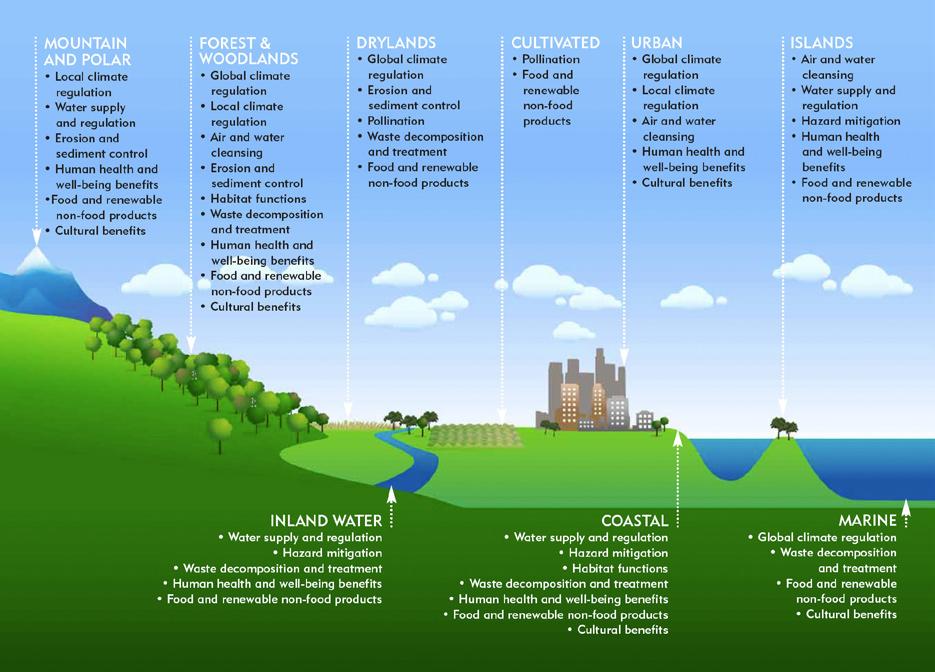
There are many ecosystem services that can be provided by sites (Figure 1-2) (Table 1-1).
Some examples are:
3
3
Trees regulate local climate through evapotranspiration, shade, and wind control.
Vegetation mitigates local air quality.
Soils and vegetation infiltrate and purify stormwater protecting adjacent waterways 3 and the water table.
3
Vegetation and construction materials mitigate heat island impacts in urban areas.
3 spaces for human health and well-being and cultural benefits.
3
Vegetation, water, and materials are combined to make parks, gardens, and open
Water and soil organisms break down waste and cycle nutrients.
Figure 1-2: Ecosystem services by landscape type
(Image from The Sustainable Sites Initiative)
It is important to note that site development decisions can impact ecosystem services far away from a site as well—and these impacts are not often easily seen or understood. Decisions about stormwater management and vegetation inputs (e.g., fertilizers and herbicides) can impact waterways hundreds of miles downstream. Resource extraction and material manufacturing can impact ecosystems halfway around the world. And air currents can carry airborne pollutants far away from the manufacturing plant that released them.
Fun CTI on
Global climate regulation
Local climate regulation
Air and water cleansing
Water supply and regulation
Erosion and sediment control
Hazard mitigation
Pollination
Habitat functions
Waste decomposition and treatment
Human health and well-being benefits
Food and renewable nonfood products
Cultural benefits
Source: SITES 2009a
Maintaining balance of atmospheric gases at historic levels, creating breathable air, and sequestering greenhouse gases
Regulating local temperature, precipitation, and humidity through shading, evapotranspiration, and windbreaks
Removing and reducing pollutants in air and water
Storing and providing water within watersheds and aquifers
Retaining soil within an ecosystem, preventing damage from erosion and siltation
Reducing vulnerability to damage from flooding, storm surge, wildfire, and drought
Providing pollinator species for reproduction of crops or other plants
Providing refuge and reproduction habitat to plants and animals, thereby contributing to conservation of biological and genetic diversity and evolutionary processes
Breaking down waste and cycling nutrients
Enhancing physical, mental, and social well-being as a result of interaction with nature
Producing food, fuel, energy, medicine, or other products for human use
Enhancing cultural, educational, aesthetic, and spiritual experiences as a result of interaction with nature
Table 1-1: ecosystem s ervices
EC o S y STEM SER v ICE
Another random document with no related content on Scribd:
‘reads all despatches himself at first hand, writes most of his own letters, and spends a considerable part of his time about such occupations, in his closet, and with his ministers.’ ‘I hope,’ Toland says, ‘that none of our countrymen will be so injudicious as to think his reservedness the effect of sullenness or pride; nor mistake that for state which really proceeds from modesty, caution, and deliberation; for he is very affable to such as accost him, and expects that others should speak to him first, which is the best information I could have from all about him, and I partly know to be true by experience.’... ‘As to what I said of his frugality in laying out the public money, I need not give a more particular proof than that all the expenses of his court, as to eating, drinking, fire, candles, and the like, are duly paid every Saturday night; the officers of his army receive their pay every month, so likewise his envoys in every part of Europe; and all the officers of his household, with the rest that are on the civil list, are cleared off every half-year.’ We are then assured that his administration was equable, mild, and prudent—a triple assertion which his own life and that of his hardly-used wife flatly denied. Toland, however, will have it that there never existed a prince who was so ardently beloved by his subjects. Hanover itself is said to be without division or faction, and all Hanoverians as being in a condition of ecstasy at the Solomon-like rectitude and jurisdiction of his very Serene Highness. He describes Madame Kielmansegge as a woman of sense and wit; and of ‘Mademoiselle Schulemberg,’ he says that she is especially worthy of the rank she enjoys, and that ‘in the opinion of others, as well as mine, she is a lady of extraordinary merit!’ Of Sophia Dorothea, Toland makes no note whatever.
There only remains to be added, that the legation left Hanover loaded with presents. The earl received the portrait of the Electress, with an Electoral crown in diamonds by way of mounting to the frame. George Louis bestowed upon him a gold basin and ewer. Gold medals and snuffboxes were showered among the other members. The chaplain, Dr. Sandys, was especially honoured by rich gifts in medals and books. He was the first who ever read the service of our Church in the presence of the Electress. She joined in it with
apparent fervour, and admired it generally; but when a hint was conveyed to her that it might be well were she to introduce it in place of the Calvinistic form used in her chapel, as of the Lutheran in that of the Elector, she shook her head, with a smile; said that there was no difference between the three forms, in essentials, and that episcopacy was merely the established form in England. She thought for the present she would ‘let well alone.’ And it was done accordingly!
In the year 1705 the war was raging which France was carrying on for the purpose of extending her limits and influence, and which England and her allies had entered into in order to resist such aggression and restore that terribly oscillating matter—the balance of European power. The Duke of Marlborough had, at the prayer of the Dutch States, left the banks of the Moselle, in order to help Holland, menaced on the side of Liège by a strong French force. Our great duke left General D’Aubach at Trèves to secure the magazines which the English and Dutch had laid up there; but upon the approach of Marshal Villars, D’Aubach destroyed the magazines and abandoned Trèves, of which the French immediately took possession. This put an end to all the schemes which had been laid for attacking France on the side of the Moselle, where her frontiers were but weak, and carried her confederates back to Flanders, where, as the old-fashioned chronicler, Salmon, remarks, ‘they yearly threw away thousands of brave fellows against stone walls.’ Thereupon, Hanover became menaced. On this, Horace Walpole has something in point:
‘As the genuine wife was always detained in her husband’s power, he seems not to have wholly dissolved their union; for on the approach of the French army towards Hanover, during Queen Anne’s reign, the Duchess of Halle (Ahlden) was sent home to her father and mother, who doted on their only child, and did retain her for a whole year, and did implore, though in vain, that she might continue to reside with them.’ On the return of ‘the genuine wife’ to captivity some of the old restrictions were taken off. There was no prohibition of intercourse with the parents; for the Duke of Zell had resolved on
proceeding to visit his daughter, but only deferred his visit until the conclusion of a grand hunt in which he was anxious to take part. He went; and between fatigue, exposure to inclement weather, and neglect on his return, he became seriously ill, rapidly grew worse, died on the 28th of August 1705, and by his death gave the domains of a dukedom to Hanover and deprived his daughter of a newlyacquired friend.
The death of the Duke of Zell was followed by honour to Bernstorf. George Louis appointed him to the post of prime-minister of Hanover, and at the same time made him a count. The death of the father of Sophia Dorothea was, however, followed by consequences more fatal than those just named. The severity of the imprisonment of the princess was much aggravated; and though she was permitted to have an occasional interview with her mother, all application to be allowed to see her two children was sternly refused and this refusal, as the poor prisoner used to remark, was the bitterest portion of her misery.
It was of her son that George Louis used to say, in later years, ‘Il est fougueux, mais il a du cœur’—hot-headed but not heartless. George Augustus manifested this disposition very early in life. He was on one occasion hunting in the neighbourhood of Luisberg, not many miles from the scene of his mother’s imprisonment, when he made a sudden resolution to visit her, regardless of the strict prohibition against such a course laid on him by his father and the Hanoverian government. Laying spurs to his horse, he galloped at full speed from the field, and in the direction of Ahlden. His astonished suite, seeing the direction which he was following at so furious a rate, immediately suspected his design and became legally determined to frustrate it. They left pursuing the stag and took to chasing the prince. The heir-apparent led them far away over field and furrow, to the great detriment of the wind and persons of his pursuers; and he would have distanced the whole body of flying huntsmen, but that his steed was less fleet than those of two officers of the Electoral household, who kept close to the fugitive, and at last came up with him on the skirts of a wood adjacent to
Ahlden. With mingled courtesy and firmness they represented to him that he could not be permitted to go further in a direction which was forbidden, as by so doing he would not only be treating the paternal command with contempt, but would be making them accomplices in his crime of disobedience. George Augustus, vexed and chafed, argued the matter with them, appealed to their affections and feelings, and endeavoured to convince them both as men and as ministers, as human beings and as mere official red-tapists, that he was authorised to continue his route to Ahlden by every law, earthly or divine.
The red-tapists, however, acknowledged no law under such circumstances but that of their Electoral lord and master, and that law they would not permit to be broken. Laying hold of the bridle of the prince’s steed, they turned its head homewards and rode away with George Augustus in a state of full discontent and strict arrest.
CHAPTER X.
THE SUCCESSION—DEATH OF THE ELECTRESS.
Marriage of Prince George to Princess Caroline of Anspach, and of his sister to the Crown Prince of Prussia—Honours conferred by Queen Anne on Prince George Intention to bring over to England the Princess Sophia— Opposed by Queen Anne Foundation of the kingdom of Prussia—The establishment of this Protestant kingdom promoted by the Jesuits The Electress Sophia’s visit to Loo The law granting taxes on births, deaths, and marriages—Complaint of Queen Anne against the Electress—Tom D’Urfey’s doggrel verses on her—Death of the Electress—Character of her.
THE Elector, meditating on this sudden development of the domestic affections of his son, resolved to aid such development, not by giving him access to his mother, but by bestowing on him the hand of a consort. Caroline of Anspach was a very accomplished young lady, owing to the careful education which she received at the hands of the best-loved child of Sophia Charlotte, Electress of Brandenburg, and the first, but short-lived, Queen of Prussia. If the instructress was able, the pupil was apt. She was quick, enquiring, intelligent, and studious. Her application was great, her perseverance unwearied, and her memory excellent. She learned quickly and retained largely, seldom forgetting anything worth remembrance; and was an equally good judge of books and individuals. Her perception of character has, perhaps, never been surpassed. She had no inclination for trivial subjects, nor affection for trivial people. She had a heart and mind only for philosophers and philosophy; but she was not the less a lively girl, or the more a pedant on that account. She delighted in lively conversation, and could admirably
lead or direct it. Her knowledge of languages was equal to that of Sophia of Hanover, of whom she was also the equal in wit and in repartee. But therewith she was more tender, more gentle, more generous.
The marriage of George Augustus, Electoral Prince of BrunswickHanover, with Caroline, daughter of John Frederick, Margrave of Anspach, was solemnised in the year 1705. The wife of George Augustus was of the same age as her husband. She had had the misfortune to lose her father when she was yet extremely young, and had been brought up at the Court of Berlin under the guardianship of Sophia Charlotte, the consort of Frederick of Prussia.
The sister of George Augustus, the only daughter of Sophia Dorothea, and bearing the same baptismal names as her mother, was also married during the captivity of the latter. Three remarkable Englishmen were present at the marriage of the daughter of Sophia Dorothea with the Prince Royal of Prussia. These were Lord Halifax, Sir John Vanbrugh, and Joseph Addison. Queen Anne, who had restored Halifax to a favour from which he had fallen, entrusted him to carry the bill for the naturalisation of the Electoral family and for the better security of the Protestant line of succession, and also the Order of the Garter for the Electoral Prince. On this mission, Addison was the invited companion of the patron whom he so choicely flattered. Vanbrugh was present in his official character of Clarencieux King-at-Arms, and performed the ceremony of investiture. The little Court of Hanover was joyfully splendid on this doubly festive occasion. The nuptials were celebrated with more accompanying gladness than ever followed them. The pomp was something uncommon in its way, and the bride must have been wearied of being married long before the stupendous solemnity had at length reached its slowly-arrived-at conclusion. She became Queen of Prussia in 1712.
Honours now fell thick upon the Electoral family, but Sophia Dorothea was not permitted to have any share therein. In 1706, Queen Anne created her son, George Augustus, Baron of
Tewkesbury, Viscount Northallerton, Earl of Milford Haven, Marquis and Duke of Cambridge. With these honours it was also decreed that he should enjoy full precedence over the entire peerage.
There was a strong party in England whose most earnest desire it was that the Electress Sophia, in whose person the succession to the crown of Great Britain was settled, should repair to London—not permanently to reside there, but in order that during a brief visit she might receive the homage of the Protestant party. She was, however, reluctant to move from her books, philosophy, and cards, until she could be summoned as Queen. Failing here, an attempt was made to bring over George Louis, who was nothing loth to come; but the idea of a visit from him was to poor Queen Anne the uttermost abomination. Her Majesty had some grounds for her dislike to a visit from her old wooer. She was nervously in terror of a monster popular demonstration. Such a demonstration was publicly talked of; and the enemies of the house of Stuart, by way of instruction and warning to the Queen, whose Jacobite bearing towards her brother was matter of notoriety, had determined, in the event of George Louis visiting England, to give him an escort into London that should amount to the very significant number of some forty or fifty thousand men.
The journal of the lord-keeper, Cowper, states the official answer of the princess to all the invitations which had been agitated by the Hanoverian Tories during the year 1704 and the succeeding summer. ‘At the Queen’s Cabinet Council, Sunday, the 11th of November 1705, foreign letters read in her Majesty’s presence, the substance remarkable, that at Hanover was a person, agent to the discontented party here, to invite over the Princess Sophia and the Electoral Prince (afterwards George II.) into England, assuring them that a party here was ready to propose it. That the Princess Sophia had caused the same person to be acquainted, “that she judged the message came from such as were enemies to her family; that she would never hearken to such a proposal but when it came from the Queen of England herself;” and withal she had discouraged the
attempt so much that it was believed nothing more could be said in it.’
Sophia, who was naturally reluctant to come to England upon a mere popular or partisan invitation, would gladly have come on the bidding of the Queen. This was never given. In one year the Queen sent a request to the Electress to aid her in promoting the peace of Europe, and a present to her god-daughter Anne, the first child of George Augustus and Caroline of Anspach. Earl Rivers carried both letter and present. The letter was acknowledged with cold courtesy by the Electress, in a communication to the Earl of Strafford, secretary of state. The communication bears date the 11th of November 1711; and, after saying that the gift is infinitely esteemed, the Electress adds—‘I would not, however, give my parchment for it, since that will be an everlasting monument in the archives of Hanover, and the present for the little princess will go, when she is grown up, into another family.’
Early in 1714 Anne addressed a powerful remonstrance to the aged Electress, complaining that ever since the Act of Succession had been settled, there had been a constant agitation, the object of which was to bring over a prince of the Hanoverian house to reside in England, even during the writer’s life. She accuses the Electress of having come, though perhaps tardily, into this sentiment, which had its origin in political pretensions, and she adds, that if persevered in, it may end in consequences dangerous to the succession itself, ‘which is not secure any other ways than as the princess who actually wears the crown maintains her authority and prerogative.’
Her Majesty addressed a second letter to George Augustus, as Duke of Cambridge, expressing her thoughts with respect to the design he had of coming into her kingdom. ‘I should tell you,’ she says, ‘nothing can be more dangerous to the tranquillity of my dominions, and the right of succession in your line, and consequently most disagreeable to me.’
The proud Dowager-Electress had declared that ‘she cared not when she died, if on her tomb could be recorded that she was
Queen of Great Britain and Ireland.’ These words are said to have given great offence to Queen Anne.
There is evidence that the last letters of Anne had something to do with the death of the Electress. They had hardly been received and read, when her health, which had been for some time failing, grew worse. She rallied, however, for a time, and was able to take exercise, but the blow had been given from which she never recovered.
Molyneux, an agent of the Duke of Marlborough at Hanover, says he was on his way to the country palace of the Electress, when he was suddenly informed that she had been seized with mortal illness in one of the garden-walks.
‘I ran up there, and found her fast expiring in the arms of the poor Electoral Princess (Caroline, afterwards Queen of George II.) and amidst the tears of a great many of her servants, who endeavoured in vain to help her. I can give you no account of her illness, but that I believe the chagrin of those villainous letters I sent you last post has been in a great measure the cause of it. The Rheingravine who has been with her these fifteen years has told me she never knew anything make so deep an impression on her as the affair of the prince’s journey, which I am sure she had to the last degree at heart, and she has done me the honour to tell me so twenty times. In the midst of this, however, these letters arrived, and these, I verily believe, have broken her heart and brought her with sorrow to the grave. The letters were delivered on Wednesday, at seven.
‘When I came to court she was at cards, but was so full of these letters that she got up and ordered me to follow her into the garden, where she gave them to me to read, and walked, and spoke a great deal in relation to them. I believe she walked three hours that night. The next morning, which was Thursday, I heard that she was out of order, and on going immediately to court, she ordered me to be called into her bed-chamber. She gave me the letters I sent you to copy; she bade me send them next post, and bring them afterwards
to her to court. This was on Friday. In the morning, on Friday, they told me she was very well, but seemed much chagrined. She was dressed, and dined with the Elector as usual. At four, she did me the honour to send to town for some other copies of the same letters; and then she was still perfectly well. She walked and talked very heartily in the orangery. After that, about six, she went out to walk in the garden, and was still very well. A shower of rain came, and as she was walking pretty fast to get to shelter, they told her she was walking a little too fast. She answered, “I believe I do,” and dropped down on saying these words, which were her last. They raised her up, chafed her with spirits, tried to bleed her; but it was all in vain, and when I came up, she was as dead as if she had been four days so.’2 Such was the end, on the 10th of June 1714, of a very remarkable woman.
CHAPTER XI.
AHLDEN AND ENGLAND.
The neglected captive of Ahlden Unnoticed by her son-in-law, except to secure her property—Madame von Schulenburg—The Queen of Prussia prohibited from corresponding with her imprisoned mother—The captive betrayed by Count de Bar—Death of Queen Anne—Anxiety felt for the arrival of King George—The Duke of Marlborough’s entry—Funeral of the Queen—Public entry of the King—Adulation of Dr. Young—Madame Kielmansegge, the new royal favourite Horace Walpole’s account of her ‘A Hanover garland’ Ned Ward, the Tory poet Expression of the public opinion The Duchess of Kendal bribed by Lord Bolingbroke Bribery and corruption general Abhorrence of parade by the King.
DURING marriage festivals and court fêtesheld to celebrate some step in greatness, Sophia Dorothea continued to vegetate in Ahlden. She was politically dead; and even in the domestic occurrences of her family, events in which a mother might be gracefully allowed to have a part, she enjoyed no share. The marriages of her children and the births of their children were not officially communicated to her. She was left to learn them through chance or the courtesy of individuals.
Her daughter was now the second Queen of Prussia, but the King cared not to exercise his influence in behalf of his unfortunate mother-in-law. Not that he was unconcerned with respect to her. His consort was heiress to property over which her mother had control, and Frederick was not tranquil of mind until this property had been secured as the indisputable inheritance of his wife. He was earnest enough in his correspondence with Sophia Dorothea until this consummation was arrived at; and when he held the writings which secured the succession of certain portions of the property of the duchess on his consort, he ceased to trouble himself further with
any question connected with the unfortunate prisoner; except, indeed, that he forbade his wife to hold any further intercourse with her mother, by letter or otherwise.
Few and trivial are the incidents told of her long captivity. The latter had been embittered, in 1703, by the knowledge that Mademoiselle von der Schulenburg was the mother of another daughter, Margaret Gertrude, of whom the Elector was the father. This child was ten years younger than her sister, Petronilla Melusina, who subsequently figured at the Court of George II. as Countess of Walsingham, and who was the uncared-for wife of Philip Stanhope, Earl of Chesterfield.
Previous to the prohibition laid on his wife by the King of Prussia, an epistolary intercourse had been privately maintained between Sophia Dorothea and her daughter. Such intercourse had never received the King’s sanction; and when it came to his knowledge, at the period of the settlement of part of the maternal property on the daughter, he peremptorily ordered its cessation. It had been maintained chiefly by means of a Chevalier de Bar; Ludwig, a privycouncillor at Berlin; Frederick, a page of the Queen’s; and a bailiff of the castle of Ahlden. There were too many confederates in a matter so simple, and the whole of them betrayed the poor lady, for whom they professed to act. The most important agent was the chevalier: in him the duchess confided longest, and in his want of faith she was the last to believe. He had introduced himself to her by sending her presents of snuff, no unusual present to a lady in those days— though it is pretended that these gifts bore a peculiar signification, known only to the donor and the recipient. They probably had less meaning than the presents forwarded to the prisoner by her daughter, consisting now of her portrait, another time of a watch, or some other trinket, which served to pass a letter with it, in which were filial injunctions to the poor mother to be patient and resigned, and to put no trust in the Count de Bar.
The prisoner did not heed the counsel, but continued to confide in a man who was prodigal of promise, and traitorous of
performance. Her hopes were fixed upon escaping, but they were foiled by the watchfulness of noble spies, who exultingly told her that her husband was a king. And it is asserted that she might have been a recognised queen if she would but have confessed that she had failed in obedience towards her husband. It is certain that a renewed, but it may not have been an honest, attempt at reconciliation was made just previous to the accession of George I., but the old reply fell from the prisoner’s lips:—‘If I am guilty, I am not worthy of him: if I am innocent, he is not worthy of me.’
The death of the Electress Sophia, in 1714, was followed very shortly after by the demise of Queen Anne. This event had taken all parties somewhat by surprise. They stood face to face, as it were, over the dying Queen. The Jacobites were longing for her to name her brother as her successor, whom they would have proclaimed at once at the head of the army. The Hanoverian party were feverish with fears and anticipations; but they had the regency dressed up and ready in the back ground, and Secretary Craggs, booted and spurred, was making such haste as could then be made on his road to Hanover, to summon King George. The Jacobite portion of the cabinet was individually bold in resolving what ought to be done, but they were, bodily, afraid of the responsibility of doing it. Each man of each faction had his king’s name ready upon his lips, awaiting only that the lethargy of the Queen should be succeeded by irretrievable death to give it joyful utterance. Anne died on the 1st of August 1714; the Jacobites drew a breath of hesitation; and in the meantime the active Whigs instantly proclaimed King George, gave Addison the mission of announcing the demise of one sovereign to another, who was that sovereign’s successor, and left the Jacobites to their vexation and their threatened redress.
Lord Berkley was sent with the fleet to Orange Polder, in Holland, there to bring over the new King; but Craggs had not only taken a very long time to carry his invitation to the monarch, but the husband of Sophia, when he received it, showed no hot haste to take advantage thereof. The Earl of Dorset was despatched over to press his immediate coming, on the ground of the affectionate
impatience of his new subjects. The King was no more moved thereby than he was by the first announcement of Lord Clarendon, the English ambassador, at Hanover. On the night of the 5th of August that envoy had received an express, announcing the demise of the Queen. At two o’clock in the morning he hastened with what he supposed the joyful intelligence to Herrnhausen, and caused George Louis to be aroused, that he might be the first to salute him as King. The new monarch yawned, expressed himself vexed, and went to sleep again as calmly as any serene highness. In the morning some one delicately hinted, as if to encourage the husband of Sophia Dorothea in staying where he was, that the presbyterian party in England was a dangerous regicidal party. ‘Not so,’ said George, who seemed to be satisfied that there was no peril in the new greatness; ‘not so; I have nothing to fear from the king-killers; they are all on my side.’ But still he tarried; one day decreeing the abolition of the excise, the next ordering, like King Arthur in Fielding’s tragedy, all the insolvent debtors to be released from prison. While thus engaged, London was busy with various pleasant occupations.
On the 3rd of August the late Queen was opened; and on the following day her bowels were buried, with as much ceremony as they deserved, in Westminster Abbey. The day subsequent to this ceremony, the Duke of Marlborough, who had been in voluntary exile abroad, and whose office in command of the imperial armies had been held for a short time, and not discreditably, by George Louis, made a triumphant entry into London. The triumph, however, was marred by the sudden breaking down of his coach at TempleBar an accident ominous of his not again rising to power. The Lords and Commons then sent renewed assurances of loyalty to Hanover, and renewed prayers that the lord there would doff his electoral cap, and come and try his kingly crown. To quicken this, the lower house, on the 10th, voted him the same revenues the late Queen had enjoyed—excepting those arising from the Duchy of Cornwall, which were, by law, invested in the Prince of Wales. On the 13th Craggs arrived in town to herald the King’s coming; and on the 14th the
Hanoverian party were delighted to hear that on the Pretender repairing from Lorraine to Versailles, to implore of Louis to acknowledge him publicly as king, the French monarch had pleaded, in bar, his engagements with the House of Hanover, and that thereon the Pretender had returned dispirited to Lorraine. On the 24th of the month the late Queen’s body was privately buried in Westminster Abbey, by order of her successor, who appeared to have a dread of finding the old lady of his young love yet upon the earth. This order was followed by another, which ejected from their places many officials who had hoped to retain them—and chief of these was Bolingbroke. London then became excited at hearing that the King had arrived at the Hague on the 5th of September. It was calculated that the nearer he got to his kingdom the more accelerated would be his speed; but George was not to be hurried. Madame Kielmansegge, who shared what was called his regard with Mademoiselle von der Schulenburg, had been retarded in her departure from Hanover by the heaviness of her debts. The daughter of the Countess von Platen would not have been worthy of her mother had she suffered herself to be long detained by such a trifle. She, accordingly, gave her creditors the slip, set off to Holland, and was received with a heavy sort of delight by the King. The exemplary couple tarried above a week at the Hague; and, on the 16th of September George and his retinue set sail for England. Between that day and the day of his arrival at Greenwich, the heads of the Regency were busy in issuing decrees:—now it was for the prohibition of fireworks on the day of his Majesty’s entry; next against the admission of unprivileged carriages into Greenwich Park on the King’s arrival; and, lastly, one promising one hundred thousand pounds to any loyal subject who might be lucky enough to catch the Pretender in England, and who would bring him a prisoner to London.
On the 18th of September the King landed at Greenwich; and on the two following days, while he sojourned there, he was waited on by various officials, who went smiling to the foot of the throne, and came away frowning at the cold treatment they received there. They
who thought themselves the most secure endured the most disgraceful falls, especially the Duke of Ormond, who, as captaingeneral, had been three parts inclined to proclaim the Pretender. He repaired in gorgeous array to do homage to King George; but the King would only receive his staff of office, and would notsee the exbearer of it; who returned home with one dignity the less, and for George one enemy the more.
The public entry into London on the 20th was splendid, and so was the court holden at St. James’s on the following day. A lively incident, however, marked the proceedings of this first court. Colonel Chudleigh, in the crowd, branded Mr. Allworth, M.P. for New Windsor, as a Jacobite; whereupon they both left the palace, went in a coach to Marylebone Fields, and there fought a duel, in which Mr. Allworth was killed on the spot. This was the first libation of blood offered to the King.
No poet affected to deplore the decease of Anne with such profundity of jingling grief as Young. He had not then achieved a name, and he was eagerly desirous to build up a fortune. His threnodia on the death of Queen Anne is a fine piece of measured maudlin; but the author appears to have bethought himself, before he had expended half his stock of sorrows, that there would be more profit in welcoming a living than bewailing a defunct monarch. Accordingly, wiping up his tears, and arraying his face in the blandest of smiles, he addressed himself to the double task of recording the reception of George and registering his merits. He first, however, apologetically states, as his warrant for turning from weeping for Anne to cheering for George, that all the sorrow in the world cannot reverse doom, that groans cannot ‘unlock th’ inexorable tomb’; that a fond indulgence of woe is sad folly, for, from such a course, he exclaims, with a fine eye to a poet’s profit
What fruit can rise or what advantage flow!
So, turning his face from the tomb of Anne to the throne of George, he grandiosely waves his hat, and thus he sings:—
Welcome great stranger to Britannia’s throne! Nor let thy country think thee all her own. Of thy delay how oft did we complain! Our hope reach’d out and met thee on the main. With pray’r we smooth the billows for thy feet, With ardent wishes fill thy swelling sheet; And when thy foot took place on Albion’s shore, We,bending,bless’dtheGodsandask’dnomore! What hand but thine should conquer and compose, Join those whom interest joins, and chase our foes, Repel the daring youth’s presumptuous aim, And by his rival’s greatness give him fame? Now, in some foreign court he may sit down, And quit without a blush the British crown; Secure his honour, though he lose his store, And take a lucky moment to be poor.
This sneer at the Pretender is as contemptible as the flattery of George is gross; and the picture of an entire nation on its knees, blessing Olympus, and bidding the gods to restrain all further gifts, is as magnificent a mixture of bombast and blasphemy as ever was made up by venal poet. But here is more of it:—
Nor think, great sir, now first at this late hour, In Britain’s favour you exert your power; To us, far back in time, I joy to trace The numerous tokens of your princely grace; Whether you chose to thunder on the Rhine, Inspire grave councils, or in courts to shine, In the more scenes your genius was display’d The greater debt was on Britannia laid: They all conspired this mighty man to raise, And your new subjects proudly share the praise.
Such is the record of a rhymer: Walpole, in plain and truthful prose, tells a very different story. He informs us that the London mob were highly diverted at the importation by the King of his uncommon seraglio of ugly women. ‘They were food,’ he says, ‘for all the venom of the Jacobites,’ and so far from Britain thanking him for coming himself, or for bringing with him these numerous tokens of his princely grace, ‘nothing could be grosser than the ribaldry vomited out in lampoons, libels, and every channel of abuse, against the sovereign and the new court, and chanted even in their hearing about the public streets.’ Mademoiselle von Schulemberg (sic) was created Duchess of Kendal. ‘The younger Mademoiselle von Schulemberg, who came over with her, and was created Countess of Walsingham, passed for her niece, but was so like the King, that it is not very credible that the duchess, who had affected to pass for cruel, had waited for the left-handed marriage.’ Lady Walsingham, as previously said, was afterwards married to the celebrated Philip Stanhope, Earl of Chesterfield.
To the Duchess of Kendal—George (who was so shocked at the infidelity of which his wife was alleged to be guilty) was to the mistress as inconstant as to the wife he had been untrue. He set aside the former, to put in her place Madame Kielmansegge, called, like her mother, Countess von Platen. On the death of her husband, in 1721, he raised her to the rank of Countess of Leinster in Ireland,
Countess of Darlington and Baroness of Brentford in England. Coxe says of her, that her power over the King was not equal to that of the Duchess of Kendal, but her character for rapacity was not inferior. Horace Walpole has graphically portrayed Lady Darlington in the following passage:—
‘Lady Darlington, whom I saw at my mother’s in my infancy, and whom I remember by being terrified at her enormous figure, was as corpulent and ample as the duchess was long and emaciated. The fierce black eyes, large, and rolling beneath two lofty arched eyebrows, two acres of cheeks spread with crimson, an ocean of neck that overflowed, and was not distinguished from, the lower part of her body, and no part restrained by stays—no wonder that a child dreaded such an ogress.’
The mob had a strong Tory leaven at this time, and among the multitude circulated a mass of broadsides and ballads, of so openly a seditious character that the power of the law was stringently applied to suppress the evil. Before the year was out half the provincial towns in England were infected with seditious sentiments against the Whig government, which had brought in a King whose way of life was a scandal to them. This feeling of contempt for both King and government was wide as well as deep; and it was so craftily made use of by the leaders of public opinion, that, before George had been three months upon the throne, the ‘High-church rabble,’ as the Tory party was called, in various country towns were violent in their proceedings against the government; and at Axminster, in Devonshire, shouted for the Pretender, and drank his health as King of England. The conduct of George to his wife, Sophia Dorothea, was as satirically dealt with, in the way of censure, as any of his delinquencies, and his character as a husband was not forgotten in the yearly tumults of his time, which broke out on every recurring anniversary of Queen Anne’s birthday (April the 23rd) to the end of his reign.
If the new King was dissatisfied with his new subjects, he liked as little the manners of England. ‘This is a strange country,’ said his
Majesty; ‘the first morning after my arrival at St. James’s, I looked out of the window, and saw a park, with walks, a canal, and so forth, which they told me were mine. The next day, Lord Chetwynd, the ranger of mypark, sent me a fine brace of carp out of mycanal, and I was told that I must give five guineas to Lord Chetwynd’s servant, for bringing me my own carp, out of my own canal, in my ownpark!’
The monarch’s mistresses loved as much to receive money as the King himself loved little to part from it. The Duchess of Kendal’s rapacity has been mentioned: one instance of it is mentioned by Coxe, on the authority of Sir Robert Walpole, to the effect that ‘the restoration of Lord Bolingbroke was the work of the Duchess of Kendal. He gained the duchess by a present of eleven thousand pounds, and obtained a promise to use her influence over the King for the purpose of forwarding his complete restoration.’ Horace Walpole states that the duchess was no friend of Sir Robert, and wished to make Lord Bolingbroke minister in his room. The rapacious mistress was jealous of Sir Robert’s credit with the monarch. Monarch and minister transacted business through the medium of indifferent Latin; the King not being able to speak English, and Sir Robert, like a country gentleman of England, knowing nothing of either German or French. ‘It was much talked of,’ says the lively writer of the ‘Reminiscences of the Courts of the first two Georges,’ ‘that Sir Robert, detecting one of the Hanoverian ministers in some trick or falsehood before the King’s face, had the firmness to say to the German, “Mentiris impudentissime!” The good-humoured monarch only laughed, as he often did when Sir Robert complained to him of his Hanoverians selling places, nor would be persuaded that it was not the practice of the English court.’ The singularity of this complaint is, that it was made by a minister who was notorious for complacently saying, that ‘Every man in the House of Commons had his price.’
CHAPTER XII. CROWN AND GRAVE.
Arrival of Caroline, Princess of Wales The King dines at the Guildhall Proclamation of the Pretender—Counter-proclamations—Government prosecutions—A mutiny among the troops—Impeachment of the Duke of Ormond of high treason—Punishment of political offenders—Failure of rebellion in Scotland—Punishment for wearing oak-boughs—Riot at the mug-house in Salisbury Court, and its fatal consequences—The Prince of Wales removed from the palace Dissensions between the King and the Prince Attempt on the life of King George Marriage of the King’s illegitimate daughter The South-Sea Bubble Birth of Prince William, the butcher of Culloden Death of the Duchess of Zell Stricter imprisonment of the captive of Ahlden Her calm death A new royal favourite, Mrs. Brett Death of the King.
WHILE Sophia Dorothea continued to linger in her prison, her husband and son, with the mistresses of the former and the wife of the latter, were enjoying the advantages and anxieties which surround a throne. The wife of the Prince of Wales, Caroline, arrived at Margate on the 13th of October. She was accompanied by her two eldest daughters, Anne and Amelia. Mother and children rested during one day in the town where they had landed, slept one night at Rochester, and arrived at St. James’s on the 15th. The royal coronation took place in Westminster Abbey on the 20th of the same month. Amid the pomp of the occasion, no one appears to have thought of her who should have been Queen-consort. There was much splendour and some calamity, for as the procession was sweeping by, several people were killed by the fall of scaffolding in the Palace Yard. The new King entered the Abbey amid the cheers and screams of an excited multitude.
Three days after, the monarch, with the Prince and Princess of Wales, dined with the Lord Mayor and corporation in the Guildhall, London, and there George performed the first grateful service to his people, by placing a thousand guineas in the hands of the sheriffs, for the relief of the wretched debtors then immured in the neighbouring horrible prisons of Newgate and the Fleet.
Within a month, the general festivities were a little marred by the proclamation of the Pretender, dated from Lorraine, wherein he laid claim to the throne which George was declared to have usurped. At this period the Duke of Lorraine was a sovereign prince, maintaining an envoy at our court; but the latter was ordered to withdraw from the country immediately after the arrival of the ‘Lorraine proclamation’ by the French mail. Already George I. began to feel that on the throne he was destined to enjoy less quiet than his consort in her prison.
The counter-proclamations made in this country, chiefly on account of the Jacobite riots at Oxford and some other places, were made up of nonsense and malignity, and were well calculated to make a good cause wear the semblance of a bad one. They decreed, or announced, thanksgiving on the 20th of January, for the accession of the House of Hanover; and, to show what a portion of the people had to be thankful for, they ordered a rigorous execution of the laws against papists, non-jurors, and dissenters generally, who were assumed to be, as a matter of course, disaffected to the reigning house.
After some of the first troubles of his reign had been got over, the King visited Hanover, where he invested his brother, the Duke of York, and Prince Frederick with the Order of the Garter. He even partook of the pleasures of the chase in the woods around Ahlden; but except ordering a more stringent rule for the safe-keeping of his consort, he took no further notice of Sophia Dorothea. He returned to London on the 18th of January 1716–17, and on that day week, hearing that the episcopal clergy of Scotland continued to refuse to pray for him, he issued a decree, which compelled many to fly the
country or otherwise abscond. The English clergy experienced even harsher treatment for less offence. I may mention, as an instance, the case of the Rev. Laurence Howell, who, for writing a pamphlet called ‘The State of Schism in the Church of England truly stated,’ was stripped of his gown by the executioner, fined 500l., imprisoned three years, and was sentenced to be twice publicly whipped by the hangman!
On the first absence of the King from England, the Prince of Wales was appointed regent, but he was never entrusted with that high office a second time. ‘It is probable,’ says Walpole, ‘that the son discovered too much fondness for acting the king, as that the father conceived a jealousy of his having done so. Sure it is, that on the King’s return, great divisions arose in the court, and the Whigs were divided—some devoting themselves to the wearer of the crown and others to the expectant.’ So that, in the second year of his reign, the King not only held his wife in prison, but his son and heir was banished from his presence.
Passing over the record of public events, the next interesting fact connected with the private life of the faithless husband of Sophia Dorothea was the marriage of his illegitimate daughter Charlotte with Lord Viscount Howe. The bride’s mother was Charlotte Sophia, daughter of the Countess von Platen; and Charlotte Sophia was decently married to Baron Kielmansegge, Master of the Horse to George I. In 1719, at the time of the above marriage, the baroness was a widow. George I. himself gave away the bride as the baroness’s niece. ‘The King,’ says Walpole, ‘was indisputably her father; and the first child born of this union was named George, after the King.’ The Princess Amelia, daughter of George II., ‘treated Lady Howe’s daughter, “Mistress Howe,” as a princess of the bloodroyal, and presented her with a ring, containing a small portrait of George I., with a crown in diamonds.’ The best result of this marriage was, that the famous Admiral Howe was one of the sons born of it, and that was the only benefit which the country derived from the vicious conduct of George I. If the marriage of the child of one mistress tended to mortify the vanity of another, as is said to
have been the case with Von der Schulenburg, King George found a way to pacify her. That lady was already Duchess of Munster, in Ireland, and the King, in April 1719, created her a baroness, countess, and duchess of Great Britain, by the name, style, and title of Baroness of Glastonbury, Countess of Feversham, and Duchess of Kendal; and this done, the King soon after embarked at Gravesend for Hanover.
The year 1720 saw King George more upon the Continent than at home, where indeed universal misery reigned, in consequence of the bursting of the great South Sea Bubble, which had promised such golden solidity—which ended in such disappointment and ruin, and for furthering which the Duchess of Kendal and her daughter received bribes of 10,000l. each. In April of the following year, William Augustus was born at Leicester House. The daughter of Sophia Dorothea was his godmother; her husband and the Duke of York were the godfathers. This son of George Augustus and Caroline of Anspach, Prince and Princess of Wales, was afterwards famous as the Duke of Cumberland.
On the 17th of January 1721, the royal family went into mourning, and this was the only domestic incident of the reign in which Sophia Dorothea was allowed to participate. With her, the mourning was not a mere formality; it was not assumed, but was a testimony offered, in sign of her sorrow, for the death of her mother, Eleanora, Duchess of Zell. The Duchess had seen little of her daughter for some time previous to her death, but she bequeathed to her as much of her private property as she had power to dispose of by will.
Sophia Dorothea had now a considerable amount of funds placed to her credit in the bank of Amsterdam. Of the incidents of her captivity nothing whatever is known, save that it was most rigidly maintained. She was forgotten by the world, because unseen, and they who kept her in prison were as silent about her as the keepers of the Man in the Iron Mask were about that mysterious object of their solicitude. Where little is known there is little to be
told. The captive bore her restraint with a patience which even her daughter must have admired; but she was not without hopes of escaping from a thraldom from which it was clear she could never be released by the voluntary act of those who kept her in an undeserved custody. It is believed that her funds at Amsterdam were intended by her to be disposed of in the purchase of aid to secure her escape; but it is added that her agents betrayed her, embezzled her property, and by revealing for what purpose they were her agents, brought upon her a closer arrest than any under which she had hitherto suffered. Romance has made some additions to these items of intelligence—items, great portions of which rest only on conjecture. The undoubted fact that much of the property which she inherited was to pass to her children rendered the death of a mother a consummation to be desired by (it was said) so indifferent a son and daughter as the Prince of Wales and the Queen of Prussia. The interest held by her husband was of a similar description, and the fatal consequences that might follow were not unprovided for by the friends of the prisoner. ‘It is known,’ says Walpole, ‘that in Queen Anne’s time there was much noise about French prophets. A female of that vocation (for we know from Scripture that the gift of prophecy is not limited to one gender) warned George I. to take care of his wife, as he would not survive her a year. That oracle was probably dictated to the French Deborah by the Duke and Duchess of Zell, who might be apprehensive that the Duchess of Kendal might be tempted to remove entirely the obstacle to her conscientious union with their son-in-law. Most Germans are superstitious, even such as have few other impressions of religion. George gave such credit to the denunciation, that, on the eve of his last departure, he took leave of his son and the Princess of Wales with tears, telling them he should never see them more. It was certainly his own approaching end that melted him, not the thought of quitting for ever two persons that he hated.’
The poor princess, ‘Queen of Great Britain,’ as those who loved her were wont to call her, had been long in declining health, born of declining hopes; and yet she endured all things with patience,
contenting herself in her last moments with reasserting her innocence, commending herself to God, naming her children, and pardoning her oppressors. On the 2nd of November 1726, after much hope, not only deferred but crushed out; after much disappointment of expectations, built on the promises of false friends; and after marked but gradual decrease of health, Sophia Dorothea became suddenly and dangerously ill. She lost all consciousness, and on the 13th of the month she lay dead on her bed in the castle of Ahlden.
The news soon reached Hanover, where the authorities, with a feeling of becomingness, ordered a general mourning as for the death of a queen in the land. As soon as this decent step was known in England, the King was vulgar in his wrath. He sent peremptory orders to Hanover to do away immediately with all signs of mourning, and the officials, if not the public, went into ordinary, or holiday, gear.
At the Court of Berlin, the daughter of Sophia Dorothea, the King, and consequently all the Prussian fashionable world, assumed the deepest mourning, as for a Queen of England so nearly allied to the Queen of Prussia. The King of Great Britain took this natural circumstance for an insult; but he was obliged to bear, albeit with blaspheming impatience, what he could not resent. The simple royal order for the funeral was that the Duchess of Ahlden should be buried in a grave dug for her on the banks of the Aller. The soil was dug into, over and over again, but the water rushed in and mocked the attempts of the workmen. Meanwhile, the body of Sophia Dorothea lay in a plain leaden coffin in the castle and no one knew what to do with it, for fear of offending the King. After several weeks had passed, a few strong men carried it down to a cellar, and, covering it over with a cart-load or two of sand, left it till further gracious orders should arrive from over the water.
At the end of six months there was a stir in the royal stud stables at Zell. Four of the King’s horses were taken thence and were ridden over to Ahlden. The chief of the men in charge there showed
the royal order by which he was commissioned to take up the body from beneath the heap of sand and carry it back to Zell. And this was to be done without any ceremony whatever.
Accordingly, at midnight the coffin was dragged from under the sand, hoisted into a suitable vehicle, and it was unceremoniously jolted over the rough roads till it reached the chief church in the old ducal city of Zell. The necessary workpeople were ready. They carried the plain leaden coffin down to the vault below, and without any circumstance of prayer or outward respect, they cast it into a corner; and there it still lies, without even a name on the rough lead to indicate whose sad burthen of life is deposited within.
Her royal husband in England simply notified in the London Gazette that a Duchess of Ahlden had died at her residence on the date above named; but he did not add that he had thereby lost a wife, or his children lost a mother. No intimation was given of the relationship she held towards him or them. The quality of his affection was illustrated by his explosion of rage when he heard that his daughter, with the Court of Prussia, had gone into mourning for the death of her mother. The husband of Sophia Dorothea became of gayer humour than usual after her death. After receiving intelligence of that event, the royal widower went to see the Italian comedians in the Haymarket act ‘Il Mercante Prodigo,’ or ‘Harlequin Prodigal Merchant.’ He liked this sort of entertainment so well, that, a few nights later, he commanded the performance of ‘Pantalone, Barone di Sloffenburgo,’ at the King’s Theatre. On Christmas Eve, the newspapers recorded the fact that Prince Waldeck (who had come over with despatches in November) had taken leave of his Majesty and had returned to Hanover. Therewith seemed to have come the end of a long, and dark, and mournful history.
In the list of the persons of note and distinction in Great Britain and Ireland, and of the Foreign Princes who died in the year 1726— published in the DailyPostin January 1727, no record was made of the demise of Sophia Dorothea. On the other hand, there is an entry of a bereavement by which her husband, the King, had been
afflicted, in the same mouth of November, namely, in the death of ‘Mr. Mahomet, valetdechambreto his Majesty.’
A story was current that Sophia Dorothea, on her death-bed, had summoned her husband, the King, to meet her at the great judgment seat of Heaven within a year. This summons was conveyed in a letter addressed by her to him, but it was not delivered to the King till after he had, in nervous restlessness, set out for Hanover.
On the night of the 2nd of June 1727, little Horace Walpole, then ten years old, was conducted by the King’s illegitimate daughter, Petronilla Melusina (Lady Walsingham) to the King himself, to kiss the royal hand as his Majesty passed on his way to sup (for the last time, as it proved) with Petronilla’s mother (the former von der Schulenburg, now Duchess of Kendal) the King’s old mistress. This presentation had been accorded to the prayer of the first minister’s wife, Horace Walpole’s mother.
On the following day, the 3rd of June, the King left England. On the night of that day week he died at Osnaburgh, aged sixty-seven years and thirteen days. The King had landed at Vaer, in Holland, on the 7th, and he travelled thence to Utrecht, by land, escorted by the Guards to the frontiers of Holland. On Friday, the 9th, he reached Dalden, at twelve at night, when he was apparently in excellent health. He partook of supper largely, and with appetite, eating, among other things, part of a melon, a fruit which has killed more than one emperor of Germany. At three the next morning he resumed his journey. According to the story to which allusion has just been made, the letter of Sophia Dorothea was then given to him. He read it, appeared shocked, and became ill. He was probably moved by something more than mere sentiment, for he had not travelled two hours when he was attacked by violent abdominal pains. He hurried on to Linden, where dinner awaited him; but, being able to eat nothing, he was immediately bled, and other remedies made use of. Anxious to reach Hanover, he ordered the journey to be continued with all speed. He fell into a lethargic doze in the carriage, and so continued, leaning on a gentleman in waiting
who was with him in the carriage. To this attendant he feebly announced in French, ‘I am a dead man.’ He reached the episcopal palace at Osnaburgh at ten that night; was again bled in the arm and foot, but ineffectually; his lethargy increased, and he died about midnight.
The King’s mistress, the Duchess of Kendal, who had gone thither to meet him, tore her hair, beat her breast, and uttered loud cries of despair at this bereavement. She repaired to Brunswick and shut herself up, for three months, as the most afflicted of widows. Subsequently, she returned to her house near Isleworth. A raven was the last pet of this lady; and the familiarity of the two gave rise to the popular legend that George had promised to visit his old mistress, after death, if such circumstance were allowed, and that he was keeping his word in the shape of the much caressed bird in sables.
Even in her estrangement from her husband, Sophia Dorothea never uttered a word of complaint against him. She never failed to exhibit either mildness or dignity in her captivity: on the contrary, she manifested both; and Coxe says of her, in his ‘Memoirs of Walpole,’ that, ‘on receiving the sacrament once every week, she never omitted making the most solemn asseverations that she was not guilty of the crime laid to her charge.’ Her son (George II.) had a double fault in his father’s eyes, namely, his popularity, and, at one time, his love for his mother—whom he loved, we are told, as much as he hated his father. A pleasant household, a sorry hearth; mistresses resting their rouged cheeks on the monarch’s bosom, a wife in prison, and a son hating her oppressor, and loving, but not redressing, the oppressed. Had Sophia Dorothea survived her consort, her son, it is said, had determined to bring her over to England and proclaim her Queen-dowager. Lady Suffolk, the snubbed mistress of that son, expressed to Horace Walpole her surprise on going (in the morning after the intelligence of the death of George I. had reached England) to the new Queen, ‘at seeing, hung up in the Queen’s dressing-room, a whole-length of a lady in royal robes; and, in the bed-chamber, a half-length of the same
person, neither of which Lady Suffolk had ever seen before. The prince had kept them concealed, not daring to produce them during the life of his father. The whole-length he probably sent to Hanover. The half-length I have frequently seen in the library of the Princess Amelia, who told me it was the property of her grandmother. She bequeathed it, with other pictures of her family, to her nephew, the Landgrave of Hesse.’
If George II. never in his later days named his mother, it was because the enemies of the dynasty pretended to trace in the features of the second George a likeness to Count Königsmark, his mother’s gallant cavalier! The Whigs had denied the legitimacy of the son of James II., and the Tories embraced with eagerness an opportunity to deny that of the heir of Brunswick.
The son of Sophia Dorothea was the pupil of his grandmother, Sophia of Hanover; and his boyhood did little credit to the system, or the acknowledged good sense of his instructress.
When the Earl of Macclesfield was at Hanover, in the year 1700, bearing with him that Act of Succession which secured a throne for the husband and son of Sophia Dorothea, that son, George Augustus, was not yet out of his ‘teens.’ He was of that age at which a prince is considered wise enough to rule kingdoms, but is yet incapable of governing himself. At that time he was said to ‘give the greatest hopes of himself that we, or any people on earth, could desire.’ He was not of proud stature, indeed—and Alexander was not six feet high; but Toland asserts, what is very hard to believe, that George possessed a winning countenance, and a manly aspect and deportment. In later years, he was rigid of feature, and walked as a man does who is stiff in the joints. He was, in the days of his youth, a graceful and easy speaker; that is, his phrases were well constructed, and he expressed them with facility. His complexion was fair, and his hair a light brown. Like his father, he spoke Latin fluently; and English much better than his father, but with a decided foreign accent, like William of Orange. As the utmost care was taken, according to Toland, to furnish him with such other