Bottom Line Limousin’s Commercial Connection
Spring 2012
Volume 13, Issue 4
Inside... Feed Efficiency Remains Critical In Today’s Beef Industry
Commercial Promoter Of The Year Goes To The Summerbells
Don’t Oversimplify The Reasons For Crossbreeding
Cattle Inventories Decline Yet Again
H&T Cattle Co. Named Commercial Producer Of The Year
Wulf Cattle Company The Home Of Good Doin’ Cattle
2012 Cattle Industry Priorities Taking Shape
Liberty Ranch Recognized Commercial Marketing Booster Of The Year
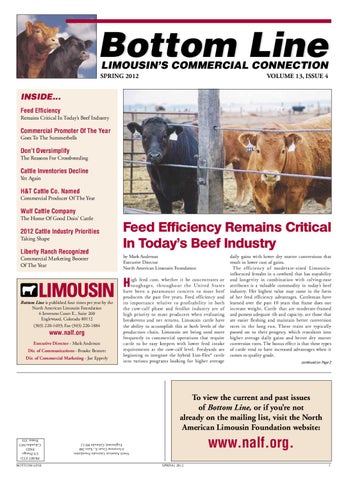
Feed Efficiency Remains Critical In Today’s Beef Industry by Mark Anderson Executive Director North American Limousin Foundation
H
Bottom Line is published four times per year by the North American Limousin Foundation 6 Inverness Court E., Suite 260 Englewood, Colorado 80112 (303) 220-1693; Fax (303) 220-1884
www.nalf.org Executive Director - Mark Anderson Dir. of Communications - Brooke Bennett Dir. of Commercial Marketing - Joe Epperly
igh feed cost, whether it be concentrates or roughages, throughout the United States have been a paramount concern to most beef producers the past five years. Feed efficiency and its importance relative to profitability in both the cow-calf phase and feedlot industry are of high priority to most producers when evaluating breakevens and net returns. Limousin cattle have the ability to accomplish this at both levels of the production chain. Limousin are being used more frequently in commercial operations that require cattle to be easy keepers with lower feed intake requirements at the cow-calf level. Feedyards are beginning to integrate the hybrid Lim-Flex® cattle into various programs looking for higher average
daily gains with lower dry matter conversions that result in lower cost of gains. The efficiency of moderate-sized Limousininfluenced females in a cowherd that has stayability and longevity in combination with calving-ease attributes is a valuable commodity in today’s beef industry. Her highest value may come in the form of her feed efficiency advantages. Cattleman have learned over the past 10 years that frame does not increase weight. Cattle that are moderate-framed and possess adequate rib and capacity, are those that are easier fleshing and maintain better conversion rates in the long run. These traits are typically passed on to their progeny, which translates into higher average daily gains and better dry matter conversion rates. The bonus effect is that these types of cattle tend to have increased advantages when it comes to quality grade. continued on Page 2
To view the current and past issues of Bottom Line, or if you’re not already on the mailing list, visit the North American Limousin Foundation website: North American Limousin Foundation 6 Inverness Court E., Suite 260 Englewood, Colorado 80112
PRSRT STD US Postage PAID Columbia MO Permit 353 BOTTOM LINE
www.nalf.org. Spring 2012
1
continued from Front Cover
One measure of feed efficiency is residual feed intake or (RFI). It is the difference between actual and expected feed intakes and represents the net value (if any) that remains after an animal meets it requirements for maintenance and growth. When cattle consume less feed than expected, they have a negative RFI value, which indicates better than average feed efficiency. RFI as a measurement of feed efficiency is valuable to a commercial cow-calf man looking to lower his feed intake and decrease production cost. If RFI is used for selecting cattle that consume less, it is only half of the equation when it comes to profitability. Superior average daily gains are essential when it comes to cattle that are geared toward commercial production in a feedlot environment. Many feedyard managers know this from years of experience when looking through their yard sheets that report consumption levels along with per head, per day cost. Cattle that excel in terms of their dry matter intake are usually doing something with it. Most of the bigger eaters typically are converting their intake to convertible pounds of meat to generate lower cost of gains. One of the biggest concerns I had managing feedyards during the past 25 years were cattle that didn’t have adequate intakes. While these cattle had lower per head, per day cost
when they were weighed out, they typically disappointed you on their pay weight and generated the poorest and highest closeouts. A study conducted by the University of Minnesota from the fall of 2009 to spring of 2010, examined the Residual Feed Intake (RFI) of 24 Limousin steers to that of 23 Angus and Simmental influenced steers. The 174-day test showed the Limousin steers had a dry matter intake of 20.4/day with an average daily gain of 4.07 lbs. and an RFI of -0.822. Compare that to the dry matter intake of 21.0 lbs. per day, average daily gain of 3.94 lbs. and an RFI of 0.870 for the commercial composite of predominantly Angus and Simmentalinfluenced steers. These results led to the Limousin cattle having a $3.45 per cwt. advantage in terms of cost of gain or 6.4 percent. Because of their better dry matter conversion, this particular set of Limousin were able to break the rule of thumb when it comes to intake. Since Limousin typically excel in terms of their muscling advantages and have less bone mass, they are in a unique position in today’s beef industry given the high cost of feedstuffs. These traits tend to typically translate into higher dressing percentages and pounds of saleable product that also adds to the bottom line of profitability. Given the fact that nearly half the fed cattle sold in today’s
Hager Bulls Perform When you use a Hager bull you get a sire backed by predictability and performance. They’ll go out and work in the pasture and put more money in your pocket come weaning time.
AHCC
WestWind W544
HP/HB - Purebred Progeny & Semen Available
AHCC
Xplain This X595 HP/B - Purebred Semen Available
6th Annual Bull Sale March 28 • 5 p.m.
NEW TIME NEW LOCATION
Mandan, North Dakota Purebred & Lim-Flex
Your call or visit is always welcome.
Kist Livestock Auction
markets are now marketed on a grid in some form or fashion, live-weight evaluations do not necessarily identify animals that are the most biologically and economically efficient. For cattle sold “in-the-beef,” carcass gain efficiency has a larger impact on profitability than live-weight gain efficiency does because it represents the difference in dressing percentage. In cases where cattle are sold on grids that determine dollar value by carcass weight, quality and yield grades, with the absence of “out cattle,” the beef industry arguably needs a new standard measure for feed efficiency. With the exception of the initial purchase price, the most economically efficient animals might be those that return the most carcass and retail value per unit input. One misconception of RFI and feed efficiency is that these values alone do not always translate to profitability. A rank of cattle by RFI in conjunction with average daily gain and dry matter conversion rates will most likely lead to a more profitable selection tool. Given the price of today’s feeder cattle, additional pounds of product sold will more than pay for the additional feed intake as long as it is converted efficiently. Limousin-influenced feeder cattle can do this given their advantages in muscling and cutability. Feedyard managers and owners of Limousin finished cattle can attest to the advantages of feed efficiency inherent to Limousin-influenced feeder cattle.
Their advantage in dry matter feed conversions are a result of lower levels of feed consumption combined with higher levels of dressed carcass weight and the resulting yield at the packing house and retail case. In simpler terms, it’s not just how much feed is consumed, its how efficiently that feed converts to pounds of quality red meat. Selection for feed efficiency is not trivial. When selecting for it, both inputs and outputs in the production system are important to evaluate. Measuring feed efficiency by evaluating feed intake and economically important outputs is the most accurate way to quantify feed efficiency. If every animal finished in the United States were to increase their dry matter conversion by 0.5 pounds, it is estimated that cattle feeders alone could save nearly $700 million per year on feed. With feed efficiency being difficult to collect for large numbers of animals, work is underway to identify variations in an animal’s DNA associated with feed efficiency and feed intake. Limousin breeders will be on the forefront of this technology with the genomic enhanced EPDs soon to come to the breed. Identification of genes with a large impact on feed efficiency will be a valuable and cost effective method for selecting cattle with improved efficiency. This should lead to more profitability for all sectors of the beef industry in the near future. BL
Commercial Promoter Of The Year Goes To The Summerbells
T
he North American Limousin Foundation (NALF) promoter of the year award was given to two individuals in an allied industry who have advanced the Limousin breed through marketing, education or research. Dean and Bev Summerbell were presented with the Promoter of the Year award at the Annual Banquet/Member Social January 9 in conjunction with the National Western Stock Show in Denver, Colorado. “The Summerbells have worked tirelessly to promote the Limousin breed throughout the country for many years through their presence and displays at
expos and sales, as well as their commercial publication,” said Joe Epperly, NALF director of commercial marketing. The Summerbells work for the Heartland Limousin Association (HLA) with Dean serving as the executive director and Bev as the editor of the HLA’s quarterly magazine, the Heartbeat. They attend numerous sales throughout the Midwest and work with breeders and commercial producers to advance those sales. They are also instrumental in the coordinating the Heartland state sales throughout the year. BL
Austin, Leah, Bailee, Pitch & Tripp Hager 4651 2nd Ave. NE Karlsruhe, North Dakota 58744 701/525-6363 • 701/626-2345 mobile www.HagerCattleCompany.com 2
Ann Vorthmann of Treynor, IA, (right) presents the North American Limousin Foundation Promoter of the Year Award to Bev and Dean Summerbell of East Bethel, MN.
Spring 2012
BOTTOM LINE
Protect your cattle with ear tags that have been proven to work.
Corathon® and CyLence Guard™ with FyberTek® hold more active ingredient in a single tag than any of our previous tags.* Now there’s proof. In 6 recent research trials, supervised by veterinarians, Corathon and CyLence Guard were found to not only significantly control horn flies, but also to control face flies — in over 2,500 head of cattle.* It’s just proof of what thousands of producers already knew.
Ask your animal health supplier about the Bayer tags with FyberTek or visit flycontrolcenter.com.
*Data on file. Bayer HealthCare LLC, Animal Health Division, Shawnee Mission, Kansas. ©2012 Bayer HealthCare LLC, Animal Health Division, Shawnee Mission, Kansas 66201 Bayer (reg’d), the Bayer Cross (reg’d), Corathon®, CyLence Guard™ and FyberTek® are trademarks of Bayer.
BOTTOM LINE
Spring 2012
l12219
3
9.5x13.5 2 4c-Bottom Line:9.5x13.5 4c-Bottom Line
2/23/12
11:13 AM
Page 2
March 30, 2012 � At the farm � Morris, MN � 12 Noon
Decades of genetic selection, marketing more than 20,000 head of fed cattle each year, and discovering profitable grid formulas place Wulf Limousin in a unique position to prove our genetics in the marketplace and connect with the beef industry from gate to plate. New management strategies enable us to broaden our industry connection through expanded export markets and new lifestyle choices. Success throughout the food chain requires partnerships between Wulf Limousin, our customers, feeding partners and packer relationships. As a Wulf customer you can expect our continued commitment to producing genetics that fit a complex beef industry to satisfy a diverse consumer. If we can be of any assistance in improving the genetics in your herd, please give us a call. FREE TRUCKING TO CENTRAL POINTS � BULL SELECTION INDEX BULL RETIREMENT PROGRAM CALF PROCUREMENT � SOURCE & AGE VERIFICATION PROGRAM FEEDLOT & CARCASS DATA � INTEGRATED BRANDED BEEF RELATIONSHIPS � GENETIC CONSULTATION � FEEDER
Lot 1 • Wulfs Xclusive 2458X • BD: 4/7/10 • Homo Pld (T)/Blk WZRK Primestar 861P x Wulfs Missive 2258M (LVLS Polled Black Jack) CED: 12 • BW: 1.1 • WW: 53 • YW: 102 • MA: 24 SC: 0.7 • DOC: 24 • REA: 0.35 • MARB: 0.11 • $MTI: 50 Lead off bull in People’s Choice Champion Pen at the National Western. Scanned almost a 22 inch ribeye in Denver with a high IMF.
Wulf is a proud supplier to Tyson Fresh Meats, Inc.
4
Spring 2012
BOTTOM LINE
9.5x13.5 2 4c-Bottom Line:9.5x13.5 4c-Bottom Line
2/23/12
11:13 AM
Page 3
Lot 2 • Wulfs Yankee K689Y • BD: 3/27/11 • Homo Pld (T)/Blk HUNT Mr Jock 44J x Wulfs Soloist 6284S (Wulfs Nobel Prize 3861N) CED: 5 • BW: 2.9 • WW: 72 • YW: 120 • MA: 30 SC: 0.9 • DOC: 35 • REA: 0.8 • MARB: 0.09 • $MTI: 56 NALF Young Sire Trait Leader for WW, YW, $MTI and ranks #1 in the Wulf Indexes for both Mainstream and Laura’s Indexes and very high in the Marbling Indexes.
Lot 3 • Wulfs Yukon Trail 8084Y • BD: 4/12/11 • Homo Pld (T)/Blk Wulfs Warbonnet 6254W x Wulfs Ualanea 8084U (Wulfs Nasa 1212N) CED: 14 • BW: -0.1 • WW: 54 • YW: 97 • MA: 29 SC: 0.5 • DOC: 28 • REA: 0.74 • MARB: 0.02 • $MTI: 47 Member of the People’s Choice Carload at the National Western.
Lot 14 • Wulfs Xtrapolate 2832X • Lim-Flex • BD: 8/12/10 • Homo Pld (T)/Het Blk (T) SAV Bismarck 5682 x Wulfs Myrlene 2332M (COLE Wulf Hunt) CED: 14 • BW: -2.1 • WW: 58 • YW: 102 • MA: 30 SC: NA • DOC: 16 • REA: 0.03 • MARB: 0.49 • $MTI: 62 NALF Young Sire Trait Leader for MARB and $MTI. Ranks #3 in the First Calf Index and #2 in Marbling Terminal and Replacement Indexes.
Lot 5 • Wulfs Yarley X232Y • BD: 4/7/11 • Scur/Homo Blk (T) Wulfs Space Ship 3223S x Wulfs Myrlene 2332M (COLE Wulf Hunt) CED: 12 • BW: 2.8 • WW: 57 • YW: 95 • MA: 22 SC: 1.2 • DOC: 19 • REA: 0.72 • MARB: 0.04 • $MTI: 49 Lead off bull in our People’s Choice Champion Carload at the National Western.
Lot 338 • Wulf Yalerie 1439Y • BD: 1/28/11 • Het Pld (T)/Blk Wulfs Sirloin 3172S x Wulfs Missive 2258M (LVLS Polled Black Jack) CED: 11 • BW: -1.9 • WW: 40 • YW: 81 • MA: 31 SC: 0.5 • DOC: 23 • REA: 0.52 • MARB: 0.08 • $MTI: 45
Lot 339 • Wulf Yo Go 1430Y • BD: 1/16/11 • Het Pld (T)/Blk Wulfs Unabridged 6093U x Wulfs Ready Made 5093R (Wulfs Nascar G949N) CED: 10 • BW: 0.8 • WW: 46 • YW: 91 • MA: 27 SC: 0.7 • DOC: 39 • REA: 0.66 • MARB: -0.01 • $MTI: 45
Visit SuperiorLivestock.com to view the sale cattle prior to the sale, watch the March 30 sale, and watch our March 29 educational forum titled “What’s Under the Hide”. LEONARD WULF & SONS 47694 320th Street, Morris, MN 56267 Farm (320) 392-5802 Jerry Wulf (320) 491-1390 Rhonda Wulf (320) 491-1746 Mike Wulf (320) 491-6682 Eric (Z) Zeltwanger (320) 766-0066 Wulf Sale Consultants: Jim Wulf (320) 491-6312, Joel Edge (319) 540-1731 e-mail: wulf@wulflimousin.com www.WulfLimousin.com
BOTTOM LINE
Spring 2012
5
Don’t Over Simplify The Reasons For Crossbreeding by Joe Epperly Director of Commercial Marketing North American Limousin Foundation
C
rossbreeding has been shown by numerous research studies to enhance advantages in growth, longevity and maternal efficiency over straightbred cattle due to the effect of heterosis and has been popular among commercial cattlemen since the 1960s. With the growth of the Angus breed and success of their Certified Angus Beef (CAB) marketing program, the term Angus has taken on a meaning synonymous with quality to consumers. This fact has changed the commercial landscape with a majority of the American cowherd being Angusinfluenced and has led some to theorize that crossbreeding is no longer needed and market demands can be met with just one breed. D u r i n g t h e No r t h A m e r i c a n International Livestock Exposition (NAILE), a white paper titled, “Crossbreeding: A free lunch but at what cost?,” published by Dr. Nevil Speer of Western Kentucky University, was presented as part of the American Angus Association’s events. Several m a g a z i n e s h a ve since published articles pertaining to the paper, which takes issue with the simplistic perspective that extra pounds through heterosis automatically equals a more profitable bottom line. It does this by comparing straight breeding Angus genetics to a “haphazard implementation of crossbreeding.” In this general comparison selecting for Angus bulls that are uniform and excel in traits the industry desires is more profitable than selecting for a crossbreeding system whose only focus is increased weaning weight. To d r a w t h e c o n c l u s i o n t h a t crossbreeding is not a viable and profitable breeding plan based on this general comparison is simply not accurate. The beef industry is far too complex and diversified in environment, production and marketing systems to think one breed or breeding plan is the only profitable solution. Dr. Speer understands this since his stated aim was to “serve as a meaningful foundation for a deeper, more comprehensive discussion about crossbreeding within the beef industry.” Nevertheless, the potential lies for far too many people to skip that discussion and move to the simplistic conclusion that crossbreeding holds no value. The key to the entire system is that breeding must be achieved in a programmed manner using seedstock
6
appropriate for the situation. With the selection tools available to cattlemen today (even on hybrids), both purebred and hybrid cattle can be selected to fit the production and marketing system. It is alarming to see the United States falling behind in the use of programmed breeding and reproductive technology. For example, according to University of Missouri researchers, USDA statistics say about 55 percent of the cows in the U.S. were exposed for a defined breeding season in 2007-2008. Of those 55 percent, 5-10 percent (1.6-3 million head) were estimated to have been bred through artificial insemination (AI). In Brazil, about 7-12 percent are bred AI, but that equates to a total of 5-9 million cows. Brazil is one of the United States biggest competitors on a worldwide level and has more than twice as many cows (76 million vs. 32 million). Most of the AI work is being done through the use of crossbreeding, mating the native Nelore cows to Angus sires. Profit-minded cattlemen are aware of the advantages of using outcross genetics and breeds to advance their programs. If this wasn’t the case, we wouldn’t have seen the increase in value for bulls in major Continental breeds in the past year. Growth in natural and NHTC programs is also a driver of a return to crossbreeding since the performance, efficiency and yield provided by crossbreeding are needed to maintain profitability when implants, beta agonists and ionophores are removed. Cu r re n t l y, a m a j o r i t y o f t h e U.S. cowherd is Angus-based or at least British-influenced. Since the early 1990s, Hereford and Angus cattle have made strides in
the area of performance, achieving weaning and yearling weights equal to the Continental breeds, and have maintained their advantage in marbling characteristics (USMARC GPE Cycle VII). However, these breeds still face problems in the commercial sector. British breeds tend to be early maturing with excess subcutaneous fat, high feed conversion rates and low dressing percentages. This is one of the major drivers for the extensive use of implants and beta agonists in commercial feedyards. This is also why we are seeing a demand from the feeding and processing sectors for designed hybrid feeder cattle to overcome these challenges. For example this summer, LimFlex® feeder cattle from Sierra Valley Ranch in California and Big Meadows Ranch in Colorado sold at the top of their weight classes at the Superior Livestock Auctions in Winnemucca, Nevada, and Steamboat Springs, Colorado, respectively. Tom Brink of JBS Five Rivers Cattle Feeding gave a presentation to the NCBA’s Cattlemen’s College titled “What Feedyards are Looking for in the Feeder Cattle They Buy.” He presented that the industr y currently needs steers that will a produce a Choice carcass that has a Yield Grade less than 3, and to be the most profitable the hot carcass weight needs to be more than 850 pounds. Brink then laid out his breed composition pyramid for the ideal feeder steer, which includes a 25 to 50 percent Continental influence to meet these demands. Feeders look for these crossbreds because of their advantages in feed efficiency, gain and yield. A majority of these cattle work in premium programs with an Angus label since
Spring 2012
a many Limousin, Simmental and Gelbvieh are black. As the marketing system for the beef industry has evolved, the breeding plans have likewise adapted. With a smaller cowherd and more dollars invested per feeder calf, we are seeing cattle buyers become more sensitive to the breed type that fits the feeding and processing system. Cattlemen across the country are becoming more involved with the feeders and packers as information is flowing to the cowcalf producers at unprecedented levels. Ranchers can now focus their selection to meet the needs of their customer, the feeder, at a faster rate than ever before. The best part is the feeders and packers are willing to contract and pay more for the cattle they know work. Targeted crossbreeding might be the most useful tool the beef industry has. We are looking at a growing world population that will require 100 percent more food by the year 2050, of which around 70 percent will have to come through efficiency improving technology. A natural phenomenon that yields the improved fertility, per formance, carcass value and longevity of heterosis is not something to be tossed away on a whim. It is not crossbreeding that is the problem, but rather the fact that a large number of producers have no breeding plan and mate cows without a goal or program. Quality on the plate of the consumer is the key. The breed composition to achieve that is based upon the program’s resources. In order for the beef industry to meet the needs of the world’s dinner tables, producers need to look for the breeding plan that fits various market needs for high quality, efficiently produced pounds and use heterosis to help push the bar forward. BL
BOTTOM LINE
Magness Land & Cattle
Annual Limousin & Lim-Flex Bull Sale Sunday, MARCH 25 - 1 p.m.
Southern Division, Miami, Oklahoma Selling 100 Registered Limousin & Lim-Flex Lots
80 Yearling & Fall Yearling Bulls...All Denver Pen & Carload Bulls Sell! 20 Spring & Fall Pairs Buy with Confidence... ...Guaranteed Sight-Unseen Purchase Program ... Breed-Leading Performance Genetics ... Complete Ultrasound & Performance Data ... Complete Herd Health ... Two Locations - Miami, OK & Platteville, CO ... Herd-Bull Retirement/Buy-Back program To View Catalog & Videos of Lots Selling...
www.MagnessCattle.com
MAGS Yip
MAGS Y-Axis
4/10/11 - HOMO Black - HOMO Polled - PB MAGS The General x AUTO Carminda 656S BW: 2.0 WW: 60 YW: 112 MA: 27 SC: 0.3 DC: 24 MS: .03 $MI: 48 BW: 77 - Adj. WW: 822
3/29/11 - HOMO Black - HOMO Polled - 50% LF TC Aberdeen 756 x MAGS Uahuka BW: -0.4 WW: 65 YW: 114 MA: 30 DC: 14 MS: .44 $MI: 61 BW: 77 - Adj. WW: 861
Gary Magness, Owner Dr. John Edwards, 541/890-5745 PO Box 190, Platteville, CO 80651 970/785-6170, office | www.magnesscattle.com Southern Division, George Hubbard 53160 E. 110th Rd., Miami, OK 74354 918/541-5482
MAGS Xiphisternum
MAGS Xrays
10/9/10 - HOMO Black - HOMO Polled - PB DHVO Deuce 132R x MAGS Teaspoon BW: 1.3 WW: 56 YW: 99 MA: 11 SC: 1.0 DC: 20 MS: -.08 $MI: 43 BW: 72 - Adj. WW: 722 - Adj. YW: 1,332
10/4/10 - HOMO Black - HOMO Polled - 75% LF DHVO Deuce 132R x MAGS Samba BW: 1.7 WW: 52 YW: 94 MA: 22 SC: 0.4 MS: .20 $MI: 51 BW: 82 - Adj. WW: 746 - Adj. YW: 1,245
To receive a complimentary sale catalog, please contact the Magness office direct or a member of our sale team!
Sale Management: American Cattle Services — 580/581-7652 Sale Consultant: Grassroots Genetics — 515/229-5227 Auctioneers: C.K “Sonny” Booth - 918/533-5587 Ronn Cunningham - 918/629-9382 BOTTOM LINE
Spring 2012
7
Cattle Inventories Decline Yet Again by CattleFax
T
he total U.S. cattle inventory decreased 1.9 million head in 2011 and totaled 90.8 million head January 1, 2012. This marks the fifth consecutive year for a decline in the total cattle inventory and puts the 2012 total at the smallest level since 1952. Over the past five years the total cattle inventory has declined by 5.8 million head. The beef cowherd was down 967,000 head (-3%) on January 1 and totaled 29.9 million head. Beef cow slaughter was up 122,000 head in 2011 versus 2010 and was the largest since 1996. This marks the sixth year in a row for a decline in the beef cowherd and the 14th out of the last 16 years in which the beef cowherd has declined. This is the longest consecutive decline in beef cow numbers in history. The decline in the beef cowherd in 2011 was most significantly impacted by the drought. And even though calf prices were record high in 2011, increasing gross revenues for producers, costs also continued to escalate as they have for the past several years contributing to the decline in the beef cowherd. The dairy cowherd increased 80,000 head in 2011 and totaled 9.23 million on January 1. Although feed costs remain a wildcard in the dairy business, milk futures increased more than any other commodity on a percentage basis in 2011. Strong demand and growing exports should encourage producers to maintain their herd size with slow growth expected to continue during 2012. The 2011 calf crop was down 382,000 head and totaled 35.3 million head. This is the 16th year in a row in which the calf crop has declined. With the smaller beef cowherd, the 2012 calf
crop is also projected to be lower by an estimated 500,000 head. The feeder and calf supply outside of feedlots was down 1.1 million head (-4%) and totaled 25.7 million head. This is the largest one year drop since 2004. The utilization rate, or cattle on feed as a percentage of the total available feeder and calf supply, was at 35.4 percent on January 1 which is the highest utilization rate in history. In other words this confirms what most thought, cattle feeders were very aggressive in placing cattle into their feedyards from the available supply, which has been supportive to the higher feeder and calf market. Cattle prices are forecast to average significantly higher again in 2012, but beef demand and cattle feeding margins will largely determine how much higher. Herd expansion has a lot of work to do The USDA Cattle Inventory Report showed a wide variation in changes in beef cow numbers between the different regions of the U.S., which is a reflection of the severity of the drought in the South. The report also indicated producers are beginning to hold back more heifers as the beef replacement
number was up 73,000 head and totaled 5.2 million head. However, it is important to note that this is still the second smallest beef replacement heifer number in the past 25 years. Only last year’s number was smaller. In addition, looking at beef replacements as a percentage of the total beef cowherd was 17.4 percent, which is still well below past periods when the beef cowherd was expanding. For example, during the early ’90s, the last time the beef cowherd saw major expansion, this percentage averaged more than 18 percent. More heifers will need to be held back and fewer cows slaughtered in 2012 before significant expansion occurs. There are two regions of the country at completely opposite ends of the spectrum when it comes to replacement heifer retention. The South Plains (TX, OK, NM, KS, CO) region beef replacement heifers were down about 100,000 head. Replacement heifers as a percentage of the beef cowherd in the South Plains was 15 percent, which was the lowest percentage since 2004. At the other end of the spectrum there is the North Plains region (NE, SD, ND, MT, WY), which saw an increase in beef replacement heifers of 128,000
head. As a percentage of the total beef cowherd, Northern Plains beef replacements were at 22 percent, which is the highest since at least 1980. The top seven beef cow states (TX, OK, KS, MT, NE, SD, MO) declined by 217,000 beef cows compared to last year. At the same time beef replacement heifers in the top seven states declined by 35,000 head. In spite of the expansion optimism across much of the United States these numbers indicate the U.S. beef cowherd is likely to be smaller yet again on January 1, 2013, unless beef cow slaughter drops sharply soon. It will take a drop in beef cow slaughter by at least 1.2 million head, or 24,000 head per week, in order for much expansion to occur by next year. Through January, total cow slaughter averaged about 4,000 more head per week than a year ago. Bottom Line: In spite of record high prices and plenty of expansion optimism, the drought is still restricting overall U.S. expansion. As a result, beef production is still likely to decline for two more years before finally seeing an increase in 2014 at the earliest, assuming the drought subsides this year and allows for more significant expansion. BL
CattleFax is a member-owned information organization, serving producers in all segments of the cattle business. CattleFax was formed in 1968 by a group of progressive cattlemen who saw the value of a self-help system to collect, analyze and distribute information needed for good marketing and business decisions which has resulted in the largest private database in the country. For more information about CattleFax or to inquire a member please call 800/825-7525 or visit the website at www.cattlefax.com
H&T Cattle Co. Named Commercial Producer Of The Year
A
stute marketing and a commitment to customer service and quality helped earn the North American Limousin Foundation (NALF) Commercial Producer of the Year Award for H&T Cattle Co. of Rapid City, South Dakota. The ranch is comprised of Harold and Judy Bies, their son Travis and his family, and their daughter Donna and her family. The family enterprise topped a field of eight nominees. Jerry Wulf of Wulf Limousin Farms presented the award January 9 during the NALF Annual Banquet and Member Social at the National Western Stock Show in Denver, Colorado. “The Bies’ commitment to quality shows throughout their operation. They strive to produce cattle that excel from the pasture to the plate, and work to obtain the feedlot and carcass data which they use as a tool to maximize their bull selection,” said Joe Epperly, NALF director of commercial marketing. Nestled near the Black Hills of western South Dakota, the operation’s 1,100 head of Limousin-Angus-cross 8
cows graze on both deeded land and Forest Service land. H&T is a true Bies family operation. Consistent proven genetics from top Limousin herds have allowed H&T to pursue the all-natural niche market. Through careful genetic selection for high maternal and growth EPDs, H&T is still able to wean a heavy calf in late September, even without growth implants. Following a strict all-natural protocol provides them access to specific, value-added markets. Routine vaccinations are still administered, but no implants or antibiotic are used. Travis explains, “We believe we have to get the most dollars out of every calf. Managing our calves the all-natural way is just one more marketing tool to try and increase their value.” They calve in open pastures and retain their own replacements so an emphasis is put on maternal characteristics and calving-ease. H&T markets their steer calves and non-replacement heifers just after weaning through either Superior
Livestock Auctions or direct sales to feeders. They maintain contact with the feeders to assess their calves’ ability in the feedlot and on the rail. H&T has also retained ownership through the feeding stage to capture added value and to better understand their cattle’s performance. H&T understand the value of information at marketing time as they document their cowherd’s genetic and health records. The also age and source verify their calves each year using IMI Global’s verification system. In addition, H&T is certified for the non-hormone treated market (NHTC), qualifying their cattle to sell into the European Union. Selling their calves with this verified information has enabled them to receive premiums. They also participate in the Global Animal Partnership (GAP) program, which allows them to enter the market for Whole Foods and other exclusive retail stores. The commitment to information and an extensive individual identification system have allowed them to assess their cowherd in a more intensive manner.
Spring 2012
Jerry Wulf of Morris, MN, presents the North American Limousin Foundation (NALF) Commercial Producer of the Year Award to Harold Bies of H&T Cattle Co., Rapid City, SD.
This allows for more scientific culling and a more targeted bull selection. Jerry Wulf characterizes H&T as the “perfect commercial customer.” In his presentation speech, Jerry stated, “they are always hungry for information and ways to improve, which yields a better product every time.” A consistent quality hybrid product is a focus for this operation and their dedication to information and enhanced marketing have made them one of the most successful operations in the country. BL BOTTOM LINE
Coleman Limousin Ranch 34th Annual
Production Sale Monday, April 2 - 1 p.m. MST
Missoula Livestock Exchange - Missoula, Montana
Selling 130 Lots Limousin & Lim-Flex
6 Complete Performance Data 6 Ribeye, Backfat & Marbling Scores 6 Bulls Semen Tested & Scrotal Measured 6 Pelvic Measurements for Heifers 6 Trucking Arrangements Available
COLE
Young Gun 10Y
2/12/11 - HOMO Black - DBL Polled 75% Lim-Flex - BW: 84 - Adj. WW: 891 S: COLE Windfall 144W MGS: COLE Magnum 15M BW: 2.6 WW: 77 YW: 131 MA: 29 SC: 0.4 RE: .30 MS: .39 $MI: 64
110 Bulls 20 Open Yearling Heifers Many carry the Homozygous Black or Polled Traits! Sale-Day Phone: (406)728-3052 Auctioneer: C.K. “Sonny” Booth
COLE
Accommodations: Days Inn (406)721-9776 Wingate Inn (406)541-8000 C’mon Inn (406)543-4600
Yokel 86Y
3/3/11 - HOMO Black - HOMO Polled Purebred - BW: 94 - Adj. WW: 783 S: COLE Sudden Impact 50S MGS: Wulfs Guardian 5074G BW: 3.3 WW: 60 YW: 104 MA: 23 SC: 1.0 DC: 12 RE: .72 MS: -.14 $MI: 44
Watch the sale online at www.dvauction.com Visit our Website www.ColemanLimousinRanch.com for complete sale information. Give us a call for a sale catalog.
COLE
Yell 101Y
2/21/11 - HOMO Black - HOMO Polled 75% - BW: 90 - Adj. WW: 859 S: COLE Windfall 144W MGS: COLE First Down 46D BW: 2.6 WW: 72 YW: 116 MA: 36 SC: 0.6 RE: .38 MS: .29 $MI: 57 BOTTOM LINE
53717 Gallagher Road • Charlo, MT 59824 Larry & Anita Coleman • (406) 644-2300 Trent & Melissa Coleman • (406) 644-2707 www.colemanlimousinranch.com Spring 2012
9
Wulf Cattle Company The Home of Doin’ Good Cattle by Brooke Bennett Director of Communications North American Limousin Foundation
W
ulf Cattle Company, located in Morris, Minnesota, brings more than 50 years of experience to the beef industry. This operation has decades of experience in genetic selection and markets more than 25,000 head of fed cattle each year. Today, the farm operates day-to-day by Leonard’s three sons Jerry, Dennis and Dave; seven family members of the next generation; herdsman Eric Zeltwanger; and feedlot managers: Lucas Sutherland, Ross Potter, Terry Goetz and Jared Sanderson. Started by Leonard Wulf, Wulf Cattle Company began as a commercial cowcalf operation consisting of black and black-baldy cows. Limousin bulls were introduced into Wulf ’s commercial cowherd through the use of artificial insemination (AI) in 1970. Leonard chose the Limousin breed because he saw a need for more growth and muscle in cattle. He was working with a semen company representative and tried a variety of breeds crossed on the commercial cows, said his granddaughter, Rhonda Wulf. The first Limousin calves were born on the farm in 1971. Leonard then fed out those Limousin-cross calves and followed them to the packer. Leonard had an appreciation for the larger ribeyes and red meat yield of the Limousincross carcasses. Producing commercial bulls is what Wulf Cattle Company has built the program around. The operation has an extensive AI program and calves out 900 cows annually. During breeding, 85 percent of the cows are bred through the use of AI and 150 calves are born annually as a result of their embryo transfer (ET) program.
10
With the production of commercial bulls being a top priority, Wulf Cattle Company aims to breed for bulls with a balance of performance, maternal traits and structure, while never losing sight of what Limousin cattle do best and makes it the carcass breed. Since carcass quality is a trait that is never lost sight of at Wulf Cattle Company, they have been collecting carcass data for 35 years and consistently select for docility, efficiency, ribeye area, yield grade and marbling at breeding time. Also, for four years, Wulf ’s have been gathering feed efficiency data on both bulls sold as breeding stock and pedigreed feedlot cattle. Wulfs are in the process of building a sizable feed efficiency data bank on Wulf genetics. Each year they market bulls through their annual production sale in March. The night before the production sale, Wulfs hold a seminar for their bull customers and colleagues. During the seminar, key industry topics are discussed in a panel setting with questions taken from the audience. Previous topics that have been discussed are various feeding programs, target markets and the value of feed efficiency. This year the seminar is “What’s Under the Hide,” with speakers on evaluating carcass data, Dr Ryan Cox, University of MN Meat Science; what a packer wants, Brad Brandenburg, VP Cattle Procurement, Tyson Foods; and how to select a bull to fit the industry, Dr Duane Wulf. This year, the annual production sale will consist of selling more than 330 bulls, including their pens and carloads exhibited at the 2012 National Western Stock Show in Denver, Colorado. Also, 55 females, 14 bred females and 41 open yearling heifers, will be offered.
For the seventh year, Wulf ’s will be offering seven different indexes to assist their bull-buying customers in selecting bulls that best meet the needs of their operation. The indexes provided by Wulf ’s combine traits of economic importance for the individual needs of their bull customers. These include firstcalf heifers, mainstream markets, Laura’s Lean Beef and higher marbling programs. When purchasing from Wulf Cattle Company, all cattle are sold fully guaranteed to be fertile and sound breeders. Wulf ’s also offers free trucking to central points throughout the country. “You can get everything in life you want if you help others get what they want,” said Leonard. This statement rings true with Wulf ’s operation as a whole, but it also can be used to describe their commitment to bull buyers. Wulfs try to see that their commercial bull customers get top dollar for their feeder calves when they sell, and often times, Wulfs purchase and finish many of these calves themselves. Another unique offering that Wulf Cattle Company offers to its buyers is the Bull Retirement Program. Past bull buyers have the opportunity to bring their old herd sire to the ranch prior to the sale where two buyers are present to purchase Limousin bulls. Laura’s Lean Beef will buy 20-monthold natural bulls (bulls guaranteed to not have had an any antibiotics in the last 20 months) and Cradle to Grave Bulls (guaranteed that the bull has not received antibiotics for the bulls entire life). American Foods will purchase all bulls that meet current USA withdrawals for all animal heath products. To top it off, Wulfs add an additional premium to the value of the retired bull. Exhibiting at the National Western Stock Show has been a long-standing tradition for the Wulf family. Wulf Limousin first began exhibiting cattle
Spring 2012
at the pen and carload show in 1980, making 2012 their 33rd consecutive year. This year at the 2012 National Western Stock Show, Wulf Limousin exhibited the reserve grand champion purebred pen of bulls and the people’s choice purebred carload and pen. The pen and carload bulls Wulfs exhibited at the National Western had on average have EPDs that rank in the top 10 percent of breed for docility, top 15 percent for ribeye, top 40 percent for yield grade and top 20 percent for marbling. Along with the feeding and farming operation, Wulf Cattle Company owns a 9,000 head feedlot, Wulfs Cattle Depot in McLaughlin, South Dakota, and a ranch near McLaughlin where they run 4,000 head of yearling stocker cattle. They also lease and manage a 4,000 head feedyard in Chamberlain, South Dakota. Wulf Cattle Company feeds out approximately 25,000 head of Limousin and Limousin cross cattle each year, both on the ranch and in custom lots. Many of their feeder calves have been bought back from bull customers. Wulfs also work closely with several branded beef programs and have been a steady supplier of premium source and age verified and Non-Hormone Treated Beef, and natural cattle for Tyson Fresh Meats, Laura’s Lean Beef, PM Beef, and Greater Omaha. As for the future of Wulf Cattle Company, “we will continue to raise Limousin seedstock and purchase Limousin cross calves, because we see the value in today’s industry with predominately Angus based commercial cows, for the industry to capitalize on hybrid vigor, added muscle and feed efficiency,” said Rhonda. “As we have one of the lowest national cowherds in the last 50 years and we need to double World food production by 2050, this is a way to add value to the U.S. beef supply naturally.” BL BOTTOM LINE
IGENITY® is changing the way you see your herd. It gives you the inside information you need to make more confident and informed decisions. From a single DNA sample, it creates a comprehensive profile of key economically important traits; traits like marbling and stayability that can help improve genetic selection and advance breeding programs. Simply put, it’s an easy-to-understand genetic profile that gives you an earlier, more accurate look at your herd’s potential.
Start moving your operation forward at IGENITY.com or call 1-877-IGENITY.
®IGENITY and the IGENITY logo are registered trademarks of Merial. ©2012 Merial Limited, Duluth, GA. All rights reserved. LAGEIG1010 (08/10)
BOTTOM LINE
Spring 2012
11
2012 Cattle Industry Priorities Taking Shape by Colin Woodall Vice President of Government Affairs National Cattleman’s Beef Association
2
012 is off to a fast start that will only continue as the pressure surrounding the November elections rises. Even though most of the media attention over the year will be focused on the Presidential race, the cattle industry has many priorities we need Congress and President Obama to focus on. Some of these issues will decide the future of many farms and ranches across the country. The top priority will be an issue that impacts every single cattle producer and small business owner in the country. The estate tax, or more appropriately labeled the death tax, will be an issue we will tackle with every weapon in our arsenal. As a result of a last-minute tax package passed in December 2010, the estate tax is based on an exemption of $5 million per individual or $10 million per couple. All assets over that amount are taxed at a 35 percent rate. This temporar y relief from an outdated tax will end on December 31, 2012. NCBA supports a permanent repeal of this nonsensical tax and that’s why we fully support the Death Tax Permanency Repeal Act, introduced by Rep. Kevin Brady (R-Texas). If a full and permanent repeal is not possible, NCBA supports making the 2010 package permanent. With no action by Congress, the death tax will revert to a $1 million exemption and a tax rate of 55 percent on anything over that. With land prices these days, it doesn’t take a very
large operation to have assets in excess of $1 million. Our cattlemen and women deserve certainty, which can only be achieved through permanency. Another issue we will be focusing a great deal of effort on will be the 2012 Farm Bill. Fortunately, our requests are relatively simple and should be welcomed by both sides of the aisle. We simply ask that Congress stay out of our business by eliminating the livestock title from this bill. Cattlemen are independent people who do not need big government setting up shop on their farms and ranches. We can attribute the job killing rule on livestock marketing proposed by the U.S. Department of Agriculture’s Gr a i n In s p e c t i o n , Pa c k e r s a n d Stockyard’s Administration (GIPSA) and mandatory Country of Origin Labeling to the livestock title that became reality during the 2008 Farm Bill deliberations. We do not need any more examples of provisions like these that take away your ability to market the way you want to in order to reap the rewards from all the effort you put into your cattle. Plain and simple, the Federal government should not have a hand in marketing cattle. Transportation is an issue not often talked about enough, but an issue we will be bringing to the forefront this year. NCBA supports making transportation policies more efficient for cattle producers by supporting legislation to create uniform transportation laws across all states and helping states adopt transportation laws that increase allowable weight, length and trailer
requirements. The bottom-line is uniformity across state lines. As we did in 2011, we will also continue working to make sure there is not a federal requirement of having commercial driver’s licenses for farmers and ranchers just to operate their tractors. The Equal Access to Justice Act (EAJA) was designed to level the playing field between small businesses and individual citizens and the federal government. EAJA allows plaintiffs to recover legal costs from the federal government when they prevail in a case against the government. Although EAJA was intended to protect citizens’ rights, it has been hijacked by radical groups who target ranchers by taking them to court and challenging their rights to natural resource uses. Cattlemen support the Government Litigation Savings Act to bring transparency and accountability to EAJA. It would prohibit organizations with a net worth exceeding $7 million from filing for EAJA funds, require that EAJA filers show a “direct and personal monetary interest” in the action to be eligible for payments and cap the attorney fees activists claim to be owed. We cannot allow extremist groups to use taxpayer dollars to try and kick ranchers off of the land. The next priority will be the issue of farm dust regulation. The Farm Dust Regulation Prevention Act of 2011, which provides permanent relief and regulatory certainty, passed in the U.S. House a couple of months ago. We will be marching the halls of Congress urging the U.S. Senate to pass this legislation. It will be an uphill battle,
but one that is worth the fight. As EPA continues to put burdensome regulations on cattle producers, we will fight their actions by showing the pure lack of science and evidence producers must do what they are doing. Another priority will be sustainability. This has been a noun wrongly defined by animal rights activists and environmental extremists. NCBA is focusing on educating consumers about the important role cattlemen play in sustaining the land and its resources for future generations. Through our work in Washington, D.C., we are going to push back on the fiction anti-meat organizations are spreading about the environmental impact of our industry by using science-based facts. At the same time, we will devote resources to helping producers understand the latest in trends and technologies that will assist in reducing their operation’s carbon footprint. These won’t be all the issues we cover. We have no doubt issues surrounding food safety, international trade, and other environmental issues will continue to pop up. In order for you to have the opportunity to work your farms and ranches each day, the cattle industry must have a strong presence in Washington, D.C. NCBA is here to provide that role, but as I have said in the past, we cannot do it alone. Strong grassroots participation by you, the producers, is important as we tackle these issues and provide a climate that allows you to succeed without big government telling you how to do your job. BL
Liberty Ranch Recognized Commercial Marketing Booster Of The Year
T
he North American Limousin Foundation (NALF) presented its Commercial Marketing Booster of the Year award to Liberty Ranch owner Roger Comeaux and manager Mike Smith of Plainville, Kansas. The announcement was made at the Annual Banquet/Member Social January 9 during the National Western Stock Show in Denver, Colorado. The award recognizes a seedstock producer who has demonstrated a commitment to commercial cattle producers. Liberty Ranch was founded in 1976 by Ralph Comeau and family. Early goals were to produce cattle that fit well into the Post Rock country of southern Rooks County, Kansas. They introduced their first Limousin females to the program in the spring of 1982. Liberty Ranch was attracted to the Limousin breed initially for their natural 12
thickness, hardiness and durability. To date, there are still 16-18-year-old females in production on the ranch. In the early ’90s Liberty Ranch added their first Red Angus females. These females were the foundation to the F1 base that would expand their commercial cowherd. Outside of a few small packages of female purchases, almost all Liberty Ranch females have been bred and born on the ranch. In December 1998, Liberty Ranch hosted its first production sale. The shift from private treaty sales was made primarily for customer convenience and to give them equal opportunity to purchase the same genetics from the ranch. Liberty Ranch continues to host its annual production sale in early February, selling more than 100 Limousin and Lim-Flex bulls, coupled with bred heifers and 10-15 head of
ranch-broke Quarter Horses. The ranch sells most of its bulls as 2-year-olds in order to offer a high-quality, sound breeding package that can cover a large number of cows. They have always focused on producing a product that will meet and exceed the expectations of their loyal commercial customers. In addition to numerous sales, Liberty Ranch continues to host educational events and seminars as part of their commitment to their customer base. Topics have ranged from commercial cow-calf production and profitability to low-stress livestock handling. They also aid their customers in marketing their cattle and feed a large number of cattle to finish every year. Liberty Ranch’s manager Mike Smith has also been a consistent leader with the North American Limousin Foundation serving in a variety of
Spring 2012
positions at the state, regional and national levels. These are highlighted by serving as the Kansas Limousin Breeders Association president, Heartland Limousin Association president, a total of six years on the NALF board of directors, including a term as president in 2011. BL
On behalf of Liberty Ranch, manager Mike Smith accepts the North American Limousin Foundation (NALF) Commercial Marketing Booster of the Year Award from NALF Director of Commercial Marketing Joe Epperly. BOTTOM LINE
As Far As The Eye Can See...
“Quality In Volume” We invite you to check out our pastures and pens. Roaming our ranch is the largest herd of registered Limousin in North America. We offer a variety of industry-leading genetics suited to exceed today’s industry standards. Let Running Creek Ranch be your one-stop shopping source.
Bulls Available Privately... 250 2-Year-Olds 20 Denver 2-Year-Old Carload Bulls 20 Denver Yearlings
Whether you need one or a hundred, Running Creek Ranch can fill the bill. We guarantee quality in volume as far as the eye can see. Level 4 Johne’s-Free Certified Herd
Joe Freund Sr. 45400 County Road 21 • Elizabeth, Colorado 80107 • 303/840-1850 Home • 303/341-9310 Office Joey Freund - 303/841-7901 • Pat Kelley - 303/840-1848 • Casey Kelley - 720/480-6709 www.runningcreekranch.com
BOTTOM LINE
Spring 2012
13
Breeder Spotlight Want to advertise in the Breeder Spotlight section? It’s easy! Call Brooke Bennett at (303) 220-1693, ext. 117.
STRAIGHT LIMOUSIN www.straightlimousin.com
Jay & Lori Straight • Jordan & Jackson 2173 Morgan Ave. • Logan, Iowa 51546 712-648-2180 • 712-592-1350 Jay, cell • 712-592-0188 Jordan, cell
2202 N. 11th St. | Yukon, Oklahoma 73099 Bob Funk, Owner | Jarold Callahan, President 800-664-3977 | 405-350-0044 | www.expressranches.com
North Central Region Breeders
Hunt Limousin Ranch
Charles & Nancy Hunt Dan, Melinda, Jenna, Adeline & Houston Hunt 10329 Highway 136 • Oxford, Nebraska 68967 308/473-8521 • 308/991-3373 (Dan) e-mail: huntlimo@huntlimousin.com • Web: www.huntlimousin.com Certified Level 4 Johne’s Negative Cowherd
Austin, Leah, Bailee, Pitch & Tripp Hager 4651 2nd Ave. NE • Karlsruhe, North Dakota 58744 701/525-6363 • 701/626-2345 mobile www.HagerCattleCompany.com
Leonard Wulf & Sons 47694 320th Street Morris, MN 56267 Farm (320) 392-5802 Fax (320) 392-5504 wulf@wulflimousin.com www.wulflimousin.com Jerry Wulf (320) 491-1390 Cowherd Manager: Eric Zeltwanger (320) 766-0066 Customer Relations: Joel Edge (319) 540-1731 • Jim Wulf (320) 491-6312 10 mi. south of Morris on Hwy. 59
9700 Slaughterville Rd. • Lexington, OK 73051 Ranch Office: 405/527-7648 • e-mail: hayhooklimousin@valornet.com Edna Manning • 405/306-1316 • Judy Bugher • 405/306-1315 Hiram and Darenda • 806/375-2346 Bret, Hayley, McKinley & Boone • 806/375-2345 Box 110, Allison, Texas 79003 e-mail: begertranch@wildblue.net • www.begertranch.com
Owners: Jim & Carole Counsil
Limousin
BQA II Certified Herd Certified Brucellosis- and TB-Free
21314 OSR • Madisonville, TX 77864 Jim, cell (281) 808-3473 Kevin, cell (281) 808-5511 Kevin Counsil, show barn mgr. www.counsilfamilylimousins.com
27195 175th St. • Leon, Iowa 50144 • www.linhartlimousin.com Charles Linhart: 641/340-1306 • David Linhart: 641/446-6906 John Linhart: 515/210-8048
Stan, Mike, Mark, Dean and Chad Settje Chad • 402/910-5504 | Dean • 402/649-2615 Mike • 402/487-2897 or 402/920-0230 82291 560th Avenue • Creston, NE 68631 www.lonelyvalley.com
Lance Hall • 325/235-4345 office Ken Holloway • 580/597-2419, night 580/581-7652, day • 580/597-3006, office Clendon Bailey, Cattle Manager • 580/597-3325 23998 State Hwy. 5 • Chattanooga, OK 73528 www.hallchr.com • e-mail: chr@hallchr.com
D L Jim, Priscilla & Jared Schott 27601 108th St. • McLaughlin, SD 57642 605-823-4974 • info@schottranch.com • www.schottranch.com
Spring Creeks Cattle Company
Bob Mitchell & Sons 48715 Hilldale Rd., Wauzeka, Wisconsin 53826 www.springcreekscattleco.com Bob, home: 608/875-5049 • Cell: 608/553-0971 Matt: 608/553-1251 • Bart: 608/553-8070 • Scott: 608/553-8069 14
Gene and Virginia Raymond • 785/448-3708 • 785/448-8026 cell Arne and Stacy Hanson • 785/448-6142 • 785/448-8027 cell 20217 NW Hwy. 31 • Garnett, Kansas 66032 • gvlimousin@ecksor.net
South Central Region Breeders
Linhart Lonely Valley Limousin
Limousin
Davis Limousin Ranch
Brad, Norma & Blair Davis 12500 Hwy. 279 • Brownwood, Texas 76801 Home: 325/784-5071 • Brad, cell: 325/647-7681 e-mail: brad@davislimousin.com • www.davislimousin.com
28 Years Of Breeding Cattle
DeMar Farms Joe and Margaret Hoot 630 VZCR 4124 • Canton, Texas 75103 903/829-8082 • e-mail: demarhome@aol.com Craig Laroue, farm manager: 903/292-9080
Spring 2012
KEETON LIMOUSIN Leonard & Betty Keeton • Lyle & Shana Keeton 10510 CR 1100 • Wolfforth, Texas 79382 806/866-9440 • Leonard & Betty 806/866-9049 • Lyle & Shana 806/866-9441 • Fax • e-mail: llkt@door.net www.KeetonShowSteers.com
L F Bruce, Paula & Lee Roy Lawrence A A Jonny, Amber, Tucker & Colt Parkinson W M P.O. Box 299 • Anton, Texas 79313 R I 806/997-5381 E L e-mail: bll1@dtnspeed.net N Y www.LawrenceFamilyLimousin.com C E L I M O U S I N
308 West Mill • Plainville, Kansas 67663 Roger Comeau, owner • 785.434.4686 Mike Smith, manager • 785.885.4882 • Mobile: 785.737.6053
Rancho Espuela Cattle Co. Jim & Kelie Dyer • 432/426-3435 17257 SH 166 • Fort Davis, Texas 79734 jfdyer@hughes.net
www.bigbendtrailers.com “Se Hablo Español”
BOTTOM LINE
Riverdale Ranch Jim Barksdale, owner
Jim Jolley, manager Robbie Jolley, herdsman 3830 Huckleberry Rd. West, Mississippi 39192 Ranch Office: 662/967-2407 Jim, mobile: 601/573-8613 Robbie, mobile: 601/942-3433 e-mail: riverdal@netdoor.com www.riverdaleranchcattle.com
www.
LuckiLimo.com Ves & Marge Garner
VALE, Oregon (541) 473-BEEF e-mail: luckilimo@q.com
Larry Smith, owner 347 Davidson Rd. • West Harrison, Indiana 47060 Evening: 812.637.2303 • Day: 513.367.0218 • Mobile: 513.218.2408 Manager, Scott Minges • Mobile: 513.616.8499 Barn: 812.637.5554 • sminges@zoomtown.com
TB-Free Herd
Wies Limousin Ranch Bob & Euvonne Wies | Mike & Heather Henderson, Mgrs. 103 Harris School Road - Wellsville, Missouri 63384 (573)684-2773 | text (573)220-5768 | www.wieslimousin.com
Gary Magness, Owner Southern Division PO Box 190, Platteville, CO 80651 53160 E. 110th Rd., Miami, OK 74354 970/785-6170, office 918/541-5482, George Hubbard www.magnesscattle.com
Bob & Gwen Minerich, Owners • (859) 582-6888, Bob-cell 2003 Barnes Mill Road • Richmond, KY 40475 Office: (859) 328-7118 • Fax: (859) 328-7120 Mark Smith, Herd Consultant (515) 965-1458
Western Region Breeders
MILLERBERG LIMOUSIN Limousin and Lim-Flex Genetics Available
491 E 12000 South • Draper, Utah 84020 Bob Millerberg • 801/566-4665 Home • 801/561-9911 Office Jim Millerberg • 801/301-2953 Mobile
Clark and Lance Sennett 2518 N. St. Rd. 25 | Waynetown, Indiana 47990 Clark • 765/234-2621 Lance • 765/234-8506 | mobile • 765/366-4894 e-mail • lasennett@att.net | www.sennettcattleco.com
Don Beus • 502 E. Vineyard Ln. • Pasco, WA 99301 Brad Beus • 509/727-2082 • e-mail: bwbeus@msn.com
53717 Gallagher Road • Charlo, MT 59824 Larry & Anita Coleman • (406) 644-2300 Trent & Melissa Coleman • (406) 644-2707 www.colemanlimousinranch.com
limousin & lim-flex Gordon, Earline & Kassi Schuppe 25653 CR 63, Iliff, CO 80736 970-522-8195 or 970-580-8195 gschuppe@dishmail.net
Kevin & Julie Ochsner and Family 30300 WCR 388 • Kersey, CO 80644 • tenderleanbeef@hughes.net H: 970-351-6008 • M: 970-396-5525 Conveniently located 60 miles northeast of Denver, CO.
Level 4 Johne’s-Free Certified Herd
152 Florida Lane | New Florence, PA 15944 John & Kitty Goodish - 724/235-2178 www.tubmillcreekfarms.com
Limousin Services 24018 State Hwy. 5 Chattanooga, OK 73528 580/597-3006 • Fax: 580/597-6619 Email: acs@americancattleservices.com
Joe Freund Sr. 45400 County Road 21 • Elizabeth, Colorado 80107 303/840-1850 Home • 303/341-9310 Office Joey Freund - 303/841-7901 Pat Kelley - 303/840-1848 • Casey Kelley - 720/480-6709 www.runningcreekranch.com
Ken Holloway • 580/597-2419 mobile: 580/581-7652 Bruce Brooks • 580/276-5137 mobile: 580/695-2036
www.GatesLimousin.com
Seedstock Consultants Specialized Sales
Brad and Janet Waddle 440 Road 161 • Pine Bluffs, Wyoming 82082 307/245-3599 Phone/Fax e-mail: waddlelimousin@rtconnect.net Bill & Mary Gates • Gary & Brandi Gates 250 Stillwater River Rd. • Absarokee, MT 59001 • www.gateslimousin.com 406/328-4393 • mary@gateslimousin.com • gary@gateslimousin.com
2300 Monument Ave., Richmond, VA 23220 Keith Kissee • Cell: 817-821-6263 Ph: 804/353-2220 • Fax: 804/353-2221 email: kkseedstock@comcast.net www.kkseedstock.com
Eastern Region Breeders
R&R Marketing Company
Mat & Wendy Lewis
30849 Co. Rd. 56 • Iliff, CO 80736 (970)521-0545 • Cell: (970)580-8209 • lewislimousin@kci.net BOTTOM LINE
Jim & Jay Justice and Family 28011 Horseshoe Rd. | Culpeper, VA 22701-8617 Office: 540/423-1200 | gbcattleco@gmail.com Jeff Kaufman, Manager, 540/280-5388 Spring 2012
Randall O. Ratliff Cell: 615.330.2735 Fax: 615.255.8992
(L#2845)
PO Box 281677 Nashville, TN 37228 Randy@RRMktg.com www.RRMktg.com
15
Englewood Farms Limousin Bull&Female Sale Saturday, April 28 - 1 p.m. At The Farm - Lancaster, Kentucky Selling 100 Lots 60 Lim-Flex, Purebred & Fullblood Bulls Black • Red • Polled • Homozygous Black • Homozygous Polled Offering 2-Yr.-Olds • Fall & Spring Yearlings 40 Females - Breds & Pairs ENGD
Yard Machine 1023Y
3/1/11 Purebred - Black - HOMO Polled S: Wulfs Upgrade 0500U D: JONK Poll Unique 70U BW: 2.5 WW: 49 YW: 89 MA: 30 SC: 0.6 MS: .02 $MI: 45 BW: 74 - Adj. WW: 794
ENGD
Yard Dawg 1041Y
3/7/11 Purebred - HOMO Black - HOMO Polled S: KYLD Daytona 730T D: ENGD Unbeatable 821U BW: 1.5 WW: 46 YW: 84 MA: 18 SC: 0.6 MS: -.01 $MI: 43 BW: 82 - Adj. WW: 713
ENGD
Upgrade 1016Y
2/25/11 Purebred - DBL Black - HOMO Polled S: Wulfs Upgrade 0500U D: ENGD Waters Edge 887U BW: 2.4 WW: 50 YW: 86 MA: 25 SC: 0.9 MS: -.01 $MI: 45 BW: 86 - Adj. WW: 727
ENGD
Yard Man 1315Y
3/2/11 Purebred - Red - Polled S: Wulfs Sirloin 3172S D: Wat-Cha Playmate 1P BW: 0.2 WW: 45 YW: 85 MA: 28 SC: 0.5 MS: -.03 $MI: 43 BW: 78 - Adj. WW: 687
Solid Values, Futuristic Vision John Ethington - Cattle Manager - 859.533.1301 Bob Knudsen - Manager - 859.621.2140 John Tobe - Owner - 859.621.4411 761 Engleman Lane - Lancaster, Kentucky 40444 englewoodfarm@live.com - www.englewoodfarm.com
Contact the Farm or visit our website to request a catalog.
www.EnglewoodFarm.com
16
Spring 2012
BOTTOM LINE