2025-2026 ECMC College Nights Presentation VA English
Speaker:
• Introduceyourself, welcome and thank audience
• Remind attendees to silence their cell phones and other distractions
• Cover logistics such as restroom location and any other announcements you would like to share
• Remind the audience to pleasehold questionsuntil the end
Before we get started, by raise of hands:
• How many of you want to go to school after high school graduation?
• Those of you who have your hands raised, keep them raised if you know what certificate or degree do you want to pursue.
• How many of you know what financial aid is?
• How many of you fear you can’t afford college?
These are all important questions we hope to help you answer today.
Event Sponsor
www.ecmc.org/opportunities
Today’s presentation is brought to you by Educational Credit Management Corporation (ECMC). ECMC is a nonprofit organization with a mission to help students succeed. We work to lower student loan default rates; sponsor college access and success initiatives, and financial literacy programs; and provide resources to support student loan borrowers to successfully repay their loans.
Presentation Overview
3
Here is a look at what we will talk about during the presentation.
1)Why obtain education beyond high school
2)How to choose your education path
3)How to apply for financial aid and pay for college
4)What steps you can take now to plan for college
Please note that when we talk about “college” in this presentation, we are referring to all educational opportunities after high school.
While this presentation is for high school students, the information you will hear tonight and read later in the Opportunities book also applies to non-traditional students (those who areno longer in high school). The steps you take to apply for financial aid and locate scholarships are the same whether you are 16 or 60!
Feel free to take notes in your Opportunities book and in the worksheets that are included. The booksare yours to keep.
At the End of the Presentation
$1,000 Scholarship Drawing
At the end of the presentation,a drawing will be held for one high school student in attendance to win a $1,000 scholarship! Students must be present for all four sections to be eligible for the drawing.
Let’s get started with our first section, how education can change your life.
Why do you think education is important?
Speaker: Ask the audience to call out all the reasons why postsecondary education (education beyond high school) is important. Summarize what was said by the audience.
Education Beyond High School
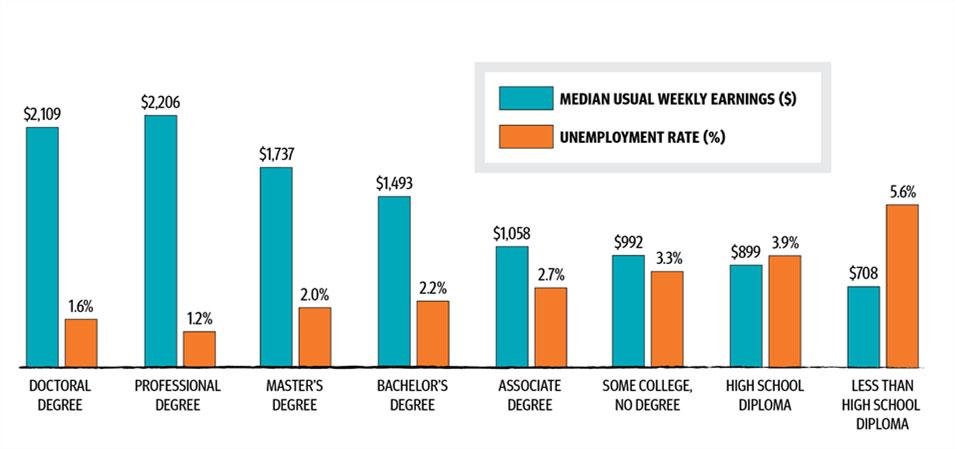
Source: “2024 Current Population Survey.” U.S. Bureau of Labor Statistics. www.bls.gov/emp/chart-unemployment-earnings-education.htm
Studies consistently show that obtaining education beyond high school adds to your lifelong earnings. The earnings difference between a high school graduate and a person with a four-year college degree can be as much as $1 million over a lifetime. You will find this graph in your Opportunities book on page 2.
Inaddition, the more education you have means you are more likely to be employed as there are more job options available to you.
While there is more to life than how much money you make, it is important to remember than any amount of education after high schoolis an investment in your future.
Education is more than a higher income –it’s a pathway to more anddifferent opportunities in life.
College includes many learning opportunities in addition to attending class. It is important to get involved in your campus community to learn more about yourself, others and your future career.
Internships are short-term opportunities to gain work experience in a profession of interest to you. While you will gain hands-on experience, internships also are a good way to determine whether a career is a good fit for you. Internships can be paid or unpaid, but colleges often provide scholarships or academic credit for students to pursue unpaid internships. Some of these in ternships may lead to a full-time position after you graduate.
Colleges and universities make new discoveries and create new knowledge every day, and undergraduate students have the opportunity to be part of this research process. When we think of research, we most often think of science laboratories, but research occurs in all disciplines from art history to sociology to zoology. You can participate in research by working alongside a professor on their research, or you can even create your own research projects.
We learn best from each other. College allows you the opportunity to meet people from near and far. This is a great opportunity to grow your network.
Evenif you attend a college close to home you will be sitting side-by-side with students from all over the country and maybe even from other parts of the world. Having the opportunity to find out about other cultures helps us develop an appreciation for the wonderful diversity all around us.
Through student organizations, such as clubs and sports teams, you can pursue your personal passions and interests while also improving your leadership skills.
All of these opportunities have the potential to create lifelong relationships with faculty and other students, which can benefit you both professionally and personally.
Now let’s look at the different types of colleges and how to choose the right education path for you.
Education After High School
Here are the types of education options to consider after high school.
Speaker: Ask the audience to share the names of colleges they are interested in attending.
Career and Technical Education
Provides students with hands-on training while preparing for occupation Programs
• Concentrate on developing a specific skill
• Designed get students into the workforce quickly
Credentials
• Certificate of completion
• Associate’s degree
• Industry Certifications
• Occupational Licenses
Career and technical education institutions teach students skills related to the qualifications and training required for a particular job and may provide a certificate for completing the program of study but may also offer degree programs.
Training is in a particular industry or career with the majority of classes focused on the skill, trade or career you are studying. This education option is geared for students who want to learn a specific skill and find employment within two years. Examples include cosmetology, HVAC, culinary and automotive technology.
A career and technical education institution in our state is _________________________. (Speaker: Name a CTE school in your state or a community college that offers CTE programs.)
Offers programs that last up to two years that lead to a certificate or an associate degree
Programs
• Ideal for students seeking career training or a pathway to a bachelor’s degree
• Many schools have transfer agreements with state universities
Credentials
• Certificate of completion
• Associate’s degree
• Industry Certifications
• Occupational Licenses
Community colleges offer programs that last up to two years that lead to a certificate or an associate degree. This includes junior colleges.
Students attending a community college can earn their associate, or two-year, degree. Some community colleges also offer CTE programs for students to complete a certificate of completion while a few others offer bachelor’s, or fouryear, degrees.
Many students start at a community college to complete their associate degree then transfer to a four-year college or university to finish and obtain a bachelor’s degree. Community colleges often have transfer agreements with state schools so that credits earned at the community college are easily transferable from the community college to a four-year college. This is a good way to keep costs down. Community colleges are generally a less expensive way to complete general requirements as the cost per credit may be lower. Students save even more money by living at home while attending community college.
A community college in our state is _________________________. (Speaker: Name a community college in your state.)
Four-Year College or University
Offers traditional academic programs; may offer technical, continuing education and remedial programs.
Programs
• Ideal for students seeking undergraduate and graduate degree programs
Credentials
• Associate’s degree
• Bachelor's degree
• Master’s degree
• Doctorate
Four-year colleges or universities offer traditional academic programs, may offer technical, continuing education, and remedial programs. Four-year colleges may offer aresidential experience, where students live on campus.
Many students choose to attend a four-year college right after high school, while others transfer from a community college after completing their associate degree. Colleges often accept transfer credits, especially if they havearticulation agreementswith community colleges.
Some four-year colleges also offergraduate programs, allowing students to continue their education after earning a bachelor’s degree. These may include master’s degrees, law school, medical school, or doctoral programs.
A four-year college or university in our state is _________________________. (Speaker: Name a community college in your state.)
How
many college are in the United States?
Audience Question: Now that we know about the different types of colleges, any guesses on how many college are in the U.S?
There are over 5,800 colleges in the U.S.
There are over 5,800 colleges in the U.S. College selection is an important decision, but where do you start?
Exploring Your Interests and Goals
Identify your goals and interests
• Consider your academic strengths
• Identify careers that interest you
• Assessment: www.onetonline.org
• Explore career options and education requirements
• www.bls.gov/ooh
16
Exploring your interests and goals is a great place to start when finding a college because it helps you choose schools that offer programs, environments, and support aligned with your passions and future goals.
It’s possible you don’t know what your ultimate goals are, and that’s OK. College can expose you topossibilities you’venever considered. On the other hand, you may know exactly what you want to do for a living and what type of college can help you. This makes it easy to identify colleges that can help you achieve your goals. Start by considering your academic strengths and interests, think about what classes or topics you perform well in, and want to explore further.
If you’re not sure what careers interest you taking a career interest assessment can help you discover which careers align with your strengths, values, and passions.
Once you’ve identified some careers that interest you, explore what those careers look like, what type of education is required, and what skills, experiences, and work environments are typically involved.
Check out page 4 in the Opportunities booklet for additional tools and resources to help you explore your options.
Exploring Your Paths to College
Research colleges and programs
• Attend college fairs in your community
• Attend in-person or virtual college campus tour
• Discuss your options with guidance counselors and mentors
• Search online
• www.collegeboard.org
Once you’ve identified some possible career choices, you’ll want to research colleges that offer programs that will help reach your goals. A great way to learn more about colleges and what they offer is to attend college fairs in your community, visit a college whether inperson or virtually, talk to
Discuss your options with a guidance counselor or mentor, they are here to help you!
A great tool to search colleges and compare their options is College Board.
Choosing a College
Program of Study
School
Extracurricular activities
You don’t have to know what you’re planning to major in today but the college you choose should offer programs in areas you’re interested in exploring.
Is the size of the school important to you? Would you prefer a school with large class sizes and less personal attention but more flexibility in what you study? Or would you rather have more individualized attention?
What about location? If you want the vibrancy of a big city, you may wish to consider an urban school. If you prefer a more quiet atmosphere, a suburban or rural location may be a better fit for you. If the campus is far from home, will that be an issue for you?
Depending on your circumstance, you may want to look at the support programs a college offers. Support programs are designed to help you stay in school and graduate. Examples of support programs include tutoring, mentoring, residence hall advisors, disability services, cultural centers, affinity groups, food support and more.
There are a variety of learning formats including in-person learning, online, hybrid, self-paced, as well as hands on learning including internships, labs, or fieldwork.
Extracurricular offerings can also be important. Many people build their social circle through activities that are organized by the school. Is there a hobby or activity that you can’t live without while enrolled? Activities can include clubs, organizations, Greek life, athletics and intramurals.
Don’t self-select yourself out of attending a specific college because it appears to be more than you can afford. While one school may appear to be less expensive, your final cost after receiving financial aid may be different. For example, a more expensive school may offer more institutional grants or other aid, which makes the overall cost less than a less expensive school.
Factors to Consider Level of Importance
Program of study: Are there programs/degrees that match your career goals?
School size: Do you prefer a large or small college? What is the student population?
Class size: How large do you like your classes to be? What is the student-to-teacher ratio?
Support programs: What is offered to help you stay in college and graduate?
City and neighborhood: Do you prefer a city or a small town?
Campus culture: When visiting each college, get a feel for its “personality.” How does it match yours?
Distance from home: How close do you want to live to your family?
Extracurricular activities: What other activities do you want/need access to?
Religious affiliation: Do you want to attend a college affiliated with your religious beliefs?
Net price: What will your final cost be after receiving grants and scholarships?
Financial aid options: Does the college have a tuition payment plan to spread out your payments or a guaranteed cost of attendance as long as you are enrolled?
Outside learning options: Does the college offer internships, externships, study abroad o service learning opportunities?
Housing options near campus: Will you need a car to get to school, work, shopping or back home, or is everything you need within walking or biking distance?
Other considerations
Activity
Let’s take about two-three minutes to complete an activity. If you have a copy of the Opportunities booklet, open to page 5. If not, no worries, take out a piece of paper and pen/pencil. Aswe know, there are a lot of factors to consider when choosing a college. We are going to complete step two of the worksheet. The instructions are to think about important factors you want your college to have. Rank the factors on a scale of 1-13, with one being the most important, 13 being the least important. Everyone has unique reasons why they choose a specific college. There is no right or wrong answer. It’s the answer that fits you, your needs and your personality.
This next segment is about paying for college. We’ll share the different financial aid resources available.
Cost of Attendance (COA)
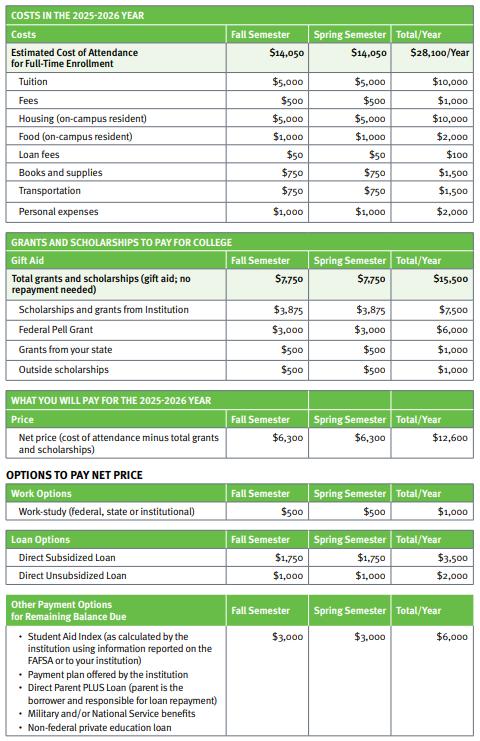
Before we talk about how to pay for college, let’s talk about what you’re actually paying for. Page 11 of the Opportunities book highlights the costs associated with going to college. These costs include, but are not limited to, tuition, fees, housing and food, books and supplies, transportation and miscellaneous expenses.
It is important to understand that the cost of college is more than the basic tuition price. Your financial aid office will determine your cost of attendance (COA) based on several categories of expenses. Your COA will vary by school.
Net Price Calculator
Required by the U.S. Department of Education
Provides an estimate of your cost after grants and scholarships
On every college website or at https://collegecost.ed.gov
Find the actual net price by applying for financial aid
Comparing the cost of attendance of various colleges does not give an accurate picture of what it will cost to attend.
Net price calculatorsare available on all college and university websites and allow prospective students to enter information about themselves to find out what students like them paid to attend the institution in the previous year, after taking grants and scholarships into account. The easiest way to find this tool on a college’s website is to type “net price calculator” in the college’s website search field.
Check out collegecost.ed.gov for more information.
Ultimately, the only way you can truly know what it will cost you to attend a specific college is to apply for financial aid.
Financial Aid Defined
Money that is given or lent to students in order to help pay for their education
Two basic types of financial aid:
Merit-based financial aid is awarded to students with specific talents or skills in areas such as academic achievements, athletics and performing arts.
Need-based financial aid is awarded to students who demonstrate financial need based on the information provided on their financial aid application, such as the Free Application for Federal Student Aid (FAFSA).
What is financial aid? Financial aid is any ou tside resource that can be used to pay for higher education. There are two basic types of financial aid: merit-based and need-based.
Merit-based financial aid is awarded to students with specific talents or skills in areas such as academicachievements, athletics and performing arts.
Need-based financial aid is awarded to students who demonstrate financial need based on the information provided on their financial aid application, such as the Free Application for Federal Student Aid (FAFSA).
Financial Aid Categories
Grants are typically awarded by the federal government, state government or college and do not need to be paid back.
Scholarships are free money that does not need to be paid back. Funding can come from a variety of sources, such as your college, community organizations, employers and individuals.
Work-study is money earned while attending college and it does not need to be repaid. Students work part-time to earn money to help fund their college expenses.
Loans are borrowed money that must be paid back with interest. The most common loans are those offered through the Federal Direct Loan Program. Other loan options include private loans.
There are four maincategories of financial aid.
Grants are typically awarded by the federal government, state government or college and do not need to be paid back.
Scholarships are free money that does not need to be paid back. Funding can come from a variety of sources, such as your college, community organizations, employers and individuals.
Loans are borrowed money that must be paid back with interest. The most common loans are those offered through the Federal Direct Loan Program. Other loan options include private loans and some colleges offer loans as well.
Work-study is money earned while attending college and it does not need to be repaid. Students work part-time in either a field related to their studies or doing community service work and are able to earn money to help fund their college expenses.
These financial aid options are explained in more detail starting on page 18 in the Opportunities book.
Applying for Financial Aid
The first step to access federal, state, and institutional financial aid is to complete the Free Application for Federal Student Aid (FAFSA)
• Determines eligibilty for grants, loans, and work-study programs
• Completed high school senior year, and each year while attending college
• Opens October 1 annually
• The only way to know if you qualify for financial aid is to apply
• Complete the FAFSA www.studentaid.gov
The first step to access any federal financial aid and most state and institutional aid is by filling out the Free Application for Federal Student Aid (FAFSA). Most students complete the FAFSA in less than one hour! By filling out the FAFSA, you will be considered for eligibility for severalfinancial aid opportunities, including federal, state, institutional and private financial aid.
It is important to remember, you will need to complete the FAFSA each year in which you wish to be considered for financial aid.
The FAFSA asks you questions about your personal financial situation, such as your family income, assets, and household size.The goal of the FAFSA is to determine how much financial aid you need and whether you are eligible to receive federal aid.
The primary reason people do not file the FAFSA is that they assume they will not be eligible to receive any aid. This is a costly mistake as nearly every student is eligible for some type of financial aid.
Speaker: Ask the audience to share guesses as to how much Pell Grant money (federally-funded grants) went unclaimed by the class of 2023. [Answer: more than $4 billion] Stress the importance of completing the FAFSA as that is the only way to be able to receive funds like the Pell Grant.
The FAFSA typically opens in October but will open in December this year for the 2025-2025 FAFSA, so approximately one year before seniors start college. The earlier you complete it, the greater your chances are of receiving funding. The federal deadline to complete the FAFSA is June 30, 2026; however, check with your college as their priority filing date may be earlier.
Even if you are not sure what school you are going to attend, you still want to make sure you complete the FAFSA as early as possible. You can pick multiple schools to send your FAFSA information to and, if afterwards, you decide on a school that you did not include to send your information to you can include it later.
Once you’vesubmittedyour completed FAFSA, you can expect the calculation resultsto beemailed to you in as little as threedays. This report iscalled the FAFSA Submission Summary. The FAFSA Submission Summary provides basic information about your eligibility for federal student aid.
For information on state financial aid programs, including available funding for those ineligible to file the FAFSA, visit www.nasfaa.org/state_financial_aid_programs.
• Students who do not qualify for federal student aid but qualify for VA tuition equity (in-state tuition)
• Provides access to VA state financial aid only
• Application opens around the same time as the FAFSA
• www.VASAapp.org 26
Virginia students who are nonimmigrants, undocumented, have Deferred Action for Childhood Arrivals (DACA) status or are otherwise ineligible to file the FAFSA should complete the Virginia Alternative State Aid (VASA) Application to be considered for state financial aid and some institutional financial aid programs.
In order to be eligible, students must: -Have graduated from a VA high school on or after July 1, 2008 -Attended a VA high school for at least two years -Provide two years of VA tax returns
State Grants in Virginia
• Virginia Commonwealth Award
• Virginia Guaranteed Assistance Program (VGAP)
• Virginia Tuition Assistance Grant (VTAG)
• Two-Year College Transfer Grant
• Workforce Credential Grant
• Virginia Military Survivors and Dependents Education Program
• www.schev.edu
27
VA Slide
There are many state financial aid programs, but these are the six main grant programs. The state grant programs each have different requirements. Some programs are based on need only, while others, such as VGAP, is based on both need and merit. VTAG is based simply on attending a participating private college in Virginia.
The Virginia Commonwealth Award is available to Virginia residents who attend Virginia public colleges. To be eligible, studentsmust demonstrate financial need and the award amount varies based on financial need up to the cost of tuition and mandatory fees. To apply, students should complete the Free Application for Federal Student Aid (FAFSA).
The Virginia Guaranteed Assistance Program (VGAP) is available to Virginia residents who attend Virginia public colleges. To be eligible, students must demonstrate financial need, be enrolled in college full-time and have a minimum high school GPA of 2.5. The award amount varies based on available funds. To apply, students should complete the FAFSA.
The Virginia Tuition Assistance Grant Program (VTAG) is available to Virginia residents who attend participating Virginia private colleges. To be eligible, students must be enrolled full-time. The award amount varies based on available funds. Students should work withtheir college’s financial aid office to apply.
The Two-Year College Transfer grant is available to Virginia residents who graduate from a VA community college and enroll in a VA public college. To be eligible, students must have achieved a 3.0 GPA in community college and have an SAI less than $12,000.
The Workforce Credential grant is available to anyone with Virginia residency planning to enroll in a community college workforce credential program. Eligible programs are determined by in-demand fields that require short-term certifications.
The Virginia Military Survivors and Dependents Education Program is available to the surviving dependents of service members killed in active duty to our nation and to the dependents and spouses of veterans with service-connected disability ratings of 90% or greater. This program requires a separate application through the Department of Veteran Services in addition to other financial aid formsthat are submitted in this process.
In all cases, the college financial aid office will determine whether or not you are eligible to receive funds.
You can find additional aid programs in the Opportunities book on pages 31-33 or visit www.schev.edu.
Co-sponsored by the State Council of Higher Education for Virginia (SCHEV) and ECMC
• Prepare: ECMC College Nights in Virginia
• Apply: Virginia College Application Week
• Finance: FAF$A Next
• Decide: Decision Day VA
From finding the best fit, to meeting application deadlines and figuring out how to finance it all, you can receive free guidance to help you through the college-planning process. Don’t miss out on this series of informational events to help Virginia students and their families “level up” their quest for education beyond high school!
1.ECMC College Nights in Virginia: October 1, 2025-April 30, 2026
ECMC has sponsored College Nights in Virginiaevery year since 2007. Participating locations across the state provide opportunities for students and families to learn about planning and paying for college. Events are open to the public.
2.Virginia College Application Week: October 20-24, 2024
Virginia College Application Week is part of a national initiativedesigned to increase the number of first-generation and low-income students pursuing a college degree or other higher education credential. Participating students are encouraged to submit at least one college application during this week.
3.FAF$A Next: October 2025-February 2026
FAF$A Nextis an annual statewide initiative designed to increase completionof the Free Application for Federal Student Aid (FAFSA) and the Virginia Alternative State Aid (VASA) Application throughout the state. ECMC and SCHEV partner with Virginia high schools to host events at which high schoolseniors and their families receive hands-on assistance completing the FAFSA. Select locations will also provide information and assistance with completing the VASA Application. Additionally,families and counselors receive valuable information through webinars and downloadablematerials.
4.Decision Day VA: On or around May 1,2026
Decision Day is part of a national effort, sometimes referred to as Signing Day, to support and celebrate student postsecondary decisions and provide reminders about upcoming deadlines and responsibilities.
You can find this information on page 38 of your Opportunities book or by going to www.levelupvirginia.org.
• = FAFSA and VASA help at select Virginia high schools
• Check with your school for FAFSA completion help
• Find more information at www.schev.edu
• ECMC The College Place
• www.ecmc.org/tcp
• Assistance is also available at 800-4-FED-AID 30
For many years, SCHEV and ECMC have sponsored FAFSA completion events around the state. FAF$A Next is being held from October 2025-February 2026. Select high schools will be host sites and hands-on FAFSA and VASA Application assistance will be provided by professionals to students and their families.
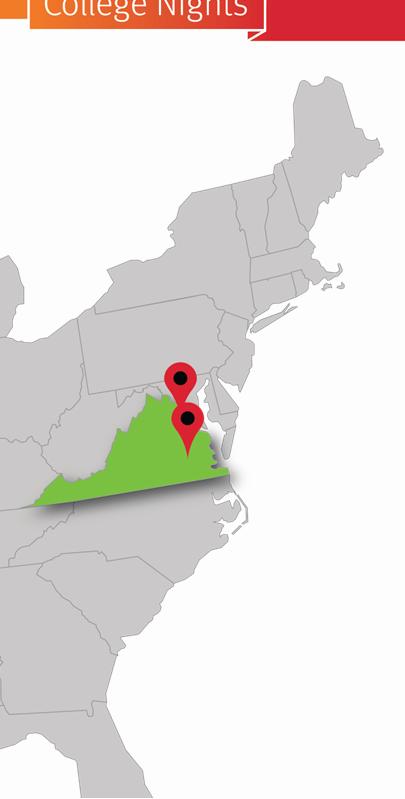
ECMC The College Place in Alexandria and Richmond are also free resource centers available for Virginia students and families. You can learn more about these resources, including locations and contact info at www.ecmc.org/tcp.
Lastly, students can call Federal Student Aid toll-free to receive free FAFSA help.
Summary from a college that outlines the types of financial support a student is eligible to receive to help pay for their education.
• Includesgrants, scholarships, work-study, and loans
• Includes net price (what you pay for college after financial aid is subtracted)
• Students receive their aid offer from the college after they have been accepted and completed their financial aid application.
• Compare offers from different colleges
Once you have been accepted for enrollment at any college and have applied for financial aid by completing the FAFSA and any other financial aid forms required by the college, you will receive a financial aid offer. This will detail the amount of financial support the college is able to provide for the upcoming year. This includes grants, scholarships, work-study, and loans. You might receive the award along with your notice of acceptance. Some colleges make the offers available online. Check with your colleges to see how they will distribute the financial aid offers.
Every offer letter looks a bit different. See page 25in the Opportunities book for more information on how to read your offers. I encourage you to also complete the worksheet on page 26to help you compare offers from different colleges.
How many scholarships are awarded each year in the U.S.?
Ask the audience: How many scholarships are awarded each year in the U.S?
Approximately 1.7 million scholarships are awarded each year.
Each year, approximately 1.7 million scholarships are awarded across various sources, including federal, state, institutional, and private organizations. These scholarships contribute to a total of $46 billion in financial aid
Search for Scholarships
Scholarships are free money for college that do not require repayment.
Local scholarships
• High School
• Employer
Regional Scholarships
• City
• District
National/Worldwide
• Scholarship platforms
• Community
• Colleges
• County
• State
• Online
20
Scholarships are free money for college that do not require repayment. Scholarships are offered in different shapes and sizes, and from various forms of sources.
It’s best to start your search for scholarships locally. Your chances of winning increase if the pool of applicants is smaller. For example, if there is a scholarship opportunity for a senior at your high school, only seni ors at our high school can apply, and are eligible to win. This is a smaller pool compared to a scholarship that is offered by to students in our entire state.
Nationwide scholarships are easier to find, and generally have easier application requirements, meaning they usually get a lot of applicants, decreasing your chances of winning.
Page 20 in the Opportunities booklet talk about scholarships in more detail, as well as provides a list of legitimate scholarship search sites.
Scam Alert Phrases
This scholarship is guaranteed or your money back.
We’ll do all the work for you.
May I have your credit card or bank account number to hold this scholarship?
You can’t get this information anywhere else.
The scholarship will cost some money.
You're a finalist [for a contest you never entered].
35
Beware -scam mailings and emails often sound and look official. Scammers who try to get you to fall for their tricks are very good at making their communication look professional.
Remember these warning signs that might help identify a scam:
• You’re guaranteed to win or your money back
• You can’t get this information anywhere else
• Give us your credit card (or checking account) number to get started
• The scholarship will cost some money
• We will apply on your behalf
Some scammers will say they are endorsed by other legitimate organizations even, when it is not true. They may also claim endorsements from fictional organizations with names that sound trustworthy.
Be aware if:
• There is a fee - FREE money should NOT cost money
• The organization has no valid contact information
• They request personal bank account information; scholarship disbursement checks are usually sent to your school on your behalf, not to your personal bank account
You’ll want to make sure any communication you get is the real thing rather than a scam. High pressure to buy a scholarship search? Never applied for the scholarship yet you are all of a sudden a ‘finalist’? Walk away… It’s a scam.
(Source: www.finaid.org)
Organize Your Scholarship Search
The competition for scholarships can be intense, especially for the big money. However, diligence and perseverance may pay off. It is important to get organized before applying for scholarships.
• Create a scholarship email address—one that you can check throughout the week
• Develop a plan to search
• Know the application deadline, allow plenty of time to obtain the required information and then apply
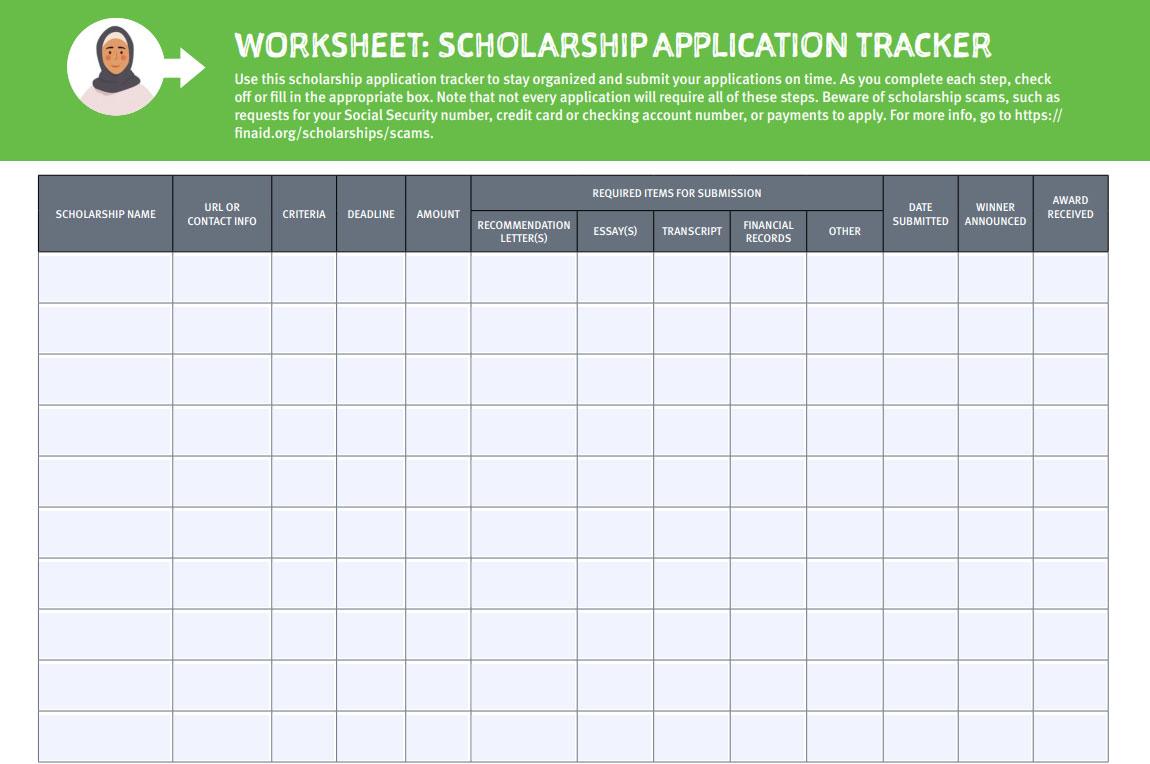
• Track the scholarships for which you have already applied for
• Verify if the deadline provided is the postmarked or received by date and ensure you apply for the scholarship prior to the deadline
You can find the scholarship application tracker in you Opportunities book on page 22.
Scholarship Tips
Start searching today
Search everywhere, starting locally
Explore scholarship platforms
Get familiar with application requirements
You can’t win if you don’t apply.
Watch out for scams
The first thing you can do is to start searching for scholarships today.
Search everywhere, starting locally.
Explore scholarship platforms online
Get familiar with the application requirements as each scholarship is unique and has their own guidelines and requirements
You can’t win if you don’t apply.
Watch out for scams.
In this last section of the presentation, we will talk aboutwhat you can do now to prepare for education beyond high school.
Action Items
Complete online assessment to help identify goals
Finish “Choosing the Right College for You” worksheet
Attend college tours (virtual or in person)
Experiment with net price calculators
Have a family financial aid discussion
Apply for scholarships
The fun does not stop at the end of this presentation! When you leave here today, there are several tasks you can do to keep on track to finding the right education path for you after high school. These are all action items we shared during today’s presentation. Feel free to write them down or take a photo with your phone.
Have a family financial aid discussion
Speaker: Pause for a moment while the audience takes note.
Stay on Track
Lastly, thereis a lot to do to prepare for college, but it’s manageable and we’ll help guide you through the process. Selecting and applying to college is a process that takes some time and energy to complete. However, the sooner you get started, the easier it will be.
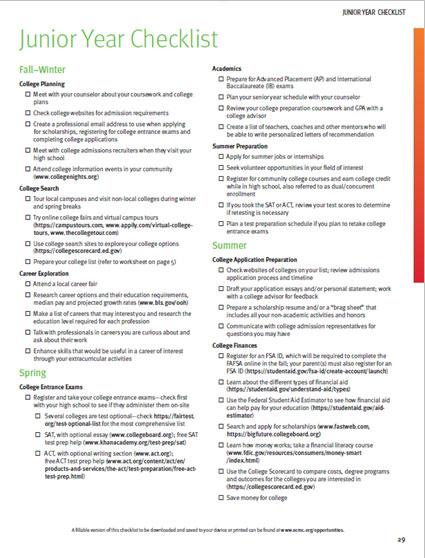
You can find these checklists in the back of your Opportunities book.
Speaker: Ask attendees to take a minute to review the checklists in the back of the Opportunities book.
Contact Us
The College Place-Alexandria, Virginia
Jason Puryear Director, The College Place jpuryear@ecmc.org
434-218-2675
The College Place-Richmond, Virginia
Jasmine Philip Director, The College Place jphilip@ecmc.org
804-380-9780
Sign up to receive personalized emails and texts.
https://bit.ly/ECMCTCP 41
For additional support on how to plan and pay for college, you can utilize free support provided by ECMC The College Place (TCP). The TCPworks to help people of all ages pursue opportunities for undergraduate education beyond high school. They provide information, assistance and encouragement to help individuals achieve their education goals. I encourage you to take a photo or write down their contact info in your Opportunities book to utilize later.
Students, use this link to sign up to receive personalized emails and texts from ECMC The College Place to help you plan and pay for college.
www.surveymonkey.com/r/FeedbackECN
It is now time to do the drawing for a $1,000 scholarship provided by ECMC.
And before you leave today, please take a brief moment to provide your feedback on today’s event by visiting the website or scanning the QR code seen on the screen.
Speaker: Pause on this slide and ask audience for questions. If audience doesn'thave questions you may want to ask audience “What was something you learned?” or “How will you use what you learned?” These two questions will enable the audience to provide a review of the content through their answers.