Levels of Authority - Part 3 - A Biblical World View

Page 1


Levels Of Authority

A
Biblical World View - September 7, 2025

[Part 3]

key points

Message Summary

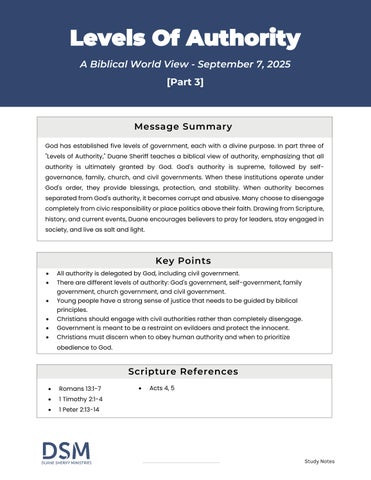
God has established five levels of government, each with a divine purpose. In part three of "Levels of Authority," Duane Sheriff teaches a biblical view of authority, emphasizing that all authority is ultimately granted by God. God's authority is supreme, followed by selfgovernance, family, church, and civil governments. When these institutions operate under God's order, they provide blessings, protection, and stability. When authority becomes separatedfrom God's authority,it becomes corruptandabusive.Many choosetodisengage completelyfromcivicresponsibilityorplacepoliticsabovetheirfaith.DrawingfromScripture, history,and current events,Duane encourages believers to pray for leaders, stay engaged in society, and live as salt and light.

Key Points

• All authority is delegated by God, including civil government.

• There are different levels of authority: God's government, self-government, family government, church government, and civil government

• Young people have a strong sense of justice that needs to be guided by biblical principles

• Christians should engage with civil authorities rather than completely disengage

• Government is meant to be a restraint on evildoers and protect the innocent

• Christians must discern when to obey human authority and when to prioritize obedience to God.

Scripture References

• Romans 13:1-7

• 1 Timothy 2:1-4

• 1 Peter 2:13-14

• Acts 4, 5

Levels Of Authority

A Biblical World View - September 7, 2025
[Part 3]

Discussion Questions

• In what ways might the church's disengagement from civil matters have contributed to corruption in government, and how can believers re-engage responsibly?

• How does understanding the different levels of authority (God, self, family, church, civil) impact our daily lives and decision-making as Christians?

• How can Christians balance respecting governmental authority (Romans 13) with standing up against unjust laws or practices?

• What are some practical ways we can be 'salt and light' in our communities and government without making politics our primary focus or 'religion'?

• How might prayer combined with active engagement in civic matters be more effective than prayer alone in addressing societal issues?

• In what ways situations might a Christian be justified in disobeying a governmental authority, and how should they approach such disobedience?

• How can the church better educate and equip young people to engage with issues of justice from a biblical perspective?

• In what ways can Christians work to ensure that government fulfills its God-given role of restraining evil and promoting good without overstepping biblical boundaries?

Turn static files into dynamic content formats.

Create a flipbook
Issuu converts static files into: digital portfolios, online yearbooks, online catalogs, digital photo albums and more. Sign up and create your flipbook.