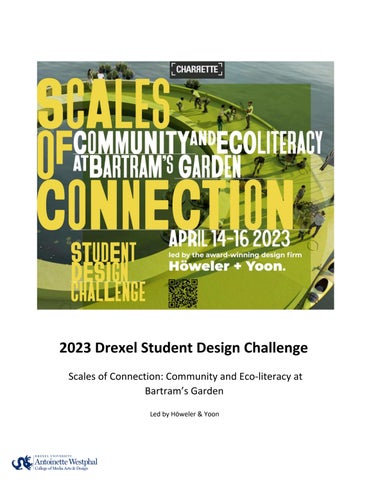
2023 Drexel Student Design Challenge
Scales of Connection: Community and Eco-literacy at Bartramâs Garden
Led by Höweler & Yoon

Charrette Brief Contents
+ Yoon Process Sponsors
About
Since 2008, the Department of Architecture, Design & Urbanism has organized an annual interdisciplinary design charrette. Drexel students from all majors and departments can participate, be part of a design team, and contribute their expertise and unique point of view. The charrettes typically draw 50 to 100 students and require three to four days of intense, creative brainstorming and collaborative design.
Cameron Sinclair (co-founder of Architecture for Humanity) orchestrated the first charrette in 2008 and it considered health and educational facilities for the desperately poor in selected locations across the globe. In the succeeding years, faculty have organized the charrette, selected projects for disadvantaged neighborhoods in Philadelphia, and invited outside experts and faculty to assist the students and critique their final projects. In 2011, the charrette was coordinated with the professional designers who were hired to create the Drexel campus master plan. The 2017 charrette was led by the partners of Snohetta, and focused on sites located along the 34th Street corridor linking Drexel to the Powelton and Mantua neighborhoods.
Faculty members observed that architecture and interiors students often assume leadership positions on their design teams while integrating the strengths and assets of other team members whose backgrounds can range from nursing to film to law. Through their design abilities, they become advisors and facilitators while respecting various viewpoints and approaches. They are able to negotiate the needs of different users or stakeholders and convince people without design backgrounds of the importance and the positive impact successful design can have on the environment. Many students comment in their post-charrette evaluations that their participation was one of the most enjoyable and empowering learning experiences of their college career.
Introduction
The world is hurtling toward ecological catastropheâunless we quickly gather the political will to undertake ârapid and far-reaching transitions across all sectors and systems,â1 in the words of the most recent IPCC. With the built environment contributing 40% of annual global carbon emissions, architecture and design clearly have a crucial role to play in any transition to a sustainable future.2 Yet architectureâs scope could be wider than implementing green building standards and using renewal materials. Design relates not only to infrastructure and economies but also to cultural expectations and behaviors. As Eric Höweler and Meejin Yoon put it several years ago, âThe goals of sustainable design are to convince as much as they are to reduce.â3 Architecture, in other words, can foster ecoliteracy.
Ecological literacy, or ecoliteracy for short, is, simply put, the ability to read one's natural environment. It is the ability to understand the relationship between everyday experiences of the natural world and larger ecological, climatic, and environmental systems. It is closely related to Anne Whinston Spirnâs concept of âlandscape literacyââthe ability to read the complex interaction between ecological and socio-economic forces that shape the physical environment of cities and regions. As Spirn has argued, such literacy âis a means for recognizing and redressing ⊠injustices through urban planning and design and community development.â4 Learning to read our environment is a first and necessary step if we hope to advocate for environmental justice, sustainable design, and a just transition to a carbon-free future.
In architecture of ecoliteracy is one that engages its subjectsâusers, inhabitants, or passersbyâpedagogically, to transform how and what they see. It strives to heighten environmental consciousness by expanding our capacity to see nature, decode its signals, and interpret its phenomena. It aims to change perceptions of energy and environment so that the ethereal qualities of our interrelated systems and lives can be understood physically, materially, and empirically.
Project Brief
Design an interventionâan apparatus, a space, an object, an installation, or a structureâthat expands its usersâ ecological literacy and articulates connections between Bartramâs Garden and its local constituencies. The intervention should implicitly instruct its users to see differently, e.g., by resituating the body or the senses in a way that makes visible an environmental process or ecological relationship. It should be a hybrid device that operates at multiple scales to facilitate sitting, viewing, and signaling.
The Observing Body: Sectional Displacement
Höweler+Yoonâs FloatLab will be a platform for experiencing oneâs surroundings in a new way. By changing the relationship of oneâs body to the Schuylkill Riverâand allowing one to experience the riverâs water at eye levelâFloatLab instigates new ways of seeing and understanding. We will also begin with observation, and by experimenting with moving our bodies vertically in relation to the landscape. While visiting Bartramâs Garden students will have the opportunity to explore on a pair of stilts. How does changing our eye level and vantage point change how and what we see? How will your proposal instigate a new way of seeing, experiencing, and understanding the natural environment?
Program: Scales of Connection
Think carefully about the relationship of ecoliteracy to environmental justice, and the role your intervention could play in connecting Bartramâs Garden to its local constituencies. Your proposal could be conceptualized as operating simultaneously at three different scales: sitting, viewing, and signaling.
Design Proposal
Working primarily in large-scale model (1â = 1â-0â), develop an interventionâan apparatus, a space, an object, an installation, or a structureâthat expands its usersâ ecological literacy and articulates connections between Bartramâs Garden and its local constituencies, while facilitating sitting, viewing, and signaling. Your proposed intervention should be designed to be constructed using 7-ft-long 2x2 lumber (actual dimension: 1-1/2â x 1-1/2â x 7â-0â) and one other material of your choice. Teams are provided with 1/8â x 1/8â basswood sticks to construct these models. You should be able to explain how your intervention responds to the distinct observational approach developed in your site model. Take care to represent your proposal in a way that communicates not only its appearance but also its intended impact. How will Bartramâs Gardenâs various constituencies interact with your proposal, and how will it change how and what they observe in the natural environment?
Charrette Site Information
Often referred to as a city between two rivers, Philadelphia has relied on the Schuylkill River from the time of its founding through the Industrial Revolution. The riverâs headwaters would transform the waterway, once celebrated for its uncommon purity, into the most polluted river in the country. The stretch of the Schuylkill River between downtown Philadelphia and the Delaware River has long been a particularly contested geography of human-environment interaction. For much of the later nineteenth and twentieth centuries, its shores served as the industrial near-hinterland home to coal processing facilities, oil refineries, gasworks, and manufacturing installations that used the river as their dumping ground. By the 1940s, the river required extensive remediation.
If the river is a landmark for the modern environmental movement, it is also of importance to a much longer history of ecological thinking. It is home to Bartramâs Gardenâthe oldest botanical garden in the US and home to the early American botanist John Bartram (1699-1777). Bartram was known for his plant-collecting trips across colonial North America and the export of American seeds and specimens to European gardens. Bartramâs son, William Bartram, and granddaughter, Ann Bartram Carr, continued cultivating the familyâs botanical garden and plant nursery on the site until 1850.
Before the Bartramsâ arrival, the site was home to the Lenape people, who, in turn, had a different kind of intimate understanding of the regionâs landscape and ecology. There is evidence of the siteâs seasonal occupation by indigenous people as early as 3000 BCE.5
The modern river is also well known for its recreational use, memorably recorded by Thomas Eakins in his turn-of-the-century paintings of rowers.
Our focus will be 56th Streetâthe southern edge o Bartramâs Garden and the one east-west connector in the area that extends all the way from the Lindbergh Blvd/Elmwood Ave trolley line to the riverâs edge.It terminates river side plaza that will be the future home of the Höweler+Yoon-designed Float Lab.
Continuing along the shore to the north is a tidal wetland and adjacent historic Lenape sites. Beyond is the primary waterfront of Bartramâs Garden. To the South, 56th Street Plaza connects to the new Bartramâs Mile Trail, which runs along the Schuylkill Embankment to an overlook at 61st Street.
Along the transect from the river to Grayâs Avenue, 56th Street passes through three distinct zones. Between the waterfront and the rail bridge, 56th Street runs between Bartramâs and the ex-industrial sites to the South some of which are planned sites of Bartramâs future expansion. In the next stretch, 56th Street runs through Bartramâs Village, a public housing development of about 500.
Site 01 Bartramâs Garden


Format and Presentation
Final Presentation
Final Presentation Final work will be presented in the 1st floor gallery of the URBN Center on Sunday afternoon. Each team will be assigned wall/floor space where they will display their work and discuss their design proposal. Teams will be given 5 minutes to present their work and all team members are encouraged to speak. Please rehearse your presentation in advance.
Presentation Format
Teams will present their 1/16â observational site model elevated 32â above the floor as described above. Tables/pedestals will be provided for teams to present 1â = 1â-0â scale models. Teams will format and print two-dimensional work on 11x17 sheets. Teams are encouraged to show process development sketches and models. Monitors are available for video presentations.
Digital Submission & Printing
Cards will be provided for each team to print free of charge. All teams are required to submit digital files of their presentation and process work by 12pm on Sunday April 16. Files should be uploaded to the SharePoint site âCharrette 2023â and saved in the appropriate folder under âTeam Submissions.â
2023 Charrette
Schedule
Thursday, April 13, 2023
Eric Höweler Arfaa Lecture
Friday, April 14, 2023
Charrette Introduction
Team/project assignments
Bus to Bartramâs Garden
Site exploration
Bus to URBN
Dinner at URBN
Work time
Saturday, April 15, 2023
Breakfast at URBN
Pin-up and discussion
Work / Site visits in teams
Lunch at URBN
Work / Site visits in teams
Prelim Pin-up / Work time
Dinner at URBN
Work time
Sunday, April 16, 2023
Breakfast at URBN
Work time
*Submit print and digital files
Presentation Prep / Printing / Pin-up
Reception in Lobby
Charrette team presentations
Arfaa Lecture
6:30pm Mandell Theater
Charrette Kickoff 1:00pm 2:30 3:00-6:00 6:00 6:30 7:00-9:00
URBN Center 4th Floor
Bartramâs Garden
URBN Center 4th Floor
Charrette Workday 9:00 9:00-10:00 10:00-12:00 12:00-1:00 1:00-4:00 4:00-6:30 6:30 7:00-9:00
Coffee/breakfast snacks provided Team alcoves URBN Center 4th floor
Team alcoves
Informal comments from faculty
Prep / Presentation
9:00 9:00-12:00 12:00 12:00-2:00 2:00 2:30-5:00
Coffee/breakfast snacks provided Light lunch provided URBN Center Lobby


Höweler + Yoon is a design-driven architecture practice and creative studio that believes design is an instrument for imagining and implementing change â social, cultural, technological, and environmental. Over the last 18 years, they have built a reputation for work that is formally and technologically innovative, socially engaged, and conceptually rigorous. The Höweler + Yoon team is a dedicated group of 20+ architects, designers, and researchers. They seek to expand the scope of design beyond disciplinary boundaries, have benefited from collaborations with experts in numerous fields, and have taken a hands-on approach to design and implementation. Their projects ask how design fits within contemporary culture, how it can affect behavioral and social norms, and how it can produce a sense of place or create environmental awareness. Each project involves a research agenda into larger cultural trends, material properties, fabrication processes, or environmental conditions.
About Höweler + Yoon Process
Each team will represent its assigned site in a 2â x 2â model at 1â16â = 1â-0â, highlighting the teamâs distinct observational approach. Teams will receive a scale plan of the site and a pre-made 2â x 2â plywood base and stand. The observational model should be constructed using the plywood base, and be presented elevated at 32â above the floor, either on top of the provided stand or supported by materials of the teamâs choice. The plywood surface should correspond to the mean low tide elevation of the Schuylkill River (the lowest contour line marked on the provided basemap). Teams should consider how to represent key aspects of the site above as well as below this datum, taking note of topography, water level, underground infrastructure, buildings, streetscape, vegetation, human uses, and ecological processes. How will you translate your observations into representations?
Event Sponsors
The Rankin Scholar-in-Residence Series, named in honor of former Dean Marjorie Rankin and established through the continuing donations of her friends and colleagues, seeks to bring noted individuals to campus who excel in the multidisciplinary education championed by the Westphal College. The goal of the Series is to inspire students, stimulate research, invigorate professional networks, and aid in the continuing development of the Drexel community.