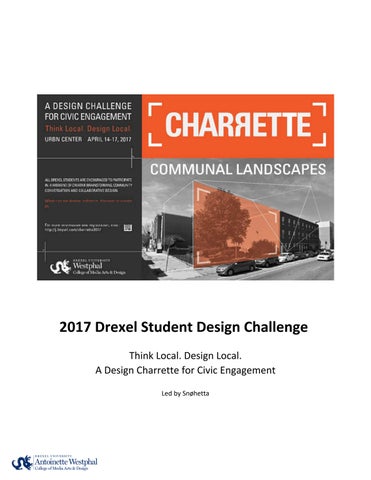
2017 Drexel Student Design Challenge
Think Local. Design Local. A Design Charrette for Civic Engagement
Led by Snøhetta

![]()

Think Local. Design Local. A Design Charrette for Civic Engagement
Led by Snøhetta

Format and Presentation Schedule
About Snøhetta Readings and Resources
Since 2008, the Department of Architecture, Design & Urbanism has organized an annual interdisciplinary design charrette. Drexel students from all majors and departments can participate, be part of a design team, and contribute their expertise and unique point of view. The charrettes typically draw 50 to 100 students and require three to four days of intense, creative brainstorming and collaborative design.
Cameron Sinclair (co-founder of Architecture for Humanity) orchestrated the first charrette in 2008 and it considered health and educational facilities for the desperately poor in selected locations across the globe. In the succeeding years, faculty have organized the charrette, selected projects for disadvantaged neighborhoods in Philadelphia, and invited outside experts and faculty to assist the students and critique their final projects. In 2011, the charrette was coordinated with the professional designers who were hired to create the Drexel campus master plan. The 2017 charrette was led by the partners of Snohetta, and focused on sites located along the 34th Street corridor linking Drexel to the Powelton and Mantua neighborhoods.
Faculty members observed that architecture and interiors students often assume leadership positions on their design teams while integrating the strengths and assets of other team members whose backgrounds can range from nursing to film to law. Through their design abilities, they become advisors and facilitators while respecting various viewpoints and approaches. They are able to negotiate the needs of different users or stakeholders and convince people without design backgrounds of the importance and the positive impact successful design can have on the environment. Many students comment in their post-charrette evaluations that their participation was one of the most enjoyable and empowering learning experiences of their college career.
Introduction
Over the past several years, the Department of Architecture, Design, and Urbanism and the Department of Design have hosted a series of weekend charrettes aimed at engaging students with ways in which design can address public space and community dynamics at both local and global scales. Previous projects have looked at water access, campus connections, transportation networks, and community identity. Notable figures in design, such as Cameron Sinclair and Snøhetta have participated and shared their expertise in past years.
This year, two partners of the award-winning architectural firm Snøhetta, Craig Dykers and Elaine Molinar, will be guiding the charrette, which will focus on the neighborhoods adjacent to Drexel University. The intent is to recognize the existing characteristics of the area and propose design interventions that are appropriate and feasible, while also being forward-looking and imaginative.
Sites have been chosen along North 34th Street, an important artery in the Mantua and Powelton neighborhoods. Within each site, the goal is to create urban interventions that are useful to the neighborhood and are possible to execute. Each site encourages its own set of design constraints and design potential. For all of the sites, designs should consider:
The needs of the neighborhood
Cost, sustainability, and maintenance
Community identity and graphic branding
Accessibility
The charrette sites are all located on the North 34th St., which is the main West Philadelphia connection between Market St and Girard Ave, the Philadelphia Zoo, and Fairmont Park. This corridor is mainly residential with some small retail spaces and a public library branch located at the intersection with Haverford Ave. A one-way street heading south, the street has two lanes of traffic and parking on both sides of the street South of Powelton Ave , 34th St cuts through the Drexel campus with its motley assemblage of buildings ranging from dorms to student centers and sorority houses.
In working with 34th Street as a site for intervention, the experiences of both pedestrians and automobile traffic should be considered. How can a sense of the neighborhood be articulated? How can traffic be slowed to create a sense of place?
The building stock of the Mantua neighborhood is largely modest two and three-story brick row homes dating from the late-nineteenth and early-twentieth centuries. Demolitions conducted over the past two decades have left many vacant parcels scattered through the neighborhood, but there can also be found new construction in the form of apartments, public housing, and retirement housing. Mantua’s population is predominantly poor and working-class African American, although Drexel students of diverse backgrounds have begun renting apartments there within the past 10 years. The neighborhood is home to active community organizations, and Drexel University recently initiated the Dornsife Center, which is dedicated to community health and renewal.
The Powelton neighborhood, also known as Powelton Village, features a variety of housing types, including mid- and late-nineteenthcentury Victorian mansions, modest brick row homes, and handsome early-twentieth-century apartment houses. Following World War II, some historic parts of the neighborhood were destroyed through urban renewal efforts and new building projects initiated by Drexel University. Despite these alterations, the neighborhood became renowned for its diverse population that embraced progressive causes. Its strong neighborhood association continues to promote inclusivity and historic preservation and sponsors a number of popular neighborhood activities throughout the year.

The following is a non-exhaustive list of possibilities for the sites in the neighborhood. Design proposals may suggest one function for a site, or multiple uses. It is important to address the typical users of each site as well as the overall demographics of the neighborhood. It may be useful to think about the relationship between program and site in the terms of production, interaction, consumption, and connection.
PROGRAM/POSSIBILITIES
Civicartery
Communitybranding/identity
Connector–Univ,publicspaces,Zoo
Welcome
Place-making
Inclusive
Urbanagriculture
Farmer’smarket
Beehives
Recreation
Gateway
Growing+selling
Performance
Gathering
Stage
Food
Commercial
Sitting


Site 04 34th and Hamilton (3401 Hamilton / Kimey’s Place)

Teams are expected to format and print their work on 11x17 sheets. Ten (10) color sheets is a suggested minimum for presentation. Teams are encouraged to show process development sketches and models. Presentation documents should include a written narrative of the design proposal; site plan; detailed plans and sections as required; perspective views; and process documentation. Teams will be provided with a format and number for printing. Printing will be provided free for all documents in the print queue by 10am Monday morning. All documents should be clearly labeled with the team number in the file name and on all printed sheets.
Final work will be presented in the 1st floor gallery of the URBN Center on the evening of Monday, April 17th. Each team will be assigned a wall space where they will display their work and discuss their design proposal with the jury teams. Teams will be given 5 minutes to present their work and all team members are encouraged to speak. Please rehearse your presentation in advance.
Presentations shall address (1) the main idea of the design proposal, (2) the potential impact the proposal will have on the site and the neighborhood, and (3) the design process the team used to develop the proposal.
The verbal and visual narrative shall address the connection of the site to the community and how the experience of the site will be transformed or enhanced by the design intervention. Also indicate ways in which the design affords or encourages civic engagement, within the site and beyond.
All teams are required to submit a digital version (PDF) of their presentation work. Additional work, photos, etc. may also be submitted digitally for archival purposes. A location will be provided to upload all work. Final presentation documents should be submitted under the following naming convention.
Thursday, April 13, 2017
Snohetta Arfaa Lecture
Friday, April 14, 2017
Introduce Charrette
Site visit walking tour
Introductory exercise
Saturday, April 15, 2017
Morning kickoff/introductions
Work time
Lunch break
Work time
Dinner break
Work time
Sunday, April 16, 2017
Morning kickoff Easter
Egg Hunt Work time
Lunch break Work time
Dinner break Work time
Monday, April 17, 2017
Submit Print and Digital Files
Charrette presentations
Arfaa Lecture
6:30 Mandell Theater
Charrette Kickoff 5:30-6:00 7:00 7:00-8:00
URBN Center 4th Floor 34th Street sites
URBN Center 4th Floor
Charrette Workday (9:30-7:30, URBN Center 4th Floor) 9:30-9:45 12:30-1:30 1:30-5:30 5:30-6:30 8:00
Coffee/breakfast snacks provided
Informal comments from faculty
Lunch provided
Informal comments from faculty
Dinner provided
Charrette Workday (9:30-7:30, URBN Center 4th Floor) 9:30-10:00 9:30-12:30 12:30-1:30 1:30-5:30 5:30-6:30 8:00
Coffee/breakfast snacks provided
URBN Center
Lunch provided
Prepare for presentation
Dinner provided
*all work must be submitted to print queue by 10am on Monday 4/17
Charrette Presentation (4:00-8:00, URBN Center Lobby) 10:00am 4:00-6:00 URBN Center Lobby (on display after)


Craig Dykers and Elaine Molinar are partners in the design firm Snøhetta. Widely recognized as one of the most exciting and innovative design firms in the world today, Snøhetta has built visually stunning works around the world including the Alexandria Library in Egypt, the Norwegian National Opera and Ballet in Oslo, the National September II Memorial Museum in New York City, and the recently completed expansion of San Francisco’s MOMA. Snøhetta is currently building Temple University’s new library and and completing the reconstruction of New York’s Times Square. The firm’s many awards include: the Mies van Der Rohe European Union Prize for Contemporary Architecture, a World Architecture Award and an Aga Khan Award for Architecture.
Mantua Greenway Project - http://thephiladelphiacitizen.org/we-are-mantua-greenway-project/ Drexel Public Realm Initiative - http://drexel.edu/now/archive/2017/March/Public_Realm/
Green 2015: An action plan to add 500 acres of open space in Philadelphia by 2015 – PennPraxis plan (led by Harris Steinberg) for Parks and Recreation to meet a goal of Greenworks – the city’s sustainability plan. Includes ideas about transforming vacant lots, underutilized school yards and recreation centers into park spaces.
Green City, Clean Waters – the Philadelphia Water Department’s landmark storm water management plan with a focus on green infrastructure.
Snohetta 25 Years 25 Works. AV Monographs 177. 2015