Where minutes have no meaning…
by Sarah Rothenberg
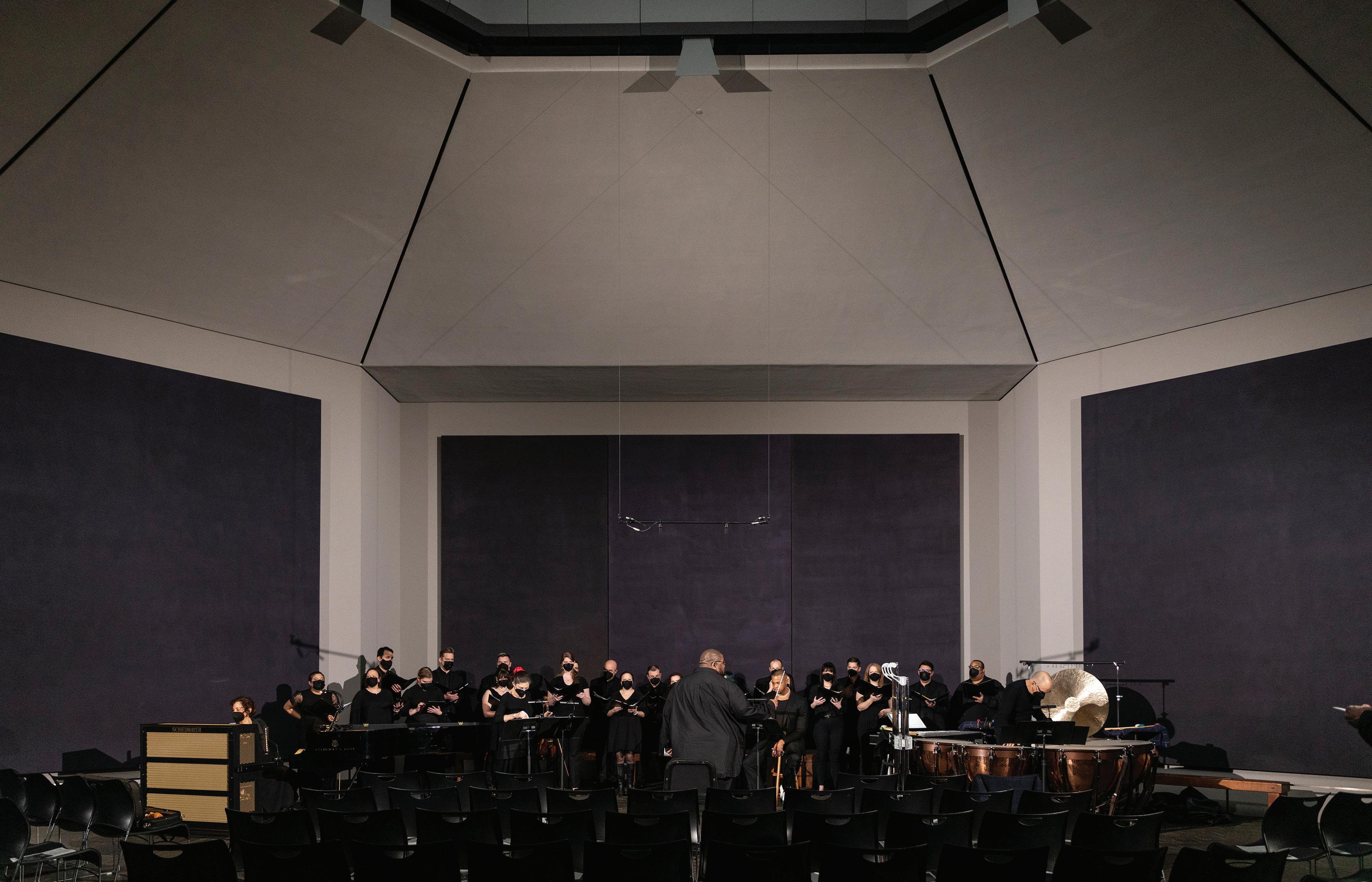
Tyshawn Sorey’s Monochromatic Light (Afterlife) was jointly commissioned by DACAMERA and Rothko Chapel to celebrate the 50th anniversary of the renowned interfaith chapel in Houston, Texas. A mecca for art lovers and spiritual pilgrims, the chapel sits across from the DACAMERA offices —an understated octagonal brick building housing fourteen late canvases by the painter Mark Rothko. The sun is bright in Houston, and when one enters the chapel to encounter the dark monolithic canvases, the change of light plays tricks on one’s eyes. At first, you see black. Gradually, the paintings themselves seem to move, revealing gradations, purples, emerging textures—a subjective fusion between viewer and viewed. This evolving exchange brings a physical awareness of passing time. Time becomes actively present, slow yet visible, in the contemplative silence.
At the chapel’s opening in 1971, Jean and Dominique de Menil commissioned a new work from Morton Feldman; his eponymous Rothko Chapel premiered there in 1972. DACAMERA’s celebration of the chapel’s fortieth anniversary resulted in the album, Rothko Chapel: Feldman, Satie, Cage on the ECM label, featuring the trio of violist Kim Kashkashian, percussionist Steve Schick, and myself on celesta and piano, together with the Houston Chamber Choir. The same instrumental soloists and choir gather again on this recording.
Tyshawn Sorey’s music embodies an abstract and contemplative aesthetic that speaks to Rothko’s paintings, along with an unshakable commitment to the non-abstract
world, as the composer brings his Black identity and the ongoing struggle for justice into his music. Sorey was already a leading inheritor of the Feldman legacy in 2016, when DACAMERA presented a performance of Perle noire, Sorey’s deconstructive portrait of Josephine Baker, and I was struck by the intensity and focus of Sorey’s silent figure on stage, moving between keyboard and percussion instruments, making sounds of infinite gentleness and delicacy, notwithstanding a fierceness of purpose and message. And so, in spring 2019, when I headed to my meeting with Rothko Chapel about an anniversary cocommission, I had only one name in mind.
Tyshawn later said that accepting this commission was a “no-brainer;” but it was a surprise when he announced to me he would compose for the same forces as Feldman: viola, celesta, percussion and mixed choir. Feldman’s Rothko Chapel seemed to inhabit a universe that no one else could enter; its unique instrumentation summoned an iconic sound world. Sorey chose to boldly confront, from the outset, both the visual power of Rothko and the musical legacy of Feldman.
COVID struck, and all came to a standstill. A huge fermata hung over the process. It wasn’t until October 2021 that the composer made it to Houston. The director Peter Sellars flew in from LA—the Park Avenue Armory had joined the commission, and a staged version was being planned for New York, to follow the premiere.
That visit of just a few charged days vibrated with
intensity. Tyshawn was profoundly affected by Rothko’s canvases, and started composing immediately. He spent part of the day in the chapel, and then holed up in his hotel room to write. Peter and Tyshawn had worked together before, on Sorey’s Perle noire, so there was already trust. Conversations happened around the edges—in the hotel lobby, as Peter and I awaited Tyshawn, still composing upstairs; over dinner in the Vietnamese restaurant, Hyunh; in the car getting to various Houston locations (stuck once in a downtown traffic jam during an Astros game, which Peter masterfully directed me out of). Tyshawn was soaking up inspiration and living within the musical sounds filling his head; and Peter was talking with him, almost whispering in his ear, in the remarkable way he has of interacting with composers even before the piece is written. The duality of past and present hovered, as we felt the breathing animus that lives on long after artists’ deaths; but, also, the energy of today, a half century later, to be evoked in Tyshawn’s new work…The word “afterlife” came up in conversations and stayed.
Peter pulled us into the present, looking ahead to the staged performance in New York. How to create, after the intimacy of Rothko Chapel, a sense of ritual between audience, musicians, choir, and, Peter suggested, dancers — for the Armory, he would add choreographer Reggie (Regg Roc) Gray and his dynamic D.R.E.A.M dance troupe. Who would create the visuals? What would we see? When Peter mentioned the artist Julie Mehretu, I was dumbstruck. Mehretu’s dazzling 2021 retrospective at the Whitney Museum in New York, my first post-COVID museum visit, embodied the double presence of history and its material disappearance; layers of past-present-
future existing in a literal simultaneity of imagery. This was abstraction married to the world in which we live. The pairing of Mehretu with Sorey would bring us vibrantly into our shared present.
We performed the world premiere of Monochromatic Light (Afterlife) in Rothko Chapel in February 2022. Sorey made two modifications to instrumentation: he shifted Feldman’s female soloists to a bass-baritone, reflecting the dark tones of the Rothko canvases; and he added piano to the keyboard’s celesta. These shifts of timbre and color became key to the work’s character, pulling the ethereal sound world of Feldman’s ensemble back towards earth and human experience. As Tyshawn’s concept for the vocal soloist expanded, we quickly engaged bass-baritone Davóne Tines, whose artistry transformed the work.
Rothko Chapel was filled to capacity on the night of the premiere. Peter Sellars, Reggie (Regg Roc) Gray, Julie Mehretu were all there, as well as Christopher Rothko, the painter’s son. We were masked, the fragility of the moment was felt intensely—across the country performances were being cancelled daily due to new COVID cases. It was Rothko Chapel’s first public event since January 2020. An epidemic had shaken the world, George Floyd had been murdered, the Black Lives Matter movement had emerged, and we had seen our capitol under siege. Much in our country was ripped open--it was a time of urgent questions and few answers. Monochromatic Light (Afterlife), wordlessly, contained it all. The solitude, the struggles, the pain; and, in the final moments when viola and voice intertwine for the spiritual “Sometimes I feel like a motherless child,” the profound human need for community.
The gestation of Sorey’s epic work happened in
stages; our Houston premiere was just the first magnificent version, as the piece transformed over time from its original 50 minutes, to over 80 minutes at the Armory, and now the 75-minute version of this recording. But these numbers don’t tell us very much. Minutes have no meaning in this music—no more than inches can describe a Rothko painting. In Sorey’s universe, the music determines its own measure of time.
Three main sections existed in the original “blueprint” of Monochromatic Light (Afterlife): the instrumental trio of the opening, the main body of the work with choir—including the arrival of bass soloist, and the final section based on “Sometimes I feel like a motherless child.” These sections roughly correspond to the structure of Feldman’s Rothko Chapel, which ends with a coda based on a remembered Jewish theme. Sorey maintains the “processional” feeling of the Feldman: the barely audible chimes gently summon our attention, a sustained harmonic from the viola continues to cast the otherworldly spell, and out of sparse utterances the solo viola is established as dramatic protagonist, growing in expressive range through arching phrases, punctuated with commentary from the celesta, vibraphone, chimes and piano—extraordinary blends of timbres and harmonies. This extended instrumental trio leads to the hushed first entrance of chorus, as the viola develops the climbing motif based on minor thirds in dialogue with questioning piano chords. The choir’s suspended close harmonies continue to hover ethereally; the solo bass enters, soon to interact with the achingly expressive viola. And then the final section, when “Sometimes I feel like a motherless child,” emerges in viola and solo baritone, freely improvised over the syncopated chords of piano and percussion, rising with hope.
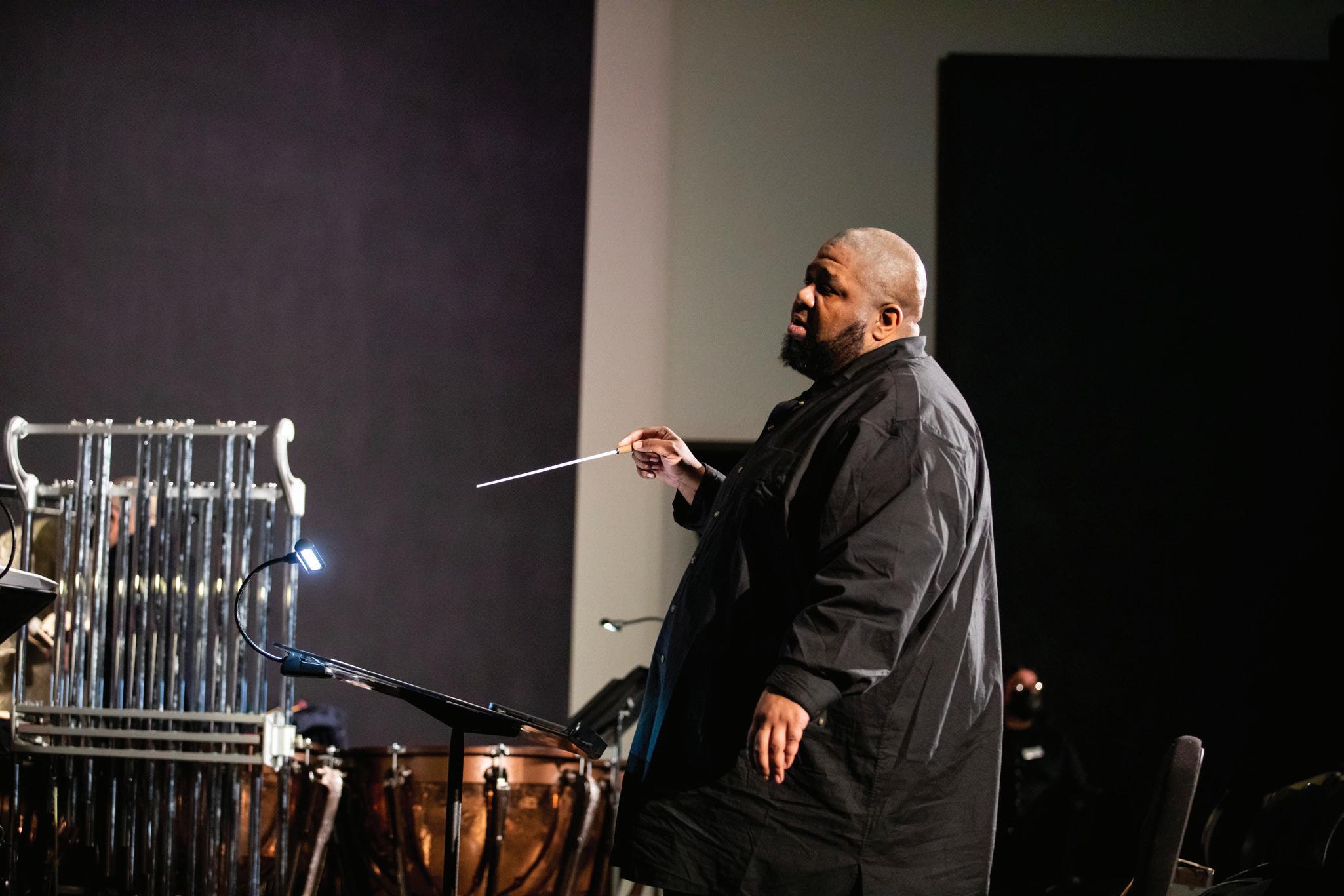
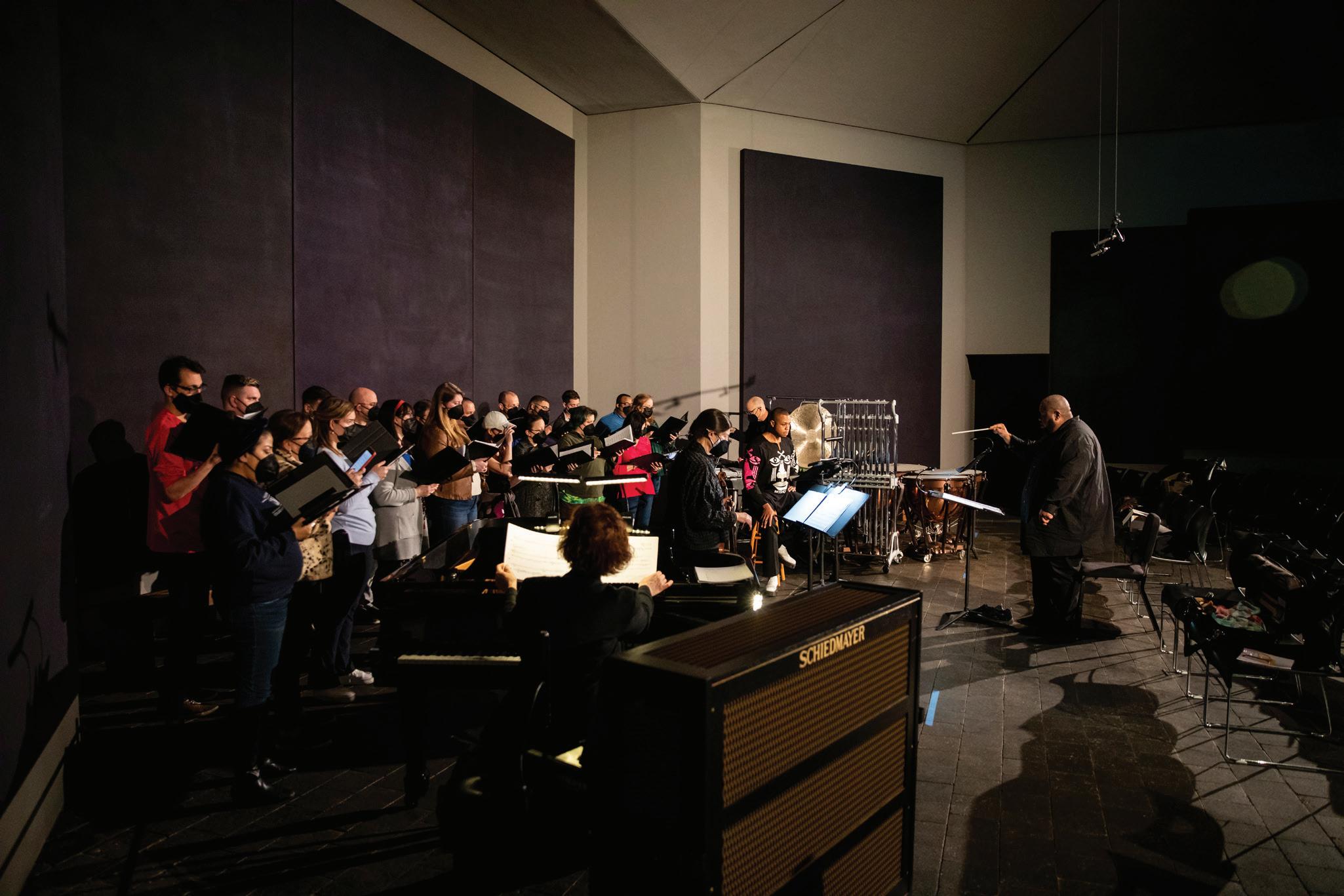
In late summer of 2022, weeks before the Armory performances, we all received new scores, modestly labeled “revised.” A closer look revealed that the work had grown by a third-- we had 100 new measures of music. The baritone’s role was greatly expanded— after entering about a third of the way into the piece, he clearly becomes a second protagonist, in dialogue and contrast with the viola. We began our music rehearsals at the Armory with this version. But that, too, was just a beginning…Tyshawn led the rehearsals with his usual acute ear and precision, calling out pitches to the choir, no detail escaping his attention. But always a part of him seemed listening from a distance, not as conductor but as composer. At every break, Tyshawn was at his computer. Always thinking, hearing, in another world. Seeing possibilities that no one else could see.
The next major revision was received a week before the New York premiere. As I was on a crosstown bus in Manhattan on my way to rehearsal, my phone started pinging, and I opened it to find pages of score arriving. Tyshawn had said to me, “I’m going to write you some piano solos.” And here they were, three of them. Two piano interludes sagely dropped into the score, foreshadowing a large solo of seven minutes which comes before the final section and coda. The piano interludes introduce a new character, breaking away from the ethereal textures to something more earthbound and direct. The contrast in sound world clears the palette, as the coloristic instrumentation and choral floating harmonies give way to the piano’s ruminative soliloquy, a moment of absolute solitude. Over the course of the work, both piano and baritone pull the music away from a Feldmanesque aesthetic towards something that becomes more narrative, at times expressionistic, and distinctly Sorey.
The piece had started out, like Feldman’s Rothko Chapel, wordless. As Peter and Davóne worked together in our New York rehearsals, syllables and words began to emerge, until, finally, stretched out over time and with wideranging melisma, we hear with each of Davóne’s entrances, a bit more: “Some…Sometimes…I feel….mother…less …” until the entire phrase finally emerges. The introduction of language into this abstract world grounds the work in human life, not unlike the introduction of figurative representation into an abstract painting—it is a shift in aesthetic that brings the piece back to earth. More than halfway through the work, after long anticipation, the word “child” is finally voiced. Davóne brings his thrillingly powerful falsetto to this dramatic climax, before dropping back down octaves to his lowest range.
With each revision, next to nothing was discarded. It was like watching a great architect at work. Tyshawn seemed to find secret doors in the composition that were invisible to us; he would open them up and add blocks of music that fit seamlessly into the expanded structure, like a new wing of a building. With each change, Sorey moved deeper into himself, producing a music of heightened drama where there is pathos but never anger.
In hindsight, this organic process was essential not only to the work’s composition but also to us as performers, for we were able to gradually grow into its vast time frame. Tyshawn Sorey has an uncanny ability to create large structures that are both fixed and moveable; exact in notation yet free; and knowing the difference between where those lines are drawn is somewhat intuitive—the score itself, notated in detail, becomes a map open to expressive interpretation. Tyshawn would be the first to say
his music is very performer dependent.
The discovery process continues: Kim, Davóne, Steve and I have now performed Monochromatic Light (Afterlife) more than sixteen times, with three different choirs, and each time it is new. Kim Kashkashian’s mournful and infinitely expressive viola, Davóne Tines’s shape-shifting range and imagination, Steven Schick’s attacks of celestial clarity and solemn inevitability. Moving in and around the resonant colors of the choir, the composition has taken on the feeling of a house; it is a space that we inhabit.
Sorey’s spell-binding harmonies and deeply internalized sense of time define his music; we don’t just listen to this music, we are inside it. This is remarkably close, I realize now, to the way Mark Rothko spoke of his paintings: they were large to create intimacy, the artist said, allowing the viewer to enter the painting rather than stand outside of it. Working in deep partnership with my musical partners, Monochromatic Light (Afterlife) gradually became a sanctuary in a time of turmoil; a place that acknowledges all the pain in our world, but at the same time offers a haven from it; allowing us to grieve and commune, holding hands across the silences. Every breath must be shared, every nuance felt together. Both vulnerable and resilient, this music is, above all, deeply human.
-November 2025
Photo: DACAMERA
Photo: John Rogers
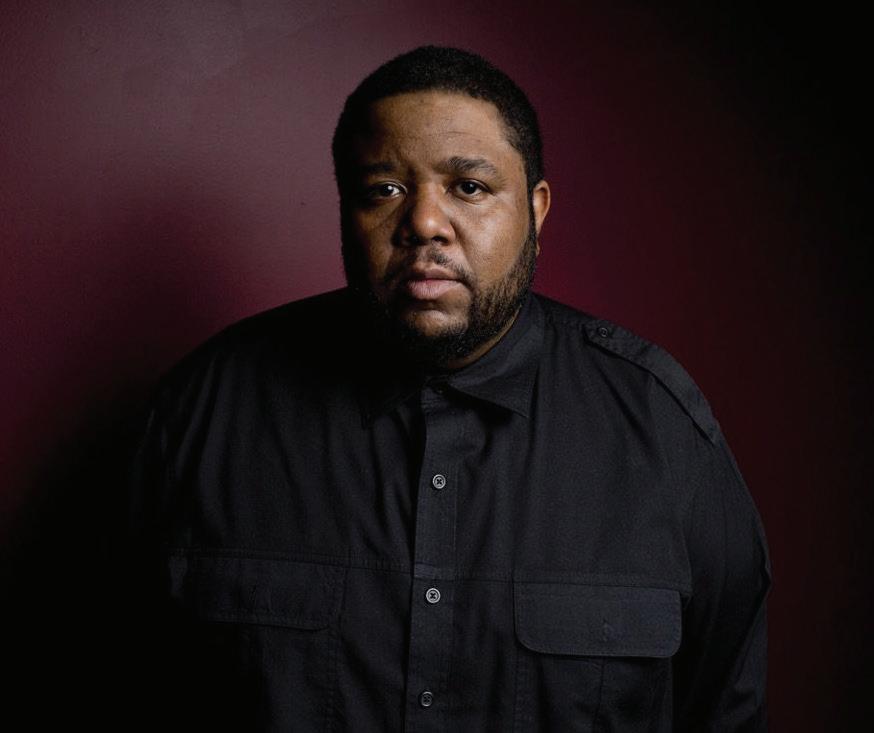
Tyshawn Sorey, composer and conductor
Composer and multi-instrumentalist Tyshawn Sorey was named the 2024 Pulitzer Prize in Music winner for his composition Adagio (for Wadada Leo Smith), after being recognized as a 2023 Pulitzer Finalist for Monochromatic Light (Afterlife). Previously, Sorey roared onto the international landscape as a 2017 MacArthur Fellow and a 2018 United States Artists Fellow. Adding to his reputation as a multifaceted talent, Downbeat Magazine recognized Sorey with its 2023 Critics Poll Award as a Rising Star Producer, while annually placing him near the top of its Composer and Drum Set performance lists. Other recent accolades include the Pew Fellowship, the Fromm Fellowship, the American Academy of Arts and Letters’ Goddard Lieberson Fellowship, and the Koussevitzsky Prize.
Sorey has composed works for the International Contemporary Ensemble, Talea Ensemble, soprano Julia Bullock, PRISM Quartet, JACK Quartet, TAK Ensemble, Brooklyn Rider, A Far Cry, cellists Seth Parker Woods and Matt Haimovitz, the San Francisco Contemporary Music Players, bass-baritone Davóne Tines, Alarm Will Sound, pianist Awadagin Pratt and vocal group Roomful of Teeth, pianist Sarah Rothenberg, violinist Johnny Gandelsman,
and tenor Lawrence Brownlee, as well as for countless others. His music has been performed in notable venues such as the Library of Congress, Walt Disney Concert Hall, Kennedy Center for the Performing Arts, Hollywood Bowl, the 92nd Street Y, Park Avenue Armory, the Donaueschinger Musiktage, Lucerne Festival, and Lincoln Center.
As a performer, he has performed globally with his own ensembles, as well as alongside industry titans including John Zorn, Bill Frisell, Joe Lovano, Vijay Iyer, Jason Moran, King Britt, Claire Chase, Roscoe Mitchell, and Steve Lehman, among many others.
Sorey joined the composition faculty of the University of Pennsylvania in the Fall of 2020, where he maintains a vigorous touring schedule in addition to his academic duties. He was selected as a Peabody Resident at Johns Hopkins University for Fall 2023, and has taught and lectured on composition and improvisation at an impressive assortment of institutions, including: Columbia University, Harvard University, Darmstadter Ferienkurse, Wesleyan University, The New England Conservatory, University of Michigan, The Banff Centre, Berklee College of Music, Mills College, University of Chicago, and The Danish Rhythmic Conservatory.
About DACAMERA
Hailed as “trendsetting” (Time Out New York), “adventurous” (The Washington Post), and “perennially thoughtful” (Alex Ross, The New Yorker), DACAMERA, the Houston-based presenter and producer, is widely regarded as a vanguard music institution combining innovative programming, community engagement, education, and arts advocacy. Under the leadership of pianist Sarah Rothenberg since 1994, DACAMERA was one of the first concert series to promote a boundary-breaking mix of chamber music, jazz and new compositions of diverse musical styles; and to introduce theatrical lighting, projection design and video into interdisciplinary productions. DACAMERA brings the world’s leading artists to perform in its annual series in Houston’s downtown Theater District and at The Menil Collection, often in specially curated ensembles and programs.
DACAMERA’s original interdisciplinary productions, conceived and directed by Sarah Rothenberg, have been presented by Great Performers at Lincoln Center (New York), Kennedy Center (Washington, DC) , De Ijsbreker (Amsterdam), Barbican Centre (London) and concert series across the U.S. DACAMERA’s over 40 commissions include works by Kaija Saariaho, Tyshawn Sorey, Vijay Iyer, Jason Moran, Matthew Aucoin, Wayne Shorter, Gabriela Lena Frank, Charles Wuorinen, Missy Mazzoli, Tobias Picker,
Shih-hui Chen, George Tsontakis. Recent Houston world premieres commissioned and produced by DACAMERA include Matthew Aucoin and Peter Sellars’s Music for New Bodies, Kendrick Scott’s Unearthed, Vijay Iyer’s For My Father, as well as Tyshawn Sorey’s Monochromatic Light (Afterlife), a 2023 Pulitzer Prize finalist. The world premiere of Sorey’s work in Rothko Chapel was named by The New York Times and The New Yorker as one of the top ten classical performances of 2022. Recordings include the critically acclaimed Rothko Chapel: Feldman, Satie, Cage on ECM, featuring the same DACAMERA instrumental soloists and choir reunited for Sorey’s Monochromatic Light (Afterlife).
Beyond the concert hall, DACAMERA’s Education and Community Initiatives reach thousands of schoolchildren and city residents. Nationally recognized for its mentorship of emerging professional musicians, the DACAMERA Young Artist Program brings innovative Music Encounters lessons into academic classrooms; engages with hospitals, youth detention centers, and community partners; and presents free concerts throughout the city. The program encourages outstanding young artists to reimagine the traditional notions of music-making and embrace the goal of impacting their communities through the transformative power of their art.
Photo: Scott Dalton
DACAMERA Soloists
Kim Kashkashian made history in 2013 when she won the first coveted Grammy Award given to a violist for her ECM recording of Ligeti and Kurtag solo viola works. Her more than 25 solo albums on the ECM label have additionally garnered a Cannes Classical Award, the Edison Prize and the Opus Klassik Prize. Ms.Kashkashian has performed as viola soloist with the orchestras of Berlin, London, Vienna, Milan, Amsterdam, New York and Cleveland in collaboration with Eschenbach, Mehta, Welser-Moest, Kocsis, Dennis Russel Davies, Blomstedt, and Holliger. As chamber musician, she appears with Trio Tre Voce, pianist Robert Levin and percussionist Robyn Schulkowsky. Ms. Kashkashian worked closely with György Kurtág, Krzysztof Penderecki, Alfred Schnittke, Giya Kancheli, and Arvo Pärt and her “viola voice” inspired compositions from Eötvös, Ueno, Betty Olivero, Thomas Larcher, Lera Auerbach, Tigran Mansurian, and Toshio Hosokawa. She is a Fellow of the American Academy of Arts and Sciences, and the Royal Academy of Music; and Founder of “Music for Food”, a musician-led hunger relief initiative. To learn more, please go to musicforfood.net or kimkashkashian.com.
Sarah Rothenberg is a pianist, writer, and creator of interdisciplinary performances focusing on the intersection of music with visual art and literature. A pianist of “power and introspection” (New York Times), and “a prolific and creative thinker” (Wall Street Journal), her original productions include A Proust Sonata; The Blue Rider in Performance; Vienna 1900: In the Garden of Dreams; and two film-performances: The Departing Landscape and Door of No Return (featuring Sorey’s For Julius Eastman, composed for Rothenberg). A champion of new music and neglected repertoire of the past, she has performed over 85 premieres, and her recordings include the U.S. premieres of Fanny Mendelssohn’s Das Jahr; her rediscoveries of Roslavetz, Lourié, Mosolov; Shadows and Fragments: Brahms and Schoenberg; as well as works of Messiaen, Satie, Feldman, Cage, Carter, Wuorinen, Picker, Tsontakis and others. Her writings appear in numerous literary journals, The Musical Quarterly, and monographs on artists Cy Twombly and Rackstraw Downes. She received the French medal of Chevalier des Arts et des Lettres in 2000. Sarah Rothenberg is artistic director of DACAMERA. She lives in Houston and New York.
Percussionist, conductor, and author Steven Schick was born in Iowa and raised in a farming family. Hailed by Alex Ross in the New Yorker as, “one of our supreme living virtuosos, not just of percussion but of any instrument,” he has championed contemporary percussion music for more than fifty years. In 2014 Schick was inducted into the Percussive Arts Society Hall of Fame. Schick’s publications include a book, “The Percussionist’s Art: Same Bed, Different Dreams,” and numerous recordings including the percussion music of Iannis Xenakis and Karlheinz Stockhausen. “Weather Systems,” a multi-part retrospective recording of solo percussion music, was listed among the best recordings of 2023 by both The New York Times and The New Yorker. In 2019, he and his wife Brenda began The Brenda and Steven Schick Commissions to foster new creative work that embraces qualities of optimism in themes dealing with community or the environment. Steven Schick is Distinguished Professor of Music and the inaugural holder of the Reed Family Presidential Chair at the University of California, San Diego.
Davóne Tines is a Grammy-nominated creator, curator, and performer working at the intersection of opera, art song, spirituals, gospel, and protest songs. Called “a singer of immense power and fervor” by The New Yorker, his work tells deeply personal stories that connect to broader cultural histories. He recently made his Metropolitan Opera debut in John Adams’s El Niño and released his first studio album, ROBESOИ , reimagining music associated with baritone Paul Robeson. Tines has premiered operas by John Adams, Terence Blanchard, and Matthew Aucoin, and has appeared with major orchestras, performing works from Beethoven’s Ninth Symphony with the New York Philharmonic to his own devised concertos with the Philadelphia Orchestra and Los Angeles Philharmonic. Tines’s honors include the 2025 Harvard Arts Medal, 2024 Chanel Next Prize, 2022 Musical America Vocalist of the Year, and the 2020 Sphinx Medal of Excellence. He is a graduate of Harvard University and The Juilliard School.
Houston Chamber Choir has earned international acclaim, highlighted by a 2020 Grammy® Award for Best Choral Performance for its recording of Maurice Duruflé’s complete choral works. Additional honors include Chorus America’s Margaret Hillis Award and the American Prize. Founded in 1995 by Robert Simpson and led since 2025 by Betsy Cook Weber, the Houston Chamber Choir has become one of the nation’s premier professional choirs, comprised of 24 professional singers chosen through rigorous auditions. Dedicated to advancing the awareness, appreciation, and esteem of choral music and musicians, the Choir commissions and records works by leading composers while performing a broad repertoire ranging from early music to jazz.
Robert Simpson , artistic director
Soprano
Skyler Blair
Kaitlin DeSpain
Lindsey Fuson
Amy Kerswell
Elizabeth Tait
Emily Wolfe
Tenor
L. Wayne Ashley
Victori Cui
Keith Lathrom
Ben McGee
Paul Mortilla
John Weinel
Alto
Sarah Dyer
Aubrey Nelson
Krista Pape
Lauren Pastorek
Ryan Stickney
Audrey Welsh
Bass
Franco Basili
Keaton Brown
James Masanotti
Raymond Pappas
Corey Swann
Eduardo Tercero
Photo: Scott Dalton
Founded in 2026, DACAMERA Editions is a new recording label dedicated to disseminating the distinctive mix of new works, surprising juxtapositions, and diverse musical styles that have defined DACAMERA, the Houston-based presenter and producer of chamber music and jazz, for over 35 years. These recordings will champion new compositions, encompassing both notated and improvised music; unjustly neglected works of the past; and repertoire from the classical canon presented in new contexts. We seek to make illuminating connections between past and present; between music, art and literature; and to offer informative viewpoints that deepen the listening experience and connect music to the complex world in which we live. Opening ears, hearts and minds through music.
– Sarah Rothenberg , executive producer
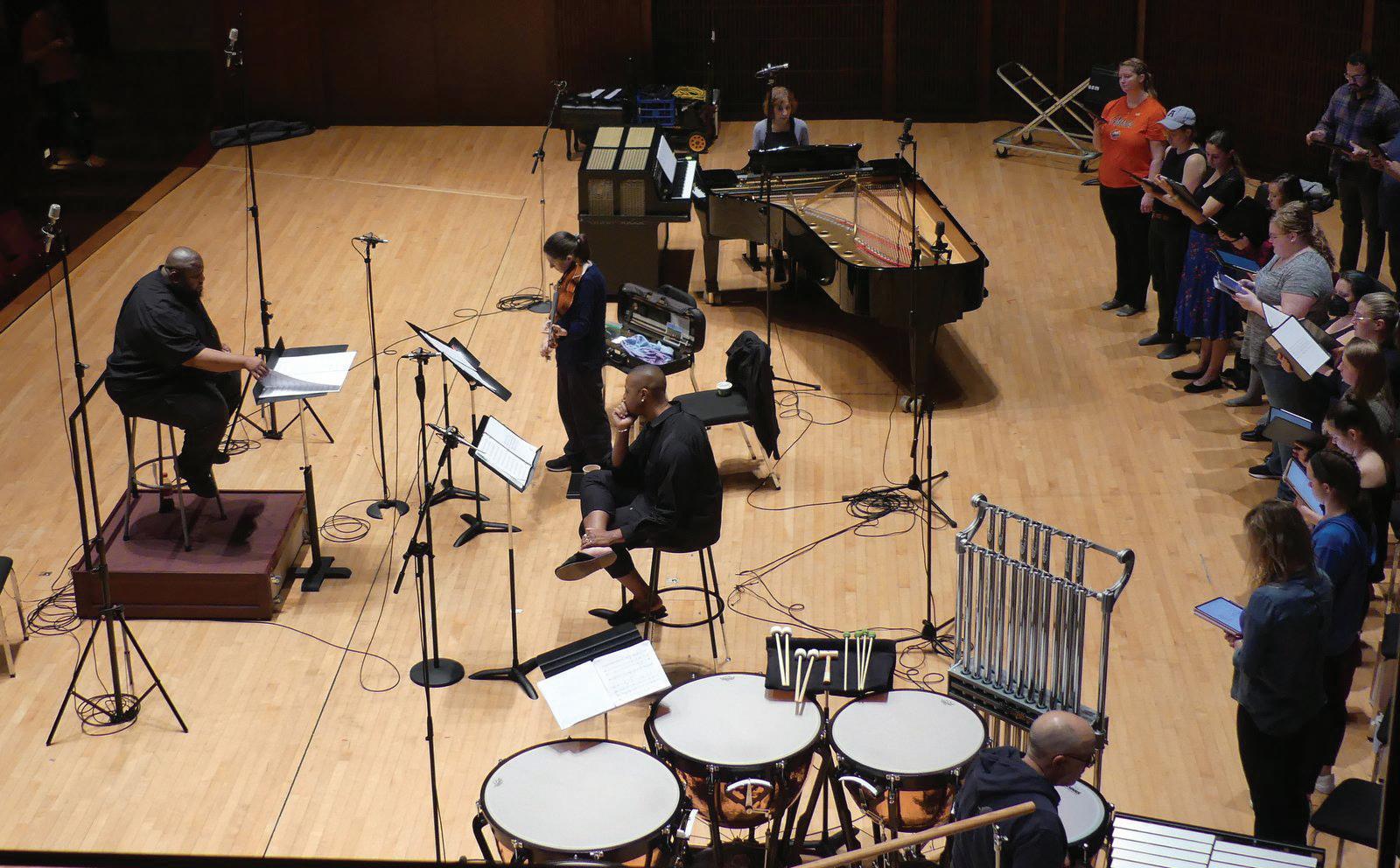
Recorded at Stude Concert Hall, Shepherd
School of Music, Rice University, Houston, Texas.
October 7-9, 2023
Produced by Judith Sherman
Engineered by Judith Sherman and Francis Schmidt
Edited by Judith Sherman and Jeanne Velonis
Mixed at John Kilgore Sound by John Kilgore, Judith Sherman and Tyshawn Sorey
Mastered at Swan Studios, New York, Meyer
Media LLC by Andreas Meyer and Judith Sherman
Executive Producer: Sarah Rothenberg
Design by Aaron C. Lazar
Media relations: DOTDOTDOTMUSIC
Publisher: Monochromatic Light (Afterlife) © 2022
Tyshawn Sorey
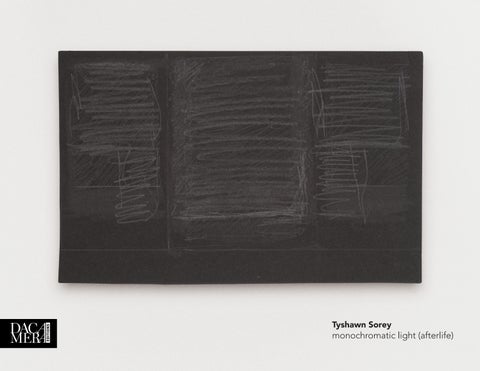
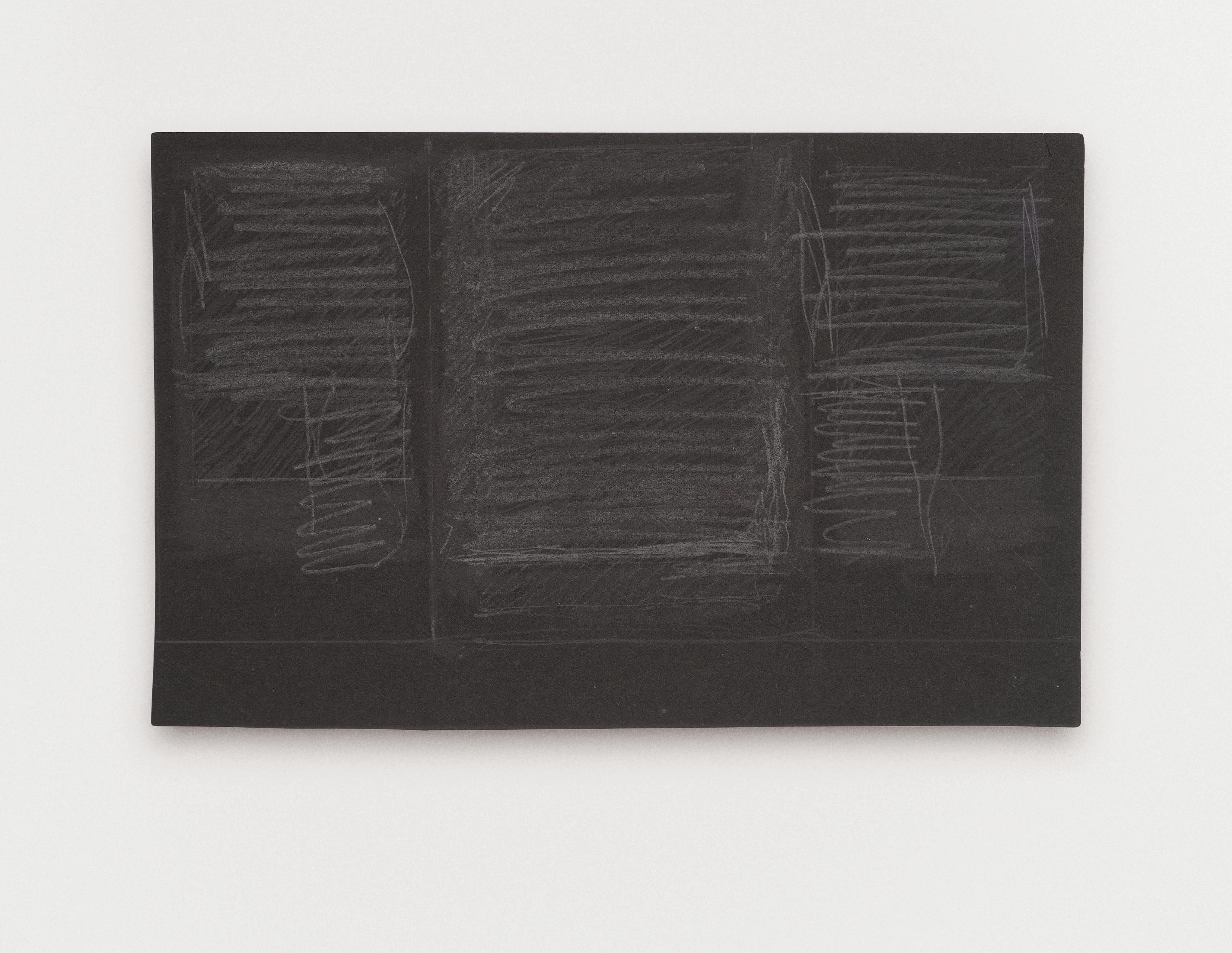
Cover Artwork: Mark Rothko, Study for side-wall triptychs, 1966
Graphite on paper 6 ½ x 10 ¼ in.
The Menil Collection, Houston, Gift of The Mark Rothko Foundation, Inc.
© 2025 Kate Rothko Prizel & Christopher Rothko / Artists Rights Society (ARS), New York
Photo: Paul Hester
Inside Panel Photo of Tyshawn Sorey: Courtesy of DACAMERA
Park Avenue Armory Photos: Stephanie Berger © 2025.
© 2026 DACAMERA Editions www.dacameraeditions.com DE2601