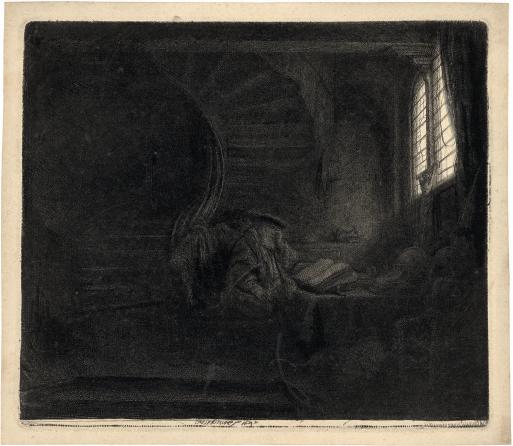
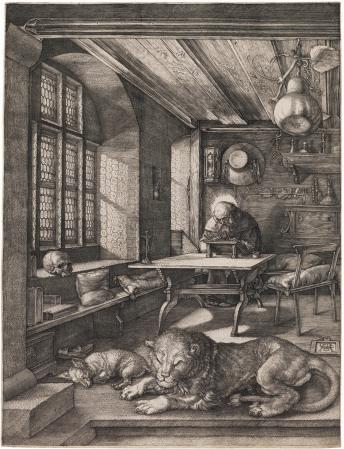
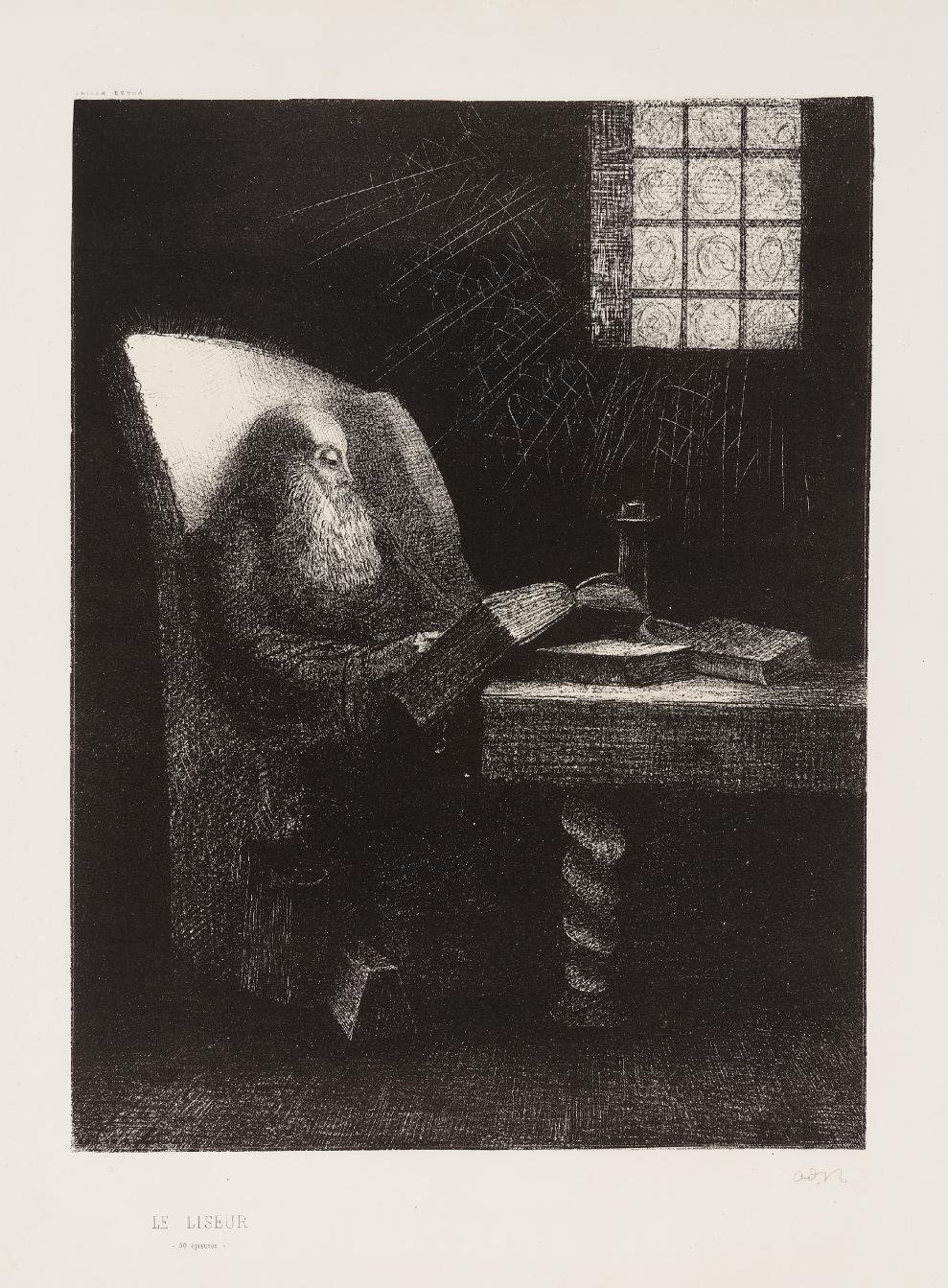
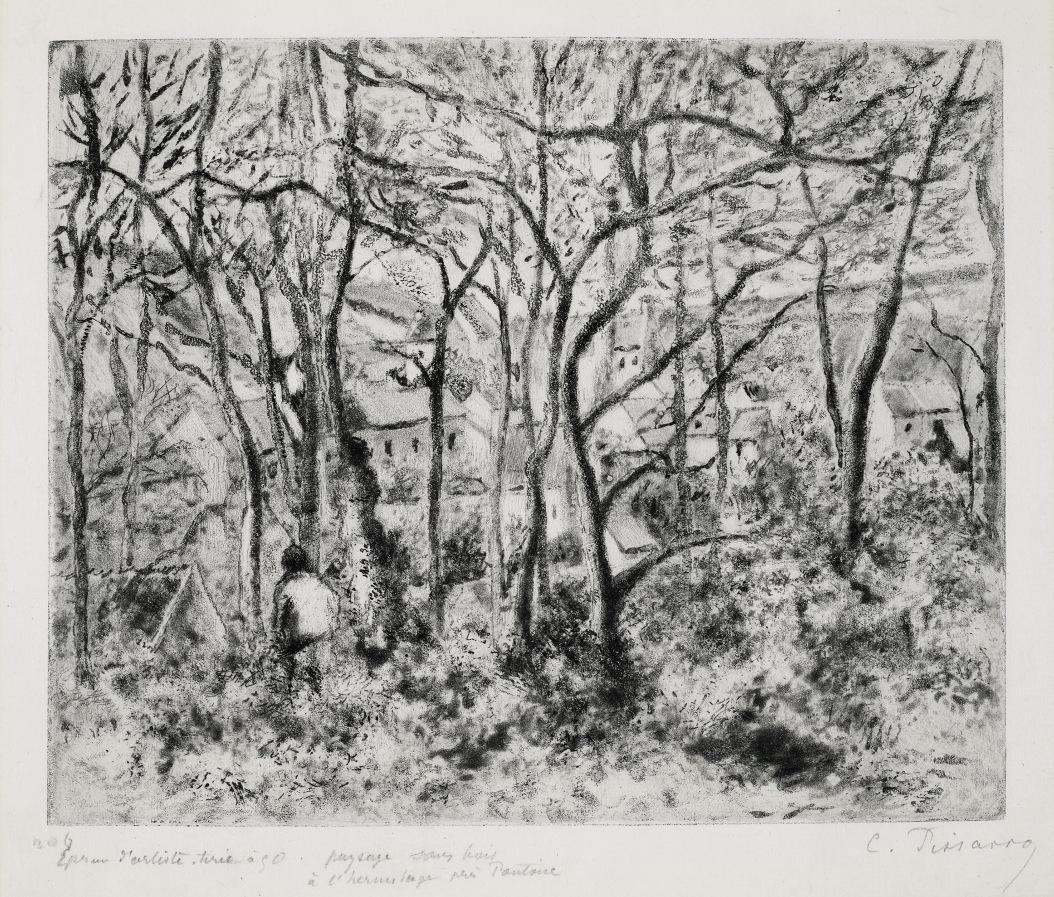
For sale inquiries, please contact the Sale Coordinator, Mallory Burrall, at +1 212 974 4563 or mburrall@christies.com.
The Christie’s Print Department would like to thank the following people without whom this sale would not be possible: Libia Nahas, Sloane Warner, Steve Zick, Olivia Muro, Abby Paschall, Jonathan Rendell, Samantha Koslow, Ben Whine, Stephen Jones, Anna Baitchenko, Kit Polosoff
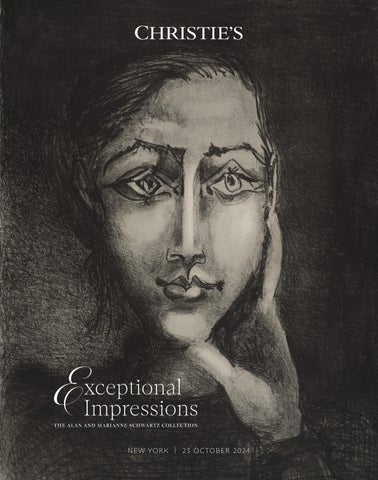
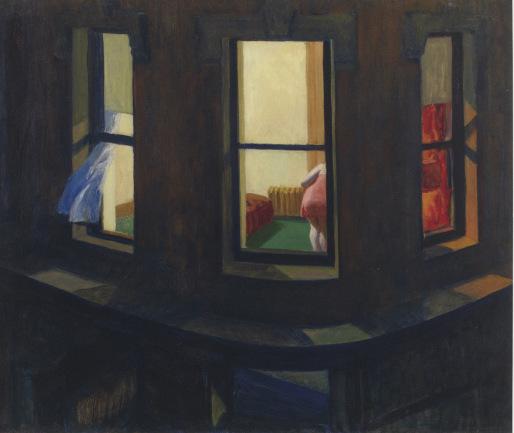
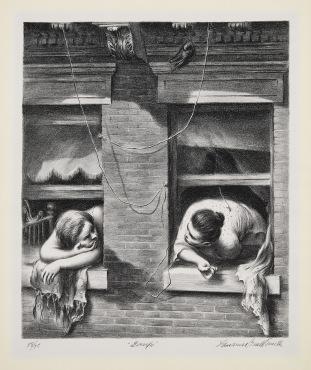
WHAT MAKES A GREAT COLLECTION? Contrary to popular belief, the eminence of the objects it contains is only half the story. The other is the narrative thread which weaves together a series of discrete works into one, cohesive whole. In the case of Alan and Marianne Schwartz, the narrative might have been about antiquities, for this is where their collecting journey began, in 1950. However, the scarcity of ‘exceptional material’ as they described it in Master Prints of Five Centuries, the catalogue of their landmark exhibition at the Detroit Institute of Arts, led them in a different direction—that of graphic art of the western world. And over the course of more than 50 years, beginning in 1963 with the purchase of John Sloan’s Night Windows, it grew to be one of the most important, and diverse, in private hands.
Alan and Marianne first met at a party in the late 1940s, when they had been set up on a blind date. Marianne, who was deaf and could lipread, knew that things were off to a good start when she was able to read Alan’s comments from across the room; ‘Isn’t she beautiful?’ he observed to a friend. At the time, Alan was finishing his studies at Harvard Law School and Marianne was starting her freshman year in art history at Wellesley College. The couple married in the summer of 1950 and moved to New York where
Alan began work at a law firm and Marianne continued her studies at Barnard. In 1952 they moved back to their native Detroit. Alan pursued a career as a lawyer, eventually becoming a founding partner in his own highly successful law firm of Honigman, Miller, Schwartz and Cohn.
Both Alan and Marianne became actively involved in the cultural life of their city, and were committed to its development. While Alan was not raised in an artistic household, Marianne’s parents immersed their daughter in the cultural life of the city. Close to their hearts was, quite naturally, the D.I.A., and here Marianne’s first involvement was as a Docent. In later years she became a member of the Board of Directors and Chair of the Collections Committee overseeing acquisitions across all disciplines. The culmination of this long relationship was a donation which, in
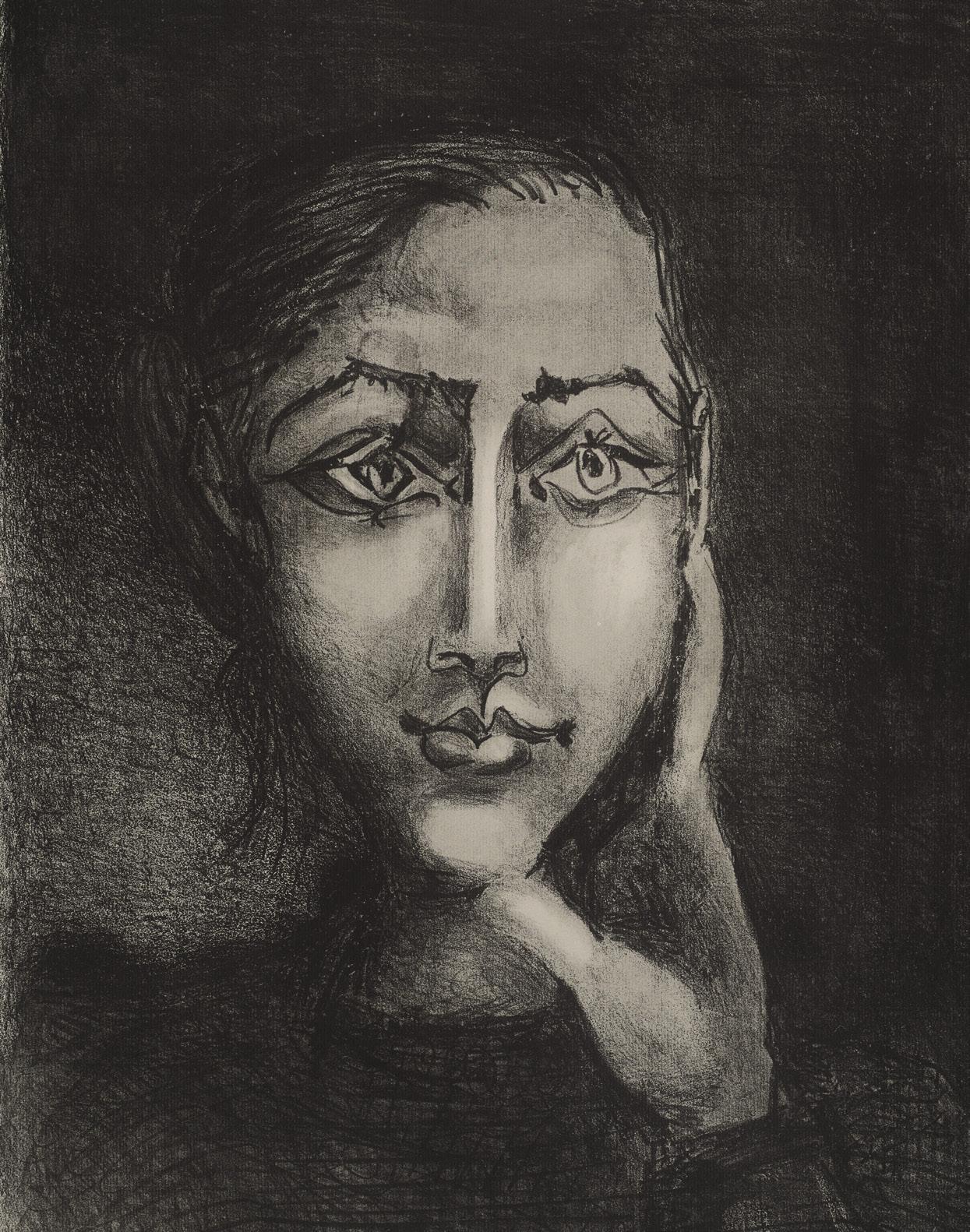
Lot 60
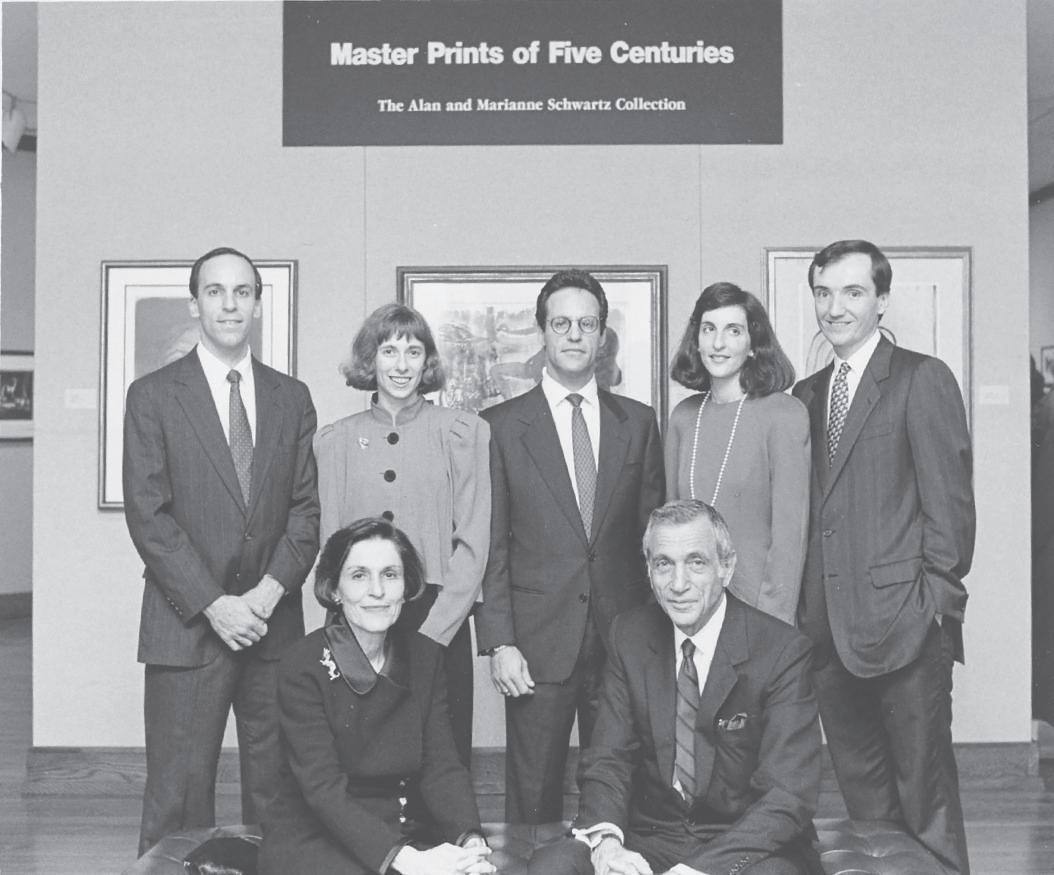
Above:
Schwartz family at opening of Master Prints of Five Centuries: The Alan and Marianne Schwartz Collection, Detroit Institute of Arts, October 1990. Photo courtesy of the consignor.
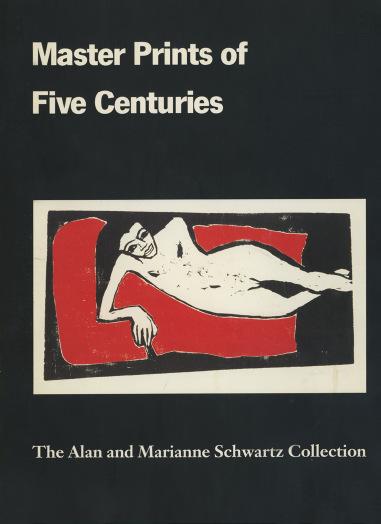
Right:
Photo: Front Cover Exhbition Catalogue
Master Prints of Five Centuries: The Alan and Marianne Schwartz Collection, Detroit Institute of Arts, 1990.
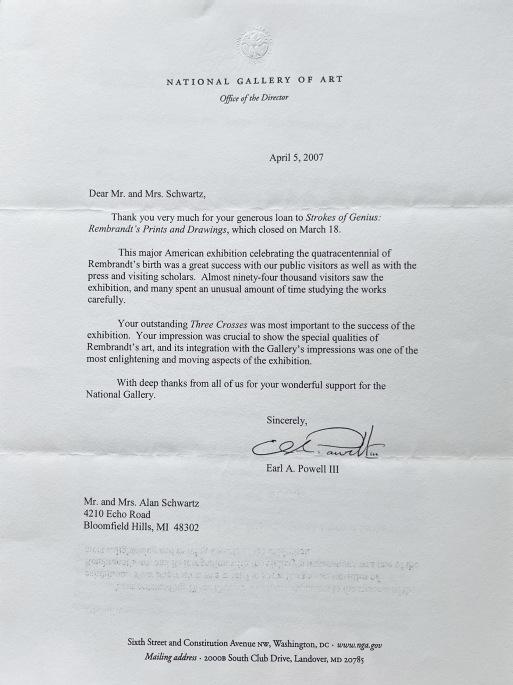
1980, culminated in the Schwartz Family Gallery of Graphic Arts. This transformational gift provided galleries, a study room and dedicated storage facilities. The nature of their gift is instructive— it was designed to increase public access to one of the finest print collections in America. During this time the Schwartz family also established the Schwartz Family Print Acquisition Fund to help finance purchases for the Museum. This spirit extended to their own collection, elements of which were included in no fewer than sixteen important exhibitions. Their meticulously-kept files are full of loan requests and letters of thanks from curators throughout the United States.
Throughout their marriage, the Schwartzes were a true partnership when it came to growing the collection. With her background in art history, Marianne would identify prints she thought worthy of inclusion. She could be drawn to a particular work for a number of reasons: because it was significant from a scholarly point of view, because it was an especially fine example of its type, or if the
artist was an important member of a particular school or period. However, it wasn’t a cold-blooded, analytical exercise—she could also settle on a print simply because it captivated her.
The preliminary stages of the process would often involve consultation with respected curators, many of whom became close friends, including Nancy Sojka and Ellen Sharp of the D.I.A., James Stewart of the University of Michigan Museum of Art and Clifford Ackley at the Museum of Fine Arts, Boston. Marianne would also diligently attend the International Fine Print Dealers fair in New York every year, where she would work her way round the many booths, talking to dealers and the countless friends and contacts she had made over the years. She was also an avid reader of auction catalogues, and Deputy Chairman emeritus Jonathan Rendell recalls their many visits to Christie’s. “It was always something of a special occasion when Marianne and Alan appeared in our auction preview. Longtime collectors and connoisseurs of prints, they were well known for their great taste and their insistence that the quality of the impression should be exceptional. The Schwartzes’ standards were high and it is no accident their collection is outstanding.”
The next stage was an in-depth discussion with her husband who, with his keen legal mind, cross-examined Marianne about any proposed purchase. Having to make a convincing case was a key element in establishing and maintaining the exceptionally high baseline for the collection. This debate, carried out around the
family dining table in Bloomfield Hills, was responsible not only for maintaining standards, but for introducing their three children, Ruthanne, Kurt and Marc, to the world of art. The back and forth also taught the Schwartz children not only that art was something about which it was possible to have a range of opinions, but that these, if informed by knowledge and understanding, were worthy of debate. The effects of these deliberations were life-long, with Marc and Ruthanne becoming collectors in their own right. All three siblings inherited their parents sense of social justice and continue to be passionate about making society a better place through public service in their respective communities.
Of course these discussions weren’t merely academic, they had practical implications. More often than not, they resulted yet
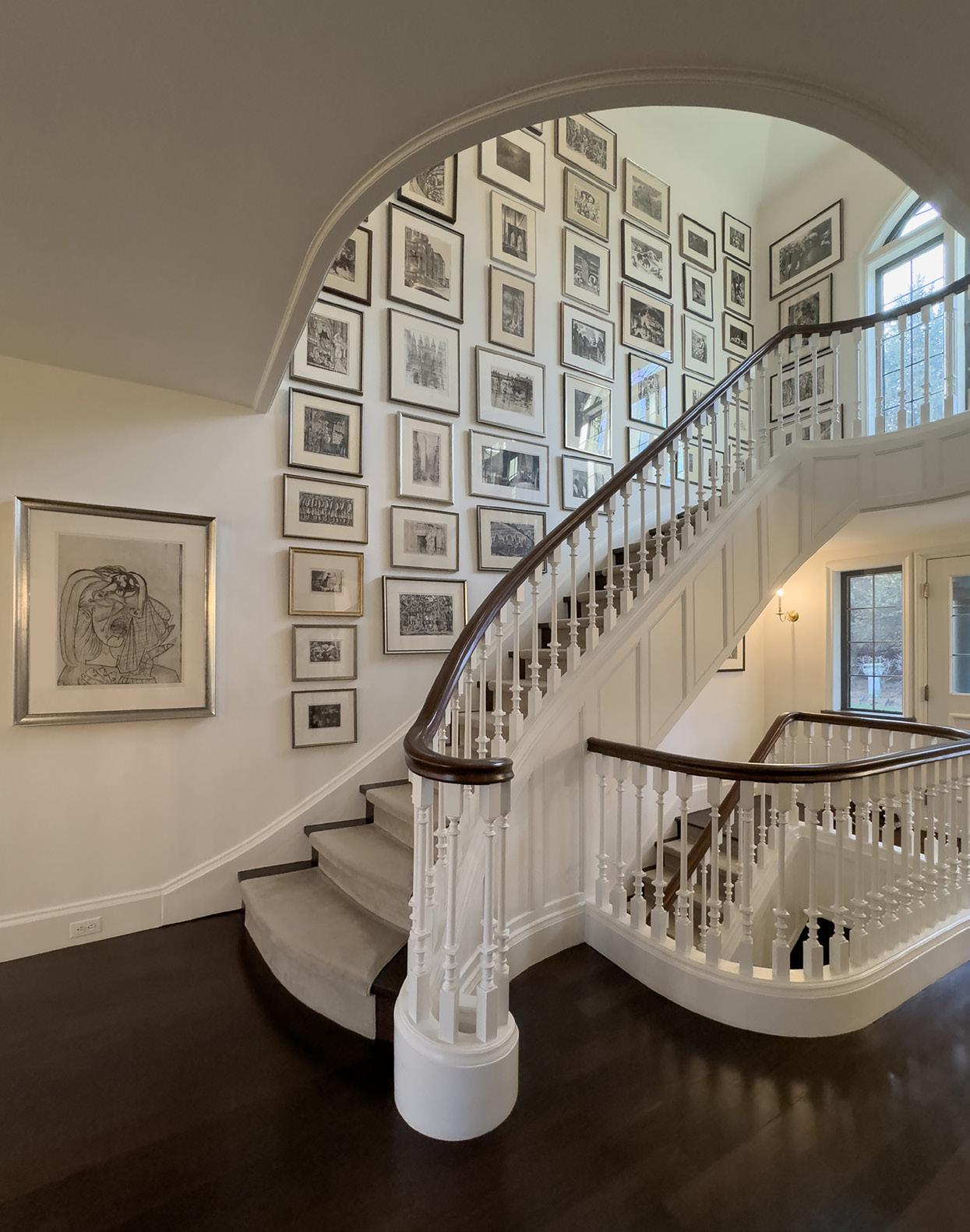
another treasure being brought home and carefully placed by Marianne—after much consideration—on the appropriate wall. This is an important point: Their art was on the walls, not in boxes.
One of the defining characteristics of the collection, aside from the quality of the impressions, is its breadth, and as you look through the catalogue imagine the level of confidence, borne of many hours of study, it took to operate so effectively across five centuries. It begins at the dawn of printmaking in Europe, with Schongauer, Dürer, Duvet, Goltzius and van Leyden, before moving on to the giant of the seventeenth century, Rembrandt, together with his fellow Netherlandish masters, van Dyck and Rubens. There follows a fascinating exploration of lithography, a technique invented at the very end of the preceding century,
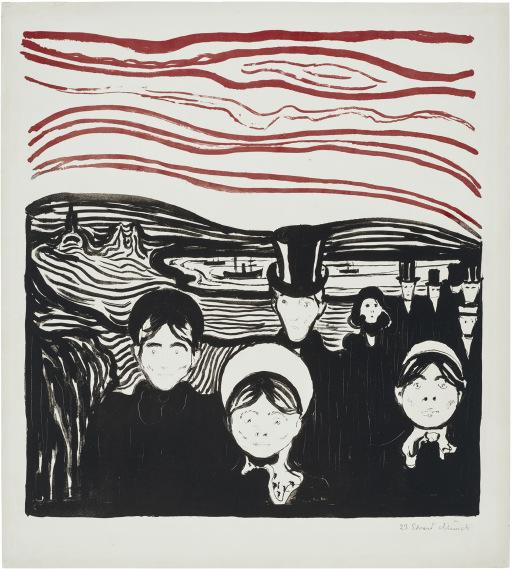
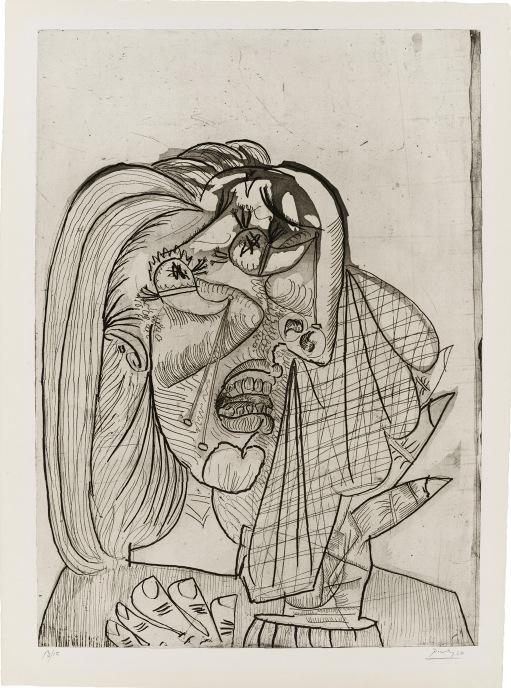
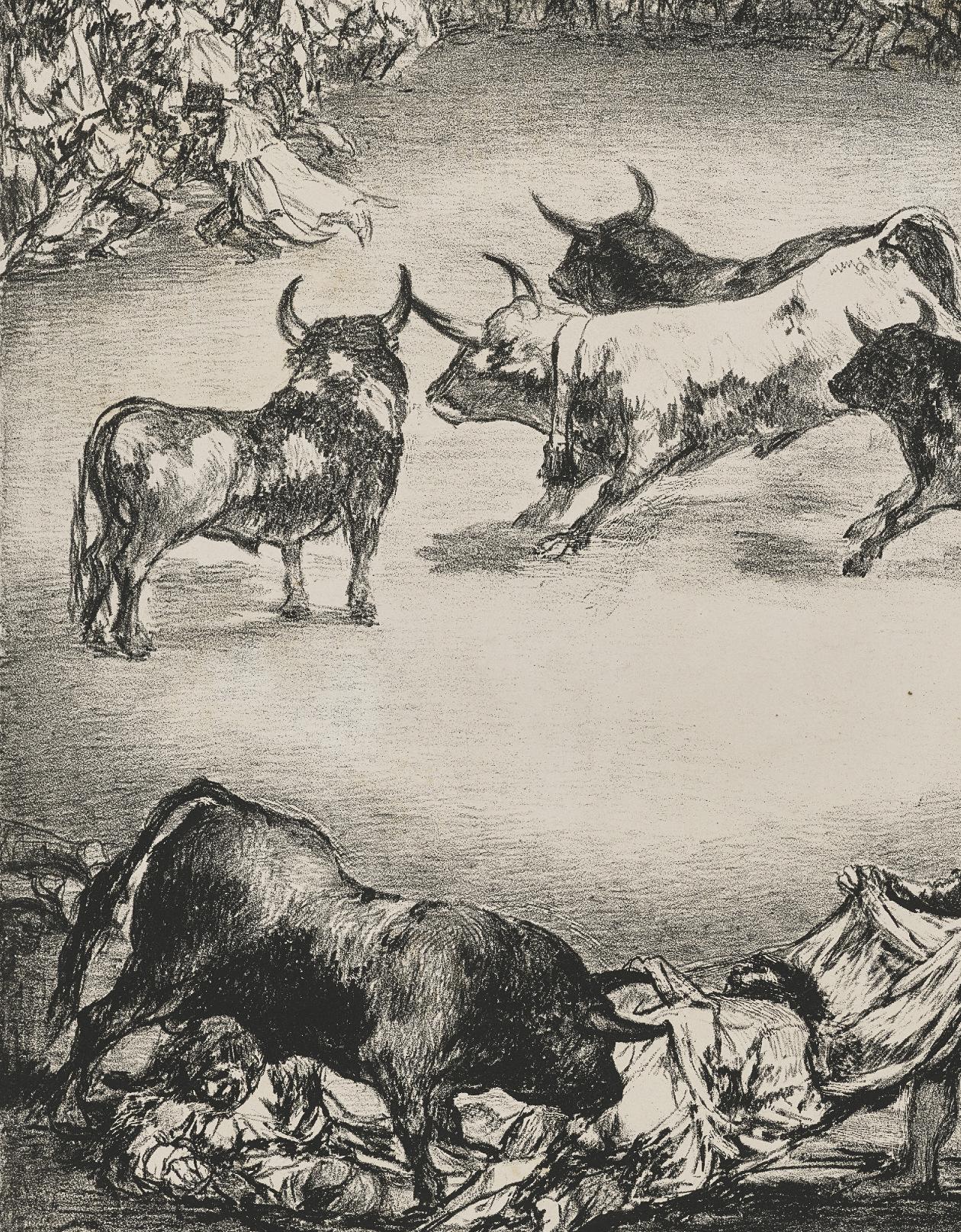
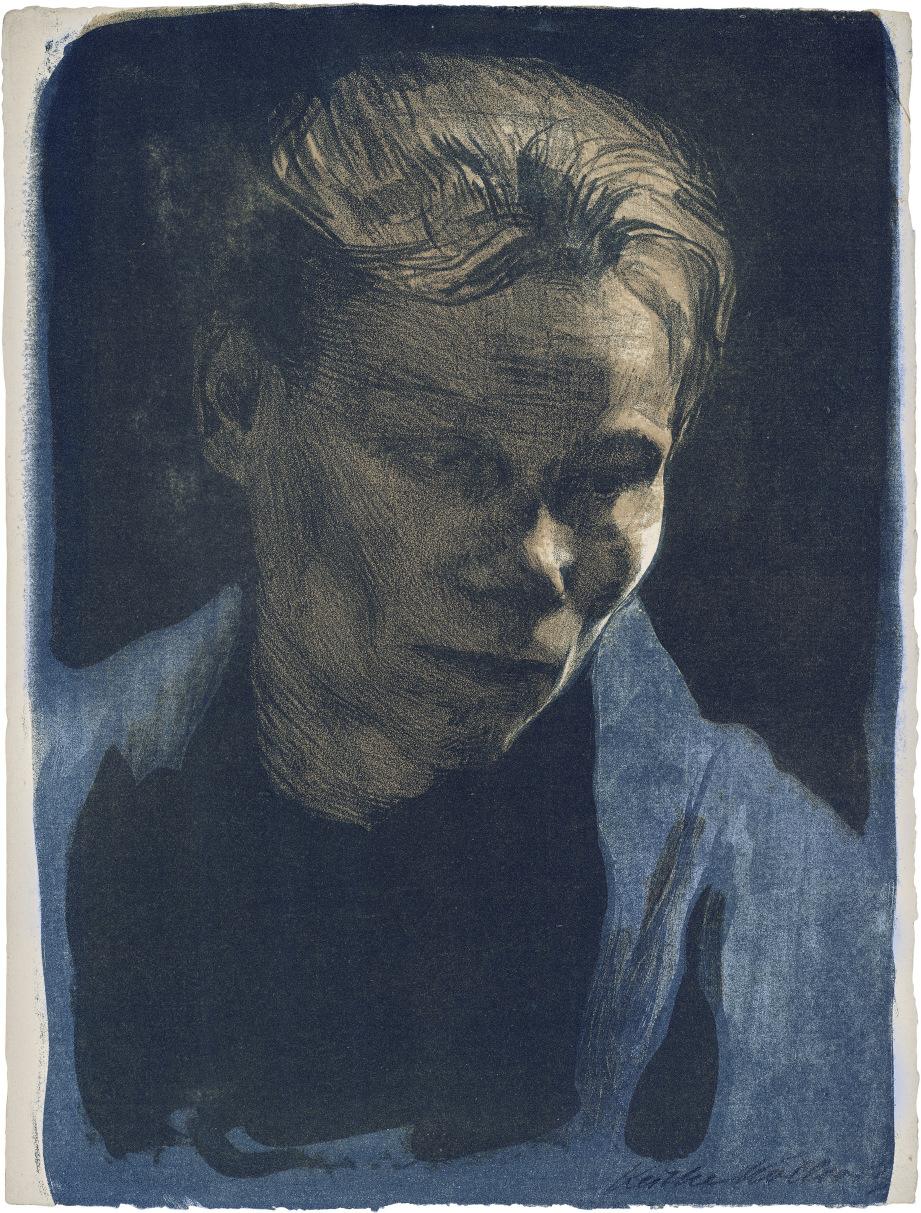
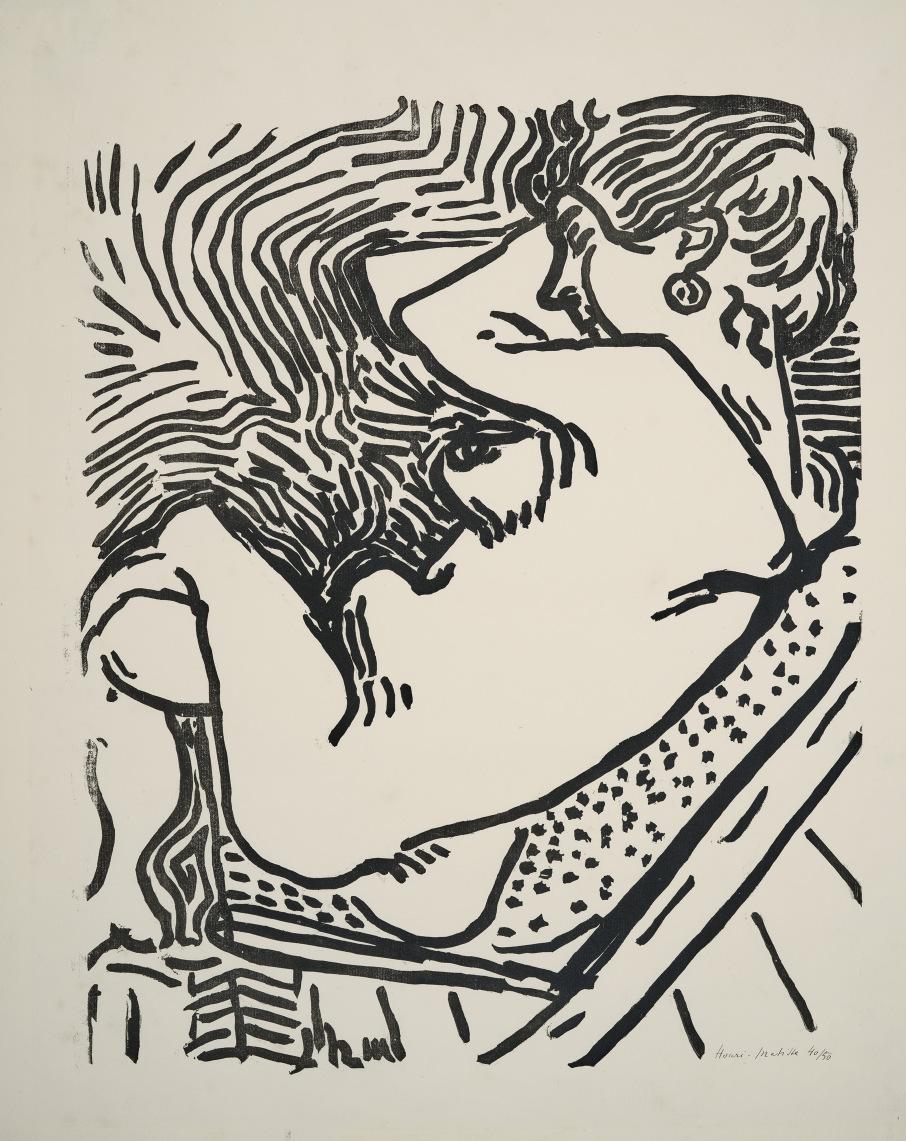
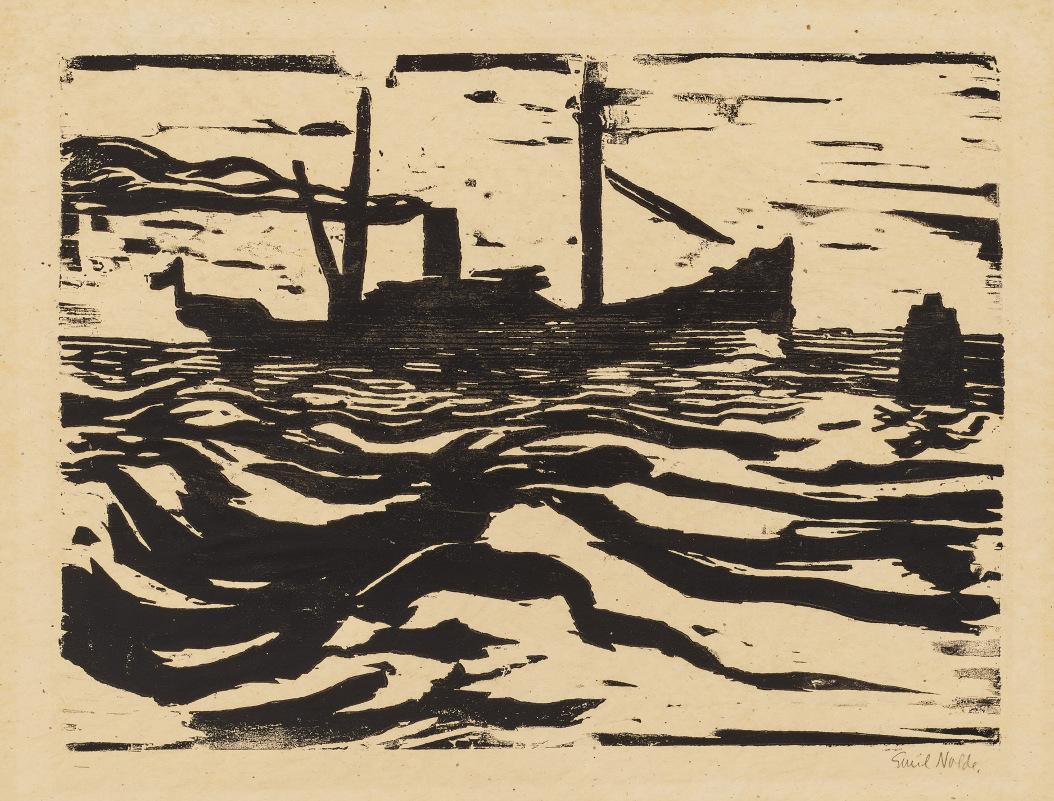
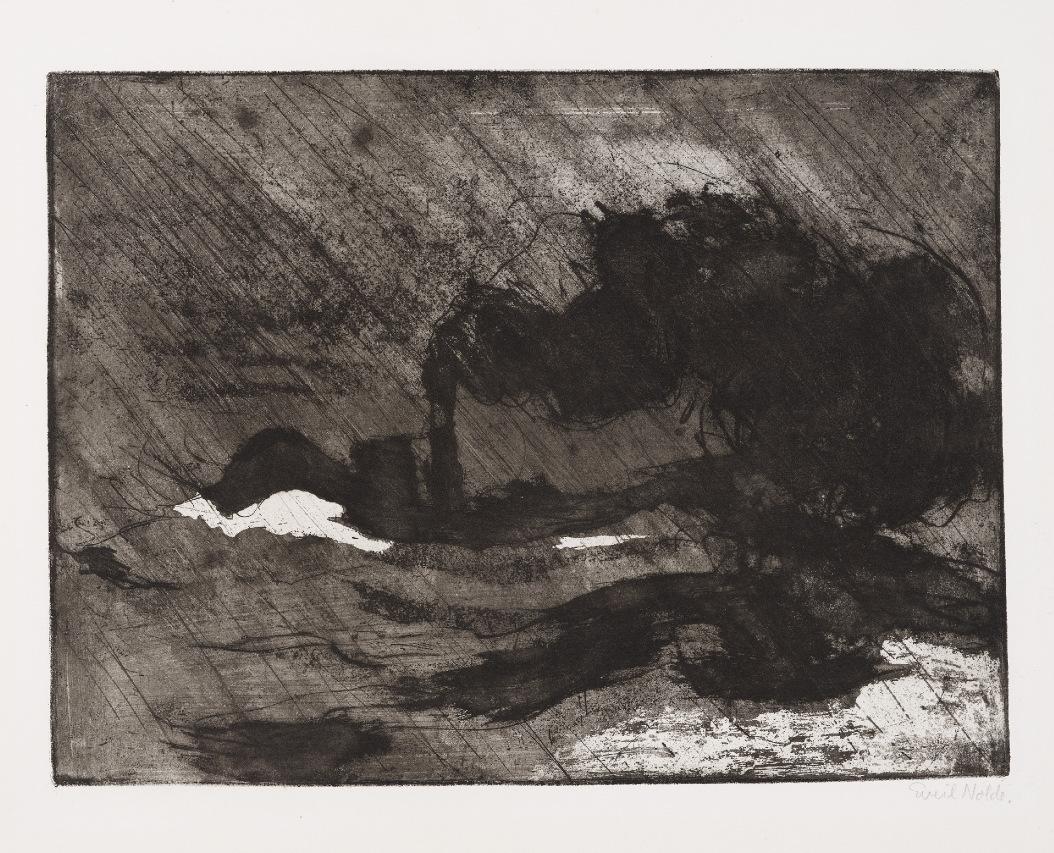
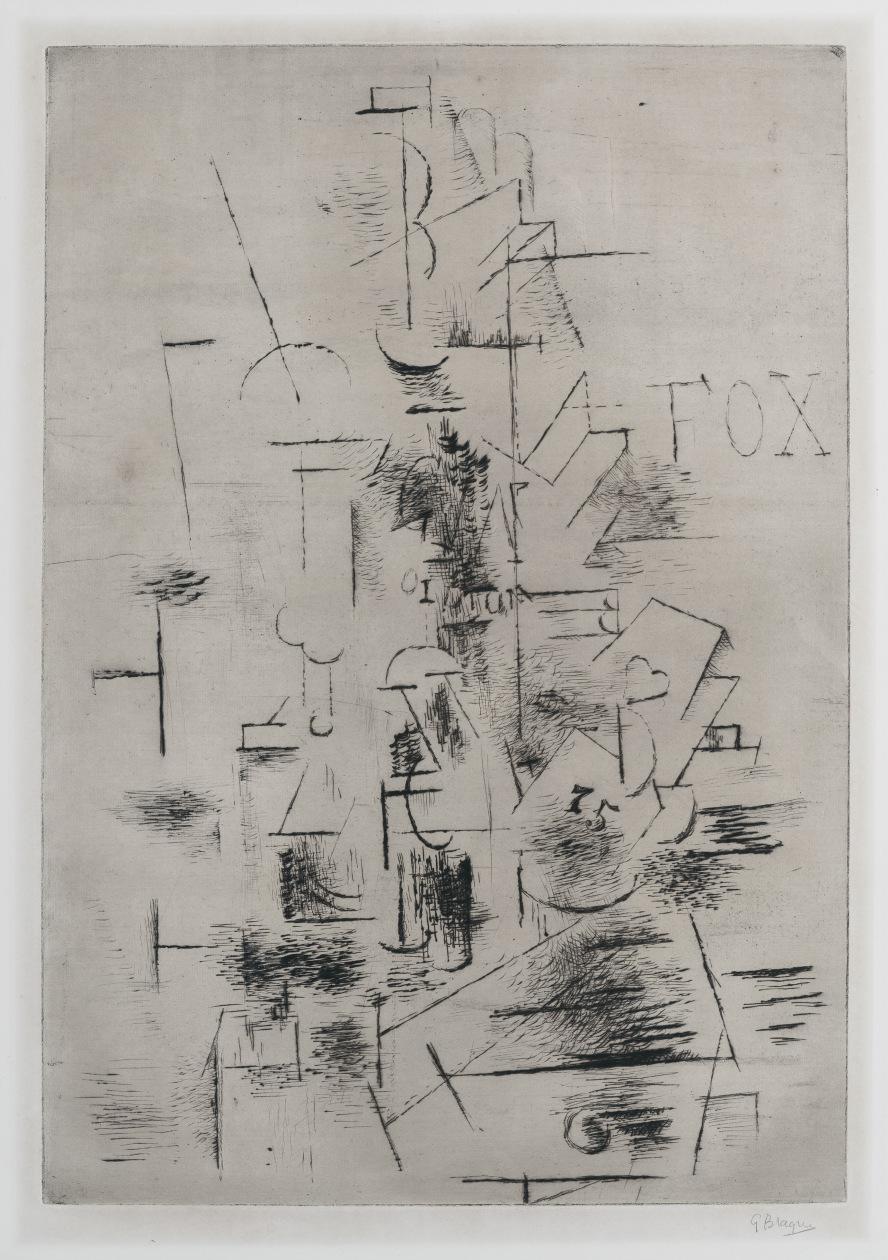
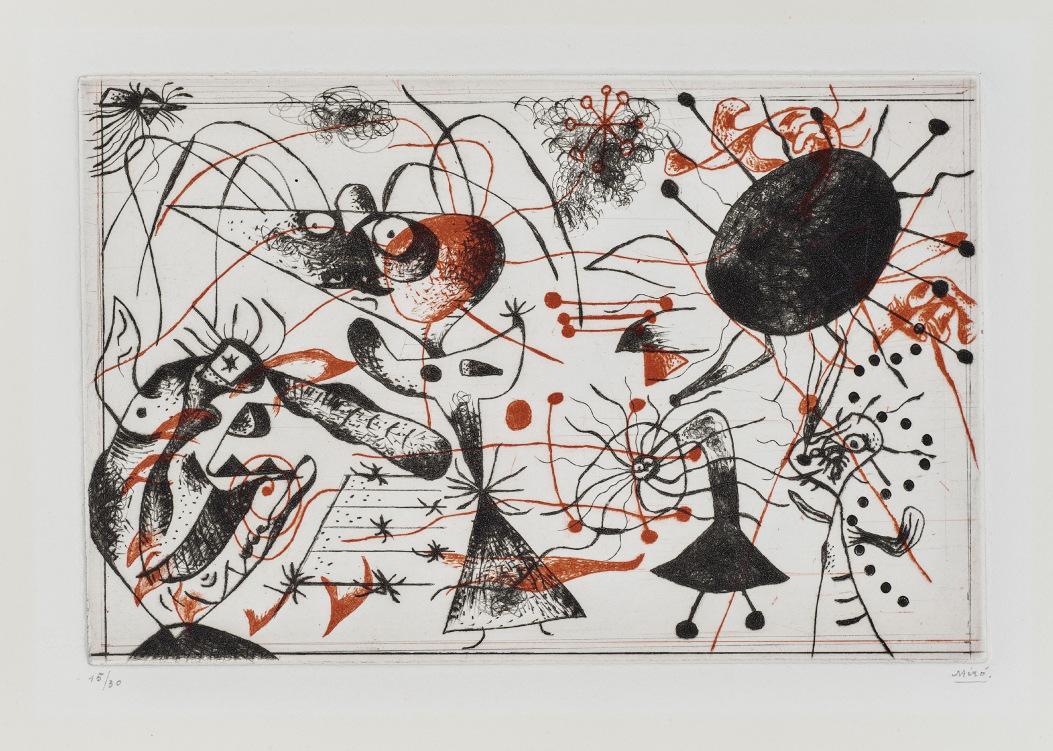
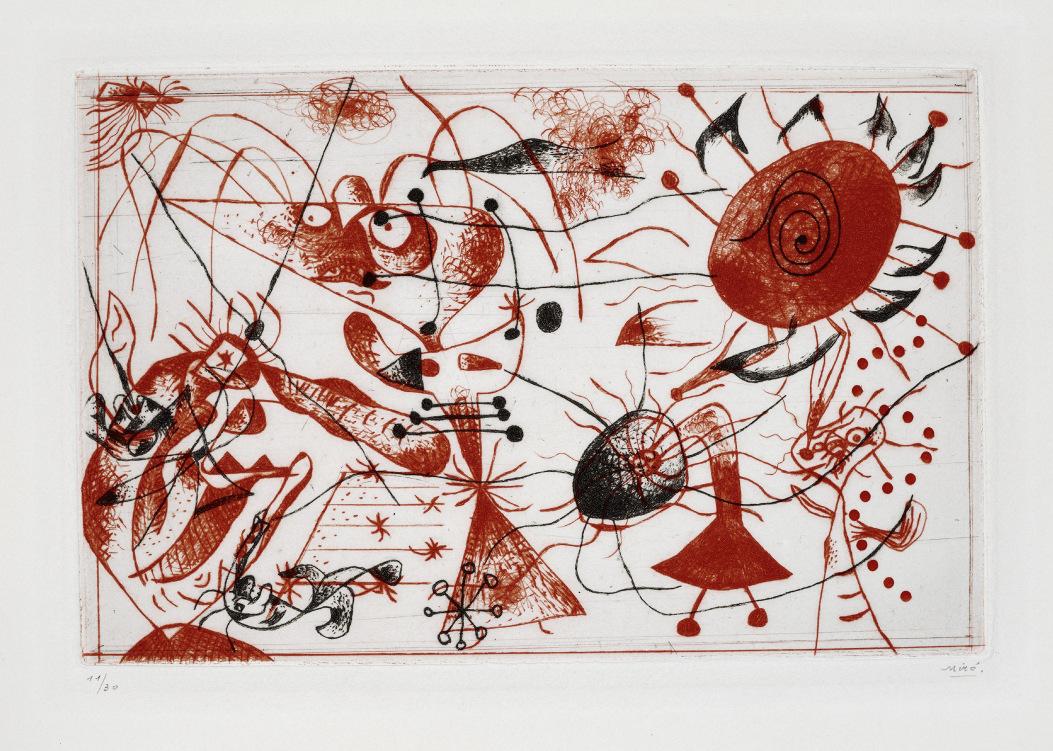
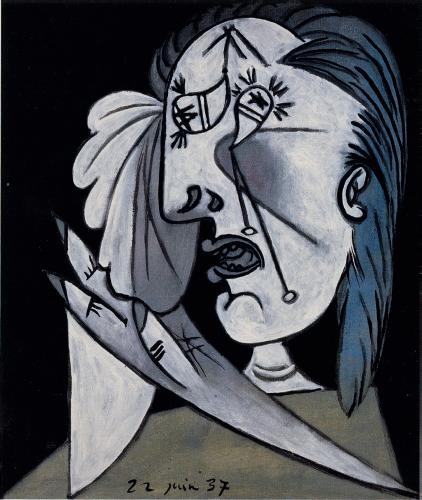
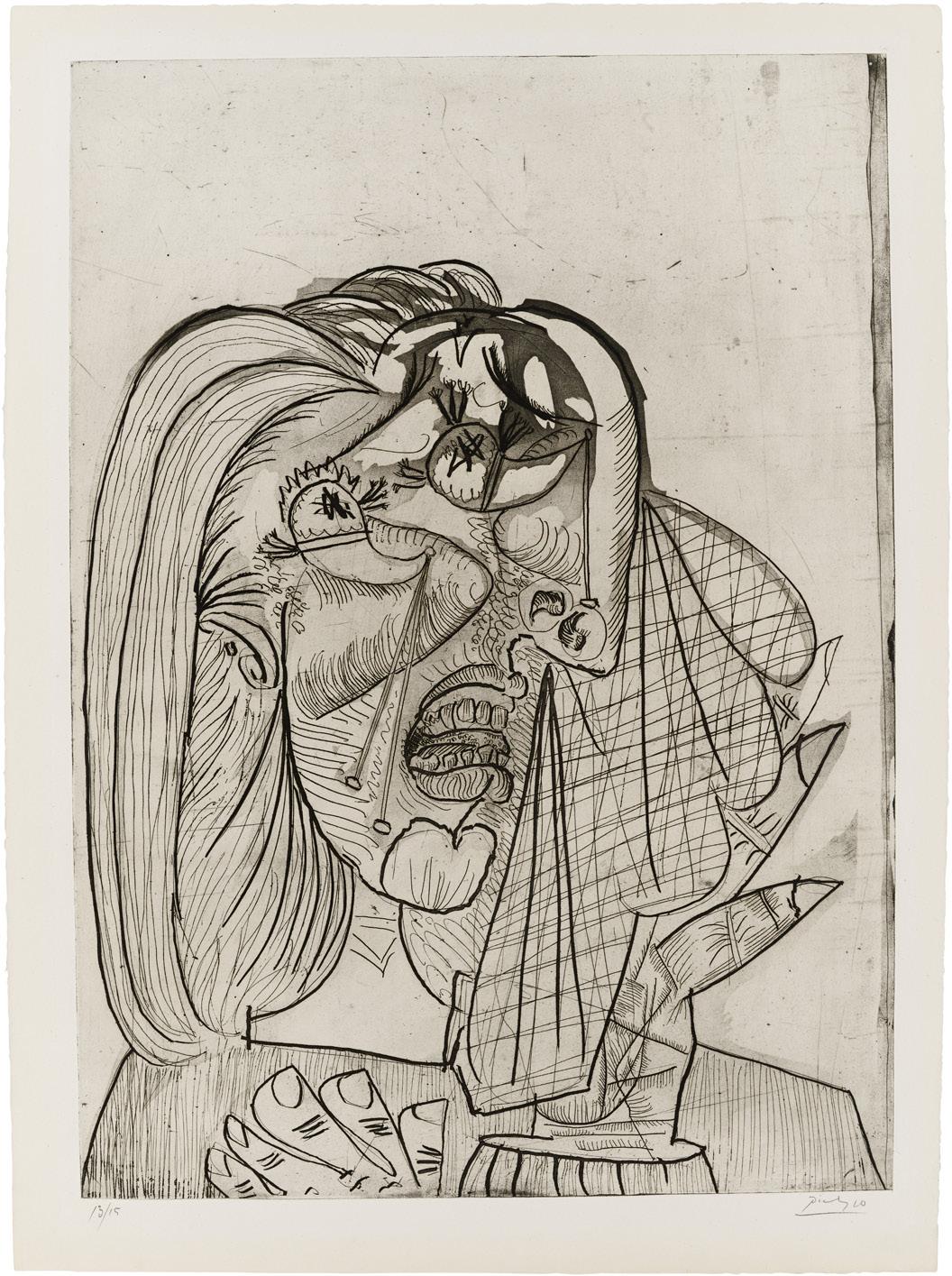
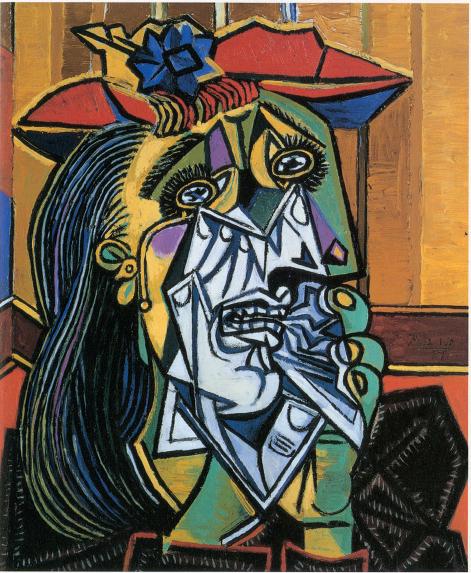
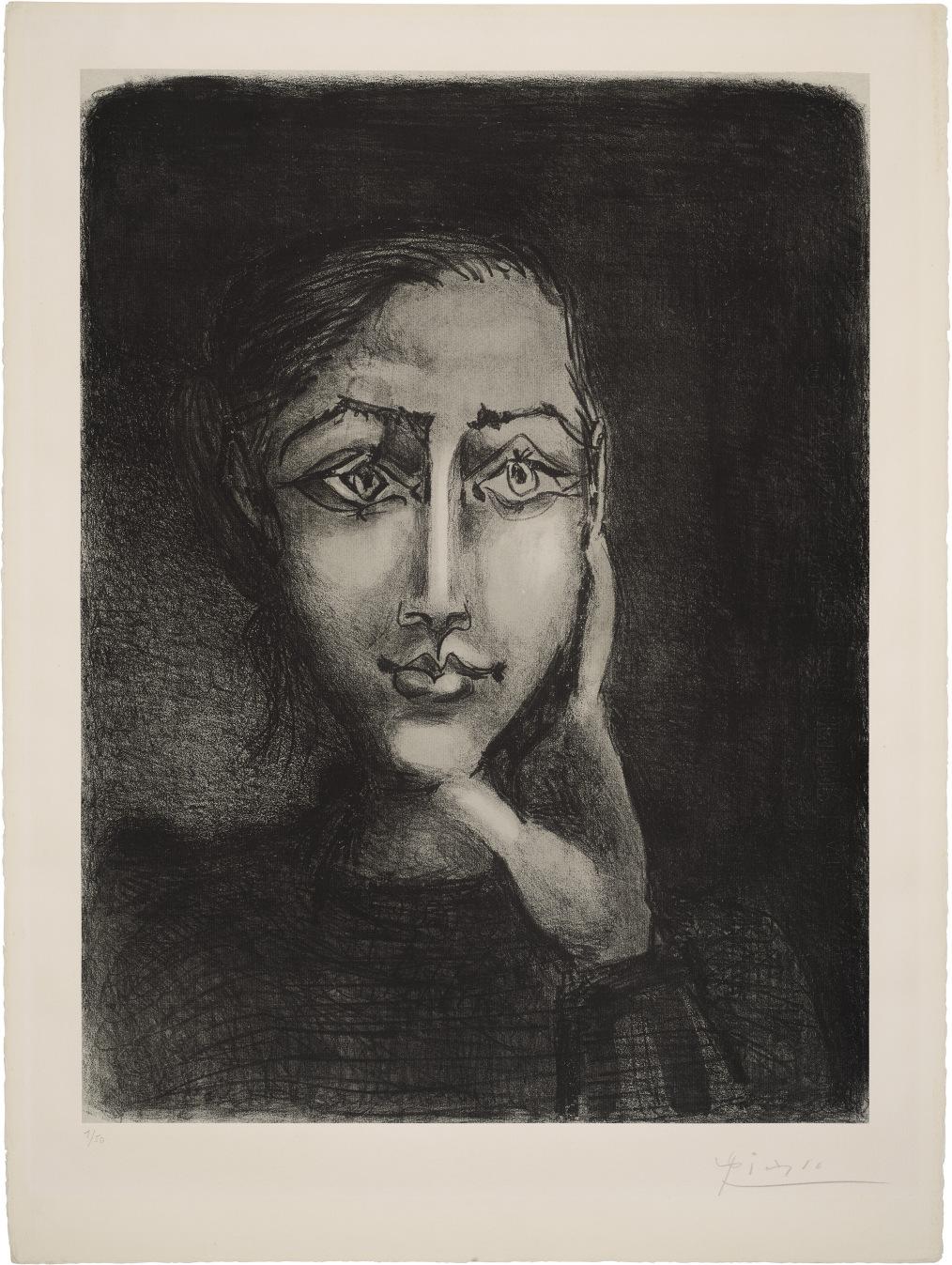
with Goya, Daumier and Manet. The late 19th century in France is particularly well represented, with masterpieces by ToulouseLautrec, Bonnard, Degas and Munch. The focus then moves to Germany in the early 20th century, with Beckmann, Kollwitz, Heckel, Kirchner, Nolde and Schmidt-Rottluff, before returning to France with Braque, Miro, Matisse and Picasso, whose majestic Weeping Woman could claim to be the most important print of the 20th century.
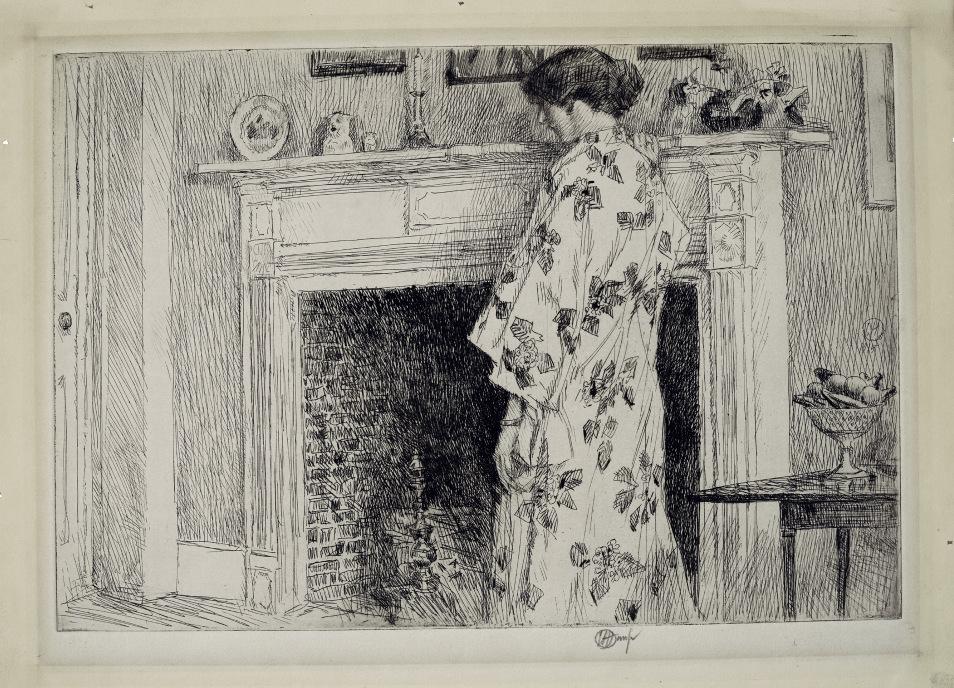
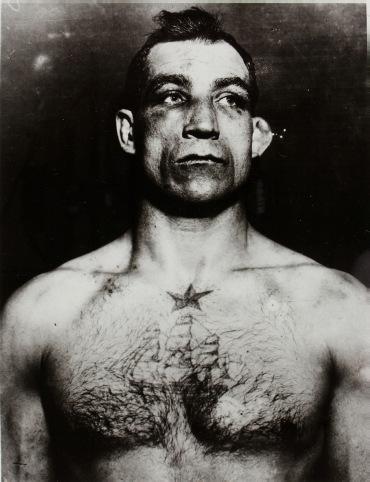
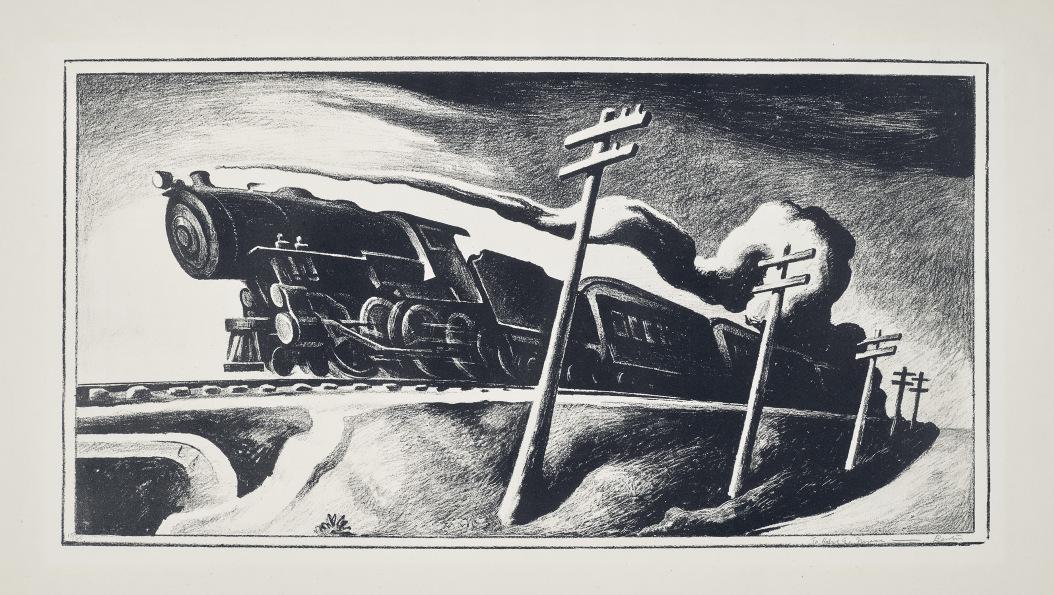
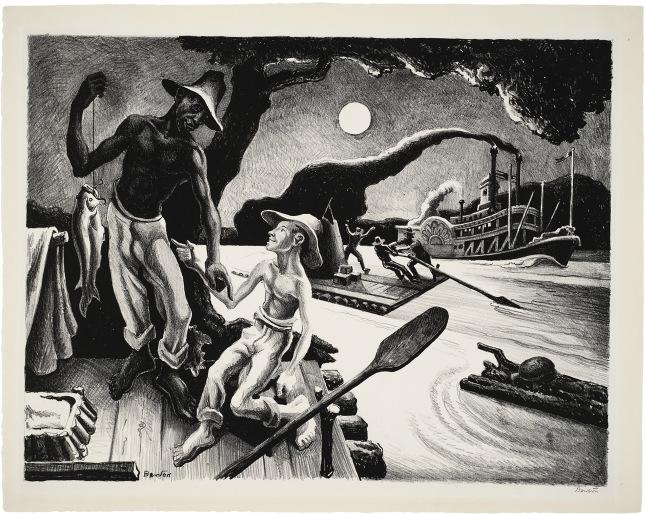
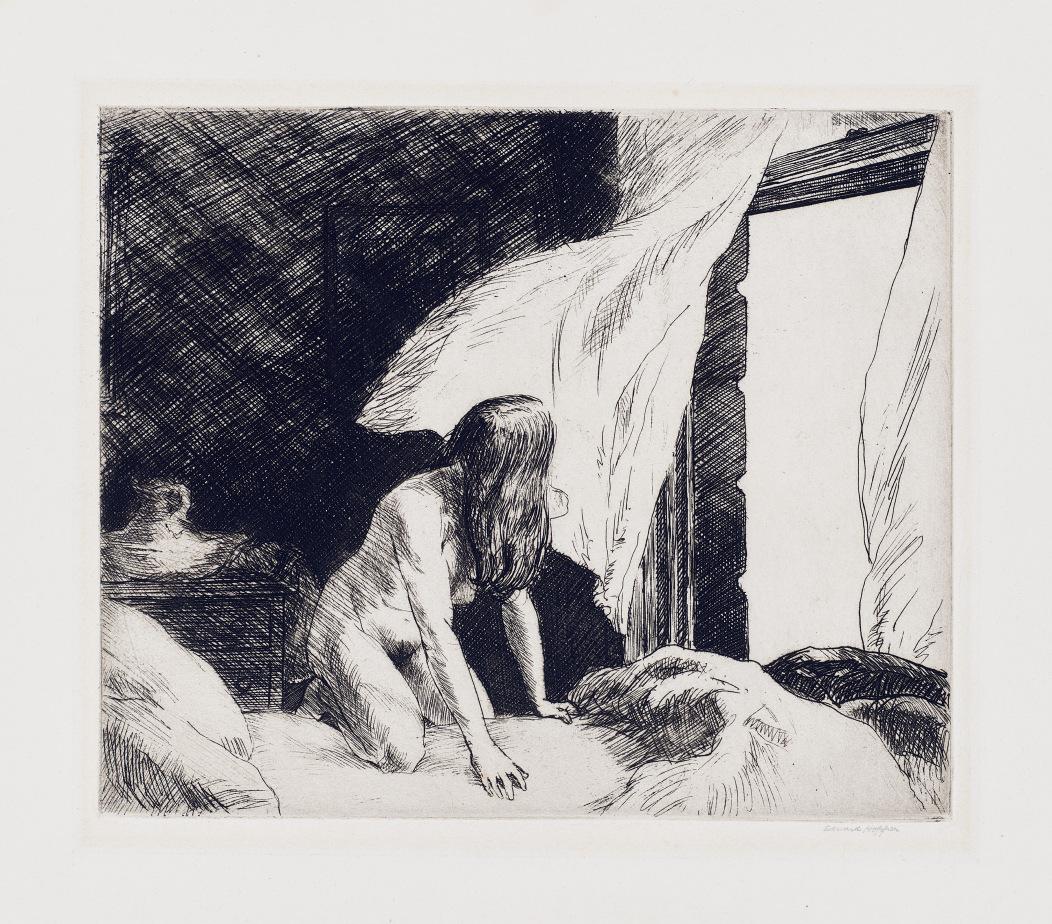
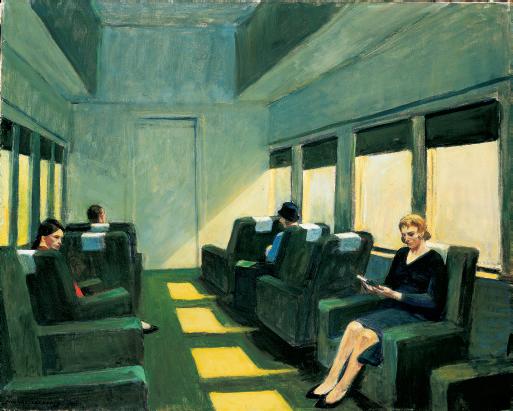
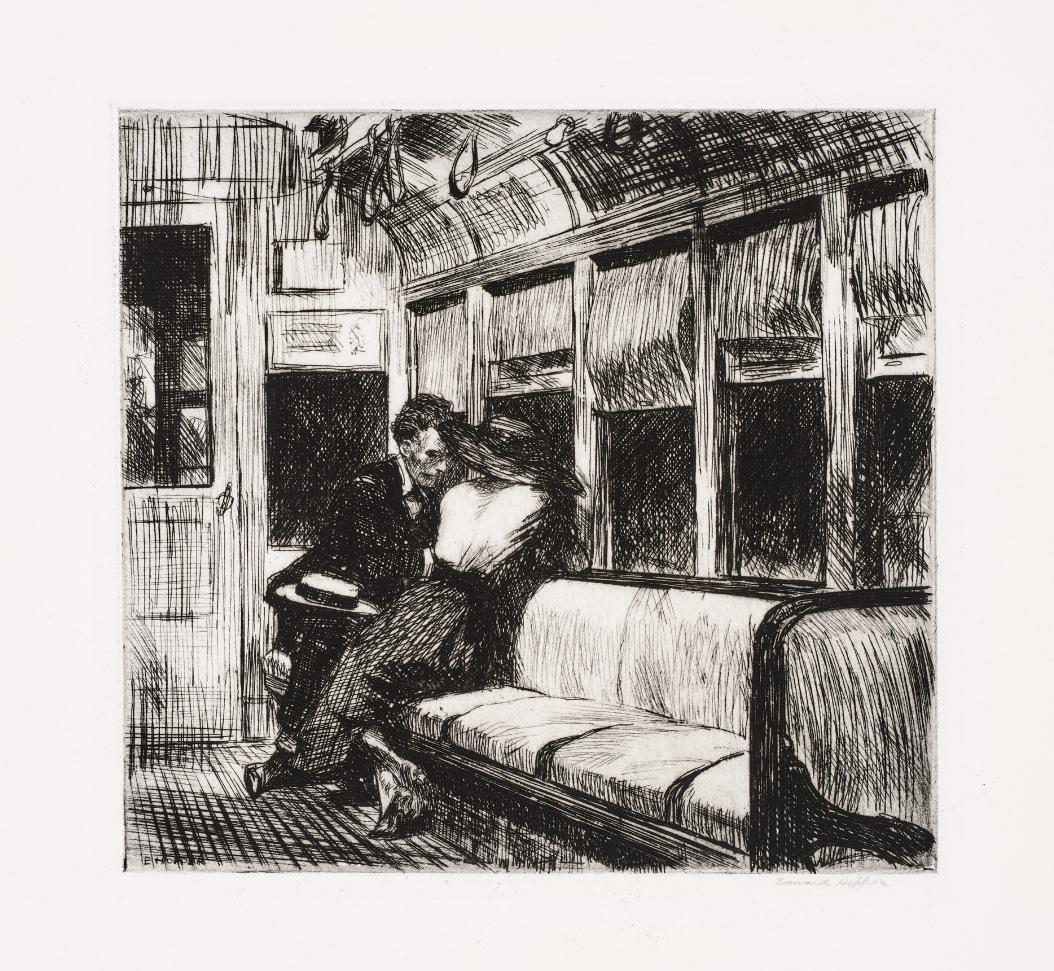
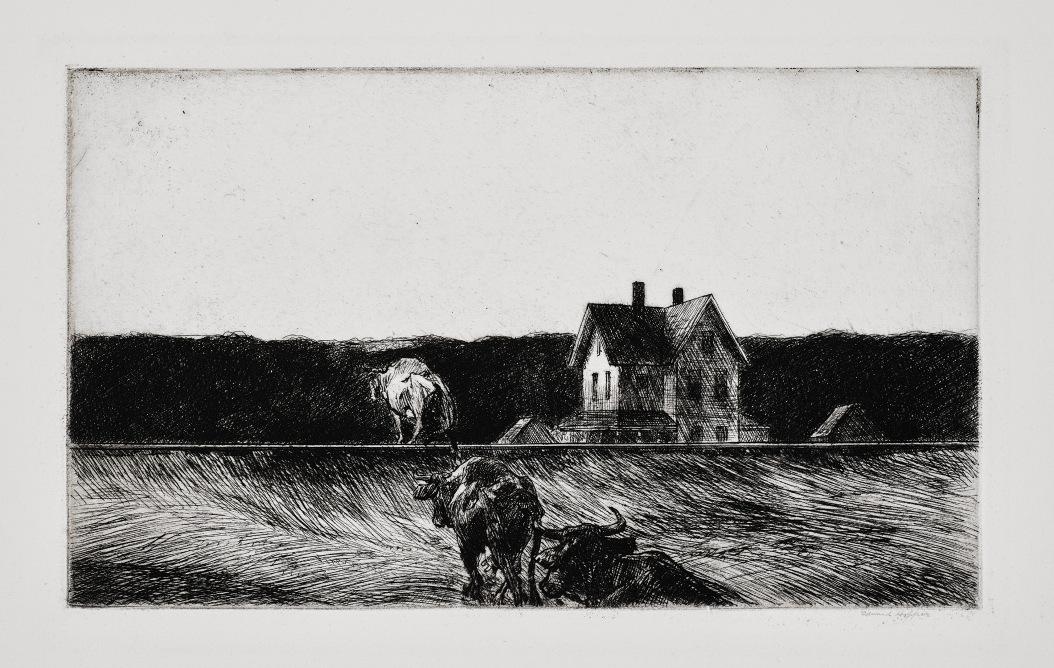
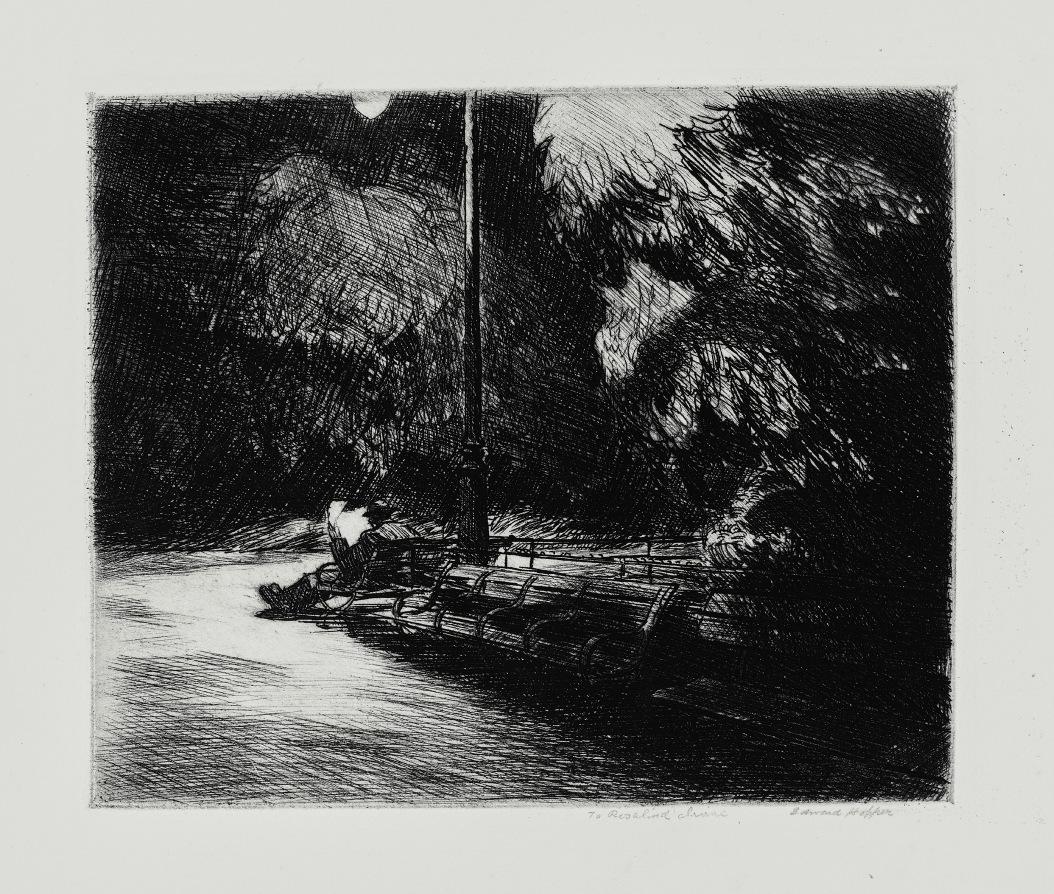
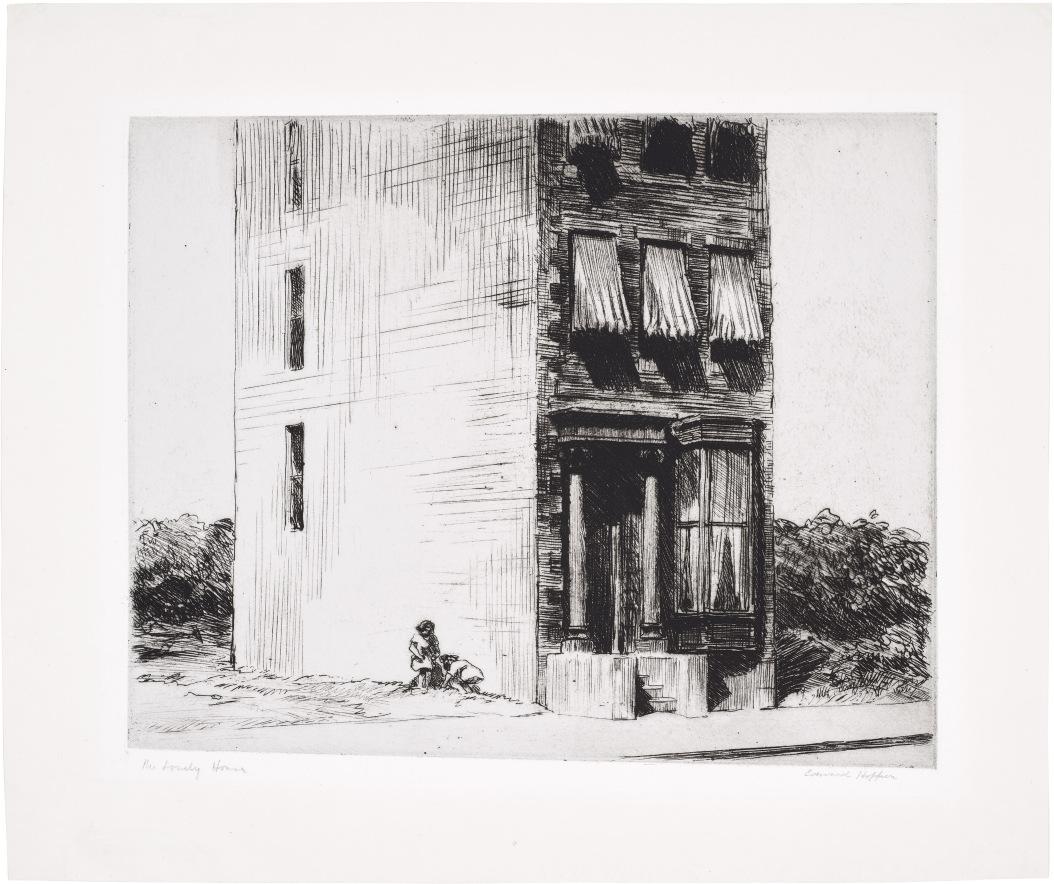
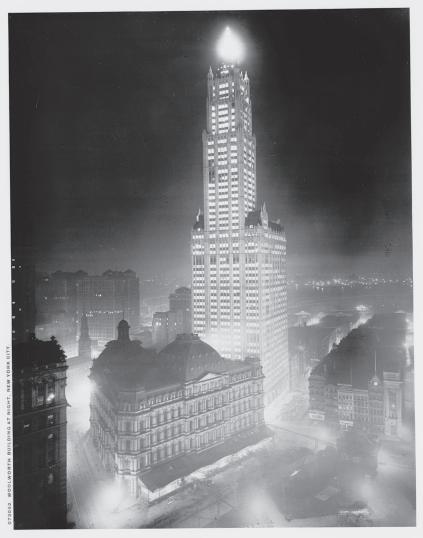
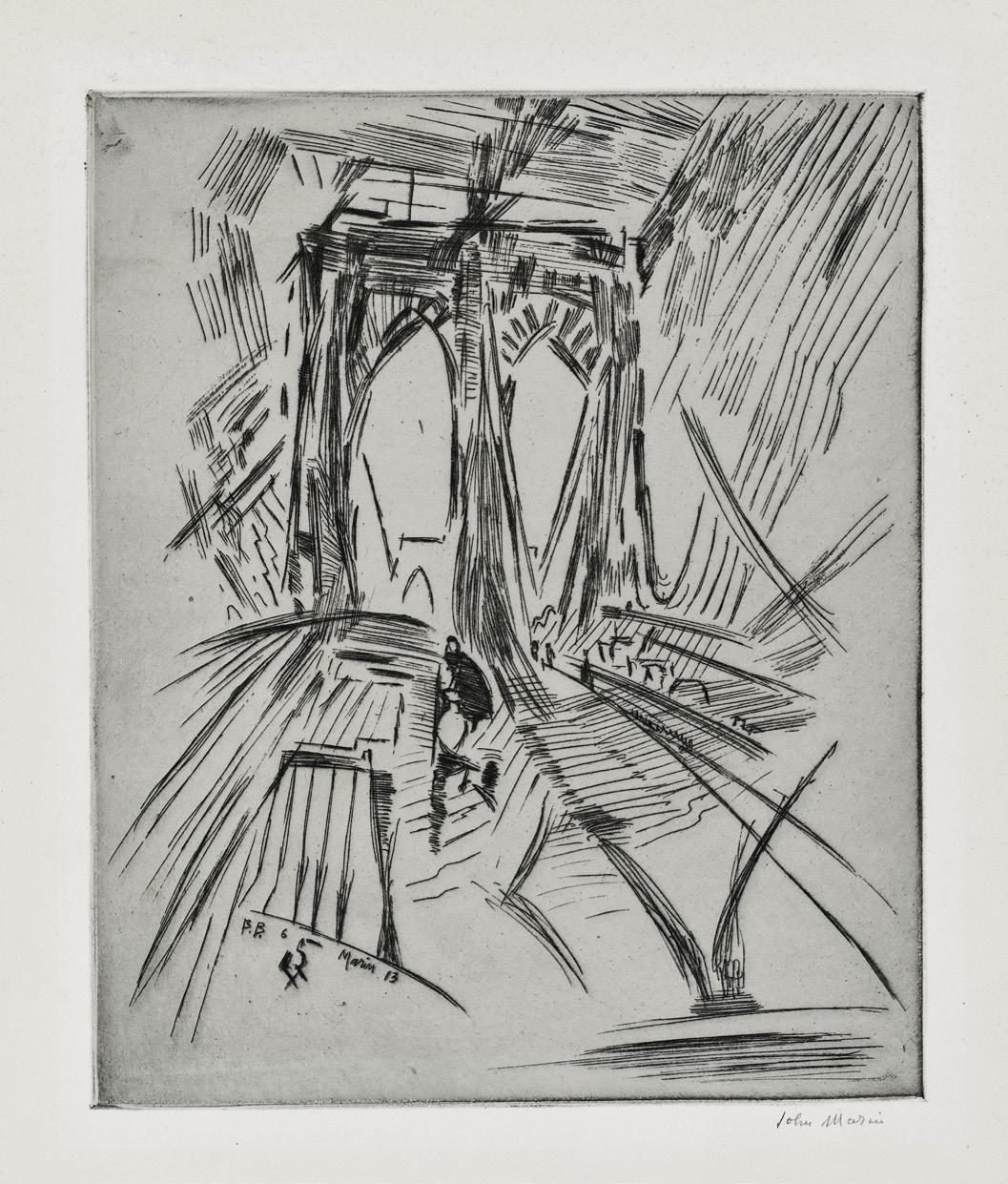
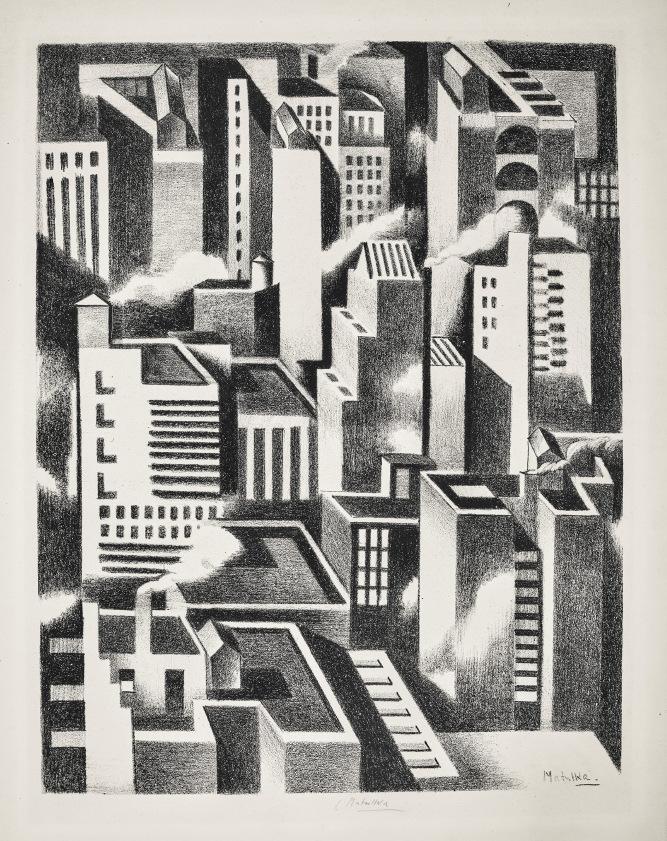
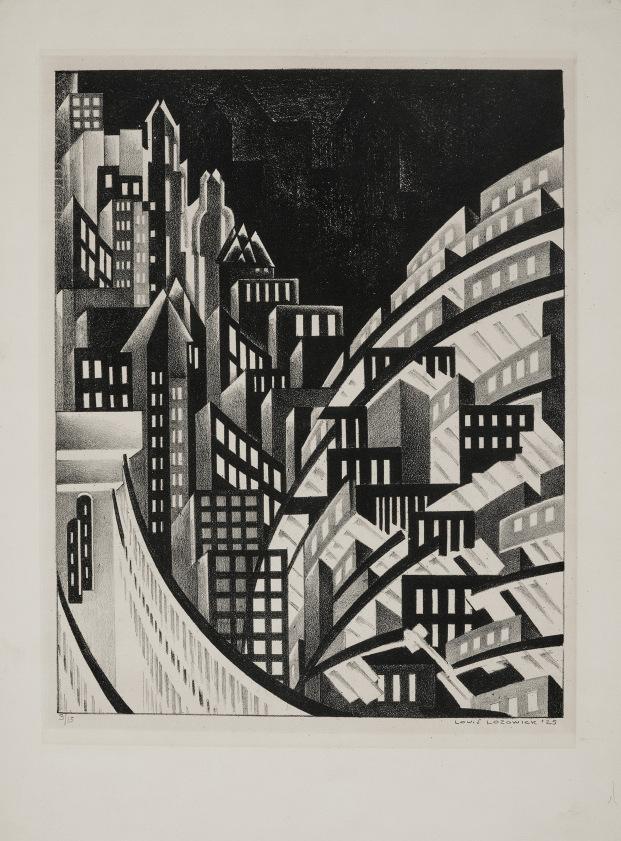
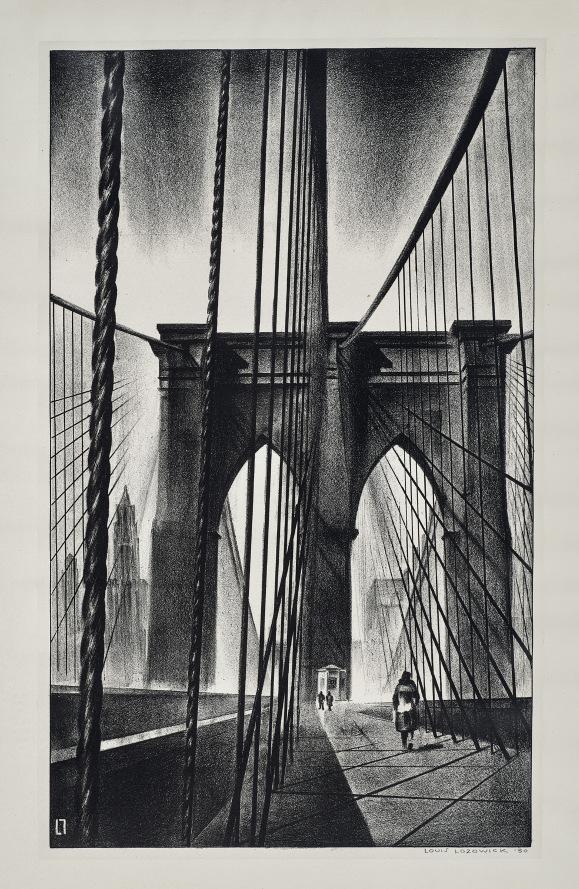
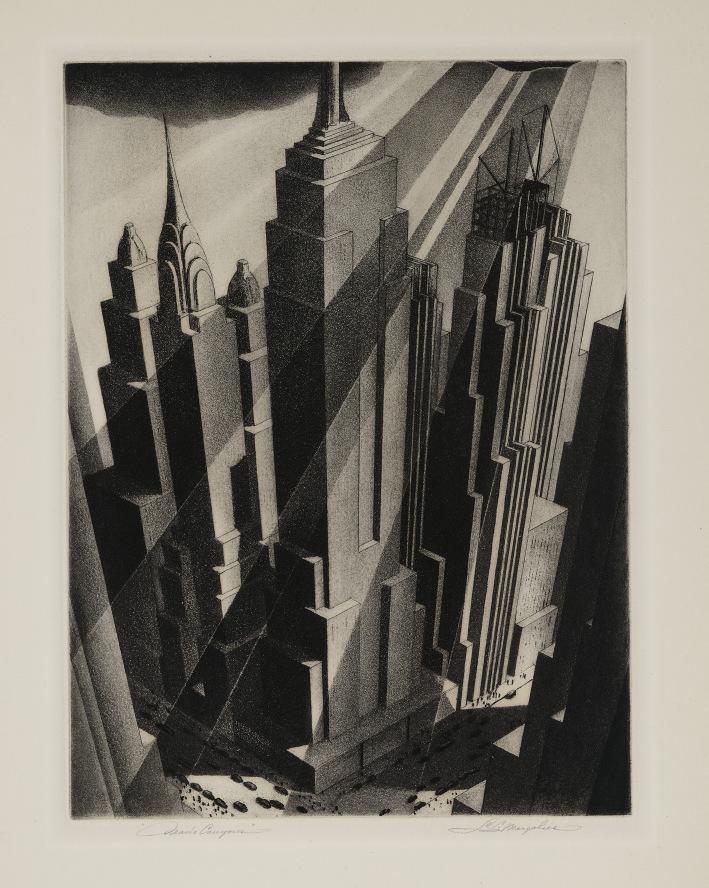
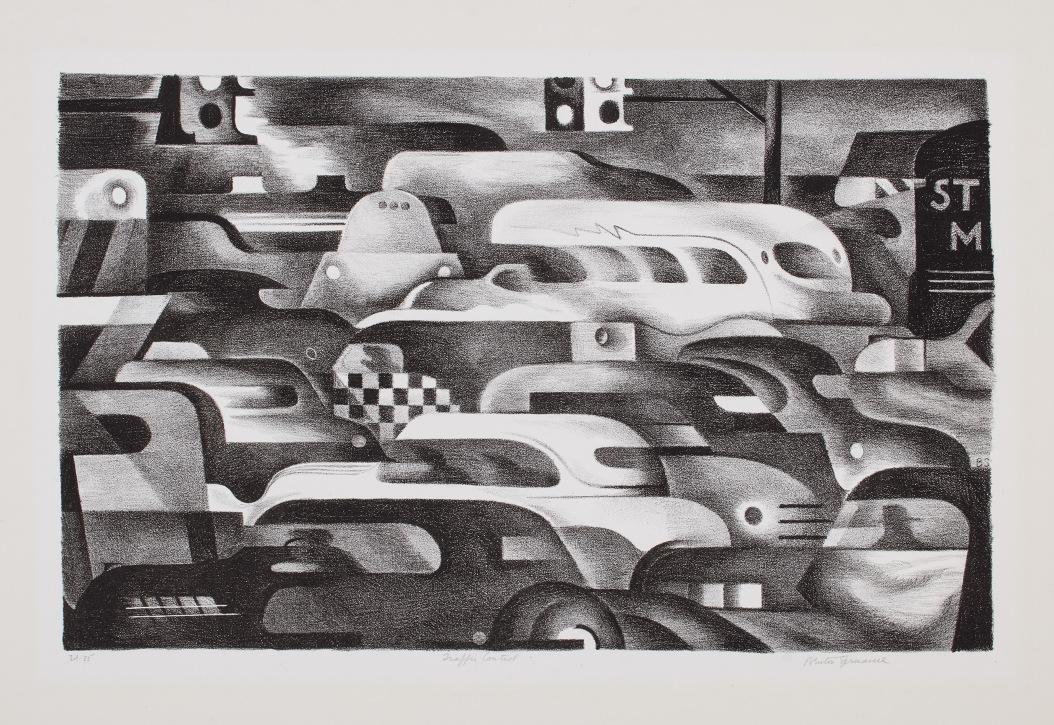
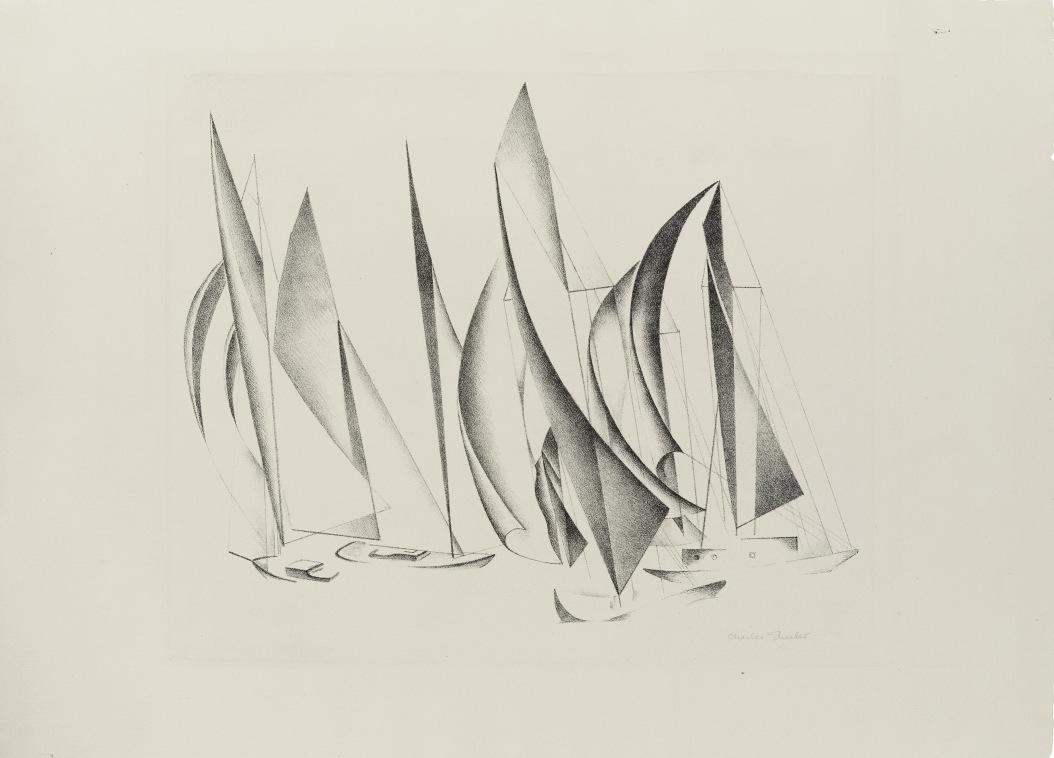
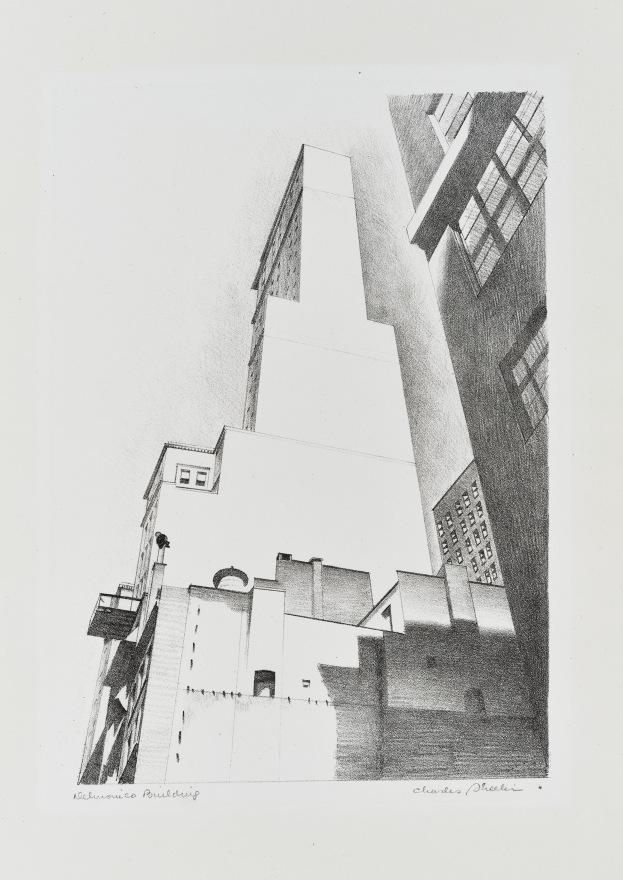
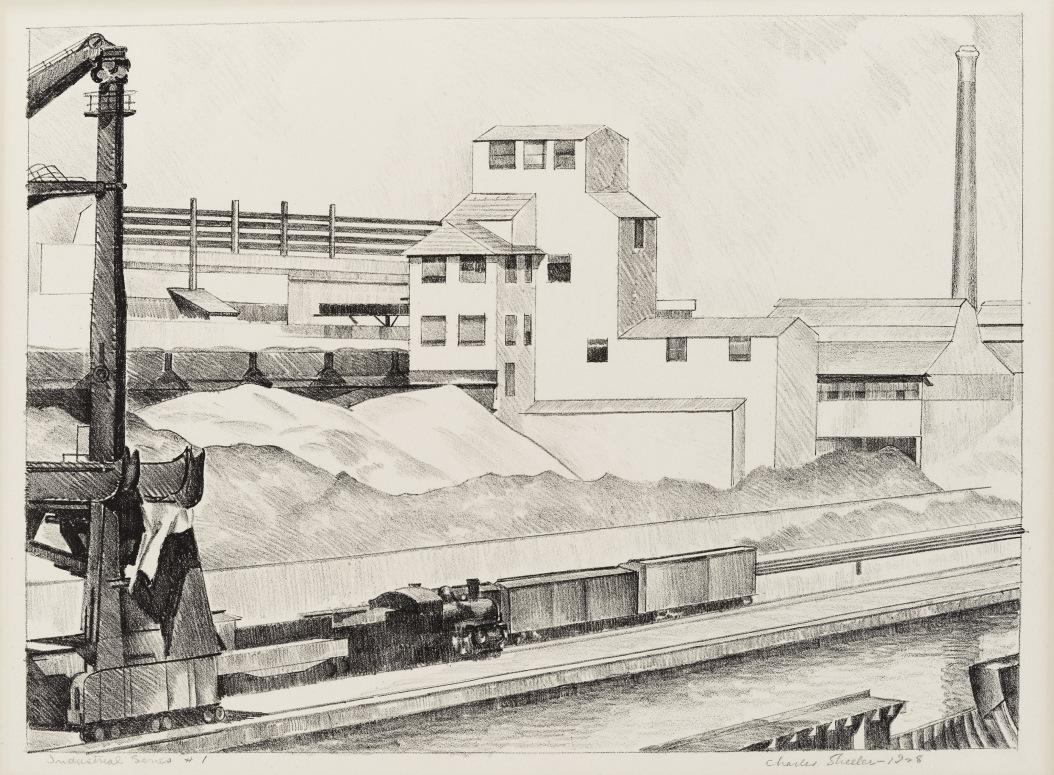
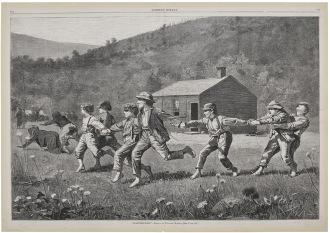
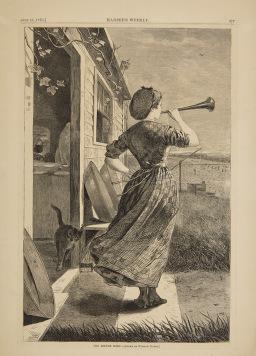
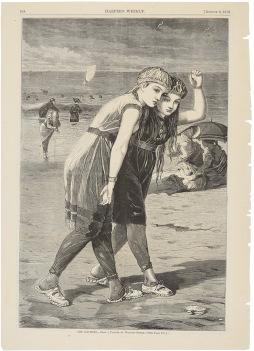
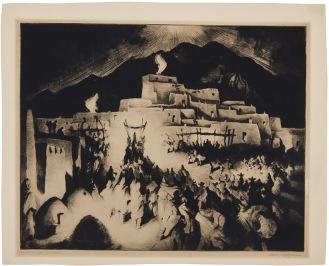
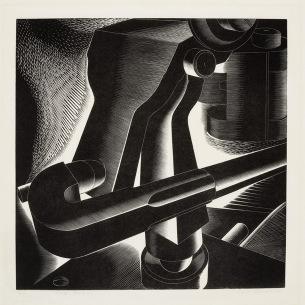
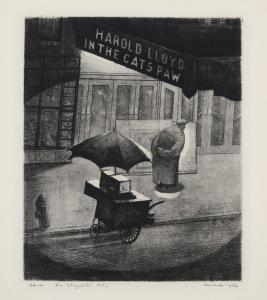
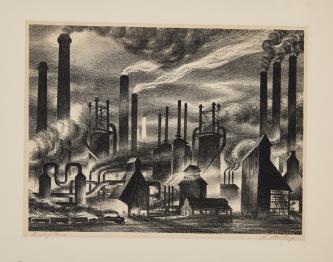
American printmaking is represented by one of the richest and most important surveys in private hands, beginning with Winslow Homer at the end of the 19th century before moving on to the great flowering in the early decades of the 20th, in which the modern city, often New York, was both the setting and the star. George Bellows,John Marin, Howard Cook, Martin Lewis, Louis Lozowick, Benton Spruance and no fewer than five major works by Edward Hopper show artistic reactions to a tumultuous time—as America became the industrial and cultural superpower of the new century. Particularly beautiful are the five prints that represent the complete lithographic work of the American Modernist Charles Sheeler, possibly the most comprehensive group outside major museums.
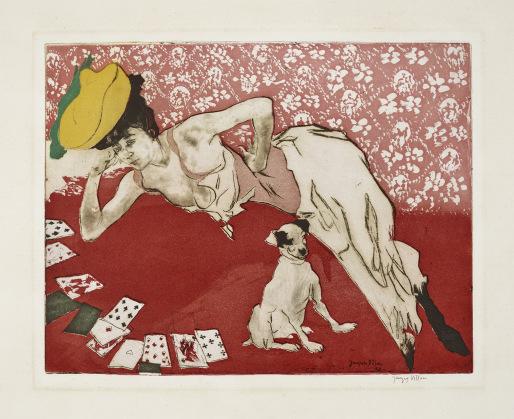
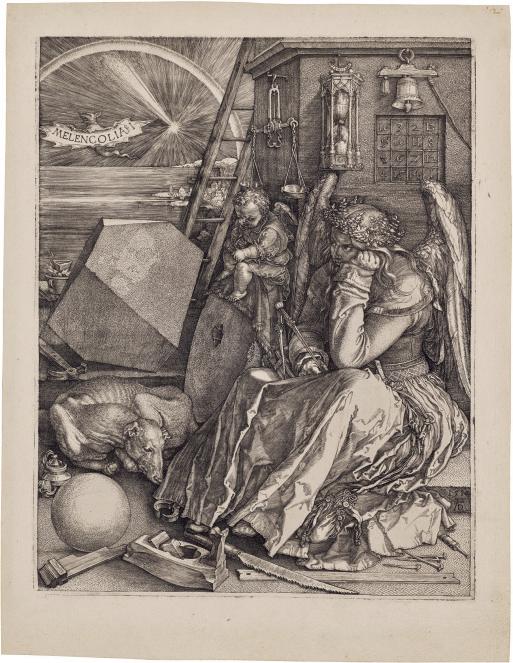
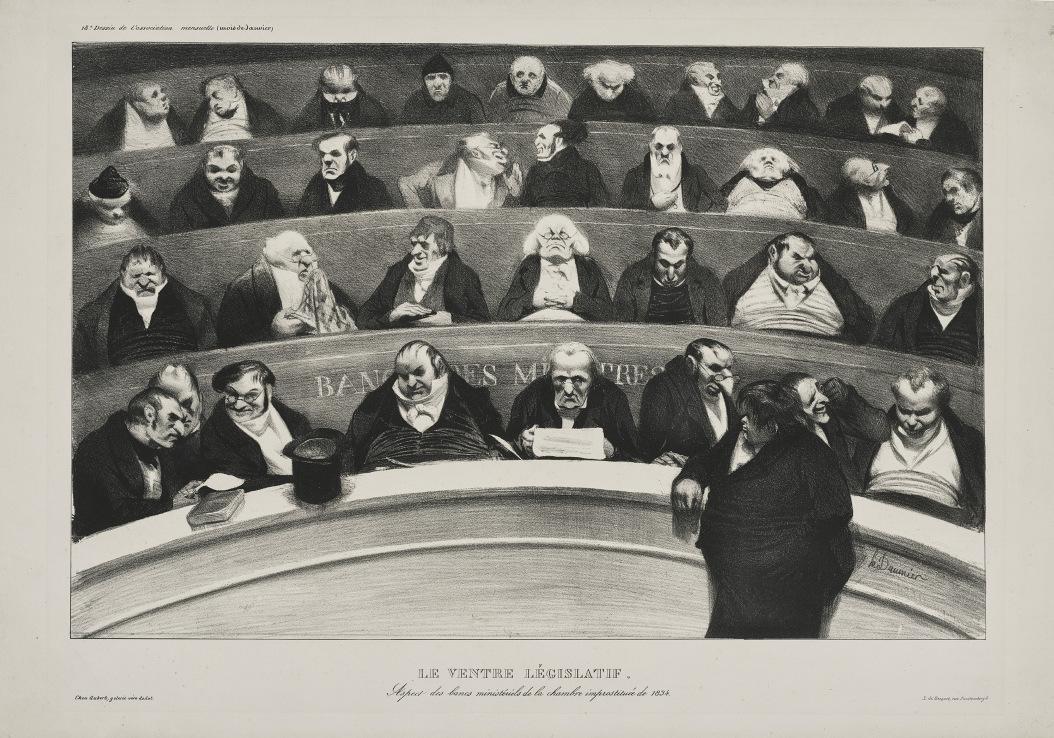
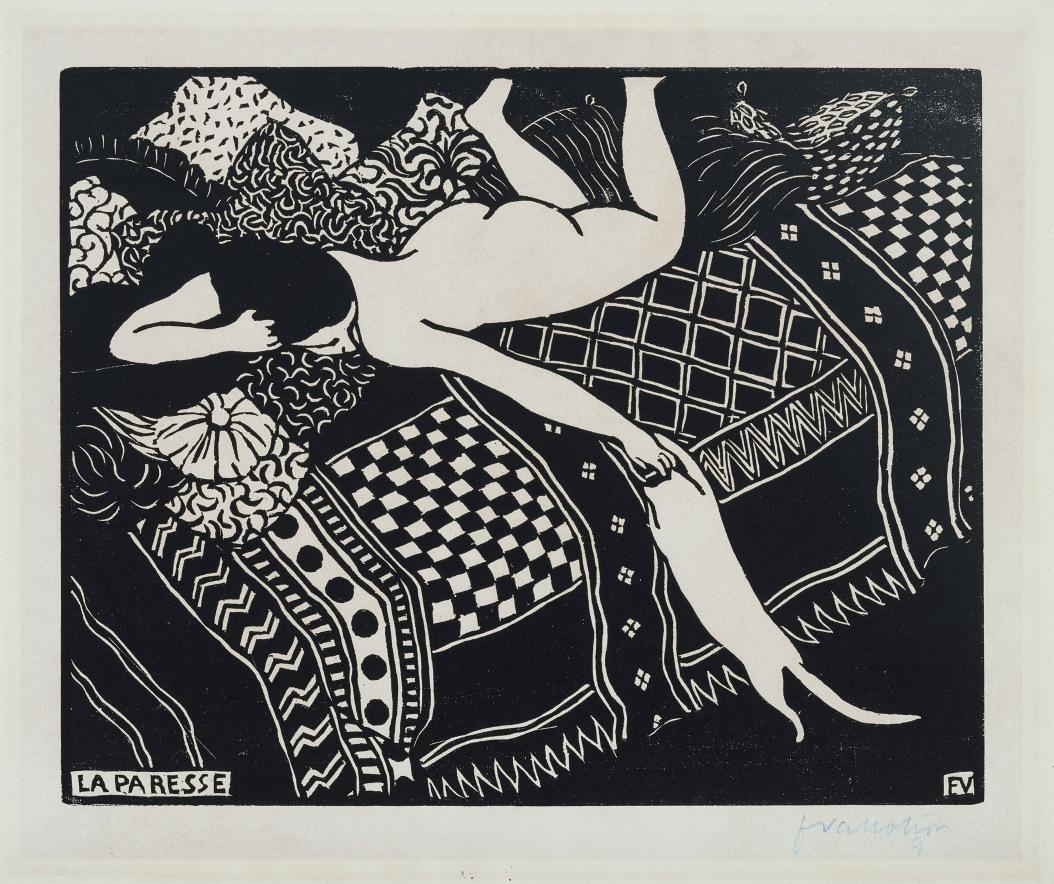
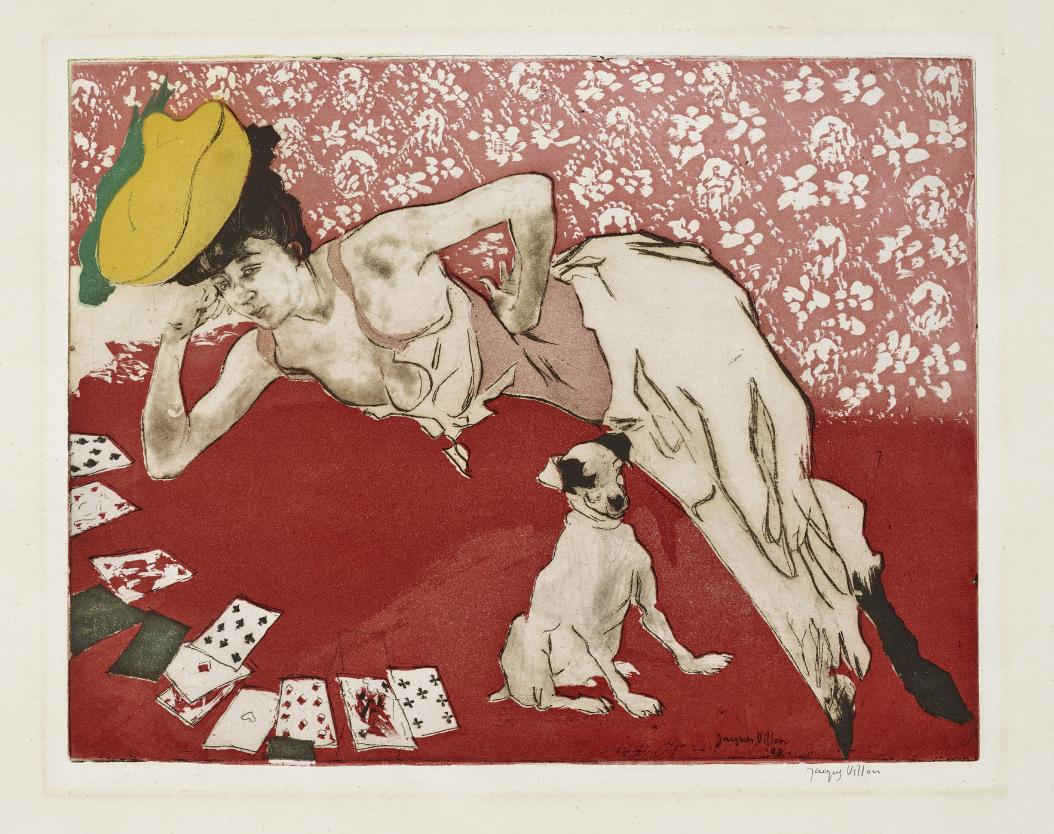
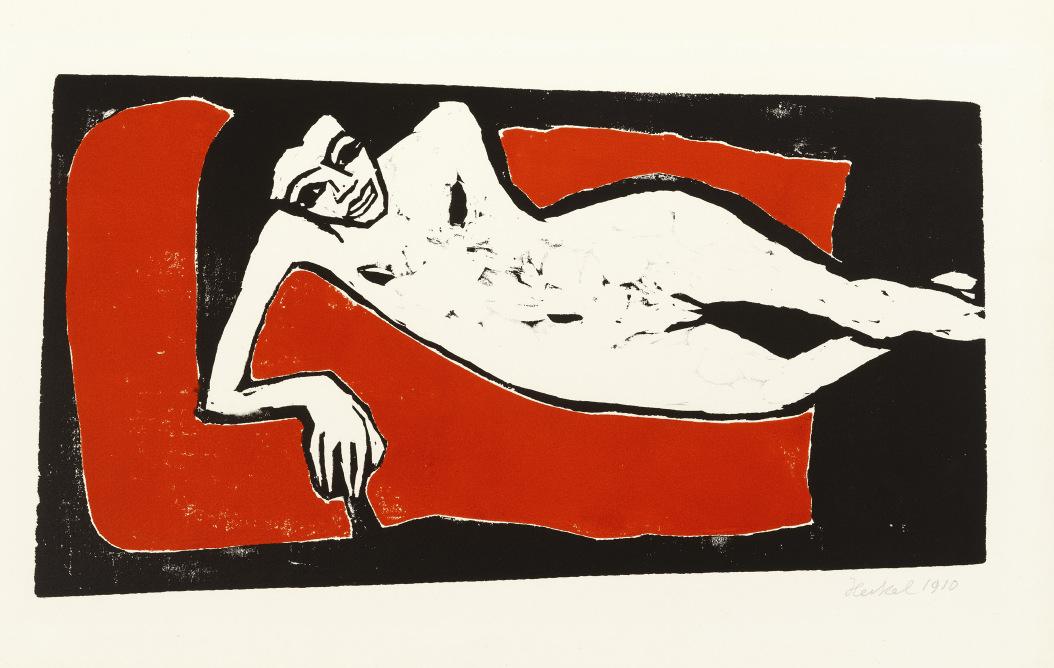
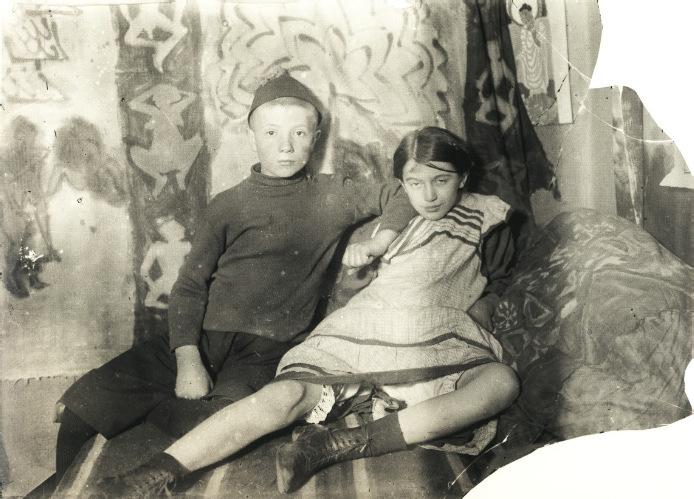
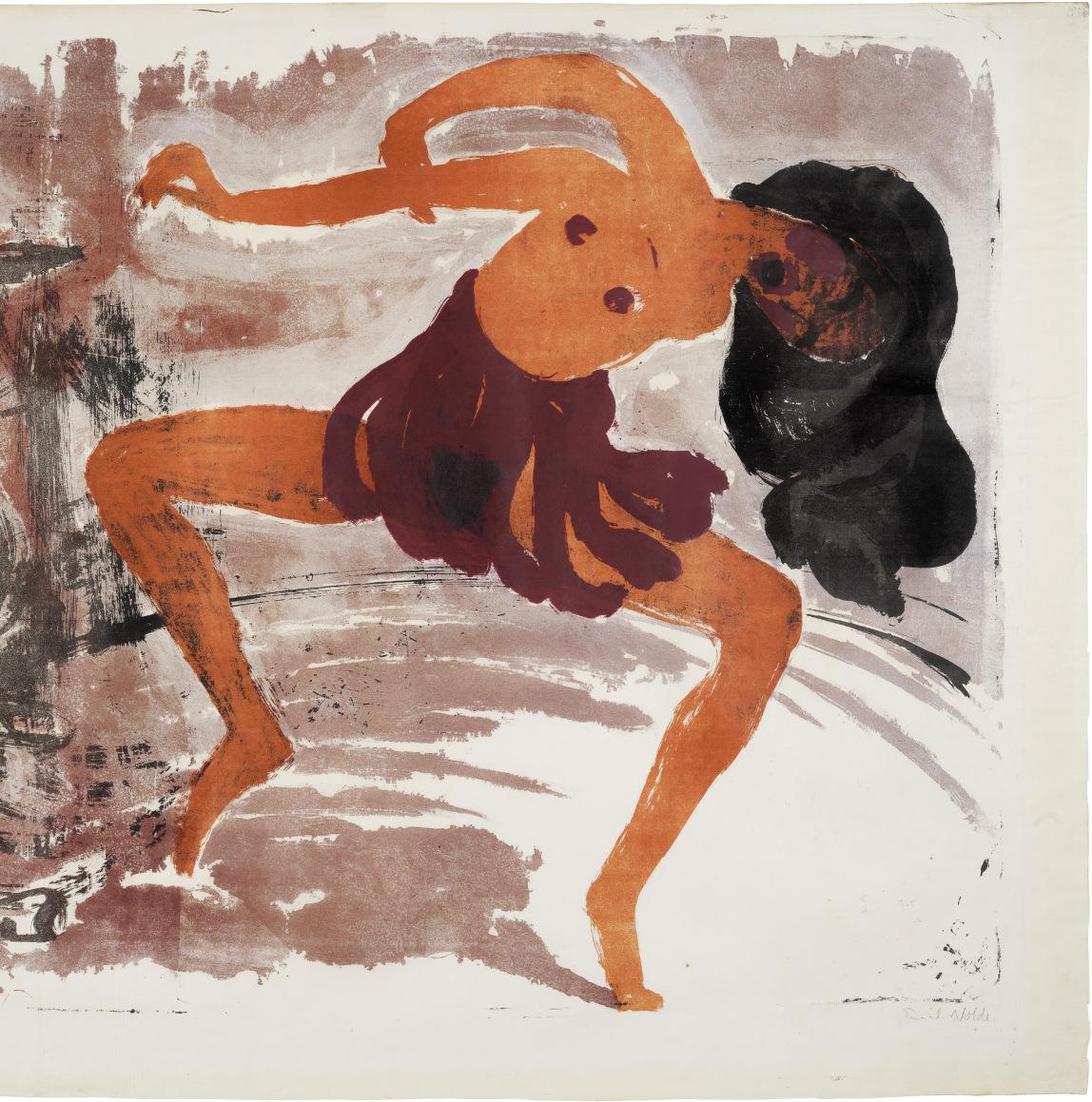
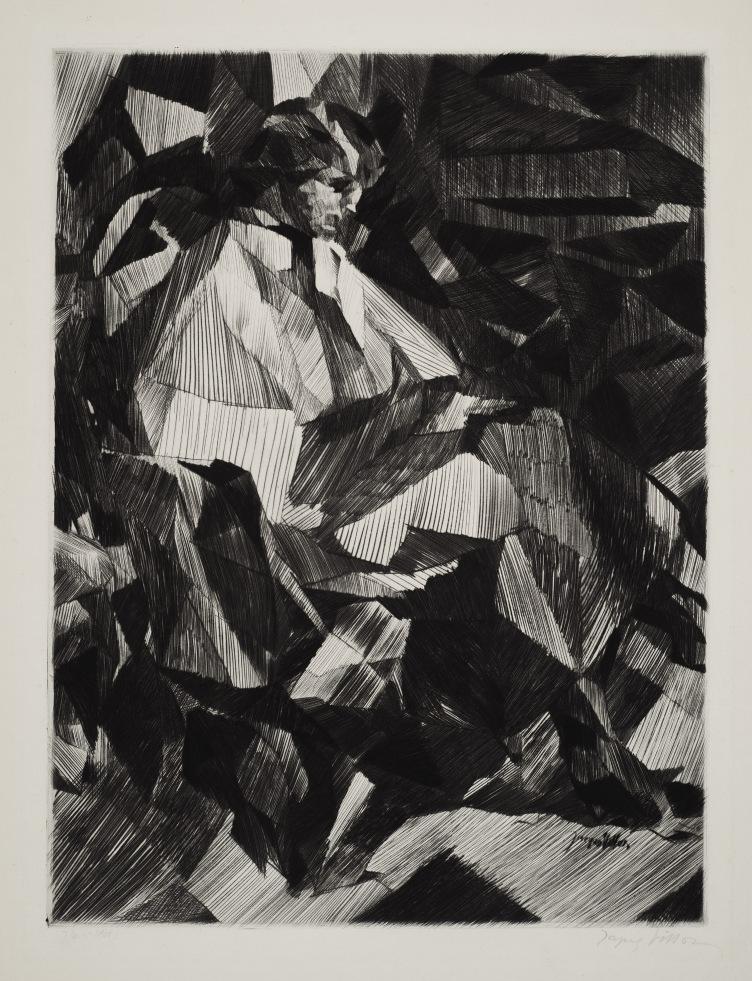
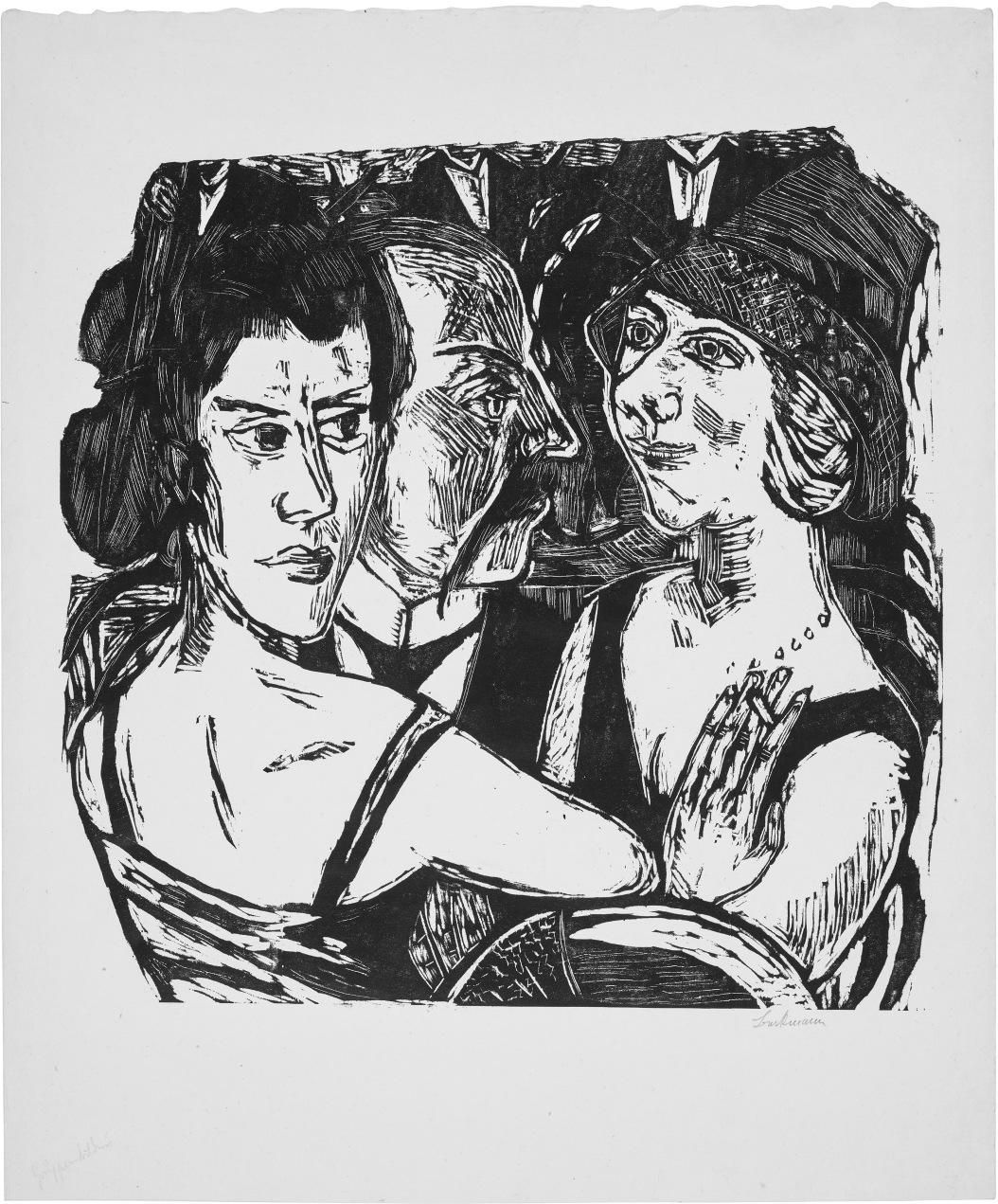
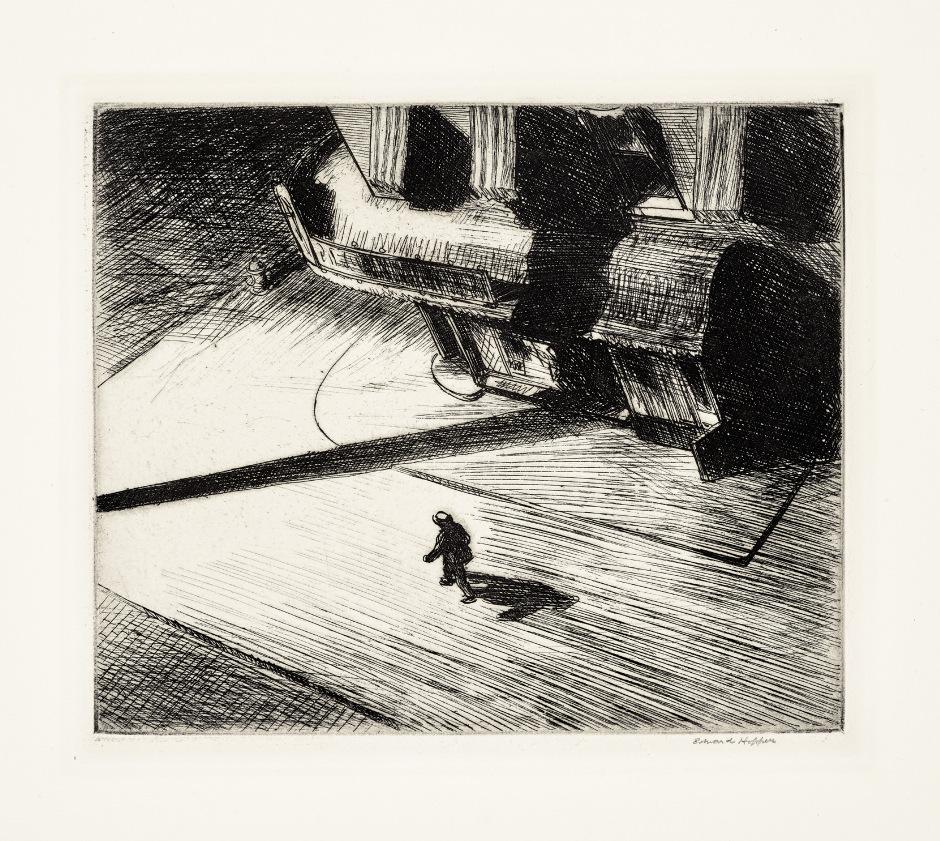
A second notable aspect of the collection is not just the breadth, but the way in which so many of the artists are represented by their most highly prized images. Durer’s Melencholia I, Rembrandt’s Three Crosses, Daumier’s The Legislative Belly, Manet’s The Races, Whistler’s Nocturne, Jacques Villon’s most famous etching, the Card Player, and Vallotton’s greatest woodcut, Paresse, Beckmann’s greatest etching, Self Portrait with Bowler Hat, and woodcut, Group Portrait, Edenbar, Heckel’s Lying Franzi, Nolde’s Dancing Girl, Hopper’s Night on the El Train, and of course, The Crying Woman. The list is breathtaking. Few other collections contain so many highlights of this stature, and very few provide, as the Schwartz collection does, the perfect context in which they can rightly shine.
Whilst Marianne focused primarily on the quality of the prints they acquired, like all great print collectors she paid close attention to provenance. As a result, the following pages feature illustrious names such as Dr. Otto Schäfer, Philip Hofer, Samuel Cortauld, and Charles C. Cunningham. It is appropriate, therefore, that the Schwartz name will be added to the history of these works. Christie’s is honored to have been chosen by Marc, Kurt and Ruthanne to present the fruits of their parents’ dedication to the market. It is their hope, and ours, that they will bring their new owners as much joy as they did Alan and Marianne.
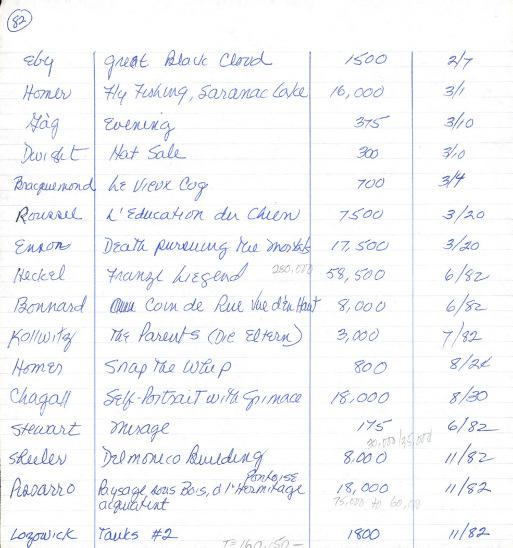
Like so many print collectors, Marianne Schwartz kept careful records of every acquisition to the collection. These handwritten lists kept by the family, tell the year of every purchase from the first in 1956 to the very last in 2014.
The Schwartz files contain dozens of loan requests and letters of thanks from curators throughout the USA. Prints from the collection graced exhibitions nationwide.
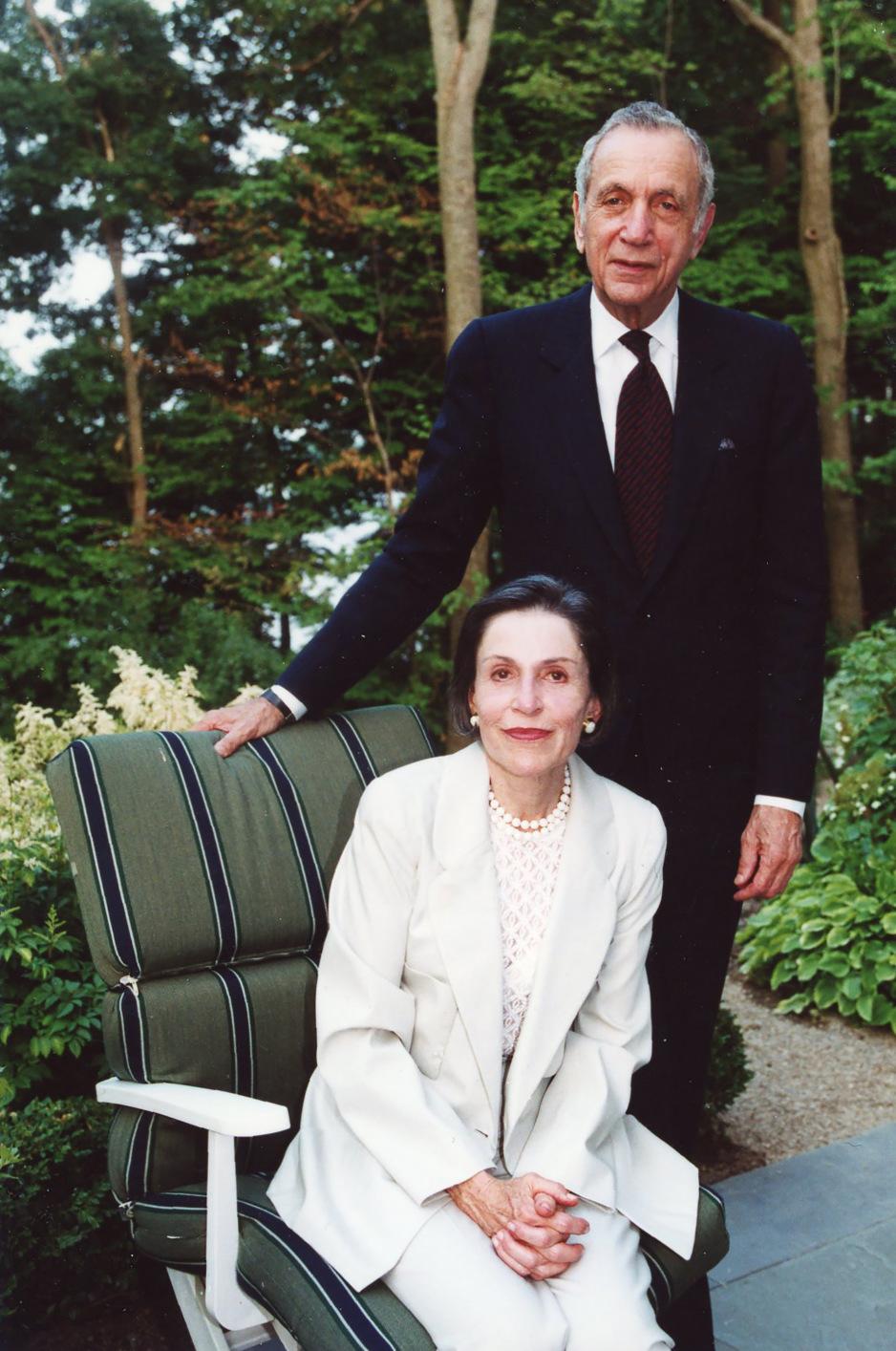
Alan and Marianne Schwartz in their home, Birmingham, Michigan.
Photo courtesy of the consignor.
ALAN AND MARIANNE SCHWARTZ: A
PERSONAL MEMOIR
I FIRST MET MARIANNE AND ALAN in the mid-1970s when they came into Colnaghi on Old Bond Street in London, unannounced, to look at old master prints. As a couple they were immaculate in their dress, deportment and good manners; I was daunted, and to be fair, I think they were a little abashed by the mahogany furniture and the hushed atmosphere of the 4th floor. Marianne made it clear that she was only interested in seeing important prints, and ones in good condition, but she looked at what I could show with great attention, and asked searching questions. She flattered me by asking me why I thought this print was important, and how I would rate it alongside other works by the same artist. Nothing that day was thought suitable to buy, but we had definitely established a ‘rapport’.
Subsequently I used to visit them regularly when travelling in the US. They occupied a large and airy house in Bloomfield Hills on the edge of Detroit, hidden by trees from the street and surrounded by large lawns, regularly cut by Alan. Inside was the surprise: every available wall surface covered with framed prints, all prime examples. Marianne’s first collection was of American print-makers including Hopper, Sloan and Lewis, as well of course as Whistler. In the dining room were colour prints by Toulouse-Lautrec and Munch, and the main sitting-room had an impressive display of master prints going from Schongauer through to Matisse and Picasso. Marianne was meticulous in researching anything she considered buying and was wise enough to seek advice from museum curators and paper restorers before committing. This made the decision process quite long. It also meant that Marianne generally preferred to buy from print dealers rather than at auction. And the whole transaction was conducted with huge charm and consideration. Selling a print involved an invariable Schwartz double-act routine. Once Marianne had decided in favour of a purchase, she sent me through to Alan’s study for a little talk. Alan would say that although he knew little about old master prints, and did not understand the art world, nonetheless he wondered whether the price quoted for this impression was not a bit excessive? His approach was all so gentlemanly and well-staged, that these discussions could almost be described as enjoyable.
The Schwartzes’ good taste extended to fine English 18th-century furniture and good carpets, usually bought during their London trips. It was a sad day when they felt they had to down-size, but their smaller house had the very same feeling of elegance, and there was still enough room to hang all the important prints. And even on my last visit, when clearly neither Alan or Marianne were at all well, their hospitality and their concern for my onward travel arrangements was, as always with them, matchless.
ADRIAN T. EELES, AUGUST 2024
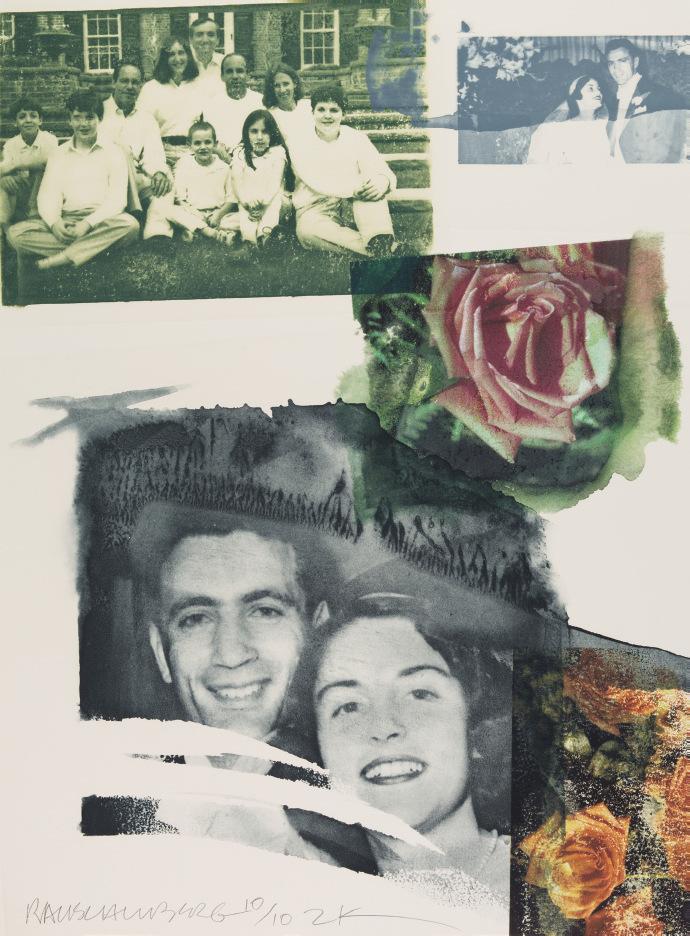
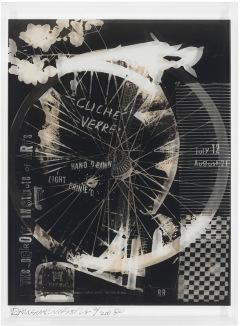
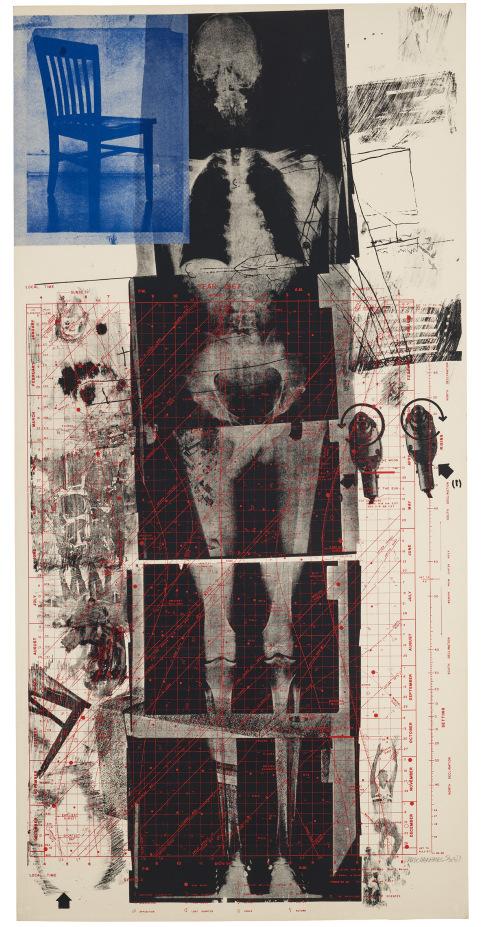
In 2000, the children of Alan and Marianne commissioned Robert Rauschenberg to create a “Schwartz Family Print” to celebrate the 50th wedding anniversary of their parents. The 5-color digital inkjet graphic with intaglio, published as an Edition of 10, features a 1950 wedding photo and an image of their children and grandchildren. The Schwartz Family Print was inspired by the Rauschenberg Cliche Verre print that was commissioned by the Detroit Institute of Arts in 1980 for the opening of the new Schwartz Graphics Arts Galleries. The edition was given to members of the Schwartz family with one impression gifted to the Detroit Institute of Arts.
Robert Rauschenberg Foundation / Licensed by VAGA at Artists Rights Society (ARS), New York.
OUR PARENTS had a love affair for sixty seven years that could have been scripted in Hollywood. Always impeccably dressed, in a grand but understated way, their presence was always felt as individuals, but most strongly as a couple. The way they communicated and their instinctive understanding of what the other was thinking and feeling was proof of the loving bond between them.
The humanity and respect they had for others was manifest by their interest in the wider world. They were adept at finding the good in every individual and were devoted to fostering positive change through public service, especially when it came to the cultural institutions of Detroit. Above all, they wanted the best for their immediate and extended family, and friends in need.
Their home was supremely important to our parents; more than that, it was an expression of who they were as people. While they enjoyed social events and dining out with friends, they were homebodies at heart. It was the gathering place for family occasions and they just loved to entertain. It was impossible to not to be awed by the beauty of the things they collected, and to feel their pride at being able to share the fruits of their collecting journey with others. They loved nothing more than to talk about the objects with which they surrounded themselves, but they did so with humility as well as passion. And they were great storytellers. You always walked away knowing a little more about art history, and the issues the artists were addressing in their work.
As their children, we had the privilege of experiencing their love in the way we were raised, and witnessing the creation of their remarkable collection. We were also fortunate to be introduced to the many curators, dealers, conservators, scholars and fellow collectors, each of whom helped our parents research, study, acquire and enjoy the remarkable things that covered the walls of the family home. We know that our parents would be pleased for these works to find homes where they will be equally appreciated.
RUTHANNE, KURT AND MARC SCHWARTZ
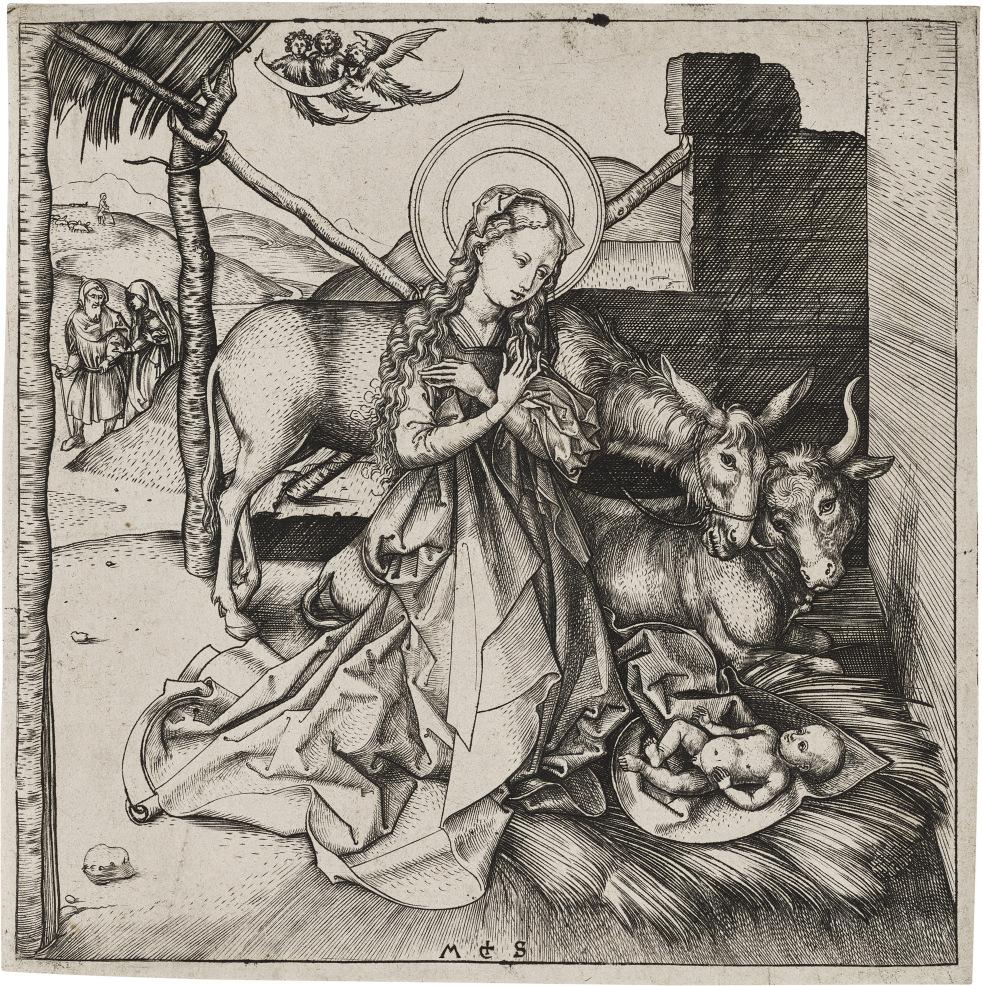
MARTIN SCHONGAUER (CIRCA 1445-1491)
The Nativity engraving before 1474 on laid paper, without watermark a superb, early impression printing very sharply and evenly, with remarkable clarity even in the finest shading and the densely engraved areas, to a great sculptural effect with touches of burr on the trunk of the stable and elsewhere, and pronounced inky relief
trimmed to or just inside the platemark but retaining a fillet of blank paper outside the borderline on all sides in very good condition
Plate & Sheet: 6Ω x 6Ω in. (165 x 165 mm.)
$100,000-150,000
PROVENANCE:
Fritz Rumpf (1856-1927), Frankfurt am Main and Potsdam (Lugt 2161); his sale, H. G. Gutekunst, Stuttgart, 18-23 May 1908, lot 1476 ('Abdruck von aussergewöhnlicher Schönheit und Frische, tadellos erhalten und mit Rand. Exemplare von dieser Qualität sind von der grössten Seltenheit.') (Mk. 5150; to L. Meder).
With Amsler & Ruthardt, Berlin.
Otto Gerstenberg (1848-1935), Berlin, inscribed at the time of the sale by his secretary Mr Montag with the deaccession number M. 509 in pencil verso (Lugt 1840c; see also Lugt 2785); sold as part of his collection of old master prints in 1922 to Colnaghi & Co., London, and Harlow, McDonald & Co., New York (with the inscription McD in pencil verso).
Richard H. Zinser (circa 1883-1983), Forest Hills, New York (Lugt 5581); then by descent to his daughter Suzanne A. Rosenborg.
With N. G. Stogdon, Middle Chinnock, Somerset; on consignment from the above; his catalogue, Martin Schongauer (X), 1996, n. 2.
Alan and Marianne Schwartz Collection, Detroit; acquired from the above in 1996; then by descent to the present owners.
EXHIBITED:
Minneapolis Institute of Arts, The Art Institute of Chicago, Prints 1400-1800: A Loan Exhibition from Museums and Private Collections, curated by H. Joachim, 1956-57, p. 7, n. 36.
LITERATURE:
Bartsch 5; Lehrs, Hollstein 4 (this impression cited in both)
Martin Schongauer is the first engraver known to us by name working north of the Alps, while his predecessors are known today only by their art historical sobriquets or initials, such as the Master of the Playing Cards or the Master ES. Schongauer's engraved oeuvre is the first culmination of this new art form, which presumably had its origins in the workshops of gold- and silversmiths in the early 15th century, somewhere along the Rhine between Basel and Strasbourg. Schongauer himself had a background in metalwork: his father was born and raised in Augsburg but established himself as a goldsmith in Colmar. Martin briefly attended university in Leipzig, but then received a more practical training as an engraver and painter back home in Alsace and possibly in Flanders. The present Nativity is a perfect example of his style and his technical achievement as a printmaker. His figures, such as the beautiful kneeling Virgin here, clearly betray the influence of the early Flemish masters, such as Rogier van der Weyden and Hugo van der Goes, in their elegance and restraint. Schongauer's Mary adoring the new-born Christ child seems perfectly composed and serene, yet the tumultuous folds of her cloak and the nervous delicacy of her hands convey an emotional and devotional intensity only found in the very best of late Gothic art. Although the image appears pared down to the essential elements of the scene, Schongauer's skill as an engraver is evident in the highly disciplined yet varied use of different graphic marks, such as the long, curved lines of the straw below the Child, the dense cross-hatching of the back wall, and the finest shading on the face of the Virgin. His handling of the burin demonstrates a command of the medium not achieved by any of the anonymous masters before Schongauer. As Stogdon pointed out in his catalogue of 1996, the present impression shows traces of burr on the rear post of the roof, which creates a focus point in the middle ground and thus adds depth and three-dimensionality to the image - an effect only evident in the finest, earliest impressions, such as the present one. The provenance of this print speaks for itself: Otto Gerstenberg counts amongst the most important print collectors of the late 19th and early 20th century, and Richard Zinser was one of the most discerning dealers of old master prints of his time. It is therefore fitting that this exquisite little sheet found its way, via the late Nick Stogdon - who probably knew more about Schongauer's prints than anyone - into the collection of Marianne and Alan Schwartz.
(actual size)
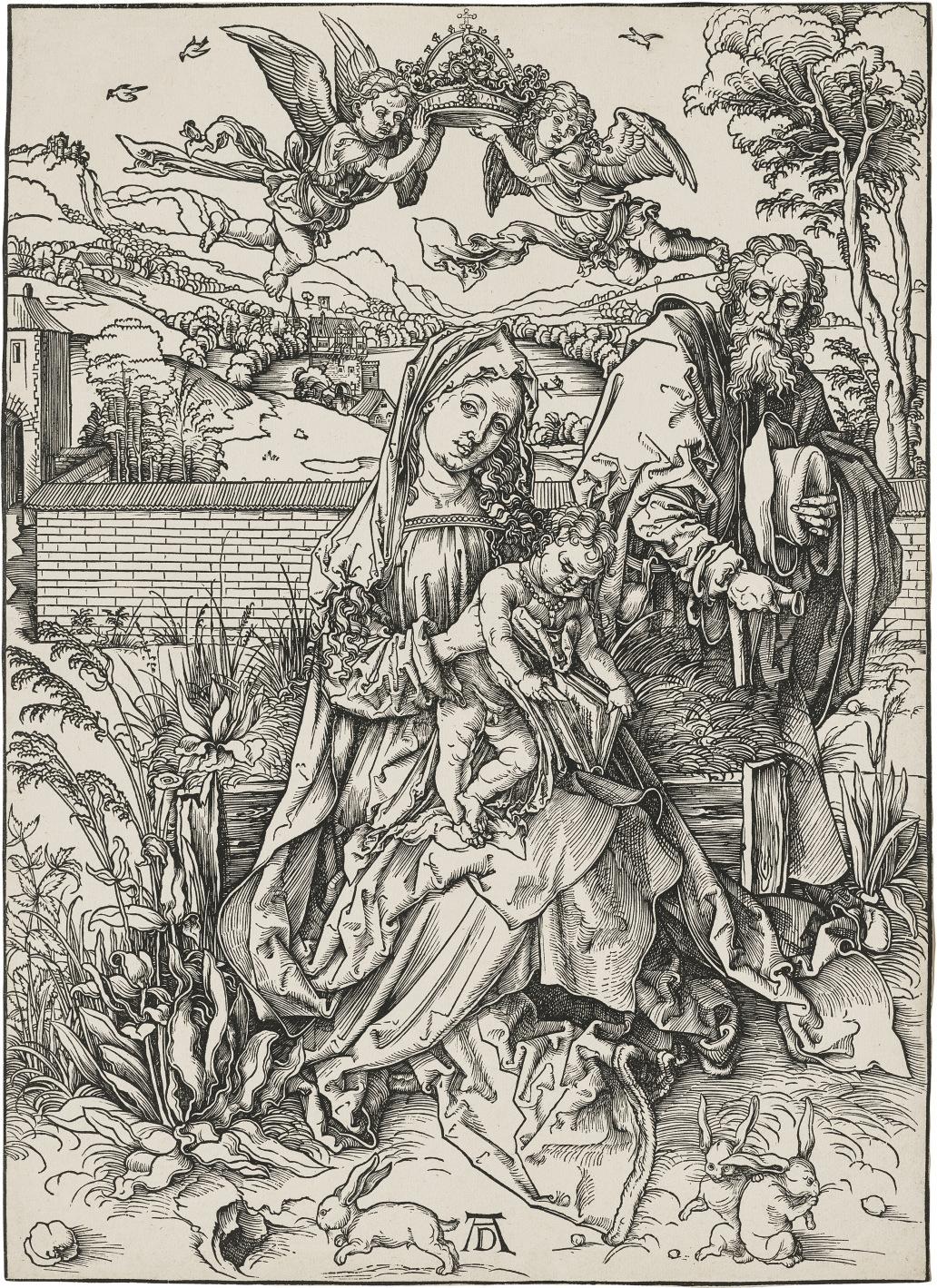
ALBRECHT DÜRER (1471-1528)
The Holy Family with the three Hares woodcut circa 1497 on laid paper, watermark Imperial Orb (Meder 53) a brilliant, rich and early impression printing very sharply and evenly, with intense contrasts and great depth trimmed to or just outside the borderline in very good condition Block & Sheet: 15¡ x 11¿ in. (389 x 281 mm.)
$70,000-100,000
PROVENANCE:
Albertina, Vienna, with their de-accession stamp verso (Lugt 5d); their duplicates sale, Gilhofer & Ranschburg, Lucerne, 28-29 November 1934, lot 142 ('Herrlicher, frühester Abdruck von größter Frische und tadelloser Erhaltung‘) (Mk 1200; to Somary).
Felix Somary (1881-1956), Vienna, Zurich, Washington, D.C. (Lugt 4384); then by descent.
With August Laube, Zurich; acquired from the heirs of the above in 1976. Private German Collection; their sale, Christie's, London, Genius of the German Renaissance: A Collection of Prints by Albrecht Dürer, 4 December 2007, lot 23 (to Rumbler).
With Kunsthandel Helmut Rumbler, Frankfurt am Main. Alan and Marianne Schwartz Collection, Detroit; acquired from the above in 2008; then by descent to the present owners.
LITERATURE:
Bartsch 102; Meder, Hollstein 212; Schoch Mende Scherbaum 108
The Holy Family with the three Hares is arguably the most charming of the artist's woodcuts and one of the few idyllic images Dürer created in the medium. Mary, with the Christ Child standing on her knees, is seated in a walled garden, the hortus conclusus, a symbol of her virginity. She is surrounded by flowers and herbs growing around the grassy bench. In the foreground three rabbits play, in the background lies an open valley. Joseph has removed his hat and stands at a respectful distance, gazing in wonder at the child. Jesus however has no eyes for the natural beauty and abundance around him; instead he is leafing through a book, as if reading his own destiny.
The present impression was formerly at the Albertina and thus comes either from the holdings of Prince Albert of Saxony, Duke of Teschen (1766-1822), which he had put together with the help of Count Giacomo Durazzo (1717-1794), or from the Imperial collection itself. The two collections, Teschen's and that of the Court Library - were merged following the dissolution of the Habsburg empire. Over the subsequent year, duplicates were sold, and it was in one of these auctions that Felix Somary, who only ever bought the very best prints by Dürer and Rembrandt, acquired it. In keeping with its grand provenance, this impression of The Holy Family with the three Hares is undoubtedly one of the finest still in private hands.
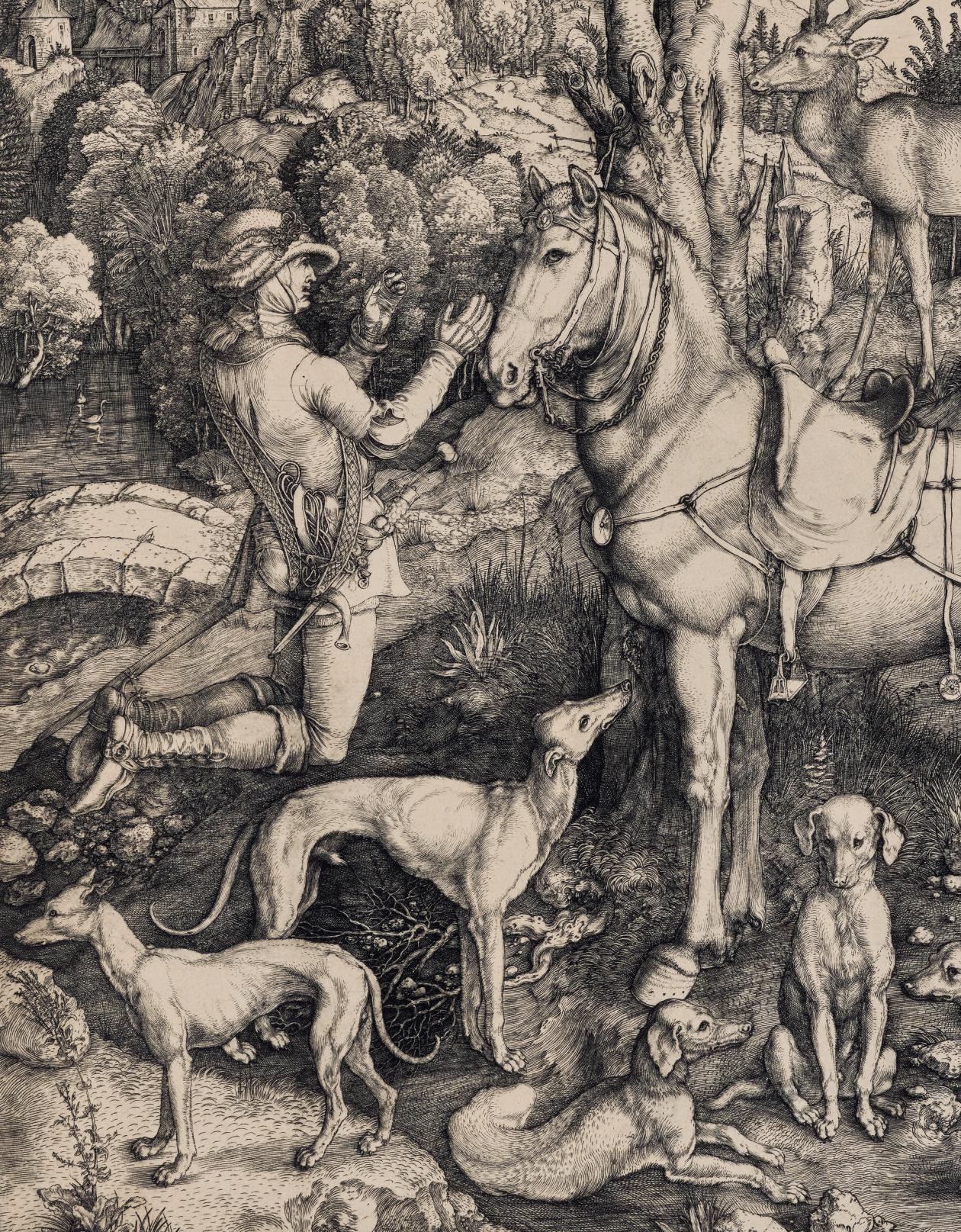
ALBRECHT DÜRER (1471-1528)
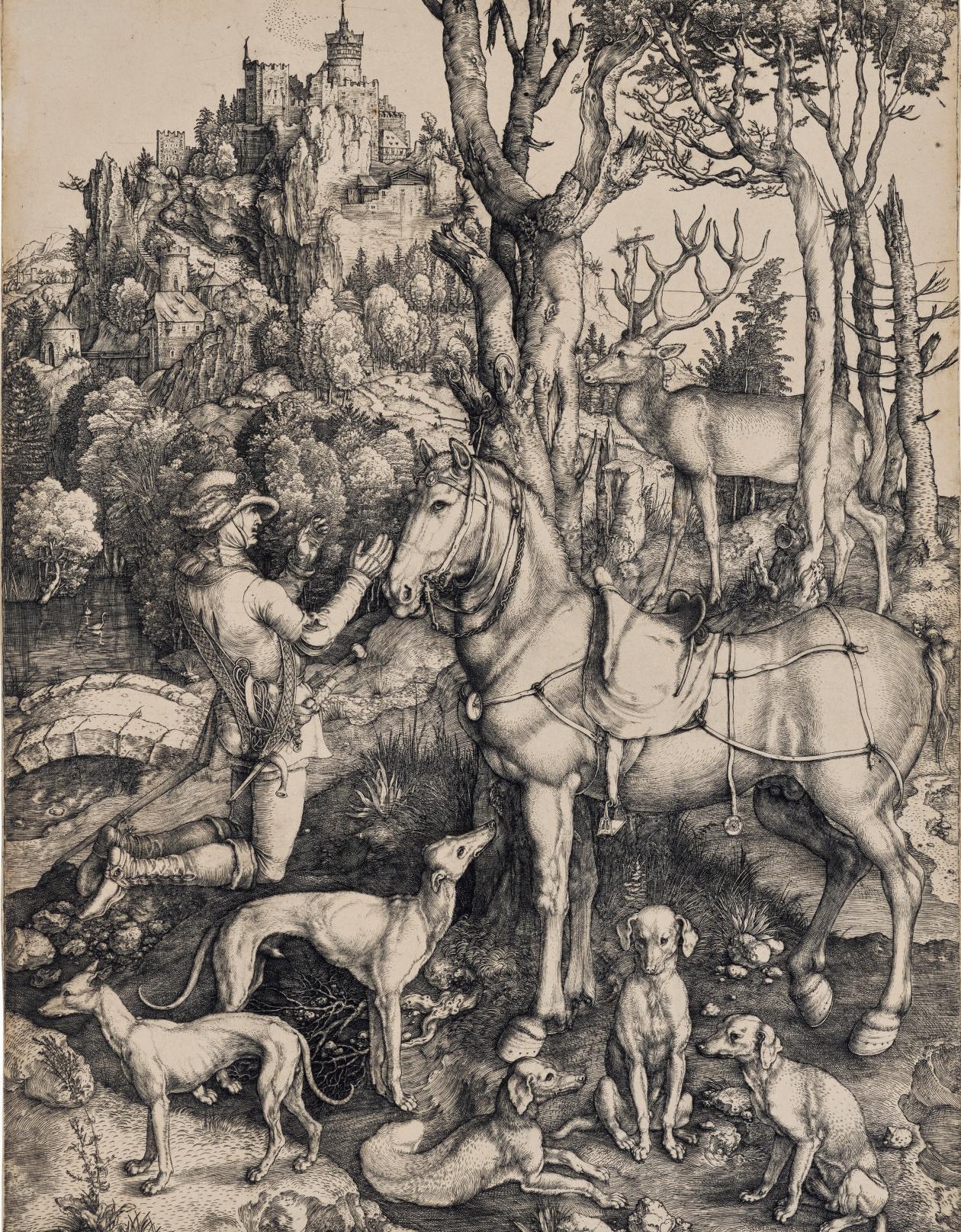
Saint Eustace engraving circa 1501 on laid paper, watermark High Crown (Meder 20) a brilliant, silvery and finely modulated Meder b impression printing very sharply and clearly, with burr on the barren tree at upper centre and elsewhere with intense contrasts and much inky relief trimmed to or just outside the borderline and subject, partially remargined in very good condition
Sheet: 14º x 10¡ in. (358 x 262 mm.)
$200,000-300,000
PROVENANCE:
Siegfried Barden (1854-1917), Hamburg (Lugt 218 and 2756).
With Richard H. Zinser (1884-1984), Forest Hills, New York (without mark, see Lugt 5581).
Charles C. Cunningham Jr. (b. 1934), Boston (Lugt 4684).
With Robert M. Light & Co., Inc., Santa Barbara, California.
Alan and Marianne Schwartz Collection, Detroit; acquired from the above in 1976; then by descent to the present owners.
EXHIBITED:
The Detroit Institute of Arts, Master Prints of 5 Centuries: The Alan and Marianne Schwartz Collection, 1990-91, p. 197, n. 184.
LITERATURE:
Bartsch 57; Meder, Hollstein 60; Schoch Mende Scherbaum 32
The largest of all Dürer's engravings, Saint Eustace has always been regarded as one of his greatest. Dürer himself considered this early work something of a show-piece and took it with him on his journey to the Netherlands in 1521. In his travel diary he mentions six occasions of selling or presenting it to potential patrons.
According to the legend a Roman soldier called Placidas saw a vision of the crucified Christ appear between the antlers of a stag he was hunting. Upon hearing God's voice spoken by the animal, 'O Placidas, why pursuest thou me?', he fell on his knees, was converted and baptized with the name Eustace. In Dürer's engraving the saint is shown kneeling on the banks of a stream, transfixed by his vision, while his horse and hounds wait patiently for their master. The animals are depicted with delightful naturalism, as is the woodland vegetation, the gnarled and splintered tree trunk, and the view in the distance of a hill surmounted by a castle, with a flock of birds spiralling around its castellated turrets. This display of technical virtuosity may have been Dürer's counter to the hotly contested view prevalent in the 16th century that sculpture was superior to painting due to its capacity to show the figure three-dimensionally. Dürer's depiction of the natural world in Saint Eustace in such exquisite detail - and in the case of the dogs from different sides at once - was a provocative claim for the parity of painting. One of the most admired and best loved elements in Dürer's whole graphic oeuvre are indeed the greyhounds in the foreground, which prompted Vasari's effusive description of the engraving as 'amazing, and particularly for the beauty of some dogs in various attitudes, which could not be more perfect'.
Although Saint Eustace, the patron saint of huntsmen, was enormously popular in Northern Europe at this time, it is intriguing to think that Dürer may have seen Pisanello's famous painting of the subject (circa 1438-42) - or a version of it - during his first journey to Venice in 1494-95. The small panel, now at the National Gallery in London, is significantly reduced in height, but a later copy at the Fondazione Cini in Venice presumably shows the original composition, taller and with a mountainous landscape in the background.
Fine, early impressions of Saint Eustace, such as the present one, have always ranked amongst the most highly-prized possessions of a print
collector. The present example is remarkable not only for its sharpness and rich contrasts, but for the subtle gradations of light and darkness on the smallest scale, which differentiate the foliage of each tree amongst the wooded hillside at upper left.
Although the composition of this magnificent print still has the charm and immediacy of Dürer's 'gothic' engravings of the 1490s, the exquisite depiction of details and textures anticipates the technical perfection of the artist's 'Meisterstiche' of 1513-14 (see lot 5).
Marianne and Alan Schwartz were only the last in a line of worthy custodians of this print, which was previously owned by the highly discerning collectors Siegfried Barden and Charlie Cunningham.
on laid paper, without watermark a superb, early Meder IIa impression printing sharply and silvery, with intense luminosity and contrasts with a light plate tone towards the inky plate edges with wide margins in very good condition
Plate: 9Ω x 7Ω in. (240 x 189 mm.)
Sheet: 112 x 86 in. (282 x 218 mm.)
$300,000-500,000
PROVENANCE:
Unidentified, paraphe in brown ink verso (not in Lugt). Unidentified, number '.2.' in brown ink recto (not in Lugt).
Count Alexandre Borisovitch Lobanoff-Rostovsky (d. circa 1880), Saint Petersburg (Lugt 2005); his posthumous sale, Amsler & Ruthardt, Berlin, 26 April 1881, lot 150 ('Eines der interessantesten Blätter des Meisters in herrlichem klaren Abdruck. Höchst selten von solcher Qualität') (Mk. 470). Moriz von Kuffner (1854-1939), Vienna (not in Lugt); then by descent.
With C. G. Boerner, New York, 2001.
Julian Edison (1929-2017), St. Louis, Missouri (not in Lugt).
With C. G. Boerner, New York.
Alan and Marianne Schwartz Collection, Detroit; acquired from the above in 2008; then by descent to the present owners.
LITERATURE:
Bartsch 74; Meder, Hollstein 75; Schoch Mende Scherbaum 71
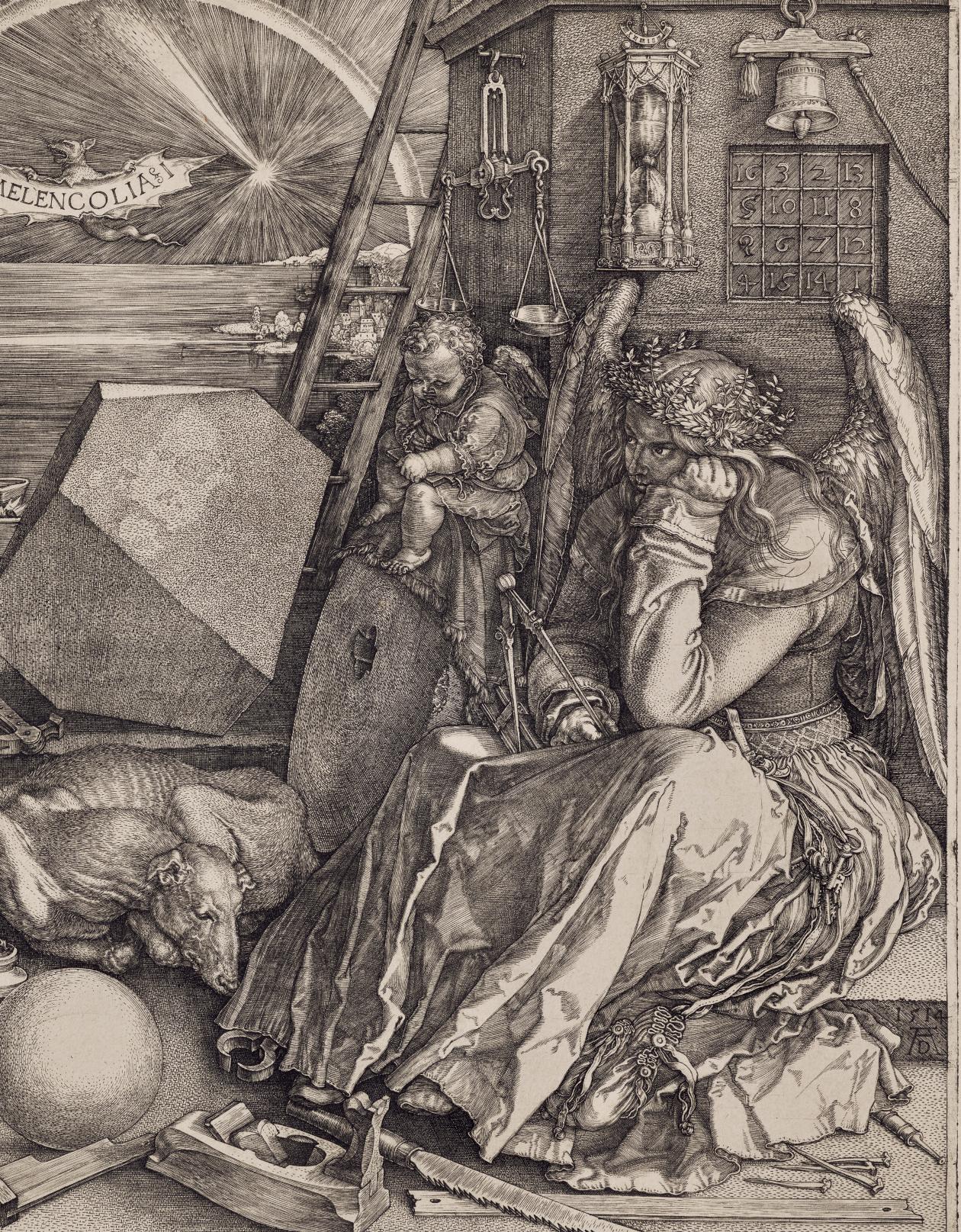
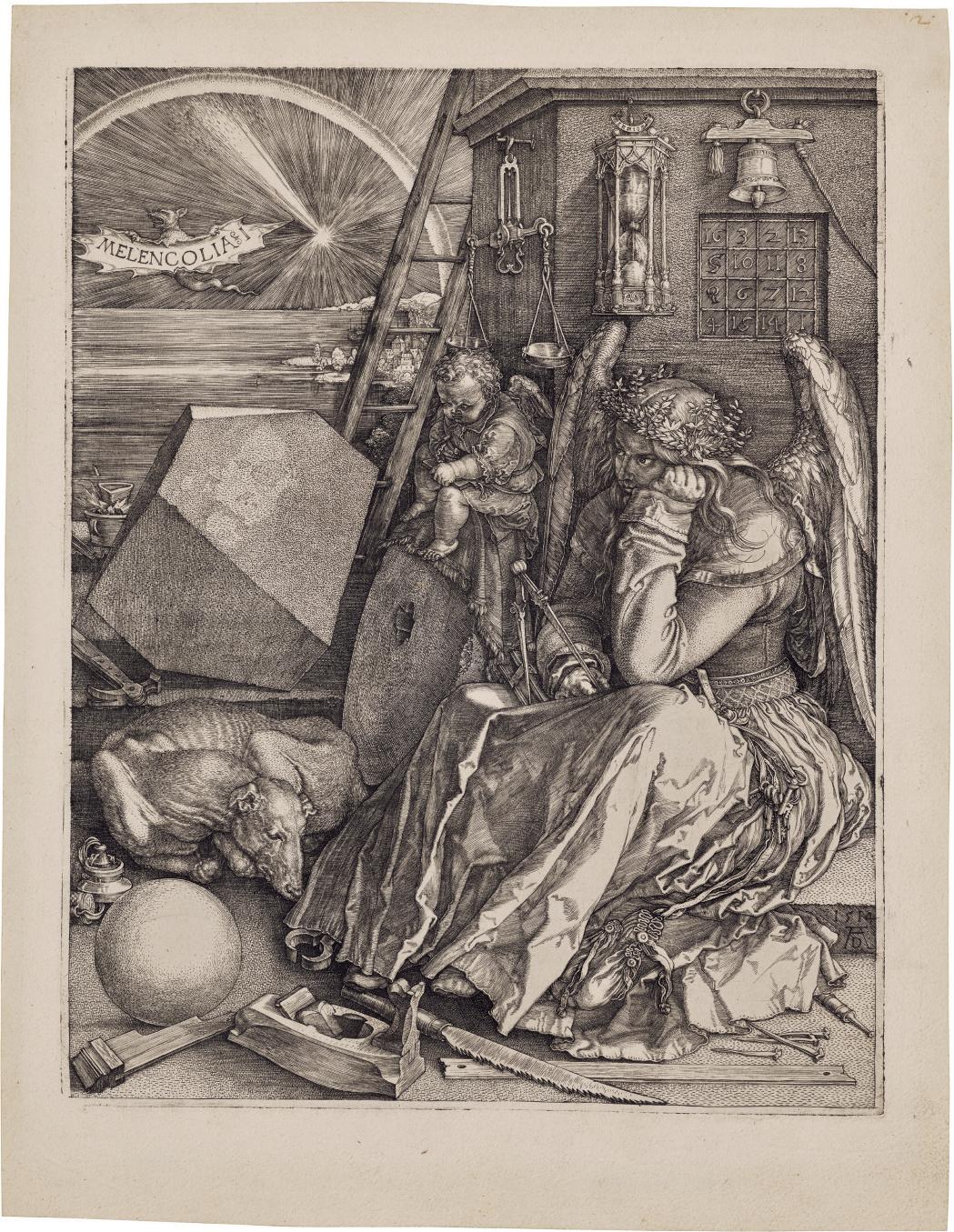
Although Dürer gave his most famous engraving a rather unambiguous title, it has become the most extensively interpreted work in the history of western art. An allegory of melancholy, the details of its iconography have intrigued and inspired countless art historians and other scholars of all fields, including mathematicians, theologians and astronomers.
In the classic pose of the thinker, her head resting on her hand, sits a female winged figure, holding a pair of compasses and a closed book. Perched next to her on a millstone is a winged putto, scribbling on a tablet. Before them lies a sleeping dog. Scattered around the figure is a variety of tools and mysterious objects, including a syringe, an oil lamp, a melting pot, scales, an hour glass, a bell, a numerical table and two geometrical shapes, a sphere and a large multi-faceted rock. On one side of this rock, like a slightly distorted reflection, we faintly see the image of a human skull. A ladder is leaning against the building which, together with the carpenter's tools - a saw, a plane, some nails, a rulergives the scene the appearance of a building site. In the background lies
a distant coastal landscape beneath a night sky, strangely illuminated by a comet and a rainbow. A bat with the title of the print written across its spread wings hovers above the scene. Some of these objects are familiar symbols, which recur in other prints by Dürer: the sphere as a symbol of chance or fate; the scales as a symbol of justice; and the skull and the hour-glass, which appear as memento mori also in Saint Jerome in his Study (M. 59). The meaning of many of the other objects however is less evident, and attempts to 'solve the riddle' of this highly charged composition by offering one unified interpretation remain unconvincing.
The print is one of the artist’s three so-called Meisterstiche (‘master engravings’), created between 1513-1514, which are widely considered the pinnacle of the artist’s mastery of the graphic medium. It is thought that the three engravings, Melencolia I, Death, Knight and the Devil and Saint Jerome in his Study each represent one of the three forms of virtuous living - intellectual, moral and theological - as outlined in Thomas Aquinas’s Summa Theologiae (written circa 1265–1274 but published in 1485). In Dürer's time, the nature of a virtuous life, and by extension of the ideal ‘Renaissance man’, was a popular topic of conversation in literary and artistic circles. Dürer himself was surrounded and no doubt inspired by the Nuremberg humanists, above all by his friend Willibald Pirckheimer. Treatises such as Machiavelli’s The Prince (1513) and Castiglione’s The Courtier (1528) give testimony of the intellectual culture and the moral questions of the time. The rich symbolism of Dürer's engraving embodies the complexity of humanist thought in the Renaissance period, and therein may lie the true purpose of the print: it is open to interpretation, deliberately inviting speculation and debate.
In Dürer's time, the melancholic temperament was associated with genius and the pursuit of knowledge. If Saint Jerome in his Study and Melencolia I are indeed companion pieces, and Saint Jerome represents the knowledge of ancient texts, then Melencolia I stands for a new and different kind of knowledge - that of empirical, applied science. The ruler, the scale and the pair of compasses are all measuring devices, instruments for the examination of nature. The building tools and the melting pot on the other hand are symbols of human creativity. In this interpretation, the comet represents the limits of human understanding of the world, and hence a cause of melancholy and despair for a speculative mind. For the artists of the Renaissance, with Leonardo and Dürer as prime examples, the observation and comprehension of the natural world was the foundation of their art. They saw themselves as artists as well as scientists, and in this sense Melencolia I could be described as an allegorical portrait of the artist.
The present impression is characterized by an almost glittering brightness and sharpness, and remarkable for its outstanding, original condition with wide margins.
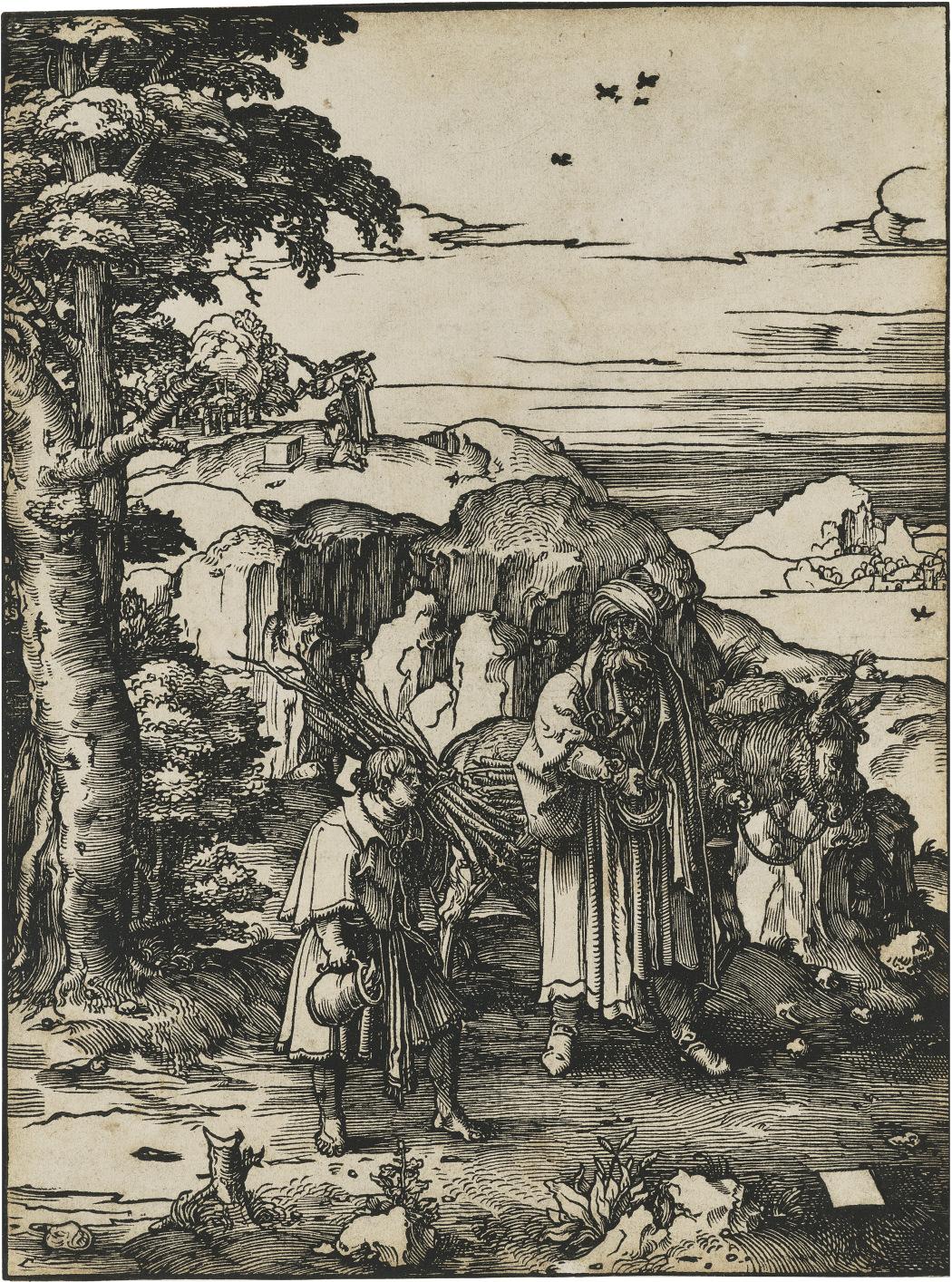
LUCAS VAN LEYDEN (1494-1533)
Abraham and Isaac woodcut circa 1517
on laid paper, watermark Small Shield with one Fleur-de-lys and Cross (New Hollstein 2b)
a brilliant impression of this very rare print first state (of two)
printing very evenly, with remarkable clarity, great contrasts and depth trimmed to or just outside the borderline generally in good condition
Block & Sheet: 11º x 8¡ in. (287 x 214 mm.)
$30,000-50,000
PROVENANCE:
Edwin A. Seasongood (1876-1953), New York (without his mark; see Lugt 826b); his sale, Parke-Bernet Galleries, New York, 5-6 November 1951, lot 167 ('Superb impression, certainly of the very earliest printing').
Albert W. Blum (1882-1952), Zürich & Short Hills, New Jersey; with his stamp verso (Lugt 79b); presumably acquired at the above sale; then by descent; Sotheby's, New York, Old Master Prints from the Collection of the late Dr. Albert W. Blum, 27 February 1988, lot 1209 ($ 47,300).
With Margo Pollins Schab Inc., New York.
Alan and Marianne Schwartz Collection, Detroit; acquired from the above in 1988; then by descent to the present owners.
EXHIBITED:
The Detroit Institute of Arts, Master Prints of 5 Centuries: The Alan and Marianne Schwartz Collection, 1990-91, p. 146, n. 138.
LITERATURE:
Bartsch, Hollstein 3 (this impresion cited); New Hollstein 187
Woodcuts by Lucas van Leyden are great rarities in the world of old master prints, and are treasured and sought-after by collectors and museums alike. Unlike Dürer, who had his woodcut series and smaller, devotional images printed in several editions and large numbers, Leyden's print-runs must have been tiny and his blocks did not survive for long, as posthumous impressions barely seem to exist. Most impressions of woodcuts by Leyden that have come to the market over the last few decades were quite damaged and restored. The appearance of a beautiful impression in good condition, such as the present example, is hence an exceptional occurrence. Despite this very limited output, Lucas van Leyden was a gifted and inspired designer of woodcuts. His finest works in the medium, including Abraham and Isaac, are imbued with a lingering atmosphere rarely found even in Dürer's best woodcuts. While the works of the two artists share at first glance many stylistic similarities, there is a marked difference in their mentalities: whereas Dürer depicts biblical, mythological or invented archetypes, Leyden depicts people. Herein, he is much more akin to another artist from Leyden working over one hundred years later - Rembrandt van Rijn - than to his German contemporary. This is nowhere more apparent than in the slightly awkward figure of Isaac, unknowlingly carrying the wood for his own sacrificial pyre, while his father looks on, guilt-ridden and torn. Dürer would have turned this scene into high drama, here it is heart-breaking.
New Hollstein records a total of 14 impressions of the first state in public collections, and one unique impression of the second state, with text (British Museum, London). None have appeared at auction within the last thirty years. The present sheet bears the same watermark as the example at the National Gallery of Art, Washington (inv. no. 1943.3.5704).
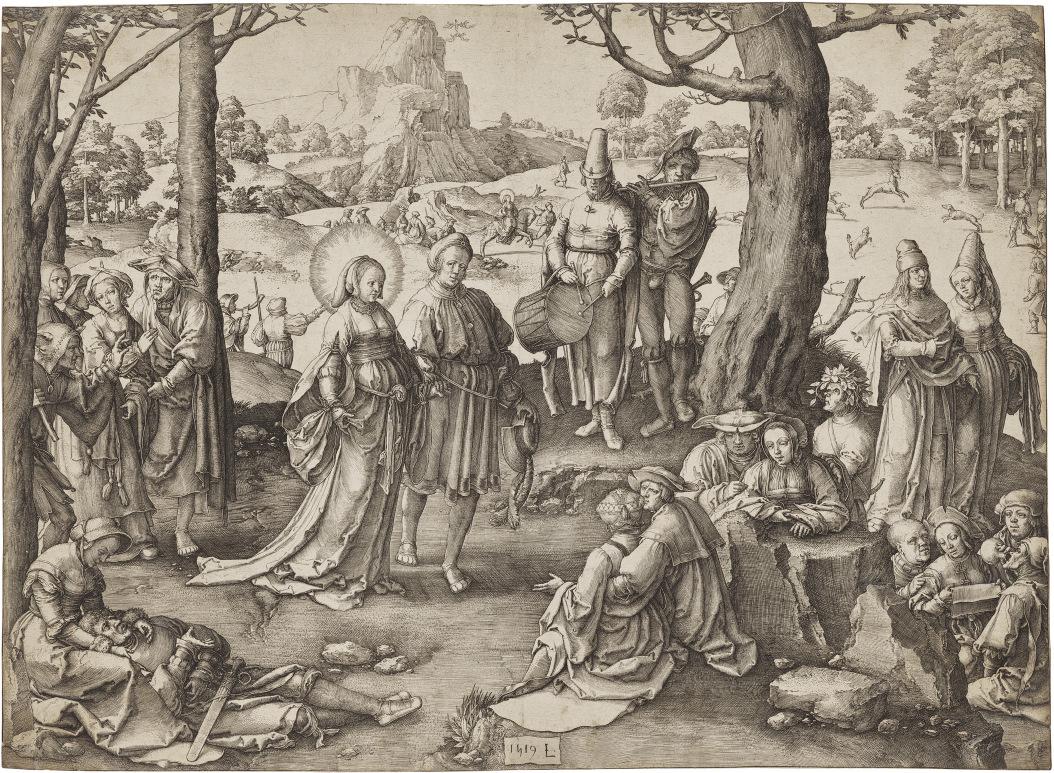
LUCAS VAN LEYDEN (1494-1533)
The Dance of Saint Mary Magdalene engraving 1519 on laid paper, watermark Gothic P (New Hollstein 6c) a very fine, early, harmonious impression of this large and important print first state (of three), New Hollstein a printing with great clarity and depth trimmed to or just outside the borderline with some small defects and repairs generally in good condition Sheet: 11¡ x 155 in. (288 x 395 mm.)
$30,000-50,000
PROVENANCE:
Count Alexandre Borisovitch Lobanoff-Rostovsky (d. circa 1880), Saint Petersburg (Lugt 2005); his posthumous sale, Amsler & Ruthardt, Berlin, 26 April 1881, lot 352 ('Meisterwerk des Stechers in herrlichem Abdruck auf Papier mit dem gotischen P. Die Einfassungslinie sichtbar. Äußerst selten so schön.' (Mk 1200; this impression cited in Lugt). Unidentified, stamped initials MC (?) in circle (Lugt 1861).
Mary Jane Morgan (1823–1885), New York (Lugt 1879); her posthumous sale, American Art Association (exp. Thomas E. Kirby), New York, 3-15 March 1886, lot 2203 (cat. price $ 62,50).
Metropolitan Museum of Art, New York (Lugt 1943, inscribed 33.79.17 in pencil); acquired in 1933; de-accessioned in 1966, with their duplicate stamp (Lugt 1808h, initialled JJM 66 by John McKendry, Curator of the Prints Department, in pencil verso).
Private Collection, California (acquired from the above through R. E. Lewis); then by descent.
With David Tunick Inc., New York (their stocknumber DTMIM5KHW in pencil verso); acquired from the above in 1978; his catalogue, Master Prints from Six Centuries, David Tunick Inc., New York, 1980, n. 20. Alan and Marianne Schwartz Collection, Detroit; acquired from the above in 1993; then by descent to the present owners.
EXHIBITED:
Williams Center for the Arts, Lafayette College, Easton, PA, Old Master Prints from the Collection of Mr. and Mrs. David Tunick, 1988. Williams College, Williamstown, Mass., Dürer to Matisse, Prints from the Collection of Elizabeth & David Tunick, Class of 1966, 1991.
LITERATURE:
Bartsch, Hollstein, New Hollstein 122
The Dance of Saint Mary Magdalene is one of Lucas van Leyden's largest and most ambitious engravings. In his slightly earlier, large multifigure-compositions, such as the Ecce Homo of 1510 or Calvary of 1517, he presented the central narrative at a safe distance in the middleor even background. Here, the focus of the composition is pushed to the foreground, whereby the viewer almost becomes part of the action. The festive scene shown here is somewhat fanciful, as it does not depict a specific event relating to the Saint, as written in the bible or the Legenda Aurea. Instead, Leyden chose to depict a moment in the luxurious and sinful life of Mary Magdalene, perhaps as a courtesan, before she encountered Christ and repented. The scene, as a man leads her to dance, surrounded by musicians, pair of lovers, and a fool, could be taken for a purely secular image, a fête champêtre, were it not for her halo. Presumably, this courtly, festive and slightly louche ambiance was precisely the intended appeal of the print. In the distance, we see Mary Magdalene once again enjoying earthly pleasures, as she is shown on horseback, riding briskly ahead of a stag hunting party. Finally and barely noticeable, the Saint's ascension to Heaven is depicted as a tiny detail at the horizon, above the mountain where she had spent the last thirty years of her life as a hermit.
Perhaps because his father was a painter and he did not, unlike Schongauer and Dürer, have a goldsmith's background, Lucas van Leyden seems to have approached the art of engraving quite differently from the older German masters (see lots 1, 3 and 4). His lines appear more finely calibrated and altogether lighter, lending his engravings an almost painterly lyricism and atmosphere. It meant however that his plates wore out more quickly, and even slightly later impressions tend to look hard and flat. As a result, fine early impressions such as the present one are very rare. The present sheet has a Gothic P watermark (New Hollstein 6c), which corresponds with the undoubtedly also early impression in the Rijksmuseum in Amsterdam (inv. n. RP-P-OB-1706).
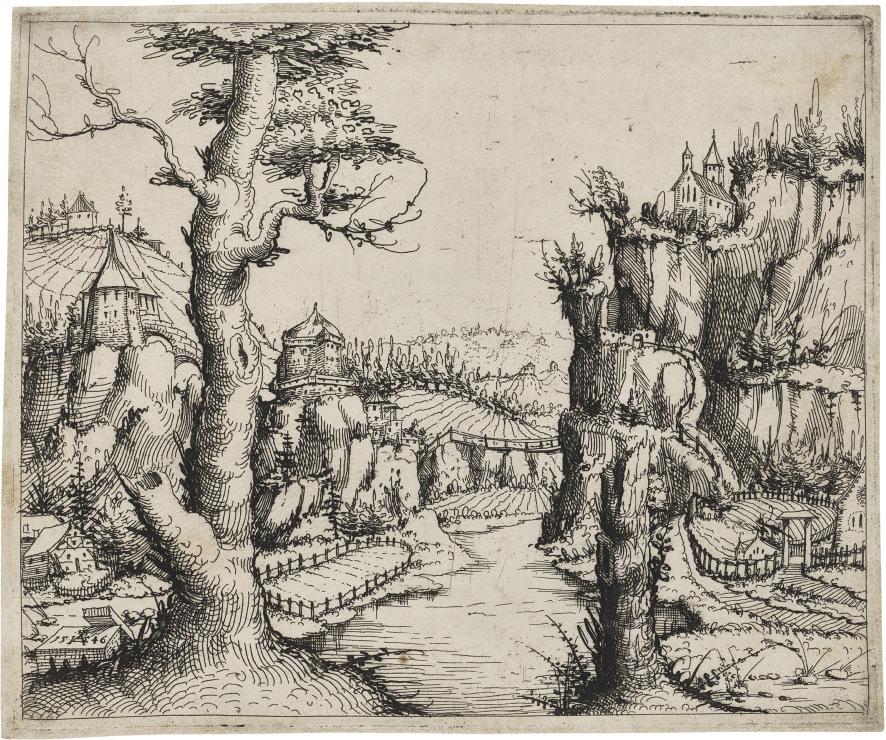
AUGUSTIN HIRSCHVOGEL (1503-1553)
River Landscape with Rocks at Left and Right etching 1546 on laid paper, without watermark a very fine impression of this rare landscape printing very strongly and clearly, with dark accents and great depth with fine vertical wiping marks at centre and an inky plate edge above with small margins generally in very good condition
Plate: 5√ x 7 in. (148 x 178 mm.)
Sheet: 6 x 72 in. (152 x 183 mm.)
$25,000-35,000
PROVENANCE:
Graphische Sammlung Staatsgalerie Stuttgart (without mark, see Lugt 2323); their duplicate sale, R. N. Ketterer, Stuttgart, 26-28 October 1949, lot 988 ('Abdruck von hervorragender Schönheit und Frische, sowie von tadelloser Erhaltung. Eine bei Schwarz nur in wenigen Exemplaren nachgewiesene Landschaft') (Mk. 1,980).
Private Collection, Germany (acquired at the above sale through Edward Traudtscholdt of C. G. Boerner, Leipzig); then by descent. With C. G. Boerner, New York.
Alan and Marianne Schwartz Collection, Detroit; acquired from the above in 1989; then by descent to the present owners.
EXHIBITED:
The Detroit Institute of Arts, Master Prints of 5 Centuries: The Alan and Marianne Schwartz Collection, 1990-91, p. 200, n. 187.
LITERATURE:
Bartsch, Schwarz 63; Hollstein 36
Augustin Hirschvogel (1503-1553) came from a family of glass painters in Nuremberg. He trained in the family craft, then set up a workshop as a majolica painter in his native city. In the late 1530's we find him in the Balkans working as a cartographer for Emperor Ferdinand I. Having established close connections to the Imperial Court, he finally moved to Vienna, where he lived permanently from 1544. It was probably there that he started decorating arms and armour and began to work in the new technique of etching. He was one of the first printmakers of the German Renaissance to create landscape prints, views of buildings and scenery, without any religious or allegorical content, and indeed the first to execute them in pure etching. He grasped and took full advantage of the spontaneity of the etched line and his scenes are imbued with an almost naïve immediacy, which was new to the medium. He thus stands at the beginning of a long tradition, lasting well into the 19th century, which considered etching as the natural printmaking method for the depiction of landscapes. The present print is almost a caricature of a 'romantic' German landscape, with a little castle or chapel on every rock and hilltop. The exceptional printing quality and condition of this sheet make it an outstanding example of the prints of this highly original artist.
Very few impressions of Augustin Hirschvogel's landscapes appear to have survived and they are great rarities on today's art market. Hollstein records a total of 13 impressions of this plate in public collections.
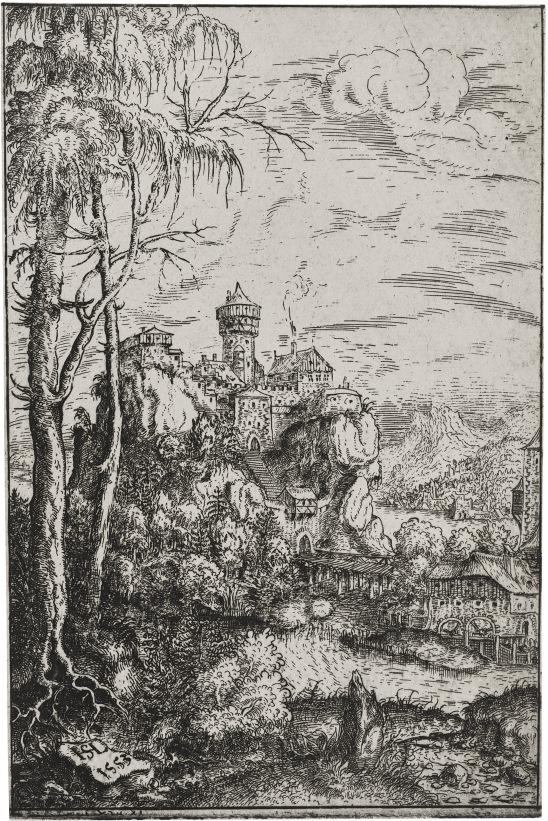
HANNS LAUTENSACK (1520-1566)
Mountainous Landscape, in the Middle a River and a Citadel etching 1553
on laid paper, watermark Arms or Ravensburg (Briquet 15921, dated 1556-71) a brilliant, luminous impression of this rare print printing with great clarity, contrasts and depth with much inky relief and a light plate tone with tiny smudges of ink on the monogram and date, the lower plate edge with filing marks and surface ink a narrow margin below, trimmed outside the borderline elsewhere in very good condition Sheet: 66 x 44 in. (170 x 112 mm.)
$8,000-12,000
PROVENANCE:
Fürst von Liechtenstein, Vaduz and Vienna (Lugt 4398).
Richard H. Zinser (circa 1883-1983), Forest Hills, New York (Lugt 5581, without mark); presumably acquired from the above.
With Robert M. Light & Co., Inc., Santa Barbara, California. Alan and Marianne Schwartz Collection, Detroit; acquired from the above in 1993; then by descent to the present owners.
LITERATURE:
Bartsch 28; Schmitt 63; Hollstein 18
Hanns Lautensack was the youngest of the small group of landscape etchers collectively known as the Danube School, which included Albrecht Altdorfer (circa 1480-1538), Wolf Huber (circa 1485-1553) and Augustin Hirschvogel (1503-1553; see previous lot), who were the first printmakers to depict pure landscapes, and chose etching as their preferred technique. Lautensack was born in the Franconian city of Bamberg, the son of a painter, but moved to Nuremberg as a child. When Dürer died in Nuremberg in1528, he would have been only about eight years old. For the final years of his life he lived in Vienna, where he presumably worked for Emperor Ferdinand I.
Being at least a generation younger than the other German etchers of the early 16th century presumably meant that the etching method had been evolved and perfected by the time Lautensack began using it. Although not the most expressive, he was technically the most accomplished of the landscape etchers, and his prints display an intricacy, wealth of detail and subtlety of line not achieved by his predecessors. The Mountainous Landscape, in the Middle a River and a Citadel is closely related to another landscape by the artist, A Landscape with a Castle on a Rock on the left top right, the Sun radiating in the Sky (Hollstein 24) sold at Christie's in December 2021. It is very similar not just in composition, format and style, but was printed on paper with the same watermark, is of similar printing quality, with the same filing marks and tone along the lower sheet edge, and even comes from the same princely collection. It was sold for £20,000 (incl. premium), the highest price for a print by the artist at auction.
Hollstein records a total of eight impressions of the present plate in public collections.
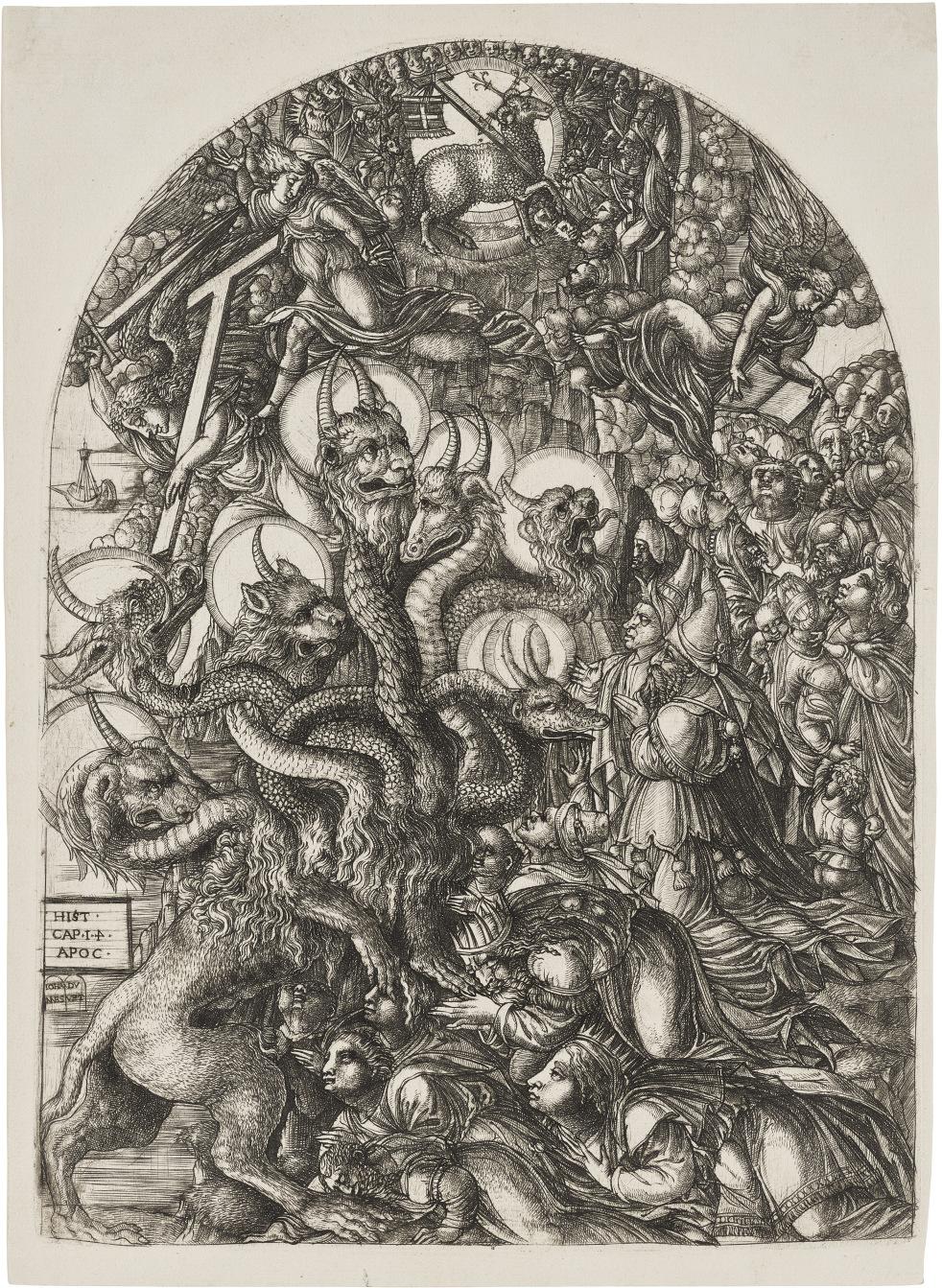
JEAN DUVET (1485-1570)
La bête a sept têtes et a dix cornes (The Beast with Seven Head and Ten Horns), from:
L'Apocalypse figurée
engraving circa 1546-55 on laid paper, without watermark a very fine, luminous impression of this rare subject second, final state, without text verso printing strongly and sharply, with considerable inky relief with a light plate tone and prominent guidelines on the tablet with margins and square sheet corners above the tips of the upper sheet corners restored generally in good condition
Plate: 12 x 8æ in. (306 x 222 mm.)
Sheet: 126 x 92 in. (332 x 232 mm.)
$25,000-35,000
PROVENANCE:
With Hill-Stone Inc., New York.
Alan and Marianne Schwartz Collection, Detroit; acquired from the above in 2010; then by descent to the present owners.
LITERATURE:
Bartsch 26; Bersier 31; Eisler 52
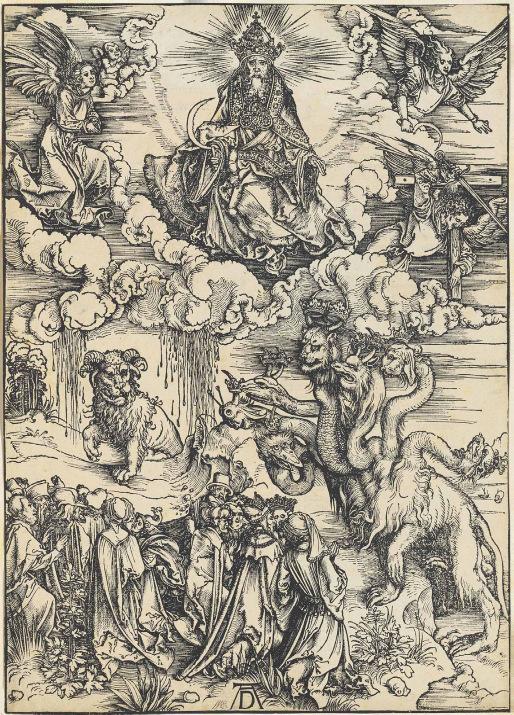
Jean Duvet's graphic output, created during the 1540-50s, coincides with the print production at the School of Fontainebleau. We can assume that Duvet, who worked as an engraver, goldsmith and festival designer in Burgundy and the North-East of France, was familiar with the etchings of Leon Davent, Antonio Fantuzzi and the other Fontainebleau etchers, yet he developed a peculiar style all of his own. His oeuvre consists mainly of two series, one describing a unicorn hunt on six horizontal plates, and a set of 23 arched, upright prints of the Apocalypse, which was clearly inspired by Albrecht Dürer's woodcut series of the Apocalypse created approximately forty years earlier. This influence is particularly evident in the present plate, especially in the design of the Beast, which is borrowed directly from the multiheaded creature in Dürer's Beast with two Horns like a Lamb (see ill.). Seemingly driven by a visual horror vacui, Duvet's treatment however is completely different, as he stacks figures, monsters, rocks and clouds tightly on top of each other, filling almost the entire surface of the plate and leaving barely any blank areas at all. The image is practically devoid of perspective or depth, more similar to a tapestry than a painting or drawing. His unique style, perhaps informed by his experience with metal ornaments and festive decorations, makes him one of the most idiosyncratic artists in the history of European printmaking. It can be assumed that Duvet's plates were printed in small numbers only, and only very few good, early impressions such as the present one have survived to this day.
Albrecht Dürer (1471-1528), The Beast with two Horns like a Lamb, from: The Apocalypse, woodcut, circa 1496/97. Sold, March 2018, Christie’s London, Lot 9.
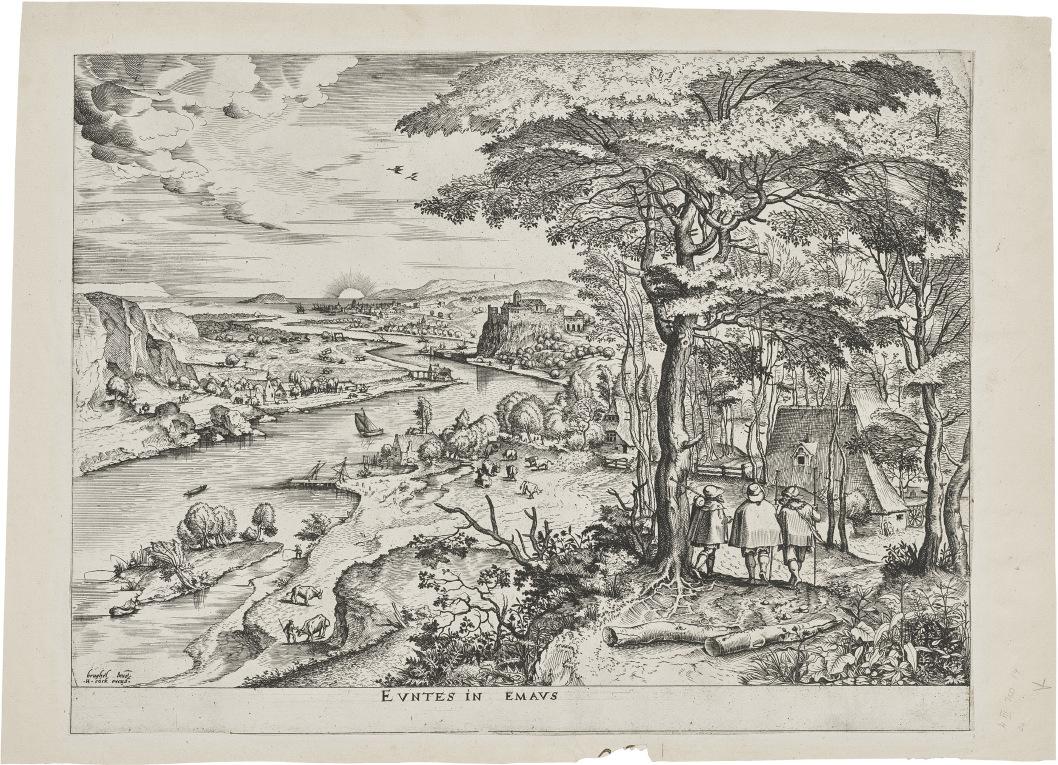
JOANNES VAN DOETECUM THE ELDER (ACTIVE 1554- CIRCA 1600) AND LUCAS VAN DOETECUM (ACTIVE 1554- D. BEFORE 1584) AFTER PIETER BRUEGEL THE ELDER (CIRCA 1525-1569)
Euntes in Emmaus (The Way to Emmaus), from:
The Large Landscapes
etching and engraving
1558
on laid paper, with an indistinct countermark a very fine, early impression of this rare landscape printing richly, with great depth and a light plate tone the guide lines in the text border very pronounced trimmed just outside the borderline on all sides, laid down onto a 17th century album sheet in very good condition
Sheet: 12æ x 17 in. (324 x 430 mm.)
Album Sheet: 14º x 19æ in. (363 x 503 mm.)
$7,000-10,000
PROVENANCE:
Sotheby's, London, Catalogue of an Important Album of Engravings, Etchings and Woodcuts collected in the 16th Century, From a Continental Princely Collection, 10 March 1964, lot 20 ('A marvellous impression').
Richard H. Zinser (circa 1883-1983), Forest Hills, New York (without mark; see Lugt 5581); acquired at the above sale; then by descent to his daughter Suzanne A. Rosenborg.
With Robert M. Light & Co., Inc., Santa Barbara, California (on consignment from the above).
Alan and Marianne Schwartz Collection, Detroit; acquired from the above in 2005; then by descent to the present owners.
LITERATURE:
Bastelaer 14; New Hollstein 56
Pieter Bruegel created only one print himself, his very rare etching of a Rabbit Hunt of 1560. He did however work very closely with the great print publisher Hieronymus Cock in Antwerp, cooperated closely with a number of gifted printmakers, including the Doetecum brothers, and provided them with a considerable number of very detailed model sketches. The preparatory drawing for the present print, which is one of a series of twelve large landscapes, is in the Koninklijk Museum voor Schone Kunsten, Antwerp (inv. n. T.50985). As in many of Bruegel's most memorable paintings - such as the Landscape with the Fall of Icarus celebrated in a poem by William Carlos Williams - the mythological or biblical content of several of these prints is reduced to a small background detail. Without the inscription in the border below, the viewer would certainly not associate this pastoral scene with three travelers with the Road to Emmaus. Clearly, Bruegel's interest here lies with the landscape itself and the composition is in fact very reminiscent of his most famous, 'pure' landscape painting, The Hunters in the Snow, now at the Kunsthistorisches Museum in Vienna.
HENDRICK GOLTZIUS (1558-1617)
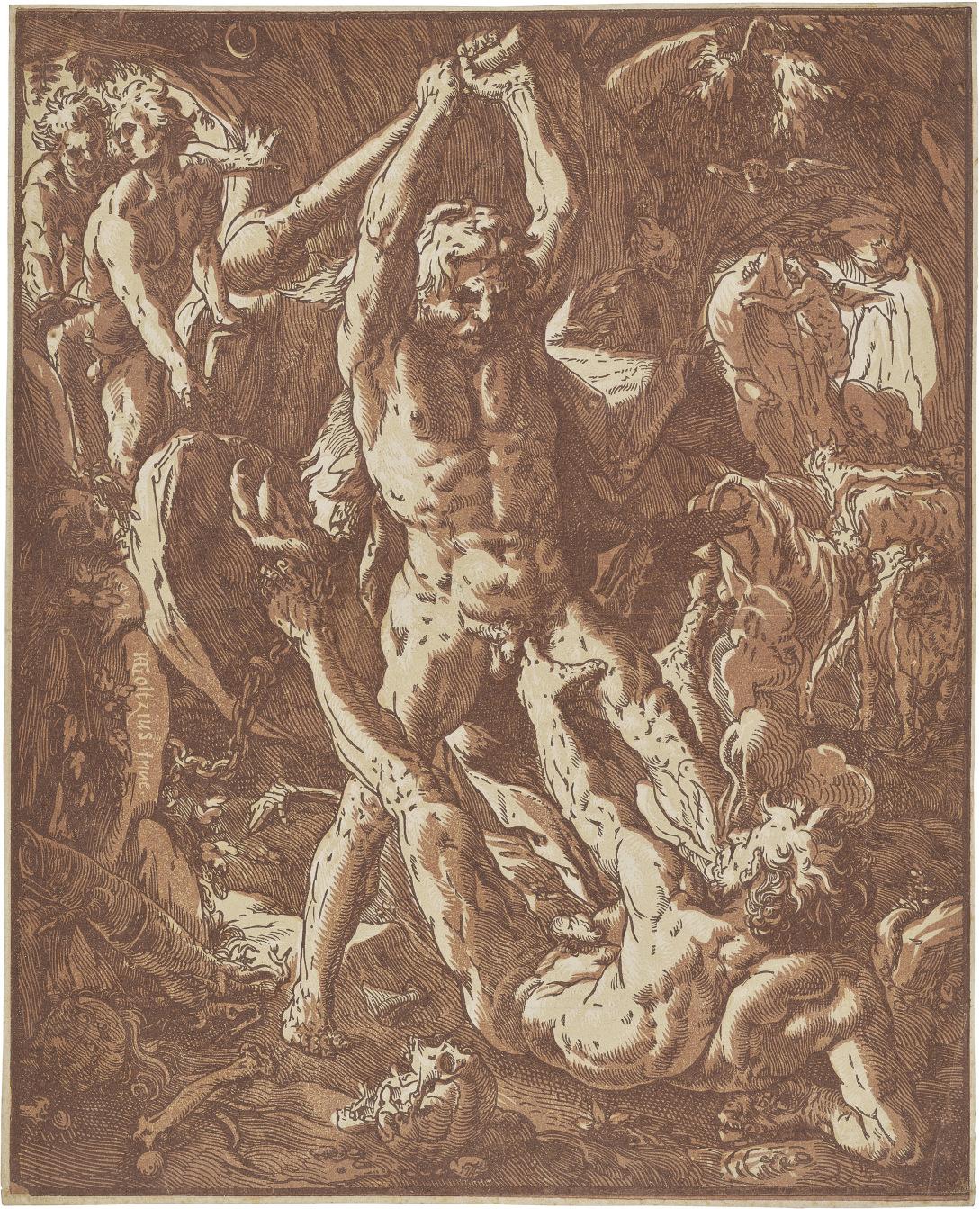
Hercules killing Cacus
chiaroscuro woodcut printed from three blocks the line block in dark reddish-brown, the tone blocks in brick red and mushroom 1588 on laid paper, watermark Grapes in Shield (Briquet 13215, first recorded The Hague, 1579)
a very fine impression of this large and important print, in an extremely rare, early colour variant
Strauss's second state (of four), Bialler's first state (of six), New Hollstein's first state (of three)
printing very strongly and evenly, with remarkable clarity and depth, with much offsetting verso with narrow to small margins on all sides some horizontal and diagonal creases and folds generally in very good condition
Block: 16¿ x 13 in. (409 x 329 mm.)
Sheet: 163 x 13.3 /16 in. (414 x 335 mm.)
$30,000-50,000
PROVENANCE:
Hubert Dupond (1901-1981), Brussels (Lugt 3926). With August Laube Kunsthandel, Zurich. Alan and Marianne Schwartz Collection, Detroit; acquired from the above in 1993; then by descent to the present owners.
The killing of Cacus is not one of the Twelve Labors of Hercules, but is related to his tenth task, the theft of the cattle of Geryon. Having taken the cattle, Hercules drove the herd all the way from Spain to Greece. Crossing Italy, he reached the Aventine Hill, where the giant Cacus lived in a cave. The local population - before the founding of Romelived in fear of the fire-spouting giant, who ate human flesh and robbed the farmers of their livestock. One of the stolen cows in the giant's cave bellowed in response to the herd passing by. Hercules entered the cave, found Cacus and killed him with his club.
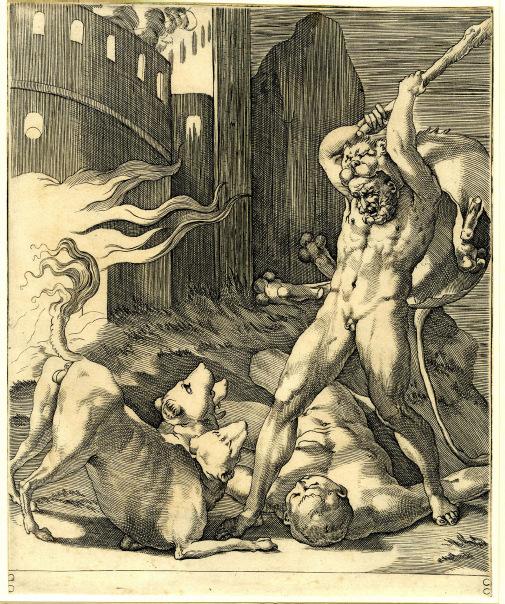
Hercules killing Cacus is the largest and most ambitious of the chiaroscuro woodcuts by Hendrick Goltzius. The subject provided ample opportunity to depict the bulging muscles of naked bodies in combat, so characteristic of the mannerist aesthetic. The composition of the central group with the two fighting figures is clearly borrowed from an engraving by Jacopo Caraglio after Rosso Fiorentino of Hercules fighting Cerberus. He did however take great care to also illustrate further details of the narrative: the violent encounter takes place in a cave scattered with human remains, and in the background we see the stolen cows. The ominous atmosphere of the cave is heightened by the iron chain at centre left and the bats flying about at upper right. In the present, very rare, early impression, another element of the myth becomes apparent, which is lost in most other examples. It is printed from three blocks in a combination of two shades of reddishbrown and pale beige or mushroom, a colour variant not described by Strauss, Bialler or in New Hollstein. Most of the more common, later impressions were printed in brown and ochre or green and yellow. It is however the reddish palette of the present impression which reflects the fact that Cacus breathes fire, thus illuminating the hellish scene with his flames.
Jacopo Caraglio (circa 1500-1565) after Rosso Fiorentino (1494-1540), Hercules fighting Cerberus, from: The Labors of Hercules, engraving, circa 1520-39. British Museum, London.
HENDRIK GOUDT (1583-1648) AFTER ADAM ELSHEIMER (1578-1610)
Ceres seeking her Daughter etching and engraving 1610 on laid paper, without watermark a brilliant impression printing very richly and sharply with great depth, intense contrasts and bright highlights with margins pale staining and small repairs in the margins generally in good condition
Plate: 12Ω x 9æ in. (318 x 247 mm.)
Sheet: 13√ x 10æ in. (352 x 274 mm.)
$4,000-6,000
PROVENANCE:
With Hom Gallery, Washington, D.C.. Alan and Marianne Schwartz Collection, Detroit; acquired from the above in 1986; then by descent to the present owners.
EXHIBITED:
The Detroit Institute of Arts, Master Prints of 5 Centuries: The Alan and Marianne Schwartz Collection, 1990-91, p. 145, n. 137.
LITERATURE:
Bartsch, Hollstein 5
As a printmaker, Hendrick Goudt specialised in translating the paintings of his contemporary Adam Elsheimer, often painted on copper and celebrated for their astonishing light effects, into the print medium. Goudt was perhaps the first etcher and engraver to compose his plates out of areas of light and shade - as Rembrandt would later do, with very different means but perhaps inspired by Goudt's brilliant, contrast-rich prints. The present work is based on a small painting by Elsheimer, which once belonged to Peter Paul Rubens and is now in the Prado in Madrid (inv. no. P002181). It depicts an episode from Ovid's Metamorphoses: Proserpina has been abducted Pluto, the God of the Underworld. Her mother Ceres, Goddess of the Harvest, on her search for her daughter, has arrived at the house of Hecuba and is offered a drink of water. A young boy, Stellio, observes Ceres drinking greedily from the jug and laughs at her. Enraged for being mocked by the child, the Goddess pours the rest of the water over him and turns him into a lizard.
The present impression is remarkable for the finest gradations of shading and the clarity of definition, even in the background and within the darkest areas and smallest details.
JACQUES BELLANGE (1575-1616)
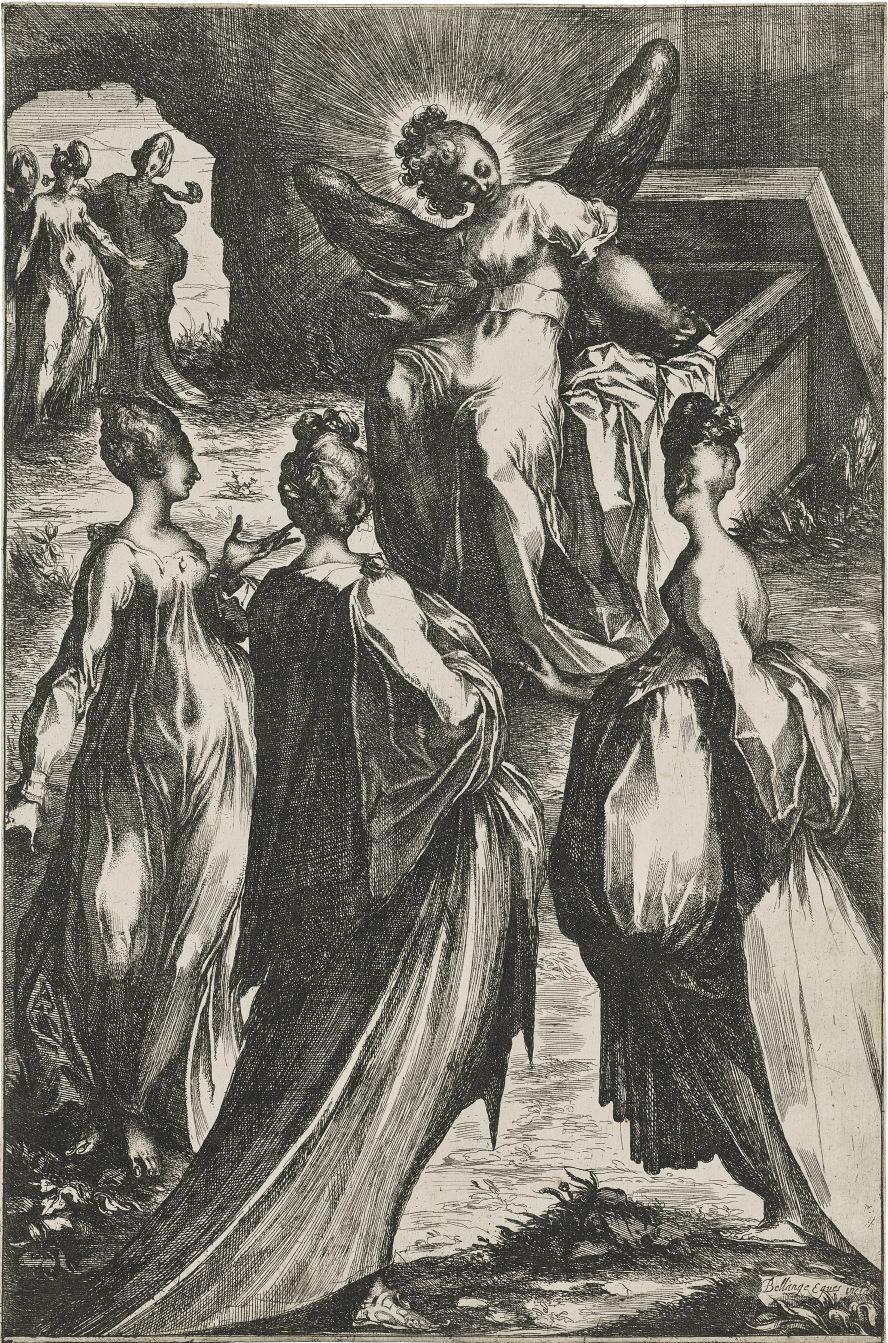
Les trois Maries au tombeau (The Holy Women at the Sepulchre)
etching and engraving circa 1613-16
on laid paper, watermark H with Letters on a Cross (Griffiths & Hartley 18) a very fine, rich impression of this large, rare and important print second, final state (the first state is only known in a unique impression in Boston)
printing very strongly, with intense contrasts and a subtle plate tone trimmed inside the platemark but outside the subject on all sides in very good condition
Sheet: 17Ω x 11Ω in. (444 x 292 mm.)
$50,000-70,000
PROVENANCE:
Dr Otto Schäfer (1912-2000), Schweinfurt, Germany (Lugt 5881); his sale, Kornfeld, Bern, 24 June 1992, lot 169 (CHF 88,000).
With Robert M. Light & Co., Inc., Santa Barbara, California. Alan and Marianne Schwartz Collection, Detroit; acquired from the above in 1992; then by descent to the present owners.
EXHIBITED:
The Detroit Institute of Arts, Prints and Drawings in the Age of Rubens, 1994.
One of the masterpieces of French mannerist printmaking, Jacques Bellange's Holy Women at the Sepulchre follows quite accurately the narrative of Mark 16.1-6:
And when the sabbath was past, Mary Magdalene, and Mary the mother of James, and Salome, had bought sweet spices, that they might come and anoint him.
And very early in the morning the first day of the week, they came unto the sepulchre at the rising of the sun.
And they said among themselves, Who shall roll us away the stone from the door of the sepulchre?
And when they looked, they saw that the stone was rolled away: for it was very great.
And entering into the sepulchre, they saw a young man sitting on the right side, clothed in a long white garment; and they were affrighted.
And he saith unto them, Be not affrighted: Ye seek Jesus of Nazareth, which was crucified: he is risen; he is not here: behold the place where they laid him.
The third woman named by the Apostle Mark, Salome, is not to be confused with the daughter of Herodias. She was a follower of Christ and also known as Mary Salome, hence the habitual French title of this subject: Les trois Maries au tombeau. Bellange depicts the the three women twice, once in the left background as they find the entrance of the cave open, and then standing in front of the empty tomb, as they encounter the angel announcing that Jesus has risen.
It is a daring composition, with the three Marys depicted prominently in the foreground, but seen from behind or in a lost profile. The viewer is thereby placed in the same position as the women, with the gaze directed towards the Angel of the Resurrection. It is the most monumental of Bellange's great, large-scale etchings such as The Raising of Lazarus or the Martyrdom of Saint Lucy, which can feel somewhat overcrowded and cluttered. Here, everything is pared down to the core of the narrative, albeit still depicted in Bellange's unique and highly eccentric style of elongated figures, opulent costumes and extravagant coiffures.
Little is known about the life of Jacques Bellange, who was employed as a court painter by the Duke of Lorraine in Nancy. His printed oeuvre is slim, consisting of only 47 plates in total, all of which are rare, especially in fine, early impressions, such as the present one.
Nicole Walch recorded only six impressions in public collections. Griffiths and Hartley erroneously record two impressions of the first state (before the signature), in Boston and Amsterdam, but the sheet at the Rijksmuseum is in fact also a second state-impression, with the signature.
JACQUES CALLOT (1592-1635)
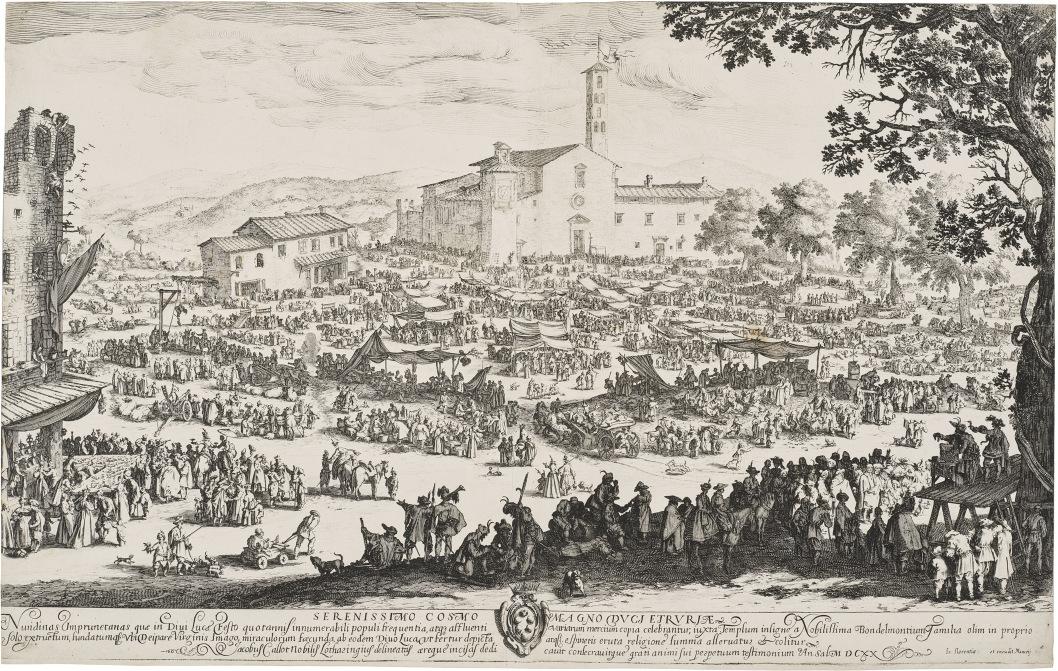
La Foire de l'Impruneta (Deuxième Planche) etching circa 1622
on two joined sheets of laid paper, watermark Rampant Lion with Star (similar to Lieure 38) on both sheets
a very fine impression of the first state (of two) printing with good contrasts and depth, with pronounced inky relief with an inky plate edge below trimmed to the borderline on three sides, a small margin below in very good condition
Sheet: 16Ω x 26º in. (420 x 665 mm.)
$4,000-6,000
PROVENANCE: Albertina, Vienna, with their de-accession stamp verso (Lugt 5d).
With David Tunick Inc., New York; his catalogue, The Art of Print, 1983 (with his stocknumber in pencil verso).
Alan and Marianne Schwartz Collection, Detroit; acquired from the above in 1983; then by descent to the present owners.
EXHIBITED:
The Detroit Institute of Arts, Master Prints of 5 Centuries: The Alan and Marianne Schwartz Collection, 1990-91, p. 158, n. 147.
The Detroit Institute of Arts, Prints and Drawings in the Age of Rubens, 1994.
LITERATURE: Lieure 478
For the lot essay, please see the online catalogue on www.christies.com
PETER PAUL RUBENS (1577-1640)
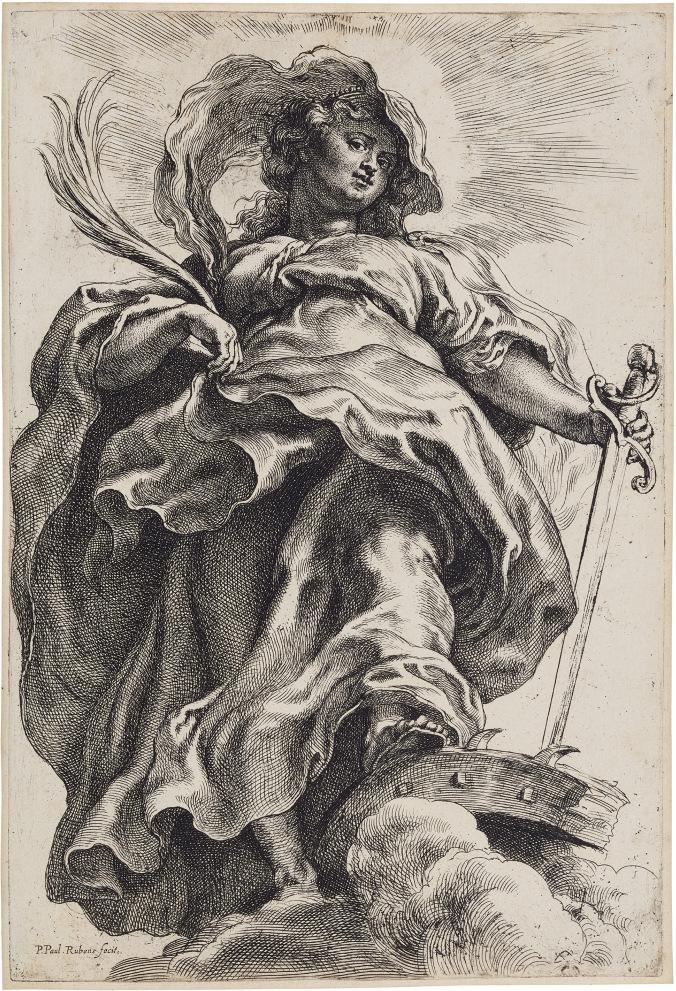
Saint Catherine
etching with engraving circa 1620-30 on laid paper, watermark Foolscap with seven-pointed Collar a brilliant impression of the only print executed by the artist third, final state printing very strongly and sharply, to a great three-dimensional effect with many wiping marks, plate impurities and a light plate tone with small margins in very good condition
Plate: 11Ω x 7æ in. (294 x 198 mm.)
Sheet: 11√ x 8¿ in. (299 x 204 mm.)
$12,000-18,000
PROVENANCE: Arthur Friederich Theodor Bohnenberger (1826-1893), Stuttgart (Lugt 68); then by descent to his son Theodor (1868-1941).
H. G. Gutekunst, Stuttgart, 13-17 May 1907, lot 822 ('Abdruck von grösster Schönheit und Frische auf Schellenkappe Papier. Äußerst selten').
Paul Davidsohn (1839-1924), London, Vienna & Berlin (Lugt 654), probably acquired at the above sale; his sale, C. G. Boerner, Leipzig, 26-30 April 1921, lot 461 ('Das sehr seltene Blatt in brillantem Abdruck, mit Plattenton und Spuren des Plattenschmutzes unten') (Mk. 600).
With Kunsthandel Helmut Rumbler, Frankfurt am Main. Alan and Marianne Schwartz Collection, Detroit; acquired from the above in 1999; then by descent to the present owners.
LITERATURE: Hollstein 1
For the lot essay, please see the online catalogue on www.christies.com
ANTHONY VAN DYCK (1599-1641)
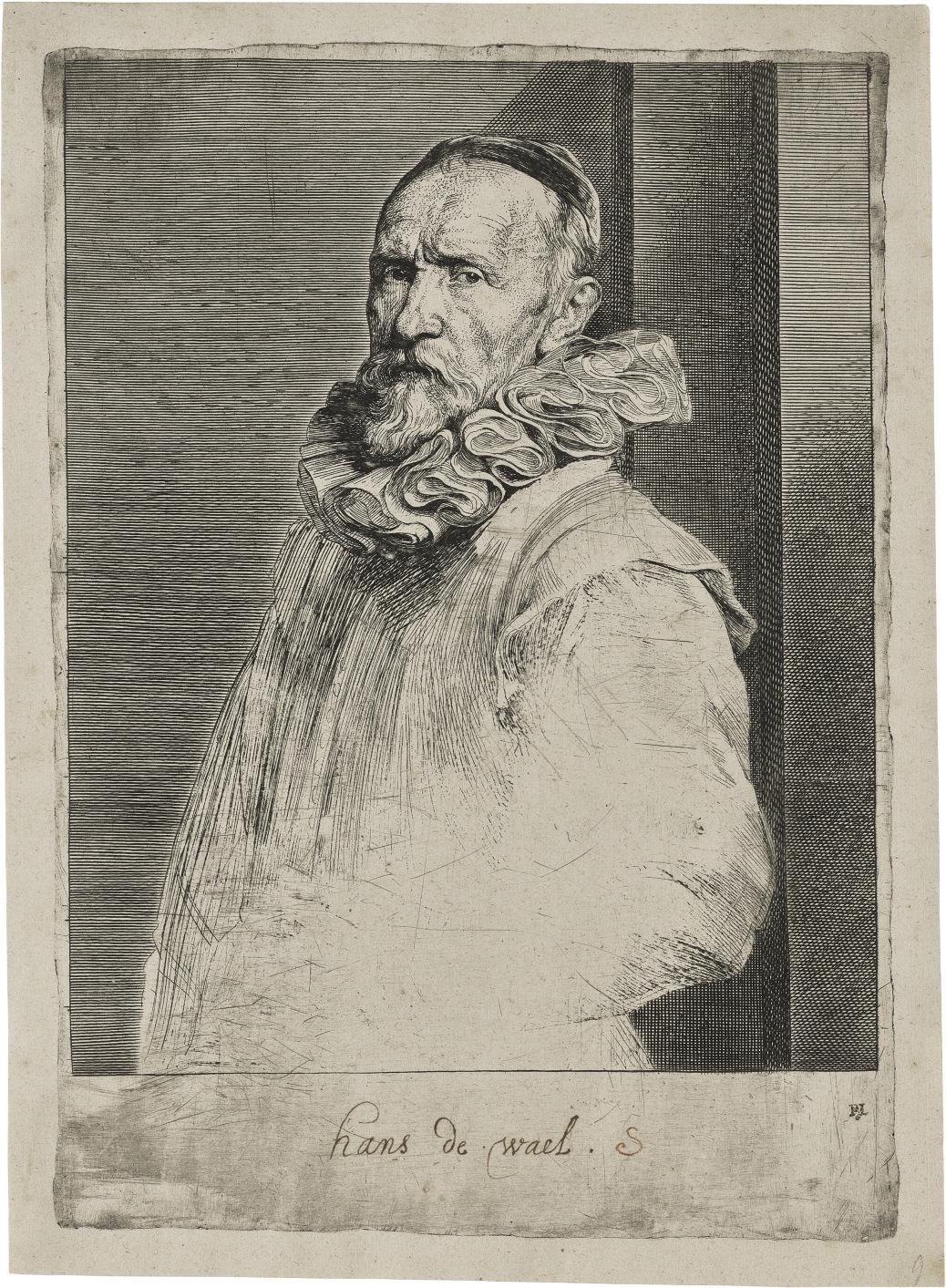
Jan de Wael
etching and engraving circa 1632 on laid paper, watermark Strasbourg Lily with pendant Letters SI and WR (Mauquoy-Hendrickx 158)
a brilliant proof impression of the second state (of six), before the completion of the arm printing very sharply and clearly, with much plate tone in the blank text border and along the sheet edges inscribed 'Hans de Wael.' in brown ink and 'S' in red crayon below with margins in very good condition
Plate: 10 x 7 in. (253 x 180 mm.)
Sheet: 107 x 78 in. (271 x 198 mm.)
$12,000-18,000
PROVENANCE:
Sir Peter Lely (1618-1680), London (Lugt 2092, recto); possibly his posthumous sale, Sonnius, Lankrink and Thompson, London, 11 April 1688 (and following days).
With Knoedler & Co., New York (with their stocknumber K9134 in pencil verso); The Print Collector’s Bulletin. An Illustrated Catalogue for Museums and Collectors: The Complete Etched Portrait Work of Anthony van Dyck from the Collections of Sir Peter Lely and Prosper Henry Lankrink, vol 3, n. 3. Clendenin J. Ryan (1905-1957), New York, Short Hills, New Jersey (not in Lugt); his sale, Parke-Bernet Galleries, New York, 17-18 January 1940, lot 127 ($ 950).
Hope Bacon von Klenk (1917-1983) and William Clifford Baron von Klenk (19272015), New York (not in Lugt); their sale, Sotheby Parke-Bernet, New York, 16 February 1979, lot 624.
Sotheby's, New York, 20 November 1986, lot 19 ($ 35,200).
Sam Josefowitz (1921-2015), Lithuania, Switzerland, USA and England (Lugt 6093); presumably acquired at the above sale; until 2004.
With C. G. Boerner, New York (with their stocknumber Jc. 20737 in pencil verso); on consignment from the above.
Alan and Marianne Schwartz Collection, Detroit; acquired from the above in 2009; then by descent to the present owners.
LITERATURE:
Hollstein 17; Mauquoy-Hendrickx 17; New Hollstein 15; C. Depauw, G. Luijten, Anthony van Dyck as a Printmaker, 1999-2000, Amsterdam, p. 162-66, n. 20 (another impression illustrated).
This portrait of the Flemish painter Jan de Wael (1558–1633) is one of a large series of printed portraits of the most famous personalities of his time, including European royalty, military men, writers and artists, known as the Iconography ('Icones Principum Virorum...'). Influenced by earlier Italian and French portrait series, Anthony van Dyck began organizing a print publication containing the engraved likenesses of more than a hundred prominent men of his lifetime in 1630. The artist himself only worked on 17 of the plates, including the present one, but delegating most of the work to professional engravers from his workshop. Many preparatory drawings and oil sketches for the plates have survived, but rarely come to the market. Recently, the preparatory drawing for the portrait of Willem Hondius, in black chalk, grey and brown wash, pen and brown ink, heightened with white, resurfaced and was sold for a record price at Christie's, New York (Old Master & British Drawings, 1 February 2024, for $2,107,000).
As an etcher, he seems to have been only interested in the essentials of the portraits, the faces and heads, which he captured with great spontaneity and fluidity, and left it to the engravers to complete the plates by adding the garments and background. Van Dyck's virtuosity as an etcher, draughtsman and portraitist is therefore best appreciated in the early unfinished states, which are very rare.
The present portrait is an interesting example of this working method. In the first state, of which only one impression is known (Musée du Louvre, Paris, inv. n. 2540), van Dyck had already completed the sitter's left arm and hand. Not happy with it, he burnished it out in the present second state. In the third state the arm was left unfinished but the sitter's name and artist's address were engraved in the text border below. In the fourth state the arm was completed by the publisher and engraver Gillis Hendricx.
CHRISTOFFEL JEGHER (1596-1653) AFTER PETER PAUL RUBENS (1577-1640)
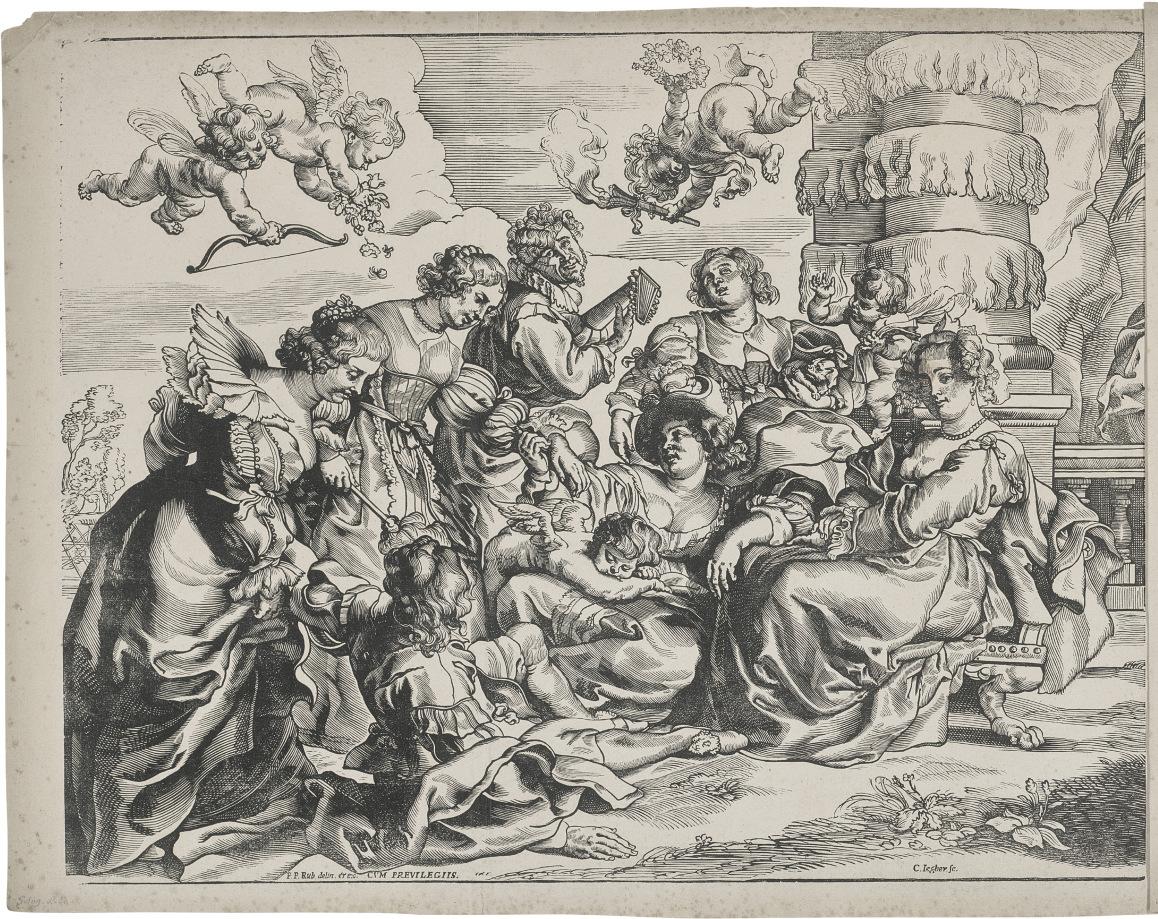
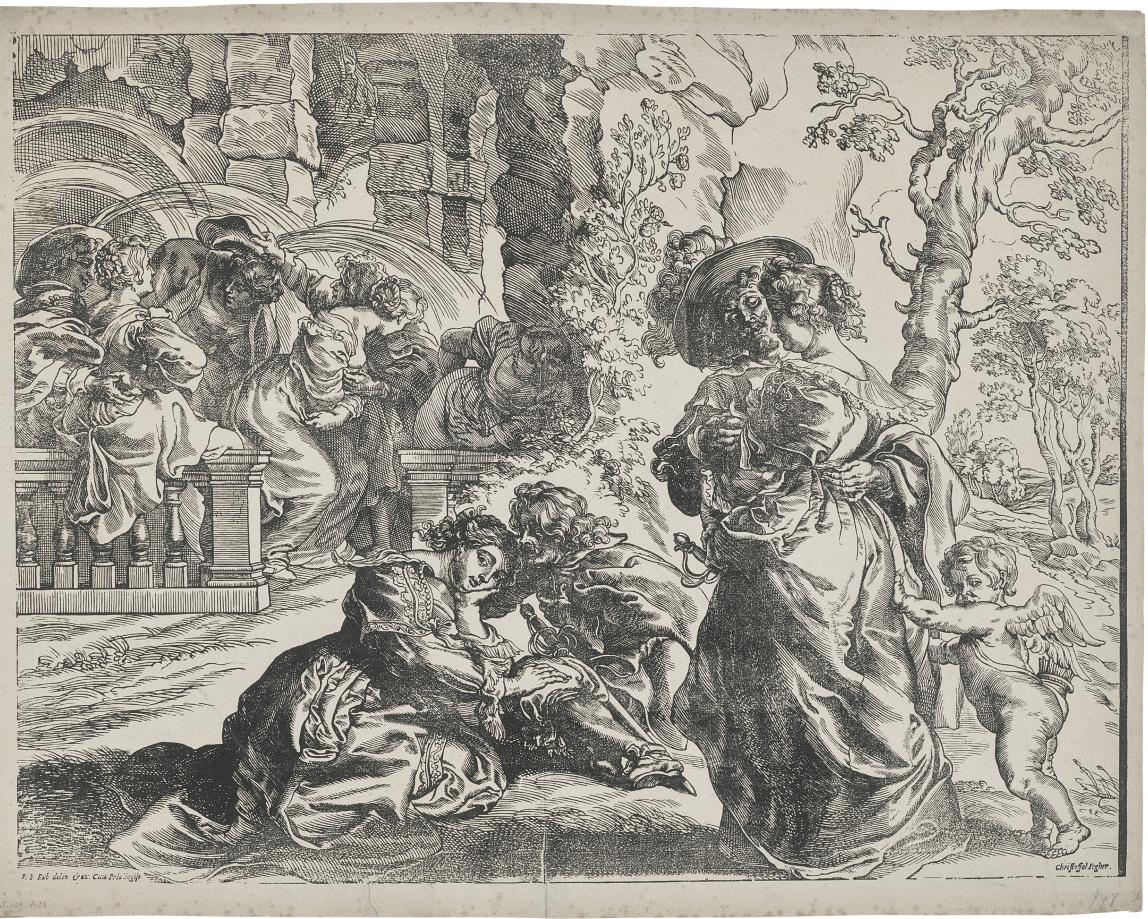
The Garden of Love
the pair of woodcuts circa 1633-35
on two sheets of laid paper, watermark Coat of Arms with countermark Name IPOYLEVE (similar to Heawood 628)
a very fine, early and uniform example of this rare, monumental pair of prints second state (of three) and only state, respectively printing very darkly and richly, slight dryly in places with great clarity, contrasts and cosiderable gaufrage verso both with margins on all sides two repaired tears in the right sheet otherwise in good condition
Block: 18¿ x 23¿ in. (460 x 588 mm.), Sheet: 19º x 25¡ in. (490 x 644 mm.) (and similar)
Overall: 49º x 193 in. (490 x 1251 mm.)
$6,000-8,000
PROVENANCE:
Julius Samuel Held (1905-2002), Mosbach, New York and Bennington, Vermont (without mark, see Lugt 4805); his posthumous sale, The Scholar's Eye: Property from the Julius Held Collection Part II, Christie's, New York, 30 January 2009, lot 272.
With Hill-Stone Inc., New York (acquired at the above sale).
Alan and Marianne Schwartz Collection, Detroit; acquired from the above in 2010; then by descent to the present owners.
LITERATURE:
Hollstein 17 a & b
Jegher's delightful pair of woodcuts of The Garden of Love is closely related to a painting by Peter Paul Rubens from around 1630-35, which is today at the Prado in Madrid (inv. n. P001690). The prints were conceived in close collaboration with Rubens and his workshop, as two highly detailed preparatory drawings attest to (Metropolitan Museum of Art, New York, acc. n. 58.96.1-2). From around 1619, Rubens had regularly worked with engravers to produce often quite large-scale prints after his painted compositions. Not only did these engravings offer another source of income, they also helped promoting his
workshop and spreading his fame. Quite why, around 1630, he decided to turn to Jegher for this purpose or whether in fact Jegher approached the painter, is not known. Either way, compared to engravings the woodcut medium offered a less labor-intensive and costly way of creating large, eye-catching prints, which focused not so much on the chiaroscuro light-effects of Rubens paintings than on the composition of the figures.
Rather than just 'copying' the main components of the painting, Rubens and Jegher reconfigured the scene and developed the rather tight, centralized composition of the painting into a frieze-like panorama, a format much better suited to the broad, bold lines of the woodcut. Despite - or perhaps because - of this transformation, the woodcut retains the charm and complexity of Rubens painting, which Alejandro Vergara summed up perfectly: 'We are confronted here with one of Rubens’s greatest gifts as a painter: his ability to create images of a joyful way of being in the world related to love and inspired by ancient literature and Renaissance art. In the case of the latter, this means primarily Titian. This painting is especially close in mood to the Bacchanal of the Andrians and the Worship of Venus. Many features of this scene call to mind Titian’s paintings: the coexistence of mythic and real-life characters, the presiding statue of Venus, the flying children,
the natural setting and its rich colouring, the sensuous atmosphere and sexual insinuation, the presence of music, the relative size of the figures within the composition. Rubens knew Titian’s works, most likely through copies (they had not yet arrived in Spain when he last visited in 1628-29), and painted two versions of them around the time when he made the Garden of Love. In this painting we see that Rubens has fully assimilated the influence of the Venetian master. [...] The matronly Venus implies that love pervades the scene. The winged children bring still more love, some of it of a kind specifically associated with matrimony, as we have seen. The crowd gathered dresses in clothes contemporary with the time when the painting was made...'
Vergara also observed an amusing variation between Rubens' canvas and the print: 'One of the men touches the breast of a woman while protecting another from a water sprout with his hat. (In a print by Christoffel Jegher made not long after the painting, the hand that touches the breast has been moved down slightly. Rubens was less concerned with modesty than many of his contemporaries).'
(A. Vergara, Alejandro, 'Comentario ', in: Pasiones mitológicas, Madrid, Museo Nacional del Prado, 2021, p.106-110, n. 9; quoted from: https:// www.museodelprado.es [31 August 2024])
REMBRANDT HARMENSZ. VAN RIJN (1606-1669)
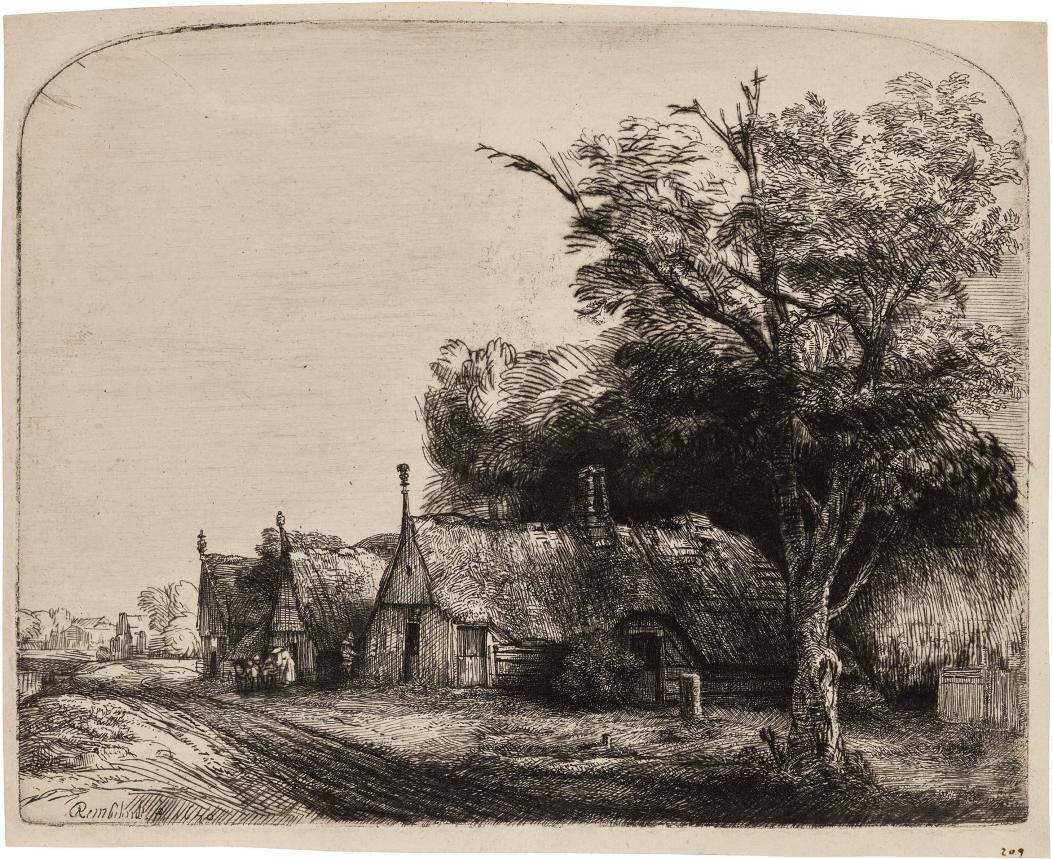
Landscape with three gabled Cottages beside a Road
etching and drypoint 1650 on laid paper, watermark Foolscap with five-pointed Collar (Hinterding C.b) a brilliant, very atmospheric impression of this rare and important print third, final state with rich, velvety burr throughout, especially on the tree and the group of figures by the road
printed with a subtle plate tone, prononuced horizontal wiping marks and inky plate edges with small margins and square sheet corners above in very good condition
Plate: 6¡ x 8 in. (161 x 202 mm.)
Sheet: 6æ x 8º in. (170 x 210 mm.)
$150,000-250,000
PROVENANCE:
Probably Nathaniel Smith (1740/41- circa 1809), London (without mark, see Lugt 2296; with the Gersaint number 209 in brown pencil recto). Private Collection, France.
With Kunsthandel Helmut Rumbler, Frankfurt am Main; acquired from the above.
Alan and Marianne Schwartz Collection, Detroit; acquired from the above in 2000; then by descent to the present owners.
EXHIBITED:
Museum of Fine Arts, Boston, The Art Institute of Chicago, Rembrandt's Journey, 2003-04, n. 188.
LITERATURE:
Bartsch, Hollstein 217; Hind 246; New Hollstein 248
The Landscape with Three Gabled Cottages is perhaps the most atmospheric rendering of a theme that appears repeatedly in Rembrandt's etchings - a bucolic view down a country lane lined with cottages and trees. The print is closely related to a drawing, Landscape with Cottages (Benesch 835; Kupferstichkabinett der Staatlichen Museen, Berlin; inv. no. KdZ 3116), which depicts a similar cluster of farm buildings, known as langhuizen (longhouses). The exact location of this etching has not been identified, however, the langhuizen were typical of the region around Amsterdam, particularly along the old roads, the Sloterweg, the Amstelveenseweg, and the Diemerdijk.
As the print varies from the drawing in several respects, it is generally thought that the artist composed the scene from more than one study. However, it has also been suggested that he had begun working on the plate outdoors, and completed it in the studio. This would explain the removal of a section of the tree, still faintly visible in the sky above the foliage over the central chimney. This combination of naturalistic observation and artistic intervention is typical of many of Rembrandt's etched landscapes, where fidelity to the subject is subordinate to composition and atmosphere.
This print is an early example in which Rembrandt executed the preliminary design for the landscape in etching, followed by extensive use of drypoint to create the marvelous tonal contrasts which characterize many of his later works. Fine impressions with rich burr in the tree, the roof at right and the figures by the cottages, and with the atmospheric effects of plate tone and wiping marks as pronounced as here, are rare and amongst the most desirable of Rembrandt's landscapes.
The tree in the foreground is one of the most beautiful and picturesque trees in Rembrandt's printed oeuvre, and the whole scene is enlivened by the small cluster of figures by the road, although they are merely suggested with a few blank spots and lines of drypoint: we can almost hear the voices of the children from the distance.
The present sheet is in exceptionally good condition and with perfectly dimensioned margins and square upper corners.
REMBRANDT HARMENSZ. VAN RIJN (1606-1669)
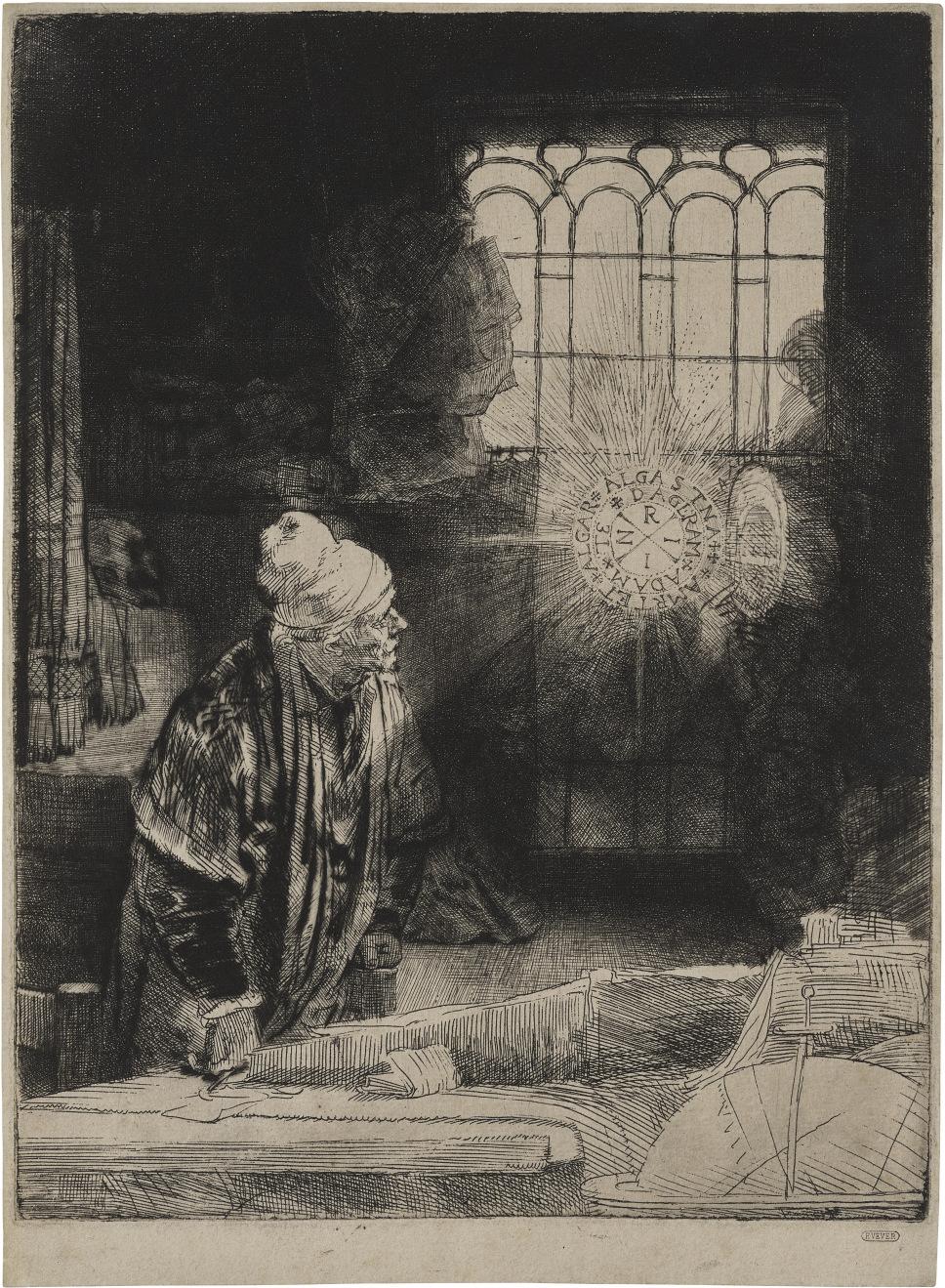
A Scholar in his Study ('Faust')
etching with engraving and drypoint circa 1652
on laid paper, indistinct countermark (possibly Hinterding FBA) a superb, luminous and atmospheric impression of the first state (of seven) printing with rich, velvety burr throughout and a subtle, selectively wiped plate tone with intense contrasts and great depth with small margins on three sides, a wider margin below in very good condition
Plate: 8º x 6º in. (210 x 158 mm.)
Sheet: 8√ x 6Ω in. (223 x 161 mm.)
$120,000-180,000
PROVENANCE:
Henri Vever (1854-1943), Paris (Lugt 2491bis, stamped twice, recto and verso); then by descent; their sale, Sotheby's, London, 30 June 1998, lot 118 ($ 170,000; to Light).
With Robert M. Light & Co., Inc., Santa Barbara, California. Alan and Marianne Schwartz Collection, Detroit; acquired from the above in 1998; then by descent to the present owners.
EXHIBITED:
Museum of Fine Arts, Boston, The Art Institute of Chicago, Rembrandt's Journey, 2003-04, n. 150.
LITERATURE:
Bartsch, Hollstein 270; Hind 260; New Hollstein 270
This is one of Rembrandt's most mysterious prints, and has been the subject of debate for over three hundred years. The subject is clearly a scholar, standing by his desk surrounded by books, papers and a terrestrial or celestial globe. On a shelf in the background is a skull, a memento mori and since the first depictions of Saint Jerome in his study a symbol of learning, philosophy and science. What is less clear is the significance of the apparition by which he is transfixed. The earliest title given to the print is found in Clement de Jonghe’s inventory of 1679, where it is described simply as 'Practising Alchemist'. In 1731 the inventory of the Dutch collector Valerius Röver identified the print as Doctor Faustus, the name by which it is still commonly known today. Whilst this title was only coined later, it seems fairly safe to assume that Rembrandt based his print on the legendary magician and alchemist: it is known that Christopher Marlowe's Tragical History of Doctor Faustus was performed in Amsterdam around 1650. One possible explanation is that the print is meant to demonstrate that scholars, and mankind in general, no matter how keenly they search after knowledge, can only perceive the truth as if in a glass darkly - in other words indirectly and distorted. Human knowledge is limited, and it is only through Jesus Christ, symbolized by the disc with the Latin acronym INRI, that we can partake of perfect knowledge hereafter.
In the late 1640-50s Rembrandt began to experiment by printing the same prints on a variety of supports, including oriental and oatmeal papers, thus exploring the effects of different surfaces and tones on the printing and the atmosphere of the image. About half of the first state-impressions of this plate recorded in New Hollstein are printed on Japanese, Chinese or oatmeal papers. For the present pull Rembrandt chose a bright European paper, which accounts for the sharpness, brilliance and intense contrasts of this impression.
(actual size)
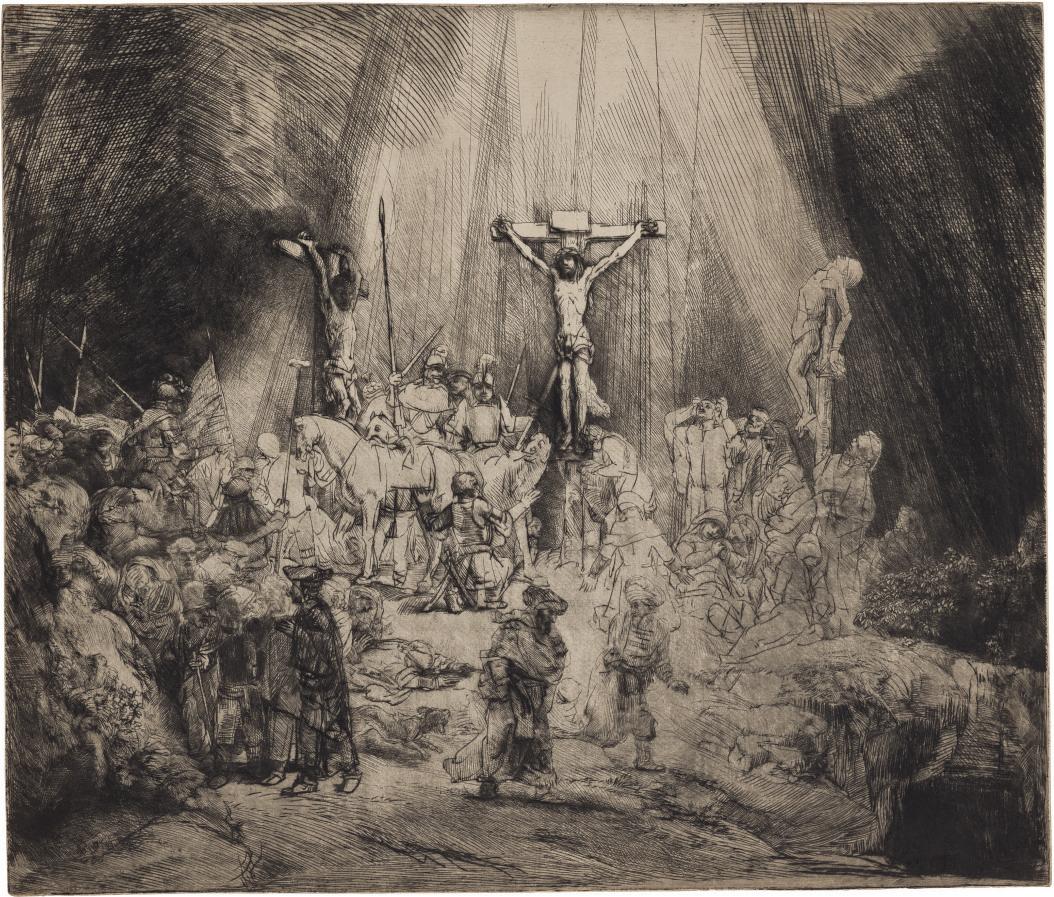
REMBRANDT HARMENSZ. VAN RIJN (1606-1669)
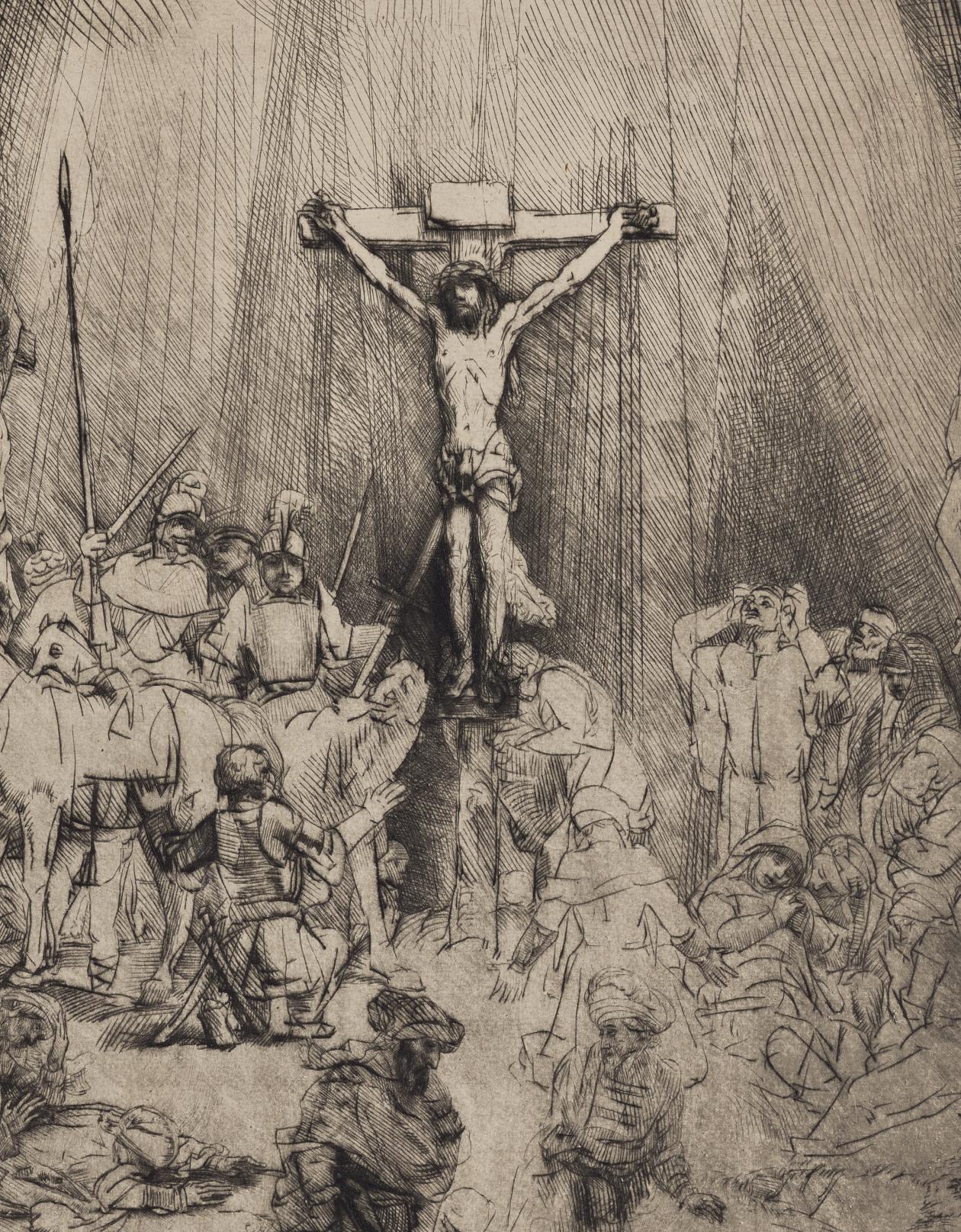
Christ crucified between the two Thieves: 'The Three Crosses' drypoint 1653 on laid paper, watermark Strasbourg Bend (Hinterding D.a) a brilliant, highly atmospheric impression of the extremely rare second state (of five) before the additional rework in the foreground and before Rembrandt's signature and date printing with much burr throughout and a rich, varied plate tone the plate selectively wiped to reveal the body of Christ and the celestial light above with narrow to thread margins in very good condition
Plate: 15¿ x 17æ in. (385 x 452 mm.)
Sheet: 15º x 17√ in. (387 x 454 mm.)
$1,000,000-1,500,000
PROVENANCE:
Jan Chalon (1738-1795), Amsterdam, Paris and London (Lugt 439).
With Walter Shropshire (before 1751-1785), London (without inscription and not in Lugt); presumably acquired from the above; according to Stogdon listed in his stock catalogue as n. 42 ('The Three Crosses, fine and very scarce, with the burs, very fine'; £ 2.2).
Jonathan Blackburne (1721-1786), Hale Hall and Liverpool (see Lugt 2650b), inscribed with initials W. S., dated 1772 and no. 20 in pencil (the initials referring to Shropshire, with the acquisition date); his posthumous sale, Hutchins, London, 20 March 1786 (and following days), lot 821 (with two other impressions of the same subject) (£ 5.12.6; to Thane for Browne).
Joseph Browne (d. circa 1790), Shepton Mallet, Somerset (not in Lugt); acquired through Thane at the above sale; his posthumous sale, Gerard,
London, 23 May 1791 (and following days), 2nd day, lot 52 (with two other impressions of the same subject) (£3.12; to Nathaniel Smith for Daulby).
Daniel Daulby (1745/6-1798), Liverpool (without mark; see Lugt 738); his posthumous sale, Christie's, London, 14-17 May 1800, probably lot 129 ('FIRST IMPRESSION, before the Name and Date, very scarce') (£2.8; to Rudge).
Edward Rudge (1763-1846), Abbey Manor, Evesham, Worchestershire, and London (without his mark, as is common, but with the inscription 'n. 80, First Impression' in brown ink; see Lugt 900); acquired at the above sale; then by descent to his great-grandson John Edward Rudge (1903-1970); his sale, Christie's, London 16-17 December 1924, lot 103 (£ 1155; to Colnaghi; cited in Lugt).
With P. & D. Colnaghi & Co., London (their stocknumbers C. 13208 and C 1384 in pencil verso).
Eldridge Reeves Johnson (1867-1945), Wilmington, Delaware & Philadelphia (not in Lugt; with his name inscribed in pencil verso); sold in his house sale, Philadelphia, 1962 (according to White & Boon).
Dr Otto Schäfer (1912-2000), Schweinfurt (Lugt 5881); his sale, The Dr Otto Schäfer Collection of Rembrandt Etchings, Sotheby's, New York, 13 May 1993, lot 22 (sold after the sale to Harris).
Richard Harris (1937-2023), New York and Chicago (Lugt 4364).
With C. G. Boerner, New York; on consignment from the above; their catalogue, Rembrandt - The Richard Harris Collection, New York, 2003, n. 10. Alan and Marianne Schwartz Collection, Detroit; acquired from the above in 2003; then by descent to the present owners.
EXHIBITED:
The Detroit Institute of Arts, The Big 3 in Printmaking, 2006.
National Gallery of Art, Washington, Strokes of Genius: Rembrandt Prints and Drawings, 2006-07.
The Detroit Institute of Arts, Rembrandt and the Face of Jesus, 2011-12. Robert and Karen Hoehn Family Galleries, University of San Diego, Rembrandt Prints 1648-1658: A Brilliant Decade, curated by Adrian Eeles, 2015, n. 13.
LITERATURE:
Bartsch, Hollstein 78 (this impression cited and illustrated by White & Boon); Hind 270; New Hollstein 274
No earlier and complete impression of The Three Crosses than this magnificent and richly tonal example of the second state is likely to come to the market in the foreseeable future: only one trimmed and one fragmentary impression on vellum of the first state are still in private hands, while of the present second state only one other impression is known outside a public collection; of the subsequent third state, three impressions are still privately owned. Before the reappearance on the market of the Plessen-Cronstern impression (Christie's, London, 7 June 2022, sold for US$ 1,753,000) and the sale of the Albertina duplicate from the Josefowitz Collection (Christie's, London, 7 December 2023, sold for US$ 1,542,000), both of the third state, no other complete impression of the first three states had been on the market for over three decades. Few prints in European art history are of equal importance and so unanimously admired as Rembrandt’s Christ crucified between the two Thieves, commonly known as The Three Crosses. Most multi-figure Calvary scenes, popular in the Netherlands in the 15th and 16th century but no longer in Rembrandt’s time, allowed the viewer to calmly observe the scene from the outside. Rembrandt, by contrast, throws us into the midst of the event as it unfolds. His print is a turmoil of light and darkness, of hard, straight lines and dense crosshatching, of highly worked details and loosely sketched, seemingly unfinished passages, all adding to a sense of movement and immediacy, to invoke an almost cinematic experience. Frederik Schmidt-Degener, director of the Rijksmuseum from 1922-41, summarized the achievement of this work thus: 'Only once, in Rembrandt’s vision, has the Christian imagination truly dwelt on Golgatha.' (F. Schmidt-Degener, quoted in: Eeles/ Hoehn, 2015, p. 11). Other scholars and print connoisseurs have, from different perspectives, expressed the importance of this work no less emphatically.
According to Holm Bevers, ‘Rembrandt’s psychologically penetrating study of terrified humanity has no equal in the iconography of Calvary’ (Bevers, 1991, p. 264); James Ganz felt that ‘the death of Christ on the cross has never been depicted with such graphic intensity or raw expressive force’ (Ganz, 2013, p. 133); Nicholas Stogdon considered it ‘the most celebrated of all prints’ (Stogdon, 2011 p. 71); and Adrian Eeles called it ‘an unforgettable masterpiece of print-making’ (Eeles, 2015, p. 48). For Erik Hinterding ‘this monumental print is one of the highlights
of his etched oeuvre and a key point in the history of the graphic arts.’ (Bikker, 2014, p. 159).
The year of its creation, 1653, must have been a difficult year for Rembrandt and for Holland, as the dispute with his former maid and lover Geertje Dircks rumbled on, and the Anglo-Dutch War (165254) put an enormous strain on the economy of the country, gravely affecting the demand for luxury goods and art commissions. It was at this point that Rembrandt embarked on the creation of his most ambitious and demanding print in subject, technique and size. He decided to depict the pivotal event of Christianity, to do it entirely in drypoint, and on a scale never before attempted.
Of the four gospels, Rembrandt followed Saint Luke’s account most closely: And when they were come to the place, which is Calvary, there they crucified him, and the malefactors, one on the right hand, and the other on the left. Then said Jesus, Father, forgive them; for they know not what they do. And they parted his raiment, and cast lots. And the people stood beholding. … And it was about the sixth hour, and there was a darkness over all the earth until the ninth hour. And the sun was darkened, and the veil of the temple was rent in the midst. And when Jesus had cried with a loud voice, he said, Father, into thy hands I commend my spirit: and having said thus, he gave up the ghost.
Now when the centurion saw what was done, he glorified God, saying, Certainly, this was a righteous man. And all the people that came together to that sight, beholding the things which were done, smote their breasts, and returned. (Luke 23; 33-48)
The composition is divided quite evenly into three parts, horizontally and vertically. The upper third is entirely taken up by the sky, dark towards the sides and bright at the center, where an intense light falls in shafts from above. In the middle section are the three crosses, with Christ slightly off-center to the right. His body has sunk deep below the crossbeam, His eyes are closed, the mouth half open. We see His ribcage and thin, stretched abdomen. A loincloth is wrapped around His waist, the feet are nailed next to each other to the Cross. To the right below, we see a group of mourners, including Mary Magdalene clutching the foot of the Cross. Saint John stands behind her, his hands
raised to his head in despair. Below him on the ground, the fainting Virgin is consoled and supported by a group of women around her. Further to the right stands the cross of one of the thieves, bathed in light. His body is painfully bent over the crossbeam, with his arms pulled back and down, tied to the trunk. The centurion mentioned by Luke has dismounted his horse and cast off his helmet, as he kneels with his outstretched arms raised, facing the figure of Christ. This is the moment of his conversion, as Christ has just exhaled his last breaththe apex of the Passion, the turning point of the work of Redemption.
To the left of Christ are two Roman cavalry soldiers on horseback, one with a tall lance, the other pointing his sword at Christ’s thigh. Further to the left stands the cross with the second thief, his face and body partially shaded. Below him, a foot soldier is leading the centurion’s horse away. Towards the left edge, Rembrandt has placed a group of soldiers with a raised standard and lances, including a commander on horseback and a man reaching with a staff and sponge towards the good thief.
In the lower left third of the sheet another small crowd of mourners has turned away, about to leave the cruel scene, including a bareheaded man, presumably Simon of Cyrene. Two women have fallen to the ground in panic or despair, a running dog adds to the sense of tumult and chaos. The lower centre is dominated by two figures, presumably Joseph of Arimathea and Nicodemus, hurrying towards a cave in the lower right corner - the future tomb of Christ, where the two men will bury Him.
To create this astonishing print, Rembrandt employed the drypoint method, whereby the design is scratched directly into the plate rather than etched into the copper by acid. In the process, small barbs of metal are raised alongside the scratched lines, creating rough ridges. When the plate is inked up, the ink gets caught in these barbed ridges, resulting in deeply black, velvety lines and blurred areas, an effect called ‘burr’. It is astonishing to observe with what virtuosity Rembrandt employed the drypoint technique to its full potential on such a monumental scale. As a result, The Three Crosses has the immediacy and spontaneity of a drawing. ‘As far as we know, with the possible exception of two small sketches for individual figures, he
worked directly on the plate without the aid of compositional drawings. His control and mastery were such that no preparation on paper was necessary. For him, drypoint became another tool for drawing.’ (White, 1999, p. 81)
The Three Crosses exists in five states. In print-making terms, a change in ‘state’ denotes a deliberate alteration to the plate and consequently to the printed image. The first state of The Three Crosses already shows the complete composition, no unfinished proofs exist. About twenty impressions of the first state are known, the majority printed on vellum. The present second state differs from the first only in that Rembrandt added a few lines of shading at the right sheet edge. A total of eleven impressions are recorded, all on European paper. In the third state, Rembrandt strengthened the shading here and there, and elaborated the face of Simon of Cyrene. At this point Rembrandt also signed and dated the plate at the lower centre left: Rembrandt.f.1653. Impressions of the third state are generally more cleanly wiped that those of the first two states, and most are printed on European paper. In the fourth state, Rembrandt famously transformed the image completely instead of reworking it, as the drypoint began to wear. He scraped and burnished off much of the previous design, removed many figures, added some, and obscured much of the plate with long and heavy, vertical lines of shading, leaving only the central section slightly brighter. James Ganz described this state as ‘a tour de force of draftsmanship and printmaking in which emotion eclipses intelligibility.’ (Ganz, 2013, p. 133) More than eighty impressions of the fourth state have survived to the present day. Finally, the Amsterdam printer Frans Carelse (d. 1683) acquired the plate, engraved it with his name, and printed a small number of impressions of the fifth, final state. (For the most recent census of impressions, please see: Bikker, 2014, p. 159-60.)
Rembrandt's Christ crucified between two Thieves: ‘The Three Crosses’ is, in Christopher White’s words, ‘one of Rembrandt’s most moving work in any medium’ (White, 1999, p. 88). The present impression, having been in the care of a long line of important print collectors for over three centuries, offers one of the last chances to acquire an early iteration of this astounding work, before Rembrandt's radical reworking of the plate.
REMBRANDT HARMENSZ. VAN RIJN (1606-1669)
The Entombment
etching and drypoint circa 1654 on laid paper, watermark Foolscap with seven-pointed Collar (Hinterding M.a) a very fine and atmospheric impression of this rare and important print fourth, final state printed with a strong, varied and selectively wiped plate tone with narrow margins in very good condition
Plate: 8º x 6¡ in. (211 x 161 mm.)
Sheet: 8Ω x 6Ω in. (213 x 163 mm.)
$100,000-150,000
PROVENANCE:
Edward Vernon Utterson (1775 or 1776-1856), London and Isle of Wight (Lugt 909); his anonymous sale, Christie's, London, 17 February 1848, lot 55 (£ 8; to Gibbs).
Probably with James Gibbs, London. Christie's, London, 6 December 1985, lot 313 (£ 34,560).
With P. & D. Colnaghi & Co., London, 2002. Private Collection, France. Christie's, London, 5 December 2006, Rembrandt 400, lot 205 ($ 153,000; to Boerner).
With C. G. Boerner, New York; their catalogue, Neue Lagerliste 132 (2013), n. 35. Alan and Marianne Schwartz Collection, Detroit; acquired from the above in 2013; then by descent to the present owners.
EXHIBITED:
Robert and Karen Hoehn Family Galleries, University of San Diego, Rembrandt Prints 1648-1658: A Brilliant Decade, curated by Adrian T. Eeles, 2015, n. 30.
LITERATURE:
Bartsch, Hollstein 86; Hind 281; New Hollstein 284
More than any other plate in Rembrandt’s oeuvre, The Entombment has been the object of his experimental approach to printmaking in the later years. Not only did he alter the plate drastically between the first and the second state, he also chose different supports - from European paper to Chinese and Japanese papers to vellum—from one impression to another, and manipulated each pull by leaving varying degrees of plate tone and wiping the tone selectively to modify the illumination and pick out different highlights. Of the later states, virtually no two impressions look the same, as Christopher White pointed out: ‘… the dark metamorphoses offer a highly personal vision employing all the chance methods at an artist’s command, with each impression as unique as a monotype.’ (White, 1999, p. 95)
Within the biblical narrative, The Entombment follows on from Christ crucified between the two Thieves: 'The Three Crosses' (see previous lot), where we see Joseph of Arimathea and Nicodemus in the foreground hastening towards the future burial place of the body of Christ. Now, they have brought Him to the tomb, depicted here as a vaulted cave or chapel, where the body is now being lowered into the grave. The first state is in pure etching, the shading and modelling of the space and the figures rendered in regularly and openly spaced hatchings, with strong lines of equal weight (see ill.). Although darkness and light are suggested, the whole scene is clearly discernible. We see Joseph of Arimathea standing at left above the sunken grave, the Virgin is sitting to his feet, her hands clasped in sorrow, a group of other grieving women is huddled behind her. Three men are lowering the body into the grave, a fourth one has climbed down to support it from below. The light seems to come from a lamp covered by the foremost figure—or is perhaps emanating from the dead Christ Himself. Above this mournful scene—pushed into the lower left corner of the image, thereby reflecting the act of the entombment—we see the arch of the cavern, with two skulls resting on a ledge. Behind this gruesome memento mori, the space recedes into darkness. Already in the second state, Rembrandt obscured the composition considerably with dense hatching in drypoint and engraving, turning it into a truly nocturnal scene, and made it even darker in the subsequent states. The present example is a very fine and tonal impression of the fourth, final state on white European paper. It demonstrates perfectly what interested Rembrandt in his experiments with this plate: how to depict a scene in a minimally lit space.
To see this print is an astonishing experience, not unlike entering a lightless room and having to wait for the eyes to adapt to the gloom. The enclosed space is more felt than seen and the figures on the left are almost swallowed up by the darkness. The figures of Virgin, Joseph of Arimathea and the men supporting the corpse are covered with tone, which thickens incrementally towards the edges of the grave, leaving them barely visible in a dim twilight. Only on the body of Christ, especially His chest, Rembrandt selectively and very gently reduced the plate tone, creating a faint highlight, suggesting a lamp or torch hidden from our view, held by the man in the foreground seen from behind. This highlight not only 'illuminates' the scene and draws the viewer's attention towards the fulcrum of the event. It also symbolizes the hope that is at the core of the sacrifice of Christ. Rembrandt knew the bible well and this may be a visual reference to John 1:5: 'The light shines in the darkness, and the darkness did not overcome it.' As in all of his best works, the form and content correspond perfectly, as the darkness of the image reflects the spiritual somberness of the occasion, and yet it contains a shimmer of light, however faint.
The present sheet comes from the collection of the English connoisseur Edward Vernon Utterson, praised by Frits Lugt: 'Son goût et son choix furent excellents.' This impression keeps a fine balance between what is visible and invisible, between the narrative and the nocturnal atmosphere, and leaves the viewer in wonder at Rembrandt’s exploration of the border between light and darkness.
Rembrandt Harmensz. van Rijn (1606-1669), The Entombment, etching and drypoint, circa 1654, first state (of four). British Museum, London.
(actual size)
REMBRANDT HARMENSZ. VAN RIJN (1606-1669)
Jan Lutma, Goldsmith etching with engraving and drypoint 1656 on laid paper, without watermark a superb, very atmospheric impression of the first state (of five) printing with rich, velvety burr throughout and a light, warm plate tone, carefully wiped to reveal the collar shirt sleeve and other highlights with small margins in very good condition
Plate: 7æ x 5√ in. (198 x 149 mm.)
Sheet: 82 x 6º in. (208 x 158 mm.)
$150,000-250,000
PROVENANCE:
Ambroise Firmin-Didot (1790-1876), Paris (Lugt 119).
Valentin Weisbach (1843-1899), Berlin (Lugt 2539b); then by descent to his son Werner Weisbach (1873-1953), Berlin and Basel (without his mark, see Lugt 2659a); his anonymous sale, Gutekunst & Klipstein, Bern, 11 March 1954, lot 255 ('Herrlicher Frühdruck in selten harmonischer Wirkung, mit starker, doch nicht überladen durchdringender Gratwirkung, tiefschwarz, aber transparent in allen Feinheiten und Schattenpartien (...) Eine der Kostbarkeiten der Sammlung') (Fr. 24.500; this impression cited in Lugt).
Dr Otto Schäfer (1912-2000), Schweinfurt (Lugt 5881); his sale, The Dr Otto Schäfer Collection of Rembrandt Etchings, Sotheby's, New York, 13 May 1993, lot 55 ($ 189,500; to Artemis).
With David Carritt (Artemis Fine Arts), London.
Alan and Marianne Schwartz Collection, Detroit; acquired from the above in 1995 (partly in exchange for a second state-impression); then by descent to the present owners.
LITERATURE:
Bartsch, Hollstein 276; Hind 290; New Hollstein 293
The etched portraits of the late 1650's are arguably Rembrandt's greatest and most elaborate. During this period he portrayed a number of fellow artists, collectors, publishers and craftsmen—men whom he respected and was friendly with. While his family portraits are mostly quick, spontaneous sketches, these more formal portraits are complex investigations into the character of his sitters. The present portrait of the goldsmith Jan Lutma is perhaps one of the most captivating portraits of all.
Jan Lutma (c.1584-1669) was one of the leading goldsmiths and jewelers in Amsterdam at the time, and a great collector of prints—his son Jan Lutma the Younger was an etcher. There is a gentle pride in the way the aging craftsman presents himself, seated in a large armchair, surrounded by the accoutrements and products of his profession. A hammer and punches are placed on the table next to him, there is a chased silver bowl, and in his right hand he holds a figurine or candlestick.
Yet Rembrandt shows him sunk deep in thought, almost unaware or simply uninterested in the act of portrayal. His eyes are shadowed and half-closed, attesting to the fact that his eyesight was beginning to wane. This work is testament to Rembrandt’s skill and deeply considered approach to his sitter; he conveys the sense of gentle resignation, as Lutma’s passion for his profession is threatened by his age and failing eyesight—an issue of some concern to Rembrandt himself.
Few portraits in Rembrandt’s graphic oeuvre convey a stronger sense of atmosphere and personal presence and are more convincing in the depiction of the textures and surfaces than fine, first-state impressions of Jan Lutma, Goldsmith.
In the catalogue of the Weisbach sale at Gutekunst & Klipstein in Bern in 1954, the present impression is described as 'one of the treasures of the collection'. Compared to the first state-impressions of the collections Aylesford, Theobald and von Hagens, the cataloguer only considered the first one as equal in quality to the present sheet. Their standards must have been very high indeed, as the impression that once belonged to Henry Studdy Theobald and later to Sam Josefowitz was sold in these rooms on 7 December 2023 for the record price of £302,400 (incl. premium).
(actual size)
ANTONIO CANAL, CALLED CANALETTO (1697-1768)
Imaginary View of Padua, from: Vedute altre prese da i luoghi altre ideate da Antonio Canal etching circa 1735-44 on laid paper, watermark Crossbow (Bromberg 4)
a brilliant, early proof impression of the extremely rare first state (of three) before the shading of the tree at centre left and other changes printing with great contrasts and depth, to a luminous, glittering effect trimmed to or just outside the platemark at left and right, narrow to small margins above and below in very good condition
Plate: 11æ x 17¿ in. (299 x 434 mm.)
Sheet: 12º x 17¿ in. (310 x 435 mm.)
$15,000-25,000
PROVENANCE:
Marchesi Navona-Ferraioli (19th century), Rome (inscribed in black ink verso; not in Lugt).
With David Tunick, Inc., New York.
Alan and Marianne Schwartz Collection, Detroit; acquired from the above in 2001; then by descent to the present owners.
LITERATURE:
De Vesme 11; Bromberg 11
Antonio Canaletto turned to etching at the height of his popularity as a painter, when his virtuoso Venetian views were in great demand, especially with the many English aristocratic visitors who passed through the city on the Grand Tour. This lucrative stream of commissions made both his reputation and his fortune, but may have also resulted in the increasingly formulaic style of his later paintings, which John Ruskin scathingly described as 'miserable, heartless, virtueless mechanism' (Bromberg, p. XI).
It can only be speculated why Canaletto at this point in his career decided to create a series of etched views, it is however likely that his patron Joseph Smith (circa 1674-1770) commissioned the prints. A renowned collector, art dealer and agent, Smith was the British Consul to Venice, and spent almost his entire life there, from the early 1700s until the year of his death. He is known to have had an interest in printmaking, having commissioned a series of engravings by Antonio Visentini (1688-1782) after Canaletto's paintings of Venice in his own
collection. Whether the initiative to create a set of etched vedute came from the artist himself or from his patron is not documented. In any case, when the series was ready for publication, Canaletto dedicated it to 'Giuseppe Smith/ Console di S. M. Britannica', as the inscription on the title page reads. It is also uncertain when exactly the plates were etched; only one plate, the later divided Imaginary View of Venice (B. 12) bears the date 1741. The exact date of publication is not known, but it must have been after 6 June 1744, the day Joseph Smith was appointed Consul to Venice, and probably before Canaletto's departure for England in 1746.
Whatever its genesis, the Vedute marked a change in the artist's style and attitude. Unusually for an artist who had made his reputation with views of Venice, it comprises relatively few of the famous sites of the city. Instead, he turned to more vernacular, picturesque buildings, courtyards and views of Venice and other towns and places in the Veneto, whether real or fictitious. Instead of topographical accuracy, his etchings betray a renewed interest in the atmospheric, ephemeral aspects of the city, in the play of light and shade on the canals and facades, which he depicted with nervous, quivering lines.
Viscount Norwich eloquently described the effect the etchings seem to have had on the artist: 'All the youthful vigour has returned, the freedom of fancy and line, all the imagination and invention that material success had whittled away. The verticals no longer betray the draughtsman's T-Square, the figures are real people once more, not just short-hand blobs put in to prevent the places looking deserted. New disciplines and techniques demanded a new eye, a new approach to problems of light and shade. Canaletto was himself again...' (Viscount Norwich, Foreword, in: Bromberg, p. XI).
As a rule, Marianne and Alan Schwartz did not collect series of prints. Instead, they focused on finding prime examples of the artist in question while at the same time avoiding the obvious. Thus, Goya's Caprichos are represented by one single plate (see lot 28), and of Canaletto's Vedute they chose the present, exquisite proof impression of the Imaginary View of Padua. It shows Canaletto at his very best. No other of the Italian vedutisti could create a view so full of atmosphere, light, texture, human activity and a sense of place in the medium of etching.
There are only four recorded impressions of the first state of the print, including the present example: Bromberg records two (Gabinetto Nazionale delle Stampe, Rome; and Museum of Fine Arts, Boston), to which we can add the impression at the Museum of Fine Arts, Houston. The present sheet bears a Crossbow watermark similar to the one found by Bromberg in the impression in Boston.
GIOVANNI BATTISTA TIEPOLO (1696-1770)
Adoration of the Magi etching circa 1740 on laid paper, without watermark a fine, delicate impression of the first state (of three), before numbers printing sharply and with good contrasts, with light wiping marks and inky plate edges with margins in very good condition
Plate: 17 x 11Ω in. (432 x 291 mm.)
Sheet: 18æ x 131 in. (476 x 330 mm.)
$7,000-10,000
PROVENANCE:
Thomas Graf (1878-1951), Berlin (Lugt 1092 a & b).
Kimbell Art Foundation, Fort Worth, Texas (not in Lugt); their sale, Sotheby's, New York, 13-15 May 1987, lot 67.
With Robert M. Light & Co., Inc., Santa Barbara, California; presumably acquired at the above sale.
Alan and Marianne Schwartz Collection, Detroit; acquired from the above in 1989; then by descent to the present owners.
EXHIBITED:
The Detroit Institute of Arts, Master Prints of 5 Centuries: The Alan and Marianne Schwartz Collection, 1990-91, p. 212, n. 199.
LITERATURE:
De Vesme 1; Rizzi 27
Giovanni Battista Tiepolo (1696-1770), Adoration of the Magi, pen and brown wash over graphite on paper, 1750-1770. Cantor Arts Center, Stanford University (Gift of Mortimer C. Leventritt).
The Adoration of the Magi is Giovanni Battista Tiepolo's largest etching, but is related to a much smaller drawing by the artist in pen and brown wash over pencil at the Cantor Arts Center in Stanford (see ill.). The dating and relation of the two works to each other is somewhat uncertain: on the basis of stylistic correlations with the Scherzi-series, Rizzi suggested a date of creation around 1740 for the etching, while the drawing has been loosely dated to 1750-70 Whether the etching does indeed precede the drawing or vice versa remains the subject of speculation. Despite a general similarity of the two composition, there are considerable differences, too: one is not a copy or translation of the other into a different medium. The artist clearly saw them a very different works. The comparison is instructive for another reason: Tiepolo drawing style and his etching manner are quite distinct: in the drawing, his use of wash in particular lends weight to his figures and objects and grounds the composition, and his lines, however sketchy, are long and firm; the etching in contrast is made up of a myriad of short lines and tiny flicks of the needle. By varying the density and direction of his etched marks, he creates shading and texture. The overall effect of the print however is one of constant flux: everything seems aflutter, as if a gust of wind could make the whole scene diffuse and disappear. It is a stylistic peculiarity that can be observed in some of Giovanni Battista's best etchings, in particular the Scherzi and some of the Capricci, and goes beyond mere technical or aesthetic considerations. Rather, by formal means, Tiepolo seems to make a philosophical point: the visible world is not a solid place, but a miragediaphanous, fleeting and ephemeral.
The original copperplate of The Adoration of the Magi however has endured and is at the Museo Correr in Venice.
BERNARDO BELLOTTO (1721-1780)
Vue de la Grande Place du Vieux Marché du Coté de l'Eglise de la Sainte Croix et la Rue de la Porte neuve ('Der Altmarkt zu Dresden') etching 1752
on laid paper, apparently without watermark a brilliant, luminous impression of this large print Kozakiewicz's second, final state, De Vesme's second state (of three) printing very richly and evenly, with remarkable clarity and intense contrasts with wide margins in very good, original condition
Plate: 21¡ x 33º in. (542 x 843 mm.)
Sheet: 25¬ x 34¬ in. (652 x 878 mm.)
$4,000-6,000
PROVENANCE:
Private English Collection; their sale, Galerie Kornfeld, Bern, 21 June 1985, lot 10. Alan and Marianne Schwartz Collection, Detroit; acquired at the above sale (through William Schab Gallery, New York); then by descent to the present owners.
EXHIBITED:
The Detroit Institute of Arts, Master Prints of 5 Centuries: The Alan and Marianne Schwartz Collection, 1990-91, p. 210, n. 196.
LITERATURE:
De Vesme 17; Succi 17; Kozakiewicz 175
D. Succi, Da Carlevarijs a Tiepolo, Incisori veneti e friulani del Settecento, Venezia, 1983, p. 38, n. 36 (another impression illustrated).
For the lot essay, please see the online catalogue on www.christies.com
THOMAS
GAINSBOROUGH
(1727-1788)
Wooded Landscape with two Country Carts and Figures
soft-ground etching circa 1779-80 on stiff laid paper, without watermark a very fine impression of the extremely rare first state (of two) one of a few impressions printed by the artist himself, before the addition of the number 3 at top left and before the posthumous edition issued by J. & J. Boydell, London, 1797 trimmed to or just inside the subject generally in good condition Sheet: 11Ω x 15¡ in. (293 x 390 mm.)
$5,000-7,000
PROVENANCE: With William Weston Gallery, London. Alan and Marianne Schwartz Collection, Detroit; acquired from the above in 1986; then by descent to the present owners.
EXHIBITED:
The Detroit Institute of Arts, Master Prints of 5 Centuries: The Alan and Marianne Schwartz Collection, 1990-91, p. 141, n. 133.
LITERATURE: Hayes 9
For the lot essay, please see the online catalogue on www.christies.com
FRANCISCO DE GOYA Y LUCIENTES (1746-1828)
Y aun no se van. (And still they don't go.), Plate 59
from: Los Caprichos
etching, burnished aquatint and burin 1797-98
on laid paper, without watermark a very rare, fine and atmospheric trial proof impression, printed in warm sepia before the exclamation mark in the title and before the First Edition published by the artist, Madrid, 1799 printing with great contrasts and touches of burr the highlight on the hand of the figure holding the stone slab particularly bright with wide margins in very good condition
Plate: 8Ω x 6 in. (216 x 154 mm.)
Sheet: 118 x 7¬ in. (304 x 194 mm.)
$15,000-25,000
PROVENANCE:
With Knoedler & Co., New York (with their stocknumber MK 30265 in pencil verso).
Private Collection, USA; acquired in 1929; then by descent.
With Susan Schulman, New York.
Alan and Marianne Schwartz Collection, Detroit; acquired from the above in 2014; then by descent to the present owners.
LITERATURE:
Delteil 96; Harris 94
A. Pérez Sánchez & J. Gállego, Goya: The Complete Etchings and Lithographs, Prestel Verlag, Munich & New York, 1995 (another impression illustrated).
M. McDonald, Goya's Graphic Imagination, The Metropolitan Museum of Art, New York, 2021.
Los Caprichos, first printed and published by the artist in 1799, comprise of eighty etchings with aquatint, which seem to expose and mock the peasantry's superstitious belief in witchcraft and folk myths, the arrogance of the nobility, and the brutality and widespread corruption of the Catholic Church, and the general ignorance and stupidity of contemporary Spanish society or perhaps mankind in general. However, Mark McDonald observed that 'traditional interpretations of the Caprichos as an enlightened satire of "human errors and vices" or as a journey "through the night of human absurdity to the daylight of reason" have been revised in recent years. The Caprichos might also be an exploration of the tensions between observation and imagination, as the two sections' frontispieces [plates 1 and 43] and the images' frequent references to the senses suggest. A recent study of the works in the context of eighteenth century epistemology underscores the point, noting that the Caprichos' ambiguities produce a perceptual uncertainty.' (McDonald, p. 98)
Plate 59 is a prime example for these ambiguities and uncertainty. Even the contemporary or near-contemporary manuscript commentaries on the Caprichos, which are worth quoting here, do not agree even on the most fundamental level on the meaning of this print, loosely titled 'Y aun no se van!'. In the Prado manuscript, the interpretation reads as follows: ‘He, who does not reflect upon the instability of fortune, sleeps tranquilly while surrounded by danger, nor does he know how to avoid dangers which threaten him, nor is there any misfortune which would not surprise him.’ The so-called Ayala text, dated circa 1799-1803, saw in the print a pithy, moral verdict: ‘Mortals mired in vices, see the wall of death falling upon them and still they do not change their ways’. More contemporary commentators, such as Alfonso Pérez Sánchez, saw it as an image of the dead haunting the living, restricting and crushing them with their enduring presence. (Pérez Sánchez & Gallego, p. 68, n. 59)
The etching shows a naked and bald, emaciated human figure of uncertain gender holding up a huge stone slab hanging over them with their full force and weight. Underneath the stone lies another naked figure, in agony or dead, and and old, cloaked woman stands behind helplessly, her hands clutched in fear. Other figures, including a nude, hunchbacked woman, crouch in the background. The only obvious element of the composition is that heavy stone plate, angled at 45 degrees, poses a great threat to the figures below. Beyond this fact, nothing is certain, as the diverging commentaries demonstrate: it is unclear whether the figures are raising the stone slab or are crushed by it, nor can it be determined whether the figures are mere spectres or living, suffering and dying people. The uncertainty of what is depicted and vagueness of the title brings with it a profound moral ambiguity, which is present throughout the Caprichos: are we to pity these figures for their plight, admire them for their tenacity or condemn them for their foolishness?
The present impression is an extremely rare proof impression before the full stop at the end of the title was replaced by an exclamation mark. Only five examples are recorded. Such proofs before changes in the titles where not, however, working proofs in a strict sense, but were already bound together in complete sets together with other early pulls, presumably as presentation copies produced by Goya before the main print-run of the edition. This is certainly true for the present sheet, which has its edges tinted in red, a clear indication that it was once bound into a volume. What unites these early proofs in the care with which they were inked and printed, and the lack of any wear, particularly evident in the rich and even printing of the aquatint.
Technically the Caprichos mark a turning point in the history of printmaking. Goya was the first major artist to work in the relatively new technique of aquatint, and he used it to its full effect - layering veils of tone one upon the other, sometimes coarse and granular, at other times velvety like a mezzotint or so fine it resembles a light watercolor wash.
FRANCISCO DE GOYA Y LUCIENTES (1746-1828)
Dibersión de España (Spanish Entertainment), from: The Bulls of Bordeaux
crayon lithograph with scraper 1825 on wove paper, without watermark a brilliant, very lively proof impression of this important, early lithograph one of the only five proofs before letters recorded by Harris before the edition one hundred, printed by Gaulon, Bordeaux, 1825 printing with remarkable luminosity and intense contrasts with wide margins some pale stains and skilful repairs in the margins generally in good condition
Image: 11√ x 16º in. (301 x 412 mm.)
Sheet: 17º x 19√ in. (431 x 504 mm.)
$80,000-120,000
PROVENANCE:
Loys-Henri Delteil (1869-1927), Paris (Lugt 773); his sale, Catalogue des Estampes Modernes composant la Collection Loys Delteil Artiste-Graveur Expert, Hôtel Drouot, Paris (exp. Le Garrec), 13-15 June 1928, lot 246 (the complete set; 'Très belles épreuves. Le N. 288 en Ier État. Rare') (Fr. 57,000) (cited in Lugt).
With P. & D. Colnaghi & Co., London (their stocknumbers C 28426, C 28141 and K 7331 in pencil recto - the second and third crossed out).
Philip Hofer (1898-1984), First curator of the Department of Printing and Graphic Arts, Houghton Library, Harvard University, Cambridge, MA (Lugt 2087a); probably acquired from the above; then by descent to his nephew Myron; his anonymous sale, Sotheby's, New York, 14 May 1992, lot 245 (coverlot) ($ 341,000).
Alan and Marianne Schwartz Collection, Detroit; acquired at the above sale (through Margo Pollins Schab, New York); then by descent to the present owners.
EXHIBITED:
Museum of Fine Arts, Boston, The National Gallery of Canada, Ottawa, The Changing Image: Prints by Francisco Goya, curated by E. A. Sayre and the Department of Prints and Drawings, 1974-1975, p. 310-311, n. 257.
LITERATURE:
Delteil 288; Harris 285 (this impression cited in both)
Mark P. McDonald, Renaissance to Goya – Prints and Drawings from Spain, London, 2012, p. 268.
Mark P. McDonald, Goya's Graphic Imagination, The Metropolitan Museum of Art, New York, 2021, n. 103, p. 286-7 (another impression illustrated).
On 17 November 1825 and two subsequent dates that same year, the French lithographer Cyprien Charles Gaulon registered an edition of one hundred impressions of four prints, each described as 'une course de taureaux'. These were Francisco de Goya's large-scale bullfight scenes, which came to be known as The Bulls of Bordeaux Almost ten years after the Tauromaquia—Goya was now living in exile in Bordeaux—he once more returned to the theme, this time in the medium of lithography. The technique had been invented in 1798 in Germany as a substitute for letter-press printing and used as a cheaper way of reproducing sheet music. In the following decades, a few lithographic presses had been established in England, France and
Spain, mainly for commercial printing purposes. Up to this moment, very few artists had produced significant works in the medium, and no one before Goya had realized the true potential of the technique. It was an enormous liberation: by drawing with a crayon onto the lithographic stone, composing the print and creating the printing matrix had become one single process. No longer was it necessary to use different techniques, such as etching and aquatint in the Tauromaquia, in order to print lines and surfaces. The much younger Spanish artist Antonio Brugada told Goya’s biographer Laurent Matheron how he had seen him working on the Bulls of Bordeaux: ‘The artist worked at his lithographs on his easel, the stone placed like a canvas. He handled his crayons like paint brushes, and never sharpened them. He remained standing, walking backwards and forwards from moment to moment to judge the effect. Usually he covered the whole stone with a uniform, grey tint, and then removed the areas that were to be light with the scraper… The crayon was then brought back into play to reinforce the shadows and accents, or to indicate the figures and give them a sense of movement…’ (quoted in: Mark P. McDonald, Renaissance to Goya—Prints and Drawings from Spain, London, 2012, p. 268) This was probably not quite the way Goya worked; much of the surface of the stone was left clear of tone, but there was plenty of scraping and re-touching, and the whole effect is much rougher and more emphatic, almost caricatural, than his etchings. Nowhere in Goya’s printed oeuvre is his virtuoso draftsmanship so apparent—his ability to create scenes bursting with life, with movement and emotion, out of near-abstract marks of ink on blank paper. Although created while lithography was still in its infancy, The Bulls of Bordeaux, in their immediacy, spontaneity and understanding of the technique, not only surpassed anything that had been made in the medium before, but are often considered the greatest lithographs ever made.
The present sheet is a very rare proof impression of Dibersion de España, pulled before the title and the publisher's name had been added to the stone below the image, and before the printing of the edition. Although lithographs do not 'wear' in the course of a print run in the way copper plates or woodblocks do, this early proof has a freshness and vivacity that sets it apart from impressions of the edition. Perhaps these proofs were intended as presentation pieces and therefore inked and printed with particular care, in order to persuade print sellers to take on the distribution of the series. We do know that Goya sent an impression of Dibersion de España to his friend Joaquín Ferrer in Paris, asking for his help in selling the edition. Ferrer's letter in response is lost, but the artist's subsequent reply indicates that Ferrer was not persuaded and advised him to republish Los Caprichos (see previous lot) instead. It is clear that Goya's great final series of prints was not a commercial success: '... it appears that the banker Jacques Galos, Gaulon's neighbor and Goya's financial manager (whose portrait he painted in 1826), came to possess the entire edition.' (Francisco J. R. Chaparro, in: Mark P. McDonald, Goya's Graphic Imagination, The Metropolitan Museum of Art, New York, 2021, n. 103, p. 286-7)
In his letter to Ferrer, Goya had referred this subject as a corrida de novillos, an amateur fight with young bulls. It is a chaotic scene with five bulls running about in the ring with numerous human opponents armed only with capes. Undaunted by the trampled body in the center of the ring, the participants grin with amusement. Their broad, humorous faces and stocky bodies also appear in his drawings of the same time, in the so-called Album H. Then in his eightieth year, Goya seems to have had an undiminished appetite for life, and the ability to convey it on stone and paper.
HONORÉ DAUMIER (1808-1879)
Le ventre législatif (The Legislative Belly) lithograph 1834 on firm white wove paper, without watermark a brilliant, rich and luminous impression a very rare proof without the vertical central fold before the edition published by Charles Philipon, Paris, for L'Association mensuelle with margins in very good condition
Image: 11 x 17 in. (280 x 432 mm.)
Sheet: 14 x 20 in. (355 x 508 mm.)
$5,000-7,000
PROVENANCE:
With Pace Prints, New York. Alan and Marianne Schwartz Collection, Detroit; acquired from the above; then by descent to the present owners.
EXHIBITED:
The Detroit Institute of Arts, Master Prints of 5 Centuries: The Alan and Marianne Schwartz Collection, 1990-91, p. 162, n. 151.
For the lot essay, please see the online catalogue on www.christies.com
CHARLES MERYON (1821-1868)
Le petit pont etching 1850 on fibrous Japan paper a very fine early example of Schneiderman's first state (of seven) signed and dated in pencil printed by the artist with narrow to thread margins in generally good condition
Sheet 10¡ x 7¬ in. (264 x 193 mm.)
$7,000-10,000
PROVENANCE: With David Tunick, Inc., New York. Alan and Marianne Schwartz Collection, Detroit; acquired from the above in 1983; then by descent to the present owners.
EXHIBITED:
The Detroit Institute of Arts, Master Prints of 5 Centuries: The Alan and Marianne Schwartz Collection, 1990-91, p. 175, n. 161.
LITERATURE: Schneiderman 20
For the lot essay, please see the online catalogue on www.christies.com
RODOLPHE BRESDIN (1822-1885)
Le bon samaritain ('Abd-el Kader secourant un chrétien')
lithograph circa 1861 on Chine collé to wove paper a very fine and early, luminous impression of the rare first state (of two) from the First Edition, printed by Lemercier, Paris, 1861 printing with remarkable clarity and intense contrasts with wide margins in very good condition
Image: 22¡ x 17Ω in. (568 x 443 mm.)
Sheet: 27 x 21 in. (685 x 532 mm.)
$8,000-12,000
PROVENANCE:
With August Laube Kunsthandel, Zurich. Alan and Marianne Schwartz Collection, Detroit; acquired from the above in 1992; then by descent to the present owners.
EXHIBITED:
The Detroit Institute of Arts, Schwartz Graphic Art Galleries, Once Upon a Matrix, The Variable Nature of Prints, 1993-94.
LITERATURE:
Van Gelder 100-102; Becker 14; Preaud 29
For the lot essay, please see the online catalogue on www.christies.com
FÉLIX BRACQUEMOND (1833-1914)
Portrait d'Edmond de Goncourt etching and engraving 1882 on vellum signed in brown ink a fine impression of Beraldi's eighth, final state one of 25 proofs printed on vellum (there were also 150 impressions on Japan paper) printing richly and with great contrasts with margins on three sides, trimmed just inside the platemark below the vellum sheet backed with thin card generally in good condition Sheet: 21√ x 15Ω in. (553 x 395 mm.)
$7,000-10,000
PROVENANCE:
With P. & D. Colnaghi & Co., London (their stocknumber C 728 750 in pencil recto).
With Klein-Vogel Gallery, Royal Oak, Michigan.
Alan and Marianne Schwartz Collection, Detroit; acquired from the above in 1975; then by descent to the present owners.
EXHIBITED:
The Detroit Institute of Arts, Master Prints of 5 Centuries: The Alan and Marianne Schwartz Collection, 1990-91, p. 155, n. 145.
LITERATURE: Beraldi 54; Fleur Roos Rosa de Carvalho, Prints in Paris 1900: from elite to the street, 2017, p. 31-32 (another impression illustrated).
For the lot essay, please see the online catalogue on www.christies.com
ODILON REDON (1840-1916)
Le liseur
lithograph 1892
on Chiné applique to wove paper initialed in pencil from the edition of 50 printed by Becquet with wide margins
Image: 12¡ x 9¡ in. (315 x 236 mm.)
Sheet: 19¬ x 15 in. (499 x 380 mm.)
$8,000-12,000
PROVENANCE:
With David Tunick, Inc., New York.
Alan and Marianne Schwartz Collection, Detroit; acquired from the above in 1981; then by descent to the present owners.
EXHIBITED:
The Detroit Institute of Arts, Master Prints of 5 Centuries: The Alan and Marianne Schwartz Collection, 1990-91, p. 179, n. 165.
LITERATURE:
Mellerio 119
A. Werner, 'Introduction', in: The Graphic Works of Odilon Redon, Dover Publications, Toronto & London, 1969, p. V-XIV.
The art critic Emile Hennequin wrote about his friend and contemporary, Odilon Redon: 'He has managed to conquer a lonely region somewhere on the frontier between the real and the imaginary, populating it with frightful ghosts, monsters, monads, composite creatures made of every imaginable human perversity and animal baseness, and of all sorts of terrifying inert and baneful things... His work is bizarre; it attains the grandiose, the delicate, the subtle, the perverse, the seraphic.' (quoted by: A. Werner, p. VII)
Of an artist best known for his dark visions and grotesque creatures, such as those depicted in his lithographic series Dans le rêve (1879), A Edgar Poë (1882), La Tentation de Saint-Antoine (1888), or Songes (1891) and others (as well as in numerous single plates), one would expect an eccentric personality and somewhat odd comportment. Odilon Redon however lead a remarkably uneventful - if mostly impecunious - life and was known for his quiet and courteous manner. 'Of medium height and thin, Redon had an oblong face with a pointed reddish beard. His colour was pale, his expression calm. His speech was slow, yet his words were well chosen. Just as he was a loyal husband and an affectionate father, so he was on the most cordial terms with a few men, chiefly poets, musicians and others not practising his own art.' (Werner, p. VII) Although well aware of the artistic and literary movements and personally acquainted with many of the leading painters, printmakers and poets of his time, Redon was deeply influenced by Albrecht Dürer and Rembrandt. It was Rodolphe Bresdin (see lot 32), who had instructed the younger artist in the techniques of etching and lithography and introduced him to the great printmakers of the past, whom he admired throughout his life.
The present image of a bearded man, seated reading at a table by a window in a dark room, is a homage to both Dürer and Rembrandt, and a direct reference to their depictions of Saint Jerome as a reader and scholar (see fig. 1 & 2). The light coming through the crown glass window is particularly reminiscent of Dürer's Saint Jerome in his Study, but also of the window in Rembrandt's Faust (see lot 20).
At the same time, Le Liseur could be understood as an allegorical self-portrait: the artist as an armchair adventurer, who travels to the darkest depths of the human experience and imagination, while seated quietly in his studio.
With this print, Marianne and Alan Schwartz once again chose a work for their which is not at all obvious and yet representative of the artist, and provides links to many other prints in their collection.
Rembrandt Harmensz. van Rijn (1606-1669), Saint Jerome in a dark Chamber, etching, engraving and drypoint, 1642, second state (of three), 1642. Sold, The Sam Josefowitz Collection – Graphic Masterpieces by Rembrandt van Rijn, 7 December 2023, Christie’s London, Lot 32.
Dürer, Saint Jerome in his Study, engraving, 1514. Sold, December 2021, Christie’s London, Lot 19.
Left:
Right: Albrecht
ÉDOUARD MANET (1832-1883)
Les courses à Longchamps (The Races) lithograph 1865-1872 on Chine collé to wove paper Fisher's second state (of three) one of fewer than ten impressions of this state Image: 15æ x 20º in. (401 x 515 mm.) Sheet: 18º x 23º in. (469 x 599 mm.)
$20,000-30,000
PROVENANCE:
Samuel Courtauld (1876-1947), London. With P. & D. Colnaghi & Co., London. Charles C. Cunningham, Jr. (b. 1934), Boston (without mark, see Lugt 4684). With Robert M. Light & Co., Inc., Santa Barbara, California. Alan and Marianne Schwartz Collection, Detroit; acquired from the above in 1984; then by descent to the present owners.
EXHIBITED:
The Detroit Institute of Arts, University Art Museum, Berkeley, The St. Louis Art Museum, Huntsville Museum of Art, Art Gallery of Ontario, The Prints of Edouard Manet, 1985, n. 56.
The Detroit Institute of Arts, Master Prints of 5 Centuries: The Alan and Marianne Schwartz Collection, 1990-91, p. 170, n. 158.
“Edouard Manet wrote very little about his art and almost nothing about his printmaking, so we cannot rely on his own words to shape our attitudes about the prints or to establish a context for their appreciation.” So begins Jay McKean Fisher’s seminal 1985 publication, The Prints of Edouard Manet. The lack of comment by the artist himself is not the only impediment to fully understanding the role printmaking played in Manet’s artistic practice. Of the more than one hundred images he created in etching and lithography, over half
were never published during his lifetime and are known in only a few impressions distributed amongst a close circle of admirers, adding to the difficulties of study.
However, whilst the role printmaking played is open to debate, the importance is not. Although his activity as a printmaker was largely confined to an intense period—1860-63—it is clear that an appreciation of printmaking was of lifelong interest to Manet. The fact that he thought it worthwhile making over one hundred prints even though fewer than half would ever see be seen widely, and therefore generate little to no income, shows how important an activity it must have been.
The subject of the present work, a strikingly modern lithograph, is an interesting case in point. During the Second Empire, horseracing was very much in vogue and the racetrack at Longchamps became a gathering place for fashionable society. A frequent subject of articles in the popular press and of many popular prints, the races drew an elegant crowd of aristocrats and wealthy prostitutes who mingled with bookmakers and punters. However, despite his interest in portraying the pleasures of modern life, Manet depicted racing only once, in two oils (only one of which survives), one watercolor and the present work which, rather than being after one of the oils, was used by Manet as a stage in the development of the composition. In fact, all four can be thought of as one project, in which Manet upended centuries of tradition, which until then had shown horse racing from the side, with a strikingly modern and unusual perspective, the throng of horses and jockeys thundering straight toward the viewer. Details are downplayed in favor of expressive lines and contrasts of shading. Manet’s vigorous, almost manic drawing style and unconventional treatment aroused the hostility of critics. But today this image is regarded as one of the earliest examples of modern printmaking.
A debate has long been had as to whether any lifetime impressions of the lithograph were pulled. Jay Fisher believes it is a possibility, but no more than that. It does seem unlikely that not a single impression was printed at the time. It was the Shwartz impression of the second state that Fisher chose to illustrate in his catalogue, and in a letter to Marianne dated July 11 1984 he states: “….I am very pleased you decided to acquire the print. It is one of the finest impressions I have seen…”
EDGAR DEGAS (1834-1917)
Mlle Bécat aux Ambassadeurs
lithograph 1877-1878 on wove paper
one of fifteen recorded impressions in Reed & Shapiro Image: 8º x 7¬ in. (208 x 195 mm.)
Sheet: 13¡ x 10æ in. (340 x 274 mm.)
$25,000-35,000
PROVENANCE:
Richard S. Davis (1971-1985), Minneapolis, Minnesota. Esperia Foundation, Santa Barbara, California. Alan and Marianne Schwartz Collection, Detroit; acquired from the above in 1983; then by descent to the present owners.
EXHIBITED:
The Detroit Institute of Arts, Master Prints of 5 Centuries: The Alan and Marianne Schwartz Collection, 1990-91, p. 164, n. 153.
“This is one of the most striking and best-known prints executed by Degas and dramatically displays the technical expertise he had acquired in the medium of lithography. It exhibits every form of natural and artificial lighting that could manifest itself in a nocturnal scene: a large gas lamppost, a cluster of gas globes, and a string of lights, seen at the right, are reflected, along with a prominent hanging chandelier,
in the mirror at left behind the performer. In the dark sky, the moon shines through the trees of the Champs-Elysées, while fireworks send down streamers of light. Even a small patch of light is glimpsed in the orchestra pit. Moreover, Degas's characteristic use of reflected footlights is clearly implied in the figure of the singer, who is brightly lit from below.
Mlle Emélie Bécat, the star performer at the Café des Ambassadeurs and the Alcazar d'Eté, was permanently recorded by Degas in four lithographic images of which this is the most fully developed. Here, in the slim figure with uplifted, wide-flung arms, Degas has captured the personality of the singer. Her individualized figure remains a strong focal presence within the enveloping and contrasting patterns of the outdoor setting.
He achieved a broad tonal range that encompasses the reserved whites of the gaslights, the pale grays of the performer's dress, and the black hats in the foreground. Degas used sharp tools to scrape and scratch into the stone, to lighten crayoned areas such as the columns, or to draw the chandelier and fireworks. He attained brilliant effects by means of his proficient and varied use of lithographic techniques, both additive and subtractive.
In (Sentimental Education), in a picturesque account of a visit to a dance garden, Gustave Flaubert characterized the climax of the evening: “Squibs went off; catherine wheels began to revolve, the emerald gleam of Bengal lights illuminated the whole garden for a moment; and at the final rocket the crowd gave a great sigh.””
Sue Welsh Reed and Barbara Stern Shapiro, Edgar Degas, The Painter as Printmaker, Museum of Fine Arts, Boston, 1984, No 31.
CAMILLE PISSARRO (1830-1903)
Paysage sous bois, à l'Hermitage (Pontoise) (Woodlands at the Hermitage)
soft ground etching, aquatint and drypoint 1879 on Japan vergé paper Shapiro's sixth, final state signed in pencil inscribed 'no 6 / Epreuve d'artiste, tiré à 50, paysage sois bois / à l'hermitage près Pontoise'
an artist's proof, the edition was fifty Image: 8æ x 10¬ in. (220 x 270 mm.)
Sheet: 10Ω x 14 in. (268 x 355 mm.)
$15,000-20,000
PROVENANCE:
Christie's, New York, Old Master and Modern Prints, 16 November 1982, lot 323. Alan and Marianne Schwartz Collection, Detroit; acquired at the above sale (through Margo Pollins Schab, New York); then by descent to the present owners.
EXHIBITED:
The Detroit Institute of Arts, Master Prints of 5 Centuries: The Alan and Marianne Schwartz Collection, 1990-91, p. 176, n. 162.
LITERATURE:
Delteil 16; Shapiro 11
Camille Pissarro, like many of his fellow Impressionist peintre-graveurs, experimented with print media as well as painting in depicting the natural world. In the present work, one of his best known prints, Pissarro employed a range of techniques to convey a complex interplay of light and texture. He used spit-bite aquatint, a method where acid is applied directly to the plate, to create the dappled quality of the leaves. For the texture of the tree bark, the artist used lift-ground applied with a brush. Pissarro’s technical skill in intaglio developed as a result of his proximity to the work of Edgar Degas. During the same period that the present work was executed, the two artists frequently created their prints together, and even shared a printing studio in 1879.
Based on an painting with the same title, now in the collection of the Nelson Atkins Museum of Art, Wooded Landscape at L’Hermitage, Pontoise was intended to be published in a journal devoted to original prints, La jour et la Nuit, organized by Edgar Degas. The other works proposed for the journal were Degas's Mary Cassatt at the Louvre: The Etruscan Gallery (R. & S. 51) and Mary Cassatt's In the Opera Box (B. 22). The project was ultimately abandoned in 1880, and the journal was never published. Four states of this image were, however, exhibited at the fifth Impressionist exhibition in 1880.
FÉLIX VALLOTTON (1865-1925)
Le bain (The Bath) woodcut 1894 on cream wove paper
Vallotton & Goerg's state a (of d) signed in blue crayon numbered '89', from the edition of 100 published in L'Estampe originale by André Marty, Paris
Image: 7¿ x 8√ in. (181 x 226 mm.)
Sheet: 8Ω x 10¿ in. (217 x 257 mm.)
$30,000-50,000
PROVENANCE: With Catherine E. Burns, Oakland, California. Alan and Marianne Schwartz Collection, Detroit; acquired from the above in 1999; then by descent to the present owners.
For the lot essay, please see the online catalogue on www.christies.com
FÉLIX VALLOTTON (1865-1925)
La paresse (Laziness) woodcut 1896 on cream wove paper signed in blue crayon numbered '9', from the edition of approximately 180
Image: 7 x 8æ in. (178 x 222 mm.)
Sheet: 9º x 11¬ in. (235 x 295 mm.)
$40,000-60,000
PROVENANCE:
With David Tunick, Inc., New York.
Alan and Marianne Schwartz Collection, Detroit; acquired from the above in 1981; then by descent to the present owners.
EXHIBITED:
University of Michigan Museum of Art, Ann Arbor; Yale University Art Gallery, New Haven; The Baltimore Museum of Art, The Artistic Revival of the Woodcut in France, 1850-1900, 1983-84, n. 52
The Detroit Institute of Arts, Master Prints of 5 Centuries: The Alan and Marianne Schwartz Collection, 1990-91, p. 189, n. 177.
LITERATURE: Vallotton & Goerg 169
For the lot essay, please see the online catalogue on www.christies.com
PIERRE BONNARD (1867-1947)
La petite blanchisseuse lithograph in colors 1896 on laid Chine paper signed in pencil numbered 'No. 1' (the edition was 100) printed by Auguste Clot, published in Album des peintres-graveurs by Ambroise Vollard, Paris
Image: 11¬ x 7√ in. (292 x 200 mm.)
Sheet: 21¡ x 16æ in. (543 x 426 mm.)
$12,000-18,000
PROVENANCE:
Donald B. Marron (1934-2019), New York. With Robert M. Light & Co., Inc., Santa Barbara, California. Alan and Marianne Schwartz Collection, Detroit; acquired from the above in 1983; then by descent to the present owners.
EXHIBITED:
The Detroit Institute of Arts, Master Prints of 5 Centuries: The Alan and Marianne Schwartz Collection, 1990-91, p. 152, n. 143.
LITERATURE: Roger-Marx 42; Bouvet 40
The figure of the little laundry girl trudging along a deserted street with her basket references the astonishing fact that by the mid-19th century, the laundry industry was employing over one-fifth of the Parisian population. All around Paris, women and girls could be seen collecting and delivering their client’s laundry. As a staple character amongst the ever-changing parade of people walking the streets and boulevards of Paris, the subject of the laundry girl became popular in illustrations as well as in paintings by Daumier, Degas, and Toulouse-Lautrec, amongst other artists. Bonnard’s treatment of the subject is however extreme in its abstraction. He projects the irregularly shaped silhouette against the steep incline of the street, thereby compressing the space and filling the picture plane with the street surface. While the simplicity of the image has its roots in poster design, other compositional elements—the bold colors, the aerial perspective and the sharp angles—also betray the influence of Japanese woodcuts.
PIERRE BONNARD (1867-1947)
Maison dans la cour, from Quelques aspects de la vie de Paris
lithograph in colors 1895-1896 on wove paper signed in pencil presumably from the edition of 100 printed by Auguste Clot, published by Ambroise Vollard, Paris, 1899
Image: 13Ω x 10¿ in. (343 x 257 mm.)
Sheet: 20√ x 16 in. (530 x 405 mm.)
$6,000-8,000
PROVENANCE: With Margo Pollins Schab, Inc., New York. Alan and Marianne Schwartz Collection, Detroit; acquired from the above in 1995; then by descent to the present owners.
LITERATURE: Roger-Marx 59; Bouvet 61
HENRI DE TOULOUSE-LAUTREC (1864-1901)
La Clownesse assise (Mademoiselle Cha-u-ka-o), from Elles
lithograph in colors 1896 on wove paper watermark G. Pellet/T. Lautrec numbered 'Serie no 52' in ink, from the edition of 100 published by Gustave Pellet, Paris, with his paraph (Lugt 1194) and ink stamp (Lugt 1190)
Sheet: 20Ω x 15√ in. (521 x 403 mm.)
$80,000-120,000
PROVENANCE:
With Robert M. Light & Co., Inc., Santa Barbara, California. Alan and Marianne Schwartz Collection, Detroit; acquired from the above in 1999; then by descent to the present owners.
La Clownesse assise (Mademoiselle CHA-U-KA-O) was published in Toulouse-Lautrec’s celebrated 1896 portfolio of ten lithographs, Elles, which was dedicated primarily to the depiction of prostitutes in the maisons closes or brothels of Paris. A regular visitor and at times a longterm guest of these establishments, the artist was well-acquainted with the women who lived and worked there. He was particularly interested in depicting them in their daily routines, whether at the wash table, getting dressed, or dozing in bed. These quiet domestic scenes were mostly printed with only one or very few colors (see lot 42, Femme au Tub, le Tub, from Elles). La Clownesse is an exception amongst this portfolio, and it remains unclear why Toulouse-Lautrec decided to include her, a stage performer and not a prostitute, in this series.
A dancer at the Nouveau Cirque and the Moulin Rouge, Mademoiselle CHA-U-KA-O claimed to be Japanese, yet her name was in fact a phonetic transcription of the French word “chahut” (an acrobatic dance derived from the cancan) and evocative of the chaos she caused whenever she came on stage. CHA-U-KA-O began her performing life as a lithe and supple gymnast, as evident in this photograph taken by Toulouse-Lautrec’s close companion Maurice Guibert. By 1895 however, the agile, slender dancer had metamorphosed into that of the ageing, slightly overweight clownesse. The arc of CHA-U-KA-O’s life, ending in physical ruin, was bound to attract Lautrec. Fascinated as he was by decadence and decline, it was his ability to empathize with his subjects and his willingness to show them in all their human frailty and vulnerability—off-stage rather than in the spotlight—that sets him apart from most of his contemporaries.
Cha-U-Kao in an acrobatic pose. Photograph by Maurice Guibert.
HENRI DE TOULOUSE-LAUTREC (1864-1901)
Femme au tub - Le tub, from Elles lithograph in colors 1896 on wove paper watermark G. Pellet/T. Lautrec numbered 'Serie no 7' in ink, from the edition of 100 published by Gustave Pellet, Paris, with his paraph (Lugt 1194) and ink stamp (Lugt 1190)
Sheet: 15¬ x 20Ω in. (397 x 521 mm.)
$15,000-25,000
PROVENANCE: With Libby Howie, London.
Alan and Marianne Schwartz Collection, Detroit; acquired from the above in 1988; then by descent to the present owners.
EXHIBITED:
The Detroit Institute of Arts, Master Prints of 5 Centuries: The Alan and Marianne Schwartz Collection, 1990-91, p. 186, n. 175.
drypoint, roulette and burnisher 1894 on heavy wove paper a fine impression of Woll's fourth state (of seven) signed, dated '95' and inscribed 'avant letre' in ink Image: 14¿ x 10Ω in. (358 x 267 mm.)
Sheet: 24º x 18¿ in. (616 x 460 mm.)
$50,000-70,000
PROVENANCE:
Mr. and Mrs. Alan Press (1930-2021), Chicago, acquired in Norway circa 1974. With David Tunick, Inc., New York, 1985. With an anonymous charitable trust, 1987. With David Tunick, Inc., New York, 1998. Alan and Marianne Schwartz Collection, Detroit; acquired from the above in 1998; then by descent to the present owners.
EXHIBITED:
The Arkansas Art Center, Little Rock; Samuel P. Harn Museum of Art, Gainesville, Cummer Gallery of Art, Jacksonville; Weatherspoon Art Gallery, Greensboro; Tyler Museum of Art, Heckscher Museum, Huntington, The Early Prints of Edvard Munch, 1990, n. 4. Columbus Museum of Art, Close to the Surface: the Expressionist Prints of Edvard Munch and Richard Bosman, 1996, n. 2.
LITERATURE: Schiefler 7; Woll 7
The etching of the Sick Child from 1894 is one of Edvard Munch’s earliest prints, and the first of one of his iconic subjects—notably the motif that first garnered him notoriety in his native Oslo—to which we would return again and again, depicting it in several paintings and prints made over many years.
The death of Munch’s beloved sister Sophie when he was fourteen haunted the artist for the rest of his life. Later he would describe his attempt to both capture this traumatic experience and at the same time purge himself of it: ‘When I saw the sick child for the first time—her pale face with vigorous red hair against the white pillow —it made an impression on me, only to disappear as I worked. [...] I repainted that picture many times over the years—scraped it off - let it dissolve into layers of paint—and tried again and again to capture that first impression—the translucent pale skin against the canvas—the tremulous mouth—the shaking hands—in the end I stopped, exhausted.’ (Quoted by A. Lampe: ‘Dislocated Motifs: Munch’s tendency towards repetition’, in: A. Lampe, C. Chéroux (eds.), Edvard Munch—The Modern Eye, Tate Modern, London, 2012, p. 32).
Just like Munch’s over-painted, deliberately rough and ‘unfinished’ canvases, the dense drypoint lines of his graphic version are deeply scratched into the copper plate, burnished out and re-worked again with the needle and roulette. It is a powerful indication of the artist’s desire to re-live the memory—and his inability to let it rest.
(cf. Jay A. Clark, Becoming Edvard Munch - Influence, Anxiety and Myth, Art Institute of Chicago, 2009, p. 118.)
Woll's second, final state signed in pencil numbered '23', from the edition of 100 published in Album des Peintres Graveurs by Ambroise Vollard, Paris Image: 16¿ x 15¿ in. (412 x 385 mm.) Sheet: 18√ x 16√ in. (478 x 431 mm.)
$400,000-600,000
PROVENANCE:
Dr. Hermann Henrich Meier (1845-1905), Bremen; Donated from the estate above to Kunstverein Bremen, Germany (Lugt 292) (inv. no. 08/206), 1908.
Confiscated from the above as "Degenerated Art" by the Reichsministerium für Volksaufklärung und Propaganda (Entartet Kunst No. 9271) on 21 August 1937. Harald Horst Halvorsen (1889-1960), Oslo, by 1938; (Possibly Harald Holst Halvorsen, Oslo, Edv. Munchs malerier og grafiske arbeider fra tyske museer, 16-23 January 1939, lot 56 or 59).
With David Tunick, Inc., New York.
Alan and Marianne Schwartz Collection, Detroit; acquired from the above in 1983; then by descent to the present owners.
EXHIBITED:
The Detroit Institute of Arts, Master Prints of 5 Centuries: The Alan and Marianne Schwartz Collection, 1990-91, p. 214, n. 202.
LITERATURE: Schiefler 61; Woll 63
Edvard Munch first described the concept of his Frieze of Life in a letter to collector and friend, Johan Rohde, in 1910. Munch used this term to describe the overarching themes of love, loss, anxiety, and death that can be found in many of his works from the 1890s. He considered masterpieces of his printmaking, Angst, Madonna, Vampyr, and The Scream to be key subjects within the cycle. Munch executed many of these images as paintings early in his career while working in Kristiania (Oslo) and Berlin. However, he would return to this imagery throughout his life. Often the artist translated these subjects across multiple mediums in order to explore the exact mood.
On January 22, 1892, Munch famously penned in his diary the narrative of a vision: “I was walking along a road with two friends. The sun went
down—the sky turned a bloody red—and I felt a breath of sadness. I stood still tired unto death—over the blue-black fjord and city lay blood and tongues of fire. My friends continued on—I remained—trembling from fear. I felt a vast infinite scream through nature.”
This infernal vision would provide the basis for one of the most widely recognized images in Western art, The Scream. It would also provide the framework for another subject that the artist executed shortly thereafter, the present work, Angst. Munch situated both hallucinatory scenes looking out across the fjord, with Kristiania below and a view of the “bloody red” sky streaked with “tongues of fire” above. However, while The Scream shows a single figure in the center of the composition looking out at the viewer, Angst depicts multiple figures on the road, with each ghostly figure staring blankly at the viewer. Their mute expressions direct engagement with the viewer serve to heighten a sense of apprehension.
In 1895, Munch mounted an exhibition of his paintings in Norway, and included the oil of this subject, painted the year before. The local audience and highly conservative critics panned the exhibition and rejected his work. However, the French art journal, La Revue Blanche, published a laudatory review of the exhibition in their December edition. Spurred by the positive review and encouragement from patrons, Munch travelled from Kristiania to Paris in February of 1896 hoping to find a more accepting artistic environment.
While Paris did not prove to be more receptive to Munch’s art, he did find several sources of inspiration and opportunity. Most notably, the artist learned about the woodcuts of Paul Gauguin and Felix Vallotton and their experiments with color in printmaking. He also had the opportunity to work with the master printer, Auguste Clot. By this time, Munch had already mastered intaglio techniques and had also recently learned to create and transfer lithographic images in Berlin. At the encouragement of one his patrons and ardent supporters, Julius MeierGraefe, the Parisian dealer and publisher, Ambroise Vollard invited Munch to contribute to the forthcoming first album of Les PeintresGravures. For the album, Munch selected Angst to be envisioned as a color lithograph.
Munch pared the image down to its essential forms, which suggests the influence of the Art Nouveau movement on the artist’s work. The 1894 painting’s crimson “tongues of fire” were replaced with a sinuous, linearly patterned sky. Each supple line demonstrates the artist’s careful stroke of tusche on the plate to fill out the sky. Munch drew on Clot’s expertise and printed the sky in blood red. The somber procession of figures on the road still stands as solid black vertical forms against the horizontal background. Intriguingly, he also translated this image into a woodcut, also in 1896. Viewing both together underlines how clearly he understood the demands and possibilities of each medium.
EDVARD MUNCH (1863-1944)
The Brooch. Eva Mudocci lithograph 1903 on tissue-thin Japan paper Woll's first state (of five) signed in pencil Image: 23Ω x 18º in. (597 x 464 mm.) Sheet: 27º x 21Ω in. (690 x 546 mm.)
$100,000-150,000
PROVENANCE:
Kornfeld und Klipstein, Bern, 26 June 1981, lot 56. Alan and Marianne Schwartz Collection, Detroit; acquired at the above sale (through David Tunick, New York); then by descent to the present owners.
EXHIBITED:
The Detroit Institute of Arts, Master Prints of 5 Centuries: The Alan and Marianne Schwartz Collection, 1990-91, p. 216, n. 203.
LITERATURE:
Schiefler 212; Woll 244
Eva Mudocci (1872–1953), a violinist, was a child prodigy who took to the stage at an early age, performing throughout her native England. Her path eventually took her to Europe, where she met a pianist named Bella Edwards, also born in England but raised in Denmark. The two of them lived and performed together throughout Europe for the next half decade. Based on the Left Bank in Paris, they were part of the rich cultural and artistic scene that included everyone from Gertrude Stein to Henri Matisse (who was to execute an etching, two drypoints, and three drawings of her). Also part of their circle was Frederick Delius, who it is thought introduced Mudocci to Edvard Munch in 1902. Their relationship lasted for several years, and it is thought they were lovers. Speculation continues as to whether the twins she bore in 1908 were
his. The official record states that Munch was childless. In any event, Mudocci’s primary relationship was with Edwards, and they were together for fifty years.
Eva said of sitting for Munch: “He wanted to paint a perfect portrait of me, but each time he began an oil painting he destroyed it, because he was not happy with it. He had more success with the lithographs, and the stones that he used were sent up to our room in the Hotel Sans Souci in Berlin. One of these, the so-called Madonna (The Brooch) was accompanied by a note that said ‘Here is the stone that fell from my heart’” (Eva Mudocci to W. Stabell, cited in W. Stabell, Edvard Munch of Eva Mudocci, Oslo 1973, p. 217).
1903 on wove paper signed in pencil a proof aside from the edition of 25 published by Sagot, Paris, with their blindstamp Image: 13¬ x 17¬ in. (347 x 448 mm.)
Sheet: 22 x 29¬ in. (558 x 753 mm.)
$60,000-80,000
PROVENANCE:
Sotheby's, New York, 6 May 1981, lot 606. Alan and Marianne Schwartz Collection, Detroit; acquired at the above sale (through David Tunick, New York); then by descent to the present owners.
EXHIBITED:
The Detroit Institute of Arts, Master Prints of 5 Centuries: The Alan and Marianne Schwartz Collection, 1990-91, p. 190, n. 178.
The Detroit Institute of Arts, Jacques Villon, La donation Charles S.N. Parent, 1995, n. 5.
LITERATURE:
Ginestet & Pouillon E76
Together with his brother Raymond, Jacques Villon moved to Paris in 1894, initially to continue his legal studies, but ultimately to become an artist. His first steps in his new career were as a printmaker, and he began with a series of color lithographs, since lithography was the dominant printing medium in Paris at turn of the century. However this was soon to change, and the majority of his graphic output from 1899–1910 were color intaglio prints.
They were executed in the studio of master engraver Eugène Delâtre in rue Lepic, beginning in 1899. Delâtre, son of the fabled printer Auguste, introduced a number of artists to the technique, challenging the black and white conventional etchings of the period (see Metropolitan Museum of Art, 22.82.1-51). Whilst he was not entirely unversed in the technique, since his grandfather was an etcher and Villon had experimented as a child, it was Delâtre who began his education in earnest. The partnership was a fruitful one for Villon, and during the decade he produced over 175 intaglio prints. Nearly all of these images illustrate life in the Belle Époque, both of high society and bohemian night life.
Unlike most of his etchings featuring the fashionable upper classes, the present work illustrates a woman at society’s fringes. The artist was a frequent visitor to the Moulin Rouge, particularly during his early years in the city. The subject is, in all probability, a denizen of one of the infamous maisons closes which feature in Toulouse-Lautrec’s Elles lithographs (see lots 41 and 42). Her state of undress, reclining pose and weary gaze leave the viewer with the impression that we have interrupted a rare moment of rest. The extent to which Villon’s skills had developed after four years with Delâtre is particularly evident. Using gradations of aquatint, Villon creates a vibrant red foreground contrasted with a delicately rendered wallpaper backdrop. Dark and bold etching lines, particularly in the subject’s elbow and skirt, create a further sense of depth. Unsurprisingly, The Game of Solitaire is seen by many as the most significant of Villon’s prints from this prolific period.
KÄTHE KOLLWITZ (1867-1945)
Brustbild einer Arbeiterfrau mit blauem Tuch (Bust of a Worker Woman with Blue Shawl) lithograph in colors 1903 on thick laid paper Knesebeck's first state (of three) signed in pencil Sheet: 13¡ x 10¿ in. (340 x 257 mm.)
$20,000-30,000
PROVENANCE:
With Kennedy Galleries, Inc., New York. Alan and Marianne Schwartz Collection, Detroit; acquired from the above in 1978; then by descent to the present owners.
EXHIBITED:
The Detroit Institute of Arts, Master Prints of 5 Centuries: The Alan and Marianne Schwartz Collection, 1990-91, p. 203, n. 190.
LITERATURE:
Knesebeck 75; Klipstein 68; Figura & Hire 63
In the years before the First World War, Käthe Kollwitz focused extensively on depicting women of the proletariat. The artist and her husband, a doctor, lived in Prenzlauer Berg, a working-class district in Berlin, where his medical practice was located. She frequently sketched patients in the waiting room and used women from the neighborhood as her models. Kollowitz was already a prolific printmaker by the turn of the century, and regularly submitted her drawings and prints for publication in political and satirical magazines. She felt these enabled her to speak ‘to a large audience about the things I am always drawn to and that have not been said enough: the many silent and noisy tragedies of big city life.’ (Starr Figura, Käthe Kollwitz: A Retrospective, p. 141)
In 1901 Kollwitz travelled to Paris, where she was inspired by the color lithography of artists such as Degas, Bonnard and Steinlen. Bust of a Worker Woman with Blue Shawl bears witness to this exposure, employing variations in tone to mimic light and shadow of a type found in Degas’ lithographs. Existing in three states, the present example is a rare example of the first state, with the image extending beyond the upper and lower sheet edges, a device employed by Toulouse-Lautrec and Bonnard. Later states of theimage presented the portrait more conventionally, centered on the sheet. It was ultimately published in a portfolio of the Gesellschaft für
vervielfätigende Kunst (Society for Reproducing Art) in 1906. It is considered one of the artist’s most significant works in the medium, which became her preferred printmaking method. She described as: ‘a technique which hardly seems like one, it is so easy. It seized only the essential.’ (Brooklyn Museum, Bust of a Working Woman in a Blue Shawl).
In the introduction to the recent exhibition of the artist’s work at the Museum of Modern Art, Starr Figura argues that 1903 marked a pivotal change in the composition of Kollwitz’s portraits. Instead of the group scenes found in her earlier works, she created a series of prints focusing on close, cropped images of individual figures or pairs. These images, of which the present work is an important example, eschew embellishment and instead focus on facial expressions. Figura notes that the absence of any context or background for these portraits was a departure from 19th century tradition. Instead of depicting her subject in an idealized landscape or in a scandalous nightclub scene, the artist has cropped out the background to depict a woman visibly exhausted from the work of the day. (Figura, Käthe Kollwitz: A Retrospective, p. 140)
Research Institute, Los Angeles.
Käthe Kollwitz (1867-1945), At the Doctor, from Portraits of Misery, drawing, 1909. Getty
HENRI MATISSE (1869-1954)
Le grand bois
woodcut
1906 on Van Gelder laid paper signed in ink numbered 40/50
Image: 18æ x 15 in. (475 x 380 mm.)
Sheet: 22Ω x 17√ in. (570 x 455 mm.)
$20,000-30,000
PROVENANCE:
With Margo Pollins Schab, Inc., New York. Alan and Marianne Schwartz Collection, Detroit; acquired from the above in 1985; then by descent to the present owners.
EXHIBITED:
The Detroit Institute of Arts, Master Prints of 5 Centuries: The Alan and Marianne Schwartz Collection, 1990-91, p. 172, n. 159.
LITERATURE:
Duthuit 317
Nu de profil sur une chaise longue (Le Grand Bois) is the largest of the woodcuts Matisse created between 1906 and 1907. He used the technique very sparingly, preferring to work in etching and lithography; in fact, of the more than eight hundred graphic works he produced in his lifetime, only four were woodcuts, all from this decade. It is thought that Matisse may have been drawn to the technique as a function of his work in sculpture, a practice he was also working in during this period.
In Le Grand Bois, the subject’s body is rendered with a chisel and a knife to create deeper marks, while the narrow lines in the background are more delicately rendered with a gouge. The image is often described as a translation of the artist’s vibrant Fauve scenes into stark black and white. Similar to these paintings, a patterned background provides texture in contrast to the central figure. Currently in the collection of the Victoria and Albert Museum, the woodblock was carved from two large pieces of joined fruitwood. Stephen Coppel, in Picasso and Printmaking in Paris, notes it was cut with the help of the artist’s wife Amélie. Le Grand Bois was printed by master printer Auguste Clot, who also printed many of the artists lithographs, and it was used as the program cover for the 1917 Surrealist play Les Mamelles de Tirésias by Guillaume Apollinaire.
ERICH HECKEL (1883-1970)
Fränzi liegend (Fränzi reclining)
woodcut in red and black 1910 on soft fibrous wove paper a vibrant impression of this rare print signed and dated in pencil
Image: 9 x 16¡ in. (230 x 416 mm.)
Sheet: 15Ω x 21 in. (395 x 532 mm.)
$100,000-150,000
PROVENANCE:
With Margo Pollins Schab, Inc., New York. Alan and Marianne Schwartz Collection, Detroit; acquired from the above in 1982; then by descent to the present owners.
EXHIBITED:
The Detroit Institute of Arts, Master Prints of 5 Centuries: The Alan and Marianne Schwartz Collection, 1990-91, p. 199, n. 186.
LITERATURE:
Dube 188; Ebner and Gabelmann 422H
A young girl lies naked on a red blanket against a neutral black background. Her lean, childish body is turned towards the viewer, her angular face with high cheekbones, wide lips and big, dark eyes looks straight ahead. With the greatest economy of means, Erich Heckel created this print from a single woodblock by carving the shape of the body roughly out of the block, retaining only a few sparse lines to indicate her bodily and facial features. Then, with a jigsaw, he cut out three separate areas around body, relating to the blanket which, taken out, inked separately and put back in, could be printed in different colors.
Fränzi liegend (‘Fränzi reclining’) is arguably the most famous woodcut of the period, a powerfully concentrated image, pared down to a basic human figure and simple blocks of colour - the quintessential expressionist print. The image shows one of the favourite models of the Brücke artists, at a time when the artists’ group was at its most cohesive and tightly-knit. During the summers of 1909 to 1911, they took Fränzi and other models and girlfriends along to the Moritzburg Lakes outside Dresden, where they bathed and relaxed, painted and drew - living out their dream of a life at one with nature, uninhibited and free. Heckel in particular was fascinated by the girl and produced numerous prints, drawings and paintings of her, both in the studio and at the lakes.
Rumors and assumptions have long surrounded the identity of the young model, partially perpetuated by Max Pechstein, who in his memoirs remembered her as the orphaned daughter of an acrobat. He also mentioned her sister, usually identified as another, slightly older model, called Marzella. These sparse details ultimately proved untrue when, in 1995, the academic Gerd Presler found Fränzi’s family name mentioned in one of Kirchner’s notebooks, following a visit in Dresden in 1925 or 1926. Church records revealed her identity: Lina Franziska Fehrmann was born on 11 October 1900 as the twelfth child of a haberdasher and a machinist. She did not have a sister called Marzella and both her parents where alive when, at the age of just nine, she first joined Heckel, Kirchner and Pechstein at the Moritzburg Lakes and became their most striking—and unlikely—muse.
Erich Heckel’s inventory records a total of 28 impressions of Fränzi liegend, including three printed in black only, twenty in black and red, and five in black and blue. It seems that only a very small number of these were printed immediately upon completion of the block in 1910. The earliest impressions of Fränzi liegend all have a strong ‘workshop character’ and demonstrate that Heckel was more interested in the printing process than in the finished print. The four impressions that are known with some certainty to have been printed in 1910 are all
printed in black and red. They are irregularly, almost carelessly inked and clearly show the application of the inks by hand or brush; the black block prints with much structure within the torso and legs, and the paper shows considerable handling marks, such as fingerprints and accidental brushstrokes in the margins. All other known impressions, including the five impressions in blue, and the present impression, were probably printed in the early 1950s when Heckel’s work, after being discredited during the Nazi-era and being partly lost and destroyed during the war, began to be rediscovered and appreciated. It must have been then that the artist decided to print a small edition for the main print rooms, private collectors and a few select art dealers in Germany.
These later impressions, most of which are now in public collections, differ somewhat from the early proofs. The inking, especially in the red or blue, is more homogeneous and opaque, and many of the sculptural marks on the torso, especially at her groin, abdomen and breasts, have disappeared. Dube thought these differences indicated the block had been re-cut and designated it as a second state. It seems more likely however, that the block in fact remained unchanged and that the differences in the later impressions are the result of a more careful and controlled inking and printing process.
Fränzi Fehrmann and Peter, 1910. Ernst Ludwig Kirchner, Public domain, via Wikimedia Commons.
KARL SCHMIDT-ROTTLUFF (1884-1976)
Liegendes Mädchen (Reclining Girl) woodcut 1910 on wove paper signed and dated in pencil one of only a few impressions
Image: 10¬ x 13º in. (272 x 335 mm.)
Sheet: 13æ x 17æ in. (349 x 450 mm.)
$5,000-7,000
PROVENANCE: With Douglas & Nash LLC, New York. Alan and Marianne Schwartz Collection, Detroit; acquired from the above in 2001; then by descent to the present owners.
LITERATURE: Schapire 39
For the lot essay, please see the online catalogue on www.christies.com
EMIL NOLDE (1867-1956) Tänzerin
lithograph in colors 1913 on Japan paper signed, titled and inscribed 'Probedruck/Tänzerin' in pencil a proof aside from the edition of 35 in five colors printed at the Westphalen lithography workshop, Flensburg, Germany
Image: 21¿ x 27º in. (537 x 692 mm.)
Sheet: 23º x 30¿ in. (590 x 765 mm.)
$120,000-180,000
PROVENANCE:
With Margo Pollins Schab, Inc., New York. Alan and Marianne Schwartz Collection, Detroit; acquired from the above in 1977; then by descent to the present owners.
EXHIBITED:
The Detroit Institute of Arts, Master Prints of 5 Centuries: The Alan and Marianne Schwartz Collection, 1990-91, p. 208, n. 195.
LITERATURE: Schiefler & Mosel L56
Saharet, photograph, circa 1910-1915, Library of Congress, George Grantham Bain Collection, Bain News Service photograph collection.
Nolde’s association with the lithographic workshop of Westphalen in Flensburg in 1913 marked a turning point in the artist’s graphic work. In its rarified atmosphere Nolde became engrossed by the effects of working directly on the lithographic stone and exercised all his painterly skills for the first time in the medium of colour lithography. Over an eight-week period he executed no less than thirteen largescale compositions employing a variety of colour combinations for each subject. The work culminated in the present work, which he said expressed ‘all his passion and joy.’
Nolde was profoundly stirred by the experience of the dance in which he saw rapt and total surrender to all the most powerful physical passions. He was particularly interested in the Australian dancer Paulina Clarissa Molony (1878 – 1964), known professionally as Saharet, whom he once saw and described as ‘Wild and whirling in her
Emil Nolde (1867-1956), Tänzerinnen, glazed ceramic tile, 1913. Sold, German and Austrian Art ‘95, October 1995, Christie’s London, Lot 176.
turns, and her streaming black hair suggested some fantastic primeval creature’ (quoted in W. Haftmann, Emil Nolde, H. Abrams, Inc., New York, text for plate 12, Candle Dancers).
Frenzied dancing is the subject of some celebrated oil paintings between 1910 and 1914. During 1913 Nolde was also actively involved in a pottery workshop in Flensburg where he produced many plates and jugs, often with dancing themes. The composition of one of these shows a striking relationship to the central figure in the present work (Emil Nolde, Jahre der Kämpfe, p. 260, reproduced).
Schiefler records a number of proofs of this print which use between one and five colours in a variety of combinations. He also records (perhaps incorrectly) an edition of 35 in five colours. Impressions in any variety of colours are rare.
EMIL NOLDE (1867-1956)
woodcut
1912 on thick cream wove paper
signed and titled in pencil from the edition of approximately twenty to thirty
Image: 12¬ x 8√ in. (320 x 226 mm.)
Sheet: 17√ x 13Ω in. (453 x 343 mm.)
$7,000-10,000
PROVENANCE: With Alice Adam, Ltd., Chicago.
Alan and Marianne Schwartz Collection, Detroit; acquired from the above in 1986; then by descent to the present owners.
EXHIBITED:
The Detroit Institute of Arts, Master Prints of 5 Centuries: The Alan and Marianne Schwartz Collection, 1990-91, p. 207, n. 194.
LITERATURE: Schiefler & Mosel H110
EMIL NOLDE (1867-1956)
Fischdampfer (Fishing Steamer)
woodcut
1910 on Japan paper
Schiefler & Mosel's second, final state signed in pencil, titled by Ada Nolde one of approximately eleven impressions of this state
Image: 11Ω x 15Ω in. (292 x 394 mm.)
Sheet: 16Ω x 20√ in. (419 x 530 mm.)
$10,000-15,000
PROVENANCE:
With Jörg Maaß Kunsthandel, Berlin.
Alan and Marianne Schwartz Collection, Detroit; acquired from the above in 2001; then by descent to the present owners.
LITERATURE:
Schiefler & Mosel H34
EMIL NOLDE (1867-1956)
Dampfer (groß, dunkel) (Steamship [Large, Dark])
etching, aquatint and drypoint 1910 on wove paper
Schiefler & Mosel's fourth, final state signed in pencil, titled by Ada Nolde one of approximately 30 impressions of this state
Image: 11√ x 16 in. (301 x 405 mm.)
Sheet: 19Ω x 24¡ in. (495 x 618 mm.)
$10,000-15,000
PROVENANCE:
With Frederick Mulder Ltd., London.
Alan and Marianne Schwartz Collection, Detroit; acquired from the above in 2014; then by descent to the present owners.
LITERATURE:
Schiefler & Mosel E135
GEORGES BRAQUE (1882-1963)
Fox
drypoint
1911 on laid Arches paper a fine impression, printing with considerable burr signed in pencil numbered 'No 53', from the edition of 100 published by Daniel Henry Kahnweiler, Paris, 1912 Image: 21¡ x 14√ in. (543 x 378 mm.)
Sheet: 25¬ x 19æ in. (651 x 502 mm.)
$8,000-12,000
PROVENANCE: With Robert M. Light & Co., Inc., Santa Barbara, California. Alan and Marianne Schwartz Collection, Detroit; acquired from the above in 1991; then by descent to the present owners.
LITERATURE: Vallier 6
From 1909 to 1914, Pablo Picasso and Georges Braque engaged in an exchange of ideas that shaped the nature of 20th-century art. The subject of this dialogue was Cubism, a revolution in the arts on par with the invention of perspective. Printmaking was a natural vehicle for the constant experimentation and change necessary to fully develop a new visual language. The stark confines of the medium limited Cubist artists to monochromatic compositions and strictly linear forms. These compositional elements aligned perfectly with what would become the hallmarks of the Cubist style.
In 1910, during this heady period of experimentation, the art dealer Daniel Henry Kahnweiler (1884-1979) commissioned Picasso and Braque to create two large-scale etchings. The result of this exercise for Braque was Fox. Here, Braque exploited the drypoint medium to create texture and line in its most raw state. Perspective is all but abandoned, in favor of the most absolute depiction of form. This important graphic work is a critical yet oft-overlooked landmark in the development of the Cubist style.
Despite this success, Braque produced a very small number of Cubist prints from 1907-1912, and of these only Fox and Job, also created in 1911, were published during the period. Further impressions were taken following the important Braque retrospective at the Museum of Modern Art in 1948. Early impressions are comparatively rare at auction, and the present example is exceptionally well-printed.
JACQUES VILLON (1875-1963)
Yvonne D. de profil
drypoint
1913 on Rives BFK paper watermarked Eug Delâtre a very fine impression of Ginestet & Pouillon's second state (of three) signed and inscribed '(1ere État)' in pencil numbered 7/11, one of eleven proofs of this state, the edition was 23
Image: 21¡ x 16 in. (543 x 406 mm.)
Sheet: 25Ω x 19Ω in. (648 x 495 mm.)
$18,000-25,000
PROVENANCE: With Margo Pollins Schab, Inc., New York.
Alan and Marianne Schwartz Collection, Detroit; acquired from the above in 1979; then by descent to the present owners.
EXHIBITED:
The Detroit Institute of Arts, Master Prints of 5 Centuries: The Alan and Marianne Schwartz Collection, 1990-91, p. 193, n. 180.
The Detroit Institute of Arts, Jacques Villon, La donation Charles S.N. Parent, 1995.
LITERATURE:
Ginestet & Pouillon E280
LYONEL FEININGER (1871-1956)
Gelmeroda VII
woodcut
1918 on European handmade light-tan laid paper
Prasse's second, final state
signed, titled and inscribed with Feininger's work number '1804' in pencil with the Feininger Estate stamp (no. GW 517)
Image: 16 x 13¿ in. (404 x 334 mm.)
Sheet: 22Ω x 17Ω in. (570 x 441 mm.)
$6,000-8,000
PROVENANCE:
With Associated American Artists, New York.
Alan and Marianne Schwartz Collection, Detroit; acquired from the above in 1976; then by descent to the present owners.
EXHIBITED:
The Detroit Institute of Arts, Master Prints of 5 Centuries: The Alan and Marianne Schwartz Collection, 1990-91, p. 60, n. 30.
LITERATURE:
Prasse W6 (this impression cited)
ERNST LUDWIG KIRCHNER (1880-1938)
Kopf Ludwig Schames (Head of Ludwig Schames) woodcut 1918 on Japan paper
Gercken's third, final state signed and titled 'Kopf Schames ' in pencil one of six known impressions of this state presumably printed after the edition published by the Frankfurter Kunstverein, Frankfurt am Main
Image: 22æ x 10¿ in. (578 x 257 mm.)
Sheet: 24¿ x 13 ¿ in. (613 x 333 mm.)
$12,000-18,000
PROVENANCE:
Kornfeld, Bern, Ernst Ludwig Kirchner, 17 June 1988, lot 51. Alan and Marianne Schwartz Collection, Detroit; acquired from the above sale (through David Tunick, New York); then by descent to the present owners.
EXHIBITED:
The Detroit Institute of Arts, Master Prints of 5 Centuries: The Alan and Marianne Schwartz Collection, 1990-91, p. 201, n. 188.
LITERATURE:
Schiefler H.281; Dube H.330; Gercken 896
While spending his first winter in Frauenkirch above Davos, in December 1918 Kirchner received a commission for a woodcut from the Association for New Art (Vereinigung für Neue Kunst) in Frankfurt. The subject of this print, meant as an annual gift (‘Jahresgabe’) for the members of the arts club, was to be a portrait of the Frankfurt art dealer Ludwig Schames. It is one of a group of large woodcut portraits executed by Kirchner in Kreuzlingen that year.
Although Kirchner’s state of health had somewhat improved in the mountains, he was still suffering from frayed nerves and bouts of depression and paralysis; it is therefore somewhat surprising that Kirchner accepted the commission. It is unclear from his correspondence whether the edition was to be 120, 150 or even 180 - in any case it was very uncharacteristic of Kirchner, who rarely printed more than a dozen impressions of each subject, to produce so large an edition. As an added difficulty, Kirchner did not have a printing press at the time and therefore had to print each impression by hand.
The woodcut shows Ludwig Schames (1852-1922) almost straight-on, in close-up, with his large, flowing beard. In the undefined background, Kirchner placed a female figure, certainly one of Kirchner’s own carved wood sculptures, as an attribute of the art dealer. Kirchner had not seen him for over two years and must have created the portrait either from memory or with the help of a now lost photograph. Kopf Ludwig Schames, with its jagged edges, elongated format, and dense, rhythmic contrasts of black and white, became one of his most dramatic and monumental woodcut portraits.
Schames was of great importance to Kirchner. The one-man exhibitions held at his gallery in Frankfurt in 1916 and 1918-22 were responsible in a large measure for the establishment of the artist’s reputation in Germany. As an obituary, Kirchner published a woodcut portrait of him in the Berlin magazine Der Querschnitt , under which he wrote: “That was the art dealer Ludwig Schames, the fine, selfless friend of art and artists... In the noblest way, he made it possible for me and many others to create and live. In him we lose a man who was unique, like a good father, a friend, a subtle, understanding supporter of the art of our time.”
MAX BECKMANN (1884-1950)
Selbstbildnis mit steifem Hut (Self-Portrait in Bowler Hat) drypoint 1921 on BSB laid paper a very good impression of Hofmaier's fourth, final state signed and titled in pencil from the second, final edition of approximately 50 published by I.B. Neumann, Berlin, circa 1922
Image: 12¡ x 9¡ in. (314 x 239 mm.)
Sheet: 20æ x 16º in. (527 x 413 mm.)
$20,000-30,000
PROVENANCE:
With David Tunick, Inc., New York.
Alan and Marianne Schwartz Collection, Detroit; acquired from the above in 1980; then by descent to the present owners.
EXHIBITED:
The Detroit Institute of Arts, Master Prints of 5 Centuries: The Alan and Marianne Schwartz Collection, 1990-91, p. 195, n. 182.
LITERATURE:
Hofmaier 180; Gallwitz 153
Max Beckmann was seventeen when he made his first printed selfportrait, depicting himself as an isolated, screaming head (Hofmaier 2). His last, showing a man in late middle age wearing a beret, came sixty two years later. In the intervening forty-five years he returned to his own likeness as a subject no fewer than thirty-five times, rivalling Rembrandt as possibly greatest self-portraitist in the history of printmaking. All three techniques—drypoint, lithography and woodcut— were used at various times, but it was the powerful immediacy of drypoint—whereby the image is scratched directly into the metal plate— that suited his purposes best.
Selbstbildnis mit steifem Hut (‘Self-Portrait with Bowler Hat’) is arguably his greatest achievement as a printmaker and portraitist. Not unlike Rembrandt, who frequently made sweeping changes to his large drypoints, Beckmann radically revised the plate by adding and burnishing out entire elements of the composition. The result is a dark, heavily worked and powerful image.
Superficially Beckmann appears a dandy, urbane and seemingly confident—yet his eyes are full of doubt and unease. As well as a character study, this Selbstbildnis encapsulates the contradictions and uncertainties of the Weimar Republic, the haunting memories, the sense of foreboding, the decadence, defiance and elegance. Together with Erich Heckel’s woodcut Männerbildnis (1919), Beckmann’s Selbstbildnis mit steifem Hut is one of the most poignant images of the inter-war years, and one of the great self-portraits of the 20th century.
Max Beckmann holding a cigarette to his mouth, photograph. Tate Archive, London.
MAX BECKMANN (1884-1950)
Gruppenbildnis Edenbar (Group Portrait, Eden Bar)
woodcut
1923 on thick imitation Japan paper
a very good impression of Hofmaier's second, final state signed and titled 'Gruppenbildnis' in pencil from the second, final edition of 40 published by I.B. Neumann, Berlin
Image: 19¡ x 19Ω in. (492 x 495 mm.)
Sheet: 26¿ x 21æ in. (664 x 553 mm.)
$20,000-30,000
PROVENANCE:
With Douglas & Nash LLC, New York. Alan and Marianne Schwartz Collection, Detroit; acquired from the above in 2001; then by descent to the present owners.
LITERATURE:
Hofmaier 277; Gallwitz 261
Max Beckmann’s Gruppenbildnis Edenbar (1923), arguably his most important woodcut, encapsulates the vibrant yet tumultuous atmosphere of post-World War I Berlin. It reflects both the lively nightlife of the era and the underlying social tensions that characterized the city during the 1920s. Created in 1923, it is very much a product of Beckmann’s distinctive style at the time, which merges elements of Expressionism with a critical social perspective. The work depicts a group of figures gathered in a bar, a common social setting in Berlin where diverse individuals converged. This setting serves as a microcosm of urban life, highlighting the interactions and relationships among people in a rapidly changing society.
The composition is notable for its dynamic arrangement of figures, each characterized by exaggerated features and expressions. Beckmann employs bold lines and contrasting areas of light and shadow to create a sense tension, mingled with claustrophobia evoked by dramatically flattened perspective. The figures, which include both men and women, are depicted in a somewhat distorted manner, reflecting the emotional intensity and existential angst prevalent in Beckmann’s work.
Beyond its aesthetic qualities, Gruppenbildnis Edenbar serves as a commentary on the social and political climate of the time. The bar setting symbolizes a space of escape and hedonism, where individuals sought solace from the harsh realities of post-war life. However, the exaggerated features and expressions of the figures also suggest a sense of disillusionment and moral ambiguity, reflecting the anxieties and tensions that permeated society.
Beckmann’s portrayal of nightlife can be interpreted as a critique of the era’s excesses, as well as an exploration of the human condition in a world marked by uncertainty and upheaval. The work captures the essence of a city in flux, reflecting both the vibrancy and the tensions of post-war society together with the underlying despair that many experienced during this period.
A sketch of the exterior of Eden Hotel, Berlin. Image: Mary Evans / Jazz Age Club Collection.
HEINRICH CAMPENDONK (1889-1957)
Sitzender Harlekin (Sitting Harlequin)
woodcut with hand-coloring in watercolor, gouache, and metallic paint 1922 on gray-green wove paper
one of a handful of known impressions with hand-coloring, aside from the edition of approximately 35 or 40 without hand-coloring Image: 14√ x 11Ω in. (377 x 290 mm.)
Sheet: 20 x 14¬ in. (506 x 372 mm.)
$8,000-12,000
PROVENANCE: Richard Cole (1930-1969), New York; then by descent. With Margo Pollins Schab, Inc., New York.
Alan and Marianne Schwartz Collection, Detroit; acquired from the above in 2003; then by descent to the present owners.
LITERATURE: Engels & Söhn 59
MARC CHAGALL (1887-1985)
Selbstbildnis mit Grimasse (Self-Portrait with Grimace)
etching and aquatint 1924-1925 on wove paper
Kornfeld's sixth, final state signed in pencil numbered 74/100
Image: 14º x 10¡ in. (362 x 264 mm.)
Sheet: 22¬ x 17æ in. (575 x 451 mm.)
$10,000-15,000
PROVENANCE: With Margo Pollins Schab, Inc., New York. Alan and Marianne Schwartz Collection, Detroit; acquired from the above in 1982; then by descent to the present owners.
EXHIBITED:
The Detroit Institute of Arts, Master Prints of 5 Centuries: The Alan and Marianne Schwartz Collection, 1990-91, p. 217, n. 204.
LITERATURE: Kornfeld 43
PAUL KLEE (1879-1940)
Rechnender Greis (Old Man calculating) etching 1929 on simili-Japan paper signed in pencil numbered 70/125 published by Schweizerische Graphische Gesellschaft, Zürich, Switzerland
Image: 11æ x 9º in. (299 x 235 mm.)
Sheet: 21√ x 17¡ in. (556 x 441 mm.)
$12,000-18,000
PROVENANCE: With Margo Pollins Schab, Inc., New York Alan and Marianne Schwartz Collection, Detroit; acquired from the above in 1984; then by descent to the present owners.
EXHIBITED:
The Detroit Institute of Arts, Master Prints of 5 Centuries: The Alan and Marianne Schwartz Collection, 1990-91, p. 202, n. 189.
LITERATURE: Kornfeld 104B
JOAN MIRÓ (1893-1983)
L'éveil du géant drypoint 1938 on Arches paper signed in pencil numbered 2/30
co-published by Pierre Loeb and Pierre Matisse, Paris and New York
Image: 10¬ x 9¡ in. (270 x 239 mm.)
Sheet: 17º x 12æ in. (438 x 324 mm.)
$15,000-20,000
PROVENANCE: Pierre Loeb; then by descent. With Frederick Mulder, London. Alan and Marianne Schwartz Collection, Detroit; acquired from the above in 1996; then by descent to the present owners.
LITERATURE: Dupin 26
JOAN MIRÓ (1893-1983)
La géante
drypoint 1938 on Arches paper signed in pencil numbered 13/30
co-published by Pierre Loeb and Pierre Matisse, Paris and New York
Image: 13æ x 9¡ in. (350 x 239 mm.)
Sheet: 17¬ x 13 in. (447 x 330 mm.)
$18,000-25,000
PROVENANCE: Pierre Loeb; then by descent. With Frederick Mulder, London. Alan and Marianne Schwartz Collection, Detroit; acquired from the above in 1996; then by descent to the present owners.
LITERATURE: Dupin 27
JOAN MIRÓ (1893-1983)
One Plate from: Série noire et rouge etching in black and red 1938 on Arches paper signed in pencil numbered 15/30
co-published by Pierre Loeb and Pierre Matisse, Paris and New York
Image: 6æ x 10º in. (170 x 260 mm.)
Sheet: 12√ x 17√ in. (325 x 453 mm.)
$20,000-30,000
PROVENANCE: Sotheby's, New York, Old Master, 19th and 20th Century Prints, 1 May 1998, lot 505.
Alan and Marianne Schwartz Collection, Detroit; acquired at the above sale (through Margo Pollins Schab, New York); then by descent to the present owners.
LITERATURE: Dupin 37
JOAN MIRÓ (1893-1983)
One Plate from: Série noire et rouge etching in black and red 1938 on Arches paper signed in pencil numbered 11/30
co-published by Pierre Loeb and Pierre Matisse, Paris and New York
Image: 6æ x 10º in. (170 x 260 mm.)
Sheet: 12√ x 17æ in. (327 x 452 mm.)
$20,000-30,000
PROVENANCE: With Margo Pollins Schab, Inc., New York. Alan and Marianne Schwartz Collection, Detroit; acquired from the above in 1991; then by descent to the present owners.
LITERATURE: Dupin 38
PABLO PICASSO (1881-1973)
La femme qui pleure I (Weeping Woman I)
etching, drypoint, aquatint and scraper 1937 on Montval paper
Baer's third state (of seven) signed in pencil numbered 13/15
Image: 27º x 19Ω in. (690 x 496 mm.)
Sheet: 30º x 22º in. (770 x 556 mm.)
$1,200,000-1,800,000
PROVENANCE:
The artist’s estate.
Marina Picasso, Paris (Lugt 3698); by descent from the above. With Margo Pollins Schab, Inc., New York.
Alan and Marianne Schwartz Collection, Detroit; acquired from the above in 1985; then by descent to the present owners.
EXHIBITED:
University of Michigan Museum of Art, Ann Arbor, Victors for Art: Michigan’s Alumni Collectors, 2017, n. 30.
The Detroit Institute of Arts, Master Prints of 5 Centuries: The Alan and Marianne Schwartz Collection, 1990-91, p. 218, n. 205.
PICASSO CREATED NOT ONE, BUT TWO powerfully iconic images during May-July 1937 while the murderous Civil War was raging in Spain. The first is, of course, the mural Guernica, unveiled at the Spanish Pavilion in the 1937 World’s Fair in Paris. Picasso intended this cri de coeur to express his shock and outrage at the destruction rained down on a defenseless Basque town by the German air force, acting on behalf of General Franco’s rebel Nationalist forces. By extension, it affirmed his support for the elected Republican (Loyalist) government in Madrid. The second image, smaller, but no less powerful, is the present work.
Both these masterpieces feature aspects of one or the other of Picasso’s two mistresses, Marie-Thérèse Walter and Dora Maar, whose qualities, both conflicting and complementary, inspired and galvanized his creative efforts for many years. Marie-Thérèse, who had been involved with Picasso since 1927, giving birth to their daughter Maya in 1935, appears in multiple guises in Guernica. “Picasso had no hesitation in using Marie-Thérèse’s image as the incarnation of peace and innocence at the mercy of the forces of evil in this supreme indictment of war as well as of totalitarianism,” John Richardson, Picasso’s foremost biographer, has written.
In 1936, Dora Maar became her rival for the artist’s attention and Picasso liked to manipulate the affections of both women to his advantage. Dora became a constant presence in Picasso’s creativity for a decade or more, and Richardson has stated that she largely inspired the iconic ‘weeping woman’ paintings. However, the relationship between Guernica and the image of a crying woman is complex and ultimately no direct reference appeared in the painting. Picasso wanted to describe in his mural the sudden, unprecedented shock
of total war to which the residents of Guernica had fallen victim. A ‘weeping woman’, he may have thought, would upstage the ensemble effect to which the four women in the mural contribute their agonized expressions, and distract attention from the primal, mythic symbolism of the horse and bull. He concluded that tears of grief and lamentation would follow in the aftermath of the tragedy; the weeping Dora, like the chorus in ancient Greek tragedy, would stand for all those who raised their cries in international solidarity at the fascist atrocity perpetrated on Guernica. In a sense, the ‘weeping woman’ is a coda to Guernica; Picasso’s, and humanity’s, reaction to the tragedy.
Since receiving the commission to paint the mural for the Spanish Pavilion in January 1937, Picasso had considered a whole host of ideas, but the bombing of Guernica on Sunday 26th April, killing more than 1,600 of the town’s 7,000 inhabitants, convinced him in an instant that this was the subject he must paint. The first studies, depicting a horse and bull, appeared within days of the atrocity. On 10th May he drew a woman with her head raised to the sky, her mouth agape, looking away in horror from the lifeless infant in her arms. The painting was already well underway when Picasso, on 24th May, drew his first study of a weeping woman (Zervos, vol., 9, no. 31), with tears hanging on threadlike tracks from darkened eyes, alluding to Dora’s fondness for using mascara, but more archetypally to the precedent of the mater dolorosa—Mary weeping for her crucified son, and by inference, for all humankind—a potent theme in Baroque Spanish religious art.
Picasso completed Guernica on 4th June 1937, but he was not done with the tearful Dora. “Her visage haunted him,” Judi Freeman has written. “He drew her frequently, almost obsessively, for the next several months. She was the metaphor for his private agonies” (Picasso and
the Weeping Women, exh. cat., Los Angeles County Museum of Art, 1994, p. 61). Picasso executed nine drawings and four paintings of her between 8th and 26th June.
The etched version, known as La femme qui pleure I, was created only weeks later, on July 1st, in a single day of frenetic activity, at master printer Roger Lacourière’s studio at 11 rue Foyatier in Montmartre. The plate was developed through seven distinct stages. The first two were the bare drypoint outline and aquatint shading respectively, with only two impressions taken of the first and one of the second. In the third state, as here, the image suddenly appears fully formed, in all its stark drama. Picasso made minor adjustments to the contrast in the fourth and fifth states, and eliminated some detail in the sixth state, whilst darkening the hair. Lacourière took only one impression of each of these three. In the final, seventh state, contrast is increased still further (‘Le suject et encore dramatisé’ in Brigitte Baer’s poetic description). Picasso decided to publish editions only from the third and seventh states, each of fifteen signed impressions. Few of these remain in private hands today, with the majority in museums and institutions across the globe, including the Museum of Modern Art, New York, Art Institute of Chicago, Musée Picasso, Paris and Musée du Prado, Madrid.
Dora would continue to be Picasso’s emblematic victim throughout the ordeal of the German Occupation during the Second World War. “For me she’s the weeping woman,” Picasso told Françoise Gilot. “For years I’ve painted her in tortured forms, not through sadism, and not with pleasure, either; just obeying a vision that forced itself on me” (F. Gilot, Life with Picasso, New York, 1964, p. 122). Richardson has taken a more objective view of their relationship: “The source of Dora’s tears was not Franco, but the artist’s traumatic manipulation of her.” (exh. cat., op. cit., 2011, p. 46).
1950 on blue-gray Ingres Canson paper laid to Arches paper Mourlot's second, final state signed in pencil numbered 1/50 (there were also five artist's proofs)
Image: 24æ x 18Ω in. (626 x 470 mm.)
Sheet: 29æ x 22 in. (755 x 556 mm.)
$80,000-120,000
PROVENANCE:
With William H. Schab Gallery, Inc., New York. Alan and Marianne Schwartz Collection, Detroit; acquired from the above in 1976; then by descent to the present owners.
EXHIBITED:
The Detroit Institute of Arts, Master Prints of 5 Centuries: The Alan and Marianne Schwartz Collection, 1990-91, p. 220, n. 206.
LITERATURE: Bloch 681; Mourlot 195
The present work, acquired in 1976, is the print that turned the Schwartzes’ interest in graphics from a casual pastime to an abiding interest. Before then, their purchases of American, French, and British artists of the late nineteenth and early twentieth centuries had been isolated incidents rather than parts of a coherent plan. However, the acquisition of this monumental lithograph by one of the greatest peintres-gravures of the twentieth century prompted a conscious decision to assemble a serious collection of European and American master prints created before 1950.
Françoise on Gray Background, a portrait of Françoise Gilot, Picasso’s mistress from 1943 to 1953, was the result of Picasso’s collaboration with the master printer Fernand Mourlot. In 1945 Picasso, who had not worked in lithography since 1930, began to visit Mourlot’s workshop in Paris where he experimented with non-conventional methods of working on the lithographic stones, behavior which challenged professional printers steeped in a century of tradition. Rumor has it they soon learned not to tell Picasso ‘we don’t do it like that’ because it would only encourage the artist to do precisely that. Nevertheless, Picasso enjoyed the camaraderie of the workshop which became a sanctuary, where he could escape from the constant stream of visitors to his Rue des Augustins studio and the privations of a city only just emerging from Nazi occupation. During his time at Mourlot Picasso made more than one hundred lithographs and, as a result of his experiments, expanded the possibilities of a medium that became a major means of expression for artists in the twentieth and twenty-first centuries.
1962 on Arches paper signed in pencil numbered 34/50
published by galerie Louise Leiris, Paris, 1963
Image: 20æ x 25 in. (526 x 636 mm.)
Sheet: 24º x 29Ω in. (618 x 750 mm.)
$150,000-200,000
PROVENANCE:
With Pace Prints, New York.
Alan and Marianne Schwartz Collection, Detroit; acquired from the above (through Margo Pollins Schab, New York), 2006; then by descent to the present owners.
LITERATURE:
Bloch 1101; Baer 1312
A peculiar mixture of geographic necessity and artistic curiosity led Picasso, at the age of 78, to turn away from etching and lithography, hitherto his favorite means of graphic expression, and take up linocutting, a technique he had all but ignored. Although linocuts were to form a relatively small part of Picasso’s output as a printmaker (approximately 150 images from a total exceeding 2000), he was to produce some of his most outstanding compositions by this method, in a short burst of activity from 1958 to 1963.
Together with Jacqueline Rocque, Picasso left Paris in 1958 and moved permanently to the South of France, dividing his time between ‘La Californie’ at Cannes, and the newly acquired Chateau de Vauvenargues, near Aix-en-Provence. In spite of the natural benefits of his new environment, a major practical drawback of this move was the delay in communicating with the printmaking ateliers in Paris. There, plates could be proofed and returned within hours. Now it took days, and robbed Picasso of direct contact with his printers.
Up to this point, Picasso’s involvement with linocutting had been rather casual. He produced a series of simple posters for the village of Vallauris above Cannes, starting with La Chèvre (Bloch 1257) in 1952. Six years later, he engaged with the technique more intensely. Working with a young printer from Vallauris Hidalgo Arnéra, he attacked an interpretation of Lucas Cranach the Younger’s Portrait of a Young Girl. The result was astonishing, given Picasso’s relative inexperience, but he found the exercise deeply frustrating, because of difficulties in registering six different blocks precisely, one on top of the other.
The present work is a direct result of Picasso’s attempts to overcome these frustrations, and embody his response to the possibilities the new medium displayed. In the process, Picasso re-invented the technique of linocutting. Rather than use separate blocks, he printed from just one; the so-called ‘reduction’ method. The uncarved block was printed in one flat color, and then cut and printed in each successive color, until in many cases there was little left of the original block. Whilst making the task of registration much simpler, it required tremendous foresight to know how each change in the block would affect the composition as a whole, and provided very little margin for error.
After experimenting with five small Corridas (Baer 1219-1223), his first major excursion with this new technique was Déjeuner sur l’Herbe (Baer 1287), the largest and most elaborate of five treatments of Manet’s masterpiece, followed shortly thereafter by the present work, Nature morte sous au Verre la Lampe (Baer 1312). In both compositions we see Picasso reveling in the new medium. He relished particularly the physical act of cutting and slicing the linoleum, a matrix which encourages fluid, dynamic strokes. Evident also is the enthusiasm with which he employed the broad areas of opaque color peculiar to this technique.
In its composition and selection of elements—a ledge or table, some apples, a glass—Nature morte au verre sous la lampe is in its sparseness and simplicity very much in the Spanish, rather than in the more opulent Netherlandish tradition. Yet by introducing another element, a ceiling lamp with a modern light bulb, Picasso transforms the subject into something altogether different and entirely contemporary. No longer is this a quiet, melancholic still-life, exploring the subtleties of natural shapes and hues. It is a celebration of saturated colours, bold shapes—and artificial light.
In 1964, the Crommelynck brothers settled in nearby Mougins, and established a fully equipped printmaking workshop. After compressing a lifetime’s innovation into a few short years, Picasso returned to his etching press.
1948 on fibrous Japan laid paper signed, titled and dated in ink inscribed 'color woodblock...' on the reverse additionally numbered '529/5' in four places on the reverse from the edition of five
Image: 12 x 14 in. (308 x 358 mm.)
Sheet: 15√ x 18 in. (405 x 458 mm.)
$8,000-12,000
PROVENANCE:
With Hirschl & Adler Galleries, Inc., New York. Alan and Marianne Schwartz Collection, Detroit; acquired from the above in 1987; then by descent to the present owners.
EXHIBITED:
The Detroit Institute of Arts, Master Prints of 5 Centuries: The Alan and Marianne Schwartz Collection, 1990-91, p. 83, n. 59.
LITERATURE:
Lazzell 127; Shapiro 76 (this impression cited)
One of the first significant exhibitions of the Provincetown printmakers outside of Massachusetts was “Wood Block Prints in Colors by American Artists” at the Detroit Institute of Arts in 1919. Twenty-two artists and over 160 prints were featured in this exhibition. The DIA subsequently purchased a selection of these prints in 1920, the first time a group of prints from this school was acquired by any major public collection.
Given this historical connection to Detroit, it is not a surprise that a significant element of the Schwartz collection is a group of white-line woodcuts from the Provincetown school. Many of the names in the 1919 Detroit exhibition are featured in the collection including: Blanche Lazzell (Lots 71 and 75), Bror Julius Olsson Nordfeldt (Lot 72 - 73), Ethel Mars (Lot 74) and Gustave Bauman (Lot 77).
The white-line woodcut technique emblematic of Provincetown school was an innovation by Nordfelt in 1915 to create a single image from a woodcut block. Influenced by the tradition of Japanese woodcuts, Nordfelt created a technique where not only could the challenges of registration from multiple blocks be eliminated, but also characteristic white lines of the composition are created by a groove in the wood. The resulting print is a hybrid of a traditional monoprint and Japanese woodcut where each printing can be considered unique.
Blanche Lazzell created 138 of these white-line woodblocks during the course of her career and was a major figure of the school. She was involved in the technique from the beginning in Provincetown and produced the majority of her woodcuts in before 1940. Red and White Petunia (Lot 71) is an impression of one of her many still lifes depicting her famous flower gardens by her studio on the town’s wharf.
“Originality, Simplicity, Freedom of Expression, and above all Sincerity, with a clean cut block, are the characteristics of a good wood block print.”—Blanche Lazzell (Blanche Lazzell and the Color Woodcut, p. 11)
BROR JULIUS OLSSON NORDFELDT (1878-1955)
The Skyrocket woodcut in colors
1906 on laid Japan paper signed and dated in pencil numbered 'no. 47 '
Image: 8¬ x 11º in. (219 x 285 mm.)
Sheet: 9 x 11Ω in. (228 x 292 mm.)
$8,000-12,000
PROVENANCE: With Catherine E. Burns, Oakland, California.
Alan and Marianne Schwartz Collection, Detroit; acquired from the above in 2005; then by descent to the present owners.
LITERATURE: Donovan 15
BROR JULIUS OLSSON NORDFELDT (1878-1955)
A Spring Day (Mother and Child) white-line woodcut in colors circa 1916 on Japan paper signed in pencil
apparently the only known impression of this print Image: 11√ x 11 in. (302 x 279 mm.)
Sheet: 14 x 13º in. (356 x 337 mm.)
$15,000-25,000
PROVENANCE: With Susan Sheehan Gallery, New York. Alan and Marianne Schwartz Collection, Detroit; acquired from the above in 1988; then by descent to the present owners.
EXHIBITED:
The Detroit Institute of Arts, Master Prints of 5 Centuries: The Alan and Marianne Schwartz Collection, 1990-91, p. 103, n. 83.
LITERATURE: Donovan 36 (this impression cited)
ETHEL MARS (1876-1959)
Lady with a Fan and Sunflowers
white-line woodcut in colors
1916-1920 on laid paper signed in pencil
one of a very small number of impressions
Sheet: 9√ x 10Ω in. (250 x 267 mm.)
$5,000-7,000
PROVENANCE: With William P. Carl Fine Prints, Northampton, Massachusetts. Alan and Marianne Schwartz Collection, Detroit; acquired from the above in 2010; then by descent to the present owners.
75
BLANCHE LAZZELL (1878-1956)
West Virginia Hills
white-line woodcut in colors
1928 on fibrous Japan laid paper signed, titled and dated in pencil inscribed 'W. Va. Hills / Blanche Lazzell / Provincetown, Mass / April 18, 1928' on the reverse (possibly retraced) additionally numbered '211/4' in four places on the reverse from the edition of five
Image: 12 x 12 in. (305 x 305 mm.)
Sheet: 18 x 15√ in. (457 x 403 mm.)
$12,000-18,000
PROVENANCE: With Mary Ryan Gallery, New York.
Alan and Marianne Schwartz Collection, Detroit; acquired from the above in 2005; then by descent to the present owners.
LITERATURE: Lazzell 20
FRANCES H. GEARHART (1869-1958)
Austerity woodcut in colors 1936 on fibrous Japan paper signed and titled in pencil from the edition of approximately 50 printed by the artist
Image: 14√ x 11 in. (378 x 279 mm.)
Sheet: 17 x 12 in. (432 x 305 mm.)
$6,000-8,000
PROVENANCE: With The Annex Galleries, Santa Rosa, California. Alan and Marianne Schwartz Collection, Detroit; acquired from the above in 1994; then by descent to the present owners.
EXHIBITED: Print Makers Society of California, 1936.
GUSTAVE BAUMANN (1881-1971)
April
woodcut in colors with aluminum leaf circa 1936 on laid paper with an indistinct watermark signed and titled in pencil numbered 1/120 with the artist's ink stamp
Image: 13¿ x 13 in. (332 x 330 mm.)
Sheet: 17¿ x 14Ω in. (435 x 376 mm.)
$8,000-12,000
PROVENANCE: With Pia Gallo, Chicago. Alan and Marianne Schwartz Collection, Detroit; acquired from the above in 1992; then by descent to the present owners.
LITERATURE: Acton 108
MABEL HEWIT (1903-1984)
Artist Working
white-line woodcut in colors
1937 on Japan paper
signed, titled and dated in pencil numbered '#5' (the edition was ten or fewer)
Image: 12¿ x 10√ in. (308 x 276 mm.)
Sheet: 17 x 13¬ in. (433 x 347 mm.)
$2,500-3,500
PROVENANCE:
The artist; then by descent. With Mary Ryan Gallery, New York. Alan and Marianne Schwartz Collection, Detroit; acquired from the above in 2004; then by descent to the present owners.
AFTERNOON SESSION
WINSLOW HOMER (1836-1910)
Eight Bells etching
1887 on simili-Japan paper signed in pencil published by Christian Klackner, New York
Image: 19¿ x 24¬ in. (487 x 625 mm.)
Sheet: 23¬ x 28¬ in. (600 x 730 mm.)
$50,000-70,000
PROVENANCE: With Susan Sheehan Gallery, New York. Alan and Marianne Schwartz Collection, Detroit; acquired from the above in 1992; then by descent to the present owners.
LITERATURE: Goodrich 95
WINSLOW HOMER (1836-1910)
Perils of the Sea etching
1888 on simili-Japan paper signed in pencil, with the Anchor remarque from the edition of fewer than 100 published by Christian Klackner, New York
Image: 16¡ x 21æ in. (420 x 550 mm.)
Sheet: 25Ω x 34¬ in. (646 x 880 mm.)
$40,000-60,000
PROVENANCE: With Kennedy Galleries, Inc., New York. Alan and Marianne Schwartz Collection, Detroit; acquired from the above in 1976; then by descent to the present owners.
EXHIBITED:
The Detroit Institute of Arts, Master Prints of 5 Centuries: The Alan and Marianne Schwartz Collection, 1990-91, p. 70, n. 42.
LITERATURE: Goodrich 98
WINSLOW HOMER (1836-1910)
A Voice from the Cliffs etching 1888 on simili-Japan paper signed and inscribed 'Winslow Homer N.A. six copies of this etching only' in pencil
Image: 22æ x 32¬ in. (580 x 825 mm.)
Sheet: 23¿ x 33 in. (588 x 840 mm.)
$40,000-60,000
PROVENANCE:
The artist's estate.
With Kennedy Galleries, New York.
Dr. and Mrs. Irving Levitt, Southfield, Michigan.
With Margo Pollins Schab, Inc., New York.
Alan and Marianne Schwartz Collection, Detroit; acquired from the above in 2002; then by descent to the present owners.
EXHIBITED:
Museum of Graphic Art, The Graphic Art of Winslow Homer, 1968, n. 100.
LITERATURE: Goodrich 100 (this impression cited)
WINSLOW HOMER (1836-1910)
Fly Fishing, Saranac Lake etching
1889 on simili-Japan paper signed in pencil
numbered 'No. 11', from the edition of approximately 100
Image: 17Ω x 22¬ in. (440 x 572 mm.)
Sheet: 21¡ x 28º x (541 x 717 mm.)
$40,000-60,000
PROVENANCE: With Linda M. Papaharis, Inc., Bronxville, New York. Alan and Marianne Schwartz Collection, Detroit; acquired from the above in 1982; then by descent to the present owners.
EXHIBITED:
The Detroit Institute of Arts, Master Prints of 5 Centuries: The Alan and Marianne Schwartz Collection, 1990-91, p. 71, n. 43.
LITERATURE: Goodrich 104
JAMES ABBOTT MCNEILL WHISTLER (1834-1903)
Nocturne, from First Venice Set etching and drypoint in dark brown 1879-1880 on laid paper, partial Crown and Fleur-de-Lys watermark Glasgow's ninth, final state richly tonal, selectively wiped signed with the artist's butterfly and inscribed 'imp' in pencil on the tab from the edition of 100 published by The Fine Art Society, London, 1880 Sheet: 7√ x 11Ω in. (200 x 292 mm.)
$50,000-70,000
PROVENANCE:
Charles C. Cunningham, Jr. (b. 1934), Boston (Lugt 4684)
With The Fine Art Society, London.
Alan and Marianne Schwartz Collection, Detroit; acquired from the above in 2009; then by descent to the present owners.
LITERATURE:
Glasgow 222 (this impression cited); Kennedy 184
As a printmaker, Whistler is most highly acclaimed for Venice, a Series of Twelve Etchings, known as the First Venice Set, the most atmospheric and painterly of his prints and an important 1879 project that immediately followed his bankruptcy. He was commissioned by the Fine Art Society in London to spend three months in the city executing a suite of twelve etchings. He stayed longer and executed more than fifty, among which Nocturne is considered the finest and most atmospheric. Upon publication, Nocturne caused a sensation, led by the Daily News and St. James' Gazette that noted Whistler's 'artistic printing', where the etched line was manipulated and the use of surface ink tone to produce variations in color and atmosphere. This novel approach was related to the renewed interest in monotype printmaking in the 1860s and 70s.
The present impression is exceptionally fine, comprised of selective vertical wiping, which radiates from the horizon and extends into the sky and water. To suggest a certain time of day Whistler left little ink above and below the horizon thereby leaving a particularly strong glow. Additionally the platemark (and sheet edges where Whistler trimmed many of his prints) holds inks in select places, part of the spontaneous and painterly effects Whistler sought to achieve during the wiping of the plate.
JAMES ABBOTT MCNEILL WHISTLER (1834-1903)
The Two Doorways, from First Venice Set etching and drypoint 1879-1880 on laid paper Glasgow's thirteenth, final state signed with the butterfly and inscribed 'imp' in pencil on the tab signed with the butterfly again on the reverse from the total edition of 54 published by The Fine Art Society, London Image: 8 x 11Ω in. (202 x 291 mm.) Sheet: 8¿ x 11Ω in. (206 x 291 mm.)
$12,000-18,000
PROVENANCE:
With Kennedy Galleries, Inc., New York. Alan and Marianne Schwartz Collection, Detroit; acquired from the above in 1978; then by descent to the present owners.
EXHIBITED:
The Detroit Institute of Arts, Schwartz Graphic Arts Galleries, James McNeill Whistler: An Exhibition on the Occasion of the 150th Anniversary of His Birth, 1984, n. 38.
The Detroit Institute of Arts, Master Prints of 5 Centuries: The Alan and Marianne Schwartz Collection, 1990-91, p. 131, n. 122.
LITERATURE: Glasgow 221; Kennedy 193
JAMES ABBOTT MCNEILL WHISTLER (1834-1903)
Draped Figure, reclining transfer lithograph in colors 1892 on fibrous Japan laid paper Spink, Stratis and Tedeschi's second, final state with the artist's monogram butterfly in pencil printed by Henry Belfond, Paris Sheet: 8 x 12º in. (204 x 310 mm.)
$40,000-60,000
PROVENANCE:
With Kennedy & Co., New York. Private Collection, Milwaukee. With Wunderlich & Company, Inc., New York.
Alan and Marianne Schwartz Collection, Detroit; acquired from the above in 1984; then by descent to the present owners.
EXHIBITED:
The Detroit Institute of Arts, Master Prints of 5 Centuries: The Alan and Marianne Schwartz Collection, 1990-91, p. 132, n. 123.
LITERATURE:
Way 156; Levy 194; Spink, Stratis & Tedeschi 56 (this impression cited)
“Draped Figure, Reclining is one of six color lithographs…that resulted from Whistler's collaboration with the French printer Belfond. It is one of the images the artist intended to include in "Songs on Stone," the never-realized set of color lithographs he planned to issue with the publisher William Heinemann. The keystone drawing for this image was made in London in the early spring of 1892, when Whistler was dividing his time between Paris and London. The model is almost certainly one of the Pettigrew sisters…, who posed for a number of lithographic drawings made in London in this period on the same thin, transparent
transfer paper provided by Belfond…This image…(was) probably transferred to stone in Belfond's studio by July of 1892.
Although there is no surviving documentation about the printing that Whistler and Belfond carried out together, the Pennells maintained that the artist worked in Belfond's shop on the rue Gaillon mixing and adjusting the ink colors himself. Color notations in Whistler's hand on two first-state trial proofs testify to his close involvement in the process, as does a comparison of the different impressions of Draped Figure, Reclining. There are many variations in the subtle hues used from impression to impression of this lithograph. Tonalities within the same hue may range from warm to cool. For example, the cap and butterfly are found in rose, rose-tan, rose-lavender, purple, and pink; and the several transparent greens in the model's drapery can be warm or cool in tone and vary considerably in intensity from one impression to another.
The experimental nature of Whistler's work in color lithography is nowhere better demonstrated than in the nuanced range of impressions... Some impressions are subdued throughout and these invariably have the keystone printed in pale gray ink, while proofs inked with stronger, brighter colors usually have the keystone printed in black or brown. In addition, Whistler seems often to have adjusted his hues according to the color of the paper on which the image was to be printed, employing warmer hues on cream sheets and purple or lavender inks on cooler off-white or ivory papers. Although five color stones were probably used, a number of impressions show evidence that certain stones were selectively inked with more than one color… Although the "Songs on Stone" project was eventually abandoned in 1894, Whistler was clearly pleased with Draped Figure, Reclining and was anxious to make it known. He signed several impressions in 1893 and sent them off to his dealers…”
Nesta R. Spink, Harriet K Stratis and Martha Tedeschi, The Lithographs of James McNeill Whistler, Art Institute of Chicago (September 28, 1998), No 56.
To our knowledge, no impressions of this print have been offered at auction within the last thirty years.
MAURICE BRAZIL PRENDERGAST (1858-1924)
Evening on the Pier No. 3
monotype in colors, with hand additions in crayon and graphite circa 1895-1897 on tissue-thin wove paper
Image: 10¿ x 8 in. (257 x 201 mm.)
Sheet: 13¬ x 10Ω in. (347 x 267 mm.)
$40,000-60,000
PROVENANCE:
With David Tunick, Inc., New York. Alan and Marianne Schwartz Collection, Detroit; acquired from the above in 1991; then by descent to the present owners.
EXHIBITED:
The Detroit Institute of Arts, Cincinnati Museum of Art, Special Exhibition of Water Colors and Monotypes by Mr. Maurice B. Prendergast, 1901.
LITERATURE:
Clark, Mathews & Owens 1685
Maurice Brazil Prendergast’s scenes of parks, beaches, and bustling streets capture the spirit of the early 20th century, and reflect the social changes and new leisure activities of the era. These early works are imbued with a sense of modernity and a keen observation of contemporary life, while also showcasing his mastery of the monotype technique. The monotype was introduced to American artists in 1880 and was adopted by Prendergast and his contemporary John Sloan soon after.
His career began mainly in watercolor and the highly skilled and rarely practiced technique of monotype. Unlike other printmaking techniques, a monotype yields a unique impression and it lends itself to a more expressive and spontaneous image. Prendergast’s monotypes often depict the same spirited subjects as his Post-Impressionist style paintings, but are executed with a freer, more fluid hand. It allowed Prendergast to manipulate the surface of the plate by layering pigments to create a dynamic subject rich with movement. The result is a series of works that bridge the gap between painting and printmaking.
Evening on the Pier captures the essence of Prendergast’s style with its vibrant palette and lively composition. The scene depicts a woman walking on a pier, likely in Boston where the artist was living and working at the time. The figure is windswept, perhaps hurrying home as the evening settles over the city. The technique allows for Prendergast to evoke a sense of immediacy and fluidity—thematic cornerstones of the post-Impressionist movement—with a jewel-toned palette blended throughout the image. Depicting a scene just after dusk, the light plays on the surface of the water glittering on the rippling water below.
Evening on the Pier stands as a testament to his skill and creativity, showing his ability to capture the transient beauty of a moment, a hallmark of his printmaking technique.
Maurice Brendergast, South Boston Pier. Public Domain, via Wikimedia Commons.
JOHN SINGER SARGENT (1856-1925)
Study of a Young Man (seated)
lithograph 1895 on Arches laid paper, watermark MBM from the edition of approximately 25
Image: 11Ω x 8¬ in. (292 x 218 mm.)
Sheet: 13√ x 10¡ in. (350 x 265 mm.)
$10,000-15,000
PROVENANCE:
Metropolitan Museum of Art, New York (Lugt 1943; without duplicate stamp); de-accessioned in 1996 (as confirmed by the museum).
With Sylvan Cole Gallery, New York.
Alan and Marianne Schwartz Collection, Detroit; acquired from the above in 1997; then by descent to the present owners.
LITERATURE: Dodgson 1
For the lot essay, please see the online catalogue on www.christies.com
CHILDE HASSAM (1859-1935)
The White Kimono etching and drypoint 1915 on Van Gelder paper signed with the artist's cipher and inscribed 'imp' in pencil
Image: 7Ω x 11 in. (191 x 279 mm.)
Sheet: 9√ x 12æ in. (250 x 325 mm.)
$6,000-8,000
PROVENANCE:
Christie's, New York, 19th and 20th Century Prints, 28 April 1979, lot 299. Alan and Marianne Schwartz Collection, Detroit; acquired at the above sale (through David Tunick, New York); then by descent to the present owners.
EXHIBITED:
The Detroit Institute of Arts, Master Prints of 5 Centuries: The Alan and Marianne Schwartz Collection, 1990-91, p. 67, n. 38.
LITERATURE: Cortissoz & Clayton 47
Childe Hassam learned his printmaking skills working as an apprentice for a Boston engraver in the 1870s, illustrating magazine publications such as Harper’s Weekly. It was only in 1915 that he discovered etching, when using Kerr Eby’s press while staying in Cos Cob, near Greenwich,
Connecticut. Unlike many of his contemporaries who focused on urban scenes of contemporary life, during his time there Hassam created a series of images focused on the landscapes of New England and quiet domestic scenes such as The White Kimono
Hassam created the present work at Holley House in Cos Cob; “the Holley House itself was one of Hassam’s favorite subjects; he rendered it no fewer than seventeen times, in oil, watercolor, pastel, and etching,” Susan Larkin writes. “As if to emphasize its age—and to present it as a paradigm of American tradition—he used its popular name, ‘The Old House,’ in most of his titles.” (Susan Larkin, in Childe Hassam: American Impressionist, p. 251)
Instead of the models employed by other artists in the town, The White Kimono depicts Helen Burke, the daughter of the house’s owner. Inspired by the greatest American etcher of the previous century, James McNeill Whistler, Hassam sketched directly on the etching plate for his portrait. While the subject recalls Dutch and Scandinavian interior paintings, the etching also shows a debt to Whistler in the model’s pose and use of Japanese motifs. Hassam idealized Whistler and considered him “‘one of the big men’ in art.” (Childe Hassam in Connecticut, exhibition catalogue, Old Lyme, Connecticut, 1987, p. 18)
Hassam produced sixty-two etchings during his time in Cos Cob and would ultimately create over four hundred prints in the next twenty years. The White Kimono was included in his first print exhibition in November 1915 and is considered one of his most important works in the medium.
GEORGE WESLEY BELLOWS
(1882-1925)
A Stag at Sharkey's lithograph 1917 on tissue-thin Japan paper signed and titled in pencil numbered 'No. 60', from the edition of 98 Image: 18¬ x 23√ in. (473 x 606 mm.)
Sheet: 21æ x 27æ in. (553 x 705 mm.)
$60,000-80,000
PROVENANCE:
With David Tunick, Inc., New York. Alan and Marianne Schwartz Collection, Detroit; acquired from the above in 1980; then by descent to the present owners.
EXHIBITED:
The Detroit Institute of Arts, Master Prints of 5 Centuries: The Alan and Marianne Schwartz Collection, 1990-91, p. 46, n. 13.
LITERATURE: Mason 46; Bellows 71
Unidentified, Tom Sharkey, portrait as boxer, ca. 18961904, gelatin silver print, sheet: 10⅜ x 8½ in. (26.5 x 21.5 cm) image: 9½ x 7½ in. (24.2 x 18.9 cm), Smithsonian American Art Museum, Gift of Kenneth B. Pearl, 1997.118.79.
George Bellows turned his brand of Realism away from the cafés and fashionable leisure activities. Instead, he focused on the urban and often working-class life. His unidealized attention to modern city life led critics to dub, Bellows and his contemporaries, as the Aschcan School. Their subjects included local bars, billiards games, movie houses, and sports. Bellows was noted for his sporting themes, especially boxing.
While boxing subjects made up a relatively small portion of Bellows’ print oeuvre, with only 16 lithographs, these images are among his best known. Of these, A Stag at Sharkey’s was the most iconic work by the artist. Bellows executed the subject first in 1909 as an oil painting. As an avid boxing fan, Bellows frequented many of these clubs, including the saloon-cum-boxing club, Sharkey’s Athletic Club, which located near Bellows’ studio in New York on 66th and Broadway. The bar was owned by a former fighter and Navy veteran named Tom Sharkey, who sported battleship tattoos and fought Bob Fitzsimmons for the heavyweight championship. Because public boxing was illegal in New York at the time, a private event had to be arranged in order for a bout to take place. Participation was usually limited to members of a particular club, but whenever an outsider competed, he was given temporary membership and known as a “stag.” Although boxing had its share of detractors who considered it uncouth at best or barbaric at worst, its proponents—among them President Theodore Roosevelt—regarded it a healthy manifestation of manliness. Around the time Bellows painted A Stag at Sharkey’s, boxing was moving from a predominantly working-class enterprise to one with greater genteel appeal. For some contemporaries, boxing was a powerful analogy for the notion that only the strongest and fittest would flourish in modern society.
Prior to 1916, Bellows had contributed drawings to be translated for magazine publication. However, he had not directly created a print. At the encouragement of his dealer’s spouse, Albert Sterner, Bellows agreed to try lithograph. Many of his contemporaries such as Edward Hopper, John Sloan, and Reginald Marsh were already avid printmakers, but they utilized intaglio techniques such as etching, engraving, and drypoint. Sterner suggested lithography and introduced Bellows to the master printer, George Miller.
Drawing on many of his earlier successes, he adapted subjects and often revised the images to the demands of the lithographic medium. Miller tended to richly ink these early works to create dense images with less gradation than Bellows later prints. In the lithograph of A Stag at Sharkey’s (1917), in contrast to the oil on canvas, the right of the subject has been cropped and the referee’s figure has been extended. Furthermore, the ringside audience in the foreground has been reduced and the background audience absorbed almost entirely into darkness. Even the ropes in the foreground were removed. As a result, the figures in the ring dominate the composition to a greater extent. The print becomes less about depicting the atmosphere of a fight found in the painting and more narrowly focused solely on two fighters locked in combat.
THOMAS HART BENTON (1889-1975)
Going West
lithograph 1934 on Rives paper
signed and dedicated 'To Robert E. Nirese' in pencil numbered 15/50; according to Fath in an edition of 75 published by Ferargil Galleries, New York
Image: 12¿ x 23º in. (308 x 591 mm.)
Sheet: 20√ x 30√ in. (530 x 784 mm.)
$15,000-20,000
PROVENANCE: With Craig F. Starr Associates, New York. Alan and Marianne Schwartz Collection, Detroit; acquired from the above in 2000; then by descent to the present owners.
LITERATURE: Fath 6
For the lot essay, please see the online catalogue on www.christies.com
91
THOMAS HART BENTON (1889-1975)
Huck Finn, from The Missouri State Capitol Mural Series
lithograph 1936 on Rives paper
Fath's second, final state signed in pencil from the edition of 100 published by Associated American Artists, New York Image: 16Ω x 21¬ in. (419 x 549 mm.)
Sheet: 18æ x 23æ in. (476 x 603 mm.)
$6,000-8,000
PROVENANCE: With Stalker & Roos, Inc., Birmingham, Michigan. Alan and Marianne Schwartz Collection, Detroit; acquired from the above in 1981; then by descent to the present owners.
EXHIBITED:
The Detroit Institute of Arts, Master Prints of 5 Centuries: The Alan and Marianne Schwartz Collection, 1990-91, p. 48, n. 15.
LITERATURE: Fath 12
92 JOHN STEUART CURRY (1897-1946)
John Brown
lithograph 1939 on wove paper signed in pencil from the edition of 250 published by Associated American Artists, New York, 1940 Image: 14æ x 11 in. (375 x 279 mm.)
Sheet: 19¿ x 13¡ in. (485 x 340 mm.)
$3,000-5,000
PROVENANCE: With Harco Gallery, Columbia, Missouri. Alan and Marianne Schwartz Collection, Detroit; acquired from the above in 1991; then by descent to the present owners.
LITERATURE: Cole 34; Czestochowski C-35
DIEGO RIVERA (1886-1957)
Emiliano Zapata
lithograph 1932 on Rives paper signed and dated in pencil numbered 90/100
Image: 16Ω x 13¿ in. (411 x 335 mm.)
Sheet: 21 x 15Ω in. (534 x 395 mm.)
$20,000-30,000
PROVENANCE:
With Paramour Fine Arts, Lathrup Village, Michigan.
Alan and Marianne Schwartz Collection, Detroit; acquired from the above in 1987; then by descent to the present owners.
EXHIBITED:
The Detroit Institute of Arts, Master Prints of 5 Centuries: The Alan and Marianne Schwartz Collection, 1990-91, p. 213, n. 201.
Best known for his outspoken sociopolitical beliefs following the Mexican Revolution, usually expressed in sprawling murals, Diego Rivera believed that art and politics were inseparable. Although he made only fourteen prints throughout his career, the medium seamlessly aligned with his creative goals—making art for the people.
In 1921, working in Mexico with the support of the Mexican government, Rivera began to develop his style and subject matter aimed at the masses. While his notoriety grew in Mexico, his popularity expanded internationally, particularly in the United States. During the early 1930s, Rivera’s creative voice was strong enough to achieve several commissions in New York, Detroit, and San Francisco.
While in New York working on his 1931 retrospective at The Museum of Modern Art, Carl Zigrosser, director of the accredited Weyhe Gallery in New York, encouraged Rivera to make lithographs with the intention of making his work more accessible in the US. The present work was executed in 1932, just before his seminal commission at the Detroit Institute of Art.
One of five lithographs commissioned by Zigrosser, it illustrates his technical mastery of the medium and his grasp of the narrative possibilities.
The subject, Mexican revolutionary hero Emiliano Zapata, is shown in humble attire, holding the reins of a horse, whose aristocratic owner lies at his feet. Although Zigrosser encouraged Rivera to create idealized images of Mexico for a more rarified American audience, it is clear Rivera was already a master at subtly incorporating his beliefs into his work. Rivera identifies Zapata and his followers as working class revolutionaries united against bureaucratic oppression. The dissemination of this politically charged image through lithography allowed Rivera’s message to reach a more widespread audience - one that otherwise might never have seen his murals, or Rivera’s work, at all.
numbered 'AP IV ', one of five artist's proofs aside from the edition of twenty printed in black, 1993
Image: 17æ x 16Ω in. (450 x 419 mm.)
Sheet: 24 x 22º in. (608 x 565 mm.)
$8,000-12,000
PROVENANCE:
With M. Lee Stone Fine Prints, Inc., San Jose, California. Alan and Marianne Schwartz Collection, Detroit; acquired from the above in 2003; then by descent to the present owners.
ELIZABETH CATLETT (1915-2012)
Sharecropper
linocut
1945 on Japan paper signed, titled and dated in pencil annotated 'A.P. 1' (an artist's proof)
Image: 4º x 6 in. (110 x 152 mm.)
Sheet: 8√ x 9Ω in. (226 x 242 mm.)
$8,000-12,000
PROVENANCE:
With Tobey C. Moss Gallery, Los Angeles. Alan and Marianne Schwartz Collection, Detroit; acquired from the above in 1994; then by descent to the present owners.
Elizabeth Catlett’s career was marked by her commitment to using art as a tool for social justice. Her artwork frequently conveyed the struggles and strength of historically disadvantaged social classes, specifically African Americans, women, and the working class. Aware of how her identity was inseparable from the complex history of racism in the United States—especially since three of her grandparents had been slaves—Catlett created art to “present Black people in their beauty and dignity for ourselves and others to understand and enjoy.”
Catlett attended Howard University as an undergraduate student, where she was first exposed to the work of important Black artists, writers, and philosophers. The time she spent at the University’s art gallery fostered her admiration of African sculpture and Mexican muralist practices, both art traditions which would continue to be centrally important to her throughout her career. Catlett then pursued further education at the University of Iowa, where she studied under Grant Wood, and became the first African American woman to earn a Master of Fine Arts degree in sculpture in 1940.
Her experience as a student nurtured her growth as an artist committed to representing African American people, history, and culture. However,
it was not until she began working at The George Washington Carver School in Harlem that she solidified her belief that her art should be of and for the people. The Carver School, a community school that served Harlem’s working class, was led by prominent figures in art and politics who crafted a curriculum tailored to the needs of the students—many of whom worked during the day as cooks, janitors, domestic workers, or in the garment industry. “Everybody I met there was so hungry for culture— for art, for music, for dance, for theater—and I felt that these were the people whom I wanted to address in my work.”1
Unable to devote sufficient time to her art at the Carver School, Catlett decided to move to Mexico City with the grant she received from the Julius Rosenwald Fund Fellowship. She joined the Taller de Gráfica Popular (TGP) soon after moving to Mexico City in 1946. The TGP was an artist’s collective based in Mexico City dedicated to producing art that addressed social and political issues, often focusing on themes of oppression and the struggles of working-class people. Influenced by the Mexican muralist movement, the collective aimed to make art accessible to the masses through printmaking, a practice that Catlett also embraced for its democratic potential and its ability to produce large editions using cost-effective techniques like linocuts.
During her time with the TGP, Catlett produced some of her most iconic linocut prints, including Sharecropper (Lot 95), which calls attention to the tribulations of tenant farming, a system where farmers pay for the land with a portion of their crop, often trapping them in a relentless cycle of debt. Simultaneously, Catlett has captured the dignity and strength of the anonymous African American woman. The image was so popular that Catlett returned to the original linoleum block multiple times since it was carved in 1956 to produce additional editions. Sharecropper (Lot 94), created one year before Catlett joined TGP, similarly depicts a farmer who is at once both weathered and heroic. Despite his challenging circumstances, he exudes pride and confidence, with light radiating from his head and shoulders, almost like a halo. This particular linocut is exceptionally rare, with only one other known impression ever appearing at public auction to our knowledge.
Elizabeth Catlett, lecture at the Mexican Fine Arts Center Museum, Chicago, May 1, 1994, quoted in M. A. Herzog, Elizabeth Catlett: An American Artist in Mexico, University of Washington Press, Seattle, 2000, p. 38.
If there was ever a pantheon of reluctant printmakers, Edward Hopper would surely rank as the most talented and successful. While studying at the New York School of Art from 1900 to 1906, he trained under American masters William Merritt Chase and Kenneth Hayes Miller, both of whom made prints, yet there is no evidence he ever pulled an impression as a student. He would not take up the needle and burin until 1915, a formative period in the artist’s oeuvre. After returning in 1910 from touring of Europe, Hopper sought to exhibit and sell his paintings and watercolors. However, he found very few galleries willing to actively promote his work, and as a result, between 1913 and 1924, he did not sell a single unique work. To support himself, Hopper turned to working as a commercial artist and illustrator, like his friends and colleagues Martin Lewis and John Sloan, both of whom were prodigious graphic artists (see lots 104106). Especially with Lewis’ technical guidance and encouragement, Hopper learned to master the techniques of etching and drypoint, and he even went so far as to acquire a press from the New York Banknote Company. While his paintings failed to sell, his prints were widely exhibited, sold, and garnered acclaim. In 1923, East Side Interior (Lot 102) won prizes from the Chicago Society of Etchers and the International Print Makers Exhibition in Los Angeles. However, despite his success as a printmaker, he nearly stopped making prints in 1924, when an exhibition of watercolors at Frank K.M. Rehn’s gallery was successful. He continued sporadically until 1928, when he laid his etching needle to rest for good. His press stayed in his studio and served as a hat rack for the rest of his life.
Many of the themes that came to dominate Hopper’s art found early expression in his graphics: isolation and urbanism, and its opposite, pastoral, rural leisure scenes. One of his frequent subjects was the lone nude in a domestic setting with the window open and
(Photo by Berenice Abbott/Getty Images)
looking out on a metropolitan landscape. This imagery certainly was adopted from Hopper’s interest in 19th-century French interior paintings by artists ranging from Manet and Degas to the more Modern works by Matisse. However, Hopper instilled angst and existential loneliness in his handling; a characteristic he denied consciously creating in his art when asked in interviews and letters. Hopper executed three prints specifically of this subject: The Open Window, Evening Wind (Lot 97), and East Side Interior (Lot 102). In each, he used dramatic contrast between light and shadow to evoke a brooding mood. The direction of the viewer’s gaze beyond the window are examples of the artist’s characteristic use of suggested narrative outside the picture plane. Light is expressed through blank space in the composition, amplifying the emphasis on the anonymous expanse. Night on the El Train (Lot 98) is a variation of this scene, with windows of a house substituted by those on a train, however, in all likelihood the two figures are looking into the windows of apartment buildings as they pass by. This observation of strangers’ lives is encountered again and again in Hopper’s work.
To create the dramatic contrast his compositions required, he used intricate cross-hatching, deeply bit plates, and heavily inked to build
subtleties in the shadows. The artist once recalled to his friend, the scholar Carl Zigrosser, that he had to order Italian Umbria paper, known for stark whiteness, and special inks from London for sufficiently intense blacks. Hopper used a similar technique for exterior urban scenes, particularly the nocturnes. Night Shadows (Lot 96), and Night in the Park (Lot 101) present scenes of isolated individuals bathed in the evening streetlights. These two scenes are deeply imbued with the heavy romantic emotional timbre of his nocturnes. Hopper was also presented many more light-heart captured moments in the urban landscape. While Hopper was widely recognized as an artist of social drama, he also created bucolic scenes of modern leisure. One of these was The Cat Boat (Lot 100) which depicts three men sailing along the Hudson River, and is a reference to Hopper’s love of sailing, which he learned young when growing up in Nyack. It is recorded that he actually built a boat of this description when only fifteen. However, not all his country compositions are as relaxed and carefree—both American Landscape (Lot 99) and The Lonely House (Lot 103) evoke the sense of brooding unease for which he is most well-known.
Only a collection as large as the Schwartz’s allows Hopper’s skill as a printmaker to be fully appreciated. It is thought to be the most extensive assemblage of his graphic work to have appeared at auction in the past thirty years.
Night Shadows, from Six American Etchings (Series I) etching
1921 on Umbria paper signed in pencil from the edition of approximately 500 published by the New Republic, New York, 1924
Image: 7 x 8º in. (178 x 210 mm.)
Sheet: 12¬ x 16¡ in. (320 x 415 mm.)
$20,000-30,000
PROVENANCE:
With Peter H. Deitsch (1925-1970), New York. Private Collection, New York.
With Susan Sheehan Gallery, New York.
Alan and Marianne Schwartz Collection, Detroit; acquired from the above in 1991; then by descent to the present owners.
LITERATURE:
Levin 82; Zigrosser 22
EDWARD HOPPER (1882-1967)
Evening Wind etching
1921 on wove paper signed in pencil
a fine impression from the edition of 100 Image: 6√ x 8º in. (175 x 210 mm.)
Sheet: 11 x 11æ in. (279 x 299 mm.)
$20,000-30,000
PROVENANCE: With Margo Pollins Schab, Inc., New York.
Alan and Marianne Schwartz Collection, Detroit; acquired from the above in 1980; then by descent to the present owners.
EXHIBITED:
The Detroit Institute of Arts, Master Prints of 5 Centuries: The Alan and Marianne Schwartz Collection, 1990-91, p. 73, n. 45.
LITERATURE: Levin 77; Zigrosser 9
EDWARD HOPPER (1882-1967)
Night on the El Train etching 1918 on wove paper
a fine, richly printed impression signed in pencil
Image: 7Ω x 7√ in. (190 x 202 mm.)
Sheet: 13¬ x 14¡ in. (345 x 364 mm.)
$150,000-200,000
PROVENANCE:
Ralph Esmerian (B. 1940), New York. With Mary Ryan Gallery, New York. Alan and Marianne Schwartz Collection, Detroit; acquired from the above in 2001; then by descent to the present owners.
American Landscape etching 1920 on Umbria paper signed and titled in pencil a rich impression from the edition of fewer than 100 published by the artist, New York
Image: 7º x 12º in. (184 x 311 mm.)
Sheet: 13º x 18 in. (337 x 457 mm.)
$50,000-70,000
PROVENANCE:
With Susan Sheehan Gallery, New York.
Alan and Marianne Schwartz Collection, Detroit; acquired from the above in 1986; then by descent to the present owners.
EXHIBITED:
The Detroit Institute of Arts, Master Prints of 5 Centuries: The Alan and Marianne Schwartz Collection, 1990-91, p. 72, n. 44.
LITERATURE: Levin 69; Zigrosser 1
100
EDWARD HOPPER (1882-1967)
The Cat Boat etching 1922 on wove paper a fine impression signed in pencil from the edition of 100 published by the artist, New York Image: 7æ x 9æ in. (197 x 248 mm.)
Sheet: 11æ x 12¬ in. (299 x 321 mm.)
$40,000-60,000
PROVENANCE:
With Kennedy Galleries, Inc., New York.
Alan and Marianne Schwartz Collection, Detroit; acquired from the above in 1976; then by descent to the present owners.
EXHIBITED:
The Detroit Institute of Arts, Master Prints of 5 Centuries: The Alan and Marianne Schwartz Collection, 1990-91, p. 74, n. 46.
LITERATURE: Levin 83; Zigrosser 4
EDWARD HOPPER (1882-1967)
Night in the Park etching
1921 on Umbria paper with a partial watermark signed and dedicated 'To Rosalind Irvine' in pencil
Image: 6√ x 8¿ in. (200 x 206 mm.)
Sheet: 12¡ x 15¬ in. (314 x 398 mm.)
$50,000-70,000
PROVENANCE: Private collection, New York. With Margo Pollins Schab, Inc., New York. Alan and Marianne Schwartz Collection, Detroit; acquired from the above in 2013; then by descent to the present owners.
LITERATURE: Levin 80; Zigrosser 20
The present work is dedicated to Rosalind Irvine, who was a curator at the Whitney Museum in the 1950s.
EDWARD HOPPER (1882-1967)
East Side Interior
etching
1922 on wove paper
Zigrosser's fifth, final state signed in pencil
Image: 8 x 10 in. (202 x 254 mm.)
Sheet: 10¡ x 12Ω in. (263 x 318 mm.)
$15,000-20,000
PROVENANCE: With Associated American Artists, New York. Alan and Marianne Schwartz Collection, Detroit; acquired from the above in 1981; then by descent to the present owners.
EXHIBITED:
The Detroit Institute of Arts, Master Prints of 5 Centuries: The Alan and Marianne Schwartz Collection, 1990-91, p. 75, n. 47.
LITERATURE: Levin 85; Zigrosser 8
103
EDWARD HOPPER (1882-1967)
The Lonely House etching and drypoint 1923 on wove paper signed and titled in pencil from the edition of 100 Image: 8 x 9√ in. (200 x 250 mm.) Sheet: 11 x 12æ in. (289 x 325 mm.)
$150,000-200,000
PROVENANCE:
With Margo Pollins Schab, Inc., New York. Alan and Marianne Schwartz Collection, Detroit; acquired from the above in 1988; then by descent to the present owners.
EXHIBITED:
The Detroit Institute of Arts, Master Prints of 5 Centuries: The Alan and Marianne Schwartz Collection, 1990-91, p. 75, n. 48.
Glow of the City drypoint 1929 on greenish gray Ingres paper signed and inscribed '-imp.' in pencil from the edition of approximately 100 Image: 11º x 14º in. (286 x 362 mm.)
Sheet: 14æ x 19 in. (375 x 483 mm.)
$20,000-30,000
PROVENANCE:
Sotheby's, New York, 15 November 1983, lot 63. Alan and Marianne Schwartz Collection, Detroit; acquired at the above sale (through Margo Pollins Schab, New York); then by descent to the present owners.
EXHIBITED:
The Detroit Institute of Arts, Master Prints of 5 Centuries: The Alan and Marianne Schwartz Collection, 1990-91, p. 85, n. 63.
LITERATURE: McCarron 77
McCarron notes only two impressions from the edition of 100 were printed on this paper.
Martin Lewis working on a plate in his East 34th Street studio in about 1930.
Martin Lewis was a key figure in the American printmaking revival of the 1920s and 1930. Known for his depictions of urban life in early 20th-century New York, Lewis’s prints are celebrated for their intricate detail, dramatic use of light and shadow, and ability to capture intimate moments in a bustling city. A meticulous, masterful printmaker, Lewis had a remarkable ability to convey the texture and atmosphere of the urban landscape, from rain-slicked streets to the play of light on buildings and figures.
The artist’s printmaking expertise is apparent in the present work, which some consider to be the artist’s most important print, and for which he won the Print Club of Philadelphia’s Charles M. Lea Prize. The miniscule dots, lines, and flecks Lewis scratched onto the plate combined with his specific wiping of the ink convey a soft light cast onto the figure in the foreground. This is in stark contrast to the newly constructed Chanin Building, which lights up the entire night sky beyond the dimly lit tenements.
Lewis captures an even more dramatic contrast in Shadow Dance (Lot 106), which some consider his most abstract print. “He all but blocked out the print’s one light source, the sun, with two sets of three figures. The figures dominate the space as their shadows and the diagonal perspectives lines of the building radiate around them, forming kaleidoscopic pinwheel patterns” (Paul McCarron, The Prints of Matin Lewis, p. 160). In Rain on Murray Hill (Lot 105), Lewis again portrays the atmospheric qualities of the city through drypoint, this time in a rainy urban scene. The thin streaking lines of the downpour and the subtle splash of the individual drops as they hit the cement illustrate his expert understanding of drypoint. Lewis’s work was a major contribution to the American printmaking tradition, and he is regarded as one of the foremost printmakers of his time.
MARTIN LEWIS (1881-1962)
Rain on Murray Hill
drypoint in green
1928 on laid paper
signed and inscribed 'imp' in pencil one of 110 recorded impressions
Image: 8 x 11√ in. (200 x 303 mm.)
Sheet: 11 x 15º in. (280 x 389 mm.)
$8,000-12,000
PROVENANCE:
With Kennedy Galleries, Inc., New York.
Alan and Marianne Schwartz Collection, Detroit; acquired from the above in 1975; then by descent to the present owners.
EXHIBITED:
The Detroit Institute of Arts, Master Prints of 5 Centuries: The Alan and Marianne Schwartz Collection, 1990-91, p. 85, n. 62.
LITERATURE: McCarron 75
McCarron notes the intended edition was 100.
106
MARTIN LEWIS (1881-1962)
Shadow Dance
drypoint with sandpaper ground 1930 on wove paper signed and inscribed 'imp.' in pencil one of 109 recorded impressions published by Kennedy & Co., New York
Image: 9¡ x 10æ in. (239 x 273 mm.)
Sheet: 13¡ x 14¬ in. (340 x 372 mm.)
$20,000-30,000
PROVENANCE:
With June 1 Gallery, Bethlehem, Connecticut. Alan and Marianne Schwartz Collection, Detroit; acquired from the above in 1978; then by descent to the present owners.
EXHIBITED:
The Detroit Institute of Arts, Master Prints of 5 Centuries: The Alan and Marianne Schwartz Collection, 1990-91, p. 86, n. 64.
LITERATURE: McCarron 88
McCarron notes the intended edition was 100.
REGINALD MARSH (1898-1954)
Tattoo - Shave - Haircut etching and engraving 1932 on wove paper
Sasowsky's tenth, final state signed in pencil numbered '3.', one of approximately 34 impressions of this state Image: 9æ x 9æ in. (248 x 248 mm.)
Sheet: 11æ x 11º in. (299 x 286 mm.)
$15,000-20,000
PROVENANCE:
With Associated American Artists, New York. Alan and Marianne Schwartz Collection, Detroit; acquired from the above in 1977; then by descent to the present owners.
EXHIBITED:
The Detroit Institute of Arts, Master Prints of 5 Centuries: The Alan and Marianne Schwartz Collection, 1990-91, p. 96, n. 75.
Reginald Marsh, a major figure in the social realist art movement of the 1930s, was primarily inspired by the landscape and citizens of New York City. Similar to many other artists featured in the Schwartz collection such as John Sloan, Thomas Hart Benton, and John Stuart Curry, in his work in all media Marsh sought to depict scenes of modern life and the struggles of the working class.
Tattoo-Shave-Haircut is one of Marsh’s most celebrated works in this tradition and depicts a chaotic downtown New York scene. The image is of the infamous area under the El train on the Bowery, a neighborhood known for transient workers and inhabitants. The din of urban life is rendered in a hectic mix of people and text, with very little empty space in the composition. The heavy cross-hatched lines depict a lack of natural light, and create a dark gloom found under the rail tracks. Despite its realistic quality, as in many works by the artist, the scene is a fabrication of Marsh’s imagination. Marsh combined a series of preparatory sketches (such as the example in the collection of Philadelphia Museum of Art seen here) from his journeys around the city to create a composite fictional image.
The present impression is from the thirty-four lifetime examples of this state printed by the artist. A prolific printmaker, Marsh revised the image extensively with ten individual states listed in Sasowsky. Many of his prints were additionally printed by Marsh himself, who often limited his edition to how many were requested. A related painting, also titled Tattoo and Haircut from the same year, is in the collection of the Art Institute of Chicago.
JOHN MARIN (1870-1953)
Woolworth Building (The Dance)
etching with drypoint 1913 on wove paper
Zigrosser's second, final state signed and inscribed 'Woolworth, New York' in pencil from the edition of approximately 30 printed by the artist, published by Alfred Stieglitz, at 291 Fifth Avenue gallery, New York
Image: 12√ x 10Ω in. (325 x 265 mm.)
Sheet: 15æ x 13¿ in. (400 x 335 mm.)
$20,000-30,000
PROVENANCE:
Sotheby's, New York, Nineteenth and Twentieth Century Prints, 13 November 1980, lot 378.
Alan and Marianne Schwartz Collection, Detroit; acquired at the above sale (through David Tunick, New York); then by descent to the present owners.
EXHIBITED:
The Detroit Institute of Arts, Master Prints of 5 Centuries: The Alan and Marianne Schwartz Collection, 1990-91, p. 93, n. 72.
LITERATURE:
Zigrosser 116
John Marin was born in Rutherford, New Jersey at the dawn of the American industrial revolution in 1870. He grew up in Weehawken, New Jersey, where he would have seen the development of the New York skyline first-hand from the banks of the Hudson River. After trying unsuccessfully to become an architect, Marin decided to pursue his interests in the arts, and at the age of 35 departed for Europe. During Marin’s time there, from 1905 through 1911, he vigorously pursued his interests in etching and watercolor. Upon his return, he was given encouragement and financial support from his new gallerist, Alfred Stieglitz, and his hugely influential 291 gallery. Stieglitz is remembered today as a pioneer of the art world, exposing many now famous American artists to the European Avant-Garde. John Marin was no exception; he absorbed these lessons and turned his eye to the changed city of his youth.
In the period between 1911 and 1913, John Marin took a significant stylistic departure from his previous work. He moved from naturalistic renderings of cathedrals, merchant streets, and European palaces to highly expressionistic images of trains, suspension bridges, and skyscrapers. In 1913, Stieglitz exhibited a selection of his Modernist etchings and watercolors.
In his artist’s statement, Marin wrote: “Shall we consider the life of a great city as confined simply to the people and animals on the streets and in its buildings? Are the buildings themselves dead? We have been told somewhere that a work of art is a thing alive…. Therefore if these buildings move me, they too must have life.” (quoted from Zigrosser, The Complete Etchings of John Marin, Philadelphia Museum of Art, 1969)
Marin first exhibited Woolworth Building (The Dance) in his 1913 exhibition. He would have seen the building taking shape when he returned from Europe, since foundations were laid in 1910, and it was opened by President Woodrow Wilson in April, 1913. It was the tallest building in the world at the time. He executed four variations of the subject, each progressively more abstract and expressionistic, with The Dance being the final version. As with most of Marin’s graphics, he pulled the impressions himself and each impression was printed with subtle variations.
Woolworth Building at night, New York City. Library of Congress, Prints & Photographs Division, Detroit Publishing Company Collection.
109
JOHN MARIN (1870-1953)
Brooklyn Bridge, No. 6 (Swaying) etching 1913 on wove paper
a fine impression printed with a pronounced plate tone signed in pencil, inscribed 'Printed by John Marin / Sent out by 291.' from the edition of approximately twelve printed by the artist, published by Alfred Stieglitz at 291 Fifth Avenue gallery, New York
Image: 10æ x 8æ in. (272 x 222 mm.)
Sheet: 14Ω x 12¡ in. (366 x 312 mm.)
$7,000-10,000
PROVENANCE:
With Alfred Stieglitz 291 Gallery, New York. Private Collection, New York.
With Wunderlich & Company, Inc., New York.
Alan and Marianne Schwartz Collection, Detroit; acquired from the above in 1984; then by descent to the present owners.
EXHIBITED:
The Detroit Institute of Arts, Master Prints of 5 Centuries: The Alan and Marianne Schwartz Collection, 1990-91, p. 92, n. 71.
LITERATURE:
Zigrosser 112
Upon his return to New York in 1911 after lengthy travels in Europe, Marin created his first two etchings of the Brooklyn Bridge, a marvel of Gothic architecture and modern engineering completed in 1883. He returned to this subject again in 1913 when, perhaps influenced by the Armory Show held in New York that year, and by his association with the circle of modernist artists at Alfred Stieglitz’s 291 gallery, he introduced an abstracted, Cubist vocabulary, marking the beginning of his mature style. The present work demonstrates how Marin exploited the linear potential of etching to animate a towering urban structure. He continued to explore the dynamism of the Brooklyn Bridge as a subject in his prints until 1944, creating eighteen images in all.
This impression is from the first edition of approximately twelve impressions only. The plate was later steel-faced and reprinted for The New Republic's Folio of American Etchings, which consisted of six etchings by six American artists. Of the 500-600 sets distributed by The New Republic, only a few sets included Brooklyn Bridge, No. 6 (Swaying); Marin's contribution to the folio was soon changed to Downtown The El (Z. 134).
John Marin. By Alfred Stieglitz - Public Domain. 186 187
JAN MATULKA (1890-1972)
Arrangement - New York
lithograph circa 1925 on Vidalon paper signed in pencil
Image: 16º x 12Ω in. (415 x 320 mm.)
Sheet: 20º x 14√ in. (514 x 380 mm.)
$20,000-30,000
PROVENANCE: With Craig F. Starr Associates, New York. Alan and Marianne Schwartz Collection, Detroit; acquired from the above in 1993; then by descent to the present owners.
LITERATURE: Flint 31
For the lot essay, please see the online catalogue on www.christies.com
LOUIS LOZOWICK (1892-1973)
New York
lithograph circa 1925 on wove paper signed and dated '25' in pencil numbered 3/15
Image: 11¡ x 9 in. (289 x 229 mm.)
Sheet: 15√ x 11¡ in. (403 x 289 mm.)
$40,000-60,000
PROVENANCE: Mrs. Louis Lozowick. With Ann Kendall, Inc., New York. Alan and Marianne Schwartz Collection, Detroit; acquired from the above in 1975; then by descent to the present owners.
EXHIBITED:
The Detroit Institute of Arts, Master Prints of 5 Centuries: The Alan and Marianne Schwartz Collection, 1990-91, p. 87, n. 65.
LITERATURE: Flint 6
LOUIS LOZOWICK (1892-1973)
Brooklyn Bridge lithograph 1930 on wove paper
signed and dated in pencil from the edition of 100
Image: 13 x 7√ in. (330 x 200 mm.)
Sheet: 15æ x 11Ω in. (400 x 292 mm.)
$5,000-7,000
PROVENANCE:
With Associated American Artists, New York. Alan and Marianne Schwartz Collection, Detroit; acquired from the above in 1976; then by descent to the present owners.
EXHIBITED:
The Detroit Institute of Arts, Master Prints of 5 Centuries: The Alan and Marianne Schwartz Collection, 1990-91, p.89, n. 68.
LITERATURE: Flint 48
STOW WENGENROTH (1906-1978)
Manhattan Gateway lithograph 1948 on wove paper
signed and numbered 'Ed 60' in pencil from the edition of 60
Image: 9¬ x 18 in. (245 x 457 mm.)
Sheet: 12Ω x 20 in. (320 x 508 mm.)
$6,000-8,000
PROVENANCE:
With Susan Sheehan Gallery, New York.
Alan and Marianne Schwartz Collection, Detroit; acquired from the above in 1987; then by descent to the present owners.
EXHIBITED:
The Detroit Institute of Arts, Master Prints of 5 Centuries: The Alan and Marianne Schwartz Collection, 1990-91, p. 126, n. 116.
LITERATURE: Stuckey 176
114
HOWARD COOK (1901-1980)
Skyscraper
woodcut 1928
on simili-Japan paper signed, dated and inscribed 'imp.' in pencil from the intended edition of 50; according to Duffy the artist printed only 40 impressions printed by the artist
Image: 17√ x 8¬ in. (454 x 222 mm.)
Sheet: 19¡ x 9¬ in. (493 x 245 mm.)
$4,000-6,000
PROVENANCE:
With Bethesda Art Gallery, Bethesda, Maryland. Alan and Marianne Schwartz Collection, Detroit; acquired from the above in 1998; then by descent to the present owners.
LITERATURE: Duffy 96
115
SAMUEL MARGOLIES (1897-1974)
Man's Canyons etching with aquatint 1936 on laid paper signed and titled in pencil
Image: 11√ x 8√ in. (301 x 225 mm.)
Sheet: 16 x 13 in. (406 x 330 mm.)
$7,000-10,000
PROVENANCE:
With Associated American Artists, New York. Alan and Marianne Schwartz Collection, Detroit; acquired from the above in 1987; then by descent to the present owners.
EXHIBITED:
The Detroit Institute of Arts, Master Prints of 5 Centuries: The Alan and Marianne Schwartz Collection, 1990-91, p. 90, n. 69.
LITERATURE: Beall 4
BENTON M. SPRUANCE (1904-1967)
Traffic Control
lithograph 1936 on wove paper
signed, titled, and inscribed 'Ed. 35' in pencil; Fine and Looney note that only 30 impressions were printed Image: 9 x 14¡ in. (229 x 365 mm.)
Sheet: 13¬ x 18æ in. (346 x 476 mm.)
$25,000-35,000
PROVENANCE:
With Bethesda Art Gallery, Bethesda, Maryland. Alan and Marianne Schwartz Collection, Detroit; acquired from the above in 1989; then by descent to the present owners.
EXHIBITED:
The Detroit Institute of Arts, Master Prints of 5 Centuries: The Alan and Marianne Schwartz Collection, 1990-91, p. 119, n. 105.
LITERATURE: Fine & Looney 132
A prolific printmaker throughout his lifetime, Benton Spruance created over five hundred lithographs in his career. Like many artists found in the Schwartz collection, Spruance focused primarily on depicting the challenges and dramas of modern life in his prints from the 1930s. Of particular interest to the artist was the danger created by the introduction of the automobile into the urban landscape. Traffic Control is considered to be the artist’s most important print, showcasing the artist’s mastery of the lithography to illustrate the frenzied and congested city street.
In a letter to Carl Zigrosser, Spruance wrote, "I am completing the Traffic Control for this reason, that aided by you, I've put on stone three subjects not being done by anyone else - football, automobiles and fencing. And while I'm well aware that their perpetuity as art forms depends on everything but subject - still they sort of form a contribution, don't they?" (Abernethy, Lloyd M., Benton Spruance: The Artist and the Man, London and Toronto: Associated University Presses, 1988, p. 41.)
Benton M. Spruance, The Artist as Model (The Artist at Stone), lithograph, 1942.
BENTON M. SPRUANCE (1904-1967)
The People Work - Morning, Noon, Evening, Night the complete set of four lithographs 1937 on Rives BFK paper each signed, titled and dated in pencil each numbered 9/40
Each Image: 13√ x 19 in. (353 x 480 mm.)
Largest Sheet: 16 x 22√ in. (404 x 582 mm.)
$25,000-35,000
PROVENANCE:
With Susan Sheehan Gallery, New York. Alan and Marianne Schwartz Collection, Detroit; acquired from the above in 1988; then by descent to the present owners.
EXHIBITED:
The Detroit Institute of Arts, Master Prints of 5 Centuries: The Alan and Marianne Schwartz Collection, 1990-91, p. 120-121, n. 106-109.
LITERATURE:
Fine & Looney 141-144
RAPHAEL SOYER (1899-1987)
Bowery Nocturne lithograph 1933 on Rives BFK paper signed and titled in pencil from the edition of 25
Image: 12æ x 17√ in. (324 x 454 mm.)
Sheet: 16 x 22√ in. (406 x 581 mm.)
$5,000-7,000
PROVENANCE: With Associated American Artists, New York. Alan and Marianne Schwartz Collection, Detroit; acquired from the above in 1983; then by descent to the present owners.
EXHIBITED:
The Detroit Institute of Arts, Master Prints of 5 Centuries: The Alan and Marianne Schwartz Collection, 1990-91, p. 118, n. 102.
LITERATURE: Cole 28
CLARE LEIGHTON (1898-1989)
Bread Line, New York
wood engraving 1931-1932 on thin wove paper signed and titled in pencil numbered 6/100
Image: 12 x 8 in. (305 x 203 mm.)
Sheet: 14 x 9√ in. (355 x 250 mm.)
$5,000-7,000
PROVENANCE: With Bethesda Art Gallery, Glen Echo, Maryland. Alan and Marianne Schwartz Collection, Detroit; acquired from the above in 1993; then by descent to the present owners.
LITERATURE: Fletcher 198; Jaffe 1
STUART DAVIS (1892-1964)
Barber Shop Chord
lithograph
1931 on wove paper signed in pencil numbered 19/25 (there were also five artist's proofs)
Image: 14 x 18√ in. (355 x 480 mm.)
Sheet: 20 x 25æ in. (510 x 653 mm.)
$20,000-30,000
PROVENANCE:
With Susan Sheehan Gallery, New York. Alan and Marianne Schwartz Collection, Detroit; acquired from the above in 1990; then by descent to the present owners.
EXHIBITED:
The Detroit Institute of Arts, Master Prints of 5 Centuries: The Alan and Marianne Schwartz Collection, 1990-91, p. 56, n. 25.
LITERATURE:
Cole & Myers 14
Although his total output as a printmaker numbers only twenty-six works, the graphic medium is an important element within Stuart Davis’ oeuvre. Like so many artists, Davis gravitated to Paris during the 1920s. His growing reputation in New York City (Davis was, in 1913, one of the youngest painters to exhibit at the Armory Show) had led one of his
patrons, Juliana Force of the Whitney Studio Club, later the Whitney Museum of American Art, to provide him with funds to travel abroad. The artist’s time in Paris, 1928-29, was a period of intense activity during which he created drawings, oils, and no fewer than twelve lithographs. Davis was enthralled by the city’s singular qualities and scale: “I liked Paris the minute I got there. Everything was human-sized. You had the illusion an artist was a human being and not just a bum.”
His work focused on the more prosaic spots, such as the hotels and cafés that sustained the American writers, artists, and musicians who were drawn there. His work depicts buildings propped up like playing cards, their details demarcated in a lively, expressive line, and show the strong influence of American Jazz, which was all the rage in Paris of the time: “For a number of years Jazz had a tremendous influence on my thoughts about art and life.”
When Davis returned to New York from Paris in 1929, he brought with him a new appreciation of lithography’s potential as a means of individual expression. He was also captivated by America’s “enormous vitality.” In 1931, at the age of 39, Davis created a set of four inventive prints, representing an engaging union of process and subject, that are among the most remarkable of the era. The artist’s imagery reflected an amalgam of cubist and surrealist (or dreamlike) elements based on sketches of his beloved urban and coastal environments. Unlike the Paris prints, these lithographs were created largely independent of oil paintings. Davis dispenses entirely with naturalistic space and relies upon lithography’s ability to produce robust patterns of black and white for visual impact. These prints stood apart from other prints of the period because of their aesthetic originality, and Davis was touted as one of the most radical of the new generation of printmakers.
121
STUART DAVIS (1892-1964)
Sixth Avenue El
lithograph
1931 on Rives paper signed in pencil
numbered 19/25 (there were also five artist's proofs)
Image: 11√ x 17√ in. (302 x 455 mm.)
Sheet: 18Ω x 24º in. (470 x 617 mm.)
$20,000-30,000
PROVENANCE: With Susan Sheehan Gallery, New York.
Alan and Marianne Schwartz Collection, Detroit; acquired from the above in 1987; then by descent to the present owners.
EXHIBITED:
The Detroit Institute of Arts, Master Prints of 5 Centuries: The Alan and Marianne Schwartz Collection, 1990-91, p. 57, n. 26.
LITERATURE: Cole & Myers 15
BENTON M. SPRUANCE (1904-1967)
Arrangement for Drums
lithograph
1941 on wove paper
signed, titled, and inscribed 'Ed. 30' in pencil; Fine and Looney note that 40 impressions were printed
Image: 9Ω x 14æ in. (241 x 375 mm.)
Sheet: 11√ x 19 in. (301 x 482 mm.)
$7,000-10,000
PROVENANCE: With Hirschl & Adler Galleries, Inc., New York.
Alan and Marianne Schwartz Collection, Detroit; acquired from the above in 1990; then by descent to the present owners.
EXHIBITED:
The Detroit Institute of Arts, Master Prints of 5 Centuries: The Alan and Marianne Schwartz Collection, 1990-91, p. 122, n. 110.
LITERATURE:
Fine & Looney 191
ARSHILE GORKY (1904-1948)
Mannikin
lithograph 1931 on wove paper signed in pencil from the edition of 25 published by The Downtown Gallery, New York Image: 14Ω x 11º in. (368 x 286 mm.) Sheet: 19√ x 16¬ in. (505 x 422 mm.)
$10,000-15,000
PROVENANCE:
With Jack Rutberg Fine Arts, Inc., Los Angeles. Alan and Marianne Schwartz Collection, Detroit; acquired from the above in 1988; then by descent to the present owners.
EXHIBITED:
The Detroit Institute of Arts, Master Prints of 5 Centuries: The Alan and Marianne Schwartz Collection, 1990-91, p. 64, n. 36.
LITERATURE:
Arshile Gorky Catalogue Raisonne, New York, digital, 2022-ongoing, no. Pr037 (this impression cited)
For a number of years this print was thought to be Gorky’s only lithograph, pulled in only one impression However, as Jo Miller discovered, the edition of Mannikin was twenty-five. Gorky created two other lithographs as well as a serigraph in the course of his career. The lithographs were all probably produced around 1931 during a period when Picasso’s influence was dominant in Gorky’s work. In the late 1920s Stuart Davis and Gorky were close friends; the striped, curvilinear forms in this print are reminiscent of Davis’s graphic style.
Master Prints of Five Centuries: The Alan and Marianne Schwartz Collection, Detroit Institute of Arts, 1990, n. 36, p. 64.
“CHARLES SHEELER’S PRINTS played a quiet but significant role in his career. He made only six prints, five lithographs between 1918 and 1928, and a screenprint in 1954. He exhibited them occasionally—he sent Industrial Series #1 (lot 128) to the Whitney’s “First Annual Black and White Exhibition” in 1928, for example, and included four prints in his 1939 retrospective at the Museum of Modern Art. He sold them at reasonable prices - $20 for Industrial Series #1 in the late twenties - but was equally likely to give them, affectionately inscribed, to friends…And he displayed his prints prominently in his home. His 1929 photograph South Salem, Living Room, with Easel (Lane Collection) shows Yachts (Lot 126) on an easel.
A master painter and photographer, Sheeler was celebrated for “Finding beauty in the commonplace,” and prints provided an additional forum for the everyday subjects he regarded as significant. They were also part of his ongoing investigation of the expressive potential of different media. He produced his first print, Barn Abstraction, (lot 124) in 1918. It was based on a drawing, now in the Philadelphia Museum of Art, made the previous year. The importance of the image was recognized immediately; it would become a landmark in Sheeler’s exploration of the relationship between abstraction and representation. Modernist critic Henry McBride noted that “Mr. Sheeler’s barns are genuine Bucks County Barns in spite of something in the work that the instructed will call ‘cubism’.... Sheeler makes compositions that are as compact as Picasso’s.”
In the print, as in the drawing, Sheeler spreads the barn across the picture surface and surrounds it with white space. He evokes the characteristic features of Bucks County architecture (steep roof, clapboarding, stone), yet provides no context for the building. There is no foreground, no horizon line, and so the image appears timeless, universal, and somewhat mysterious. The compositional formula Sheeler uses here a familiar object floating in an anonymous sea of space-would recur in a number of prints made in the next decade.
Roses (lot 125), for example, is a precisely realistic yet uncannily abstract rendering of three flowers in a glass vase. Sheeler’s composition - frontal and symmetrical, rudimentary and sparereprises his own paintings of the teens (e.g., Three White Tulips, 1912, Museum of Fine Arts, Boston) and has roots in similar motifs found on Pennsylvania German chests, ceramics, and frakturs that Sheeler admired. But while reflecting art of the past, the print’s deadpan quality also parallels the work of Sheeler’s friends Marcel Duchamp and William Carlos Williams, who sought to remove all charming and ingratiating qualities from their work. Sheeler himself talked about “the absolute beauty…of objects suspended in a vacuum”. Modernist purity coupled with classical perfection was his goal here.
The Estate of Edward Steichen / Artists Rights Society (ARS), New York.
Sheeler planned an edition of 35 for Roses. According to Lillian Dochterman, who catalogued his works in the 1960s, because of an accident during the printing process, only eight impressions were made. A few more may actually have been printed, but Sheeler deliberately kept his editions small and the prints therefore are rare. Sheeler relied on printer George Miller, who also assisted George Bellows, Stuart Davis, and many other modernists, to produce his prints. Lithography was an easy medium to work with—the artist drew directly on a prepared stone with a special crayon—but the stones themselves were cumbersome, and Sheeler, who already managed both a painter’s studio and a darkroom, benefited from Miller’s assistance.
Miller also printed Sheeler’s lithograph Yachts (1924) (lot 126), an image with counterparts in many media. In the early 1920s, Sheeler and fellow photographer Paul Strand contemplated making a film at the New York Yacht Club. While the film never materialized, between 1922 and 1924 Sheeler produced an oil, several drawings, and this print, all of which depict graceful boats under sail. Sheeler’s biographer Constance Rourke noted the artist’s pride in having created these images not by observing boats but by consulting books and photographs; he then “threw away the detail” to arrive at “pure design yet with no sacrifice of underlying truth.” The result was, in Sheeler’s words, a “study in polyphonic form.” Unlike traditional ship paintings, in which a detailed recording of sails and rigging is all-important,
Yachts celebrated the rhythm of boats in motion and the prismatic sparkle of sails in light.
During the teens and twenties Sheeler supported himself as a commercial photographer. In 1927 he was hired to document the Ford plant at River Rouge, Michigan. The assignment proved to be transformative, for while at the Rouge he devised a method for integrating his photography with his work in other media. As Sheeler described it,
“I was out there on a mission of photography..... When I got there, I took a chance on opening the other eye and so then I thought maybe some pictures could be pulled out.” Industrial Series #1 was among the first images to be “pulled out.” It was derived from the top third of his photograph Salvage Ship (Lane Collection); Sheeler made a watercolor (Carnegie Museum of Alt) in anticipation of the print, which repeats its design in reverse.
Delmonico Building (1926) (lot 127) also had its origins in a “mission of photography”; a dramatic photograph he made in 1926 to illustrate the Vanity Fair article, “On the Site of Historic Delmonico’s.” The building, at 44th Street and Fifth Avenue, was erected in 1925 to replace the
ornate, six-story structure that once housed the celebrated restaurant. Its soaring tower and stepped silhouette (designed in compliance with New York’s setback laws) typified the skyscrapers then rising in Midtown. In the photograph and especially in the print, Sheeler saluted the geometric purity and boldness of this new, functionalist architecture. Using the radical perspective he had pioneered in his film Manhatta (1920), showed the tower reaching toward the heavens, with little difference in tone between the blank façade of the building’s rear wall and the sky behind it. He thus transformed the least distinguished side of the building into an astonishing ziggurat, bathed in light. Lithography afforded him the ability to record subtle variations in texture and tone; contrasts between the new construction and its shorter, blockier neighbors are both vividly descriptive and intriguingly abstract. “Light is the great designer,” Sheeler claimed; here light creates a structure that seems magically transparent and free of the mundane claims of gravity.”
CAROL TROYEN, “FINDING BEAUTY IN THE COMMONPLACE:” THE PRINTS OF CHARLES SHEELER , IN KRISTY BRYCE, CHARLES SHEELER PRINTS: A CATALOGUE RAISONNE (NEW YORK: CRAIG F. STARR GALLERY, 2008).
1. “Charles Sheeler Finds Beauty in the Commonplace,” Life, August 8, 1938.
2. Henry McBride, “Charles Sheeler’s Bucks County Barns,” The Sun and New York Herald, February 22, 1920, quoted in The Flow of Art: Essays and Criticisms of Henry McBride, ed. Daniel Catton Rich (New York: Atheneum Publishers, 1975), p. 15S.
3. Sheeler, in Thomas Craven, “Charles Sheeler, Shadowland 8 (March 1923). p. 71.
4. Lillian Dochterman, The Stylistic Development of the Work of Charles Sheeler, (Ph.D. diss., State University of Iowa, 1963). vol. 2, p. 273-
5. Constance Rourke, Charles Sheeler, Artist in the American Tradition (New York: Harcourt, Brace and Company, 1938) pp. 91-93.
6. Sheeler, interview by Bartlett Cowdrey, December 9, 1958, Archives of American Art, Smithsonian Institution.
7. Sheeler, quoted in Rourke, p. 109.
CHARLES SHEELER (1883-1965)
Barn Abstraction
lithograph
1918 on wove paper
one of approximately ten impressions of this rare print
Image: 8º x 18¡ in. (210 x 467 mm.)
Sheet: 19¬ x 25¡ in. (499 x 645 mm.)
$70,000-100,000
PROVENANCE:
Gift from the artist to Mrs. Harry Baum, Washington. Patricia Vanderbes, New York, by descent from the above.
With Susan Sheehan Gallery, New York, 1987.
Private Collection, Washington, 1987.
With Susan Sheehan Gallery, New York, 1989.
Alan and Marianne Schwartz Collection, Detroit; acquired from the above in 1989; then by descent to the present owners.
EXHIBITED:
Whitney Museum of American Art at Philip Morris, Precisionist Perspectives, 1988, p. 12.
The Detroit Institute of Arts, Master Prints of 5 Centuries: The Alan and Marianne Schwartz Collection, 1990-91, p. 109, n. 90.
LITERATURE:
Gordon 1; Bryce 1
CHARLES SHEELER (1883-1965)
Roses lithograph
1924 on Rives paper signed in pencil
presumably a proof aside from the edition of 35 Sheet: 15√ x 11º in. (403 x 286 mm.)
$5,000-7,000
PROVENANCE: With Hirschl & Adler Galleries, Inc., New York.
Alan and Marianne Schwartz Collection, Detroit; acquired from the above in 1990; then by descent to the present owners.
EXHIBITED:
The Detroit Institute of Arts, Master Prints of 5 Centuries: The Alan and Marianne Schwartz Collection, 1990-91, p. 111, n. 91.
LITERATURE: Gordon 2; Bryce 2
CHARLES SHEELER (1883-1965)
Yachts
lithograph
1924 on Rives paper signed in pencil from the edition of 35
Image: 8æ x 10¡ in. (220 x 268 mm.)
Sheet: 11¡ x 15æ in. (290 x 402 mm.)
$6,000-8,000
PROVENANCE:
Parke Bernet, New York, 16 February 1979, lot 431. Alan and Marianne Schwartz Collection, Detroit; acquired at the above sale (through David Tunick, New York); then by descent to the present owners.
EXHIBITED:
The Detroit Institute of Arts, Master Prints of 5 Centuries: The Alan and Marianne Schwartz Collection, 1990-91, p. 111, n. 92.
LITERATURE: Gordon 3; Bryce 3
CHARLES SHEELER (1883-1965)
Delmonico Building
lithograph 1926 on Rives BFK paper signed and titled in pencil from the edition of approximately 50 published by the artist, New York Image: 9æ x 6æ in. (248 x 171 mm.)
Sheet: 16 x 11º in. (406 x 285 mm.)
$8,000-12,000
PROVENANCE: With David Tunick, Inc., New York.
Alan and Marianne Schwartz Collection, Detroit; acquired from the above in 1982; then by descent to the present owners.
EXHIBITED:
The Detroit Institute of Arts, Master Prints of 5 Centuries: The Alan and Marianne Schwartz Collection, 1990-91, p. 113, n. 93.
LITERATURE: Gordon 4; Bryce 4
CHARLES SHEELER (1883-1965)
Industrial Series #1
lithograph 1928 on wove paper signed, titled and dated in pencil one of approximately fourteen impressions; the intended edition of 25 was not completed
Image: 8º x 11¿ in. (208 x 283 mm.)
Sheet: 11¡ x 14¿ in. (290 x 359 mm.)
$30,000-50,000
PROVENANCE: With Susan Sheehan Gallery, New York.
Alan and Marianne Schwartz Collection, Detroit; acquired from the above in 1989; then by descent to the present owners.
EXHIBITED:
The Detroit Institute of Arts, Master Prints of 5 Centuries: The Alan and Marianne Schwartz Collection, 1990-91, p. 113, n. 94.
LITERATURE: Gordon 5; Bryce 5
GRAPHIC CENTURY ONLINE
FEATURING
November 6—19, 2024
New York
MAURICE JACQUE (19TH CENTURY)
Église de Chailly, près Barbizon etching with hand-coloring, on wove paper, 1849, signed twice, titled and dated in ink, annotated 'Église de Chailly, près Barbizon, l'église de l’Angélus de J.F. Millet. À Marianne, j'espère qu'elle viendra bientôt à Barbizon - 9.8.49.', with margins, framed
Image: 6¡ x 8√ in. (162 x 225 mm.)
Sheet: 10 x 12º in. (254 x 311 mm.)
$50-100
AFTER WINSLOW HOMER (1836-1910)
Snap-the-Whip, from Harper's Weekly
wood engraving, on newsprint, 1873, published by Harper's Weekly, New York, with margins, framed Image: 13Ω x 20Ω in. (343 x 521 mm.)
Sheet: 15¡ x 21æ in. (391 x 553 mm.)
$200-300
JEAN-BAPTISTE CAMILLE COROT (1796-1875)
Le petit berger (2e planche)
cliché-verre, on wove paper, circa 1855, Delteil's second, final state, published by Maurice Le Garrec, Paris, 1921, with margins, framed Image: 13º x 10º in. (336 x 260 mm.)
Sheet: 14Ω x 11æ in. (368 x 298 mm.)
$1,000-1,500
AFTER WINSLOW HOMER (1836-1910)
Harper's Weekly: Six Prints
six wood engravings, on newsprint, 1872-74, published by Harper's Weekly, New York, with margins, in generally compromised condition, framed
Largest Image: 9¿ x 13√ in. (232 x 352 mm.)
Largest Sheet: 11¡ x 16º in. (289 x 413 mm.) (6)
$800-1,200
AFTER WINSLOW HOMER (1836-1910)
The Dinner Horn, from Harper's Weekly
wood engraving, on newsprint, 1870, published by Harper's Weekly, New York, with margins, framed Image: 13æ x 9 in. (349 x 229 mm.)
Sheet: 16Ω x 11¬ in. (409 x 295 mm.)
$200-300
AFTER WINSLOW HOMER (1836-1910)
Two Prints by the Artist
Including: The Bathers, wood engraving, on newsprint, 1873, published by Harper's Weekly, New York; together with Raid on a Sand-Swallow Colony - "How Many Eggs?", wood engraving, on newsprint, 1874, published by Harper's Weekly, New York, with margins, framed
Largest Image: 13¬ x 9¿ in. (346 x 232 mm.)
Largest Sheet: 15¡ x 11º in. (391 x 286 mm.) (2)
$400-600
JAMES MCNEILL WHISTLER (1834-1903)
Limehouse, from Notes lithotint, on cream Japan paper mounted to plate paper (as issued), 1878, Spink, Stratis & Tedeschi's second state (of three), signed in pencil (partially trimmed), from the edition of approximately 30, published by Boussod, Valadon, and Co., London, 1887, with margins, framed
Image: 6æ x 10¡ in. (171 x 263 mm.)
Sheet (Overall): 10¡ x 13æ in. (263 x 349 mm.)
$2,000-3,000
THOMAS MORAN (1837-1926)
The Gate of Venice etching, on simili-vellum, 1888, signed in pencil, from the edition of 75 impressions on this paper with the artist's portfolio remarque in the lower margin, with margins, framed
Image: 17¬ x 31 in. (447 x 787 mm.)
Sheet: 21 x 33º in. (533 x 844 mm.)
$1,500-2,500
FÉLIX BRACQUEMOND (1833-1914)
Le vieux coq (The Old Cock)
etching, on Japan paper, 1882, Beraldi's fourth state (of five), signed in pencil, from the edition of 200, published by Dowdeswell, London, with margins, framed
Image: 11¿ x 9æ in. (283 x 248 mm.)
Sheet: 18¡ x 12æ in. (467 x 324 mm.)
$1,000-1,500
FRANK DUVENECK (1848-1919)
San Pietro in Castello (Small Plate)
etching, on Chine appliqué to thick wove paper, 1880, signed in pencil, with margins, framed
Image: 10√ x 13º in. (276 x 337 mm.)
Sheet: 18º x 19º in. (464 x 489 mm.)
$800-1,200
ARTHUR WESLEY DOW (1857-1922)
Bend of a River, Sunset woodcut in colors, on laid Japan paper, circa 1908, signed in pencil, with margins, framed Image: 4¡ x 7¿ in. (111 x 181 mm.)
Sheet: 6¿ x 8¬ in. (156 x 220 mm.)
$3,000-5,000
CHARLES BARKER (1878-1941)
Skyline-Detroit
etching and aquatint, on Whatman laid paper, circa 1930, signed in pencil, framed
Image: 13¡ x 18¿ in. (340 x 460 mm.)
Sheet: 17æ x 22º in. (451 x 565 mm.)
$50-100
HELEN HYDE (1868-1919)
The Bath
woodcut in colors, on thin Japan paper, 1905, signed in pencil, numbered '96', with margins, framed
Image: 16¿ x 10¿ in. (410 x 257 mm.)
Sheet: 19º x 11¿ in. (489 x 283 mm.)
$200-300
JOHN SLOAN (1871-1951)
Turning Out the Light, from New York City Life
etching, on laid Van Gelder paper, 1905, Morse's third, final state, signed, titled and inscribed '100 proofs' in pencil, from the edition of 100, with wide margins, framed
Image: 5 x 7 in. (127 x 178 mm.)
Sheet: 9√ x 11¬ in. (250 x 295 mm.)
$800-1,200
ARTHUR WESLEY DOW (1857-1922)
Marsh Creek
woodcut in colors, on laid Japan paper, circa 1907, signed in pencil, with margins, in generally very good condition, framed
Image: 4º x 7 in. (108 x 178 mm.)
Sheet: 5¡ x 8º in. (137 x 210 mm.)
$3,000-5,000
JOHN SLOAN (1871-1951)
The Women's Page, from New York City Life
etching, on laid paper, 1905, Morse's second, final state, signed, titled and inscribed '100 proofs' in pencil, from the edition of 100, with wide margins, in good condition, framed
Image: 5 x 6√ in. (127 x 175 mm.)
Sheet: 8¬ x 10¬ in. (219 x 270 mm.)
$500-700
CHARLES F. WILLIAM MIELATZ (1864-1919)
Bowling Green
etching in colors, on wove paper, 1910, signed and inscribed 'imp' in pencil, numbered 'no 20', with wide margins, framed
Image: 10 x 7 in. (254 x 178 mm.)
Sheet: 13º x 9æ in. (336 x 247 mm.)
$800-1,200
ARTHUR WESLEY DOW (1857-1922)
Moonrise
woodcut in colors, on laid Japan paper, circa 1915, signed in pencil, with margins, in generally very good condition, framed
Image: 4º x 6√ in. (108 x 175 mm.)
Sheet: 4¡ x 7¡ in. (111 x 187 mm.)
$3,000-5,000
WILLIAM ZORACH (1887-1966)
The Island
linocut in colors, on fibrous laid paper, 1915, signed and dated in pencil, numbered 4/5, published by The Melomime Publications, Inc., New York, with wide margins, in generally compromised condition, framed
Image: 6¡ x 8æ in. (162 x 222 mm.)
Sheet: 15Ω x 17æ in. (394 x 451 mm.)
$2,000-3,000
OTTO LANGE (1879-1944)
Dame in Grün (Lady in Green), from Die Schaffenden
woodcut in colors, on simili-Japan paper, 1916, signed in pencil, from the total edition of 125, published by Gustav Kiepenheuer in Die Schaffenden, Weimar, with the Die Schaffenden blindstamp, with margins, framed
Image: 14 x 9Ω in. (355 x 241 mm.)
Sheet: 16º x 12º in. (413 x 311 mm.)
$1,500-2,000
CHILDE HASSAM (1859-1935)
Washington's Birthday - Fifth Avenue & 23d Street
etching, on wove paper, 1916, Cortissoz and Clayton's second, final state, signed with the artist's cipher and inscribed 'imp' in pencil, with margins, framed
Image: 12√ x 7 in. (326 x 180 mm.)
Sheet: 15¿ x 9º in. (383 x 233 mm.)
$3,000-5,000
ADA GILMORE CHAFFEE (1883-1955)
Tomb Stones
white-line woodcut in colors, on thick wove paper, 1919, signed, titled, dated and inscribed 'Provincetown' in ink, with margins, framed
Image: 11¡ x 9¬ in. (287 x 245 mm.)
Sheet: 14¿ x 12¡ in. (356 x 314 mm.)
$4,000-6,000
EDGAR CHAHINE (1874-1947)
Tototte
drypoint, on thick wove paper, 1917, signed and titled in pencil, numbered 16/50, with margins, framed
Image: 12æ x 8æ in. (323 x 223 mm.)
Sheet: 13¬ x 9√ in. (346 x 250 mm.)
$2,000-3,000
KERR EBY (1890-1946)
September 13, 1918, St. Mihiel (The Great Black Cloud)
etching and aquatint, on laid paper, 1934, signed and inscribed 'imp' in pencil, inscribed 'Ed 100', from the edition of 100, with wide margins, framed
Image: 10¡ x 15√ in. (265 x 403 mm.)
Sheet: 14 x 19¿ in. (355 x 486 mm.)
$3,000-5,000
MAX WEBER (1881-1961)
Prayer
linocut in colors, on thin laid Japan paper, 1920, signed in pencil, one of a small number of impressions, with wide margins, framed Image: 9 x 2√ in. (228 x 73 mm.)
Sheet: 10 x 6Ω in. (254 x 165 mm.)
$2,000-3,000
JOHN EDGAR PLATT (1886-1967)
Pilchard Boats, Cornwall
woodcut in colors, on laid Japan paper, 1922, signed and titled in pencil, numbered 13/100 (Chapman notes only 78 impressions were recorded), with margins, in very good condition, framed
Image: 6¬ x 12Ω in. (168 x 317 mm.)
Sheet: 7Ω x 13¿ in. (190 x 333 mm.)
$300-500
MUIRHEAD BONE (1876-1953)
A Spanish Good Friday (Ronda) drypoint, on wove paper, 1925, Dodgson's twenty-ninth, final state, signed and inscribed 'GB' in pencil, from the edition of 83, published by Colnaghi, London, with wide margins, framed
Image: 12¬ x 8 in. (321 x 203 mm.)
Sheet: 21 x 12√ in. (533 x 327 mm.)
$1,000-1,500
KÄTHE KOLLWITZ (1867-1945)
Die Eltern (The Parents), from Krieg (War)
woodcut, on cream laid Japan paper, 1921-1922, Knesebeck's fifth, final state, signed in pencil, numbered 28/100, published by Emil Richter, Dresden, Germany, with full margins, in generally good condition, framed
Image: 13æ x 16æ in. (349 x 425 mm.)
Sheet: 18¬ x 25¬ in. (473 x 650 mm.)
$2,000-3,000
KENNETH HAYES MILLER (1876-1952)
Leaving the Shop
etching and engraving, on wove paper, 1929, signed in pencil, published by the artist, with margins, in generally good condition, framed
Image: 7æ x 9æ in. (197 x 248 mm.)
Sheet: 9æ x 12Ω in. (248 x 318 mm.)
$200-300
WANDA GÁG (1893-1946)
Spring in the Garden (Spring II) lithograph, on wove paper, 1927, signed and titled in pencil, from the edition of 100, published by Weyhe Gallery, New York, with full margins, in generally very good condition, framed
Image: 9√ x 12√ in. (251 x 327 mm.)
Sheet: 11¡ x 15√ in. (289 x 403 mm.)
$1,000-1,500
GLENN COLEMAN (1887-1932)
Coney Island, from Lithographs of New York
lithograph, on wove paper, 1928, signed in pencil, from the edition of 50, with margins, framed
Image: 12 x 17¡ in. (305 x 441 mm.)
Sheet: 15º x 19æ in. (387 x 502 mm.)
$800-1,200
WANDA GÁG (1893-1946)
Evening
lithograph, on Rives BFK paper, 1928, signed, titled and dated in pencil, from the edition of 100, with full margins, framed
Image: 8¿ x 11√ in. (206 x 302 mm.)
Sheet: 11º x 15¬ in. (286 x 397 mm.)
$800-1,200
WHARTON ESHERICK (1887-1970)
Radiance
wood engraving, on fibrous laid paper, 1928, signed, titled and dated in pencil, with full margins, framed
Image: 8¡ x 8Ω in. (212 x 216 mm.)
Sheet: 17º x 15æ in. (438 x 400 mm.)
$600-800
ROCKWELL KENT (1882-1971)
Memory
chiaroscuro lithograph in gray-green and black, on Rives BFK paper, 1928, signed in pencil, from the edition of 100, with full margins, framed
Image: 14¬x 19¿ in. (371 x 486 mm.)
Sheet: 19æ x 22æ in. (501 x 578 mm.)
$300-500
FRANK MORLEY FLETCHER (1866-1949)
California No. 1 - Salinas River
woodcut in colors, on Japan paper, 1927-1928, signed and titled in pencil, numbered 41/100, with margins, in generally good condition, framed
Image: 12æ x 16√ in. (324 x 429 mm.)
Sheet: 14¬ x 19 in. (372 x 483 mm.)
$3,000-5,000
PETER KRASNOW (1886-1979)
Betrothal
lithograph, on wove paper, 1928, signed, titled and dated in pencil, with margins, in generally good condition, framed
Image: 16 x 10√ in. (406 x 276 mm.)
Sheet: 17º x 12 in. (438 x 305 mm.)
$500-700
ARNOLD RÖNNEBECK (1885-1947)
Skyline (Manhattan)
lithograph, on Rives BFK paper, 1928, signed and dated in pencil, with full margins, in generally good condition, framed
Image: 9 x 13√ in. (229 x 352 mm.)
Sheet: 11Ω x 16¿ in. (292 x 409 mm.)
$1,000-1,500
ADOLF ARTHUR DEHN (1895-1968)
New York Night
lithograph, on thick wove paper, 1930, signed, titled and dated in pencil, numbered 9/30, with full margins, framed
Image: 19 x 13º in. (483 x 337 mm.)
Sheet: 24Ω x 18Ω in. (622 x 470 mm.)
$500-700
NILES SPENCER (1893-1952)
White Factory
lithograph, on Rives BFK paper, 1928, signed in pencil, presumably a proof aside from the edition of approximately twenty or fewer, with wide margins, framed
Image: 10Ω x 13¬ in. (267 x 346 mm.)
Sheet: 14√ x 18Ω in. (378 x 470 mm.)
$2,000-3,000
AUGUSTA PAYNE BRIGGS RATHBONE (1897-1990)
Desolation Valley
etching with aquatint in colors, on Arches paper, circa 1930, signed in pencil, numbered 10/20, with full margins, framed
Image: 12Ω x 9æ in. (318 x 248 mm.)
Sheet: 19æ x 12√ in. (502 x 327 mm.)
$150-200
HOWARD COOK (1901-1980)
Edison Plant
lithograph, on Rives BFK paper, 1930, signed, titled and dated in pencil, from the edition of 35 (Duffy notes that the intended edition was 75), with full margins, in generally good condition, framed
Image: 13º x 9æ in. (337 x 248 mm.)
Sheet: 22æ x 15¬ in. (578 x 397 mm.)
$1,500-2,000
WILLIAM SELTZER RICE (1873-1963)
Japanese Peony
white-line woodcut in colors, on laid Japan paper, circa 1930, signed and titled in pencil, with margins, framed
Image: 10º x 11æ in. (260 x 299 mm.)
Sheet: 13º x 13æ in. (337 x 349 mm.)
$800-1,200
DIEGO RIVERA (1886-1957)
Desnudo de Dolores Olmedo lithograph, on tissue-thin wove paper, 1930, signed and dated in pencil, numbered 81/100, published by Weyhe Gallery, New York, with wide margins, framed
Image: 16Ω x 9¡ in. (418 x 240 mm.)
Sheet: 23√ x 15 in. (605 x 382 mm.)
$4,000-6,000
CHARLES TURZAK (1899-1986)
Man with a Drill woodcut, on thin laid Japan paper, circa 1930s, signed and titled in pencil, numbered 46/50, with margins, framed
Image: 12¿ x 9º in. (308 x 235 mm.)
Sheet: 14º x 11¡ in. (362 x 289 mm.)
$4,000-6,000
THEODORE WHITE (1902-1978)
Machine No. 2 - Boulder Dam lithograph, on wove paper, 1930, titled in pencil, inscribed 'proof ' (the edition was twenty), with margins, framed
Image: 16 x 12¿ in. (406 x 308 mm.)
Sheet: 19 x 15æ in. (482 x 400 mm.)
$1,000-1,500
ALBERT BARKER (1874-1947)
The Stronghold
lithograph, on gray wove paper, 1932, signed and inscribed 'Ed. 55' in pencil, from the edition of 55, with full margins, in generally good condition, framed
Image: 10º x 13º in. (260 x 337 mm.)
Sheet: 14¬ x 17¬ in. (372 x 448 mm.)
$100-150
WILLIAM SAMUEL SCHWARTZ (1896-1977)
Lithograph #41 (Visionary City)
lithograph, on laid paper, 1931, from the edition of 22, with wide margins, framed
Image: 11æ x 12 in. (299 x 305 mm.)
Sheet: 18√ x 14æ in. (479 x 375 mm.)
$800-1,200
MABEL DWIGHT (1875-1955)
Self-Portrait (Portrait)
lithograph, on wove paper, 1932, signed and dated in pencil, titled on the reverse, from the edition of 50, published by Weyhe Gallery, New York, with full margins, in generally very good condition, framed
Image: 10Ω x 8º in. (267 x 210 mm.)
Sheet: 15æ x 11º in. (400 x 286 mm.)
$1,500-2,000
DON FREEMAN (1908-1978)
First-Night
Ovation
lithograph, on wove paper, 1933, signed, titled and dated in pencil, a proof aside from the edition of 25 or fewer, with margins, framed
Image: 11Ω x 13æ in. (292 x 349 mm.)
Sheet: 14¿ x 16¬ in. (359 x 422 mm.)
$800-1,200
ISAC FRIEDLANDER (1890-1968)
3 A.M.
etching, on Arches paper, 1933, signed, titled and dated in pencil, annotated 'ap' (an artist's proof, the edition was 50), with margins, in generally good condition, framed
Image: 9¡ x 15¬ in. (238 x 397 mm.)
Sheet: 11¬ x 17√ in. (295 x 454 mm.)
$600-800
WERNER DREWES (1899-1985)
It Can't Happen Here: Distorted Swastika
linocut, on tissue-thin Japan paper, 1934, signed in pencil, from the edition of 35, with narrow margins, framed
Image: 6¿ x 10º in. (156 x 260 mm.)
Sheet: 7¬ x 11 in. (194 x 279 mm.)
$600-800
REGINALD MARSH (1898-1954)
Star Burlesk
etching, on wove paper, 1933, Sasowsky's third, final state, signed in pencil, numbered '#12', one of fifteen impressions printed on this paper (the total edition was 40), 1934, with margins, framed
Image: 11æ x 8æ in. (299 x 222 mm.)
Sheet: 13æ x 10Ω in. (349 x 267 mm.)
$600-800
FRITZ EICHENBERG (1901-1990)
City Lights
wood engraving, on Japan paper, 1934, signed in ink, from the edition of 200, printed by Ernest Roth, New York, with margins, framed
Image: 6¿ x 4æ in. (156 x 121 mm.)
Sheet: 8º x 5º in. (210 x 133 mm.)
$800-1,200
FRITZ EICHENBERG (1901-1990)
The Subway
wood engraving, on Rives BFK paper, 1934, signed, titled and numbered 'Ed. 200' in pencil, from the edition of 200, printed by Ernest Roth, New York, with wide margins, in generally very good condition, framed
Image: 6¿ x 4æ in. (156 x 121 mm.)
Sheet: 11√ x 8√ in. (302 x 225 mm.)
$800-1,200
GENE KLOSS (1903-1996)
Christmas Eve-Taos Pueblo
drypoint and aquatint, on Umbria Italia paper, 1934, signed and titled in pencil, from the edition of 30, with margins, framed
Image: 11√ x 15 in. (301 x 380 mm.)
Sheet: 13√ x 17 in. (351 x 431 mm.)
$2,000-3,000
ARMIN LANDECK (1905-1984)
Manhattan Canyon
drypoint, on wove paper, 1934, signed, dated and numbered 'Ed. 100' in pencil, from the edition of 100, with margins, framed
Image: 13æ x 6¬ in. (349 x 168 mm.)
Sheet: 17æ x 10Ω in. (451 x 267 mm.)
$1,500-2,000
PAUL LANDACRE (1893-1963)
The Press
woodcut, on tissue-thin Japan paper, 1934, signed and titled in pencil, numbered 49/60, with wide margins, in good condition, framed
Image: 8¡ x 8¡ in. (212 x 212 mm.)
Sheet: 13 x 10¬ in. (330 x 268 mm.)
$5,000-7,000
ARMIN LANDECK (1905-1984)
Cat's Paw
drypoint and aquatint, on wove paper, 1934, signed, dated and inscribed 'for Elizabeth Betz' in pencil, annotated 'Ed. 100' (Kraeft notes that 50 were printed from the intended edition of 100), with margins, framed
Image: 8¡ x 6√ in. (213 x 175 mm.)
Sheet: 12 x 10¡ in. (305 x 264 mm.)
$1,000-1,500
PAUL LANDACRE (1893-1963)
Tuonela
wood engraving, on Kitakata laid paper, 1934, signed and titled in pencil, numbered 20/60, in generally good condition, framed
Image: 10º x 7Ω in. (260 x 190 mm.)
Sheet: 15 x 10Ω in. (381 x 267 mm.)
$2,000-3,000
STEVAN DOHANOS (1907-1994)
Connecticut Yankee lithograph, on wove paper, 1935, signed in pencil, from the edition of unknown size, published by The Cleveland Print-a-Month Club, February 1935, with wide margins, framed
Image: 12Ω x 9¬ in. (317 x 244 mm.)
Sheet: 18 x 12¬ in. (457 x 320 mm.)
$300-500
YASUO KUNIYOSHI (1889-1953)
Café No. 2
lithograph, on Rives BFK paper, 1935, signed, titled, dated and inscribed 'Ed 100' in pencil, from the edition of 100, with the Hamilton Easter Field Foundation blindstamp, with full margins, in good condition, framed
Image: 12¡ x 9√ in. (314 x 250 mm.)
Sheet: 16 x 11¡ in. (406 x 289 mm.)
$2,000-3,000
MIGUEL COVARRUBIAS (1904-1957)
The Lindy Hop
lithograph, on wove paper, 1936, published by the American Artists Group, New York, with their ink stamp on the reverse, with margins, framed
Image: 12√ x 9¬ in. (327 x 244 mm.)
Sheet: 15æ x 11Ω in. (400 x 292 mm.)
$2,000-3,000
ROBERT RIGGS (1896-1970)
Elephant Act
lithograph, on Rives paper, circa 1935, signed and titled in pencil, numbered '42', from the edition of fewer than 100, with margins, in generally good condition, framed
Image: 14º x 19Ω in. (337 x 495 mm.)
Sheet: 18¡ x 23Ω in. (467 x 597 mm.)
$1,000-1,500
ANGELO PINTO (1908-1994)
Shooting Gallery
wood-engraving, on thin Japan paper, circa 1936, signed, titled and numbered '50' in pencil, with margins, framed
Image: 6¬ x 8¡ in. (168 x 213 mm.)
Sheet: 9æ x 11√ in. (248 x 302 mm.)
$600-800
PAUL CADMUS (1904-1999)
Going South
etching, on laid paper, 1936, Davenport's second state (of three), signed in pencil, from the edition of 15, with wide margins, framed
Image: 9æ x 5 in. (245 x 128 mm.)
Sheet: 12æ x 8√ in. (325 x 225 mm.)
$6,000-8,000
GEORGES ROUAULT (1871-1958)
Automne, from Grandes eauxfortes en couleurs
etching with aquatint in colors, on Montval laid paper, 1938, signed in ink, numbered 50/175, published by Ambroise Vollard, Paris, with full margins, framed
Image: 19æ x 25¬ in. (501 x 651 mm.)
Sheet: 22¡ x 30æ in. (568 x 781 mm.)
$4,000-6,000
BORIS ARTZYBASHEFF (1899-1965)
The Last Trumpet
wood engraving, on thin Japan paper, 1937, signed and titled in pencil, presumably from the edition of 200, published by The Woodcut Society, Kansas City, Missouri, with wide margins, framed
Image: 11¡ x 8 in. (289 x 203 mm.)
Sheet: 14æ x 11¡ in. (375 x 289 mm.)
$800-1,200
JOHN HENRY BRADLEY STORRS (1885-1956)
The Spirit of the Night
woodcut, on tissue-thin paper, circa 1937, inscribed 'FIRST ' in pencil, with full margins, framed
Image: 6Ω x 6Ω in. (165 x 165 mm.)
Sheet: 11¿ x 7√ in. (282 x 200 mm.)
$1,000-1,500
JOHN FERREN (1905-1970)
Sea Forms
wood engraving in colors, on wove paper, 1937, signed and titled in pencil, numbered 3/7, with wide margins, framed
Image: 14Ω x 14Ω in. (368 x 368 mm.)
Sheet: 21 x 18¿ in. (533 x 460 mm.)
$3,000-5,000
HELEN LUNDEBERG (1908-1999)
Planets
lithograph, on Rives paper, 1937, signed in pencil, published by the Works Progress Administration, Federal Art Project, Los Angeles, 1943, with their blindstamp, with wide margins, framed
Image: 12 x 9 in. (305 x 229 mm.)
Sheet: 16 x 12æ in. (406 x 323 mm.)
$800-1,200
HARRY BRODSKY (1908-1997)
The Tomato Pickers
lithograph, on wove paper, 1938, signed and titled in pencil, numbered 11/15, with wide margins, framed
Image: 19æ x 13æ in. (502 x 349 mm.)
Sheet: 25¬ x 17Ω in. (651 x 445 mm.)
$800-1,200
PAUL CADMUS (1904-1999)
Two Boys on a Beach, No. 1 etching, on laid Japan paper with watermark, 1938, signed, dated and inscribed 'For Frank' in pencil, from the edition of 75, with wide margins, in very good condition
Image: 5¿ x 7¿ in. (130 x 180 mm.)
Sheet: 8æ x 10Ω in. (222 x 267 mm.)
$3,000-5,000
RIVA HELFOND (1910-2002)
Out of the Pit
lithograph, on wove paper, 1936, signed, titled and dated '38' in pencil, numbered 26/40, with margins, framed
Image: 11 x 14¡ in. (279 x 365 mm.)
Sheet: 13æ x 16¡ in. (349 x 416 mm.)
$1,000-1,500
JOE JONES (1909-1963)
Missouri Wheat Farmers
lithograph, on wove paper, 1938, signed in pencil, published by Associated American Artists, New York, with full margins, in generally good condition, framed
Image: 9√ x 7√ in. (251 x 200 mm.)
Sheet: 16º x 12¡ in. (413 x 314 mm.)
$1,500-2,000
GRANT WOOD (1891-1942)
January
lithograph, on wove paper, 1938, signed in pencil, from the edition of 250, published by Associated American Artists, New York, with full margins, in generally very good condition, framed
Image: 8√ x 11√ in. (225 x 301 mm.)
Sheet: 11√ x 16 in. (301 x 406 mm.)
$2,000-3,000
LAWRENCE KUPFERMAN (1909-1982)
Victorian Mansion
drypoint, on cream wove paper, circa 1939, signed in pencil, titled on the reverse, numbered 45/100, with full margins, in generally very good condition, framed
Image: 13√ x 12æ in. (352 x 324 mm.)
Sheet: 19Ω x 18 in. (495 x 457 mm.)
$300-500
REGINALD MARSH (1898-1954)
Battery (Belles)
etching and engraving, on wove paper, 1938, Sasowsky's fourth, final state, signed, titled and inscribed 'Forty Proofs' in pencil, initialed in pencil on the reverse, from the edition of 40 (one of only twenty impressions printed in 1938, the intended edition of 40 was never realized), with margins, framed
Image: 8√ x 11√ in. (225 x 302 mm.)
Sheet: 10º x 13º in. (260 x 337 mm.)
$2,000-3,000
JOHN STOCKTON DE MARTELLY (1903-1979)
White Pastures
lithograph, on wove paper, 1939, signed in pencil, from the edition of 250, published by Associated American Artists, New York, 1940, with margins, in generally good condition, framed
Image: 10 x 13¬ in. (254 x 346 mm.)
Sheet: 12¡ x 17 in. (314 x 432 mm.)
$200-300
MILLARD OWEN SHEETS (1907-1989)
Horse Frightened by Lightning
lithograph, on blue wove paper, 1939, signed and titled in pencil, inscribed 'artist's proof ', with wide margins, in generally good condition, framed Image: 16æ x 21æ in. (426 x 553 mm.)
Sheet: 19√ x 25æ in. (505 x 654 mm.)
$500-700
GRANT WOOD (1891-1942)
Three Prints by the Artist
Including: Fruits, lithograph in colors with handcoloring in watercolor, 1939, signed in pencil, from the edition of 250; Vegetables, lithograph in colors with hand-coloring in watercolor, 1939, signed in pencil, from the edition of 250; together with Wild Flowers, lithograph in colors with hand-coloring in watercolor, 1939, signed in pencil, from the edition of 250, each published by Associated American Artists, New York, with margins, framed
Largest Image: 7¿ x 9æ in. (181 x 248 mm.)
Largest Sheet: 11º x 15æ in. (286 x 400 mm.) (3)
$6,000-8,000
LAWRENCE BEALL SMITH (1909-1995)
Gossips
lithograph, on Rives paper, 1938, signed and titled in pencil, numbered 58/75, with full margins, in good condition, framed Image: 11√ x 10 in. (302 x 254 mm.)
Sheet: 15√ x 11√ in. (403 x 302 mm.)
$800-1,200
HARRY STERNBERG (1904-2001)
Forest of Flame
lithograph, on cream wove paper, 1939, signed and titled in pencil, with wide margins, framed Image: 12Ω x 16¬ in. (317 x 422 mm.)
Sheet: 17º x 21¡ in. (438 x 543 mm.)
$1,500-2,000
ADOLF ARTHUR DEHN (1895-1968)
Swinging at the Savoy
lithograph, on Rives paper, 1941, signed, titled, dated and numbered '30 prints' in pencil, from the edition of 30, with full margins, framed Image: 12¡ x 17æ in. (314 x 451 mm.)
Sheet: 15¬ x 22¬ in. (397 x 575 mm.)
$800-1,200
ROBERT RIGGS (1896-1970)
Dust Storm
lithograph, on Rives paper, circa 1941, signed in pencil, with full margins, framed Image: 14 x 14 in. (356 x 356 mm.)
Sheet: 19 x 23¡ in. (484 x 594 mm.)
$6,000-8,000
JOHN STEUART CURRY (1897-1946)
Our Good Earth lithograph, on wove paper, 1942, signed in pencil, from the edition of 250, published by Associated American Artists, New York, with wide margins, framed
Image: 12æ x 10¿ in. (324 x 257 mm.)
Sheet: 16¬ x 12Ω in. (422 x 318 mm.)
$1,500-2,000
STANLEY WILLIAM HAYTER (1901-1988)
Amazon engraving, etching and scorper in sanguine, on fibrous laid paper, 1945, signed, titled and dated in pencil, inscribed 'Epreuve d'Essai (Sanguine)' (a unique proof in this color aside from the edition of 50 in black), published by Curt Valentin, New York, with margins, framed
Image: 24¡ x 15æ in. (619 x 400 mm.)
Sheet: 26 x 20 in. (660 x 508 mm.)
$3,000-5,000
FRITZ EICHENBERG (1901-1990)
Heathcliff under the Tree, from Wuthering Heights
wood engraving, on cream Japan paper, 1943, signed and inscribed 'Wuthering Heights' in pencil, published by Random House, New York, with margins, in good condition, framed Image: 10º x 7 in. (260 x 178 mm.)
Sheet: 12√ x 9√ in. (327 x 251 mm.)
$800-1,200
STOW WENGENROTH (1906-1978)
Untamed
lithograph, on wove paper, 1946, signed and inscribed 'Ed/65' in pencil, from the edition of 65, with full margins, in good condition, framed Image: 12¡ x 18¿ in. (314 x 460 mm.)
Sheet: 15¡ x 21 in. (390 x 533 mm.)
$1,500-2,000
WERNER DREWES (1899-1985)
Mexican, from Variations on a Dance Motif
woodcut in black and brown, on Japan paper, 1944, signed and dated in pencil, numbered '23/ XXXV ' (from the edition of 30 in black and brown, there was also an edition of five in black, brown, blue and green), with wide margins, framed Image: 9√ x 15æ in. (250 x 400 mm.)
Sheet: 11√ x 18 in. (301 x 457 mm.)
$600-800
LUIS ARENAL (1909-1985)
Mujer de Taxco
lithograph, on wove paper, 1947, signed in pencil, from the edition of 250, published by Associated American Artists, New York, with margins, in generally good condition, framed
Image: 8¬ x 10æ in. (220 x 273 mm.)
Sheet: 12¬ x 16¿ in. (321 x 410 mm.)
$50-100
LETTERIO CALAPAI (1902-1993)
11:45 P.M.
engraving, etching and aquatint in colors with hand-coloring, on wove paper, 1947, signed, titled and inscribed 'Artist's proof ' in pencil (the edition was 35), with wide margins, in generally good condition, framed
Image: 19æ x 11æ in. (502 x 299 mm.)
Sheet: 23æ x 15√ in. (603 x 403 mm.)
$2,000-3,000
HANS BURKHARDT (1904-1994)
Lovers
lithograph, on wove, 1948, signed, dated and inscribed 'P.C.' in pencil (a proof aside from the edition of fewer than ten), with wide margins, framed
Image: 9 x 12 in. (229 x 305 mm.)
Sheet: 12º x 16√ in. (311 x 428 mm.)
$1,000-1,500
DONALD STANLEY VOGEL (1917-2004)
End of the Line
drypoint, on wove paper, circa 1947, signed and titled in pencil, with margins, in generally very good condition, framed
Image: 8æ x 10æ in. (222 x 273 mm.)
Sheet: 11 x 13¡ in. (279 x 340 mm.)
$400-600
STEVAN DOHANOS (1907-1994)
State Fair
wood engraving, on wove paper, 1948, signed in pencil, from the edition of 255, published by The Print Club, Cleveland, Ohio, with their ink stamp on the reverse, with margins, in generally very good condition, framed
Image: 12¬ x 8√ in. (321 x 225 mm.)
Sheet: 16æ x 12√ in. (426 x 327 mm.)
$400-600
MILTON AVERY (1885-1965)
Umbrella by the Sea, from Laurels Portfolio
drypoint, on wove paper, 1948, signed in pencil, from the edition of 100, with wide margins, framed
Image: 4æ x 7º in. (120 x 184 mm.)
Sheet: 16 x 12√ in. (406 x 327 mm.)
$4,000-6,000
LEONARD EDMONDSON (1916-2002)
Plural Detail
intaglio print in colors, on wove paper, 1951, signed and titled in pencil, numbered 17/50, printed by the artist, with wide margins, framed
Image: 11 x 13Ω in. (279 x 343 mm.)
Sheet: 16¡ x 18Ω in. (416 x 470 mm.)
$300-500
LEONARD BASKIN (1922-2000)
Man of Peace
woodcut, on thin Japan paper, 1952, signed in pencil, from the edition of unknown size, printed and published by the artist, framed Image: 59Ω x 30¬ in. (1511 x 778 mm.)
Sheet: 78æ x 40 in. (2000 x 1016 mm.)
$800-1,200
GEORGE TOOKER (1920-2011)
Repose (Sleep)
embossing, on Arches paper, 1976, signed in pencil, numbered 38/150, with wide margins, in generally good condition, framed
Image: 6√ x 10 in. (175 x 254 mm.)
Sheet: 14√ x 22º in. (378 x 565 mm.)
$1,000-1,500
MILTON AVERY (1885-1965)
Sailboat
woodcut, on Japan paper, 1954, signed and dated in pencil, numbered 22/25, with margins, framed
Image: 7Ω x 11√ in. (191 x 302 mm.)
Sheet: 12º x 17Ω in. (311 x 445 mm.)
$3,000-5,000
GEORGE TOOKER (1920-2011)
Voice
lithograph, on gray Rives BFK paper, 1977, signed in pencil, numbered 47/125, published by Editions Press, San Francisco, with full margins, in generally good condition, framed
Image: 11 x 9æ in. (279 x 247 mm.)
Sheet: 21 x 18 in. (533 x 457 mm.)
$1,200-1,800
REYNOLD HENRY WEIDENAAR (1915-1985)
Bridge Builders, Mackinac Straits
mezzotint, on heavy Dutch paper, 1956, signed and titled in pencil, from the edition of 243, published by the Society of American Graphic Artists, New York, with wide margins, in good condition, framed Image: 12æ x 6æ in. (324 x 172 mm.)
Sheet: 18Ω x 12æ in. (470 x 324 mm.)
$1,000-1,500
ROBERT RAUSCHENBERG (1925-2008)
Cliché-verre: Hand Drawn, Light Printed
offset lithograph in black and brown, on Mylar, 1980, signed and dated in felt-tip pen, numbered 2/200, published by The Drawing and Print Club Founders Society, The Detroit Institute of Arts, Detroit, in generally good condition, framed Overall: 25¬ x 18æ in. (651 x 476 mm.)
$800-1,200
Childe Hassam (1859-1935), Washington’s Birthday—
Fifth Avenue & 23d Street
CHARLES DEMUTH (1883-1935)
Red and Yellow Gladioli
signed and dated 'C. Demuth/aug. 1928-' (in the leaf at lower center)
watercolor and pencil on paper
20 x 14 in. (50.8 x 35.6 cm.)
Executed in 1928.
$120,000-180,000
CHARLES EPHRAIM BURCHFIELD (1893-1967)
Crows in March
signed with initials in monogram 'CEB' (lower left)—signed again 'Charles E. Burchfield' (in the margin at lower right)—inscribed with title (in the margin at lower left)
ink, charcoal and pencil on paper
image, 13 x 9Ω in. (33 x 24.1 cm.); sheet, 16æ x 13º in. (42.5 x 33.7 cm.)
$12,000-18,000
CONDITIONS OF SALE • BUYING AT CHRISTIE’S
CONDITIONS OF SALE
These Conditions of Sale and the Important Notices and Explanation of Cataloguing Practice set out the terms on which we offer the lots listed in this catalogue for sale. By registering to bid and/or by bidding at auction you agree to these terms, so you should read them carefully before doing so. You will find a glossary at the end explaining the meaning of the words and expressions coloured in bold. As well as these Conditions of Sale, lots in which we offer Non-Fungible Tokens are governed by the Additional Conditions of Sale – Non-Fungible Tokens, which are available in Appendix A herein. For the sale of Non-Fungible Tokens, to the extent there is a conflict between the “New York Conditions of Sale Buying at Christie’s” and “Additional Conditions of Sale – Non-Fungible Tokens”, the latter controls.
Unless we own a lot in whole or in part (Δ symbol), Christie’s acts as agent for the seller.
A BEFORE THE SALE
1 DESCRIPTION OF LOTS
(a)Certain words used in the catalogue description have special meanings. You can find details of these on the page headed “Important Notices and Explanation of Cataloguing Practice” which forms part of these terms. You can find a key to the Symbols found next to certain catalogue entries under the section of the catalogue called “Symbols Used in this Catalogue”.
(b)Our description of any lot in the catalogue, any condition report and any other statement made by us (whether orally or in writing) about any lot, including about its nature or condition, artist, period, materials, approximate dimensions, or provenance are our opinion and not to be relied upon as a statement of fact. We do not carry out in-depth research of the sort carried out by professional historians and scholars. All dimensions and weights are approximate only.
2 OUR RESPONSIBILITY FOR OUR DESCRIPTION OF LOTS
We do not provide any guarantee in relation to the nature of a lot apart from our authenticity warranty contained in paragraph E2 and to the extent provided in paragraph I below.
3 CONDITION
(a)The condition of lots sold in our auctions can vary widely due to factors such as age, previous damage, restoration, repair and wear and tear. Their nature means that they will rarely be in perfect condition Lots are sold “as is,” in the condition they are in at the time of the sale, without any representation or warranty or assumption of liability of any kind as to condition by Christie’s or by the seller.
(b)Any reference to condition in a catalogue entry or in a condition report will not amount to a full description of condition, and images may not show a lot clearly. Colours and shades may look different in print or on screen to how they look on physical inspection. Condition reports may be available to help you evaluate the condition of a lot Condition reports are provided free of charge as a convenience to our buyers and are for guidance only. They offer our opinion but they may not refer to all faults, inherent defects, restoration, alteration or adaptation because our staff are not professional restorers or conservators. For that reason condition reports are not an alternative to examining a lot in person or seeking your own professional advice. It is your responsibility to ensure that you have requested, received and considered any condition report.
4 VIEWING LOTS PRE-AUCTION
(a)If you are planning to bid on a lot, you should inspect it personally or through a knowledgeable representative before you make a bid to make sure that you accept the description and its condition. We recommend you get your own advice from a restorer or other professional adviser.
(b)Pre-auction viewings are open to the public free of charge. Our specialists may be available to answer questions at preauction viewings or by appointment.
5 ESTIMATES
Estimates are based on the condition, rarity, quality and provenance of the lots and on prices recently paid at auction for similar property. Estimates can change. Neither you, nor anyone else, may rely on any estimates as a prediction or guarantee of the actual selling price of a lot or its value for any other purpose. Estimates do not include the buyer’s premium or any applicable taxes.
6 WITHDRAWAL
Christie’s may, at its option, withdraw any lot from auction at any time prior to or during the sale of the lot. Christie’s has no liability to you for any decision to withdraw.
7 JEWELLERY
(a)Coloured gemstones (such as rubies, sapphires and emeralds) may have been treated to improve their look, through methods such as heating and oiling. These methods are accepted by the international jewellery trade but may make the gemstone less strong and/or require special care over time.
(b)It will not be apparent to us whether a diamond is naturally or synthetically formed unless it has been tested by a gemmological laboratory. Where the diamond has been tested, a gemmological report will be available.
(c) All types of gemstones may have been improved by some method. You may request a gemmological report for any item which does not have a report if the request is made to us at least three weeks before the date of the auction and you pay the fee for the report.
(d)Certain weights in the catalogue description are provided for guidance purposes only as they have been estimated through measurement and, as such, should not be relied upon as exact.
(e) We do not obtain a gemmological report for every gemstone sold in our auctions. Where we do get gemmological reports from internationally accepted gemmological laboratories, such reports will be described in the catalogue. Reports from American gemmological laboratories will describe any improvement or treatment to the gemstone. Reports from European gemmological laboratories will describe any improvement or treatment only if we request that they do so, but will confirm when no improvement or treatment has been made. Because of differences in approach and technology, laboratories may not agree whether a particular gemstone has been treated, the amount of treatment, or whether treatment is permanent. The gemmological laboratories will only report on the improvements or treatments known to the laboratories at the date of the report. We do not guarantee nor are we responsible for any report or certificate from a gemmological laboratory that may accompany a lot
(f)For jewellery sales, estimates are based on the information in any gemmological report, or if no report is available, assume that the gemstones may have been treated or enhanced.
8
WATCHES & CLOCKS
(a)Almost all clocks and watches are repaired in their lifetime and may include parts which are not original. We do not give a warranty that any individual component part of any watch is authentic. Watchbands described as “associated” are not part of the original watch and may not be authentic. Clocks may be sold without pendulums, weights or keys.
(b)As collectors’ watches often have very fine and complex mechanisms, you are responsible for any general service, change of battery, or further repair work that may be necessary. We do not give a warranty that any watch is in good working order. Certificates are not available unless described in the catalogue.
(c)Most wristwatches have been opened to find out the type and quality of movement. For that reason, wristwatches with water resistant cases may not be waterproof and we recommend you have them checked by a competent watchmaker before use.
Important information about the sale, transport and shipping of watches and watchbands can be found in paragraph H2(f).
B REGISTERING TO BID
1
NEW BIDDERS
(a)If this is your first time bidding at Christie’s or you are a returning bidder who has not bought anything from any of our salerooms within the last two years you must register at least 48 hours before an auction begins to give us enough time to process and approve your registration. We may, at our option, decline to permit you to register as a bidder. You will be asked for the following:
(i)for individuals: Photo identification (driver’s licence, national identity card, or passport) and, if not shown on the ID document, proof of your current address (for example, a current utility bill or bank statement);
(ii)for corporate clients: Your Certificate of Incorporation or equivalent document(s) showing your name and registered address together with documentary proof of directors and beneficial owners; and
(iii)for trusts, partnerships, offshore companies and other business structures, please contact us in advance to discuss our requirements.
(b)We may also ask you to give us a financial reference and/or a deposit as a condition of allowing you to bid. For help, please contact our Client Services Department at +1 212-636-2000.
2 RETURNING BIDDERS
As described in paragraph B(1) above, we may at our option ask you for current identification, a financial reference, or a deposit as a condition of allowing you to bid. If you have not bought anything from any of our salerooms within the last two years or if you want to spend more than on previous occasions, please contact our Client Services Department at +1 212-636-2000.
3 IF YOU FAIL TO PROVIDE THE RIGHT DOCUMENTS
If in our opinion you do not satisfy our bidder identification and registration procedures including, but not limited to completing any anti-money laundering and/or anti-terrorism financing checks we may require to our satisfaction, we may refuse to register you to bid, and if you make a successful bid, we may cancel the contract for sale between you and the seller.
4 BIDDING ON BEHALF OF ANOTHER PERSON
If you are bidding on behalf of another person, that person will need to complete the registration requirements above before you can bid, and supply a signed letter authorising you to bid for him/ her. A bidder accepts personal liability to pay the purchase price and all other sums due unless it has been agreed in writing with Christie’s, before commencement of the auction, that the bidder is acting as an agent on behalf of a named third party acceptable to Christie’s and that Christie’s will only seek payment from the named third party.
5 BIDDING IN PERSON
If you wish to bid in the saleroom you must register for a numbered bidding paddle at least 30 minutes before the auction. You may register online at www.christies.com or in person. For help, please contact the Client Service Department on +1 212-636-2000.
6 BIDDING SERVICES
The bidding services described below are a free service offered as a convenience to our clients and Christie’s is not responsible for any error (human or otherwise), omission, or breakdown in providing these services.
(a) Phone Bids
Your request for this service must be made no later than 24 hours prior to the auction. We will accept bids by telephone for lots only if our staff are available to take the bids. If you need to bid in a language other than in English, you must arrange this well before the auction. We may record telephone bids. By bidding on the telephone, you are agreeing to us recording your conversations. You also agree that your telephone bids are governed by these Conditions of Sale.
(b) Internet Bids on Christie’s LIVE™
For certain auctions we will accept bids over the Internet. For more information, please visit https://www.christies.com/ buying-services/buying-guide/register-and-bid/. As well as these Conditions of Sale, internet bids are governed by the Christie’s LIVE™ Terms of Use which are available at https:// www.christies.com/LiveBidding/OnlineTermsOfUse.aspx
(c) Written Bids
You can find a Written Bid Form at any Christie’s office, or by choosing the sale and viewing the lots online at www. christies.com. We must receive your completed Written Bid at least 24 hours before the auction. Bids must be placed in the currency of the saleroom. The auctioneer will take reasonable steps to carry out written bids at the lowest possible price, taking into account the reserve. If you make a written bid on a lot which does not have a reserve and there is no higher bid than yours, we will bid on your behalf at around 50% of the low estimate or, if lower, the amount of your bid. If we receive written bids on a lot for identical amounts, and at the auction these are the highest bids on the lot, we will sell the lot to the bidder whose written bid we received first.
C CONDUCTING THE SALE
1
WHO CAN ENTER THE AUCTION
We may, at our option, refuse admission to our premises or decline to permit participation in any auction or to reject any bid.
2
RESERVES
Unless otherwise indicated, all lots are subject to a reserve. We identify lots that are offered without a reserve with the symbol • next to the lot number. The reserve cannot be more than the lot’s low estimate, unless the lot is subject to a third party guarantee and the irrevocable bid exceeds the printed low estimate. In that case, the reserve will be set at the amount of the irrevocable bid.
Lots which are subject to a third party guarantee arrangement are identified in the catalogue with the symbol °◆
3 • AUCTIONEER’S DISCRETION
The auctioneer can at his or her sole option:
(a)refuse any bid;
(b)move the bidding backwards or forwards in any way he or she may decide, or change the order of the lots;
(c)withdraw any lot;
(d)divide any lot or combine any two or more lots;
(e)reopen or continue the bidding even after the hammer has fallen; and
(f)in the case of error or dispute related to bidding and whether during or after the auction, continue the bidding, determine the successful bidder, cancel the sale of the lot, or reoffer and resell any lot. If you believe that the auctioneer has accepted the successful bid in error, you must provide a written notice detailing your claim within 3 business days of the date of the auction. The auctioneer will consider such claim in good faith. If the auctioneer, in the exercise of his or her discretion under this paragraph, decides after the auction is complete, to cancel the sale of a lot, or reoffer and resell a lot, he or she will notify the successful bidder no later than by the end of the 7th calendar day following the date of the auction. The auctioneer’s decision in exercise of this discretion is final. This paragraph does not in any way prejudice Christie’s ability to cancel the sale of a lot under any other applicable provision of these Conditions of Sale, including the rights of cancellation set forth in sections B(3), E(2)(i), F(4), and J(1).
3 BIDDING
The auctioneer accepts bids from:
(a)bidders in the saleroom;
(b)telephone bidders;
(c)internet bidders through Christie’s LIVE™ (as shown above in paragraph B6); and
(d)written bids (also known as absentee bids or commission bids) left with us by a bidder before the auction.
4 BIDDING ON BEHALF OF THE SELLER
The auctioneer may, at his or her sole option, bid on behalf of the seller up to but not including the amount of the reserve either by making consecutive bids or by making bids in response to other bidders. The auctioneer will not identify these as bids made on behalf of the seller and will not make any bid on behalf of the seller at or above the reserve. If lots are offered without reserve, the auctioneer will generally decide to open the bidding at 50% of the low estimate for the lot. If no bid is made at that level, the auctioneer may decide to go backwards at his or her sole option until a bid is made, and then continue up from that amount. In the event that there are no bids on a lot, the auctioneer may deem such lot unsold.
5 BID INCREMENTS
Bidding generally starts below the low estimate and increases in steps (bid increments). The auctioneer will decide at his or her sole option where the bidding should start and the bid increments.
6 CURRENCY
CONVERTER
The saleroom video screens (and Christies LIVE™) may show bids in some other major currencies as well as US dollars. Any conversion is for guidance only and we cannot be bound by any rate of exchange used. Christie’s is not responsible for any error (human or otherwise), omission or breakdown in providing these services.
7 SUCCESSFUL
BIDS
Unless the auctioneer decides to use his or her discretion as set out in paragraph C3 above, when the auctioneer’s hammer strikes, we have accepted the last bid. This means a contract for sale has been formed between the seller and the successful bidder. We will issue an invoice only to the registered bidder who made the successful bid. While we send out invoices by mail and/ or email after the auction, we do not accept responsibility for telling you whether or not your bid was successful. If you have bid by written bid, you should contact us by telephone or in person as soon as possible after the auction to get details of the outcome of your bid to avoid having to pay unnecessary storage charges.
8 LOCAL BIDDING LAWS
You agree that when bidding in any of our sales that you will strictly comply with all local laws and regulations in force at the time of the sale for the relevant sale site.
D
THE BUYER’S PREMIUM AND TAXES
1 THE BUYER’S PREMIUM
In addition to the hammer price, the successful bidder agrees to pay us a buyer’s premium on the hammer price of each lot sold. On all lots we charge 26% of the hammer price up to and including US$1,000,000, 21.0% on that part of the hammer price over US$1,000,000 and up to and including US$6,000,000, and 15.0% of that part of the hammer price above US$6,000,000.
2 TAXES
The successful bidder is responsible for any applicable taxes including any sales or use tax or equivalent tax wherever such taxes may arise on the hammer price, the buyer’s premium, and/ or any other charges related to the lot
For lots Christie’s ships to or within the United States, a sales or use tax may be due on the hammer price, buyer’s premium, and/or any other charges related to the lot, regardless of the nationality or citizenship of the successful bidder. Christie’s will collect sales tax where legally required. The applicable sales tax rate will be determined based upon the state, county, or locale to which the lot will be shipped. Christie’s shall collect New York sales tax at a rate of 8.875% for any lot collected from Christie’s in New York.
In accordance with New York law, if Christie’s arranges the shipment of a lot out of New York State, New York sales tax does not apply, although sales tax or other applicable taxes for other states may apply. If you hire a shipper (other than a common carrier authorized by Christie’s), to collect the lot from a Christie’s New York location, Christie’s must collect New York sales tax on the lot at a rate of 8.875% regardless of the ultimate destination of the lot
If Christie’s delivers the lot to, or the lot is collected by, any framer, restorer or other similar service provider in New York that you have hired, New York law considers the lot delivered to the successful bidder in New York and New York sales tax must be imposed regardless of the ultimate destination of the lot. In this circumstance, New York sales tax will apply to the lot even if Christie’s or a common carrier (authorized by Christie’s that you hire) subsequently delivers the lot outside New York.
Successful bidders claiming an exemption from sales tax must provide appropriate documentation to Christie’s prior to the release of the lot or within 90 days after the sale, whichever is earlier. For shipments to those states for which Christie’s is not required to collect sales tax, a successful bidder may have a use or similar tax obligation. It is the successful bidder’s responsibility to pay all taxes due. Christie’s recommends you consult your own independent tax advisor with any questions.
E WARRANTIES
1
SELLER’S WARRANTIES
For each lot, the seller gives a warranty that the seller:
(a)is the owner of the lot or a joint owner of the lot acting with the permission of the other co-owners or, if the seller is not the owner or a joint owner of the lot, has the permission of the owner to sell the lot, or the right to do so in law; and (b)has the right to transfer ownership of the lot to the buyer without any restrictions or claims by anyone else.
(c)If either of the above warranties are incorrect, the seller shall not have to pay more than the purchase price (as defined in paragraph F1(a) below) paid by you to us. The seller will not be responsible to you for any reason for loss of profits or business, expected savings, loss of opportunity or interest, costs, damages, other damages or expenses. The seller gives no warranty in relation to any lot other than as set out above and, as far as the seller is allowed by law, all warranties from the seller to you, and all other obligations upon the seller which may be added to this agreement by law, are excluded.
2 OUR AUTHENTICITY WARRANTY
We warrant, subject to the terms below, that the lots in our sales are authentic (our “authenticity warranty”). If, within 5 years of the date of the auction, you give notice to us that your lot is not authentic, subject to the terms below, we will refund the purchase price paid by you. The meaning of authentic can be found in the glossary at the end of these Conditions of Sale. The terms of the authenticity warranty are as follows:
(a)It will be honored for claims notified within a period of 5 years from the date of the auction. After such time, we will not be obligated to honor the authenticity warranty
(b)It is given only for information shown in UPPERCASE type in the first line of the catalogue description (the “Heading”). It does not apply to any information other than in the Heading even if shown in UPPERCASE type
(c)The authenticity warranty does not apply to any Heading or part of a Heading which is qualified Qualified means limited by a clarification in a lot’s catalogue description or by the use in a Heading of one of the terms listed in the section titled Qualified Headings on the page of the catalogue headed “Important Notices and Explanation of Cataloguing Practice”. For example, use of the term “ATTRIBUTED TO…” in a Heading means that the lot is in Christie’s opinion probably a work by the named artist but no warranty is provided that the lot is the work of the named artist. Please read the full list of Qualified Headings and a lot’s full catalogue description before bidding.
(d)The authenticity warranty applies to the Heading as amended by any Saleroom notice
(e)The authenticity warranty does not apply where scholarship
has developed since the auction leading to a change in generally accepted opinion. Further, it does not apply if the Heading either matched the generally accepted opinion of experts at the date of the auction or drew attention to any conflict of opinion.
(f)The authenticity warranty does not apply if the lot can only be shown not to be authentic by a scientific process which, on the date we published the catalogue, was not available or generally accepted for use, or which was unreasonably expensive or impractical, or which was likely to have damaged the lot
(g)The benefit of the authenticity warranty is only available to the original buyer shown on the invoice for the lot issued at the time of the sale and only if on the date of the notice of claim, the original buyer is the full owner of the lot and the lot is free from any claim, interest or restriction by anyone else. The benefit of this authenticity warranty may not be transferred to anyone else.
(h)In order to claim under the authenticity warranty you must:
(i)give us written notice of your claim within 5 years of the date of the auction. We may require full details and supporting evidence of any such claim;
(ii)at Christie’s option, we may require you to provide the written opinions of two recognised experts in the field of the lot mutually agreed by you and us in advance confirming that the lot is not authentic. If we have any doubts, we reserve the right to obtain additional opinions at our expense; and
(iii) return the lot at your expense to the saleroom from which you bought it in the condition it was in at the time of sale.
(i)Your only right under this authenticity warranty is to cancel the sale and receive a refund of the purchase price paid by you to us. We will not, under any circumstances, be required to pay you more than the purchase price nor will we be liable for any loss of profits or business, loss of opportunity or value, expected savings or interest, costs, damages, other damages or expenses.
(j) Books. Where the lot is a book, we give an additional warranty for 21 days from the date of the auction that if any lot is defective in text or illustration, we will refund your purchase price, subject to the following terms:
(a) This additional warranty does not apply to:
(i)the absence of blanks, half titles, tissue guards or advertisements, damage in respect of bindings, stains, spotting, marginal tears or other defects not affecting completeness of the text or illustration;
(ii)drawings, autographs, letters or manuscripts, signed photographs, music, atlases, maps or periodicals;
(iii)books not identified by title;
(iv) lots sold without a printed estimate;
(v)books which are described in the catalogue as sold not subject to return; or
(vi)defects stated in any condition report or announced at the time of sale.
(b) To make a claim under this paragraph you must give written details of the defect and return the lot to the sale room at which you bought it in the same condition as at the time of sale, within 21 days of the date of the sale.
(k) South East Asian Modern and Contemporary Art and Chinese Calligraphy and Painting.
In these categories, the authenticity warranty does not apply because current scholarship does not permit the making of definitive statements. Christie’s does, however, agree to cancel a sale in either of these two categories of art where it has been proven the lot is a forgery. Christie’s will refund to the original buyer the purchase price in accordance with the terms of Christie’s Authenticity warranty, provided that the original buyer notifies us with full supporting evidence documenting the forgery claim within twelve (12) months of the date of the auction. Such evidence must be satisfactory to us that the property is a forgery in accordance with paragraph E2(h)(ii) above and the property must be returned to us in accordance with E2h(iii) above. Paragraphs E2(b), (c), (d), (e), (f) and (g) and (i) also apply to a claim under these categories. (l) Chinese, Japanese and Korean artefacts (excluding Chinese, Japanese and Korean calligraphy, paintings, prints, drawings and jewellery).
In these categories, paragraph E2 (b) – (e) above shall be amended so that where no maker or artist is identified, the authenticity warranty is given not only for the Heading but also for information regarding date or period shown in UPPERCASE type in the second line of the catalogue description (the “Subheading”). Accordingly, all references to the Heading in paragraph E2 (b) – (e) above shall be read as references to both the Heading and the Subheading
3 NO IMPLIED WARRANTIES
EXCEPT AS SET FORTH IN PARAGRAPHS E1 AND E2 ABOVE, NEITHER THE SELLER NOR THE CHRISTIE’S GROUP MAKE
ANY OTHER WARRANTY, EXPRESS OR IMPLIED, ORAL OR WRITTEN, WITH RESPECT TO THE LOT, INCLUDING THE IMPLIED WARRANTIES OF MERCHANTABILITY OR FITNESS FOR A PARTICULAR PURPOSE, EACH OF WHICH IS SPECIFICALLY DISCLAIMED.
4 YOUR WARRANTIES
(a)You warrant that the funds used for settlement are not connected with any criminal activity, including tax evasion, and you are neither under investigation, nor have you been charged with or convicted of money laundering, terrorist activities or other crimes.
(b)Where you are bidding on behalf of another person, you warrant that:
(i)you have conducted appropriate customer due diligence on the ultimate buyer(s) of the lot(s) in accordance with all applicable anti-money laundering and sanctions laws, consent to us relying on this due diligence, and you will retain for a period of not less than 5 years the documentation evidencing the due diligence. You will make such documentation promptly available for immediate inspection by an independent third-party auditor upon our written request to do so;
(ii)the arrangements between you and the ultimate buyer(s) in relation to the lot or otherwise do not, in whole or in part, facilitate tax crimes;
(iii)you do not know, and have no reason to suspect, that the funds used for settlement are connected with, the proceeds of any criminal activity, including tax evasion, or that the ultimate buyer(s) are under investigation, or have been charged with or convicted of money laundering, terrorist activities or other crimes.
F PAYMENT
1 HOW TO PAY
(a)Immediately following the auction, you must pay the purchase price being:
(i)the hammer price; and
(ii)the buyer’s premium; and
(iii)any applicable duties, goods, sales, use, compensating or service tax, or VAT.
Payment is due no later than by the end of the 7th calendar day following the date of the auction (the “due date”).
(b)We will only accept payment from the registered bidder. Once issued, we cannot change the buyer’s name on an invoice or re-issue the invoice in a different name. You must pay immediately even if you want to export the lot and you need an export licence.
(c)You must pay for lots bought at Christie’s in the United States in the currency stated on the invoice in one of the following ways:
(i) Wire transfer
JP Morgan Chase Bank, N.A., 270 Park Avenue, New York, NY 10017; ABA# 021000021; FBO: Christie’s Inc.; Account # 957-107978, for international transfers, SWIFT: CHASUS33.
(ii) Credit Card
We accept Visa, MasterCard, American Express and China Union Pay. Credit card payments at the New York premises will only be accepted for New York sales. Christie’s will not accept credit card payments for purchases in any other sale site.
(iii) Cash
We accept cash payments (including money orders and traveller’s checks) subject to a maximum global aggregate of US$7,500 per buyer.
(iv) Bank Checks
You must make these payable to Christie’s Inc. and there may be conditions. Once we have deposited your check, property cannot be released until five business days have passed.
(v) Checks
You must make checks payable to Christie’s Inc. and they must be drawn from US dollar accounts from a US bank.
(vi) Cryptocurrency
With the exception of clients resident in Mainland China, payment for a lot marked with the symbol ❖ may be made in a cryptocurrency or cryptocurrencies of our choosing. Such cryptocurrency payments must be made in accordance with the Additional Conditions of Sale - Nonfungible Tokens set out at Appendix A to these Conditions of Sale.
(d)You must quote the sale number, your invoice number and client number when making a payment. All payments sent by post must be sent to:
Christie’s Inc. Post-Sale Services, 20 Rockefeller Center, New York, NY 10020.
(e)For more information please contact our Post-Sale Services
by phone at +1 212 636 2650 or fax at +1 212 636 4939 or email PostSaleUS@christies.com.
2 TRANSFERRING OWNERSHIP TO YOU
You will not own the lot and ownership of the lot will not pass to you until we have received full and clear payment of the purchase price, even in circumstances where we have released the lot to you.
3
TRANSFERRING RISK TO YOU
The risk in and responsibility for the lot will transfer to you from whichever is the earlier of the following:
(a)When you collect the lot; or
(b)At the end of the 30th day following the date of the auction or, if earlier, the date the lot is taken into care by a third party warehouse as set out on the page headed ‘Storage and Collection’, unless we have agreed otherwise with you.
4 WHAT HAPPENS IF YOU DO NOT PAY
(a)If you fail to pay us the purchase price in full by the due date, we will be entitled to do one or more of the following (as well as enforce our rights under paragraph F5 and any other rights or remedies we have by law):
(i)we can charge interest from the due date at a rate of up to 1.34% per month on the unpaid amount due;
(ii)we can cancel the sale of the lot. If we do this, we may sell the lot again, publically or privately on such terms we shall think necessary or appropriate, in which case you must pay us any shortfall between the purchase price and the proceeds from the resale. You must also pay all costs, expenses, losses, damages and legal fees we have to pay or may suffer and any shortfall in the seller’s commission on the resale;
(iii)we can pay the seller an amount up to the net proceeds payable in respect of the amount bid by your default in which case you acknowledge and understand that Christie’s will have all of the rights of the seller to pursue you for such amounts;
(iv)we can hold you legally responsible for the purchase price and may begin legal proceedings to recover it together with other losses, interest, legal fees and costs as far as we are allowed by law;
(v)we can take what you owe us from any amounts which we or any company in the Christie’s Group may owe you (including any deposit or other part-payment which you have paid to us);
(vi)we can, at our option, reveal your identity and contact details to the seller;
(vii)we can reject at any future auction any bids made by or on behalf of the buyer or to obtain a deposit from the buyer before accepting any bids;
(viii)we can exercise all the rights and remedies of a person holding security over any property in our possession owned by you, whether by way of pledge, security interest or in any other way as permitted by the law of the place where such property is located. You will be deemed to have granted such security to us and we may retain such property as collateral security for your obligations to us; and
(ix)we can take any other action we see necessary or appropriate.
(b)If you owe money to us or to another Christie’s Group company, we can use any amount you do pay, including any deposit or other part-payment you have made to us, or which we owe you, to pay off any amount you owe to us or another Christie’s Group company for any transaction.
5 KEEPING YOUR PROPERTY
If you owe money to us or to another Christie’s Group company, as well as the rights set out in F4 above, we can use or deal with any of your property we hold or which is held by another Christie’s Group company in any way we are allowed to by law. We will only release your property to you after you pay us or the relevant Christie’s Group company in full for what you owe. However, if we choose, we can also sell your property in any way we think appropriate. We will use the proceeds of the sale against any amounts you owe us and we will pay any amount left from that sale to you. If there is a shortfall, you must pay us any difference between the amount we have received from the sale and the amount you owe us.
G COLLECTION AND STORAGE
(a)You must collect purchased lots within seven days from the auction (but note that lots will not be released to you until you have made full and clear payment of all amounts due to us).
(b)Information on collecting lots is set out on the storage and collection page and on an information sheet which you can get from the bidder registration staff or Christie’s Post-Sale Services Department on +1 212 636 2650.
(c)If you do not collect any lot within thirty days following the
auction we may, at our option
(i)charge you storage costs at the rates set out at www. christies.com/storage
(ii)move the lot to another Christie’s location or an affiliate or third party warehouse and charge you transport costs and administration fees for doing so and you will be subject to the third party storage warehouse’s standard terms and to pay for their standard fees and costs.
(iii)sell the lot in any commercially reasonable way we think appropriate.
(d)The Storage conditions which can be found at www.christies. com/storage will apply.
(e)In accordance with New York law, if you have paid for the lot in full but you do not collect the lot within 180 calendar days of payment, we may charge you New York sales tax for the lot
(f)Nothing in this paragraph is intended to limit our rights under paragraph F4.
H TRANSPORT AND SHIPPING
1 SHIPPING
We would be happy to assist in making shipping arrangements on request. You must make all transport and shipping arrangements. However, we can arrange to pack, transport, and ship your property if you ask us to and pay the costs of doing so. We recommend that you ask us for an estimate, especially for any large items or items of high value that need professional packing. We may also suggest other handlers, packers, transporters, or experts if you ask us to do so. For more information, please contact Christie’s Post-Sale Services at +1 212 636 2650. See the information set out at https://www.christies.com/buyingservices/buying-guide/ship/ or contact us at PostSaleUS@ christies.com. We will take reasonable care when we are handling, packing, transporting, and shipping. However, if we recommend another company for any of these purposes, we are not responsible for their acts, failure to act, or neglect.
2 EXPORT AND IMPORT
Any lot sold at auction may be affected by laws on exports from the country in which it is sold and the import restrictions of other countries. Many countries require a declaration of export for property leaving the country and/or an import declaration on entry of property into the country. Local laws may prevent you from importing a lot or may prevent you selling a lot in the country you import it into.
(a)You alone are responsible for getting advice about and meeting the requirements of any laws or regulations which apply to exporting or importing any lot prior to bidding. If you are refused a licence or there is a delay in getting one, you must still pay us in full for the lot. We may be able to help you apply for the appropriate licences if you ask us to and pay our fee for doing so. However, we cannot guarantee that you will get one. For more information, please contact Christie’s Post-Sale Services Department at +1 212 636 2650 and PostSaleUS@christies.com.
See the information set out at https://www.christies. com/buying-services/buying-guide/ship/ or contact us at PostSaleUS@christies.com.
(b)You alone are responsible for any applicable taxes, tariffs or other government-imposed charges relating to the export or import of the lot. If Christie’s exports or imports the lot on your behalf, and if Christie’s pays these applicable taxes, tariffs or other government-imposed charges, you agree to refund that amount to Christie’s.
(c) Endangered and protected species
Lots made of or including (regardless of the percentage) endangered and other protected species of wildlife are marked with the symbol in the catalogue. This material includes, among other things, ivory, tortoiseshell, whalebone, certain species of coral, Brazilian rosewood, crocodile, alligator and ostrich skins. You should check the relevant customs laws and regulations before bidding on any lot containing wildlife material if you plan to export the lot from the country in which the lot is sold and import it into another country as a licence may be required. In some cases, the lot can only be shipped with an independent scientific confirmation of species and/or age and you will need to obtain these at your own cost. Several countries have imposed restrictions on dealing in elephant ivory, ranging from a total ban on importing African elephant ivory in the United States to importing, exporting and selling under strict measures in other countries. Handbags containing endangered or protected species material are marked with the symbol ≈ and further information can be found in paragraph H2(h) below. We will not be obliged to cancel your purchase and refund the purchase price if your lot may not be exported, imported or it is seized for any reason by a government authority. It is your responsibility to determine and satisfy the requirements of any applicable laws or regulations relating to the export or import of property containing such protected or regulated material.
(d) Lots containing Ivory or materials resembling ivory
If a lot contains elephant ivory, or any other wildlife material that could be confused with elephant ivory (for example, mammoth ivory, walrus ivory, helmeted hornbill ivory) you may be prevented from exporting the lot from the US or shipping it between US States without first confirming its species by way of a rigorous scientific test acceptable to the applicable Fish and Wildlife authorities. You will buy that lot at your own risk and be responsible for any scientific test or other reports required for export from the USA or between US States at your own cost. We will not be obliged to cancel your purchase and refund the purchase price if your lot may not be exported, imported or shipped between US States, or it is seized for any reason by a government authority. It is your responsibility to determine and satisfy the requirements of any applicable laws or regulations relating to interstate shipping, export or import of property containing such protected or regulated material.
(e) Lots of Iranian origin
Some countries prohibit or restrict the purchase, export and/or import of Iranian-origin “works of conventional craftsmanship” (works that are not by a recognized artist and/ or that have a function, (for example: carpets, bowls, ewers, tiles, ornamental boxes). For example, the USA prohibits the import and export of this type of property without a license issued by the US Department of the Treasury, Office of Foreign Assets Control. Other countries, such as Canada, only permit the import of this property in certain circumstances. As a convenience to buyers, Christie’s indicates under the title of a lot if the lot originates from Iran (Persia). It is your responsibility to ensure you do not bid on or import a lot in contravention of the sanctions or trade embargoes that apply to you.
(f) Gold
Gold of less than 18ct does not qualify in all countries as ‘gold’ and may be refused import into those countries as ‘gold’.
(g) Watches
Many of the watches offered for sale in this catalogue are pictured with straps made of endangered or protected animal materials such as alligator or crocodile. These lots are marked with the symbol Ψ in the catalogue. These endangered species straps are shown for display purposes only and are not for sale. Christie’s will remove and retain the strap prior to shipment from the sale site. At some sale sites, Christie’s may, at its discretion, make the displayed endangered species strap available to the buyer of the lot free of charge if collected in person from the sale site within 1 year of the date of the auction. Please check with the department for details on a particular lot
(h)Handbags
A lot marked with the symbol ≈ next to the lot number includes endangered or protected species material and is subject to CITES regulations. This lot may only be shipped to an address within the country of the sale site or personally picked up from our saleroom. Please note, Christie’s cannot facilitate the shipment of any lot containing python, alligator or crocodile into the State of California.
The term “hardware” refers to the metallic parts of the handbag, such as the buckle hardware, base studs, lock and keys and/or strap, which are plated with a coloured finish (e.g. gold, silver, palladium). The terms “Gold Hardware”, “Silver Hardware”, “Palladium Hardware”, etc. refer to the tone or colour of the hardware and not the actual material used. If the handbag incorporates solid metal hardware, this will be referenced in the catalogue description
For all symbols and other markings referred to in paragraph H2, please note that lots are marked as a convenience to you, but we do not accept liability for errors or for failing to mark lots
I OUR LIABILITY TO YOU
(a)We give no warranty in relation to any statement made, or information given, by us or our representatives or employees, about any lot other than as set out in the authenticity warranty and, as far as we are allowed by law, all warranties and other terms which may be added to this agreement by law are excluded. The seller’s warranties contained in paragraph E1 are their own and we do not have any liability to you in relation to those warranties.
(b)(i) We are not responsible to you for any reason (whether for breaking this agreement or any other matter relating to your purchase of, or bid for, any lot) other than in the event of fraud or fraudulent misrepresentation by us or other than as expressly set out in these conditions of sale; and (ii) we do not give any representation, warranty or guarantee or assume any liability of any kind in respect of any lot with regard to merchantability, fitness for a particular purpose, description, size, quality, condition, attribution, authenticity, rarity, importance, medium, provenance, exhibition history, literature, or historical relevance. Except as required by local law, any warranty of any kind is excluded by this paragraph. (c)In particular, please be aware that our written and telephone
bidding services, Christie’s LIVE™, condition reports, currency converter and saleroom video screens are free services and we are not responsible to you for any error (human or otherwise), omission or breakdown in these services.
(d)We have no responsibility to any person other than a buyer in connection with the purchase of any lot
(e)If, in spite of the terms in paragraphs I(a) to (d) or E2(i) above, we are found to be liable to you for any reason, we shall not have to pay more than the purchase price paid by you to us. We will not be responsible to you for any reason for loss of profits or business, loss of opportunity or value, expected savings or interest, costs, other damages, or expenses.
J OTHER TERMS
1 OUR ABILITY TO CANCEL
In addition to the other rights of cancellation contained in this agreement, we can cancel a sale of a lot if : (i) any of your warranties in paragraph E4 are not correct; (ii) we reasonably believe that completing the transaction is, or may be, unlawful; or (iii) we reasonably believe that the sale places us or the seller under any liability to anyone else or may damage our reputation.
2 RECORDINGS
We may videotape and record proceedings at any auction. We will keep any personal information confidential, except to the extent disclosure is required by law. However, we may, through this process, use or share these recordings with another Christie’s Group company and marketing partners to analyse our customers and to help us to tailor our services for buyers. If you do not want to be videotaped, you may make arrangements to make a telephone or written bid or bid on Christie’s LIVE™ instead. Unless we agree otherwise in writing, you may not videotape or record proceedings at any auction.
3 COPYRIGHT
We own the copyright in all images, illustrations and written material produced by or for us relating to a lot (including the contents of our catalogues unless otherwise noted in the catalogue). You cannot use them without our prior written permission. We do not offer any guarantee that you will gain any copyright or other reproduction rights to the lot
4 ENFORCING THIS AGREEMENT
If a court finds that any part of this agreement is not valid or is illegal or impossible to enforce, that part of the agreement will be treated as being deleted and the rest of this agreement will not be affected.
5 TRANSFERRING YOUR RIGHTS AND RESPONSIBILITIES
You may not grant a security over or transfer your rights or responsibilities under these terms on the contract of sale with the buyer unless we have given our written permission. This agreement will be binding on your successors or estate and anyone who takes over your rights and responsibilities.
6 TRANSLATIONS
If we have provided a translation of this agreement, we will use this original version in deciding any issues or disputes which arise under this agreement.
7 PERSONAL INFORMATION
We will hold and process your personal information and may pass it to another Christie’s Group company for use as described in, and in line with, our privacy notice at www.christies.com/aboutus/contact/privacy and if you are a resident of California you can see a copy of our California Consumer Privacy Act statement at https://www.christies.com/about-us/contact/ccpa
8 WAIVER
No failure or delay to exercise any right or remedy provided under these Conditions of Sale shall constitute a waiver of that or any other right or remedy, nor shall it prevent or restrict the further exercise of that or any other right or remedy. No single or partial exercise of such right or remedy shall prevent or restrict the further exercise of that or any other right or remedy.
9 LAW AND DISPUTES
This agreement, and any non-contractual obligations arising out of or in connection with this agreement, or any other rights you may have relating to the purchase of a lot (the “Dispute”) will be governed by the laws of New York. Before we or you start any court proceedings (except in the limited circumstances where the dispute, controversy or claim is related to proceedings brought by someone else and this dispute could be joined to those proceedings), we agree we will each try to settle the Dispute by mediation submitted to JAMS, or its successor, for mediation in New York. If the Dispute is not settled by mediation within 60 days from the date when mediation is initiated, then the Dispute shall be submitted to JAMS, or its successor, for final and binding arbitration in accordance with its Comprehensive Arbitration Rules and Procedures or, if the Dispute involves a non-U.S. party, the JAMS International Arbitration Rules. The seat of the arbitration shall be New York and the arbitration shall be conducted by one arbitrator, who shall be appointed within
30 days after the initiation of the arbitration. The language used in the arbitral proceedings shall be English. The arbitrator shall order the production of documents only upon a showing that such documents are relevant and material to the outcome of the Dispute. The arbitration shall be confidential, except to the extent necessary to enforce a judgment or where disclosure is required by law. The arbitration award shall be final and binding on all parties involved. Judgment upon the award may be entered by any court having jurisdiction thereof or having jurisdiction over the relevant party or its assets. This arbitration and any proceedings conducted hereunder shall be governed by Title 9 (Arbitration) of the United States Code and by the United Nations Convention on the Recognition and Enforcement of Foreign Arbitral Awards of June 10, 1958.
10 REPORTING ON WWW.CHRISTIES.COM
Details of all lots sold by us, including catalogue descriptions and prices, may be reported on www.christies.com. Sales totals are hammer price plus buyer’s premium and do not reflect costs, financing fees, or application of buyer’s or seller’s credits. We regret that we cannot agree to requests to remove these details from www.christies.com
K GLOSSARY
auctioneer: the individual auctioneer and/or Christie’s. authentic: a genuine example, rather than a copy or forgery of:
(i) the work of a particular artist, author or manufacturer, if the lot is described in the Heading as the work of that artist, author or manufacturer;
(ii) a work created within a particular period or culture, if the lot is described in the Heading as a work created during that period or culture;
(iii) a work for a particular origin source if the lot is described in the Heading as being of that origin or source; or
(iv) in the case of gems, a work which is made of a particular material, if the lot is described in the Heading as being made of that material.
authenticity warranty: the guarantee we give in this agreement that a lot is authentic as set out in paragraph E2 of this agreement.
buyer’s premium: the charge the buyer pays us along with the hammer price
catalogue description: the description of a lot in the catalogue for the auction, as amended by any saleroom notice
Christie’s Group: Christie’s International Plc, its subsidiaries and other companies within its corporate group.
condition: the physical condition of a lot
due date: has the meaning given to it paragraph F1(a).
estimate: the price range included in the catalogue or any saleroom notice within which we believe a lot may sell. Low estimate means the lower figure in the range and high estimate means the higher figure. The mid estimate is the midpoint between the two.
hammer price: the amount of the highest bid the auctioneer accepts for the sale of a lot
Heading: has the meaning given to it in paragraph E2. lot: an item to be offered at auction (or two or more items to be offered at auction as a group).
other damages: any special, consequential, incidental or indirect damages of any kind or any damages which fall within the meaning of ‘special’, ‘incidental’ or ‘consequential’ under local law. purchase price: has the meaning given to it in paragraph F1(a).
provenance: the ownership history of a lot
qualified: has the meaning given to it in paragraph E2 and Qualified Headings means the paragraph headed Qualified Headings on the page of the catalogue headed ‘Important Notices and Explanation of Cataloguing Practice’.
reserve: the confidential amount below which we will not sell a lot
saleroom notice: a written notice posted next to the lot in the saleroom and on www.christies.com, which is also read to prospective telephone bidders and notified to clients who have left commission bids, or an announcement made by the auctioneer either at the beginning of the sale, or before a particular lot is auctioned.
subheading: has the meaning given to it in paragraph E2.
UPPER CASE type: means having all capital letters.
warranty: a statement or representation in which the person making it guarantees that the facts set out in it are correct.
IMPORTANT NOTICES AND EXPLANATION OF CATALOGUING PRACTICE
IMPORTANT NOTICES
∆ Property in which Christie’s has an ownership or financial interest
From time to time, Christie’s may offer a lot in which Christie’s has an ownership interest or a financial interest. Such lot is identified in the catalogue with the symbol ∆ next to its lot number. Where Christie’s has an ownership or financial interest in every lot in the catalogue, Christie’s will not designate each lot with a symbol, but will state its interest in the front of the catalogue.
º Minimum Price Guarantees
On occasion, Christie’s has a direct financial interest in the outcome of the sale of certain lots consigned for sale. This will usually be where it has guaranteed to the Seller that whatever the outcome of the auction, the Seller will receive a minimum sale price for the lot. This is known as a minimum price guarantee. Where Christie’s holds such financial interest we identify such lots with the symbol º next to the lot number.
º ♦ Third Party Guarantees/Irrevocable bids
Where Christie’s has provided a Minimum Price Guarantee, it is at risk of making a loss, which can be significant if the lot fails to sell. Christie’s sometimes chooses to share that risk with a third party who agrees prior to the auction to place an irrevocable written bid on the lot. If there are no other higher bids, the third party commits to buy the lot at the level of their irrevocable written bid. In doing so, the third party takes on all or part of the risk of the lot not being sold. Lots which are subject to a third party guarantee arrangement are identified in the catalogue with the symbol º ♦
In most cases, Christie’s compensates the third party in exchange for accepting this risk. Where the third party is the successful bidder, the third party’s remuneration is based on a fixed financing fee. If the third party is not the successful bidder, the remuneration may either be based on a fixed fee or an amount calculated against the final hammer price. The third party may continue to bid for the lot above the irrevocable written bid.
Third party guarantors are required by us to disclose to anyone they are advising their financial interest in any lots they are guaranteeing. However, for the avoidance of any doubt, if you are advised by or bidding through an agent on a lot identified as being subject to a third party guarantee you should always ask your agent to confirm whether or not he or she has a financial interest in relation to the lot
∆ ♦ Property in which Christie’s has an interest and Third Party Guarantee/Irrevocable bid
Where Christie’s has a financial interest in a lot and the lot fails to sell, Christie’s is at risk of making a loss. As such, Christie’s may choose to share that risk with a third party whereby the third party contractually agrees, prior to the auction, to place an irrevocable written bid on the lot. Such lot is identified with the symbol ∆ ♦ next to the lot number.
Where the third party is the successful bidder on the lot, he or she will not receive compensation in exchange for accepting this risk. If the third party is not the successful bidder, Christie’s may compensate the third party. The third party is required by us to disclose to anyone he or she is advising of his or her financial interest in any lot in which Christie’s has a financial interest. If you are advised by or bidding through an agent on a lot in which Christie’s has a financial interest that is subject to a contractual written bid, you should always ask your agent to confirm whether or not he or she has a financial interest in relation to the lot
¤ Bidding by interested parties
When a party with a direct or indirect interest in the lot who may have knowledge of the lot’s reserve or other material information may be bidding on the lot, we will mark the lot with this symbol ¤. This interest can include beneficiaries of an estate that consigned the lot or a joint owner of a lot. Any interested party that successfully bids on a lot must comply with Christie’s Conditions of Sale, including paying the lot’s full buyer’s premium plus applicable taxes.
Post-catalogue notifications
If Christie’s enters into an arrangement or becomes aware of bidding that would have required a catalogue symbol, we will notify you by updating christies.com with the relevant information (time permitting) or otherwise by a pre-sale or prelot announcement.
Other Arrangements
Christie’s may enter into other arrangements not involving bids. These include arrangements where Christie’s has advanced money to consignors or prospective purchasers or where Christie’s has shared the risk of a guarantee with a partner without the partner being required to place an irrevocable written bid or otherwise participating in the bidding on the lot. Because such arrangements are unrelated to the bidding process they are not marked with a symbol in the catalogue.
EXPLANATION OF CATALOGUING PRACTICE
Terms used in a catalogue or lot description have the meanings ascribed to them below. Please note that all statements in a catalogue or lot description as to authorship are made subject to the provisions of the Conditions of Sale, including the authenticity warranty. Our use of these expressions does not take account of the condition of the lot or of the extent of any restoration. Written condition reports are usually available on request.
A term and its definition listed under ‘Qualified Headings’ is a qualified statement as to authorship. While the use of this term is based upon careful study and represents the opinion of specialists, Christie’s and the consignor assume no risk, liability and responsibility for the authenticity of authorship of any lot in this catalogue described by this term, and the authenticity warranty shall not be available with respect to lots described using this term.
PICTURES, DRAWINGS, PRINTS AND MINIATURES
Name(s) or Recognised Designation of an artist without any qualification: in Christie’s opinion a work by the artist.
QUALIFIED HEADINGS
“Attributed to …”: in Christie’s qualified opinion probably a work by the artist in whole or in part.
“Studio of …”/“Workshop of …”: in Christie’s qualified opinion a work executed in the studio or workshop of the artist, possibly under his supervision.
“Circle of …”: in Christie’s qualified opinion a work of the period of the artist and showing his influence.
“Follower of… ”: in Christie’s qualified opinion a work executed in the artist’s style but not necessarily by a pupil.
“Manner of… ”: in Christie’s qualified opinion a work executed in the artist’s style but of a later date.
“After …”: in Christie’s qualified opinion a copy (of any date) of a work of the artist.
“Signed …”/“Dated …”/ “Inscribed …”: in Christie’s qualified opinion the work has been signed/dated/inscribed by the artist.
“With signature …”/“With date …”/ “With inscription …”: in Christie’s qualified opinion the signature/ date/inscription appears to be by a hand other than that of the artist.
The date given for Old Master, Modern and Contemporary Prints is the date (or approximate date when prefixed with ‘circa’) on which the matrix was worked and not necessarily the date when the impression was printed or published.
CHINESE CERAMICS AND WORKS OF ART
When a piece is, in Christie’s opinion, of a certain period, reign or dynasty, its attribution appears in uppercase letters directly below the Heading of the description of the lot
e.g. A BLUE AND WHITE BOWL
18TH CENTURY
If the date, period or reign mark mentioned in uppercase letters after the bold type first line states that the mark is of the period, then in Christie’s opinion, the piece is of the date, period or reign of the mark.
e.g. A BLUE AND WHITE BOWL
KANGXI SIX-CHARACTER MARK IN UNDERGLAZE BLUE AND OF THE PERIOD (1662-1722)
If no date, period or reign mark is mentioned in uppercase letters after the bold description, in Christie’s opinion it is of uncertain date or late manufacture.
e.g. A BLUE AND WHITE BOWL
QUALIFIED HEADINGS
When a piece is, in Christie’s opinion, not of the period to which it would normally be attributed on stylistic grounds, this will be incorporated into the first line or the body of the text of the description.
e.g. A BLUE AND WHITE MING-STYLE BOWL; or
The Ming-style bowl is decorated with lotus scrolls…
In Christie’s qualified opinion this object most probably dates from Kangxi period but there remains the possibility that it may be dated differently.
e.g. KANGXI SIX-CHARACTER MARK IN UNDERGLAZE BLUE AND PROBABLY OF THE PERIOD
In Christie’s qualified opinion, this object could be dated to the Kangxi period but there is a strong element of doubt.
e.g. KANGXI SIX-CHARACTER MARK IN UNDERGLAZE BLUE AND POSSIBLY OF THE PERIOD
JEWELLERY
“Boucheron”: when maker’s name appears in the title, in Christie’s opinion it is by that maker.
“Mounted by Boucheron”: in Christie’s opinion the setting has been created by the jeweller using stones originally supplied by the jeweller’s client.
QUALIFIED HEADINGS
“Attributed to”: in Christie’s qualified opinion is probably a work by the jeweller/maker but no warranty is provided that the lot is the work of the named jeweller/maker.
Other information included in the catalogue description
“Signed Boucheron / Signature Boucheron”: in Christie’s qualified opinion has a signature by the jeweller.
“With maker’s mark for Boucheron”: in Christie’s qualified opinion has a mark denoting the maker.
Periods
Art Nouveau 1895-1910
Belle Epoque 1895-1914
Art Deco 1915-1935
Retro 1940s
WATCHES
Removal of Watch Batteries
A lot marked with the symbol ⊕ next to the lot number incorporates batteries which may be designated as “dangerous goods” under international laws and regulations governing the transport of goods by air freight. If a buyer requests shipment of the lot to a destination outside of the country in which the saleroom is located, the batteries will be removed and retained by us prior to shipment. If the lot is collected from the saleroom, the batteries will be made available for collection free of charge.
FABERGÉ
QUALIFIED HEADINGS
“Marked Fabergé, Workmaster …”: in Christie’s qualified opinion a work of the master’s workshop inscribed with his name or initials and his workmaster’s initials.
“By Fabergé …”: in Christie’s qualified opinion, a work of the master’s workshop, but without his mark.
“In the style of …”: in Christie’s qualified opinion a work of the period of the master and closely related to his style.
“Bearing marks …”: in Christie’s qualified opinion not a work of the master’s workshop and bearing later marks.
HANDBAGS
Condition Reports
The condition of lots sold in our auctions can vary widely due to factors such as age, previous damage, restoration, repair and wear and tear. Condition reports and grades are provided free of charge as a courtesy and convenience to our buyers and are for guidance only. They offer our honest opinion but they may not refer to all faults, restoration, alteration or adaptation. They are not an alternative to examining a lot in person or taking your own professional advice. Lots are sold “as is,” in the condition they are in at the time of the sale, without any representation or warranty as to condition by Christie’s or by the seller.
19/10/2023
Grades in Condition Reports
We provide a general, numeric condition grade to help with overall condition guidance. Please review the specific condition report and extra images for each lot before bidding.
Grade 1: this item exhibits no signs of use or wear and could be considered as new. There are no flaws. Original packaging and protective plastic are likely intact as noted in the lot description.
Grade 2: this item exhibits minor flaws and could be considered nearly brand new. It may never have been used, or may have been used a few times. There are only minor condition notes, which can be found in the specific condition report.
Grade 3: this item exhibits visible signs of use. Any signs of use or wear are minor. This item is in good condition.
Grade 4: this item exhibits wear from frequent use. This item either has light overall wear or small areas of heavy wear. The item is considered to be in fair condition.
Grade 5: this item exhibits normal wear and tear from regular or heavy use. The item is in good, usable condition but it does have condition notes.
Grade 6: this item is damaged and requires repair. It is considered in fair condition.
Any reference to condition in a catalogue entry will not amount to a full description of condition, and images may not show the condition of a lot clearly. Colours and shades may look different in print or on screen to how they look in real life. It is your responsibility to ensure that you have received and considered any condition report and grading.
References to “HARDWARE”
Where used in this catalogue the term “hardware” refers to the metallic parts of the bag, such as the buckle hardware, base studs, lock and keys and /or strap, which are plated with a coloured finish (e.g. gold, silver, palladium). The terms “Gold Hardware”, “Silver Hardware”, “Palladium Hardware” etc. refer to
SYMBOLS USED IN THIS CATALOGUE
the tone or colour of the hardware and not the actual material used. If the bag incorporates solid metal hardware this will be referenced in the lot description.
POST 1950 FURNITURE
All items of post-1950 furniture included in this sale are items either not originally supplied for use in a private home or sold as collector’s items. These items may not comply with the provisions of the Furniture and Furnishings (Fire) (Safety) Regulations 1988 (as amended in 1989, 1993 and 2010, the “Regulations”). Accordingly, these items should not be used as furniture in your home in their current condition. If you do intend to use such items for this purpose, you must first ensure that they are reupholstered, restuffed and/or recovered (as appropriate) in order that they comply with the provisions of the Regulations.
The meaning of words coloured in bold in this section can be found in paragraph K, Glossary, of the section of the catalogue headed ‘Conditions of Sale’. Please note that lots are marked as a convenience to you and we shall not be liable for any errors in, or failure to, mark a lot.
º Christie’s has a direct financial interest in the lot. See Important Notices in the Conditions of Sale for further information.
º ♦
Christie’s has provided a minimum price guarantee and has a direct financial interest in this lot. Christie’s has financed all or a part of such interest through a third party. Such third parties generally benefit financially if a guaranteed lot is sold. See the Important Notices in the Conditions of Sale for further information.
∆
Christie’s has a financial interest in the lot. See Important Notices in the Conditions of Sale for further information..
∆
Christie’s has a financial interest in this lot and has financed all or a part of such interest through a third party. Such third parties generally benefit financially if a guaranteed lot is sold. See the Important Notices in the Conditions of Sale for further information. `
¤
A party with a direct or indirect interest in the lot who may have knowledge of the lot’s reserve or other material information may be bidding on the lot
• Lot offered without reserve
Lot incorporates material from endangered species which could result in export restrictions. See Section H2(c) of the Conditions of Sale for further information.
≈
Handbag lot incorporates material from endangered species. International shipping restrictions apply. See paragraph H2 of the Conditions of Sale for further information.
∝
Lot incorporates elephant ivory material. See paragraph H2 of the Conditions of Sale for further information.
Lot incorporates material from endangered species which is shown for display purposes only and is not for sale. See Section H2(h) of the Conditions of Sale for further information.
Lot is a Non Fungible Token (NFT). Please see Appendix A – Additional Conditions of Sale – Non- Fungible Tokens in the Conditions of Sale for further information.
◗
Lot contains both a Non Fungible Token (NFT) and a physical work of art. Please see Appendix A –Additional Conditions of Sale – Non-Fungible Tokens in the Conditions of Sale for further information.
■
See Storage and Collection pages in the catalogue.
With the exception of clients resident in Mainland China, you may elect to make payment of the purchase price for the lot via a digital wallet in the name of the registered bidder, which must be maintained with one of the following: Coinbase Custody Trust; Coinbase, Inc.; Fidelity Digital Assets Services, LLC; Gemini Trust Company, LLC; or Paxos Trust Company, LLC. Please see the lot notice and Appendix B – Terms for Payment by Buyers in Cryptocurrency in the Conditions of Sale for further requirements and information
φ
Please note that this lot is subject to an import tariff. The amount of the import tariff due is a percentage of the final hammer price plus buyer’s premium. The buyer should contact Post Sale Services prior to the sale to determine the estimated amount of this import tariff. If the buyer instructs Christie’s to arrange shipping of the lot to a foreign address, the buyer will not be required to pay an import tariff, but the shipment may be delayed while awaiting approval to export from the local government. If the buyer instructs Christie’s to arrange the shipment of the lot to a domestic address, if the buyer collects the property in person, or if the buyer arranges their own shipping (whether domestically or internationally), the buyer will be required to pay the import tariff. For the purpose of calculating sales tax, if applicable, the import tariff will be added to the final hammer price plus buyer’s premium and sales tax will be collected as per The Buyer’s Premium and Taxes section of the Conditions of Sale.
Specified lots (sold and unsold) marked with a filled square (■) not collected from Christie’s by 5.00pm on the day of the sale will, at our option, be removed to Christie’s Fine Art Storage Services (CFASS in Red Hook, Brooklyn). Christie’s will inform you if the lot has been sent offsite.
If the lot is transferred to Christie’s Fine Art Storage Services, it will be available for collection after the third business day following the sale.
Please contact Christie’s Post-Sale Service 24 hours in advance to book a collection time at Christie’s Fine Art Services. All collections from Christie’s Fine Art Services will be by pre-booked appointment only.
Please be advised that after 50 days from the auction date property may be moved at Christie’s discretion. Please contact Post-Sale Services to confirm the location of your property prior to collection.
Tel: +1 212 636 2650
Email: PostSaleUS@christies.com
Operation hours for both Christie’s Rockefeller and Christie’s Fine Art Storage are from 9:30 am to 5:00 pm, Monday – Friday.
COLLECTION AND CONTACT DETAILS
Lots will only be released on payment of all charges due and on production of a Collection Form from Christie’s. Charges may be paid in advance or at the time of collection. We may charge fees for storage if your lot is not collected within thirty days from the sale. Please see paragraph G of the Conditions of Sale for further detail.
Tel: +1 212 636 2650
Email: PostSaleUS@christies.com
SHIPPING AND DELIVERY
Christie’s Post-Sale Service can organize domestic deliveries or international freight. Please contact them on +1 212 636 2650 or PostSaleUS@christies.com.
Long-term storage solutions are also available per client request. CFASS is a separate subsidiary of Christie’s and clients enjoy complete confidentiality. Please contact CFASS New York for details and rates: +1 212 636 2070 or storage@cfass.com
CHRISTIE’S ROCKEFELLER CENTER
20 Rockefeller Plaza, New York 10020
Tel: +1 212 636 2000
PostSaleUS@christies.com
Main Entrance on 49th Street
Receiving/Shipping Entrance on 48th Street
Hours: 9.30 AM - 5.00 PM
Monday-Friday except Public Holidays
CHRISTIE’S FINE ART STORAGE SERVICES (CFASS)
62-100 Imlay Street, Brooklyn, NY 11231
Tel: +1 212 974 4500
PostSaleUS@christies.com
Main Entrance on Corner of Imlay and Bowne St
Hours: 9.30 AM - 5.00 PM
Monday-Friday except Public Holidays
As a leader in the art market,
Christie’s is committed to building a sustainable business model that promotes and protects the environment. Our digital platform on christies.com offers a conscious approach, creating an immersive space where we bring art to life through high quality images, videos and in-depth essays by our specialists.
With this robust online support, Christie’s will print fewer catalogues to ensure that we achieve our goal of Net Zero by 2030. However, when we do print, we will uphold the highest sustainable standards.
Please scan for more information about our sustainability goals and projects.
The catalogue you are reading is:
printed on fully recycled paper;
printed with vegetable-based ink and biodegradable laminates;
printed in close proximity to our markets in an effort to reduce distribution emissions.
Identity Verification
Anti-money laundering regulations require Christie’s and other art businesses to verify the identity of all clients. To register as a new client, you will need to provide the following documents, or if you are an existing client, you will be prompted to provide any outstanding documents the next time you transact.
Private Individuals
• A copy of your passport or other government-issued photo ID.
• Proof of your residential address (such as a bank statement or utility bill) dated within the last three months.
Please upload your documents through your christies.com account: click ‘My Account’ followed by ‘Complete Profle’. You can also email your documents to info@christies.com or provide them in person.
Organisations
• Formal documents showing the company’s incorporation, its registered office and business address, and its officers, members and ultimate beneficial owners
• A passport or other governmentissued photo ID for each beneficial owner and authorised user.
Please email your documents to info@christies.com or provide them in person.
Prints and Multiples
New York | 24–25 October 2024
EXHIBITION
19–24 October 2024
20 Rockefeller Plaza
New York, NY 10020
CONTACT
Lindsay Griffith
lgriffith@christies.com +1 212 636 2290
ROBERT RAUSCHENBERG (1925-2008)
Booster, from Booster and Seven Studies lithograph and screenprint in colors, 1967 signed and dated in pencil, numbered 5/38 Sheet: 721⁄8 x 355⁄8 in. (1806 × 905 mm.)