Thursday 11 December 2025 at 11.00am (Lots 1-40)
20 Rockefeller Plaza New York, NY 10020
EXHIBITION
Friday 5 December – Thursday 11 December 10.00am–5.00pm Sunday 7 December 1.00pm–5.00pm
AUCTIONEER
Cécile Verdier
AUCTION CODE AND NUMBER
In sending absentee bids or making enquiries, this sale should be referred to as TONY-24188
ABSENTEE AND TELEPHONE BIDS
Tel: +1 212 636 2437
Principal Auctioneer: Adrien Meyer
Please scan for complete auction information
NEW YORK
Alex Heminway
International Head aheminway@christies.com
Tel: +1 917 558 4798
Daphné Riou
Head of Design, Americas driou@christies.com
Tel: +1 917 376 8171
Victoria Tudor
Specialist, Head of Sale vtudor@christies.com
Tel: +1 718 710 2136
Christina Haselerhansen Associate Specialist chaselerhansen@christies.com
Tel: +1 347 205 7429
Claire Salon Cataloguer csalon@christies.com
Tel: +1 718 755 2534
Kate Goldberg Sale Coordinator kgoldberg@christies.com
Tel: +1 917 683 0980
PARIS
Cécile Verdier
President, France cverdier@christies.com
Tel: +33 1 40 76 85 59
Sonja Ganne
International Chairwoman sganne@christies.com
Tel: +33 1 40 76 86 21
Flavien Gaillard
International Specialist, Head of Design, Europe fgaillard@christies.com
Tel: +33 1 40 76 84 43
Agathe de Bazin Specialist, Head of Department adebazin@christies.com
Tel: +33 1 40 76 72 54
Capucine Tamboise Specialist , Head of Sale ctamboise@christies.com
Tel: +33 1 40 76 72 13
Robin Beyries
Associate Specialist rbeyries@christies.com
Tel: +33 1 40 76 72 57
SERVICES
ABSENTEE AND TELEPHONE BIDS
Tel: +1 212 636 2437
AUCTION RESULTS christies.com
CATALOGUES ONLINE Lotfinder® Internet: christies.com
INSURANCE
Tel: +1 212 484 4879
Fax: +1 212 636 4957
EMAIL
First initial followed by last name @christies.com (eg. Alex Heminway = aheminway@christies.com).
For general enquiries about this auction, email should be addressed to the Sale Coordinator.
POST-SALE SERVICES
PostSaleUS@christies.com
Payment, Shipping and Collection
Tel: +1 212 636 2650
Fax: +1 212 636 4939
Email: PostSaleUS@christies.com
Eléonore Poitiers
Junior Specialist epoitiers@christies.com
Tel: +33 1 40 76 72 26
Victoire Jungers
Sale Coordinator vjungers@christies.com
Tel: +33 1 40 76 83 83
CHAIRMAN’S OFFICE
Pierre Martin-Vivier
Deputy Chairman, 20th Century Art, Paris pemvivier@christies.com
Tel: +33 1 40 76 86 27
INTERNATIONAL CONSULTANT
Philippe Garner
Tel: +44 (0)20 7752 3382
BUSINESS MANAGER
Alexa MacPhee amacphee@christies.com
Tel: +1 212 636 2237
25/11/2025
If there is one man in our time who has taken the artistry of metal to extremes, it is Jean Dunand. - Ivanhoé Rambosson in“Le Décor géométrique et les Laques dans l’œuvre de Dunand, ” L’Amourdel’Art , Paris, July 1923
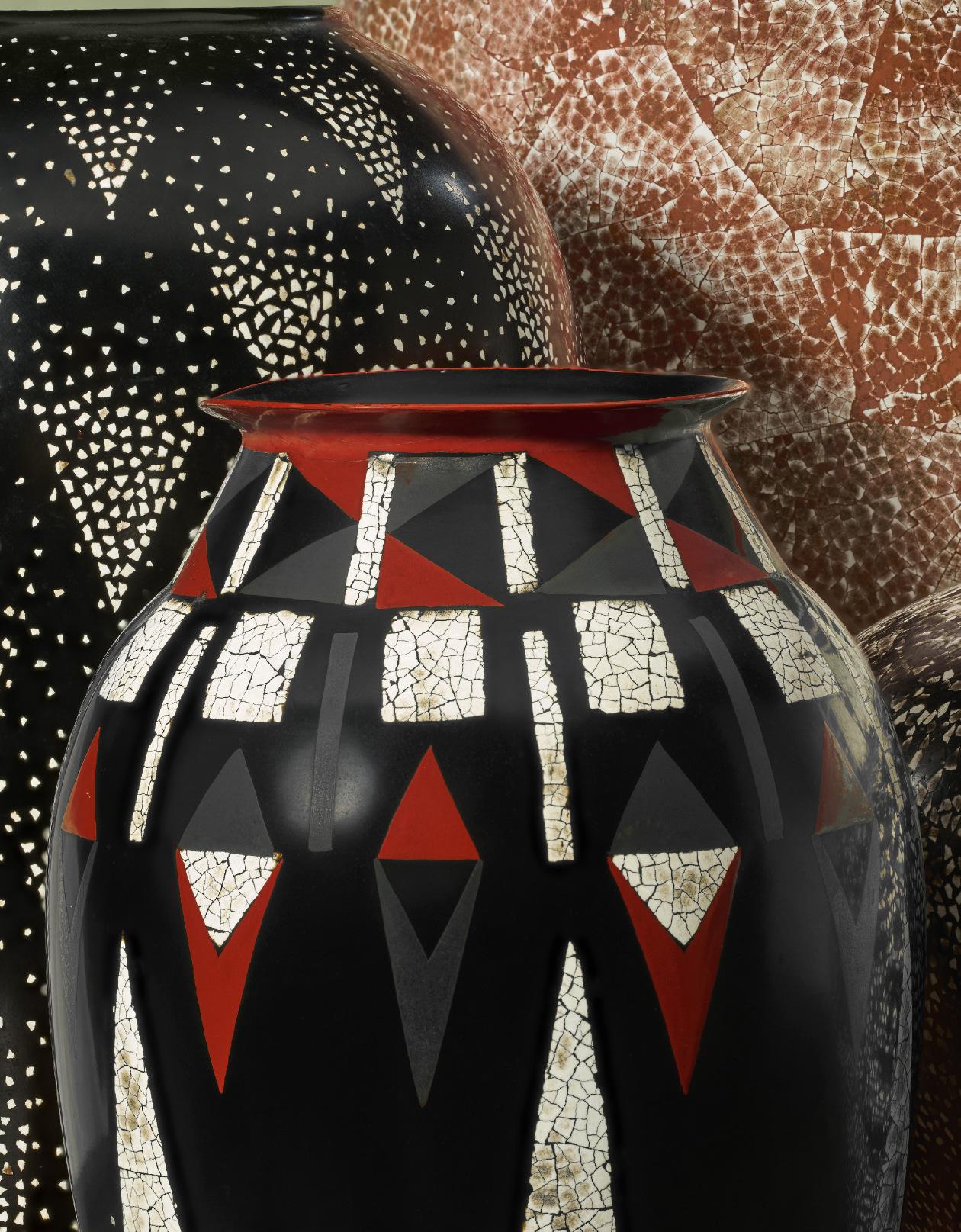
Few artists of the 20th century mastered the relationship between material, form and surface with the confidence and sensitivity of Jean Dunand. A sculptor, metalsmith, and lacquer artist, he is one of the most visionary designers of the Art Deco era who transformed every technique he touched into a discipline of extraordinary precision. The lacquer and eggshell vases and furniture from the celebrated Edlis | Neeson Collection presented here stand among the most refined expressions of his work.
Born in Switzerland, Dunand trained as a sculptor before moving to metalwork. After moving to Paris in 1902, he entered the workshop of Jean Dampt and quickly became known for his mastery of repoussé and metal chasing. By 1915, his dinanderie (hammered and patinated metal vessels) had begun to simplify in both form and decoration. Ornament was reduced, surfaces became more polished, and shapes grew more architectural. This evolution in his metalwork prepared him for the major shift in his career that began in 1912, when he met the Japanese lacquer master Seizo Sugawara.
Sugawara introduced Dunand not only to the technical foundations of lacquer but also to a new way of thinking about surface and time. Lacquer required the slow building of many layers, each one applied and polished in succession. Dunand embraced this process fully. While many modern artists explored abstraction through painting, Dunand achieved abstraction materially, constructing it through the layered skin of the object itself. His vases exist at the intersection of sculpture and painting, volume and surface, modernity and craft.
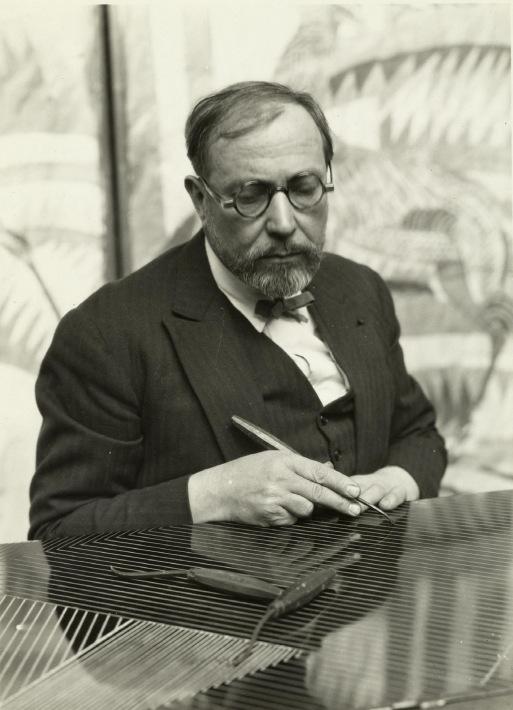
Jean Dunand in his studio, 70 rue Hallé, Paris, 1931. Photograph by Thérèse Bonney. Thérèse Bonney © The Regents of the University of California, The Bancroft Library, University of California, Berkeley. This work is made available under a Creative Commons Attribution 4.0 license. The Bancroft Library, University of California, Berkeley / Ville de Paris / BHVP / Artworks by Jean Dunand © 2025 Artists Rights Society (ARS), New York
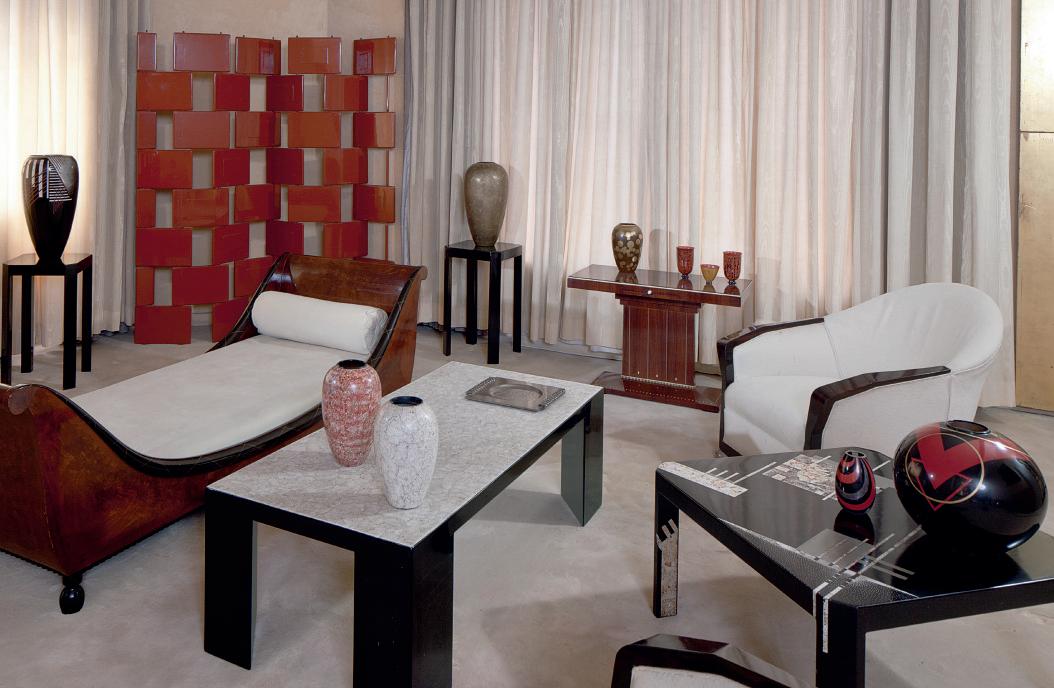
Steven A. Greenberg’s penthouse suite on Fifth Avenue, New York, circa 2012. Christie’s Images.
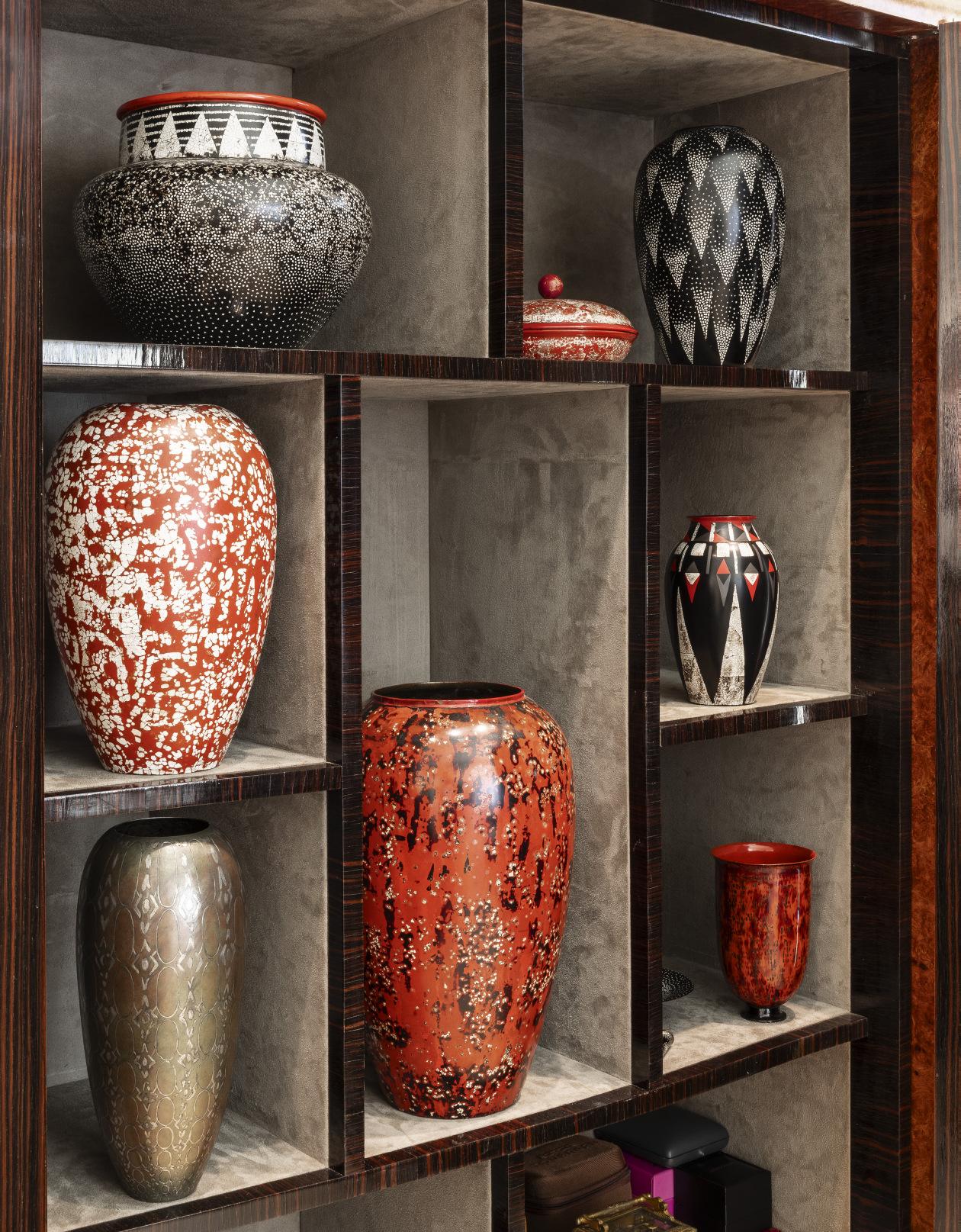
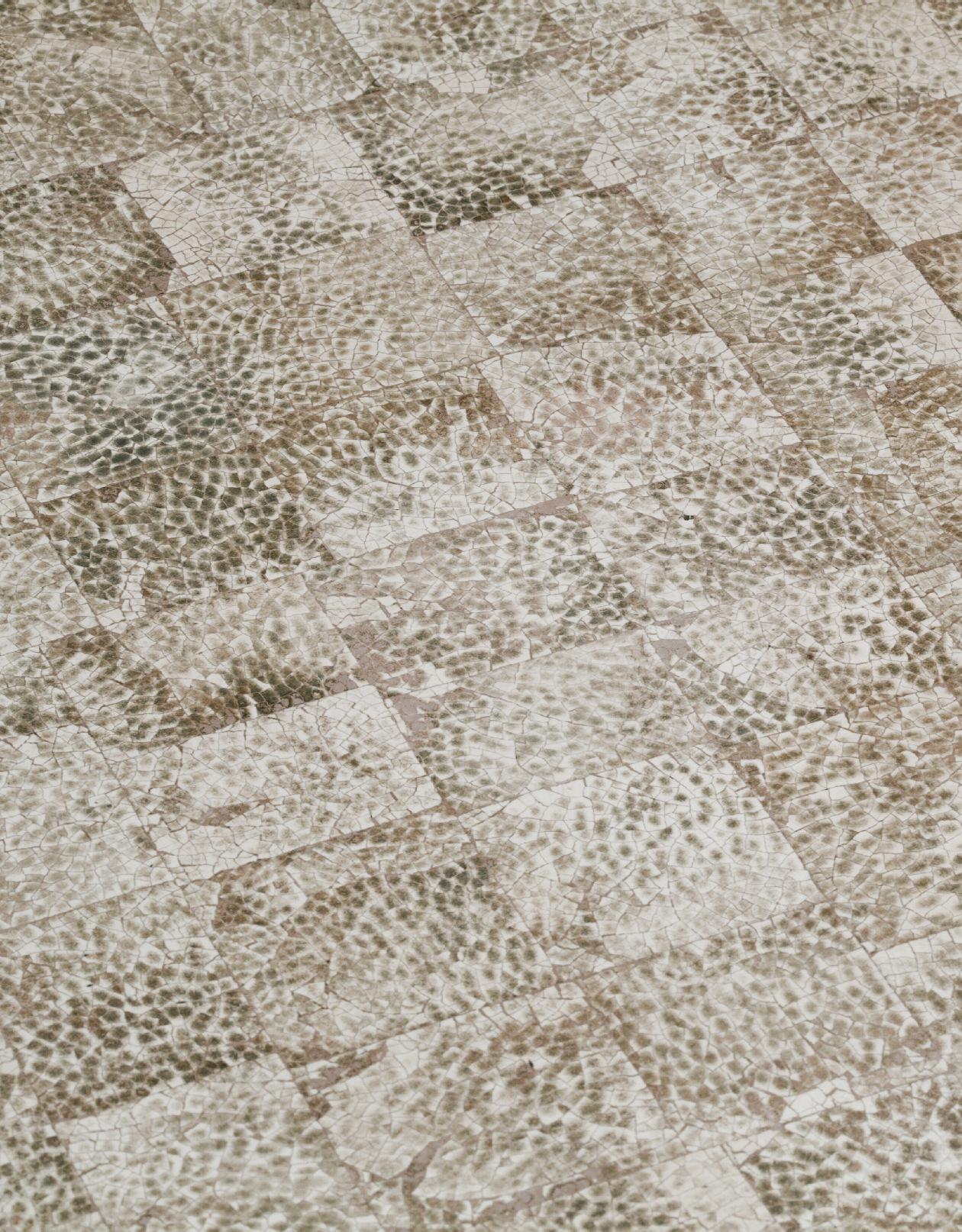
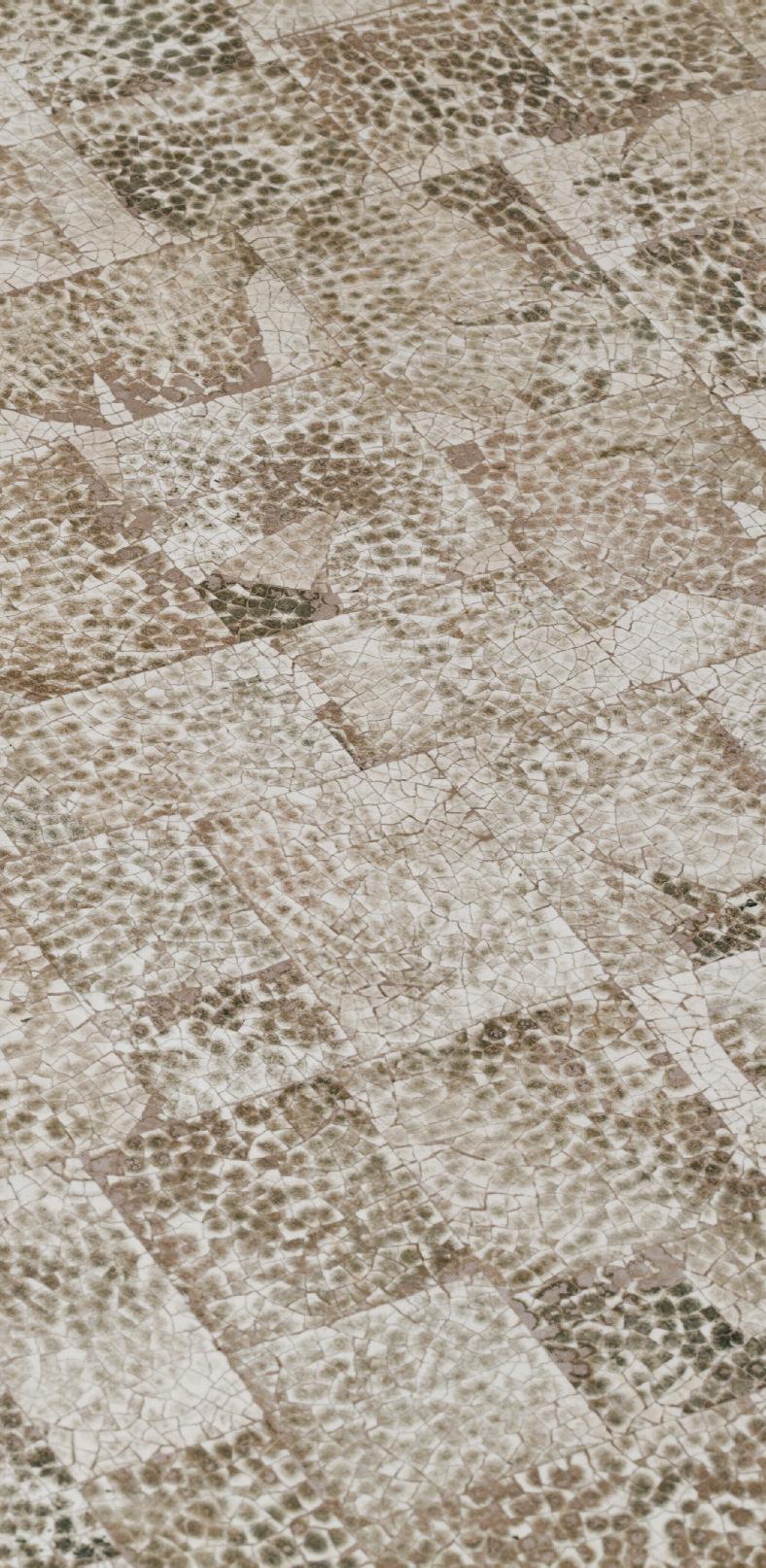
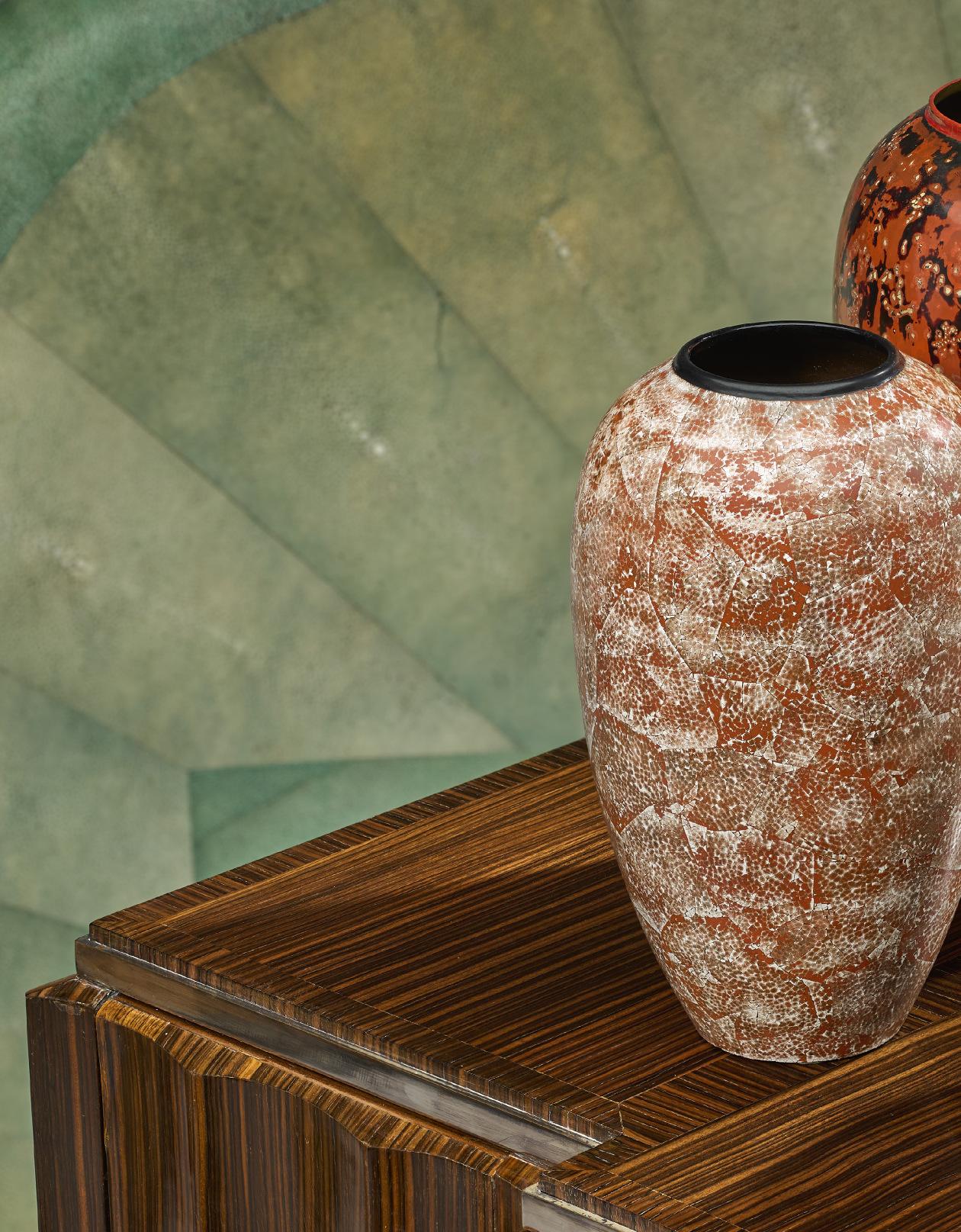
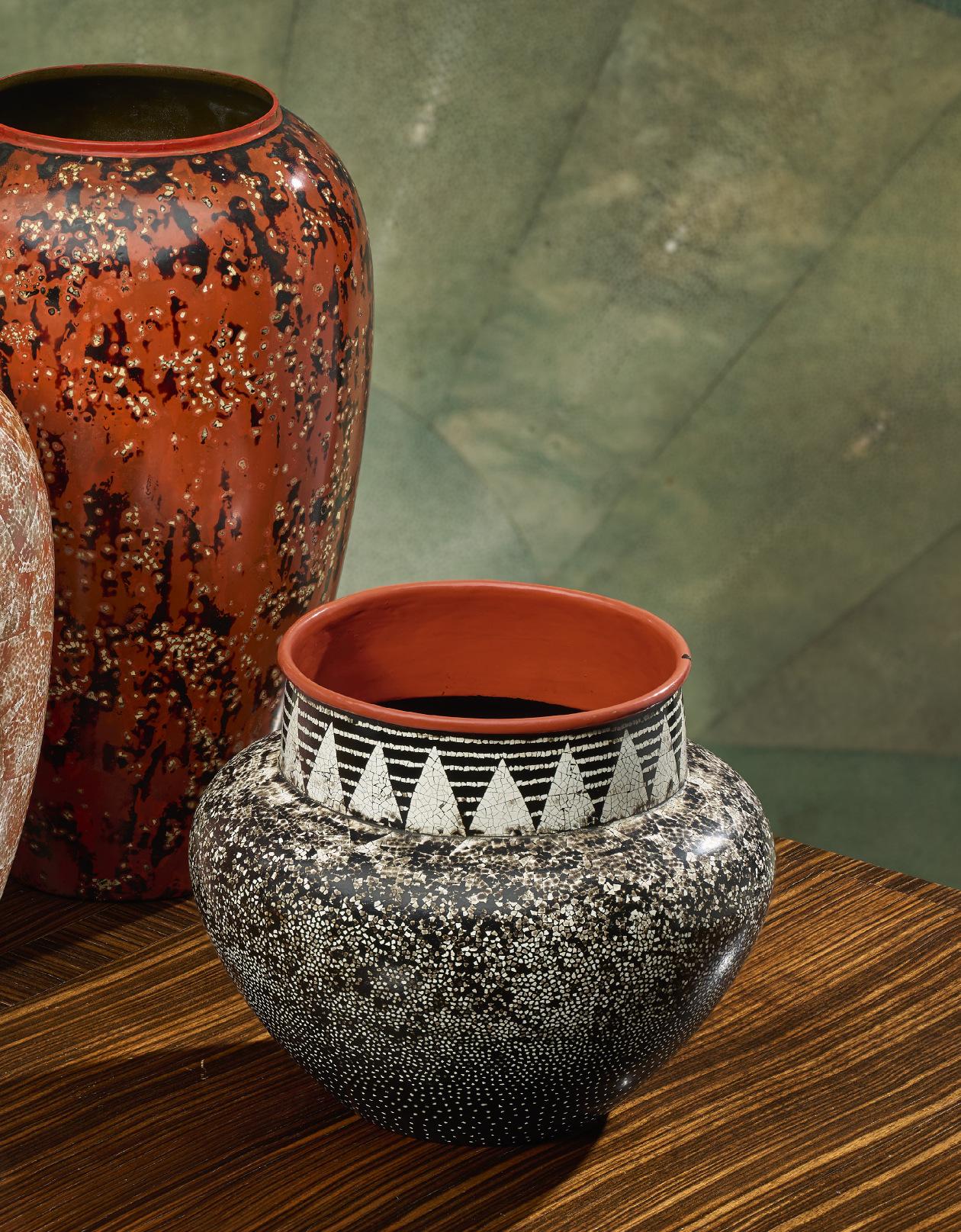
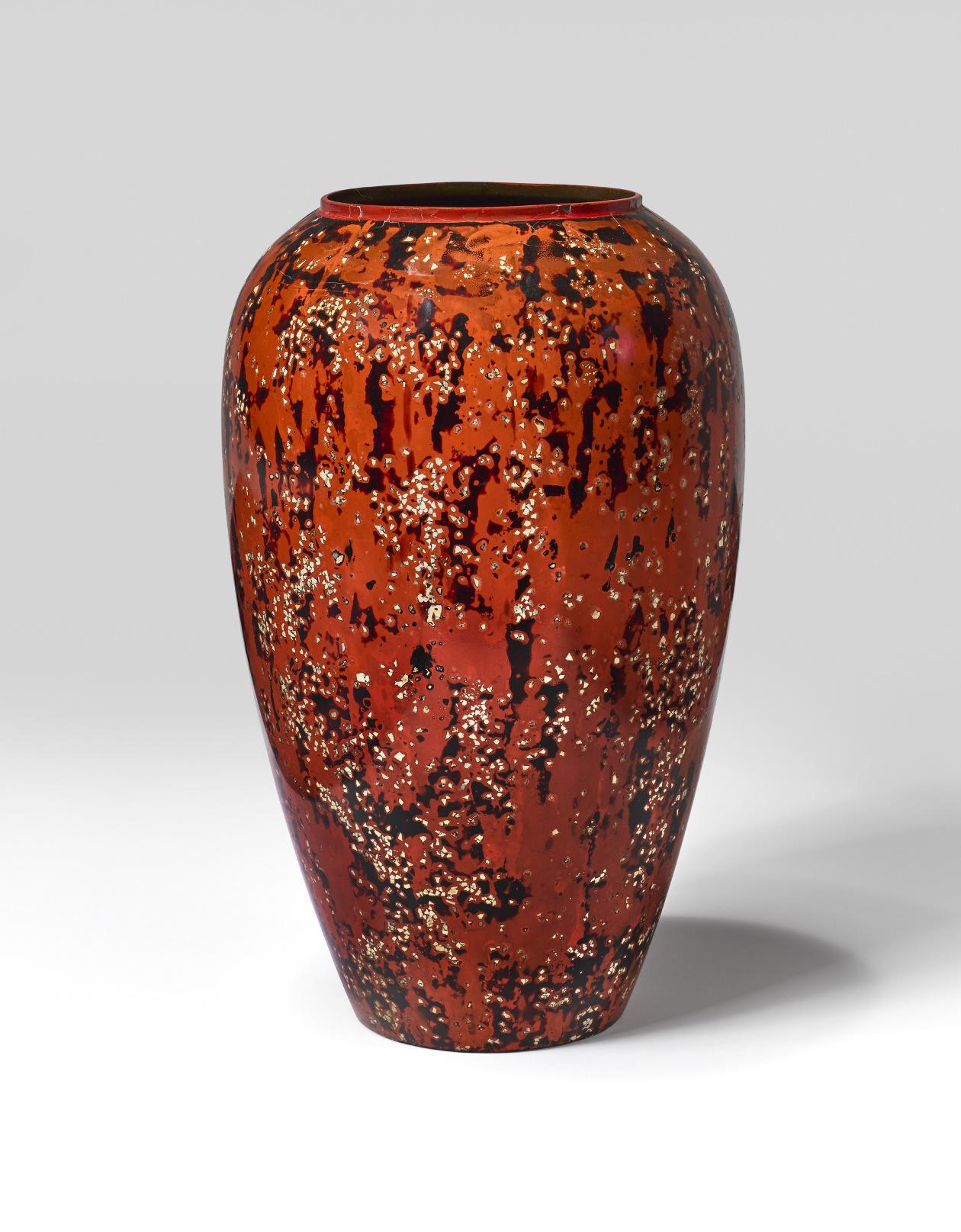
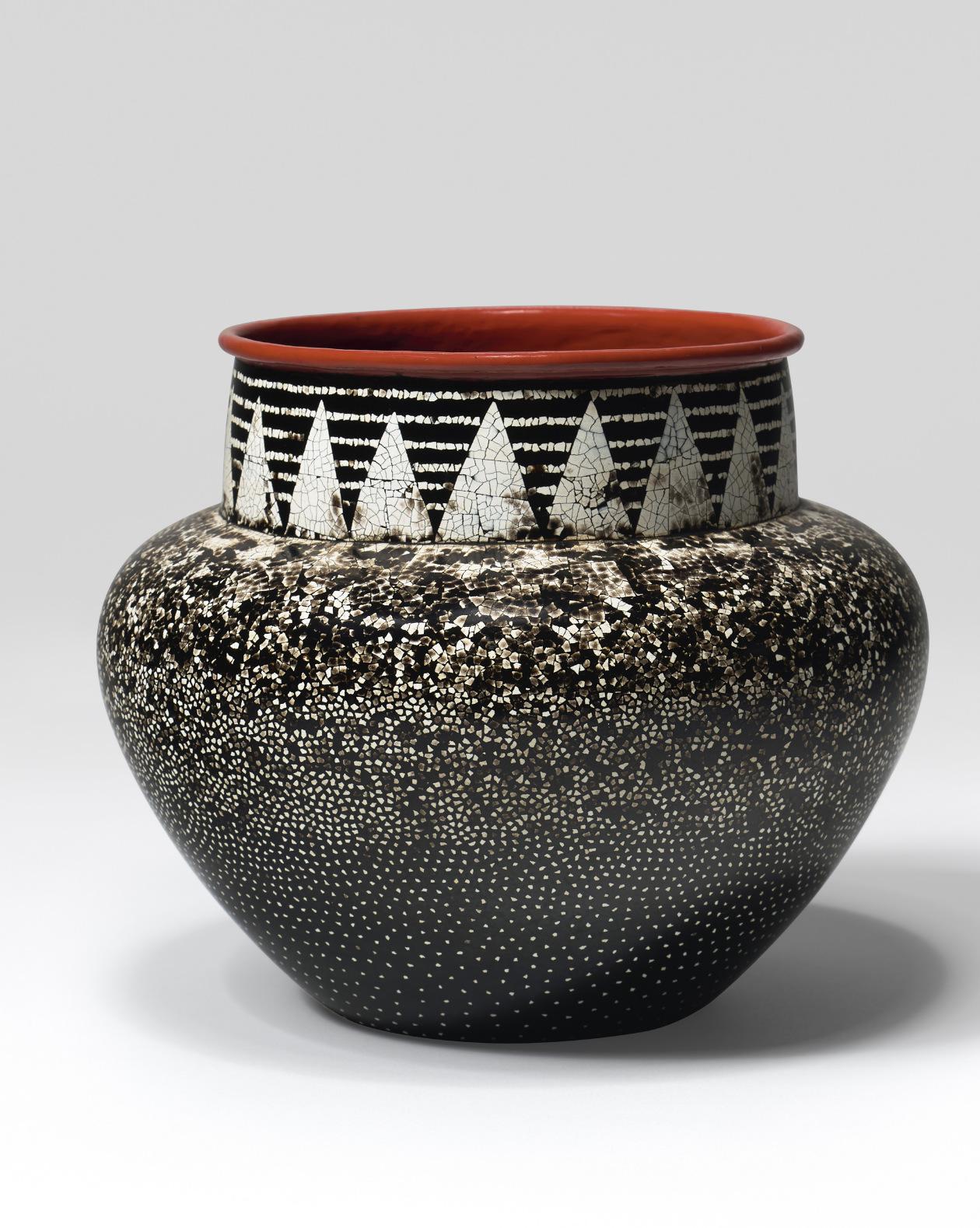
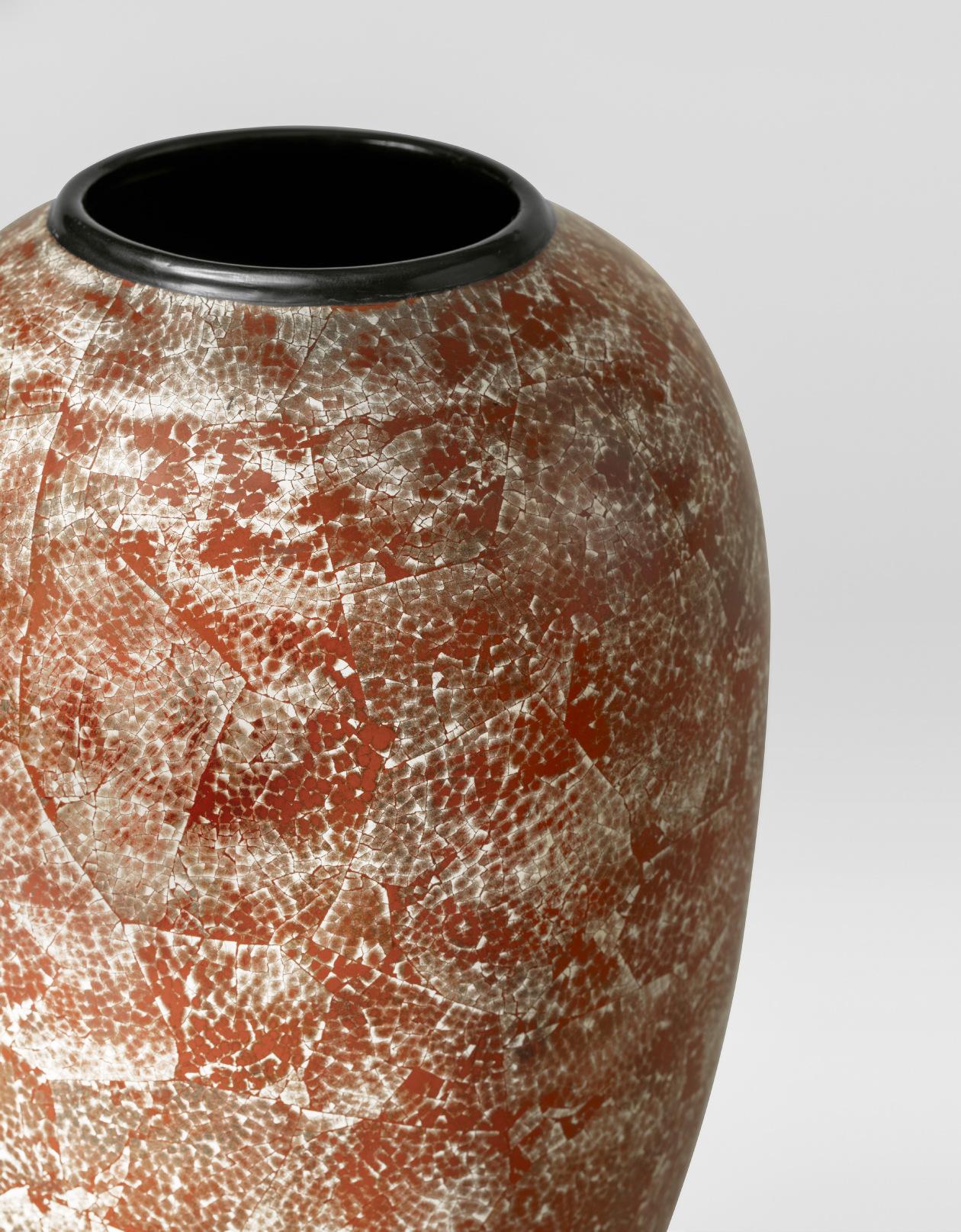
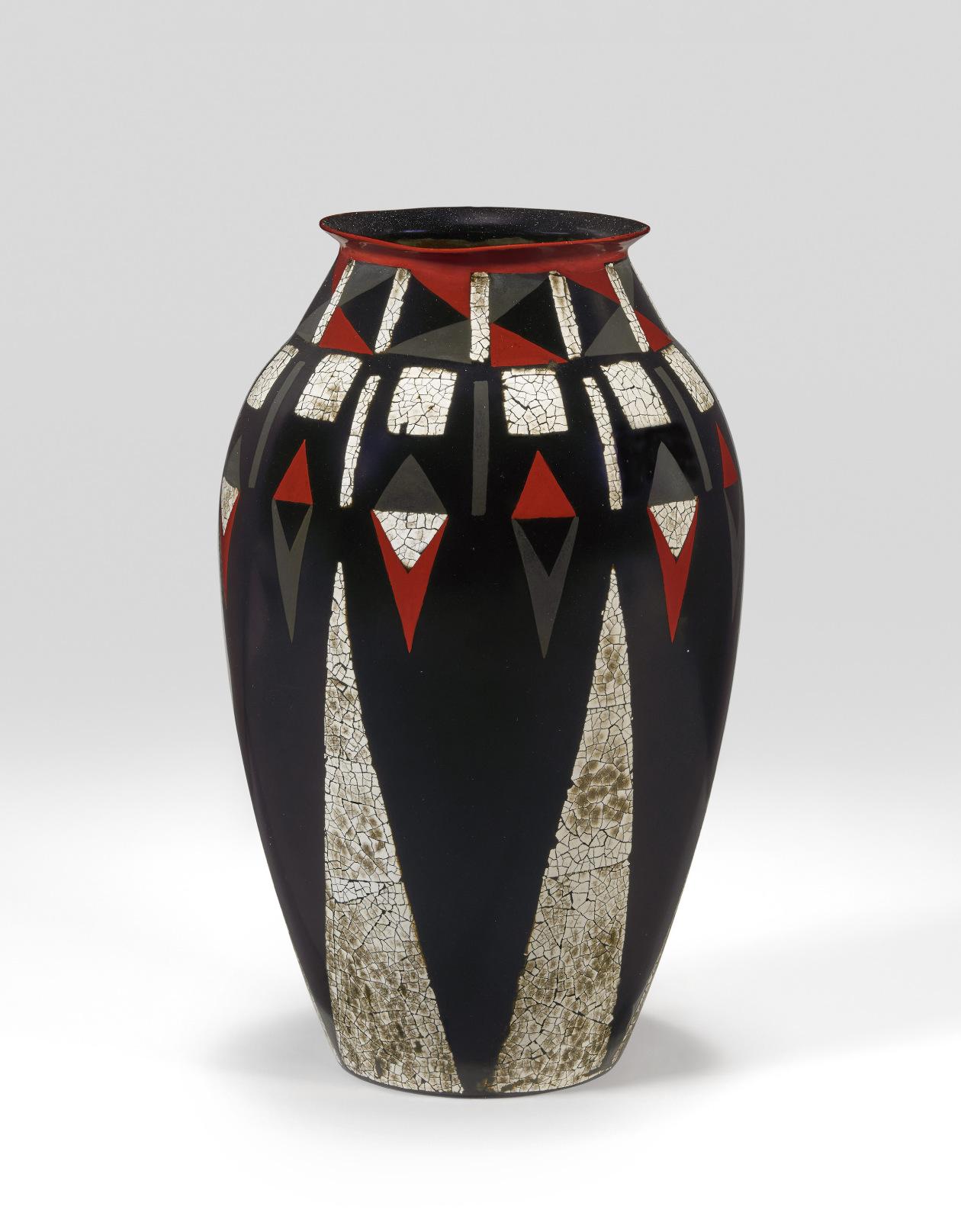
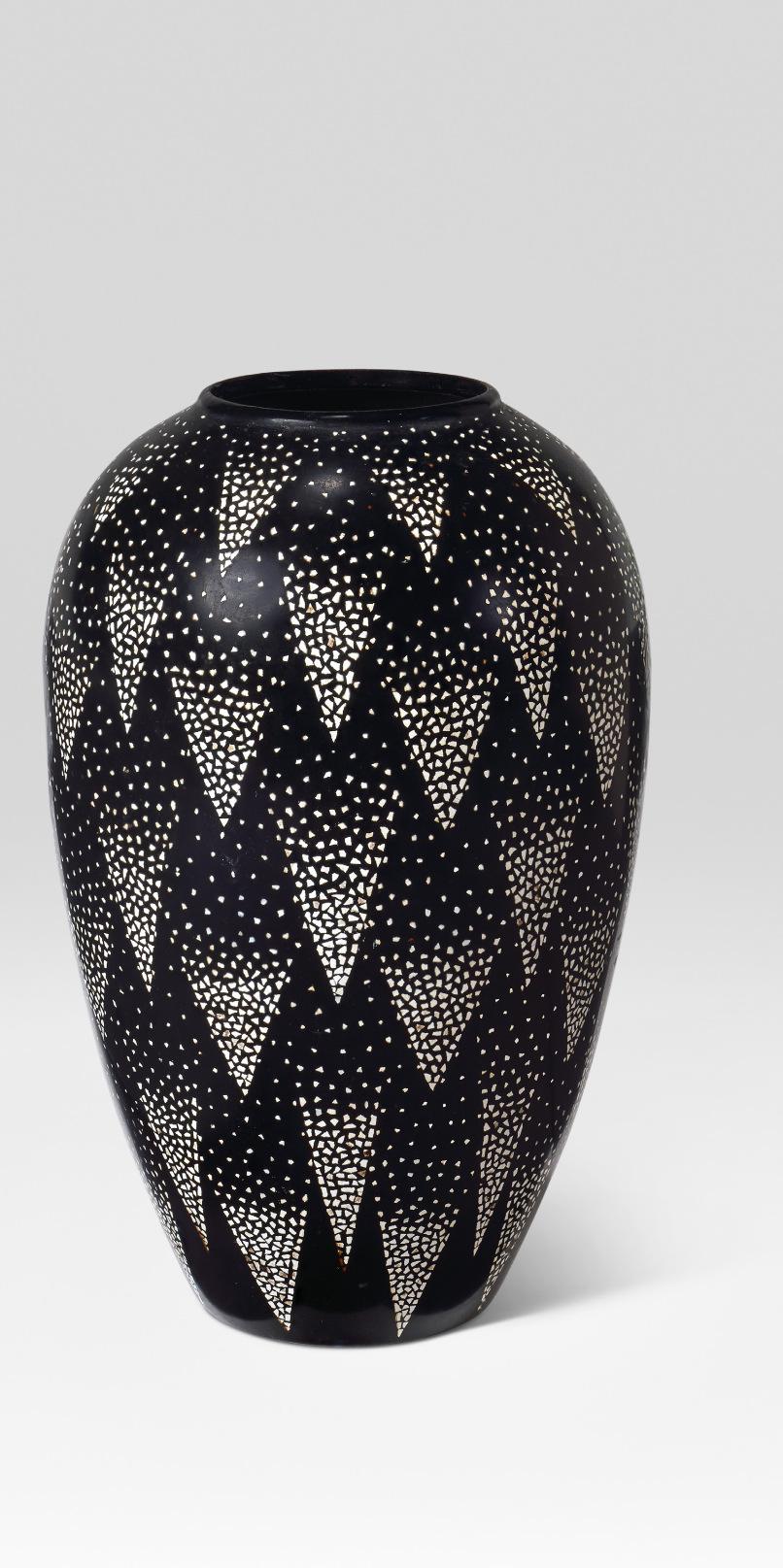
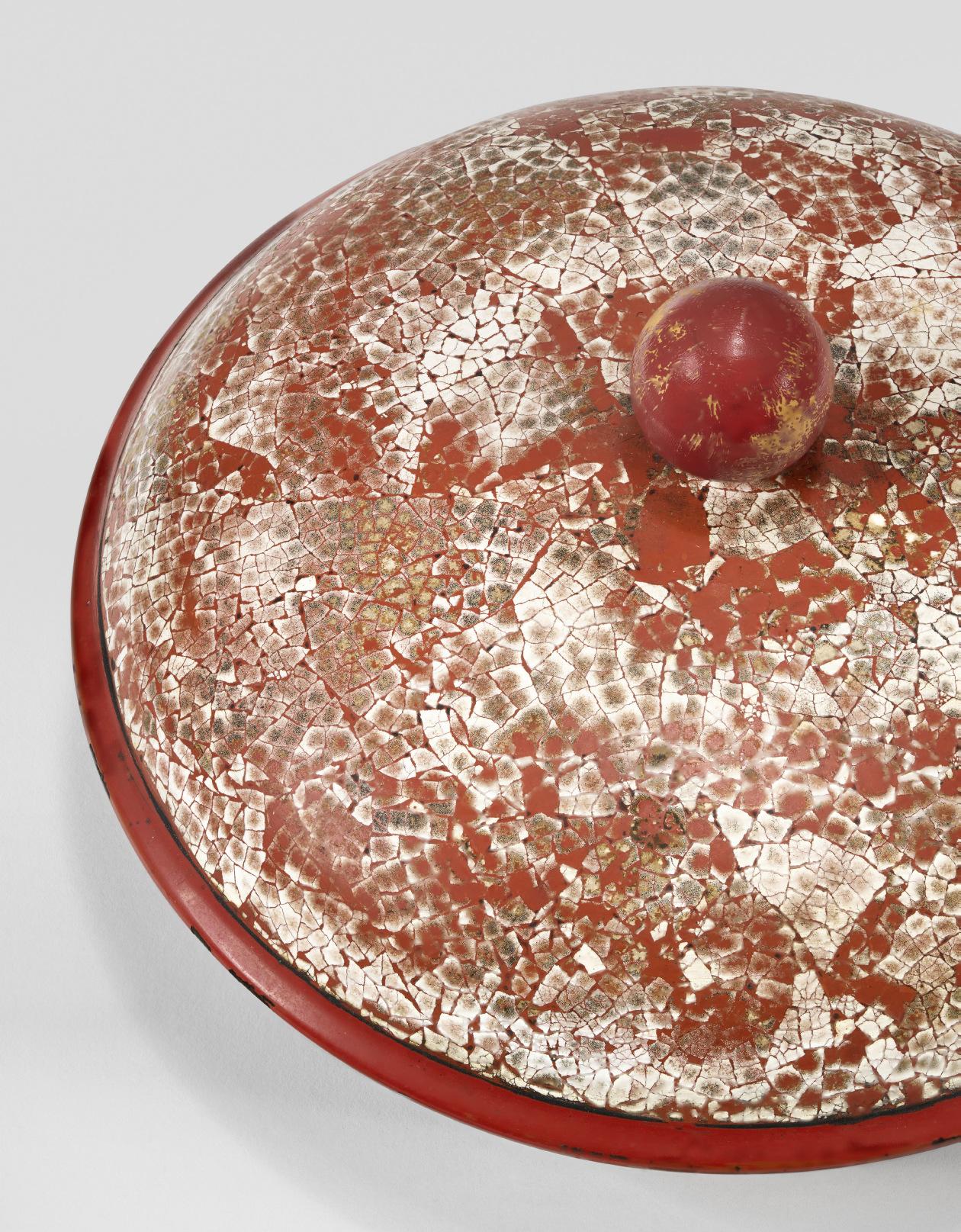
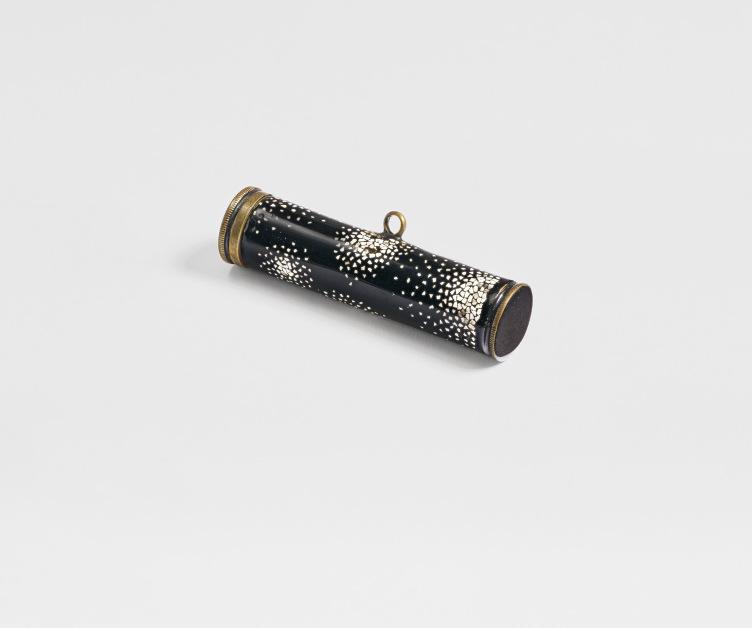
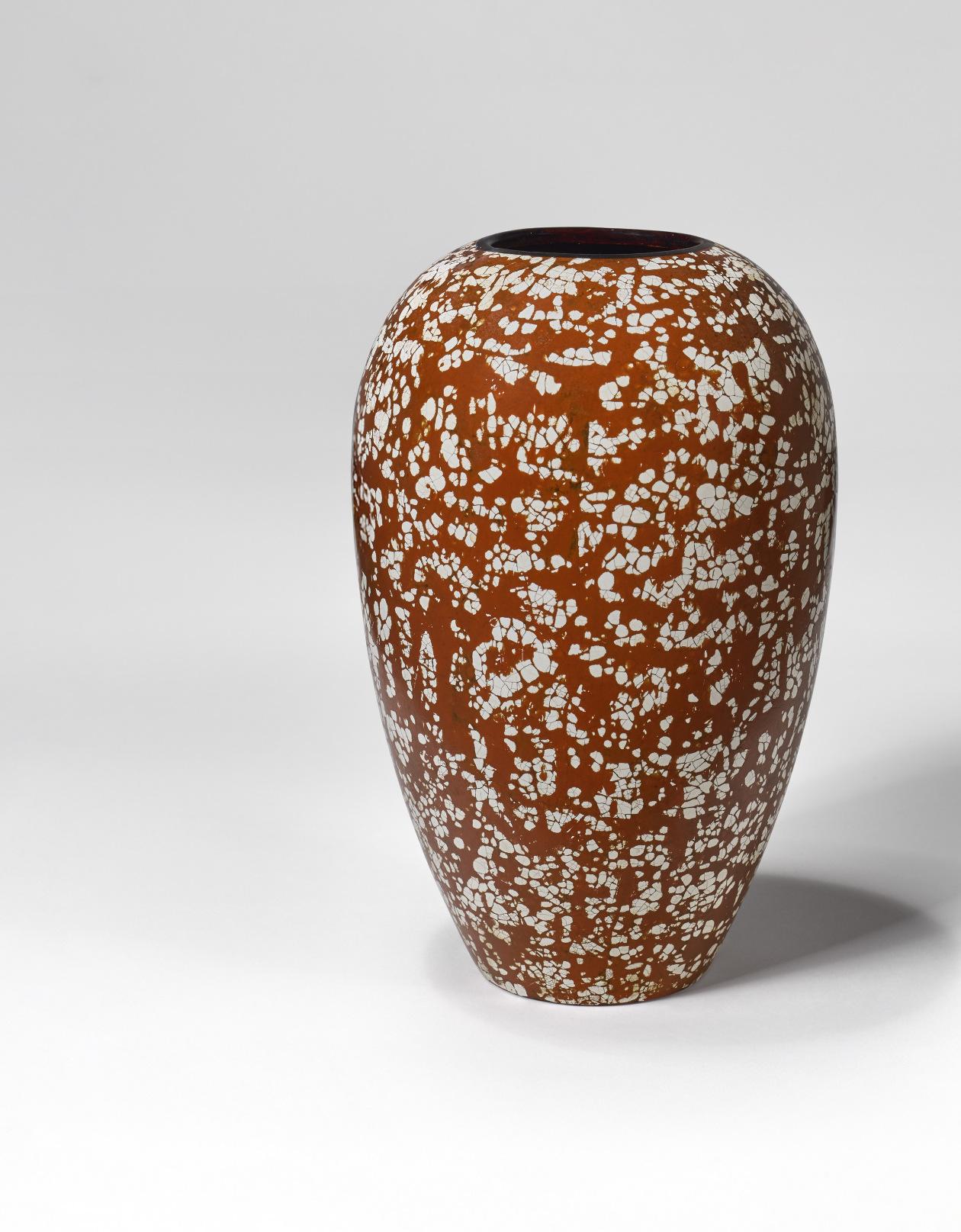
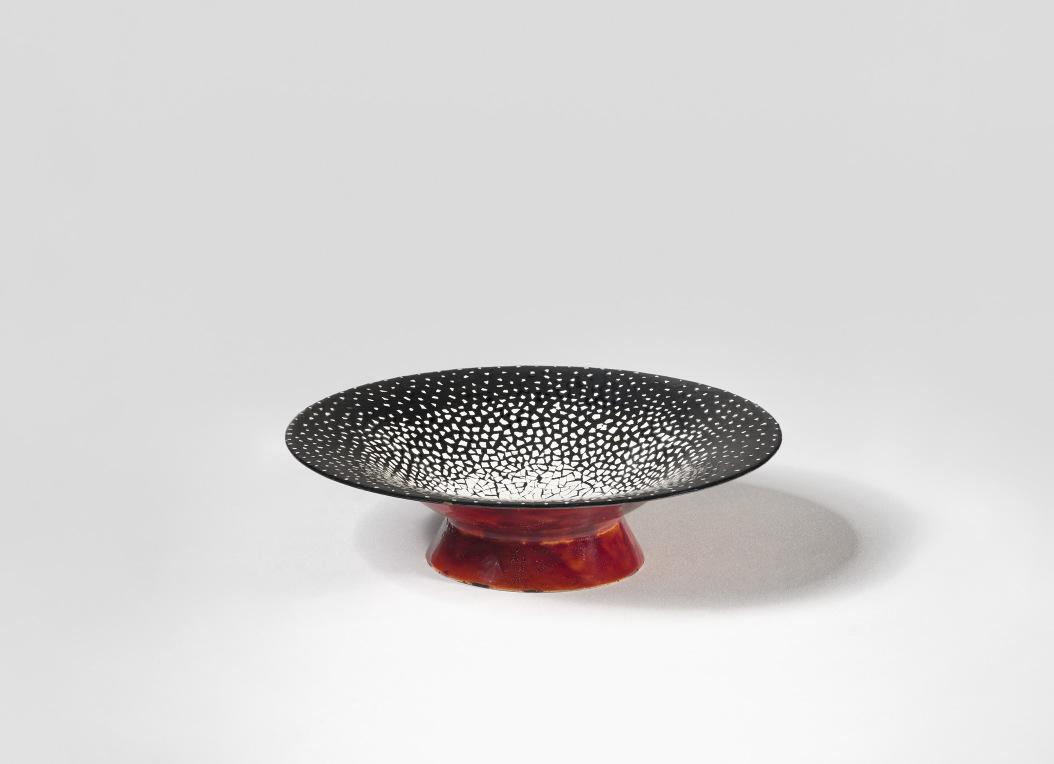
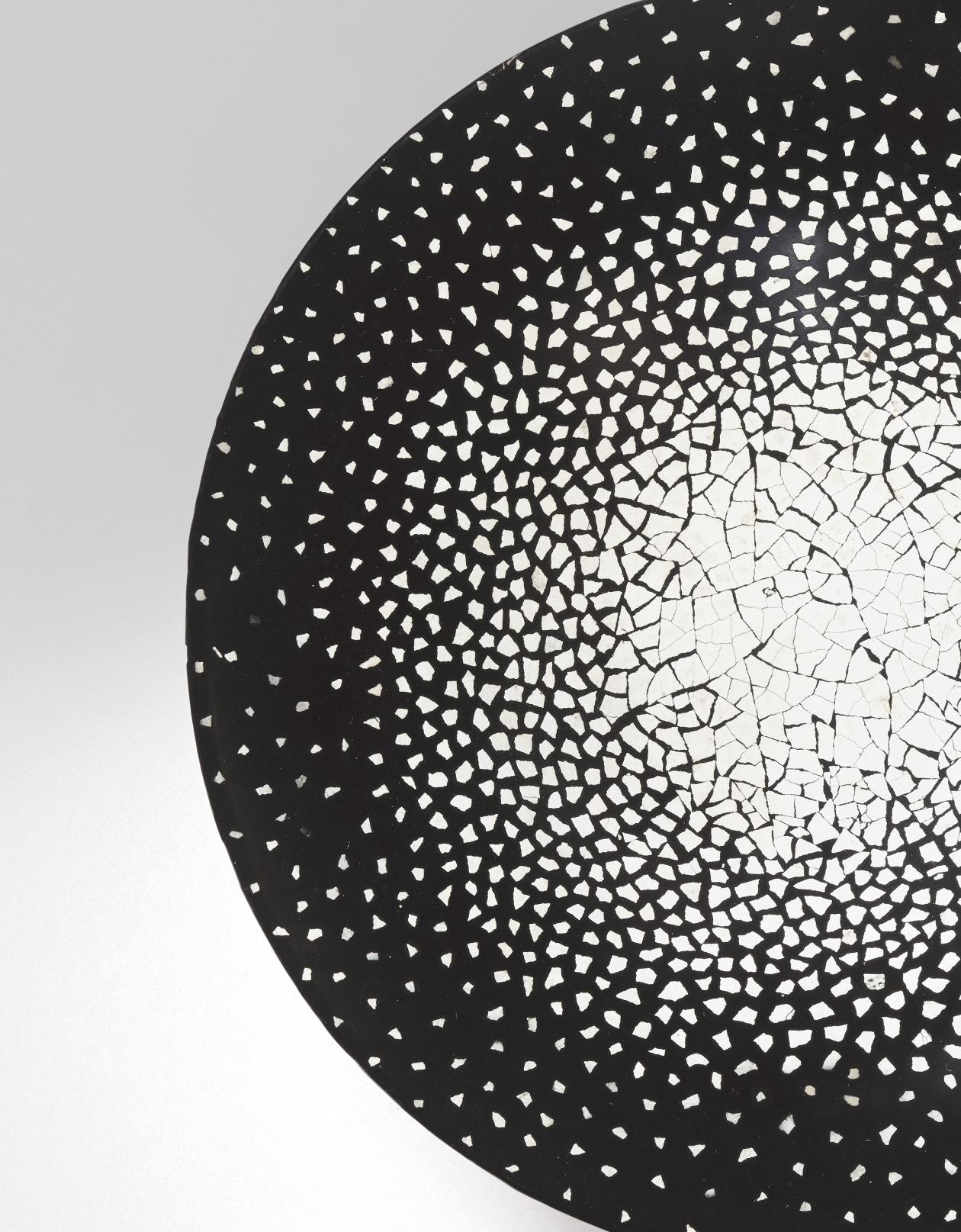
Dunand’s use of eggshell inlay was equally groundbreaking. He refined this demanding technique to a level unmatched in the West. Under his hand, eggshell became a structural component—tiny fragments forming a crackled, mosaic-like surface set into lacquer. The geometric order of these patterns places them firmly within modern design, while their natural irregularity evokes organic processes of fracture and growth. In the Edlis | Neeson group, some vessels display exceptionally fine, almost textile-like eggshell fields. Others feature more varied patterns that give the surface a lively, shimmering texture. This balance between control and spontaneity reflects Dunand’s belief in materials as active and living elements: a philosophy that shaped his entire career. The importance of this group of works lies not only in their artistry but also in their exceptional provenance, connected to two of the most significant collectors of French modernism.
Steven A. Greenberg was one of the first American collectors to give French Art Deco serious scholarly attention. His collection, assembled with remarkable care, played a major role in restoring Dunand’s reputation and bringing his work into the spotlight when it was sold at Christie's New York in 2012. Greenberg’s focus on pieces that demonstrated the clarity and innovation of Dunand’s lacquer helped set a standard for museums and private collectors.
The Edlis | Neeson Collection, assembled by Chicago philanthropists Stefan Edlis and Gael Neeson, reflects a similar commitment to excellence across periods and disciplines. Known especially for their postwar and contemporary eye, Edlis and Neeson also collected Art Deco masterpieces with great discernment. Their interest in Dunand’s vessels aligns with their broader appreciation for artists, such as Johns, Lichtenstein, and Koons, who explore materiality, surface, and perception.
Together, these two collecting traditions form a lineage of modern taste. Their shared vision has shaped how Dunand is understood today and ensured that his finest works remain accessible to scholars and the public. The Dunand vases that moved from the Greenberg Collection into the Edlis | Neeson Collection reflect this continuity and highlight the enduring relevance of his work.
The present group offers a rare opportunity to appreciate Dunand’s achievement in depth. Each vase has its own character, rhythm, glow, and balance. Yet together they reflect the development of an artist who transformed an ancient craft into a foundation of modern art. These objects hold deep scholarly importance and strong sensory appeal. They demonstrate that modernism is not only an idea but a material reality, one that Dunand defined with exceptional clarity through lacquer, eggshell, and the luminous surfaces that remain his legacy.
A collection of Jean Dunand lacquer vases in the Chicago residence of Stefan Edlis and Gael Neeson, 2025. Christie’s Images
EDLIS | NEESON COLLECTION
° 1
LEARN MORE
JEAN DUNAND (1877-1942)
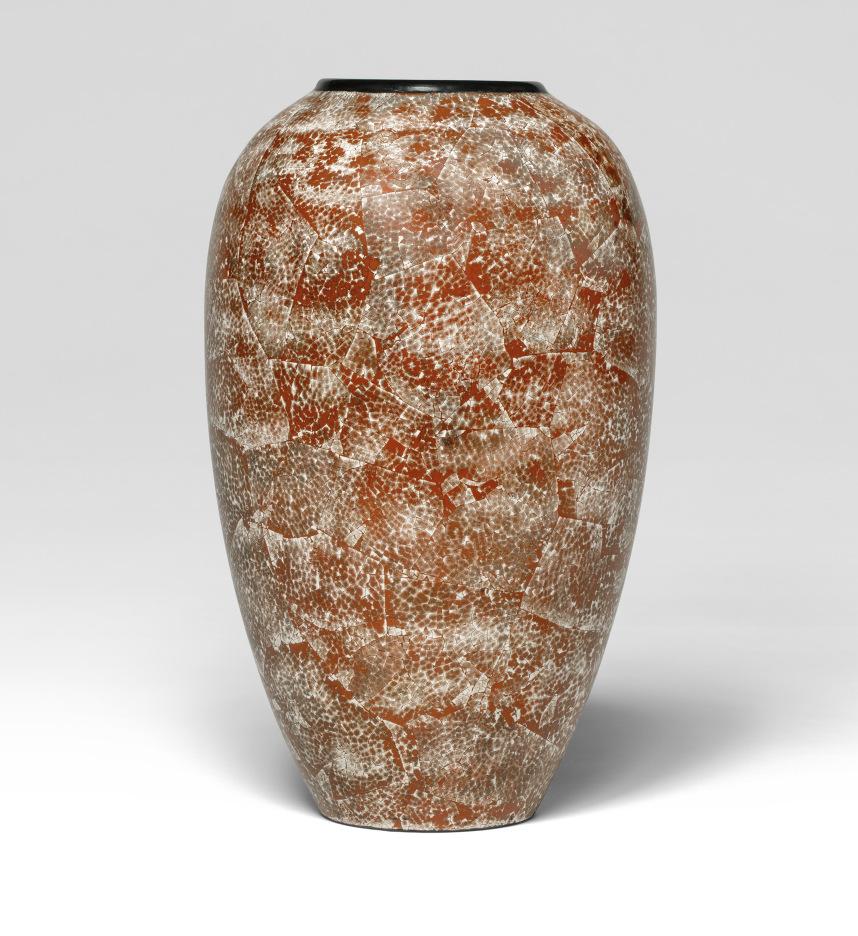
VASE, CIRCA 1925
lacquered metal, eggshell inlay
12 in. (30.5 cm) high, 7º in. (18.5 cm) diameter signed J.DUNAND
$40,000-60,000
PROVENANCE:
Steven A. Greenberg, New York
The Steven A. Greenberg Collection: Masterpieces of French Art Deco, Christie's, New York, 13 December 2012, lot 119
Acquired from the above by the present owner
EXHIBITED:
New York, DeLorenzo Gallery, Jean Dunand, May-June 1985, p. 62 (present lot illustrated)
EDLIS | NEESON COLLECTION
°2
JEAN DUNAND (1877-1942)
VASE, CIRCA 1925
lacquered metal, eggshell inlay
6Ω in. (16.5 cm) high, 7Ω in. (19 cm) diameter
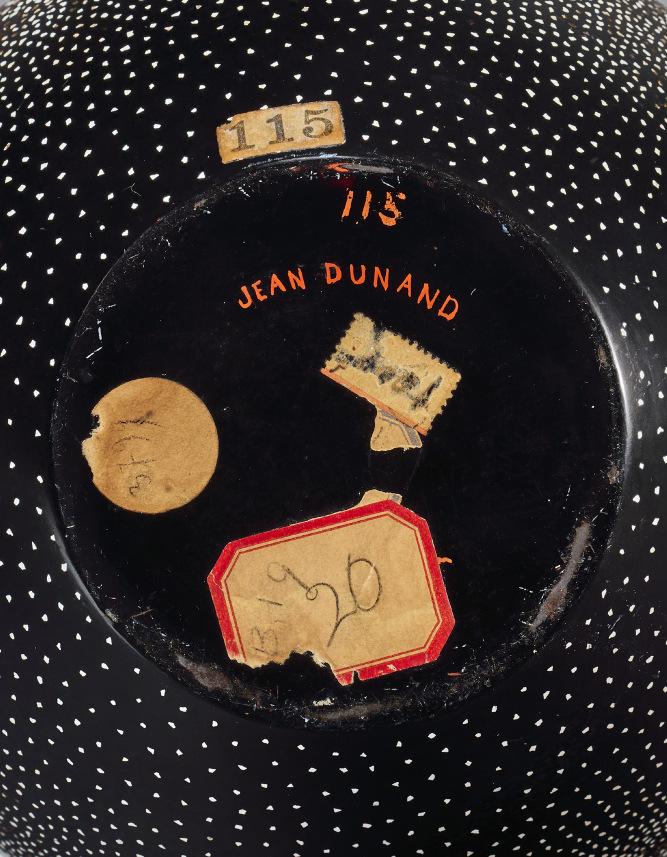
signed JEAN DUNAND and with various paper labels
$40,000-60,000
PROVENANCE:
Aline and Charles Liebman, New York
Thence by descent Christie's, New York, 10 December 1994, lot 465 DeLorenzo Gallery, New York
Steven A. Greenberg, New York
The Steven A. Greenberg Collection: Masterpieces of French Art Deco, Christie's, New York, 12 December 2012, lot 28
Acquired from the above by the present owner
LITERATURE:
E. Bayard, L'art appliqué français d'aujourd'hui : meuble, ferronnerie, céramique, verrerie, tissus, etc., Paris, 1925, p. 77
LEARN MORE
EDLIS | NEESON COLLECTION °3
JEAN DUNAND (1877-1942)
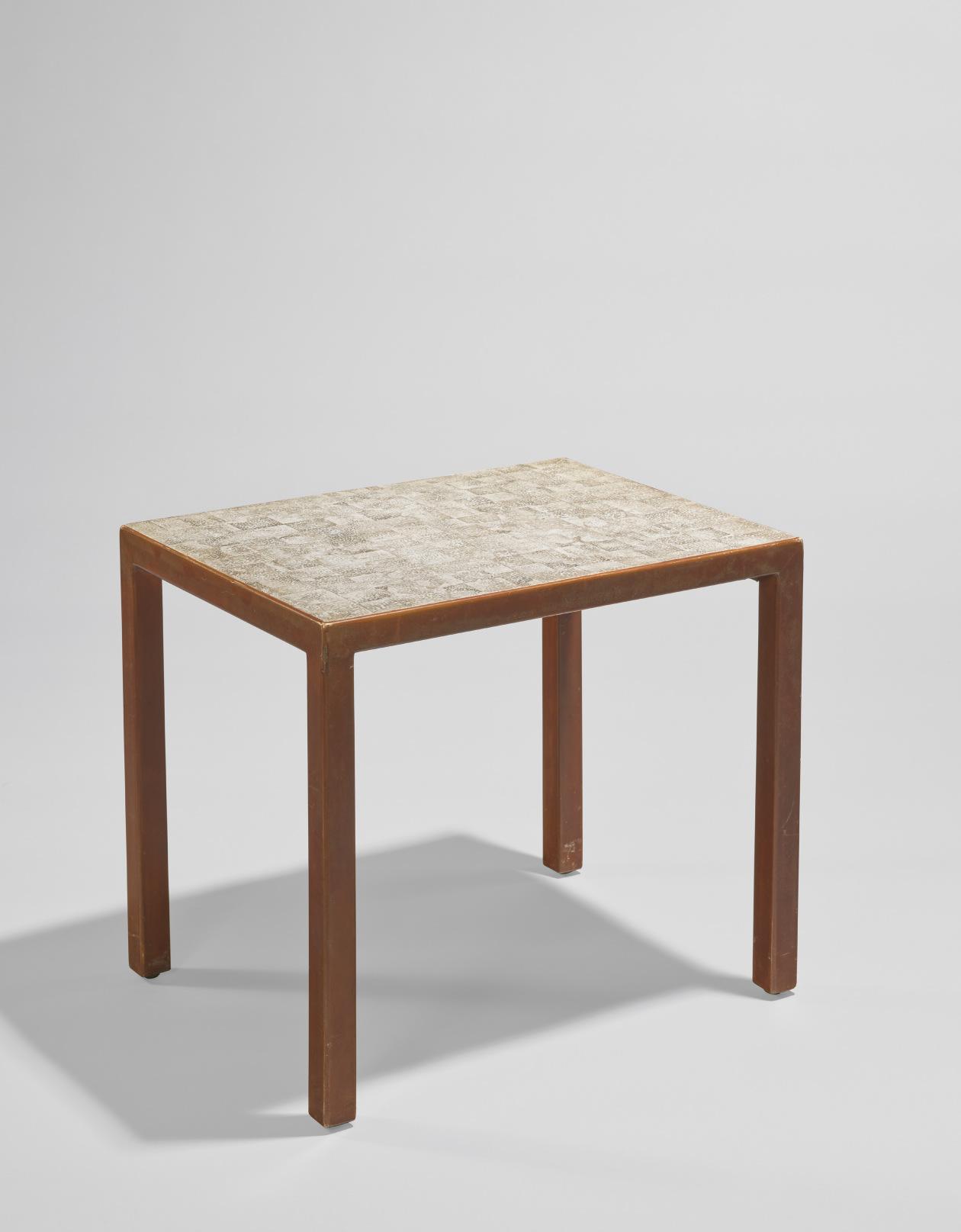
SIDE TABLE, CIRCA 1925
lacquered wood, eggshell inlay
18 x 21 x 15æ in. (45.7 x 53.3 x 40 cm)
stamped JEAN DUNAND LAQUEUR 306
$50,000-70,000
PROVENANCE:
Private Collection, USA
Christie's, New York, 12 December 1997, lot 119
Acquired from the above by the present owner
LITERATURE:
Jean Dunand, exh. cat., DeLorenzo Gallery, New York, 1985, p. 49 (for a related example)
F. Marcilhac, Jean Dunand: His Life and Works, New York, 1991, pp. 246, no. 429 (for a related example)
F. Marcilhac and A. Marcilhac, Jean Dunand, Paris, 2020, p. 288, no. 30 (for a related example)
EDLIS | NEESON COLLECTION
°4
JEAN DUNAND (1877-1942)
VASE, CIRCA 1925
lacquered metal, eggshell inlay
10º in. (26 cm) high, 6¿ in. (15.5 cm) diameter
signed JEAN DUNAND and numbered 5864
$70,000-100,000
PROVENANCE:
Sotheby's, Monaco, 25 October 1982, lot 400
Steven A. Greenberg, New York
The Steven A. Greenberg Collection: Masterpieces of French Art Deco, Christie's, New York, 13 December 2012, lot 187
Acquired from the above by the present owner
EXHIBITED:
New York, DeLorenzo Gallery, Jean Dunand, May-June 1985, p. 85 (present lot illustrated)
LITERATURE:
Y. Brunhammer, Le Style 1925, Paris, 1970, p. 132, no. 2 (for a related example)
Jean Dunand, Jean Goulden, exh. cat., Galerie du Luxembourg, Paris, 1973, p. 71, no. 56 (for a related example)
F. Marcilhac, Jean Dunand: His Life and Works, New York, 1991, p. 122 (for a related example)
Jean Dunand, Jean Goulden, exh. cat., Kelly Gallery, New York, 2013, p. 21 (for a related example)
F. Marcilhac and A. Marcilhac, Jean Dunand, Paris, 2020, p. 350, no. 30 (for a related example)
LEARN MORE
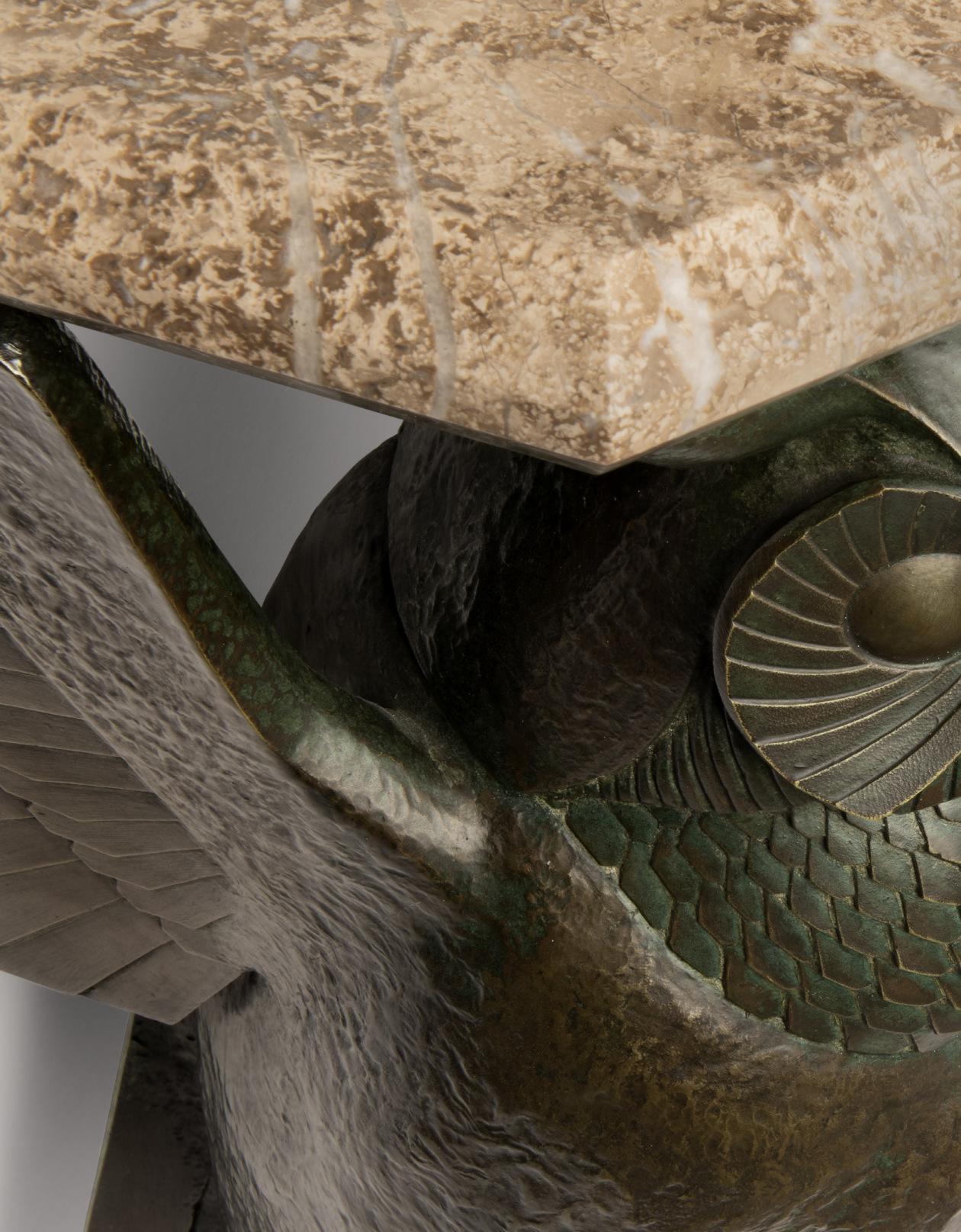
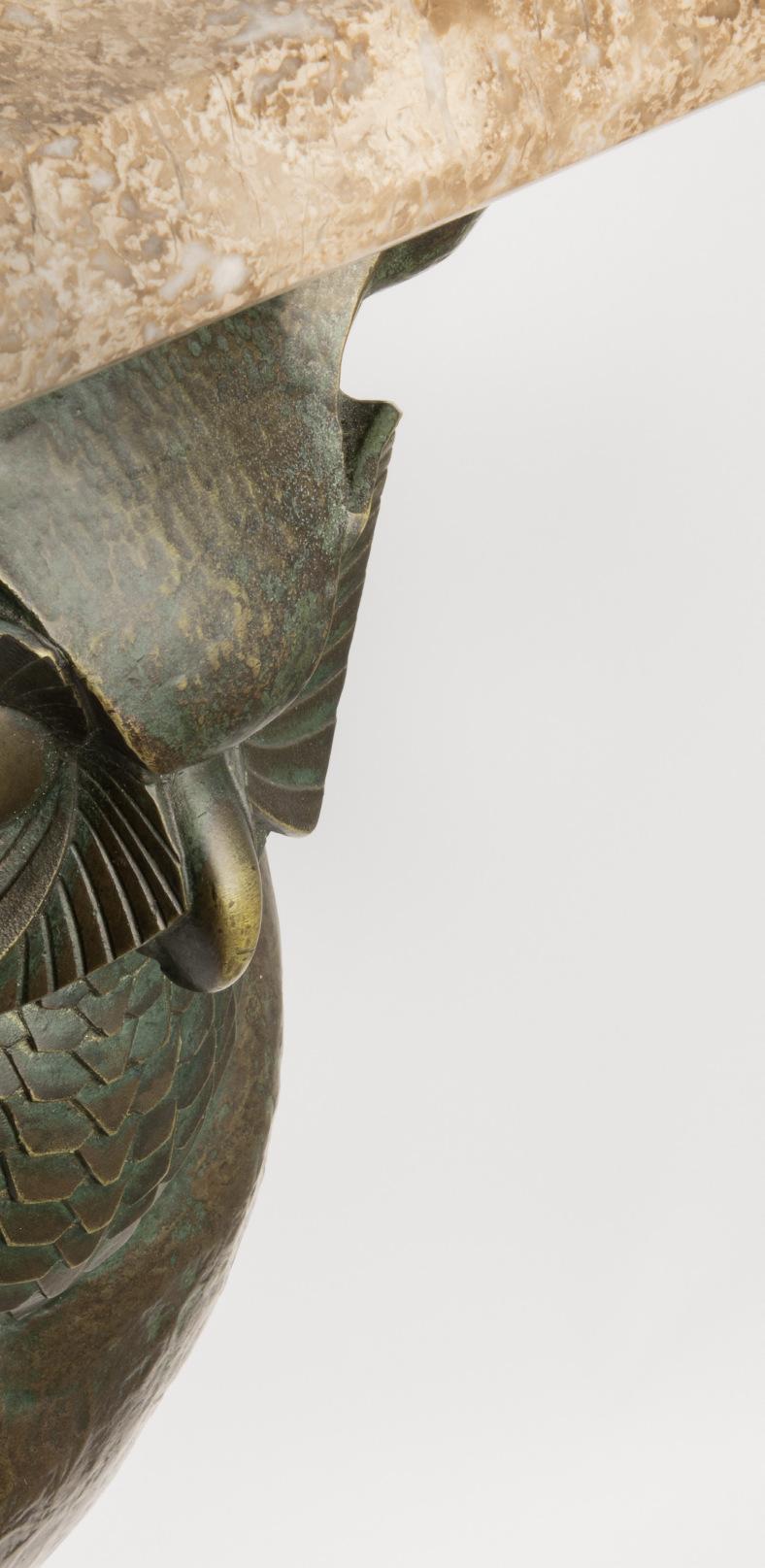
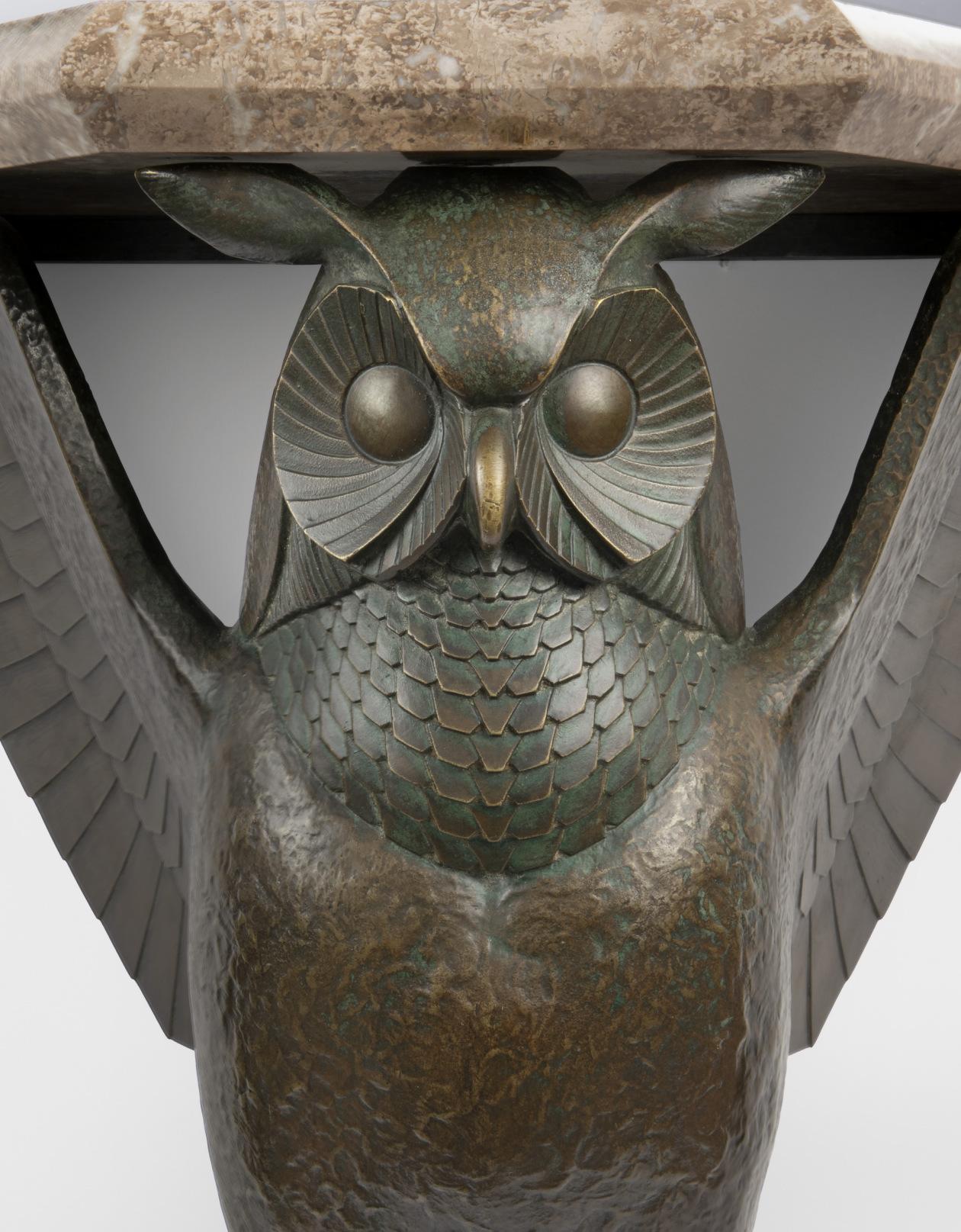
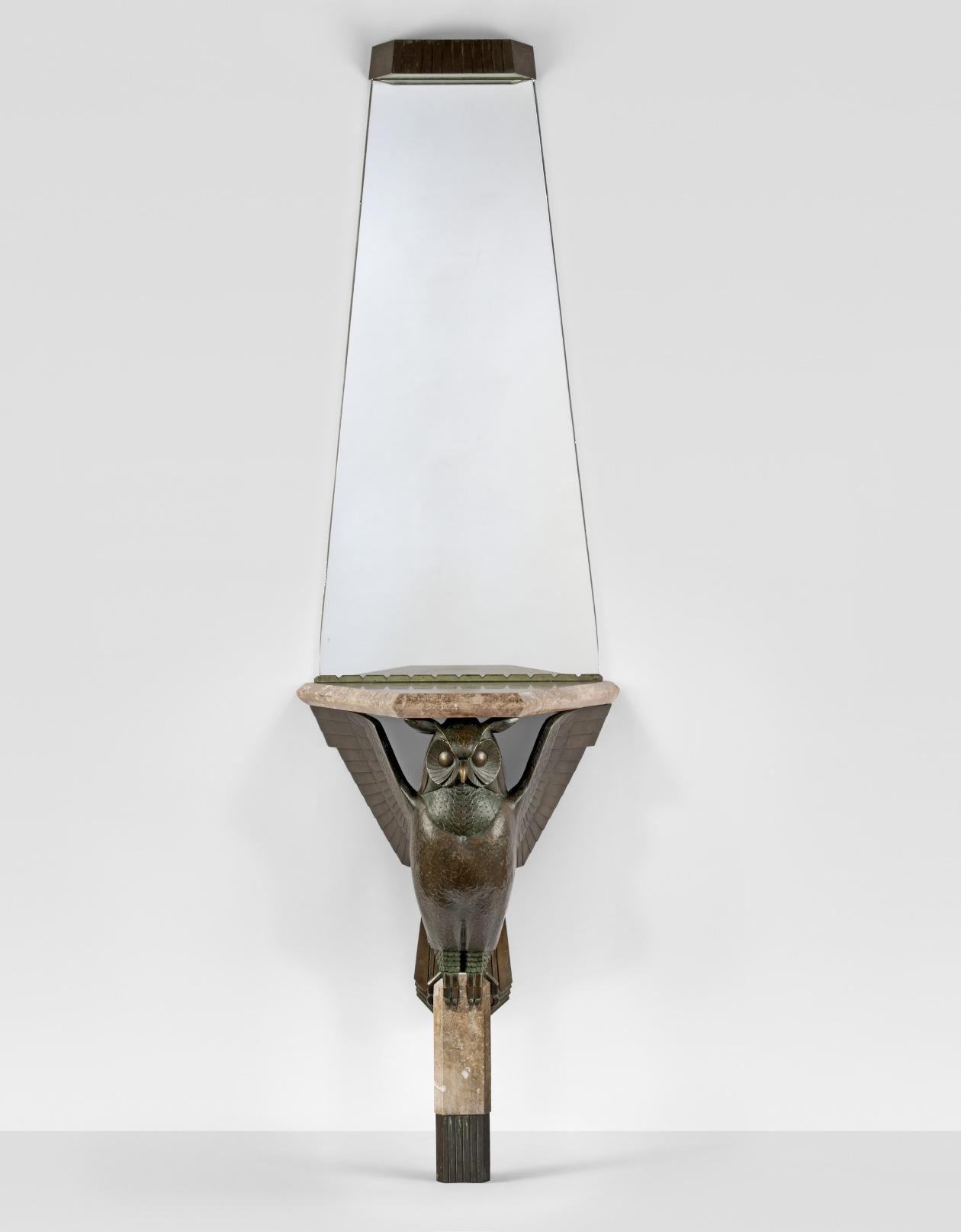
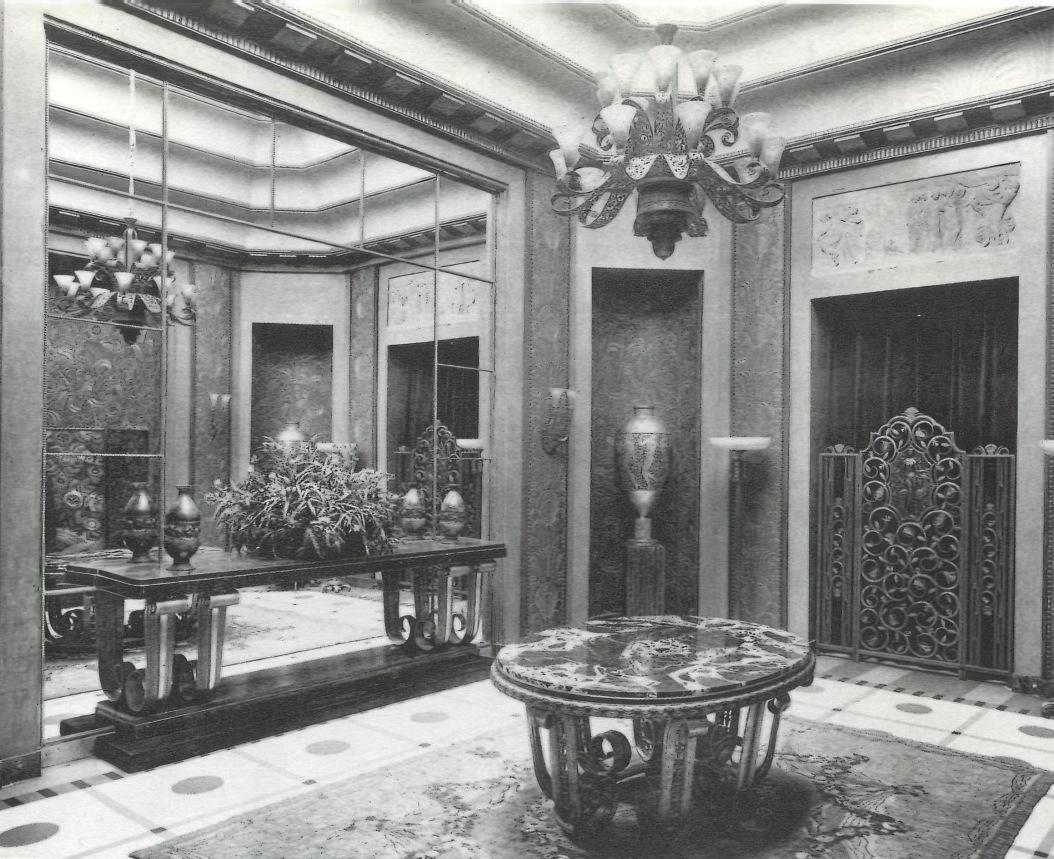
Albert Cheuret’s Hibou console is a striking example of the Art Deco reinterpretation of classical French furniture traditions. After the fluid forms of Art Nouveau, designers of the 1910s and 1920s sought a renewed dialogue with the disciplined proportions and refined craftsmanship of the Ancien Régime, looking to late-18thcentury masters such as Riesener, Roentgen, and Weisweiler. The present console with its accompanying mirror is an enduring fixture of French interior decoration, reemerging in this period with a modern sensibility, defined by clean geometry, sculptural relief, and a restrained decorative program.
The 1922 discovery of Tutankhamun’s tomb introduced a new repertoire of motifs that resonated deeply within the Art Deco movement. Stylized animals, hieroglyphic profiles, and angular silhouettes quickly infiltrated architecture and the decorative arts. Cheuret was particularly receptive to these influences. Birds appear frequently in his work, ranging from naturalistic depictions to highly abstracted forms. The sharply modelled owl that supports the present console reflects this vocabulary: its faceted planes and taut verticality evoke Egyptian prototypes and embody the era’s fascination with exotic fauna rendered in bold, emblematic form.
Born in 1884, Albert Cheuret trained as a sculptor under Jacques Perrin and Georges Lemaître before establishing his Paris atelier at 11 avenue Franco-Russe. Beginning in 1907, he exhibited regularly at
the Salon de la Société des Artistes Français. Cheuret soon became known for applying his sculptural instincts to functional objects and particularly lighting. His celebrated lamps and sconces diffuse light through alabaster panels often cut into stylized leaf or feather shapes, underscoring his command of both material and form.
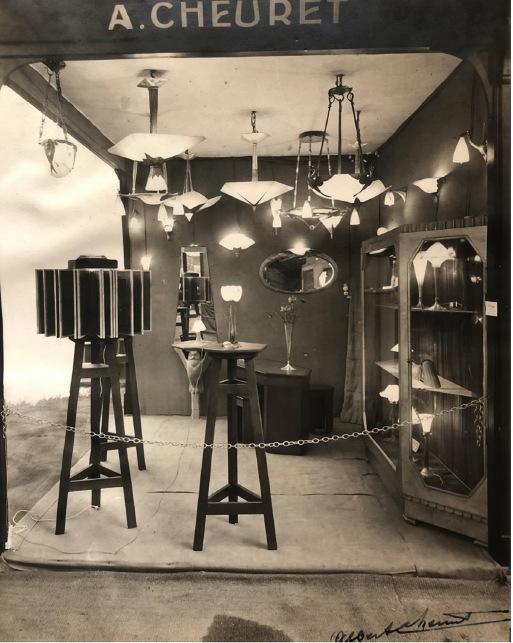
At the 1925 Exposition Internationale des Arts Décoratifs et Industriels Modernes, Cheuret occupied booth 33 on the Pont Alexandre III, identifying himself as a statuaire-décorateur. Although his lighting drew the most attention, he also presented bronzeware that included animal figures, clocks, pedestals, mirrors, and console tables. The present model is believed to have been shown at this landmark exhibition, which cemented his reputation as one of the movement’s most distinctive sculptor-designers.
This console and mirror were formerly displayed in the historic Philadelphia department store Strawbridge’s & Clothier. Founded in 1892 and celebrated for introducing sophisticated European and American design to local clientele, Strawbridge’s became a cultural anchor in the city, particularly after its grand Beaux-Arts flagship opened in 1931. The ensemble descended from a long-serving employee responsible for the store’s imaginative window displays, connecting the piece to a notable chapter in Philadelphia’s history of design presentation and retail culture.
The present model on display in an Albert Chreuret booth, Paris.
PROPERTY FROM AN IMPORTANT PRIVATE EUROPEAN COLLECTION
°φ5
ALBERT CHEURET (1884-1966)
'HIBOU' CONSOLE AND MIRROR, CIRCA 1925 patinated bronze, marble, original felt-backed mirror
81º x 23¡ x 12æ in. (206.4 x 59.4 x 32.4 cm) signed Albert Cheuret and stamped MADE IN FRANCE
$200,000-300,000
PROVENANCE:
Strawbridge's and Clothier, Market Street, Philadelphia, Pennsylvania Private Collection, Philadelphia, Pennsylvania, circa 1940
Thence by descent, Maryland
Sotheby's, New York, 15 December 2012, lot 27
Acquired from Sinai & Sons Ltd, London, circa 2015
LITERATURE:
P. Kjellberg, Art Déco : Les Maîtres du Mobilier, Le Décor des Paquebots, Paris, 2000, p. 59
PROPERTY FROM THE COLLECTION OF PHYLLIS AND FRED PRESSMAN
ÉMILE-JACQUES RUHLMANN (1879-1933)
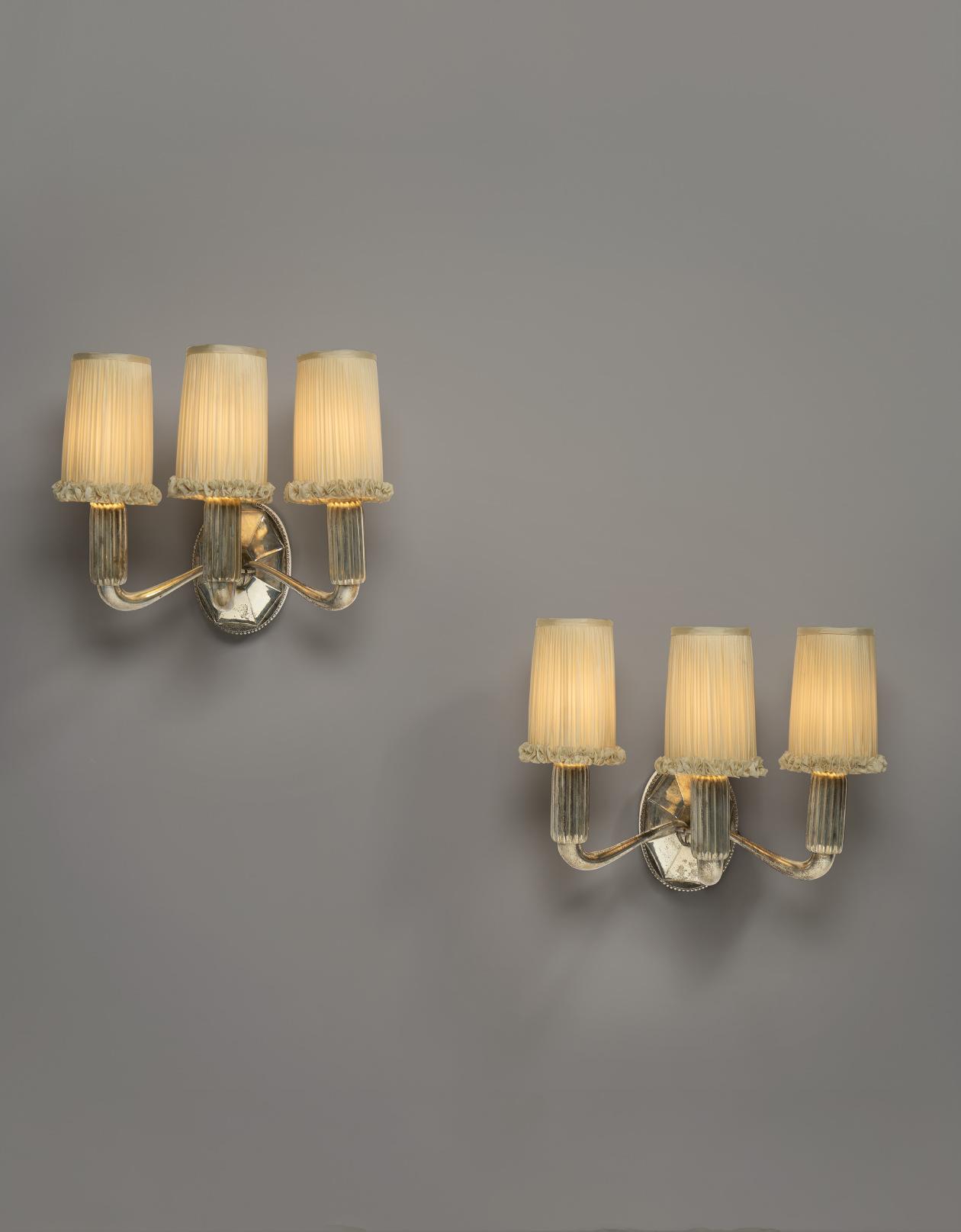
PAIR OF THREE-LIGHT 'LOTUS' SCONCES, CIRCA 1925 silvered bronze, silk shades
14Ω x 16º x 11º (37 x 41.3 x 29.8 cm) (each)
$15,000-20,000
LITERATURE:
G. Henriot, "Le 16e Salon de la Société des Artistes Décorateurs," Mobilier et Décoration, Paris, June 1926, pp. 165, 167 F. Camard, Ruhlmann, Paris, 1983, pp. 115, 144, 148-149, 155, 166, 294
F. Camard, Ruhlmann, Master of Art Deco, London, 1984, pp. 115, 144, 148149, 155, 167, 294
Ruhlmann, Genius of Art Deco, exh. cat., Musée des Années 30, BoulogneBillancourt, 2001, pp. 16, 201, 223
F. Camard, Jacques-Émile Ruhlmann, Saint-Rémy-en-l'Eau, 2009, pp. 150, 210, 215, 230
F. Camard, Jacques-Émile Ruhlmann, New York, 2011, pp. 150, 210, 215, 230
This model is recorded under number 3056AR/3668NR in the Ruhlmann Archives, Musée des Années 30, Boulogne-Billancourt.
Through his extraordinary personality, the incomparable quality of his work, and the abundance of his production, Émile-Jacques Ruhlmann stands as the undisputed master of Art Deco. Just as Louis Majorelle is inseparably associated with the elegance of the style 1900, Ruhlmann embodies the style 1925 and its harmony, precision, and sumptuous restraint. He was not merely a maker of furniture, but a true ensemblier: conceiving and executing complete interiors in which every element, furniture, draperies, carpets, lighting, and decorative objects, formed part of a unified vision.
This holistic approach first captivated Paris in 1913 at the Salon d’Automne, where Ruhlmann unveiled a dining room and circular gallery of intimate alcoves. Critics, both startled and enchanted, hailed the work’s ingenuity and daring. As M.-P. Verneuil observed in Art et Décoration, it revealed “the effort and research that went into it (…) and the desire to break away from the familiar at all costs.”
In the decade that followed, Ruhlmann emerged as the preeminent interpreter of high French taste in the modern age. His name became synonymous with aesthetic refinement, the rarest materials, and craftsmanship so exacting it rivaled the greatest achievements of the 18th century, a period that continuously inspired his most celebrated designs. He famously declared, “To create something that lasts, the first thing is to want to create something that lasts forever,” a philosophy shaping in every curve, joint, and surface he conceived.
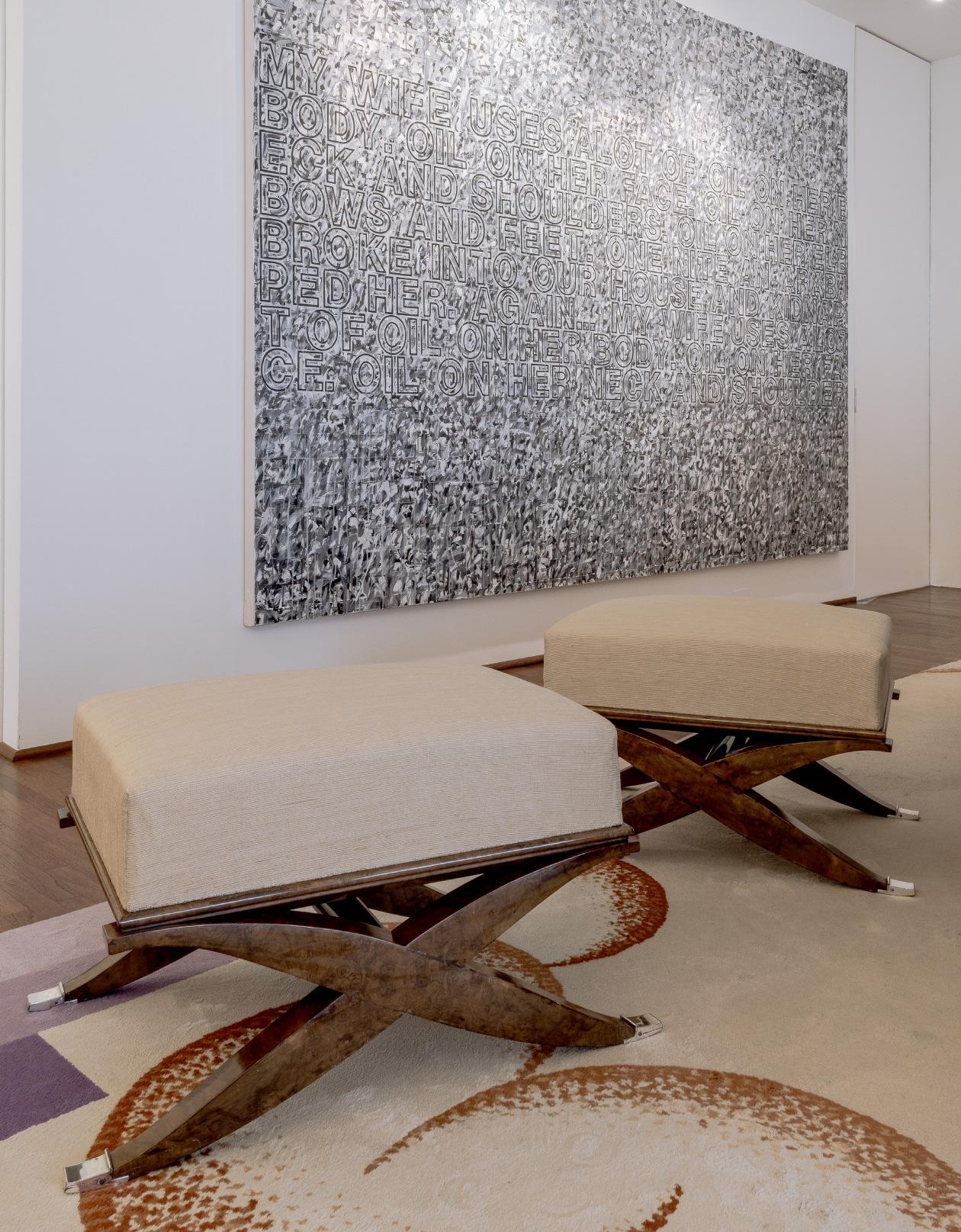
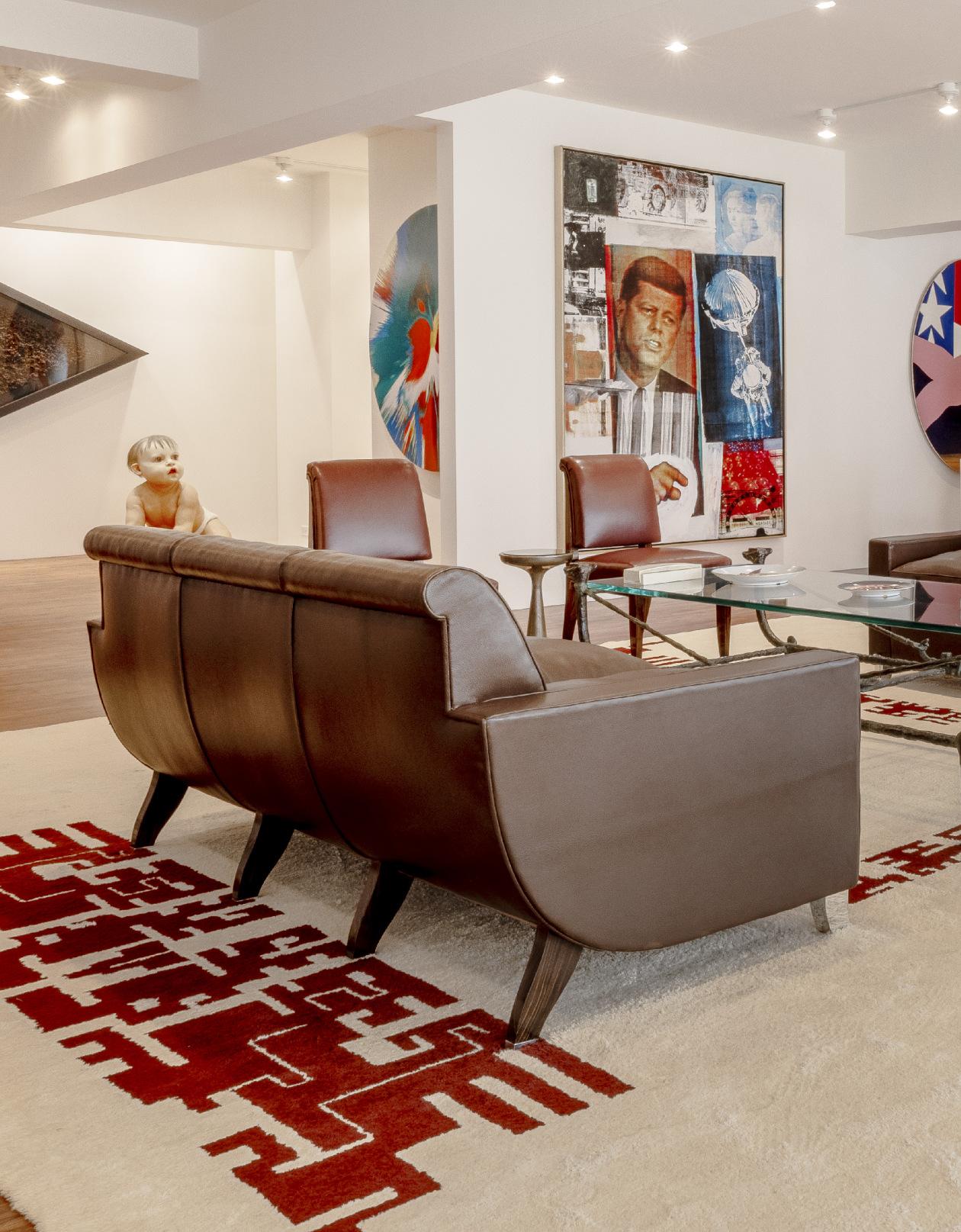
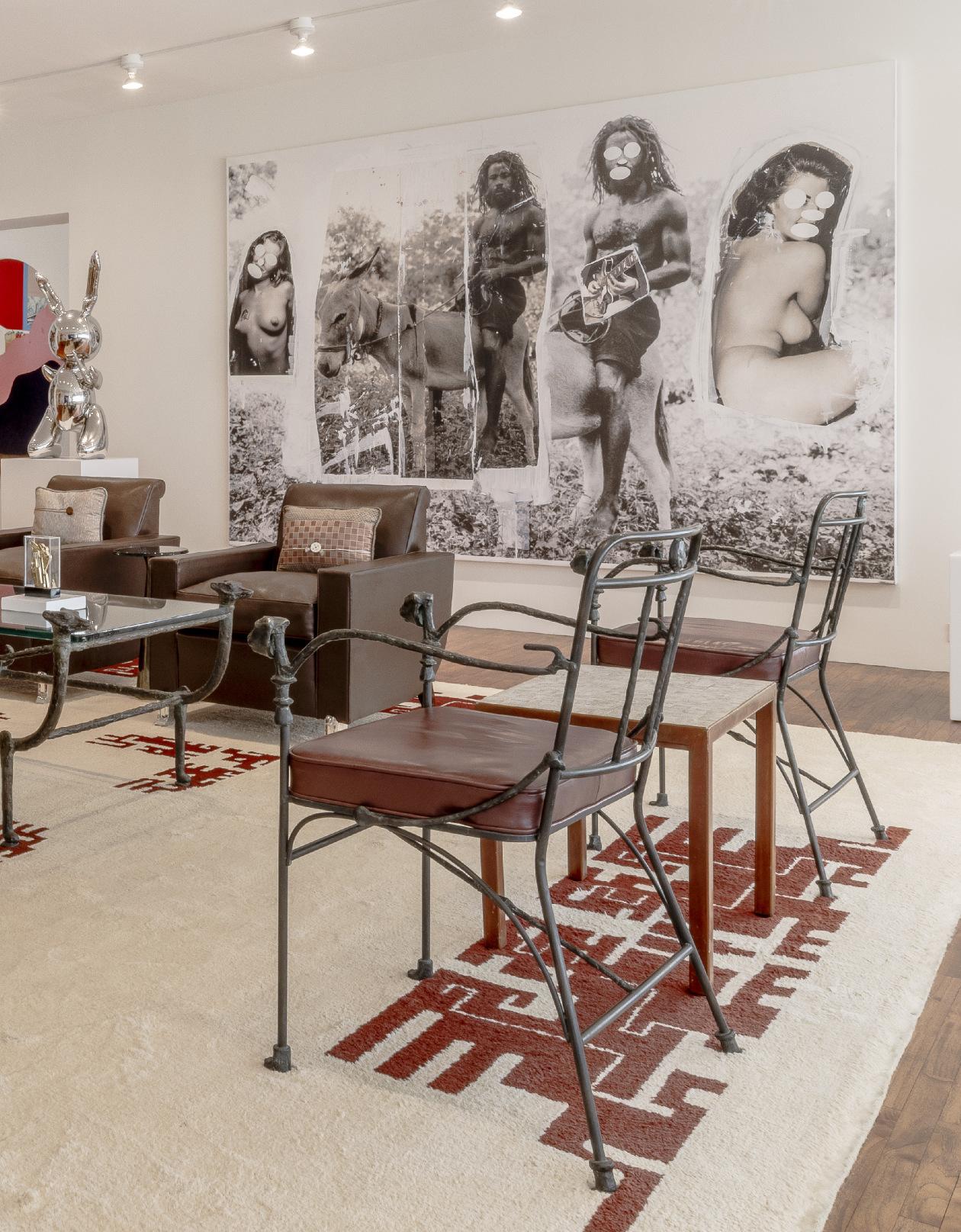
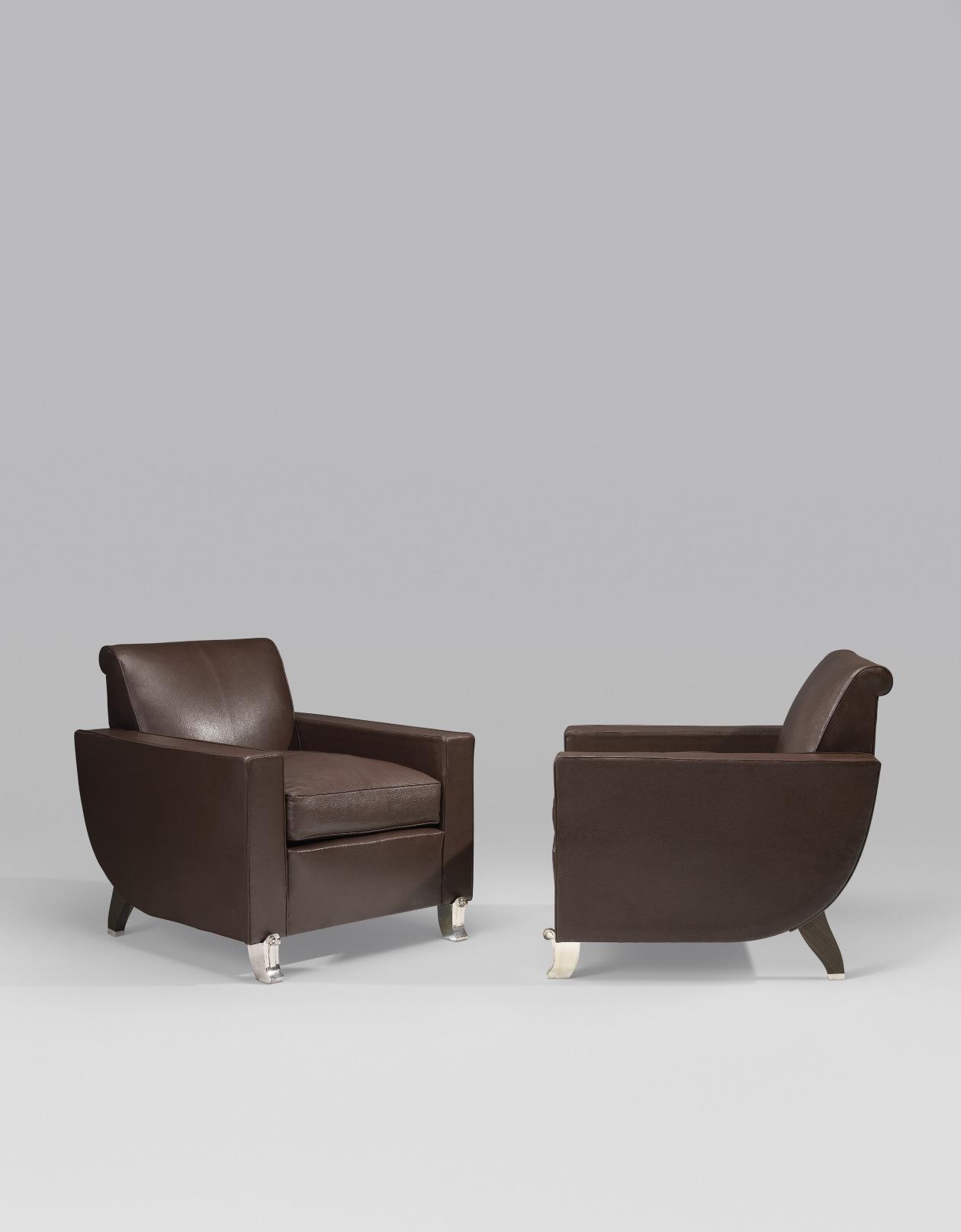
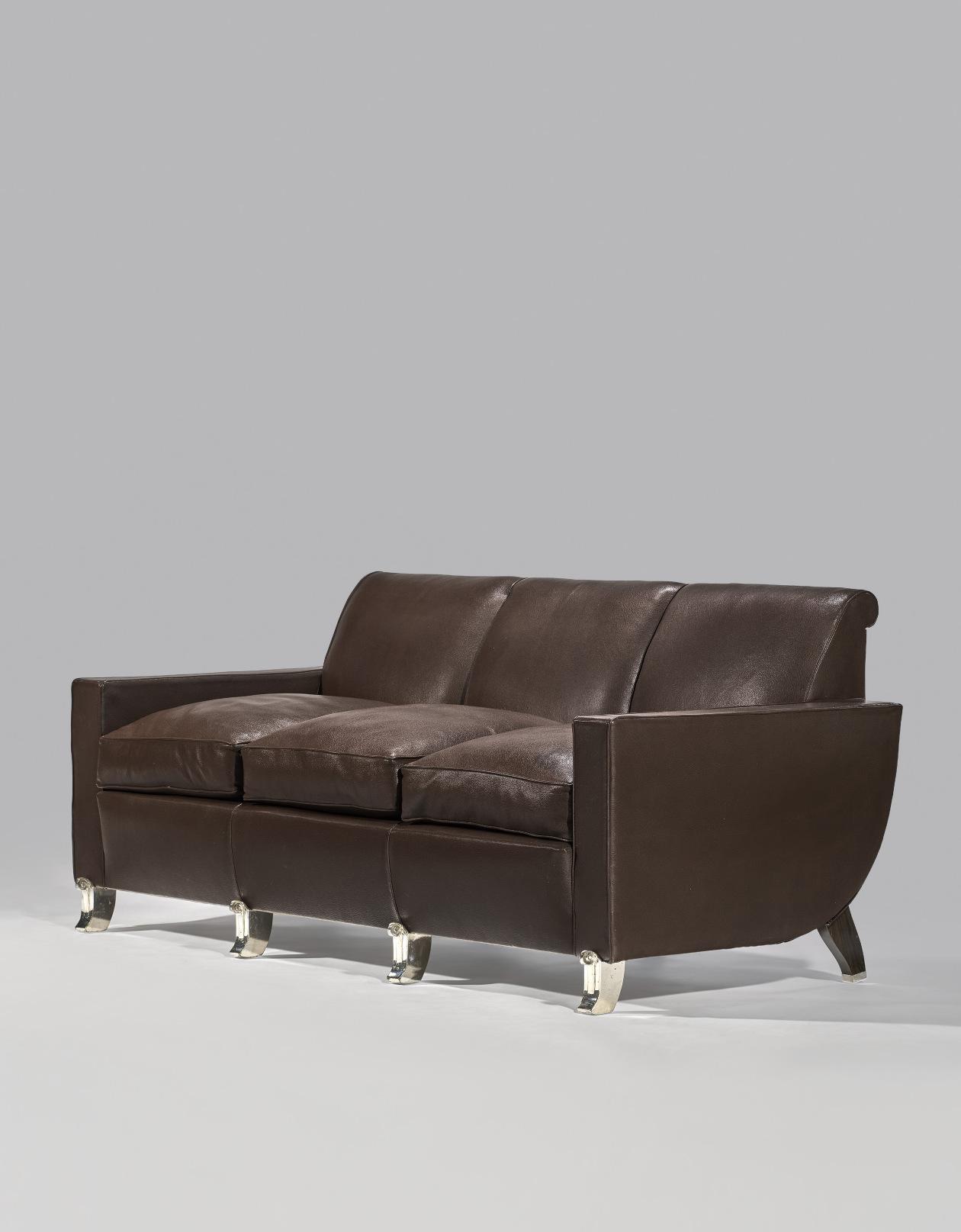
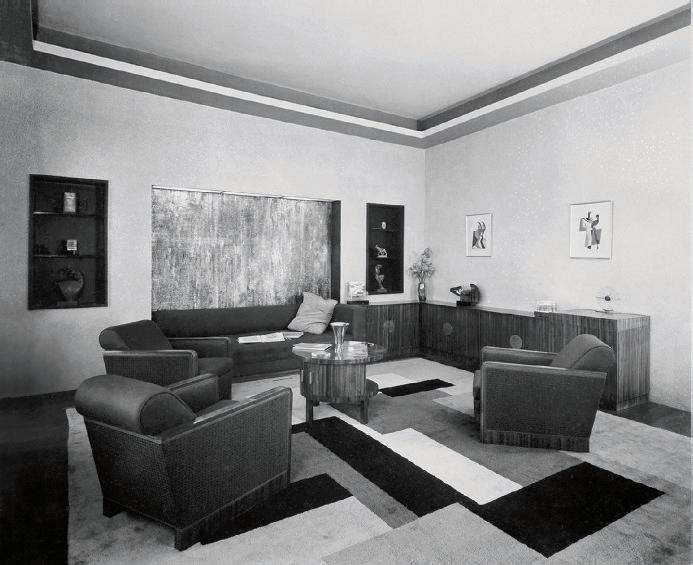
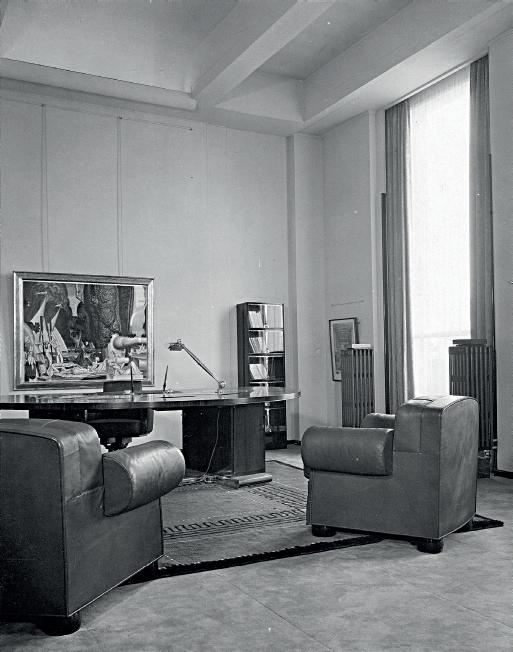
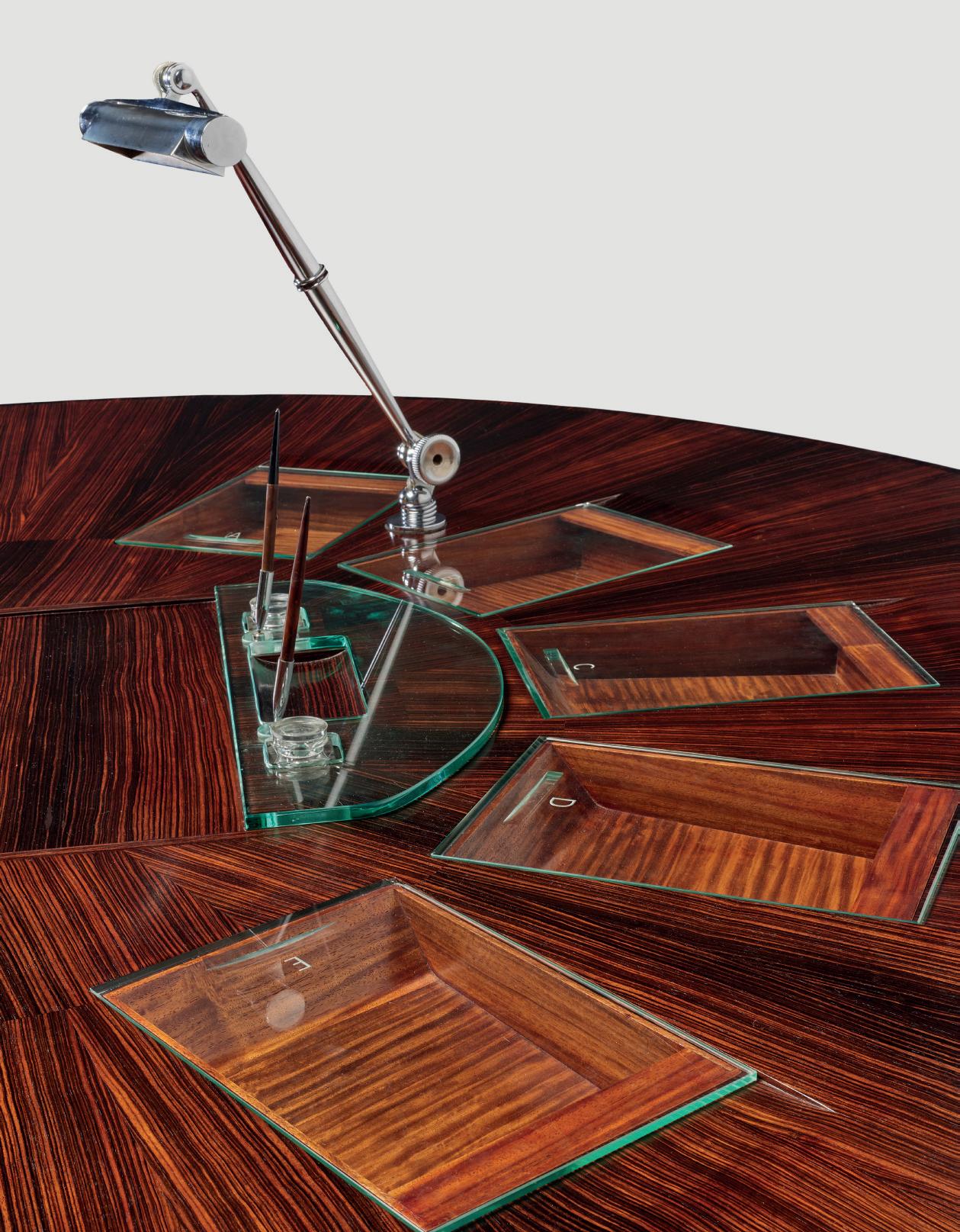
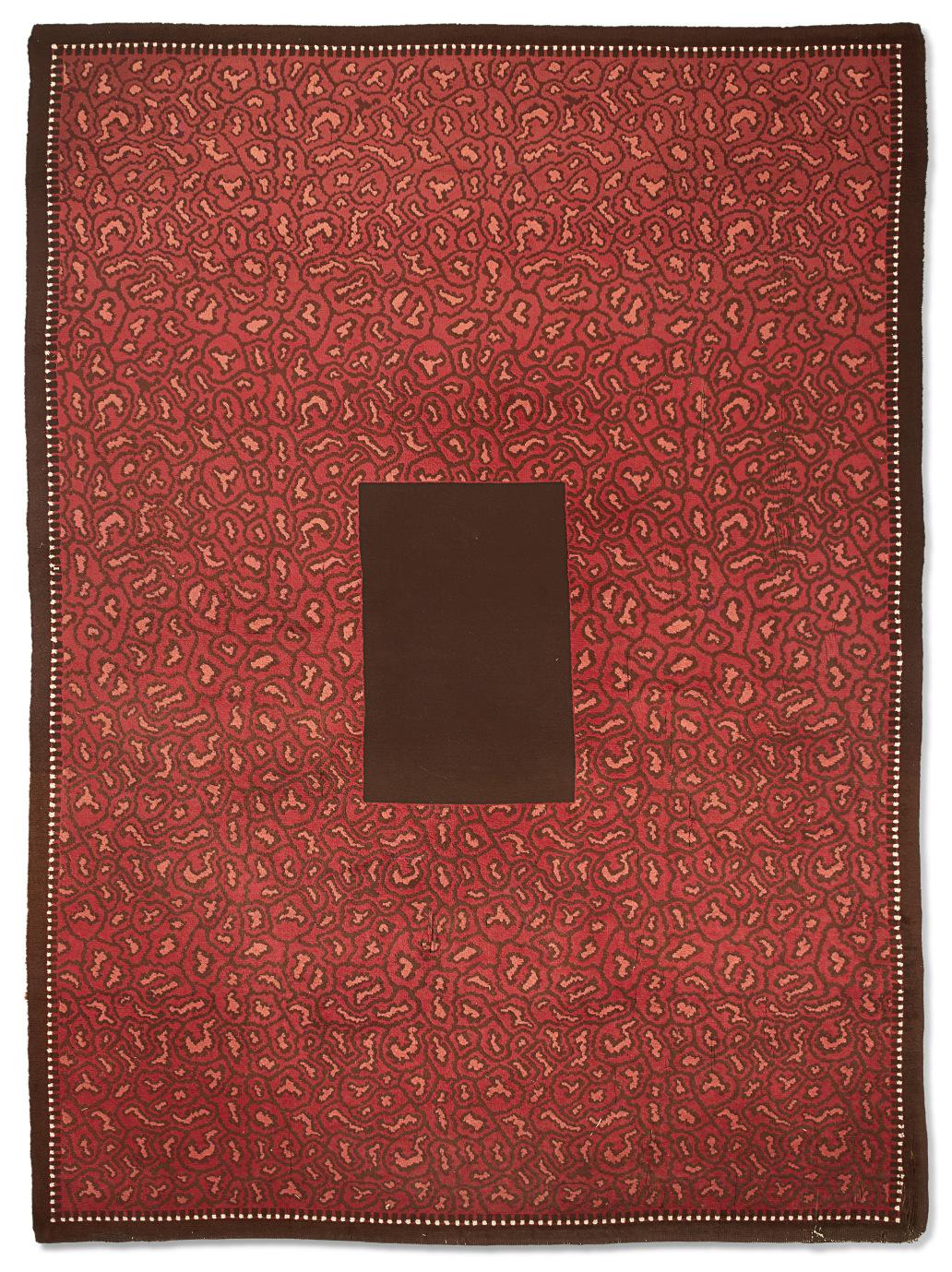
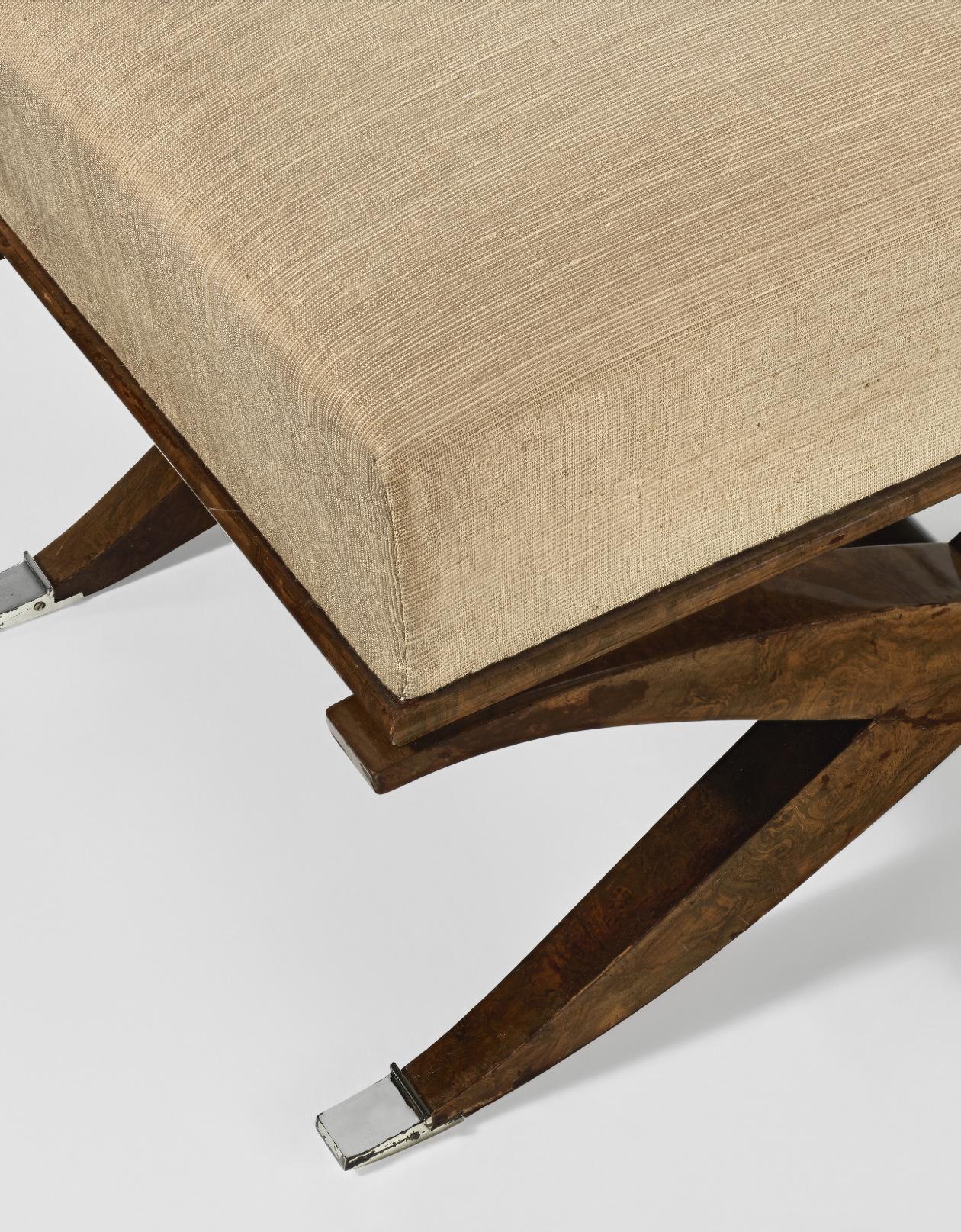
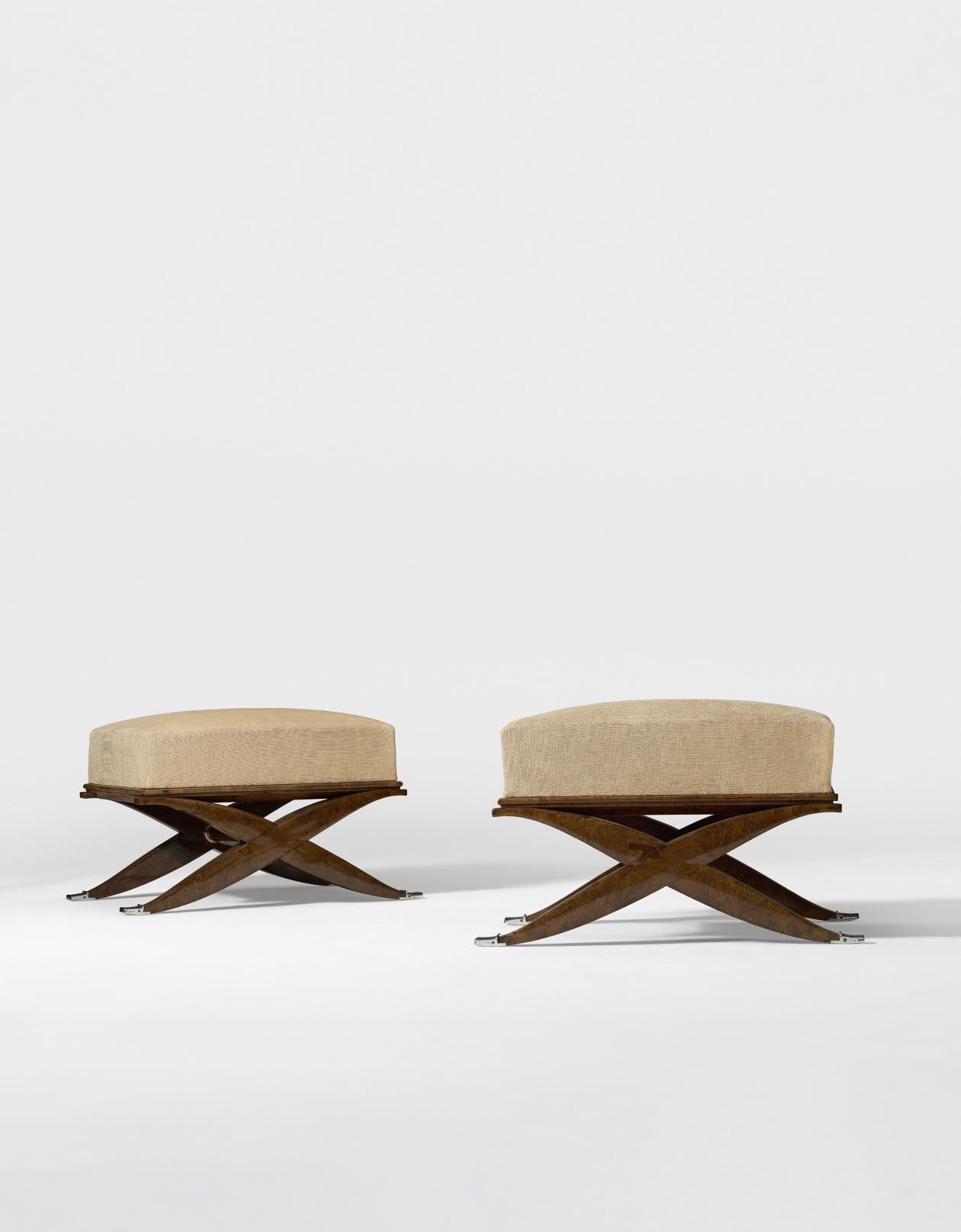
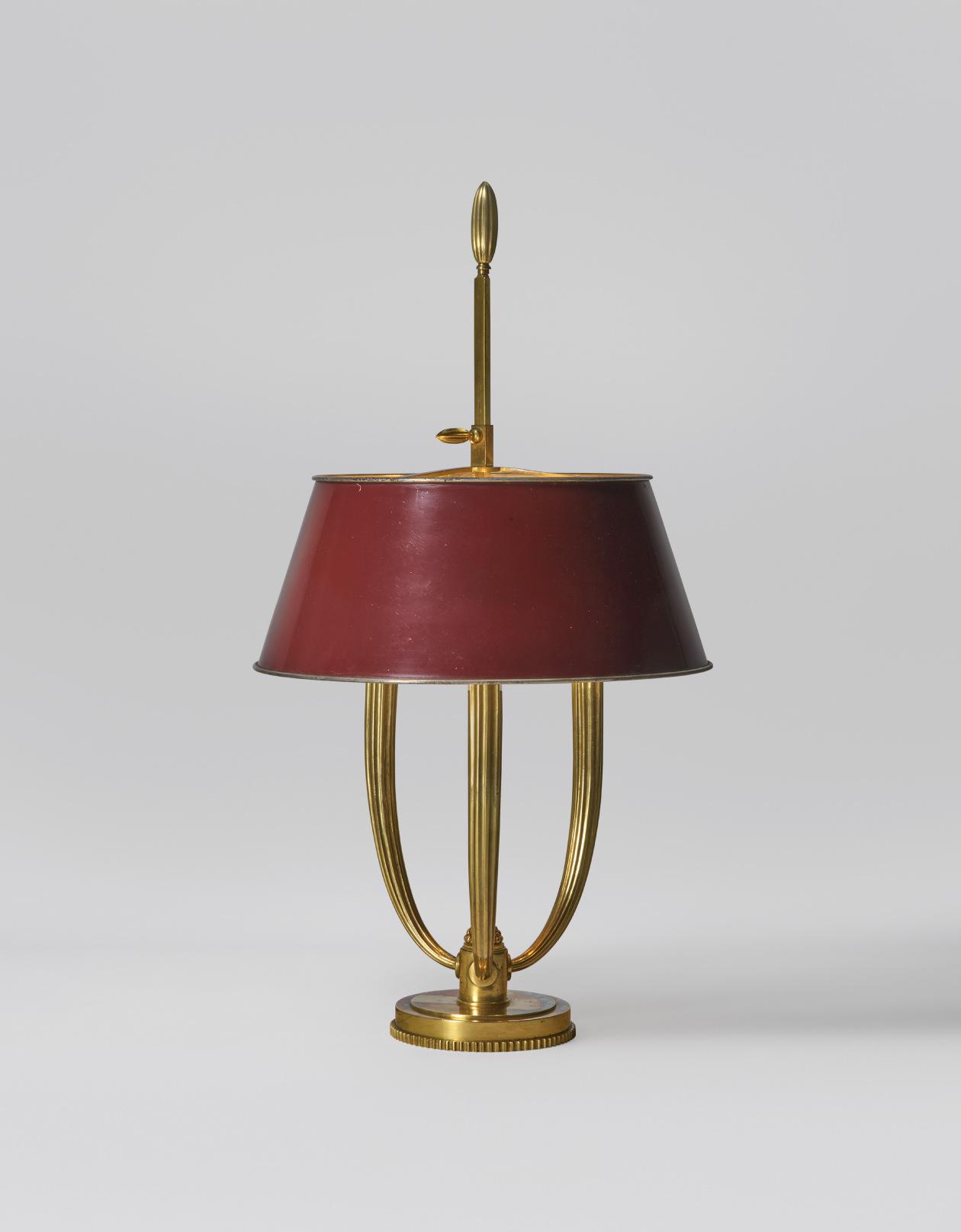
The present ensemble from the Edlis | Neeson Collection embodies this legacy with extraordinary breadth and coherence, unfolding like a private salon conceived by the master himself. One is first greeted by the the warm glow of a ‘Bouillotte’ table lamp (lot 37) while richly woven carpets (lot 9 and lot 35) ground the space with sumptuous texture. At the heart of the ensemble, the rare ‘Hydravion’ armchairs (lot 7) and extremely rare sofa (lot 8) evoke the aerodynamic elegance and forward-looking spirit of the 1920s. Anchoring the interior, the commanding ‘Cannelée à redents’ commode (lot 10) and pair of stools (lot 36) stand as architectural statements: monuments of proportion, precision, and luxury that embody Ruhlmann’s vision of the complete work of art.
The 1925 Exposition Internationale des Arts Décoratifs et Industriels Modernes in Paris confirmed Ruhlmann’s reign, placing him at the very center of the movement that defined an era. Today, as the centennial of this landmark event approaches, his work speaks with renewed resonance, not only as a pinnacle of design history, but as a touchstone of connoisseurship and cultural refinement.
Ruhlmann’s patrons were cosmopolitan, visionary, unfailingly attuned to beauty and sought more than decoration. They commissioned icons as they lived within works of art. The scarcity of these masterpieces today only deepens their allure, and to encounter one is to step into a world where design, craftsmanship, and vision meet in perfect equilibrium: a world Ruhlmann created and that continues to inspire the most discerning collectors a century later.
The present model at the Salon des artistes décorateurs, Paris, 1923, where it was shown for the first time.
Émile-Jacques Ruhlmann pair of stools, circa 1925, in the Chicago residence of Stefan Edlis and Gael Neeson, 2025. © Richard Prince
The Edlis | Neeson Residence. Artwork: © Richard Prince; © 2025 Artists Rights Society (ARS), New York / DACS, London; © 2025 Artists Rights Society (ARS), New York / DACS, London; © 2025
Robert Rauschenberg Foundation / Licensed by VAGA at Artists Rights Society (ARS), New York; © 2025
Estate of Tom Wesselmann / Artists Rights Society (ARS), NY; © Jeff Koons; © 2025 Artists Rights Society (ARS), New York / ADAGP, Paris.
EDLIS | NEESON COLLECTION
°7
ÉMILE-JACQUES RUHLMANN (1879-1933)
PAIR OF 'HYDRAVION' ARMCHAIRS, CIRCA 1923
Macassar ebony, chromed bronze, leather upholstery
29æ x 28 x 32 in. (75.6 x 71.1 x 81.3 cm) (each) each branded Ruhlmann (2)
$200,000-300,000
PROVENANCE:
Private Collection, France
Christian de Quay and Francis Lombrail, Paris, 15 October 1996, lot 127 (part) Acquired from the above by the present owner
LITERATURE:
R. Chavance, "L'art décoratif contemporain au Pavillon de Marsan," Art et Décoration, no. 256, Paris, April 1923, p. 114
F. Camard, Ruhlmann, Paris, 1983, pp. 33 (for a drawing), 80, 134, 202 (for period photographs)
F. Camard, Ruhlmann: Master of Art Deco, New York, 1984, pp. 33 and 183 (for illustrations of this model), 80, 134, 202 (for period photographs)
Ruhlmann: un génie de L’Art déco, exh. cat., Musée des Années 30, BoulogneBillancourt, 2001, pp. 229 (for an illustration of this model) and 197 (for a period photograph)
E. Bréon, Émile-Jacques Ruhlmann: The Designer’s Archives, vol. 1, Paris, 2004, p. 87 (for a drawing)
F. Camard, Jacques Émile Ruhlmann, Saint-Rémy-en-l'Eau, 2009, pp. 87 (for an illustration of this model), 112, 115, 135, 153 (for period photographs)
This model is recorded under number 53AR/267NR in the Ruhlmann Archives, Musée des Années 30, Boulogne-Billancourt.
This model was exhibited in the Pavillon de Marsan at the Salon des artistes décorateurs, Paris, 1923.
LEARN MORE
EDLIS | NEESON COLLECTION
°8
ÉMILE-JACQUES RUHLMANN (1879-1933)
RARE 'HYDRAVION' CANAPÉ, CIRCA 1923
Macassar ebony, chromed bronze, leather upholstery
29Ω x 67º x 32 in. (74.9 x 170.8 x 81.3 cm)
branded Ruhlmann
$200,000-300,000
PROVENANCE:
Private Collection, France
Christian de Quay and Francis Lombrail, Paris, 15 October 1996, lot 127 (part) Acquired from the above by the present owner
This model is recorded under number 104AR/406NR in the Ruhlmann Archives, Musée des Années 30, Boulogne-Billancourt.
EDLIS | NEESON COLLECTION
°9
ÉMILE-JACQUES RUHLMANN (1879-1933)
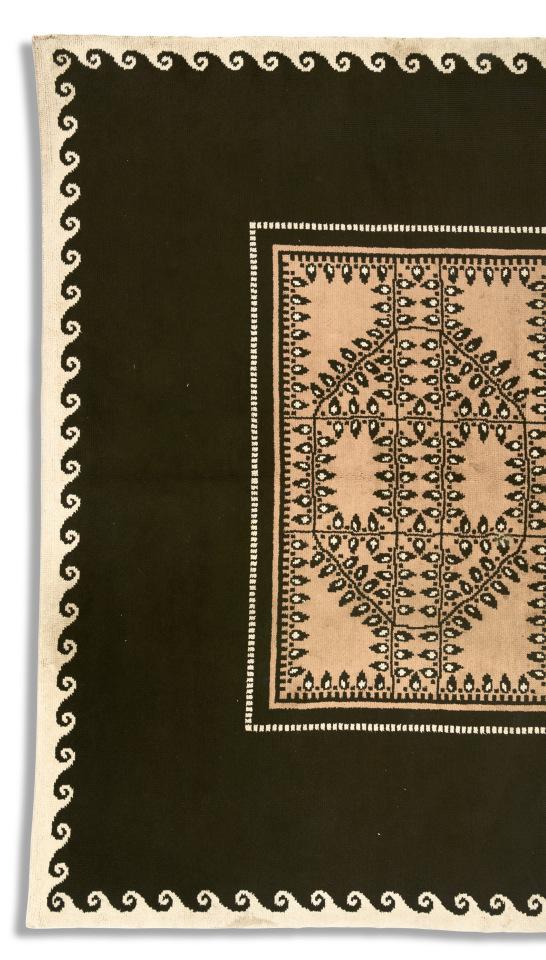
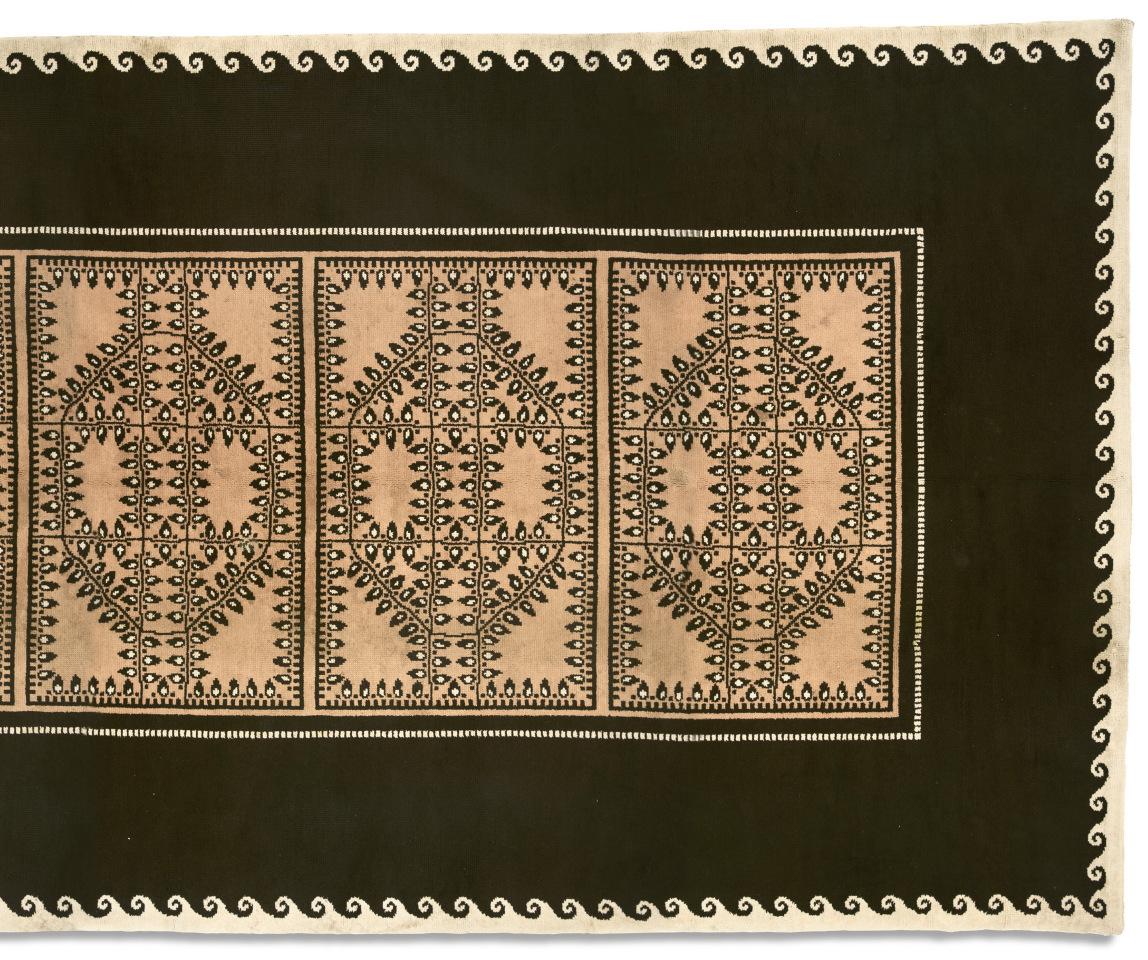
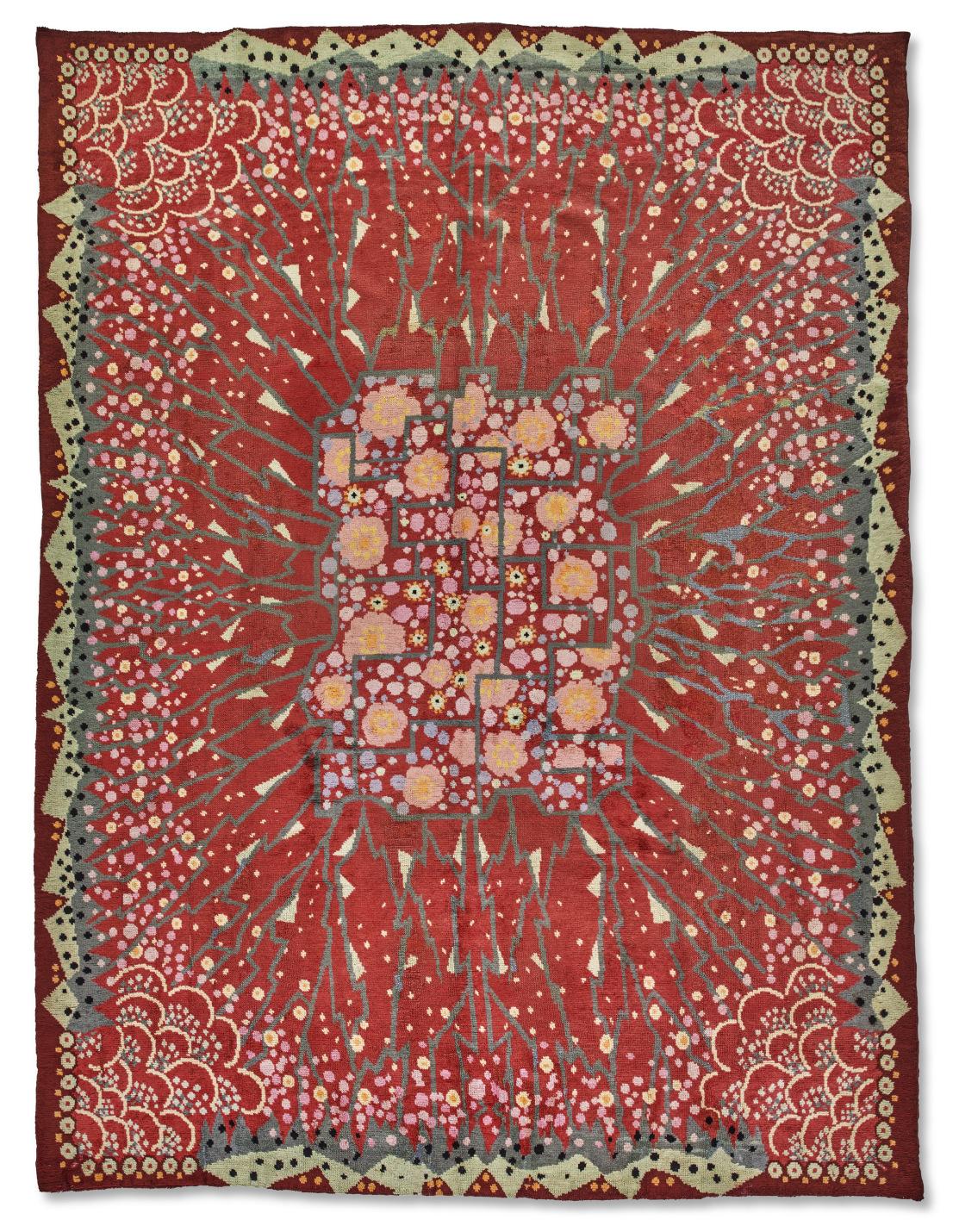
CARPET, DESIGNED CIRCA 1923
hand-knotted wool
14 ft. 6 in. x 9 ft. 10 in. (444 x 300 cm)
$80,000-120,000
PROVENANCE:
Millon & Robert, 26 June 1996, lot 307
Acquired from the above by the present owner
LITERATURE:
For a related variation:
A. Fréchet, Intérieurs Modernes. Mobilier et Décoration, Paris, 1930, pl. 28
M. Roux-Spitz, "L'arte decorativa francese (parte I)," Architettura e Arti Decorative, Milan, no. 3, 1923, p. 113
F. Camard, Ruhlmann, Paris, 1983, pp. 80 (for a period photograph of the model in the Pavillon de Marsan, Salon des artistes décorateurs, Paris, 1923), 99, 243 (for period photographs), 182 (for a drawing)
F. Camard, Ruhlmann: Master of Art Deco, London, 1984, pp. 80 (for a period photograph of the model in the Pavillon de Marsan, Salon des artistes décorateurs, Paris, 1923), 99, 243 (for period photographs), 182 (for a drawing)
Ruhlmann: Genius of Art Deco, exh. cat., The Metropolitan Museum of Art, New York, 2004, pp. 41, 100, 115, 178 (for period photographs)
A related model is recorded under number 2512AR/3105NR in the Ruhlmann Archives, Musée des Années 30, Boulogne-Billancourt.
A related model was exhibited in the Pavillon de Marsan at the Salon des artistes décorateurs, Paris, 1923.
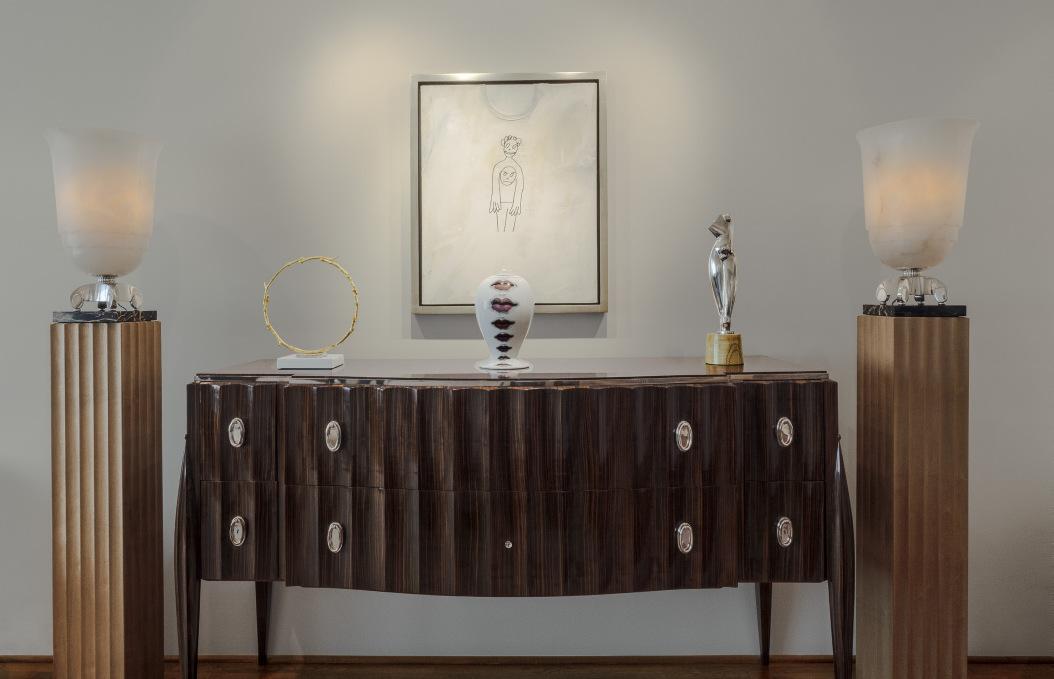
Émile-Jacques Ruhlmann ‘Grande Cannelée à Redents’ Commode, in the Chicago residence of Stefan Edlis and Gael Neeson, 2025. © Ugo Rondinone, courtesy of Gladstone. © 2025 Estate of Alexander Archipenko / Artists Rights Society (ARS), New York. © Richard Prince
In only two decades, from the first time he exhibited pieces at the Salon d’automne in 1913 to his death in 1933, Émile-Jacques Ruhlmann created over a thousand and seven hundred pieces, carefully referenced in the Archives kept at the Musée des Années 30, Boulogne-Billancourt.
A man of many talents, he was above all creating refined furniture and knew how to appeal to influential figures in the worlds of industry, fashion, theater, and politics in the 1920s. He was also a sought-after decorator, perfectly in tune with the tastes of the time, who carefully studied every aspect of the interior designs created by his workshops. Ruhlmann’s reputation was shaped in part by the breadth of materials he mastered: from exotic veneers prized for their depth and movement to lacquer, metalwork, and delicately carved ivory, each chosen with intention. His material choices were not arbitrary as he sought surfaces that evoked refinement, clarity of line, and a harmonious balance of
textures. This versatility contributed to his acclaim during a decade of artistic optimism and explains why his creations were so prominently exhibited and published.
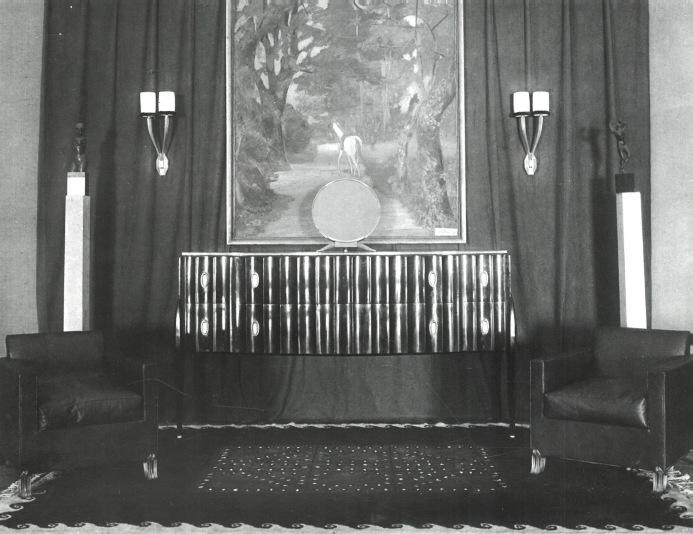
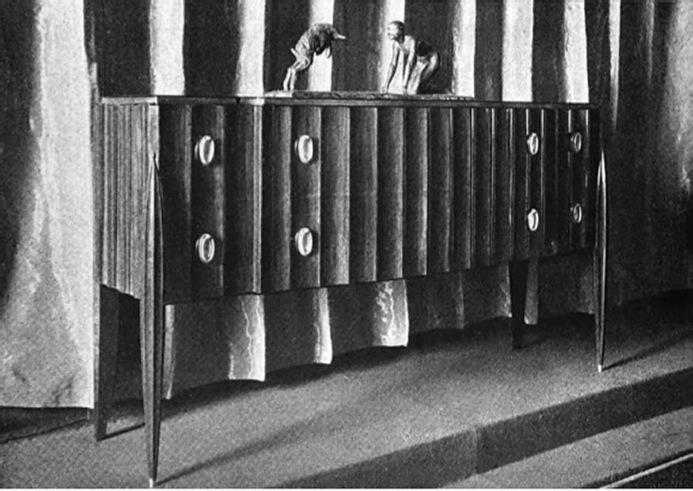
The present model was first exhibited at the 1923 Salon des artistes décorateurs in Paris and is a forerunner to his later commode he exhibited in the Hotel du Collectionneur at the 1925 Exposition Internationale des Arts Décoratifs et Industriels Modernes.
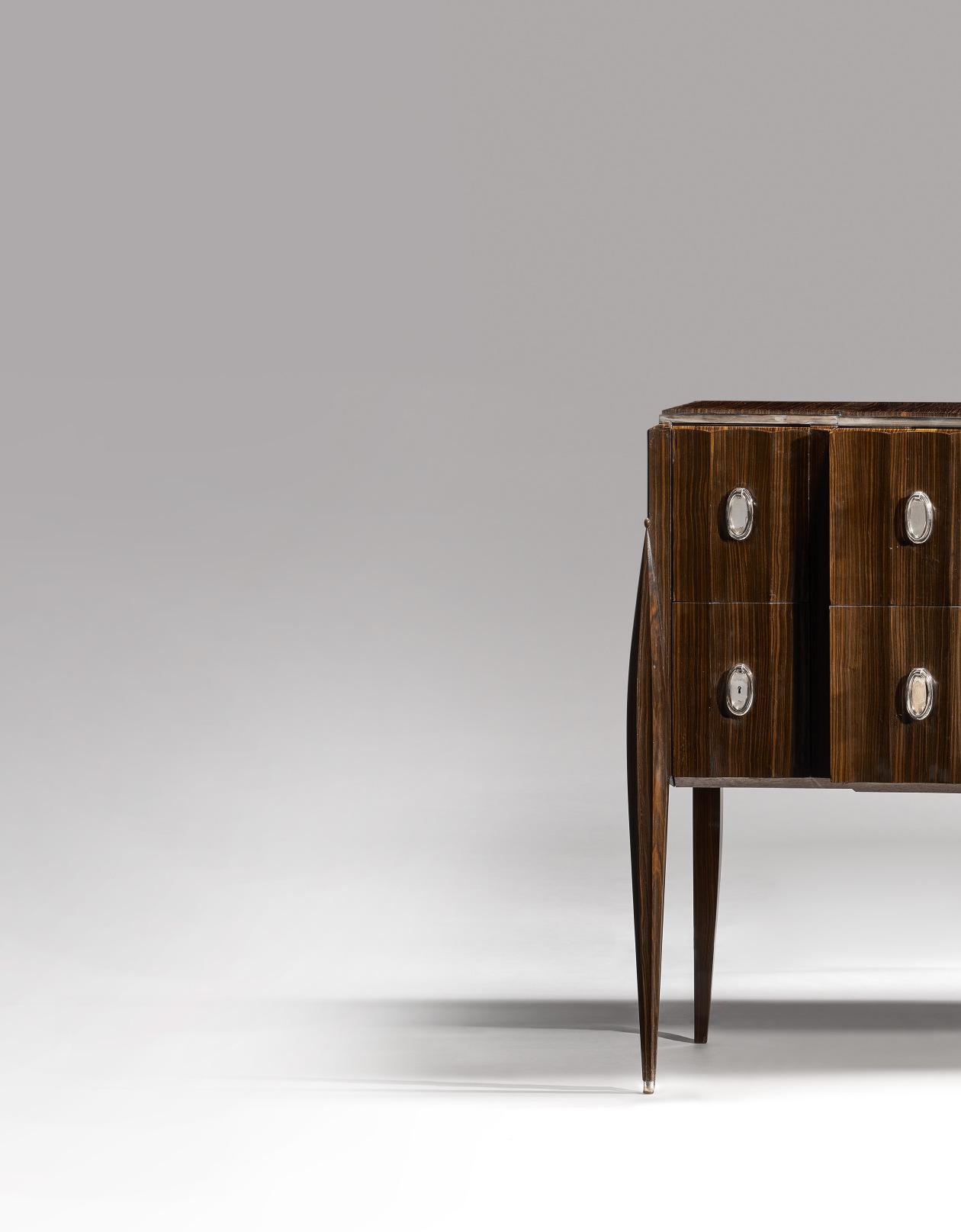
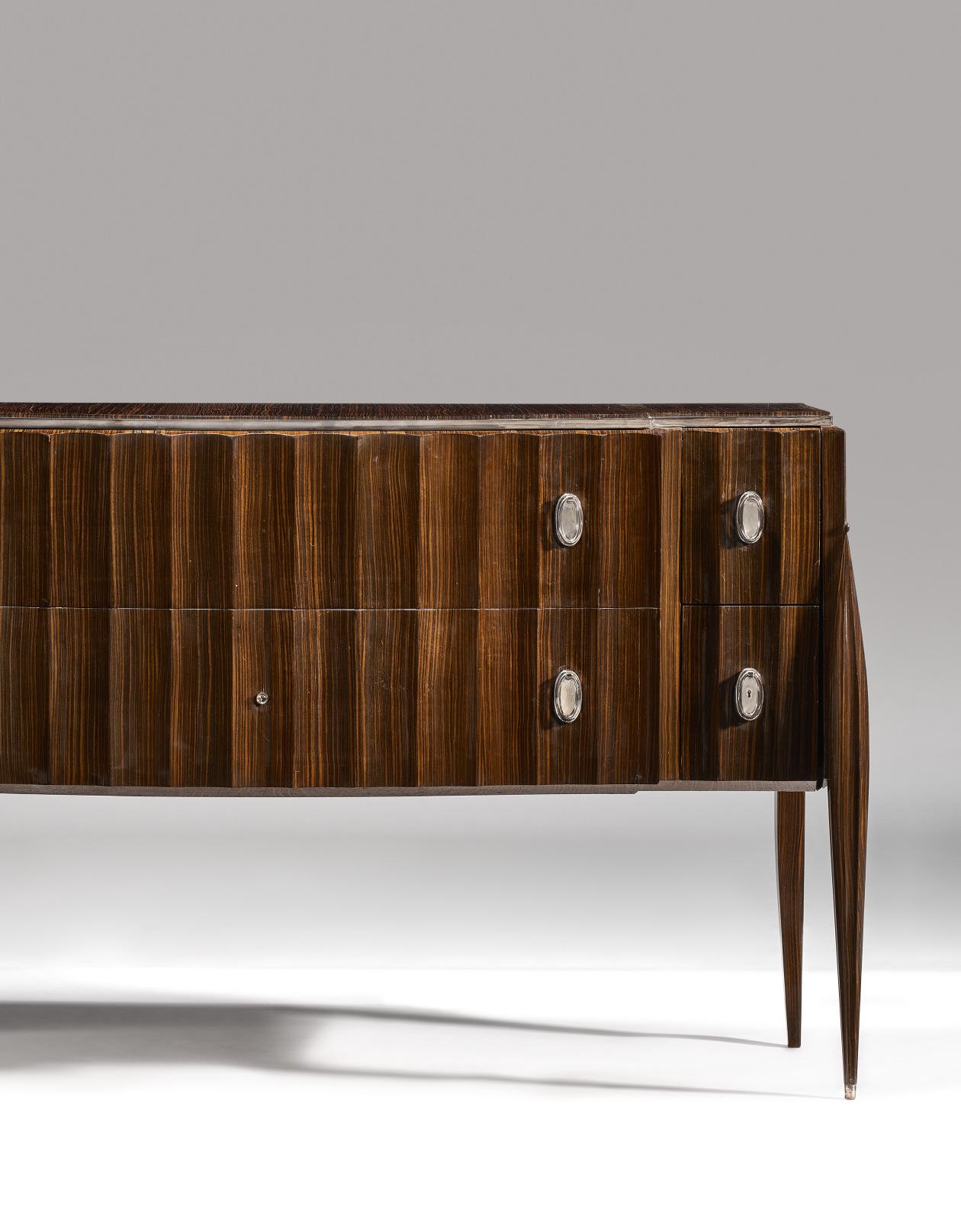
The piece has two central large drawers flanked by sets of narrower ones, all adorned by undulating redents in Macassar ebony veneer. Very simple in decoration, the large piece of furniture has a light and graceful appearance because of the shaped fuseaux legs supporting the chest and serves as an excellent example of Ruhlmann’s craftsmanship and sense of proportions.
The present model on display in the French Section at the Monza Biennal, 1925.
ÉMILE-JACQUES RUHLMANN (1879-1933)
'GRANDE CANNELÉE À REDENTS' COMMODE, DESIGNED CIRCA 1923
Macassar ebony-veneered oak, silvered bronze
42¡ x 75 x 23æ in. (107.5 x 190.5 x 60.3 cm)
branded Ruhlmann and with Atelier B mark
$150,000-250,000
PROVENANCE:
Lillian Nassau, New York Private Collection
Sotheby's, New York, 23 March 1996, lot 360
Acquired from the above by the present owner
EXHIBITED:
New York, The Finch College Museum of Art, Art Deco, October-November 1970, cat. no. 246
Minneapolis, The Minneapolis Institute of Arts, The World of Art Deco, JulySeptember 1971, pp.14, 62, cat. no. 94 (present lot illustrated)
LITERATURE:
A. Morancé ed., Les Arts de la Maison, Paris, 1923, p. 50 (for a drawing), pl. XVII (for a period photograph)
"Le Arti a Monza nel 1925," Emporium, Bergamo, no. 369, September 1925, p. 146 (for a period photograph)
F. Camard, Ruhlmann, Paris, 1983, pp. 80 (for a period photograph of the model in the Pavillon de Marsan, Salon des artistes décorateurs, Paris, 1923), 276-277 (for a period photograph of a related example)
F. Camard, Ruhlmann: Master of Art Deco, London, 1984, pp. 80 (for a period photograph of the model in the Pavillon de Marsan, Salon des artistes décorateurs, Paris, 1923), 276-127 (for a period photograph of a related example)
E. Bréon, Jacques-Émile Ruhlmann, the designer's archives: furniture, Paris, 2004, p. 91 (for a sketch of a related model)
Ruhlmann: Genius of Art Deco, exh. cat., The Metropolitan Museum of Art, New York, 2004, p. 183 (for a related example)
F. Camard, Jacques Émile Ruhlmann, Paris, 2009, p. 155
F. Camard, Jacques Émile Ruhlmann, New York, 2011, p. 155
This model is recorded under number 2023AR/1954NR in the Ruhlmann Archives, Musée des Années 30, Boulogne-Billancourt.
This model was exhibited in the Pavillon de Marsan at the Salon des artistes décorateurs, Paris, 1923.
This model was exhibited at the Monza Biennal, 1925.
LEARN MORE
PROPERTY FROM AN IMPORTANT CHICAGO COLLECTION 11
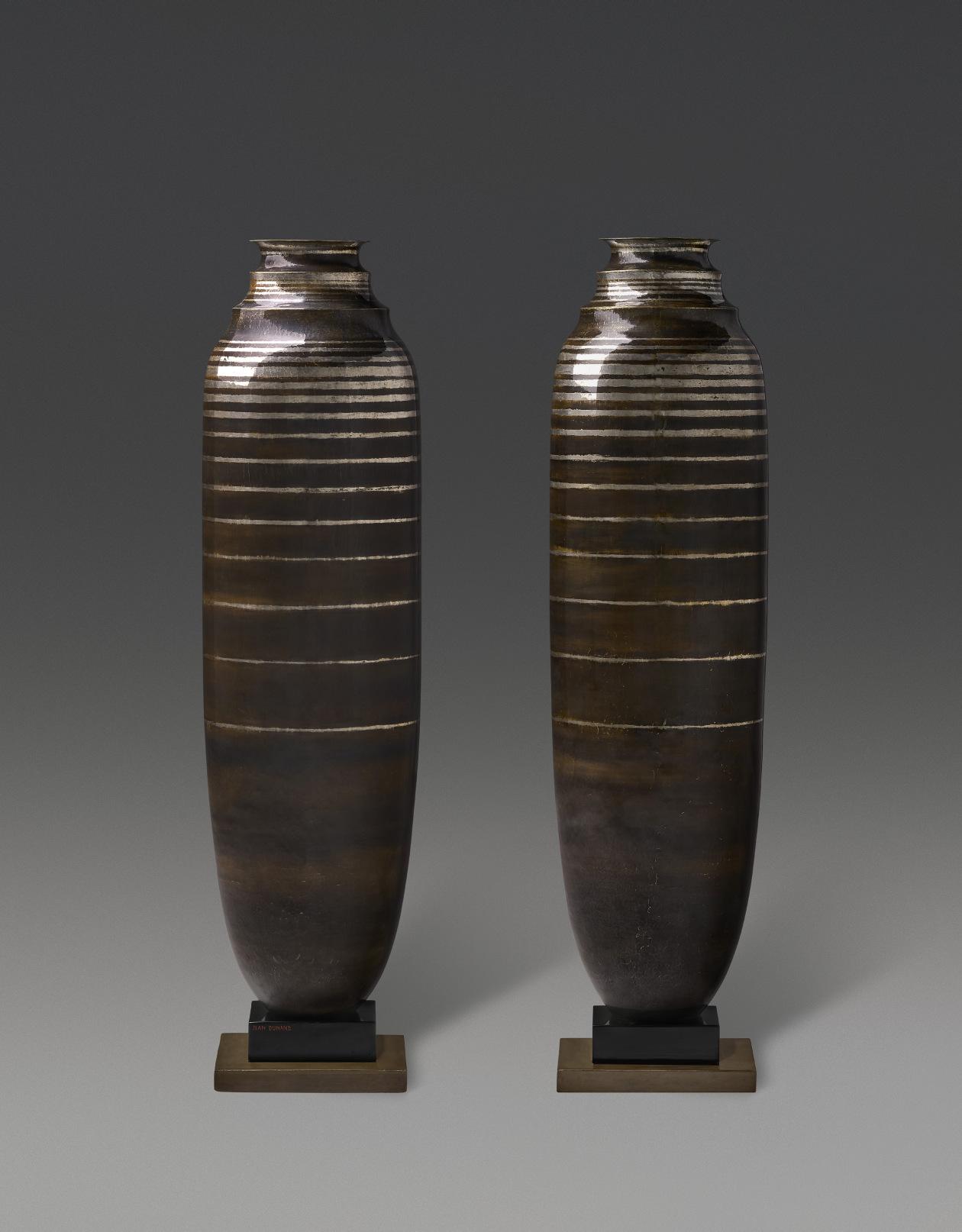
JEAN DUNAND (1877-1942)
PAIR OF MONUMENTAL VASES, CIRCA 1922
yellow copper oxide inlaid with silver, lacquered wood
36¬ x 8¬ x 8º in. (93 x 22 x 21 cm) (overall, each)
one base signed JEAN DUNAND (2)
$250,000-350,000
PROVENANCE:
DeLorenzo Gallery, New York
Galerie Jean-Jacques Dutko, Paris
Acquired from the above by the present owner, 1994
EXHIBITED:
New York, DeLorenzo Gallery, Jean Dunand, May-June 1985, p. 82 (present lot illustrated, part)
LITERATURE:
P. Seulliet, "Un Art de Composer, À Paris, chez un fervent des années trente," Vogue Décoration, 1987, no. 4, p. 94 (present lot illustrated, part)
F. Marcilhac, Jean Dunand, His Life and Work, London, 1991, p. 304, no. 988 (present lot illustrated)
F. and A. Marcilhac, Jean Dunand, Paris, 2020, p. 346, no. 194 (present lot illustrated)
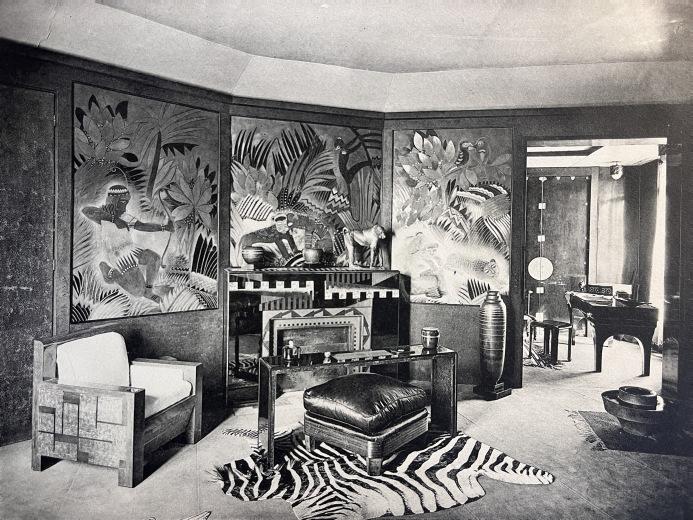
A related example in the living of Madame J. Henri Labourdette-Debacker, Paris, 1927. Decorated by Jean Dunand and Eileen Gray.
LEARN MORE
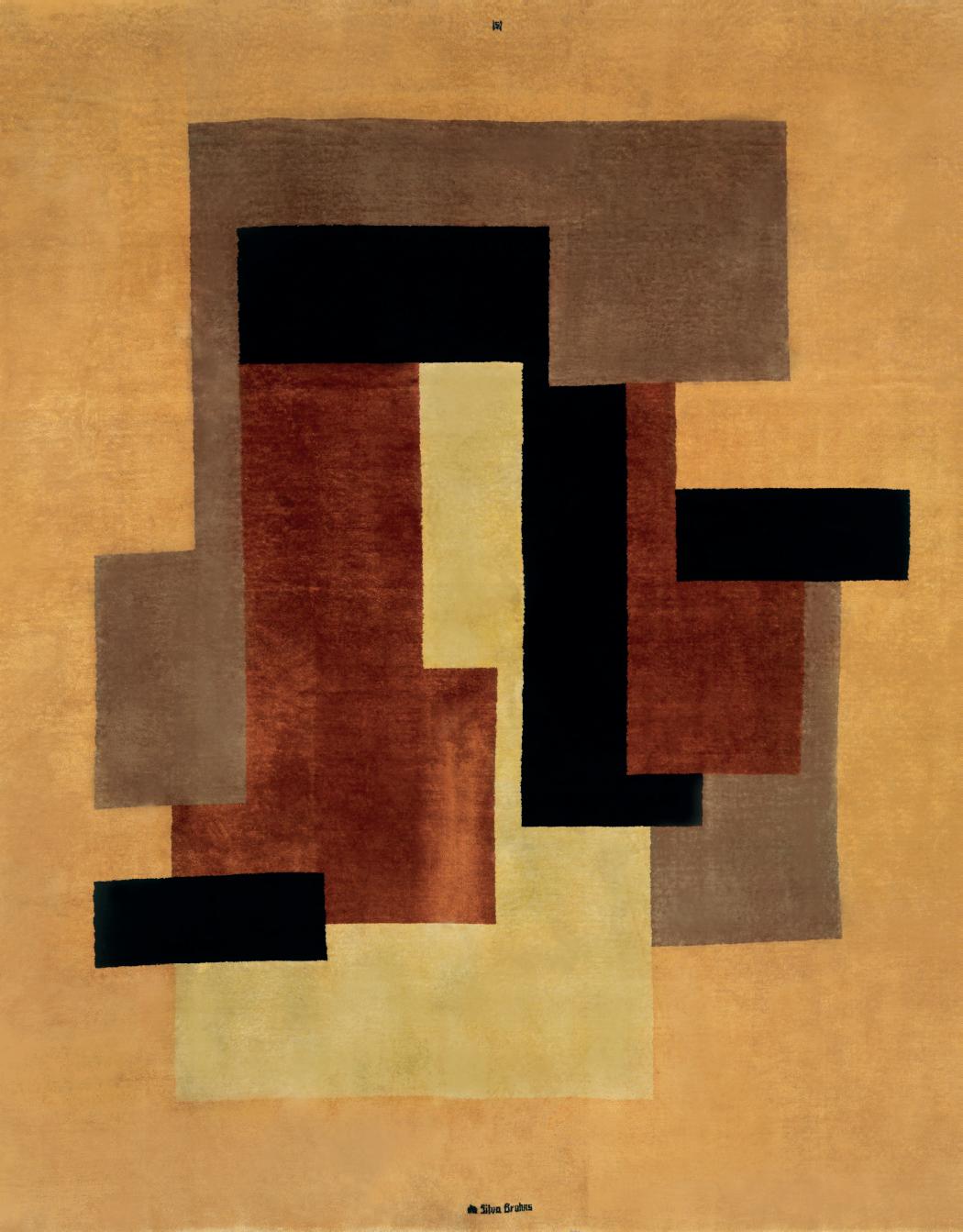
IVAN DA SILVA-BRUHNS (1881-1980)
UNIQUE AND IMPORTANT CARPET FROM THE PALACE OF THE MAHARAJA OF INDORE, MANIK BAGH, CIRCA 1930
executed by the Manufacture de Savigny, Savigny-sur-Orge, France hand-knotted wool
16 ft. 1 in. x 13 ft. 8 in. (491 x 422 cm) signed in weave da Silva Bruhns and with manufacturer's monogram
$250,000-350,000
PROVENANCE:
Maharaja of Indore, Manik Bagh, India, circa 1930
Maharajah d'Indore, Sotheby's, Monaco, 11 October 1987, lot 329 Marsha Miro, Detroit
Christie's, New York, 9 December 2014, lot 544
Private Collection
Christie's, New York, 7 June 2017, lot 45
LITERATURE:
'Indisches Märchenschloss 1933, Eine Berliner Architekt baut den Palast des Maharadschas von Indore', Berliner Illustrierte Zerfung, no. 46, November 1933, n.p. (for information on Manik Bagh and images of carpets designed by da Silva Bruhns)
R. Descharnes, 'En Inde un Palais 1930', Connaissance des Arts, no. 223, September 1970, pp. 52 and 55 (for similar carpets in Manik Bagh)
A. Pica, 'Eckart Muthesius in India, The avant-garde meets history', Domus, no. 593, April 1979, p. 6 (for a similar carpet in Manik Bagh)
P. Adam, Eileen Gray: Architect-Designer, London, 1987, p. 188 (for a similar carpet in the Maharaja's bedroom)
Y. Brunhammer, Les Styles des Années 30 à 50, Paris, 1987, p. 52, fig. 1 (present lot illustrated in situ)
P. Bayer, Art Deco Interiors, London, 1990, p. 136 (for a similar carpet in the Maharaja's bedroom)
P. Garner, Eileen Gray: Designer and Architect, Berlin, 1993, p. 36 (for a similar carpet in the Maharaja's bedroom)
R. Niggl, Eckart Muthesius 1930: The Maharaja's Palace in Indore, Architecture and Interior, Stuttgart, 1996, p. 91 (present lot illustrated in situ)
S. Day, 'Art Deco Masterworks, The Carpets of Ivan da Silva Bruhns', Hali, The International Magazine of Antique Carpet and Textile Art, no. 105, JulyAugust 1999, pp. 78-80 (for two similar carpets for Manik Bagh)
Le palais du maharadjah d'Indore : photographies : Man Ray, Emil Leitner, Eckart Muthesius, exh. cat., Galerie Doria, Paris, 2006, p. 84-85 (present lot illustrated)
Eileen Gray, exh. cat., Centre Georges Pompidou, Paris, 2013, p. 69 (for a similar carpet in the Maharaja's bedroom)
Moderne Maharajah, exh. cat., Musée des Arts Décoratifs, Paris, 2019, pp. 102-103, 136-137, 173, 201 (present lot illustrated)
G. Lenain, Le Dernier Maharaja d'Indore, Paris, 2022, pp. 143, 145 and 146 (mentioned)
Eckhart Muthesius, Living room designed by Eckhart Muthesius for the Maharaja of Indoore, 1930 featuring the present carpet by Ivan Da Silva Bruhns. © 2025 Artists Rights Society (ARS), New York / VG Bild Kunst, Bonn
LEARN MORE
In 1925, the Exposition internationale des arts décoratifs et industriels modernes opened in Paris, ushering in the new modern style that would eventually become known as Art Deco. The movement became synonymous with luxury and glamor, featuring rare and expensive materials and distinguished by exceptional craftsmanship. It encompassed a wide variety of objects from dazzling pieces of jewelry by Cartier and Van Cleef & Arpels, to large-scale buildings—such as the Empire State and Chrysler Buildings in New York—whose interiors and exteriors where covered in gleaming chrome plating and stainless steel. Not technically an autonomous movement with a proscribed set of principles and rules, the roots of Art Deco can be traced by to the 1910s when it was influenced by the bold colors of Fauvism, the geometrics of the Vienna Succession, and the exoticized art of China, Japan, India, and ancient Egypt. However, from this myriad of influences one in particular stood out: Cubism.
Cubism’s propensity to analyze, break-up and re-assemble the visual field broke with millennia of artistic tradition. Without the need to represent the physical world, Cubism became more of an intellectual movement allowing for metaphysical introspection rather than visual pleasure. Instead of figurative depictions of people or places, practitioners such as Pablo Picasso, Georges Braque, and Juan Gris sought to examine the relationship of space, mass, time and volume in new and revolutionary ways. While all three argued that the flatness of the canvas supported their investigations, it was with three-dimensional sculptures that many artists felt that the potential of Cubism could be taken to its ultimate conclusion.
The artist Gustave Miklos was a key figure in the development of Cubism, and consequently early developments in Art Deco. Born in Hungary, he trained at the Royal National School of Arts and Crafts in Budapest. He moved to Paris in 1909 and attended the Académie de la Palette, a private art school which—under the direction of Henri Le Fauconnier and Jean Metzinger — had become a center of Cubist ideas. Metzinger particularly helped shape the school into a vibrant center of avant-garde experimentation. His teachings emphasized structural analysis, the fragmentation of form, and the exploration of simultaneity—ideas that would come to define Cubist theory.
It was shortly after Miklos arrived that he exhibited at the 1910 Salon d’Automne, the famed venue for art that challenged the norms of the state run academies. Two of his paintings—Paysage de Meudon (1909, Collection Monastère royal de Brou à Bourg-en-Bresse) and Fleurs where exhibited alongside works by Pierre Bonnard, Marcel Duchamp, Wassily Kandinsky, and most significantly, Henri Matisse’s masterpiece, La Danse (1910, The Hermitage, St. Petersburg).
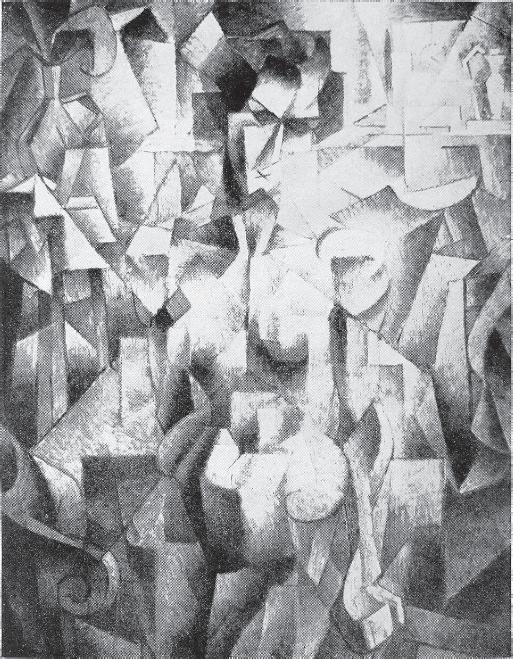
This 1910 exhibition has been credited with launching Cubism as a global movement and Miklos’ work, along with those of his contemporaries, both shocked and delighted audiences in equal measure. One critic, Jean Calud, described Jean Metzinger’s Nu à la cheminée—widely considered to be the first ever Cubist painting—as “a puzzle, cubic and triangular…beyond comprehension” (J. Calud, quoted in The Art Story: Salon Cubism), while another critic Roger Allard hailed the birth of a new movement of French art.
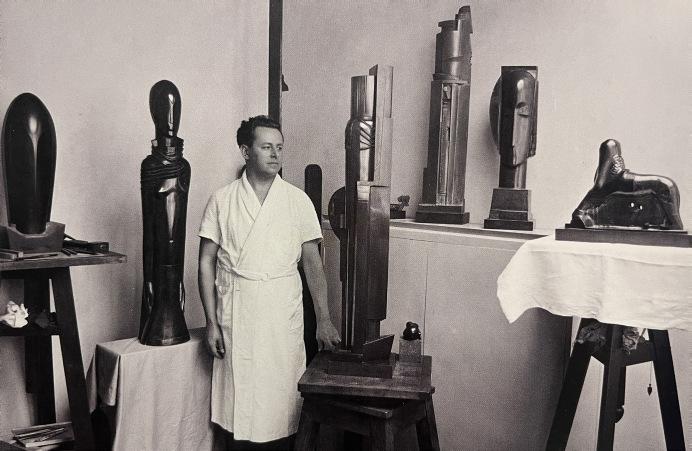
Gustave Miklos in his studio, circa 1928.
One of
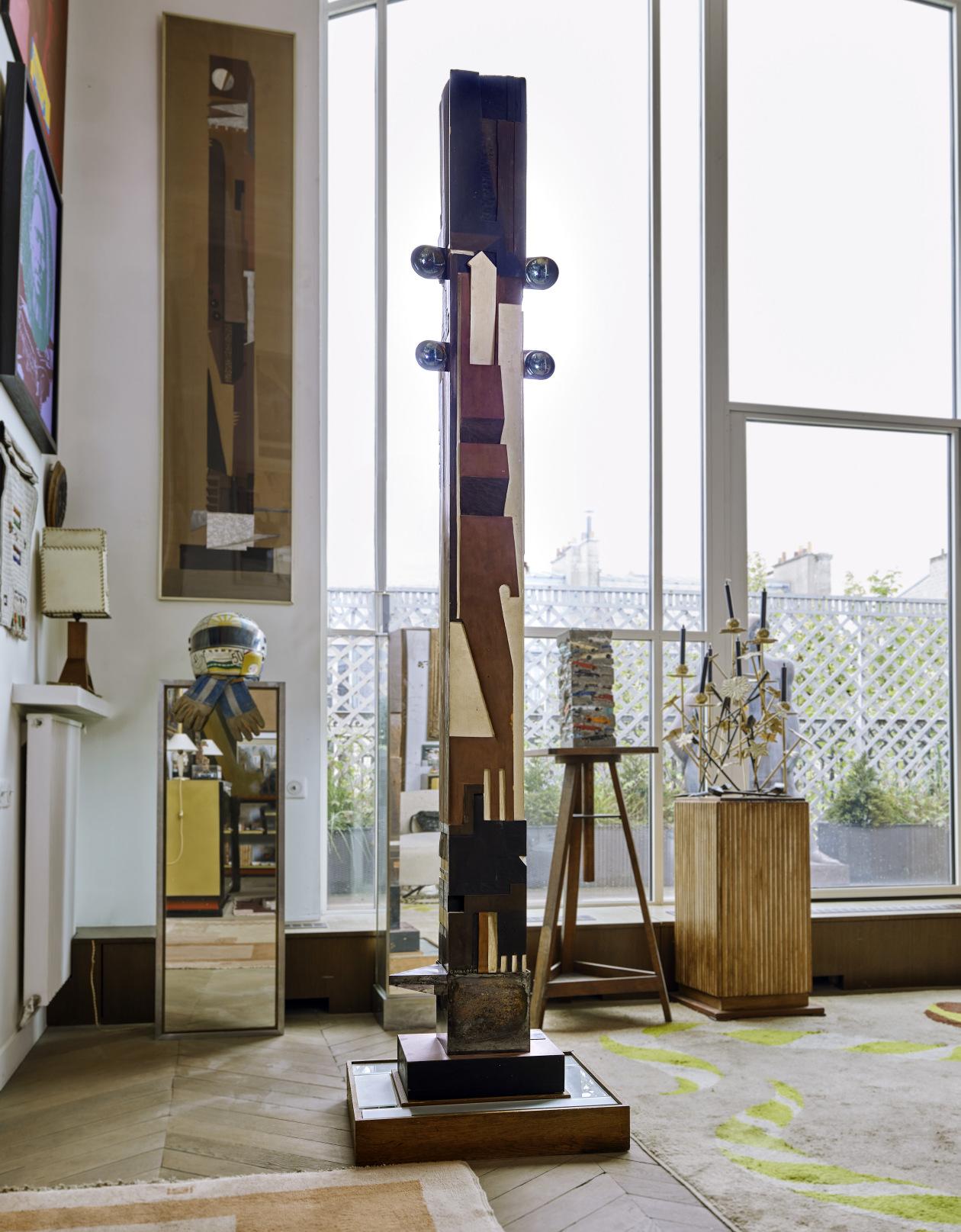
‘Tours Cubistes’ in the residence of Hervé and Isabelle Poulain, 2025.
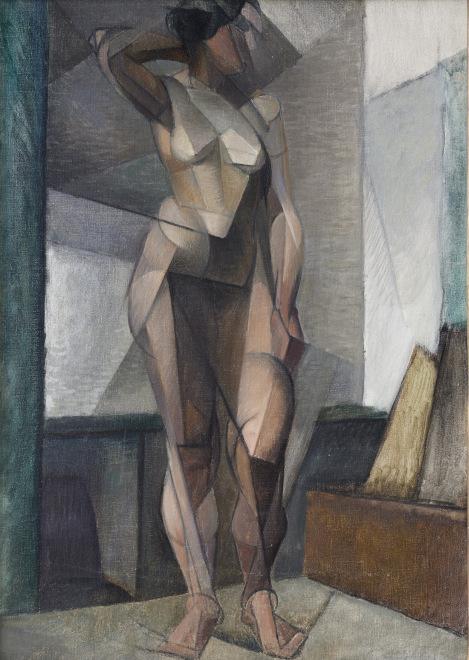
Miklos’ next big break came in 1913, when—shortly after the famed Armory Show in New York which was a watershed moment for modern art in America—he was invited to take part in an exhibition that was one of the first to introduce American audiences to Cubism. The Exhibition of Cubist and Futurist Paintings opened in the Boggs & Buhl Department Store in Pittsburgh before touring widely throughout the United States with stops in Milwaukee, Cleveland, Philadelphia, and New York. The paintings and sculpture in the exhibition (including two canvases by Miklos: Figure of Woman Sitting, circa 1912-1913 and Standing Nude, circa 1913) were said to have intrigued “curious visitors” (“Cubist and Futurist Paintings are Shown,” The Pittsburgh Post, July 11, 1913). This avant-garde exhibition brought European Cubism and Futurism into a commercial, non-museum context, and helped introduce radical modern art to a broader American audience.
Although he initially focused on paintings, Miklos soon turned to sculpture and began to explore the potential of his new visual language in three dimensions. Pablo Picasso is often credited with producing the first work of Cubist sculpture, namely his Head of a Woman (Fernande) (1909, Museum of Modern Art, New York), but much earlier Cubist sculpture was heavily influenced by practitioners from Bohemia and Miklos’ native Hungary. Artists from these regions had been influenced by visits to the collection of Vincenc Kramář, a Prague-based art historian who was an early champion of Georges Braque and Pablo Picasso and did much to champion their work through his articles and publications, and lending works from his personal collection. Other forward-thinking exhibitions in Budapest included the work of the sculptor Otto Gutfreund, who treated his figures as high reliefs with discontinuous volumes, fragmented silhouettes, and deeply shadowed transitions to the ground plane.
Miklos continued to exhibit his work at both the Salon d’Automne and the Salon des Independents throughout the 1910s and the 1920s (including the present work, Tours Cubistes, which debuted at the 1923 Salon d’Automne). Then, in 1925, he was invited to exhibit at the famed Exposition Internationale des arts décoratifs et industriels modernes in Paris. This marked an important point of departure for Miklos, whose work shifted decisively toward the refined, sculptural language that would align with the aesthetics of Art Deco movement. Sleek, elongated figures or highly stylized forms were cast in bronze or carved of wood, often characterized by smooth surfaces, attenuated proportions, and with a sense of poised stillness. At this time, Miklos started working for Jacques Doucet, the visionary patron and among the first collectors to recognize the groundbreaking genius of Pablo Picasso, famously acquiring Les Demoiselles d'Avignon in 1924. For Doucet's legendary Studio in Neuilly-sur-Seine, Gustave Miklos created decorative objects that merged modernist geometry with exquisite craftsmanship.
Miklos demonstrated a mastery of materials, a commitment to unifying art and design. He remained true to his craft and became a rarity amongst his peers of artists in the early part of the twentieth century, in that he was determined to stay working in three-dimensional forms. In contrast to Picasso and others, who experimented with sculpture early in their careers before concentrating on two-dimensional works, Miklos remained faithful to his desire to explore the unique opportunities that the sculptural form offered him.
Jean Metzinger, Nu à la cheminée (Nude), 1910
Gustave Miklos, Nu féminin debout (étude de nu), 1913. Private collection, France
Miklos’s mastery can be compared to the parallel trajectory of Constantin Brancusi. Both artists progressively distilled forms to their essential lines and volumes, privileging clarity, harmony, and simplicity over naturalistic detail. A shared fondness for verticality and direct carving in wood is evident in their sculptural processes, where elongated, upright forms convey elegance and monumentality.
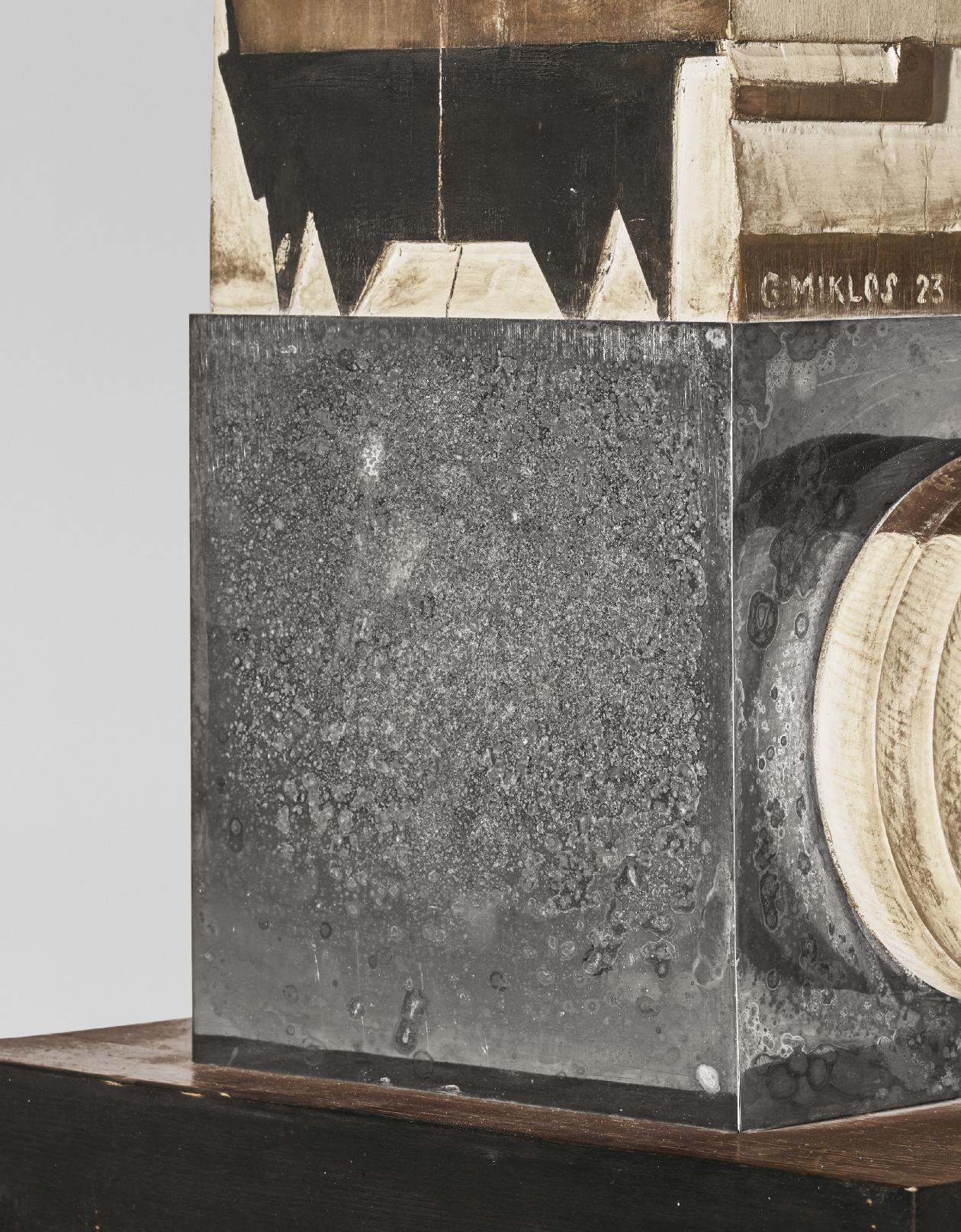
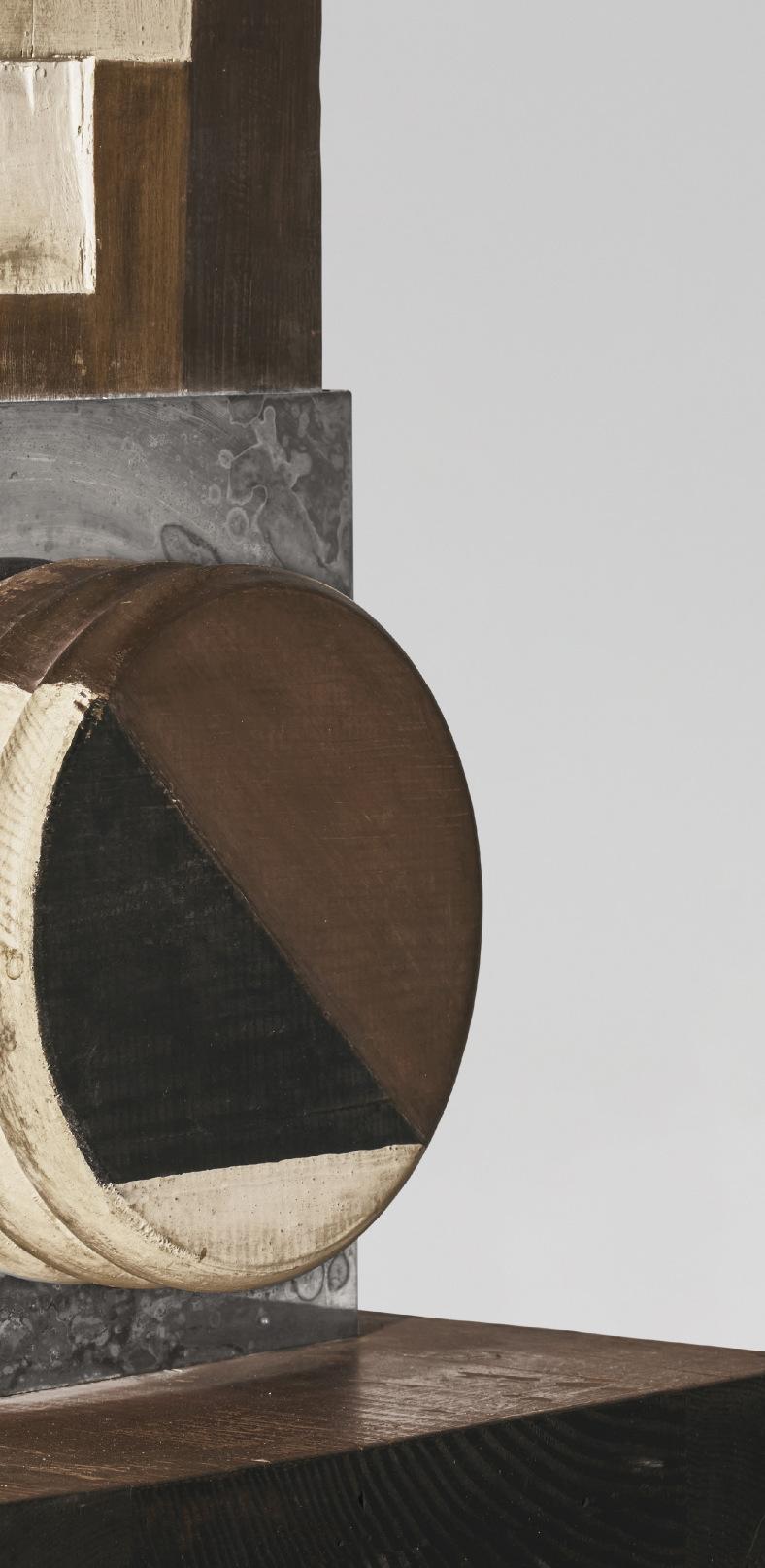
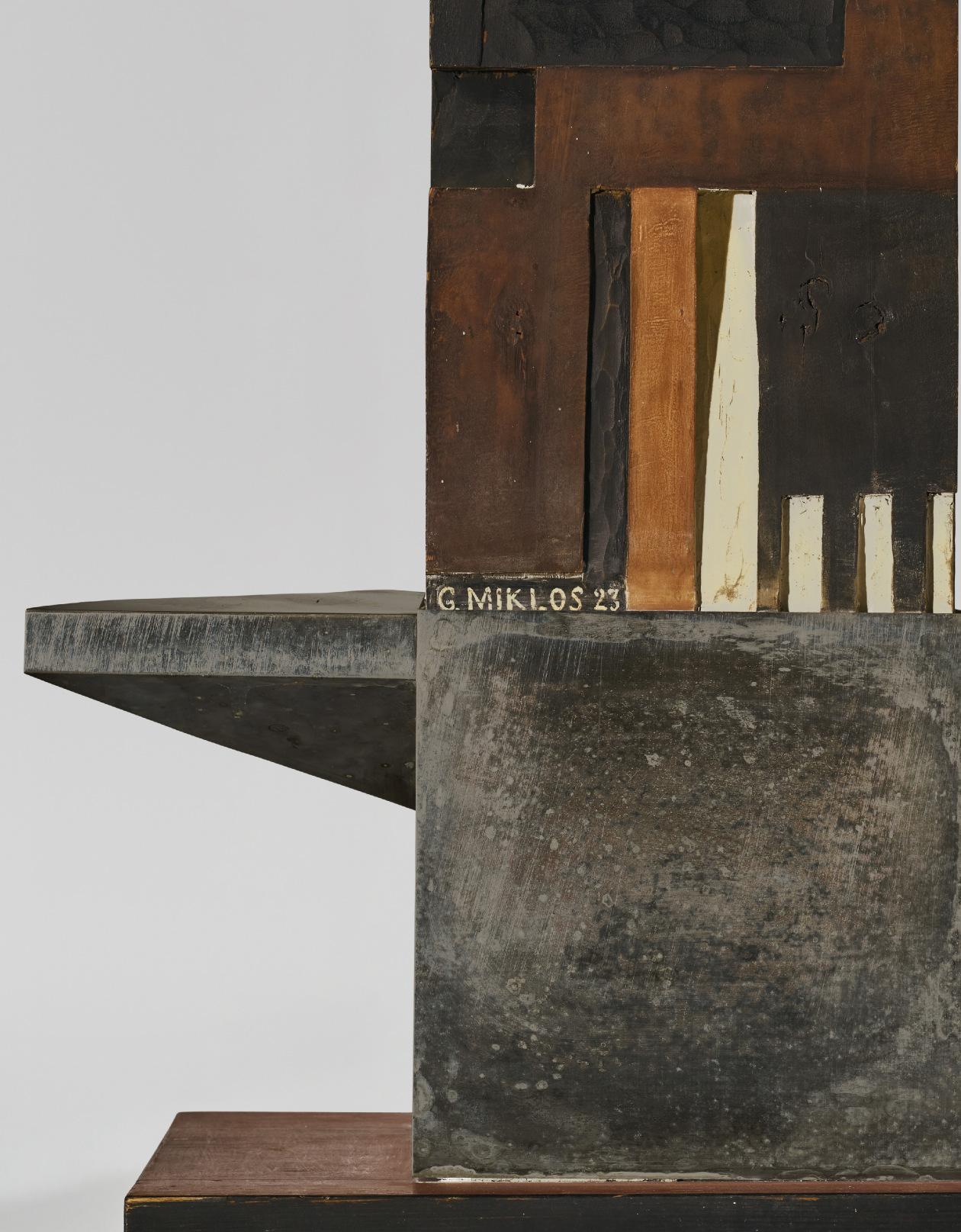
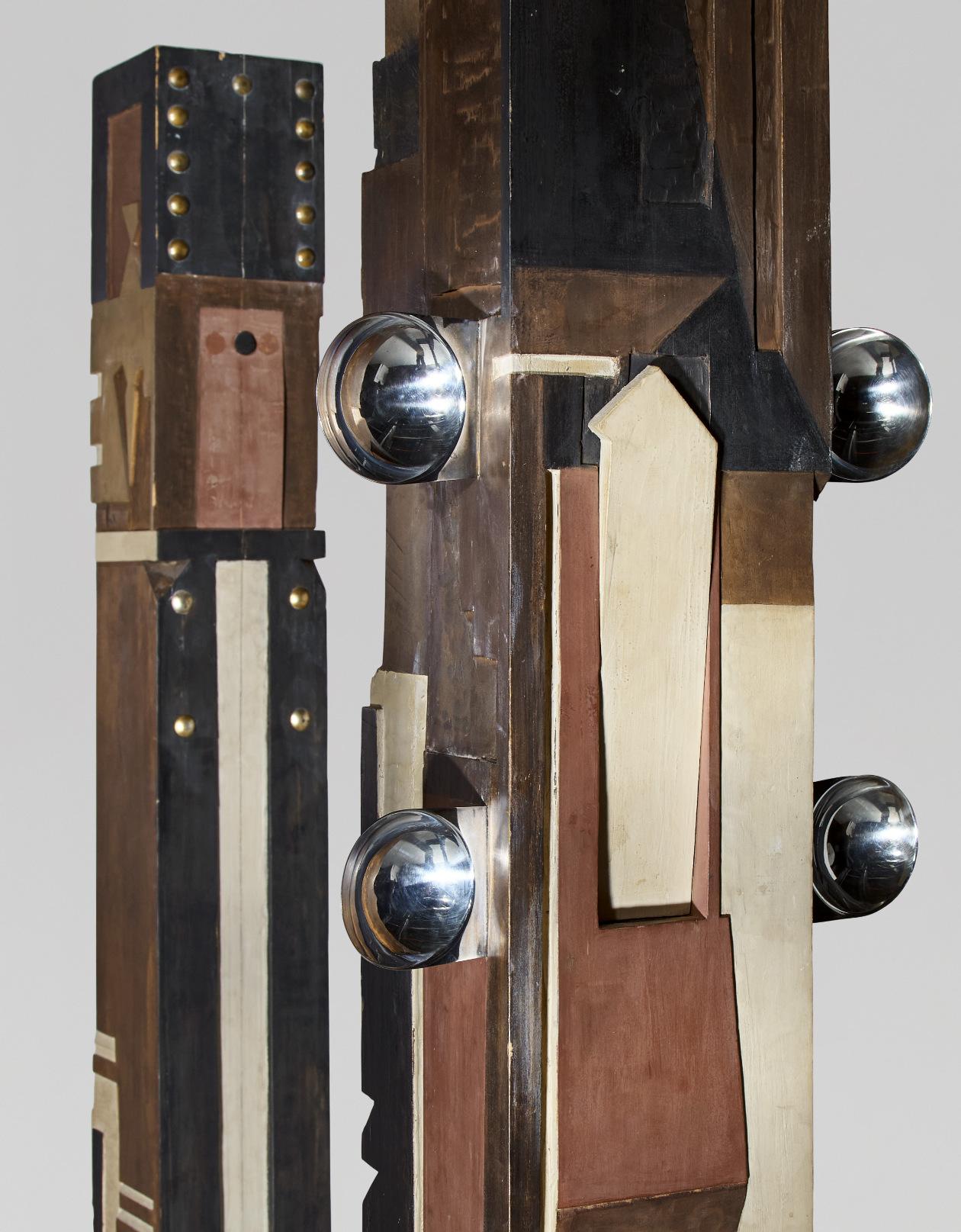
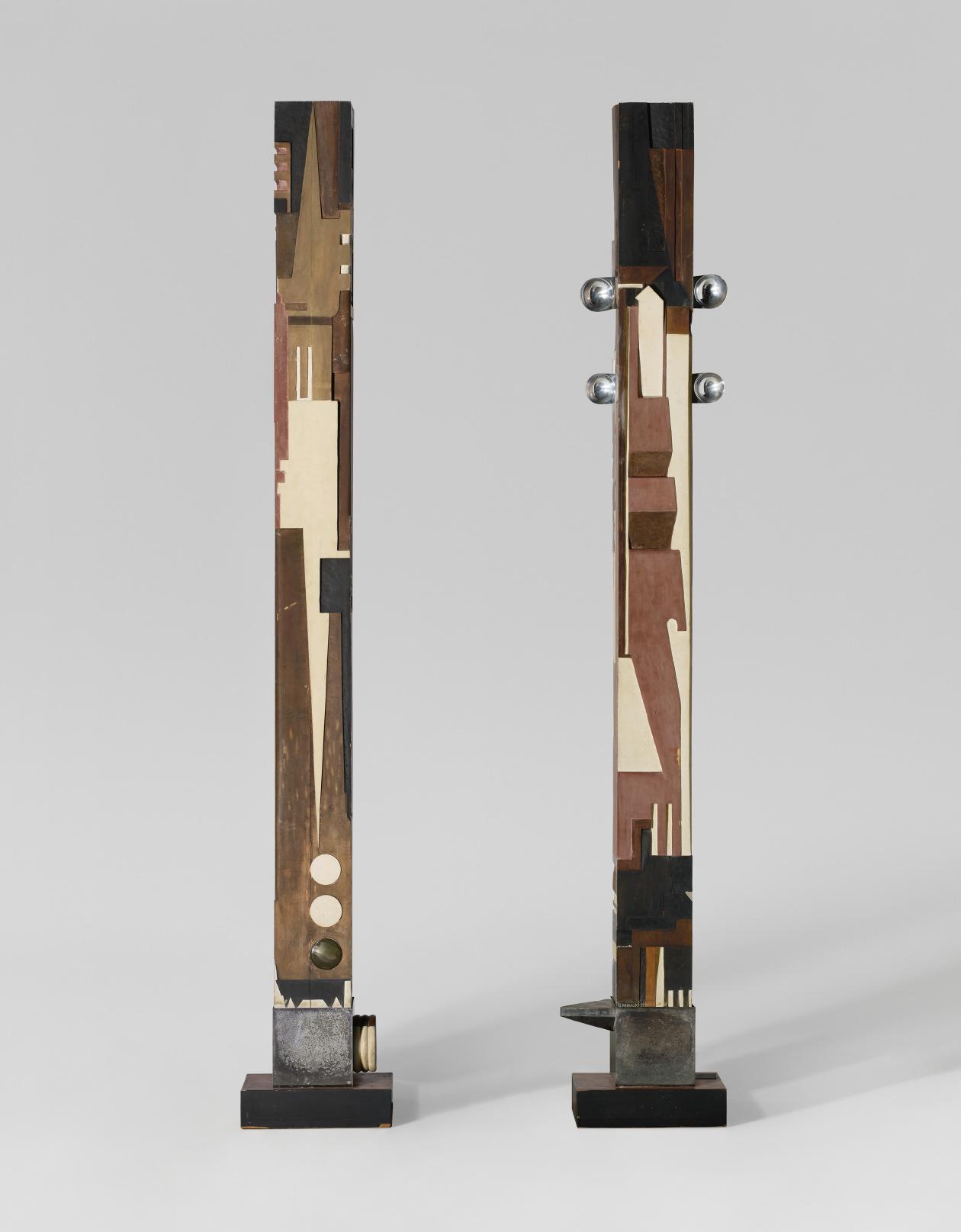
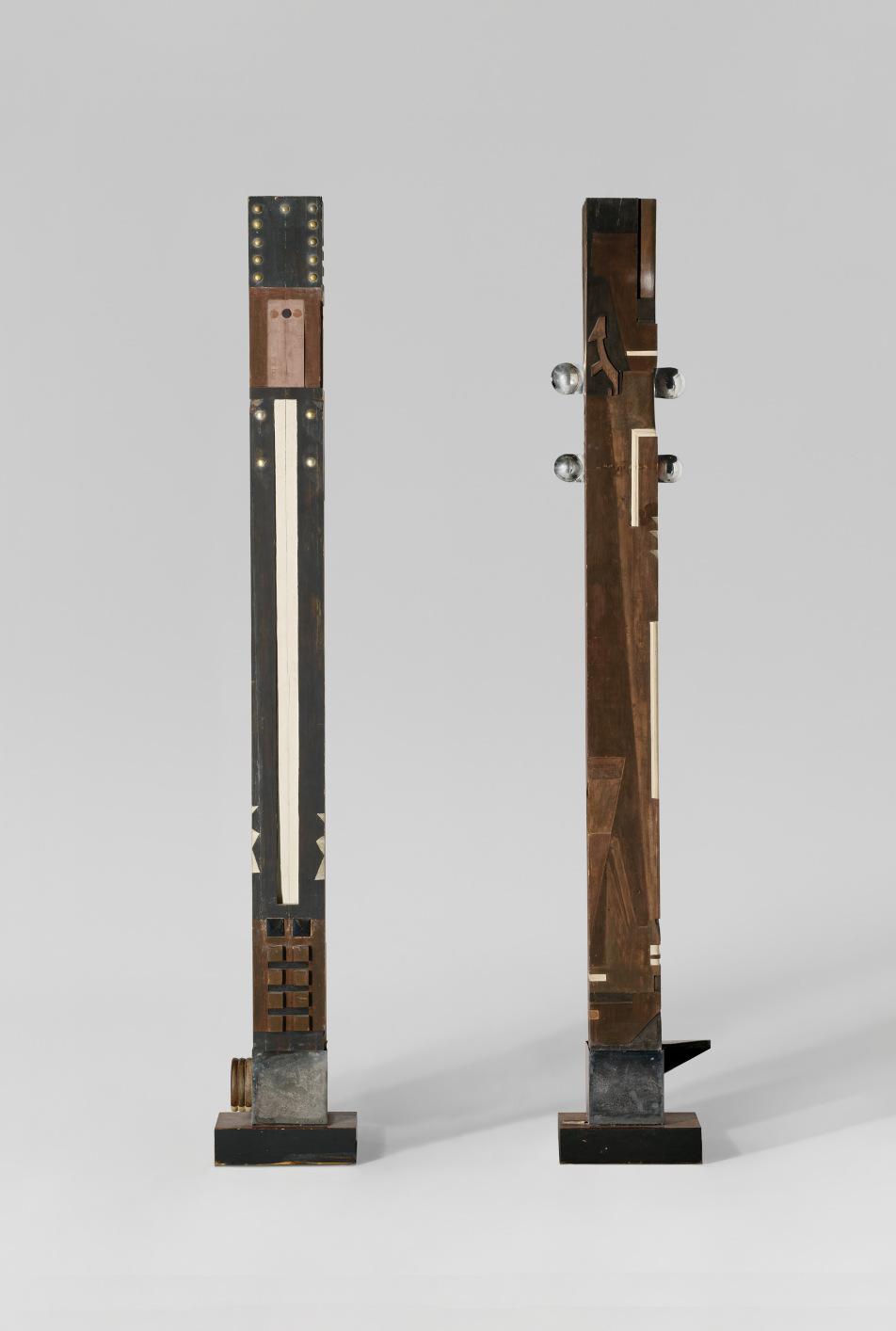
The Two Tours Cubistes stand as a totemic example of Miklos’s career, demonstrating the influence of Cubism while being a prophetic example the stylistic revolution to come. Standing nearly 9 feet tall, its geometric arrangements command authority, carrying both the weight of Cubist desires in its strict geometry while at the same time introducing a more decorative element with its combination of metal elements and rich polychromed wood.
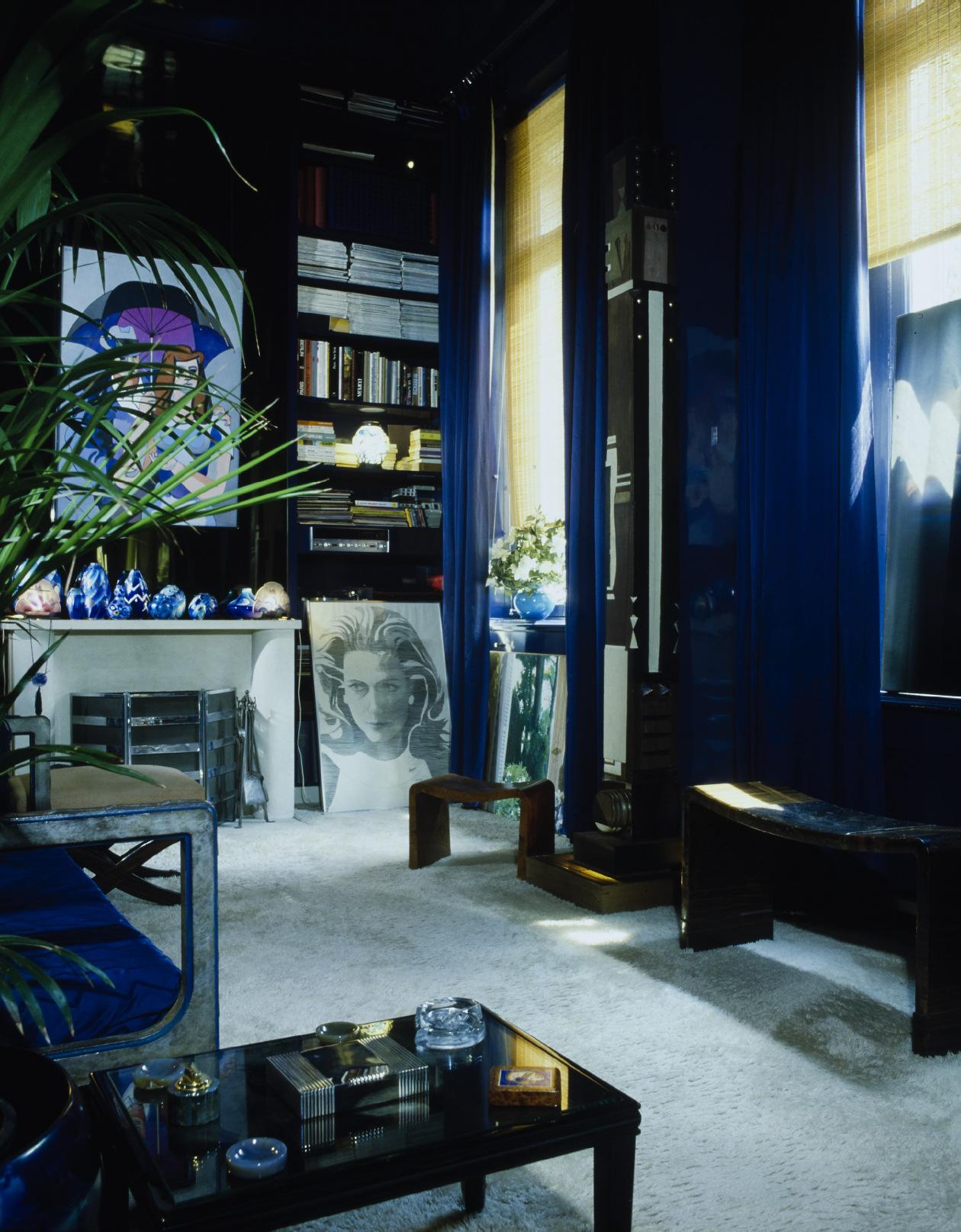
The present work was first owned by the renowned entrepreneur, businesswomen and art collector, Hélène Rochas. A classical dancer and drama student, she met her future husband, the fashion designer and perfumier Marcel Rochas, on the Paris metro where he accosted her stating ‘You have a head for hats!’ Hélène soon became face of her husband’s boutique, as Marcel trained her eye and shaped her tastes. After his death in 1955, she become one of the first women to become head of a business in France, turning the company into a major luxury perfume brand.
In addition to her highly successful business career, Hélène Rochas acquired works by the Cubist master Picasso, along with Kandinsky, and Balthus, alongside Art Deco furniture and objet d’art. She became a celebrated art collector, cultivating a discerning eye much like Yves Saint Laurent and Karl Lagerfeld. She organized grand dinner parties at her home on rue Barbet-de-Jouy in Paris’s fashionable 7th
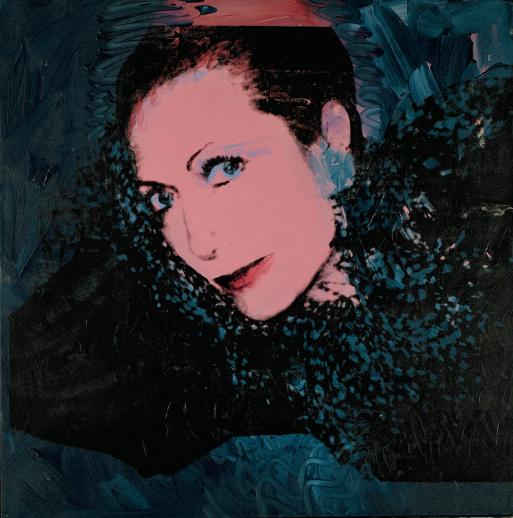
arrondissement, where guests often included Salvador Dalí, Max Ernst, Man Ray, and the Duke and Duchess of Windsor. She also became a muse to many artists, including César and Andy Warhol who painted her portrait in 1973.
The present work was then acquired at Rochas’s 1990 sale at Christie’s in Monaco by the French racing driver, author and auctioneer, Hervé Poulain. Together with his wife Isabelle, Poulain became fascinated by the revolutionary visual language of the Cubist artists and the foundational role they played in the aesthetic developments of the twentieth century.
"With Les Demoiselles d'Avignon, Picasso invented a revolutionary language that influenced every field of creationfrom architecture to the decorative arts
Hervé and Isabelle Poulain
The Poulain’s second great passion as collectors was Pop Art. In 1975, Hervé Poulain combined his love of art with his passion for speed, conceiving the idea of entering a car in the legendary 24 Hours of Le Mans race—its body painted by a master of contemporary art. It was an unprecedented gesture, a gift to the public: living art hurtling through the open air at over 300 km per hour.
The vision became reality when BMW Motorsport embraced the concept and prepared a car for the project. The choice of Alexander Calder was self-evident—the man who had brought movement into sculpture. Calder accepted without hesitation, intrigued by the idea that Poulain, by inhabiting this “mobile-auto,” would transform his work by introducing sound, struggle, and danger. At the start of the race, Calder kissed his driver and said, “Hervé, win—but go gently!”
The initiative was a tremendous popular success, and Poulain continued the adventure behind the wheel of BMWs adorned by artists of his choosing: Frank Stella, Roy Lichtenstein, and Andy Warhol. Later, the “father of the Art Cars” would take part in selecting Jenny Holzer, Jeff Koons, and Julie Mehretu in 2024.
Hervé Poulain’s interest in cars also extended into his career as an auctioneer and he was one of the first people to preside over classic car auctions for collectors. After training as a commissaire-priseur (the French term for an auctioneer), he held his first car auction in 1973 and over the next four decades he built a reputation as one of the most successful practitioners in the business, holding many world records including selling a Ferrari 330 S for €32million. His writings and cultural vision contributed significantly to elevating the automobile to the status of fine art, to such an extent that The New York Times wrote on March 9, 2009: “One would search in vain for an American who could be compared to Hervé Poulain.”
"For Isabelle and me, collection brings coherence, by revealing underlying harmonies in an otherwise unruly world. It is a quest, a form of transcendence, in the pursuit of understanding beauty," says Poulain. For them, Tours Cubistes concentrates these resonant harmonies. "They stand as salient, monumental emblems of Cubism's broader cultural triumph". Their statuesque form challenges traditional notions of composition, offering up multiple aspects, while retaining a harmonic rationality. Their fusion of modernist minimalism and ornamental luxury emphasize the period's celebration of clean lines, bold shapes, exotic influences, and luxury. Executed during the peak of his creativity, it is works such as this that allowed Gustave Miklos to establish himself as one of the most significant sculptors of the 20th century avant-garde and a master of stylization.
Hélène Rochas, by Andy Warhol. Sold at Christie’s, Paris, 27 September 2012, lot 186. © 2025
The Andy Warhol Foundation for the Visual Arts, Inc. / Licensed by Artists Rights Society (ARS), New York
The Parisian apartment of Hélène Rochas. © 2025 Artists Rights Society (ARS), New York / ADAGP, Paris. Pascal Hinous, Architectural Digest © Condé Nast
PROPERTY FROM THE COLLECTION OF ISABELLE AND HERVÉ POULAIN
GUSTAVE MIKLOS (1888-1967)
TWO UNIQUE 'TOURS CUBISTES', 1923
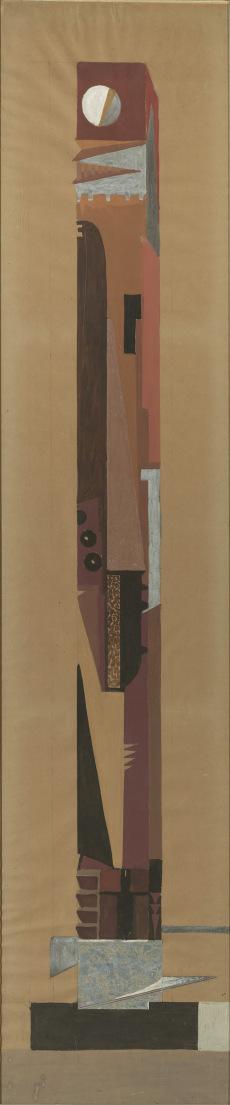
taille directe (hand carved) polychrome wood, silvered metal mounted on later illuminating bases together with a preparatory drawing of a 'Tour Cubiste', circa 1922-1923
106º x 7Ω x 7Ω in. (270 x 19 x 19 cm) (each, over later bases)
90Ω x 18æ in. (230 x 47.5 cm) (preparatory drawing) each signed G. MIKLOS and dated 23
$1,000,000-1,500,000
PROVENANCE:
Two Unique 'Tours Cubistes':
Collection of the artist
Thence by descent to his widow, Marie-Louise Miklos
Alain Blondel and Yves Plantin, Galerie du Luxembourg, 1970
Hélène Rochas, Paris, 1972
Collection Hélène Rochas : Important Mobilier et Objets d'Art Art Deco, Christie's, Monaco, 9 December 1990, lot 24
Acquired from the above by the present owner
Preparatory Drawing:
Galerie Vallois, Paris
Acquired from the above by the present owner
EXHIBITED:
Paris, Salon d'automne, November-December 1923, nos. 1420, 1421 (present lot cited)
Paris, Galerie l'Enseigne du Cerceau, Gustave Miklos sculpteur 1888-1967, October-November 1972, nos. 2, 3 (present lot illustrated)
Paris, Musée des Arts Décoratifs, Cinquantenaire de l'Exposition de 1925, October 1976-February 1977, vol. I. no. 192 (present lot cited), vol. II p. 158 (present lot illustrated, part)
Paris, Galerie Vallois, Joseph Csaky, 1888-1971, Gustave Miklos, 1888-1967 : l'époque cubiste, 1913-1937, Paris-Budapest, April-May 2004, no. 19 (present preparatory drawing illustrated)
LITERATURE:
P. Bayer, Intérieurs Art Déco : les classiques de la décoration 1920-1930, Paris, 1990, p. 203 (present lot illustrated, part, in the Parisian apartment of Hélène Rochas)
X. Narbaits, "L'Art Déco enfin reconnu majeur," Connaissance des Arts, Paris, February 1991, p. 115 (present lot illustrated)
V. Arwas, Art Deco, New York, 1980, p. 177 (present lot illustrated, part)
F. Marcilhac, Gustave Miklos, Joseph Csaky, Budapest, 2010, p. 3 (present lot illustrated, part)
"Hélène Rochas, un parfum de luxe," Paris Match, Paris, no. 3303, 6 September 2012, pp. 88-89 (present lot illustrated, part, in the Parisian apartment of Hélène Rochas)
D. Cichocka, Gustave Miklos : Volume I, Un grand oeuvre caché, Paris, 2013, p. 77 (present lot illustrated, part)
D. Cichocka, Gustave Miklos : Volume II, Le moderniste byzantin, Paris, 2014, pp. 40-41, nos. S21B, S22 (present lot illustrated), no. S21A (for the preparatory drawing)
A. Duncan, Art Deco Sculpture, New York, 2016, p. 102 (present lot cited)
Preparatory drawing for ‘Tour Cubiste’, circa 1922-1923 (included in the lot)
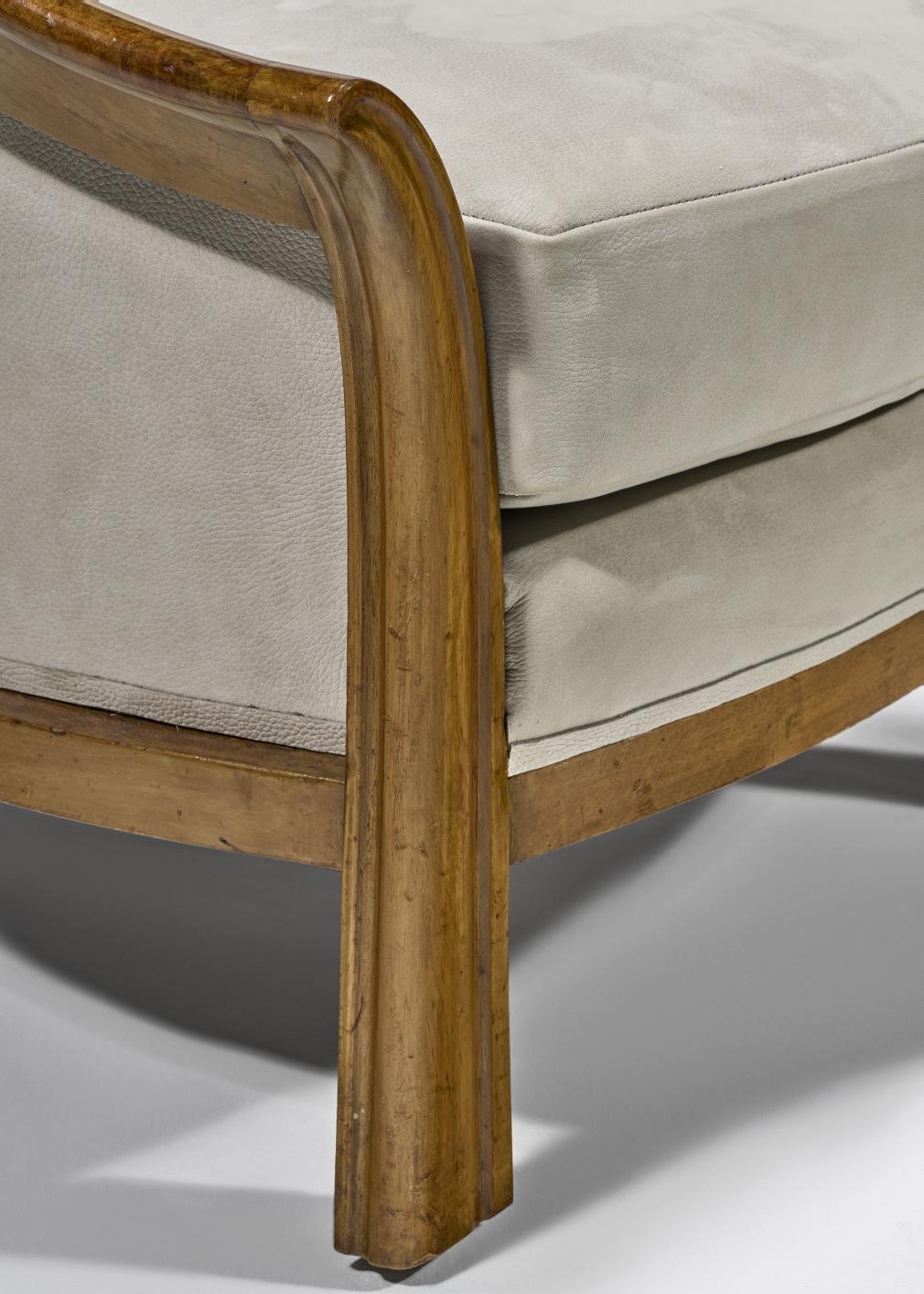
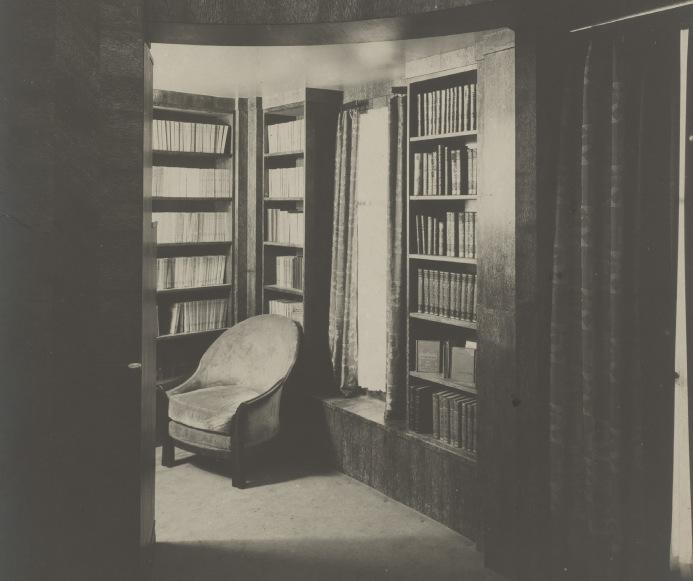
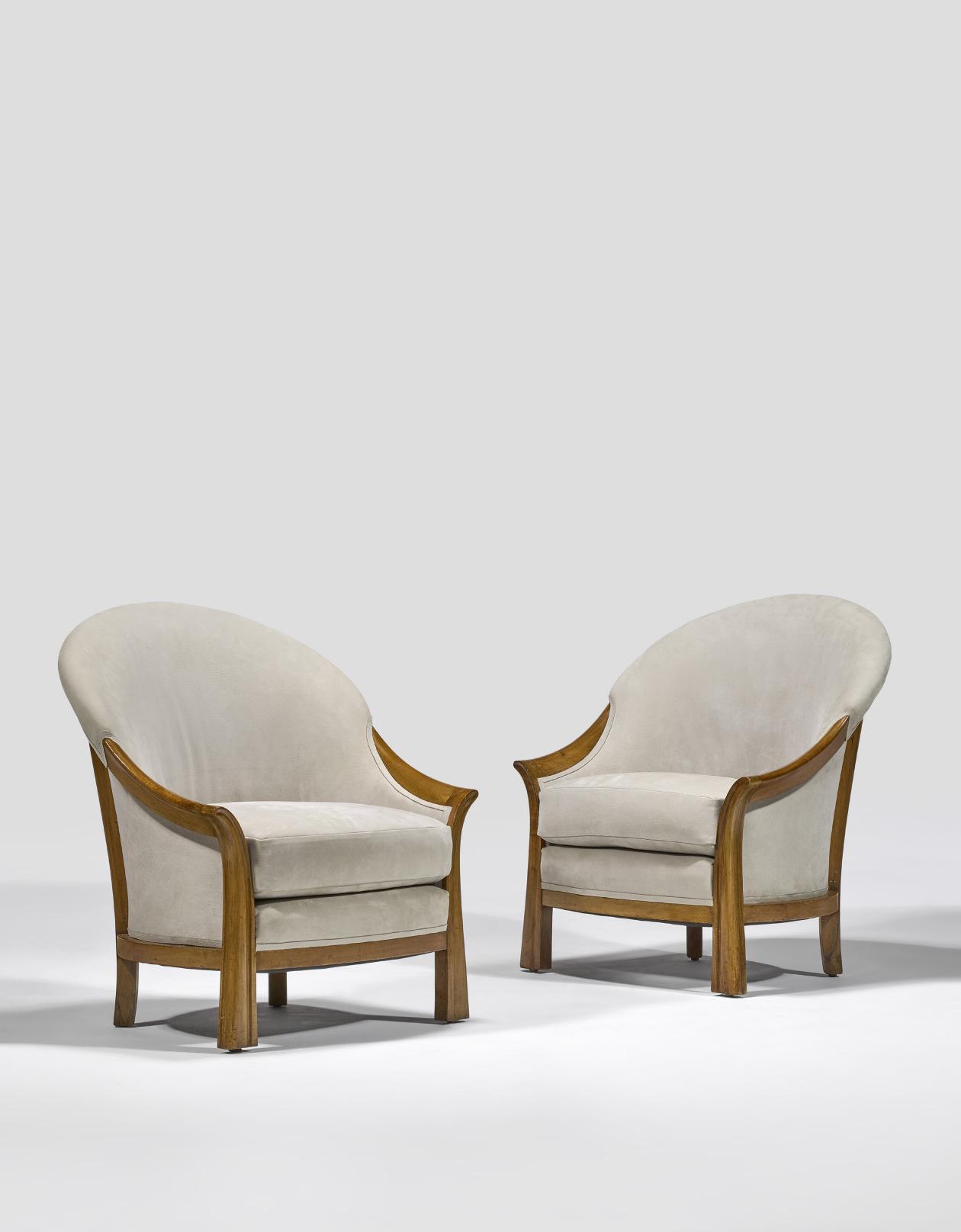
Pierre Chareau's dual training as both architect and decorator emerges in his Bureau-Bibliothèque at the Pavillon de l'Ambassade Française in 1925, where the library's modular design and palm wood interior is enhanced by similarly minimal, yet luxurious and modern furnishings, including the Armchair model no. MF208217. The experimental interior of the Study-Library, characterized by an open design, domed ceiling, and most ingeniously the fan-like closing mechanism allowing for adjustments to privacy and lighting, were pioneering feats of modern design by Chareau and integral to the presentation of the 'new' interior promoted by the Société des artistes décorateurs in the 1925 Paris Exposition Internationale des Arts Décoratifs et Industriels Modernes. The combination of delux materials and minimal, streamlined configurations were essential to the ethos of the 1925 Exposition, where artistry met industry in the heralding of a new age of French and International Design.
Chareau's armchair model no. MF208-217, originally designed in 1923, features the union of minimalist modernity and bourgeois elegance. Its inclusion in the French Pavillion study library brought harmony to the interior, where the fan-like structure at the dome is mirrored through
the fanned-out legs of the armchair, tying the interior together top to bottom. While Chareau's designs, especially those from the later 20s and 30s, include fragmented and asymmetrical structures in alabaster and wrought iron requiring an inherent and complete mastery of balance, weight, and composition, these elements can be seen in the 1925 bibliothèque, and even earlier in 1923 with armchair model no. MF208-217, where all stylistic facets of the design are harmoniously juxtaposed.
The armchair's frame, with its angular arms, exposed back supports, and fanned legs reflect the streamline and minimalist elements of early modernist design, emerging from developments in industry and commercialized production seen in the beginnings of the 20th century, and featured prominently in the 1925 Exposition. Yet Chareau distinguishes himself through fine materials and finishes, seen in the present lot through his use of rich walnut wood and enveloping upholstery. A fan of exotic wood veneers, and unexpected contrasts between opposing materials, Chareau's model MF208-217 armchair epitomizes the contracts inherent to modern French decorative arts, where centuries of craftsmanship and artistry collide with the innovations of the industrial age.
Bureau-Bibliothèque de l’Ambassade Française. Pierre Chareau, architect. Photo REP. Musée des Arts décoratifs, Fonds Chareau. Photo © Les Arts Décoratifs
PIERRE CHAREAU (1883-1950)
PAIR OF ARMCHAIRS, MODEL NO. MF208-217, DESIGNED CIRCA 1923
walnut, leather upholstery
32 x 29 x 26 in. (81.3 x 73.5 x 66 cm) (each)
$70,000-100,000
PROVENANCE:
Jean-Claude Brugnot, Paris
Acquired from the above by the present owner, 1982
LITERATURE:
G. Janneau, "L'Exposition Internationale des Arts Décoratifs et Modernes," Beaux-Arts, Paris, no. 12, 15 June 1925, p. 191
Les Arts de la Maison, Paris, Spring-Summer 1926, pl. XXVI, XXVII
R. Herbst, Pierre Chareau: un inventeur. l'architecte, Paris, 1954, pp. 20, 25, 55
Y. Brunhammer, Le Style 1925, Paris, 1975, p. 87, no. 2
A. Duncan, Art Deco Furniture, London, 1984, p. 19, no. 4
M. Vellay and K. Frampton, Pierre Chareau: Architecte Meublier 1883-1950, Paris, 1984, pp. 50, 75-77, 84-85
A. Bony, Les années 20, Paris, 1989, p. 916
M. Battersby, The Decorative Twenties, New York, 1988, p. 76
Pierre Chareau, exh. cat., L'Arc en Seine, Paris, 1991, p. 49
B. Brice Taylor, Pierre Chareau: Designer and Architect, Cologne, 1992, pp. 131, 134
Pierre Chareau: architecte, un art intérieur, exh. cat, Centre Georges Pompidou, Paris, 1993, pp. 91, 101
Archives Louis Moret, exh, cat., Martigny, 1994, pp. 40, 67
É. Possémé, Le Mobilier Français 1910-1930 les années 25, Paris, 1999, p. 149
M. Vellay, La Maison de Verre: Pierre Chareau’s Modernist Masterwork, New York, 2007, pp. 65, 114-115, 123, 125
Y. Futagawa, Pierre Chareau: Maison de Verre (Maison Dalsace) Paris, France, 1928-32, Tokyo, 2012, p. 40
E. da Costa Meyer, Pierre Chareau: Modern Architecture and Design, New York, 2016, pp. 24, 44, 101, 178, 188
D. Doria, Pierre Chareau : Un architecte moderne de Paris à New York, Paris, 2016, pp. A IV, no. 32, A II, no. 10
M. Bédarida and F. Lamond, Pierre Chareau, Volume 1: Biographie, Expositions, Mobilier, Paris, 2023, pp. 132-133, 253, 294, no. 49
M. Bédarida, Pierre Chareau, Volume 2: Architecture Intérieure, Architecture, Paris, 2023, pp. 64-65, 76, 79, 96, 263, 276, 298-300, 303, 317
This model was exhibited in the Bureau-Bibliothèque of the Pavillon de l'Ambassade Française at the Exposition Internationale des Arts Décoratifs et Industriels Modernes, Paris, 1925.
This model can be found in the permanent collection of the Virginia Museum of Fine Arts, Richmond, VA (inv. no. 85.96).
A period image of the model in the Bureau-Bibliothèque of the Pavillon de l'Ambassade Française at the Exposition Internationale des Arts Décoratifs et Industriels Modernes, Paris, 1925 can be found in the Fonds Chareau, Musée des Arts décoratifs, Paris (inv. no. 29916.9.1.1).
LEARN MORE
PROPERTY FROM A MANHATTAN COLLECTION
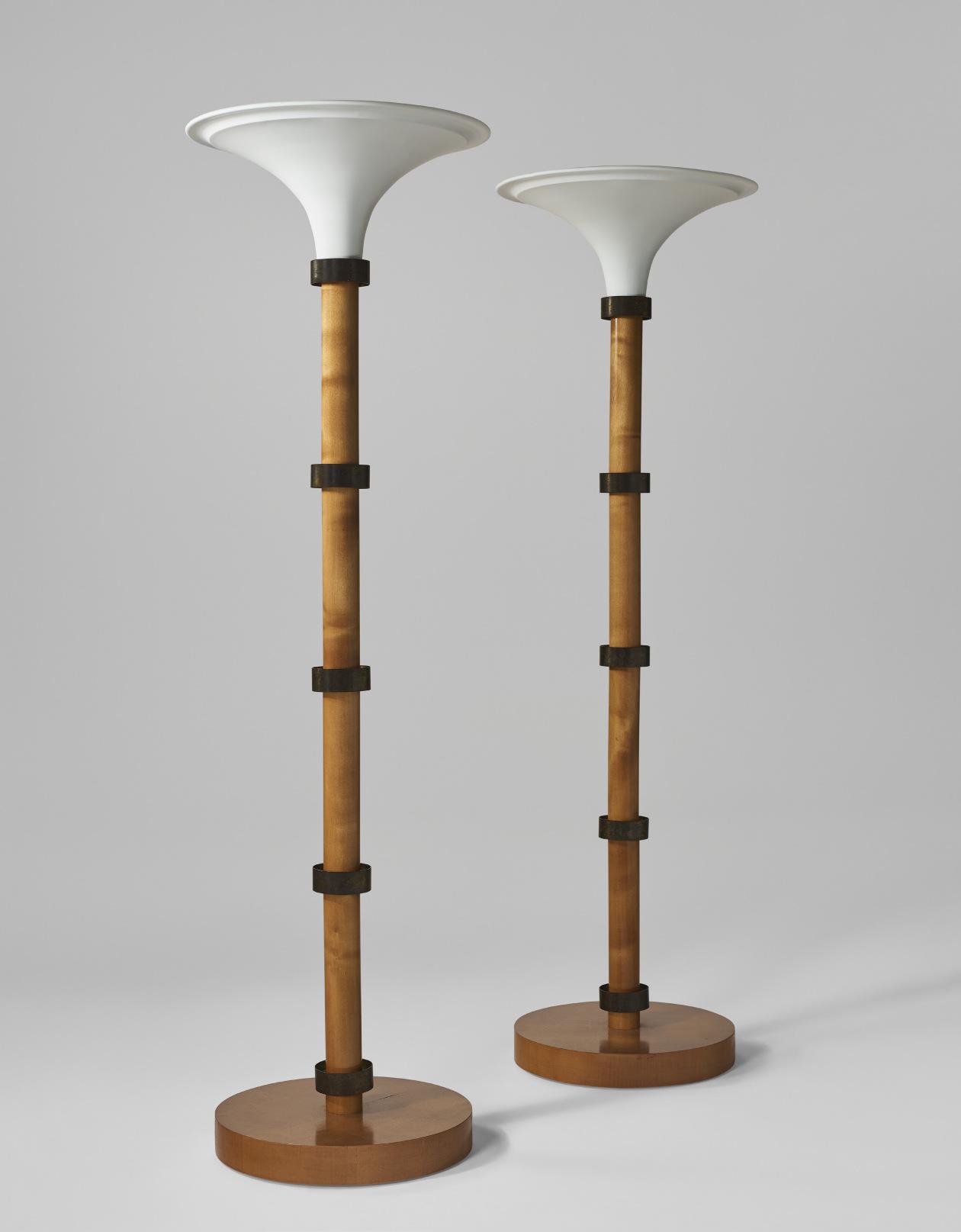
EUGÈNE PRINTZ (1879-1948)
PAIR OF FLOOR LAMPS, CIRCA 1937
sycamore, patinated bronze, painted aluminum 70 in. (177.8 cm) high, 20æ in. (52.7 cm) diameter of shade (each) each stamped E. PRINTZ (2)
$120,000-180,000
PROVENANCE:
L’Arc en Seine, Paris
Acquired from the above by the present owner, 1993
LITERATURE:
R. Jean, "Eugène Printz et son atelier," Mobilier et Décoration, Paris, May 1946, pp. 10, 17
R. Chavance, "Quelques aménagements de Jean Saint-Georges ou la tradition de la vie moderne," Mobilier et Décoration, Paris, no. 7, September-October 1954, p. 335
G. Bujon et J.-J. Dutko, Eugène Printz, Paris, 1986, pp. 51, 204
Ensembles Mobiliers, vol. 2, Exposition Internationale de 1937, Paris, 1937, pl. 4
G. Bujon & J.-J. Dutko, Eugène Printz, Paris, 2018, p. 4, 158, 186
This model was exhibited at the Exposition Internationale des Arts et Techniques dans la Vie Moderne, Paris, 1937.
EDLIS | NEESON COLLECTION °16
JEAN DUNAND (1877-1942)
VASE, CIRCA 1925
lacquered metal, eggshell inlay
6 in. (15.2 cm) high, 3æ in. (9.5 cm) diameter signed JEAN DUNAND and numbered -4997$40,000-60,000
PROVENANCE:
Steven A. Greenberg, New York
The Steven A. Greenberg Collection: Masterpieces of French Art Deco, Christie’s, New York, 13 December 2012, lot 111
Acquired from the above by the present owner
LITERATURE:
A. Duncan, Art Deco Complete, London, 2009, p. 290 (present lot illustrated)
EDLIS | NEESON COLLECTION
°17
LEARN MORE
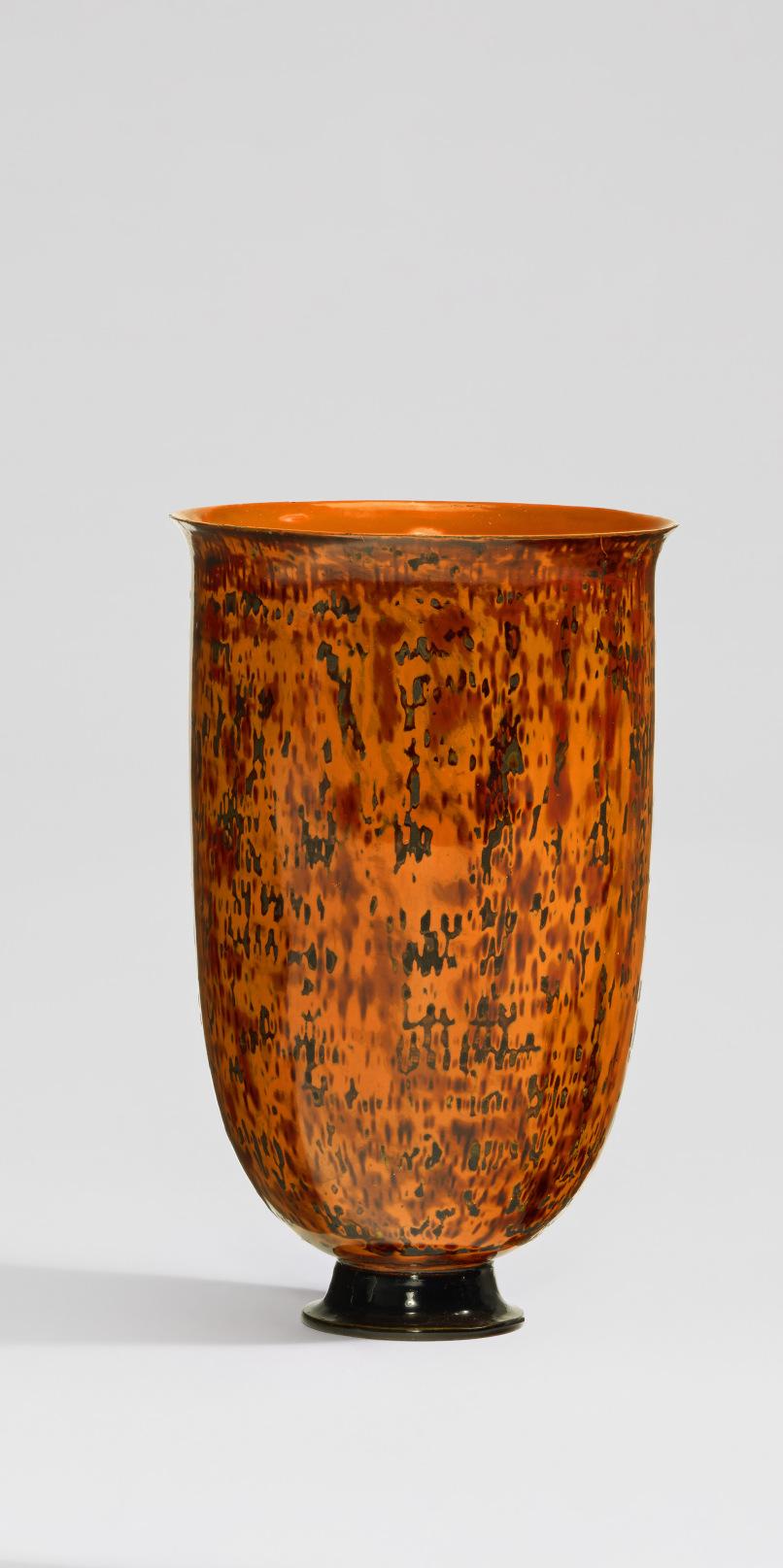
JEAN DUNAND (1877-1942)
FOOTED VASE, CIRCA 1925
lacquered metal
5¡ in. (13.7 cm) high, 3Ω in. (9 cm) diameter
signed JEAN DUNAND
$10,000-15,000
PROVENANCE:
DeLorenzo Gallery, New York
Steven A. Greenberg, New York
The Steven A. Greenberg Collection: Masterpieces of French Art Deco, Christie's, New York, 13 December 2012, lot 123
Acquired from the above by the present owner
EXHIBITED:
New York, DeLorenzo Gallery, Jean Dunand, May-June 1985, p. 137 (present lot illustrated)
LITERATURE:
Jean Dunand Jean Goulden, exh. cat., Galerie du Luxembourg, Paris, 1973, p. 61 (for a related example)
°18
LEARN MORE
JEAN DUNAND (1877-1942)
VASE, CIRCA 1925
lacquered metal, eggshell inlay
7æ in. (19.6 cm) high, 4æ in. (12 cm) diameter signed JEAN DUNAND
$40,000-60,000
PROVENANCE: DeLorenzo Gallery, New York
Acquired from the above by the present owner
EXHIBITED:
New York, The Salon: Art + Design, DeLorenzo Gallery, November 2014
LITERATURE:
J. du Bercel, "L'objet d'art et le décor moderne," Art et Industrie, Paris, no. 9, September 1928, p. 38 (for a related example)
F. Marcilhac, Jean Dunand: His Life and Works, New York, 1991, p. 308 (for related examples)
F. Marcilhac and A. Marcilhac, Jean Dunand, Paris, 2020, pp. 87, 354 (for related examples)
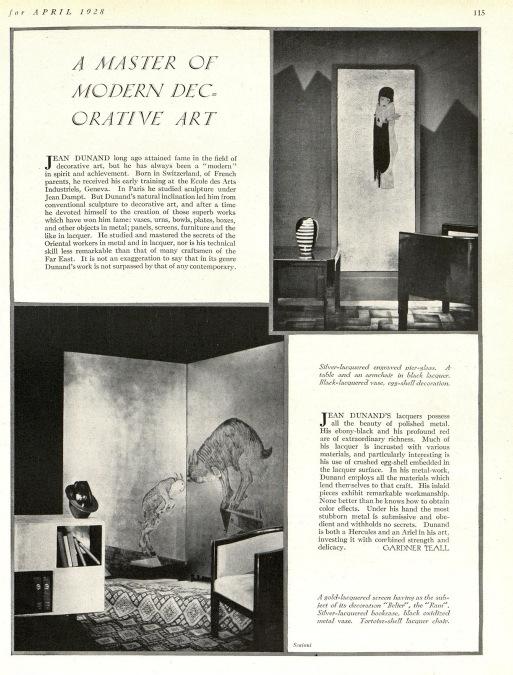
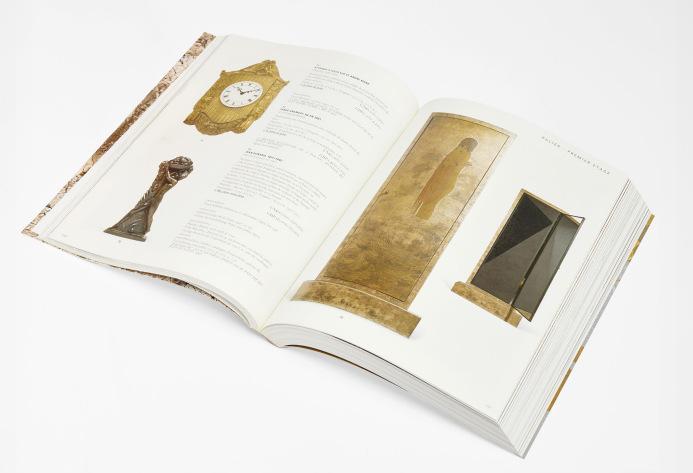
Harper’s Bazaar, April 1928, “A Master of Modern Decorative Art,” text by Gardner Teall and photographs by (Egidio) Scaioni. Courtesy of Harper’s BAZAAR, Hearst Magazine Media, Inc. / Artworks by Jean Dunand © 2025 Artists Rights Society (ARS), New York
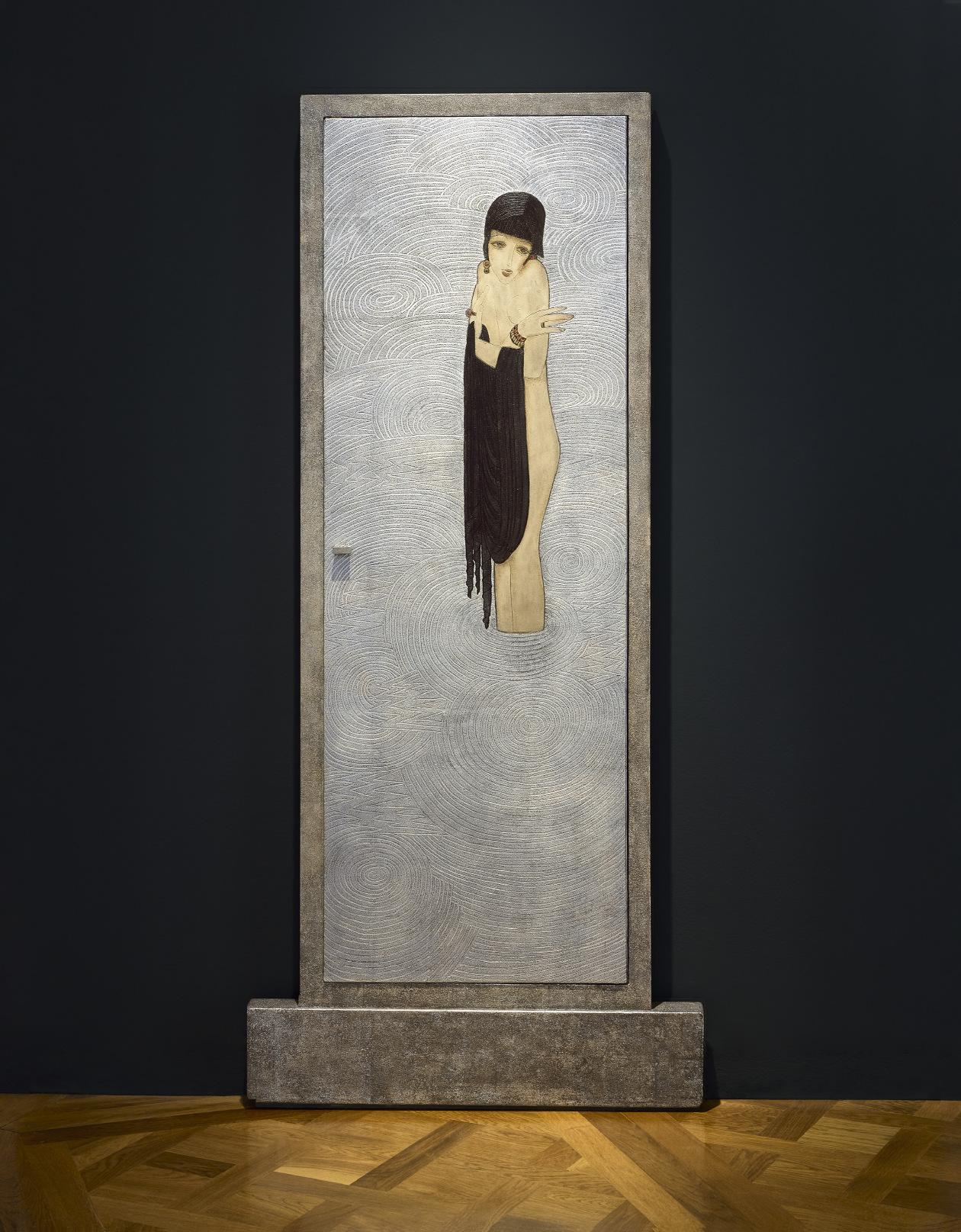
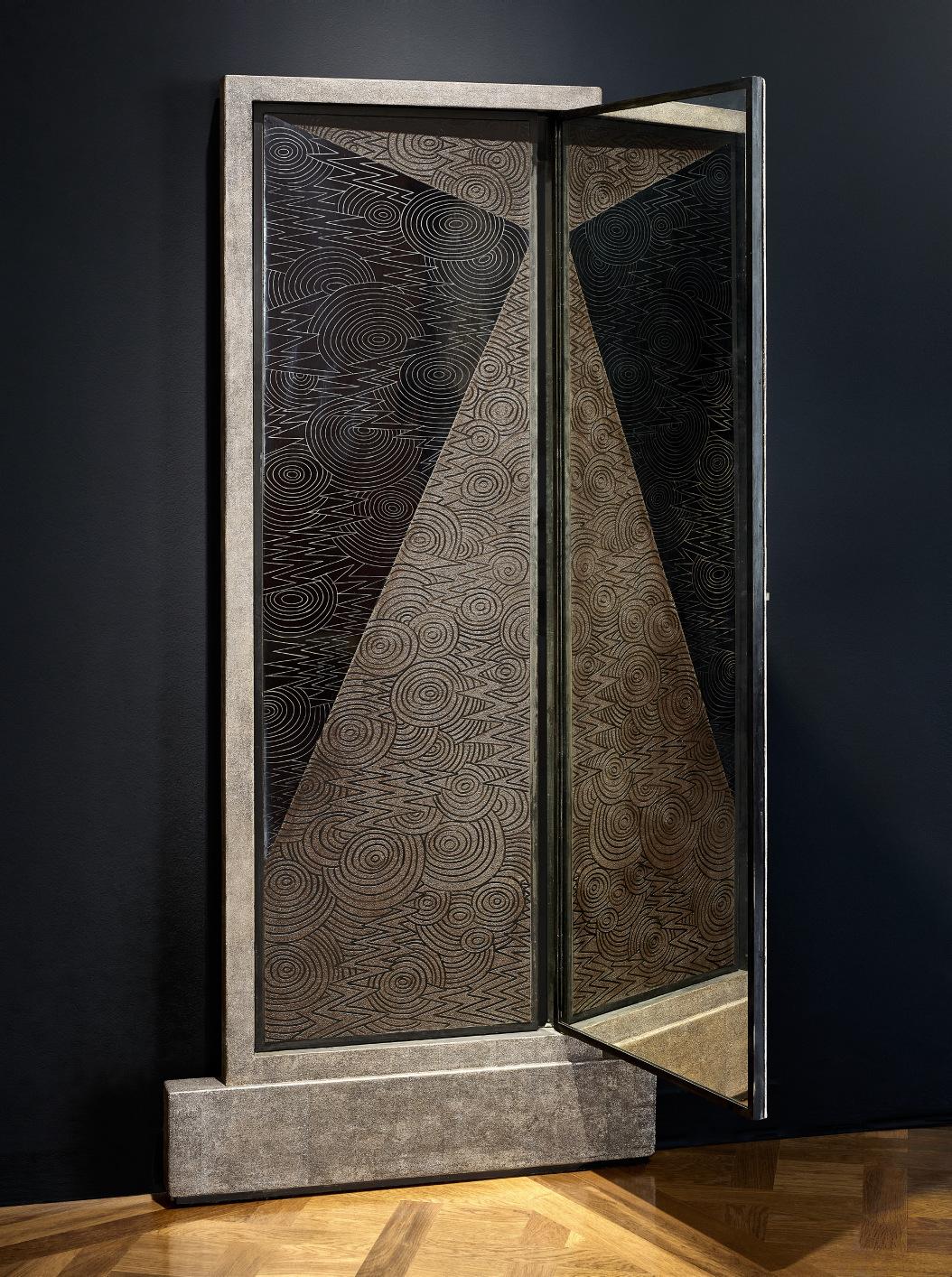
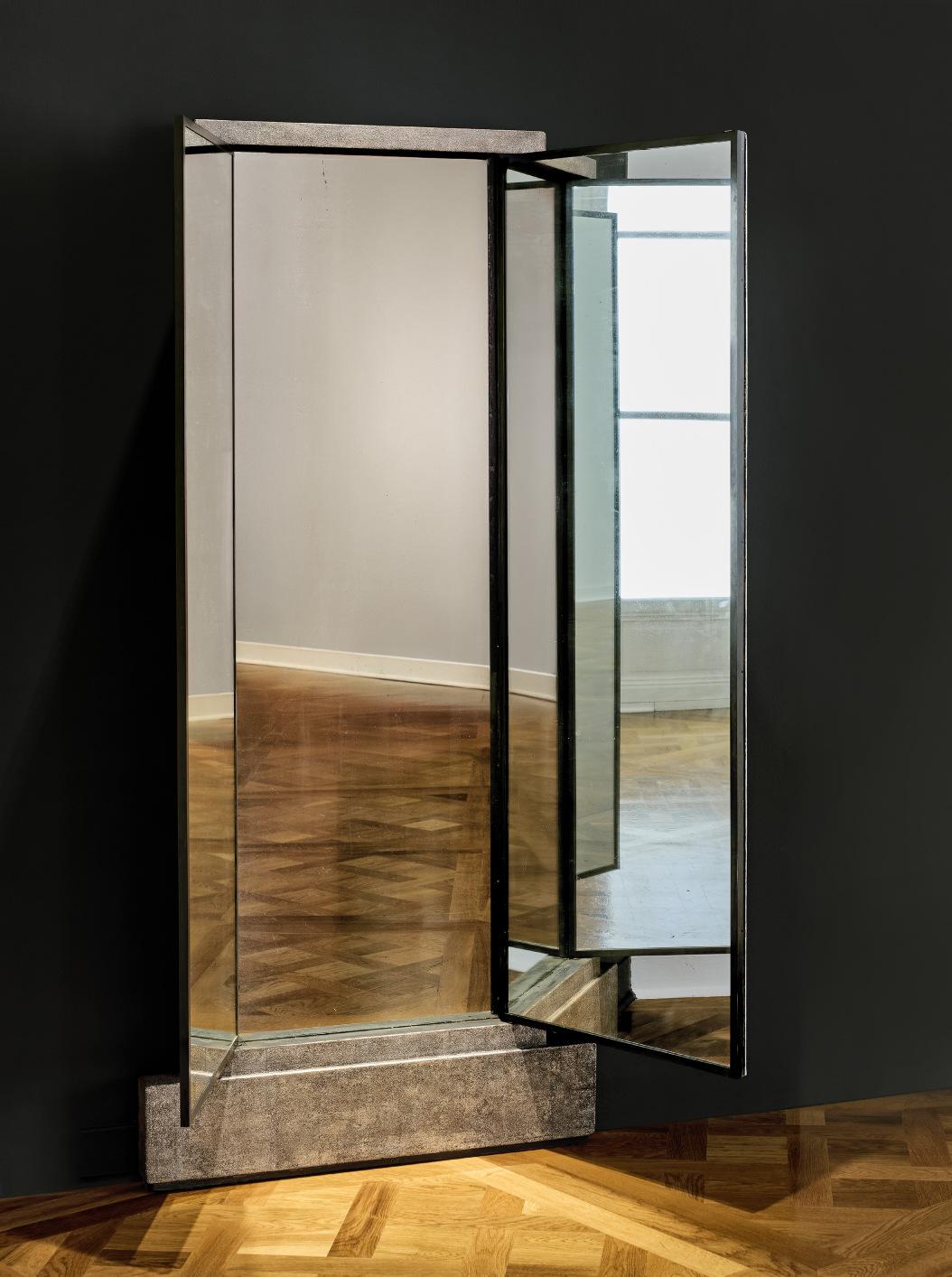
The breathtaking 'Psyché à la Baigneuse' Dressing Mirror is among the most singular pieces produced by Jean Dunand. Created in 1927 and one of only six psychés documented in the artist’s catalogue raisonné, it embodies the artist's technical confidence at a time when he was firmly established as one of the leading figures of modern French decorative art. First exhibited at the Galerie Georges Petit in 1927, it appeared alongside his major works in lacquer and metal, and it was later shown in the 1973 Jean Dunand, Jean Goulden exhibition at the Galerie du Luxembourg in Paris.
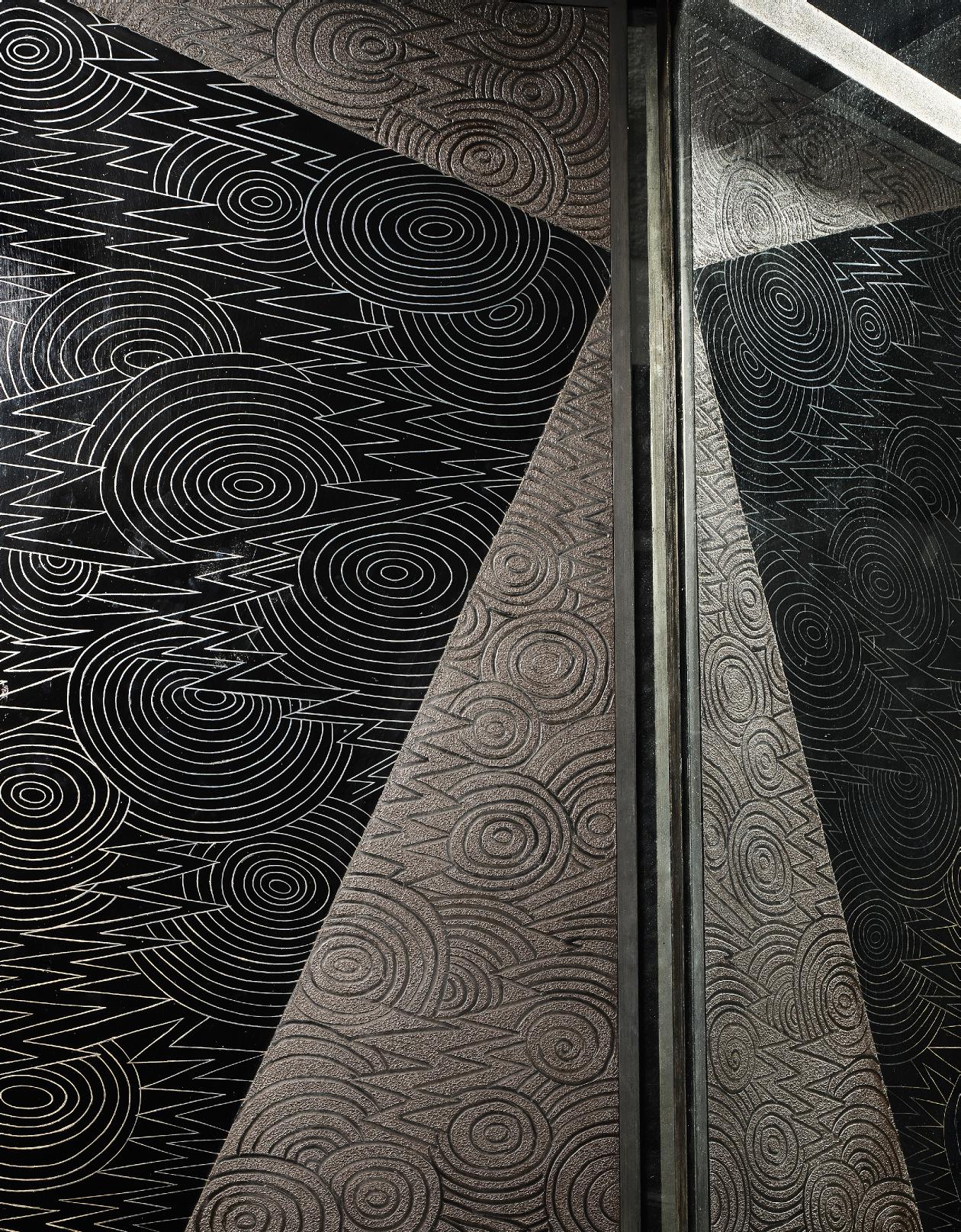
The present lot demonstrates Dunand’s mastery of lacquer, perfected through his work with Seizo Sugawara and rooted in Japanese techniques. Through the patient application and polishing of many thin layers, Dunand achieved a smooth, durable, and visually rich surface, often enhanced with eggshell, gold powder, or incised metal details. These techniques were central to the luxury aesthetic that defined Paris in the 1920s, and they positioned Jean Dunand at the forefront of highend commissioned work for important clients, interior designers, and the fashionable elite.
Originating in the late 18th century as a freestanding, tilting full-length mirror, the psyché had become an essential element of refined interiors by the 1920s. During the Art Deco era, marked by an emphasis on modern lifestyles, personal appearance, and domestic sophistication, this type of mirror served both practical and symbolic roles. It was especially common in luxurious bedrooms and dressing rooms designed for women where it reflected the new culture of elegance and intimate self-presentation that shaped the period.
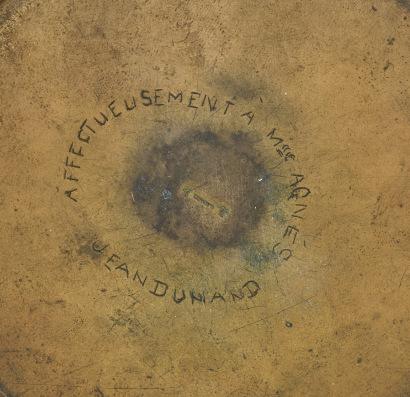
Jean Dunand’s own career intersected directly with this world. He received numerous commissions from leading French women fashion designers and couturières, including Madeleine Vionnet and milliner Madame Agnès, who sought his lacquer and eggshell portraits, screens, and decorative pieces for boutiques, salons, and private apartments. These collaborations placed him in close dialogue with the aesthetics of modern femininity and reinforced the importance of the female figure and the female sphere in his Oeuvre. His recurring bather motifs, stylized silhouettes, and representations of women in his lacquer panels all point to a consistent yet lesser-known engagement with themes of grace, self-presentation, and the decorative framing of the feminine body.
The 'Psyché à la Baigneuse' fits naturally within this context. As a dressing mirror traditionally associated with women’s private spaces, and bearing a title that explicitly references the bather and possibly the Greek myth of Psyche, it aligns with Dunand’s larger exploration of feminine subjects. The dual meaning of the word psyché in French, both designating the mirror and the inner self, reinforces the connection between the object, the act of looking at oneself, and the broader visual language of femininity that Dunand developed throughout the 1920s.
JEAN DUNAND (1877-1942)
IMPORTANT 'PSYCHÉ À LA BAIGNEUSE' DRESSING MIRROR, 1927
lacquered wood, mirrored glass
74¡ x 33Ω x 2æ in. (189 x 85.3 x 7 cm)
$800,000-1,200,000
PROVENANCE:
Private Collection
Sotheby's, Monaco, 11 December 1995, lot 158
Claude and Simone Dray, Paris
Collection Claude et Simone Dray - Art Déco, Christie's, Paris, 8 June 2006, lot 73
Private Collection, USA
Acquired from the above by the present owner
EXHIBITED:
Paris, Galerie Georges Petit, 1927, no. 39
Paris, Galerie du Luxembourg, Jean Dunand, Jean Goulden, May-July 1973, p. 103 (present lot illustrated)
LITERATURE:
G. Teall, "Screens and furniture by Jean Dunand," Harper's Bazaar, New York, April 1928, p. 115 (present lot illustrated)
F. Marcilhac, Jean Dunand His Life and Works, New York, 1991, pp. 93, 263, no. 560 (present lot illustrated)
F. Marcilhac and A. Marcilhac, Jean Dunand, Paris, 2020, p. 317, no. 5 (present lot illustrated)
LEARN MORE
Like all great ladies, Jean Dunand's La Baigneuse harbors her share of mystery.
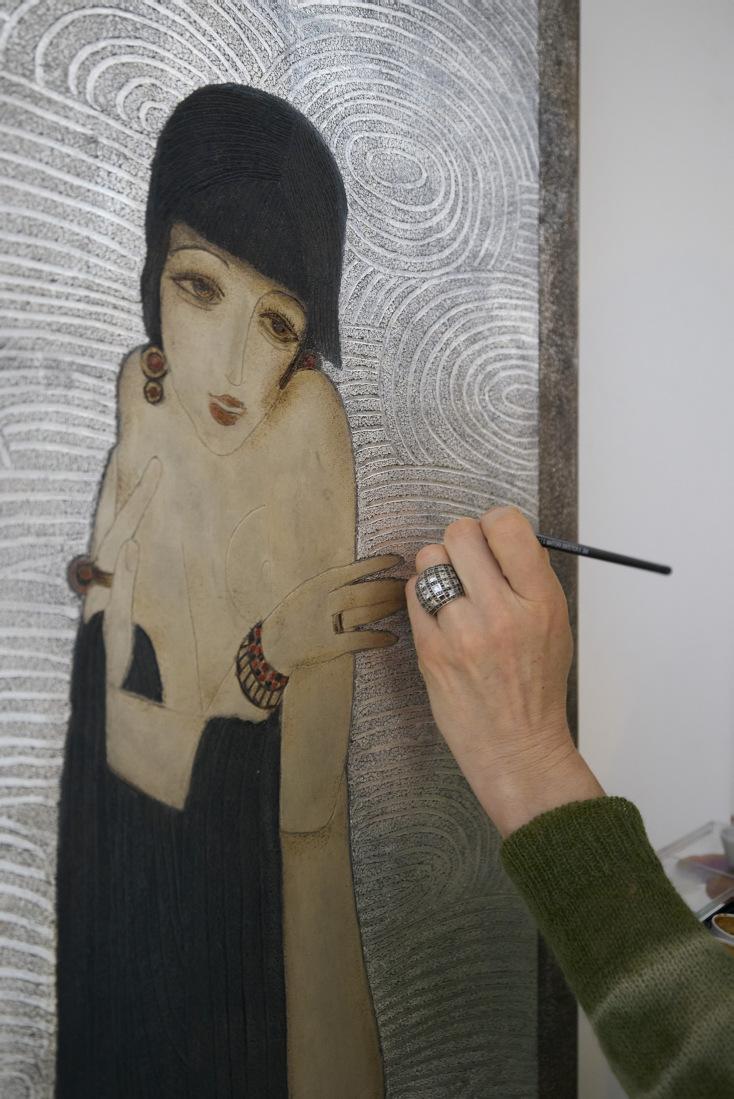
Presented in 1995 at a Monaco sale dressed in gold and red, she truly came to notice in 2006 when she appeared under the prestigious banner of the Claude and Simone Dray Collection—the most important Art Deco collection ever brought to market at that time. All the great collectors participated in the sale, and Adriana Berenson of the DeLorenzo Gallery won the Beauty for an American client. La Baigneuse thus took up residence in New York, then moved into her own apartment, for having fallen in love with the piece at the moment of sale, Adriana bought the work back from her client for her personal collection a few years later. She enjoyed it for a long time in her living room just as it was, then one day undertook to have the gold background of the façade restored, which showed some wear, particularly in the lower section. This is how this adventure began.
Someone had to be found capable of not only mastering the technique perfectly, but who would also respect the integrity of the work. Anne Jacquin was the perfect candidate. La Baigneuse returned to Paris to join her studio. Meanwhile, research conducted in period documentation revealed two surprising black-and-white illustrations: not only were the contrasts in the images incompatible with the work's current colors, but their captions were contradictory as well. In both cases, they described a mirror lacquered in brown and silver, rather than red and gold.
We thus came to the conclusion that the colors had been altered, though we knew neither why nor to what extent. The most plausible explanation was that the work had likely been damaged at some point and then repainted. The risk in contemplating the idea of removing this camouflage was that no original work might remain beneath—that
it might be deteriorated or incomplete, or even that we might harm it further in the process. The easiest course would have been to leave it with this new appearance and simply refresh it. But Adriana felt a duty toward this piece—as one does toward someone that you respect and owe the truth to—and gave her approval.
Anne began her restoration with the frame, meticulously and gently removing the upper layers one by one, centimeter by centimeter. Per chance, the original lacquer was natural, highly resistant, and perfectly preserved. Beneath the gilding indeed, everything was brown and silver. Suddenly the whole regained its coherence: the harmony with the interior lacquer panel, which by contrast had never been retouched, was perfect. The frame recovered its initial appearance. Everything was there —the slightly rough texture, the fine lines that delineated the square silver leaves. What a wonder. We had to go further. Anne turned to the figure. This was perhaps the most moving stage of the restoration. It was already late in her studio, night had fallen. Gently, Anne removed the Bather's makeup, lifted away the greenish tint from her cheeks to reveal her true skin, the shadows of her face, her eyelashes, the subtlety of her gaze. Everything was there, immaculate. The lady had recovered the full delicacy of her features—her rosy, diaphanous skin, the shadows along her contours, the fineness of her jewels. What a marvel. Jean Dunand would have been pleased to see her again.
All that remained was to erase the gold from the water and plunge her into a silvery bath, so that this prude yet naked woman might bathe once more in the white light of the moon. It is midnight again. A matter of taste, no doubt, that had once carried her from night to the golden sunlight and wrapped her in red, for now we know—beneath her makeup—the Bather had remained untouched.
- Pauline De Smedt, Art Advisor
Present lot before restoration when presented in Christie’s, Paris, Collection Claude et Simone Dray - Art Déco, 8 June 2006, Lot 73. Artworks by Jean Dunand © 2025 Artists Rights Society (ARS), New York
Present lot at Anne Jacquin studio, Paris, 2025
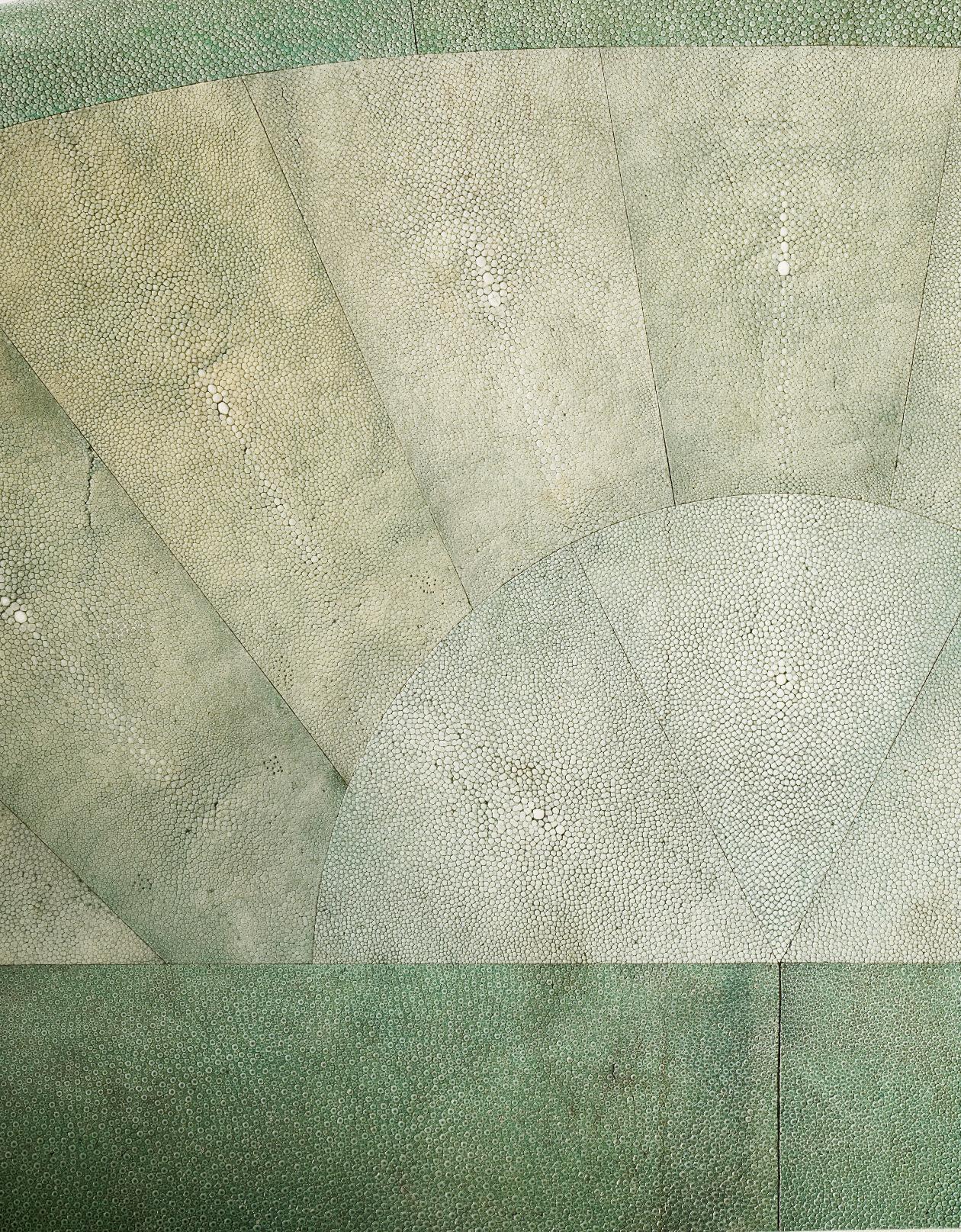
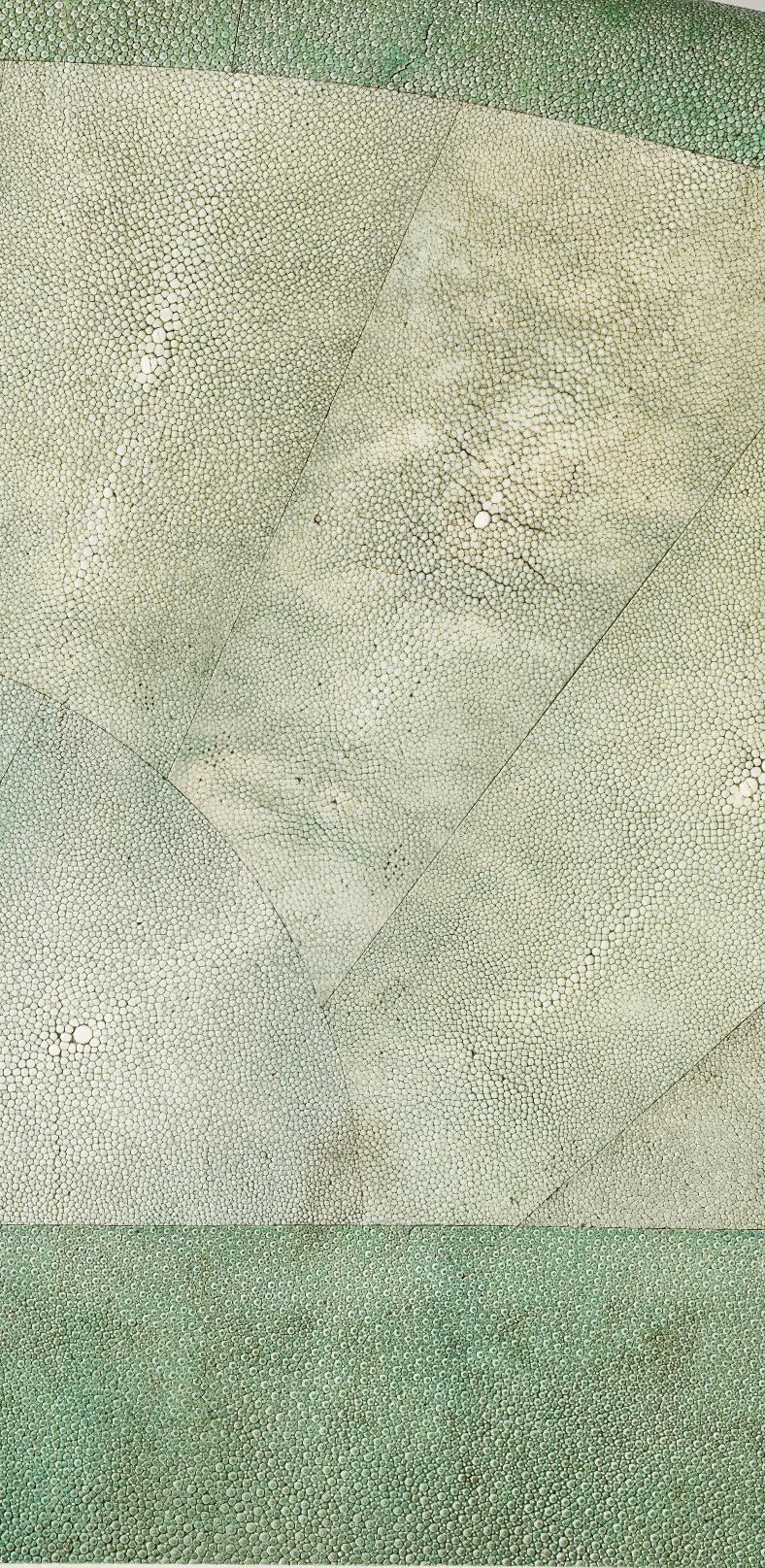
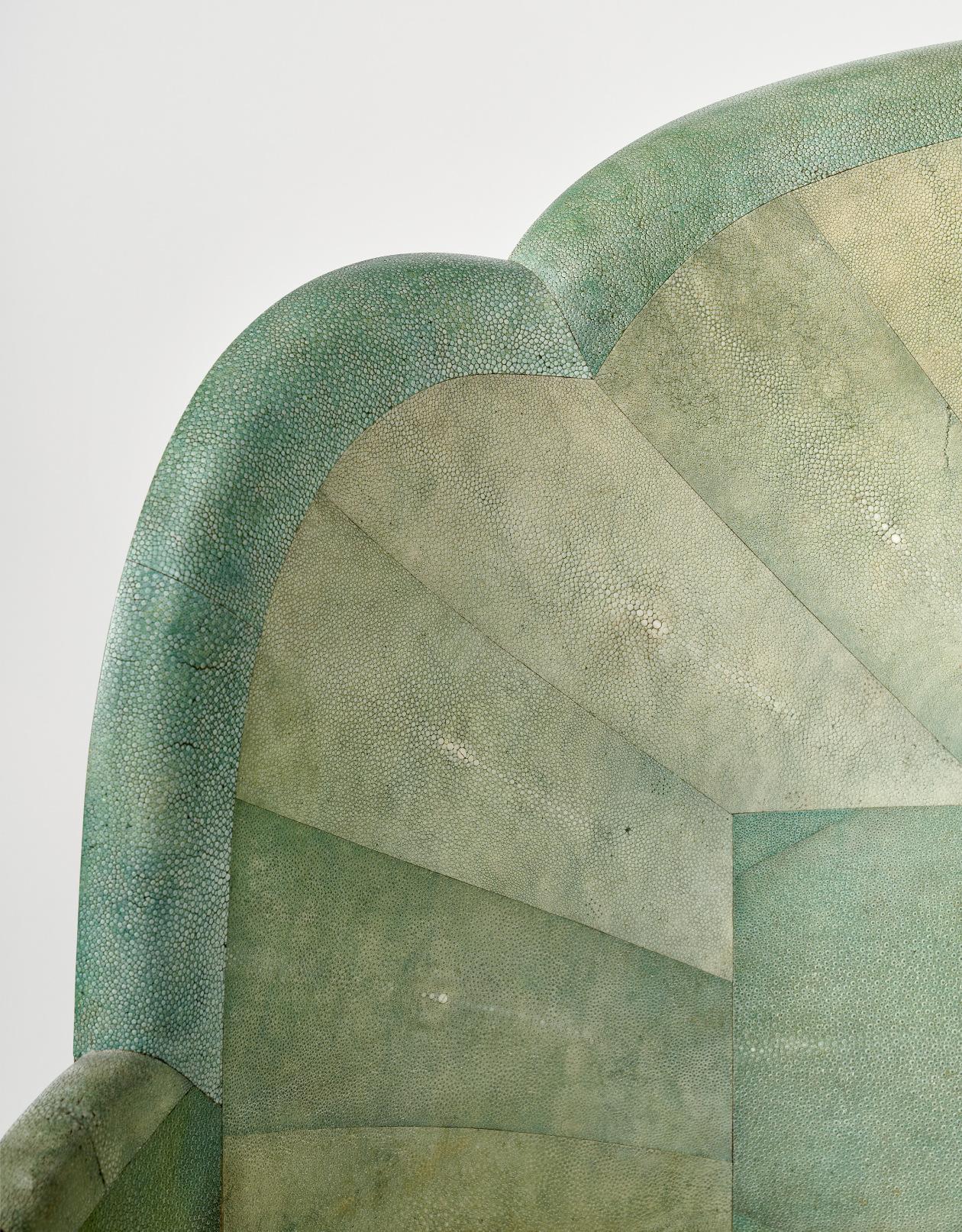
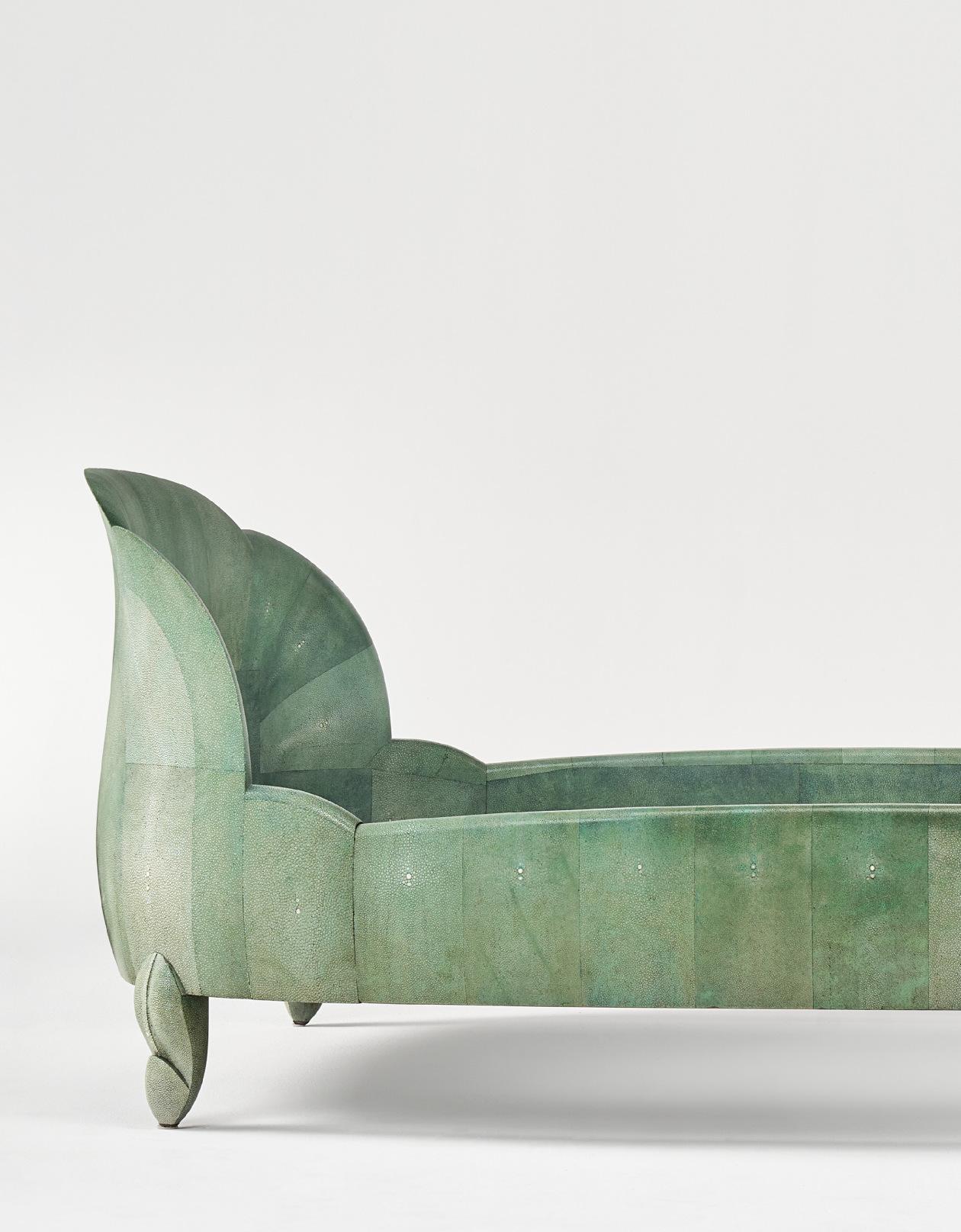
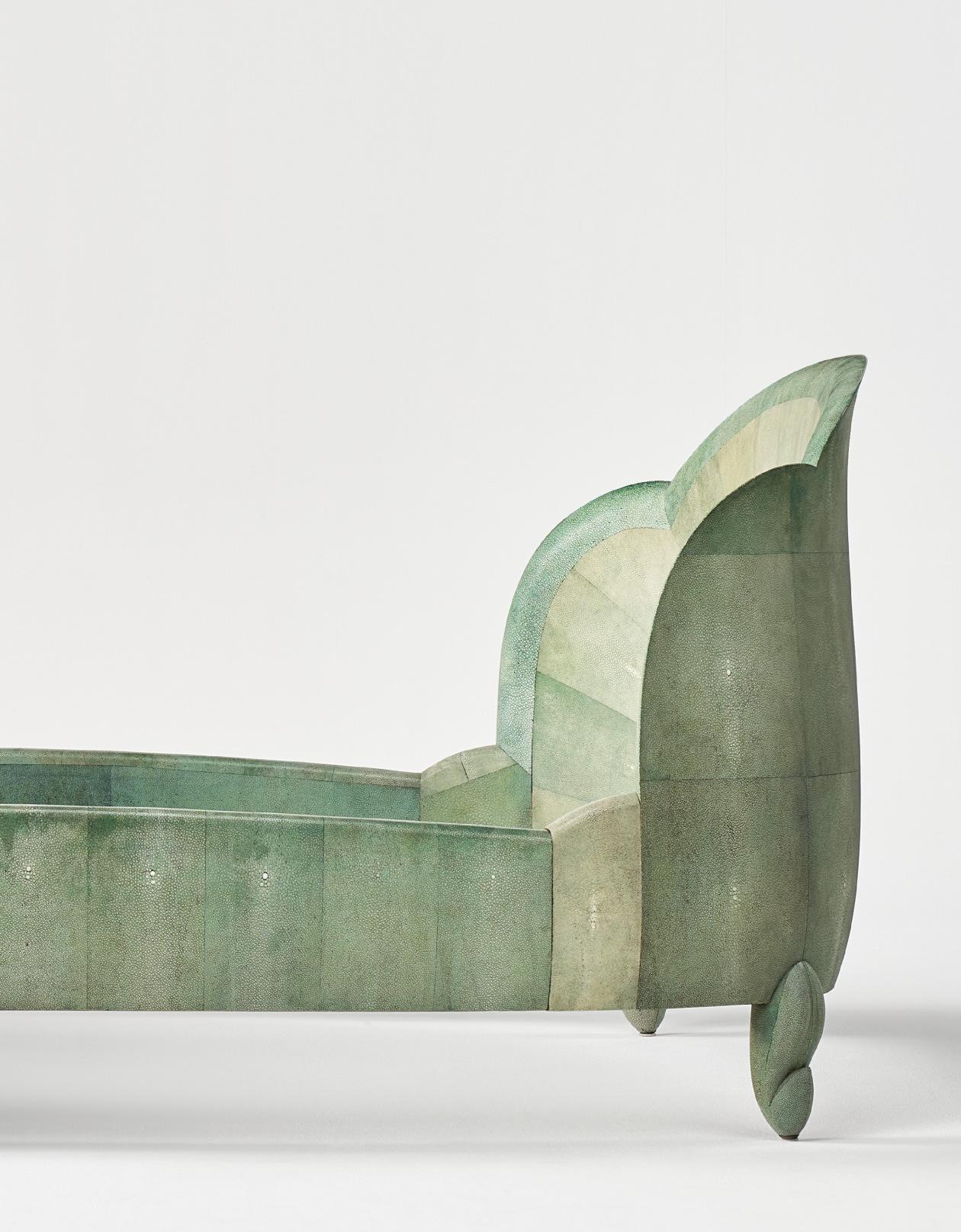
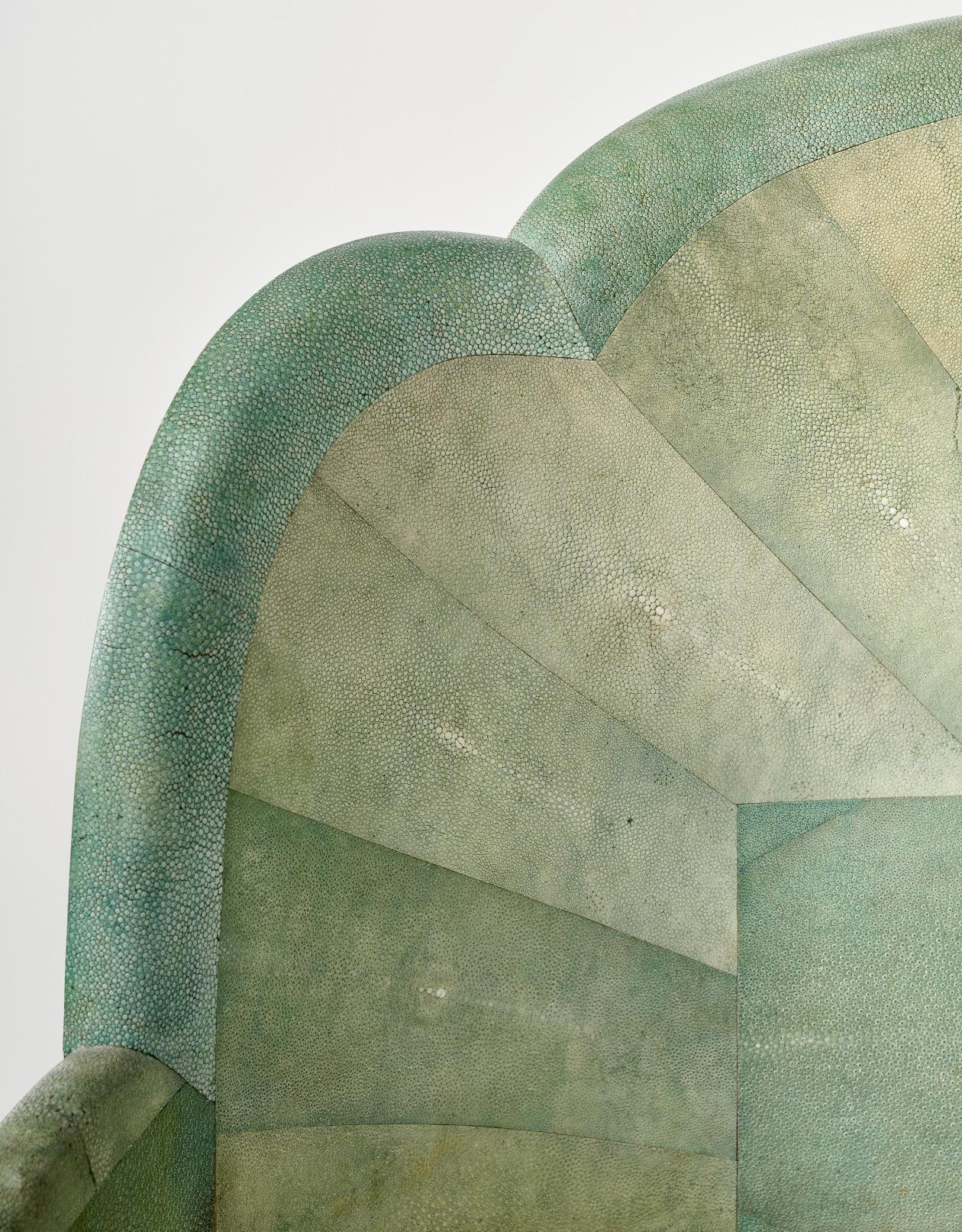
Amongst those of the Société des Artistes Décorateurs who collaborated on the Ambassade Française at the Paris 1925 Exposition Internationale des Arts Décoratifs et Industriels Modernes, André Groult’s Chambre de Madame was unparalleled in precision, technique, and sumptuous materiality. Known for his refined designs, executed in rich materials through traditional craftsmanship; the oeuvre of André Groult embodies the convergence of luxury and modern aesthetics, which captivated both decorators and their patrons in an era of rapid modernization. André Groult's 1925 Important Bed, an adapted version of the Chambre de Madame bed in a shimmering green shagreen (sharkskin), elaborated on his defining Paris Exposition interior; where the ultra-luxurious materials were refined down to their essential nature.
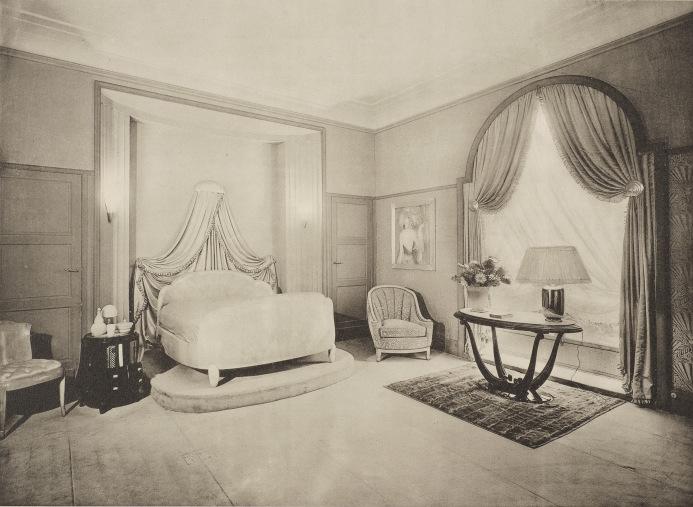
For his Chambre de Madame, Groult's interior comprised coordinating furniture pieces of rounded contours and voluptuous forms, enveloped in cream-colored shagreen upholstery, with ivory and silver detailing, and accents of pink in the interior. Pieces from the suite included defining exemplars of Art Deco style including the Chiffonnier Anthropomorphe, now in the permanent collection of the Musée des Arts Décoratifs, Paris. The voluptuous form of the Chiffonnier, fancifully crafted to suggest the curved outlines of a woman's body, was echoed across the other suite components, including the rounded framed of the Madame's bed, with it's scallop-like headboard and
footboard, and charming oval feet. Strips of shagreen upholstery, carefully pieced together in a radiating geometric pattern across the suite, are a testament to craftsmanship in their precision and execution, as well as an astonishing display of material decadence, speaking to the taste for opulent and luxurious interiors presented in Paris in 1925.
Indeed, André Groult and other ensemblier-décorateurs made their livings designing deluxe and modern interiors for elite collectors, who sought highly refined, sophisticated pieces, including those on display in 1925. Following his success at the Exposition, Groult was commissioned by an American client to recreate his Chambre de Madame suite entirely in bright green shagreen, comprising a sideboard, chest of drawers, desk, chairs, and armchairs, as well as the present bed (the chest of drawers, pair of armchairs, and desk with chairs sold at Christie's in 2006, 2017, and 2021 respectively). The pearly white spots inherent to the sharkskin stand out against the green-dyed shagreen, creating an effect of light glittering across viridescent water, while the geometric paneling in varying shades of green recall the rigid lines of cut stone. These material details, customized special for this green-shagreen commission, combine themes of nature with expert human artistry, creating a stunning visual contrast and an entirely modern feel. In Groult’s Important Bed, these elements make it a masterwork of Art Deco artistry, and a symbol for the luxurious tastes that defined the era.
André Groult’s Chambre de Madame at the Ambassade Française, Exposition Internationale des Arts Décoratifs, Paris, 1925. Plate 23 from « Exposition internationale des Arts décoratifs et industriels modernes, Paris, 1925. Une Ambassade Française organisée par la Société des Artistes Décorateurs ». Paris, éditions Charles Moreau, 1925. © Photo distr. Les Arts Décoratifs
PROPERTY FROM AN IMPORTANT CHICAGO COLLECTION
20 ANDRÉ GROULT (1884-1966)
IMPORTANT BED, CIRCA 1925
shagreen, mahogany, oak
38 x 88¬ x 66¬ in. (96.5 x 225.1 x 169.2 cm)
$250,000-350,000
PROVENANCE:
Private Collection, Paris, commissioned directly from the artist, circa 1925
François Issaly, Cannes, 7–8 April 1999
Galerie Jean-Jacques Dutko, Paris
Acquired from the above by the present owner, 1999
LITERATURE:
For the same model in white shagreen created for the Exposition Internationale des Arts Décoratifs et Industriels Modernes, Paris, 1925:
G. Varenne, "L'Exposition des Arts Décoratifs," Art et Décoration, Paris, July 1925, p. 3
G. Boissy, "Les belles chambres à coucher de l'exposition," Les Echos des Industries d'Art, Paris, no. 3, September 1925, p. 9
Les Arts de la Maison, Paris, Spring-Summer 1925, pl. IV
M. Dormoy, "Les Intérieurs à l'Exposition Internationale des Arts Décoratifs," L'Amour de l'Art, Paris, August 1925, p. 316
Les Arts de la Maison, Paris, Fall-Winter 1925, pl. VIII
G. Rosenthal, "La Cour des Métiers et l'Ambassade Française," L'Art Vivant, Paris, no. 20, October 1925, p. 15
"Une Ambassade Française," Paris, November 1925, pl. XXIII
Y. Brunhammer, Le Style 1925, Paris, 1975, p. 21
Encyclopédie des arts décoratifs et industriels modernes au XXème siècle, New York, 1977, vol. IV, pl. XV
P. Kjellberg, Art Deco : Les Maîtres du Mobilier, Paris, 1981, p. 73
L. de Caunes and J. Perfettini, Galuchat, Paris, 1994, p. 92
F. Marcilhac, André Groult, décorateur-ensemblier du XXe siècle, Paris, 1997, pp. 151-153
This model was exhibited in the Chambre de Madame of the Ambassade Française at the Exposition Internationale des Arts Décoratifs et Industriels Modernes, Paris, 1925.
LEARN MORE
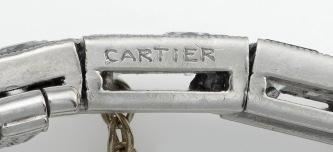
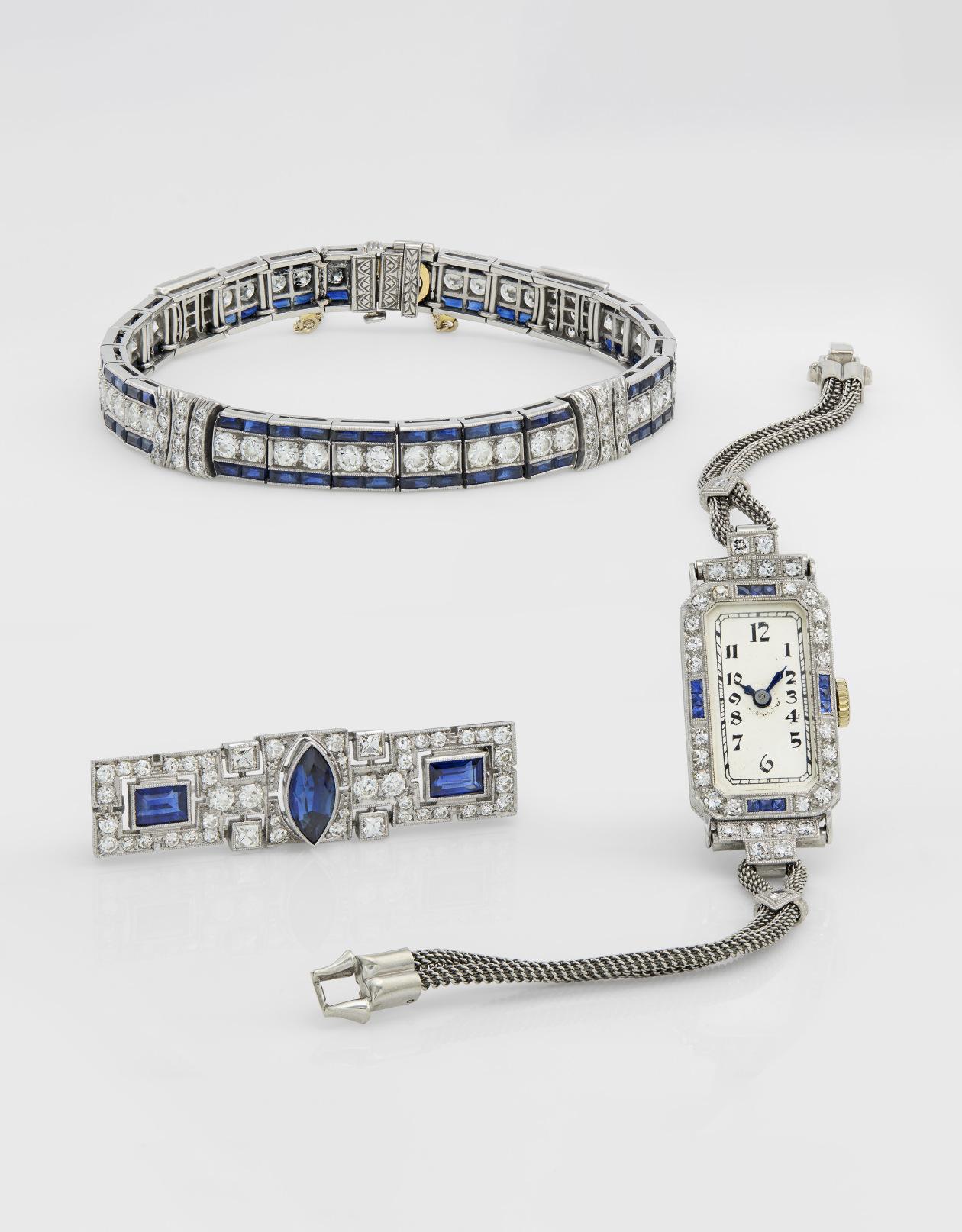
CARTIER, SAPPHIRE AND DIAMOND BRACELET, WITH UNSIGNED SAPPHIRE AND DIAMOND BROOCH, GALLET & CO. SAPPHIRE AND DIAMOND WATCH
Baguette-cut sapphires, old-cut diamonds, platinum, circa 1920, signed Cartier, one sapphire deficient; accompanied by a sapphire and diamond brooch, marquise and rectangular-cut sapphires, old and square-cut diamonds, 14k white gold, circa 1920
Diamonds (bracelet): approximately 96 with approximate total carat weight of 3.25 – 3.50 carats
Diamonds (brooch): approximately 48 with approximate total weight of 0.90 – 1.10 carats
Size/Dimensions: bracelet 17.2 cm (6æ in); brooch 4.1 x 0.9 cm (1¬ x ¡ in)
Mechanical movement, silvered dial with Arabic numerals, diamond, sapphire, platinum, circa 1920s, movement signed Gallet & Co, numbered 278885
Size/Dimensions: approximately 34 x 15 mm, approximately 168 mm circumference, inclusive of the head of the watch
$18,000-24,000
(detail)
JEAN BEAUMONT (1895-1978)
'LA NATURE', CIRCA 1925
manufactured by Cornille Frères, Paris silk damask
59 x 51 in. (149.8 x 129.5 cm)
$10,000-15,000
PROVENANCE:
Archive of L. Alavoine & Co., 712 5th Avenue, New York
Dalva Brothers, Inc., 53 E 77th St, New York, 1963
Acquired from the above by the present owner
LITERATURE:
M. Dufrêne, Ensembles Mobiliers : Exposition Internationale 1925, Paris, 1925, pl. 30 (for a room with wall panels of this fabric)
L. Alavoine & Co. (Lucien Alavoine and Company) was one of Paris’s leading luxury interior decoration firms from the late nineteenth century until the 1960s. Renowned for their refined taste and international reach, Alavoine maintained an influential presence in both Paris and New York. The New York showroom, established in 1893, operated in close dialogue with the celebrated Parisian decorators Jules Allard et Fils, known for prestigious commissions including Newport mansions, The Plaza Hotel, and the Vanderbilt House. In the early 20th century, the artistic direction of Alavoine was shaped by the eminent designer Armand Albert Rateau, whose discerning oversight elevated the firm’s reputation for exceptional craftsmanship and sophisticated interiors.
The present fragment comes from a larger ensemble of furnishing materials preserved in Alavoine’s New York showroom, which included an extensive array of high-end weavings from Lyon by firms such as Tassinari & Chatel, Rodier, and Cornille Frères. Around 1965, the remnants of this showroom collection were acquired by Dalva Brothers, Inc., specialists in French eighteenth-century furniture, ensuring the survival of these rare examples of early 20th century decorative textiles.
A fragment of this fabric can be found in the permanent collection of the Musée des Arts Décoratifs, Paris (inv. no. 25176).
Photography: Rachel Robshaw
Maurice Dufrêne, Ensembles Mobiliers, Paris, 1925, pl. 30. From The New York Public Library.
LEARN MORE
JEAN BEAUMONT (1895-1978)
FURNISHING TEXTILE, CIRCA 1925
manufactured by Cornille Frères, Paris silk damask
27Ω x 50Ω in. (69.8 x 128.3 cm)
$5,000-7,000
PROVENANCE:
Archive of L. Alavoine & Co., 712 5th Avenue, New York Dalva Brothers, Inc., 53 E 77th St, New York, 1963 Acquired from the above by the present owner
LITERATURE:
M. Dufrêne, Ensembles Mobiliers : Exposition Internationale 1925, Paris, 1925, pl. 25 (for a chair upholstered with this fabric)
A fragment of this textile can be found in the permanent collection of the Musée des Arts Décoratifs, Paris (inv. no. 25170).
Photography: Rachel Robshaw
Maurice Dufrêne, Ensembles Mobiliers, Paris, 1925, pl. 25. From The New York Public Library.
LEARN MORE
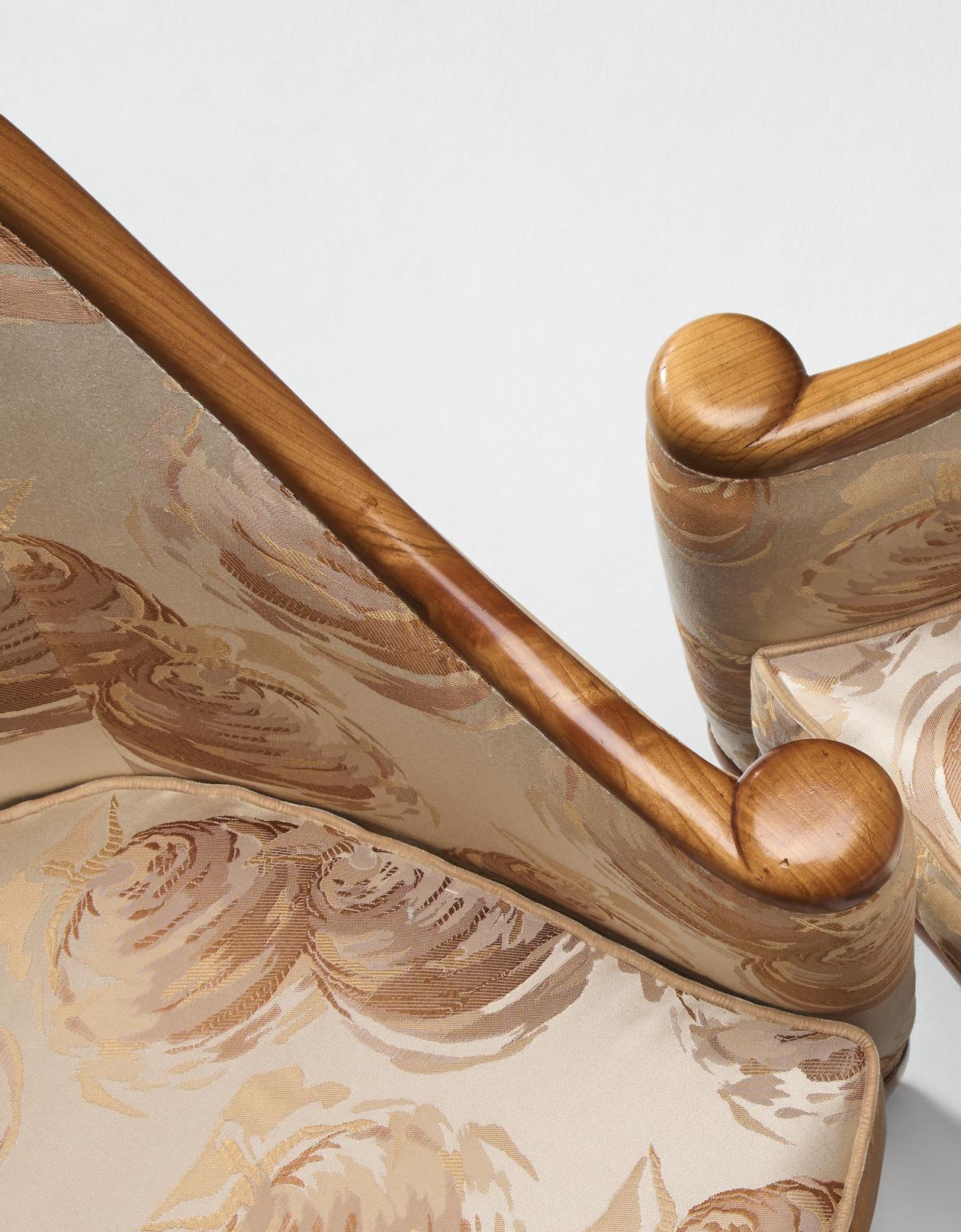
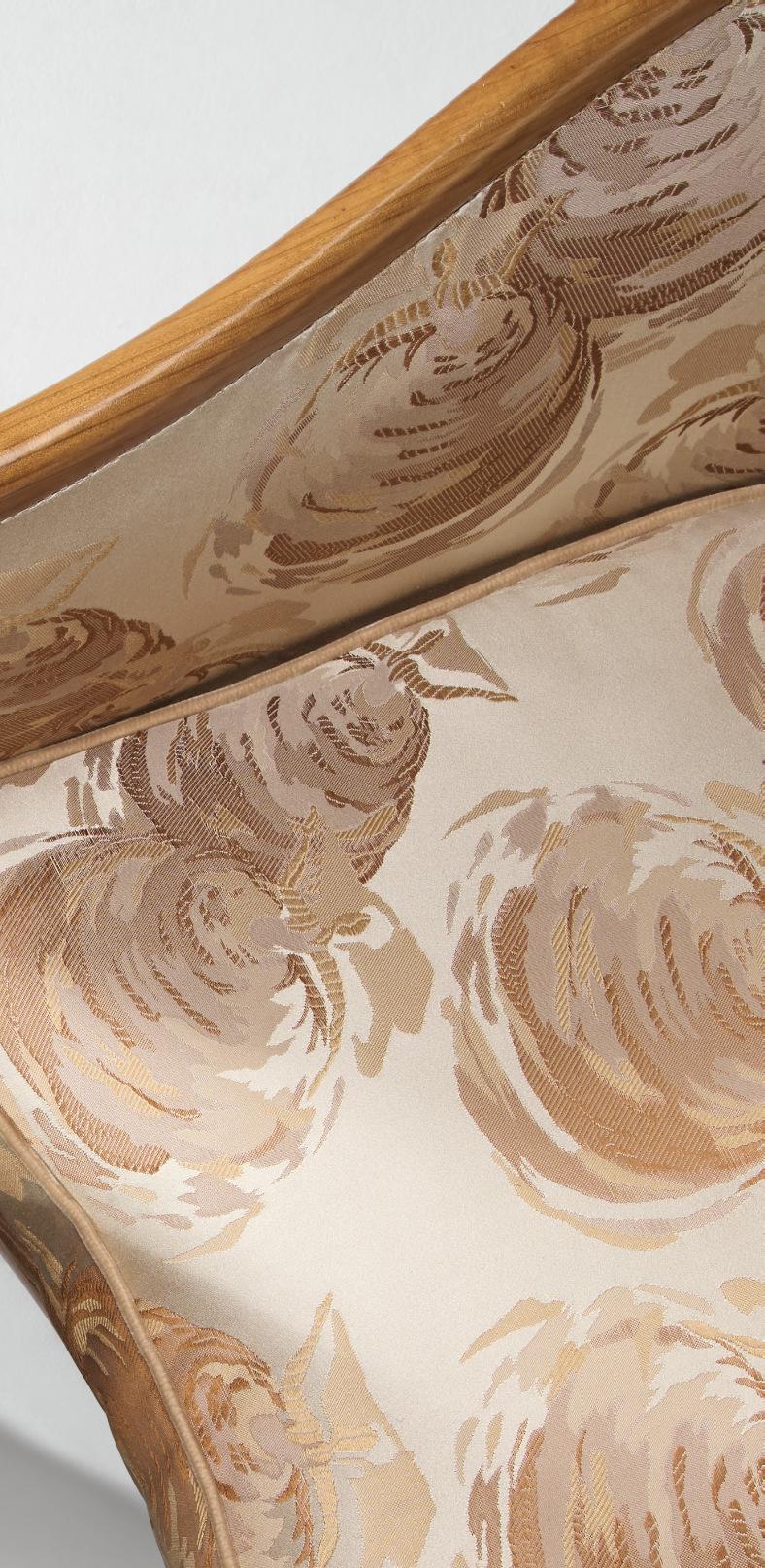
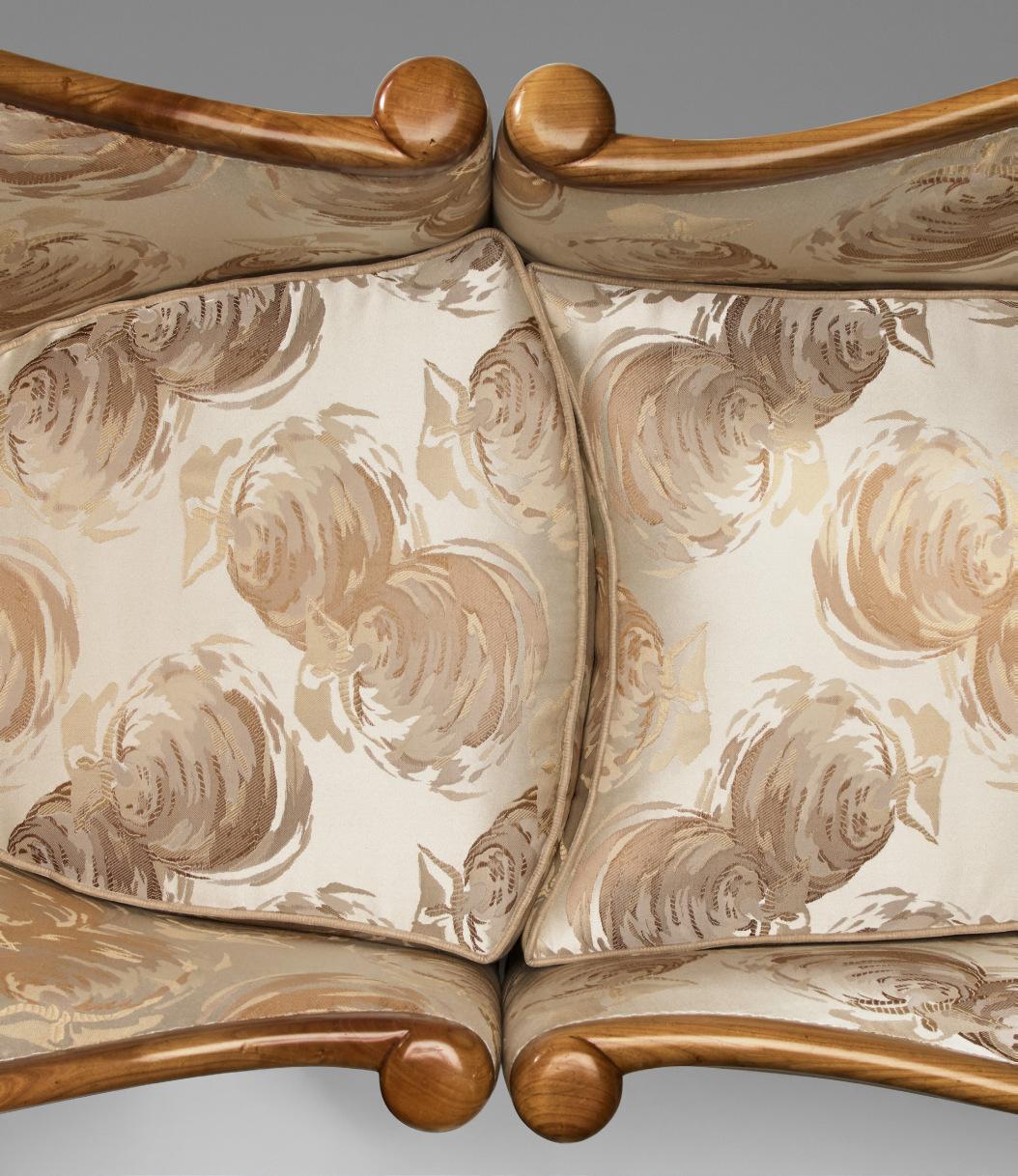
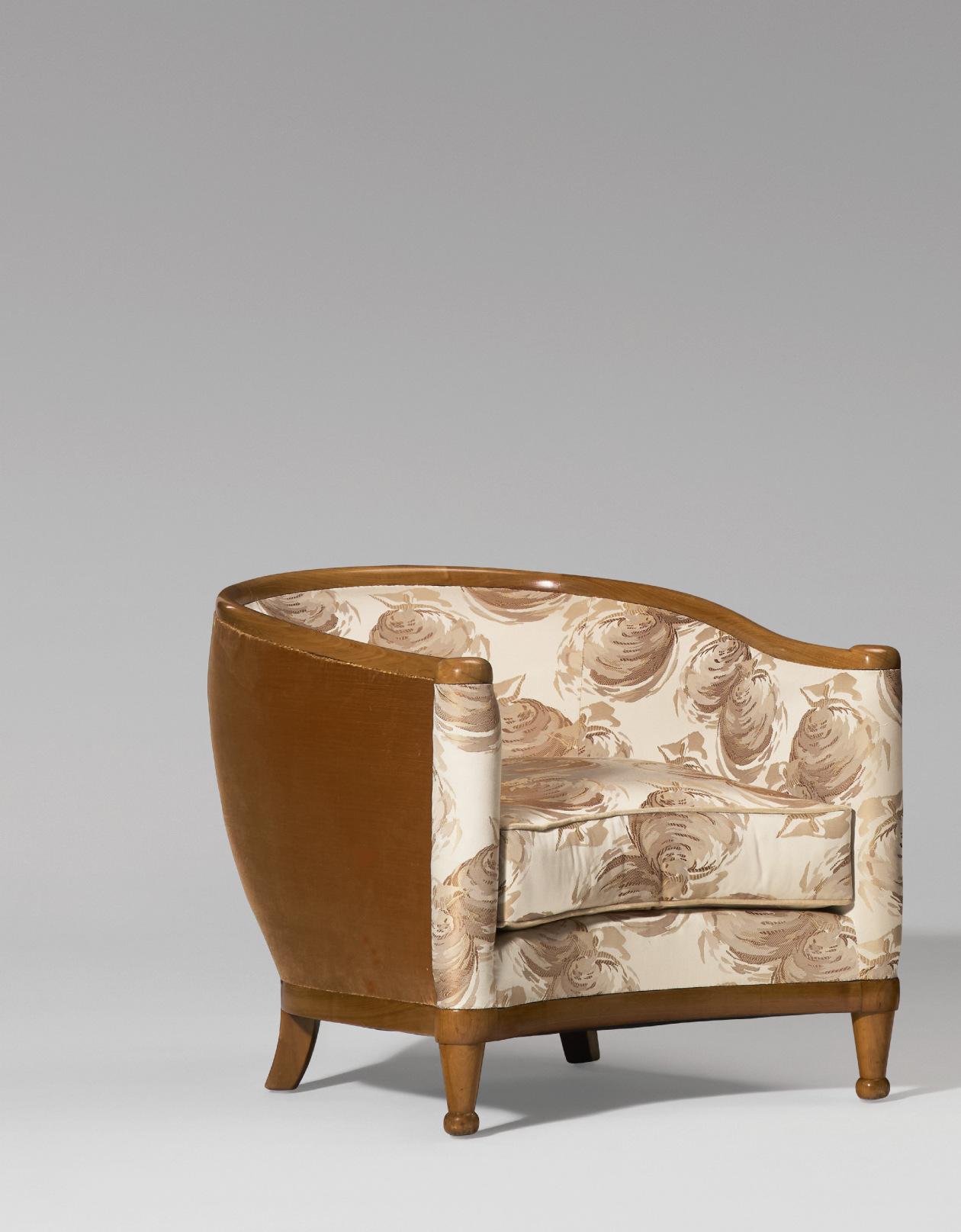
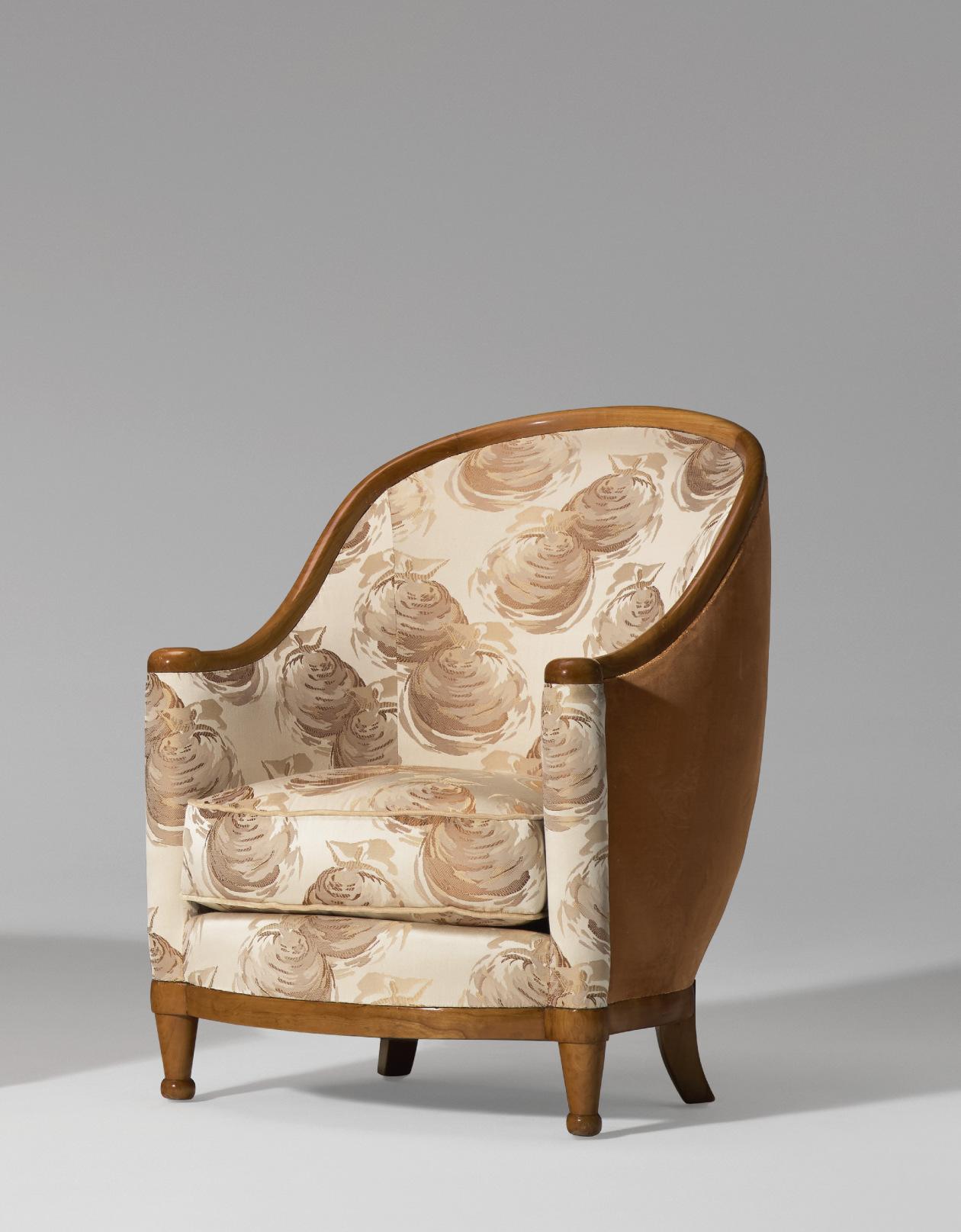
The present lot was commissioned directly from André Groult as part of a larger bedroom suite by the sister and husband of the artist's sister-in-law, Marie and Maurice Feuillatte. The couple were friends with Paul Poiret and his wife (André Groult's sister) and hosted all the important personalities of the time in their house in Vernouillet, near Paris. They are arranged as a duchesse brisée, a type of seating composed of two or sometimes even three separate elements, typically a bergère and a low footrest, that can be used individually or combined to form a long seat.
The duchesse brisée, originating in the 18th century, experienced a modest revival in Paris in the 1910s and 1920s, offering a more flexible and informal approach to seating than a single chaise longue. The taller bergère of this pair follows a form that Groult presented at the Salon des artistes décorateurs in 1921, a gently curved and enveloping shape which would then appear frequently in his work, executed in wood or shagreen.
While a duchesse brisée was not a particularly common furniture type in the Parisian Art Deco era, it could be found in elite Parisian interiors as a combination of comfort and elegance. This pair illustrates Groult’s design approach, combining refined proportions with careful craftsmanship, and provides a clear example of forms he would continue to explore throughout his career and which would be particularly celebrated in the Chambre de Madame he presented at the Paris Exposition Internationale in 1925.
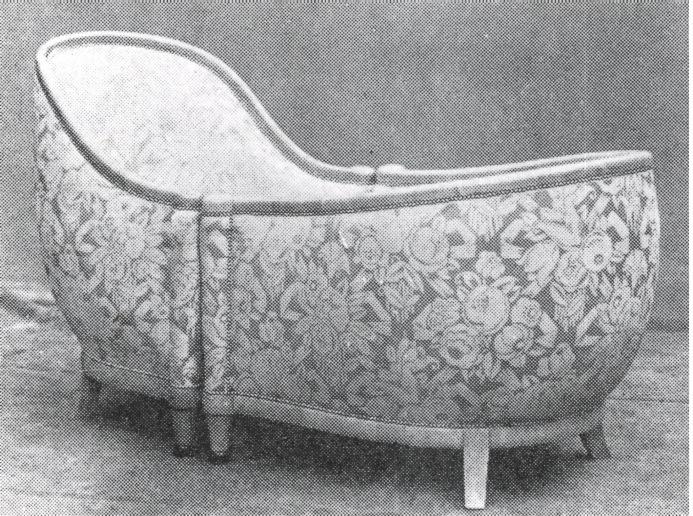
Present bergère illustrated in it original interior, circa 1922-1923.
André Groult, duchesse brisée in white shagreen, circa 1921.
PROPERTY FROM A PROMINENT INTERNATIONAL COLLECTION
φ24
ANDRÉ GROULT (1884-1967)
TWO BERGÈRES FORMING DUCHESSE BRISÉE, 1921
cherry, fabric upholstery
33º x 27 x 28¡ in. (84.5 x 68.5 x 72 cm) (taller)
25 x 27 x 31¿ in. (63.5 x 68.5 x 79 cm) (shorter)
each stamped ANDRÉ GROULT and with artist's cypher, the taller bergère further dated 1921 (2)
$200,000-300,000
PROVENANCE:
Madame Marie Ces and Monsieur Maurice Feuillatte, commissioned directly from the artist, 1921
Thence by descent Christie's, Paris, 20 May 2003, lots 6 and 7
Galerie Vallois, Paris
Acquired from the above by the present owner, 2006
LITERATURE:
E. Sedeyn, "Le XIIe Salon des Artistes décorateurs," Art et Décoration, Paris, April 1921, p. 115 (for the bergère)
G. Janneau, "Le mouvement moderne. Le douxième Salon des Artistes Décorateurs," La Renaissance de l'Art Français, Paris, May 1921, p. 284 (for a period photograph of an interior with the model)
M. Dufet and M. Astruc, "Les décorations d'André Groult et de Charles Martin," Feuillets d'art, Paris, no. 2, January 1922, pl. 29 (for a period photograph with the bergère)
Y. Rambosson, "Les Artistes décorateurs au Salon des Artistes français," Art et Décoration, Paris, June 1922, p. 187 (for a period photograph with the bergère)
H. Verne and R. Chavance, Pour comprendre l'art décoratif moderne en France, Paris, 1925, p. 127 (for a period photograph of the model)
F. Marcilhac, André Groult décorateur-ensemblier du XXe siècle, Paris, 1997, pp. 100-101, 104, 112 (for the model), 125, 127 (present lot illustrated)
This tall bergère model was exhibited at the Salon des artistes décorateurs, Paris, 1921.
LEARN MORE
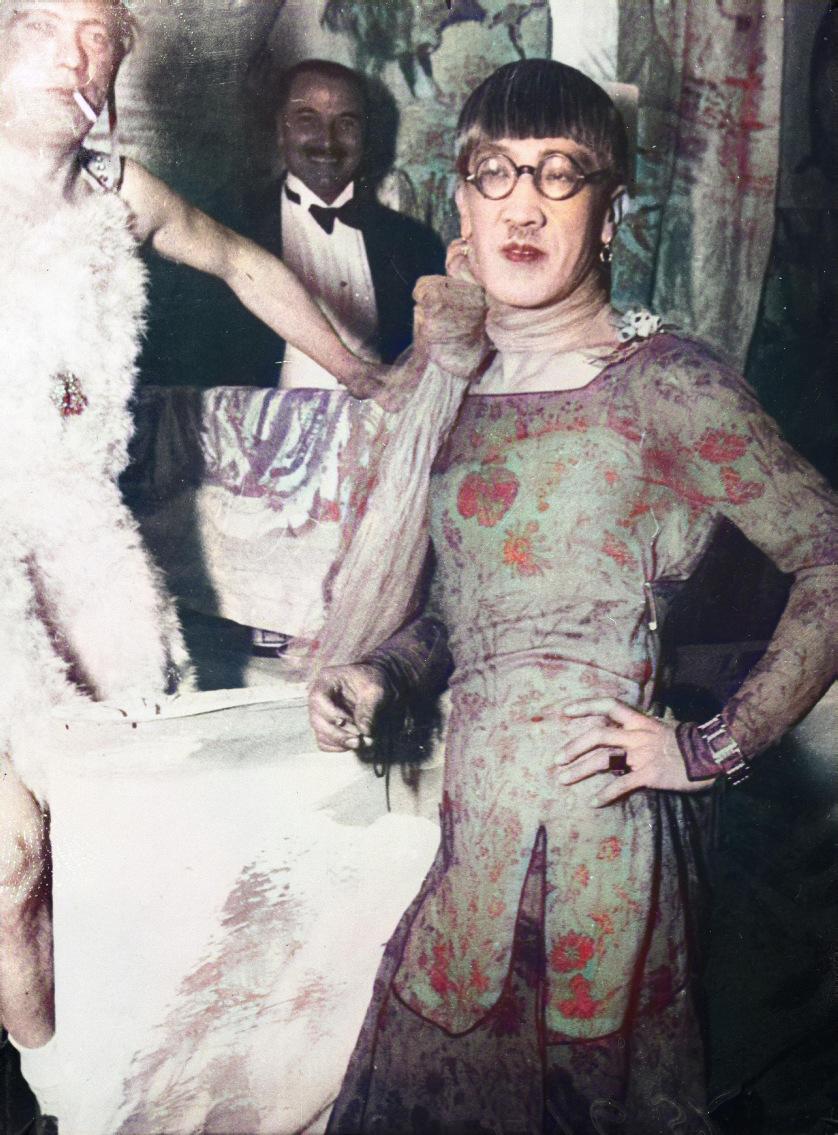
Leonard Tsuguharu Foujita in drag, smoking with friends at a cabaret club. Chroma Collection/Alamy
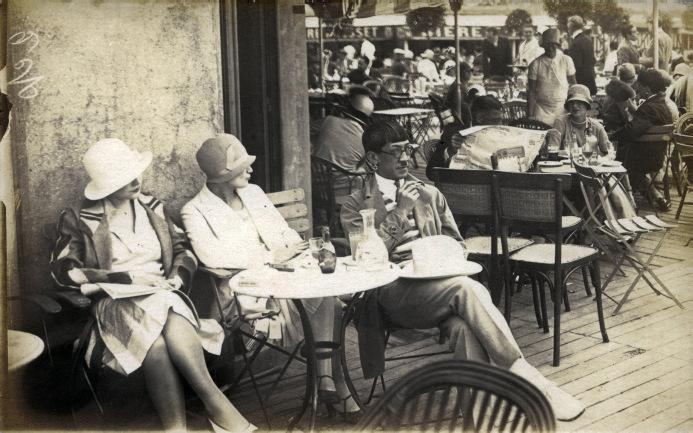
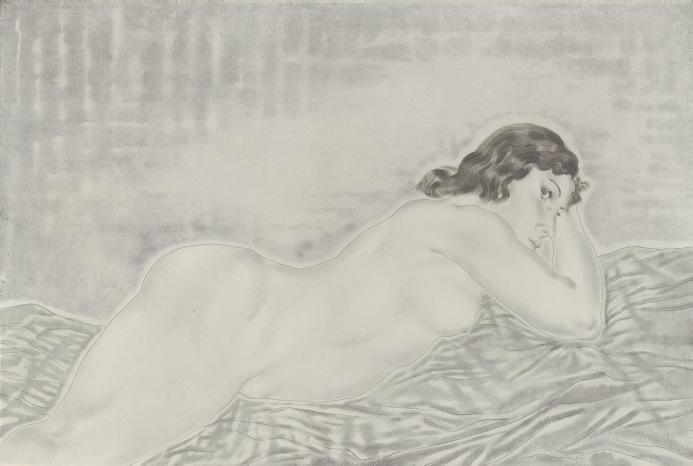
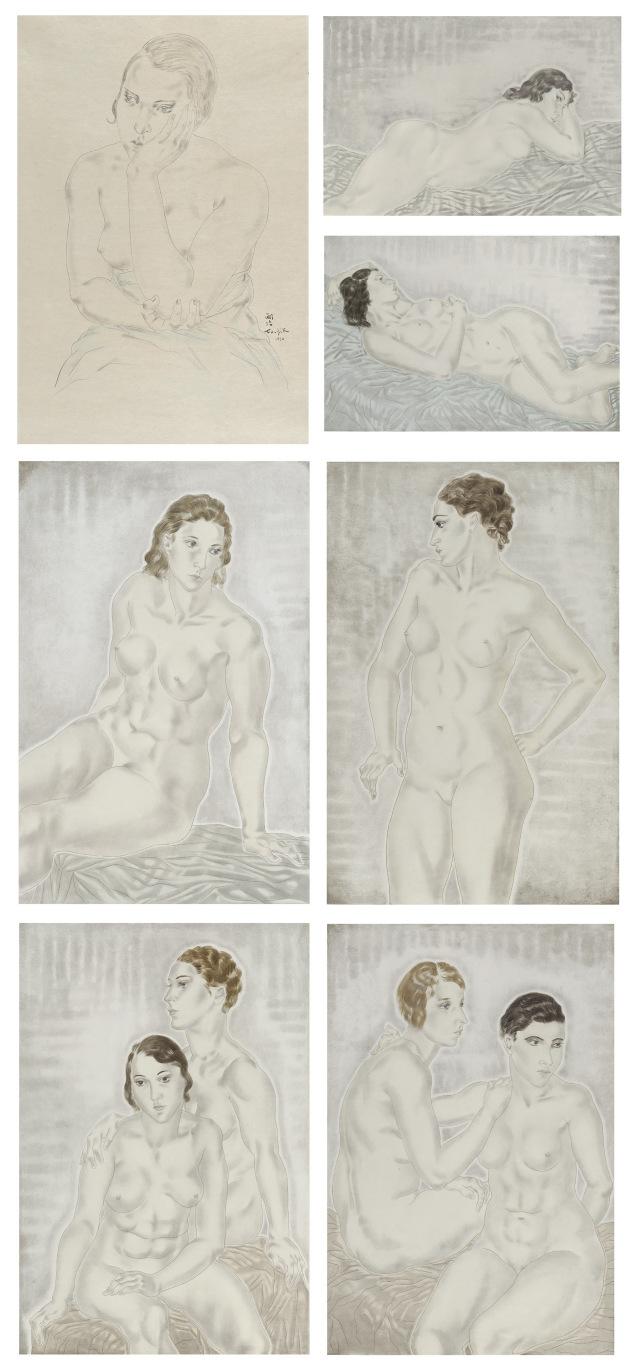
When Leonard Tsuguharu Foujita arrived in Paris from Tokyo in 1913, the city was poised to become the epicenter of a new aesthetic movement. By the time the International Exhibition of Modern Decorative and Industrial Arts opened in 1925— the event that would define Art Deco as a coherent style—Foujita had established himself as one of the most prominent artists in Montparnasse, integrating Japanese visual traditions with the geometric clarity and material consciousness that characterized the era's design principles. The Femmes portfolio, executed in 1930, represents Foujita's engagement with these concerns. Created five years after that exhibition, this deluxe edition demonstrates how the principles articulated in 1925 continued to shape artistic production throughout the decade, particularly in the realm of the luxury édition de tête, where the boundaries between fine art and decorative object were deliberately collapsed.
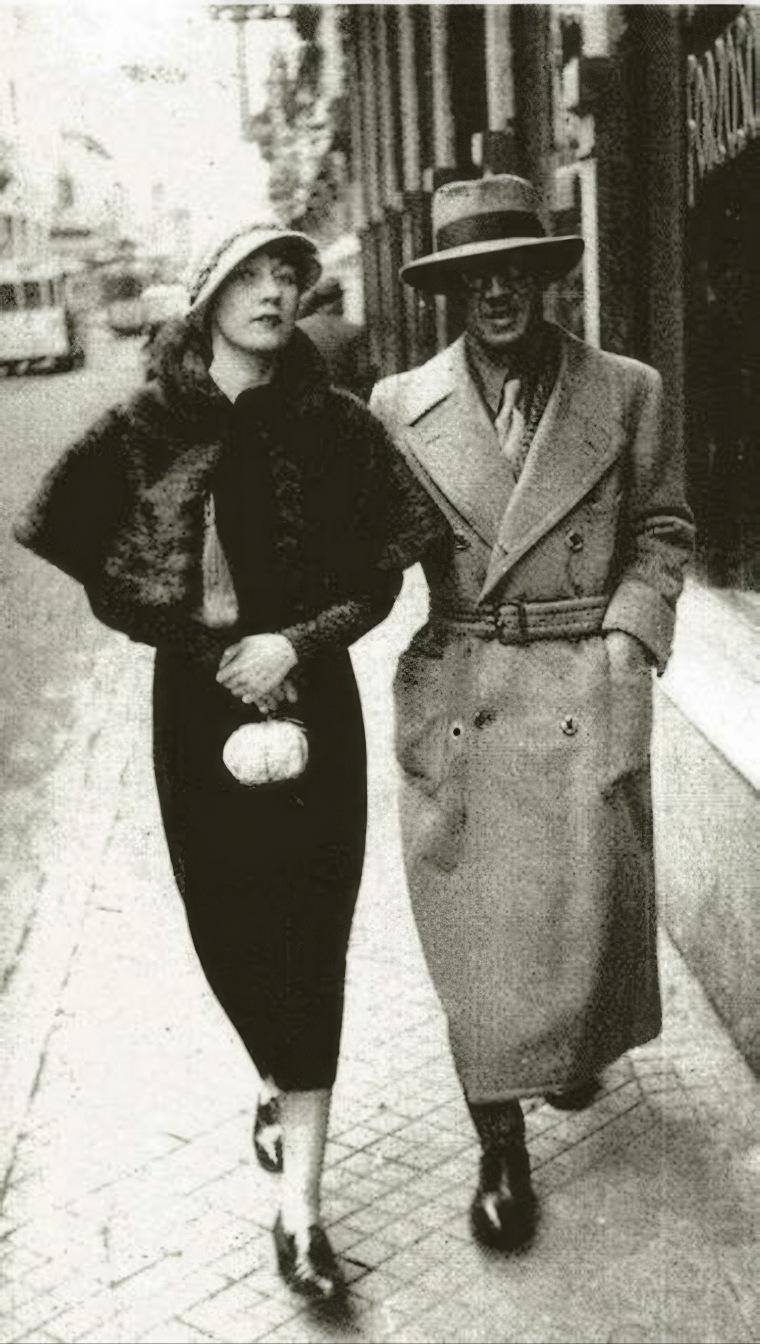
Foujita's life in Paris placed him at an intersection of avant-garde art and decorative modernism. Settling in Montparnasse, he became a member of the École de Paris, forming relationships with Amedeo Modigliani, Chaim Soutine, and other artists who congregated at the cafés Le Dôme and La Rotonde. His connection with Alice Prin, known as Kiki de Montparnasse—model, performer, and central figure in 1920s bohemian culture—situated him within the social networks where artistic innovation and cultural transformation converged. The photograph showing the artist with Kiki documents this milieu, where the visual arts, fashion, literature, and design existed in productive dialogue rather than separate spheres.
Foujita's aesthetic—characterized by his distinctive white grounds (achieved through a technique combining talc and other materials that he kept deliberately mysterious), delicate linear articulation, and synthesis of Japanese ink painting traditions with European
printmaking methods—corresponded with Art Deco's engagement with non-Western artistic traditions. This was not the earlier generation's decorative japonisme but rather an investigation of how different visual systems might inform modern design. His work interested collectors and designers who understood technical mastery and cross-cultural synthesis as central to contemporary practice.
The artist's integration into Parisian design circles extended beyond aesthetic affinity. His studio attracted collectors and tastemakers who moved fluidly between fine art and decorative arts patronage. Jacques Doucet, the couturier who had transformed himself into one of the era's most discerning collectors, acquired Foujita's work alongside pieces by designers such as Eileen Gray and Pierre Legrain. This circulation pattern is significant: Foujita's ability to work across categories— producing paintings, illustrated books, and designs for applied arts— reflected the Art Deco ideal of the artist-designer whose practice was not constrained by traditional hierarchies.
The Femmes series demonstrates Foujita's command of printmaking technique while articulating a vision of feminine representation that resonated with contemporary design aesthetics. The combination of color etching, aquatint, and roulette allowed for tonal modulation and linear precision that paralleled developments in luxury crafts where technical innovation served refinement rather than industrial efficiency. The production specifications—Chine appliqué on Japon Impériale paper for the primary suite, Japon Ancien paper for the additional suite—indicate the period's attention to materials as carriers of cultural meaning and tactile quality. The deluxe edition structure, limited to six copies and augmented with an additional suite and original watercolor drawing, follows publishing models established by dealers such as Ambroise Vollard and reflects the Art Deco conviction that artistic experience could be calibrated through degrees of rarity and material elaboration.
Léonard Tsuguharu Foujita at a Parisian terrace. © Patrice Cartier. All rights reserved 2025 / Bridgeman Images
The portfolio's subjects—women rendered with Foujita's characteristic balance of sensuality and formal restraint—engage with representations of modern femininity that circulated widely in 1920s visual culture. These figures inhabit a different social and visual space than their Belle Époque predecessors; they are the fashionable, mobile women who embodied the decade's transformed gender relations. Their elongated proportions and decorative settings invite comparison with contemporary design representations—the stylized figures that appeared in the work of designers such as Erté, or the attenuated forms in lacquer panels by Jean Dunand and metalwork by ArmandAlbert Rateau. This formal consonance was not coincidental but rather reflected shared assumptions about how the modern body and modern space should be visualized.
Notably, two of the prints depict pairs of women together, their figures rendered with a subtle androgyny that suggests same-sex desire. This represented a significant departure from Western artistic convention, where the female nude had been predominantly configured for male viewing. The representation of women in intimate relationship with one another, rather than as objects arranged for heterosexual consumption, participated in the broader discourse of sexual liberation that characterized Montparnasse in the 1920s and early 1930s. This aspect of the portfolio may also reflect Foujita's knowledge of Japanese ukiyo-e traditions, particularly prints depicting the pleasure quarters of Edo, where representations of same-sex relationships and gender fluidity existed within established visual conventions. By bringing these representational strategies into conversation with European printmaking, Foujita created images that articulated the sexual and social freedoms that were integral to the cultural transformation occurring in interwar Paris.
By 1930, when Apollo Editions Artistiques published this portfolio, the principles articulated at the 1925 Exhibition had become integrated into Parisian visual production. Foujita's Femmes constitutes evidence of that integration—of how ideas about craft, modernism, and material quality that animated the exhibition continued to structure artistic practice in its aftermath. The portfolio format itself, with its emphasis on the complete ensemble rather than individual images, reflects the Art Deco insistence on totality, on the work of art as an element within a larger decorative program. This deluxe edition, number IV
of six, represents a category of Art Deco production oriented toward connoisseurship, technical refinement, and the selective dissemination of objects within networks of patronage.
As the centennial of the 1925 Exhibition prompts reconsideration of the movement's scope and influence, Foujita's work offers a case study. His position as an artist from Tokyo who became a chronicler of Parisian modernity complicates narratives about Art Deco's relationship to non-Western cultures, while his movement between fine art and design contexts illuminates the period's challenge to established artistic categories. The Femmes portfolio demonstrates how these concerns manifested in specific objects—in choices about technique, materials, edition structure, and modes of distribution that together constituted a coherent aesthetic and social practice.
The dedication of this portfolio "à Monsieur André Kahn/En Souvenir" in 1930 exemplifies these collecting networks. André Kahn-Wolf (born circa 1880), active in Paris from at least the 1920s through the 1960s, assembled a collection that ranged from eighteenth-century portraits and Egyptian antiquities to German medieval sculpture and modern art. His patronage extended across historical periods and categories, much like the Art Deco approach to design, which drew inspiration from diverse sources while maintaining a coherent aesthetic vision. That his name appears in collecting contexts alongside the David-Weill family—one of France's most important collecting dynasties—indicates his standing within Parisian art circles. His donations to the Musée d'Art Moderne et Contemporain in Strasbourg in 1966 and numerous gifts to the Louvre, including Egyptian works in 1972-1973, demonstrate a commitment to public institutions that was characteristic of this generation of collectors. For Foujita to dedicate one of only six deluxe copies to Kahn-Wolf suggests a relationship that went beyond simple patronage; the inscription "En Souvenir" implies personal connection, situating this portfolio within networks of friendship and mutual respect that linked artists, collectors, and designers in interwar Paris.
Including: Deux Amies (B. I. 30.34); Nu assis (B. I. 30.35); Deux Nus assis (B. I. 30.36); Femme brune, allongée (B. II. 30.75); Femme blonde, allongée (B. II. 30.76); Nu debout de profil (B. II. 30.77). Sylvie Buisson has verbally confirmed the authenticity of this lot.
Kiki de Montparnasse and Tsuguharu Foujita, Paris, 1926, by Iwata Nakayama
LEONARD TSUGUHARU FOUJITA (1886-1968)
Les Femmes
the complete portfolio of six etchings in colors with aquatint and roulette, plus an additional suite of etchings, and an original signed and dated pen and ink and pencil drawing heightened in watercolor, the first suite on Chine appliqué on Japon Impériale paper, the additional suite on Japon Ancien paper, 1930, each signed in pencil, signed, dated and dedicated à Monsieur André Kahn/En Souvenir in black ink on the justification page, each numbered 'IV/VI' (a deluxe edition, the standard edition without the additional suite and drawing was 100), published by Apollo Editions Artistiques, Paris, loose (as issued), within the original paper mounts, with blue morocco boards, each with full margins, in generally good condition
Largest sheet: 28√ x 20º in. (733 x 514 mm.)
$70,000-90,000
PROVENANCE:
Private collection, Paris; acquired from the artist Then by descent Anon. sale; Christie’s, London, 29 March 2017, lot 128 Acquired at the above sale by the present owner
LITERATURE:
Buisson I. 30.34-30.36; II. 30.75-30.77; II. 30.126
JACQUES VERGÉ
RUG, DESIGNED CIRCA 1928
executed by Grands Magasins À La Place de Clichy, Paris
hand-knotted wool
12 ft. 4 in. x 9 ft. 3 in. (375 x 281 cm) (approximately)
$30,000-50,000
LITERATURE:
L'Art vivant, Paris, 15 April 1928, pl. XI
J. Sirat and F. Siriex, Tapis français du XXe siècle, Paris, 1993, p. 234
PROPERTY FROM A PRIVATE FRENCH COLLECTION
27
CAMILLE ROCHE (1894-1948)
SET OF EIGHT PANELS FOR SERGE ROCHE'S HÔTEL PARTICULIER, RUE LAS CASES, PARIS, CIRCA 1932-1935
painted plywood
86¬ x 23¬ in. (220 x 60 cm) (each panel) two panels signed CAMILLE ROCHE (8)
$60,000-80,000
PROVENANCE:
Serge Roche, brother of the artist, commissioned for his Hôtel Particulier, rue Las Cases, Paris, circa 1932-1935
EXHIBITED:
New York, Galerie Dumonteil, Splendor on the Riviera. Camille Roche: Panels, Paintings and Drawings, October-November 2013, pp. 20-21 (present lot illustrated)
LITERATURE:
"Cordonnier est-il toujours mal chaussé?"Le décor d'aujourd'hui, Paris, no. 30, 1938, p. 23 (for a period photograph of two panels in Serge Roche's Hôtel Particulier)
P. Mauriès, Serge Roche, exh. cat., Galerie ChastelMaréchal, Paris, 2006, pp. 126-134 (for drawings of Serge Roche's Hôtel Particulier)
P. Dumonteil, Camille Roche (1894-1948), Paris, 2017, pp. 185 (for a drawing of Serge Roche's Hôtel Particulier, 186-189 (present lot illustrated)
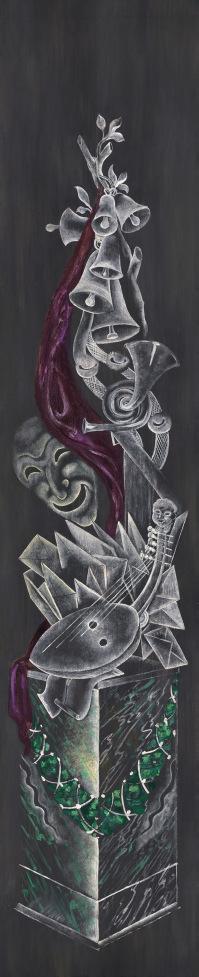
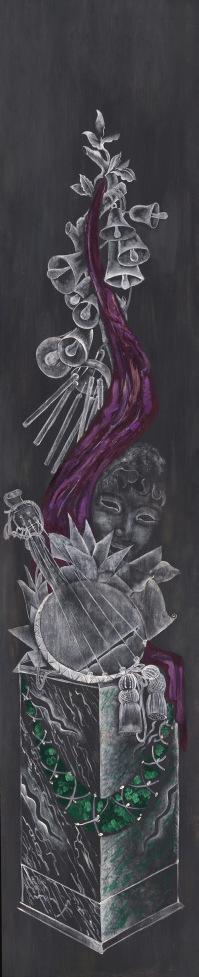
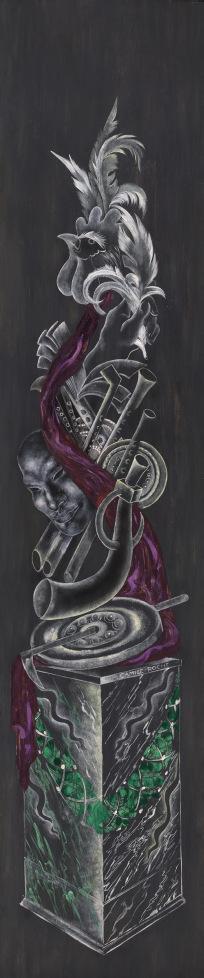
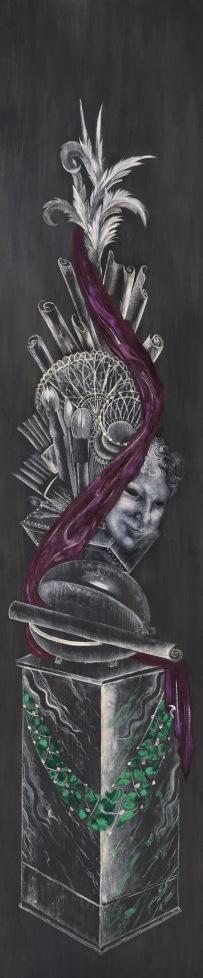
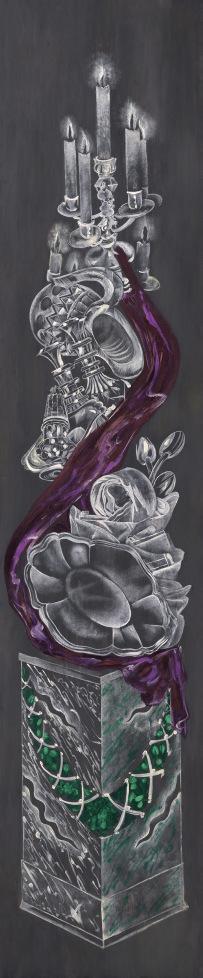
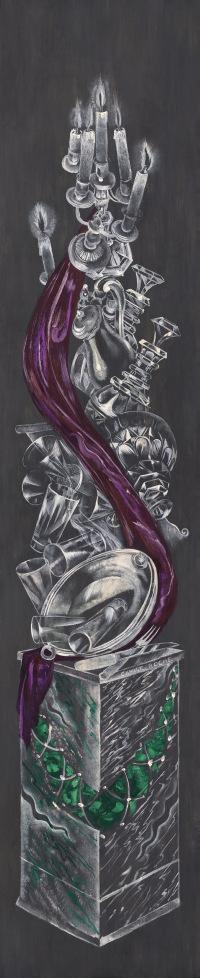
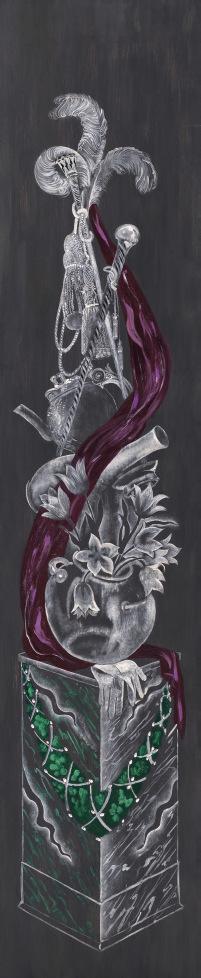
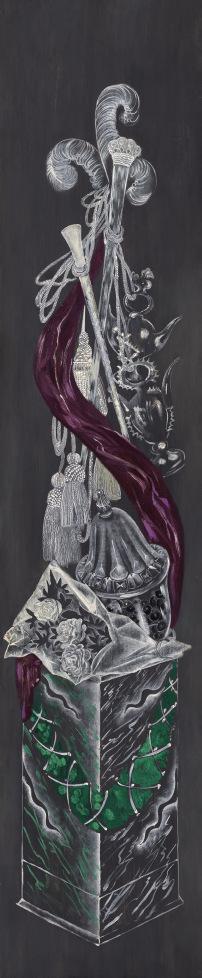
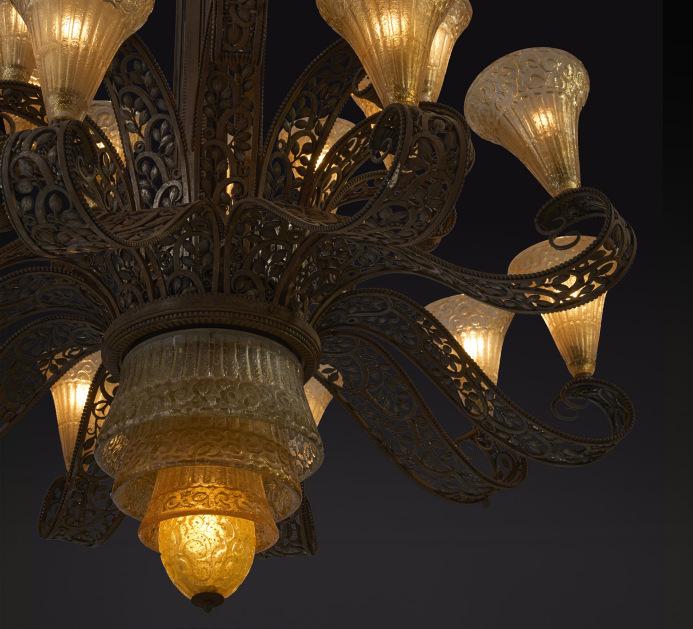
Edgar Brandt, the remarkably versatile artist-blacksmith of the early twentieth century, built his career on applying modern metalworking technologies to express the spirit of his time. Composed of geometric forms and motifs drawn from nature like birds, flowers, waterfalls, sunbursts and clouds, Brandt’s superbly crafted metalwork, with its refined and elegant scrolls, came to embody the essence of French Art Deco. He believed that decorative arts had relied on historicist models for too long, and although he mastered traditional forging with hammer and anvil, he readily adopted power hammers, oxy-acetylene welding, and other modern tools. These innovations, he felt, offered far greater expressive freedom. As he stated, “In order to create, the artist must use all the means that science places at his disposal.” This forward-looking philosophy allowed him to develop an ironwork vocabulary that earned him international acclaim.
Already well known before the Paris Exhibition of 1925, Brandt achieved even greater fame with his extraordinary Porte d’Honneur, created with the architects André Ventre and Henri Favier, and with his own presentation in the Salon d’Ameublement. When the Exposition Internationale des Arts Décoratifs et Industriels Modernes opened on April 15, 1925, Brandt served as a judge for the metalwork section and presented works throughout the fair. His display in booth 45 was distinguished by masterpieces including the magnificent L’Oasis fivepanel screen, often considered his finest work, as well as the present model of extraordinary twenty-light chandelier, its grand scrolling arms unfurling like a regal flower. In the same booth, planned as a narrow vestibule, Brandt assembled tables, grills, sconces, torchères and vases. Critics and visitors alike praised the installation, affirming his status as hors concours
Brandt’s extensive contributions to the 1925 exhibition led to major commissions, among them his first American project: the entrance,
window frames, decorative ironwork, and grilles for the MadisonBelmont Building at Madison Avenue and 34th Street, along with the interior showroom for the Cheney Brothers fabric house. These successes prompted him to open a New York office, Ferrobrandt Inc., and to expand his Paris atelier. Over the following years he produced metalwork for hotels, embassies, museums, ocean liners including the Normandie and for elite European and American clients. He often collaborated with leading designers such as Émile-Jacques Ruhlmann, and for his lighting designs he partnered with Daum in Nancy, who supplied colored glass shades. Eager to unite art and industry, Brandt combined wrought iron with bronze, steel, or aluminum, experimenting with varied patinas and introducing unprecedented technical and aesthetic possibilities. The interwar period proved a golden age for metalwork, and Brandt emerged as its most influential figure, redefining the role of elaborated metalwork in architecture and interior design.
The present chandelier embodied this achievement at the Paris 1925 fair. Suspended above a circular table supported by large S-scrolls, it featured two tiers of delicate floral arms adorned with vines, leaves, stylized flowers, and small berries. The larger arms curved outward and upward while the smaller ones spiraled downward, creating a dynamic interplay of forms that could be appreciated from multiple angles. Twenty bell-shaped, acid-etched Daum glass shades incised with paired C-scrolls echoed the ironwork, and four graduated shades below added further illumination. Lightly gilded iron over a rich brown-gold patina and glass shades flecked with verreries métalliques produced a warm glow that harmonized with the room’s palette of gray, silver, and gold and with the indirect cove lighting above. The chandelier served as the radiant centerpiece of a space that showcased the artistic and technical mastery that made Edgar Brandt the preeminent ironworker of his era.
Present lot (detail)
Edgar Brandt’s booth at the Exposition Internationale des Arts Décoratifs et Industriels Modernes, Paris, 1925. Ironwork by Brandt. Joseph Bernard, sculptor. Henri Favier, architect.
PROPERTY FROM AN IMPORTANT EUROPEAN COLLECTION
φ28
EDGAR BRANDT (1880-1960) AND DAUM FRÈRES
CHANDELIER, CIRCA 1925
patinated wrought-iron, acid-etched glass shades with gold leaf inclusions 46 in. (117 cm) drop, 43 in. (109.5 cm) diameter stamped E Brandt and each shade engraved Daum Nancy with the Croix de Lorraine
$400,000-600,000
PROVENANCE:
Rod Stewart, Los Angeles
Sotheby's, New York, 9 June 2000, lot 182
Steven A. Greenberg, New York
The Steven A. Greenberg Collection: Masterpieces of French Art Deco, Christie's, New York, 12 December 2012, lot 33 Acquired from the above by the present owner
LITERATURE:
For period photographs of the model on Edgar Brandt's booth at the Exposition Internationale des Arts Décoratifs et Industriels Modernes, Paris, 1925:
G. Rémon, "Edgar Brandt à l'Exposition Internationale des Arts Décoratifs," Mobilier et Décoration, Paris, no. 8, July 1925, p. 97
M. Dufrêne, Ensembles Mobiliers : Exposition Internationale 1925, Paris, 1925, pl. 30
G. Janneau, Le luminaire et les moyens d'eclairage nouveaux, Paris, 1926, pl. 5
J. Kahr, Edgar Brandt: Master of Art Deco Ironwork, New York, 1999, pp. 139140, 162 (for a period photograph of the model in the Galerie Edgar Brandt, Paris, 1926)
A. Duncan, Art Deco Complete, London, 2009, p. 230, 274 (for a period photograph)
J. Kahr, Edgar Brandt: Art Deco Ironwork, Atglen, PA, 2010, pp. 119-120, 139 (for a period photograph of the model in the Galerie Edgar Brandt, Paris, 1926)
This model was exhibited at the Exposition Internationale des Arts Décoratifs et Industriels Modernes, Paris, 1925.
Christie's would like to thank Joan Kahr for her assistance with the authentication and cataloguing of this lot.
PROPERTY FROM THE DISTINGUISHED COLLECTION OF MS. EVA CHOW
29
LEARN MORE
JEAN DUNAND (1877-1942)
PAIR OF FOLDING GAMES TABLES FOR TEMPLETON CROCKER, SAN FRANCISCO, CIRCA 1927-1928
lacquered wood, felt
27Ω x 31¿ x 31¿ in. (69.8 x 79 x 79 cm) (each) each stamped JEAN DUNAND LAQUEUR (2)
$80,000-120,000
PROVENANCE:
Charles Templeton Crocker, San Francisco, commissioned directly from the artist, circa 1927-1928
Sotheby's, London, 19 October 2000, lot 118
Acquired from the above by the present owner
Charles Templeton Crocker, San Francisco, commissioned directly from the artist, circa 1927-1928
DeLorenzo Gallery, New York
Christie's, New York, 20 June 2002, lot 76
Acquired from the above by the present owner
LITERATURE: Jean Dunand, exh. cat., DeLorenzo Gallery, New York, 1985, p. 54 (for a related example)
F. Marcilhac, Jean Dunand, His Life and Work, London, 1991, pp. 113 (for a discussion of the commission) 319, no. 1120 (for a related example)
F. and A. Marcilhac, Jean Dunand, Paris, 2020, pp. 117 (for a discussion of the commission), 294, no. 89 (for a related example)
Although the main patrons of Art Deco were based in France, one of the period’s most ambitious and complete residential interiors was created in the United States: the San Francisco penthouse of Charles Templeton Crocker, the millionaire grandson of the founder of the Union Pacific Railroad. Crocker had bought the Russian Hill property in 1927 and traveled to Paris where he met decorator Jean-Michel Frank whom he commissioned to decorate the apartment.
At a time when the city remained steeped in Victoriana, the apartment made a radical statement. Vogue declared it in 1929 “the first large and luxurious apartment done completely in the modern manner in the United States,” and “perhaps one of the most beautiful apartments in the world.” The living room featured parchment-clad walls and ceilings, mica-inlaid fireplace surrounds, ivory Morocco leather seating, and tables in shagreen, straw, and parchment, softly illuminated by rose quartz and obsidian lamps.
The penthouse was also a collaborative masterpiece with the dining room, breakfast room, and master bedroom designed by Jean Dunand, whose work contrasted boldly with Frank’s restraint. Trained as a
sculptor and master of dinanderie and lacquer, Dunand was celebrated for his dramatic use of color and for his signature eggshell lacquer inlaid with coquille d’œuf (eggshell). At Crocker’s, Jean Dunand created a vibrant dining room with red-brown lacquer furniture inlaid with crushed eggshell and walls of sweeping gold and silver rays. The adjacent breakfast room, conceived as an underwater fantasy, featured etched tropical fish on black onyx lacquer, pink and silver furnishings, and chrome-tubed chairs. The bedroom combined black and grey lacquer furniture with silver-toned woodland scenes in laque arraché, including inlaid animal figures.
The present pair of games tables were originally placed in the bedroom, their “sponged” surface exemplifying Dunand’s preferred lacque arraché technique, in which a final lacquer layer is applied over a roughened undercoat: here, metallic gray over black, and then polished so that the raised points of the lower layer emerge, producing a smooth yet subtly mottled effect. The ensemble was dismantled and dispersed in 1959.
Other furnishings from the Templeton Crocker penthouse designed by Jean Dunand can be found in the permanent collection of the The Metropolitan Museum of Art, New York.
Charles Templeton Crocker’s bedroom, San Francisco, 1928.
EDLIS | NEESON COLLECTION
°30
JEAN DUNAND (1877-1942)
BONBONNIÈRE FOR MADAME AGNÈS, PARIS, CIRCA 1925
lacquered Oréum, eggshell inlay, painted wood
2æ in. (7 cm) high, 5 in. (12.7 cm) diameter
incised JEAN DUNAND AFFECTUEUSEMENT A MME AGNES and impressed OREUM
$6,000-8,000
PROVENANCE:
Madame Agnès, Paris, acquired directly from the artist Steven A. Greenberg, New York
The Steven A. Greenberg Collection: Masterpieces of French Art Deco, Christie's, New York, 13 December 2012, lot 88
Acquired from the above by the present owner
LITERATURE:
F. Marcilhac and A. Marcilhac, Jean Dunand, Paris, 2020, p. 370, no. 34 (for a related example)
Jean Dunand significantly impacted the world of fashion in the 1920s by creating jewelry, decorating accessories and collaborating with fashion designers such as Jeanne Lanvin and Madeleine Vionnet, incorporating his signature lacquered metal and eggshell inlay designs into everyday objects.
He met Parisian milliner Madame Agnès in the early 1920s and the two quickly started to collaborate extensively and exclusively, Dunand decorating the designer's showroom with lacquered walls and furniture, creating fashion accessories, decorative panels, and creating vases for her booth at the 1925 Exposition des Arts Décoratifs et Industriels Modernes.
Agnès later commissioned Dunand to decorate her studio and personal Parisian apartment with sumptuous gilt lacque arraché furniture, published in La Renaissance de l'art français, Paris, April 1927.
(mark)
LEARN MORE
EDLIS | NEESON COLLECTION
°31
LEARN MORE
JEAN DUNAND (1877-1942)
LIPSTICK HOLDER, CIRCA 1925
lacquered metal, eggshell inlay
2¿ in. (5.5 cm) high, ¬ in. (1 cm) diameter
$4,000-6,000
PROVENANCE:
Steven A. Greenberg, New York
The Steven A. Greenberg Collection: Masterpieces of French Art Deco, Christie's, New York, 13 December 2012, lot 100
Acquired from the above by the present owner
°32
JEAN DUNAND (1877-1942)
VASE, CIRCA 1925
lacquered metal, eggshell inlay
9Ω in. (24 cm) high, 6 in. (15.2 cm) diameter signed JEAN DUNAND
$30,000-50,000
PROVENANCE:
Steven A. Greenberg, New York
The Steven A. Greenberg Collection: Masterpieces of French Art Deco, Christie's, New York, 13 December 2012, lot 188
Acquired from the above by the present owner
LITERATURE:
Jean Dunand, exh. cat., DeLorenzo Gallery, New York, 1985, p. 78 (for a related example)
F. Marcilhac, Jean Dunand: His Life and Works, New York, 1991, p. 307, no. 1018 (for a related example)
A. Duncan, Art Deco Complete, London, 2009, p. 290 (present lot illustrated)
F. Marcilhac and A. Marcilhac, Jean Dunand, Paris, 2020, p. 351, no. 39 (for a related example)
EDLIS | NEESON COLLECTION
°33
JEAN DUNAND (1877-1942)
COUPE, CIRCA 1925
lacquered metal, eggshell inlay
1º in. (3.2 cm) high, 4æ in. (12 cm) diameter signed J.D.
$10,000-15,000
PROVENANCE:
DeLorenzo Gallery, New York
Steven A. Greenberg, New York
The Steven A. Greenberg Collection: Masterpieces of French Art Deco, Christie's, New York, 13 December 2012, lot 51
Acquired from the above by the present owner
ÉMILE-JACQUES RUHLMANN (1879-1933)
ÉMILE-JACQUES RUHLMANN'S PERSONAL DESK, 1929, AND ARMCHAIR, CIRCA 1930-1933
Macassar ebony, oak, yellow peroba, sipo, chrome-plated metal, maillechort and glass ; two original keys, electrical components (desk) cast iron, painted metal, chrome-plated metal, leather upholstery, oak and plywood (armchair)
53¡ x 107¿ x 65 in. (135.5 x 272 x 165 cm) (desk)
34º x 23º x 24æ in. (87 x 59 x 63 cm) (armchair)
desk branded Ruhlmann four times, with the Atelier B mark and DEROUBAIX
$800,000-1,200,000
PROVENANCE:
The artist, 27 rue de Lisbonne, Paris
Thence by descent
Marcel Miguet, Paris, acquired from Ruhlmann & Laurent, circa 1935-1936
Thence by descent
Jules Deroubaix, Paris
Galerie Marc Perpitch, Paris
DeLorenzo Gallery, New York, by 1990
Acquired from the above by the family of the present owner
EXHIBITED:
Paris, Pavillon de Marsan, Palais du Louvre, Musée des Arts Décoratifs, Exposition rétrospective E.-J. Ruhlmann, October-December 1934, no. 118 (present desk)
London, Victoria and Albert Museum, Maharaja: The Splendour of India's Royal Courts, October 2009-January 2010, p. 40 (present desk)
LITERATURE:
"Immeuble de la Compagnie Sulzer, rue Cognacq-Jay," L'Architecture d'aujourd'hui, Paris, December 1933, p. 50, no. 9 (for a related armchair)
"Émile-Jacques Ruhlmann, un précurseur du Design", Le courrier des Métiers d'Art, Paris, May 1981, p. 63, no. 16 (present desk)
F. Camard, Ruhlmann, Paris, 1983, p. 201 (present desk)
C. McGee, "Art Déco Classics at DeLorenzo," Architectural Digest, April 1988, p. 222 (present desk)
Ruhlmann, un génie de l'Art Déco, exh. cat.,, Musée des Années 30, BoulogneBillancourt, 2001, pp. 149-150 (present desk)
E. Bréon, Jacques-Émile Ruhlmann, mobilier, Paris, 2004, p. 69 (present desk)
Ruhlmann, Genius of Art Deco, exh. cat., The Metropolitan Museum of Art, New York, 2004, p. 127 (present desk)
F. Camard, Jacques Émile Ruhlmann, Saint-Rémy-en-l'Eau, 2009, p. 300 (present desk)
This desk model is recorded under number 1517NR in the Ruhlmann Archives, Musée des Années 30, Boulogne-Billancourt.
φ Import tariff Please note that this lot is subject to an import tariff. The amount of the import tariff due is a percentage of the final hammer price plus buyer’s premium. The buyer should contact Post Sale Services prior to the sale to determine the estimated amount of this import tariff. If the buyer instructs Christie’s to arrange shipping of the lot to a foreign address, the buyer will not be required to pay an import tariff, but the shipment may be delayed while awaiting approval to export from the local government. If the buyer instructs Christie’s to arrange the shipment of the lot to a domestic address, if the buyer collects the property in person, or if the buyer arranges their own shipping (whether domestically or internationally), the buyer will be required to pay the import tariff. For the purpose of calculating sales tax, if applicable, the import tariff will be added to the final hammer price plus buyer’s premium and sales tax will be collected as per The Buyer’s Premium and Taxes section of the Conditions of Sale.
Present desk in Ruhlmann’s studio, 27 rue de Lisbonne, Paris, circa 1930. Courtesy of Olivier Old / All rights reserved.
LEARN MORE
EDLIS | NEESON COLLECTION
°35
ÉMILE-JACQUES RUHLMANN (1879-1933)
CARPET, CIRCA 1925
hand-knotted wool
14 ft. x 10 ft. 2 in. (426.7 x 310 cm)
$100,000-150,000
PROVENANCE:
Christie's, New York, 11 June 1998, lot 75 Acquired from the above by the present owner
LITERATURE:
G. Rémon, "Le XXIIe Salon des artistes décorateurs," Mobilier et Décoration, Paris, no. 6, June 1932, p. 255 (for a period photograph of an interior with a related example)
J.-L. Gaillemin, "Ornement et modernité," Connaissance des arts, Paris, special issue dedicated to Ruhlmann, no. 171, 2001, p. 48 (for a related example)
F. Camard, Jacques Émile Ruhlmann, Saint-Rémy-en-l'Eau, 2009, p. 369 (for a period photograph of a related example)
This model is recorded under number 3176NR in the Ruhlmann Archives, Musée des Années 30, Boulogne-Billancourt.
EDLIS | NEESON COLLECTION
°36
ÉMILE-JACQUES RUHLMANN (1879-1933)
PAIR OF STOOLS, CIRCA 1925
burl walnut, silvered bronze, fabric upholstery
16 x 28Ω x 19 in. (40.6 x 72.4 x 48.3 cm) (each) (2)
$100,000-150,000
PROVENANCE:
Sotheby's, London, 29 March 1996, lot 281 Acquired from the above by the present owner
LITERATURE:
Les Échos des Industries d'art, Paris, no. 35, June 1928, p. 11 (for a period photograph)
Art et Décoration, Paris, February 1929, p. 6 (for an advertisement with the model)
F. Camard, Ruhlmann, Paris, 1983, pp. 118, 147 (for period photographs)
E. Bréon, Jacques-Émile Ruhlmann, the designer's archives: furniture, Paris, 2004, pp. 82-83 (for a period photograph)
F. Camard, Jacques Émile Ruhlmann, Saint-Rémy-en-l'Eau, 2009, pp. 272-273 (for period photographs)
F. Camard, Jacques Émile Ruhlmann, New York, 2011, pp. 272-273 (for period photographs)
This model is recorded under number 121AR/481NR in the Ruhlmann Archives, Musée des Années 30, Boulogne-Billancourt.
This model was exhibited at the Salon des artistes décorateurs, Paris, 1928.
LEARN MORE
EDLIS | NEESON COLLECTION
°37
ÉMILE-JACQUES RUHLMANN (1879-1933)
'BOUILLOTTE' TABLE LAMP, CIRCA 1928
gilt bronze, lacquered metal, ivorine
26Ω in. (67.4 cm) high, 14æ in. (37.5 cm) diameter of shade
$50,000-70,000
PROVENANCE:
Sotheby's, London, 27 March 1997, lot 340 Acquired from the above by the present owner
LITERATURE:
A. Lévy ed., L'Hôtel du Collectionneur, Paris, 1925, pl. XI (for a period photograph)
E. Tisserand, “Chroniques de l’Art Décoratif, les projets de M. Ruhlmann,” L’Art Vivant, no. 22, November 1925, p. 27 (for a period photograph)
M. Dufrène, Ensembles Mobiliers : Exposition Internationale 1925, Paris, 1925, pl. 4 (for a period photograph)
Les Échos des Industries d'art, Paris, no. 39, October 1928, p. 19 (for a period photograph)
F. Camard, Ruhlmann, Paris, 1983, pp. 122-123, 167 (for period photographs)
F. Camard, Ruhlmann: Master of Art Deco, New York, 1984, pp. 122-123, 166 (for period photographs)
Ruhlmann: un génie de l’Art Déco, exh. cat., Musée des Années 30, BoulogneBillancourt, 2001, p. 225 (for a drawing)
Ruhlmann: Genius of Art Deco, exh. cat., The Metropolitan Museum, New York, 2004, p. 51 (for a period photograph)
F. Camard, Jacques Émile Ruhlmann, Saint-Remy-en-l'Eau, 2009, pp. 179, 324325, 427 (for period photographs) and 329
F. Camard, Jacques Émile Ruhlmann, New York, 2011, pp. 179, 324-325, 427 (for period photographs) and 329
This model is recorded under number 3048AR/3342NR in the Ruhlmann Archives, Musée des Années 30, Boulogne-Billancourt.
This model was exhibited in the Cabinet de Travail of the Hôtel du Collectionneur at the Exposition Internationale des Arts Décoratifs et Industriels Modernes, Paris, 1925.
GIO PONTI (1891-1979)
PESCE, MODEL NO. 426S, CIRCA 1924-1925
manufactured by Richard-Ginori, Florence, Italy partially gilt porcelain
6Ω x 10√ x 3 in. (16.5 x 27.5 x 7.5 cm)
with green manufacturer's mark RICHARD GINORI, MADE IN ITALY 9e, with gold sticker RICHARD-GINORI PITTORIA DI DOCCIA and with painter's signature
$20,000-30,000
LITERATURE:
G. Marangoni, Le arti del fuoco: ceramica-vetri-vetrate, Milan, 1927, pl. 17
F. Reggiori, "La Terza Biennale delle Arti Decorative a Monza," Architettura e Arti Decorative, Milan, fasc. VII, March 1928, p. 313
Domus, Milan, no. 10, October 1928, p. 7
L. Manna, Gio Ponti. Le maioliche, Milan, 2000, p. 31 (for a period photograph of Richard-Ginori's pavilion at the Exposition Internationale des Arts Décoratifs et Industriels Modernes, Paris, 1925)
V. Terraroli, Italian Art Ceramics 1900-1950, Milan, 2007, p. 12
G. Celant eds., espressioni di Gio Ponti, Milan, 2011, p. 21, no. 10
L. Frescobaldi Malenchini, M. Teresa Giovannini and O. Rucellai eds., Gio Ponti. La collezione del Museo Richard-Ginori della Manifattura di Doccia, Florence, 2015, pp. 500-501, cat. no. 447
This lot is accompanied by a certificate of expertise from the Gio Ponti Archives.
This model was exhibited at the Exposition Internationale des Arts Décoratifs et Industriels Modernes, Paris, 1925.
This model can be found in the permanent collection of the Museo RichardGinori della Manifattura di Doccia, Florence (inv. no. 3314).
Christie's would like to thank Brian Kish for his assistance with the cataloguing of this lot.
LEARN MORE
PROPERTY OF A LADY 39
JEAN DUPAS (1882-1964)
'THE SALON DE L'ARGENTERIE' MURAL FOR CAROL II, KING OF ROMANIA, COMMISSIONED FOR THE ROYAL PALACE OF BUCHAREST, CIRCA 1938-1940
oil on canvas
151 x 305 in. (383.5 x 774.7 cm) (overall)
140 x 295 in. (355.6 x 749.3 cm) (painted area)
$100,000-150,000
LEARN MORE
PROVENANCE: Family of the artist
Michael Pruskin, London, circa 1980
Pruskin: Decorative Art 1880-1960, Sotheby's, London, 2 April 2008, lot 287
Acquired from the above by the present owner
This lot is accompanied by a portfolio containing photographs of sketches and photocopies of correspondence between the artist and the Royal Household.
This work will be included in the Jean Dupas catalogue raisonné currently being prepared by Romain Lefebvre.
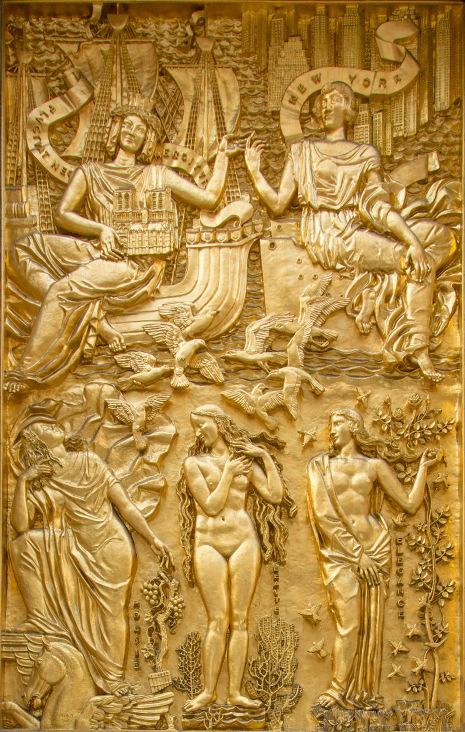
Following the success of the 1925 Exposition Internationale des Arts Décoratifs et Industriels Modernes in Paris, Art Deco style swept across New York, emerging to embody the glamour, riches, and success brought about by the 'Roaring Twenties', and immortalized through transformative city landmarks such as the Chrysler building. While Art Deco at this time represented the future of modern decorative arts and architecture, the economic crash of 1929 brought with it the sobering realities of the interwar period, and economic hardship in which Art Deco style and monumental architecture came to take on a new, aspirational significance. Through the momentous construction of New York's Rockefeller Center in the 1930s as an international hub of culture and commerce, Alfred Auguste Janniot's facade of the Center's La Maison Française personified a timeless message of friendship and harmony through the gilded bronze basrelief 'L'amitié entre l'Amérique et la France'.
The full plaque depicts two female personifications of France and America reaching across the sea in a friendly embrace; bordered by the Three Graces representing Elegance, Beauty, and Poetry in Janniot's distinctive modern decorative style, and Greco-Roman influence. Janniot’s interest in classical themes, as well as mannerist forms were on view during the 1925 Exposition Internationale des Arts Décoratifs, with his sculpture 'Hommage à Jean Goujon' at the entrance to Émile-Jacques Ruhlmann's Hôtel du Collectionneur honoring the
French Renaissance artist, and reimagining antiquity in the style of Art Moderne.
This success in 1925 lead to Janniot's selection for the Rockefeller project by architects Raymond Hood and Wallace K. Harrison. Harrison in particular admired Janniot's design, and displayed the present original plaster maquette of the 'Élégance' figure in his New York apartment for many years. The gilt bronze bas-relief, with its monumental, yet softly modeled female figures, complemented the austere limestone facades and imposing scale of Rockefeller Center, and bestowed a timeless, yet modern quality through the inclusion of the Three Graces, a classical motif favored by Janniot. The 'Élégance' in particular emphasized Janniot's sculptural mastery of both figure and fabric, and the birds and tendrils of vines creeping up the border of the bas-relief stand out amidst the metropolitan surroundings of New York City.
In Alfred Janniot's depiction, the friendship and camaraderie between the personifications of America and France are endowed by the presence of the Three Graces, who imbue the union with the attributes of Elegance, Beauty, and Poetry. This image, in the refined style of French Art Deco, speaks as much about the ambitions for Rockefeller Center as an international center of business, art, and culture, as it does to the significance of Art Deco at the time, as a symbol of cosmopolitan, modern, and prosperous times to strive towards.
Alfred Auguste Janniot, bronze bas-relief ‘L’amitié entre l’Amérique et la France’, designed for La Maison Française in Rockefeller Center, 610 Fifth Avenue, New York, 1934. © 2025 Artists Rights Society (ARS), New York / ADAGP, Paris. Thom Land/Alamy
La Maison Française in Rockefeller Center, 610 Fifth Avenue, New York. © 2025 Artists Rights Society (ARS), New York / ADAGP, Paris. Patti McConville/Alamy
ALFRED AUGUSTE JANNIOT (1889-1969)
'ÉLÉGANCE', ORIGINAL PLASTER MAQUETTE FOR THE BRONZE BASRELIEF 'L'AMITIÉ ENTRE L'AMÉRIQUE ET LA FRANCE', DESIGNED FOR LA MAISON FRANÇAISE IN ROCKEFELLER CENTER, 610 FIFTH AVENUE, NEW YORK, CIRCA 1933-1934
plaster
99¬ x 46Ω x 11 in. (253 x 118 x 28 cm)
$150,000-250,000
PROVENANCE:
Wallace K. Harrison, architect of Rockefeller Center, New York, circa 19331934
Harold and Hester Diamond, New York Grey Art Gallery, New York University Art Collection, 1982
De-accessioned from the above and acquired by Maison Gérard, New York, 2007
Galerie Martin du Louvre, Paris, 2007
Acquired from the above by the present owner, 2008
EXHIBITED:
Saint-Quentin, Musée des Beaux-Arts Antoine Lécuyer, Alfred Janniot (18891969). De l'atelier au monumental, April - September 2022, pp. 134, 137 (for the bronze cast bas-relief in Rockefeller Center), 136 (present lot illustrated) Paris, Cité de l’Architecture et du Patrimoine, Art déco France-Amérique du Nord, l'émulation réciproque, October 2022 - March 2023, p. 130 (present lot illustrated)
LITERATURE:
P. Lamure, "La Maison Française de New York," Plaisir de France, Paris, no. 24, September 1936, pp. 16-19 (for a discussion of the commission and a period photograph of the bronze cast bas-relief in Rockefeller Center)
A. Demeurisse, Alfred Auguste Janniot 1889-1969, Paris, 2003, pp. 60-61 (present lot illustrated)
M. Giraud and F. Fravalo, Alfred Janniot 1889-1969: Propos mythologiques et modernes, Paris, 2006, p. 117 (for the bronze cast bas-relief in Rockefeller Center)
The plaster model 'Poésie', also a model for the bas-relief 'L'amitié entre l'Amérique et la France', can be found in the permanent collection of the Seattle Art Museum (inv. no. 2009.29).
Christie's would like to thank Anne Demeurisse for her assistance with the cataloguing of this lot.
LEARN MORE
Beaumont, J. 22, 23
C
Chareau, P. 14
Cheuret, A. 5
D da Silva-Bruhns, Ivan 12
Dunand, J. 1-4, 11, 16-19, 29-33
Dupas, J. 39
F Foujita, L. 25
G Groult, A. 20, 24
J Janniot, A. A. 40
M Miklos, G. 13
P Ponti, Gio 38
Printz, E. 15
R Roche, C. 27
Ruhlmann, E. 37
Ruhlmann, E.-J. 6-10, 34-36
V Vergé, J. 26
CONDITIONS OF SALE • BUYING AT CHRISTIE’S
CONDITIONS OF SALE
These Conditions of Sale and the Important Notices and Explanation of Cataloguing Practice set out the terms on which we offer the lots listed in this catalogue for sale. By registering to bid and/or by bidding at auction you agree to these terms, so you should read them carefully before doing so. You will find a glossary at the end explaining the meaning of the words and expressions coloured in bold. As well as these Conditions of Sale, lots in which we offer Non-Fungible Tokens are governed by the Additional Conditions of Sale – Non-Fungible Tokens, which are available in Appendix A herein. For the sale of Non-Fungible Tokens, to the extent there is a conflict between the “New York Conditions of Sale Buying at Christie’s” and “Additional Conditions of Sale – Non-Fungible Tokens”, the latter controls. Unless we own a lot in whole or in part, Christie’s acts as agent for the seller.
A BEFORE THE SALE
1 DESCRIPTION OF LOTS
(a)Certain words used in the catalogue description have special meanings. You can find details of these on the page headed “Important Notices and Explanation of Cataloguing Practice” which forms part of these terms. You can find a key to the Symbols found next to certain catalogue entries under the section of the catalogue called “Symbols Used in this Catalogue”.
(b)Our description of any lot in the catalogue, any condition report and any other statement made by us (whether orally or in writing) about any lot, including about its nature or condition, artist, period, materials, approximate dimensions, or provenance are our opinion and not to be relied upon as a statement of fact. We do not carry out in-depth research of the sort carried out by professional historians and scholars. All dimensions and weights are approximate only.
2 OUR RESPONSIBILITY FOR OUR DESCRIPTION OF LOTS
We do not provide any guarantee in relation to the nature of a lot apart from our authenticity warranty contained in paragraph E2 and to the extent provided in paragraph I below.
3 CONDITION
(a)The condition of lots sold in our auctions can vary widely due to factors such as age, previous damage, restoration, repair and wear and tear. Their nature means that they will rarely be in perfect condition Lots are sold “as is,” in the condition they are in at the time of the sale, without any representation or warranty or assumption of liability of any kind as to condition by Christie’s or by the seller.
(b)Any reference to condition in a catalogue entry or in a condition report will not amount to a full description of condition, and images may not show a lot clearly. Colours and shades may look different in print or on screen to how they look on physical inspection. Condition reports may be available to help you evaluate the condition of a lot Condition reports are provided free of charge as a convenience to our buyers and are for guidance only. They offer our opinion but they may not refer to all faults, inherent defects, restoration, alteration or adaptation because our staff are not professional restorers or conservators. For that reason condition reports are not an alternative to examining a lot in person or seeking your own professional advice. It is your responsibility to ensure that you have requested, received and considered any condition report.
4 VIEWING LOTS PRE-AUCTION
(a)If you are planning to bid on a lot, you should inspect it personally or through a knowledgeable representative before you make a bid to make sure that you accept the description and its condition. We recommend you get your own advice from a restorer or other professional adviser.
(b)Pre-auction viewings are open to the public free of charge. Our specialists may be available to answer questions at preauction viewings or by appointment.
5 ESTIMATES
Estimates are based on the condition, rarity, quality and provenance of the lots and on prices recently paid at auction for similar property. Estimates can change. Neither you, nor anyone else, may rely on any estimates as a prediction or guarantee of the actual selling price of a lot or its value for any other purpose. Estimates do not include the buyer’s premium or any applicable taxes.
6 WITHDRAWAL
Christie’s may, at its option, withdraw any lot from auction at any time prior to or during the sale of the lot. Christie’s has no liability to you for any decision to withdraw.
7 JEWELLERY
(a)Coloured gemstones (such as rubies, sapphires and emeralds) may have been treated to improve their look, through methods such as heating and oiling. These methods are accepted by the international jewellery trade but may make the gemstone less strong and/or require special care over time.
(b)It will not be apparent to us whether a diamond is naturally or synthetically formed unless it has been tested by a gemmological laboratory. Where the diamond has been tested, a gemmological report will be available.
(c) All types of gemstones may have been improved by some method. You may request a gemmological report for any item which does not have a report if the request is made to us at least three weeks before the date of the auction and you pay the fee for the report.
(d)Certain weights in the catalogue description are provided for guidance purposes only as they have been estimated through measurement and, as such, should not be relied upon as exact.
(e) We do not obtain a gemmological report for every gemstone sold in our auctions. Where we do get gemmological reports from internationally accepted gemmological laboratories, such reports will be described in the catalogue. Reports from American gemmological laboratories will describe any improvement or treatment to the gemstone. Reports from European gemmological laboratories will describe any improvement or treatment only if we request that they do so, but will confirm when no improvement or treatment has been made. Because of differences in approach and technology, laboratories may not agree whether a particular gemstone has been treated, the amount of treatment, or whether treatment is permanent. The gemmological laboratories will only report on the improvements or treatments known to the laboratories at the date of the report. We do not guarantee nor are we responsible for any report or certificate from a gemmological laboratory that may accompany a lot
(f)For jewellery sales, estimates are based on the information in any gemmological report, or if no report is available, assume that the gemstones may have been treated or enhanced.
8 WATCHES & CLOCKS
(a)Almost all clocks and watches are repaired in their lifetime and may include parts which are not original. We do not give a warranty that any individual component part of any watch is authentic. Watchbands described as “associated” are not part of the original watch and may not be authentic. Clocks may be sold without pendulums, weights or keys.
(b)As collectors’ watches often have very fine and complex mechanisms, you are responsible for any general service, change of battery, or further repair work that may be necessary. We do not give a warranty that any watch is in good working order. Certificates are not available unless described in the catalogue.
(c)Most wristwatches have been opened to find out the type and quality of movement. For that reason, wristwatches with water resistant cases may not be waterproof and we recommend you have them checked by a competent watchmaker before use.
Important information about the sale, transport and shipping of watches and watchbands can be found in paragraph H2(f).
B REGISTERING TO BID
1 NEW BIDDERS
(a)If this is your first time bidding at Christie’s or you are a returning bidder who has not bought anything from any of our salerooms within the last two years you must register at least 48 hours before an auction begins to give us enough time to process and approve your registration. We may, at our option, decline to permit you to register as a bidder. You will be asked for the following:
(i)for individuals: Photo identification (driver’s licence, national identity card, or passport) and, if not shown on the ID document, proof of your current address (for example, a current utility bill or bank statement);
(ii)for corporate clients: Your Certificate of Incorporation or equivalent document(s) showing your name and registered address together with documentary proof of directors and beneficial owners; and
(iii)for trusts, partnerships, offshore companies and other business structures, please contact us in advance to discuss our requirements.
(b)We may also ask you to give us a financial reference and/or a deposit as a condition of allowing you to bid. For help, please contact our Client Services Department at +1 212-636-2000.
2 RETURNING BIDDERS
As described in paragraph B(1) above, we may at our option ask you for current identification, a financial reference, or a deposit as a condition of allowing you to bid. If you have not bought anything from any of our salerooms within the last two years or if you want to spend more than on previous occasions, please contact our Client Services Department at +1 212-636-2000.
3
IF YOU FAIL TO PROVIDE THE RIGHT DOCUMENTS
If in our opinion you do not satisfy our bidder identification and registration procedures including, but not limited to completing any anti-money laundering and/or anti-terrorism financing checks we may require to our satisfaction, we may refuse to register you to bid, and if you make a successful bid, we may cancel the contract for sale between you and the seller.
4 BIDDING ON BEHALF OF ANOTHER PERSON
If you are bidding on behalf of another person, that person will need to complete the registration requirements above before you can bid and supply a signed letter authorising you to bid for him/ her. A bidder accepts personal liability to pay the purchase price and all other sums due unless it has been agreed in writing with Christie’s, before commencement of the auction, that the bidder is acting as an agent on behalf of a named third party acceptable to Christie’s and that Christie’s will only seek payment from the named third party.
5 BIDDING IN PERSON
If you wish to bid in the saleroom you must register for a numbered bidding paddle at least 30 minutes before the auction. You may register online at www.christies.com or in person. For help, please contact the Client Service Department on +1 212-636-2000.
6 BIDDING SERVICES
The bidding services described below are a free service offered as a convenience to our clients and Christie’s is not responsible for any error (human or otherwise), omission, or breakdown in providing these services.
(a) Phone Bids
Your request for this service must be made no later than 24 hours prior to the auction. We will accept bids by telephone for lots only if our staff are available to take the bids. If you need to bid in a language other than in English, you must arrange this well before the auction. We may record telephone bids. By bidding on the telephone, you are agreeing to us recording your conversations. You also agree that your telephone bids are governed by these Conditions of Sale.
(b) Internet Bids on Christie’s LIVE™
For certain auctions we will accept bids over the Internet. For more information, please visit https://www.christies.com/ buying-services/buying-guide/register-and-bid/. As well as these Conditions of Sale, internet bids are governed by the Christie’s LIVE™ Terms of Use which are available at https:// www.christies.com/LiveBidding/OnlineTermsOfUse.aspx
(c) Written Bids
You can find a Written Bid Form at any Christie’s office, or by choosing the sale and viewing the lots online at www. christies.com. We must receive your completed Written Bid at least 24 hours before the auction. Bids must be placed in the currency of the saleroom. The auctioneer will take reasonable steps to carry out written bids at the lowest possible price, taking into account the reserve. If you make a written bid on a lot which does not have a reserve and there is no higher bid than yours, we will bid on your behalf at around 50% of the low estimate or, if lower, the amount of your bid. If we receive written bids on a lot for identical amounts, and at the auction these are the highest bids on the lot, we will sell the lot to the bidder whose written bid we received first.
C CONDUCTING THE SALE
1
WHO CAN ENTER THE AUCTION
We may, at our option, refuse admission to our premises or decline to permit participation in any auction or to reject any bid.
2
RESERVES
Unless otherwise indicated, all lots are subject to a reserve. We identify lots that are offered without a reserve with the symbol • next to the lot number. The reserve cannot be more than the lot’s low estimate, unless the lot is subject to a third party guarantee and the irrevocable bid exceeds the printed low estimate. In that case, the reserve will be set at the amount of the irrevocable bid. Lots which are subject to a third party guarantee arrangement are identified in the catalogue with the symbol °◆
3 AUCTIONEER’S DISCRETION
The auctioneer can at their sole option:
(a)refuse any bid;
(b)move the bidding backwards or forwards in any way they may decide, or change the order of the lots;
(c)withdraw any lot;
(d)divide any lot or combine any two or more lots;
(e)reopen or continue the bidding even after the hammer has fallen; and
(f)in the case of error or dispute related to bidding and whether during or after the auction, continue the bidding, determine the successful bidder, cancel the sale of the lot, or reoffer and resell any lot. If you believe that the auctioneer has accepted the successful bid in error, you must provide a written notice detailing your claim within 3 business days of the date of the auction. The auctioneer will consider such claim in good faith. If the auctioneer, in the exercise of their discretion under this paragraph, decides after the auction is complete, to cancel the sale of a lot, or reoffer and resell a lot, they will notify the successful bidder no later than by the end of the 7th calendar day following the date of the auction. The auctioneer’s decision in exercise of this discretion is final. This paragraph does not in any way prejudice Christie’s ability to cancel the sale of a lot under any other applicable provision of these Conditions of Sale, including the rights of cancellation set forth in paragraphs B(3), E(2)(i), F(4), and J(1).
4
BIDDING
The auctioneer accepts bids from:
(a)bidders in the saleroom;
(b)telephone bidders;
(c)internet bidders through Christie’s LIVE™ (as shown above in paragraph B6); and
(d)written bids (also known as absentee bids or commission bids) left with us by a bidder before the auction.
5
BIDDING ON BEHALF OF THE SELLER
The auctioneer may, at their sole option, bid on behalf of the seller, including where the seller is the auctioneer, up to but not including the amount of the reserve either by making consecutive bids or by making bids in response to other bidders.
The auctioneer will not identify these as bids made on behalf of the seller and will not make any bid on behalf of the seller at or above the reserve. If lots are offered without reserve, the auctioneer will generally decide to open the bidding at 50% of the low estimate for the lot. If no bid is made at that level, the auctioneer may decide to go backwards at their sole option until a bid is made, and then continue up from that amount. In the event that there are no bids on a lot, the auctioneer may deem such lot unsold.
6 BID INCREMENTS
Bidding generally starts below the low estimate and increases in steps (bid increments). The auctioneer will decide at their sole option where the bidding should start and the bid increments.
7
CURRENCY CONVERTER
The saleroom video screens (and Christies LIVE™) may show bids in some other major currencies as well as US dollars. Any conversion is for guidance only and we cannot be bound by any rate of exchange used. Christie’s is not responsible for any error (human or otherwise), omission or breakdown in providing these services.
8 SUCCESSFUL
BIDS
Unless the auctioneer decides to use their discretion as set out in paragraph C3 above, when the auctioneer’s hammer strikes, we have accepted the last bid. This means a contract for sale has been formed between the seller and the successful bidder. We will issue an invoice only to the registered bidder who made the successful bid. While we send out invoices by mail and/or email after the auction, we do not accept responsibility for telling you whether or not your bid was successful. If you have bid by written bid, you should contact us by telephone or in person as soon as possible after the auction to get details of the outcome of your bid to avoid having to pay unnecessary storage charges.
9
LOCAL BIDDING LAWS
You agree that when bidding in any of our sales that you will strictly comply with all local laws and regulations in force at the time of the sale for the relevant sale site.
D THE BUYER’S PREMIUM AND TAXES
1 THE BUYER’S PREMIUM
In addition to the hammer price, the successful bidder agrees to pay us a buyer’s premium on the hammer price of each lot sold. On all lots we charge 27% of the hammer price up to and including US$1,500,000, 22.0% on that part of the hammer price over US$1,500,000 and up to and including US$8,000,000, and 15.0% of that part of the hammer price above US$8,000,000.
2 TAXES
The successful bidder is responsible for any applicable taxes including any sales or use tax or equivalent tax wherever such taxes may arise on the hammer price, the buyer’s premium, and/ or any other charges related to the lot
For lots Christie’s ships to or within the United States, a sales or use tax may be due on the hammer price, buyer’s premium, and/or any other charges related to the lot, regardless of the nationality or citizenship of the successful bidder. Christie’s will collect sales tax where legally required. The applicable sales tax rate will be determined based upon the state, county, or locale to which the lot will be shipped. Christie’s shall collect New York sales tax at a rate of 8.875% for any lot collected from Christie’s in New York.
In accordance with New York law, if Christie’s arranges the shipment of a lot out of New York State, New York sales tax does not apply, although sales tax or other applicable taxes for other states may apply. If you hire a shipper (other than a common carrier authorized by Christie’s), to collect the lot from a Christie’s New York location, Christie’s must collect New York sales tax on the lot at a rate of 8.875% regardless of the ultimate destination of the lot
If Christie’s delivers the lot to, or the lot is collected by, any framer, restorer or other similar service provider in New York that you have hired, New York law considers the lot delivered to the successful bidder in New York and New York sales tax must be imposed regardless of the ultimate destination of the lot. In this circumstance, New York sales tax will apply to the lot even if Christie’s or a common carrier (authorized by Christie’s that you hire) subsequently delivers the lot outside New York.
Successful bidders claiming an exemption from sales tax must provide appropriate documentation to Christie’s prior to the release of the lot or within 90 days after the sale, whichever is earlier. For shipments to those states for which Christie’s is not required to collect sales tax, a successful bidder may have a use or similar tax obligation. It is the successful bidder’s responsibility to pay all taxes due. Christie’s recommends you consult your own independent tax advisor with any questions.
E WARRANTIES
1 SELLER’S WARRANTIES
For each lot, the seller gives a warranty that the seller:
(a)is the owner of the lot or a joint owner of the lot acting with the permission of the other co-owners or, if the seller is not the owner or a joint owner of the lot, has the permission of the owner to sell the lot, or the right to do so in law; and (b)has the right to transfer ownership of the lot to the buyer without any restrictions or claims by anyone else.
(c)If either of the above warranties are incorrect, the seller shall not have to pay more than the purchase price (as defined in paragraph F1(a) below) paid by you to us. The seller will not be responsible to you for any reason for loss of profits or business, expected savings, loss of opportunity or interest, costs, damages, other damages or expenses. The seller gives no warranty in relation to any lot other than as set out above and, as far as the seller is allowed by law, all warranties from the seller to you, and all other obligations upon the seller which may be added to this agreement by law, are excluded.
2 OUR AUTHENTICITY WARRANTY
We warrant, subject to the terms below, that the lots in our sales are authentic (our “authenticity warranty”). If, within 5 years of the date of the auction, you give notice to us that your lot is not authentic, subject to the terms below, we will refund the purchase price paid by you. The meaning of authentic can be found in the glossary at the end of these Conditions of Sale. The terms of the authenticity warranty are as follows:
(a)It will be honored for claims notified within a period of 5 years from the date of the auction. After such time, we will not be obligated to honor the authenticity warranty
(b)It is given only for information shown in UPPERCASE type in the first line of the catalogue description (the “Heading”). It does not apply to any information other than in the Heading even if shown in UPPERCASE type
(c)The authenticity warranty does not apply to any Heading or part of a Heading which is qualified Qualified means limited by a clarification in a lot’s catalogue description or by the use in a Heading of one of the terms listed in the section titled Qualified Headings on the page of the catalogue headed “Important Notices and Explanation of Cataloguing Practice”. For example, use of the term “ATTRIBUTED TO…” in a Heading means that the lot is in Christie’s opinion probably a work by the named artist but no warranty is provided that the lot is the work of the named artist. Please read the full list of Qualified Headings and a lot’s full catalogue description before bidding.
(d)The authenticity warranty applies to the Heading as amended by any Saleroom notice
(e)The authenticity warranty does not apply where scholarship has developed since the auction leading to a change in generally accepted opinion. Further, it does not apply if the Heading either matched the generally accepted opinion of experts at the date of the auction or drew attention to any conflict of opinion.
(f)The authenticity warranty does not apply if the lot can only be shown not to be authentic by a scientific process which, on the date we published the catalogue, was not available or generally accepted for use, or which was unreasonably expensive or impractical, or which was likely to have damaged the lot
(g)The benefit of the authenticity warranty is only available to the original buyer shown on the invoice for the lot issued at the time of the sale and only if on the date of the notice of claim, the original buyer is the full owner of the lot and the lot is free from any claim, interest or restriction by anyone else. The benefit of this authenticity warranty may not be transferred to anyone else.
(h)In order to claim under the authenticity warranty you must:
(i)give us written notice of your claim within 5 years of the date of the auction. We may require full details and supporting evidence of any such claim;
(ii)at Christie’s option, we may require you to provide the written opinions of two recognised experts in the field of the lot mutually agreed by you and us in advance confirming that the lot is not authentic. If we have any doubts, we reserve the right to obtain additional opinions at our expense; and
(iii) return the lot at your expense to the saleroom from which you bought it in the condition it was in at the time of sale.
(i)Your only right under this authenticity warranty is to cancel the sale and receive a refund of the purchase price paid by you to us. We will not, under any circumstances, be required to pay you more than the purchase price nor will we be liable for any loss of profits or business, loss of opportunity or value, expected savings or interest, costs, damages, other damages or expenses.
(j) Books. Where the lot is a book, we give an additional warranty for 21 days from the date of the auction that if any lot is defective in text or illustration, we will refund your purchase price, subject to the following terms:
(a) This additional warranty does not apply to:
(i)the absence of blanks, half titles, tissue guards or advertisements, damage in respect of bindings, stains, spotting, marginal tears or other defects not affecting completeness of the text or illustration;
(ii)drawings, autographs, letters or manuscripts, signed photographs, music, atlases, maps or periodicals;
(iii)books not identified by title;
(iv) lots sold without a printed estimate;
(v)books which are described in the catalogue as sold not subject to return; or
(vi)defects stated in any condition report or announced at the time of sale.
(b) To make a claim under this paragraph you must give written details of the defect and return the lot to the sale room at which you bought it in the same condition as at the time of sale, within 21 days of the date of the sale.
(k) South East Asian Modern and Contemporary Art and Chinese Calligraphy and Painting.
In these categories, the authenticity warranty does not apply because current scholarship does not permit the making of definitive statements. Christie’s does, however, agree to cancel a sale in either of these two categories of art where it has been proven the lot is a forgery. Christie’s will refund to the original buyer the purchase price in accordance with the terms of Christie’s Authenticity warranty, provided that the original buyer notifies us with full supporting evidence documenting the forgery claim within twelve (12) months of the date of the auction. Such evidence must be satisfactory to us that the property is a forgery in accordance with paragraph E2(h)(ii) above and the property must be returned to us in accordance with paragraph E2(h)(iii) above. Paragraphs E2(b), (c), (d), (e), (f) and (g) and (i) also apply to a claim under these categories.
(l) Chinese, Japanese and Korean artefacts (excluding Chinese, Japanese and Korean calligraphy, paintings, prints, drawings and jewellery).
In these categories, paragraph E2 (b) – (e) above shall be amended so that where no maker or artist is identified, the authenticity warranty is given not only for the Heading but also for information regarding date or period shown in UPPERCASE type in the second line of the catalogue description (the “Subheading”). Accordingly, all references to the Heading in paragraph E2 (b) – (e) above shall be read as references to both the Heading and the Subheading
3 NO IMPLIED WARRANTIES
EXCEPT AS SET FORTH IN PARAGRAPHS E1 AND E2 ABOVE, NEITHER THE SELLER NOR THE CHRISTIE’S GROUP MAKE ANY OTHER WARRANTY, EXPRESS OR IMPLIED, ORAL OR WRITTEN, WITH RESPECT TO THE LOT, INCLUDING THE IMPLIED WARRANTIES OF MERCHANTABILITY OR FITNESS FOR A PARTICULAR PURPOSE, EACH OF WHICH IS SPECIFICALLY DISCLAIMED.
4 YOUR WARRANTIES
(a)You warrant that the funds used for settlement are not connected with any criminal activity, including tax evasion, and you are neither under investigation, nor have you been charged with or convicted of money laundering, terrorist activities or other crimes.
(b)Where you are bidding on behalf of another person, you warrant that:
(i)you have conducted appropriate customer due diligence on the ultimate buyer(s) of the lot(s) in accordance with all applicable anti-money laundering and sanctions laws, consent to us relying on this due diligence, and you will retain for a period of not less than 5 years the documentation evidencing the due diligence. You will make such documentation promptly available for immediate inspection by an independent third-party auditor upon our written request to do so;
(ii)the arrangements between you and the ultimate buyer(s) in relation to the lot or otherwise do not, in whole or in part, facilitate tax crimes;
(iii)you do not know, and have no reason to suspect, that the funds used for settlement are connected with, the proceeds of any criminal activity, including tax evasion, or that the ultimate buyer(s) are under investigation, or have been charged with or convicted of money laundering, terrorist activities or other crimes.
F PAYMENT
1 HOW TO PAY
(a)Immediately following the auction, you must pay the purchase price being:
(i)the hammer price; and
(ii)the buyer’s premium; and
(iii)any applicable duties, goods, sales, use, compensating or service tax, or VAT.
Payment is due no later than by the end of the 7th calendar day following the date of the auction (the “due date”).
(b)We will only accept payment from the registered bidder. Once issued, we cannot change the buyer’s name on an invoice or re-issue the invoice in a different name. You must pay immediately even if you want to export the lot and you need an export licence.
(c)You must pay for lots bought at Christie’s in the United States in the currency stated on the invoice in one of the following ways:
(i) Wire transfer
JP Morgan Chase Bank, N.A., 270 Park Avenue, New York, NY 10017; ABA# 021000021; FBO: Christie’s Inc.; Account # 957-107978, for international transfers, SWIFT: CHASUS33.
(ii) Credit Card
We accept Visa, MasterCard, American Express and China Union Pay. Credit card payments at the New York premises will only be accepted for New York sales. Christie’s will not accept credit card payments for purchases in any other sale site.
(iii) Cash
We accept cash payments (including money orders and traveller’s checks) for sales in New York, subject to a maximum aggregate limit of US$500 per buyer per year.
(iv) Bank Checks
You must make these payable to Christie’s Inc. and there may be conditions. Once we have deposited your check, property cannot be released until five business days have passed.
(v) Checks
You must make checks payable to Christie’s Inc. and they must be drawn from US dollar accounts from a US bank.
(vi) Cryptocurrency
With the exception of clients resident in Mainland China, payment for a lot marked with the symbol ❖ may be made in a cryptocurrency or cryptocurrencies of our choosing. Such cryptocurrency payments must be made in accordance with the Additional Conditions of Sale - Nonfungible Tokens set out at Appendix A to these Conditions of Sale.
(d)You must quote the sale number, your invoice number and client number when making a payment. All payments sent by post must be sent to:
Christie’s Inc. Post-Sale Services, 20 Rockefeller Center, New York, NY 10020.
(e)For more information please contact our Post-Sale Services by phone at +1 212 636 2650 or fax at +1 212 636 4939 or email PostSaleUS@christies.com.
2 TRANSFERRING OWNERSHIP TO YOU
You will not own the lot and ownership of the lot will not pass to you until we have received full and clear payment of the purchase price, even in circumstances where we have released the lot to you.
3 TRANSFERRING RISK TO YOU
The risk in and responsibility for the lot will transfer to you from whichever is the earlier of the following:
(a)When you collect the lot; or
(b)At the end of the 30th day following the date of the auction or, if earlier, the date the lot is taken into care by a third party warehouse as set out on the page headed ‘Storage and Collection’, unless we have agreed otherwise with you.
4 WHAT HAPPENS IF YOU DO NOT PAY
(a)If you fail to pay us the purchase price in full by the due date, we will be entitled to do one or more of the following (as well as enforce our rights under paragraph F5 and any other rights or remedies we have by law):
(i)we can charge interest from the due date at a rate of up to 1.34% per month on the unpaid amount due;
(ii)we can cancel the sale of the lot. If we do this, we may sell the lot again, publicly or privately on such terms we shall think necessary or appropriate, in which case you must pay us any shortfall between the purchase price and the proceeds from the resale. You must also pay all costs, expenses, losses, damages and legal fees we have to pay or may suffer and any shortfall in the seller’s commission on the resale;
(iii)we can pay the seller an amount up to the net proceeds payable in respect of the amount bid by your default in which case you acknowledge and understand that Christie’s will have all of the rights of the seller to pursue you for such amounts;
(iv)we can hold you legally responsible for the purchase price and may begin legal proceedings to recover it together with other losses, interest, legal fees and costs as far as we are allowed by law;
(v)we can take what you owe us from any amounts which we or any company in the Christie’s Group may owe you (including any deposit or other part-payment which you have paid to us);
(vi)we can, at our option, reveal your identity and contact details to the seller;
(vii)we can reject at any future auction any bids made by or on behalf of the buyer or to obtain a deposit from the buyer before accepting any bids;
(viii)we can exercise all the rights and remedies of a person holding security over any property in our possession owned by you, whether by way of pledge, security interest or in any other way as permitted by the law of the place where such property is located. You will be deemed to have granted such security to us and we may retain such property as collateral security for your obligations to us; and
(ix)we can take any other action we see necessary or appropriate.
(b)If you owe money to us or to another Christie’s Group company, we can use any amount you do pay, including any deposit or other part-payment you have made to us, or which we owe you, to pay off any amount you owe to us or another Christie’s Group company for any transaction.
5 KEEPING YOUR PROPERTY
If you owe money to us or to another Christie’s Group company, as well as the rights set out in F4 above, we can use or deal with any of your property we hold or which is held by another Christie’s Group company in any way we are allowed to by law. We will only release your property to you after you pay us or the relevant Christie’s Group company in full for what you owe. However, if we choose, we can also sell your property in any way we think appropriate. We will use the proceeds of the sale against any amounts you owe us and we will pay any amount left from that sale to you. If there is a shortfall, you must pay us any difference between the amount we have received from the sale and the amount you owe us.
G COLLECTION AND STORAGE
(a)You must collect purchased lots within seven days from the auction (but note that lots will not be released to you until you have made full and clear payment of all amounts due to us).
(b)If you do not collect any lot within 90 days following the auction we may, at our option
(i)charge you storage costs at the rates set out at www. christies.com/en/help/buying-guide/storage-fees
(ii)move the lot to another Christie’s location or an affiliate or third-party warehouse and charge you transport costs and administration fees for doing so and you will be subject to the third party storage warehouse’s standard terms and to pay for their standard fees and costs.
(iii)sell the lot in any commercially reasonable way we think appropriate.
(c)The Storage conditions which can be found at www.christies. com/en/help/buying-guide/storage-conditions will apply.
(d)If you do not collect the lot within 90 calendar days of the auction and Christie’s exercises its rights under paragraph G(b) above, the lot will be deemed delivered in New York and therefore subject to New York state and local sales tax. For shipments booked and paid for prior to 90 calendar days of the auction, sales tax will be determined based on the guidance set forth in paragraph D(2).
(e)Nothing in this paragraph is intended to limit our rights under paragraph F4.
H TRANSPORT AND SHIPPING
1 SHIPPING
We would be happy to assist in making shipping arrangements on request. You must make all transport and shipping arrangements. However, we can arrange to pack, transport, and ship your property if you ask us to and pay the costs of doing so. We recommend that you ask us for an estimate, especially for any large items or items of high value that need professional packing. We may also suggest other handlers, packers, transporters, or experts if you ask us to do so. For more information, please contact Christie’s Post-Sale Services at +1 212 636 2650. See the information set out at https://www.christies.com/buyingservices/buying-guide/ship/ or contact us at PostSaleUS@ christies.com. We will take reasonable care when we are handling, packing, transporting, and shipping. However, if we recommend another company for any of these purposes, we are not responsible for their acts, failure to act, or neglect.
2 EXPORT AND IMPORT
Any lot sold at auction may be affected by laws on exports from the country in which it is sold and the import restrictions of other countries. Many countries require a declaration of export for property leaving the country and/or an import declaration on entry of property into the country. Local laws may prevent you from importing a lot or may prevent you selling a lot in the country you import it into.
(a)You alone are responsible for getting advice about and meeting the requirements of any laws or regulations which apply to exporting or importing any lot prior to bidding. If you are refused a licence or there is a delay in getting one, you must still pay us in full for the lot. We may be able to help you apply for the appropriate licences if you ask us to and pay our fee for doing so. However, we cannot guarantee that you will get one. For more information, please contact Christie’s Post-Sale Services Department at +1 212 636 2650 and PostSaleUS@christies.com.
See the information set out at https://www.christies. com/buying-services/buying-guide/ship/ or contact us at PostSaleUS@christies.com.
(b)You alone are responsible for any applicable taxes, tariffs or other government-imposed charges relating to the export or import of the lot. If Christie’s exports or imports the lot on your behalf, and if Christie’s pays these applicable taxes, tariffs or other government-imposed charges, you agree to refund that amount to Christie’s.
(c) Endangered and protected species
Lots made of or including (regardless of the percentage) endangered and other protected species of wildlife are marked with the symbol ~ in the catalogue. This material includes, among other things, ivory, tortoiseshell, whalebone, certain species of coral, Brazilian rosewood, crocodile, alligator and ostrich skins. You should check the relevant customs laws and regulations before bidding on any lot containing wildlife material if you plan to export the lot from the country in which the lot is sold and import it into another country as a licence may be required. In some cases, the lot can only be shipped with an independent scientific confirmation of species and/or age and you will need to obtain these at your own cost. Several countries have imposed restrictions on dealing in elephant ivory, ranging from a total ban on importing African elephant ivory in the United States to importing, exporting and selling under strict measures in other countries. Handbags containing endangered or
protected species material are marked with the symbol ≈ and further information can be found in paragraph H2(h) below. We will not be obliged to cancel your purchase and refund the purchase price if your lot may not be exported, imported or it is seized for any reason by a government authority. It is your responsibility to determine and satisfy the requirements of any applicable laws or regulations relating to the export or import of property containing such protected or regulated material.
(d) Lots containing Ivory or materials resembling ivory
If a lot contains elephant ivory, or any other wildlife material that could be confused with elephant ivory (for example, mammoth ivory, walrus ivory, helmeted hornbill ivory) you may be prevented from exporting the lot from the US or shipping it between US States without first confirming its species by way of a rigorous scientific test acceptable to the applicable Fish and Wildlife authorities. You will buy that lot at your own risk and be responsible for any scientific test or other reports required for export from the USA or between US States at your own cost. We will not be obliged to cancel your purchase and refund the purchase price if your lot may not be exported, imported or shipped between US States, or it is seized for any reason by a government authority. It is your responsibility to determine and satisfy the requirements of any applicable laws or regulations relating to interstate shipping, export or import of property containing such protected or regulated material.
(e) Lots of Iranian origin
Some countries prohibit or restrict the purchase, export and/or import of Iranian-origin “works of conventional craftsmanship” (works that are not by a recognized artist and/ or that have a function, (for example: carpets, bowls, ewers, tiles, ornamental boxes). For example, the USA prohibits the import and export of this type of property without a license issued by the US Department of the Treasury, Office of Foreign Assets Control. Other countries, such as Canada, only permit the import of this property in certain circumstances. As a convenience to buyers, Christie’s indicates under the title of a lot if the lot originates from Iran (Persia). It is your responsibility to ensure you do not bid on or import a lot in contravention of the sanctions or trade embargoes that apply to you.
(f) Gold
Gold of less than 18ct does not qualify in all countries as ‘gold’ and may be refused import into those countries as ‘gold’.
(g) Watches
Many of the watches offered for sale in this catalogue are pictured with straps made of endangered or protected animal materials such as alligator or crocodile. These lots are marked with the symbol Ψ in the catalogue. These endangered species straps are shown for display purposes only and are not for sale. Christie’s will remove and retain the strap prior to shipment from the sale site. At some sale sites, Christie’s may, at its discretion, make the displayed endangered species strap available to the buyer of the lot free of charge if collected in person from the sale site within 1 year of the date of the auction. Please check with the department for details on a particular lot
(h)Handbags
A lot marked with the symbol ≈ next to the lot number includes endangered or protected species material and is subject to CITES regulations. This lot may only be shipped to an address within the country of the sale site or personally picked up from our saleroom. Please note, Christie’s cannot facilitate the shipment of any lot containing python, alligator or crocodile into the State of California.
The term “hardware” refers to the metallic parts of the handbag, such as the buckle hardware, base studs, lock and keys and/or strap, which are plated with a coloured finish (e.g. gold, silver, palladium). The terms “Gold Hardware”, “Silver Hardware”, “Palladium Hardware”, etc. refer to the tone or colour of the hardware and not the actual material used. If the handbag incorporates solid metal hardware, this will be referenced in the catalogue description
For all symbols and other markings referred to in paragraph H2, please note that lots are marked as a convenience to you, but we do not accept liability for errors or for failing to mark lots
I OUR LIABILITY TO YOU
(a)We give no warranty in relation to any statement made, or information given, by us or our representatives or employees, about any lot other than as set out in the authenticity warranty and, as far as we are allowed by law, all warranties and other terms which may be added to this agreement by law are excluded. The seller’s warranties contained in paragraph E1 are their own and we do not have any liability to you in relation to those warranties.
(b)(i) We are not responsible to you for any reason (whether for breaking this agreement or any other matter relating to your purchase of, or bid for, any lot) other than in the event of fraud or fraudulent misrepresentation by us or other than as expressly set out in these conditions of sale; and (ii) we
do not give any representation, warranty or guarantee or assume any liability of any kind in respect of any lot with regard to merchantability, fitness for a particular purpose, description, size, quality, condition, attribution, authenticity, rarity, importance, medium, provenance, exhibition history, literature, or historical relevance. Except as required by local law, any warranty of any kind is excluded by this paragraph.
(c)In particular, please be aware that our written and telephone bidding services, Christie’s LIVE™, condition reports, currency converter and saleroom video screens are free services and we are not responsible to you for any error (human or otherwise), omission or breakdown in these services.
(d)We have no responsibility to any person other than a buyer in connection with the purchase of any lot
(e)If, in spite of the terms in paragraphs I(a) to (d) or E2(i) above, we are found to be liable to you for any reason, we shall not have to pay more than the purchase price paid by you to us. We will not be responsible to you for any reason for loss of profits or business, loss of opportunity or value, expected savings or interest, costs, other damages, or expenses.
1
J
OTHER TERMS
OUR ABILITY TO CANCEL
In addition to the other rights of cancellation contained in this agreement, we can cancel a sale of a lot if : (i) any of your warranties in paragraph E4 are not correct; (ii) we reasonably believe that completing the transaction is, or may be, unlawful; or (iii) we reasonably believe that the sale places us or the seller under any liability to anyone else or may damage our reputation.
2
RECORDINGS
We may videotape and record proceedings at any auction. We will keep any personal information confidential, except to the extent disclosure is required by law. However, we may, through this process, use or share these recordings with another Christie’s Group company and marketing partners to analyse our customers and to help us to tailor our services for buyers. If you do not want to be videotaped, you may make arrangements to make a telephone or written bid or bid on Christie’s LIVE™ instead. Unless we agree otherwise in writing, you may not videotape or record proceedings at any auction.
3 COPYRIGHT
We own the copyright in all images, illustrations and written material produced by or for us relating to a lot (including the contents of our catalogues unless otherwise noted in the catalogue). You cannot use them without our prior written permission. We do not offer any guarantee that you will gain any copyright or other reproduction rights to the lot
4 ENFORCING THIS AGREEMENT
If a court finds that any part of this agreement is not valid or is illegal or impossible to enforce, that part of the agreement will be treated as being deleted and the rest of this agreement will not be affected.
5 TRANSFERRING YOUR RIGHTS AND RESPONSIBILITIES
You may not grant a security over or transfer your rights or responsibilities under these terms on the contract of sale with the buyer unless we have given our written permission. This agreement will be binding on your successors or estate and anyone who takes over your rights and responsibilities.
6 TRANSLATIONS
If we have provided a translation of this agreement, we will use this original version in deciding any issues or disputes which arise under this agreement.
7 PERSONAL INFORMATION
We will hold and process your personal information and may pass it to another Christie’s Group company for use as described in, and in line with, our privacy notice at www.christies.com/aboutus/contact/privacy and if you are a resident of California you can see a copy of our California Consumer Privacy Act statement at https://www.christies.com/about-us/contact/ccpa
8 WAIVER
No failure or delay to exercise any right or remedy provided under these Conditions of Sale shall constitute a waiver of that or any other right or remedy, nor shall it prevent or restrict the further exercise of that or any other right or remedy. No single or partial exercise of such right or remedy shall prevent or restrict the further exercise of that or any other right or remedy.
9 LAW AND DISPUTES
This agreement, and any non-contractual obligations arising out of or in connection with this agreement, or any other rights you may have relating to the purchase of a lot (the “Dispute”) will be governed by the laws of New York. Before we or you start any court proceedings (except in the limited circumstances where the dispute, controversy or claim is related to proceedings brought by someone else and this dispute could be joined to those proceedings), we agree we will each try to settle the Dispute by mediation submitted to JAMS, or its successor, for mediation in New York. If the Dispute is not settled by mediation within
60 days from the date when mediation is initiated, then the Dispute shall be submitted to JAMS, or its successor, for final and binding arbitration in accordance with its Comprehensive Arbitration Rules and Procedures or, if the Dispute involves a non-U.S. party, the JAMS International Arbitration Rules. The seat of the arbitration shall be New York and the arbitration shall be conducted by one arbitrator, who shall be appointed within 30 days after the initiation of the arbitration. The language used in the arbitral proceedings shall be English. The arbitrator shall order the production of documents only upon a showing that such documents are relevant and material to the outcome of the Dispute. The arbitration shall be confidential, except to the extent necessary to enforce a judgment or where disclosure is required by law. The arbitration award shall be final and binding on all parties involved. Judgment upon the award may be entered by any court having jurisdiction thereof or having jurisdiction over the relevant party or its assets. This arbitration and any proceedings conducted hereunder shall be governed by Title 9 (Arbitration) of the United States Code and by the United Nations Convention on the Recognition and Enforcement of Foreign Arbitral Awards of June 10, 1958.
10 REPORTING ON WWW.CHRISTIES.COM
Details of all lots sold by us, including catalogue descriptions and prices, may be reported on www.christies.com. Sales totals are hammer price plus buyer’s premium and do not reflect costs, financing fees, or application of buyer’s or seller’s credits. We regret that we cannot agree to requests to remove these details from www.christies.com
K GLOSSARY
auctioneer: the individual auctioneer and/or Christie’s.
authentic: a genuine example, rather than a copy or forgery of:
(i) the work of a particular artist, author or manufacturer, if the lot is described in the Heading as the work of that artist, author or manufacturer;
(ii) a work created within a particular period or culture, if the lot is described in the Heading as a work created during that period or culture;
(iii) a work for a particular origin source if the lot is described in the Heading as being of that origin or source; or
(iv) in the case of gems, a work which is made of a particular material, if the lot is described in the Heading as being made of that material.
authenticity warranty: the guarantee we give in this agreement that a lot is authentic as set out in paragraph E2 of this agreement.
buyer’s premium: the charge the buyer pays us along with the hammer price
catalogue description: the description of a lot in the catalogue for the auction, as amended by any saleroom notice
Christie’s Group: Christie’s International Plc, its subsidiaries and other companies within its corporate group.
condition: the physical condition of a lot
due date: has the meaning given to it paragraph F1(a).
estimate: the price range included in the catalogue or any saleroom notice within which we believe a lot may sell. Low estimate means the lower figure in the range and high estimate means the higher figure. The mid estimate is the midpoint between the two.
hammer price: the amount of the highest bid the auctioneer accepts for the sale of a lot
Heading: has the meaning given to it in paragraph E2. lot: an item to be offered at auction (or two or more items to be offered at auction as a group).
other damages: any special, consequential, incidental or indirect damages of any kind or any damages which fall within the meaning of ‘special’, ‘incidental’ or ‘consequential’ under local law.
purchase price: has the meaning given to it in paragraph F1(a).
provenance: the ownership history of a lot
qualified: has the meaning given to it in paragraph E2 and Qualified Headings means the paragraph headed Qualified Headings on the page of the catalogue headed ‘Important Notices and Explanation of Cataloguing Practice’.
reserve: the confidential amount below which we will not sell a lot
saleroom notice: a written notice posted next to the lot in the saleroom and on www.christies.com, which is also read to prospective telephone bidders and notified to clients who have left commission bids, or an announcement made by the auctioneer either at the beginning of the sale, or before a particular lot is auctioned.
subheading: has the meaning given to it in paragraph E2. UPPER CASE type: means having all capital letters.
warranty: a statement or representation in which the person making it guarantees that the facts set out in it are correct.