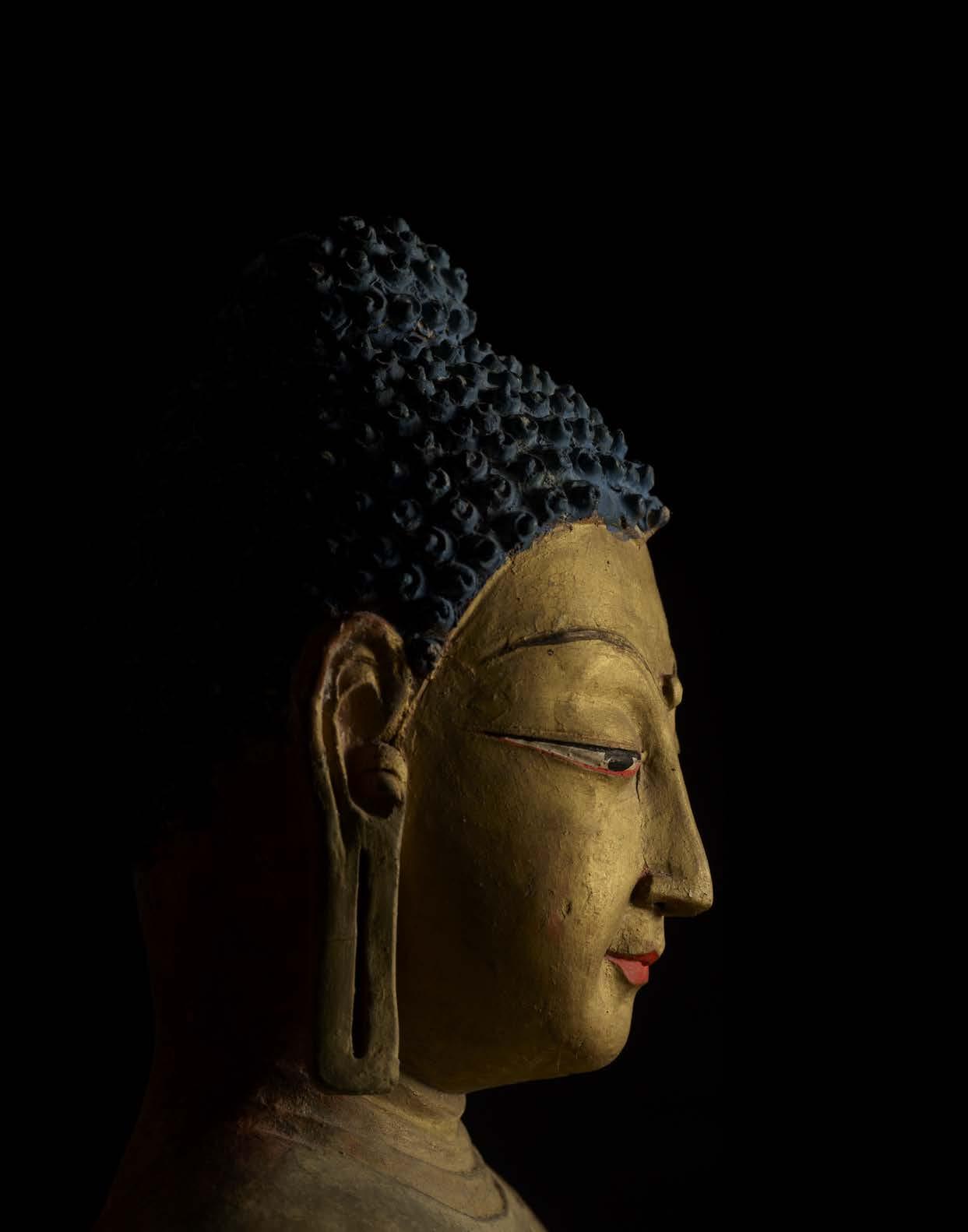
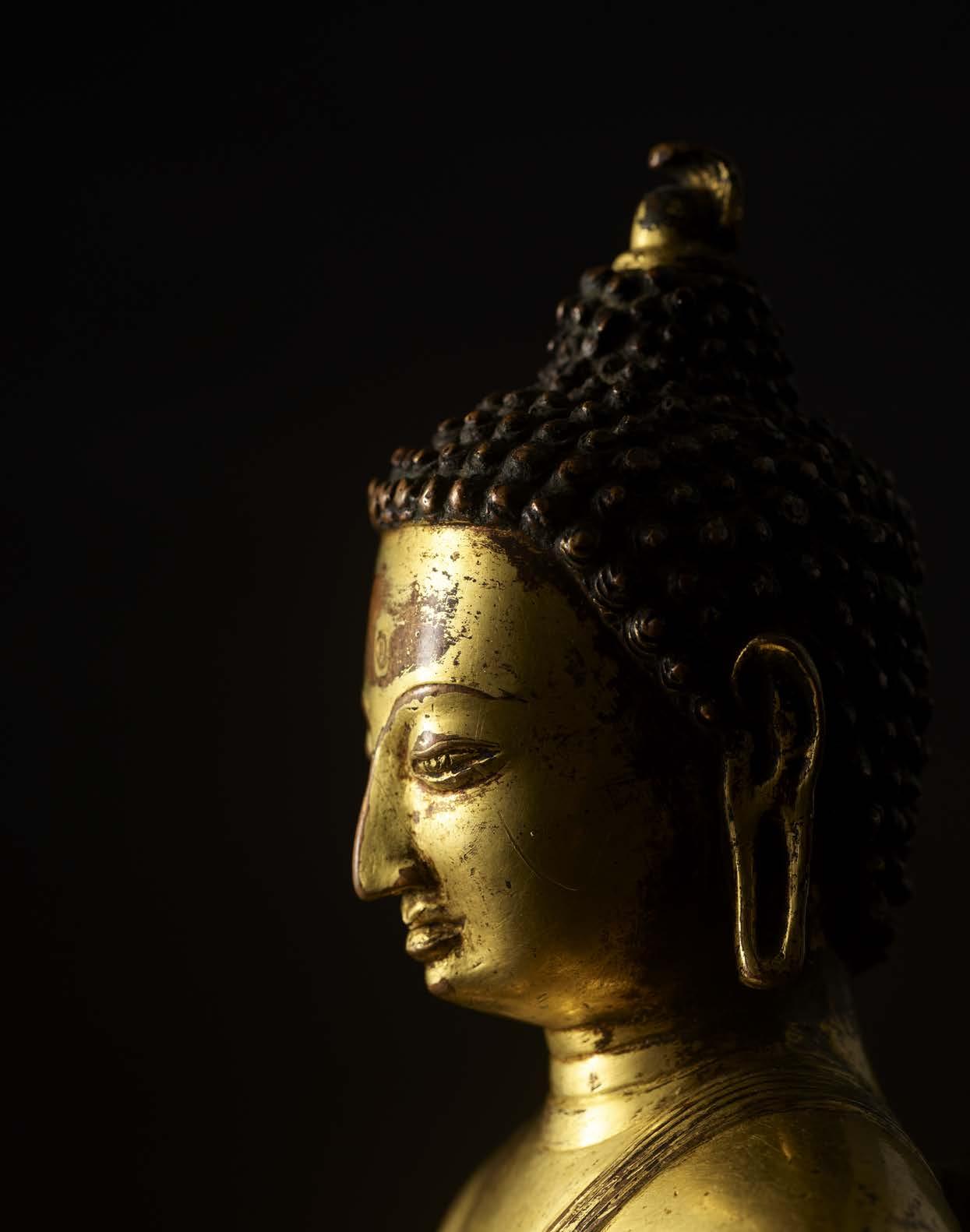
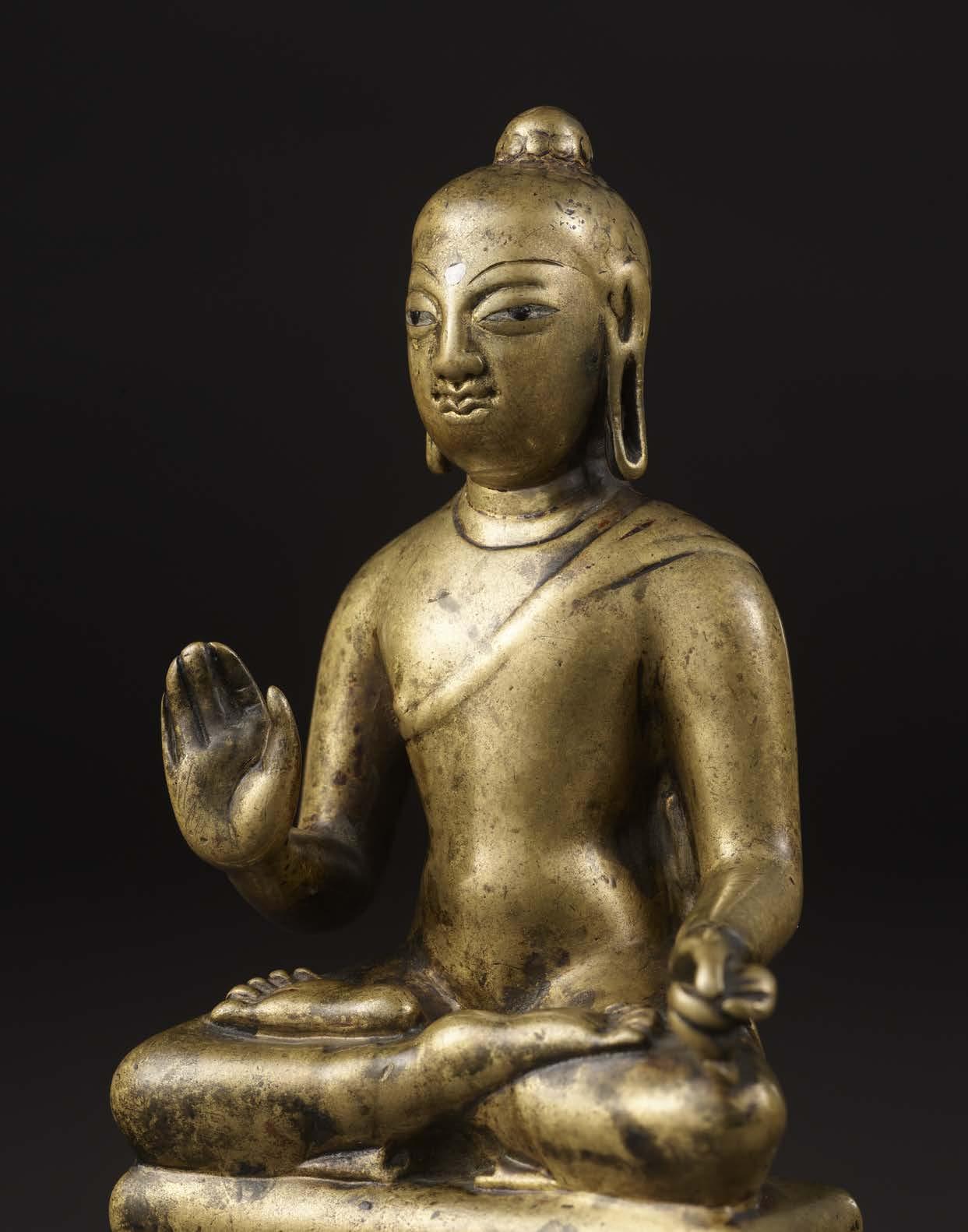
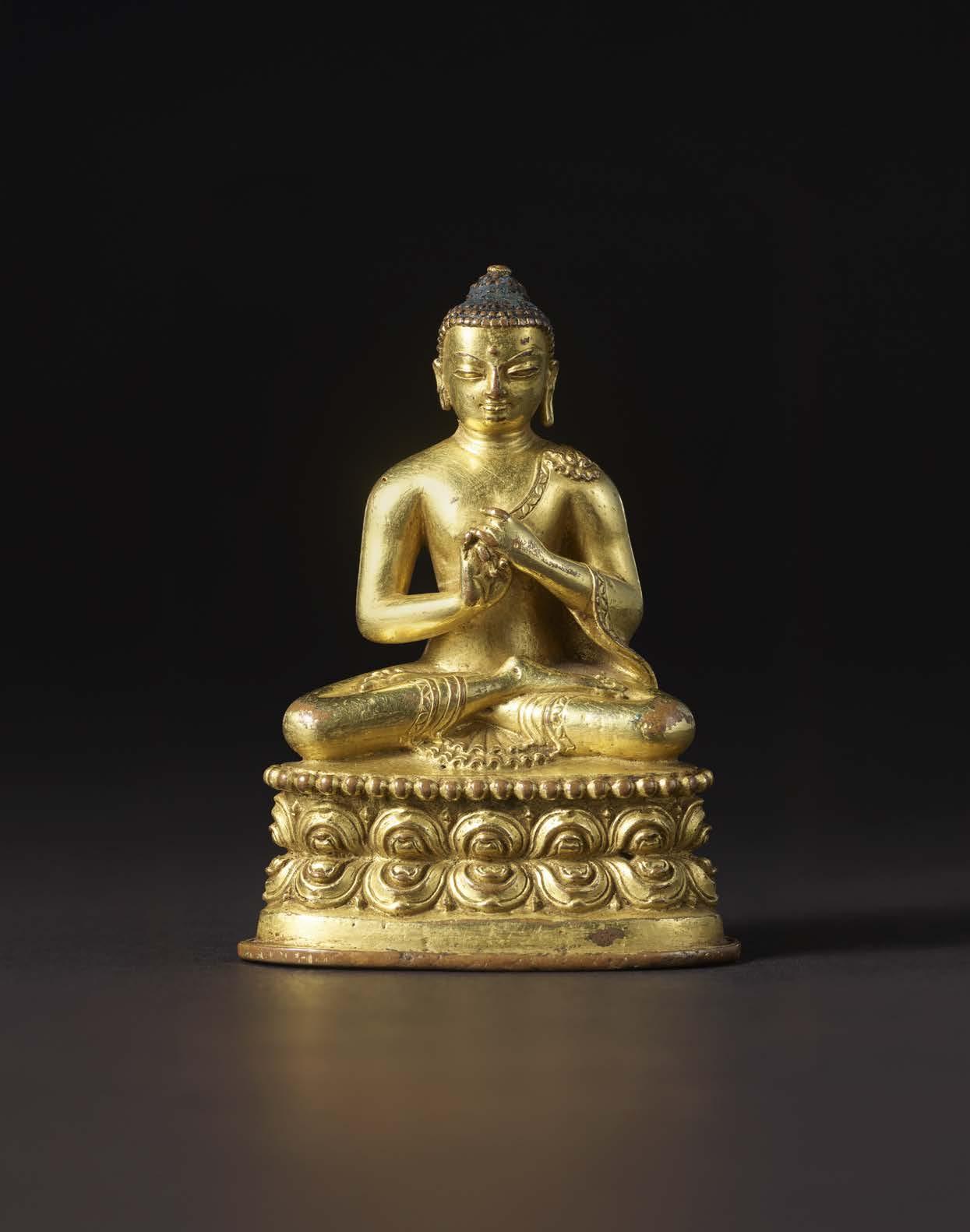
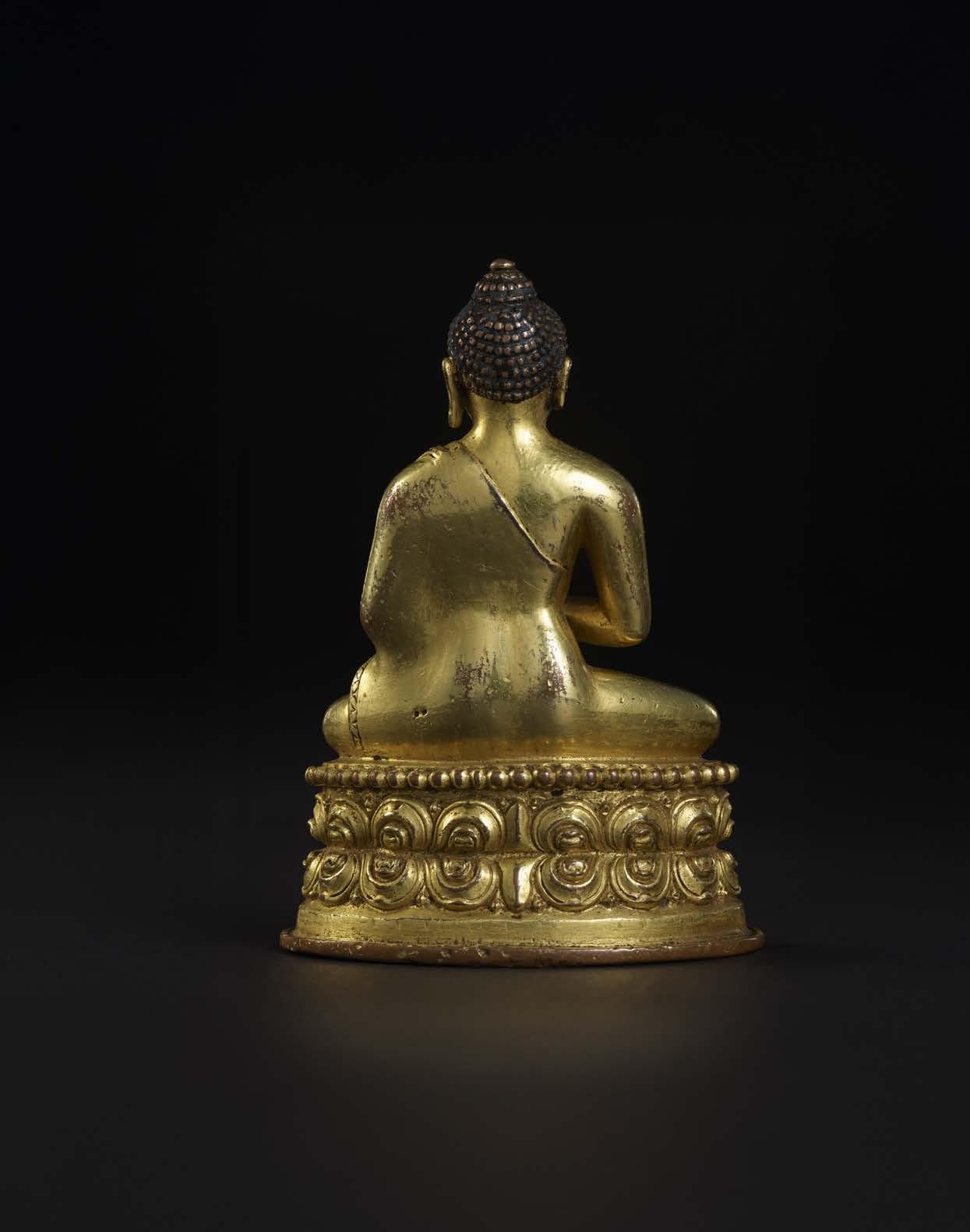
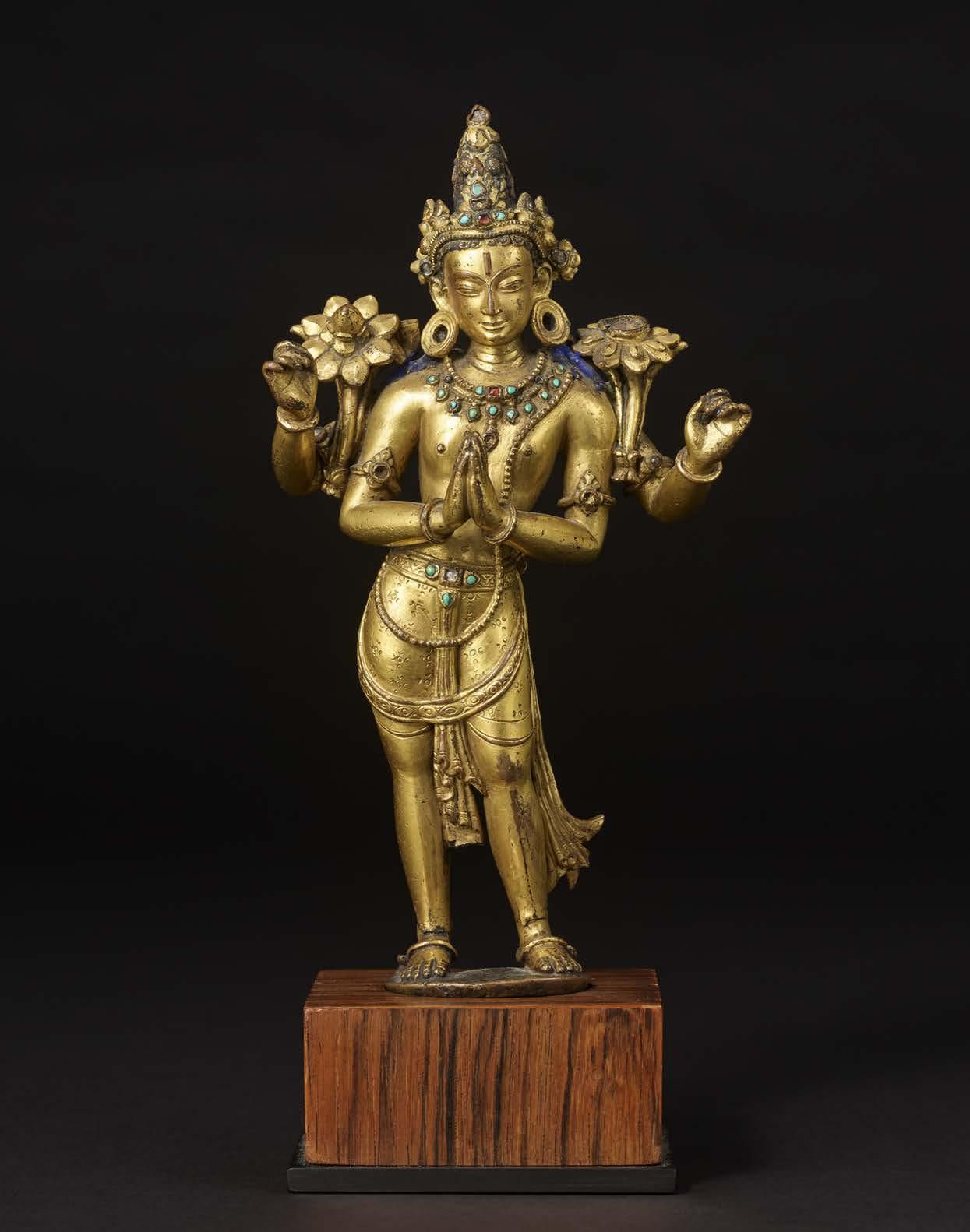
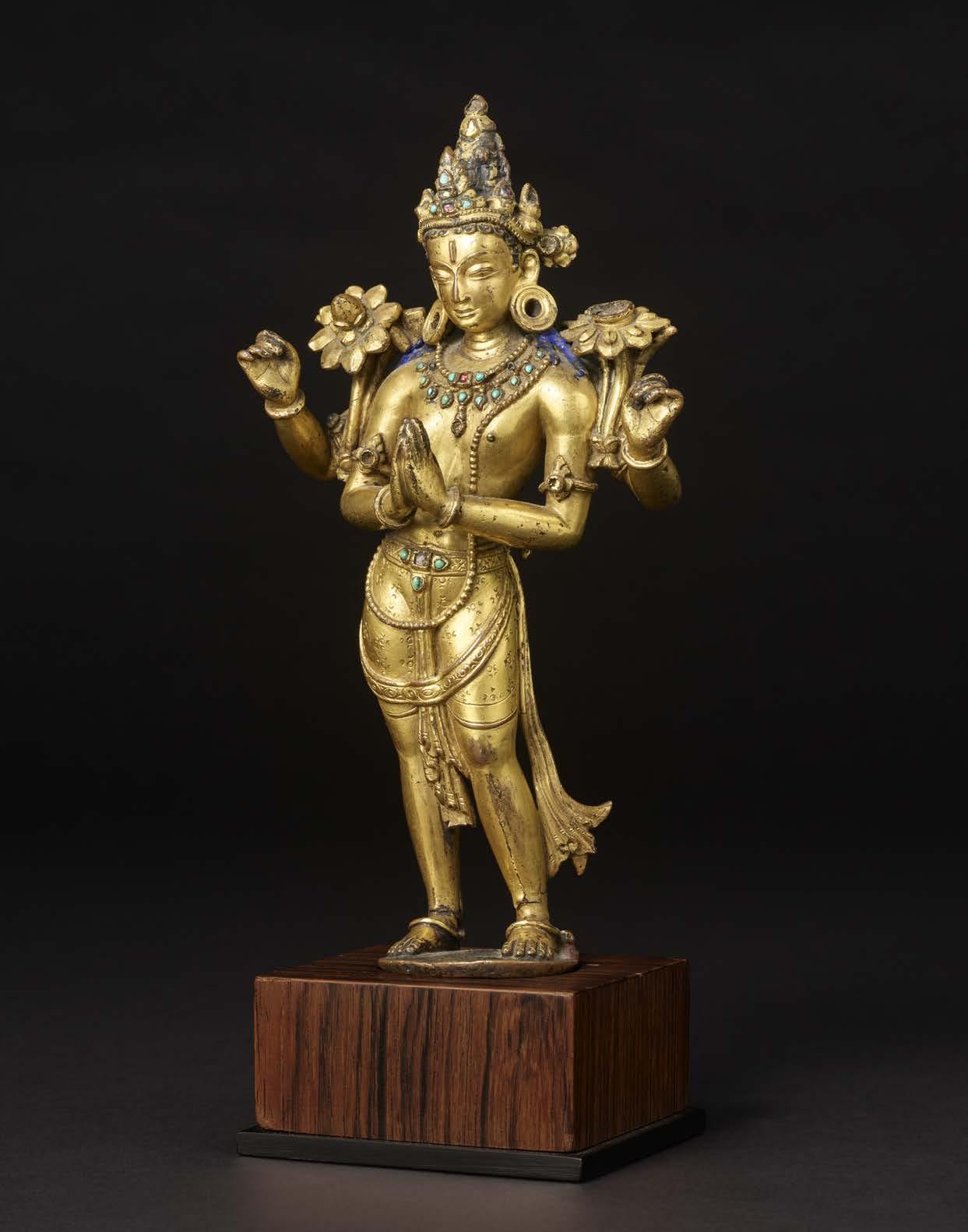
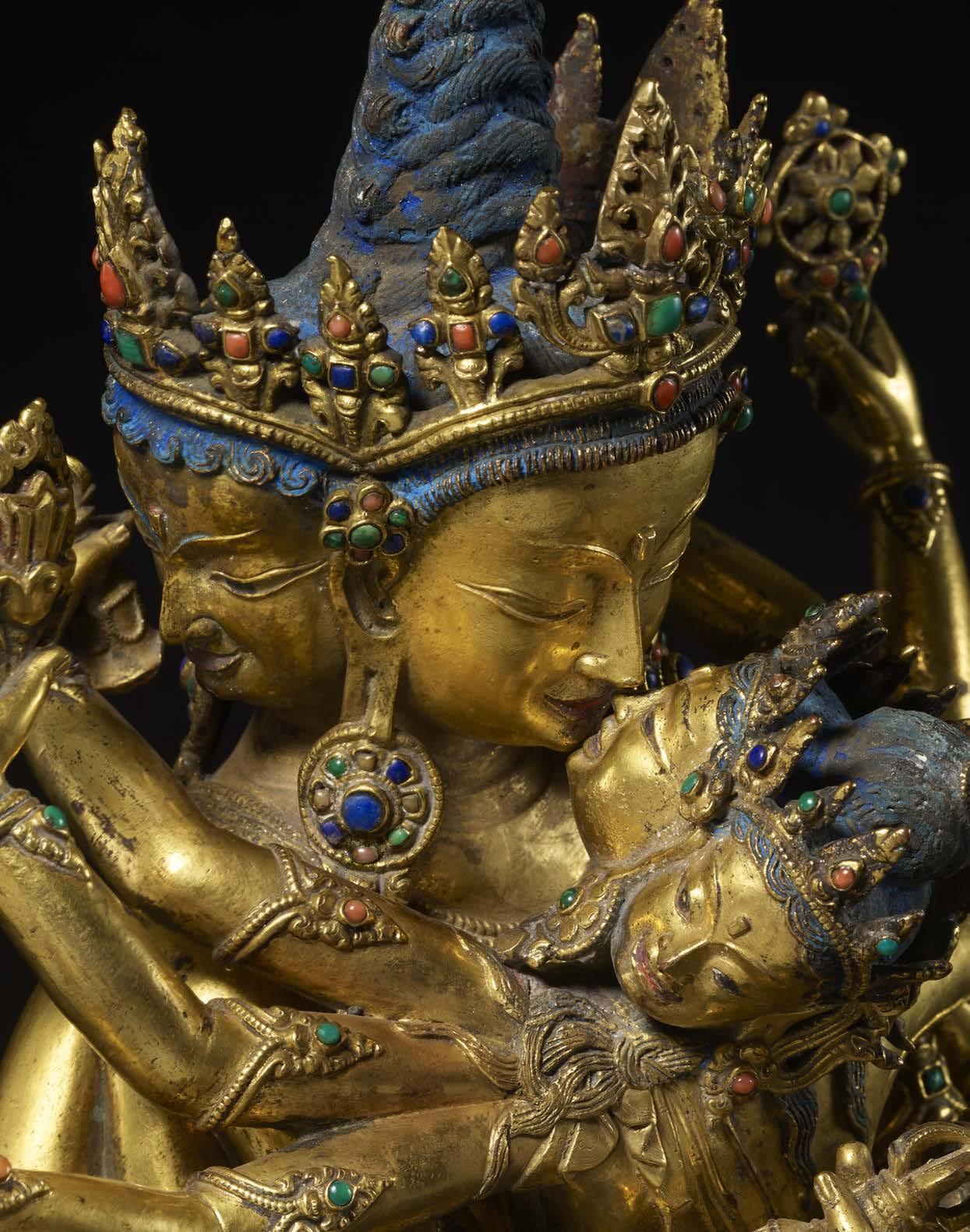
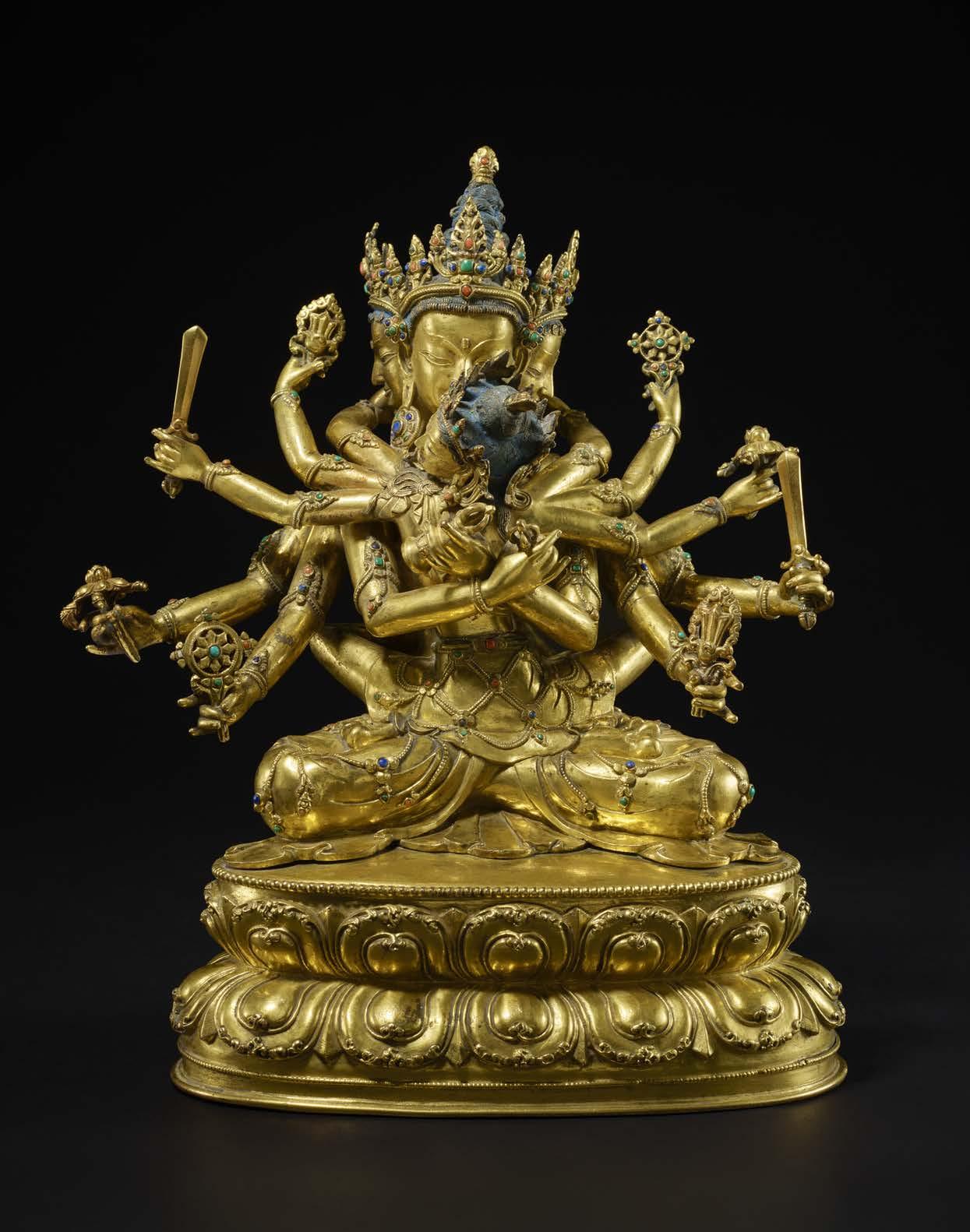
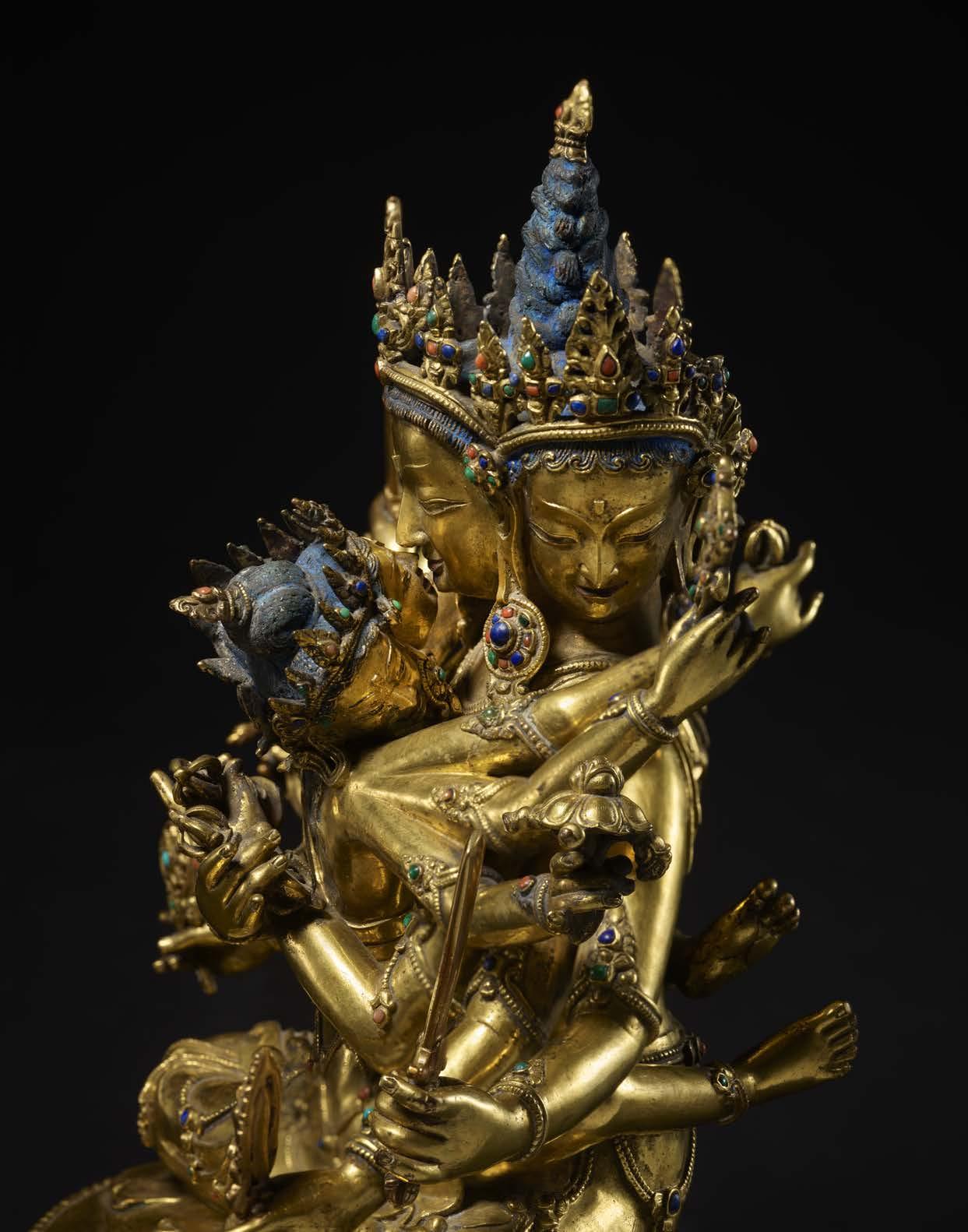
For general enquiries about this auction, emails should be addressed to the Sale Co-ordinator(s).
We would like to thank Mr. Jeff Watt, Mr. JeanLuc Estournel, Prof. Huang Chun He, Dr. Yannick Laurent and Mr. Ian Alsop for their assistance in the preparation of this catalogue.
TAIPEI, Taipei Marriot Hotel 台北,台北萬豪酒店 Saturday – Sunday, 18–19 October 10月 18至 19日(星期六至日) 11.00am – 6.00pm
In sending Written and Telephone bids or making enquiries, this sale should be referred to as CHINTAMANI-24525 在遞交書面和電話競投表格或查詢拍賣詳情時,請註明拍賣名稱及編號為 如意寶珠-24525。
SPECIAL NOTICE 特別須知
From June 2025, EU regulations 2019/ 880 and 2021/ 1079 introduce new licensing requirements and regulations relating to the import of cultural goods into the EU. We recommend clients check ahead of the sale whether the lot they wish to purchase and its import into the EU could be impacted by the regulations. 自 2025 年 6月起,歐盟法規 2019/ 880及 2021/ 1079 對文物進口至歐盟實施新的許可要求和規定。
我們建議客戶在拍賣前確認其擬購買的拍賣品及其進口至歐盟是否受此等法規的影響。
CONDITIONS OF SALE – BUYING AT CHRISTIE’S 業務規定 – 買家須知
The sale for each lot is subject to the Condition of Sale, Important Notices and Explanation of Cataloguing Practice, which are set out on christies.com. Please note that the symbols and cataloguing for some lots may change before the auction. For the most up to date sale information for a lot, please see the full lot description, which can be accessed through the sale landing page on christies.com. 每件拍賣品的銷售均受 christies.com 上列出的業務規定、重要通知及目錄編列方法之說明的約束。請注意,某些拍賣品的符號和目錄 可能會在拍賣前發生變化。有關拍賣品的最新拍賣信息,請參閱 christies.com 上的拍賣登陸頁面中的完整拍賣品描述。
Principal Auctioneer 首席拍賣官 : Adrien Meyer
2001
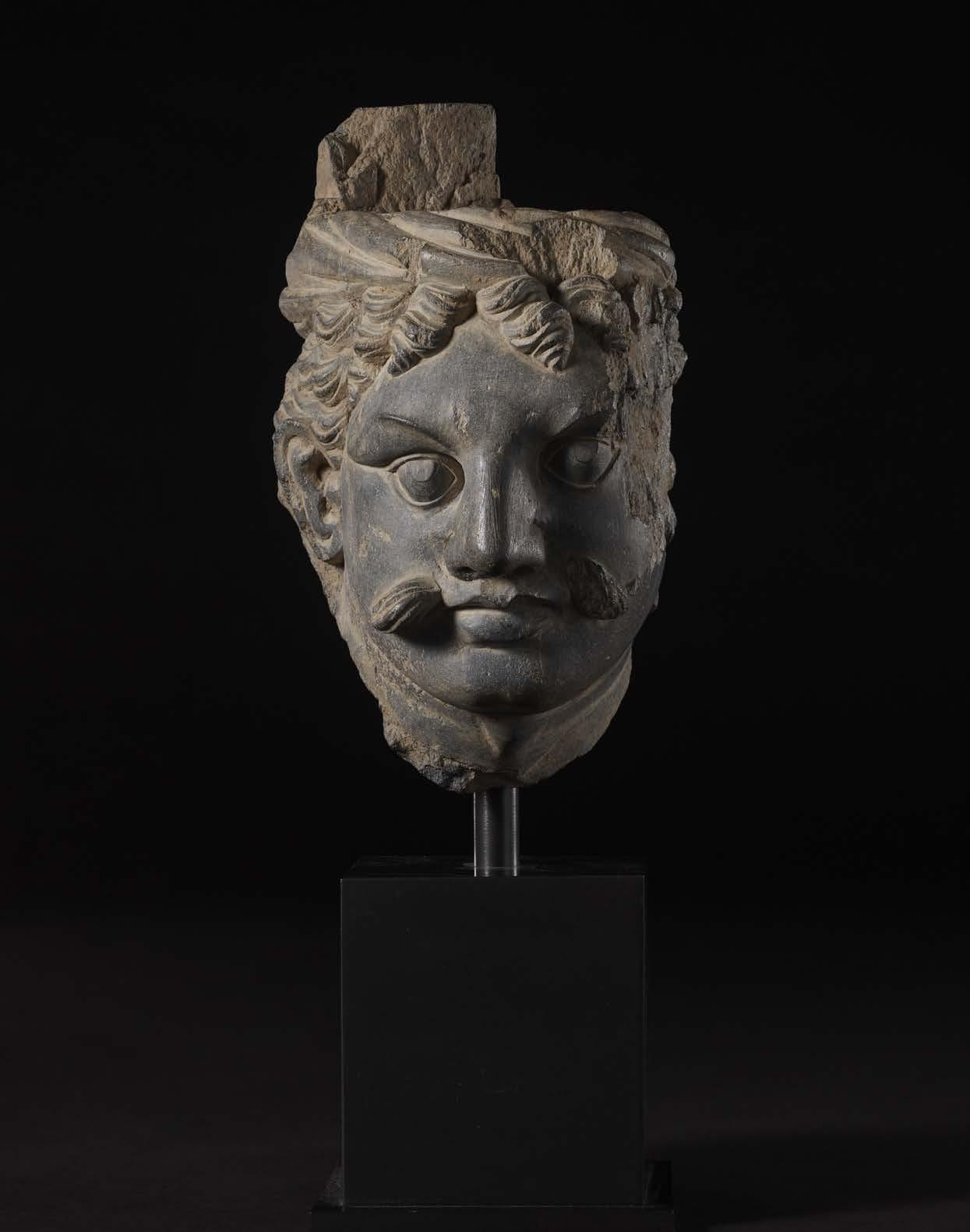
A GREY SCHIST HEAD OF AN ATTENDANT
灰色片岩頭像
ANCIENT REGION OF GANDHARA, CIRCA 3RD CENTURY
犍陀羅古地區 約三世紀
7 1/2 in. (19.1 cm.) high
HK$80,000-120,000
US$11,000-15,000
PROVENANCE:
Simon Ray, London, 2007
Oliver Hoare, London
來源:
西蒙·雷,倫敦,2007年
奧利弗·霍爾,倫敦
This finely carved dark grey schist head depicts a male figure with a serene yet intense expression, exemplifying the stylistic synthesis of classical and South Asian traditions in Gandharan art. His large, wideset eyes, carefully incised with pupils, convey a trance-like gaze that draws the viewer in, while heavy, lidded brows, a bow-shaped upper lip, and a strong, rounded jaw give the face a calm but alert presence. A neatly groomed moustache, curled whiskers, and voluminous hair arranged in large curls frame the face, with the remnants of a turban still visible above the forehead, its individual twisting bands finely detailed.
This figure has traditionally been interpreted as an atlantes, a supporting figure found in Gandharan architecture and loosely based on the Greek god Atlas. However, unlike classical Atlas figures, Gandharan atlantes do not wear turbans. (see Pal, Asian Art at the Norton Simon Museum, Volume 1: Art from the Indian Subcontinen t, 2003, pp. 68–69).
Given the presence of the turban, a marker of status or religious affiliation not typically associated with atlantes, this head may just as plausibly represent an attendant figure in a narrative tableau surrounding a teaching Buddha. In such scenes, attendant bodhisattvas or lay donors are often depicted with stylised Hellenistic features, integrating local devotional customs with imported classical forms.
Whether architectural or narrative, this fragment speaks to the hybrid aesthetic and religious diversity that defined Gandharan Buddhist visual culture.
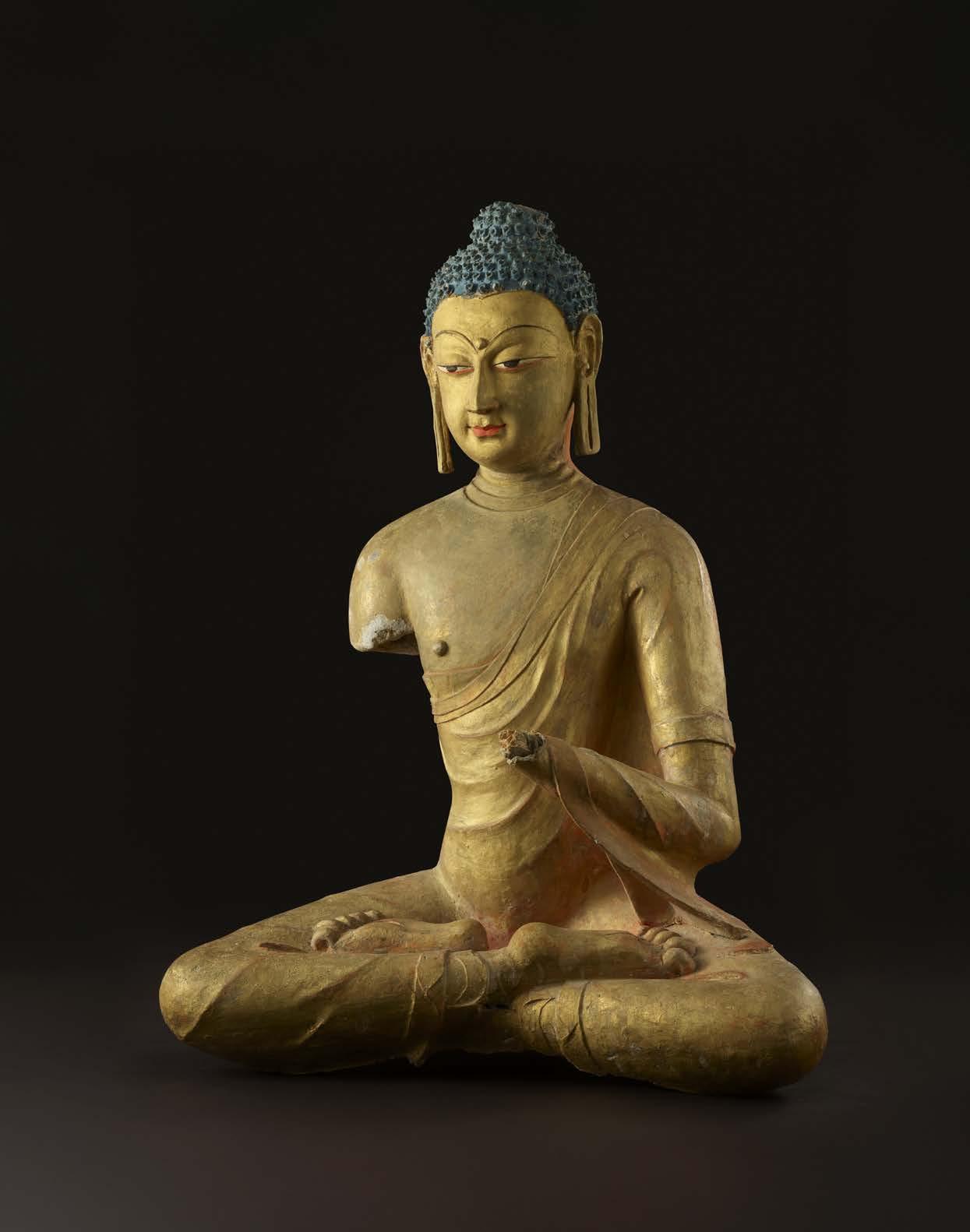
A SILVER INLAID BRASS FIGURE OF BUDDHA
黃銅嵌銀佛像
KASHMIR, CIRCA 8TH CENTURY
喀什米爾 約八世紀
5 1/2 in. (14.1 cm.) high
HK$650,000-800,000
US$84,000-100,000
PROVENANCE:
Sotheby’s New York, 28 October 1991, lot 125
Distinguished European Collection
LITERATURE:
John Siudmak, The Hindu-Buddhist Sculpture of Ancient Kashmir and its Influences, Leiden, 2013, p. 286, pl. 132
來源:
紐約蘇富比,1991年10月28日,拍品125號
歐洲顯赫珍藏
出版:
約翰·西烏德馬克,《喀什米爾的印度教-佛教雕塑及其影響》,萊
頓,2013 年,第 286頁,圖版132號
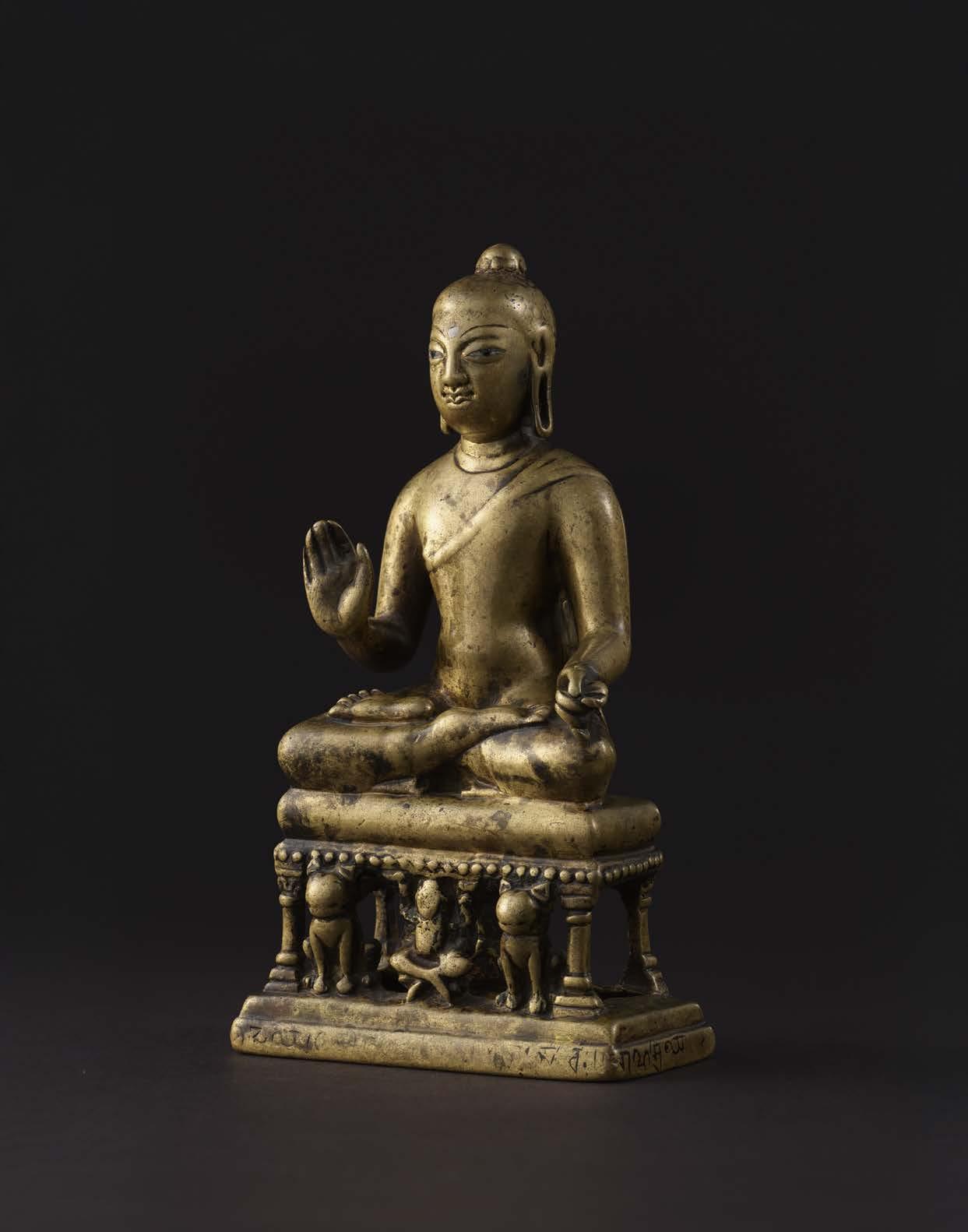
This finely cast Buddha, inlaid with silver at the eyes and urna, exemplifies the sophisticated elegance of early Kashmiri metal sculpture during the 7th and 8th century.
The figure is seated in vajrasana with plump feet, atop rounded shallow cushion on an open pedestal supported by forward-facing lions, a motif associated with royal and spiritual authority in early Himalayan art. Additionally, the throne is centred by a dwarf yaksha figure seated cross-leg with hands raised to support the weight. Of particular note is the throne edges, supported by unusually thin columnar struts, which compare closely to an 8th-century bronze Buddha preserved in Phiyang Monastery in Ladakh (see von Schroeder, Indo-Tibetan Bronzes, 1981, p. 114, no. 14B). These architectural elements are notable for their slender proportions and structural delicacy, providing both vertical balance and visual lightness to the composition.
The Buddha raises his right hand in abhaya mudra, a gesture of reassurance, while the left hand rests upon the thigh, delicately grasping the end of his robe. The monastic robe, rendered with refined simple lines, flows smoothly across the body without any evidence of the garment’s natural folds, however, long vertical pleats behind the left arm fall to neat terminus at the hip. This stylistic restraint is consistent with early Kashmiri bronzes, where volume and surface are favored over ornate patterning. The Buddha’s face is finely modeled with silver-inlaid eyes and urna, enhancing the contemplative gaze. His lips curve into a distinct ‘W’ shape, a stylistic hallmark echoed in related bronzes from the period. The ushnisha is shallow, with the hair worn in soft, smooth curls, features that further point to an early date within the Kashmiri sculptural tradition. Gouriswar Bhattacharya has read the barely legible left edge and right edge of throne base inscription and has suggested the translation “Meritorious Gift of Whab gri ”, which conforms to the practice of meritorious inscriptions common to Kashmiri sculpture from the period.
Further examples of Kashmiri Buddha with smooth robes and silverinlaid features dated to the 8th-century can be found in Los Angeles County Museum of Art (acc. no. M.72.2.1), see Pal, Indian Sculpture, Vol. 1, 1986, p. 226, no. 100 and another with similar facial modeling and the distinctive ‘W’ form lips in Cleveland Museum of Art (acc. no. 1981.10), see Pal, The Arts of Kashmir, New York, 2008, fig. 25 is also dated circa 8th century. Also compare a Buddha in The British Museum with similar treatment of the robe and ushnisha (inv. 1905,0612.5), see Zwalf, Buddhism: Art and Faith, London, 1985, no. 146. Also, compare with the three other closely related examples in von Schroeder, IndoTibetan Bronzes, 1981, no. 14A, C, and D.
A SILVER AND COPPER INLAID BRASS
FIGURE OF TARA
黃銅嵌銀嵌紅銅度母像
NORTHEAST INDIA, PALA PERIOD, CIRCA 11TH CENTURY
東北印度 帕拉時期 約十一世紀
2 5/8 in. (6.6 cm.) high
HK$600,000-800,000
US$78,000-100,000
PROVENANCE:
Nyingjei Lam Collection, before 1990
來源:
菩薩道收藏,1990 年前入藏
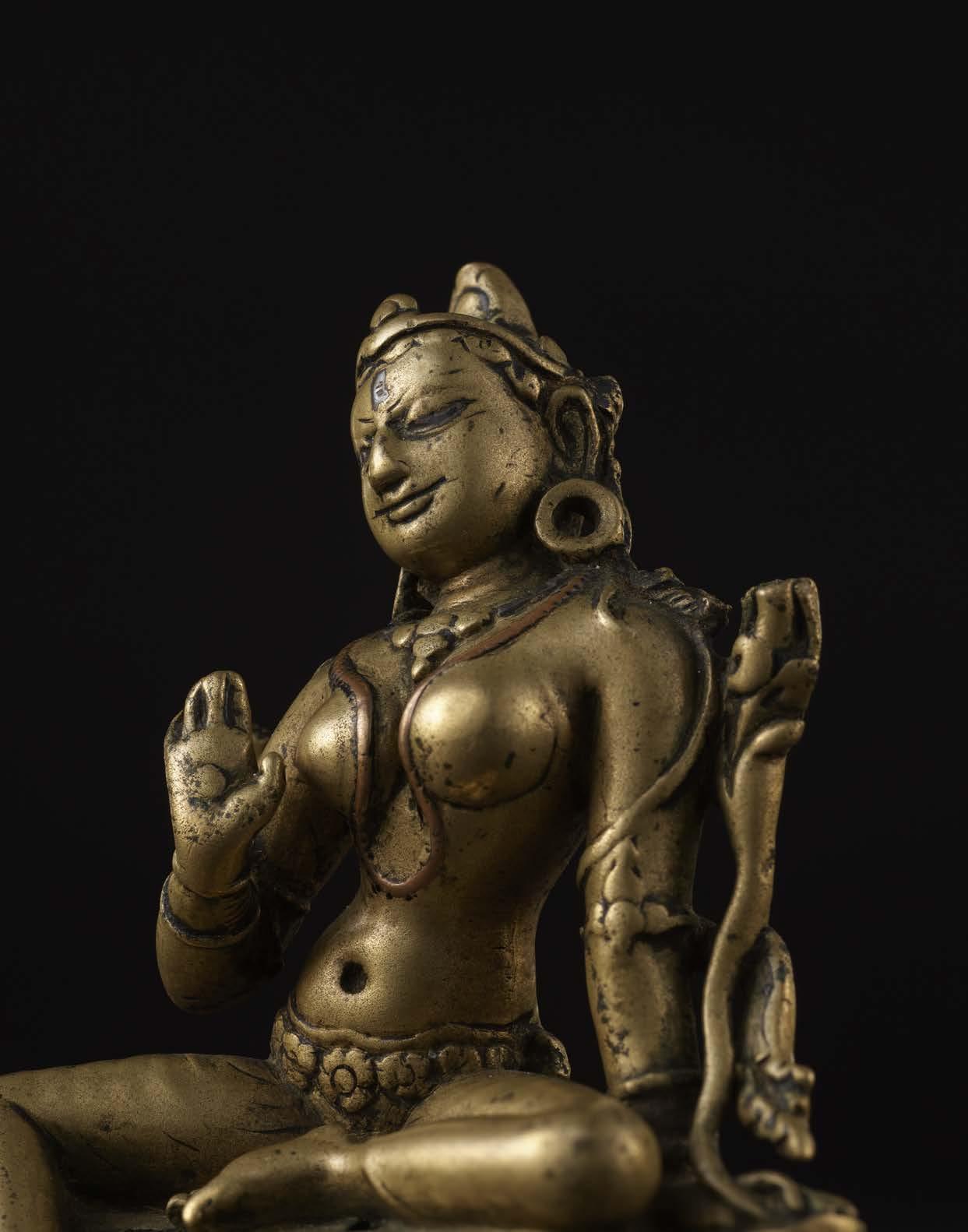
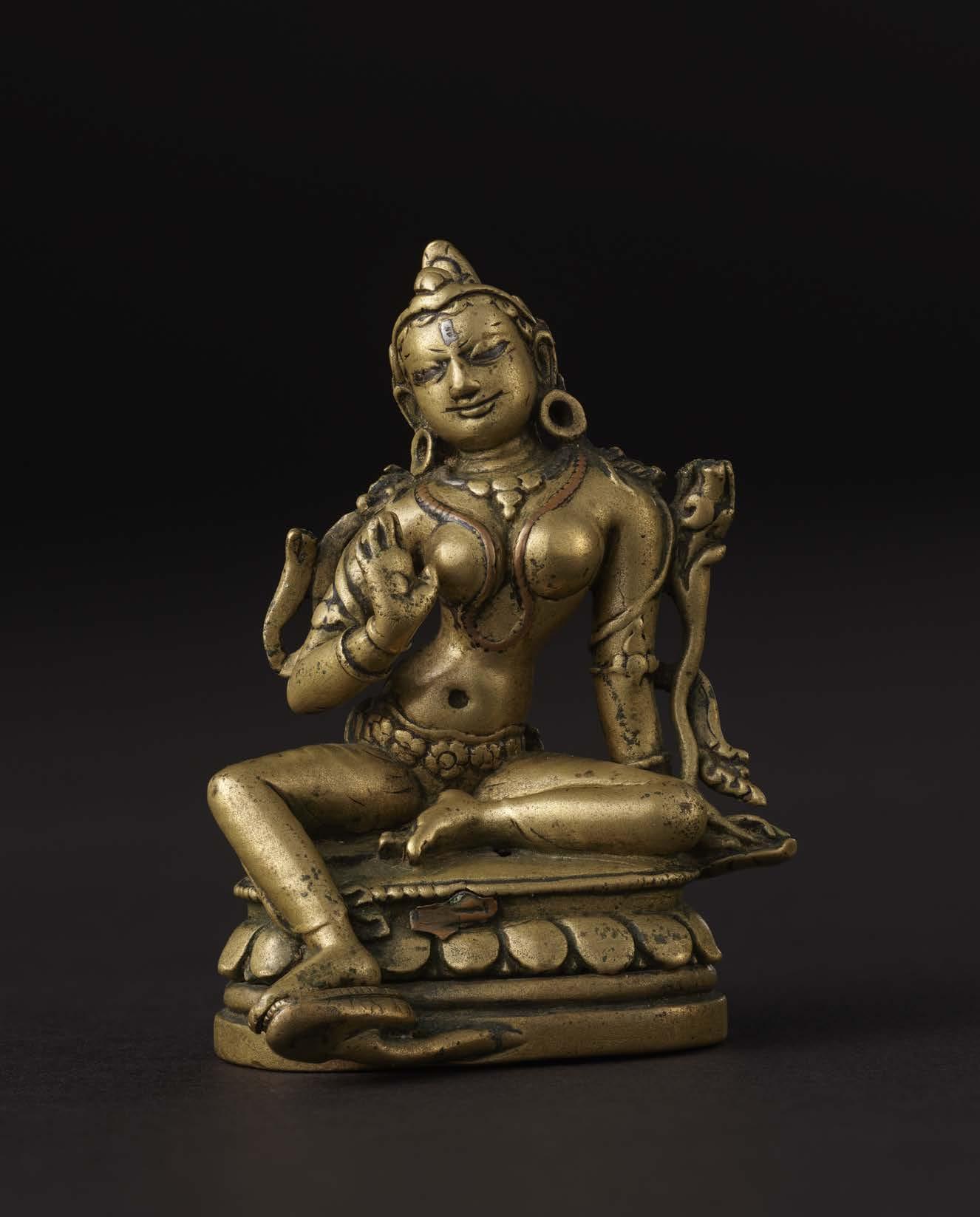
This superb sculpture representation of the goddess Tara exemplifies the refined aesthetic and spiritual vision of Pala-period artists active in northeastern India between the 9th and 12th centuries. While her form is idealised, the sculpture captures the essence of feminine beauty with remarkable sensitivity. Her well-balanced proportions and full, sensuous body reflect both artistic mastery and devotional intent, hallmarks of the heralded sculptural tradition of the Pala ateliers.
Tara is depicted in lalitasana, the royal ease posture, with her right leg pendant, a pose imbued with both elegance and compassionate authority. As the Great Saviouress, she embodies the bodhisattva’s readiness to descend into the world to alleviate suffering.
The visual appeal of this work is further enhanced by its smooth, timeworn surface, the result of centuries of ritual handling. This prolonged devotional contact has imparted a subtle patina, giving the sculpture a skin-like warmth and softness. The finer details of her eyes and necklace are highlighted by silver and copper inlays, and the barely discernable pleats on her dhoti have been gently worn down over time.
Closely related examples also seated in rajalilasana, with supporting weight on the left arm, broad shoulders, narrow waist, and plump torsos include two Manjushris, one in the Museum de Kulturen, Basel (HAR 3314716) and the other in the Los Angeles County Museum (M.75.4.9), both attributed to Bihar. The broad face with planar features, heavy lidded eyes in each of these examples, are emblematic to both this later Pala period as well as to styles often linked to the region of Bihar. Also compare with a Tara seated on a double lotus but of the same scale in the Varendra Research Museum, Rajshahi. Museum (#113), see Huntington, The Pala Sena Schools of Sculpture, Leiden, 1984, no. 271. Also compare patina and scale of a Manjushri sold Bonhams Hong Kong, 1 December 2023, lot 1853.
This Tara was most likely transferred by a pilgrim from India to Tibet at the time of production. The well-worn features suggest it was retained as a personal devotion object for the past millennia and bares testament to the magnetic power of sculpture of this scale and quality.
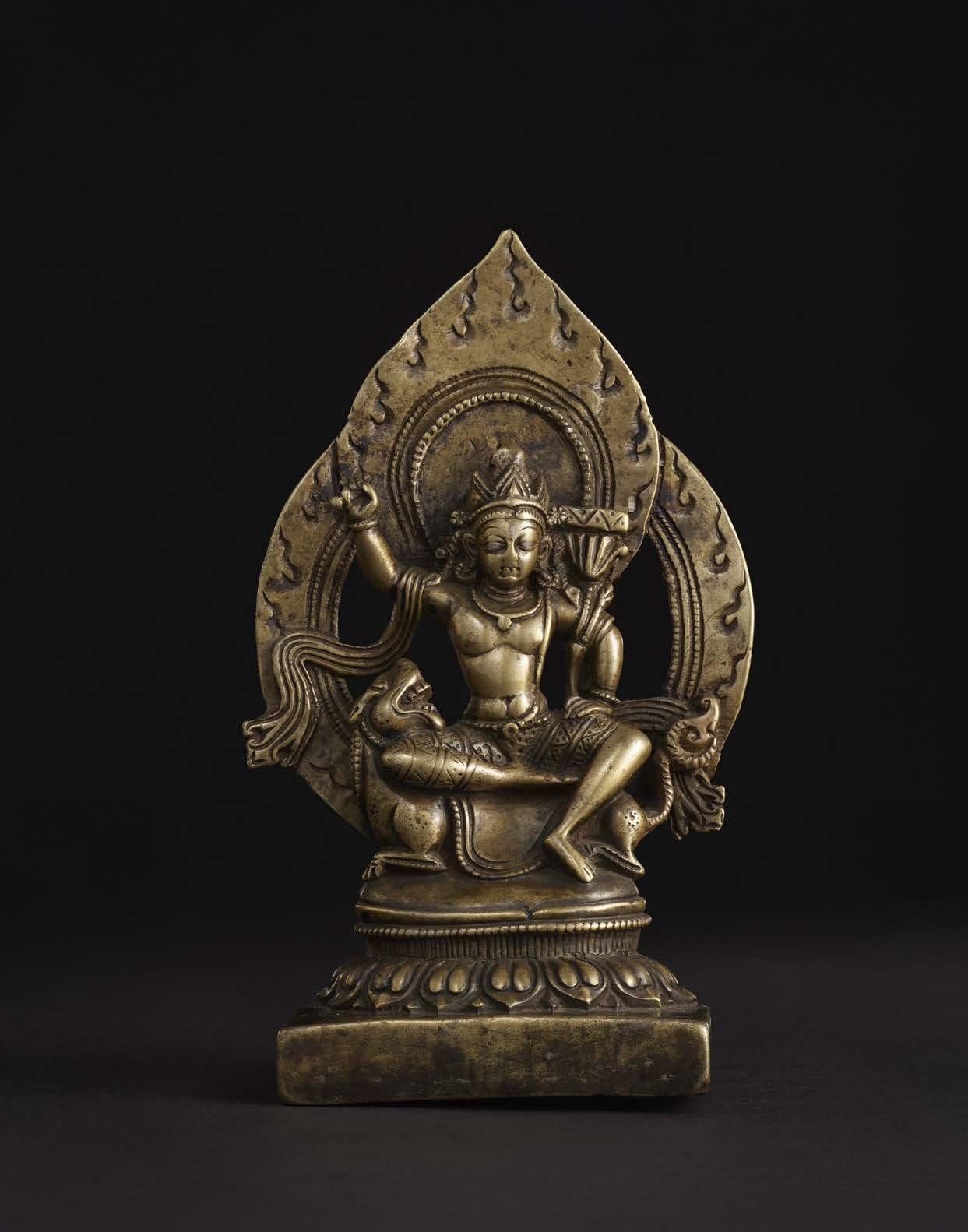
A SILVER AND COPPER INLAID FIGURE OF MANJUSHRI
銅嵌銀文殊菩薩像
KASHMIR OR SPITI VALLEY, CIRCA 11TH CENTURY
喀什米爾/斯皮提河谷 約十一世紀
5 1/8 in. (13 cm.)
HK$400,000-550,000
US$52,000-71,000
PROVENANCE:
Chino Roncoroni, before 1996 Distinguished European Collection
來源:
奇諾·龍柯洛尼,1996 年前入藏
歐洲顯赫珍藏
Finely cast and richly inlaid with silver and copper, this intimate yet powerful image of Manjushri, the Bodhisattva of Wisdom, exemplifies the high craftsmanship and devotional intensity of Himalayan metal sculpture in the 11th century. Small-scale works of this quality were treasured not only for their artistic refinement but also for their role in private devotion and tantric practice.
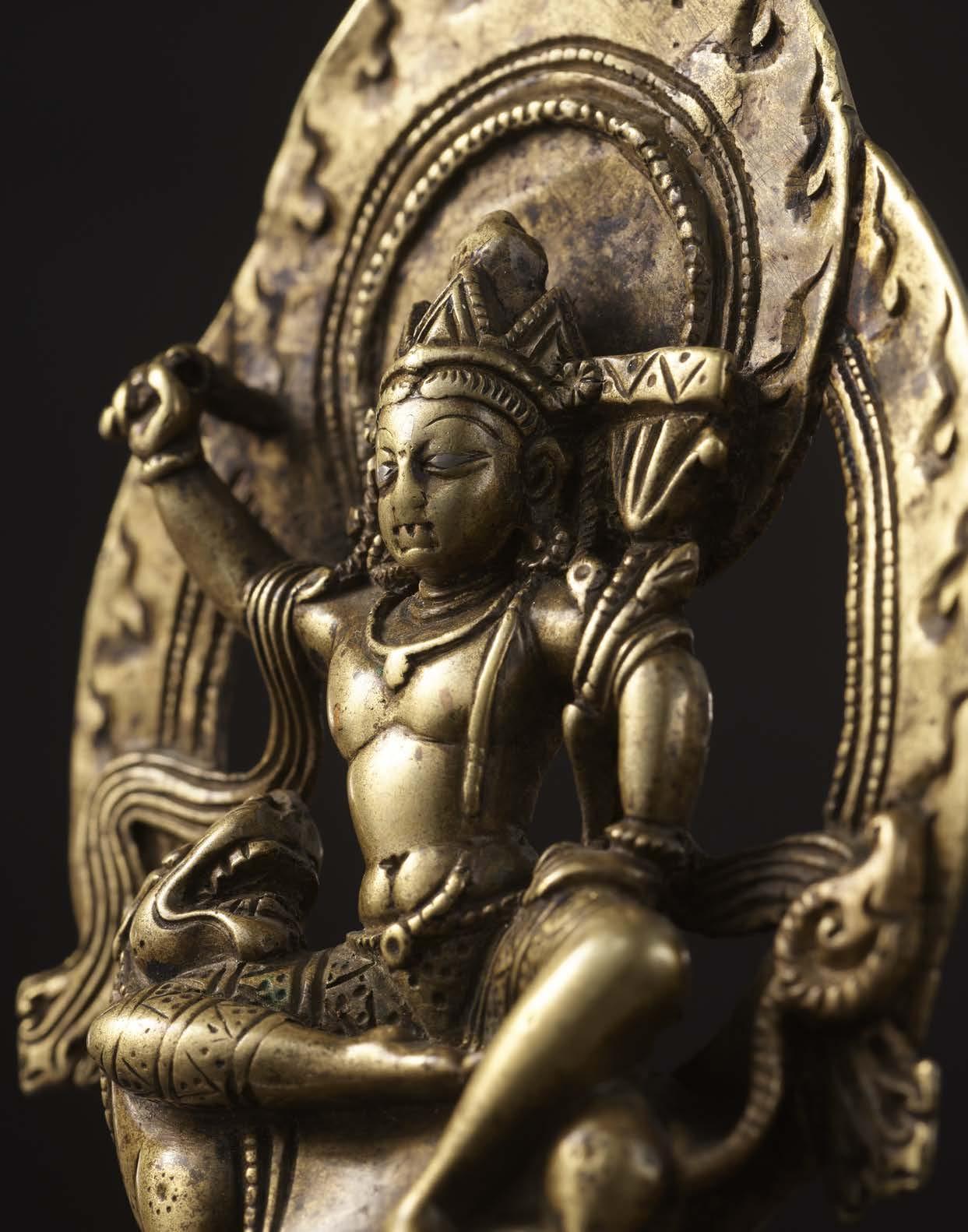
Here, Manjushri is depicted with resolute grace, raising his right hand aloft to wield the flaming sword of wisdom, the blade that cuts through ignorance and illusion. He is seated in lalitasana atop his snow lion mount, a rare and dynamic feature that sets this example apart. The lion looks up at his divine master with an expression of roaring adoration, reinforcing the central message of spiritual dominion and fearless insight.
The figure bears subtle yet precise detailing: a pleated scarf falls over his shoulders, and a triangular crown surmounts his serene yet purposeful face. Traces of silver inlay highlight ornamental features and facial details, underscoring both the preciousness of the work and the piety of the original patron. The presence of such inlay is not merely decorative but imbued with devotional intent, intended to honour the deity and accrue spiritual merit for the commissioner.
Signs of prolonged ritual use are evident in the softening of the facial features, torso, and hands, the key touch points of veneration over generations of worship. These marks of devotion serve as a moving testimony to the sculpture’s long life as a sacred object, rather than a static work of art.
A close parallel can be found in a bronze Avalokiteshvara preserved in the Tsuglakhang Temple, Lhasa (von Schroeder, Buddhist Sculpture in Tibet, Vol. I, Hong Kong, 2022, p. 168, no. 48A). That figure, of comparable scale, shares a distinctive base of split lotus petals, a looped halo, and the same robust treatment of scarves and jewellery, suggesting both were produced in the same atelier, possibly even by the same hand. Furthermore, the unique triangular crown motif is repeated in other contemporaneous bronzes, including a six-armed deity and another figure of Manjushri (ibid., pp. 170 and 173, nos. 49A and 50D).
Yet, it is the present figure’s exceptional mount, the animated lion that distinguishes it within this well-documented corpus. The integration of mount and deity into a cohesive and lively composition demonstrates the sculptor’s ingenuity outside the typically codified constraints of the monastic atelier.
This rare and expressive bronze encapsulates the devotional spirit, technical precision, and cross-regional aesthetic influences that flourished in Kashmir and the western Himalayas during the 11th century.
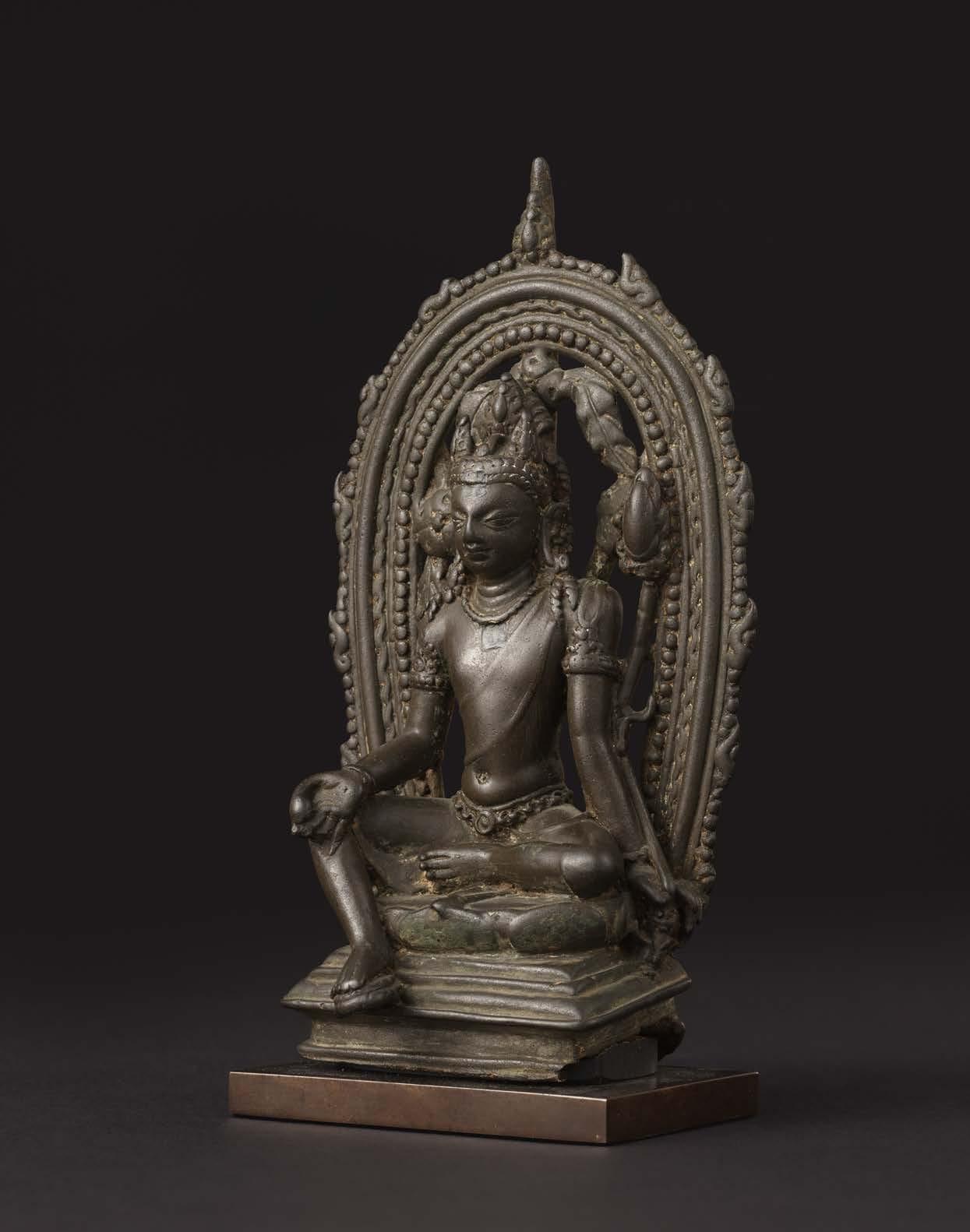
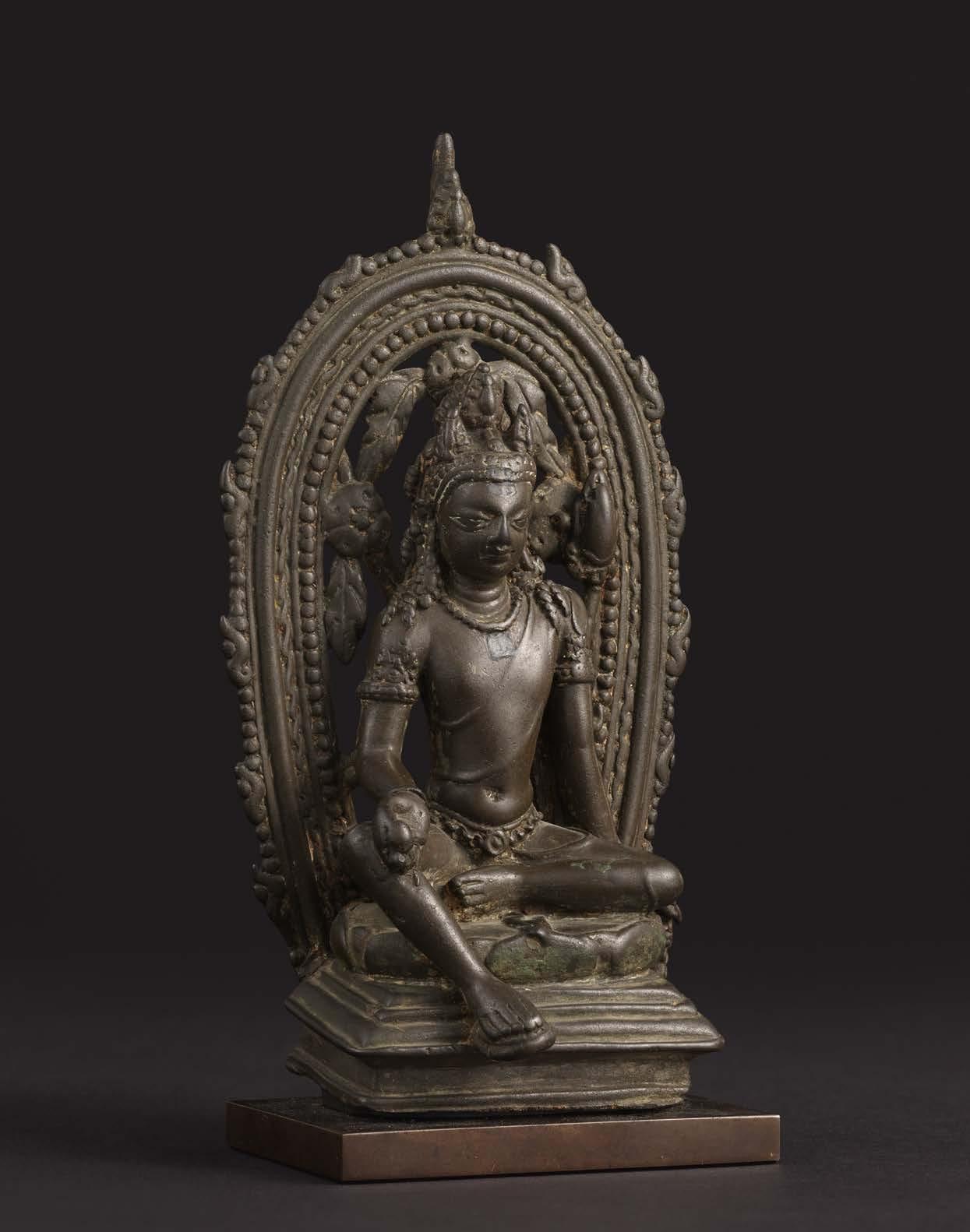
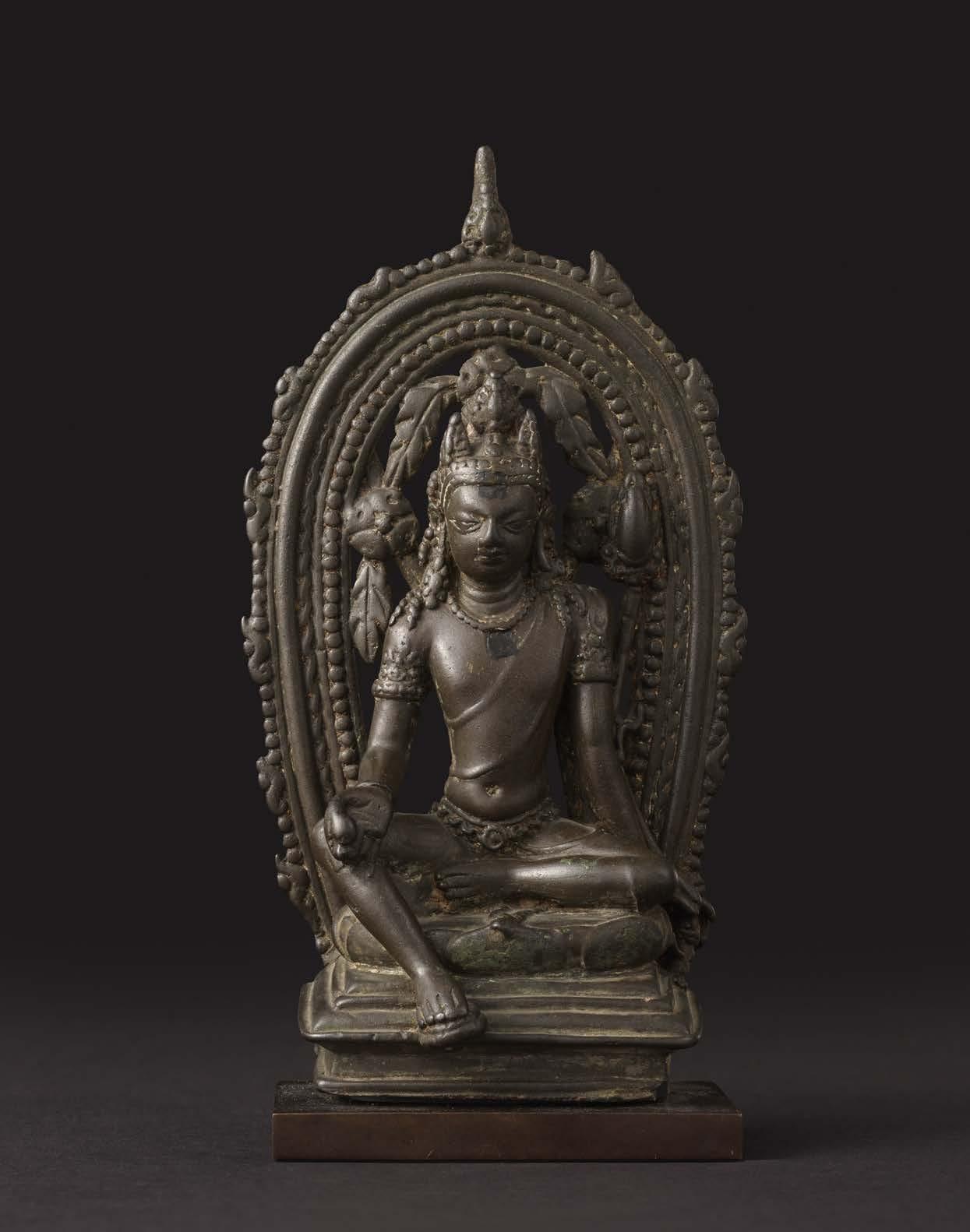
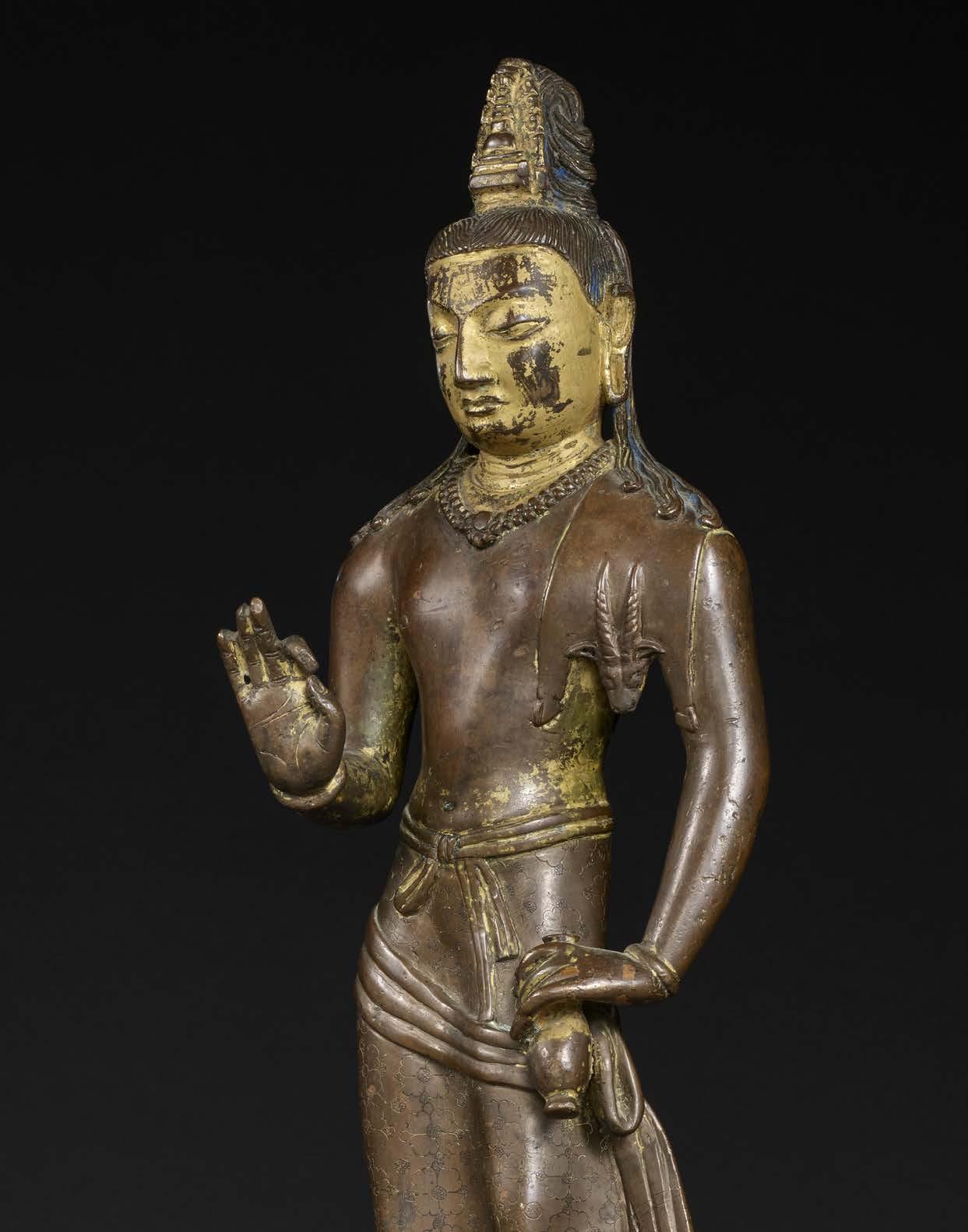
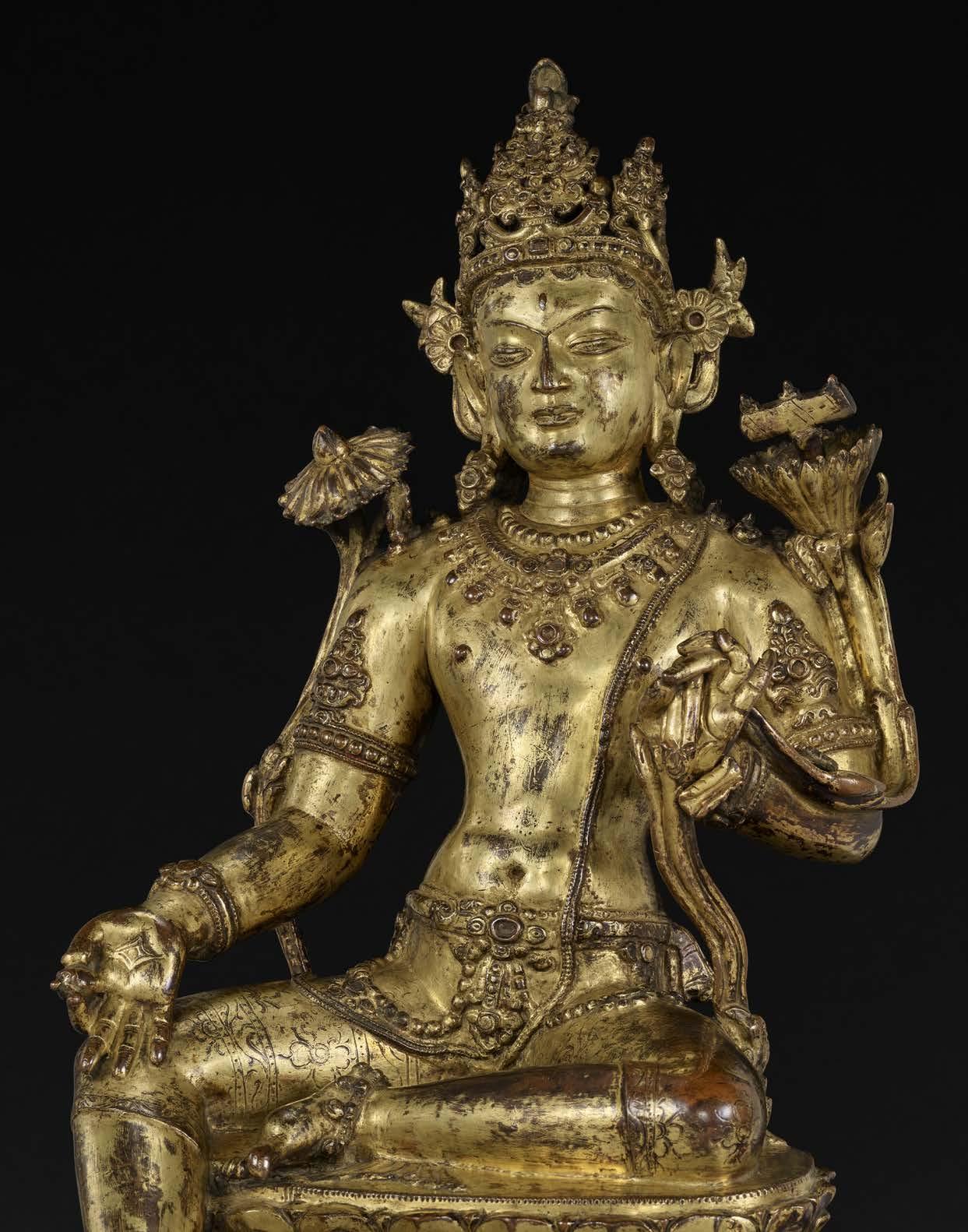
A COPPER ALLOY FIGURE OF PADMAPANI LOKESHVARA
蓮花手觀自在菩薩銅像
NORTHEAST INDIA, BIHAR REGION, 7TH-8TH CENTURY
東北印度 比哈爾邦邦地區 七/八世紀
6 3/4 in. (17.2 cm.) high
HK$2,000,000-3,000,000
US$260,000-390,000
PROVENANCE:
Acquired in New York between 1946 and 1959
Former collection of M. Robert Rousset (1901-1981)
Former collection of Mrs. Anne-Marie Rousset.
Cornette de Saint Cyr, Paris, 15 October 2020, lot 59
Private European Collection
來源:
1946至1959 年間購於紐約
M·羅伯特·魯塞特(1901-1981)舊藏
安妮-瑪麗·魯塞特女士舊藏
巴黎科爾內特·德·聖西爾拍賣行,2020 年10月15日,拍品59 號
歐洲私人收藏
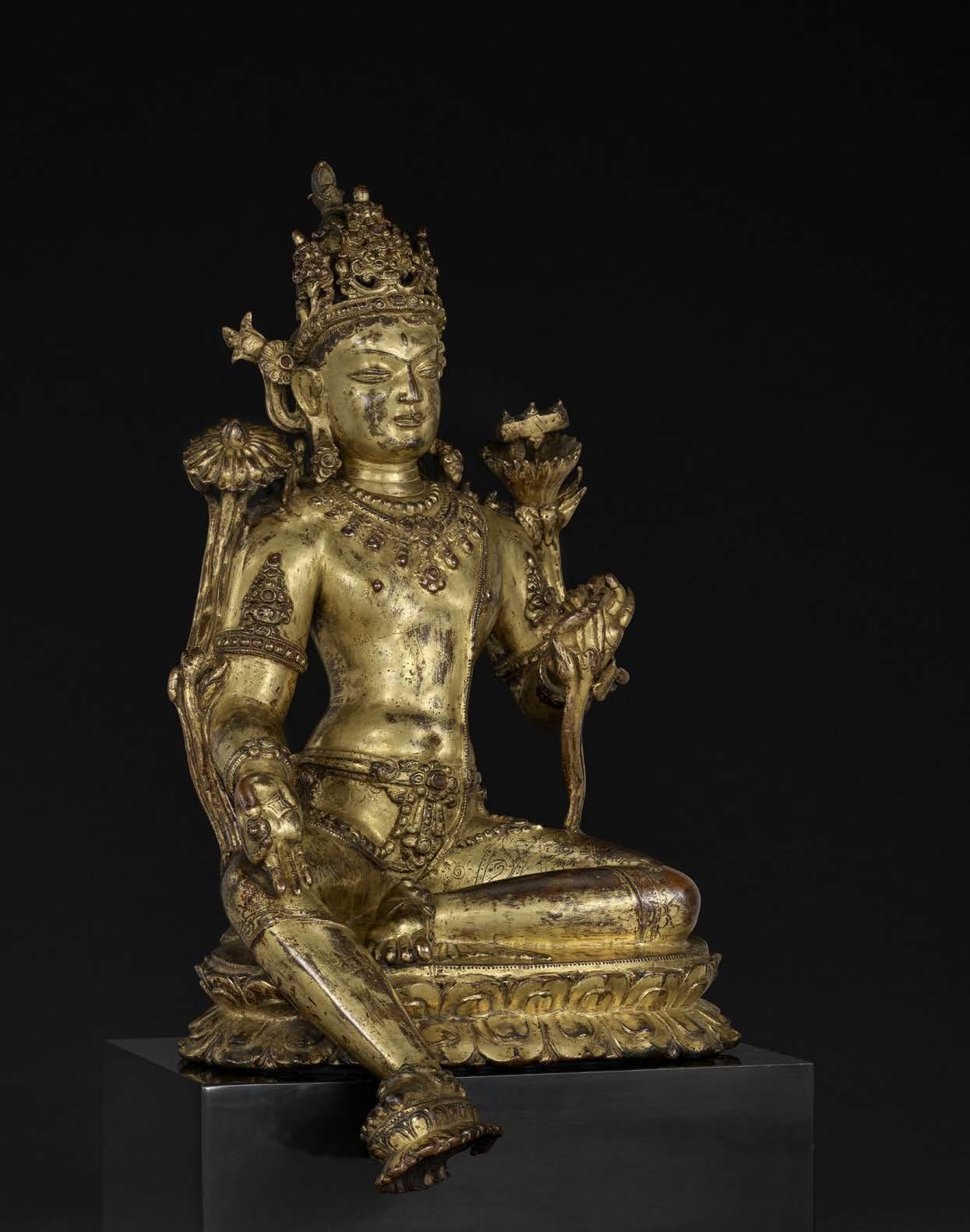
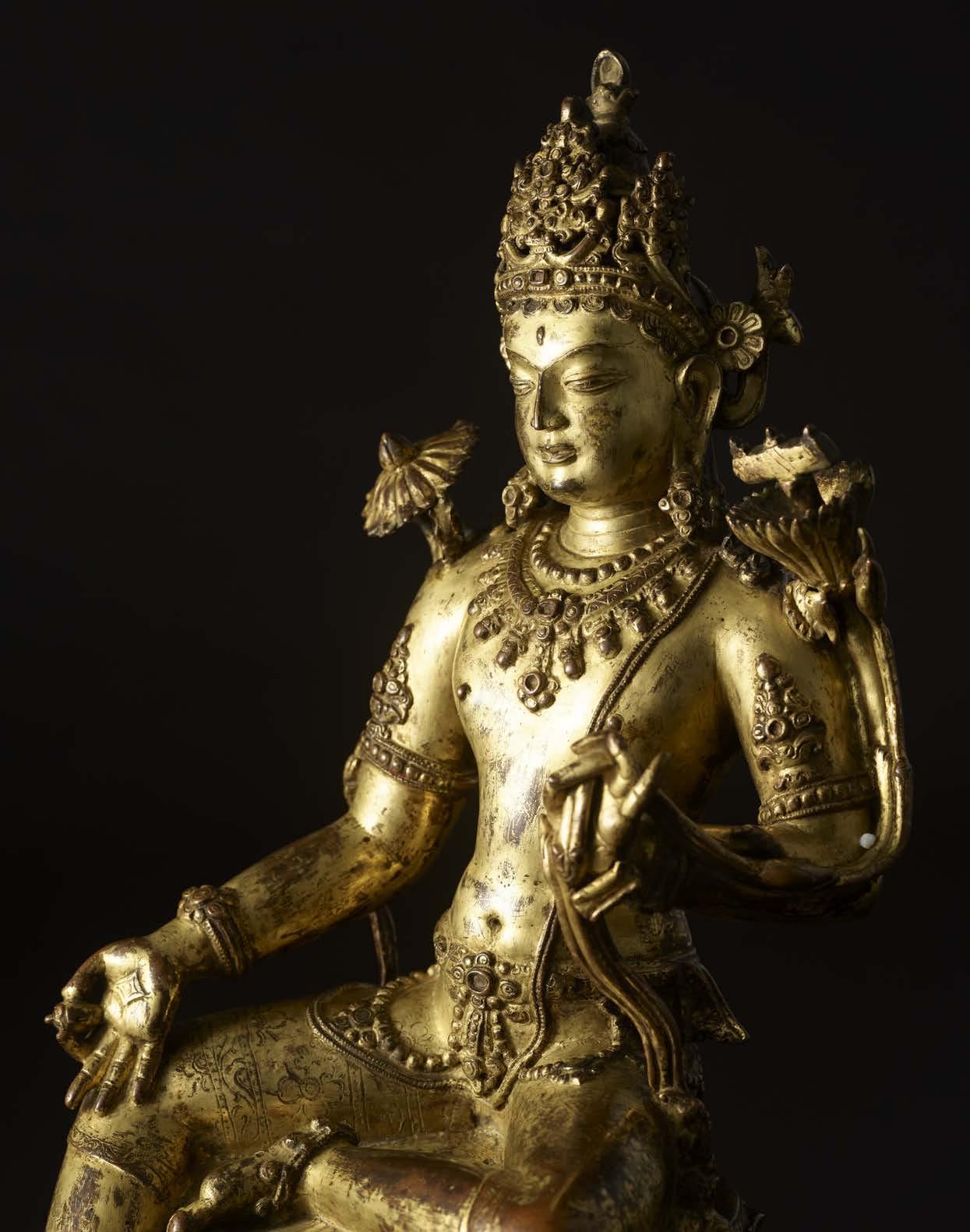
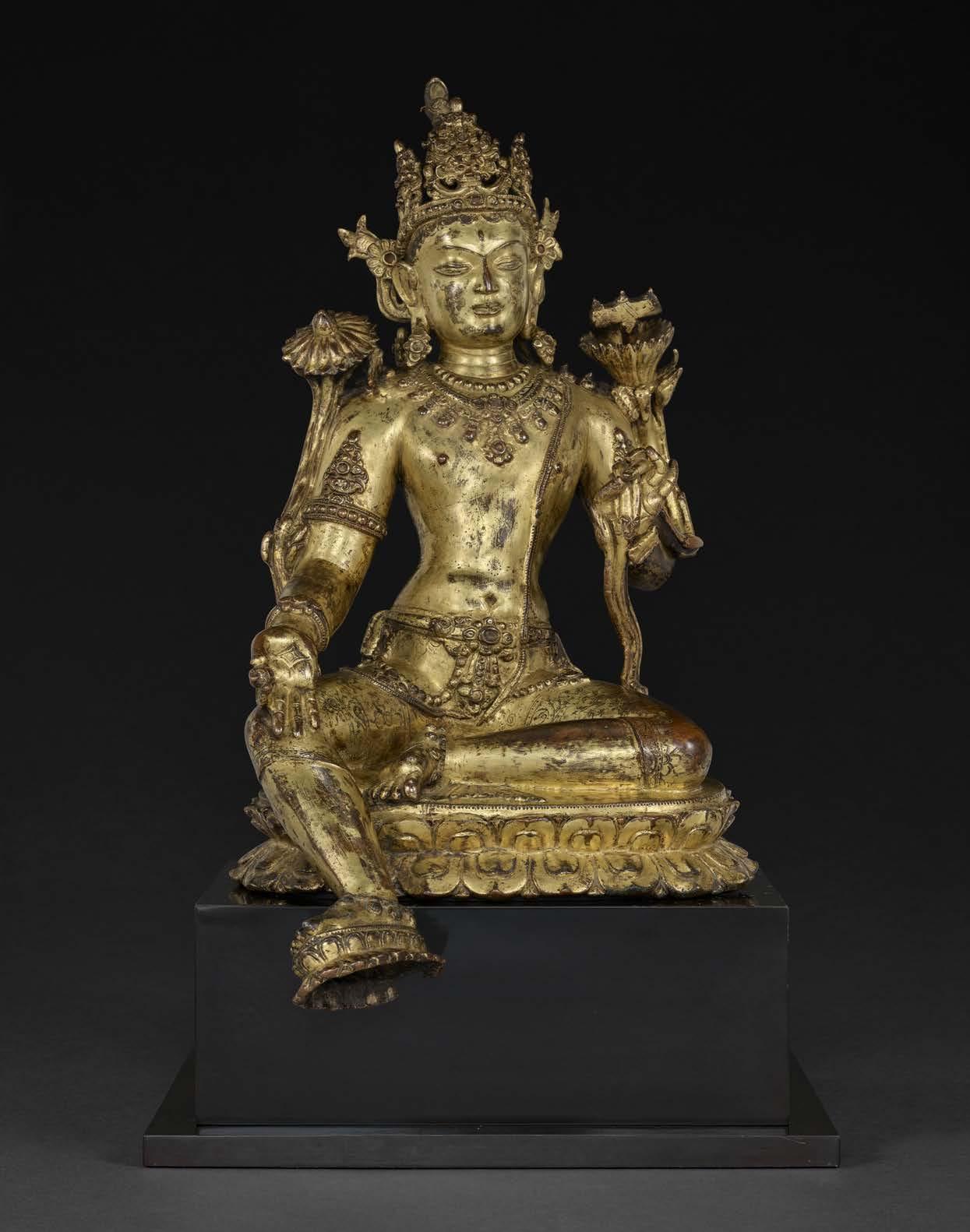
This elegant copper alloy sculpture portrays the bodhisattva Padmapani Lokeshvara seated in lalitasana, the posture of royal ease, poised serenely atop a blooming lotus pedestal, a potent symbol of spiritual purity and transcendence. His right hand extends in varadamudra, the gesture of generosity, perhaps once offering a now-lost chintamani (wish-fulfilling jewel), while his left hand gently rests on the base, delicately grasping the stem of a lotus that rises beside his left shoulder.
The figure leans subtly into an openwork oval halo, exquisitely adorned with three stylised blossoms joined by leafy tendrils. These floral forms arc above the shoulders, forming a graceful canopy that heightens the figure’s ethereal and devotional presence.
The sculptor has lavished particular attention on the jewellery, with the pectoral ornaments and forehead embellishments likely having once been inset with semiprecious stones or enriched with metal inlay—details now softly worn with age but still speaking to the sophistication of Pala-period bronze artistry.
The sculpture’s refined proportions, gentle modelling, and lyrical ornamentation reflect the enduring legacy of Gupta classicism. This lineage is especially visible in the rounded visage, gently parted lips, flowing curls, and asymmetrical earrings that hang suspended from elongated earlobes. These features demonstrate the classical idiom reinterpreted and spiritually elevated by Pala sculptors in their service to Mahayana and Vajrayana iconography.
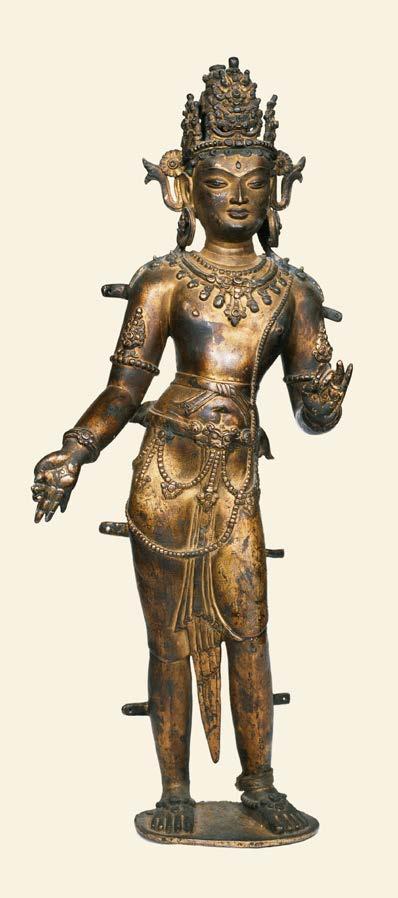
A closely related bronze image of Avalokiteshvara in the Nalanda Museum shows a similar composition, differing only in the positioning of the left hand and the use of a lotus leaf base (00169) (see Susan Huntington, The Pala-Sena Schools of Sculpture, Leiden, 1984, no. 162). Further comparable examples include a bronze in the Orissa State Museum (von Schroeder, Indo-Tibetan Bronzes, Hong Kong, 1981, p. 223, no. 48G), a slightly more compact variant in Pal’s The Norton Simon Museum, Volume I: Art from the Indian Subcontinent, no. 134, p. 174, and a notable piece from the Robert H. Ellsworth Collection sold at Christie’s New York, 17 March 2015, lot 12.
With its serene presence, balanced composition, and refined execution, this sculpture stands as a superb example of early Pala bronze work. The quality of the casting, the sensitivity of the modelling, and the intricacy of the details affirm its artistic significance. Furthermore, its distinguished early provenance, beginning with acquisition in New York in the mid-20th century and its inclusion in the esteemed Rousset collection, underscores both its historical importance and its enduring appeal to collectors and connoisseurs alike.
A COPPER ALLOY FIGURE OF KAUMARI
嬌麼哩銅像
NEPAL, CIRCA 1300
尼泊爾 約十三世紀
7 5/8 in. (19.8 cm.) high
HK$1,600,000-3,200,000
US$210,000-410,000
PROVENANCE:
Bertie Aschmann Collection, Switzerland, before 1978
Galerie Koller, Zurich, 1-3 June 1978, lot 33
Sotheby's New York, 1 December 1993, lot 22
Distinguished European Collection
LITERATURE:
Ulrich von Schroeder, Indo-Tibetan Bronzes, Hong Kong, 1981, p. 353, no. 92G
來源:
貝蒂· 安什曼收藏,瑞士,1978 年前入藏
蘇黎世闊樂,1978 年 6月1-3日,拍品33號
紐約蘇富比,1993 年12月1日,拍品22號
歐洲顯赫珍藏
出版:
烏爾裡希·馮·施羅德《印度-西藏銅造像》,香港,1981年,第 353頁,
編號 92G
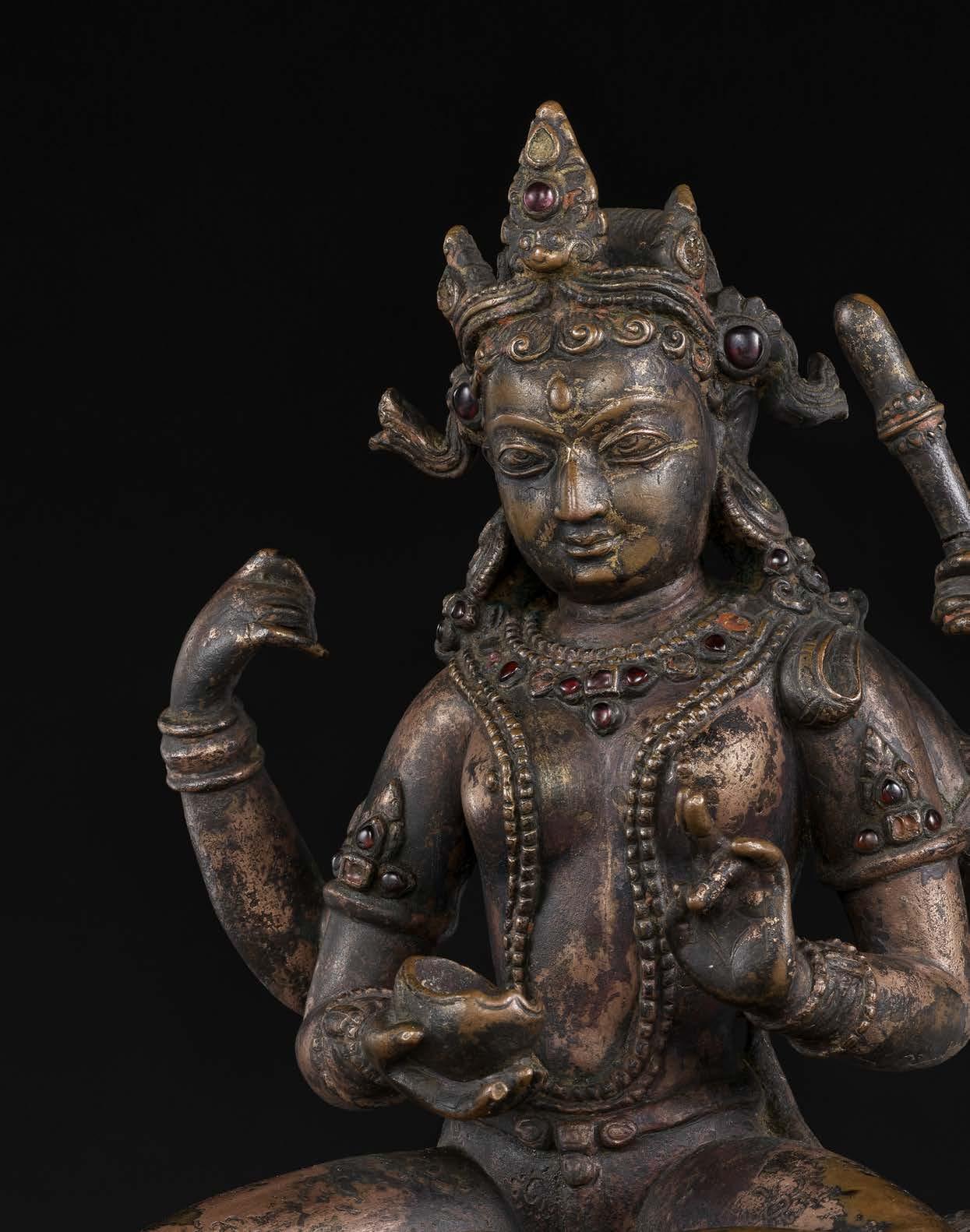
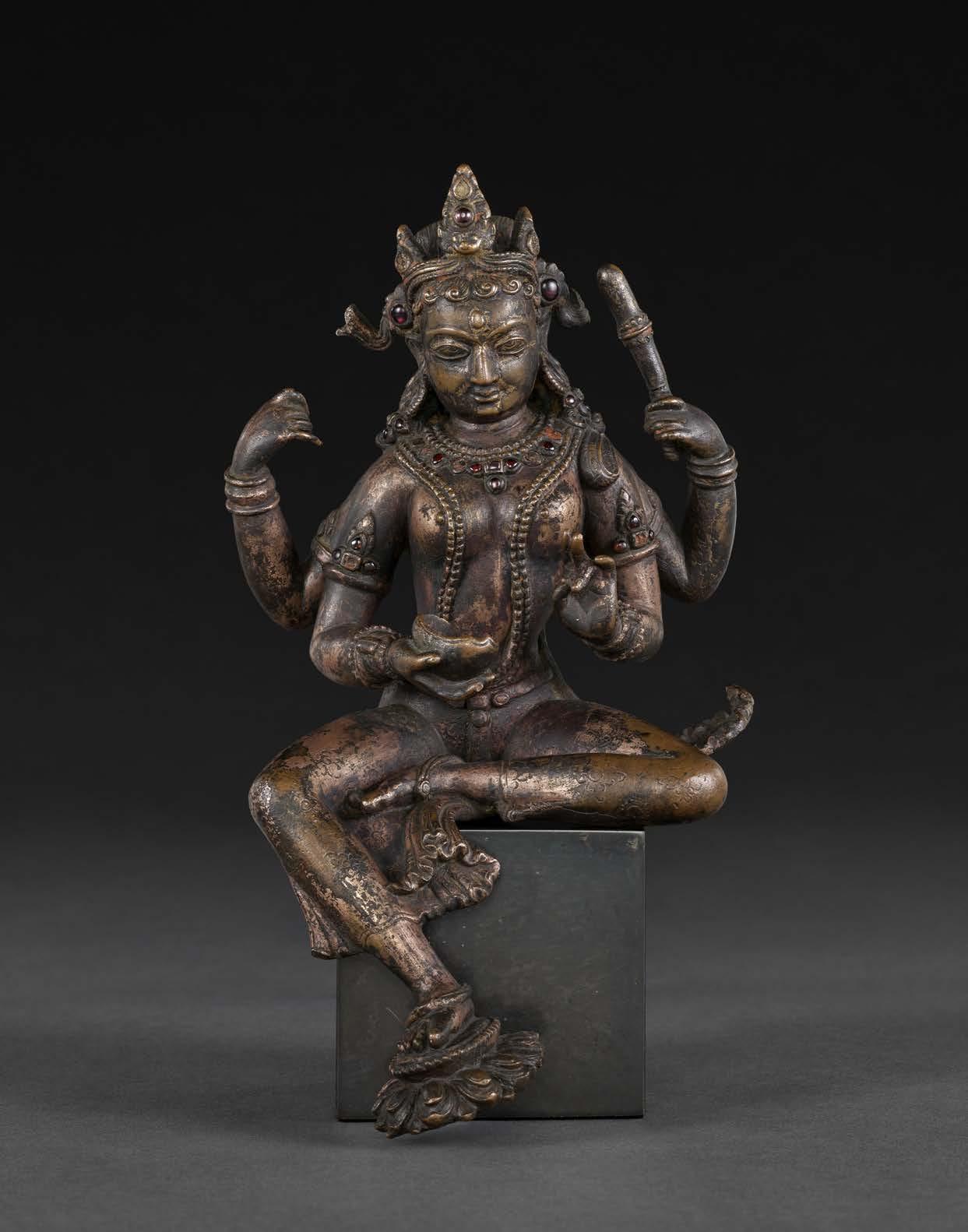
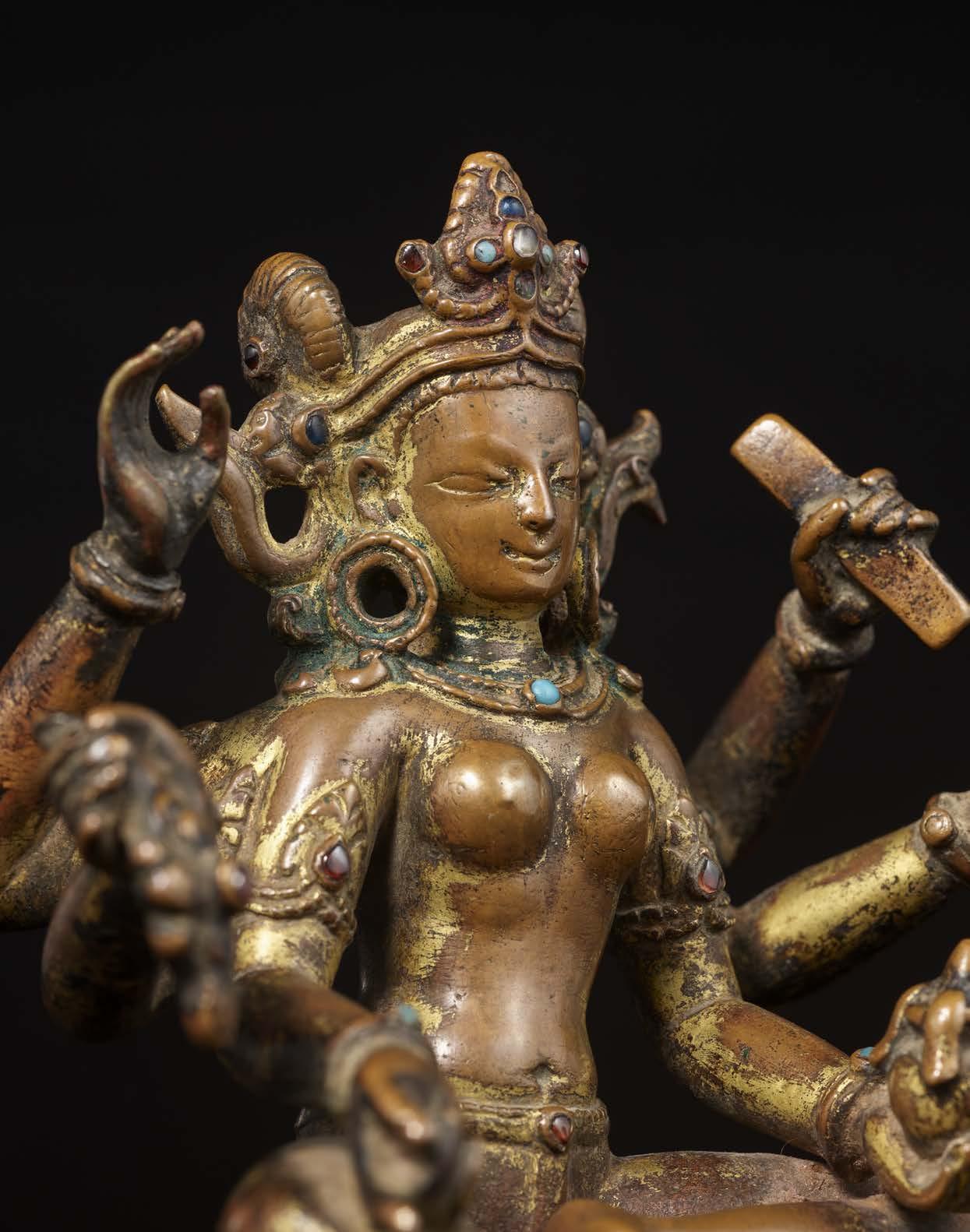
Kaumari belongs to the group of Astamatrikas, or Eight Mother Goddesses, a powerful assembly of female deities revered in both Hindu and Buddhist Tantric traditions across South Asia. She is the third of the Matrikas and represents the shakti (divine feminine energy) of Kumara (also known as Skanda or Kartikeya), the youthful god of war and son of Shiva. As his consort and female counterpart, Kaumari embodies martial strength, youthful vitality, and divine protection. She is typically depicted holding a club and a skull bowl, potent symbols of her protective and destructive power.
In the Kathmandu Valley, the Matrikas hold particular significance in Newar culture, where they are invoked not only as protectors of individuals and communities, but also enshrined as guardians of urban space, deeply embedded in civic rituals, festivals, and temple architecture. They function as fierce yet nurturing forces, removers of obstacles and defenders of cosmic order.
The full pantheon includes Brahmani, Vaishnavi, Maheshvari, Indrani, Kaumari (the present lot), Varahi (Cleveland Museum of Art), Chamunda (LACMA), and Mahalakshmi. Each goddess is an emanation of the shakti of a principal male deity of the Hindu pantheon. In Tantric belief systems, they are simultaneously wrathful and beneficent, embodying the power to destroy evil and to sustain and nurture life.
This figure of Kaumari is part of a rare and well-documented group of eight mother goddesses published by Ulrich von Schroeder in Indo-Tibetan Bronzes, 1981, p. 352. Von Schroeder proposed that the group can be divided stylistically into two subgroups based on subtle sculptural differences. Group I: 92A, 92B, 92F, and 92H, features a slightly more attenuated torso and a distinct treatment of the pleated garment between the legs. The present figure, along with 92C, 92D, 92E, and 92G, falls within Group II, characterised by a more naturalistically proportioned torso and a softer, more rhythmic rendering of the lower garment’s pleats.
Despite these nuanced variations, the group as a whole represents a remarkably rare survival of a complete sculptural set from this period. Like the Varahi now in the Cleveland Museum of Art (inv. no. 1978.70), Kaumari is depicted seated in lalitasana, the pose of royal ease, exuding grace and poised dignity. Her four arms are conceived with a superhuman naturalism, while her tightly draped garment cascades in elegant pleats between her legs.
Notably, the large floral rosettes adorning her lower garment resonate with those seen on the standing Maitreya (lot 2017), attesting to a widespread and enduring aesthetic trend in textile and costume design across the Himalayan plateau during the 11th to 13th centuries.
Kaumari’s expression carries a slightly foreboding intensity, her head gently inclined, and her sharply defined pupils gazing forward with divine concentration. Together, these elements fuse to create a sculpture of exceptional presence and spiritual gravitas, exemplifying the artistic heights achieved during the early Malla period in Nepal.
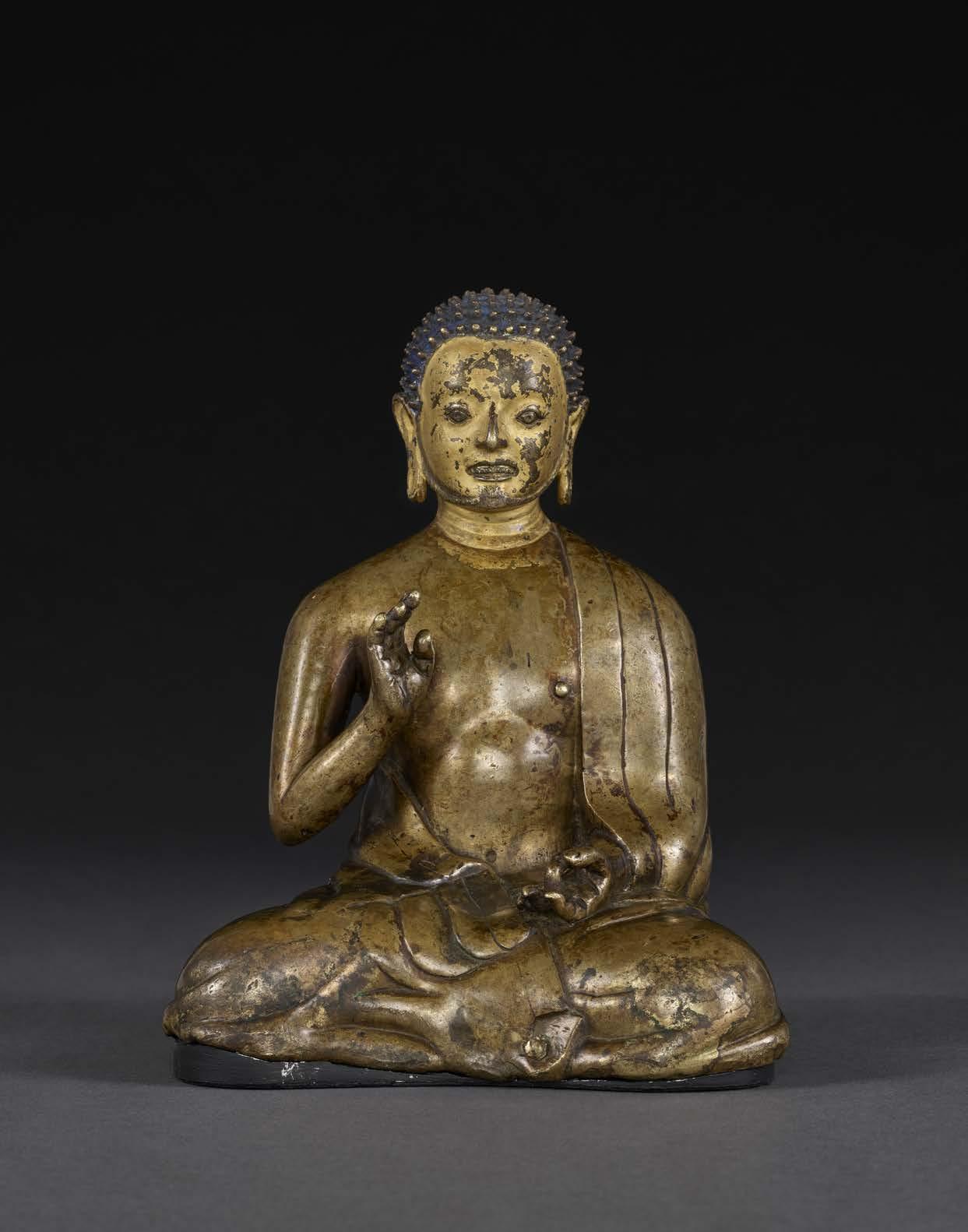
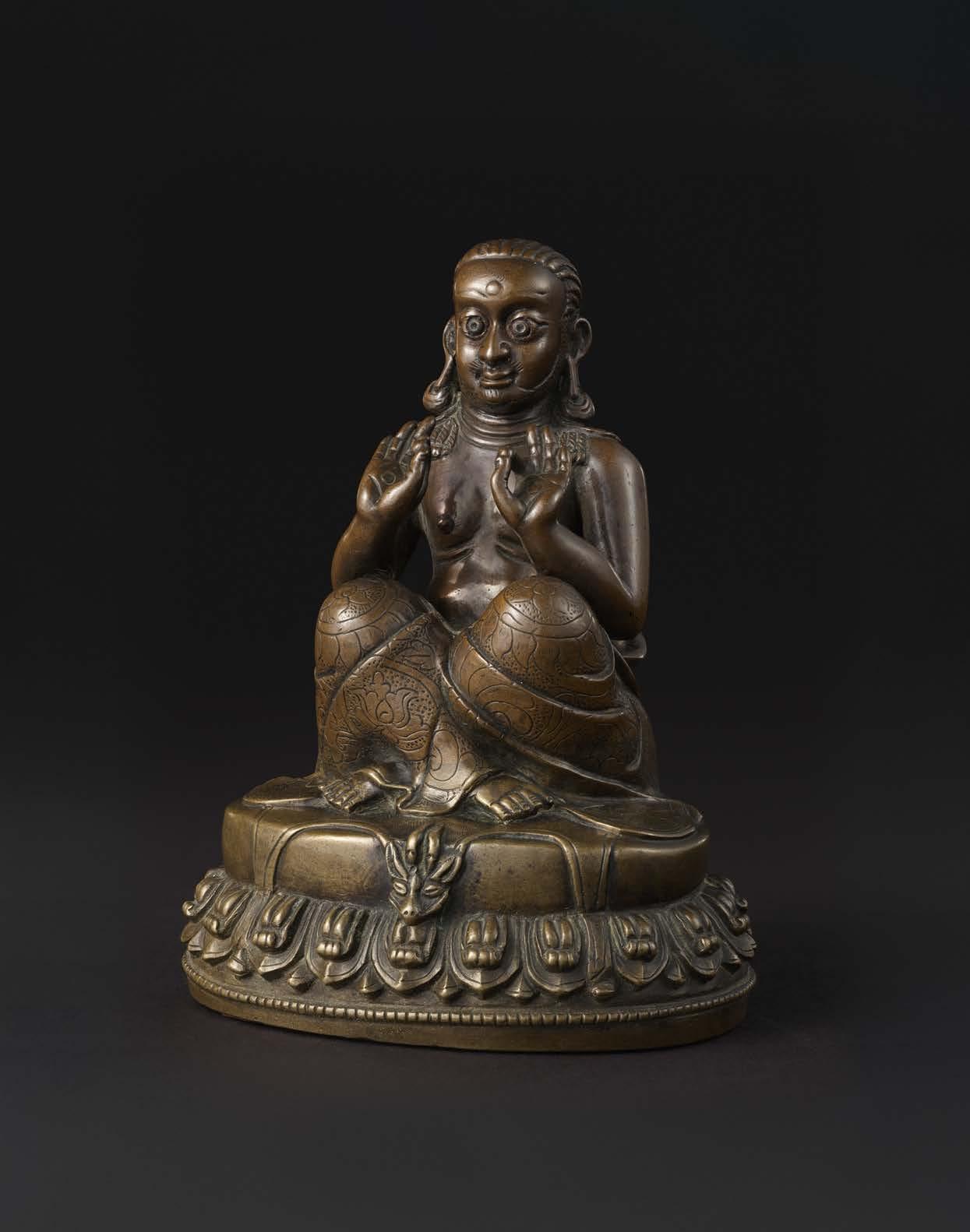
A SILVER INLAID BRASS FIGURE OF A YOGI
MASTER, MOST LIKELY PADAMPA SANGYE
銅錯銀瑜伽上師像 應為帕當巴桑傑
TIBET, WESTERN TSANG PROVINCE, 13TH CENTURY
西藏 後藏地區 十三世紀
7 5/8 in. (19.5 cm.) high
HK$2,400,000-4,000,000
US$320,000-520,000
PROVENANCE: Distinguished European Collection
來源:
歐洲顯赫珍藏
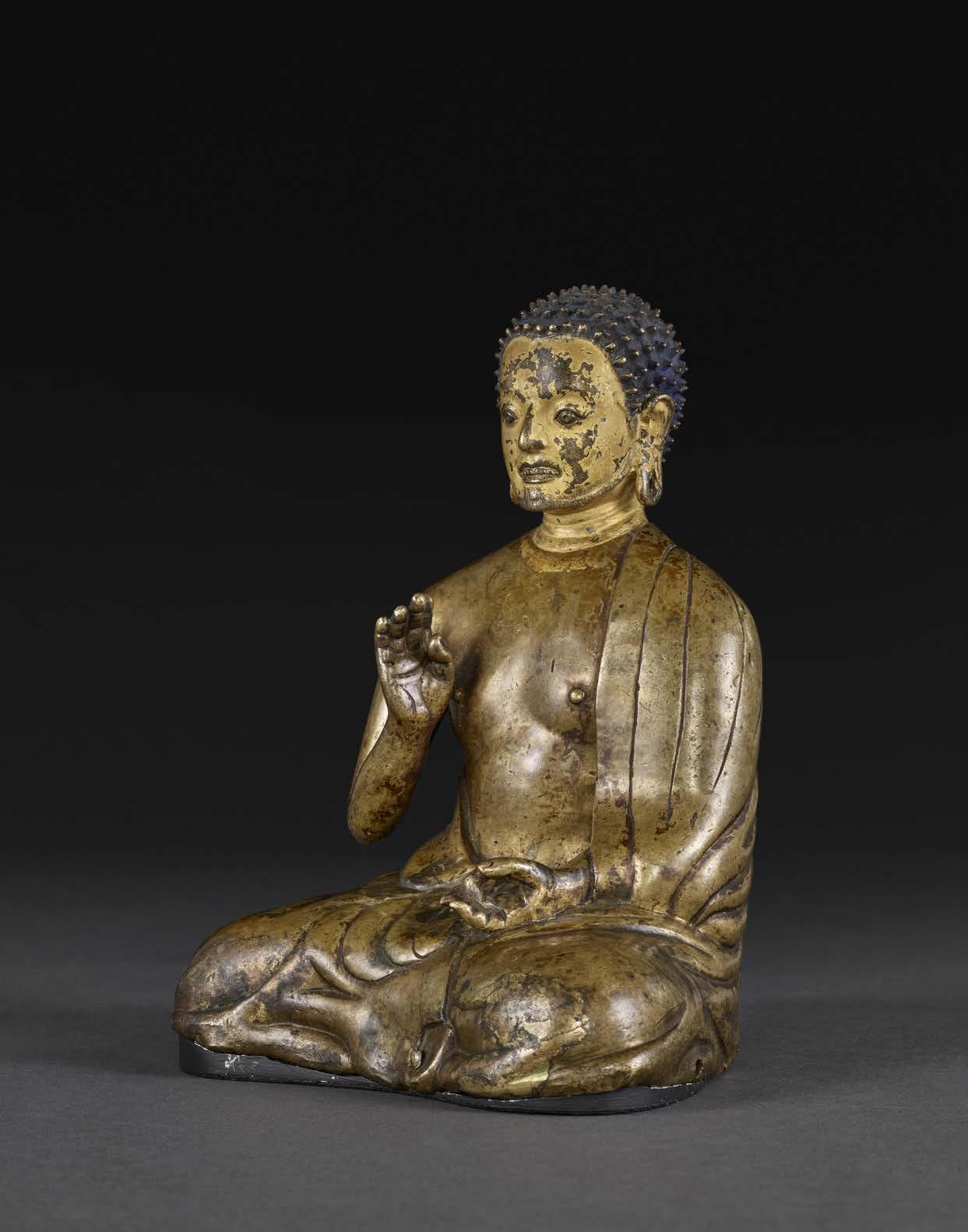
This rare and powerfully expressive sculpture represents an important Tibetan yogi. Executed in copper alloy with silver inlay, the figure is a masterpiece of early Tibetan bronze casting, notable for its spiritual intensity and stylistic restraint, consistent with 12th–13th century production techniques.
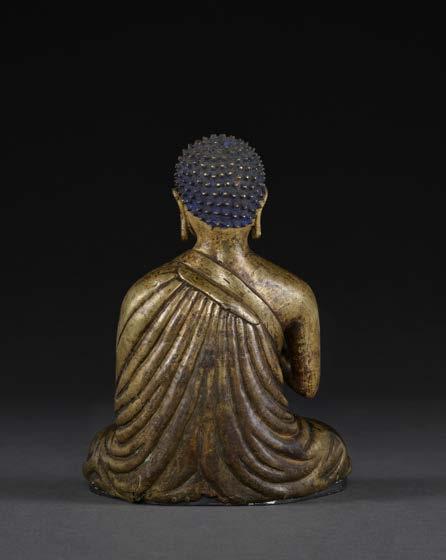
Seated in vajrasana, the yogi raises his right hand in abhaya mudra (the gesture of fearlessness), while the left, resting in his lap is held in vitarka mudra (the gesture of teaching or discussion), eloquently conveying his role as an enlightened master and teacher. His face is rendered with intense, focused expression, including deeply incised eyes, furrowed brow, and notably, exposed teeth, a rare but documented iconographic detail emphasising both spiritual intensity and lifelike realism. His short, spiked hair, unbound and natural, aligns with another sculpture from the same atelier that represents Padamapa Sangye at a more advanced age.
He wears a plain meditation cloak draped simply over his shoulder, its folds modelled with remarkable subtlety across both front and back. The simplicity of his attire and absence of jewellery or attributes makes it difficult to suggest a definitive name, but the popularity of his following was at its peak in the 13th century (see lot 2008 for a discussion on the subject by Jeff Watt).
As noted by Rob Linrothe, in his discussion of a related image of Padampa Sangye from the same period:
“His blanket, his only piece of clothing, was plain… Unlike most yogi siddhas, he is said to have worn no jewellery, and that is how he is shown in this statue, although later images often present him outfitted with large earrings and bone ornaments.” (Holy Madness: Portraits of Tantric Siddhas, New York, 2006, cat. no. 79)
This sculpture is likely part of the same original set as the silver-inlaid figure of Padampa Sangye in the Nyingjei Lam Collection, now widely recognised for its historical and stylistic coherence. Both figures exhibit the thin-wall casting characteristic of 12th–13th century Tibetan bronzes, likely produced in a high-status atelier with access to refined materials and advanced metalworking techniques.
Early, lifelike depictions of Indian masters in this unadorned and ascetic form are exceedingly rare. Later traditions tended to embellish his image, whereas this sculpture captures a near-contemporary vision of the saint, likely created shortly after his death in the 12th century, when his legacy was still being actively shaped by close disciples. The absence of ornamental features, the naturalistic facial expression, and the use of precious inlay point to a devotional image of both ritual and historical significance.
As such, this figure stands as a rare and important survival from Tibet’s early artistic flowering. It reflects a transitional moment, before standardised iconography overtook biographically informed portraiture. The sculpture is not only an object of great visual power but also a testament to the reverence bestowed on early Indian teachers who brought the Buddhist teachings to Tibet.
Backview 背面
PADAMPA SANGYE
Jeff Watt
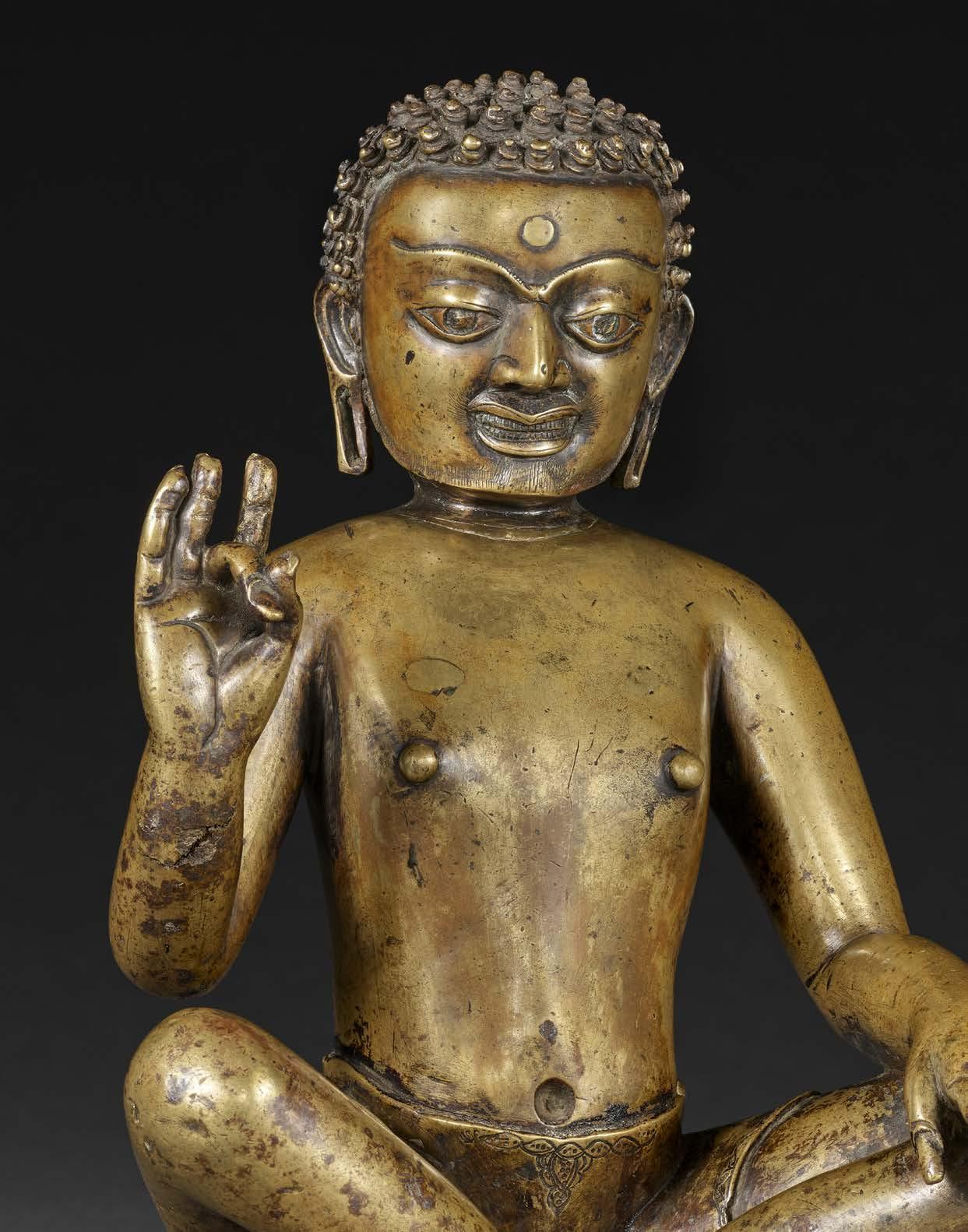
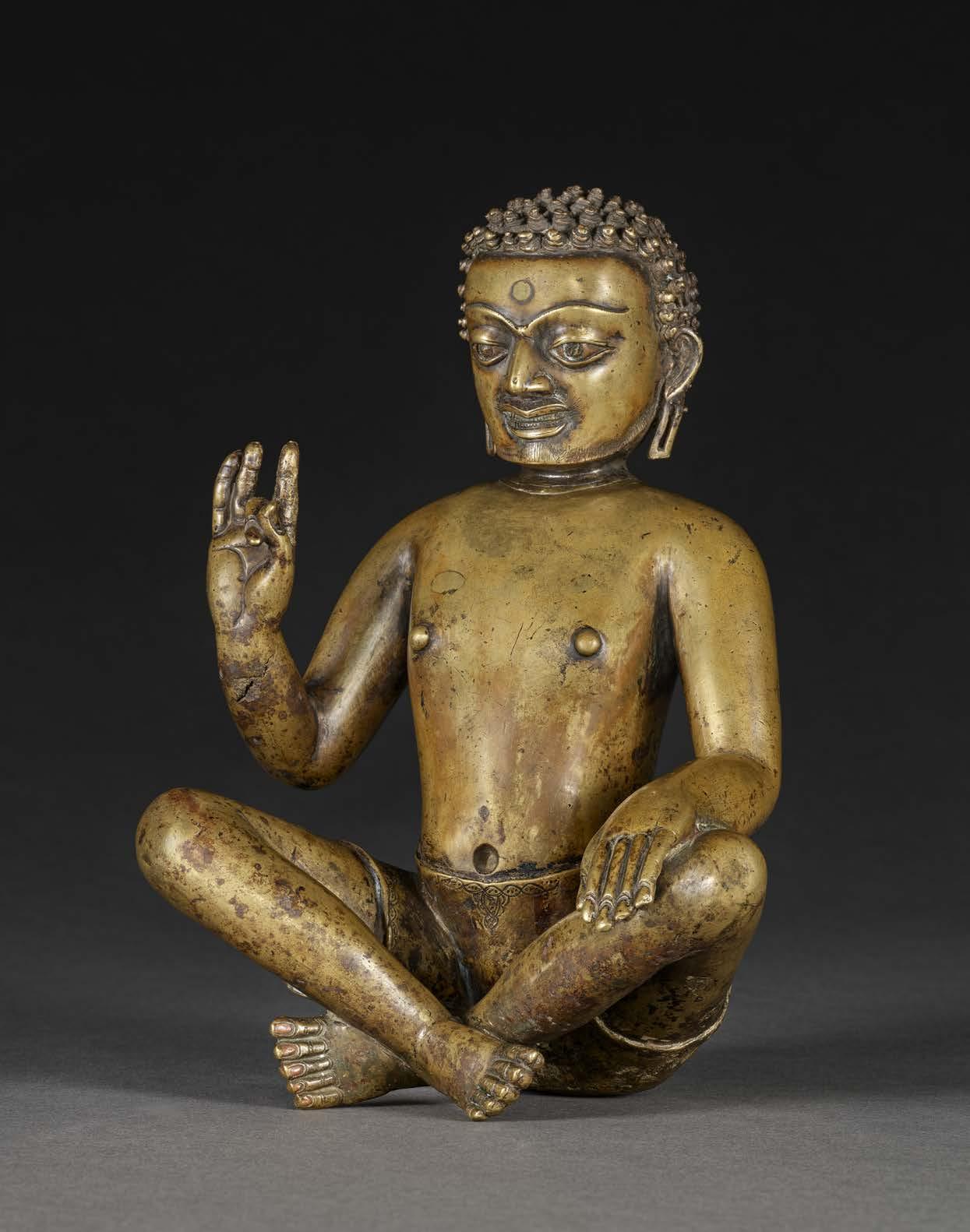
With these three sculptural figures presented (lots 2007, 2008 and 2036) they do appear to possibly be historical people, maybe ascetics, religious practitioners or yogis. The differences between them are in the originating workshop, hand gestures, hair style and clothing. Fortunately, the subject is well known and there are established examples and comparables to assist with the identification of the person.
The three figures are all of the same person, Padampa Sanggye, a historical figure, an itinerant traveler and a religious teacher originating from South India. He is also a well-known figure in Tibetan Buddhism from the 11th and early 12th century. His date of birth is yet to be determined, but he is believed to have passed away in 1117. It is said that he travelled back and forth several times between India, Tibet, and China, before residing permanently in the small trading town of Dingri in the Southern Tibetan province of Tsang.
The question should now be ‘why are there three images and other examples of this person?’ The answer is that he was very charismatic and was documented in historical literature as well as leaving a number of very popular writings especially regarding advice for spiritual practitioners. His traditions and lineages of teaching continue to the present day.
Identifying Padampa Sanggye without any name inscription etched into a sculpture is done through recognising particular characteristics and also through the process of elimination. His clothing is sparse and often only around his midsection and legs. Sometimes a robe will cover a shoulder. He has no particular posture. Padampa also does not have one single manner of hand gesture but rather several. A more familiar appearance is
with both hands raised with the palms facing outward and the knees somewhat upraised (lot 2036). We can see that with the sculpture atop a round floral base. Note that he is also sitting on a krishnasara antelope skin. The present lot and lot 2007 share the same characteristic of spikey hair almost reminiscent of the curly hair of Shakyamuni Buddha. This is a very important observation which can also be found in very early block print depictions of Padampa showing the same style of spikey hair (see Linrothe, Holy Madness, New York, 2006, pp. 112 and 113, figs. 6.1-5). The example (lot 2007) with the robe across the left shoulder might be mistaken for other notable celebrities of the time such as the great yogi poet Milarepa; however, there is a characteristic found with all three of these sculptures that is often overlooked. They all have short beards. This is consistent with most examples of Padampa Sanggye. They also share wide open eyes and often a slightly open mouth with the teeth showing. Why is this done? That I think will require more research however, Padampa was known for teaching with symbols, gestures and facial expressions. It is possible over time with these three figurative examples that the artistic convention was established that varying postures, hand gestures, facial expression, and wide eyes best represented the expression and character of Padampa Sanggye.
All three of these sculpture appear to be from different workshops and slightly different periods. The robed figure at one time sat on a floral base, throne or a cushion of some kind. The face has also been adorned with cold gold as a veneration and for acquiring merit. The curly slightly spikey hair is an early phenomena with Tibetan sculpture and is not found in later centuries with depictions of later historical teachers. All three sculpture are wonderful additions to the larger corpus of knowledge surrounding the very popular figure of Padampa Sanggye.
A
COPPER INLAID BRASS FIGURE OF A YOGI, PROBABLY PADAMPA SANGYE
瑜伽士銅像 可能為帕當巴桑傑
TIBET, 13TH/14TH CENTURY
西藏 十三/十四世紀
8 3/4 in. (22.2 cm.) high
HK$2,000,000-3,000,000
US$260,000-390,000
EXHIBITED:
Tibet: Tradition and Change, Albuquerque Museum, October 18, 1997 - May 24, 1998.
LITERATURE:
Pratapaditya Pal, Tibet: Tradition and Change, Albuquerque, 1998, pp. 22-23, pl. 11,
展覽:
《西藏:傳統與變革》,阿爾伯克基博物館,
1997年10月18日–1998 年 5月24日
出版:
帕爾,《西藏:傳統與變革》,阿爾伯克基,1998 年, 第 22–23頁,圖版11
With black, spiky nubs representing his hair and an intense expression on his face, the figure is depicted seated in a yogic posture, legs raised, bent at the knees, and ankles crossed. Typically, such a posture would be supported by a yogic band, which is notably absent here. He wears a short dhoti in the Indian style, leaving the upper body bare. Just below the navel, a floral motif is delicately etched into the cloth.
The style of the dhoti, the distinctive hair treatment, and the facial features all point toward an Indian identity rather than Tibetan. These features are share with another yogi or mahasiddha in the Tsuglagkhang Temple, Lhasa (von Schroeder, Buddhist Sculpture in Tibet, Vol. II, 2002, p. 1194, nos. 324A&B). Although the figure cannot be identified with absolute certainty, these visual cues strongly suggest he may represent Padampa Sangye, the famed Indian mahasiddha and teacher who played a key role in the later diffusion of Buddhism to Tibet.
Even if not a direct portrait, the sculpture likely draws from keen observation of a real practitioner, possibly Padampa Sangye himself or another mahasiddha in a similar tradition. While the precise origin and date remain uncertain, the work most likely comes from the Western Himalayan regions and belongs to the period of the later diffusion ( phyi dar) of Buddhism into Tibet.
2009
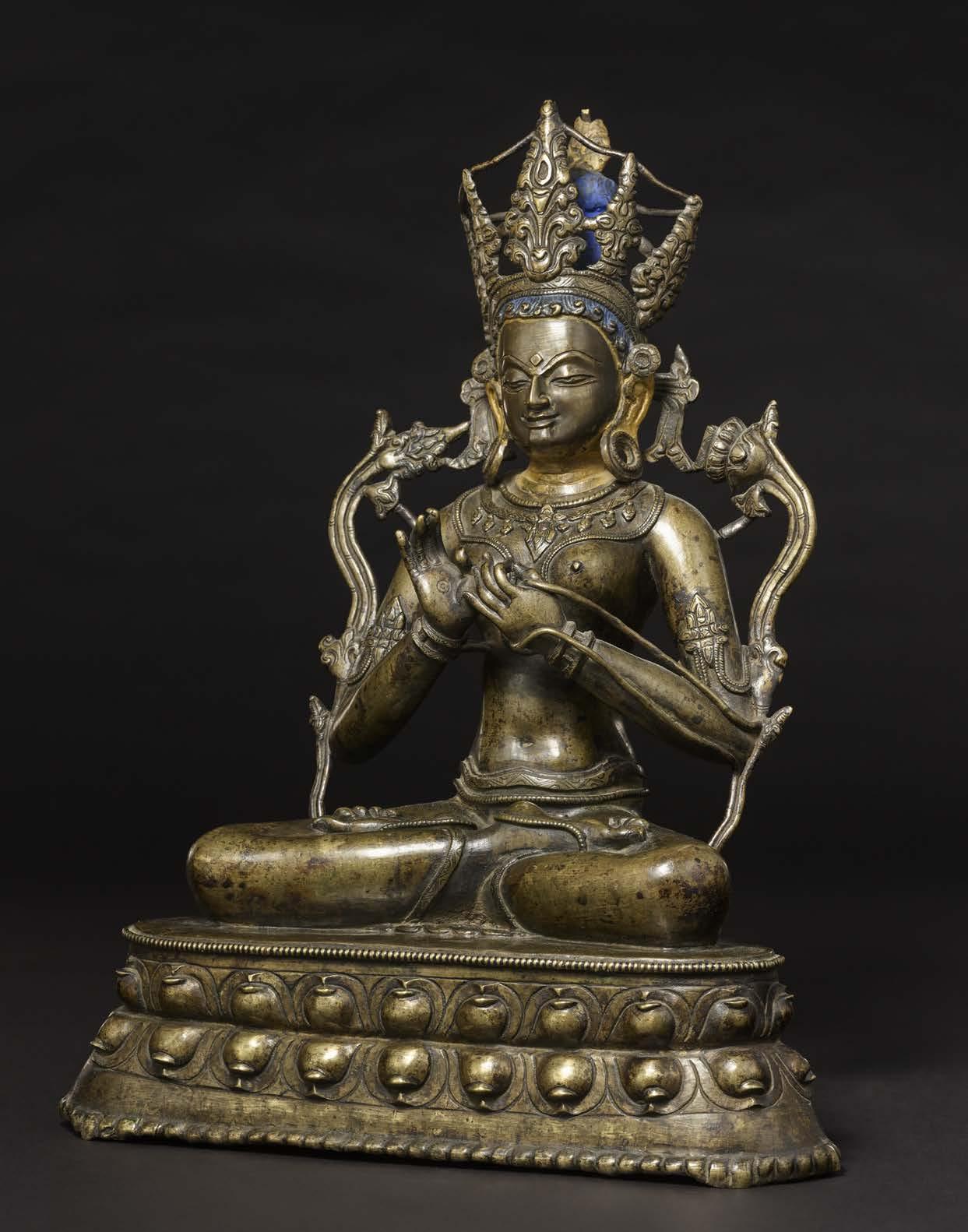
A BRASS FIGURE OF PRAJNAPARAMITA
般若佛母銅像
TIBET, 13TH CENTURY
西藏 十三世紀
15 3/4 in. (40 cm.) high
HK$2,500,000-3,500,000
US$330,000-450,000
PROVENANCE:
Bodhicitta Ltd., New York, before 2008 Michael Henss Collection
LITERATURE: Michael Henss, The Image of the Buddha, 2026 (forthcoming)
來源:
菩提心藝廊,紐約, 2008 年前入藏
邁克爾·亨斯珍藏
出版:
邁克爾·亨斯《佛陀造像》,2026 年 (待出版)
This rare and elegant image of Prajnaparamita, the goddess of transcendent wisdom and personification of the Prajnaparamita Sutra, is an exceptional example of 13th century Tibetan sculpture. Unusual for its scale and subject as no other examples of Prajnaparamita from this period is known.
The figure is cast in a brass alloy, which preserves the delicate modelling and subtle surface details and reveals the sculpture’s clear iconographic program that reflects both its Indian antecedents and the emerging confidence of a distinctly Tibetan artistic language.
Prajnaparamita, venerated as the “Mother of All Buddhas,” embodies the wisdom of emptiness (sunyata), the insight that all phenomena are devoid of inherent existence. She is a central figure in Mahayana and Vajrayana traditions and an especially potent symbol during the second diffusion of Buddhism in Tibet. Despite her importance in textual traditions and manuscript painting, sculptural representations of Prajnaparamita from this period are remarkably rare, particularly in bronze. This figure may represent one of the few large-scale, freestanding images of the goddess created during the 13th or 14th century.
The deity is depicted in her two-armed form, a visual formula rooted in Pala-period eastern Indian bronzes of the 10th and 11th centuries. An example of a White Prajnaparamita from the 9th century early Pala period in the Asian Art Museum of San Francisco, no. B62S32+ (Huntington and Bangdel, The Circle of Bliss, Los Angeles, 2002, p. 122, no. 21), fig. 1 shows the early example of the two-armed form although shown with a sutra on top of both flowers.
She sits in a meditative posture with her hands in dharmacakra mudra, the gesture of turning the Wheel of the Dharma. From the base, a lotus stem rises and splits into two vines: one curves gracefully around her left arm, looping along the forearm and reconnecting to the main stem before arching upward to support a manuscript above her left shoulder, an explicit symbol of the wisdom teachings she embodies. The right-hand stem, by contrast, rises independently behind the figure, a visual echo of early Indian bronze compositions. The subtle variation in stem handling and the unadorned elegance of the forms are rare survivals in the Tibetan sculptural canon.
The facial expression is serene and introspective, the features softly modelled, with an ovoid face, high forehead, prominent chin, and hooked nose, may suggest a degree of regional portraiture, possibly reflecting the appearance of a patron or local ruler who commissioned the image. Her tall ushnisha is framed by structured crown leaves, flanked by projecting ribbons and large rosettes over the ears. A diamond-shaped urna marks her forehead. She wears a necklace with an incised pendant in a cruciform leaf design, suspended from a flat band, along with stylised armbands and wrist bangles, motifs that also
appear in works like the Ratnasambhava in the Tsuglang Temple, Lhasa (von Schroeder, The Jokhang Bronzes, in Jokhang – Tibet’s Most Sacred Buddhist Temple, edited by Gyurme Dorje, London, 2009; Part 4, Pl. 3E). fig. 2. The overall handling of the body, jewellery, and expansive lotus base with a bold beaded lower rim reveal the sculptor’s deep familiarity with the Pala idiom.
Yet this is not a mere replication of Indian models. The sculpture incorporates local innovations that mark it unmistakably as Tibetan. The bars linking the crown leaves are structurally functional but also stylistic markers frequently found in Tibetan bronzes of the 13th and 14th centuries. The lotus base, with its flat, wide petals and incised outlines, reflects the aesthetic preferences of Central Tibetan ateliers. The brassy alloy, the exaggerated height of the crown, and certain ornamental details point to Kashmiri influence, especially the sculptural tradition disseminated across Western and Central Tibet in the 10th–12th centuries. These elements are visible, for instance, in a Kashmirstyle Prajnaparamita in the British Museum (1966,0616.2), showing the hybrid aesthetic Tibetan sculptors synthesised from multiple Himalayan sources.
The composition of this sculpture also reveals the artist’s sensitivity to visual rhythm and devotional function. The flowering vine stems that arc above the shoulders act not only as symbolic elements but also as a visual mandorla—encircling the deity with an aura of sacred presence. This motif, drawn directly from Pala prototypes, appears in several related bronzes from the region but rarely with such finesse.
Comparable examples of related stylistic features and compositions include a seated Buddha illustrated in von Schroeder’s Buddhist Sculptures in Tibet, Vol. II (2001, p. 1173, no. 313D); a Ratnasambhava in the Tibet Museum, Gruyères (ABS 032; HAR 200457); and the Prajnaparamita on a Pala bronze stupa in the Cleveland Museum of Art (1982.132). Additional references can be found in Buddha: 2000 Years of Buddhist Art by Grewenig & Rist (2016, pp. 408–9, no. 177), which presents related Central Tibetan bronzes informed by Indian and Kashmiri traditions.
This sculpture of Prajnaparamita is not only a masterwork of early Tibetan bronze casting but a rare and profound expression of the spiritual and artistic bridges between India and Tibet during the second diffusion of Buddhism. Its iconographic clarity, elegant restraint, and exceptional state of preservation distinguish it as one of the most important surviving representations of a female deity from the early period of Tibetan Buddhist art. In both its devotional significance and its sculptural quality, it stands among the finest known examples of its kind.
A GILT-COPPER ALLOY FIGURE OF VASUDHARA
銅鎏金財續佛母像
NEPAL, EARLY MALLA PERIOD, 13TH-14TH CENTURY
尼泊爾 馬拉王朝早期 十三/十四世紀
8 1/2 in. (21.5 cm.) high
HK$1,500,000-2,000,000
US$200,000-260,000
PROVENANCE:
David Weldon, London, 1970-1972
Alain Presencer, U.K., 1972-2020
Private English Collection
來源:
大衛· 韋爾登,倫敦,1970 -1972 年
艾倫· 弗雷森勒,英國,1972-2020 年
英國私人收藏
A commanding embodiment of abundance and wisdom, this 14thcentury bronze Vasudhara is a masterpiece of Newari artistry and spiritual symbolism. Her name, meaning “Bearer of Treasure,” reflects her role as the Buddhist goddess of wealth, prosperity, and fertility, revered above all by the Newars of the Kathmandu Valley. Although she is often associated as the consort of the wealth deity Jambhala, Vasudhara’s worship in Nepal predates his, and her significance runs deeper: she represents not only material wealth but the abundance of transcendental wisdom. She stands as the Buddhist counterpart to both Lakshmi and Sarasvati, Hindu goddesses of prosperity and intellect.
This substantial, heavily cast bronze is a striking example of Newari aesthetics, with soft, rounded forms that convey divine contentment and vitality. Her six arms radiate from her body with effortless grace, a form largely unique to Nepal. Adorned with an elaborate crown, lavish jewellery, and a boldly patterned dhoti, Vasudhara radiates the ideals of beauty, abundance, and spiritual grace. Her hand gestures (mudras) signal generosity and reassurance, while the objects she holds— treasure vases, grain, jewels, and sutras—embody the full spectrum of prosperity.
The sculpture’s stylistic details, its physiognomy, patterned garments, and gilded bronze alloy, compare favourably with another in von Schroeder, Buddhist Sculptures of the Alain Bordier Foundation, Hong Kong, 2010, pp. 26-7, no. 10B. Also compare the features an Early Malla Prajnaparamita, in van Alphen, Cast for Eternity, 2005, p. 119, no. 33, and to another Vasudhara figure sold in Sotheby's, New York, 26 March 1998, lot 217.
These examples share the common traits are found cross both Buddhist and Hindu traditions, and asserts a uniquely local vision of divine abundance.
A GILT COPPER ALLOY FIGURE OF SHAKYAMUNI BUDDHA
銅鎏金釋迦牟尼佛像
NEPAL, CIRCA 13TH CENTURY
尼泊爾 約十三世紀
4 1/2 in. (11.4 cm.) high
HK$1,000,000-1,500,000
US$130,000-190,000
PROVENANCE:
Philip Goldman, London
Sotheby's New York, 21 March 2002, lot 50. Private American Collection
來源:
菲力浦·戈德曼,倫敦 紐約蘇富比,2002 年 3月21日,拍品50 號 美國私人珍藏
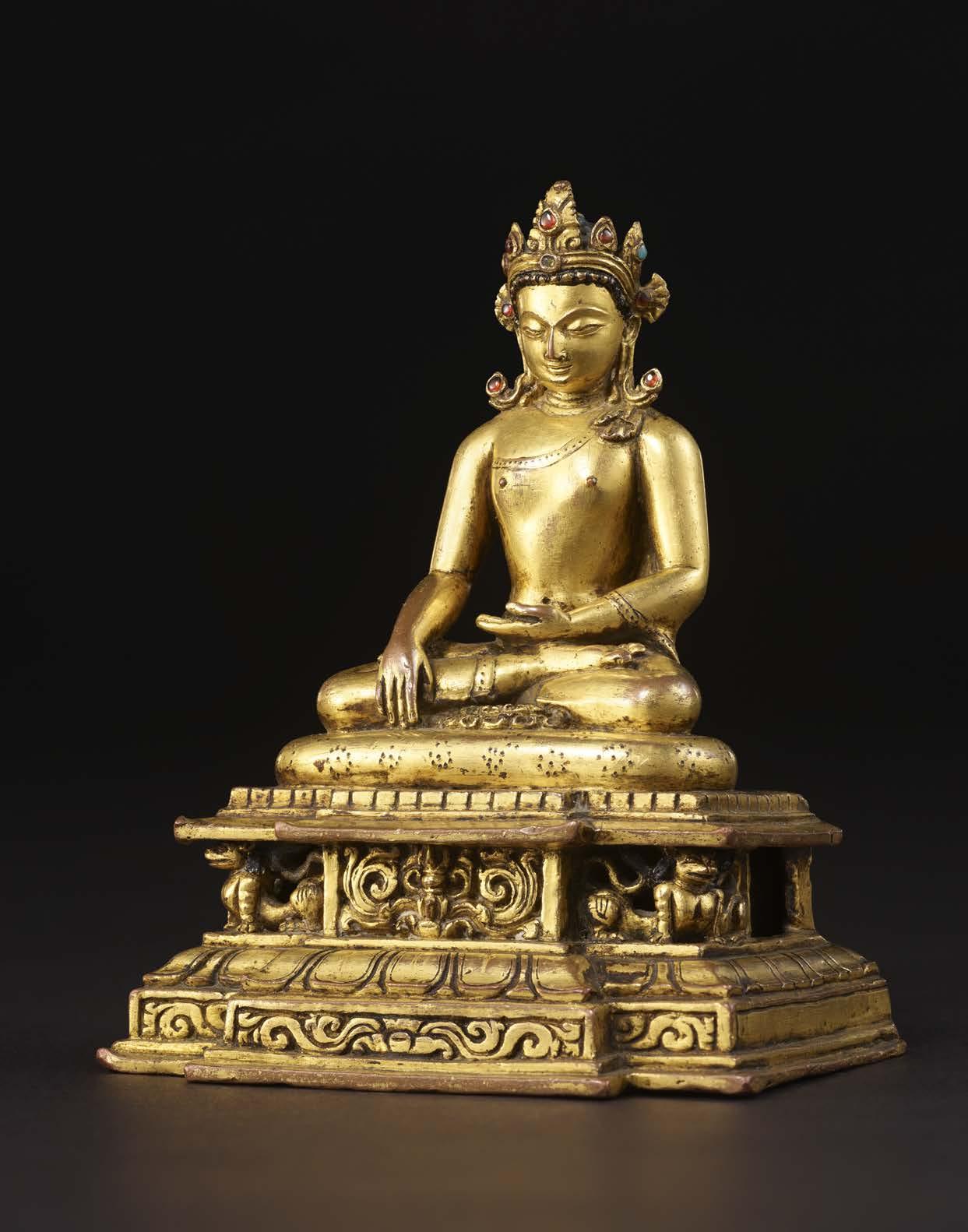
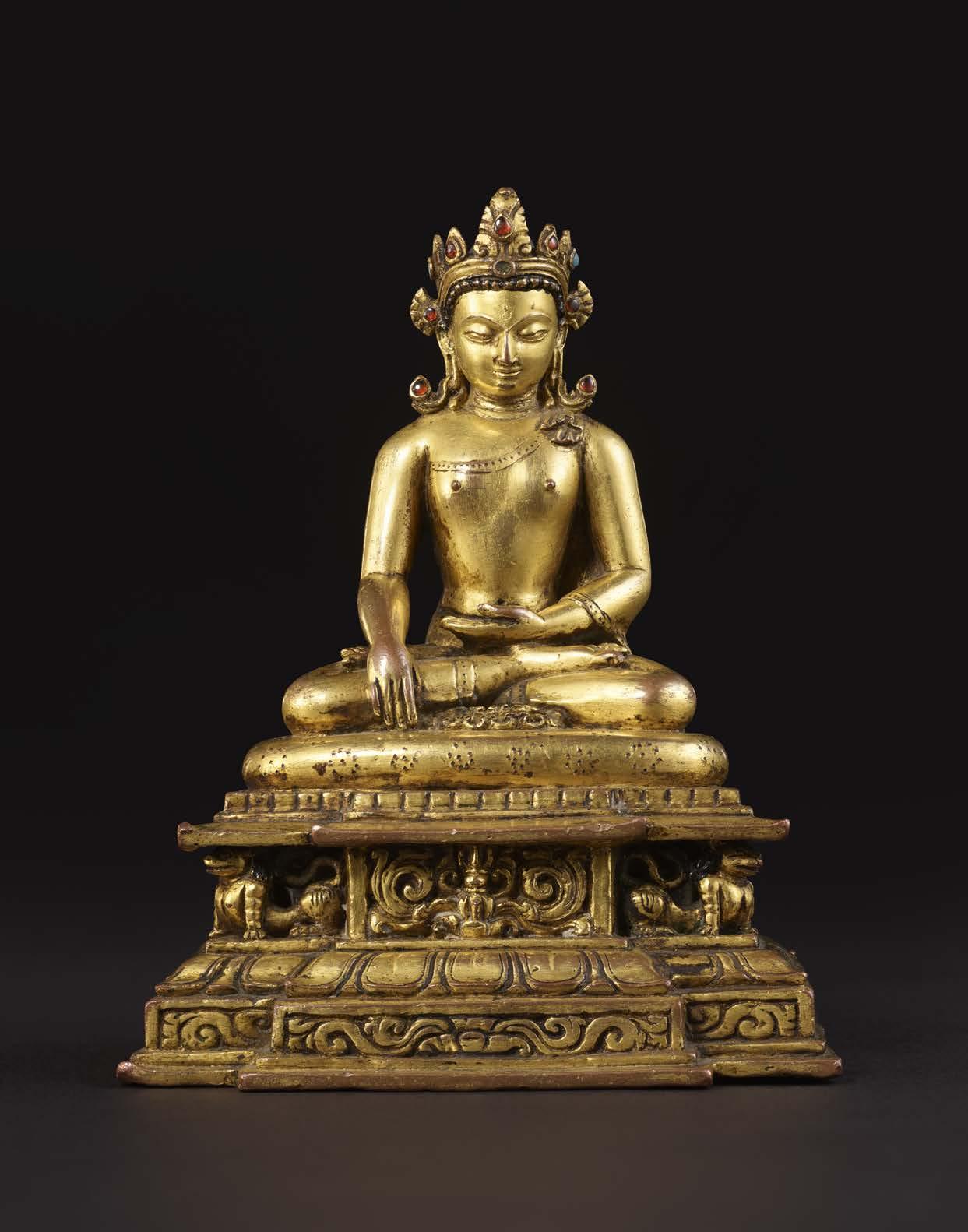
This superbly preserved and richly gilded bronze of a crowned Shakyamuni Buddha can be securely attributed to a Newar master sculptor active during the birth and artistic apex of the early Malla period of the 13th century. Newar artisans from the Kathmandu Valley worked for centuries in service of Tibetan patrons, creating works that combined Indian, Nepalese, and Tibetan elements into a distinctive visual idiom. This sculpture exemplifies the sophisticated metalwork produced during this brief but significant period of artistic realisation.
The crowned Shakyamuni is shown seated in the lotus position on a finely decorated cushion, itself raised upon a lion-protected throne. Crowned images of the historical Buddha became increasingly prominent from the early Malla period onwards, inspired by Indian prototypes but adapted in Nepalese and Tibetan contexts. Here, the Buddha makes the earth-touching (bhumisparsha) and meditation gestures, recalling the moment of enlightenment beneath the Bodhi tree. His serene expression, wide forehead, and smoothly contoured facial features reflect the high aesthetic standards of Newar craftsmanship. The leaf-shaped crown, inset with semi-precious stones, and the large, upturned earrings are emblematic features found in Kathmandu Valley early Malla period bronzes, paralleling those seen on a standing Avalokiteshvara in the Rietberg Museum, (see Uhlig, On the Path to Enlightenment, Zurich, 1995, pp. 96-7, no. 51). His monastic robe, revealing his right shoulder, but covers both pectorals, a rare representation that recalls Pala models. It is further defined by a beaded hem and dense, pleated folds that terminate in elegant ridges across the left shoulder. The cushion below features stippled floral motifs enclosed in circular designs, closely related to patterns on a Vasudhara in the British Museum (1971,0925.1) and which is are also found on the lower garment on the Rietberg Avalokiteshvara.
The throne is particularly elaborate: a breakfront Pala-style base centred with a vajra emerging from a lotus flanked by scrolling foliage and protected at the corners by a pair of lions whose deeply arched backs converge into a singular conjoined head—a style reminiscent of the fine terracotta examples found in the early Pala traditions at Shablan Vihar. The throne itself is a monument to architectural design. It is a study of the pagoda, a deliberate nod to the prototypal Nepalese chaitya of the Lichaavi dynasty. The front of the base protrudes forward at the centre, articulating one of the four reliquary niches of a chaitya, the east, while contextualizing the other two remaining visible sides as niches facing north and south. Pillars, interrupted by the converging lions at the corners, frame the reliquary niches and hold up one of the many canopied tiers of the pagoda’s roof—which are slightly upturned at the corners in a pleasing fashion. The architect of this small masterwork was indeed keen on the intricacies of architecture itself.
For comparison, see the iconic thangka of a Green Tara in the Cleveland Museum of Art (1970.156). Note the rigorous focus on architecture: the tiered canopies of the roof of the pagoda enshrine the celestial Tara in a penultimate torana, echoed as well in the tiered throne under her delicate, pendulant leg. While most scholars agree that the Green Tara was painted by the renowned Nepalese artist known as Aniko, sculptor, painter, and architect, no such attribution has ever been lent to a sculpture.
Contextually, the story of Aniko’s life, or that of a contemporary thirteenth century Newar master, is reflective in this present sculpture. There is no doubt that it was made by the hand of a preeminent Nepalese artist, but where along that great journey from Nepal to Tibet was it executed? Whether in the lush valley of Kathmandu or on the high plateau of Lhasa, in the monolithic monastery at Sakya or within the imperial courts of Shandu, there is little question that this miraculous image of a Shakyamuni Buddha was commissioned at the highest order.
A GILT COPPER FIGURE OF KRISHNAVATI
銅鎏金克里希納瓦提像
NEPAL, DATED 1672
尼泊爾 1672 年
5 7/8 in. (14.9 cm.) high
HK$800,000-1,200,000
US$110,000-160,000
PROVENANCE:
The Sporer Collection, New Jersey, acquired by 4 March 1973 Christie’s New York, 15 September 2015, lot 46 Nyingjei Lam Collection, Hong Kong
ENGRAVED:
The inscription around the lower rim of the base reads text transliteration should appear as:
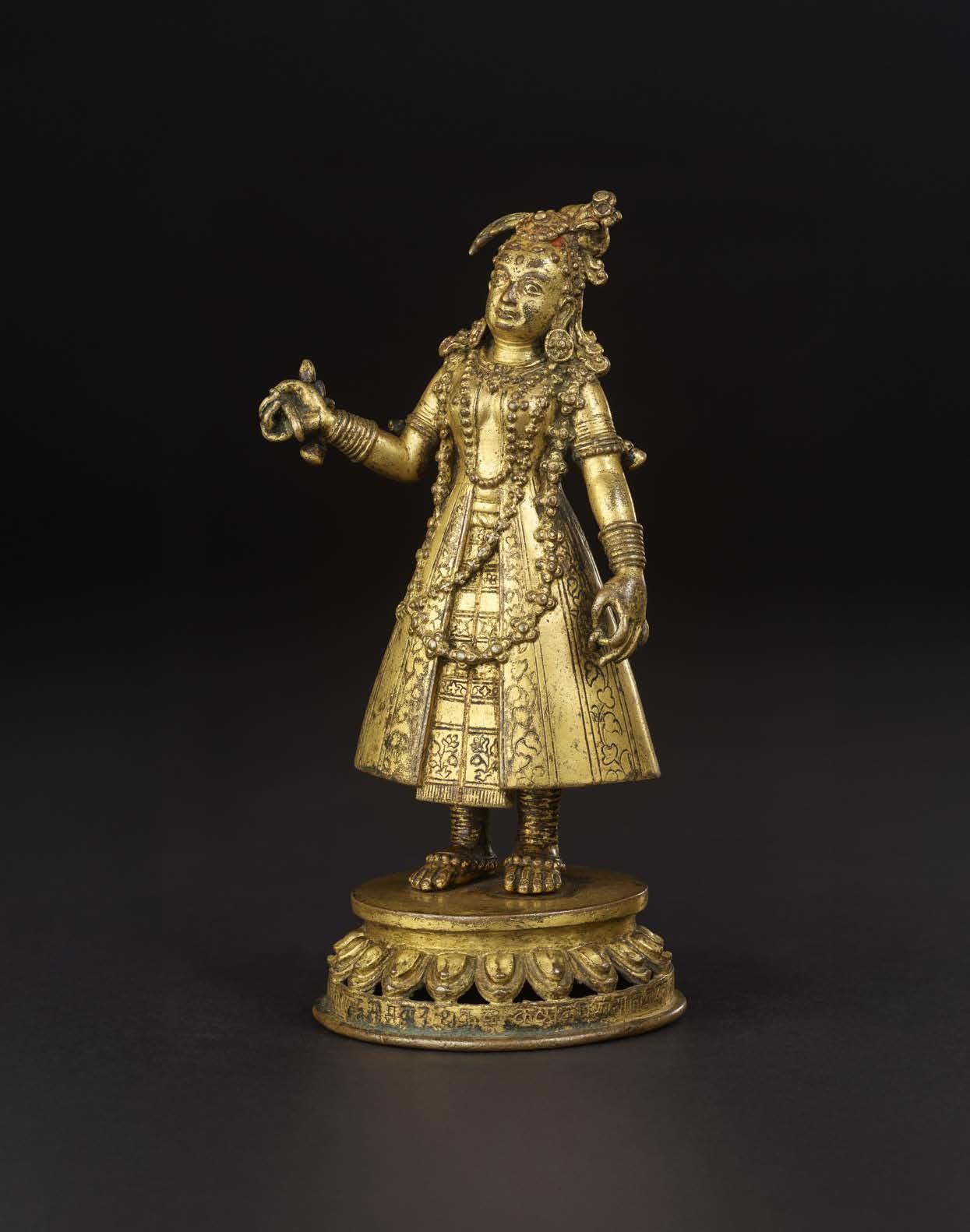
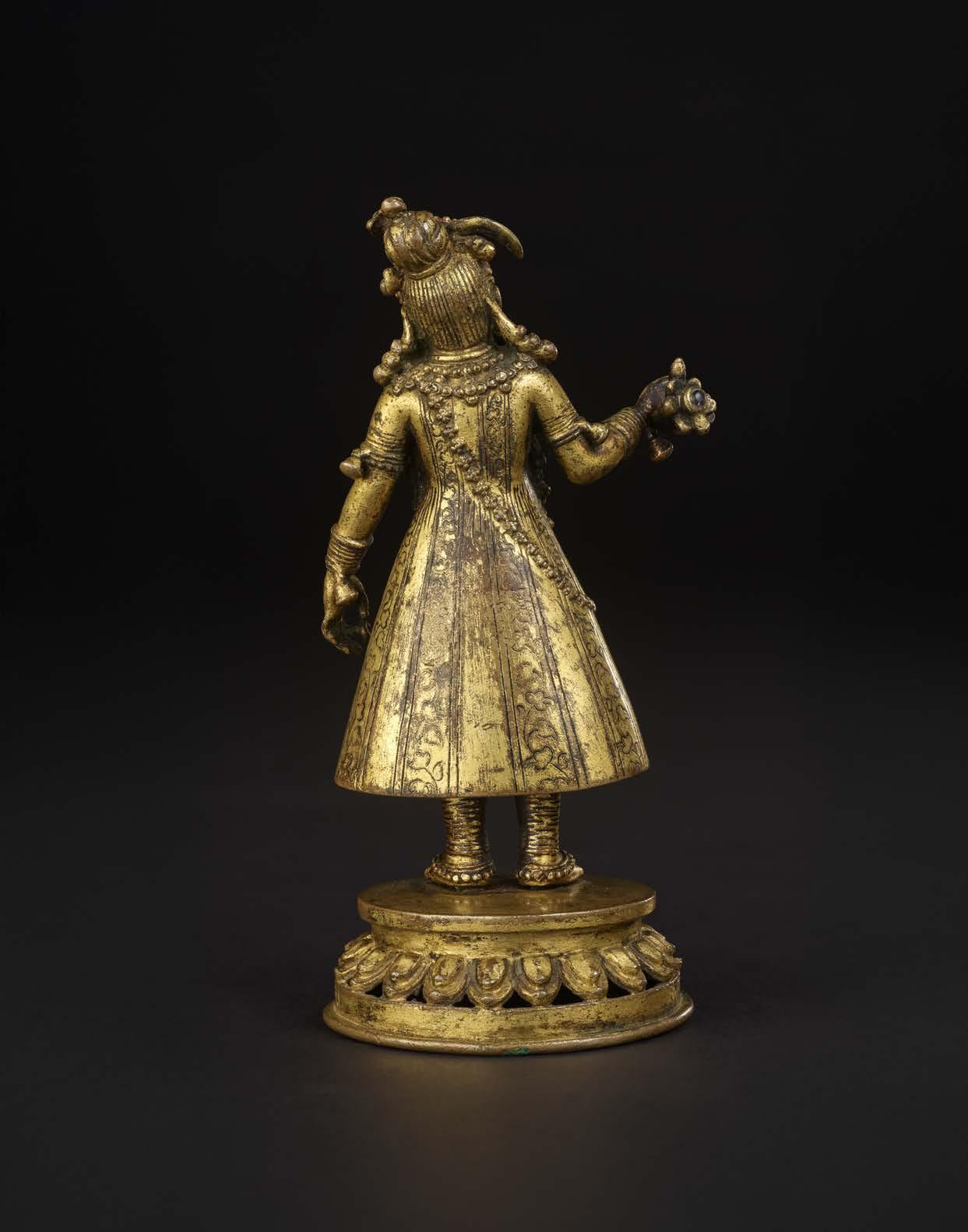
More than a portrait, this exquisitely cast figure of Krishnavati captures a fleeting moment of grace and spontaneity. With her right arm raised, she holds a gem-studded bouquet, as if caught mid-performance. Her expression, gentle and open, conveys a sense of innocence and quiet confidence, setting this figure apart from the more rigid, devotional representations common in conventional Nepalese royal portrait sculpture.
This lifelike portrayal stands in contrast to traditional portraiture where historical figures are often depicted in veneration or mimicking the posture of deities. Here, Krishnavati is depicted in a relaxed, naturalistic pose that suggests vitality and personality. The subtle articulation of her garments, the rippling sleeves and trousers, the layered jewellery, and the carefully rendered hair ornaments all speak to the sculptor’s attention to nuance and individuality.
She stands gracefully on a single-lotus openwork base, wearing a long, flared tunic that parts at the centre to reveal her bare torso and a long, tasselled scarf below the waist. Her clothing is sparsely adorned with floral motifs, and she is richly ornamented with garlands, multi-strand necklaces, bracelets, anklets with bells, and earrings. Her elaborate headdress rests atop a precisely arranged coiffure, from which long tresses fall over her shoulders.
This figure belongs to a broader tradition of portraiture in Nepal that gained prominence in the 17th century, particularly in metal and stone. While depictions of historical figures appear in painted paubhas as early as the 12th century, three-dimensional representations such as this became increasingly refined and individualised in this later period.
A closely related figure, believed to depict a young prince, is in the Aalderink Collection. The prince is of a similar scale at 13 cm. high, it was exhibited in the Rijksmuseum, Amsterdam, during the Oosterse Schatten exhibition in 1954 (p. 114, pl. 51, no. 570). Both sculptures share the same flared tunic and densely rippled sleeves and trousers, suggesting they may have originated from the same workshop or even as part of a set. The present inscription dates the Krishnavati figure just two years before the death of King Pratap Malla, further supporting the likelihood that both portraits are connected to his court.
Additional and more conventional comparisons can be drawn with a donor figure in the Metropolitan Museum of Art (acc. no. 2020.288.1), which depicts a nobleman in Rajput-style dress similar to that seen in 17th- and 18th-century Nepalese courtly attire. This style also appears in the lower register of a 1681 Vishnu mandala in the Los Angeles County Museum of Art (M.73.2.2). Additionally a paubha of a Tuladaan ceremony dated 1669 now in the Collège de France, Paris (see Pal, The Arts of Nepal: Volume Two: Painting, Leiden, 2978, no. 220) that features Pratap Malala’s youngest son Chakrabartendra Malla. The Met figure bears an inscription identifying the donor as Sri Muni Vajracharya, a member of the Varyacharya caste. Another relevant comparison is a kneeling female donor figure, also in the Met (acc. no. 2020.288.2), believed to represent Lady Bharamayi. That figure features a more restrained rendering of garments, contrasting with the dynamic presence of Krishnavati.
Together, these rare and intimate portraits offer a compelling glimpse into the sophisticated visual culture of 17th-century Nepal, where portraiture served not only as personal or devotional objects but also as records of status, identity, and courtly life.
(We are grateful to Ian Alsop for providing the translation and sharing his research for this essay).
A GILT COPPER ALLOY FIGURE OF VAIROCHANA
銅鎏金大日如來佛像
NEPAL, KHASA MALLA KINGDOM, EARLY 14TH CENTURY 尼泊爾 卡薩馬拉王朝 十四世紀初
3 1/4 in. (8.3 cm.) high
HK$800,000-1,200,000
US$110,000-160,000
PROVENANCE: Private American Collection
來源: 美國私人收藏
This refined casting of Vairochana exemplifies the sophisticated and enigmatic aesthetic of the Khasa Malla kingdom during the early 14th century. Though modest in scale, the sculpture radiates an imposing presence, combining spiritual authority with technical mastery.
The work is preserved in exceptional condition and was likely used as a personal devotional object. It bears all the hallmarks of Khasa Malla sculpture, most notably in its intricately rendered double-lotus base. The concentric lotus petals swell outward in deep, layered relief, each broad petal inset with a smaller, jewel-like motif. This distinctive design is found in only a select group of Khasa Malla works and closely resembles the figure of Nairatmya in the Los Angeles County Museum of Art (M.85.221), dated to the first quarter of the 14th century (Casey and Denwood, Tibetan Art: Toward a Definition of Style, 1997, p. 74, no. 52). The strong stylistic parallels between the two suggest a contemporaneous origin.
Further support for this dating comes from an inscribed figure of Shadaksari, formerly in the Yuri Khokholov Collection (Bonhams, Hong Kong, 23 July 2020, lot 848), which features an identical lotus base, reflectively stylized facial features, and muscular physique. These traits, particularly the face and corporal treatment of the Vairochana and Shadakshari, are also present in the figure of Queen Dipamala from the National Museum of Asian Art, Washington, D.C. (F1986.23), believed to represent the wife of King Pritivi Malla. Taken together, these affinities suggest this bronze may belong to a royal subgroup of sculptures produced under, or contiguous to, Pritivi Malla’s reign.
Two additional gilt bronzes, a Bhaisajyaguru (Sotheby’s, Paris, 23 June 2016, lot 137) and a Manjushri (Koller, Zurich, 13 June 2017, lot 111), are also likely part of this group. All five works display a shared aesthetic and exceptional craftsmanship, standing among the finest known Khasa Malla sculptures of their scale.
Vairochana’s powerful expression is emphasised by a broad, boldly defined face, an echo of the Newari aesthetic that heavily influenced Western Himalayan sculpture of this era. His taut, smooth torso, with subtly defined musculature, conveys a sense of inner vitality and strength. The lower robe falls in an elegantly articulated, fan-shaped arrangement between the legs, rendered with a rare double-layered treatment that adds rhythmic complexity to the composition.
Finely observed details throughout the figure further attest to the remarkable skill of the Khasa Malla atelier. The robe’s hemline is incised with a delicate rice-grain pattern, lending subtle texture and refinement. The hands are particularly elegant, with slender fingers and finely articulated joints, while the feet are naturalistically rendered, the toes gracefully splayed in lifelike fashion.
Although compact in scale, this sculpture encapsulates the monumental vision of Buddhist art produced under the patronage of the Khasa Malla kings. It stands as a superb example of the kingdom’s synthesis of Newar craftsmanship and local innovation, capturing a moment of artistic brilliance at the intersection of Himalayan and Indian visual cultures.
A GILT COPPER ALLOY FIGURE
AVALOKITESHVARA
銅鎏金四臂觀音像
NEPAL, KHASA MALLA KINGDOM, 13TH/14TH CENTURY
尼泊爾 卡薩馬拉 十三/十四世紀
9 7/8 in. (23.8 cm.) high
HK$2,500,000-3,500,000
US$330,000-450,000
PROVENANCE:
William H. Wolff, New York before 1965
Robert and Bernice Dickes Collection New York
Carlton Rochell Ltd, 2010
Private Californian Collection Bonhams, New York, 16 March 2015, lot 5
Private Collection New York
LITERATURE:
Stella Kramrisch, The Art of Nepal, Asia House Gallery, New York, 1965, no. 51.
Carlton Rochell Ltd., Indian and Southeast Asian Art: Selections from Robert and Bernice Dickes Collection, New York, 2010
Nancy Tingley, Celestial Realms: The Art of Nepal, Sacramento, 2012, no. 16.
This rare and striking image of Avalokiteshvara represents a unique standing form of Shadakshari Lokeshvara, a variant of the Bodhisattva of Compassion typically portrayed in seated posture. First published by Stella Kramrisch in her seminal 1964 exhibition catalogue The Art of Nepal, the sculpture was originally dated to the 16th century. However, subsequent decades of scholarship in Himalayan art have established a more accurate attribution to the early 14th century, during the flourishing of the Khasa Malla kingdom in West Nepal and West Tibet.
Cast in copper alloy using the lost-wax technique and richly gilded, this figure exudes a refined elegance characteristic of high Himalayan craftsmanship. Its delicate proportions, supple form, and poised serenity reflect the influence of Newar sculptural idioms from the Kathmandu Valley. The four-armed deity clasps the principal hands in the gesture of devotion (anjali mudra), while the now-lost upper hands likely held lotus stems.
What sets this figure apart is not only its upright posture but its nuanced interpretation of the Shadakshari iconography, adapted here perhaps in response to specific patronage or regional devotional practice. However, while the standing posture of this Shadakshari is rare, it is part of a broader, often locally determined, iconographic fluidity within Himalayan Buddhist art.
While the sculpture’s stylistic features, such as the sensuous modelling, tiered crowns, lotus jewellery, and gem-set inlays, reflect close ties to Kathmandu Valley production, several critical details mark it as a product of the Khasa Malla kingdom. Most distinctive is the fine articulation of the finger joints on the reverse of the hands, a feature that, as Ian Alsop has shown ('Metal Sculpture of the Khasa Mallas' in Casey and Denwood, eds. Tibetan Art: Towards a Definition of Style, London, 1997, pp. 68-79), appears uniquely in Khasa Malla bronzes. The restrained coiffure, lotus-bud crown elements (possibly referencing Pala motifs), and slightly schematic treatment of the back, relatively unfinished yet structurally sound, support this attribution.
Additional regional markers include the insertion plates on the back of the hollow-cast sculpture, used for consecratory materials, a Tibetan ritual practice not found in Valley sculpture but typical of Khasa Malla bronzes intended for West Tibetan contexts. Traces of blue pigment in the hair and the use of turquoise in the jewellery further point toward this western Himalayan provenance. Similar pigment and material use is documented in other Khasa Malla works, such as the Avalokiteshvara in the Claire Ritter Collection and a related sculpture in the Ford Collection (ibid, Alsop, "Metal Sculpture of the Khasa Mallas of West Nepal/West Tibet" asianart.com, figs. 7, 8.)
Stylistic parallels may be drawn to a Vasudhara in the Rietberg Museum (Uhlig, On the Path to Enlightenment, no. 97, p. 152) and the Goddess in the National Museum of Asian Art, Washington D.C. (F1986.23) particularly in the facial type and the distinct lotus-bud crown finials.
The present sculpture is one of only a handful of known representations of Shadakshari Lokeshvara from the Khasa Malla kingdom. It stands as a rare and refined testament to the confluence of Newar aesthetic mastery and western Himalayan devotional vision during a period of vibrant artistic production.
A GILT COPPER ALLOY FIGURE OF MAHOTTARA HERUKA
銅鎏金大殊勝黑如嘎像
WESTERN NEPAL, POSSIBLY KHASA MALLA, CIRCA 13TH CENTURY
尼泊爾西部 可能為卡薩馬拉 約十三世紀
6 1/2 in. (16.6 cm.) high
HK$2,500,000-3,000,000
US$330,000-390,000
PROVENANCE:
Belgian Private Collector
Sotheby’s Paris, 12 December 2024, lot 6
ENGRAVED:
Inscribed at the back of the base: ‘To fulfil the intentions of the teacher Gonpopa this Eight Pronouncement Mahottara was well made by the artist Rinchen Ozer. Mangalam!’
來源:
比利時私人收藏
巴黎蘇富比,2024 年12月12日,拍品6 號
刻印:
底座背面銘文:”為圓滿上師貢果恰之意願,此八大教戒殊勝像由匠人 仁欽奧賽精心製作。吉祥!”
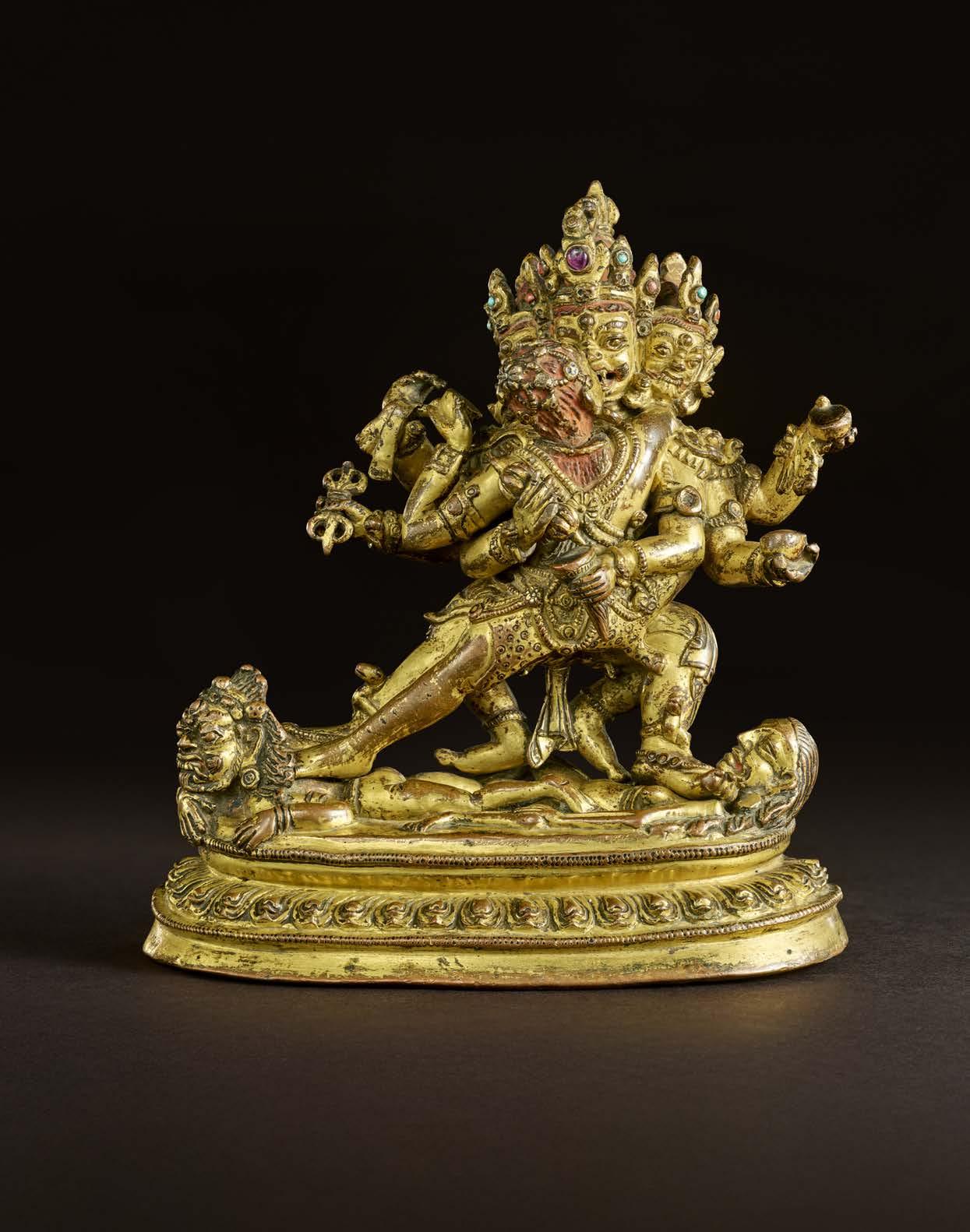
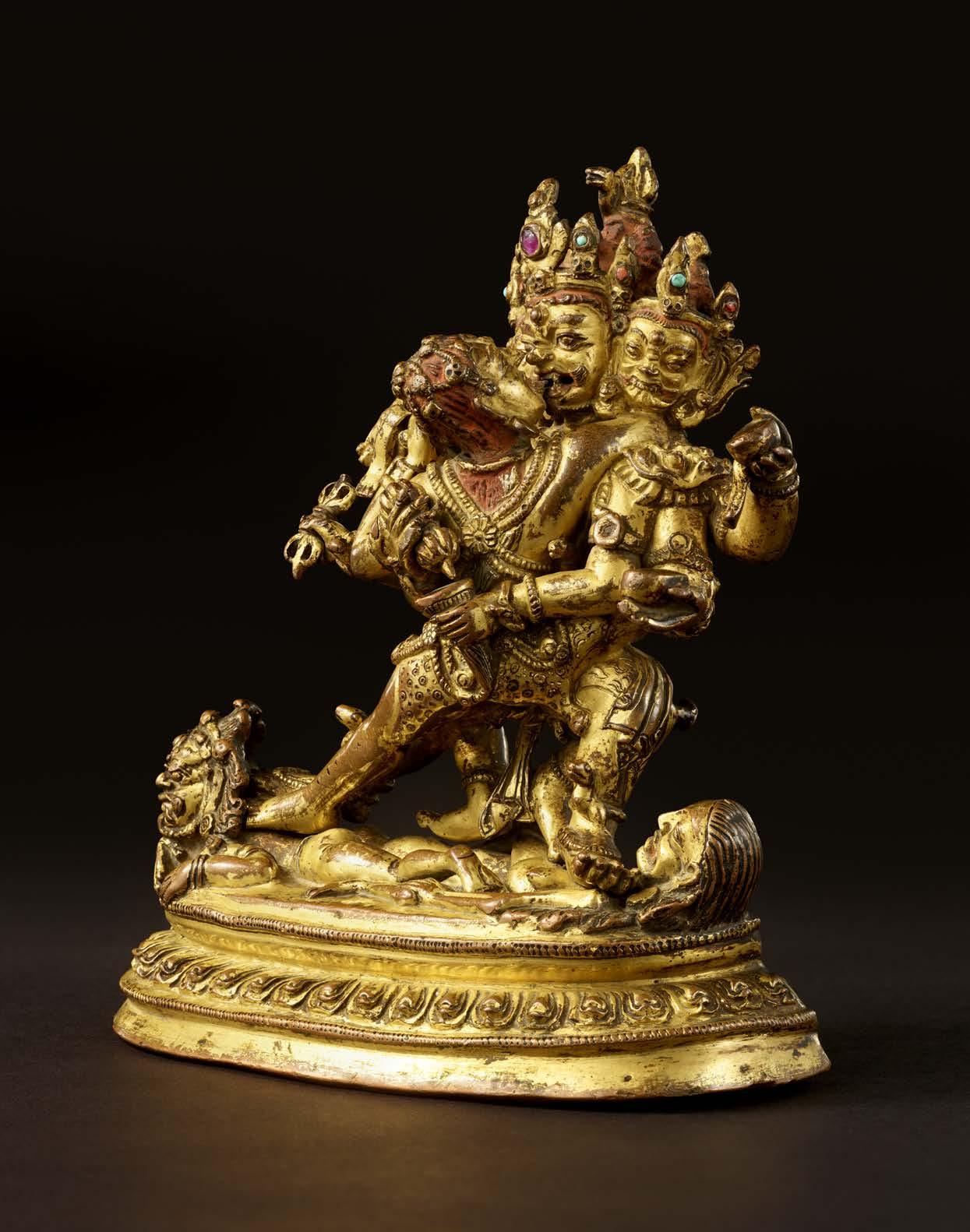
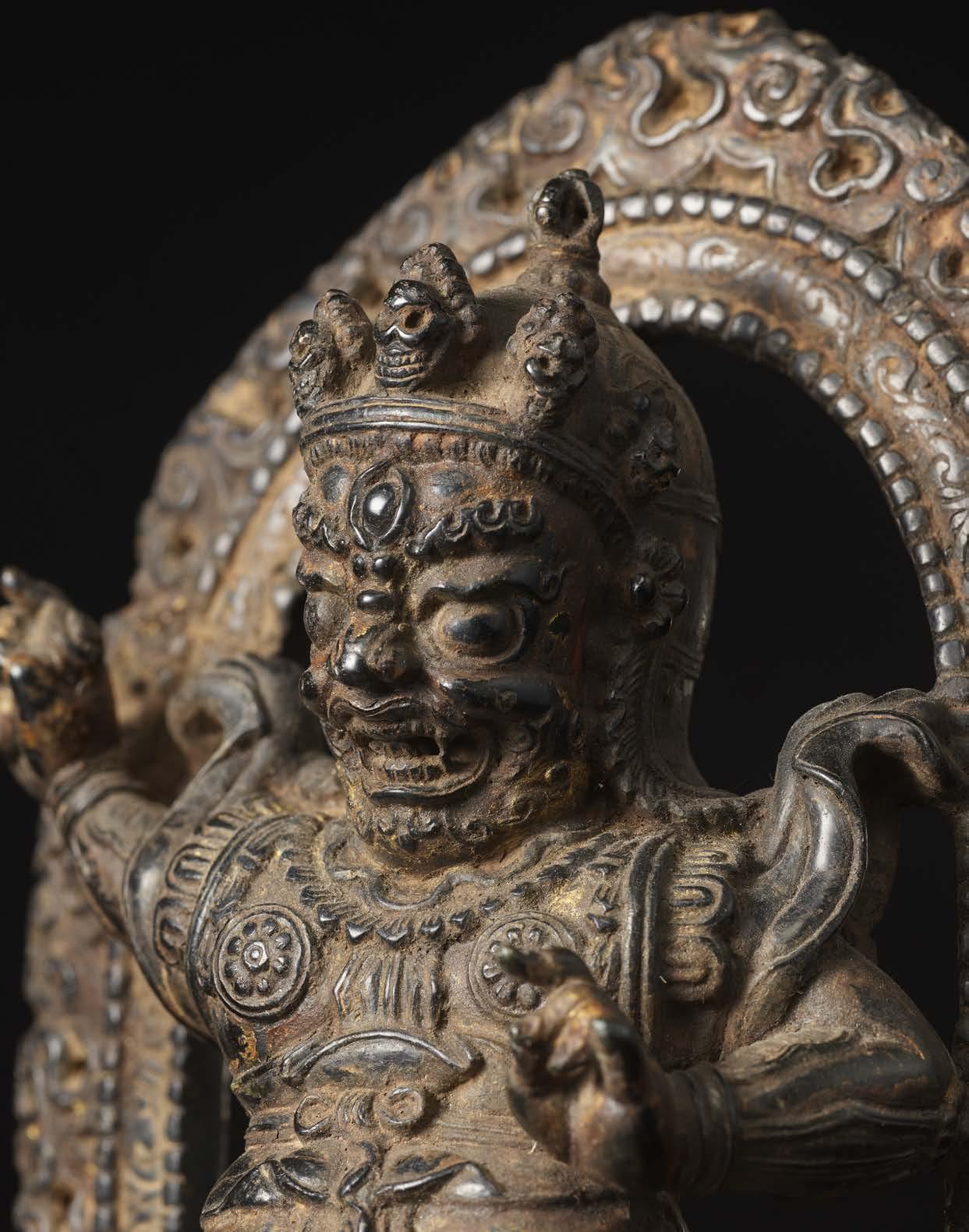
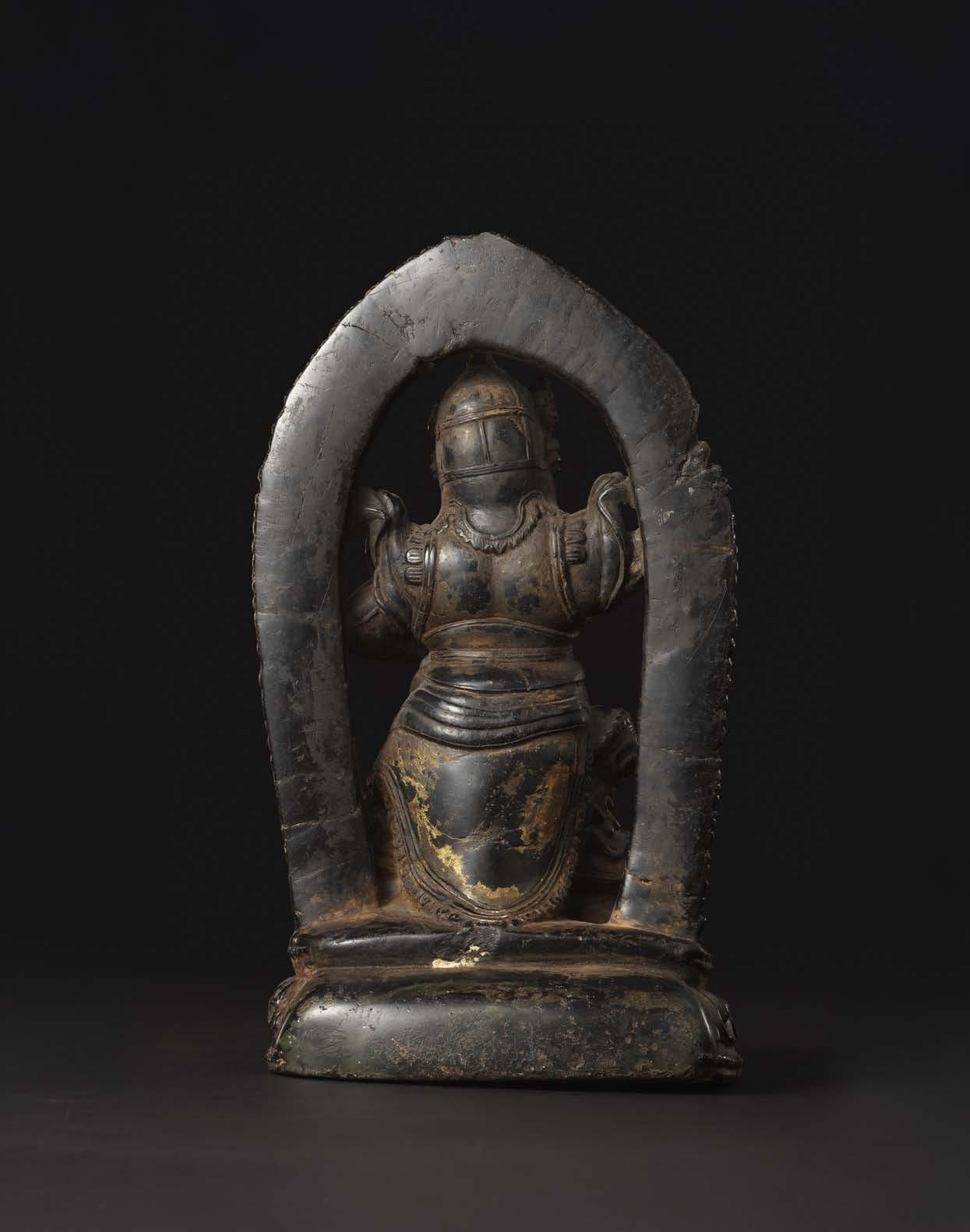
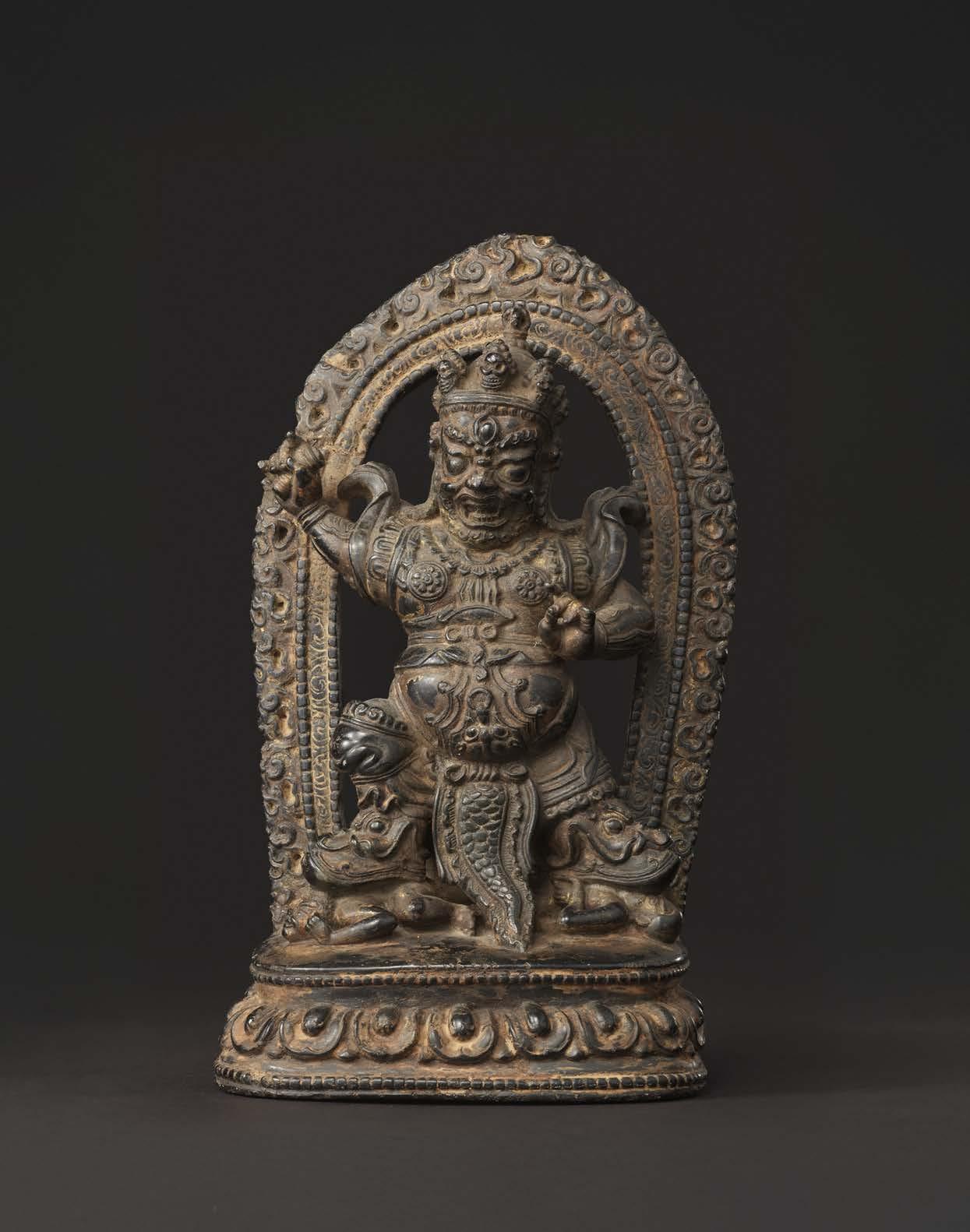
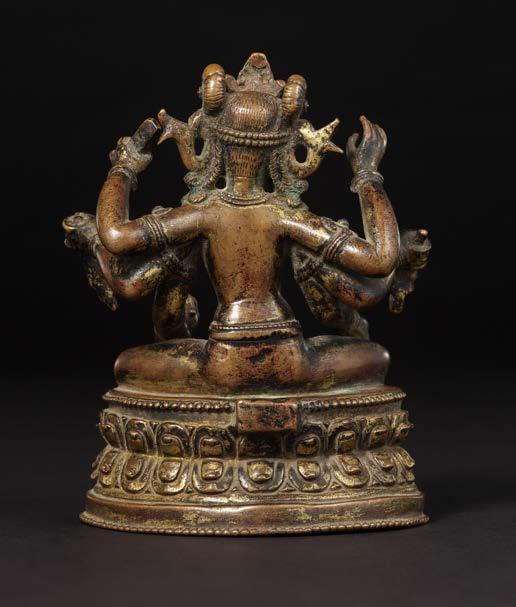
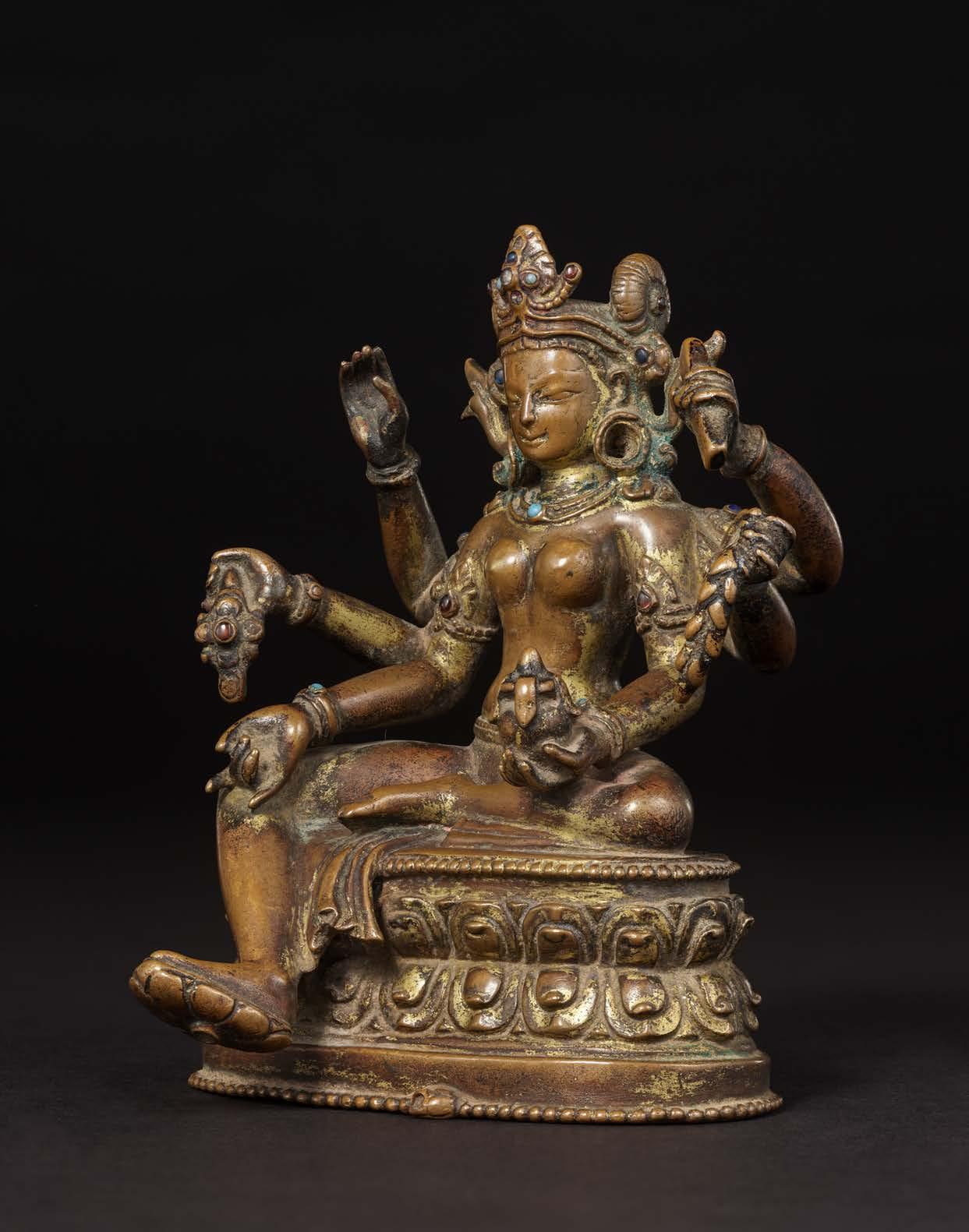
The object at hand is a metal figurative work albeit with three heads and six arms, four legs and male in gender, embracing a female consort with one face and two arms. They stand atop two prone figures and an oblong flat horizontal single floral base usually characterised as a lotus although other flowers can be textually found. Such objects as these are typically of a religious nature and commonly found in India and South Asian traditions along with those regions under the cultural sway.
The identification of this figure is established by the unique hand attributes, hand held objects, which typically serve as identifies in iconographic studies of these figures. In this case we are observing a wrathful countenance, three bulging eyes per face, a gaping mouth and sharp canine teeth. The sparse clothing of a tiger and leopard skin along with snake ornaments and the remnants of an elephant hide and human skin are typical of an Indian model of a wrathful deity known as a 'Raksha.' In this case the deity is identified as Buddhist betrayed by the vajra sceptres held in the right hands. The vajras themselves identify the figure as Buddhist. The three left hands of the male hold three skull cups. Only a single Buddhist deity from the Nyingma tradition of Tibetan Buddhism has these hand attributes. Underfoot we find two ghoulish subordinates, male and female, whose proper names will be recorded in the corresponding ritual texts.
The name is Mahottara (che mchog), meaning something along the lines of 'great supreme one.' In this rare example there appears to be Nepalese influence with the two prone figures following the model of the upward bent head of the male Black Bhairava and the skeletal-like female red Kalaratri lying on her back. This standard depiction of the two is generally seen under the two feet of another Tantric Buddhist figure named Chakrasamvara. No later examples of this figure in painting have any standardised iconography of the figures under foot.
The object is rare because only two other sculptural examples of Mahottara are known. The first is a black stone carving (HAR 3205) and the second is a metal work (HAR 22171) with only the upper torso and arms remaining. Paintings are also of little help as only one early work depicts this figure from the same or very close time period of the 12th or early 13th century (HAR 89981). The dating is known both by stylistic elements for both the sculptures and single painting because of the teacher that popularised this deity form within Nyingma Buddhism is Nyangral Nyima Ozer who lived from 1124 until 1192. Some scholars dispute the dates but only by adjusting for a few years forward with a slightly later birth and death.
An inscription on the back of the floral base reads 'To fulfil the intentions of the teacher Gonpopa, this Eight Pronouncement Mahottara was well made by the artist Rinchen Ozer. Mangalam!' Inscriptions such as this with the words 'to fulfil the intentions' generally indicate that the person Gonpopa is deceased and this sculpture was made as a memorial. Nothing is currently known of the artist Rinchen Ozer.
Although seeming to be a Tibetan production, the mercuric gold gilding and the inset turquoise stones along with the face of Black Bhairava having a very strong Newar Buddhist Bhairava mask character, there was very likely some Nepalese craftsman involved with the workshop of the objects creation.
The sculpture of Mahottara is unusual indeed with only two other examples known from this time period and a single painting of a mandala with Mahottara at the centre. A later painting of Mahottara is identified as Eastern Tibetan from the mid 16th century, otherwise all further examples are essentially modern from the 18th to 20th centuries. The Nyingma tradition of Tibetan Buddhism is regarded as the earliest however it is very rare to find works of art prior to the 16th century.
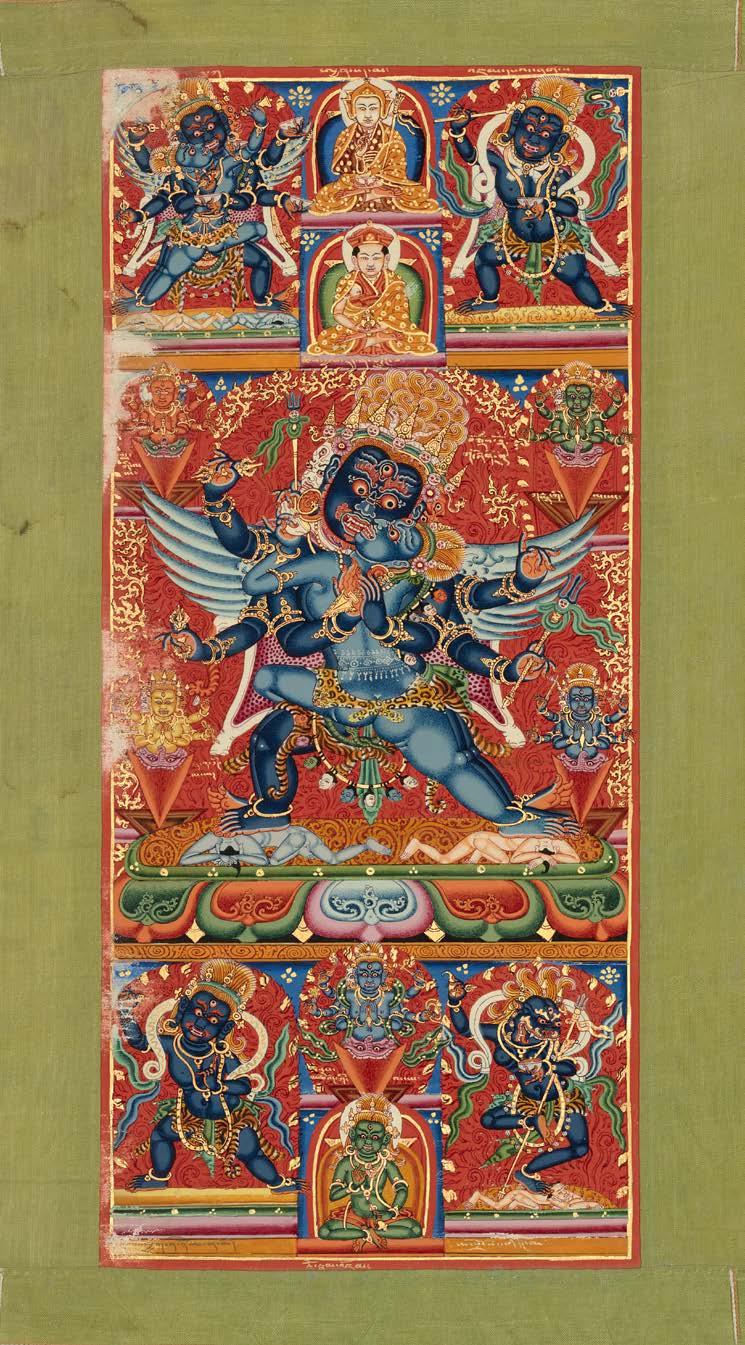
A THANGKA OF VAJRAKILA FROM A RATNA
LINGPA TERMA SET
普巴金剛像唐卡 出自仁達林巴伏藏組卡其一
TIBET, 16TH CENTURY
西藏 十六世紀
Image: 11 x 5 in. (27.8 x 12.5 cm.)
HK$1,600,000-2,000,000
US$210,000-260,000
PROVENANCE:
Fabio Rossi, before 1993
Distinguished European Collection
EXHIBITED:
Paris, Musée Guimet, Rituels Tibetains; Visions secretes du Ve Dalai Lama, 2002.
LITERATURE:
N. Bazin, Rituels Tibetains; Visions secretes du Ve Dalai Lama, Musée Guimet, 2002, p. 82, no. 27.
來源:
法比奧·羅西,1993 年前入藏
歐洲顯赫珍藏
展覽:
巴黎吉美博物館,《西藏儀軌:五世達賴喇嘛秘傳》,2002 年
出版:
N. 巴贊,《西藏儀軌:五世達賴喇嘛秘傳》,吉美博物館,2002 年,第
82頁,編號 27
The unusual dimensions of this painting immediately stand out as something very special. The bright colours, detail and gold accents suggest an early date of creation. However this is not the case. The painting style has become known and identified through other paintings recognised as belonging to the same larger set of compositions along with a number of smaller paintings from the same workshop and master artist. This set of paintings is one of the great artistic treasures of Tibet, Kham Provence, Chamdo region and specifically of Riwoche monastery. There are at least seven paintings known to exist from this set of compositions, although the full set is of an unknown number. Additionally, five or more are known that belong to a smaller, half the size, accompanying set, also from the same workshop and subject matter.
Depicted in this extraordinary painting are thirteen figures. Two teachers are depicted at the top centre of the painting. The first is Padmasambhava circa 8th century. The teacher seated below is unidentified although currently with an illegible inscription. The remaining eleven figures are Buddhist deities belonging to the Nyingma 'Revealed Treasure' tradition of the 15th century teacher named Ratna Lingpa (1403-1479).
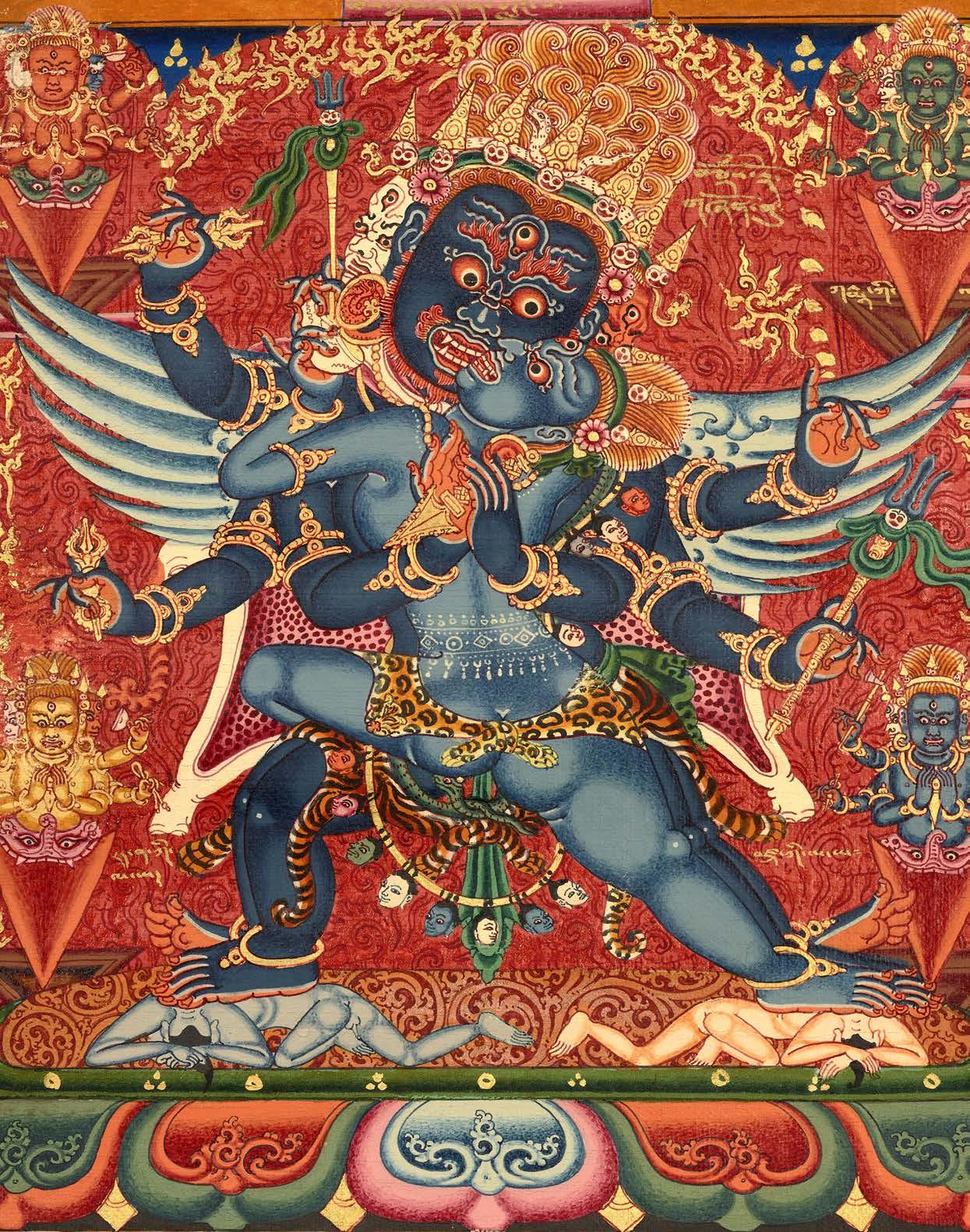
The principal central figure, the main subject of the painting is Vajrakila, surrounded by five secondary attendant figures each with a triangular blade-like lower body. Each are differentiated by their colour, green Kilaya, blue Kilaya, blue-black (etc.), yellow and red.
'...the king of wrath, bhagavan Vajrakumara, have a body blue-black [in colour], three faces and six hands, the right face is white, left red, the centre blue. Held with the two pairs of right and left hands are a nine and five pointed vajra, a blazing mass of fire and a trident. The remaining two roll a kila. The body is huge and heavy, with bared fangs, three eyes - round and red, brown hair flowing upward; wearing an elephant hide, human skin, and a tiger skin as a lower garment. Adorned with white, red, green, and black snakes as a crown, necklace and sash; decorating the arms and legs. Five dry skulls adorn the head. Wearing a garland of fifty fresh [heads]; marked with clots of blood, spots of great ash and a smear of grease, adorned with various jewel ornaments. With four legs the right are bent and left extended atop the head of Ishvara - face down, and the breast of Uma, standing in the middle of a massive fire of pristine awareness. The Great Mother of the Wheel, embraced, is blue with one face, two hands, in the right a chakra, left a skull cup of blood to feed the father, possessing a leopard skin as a lower garment, adorned with the five bone ornaments. The head is adorned with five dry skulls, wearing a garland of fifty wet [heads], adorned with snake and jewel ornaments, clots of blood, spots of great ash and a smear of grease. The two legs, right and left, are extended and bent, standing with the left embracing the Father.' (Ngawang Kunga Lodro (1729-1783).
Additional deities unrelated to Vajrakila have been added at the top right and left and along the bottom. At the top on the left side is the deity Mahottara Heruka. On the right side is a black wrathful figure. At the lower right side is a wrathful Vajrapani, blue in colour, holding a vajra scepter upraised. On the right side is the female lion-faced deity Simhamukha. Seated between the two is Vajravidarana, dark green in colour. Each has a name inscription with some legible, others not.
Because of the dimensions of the set of paintings they most certainly were used for personal ritual practice. They have been well cared for and there is little damage on most of the examples that are known.
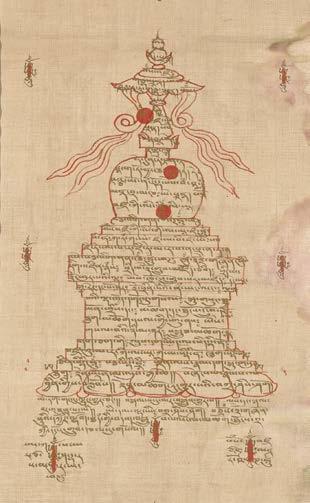
The reverse of the painting is marked with the outline of a stupa drawn in red ink, enclosing the central field. Within this diagram, the central
deity Vajrakumara is consecrated by the vertically arranged seed syllables om ah hum written directly behind his figure and highlighted in red-orange pigment. The same consecration formula is repeated for all other deities on the obverse: each is inscribed with om ah hum in their respective positions across the registers, ensuring that every figure is ritually activated.
The interior of the stupa outline also bears several dedicatory inscriptions. These verses are largely devotional in character, with some explicitly invoking the auspicious merit to be gained from producing such a work. While they reinforce the consecratory function of the painting, they offer no historical details concerning its creation, the circumstances of its commissioning, or the identity of its patron. The final verse, however, clearly identifies the subject of the painting and names the central deity, otherwise left uninscribed. It reads:
“I beseech all the deities of the mandala of the Victorious One, Vajrakummra, to bestow upon the practitioner the supreme and ordinary accomplishments (i.e., siddhi )!”
This combination of the stupa outline, the consecratory syllables, and dedicatory verses links the painting’s iconography to its ritual function. The inscriptions do not merely label but transform the thangka into a fully empowered support (rten) for Vajrakilaya practice in the Ratna Lingpa tradition.
As this thangka, and the larger set of paintings are well known to scholars and historians it is anticipated that in the future more research will reveal a greater understanding of the use and the possibility of identifying an artist.
Backview 背面
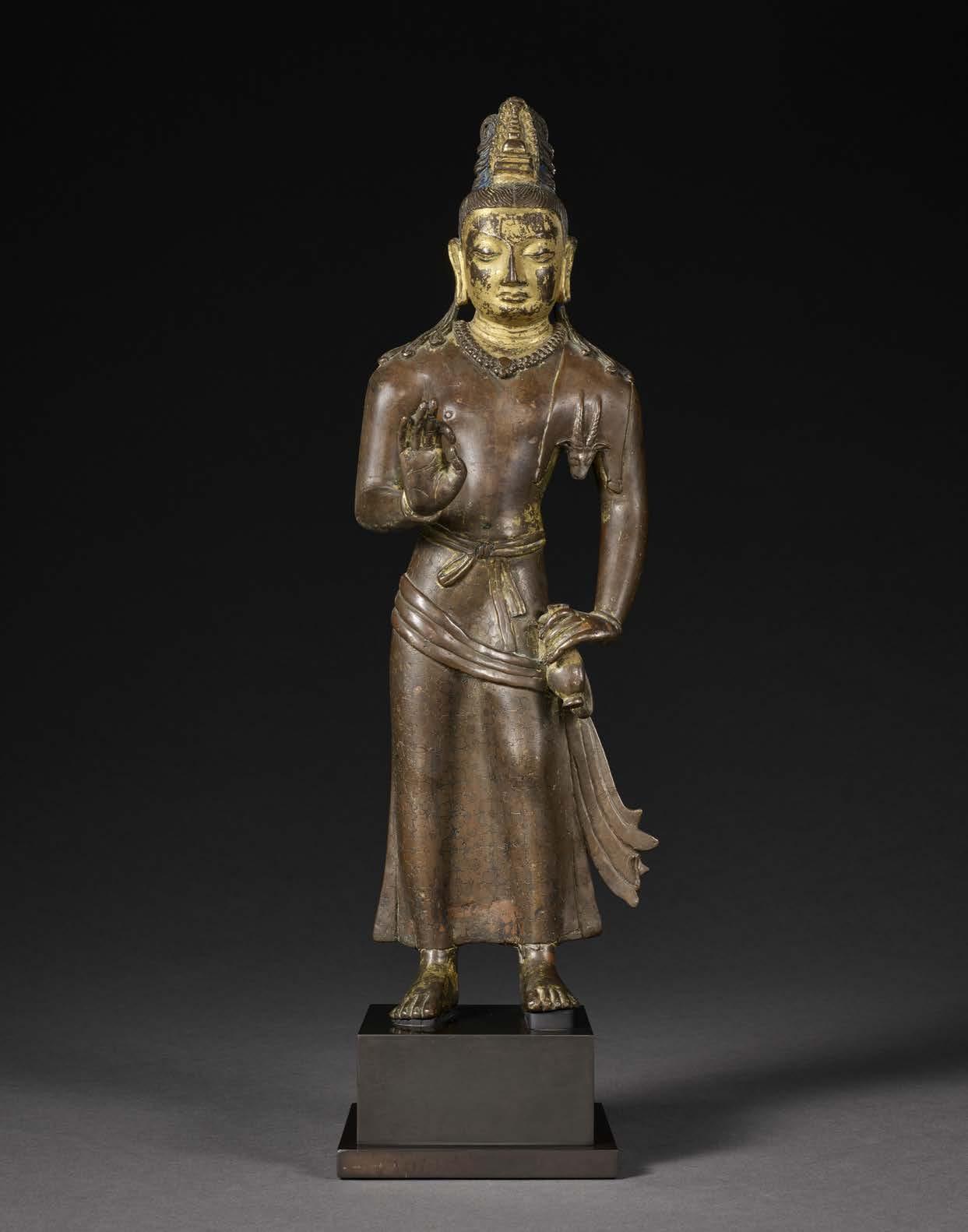
A COPPER ALLOY FIGURE OF MAITREYA
彌勒菩薩銅像
NEPAL OR TIBET, 11TH CENTURY
尼泊爾/西藏 十一世紀
18 in. (45.7 cm.) high
HK$3,500,000-4,000,000
US$460,000-520,000
PROVENANCE: Adrian Maynard, London, 1990 Distinguished European Collection
來源:
阿德里安·梅納德,1990 年 歐洲顯赫珍藏
This finely cast early image of Maitreya, the future Buddha, presents a rare and stylistically significant example of Himalayan bronze sculpture from the 11th century, blending elements associated with both Avalokiteshvara and Maitreya. The deity stands in a graceful tribhanga posture, holding in his left hand an abstract antelope skin and a water flask (kamandalu), iconographic features that, though typically associated with Avalokiteshvara, appear here in combination with unmistakable attributes of Maitreya, suggesting a transitional or regionally nuanced representation.
He wears a finely detailed braided jatamukuta, the high matted chignon typical of bodhisattva figures, centered by a miniature stupa (chaitya), an unambiguous emblem of Maitreya’s identity as the future Buddha. An elegantly scalloped leaf-panel is symmetrically framed before the jata while three neatly tiered braids cascade over the left shoulder, a distinctive and carefully modelled feature.
His dhoti is tied in a characteristic loose knot at the front, the trailing ends falling irregularly across the tight-fitting garment. Across its surface are formally spaced rosette motifs, closely comparable to those seen on a seated Maitreya in the Potala Palace, Lhasa (von Schroeder, Buddhist Sculptures in Tibet, 2002, vol. II, p. 938, nos. 220A–B). Related examples are also illustrated in ibid, nos. 220C–E and 221B–C, attesting to a regional sculptural idiom in early Tibetan ateliers under strong eastern Indian Pala influence.
A closely related figure in the Nyingjei Lam Collection shares several stylistic traits, such as the posture, treatment of the jatamukuta, and gesture, but the dhoti in that example is decorated with horizontal bands, a motif more typically associated with Nepalese bronzes of the period (see Casey and Weldon, The Sculptural Heritage of Tibet, p. 93, pl. 13). Another comparable example from the Los Angeles County Museum of Art likewise shows a similar dhoti banding style (Pal, Art of Nepal, 1985, p. 100, no. S20).
The face has the distinctive Newari profile of a long aquiline nose and is painted with cold-gold, and traces of blue pigment remain in the hair, confirming the sculpture’s history of active veneration in a Tibetan context.
This sculpture stands as a compelling example of early Himalayan syncretism, where stylistic and iconographic conventions of Nepalese and Tibetan art converge. Its refined modelling, restrained ornamentation, and layered iconography reflect both devotional purpose and artistic innovation, making it an important and rare survival from the early medieval period of Himalayan bronze casting.
A GILT COPPER ALLOY FIGURE OF MANJUSHRI
銅鎏金文殊菩薩像
CENTRAL TIBET, CIRCA 12TH CENTURY 藏中 約十二世紀
15 1/2 in. (39.4 cm.) high
HK$16,000,000-20,000,000
US$2,100,000-2,600,000
PROVENANCE:
Private European Collection
Sotheby’s New York, 23 March 2000, lot 29
Distinguished European Collection
來源:
歐洲私人收藏
紐約蘇富比,2000 年 3月23日,拍品29 號
歐洲顯赫珍藏
This monumental image of Manjushri, the bodhisattva of transcendent wisdom, represents a pinnacle of late 12th/early 13th century Himalayan sculpture, combining Pala-derived iconography with distinct Newar stylistic refinement. Its artistic quality and scale reflect the importance of Manjushri in Tibetan Buddhist devotion, particularly within the Sakya school, and its close association with the historic Shalu Monastery, a major center of art and scholarship in Tsang, Southern Tibet.
The figure’s most striking feature is the synthesis of Pala and Newar aesthetics, emblematic of the Newari artisan presence at Shalu during its major early renovation period. The prominent, gem necklace, stylised lotus pedestal, and gently curved Pala-style browline anchoring the face to the bridge of the nose evoke eastern Indian prototypes, while other elements, the towering crown, elaborate flower earrings, and the bold, almond-shaped eyes are unmistakably Newari in execution.
The figure’s hair curls sweep dramatically across the forehead, rising in a bifurcated plume from the scalp, another Newar hallmark. The tight-fitting dhoti, ornamented with rosettes, chevrons, and scrolling vine motifs, is rendered in wide decorative bands that mirror the textiles seen in both Nepalese and eastern Indian bronze tradition. Banded designs that represent similar lozenges containing flowers are also found on the dhoti of the tathagata Akshobhya in the wall mural in the South Chapel at Shalu (Thomas Laird, Murals of Tibet, Taschen, 2008, p. 386). The mismatched lotuses beneath the base, an idiosyncratic detail, further emphasise the individuality and workshoplevel variation that characterised Newar craftsmanship.
Additional features, such as the full, well-defined lips, notably heavy jewellery, thick fingers, and large, finely articulated thick right palm (bearing a diamond-shaped motif and holding a bead or gem), match closely with a standing bodhisattva preserved at Shalu Monastery, as illustrated in von Schroeder, Buddhist Sculptures in Tibet, Vol. II, 2002, p. 1025, no. 252D. (fig. 1). The details are so closely matched, it is likely they were produced at the same atelier and even by the same hand.
As Yury Khokholov has noted ('The Xi Xia Legacy in Sino-Tibetan Art of the Yuan Dynasty', Asianart.com, September 15, 2016), during the 13th century, there was a growing reliance on Newar craftsmen to execute large-scale and high-quality commissions in Tibet. By 1260, even for the construction of the golden stupa at Sakya Monastery, the Sakya hierarchs had to request assistance from the king of Nepal, who sent eighty artisans, among them Newars and Indians. This trend continued at Shalu Monastery, where local ruler Drakpa Gyaltsen, beginning renovations in 1306, had to turn to Yuan imperial workshops due to the persistent shortage of skilled local Tibetan sculptors.
This context highlights the extraordinary value of Newar artists like Anigne (Aniko) and his peers, who were among the very few Tibetans or Himalayan artists involved with Mongol imperial commissions and were in high demand within Tibet itself. The exceptional quality and cross-cultural synthesis evident in this figure strongly suggest it was created under such Newar direction, likely for a major religious and scholastic institution such as Shalu.
The late 12th/early 13th century marked a pivotal time at Shalu Monastery, situated near Shigatse, as it underwent significant expansion and decorative renovation under the patronage of local Sakya rulers and later the Mongol-backed elite. This period saw the influx of highly trained Newar artisans from the Kathmandu Valley, who played a central role in both sculpture and mural painting, helping to forge the distinctive Tibeto-Newar artistic vocabulary that would define north-central Tibetan Buddhist art for centuries. According to Ulrich von Schroeder, monumental images, such as the eight
bodhisattvas at Sera Monastery and several statues at Shalu (ibid, figs. 229C, 230A–B), were most likely cast by Newar ateliers working in Tibet, while Newar artists painted the monastery walls.
This colossal image thus stands not only as a remarkable work of art, but also as a historical document of 12th century Tibetan artistic excellence. It captures the interplay of regional styles, the importance of trans-Himalayan artisan networks, and the central place of Manjushri in Tibetan culture, particularly in the Sakya monastic tradition.
A BLACKSTONE FIGURE OF BEGTSE CHEN
貝格遮護法黑石像
TIBET, 16TH CENTURY
西藏 十六世紀
8 1/2 in. (21.5 cm.) high
HK$320,000-480,000
US$42,000-62,000
PROVENANCE:
Kari Khedup, New York
Important Swiss Collection, before 2007
來源:
卡裡·克杜普,紐約
瑞士重要珍藏,2007年前入藏
This rare carving represents Begtse Chen, also known as Trichapa Chamsin, one of the eight revered Dharmapalas, or wrathful Dharma protectors, in Tantric Buddhism. More than a guardian figure, Begtse Chen embodies a complex narrative of transformation, cultural integration, and religious expansion in Inner Asia. So few examples of carved stone are known from this period in Tibet and it stands out as an exceptional representation of a revered protector.
Originally a pre-Buddhist war deity venerated in 16th-century Mongolia, Begtse Chen’s transition into the Buddhist pantheon reflects a profound moment in Mongolian religious history. According to tradition, Begtse Chen confronted Sonam Gyatso, the Third Dalai Lama, during his 1575 journey to Mongolia. Upon his defeat, Begtse Chen was dramatically converted to Buddhism, symbolising the triumph of the Dharma over indigenous beliefs and marking a pivotal step in the spread of Buddhism in the region.
This religious integration gained momentum just two years later in 1577, when Sonam Gyatso formed a historic alliance with Altan Khan, leader of the Tumed Mongols. Altan Khan’s conversion to the Gelug School of Tibetan Buddhism initiated widespread state-sponsored support for the faith, including the construction of temples and monasteries across Mongolia. Within this rapidly evolving religious landscape, Begtse Chen was fully incorporated into the Tibetan Buddhist pantheon as a protector of the Dharma. His cult spread broadly, serving both spiritual and political functions in the growing cultural dialogue between Tibet and Mongolia.
The present black stone sculpture powerfully encapsulates this narrative. Carved with extraordinary precision and artistry front and back, the figure conveys a compelling duality. The naturalistic modelling of the body, especially the gently bent left arm raised in vitarka mudra, that would have held a fresh human heart amplifies ferocity of Begtse Chen’s wrathful visage: the right arm raised that would have brandished a sword, bulging eyes, a protruding tongue, sharply cast fang-like teeth, and a flaming mane, all underscoring his fearsome power as a spiritual protector.
Further enhancing the sculpture’s impact are its richly detailed accoutrements, chainmail armour, a tiara of skulls, and intricate jewellery, all skilfully rendered to emphasise both the divine authority and the martial origins of the deity. The overall composition is dynamic yet balanced, reflecting the masterful craftsmanship of 16th-century Tibetan ateliers.
As both an artwork and a historical artifact, this black stone carving of Begtse Chen stands as a testament to the transformative journey of Buddhism across Central Asia. It embodies not only the fierce devotion to the preservation of Buddhist orthodoxy but also the dynamic cultural syncretism that shaped the spiritual landscape of the region.
2020
A GILT COPPER FIGURE OF SHAKYAMUNI
BUDDHA
銅鎏金釋迦牟尼佛像
NEPAL, LICCHAVI PERIOD, CIRCA 8TH CENTURY
尼泊爾 李查維王朝 約八世紀
10 1/2 in. (26.7 cm.) high
HK$5,000,000-7,000,000
US$650,000-900,000
PROVENANCE:
Private European Collector
Sotheby's New York, 26 March 1998, lot 83 Distinguished Private European Collection
來源:
歐洲私人藏家
紐約蘇富比,1998 年 3月26日,拍品83號
歐洲顯赫私人珍藏
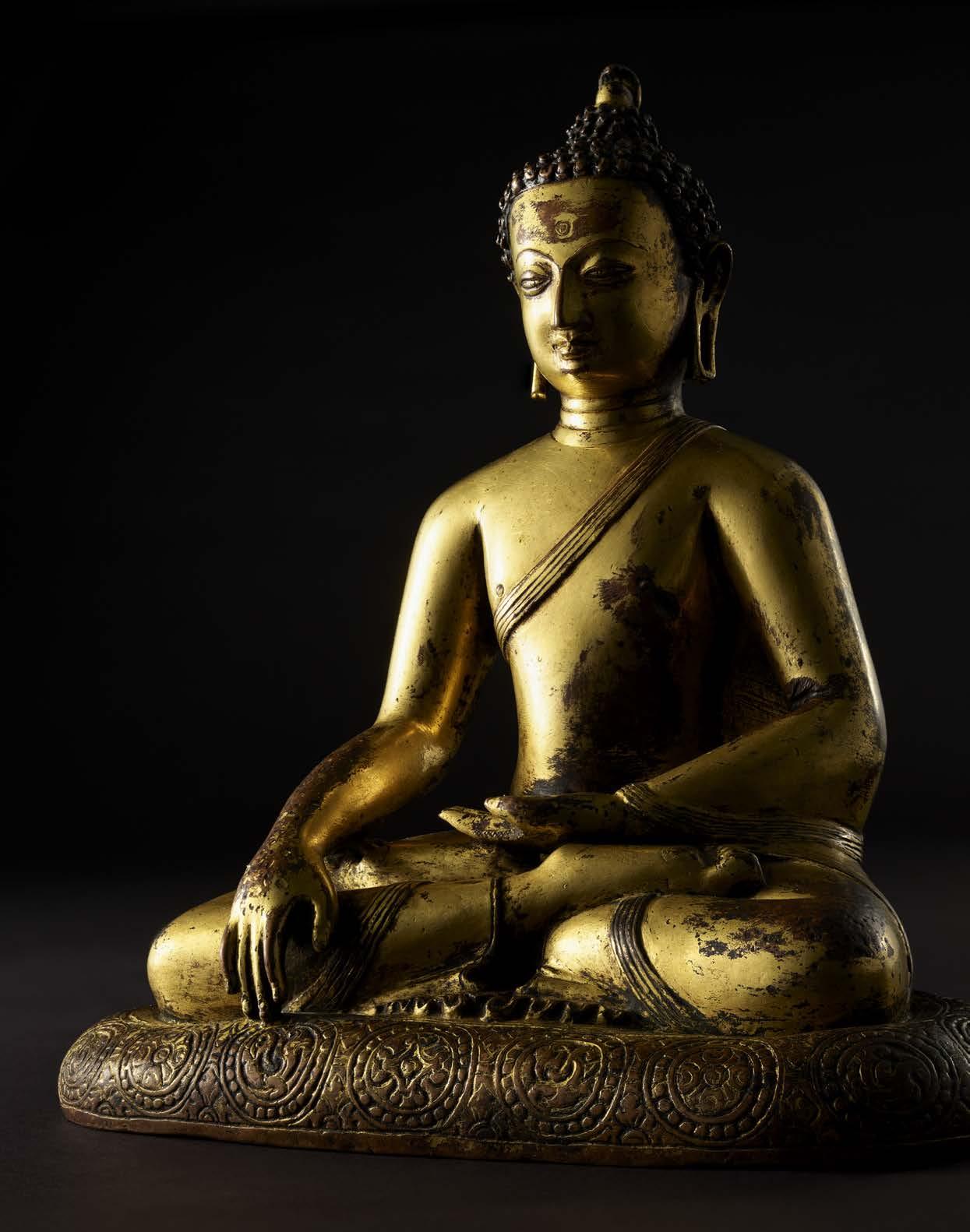
This superb gilt copper casting of Shakyamuni Buddha represents one of the finest and best-preserved early Licchavi-period sculptures, exemplifying the cross-cultural exchange that characterised Nepalese art of the 8th century. Most notably, it reveals a sophisticated appreciation for luxury textiles, likely influenced by Central Asian, particularly Sogdian, traditions.
The Buddha is depicted wearing a simple, tightly fitted, diaphanous robe, delineated only by thick hemlines visible across the chest, ankles, and under the left arm. In striking contrast, the figure is seated atop an elaborate cushion, richly adorned with pearl-edged roundels enclosing anthropomorphic figures and floral motifs. These patterns are consistent with Sogdian textile designs produced between the 7th and 9th centuries, closely resembling examples such as the silk fragment in the Cleveland Museum of Art (1950.514).
This particular representation of textile design shares strong visual and stylistic parallels with a gilt copper figure of Manjushri, almost certainly from the same atelier, formerly with Carlton Rochell (see Weldon, Himalayan Art, New York, 2018, p. 75, no. 23). The cushion’s decorative motifs also mirror those found on the well-known Shakyamuni Buddha with Adorants on Mt. Meru in the Norton Simon Museum, (1972.28.2.S), a Kashmiri work dated to the 8th century. Both works feature identical roundel patterns as well as diamond-shaped lozenges that fill the negative space. Another relevant comparison is a Manjushri figure in the Norton Simon Museum, circa 800, (1977.6.3.S), which is also seated on a similarly shaped cushion, though with a more simplified textile treatment. For a broader discussion of this textile design in the context of Central Asian imports, see Amy Heller, 'The Design of Abegg inv. no. 5065 in Relation to Documented Textiles', in Central Asian Textiles and Their Contexts in the Early Middle Ages, Abegg-Stiftung, 2006, pp. 178–180, figs. 123–124.
An unusually large tang projects from the back of the sculpture, a feature shared with a Licchavi period figure of Indra from the Solomon Family Collection. For a detailed discussion, see Vajracharya, 'Three Licchavi Period Sculptures Under One Roof: The Solomon Family Collection of Nepalese Art', Part One, Orientations, March/April 2020.
The cushion beneath the Buddha is enriched by stylised dragons and floral motifs rendered in beaded roundel patterns. This emphasis on ornate textile representation aligns with broader Himalayan trends, where luxury fabrics from Central Asia influenced throne covers, deity robes, and other decorative elements. One notable example is the sleeve pattern of an unidentified royal figure preserved in the Potala Palace, tentatively attributed to the 11th century (see von Schroeder, Buddhist Bronzes in Tibet, Vol. II, p. 941, figs. 241D & E), but also considered to be Yarlung or Licchavi.
Further evidence of the motif’s continuity across media is seen in a stone sculpture of Devi at Pashupatinath, dated to the 7th century, where the figure wears an embroidered belt adorned with Sogdianstyle roundels (see Pal, The Arts of Nepal, Part One: Sculpture, Leiden/ Köln, 1974, pl. 216, p. 130).
Valrae Reynolds also documents the early use of such textiles in the Himalayan context. A Tang court painting by Yan Liben (c. 600–674) shows the first Tibetan envoy wearing a red robe decorated with pearl medallions enclosing a single bird, possibly fashioned from imported Sasanian fabric (see Reynolds, “Luxury Textiles in Tibet,” in Casey and Denwood, Tibetan Art: Toward a Definition of Style, London, 1997, p. 89, fig. 3).
The enduring appeal of these textiles in Tibet is evidenced in 11thcentury mural paintings, where nobles continue to be depicted wearing robes with similar motifs. However, by the 10th/11th century, representations of Vasudhara and Cundi attributed to Nepalese artists, now preserved in the Potala, (see von Schroeder, Buddhist Sculpture in Tibet, Vol. II, p. 487, nos. 154C–H) show a stylisation of the cushions, retaining the form but losing the crisp definition seen in the present Buddha and the Rochell Manjushri.
Re-evaluating this sculpture through the lens of its textile representation, heavy and precise casting, distinctive facial features, and detailed ornamentation, we are now better equipped to support an 8th-century dating. The comparative examples, ranging from Nepal to Kashmir and Tibet, reinforce the central importance of Sogdian textiles in Himalayan visual culture and underscore the remarkable craftsmanship of this work. This figure stands not only as a masterpiece of Licchaviperiod sculpture but also as a testament to the dynamic cultural exchanges that shaped early Himalayan art.
A GILT COPPER FIGURE OF DROKMI
LOTSAWA SHAKYA YESHE
銅鎏金譯師卓彌釋迦益西像
TIBET, 15TH CENTURY
西藏 十五世紀
7 1/4 in. (18.5 cm.) high
HK$400,000-600,000
US$52,000-78,000
ENGRAVED:
Being the upholder of a treasury of precious teachings, He fulfils the desires of those to be trained. Compassionate translator, I pay homage to Shakya Yeshe. 1, Palden Dren, pay homage to the eighth lama of the Lamdre lineage, the great master Drokmi, and request his blessings. May this be auspicious!
刻印:
題記:“作為珍貴教法寶藏的持有者, 他滿足所有有待教化眾生的願望。
慈悲的譯師,我向釋迦益西頂禮。
我,巴登·滇,向道果傳承的第八位上師、大導航師卓彌頂禮, 並祈求他的加持。願此吉祥。”
This sensitively rendered portrait depicts Drokmi Lotsawa Shakya Yeshe (992/3–1043/72), a seminal 11th-century translator and master of the Lamdre teachings, a cornerstone of the Sakya tradition. The inscription identifies him and affirms his position within the lineage, offering homage and a request for blessings.
Drokmi Lotsawa was revered for his scholarship, having translated nearly seventy tantric texts from Sanskrit after years of intensive study in India and Nepal. His pivotal role in bringing esoteric Indian teachings into Tibetan intellectual life is embodied in this finely executed sculpture.
The figure is masterfully cast, with features rendered in a soft, naturalistic mode. The hands and feet are particularly delicate, evoking the pliability and warmth of living flesh. Subtle gestural refinement conveys an inner serenity and spiritual presence.
The treatment of the robes is especially noteworthy. Draped with a sense of weight and fluidity, they curve around the body in a naturalistic manner, falling in gentle, undulating folds that accentuate the figure’s quiet grace. The incised hemline, broad and adorned with a foliate motif, adds a refined opulence to the textile, heightening the sense of movement and balance.
This stylistic treatment finds a close parallel in the 15th-century portrait of another Lamdre lineage master, Drakpa Gyaltsen (see Rossi, Homage to the Holy: Portraits of Tibet’s Spiritual Teachers, London, 2003, cat. 20). Both works share a striking textural contrast between flesh and garment, as well as a distinctive decision to leave the lips un-gilded, allowing the red copper of the alloy to show through and enhancing the lifelike realism of the faces.
With its expressive modelling, refined casting, and layered iconographic meaning, this portrait offers not only a representation of a great historical figure but also an embodiment of the stylistic and spiritual ideals of 15th-century Tibetan art.
A THANGKA OF SHAKYAMUNI'S PARINIRVANA ATTRIBUTED TO THE TENTH KARMAPA, CHOYING DORJE DISTEMPER ON SILK 第十世噶瑪巴卻英多傑 絹本礦物顏料彩繪
釋迦牟尼佛涅槃唐卡
CHINA, YUNNAN PROVINCE OR EASTERN TIBET, LATE 17TH CENTURY
雲南/ 藏東 十七世紀晚期
24 1/2 x 16 5/8 in. (62.3 x 42.2 cm.)
HK$8,000,000-12,000,000
US$1,100,000-1,600,000
PROVENANCE:
Sotheby Parke Bernet, New York, 14 and 15 March, 1979, lot 426 Bonhams, New York, 14 March 2016, lot 34 Alsop Collection
LITERATURE:
Karl Debreczeny, 'Recrafting Remote Antiquity: Art of the Tenth Karmapa', in Arts of Asia, November-December, 2020, pp. 84, 85, nos. 14 and 16
Karl Debreczeny, 'Of Bird and Brush: A Preliminary Discussion of a Paranirvana Painting in the Distinctive Idiom of the Tenth Karmapa Recently Come to Light', in Caumanns, Volker, Jörg Heimbel, Kazuo Kano and Alexander Schiller (eds.), Gateways to Tibetan Studies. A Collection of Essays in Honour of David P. Jackson on the Occasion of his 70th Birthday in Indian and Tibetan Studies 12.1-2, 2021, pp. 161-189. figs. 1, 2, 4 and 8.
Ulrich von Schroeder, The Tenth Karmapa: Tibet's Greatest Artist, Visual Dharma Publications, 2025, p. 241, no. P23.
New scholarship and rediscovered provenance details have significantly advanced our understanding of this remarkable painting, allowing for a more informed attribution to the Tenth Karmapa, Choying Dorje (1604–1674). Long admired for its stylistic uniqueness and enigmatic iconography, this parinirvana thangka can now be more securely linked to Choying Dorje and his production of two sets of The Twelve Deeds of the Buddha series that he is recorded to have painted in 1653 and 1654. Crucially, its first documented appearance at Sotheby Parke Bernet, New York, in 1979, with original silk mountings that included kesi tapestry panels of cranes, a specific motif that Choying Dorje employed in his artistic vocabulary, adds compelling material evidence. Further, new scholarship by Karl Debreczeny, particularly his 2021 study, provides a rigorous comparative and iconographic framework that situates the painting firmly within the Karmapa’s creative milieu. Taken together, these developments support a confident attribution to the master himself, Choying Dorje, the Tenth Karmapa.
This painting of the Buddha’s parinirvana (final nirvana) executed on silk, features the Buddha reclining on a richly decorated light green plinth, surrounded by grieving followers, with scenes of his cremation and the distribution of his relics illustrated in the upper parts of the composition. The Tenth Karmapa’s style is recognisable for its whimsical, almost naive figural forms, long heads, fleshy faces, and tiny red lips, departing from conventional Tibetan aesthetics. The elaborate plinth beneath the Buddha, decorated with animals and offering figures, echoes ancient Kashmiri throne reliefs from the 7th–8th centuries. This reference to archaic Indian models was noted by later Tibetan artists and scholars, including the Thirteenth Karmapa, who praised the Tenth Karmapa’s paintings for their inspiration from ancient Kashmiri bronzes (see Debreczeny, The Black Hat Eccentric, 2012).
Choying Dorje led the Karma Kagyu lineage through a time of existential crisis during the rise of the Gelugpa-Mongol alliance under the Fifth Dalai Lama (r. 1642–1682). The political unification of Tibet resulted in the widespread suppression of rival sects. The Karma Kagyu, one of Tibet’s wealthiest and most established traditions, was systematically dismantled, its monasteries confiscated, its monks exiled or killed, and its cultural legacy nearly obliterated (ibid, 2012, p. 256). In 1645, Choying Dorje escaped a doomed encampment in Lhadok, fleeing Mongol encirclement and ultimately taking refuge in Lijiang (modern Yunnan), under the protection of the Naxi King Mu Yi (r. 1624–1669). There, in exile, he nurtured the Karma Kagyu tradition and developed a radically independent artistic style.
Karl Debreczeny has argued that Choying Dorje’s artistic idiom parallels that of contemporaneous late Ming painters, such as Chen Hongshou (1598–1652), who also drew upon antiquity to evoke an imagined golden age (ibid.). In this context, Choying Dorje’s visual vocabulary may be interpreted as an aesthetic form of resistance, rejecting the increasingly codified visual language of the Gelugpa establishment, whose workshops emphasised rigid formulas, ornate decoration, and saturated contrasts. In contrast, Choying Dorje’s style emphasises empty, atmospheric backgrounds, simplified (possibly Naxi) clothing, and tonal harmonies, seen here in the delicate lavender-cyan sky.
This attribution is further supported by Debreczeny who offers a detailed examination focused entirely on this thangka in: “Of Bird and Brush: A Preliminary Discussion of a Paranirvana Painting in the Distinctive Idiom of the Tenth Karmapa Recently Come to Light” (2021). There, Debreczeny contextualises the painting both stylistically and
historically, affirming its attribution to Choying Dorje and highlighting the importance of its iconographic and formal departures from the Gelugpa mainstream.
Debreczeny further notes that the brushwork includes the use of the “tremulous brush” technique [zhanbi], a Chinese method involving quick broken lines, especially visible in hands and faces, a method rare in Tibetan painting. “Perhaps the subtlest and most telling clue of the Karmapa’s own hand are the quick broken lines found in some of the hands and faces, a Chinese brush technique known as “tremulous brush” (zhanbi 顫笔) which is especially distinctive to Chos dbyings rdo rje’s hand.” Other features, like boneless washes of pigment in the depiction of animals and delicate rendering of fabrics, support attribution to the Tenth Karmapa. Additionally, the painting’s medium in silk, aligns with Chinese painting traditions, further distinguishing this work from typical Tibetan thangkas.
The parinirvana belongs to a larger series/set illustrating the Twelve Deeds of the Buddha, a central theme in the Tenth Karmapa’s oeuvre. This theme was introduced to him through a 1629 commentary by his main teacher, the Sixth Zhwa dmar pa, which had a lasting influence. The Karmapa composed several poetic and biographical texts based on avadana literature, which often intertwine stories of the Buddha’s life with autobiographical elements.
The Tenth Karmapa is known to have painted a series of the Twelve Deeds by his own hand in 1653 and 1654. Then in 1653, four years after composing his own praises, the Karmapa “painted by his own hand thang ka(s) of the Twelve Deeds of the Buddha.”14 A year later during the New Year festivities of the Wood Horse Year (1654) “he once again began to draw at one time the Twelve Deeds [of the Buddha]." Multiple records indicate he painted and designed these works during his exile in Lijiang, Yunnan, after fleeing political upheaval in Tibet. His compositions were often intended as models for workshop production, with textual references emphasising his collaborative methods.
This thangka of parinirvana represents the only known composition from the two sets of the series of the Twelve Deeds of the Buddha, composed in 1653 and 1654. A much later copy of the se, riesa complete narrative set painted on cotton in bright, incongruent colours, remains at Palpung Monastery, further material evidence of the existence of the original sets. Contrasting the present parinirvana image with the Palpung iteration (Debreczeny 2012, p. 166, fig. 5.9), the two works share a foundational composition but differ in numerous details: figures vary in age, attire, and pose; the couch supporting Shakyamuni has an extra tier of lambs or deer in the present version. Their palettes also diverge. While the Palpung version, painted on cotton, features hard-edged contrasts in deep blue and green, this painting favours subtler shifts between cyan and lavender in the sky, and richer purples in the landscape. The present thangka also displays greater facial variation and emotional range, suggesting a more refined hand and an earlier date, when Choying Dorje was perfecting his style.
Compare instead to the colour palette of the Palden Lhamo, recently discovered in the depths of the inventory of the Potala collection (von Schroeder, The Tenth Karmapa: Tibet’s Greatest Artist, 2025, p. 223, P12), the dark blue skin of the Sri-Devi, layered with garments, his necklace, belt, and anklets lavishly adorned with jewels, to the robes of the myriad grieving followers in the parinirvana, their costumes layered with translucent necklaces made of fish-skin, jewel-adorned
headdresses, and accessorised with peacock fans and translucent vessels filled with corals and jewels. As well the similarities in the colour palette with the Buddha Shakyamuni Attended by Mahakasyapa and Ananda in the Tibet Museum in Gruyères (ibid, pp. 274-5, P59) the contrasting orange and red of the buddha against the blue-green cyan and lavender backdrops of the nimbus and coffin.
A particularly notable and important feature is the painting’s original mounting, which included Chinese kesi (silk tapestry) squares decorated with birds. These were intact when the thangka first appeared on the market with Sotheby Parke Bernet, New York in 1979. These birdthemed mandarin squares are found in other works attributed to the Tenth Karmapa, and they carry symbolic and personal resonance. Birds appear frequently in his art, poetry, and autobiographies, often representing beauty, communication, and spiritual companionship. His biographers even credit him with the ability to communicate with birds, a talent inherited by the Thirteenth Karmapa.
While such bird-themed mountings are usually reserved for central paintings in a series, this parinirvana painting features them as well, suggesting either that all works in the set were richly mounted or that the scene was considered iconically important alongside Enlightenment and the First Teaching.
A set of thang kas depicting the Twelve Deeds of the Buddha "in a Chinese style" (rgya bris ma) in ten paintings by Chos dbyings rdo rje is recorded to have survived at mTshur phu Monastery in the Karmapa's private chambers into the 1920s when Kah thog Si tu visited that place.
See Kah. thog Si tu 2001: 86, 95, line 5: karma pa’i gzim khang du chos dbyings rdo rje’i phyag bris mdzad bcu rgya bris ma thang ka bcu. Also cited by Jackson 1996: 250. Karl-Heinz Everding has recently published a complete German translation of Kah. thog Si tu’s Pilgrimage Record; for the above-mentioned set of thang kas, see Everding 2019, vol. 1: 191. While mTshur phu Monastery was destroyed in the 1950s, many personal objects related to the Karmapa lineage in mTshur phu were taken to Rumtek Monastery in Sikkim, and may have survived there. Unfortunately, due to the current complicated internal political situation involving competing factions, the Rumtek treasury is locked and seems will remain inaccessible for the foreseeable future.
A THANGKA OF GARWA NAGPO, ATTRIBUTED TO THE TENTH KARMAPA, CHOYING DORJE
DISTEMPER AND GOLD ON SILK 第十世噶瑪巴卻英多傑 絹本重彩設色加金彩
守誓黑鐵匠神唐卡
TIBET OR LITHUNG, CIRCA 1655
西藏/雲南 約 1655 年
Image: 18 7/8 x 12 in. (48 x 30.5 cm.)
With silk border: 37 x 15 in. (94 x 38 cm.)
HK$6,500,000-9,500,000
US$840,000-1,200,000
PROVENANCE:
Private American Collection, before 2004
Distinguished European Collection
LITERATURE:
Heather Stoddard, 'The nine brothers of the White High. On `remembering' of history and the creation of gods'. In Karmay, Samten and Sagant, Philippe (eds.), Les habitants du toit du monde. Études recueillies en hommage à Alexander W. Macdonald, 1997, p. 99, fig. 4.
Irmgard Mengele, The Life and Art of the Tenth Karma-pa Chosdbyings-rdo-rje (1604-1674), 2005, p. 307, fig. 1.
Karl Debreczeny, The Black Hat Eccentric: Artistic Visions of the Tenth Karmapa, Rubin Museum of Art, 2012, pp. 14, 15, 21, 182, figs. 03 and 6.7.
Heather Stoddard, 'A Brief Note on a Tangka Painted by Chöying Dorjé, Tenth Black Hat Karmapa of Tibet, in 1655: The "Oathbound Great Being" (Dam can Skyes bu chen po)', pp. 185-190 in Debreczeny and Tuttle, The Tenth Karma & Tibet's Turbulent Seventeenth Century, Serinda, 2016, (cover image)
Karl Debreczeny, 'Recrafting Remote Antiquity: Art of the Tenth Karmapa', Arts of Asia, November-December 2020, p. 83, no. 12.
Ulrich von Schroeder, The Tenth Karmapa Tibet's Greatest Artist, Hong Kong, 2025, p. 221, no. P11.
This extraordinary thangka by the Tenth Karmapa, Choying Dorje, stands out as one of the very few surviving examples bearing an inscription that honors both his artistic legacy and spiritual authority. Among the limited number of known inscribed thangkas attributed to him, this painting is especially significant, not only for its aesthetic mastery but for the rare presence of an inscription, which situates it within a select group of works where authorship, place, and date are explicitly recorded.
The subject is the Oath-Bound Protector (Damchen), rendered in the nag thang or black-ground painting tradition, a visual mode typically reserved for wrathful deities. The inscription in gold identifies the Tenth Karmapa as the source of the image, though the formal and honorific language, similar to that found in the Marpa thangka (von Schroeder, The Tenth Karmapa Tibet’s Greatest Artist, Hong Kong, 2025, pp. 198-9, P1), indicates it was likely written by a devotee rather than by the Karmapa or his direct attendant. Despite this, the attribution remains critical in understanding the painting’s place within Choying Dorje’s oeuvre.
While the genre and subject matter are distinct from his other works, the techniques used in this composition show strong affinities with the 1660 painting set attributed to him. The palette, dominated by deep blacks, rusty reds, and warm browns, creates a striking visual intensity, heightened by ethereal atmospheric effects that give the painting an almost dream-like, otherworldly quality. The dramatic contrasts between opaque and translucent elements, warm and cool tones, and dynamic versus still forms generate a surreal, nearly cinematic tension throughout the scene.
David Jackson has commented on the unusually affectionate and realistic treatment of animals in this thangka, a hallmark of Choying Dorje’s style. The rendering of the goat, the bear, and the spectral white figure emerging from the smoke suggests not only technical mastery but also a unique emotional sensitivity. Particularly noteworthy is the use of colour and brush technique: pigment is applied in a manner reminiscent of Chinese ink painting, with subtle tonal variations achieved by layering pale, creamy hues over slightly darker underlayers.
This method is especially effective in the sea of blood the deity rides across, painted in graded reds reminiscent of the green tonal variations in the decorative details of Choying Dorje’s other works. These reds are further intensified by the juxtaposition of cool blue rocks and the smoky, ink-washed background, out of which bursts of flame and billowing smoke frame the central figure. Within the smoke, a ghostly white form materialises just above the Damchen’s arms, which hold the symbolic blacksmith’s hammer and bellows, its hands splayed in a haunting, almost hallucinatory gesture.
The animals’ fur is depicted using soft, boneless pigment washes, especially evident in the dappled coat of the bear cub and the delicate shading on the goat’s muzzle. Meanwhile, the deity’s own body, rendered in unpigmented black silk ground, is defined only by light blue outlines and quick, expressive strokes that give volume and dynamism without compromising the spectral quality of the form. The blacksmith’s hammer, rendered in flat yellow-gold, stands in bold contrast to the subtle shading elsewhere, and this contrast is characteristic of other thangkas bearing Choying Dorjes inscription.
The inscription not only attributes the work to the Tenth Karmapa but provides crucial information regarding its date and location. It records that the painting was created in the “Land of Gura Sharka” in Minyak (southern Kham), specifically in Banghe village, Daocheng County, Sichuan, placing the work geographically and narrowing the possible dates within the Tibetan calendrical Sheep Years of the Karmapa’s lifetime to 1655. This aligns with historical accounts of the Karmapa’s presence in the region during his exile, particularly a documented visit to Minyak in 1655.
Further corroboration comes from the Karmapa’s biography, which records that in the same year he painted a thangka of Damchen Dorje Lekpa in the style of Jeu (Byeu). Given that the figure in this painting is clearly labeled as Damchen in the inscription, and carries the hammer and bellows typical of the blacksmith emanation Damchen Garwai Nakpo, the identification seems well-founded. The rest of the figure’s name in the inscription, “the great long-haired one,” appears to be descriptive rather than a formal epithet, but corresponds with the deity’s iconography found in other Tibetan sources.
As Shakabpa notes in his description of wrathful figures in the Jeu style, such deities are often portrayed as short, with large heads and bellies, and when rendered in dark blue or black, are outlined in white or pale blue, details that precisely match the stylistic choices in this painting.
This thangka is not only a testament to Choying Dorje’s technical virtuosity but also a profound expression of visionary creativity. The inscription elevates its importance, placing it firmly within a rarefied body of signed and attributed works and providing essential historical context. More than a devotional object, this painting is a powerful atmospheric experience, its inky veils of smoke, spectral forms, and vibrant pigments drawing the viewer into a liminal world where wrathful protectors emerge from fire and mist. Few thangkas achieve such an ethereal, dream-like presence while remaining so grounded in historical specificity and technical mastery.
AN EMBROIDERED SILK THANGKA OF SHAKYAMUNI BUDDHA ATTENDED BY MAHAKASYAPA AND ANANDA
釋迦牟尼佛與摩訶迦葉及阿難尊者像刺繡唐卡
ATTRIBUTED TO THE TENTH KARMAPA, CHOYING DORJE AND HIS WORKSHOP
CENTRAL TIBET OR KINGDOM OF LIJIANG (YUNNAN PROVINCE), 17TH CENTURY 第十世噶瑪巴卻英多傑或其工坊 西藏中部/雲南麗江 十七世紀
20 x 12 1/2 in. (50.8 x 31.8 cm.)
HK$800,000-1,200,000
US$110,000-150,000
PROVENANCE:
Spink & Son, London
Christie's New York, 20 September 2013, lot 1644
Alsop Collection
LITERATURE:
Ulrich von Schroeder, The Tenth Karmapa: Tibet's Greatest Artist, Hong Kong, 2025, p. 283, no. P64, pl. XXVI
This exquisitely embroidered thangka depicts Shakyamuni Buddha seated in dhyanasana on a lotus pedestal, framed by an elaborate mandorla and flanked by his t wo principal disciples, Mahakasyapa and Ananda. At the base of the pedestal is a pile of precious jewels, while above presides Vajradhara, the primordial Buddha (adibuddha), overseeing the scene. Shakyamuni’s right hand extends downward in bhumisparsha mudra, the “earth-touching gesture” that commemorates the moment of enlightenment.
While somewhat similar embroidered textile thangkas are known from the Late Ming and Early Qing periods, this thangka exhibits stylistic elements that suggest a specific attribution to Choying Dorje, the Tenth Karmapa (1604-1674).
Shakyamuni is modelled in the Choying Dorje idiom, with an ovoid face, small mouth, small eyes with high arched brows, and pronounced fleshy ears. The pale green, rectangular throne platform beneath him is guarded by exuberantly stylised lions and layered lotus petals, shaded to give a sense of depth and dimensionality.
Notable too is the individualised treatment of the Buddha’s two disciples. Rather than the anonymous or idealised forms typical of the period, Mahakasyapa and Ananda are rendered with expressive, asymmetrical features and archaic patchwork robes, and the s tubby hands and fingers characteristic of Choying Dorje. Their stances, gestures, and facial expressions convey psychological depth and reverence, hallmarks of the 10th Karmapa’s personal style.
The mandorla framing the Buddha is particularly striking, featuring the ashtamangala, or eight auspicious symbols, nestled within bold scrolling foliage. The composition of the mandorla follows conventions favoured by Choying Dorje in both painting and sculpture, especially in including an upper protuberance of the mandorla.
The theme of the embroidery, Shakyamuni with his two main disciples, is familiar from the numerous examples already known in the painting sets of the 16 arhats by Choying Dorje, where this theme forms the central painting (Debreczeny 2012 figs 0.1, 0.8, 3.1, 4.1; see also von Schroeder 2025, p. 272). The treatment of many elements in the embroidery is strikingly similar to these paintings, from the overall format, to details such as the clear distinction in age shown in the portrayal of Mahakasyapa and Ananda, and the rendering of their patchwork robes.
Although Choying Dorje is best known for his paintings and sculptures, his biographies and autobiographies frequently mention his work with embroideries. When he was first reunited with his main teacher, the sixth Shamarpa in 1620, when only 16 years old, he received an Arya Avalokiteshvara painted on cotton from his teacher, and in turn offered the Shamarpa “a silk embroidered image of the Buddha” (Mengele 106, notes 83, 84, 85, quoting from Choying Dorje’s autobiographical Wish Fulfilling Cow).
Another notable example is recorded in the authoritative biography of Situ and Belo: when Choying Dorje, then 33 years old, was on pilgrimage in Tsari during the Tibetan New year of 1637, “…he made the drawing for embroidered images of the Sixteen Elders surrounded by sixteen thousand four hundred arhats. He set up a workshop with ten craftsmen.” (translation by Mengele, Irmgard Riding a Huge Wave of Karma, The Turbulent Life of the Tenth Karma-pa, p 1974).
Recent scholarship—especially the work of Karl Debreczeny— has also confirmed how his artistic influence extended into textile production. Debreczeny’s early article, The B uddha’s Law Among the Jang: The 10th Karmapa’s Development of His Chinese Style Thangka Painting in the Kingdom of Lijiang (Orientations, Vol. 34, No. 4, April 2003, pp. 4 6–47), discusses how the eccentric figural style associated with the Karmapa was transmitted across various media, including embroidery. (see citations from this article)
In his later seminal work on the art of Choying Dorje, The Black Hat Eccentric (New York, 2012) Debreczeny quotes from several Tibetan sources describing the Karmapa’s mastery across artistic disciplines:
“Since he was young he painted thangka and made embroidery (si’u) with multi-colored threads” (p. 65, quoting an unpublished Tibetan manuscript biography of Choying Dorje)
“His practice of the arts (bzo spyod) such as embroidered silk thangkas was completely unsurpassed” (p. 253, quoting Tibetan art historian Konchok Tenzing 1994).
One key passage from the 19th century Tibetan scholar Kongtrul’s Shes bya kun khyab (Embracing All Knowables, 1846), translated by Debreczeny (ibid., p. 248), reads:
“Superior to all of these [was] the Lord of the World practicing art, the glorious Karmapa Choying Dorje. This personage studied painting with the Chukhyer Trulku Tsering of Lhodrak, a follower of the Menri manner. During the later part, however, he was inspired by Chinese scroll painting for painting (bris) and influences from [old] Kashmiri originals for his sculpture (bur). His marvellous paintings, along with his embroideries, can be seen even today.”
The present lot can be viewed as an example of one of the embroideries of Choying Dorje that “can be seen even today.”
A GILT COPPER ALLOY FIGURE OF VASUDHARA
銅鎏金財續佛母像
NEPAL, CIRCA 11TH CENTURY
尼泊爾 約十一世紀
6 in. (15.2 cm.) high
HK$1,600,000-2,400,000
US$210,000-310,000
PROVENANCE:
Private American Collection
Chino Rocoroni, Paris, by 1980s
Estate of William H. Wolff
Sotheby's New York, 2 June 1992, lot 5
Important Swiss Collection
來源:
美國私人收藏
奇諾·羅科羅尼,巴黎,於 1980 年代入藏
威廉.H.沃爾夫遺贈
紐約蘇富比,1992 年 6月2日,拍品5號
瑞士重要珍藏
Backview 背面
Elegantly cast and richly adorned, this exquisite figure of Vasudhara, the bodhisattva of abundance and prosperity, exemplifies the sophistication of 11th-century Nepalese sculpture. Rendered in gilt copper alloy, the goddess is seated in lalitasana, her slightly curving posture matches her relaxed posture and the fluid articulation of her limbs. Her six arms, emblematic of her supernormal attributes, are arranged in a balanced rhythm: one holds a manuscript ( pustaka), another a sheaf of grain (dhanya), and another a water vessel (kamandalu), all of which signify the goddess’s bestowal of spiritual and material wealth.
Single leaf tall crown is flanked by thin beaded brackets and a pair of radial hair buns, reflecting the cosmopolitan style of the day and it’s also found in another Vasudhara in von Schroeder, Buddhist Sculpture in Tibet, Vol. I, Hong Kong, p. 172, no. 172C. Although this is suggested to date from 13th century, there are clear connection to the 11th century evident in the high armbands and crown configuration as seen in standing Tara (ibid, p. 489, nos. 155C-E).
What distinguishes the present example is the extraordinarily smooth, lustrous surface, particularly over the cheeks, chest, and arms, polished to a deep, golden sheen by centuries of ritual handling and devotional anointment. This velvety patina, developed through repeated consecration and offering, imbues the sculpture with a powerful sense of sanctity and presence, bearing tangible witness to its long life within a sacred context.
The modelling reflects the idealised feminine canon of the Licchavi and early Malla periods: the full, high breasts; narrow waist; and rounded thighs create a sensuous yet poised figure, characteristic of 11th-century Nepalese depictions of divine femininity. Her serene expression, with gently arched brows, downcast eyes, and softly smiling lips, conveys a quiet introspection, while her ornate jewellery and elaborate crown, cast with remarkable precision, further emphasise her celestial status.
This sculpture belongs to a rare group of early Nepalese bronzes produced in the Kathmandu Valley during the transitional period between the Licchavi and early Malla dynasties, distinguished by their refined casting, subtle modelling, and delicate surface treatment. Comparable examples can be found in major institutional collections, including a Vasudhara in the Norton Simon Museum, Pasadena (inv. no. F.1975.08.02.S), and another published in The Sculptural Heritage of Nepal: Art from the Kathmandu Valley by Pratapaditya Pal (Marg Publications, 1986, p. 83, fig. 68). A closely related figure in the Los Angeles County Museum of Art (M.72.2.1) also shares the same sculptural vocabulary, including the slender proportions, refined adornment, and calm facial features.
Works of this quality and rarity are seldom seen on the market. The present lot not only represents a pinnacle of early Nepalese metal sculpture but also serves as a deeply moving object of living devotion.
A SILVER COPPER AND GOLD INLAID BRASS
FIGURE OF SITATAPATRA
黃銅錯金銀紅銅白傘蓋佛母像
TIBET, 13TH CENTURY
西藏 十三世紀
6 3/4 in. (17.1 cm.) high
HK$1,000,000-1,500,000
US$130,000-190,000
PROVENANCE:
Sotheby’s New York, 30 November 1994, lot 84
Private Swiss Collection
來源:
紐約蘇富比,1994 年11月30日,拍品84 號
瑞士私人收藏
This exquisitely cast bronze depicts Sitatapatra, the “White Parasol” goddess, in her most essential and iconic form, rendered with remarkable refinement and technical mastery. Seated in vajrasana, she radiates calm authority and protective strength, qualities central to her role in Mahayana and Vajrayana Buddhism as a powerful female protector deity (dharmapala).
She is shown here in her peaceful aspect with a single face and two arms, her right hand raised in abhaya mudra, the gesture of protection and fearlessness, while her left hand delicately holds the shaft of a white parasol, the symbol from which she derives her name. The parasol (Sitatapatra), traditionally represents spiritual shelter from harmful forces, both worldly and supernatural. A distinctive third eye is modelled at the center of her forehead, indicating her omniscient awareness and vigilance.
The goddess is adorned with elegant jewellery inlaid with gold, silver, and copper, including foliate armbands, hoop earrings, a prominent central -leaf tiara, and a beaded girdle- even her toenails and fingernails are inlaid with copper. Her sash and diaphanous dhoti are rendered with fine chased detailing that glimmers against the darker brass, following the Pala sculptural tradition of eastern India, which had a profound influence on Tibetan art from the 11th through 13th centuries.
The serene, oval face with bow-shaped lips, elongated eyes, and softly arched brows is characteristic of the post-Pala idiom carried into early Tibetan ateliers. In a variation from the Pala fashion her hair is twisted in a long strand at the back and gathered in a bun ornamented with flowers resting on her left shoulder. The surface is smooth and wellpreserved, with traces of ritual use enhancing its devotional aura.
Sitatapatra, often regarded as an emanation of either Tara or Avalokiteshvara, is invoked in esoteric practice to ward off obstacles, calamities, and malevolent forces. In this pared-down two-armed form, she was likely used in individual tantric meditation practices, as well as placed on personal or monastic altars for protection.
This figure of Sitatapatra is likely from the same set or atelier as a Ushnishavijaya that shares the same expansive use of silver and copper inlay, jewels and shallow plain cushion base, see Christie’s, New York, September 1998, lot 98. Another closely related figure of of Sitatapatra is slightly more restrained with inlays but share many physical features, see Henss 'Early Tibetan sculpture' in Pal, On The Path to Void, Buddhist Art of the Tibetan Realm, 1996, cat, no. 18, p. 116, and is also likely attributable to the same workshop.
Sitatapatra in this refined, seated form reflects a unique balance between esoteric potency and aesthetic harmony, as a compelling example of early Tibetan bronze sculpture rooted in the Pala legacy, yet bearing the hallmarks of a distinct Himalayan devotional language.
AN IMPERIAL GILT COPPER ALLOY FIGURE OF AVALOKITESHVARA
銅鎏金觀世音菩薩自在坐像
YUAN DYNASTY, LATE 13TH/EARLY 14TH CENTURY
元大都 十三世紀晚期/十四世紀早期
12 1/4 in. (31 cm.) high (15 1/4 in. on parcel-gilt lacquered wood base)
HK$20,000,000-30,000,000
US$2,600,000-3,900,000
PROVENANCE:
Mayuyama & Company, Ltd., Tokyo, mid 1960s
Ellsworth and Goldie, New York, before 1971
Christian Humann, Pan-Asian Collection, before 1977
Christie's New York, 2 June 1989, lot 110
Private West Coast Collection
Christie's New York, 21 March 2008, lot 616
Private Asian Collection
LITERATURE:
Phillip Adams, "Imperial Yuan Gilt-Metal Buddhist Sculptures: Stepping Stones to the early Ming," Orientations, (Nov/Dec 2014), pp. 93, 96-98, figs. 1, 9a, 10c, 11a.
Within the vast artistic continuum of Indo-Himalayan and Chinese Buddhist sculpture, this figure of Avalokiteshvara stands as a singular masterpiece, embodying a harmonious synthesis of Pala, Newar, and Classical Chinese elements. Produced in the early 14th century, likely at Dadu (modern Beijing), the capital of the Yuan dynasty, this sculpture marks a defining moment in the evolution of Sino-Tibetan Buddhist art. Its remarkable stylistic fusion became the foundation for the next two centuries of Buddhist artistic production across the Asian plateau.
At the heart of this sculpture’s brilliance is the artist’s sensitive rendering of Avalokiteshvara’s youthful, semi-wrathful expression, imbued with both compassion and latent power. The plump cheeks, small mouth with well-defined lips, and finely inset urna relate directly to the Newar and Xi Xia aesthetic, distinguishing this face from earlier Tibetan and Pala precedents. The forelocks, neatly arranged in radiating curls, and the double-banded hair across the back of the head, display meticulous craftsmanship characteristic of Yuan court commissions.
The sculpture’s ornamentation further confirms its exceptional status. The strap over the chignon, five-leaf crown, triple-strand necklace, and armbands all reflect 12th–13th century Pala models transmitted through Tibet and refined by Newar artisans. The central pendant, featuring a rectangular gem surrounded by six insets within a triangular frame, echoes the same foliate scrolls seen on the crown leaves, a direct reference to earlier Pala masterpieces such as the black stone figure of Lokanatha Avalokiteshvara sold by Christie's New York, 15 March 2017, lot 233. The long necklace, with its double strands of pearls secured by quatrefoil turquoise-set clasps, extends across the chest and terminates in a trefoil gem at the navel, while the pearl swags draped across the hips and over the finely incised lower garment mimic Yuan textiles preserved in museum collections such as the Cleveland Museum of Art (1994.293).
Distinct from the simplified treatment seen in smaller Yuan bodhisattva figures, such as the 1305-dated Manjushri, this sculpture displays a fully realised three-dimensionality, particularly in the torso, which follows a more naturalistic Nepalese model. The hands and feet are similarly well-articulated, while struts at the shoulders and thighs, intended to support flower stems, are features unique to Yuan bronzes.
The base, with its single rectangular consecration opening and traces of red lacquer on the plate, follows Newar casting traditions, and three tang holes suggest it was originally secured into a separately cast pedestal. The later Kangxi-period parcelgilt wooden stand, with its lotus petals and recessed cartouches, reflects Qing reverence for earlier Yuan religious art.
This Avalokiteshvara is likely a proto-type for the famed Yongleperiod sculpture that would follow in the 15th century. The exceptional quality of the casting, along with its imperial scale and refinement, strongly suggests production under Yuan court patronage, potentially linked to Qubilai Khan’s sponsorship of Sakya Pandita and Phagpa, and the presence of Newar artists such as Aniko (Aiko), who were invited to Dadu during this era. While attribution to a specific hand remains speculative, the sophistication of the modelling indicates the work of a master sculptor, either Aniko himself or a leading artist from his workshop.
While scholars such as Yury Khokholov have argued for a stylistic lineage rooted in the Xi Xia and Hexi corridor, and not solely in the Tibetan-Newar tradition, this sculpture reconciles both theories. Regardless of the precise transmission route, it exemplifies a new imperial aesthetic, drawing together strands from India, Nepal, and China to form a distinctly Yuan style —one that would dominate Buddhist sculpture across East and Central Asia for the next two centuries.
In terms of provenance, scale, stylistic innovation, and state of preservation, this Avalokiteshvara is the finest imperial Yuan Buddhist sculpture to appear on the market. It offers not only a window into the religious and artistic life of the early 14th century, but also stands as a touchstone of pan-Asian artistic synthesis at the highest level.
(For a full discussion on this masterpiece of Buddhist sculpture please refer the dedicated catalogue that features an essay by Professor Huang, Capital Museum, Beijing and christies.com)
A GILT COPPER ALLOY FIGURE OF MANJUSHRI
明永樂 銅鎏金文殊菩薩像 「大明永樂年施」楷書刻款
CHINA, YONGLE SIX-CHARACTER MARK AND OF THE PERIOD (1403-1424)
6 1/8 in. (15.5 cm.) high
HK$4,000,000-6,000,000
US$520,000-770,000
PROVENANCE: Private English Collection
Dore and Rees, U.K., 29 May 2024, lot 14
來源:
英國私人珍藏
英國朵爾與裡斯拍賣行,2024 年 5月29日,拍品14 號
Emerging from the extraordinary sculptural tradition fostered by the imperial court of the Yongle Emperor, this finely cast gilt bronze figure of Manjushri exemplifies a particular subset of works distinguished by their smaller size, elegant proportions, and youthful, smiling expression. While often presumed to be the product of standardised moulds, figures such as this reveal subtle variations that underscore their individuality, despite their adherence to a codified visual language.
This Manjushri, together with closely related examples in the Rietberg Museum and other collections, represents a distinct subset of imperial bronzes produced using the lost wax technique. Though all conform to the refined aesthetic cultivated in the Yongle workshops, this casting displays notable individuality in its slightly attenuated torso and charmingly expressive face, setting it apart from the more standardised representations. Such variation is characteristic of Yongle-period figures, which, while uniform in concept, were executed with enough nuance to give each sculpture a unique personality.
Cast in luminous gilt copper alloy, the figure portrays Manjushri seated in vajrasana on a double lotus pedestal, with his left hand raised in vitarkamudra and supporting the stems of a lotus that rise to bear the prajnaparamita manuscript. His right hand raised high brandishing sword of wisdom. The figure bears the six marks of perfection: a long torso, slender limbs, high nose, elongated eyes, full cheeks, and a gentle, compassionate expression. Particularly striking is the lightness and verticality of the body, which subtly sways at the hips, imparting a gentle contrapposto. This sense of movement is echoed in the softly undulating scarf and the rhythmic folds of the dhoti
The facial features are delicately modelled, with rounded cheeks, a softly curved hairline, and an unmistakably youthful smile. This feature is shared by another Manjushri and Shadakshari Lokeshvara in the Reitberg (Uhlig, On the Path to Enlightenment, 1995, nos. X and 53). All have particularly well-defined lotus petals by his left shoulder, a subtle variant shared by the three bronzes. This youthful expression, rarely seen in later or more formulaic examples, contributes to the figure’s approachable and compassionate demeanour. The elongated torso and slender waist further differentiate this work from the more robust forms typical of earlier Yuan or Tibetan styles, pointing instead to the unique refinements developed under Yongle’s patronage.
The six-character inscription on the front of the base, written in the Tibetan reading direction, states: Da Ming Yongle nian shi “Bestowed in the Yongle era of the Great Ming.” This formula, seen
on numerous imperial bronzes, affirms the figure’s intended role as a diplomatic gift, most likely to Tibetan hierarchs or monastic institutions. Yongle, following the precedent set by the Mongol Yuan emperors, actively cultivated patron-priest relationships with the Tibetan clergy. The production and gifting of portable bronze images such as this played a central role in that strategy. Characteristically the underside of the base is sealed with its original consecration plate, affixed with eight evenly spaced punch marks and remains of red cinnabar lacquer still evident, a feature consistent with Nepalese and Tibetan ritual practices.
This particular casting can be closely compared to other works of similar scale and iconography. A gilt bronze four-armed Manjushri in the Potala in Lhasa, also inscribed with a Yongle reign mark, shows similar treatment of the crown and torso (von Schroeder, Buddhist Sculptures in Tibet, Vol. II, 2001, p. 1273, no. 354C). Additional parallels may be drawn with an 18.7 cm. Manjushri sold at Christie’s New York, 21 March 2001, lot 86 and an 18.4 cm. Vajrasattva formerly in the Speelman Collection (Sotheby’s Hong Kong, 7 October 2006, lot 801), both of which share the same attenuated torso, slender limbs, and delicately modelled facial features. The latter, while displaying a more tightly wrapped dhoti, exhibits the same dynamic softness in the expression and bodily proportions. Another Manjushri of similar scale (17.6 cm.), but of more squat proportions from the Claude de Marteau Collection sold at Bonhams, Hong Kong, 6 October 2023, lot 8.
Other closely related figures include an 18 cm. Vajrasattva from the Berti Aschmann Collection (Uhlig, On the Path to Enlightenment, 1995, no. 22), and an elegant four-armed Manjushri in the British Museum (1953,0713.4), formerly exhibited in Ming: 50 Years That Changed China. For additional comparisons, see examples in The Metropolitan Museum of Art (2001.59), Sotheby’s New York, 20 September 2000, lot 57, and Christie’s Hong Kong, 26 November 2014, lot 3106.
In both style and spirit, this Manjushri captures the refined court aesthetics and spiritual ambitions of the Yongle Emperor’s vision. Its rare combination of technical excellence, subtle expressiveness, and exceptionally preserved gilding ranks it among the most distinguished examples of 15th-century Chinese Buddhist sculpture.
A GILT COPPER ALLOY SHRINE OF CHINTAMANI LOKESVARA
銅鎏金倚樹觀音像
NEPAL, DATED 1705
尼泊爾 1705 年
8 5/8 in. (22 cm.) high
HK$1,000,000-1,500,000
US$130,000-190,000
PROVENANCE:
Private French Collection, acquired in Paris, 1970s Bonhams, Hong Kong, 7 October 2019, lot 938 Nyingjei Lam Collection
ENGRAVED:
Inscribed in Newari around the lower edge of the lotus base, translated: "Made by/for[?] Padmananda raja on the eighth of the bright half of Sravana, Nepal Samvat 825 (1705 CE)."
Exquisitely modelled and detailed in iconographic complexity, this rare bronze sculpture of Chintamani Lokeshvara stands out for both its compositional finesse and its exceptional casting quality. The deity is shown in a graceful posture with crossed ankles, a subtle yet elegant contrapposto that enhances the rhythm of the figure. He wears a finely delineated tiger skin, rendered with naturalistic textures and loosely tied around the waist, an aesthetic hallmark of master Newar craftsmanship.
Chintamani Lokeshvara, a form of Avalokiteshvara, is captured here in the compassionate act of dispensing boons: his right hand extends forward, poised to drop a freshly plucked wish-fulfilling gem (chintamani ) into the bag of a kneeling devotee. With his left hand, he lightly touches the stylised kalpavriksha, the mythical wish-fulfilling tree, which is ingeniously transformed into a mandorla that envelops the entire figure. The integration of symbolic narrative and sacred geometry is seamlessly executed, each element imbued with devotional meaning and artistic sensitivity.
The subject of Chintamani Lokeshvara is exceptionally rare in sculptural form, with few known examples in either bronze or stone. A closely related work, dated 1684, was sold at Christie’s Paris, 7 June 2011, lot 395, showing a similarly fluid composition and symbolic intricacy.
Among the earliest representations is a Pala-period bronze in the Bonardi Collection, in which animals and divine beings animate the foliage of the kalpavriksha (see Tucci, Transhimalaya, Geneva, 1973, no. 151). The theme continues into painted traditions, notably an early 18th-century Nepalese thangka published in Pal, Himalayas: An Aesthetic Adventure, Chicago, 2003, p. 82, no. 47.
This work exemplifies the Newar metalworkers’ mastery of detail, fluidity, and symbolic integration, a rare survival of a highly specialised devotional form rendered with sculptural sophistication and profound iconographic intention.
A GILT COPPER ALLOY
FIGURE OF AMOGHAPASHA
銅鎏金不空羂索觀音像
NEPAL, 14TH CENTURY
尼泊爾 十四世紀
12 7/8 in. (32.8 cm.) high
HK$6,000,000-8,000,000
US$780,000-1,000,000
PROVENANCE:
Edith Soeiro collection, Santa Fe, 1970's - 1997
Sotheby's New York, 24 September 1997, lot 37 Sterling Collection, Denver Kapoor Galleries, 2011
EXHIBITED:
Denver Art Museum, June 1998 - September 2010
Buddha: 2000 Years of Buddhist Art, 232 Masterpieces, Völklingen, 24 June 2016-19 February 2017.
LITERATURE:
Meinrad Maria Grewenig & Eberhard Rist (eds.), Buddha: 2000 Years of Buddhist Art, 232 Masterpieces, Völklingen, 2016, p. 325, no. 135.
Amoghapasa Avalokiteshvara, a significant esoteric manifestation of the bodhisattva Avalokiteshvara, is revered as the “Unfailing Lasso Bearer”, a saviour figure who draws sentient beings toward liberation using his compassionate noose. One of the eight principal tutelary deities of the Kathmandu Valley, Amoghapasa holds a special place in the Vajrayana pantheon of Nepal and Tibet, where his cult flourished widely during the late first and early second millennia.
In this elegant representation, the deity stands in tribhanga, a tripleflexed pose embodying both grace and divine presence. His primary right hand is raised in abhaya mudra the gesture of protection and reassurance, while the lower right hand extends in varada mudra, granting boons. The remaining right hands, now damaged, would have held a rosary (aksamala) and the eponymous noose ( pasa), symbolising his vow to rescue beings from the endless cycle of suffering.
The principal left hand supports a kamandalu (water vessel), signifying purity, and a lotus stalk rises alongside, emblematic of spiritual awakening and liberation from the hell realms. The other left hands, originally holding a manuscript ( pustaka) and a trident, speak to his role as a spiritual guide and protector.
He is richly adorned with foliate armbands, multi-strand necklaces, rosette earrings, and a finely chased five-leaf crown, with billowing sashes cascading from the sides. The elaborate dhoti, pleated and edged with intricate beaded patterns, is secured by a jewelled girdle. His high chignon ( jatamukuta) is crowned with the , the wish-fulfilling jewel that is a defining attribute of Avalokiteshvara.
A stylistically similar yet later bronze of Amoghapasa Avalokiteshvara, now in the Cleveland Museum of Art (1936.686), shows a simplification of ornamentation and greater rigidity in posture and garment treatment, reflecting evolving aesthetic preferences. Another important example is published in von Schroeder, Indo-Tibetan Bronzes, 1981, p. 361, fig. 96F, which documents a Tibetan bronze with similar iconography and attributes, attesting to the deity’s popularity in the Himalayas during the 11th–13th centuries. For additional context, see Huntington and Bangdel, The Circle of Bliss: Buddhist Meditational Art, Los Angeles, 2003, pp. 186-190, which discusses Amoghapasa's ritual role in Mahayoga and Yogatantra traditions shared across Nepal and Tibet.
This image reflects the Newar aesthetic of Nepalese metalwork, especially from the Licchavi and early Malla periods, in its fluid modelling, intricate detailing, and spiritual expressiveness. Yet its widespread dissemination beyond Nepal is attested by several examples found across the Tibetan plateau, where Amoghapasa was integrated into local Vajrayana practice.
A GILT-COPPER ALLOY FIGURE OF A CROWNED BUDDHA
銅鎏金寶冠佛像
NEPAL, 14TH CENTURY
尼泊爾 十四世紀
7 in. (17.8 cm.) high
HK$1,500,000-2,500,000
US$200,000-320,000
PROVENANCE:
Private French Collection
Ader, Paris, 14 June 2024, lot 169
來源 :
法國私人收藏
巴黎艾德拍賣行,2024 年 6月14日,拍品169 號
This impressive and finely cast figure of the Buddha is depicted seated in dhyanasana, the posture of meditation, with his right hand extended in bhumisparshamudra, the earth-touching gesture. This momentous iconographic motif captures the Buddha’s enlightenment as he calls the earth to witness his triumph over Mara beneath the Bodhi tree.
The sculpture is rich in symbolic detail underscoring the Buddha’s divinity. Lotus blossoms are incised into the palms and soles; elongated earlobes are adorned with diminutive lotus forms; the eyes are elongated and gaze inward in serene introspection; the forehead is marked with a raised urna; and tightly coiled curls of hair rise above the cranial protuberance (ushnisha), which is surmounted by a conical finial. Crowning the head is a five-leaf diadem inset with semi-precious stones, further affirming the Buddha’s divine and regal status. The base is sealed by a consecration plate with the symbols of the a shtamsngala encircling the visvavajra, together with minute traces of cold gold paste and blue in the hair confirm this sculpture was brought under worship in Tibet.
This crowned representation may be interpreted in two ways: either as Akshobhya, assuming it once formed part of a set of the Five Transcendent Buddhas, or as a Crowned Shakyamuni, if it served as a standalone image or the central figure in an ensemble. While the presence of regal adornments might appear at odds with the Buddha’s renunciation of worldly life, scholarly research, particularly by Claudine Bautze-Picron, The Bejewelled Buddha from India to Burma, 2010, has shown how political, devotional, and philosophical shifts across South Asia by the end of the first millennium CE led to the depiction of the historical Buddha with royal attributes to reinforce his spiritual sovereignty.
The Buddha is clad in a diaphanous sanghati (monastic robe), its hem intricately incised and edged with beaded bands. A pleated section of the robe drapes elegantly over his left shoulder, while the lower garment fans outward in thick, rhythmic folds below the crossed ankles. The surface is richly gilded, and the sculpture retains much of its original consecration material, visible from the underside, an important trace of its ritual use and sanctity.
Powerfully modelled and radiating quiet authority, this figure compares closely with a seated Buddha of similar period held in the Qing Palace Collection, Beijing (Zangchuan Fojiao Zaoxiang, Hong Kong, 2008, p. 145, no. 139). Also compare with an example in von Schroeder, Buddhist Sculpture in Tibet, Vol. 1, 2001, pp. 522–523, cat. no. 170c). Both display a strong chest wrapped in a simple robe with subtle undulating folds and incised scrollwork bordered by beaded rims. Their limbs are elongated and proportionate, seated in padmasana, with square-shaped faces, stylised floral motifs above the ears, and contemplative expressions that embody the ideal of meditative stillness.
Von Schroeder notes that the comparable figure may have been either imported from Nepal or produced by Newar craftsmen in Tibet. However, the lotus motif beside each ear in the present sculpture is particularly evocative of 11th-century Kashmiri prototypes from Western Tibet (ibid., pp. 152–166, cat. nos. 40B–47B). This points to the dynamic interplay of regional artistic traditions across Kashmir, Tibet, and the Kathmandu Valley, an exchange in which Newar artists demonstrated exceptional ability to synthesise and reinterpret diverse stylistic influences into a uniquely Newari aesthetic.
The present Buddha compares favourably with another sold at Christie’s New York, 18 March 2015, lot 4018, both sculpture enjoy a refinement in casting, balance, and execution. Its serene expression, delicately rendered hands and feet, and harmonious features underscore its masterful design and Newari character.
What ultimately distinguishes this image, however, is its compact, powerful presence. The figure’s squat, robust frame, anchored by a broad chest, thickly pleated base, and solid, symmetrical build, imbues it with a commanding physicality that is both grounded and transcendent. This emphasis on volume and solidity not only enhances its visual impact but also reflects a uniquely Newar sculptural sensibility. The synthesis of iconographic precision, regal iconography, and physical strength makes this sculpture an exceptional testament to early Nepalese bronze artistry at its most accomplished.
Base 底部
A GILT COPPER ALLOY FIGURE OF AKSHOBHYAVAJRA GUHYASAMAJA ATTRIBUTABLE TO SONAM GYALTSEN 銅鎏金密集不動金剛像 應為索南堅贊之作
CENTRAL TIBET, SECOND QUARTER OF THE 15TH CENTURY 藏中十五世紀
13º in. (33.7 cm.) high
HK$5,000,000-7,000,000
US$650,000-900,000
PROVENANCE: Private North Carolina Collection Chinese Porcelain Company, New York, by 2001
EXHIBITED:
Buddha: 2000 Years of Buddhist Art, 232 Masterpieces, Völklingen, 24 June 2016-19 February 2017.
LITERATURE:
Meinrad Maria Grewenig & Eberhard Rist (eds.), Buddha: 2000 Years of Buddhist Art, 232 Masterpieces, Völklingen, 2016, p. 448, no. 197.
This exceptional gilt copper alloy sculpture represents one of the highest expressions of artistic and spiritual synthesis in 15th-century Tibetan art. It portrays Akshobhyavajra Guhyasamaja, the unified form of the male deity Akshobhya and his consort Adhiprajna, joined in yabyum to embody the transcendental union of compassion and wisdom.
The complex iconography is rendered with remarkable precision: Akshobhyavajra has three faces and six arms. His original hands, crossed in vajrahumkara mudra, hold a vajra and ghanta, symbols of method and wisdom, while simultaneously embracing his consort. His remaining hands hold a chakra (wheel), mani (flaming jewel), padma (lotus), and prajna-khadga (sword of wisdom). Adhiprajna mirrors this divine symmetry with her own three faces and six arms, also holding the same attributes in complementary arrangement. The divine couple sits atop a luxurious double-lotus pedestal supporting a complex visual composition that integrates the iconographic principles of the Five Tathagathas.
The high quality and distinct iconographic vocabulary of this work allow it to be confidently attributed to the atelier of Sonam Gyaltsen, one of the foremost Tibetan sculptors active in the Shigatse region of Central Tibet during the second quarter of the 15th century. His workshop flourished under the patronage of the Sakya order and members of the Rinpungpa dynasty (1435–1565), during a period marked by intense religious and artistic production.
The attribution is reinforced by comparisons to a documented gilt bronze Avalokiteshvara Sahasrabhuja Ekadasamukha (Bonhams, New York, 19 March 2018, lot 3033), inscribed with the names of the artist, patrons, monastery, and overseeing Sakya hierarch. This sculpture, known as the “Jamchen Avalokiteshvara,” was conclusively dated to c. 1425–30 and linked to Jamchen Monastery in the Shigatse region. Scholarly research by Jeff Watt has shown that the present Guhyasamaja shares defining stylistic and technical features with this benchmark work, supporting the attribution to Sonam Gyaltsen or his atelier.
The attribution to Sonam Gyaltsen is further supported by a close comparison with the documented Jamchen Avalokiteshvara, particularly in the treatment of ornamentation and structural detail. The crown of the present figure sits just above the hairline, its five leaves inlaid with turquoise in a style consistent with known works from the atelier. The jewellery displays striking similarities as well, many elements follow a distinct design vocabulary, such as threepetal lotus motifs centring small turquoise settings framed by five-
lobed leaves, or pendants formed as lotus buds blooming into turquoise-set flowers. Particularly distinctive is the style of the lotus base, whose bold, deeply scalloped petals correspond closely to those found on a fifteenth-century gilt bronze Sarasvati in the Rietberg Museum, Zurich (Uhlig, 1995, no. 102, p. 157), and a comparable Tara in the same collection (ibid., no. 105). Although diverging from the petal form appears on other major bronzes attributed to Sonam Gyaltsen, including yab-yum images of Vajrabhairava and Manjuvajra Guhyasamaja in Zurich, as well as a Guhyasamaja in the Capital Museum, Beijing (HAR 59837), the primary features follow the corpus of works now associated with this distinguished atelier.
Most strikingly, the style of the lotus base, of broad, bold, and deeply scalloped petals, shows clear affinity with lotus designs found on the contemporaneous wall murals at Gyantse (see Laird, Murals of Tibet, 2018, p. 354 )
This figure was likely created for a major monastic institution in Central Tibet during the flourishing artistic renaissance of the 15th century. Whether commissioned by the Sakya, longtime patrons of Sonam Gyaltsen, or by the rising Gelug school, who especially revered Akshobhyavajra Guhyasamaja as a central meditational deity, this sculpture belongs to a seminal moment in Tibetan Buddhist visual culture.
In both conception and execution, this sculpture demonstrates a masterful integration of formal complexity, iconographic clarity, and spiritual potency. Yet beyond its symbolic and ritual significance, the exceptional condition and preservation of the richly gilded surface set this work apart. The brilliance of the gold, intact across nearly all surfaces, enhances every sculpted element, from the fine facial modelling and jewellery to the elaborate armature of attributes, and offers rare insight into the original visual power of such images when they were first installed on temple altars.
Ultimately, this rare and opulent depiction of Akshobhyavajra Guhyasamaja stands as a crowning achievement of Sonam Gyaltsen’s atelier and a pinnacle of Tibetan metal sculpture in the 15th century. Its exceptional condition, luminous gilding, and impeccable craftsmanship make it not only a superb object of devotional practice but also a significant historical artifact from the golden age of Tibetan Buddhist art.
ABOUT TWO UNPUBLISHED GODDESSES FROM DENSATIL
Jean-Luc Estournel, Paris 2025
The eight famous tashi gomang erected at Densatil Monastery between 1267 and 1435, following the model prescribed by Jigten Gonpo, founder of Drigung, after a vision he had in Tsari in 1198 for his master Dorje Gyalpo Phagmodrupa, are now well documented and need no further introduction.
The discovery of two previously unknown goddesses from the sixth tiers of two different “royal” tashi gomang can be considered a significant event. Indeed, they are valuable examples of art from the Lang/Phagmodrupa dynasty at its peak at the turn of the 14th and 15th centuries.
The first depicts a two-armed aspect of Lha mo, seated on her mule, surrounded by the four goddesses of the four seasons, three still visible on her left and one that must have occupied the missing part under her right arm. According to the texts, it can only be Tamra Kharavahana Sritakali Sridevi ( Dpal Lha mo Gcer bu bong zhon ma shan pa nag mo). This precise iconography, combined with its characteristic stylistic elements, treatment of the lotus rhizome, jewellery, and lotus pedestal, suggests that it most likely belongs to the west side of tier 6 of the tashi gomang erected from 1386 onwards for Dragpa Changchub (1356–1386), abbot of Densatil from 1370 to 1386. This important figure of the Lang/Phagmodrupa dynasty also occupied the throne of Neudongtse from 1374 to 1381, making him the first “King of Tibet” to obtain a tashi gomang in Densatil. Since the Lang/Phagmodrupa clan was at the height of its power at the time, the stupa dedicated to such a figure had to be worthy of its recipient’s prestige, which explains why the objects that come from it are among the most beautiful and accomplished in the entire Densatil corpus. This tashi gomang is mentioned in various sources, the most notable being the biography of Dragpa Changchub written by Tsongkhapa himself. This work, which was originally surrounded by the famous Mahakala from the Pritzker Collection (J-L Estournel fig.153) and the Jambhala formerly in the John Eskenazi Collection (J-L Estournel fig.154), can be linked in many ways to another aspect of Lha mo from the north side of the same monument (Saptadasasirsi Sridevi) (Dbu bcu bdun ma), now in the Michael C. Carlos Museum of Emory University (J-L Estournel fig.156).
The second deity is depicted seated, with both hands stretched forward, which once held what could have been a blooming lotus flower. According to the iconographic diagram visualized by Jigten Gonpo, it can only be Bhumidevi Dridha, Bhumidevi Dridha (Prithivi)
(Sa’i lha mo Brtan ma), the Indian goddess of the earth and ruler of all jewelled treasures. This iconography, combined with the stylistic elements that characterise it - the treatment of the lotus rhizome, the jewellery and the lotus pedestal - means that it can most probably be attributed to the east side of tier 6 of the tashi gomang erected from 1408 onwards for Sonam Dragpa (13591408) abbot of Densatil from 1386 to 1405 and ‘King of Tibet’ from 1381 to 1385.
The initial iconographic diagram of Bhumidevi’s entourage, according to texts believed to describe Jigten Gonpo’s tashi gomang for Dorje Gyalpo Phagmodrupa, mentions the eight Dhanadevis and five other goddesses, making a total of thirteen deities. Here, there are sixteen.
This detail perfectly illustrates the iconographic variations that can be observed from one tashi gomang to another. Indeed, while they all seem to follow the initial iconographic scheme of 2,800 deities described by Jigten Gonpo in 1198, they clearly display differences in terms of secondary deities. This is attested by various texts which indicate, for example, that the tashi gomang erected in 1370 and 1407 for Dragpa Sherab and Paldan Zangpo included 3,900 deities, that of Sonam Zangpo in 1431 more than 5,000, and that of Sonam Gyaltsen in 1434, 3,962.
This ornamental inflation is probably, beyond the religious character of these precious monuments, an expression of a desire to strengthen the political power of the Lang/Pagmodrupa clan. This very rare representation of Bhumidevi Dridha from Densatil is one of only two known to date, along with the one sold at Bonhams Hong Kong on 27 November 2024, lot 1013.
Bibliographic references:
- C. Luczanits, « Mandalas of Mandalas: The Iconography of a Stupa of Many Auspicious Doors for Phagmodrupa » in Tibetan Art and Architecture in Context, PIATS 2006, published 2010.
- O. Cjaza, « Medieval Rule in Tibet: The Rlangs Clan and the Political and Religious History of the Ruling House of Phag mo gru pa. » Austrian Academy of Sciences Press 2013.
- J-L Estournel, « About the 18 Stupas and Other Treasures Once at the Densatil Monastery », in asianart.com, 2020.
A COPPER ALLOY PANEL OF PALDEN LHAMO
吉祥天母像銅飾板
CENTRAL TIBET, DENSATIL, CIRCA 1386
藏中 丹薩替寺 約 1386 年
22 in. (56 cm.) high
HK$1,600,000-2,400,000
US$210,000-310,000
PROVENANCE:
Important Swiss Collection, before 1995
來源:
瑞士重要珍藏,1995 年前入藏
This finely cast copper alloy panel once formed part of a monumental tashi gomang stupa within the main assembly hall of Densatil Monastery. Its considerable size and weight suggest it belonged to the lowest, sixth tier, known as the “Tier of the Dharma Protectors”, where the most imposing sculptures of the stupa were installed.
Depicted here is a youthful deity with a semi-wrathful expression, an arresting blend of serenity and latent power. Her finely modelled face radiates vitality and poise, while a crown of sharply arched brows and gently parted lips hints at a dynamic, protective presence. The figure is richly adorned in exquisitely articulated jewellery: large earrings, ornate necklaces, and detailed armlets that shimmer with delicate craftsmanship, emphasising her elevated status and divine role.
By her right hip the head of her recumbent mule is delightfully rendered, its expressive form adding a touch of charm and personality to the composition. This animal companion, rarely so sensitively depicted, as the ever-present vehicle Shri Devi (Palden Lhamo), the fierce protector goddess of the Buddhist teachings.
This panel would have originally occupied one of four quadrants along the sixth tier, each side featuring a symmetrical grouping: two Nagarajas, two Yaksharajas, and a pair of protector deities—Mahakala and Shri Devi. Together, these 24 guardians formed a powerful encircling band of protection, known as the “adamantine ground,” safeguarding the Dharma above and practitioners below. Encased in curling lotus stems that rise from the primordial waters, they inhabited the threshold between the earthly and transcendent realms. For a related example see Czaja & Proser, eds., Golden Visions of Densatil, 2014, p. 42.
A COPPER ALLOY PANEL OF BHUMIDEVI DRIDHA
持地女神浮雕銅飾板
CENTRAL TIBET, DENSATIL MONASTERY, CIRCA 1407-08
藏中 丹蕯替寺 約 1407-1408 年
20 7/8 in. (53 cm.) high
HK$2,400,000-4,000,000
US$310,000-520,000
PROVENANCE:
Important Swiss Collection, before 1995
來源:
瑞士重要珍藏,1995 年前入藏
With outstretched hands once holding a boon, this panel presents Bhumidevi Dridha, the Earth Goddess of Indic mythology, envisioned as a graceful young woman in the act of giving. Her serene expression is rendered with remarkable sensitivity, the gentle curve of her lips and the softness of her gaze convey a sense of benevolence and poise. The gesture of offering, so central to her identity, is captured with extraordinary realism, evoking both generosity and spiritual grace.
This identification is supported by a Drigung registry describing the deities associated with an early tashi gomang stupa, dated to the 13th or 14th century. One entry refers to a one-faced, two-armed goddess named “Bhumidevi”, a description that closely aligns with the figure here (see Christian Luczanits, “Mandalas of Mandalas: The Iconography of a Stupa of Many Auspicious Doors for Phagmodrupa,” in Tibetan Art and Architecture in Context, PIATS 2006, 2010, pp. 281–83, 301–02).
Behind the central figure, arranged across the panel’s background, are sixteen subsidiary goddesses, including the Five Sisters of Long Life and the Eight Dhanadevis, goddesses of wealth. While the panel is now fragmentary, the presence of this unusually large group of peaceful deities strengthens its identification as a depiction of Bhumidevi surrounded by her divine retinue—a rare subject in tashi gomang sculpture (cf. Czaja, Medieval Rule in Tibet, Vol. II, 2014, p. 537).
A PARCEL GILT COPPER ALLOY FIGURE OF VAJRAPANI AND MAMAKI
局部銅鎏金 金剛手雙身像
CENTRAL TIBET, TASHI LHUNPO, 18TH CENTURY 藏中 紮什倫布寺 十八世紀
12 5/8 in. (32 cm.)
HK$1,000,000-1,500,000
US$130,000-190,000
PROVENANCE:
Galerie Koller, Zurich, 11 and 12 November 1988, lot 109
Private Swiss Collection
來源:
蘇黎世闊樂,1988 年11月11日至12日,拍品109 號 瑞士私人收藏
This commanding image of Vajrapani in union with his consort exemplifies the intense spiritual dynamism and technical virtuosity characteristic of high 18th century sculpture from Tashi Lhunpo Monastery, the seat of the Panchen Lama. Executed in parcel gilt copper alloy, the figure projects extraordinary vitality: Vajrapani’s muscular form, tense with wrathful energy, surges forward from a lotus base, his flaming hair and fierce expression rendered with dramatic precision. His consort entwines him in a gesture of perfect tantric union, embodying the indivisibility of wisdom and compassion.
The statue’s powerful presence is enhanced by the subtle contrasts between the gilded flaming aureole, garments, and jewellery against the dark-patinated skin of the figures and base. The sculptor’s hand is evident in every incised line and modelled curve, from the sinewy limbs to the elaborate jewellery that animates the divine couple’s divine ferocity.
This work bears the stylistic hallmarks of Newar craftsmanship, a tradition long revered in the Himalayas for its refinement and expressive force. During the 18th century, Newari artisans from the Kathmandu Valley were active at Tashi Lhunpo, commissioned by the Panchen Lamas to execute sculptures, thangkas and ritual implements of the highest quality. Tibetan textual sources, including the monastery’s own archival records, refer explicitly to these master craftsmen — known as Lalitakala Acharyas — who were engaged to preserve and perpetuate the classical Newar idiom within the framework of Tibetan iconography.
Their contributions were not merely decorative, but central to the monastic vision of the Panchen Lamas, who regarded sacred art as a vital medium for tantric transmission. This sculpture, with its commanding form and meticulous workmanship, likely originated in this context — a devotional image designed to evoke awe, protect the Dharma, and embody the enlightened of Vajrapani.
A four-armed Vajrapani embracing Mamaki of the same scale is most likely a part of the same set was sold at Christie's, New York, 17 September 1998, lot 119. Both are adorned with finely observed snake ornaments on their ankles and wrists.
Also compare with a Vajrapani and consort from the monastic collection recently features in Power and Devotion: Buddhist Art from the Macao Museum, Macao, 2016, cat. no. 66, pp. 224–225. Also see a Vajrapani in Rubin Museum of Art, (HAR 65105) and a Mahachakravajrapani in the Qing Palace Collection, see Wang (ed.), Zangchuan Fojiao Zaoxiang, Hong Kong, 1992, p. 251, no. 240.
A SILVER INLAID COPPER ALLOY FIGURE OF PADAMPA SANGYE
銅錯銀帕當巴桑傑尊者像
TIBET, 16TH CENTURY
西藏 十六世紀
5 1/4 in. (13.4 cm.) high
HK$480,000-650,000
US$62,000-84,000
PROVENANCE:
Distinguished European Collection
來源:
歐洲顯赫珍藏
Seated in a dynamic yogic posture with knees raised and legs crossed at the ankles, the alert mahasiddha performs his distinctive doublehanded vitarka mudra, a gesture of teaching and discussion. His long, matted locks are elegantly fanned across his back, meticulously arranged to suggest both spiritual intensity and aesthetic refinement. A voluminous meditation cloak cascades in heavy folds over his legs, leaving the feet deliberately exposed, an expressive detail that grounds the figure in physical presence and discipline.
What immediately captures the viewer is the piercing intensity of his gaze, conveying profound awareness and focused inner vision. This potent expression, along with the unique posture, sets this sculpture apart from more common representations.
Padampa Sangye, the likely subject, was a 12th-century Indian mahasiddha from southern India, trained in the renowned Pala monastic tradition. He is revered for his non-verbal methods of instruction, often teaching through gesture rather than speech, and for his progressive support of female practitioners. His influence in Tibet during the later diffusion ( phyi dar) of Buddhism was substantial, and he is frequently depicted in art from this period.
While he is often shown seated with the soles of his feet planted on the ground and knees drawn to the chest, such as the example in the Los Angeles County Museum of Art (M.70.1.5), the posture of the present figure is notably rarer. A close parallel can be found in a bronze example (HAR item no. 49424), suggesting a distinct iconographic tradition associated with particular depictions of Padampa.
For a comparative treatment of expressive gaze, one might look to the eyes of a dancing dakini formerly in the Goldman Collection (Sotheby’s New York, 2002), which exhibit a similarly riveting presence.
For further context on early representations of Padampa Sangye, see the discussion by Jeff Watt (lot 2008).
A GILT AND POLYCHROME STUCCO FIGURE OF BUDDHA
木胎泥塑漆金彩繪佛像
WEST TIBET, GUGE, TSAPARANG, 16TH CENTURY
藏西 古格 劄不讓 十六世紀
19 1/8 in. (48.5 cm.) high
HK$650,000-950,000
US$84,000-120,000
PROVENANCE:
John Eskenazi Ltd., London, before 2003
Distinguished European Collection
LITERATURE:
Pratapaditya Pal, Himalayas: An Aesthetic Adventure, Chicago, 2003, p. 160, no. 106
來源:
約翰·艾斯肯納齊藝廊,倫敦,2003 年前入藏
歐洲顯赫珍藏
出版:
普拉塔帕迪亞·帕爾著《喜馬拉雅:美學歷險》,芝加哥,2003 年, 第160頁,編號 106。
In the artistic landscape of Western Tibet, particularly within the Guge Kingdom (10th–17th centuries), clay and stucco emerged as primary sculptural materials for creating monumental images intended for temple interiors. These materials, commonly used from Himachal Pradesh to Ladakh, were favored for their malleability, enabling dynamic modelling and expressive detail. While often vibrantly polychromed, many sculptures, such as those discussed here, were also adorned with gold leaf to signify the sanctity and radiance of the Buddha,
The Buddha is most likely from Tsaparang, the capital of Guge, exemplify the region’s refined late-medieval aesthetic. Though damage, most notably, the loss of arms which hinders precise mudra (hand gesture) identification, the visual impact remains compelling. He is seated in vajraparyankasana, the meditative posture of unwavering stability. He wears a monastic robe rendered in a single piece, with delicately modelled folds that ripple across the chest and lap, imbuing the figure with a sense of softness and naturalism. A dot (urna) is painted above the nose bridge, symbolising the Buddha’s supernatural wisdom. His hair is painted blue, aligning with traditional iconographic norms for enlightened beings.
As noted by Pal (ibid, 2002, p. 160) Christian Luczanits (Buddhist Sculpture in Clay: Early Western Himalayan Art, Late 10th to Early 13th Centuries, Chicago, 2004), believes the sculpture can be securely attributed to the sacred precincts of Tsaparang and may have belonged to a group of Thirty-Five Buddhas of Confession (Trisong Gyatsa), a popular devotional motif in Mahayana Buddhism aimed at purification through visualisation and recitation. Comparable sculptural programs are documented in situ, particularly in temple murals and iconographic cycles at Tsaparang (ibid, 2004: 126–135).
The Buddha demonstrates a clear continuity with the eleventh-century artistic heritage of the western Himalayas, especially in its serene expression and balanced proportions. This persistence of earlier stylistic values illustrates how Guge artists selectively adapted and preserved older traditions even while engaging with new iconographic themes and materials.
2038
A PAIR OF GILT COPPER ALLOY REPOUSSÉ
TORANA PANELS
銅鎏金寶座背屏飾板 一對
NEPAL, 16TH/17TH CENTURY
尼泊爾 十六/十七世紀
11 1/8 x 6 3/4 in. and 10 1/4 x 6 3/4 in. (28.2 x 17 cm. and 26 x 17.2 cm.) (2)
HK$120,000-160,000
US$16,000-21,000
PROVENANCE:
Important Swiss Collection, before 1992
來源 :
瑞士重要珍藏,1992 年前入藏
These well-preserved gilt copper repousse panels are from a larger throne back ensemble, an architectural framework designed to enshrine a central deity, and surmounted by an elaborate torana (arch of glory). In the full ritual context, such thrones served not only as physical supports but as cosmological diagrams, situating the deity at the axis of the sacred universe.
Each panel is richly animated with a tiered composition populated by divine and mythical beings. On the inner edge of each, are sensitively modelled standing bodhisattvas, each with expressive faces reflecting their reverence, facing inward toward the absent central image. They hold flower stems, possibly lotus or utpala blossoms, symbols of purity and enlightenment. Flanking the bodhisattvas are elephants supporting snow lions, a symbolic pairing frequently found in throne base iconography to represent stability, majesty, and the fearless defence of the Dharma. Above them, the writhing figure of Garuda, the mythical half-human, half-avian protector, spreads its wings in dramatic tension, symbolising victory over the nagas and destructive forces. The visual hierarchy of these figures echoes their roles within Buddhist cosmology: earthly strength (elephant), fierce purity (snow lion), divine liberation (Garuda), and enlightened compassion (bodhisattva). The shape of the panels and edges together with the impressive bodhisattvas match closely with another pair in the Los Angeles County Museum of Art (M. 78.106.3).
Compare with a complete torana sold Christies New York, 13 September 2011, lot 337 featuring a comparable arrangement of divine figures and stylistic handling of drapery and anatomical form and another is in the Norton Simon Museum of Art, (N.1983.1.1.S).
The present panels exemplify not only the sculptural and devotional sophistication of late Malla-period Nepalese religious art, but also the architectural richness of Himalayan Buddhist ritual spaces. As rare survivals, they offer a vivid glimpse into the monumental visual language that once surrounded sacred images at the heart of temple worship.
A GILT COPPER REPOUSSÉ PANEL OF A SNOW LION
銅鎏金錘揲雪獅浮雕飾板
TIBET, CIRCA 17TH CENTURY
西藏 約十七世紀
10 7/8 x 13 1/4 in. (27.5 x 35 cm.)
HK$160,000-240,000
US$21,000-31,000
PROVENANCE:
Important Swiss Collection, before 1992
來源:
瑞士重要珍藏,1992 年前入藏
Vibrant and fiercely expressive, this finely worked gilt copper repoussé plaque depicts a snow lion, a celestial creature in Tibetan iconography and a potent national emblem. Typically installed at the base of thrones or within a torana (the “arch of glory”) framing a central deity, such plaques served as powerful apotropaic symbols, protecting sacred spaces from malign forces through their commanding presence and divine associations.
The snow lion, revered across the Himalayan cultural sphere, symbolises fearless energy, purity, and the untamed forces of nature. Here, the creature is shown in mid-roar, with a gaping mouth stretched wide, its bared fangs and curling tongue dramatising its ferocity. The piercing eyes, uplifted mane, and dynamic sweep of the tail animate the feline with a sense of kinetic energy and supernatural vitality. The body is adorned with scrolling foliate motifs that echo the rhythmic flamelike patterns found throughout Tibetan decorative arts, reinforcing the lion’s spiritual power and stylistic integration within a broader architectural program.
A closely related example in a private collection (HAR 16902), features the same combination of expressive facial modelling and stylised fur. Also compare with related examples in Xu Tianfu (ed.), Faces of Dharma, Taipei, 2012, nos. 78-82 and another in Zwalf, Tibetan Art, British Museum, 1981, vol. 2, p. 79, fig. 120, where the lion’s fierce expression and integration within an elaborate torana underscore its ritual function.
The present plaque stands out for the quality of its repoussé work, the dramatic emotional expressiveness of the snow lion, and the clarity of its iconographic and decorative language. As a ritual object once embedded in a sacred architectural setting, it offers both aesthetic beauty and a tangible connection to Tibet’s devotional and artistic traditions.
A GILT-COPPER ALLOY FIGURE OF BUDDHA
銅鎏金拒洪印釋迦牟尼佛像
THAILAND, U THONG B STYLE, CIRCA 14TH CENTURY
泰國 阿瑜陀耶 烏通B風格 約十五世紀 68 in. (173 cm.) high
HK$6,000,000-8,000,000
US$780,000-1,000,000
PROVENANCE:
Albert Netter, Paris, acquired in the 1960s
EXHIBITED:
Denver Art Museum, June 1998 - September 2010 Buddha: 2000 Years of Buddhist Art, 232 Masterpieces, Völklingen, 24 June 2016-19 February 2017.
LITERATURE:
Meinrad Maria Grewenig & Eberhard Rist (eds.), Buddha: 2000 Years of Buddhist Art, 232 Masterpieces, Völklingen, 2016, p. 270, no. 106.
Commanding in both scale and spiritual presence, this monumental gilt copper alloy figure of the Buddha, standing nearly two meters tall, is a superb example of the elegance and authority characteristic of the U Thong B style, a refined sculptural idiom of 14th-century Thailand. Exceptionally well-preserved, the sculpture retains crisp surface detail and subtle traces of gilding, offering a rare glimpse of the luminous devotional power it once radiated.
The Buddha is depicted in abhayamudra, the gesture of reassurance, fearlessness, and divine protection. With both hands raised in a symmetrical and composed posture, the figure emanates spiritual calm and authority. The modelling is confident and restrained, marked by serene volumetric forms and subtle anatomical precision, hallmarks of the U Thong B style, which evolved from the earlier, more rigid and Khmer-influenced U Thong A tradition.
This sculpture was created within the flourishing cultural context of the Ayutthaya Kingdom (1351–1767), one of Southeast Asia’s most powerful and artistically vibrant empires. The capital city, also named Ayutthaya, was a major religious centre, renowned for its monumental temples and Buddhist imagery. Within this environment, large-scale bronzes such as the present work served not merely as icons, but as focal points of public devotion in temple complexes, embodying both religious function and artistic grandeur.
The Buddha’s face, broad and rounded, with softly arched brows, a lowered gaze, and faintly smiling lips, conveys a sense of profound inner composure. Defining features of the U Thong B style are evident in the full cheeks, square jawline, and the tiered lotus-bud finial atop the ushnisha. The tightly coiled snail-shell curls, sharply cast pleats of the monastic robe, and the sculpture’s overall symmetry further enhance the impression of calm authority and divine presence.
These stylistic elements reflect the aesthetic innovations fostered under the patronage of Prince U Thong, founder of the Ayutthaya Kingdom. As noted by scholars such as Hiram Woodward (The Sacred Sculpture of Thailand, 1997), workshops in this period synthesised artistic traditions from Mon, Khmer, and early Thai sources, resulting in a distinctly hybrid visual language. Features such as the squared face, stylised lips, and hair treatment draw directly from Khmer and Lopburi models while advancing a more refined and spiritualised iconography.
A closely related seated Buddha in maravijaya, dated to the 14th century and housed at Wat Pho (Phra Chettuphon), Bangkok, shares similar stylistic traits, including the facial structure and robe treatment in Boisselier, The Heritage of Thai Sculpture, 1975, p. 133, 231, cat. no. 94 and similar treatment of the face, shown on a bronze seated Buddha, U Thong style, 13-14th century, is illustrated in Treasures from the National Museum Bangkok, 2006, p. 41, figure 6.3.
While a few large-scale U Thong B bronzes have appeared on the art market, works of this magnitude and condition are exceedingly rare outside museum collections. Notable examples include a seated Buddha sold at Sotheby’s London, 14 November 1988, lot 58, and a standing figure sold at Sotheby’s London, 7 July 1986, lot 34.
This sculpture distinguishes itself not only through its monumental scale and stylistic purity, but also through its exceptional preservation, which allows its original spiritual and artistic power to resonate undiminished. As a masterwork of high classical Thai art, it stands as a testament to the religious devotion, technical sophistication, and crosscultural synthesis that defined one of Asia’s great historical civilisations.
HIGH VALUE LOT PRE-REGISTRATION
IF YOU ARE INTERESTED IN ANY HIGH VALUE LOT (I.E., ALL LOTS OF OUR 20TH AND 21ST CENTURY EVENING SALES AND IN RESPECT OF OTHER CATEGORIES OF LOTS, A LOT THE LOW ESTIMATE OF WHICH IS HK$8,000,000 OR ABOVE), YOU ARE INVITED TO COMPLETE THE HIGH VALUE LOT PRE-REGISTRATION. PLEASE NOTE THE POINTS BELOW IN ORDER TO ASSIST YOU WITH THE PREREGISTRATION AND PAYMENT PROCESS.
• After you have successfully registered as a bidder with Christie’s, you should complete the High Value Lot pre-registration before the date of sale through the Bid Department or on the date of sale in the High Value Lot pre-registration area.
• Unless otherwise agreed by us, you will be permitted to bid for High Value Lots only if Christie’s has confirmed your payment of deposit and your completion of the High Value Lot pre-registration before the sale.
• Upon the pre-registration, you should pay a deposit equivalent to the higher of HK$1,600,000, and 20% or more of the aggregate of the low estimate of all lots you intend to bid for. You will need to pay such deposit by way of wire transfer or credit card(s) acceptable to Christie’s for the prospective purchase(s). Please note that Christie’s does not
accept payment from third parties. This also applies to agents.
• If you are not successful in any bid and do not owe Christie’s or Christie’s group of companies any debt, the deposit will be refunded to you by way of wire transfer or such other methods as determined by Christie’s. Please make sure that you provide your bank details in the pre-registration form. If you require payment other than in Hong Kong dollars, we shall charge you for any currency costs incurred and shall not be liable for any exchange rate loss. The exchange rate as provided to us by the bank on the date of exchange is final and binding on you. While we will arrange to refund the deposit to you within seven days after the date of sale, we do not guarantee when you will receive the payment as the time for banks to process a fund transfer or refund varies.
• Upon successful pre-registration, you will be given a numbered High Value Lot paddle for identification purpose. The auctioneer will usually only accept bids made with the High Value Lot paddle or by its registered bidder.This applies to saleroom, telephone and absentee bids.
• Christie’s has the right to change the High Value Lot pre-registration procedures and requirements from time to time without notice.
ENQUIRIES
For further details, please contact our Client Services Department at + 852 2760 1766 or email infoasia@ christies.com.
These Conditions of Sale and the Important Notices and Explanation of Cataloguing Practice set out the terms on which we offer the lots listed in this catalogue for sale. By registering to bid and/or by bidding at auction you agree to these terms, so you should read them carefully before doing so. You will find a glossary at the end explaining the meaning of the words and expressions coloured in bold
Unless we own a lot ( symbol), Christie’s acts as agent for the seller.
A BEFORETHESALE
1 DESCRIPTIONOFLOTS
(a) Certain words used in the catalogue description have special meanings. You can find details of these on the page headed “Important Notices and Explanation of Cataloguing Practice” which forms part of these terms. You can find a key to the Symbols found next to certain catalogue entries under the section of the catalogue called “Symbols Used in this Catalogue”.
(b) Our description of any lot in the catalogue, any condition report and any other statement made by us (whether orally or in writing) about any lot, including about its nature or condition, artist, period, materials, approximate dimensions or provenance are our opinion and not to be relied upon as a statement of fact. We do not carry out in-depth research of the sort carried out by professional historians and scholars. All dimensions and weights are approximate only.
2 OURRESPONSIBILITYFOROURDESCRIPTIONOFLOTS
We do not provide any guarantee in relation to the nature of a lot apart from our authenticity warranty contained in paragraph E2 and to the extent provided in paragraph I below.
3 CONDITION
(a) The condition of lots sold in our auctions can vary widely due to factors such as age, previous damage, restoration, repair and wear and tear. Their nature means that they will rarely be in perfect condition Lots are sold “as is” in the condition they are in at the time of the sale, without any representation or warranty or assumption of liability of any kind as to condition by Christie’s or by the seller.
(b) Any reference to condition in a catalogue entry or in a condition report will not amount to a full description of condition, and images may not show a lot clearly. Colours and shades may look different in print or on screen to how they look on physical inspection. Condition reports may be available to help you evaluate the condition of a lot Condition reports are provided free of charge as a convenience to our buyers and are for guidance only. They offer our opinion but they may not refer to all faults, inherent defects, restoration, alteration or adaptation because our staff are not professional restorers or conservators. For that reason they are not an alternative to examining a lot in person or taking your own professional advice. It is your responsibility to ensure that you have requested, received and considered any condition report.
4 VIEWINGLOTSPRE-AUCTION
(a) If you are planning to bid on a lot, you should inspect it personally or through a knowledgeable representative before you make a bid to make sure that you accept the description and its condition. We recommend you get your own advice from a restorer or other professional adviser.
(b) Pre-auction viewings are open to the public free of charge. Our specialists may be available to answer questions at pre-auction viewings or by appointment.
5 ESTIMATES
Estimates are based on the condition, rarity, quality and provenance of the lots and on prices recently paid at auction for similar property. Estimates can change. Neither you, nor anyone else, may rely on any estimates as a prediction or guarantee of the actual selling price of a lot or its value for any other purpose. Estimates do not include the buyer’s premium or any applicable taxes. Estimates may be shown in different currencies from that of the saleroom for guidance only. The rate of exchange used in our printed catalogues is fixed at the latest practical date prior to the printing of the catalogue and may have changed by the time of our sale.
6 WITHDRAWAL
Christie’s may, at its option, withdraw any lot at any time prior to or during the sale of the lot. Christie’s has no liability to you for any decision to withdraw.
7 JEWELLERY
(a) Coloured gemstones (such as rubies, sapphires and emeralds) may have been treated to improve their look, through methods such as heating and oiling. These methods are accepted by the international jewellery trade but may make the gemstone less strong and/or require special care over time.
(b) It will not be apparent to us whether a diamond is naturally or synthetically formed unless it has been tested by a gemmological laboratory. Where the diamond has been tested, a gemmological report will be available.
(c) All types of gemstones may have been improved by some method. You may request a gemmological report for any item
which does not have a report if the request is made to us at least three weeks before the date of the auction and you pay the fee for the report.
(d) Certain weights in the catalogue description are provided for guidance purposes only as they have been estimated through measurement and, as such, should not be relied upon as exact.
(e) We do not obtain a gemmological report for every gemstone sold in our auctions. Where we do get gemmological reports from internationally accepted gemmological laboratories, such reports will be described in the catalogue. Reports from American gemmological laboratories will describe any improvement or treatment to the gemstone. Reports from European gemmological laboratories will describe any improvement or treatment only if we request that they do so, but will confirm when no improvement or treatment has been made. Because of differences in approach and technology, laboratories may not agree whether a particular gemstone has been treated, the amount of treatment or whether treatment is permanent. The gemmological laboratories will only report on the improvements or treatments known to the laboratories at the date of the report. We do not guarantee nor are we responsible for any report or certificate from a gemmological laboratory that may accompany a lot
(f) For jewellery sales, estimates are based on the information in any gemmological report or, if no report is available, assume that the gemstones may have been treated or enhanced.
8 WATCHES&CLOCKS
(a) Almost all clocks and watches are repaired in their lifetime and may include parts which are not original. We do not give a warranty that any individual component part of any watch or clock is authentic. Watchbands described as “associated” are not part of the original watch and may not be authentic. Clocks may be sold without pendulums, weights or keys.
(b) As collectors’ watches and clocks often have very fine and complex mechanisms, a general service, change of battery or further repair work may be necessary, for which you are responsible. We do not give a warranty that any watch or clock is in good working order. Certificates are not available unless described in the catalogue.
(c) Most watches have been opened to find out the type and quality of movement. For that reason, watches with water resistant cases may not be waterproof and we recommend you have them checked by a competent watchmaker before use.
Important information about the sale, transport and shipping of watches and watchbands can be found in paragraph H2(g).
B REGISTERINGTOBID
1 NEWBIDDERS
(a) If this is your first time bidding at Christie’s or you are a returning bidder who has not bought anything from any of our salerooms within the last two years you must register at least 48 hours before an auction to give us enough time to process and approve your registration. We may, at our option, decline to permit you to register as a bidder. You will be asked for the following:
(i) for individuals: Photo identification (driving licence, national identity card or passport) and, if not shown on the ID document, proof of your current address (for example, a current utility bill or bank statement);
(ii) for corporate clients: Your Certificate of Incorporation or equivalent document(s) showing your name and registered address, photo ID copy of the authorized bidder, letter of authorization duly signed by legal representative and, where applicable, chopped with company stamp and together with documentary proof of directors and beneficial owners; (iii) for trusts, partnerships, offshore companies and other business structures, please contact us in advance to discuss our requirements.
(b) We may also ask you to give us a financial reference and/or a deposit as a condition of allowing you to bid. For help, please contact our Client Services Department on +852 2760 1766.
2 RETURNINGBIDDERS
We may at our option ask you for current identification as described in paragraph B1(a) above, a financial reference or a deposit as a condition of allowing you to bid. If you have not bought anything from any of our salerooms in the last two years or if you want to spend more than on previous occasions, please contact our Bids Department on +852 2978 9910 or email to bidsasia@christies.com.
3 IFYOUFAILTOPROVIDETHERIGHTDOCUMENTS
If in our opinion you do not satisfy our bidder identification and registration procedures including, but not limited to completing any anti-money laundering and/or anti-terrorism financing checks we may require to our satisfaction, we may refuse to register you to bid, and if you make a successful bid, we may cancel the contract for sale between you and the seller. Christie’s may, at its option, specify the type of photo identification it will accept, for the purposes of bidder identification and registration procedures.
4 BIDDINGONBEHALFOFANOTHERPERSON
(a) As authorised bidder: If you are bidding on behalf of another person who will pay Christie’s directly, that person will need to
complete the registration requirements above before you can bid, and supply a signed letter authorising you to bid for them.
(b) As agent for a principal: If you register in your own name but are acting as agent for someone else (the “ultimate buyer(s)”) who will put you in funds before you pay us, you accept personal liability to pay the purchase price and all other sums due. We will require you to disclose the identity of the ultimate buyer(s) and may require you to provide documents to verify their identity in accordance with paragraph E3(b).
5 BIDDINGINPERSON
If you wish to bid in the saleroom you must register for a numbered bidding paddle at least 30 minutes before the auction. For help, please contact the Client Services Department on +852 2760 1766.
6 BIDDINGSERVICES
The bidding services described below are a free service offered as a convenience to our clients and Christie’s is not responsible for any error (human or otherwise), omission or breakdown in providing these services.
(a) Phone Bids
Your request for this service must be made no later than 24 hours prior to the auction and may also be made on the Christie’s WeChat Mini Program. We will accept bids by telephone for lots only if our staff are available to take the bids. Telephone bids cannot be accepted for lots estimated below HK$30,000. If you need to bid in a language other than in English, you must arrange this well before the auction. We may record telephone bids. By bidding on the telephone, you are agreeing to us recording your conversations. You also agree that your telephone bids are governed by these Conditions of Sale.
(b) Internet Bids on Christie’s LIVE™
For certain auctions we will accept bids over the Internet. To learn more, please visit https://www.christies.com/auctions/ christies-live-on-mobile. You should register at least 24 hours in advance of the sale in order to bid online with Christie’s LIVETM As well as these Conditions of Sale, internet bids are governed by the Christie’s LIVETM terms of use which are available on www.christies.com/LiveBidding/OnlineTermsOfUse.aspx
(c) Written Bids
You can find a Written Bid Form at any Christie’s office or by choosing the sale and viewing the lots online at www. christies.com or on the Christie’s WeChat Mini Program. We must receive your completed Written Bid at least 24 hours before the auction. Bids must be placed in the currency of the saleroom. The auctioneer will take reasonable steps to carry out written bids at the lowest possible price, taking into account the reserve. If you make a written bid on a lot which does not have a reserve and there is no higher bid than yours, we will bid on your behalf at around 50% of the low estimate or, if lower, the amount of your bid. If we receive written bids on a lot for identical amounts, and at the auction these are the highest bids on the lot, we will sell the lot to the bidder whose written bid we received first.
C CONDUCTINGTHESALE
1 WHOCANENTERTHEAUCTION
We may, at our option, refuse admission to our premises or decline to permit participation in any auction or to reject any bid.
2 RESERVES
Unless otherwise indicated, all lots are subject to a reserve. We identify lots that are offered without a reserve with the symbol • next to the lot number. The reserve cannot be more than the lot’s low estimate, unless the lot is subject to a third party guarantee and the irrevocable bid exceeds the printed low estimate. In that case, the reserve will be set at the amount of the irrevocable bid. Lots which are subject to a third party guarantee arrangement are identified in the catalogue with the symbol º♦
3 AUCTIONEER’SDISCRETION
The auctioneer can at their sole option:
(a) refuse any bid;
(b) move the bidding backwards or forwards in any way they may decide, or change the order of the lots;
(c) withdraw any lot;
(d) divide any lot or combine any two or more lots;
(e) reopen or continue the bidding even after the hammer has fallen; and
(f) in the case of error or dispute related to bidding and whether during or after the auction, continue the bidding, determine the successful bidder, cancel the sale of the lot, or reoffer and resell any lot. If you believe that the auctioneer has accepted the successful bid in error, you must provide a written notice detailing your claim within 3 business days of the date of the auction. The auctioneer will consider such claim in good faith. If the auctioneer, in the exercise of their discretion under this paragraph, decides after the auction is complete, to cancel the sale of a lot, or reoffer and resell a lot, they will notify the successful bidder no later than by the end of the 7th calendar day following the date of the auction. The auctioneer’s decision in exercise of this discretion is final. This paragraph does not in any way prejudice Christie's ability to cancel the sale of a lot
under any other applicable provision of these Conditions of Sale, including the rights of cancellation set forth in sections B(3), E(2)(i), F(4) and J(1).
4 BIDDING
The auctioneer accepts bids from: (a) bidders in the saleroom; (b) telephonebidders,andinternetbiddersthroughChristie’sLIVE™ (as shown above in Section B6); and (c) written bids (also known as absentee bids or commission bids) left with us by a bidder before the auction.
5 BIDDINGONBEHALFOFTHESELLER
The auctioneer may, at their sole option, bid on behalf of the seller up to but not including the amount of the reserve either by making consecutive bids or by making bids in response to other bidders. The auctioneer will not identify these as bids made on behalf of the seller and will not make any bid on behalf of the seller at or above the reserve. If lots are offered without reserve, the auctioneer will generally decide to open the bidding at 50% of the low estimate for the lot. If no bid is made at that level, the auctioneer may decide to go backwards at their sole option until a bid is made, and then continue up from that amount. In the event that there are no bids on a lot, the auctioneer may deem such lot unsold.
6 BIDINCREMENTS
Bidding generally starts below the low estimate and increases in steps (bid increments). The auctioneer will decide at their sole option where the bidding should start and the bid increments. The usual bid increments are shown for guidance only at https://www. christies.com/en/help/buying-guide-important-information/ financial-information
7 CURRENCYCONVERTER
The saleroom video screens, Christie’s LIVE™ and Christie’s website may show bids in some other major currencies from that of the saleroom. Any conversion is for guidance only and we cannot be bound by any rate of exchange used by Christie’s. Christie’s is not responsible for any error (human or otherwise), omission or breakdown in providing these services.
8 SUCCESSFULBIDS
Unless the auctioneer decides to use their discretion as set out in paragraph C3 above, when the auctioneer’s hammer strikes, we have accepted the last bid. This means a contract for sale has been formed between the seller and the successful bidder. We will issue an invoice only to the registered bidder who made the successful bid. While we send out invoices by post and/or email after the auction, we do not accept responsibility for telling you whether or not your bid was successful. If you have bid by written bid, you should contact us by telephone or in person as soon as possible after the auction to get details of the outcome of your bid to avoid having to pay unnecessary storage charges
9 LOCALBIDDINGLAWS
You agree that when bidding in any of our sales that you will strictly comply with all local laws and regulations in force at the time of the sale for the relevant sale site.
D THEBUYER'SPREMIUM,TAXES
1 THEBUYER'SPREMIUM
In addition to the hammer price, the successful bidder agrees to pay us a buyer’s premium on the hammer price of each lot sold. On all lots we charge 27% of the hammer price up to and including HK$10,000,000, 22% on that part of the hammer price over HK$10,000,000 and up to and including HK$60,000,000, and 15% of that part of the hammer price above HK$60,000,000.
Exception for wine: the buyer’s premium for wine is 25% of the hammer price 2 TAXES
The successful bidder is responsible for any applicable tax including any VAT, sales or compensating use tax or equivalent tax wherever such taxes may arise on the hammer price and the buyer’s premium It is the buyer’s responsibility to ascertain and pay all taxes due. In all circumstances Hong Kong law takes precedence. Christie’s recommends you obtain your own independent tax advice. For lots Christie’s ships to the United States, a state sales or use tax may be due on the hammer price, buyer’s premium and/or any other charges related to the lot, regardless of the nationality or citizenship of the purchaser. Christie’s will collect sales tax where legally required. The applicable sales tax rate will be determined based upon the state, county, or locale to which the lot will be shipped. Successful bidders claiming an exemption from sales tax must provide appropriate documentation to Christie’s prior to the release of the lot. For shipments to those states for which Christie’s is not required to collect sales tax, a successful bidder may be required to remit use tax to that state’s taxing authorities. Christie's recommends you obtain your own independent tax advice with further questions.
E WARRANTIES
1 SELLER’SWARRANTIES
For each lot, the seller gives a warranty that the seller:
(a) is the owner of the lot or a joint owner of the lot acting with the permission of the other co-owners or, if the seller is not the owner or a joint owner of the lot, has the permission of the owner to sell the lot, or the right to do so in law; and (b) has the right to transfer ownership of the lot to the buyer without any restrictions or claims by anyone else.
If either of the above warranties are incorrect, the seller shall not have to pay more than the purchase price (as defined in paragraph F1(a) below) paid by you to us. The seller will not be responsible to you for any reason for loss of profits or
business, expected savings, loss of opportunity or interest, costs, damages, other damages or expenses. The seller gives no warranty in relation to any lot other than as set out above and, as far as the seller is allowed by law, all warranties from the seller to you, and all other obligations upon the seller which may be added to this agreement by law, are excluded.
2 OURAUTHENTICITYWARRANTY
We warrant, subject to the terms below, that the lots in our sales are authentic (our “authenticity warranty”). If, within 5 years of the date of the auction, you give notice to us that your lot is not authentic, subject to the terms below, we will refund the purchase price paid by you. The meaning of authentic can be found in the glossary at the end of these Conditions of Sale. The terms of the authenticity warranty are as follows:
(a) It will be honoured for claims notified within a period of 5 years from the date of the auction. After such time, we will not be obligated to honour the authenticity warranty
(b) It is given only for information shown in UPPERCASE type in the first line of the catalogue description (the “Heading”). It does not apply to any information other than in the Heading, even if shown in UPPERCASE type
(c) The authenticity warranty does not apply to any Heading or part of a Heading which is qualified. Qualified means limited by a clarification in a lot’s catalogue description or by the use in a Heading of one of the terms listed in the section titled Qualified Headings on the page of the catalogue headed “Important Notices and Explanation of Cataloguing Practice”. For example, use of the term “ATTRIBUTED TO…..” in a Heading means that the lot is in Christie’s opinion probably a work by the named artist but no warranty is provided that the lot is the work of the named artist. Please read the full list of Qualified Headings and a lot’s full catalogue description before bidding.
(d) The authenticity warranty applies to the Heading as amended by any saleroom notice
(e) The authenticity warranty does not apply where scholarship has developed since the auction leading to a change in generally accepted opinion. Further it does not apply if the Heading either matched the generally accepted opinion of experts at the date of the sale or drew attention to any conflict of opinion.
(f) The authenticity warranty does not apply if the lot can only be shown not to be authentic by a scientific process which, on the date we published the catalogue, was not available or generally accepted for use, or which was unreasonably expensive or impractical, or which was likely to have damaged the lot
(g) The benefit of the authenticity warranty is only available to the original buyer shown on the invoice for the lot issued at the time of the sale and only if, on the date of the notice of claim, the original buyer is the full owner of the lot and the lot is free from any claim, interest or restriction by anyone else. The benefit of this authenticity warranty may not be transferred to anyone else.
(h) In order to claim under the authenticity warranty you must: (i) give us written notice of your claim within 5 years of the date of the auction. We may require full details and supporting evidence of any such claim;
(ii) at Christie’s option, we may require you to provide the written opinions of two recognized experts in the field of the lot mutually agreed by you and us in advance confirming that the lot is not authentic. If we have any doubts, we reserve the right to obtain additional opinions at our expense; and
(iii) return the lot at your expense to the saleroom from which you bought it in the condition it was in at the time of sale.
(i) Your only right under this authenticity warranty is to cancel the sale and receive a refund of the purchase price paid by you to us. We will not, in any circumstances, be required to pay you more than the purchase price nor will we be liable for any loss of profits or business, loss of opportunity or value, expected savings or interest, costs, damages, other damages or expenses.
(j) Books. Where the lot is a book, we give an additional warranty for 14 days from the date of the sale that if on collation any lot is defective in text or illustration, we will refund your purchase price, subject to the following terms:
(i) This additional warranty does not apply to:
(A) the absence of blanks, half titles, tissue guards or advertisements, damage in respect of bindings, stains, spotting, marginal tears or other defects not affecting completeness of the text or illustration;
(B) drawings, autographs, letters or manuscripts, signed photographs, music, atlases, maps or periodicals;
(C) books not identified by title;
(D) lots sold without a printed estimate;
(E) books which are described in the catalogue as sold not subject to return; or
(F) defects stated in any condition report or announced at the time of sale.
(ii) To make a claim under this paragraph you must give written details of the defect and return the lot to the sale room at which you bought it in the same condition as at the time of sale, within 14 days of the date of the sale.
(k) South East Asian Modern and Contemporary Art and Chinese Calligraphy and Painting.
In these categories, the authenticity warranty does not apply because current scholarship does not permit the making of definitive statements. Christie’s does, however, agree to cancel a sale in either of these two categories of art where it has been proven the lot is a forgery. Christie’s will refund to the original buyer the purchase price in accordance with the terms of Christie’s authenticity warranty, provided that the original buyer gives us written notice of the claim within twelve (12) months of the date of the auction. We may require full details
and supporting evidence of any such claim. Such evidence must be satisfactory to us that the lot is a forgery in accordance with paragraph E2(h)(ii) above and the lot must be returned to us in accordance with E2h(iii) above. Paragraphs E2(b), (c), (d), (e), (f), (g) and (i) also apply to a claim under these categories. (l) Chinese, Japanese and Korean artefacts (excluding Chinese, Japanese and Korean calligraphy, paintings, prints, drawings and jewellery).
In these categories, paragraph E2 (b) – (e) above shall be amended so that where no maker or artist is identified, the authenticity warranty is given not only for the Heading but also for information regarding date or period shown in UPPERCASE type in the second line of the catalogue description (the “Subheading”). Accordingly, all references to the Heading in paragraph E2 (b) – (e) above shall be read as references to both the Heading and the Subheading (m) Guarantee in relation to Wines and Spirits
(i) Subject to the obligations accepted by Christie’s under this authenticity warranty, none of the seller, Christie’s, its employees or agents is responsible for the correctness of any statement as to the authorship, origin, date, age, attribution, genuineness or provenance of any lot, for any other error of description or for any fault or defect in any lot. Further, no warranty whatsoever is given by the seller, Christie’s, its employees or agents in respect of any lot and any express or implied condition or warranty is hereby excluded;
(ii) If, (1) within twenty-one days of the date of the auction, Christie’s has received notice in writing from the buyer of any lot that in their view the lot was at the date of the auction short or ullaged or that any statement of opinion in the catalogue was not well founded, (2) within fourteen days of such notice, Christie’s has the lot in its possession in the same condition as at the date of the auction and (3) within a reasonable time thereafter, the buyer satisfies Christie’s that the lot was as notified in writing by the buyer (as above) and that the buyer is able to transfer a good and marketable title to the lot free from any lien or encumbrance, Christie’s will set aside the sale and refund to the buyer any amount paid by the buyer in respect of the lot provided that the buyer shall have no rights under this authenticity warranty if: (i) the defect is mentioned in the catalogue; or (ii) the catalogue description at the date of the auction was in accordance with the then generally accepted opinion of scholars or experts or fairly indicated there to be a conflict of such opinion; or (iii) it can be established that the lot was as notified in writing by the buyer (as above) only by means of a scientific process not generally accepted for use until after the publication of the catalogue or by means of a process which at the date of the auction was unreasonably expensive or impracticable or likely to have caused damage to the lot. (See also notes on ullages and corks);
(iii) The buyer shall not be entitled to claim under this authenticity warranty for more than the amount paid by them for the lot and in particular shall have no claim for any loss, consequential loss or damage whether direct or indirect suffered by them;
(iv) The benefit of this authenticity warranty shall not be assignable and shall rest solely and exclusively in the buyer who shall be the person to whom the original invoice was made out by Christie’s in respect of the lot when sold and who has since the sale retained uninterrupted, unencumbered ownership thereof.
3 YOURWARRANTIES
(a) You warrant that the funds used for settlement are not connected with any criminal activity, including tax evasion, and you are neither under investigation, nor have you been charged with or convicted of money laundering, terrorist activities or other crimes.
(b) Where you are bidding as agent on behalf of any ultimate buyer(s) who will put you in funds before you pay Christie’s for the lot(s), you warrant that:
(i) you have conducted appropriate customer due diligence on the ultimate buyer(s) and have complied with all applicable anti-money laundering, counter terrorist financing and sanctions laws;
(ii) you will disclose to us the identity of the ultimate buyer(s) (including any officers and beneficial owner(s) of the ultimate buyer(s) and any persons acting on its behalf) and on our request, provide documents to verify their identity;
(iii) the arrangements between you and the ultimate buyer(s) in relation to the lot or otherwise do not, in whole or in part, facilitate tax crimes;
(iv) you do not know, and have no reason to suspect, that the ultimate buyer(s) (or its officers, beneficial owners or any person acting on its behalf) are on a sanctions list, are under investigation for, charged with or convicted of, money laundering, terrorist activities or other crimes, or that the funds used for settlement are connected with the proceeds of any criminal activity, including tax evasion; and
(v) where you are a regulated person who is supervised for anti-money laundering purposes under the laws of the EEA or another jurisdiction with requirements equivalent to the EU 4th Money Laundering Directive, and we do not request documents to verify the ultimate buyer’s identity at the time of registration, you consent to us relying on your due diligence on the ultimate buyer, and will retain their identification and verification documents for a period of not less than 5 years from the date of the transaction. You will make such documentation available for immediate inspection on our request.
F PAYMENT
1 HOWTOPAY
(a) Immediately following the auction, you must pay the purchase price being:
(i) the hammer price; and
(ii) the buyer’s premium; and
(iii) any duties, goods, sales, use, compensating or service tax.
Payment is due no later than by the end of the 7th calendar day following the date of the auction (the “due date”).
(b) We will only accept payment from the registered bidder. Once issued, we cannot change the buyer’s name on an invoice or re-issue the invoice in a different name. You must pay immediately even if you want to export the lot and you need an export licence.
(c) You must pay for lots bought at Christie’s in Hong Kong in the currency stated on the invoice in one of the following ways:
(i) Christie’s Christie’s is pleased to offer clients the option of viewing invoices, paying and arranging shipping online through MyChristie’s. To log in, or if you have yet to create an online account, please go to: www.christies. com/MyChristies. While this service is available for most lots, payment and shipping must be arranged offline for some items. Please contact Post-Sale Services directly to coordinate.
(ii) Wire transfer
You must make payments to: HSBC Head Office
1 Queen’s Road, Central, Hong Kong Bank code: 004
Account No. 062-305438-001
Account Name: Christie’s Hong Kong Limited SWIFT: HSBCHKHHHKH
(iii) Credit Card
We accept most major credit cards subject to certain conditions. We accept payments in person by credit card up to HK$1,000,000 per auction sale although conditions and restrictions apply. China Union Pay is accepted with no limits on amounts. To make a “cardholder not present” (CNP) payment, we accept payment up to HK$1,000,000 per auction sale. CNP payments cannot be accepted by all salerooms and are subject to certain restrictions. Details of the conditions and restrictions applicable to credit card payments are available from our Post-Sale Services Department, whose details are set out in paragraph (d) below.
(iv) Cash
We do not accept cash in Hong Kong.
(v) Banker’s draft
You must make these payable to Christie’s Hong Kong Limited and there may be conditions.
(vi) Cheque
You must make cheques payable to Christie’s Hong Kong Limited. Cheques must be from accounts in Hong Kong dollar from a Hong Kong bank.
(d) You must quote the sale number, your invoice number and client number when making a payment. All payments sent by post must be sent to: Christie’s, Post-Sale Services Department, 6th Floor, The Henderson, 2 Murray Road, Central, Hong Kong.
(e) For more information please contact our Post-Sale Services Department by phone on +852 2760 1766 or email to postsaleasia@christies.com.
2 TRANSFERRINGOWNERSHIPTOYOU
You will not own the lot and ownership of the lot will not pass to you until we have received full and clear payment of the purchase price, even in circumstances where we have released the lot to the buyer.
3 TRANSFERRINGRISKTOYOU
The risk in and responsibility for the lot will transfer to you from whichever is the earlier of the following:
(a) When you collect the lot; or
(b) At the end of the 30th day following the date of the auction or, if earlier, the date the lot is taken into care by a third party warehouse unless we have agreed otherwise with you in writing.
4 WHATHAPPENSIFYOUDONOTPAY
(a) If you fail to pay us the purchase price in full by the due date, we will be entitled to do one or more of the following (as well as enforce our rights under paragraph F5 and any other rights or remedies we have by law):
(i) to charge interest from the due date at a rate of 7% a year above the 3-month HIBOR rate from time to time on the unpaid amount due;
(ii) we can cancel the sale of the lot. If we do this, we may sell the lot again, publically or privately on such terms we shall think necessary or appropriate, in which case you must pay us any shortfall between the purchase price and the proceeds from the resale. You must also pay all costs, expenses, losses, damages and legal fees we have to pay or may suffer and any shortfall in the seller’s commission on the resale;
(iii) we can pay the seller an amount up to the net proceeds payable in respect of the amount bid by your default in which case you acknowledge and understand that Christie’s will have all of the rights of the seller to pursue you for such amounts;
(iv) we can hold you legally responsible for the purchase price and may begin legal proceedings to recover it together with other losses, interest, legal fees and costs as far as we
are allowed by law;
(v) we can take what you owe us from any amounts which we or any company in the Christie’s Group may owe you (including any deposit or other part-payment which you have paid to us);
(vi) we can, at our option, reveal your identity and contact details to the seller;
(vii) we can reject at any future auction any bids made by you or on your behalf or to obtain a deposit from you before accepting any bids;
(viii) to exercise all the rights and remedies of a person holding security over any property in our possession owned by you, whether by way of pledge, security interest or in any other way as permitted by the law of the place where such property is located. You will be deemed to have granted such security to us and we may retain such property as collateral security for your obligations to us; and (ix) we can take any other action we see necessary or appropriate.
(b) If you owe money to us or to another Christie’s Group company, we can use any amount you do pay, including any deposit or other part-payment you have made to us, or which we owe you, to pay off any amount you owe to us or another Christie’s Group company for any transaction.
5 KEEPINGYOURPROPERTY
If you owe money to us or to another Christie’s Group company, as well as the rights set out in F4 above, we can use or deal with any of your property we hold or which is held by another Christie’s Group company in any way we are allowed to by law. We will only release your property to you after you pay us or the relevant Christie’s Group company in full for what you owe. However, if we choose, we can also sell your property in any way we think appropriate. We will use the proceeds of the sale against any amounts you owe us and we will pay any amount left from that sale to you. If there is a shortfall, you must pay us any difference between the amount we have received from the sale and the amount you owe us.
G COLLECTIONANDSTORAGE
(a). You must collect purchased lots within 7 days from the auction (but note that you may not collect any lot until you have made full and clear payment of all amounts due to us)
(b). If you do not collect a lot within 90 days following the date of the auction we may, at our option:
(i) charge you storage costs at the rates set out at www. christies.com/en/help/buying-guide/storage-fees.
(ii) move the lot to or within another Christie’s location or an affiliate or third party warehouse and charge you transport costs and administrative fees for doing so and you will be subject to the third party storage warehouse’s standard terms and to pay for their standard fees and costs.
(iii) sell the lot in any commercially reasonable way we think appropriate.
(c). The Storage conditions which can be found at www.christies. com/en/help/buying-guide/storage-conditions will apply.
(d). Nothing in this paragraph is intended to limit our rights under paragraph F4.
H TRANSPORTANDSHIPPING
1 TRANSPORTANDSHIPPING
We will enclose a transport and shipping form with each invoice sent to you. You must make all transport and shipping arrangements. However, we can arrange to pack, transport and ship your property if you ask us to and pay the costs of doing so. We recommend that you ask us for an estimate, especially for any large items or items of high value that need professional packing before you bid. We may also suggest other handlers, packers, transporters or experts if you ask us to do so.
For more information, please contact Christie’s Post-Sale Services Department on +852 2760 1766 or email to postsaleasia@christies. com. We will take reasonable care when we are handling, packing, transporting and shipping a lot. However, if we recommend another company for any of these purposes, we are not responsible for their acts, failure to act or neglect.
2
EXPORTANDIMPORT
Any lot sold at auction may be affected by laws on exports from the country in which it is sold and the import restrictions of other countries. Many countries require a declaration of export for property leaving the country and/or an import declaration on entry of property into the country. Local laws may prevent you from importing a lot or may prevent you selling a lot in the country you import it into.
We will not be obliged to cancel your purchase and refund the purchase price if your lot may not be exported, imported or it is seized for any reason by a government authority. It is your responsibility to determine and satisfy the requirements of any applicable laws or regulations relating to the export or import of any lot you purchase.
(a) You alone are responsible for getting advice about and meeting the requirements of any laws or regulations which apply to exporting or importing any lot prior to bidding. If you are refused a licence or there is a delay in getting one, you must still pay us in full for the lot. We may be able to help you apply for the appropriate licences if you ask us to and pay our fee for doing so. However, we cannot guarantee that you will get one. For more information, please contact Christie’s Post-Sale Services Department on +852 2760 1766 or email to postsaleasia@christies.com.
(b) You alone are responsible for any applicable taxes, tariffs or other government-imposed charges relating to the export or import of the lot. If Christie’s exports or imports the lot on your behalf, and if Christie’s pays these applicable taxes, tariffs or
other government-imposed charges, you agree to refund that amount to Christie’s.
If you are the successful purchaser of a lot of (i) liquor or cordials, including Irish and Scotch whiskeys, from Germany, Ireland, Italy, Spain or the U.K. or (ii) non-carbonated wine, containing less than 14% alcohol and in bottles smaller than 2 litres, from France, Germany, Spain or the U.K. and you plan to import it into the US, you are solely responsible for and must pay any relevant tariff for the lot at the time of importation. For more information, please contact Christie's Post-Sale service Department on +852 2760 1766/ Email: postsaleasia@christies. com.
(c) Lots made of protected species
Lots made of or including (regardless of the percentage) endangered and other protected species of wildlife are marked with the symbol in the catalogue.
This material includes, among other things, ivory, tortoiseshell, whalebone, certain species of coral, Brazilian rosewood, crocodile, alligator and ostrich skins. You should check the relevant customs laws and regulations prior to purchasing any lot containing wildlife material if you plan to export the lot from the country in which the lot is sold and import it into another country as a licence may be required. In some cases, the lot can only be shipped with an independent scientific confirmation of species and/or age and you will need to obtain these at your own cost. Several countries have imposed restrictions on dealing in elephant ivory, ranging from a total ban on importing African elephant ivory in the United States to importing, exporting and selling under strict measures in other countries. Lots made of or including elephant ivory material are marked with the symbol ∝ and are offered with the benefit of being registered as “exempt” in accordance with the UK Ivory Act. Handbags containing endangered or protected species material are marked with the symbol ≈ or ≡ and further information can be found in paragraph H2(h) below.
We will not be obliged to cancel your purchase and refund the purchase price if your lot may not be exported, imported or it is seized for any reason by a government authority. It is your responsibility to determine and satisfy the requirements of any applicable laws or regulations relating to the export or import of property containing such protected or regulated material.
(d) US import ban on African elephant ivory
The USA prohibits the import of ivory from the African elephant. Any lot containing elephant ivory or other wildlife material that could be easily confused with elephant ivory (for example, mammoth ivory, walrus ivory, helmeted hornbill ivory) can only be imported into the US with results of a rigorous scientific test acceptable to Fish & Wildlife, which confirms that the material is not African elephant ivory. Where we have conducted such rigorous scientific testing on a lot prior to sale, we will make this clear in the lot description. In all other cases, we cannot confirm whether a lot contains African elephant ivory, and you will buy that lot at your own risk and be responsible for any scientific test or other reports required for import into the USA at your own cost. If such scientific test is inconclusive or confirms the material is from the African elephant, we will not be obliged to cancel your purchase and refund the purchase price
(e) Lots of Iranian origin
As a convenience to buyers, Christie’s indicates under the title of a lot if the lot originates from Iran (Persia). Some countries prohibit or restrict the purchase and/or import of Iranian-origin property. It is your responsibility to ensure you do not bid on or import a lot in contravention of any sanctions, trade embargoes or other laws that apply to you. For example, the USA prohibits dealings in and import of Iranian-origin “works of conventional craftsmanship” (such as carpets, textiles, decorative objects, and scientific instruments) without an appropriate licence. Christie’s has a general OFAC licence which, subject to compliance with certain conditions, may enable a buyer to import this type of lot into the USA. If you use Christie’s general OFAC licence for this purpose, you agree to comply with the licence conditions and provide Christie’s with all relevant information. You also acknowledge that Christie’s will disclose your personal information and your use of the licence to OFAC.
(f) Gold
Gold of less than 18ct does not qualify in all countries as “gold” and may be refused import into those countries as “gold”.
(g) Watches
Many of the watches offered for sale in this catalogue are pictured with straps made of endangered or protected animal materials such as alligator or crocodile. These lots are marked with the symbol ψ in the catalogue. These endangered species straps are shown for display purposes only and are not for sale. Christie’s will remove and retain the strap prior to shipment from the sale site. At some sale sites, Christie’s may, at its discretion, make the displayed endangered species strap available to the buyer of the lot free of charge if collected in person from the sale site within 1 year of the date of the sale. Please check with the department for details on a particular lot
(h) Handbags
A lot marked with the symbol ≈ includes endangered or protected species material and is subject to CITES regulations. This lot may only be shipped to addresses within Hong Kong SAR or collected from our Hong Kong saleroom. It will not be possible to obtain a CITES export permit to ship these bags to addresses outside Hong Kong SAR post-sale.
A lot with the symbol ≡ is subject to CITES export/import restrictions and will require export/import permits to ship the bag outside Hong Kong SAR post sale. Buyers are responsible for obtaining and paying for the necessary permits. Please contact the department for further information.
For all symbols and other markings referred to in paragraph H2, please note that lots are marked as a convenience to you, but we do not accept liability for errors or for failing to mark lots
I OURLIABILITYTOYOU
1. We give no warranty in relation to any statement made, or information given, by us or our representatives or employees, about any lot other than as set out in the authenticity warranty and, as far as we are allowed by law, all warranties and other terms which may be added to this agreement by law are excluded. The seller’s warranties contained in paragraph E1 are their own and we do not have any liability to you in relation to those warranties
2. (a) We are not responsible to you for any reason (whether for breaking this agreement or any other matter relating to your purchase of, or bid for, any lot) other than in the event of fraud or fraudulent misrepresentation by us or other than as expressly set out in these conditions of sale; and
(b) We do not give any representation, warranty or guarantee or assume any liability of any kind in respect of any lot with regard to merchantability, fitness for a particular purpose, description, size, quality, condition, attribution, authenticity, rarity, importance, medium, provenance, exhibition history, literature, or historical relevance. Except as required by local law, any warranty of any kind is excluded by this paragraph.
3. In particular, please be aware that our written and telephone bidding services, Christie’s LIVE™, condition reports, currency converter and saleroom video screens are free services and we are not responsible to you for any error (human or otherwise), omission, breakdown, or delay, unavailability, suspension or termination of any of these services.
4. We have no responsibility to any person other than a buyer in connection with the purchase of any lot
5. If, in spite of the terms in paragraphs (a) to (d) or E2(i) above, we are found to be liable to you for any reason, we shall not have to pay more than the purchase price paid by you to us. We will not be responsible to you for any reason for loss of profits or business, loss of opportunity or value, expected savings or interest, costs, other damages, or expenses.
J OTHERTERMS
1 OURABILITYTOCANCEL
In addition to the other rights of cancellation contained in this agreement, we can cancel a sale of a lot if we reasonably believe that completing the transaction is, or may be, unlawful or that the sale places us or the seller under any liability to anyone else or may damage our reputation.
2 RECORDINGS
We may videotape and record proceedings at any auction. We will keep any personal information confidential, except to the extent disclosure is required by law. However, we may, through this process, use or share these recordings with another Christie’s Group company and marketing partners to analyse our customers and to help us to tailor our services for buyers. If you do not want to be videotaped, you may make arrangements to make a telephone or written bid or bid on Christie’s LIVE™ instead. Unless we agree otherwise in writing, you may not videotape or record proceedings at any auction.
3 COPYRIGHT
We own the copyright in all images, illustrations and written material produced by or for us relating to a lot (including the contents of our catalogues unless otherwise noted in the catalogue). You cannot use them without our prior written permission. We do not offer any guarantee that you will gain any copyright or other reproduction rights to the lot
4 ENFORCINGTHISAGREEMENT
If a court finds that any part of this agreement is not valid or is illegal or impossible to enforce, that part of the agreement will be treated as being deleted and the rest of this agreement will not be affected.
5 TRANSFERRINGYOURRIGHTSAND RESPONSIBILITIES
You may not grant a security over or transfer your rights or responsibilities under these terms on the contract of sale with the buyer unless we have given our written permission. This agreement will be binding on your successors or estate and anyone who takes over your rights and responsibilities.
6 TRANSLATIONS
If we have provided a translation of this agreement, we will use the English version in deciding any issues or disputes which arise under this agreement.
7 PERSONALINFORMATION
We will hold and process your personal information and may pass it to another Christie’s Group company for use as described in, and in line with, our privacy notice at www.christies.com. If you are a resident of California you can see a copy of our California Consumer Privacy Act statement at https://www.christies.com/ about-us/contact/ccpa.
8 WAIVER
No failure or delay to exercise any right or remedy provided under these Conditions of Sale shall constitute a waiver of that or any other right or remedy, nor shall it prevent or restrict the further exercise of that or any other right or remedy. No single or partial exercise of such right or remedy shall prevent or restrict the further exercise of that or any other right or remedy.
9 LAWANDDISPUTES
The rights and obligations of the parties with respect to these Conditions of Sale, the conduct of the auction and any matters connected with any of the foregoing shall be governed and
interpreted by Hong Kong law. By bidding at auction, whether present in person or by agent, by written bid, telephone or other means, the buyer/bidder shall be deemed to have accepted these Conditions and submitted, for the benefit of Christie’s, to the exclusive jurisdiction of the Hong Kong courts for the resolution of any disputes related thereto, and also accepted that Christie’s also has the right to pursue remedies in any other jurisdiction in order to recover any outstanding sums due from the buyer.
10 REPORTINGONWWW.CHRISTIES.COM
Details of all lots sold by us, including catalogue descriptions and prices, may be reported on www.christies.com. Sales totals are hammer price plus buyer’s premium and do not reflect costs, financing fees, or application of buyer’s or seller’s credits. We regret that we cannot agree to requests to remove these details from www.christies.com
K GLOSSARY
auctioneer: the individual auctioneer and/or Christie’s. authentic: a genuine example, rather than a copy or forgery of:
(i) the work of a particular artist, author or manufacturer, if the lot is described in the Heading as the work of that artist, author or manufacturer;
(ii) a work created within a particular period or culture, if the lot is described in the Heading as a work created during that period or culture;
(iii) a work for a particular origin source if the lot is described in the Heading as being of that origin or source; or
(iv) in the case of gems, a work which is made of a particular material, if the lot is described in the Heading as being made of that material.
authenticity warranty: the guarantee we give in this agreement that a lot is authentic as set out in section E2 of this agreement. buyer’s premium: the charge the buyer pays us along with the hammer price catalogue description: the description of a lot in the catalogue for the auction, as amended by any saleroom notice Christie’s Group: Christie’s International Plc, its subsidiaries and other companies within its corporate group.
condition: the physical condition of a lot due date: has the meaning given to it paragraph F1(a).
estimate: the price range included in the catalogue or any saleroom notice within which we believe a lot may sell. Low estimate means the lower figure in the range and high estimate means the higher figure. The mid estimate is the midpoint between the two. hammer price: the amount of the highest bid the auctioneer accepts for the sale of a lot
Heading: has the meaning given to it in paragraph E2. lot: an item to be offered at auction (or two or more items to be offered at auction as a group).
other damages: any special, consequential, incidental or indirect damages of any kind or any damages which fall within the meaning of “special”, “incidental” or “consequential” under local law.
purchase price: has the meaning given to it in paragraph F1(a).
provenance: the ownership history of a lot
qualified: has the meaning given to it in paragraph E2 and Qualified Headings means the section headed Qualified Headings on the page of the catalogue headed “Important Notices and Explanation of Cataloguing Practice”.
reserve: the confidential amount below which we will not sell a lot saleroom notice: a written notice posted next to the lot in the saleroom and on www.christies.com, which is also read to prospective telephone bidders and notified to clients who have left commission bids, or an announcement made by the auctioneer either at the beginning of the sale, or before a particular lot is auctioned.
Subheading: has the meaning given to it in paragraph E2.
UPPERCASE type: means having all capital letters.
warranty: a statement or representation in which the person making it guarantees that the facts set out in it are correct.
SYMBOLS USED IN THIS CATALOGUE
The meaning of words coloured in bold in this section can be found at the end of the section of the catalogue headed “Conditions of Sale • Buying at Christie’s”
º Christie’s has provided a minimum price guarantee and has a direct financial interest in the lot. See Important Notices in the Conditions of Sale for further information.
º
♦
Christie's has provided a minimum price guarantee and has a direct financial interest in this lot. Christie's has financed all or a part of such interest through a third party. Such third parties generally benefit financially if a guaranteed lot is sold. See the Important Notices in the Conditions of Sale for further information.
⇔
A party has provided Christie’s with a bid to cover all or part of Christie’s financial interest in the lot and may benefit financially from such bid. See the Important Notices in the Conditions of Sale for further information.
Christie’s has a financial interest in the lot. See Important Notices in the Conditions of Sale for further information.
A party with a direct or indirect interest in the lot who may have knowledge of the lot’s reserve or other material information may be bidding on the lot.
• Lot offered without reserve
Lot incorporates material from endangered species which could result in export restrictions. See paragraph H2 of the Conditions of Sale for further information.
≈
Handbag lot incorporates material from endangered species. The lot can only be shipped to addresses within Hong Kong SAR or collected from our Hong Kong saleroom. See paragraph H2 of the Conditions of Sale for further information.
≡ Handbag lot incorporates material from endangered species. International shipping restrictions apply and export / import permits are required in order to ship the bag outside Hong Kong SAR post sale. See paragraph H2 of the Conditions of Sale for further information
∝ Lot incorporates elephant ivory material. See paragraph H2 of the Conditions of Sale for further information.
ψ
The endangered species strap is shown for display purposes only and is not for sale. Upon sale, this watch may be supplied to the buyer with a non CITES strap (not shown). For further information please refer paragraph H2 of the Conditions of Sale.
❖
Accepting payment in certain cryptocurrencies for this lot, conditions apply.
Please note that lots are marked as a convenience to you and we shall not be liable for any errors in, or failure to, mark a lot.
IMPORTANT NOTICES AND EXPLANATION OF CATALOGUING PRACTICE
IMPORTANT NOTICES
CHRISTIE’S INTEREST IN PROPERTY CONSIGNED FOR AUCTION
Δ Property in which Christie’s has an ownership or financial interest
From time to time, Christie’s may offer a lot in which Christie’s has an ownership interest or a financial interest. Such lot is identified with the symbol Δ in the next to its lot number.
º Minimum price guarantees
On occasion, Christie’s has a direct financial interest in the outcome of the sale of certain lots consigned for sale. This will usually be where it has guaranteed to the Seller that whatever the outcome of the auction, the Seller will receive a minimum sale price for the lot. This is known as a minimum price guarantee. Where Christie’s holds such financial interest we identify such lots with the symbol º next to the lot number.
º♦ Third party guarantees/Irrevocable bids
Where Christie’s has provided a Minimum Price Guarantee, it is at risk of making a loss, which can be significant if the lot fails to sell. Christie’s therefore sometimes chooses to share that risk with a third party who agrees prior to the auction to place an irrevocable written bid on the lot. If there are no other higher bids, the third party commits to buy the lot at the level of their irrevocable written bid. In doing so, the third party takes on all or part of the risk of the lot not being sold. Lots which are subject to a third party guarantee arrangement are identified in the catalogue with the symbol º♦ Christie's compensates the third party in exchange for accepting this risk provided that the third party is not the successful bidder. The remuneration to the third party may either be based on a fixed fee or an amount calculated against the final hammer price The third party may also bid for the lot above the irrevocable written bid. Where the third party is the successful bidder, the third party is required to pay the hammer price and the buyer’s premium in full.
Third party guarantors are required by us to disclose to anyone they are advising their financial interest in any lots they are guaranteeing. However, for the avoidance of any doubt, if you are advised by or bidding through an agent on a lot identified as being subject to a third party guarantee you should always ask your agent to confirm whether or not they have a financial interest in relation to the lot
⇔ Financial Interest/Irrevocable bids
Where Christie’s has a financial interest in a lot, Christie’s is at risk of making a loss if the lot fails to sell. As such, Christie’s may share that risk with a third party who agrees, prior to the
auction, to place an irrevocable written bid on the lot and may receive compensation from Christie’s. Christie’s requires the bidding party to disclose to anyone they are advising of their financial interest in the lot
¤ Bidding by parties with an interest
When a party with a direct or indirect interest in the lot who may have knowledge of the lot’s reserve or other material information may be bidding on the lot, we will mark the lot with this symbol ¤. This interest can include beneficiaries of an estate that consigned the lot or a joint owner of a lot. Any interested party that successfully bids on a lot must comply with Christie’s Conditions of Sale, including paying the lot’s full buyer’s premium plus applicable taxes.
Post-catalogue notifications
If Christie’s enters into an arrangement or becomes aware of bidding that would have required a catalogue symbol, we will notify you by updating christies.com with the relevant information (time permitting) or otherwise by a pre-sale or pre-lot announcement.
Other Arrangements
Christie’s may enter into other arrangements not involving bids. These include arrangements where Christie’s has advanced money to consignors or prospective purchasers or where Christie’s has shared the risk of a guarantee with a partner without the partner being required to place an irrevocable written bid or otherwise participating in the bidding on the lot. Because such arrangements are unrelated to the bidding process they are not marked with a symbol in the catalogue. Please see http://www.christies.com/financial-interest/ for a more detailed explanation of minimum price guarantees and third party financing arrangements.
EXPLANATION OF CATALOGUING PRACTICE
Terms used in a catalogue or lot description have the meanings ascribed to them below. Please note that all statements in a catalogue or lot description as to authorship, period, reign or dynasty are made subject to the provisions of the Conditions of Sale, including the authenticity warranty. Our use of these expressions does not take account of the condition of the lot or of the extent of any restoration. Buyers are advised to inspect the property themselves. Written condition reports are usually available on request.
A term and its definition listed under ‘Qualified Headings’ is a qualified statement as to authorship, period, reign or dynasty. While the use of this term is based upon careful study and represents the opinion of specialists, Christie’s and the consignor assume no risk, liability and responsibility for the authenticity of authorship or of the lot being created in certain period, reign or dynasty of any lot in this catalogue described by this term, and the authenticity warranty shall not be available with respect to lots described using this term.
Discrepancy in the layout of information may appear between the catalogue description in English and its Chinese translation. We will use the English version of the catalogue description in deciding any issue or disputes which arise under the authenticity warranty or the ‘Qualified Headings’.
PICTURES, DRAWINGS, PRINTS, AND MINIATURES, SCULPTURES, INSTALLATION, VIDEO, CALLIGRAPHY AND PAINTED CERAMIC
QUALIFIED HEADINGS
“Attributed to…”: in Christie’s qualified opinion probably a work by the artist in whole or in part.
“Studio of …”/“Workshop of …”: in Christie’s qualified opinion a work executed in the studio or workshop of the artist, possibly under their supervision.
“Circle of …”: in Christie’s qualified opinion a work of the period of the artist and showing their influence.
“Follower of …”: in Christie’s qualified opinion a work executed in the artist’s style but not necessarily by a pupil.
“Manner of …”: in Christie’s qualified opinion a work executed in the artist’s style but of a later date.
“After …”: in Christie’s qualified opinion a copy (of any date) of a work of the artist.
“Signed …”/“Dated …”/ “Inscribed …”: in Christie’s qualified opinion the work has been signed/dated/inscribed by the artist.
“With signature …”/“With date …”/ “With inscription …”: in Christie’s qualified opinion the signature/ date/inscription appears to be by a hand other than that of the artist.
The date given for Old Master, Modern and Contemporary Prints is the date (or approximate date when prefixed with ‘circa’) on which the matrix was worked and not necessarily the date when the impression was printed or published.
The date given for Chinese Books and Rubbings is the date (or approximate date when prefixed with ‘circa’) when the impression was printed or published.
CHINESE CLASSICAL PAINTINGS & CHINESE MODERN AND CONTEMPORARY INK PAINTINGS
QUALIFIED HEADINGS
“Attributed to …”: In Christie’s qualified opinion probably a work by the artist or maker in whole or in part.
“With signature …”: In Christie’s qualified opinion the signature appears to be by a hand other than that of the artist.
The date given for Chinese Books and Rubbings is the date (or approximate date when prefixed with ‘circa’) when the impression was printed or published.
JEWELLERY
“Boucheron”: when maker’s name appears in the title, in Christie’s opinion it is by that maker.
“Mounted by Boucheron”: in Christie’s opinion the branded jeweller (e.g. Boucheron) set the stone into the mount using stones originally supplied to the jeweller by their client.
QUALIFIED HEADINGS
“Attributed to”: in Christie’s qualified opinion is probably a work by the jewellery/maker but no warranty is provided that the lot is the work of the named jeweller/maker.
Other information included in the catalogue description
“Signed Boucheron / Signature Boucheron”: in Christie’s qualified opinion has a signature by the jeweller.
“With maker’s mark for Boucheron”: in Christie’s qualified opinion has a mark denoting the maker.
Periods
Art Nouveau 1895-1910
Belle Epoque 1895-1914
Art Deco 1915-1935
Retro 1940s
WATCHES
Authenticity Certificates
As certain manufacturers may not issue certificates of authenticity, Christie’s has no obligation to furnish a buyer with a certificate of authenticity from the manufacturer, except where specifically noted in the catalogue. Unless Christie’s is satisfied that it should cancel the sale in accordance with the authenticity warranty, the failure of a manufacturer to issue a certificate will not constitute grounds for cancellation of the sale.
Removal of Watch Batteries
A lot marked with the symbol ⊕ in the catalogue incorporates batteries which may be designated as “dangerous goods” under international laws and regulations governing the transport of goods by air freight. If a buyer requests shipment of the lot to a destination outside of the region in which the saleroom is located, the batteries will be removed and retained prior to shipment. If the lot is collected from the saleroom, the batteries will be made available for collection free of charge.
CHINESE CERAMICS AND WORKS OF ART
In Christie’s opinion a work by the maker or artist
e.g. A YIXING TEAPOT BY CHEN MINGYUAN
KANGXI PERIOD (1662-1722)
When a piece is, in Christie’s opinion, of a certain period, reign or dynasty, its attribution appears in uppercase letters directly below the heading of the description of the lot.
e.g. A BLUE AND WHITE BOWL
QING DYNASTY, 18TH CENTURY
If the date, period or reign mark mentioned in uppercase letters directly below the heading of the description of the lot states that the mark is of the period, then in Christie’s opinion, the piece is of the date, period or reign of the mark.
e.g. A BLUE AND WHITE BOWL
KANGXI SIX-CHARACTER MARK IN UNDERGLAZE BLUE AND OF THE PERIOD (1662-1722)
When a piece is, in Christie’s opinion, made no later than a certain period, reign or dynasty, its attribution appears in uppercase letters directly below the heading of the description of the lot and the term “AND EARLIER” appears.
e.g A JADE NECKLACE
LIANGZHU CULTURE AND EARLIER, CIRCA 39002300 BC
If no date, period or reign mark is mentioned in uppercase letters directly below the heading of the description of the lot , in Christie’s opinion it is of uncertain date or late manufacture.
e.g. A BLUE AND WHITE BOWL QUALIFIED HEADINGS
When a piece is, in Christie’s opinion, not of the period to which it would normally be attributed on stylistic grounds, this will be incorporated into the first line or the body of the text of the description.
e.g. A BLUE AND WHITE MING-STYLE BOWL
The Ming-style bowl is decorated with lotus scrolls… In Christie’s qualified opinion, this object could be dated to the Kangxi period but there is a strong element of doubt.
e.g. A BLUE AND WHITE BOWL
POSSIBLY KANGXI PERIOD
In Christie’s opinion, this object is of a certain period, reign or dynasty. However, in Christie’s qualified opinion, this object could belong to a particular culture but there is a strong element of doubt.
e.g. A JADE BLADE NEOLITHIC PERIOD, POSSIBLY DAWENKOU CULTURE HANDBAGS
Condition Reports
The condition of lots sold in our auctions can vary widely due to factors such as age, previous damage, restoration, repair and wear and tear. Condition reports and grades are provided free of charge as a courtesy and convenience to our buyers and are for guidance only. They offer our honest opinion but they may not refer to all faults, restoration, alteration or adaption. They are not an alternative to examining a lot in person or taking your own professional advice. Lots are sold “as is,” in the condition they are in at the time of the sale, without any representation or warranty as to condition by Christie’s or by the seller.
Grades in Condition Reports
We provide a general, numeric condition grade to help with overall condition guidance. Please review the specific condition report and extra images for each lot before bidding.
Grade 1: This item exhibits no signs of use or wear and could be considered as new. There are no flaws. Original packaging and protective plastic are likely intact as noted in the lot description.
Grade 2: This item exhibits minor flaws and could be considered nearly brand new. It may never have been used, or may have been used a few times. There are only minor condition notes, which can be found in the specific condition report.
Grade 3: This item exhibits visible signs of use. Any signs of use or wear are minor. This item is in good condition.
Grade 4: This item exhibits normal signs of wear from frequent use. This item either has light overall wear or small areas of heavy wear. The item is considered to be in fair condition.
Grade 5: This item exhibits wears and tear from regular or heavy use. The item is in usable condition but it does have condition notes.
Any reference to condition in a catalogue entry will not amount to a full description of condition, and images may not show the condition of a lot clearly. Colours and shades may look different in print or on screen to how they look in real life. It is your responsibility to ensure that you have received and considered any condition report and grading. We recommend you examine the lot in person or take your own professional advice.
REFERENCE TO “HARDWARE”
Where used in this catalogue the term “hardware” refers to the metallic parts of the bag, such as the buckle hardware, base studs, lock and keys and/or straps, which are plated with a coloured finish (e.g. gold, silver, palladium). The terms “Gold Hardware”, “Silver Hardware”, “Palladium Hardware” etc. refer to the stone or colour of the hardware and not the actual material used. If the bag incorporates solid metal hardware this will be referenced in the lot description.
WINES
OPTIONS TO BUY PARCELS
A parcel consists of several lots of the same wine of identical lot size, bottle size and description. Bidding will start on the first lot of the parcel and the successful buyer of that lot is entitled to take some or all of the remaining lots in the parcel at the same hammer price. If the buyer of the first lot does not take further lots, the remaining lots of the parcel will be offered in a similar fashion. We recommend that a bid on a parcel lot be placed on the first lot of the parcel. If the bid is superseded, Christie‘s will automatically move your bid to the next identical lot and so on. In all instances, such bids will be handled at the auctioneer’s discretion.
CLASSIFICATIONS
Bordeaux Classifications in the text are for identification purposes only and are based on the official 1855 classification
of the Médoc and other standard sources. All wines are Château-bottled unless stated otherwise.
ULLAGES AND CORKS OF OLD WINES
Wines are described in this catalogue as correctly as can be ascertained at time of going to press, but buyers of old wines must make appropriate allowances for natural variations of ullages, conditions of cases, labels, corks and wine. No returns will be accepted.
ULLAGE
The amount by which the level of wine is short of being full: these levels may vary according to age of the wines and, as far as can be ascertained by inspection prior to the sale, are described in the catalogue. A chart explaining level and ullage descriptions and interpretations, together with a visual presentation, appears in this catalogue. We hope you will find this helpful.