The AgriPost
March 29, 2019
Rebate Expands for Young Farmers
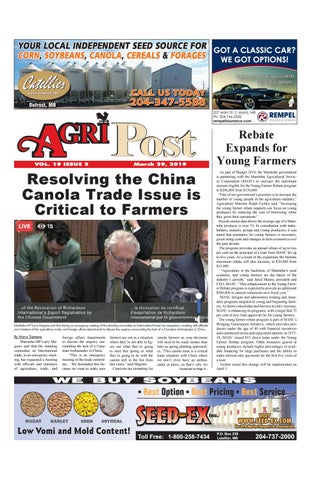
Resolving the China Canola Trade Issue is Critical to Farmers
Manitoba MP Larry Maguire said that during an emergency meeting of the standing committee on International trade has requested a meeting with officials and ministers of the agriculture, trade, and foreign affairs departments to discuss the urgency surrounding the lack of a Canadian Ambassador in China.
By Harry Siemens Manitoba MP Larry Maguire said that the standing committee on International trade, in an emergency meeting, has requested a meeting with officials and ministers of agriculture, trade, and
foreign affairs departments to discuss the urgency surrounding the lack of a Canadian Ambassador in China. “This is an emergency meeting of the trade committee… We demanded this because we want to make sure
farmers are not in a situation where they’re not able to figure out what they’re going to seed this spring or what they’re going to do with the canola still in the bin from last years,” said Maguire. Concerns are mounting for
canola farmers as crop decisions will need to be made sooner than later as spring planting approaches. “This canola issue is a critical trade situation with China where we don’t even have an ambassador in place, so that’s why we Continued on Page 3...
As part of Budget 2019, the Manitoba government is partnering with the Manitoba Agricultural Services Corporation (MASC) to increase the maximum amount eligible for the Young Farmer Rebate program to $200,000 from $150,000 “One of our government’s priorities is to increase the number of young people in the agriculture industry,” Agriculture Minister Ralph Eichler said. “Increasing the young farmer rebate supports our focus on young producers by reducing the cost of borrowing while they grow their operations.” Recent census data shows the average age of a Manitoba producer is over 53. In consultation with stakeholders, industry groups and young producers, it was noted that assistance for young farmers is necessary, given rising costs and changes in farm economics over the past decade. The program provides an annual rebate of up to two per cent on the principal of a loan from MASC for up to five years. As a result of the expansion, the lifetime maximum rebate will also increase, to $20,000 from $15,000. “Agriculture is the backbone of Manitoba’s rural economy, and young farmers are the future of the industry’s growth,” said Jared Munro, president and CEO, MASC. “This enhancement to the Young Farmer Rebate program is expected to provide an additional $500,000 in interest reductions next fiscal year.” MASC designs and administers lending and insurance programs targeted at young and beginning farmers. As farms consolidate and barriers to entry increase, MASC is enhancing its programs, with a target that 75 per cent of new loan approvals be for young farmers. The young farmer rebate program is part of MASC’s Bridging Generations Initiative, which provides producers under the age of 40 with financial incentives and customized terms and repayment options. In 201718, MASC issued 815 direct loans under the Young Farmer Rebate program. Other measures geared at young producers include higher percentages of available financing for large purchases and the ability to make interest-only payments for the first five years of a loan. Eichler noted this change will be implemented on April 1.
March 29, 2019
The AgriPost
The Hog Industry is in a Quandary By Harry Siemens Tyler Fulton, the Director of Risk Management with H@ms Marketing Services said futures markets had shown improvement in spite of substantially higher than expected live hog numbers. In early March, most of the summer months’ futures have recovered to roughly halfway back to their highs but acknowledged it is still very volatile. “The reality is there’s a huge hog supply that to some degree caught the market off guard. We’ve seen several weeks that exceeded five percent growth over year-ago levels, and that is pretty close to double what we anticipated seeing,” said Fulton. “We usually don’t get caught off guard on the supply side with that kind of an increase, and it’s been quite consistent since the new year, and there’s no indication of it stopping. Not only are the hog numbers up significantly but hog carcass weights are also heavier.” He said in terms of weekly pork production, the US in particular, is up a solid five percent over year-ago levels. For whatever reason, the futures are willing to put this large supply on the back burner and focus a little bit more on some of the longer term positive fundamentals. “I believe that the market still thinks that the North American market place is going to benefit from higher export sales into Asia, in particular into China as a result of the short domestic supply there relating to African Swine Fever but there’s a great reason for caution,” Fulton said. “When we get close to where we think there’s going to be a tangible
benefit to North American prices, it gets pushed further down the road. When you look at the current futures values and the current hog supply, it’s hard to reconcile the two.” Bob Fraser, sales and service, Genesus Ontario said Stats Canada, January 1 semi-annual Hog & Pig Report placed the Canadian sow herd at 1.24 million head. That puts the Canadian herd as basically flat for a decade now. “Or you can make an argument that it is slowly bleeding to death by a thousand pinpricks as it approaches the inventory of two decades ago, after a peak of just shy of 1.6 million sows in the first quarter of 2005,” said Fraser. “A decline approaching a quarter of the sow herd. Granted productivity gains have lessened the overall production drain but still not exactly an encouraging picture.” He said there are a variety of reasons for this, some known perhaps some unknown, but the result is a weakened infrastructure, much in need of replacement. The bulk of the new ‘good’ barns were built at the turn of the millennium. “Those barns are now drawing onto twenty years old, with the bulk of everything else south of that. Most could use some serious refurbishing where some should probably go away. Lack of finishing space at least in Ontario seems chronic as I am asked constantly if I know of any space,” said Fraser. “I think many producers would agree that there is much space presently in use that might be better retired.” “However, replacement of capital assets takes just
that, capital and as Jim Long would add courage. Something that has been lacking in this industry of late,” noted Fraser. Fraser said for the last while; margins have charitably been thin and spotty. Olymel, both Canada’s largest pork processor and pork producer reported losses in 2018 fiscal year for both its eastern and western hog production divisions’ losses. Whereas their eastern fresh pork sector saw positive results second only to 2017 that was their best year ever. Overall, the western fresh pork sector had excellent results for the third consecutive year. This would be consistent with most of the other Canadian packers and US packers enjoying unheard of margins for three or four years now. Kevin Grier in his Canadian Pork Market Report suggested the Maple Leaf Foods plant in Brandon, 4th quarter 2018 kill to be 70,000 to 72,000 weekly against an 80,000 extra capacity. Olymel in Red Deer Alberta is running less than 35,000 weekly against 45,000 (single shift) capacity. “This doesn’t work. A pork plant like a finishing barn’s per head costs soar when operating under capacity. So, the question becomes who is going to blink first. The obvious easy solution to the need for more hogs certainly in producers’ eyes is just paying more. However, to date, this seems to have only shuffled the deck chairs from one plant to the other, with no more hogs. Without a solution, it would seem a plant is vulnerable to closure,” said Fraser.
Government Invests in Industry-Led Animal Welfare Activities The livestock industry strives to continuously improve its capacity to respond to increasing demands by consumers and markets to demonstrate the highest quality of animal care. The Federal Government recently announced funding of up to $4.56
million to the Canadian Animal Health Coalition (CAHC), on behalf of the National Farm Animal Care Council (NFACC), to help update and develop Codes of Practice for the care and handling of farmed animals. The investment was made through the AgriAssurance program of the Canadian Agricultural Partnership. The investment will be divided between four activities including updating the transportation Codes of Practice for the care and handling of farm animals during transport; updating the dairy Code of Practice that will address new scientific findings, changes in industry practices and address changes in market and consumer demands; updating the goat Code of Practice that will respond to growing buyer and consumer expectations for on-farm animal welfare and developing a new Code of Practice for farmed finfish. Fish welfare is a new and emerging animal welfare concern for which the industry needs to be able to demonstrate its commitment and alignment with public values and consumer expectations.
The AgriPost
March 29, 2019
Resolving the China Canola Trade Issue is Critical to Farmers Continued from Page 1...
wanted the Minister of Foreign Affairs.” “We need to have these people on the ground in China, meet with the Chinese to let them know that we’re very serious about this or else China could become a market of last resort for many of these companies as they have indicated to me because of the unpredictability of the Chinese in this kind of a situation,” said Maguire noting that Canadians know there is nothing wrong with the quality of the Canadian canola. “We provide the safest food in the world. I know from my time on the western Standards Committee that we meet the quality standards. The Canadian Food Inspection Agency does the checks on the quality control of every shipment that leaves Canada [and] we are certainly in compliance
with the product that is going offshore.” Maguire said farmers are concerned that they need to make payments and decisions on production for the coming spring as they deal with the banks in regards to the types of loans they already have or their operating basis for this year. “They’re telling me that this loss of a dollar to a dollar and a half a bushel since the beginning of December in the canola market is significant. I know from my farming experience that it certainly is significant,” he said. “It’s a big loss, close to a billion dollars in the industry already and we need the government to get their boots on the ground in China to make sure that we show China that we have the best quality in the world and that we need to have them in the world marketplace as a reliable customer.”
Size of Canola Crop in Question By Les Kletke Canola seed remains a question mark for Canadian exports and it remains a question mark on Canadian farms. The Chinese continue to refuse canola imports, maintaining it is contaminated with “dangerous pests” or weed seeds even though the Canadian Food Inspection Agency conducted nine separate investigations finding nothing. Harold Dueck one of 43,000 canola farmers, who farms 3,000 acres near Pilot Mound said he is trying to keep canola to about 1/3 of his and the rest of his oil seed will be comprise of sunflowers. The remaining acres will be planted to cereal crops. He said that he has grown canola for as long as he can remember and will continue to grow it this year but if the export situation stays as it is there will be fewer acres than planned. Dueck normally counts canola as one third of his acres. “That is what works in our rotation and with our weed control program,” he said. “We try not to get our oilseeds over half of our acres and we are aware of rotating our weed control products to keep them effective.” That has meant using other herbicides rather than glyphosate. “If we have a major shift away from
canola that means rethinking both out rotation and weed control programs,” he said. “But if the Chinese maintain this position and don’t buy the Canadian crop there is not much point in growing and hoping for a strong market.” Dueck does not believe the problem is with the crop. He agrees with those that say the issue is a retaliatory measure that is politically motivated. “It does not really matter why this came about,” he said. “The issue is we as farmers have to deal with it and at a time that we are making our planting decisions. That is the reality.” “We have increased our winter wheat acres the past couple of years because it is a good fit with the canola stubble and works with fall seeding,” he said. “So when we cut back out canola that is another consideration.” As of late March he has not yet finalized his seeding plans. “We are still more than a month away from the final choices so we have not determined how this will affect us. I am hopeful the situation will be cleared up and we can get back to a normal situation with markets and our plantings.” Then with smile he asked, “What is normal? Maybe this is the new normal.”
Virden RCMP Respond to Farm Site Fatality On February 25 at 9:25 pm, officers from the Virden RCMP received a report of a fatality that occurred at a farm site, located approximately 15 km north-west of Virden, in the RM of Wallace-Woodworth. The initial investigation has determined that a 63-year-old male, from Prairie
View, was operating a tractor and grain auger when it is believed that parts of his clothing were caught in machinery. The 63-year-old male suffered serious injuries and was pronounced deceased at the scene. Virden RCMP and Manitoba Workplace Safety and Health continue to investigate.
Prairies East Sustainable Agriculture Initiative 14th AGM & Tour Share your expertise, share your voice, and be a part of the latest developments in agriculture! Attend the Prairies East Sustainable Agriculture Initiative Inc. (PESAI) 14th Annual AGM & Tour on April 10. The AGM is free and open to all those interested in support-
ing agricultural initiatives in the Eastman and Interlake regions. Contact Britney Gilson, Diversification Technician, phone or text 204-641-4640, prairies.east@gmail.com. RSVP by Wednesday, April 3, space is limited.
Location: Peak of the Market, 1200 King Edward St. Winnipeg. Meeting and Supper at Red River College, 2055 Notre Dame Ave Winnipeg - Classroom F311 When: Wednesday, April 10 Schedule: Tour of Peak of the Market: 3-3:30 pm Meeting from 4 - 6 pm Supper at 6 pm
The AgriPost
March 29, 2019
A Different Kind of Call I didn’t think there were many firsts left in this business, but I had one last week. I got a call from a representative of the Western Canadian Wheat Growers, which in itself would not be that unusual. There was a time when I would get calls from a lot of farm organizations; some were with questions some were to point out where they felt I had gotten things wrong. This call was different, it was from the chair of their History Book committee and he was making the call to see if I would be available to speak to the author of the groups forth coming history book. I was shocked, why would anyone want to talk to me about history? I have only lived in the present, what can I know about history unless I read it? I will acknowledge that in the past year or so I have taken to saying that I wish I had written down more of the things that my Dad had told me. There was a guy that knew history, he remembered the flu epidemic at the end of WWI and the Titanic as a news story, he knew history and I was not aware enough to write down some of his observations. The caller went on to explain that the group had produced a book on the occasion of their 25th anniversary and the intention of the new volume was to record the happenings of the last 25 years. I thought back to my time as a farm broadcaster when I covered a series of the WCWG annual meetings and actually got to know some of their president’s quiet well. We chatted a bit and I recalled a few names of those that had occupied the president’s office. The caller politely pointed out that they had served in the first quarter century and had been covered in the first volume. He did it with tack but I got the point, my memories were from before the history he was looking for. I shifted gears and began to speak of some of the policy changes his group had brought about, the most obvious being the demise of the CWB. Out conversation went more smoothly now that I was in the right century and we carried on for a few minutes and I agreed to make myself available for the said author to give me a call. Funny thing, a week has passed with all the available times that I checked off on her calendar for a phone call. She has not called. Can it be? I have gotten too old for history? Time flies when you’re having fun.
Bring Back Fahrenheit!
Penner’s Points By Rolf Penner
Spring is in the air! Warmer temperatures everywhere. Trudeau is in despair. There’s a song in there somewhere! But hey, here’s another crazy idea, how’s about we bring back the old Fahrenheit scale when we’re talking about temperatures? Okay, sure the United States is almost completely alone in keeping the old measurement around. Joined only by Burma and Liberia it may not be the most illustrious company but gosh darn it these guys are doing it right. It’s a better measurement. People point to Celsius claiming that it’s simpler and it makes more sense. Water freezes at 0 degrees and it boils at 100 degrees Celsius. Nice round numbers with clear points at both ends of the spectrum. With Fahrenheit its 32 and 212 degrees respectfully, or Looney Tunes as the obsessive compulsives might say. Here’s the thing though, you and I are not water. Nor do we live in water. Unless we suddenly sprout gills and go live in the floodway it’s not particularly relevant to us. On pasta night do we carefully get the water temperature to a perfect 100 degrees Celsius? Or do we just crank up the stove to eleven and wait for things to boil? We do care about when things freeze, but is 32 degrees Fahrenheit really any harder to remember than 0 degrees Celsius? Did you ever hear the old joke, with Fahrenheit you’re really cold at 0 degrees and really hot at 100 degrees but with Celsius you’re kind of cold at 0 degrees and dead at 100 degrees? It’s more of a Dad joke but it’s true. The Fahrenheit scale makes more sense to us on a personal comfort level. Even on a global scale, outside of deserts and the North Pole temperature tends to range from -20 to 110 degrees Fahrenheit or -29 to 44 degrees Celsius. The former is a range of 130 degrees, the latter 73. So Fahrenheit gives us just under double the amount of precision without having to resort to clunky decimal points or fractions. As human beings we are sensitive to tiny changes in temperature. Any husband and wife who have ever fought over a thermostat setting can vouch for that. Face it; we’re all looking for the ultimate in comfort. If the temperature is off, even a bit, we can go from a miserable sweaty mess, to a frozen, teeth chattering ice cube in the blink of an eye. Precision matters. At this point some may be thinking that your bending author is just “anti-metric”. They would be wrong. Measuring rain in millimetres is easier than tenths of an inch. The same is true when it comes to things like wrench sizes and drill bits. Distance and speed should be in miles because that’s how they built the roads back in the days of Moses. And I actually don’t mind going back and forth between both bushels and tonnes of grain depending on what I’m trying to figure out. But if you talk to me about hectares instead of acres it may as well be Greek. Ahh… an anarchist then? Maybe. Though what’s wrong with using the best measurement for the job at hand? Diversity is strength, and all that stuff, right? We’re not talking about a science project here where everything needs to be standardized. When it comes to communicating about things in day to day life in a relatable way there’s times when the metric system sucks. There’s times when every other system sucks as well. Why not just use the system that makes the most sense, when it makes the most sense? When it comes to air temperature Fahrenheit is more precise, more relatable and more understandable than the “Saint Celsius” system that has been foisted upon us. We jumped off the bridge just because everyone else did. We should get back on it.
Carbon Tax - What For? In my humble opinion and that of many others suggests that a carbon tax on anything will do nothing else than add cost to everything we do. On the other hand, while adding costs to everything we do and produce it also makes us much less competitive because no other country is silly enough to do the same. Another reason it makes no sense is the Federal Liberal government is doing so when the economy is al-
ready in the tank. A swine nutritionist with the University of Saskatchewan said the introduction of carbon pricing could change the equation when considering the inclusion of low-cost, high fibre feed ingredients into swine rations. Researchers with the University of Saskatchewan’s College of Agriculture and Bioresources are examining the carbon footprint left by using high fibre alternative feed ingredients in swine rations. Dr. Denise Beaulieu an Assistant Professor in Monogastric Nutrition, said ingredients such as peas or by-products such as wheat mids are used to lower feed
costs, but these high fibre ingredients would increase methane and carbon dioxide output as the fibres ferment in the gut of the pig. Oh, I failed to mention earlier it is also resulting in all kinds of other findings that never made much of difference, but now when everyone keeps telling you “this” or “that” is either adding or taking away from something that isn’t. “This work is primarily for the pork producers and it will allow them to use these ingredients with more confidence and into the future,” said Beaulieu. “For example, I know it’s political, but let’s say there was a scenario where carbon pric-
ing came into play for our pork production industry and then we would have to put a cost on for example high fibre ingredients. This data could more accurately allow us to look at the cost of these high fibre ingredients and the role that they might play in terms of the overall carbon footprint of pork production.” She said that, right now producers use the wheat mids and peas; they’re primarily brought into the diet on a least-cost basis. “We put these into the diets so we can meet all the nutritional requirements of the pig but at a lower cost, so that’s the status quo,” she said. “But, for example, going into the
future, if we add increasing amounts of these into the diet, we may want to consider the carbon footprint of including these into the diet because that could be an additional cost that we’d want to consider.” Dr. Beaulieu said this data could allow us to accurately determine the cost and the overall carbon footprint of pork production. I do not quarrel with Dr. Beaulieu, but I do disagree with those people who keep trying every which way to extract money from innocent hard working people to pay for this substantial bottomless pit, called trying to finance the so-called climate change fiasco.
The AgriPost
Challenges Persist For Canola as China Still Unwilling to Purchase While there was some initial optimism that Chinese concerns with canola trade could be resolved quickly, technical discussions to date have not indicated an immediate resolution is possible. Canola seed exporters report that Chinese importers are unwilling to purchase Canadian canola seed at this time. “We’re disappointed that differing viewpoints cannot be resolved quickly,” says Jim Everson, president of the CCC. “Under the circumstances, Canadian canola seed exporters who normally ship to China have no alternative but to supply customers in other countries who value high quality Canadian canola.” China has been a major market for Canadian canola, accounting for approximately 40% of all canola seed, oil and meal exports. Canola seed exports to China were worth $2.7 billion in 2018. Demand has been very strong until recent disruptions.
“Canadian ministers and government officials have responded quickly to Chinese concerns, however, technical discussions are unlikely to lead to an immediate resolution,” says Everson. “We urge the Government of Canada to continue to intensify efforts to resolve the situation.” The Canadian canola industry makes every effort to meet the requirements of customers and their governments around the world. From seed developers, growers, processors and exporters, all segments of the value chain coordinate to ensure consistent and high quality canola. “Canadian canola is of the highest quality because of our world-class quality assurance systems,” says Everson. “We have a long-standing history of delivering on quality and reliability. We will continue to provide our customers with high quality canola and promote stable trade based on science.” “Canola is a key driver
of the agriculture industry in this province and in this country, and is Manitoba’s second-largest export product to China,” said Manitoba’s Growth, Enterprise and Trade Minister Blaine Pedersen. “We will continue to push this matter so that our producers are not caught in the crossfire of an international dispute between Canada and China.” China is Manitoba’s second-largest trading partner, with over $2.6 billion in two-way trade in 2017, and an important market for Manitoban businesses. “This move by the Chinese government is not sciencebased, as we know that all canola exported out of Canada is rigorously inspected by the Canadian Food Inspection Agency,” said Agriculture Minister Ralph Eichler. “We will stand up for our farmers and the agri-food industry in Manitoba and work to ensure that this issue is resolved as soon as possible so the best canola in the world, grown right here by our pro-
ducers, can continue to feed the world.” Both ministers noted that they have had positive and collaborative discussions on this issue, particularly with federal International Trade Diversification Minister Jim Carr and federal Agriculture Minister Marie-Claude Bibeau, as well as discussions with counterparts across the prairies. In addition to discussing the situation directly with Richardson International (On March 1, Richardson International was notified by China’s General Administration of Customs that its registration to ship canola had been cancelled), they will continue to have broader discussions with the Canadian Canola Growers Association and with Keystone Agricultural Producers. In 2017, exports of canola seed and products generated $1.72 billion for Manitoba’s economy. About 40 per cent of Manitoba’s farms grow canola, representing about 18 per cent of all canola farms in Canada.
March 29, 2019
March Hay Situation Tightens By John McGregor, MFGA Extension Support As we move closer to spring the hay situation across Manitoba continues to be extremely tight. Hay marketers are reporting they are sold out and any ads for hay are getting snapped up very quickly. “It’s been a cold winter for sure and feed supplies have shrunk reflecting that,” said Darren Chapman, Manitoba Forage and Grasslands Association (MFGA) Chair and member of Manitoba Hay Exporters. According to Chapman, with spring coming producers should be mindful of feed stocks and resources and be sure to plan ahead. In the last report there was some hope that producers with adequate supplies may have surplus hay available later in the winter if it continued to be mild and short. Presently, with the below normal conditions in February, this is becoming less likely. We are hearing of forage shortfalls being stretched with grain and grain by-products. Looking at hay prices received this month, prices are slightly higher than the January report but with little or no hay trading, establishing a price is difficult for all classes of hay. Straw continues to be in tight supply. Kijiji Manitoba has a number of hay for sale listings this month. The Manitoba Hay Listing site has a number of listing for both hay and straw but limited information on price. The Wisconsin Hay Report indicates that there continues to be a strong demand for good quality hay and it looks like prices are up from last month. Producers wanting to make use of the Manitoba Hay Listing service should call Manitoba Agriculture toll-free at 1-84-GROW-MB-AG, 1-844-769-6224 and the department will call them back within 30 minutes to capture information.
Ag in the Classroom Receives Program Funding By Elmer Heinrichs
Outlook Forecasts Higher Wheat and Less Canola Acres By Elmer Heinrichs Agriculture and Agri-Food Canada’s March preliminary outlook for the upcoming 2019-20 crop year says based on current market conditions and historical trends, the area seeded to field crops in Canada should increase by one per cent over last year. The increase in field crops comes mainly from a lower allocation to summer fallow with the area seeded to grains and oilseeds increasing by only two per cent while the area
seeded to pulses and special crops decreases by six per cent. However, expected prices, input costs, delivery opportunities and moisture conditions are expected to play a crucial role in determining actual seeding decisions in the spring. Averaged over all crops, yields are forecast to increase compared to 2018-19 since average yields were reduced last year by excessive moisture conditions in some areas. The production of grains and oilseeds is forecast to increase by 4 per cent to 89.0 Mt while the output of pulses and special crops is expected to decrease by
2 per cent to 6.5 Mt. Total field crop production is expected to increase by 3 per cent to 95.6 Mt. The forecast of less winter wheat should be offset by an increase in spring wheat. For 2019-20, seeded corn area is forecast to increase due to continued good overall demand, especially for high quality corn. Production is expected to rise by 6 per cent to 14.7 Mt on the higher area and higher average yields. Seeded area in oats is forecast to increase by 13 per cent from 2018-19 due to good US oat futures price levels, with production increasing by 10 per cent. Canola seeded area in Cana-
da is forecast to decrease to 9.0 million hectares (Mha) due to the decline in prices from burdensome world oilseed supplies and the uncertainty over Chinese buying. The estimated area seeded to soybean decreases by 3 per cent from last year, to 2.48 Mha, mostly due to dry growing conditions in western Canada. Production is forecast to fall to 7.0 Mt due to lower area and lower average yields. Despite higher exports and domestic use, carry-out stocks are expected to increase by 8 per cent due to a higher supply. Grain prices in Canada will continue to be supported by the low value of the Canadian dollar.
Agriculture in the Classroom Manitoba is receiving $99,400 in support from the Canadian and Manitoba governments over the next two years. The organization delivers curriculum-based programs, activities and resources for teachers and students to learn more about agriculture and the role it plays in Manitoba. “Our goal is to ensure all Manitoba students have enough accurate information to make informed consumer decisions by the time they graduate,” said Sue Clayton, Executive Director of Agriculture in the Classroom Manitoba. “Agricultural education initiatives like Canadian Agriculture Literacy Month allow thousands of students to make meaningful connections to food and farming early on.” The funding is flowing through the Canadian Agricultural Partnership. “We are proud to be supporting Agriculture in the Classroom Manitoba and the educational programming they’re providing to our students,” said Agricultural Minister Ralph Eichler. “Agriculture is a critical part of Manitoba’s overall economy, and raising awareness and giving these students this opportunity at such a young age is an incredible experience.”
March 29, 2019
The AgriPost
The AgriPost
March 29, 2019
Raising the Soybean Protein Levels in Western Canada By Harry Siemens Soybean protein is an important seed quality component and an export determinant according to Cassandra Tkachuk, Production Specialist, Manitoba Pulse Soybean Growers in an interview at Ag Days in Brandon. Tkachuk said the importance of protein is its nutritional value for both humans in the form of food-grade soybeans and livestock in the form of soybean meal. Producers in Manitoba grow mostly for the crush markets, with meal as the intended end-use and oil as a by-product. However, exporters have protein content in soybeans on their minds for the past several years and more recently it is a trait that farmers are paying much more attention to. “We’ve been dealing with the issue of lower soybean protein in more northern growing regions with some interesting research done in the US that’s showing us some opportunities to look at our soybean protein content levels,” said Tkachuk. “This is a relatively new issue in farmers’ minds but growing over the years. It’s likely that somewhere in the value export chain, some discounts are based on protein levels. But this isn’t something that farmers are always necessarily seeing. They’re not thinking, maybe traditionally, were not thinking about protein in their soybeans as much as they were in wheat, for example.” She said there are also price premiums for growing higher-protein soybeans. But protein is an essential component since producers grow soybeans mainly for the meal
and then oil is a by-product for feed markets all over the world. “We’re seeing declining protein-content levels in soybeans, as we move northward in North America with the highest in South America. Then moving northward the protein content gets lower, toward western Canada, while Ontario has higher protein,” said Tkachuk. “We looked at maps from the University of Minnesota based on their surveys and their content levels, and we extrapolate from there,” she said. “We also have our own, I believe from the Canadian Grain Commission, showing levels of western Canadian soybean protein versus in Eastern Canada. There is a big difference meaning there’s a geographic component.” Tkachuk said the main components are geography, environment, climate, different growing season lengths, and different genetics. “The genetics, by the environment, by management factors, or G by E by M, is what we largely look at,” she said. “When you think about genetics over time, breeders have selected for higher-yielding soybean varieties. But maybe sacrificing protein content over time, because there is often an inverse relationship between yield and protein, as there is with oil and protein; that might be another factor.” Unfortunately, there is very little the industry can do in the short term about the environment and genetics. Breeders are aware of this and the solutions will be over the long term to provide a higher protein variety available to farmers, she said. Tkachuk said farmers are
asking the question on what can they do to increase the protein content right by possibly managing the crop to increase protein levels. Research has shown that protein does not increase even when soybeans are planted earlier although it does provide more time to grow and even using more nitrogen and phosphorous fertilizer has not provided results. “I looked into some data, because a lot of field trials in Manitoba, they often test for seed quality. I looked at, for example, planting dates and testing protein and oil. The short story is earlier planting didn’t improve protein,” she said. “But we did see some pretty dramatic differences between locations and years. So locations, years; back to the environmental component. And nitrogen fertilization in soybeans and measuring seed quality found little differences in protein levels there, either.” Another study using different phosphorous fertilization techniques did not show differences in protein. “So just dipping into the data that we have currently, I would not say that there is much you can do as a farmer to manage for protein. It’s more these long-term solutions,” said Tkachuk. “That was the big goal of writing the article, to first and foremost tell farmers that there’s not a whole lot they can do. So don’t spend money on sulphur products, for example, because we don’t have research on that here. But we do know that moisture and temperature can have an impact. So during the seed growth period, if you have arid conditions,
Federal Government Highlights Support for Women in Agriculture Diversity and inclusion are integral to creating an economy that works for everyone. The full and equal participation of women in Canada’s agriculture and food system will ensure the sector remains an engine of economic growth, contributing to the sector’s competitiveness and prosperity. Minister of Agriculture and Agri-Food Marie-Claude Bibeau spoke at the Advancing Women in Agriculture West 2019 conference recently in Calgary, highlighting the Government of Canada’s ongoing commitment to creating a diverse, inclusive economy and supporting women in the agriculture and agri-food sector. The Minister also announced Farm Credit Canada’s (FCC)
new Women Entrepreneur Program to support women entrepreneurs involved in the agriculture and agri-food sector by providing the capital they need to grow their business, along with the meaningful skill development opportunities they are seeking. The program includes access to capital through the Women Entrepreneur Loan, enhanced learning events, partnerships with other groups, and delivery of online content to support their needs. FCC has committed $500 million over three years for the Women Entrepreneur Loan. As part of the loan, borrowers can have a portion of their fees waived and are encouraged to reinvest these savings into both personal and professional
development that best suits their individual and business needs. FCC’s Women Entrepreneur Program is part of a commitment made under the Government of Canada’s Women Entrepreneurship Strategy, a $2-billion investment that seeks to double the number of women-owned and womenled businesses by 2025. In Canada, more women are farming and the roles of women on the farm are continuing to evolve. Women accounted for 28.7 per cent of all farm operators in 2016, nearly 78,000 of 272,000 farmers in total. Women were most prevalent among farm operators between the ages of 35 and 54, representing almost a third of the group.
you can have lower protein. Like this year, we had really dry conditions. That could be one factor. But we’re still working to piece together this whole story. There are many unknowns.” She stressed that growers should check their protein levels to know what they have. A level of 32 per cent is a good indicator level. She encourages everyone to question how that protein level is measure. “It’s just a simple
calculation. But is it 13 percent seed moisture or dry basis? You could have significant differences in numbers there. Some researchers even use seven percent, “said Tkachuk. “Asking those questions about, well, how is it measured? That might make a difference. But yeah, aiming for above 32 percent protein is a good number.”
Cassandra Tkachuk, Production Specialist with the Manitoba Pulse Soybean Growers, said that geography is one of the determining factors if a soybean crop has low or high protein levels. Photo by Harry Siemens
March 29, 2019
The AgriPost
The AgriPost
March 29, 2019
Food Development Centre Researches Protein Crop By-Products By Les Kletke Manitoba crops may play a larger part in the protein portion on a consumer’s dinner plate in the near future. Robin Young, the Chief Operating Officer/General Manager of the Food Development Centre in Portage la Prairie sees even more potential, than protein with the by-products of these crops. “There is real interest in the plant protein sector now and development of new products that will fit into the diet of people who are eating less meat,” said Young. “But when the protein is extracted from a crop there are other products that can be used. Products like starch and fibre.” Currently soy accounts for 77% of plant extractions and wheat another 22% with all other crops accounting for less than 1% each of the products that are used as non-meat proteins. Young said that crops like peas could play a much bigger role as a protein ingredient. The construction of a major pea processing plant in Portage la Prairie over the next couple of year’s means there will be real potential for the crop and the extracted components. “There will
The Food Development Center has pilot plant capabilities to help companies develop new uses for components extracted from crops.
be large amounts of the crop processed and that means there will be a significant amount of products like fibre and starch that will be available and need to be utilized,” said Young. The value of crops is too high and the margins too thin to use the crop for one use. “The margins today require that all the components of crop be utilized and that is the role the Food Development Centre can play,” she said. “We can work with firms to find uses
and develop the products for these other components.” A seminar in late March attracted over 100 industry people to Portage la Prairie at the Food Development Centre to hear about the work that is going on and what the potential for these components might be. “We had people from across the US attending as well as from Germany,” said Young. “The interest in extracting these components is tremendous at this time and it is not just for the protein.”
She highlighted crops such as canola and peas would gain tremendously as the market develops. It is a not a mature market by any means and as it grows the opportunity for new crops and their by-products is fantastic. “Flax is another crop produced in Manitoba that is positioned to gain from these developments,” said Young. “We are not sure exactly where it will go but we at the Food Development Centre are looking for industry people to work with, to develop their potential.”
Growing the Protein Crop in Manitoba By Les Kletke Robin Young is the General Manager of the Food and Development Centre in Portage la Prairie and she said her organization is poised to be a part of the next big change in food production. Young chuckles when asked about the current A & W television commercial that features a non-meat burger that has customers raving that it tastes as good as the real thing. “I believe they even have one now that features a sausage like product for a breakfast food,” said Young noting that this is not her target market. Though the Food and Development Center did attract some major food manufacturers and marketers to its most recent seminar, she is more concerned about helping Manitoba companies develop products that fit the market than focusing on one of the fast food giant’s advertising campaigns. A seminar held in late March at-
tracted over 100 people from various sized corporations and government bodies to see the latest developments in the ‘after meat’ segment of the market. “There is no doubt that plant based protein foods are of great interest at this time,” said Young referring to the Province’s January announcement to remain a leader in protein production. “This is a great fit for the crops produced in the province and where the market is going.” Currently soy products account for 77% of the world market, wheat products 22% and all other crops less than 1% of market. “There is a tremendous potential for the other crops that Manitoba produces to take their place in the food product market place,” said Young. “Crops like canola and peas have great potential and it is not a matter of them having to replace soy in the market place, they can be a part of the growth
of this sector.” She is very cautious when drawing the parallel to livestock feed but said the situation is not unlike what canola meal went through a couple of decades ago when it moved into the dairy feed sector. At the time it was thought that soy meal was the only protein source that would work in dairy rations and cows did not like the taste of canola meal. Some of that resistance may have stemmed from the days of rapeseed meal but the crop has changed. “We have consumers that have no objection to canola meal, it is already accepted as a food source so it is a good fit,” she said. Young is confident that the protein sector will grow just as other parts of the industry. “We have existing companies like Tyson and Maple Leaf making investments in this sector because they see it as a natural outgrowth of the meat industry as people choose
Robin Young is the COO and General Manager of the Food Development Center in Portage la Prairie. She sees potential for Manitoba crops in plant based proteins.
different types of protein for their dinner plate.” She said the Food Development Centre is well place to help new companies develop products for the expanding market. “We have been the recipient of some grants that have provided new equipment and we are ready to work with players from all sectors of the industry,” she said.
Support for Equestrian Competition and Royal Farm Yard at the Winter Fair The Canadian and Manitoba governments are providing $20,000 over two years through the Canadian Agricultural Partnership (CAP) to support the 2019 and 2020 Manitoba Cup Equestrian Competition at the Royal Manitoba Winter Fair. “Our government is proud to sup-
port initiatives that help educate and raise awareness on Canada’s agricultural sector,” said Federal Minister of Agriculture and Agri-Food Canada Marie-Claude Bibeau. “This event showcases equestrian excellence and demonstrates the diversity and economic importance of our agricultural in-
dustry.” “We are proud to support Manitoba’s premiere indoor equestrian show, featuring top level show jumping, hackney and draft horse competitions,” said Manitoba Agriculture Minister Ralph Eichler. Additionally, $10,000 will be provided to the Royal Farm Yard
in 2019 through CAP, which is devoted to enhancing the important relationship and building public trust between farmers and consumers. The 44,000 square foot Royal Farm Yard is a winter fair highlight for many families, offering an agricultural education area, live animal and cattle shows, and much more.
10
March 29, 2019
The AgriPost
The AgriPost
March 29, 2019
11
MHHC Land Donation is a Gem
According to the New Oxford Dictionary, the word gem \jem\ is a noun that is defined as a person or thing considered to be outstandingly good or special in some respect. By this definition, the quartersection of native prairie grassland formerly owned by mixed grain and cattle producer Peter Galawan of Lenore, Manitoba can undoubtedly be described as a gem. The 160-acre plot located northeast of Virden has never been broken and for the most part, has been kept completely intact. To the average person, this doesn’t mean much, however, to the people who are actively engaged in protecting wildlife habitat this is worth celebrating. The Manitoba Habitat Heritage Corporation (MHHC) is an organization that strives to maintain and enhance fish and wildlife habitat throughout the province. When the organization was presented with this generous land donation by Peter Galawan to protect this quarter in perpetuity, it was an honour to accept the gift. Carol Graham, MHHC Conser-
vation Specialist, said the property is sentimental to the Galawan’s as the family yard site is located on the corner of the property and as a child, Mr. Galawan spent a great deal of time on the native, prairie grassland exploring what Mother Nature had to offer. They viewed the space as a sanctuary for wildlife. “It is quite unique and rare to have that much open grassland still intact, especially in this part of the province. We will respect and honour the landowners’ wishes to ensure it stays the way it is,” said Graham. “We will continue to use it for grazing and utilize a rotational grazing system as a tool to enhance and maintain the habitat as the landowner has done for a number of years with the current renter.” The property is home to many grassland birds and is supportive of Species at Risk such as the Burrowing Owl, Ferruginous Hawk, and Sprague’s Pipit. With diverse landscapes surrounding the property, other animals such as sharptailed grouse find the habitat suitable as well. Having lived on the
property for many years, Mr. Galawan also took a special interest in observing insects such as beetles, butterflies, and moths. “We often see that with producers, they become in tune with the environment. Where insects are concerned there is a benefit or a risk to crops, so producers are often quite observant of the species that inhabit their land. Landowners, in general, tend to have an innate interest in what the natural landscape has to offer and what it holds for the future,” said Graham. The Galawan property is significant in its rarity for being kept in its natural state for so many years and in providing a much-needed benefit to wildlife. With MHHCs land management practices, the family can be assured that this parcel of land will continue to provide people with an opportunity to develop an interest in wildlife with the hope that many will recognize and value the different species that are part of the prairie landscape.
The Canola Flower Midge: a Newly Discovered Species In the agricultural lands of Canada, most farmers would think they have seen all the pests that they could. But not so, a new species of midge has recently been identified. Dr. Boyd Mori, who began his career with Agriculture and AgriFood Canada (AAFC) in Saskatoon in 2016, has been studying swede midge, a common pest that damages Brassicaceae crops like canola, cabbage and broccoli. At one point, he thought the traps were broken, as they were not picking up as many swede midges as expected. But they were picking up something else, a new midge species named Contarinia brassicola, or the Canola Flower Midge. “At this point, we’re not sure if it is a native species or whether it has migrated from other areas, like the swede midge did. We’re looking into the life cycle, agronomic impacts, and the existence of natural enemies (beneficial insects),” explained Mori. Not recognizing the insects they were seeing in their traps, they sent them to their colleagues in Ontario for verification. Experts
Contarinia brassicola – also known as the Canola Flower Midge.
Dr. Boyd Mori with Agriculture and Agri-Food Canada (AAFC).
agreed, this insect has never before been described in literature and has therefore been identified as a new species. One theory as to why it was only discovered now is that it might be a native species whose fortunes and population have increased with the rise of canola acreage in the past 50 years. A lot more research needs to be done to learn about their biology, potential economic impact on crops and if necessary, how to control them. At this time, there has been no evidence found of this new midge threatening or causing serious damage to crops but further assessment is required.
The Galawan property is significant in its rarity for being kept in its natural state for so many years and in providing a much-needed benefit to wildlife.
12
March 29, 2019
The AgriPost
The AgriPost
March 29, 2019
Local Farmer Participates in CFB Documentary
Colleen and husband Grant operate a 14,000 acre grain and oilseed farm and she runs an energy bar business, which she founded.
By Les Kletke Colleen Dyck is going to spend a week in Kenya which will be well documented, not only in her travel journal but in a documentary being produced by the Canadian Foodgrains Bank. The short video is scheduled to be released this fall. The Niverville entrepreneur and farm partner will spend a week in Kenya with Lucy
Anyengo, who farms less than an acre on the Uganda-Kenya border. Colleen and husband Grant operate a 14,000 acre grain and oilseed farm and she runs an energy bar business, which she founded. Dyck said the trip came about after she got a call from a friend suggesting she apply for the program. “I got a
call saying that I should apply, I had not even heard of the program, but filled out the application and that lead to an interview and then I was notified that I would be the one going on the trip and part of the documentary,” she said. She said that she is well aware of the work done by the CFGB and the Dycks
have donated land to be used by local growing projects for a number of years. On the verge of leaving, Dyck said she was looking forward to establishing a relationship with her counterpart in Kenya and understanding some of the challenges she faces on a daily basis. Anyengo participates in the World Renew a Foodgrains Continued on Page 22...
21
GGC Welcomes Budget 2019’s Commitment to Farmers Grain Growers of Canada (GGC) welcomed initiatives in Budget 2019 that will help make the valuechain more competitive, including the exemption of farm fuel bought at cardlocks from the carbon price, investments in rural broadband, and a commitment to reform the Canada Grain Act and the Canadian Grain Commission (CGC). “We are pleased that the Government continues to respond to concerns raised by farmers,” said Jeff Nielsen, GGC Chair. “We wish the Government had gone further and exempted all fuels used in grain farming from the carbon price, but this is another step in the right direction, and we look forward to continuing to work with the Government to get further exemptions for the sector.” In Budget 2019, the Government has committed to reforming the Canada Grain Act and the operations of the Canadian Grain Commission. GGC has long called for reform of the Act and the CGC has committed to working with the Government to ensure that the consultations on reform lead to real changes that make it more competitive and more profitable to be a grain farmer in Canada. GGC was also pleased to see investment of up to $1.7 billion over 13 years for rural and remote broadband and the commitment to release an agri-food regulatory reform roadmap. These initiatives will make it easier to do business as a grain farmer. “Grain farmers know they can make their money from the marketplace and we will continue to support all efforts to reduce the cost of doing business in Canada and to expand new markets,” added Nielsen. “Grain farmers welcome these incremental steps in the right direction.” Grain farmers also took note of the announcement of the Government’s intention to move forward with a Food Policy. GGC will continue to work with the Government to ensure that the Food Policy reflects the realities of 65,000 grain farmers across Canada, said Nielsen.
22
March 29, 2019
Local Farmer Participates in CFB Documentary... Continued from Page 21...
Bank program learning techniques to improve the quality of her soil, better pest management and how work with the erratic rainfall of the area. She is a trainer of trainers and teaches these techniques to others in her community. “I am sure that I will come away with a feeling of how decadent our life is and how much people in other parts of the world have to work for substance living,” she said. Dyck said that while she is focusing on the wider scope of the program and hopes to learn about the production practices of the area she is especially hopeful to establish a personal relationship with her counterpart. “I want to learn about the production techniques but it is also important to have a face to the people on the other side of the world, and to know someone who lives and works in these conditions,” said Dyck. “It becomes so much more real when you know a person in these conditions. I am hoping to come home having a new friend half way around the world.” The video is intended to demonstrate how a small investment in the lives of women farmers can unleash their potential, with lasting impacts on the families and communities. If the program is successful it will have Anyengo visit Dyck on her farm in the future.
Lucy Anyengo on her farm.
The AgriPost
Manitoba Soybean Acres Could Be Down in 2019
By Harry Siemens What will the soybean acres be in 2019 in Manitoba is a $64,000 question because a lot of things come into consideration. Manitoba Agriculture’s pulse specialist Dennis Lange told growers earlier this year Manitoba could see soybean acres around 1.5 million acres, that is down from 2.3 million based on two years ago. “Part of that reason is that we saw some lower yields last year due to the dry conditions we had in July and August,” said Lange. “The estimated provincial average yield is going to be about 32 bushels an acre. In the previous year we were at 34, so we have seen some lower yields there this year.” He also thinks that growers realize it’s nice to have a bit more selection of some of the crops in different regions, and with soybean prices a little bit lower, these factors come into play. “There were some green seed challenges [in 2018] for a couple of weeks, where the seed had matured so quickly on some varieties that it caused the green seeds to be locked in, and in some cases growers had some very high levels, which resulted in some discounts on some loads,” said Lange. “It was more of an isolated region that it happened
in. It wasn’t province-wide. But all these factors contributed to it, and right now seed sales, when you talk to a lot of seed sellers, a little bit lower. So, yeah, we’re going to be looking at a little fewer soybeans for this year.” “When growers are looking at growing a crop, what they’re looking at is they’re seeing what’s going to work best on their farm, given where commodity prices are at, based on history and on the number of late season crops you want to have,” said Lange. “I talked to one producer that’s up close to Winnipeg, and he was saying this is the first year he’s going to be under 1,000 acres of soybeans, and he’s been growing soybeans a long time. They look at some of the competing crops that they’re growing, for example, oats, cereals, canola, winter wheat, spring wheat with yields in most areas this year were quite good. When you compare something with a very high yield compared with something that was a little bit lower yielding, like the soybeans this year, that
Manitoba Agriculture’s pulse specialist Dennis Lange told growers earlier this year in Brandon, Manitoba could see soybean acres around 1.5 million acres, that is down from 2.3 million on two years ago.
plays into grower’s decisions.” “There’s still going to be lots of soybeans around. “Don’t get me wrong, and if the market turns around even, 1.5 million acres is still nothing to sneeze at. But it’ll just be a little less than what we saw several years ago.” Rotation is also a big factor. “You have to look at wheat, the spectrum that growers have to work with. When you’re changing crops,
you’re also changing in some instances the chemistries that you’re using to control some of these weeds, which is a great thing to do. You need to be able to not rely on just one product to control all your weed problems,” he said. “In other words, if you’re putting soybeans too often, you’re using the same chemistry to control those weeds. So to have that crop in a rotation and be able to rotate your chemical groups, that is a bonus.”
The AgriPost
Federal Budget Aggressively Tackles Rural Economic Development
By Elmer Heinrichs The Federal government unveiled its 2019 budget on March 26 and it included several announcements that are notable for the agriculture sector. The budget pledges compensation for supply-managed sectors facing financial hits from international trade pacts, funding for a new national food policy, farmer-friendly changes to the small business deduction and rural high speed internet service. Some of the announcements that are of particular importance to the agriculture sector include the development of a national food policy. This policy will focus on tackling
food waste, improving community access to healthy food and will shine a spotlight on Canadian food both at home and abroad. The national food policy will receive $134.4 million over five years, and the food processing sector will get $100 million. Budget 2019 includes a total of $3.9 billion in compensation, including $2.15 billion in direct compensation, in addition to the $250 million in innovation funding already provided to Canada’s dairy industry and another $1.5 billion in funding to protect quota value upon sale. A regulatory review will see the Canada Grain Act opened
and examined. The government will also seek further input on how to extend the farm fuel exemption on fuel bought at cardlocks. Farmers will also benefit from a measure to provide all Canadians with access to high-speed internet by 2030, thanks to a $1.7 billion investment over 13 years. Western Economic Diversification will get up to $1 million this fiscal year, “To develop a new strategy to sustainably manage water and land in the Prairies.” The agency will also receive $100 million over three years to expand programs in the west. Early responses from farm and agribusiness organizations to the pre-election budget sug-
gest the Federal government has managed to find something for almost everyone in the Ag sector. The Canadian Pork Council was pleased to hear of new funding to increase the number of detector dogs at Canadian ports of entry to help prevent illegally imported meat products from entering Canada and thereby risking the introduction of African swine fever. Bill Campbell, President of Keystone Agricultural Producers, was pleased with funding for rural high-speed internet access, and support for farmers in the supply-managed sectors who gave up market share under the recent new trade agreements.
Wheat Sector Receives Boost to Increase Export Market Share The grain sector is a key driver of Canada’s economic growth, exporting 20.5 million tonnes of wheat in 2017 and $21 billion in exports sales. Marie-Claude Bibeau, Minister of Agriculture and Agri-Food has announced an investment of up to $6.2
million to help the Canadian International Grains Institute (Cigi) expand the market for Canadian wheat through technical support, market research, employee exchanges and customized training for customers and commercial partners in over 50 countries. The Canadian International
Grains Institute (Cigi) is a not for profit organization established in 1972 to work with the grain and field crop value chain throughout Canada and internationally to drive the development and increase the use of Canadian agricultural products. This project, funded
through the AgriMarketing Program, under the Canadian Agricultural Partnership, will enable Cigi to strengthen relations with buyers and prevent future market access issues, while expanding existing markets and developing new opportunities around the world.
MPC Salutes Federal Action on African Swine Fever African Swine Fever (ASF) is a hemorrhagic disease that is fatal to pigs but is neither a food safety or public health concern. Since ASF first appeared in China last summer, the Canadian Pork Council (CPC) has worked diligently with the Federal government and its agencies to develop strategies to keep this disease out of Canada. The introduction of ASF into Canada would put over 100,000 jobs in jeopardy and could cost the Canadian economy $24 billion. There are several ways ASF
could enter Canada. Via internationally sourced feed ingredients, travelers bringing in contaminated meat from infected countries and travelers with the virus on their clothes, footwear and personal items. Since detector dogs are the best available method to intercept illegal and possibly contaminated meat products at the Canadian border, Manitoba pork producers sincerely welcomed the Federal government’s recent commitment of up to $31 million to increase the number of detector dogs at Canadian airports. This fund-
ing will allow for the addition of 24 detector dog teams over five years, bringing the total to 39. “If Canada got a single case of ASF, our borders would close to all nations,” said Manitoba Pork Chair George Matheson. “The impact on the Canadian economy would be devastating. We commend the Government of Canada for making this critically important investment in protecting the country’s swine sector.” Manitoba Pork representatives will be attending the first international ASF forum, hosted by
the Canadian Food Inspection Agency in Ottawa on April 30 to May 1. The gathering will be an opportunity to strengthen global cooperation to stop the spread of this deadly disease. In addition to supporting the CPC in its national ASF efforts, on the home front Manitoba Pork is working with governments and sector partners to develop an ASF emergency response plan. Manitoba’s experience and success with limiting Porcine Epidemic Diarrhea Virus (PEDv) will be invaluable in any fight against ASF.
KAP Supports a Number of Federal Budget Initiatives
ers who are now limited in the innovative technology they can access because of poor internet service.” Campbell also commended the government for its commitment to spend $31 million over the next five years to improve sniffer dog services at border entries, in order to prevent African Swine Fever from entering Canada. It is brought in on meat in passengers’ luggage, as well as on clothing and personal items. Although harmless to humans, this flu is extremely fatal for pigs. The Canadian Pork Council estimates African Swine Fever in Canada would put over 100,000 jobs in jeopardy and cost the Canadian economy $24 billion dollars. Another positive in the bud-
get, said Campbell, is support for farmers in the supply-managed sectors who were forced to give up market share under the recent new trade agreements, the Canada-European Union Comprehensive Economic and Trade Agreement, and the Comprehensive and Progressive Agreement for Trans-Pacific Partnership. These sectors include dairy, poultry and eggs and therefore the $2.15 billion in coming years will help them address income losses. Campbell also noted the Federal government has committed to look at the exemptions on farm fuel, so called “purple gas.” “When the carbon tax was announced, we were told there would be an exemption on farm fuel,” he said. “However, we recently we found out that only
fuel delivered to the farm is exempt, but not that accessed from a cardlock system. This system allows farmers to get fuel from unmanned fuel stations, which is often more efficient.” “I am pleased the government has committed to look at this situation, and we will continue to press for this exemption,” continued Campbell. Campbell said KAP will also continue to lobby for carbon tax exemptions on fuels used for grain drying, and heating and cooling of farm buildings, because these taxes will add very considerable amounts to farm expenses. “We compete on the global market and can’t adjust our prices to reflect these expenses and this puts us at a very unfair disadvantage compared to our competitors.”
KAP has long called for highspeed internet access in rural communities and the Federal budget promised to add new money to existing investments to make this happen, said Bill Campbell, president of Keystone Agricultural Producers (KAP). “It’s my understanding between $5 billion and $6 billion will be added in order to improve connectivity to over 900 communities in Canada with more than 200,000 kilometres of advanced fibre networks,” he said. “This will help farm-
March 29, 2019
23
24
The AgriPost
March 29, 2019
Achieve Cost-Effective Diets for Lactating Dairy Cows Most dairy producers want to feed cost-effective diets to their high milk (milkfat) producing lactating cows. That’s a tall order, which is most often achieved by obtaining the best lactation diets; first as a formula on paper, blended into a TMR, and then put in front of the milking cows. Finally, it’s up to them to eat and turn it into money-making milk.
As a dairy nutritionist, I pencil out such cost-effective diets for high producing dairy cows. It’s a matter of matching their nutrient requirements, which support vital functions, general and rumen health, and lactation performance. In the latter, I target early to mid-lactation dairy cows (60 – 150 DIM) that are producing 39 kg milk production, 4.0% milkfat and
3.3% protein. My lactation diets are also designed to promote good dry matter intake amongst lactating dairy cows. I do this by laying a foundation of high-quality forages supplemented with palatable grains and grain by-products. A complimentary dairy premix is added containing essential macro-minerals as well as important trace-minerals and fat-soluble A, D and E vitamins. Limit-fed by-pass fat and dietary feed additives are also formulated in the final dairy diets. (See Chart A below) In this illustrated case, it costs $8.27 of a well-balanced diet to feed a lactating dairy cow. This is a common way to express feed costs, yet there are other ways. For example: $5.30 per kg of milk fat, $ 9.66 per cwt of milk produced, or $ 0.36 per kg of dairy diet consumed. Regardless, all of the above costs of feeding a cow are gross numbers. So far, I did not account for storage and mixing losses as well as feed refusal by lactating dairy cows. I conservatively estimate these numbers at 10% and 2%, respectively. So, our raw feed cost of $8.27 per cow might be closer to $9.38
per cow, despite some salvageable value of feed refusal, which is frequently fed to dairy non-lactating livestock. In a similar way, dairy producers rarely discuss yardage to me, which I define as the daily operating costs of using equipment, labour and fuel to feed the lactation dairy cowherd. I estimate that these direct non-feed costs in a free-stall lactation barn is at least $ 1.00 per head per day (may use your own operation costs). Such new and relevant information could elevate our new dairy diet cost to $10 – 11.00 per cow. With the mild cow groceryshock of $11.00 per lactating, many dairy producers think as to where such feed costs might be saved, without sacrificing milk and milkfat production. Here are some proven cost-saving measures: - Feed high quality forages – Good silage, haylage and hay reduce the use of grain and other feed supplementation – the latter which is likely purchased off-farm and likely more expensive relative to high quality forages. - Review the lactation diet – Substitute more expensive ingredients with less costly ones. Palm fat often comprises 10% of the total feed costs.
It might be possible to partially substitute it with more cost-effective forage fibre, without decreasing milkfat yield. - Analyze forages and grains – These feed tests match dietary nutrition with the nutrient requirements of high producing lactation cows. It also helps avoid feeding excessive amounts of nutrients. Test moisture of silages and their final TMR diet on a weekly basis. - Budget feed additives – I budget between $0.50 – 0.75 per head per day for feed additives. I often feed a commercial yeast and direct-fed microbial product at 10 g per head, daily, which I believe promotes feed efficiency and dry matter intake of diets.
- Good feed management – A TMR that is pushed up to free-stall cows throughout the day, promotes good dry matter intake, more milk production and less feed refusal. Improving mixing and unloading procedures also significantly reduces feed wastage. Implementing these costcutting measures parallel the above spreadsheet of the cost of feeding a well-balanced diet to high producing dairy cows. Therefore, most people should achieve their best cost-effective diets for lactation dairy cows.
Chart A
CFB Commits to Sixteen Projects and Thirteen Countries By Amanda Thorsteinsson Over 197,000 people in 13 countries will benefit from 16 projects totaling $5.2 million committed by Canadian Foodgrains Bank in the first two months of the year. The projects are being implemented by Foodgrains Bank members ADRA Canada, Canadian Baptist Ministries, Canadian Lutheran World Relief, Emergency Relief and Development Overseas, Mennonite Central Committee Canada, Presbyterian World Service & Development, and World Renew, in collaboration with their local partners. One project, through Canadian Lutheran World Relief, is responding to conflict in the Central African Republic. Ongoing conflict since the 2013 political coup has forced over one million people (over a quarter of the total population) from their homes into other parts of the country and into neighbouring countries. Many people are struggling to access the food they need to lead active and healthy lives. About 40 percent of children between the ages of six months and five years are affected by stunting, meaning their growth is limited due to insufficient nutrients.
Through the Lutheran World Federation, four months of emergency food vouchers redeemable at approved local vendors are being delivered to 1,200 families (about 6,100 people) at risk of severe hunger. The project totals $444,000. Another project, through World Renew and their partner ICCO Cooperation, is responding to the needs of Rohingya people forced from their homes by violence and persecution in Myanmar into Cox’s Bazar, Bangladesh. Most of these refugees are reliant on humanitarian assistance to meet their basic needs. The World Food Programme is providing rice, lentils and oil for families. World Renew is complementing these efforts by providing 13,000 households (about 62,000 people) with vouchers that can be used for iodized salt, milk, and fresh vegetables to improve the nutritional diversity of their diets. The project totals $900,000. All projects committed in January and February: - An agriculture and livelihoods project in Burkina Faso through Mennonite Central Committee Canada, totaling $177,000 and benefitting 7,000 people.
- An agriculture and livelihoods project in Ethiopia through Canadian Lutheran World Relief, totaling $338,000 and benefitting 6,000 people. - An agriculture and livelihoods project in Guatemala through Presbyterian World Service & Development, totaling $85,000 and benefitting 1,900 people. - An agriculture and livelihoods project in Haiti through Mennonite Central Committee Canada, totaling $300,000 and benefitting 13,000 people. - A food assistance project in South Sudan through Canadian Lutheran World Relief, totaling $348,000 and benefitting 19,000 people. - A food assistance project in Colombia through Mennonite Central Committee Canada, totaling $61,000 and benefitting 400 people. - An agriculture and livelihoods project in Democratic Republic of Congo through Emergency Relief and Development Overseas, totaling $62,000 and benefitting 2,100 people. - An agriculture and livelihoods project in Democratic Republic of Congo through Canadian Baptist Ministries, totaling $224,000 and ben-
efitting 4,200 people. - A food assistance and agriculture and livelihoods project in Ethiopia through World Renew, totaling $272,000 and benefitting 1,400 people. - A food assistance project in Pakistan through Presbyterian World Service & Development, totaling $837,000 and benefitting 8,900 people. - A nutrition project in Laos through ADRA Canada, totaling $251,000 and benefitting 11,000 people. - An agriculture and livelihoods project in Kenya through Mennonite Central Committee, totaling $365,000 and benefitting 29,000 people. - A food assistance project in Kenya through Emergency Relief and Development Overseas, totaling $249,000 and benefiting 2,100 people. - An agriculture and livelihoods project in Kenya through Mennonite Central Committee Canada, totaling $253,000 and benefitting 24,000 people. Canadian Foodgrains Bank programs are undertaken with support from the Government of Canada. Amanda Thorsteinsson is the Communications Coordinator with the Canadian Foodgrains Bank.
The AgriPost
Time for a Code of Practice for Grain Production I was on a speaker’s panel a few weeks back with a farmer who said he never wanted to hear the word sustainability again. I understand the sentiment but we, as an industry, are going to be hearing that word more and more from customers and consumers around the world. Farmers shy away from sustainability because they see people who want to shut down modern agriculture. They see more forms, paperwork, and bureaucracy. These are legitimate concerns. But it does not have to be that way. Canadian farmers have a good sustainability story to tell. I don’t know of a single producer who does not want to turn their land over to the next generation in better shape and more productive than when they started farming. Preserving the air, land, and water for the next generation is the very definition of “sustainability.” But we currently don’t have the tools to tell our story in a coherent way. The time has come for the grain, oilseed and special crops sectors to accept both the responsibility and opportunities that come from concretely demonstrating the sustainability of modern agriculture. In reality, the vast majority of farmers have already adopted sustainable practices. If we are not able to demonstrate this fact those that want to go back to the farming practices of the 1900s will win the hearts and minds of consumers and the long run profitability and competitiveness of grain production in Canada will be in jeopardy.
We do not have to re-invent the wheel to move forward in a proactive and concrete manner. Animal agriculture has long been under pressure to demonstrate good animal welfare and sustainability practices. These industries have responded with the development of Codes of Practice that help define the right (and wrong) way to raise animals in Canada. These voluntary codes provide ranchers and farmers with the tools needed to demonstrate good practices and the ability to defend themselves with scientific backing when agricultural practices are challenged. The grain industries should follow this lead. What will a Code of Practice for grain production look like? It is critical that the Code’s recommendations use best available most recent scientific studies from accepted sources. Recommended practices should be practical, manageable and consider economic implications. If they are not, farmers will not follow them. The Code will be voluntary. That means that it will not require farmers to fill out additional forms and paperwork. A voluntary Code can also serve as the foundation of something more robust, such as verified production contracts upon the mutual agreement of willing buyers and sellers. This is a balance between customers who might be looking for stronger verification and farmers who are concerned that we are moving beyond market demand. How will the Code be developed? Farmers must be
directly involved in the development of the Code of Practice. If the Code is going to build the trust of consumers who are interested in the question “where does my food come from” farmers cannot be alone in the room when the Code is developed. The development of the Code must also include scientific expertise, non-governmental organizations with interest in sustainability, customers, and processors. And the Code must be open to public review upon its development and publicly available when completed. What happens if we successfully do all of this? The development of a defined code of practice and assist in efforts in gaining and maintaining public trust in Canadian agriculture, both domestically and internationally. I believe that there are specific existing market access issues in the grains sector that could be eased by the development of a Code of Practice. This is in addition to alleviating issues that will cause market access and public trust concerns going forward. Canadian farmers, exporters, and processors will have a concrete tool to demonstrate sustainability to our customers. We will be able to show, with the backing of science, what we are already doing to preserve our land, air, and water. This is a tool to help increase the competitiveness of Canadian agriculture and not a threat to modern farming practices. Further, the development of a Code of Practice will be a valuable tool in communicating beneficial
management practices to farmers. The development of a Code of Practice is going to be a policy discussion within the industry in the coming weeks and months. For example, the Grains Round Table, which includes farm groups, industry and government representatives, recently endorsed exploring the development of a Code through the Canadian Round Table for Sustainable Crops (CRSC). The CRSC will be working to refine the principles around which the Code will be developed and form the Development Committee. Farmers are members of producer organizations through check-off funds. Your Commissions will have the direct opportunity to be involved in the development of the Code through participation in the CRSC and through national value chain groups like Cereals Canada, the Canola Council of Canada or Pulse Canada. I encourage you to use your farm groups to follow the development of the Code, the potential benefits to your farm and to be heard if you have concerns about the direction being taken. The work on the Code of Practice is just beginning. Now is the time to be engaged.
New Corn Variety Offering Resistance and Higher Yields By Les Kletke Mike Weir, the Regional Agronomist with Pioneer HiBred, said the next 3 years will see a dramatic change in corn varieties suited to Manitoba. He predicts that over the next couple of years will be the biggest changes seen in his career. Weir was on hand to speak to a grower meeting in Grunthal in early March facing tough questions about why this information was being released now that producers have already made their seed purchases for 2019. “Most of these things will be at the demonstration level this year with seed available for field planting in the next two years, but we want
producers to be aware of the changes coming and to see the improvements so that they can make the best seed selection for their farm,” answered Weir. Goss’s Wilt has been an increasing concern in Manitoba and it is being addressed with the new generation of seed. “Goss’s Wilt has been a concern and is increasing in Manitoba,” said Weir. “We have paid extra attention to stalk integrity in the new varieties and it is something that has been improved.” He said testing at the company’s Carman research facility is helping develop varieties that are better suited to Manitoba production. Weir said that one of the
reasons the information on new varieties is being released now is so that producers can use the growing season to evaluate new varieties in plots. “Some of the existing varieties that have been strong in the market place are going away, they will be replaced by new ones that offer better resistance and in many cases higher yield,” he said. “But you have to be aware that you will have new products available for you selections.” Those selections will be made in the fall of 2019 as farmers prepare for 2020 planting. Looking back on the production of 2018, Weir stressed that in an extreme drought and under stress
plants become susceptible to problems that might otherwise survive. “When there is no rain, a plant cannot make an ear so it uses the nutrients to make a viable plant and becomes more susceptible to disease pressures,” he said. He acknowledged that many producers where forced to make a decision between cutting silage and allowing a plant to mature in the hopes of harvesting grain corn. “That is a tough call and in some cases the grain yields were very low, but that is a choice we hope not to be faced with this year,” he said.
March 29, 2019
Grain Commission Launches Discussion on Falling Number Test and DON As part of its grain grading modernization initiative, the Canadian Grain Commission is inviting grain sector stakeholders to provide input on whether falling number test and deoxynivalenol (DON) should become official grain grading factors. Currently, the falling number test and DON are not official grading factors in the statutory Canadian grading system for any type of crop. However, they increasingly play a critical role in grain contracts and the assessment and price that grain sector participants, including producers, receive for their grain. As well, advances in technology and analytical testing now provide the opportunity to test directly for these important characteristics using methods that are increasingly accessible to the sector. The Canadian Grain Commission would like to hear from stakeholders whether they support the use of falling number test and DON as grading factors within the Canadian grain grading system, and what the impacts would be if these changes were implemented. A full discussion document is available on the Canadian Grain Commission’s website. Interested stakeholders are invited to provide their input until May 10, 2019.
25
26
The AgriPost
March 29, 2019
Agriculture a Mainstay for Manitoba’s Budget By Elmer Heinrichs Budget 2019 gets the job done for Manitobans by focusing on investments that fix finances and rebuilds the economy said Manitoba Finance Minister Scott Fielding on March 7 in the Legislature. The main budget feature was to cut retail sales tax to seven per cent from eight on July 1, six years from the day the previous government raised it, thus achieving the current government’s commitment to reduce the PST in its first term. Bill Campbell, President of Keystone Agricultural Producers said the most signifi-
cant benefit of the Manitoba government’s budget is the reduction of the provincial sales. “The reduction of the sales tax, I think was one of the highlights of the budget, and will affect all citizens of Manitoba and especially agriculture with regards to all of the inputs that they buy and the tax that’s on them,” said Campbell. “So that is some very favourable news.” In its economic review and outlook, the province said agriculture continues to be an important contributor to the Manitoba economy. Crop and livestock agribusinesses produce a variety of commodities and processed
products that also have strong linkages to food manufacturing, transportation, warehousing, retail and wholesale trade, as well as finance, insurance and real estate. Farmers and agriculture overall were interested in various other parts of the budget which the government said would strengthen the agricultural sector. Other agriculture related highlights include increased funding for the young farmer rebate enhancement program by 32 per cent to $2 million and developing a first-ofits-kind sustainable protein strategy to ensure Manitoba producers and processors
continue to lead in plant and animal protein development. It’s also reducing administrative and lending costs at the Manitoba Agricultural Services Corporation (MASC), and will provide income from the $102-million Conservation Trust to invest approximately $5 million annually for conservation projects that enhance natural areas and infrastructure. The budget will also strengthen flood and drought protection, support climate-change adaptation and continue support for income stabilization programs for producers.
Planting Intentions Stay the Same Despite Canola Dispute By Les Kletke Bob Wiebe is not changing his seeding plans because of Canadian canola being blocked by China. “It is a long time before this crop would be shipped, a lot of things can change in a year,” he said. “A year ago we would not have expected this situation so in a year it might not be here.” Wiebe farms with his brother at Wawanesa and the pair have decided to carry on with what their planting intentions were prior to the trade relation beak down. “Canola has been a good crop for us over the years and we won’t abandon it quiet yet,” he said. The brothers farm 4,500 acres and split it between oilseeds and cereals. “We try to do some of our marketing early, so we try to have some of our prices locked in by the time we seed the crop. We see that as one way of decreasing the risk,” he said. Prices have not been strong since the breakdown in canola seed trade which has kept Wiebe from pricing more of his crop. He said that cereal prices have not been strong during the same time period.
“We don’t see anything that is looking like they are trying to buy acres at this time,” said Wiebe. “So our plan is to sell some crop as we usually do, and plant much of the same rotation as we usually do. That has kept us in business; we tend not to swing too much of our land into any one crop.” As the end of March approached he was not overly concerned about the weather either. “There is an adage in the market that weather doesn’t kill a crop in April, and we are still a month away from seeding,” he said. “We will see how the spring melt goes and how much of the snow finds its way into the land. We can still have an early seeding year.” The drought of last summer and fall does cause some concern though. “We did not go a long way to replenishing solid moisture last fall,” he said. “So we are probably going into this crop year drier than we did last spring. It depends on the moisture during the growing season but we know that often we have to rely on solid moisture to finish the crop and we don’t have a lot of that at this time.”
High Quality Silage Helped Mitigate a Disaster By Les Kletke A near disaster in available hay supply this winter may have caused some long term changes in the feeding programs for beef cows. Dave Plett farms, does some custom work and sells feed. Last year as many producers in the southeast part of the province where facing disastrously low feed levels they turned to some new options. Plett has been putting up corn silage for a number of years and has dairy farmers as regular customers. “Last year some of the fellows did not have enough feed for their beef cows,” he said. “So they were willing to try just about anything. Some of them bought some corn silage and are surprised by how well it worked and how much less they needed to get a cow through the winter.” He is hopeful that some will be converted to using corn silage as a part of their regular feeding program. “They know the value of feeding silage,” he said. “But their programs are set up to get the cow through the year on a maintenance diet, so they can use poorer quality hay
for that.” Plett said it is too early to tell if he will gain any long term customers due to the switch last year but he knows that at least some of the ranchers are considering it. “When guys were placing orders last year, they ordered a lot more than they needed,” he said. “They were just not aware of how much more they can do with a tonne of silage than a tonne of low quality hay. The cows don’t need as much as they just won’t eat as much.” In his opinion, he believes that given unlimited feed for a longer period of time, even beef cows would get used to eating more of the high energy feed. He plans to continue making silage although it is too early to tell if he gained repeat customers. “We will know as the summer wears on,” he said. “I hope they are not in a situation where they are desperate for feed, but some of them make look at the numbers and decide it makes sense to buy some high quality silage to work into their feed program.” It is unlikely he would have got them to give it a try if feed supplies had been at normal levels last fall he noted.
The AgriPost
A Tribute to His Grandfather By Les Kletke Arnold Reimer’s 706 International is a tribute to his grandfather David P. Reimer and to that end it has a decal on the front cowl bearing his likeness. “I put it on about two years ago,” said Reimer who spent several years looking for a tractor like the one his grandfather had. After scouring the province he found one a few miles down the road from his farm that had been shedded for its entire life and was in great shape. “When I bought the tractor he gave me an extra air filter with it,” said Reimer with a chuckle. “He said he had two and always changed them mid-day and would clean both out in the evening so they would be ready for the next day. I knew then the tractor was in great shape.” He has not been disappointed in the tractor, it was and remains in great shape. Reimer intends to keep it original but has added an extended platform for the operator. He had one custom made but has since found one from another tractor which was installed. “I wanted it to be just like the one grandfather had, and I remember spending a lot of hours on the fender of that tractor with him when he was working the fields.” It was a time when every acre
Arnold Reimer with his 706 International purchased as a tribute to his Photo by Les Kletke grandfather.
was ploughed every fall, so there was lots of time in the field. He does have the original 4 bottom Case plough from his grandfather. “It is a 4-bottom with 14 inch shears so in the lighter land it is a good match but in the heavy land it makes the tractor work,” he said. For seeding it was matched with a 12-foot discer. The 706 was rated as 67 hp on the drawbar and 76 hp on the PTO. Reimer said that when he bought the tractor 5 years ago he used it to power the auger on his Landmark farm however now he needs more power. “When grandpa bought it, that was the big tractor, now it is not enough for the auger if I want to run it full. I am looking for a trailing mower for it though,” he said. The tight turning circle
of the tractor would make it a good fit on a mower he explained. “A lot of these tractors ended up with a front end loader but that was hard on the front end, carrying more weight than they were designed for and a lot of them show wear in the front end. Mine is in very good shape,” he said. The tractor was released in 1963 and built through ’76. His model is a first year edition. The main feature of the newer model was the hydraulic torque amplifier which prevented freewheeling of the tractor when in the lower range. Reimer said that the tractor was so popular one of his uncles bought the same model for his farm and he had the opportunity to spend more than a few hours on that one too.
Flooding Likely Along Red River By Elmer Heinrichs The Red River and its tributaries will likely see substantial flooding this spring, according to the hydrological centre of Manitoba’s latest forecast on March 18. With normal or average weather conditions, the centre is now predicting a Red River flood of a magnitude higher than 2009. Heavy snows have fallen in the northern United States and across the Red River Valley. The Assiniboine River system will see limited flooding, so the focus is on the Red River and its tributaries. With favourable weather, the forecast at this stage indicates the Red will rise to 2011 flood levels. With unfavourable weather conditions, water levels will be higher than 2009, by almost one foot at Emerson, 1.5 feet at Ste. Agathe and reach 22 feet at James Avenue in Winnipeg. Flood levels will depend
on rate of snow melt and new snow or rain accumulation over the coming weeks. In the latest flood forecast, predictions are favourable weather this month and into April resulting in lower flood risk. Normal weather conditions will result in moderate flooding. The province’s flood preparations include working with local governments in the Red River Valley and Winnipeg, working with the Federal government to ensure the safety of Indigenous communities in the Valley, preparing to support municipal evacuations if needed, assembling teams to work with farmers to move livestock out of impacted areas, preparing to close community ring dikes and road closures and acquiring additional inventory of flood protection equipment. The flood update also noted that community ring dikes, and the majority of individual flood protection
works, are at 1997 plus two feet (61 cm) levels. South of Manitoba, the US National Weather Service is projecting it will be a top 10 run-off year, with significant overland runoff and rural flooding expected in most areas of the Red River Valley. However, it does not expect significant flooding along the Pembina River through Walhalla and Neche, with a 95 per cent chance of below average flows at both points. Never the less the RM of Rhineland will be monitoring International Boundary border roads at Halbstadt between Gretna, Manitoba and Neche, North Dakota to ensure steady flows. Snow melt conditions over the past week have been favourable although it appears that many farmers along the Red River will see their early spring seeding plans delayed. The province will continue to issue regular flood outlook updates.
March 29, 2019
27
28
The AgriPost
March 29, 2019
Great Workshops for Gardeners Across Manitoba
By Joan Airey Recently I was able to drop in at Park Community Centre for Seedy Saturday spon-
sored by Seeds of Diversity and Assiniboine Food Forrest. Those attending could pur-
chase seeds from Heritage Harvest Seeds operated by Tanya Stefanec and Jessy Friesen for sixteen years.
These entrepreneurs grow seventy-five percent of their seeds on their farms at Carman and Fisher Branch. Also available are heritage seeds their parents or grandparents grew. I ordered Siberian Tomato seeds from them since I had good experience growing the variety years ago and liked to have the early fruit they produced For more information visit heritageharvestseed.com. During the event, numerous vendors shared their seeds with the public and encouraging people to grow their own food. I came home with shared seeds to grow white tomatoes, morning glory, and a squash variety I’d never heard of before. The white tomatoes I’m told grow six feet high I’m going to grow one out of curiosity. In other recent news the Westman Gardeners will be holding a workshop on April 13, “Growing Great Gardeners”. One of the presenters is Mick Manfield a Master Gardener and a certified Square foot Gardening Teacher. He will present the United Kingdom Royal Horticultural Garden in Wisley, England where he volunteered before immigrating to Canada. He will also provide tricks, tips and an overview of the two basic seed starting techniques including what supplies are needed to start. The main presentation topic is “Ten Principles of Square Foot Gardening” with examples from his own garden to illustrate these principles.
A gardener’s delight is the annual arrival of seeds, catalogues and magazines.
He gardens on a one-acre lot in Lockport in Square Foot Garden that measures 32 ft. x 32ft. In this small space he grows fifty different varieties of vegetables, salads fixings, herbs and fruits. The fee to attend this workshop is $20 and it includes lunch. To attend participants will need to pre-register and for more information, check out the website westmangardeners.com or contact Judy Olmstead 204-571-0224. In Winnipeg there is the Manitoba Annual Gardening Saturday with workshops focused on Growing Prairie Potential. It’s on March 30, from 9 am to 4 pm. For more information check out their website at gardeningsaturday.ca. No matter how many years
a person has been gardening there is always a new plant to learn about. Recently my seeds arrived from the Sage Garden Club containing Gardenia, Grevillea and Edible Ice Plant seeds. I learned that Edible Ice Plant is a cool succulent that you can eat! The edible ice plant is a low growing South African native that does very well in small pots, indoor or on a balcony/ deck. The leaves are covered in small glistening structures that help the plant retain water, and give it a shimmery look that is reflected in the common name “ice-plant”. Not only do the water-holding cells look neat, it helps the plant tolerate difficult growing conditions such as dry forced air heating or hot situations outdoors.
KAP Announces New General Manager Bill Campbell, President of Keystone Agricultural Producers (KAP), is pleased to announce that Patty Rosher is the new general manager for the organization. “I am very pleased to welcome Patty to KAP. She brings with her a wealth of experience in our industry and the ability to continue KAP’s work of making farms more profitable and sustainable,” he said. Prior to joining KAP, Rosher was the policy director at Manitoba Agriculture. She previously held the role of director of Boards, Commissions and Legislation with the department, and before that was the acting general manager and CEO of the Food Development Centre. Rosher also spent 17 years at the Canadian Wheat board in policy, program manage-
Patty Rosher
ment and marketing. She holds a master’s degree in business administration, a master’s degree in science, agricultural economics and a bachelor’s degree in commerce. “I look forward to working for Manitoba’s agricultural producers to help them overcome the obstacles that hinder the industry,” she said. “I also want to work to assist Manitoba’s young farmers make a success of their farms.”
The AgriPost
March 29, 2019
Maple Valley Farms Sells Their Fresh Produce Direct to Consumer
By Joan Airey Maple Valley Farms located north of Ninette, is a 310acre family farm owned and operated by Roxanne and Gene Reimer. “We started market gardening in 2004 growing eight acres of vegetables and fruit,” said Roxanne Reimer. “We sold our vegetables through the Farmers’ Market in Brandon for many years and transitioned to delivering our vegetable produce to Winnipeg. In 2016 we began our Community Share Agriculture Program delivering fresh produce directly to the consumer along with delivering produce to weekly markets in Winnipeg. In 2017 we completely opted out of the Farmers’ Markets and have since grown vegetables specifically to meet the needs of our CSA customers.” Community Supported Agriculture (CSA) operations have found success with this direct marketing program. It works because, the consumer purchases a CSA share from the farmer and in exchange the consumer receives a weekly bag of fresh produce thought the growing season. A full share consists
of a larger bag, containing a variety of seasonal fresh produce, sufficient to feed approximately four people for a week. A half share is sufficient to feed approximately two people for the given week. “We provide our customers with fresh, healthy farm produce harvested each week and delivered to the customer with no middle man involved. By purchasing a CSA Share you are supporting your local economy and keeping food dollars close to home,” said Reimer. “We deliver a wide selection of vegetables, herbs, recipes and more to our customers. By working together with a CSA producer you are preserving your community resources. Some of the products we grow are potatoes, corn, carrots, tomatoes, beans, chard, peas, lettuce, kale, onions, squash, peppers, herbs, beets melons, parsnips, kohlrabi, cabbage to name a few.”. The Reimers deliver their produce to customers in Killarney, Ninette, Wawanesa, Shilo and Brandon. On Thursdays they deliver to south Killarney and to Ninette, then on Fridays they
deliver to Wawanesa, Shilo and Brandon. “As far as deliveries, we meet everyone at a central location. We have a set time frame that they have to pickup their bag of veggies,” said Reimer. “If they can’t make it, they will send a friend, family member, co-worker.” Besides running their CSA business they operate a herd of commercial cattle making life hectic over the summer months when they are haying, busy weeding, harvesting vegetables and delivering them to their clients. Gardening also starts early for the Reimers as they start their own bedding plants. Presently they have 53 customers and hope to expand again this year to a larger customer base. Their son helps when he is not in school and their daughter helps when she has time off work. Delivery of vegetables starts the second week in July and continues for fourteen weeks ending in the second week of October. For more information on this CSA operation visit Maple Valley Farm on Facebook.
29
Roxanne Reimer with her display at Seedy Saturday Open House held recently in Brandon.
If you wonder what a full share of vegetables looks like, this is what you might receive every week. Photos by Joan Airey
30
March 29, 2019
The AgriPost
The AgriPost
A Short 60-Day Breeding Season Leads to Profit
Researchers found that as the days of the breeding season increased, the total production expenses per cwt of weaned calves also increased. In contrast, they found that as the number of days of the breeding season decreased, the saleable pounds of calf per cow, significantly increased.
By Peter Vitti The calving season is well underway on the prairies, with some cow-calf operations calving with snow on the ground, while others wait to calve on pasture. Regardless of its actual starting date, the length of calving season is directly related to its previous breeding season. With that said I believe that moving toward a desirable 60day breeding season shortens the next calving season and should be the ambition of all beef producers. That’s because University field trials demonstrate that a 60-day versus a longer 90day (and beyond) period to get the cowherd rebred with next year’s calf crop yields several profitable advantages. They are better cow health and fertility, a more uniform calf crop, and heavier calves at weaning. It also allows for more flexible farm management such as permits for improved feed inventories, streamlines feeding programs, implements more effective health programs and creates several opportunities to market cattle. For example, Oklahoma State University and Texas A & M studied the respective profitability of long and shorten breeding seasons. The researchers found that as the days of the breeding season increased, the total production expenses per cwt of weaned calves also increased. In contrast, they found that as the number of days of the breeding season decreased, the saleable pounds of calf per cow, significantly increased. Closer to home, I know a beef producer and his wife
that run a 120-head cow-calf operation. Until they decided to shorten their operation’s breeding season, they struggled. They had an openended 100-day plus breeding season, which created an endless calving season and a 150 lb. weight-gap between the first- and last-calf born. Furthermore, cows and bulls were often heat-stressed during the breeding season, which contributed to a 15% open-cow rate and creation of a small fall-calving cowherd. With a lot of hard work, they tightened their annual breeding season to a present 55-day period, and it’s paid-off. For example, they just sold 80 backgrounders (late February 2019) with a weight range of 875 – 910 lbs. on scaled steers of 11 months of age. The husband also told me that most of these uniform black Angus x Shorthorn animals brought an extra twenty cents (cwt) compared to similarly sold steers on the same day. It started seven years ago when they applied a few sound principles, which they continue to use to this present day. First, my friend and his wife assured me that the whole cowherd was put on a high plane of nutrition. They started feeding them higher quality forages (mixed alfalfa-grass hay) complimented with a well-balanced mineral-vitamin program during a six-week period before the start of the calving season and throughout the next 80day post-calving period, to the first day of the breeding season with the bulls. As a result, most of their cows maintain a desirable body condition score of 3.0
– 3.5 (re: 1= emaciated and 5 = obese), which has almost guaranteed most of them to have a strong estrus cycle before being released onto pasture, and another cycle during the first 21 days of the breeding season. This latter cycle has significantly increased the chance of conception to 70% during the first mating by the breeding bulls. Second, while mature cows were moved toward a 60-day breeding season, their 1st calf yearling heifers were given a tighter 45-day one. They are now routinely bred about three weeks prior to the rest of the main cowherd. The third parameter was implemented, but only during a couple of initial breeding seasons from 7 years ago; my friend chose a removal date of the bulls that coincided with the last calf being born the following spring. He also began turning the bulls out to cows, 10 days later than usual and then removing them 10 days earlier than a regular season. Furthermore, sixty days after the bulls were removed all cows were and still are vet-checked for confirmation of pregnancy. Old cows and truly infertile cows are culled. As mentioned, open cows and replacement heifers that were heat-stressed in the past were given another life in a fall-calving herd. Again, it really took a lot of hard work and discipline to implement these changes to achieve a 55 (nee 60) day breeding season, yet this is an excellent testimony that has paid-off with better longterm cow reproductive performance, heavier weaned calves and more profit.
March 29, 2019
31
Understanding Why Global Volatility Affects My Rates The basis behind insurance is that the premiums of many pay for the losses of a few. This is true whether you are buying travel insurance, cyber liability insurance, or protection for your 1980 John Deere Tractor that refuses to retire. As an independent insurance broker, we represent many different insurance companies who offer a wide assortment of insurance coverage for many things. One recent trend that we are seeing is insurers requesting higher premium to provide similar coverage. There are a few reasons for this, one of them being that their expenses have gone up. Just like the cost of growing a crop has increased over the past decade, the cost of building materials, skilled labour, defense and liability claim payouts and overall operating costs have also grown for insurance companies. The insurance companies that are still profitable in this market are working hard to control their costs, along with working hard to choose the right clients to insure. One expense that is difficult to control is the cost insurance companies’ pay to reinsurers for their own insurance coverage. Globally, insurance companies have been dealing with some catastrophic losses in the past 3 years. This affects the local insurers who write policies for their local clients, but also the reinsurers who are backing those local insurance companies. The concept of reinsurance is that insurers will sell off a portion of their risk to reinsurance companies to spread out their exposure. This is how small insurance companies can take on liability that could potentially exceed their company’s annual revenue, as they are selling a percentage of the risk to other insurers to once again spread the losses to the reinsurers. The reinsurance industry has suffered in the past 3 years, with the top reinsurers in the world struggling to break even. When businesses don’t make money, they adjust their practices to become more profitable. This is what we are seeing and hearing from the reinsurance partners of our local Canadian insurers. In most instances, our Canadian insurers are being asked to share more of the premium they collect with their reinsurer partners to help improve overall profitability. This starts the chain of increases, which ultimately trickle down to you and I as we look to purchase insurance. This is important information to understand, as it helps us as policy holders realize that we aren’t being punished or unfairly treated when our local insurers come to us requesting higher premiums. There has never been a better time to make sure you are working with a broker that understands your operation and the risks involved. Consider making Rempel Insurance Brokers your insurance broker of choice. Be sure to seek advice and purchase insurance from those who understand your business. David Schmidt is an Account Executive at Rempel Insurance Brokers in Morris, MB, specializing in insuring farms and businesses across Manitoba and Saskatchewan. Office 204- 746-2320, Text 204-712-6618, email davids@rempelinsurance.com or visit rempelinsurance.com.
32
March 29, 2019
The AgriPost