Center for Interprofessional Collaboration
CELEBRATING THE CLOSE OF A RECORD YEAR
At UTHealth Houston, the Center for Interprofessional Collaboration (CIPC) is dedicated to advancing interprofessional education (IPE) across all disciplines. IPE brings students from diverse health professions together to learn with, from, and about each other, building the skills necessary to collaborate effectively as members of healthcare teams. This approach not only strengthens communication among providers but also has a direct and lasting impact on patient safety and quality of care.
The World Health Organization (2010) identifies interprofessional education as an essential step in preparing a “collaborative practice-ready” workforce— health professionals equipped to respond to the evolving needs of the communities they serve. At UTHealth Houston, we take pride in leading this effort through innovative, patient-centered learning experiences.
Our curriculum is designed and continuously refined by a team of interprofessional faculty representing each of UTHealth Houston’s seven schools— medicine, nursing, dentistry, public health, biomedical informatics, and beyond. Through team-based simulations and transformative educational experiences, our students develop the competencies required to deliver safe, effective, and compassionate care in today’s complex healthcare environment.
In the past year alone, CIPC:
• Engaged more than 1,500 students in over 3,800 interprofessional learning encounters
• Delivered 50 discrete events and activities designed to strengthen teamwork and patient safety
• Involved all seven (7) UTHealth Houston schools, demonstrating institution-wide commitment
• Partnered with 39 faculty members, with more joining through the Distinguished Faculty Program
The CIPC remains committed to shaping the next generation of health professionals by fostering collaboration, promoting mutual respect across disciplines, and ultimately improving the health of the communities we serve.
2013 UTHealth Houston CIPC Founded
2016 Fire Dept Mass Casualty Simulation
2017 Cooley Center Mass Casualty Simulation
2 Standardized Patient Cases
2019 Healthcare Innovation Challenge
2020 Geriatric Clinical Experience
2021 Virtual Health Policy Simulation
2022 ICARE Community Engagement Experience
2024 1st Place Clarion Case Competition
2025 2nd Place Clarion Case Competition
Interprofessional Panel & Bus Crash Simulation
Distinguished Faculty in IPE Program
Co-Directors
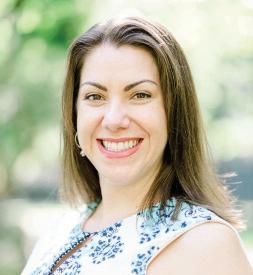
Dr. Rachel Jantea, MD, MS
Education and Training Core

Dr. Robert Coghlan III, PhD, RN, MA, MSN, CNS, FNP Administration
MISSION
To inspire a collaborative interprofessional culture at UTHealth Houston through transformative educational experiences, consultative expertise, and scholarly innovation
VISION
Advancing interprofessional best practices in healthcare
Advisory Council Members
Padmavathy Ramaswamy, PhD, MSN, MPH, RN, FNP-C, FNAP
Puja Gandhi, MD, MPH
George Delclos, MD, MPH, PhD
Leslie Dunnington, MS, CGC
Robert Spears, PhD, MS
Kevin Schulz, MD, FAEMS, FACEP
Marcelle Hamburger, MS
Teng-Yuan Yu, PhD, RN, FNAP
Ann Marshburn MD, FAAP
Elaheh Ashtari, PsyD
Robert Hammarberg, DrPH
Francine Snow, DrPH, MSN, RN, CNE, NPD-BC
Toufeeq Syed, PhD
Yearly Planning Schedule
Preclinical Experiences
ICARE (Improving Care Access and Realizing Engagement)
Interprofessional student teams learn about vaccine hesitancy, use of medical interpreters, and individual and community health
needs. Students engage in a series of telehealth encounters with real clients in the community, where they design individualized educational sessions to help clients reach their health goals.
Interprofessional Panel
An interprofessional panel of health care providers that make up a real-world practicing healthcare team discuss their roles on the healthcare team, how they engage with one another, and the value of collaborative teamwork and effective communication for best patient care.
Bus Crash Scenario
In this exercise, your team will respond to a simulated bus crash scenario designed to test and strengthen your teamwork skills. You’ll be faced with a challenging situation that requires you to collaborate, communicate effectively, and make strategic decisions under pressure. Success will depend on your ability to work together, prioritize tasks, and reach consensus. A set of correct answers will allow you to objectively assess your team’s performance and reflect on areas for improvement, before doing it all again as the scenario evolves.
Clinical Experiences
Geriatric IPE Virtual Simulation (Lee Palmer)
Students actively participate in a telehealth visit as interprofessional teams to care for a geriatric standardized patient experiencing cognitive impairment, dental infection, and other complications during a transition of care. Students collaborate to identify the patients’ medical and social needs and address caregiver concerns.
Inpatient Medical Error Simulation (Marty Evans)
Students engage in a virtual interprofessional standardized patient encounter centered around patient safety. Teams must navigate an encounter with the patient and their family member, applying crucial communication skills to acknowledge a serious medical error, address patient concerns, and resolve conflict.
Virtual Interprofessional Health Policy Simulation (VIPS)
Interprofessional student teams engage in a virtual health policy simulation. They assume roles of policy makers, legislators, lobbyists, and other key players to examine tradeoffs and negotiate solutions to prevent an impending Medicare Part A bankruptcy. This activity is a collaboration with the UTHealth Houston Quality Enhancement Plan.
MCI (Mass Casualty Incident Simulation)
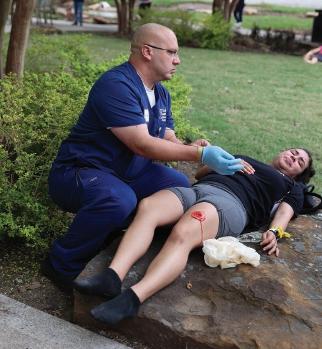
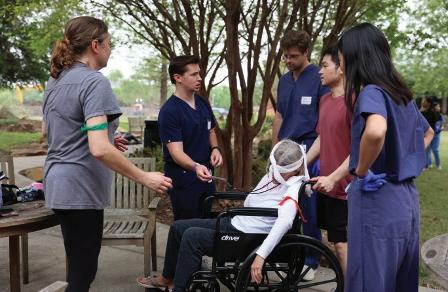
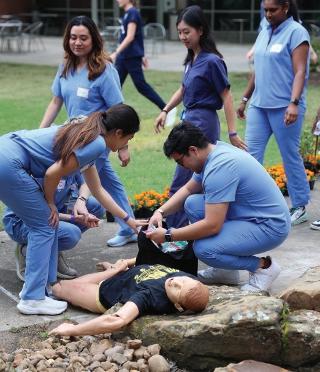
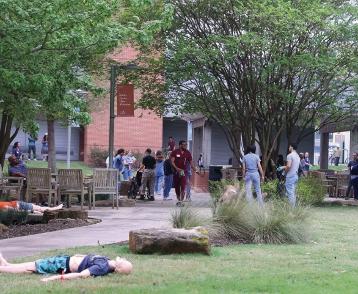
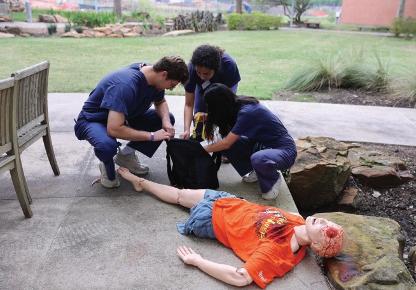
Students participate in a real-life mass casualty scenario in two different settings. During the Fall MCI student groups are tasked with assessing patients in a mass casualty incident to problem solve and save lives as a team. Spring MCI allows students to work in teams collaboratively to save lives in the field and the hospital following a mass casualty.
CAPS (Community Action Poverty Simulator)
CAPS is an educational initiative, bridging the divide between theoretical knowledge and the practical understanding of poverty. Students are empowered with a comprehensive grasp of the intricate and real challenges faced by individuals in poverty and inspired to develop tangible and effective solutions for their patients. This activity is a collaboration with the UTHealth Houston Office of Population Health.