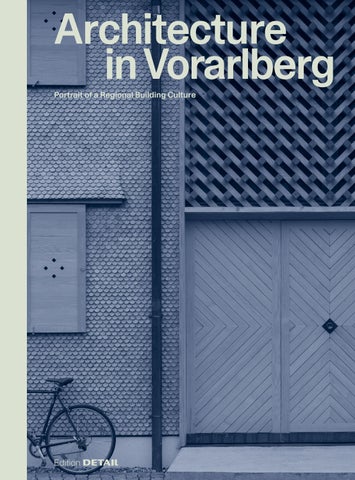
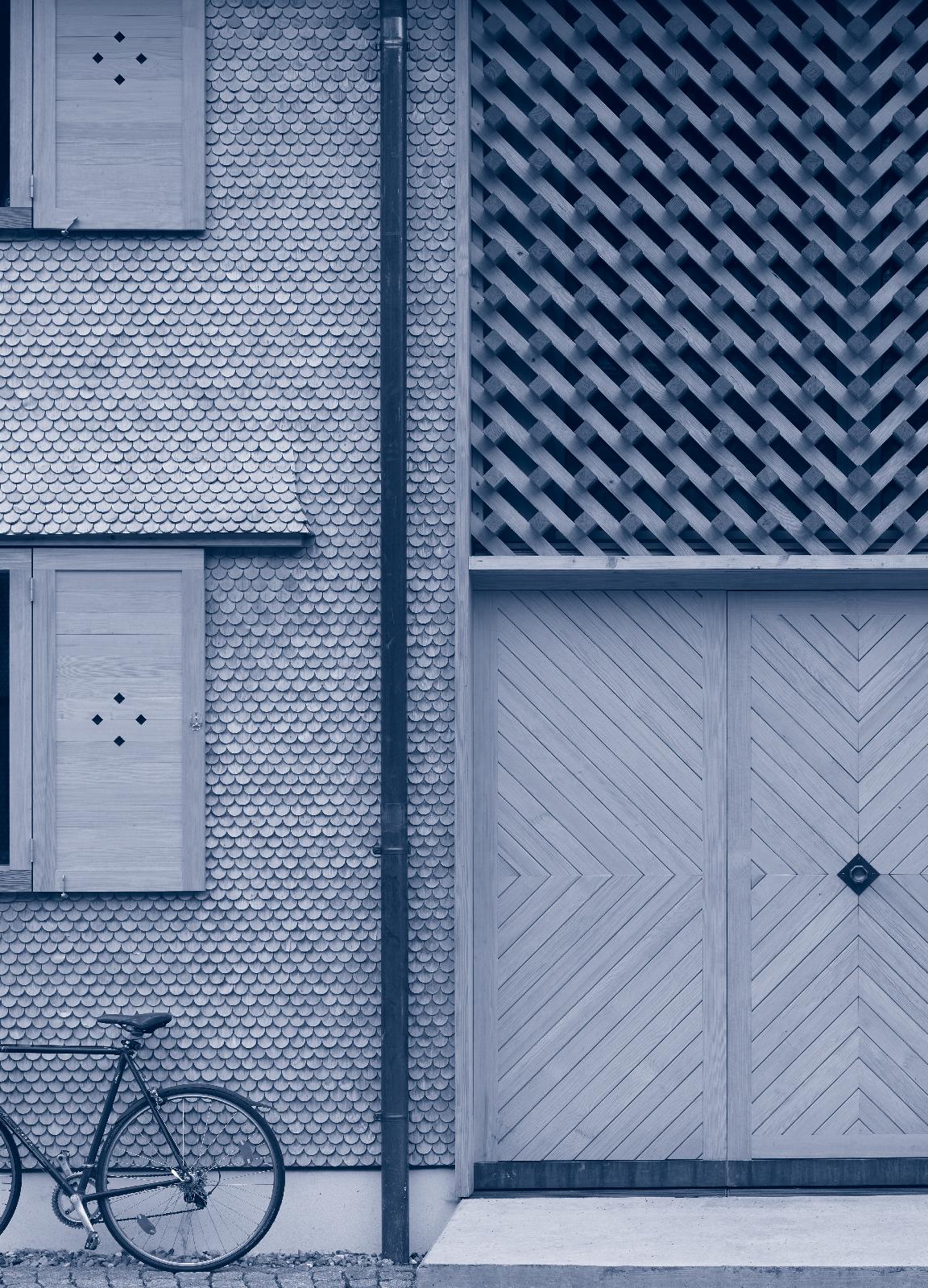
Architecture in Vorarlberg
Portrait of a Regional Building Culture
FOREWORD
Landscape, Resources, Architecture
Sandra Hofmeister, Verena JakoubekKonrad p. 8
Rhine Valley (Rheintal)
[ 1 ] Dornbirn City Library
Dietrich | Untertrifaller, Christian Schmölz p. 14
[ 2 ] Sägerbrücke Architekturwerkstatt
Dworzak – Grabher p. 20
[ 3 ] Oeconomiegebäude
Josef Weiss
Julia Kick Architekten p. 24
INTERVIEW
Beyond the Norms
Julia Kick in conversation with Sandra Hofmeister p. 28
[ 4 ] Villa Fleisch
ARSP Architekten p. 34
[ 5 ] House Hohlen Jochen Specht Architekten p. 38
[ 6 ] Dornbirn Hospital
Gohm Hiessberger Architekten p. 46
[ 7 ] Winderhof and Ernas Haus
Ludescher + Lutz Architekten p. 50
[ 8 ] Bridges Into the Ebnit Valley Marte.Marte Architekten p. 56
[ 9 ] House 2226
Baumschlager Eberle Architekten p. 62
[ 10 ] Doppelmayr Headquarters at Hohe Brücke AllesWirdGut p. 68
ESSAY
Vorarlberg: Between Rural and Urban Verena JakoubekKonrad p. 74
[ 11 ] Islamic Cemetery bernardo bader architekten p. 80
[ 12 ] Zwischenwasser Civic Centre
Hein Architekten p. 86
[ 13 ] Muntlix Kindergarten Hein Architekten p. 92
[ 14 ] House K Helena Weber p. 96
[ 15 ] Tschitscher-Schlössle Conversion Marte.Marte Architekten p. 102
[ 16 ] Masellahütte Memorial Marte.Marte Architekten p. 106
Mountains and Valleys
[ 17 ] Der Wolf Ski Hut bernardo bader architekten p. 113
[ 18 ] Allmeinde Commongrounds Katia and Gerold Schneider p. 118
[ 19 ] Biomass Heating Plant in Lech HK Architekten p. 122
[ 20 ] Integrative Housing Dorner\Matt Architekten p. 126
[ 21 ] Illwerke Centre Montafon HK Architekten p. 130
INTERVIEW
Building with Timber Johannes, Michael, Hermann, Matthias, Anton, and Christian Kaufmann in conversation with Verena Jakoubek-Konrad p. 136
[ 22 ] St. Gerold Provostry Renovation and Extension HK Architekten p. 142
[ 23 ] St. Gerold Civic Centre Cukrowicz Nachbaur Architekten p. 152
[ 24 ] Ludesch Civic Centre HK Architekten p. 156
[ 25 ] Nüziders Educational Campus Fink Thurnher Architekten p. 160
ESSAY
Community in Planning, Building, and Living
Eva Lingg-Grabher, Nicola Hilti p. 168
[ 26 ] Maierhof
Residential Complex feld 72 p. 174
[ 27 ] Din-Sicherheitstechnik Headquarters
Fink Thurnher
Architekten p. 178
[ 28 ] Erden Werkhalle
Martin Rauch, Lehm Ton Erde Baukunst p. 184
INTERVIEW Back to Earth
Anna Heringer and Martin Rauch in conversation with Marina Hämmerle p. 190
Bregenzerwald
[ 29 ] Fire Station and Cultural Centre
Hittisau Women’s Museum
Cukrowicz Nachbaur and Siegfried Wäger p. 198
[ 30 ] Gasthof Hotel Krone bernado bader architekten p. 204
[ 31 ] Denkwerkstätte
Georg Bechter Architektur p. 208
[ 32 ] Gasthaus Adler
Conversion
Fink Thurnher Architekten p. 214
[33 ] Werkraumhaus
Atelier Peter Zumthor & Partner p. 220
ESSAY Craft, Industry, and Building Culture
Verena JakoubekKonrad p. 226
[ 34 ] Fotostudio Hiller, Kriechere Innauer Matt Architekten p. 234
[ 35 ] Salgenreute Chapel bernardo bader architekten p. 240
[ 36 ] Angelika Kauffmann Museum Dietrich | Untertrifaller p. 244
[ 37 ] Badehaus Hotel Hirschen NONA Architektinnen p. 250
[ 38 ] Mellau Civic Centre and Kindergarten Dorner\Matt Architekten p. 256
[ 39 ] Tempel 74 Jürgen Haller, Peter Plattner p. 262
Lake Constance (Bodensee)
[ 40 ] Festspielhaus Bregenz Dietrich | Untertrifaller p. 268
[ 41 ] Vorarlberg Museum Cukrowicz Nachbaur Architekten p. 274
[ 42 ] Kornmarktplatz ARGE Baumschlager Hutter Partners, Kuëss, Hörburger, Vogt Landschaftsarchitekten p. 282
[ 43 ] Kleiner Löwe Hotel Herzog & de Meuron p. 284
[ 44 ] Atelier Klostergasse bernardo bader architekten p. 290
[ 45 ] Sandgrubenweg Residential Complex Wolfgang Ritsch Architekten, Helmut Kuëss, Gerhard Hörburger, Norbert Schweitzer p. 296
[ 46 ] Schendlingen School Complex
Matthias Bär, Bernd Riegger, Querformat p. 300
[ 47 ] Unterdorf
Primary School
Dietrich | Untertrifaller p. 304
ESSAY
Building for Education Christian Kühn p. 310
[ 48 ] Hard School Complex Baumschlager Hutter Partners p. 314
[ 49 ] Badehaus am Kaiserstrand Lang + Schwärzler Architekturbüro p. 320
APPENDIX
Architect Index and Project Map, Project and Location Index p. 324
Dietrich | Untertrifaller and Christian
Schmölz
Client: City of Dornbirn
Structural engineering: gbd
Geotechnical engineering:
3P Geotechnik
Landscape and play area design:
Balliana Schubert
Landschaftsarchitekten
Building physics: Bernhard Weithas
A Living Room for the City
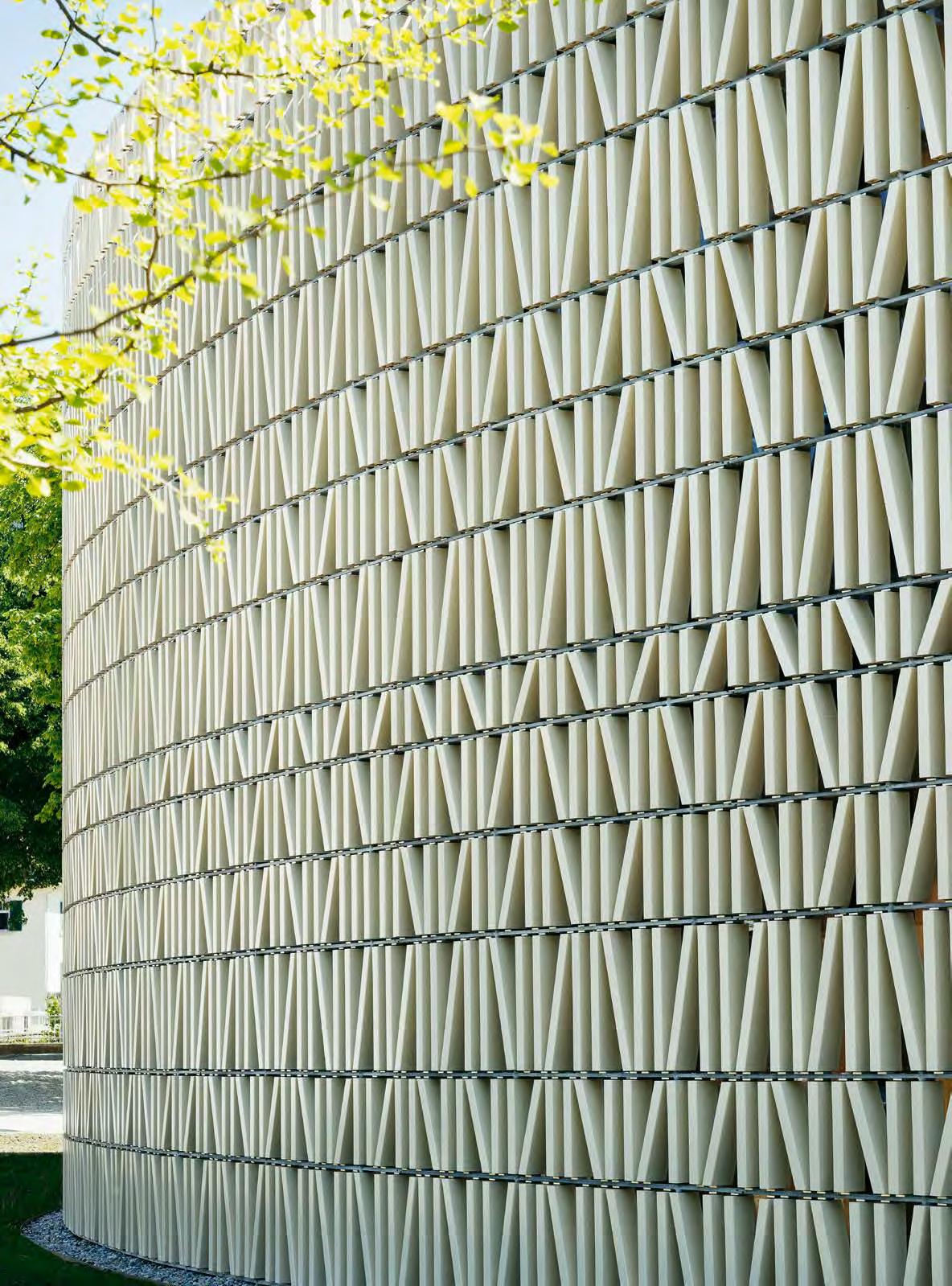
The Dornbirn City Library in Vorarlberg’s Rhine Valley is a place for communication, meeting, and intergenerational learning. Conceived as a public living room, it brings people together and, as a “third place”, makes knowledge democratically accessible while fostering exchange. The pavilion, set in a park, has a facade of 8000 stylised ceramic books. With its freestanding form, it creates a playful contrast to the surrounding buildings, including the historic library, which had become too small. The design concept was inspired by a well-trodden path that once cut diagonally across the meadow. The joint team of Dietrich | Untertrifaller Architekten and Christian Schmölz positioned the new building directly on this route. The striking floor plan is formed by four interlinked parabolas – a reference both to the parable as a literary form and to the need to accommodate the existing trees.
The library not only interacts with its immediate surroundings but also links the town centre with cultural institutions at its edge. The original path between Schulgasse and Jahngasse now passes through the building itself, allowing the library to be experienced as a public space in which interior and exterior flow into one another. The two entrances with sheltered forecourts reflect this permeability.
In total, 1200 m2 spread over three floors provide space for up to 100 000 books and journals, quiet reading niches, listening and play areas, offices, and flexible rooms finished in light oak and exposed concrete. Visitors enter directly into a two-storey atrium, naturally lit from above, with the main circulation desk at its centre. The open-access collection is arranged on two levels around this atrium. A straight-flight staircase leads down to the basement, which houses a media library, play library, gaming room, and open makerspace. All furniture – including the bookshelves with adjustable and tilting shelves – was custom-designed. The large atrium is a flexible space that can serve either as a reading area or as an event hall, depending on the occasion.
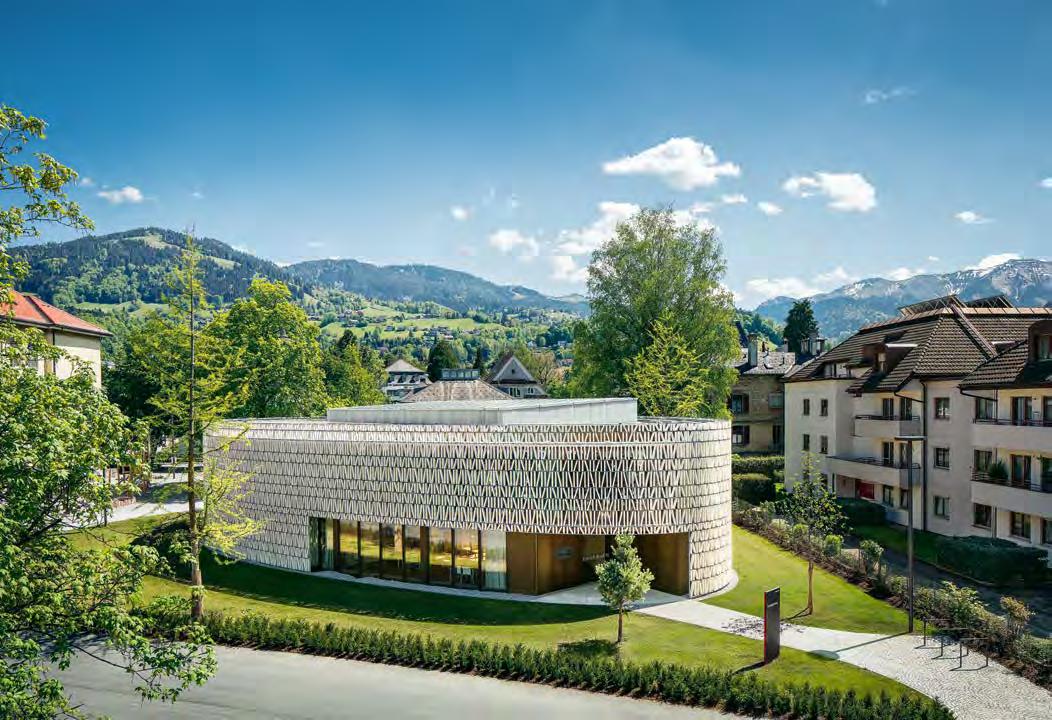
The amorphous building form sits naturally within the park.
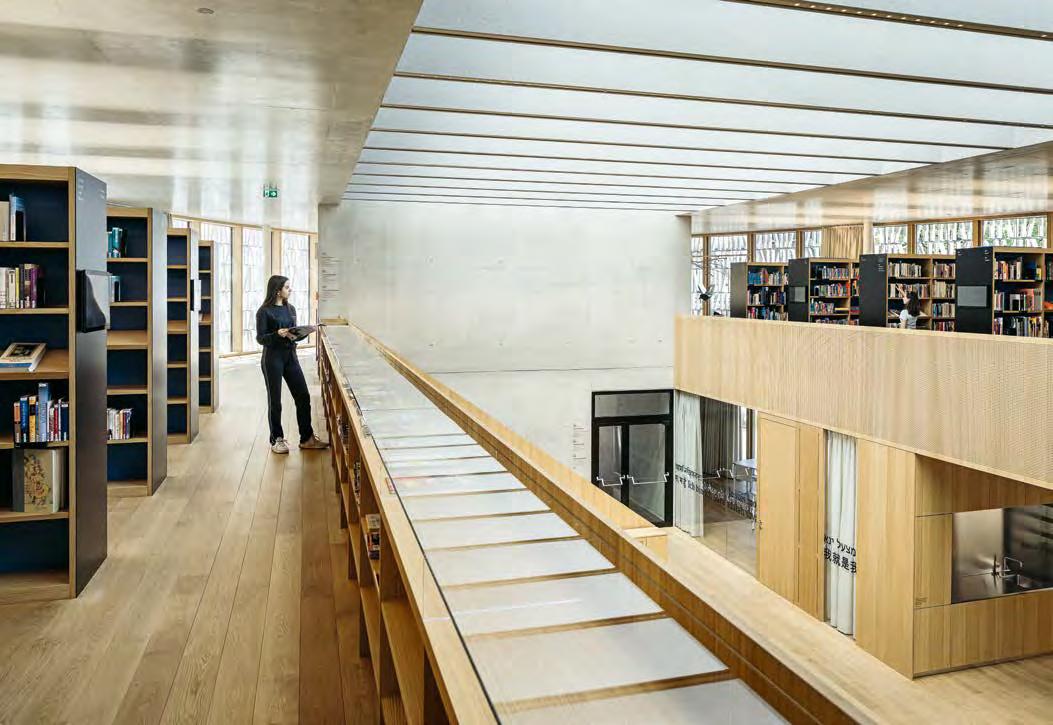
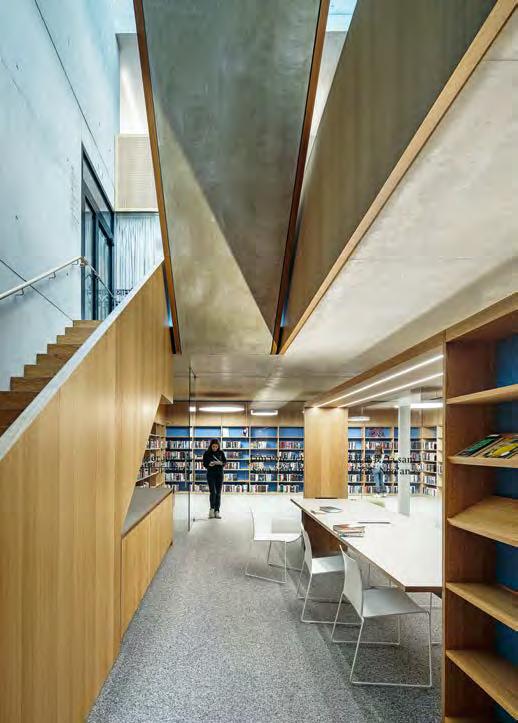
Clarity and orientation: The interior spaces are arranged on two levels.
INTEGRATIVE HOUSING, 2016
Silvrettastraße 7a, 6791 St. Gallenkirch
Dorner\Matt Architekten
Client: Alpenländische Heimstätte
Structural engineering: Mader & Flatz
Construction: Tomaselli Gabriel Bau
Spatial Sophistication
The five-storey cube stands on a sloping site below Silvrettastraße in the small Montafon village of St. Gallenkirch. This social housing development, built to Passive House standards, emerged from an invited competition jointly organised by the Alpenländische Heimstätte and the municipality. Dorner\Matt Architekten positioned the building at the lower edge of the site, allowing parking spaces and the entrance to the underground garage to be concentrated on the mountain-facing north side. The cube, roughly 25 m per side, thus appears well proportioned within the village context while retaining its presence as a sculptural solitaire with open views in all directions.
Situated in a mountain valley, the site experiences long winter shadows. The architects accounted for this in the layout of the 20 apartments, each oriented in two directions – east or west, and towards the village or the surrounding peaks. This corner-based floor plan was achieved through an internal stairwell with service cores grouped around it. Loggias and double-height spaces further enhance daylight and spatial generosity, giving each flat individuality and a dynamic relationship to the outdoors. These double-height recesses break up the strict square geometry, lending the facade depth and articulation. The cladding of pre-weathered silver fir establishes a subtle dialogue with the shingled roof of the neighbouring church.
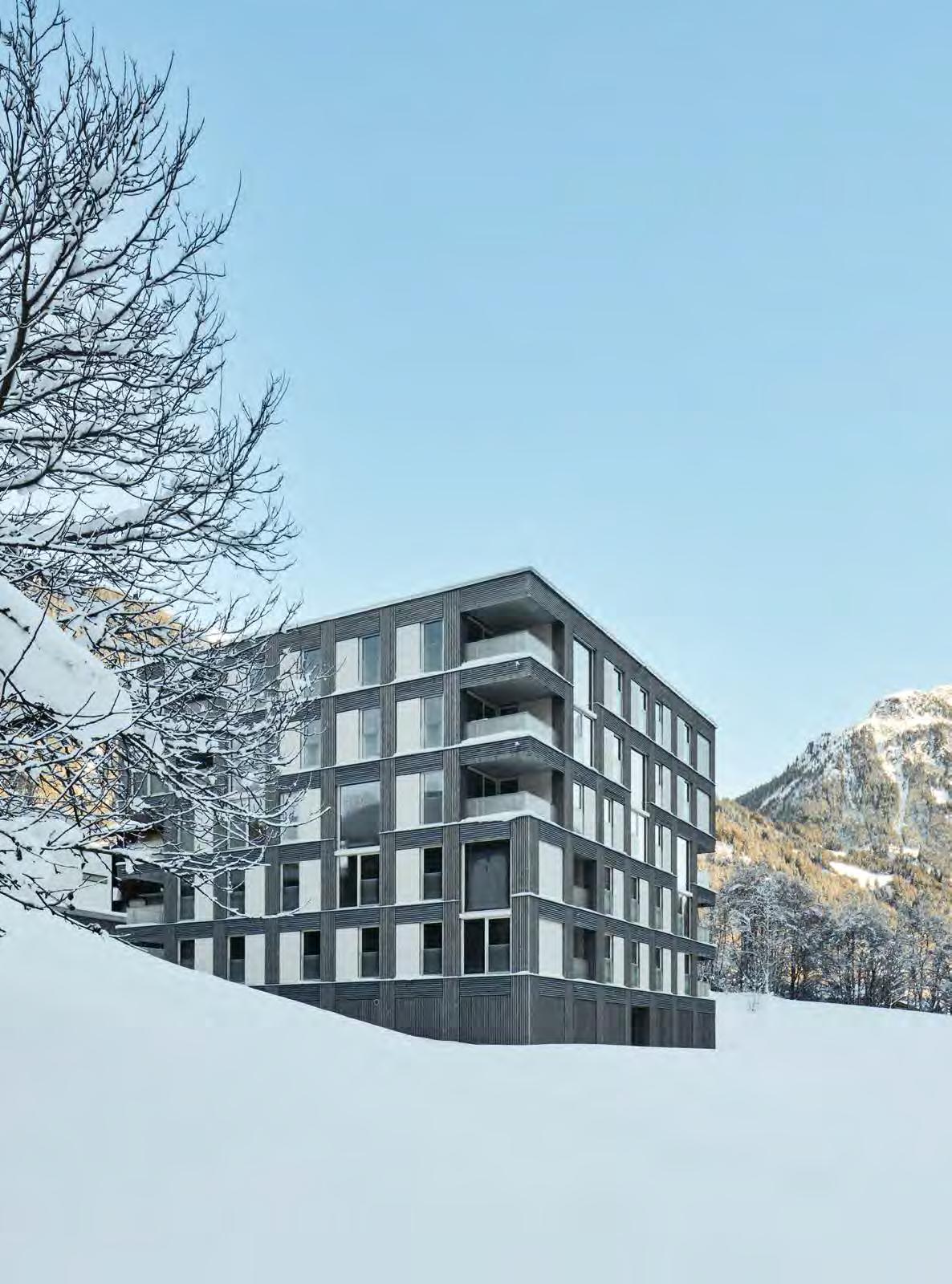
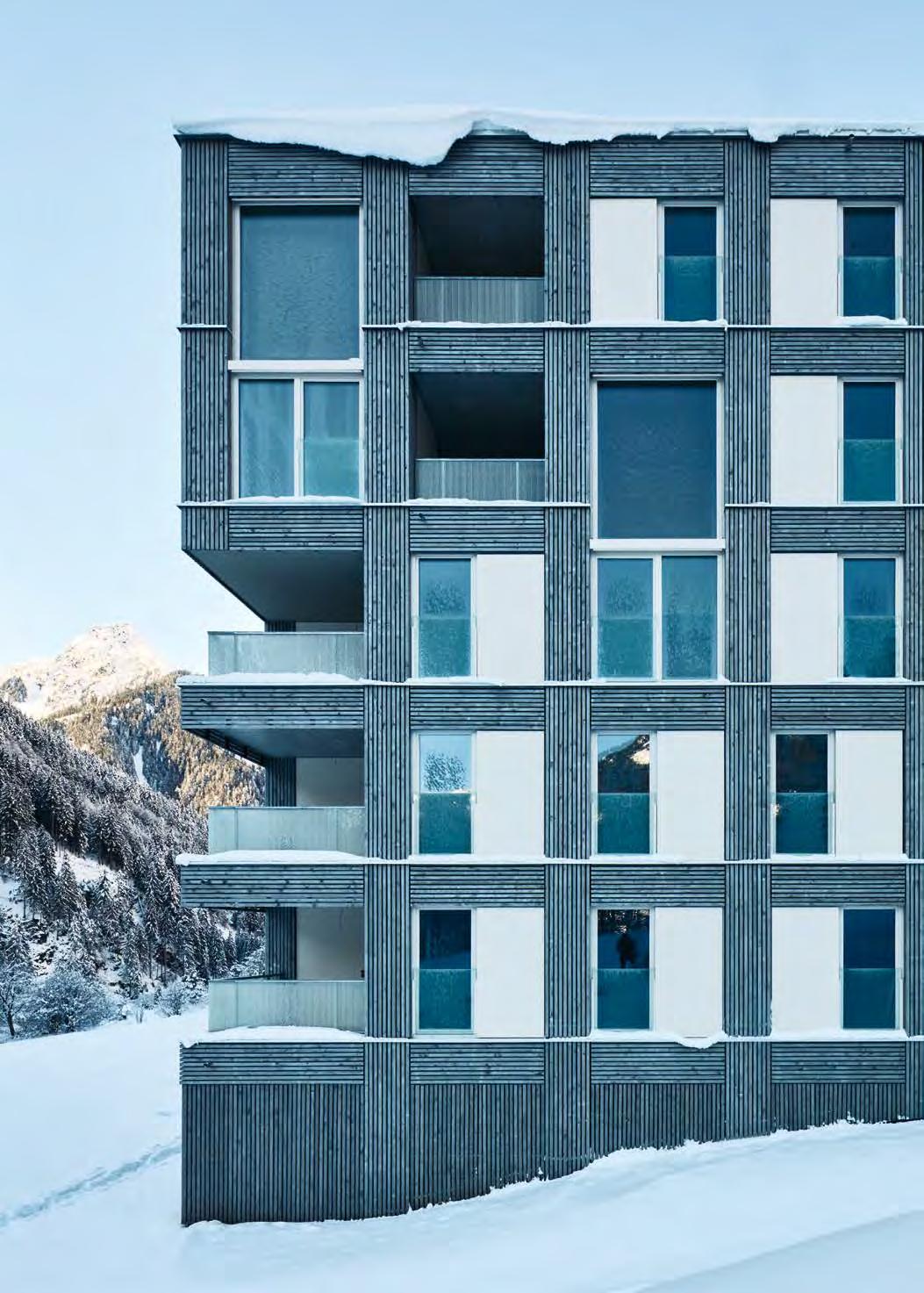
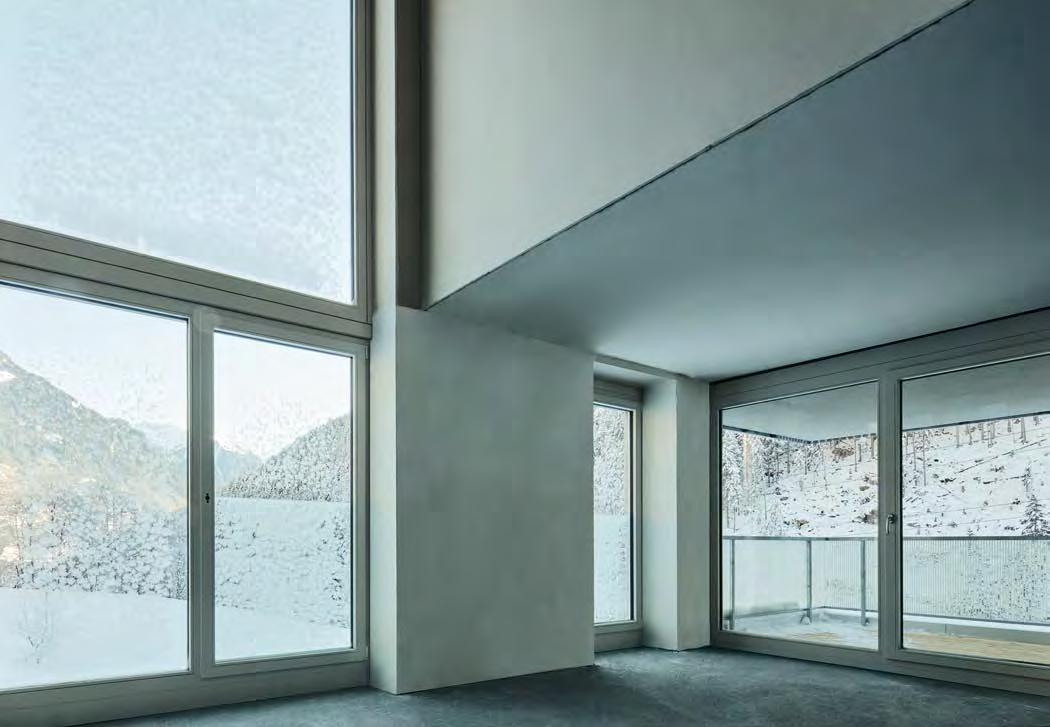
Social housing with architectural ambition: Distinctive layouts and generous ceiling heights provide light, air, and spaciousness.
Atelier Peter Zumthor & Partner
Client: Werkraum Bregenzerwald
Structural
engineering: merz kley partner
A Showcase for Craftsmanship
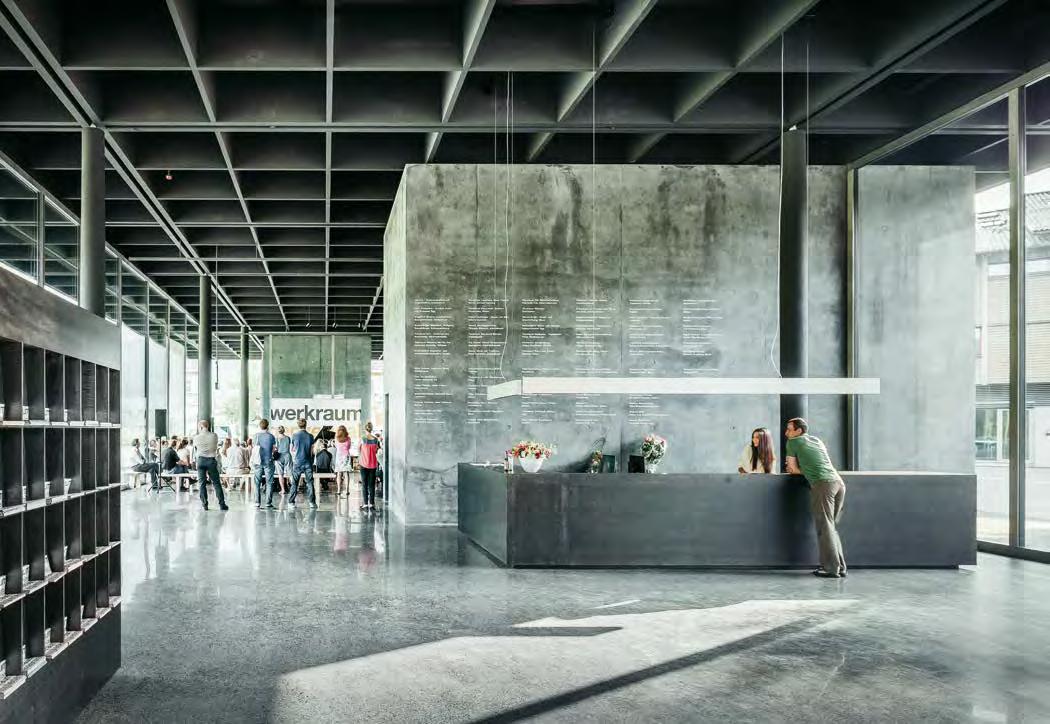
The Werkraum Bregenzerwald is an association of more than 90 craft businesses from the Bregenzerwald region. Together, they built a house – a meeting place and a venue dedicated to craftsmanship. The association’s history began in 1991 with the competition Handwerk + Form, created to foster collaboration between architecture and craft. The initiative quickly gained recognition beyond the region. Since 2000, the Werkraum Bregenzerwald has organised the competition every three years, and it continues to attract a wide audience. Its growing reputation provided the basis for the next step: building a permanent home for the association.
The municipality of Andelsbuch provided a centrally located site, underscoring the importance of the project for both community and region. Here, craftsmanship would be presented, reflected upon, and passed on – a place for celebration and exchange. The architect Peter Zumthor was commissioned for the design. Many local craftspeople already knew him from his work on the Kunsthaus Bregenz, and mutual respect ran deep.
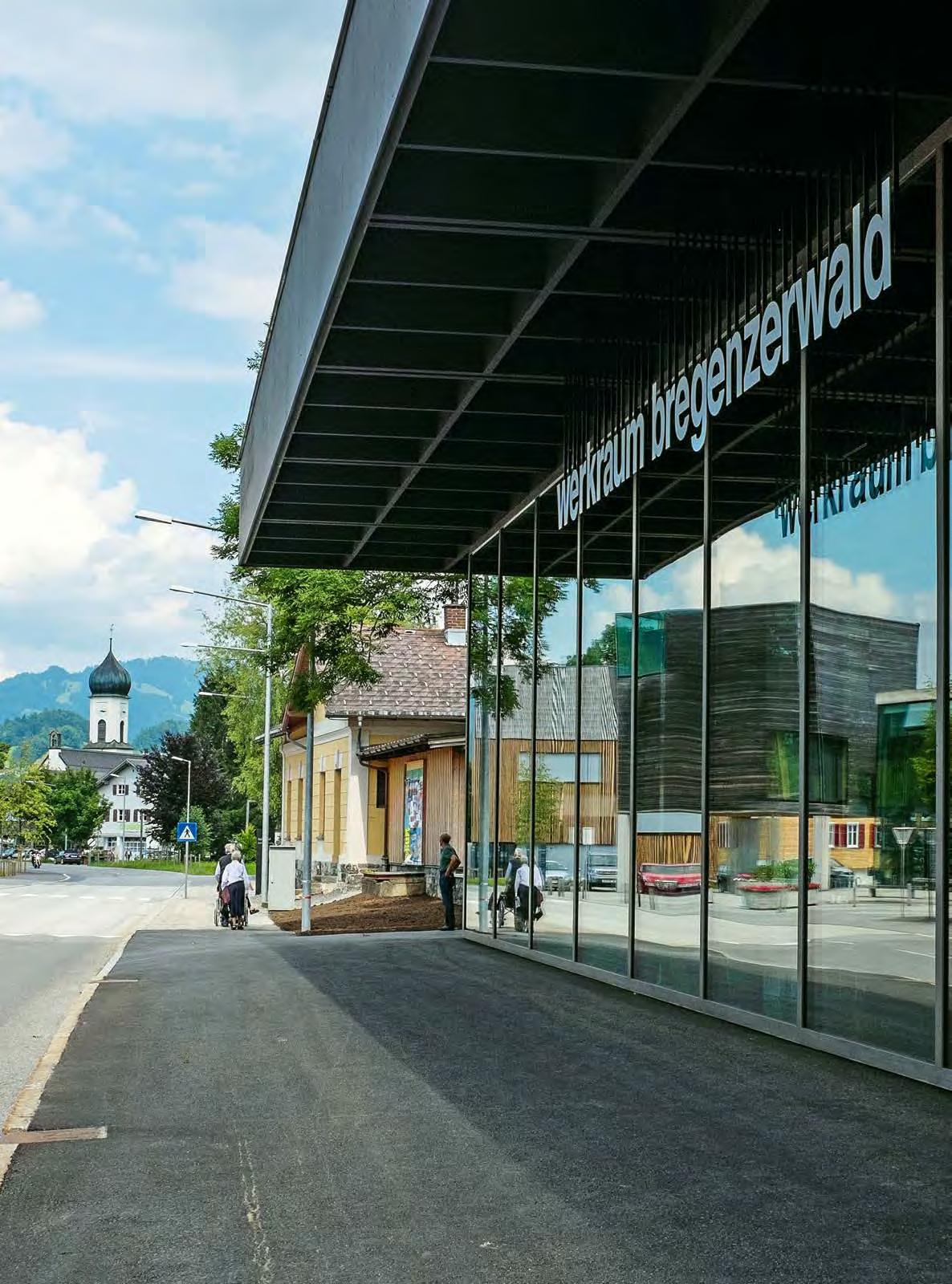
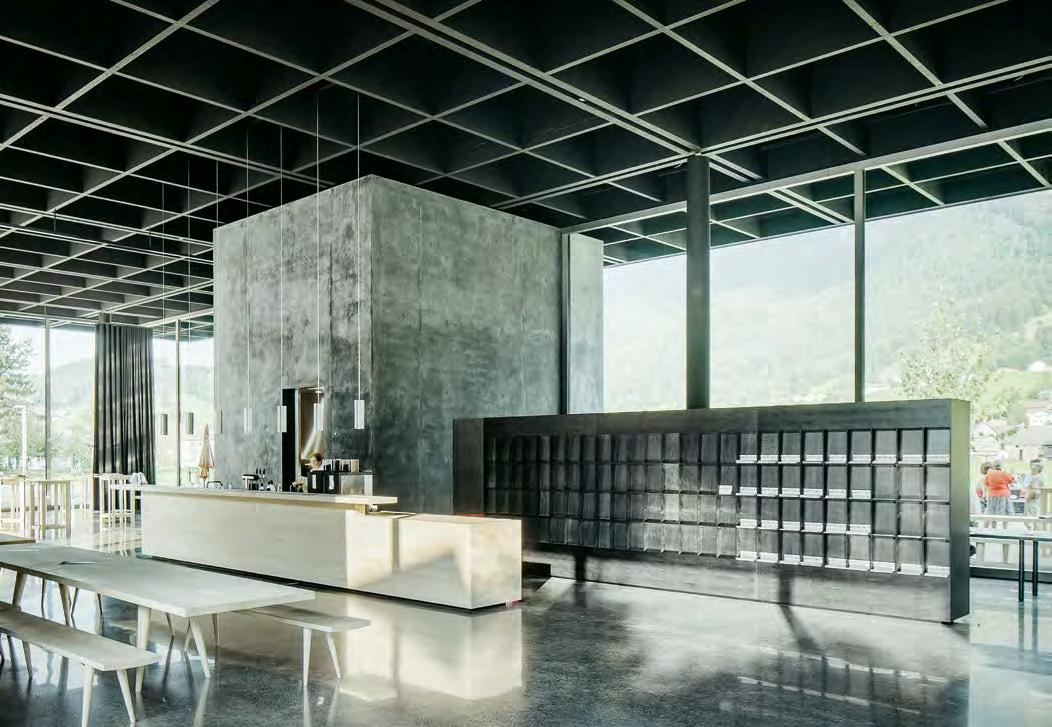
Zumthor designed a building with a broad, projecting roof and fully glazed walls that turn the interior into a transparent showcase. The 700 m2 space is open and flexible. A long bar and entrance zone articulate the interior, defining the areas for exhibitions, gastronomy, and events. The materials are dark and refined, conveying both restraint and elegance. The 70 m long roof appears to float above the space but is supported by 14 timber columns, their lower sections wrapped in dark leather bands. Only two main beams running above the rows of columns are configured as double girders. The glass facade, set flush with the floor in slim profiles, is punctuated by two dark concrete blocks. Long curtains of dark loden fabric provide additional spatial division, while a coffered ceiling covered in deep blue textile conceals the technical services and also improves the room’s acoustics. Delicate luminaires are set at the centre of each panel.
Since its opening, the Werkraumhaus has become one of Vorarlberg’s most visited architectural landmarks and has received numerous awards.
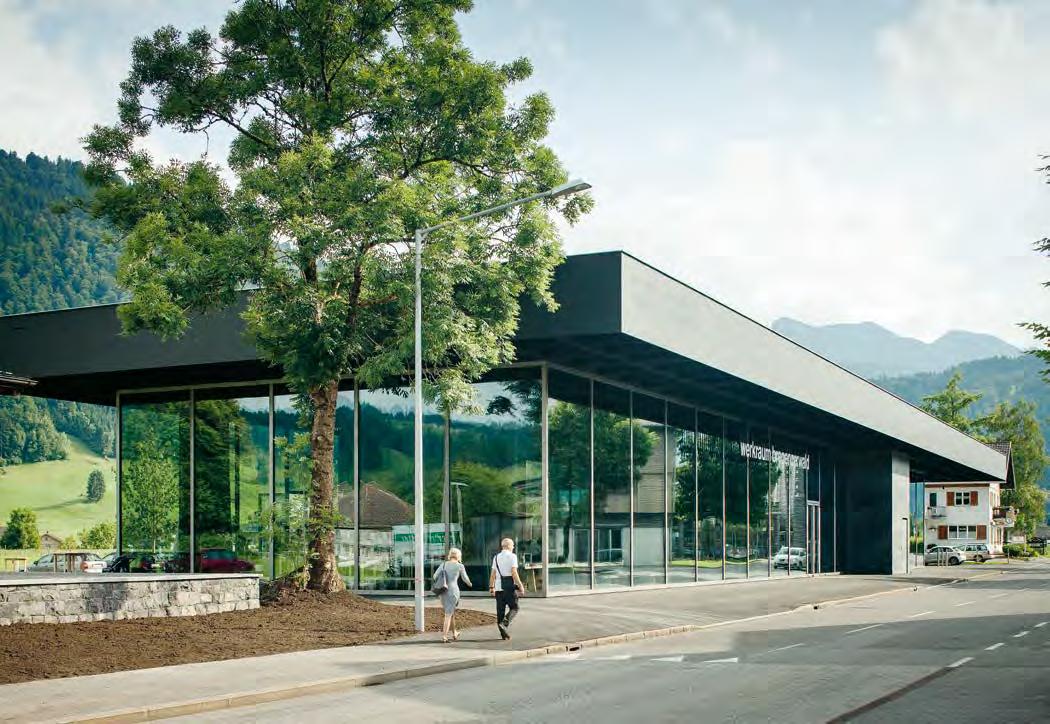
A showcase for craftsmanship: The Werkraumhaus is glazed up to the roof.
Lang + Schwärzler Architekturbüro
Client: Bauart Bauträger
Structural engineering: Hagen-Huster and Schertler-Alge
Construction: Schertler-Alge
Masonry work: Schertler-Alge
Sunny Days on the Lake
Once, an old jetty stood here – now it forms a bridge leading to a refined lakeside pavilion: the Badehaus (bathhouse) at Kaiserstrand beach in Lochau, just north of Bregenz. From this vantage point, Lake Constance opens to a panorama of the nearby Swiss mountains, the Bregenz Bay with its Seebühne floating stage, and the old town of Lindau. In summer, the area comes alive with boats, bathers, walkers, and cyclists.
Unlike in Switzerland and Germany, where private properties often occupy the lakeshore, the Austrian side of Lake Constance remains largely accessible to the public. The Badehaus, which requires paid admission, is therefore something of an exception. Designed as a contemporary interpretation of a stilt house, the simple structure with its sun terrace and lakeside café captures the special atmosphere of the place. Visitors cross a 40 m bridge to reach the building, where they can swim, sunbathe, or enjoy lunch or coffee on the terrace. The timber structure, made of locally sourced white fir, still releases a pleasant scent years after its completion. The piles and base slab are made of concrete. Whether the Badehaus is open can be seen from afar: during opening hours, large sections of the otherwise closed timber volume fold open, allowing sunlight to flood the central room and terrace and inviting guests inside.
Bathhouses have a long tradition on Lake Constance. Some, such as the historic Strandbad Mili in Bregenz – once a military bath – or the elegant facilities in nearby Lindau, are cherished for their atmosphere and character. More than a century ago, a bathhouse stood on this very site, then part of the former Kaiser-PalastHotel, now the Hotel am Kaiserstrand. Few contemporary bathhouses, however, offer the same understated comfort as this one, complete with restaurant and event facilities.
Technically, the building is deliberately simple in its construction. Because food is prepared on site, it is equipped with a controlled ventilation system and a heating function. The latter – using an air-source heat pump with a heating coil – ensures pleasant indoor temperatures during the cooler transitional seasons. Even when swimming is out of season, the Badehaus serves as a venue for gatherings and celebrations, valued year-round for its architecture and lakeside setting.
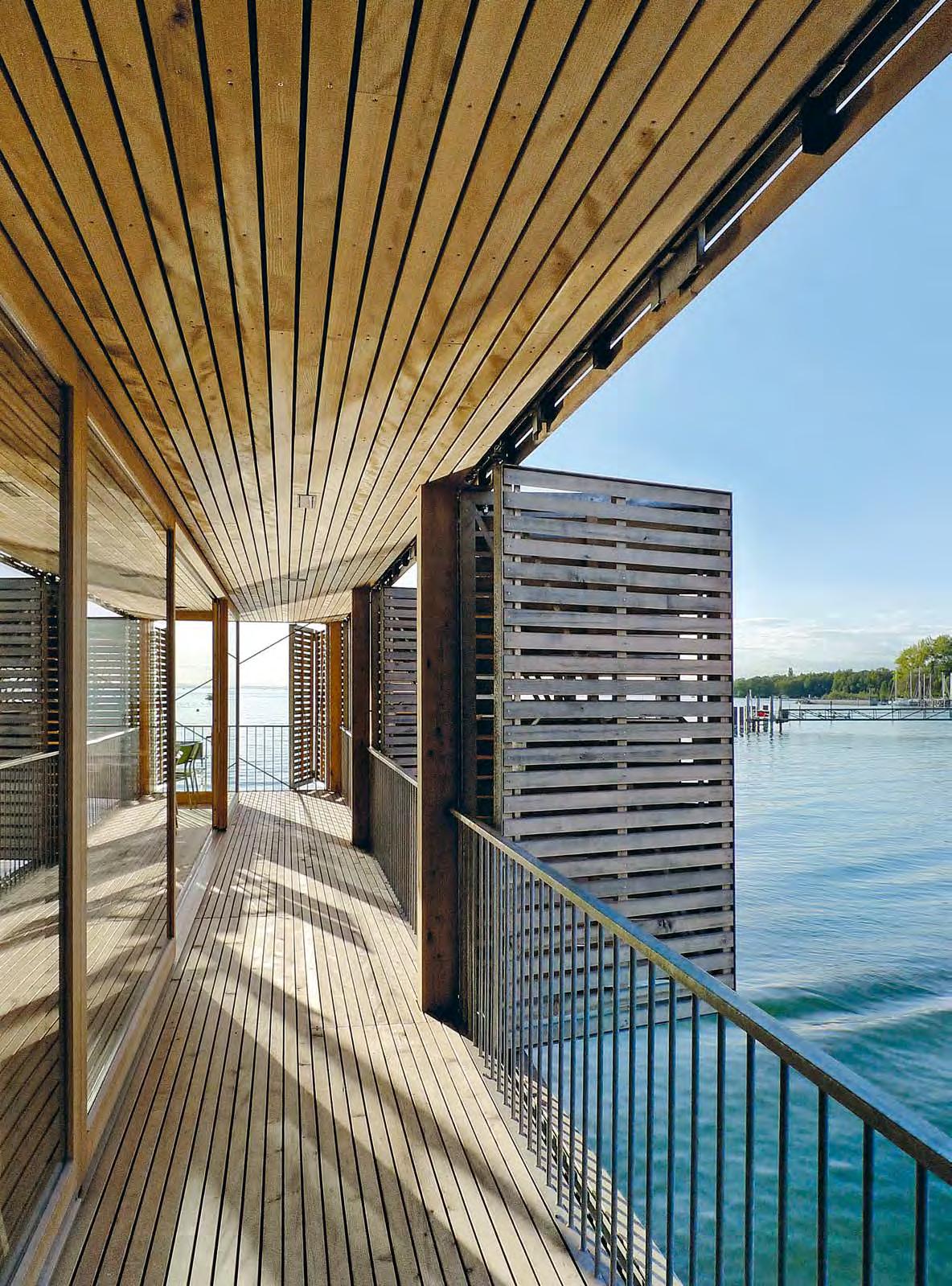
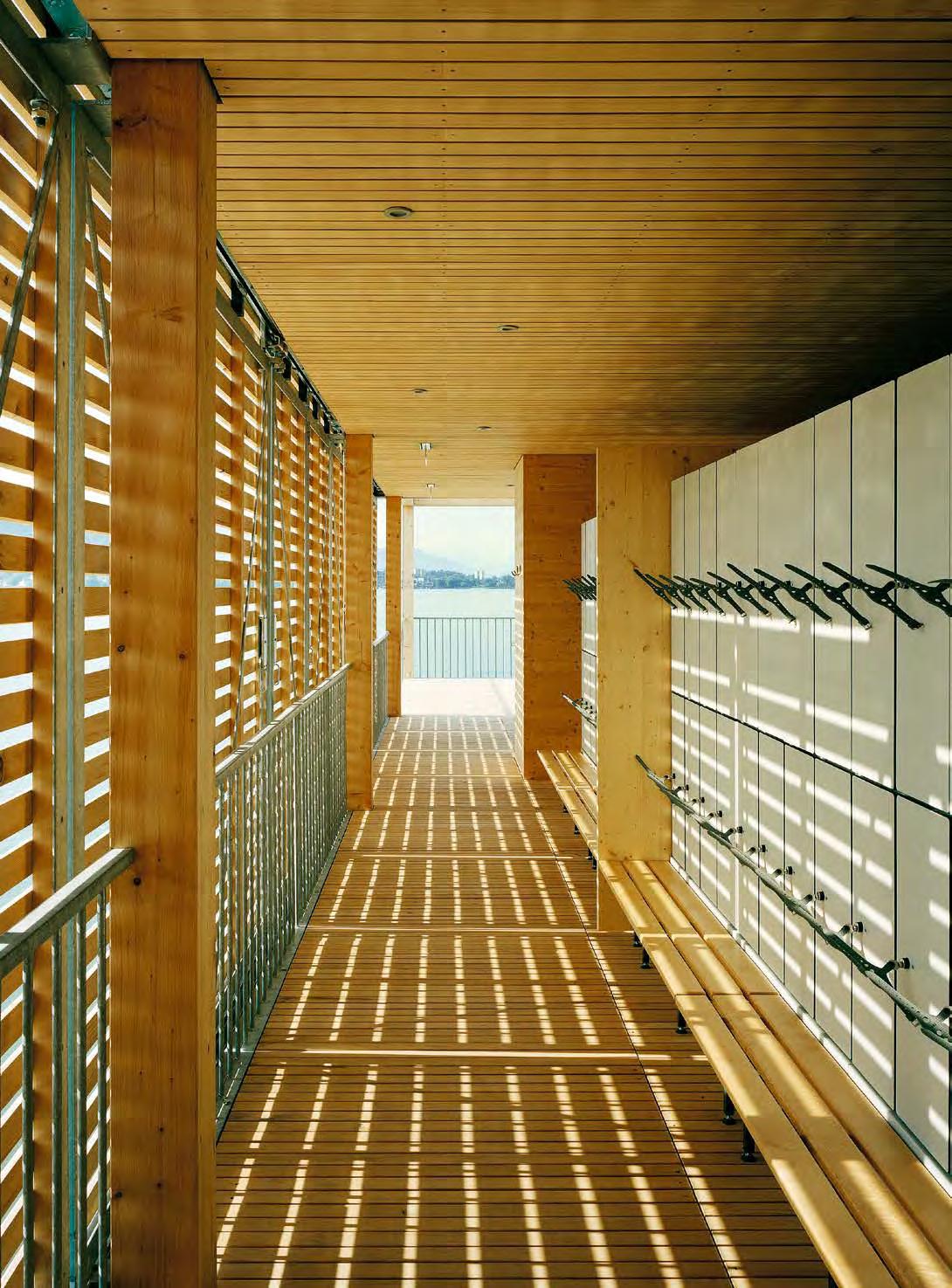
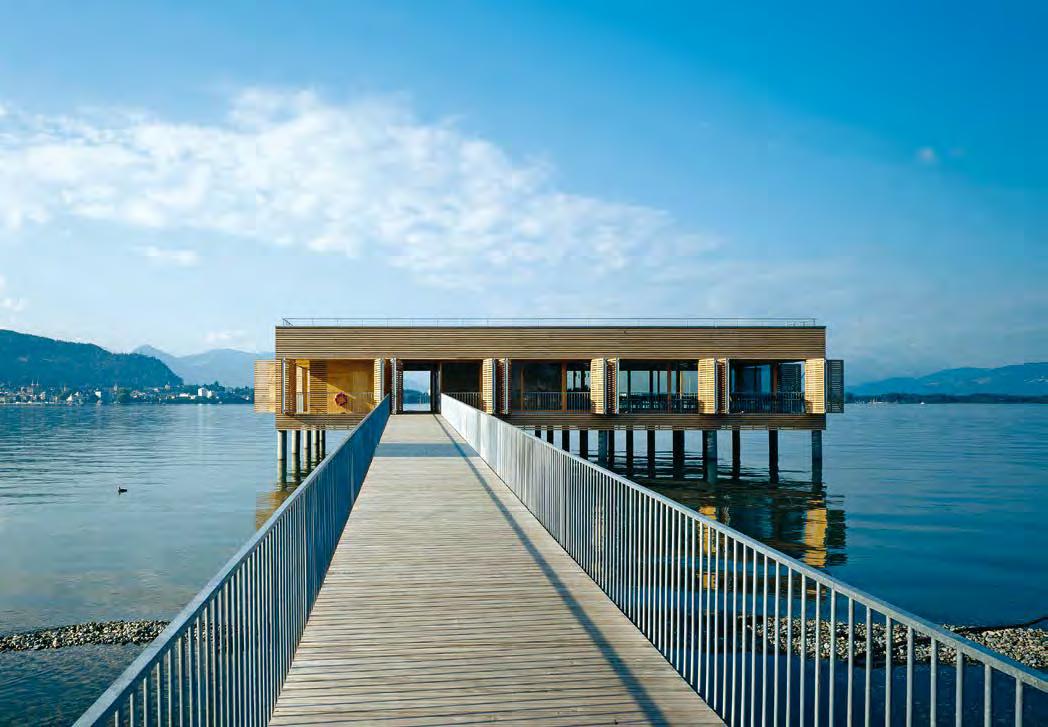
The Badehaus lakeside pavilion is connected to the shore by a footbridge.
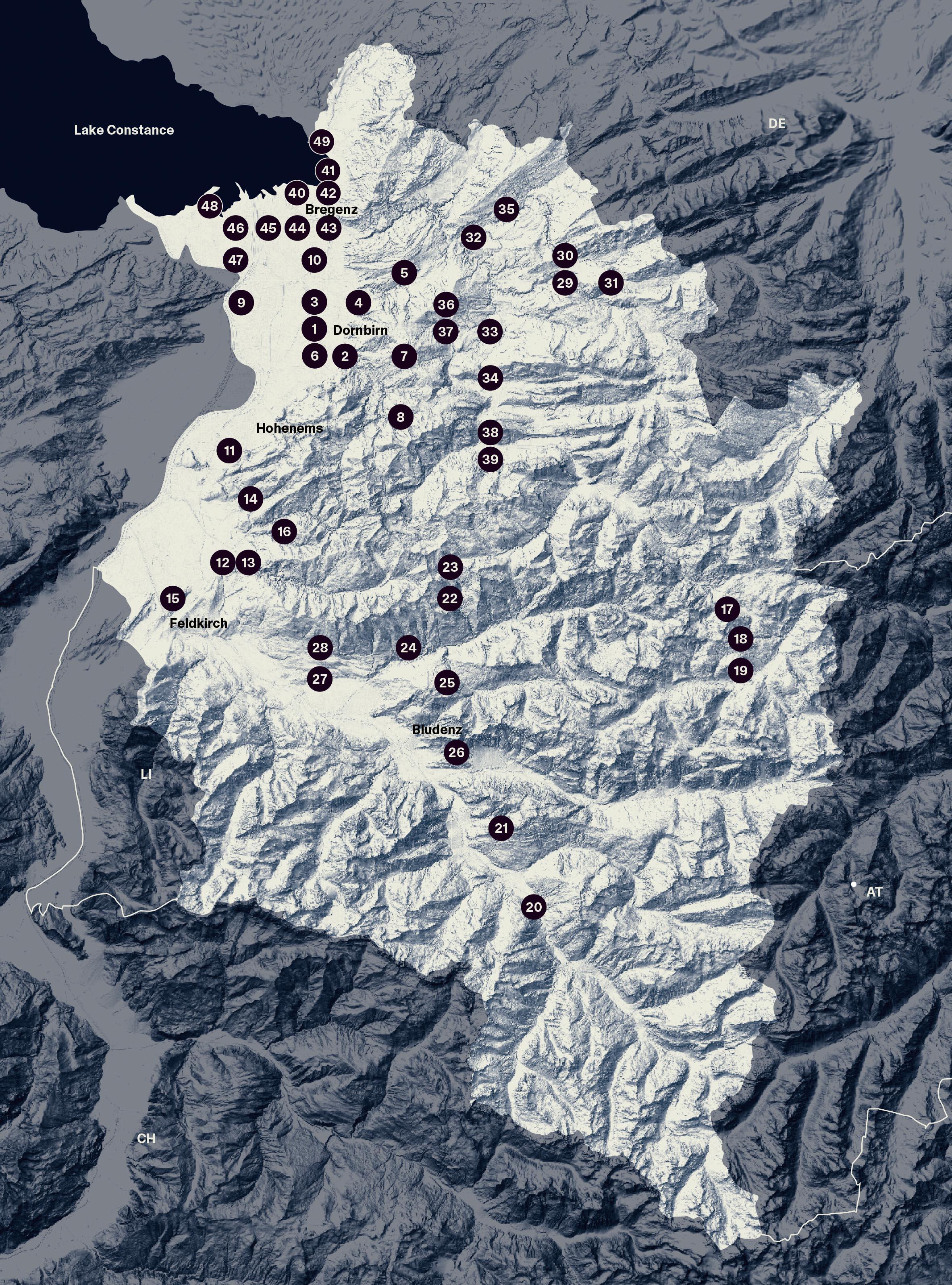
Project and Location Overview
ALTACH
[ 11 ] Islamic Cemetery p. 80ff.
ANDELSBUCH
[ 33 ] Werkraum Bregenzerwald p. 220ff.
BEZAU
[ 34 ] Fotostudio Hiller, Kriechere p. 234ff.
BLUDENZ
[26] Maierhof Residential Complex p. 174ff.
BREGENZ
[ 40 ] Festspielhaus Bregenz p. 268ff.
[ 41 ] Vorarlberg Museum p. 274ff.
[ 42 ] Kornmarktplatz p. 282f.
[ 43 ] Kleiner Löwe Hotel p. 284ff.
[ 44 ] Atelier Klostergasse p. 240ff.
[ 45 ] Sandgrubenweg Residential Complex p. 296ff.
[ 46 ] Schendlingen School Complex p. 300ff.
[ 49 ] Badehaus am Kaiserstrand p. 320ff.
DAFINS
[ 16 ] Masellahütte Memorial p. 106ff.
DORNBIRN
[ 1 ] Dornbirn City Library p. 14ff.
[ 2 ] Sägerbrücke p. 20ff.
[ 3 ] Oeconomiegebäude Josef Weiss p. 24ff.
[ 4 ] Villa Fleisch p. 34ff.
[ 5 ] House Hohlen p. 38ff.
[ 6 ] Dornbirn Hospital p. 46ff.
[ 7 ] Winderhof and Ernas Haus p. 50ff.
EBNIT
[ 8 ] Bridges Into the Ebnit Valley
Schanerlochbrücke, Schaufelschluchtbrücke, Kohlhaldenbrücke, and Rappenschluchtbrücke p. 56ff.
FELDKIRCH
[ 15 ] Tschitscher-Schlössle Conversion p. 102ff.
HARD
[ 48 ] Hard School Complex p. 314ff.
HITTISAU
[ 29 ] Fire Station and Cultural Centre
Hittisau Women’s Museum p. 198ff.
[ 30 ] Gasthof Hotel Krone p. 204ff.
[ 31 ] Denkwerkstätte p. 208ff.
HÖCHST
[ 47 ] Unterdorf Primary School p. 304ff.
KRUMBACH
[ 35 ] Salgenreute Chapel p. 240ff.
KLAUS
[ 14 ] House K p. 96ff.
LANGENEGG
[ 32 ] Gasthaus Adler Conversion p. 214ff.
LECH
[ 17 ] D er Wolf Ski Hut p. 112ff.
[ 18 ] Allmeinde Commongrounds p. 118ff.
[19] Biomass Heating Plant in Lech p. 122ff.
LUDESCH
[ 24 ] Ludesch Civic Centre p. 156ff.
LUSTENAU
[ 9 ] House 2226 p. 62ff.
MELLAU
[ 38 ] Mellau Civic Centre and Kindergarten p. 256ff.
[ 39 ] Tempel 74 p. 262ff.
MONTAFON
[ 21 ] Illwerke Centre p. 130ff.
NÜZIDERS
[ 25 ] Nüziders Educational Campus p. 160ff.
SCHLINS
[ 27 ] Din-Sicherheitstechnik Headquarters p. 178ff.
[ 28 ] Erden-Werkhalle p. 184ff.
SCHWARZENBERG
[ 36 ] Angelika Kauffmann Museum p. 244ff.
[ 37 ] Badehaus Hotel Hirschen p. 250ff.
ST. GALLENKIRCH
[ 20 ] Integrative Housing p. 126ff.
ST. GEROLD
[ 22 ] St. Gerold Provostry Renovation and Extension p. 142ff.
[ 23 ] St. Gerold Civic Centre p. 154ff.
WOLFURT
[ 10 ] Doppelmayr Headquarters at Hohe Brücke p. 68ff.
ZWISCHENWASSER
[ 12 ] Zwischenwasser Civic Centre p. 86ff.
[ 13 ] Muntlix Kindergarten p. 92ff.
Imprint
Editors:
Verena Jakoubek-Konrad, Sandra Hofmeister
Authors:
Nicola Hilti, Eva Lingg-Grabher, Christian Kühn, Verena JakoubekKonrad, Sandra Hofmeister, Marina Hämmerle, with adapted texts from the architectural documentation work of the Vorarlberg Architecture Institute, featuring contributions by Julia Ess (p. 122, p. 178), Tobias Hagleitner (p. 20, p. 50, p. 86, p. 126, p. 240, p. 300, p. 304, p. 314), Marina Hämmerle (p. 56, p. 106), Gabriele Kaiser (p. 46, p. 118, p. 244, p. 296), Otto Kapfinger (p. 198), Claudia Klammer (p. 68, p. 142), Verena Jakoubek-Konrad (p. 38, p. 102, p. 184, p. 250, p. 284), Isabella Marboe (p. 113, p. 160, p. 256), Martina Pfeifer Steiner (p. 62, p. 80, p. 92, p. 130, p. 152, p. 204, p. 220, p. 274, p. 320), Clemens Quirin (p. 174), Jury Vorarlberger Holzbaukunst (p. 24)
Project management: Sandra Hofmeister, Verena Jakoubek-Konrad
Drawings: Julia Voitl, Barbara Kissinger
Editorial assistance: Laura Traub, Jasmin Rankl
Translation and copyediting: Alisa Kotmair Berlin, DE
Design: strobo B M, Sabrina Baumann, Matthias Friederich, Munich, DE
Production and DTP: Simone Soesters
Reproduction: ludwig:media, Zell am See, AT
Printing and binding: Gutenberg Beuys Feindruckerei, Langenhagen, DE
Paper:
Cover: Surbalin glatt 115 g Content: Munken Polar 130 g
© 2026, 1st edition
DETAIL Architecture GmbH, Munich, DE
↗ detail.de
↗ books@detail.de
The German National Library lists this publication in the Deutsche Nationalbibliografie; detailed bibliographic data is available on the Internet at ↗ dnb.d-nb.de
This work is subject to copyright. All rights reserved, whether the whole or part of the material is concerned, specifically the rights of translation, reprinting, citation, reuse of illustrations and tables, broadcasting, repro- duction on microfilm or in other ways and storage in data processing systems. Reproduction of any part of this
work in individual may also only be permitted within the limits of the provisions of the valid edition of the copyright law. A charge shall be levied. Infringements shall be subject to the penalty clauses of the copyright law.
The FSC®-certified paper types used in this book are made from fibres that are proven to come from environmentally and socially responsible sources.
ISBN 978-3-95553-674-9 (Print)
ISBN 978-3-95553-675-6 (E-Book)
Verena Jakoubek-Konrad
is an art and architecture historian. She has been director of the Vorarlberg Architecture Institute in Dornbirn since 2013. She previously worked as a curator and author, and taught at the University of Innsbruck and the University of Art and Design Linz.
Sandra Hofmeister has documented architectural developments in Vorarlberg for many years through her books, articles in specialist journals, and lectures. She is a Doctor of Philology, an architecture critic, and a lecturer at the University of Applied Arts in Vienna. Through the Castello Books platform, she is also committed to promoting architectural book culture.