Working with historic windows in existing buildings and architectural monuments
0
a
b
On the one hand, composite window constructions avoided a big drawback of the already tried and tested shell glazing, described in more detail in the next section, whose pane cavity could not be opened for cleaning. On the other, condensation that formed in the cavity not only obscured the view, but also damaged the construction, paint coat and glazing, chipping away at users’ acceptance. Insulating glass was developed to address these problems. The composite window was a technological progression of the single-glazed window, and until insulating glass reached the market in Germany in the 1970s, it remained the most energy-efficient, user-friendly and cost-saving window (Fig. B 4.1, p. 148 and B 4.12). Shell glazing
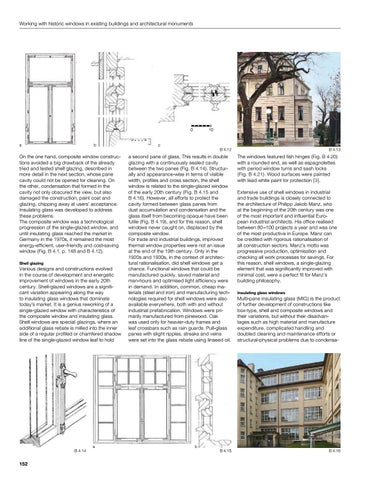
Various designs and constructions evolved in the course of development and energetic improvement of windows in the early 20th century. Shell-glazed windows are a significant variation appearing along the way to insulating glass windows that dominate today’s market. It is a genius reworking of a single-glazed window with characteristics of the composite window and insulating glass. Shell windows are special glazings, where an additional glass rebate is milled into the inner side of a regular profiled or chamfered shadow line of the single-glazed window leaf to hold
B 4.14
152
a
10
c
B 4.12
a second pane of glass. This results in double glazing with a continuously sealed cavity between the two panes (Fig. B 4.14). Structurally and appearance-wise in terms of visible width, profiles and cross section, the shell window is related to the single-glazed window of the early 20th century (Fig. B 4.15 and B 4.16). However, all efforts to protect the cavity formed between glass panes from dust accumulation and condensation and the glass itself from becoming opaque have been futile (Fig. B 4.19), and for this reason, shell windows never caught on, displaced by the composite window. For trade and industrial buildings, improved thermal window properties were not an issue at the end of the 19th century. Only in the 1920s and 1930s, in the context of architectural rationalisation, did shell windows get a chance. Functional windows that could be manufactured quickly, saved material and man-hours and optimised light efficiency were in demand. In addition, common, cheap ma terials (steel and iron) and manufacturing technologies required for shell windows were also available everywhere, both with and without industrial prefabrication. Windows were primarily manufactured from pinewood. Oak was used only for heavier-duty frames and leaf crossbars such as rain guards. Pull-glass panes with slight ripples, streaks and veins were set into the glass rebate using linseed oil.
b
B 4.15
B 4.13
The windows featured fish hinges (Fig. B 4.20) with a rounded end, as well as espagnolettes with period window turns and sash locks (Fig. B 4.21). Wood surfaces were painted with lead white paint for protection [3]. Extensive use of shell windows in industrial and trade buildings is closely connected to the architecture of Philipp Jakob Manz, who at the beginning of the 20th century was one of the most important and influential European industrial architects. His office realised between 80 –100 projects a year and was one of the most productive in Europe. Manz can be credited with rigorous rationalisation of all construction sectors. Manz’s motto was progressive production, optimisation and checking all work processes for savings. For this reason, shell windows, a single-glazing element that was significantly improved with minimal cost, were a perfect fit for Manz’s building philosophy. Insulating glass windows
Multi-pane insulating glass (MIG) is the product of further development of constructions like box-type, shell and composite windows and their variations, but without their disadvantages such as high material and manufacture expenditure, complicated handling and doubled cleaning and maintenance efforts or structural-physical problems due to condensa-
B 4.16