Solution principles for adjustable openings
terraces (Fig. A 5.2). This creates a spatial continuum between the interior and exterior and offers new possibilities for usage and experiences. In temperate climates with very different seasons, use of such openings is usually restricted to the summer months. Another elementary functional requirement is enabling the bringing in of objects of all kinds. In this case, the frequency of such deliveries (e.g. of a grand piano or a large piece of tech nical building equipment) will largely determine the type of opening. If a building is designed to provide natural (free) ventilation through its envelope, air must be supplied through appropriate adjustable openings (see “Natural ventilation”, p. 200f.). The goal here is good interior air quality, which is determined by the composition of the air intake (outside air) and the proportion of gases and compounds resulting from usage and the space itself [2]. In the context of hygienic comfort [3], an exchange of air is important for the following reasons: • Supply of oxygen • Discharge of stale air containing a high pro portion of carbon dioxide • Discharge of organic odorants • Discharge of vapours from construction materials (e.g. formaldehyde) • Discharge of combustion gases (from heat ing, cooking, manufacturing processes etc.) • Discharge of moisture • Discharge of other compounds resulting from production processes As well as various gases, solids (e.g. particles) are also brought inside with outside air, and it is becoming increasingly important to limit or check their passage. These particles may include soot particles and dust from industry and transport as well as organic particles or microorganisms such as pollen, fungal spores etc. The undesired ingress of various small animals and insects through openings into buildings must also be prevented or at least restricted. Natural ventilation requires the movement of air, although air does not necessarily have to be moved mechanically (Fig. A 5.4). This movement of air (streams of gas molecules) requires a difference in pressure between inside and outside air as a result of wind and / or thermal updraughts [4]. Ventilation is usually classified into two main types: • Intermittent ventilation (brief periods of venti lation through large openings), and • Constant ventilation (continuous ventilation through relatively small openings). An exchange of air for hygienic reasons is essential if differences in temperature between inside and outside air are connected with an exchange of energy, which can also be a goal of natural ventilation, using air to specifically supply or release heat. Given air’s low heat capacity, the use of energy
exchange for the free cooling of spaces is limited. Continuous ventilation is problematic in buildings exposed to a large range of exterior and interior temperatures for the following reasons: • Continuous discharge of (mainly valuable) heat from the interior • Excessive continuous supply of heat • Draughts due to large differences in tem perature Natural intermittent ventilation at night requires active mechanical systems with controls and servomotors. Alternatively, decentralised mechanical ventilators integrated into the building envelope combined with heat exchangers or heat recovery can be used with continuous ventilation. The position and form of adjustable openings in the building envelope are important in assuring an efficient exchange of air. It can be useful to provide different openings for incoming and outgoing air. As well as prevailing wind directions, aerodynamic aspects and phenomena in the building’s environs and openings must be taken into account. For economic reasons it may be advisable to combine as many as possible of the primary functions mentioned in a single system.
A 5.2 Primary functions
Different cases Regular use
Ingress /egress
Extensive opening
Special cases, temporary With access to exterior surfaces Without access to exterior surfaces Regular use
Bringing objects in and out
Special cases, temporary Natural ventilation With mechanical support
Ventilation Additional functions
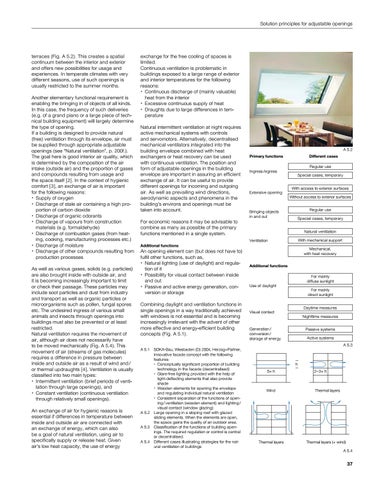
An opening element can (but does not have to) fulfil other functions, such as, • Natural lighting (use of daylight) and regula tion of it • Possibility for visual contact between inside and out • Passive and active energy generation, con version or storage Combining daylight and ventilation functions in single openings in a way traditionally achieved with windows is not essential and is becoming increasingly irrelevant with the advent of other more effective and energy-efficient building concepts (Fig. A 5.1). A 5.1 SOKA-Bau, Wiesbaden (D) 2004, Herzog+Partner, innovative facade concept with the following features: • Conceptually significant proportion of building technology in the facade (decentralised) • Glare-free lighting provided with the help of light-deflecting elements that also provide shade • Wooden elements for opening the envelope and regulating individual natural ventilation • Consistent separation of the functions of open ing / ventilation (wooden element) and lighting / visual contact (window glazing) A 5.2 Large opening in a sloping roof with glazed sliding elements. When the elements are open, the space gains the quality of an outdoor area. A 5.3 Classification of the functions of building open ings. The required regulation or control is central or decentralised. A 5.4 Different cases illustrating strategies for the nat ural ventilation of buildings
Mechanical, with heat recovery Additional functions For mainly diffuse sunlight
Use of daylight
For mainly direct sunlight Daytime measures
Visual contact
Nighttime measures
Generation / conversion / storage of energy
Passive systems Active systems A 5.3
h 5× h
2– 3× h
Wind
Thermal layers
Thermal layers
Thermal layers (+ wind) A 5.4
37