Drawing equipment, paper and lines
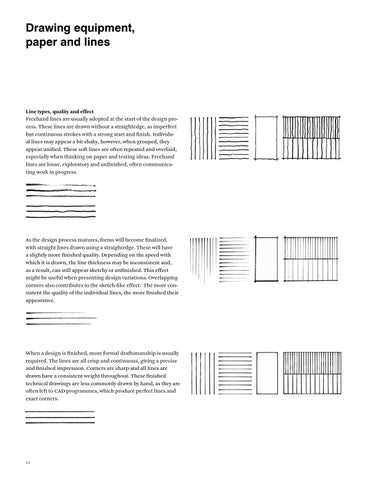
Line types, quality and effect Freehand lines are usually adopted at the start of the design process. These lines are drawn without a straightedge, as imperfect but continuous strokes with a strong start and finish. Individual lines may appear a bit shaky, however, when grouped, they appear unified. These soft lines are often repeated and overlaid, especially when thinking on paper and testing ideas. Freehand lines are loose, exploratory and unfinished, often communicating work in progress.
As the design process matures, forms will become finalized, with straight lines drawn using a straightedge. These will have a slightly more finished quality. Depending on the speed with which it is drawn, the line thickness may be inconsistent and, as a result, can still appear sketchy or unfinished. This effect might be useful when presenting design variations. Overlapping corners also contributes to the sketch-like effect. The more consistent the quality of the individual lines, the more finished their appearance.
When a design is finished, more formal draftsmanship is usually required. The lines are all crisp and continuous, giving a precise and finished impression. Corners are sharp and all lines are drawn have a consistent weight throughout. These finished technical drawings are less commonly drawn by hand, as they are often left to CAD programmes, which produce perfect lines and exact corners.
24