AMERICAN SHAD AND RIVER HERRING: THE GOOD AND BAD NEWS
Threats remain on depleted populations of migratory fish in the Delaware River Basin
The Delaware Estuary Program’s Science and Technical Advisory Committee (STAC) recently published a white paper about the status of American shad and river herring in the Delaware River Watershed, revealing mixed news on how these fish are faring.
The report, "Life History, Population Status, and Restoration of American Shad and River Herring in the Delaware River Basin,” encapsulates the most recent information on American shad and river herring. It is the product of a year’s worth of collaboration among technical experts in the field of fish ecology that were convened as part of a STAC subcommittee. This report reviews six indices that reflect American shad and river herring population health, which are tracked by the Delaware
River Basin Fish and Wildlife Management Cooperative.
“This report’s comprehensive review highlights the extensive efforts by member states to determine population dynamics of American shad and river herring in the Basin while providing guidance on actions needed to better understand threats and paths to restoration,” said Gregory Lech, co-author, STAC chair, and fisheries biologist with the Pennsylvania Fish and Boat Commission. “The report highlights the complexities associated with management of migratory fish in the historic Delaware River Basin and provides a comprehensive resource to stakeholders for future research.”
Sheila Eyler, lead author and biologist with the U.S. Fish and Wildlife Service, said that
continued on page 3
COMMITTEES CONTACT LIST
Meetings conducted by the Delaware Estuary Program’s implementation and advisory committees occur on a regular basis and are open to the public. For meeting dates and times, please contact the individuals listed below:
Estuary Implementation Committee
Kathy Klein
Partnership for the Delaware Estuary Executive Director (Chair) (302) 354-0307 kklein@DelawareEstuary.org
Monitoring Advisory & Coordination Committee
Elaine Panuccio
Water Restoration Scientist, Water Quality Assessment
Delaware River Basin Commission (609) 883-9500, ext. 307 elaine.panuccio@drbc.gov
Toxics Advisory Committee
Jeremy Conkle Senior Toxicologist
Delaware River Basin Commission (609) 883-9500 Jeremy.Conkle@drbc.gov
Science and Technical Advisory Committee
LeeAnn Haaf, Ph.D.
Partnership for the Delaware Estuary Assistant Director of Estuary Science (800) 445-4935, ext. 116 lhaaf@delawareestuary.org
Water Quality Advisory Committee
John Yagecic, P.E. Manager, Water Quality Assessment
Delaware River Basin Commission (609) 883-9500, ext. 271 john.yagecic@drbc.nj.gov
ON THE COVER
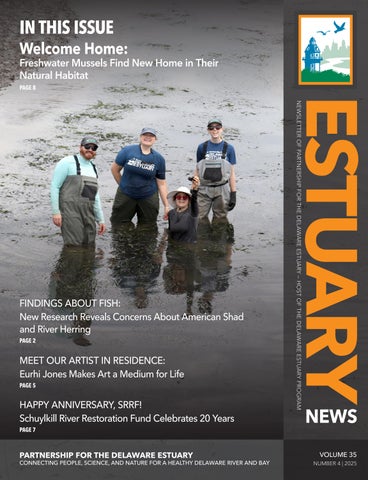
PDE staff stand in the shallow waters of the Delaware River during an August restoration effort to return hatcheryraised freshwater mussels to their natural habitat See Page 8.

FOLLOW US ON:
populations of American shad and river herring, once abundant in the Delaware River and Estuary, are depleted and that with reduced populations, the critical ecosystem services they provide may likewise become threatened. The paper seeks to fully assess the status of these fish in the Delaware

River Basin while providing recommendations on how to best manage for the continuing health of their populations.
The fishery management agencies of the Delaware River Basin Fish and Wildlife Management Cooperative are tracking the population trends through time and working with partners to manage and restore stocks.
American shad, along with alewife and blueback herring (collectively termed river herring), are keystone fish species within the Delaware River Basin. All three species undertake seasonal migrations to spawn in Delaware River tributaries and provide numerous benefits to communities and
habitats along the path of their journey.
“Historically, both indigenous people and early colonizers of the Delaware River Basin relied on the abundant American shad and river herring as vital food sources. However, their numbers have decreased to the point that we are looking to help preserve and restore these populations however we can,” said Ella Rothermel, co-author and urban resilience assistant manager at the Partnership for the Delaware Estuary. “Besides their cultural importance, American shad and river herring are also an important part of our local ecosystem as both predators and prey, helping with nutrient cycling, and acting as a host fish for our native freshwater mussel species.”
Overall, there is both good news and bad news to report on the status of these signature migratory
“each step toward renewal carries the promise of revitalized rivers, enriched biodiversity, and the reconnection of communities with a heritage once defined by these iconic fish.”
However, populations of American shad and river herring remain at historic lows and threats such as predation and changing water conditions will continue to affect these species moving forward. “Changing environmental conditions is a challenge that we all must face, now and in the future,” said Ron Heun, co-author and environmental compliance and program manager at PSEG. “Continuing to conduct meaningful research within the Delaware Estuary is the best way to understand and combat changes in the aquatic ecosystem. PSEG recognizes these challenges and supports the Partnership for the Delaware Estuary and its goals
“ “
Continuing to conduct meaningful research within the Delaware Estuary is the best way to understand and combat changes in the aquatic ecosystem.
- Ron Heun, paper co-author and environmental compliance and program manager at PSEG.
fish species. On the positive side, water quality in the Delaware River Basin has improved, and efforts to remove the dams that impede fish passage have gained momentum. Lance Butler, co-author and senior scientist with the Philadelphia Water Department, said that with these positive restoration trends,
to improve water quality and aquatic habitat restoration, as well as protecting and understanding our aquatic resources.”
This paper serves as a cornerstone to understanding the ecological dynamics of the watershed, said LeeAnn Haaf, Ph.D., estuary
continued on page 4
Overall, there is good and bad news for American shad and river herring. While conditions have improved in the form of water quality and fewer dams to block their way, fish populations are at an all-time low.
science director at Partnership for the Delaware Estuary and advisor to the STAC.
“The report offers critical, speciesspecific insights that will help inform and strengthen the comprehensive assessment of the Estuary and Basin’s overall health,” Haaf said.
The assessment Haaf mentioned, known as the Technical Report for the Estuary and Basin, has been completed every five years since 2012 and is forthcoming in 2027.
The primary role of the PDE’s Science, Technical and Advisory Committee is to offer objective, expert guidance and peer review on scientific and technical issues that support the goals of the Delaware Estuary Program and its partners. This includes advancing initiatives outlined in
the Program’s Comprehensive Conservation and Management Plan (CCMP).
The 2025 Life History, Population Status, and Restoration of American Shad and River Herring in the Delaware River Basin Report can be found on the PDE website
Visit the 2019 CCMP for the

Delaware Estuary and the 2022 Technical Report for the Estuary and Basin for more information.
Additional questions can be directed to Haaf or Rothermel
Please visit the PDE website to learn more about the STAC
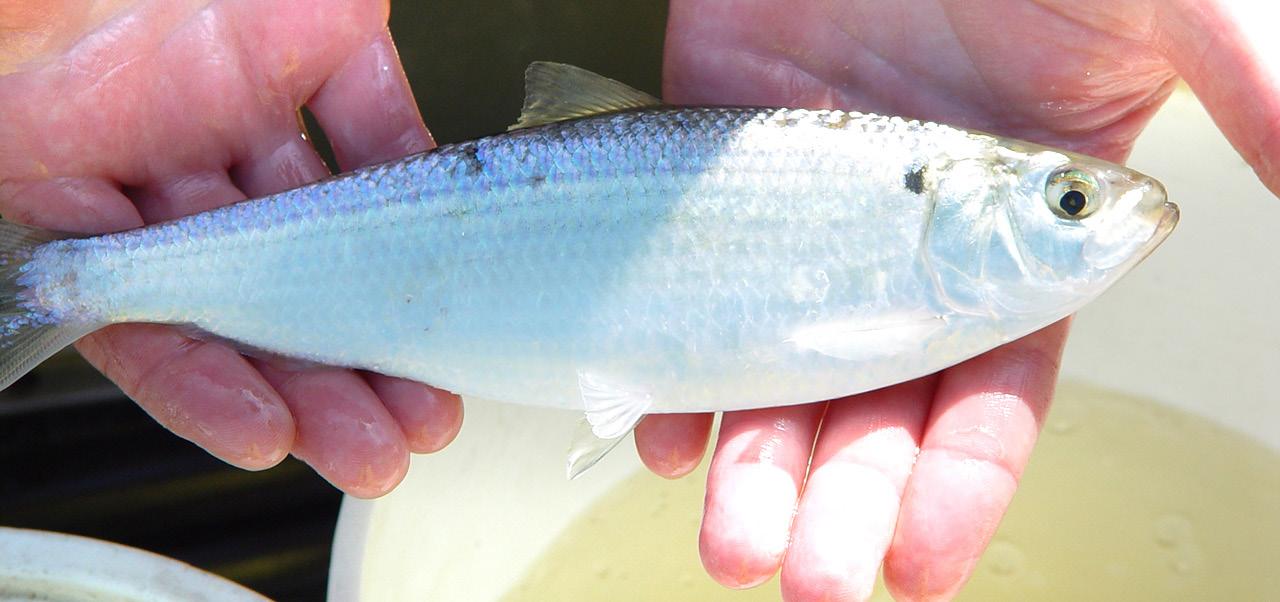
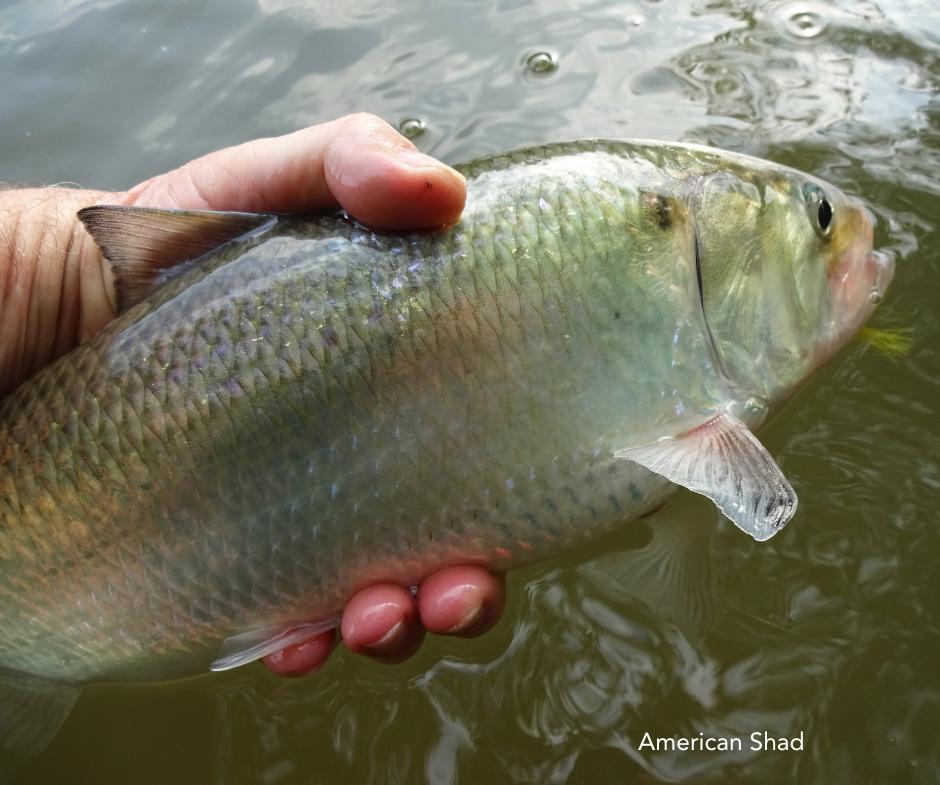
Blueback herring are one of the keystone species in the Delaware Estuary. Photo courtesy of Lance Butler.
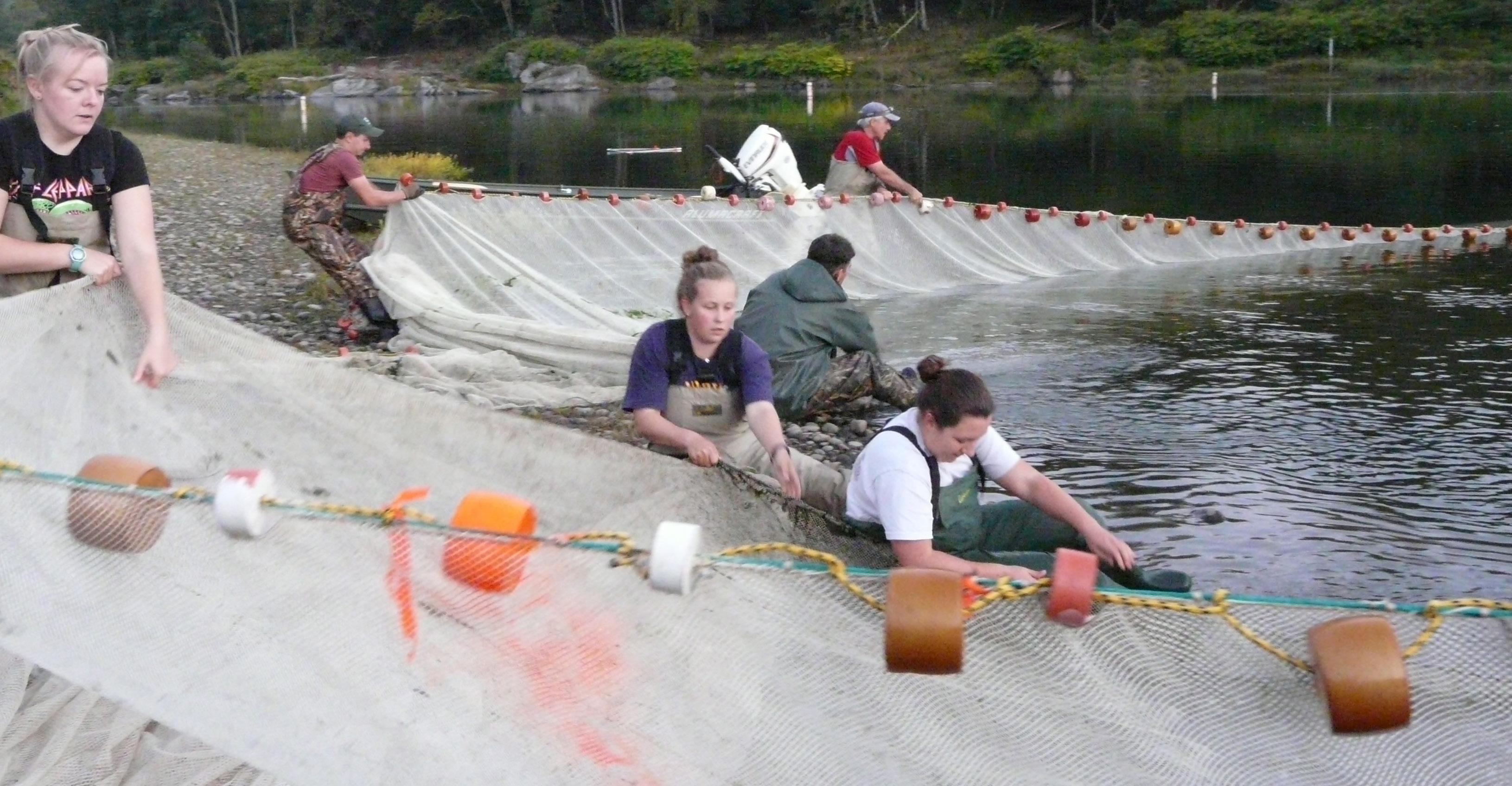
Representatives from the Philadelphia Water Department seine for shad in the upper Delaware River. Photo courtesy of the Philadelphia Water Department.
ARTIST IN RESIDENCE EURHI JONES HAS A PASSION FOR ART AND NATURE
Growing up in Swarthmore, Pennsylvania, Crum Creek was a place for artist Eurhi Jones to play and explore. Today, nature, as well as climate and pro-democracy activism remains a signature element of her work, as it has throughout her nearly 30-year career.
Starting this year, Jones will lead a project with regional reach and voice, the Artist in Residence (AiR) project for the Greater Philadelphia Area/ Delaware River Watershed. Launched in 2023 by the U.S. Environmental Protection Agency, the Delaware River Watershed was selected as one of six sites nationwide that are part of the Urban Waters
Federal Partnership. The initiative focuses on critical water quality challenges in these areas, with the goal of encouraging investment and aligning arts and culture to make environmental issues more accessible and understandable, especially for communities with limited resources.
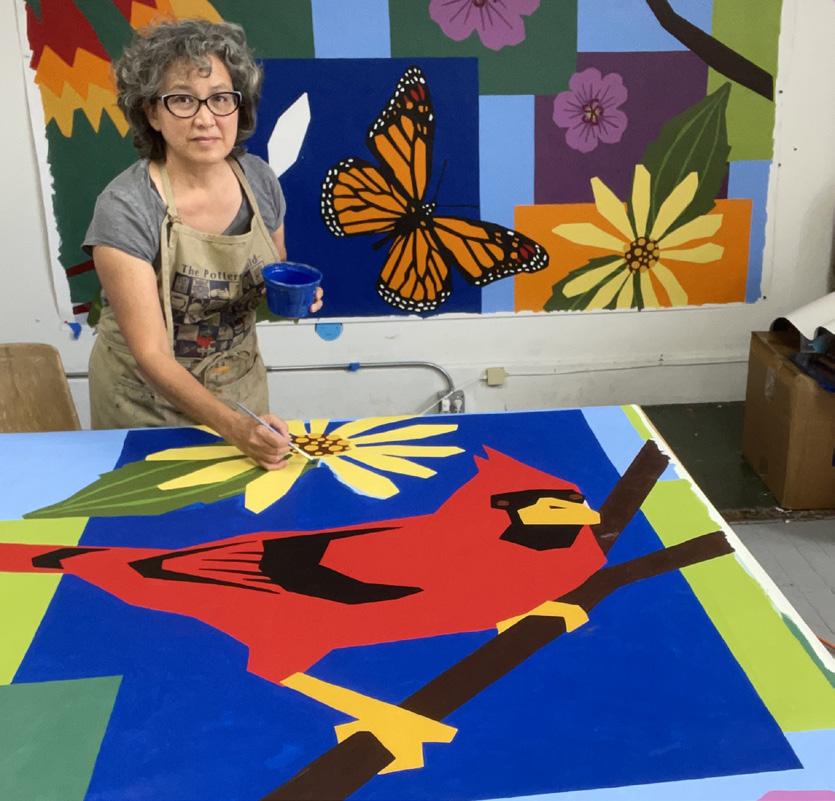
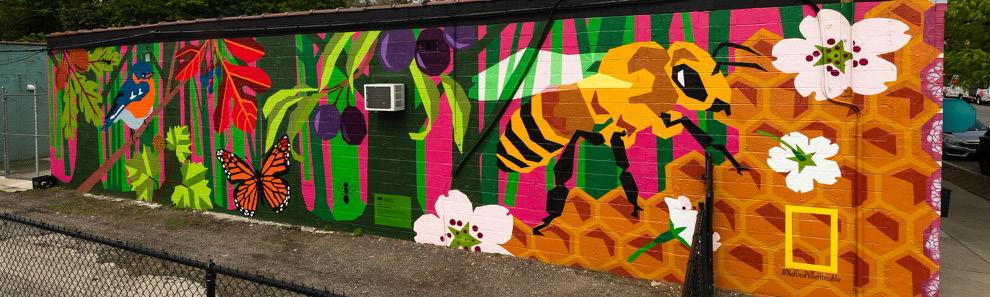
Jones brings solid experience to this role, having designed and created more than 30 public murals in collaboration with organizations such as the National Geographic Society, the Philadelphia Water Department, the Philadelphia Zoo, the Please Touch Museum,
and Mural Arts of Philadelphia, as well as many libraries, community gardens, and schools.
“The mission of my career in public art is to build connections between people and the natural world and to bring images of
Eurhi Jones incorporates nature in much of her artwork. Photo courtesy of Eurhi Jones.
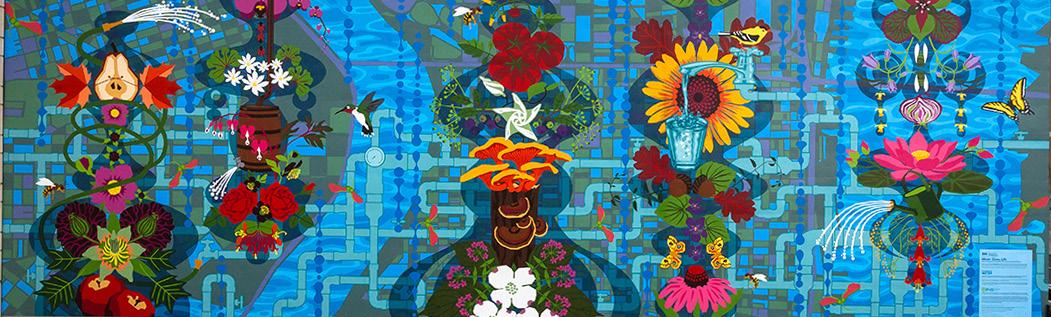
“Water Gives Life” 2018 Collaboration with David McShane for the Philadelphia Water Department and the Pennsylvania Horticultural Society.
the natural world to the built environment,” Jones has said of her work and interest in the Artist in Residence program.
PDE: You have said that the mission of your career in public art public art is to “build connections between people and the natural world and to bring images of the natural world to the built environment.” Is this what initially drew you to murals as your chosen medium as opposed to other forms of painting or art?
Jones: In my art, I have always been most drawn to horticulture, animal life, biology and natural
phenomena, and how we can think about the human condition through nature. When I first started making murals, I was thrilled by the theatricality of scale. By painting a large wall, I could bring the feeling of actually being in a garden, or in the woods to the urban landscape.
PDE: What is something that you are most looking forward to about the Artist in Residence project? What do you hope it will do for the people of the region?
Jones: During my years as a community muralist, I’ve had the privilege of spending
significant time in many different parts of Philadelphia, getting to know all kinds of people and neighborhoods through the process. The AiR is exciting because it expands that network of connection to a wider regional range.
PDE: What will be challenging about this project? What’s the most intimidating part?
Jones: Probably the most challenging thing about the project is the large geographic area, and the multitude of experiences that I will be trying to represent. In my experience, making public art is often an act of diplomacy. It can be a challenge to uplift many voices in a community, while at the same time hitting upon a design that doesn’t feel like art made by a committee.
Jones studied art at Wesleyan University and the Pennsylvania Academy of the Fine Arts where she met her partner, David McShane. Together, they have worked with Mural Arts Philadelphia for decades. Their two children, now grown and visual artists themselves, often participate in their mural projects.
“NatureWorks 2022” by Eurhi Jones at the Overbrook Environmental Education Center in Philadelphia. Photo courtesy of Eurhi Jones.
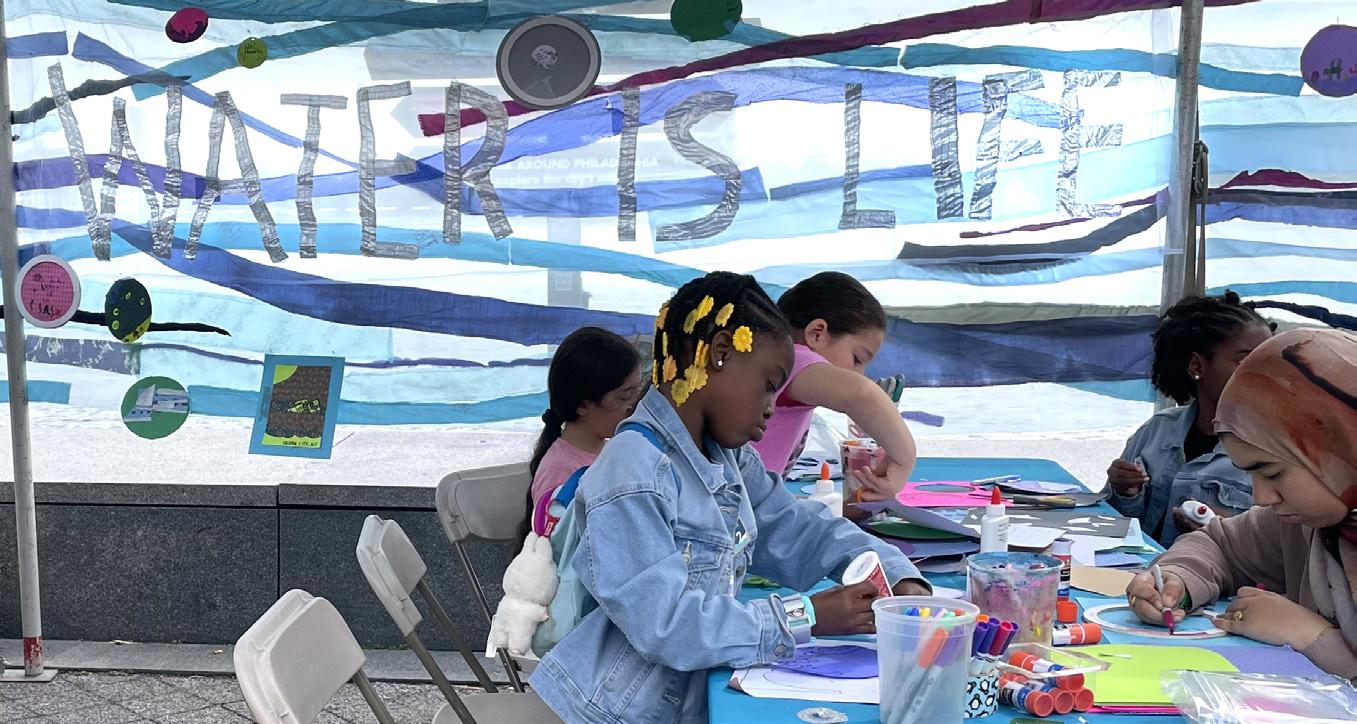
Children at this year's Delaware River Festival create art using water as a theme with PDE's artist in residence Eurhi Jones.
SCHUYLKILL RIVER RESTORATION FUND CELEBRATES TWO DECADES OF CONSERVATION
By Rosemary Keane, Schuylkill River Greenways’ Communications Director
Over two decades, more than 150 projects, and over $6 million in funding, the Schuylkill River Restoration Fund (SRRF) has become a model watershed restoration program — improving and protecting the natural resource that provides drinking water to nearly 2 million people. On a picture-perfect September day, the Fund celebrated a milestone year by awarding more than $500,000 in grants to eight projects in the Schuylkill River Watershed.
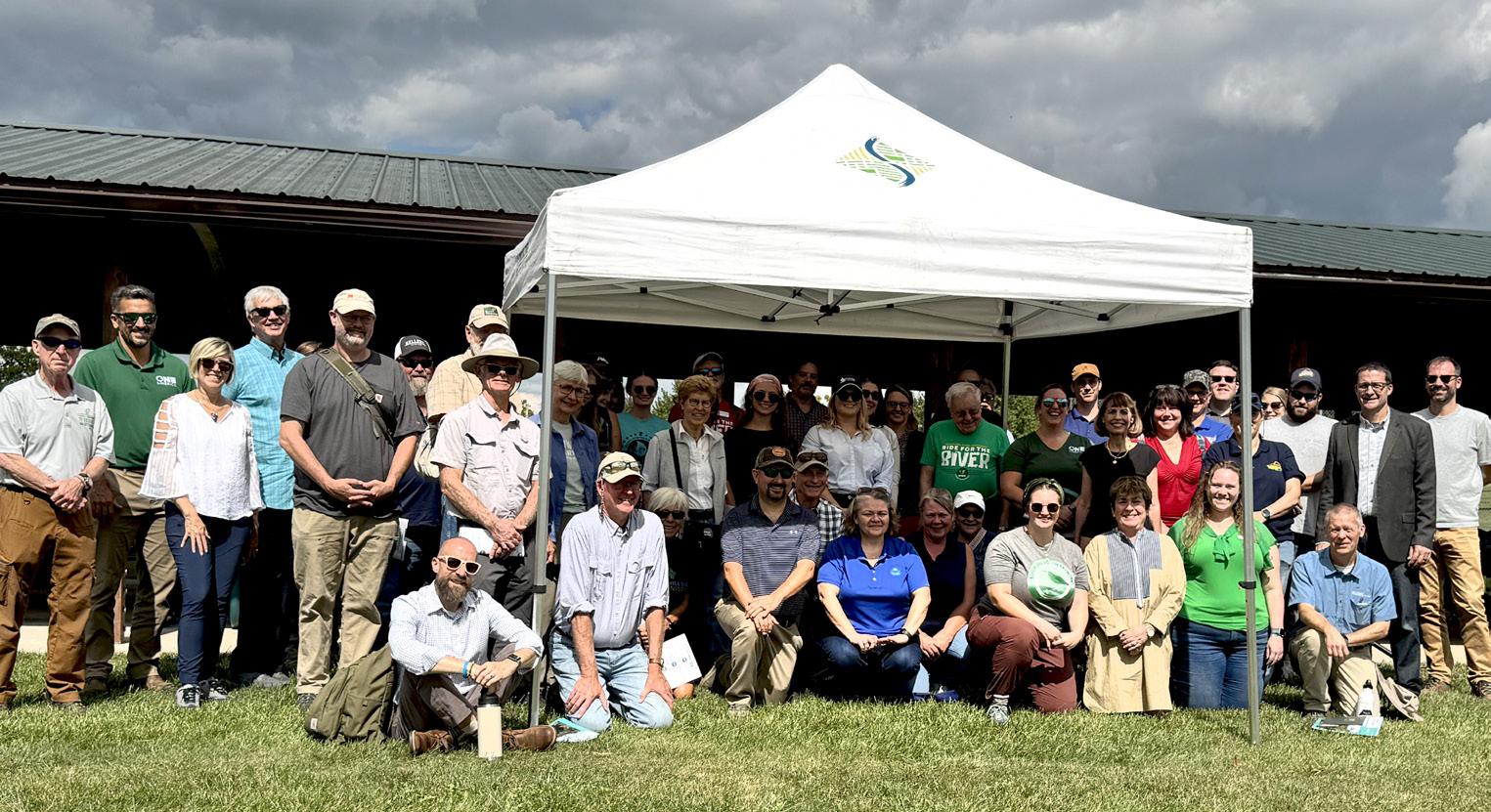
More than 50 people gathered at Camelot Park in East Greenville, Pennsylvania to celebrate the SRRF’s 20th anniversary and take part in its annual bus tour of supported projects in Montgomery County.
Tour stops included Camelot Park and Longacre Farm, both in East Greenville, as well as Masemore Farm in Barto. Attendees included representatives from the Restoration Fund’s advisory board, funders, and watershed organizations.
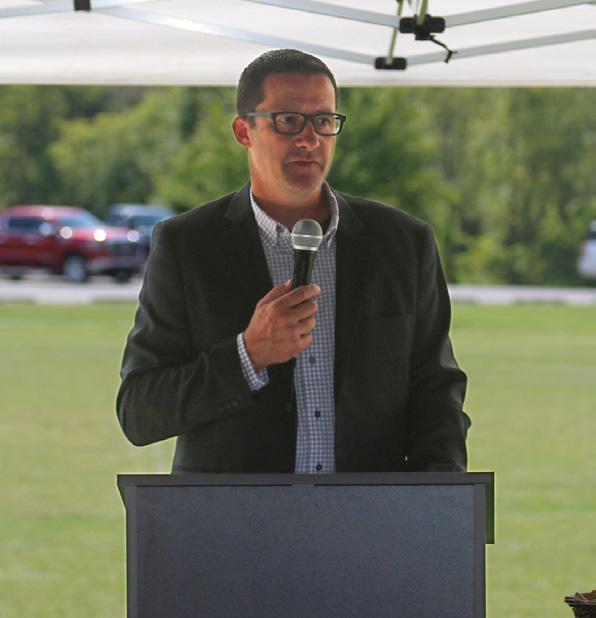
Between site visits and tours, the group paused to recognize the SRRF’s 20th anniversary and award this year’s grants. Schuylkill River Greenways Deputy Director Tim Fenchel announced the 2025 grant recipients and reflected on the successes and impact of the Fund’s innovative public/private partnership.
Looking back at the SRRF’s history, Fenchel credited its consistent and dedicated leadership, committed and
Members of the Schuylkill Action Network celebrate the 20th anniversary of the Schuylkill River Restoration Fund during their annual bus tour, which included stops at various grant supported sites to showcase progress.
Schuylkill River Greenways Deputy Director Tim Fenchel announces SRRF grant recipients for 2025.
HOMEWARD BOUND
Silently nestled at the bottom of the Delaware River where wild celery (Vallisneria americana) grows thick, thousands of freshwater mussels are adjusting to a new home.
Ordinarily, the riverbed would be the only home these long-living mollusks would ever know. But these particular mussels were bred in a hatchery at the U.S. Fish and Wildlife Service’s Harrison Lake National Fish Hatchery in Charles City, Virginia. They spent part of their early lives in baskets submerged in ponds at Winterthur Museum, Garden & Library and Talley Day Park in Wilmington.
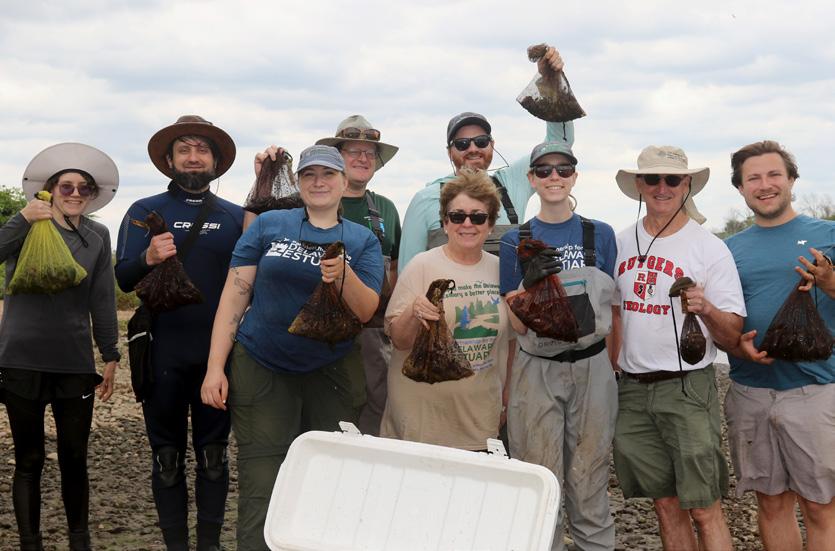
On August 29, more than 1,800 mussels were carefully rehomed to the Delaware River by staff from the Partnership for the Delaware Estuary (PDE), along with partners from Pennsylvania Department of Environmental Protection, New Jersey Department of Environmental Protection, and Palmyra Cove Nature Park in New Jersey. The mussels were ready for rehoming once they reached at least 50 millimeters in diameter. Volunteers and staff had previously tagged them with decals to distinguish them from mussels born in the wild.
The newly placed mussels, a mix of alewife floaters (Utterbackiana implicata), yellow lampmussels (Lampsilis cariosa), and Eastern pondmussels (Sagittunio nasutus), joined large, healthy beds of mussels at the rehoming site.
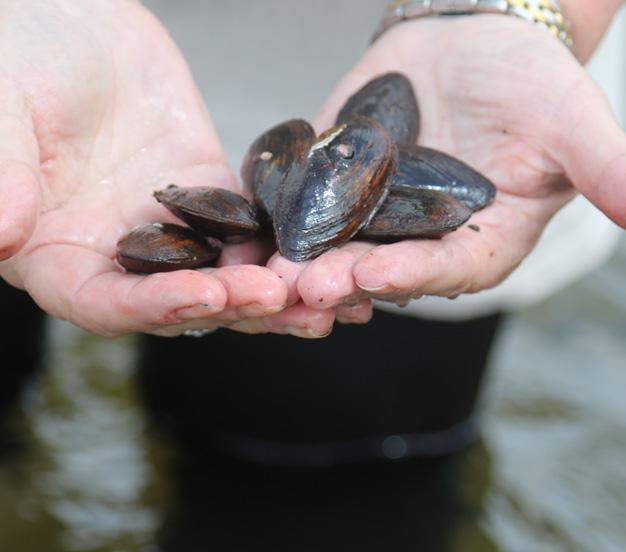
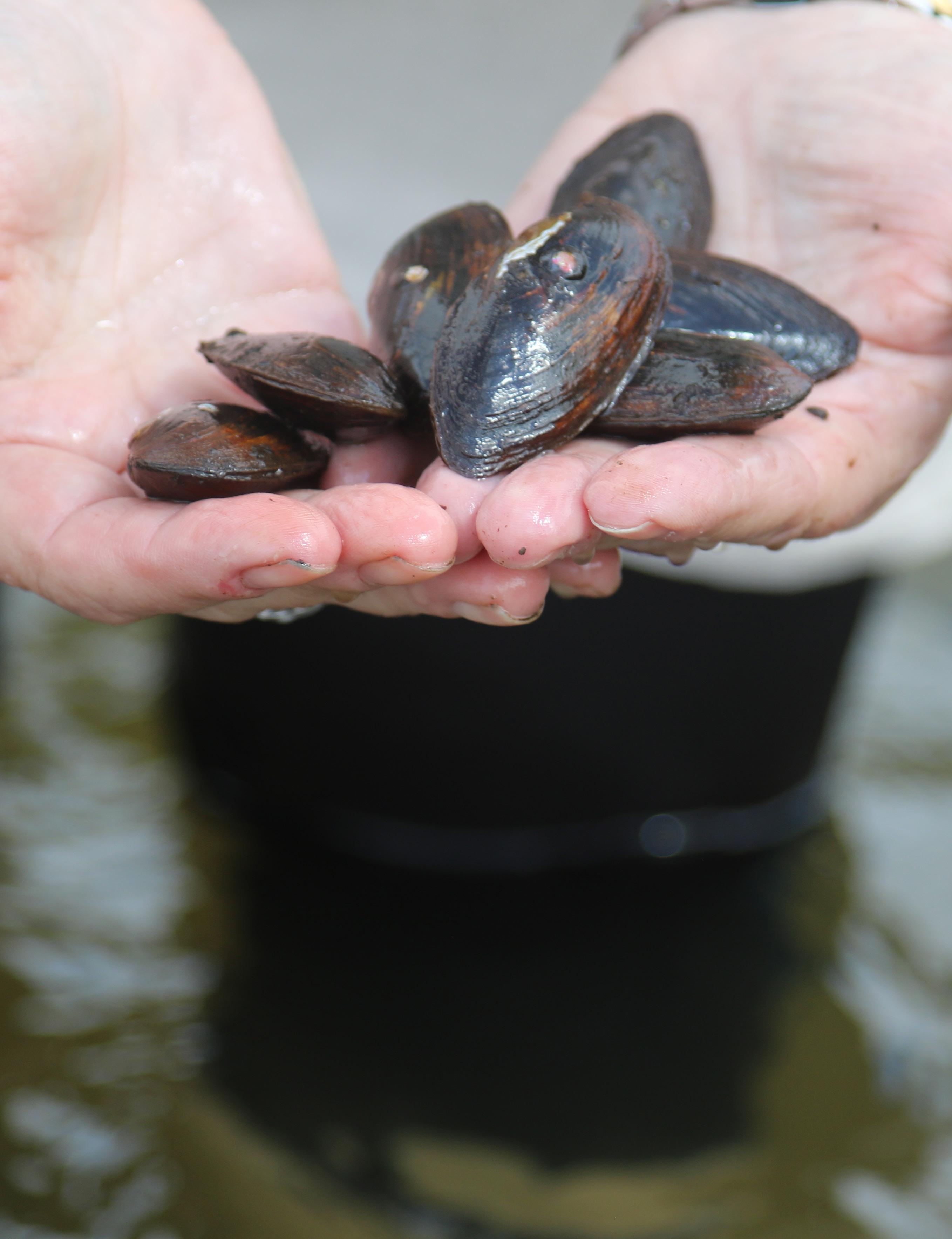
Rehoming mussels is a delicate process. They aren’t simply tossed in the water. Each mussel is carefully placed into the riverbed, allowing it to use its strong foot to burrow into the sediment. The crew waded at least hip deep before plunging their arms and shoulders into the river to gently plant them in their new home. One member of the team snorkeled in the river shallows to perform their task. PDE will apply for grants to continue monitoring the mussels now that they’ve been returned to the river.
"It was a pleasure and a privilege to return these mussels to their natural home in the Delaware River," said PDE Executive Director Kathy Klein, who actively participated in the effort. "Everyone — from PDE staff to our partners from Pennsylvania and New Jersey — was in the water, making sure they properly placed each mussel in the riverbed. By the end, we were all soaked to the gills, but the team spirit was incredible, and there was a real sense of joy in what we were accomplishing together."
PDE gives many thanks to the partners who participated in the rehoming. This work was made possible through funding from New Jersey Sea Grant Consortium, National Oceanic and Atmospheric Administration (NOAA), Pennsylvania Department of Environmental Protection Coastal Resource Management Program, a Constellation CLEAN Environment Award, and National Fish and Wildlife Foundation Delaware Watershed Conservation Grant programs.
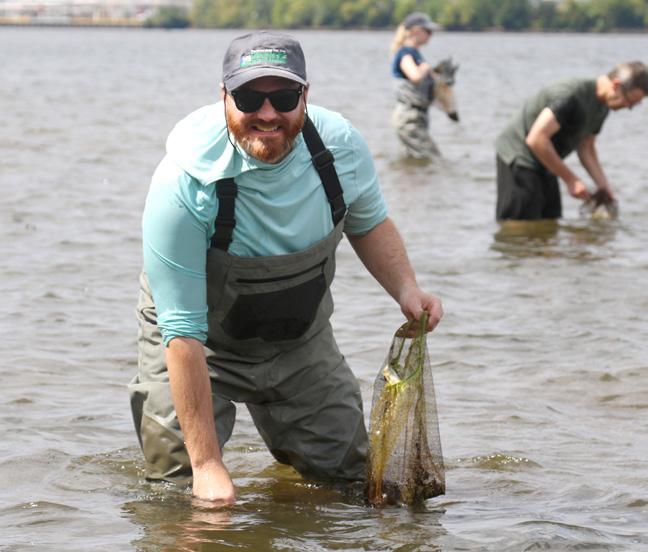
Freshwater mussels get ready to make their way to the bottom of the Delaware River.
PDE Estuary Science Coordinator Joe DiDomenico plants freshwater mussels in the Delaware River.
PDE staff and partners show the mussels about to be placed in the bottom of the Delaware River.
MORE THAN MEETS THE EYE: Constellation Energy Sees Big Ecological Potential at Croydon Generating Station
By Ella Rothermel, PDE’s Urban Resilience Assistant Manager
Big plans for better habitat are in motion along the Delaware River waterfront in Croydon, Pennsylvania. Since 2020, PDE has been working with Constellation Energy to develop a plan for an inlet that sits outside one of the company’s generating stations. This inlet’s shoreline is in good condition with a sturdy mudflat and healthy stand of wetland plants such as spadderdock (Nuphar advena), but Constellation sees more potential to uplift this site. With PDE’s help, Constellation hopes to make the inlet more impactful, both for local wildlife and for the nearby community.
To boost ecological function, PDE has recommended adding structures, enhancing plant diversity, and seeding the area with freshwater mussels to provide an ecological boost. Adding ecological complexity is important, as native fish, turtles, and birds thrive in places where they have access to many different resources.
A $96,284 grant, awarded in 2021, from the National Fish and Wildlife Foundation’s Delaware Watershed Conservation Fund allows PDE, Constellation, and global environmental consulting firm, Stantec, to refine concept designs and prepare permits
for the living shoreline project. So far, funds have been used to continue collaboration between all three groups. In August, Stantec submitted a full set of engineering design plans to regulators.
“Enhancing the Croydon Generating Station shoreline habitat is more than an environmental effort, it’s an investment in the future of our community and local wildlife," said Constellation Energy's Principal Environmental Specialist Donna Fabrizio. "By working together, PDE, Constellation, and Stantec are creating a living legacy along the Delaware River that will inspire watershed stewardship and resilience for generations to come.”
In preparation for the future living shoreline, PDE also worked to develop an outreach plan to help educate the local community about the project. Chesa Blom, PDE’s estuary engagement manager, established a direct connection with the nearby Harry Truman High School in Levittown, Pennsylvania, and created a lesson plan tailored to students who are interested in caring for the environment. The lesson included the use of PDE’s 3-D model of a living shoreline that allows students to move pieces around to create
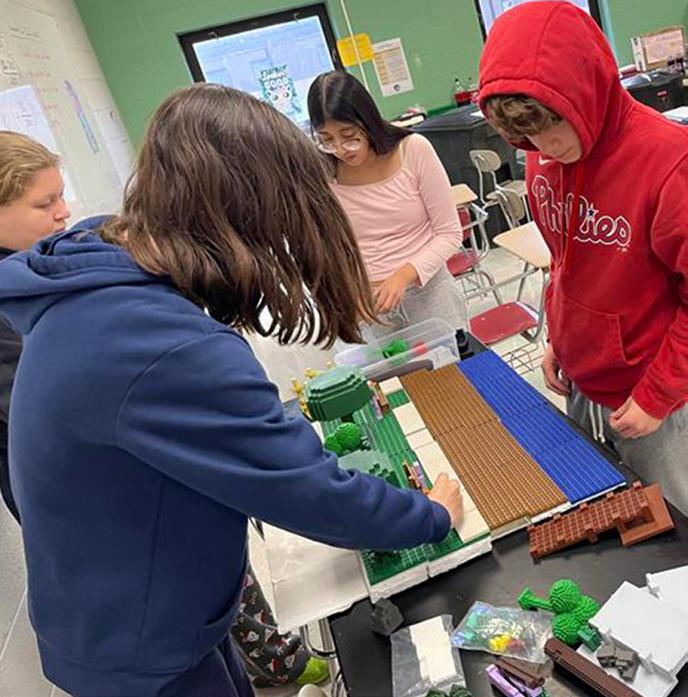
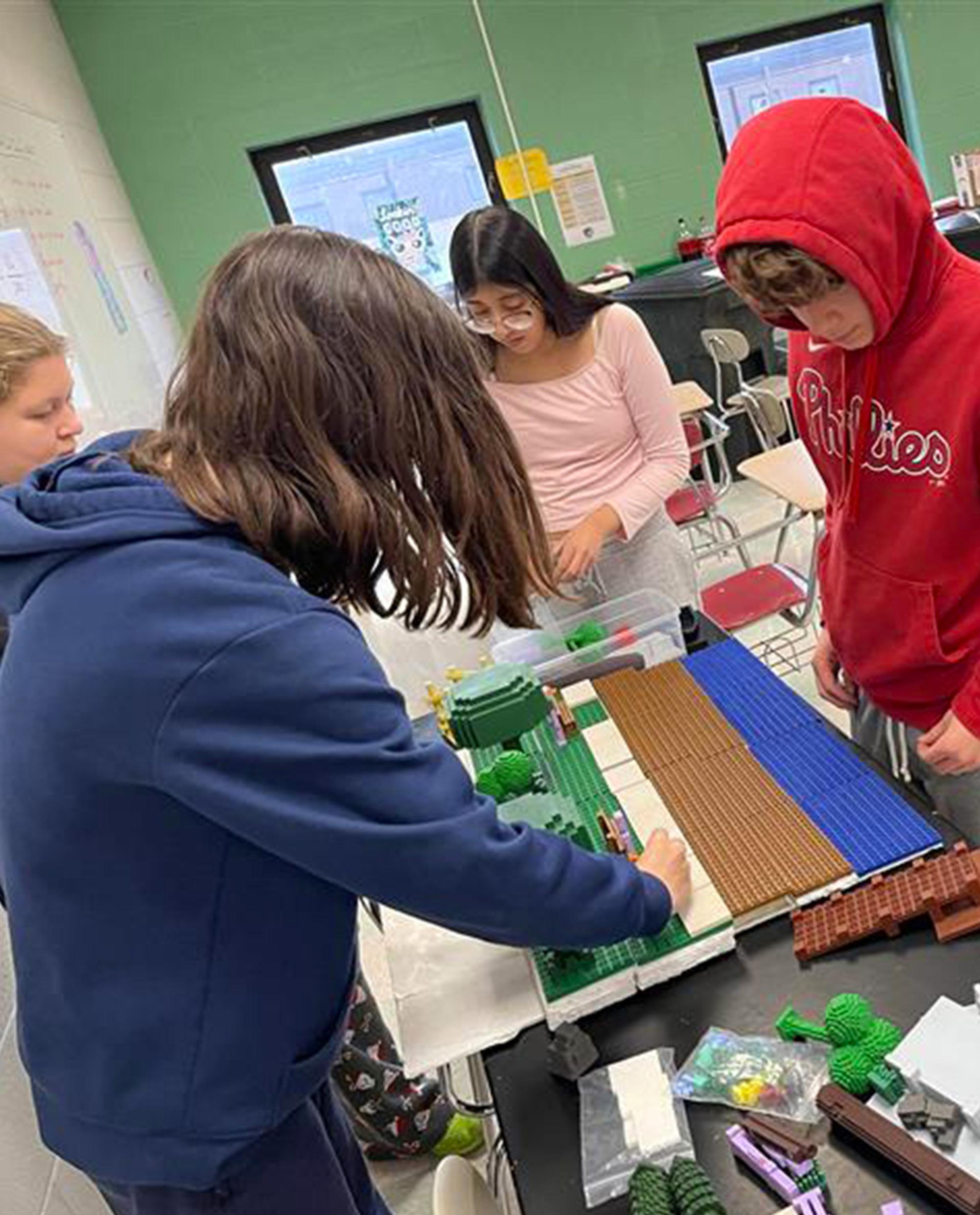
their own vision of an urban riverbank.
“My students enjoyed Chesa's shoreline lesson, especially the hands-on component where they were able to build a model of a shoreline and learn how the different components could affect erosion," said Lars McGee, a science teacher and Environmental Club advisor at the school.
PDE just received additional funding from the Constellation CLEAN Environment Award Program to continue the planning and permitting process, and to begin the first steps in implementation of the shoreline project.
Students at Harry Truman High School in Levittown, Pennsylvania, work with a living shoreline model to visualize different ways a river shoreline can look.
WINNERS OF THE 2025 TRASH FREE WATERS ART CONTEST ANNOUNCED
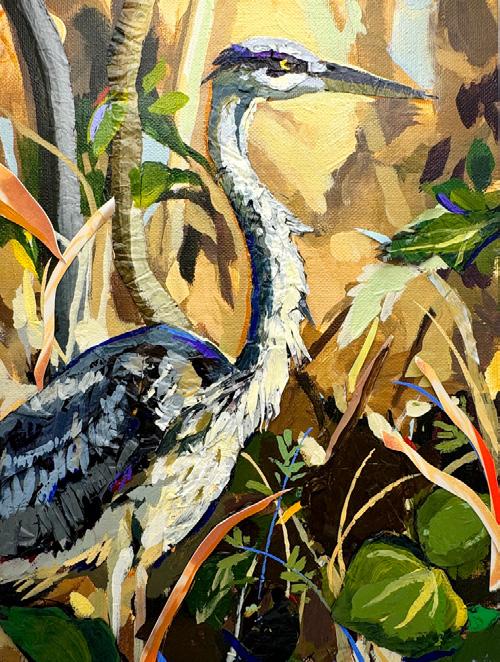
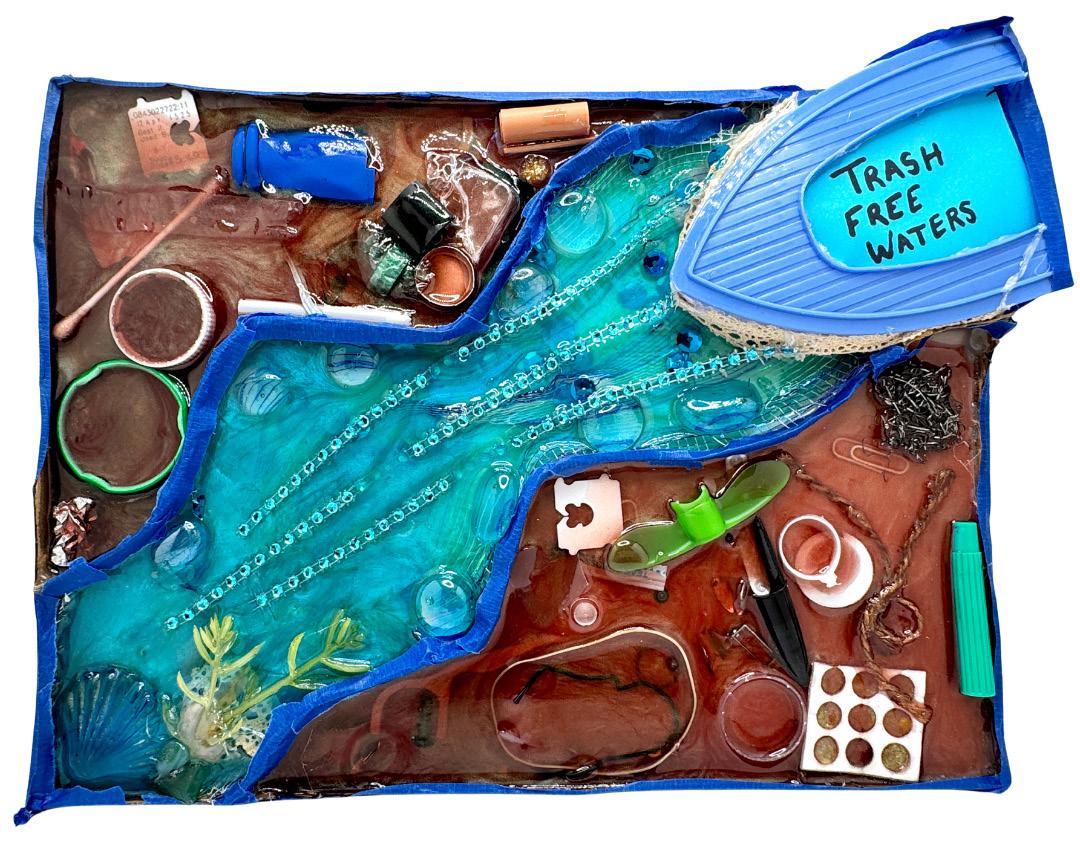
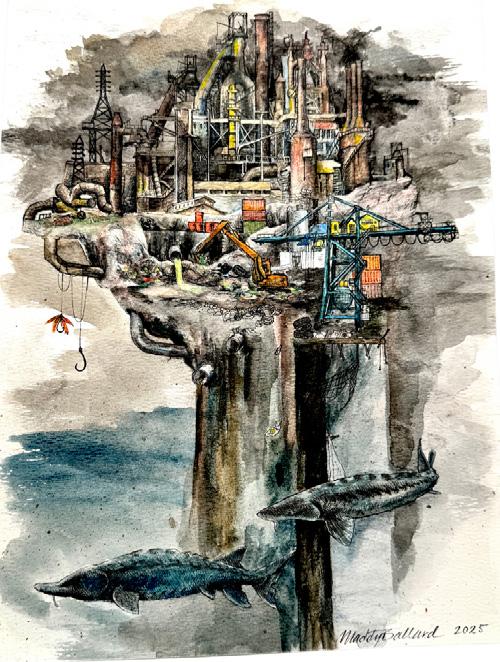
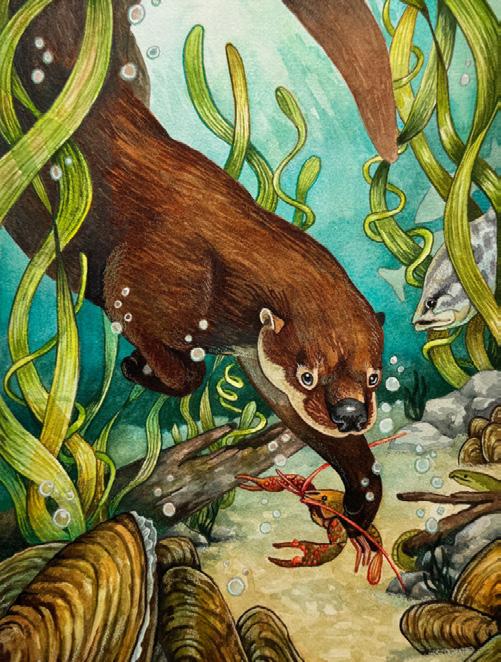
Partnership for the Delaware Estuary congratulates the winners of the 2025 Trash Free Waters Art Contest in conjunction with the Philadelphia Water Department, which raises awareness about the importance of keeping trash and debris from polluting the Delaware River Watershed.
More than 25 artists who live or work in Philadelphia submitted competitive work that incorporated a variety of styles and mediums from paint and markers to yarn, resin, and even broken dishes. Visitors to the September 27 Delaware River Festival and Philadelphia’s Independence Seaport Museum chose the winners by voting for their top three choices.
First Place: “Clearing the Way to Trash Free Waters” by Cassandra Hanlon.
Second Place: “Great Blue Heron,” by McKinna Salinas
Third Place (a tie): “Industrial Waste,” by Madeline Ballard and “Trash Free Biodiversity” by Stephanie Weinger.
All submitted work is now on display at Fairmount Water Works Interprative Center in Philadelphia. This project was financed in part by a Federal Coastal Zone Management Grant provided by the Pennsylvania Department of Environmental Protection with funds provided by the National Oceanic and Atmospheric Administration.
First Place: “Clearing the Way to Trash Free Waters,” by Cassandra Hanlon
Second Place: “Great Blue Heron,” by McKinna Salinas
Third Place: “Industrial Waste,” by Madeline Ballard
Third Place: “Trash Free Biodiversity,” by Stephanie Weinger

A NIGHT TO REMEMBER:
PDE hosts its biggest night of the year in Philadelphia
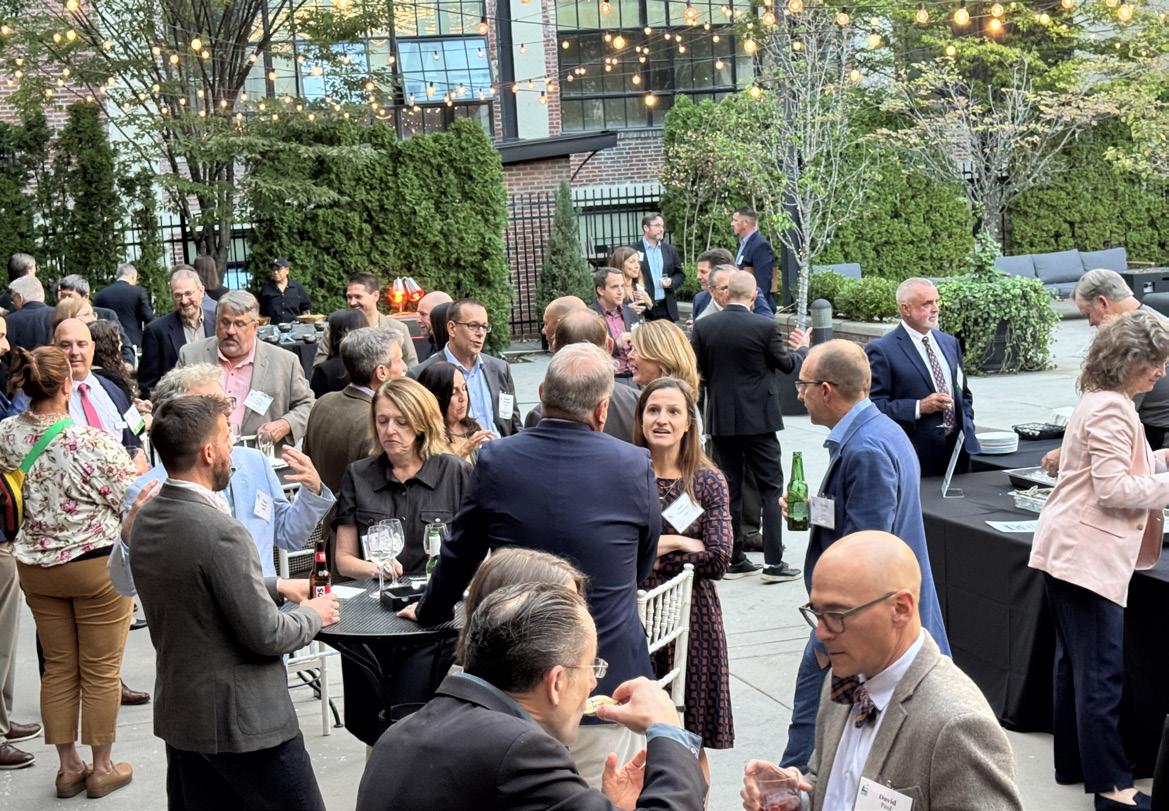
Cool jazz and crisp weather set the stage for this years’ Experience the Estuary Celebration in Philadelphia.
Nearly 300 attendees gathered to network, enjoy cocktails, bid on silent auction items, and learn about PDE programs — all while celebrating the estuary and incredible network of people who make this work possible.
Thanks to generous support, PDE raised enough funds that night to purchase a new handheld YSI water quality meter. This equipment will enable PDE science staff to spot check temperature, pH, dissolved oxygen, and more at freshwater mussel sites and in submerged aquatic vegetation habits. We are deeply grateful to everyone who contributed to making this purchase possible.

Finally, a heartfelt thank you to all our guests and sponsors for making this event a success. We look forward to welcoming you next year to our 30th anniversary celebration!
Guests mix and mingle during the cocktail hour at PDE’s Experience the Estuary Celebration in Philadelphia.
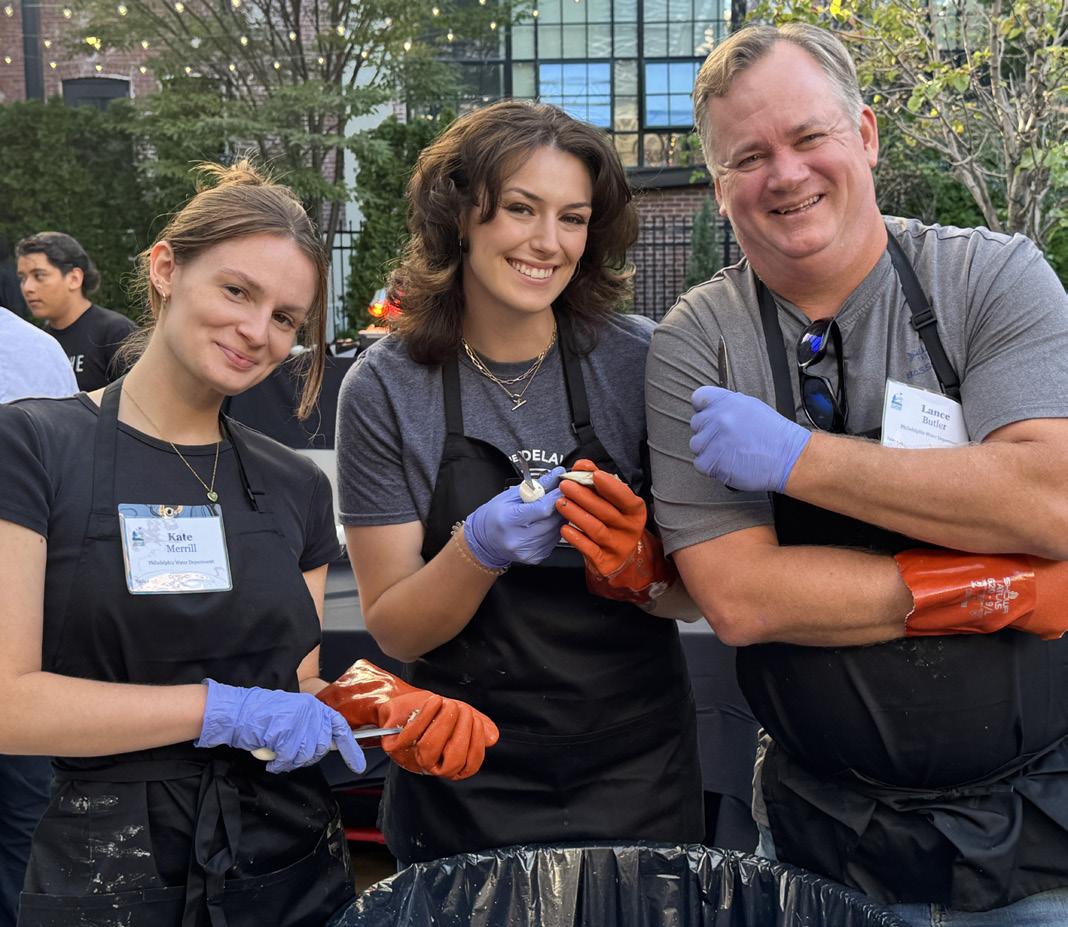
From left, Kate Merrill, Shannon Boyle, and Lance Butler of the Philadelphia Water Department were the evening’s guest shuckers during the celebration’s 90-minute raw oyster bar.
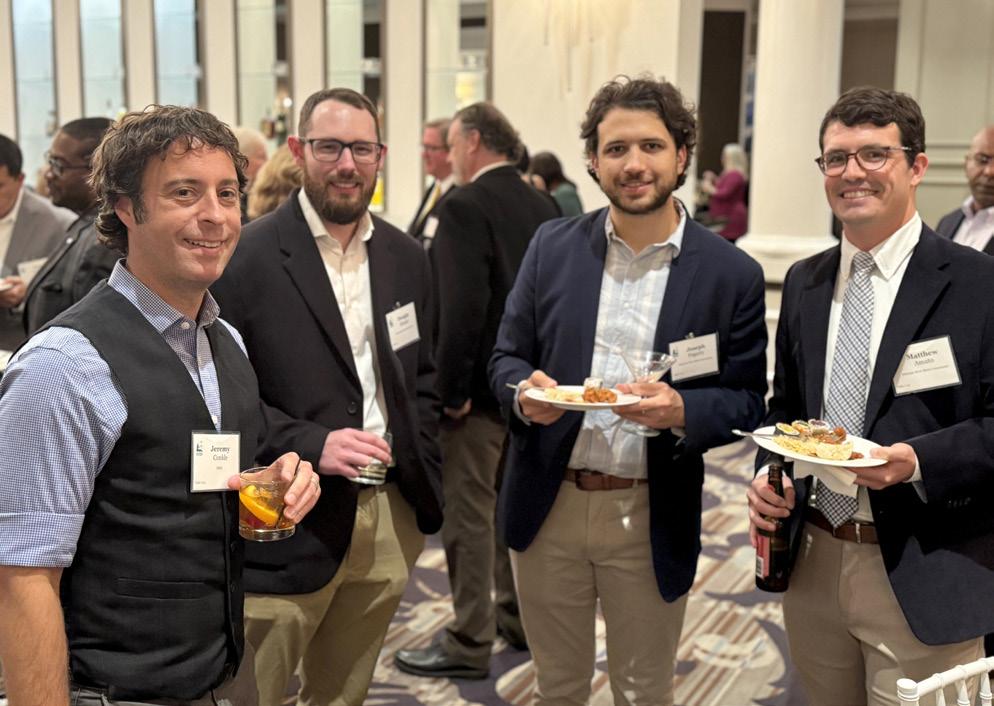
Guests at the Experience the Estuary Celebration enjoy cocktails, food, and conversation as part of the festivities.
Schuylkill River continued from page 7
engaged funders, and the partnerships and collaborative efforts of so many people and organizations that have contributed to the longevity and success of the Schuylkill River Restoration Fund. Guest speaker Tami Shimp, vice president of development and community relations at Berks Nature, echoed Fenchel by acknowledging the longstanding partnerships that have contributed to the Fund's success. She highlighted the role SRRF funding has played for Berks Nature, who received one of the first grants in 2006 for over $30,000.
With funding from the Philadelphia Water Department, Constellation, Aqua — an Essential Utilities Company, and Pennsylvania American Water, the future of the Restoration Fund
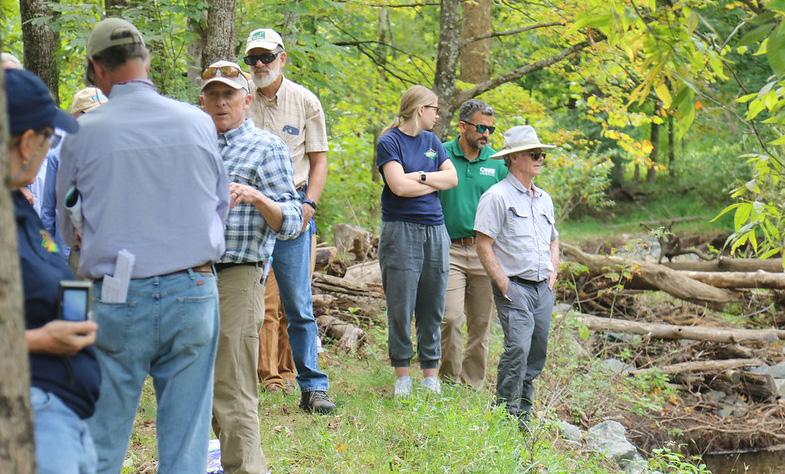
SRRF bus tour attendees look out at a portion of Camelot Park in East Greenville, Pennsylvania. Improvements came with the help from the Schuylkill River Restoration Fund, which celebrates its 20th anniversary this year.
looks secure. The solid foundation built over the past two decades will allow the Fund to continue to expand, improve water quality,
build communities, engage with the Schuylkill River, and preserve a healthy watershed for future generations.
For more information about the Schuylkill River Restoration Fund, the annual site tour, and how to apply for funding next year, visit: schuylkillriver.org/conservation/the-restoration-fund/
2025 SRRF GRANT AWARDEES
Berks County Conservation District - Cacoosing Creek
$84,000
Berks Nature - Hemsley Farm $99,475
Berks Nature - Willet Farm $54,290
Berks Nature - Miller Property $7,500
Courtesy Stable - Paddock Stabilization $40,000
Lebanon County Conservation District - Klinedell Farm $100,000
Manayunk Development Corp. - Canal Towpath Restoration $41,250
Woodmere Art Museum - Rain Garden $25,000
SAVE THE DATE: 2026 RASCL SUMMIT
March 5, 2026
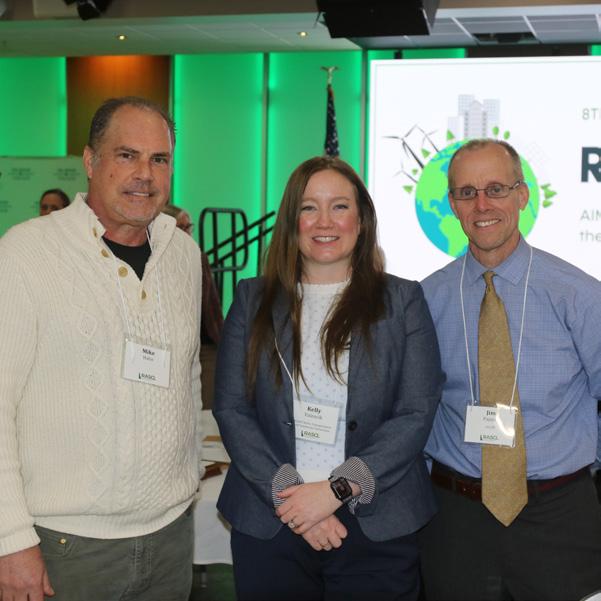
The 2026 Summit of the Delaware Resilient and Sustainable Communities League (RASCL) will be held at the Del-One Conference Center on the campus of Delaware Technical Community College in Dover. This milestone event marks RASCL’s 10th anniversary year, and the group is planning a Summit that’s both informative and celebratory, highlighting a decade of progress in ecological sustainability. Stay tuned for registration details at derascl.org
VOLUNTEER THIS SPRING: SAN SCRUB & PUB
Thursday, March 26, 2026
CHRISTINA RIVER WATERSHED CLEANUP
Saturday, April 11, 2026
Make a ripple in your community and local waterways! There are two impactful cleanup events this spring to help protect our local waterways:
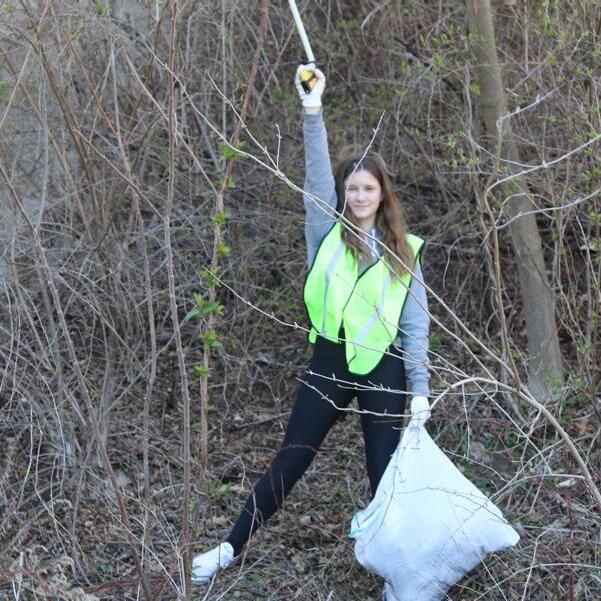
The Schuylkill Action Network’s (SAN) Scrub and Pub in Upper Merion Township, Pennsylvania is March 26. Help clean up the Schuylkill River Watershed and then unwind with fellow volunteers at Puddler’s Kitchen, where participants will receive a voucher for a free beverage. It’s a great way to give back and connect with others who care about the environment.
Two weeks later, Delaware celebrates Earth Month with the Christina River Watershed Cleanup at multiple sites across northern New Castle County. Volunteer to remove trash and debris from the Christina River Watershed — a vital source of drinking water for millions.
Over the years, volunteers at each of these cleanups have removed tens of thousands of pounds of trash, including tires, plastics, and other bulky items, all of which pose a threat to the health of our rivers and surrounding communities.
Registration opens soon for both events. Visit the SAN’s website for updates on the Scrub and Pub, and visit the Christina River Watershed Cleanup’s website for site information, registration, and more.
SUBMIT YOUR WORK: 2026 DELAWARE TRASH INTO TREASURE ART CONTEST
Deadline is February 13, 2026
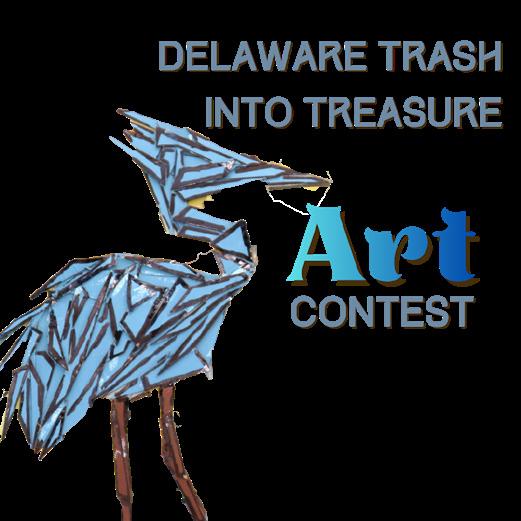
Calling all Delaware artists! Do you have a creative vision for a cleaner environment? Now’s the chance to showcase your work in the 2026 Delaware Trash Into Treasure Art Contest.
In order to participate, you can request a canvas from PDE and then submit your artwork depicting the importance of keeping the Christina River Watershed clear of trash and other pollutants. All finished work must be submitted by February 13, 2026, to be eligible for the contest.
This contest is associated with the annual Christina River Watershed Cleanup, scheduled for April 11, 2026. For contest rules and to request a canvas, visit bit.ly/TrashIntoTreasureContest. Don’t miss your chance to compete and win prizes.
THE PARTNERSHIP FOR THE DELAWARE ESTUARY CONNECTING PEOPLE, SCIENCE, AND NATURE FOR A HEALTHY DELAWARE RIVER AND BAY
The Partnership for the Delaware Estuary, host of the Delaware Estuary Program, leads collaborative, science–based efforts to improve the Delaware River and Bay, which covers portions of Delaware, New Jersey, and Pennsylvania. To find out how you can become one of our partners, call PDE at (800) 445-4935 or visit our website at www.DelawareEstuary.org
Partnership for the Delaware Estuary, Inc.
Kathy Klein (800) 445-4935, ext. 102 kklein@DelawareEstuary.org
Environmental Protection Agency
Irene Purdy, EPA Region II (212) 637-3794 purdy.irene@epa.gov
Megan Mackey, EPA Region III (215) 814-5534 mackey.megan@epa.gov
Pennsylvania
Jason M. Minnich Department of Environmental Protection (717) 787-0124 jaminnich@pa.gov
Delaware
Rachael Phillos Department of Natural Resources and Environmental Control (302) 735-3411
Rachael.Phillos@delaware.gov
New Jersey
Natalie Young Department of Environmental Protection (609) 940-4512 Natalie.Young@dep.nj.gov
Delaware River Basin Commission
Chad Pindar (609) 883-9500, ext. 268 chad.pindar@drbc.gov
Philadelphia Water Department Will Whalon (267) 207-0937 william.whalon@phila.gov
Editor
Kate Layton (800) 445-4935, ext. 113 klayton@DelawareEstuary.org
Estuary News encourages reprinting of its articles in other publications. Estuary News is produced four times annually by the Partnership for the Delaware Estuary, Inc. (PDE), under an assistance agreement (CE-99398517-2) with the U.S. Environmental Protection Agency (EPA). The purpose of this newsletter is to provide an open, informative dialogue on issues related to PDE. The viewpoints expressed here do not necessarily represent the views of PDE or EPA, nor does mention of names, commercial products or causes constitute endorsement or recommendation for use. For information about the PDE, call (302) 655-4990. Review Our Notice of Non-Discrimination, Request for Equal Access, and How to File a Complaint