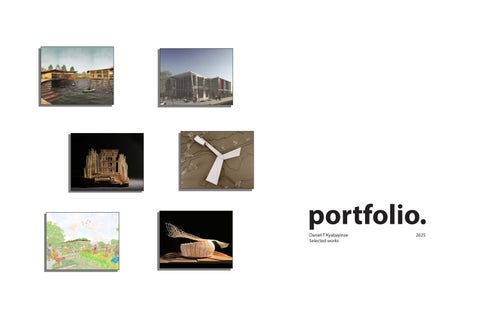
portfolio. Daniel T Kyabayinze Selected works
2025
Education Bachelor of Architecture (B.Arch.)
UNIVERSITY OF OKLAHOMA | NORMAN, OK
May 2028 GPA 3.98/4
International Baccalaureate (IB) diploma
MAY 2021
UWC Thailand
Daniel T Kyabayinze
Skills Design Tools Rhino 3D, Revit, QGIS, Enscape, D5 Render, Adobe InDesign, Photoshop, Illustrator Techniques Physical model-making, hand sketching, conceptual Drawing Soft Skills Collaboration, Leadership, Problem-Solving, Adaptability
Experience 2nd Year Architecture Studio Mentor
AUG 2025 Present
1st Year Architecture Studio Mentor
AUG 2024 May 2025
Facilities Student Supervisor
JAN 2024 Present
OU Gibbs College of Architecture OU Gibbs College of Architecture
Sarkeys Fitness Center, University of Oklahoma
Involvements National Organization of Minority Architecture Students (NOMAS)
FEB 2025 Present
National Organization of Minority Architecture Students (NOMAS)
JAN 2024 JAN 2025
Engineers Serving Others (ESO) |
SETP 2023 Present
Vice President
2nd year representative, 1st year represtative Volunteer Member
2
Selected Works
The Arc
SEAM
Studio Basilico
p4
p 14
p 18
Roots Village Communty Center
The Aviary
Other
28
32
38
3
4
The Arc at Lake Thunderbird The public boathouse at Lake Thunderbird begins with a simple question: how can architecture slow people down enough to actually take in the the environment around them. The project’s main idea is both the path and the shape. Gently curving along the shoreline, guiding visitors Daniel T Kyabayinze from parking at above, down toward the water. The slow descent marks a shift in mindset: leaving the car and enThe Arc at Lake Thunderbird tering a landscape curated to the by human experience of The public boathouse at Lake Thunderbird begins with a arc becomes a shared walking, rowing and gazing. The simple question: how canline architecture slow between people down of connection people, land, and water. Alamida enough to actually take in the the environment around them. The project’s main The ideabuilding is both the theporch at the lake. Storage and actspath as aand social Alamida shape. Gently curving along the shoreline, guiding equipment spaces anchor visitors the uphill side, while open from parking at above, down toward the water. The slow decks, gathering spaces and circulation paths stretch Daniel T Kyabayinze Human Power Water craft Boat house descent marks a shift in mindset: leaving the car and en- visible across the curve. toward the lake, keeping activity tering a landscape curated tocan the stand by human experience You at one edge and of watch others launch The Arc at Lake Thunderbirdwalking, rowing and gazing. The arc becomes a shared canoes or rest along the opposite side. Always keeping The boathouse on Lake Thunderbird is organized The public boathouse at Lake begins with a people, land, lineThunderbird of connection between andrhythm water. ofaround one part of a wider motion and pause around simple question: how can architecture slow people down a slow, curved path that guides visitors from land to used wa- openly for both them. Wood is the main material, enough to actually take in the environment Thethe building acts asaround a social porch and at the lake. Storage and structure surface, so the building ter. main Thisidea arc both and while form, creating afeels familiar, while them. The project’s is shapes both the path andmovement the equipment spaces anchorthe thesectional uphill side, open form trys to push but not veir far from the shape. Gently curving along the shoreline, guiding visitors gradual transition away from the car and toward theextend lake.as wooden decks decks, gathering spaces and circulation paths stretch tyology of boath house. Floors from parking at above, down toward the water. The slow toward the lake, keeping activity visible across the curve. that hoverpace, lightlyallowing over the changing water levels, supportencourages a enslower people descent marksThe a shiftbuilding in mindset: leaving the car and You can stand at one edge and watch others launch ed just enough to float above seasonal tering a landscape curated to by human experience of to arrive onthefoot, orient themselves to Always the shoreline, and shifts. rest along the opposite side. keeping walking, rowing and gazing.canoes The arcorbecomes a shared partlake of a wider rhythm motion andon pause around experience the before ever getting the water. Setofwithin Norman’s wooded edge, the roof rises toward line of connection betweenone people, land, and water. them. Wood is the main material, used openly for both the lake to catch light and breeze, while the back tucks andlake. surface, so quietly the feels familiar, The building acts as a socialstructure porch at the Storage andbuilding into the terrain. Thewhile concept is measured not by the sectional form trys to push but not veir far from the moments of pause, equipment spaces anchor the uphill side, while open form alone, but by what it allows: of boath extend wooden decks decks, gathering andtyology circulation pathshouse. stretch public visibility, a direct encounter Asspaces visitors move along theFloors deck, theyas and pass others stor- with nature and that hover lightly over the changing water levels, supporttoward the lake, keeping activity visible across the curve. fellow humans. Success here means visitors feel the tranlaunch, restingshifts. in the shade, or edpreparing just enough float above You can stand ing at oneboats, edge and watch otherstoto launch sition,seasonal from land to water, from speed to stillness, without canoes or rest along the opposite side. Always keeping watching activity on the water. curveThe keeps thesesimply clears the needingThe it explained. architecture one part of a wider rhythm Set of motion pause wooded around within and Norman’s edge, the roof rises toward way for that connection to happen. visible across space, reinforcing a shared them. Wood is moments the main material, used openly for the both the lake to catch light and breeze, while the back tucks structure and surface, the building feels familiar, while publicsoexperience rather separating programs. quietly into the terrain.than The concept is measured not by The the sectional form trys to push but not veir far from the form alone, but by what it allows: moments of pause, boathouse acts as a social porch—part infrastructure, tyology of boath house. Floors extend as wooden public visibility, and a decks direct encounter with nature and KEY Lakewater High 1041 that hover lightly overplace the changing supportpart to stay. fellow humans.levels, Success here means visitors feel the tranBUILDINGS MARINA TENT CAMP SITE ed just enough to float above seasonal shifts. sition, from land to water, from speed to stillness, without LAUNCHsimply clears the FIRE PIT ROADSneeding it explained. The BOAT architecture Set within Norman’s wooded edge, the roof rises toward for that connection toFISHING happen. PIER DUMPSTER PAVEDway SURFACE the lake to catch lightstructure and breeze, while the back tucks The is expressed through exposed glulam colDAM COVERED PICNICTABLE GAS STATION quietly into the terrain. The concept is measured not by umns that rise and branch into a light roof canopy, abform alone, but by what it allows: moments of pause, PICNIC TABLE PUMPING PLANT RV CAMPING public visibility,stracting and a directthe encounter with nature and wooded landscape behind the site. Wood is DELIVERY AQUEDUCTS TENT CAMP SITE CONVINIENCE STORE Lake High 1041 fellow humans. Success here means visitors feel the tranused throughout a warm, tactile environment. Lowcreate sition, from land to water, from speedLake toto stillness, without needing it explained. The architecture simply clears the The building meets the shoreline lightly, allowing water KEY way for that connection to happen. BUILDINGS MARINA
Lake Thunderbird Boat house
The Arc @ Lake Thunderbird
D5 - Prof. Rodriguez Lake Thunderbird Boat house
levels, movement, and human activity to shape the experience.
TENT CAMP SITE
ROADS
BOAT LAUNCH
FIRE PIT
PAVED SURFACE
FISHING PIER
DUMPSTER
DAM
COVERED PICNICTABLE
GAS STATION
PUMPING PLANT
PICNIC TABLE
RV CAMPING
DELIVERY AQUEDUCTS
TENT CAMP SITE
CONVINIENCE STORE
Lake Low
5 1”-16’ 0’
16’
48’
80’
Initial studies focused on topography, shoreline conditions, soil behavior, and water levels. The site was treated as an active system shaping access, movement, drainage, and the relationship between land and lake.
Early massing models explored spatial relationships rather than form, testing how program, circulation, and the shoreline interact before committing to a final geometry or architectural expression.
Plan and sectional explorations refined the form, balancing storage, launch docks, and gathering spaces while maintaining circulation as an experiential sequence rather than a purely functional. 6
Sketches tested a different circulation strategies that organize movement from parking to water. The form was intend frames views, slow movement, and maintains visual connection between people, programs, and the lake.
Site grading was manipulated to meet accessibility requirements while maintaining natural drainage patterns. Slopes were designed to guide water toward bioswales and rain gardens, reducing erosion and avoiding mechanical solutions to preserve the site’s existing character.
The final structural language abstracts the wooded landscape behind the site. Glulam columns read as trunks and branches, supporting a light canopy that provides shade and orientation while reinforcing the building’s relationship to the surrounding forest and lake. Through physical study models, the structural system evolved beyond pure function. Columns began to rise and branch, testing how structure could shape space, frame views, and contribute to the project’s narrative rather than simply support the roof. Physical models were used throughout the project to test grading, circulation, and structure at multiple scales. These studies allowed design decisions to respond simultaneously to technical constraints and spatial experience, guiding each iteration toward greater clarity.
The first structural iterations prioritized clarity and efficiency. Glulam beams and columns were sized and spaced to meet structural demands, establishing a functional framework that supported the building. 7
Site Plan
Lake Thunderbird Boat house Enlarged Plans
A
Daniel T Kyabayinze 1050 LP
5%
1050.25 LP
1051.75
5%
1050.35 1050.35
1050.5 HP 1051.5 1051.25 1052
%
6.67
5%
8.3%
1048.6
1051.95
8.3%
1048 TW 1046 BW
1046 TW 1044 BW
%
1049
5.5
4.0% %
4.4
4.0% 1046
%
4.4
4.0% 1043.0
sto
rag
1043.0
%
4.4
Lake Thunderbird Boat house Enlarged Plans
Lake Thunderbird Boat house Enlarged Plans
Daniel T Kyabayinze
Daniel T Kyabayinze
A
sto
rag
e
e
Kit ch
4.0%
en
4.0%
1045
A
1”-8’ 0’ 4.0%
8’
24
A
Bo
at re
pa
ir
N
6.67%
0.5
6.67%
1043.0
105
1051.4
1051.90
0.5
105
1051.95
7%
1051.47
6.6
7%
1051.47
6.6
1051.90
1051.4
1051.95
%
1051.25 TW
1051.25 TW
1050 BW
1050 BW
1050 TW
1050 TW
1048 BW
1048 BW
%
8.3
8.3
8.6
8.6
104
104 1048 TW
%
1048 TW
%
1044 BW
7 6.6
1046 TW
1046 TW
P
1.5 L
104
1044 BW
6.8
1044 BW
7 6.6
P
1.5 L
104
1044 BW
6.8
104
104
1”-16’ 0’
16’
48”
8.3%
3.45
104
8.3%
LP
3.45
104
3.65
LP 3.65
104
104
1041-1037
3
3
104
1043
8
104
1043(FF)
1043
1”-8’
1”-8’ 8’
0’
24
N
N
0’
1043(FF)
8’
24
5%
1050.5 HP 1051.5 1051.25 1052
%
6.67
5%
8.3%
1048.6
1051.95
8.3%
1048 TW 1046 BW
1046 TW 1044 BW
5%
1049
5.
4.0% %
4.4
4.0%
A
1046
%
4.4
B
4.0% 1043.0
sto
rag
% .4
e
4.0%
4.0%
1045
4
sto
rag
Kit ch
en
4.0%
Bo
at re
pa
ir
e
1043
OP
EN
(FF)
TO B
1043
ELO W
DW
EN
B
TO
BE LO W
A OP
1043.0
2n 2d ndF
looo r r
flo
1043(FF)
9
Section 2 Daniel T Kyabayinze
1043(FF)
1041’ (lake high) 1037’ (lake low)
1”-8’
10 0’
8’
24’
1043(FF)
Lake Thunderbird Boat house Section A-A 1043’ (finish floor)
1041’ (lake high) 1037’ (lake low)
1”-8’ 0’
8’
24’
1043
1038.4
1041 1040
1039 1038
1037
11
12
13
14
SEAM NOMAS OU SEAM was the University of Oklahoma NOMAS chapter’s proposal for reconnecting West Baltimore’s communities torn apart by the unbuilt “Highway to Nowhere.” Leveraging the future Red Line train, we proposed a campus of mixeduse interventions across disjointed site, restoring connectivity through transit-oriented development. The masterplan hosts four key nodes—The Canyon (Train stration), Ice Factory (adaptive reuse), Hive (Housing), and The Hill. Each activating public space, culture, and ecology in different ways. The Hill The Hill, where I was most involved, forms the project’s eastern gateway. Tucked into a rising slope at the edge of campus, it blends wellness, recreation, and ecology across multiple layers (sports courts, gathering lawns, water features, play areas, and a community garden), while disguising offstreet parking below. Involvement included refining circulation, landforms, and section to create a multifunctional civic landscape that celebrates and reconnects the sites history and promotes community use. Team: Hisham Ramoly, Roy Nitzan, Grace Hill, Ashley Gonzalez, Whit Hull, Drew King, Charles Kim, Sasha Alexander, Terry Chishimba, Eryne Degeorge, Seaira Hull, Albert Rogers, Fernanda Manuella.
15
16
NIGHT LIFE LIGHTING & SECURITY
OUTDOOR WORKOUT WELLBEING + LIVE
PUBLIC PARK WELLBEING + PLAY
MULTI-PURPOSE SPORTS COURT
Great blue lobelia Winterberry Joepye weed Black chokeberry Button bush Tussock sedge
PUBLIC FACILITIES GATHERING & MEETING POINT STORM-WATER FILTRATION POOL SUSTAINABLE STRATEGY
CONNECTION TO CANYON
NATIVE SPECIES OF THE CHESAPEAKE BAY
Swamp white oak Green ash
Roots are filtering the collected water, later reused to water the higher parts of the Hill.
ENTRANCE TO UNDERGROUND PARKING GARDENS WITH NATIVE VEGETATION WELLBEING + LIVE
KIDS PLAYGROUND PLAY
RAMPED PATHWAYS 1:20 FOR UNIVERSAL ACCESSIBILITY
17
18
Santa Fe Street façade perspective showing the Culinary Arts LAB. Brick louvers filter light, transparent greenhouse volume anchors the corner, and active glazing connects public bistro to downtown Norman’s street life.
Andrews Park
W
t aS aw nh
To
OK Culinary Arts LAB
W
SP ete
ySt Gra
rs A ve
t in S
Jam
es
Ma SS
ay ew
ay ew
SU
niv ers
on
ity
The Culinary Arts LAB is a hybrid facility for culinary education, nutritional wellness, and community engagement. Located in downtown Norman, the design ties food systems to urban life, celebrating the relationship between growing, cooking, and sharing food.
C OK
W
on
Ave
D4 - Prof. Rodriguez
St ws Da
Acares St
ar k NP
Studio Basilico
Blv d ins 6m
SW eb
sta
er
an ta
on
rne
rA ve
es
ula
fa Eu
Av e
Av e
3
W
t eS
Ga
nch
ma
Fe Co Av W e
SJ
St
5m
ins
t sS
me
W
Sym
che
W
e Ap
St
Parking Lots
121 Bus Route 024 Bus Route 110 Bus Route Train Tracks Pavement Largest Streets (3 lane) Larger Streets Regular Streets Train Station Bus Stop Bicycle Rack
Street Center Line
making temperatu
Buildable Area In summer, heat highs near 81°Fret (2 Critial View point taken Shared Lot Line limited greenery am shorter shadows d Street CenterPoorly LineLit Areas for pedestrians (Night) substantial shadin making temperature
Buildings
Our Site
Critial View point taken
Poorly Lit Areas for pedestrians (Night)
highs near 81°F (27° shorter shadows due substantial shading.
Urban General (5 stories allowable)
Detouched (4 stories allowable)
Buildable Area Shared Lot Line Street Center Line
Urban General (6 stories allowable)
The Well University of Oklahoma 10 mins walk Diameter
This project expanded my understanding of architectural programming and context-driven design, balancing practical spatial requirements, conceptual ambitions, and real-world constraints, including zoning restrictions, preservation of the urban edge, and managing an extensive program.
Winter microclima
andmicroclimat less solar expo Winter tial wind tunnels t Urban General (6 stories allowable) and less solar expos average temperatu tial wind tunnels th low freezing, south Urban General (6 stories Urban General allowable) (5 stories allowable) average temperature passive solar heati low freezing, southareas remain signi Detouched (4 stories allowable) Urban General (5 stories allowable) passive solar heatin Buildable Area summer,signi�� heat r areasInremain Detouched (4Shared stories Lotallowable) Line limited greenery a
Library
Studio Basilico responds to site and program through bold, context-driven form striving to relate to its sur§rounding . Key features include a demonstration kitchen theater, teaching kitchens, and a public bistro—blending vibrant public access with intimate learning environments.
Urbun Storefront General Commercial Urban General Detached City Buildings
Critial View point taken Urban Residential Poorly Lit Areas for pedestrians (Night)
Winter microclimate is shaped by strong northern winds and less solar exposure, creating cold pockets and potential wind tunnels that a�fect pedestrian comfort. With average temperatures around 41°F (5°C), also veering be low freezing, south-facing facades bene��t from some passive solar heating, while shaded and wind-exposed areas remain signi��cantly colder. In summer, heat retention from paved surfaces and limited greenery ampli��es the urban heat island e�fect, making temperatures feel more extreme. With average highs near 81°F (27°C) but alos exceeding 100°F (38°C), shorter shadows due high sun angles do little to improve substantial shading.
Urba
Urba
Mature Trees Green Spaces
Detou
Build Share Stree
0. 25
M
ile s
N
Poorl
Urban General (6 stories allowable) Urban General (5 stories allowable)
Winter microclimate is shaped by strong northern winds and less solar exposure, creating cold pockets and potential wind tunnels that a�fect pedestrian comfort. With average temperatures around 41°F (5°C), also veering be low freezing, south-facing facades bene��t from some
Critia
19
Culinary Culinary Arts Arts LAB LAB Conceptual Conceptual Massing Massing Studies Studies
RefinedRefined Iteration Iteration Building Building upon the upon firstthe iteration, first iteration, this refined this refined massing massing addresses addresses the transition the transition from urban from urban to residential to residential scale through scale through carefulcareful expanding, expanding, stacking, stacking, and and notching notching of volumes. of volumes. The additive The additive operations operations (in red)(inbuild red)up build the up volumes, the volumes, creating creating communal communal spaces,spaces, while while subtractive subtractive moves moves (in blue) (in enhance blue) enhance circulation, circulation, invitinginviting entires,entires, daylighting daylighting and view andframing. view framing. Result Result is a structure is a structure that engages that engages the street the and street surrounding and surrounding context.context.
20
Back of house
Bistro
Culinary Garden
Student Spaces
Admin
Teaching Spaces
rk
Pa
n ree /G
ea
Ar
ng
P
i ark
21
10 30
0
60
Fire Egress Food Path Trash Path
Changing Room + Bathrooms
Delivery Access
Changing Room + Bathrooms
Directors Office
Wine Room Admin Stuff
Storage
Confrence Room
Bistro
Receiving Area
Dish Wash
Lobby
Offices Food Storage
MC
22
Trash Room
Green house
Break Room
10 30
0
60
Fire Egress Food Path Trash Path
Teaching Kitchen
MC
Teaching Kitchen
Theater Kitchen
Classroom
Classroom
Data Reference Printer
Copy Room
Work/ supply
Green house
23
MC Printer
10 0
30
10 0
24
30
60
60
MC Printer
10 0
30
60
25
Eastern facade lined with offset brick mural inspired by the basil leaf. The bistro and rear entrances open directly into the community garden and parking. 26
Academic floor above opens into a central daylit atrium. Circulation wraps the bistro below, offering views down into the heart of the project and connecting daily movement with culmination of the Culinary experience. 27
COMMUNITY CENTER
28
NOMAS OU
Root Village Community Center NOMAS OU
Roots Village Multi-block urban redevelopment project in Kansas City MO cerntered around cultural restoration, housing justice, and intergenerational living. Anchored in historically disinvested Paseo West, the project prioritizes community agency through inclusive design, bringing together housing, wellness, entrepreneurship, and cultural infrastructure into a walkable, regenerative civic frameworks. Roots Village Community Center Within the village, I led the design of the Roots Cultural Center, including program development, spatial layout, and design narrative. A key focus was communty peticipation and flexible spaces such as youth media labs, co-working forums and wellness spaces. To support community ownership, cultural continuity, and a long-term social impact beyond architecture as static form. I am proud to acknowledge the OU NOMAS team who contributed to the greater success of the project: Ashley Gozalez, Terry Chishimba, Eryne Degeorge, Ty Brown-Field, Seaira Hull and Luke Hernandez
NOMAS OU
29
First Floor 30
Second Floor
NOMAS OU
NOMAS OU 31
32
BLER Building & landscape for Ecological Regeneration Macro Site Analysis
Daniel T Kyabayinze
miles
BLUE JAY
The Aviary
BLER - MAPPING HABITAT
D3 - Prof. Paulo Sanza 0’
Population spread
Seasonality
Daniel T Kyabyinze
Movement
-Fly at speeds of 20-25mph when unprovoked (Slow flyers). Making them easy prey to flying preditors
Building and Landscape for Ecological Regeneration
-The blue jay measures 9–12 in from bill to tail and weighs 70–100 g. With a wingspan of 13–17 in - Their migratory behavior remains somewhat mysterious, as some individuals may migrate one year and not the next
0.00m
0.25m
0.50m
0.75m
1.00m
1.25m
-It migrates during the daytime, in loose flocks of 5 to 250 birds. 1.50m
The Aviary is a space for ecological restoration, biodiversity prefoliation, and education. Designed to be a living extension of the landscape, it serves to actively educate and involve the community in advancing ecological resilience and sustainability.
1.75m
2.00m
2.25m
16’ 2.75m
Life Cycle
Constructed predominantly from wood, the structure hosts indoor and outdoor classrooms, research labs, offices, and a viewing platform to observe and engage with the expanding ecosystems north of the preserve.
365 days
Behavior -The blue jay is a noisy, bold, and aggressive bird.
7year lifespan
-Sound an alarm call when hawks or oth-
er dangers are near, and smaller birds often recognize this call and hide themselves away accordingly.
17–21days
1 :10000
-It may also be aggressive towards humans and other species who come close to its nest.
16–18days
6:50
20:00
16:30 August
Though this project i had my first experience working with a client the blue jays and conducting reseech on the the client, as well site analysis and the macro and the mezzo scale as to make more contextual informed designed choices
12:00
Preditiors
Hawks
Owls
Diet
Natural Habitat
Occupies a variety of habitats ranging from pine woods to spruce-fir forests. Less in denser forests, preferring mixed woodlands with oaks and beeches.
33
34
Curated building approch guides visitors along tree lined access path parallel to research wing. Supplemented by the striking observation tower to the right peeping form behind the swaying tree canopies .
Wood paneled interior classroom featuring large windows to maintain the buildings connection to nature while flooding the space with of natural light.
35
36
37
Renegade Vessels D2 - Prof. Zinger Cyclone Studio + Weaving the Storm The Cyclone Studio is a potteary designed to sit on Bruce Goff ’s Prairie House site drawing inspiration from the cylindrical forms and spiraling dissipation paths of the bomb cyclone. A skylight illuminates the main studio space, representative the eye of a storm. Surrounding the central studio, other programmatic elements populate the interstitial space similar to the swirling winds of the cyclone.
38
Weaving the Storm Oklahoma experiences a wide range of extreme weather events, we were tasked with researching, documenting, and representing weather phenomena three-dimensionally through drawings and physical models, to influence a structure or space we would later design. Among these, my strom was the Bomb Cyclone. A rapidly intensifying storm that earns its classification when the atmospheric pressure at its center drops by at least 24 millibars within 24 hours.
39
Land Vesssels D1 - Prof. Motamedi
Costa rica tree house - Olson Kundig The Land Vessels project introduced us to orthogonal drawings. The goal was to develop skills in reading, interpreting, and reproducing building plans, sections, and elevations by hand. Olson Kundig’s Costa Rica Tree House stood out for its vertical integration within the dense tree canopies of its forested hillside site. Overlooking Hermosa Beach, the house was designed for surfing-enthusiast clients and seamlessly blends architecture with nature. The final part of the project was a 1/4” scale model showcasing how the house integrates with the topography and surrounding forest canopy.
40
41
Thank you more comming soon....