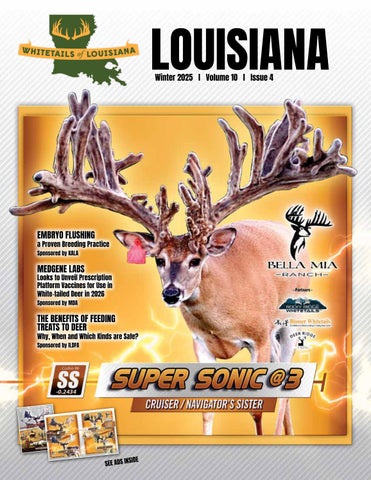
Looks to Unveil Prescription Platform Vaccines for Use in White-tailed Deer in 2026
Sponsored by MDA
THE BENEFITS OF FEEDING TREATS TO DEER
Why, When and Which Kinds are Safe?
Sponsored by ILDFA
Winter 2025 l Volume 10 l Issue 4
BRANDON BOLLINGER (‘26)
President 56099 Dohm Road Loranger, LA 70446
985-264-3437
bbollinger@gulfcraneservices.com
RICK PRIEST (‘27)
18610 Lake Harbour Ave. Baton Rouge, LA 70816
225-572-9212
rick@bigladeer.com
ZACARY MARTIN (‘27)
5530 Hwy 129
Jonesville, LA 71343
417-691-3316
zacarymartindjw@gmail.com
BJ CLARK (‘25) 38334 Shelby Drive
Denham Springs, LA 70706
225-445-4459
bjclark.ds20@gmail.com
JASON BORDELON 8834 Hwy 114
Cottonport, LA 71327
318-730-8254
jbordelon@sqsolutions.com
MYRA BOLLINGER
Administrator
Whitetails Of Louisiana P.O. Box 436, Folsom, LA 70437 985-892-0056 whitetailsoflouisiana@gmail.com
KEVIN MEADOWS (‘26)
123 Journie Grace Street Benton, LA 71006
318-423-8997
kevinmeadows0123@gmail.com
JARRETT ROGERS 625 Bear Creek Road Quitman, LA 71268 318-914-3049 drwhitetails.llc@gmail.com
KRISTINA ROTHSCHILD (‘24) 3220 Tisdale Road Eros, LA 71238
318-355-4197 krisrothschild@yahoo.com
JOSH MCCOY 3045 Westfork Baton Rouge, LA 70818 225-485-7205 jmccoy@dynamicgrp.com
Breeder Buck 2025 Showcase Magazine
We created this magazine in order for 2025 Breeder and Hunting Preserve advertisers to showcase their most recent photos of their bucks close to the last days of antler growth. We realize establishing a collective deadline for all states Fall magazines to publish on the same date to obtain last-minute photos would be impossible to achieve. With this magazine, advertisers have one more chance to showcase their bucks.
~ Thank you to all that participated!
If you’re interested in advertising or featuring one or more bucks in the 2026 Showcase please call 435-817-0150 or email deerassociations@gmail.com for more information. There are limited spaces available, call today to reserve your space!
Whitetails of Louisiana
Participation in CWD Task Force Encouraging
By: Gail Veley • Sponsored by Whitetails of Louisiana
With the goal of perhaps becoming the next “Oklahoma,” Whitetails of Louisiana President Brandon Bollinger and WOL Vice President Josh Kaplan have spent the better part of six months participating in the Louisiana Department of Wildlife and Fisheries CWD Task Force meetings. These meetings, the most recent one being December 3rd, 2025, are conducted at the State Capital in Baton Rouge, Louisiana, and have also included representatives from The Louisiana Department of Agriculture, The Louisiana Department of Natural Resources as well as owners of feed stores and others who are in some manner affected by CWD. In an effort to gather information, foster an understanding of CWD and what’s
being done to minimize it, lengthy discussions have taken place at each meeting. At an October 9th CWD Task Force meeting, questions were answered by Dr. Daniel Myrick, DVM, which focused mainly on the benefits of becoming a Certified CWD Free Herd (and the accountability system needed on behalf of all 241 deer farms and preserves combined) in Louisiana, to operate compliantly.
Leading up the genetic side of a meeting discussion on December 3rd was Arkansas Game and Fish, who strongly believe that Mother Nature, or albeit the concept of “survival of the fittest,” will ultimately weed out those deer who are more susceptible to CWD, and allow healthier deer to flourish. In addition, Dr. Christopher
Seabury presented his research on predictive genetics in a letter addressed to the task force. It included the following excerpt:
“Relevant to your interest in CWD management, and to my best knowledge, I am the only person in the world who has effectively cleaned up a CWD positive breeding herd to date; which included a combination of best management practices and the utilization of my custom technology,” Dr. Seabury wrote. His letter also included “it is clear that CWD-risk can be managed, mitigated, and even controlled within breeding facilities; with the overall effectiveness of our best management practices being subject to influence by state-level variations in implementation and
execution. I would be happy to work with you and the state of Louisiana to help mitigate CWD risk in your breeding facilities. Interestingly, mother nature does not over-fix problems; she doesn’t need freeranging deer to be 100% resistant to CWD infection. She only needs free-ranging deer to accumulate enough CWD resistance (on average) to become “tolerant”; meaning that they can often still become infected, but the disease does not
cause rapid or acute death that precludes reproduction. I hope state inferences and actions will be guided by real evidence, as opposed to the many common ideological talking points for which no meaningful scientific evidence exists.”
Bollinger and Kaplan are very grateful for their inclusion on the CWD Task Force and the invaluable contribution by Dr. Seabury. “We look forward to attending more
meetings and seeing where this goes,” Bollinger said. “We see our participation as vital to helping minimize CWD not only in Louisiana, but in other states, too.”
THE ART OF BOW HUNTING
GUIDANCE FROM PROFESSIONAL BOW HUNTER AND T.V. HOST TOM NELSON
By: Gail Veley • Sponsored by The United Deer Farmers of Michigan
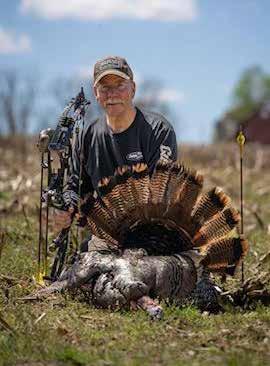
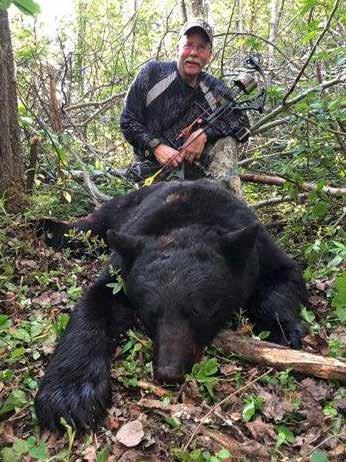
Tom Nelson sits quietly during the predawn of a crisp morning inside a deer blind, nestled deep among a meadow of mature trees and dense vegetation. He’s studied this copious area in his native Michigan, where he’s certain his next harvest will be found. His keen senses tell him a deer is coming, and he silently lifts his bow. Confident in his ability to take an ethical shot and efficiently utilize his effective range, he zeroes in on the broad side (where the heart and lungs are located) of a buck that’s just come into view. Knowing this shot for him cannot be a “maybe” but must be certain, Nelson, 67, knows exactly when to draw back the arrow and release. He does so with the precision that 50-plus years of experience has given him and is shortly thereafter standing over his patiently sought-out treasure.
“Bow hunting for me is my way of speaking to the woods with a stick and a string,” explained Nelson, a professional bow hunter and host of the television show “The American Archer.” To be an effective bow hunter “you must be woods-wise and deer savvy,” he said. “Unlike a gun that can do massive damage to an animal, an arrow doesn’t do that. An arrow essentially slides in and takes a little bit of time to take effect and then (hopefully) causes a quick and humane kill. That should be the objective of a bow hunter. You don’t want to be hitting them in the leg or in their back end.”
Nelson, who has hunted all over the world and harvested a wide variety of animals from mountain lion, moose, elk, turkey, mule deer and whitetail, has done so exclusively
with a bow. “I don’t know how many hunts I’ve been on where things might not have looked promising and the guide is telling me ‘Take my gun Tom, take my gun,’” he reflected. “But I will not be a ‘turncoat’ at that point. It won’t mean anything to me if that’s how it ends.”
Nelson, who has primarily made his entire living off of the sport of archery, still feels his very first harvest is and always will be his favorite. At the age of 14 he bought his first bow, a now vintage red wing hunter bow (with a 45-pound pull weight) and 12 fiberglass arrows at the now defunct Anderson Archery Store, where every conceivable bow hunting device could be found. “I lived three miles from the store,” Nelson said. “After I saved up enough money, I was able to buy my first bow. I thought I was all set. But I spent many fruitless years with nothing to show for it.” It was then over Christmas break during his sophomore year of high school, that he took triumphant aim and got his first deer.
Today, Nelson relives that very moment with the youth (both male and female) that he mentors and takes out bow hunting. “I show them the right way, how to figure out the whitetail puzzle,” Nelson explained. “Your learning curve is shorter if you learn the right way. I show them where to sit and why. I explain deer scat. I point out the small details such as why the deer will be coming a particular way to feed. They learn how to effectively operate a bow, when to draw back and release and to develop their personal effective range for taking a successful ethical shot. I teach them to aim exclusively at the chest cavity. Above all I teach patience and the love and reverence of being in the outdoors.”
“Bow hunting may be the more challenging and the harder way to hunt, but to me that is what makes it so rewarding,” Nelson said. “It’s also something my wife Beth and daughter Sara and I enjoy doing together. Like other bow hunters, we share a common bond as a family and a love of nature.”
Whitetails of Louisiana Magazine Deadlines 2026
Spring: February 24th
Summer: May 26th
Fall: September 8th
Northern Top 30 - Jan 14-16, 2026 - Shipshewanna, IN
Illinois Deer Farmers Association Fundraiser - Feb 20-21, 2026 - Altamont IL
Alabama Deer Association Spring Auction - Feb 21, 2026 - Cullman, AL
Iowa Whitetail Deer Association Winter Banquet - Feb 21, 2026 - Timberghost Ranch Lodge
Kansas Deer & Elk Association Convention - Feb 28, 2026
United Deer Farmes of Michigan Annual Convention - March 6-7, 2026, Bath Township, Michigan
Southeast Trophy Deer Association Spring Fling - March 6-7, 2026 - Orlando, FL
Whitetails of Wisconsin Annual Banquet & Fundraiser - March 13-14, 2026 - Wisconsin Dells, WI
NADeFA Spring Open - March 20, 2026 - Sandusky, OH
KALA Summer Showcase - Aug 8, 2026
Whitetail Deer Farmers of Ohio Convention - Aug 13-14, 2026
Southern Top 30 - Aug 20-21, 2026 - Louisiana
TDA Annual Convention - Aug 28-29, 2026 - San Antonio, TX
Winter: December 1st Use this QR Code or go online to DeerSites.com for more deadlines and up to date event
MK2™ Kit
Dependable Sedation Starts Here
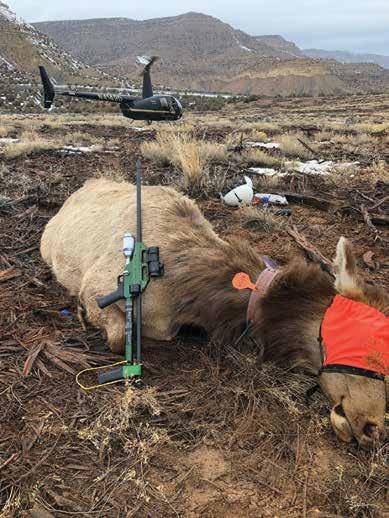
Gentle on the animal and trusted by veterinarians, handlers and owners for every species or procedure
e most widely used MK™ kit on the market. is formulation contains higher concentrations of active ingredients than the original MK™ kit, allowing for lower dose volumes and the use of a smaller dart, resulting in improved accuracy during capture.
Contains higher concentrations of active ingredients than the MKB Kit, allowing for lower dose volumes and a smaller dart to improve accuracy during capture. Recommended for super exotics and large cervids that may be more diffi cult to sedate.
is kit builds on our MKB™ formulation by adding midazolam for superior muscle relaxation and more reliable sedation. Recommended for immobilizing large exotic hoofstock species, including bongo, kudu, gazelle, eland, other African hoofstock and certain domestic wildlife species.
TOHIO ANNUAL EVENT DRAWS LARGE NUMBERS OF GENERAL PUBLIC
By: Gail Veley • Sponsored by the Whitetail Deer Farmers of Ohio
here were close to 1,800 people who attended The Whitetail Deer Farmers of Ohio (WDFO) convention in August of 2024. Approximately half were not deer farmers, but the interested and curious general public. The WDFO, a cornerstone of the deer farming community in the Buckeye State, appears to do a very commendable job of sharing their passion with those outside the industry, including hunters, non-hunters, families and children.
“With a mission to educate, unite and support deer farmers, the WDFO also strives to bring the broader public into the fold, helping them understand the nuances and rewards of this unique agricultural pursuit,” said Ivan Hochstetler, owner of Double H Whitetails in Wayne County, Ohio. Hochstetler, who has co-sponsored the annual WDFO event for the last two years, believes their Hallmark Feature and biggest crowd attraction at the annual event is the EXPO, a vibrant gathering Friday evening that includes dinner and a guest speaker. It typically draws both seasoned deer farmers and inquisitive visitors alike. The EXPO also serves as a platform to showcase the industry’s achievements with educational seminars, breeder displays and interactive demonstrations. “We sold 107 tables at $1,000 a table, and at least half were bought by non-deer
farmers,” Hochstetler explained. “An individual at each table won a gun.”
Beyond its focus on deer farming, the event throughout the years has gained a reputation for its community centered activities, including popular gun raffles as well as a special emphasis on honoring the veteran community, who also have their own table at each annual event. Event advertising is done through local newspapers, Facebook and various Ohio sporting goods stores.
“The Expo’s success and spirit of outreach can largely be attributed to the vision and dedication of our late Terry Klick, a passionate advocate for deer farming and a gregarious leader with the WDFO.” Hochstetler reflected. “Terry championed the EXPO as a way to connect deer farmers and the public, ensuring it became a yearly tradition. Being a veteran himself, Terry made certain they felt welcome, along with all the others. It not only advanced the industry but also fostered community camaraderie and goodwill. We gave a small gift to each and every child who attended the convention, 300 total this past year, along with hosting other family activities and the gun raffle that any adult who attended could potentially win.”
When Terry passed away in January of 2024, he left behind a legacy within the WDFO and the wider deer farming
community. His leadership and passion continue to inspire those who knew him, and the EXPO stands as a testament to his enduring vision. As the WDFO moves forward, it remains committed to honoring Terry’s memory by growing the EXPO and further strengthening its mission of education, unity and outreach.
“There isn’t a minute that goes by that we aren’t thinking about or planning for our annual event,” said WDFO Executive Director Levi Miller. “As an association, I’d say we are very blessed to live in the great State of Ohio. If anyone reading this hasn’t been to one of our events, you owe it to yourself to come. We’d love to see you.”
“The Expo’s success and spirit of outreach can largely be attributed to the vision and dedication of our late Terry Klick, a passionate advocate for deer farming and a gregarious leader with the WDFO.
THE BENEFITS OF FEEDING TREATS TO DEER
WHY, WHEN AND WHICH KINDS ARE SAFE?
By: Gail Veley • Sponsored by The Illinois Deer Farmer’s Association
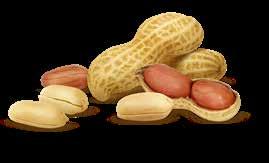
Staying on top of herd health finds many deer farmers to be big proponents of feeding treats to their whitetail deer. Safe options could include animal crackers, peanuts, marshmallows, horse treats made with oats, golden oreos or other similar non-chocolate cookies. “Feeding treats helps me to get a good look at them every day,” said Chase Baker of Baker Whitetails in Junction, Illinois. “Each deer has a distinct personality and if they aren’t acting like themselves then I know something is wrong. If I can get closer to one that normally I couldn’t or pet one I normally can’t, there’s a problem. Or if one that is normally friendly and right up front is hanging out in the back, then I know I need to attend to it. There could be any number of things wrong from a soundness issue, a wound or a virus.”
Baker, who prefers to feed animal crackers and buys them in bulk, also adheres to certain safety rules while feeding treats. He only feeds bucks outside the fence and never touches them. He also never wears gloves, to allow his deer to be familiar with his scent. Baker
also recommends feeding treats during a specific time of the day, to help ensure that expectant deer will be ready, waiting and easier to find. Through Baker’s year-round routine of feeding treats, it allows him to check for ailments specific to certain times of the year such as pneumonia in the fall or EHD in the summer months. While feeding treats year-round can be ideal, in places such as New York where winters can be much colder and more brutal, Dana Hoover of Mountainside Whitetails in Penyan, New York abstains in the winter from doing so. “Starting after NADEFA when the weather turns nicer, we start feeding treats again,” Dana shared. “I like to feed peanuts for the protein aspect and that way I won’t get sticky hands like I would feeding something like diced up apples. Peanuts rattle when they hit the ground, and the deer know the sound.”
Dana and his wife Ella feed treats from early spring until early fall and revel in the time they spend in the deer pens. They have found that throughout the winter, their deer tend to get wilder due to reduced interaction. As soon as the peanuts
come out and Ella resumes her daily practice of walking though the pens, the deer calm right down (and fawns get used to seeing humans from the very onset.) “This really helps our program,” Hoover said. “We can safely watch them grow and catch stuff early on. It also gives us a head start on any potential antler infections. We’ve definitely caught most of them early on during the years.”
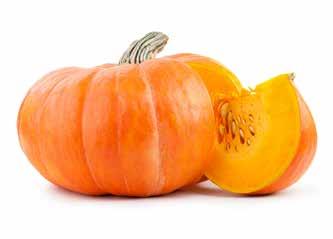
Medicinal benefits from other types of food such as raw pumpkin, also perceived by deer as a treat, is a natural dewormer as a result of the fiber content. In addition, acorns, watermelons, apples, alfalfa, soybeans and legumes provide vitamins, protein and energy. However, certain foods such as cucumbers, rhubarb plants, potato leaves, tomato leaves, onions, garlic, daffodils, foxgloves and poppies are either toxic, or generally unpalatable to deer, and should not be found near where they thrive. “If you have a garden, make sure it is fenced off properly and your deer are unable to get in there,” Baker said. “Regardless of whether you’re growing watermelons or tomatoes.”
EMBRYO FLUSHING A PROVEN BREEDING PRACTICE
By: Gail Veley • Sponsored by the Kentucky Alternative Livestock Association
When deer farmers tell Kevin Calmes “I know my deer,” he responds with “yes, but you don’t know the insides of your deer.” Calmes, who is a consultant and product shipper for Advanced Deer Genetics as well as the North American Small Ruminant Manager and Coordinator for Sexing Technologies, believes his specific recommendations for A.I. breeding and embryo flushing will provide a deer farmer with a safer and perhaps a more successful outcome.
Embryo flushing, often used to allow recipient does to carry the offspring of does with superior genetics, can be an efficient way to produce a uniformly high-quality herd. It all starts with placing CIDR’s in does with superior genetics, followed by follicle stimulating hormone (FSH) shots 11 days later and subsequently inducing multiple ovulations. In his years of experience travelling all over the world to work with cervids, Calmes has found that does, when run through a chute for any type of breeding procedure, tend to fight ovulation. “The stress put upon the doe by running them in a chute causes them to shut down in a sense,” Calmes, 57, explained. The better solution? “I prefer to run the deer into a facility, separated by ages, and blow dart FSH to get them to super ovulate,” he said.
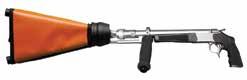
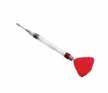
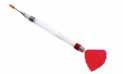
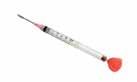
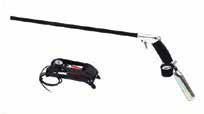
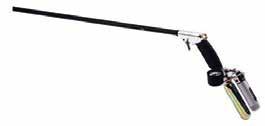
Calmes has found that does who are darted with a specially designed 2.5 cc syringe with an 18 or 19gauge one inch needle shot out of a small pistol, absorb all of the FSH hormone and don’t even know they’ve been hit, since the small size of the needle and force of the pistol is so minimal. “The first time I’m in
there they might be nervous, but by the second or third time they aren’t because they don’t know something hit them,” he said, referring to the dart which was designed years ago by Chinese scientists. And while the hormone can also be administered in a chute with a pole injection, very often you will have backflow and wasted product, decreasing your chances of fertilization success.
After two to eight FSH hormone shots have been administered, depending on protocols, CIDRS’s are pulled on day 14 and followed up with a hormone shot of pregnant mare serum gonadotropin (PMSG.) The next step involves laparoscopic artificial insemination (A.I.) ideally performed 57-58 hours later. Approximately six to eight days after that, embryos are flushed (as though it were another laparoscopic surgery in terms of preparation) however they are under sedation longer. After flushing and retrieval, embryos are placed in a petri dish and graded on a scale of one to three by an embryo specialist. Grade one embryos, considered the better ones, are either placed immediately into recipient does or frozen for later use. Grade two and three embryos, considered not as hearty as grade one, need to be placed into recipient does immediately as they may not retain their viability should they be
frozen and used later.
While a small percentage of does whose embryos are flushed may retain one or two and carry them to a full-term pregnancy “I suggest rebreeding her that same year naturally, to help break up the scar tissue from the previous procedures and not put any additional stress on her,” Calmes said. “We push these animals so much. And whether it’s the chemicals sprayed on what we feed them or a lack of chelated absorbable vitamins and minerals in their diets, I have also found in my work that our semen quality is driven down year after year. On average, ten years ago we had 4-6 billion cells per buck per collection, and today it’s 2 to 3 billion cells per collection. Given that deer genetics are held in such high regard, I believe the industry as a whole needs to sit down and look at this.”
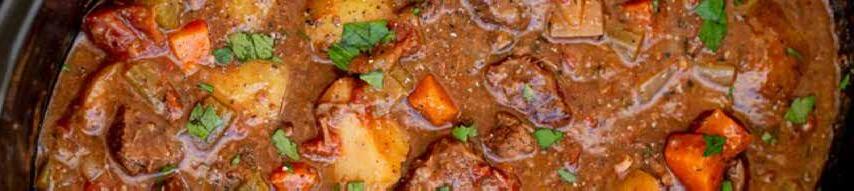
Thick & Hearty Slow Cooker Venison Stew
This thick, hearty and healthy slow cooker venison stew is made in the crockpot with tender hunks of deer meat, vegetables, and a rich & flavorful broth.
Ingredients
• 2 lbs. venison stew meat (or elk, antelope, moose, beef, bear – really any red meat)
• ¼ cup all purpose flour
• 2 tsp. salt, divided
• 1 tsp. pepper
• 1–2 Tbsp. high heat tolerant oil or fat (duck/deer/ beef fat, avocado oil, clarified butter)
• 1 lb. baby, gold potatoes, quartered
• 3–4 large carrots, diced
• 3 celery stalks, diced
• 1 onion, diced
• 4–5 garlic cloves, minced
• 2 tsp. Herbs de Provence
• 1 (15oz.) can diced tomatoes, drained
• 4 cups beef or venison stock
• ½ cup red wine (dry red like a Cabernet or Bordeaux is lovely)
1. Mix together the flour, 1 teaspoon of the salt, and 1/2 teaspoon of the pepper in a medium bowl. Pat the venison very dry with a towel to remove any liquid. Toss the venison chunks in the flour mixture until everything is coated and the flour is absorbed.
2. Heat a large skillet over medium-high heat and add the oil or fat. Once hot, sear the venison on all sides. You may need to work in batches to avoid overcrowding the meat.
3. Once seared, transfer the meat to the bottom of a slow cooker with the potatoes.
4. Then layer in the carrots, celery, onion, garlic, Herbs de Provence, the remaining 1 teaspoon of salt, the remaining 1/2 teaspoon of pepper, tomatoes, stock, wine, and Worcestershire sauce.
5. Set your slow cooker on low for 8-9 hours.
6. Optional (for thick stew) – After about 6 hours, remove a few spoonfuls of the broth and pour into a bowl or cup. Stir in the starch until the starch dissolves making a slurry. Pour the slurry into the stew, stir well and skew the lid for the remaining cook time.
7. Serve with crusty bread & get cozy!
SUDOKU
The rules for sudoku are simple:
A 9x9 square must be filled in with numbers from 1-9 with no repeated numbers in each line, horizontally or vertically.
To challenge you more, there are 3x3 squares marked out in the grid, and each of these squares can’t have any repeat numbers either.
Does the sound of antlers clashing make you cringe each fall?
PEACEMAKER
™
ENHANCED WITH APPETITE STIMULANTS & PROBIOTICS!
DESIGNED TO HELP INCREASE YOUR PEACE OF MIND... WHEN YOU NEED IT MOST!
Rut and reduced feed intakes can bring out the worst in bucks and irritable behavior can rear it’s ugly head!
PeaceMaker is scientifically formulated to provide optimal support levels of magnesium, Vitamin B1 and inositol to help maintain a normal and relaxed disposition in cervids
Now enhanced with appetite stimulants and probiotics for digestive health
Contains no herbals nor tryptophan, eliminating concerns of unwanted side effects
Use PeaceMaker™ to help “keep the peace” during pre-rut, rut, transportation and other key times during the year
Now available in a 30 lb resealable bag and 11.25 lb pail to help fit your operation’s needs
FAWN & DEER XTR™ PASTE R
ROBUST, FAST GI SUPPORT FOR FAWNS & OLDER DEER
Designed to quickly support normal GI health
Novel formula delivers powerful immune support
Can be used post tranquilization to help speed recovery
ENTERIC HEALTH FORMULA™
DIGESTIVE HEALTH & IMMUNE SUPPORT CERVIDS OF ALL AGES
Supports digestive health and a healthy immune system
Natural formula contains Encrypt®, egg proteins, enzymes, micro-encapsulated probiotics and a prebiotic
Top dress or mix in feed during fawning season, weather changes, times of stress and when top performance is desired
MEDGENE LABS Looks to Unveil Prescription Platform Vaccines for Use in White-tailed Deer in 2026
By: Gail Veley • Sponsored by The Missouri Deer Association
Deer farmers can feel optimistic about vaccine advancement by Medgene Labs in Brookings, South Dakota. If all goes according to plan, the prescription platform for white-tailed deer will be available in 2026. This will allow Medgene to offer more than an EHD vaccine to deer farmers, specifically an option to vaccinate against some strains of bluetongue. Bluetongue, an often fatal virus closely associated with EHD, is caused by the same vector, the Culicoides midge fly. Symptoms include fever, swelling of the head, neck and tongue, lameness, a loss of the fear of humans and the desire to be near water. Although Medgene Labs has a vaccine for EHD, they felt the need to expand to a prescription platform in whitetails because a specific bluetongue vaccine was just as necessary, said Medgene Labs Immunological Services (I.S.) Prime Director Ashley Petersen. “While bluetongue is very similar to EHD, having a vaccine specific to both is another part of a toolbox in overseeing the health and well-being of your deer,” she explained.
In order to test the safety of the prescription platform
technology, a vaccine Safety Study was conducted after four farms, one located in South Dakota, one in Oklahoma, one in Missouri and one in Ohio, agreed to allow their herds to participate. The study evaluated how safe the vaccine appeared for the target species (whitetailed deer) and recorded all reaction events that may have happened after an injection such as limping, soreness or not eating. Medgene’s currently available EHDV2&6 vaccine is manufactured differently than the methods used in the prescription platform system. Though the immune response is robust, “it didn’t matter if it was administered IM or SQ, the deer would be lame afterwards,” said Amy Nold of Nold Farms, LLC in Urich, Missouri. “I would say this new vaccine formulation shows great promise. Lameness is much less significant. I think it allows for more confidence while not inhibiting production.”
In addition, Nold felt there wasn’t a difference between how the does or bucks responded to the vaccine. Vaccines were administered starting December 16th, 2024, and followed up with a booster on January 4th, 2025. Every farm that participated reported their
observations back to Medgene Labs, who upon receiving the results, prepared and submitted a report to The Center for Veterinary Biologics, a division of the USDA located in Ames, Iowa. The center, which works to assure that safe and potentially effective veterinary biologics are available for the ultimate treatment of animal diseases, will more than likely need three to four months to review the report, Petersen said. Should the vaccine platform for use in white-tailed deer be given the greenlight, it will join others that subsist under Medgene Lab’s Prescription Platform License and will contain a “label claim” listing potential side effects. “I’m willing to use this vaccine on all of my deer,” said Nold, whose herd numbers exceed 200 head. “I say the risk is worth the reward in seeing our deer grow and in learning about and caring for one of God’s most wonderful creatures. Anytime you have an opportunity to participate in research, it’s always a pleasure and an honor.”
We love receiving your artwork! Here’s a standout coloring-book submission from last issue—keep them coming!
From Shyla, 9 Yr Old
Answers to puzzles will be available on our website: www.deersites.com
Coloring pages can be mailed to: Samantha Uchytil, 19291 59th St NE, New London, MN 56273 or emailed to deerassociations@gmail.com rr sent as a text message image to 320-905-2622 for a chance to be featured in the next issue!
members of Whitetails of Louisiana
If you would like your farm or business featured on our business card pages, email digital pdf file or scanned image (must be readable resolution) of your business card to the email address below.
This gives Whitetials of Louisiana members a way to reach out to one another for services and to buy or sell deer! There will be limited pages for these card spreads, first come first serve. The overflow would be placed in the next issue and cards will be rotated each quarter.
Email to:
Myra Bollinger whitetailsoflouisiana@gmail.com
I AM JOINING AS: (PLEASE CHECK ONE) ACTIVE MEMBERSHIP (VOTING PRIVILEGES): $100.00/YR.
ASSOCIATE MEMBERSHIP (NON- VOTING): $50.00/YR.
LIFETIME MEMBERSHIP (VOTING PRIVILEGES): $750.00
I HEREBY MAKE APPLICATION TO THE WHITETAILS OF LOUISIANA AND I CERTIFY THAT THE INFORMATION I HAVE PROVIDED IS TURE AND CORRECT TO THE BEST OF MY KNOWLEDGE:
Mission and Purpose :
To promote the business of raising and marketing Whitetail Deer in the state of Louisiana.
To promote high ethical standards in the care, handlin g, and harvesting Whitetail deer
To provide educational opportunities for members of the corporation and other interested people through the sharing of inform ation concerning whitetail deer.
To serve as a collective voice in governmental issues that affec t whitetail deer producers, so as to enhance the whitetail deer industry. To require members of the corporation to operate in a legal, honest and forthright manner with fellow members, other whitetai l deer producers and the general public
Mult-State Magazine Advertising Pricing Guide
Last chance to lock in 2025 rates, SIGN UP TODAY!
• Alabama Deer Association
• Illinois Deer Farmers
• Indiana Deer And Elk Farmers Association
• Iowa Whitetail Deer Association
• Kansas Elk and Deer Association
• Kentucky Alternative Livestock Association
Buckaneer
Package: *
44 ISSUES FOR 1 YR.
Reaching out to over 2500 members (11 Publications x 4 quarters)
17 State Associations - Approx. 2500 readers
$189 / Issue ($8316. / Yr) ~ Full Page
$107 / Issue ($4708. / Yr.) ~ Half Page (55-59% Discount off single ad placement)
Yearling Package:
*
4 ISSUES FOR 1 YR.
(1 Publication x 4 quarters)
$252/ Issue ($1008. / Yr) ~ Full Page
• Minnesota Deer Association
• Missouri Deer Association
• New York Deer and Elk Farmers Association
• North Dakota Deer Ranchers
• Pennsylvania Deer Farmers Association
• South Dakota Deer & Elk Breeders
• Southeast Trophy Deer Association
• Texas Deer Association
• United Deer Farmers of Michigan
• West Virginia Deer Farmers Association
• Whitetail Deer Farmers of Ohio
• Whitetails of Louisiana
• Whitetails of Oklahoma
Doe-Re-Mi Package:
*
16 ISSUES FOR 1 YR.
(4 Publications of your choice x 4 quarters)
$220 / Issue ($3520. / Yr) ~ Full Page
$121 / Issue ($1936. / Yr.) ~ Half Page (48-54% Discount off single ad placement)
$137 / Issue ($548. / Yr.) ~ Half Page (40-48% Discount off single ad placement)
Single Issue In Any Of Our Eleven Quarterly Publications: Full Page: $420.00 1/2 Page: $263.00
Exotic
Package Add On *
TEXAS DEER ASSOCIATION MAGAZINES
4 ISSUES FOR 1 YR. (Can be added to Buckaneer or Doe-Re-Mi package)
Reaching out to over 800 TDA members
(3 Tracks Publications & 1 Auction Catalog)
$428 / Issue ($1712. / Yr) ~ Full Page
$267/ Issue ($1068. / Yr.) ~ Half Page (55-59% Discount off single ad placement)
Single Issue In TDA Publications: Two Page: $1500. One Page: $950 1/2 Page: $650 NEW!
L OUISIANA D EPARTMENT OF A GRICULTURE & F ORESTRY