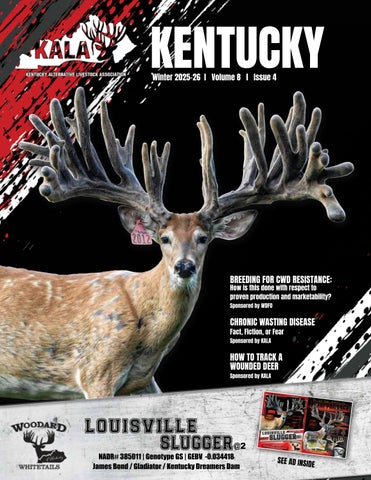
KY Winter 2025 Full Book

Page 1


BREEDING FOR CWD RESISTANCE:

How is this done with respect to proven production and marketability?

Sponsored by WDFO

CHRONIC WASTING DISEASE

Fact, Fiction, or Fear

Sponsored by KALA

HOW TO TRACK A WOUNDED DEER

Sponsored by KALA

Chronic Wasting Disease (CWD) is a contagious neurological disease

affects deer, elk, and other animals in the cervid family It is part

a group

illnesses

spongiform encephalopathies (TSEs), which are thought to be caused by abnormal proteins called prions CWD damages the brain, leading to behavior changes, weight loss, and eventually death Ongoing research particularly in genetics and herd management is providing promising paths toward understanding and controlling its spread

Understanding the Emergence of CWD & the Routes of Infection

Chronic Wasting Disease was first identified in 1967 at a government-funded research facility in Fort Collins, Colorado, operated by the Colorado Division of Wildlife It is believed that mule deer housed at the facility were exposed to Scrapies (a related prion disease) infected sheep These deer were later released into the wild, which is thought to have contributed to the initial spread of CWD into free-ranging populations CWD can be transmitted through a variety of biological materials and environmental pathways The level of infectious risk varies depending on the tissue or secretion Based on current research, the following are listed from highest to lowest relative prion concentration and infectious potential: brain tissue whole carcass remains, lymphoid tissues (e g , tonsils, lymph nodes), deboned skeletal muscle (meat), digestive tract contents and tissues, blood, saliva, feces, and urine To highlight the stark difference in prion concentration, it would take approximately 33,000 gallons of urine to equal the number of infectious prions found in just one gram of CWD-infected brain tissue

In addition to direct biological transmission, prions can also spread indirectly through environmental contamination including contact with soil plants farm equipment mud on vehicle tires predators like coyotes and wolves, and avian scavengers like crows, hawks, buzzards, and other migratory birds which can pick up prions from infected carcasses and spread them across the landscape

EXECUTIVE BOARD OF DIRECTORS

Jason Becker

PRESIDENT

Finley Ridge Whitetails 737 Finely Ridge Road Campbellsville, KY 42718 jasonbecker757@gmail.com 757-692-5820

Jake Anderson

VICE PRESIDENT

Anderson Whitetails 925 Guston Rd Guston KY 40142 andersonhvac7@gmail.com 270-547-8432

DIRECTORS

Daniel Stallard

Copper Creek Whitetails

500 Copper Creek Rd Dawson Springs, KY 42408 thestallards@yahoo.com 214-897-1958

Patrick Stanley

Twisted Tines Ranch / Crooked Creek Whitetails P.O. Box 130 Williamstown, KY 41097 kyarms@fuse.net 859-393-2422

David Miller

Forrestville Whitetails 1873 Forestville Rd Mumfordville KY 42765 270-537-5357

KALA ADVISORY BOARD

Henry Woodard

CHAIRMAN

Woodard Whitetails 9776 Roseville Rd

Glasgow KY 42141

woodardpropertiestn@gmail.com 423-595-8898

Grayson Steele

SECRETARY

ACE Whitetails 1404 Wendy Drive Lawrenceburg, KY 40342 grayson@unityridge.com 502-994-8656

WES BREWER

TREASURER

Bonehead Whitetails 210 Vincent Rd. Hodgenville KY 42748 mwb5304@yahoo.com 502-297-1309

Tony Maddox

Solid Rock Whitetails 725 Rabbit Town Rd Winchester KY 40391 solidrockwhitetails@yahoo.com 859-556-7253 • 239-340-1171

Josh Moore

J&L Whitetails 7129 Oakwood Road Maysville, KY 41056 jandlwhitetails@gmail.com 606-748-7563

Joe Miller

Kentucky Whitetals 4195 Penchem Rd Guthrie KY 42234 jmgreenlandsod@safecom.link 270-483-2140

Message from KALA President: Jason Becker

Winter 2025

Kentucky Deer Farmers,

Greetings and Merry Christmas to you and your families. 2025 was a busy year for KALA! Between the huge effort to defeat Kentucky House Bill 700, representation at the State Fair, the Summer Showcase Fundraiser, and several meetings with the Department of Agriculture to improve our industry, we have a lot to be proud of. With that said, 2026 will be just as busy as we enter a full Kentucky legislative year. It will be extremely important to have Kentucky Deer Farmers present in Frankfort to advocate for our rights and push back against harmful legislation that the Department of Fish & Wildlife and the League of Outdoorsmen will certainly be pursuing. KALA will be tracking all legislative efforts closely and let everyone know when we need to be there in person. We learned a lot this year and made allies in the house and senate that will be leveraged again in 2026.

KALA board of directors’ elections are held in the first quarterly meeting of the year, and we will have several openings this year. The meeting will be held on the 7th of February at the Washington County Extension Office. I highly encourage anyone who meets the requirements and wants a more direct role in how KALA operates to please submit your name for consideration. There are Advisory Board positions available as well. The Advisory Board are not voting members, but they attend meetings, provide input, and are included on Zoom meetings and texts outside of Quarterly meetings. The only qualification required is to be a Kentucky Deer Farmer and a desire to be involved. We need all the help we can get.

KALA continues to work hard in the interest of all Kentucky Deer Farmers and Preserve Owners. CWD remains the cloud over our industry, but I think tides are turning in response to government attempts to “control the spread”. As CWD research continues, better days lie ahead, particularly if they figure out a blood test. Thank you to all the KALA members that have worked so hard this year. We look forward to seeing a big crowd at our next meeting. I hope everyone had a great holiday season and a Happy New Year!

Sincerely,

Message from Magazine Chairman: Grayson Steele

Winter 2025

Hey y’all! Happy Holidays!! I hope you had a great time with family and got some well-deserved time to rest, even though farming never stops.

This is a friendly reminder that annual membership dues are due by November 15th. Our records show that there are still outstanding invoices for membership renewals. THANK YOU to those of you who have already submitted payment; we really appreciate your support! If still have an open invoice, we kindly ask that you take a moment to review and complete your renewal to ensure uninterrupted membership benefits. Renewing your membership is more than just staying current—it helps strengthen a unified voice for alternative livestock producers across Kentucky (and the nation, really). Members receive our quarterly magazine, regular news and updates (including meeting minutes, which are posted on the website for members only to view), access to educational opportunities, and the continued support and advocacy of an organization working on your behalf. Your membership helps ensure we can continue providing resources, representation, and connection within our industry.

As we look ahead to next year, we are excited to share our 2026 meeting dates and hope you will plan to join us:

• February 7th – Meeting at Washington County Extension Office (Board and Advisory Board elections will take place)

• May 9th – Meeting at Washington County Extension Office

• August 8th – Summer Showcase at Shelbyville Conference Center

• December 5th – Meeting (Location TBA)

One of the greatest strengths of our association is the connection between our members. Through meetings, events, and shared communication, membership creates opportunities to learn from one another, build relationships, and strengthen our sense of community. By staying involved, you help foster unity within the alternative livestock industry—bringing producers together to support one another, share knowledge, and work toward common goals that benefit us all.

We truly value your involvement and hope you will continue to be part of our growing association. Please don’t hesitate to reach out if you need help or have questions about anything! We’re happy to help.

Thank you for your continued support, and we look forward to another great year together. See y’all in February, Lord willing!

KALA FARM FEATURE

BRAVERY WHITETAILS - THE BOYERS FAMILY

FROM FIREFIGHTER TO FARMER: A JOURNEY FUELED BY PURPOSE & ROOTED IN FAMILY

In a quiet corner of Northern Kentucky, what began as a retirement idea has transformed into a family-powered whitetail operation built from the ground up. For Brian, owner of BrAvery Whitetails, the farm’s origin is as personal as its name.

“I combined my kids’ names—Brody and Avery—and BrAvery was the best I could come up with,” he joked. But behind the lighthearted explanation lies a story shaped by determination, risk, and a profound love for whitetails.

While Brian leads the operation, he is quick to highlight that the farm’s success has been a true family effort. His wife Jessica, son Brody, daughter Avery, Uncle Bob Scott, and cousins Jake, Brady, and Zach Wells have all played major roles. “My family has been instrumental in everything we’ve built,” Brian shared. “Without them, none of this would have been possible.”

Brian’s journey into deer farming began as he neared retirement from his career as a Firefighter/ Paramedic. Unsure of his next chapter, he stumbled upon Keith Warren’s Deer and Wildlife Stories on YouTube. “I fell in love immediately,” he said. Having already spent 15+ years managing

the family property for deer and turkey hunting, the idea of entering the cervid industry felt like a natural extension of his passion.

Bringing that passion to life, however, wasn’t simple. Brian says the accomplishment he is most proud of is “just bringing our vision to life.” The journey of grit from building facilities on land while learning an entirely new industry unique to Kentucky’s cervid world is a tough challenge to navigate. But through those challenges came strong relationships that made it worthwhile.The most recent milestone standing out: “This year we were also very proud to complete our first AI.”

Brian also vouches, “One of the greatest accomplishments has been connecting with really great people in this business,” he said. And when asked what advice he would give new farmers, Brian didn’t hesitate: “Be patient, and be humble. Making quality business and personal connections in this industry is vital for success.”

He is equally honest about the things he wishes he had known when starting out. “To be honest, the government’s control over this industry is very scary,” he said. “I wish I had spent more time

understanding the state’s ability to control our private property.” He encourages new farmers to seriously consider the realities of CWD and the stress that comes with government oversight. “You have to ask yourself—is the risk worth the reward? Is the stress of government overreach worth the potential income and enjoyment of raising cervids?”

For Brian, the answer was yes— because of his deep connection to the animals. “I chose to continue when I could have backed up and punted early on with minimal losses, I absolutely love my deer. They bring me enjoyment and a purpose,” he said. Even then, he acknowledges

the emotional toll that can come with the territory. “Deer will die. It always feels like it’s your favorites. Follow your protocols, stay the course, pray a bit, and hope it works out.”

As the industry evolves, Brian’s goals have shifted as well. While his original focus was producing big, healthy stocker bucks, the growing influence of CWD has guided him toward prioritizing genetic advancements with GEBVs and codon markers. Stocker bucks will remain the core part of the farm’s income, but building for the future has become just as important.

Brian also has a message for his fellow KALA members: unity is everything. “We are much stronger together than not,” he said. “We might have different priorities and

feelings, and sometimes agreeing to disagree is okay, but if we can stick together, our time is coming. More legislation will be brought forward, and we need to band together and do anything to protect our livelihoods and our private property.” Standing united matters.

He also wanted to express sincere gratitude to those who have stepped up to lead. “I’d like to thank the members of the KALA board, current and past, for donating their time and talents. I know it’s not easy.” Brian finished with, I’m proud to be a Kentucky deer farmer.”

The Boyers family’s determination, unity, and willingness to stand up for what matters embody the very spirit of our industry. KALA is proud to count them among our deer farmers. Families like

theirs are the backbone of our organization and are the ones who give our organization strength to stand united and navigate ongoing challenges including government pressures.

• All-Milk Protein from Premium Food-Grade Milk Ingredients

• Essential Vitamins and Complex Minerals

• Balanced Fatty Acids

• Improves Digestion

• Promotes Growth and Performance

FEEDING DIRECTIONS: WHITE-TAILED DEER:

• Fawns up to 1 week of age: Feed 16 oz. of formula daily, divided into 4 – 6 feeding.

• Fawns 1 week to 1 month of age: Feed 24 to 30 oz. of formula daily, divided into 4 feedings.

• Fawns 1 month to 2 months of age: Feed 30 to 35 oz. of formula daily, divided into 2 to 3 feedings.

• Fawns 2 months to weaning: Gradually decrease formula and number of feedings to approximately 15 oz. of formula once daily until fawn is fully weaned at 12 to 14 weeks of age. Provide a weaning diet and fresh clean water to the fawn.

For oral use only. These feeding directions are guidelines. As each animal is an individual, the feeding rate may be increased or decreased according to the needs of the neonate.

Feeding directions for other species can be found on our website.

• No Refrigeration Needed

• Easily Palatable

• 18 Month Shelf Life

• Available in 20# & 8# pails

• 24/7 Technical Advice & Support

• Formula for other Exotics and Wildlife Available

Science that delivers the health & productivity you require

G FORC E™

SCIENTIFICALLY FORMULATED NATURAL SUPPLEMENT TO HELP GROW LARGE, HEALTHY DEER AND BIG ANTLERS!

Nutrient rich formula contains highly bioavailable ingredients, including our proprietary calcium/phosphorous complex with Antler D TM, that are required to support body and bone growth, especially for fast growing bucks

Contains probiotics and targeted enzymes to support gut health and proper digestion

Available in pellet or powder that can be top dressed or mixed in feed. Great for antler growing season and young bucks, too

PeaceMaker

PRECISELY FORMULATED TO HELP MAINTAIN A NORMAL AND RELAXED DISPOSITION IN ALL CERVIDS

Provides optimal levels of magnesium, Vitamin B1 and inositol to promote calmness and provide help for restless animals

Contains no herbals, tryptophan or chemicals, eliminating concerns of unwanted side effects

Use PeaceMaker to “keep the peace” during pre-rut, rut, transportation, weaning and anytime destructive behavior may occur

ENTERIC HEALTH FORMULA

POWERFUL SOLUTION FOR HEALTH & PRODUCTIVITY

Helps maintain digestive health and productivity

Contains micro-encapsulated probiotics, targeted enzymes and a novel fiber complex

Use in does before fawning, during lactation and all cervids during times of environmental stress

FAWN ARRIVAL™ POWDER & PASTE

HELPS PRODUCE HEALTHY, FAST GROWING FAWNS

Helps maintain normal digestive health

Supports a healthy immune system

Feed powder for 14 days to bottle fed fawns

Paste is ideal for fawns left on does

FAWN & DEER XTR™

ROBUST FAST RESPONSE FOR FAWNS & OLDER DEER

Innovative formula delivers max digestive support, especially in newborns

Rapidly delivers help for GI health and a functioning immune system

May also be used post-tranquilization to support healthy recovery

Dependable Sedation Starts Here

MK2™ Kit

(Medetomidine/Ketamine 10/200 mg/mL + 2X Atipamezole 20mg/mL)

MKB™ Kit PROPRIETARY FORMULA PROPRIETARY FORMULA

e

MKB2™ Kit PROPRIETARY FORMULA

(Medetomidine/Ketamine/Butorphanol 20/100/50 mg/mL + Atipamezole 40mg/mL + Naltrexone 50mg/mL)

(Medetomidine/Ketamine/Butorphanol 10/50/25 mg/mL + Atipamezole 20mg/mL + Naltrexone 25mg/mL)

Contains higher concentrations of active ingredients than the MKB Kit, allowing for lower dose volumes and a smaller dart to improve accuracy during capture. Recommended for super exotics and large cervids that may be more diffi cult to sedate.

MKBM™ Kit PROPRIETARY FORMULA

(Medetomidine/Ketamine/Butorphanol/Midazolam 20/100/30/20 mg/mL + Atipamezole 40mg/mL + Naltrexone 50mg/mL)

is kit builds on our MKB™ formulation by adding midazolam for superior muscle relaxation and more reliable sedation. Recommended for immobilizing large exotic hoofstock species, including bongo, kudu, gazelle, eland, other African hoofstock and certain domestic wildlife species.

UPCOMING KALA MEETINGS:

Feb 7th – Meeting at Washington Co. Extension Office (elections will be taking place for Board members and Advisory Board members)

May 9th - Meeting at Washington Co. Extension Office

Aug 8th – Summer Showcase at Shelbyville Conference Center

Dec 5th - Meeting at TBA For Questions Contact: Grayson Steele grayson@unityridge.com

Chronic Wasting Disease

Fact, Fiction, or Fear?

Genuine Solutions Start with Proven Science

Genetics Are the Game Changer

Chronic Wasting Disease (CWD) is a contagious neurological disease that affects deer, elk, and other animals in the cervid family. It is part of a group of illnesses called transmissible spongiform encephalopathies (TSEs), which are thought to be caused by abnormal proteins called prions. CWD damages the brain, leading to behavior changes, weight loss, and eventually death. Ongoing research—particularly in genetics and herd management—is providing promising paths toward understanding and controlling its spread

Understanding the Emergence of CWD & the Routes of Infection

Chronic Wasting Disease was first identified in 1967 at a government-funded research facility in Fort Collins, Colorado, operated by the Colorado Division of Wildlife It is believed that mule deer housed at the facility were exposed to Scrapies (a related prion disease) infected sheep These deer were later released into the wild, which is thought to have contributed to the initial spread of CWD into free-ranging populations

CWD can be transmitted through a variety of biological materials and environmental pathways The level of infectious risk varies depending on the tissue or secretion Based on current research, the following are listed from highest to lowest relative prion concentration and infectious potential: brain tissue, whole carcass remains, lymphoid tissues (e g , tonsils, lymph nodes), deboned skeletal muscle (meat), digestive tract contents and tissues, blood, saliva, feces, and urine To highlight the stark difference in prion concentration, it would take approximately 33,000 gallons of urine to equal the number of infectious prions found in just one gram of CWD-infected brain tissue.

In addition to direct biological transmission, prions can also spread indirectly through environmental contamination, including contact with soil, plants, farm equipment, mud on vehicle tires, predators like coyotes and wolves, and avian scavengers like crows, hawks, buzzards, and other migratory birds which can pick up prions from infected carcasses and spread them across the landscape.

Genetics Matter: The Future of CWD Management

Genetics are becoming a key tool in the fight against CWD Researchers have identified specific gene variants in deer especially the PRNP alleles 96S, 95H, and 226K that are linked to greater resistance or slower progression of the disease Dr Christopher Seabury at Texas A&M has led much of this research, showing that selective breeding based on these genes can improve resistance in captive herds. Deer farmers across the country are integrating genetic testing to guide breeding, helping build stronger, more resilient populations. Farmed deer also offer valuable data for studying how CWD spreads and how genetics influence it insights that are hard to gather in the wild. Experts like Dr. Nicholas Haley at Kansas State University have worked closely with the deer farming industry, confirming that genetics can play a major role in managing CWD. By applying cutting-edge science and partnering with researchers, deer farmers are helping protect their herds and contributing to broader efforts to control the disease

Debunking the Myths, Advancing the Science

CWD has become a fear mongering topic for many, often misunderstood due to inconsistent and sensationalized narratives from government agencies and the media While the disease does affect the deer, its nature, transmission, and impact are far from the catastrophic threat portrayed by fear-based policies When grounded in science, the evidence is clear and common lies are effectively dispelled

One of the most common claims is “CWD is always fatal ” However, symptoms usually take 4–5+ years to appear, yet the average lifespan of a wild deer is only 3-4 years, so most never live long enough to show symptoms

The standard response from many wildlife agencies has been testing followed by depopulation Hunters are urged to test their harvests for CWD but no meaningful no next step is provided, other than calls for mass culling But depopulation is not the solution Several state agencies have used CWD to justify extreme management measures such as mass culling, bans on feeding and baiting, and restrictions on deer movement despite limited evidence of CWD being an actual population-level threat in many regions Sharpshooters and expanded hunting have been deployed, yet deer populations have grown, and CWD continues to spread In Wisconsin, over 172,000 deer were killed in an aggressive effort to stop CWD in 2008 Yet today, their deer population is 73% higher, according to Dr Seabury, a genomics expert and wildlife biologist at Texas A&M In fact, CWD has never wiped out an entire deer herd From 1970 to 2021, U S deer populations grew by 568%, according to the U S Forest Service and USDA reported numbers It’s obvious, CWD is not a long-term threat to deer populations. Deer rebound quickly. After mass-kills in Wisconsin, deer numbers returned to pre-cull levels within a few years, and CWD still spread and they are still one of the most infected states. Prions can remain infectious in the soil for years, meaning depopulation does not eliminate the source. Predators and scavengers further disperse prions by consuming and moving infected carcasses. And because depopulation only reacts after infection is found, it offers no strategy for long-term management or resistance.

Nature, is adapting, but we’re standing in the way. Some deer naturally carry the 96SS PRNP genotype, which is extremely resistant to CWD Depopulation efforts indiscriminately kill these genetically resistant animals, slowing the natural development of herd resistance In short, we are eliminating the very deer that could help solve the problem Since CWD was first discovered in the 1960s, the U S whitetail population has grown from an estimated 300,000 in the early 1900s to around 30 million today This dramatic increase proves that while CWD is a real concern, it is not the devastating threat to deer populations that fear-based narratives would have us believe

If CWD were truly apocalyptic, why has the population exploded in the 58 years since the disease was first detected? And yet, despite decades of failed outcomes, states continue to follow the same agency-driven strategies strategies that have failed to stop the spread of CWD and in many cases made the situation worse The question must be asked: why are we still relying on approaches that have repeatedly proven ineffective, instead of turning to those actively working toward real solutions like deer farmers who are investing in genetics, testing, and long-term herd health? It’s time to shift the focus from fear to facts, and from destruction to innovation

Cave City, Kentucky August 28th 2026 Early

Cave City Convention Center

Only a limited amount of buck space availableReserve your buck today!

To submit consignments or reserve booths contact: David Miller - 270-537-5357

Deer Farming & CWD: What You Need to Know

A Science-Based Approach to Managing CWD

There is a viable option to CWD management: genetic selection for reduced disease susceptibility Deer farmers are actively pursuing this progressive approach unlike the wildlife agencies

Deer farmers are already making a difference accelerating what nature alone cannot do quickly Research led by Dr. Chris Seabury at Texas A&M University has shown that the PRNP genotype can predict susceptibility to Chronic Wasting Disease with over 80% accuracy. Through selective breeding, farmers have been producing deer with resistant genetics (SS-genotype), which is proven to be extremely resistant to CWD.

Oklahoma is taking this proactive approach into action with tangible, on-the-ground initiatives. In 2024, Oklahoma passed House Bill 3462 the CWD Genetic Improvement Act which enables the state to begin purchasing SSgenotype deer from deer farmers in 2026 to release into wild populations. This will enhance the genetic durability of Oklahoma deer against CWD, further showing that deer farmers are the way to strengthen long-term herd resilience.

We've successfully applied this same approach before sheep farmers used selective breeding to nearly eradicate scrapie, a prion disease closely related to CWD Scientists identified that certain genetic markers specifically variations in the prion protein gene (PRNP) determined an animal's susceptibility or resistance to the disease There is no reason deer cannot follow the same path Deer farmers are applying similar science to manage CWD in deer with genetic resistance to track and control its spread Deer farming plays a vital role Instead of killing deer, we can breed better deer

CWD and You

While public fear persists, it's important to note that CWD has never been shown to infect humans. Controlled studies involving CWD-positive venison fed to macaques and squirrel monkeys have shown no transmission, even after years of monitoring. Both the CDC and WHO continue to affirm that no human case of CWD has ever been recorded, despite millions of hunters consuming venison from CWDendemic regions for decades Studies show humans have a strong genetic barrier against it

Why Deer Farming Matters

Tracks and selects for CWD-resistant genetics

Speeds up nature’s resistance-building

Provides the only real long-term plan for managing CWD

Creates healthier, stronger deer populations over time

EHD vs CWD

EHD was first reported in New Jersey in 1955 EHD kills deer rapidly and in large numbers, even up to 90-100% of whole herd populations It’s common to have widespread die-offs during late summer and early fall Deer with the peracute form typically die within 8-36 hours.

Results of Confusion

CWD and EHD are often misunderstood and confused, partly due to inconsistent messaging and misleading narratives from government agencies and the media While both diseases affect deer, their nature, spread, and impact are very different Deer farmers and hunters see far more visible

CWD

Chronic Wasting Disease

Cause: Abnormal prions (misfolded proteins)

Symptoms: Weight loss, drooling, behavioral changes, lack of coordination

EHD

Epizootic Hemorrhagic Disease

Blood-borne virus by biting midges (gnats, flies, no-see-ums)

Fever, swollenness, respiratory distress, internal bleeding, lethargy

Transmission: Spread by insect bites

Contaminated environment or animal-to-animal contact

damage from EHD yet are told CWD is the greater threat The result is a growing belief that the danger of CWD is being overstated to justify government overreach, research funding, or policy agendas, while the more immediate and deadly effects of EHD are downplayed or ignored

OK HB3462 - CWD Genetic Improvement Act

Wisconsin DNR & Wisconsin University presented at the 4th International CWD Symposium - (https://intcwdsympo.wordpress.com/agenda/)

Seabury, C. et al., Texas A&M University – Predictive Genomics for CWD Resistance

Wisconsin DNR Reports – CWD Management and Population Trends (2002–2020)

USDA APHIS – Scrapie Eradication Program Success CIDRAP – University of Minnesota (2023) – CWD Prevalence in Wisconsin Herds

Oklahoma Ecology Project (2024) – Critics and Supporters of Genetic Resistance Programs

CDC / WHO Statements on CWD & Human Health (2024)

Race et al., NIH Rocky Mountain Laboratories (2009–2019) – CWD Transmission Studies in Nonhuman Primates

Truth. Research. Progress.

Since CWD is a prion disease, it won’t simply disappear so efforts must focus on real solutions, not just testing. Testing alone just says there’s a problem. It is only useful if it’s paired with a clear plan to manage the disease

Scan the QR code to watch a YouTube video from the Deer Talk Now Podcast: “NATURE WILL FIX CWD!" with Dr. Christopher Seabury

Check our website for more studies, information, and resources regarding CWD: www.kalaky.net kalaleadership@gmail.com

KALA Magazine Deadlines 2026

Spring: March 31st

Summer: June 30th

Fall: October 6th

Northern Top 30 - Jan 14-16, 2026 - Shipshewanna, IN

Illinois Deer Farmers Association Fundraiser - Feb 20-21, 2026 - Altamont, IL

Alabama Deer Association Spring Auction - Feb 21, 2026 - Cullman, AL

Iowa Whitetail Deer Association Winter Banquet - Feb 21, 2026 - Timberghost Ranch Lodge

Kansas Deer & Elk Association Convention - Feb 28, 2026

United Deer Farmes of Michigan Annual Convention - March 6-7, 2026, Bath Township, Michigan

Southeast Trophy Deer Association Spring Fling - March 6-7, 2026 - Orlando, FL

Whitetails of Wisconsin Annual Banquet & Fundraiser - March 13-14, 2026 - Wisconsin Dells, WI

NADeFA Spring Open - March 20, 2026 - Sandusky, OH

KALA Summer Showcase - Aug 8, 2026

Whitetail Deer Farmers of Ohio Convention - Aug 13-14, 2026

Southern Top 30 - Aug 20-21, 2026 - Louisiana

TDA Annual Convention - Aug 28-29, 2026 - San Antonio, TX

Winter: Jan 5th, ‘27 Use this QR Code or go online to DeerSites.com for more deadlines and up to date event information!

HOW TO TRACK A WOUNDED DEER

The last thing any hunter wants is a wounded deer, rather than a quick and clean shot. Any ethical hunter will develop the bow or rifle skill needed to make an ethical shot in the heart or lungs. Yet, simply wounding a deer, rather than having this precise aim, does happen. Losing track of where a wounded deer has retreated to, could turn into a challenge. “There are three ways to track them,” explained Ethan Woosley of Single Creek Whitetails in Litchfield, Kentucky. “There’s the old-fashioned way. Wait 30 minutes and follow the blood trail. Waiting gives the deer time to settle down and expire. If you track them immediately, which most people want to do, they will spook and just keep running. But if you wait, they might have expired by the time you find them.”

Drones are perhaps a more efficient and popular way to track a wounded deer, as drones equipped with thermal imaging can pick up the heat emitted from a blood trail. It could also help guarantee that you won’t lose the deer entirely. “We’ve only had one situation where we thought we lost a deer,” Woosley said. “It was about 15 years ago. “The deer had run down a hill and fell up under some brush, and it was nearly impossible to find him. It took a couple of hours. When we did, he was dead. Having a drone might have saved us a lot of time.”

Using a tracking dog is yet another way to find a wounded deer. For Kenzie Taylor, owner of Kentucky K9 Deer Tracking out of Madisonville, Kentucky, she and her five-yearold Bavarian Mountain Hound, Liebe, track “on lead” an average of 100 times per season which

runs from Labor Day through the second week of January. Her fees are indicative of travel time and whether or not the deer is found. “Deer will emit the stress hormone cortisol through their hooves when they are injured, and dogs can track that,” Taylor said. “The hardest deer to track and find is one that is hit in the intestines during the rut. These bucks are so fueled by testosterone and adrenaline that pain isn’t as prevalent, so they may not emit enough hormone to track them. The dogs are trained to follow specific hoof tracks of the wounded deer, but because of being in the rut, it’s like the deer don’t even know how badly they are hit at times!” Now in their sixth hunting season together, Taylor even further appreciates Liebe’s natural ability to “cold nose track,” meaning for a hunt that is at least 10 hours old.

However, for Patrick Shanley, owner of Twisted Tines Ranch in

Williamstown, Kentucky, he and his clients have never had the misfortune of losing a deer. “We take preventive measures of first making ethical shots,” he shared. “That is the goal. We take clients to our shooting range and spend enough time until they are sufficient with whatever weapon they are using. Any approved shot from our guides is about half of what the client is truly qualified to shoot at, for both firearms and bow hunting. If you shoot from 50 yards, you have a 75 percent or better chance of making it. This applies to hunting from deer blinds, deer stands or from within the woods. Practice is everything. No one wants to take unsuccessful aim and end up with a wounded deer. If a shot is not mortal, we quickly dispatch a drone. This happens less than one percent of the time.”

KALA FARM FEATURE FOLLOW UP

WHEATLEY’S WHITETAILS - AUSTIN WHEATLEY

AGAINST THE ODDS: INSIDE A RESILIENT KENTUCKY CERVID FARM

In Hawesville, Kentucky, Wheatley’s Whitetails stands as a testament to resilience, handson learning, and determination. Owner, Austin Wheatley, entered the cervid industry in 2018 with a robust beginning— 23 deer— and a desire to build something meaningful from the ground up. In 2020, he added elk to his farm, purchasing his first bull and three cow elk—a decision that would reshape the trajectory of the farm. Today, his operation includes 66 mature deer, 32 fawns born in 2025, 25 mature elk, and six elk calves, along with a network of pens, grazing acreage, and a growing foundation in genetics.

Like many newcomers to the cervid world, Austin began with some misleading advice. After doing this for a few years, his management

philosophy has since centered on avoiding overcrowding. He maintains roughly 15–20 animals per pen and rotates them to allow for pasture rest and reseeding. “Overpopulation is one of the fastest ways to cause problems,” he says. “Healthy animals need space.” His deer occupy twelve pens ranging from half an acre to an acre and a half, while his elk graze on ten acres leased from a neighboring landowner.

Fawn care has also been an evolving part of the operation. Prior to 2020, bottle-feeding was a major challenge without proper facilities. That year, Austin converted his family’s old tobacco barn into a dedicated fawn barn—a project that required both investment and long hours. “It changed everything,” he explains. “It made caring for fawns so much easier. But even then, the key to raising good fawns is the same as with mature deer: don’t overcrowd them.”

Austin’s goal has always been to raise “good-looking bucks with nice racks,” he says. Although he hasn’t been able to dive into breeding lines as deeply as he wants to due to his schedule, he still remains proud of the bucks he has produced. A new breeder buck added last year and several deer purchased from producers leaving the industry have brought promising new bloodlines

to his herd. “I’m hoping to see those improvements show up in the fawns over the next few years.”

His operation has faced more than its share of hardships. Austin experienced devastating EHD losses in both 2023 and 2025— losing more than 30 animals each year. “Those were rough years,” he admits. “I was losing multiple deer per day. And when you work a twelve-hour shift at the plant, it’s not always easy to get to the animals in time, especially in the heat.” The state’s requirement that farmers test 100% of dead cervids adds additional pressure, especially during severe outbreaks. While he supports disease surveillance, he believes farmers would benefit greatly from practical flexibility. “A little leniency during events like EHD would go a long way,” he says. “Farmers like us are doing our part.”

CWD concerns have also reached Wheatley’s Whitetails. Austin recently had to euthanize a cow elk that had been caught in a traceback from the Breckinridge County farm. “We waited as long as we could because we were hoping to get a calf from her,” he explains. “Unfortunately, she didn’t have one this year.” The elk ultimately tested negative to CWD, but the emotional and regulatory strain underscores the challenges modern cervid producers face.

If he were starting over today, Austin says he would focus solely on raising elk. “They’re more dangerous than deer, but they’re easier to raise. They’re grazers, not foragers, so pens work better for them. And they don’t seem as susceptible to EHD.” Still, whitetails have remained a meaningful part of his journey.

The 2025 EHD outbreak brought one of Austin’s most difficult losses: a piebald buck he had raised since 2021. “He was more

like a pet than a breeder, – losing him was hard on all of us.” But the buck’s legacy continues—this year, he sired a piebald buck fawn and an albino doe.

Even when farmers lose a lot, being able to look out in the pens and see what you’ve been able to raise is a glimpse of promise. You can see the hope in the next generation. “That’s the part that keeps you going,” Austin reflects. Despite disease challenges, regulatory pressures, and the emotional toll that comes

with raising animals he cares deeply for, his commitment to preserve the herd has become such a central part of his life.

With persistence, hard-earned experience, and a focus on growth improvement, Austin Wheatley remains committed to strengthening his farm and the cervid industry in Kentucky. KALA is so proud of what he has accomplished and is appreciative of his willingness to take a public stand.

KALA’S Kitchen

If you are a KALA Member and would like to share one of your game recipes to KALA’s Kitchen and be featured in one of our upcoming KALA Magazine issues please contact Maryann Hall at solidrockwhitetails@ yahoo.com or call 859-556-7262. All you have to do is be a KALA member to participate!

Spicy Ground BiSon chilli

INGREDIENTS

• 2 Tablespoons Olive Oil, divided

• 2.5 pounds Ground Bison

• 2 Sweet Onions, finely diced

• 2 Poblano or Bell Peppers, finely diced

• 2 small Jalapeño Peppers, seeds removed and finely diced

• 2 Fresno Chiles, seeds removed and finely diced

• 1 Carrot, peeled and finely grated or diced

INSTRUCTIONS

• 2 teaspoons Kosher Salt

• 4 cloves Garlic, crushed or minced

• 1/4 cup (66g) Tomato Paste

• 12 oz Dark Beer**

• 1 packet (1/4 cup) Chili Seasoning

• 28 oz can Fire Roasted Crushed Tomatoes

• 4 cups Low Sodium Beef Broth

• 3 Bay Leaves

1. Heat a large (at least 5.5-quart) Dutch oven or heavy bottomed pot over medium-high heat with 1 Tbsp olive oil. Once hot, add the bison and cook for 4-5 minutes to brown one side before breaking apart and fully cooking. Use a slotted spoon or spatula to transfer the cooked bison to a bowl and set aside.

2. Add the remaining olive oil to the pot, followed by the onion, peppers, carrots, and 2 tsp salt. Cook until the veggies begin to soften, about 8-10 minutes. Stir in the garlic and tomato paste. Cook for 1-2 minutes until fragrant.

3. Add the cooked bison to the pot along with the beer. Deglaze and cook until very little liquid remains, about 4-5 minutes.

4. Stir in the chili seasoning, followed by the crushed tomatoes, broth, and bay leaves. Bring to a boil before reducing the heat to low, covering, and simmering for 2-3 hours (the longer, the better). Stir the chili every 30-45 minutes.

5. Before serving, stir in some chopped herbs like chives, parsley, oregano, or dill and a splash of vinegar. Salt and pepper to taste.

Cypress Creek Whitetails is now owned and operated by Nathan Rorie. CCW has proudly gown into a destination where memories are made, stories are born, and every guest becomes part of something bigger than a single hunt. From the moment you turn down our drive, you’ll feel it—the sense of peace, the quiet excitement, and the unmistakable promise of adventure. Our goal is simple, its the laughter around the fire pit, and the bonds formed in the woods that keep hunters returning year after year.

We believe that a great hunt extends far beyond the field. That’s why our lodging, amenities, and hospitality have been crafted with the same care and pride as our hunting experience. Whether you’re here for a weekend getaway, celebrating a milestone with family, or hosting a corporate retreat that shows your clients how much you value them, we want Cypress Creek to feel like a second home—warm, comfortable, and full of possibility. Here, you’re not just another reservation. You’re someone we look forward to meeting, sharing a meal with, laughing alongside, and celebrating victories—big or small. When you leave, we want you counting the days until you return.

We know you have many choices when planning your next hunt, and we do not take your interest lightly. Thank you for considering Cypress Creek Whitetails. We invite you to join us, make memories, and experience the kind of adventure that lasts long after the season ends.

Welcome to Cypress Creek—where the hunt is epic, the friendships are real, and the stories never end.

If you would like your farm or business featured on our business card pages, email digital pdf or scanned image (must be readable resolution) of your business card to:

Business Cards rotate as space allows. If you have any concerns, double check your membership is up to date and feel free to contact us and resend your card.

BREEDING FOR CWD RESISTANCE

HOW IS THIS DONE WITH RESPECT TO PROVEN PRODUCTION AND MARKETABILITY?

The fastest way to get to negative GEBV’s such as -.3 or -.2 or better, is to use deer that have SS markers and negative GEBV values, offers Ivan Hochstetler of Double H Whitetails, 25-acre deer farm in Mt. Eaton, Ohio. However, proven production and pedigree can also play a huge part in exactly how you arrive at having such a herd. Many deer farmers simply do not own (at this point) quality breeding bucks that are SS with negative GEBV breeding values. Yet it seems “every year a good buck comes out with good markers,” Hochstetler said. “For us, we buy SS semen with negative GEBV values from privately owned farms.”

The push to breed for SS markers and negative values and the realization that it was going to become necessary, began about five years ago, Hochstetler believes. Three years ago, things got more

serious. For Hochstetler and his herd of powerhouse GG does, he knew he needed a strategy. In breeding his proven and very valuable GG does to SS bucks with negative GEBV values, he is now producing GS deer and some SS negative breeding values. He has also not culled any deer but rather has sold some to hunting preserves. If all goes according to plan, in five years Double H Whitetails will see a huge impact as a result of their breeding decisions and have their very own SS bucks for breeding. “We’ve tested our offspring, and they are more and more resistant with each breeding cycle,” Hochstetler said.

Utilizing your current herd while working towards resistance breeding is a strategy that Joe and Crissy Johnson, owners of 7-acre Whiskey River Whitetails in East Sparta, Ohio are also abiding by. “We are doing a mix and not giving up proven production and pedigree,” Joe Johnson said. “Ninety-five percent of our deer are foundation deer to Ms. Patrick, a line that has proven itself for decades and decades.”

When Whiskey River Whitetails first got started three years ago, they acquired GG deer as starting stock for raising typical deer. Today, they use semen from SS bucks and have subsequently acquired GS offspring. “In a couple years we hoping to have phased out the GGs and have our very own SS big clean typical breeding bucks,” Johnson added.

While solid scientific proof points to the understandable justification for SS production, things can and often do change quickly in the deer industry. Therefore, Johnson, 47,

believes his decision to preserve pedigree and proven production is a solid one, no matter what the latest trends may be or could become.

“At this point I say ‘to each his own’ in finding what works for you and your farm,” he said. “Everyone has their own opinion on what is best for them.”

Going forward, Hochstetler feels that currently, “there’s not enough people selling markered does, but as that begins to happen it might be harder to afford to acquire them, especially for the new deer farmer,” he explained. However, while this may or may not prove to be a stumbling block “deer farmers are the solution to CWD and I feel having a reliable markered herd is what we’re all going to need, along with the indisputable proof from NADR that it’s real.”

Daybreak @ 3

• United Deer Farmers of Michigan

• West Virginia Deer Farmers Association

• Whitetail Deer Farmers of Ohio

• Whitetails of Louisiana

• Whitetails of Oklahoma

Buckaneer

Package: *

44 ISSUES FOR 1 YR.

Reaching out to over 2500 members (11 Publications x 4 quarters)

19 State Associations - Approx. 2500 readers

$200 / Issue ($8815. / Yr) ~ Full Page

$113 / Issue ($4990. / Yr.) ~ Half Page (55-59% Discount off single ad placement)

Yearling Package:

*

4 ISSUES FOR 1 YR.

(1 Publication x 4 quarters)

$267 / Issue ($1069. / Yr) ~ Full Page

Doe-Re-Mi Package:

16 ISSUES FOR 1 YR. (4 Publications of your choice x 4 quarters)

$233 / Issue ($3730. / Yr) ~ Full Page

$128 / Issue ($2052. / Yr.) ~ Half Page (48-54% Discount off single ad placement)

$145 / Issue ($581. / Yr.) ~ Half Page (40-48% Discount off single ad placement)

Magazine ANNUAL

$540 ~ Full Page*

$250 ~ Per Quarter Page

$135 ~ Per Quarter Page

- Current Advertiser in quarterly magazines.

$180 ~ Per Quarter Page

- Current Member of any of the Associations we serve

* Must be a current advertiser, limited space available

SUDOKU

The rules for sudoku are simple:

A 9x9 square must be filled in with numbers from 1-9 with no repeated numbers in each line, horizontally or vertically.

To challenge you more, there are 3x3 squares marked out in the grid, and each of these squares can’t have any repeat numbers either.

Turn static files into dynamic content formats.

Create a flipbook
Issuu converts static files into: digital portfolios, online yearbooks, online catalogs, digital photo albums and more. Sign up and create your flipbook.