Building Confidence and Understanding in a New Digital Age A FACULTY LEARNING STORY
I
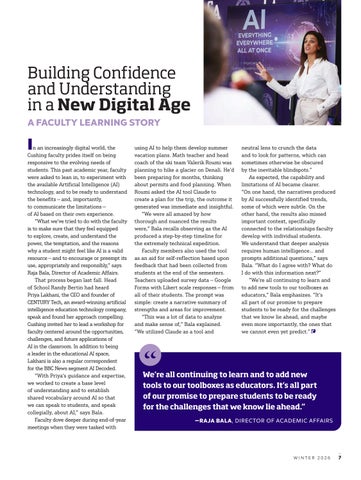
n an increasingly digital world, the Cushing faculty prides itself on being responsive to the evolving needs of students. This past academic year, faculty were asked to lean in, to experiment with the available Artificial Intelligence (AI) technology, and to be ready to understand the benefits — and, importantly, to communicate the limitations — of AI based on their own experience. “What we’ve tried to do with the faculty is to make sure that they feel equipped to explore, create, and understand the power, the temptation, and the reasons why a student might feel like AI is a valid resource — and to encourage or preempt its use, appropriately and responsibly,” says Raja Bala, Director of Academic Affairs. That process began last fall. Head of School Randy Bertin had heard Priya Lakhani, the CEO and founder of CENTURY Tech, an award-winning artificial intelligence education technology company, speak and found her approach compelling. Cushing invited her to lead a workshop for faculty centered around the opportunities, challenges, and future applications of AI in the classroom. In addition to being a leader in the educational AI space, Lakhani is also a regular correspondent for the BBC News segment AI Decoded. “With Priya’s guidance and expertise, we worked to create a base level of understanding and to establish shared vocabulary around AI so that we can speak to students, and speak collegially, about AI,” says Bala. Faculty dove deeper during end-of-year meetings when they were tasked with
using AI to help them develop summer vacation plans. Math teacher and head coach of the ski team Valerik Roumi was planning to hike a glacier on Denali. He’d been preparing for months, thinking about permits and food planning. When Roumi asked the AI tool Claude to create a plan for the trip, the outcome it generated was immediate and insightful. “We were all amazed by how thorough and nuanced the results were,” Bala recalls observing as the AI produced a step-by-step timeline for the extremely technical expedition. Faculty members also used the tool as an aid for self-reflection based upon feedback that had been collected from students at the end of the semesters. Teachers uploaded survey data — Google Forms with Likert scale responses — from all of their students. The prompt was simple: create a narrative summary of strengths and areas for improvement. “This was a lot of data to analyze and make sense of,” Bala explained. “We utilized Claude as a tool and
neutral lens to crunch the data and to look for patterns, which can sometimes otherwise be obscured by the inevitable blindspots.” As expected, the capability and limitations of AI became clearer. “On one hand, the narratives produced by AI successfully identified trends, some of which were subtle. On the other hand, the results also missed important context, specifically connected to the relationships faculty develop with individual students. We understand that deeper analysis requires human intelligence… and prompts additional questions,” says Bala. “What do I agree with? What do I do with this information next?” “We’re all continuing to learn and to add new tools to our toolboxes as educators,” Bala emphasizes. “It’s all part of our promise to prepare students to be ready for the challenges that we know lie ahead, and maybe even more importantly, the ones that we cannot even yet predict.”
We’re all continuing to learn and to add new tools to our toolboxes as educators. It’s all part of our promise to prepare students to be ready for the challenges that we know lie ahead.” —RAJA BALA, DIRECTOR OF ACADEMIC AFFAIRS
WINTER 2026
7