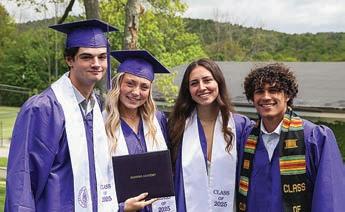
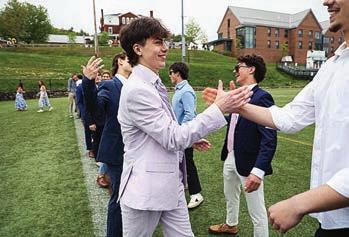
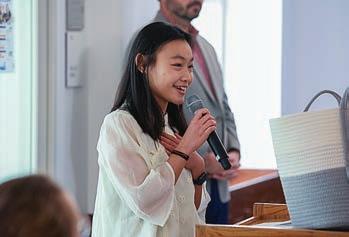
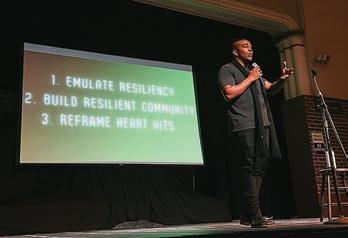
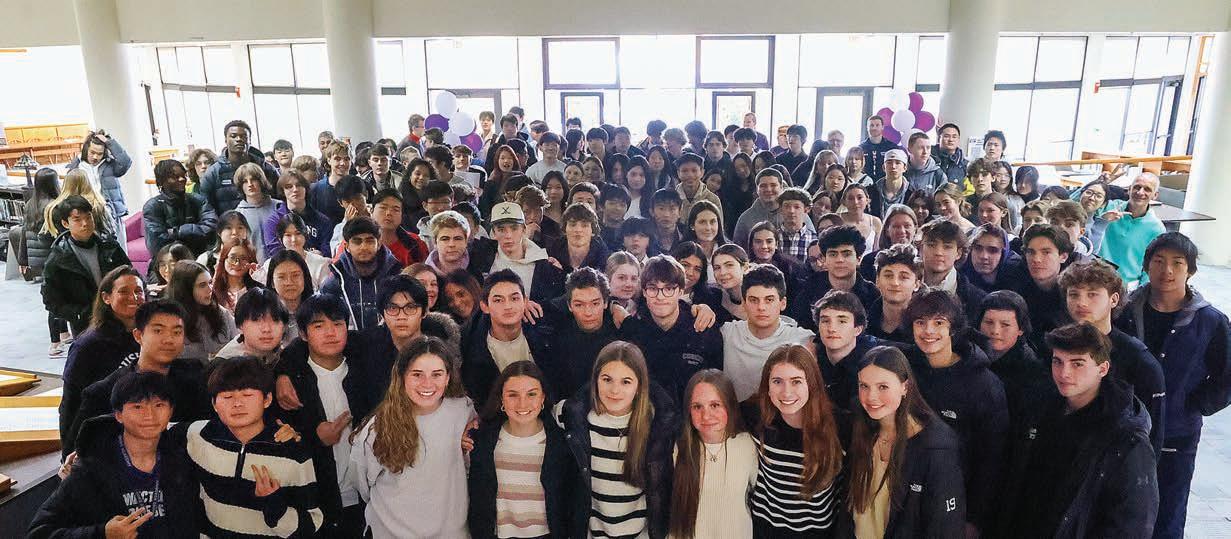
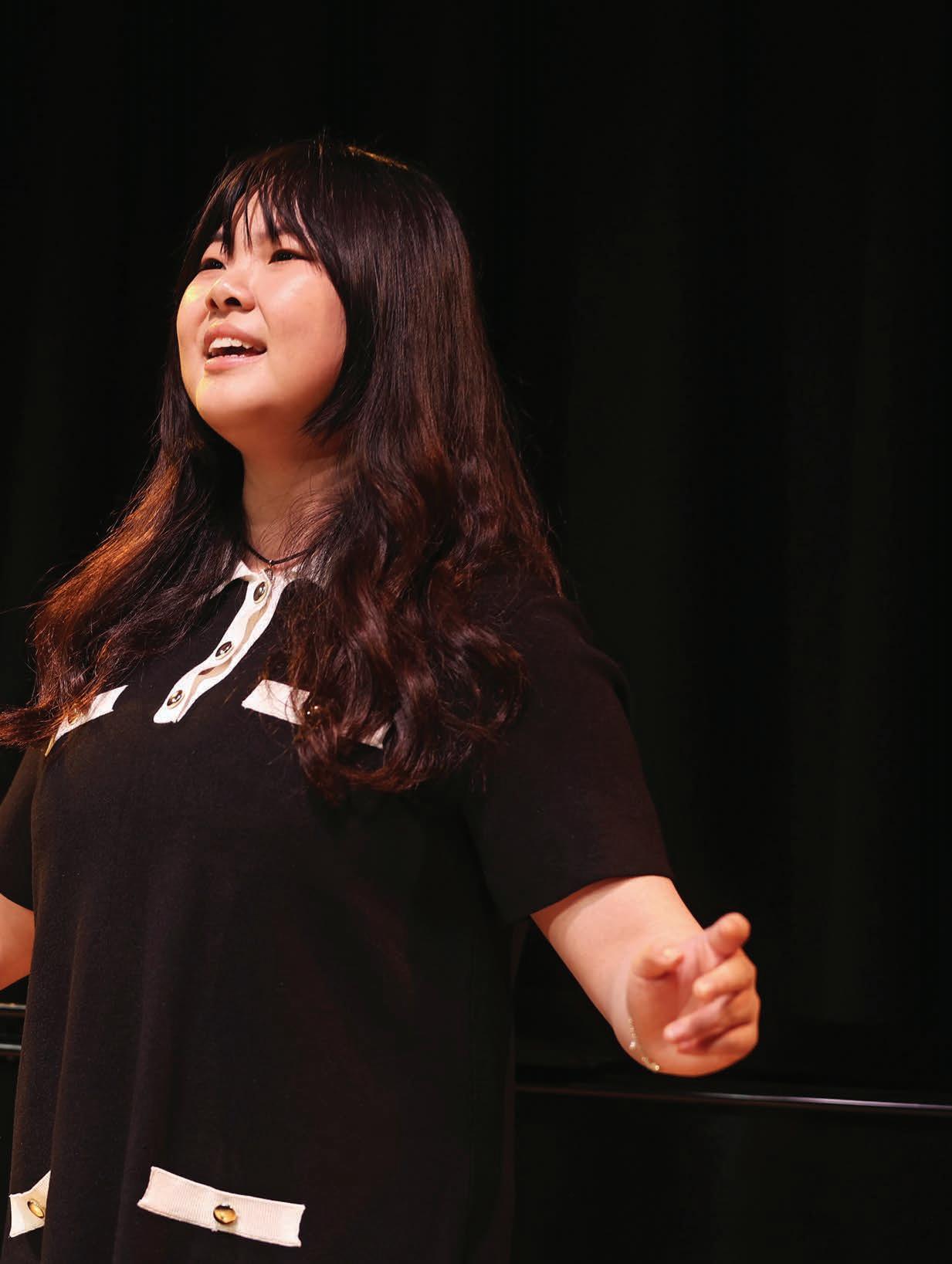
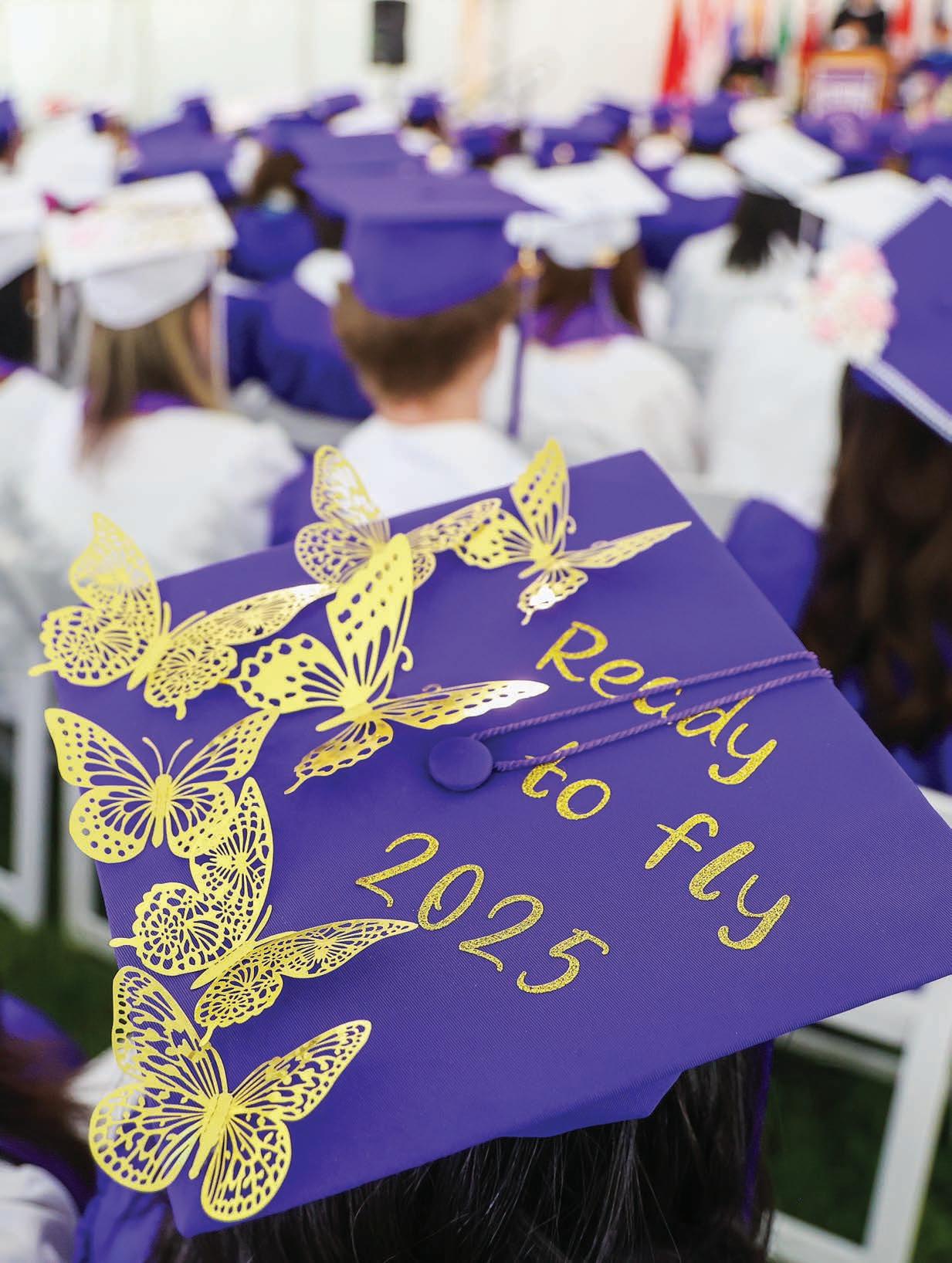
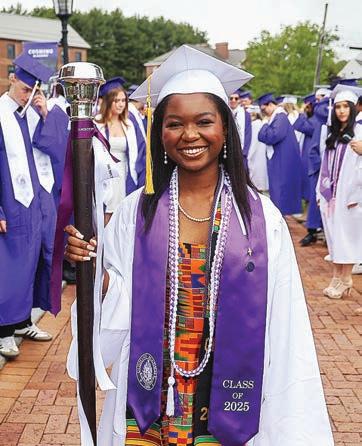
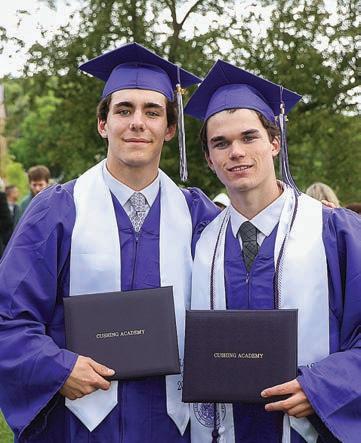
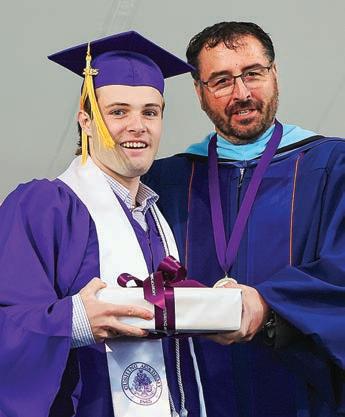
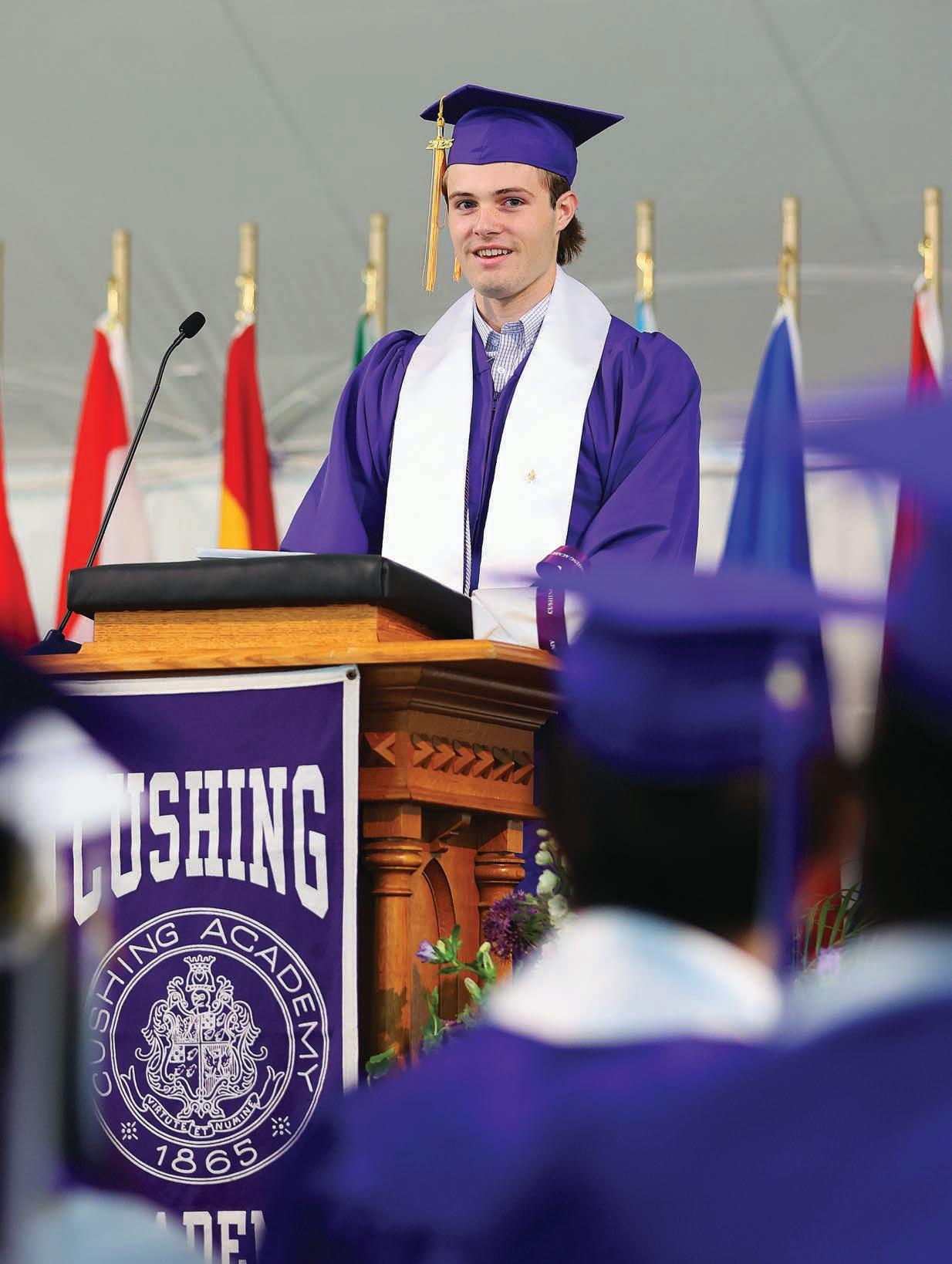
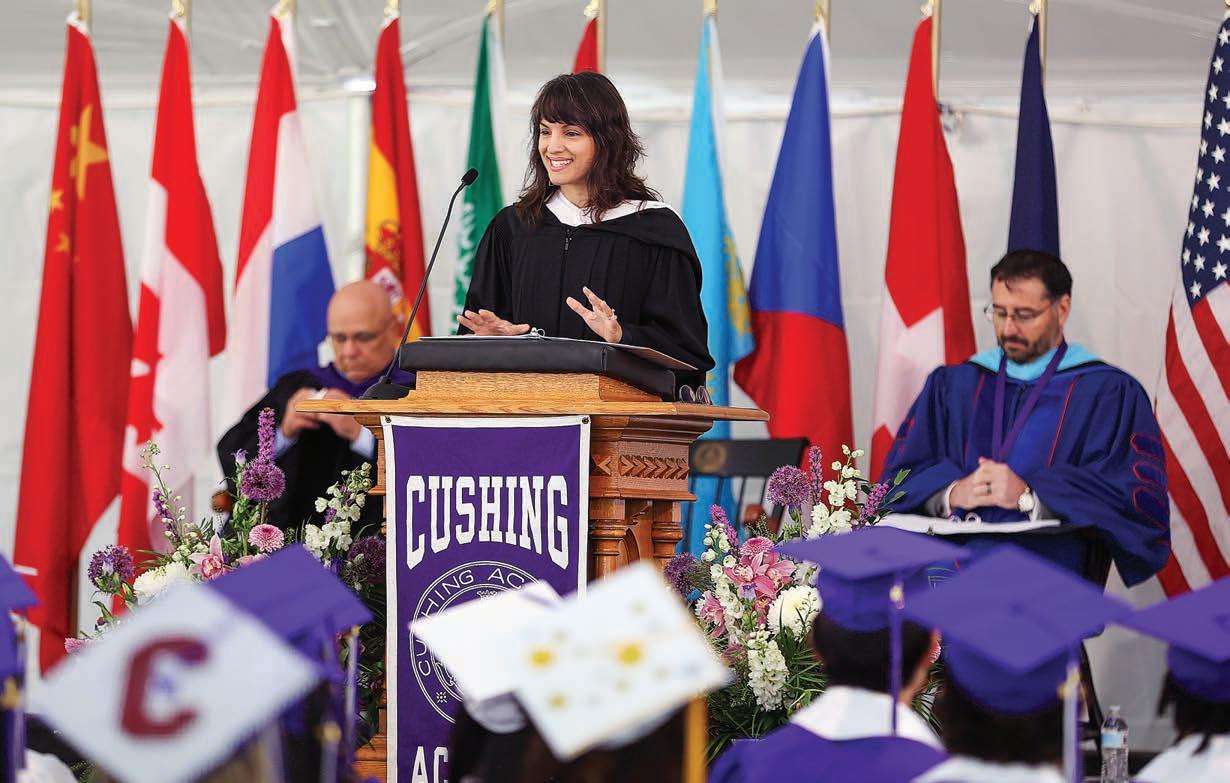
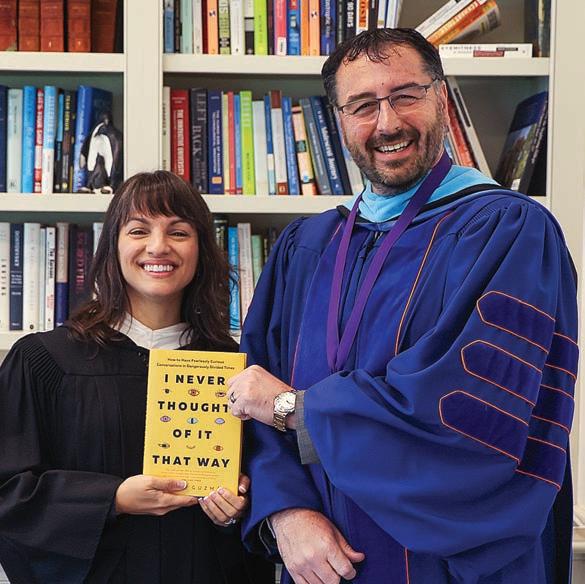
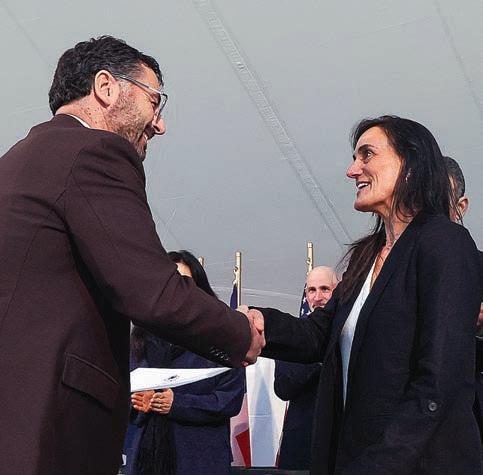
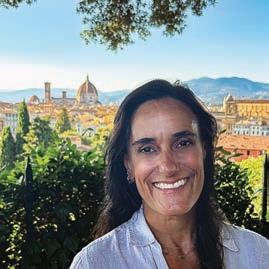
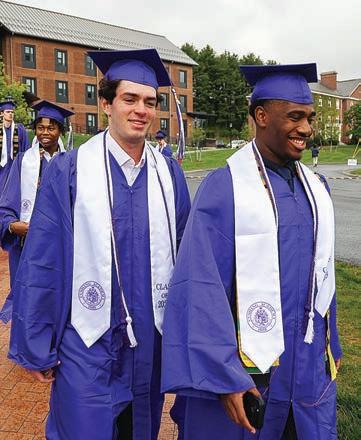
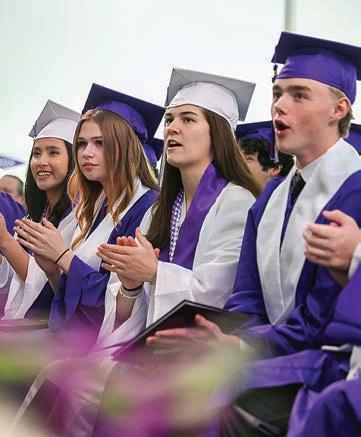
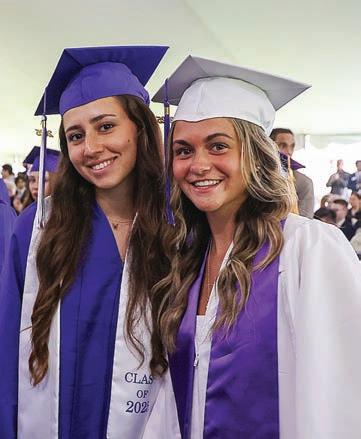
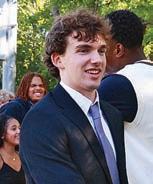
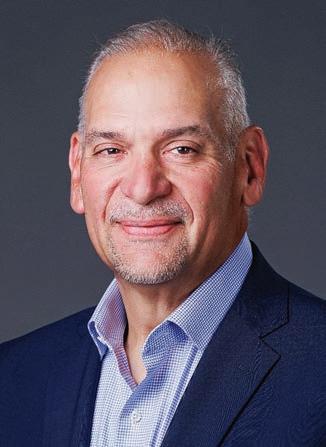
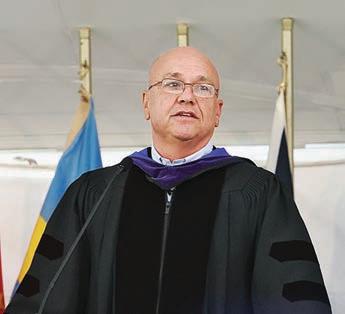
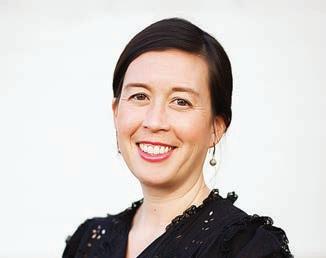
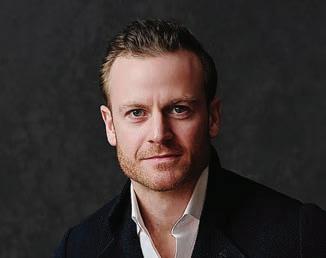
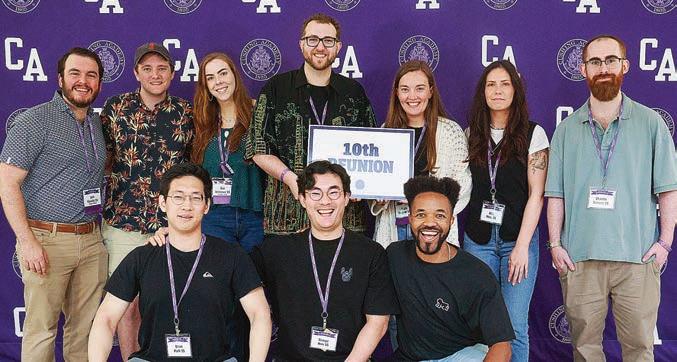
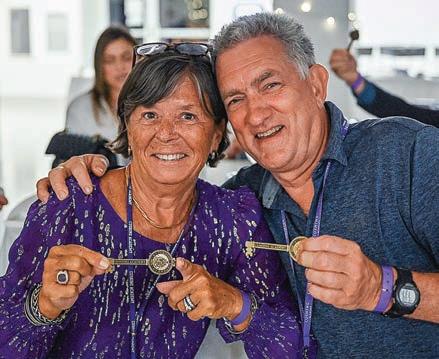
Cushing celebrated the Class of 2025’s excellence with honors for an inspired teacher and heartfelt addresses from the Head of School, the valedictorian, and keynote speaker Mónica Guzmán. 44
Celebrating a Century of Cushing Hockey
Cushing Academy exists for students and develops curious, creative, and confident learners and leaders.
Cushing Today is a publication of Cushing Academy’s Office of Marketing + Communications.
Head of School
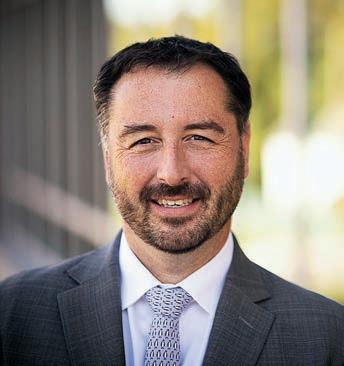
Dr. Randy R. Bertin P’21, ’22, ’24, ’25
Associate Head of School
Catherine Pollock
Director of Marketing + Communications
Christian Housh
Director of Advancement
Greg Pollard
Magazine Design Good Design, LLC gooddesignusa.com
Contributing Writers + Editors
Dr. Randy R. Bertin P’21, ’22, ’24, ’25
Christian Housh
Amy Logan
Christine Foster
Photography
Ed Collier
Gary Fournier
Anton Grassl
Tom Kates
Colin Miller
Steve Musco
Philip Wexler P’19
Cushing Today welcomes your class notes, photography, story ideas, and comments. Please send them to communications@cushing.org, call (978) 827-7000, or mail to:
Communications Office
Cushing Academy 39 School Street
Ashburnham, MA 01430
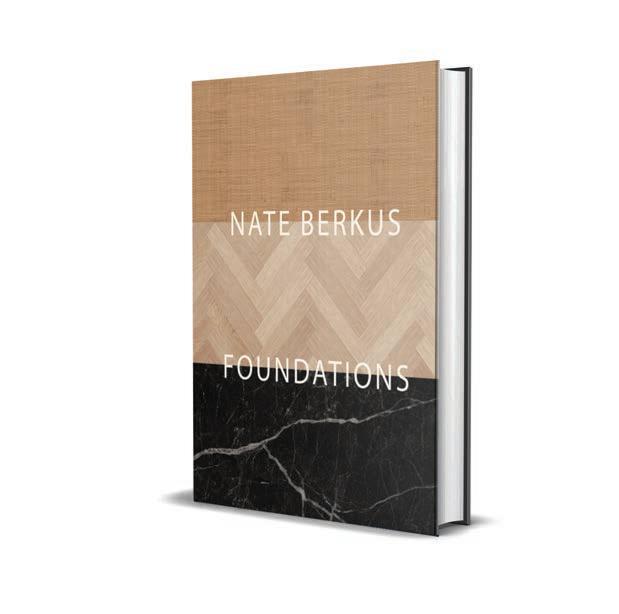
From art and architecture to
ON THE COVER
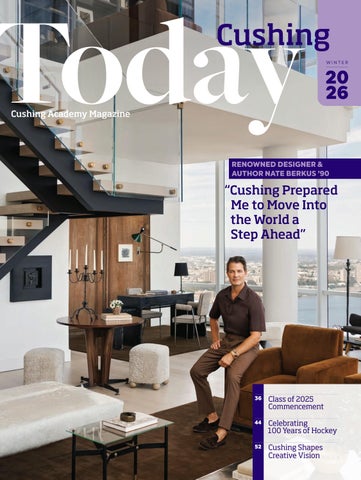
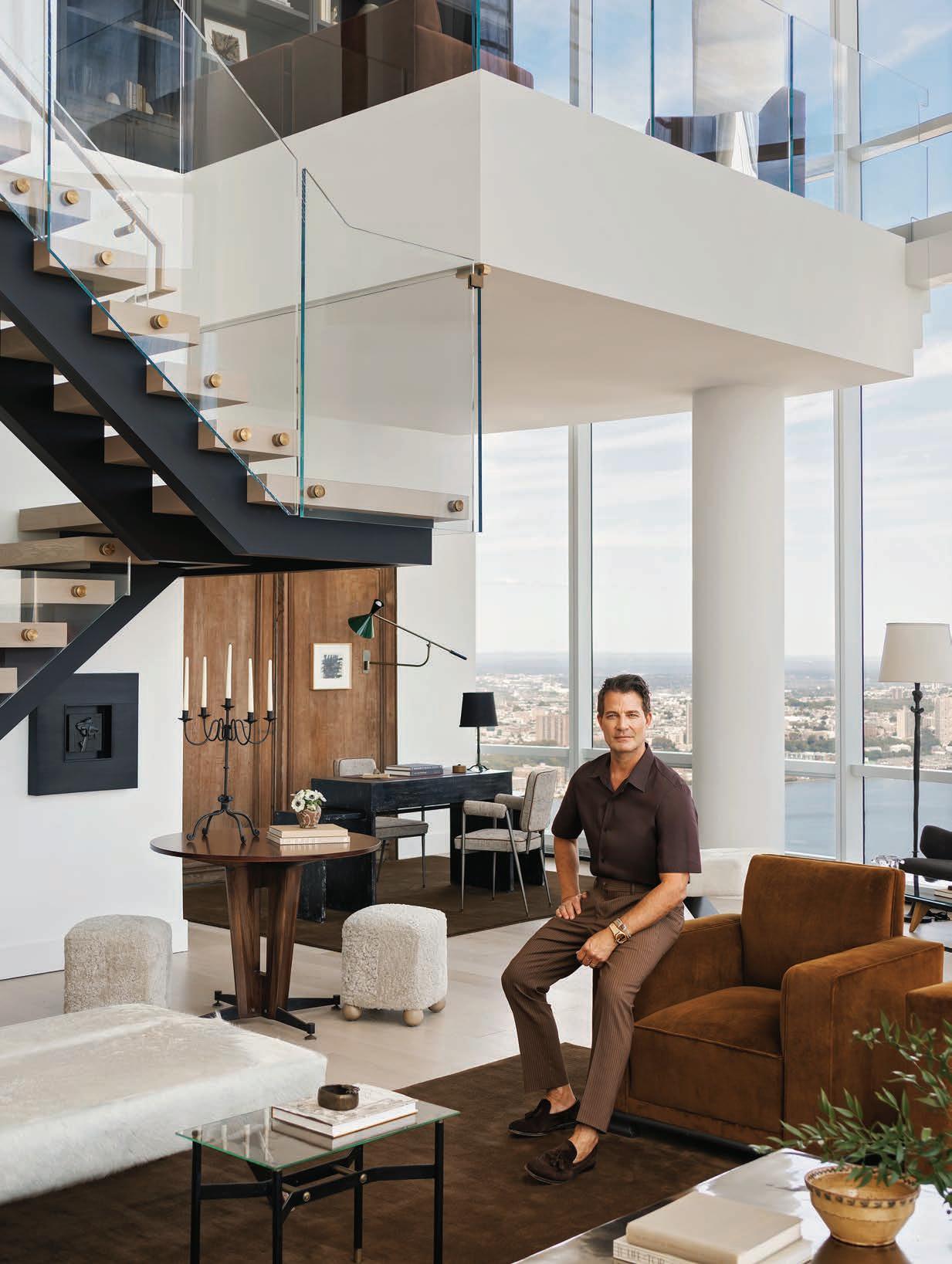
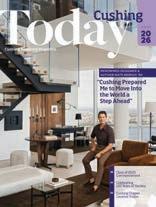
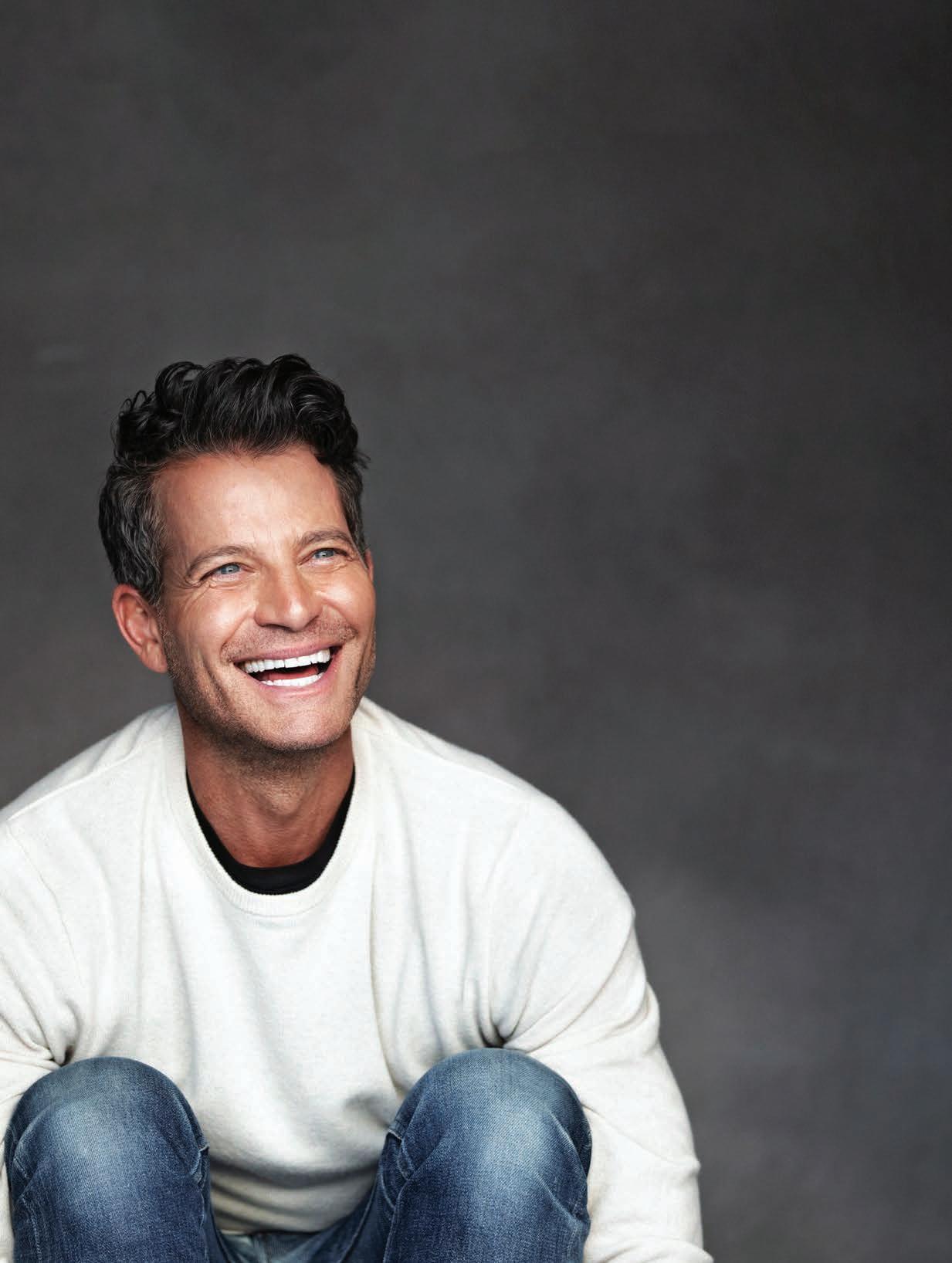
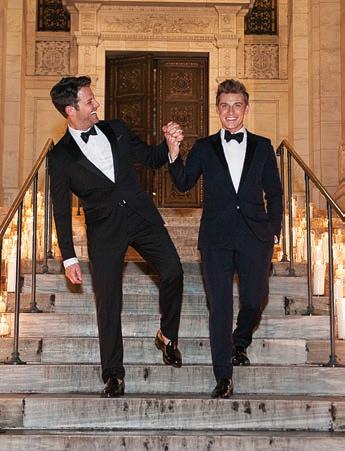
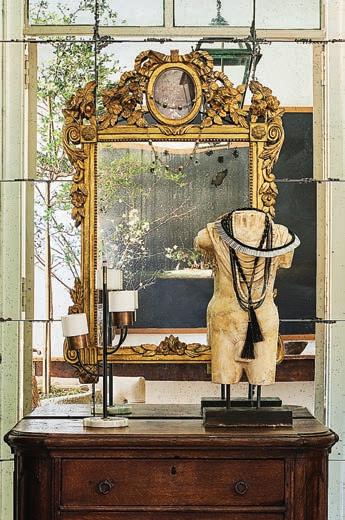
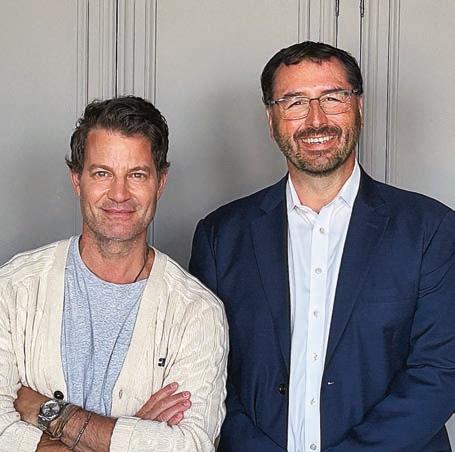
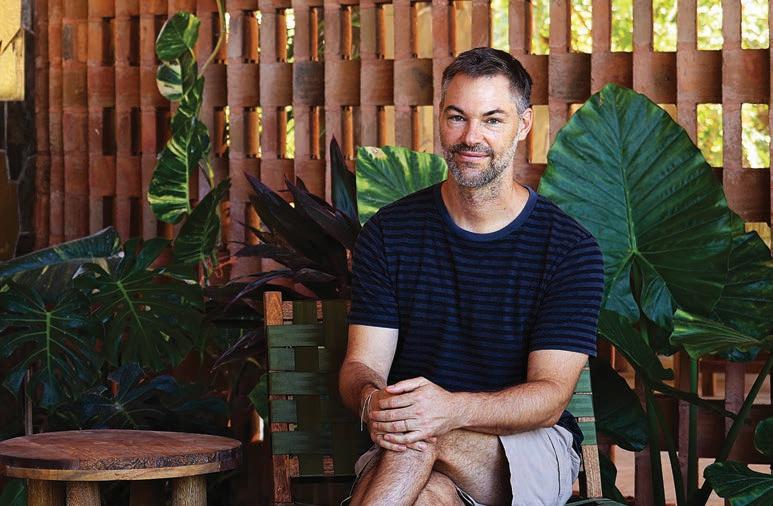
Surrounded by his signature style, Nate Berkus ’90 reflects on design, storytelling, and a foundation that began at Cushing. (Image courtesy of Colin Miller)
Throughout this magazine are links to extra content including photos, videos, and our website. Look for QR codes and links to explore more.
INTELLIGENCE HAVING FUN
Leaning into Creativity
One of my favorite definitions of creativity — often attributed to Albert Einstein — is that “creativity is intelligence having fun.”
In all of our endeavors at Cushing, creativity is not optional. It is essential. So as we began this school year, I challenged our students and faculty to embrace and actively practice creativity. In the face of a future where technology is ever more quickly advancing, it has never been more needed.
At Cushing Academy, creativity shows up everywhere: in our performing and visual art studios, on our athletic fields, in our science labs and classrooms, and throughout dorm life. It is embedded in our mission — Cushing Academy exists for students and develops curious, creative, and confident learners and leaders — and is the ubiquitous tool that helps us generate new ideas, discover opportunities in obstacles, and develop resilience in the face of challenges.
Creative Visions: Interdisciplinary Arts
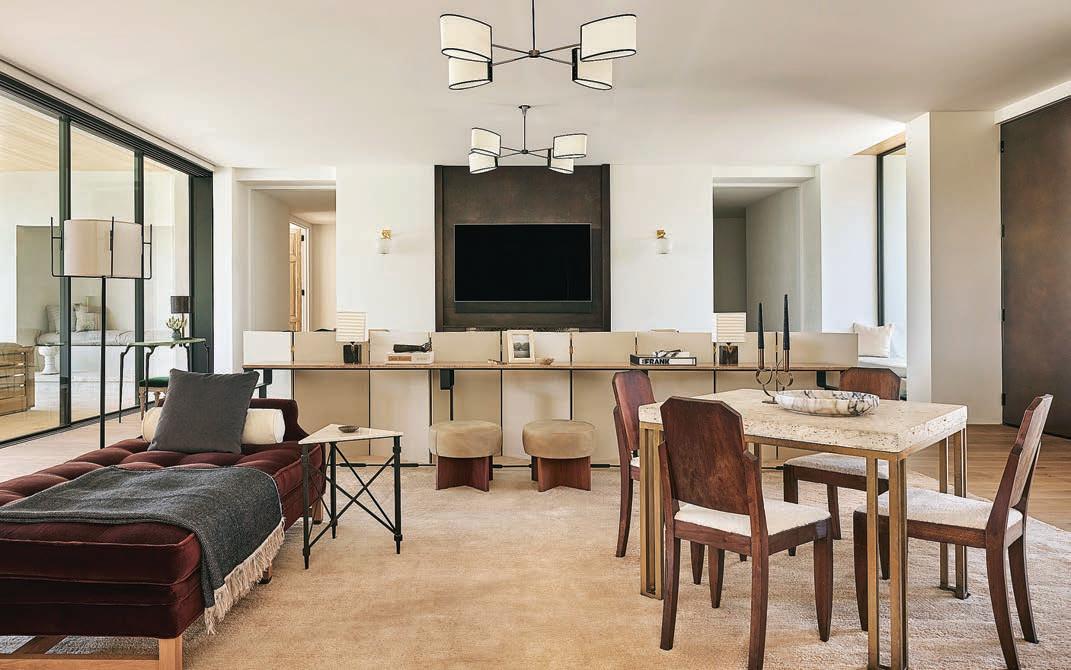
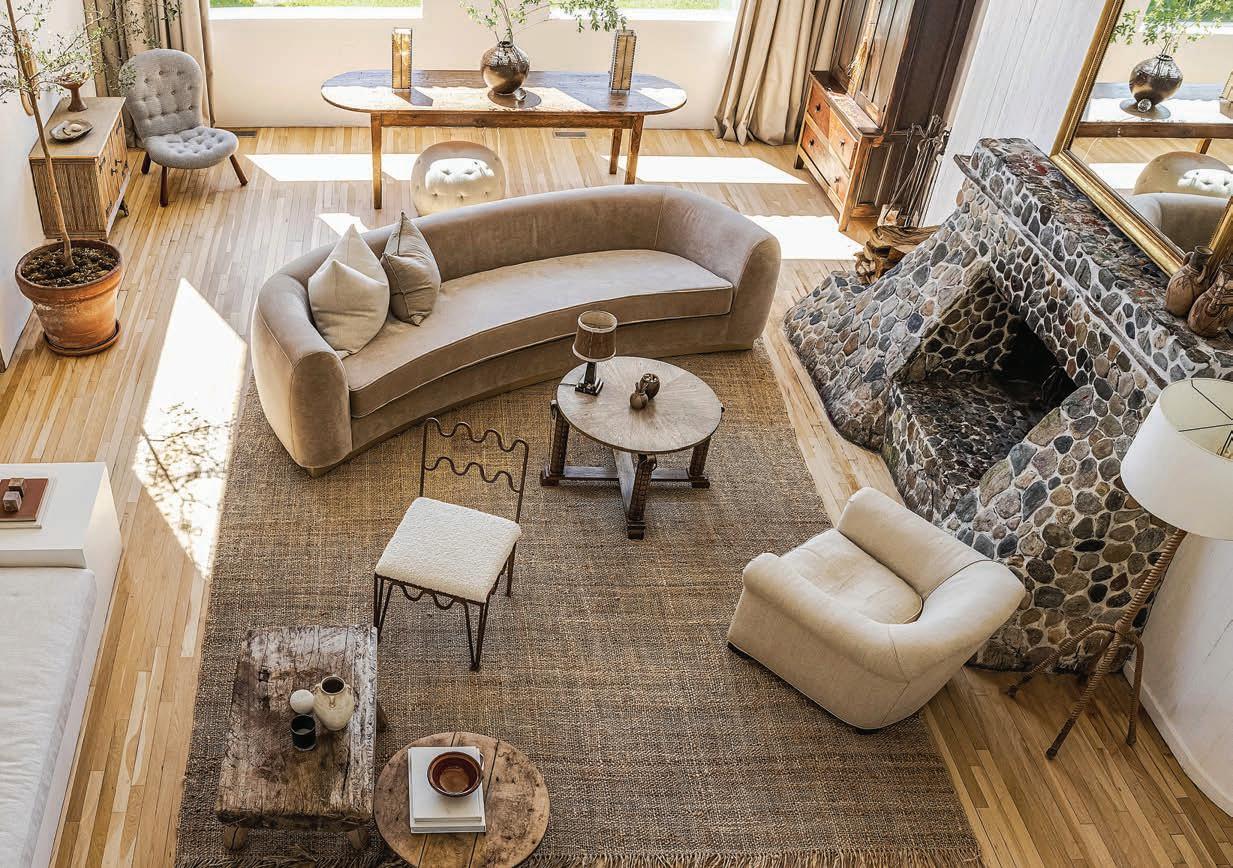
Cushing has a long tradition of excellence in the visual arts, and it has been the launching pad for numerous creative careers. We are excited to share the stories of four such working artists in this issue of Cushing Today. I had the pleasure of meeting with interior designer and author Nate Berkus ’90 in his Manhattan studio this summer. In our talk, I was
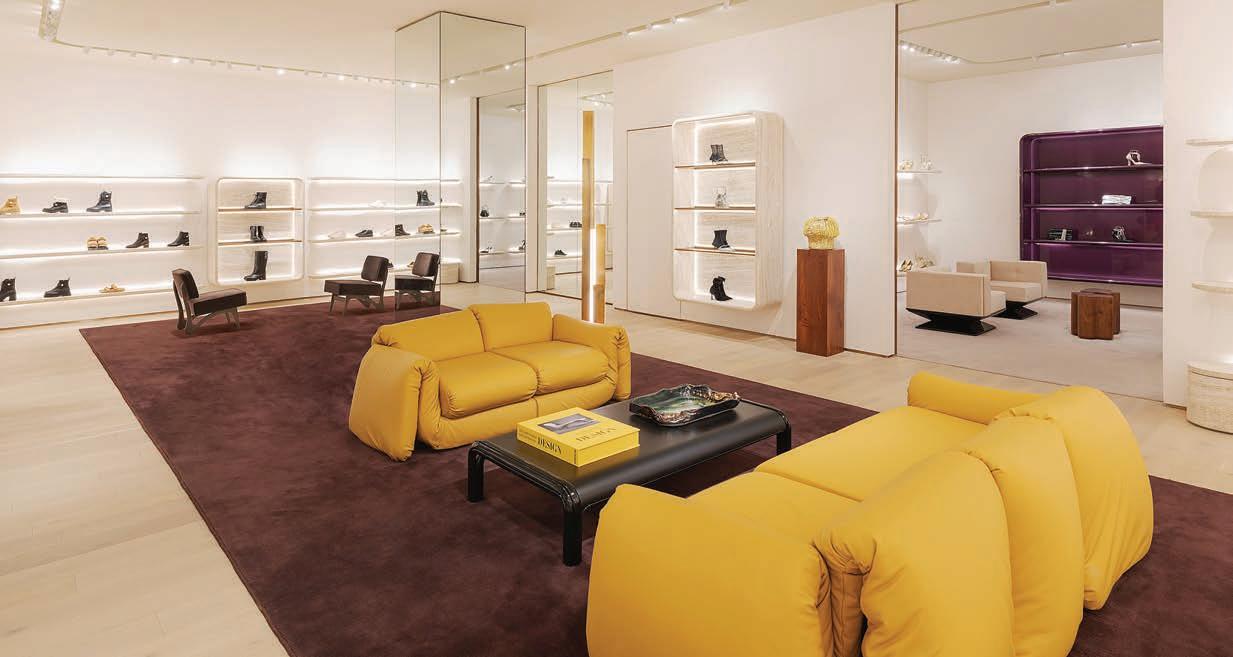
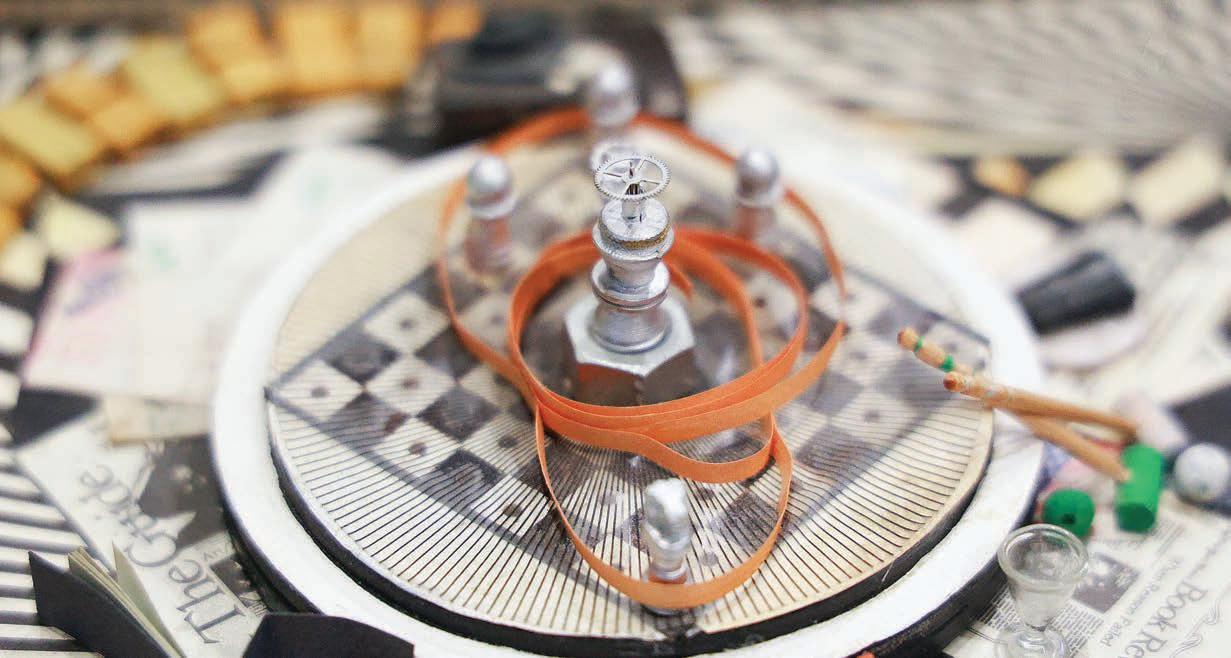
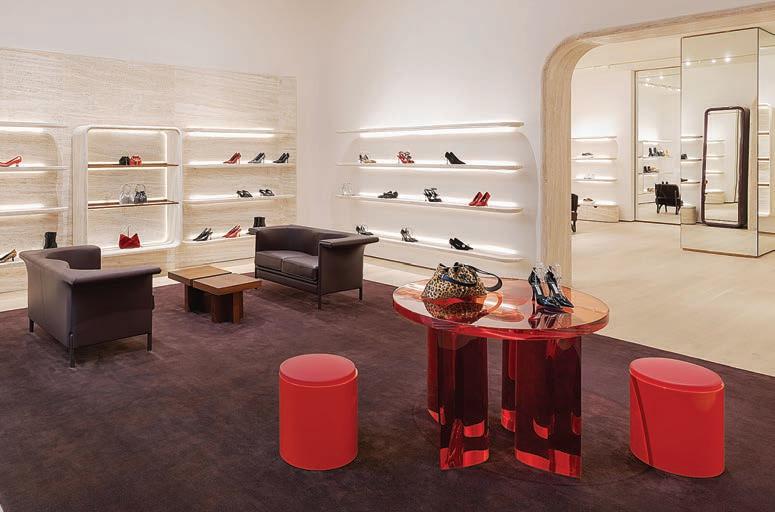
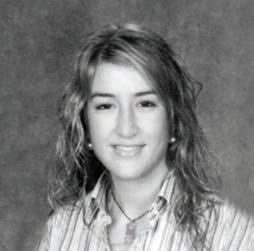
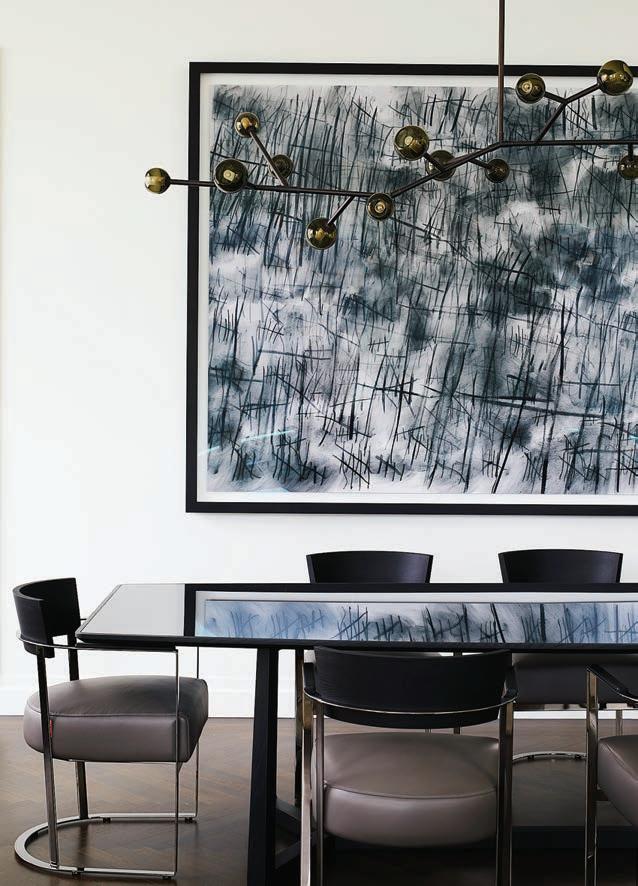
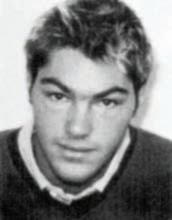
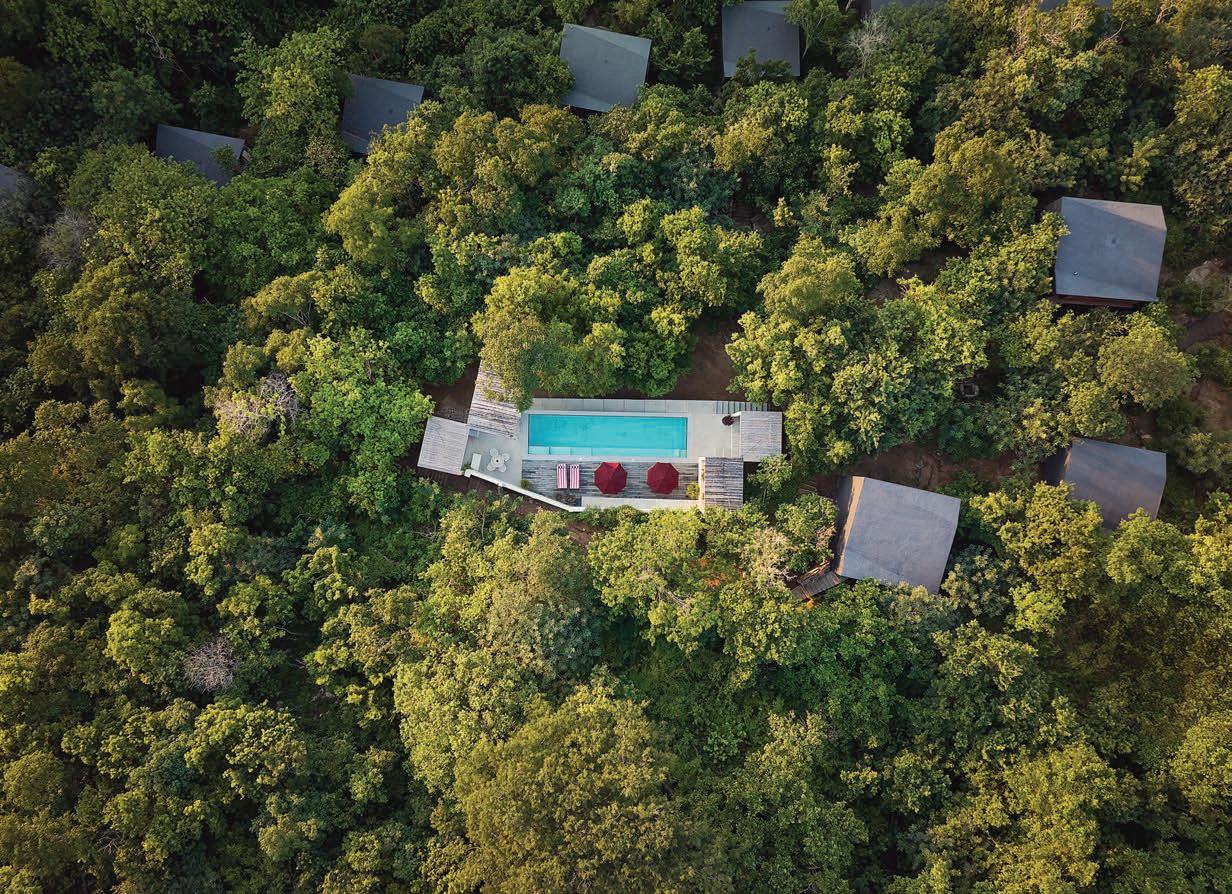
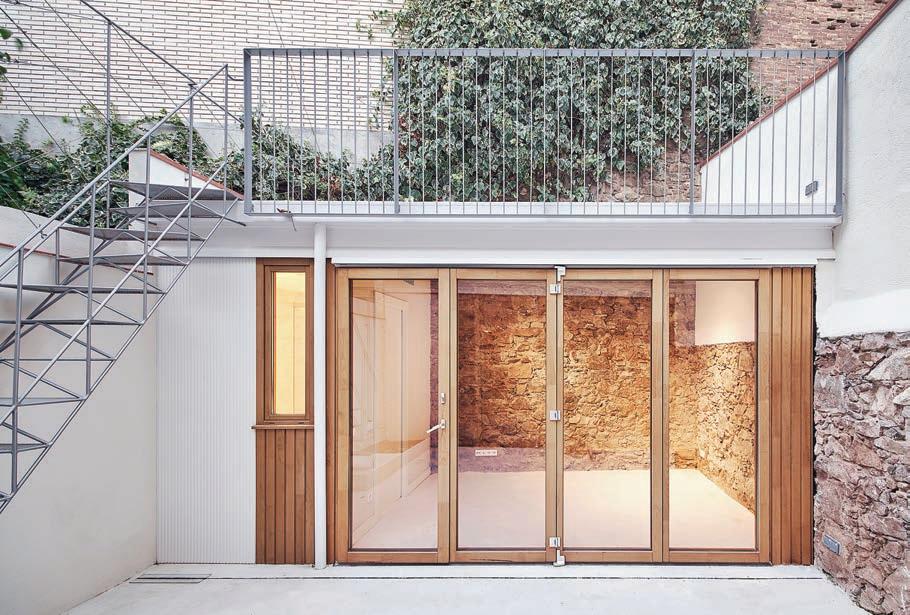
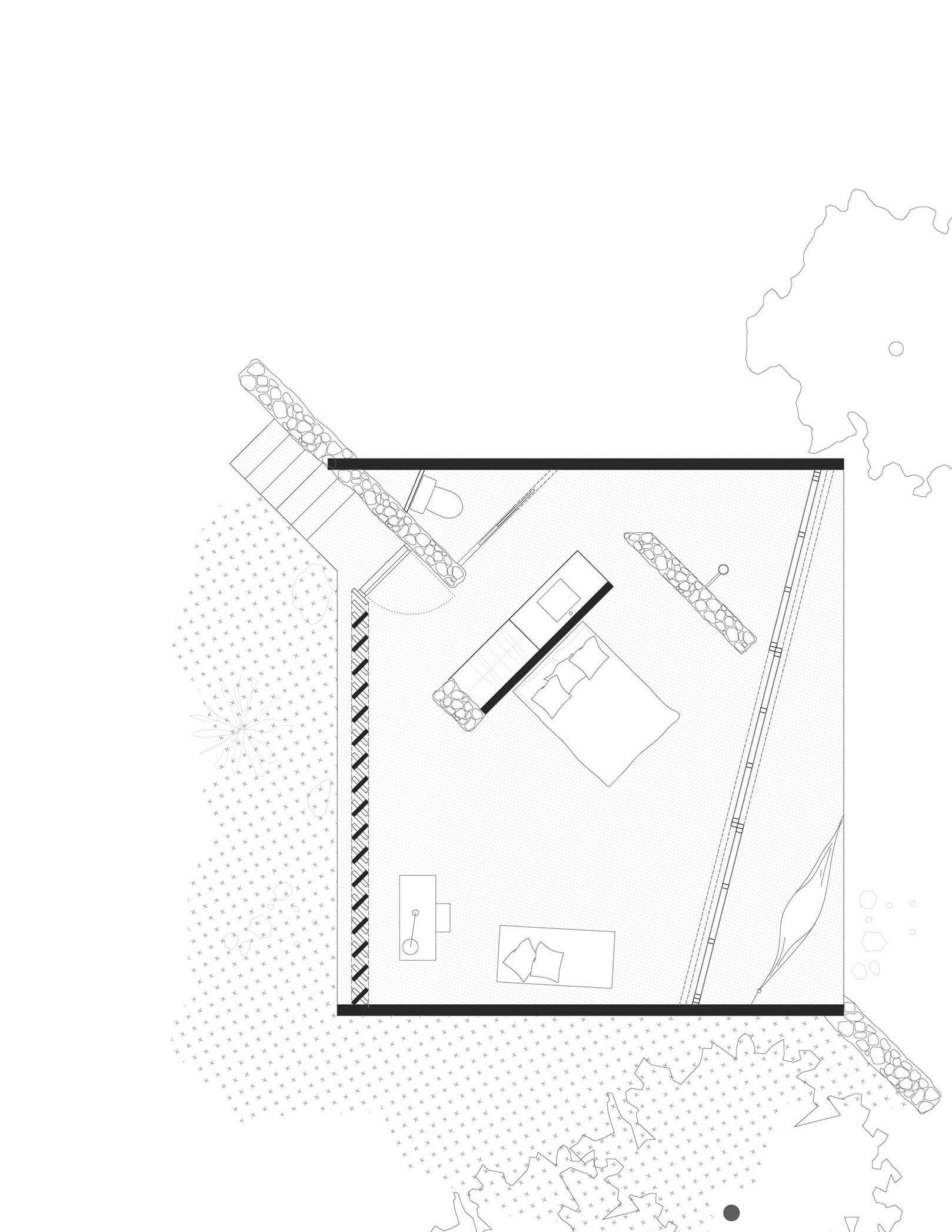
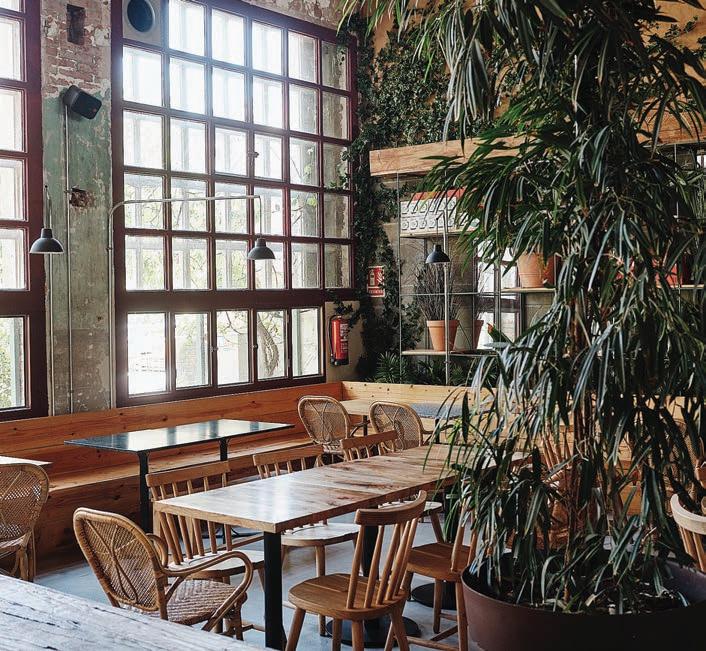
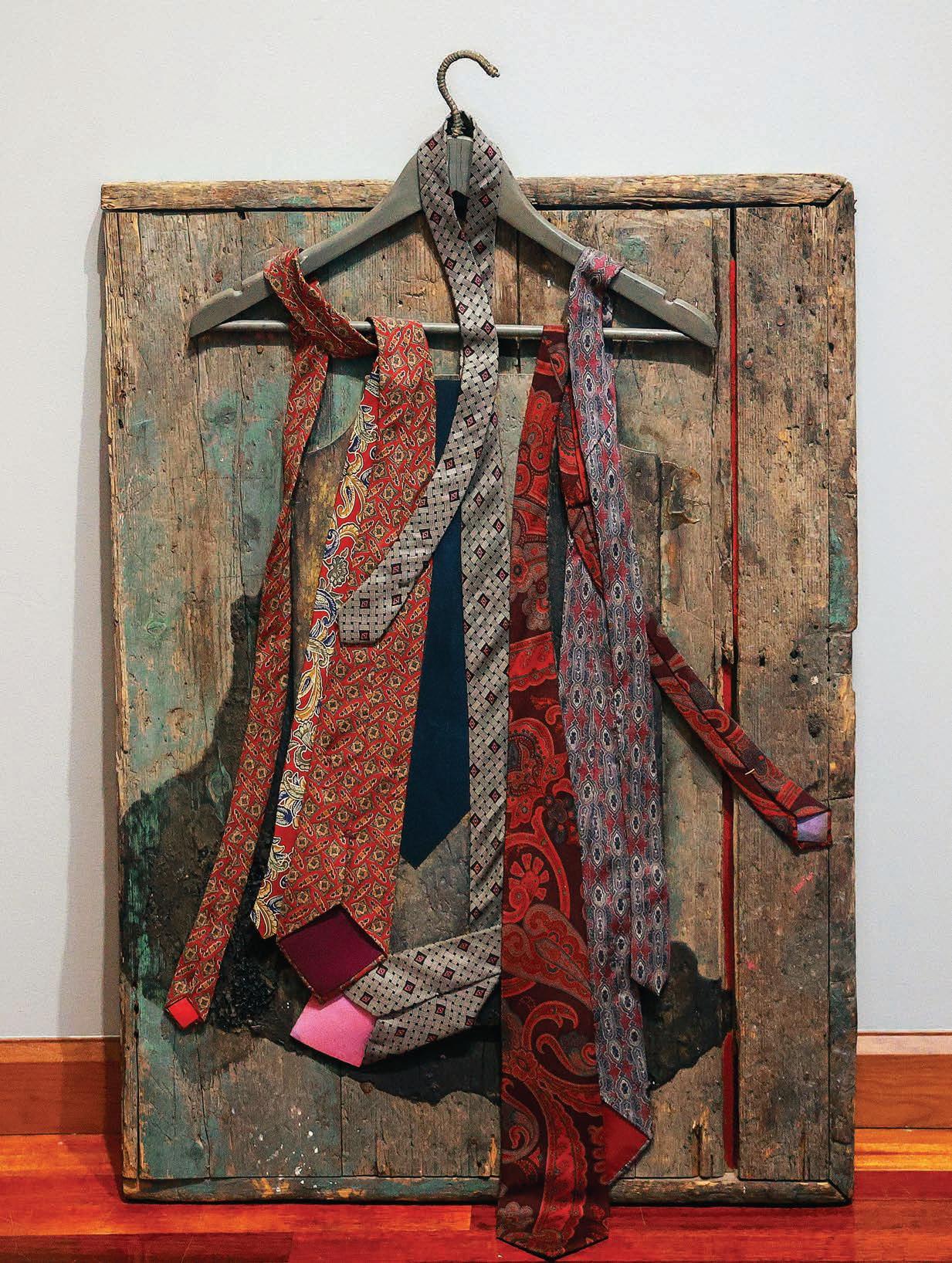
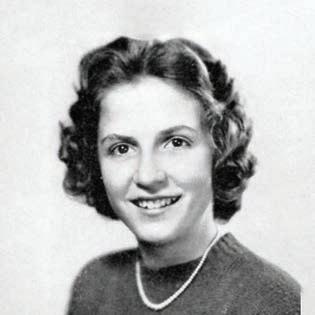
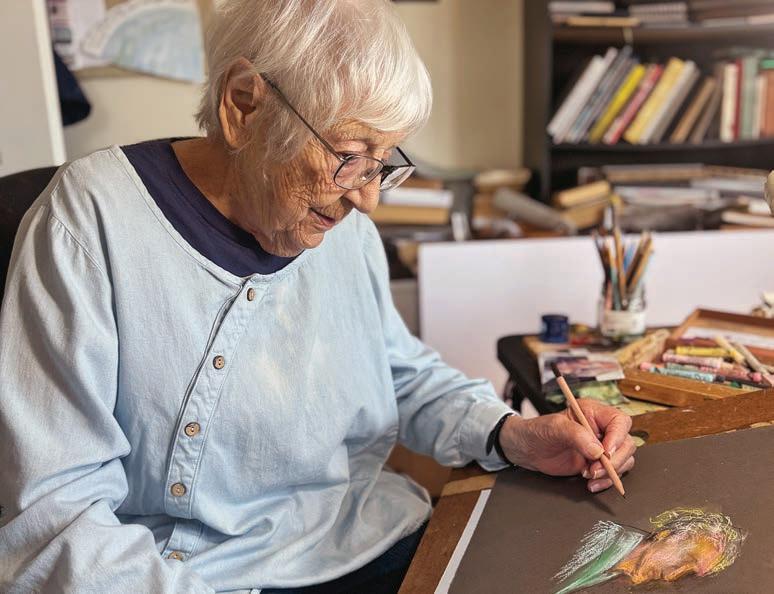
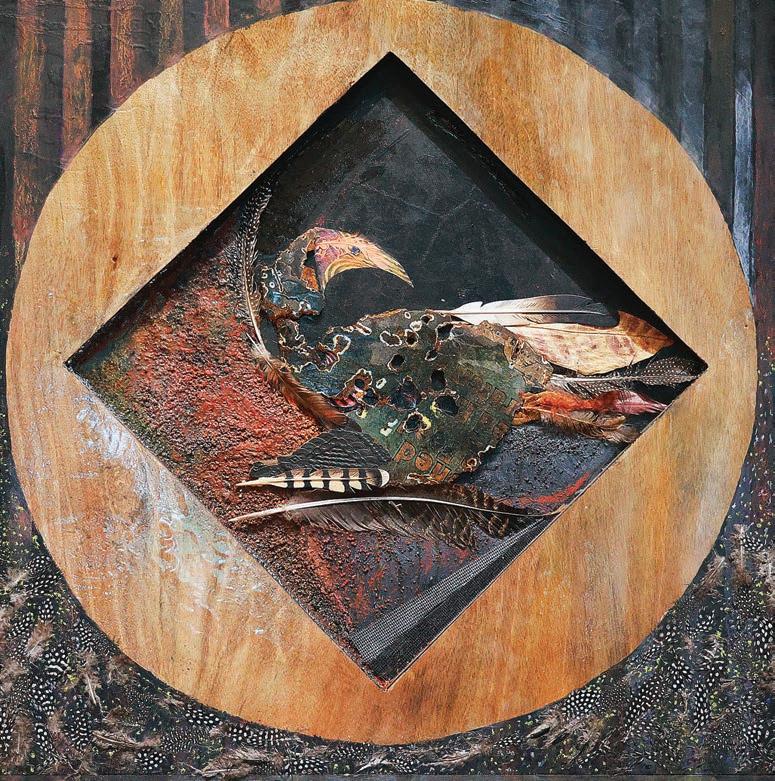
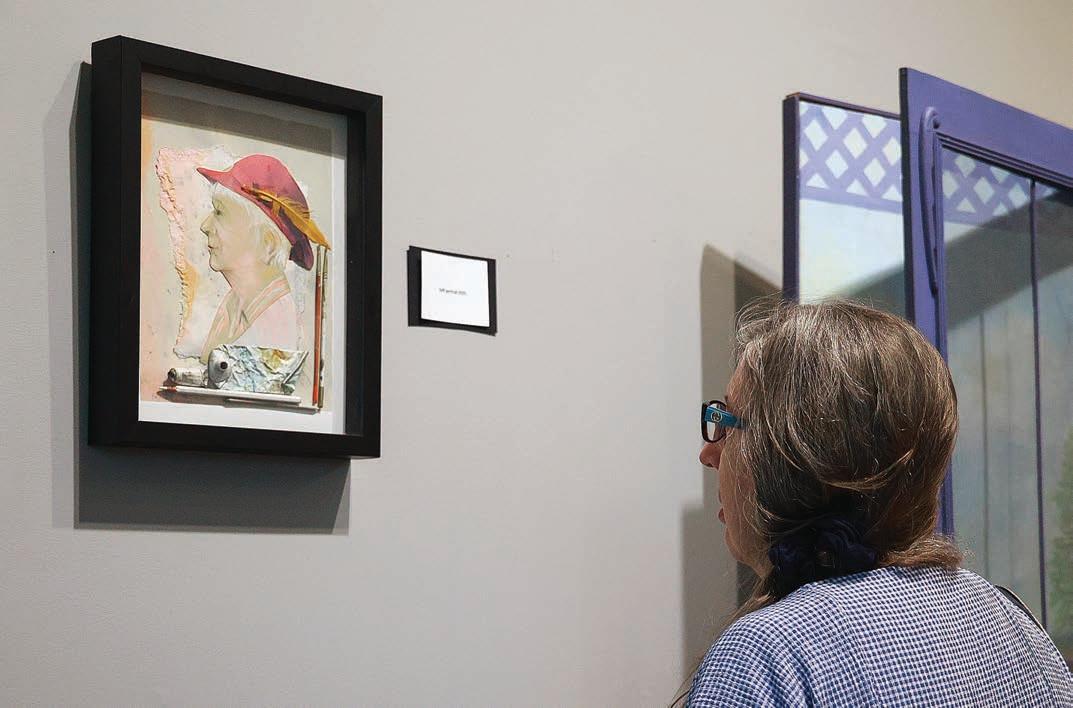
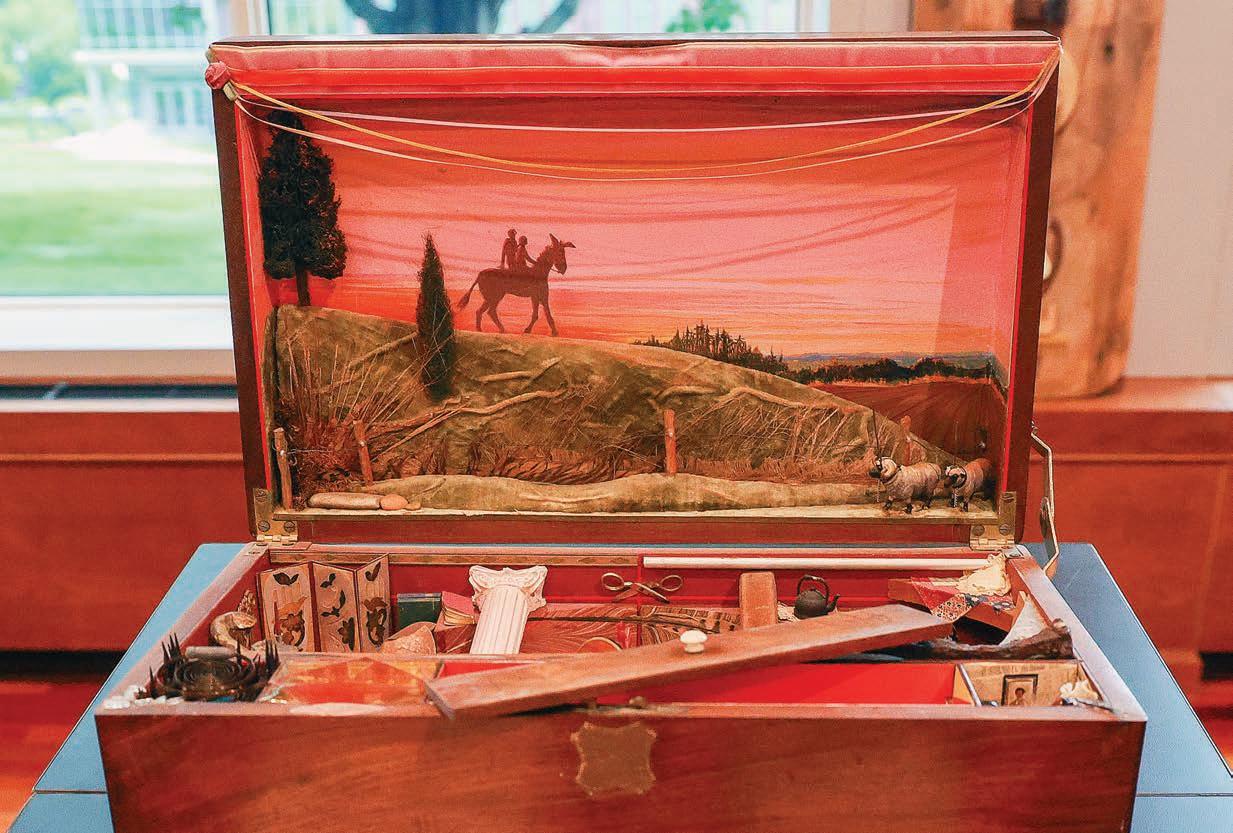
struck by how deeply interdisciplinary his practice is, and how much creative storytelling goes into his work. I hope you will enjoy reading our conversation Interdisciplinary, creative storytelling is also at the heart of the other visual artists in our Creative Visions feature. Interior designer Nebihe Cihan ’03 tells global stories by sourcing unique objects, like the vintage furniture she painstakingly sourced across Europe for the Jimmy Choo Madison Avenue flagship store. Architect Damián Figueras ’99 integrates local materials, cultural context, and sustainable practices in his work around the world. And visual artist Constance Whitehead Kiermaier ’45 breathes new meaning into found objects in her work across mediums in Maine.
Foundational Creativity
Our focus on creativity coincides with the first year of Cushing’s five-year strategic plan, Our Common Journey: Strategic Priorities for Cushing Academy 2025–2030. Guided by six pillars — community and belonging, learning, leading, health and well-being, longterm sustainability, and culture and legacy — we are laying foundations in this first year, strengthening who we are at our core, and preparing for the growth and success that lie ahead. You can see the seeds of these foundations throughout this issue of Cushing Today: in our year-long engagement with our community reading, where we developed language and norms for civil discourse and intellectual inquiry; in the agency and leadership of our student proctors; in
project-based learning initiatives; in the thoughtful restoration of the bell in the Main Building; in our celebration of one hundred years of Cushing hockey; and in the strength of alumni leading our board and serving on our alumni council.
I invite you to embrace creativity as a spark that helps bring our community together. I hope you will join us in imagining an extraordinary future for Cushing and in helping build a foundation for the Academy that is filled with promise.
Sincerely,
Randy R. Bertin, Ed.D. Head of School
Six Pillars of Our Common Journey
> Strengthening Community and Belonging
> Developing Curious Learners
> Developing Confident Leaders
> Promoting Student Health and Well-Being
> Ensuring Long-Term Sustainability
> Celebrating School Culture and Legacy
Read Our Common Journey: Strategic Priorities for Cushing Academy 2025–2030.
SCAN ME!
Cushing Moments
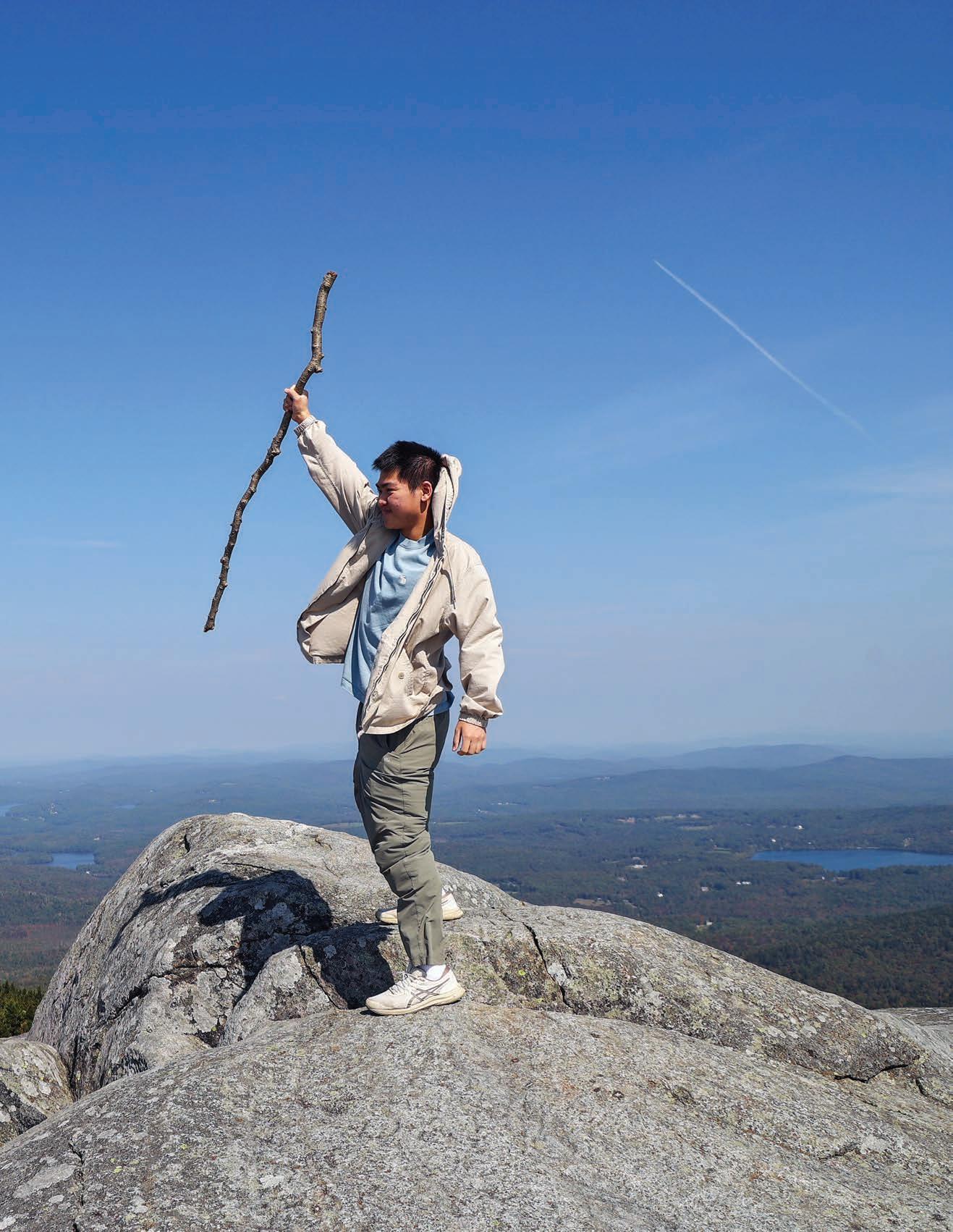
Danny Cao ’26 celebrates reaching the summit of Mount Monadnock on Mountain Day — a beloved tradition of challenge, camaraderie, and breathtaking views.
2026 WILL MARK 100 YEARS SINCE THE FIRST CUSHING MOUNTAIN DAY!
SCAN ME! Share your Mountain Day experiences.
Cushing Students Shine at Poetry Contest
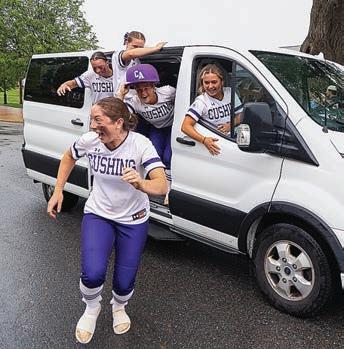
A FAN BUS OF CHEERING CLASSMATES CELEBRATES WINNERS
W
hen Lukas Botnick ’26 tore his ACL on his sixth day at Cushing Academy, poetry was the furthest thing from his mind. A dedicated lacrosse player with collegiate aspirations, Botnick found himself sidelined during what he describes as “a bit of a rough patch” in the middle of winter.
“I don’t really think of myself as a poet,” Botnick admits. “I had a lot of time on my hands... I had a week off of school, so I had a long time to just think about what I was writing.”
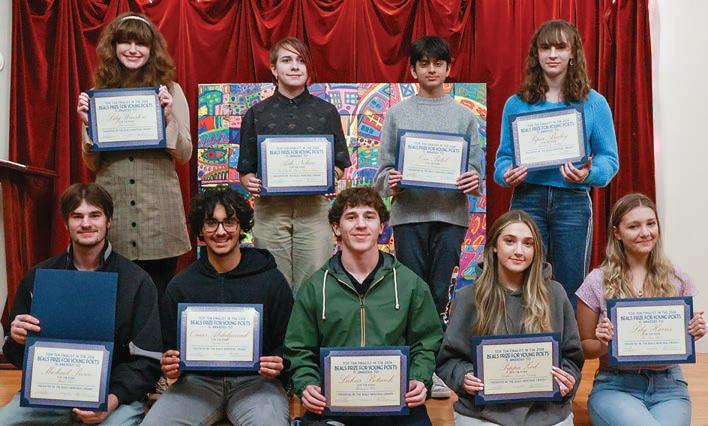
That unexpected time proved transformative. Botnick’s poem “Waiting to Heal,” about his recovery, earned honors in the Beals Prize for Young Poets, a regional contest where Cushing students captured six of the ten finalist spots.
The strong showing reflects the efforts of English teacher Simon Hunt, who has worked to nurture an appreciation for literature and creative writing at Cushing. In addition to promoting the poetry contest, Hunt advises Patchwork, Cushing’s literary magazine.
Hunt’s approach was intentional. Along with a school-wide call for entries, he timed a poetry unit in his creative writing class to coincide with the competition. The result: Lily Winston ’25 claimed second place, Botnick took third, and four other Cushing students received honorable mentions. The contest drew submissions from 12 regional schools.
A Poetry Fan Bus
In recognition of Cushing’s success, the school organized a “fan bus” to the awards ceremony. Just as they do for major athletic events, friends and classmates climbed on board to be there in person, cheering on their fellow Penguins as they read their poems.
The recognition has sparked new confidence in unexpected writers. “In 100 years, I would have never thought I would have won a poetry contest,” Botnick says. “It kind of gives me some hope that maybe I’ve got some good poems in me.”
For Hunt, the experience reinforces his belief that writing reveals something essential. “Everybody’s a writer, whether they know it or not,” he believes. “You can’t really understand who you are unless you can understand the stories that you’ve been told by the people around you.”
Cushing’s Award-Winning Poets
2nd Place: Lily Winston ’25
3rd Place: Lukas Botnick ’26
Honorable Mention Winners:
Omar Abduljawad ’25
Elle Morgan ’25
Michael Pierce ’25
Pippa Zed ’25
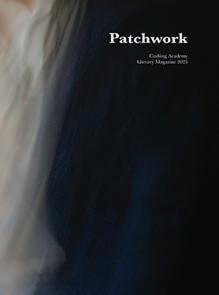
Check out our student writing in the 2025 edition of Patchwork, Cushing’s literary magazine.
SCAN ME!
Building Confidence and Understanding in a New Digital Age
A FACULTY LEARNING STORY
In an increasingly digital world, the Cushing faculty prides itself on being responsive to the evolving needs of students. This past academic year, faculty were asked to lean in, to experiment with the available Artificial Intelligence (AI) technology, and to be ready to understand the benefits — and, importantly, to communicate the limitations — of AI based on their own experience.
“What we’ve tried to do with the faculty is to make sure that they feel equipped to explore, create, and understand the power, the temptation, and the reasons why a student might feel like AI is a valid resource — and to encourage or preempt its use, appropriately and responsibly,” says Raja Bala, Director of Academic Affairs.
That process began last fall. Head of School Randy Bertin had heard Priya Lakhani, the CEO and founder of CENTURY Tech, an award-winning artificial intelligence education technology company, speak and found her approach compelling. Cushing invited her to lead a workshop for faculty centered around the opportunities, challenges, and future applications of AI in the classroom. In addition to being a leader in the educational AI space, Lakhani is also a regular correspondent for the BBC News segment AI Decoded.
“ With Priya’s guidance and expertise, we worked to create a base level of understanding and to establish shared vocabulary around AI so that we can speak to students, and speak collegially, about AI,” says Bala.
Faculty dove deeper during end-of-year meetings when they were tasked with
using AI to help them develop summer vacation plans. Math teacher and head coach of the ski team Valerik Roumi was planning to hike a glacier on Denali. He’d been preparing for months, thinking about permits and food planning. When Roumi asked the AI tool Claude to create a plan for the trip, the outcome it generated was immediate and insightful.
“ We were all amazed by how thorough and nuanced the results were,” Bala recalls observing as the AI produced a step-by-step timeline for the extremely technical expedition.
Faculty members also used the tool as an aid for self-reflection based upon feedback that had been collected from students at the end of the semesters. Teachers uploaded survey data — Google Forms with Likert scale responses — from all of their students. The prompt was simple: create a narrative summary of strengths and areas for improvement.
“This was a lot of data to analyze and make sense of,” Bala explained. “We utilized Claude as a tool and
neutral lens to crunch the data and to look for patterns, which can sometimes otherwise be obscured by the inevitable blindspots.”
As expected, the capability and limitations of AI became clearer. “On one hand, the narratives produced by AI successfully identified trends, some of which were subtle. On the other hand, the results also missed important context, specifically connected to the relationships faculty develop with individual students. We understand that deeper analysis requires human intelligence… and prompts additional questions,” says Bala. “What do I agree with? What do I do with this information next?”
“ We’re all continuing to learn and to add new tools to our toolboxes as educators,” Bala emphasizes. “It’s all part of our promise to prepare students to be ready for the challenges that we know lie ahead, and maybe even more importantly, the ones that we cannot even yet predict.”
We’re all continuing to learn and to add new tools to our toolboxes as educators. It’s all part of our promise to prepare students to be ready for the challenges that we know lie ahead.”
—RAJA BALA , DIRECTOR OF ACADEMIC AFFAIRS
Cushing Moments
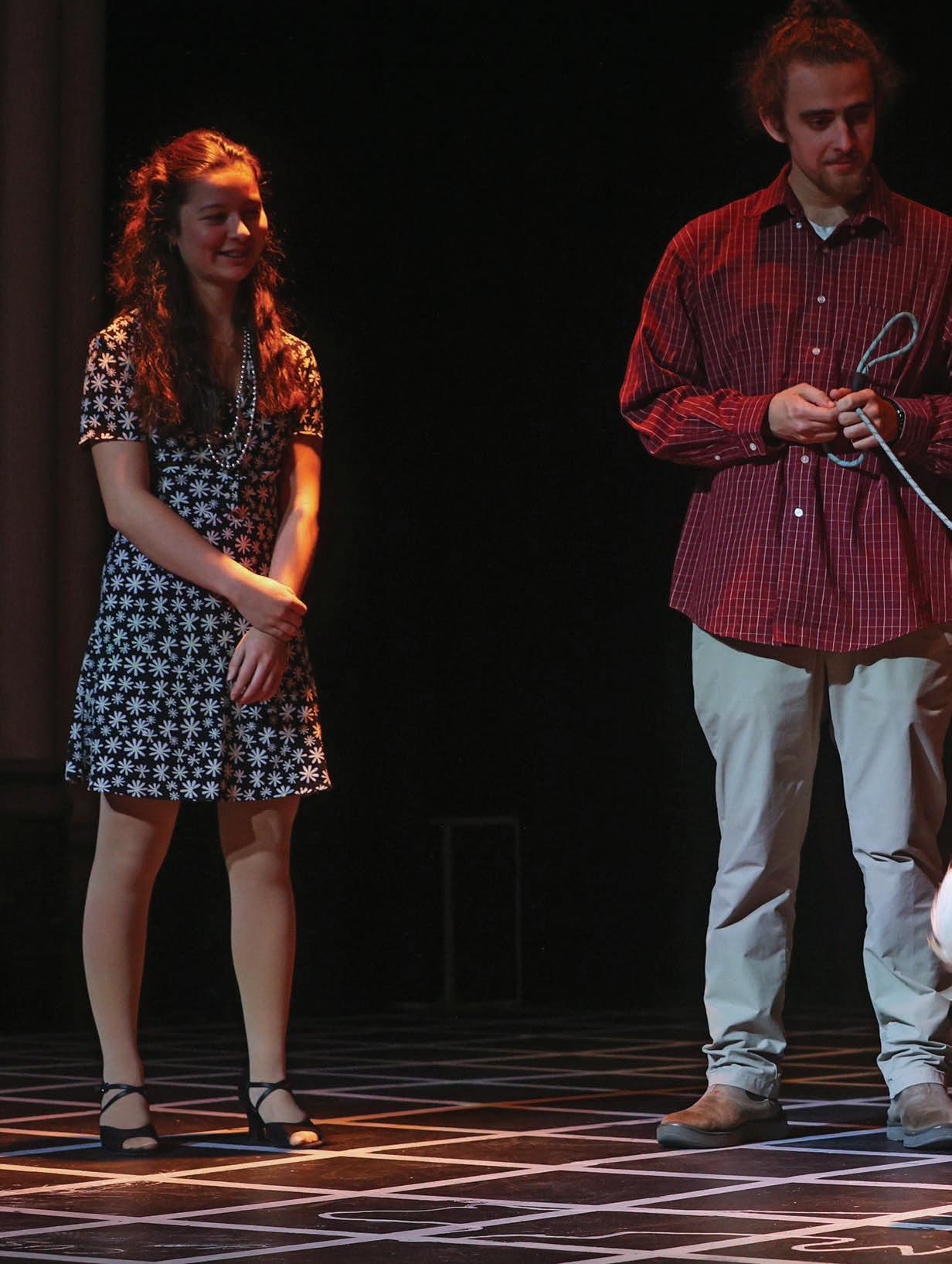
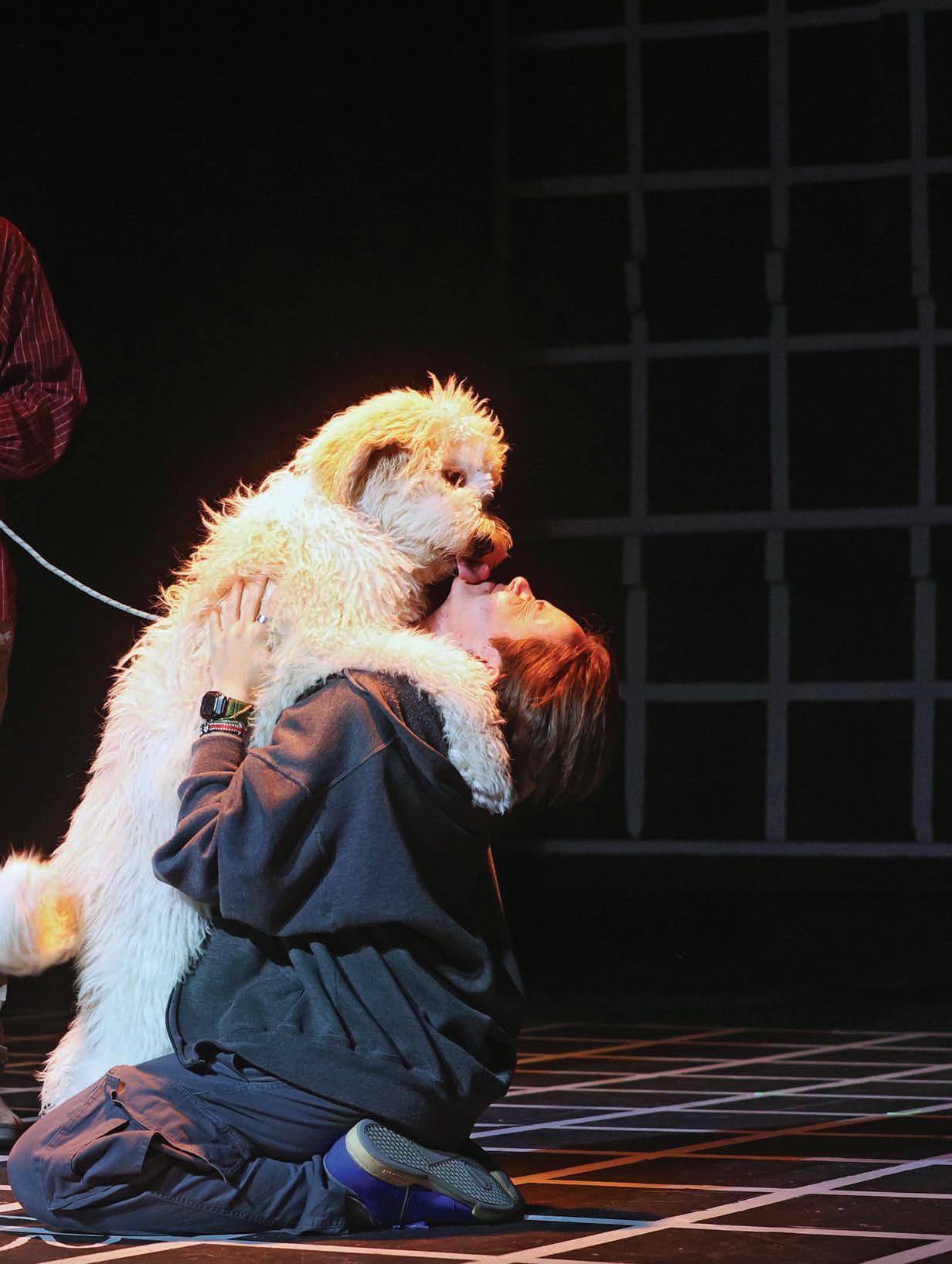
Cushing’s fall play, The Curious Incident of the Dog in the Night-Time, featured standout performances — including those by Maddie Murphy ’27 (left), Kirby Leno ’25 (center), Ray Hecht ’25 (right), and Gryffindor “Gryff” Catlin, the beloved, scene-stealing pet of Director of Student Affairs Sarah Catlin and Director of Teaching and Learning Jennifer Willis.
Building Bridges at Cushing Academy
COMMUNITY READ AND CAMPUS CAMPAIGN FOSTERS CIVIL DISCOURSE
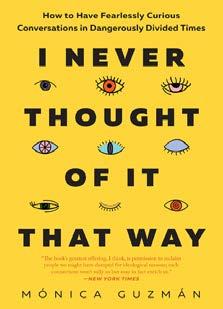
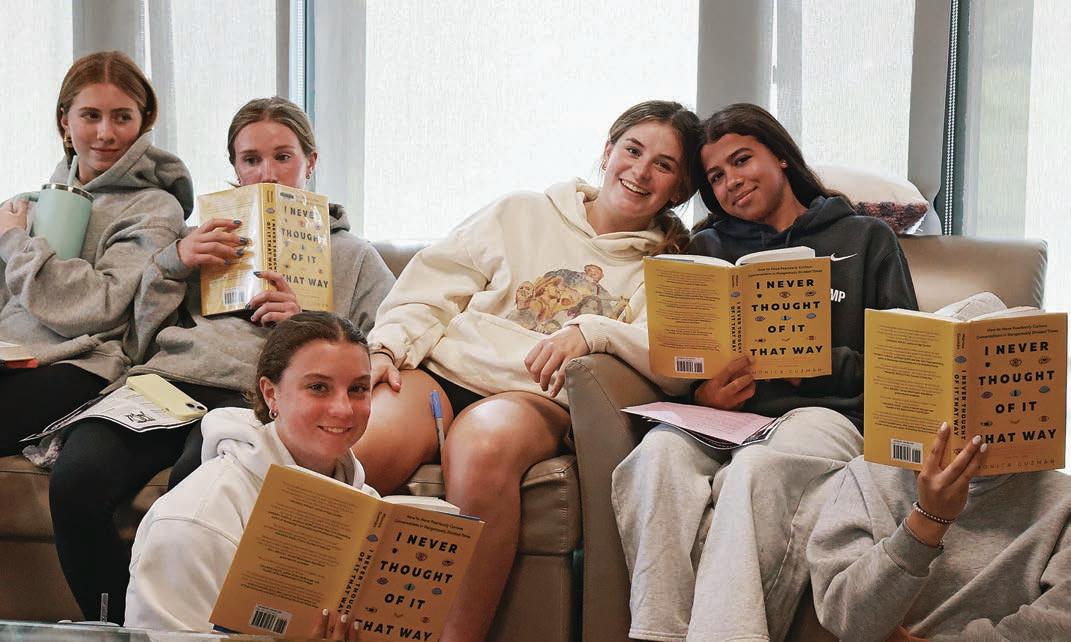
At Cushing Academy, summer reading looked different last year. Instead of giving students a long list of books to choose from, the whole school read the same one: Mónica Guzmán’s I Never Thought of It That Way: How to Have Fearlessly Curious Conversations in Dangerously Divided Times. The decision to shift to a shared text was intentional. As Director of Teaching and Learning Dr. Jennifer Willis explains it, the timing coincided with growing concerns about polarization and the upcoming election season. “We were thinking about how students would be feeling, what they would be receiving through media and social media,” Willis says. “We wanted to launch the school year with shared language.”
The book, which explores how to navigate disagreement in a divided world, became the foundation for a yearlong theme around curiosity and civil discourse. Working with the organization Leadership + Design and partnering with Eddie Buggie, Cushing’s Director of Inclusion and Community Life, Cushing developed civil discourse guidelines that were posted in every classroom across campus, alongside striking posters featuring quotes from Guzmán’s work.
The centerpiece of Guzmán’s approach — and Cushing’s implementation — revolves around three interconnected concepts: Sorting, Othering, and Siloing (SOS). These natural human tendencies can create divisions, but the book offers “bridging” as the antidote. One poster displayed on campus quotes this from Guzmán’s book: “Bridging is the answer to sorting, othering, and siloing. It’s what we do when we step out of our silos and try to see things from a different point of view.”
What we learn relies first and foremost on how open we are to learning, what room we make in our minds conversations.”and “
For Daniela Mijares ’28, who came to Cushing from Costa Rica, the book’s message resonated personally. “I think it definitely taught us to take a step back and really look at a situation from an outside perspective,” she says. Mijares found herself initially ”siloed” with other international students but credited the book’s concepts with encouraging her to branch out and form friendships across different communities.
Community Read launched during orientation, with small-group discussions led by proctors and dorm faculty, where students explored the Civil Discourse Guidelines and practiced active listening skills. A key question from the book — “What am I missing?” — became a touchstone for approaching conversations with curiosity rather than judgment.
“ We tried to hit students from a variety of different angles,” Willis notes, describing follow-up sessions that included role-playing exercises, empathy training, and community art projects based on values
— Mónica Guzmán “
The most important thing about bridges is not to cross them but to keep them.”
—Mónica Guzmán
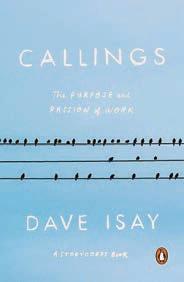
THE 2025–2026 COMMUNITY READ BOOK IS
Callings: The Purpose and Passion of Work by StoryCorps founder Dave Isay
inventories. The goal was prevention rather than reaction — establishing norms for respectful dialogue before conflicts arose.
The impact was subtle but significant. Most tellingly, the school “enjoyed a respectful, civil, pleasant fall” during what could have been a contentious election season, Willis says. “If you do it well, you avoid a lot of classes getting too hot,” she observes.
The program brought Guzmán’s insight to life: “The most important thing to do with bridges is to keep them, not cross them.” By working on these norms early, Cushing created a foundation for dialogue and understanding throughout the school year.
CUSHING ACADEMY Civil Discourse Guidelines
As a member of the Cushing Community, I will strive to model curiosity as I work to build trust and deepen relationships with those around me. By doing my part to engage thoughtfully and with purpose, I will join others in working to create and maintain a community of bridges and an environment of exploration, curious uncertainty, and respectful dialogue.
I affirm my commitment to striving to:
Be
More Curious Than Certain
I will privilege listening over speaking. I will try to understand and be sensitive to the perspectives and feelings of those around me. I will embrace the possibility that what I hear might teach me something.
Challenge Ideas, Not the Person (or Their Values)
I will remember that I can question ideas and actions without disrespecting who they are. I will use proper names and titles. In moments when I disagree with a person’s ideas, I will strive to ask, “What am I missing? Why do you think that?” instead of saying “You’re Wrong!”
Educate Myself
Recognize Intent, Emphasize Impact
I will remember that even when I have good intentions, I can sometimes negatively impact people. When harm is caused, I will recognize the intention — my own or others — and emphasize the impact that was made. When necessary, I will seek to repair the harm caused by my words or actions.
Build Bridges + Intervene Against Incivility
I will remember to begin by listening. By listening to others, I can try to understand what they are saying and, if necessary, intervene using the strategy most likely to disrupt the incivility and restore the relationship.
Trust the Process
I will be patient with myself and others throughout the process. Conversations can be messy and ongoing. I will trust that the process is a journey and not a destination.
Notice Who Is Present: Encourage Participation
I will check to ensure that everyone has been included in the conversation. When people or a group of people are missing, I will surface their absence and find ways to invite them into the conversation.
“The Coach of the Coaches”
BRIAN KRAUSS BRINGS EXCELLENCE
AS DIRECTOR OF ATHLETICS
Brian Krauss P’27 likes to say he’s “the coach of the coaches.” It’s the perfect way to describe his role as Cushing Academy’s director of athletics and his belief that sports are an essential part of education. Af ter starting his career in the classroom, Krauss discovered his true passion on the sidelines, coaching soccer, basketball, and baseball. He went on to lead athletic programs at Millbrook School (NY) and a day school in Virginia before joining Cushing in 2024. It was a move that brought him closer to family, his beloved Red Sox, and the boarding school environment he loves.
What drew Krauss most was Cushing’s size and spirit. “It’s big enough to do a lot, but not so big you lose that family feel,” he says. “As soon as I got on campus, I fell in love with the leadership here and their vision.” Krauss leads through collaboration. “We’re an athletic department. We’re a team,” he says. His open-door style and constant communication set the tone for a culture of shared purpose and accountability. “The biggest impact he has made in his short time is just his willingness to jump right in to help in any scenario,” says varsity baseball coach Ryan Suchanek. “He puts our studentathletes and coaches at the forefront.”
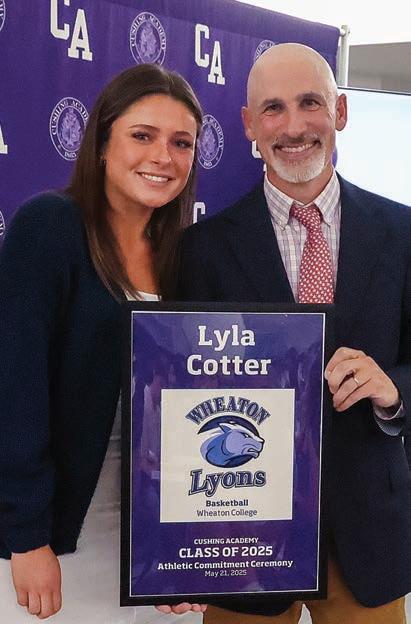
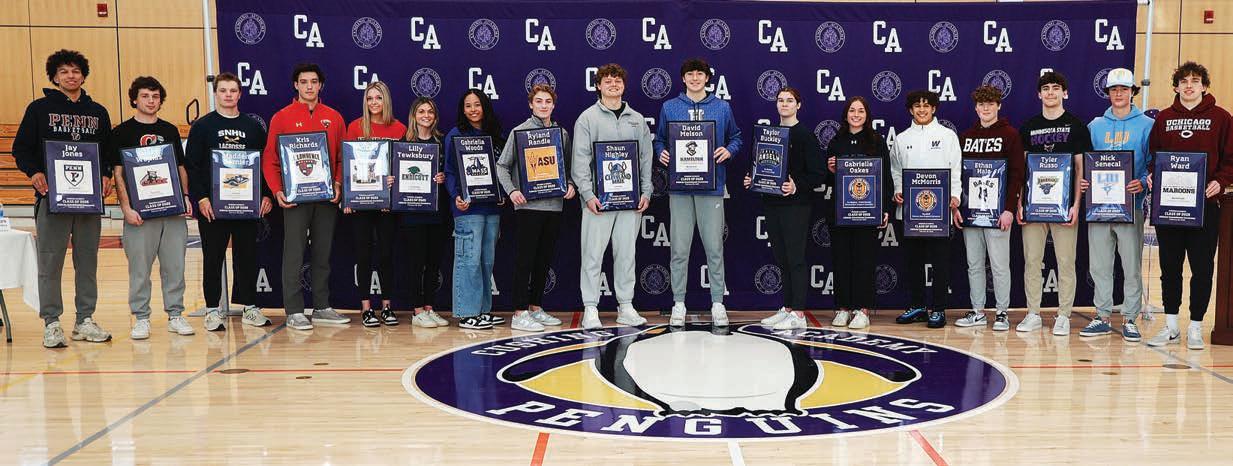
In his first year, Krauss introduced new traditions that celebrate student-athletes — including a revamped college commitment ceremony. He also combined individual season awards banquets into an end-of-year athletics dinner recognizing every participant, with a special nod to multi-sport athletes. “In an era of specialization, we appreciate students who contribute across several different programs,” Krauss says.
Krauss is quick to credit Cushing’s dedicated coaches. “It’s amazing the amount of time and energy that they put into their programs that no one will ever see, the late hours that they are breaking down film or planning practices, working on outreach to parents and making sure that they’re on the same page,” he reflects. “I think it’s pretty special here how dedicated our coaches are. It doesn’t happen everywhere.“
The move to Cushing has also been meaningful personally. His son Nolan ’27 has thrived as a studentathlete. His sixth grader Tucker attends the local middle school and his wife Sara Krauss P’27 joined the faculty as an English teacher this year. “As a parent, seeing Nolan love every second has been really special.”
Krauss brings balance to a program known for athletic excellence. He emphasizes that athletics are one part of a holistic experience at Cushing. “Students don’t have to choose between sports, academics, and arts. They can do it all,” he says. “Not that winning is everything,” he adds with a grin, “but it sure is fun when you are.”
The biggest impact Brian has made in his short time is just his willingness to jump right in to help in any scenario. He puts our studentathletes and coaches at the forefront.”
—RYAN SUCHANEK , HEAD COACH, VARSITY BASEBALL
Athletic Commitments
Twenty-eight members of the class of 2025 committed to playing athletics in college, including nine student-athletes playing at Division I schools, five playing in Division II, and thirteen playing in Division III. Roll Pens!
Baseball
> Jacob Hourihan
Westfield State University
> Devon McMorris
Western New England University
> Michael Pierce
Southern Maine Community College
Men’s Basketball
> Jacob Davis
Eckerd College
> Frederik Jellum
Duquesne University
> Jay Jones
University of Pennsylvania
> David Melson
Hamilton College
> John Price
East Central University
> Ryan Ward
University of Chicago
Women’s Basketball
> Lyla Cotter
Wheaton College
> Derin Tokcan
Worcester State University
Men’s Ice Hockey
> Ryland Randle
Arizona State University
> Kristopher Richards
St. Lawrence University
> Tyler Russo
Minnesota State University, Mankato
> Max Dinneen
Sacred Heart University
> Brett Cunningham
Assumption University
> Eric Lund
Northeastern University
Women’s Ice Hockey
> Taylor Buckley
Saint Anselm College
> Kenzley Goode
Keene State
> Gabbi Oakes
Western New England University
> Lilly Tewksbury
Endicott College
> Gabby Woods
University of Massachusetts Boston
Men’s Lacrosse
> Madden Bernier
Southern New Hampshire University
> Shaun Highley
Cleveland State University
> Nick Senecal
Long Island University
> Lucas Wojnas
Clark University
> Chase DiMeco
Johnson & Wales University
Golf
> Ethan Hale
Bates College
Volleyball
> Kenzley Goode
Keene State
Cushing Moments
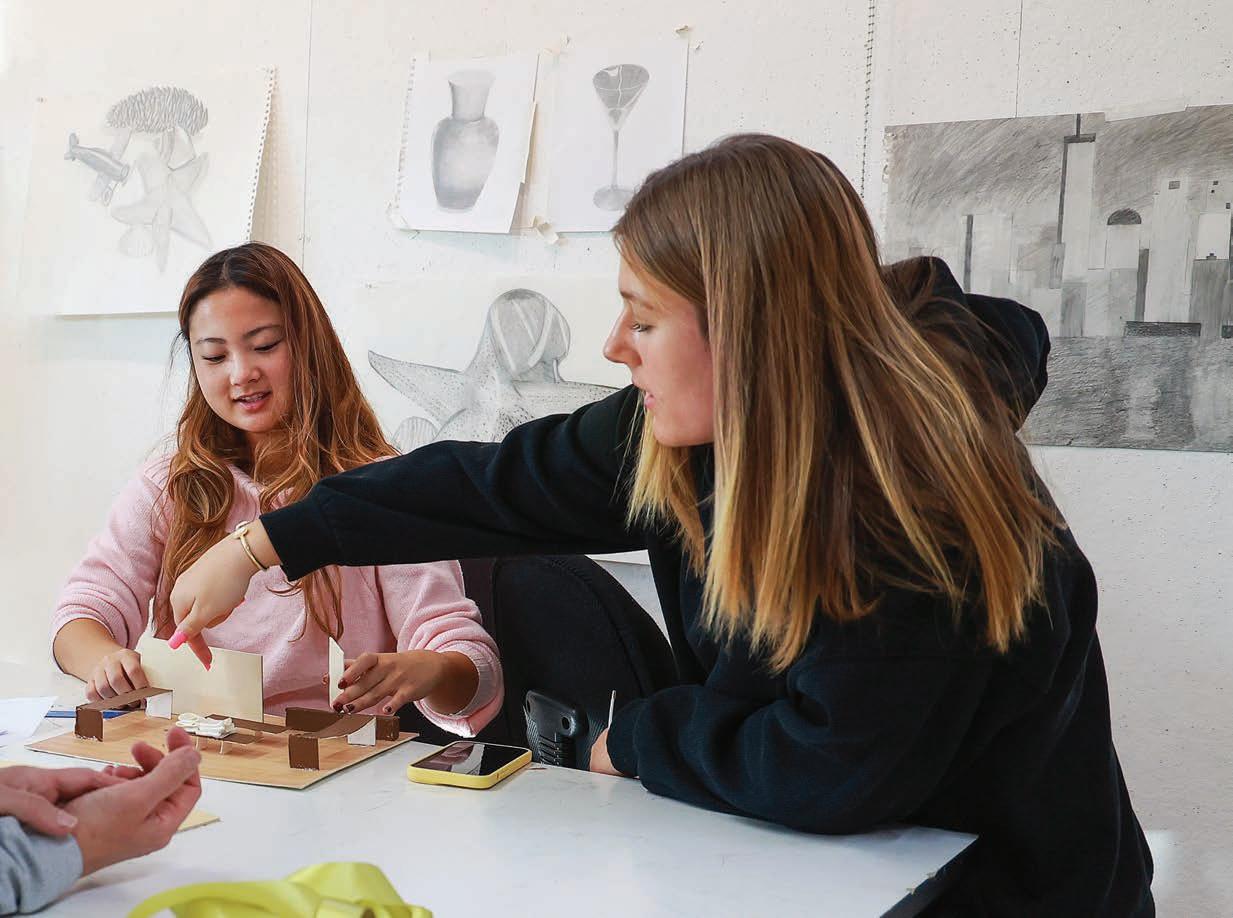
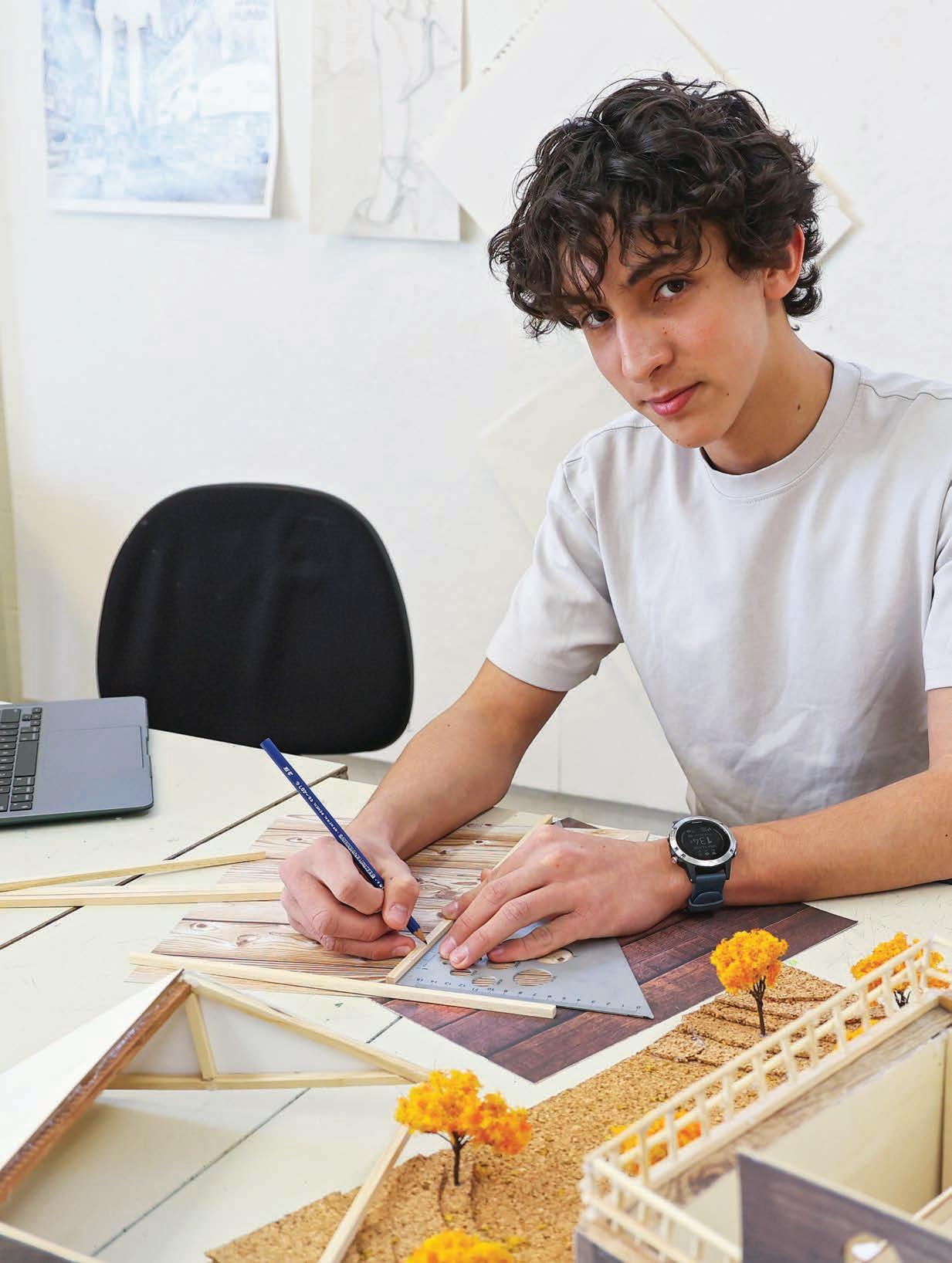
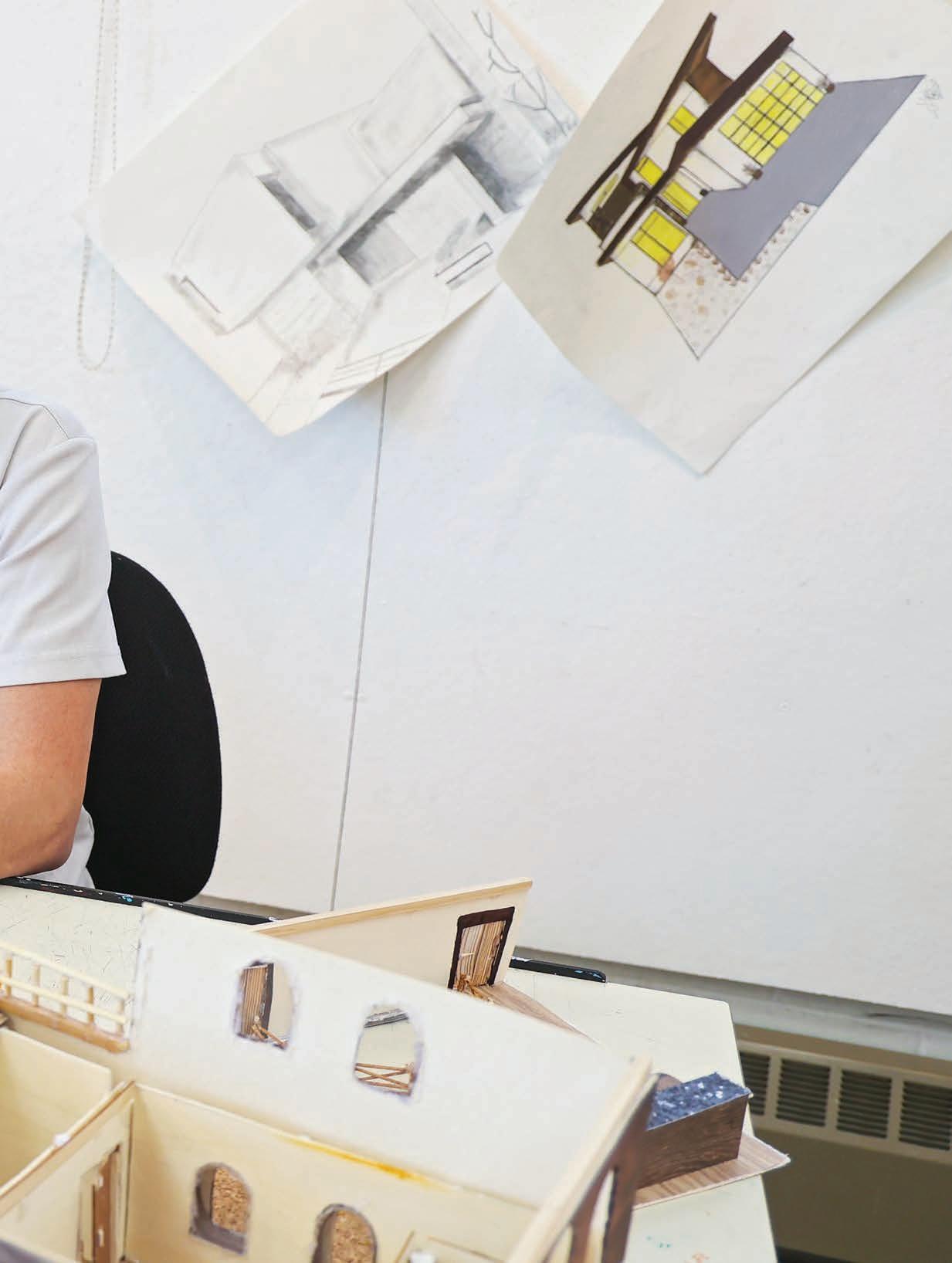
Marcelo Muñoz Hinojosa ’27 works on a model for his Cushing architecture class. His passion for building — sparked by childhood LEGO creations and family ties to engineering — was nurtured through a conversation with alumnus and architect Damián Figueras ’99 (featured on page 64), who spoke to the class from Barcelona as a special guest speaker.
Restoring the Ring of Tradition
CUSHING’S BELL RETURNS AS A SYMBOL OF COMMUNITY AND CONTINUITY
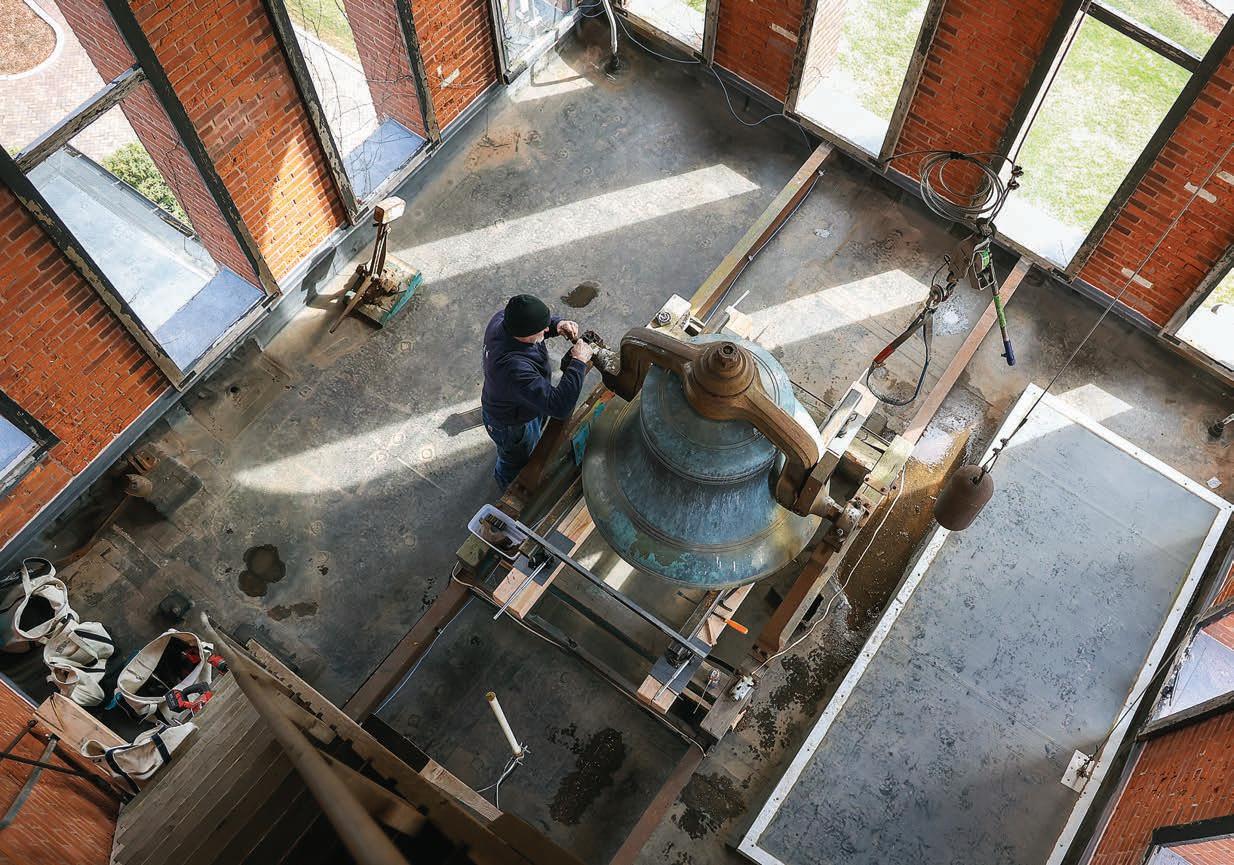
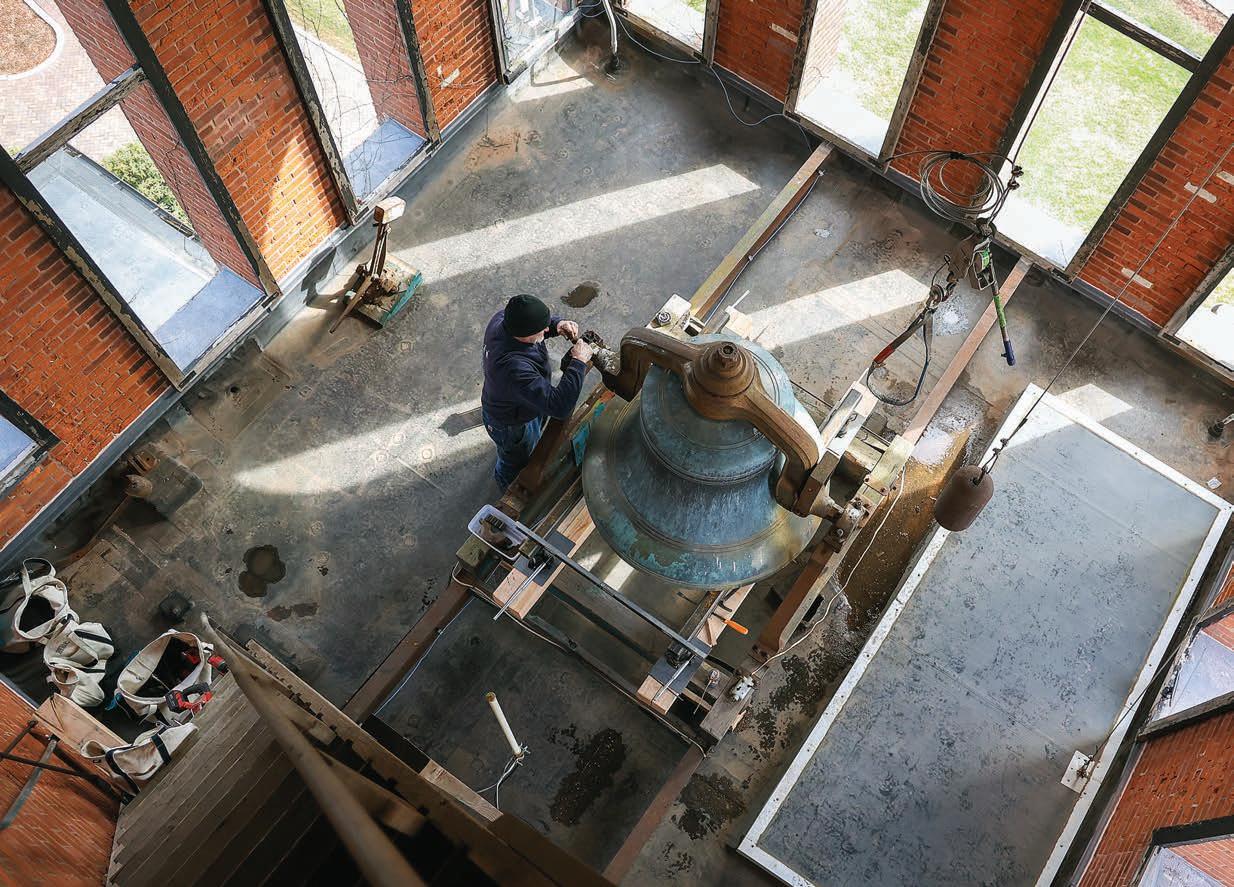
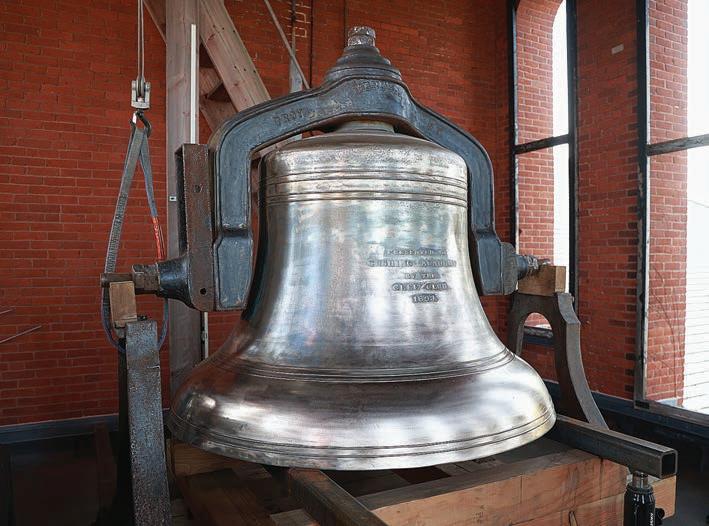
On the surface, it’s just a bell. But to those who know Cushing Academy, the bell that is in Cushing’s Main Building is something much more — a marker of moments, a witness to tradition, and now, thanks to recent restoration, a legacy preserved.
For many years, the bell tolled on the hour, providing a regular tone throughout the day. In more recent years, ringing was reserved for special occasions, like Convocation, Commencement, and the annual 9/11 remembrance. That sound echoed in
the ears of generations of Penguins.
The 3,000-pound bell with a 56inch base was donated to Cushing Academy by the Glee Club in 1893, to replace the original bell which had been destroyed in a Main Building fire that year. The “new“ Cushing bell survived the Main Building burning twice more (in 1923 and 1952), and after more than 130 years of faithful service, the bell — and its surrounding parts — had grown weathered and worn.
“It had lost some of its sound and its functionality,” says Edward Kirk,
Cushing’s director of master planning and engineering. “And with everything it’s meant to this school over the years, we knew it was time to bring it back.”
Local Craftsman With Cushing Connections Tapped
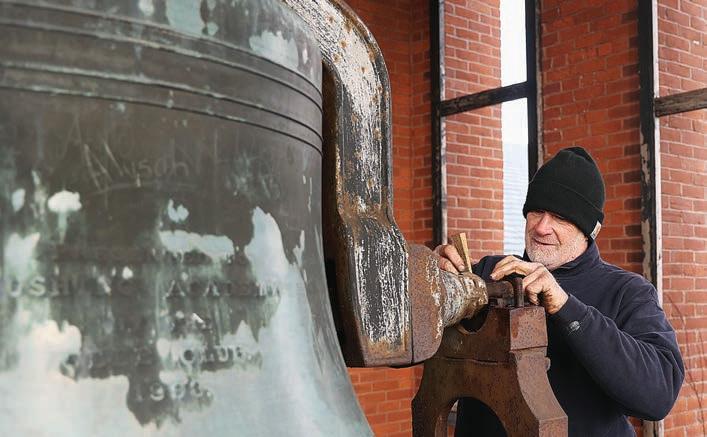
Fixing a bell is a unique skill. Surprisingly, the contractor with the right skills to restore the bell was practically next door. Bill Perrett of Northland Restoration can hear the bell from his home just down the road in Ashburnham.
When Perrett did an introductory walk-through, Kirk knew he was the right person for the job. “He immediately started talking in bell vernacular,” Kirk recalls. “He talked about the hammers and the parts of the hammer and what their functions were, and he knew exactly what he was talking about. He knows his stuff.” As a bonus, Perrett already had a fond connection with Cushing — his late mother, Janet (Battles) Perrett ’51, was a graduate.
Historic preservation has been Perrett’s bread and butter for 40 years. “It’s not just a bell — it’s tradition,” says Perrett. “It’s something that everybody has heard. And it’s something that just sticks in your memory.”
Before the project, the bell could only be rung by directly pulling the tolling hammer in the exposed part of the tower next to the bell. Now, both the tolling hammer and swinging clapper can be operated by pulling ropes that are accessed from a room underneath the bell. An advantage of this is that it protects the hearing of those who ring the bell by giving them a little bit of distance from the loud gong. In addition, Cushing has connected the bell to automation, so the bell once again rings on the hour.
Perrett complimented the facilities staff at Cushing. “They were great to work with,” he says. “Everyone’s a pro. It was cut and polished and prettied up. The mechanics, the new bell wheels, and the new bearings are all functioning as new.”
“ You hear it, and you know you’re part of something bigger,” says Kirk. “It’s more than a sound — it’s a shared experience.”
When you hear the bell ring again, note a sound that’s not just clearer but richer — the enduring echo of a school that treasures its past as it looks to the future.
It’s not just a bell — it’s tradition. It’s something that everybody has heard. And it’s something that just sticks in your memory.”
—BILL PERRETT , CONTRACTOR, NORTHLAND RESTORATION
Proctors Drive Connection and Community at Cushing
SCHOOL-WIDE, STUDENT-LED PROGRAMS BUILD A POSITIVE CULTURE
In the last two years, the job of student proctors at Cushing has expanded in ways that serve both the student-leaders and their peers well. The 50 students in this position have been given a transformational opportunity to learn leadership skills and to develop programs aimed at student-driven change, engagement, and community-building.
The result? A school year shaped by creative new traditions, deeper dorm connections, and a spirit of inclusion that resonated from the dorm lounges to the athletic fields.
“ What made last year different was how intentional the proctors were about the culture they wanted to build,” says Sarah Catlin, director of student
affairs, who oversees the student proctor program. “They didn’t just ask, ‘What should we do?’ They asked, ‘What do we want our community to feel like?’ And then they made that happen.”
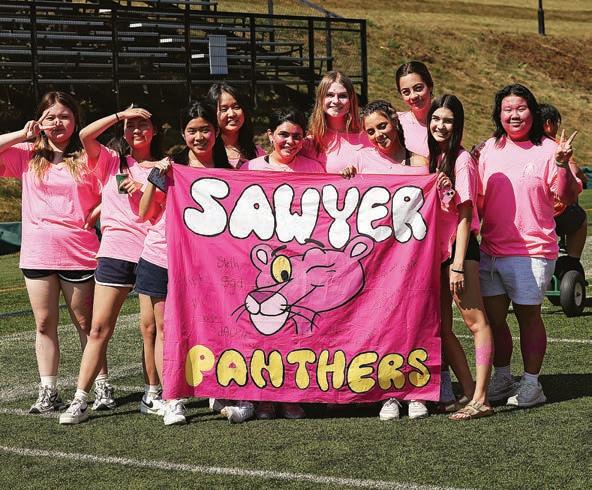
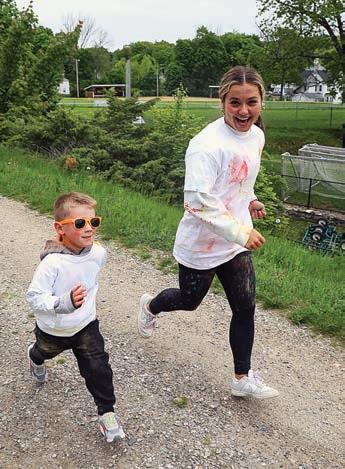
A dorm proctor is a student leader who helps build and enforce student norms in each student residence. It is a selective campus role that requires an application. As part of the updated program, each student who is accepted as a dorm proctor launches their own initiative — some just for fun, some intended to go a little deeper, all rooted in a desire to create meaningful experiences. Projects ranged from community events like a Color Run and a holiday movie festival to initiatives such as dorm kindness cards and organized Cushing campus cleanups.
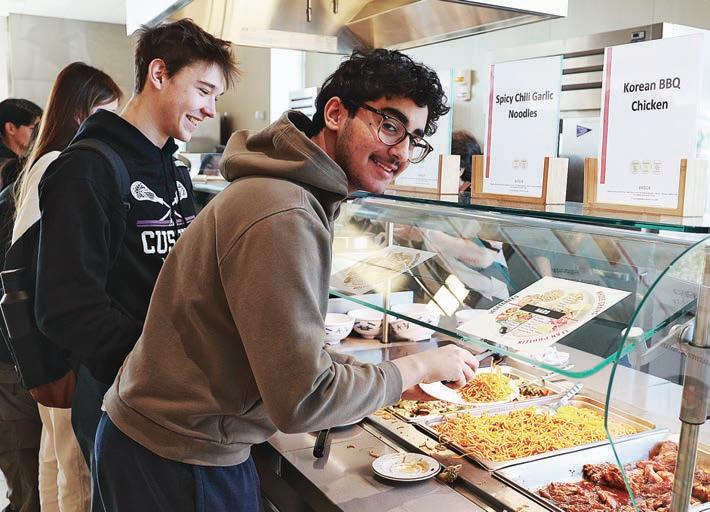
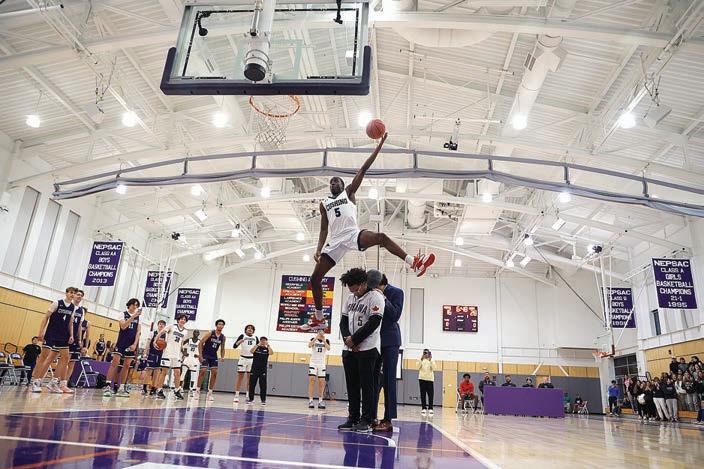
One par ticular hit was Cultural Food Week. Proctors Dawson Hsu ’27, Justin Lee ’27, Valerie Kwak ’26, Inwoo Hwang ’25, and Emma Yamashita ’25 partnered with students in the International Club to collect favorite recipes from home and worked with dining services to prepare authentic cuisine over the course of the week from China, Germany, Italy, Mexico, Venezuela, and Vietnam, among others. Not every effort turns out exactly as expected — but as an educator, Catlin embraces the opportunities for learning when things don’t go perfectly. For instance, for his proctor project, Ryan Ward ’25 revamped Penguin Madness, a start-of-thebasketball-season showcase akin to
many college programs’ Midnight Madness, incorporating lessons learned from previous events to make an even better experience.
“ We’re embracing the fact that they build resilience by learning from failure,” says Catlin. “The worst thing we can do to them in these leadership roles is to give them roles where they don’t have any skin in the game, where they don’t have any ownership, where they don’t have any risk in it. Leading is really hard, and if we make leading easy, that’s a disservice to them.”
Leadership training played a role in the proctors’ growth. Proctors take a semester-long course with Catlin, including training on communication, inclusivity, and conflict resolution. But the real learning came when they applied those lessons day after day.
“Being a proctor isn’t just about having a title,” says Catlin. “It’s about making the people around you feel safer, more connected, more supported.”
As the year came to a close, faculty and students alike praised the proctors for raising the bar.
“They set a tone,” Catlin says. “And now we have a foundation to build on for years to come.”
They didn’t just ask, ‘What should we do?’ They asked, ‘What do we want our community to feel like?’ And then they made that happen.”
—SARAH CATLIN , DIRECTOR OF STUDENT AFFAIRS
Our Social Semester
US
FEBRUARY 22: Students are making the most of every moment this week — diving into hands-on workshops, rallying together for Hockey Fights Cancer games, and keeping the energy high with late-night events. #PoweredByTeaching #PoweredByCommunity
MAY 17: Weekly Roundup: AP Geography, Cum Laude Induction, Chamber Music, and great moments from our athletics. #PoweredByCommunity
FEBRUARY 15: We are celebrating a lot this week around campus! Seniors kick off the official 100 days until graduation for the Class of 2025, our Ski Team scored awards at the NEPSAC championship, and indoor activities like Casino Night help keep our students busy with the winter weather. #PoweredByTradition #PoweredByCommunity
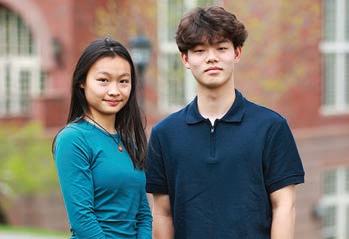
MAY 19: Congratulations to our new Student Body Co-Presidents: Fangqi “Felicity” Liao ’26 and Rong “Rony” Pang ’26. The Student Body Co-Presidents represent students, organize all-school assembly, and work with a variety of groups on campus to promote curious, creative, and confident learners and leaders. #PoweredByTradition
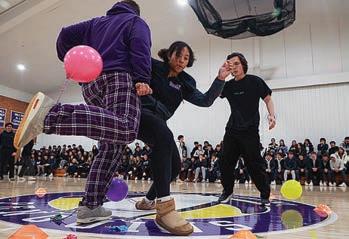
MARCH 11: In the past two weeks, Cushing has been filled with activity: debates in International Relations, enthusiastic pep rallies, Winter Family Weekend, athletic commitment ceremonies, Senior games, the Rust Cup (winners!), the winter musical, and more! #PoweredByPeople #ThePowerOfCushing
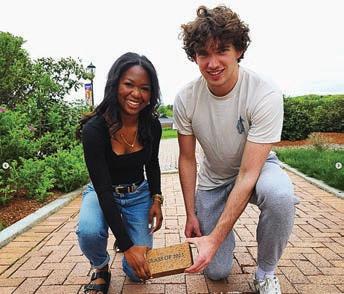
MAY 20: Student Body Co-Presidents Dorothy Kuwana and Ryan Ward place the Class of 2025 brick along the Senior Walkway. Each member of the Class of 2025 has a brick placed in their honor. #PoweredByTradition #PoweredByPeople
#ThePowerOfCushing
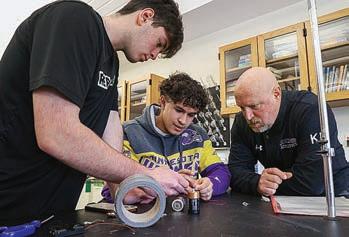
JANUARY 25: What’s happening around campus? Students have been busy with electrical circuits, Lunar New Year preparations, skiing, and plenty of home games!
#ThePowerOfCushing #PoweredByPeople
MARCH 13: It’s pretty quiet around campus as students officially head out for Spring Break! That did not stop our up-and-coming spring athletes from squeezing in a little practice before they go.
JUNE 2: Our LAST week on campus: Final Assembly, Spring Fling, XBL, Senior Breakfast, All-School Handshake and Commencement. #PoweredByCommunity #PoweredByTradition
JANUARY 29: Happy New Year! It’s the Year of the Snake, which symbolizes good luck, rebirth, and regality. Students shared over 3,000 handmade dumplings with their peers during Community Lunch, tested their luck with our tradition of red envelopes, and tried their hand at calligraphy. Thank you to everyone who helped make this event happen. #PoweredByCommunity #PoweredByPeople
APRIL 19: This week at Cushing: Penguin Attack, Girls’ in Sports Leadership Series, International Club, art trip to the Museum of Fine Arts, guest speaker Saul Malek, and Spring Media Week. #PoweredByTradition #PoweredByCommunity #PoweredByPenguins
FEBRUARY 8: Campus is a blizzard of energy with students participating in an interactive lab for Integrated Science, an adorable guest joining Assembly, slam poet Andre Bradford (@SCsays) performing pieces on resilience, and girls’ basketball taking the spotlight before Super Bowl Weekend! #PoweredByCommunity #PoweredByInclusion #PoweredByResilience
APRIL 24: Cushing Academy gives back on Tony Fisher Day — a powerful tradition of service, unity, and community impact. Students and staff join together to make a difference at over 20 organizations. #PoweredByTradition #PoweredByCommunity
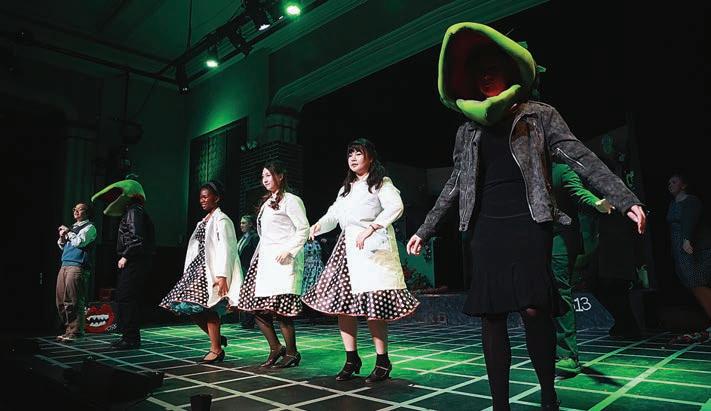
2: A job well done to all of the cast of Little Shop of
A wonderful production from beginning to tragic plant end! #PoweredByCreativity #PoweredByTheatre
MARCH
Horrors.
From Underdogs to Champions
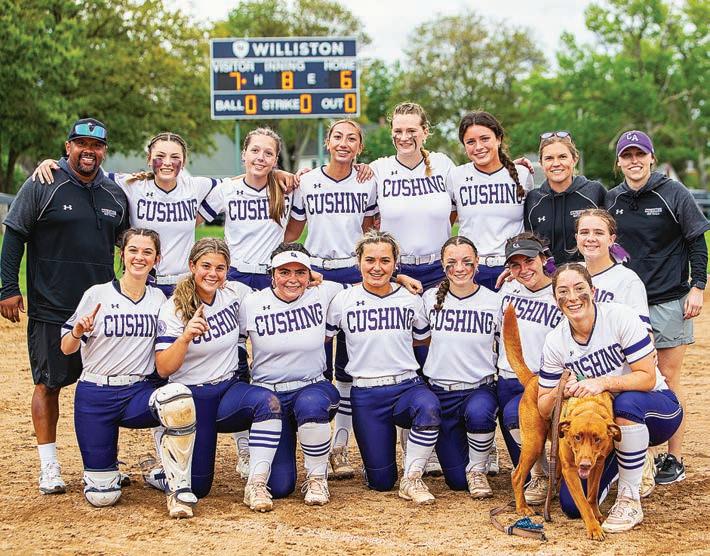
CUSHING SOFTBALL’S REMARKABLE 2025 COMEBACK TOUR
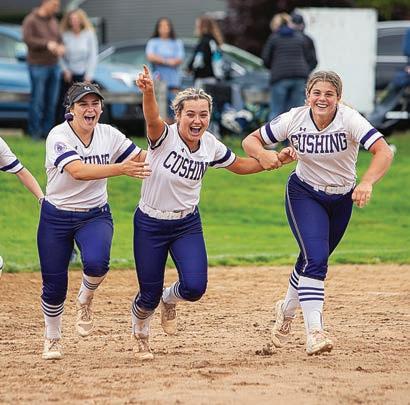
When the Cushing Academy softball season began, head coach Aaron Santos ’06 knew his young team faced challenges. With ninth grader Olivia Richard ’28 behind the plate as starting catcher and fellow underclassman Addy Pelletier ’27 patrolling left field, the Penguins were largely untested. But Santos had his eyes on a third championship in four years. This is his 12th year of building a solid team culture.
“I think we knew we’d be competitive, but we weren’t sure how far we could go,” Santos recalls.
What unfolded was a Cinderella story that culminated in one of the most grueling — and rewarding — championship weekends in recent memory.
The Penguins finished the regular season 11–4, but those four losses told a story of near-misses against quality opponents. They
fell to Suffield Academy, Williston Northampton School, KUA, and Andover — teams that would prove their mettle by winning their respective divisions or advancing deep into playoffs.
“ Three of those four losses were in a row,” assistant coach Katie Ftorek remembers. “So we lost, lost, lost, and that was the middle of the season, so it wasn’t looking great.”
But then something clicked as the season wound down. The team found its rhythm just when it mattered most, though they still had to fight for their tournament lives.
On Friday, May 16, the Penguins faced a daunting reality: they needed to win a play-in game just to make the Western New England Division A tournament. That meant a three-hour bus ride to Rye, New York, to face the School of the Holy Child. Rather than scared, though, the team was motivated for what was to come.
“If we lost that game, it was like we traveled all that way for nothing,” captain Charlotte Ciarletta ’26 recalls.
The Penguins won 3–1, but their weekend was just beginning. Saturday brought a two-hour trip to Suffield, Connecticut, for the semifinal — a rematch against the team that had beaten them 7–8 earlier in the season.
“Before the game even started, Char and I went up to the plate for the
pregame meeting,” remembers captain Brooke Harb ’26, “and the Suffield team was already talking about how they have to play Williston tomorrow. They already thought they won the game.”
That confidence proved premature. Despite falling behind 5–0, Cushing roared back with 14 unanswered runs for a decisive 14–5 victory. Harb threw every inning of the tournament weekend.
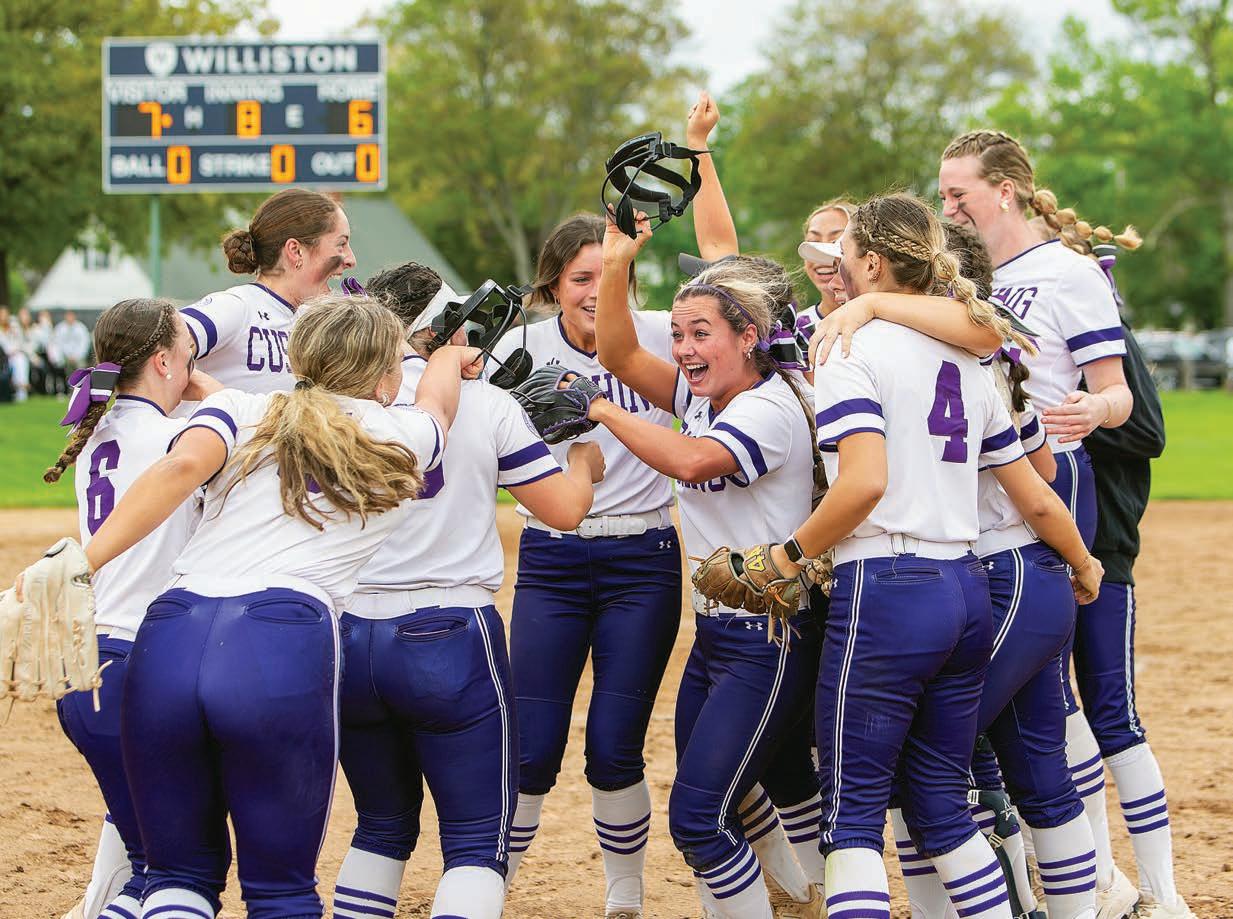
Sunday brought the final test: Williston Northampton, another team that had beaten Cushing during the regular season. With prom that evening, the Penguins started early — 7 a.m. batting practice followed by a 10:30 a.m. game time. This time Harb contributed with her bat, too, launching a first-inning home run.
The strategy worked. Cushing captured the championship, with shortstop Ciarletta making “almost half of our outs that were in the field,” according to Ftorek. In center field, Bailee St. Sauveur ’26, made a diving catch that Santos called a
“game changer — if she dives and misses that ball, we lose the game.”
By the time the team bus rolled back onto campus around 1:30 p.m., complete with police escort and cheering faculty and students lining the Senior Walkway, the girls had traveled an astounding 662 miles over the championship weekend alone. They had just enough time to transform from championship softball players to prom attendees, with buses departing for the dance at 4:30 p.m.
“It felt so nice, finally winning, AGAIN,” Harb reflects. “It was all worth it.”
For Santos, now in his 12th year as head coach, the weekend represented something special about the culture he’s built. As St. Sauveur’s father noted after the championship game, his daughter “must really like playing for you, because she’s never dove before, and we’ve been asking her to practice that for years.”
With nearly the entire team returning next season, there is already a buzz about what this spring has in store.
Making History at Cushing Academy
STUDENTS EXCEL IN NATIONAL HISTORY DAY COMPETITION
When Susie Cirone became the history and social science department chair in 2023, she envisioned creating “a collective experience and a collective skill set” for students across the curriculum.
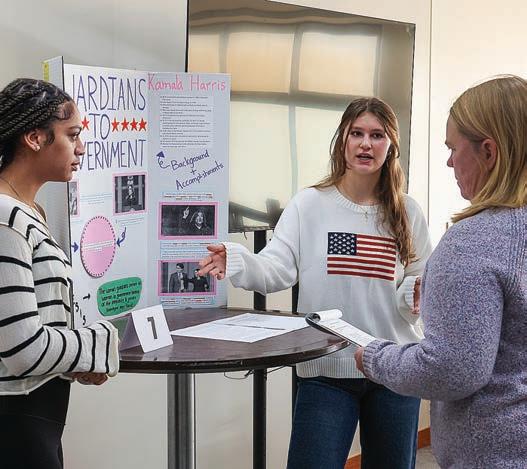
Cirone’s ambitious plan hit a first milestone last December with the inaugural Cushing History Expo — a school-wide research showcase that has already produced remarkable results, including Jack Zhang ’27 advancing to the National History Day competition after winning both regional and state competitions.
A (Research) ProjectOriented Approach
The Expo featured research centered around the National History Day theme of “Rights & Responsibilities.” Students in World History and United States History courses investigated diverse topics ranging from immigration and refugee rights to social movements, substance use disorders, and Socratic dialogues.
“ We had about 260 kids with about 140 projects,” Cirone explains. The format of the Expo
mimicked the National History Day guidelines. Students worked individually or in groups, producing essays, documentaries, websites, displays, or performances.
The Expo replaced traditional final exams for most history courses, serving as both an assessment and a celebration. This required buy-in from the other members of the department who understood the value of giving students valuable research and public speaking experience. “I think it was much more fun than an exam,” Cirone notes, adding that it also was “more
memorable than an exam” while effectively showcasing research skills.
Cirone and her colleague Christine Monahan P’24, ’26 put a lot into making the Expo happen. They completed a six-week online course through the Massachusetts Historical Society focused on teaching research and National History Day methodology. Monahan also volunteered to be a judge for a day at the National History Day contest so she could learn more about research and the process. The results were worth it. Students got engaged in their learning, and the learning of their peers.
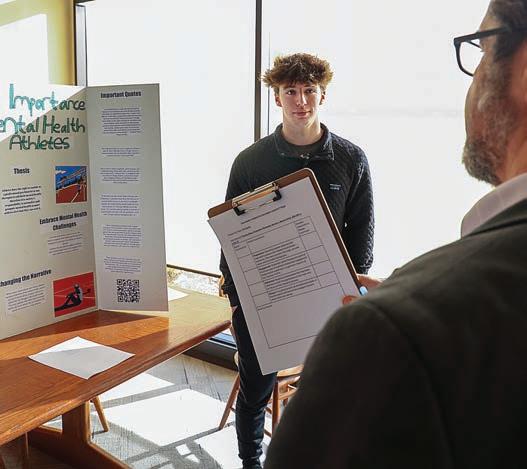
More than 30 adult volunteers, including three educators from the Massachusetts Historical Society and the president of the Ashburnham Historical Society, volunteered at the event, conducting 10-minute interviews with student presenters. This oppor tunity to practice presentation skills was especially valuable. Students were expected to give presentations with data to support their research. Following the presentations, judges and audience members could
ask questions about their work. It was truly a collaborative learning experience, where students had a chance to see — and be impressed and inspired by — the work their peers had done.
Cushing Wins at the Regional and State Level
An added bonus was success beyond the Academy. This first year, 43 students competed at the regionals in a combination of individual and group projects, with 25 earning awards and 13 qualifying for the State Competition. At States, in addition to Zhang’s win, Isabella Yang ’26 earned an Honorable Mention in the Individual Performance category and the Handel and Haydn Society Award for an Outstanding Project in Music History for her project, “Do You Hear the Prisoners Sing?”
The variety of student experiences inspired Cirone. Zhang, an Honors Modern World student who initially wanted to research the Holocaust, gradually shifted to examining the Nanjing Massacre through the lens of rights and responsibilities. Conducting research in both English and Chinese, he created a sophisticated website for
his project, “The Hidden Truth: Bloody Massacre at Nanjing.” One Massachusetts Historical Society educator called his work “one of the most complex arguments” they’d encountered.
Another memorable success was that of a ninth-grade student who had been struggling academically, but who found his passion through History Day research. “It was not until the research started that he started to light up,” Cirone recalls. “He went from being a student about whom we were really worried... and then this was just the thing that gave him a little independence.”
Looking ahead, Cirone envisions that the intensive research process leading up to future Cushing Expos will foster every student’s curiosity, creativity, and confidence. The success of students like Zhang demonstrates the program’s potential to differentiate Cushing students in college applications and beyond.
“ We love to see kids choose to compete, and we love to win things,” Cirone says. “But the idea is that they’re not going to forget what they researched. They learn the skills, and that’s the goal.”
We love to see kids choose to compete, and we love to win things. But the idea is that they’re not going to forget what they researched. They learn the skills, and that’s the goal.”
—SUSIE CIRONE , HISTORY AND SOCIAL SCIENCE DEPARTMENT CHAIR
Cushing Moments
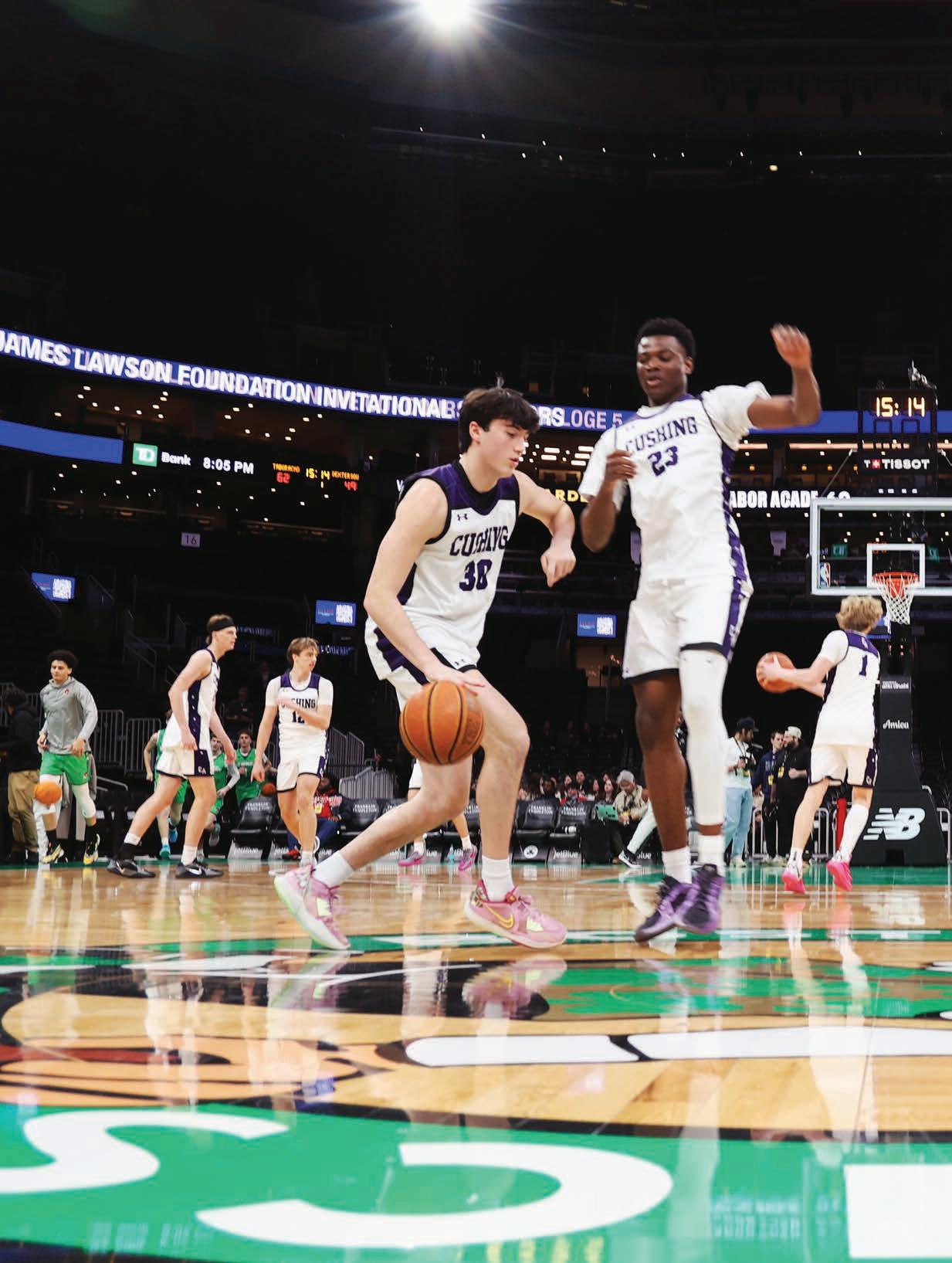
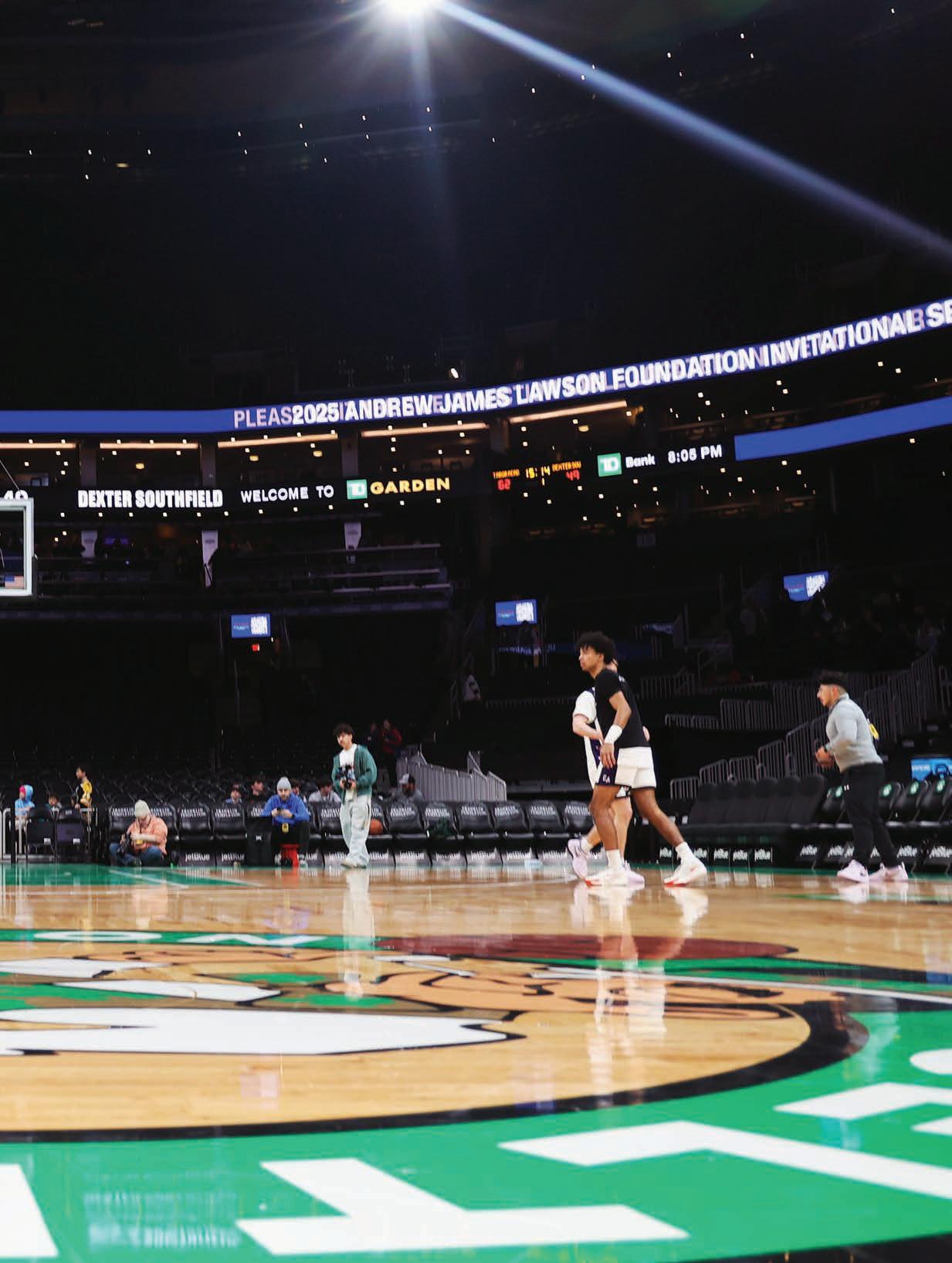
David Melson ’25 and Theophilous Edema ’27 warm up on the Boston Celtics’ parquet before a thrilling 61–57 win against Newman School as part of the Andrew James Lawson Foundation Invitational at TD Garden, held in January 2025. Boys’ Prep Basketball had a tremendous season, finishing 26–6 and advancing to the semifinals in the National Prep Championship.
Boys’ Prep Basketball will return to TD Garden for a rematch against Newman School on January 18, 2026. Be on the lookout for details and a pregame Cushing community gathering.
Building an Artistic Shoe Business
JACKSON LOGAN ’27 THRIVES ON THE BASEBALL DIAMOND AND IN THE ART STUDIO
What started as a project to beat the doldrums during a holiday break has blossomed into a thriving custom shoe business that’s catching the attention of professional athletes and sneakerheads around the world.
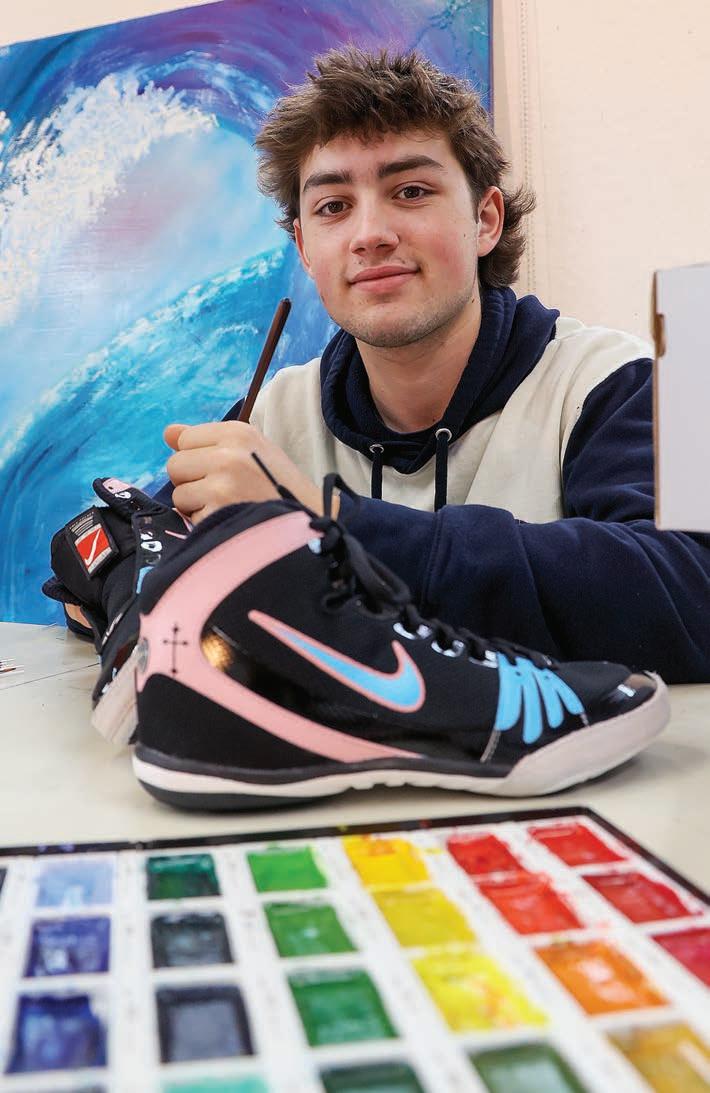
Jackson Logan ’27 has loved art since he was a child, but when he looked around for a canvas this time, his eyes fell on something different. He picked up a pair of New Balance baseball cleats and experimented with painting them sunset pink. “I was just bored one day,” Logan recalls. “I’d always watched YouTube videos on art, and it kind of just went in the shoe direction.”
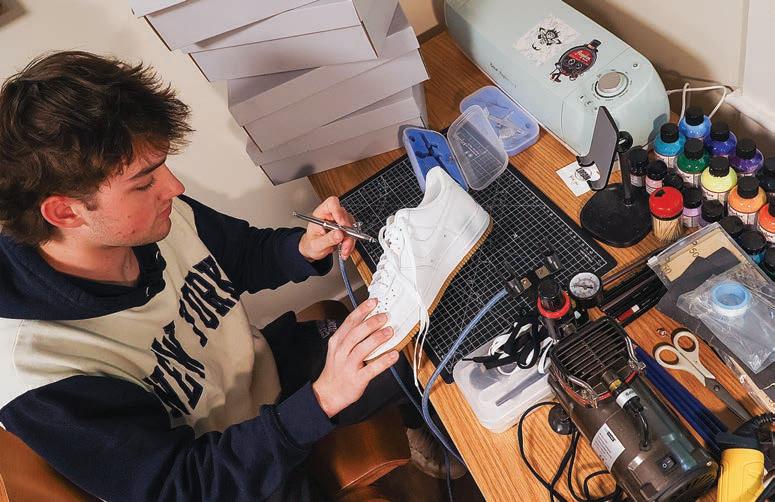
That single pair of painted cleats sparked something bigger. Friends on his Cushing baseball team wanted their own custom designs, and soon Logan found himself fielding requests from beyond Cushing Academy’s campus. Although the business has grown primarily through word-of-mouth, his Instagram account, @logan.customz, now showcases an impressive portfolio ranging from spider web-themed cleats to an intricate tartan plaid.
The business has grown remarkably fast. Logan has painted shoes for professional hockey goalie Drew Commesso and Savannah Bananas player Eric Jones Jr. and is in conversations with Boston Red Sox prospects. His most ambitious project yet? Eight pairs of shoes featuring multi-layered tartan patterns for a wedding party in Scotland.
“It’s not just a hobby anymore,” Logan says. His prices have evolved accordingly. He started with “give me anything you have” for friends. Now he
does formally contracted commissions that can take 10–15 hours to complete.
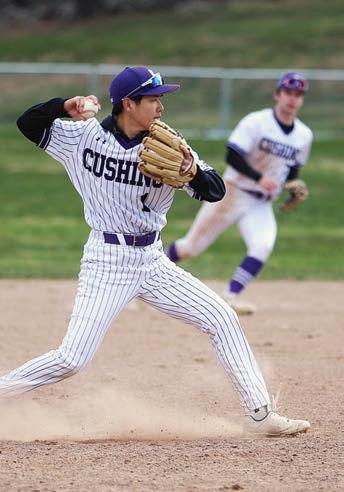
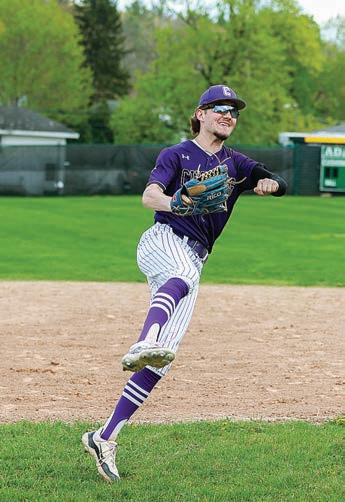
Until that moment of experimentation, Logan’s primary outside-of-class pursuit had been baseball. During his first varsity start in 2024, Logan threw a complete game no-hitter and also hit a two-run triple, driving in what proved to be the game-winning run. Cushing has been the perfect environment to nurture all sides of Logan’s growth — academic, athletic, and artistic passions. Jeanine Eschenbach (Ms. Esch), Logan’s dorm parent and the head of the visual arts department, discovered his talent early in his sophomore year and immediately became his champion, providing professional-grade detail brushes to replace the toothpick he’d been using for intricate work.
“He just exudes confidence at this point,” Ms. Esch observes.
“It’s electric to be a sidecar to a student who is so enthusiastic and courageous with their idea.”
In M s. Esch’s advanced painting and drawing class, Logan works alongside classmates using chalk pastels and
oils while he perfects his leather painting technique using specialized Angelus paint. The setup includes an airbrush station and sanding materials — unusual equipment for a traditional art classroom, but perfectly suited to Logan’s unique medium.
“ We pivot, and we wiggle to make things work so students can dive into many things,” Ms. Esch explains.
This flexibility allows Logan to excel as both a baseball player and emerging artist-entrepreneur while maintaining strong academics and serving as a proctor this year.
For Logan, whose mother works at Boston’s Museum of Fine Arts and has always encouraged his artistic side, the support at Cushing represents something special.
“Ms. Esch has been super supportive with everything,” he says. “She lets me do whatever I want with shoes.”
As he look s ahead, Logan hopes his custom shoe business might eventually replace his summer construction job with his father, allowing him to pursue “something I love” full-time.
He just exudes confidence at this point. It’s electric to be a sidecar to a student who is so enthusiastic and courageous with their idea.”
—JEANINE ESCHENBACH , LOGAN’S DORM PARENT AND HEAD OF THE VISUAL ARTS DEPARTMENT
SCAN ME! Check out Logan’s Instagram for his latest creations.
Scholastic Art Award Winners
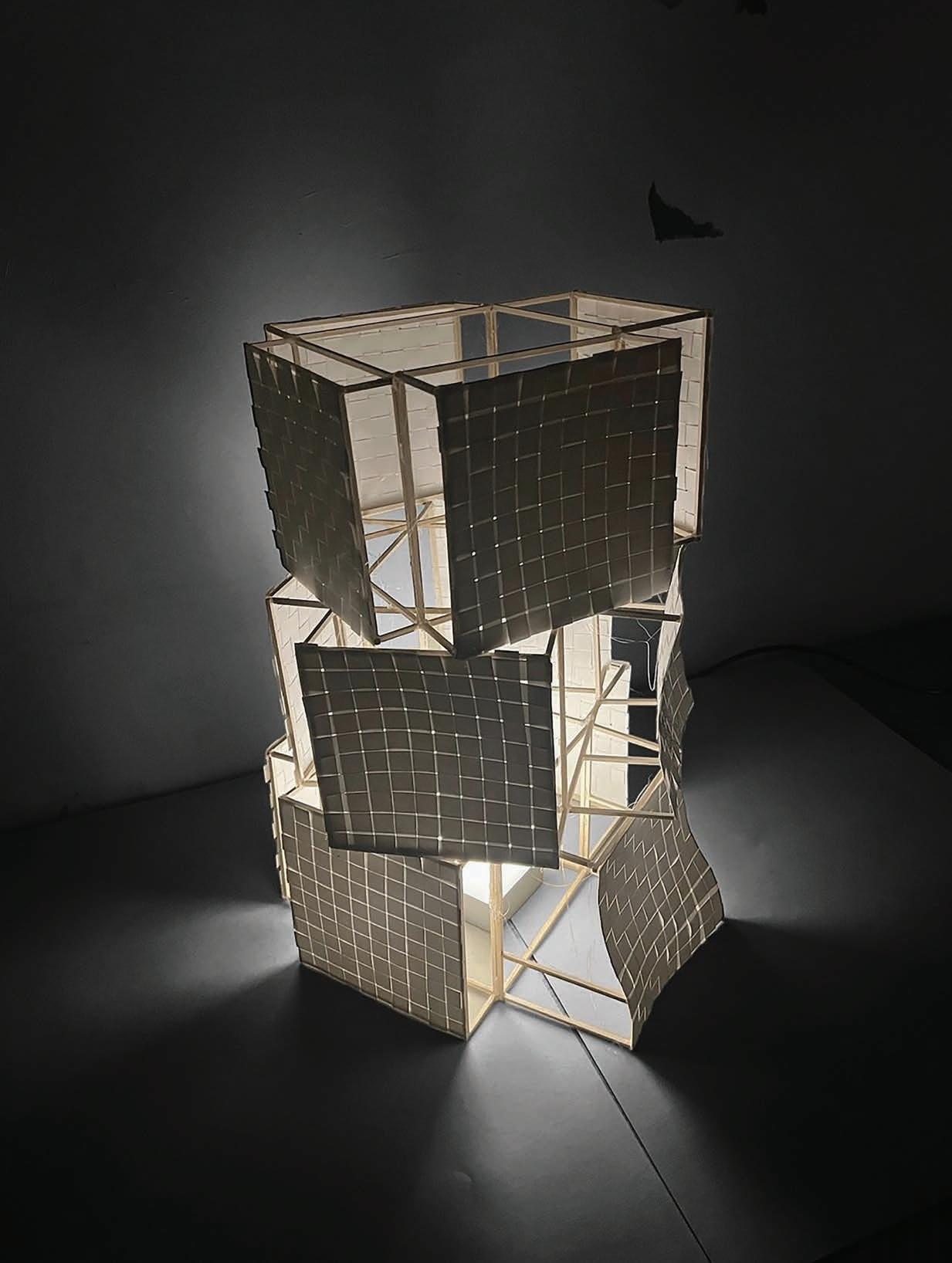
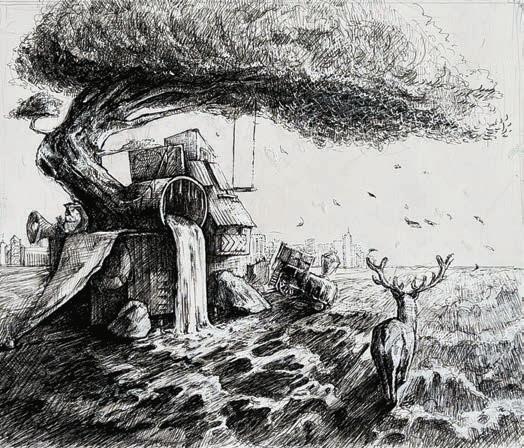
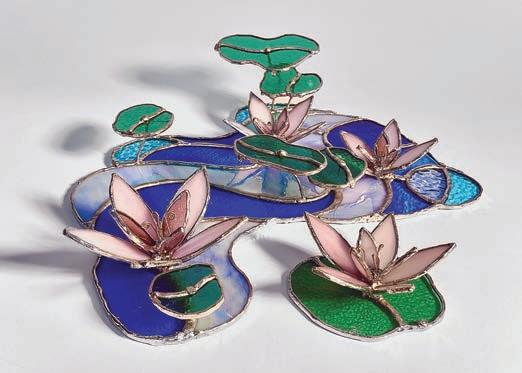
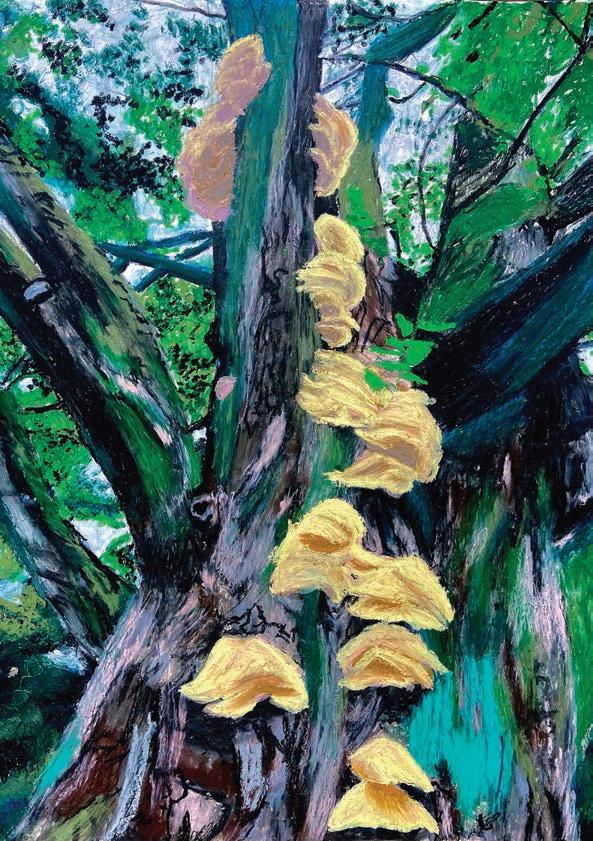
Cushing visual artists received 2 Gold Keys, 11 Silver Keys, and 6 Honorable Mentions in the 2024–2025 Scholastic Art & Writing Awards, the nation’s longestrunning and most prestigious recognition program for creative teens. Here are some of the winning submissions by Jaehyo Daniel Choi ’26 (opposite page), Zitian Catherine Li ’27 (below left), Yundi Wendy Hu ’25 (bottom left), and Lily Winston ’25 (below right).
See more work and artist profiles in the 2025 Cushing Academy Visual Arts Magazine, featuring a cover image by William
’25
SCAN ME!
Rawlins
Bill Troy Hits 26 Boston Finishes — Sets His Sights on 30
CUSHING STUDENTS CONTINUE TRADITION OF CARING FOR DANA-FARBER FINISHERS
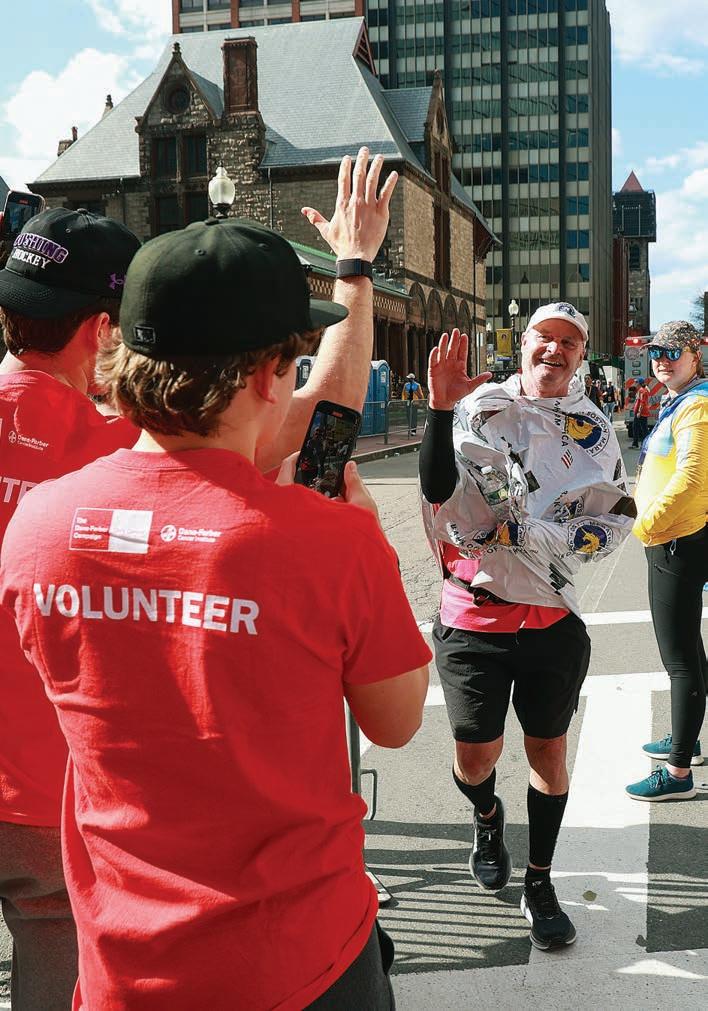
Now retired, faculty member Bill Troy P’10, ’11 was the quintessential Cushing coach, guiding countless student athletes in 35 years at Cushing to reach their full potential, and influencing elite athletes like Cena, Bourque, and Sheary. In 1998, he began coaching in yet another way, showing the community how to give back, when he began running the Boston Marathon to raise money for DanaFarber Cancer Institute as part of their Dana-Farber Marathon Challenge team.
In 2024, Troy pounded the pavement for the 25th time — continuing a tradition that grew over the years to engage hundreds of Cushing students. He considered hanging up his shoes, but this year, prompted by his sister, he laced up once more, running his 26th Boston Marathon.
“I had a good run this year,” he says. “Now my new goal is to get to 30. If the body holds up, I’ll get there.”
Troy took that first step decades ago to support cancer researchers at Dana-Farber, where both his parents received care. Since then, he has brought in more than $162,998.42 to support their work.
Cushing has been par t of Troy’s life for even longer than the Boston Marathon. He began here in 1990 as a history teacher and coach for football, ice hockey, and baseball, and over the years has also served as a dorm parent, athletic director, and admissions officer.
Bringing Cushing Students into the Effort
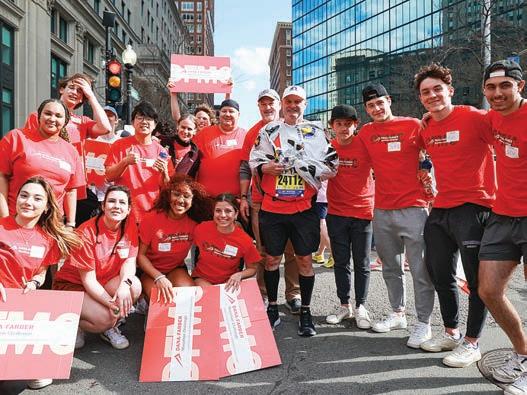
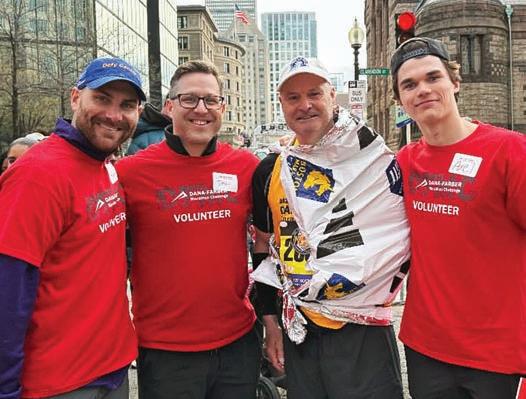
For more than half the years he has run, when Troy crossed the finish line, he has been met by the smiling faces of Cushing students. He set up a partnership to give students the opportunity to get involved in both the charity and the human drama of the marathon, serving as runner guides for those who, like him, are raising money for Dana-Farber. The students greet the exhausted racers from around the world at a vulnerable moment, draping a silver warming blanket around their shoulders and making sure they are in shape to walk the halfdozen or so blocks to the hotel where runners reunite with their families.
“They just feel so well cared for because of the Cushing students,” says Jan Ross, Dana-Farber’s former assistant vice president for running programs. She and Troy estimate that between 700 and 800 Cushing students have served in this role over nearly 20 years.
Kelly Yardley, assistant director for running programs, does the hands-on work with the students. Runners often comment on how much they appreciate the Cushing ambassadors. “They take the job seriously,” she says. “That means that we’re really able to rely on
the students and their positivity and their genuine care for the runners.”
Even in retirement and no longer on campus daily, Troy is heartened to see the tradition continue. “I think there were about 25 or 30 kids that went in again this year,” he said. “Even though I’m not directly affiliated with the school, Dr. Bertin still allowed them to come in. To see them at the finish line, was a really nice thing. I hope that tradition continues.”
A Quarter Century of Memories — and Counting
Troy has tons of race recollections. He has run in pouring rain with his son Brian ’10 (2016), in 90-degree heat (2012), and with Cushing colleague Aaron Santos ’06 (2018 and 2023). “To run with someone who was both a former Cushing student and a colleague was kind of fun,” Troy says. He especially looks forward to seeing Courtney Sheary ’06 each year in her usual viewing spot at mile 20 right at the top of the hill next to Boston College.
In 2013, Troy was at mile 25 when terrorists set off two bombs near the finish line. A phalanx of police stopped the runners and told them the race had ended. He wound his way through the streets, eventually serendipitously
running into both his wife Sue and his son, even without cell coverage to help.
The 2014 marathon was memorable because everyone was so positive and motivated to get back to normalcy. “I actually ran one of my better times that year,” Troy says. (His best time was 3 hours and 41 minutes; most years he runs it in around four hours.)
A Life Still in Motion
Though officially retired from Cushing as of the fall of 2024, Troy has hardly slowed down. After moving to Ogunquit, Maine, he quickly found himself working at the local golf course, and then took on an assistant coaching role at nearby Berwick Academy. “I think I may have had three days off in a row since July,” he said with a laugh. “But nothing more than that.”
Despite the schedule, he still finds time to train — and yes, he confirms, “Maine is actually a little flatter than Ashburnham.”
Troy says he misses Cushing every day, stays in close contact with colleagues, and looks forward to events like Alumni Weekend and the annual golf tournament. For now, he’s focused on the next goal.
“Getting to 30 marathons is going to take staying healthy,” Troy says. “But I want to do it.”
Ryan Bourque ’09, Dan Fontas ’98, P’27, Bill Troy, Axel Favreau ’26
Doing Your Best, Every Day
Head of School Dr. Randy Bertin Urges the Class of 2025 to Lead with Integrity and Effort
REAL SUCCESS ISN’T ABOUT PERFECTION — IT’S ABOUT DOING YOUR BEST, CONSISTENTLY AND AUTHENTICALLY
Head of School Randy Bertin
shared this wisdom as he kicked off Commencement for Cushing Academy’s Class of 2025.
Ber tin reflected on what really defines Cushing and it boils down to this: a shared commitment to excellence — in the classroom, on the fields, on stage, and in the dorms. “Today is a celebration of all that our graduates have achieved and will achieve,” he began. “They have so much to be proud of.”
In his address, Bertin shared the story of a top heart surgeon who, even after a complex procedure appeared successful, paused. Something didn’t feel right. Rather than accepting “good enough,” the doctor went back in — and that second look saved a life. “That mindset haunts me in the best way,” Bertin said. “It makes me ask: was that really my best, or just good enough?”
Ber tin challenged graduates to carry that same ethic of self-reflection
forward. “Success is peace of mind, which is a direct result of selfsatisfaction in knowing you made the effort to become the best of which you are capable,” he quoted from legendary UCLA basketball coach John Wooden. “That’s what real success feels like.”
Throughout their time at Cushing, Bertin noted, students have countless opportunities to live out that mindset — on stage, on the ice, in the lab, and in their daily lives. “Hopefully during your time at the Academy,” he said, “you have had space to reflect that you made the effort to become the best version of you.”
Doing your best, he said, is rarely about drama or grand gestures. Often, it’s the small, everyday choices that matter most: saying hello, showing kindness, taking responsibility, doing the right thing when no one is watching. “You don’t need to be perfect, just consistent,” he said. “Build habits, stay honest, act with integrity.”
Ber tin also looked ahead. In a world rapidly transformed by artificial intelligence and accelerating change, he urged students to lean into the very things that make us most human. “Reflect, care, show up, fail, get up, and try again,” he said. “Doing your best isn’t a one-time thing — it’s a lifelong habit.”
As they graduate from Cushing, Bertin encouraged the Class of 2025 not to settle for “should be good enough.” “Be like the surgeon,” he said. “Go back in.”
Congratulations, Class of 2025!
Keep showing up, stay honest, and always do your best.
SCAN ME! Watch the full coverage of the 2025 Commencement.
Just Keep Flipping Those Pancakes
VALEDICTORIAN MATT HAIGH FINDS PURPOSE IN PERSISTENCE AT CUSHING
In his address to fellow graduates at Commencement, Boston Collegebound Matt Haigh ’25 used an unlikely metaphor — his mom’s tradition of “Posco’s pancakes” — to capture the power of learning through mistakes. The lesson? Burnt first tries are inevitable — and essential.
“Life is filled with Posco’s pancakes,” Haigh told his classmates. (The name comes from his dog, Posco. On important days, Haigh’s mom makes pancakes for the family. Posco gets the first pancake, which is always botched.) “Some require just a little water, and some will have you walking across the stage for the wrong award in front of the whole school. So don’t be so hard on yourself if the first pancake doesn’t make the meal.”
A Fitchburg native, Haigh knew about Cushing long before his first day of ninth grade. His older brother, T.J. ’22, had gone before him. Over Haigh’s four years, the day student developed into a standout as a scholar, athlete, advocate, and quiet leader.
While many of his classmates were surprised when Haigh’s name was called as valedictorian — he never told anyone, not even his parents — his achievements speak volumes. He was a three-year captain of the ski team, helping it grow from four members to nearly twenty, and raced all over New England. “It always felt like home,” Haigh says. “And skiing brought so many people together.”
The athlete-scholar embraced a broad range of sports — from varsity soccer and JV lacrosse (where he was a
captain), to instructional hockey, tennis, and competitive weightlifting. He was equally wide-ranging in academics: a history enthusiast who learned to love math thanks to an inspiring teacher, Mr. [Rich] Devin P’06, ’24, ’27
But beyond grades and athletics, Haigh is perhaps best known for his offbeat curiosity — especially his deep dive into state flags. During the pandemic, he became obsessed with the history of the Massachusetts state flag and launched a campaign to redesign it, growing an Instagram following (@oldmassflag), earning local media coverage, and even meeting with lawmakers.
“It’s the courage to fail, not the validation from success, that creates a life worth being proud of,” Haigh said from the stage. “Don’t be afraid of that first try… your first job, first business, first relationship. Just keep flipping those pancakes, keep trying, and you’ll make something great.”
At Boston College, Haigh plans to major in biology and minor in business, hoping to pursue a career in biomedical science. He’ll continue skiing at the club level — and likely keep advocating for a new Massachusetts flag in his spare time.
What will he miss most about Cushing? “The support,” he says. “It’s the little things — teachers who knew I had a race even when I didn’t tell them, friends who made long bus rides feel like adventures. I didn’t always talk about what I was doing, but people noticed. They cared.”
“Even though today we celebrate us,” Haigh said as he concluded his speech, “don’t forget to thank those who’ve gotten us here. And don’t be afraid to take that first step. You’ll never know where it might take you.”
We’ll be watching your next steps, Matt. And cheering.
“It’s the courage to fail, not the validation from success, that creates a life worth being proud of.”
A FUN, FULL CIRCLE MOMENT WITH AN HONORARY AWARD
As valedictorian Matt Haigh gave his commencement speech last spring, he showcased humility, sharing a story of an infamous mistake he made during his time at Cushing. He once walked across the stage to accept an award for AP U.S. History, a class he never took. Haigh pointed to the episode as a symbol of growth.
“I hadn’t even taken the class… and then I walked away emptyhanded as Mr. [Bob] Macioci ’23 (Hon.) gave the award to the correct Matt,” he recalled to laughter. “Now, here we are, all of us walking across the stage on purpose… and every step is a reminder of what we’ve put in to get here.”
This summer it became another opportunity for (playful) recognition. Head of School Dr. Randy Bertin and Director of Academic Affairs Raja Bala decided to officially honor Matt, conferring upon him an honorary AP U.S. History Award.
Three Choices for a Divided World
JOURNALIST AND AUTHOR MÓNICA GUZMÁN URGES
THE CLASS OF 2025 TO STAY CURIOUS
At Commencement, Mónica Guzmán — journalist, author, bridge builder, and fierce champion of curiosity — offered Cushing graduates something they may not have expected: a multiple-choice test. But this wasn’t a test with a right answer or a grade. It was, as Guzmán — the author of I Never Thought of It That Way: How to Have Fearlessly Curious Conversations in Dangerously Divided Times — explained,
“a test for the polarized, digitized, even paralyzing times I know you will be moving and shaking in.”
Guzmán drew inspiration from a speech Edith Sampson gave 60 years ago. (Sampson was the first AfricanAmerican to officially represent the United States at the United Nations.) Guzmán asked the Class of 2025 to think about how they are going to show up in a world that often seems overwhelming and divided.
Choice One: Shrink the World
Guzmán described the first option as the most tempting: minimize friction and maximize comfort. With endless entertainment and algorithms feeding you exactly what you want to see, it’s easy to avoid anything complicated and just stick to opinions you already agree with and distractions that feel safe. “Avoidance is your superpower,” she said, wryly. But she warned them
about what that costs — you end up disconnected and you stop growing. “As long as you shrink your world down to a size you can control, all that turbulence will stay in the background. And so, thank goodness, will you.”
Choice Two: Stand and Fight
The second choice, Guzmán said, is to hold your ground and fight for what’s right. There’s clarity and community here — validation from like-minded allies and a sense of purpose. “You know what’s right and wrong. You’ve got receipts,” she said. But this choice, too, can be corrosive. “It’s exhilarating — but be careful,” she cautioned. “Try as you might to change people you care about, they won’t budge. And sometimes, neither will you.”
Guzmán admitted that she’s lived in both of these modes — avoiding conflict or doubling down on conviction — and she’s learned the hard way that
they don’t always offer a full path forward. “I mess up, and you will too,” she said. “Because we’re human. We’re proud. We’re busy and tired. And if we’re going to find a braver way to engage with this confounding world, we’re going to need grace — for others, yes, but also for ourselves.”
Choice Three:
Stay Curious
And that brought her to the third — and hardest — choice. “Curiosity,” she said, “is simple in theory and difficult — almost foolish — in practice.” This path doesn’t avoid the world’s discomfort or attack it for clarity. It meets the world as it is, day in and day out. It means asking questions, even when it’s easier to walk away. It means choosing understanding over assumptions, especially about the people we talk about but never talk to.
“ You don’t abandon your convictions,” she emphasized. “You cultivate the capacity to understand someone
COMMUNITY READ 2024
Guzmán’s book was Cushing’s summer Community Read. It sparked a year of exploration into curiosity and civil discourse. Read more about how students learned to “disagree better” and build bridges on page 10.
else’s. You don’t try to change other people. You build the trust it takes to find truth together.”
Though it may not make you popular, Guzmán argued that curiosity is the most powerful tool for a divided world. “In a sea of symbolic gestures and performances, when you do choose to fight, you will be so effective — because you don’t disagree less. You disagree better.”
She closed her remarks with a reminder that the real test begins now — and that the answers will take a lifetime to explore.
“Cushing Academy Class of 2025, you’ve got your test. There’s no grade. No pass or fail. Just a lifelong practice of learning — precisely where it matters most.”
And with a final flourish, she sent the graduates off with four simple, powerful words:
“Congratulations, graduates — stay curious.”
“You cultivate the capacity to understand someone else’s [convictions]. You don’t try to change other people. You build the trust it takes to find truth together.”
Teaching Art and Creating Space for Students to Feel Seen
JEANINE ESCHENBACH NAMED CUSHING’S TEACHER OF THE YEAR
When Jeanine Eschenbach became dorm head of Price Hall, she inherited a group of ninth-grade boys who expected to move on the following year to newer, fancier upper-class dorms. Instead, something remarkable happened: they stayed. Year after year, students chose to stay with Ms. Esch, as she is known.
That’s how Price Hall became what Director of Student Affairs Sarah Catlin calls “the cool dorm” — not because of anything fancy, but because of the real community she builds there. Last spring, Ms. Esch, the Visual Arts Department Head, was named the Reitman Teacher of the Year, the highest honor a Cushing faculty member can receive.
“Before safe space was even a term, Jeanine cultivated that culture of belonging,” Catlin observes. As head of the art department and a veteran educator, Ms. Esch has built her career on a simple but powerful philosophy: building connection with all students, letting them know they are valued, and empowering the discovery of who they really are.
David Scott ’25, one of two seniors who presented the award, talked about how she supported him throughout his time at Cushing, both in the dorm and in the classroom. “Each and every time things weren’t going my way, she
helped me find a path forward,” he said during the annual awards ceremony.
“ When I had something to celebrate, she met my excitement with her own. She would always stay behind to be supportive and listen, and even when I knew she was busy, she helped me remove hundreds of staples from a project just so I could take it home”
Ray Hecht ’25, who has lived in Price for 3 years as a proctor, credited Ms. Esch with making his transition to Cushing possible. Ray wasn’t sure about leaving the British school system and then he had a thirty-minute Zoom conversation with the art department head that changed everything. “She is the reason why I felt safe coming to Cushing and I have had such success here. I know she is there for me every single day and I don’t think there is a student here who doesn’t feel the same way.”
But what Ms. Esch does goes beyond teaching art. While she works with elite-level portfolio students preparing for college, she’s equally committed to students who feel that in the past, they “failed at art” or they came to Cushing for another passion. Through diverse offerings from art history to architecture classes, she ensures that everyone’s creative confidence grows.
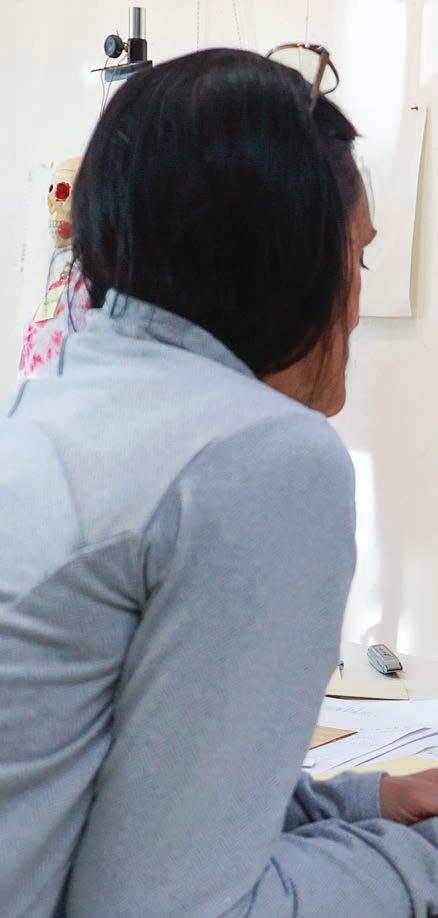
“I want all students to feel that I truly know them, and that I will champion and celebrate who they are regardless of any differences, strengths, and perceived weaknesses,” Ms. Esch explains. She works to emphasize a strong crossdisciplinary style in such innovative projects like the Aeroptera drone project from the Advanced Portfolio class. Partnering with Kurt Kublbeck P’16, who heads the science department and coordinates STEAM programs, she emphasizes the importance of creativity in engineering while working with her art students. This collaborative student group 3D-prints drone parts, troubleshoots and figures out aerodynamics, learns about patents and marketing strategies, and is basically growing their own company — all from one small idea. Ms. Esch “helps students see possibilities,” says Kublbeck, who was the 2008 Reitman Award recipient. “She builds that quiet confidence within them and creates spaces where questioning is encouraged, and exploration is celebrated.”
For Ms. Esch, the lasting impact isn’t about artistic technique. “They’re not going to remember if they could draw a pear in charcoal in 30 years,” she reflects. “They’re going to remember how they were made to feel.”
Class of 2025 College Matriculations
Assumption University
Babson College*
Basque Culinary Center, Spain
Bates College
Bentley University
Boston College
Boston University*
Clark University
Cleveland State University
College of Charleston
Connecticut College
Duquesne University
East Central University
Eckerd College*
Emerson College*
Emory University
Endicott College
Esade Business School, Spain
Fordham University*
Franciscan University of Steubenville
Hamilton College
High Point University
Johnson & Wales University
Keene State College
Long Island University Post
Lynn University
Merrimack College
Minnesota State University, Mankato
Montana State University
Nichols College
Northeastern University*
Providence College
Queen’s University, Canada
Saint Anselm College
Santa Clara University
Sonoma State University
Southern Maine
Community College
Southern Methodist University
Southern New Hampshire University
St. John’s University*
Stevens Institute of Technology
Stonehill College
Tecnológico de Monterrey, Mexico
The University of Tampa Union College*
University of Arizona
University of California, Berkeley
University of California, Davis
University of California, Los Angeles
University of California, San Diego
University of Chicago
University of Connecticut*
University of Illinois at Urbana-Champaign*
University of Massachusetts, Amherst
University of Massachusetts, Boston*
University of Massachusetts, Lowell
University of Pennsylvania
University of Toronto, Canada
University of Vermont
University of Virginia
Wesleyan University
Western New England University*
Westfield State University
Wheaton College, Massachusetts
William & Mary
Worcester State University
*Multiple Students
Celebrating a Century of Cushing Hockey
A LEGACY OF SUCCESS AND CONNECTION
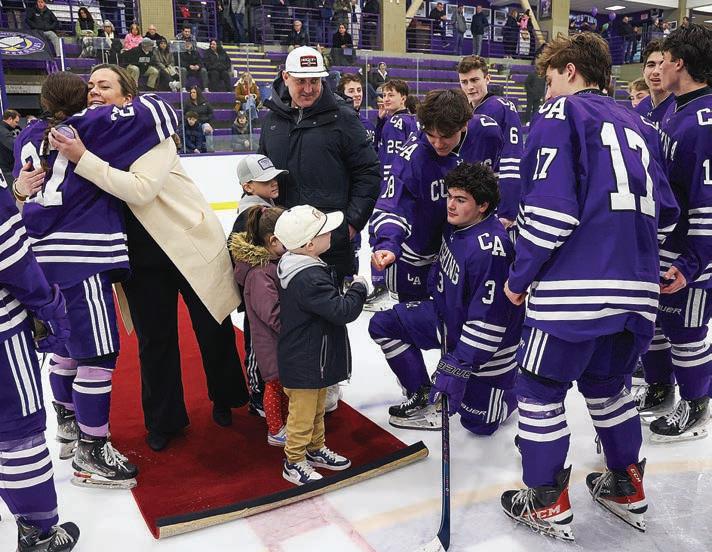
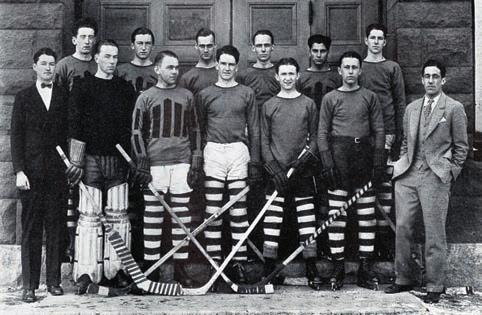
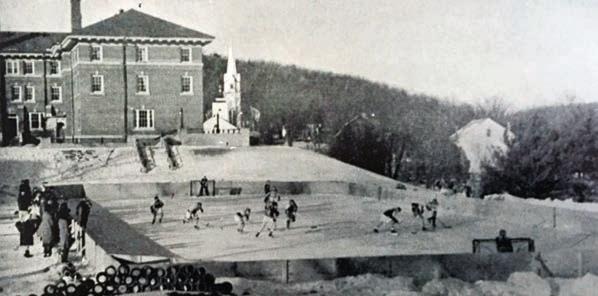
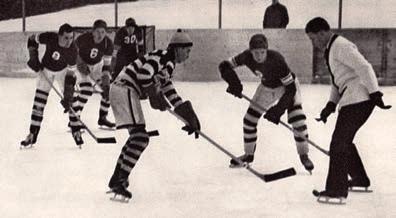
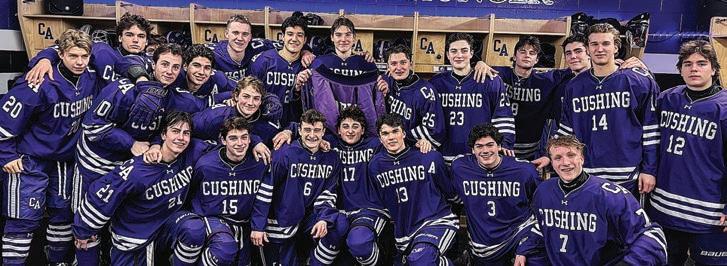
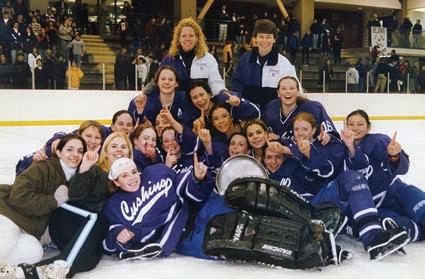
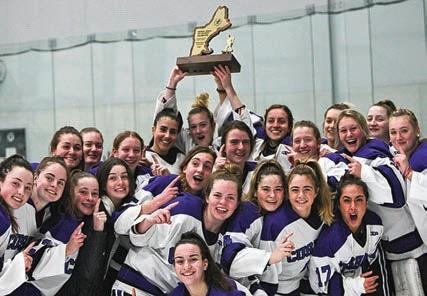
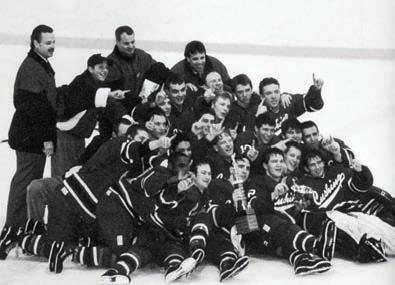
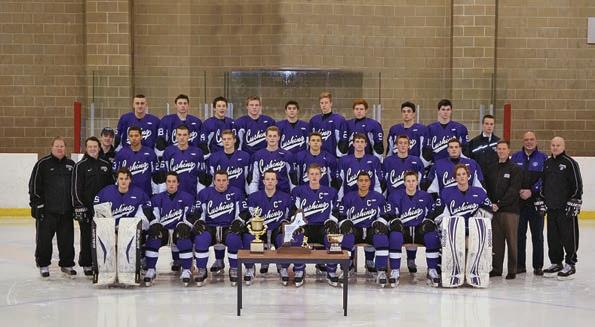
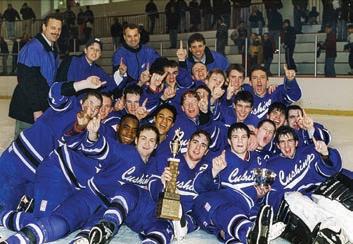
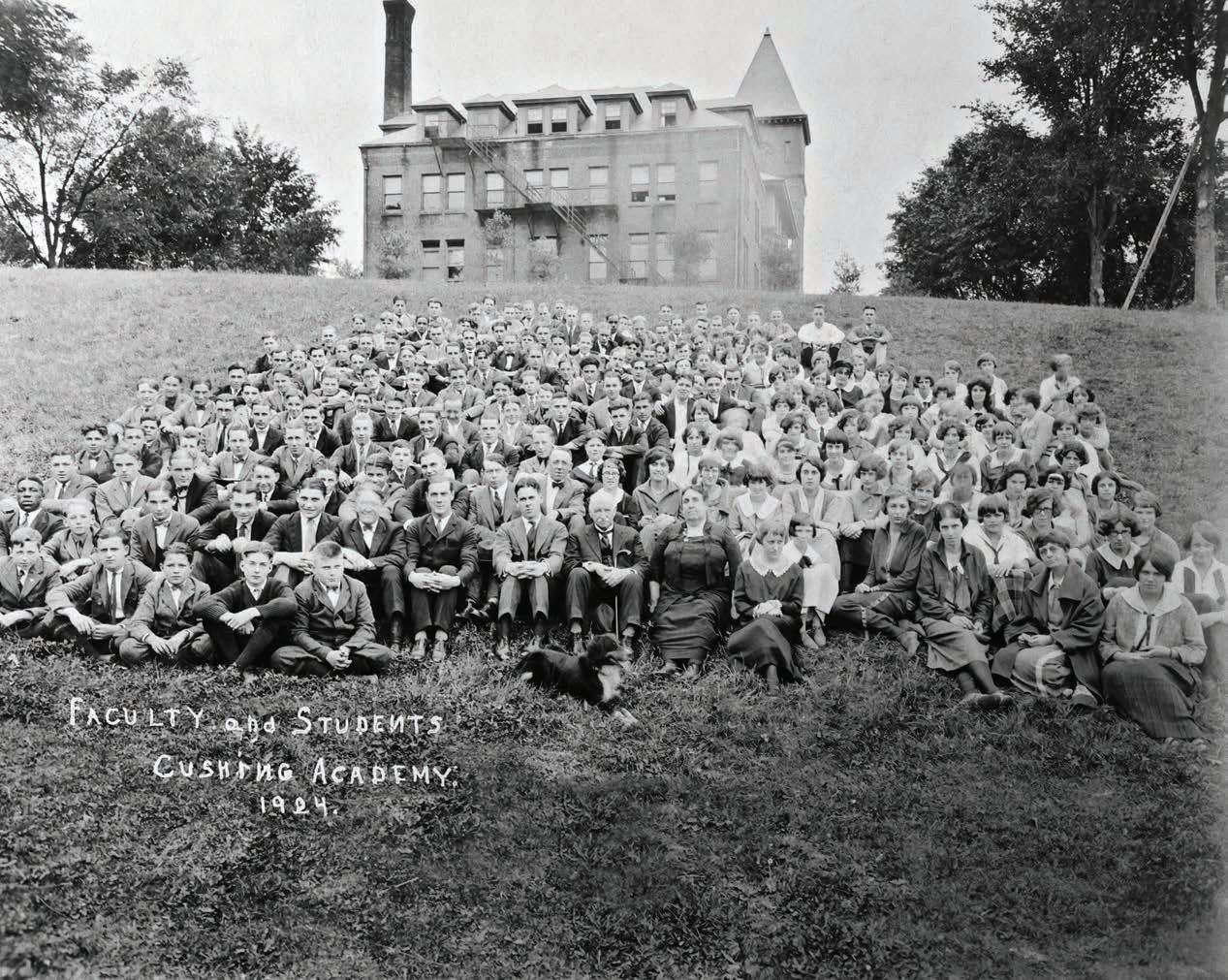
Cushing Academy played its first official hockey game on January 14, 1925 against a squad of freshmen from Harvard University on a makeshift rink. 100 years later, things look a little bit different. Cushing has won 6 hockey championships, developed more than 400 collegiate players, 10 NCAA champions, 9 Olympians, and 17 NHL stars.
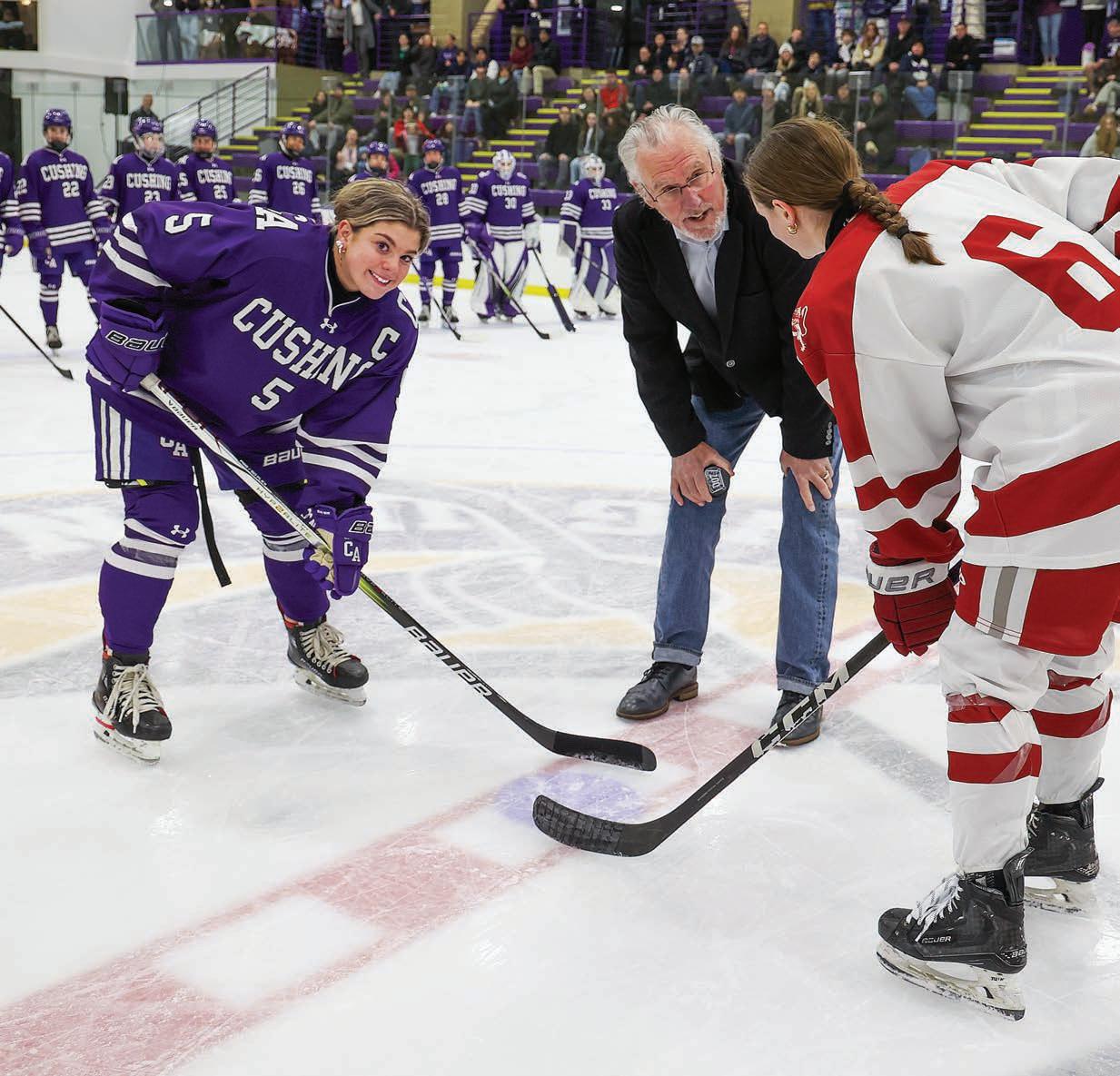
The 2024–2025 hockey season marked a celebration of 100 years of Cushing hockey, capped by a special Hockey Night in Ashburnham event on January 10, 2025. On the following pages, we recap some of the great moments in the history of Cushing hockey. We can’t wait to see what the next 100 years will bring!
“To me, Cushing hockey is so special because of the relationships that you develop year after year. Players continue to talk with you as they go to college, as they begin to get married, as they start families. You’re always in constant contact with them. Where did that start? Here at Cushing.”
—BILL TROY P’10, ’11 Boys’ Hockey Coach 1990–2024
In 1929, the Penguins played their first game outside of Ashburnham. That season, the team played nine games, going undefeated. It was the first hint of what was to come.
“To build up the ice before and during the season, team members would take two-hour shifts watering the ice with a hose throughout the night until the sun came up in the morning.”
—RICHARD B. DURGIN ’51 (DECEASED)
Champions Again!
The Story of How the Penguins Clinched the 2024–2025 Elite 8 Title
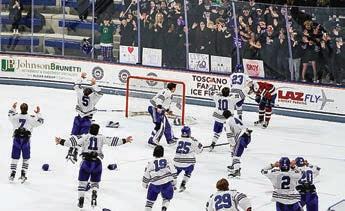
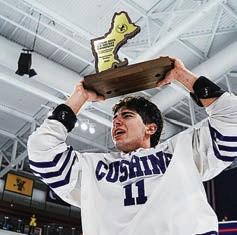
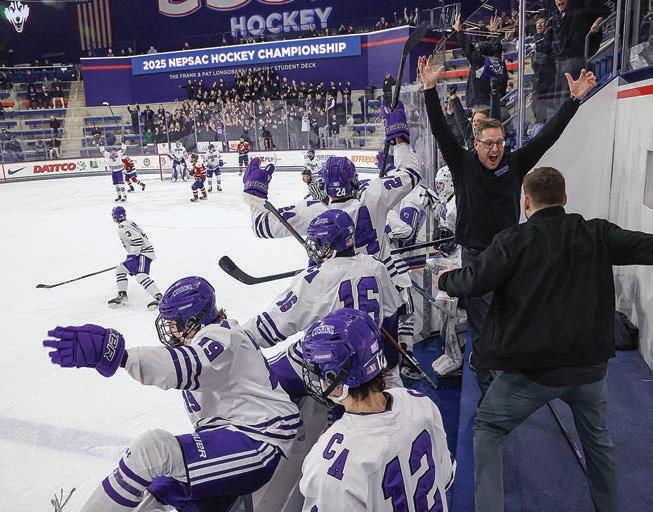
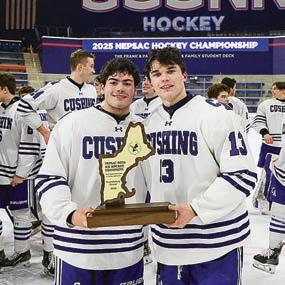
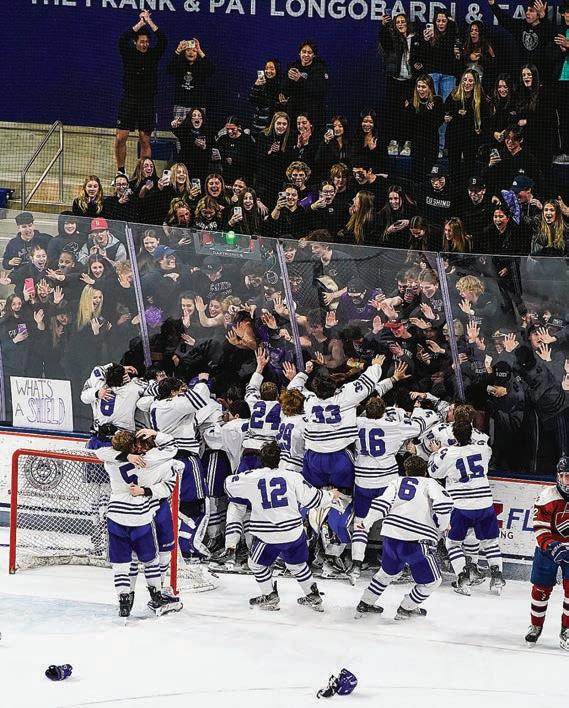
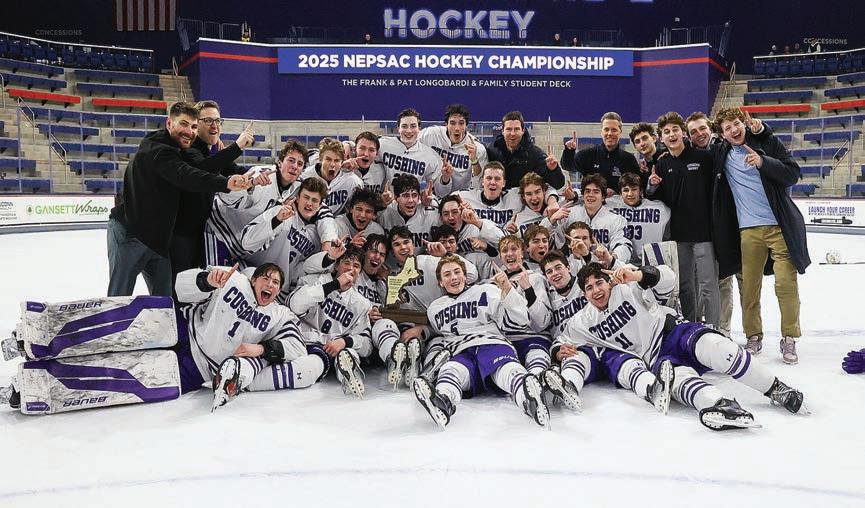
In a storybook season filled with adversity, triumph, and grit, Boys’ Varsity Hockey won the 2024–2025 Division I NEPSAC Stuart/Corkery Elite 8 Tournament. It was the program’s third straight trip to the Elite 8 championship game, and this time, Cushing emerged victorious.
The season was a wild ride from the start. Before the first face-off, the team got a new coach. In June 2024, Cushing announced the hire of Ryan Bourque ’09 as head coach. A nine-year NHL/AHL veteran, Bourque had been an assistant coach with the U.S. National Under-18 Team prior to being tapped by his alma mater.
The three team co-captains were brought into the coaching interview process. “He was the first one that we interviewed,” recalls Ryland Randle ’25. “Right when that call ended, Max [Dinneen ’25], Tyler [Russo ’25], and I hopped on the phone and we were like: ‘That’s going to be tough to beat.’ He went to Cushing, he lived the prep school life, and he really felt like someone we could connect to.”
championships — and assistant coach Tyler Stillings, who had been coaching with the team as a goalie specialist since 2017.
From the start, Bourque made it clear that his priority was making the young men into better players. “He told us he was about development, not just stacking talent,” said Stillings. “It wasn’t ‘just recruit the best and play to win.’ It was ‘how do we help everyone become the best players and teammates they can be?’”
He backed that up with fresh ideas — including banning cell phones in the locker room and weekly one-onone meetings with players. “What I really appreciated about Ryan was he wanted to be challenged,” Stillings remembers. “He didn’t want yes-men. We spent so many hours kicking ideas around, going back and forth.”
Bourque surrounded himself with a veteran coaching staff, led by associate head coach Dan Fontas ’98, P’27 — who had led the Varsity B team to two consecutive Rust Cup
Seasonal rinks sprang up outside of Ash House on what is now Drew Common and later on Adams Field.
Willard Payson Jr. ’49 was the first Cushing graduate to play collegiately, captaining the men’s team at the University of New Hampshire.
“Cushing usually has a lot of older guys on the team,” says Alex Gomes ’25. “But we had a lot of younger guys. That was a new obstacle to overcome.”
“I was privileged to be on the hockey team for three years, basically in the late 50s. Of course, back in those days, the rink was outside. Sometimes we handled a snow shovel and cleared the ice before we could actually skate. So, minor inconveniences that we were willing to put up with to play the game that we love here. I am here wishing Cushing success for the next 100 years as well.”
—DAVID HILLBROOK
’60
ADVERSITY TO BEGIN THE SEASON
The season opened with a crushing reality check. The Penguins played Andover and Dexter Southfield in their first two games and had a scrimmage against Nobles in between. They lost all three.
“ Those first two games, we lost 4–1 and 5–2,” recalls Gomes. “We weren’t scoring. We weren’t playing good D. Last year we lost two or three games in the entire season. We already lost three in a row. It was kind of a weird place to be in.”
Dinneen saw the losses as necessary preparation.
“Looking back at it now, I just feel like it was the best thing that could happen to us. The year before, we didn’t really have any moments like that in our season, so when we did go down, we didn’t know what to do.”
Coach Fontas, who won the 1997–1998 championship as a Cushing player, put it in perspective: “I’ve been coaching for 22-plus years now, and every team that’s had
success — it’s never been easy. The past couple years we’ve been loaded with talent, and we couldn’t get across the finish line. I think we were missing that piece of adversity that we had this year.”
WATKINS TOURNAMENT WIN SPARKS LIFE
In late December, the Watkins Tournament would prove pivotal. Entering into the tournament 5–3–1, Cushing faced Canterbury in the first game and was down 2–3 with less than a minute to go.
“It gets down to the last minute, we pull our goalie,” Gomes recalls. “I was battling in front. Joe Covelluzzi ’27 scored to tie it.” The Penguins won in overtime on a Jeff Swartz ’26 goal. “From there, it was just a different feel. It was awesome.”
That momentum carried into the tournament championship against Dexter Southfield, a team that had beaten Cushing 5–2 in the second game of the season. This time, the Penguins dominated.
“That Canterbury game really just gave us all confidence,” Gomes said. “The locker room felt different. We actually had a belief in ourselves.”
Even off the ice, the staff kept hammering home how to respond to adversity. Before a key game against Brunswick at Sacred Heart, the team
“It
really just changed my life to
be in the same locker room as like-minded people. The people that I grew up playing with at Cushing are my best friends today. Love those people from the bottom of my heart. We all met in the Cushing locker room. Every single time I talk about Cushing, I feel like I get really emotional because of the gratitude that I feel. You know, it’s not just the game that I love so much — it’s what the school did for me. It gave me so much confidence to be who I was always meant to be.”
—ERIKA LAWLER
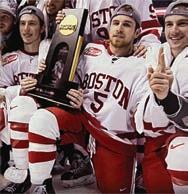
’05 NCAA Division I Champion (2006, 2007, 2009), U.S. Women’s Olympic Hockey Team (2010 Silver Medalist), CWHL/NWHL Player
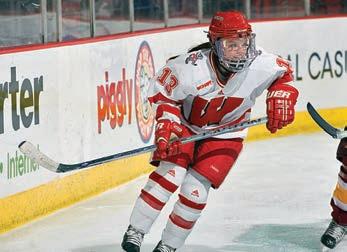
Erected in 1995, Iorio Arena ushered in a new era for Cushing hockey, including the start of girls’ hockey. In their third year of play, Girls’ Varsity Ice Hockey won the first of two NEPSAC championships.
(Above) After the 3–1 victory over St. Mark’s School on Valentine’s Day, Zach White ’25 shares his ‘player of the game jacket’ with the entire team.
gathered to watch a video titled Good — a reminder that when bad things happen, you look for what you can learn and how you can grow.
“It basically nailed in the fact that stuff’s gonna go bad,” Randle said, “but it’s how you respond that matters.”
GOALIE GOES DOWN
In early February, starting goaltender, Maks Corovic ’26 — one of the top goalies in New England — contracted pneumonia and missed four games against some of the best teams in the league. Zach White ’25, who played sparingly all season, stepped into the spotlight.
With White in goal, Cushing tied Tilton 4–4, defeated Vermont Academy 7–2, shut out Brunswick — then the number-two team in New England — followed by another stellar performance against St. Mark’s.
“Zach hadn’t had a lot of opportunities in the past,” Stillings reflected. “And when the team needed him most, he showed up. He gave us a spark that translated to the rest of the season. If he doesn’t play lights out in that moment, we’re not sitting here today talking about the Elite 8.”
PLAYOFFS COME EARLY
By early February, Cushing had seven losses and wasn’t even in the top 16 in New England. One more loss would end their hopes of postseason play.
SIX CUSHING CHAMPIONSHIP WINS
BOYS’ HOCKEY
• Division I Champions 1995–1996
• Division I Champions 1997–1998
• Division I (Large School)
Champions 2012–2013
• Division I (Elite 8)
Champions 2024–2025
GIRLS’ HOCKEY
• Division I Champions 1997–1998
• Division I (Small School)
Champions 2019–2020
“It was playoff hockey starting in February,” said Gomes. “We needed to win every game.”
Coach Bourque taped the standings to the wall. “We all just saw: we’re not out of this,” Dinneen recalled. “You could see, if we keep winning games, we’re going to make a push.”
The captains gathered the team. “This is our senior year,” Dinneen told his teammates. “I don’t want to go out playing the small school [tournament]. I want to end with a bang.”
Cushing went on to win their final eight regular season games, securing the four seed. By rule, that meant a home playoff game — but Brunswick, more than two-and-a-half hours away, elected to move it to a neutral site at Pomfret.
“I thought I was going to get to play my last game at Cushing,” Gomes remembered. “Having that taken away stung a little.”
“Br unswick forced a neutral site,” said Dinneen. “Nobody wanted to play us at home. That put a chip on our shoulder.” Cushing dominated Brunswick 6–3, advancing to face top-seeded Deerfield, a team that had embarrassed them 6–2 earlier in the season.
“We played them a couple of games before,” said Randle, “and it was chippy. They’re a physical team with a small rink. We knew before the game that it would be physical, but it was about letting them make mistakes and us kind of just embracing that and using it to our advantage.”
“I just knew we were better than them,” Gomes said. “Even the night we lost, they scored a bunch on power plays. If we just played disciplined and played our game, we were the better team.”
Buoyed by an army of student supporters, who pounded on the glass and filled the rink with purple, the Penguins emerged with a 4–1 victory in the semifinal and a return trip to the championship game.
CHAMPIONSHIP GAME
The stage was set: Cushing versus Dexter Southfield for the championship.
“I mean, you couldn’t have drawn it up any better,” said Randle. There was so much animosity between Cushing and Dexter. Once you step out there, it’s kind of just war.”
After some first period jitters, Cushing built a 2–1 lead, but late in the second period, the game swung. The Penguins took a five-minute major penalty, then another minor, creating a five-on-three for Dexter. They scored once on the power play, then again early in the third to take a 3–2 lead.
The situation felt painfully familiar. “It never sits right when it’s a 3–2 game and you’re losing with under 10 minutes to go,” Gomes said. “We had been there before. We just made sure that we were going to go out there and give it our all, no matter what the outcome was.”
With 6:48 left, Gomes tied it. “Eric Lund ’25 took the puck around the whole zone,” Gomes recalled. “I went
right to the net. The defender had it, and Eric made an unbelievable play to poke it away. I grabbed the puck — it was like a one-on-three going back. I cut to the middle and took advantage of a shot at the top of the circles. I kind of blacked out at that moment, because it was probably the biggest goal I’ve ever scored in my life.”
Less than two minutes later, Dinneen scored the winner. “Cam McDonough ’26 came down the left side and tossed one on net,” Dinneen said. “I was crashing, beat the defense, and it popped out on my stick. When I saw it go in, it was surreal. It’s something I’ll never forget — but I knew that the game wasn’t over. It was a pretty cool 30 seconds, and then we got back out on the ice.”
With 30 seconds left and Dexter pressing with their goalie pulled, Corovic made a spectacular save to seal it — the kind of stop no one had any right to expect and everyone will remember.
“It was the best feeling ever,” said Randle. “For me and the seniors, that was our last time playing with a purple helmet. You can’t think of a better way to end it.”
For Gomes, the whole season felt almost unreal. “It was an unbelievable experience,” he said. “It’s like something out of a movie.”
“I personally know how hard it is to win that championship,” Bourque reflected. “I think about my brother [Chris Bourque ’04]’s teams, guys who are Olympians, NHL all-stars. My group and the teams we
TEN PENGUINS HAVE BEEN NCAA CHAMPIONS
• Greg Hirsch ’91, University of Maine, 1993
• Andy Silverman ’91, University of Maine, 1993
• Pete Metcalf ’98, University of Maine, 1999
• Bobby Allen ’97, Boston College, 2001
• Brett Peterson ’00, Boston College, 2001
• Mike Boudreau ’02, Norwich University, 2003
• Erika Lawler ’05, University of Wisconsin, 2006, 2007, 2009
• Meghan Duggan ’06, University of Wisconsin, 2007, 2009, 2011
• Dave Warsofsky ’09, Boston University, 2009
• Blossom Truel ’17, Norwich University, 2018
“Cushing is a big part of my life and who I’ve become as a coach. I’ll forever be grateful for the time I had there, and friendships and people that I’ve met along the way.”
had — we didn’t win. That makes me even prouder of what these kids were able to do.”
Stillings, who was on staff for four previous championship game losses, knew this was different. “I went up to Axel Favreau ’26 and Tyler Russo ’25 the day of the game, and I said: ‘I’ve been in four of these, but I feel different today.”
“ These kids are bonded for life,” said Fontas. “Twenty years from now, they’re going to be texting in the group — just like I’m texting with my teammates from our championship run — and they’re still going to remember this day. This is the team they’re going to come back to.”
For Cushing Academy’s hockey program — in its 100th year — the 2024–2025 team will long be remembered for their extraordinary grit and resilience — a perfect Penguin ending.
NINE PENGUINS HAVE REPRESENTED TEAM USA IN THE OLYMPICS
• Jeff Norton ’84, Calgary 1988
• John Lilley ’91, Lillehammer 1994
• Tom Poti ’96, Salt Lake 2002
• Erika Lawler ’05, Vancouver 2010
• Meghan Duggan ’06, Vancouver 2010, Sochi 2014, PyeongChang 2018
• Chris Bourque ’04, PyeongChang 2018
• Broc Little ’07, PyeongChang 2018
• Marc McLaughlin ’17, Beijing 2022
• Dave Warsofsky ’09, Beijing 2022
“I cherish the hockey program so much and what it brought into my life, obviously, not only on-ice development and leadership experiences and so many lessons learned, but most importantly, just the friendships I made there that I will cherish for a lifetime.”
—MEGHAN DUGGAN ’06 NCAA Division I Champion (2007, 2009, 2011), USA Women’s Olympic Hockey Team, (2010 Silver Medalist, 2014 Silver Medalist and Team Captain, 2018 Gold Medalist and Team Captain), CWHL 2011–2015, NWHL 2015–2017
After a magical 2024–2025 season winning the Elite 8 championship, Dan Fontas ’98, P’27 has been named to succeed Ryan Bourque ’09 as the next head coach of Boys’ Varsity Hockey at Cushing Academy.
“ We are thrilled that Dan is taking the reins of Cushing boys’ hockey,” said Dr. Randy Bertin, Head of School. “Coach Fontas has been instrumental in our hockey program’s recent run of success. As a former Cushing Penguin and current coach, he knows firsthand the values of our program and our commitment to our students — both on and off the ice.”
Coach Fontas, who played DI hockey at UMass-Lowell, returned to Cushing in 2021 as the head coach of Varsity B Hockey, guiding the program to back-to-back Rust Cup championships before being promoted last season to
associate head coach of Boys’ Varsity Hockey and helping coach the squad to the 2024–2025 Elite 8 championship.
“I’m incredibly honored and excited to be named head coach of boys’ hockey,” said Fontas. “As a proud member of the Class of 1998, Cushing has always held a special place in my life. This school shaped me — as a student, as an athlete, and as a person — and I’m deeply grateful for the opportunity to continue to give back to a community that has given me so much.”
Bourque, who joined the coaching staff of the Providence Bruins, the AHL affiliate of the Boston Bruins, remarked: “It is an honor to have Dan Fontas as my successor at Cushing. Dan embodies everything it means to be a Penguin. He was more than a colleague, he was a mentor — and played an integral role in our team’s success this past season.”
“One of the biggest memories for me is how proud my kids were — my son Steve ’02 and my daughter Lauren ’04 — pulling on the Cushing sweater. And then, of course, so many of the players who contributed on the ice, in the community, and in the classroom at Cushing. So many wins and all the hard losses too — they were all part of the memory package.”
—STEVE JACOBS P’02, ’04, HON. ’24, Boys’ Hockey Coach and Director 1985–2024
MORE THAN 80 ALUMS HAVE PLAYED PROFESSIONALLY, INCLUDING 17 IN THE NATIONAL HOCKEY LEAGUE
• Jeff Norton ’84 (1987–2002)
• John Lilley ’91 (1993–1996)
• Eric Nickulas ’94 (1998–2006)
• Tom Poti ’96 (1998–2013)
• Brad Norton ’94 (2001–2007)
• Bobby Allen ’97 (2002–2008)
• Keith Yandle ’05 (2006–2022)
• Chris Bourque ’04 (2007–2013)
• Zach Bogosian ’08 (2008– )
• Richard Bachman ’06 (2010–2019)
• Brad Malone ’07 (2011–2023)
• Dave Warsofsky ’09 (2013–2018)
• Ryan Bourque ’09 (2014–2015)
• Conor Sheary ’10 (2015– )
• Joey Daccord ’15 (2018– )
• Marc McLaughlin ’17 (2021– )
• Cam Lund ’22 (2024– )
In 2022, Keith Yandle ’05 became the National Hockey League Iron Man, earning the record for most consecutive NHL games played.
“When I look back, I really think that Cushing helped shape me into the person and the hockey player that I am today, and I definitely wouldn’t be here right now without them. I had so many amazing memories, but one that stands out is winning the Watkins Tournament my senior year.”
—JOEY DACCORD ’15
7 seasons in NHL, currently with Seattle Kraken
Brandy Fisher-Bailey
Steps Up to Coach Cushing Girls’ Hockey
Cushing’s Girls’ Varsity Hockey capped off a strong 2024–2025 season with a seventh-place NEPSAC finish and a spot in the Elite 8 — an impressive achievement for a young squad, now entering a new era.
That success came under the leadership of Val Bono-Bunker ’97, who concluded her ninth and final season as head coach last spring. During her tenure, Bono-Bunker built a program that won two Watkins Tournament Championships, made two trips to the Elite 8 Tournament, two trips to the Small School Tournament, and earned the 2020 NEPSAC Small School Championship. As she retired, she was named the 2025 New England Hockey Journal Prep Coach of the Year, a fitting capstone to a remarkable run.
special. “The girls were hungry. They were committed,” she says. “You could feel that energy.”
Stepping into the role now is Brandy Fisher-Bailey P’28, ’29, who served as associate coach during last season and brings elite credentials and deep experience. A former collegiate and national standout, Fisher-Bailey led the University of New Hampshire to the NCAA Championship in 1998 and won the inaugural Patty Kazmaier Award, given to the top player in NCAA Division I women’s ice hockey.
With more than a decade of coaching experience, Fisher-Bailey saw firsthand what makes Cushing’s program
THREE PENGUINS HAVE LIFTED THE STANLEY CUP
• Conor Sheary ’10
• Zach Bogosian ’08
• Brett Peterson ’00
The energy translated into results. The young team secured a triumphant victory at the Watkins Tournament, ending a multiyear drought, and claimed a second-place finish at the New Year’s tournament. One of their leading scorers, Isabella Freitas ’28, was only in ninth grade. The captains led by example, creating a culture of genuine support and grit where players battled for each other night after night.
Fisher-Bailey is eager to build on that foundation. “I’m excited to continue what Val started and put my own stamp on it, too,” she says. “There’s such a strong base here. It’s about continuing to grow — on the ice, in the locker room, and in life.”
Says Head of School Randy Bertin: “We are excited to have Coach Fisher-Bailey on board, and look forward to seeing where she leads our girls’ hockey program.”
“To the guys who came before me: they paved the way, and hopefully my class and my teammates were able to do the same for future Penguins. But I can’t thank Cushing enough for all they did for me in my hockey career and helping me get to the highest level. I’ll always be grateful, and I’ll always be proud to be a Penguin.”
—CONOR SHEARY ’10
11 seasons in NHL, currently with Tampa Bay Lightning; Stanley Cup Champion 2016, 2017
SCAN ME! Watch the 100 Years of Cushing Hockey video.
Cushing Academy has inspired generations of artists to trust their own voices. Four Penguins — with careers spanning eight decades — share how the Academy helped them develop independence that shaped their creative paths.
Pictured clockwise: Work of Nate Berkus ’90, Nebihe Cihan ’03, Constance Whitehead Kiermaier ’45, Damián Figueras ’99
“CUSHING PREPARED ME TO MOVE INTO THE WORLD
A Step Ahead”
Nate Berkus ’90 Reflects on Independence and Authentic Design in Conversation with Head of School Dr. Randy Bertin
Interior designer Nate Berkus ’90 has transformed how America thinks about home design, building a multimedia empire that spans television, publishing, and retail. From his early days creating accessible makeovers for television audiences to founding his award-winning firm Nate Berkus Associates, he has consistently championed the idea that great design should tell personal stories rather than follow rigid rules. His warm, approachable style has made him a trusted voice in homes across the country, whether through his TV shows, bestselling books, or thoughtfully curated home collections.
Berkus credits his Cushing experience with giving him the independence and confidence that shaped his approach to both business and life. The boarding school environment taught him selfreliance and decision-making skills that set him apart when he started his design firm at just 24 years old. In a sit-down interview with Head of School Randy Bertin, Berkus shares more about his Cushing journey and how lessons learned on campus continue to influence his work three decades later. What follows is a lightly edited transcript of their conversation.
RANDY BERTIN: I’m here with Nate Berkus, Cushing Academy Class of 1990. Nate is a remarkable and renowned interior designer. After doing more than 100 makeovers on The Oprah Winfrey Show, Nate has hosted several other TV shows, including Nate & Jeremiah By Design (with his husband Jeremiah Brent), and has curated a number of thoughtful and accessible home collections. His firm, Nate Berkus Associates, is regularly
named to Architectural Digest AD100 lists, and ELLE Decor A-List. He’s a New York Times bestselling author and has a new book, Foundations: Timeless Design That Feels Personal, now available. Thank you, Nate, for joining us today.
NATE BERKUS: Of course, my pleasure.
BERTIN: At Cushing, we talk a lot about the journey with students and their journey over time, and how Cushing is one step. So, I’m curious, how did Cushing influence your journey and lead you on the path to where you are?
BERKUS: I think the thing that people really don’t think about when they are either making a decision to send their own children to boarding school or when you’re a kid and a student at Cushing is that the preparation that it gives you to move out in the world [means] you’re already a step ahead. And I say that because when I got to college in suburban Chicago, everyone else was drinking beer out of a hat, and I didn’t
A PARTNER IN WORK AND LIFE: With husband Jeremiah Brent (pictured above), who is also an acclaimed interior designer with his own firm.
BEFORE AND AFTER: Twenty-three years after he was a student at Cushing (see inset photo), Berkus returned to campus to share his wisdom about life with the graduating class of 2013.
want to because I had already lived on my own. I had already experienced Fall free weekend. I had already climbed Mount Monadnock, done all the things that you typically do at university or at college.
I think it’s that sense of independence, the idea that you are in charge of your destiny, starting right now. You decide whether or not you’re going to go back to the dorm and do your homework. You decide how good that presentation is going to be. And that carries with you for the next 50 years, bringing forth those habits over time.
BERTIN: Looking at your career, you’ve really made yourself known by designing spaces around people’s stories. And I wonder if you could tell me a little bit about that.
BERKUS: I started in the industry, in design, right after college in Chicago. I was by far the youngest person on the scene. I was 24 years old when I started my firm. At the time, interior design was very, very private. It was shrouded in all these sorts of practices that didn’t make sense. It was set up to keep the general public away from understanding how to craft an interior.
I looked at that situation and I thought, can we democratize this? Can we make design really for everybody? Can we make it not dictatorial and not snobby and not scary? I didn’t want to be intimidating. I didn’t want to be one of those characters that walks into a room and everything’s wrong and I’m the only person that can make this right.
So for me, it was really born from the idea that there’s not one right way to design a space. And when you really think about decoration and architecture in that way, you realize that the only thing special about a room is the people that live there. And so a room should really do three things: It should represent the people that live there. It should represent
who they have been and where they have been, who they are now, and also leave room for who they aspire to become. And so that philosophy allowed me to both do high-end residential projects, because we all are the same, I believe that, no matter how much money we have in the bank or don’t. And it also enabled me to sell bath mats. Because that philosophy works.
There is a vulnerability around design. But in the end, there’s really a vulnerability around everything. To do anything well: Nutrition or fitness or banking. You really have to know who you’re talking to, and you have to be a decent listener. And then you have to bring all your best ideas all the time. And I think that’s served me well to not only just speak, but to hear.
BERTIN: I know you came back to Cushing in 2013 to do the commencement speech, which I thought was great. How did that feel to come back and be on the other side and talk to students about your journey and leading to that moment?
BERKUS: Well, the great sort of aspect of how I move through the world is that I don’t think I’m any different than the kid that was at Cushing. I have such nostalgia and such appreciation for the education that I received, for the relationships that I had, both with teachers and with friends, for what I learned and the people that I met. So for me coming back, it sort of was a little bit like, “Why am I speaking? I should be sitting down listening to somebody else speak.” But I loved being back. I thought it was great.
BERTIN: Do you have a greatest or favorite memory from Cushing?
BERKUS: Mountain Day, I still remember. I loved being on campus. But I think my favorite memory was sitting in French
class with Madame Cheryl Storm ’16 (Hon.); P’92, ’99; GP’27, realizing that if I actually paid attention, that there would be doors that would open to me. We spend a tremendous amount of time in Europe, and French is really like a universal language. Every time I open my mouth to order a drink or introduce myself to somebody that our 10-yearold daughter met on the beach, and I’m speaking in French, it brings me back to that moment, sitting in French class and thinking to myself, ‘I should probably get good at something.’
BERTIN: Wow. Thinking about how those experiences tie together, that experience with French at Cushing and bringing you back to campus, and then how your path has brought you to this moment. Is there anything in reflection when
you think about Cushing and your time there, and the path now that you wish you could have back or do over, or do you think that was the full experience?
BERKUS: No. I did it all. I did it well. I was a little weird when I arrived at Cushing. There were a lot of kids from the East Coast. I was from the West Coast. My hair was super gelled, and I had all the wrong clothes, and everybody was listening to The Grateful Dead, and I was like, ‘What’s that?’ But I ended up finding a really great group of friends that carried me through the whole experience. I’ll never forget my mom and her friend Cheryl walking through the paths of Cushing and then leaving me. And it was that moment where I thought, ‘Whoa, I’m like completely on my own here.’ Like, I don’t know
“The interaction matters. The energy matters. The attitude matters. And I think moving through the world gracefully, graciously, sort of holding your head out high, doing things that you’re proud of, that all matters. And that’s the sauce for me. It’s the connection.”
—NATE BERKUS ’90 “
anybody. I’ve never met any of the kids. I’ve never met any of the teachers. I thought to myself, ‘This is going to be great.’ And you know what? It was.
BERTIN: That’s great to hear. So you have a new book coming out this fall? Do you want to tell us a little bit about it?
BERKUS: It’s my third book. I waited over a decade to put out this book. Through the process of writing Foundations, though, it not only became the book that I wanted to write, but it became very apparent that it was the book that I was meant to write. And the whole premise of it is sort of a thank you note, back to the people who have supported my career for the last 30 years.
I break down literally everything in this book. It goes room by room. So if you’re renovating a bathroom, you can go right to that chapter. But it’s everything I’ve learned since I started my design firm in 1995.
BERTIN: That’s wonderful. Congratulations. I am looking forward to it. When we talked about people’s stories and how you get to know them in the process of design, is that the secret sauce? You have their story in there, but then you have all your experiences, as a husband, parent, entrepreneur, designer?
BERKUS: I’ve never believed in compartmentalization. I don’t think you can be soaring and excelling in your career professionally and have a really horrible personal life. I think it’s all connected. And so for me, going back to that aspect of vulnerability, I let myself be known. I’m happy to sit here with you and have this conversation. I’m happy to do the same thing with somebody furnishing an apartment here in New York City that I’ve never met. I think it is that I view every interaction as an opportunity to really try and understand what the person is saying to me and what they might be omitting. And I find it to be my job to help interpret that visually. Once I crack that, I want to have a good time. Grace goes a really long way in this world, especially now.
So for me, whether I’m working with a towel buyer at a retailer, or I’m working with a client, or I’m at the park with my kids, the interaction matters. The energy matters. The attitude matters. And I think moving through the world gracefully, graciously, sort of holding your head up high, doing things that you’re proud of, that all matters. And that’s the sauce for me. It’s the connection.
BERTIN: Over the last couple of days, I took a deep dive into some of your Instagram reels. And so I noticed
more recently that you’re into sort of desk boxes and materials there. How do you keep things fresher? What do you look for, the next thing, or is it more of an organic process?
BERKUS: What I actually love more than design is the stories behind furniture and decoration. When you work in an auction house, a truck pulls up and backs up, and they lift the back, and then there’s just 7,000 huge boxes. As you’re going through those boxes, it’s somebody’s entire life of things that they’ve collected, things that really represent who they are. I could tell if a house was coming from Nantucket or Texas or South Florida just by the style of what was being unpacked.
The history of decoration and furniture is what I love. And I have almost an encyclopedic knowledge of furniture makers and architects and designers and that is my continuing education. I get really excited when I learn about someone I haven’t heard of before.
So, it changes for me — from decorative boxes, to then I’ll have a moment where I’m really into porcelain and understanding all the hallmarks and the age of different plates and
the decoration and things like that. So that is where I am a massive nerd.
BERTIN: Well, one last question. If you could tell us something, one thing about Cushing, what would it be?
BERKUS: I think that it is a special place for the following reasons. It’s got a great sense of community without having an attitude, if you will. With Cushing, it’s similar to the school where we send our children now in New York City. It’s nice people. There’s a sign on my son’s rooftop playground in early education that says, “If you need a friend, come stand under this sign.” And so the kids are all trained from pre-K to check the sign and see if anybody’s standing there. And there are kids that stand there to find somebody to play with. And when I look back on
my time at Cushing — how welcoming it was, how warm the faculty was, how comfortable I felt almost instantly — I think that that’s what’s really special about Cushing Academy.
BERTIN: Great insights. I appreciate you sharing, and it’s amazing to hear that your experience from years ago — not too many years ago — is still echoed in what our kids are doing today on campus, and that feel of good people coming together, with faculty who care and want to bring kids along, is still true today. Thank you for your time.
“I’m always chasing unique things. I never basically take the easy way, the shortcut to find things everyone would pick.”
—NEBIHE CIHAN ’03 “
A DESIGN ETHOS ROOTED IN
Independence
Nebihe Cihan ’03 Credits Cushing for Teaching
Her to Be a “Hustler” in Life and Design
When Nebihe Cihan ’03 walks into Jimmy Choo’s flagship store on Madison Avenue — a space she designed to feel like “the coolest girl’s apartment in New York” — she’s just blocks from where she once lived as a young designer in Manhattan. But the path that brought her from Cushing Academy’s snowy campus as a 15-year-old Turkish student to designing luxury retail spaces and high-end homes has been much more global — a journey that has taken her across continents and cultures.
“I think that going to Cushing kind of taught me to become a hustler in life,” Cihan reflects from her London workplace, where she now runs Nebihe Cihan Studio. “And that kind of now reflects my work. I’m still a hustler.”
That hustle began with a bold decision made during a summer program at Cushing when she was just 15. Originally from southern Turkey, Cihan had come to the Academy for a six-week summer program in 1999. When school administrators approached her about joining as a full-time student, she didn’t hesitate — even though it meant convincing her parents from an ocean away.
“I called my mom, who was in Turkey. I said, ‘Mom, you know, they’re asking me if I would want to become a part of the academic program,’” Cihan recalls. Her mother’s response was immediate: “I think that you’re way too talented for your school in Turkey... if you want it, I’m happy for you to go.”
THE MAKING OF AN INDEPENDENT SPIRIT
That decision set the tone for everything that followed: Cihan’s ability to seize opportunities and tackle challenges on her own terms.
When she arrived at Cushing in January 2000 as a second-semester sophomore, the cultural adjustment was significant. “Turkish education is extremely different than a U.S. boarding school,” she explains. “In Turkey, they would teach you things in school, but you don’t apply that to your study. At Cushing, it was
AT CUSHING AND BEYOND: Cihan (inset photo, as a student at Cushing) designed the sleek flagship store for Jimmy Choo in New York City (above).
amazing — in biology class, you were actually experimenting. It wasn’t just learning in school, but also application.”
The structured environment — lights out, study hours, complete independence — shaped her in ways that continue to influence her approach to business today. “I learned to become disciplined, to become organized, and obviously to manage my own calendar,” she says. “But then also I learned to become independent because that’s what the school pushes you to be.”
Perhaps most importantly for her future career, Cushing nurtured her creative side in ways her previous education hadn’t. Already a dancer
with 15 years of ballet training, Cihan discovered new artistic outlets, including a silversmithing course that would prove transformative. “I not only designed first, on paper, but then I went into the workshop, worked with the instructor there... picking the stones, and making jewelry. I kept all that jewelry I made from that class,” Cihan recalls.
FINDING HER PATH THROUGH DESIGN
After Cushing, Cihan’s journey took what might seem like a detour through economics and finance at Bentley University — a decision influenced by
her father’s practical concerns about creative careers. But an internship at a Turkish bank quickly confirmed what she suspected: “I realized that this is really not what I want to do,” she remembers thinking. That realization led her to the renowned Parsons School of Design in New York, where she earned her master’s in interior design despite having no formal background in the field. “I just did a portfolio. I sent it. I got accepted,” she says with characteristic directness.
“
“I learned to become disciplined, to become organized, and obviously to manage my own calendar. But then also I learned to become independent because that’s what the school pushes you to be.”
—NEBIHE CIHAN ’03
Her retail design career started with French designer Catherine Malandrino, managing creative services and visual merchandising — basically translating between Parisian architects and New York retail spaces. But it was five years at Michael Kors that really honed her skills, managing the design and construction of hundreds of stores worldwide.
“ When I met with the head of store design, she showed me an Excel sheet of upcoming stores in, like, 600 locations,” recalls Cihan. “She said, ‘Well, are you ready?’ I said, ‘You know what? I’m tough. I’m ready. I can manage.’”
THE ART OF STORYTELLING THROUGH OBJECTS
Today, Cihan’s greatest strength is reading her clients — figuring out what they need even when they can’t quite articulate it. Whether she’s designing a Jimmy Choo store that feels like a cool New York penthouse or a private home, her philosophy remains the same: every piece must have a story.
“For me, it’s really important that every piece has a story — either rooted to the client or the space,” she explains. This approach led her to personally hunt for vintage furniture across Europe for the Jimmy Choo Madison Avenue flagship, traveling
to the Netherlands, Paris, Belgium, and Italy to source pieces that each contribute to the overall narrative.
“I’m always chasing unique things,” Cihan says. “I never basically take the easy way, the shortcut to find things everyone would pick.”
This philosophy extends beyond individual pieces to entire projects. Cihan’s breakthrough residential project — a penthouse in New York’s 432 Park Avenue — began with an unusual request: curate the client’s art collection first, then design the apartment around it. “We literally designed the apartment around the artwork and the panoramic views of New York,” Cihan says.
The project caught the attention of major architecture and design magazines, launching her residential practice.
THE NEXT CHAPTER: GLOBAL AMBITIONS
Now expanding into Saudi Arabia’s burgeoning luxury market, Cihan continues to embody the entrepreneurial spirit Cushing fostered. “I like a challenge. The more challenging the project or the client, that actually drives me,” she says. “I like to work in different regions, find artisans or craftsmen in those regions, build relationships, and find suppliers there.”
This global perspective, she believes, traces back to her early international experience at Cushing. “Blending in different cultures pushed me to understand what I want in life,” Cihan says.
Whether she’s sleeping on an air mattress at a construction site in Bel-Air (as she did for one challenging
project) or sourcing unique pieces from galleries worldwide, Cihan approaches each challenge with the same independence and determination that first brought her to Cushing’s campus over two decades ago.
“I think my experience [at Cushing] pushed me to become an entrepreneur as well because it opened my vision,” she reflects. “If I didn’t go to high school in the U.S. — to Cushing — I would probably not be where I am.”
There is a through line from that first piece of jewelry crafted in Cushing’s art studios to the luxury spaces she creates now. It’s the lesson she learned as a teenager far from home: when you combine independence with guts to go after unique opportunities, you can build something beautiful that’s completely your own.
AN ARCHITECT WHO
Listens & Sees
Damián Figueras ’99’s Global Journey Began in Cushing’s International Community
When the global financial crisis struck in 2008, Damián Figueras ’99 hit a wall that a lot of young architects were facing at the time: no work in London, nothing back home in Barcelona, and no clear path forward. But rather than retreat, he made a bold decision that would define his career. With just two suitcases and no prior experience in the country, he moved to Mexico City — a leap of faith that transformed him into an internationally recognized architect whose sustainable designs span from jungle communities in Panama to luxury hotels on Mexico’s Pacific coast.
“I had never stepped in that country before,” Figueras recalls of his move to Mexico. A Mexican student he’d met at graduate school in London had told him, “Come to Mexico because we’ve always been in crisis there, and there’s a lot to do anyway.” It was advice that would prove prophetic.
Today, Figueras co-directs Septiembre Arquitectura, an architectural firm he founded with offices in both Mexico City and Barcelona. He and his colleagues are known for projects that integrate local materials, cultural context, and sustainable practices. His work ranges from designing entire indigenous
communities relocated from flooding areas in Panama to creating the Casa Amatller Digital Museum on Barcelona’s prestigious Passeig de Gràcia — literally next door to a building designed by the legendary architect Antoni Gaudí.
FINDING HIS FOUNDATION AT CUSHING
Figueras’ path to international architecture began with a family tradition. Going back many years, his relatives had spent their final two years of high school abroad, and he became the first in his family to choose Cushing Academy. “It’s been going on for generations,” he explains. “Everybody has been going to different schools, but Cushing was a great, great place.”
About a third of the Cushing community back then were international students, Figueras recalls. He found himself studying alongside classmates from around the world — including the future King of Bhutan, whom he
INTERNATIONAL IMPACT: Figueras has his roots at Cushing (see inset photo). He now designs projects around the world.
SCAN ME! Learn more about Damián’s firm.
didn’t entirely realize was royalty until years later during a trip to that country. “He was a friend at the end of the day,” Figueras remembers.
The international community at Cushing proved formative, particularly through his connections with other students who shared similar roots. “I was very close to a Latin community, and I was in the ESL program,” he recalls. These relationships have endured — in recent years, Figueras reconnected with classmate Miriam Hidalgo ’99 when she returned to Barcelona, and he is now designing a country home for her.
But it was in Cushing’s thennew Emily Fisher Landau Center for the Visual Arts that Figueras first encountered architecture as a discipline. His architecture class — taught with American measurements that challenged his European sensibilities — introduced him to spatial thinking through handson projects. “Everything was in feet and inches, and being European, it was kind of a struggle,” he laughs. Students worked with graphing paper where each square represented a square foot, and the classroom tiles were also square feet, allowing them to literally walk through their designs.
His first project was designing a nightclub — focusing on the sequence of spaces from the entrance to the ticket booth to the main room. His second, more personal project was an iglooinspired dome house featuring a primary bedroom at the top, offering 360-degree views. “It was quite straightforward,” he recalls modestly, though the creative thinking that would later characterize his professional work was already emerging.
BUILDING A GLOBAL PRACTICE
After finishing architecture school in Barcelona and postgraduate work at the Architectural Association in London, Figueras made the move to Mexico that changed everything. What started as a way to get by during an economic crisis grew into a thriving design practice.
Over time, Figueras’ projects became both wide-ranging and deeply meaningful. In Panama, he designed two entire towns in the jungle for indigenous communities displaced by flooding — a project that demanded not only architectural skill but also empathy, cultural respect, and a careful eye toward the environment. “You’re telling these guys how to live, but they’re already self-sufficient. They’re living in a place where they’re really in contact with nature,” he says. That project reinforced his commitment to using local materials and traditional building methods that communities could maintain themselves.
This philosophy extends throughout his practice. For a house in Mexico, his team used compacted earth from the construction site itself, mixed with just 5–12 percent cement to create
50-centimeter-wide walls that served as structure, insulation, and finished surface. “We didn’t even have to put paint on it because it was beautiful,” he says. The building required no air conditioning thanks to the natural thermal properties of the earth walls.
BRIDGING CONTEXTS AND CULTURES
Today, Figueras’s work stretches across continents and includes a wide range of building types. One project especially close to his heart is Cocolia Hotel, located on the coast of Oaxaca, Mexico, a place he believed in so strongly that he invested in it himself. In Barcelona, the museum — a mixed analog and virtual space focused on art, history, and culture — sits prominently on one of the city’s most visited streets.
Figueras’s firm’s approach emphasizes extensive research and contextual understanding before any design work begins. “We work with the local context, local materials, taking a lot of care with detail,” Figueras explains. “When it’s more of a project that is not so personal, like a hotel or
office building, we try to understand the current context, but also what’s happening in the industry.”
He shared that vision in a guest lecture with Cushing’s architecture students. Marcelo Muñoz Hinojosa ’27, who was inspired by his presentation, recalls: “He talked to us about a hotel he designed, where each room had its own unique environment that expressed how it existed in the nature around it.”
This methodology reflects lessons Figueras learned as an international student at Cushing. “It’s adapting to a new environment and understanding how it works, and trying to be there and not trying to impose something from somewhere else,” he says.
“The local knowledge is strong, and it’s really important to have it.”
LOOKING FORWARD
As Figueras raises his own children in Barcelona while maintaining his practice in Mexico through regular trips, he continues to evolve his approach to architecture. Teaching a class on hotel and bar design in a Barcelona master’s degree program — coming full
““It’s adapting to a new environment and understanding how it works, and trying to be there and not trying to impose something from somewhere else. The local knowledge is strong, and it’s really important to have it.”
—DAMIÁN FIGUERAS ’99
circle to that first nightclub project at Cushing — he emphasizes the importance of creating “something very static that can be preserved for a long time and not existing in this world of use and throw away.”
His commitment to sustainability goes beyond material choices. “There’s a big responsibility in the ecological part,” he says, referring to lessons learned from working with indigenous communities who understood their environmental impact intimately.
For Figueras, architecture is still about creating lasting value — shaped by a deep respect for context, community, and craft. Those principles reach back to his early days at Cushing, where he first learned to move between
cultures and discovered what it meant to belong in a global community.
“Understanding the context gives you all the clues that give strength to that way of designing,” he says, describing an approach that has taken him from a Massachusetts boarding school to architectural projects spanning three continents.
SCAN ME! Check out the Cocolia Hotel.
A ArtistPioneeringShaped by
A YEAR AT CUSHING
Constance Whitehead Kiermaier ’45 Reflects on Her Roots
At 98 years old, Constance Whitehead Kiermaier ’45 has officially retired from teaching art — but only just barely.
As an ar tist who came of age when not all doors were easy to open for women, Kiermaier crafted a career creating her own work while also teaching and mentoring others. It is a hard thing to step back, and Kiermaier admits that she might be pulled to continue her work in teaching, which in recent years has taken place in her studio in Rockland, Maine.
“I’ve been teaching most of my adult life,” explained Kiermaier in a conversation with Brett Torrey ’85, former director of alumni relations, at her home last spring. “When I came to live in Rockland, of course, I gave up a big group of people that I had been working with in Connecticut, so I started teaching here.”
Her sense of gratitude to Cushing Academy runs deep, formed during a pivotal year that would shape the trajectory of her career.
A YEAR THAT CHANGED EVERYTHING
She arrived at the Academy from Virginia. “I grew up on a wonderful farm,” Kiermaier recalls. “My parents lived a kind of crazy, wonderful life.”
Kiermaier graduated from Cushing during World War II (see inset photo and yearbook note below). Today she continues to work as an artist and mentor others.
But when World War II erupted, everything changed. The family relocated to Newport News for her father’s work in shipbuilding. After a couple of years there, Kiermaier’s parents felt she needed a change. “They decided I should go away to school,” she recalls. Her father discovered Cushing Academy, drawn to its coeducational environment and New England setting, and she enrolled in the fall of 1944.
That single year at Cushing changed everything for her. “It was a really great year for me,” Kiermaier remembers fondly. “It was a great school.”
Her ar t teacher saw a spark in her work and encouraged her to apply to Yale University’s School of Art. It was a decision that profoundly shaped her career. She applied and was accepted — becoming one of just a few women studying at the university.
“Remember that I was a woman at Yale, and that was very different,” notes Kiermaier, who enrolled during an era
20 years before undergraduate women were admitted to Yale College. The School of Art, however, had different rules. “They had always had open entry for women since its very inception. The art teacher, who had sent another student to Yale the year before, knew that, but I don’t think most people did.” Kiermaier spent five years at Yale, earning her Bachelor of Fine Arts. (The degree at that time required five years of study.) Looking back, she identifies one regret: “The biggest mistake I made in my career is that I should have managed to do what men did, to take the time to get my MFA. I didn’t know enough about it to do that.”
FROM CONNECTICUT TO MAINE
At Yale, she met law student John “Jack” Kiermaier, and they were married for 60 years until his death in 2009. Starting his career as a producer with NBC, Jack went on to become president of
New York’s Educational Broadcasting Corporation (WNET Group/Channel 13). The couple lived in Westport, Connecticut, where Kiermaier raised their four children and worked as a freelance art illustrator before devoting herself full-time to serious painting. Having spent summers in Maine for many years, she now resides there year round.
Throughout her career, Kiermaier has worked across various artistic mediums. Her website shows painted planks, collages, boxes, prints, paintings, and even constructions with found objects (eyeglasses, hand brooms, cheese graters, and more).
She is the recipient of many awards and honors, including the Faber Birren Award for Distinctive and Creative Expression with Color and a fellowship grant from the New England Foundation for the Arts/ National Endowment for the Arts.
Her pieces have been shown in galleries up and down the East Coast over the years — at the Rhode Island School of Design, the National Academy of Fine Arts in New York, Yale University, the Portland Museum, and beyond. This past spring, Kiermaier’s work came back to where it started, when she was included — along with New York City photographer Sam Fuller ’15 — in an exhibition of alumni art in the Maude Bowen Carter Gallery during Alumni Weekend.
For aspiring young artists today, Kiermaier’s advice remains rooted in the educational excellence she experienced at Cushing and beyond: “If they want to be an artist, I would certainly say, go to Rhode Island School of Design... And maybe Yale. Not many that have that kind of reputation,” she says.
Sur veying her vibrant career as an artist, teacher, and mentor, Kiermaier traces its roots back to Cushing, where a single year as a teenager set everything in motion.
DEAR FELLOW
Cushing Alumni,
This is a moment of extraordinary transformation for our beloved school and its alumni community. As we write to you, we’re filled with excitement about the remarkable momentum building across our entire Cushing family.
The stars have aligned in ways we haven’t seen in years. Our Board of Trustees has welcomed three terrific new alumni to its ranks, bringing fresh perspectives and deep institutional knowledge to guide Cushing’s future. This continued influx of talented leadership signals a profound commitment to ensuring our school’s continued excellence while honoring its cherished traditions.
2025–2026
ALUMNI COUNCIL
Kate Zimmerman Marlow ’99, Chair
Marina “Boo” Vernon ’07, Vice Chair
David Nevins ’16, Secretary
Lauren Dellheim Ainsworth ’94
Mark Axelman ’88
Dean Boecher ’67
Jack Casady ’15
Matt DeFeo ’82
Courtney Houston-Carter ’04
Chelsea Cummings Koski ’03
Dorothy Kuwana ’25
Marisa “Reese” Maccario ’13
Mary “Molly” O’Neill ’13
Hassan Robinson ’91
Kurt Scanio ’92
Wayne Scroggs ’75
Simultaneously, the Alumni Council is launching several new projects, most notably, an ambitious new Class Ambassador program that will strengthen bonds between alumni and the school, create meaningful connections across graduation years, foster increased engagement opportunities, and ensure every alum feels connected to our vibrant community.
Kim White Sousa ’75 (former faculty)
Ryan Ward ’25
Mary “Libby” Mapes Yarnall ’79
As we embrace these exciting developments, we pause to express heartfelt gratitude to four exceptional Alumni Council members who have concluded their dedicated service. Valerie Bono-Bunker ’97, Robin Lockwood Hall ’78, Babetta “Babs” Marrone ’70, and Sandy Vachon Sullivan ’83 have each brought unique talents, unwavering commitment, and genuine passion to their roles. Their contributions have laid a strong foundation for today’s initiatives, and their legacy of service will benefit our community for years to come.
We’re equally thrilled to welcome five outstanding new members to the Alumni Council: Lauren Dellheim Ainsworth ’94, Mark Axelman ’88, Marisa “Reese” Maccario ’13, Wayne Scroggs ’75, and Mary “Libby” Mapes Yarnall ’79. Each brings distinctive experiences that will enrich our collective efforts to serve the alumni community and support our school’s mission.
Perhaps most exciting, we’re honored to welcome Cushing’s recent all-school co-presidents, Dorothy Kuwana ’25 and Ryan Ward ’25, as our new young alumni representatives. Their addition brings fresh energy and contemporary insights, ensuring recent graduates have a strong voice in shaping alumni engagement strategies.
This convergence of leadership renewal, program innovation, and intergenerational collaboration represents more than organizational changes — it embodies the spirit that has made Cushing Academy special for generations. We’re building bridges between past and present while strengthening the ties that bind us all to this remarkable institution.
GET INVOLVED!
Interested in learning more about the Cushing Alumni Council or opportunities to help build regional engagement?
Reach out to Director of Advancement Greg Pollard at grpollard@cushing.org.
We invite you to join us in this moment of opportunity. Your voice matters, your experience enriches our community, and your ongoing connection to Cushing helps ensure future generations benefit from the same transformative educational experience that shaped us all.
With warm regards and Penguin pride,
Kate
Zimmerman Marlow ’99
Chair, Alumni Council
Marina “Boo” Vernon ’07
Vice Chair,
Alumni Council
NEW CUSHING Alumni Council Members
Lauren Dellheim Ainsworth ’94 brings both deep Cushing connections and professional advancement expertise to the Alumni Council as Director of Development at Benchmark School in Media, PA. A former three-sport athlete in skiing, soccer, and lacrosse, Lauren has remained actively engaged with her class and the broader alumni community through numerous on-campus reunions and Philadelphia-area gatherings.
Mark Axelman ’88, CEO of Special Smiles, a special needs dentistry practice in the Philadelphia area, was a standout three-year student athlete at Cushing who played football, basketball, and track. He serves as an excellent connector to alumni from the late 80s and early 90s, maintaining strong ties to the school through regular campus visits, consistent financial support, and active engagement with fellow alumni in his region.
Wayne Scroggs ’75, a four-year Cushing student and former Hoffman Scholar from Georgia, is returning to the Alumni Council after previously serving. A multi-talented student who played football and basketball while being actively involved in the drama program, Wayne has maintained strong connections within the Class of 1975 and has demonstrated his commitment by serving as a class ambassador and working closely with classmates to plan reunions, including their recent 50th. He is excited to work with his extensive network among 1970s alumni.
Marisa “Reese” Maccario ’13, Director of Athletics at the New Community School in Richmond, VA, was a standout two-sport athlete at Cushing before continuing her hockey career at UConn. Reese learned invaluable lessons about leadership and resilience and found transformative support at Cushing that changed her life’s trajectory. She maintains strong connections to her class and the school, recently returning as a guest speaker at the Leaders and Learners Summit Series for Girls in April 2025.
Mary “Libby” Yarnall ’79, recently retired and splitting her time between Florida and Pennsylvania, has maintained strong connections to Cushing over the past four decades. She’s active in the Cushing social media universe and has been a consistent presence at Alumni Weekends for 40 years, as well as Philadelphia-area gatherings over the past decade. She is excited to continue to actively engage in alumni networking and fostering connections at home and among her class.
Dorothy Kuwana ’25 and Ryan Ward ’25, Cushing’s 2024–2025 student body co-presidents. Dorothy, a four-year student from Gardner, MA, was a two-sport varsity athlete who also performed in the Winter Musical and with the C-Tones and attends Wesleyan University, while Ryan, a three-year student from Swampscott, MA, served as co-captain of the prep basketball team and attends the University of Chicago, studying business and continuing to play basketball.
Board of Trustees Transitions
MATT SIEGEL ’82 LEADS BOARD FORWARD
Matt Siegel ’82 has been elected as Board Chair, succeeding Joseph Marzilli (see sidebar). Having joined Cushing’s Board in 2021, he was elected Vice Chair in 2024. He has also led the Plant, Property, IT Infrastructure, and Cyber Security Committee and has served as a member of the Advancement Committee. A member of the Alumni Council from 2016–2021, he also served the Council as Vice Chair.
A resident of upstate New York, Siegel is Vice President, Channel Management of Oldcastle Infrastructure’s National Solutions Leadership Team, developing and executing strategies that drive revenue growth through partnerships and indirect sales channels, specifically in the Water Infrastructure Market. He previously held various leadership roles within National Pipe & Plastics, including President.
A one-year postgraduate, Siegel earned his bachelor’s degree in Marketing from Juniata College and a certificate in Finance and Accounting from Rice University. He is active in industry associations and in his local community, including past service on the Board of Directors of the Greater Binghamton (NY) Area Chamber of Commerce and the Advisory Board for Excellus Blue Cross/Blue Shield.
HONORING JOSEPH MARZILLI’S LEADERSHIP AT CUSHING
The Board notes with gratitude the outstanding leadership and contributions of Joseph Marzilli, who retired June 30 as Chair of the Board and as a Trustee.
Mar zilli’s distinguished 15-year service on the Board spanned two chapters. Elected in 2006 and serving for eight years, he rejoined the Board in 2018 and was elected Chair in 2020, serving succeeding one-year terms. He also was Treasurer and served as Chair of the Finance and Investment Committee and the Audit Committee for many years.
Praising Marzilli’s tenure, Board Chair Matt Siegel ’82 noted his election as chair just two months before the start of the pandemic. “Joe commented that the pandemic was the single most challenging environment he had encountered
during his own long career, and his stalwart leadership throughout and beyond leaves a legacy,” noted Siegel. “His steady hand at the helm in tandem with Dr. Bertin helped Cushing navigate unprecedented times and emerge stronger than ever, to achieve new heights in the educational program and student experience, admissions, fundraising, and the Academy’s endowment.”
In a May 2021 letter to Cushing’s faculty and staff, Marzilli expressed the Board’s appreciation for their dedication and collective efforts.
Dr. Bertin adds, “He wrote that the successful year for students ‘would not have been possible without your leadership and efforts, including what we know were a series of large and small sacrifices by all. We hope you feel great pride in what you have helped accomplish and in the
experience you have provided to our students.’ We echo these words back to Joe now in gratitude for his remarkable leadership.”
Concluded Siegel, “Joe’s retirement from Cushing’s Board, coinciding with his professional retirement as Chief Executive Officer at Goodrich LLC, is well earned, and the Board and school leadership will build on his extraordinary contributions to continue the work of strengthening Cushing and its mission for generations to come.”
“The
perspective that alumni bring to the Board is a special one, bringing the Penguin experience full circle. We are grateful for the expertise that Ashlee, Ryan, and Hyoe will contribute and for Matt’s continued leadership in his new role, as they join fellow alumni, parents, and friends in the ongoing work of the Board. As a fellow trustee, I look forward to working with them to advance Cushing’s mission to new levels, including the fulfillment of our new Strategic Plan.”
—DR. RANDY BERTIN , HEAD OF SCHOOL
NEW MEMBERS ELECTED
Ashlee Pierce Cabeal ’02 is a Partner and Chief Financial Officer at Hamilton Zanze, where she has been instrumental in shaping the financial strategy and leading the launch of key initiatives bolstering the firm’s financial agility and investment capabilities. Previously, as Senior Director on the HZ Transactions team, she oversaw acquisitions, dispositions, and refinancing efforts. She began her career at PricewaterhouseCoopers and is a Certified Public Accountant.
Cabeal holds a B.S. in Accounting and a B.B.A. in Marketing from Loyola Marymount University, and an M.B.A. from the University of California, Davis. She serves on the Audit and Finance & Investment Committees.
Ryan Duff ’06 is Founder and Managing Partner of C-Port Equity, a private equity platform investing in Multifamily properties nationwide. With over 15 years of experience in real estate debt/ equity structuring, Duff brings a deep understanding of the capital stack and market dynamics to his platform and its investors. He has been instrumental in funding over $4B of apartment transactions, making him a sought-after fund manager, advisor and co-investor. He previously served as Senior Vice President of Sales at Arbor Realty Trust, a REIT and direct lender specializing in loan origination of Multifamily.
Duff earned a double Bachelor’s degree in Economics and Communications from St. Lawrence University. He serves on the Advancement and Admissions & Marketing Committees.
Hyoe Yamashita ’89, P’25 is Managing Executive Officer, Senior Vice President & CFO of Wismettac Asian Foods, Inc., a food trading company and importer, wholesaler and distributor of wholesale items, kitchenware, and household products in North America, with over 900 employees and $1 billion in annual sales. He previously served as Vice President of Business Strategy at Asurion, LLC, a privately-held company, specializing in insurance for electronics, appliances, and jewelry.
Yamashita earned a Bachelor’s degree in Communication and Economics from St. John Fisher University. The proud Penguin parent of Emma ’25, he serves on the Admissions & Marketing and Education & Student Life Committees.
PENGUIN NATION Receptions
This year, Cushing events truly spanned the globe! From Penguin Pop-Ups on World Penguin Day to gatherings across cities like Rockland MA, Seoul, Tokyo, Boston, New York, Ft. Lauderdale, Naples, Phoenix, Beijing, Shanghai, Portland ME, Chicago, Rye NY, and Westminster MA, it was wonderful to see alumni, Cushing families, and future Penguins come together to celebrate our community near and far.
PENGUIN Icebreakers
Day of Giving Penguin Pop-Ups
April 25, 2025
• Chicago: Hosted by Molly O’Neill ’13
• Westminster: Hosted by Mike ’91 and Nicole Barone, P’21
• Portland, Maine: Hosted by Betsy Smith ’78
• Rye, NY: Hosted by Kate Marlow ’99
Alumni 2025 Weekend
The Thomas Parkman Cushing Alumni Service Awards
The Thomas Parkman Cushing Alumni Service Award is presented annually during Alumni Weekend to an alum who displays extraordinary commitment, dedication, passion, and service for Cushing Academy and to the betterment of society. This year, there were two recipients of the award:
A Steadfast Champion of Penguin Pride
For six decades, Jim Rondeau ’65 has been showing up for Cushing Academy.
In the early years after graduation, Rondeau was already showing his passion and engagement for the Academy by serving as a class ambassador for years, keeping members connected and informed about class news. He has also been a stalwart attendee at alumni events, both on and off campus, and a valued volunteer and donor.
One thing that sets Rondeau apart is his support of Cushing’s annual golf tournament. For a decade, Rondeau has volunteered at golf tournaments. He graciously donated several hundred sleeves of Cushing Academy stamped golf balls as items for players’ gift bags.
Brett Torrey ’85, former director of alumni relations, said that he also appreciates the way
Rondeau encourages others to exhibit Penguin pride, too.
“Jim has been a very consistent donor to the annual fund over the past twenty-five years, and is a prime example of someone who encourages others to participate at any level they feel most comfortable,” Torrey said. “Jim is also a presence on social media, especially Penguin Nation, and is often making positive and supportive comments in support of ‘all things Cushing.’”
Giving of Herself with Grit and Grace
Valerie Bono-Bunker ’97 already had a big job on campus — head coach of Girls’ Varsity Ice Hockey team — when she stepped into the role of Vice Chair of the Alumni Council in 2017.
Then, several unique circumstances propelled her into the top role — Alumni Council Chair — just a year later and kept her in that spot for longer than typical, making sure
the alumni association was well cared for through 2022, when she stepped down as chair. Her consistent leadership made a huge difference during a period of change.
Bono-Bunker became the chair in 2018 and — when Covid threw the world into turmoil — she graciously agreed to stay in that top spot for two additional years. She then remained on the Alumni Council as past chair for three more years, offering guidance and assistance.
Torrey noted that Bono-Bunker has been a force in other important ways, too. She was the Senior Breakfast speaker in 2016 and has been intimately involved in the Leaders and Learners Summit Series for Girls programs since its inception in 2017.
“ Val also has been a constant, generous supporter of Cushing,” Torrey said. “Her commitment to Cushing all around has never wavered. She is an extremely loyal Penguin.”
WHY I GIVE Finding Extraordinary Opportunity
MATT DEFEO ’82 GIVES BACK TO THE PLACE THAT LAUNCHED HIS FUTURE
Last fall, when delivery trucks arrived at Cushing Academy’s facilities department, Brandon Monat and his crew found boxes upon boxes of brand-new Milwaukee Tools.
“We don’t often receive gifts like that,” says Monat, Cushing’s director of facilities.
The generous donation came from Matt DeFeo ’82, an alumnus who wanted to give back to the people who keep Cushing running behind the scenes.
DeFeo and his company Milwaukee Tool’s thoughtful gift reflects the same attention to detail that marked his successful business career. He asked the facilities team for a wishlist to ensure maximum impact.
DeFeo’s desire to give stems from his own transformative experience at Cushing — one that began when he left Martha’s Vineyard as a 14-yearold to attend the Academy.
“My mom was a single parent with four kids. We didn’t have much,” he says. “Cushing made it financially feasible for me to attend, and it changed everything.”
With the help of scholarships and summer jobs, DeFeo earned money for part of his tuition. “It was $8,200 back then. My family paid $2,000 a year, and I paid half of that. It was a lot, but it was worth every penny.”
At Cushing, DeFeo found more than a strong academic foundation — he found mentors who saw potential in him and gave him the tools to thrive. “Coach Wayne Sanborn ’99 (Hon.), P’02 was one of those people,” DeFeo says. “He was a mentor, a leader. I’d hang out in his office between classes. He helped me become someone who believed in myself.”
Paul Dowling ’15 (Hon.), P’99, his wrestling coach, also left a mark. “He was tough, but he taught us discipline, grit, and how to never quit,” DeFeo recalls. “He drove us hard, and we won Cushing’s first-ever New England Class A Championship in wrestling.” DeFeo took fourth in New England that year, captained the lacrosse team, and served as class president.
Cushing, he says, wasn’t just about athletics — it was about inclusion. “I participated in drama. I had leadership roles,” he emphasizes. “At a bigger public school, I never would have had those chances. At Cushing, there was a place for everyone.”
Af ter graduating, DeFeo attended Northeastern University, where he worked his way through school via the co-op program. Coming from Cushing, it was a culture shock. “I was used to
unbelievable teachers, and I could get help at any time,” DeFeo says. “What Cushing helped me with is having a study hall every night for four years from 8 to 10 pm. It prepared me to know that I had to study at night.”
DeFeo then went on to a successful career. He spent the last 18 years of his career at Techtronic Industries, ultimately serving as group president and helping grow the company from $2.2 billion to over $14 billion before retiring in 2024.
He credits Cushing with teaching him how to lead. “When I retired, I had 2,300 employees, and I always tried to create a family culture — just like Cushing had,” he says. “I treated everyone with respect, from entry-level hires to senior executives. That’s what I learned there. Cushing had an incredible culture.”
Giving back is personal for DeFeo, who serves on the Alumni Council.
“I check the box every year to direct my gift to scholarships, because someone did that for me. There are so many kids like I was — full of potential but without means. If we don’t open that door, we might never see what they can become.”
His message to fellow alumni?
“If Cushing shaped you — even a little — give back.”
1941
James Schmidt writes, “I was captain of the 1942 undefeated football team. I’m now 101 years old. I still remember the Cushing years and Coach Heslin.”
1945
In September 2024, the Bartlett Woods Retirement Community hosted a solo exhibition showcasing the work of resident artist Constance Whitehead Kiermaier. The exhibit featured a blend of her signature mixed media pieces along with a special collection titled The
Portrait Project. Additionally, during Alumni Weekend 2025, Constance was honored as one of our featured alumni artists in celebration of her 80th reunion. Though she was unable to attend in person, she graciously shared several of her works to be enjoyed throughout the weekend. See page 68 for more.
1956
Before his passing in April 2025, Mike Sheff shared that his granddaughter, Bella — daughter of Buffy Sheff Ross ’87 — is a freshman at Elon University, where she is enrolled in the nursing program. Mike took great pride in
his grandchildren and often shared their accomplishments with us.
1958
Bob Curry writes, “In late September 1954, I entered Cushing Academy and spent four years there. My room was in Vose Hall, and it was said Bette Davis ’26 once had that room. She was not there when I moved in. Walter Butler was our dorm master and a great mentor. On October 8, 2024, I will be 84 years old, have great memories of Cushing and am only sad when I read of the deaths of so many of my classmates. Best wishes to you all!”
SEND US YOUR News!
Please send your news, notes, and photos to be included in the next issue of Cushing Today. Professional milestones, family news, fun facts, mini CA reunions — let your fellow Penguins know what you’ve been up to! Email your submissions to alumni@cushing.org. Be sure to include your full name and class year!
Join the Penguin Nation Facebook group by searching for “Cushing Academy Penguin Nation” or visiting facebook.com/groups/CAPenguinNation. Request to join, a member of our Advancement Team will approve, and you’ll be in touch with almost 3,000 other members of Penguin Nation.
1987
Buffy Sheff Ross shared that her daughter Bella is a freshman at Elon University, where she is enrolled in the nursing program.
1990
In December 2024, Aaron Earls joined the Board of the Tewaaraton Foundation, the organization behind the Tewaaraton Award — presented in partnership with the Native American community to honor the nation’s top male and female college lacrosse players. Recognized as the most
Chuck Hemingway ’56 (right) delighted his old buddy Pete Talbot ’56 (left) with a surprise visit!
A mini reunion before THE reunion! L to R: Vic Perry Cairl ’95, Julie Brooks ’94, Carrie Boynton Quinlan ’95, Lauren Cushing ’94, Istifan Ghanem ’94, Jason Harrington ’95, Chris Carmody ’95, and Bonnie McConologue ’95
prestigious award in collegiate lacrosse, the Tewaaraton Award presented by Stifel has been awarded annually since 2001. It was established at the University Club of Washington, D.C., with the permission of the Mohawk Nation Council of Elders. The word “Tewaaraton,” meaning lacrosse in Mohawk, reflects the sport’s Native American origins. For 25 years, the award has celebrated excellence in lacrosse while honoring its Indigenous roots.
1995
Jason Harrington writes, “Something pretty cool happened to me a few weeks back. I got a text from Vic Perry Cairl asking me if I minded sending my info to Istifan Ghanem ’94. I said sure and soon we were in a group of nine people from Cushing and talking about getting together at my brewery, Vulgar Brewing Company in Franklin, NH, for a 30th-year reunion. We all plan on
attending the reunion next year. Miss the days at Cushing!”
Theodore Iorio and his wife Kimberly are thrilled to announce the arrival of Theodore Lawrence Wallace Iorio (aka “Ace”) born in October of 2024. Everyone is happy, healthy and adjusting to life as a family of three.
1996
Maya Rogers was honored with the 2025 WiT Vanguard Award by Women in Toys, Licensing & Entertainment (WiT), celebrating her groundbreaking leadership and transformative impact. As CEO of Tetris, Maya has reimagined the iconic video game into a global cultural force, expanding its reach into entertainment, fashion, and consumer products worldwide. This prestigious award recognizes visionary leaders whose innovation, dedication, and influence are reshaping the future of toys, consumer products, licensing, and entertainment.
Be the Voice
OF YOUR CLASS — BECOME A CLASS AMBASSADOR
Join a bold network of alumni leaders strengthening the bonds between Cushing and its graduates. As a Class Ambassador, you’ll connect with classmates, share stories, and help keep our Penguin network thriving.
Ready to lead? Scan to sign up and help us write the next great chapter of Cushing’s story — together. You can also contact Greg Pollard, Director of Advancement, at grpollard@cushing.org.
Theodore Iorio ’95 and his wife Kimberly with son Theodore Lawrence Wallace Iorio (aka “Ace”).
2003
Jordan Edwards writes, “After nearly four years of hard work, I’m thrilled to announce the launch of my second book, Business Jiu Jitsu. This project blends my passion for the discipline and philosophy of Jiu Jitsu and the challenges and strategies of business leadership. I share the lessons I’ve learned as the CEO of Mixology Clothing Company and as a Partner at Chart Organization. The book explores how Jiu Jitsu principles can be applied to entrepreneurship, leadership, and everyday life. It’s about finding strength in adversity, learning from every challenge, and constantly striving to improve — both on the mat and in business. If you want to learn more or pick up a copy, you can find Business Jiu Jitsu on Amazon. If you’d like to stay connected or follow along on the journey, check out @businessjiujitsu on Instagram.”
2004
George Saunders writes, “Maggie (7) and George (4) are Penguins at heart and loved visiting campus over Alumni Weekend. This was them heading off to school this morning to spread the Cushing word!”
2006
Congratulations to Aaron Santos and his wife, Lindsay, on the joyful arrival of their daughter, Maya, born on November 22, 2024!
2011
Margot McElwreath and her husband Harry welcomed their son, Theodore Brooks Garland, on August 8, 2024! Affectionately nicknamed Theo, he graduated from the NICU after 42 days!
2013
In November 2024, Jocelyn Labombarde was awarded the prestigious F30 grant from the National Institutes of Health (NIH), a recognition of both her exceptional research and the dedication required to thrive in the rigorous dual-degree program at the Graduate College of the University of Oklahoma Health Sciences. The F30 grant, a highly competitive award supporting outstanding dual-degree students, underscores Jocelyn’s commitment to advancing biomedical research and her strong potential to make meaningful contributions to the field.
Aaron Santos ’06 introducing baby Maya to Penguin Nation!
Children of George Saunders ’04 show their Cushing spirit.
Jordan Edwards ’03 recently published his second book, Business Jiu Jitsu.
Sophie Santos is thrilled to be a big sister!
Margot McElwreath ’11 and her husband Harry welcomed their son, Theodore Brooks Garland.
UPCOMING
2026 brings more remarkable opportunities for Penguin Nation to gather together. Keep up to date on all Cushing events: cushing.org/events
> April 25 World Penguin Day
Celebrate World Penguin Day with the Cushing community! Join fellow Penguins as we come together to show our school spirit while giving back and supporting the Academy. More details coming soon!
> May 23 151st Commencement
We are excited to celebrate the Class of 2026.
> June 5–7 Cushing Academy Alumni Weekend
While we are especially celebrating class years ending in 1 and 6, all alumni are welcome!
> July 13 Golf Tournament
Our 13th Annual Cushing Academy Golf Tournament will be held this year at the Ferncroft Country Club in Middleton, MA. For additional information, including sponsorship opportunities, please contact the Advancement Office at (978) 827-7400.
Here we include the names of those whose passing we have learned of as of July 31, 2025. We extend our deepest sympathies to their families, classmates, and friends.
Virginia Arey Querci Wally Hacker
William C. Allison IV
William L. Gettens
Helen DeBlois Hutton
Helen Riccio Gallucci
Arthur J. Loveley III
Leah R. Marks
Richard B. Carter
Dwight F. Damon
Oscar H. Hawley
Albert R. Mezzanotti
Muriel Corbin Rubin
Harvey L. Pastan
Gretchen Augat Reilly
Michael C. Sheff
Edwin O. Wagg
Robert E. Morgan
John R. Wells
Joan Bragdon Esposito
Alan J. Wagg
Edward J. Markey, Jr.
Flavio A. Vanoff
Jeremiah W. Jones, P’07
Edna M. Lahtinen
James R. Hollowood II, P’01
WHY I GIVE Giving Others the Chance to Thrive
COURTNEY HOUSTON-CARTER ’04 REFLECTS ON HOW CUSHING SHAPED HIM
Courtney Houston-Carter ’04 didn’t just attend Cushing — he found himself there.
Originally from Memphis, Tennessee, Houston-Carter made a split-second decision to attend Cushing just weeks before the school year began. “I was about to start at a private school in Memphis, and then, almost overnight, I decided to go to Cushing,” he recalls. “It was a leap, but I never looked back. I didn’t get homesick. From day one, it just felt right.”
At Cushing, Houston-Carter threw himself into every opportunity. He played soccer, basketball, and tennis. He was a dorm proctor, student body vice president, and a regular at open gym on Saturday nights. He loved history classes, weekend trips to Boston, and bonding with classmates from all over the world. “I was kind of a floater,” he says. “I sat with athletes and with international students — I loved being exposed to all the different elements of campus life.”
What stuck most, though, were the relationships. Wayne Sanborn ’99 (Hon.), P’02 saw leadership potential in a shy freshman and made him basketball captain at the start of the season. David Bennett ’22 (Hon.); P’09, ’13 had a passion for teaching
biology that turned Houston-Carter from a good student into a deeply curious learner. “Within just weeks, I went to a whole new level academically,” Houston-Carter says. “Cushing gave me structure — and confidence.”
Af ter Cushing, Courtney went on to Tufts University, then attended law school at Suffolk University. He eventually worked on Capitol Hill for Senators Marco Rubio and Roy Blunt. Today, he is in a leadership role focused on government relations at JPMorganChase in Washington, D.C. — and still runs into his freshman roommate, Injae Lee ’04, who works in the same building. “The connections are everywhere,” he says.
Houston-Carter points to a pivotal moment when he realized how much Cushing had changed him. It was his junior year, when he told his mom that her son — once shy — was going to run for a position in the student body government. “Two-and-a-half years at Cushing left me feeling empowered to step up and to do that,” he recalls.
For Houston-Carter, who serves on the Alumni Council, giving back to Cushing is a way of paying it forward. “It’s the one educational institution that I feel the strongest connection with,” he says.
“I want to be able to give back so that other individuals can have the same opportunity to grow and to mature.”
—COURTNEY
HOUSTON-CARTER ’04
“Going there when you’re 14, being 1,500 miles away from home, in a completely different culture and environment — it shaped me. It just really means a lot, and I want to be able to give back so that other individuals can have the same opportunity to grow and to mature.”
He encourages fellow alumni to reflect on what Cushing meant to them. “Don’t take it for granted,” he says. “This is a place that gave us so much. Giving back helps it not only survive — but thrive.”
POWERED BY COMMUNITY
While we couldn’t replicate the 1924 All-School photo from our archives completely — the Emily Fisher Landau Center for the Visual Arts occupies that section of the hill, and the Main Building no longer has a roof over the bell tower — a faculty dog, Bex Ftorek, once again poses at the front of the pack in our Fall 2024 All-School photo.
Cushing Story
Thomas Parkman Cushing created his legacy when he founded Cushing Academy over 150 years ago. Through his last will and testament, he expressed his desire to establish a school for “rising and future generations.” Because of that gesture, his story lives on in the generations of students that followed, their lives transformed by their education at Cushing.
When you include Cushing Academy in your long-term plans, you add to that story and create your own legacy.
Be a part of our story. For inquiries and details, please contact Greg Pollard, Director of Advancement grpollard@cushing.org or (978) 827-7400 Add your legacy to the
39 School Street
Ashburnham, MA 01430
www.cushing.org
Address Service Requested
100 YEARS OF HOCKEY
Girls’ hockey captain Brooke Harb ’26 smiles for the camera as Paul Kennedy, girls’ hockey coach from 1999–2015, performs the ceremonial puck drop during a special Hockey Night in Ashburnham. Read more about 100 years of Cushing hockey, beginning on page 44.