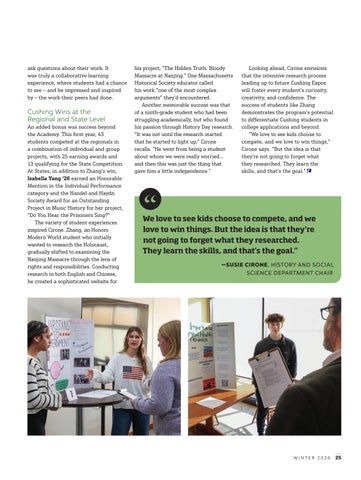
ask questions about their work. It was truly a collaborative learning experience, where students had a chance to see — and be impressed and inspired by — the work their peers had done.
Cushing Wins at the Regional and State Level An added bonus was success beyond the Academy. This first year, 43 students competed at the regionals in a combination of individual and group projects, with 25 earning awards and 13 qualifying for the State Competition. At States, in addition to Zhang’s win, Isabella Yang ’26 earned an Honorable Mention in the Individual Performance category and the Handel and Haydn Society Award for an Outstanding Project in Music History for her project, “Do You Hear the Prisoners Sing?” The variety of student experiences inspired Cirone. Zhang, an Honors Modern World student who initially wanted to research the Holocaust, gradually shifted to examining the Nanjing Massacre through the lens of rights and responsibilities. Conducting research in both English and Chinese, he created a sophisticated website for
his project, “The Hidden Truth: Bloody Massacre at Nanjing.” One Massachusetts Historical Society educator called his work “one of the most complex arguments” they’d encountered. Another memorable success was that of a ninth-grade student who had been struggling academically, but who found his passion through History Day research. “It was not until the research started that he started to light up,” Cirone recalls. “He went from being a student about whom we were really worried... and then this was just the thing that gave him a little independence.”
Looking ahead, Cirone envisions that the intensive research process leading up to future Cushing Expos will foster every student’s curiosity, creativity, and confidence. The success of students like Zhang demonstrates the program’s potential to differentiate Cushing students in college applications and beyond. “We love to see kids choose to compete, and we love to win things,” Cirone says. “But the idea is that they’re not going to forget what they researched. They learn the skills, and that’s the goal.”
We love to see kids choose to compete, and we love to win things. But the idea is that they’re not going to forget what they researched. They learn the skills, and that’s the goal.” —SUSIE CIRONE, HISTORY AND SOCIAL SCIENCE DEPARTMENT CHAIR
WINTER 2026
25