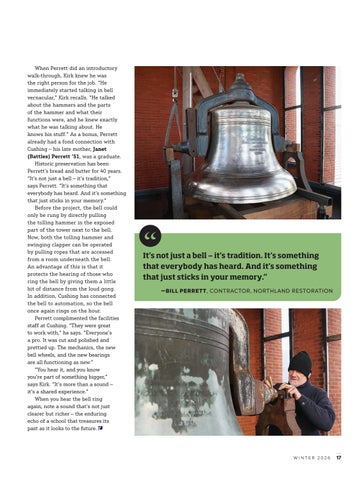
When Perrett did an introductory walk-through, Kirk knew he was the right person for the job. “He immediately started talking in bell vernacular,” Kirk recalls. “He talked about the hammers and the parts of the hammer and what their functions were, and he knew exactly what he was talking about. He knows his stuff.” As a bonus, Perrett already had a fond connection with Cushing — his late mother, Janet (Battles) Perrett ’51, was a graduate. Historic preservation has been Perrett’s bread and butter for 40 years. “It’s not just a bell — it’s tradition,” says Perrett. “It’s something that everybody has heard. And it’s something that just sticks in your memory.” Before the project, the bell could only be rung by directly pulling the tolling hammer in the exposed part of the tower next to the bell. Now, both the tolling hammer and swinging clapper can be operated by pulling ropes that are accessed from a room underneath the bell. An advantage of this is that it protects the hearing of those who ring the bell by giving them a little bit of distance from the loud gong. In addition, Cushing has connected the bell to automation, so the bell once again rings on the hour. Perrett complimented the facilities staff at Cushing. “They were great to work with,” he says. “Everyone’s a pro. It was cut and polished and prettied up. The mechanics, the new bell wheels, and the new bearings are all functioning as new.” “You hear it, and you know you’re part of something bigger,” says Kirk. “It’s more than a sound — it’s a shared experience.” When you hear the bell ring again, note a sound that’s not just clearer but richer — the enduring echo of a school that treasures its past as it looks to the future.
It’s not just a bell — it’s tradition. It’s something that everybody has heard. And it’s something that just sticks in your memory.” —BILL PERRETT, CONTRACTOR, NORTHLAND RESTORATION
WINTER 2026
17