Cambridge IGCSE Mandarin Exec Preview

Page 1


Mandarin Chinese

Dear Teacher,

Welcome to the second edition of our Cambridge IGCSE™ Mandarin Chinese series We have developed this series to support the updated Cambridge IGCSE Mandarin Chinese syllabus (0547) for examination from 2028. This series has been designed to flexibly meet your teaching needs, including extra support to help prepare for assessment. This preview will help you understand how the coursebook, workbook and teacher’s resource work together to best meet the needs of your classroom, timetable and students.

This Executive Preview contains sample content from the series, including:

• a guide explaining how to use the series

• a guide explaining how to use each resource

• a table of contents for each resource.

In developing this new edition, we carried out extensive global research with teachers - through interviews and work on the Cambridge Panel, our online teacher research community. Teachers just like you have helped our experienced authors shape these new resources, ensuring that they meet the real teaching needs of your Mandarin Chinese classroom.

The coursebook has been specifically written to support learners with key vocabulary, grammar and accessible language throughout. We have also provided new features, such as a welcome unit, topicbased videos, and more support to encourage active learning, assessment for learning and student reflection. Numerous practice opportunities within the coursebook and workbook help put students’ learning into practice and can be used in class or at home.

Core to the series is the fully updated digital teacher’s resource. It will help you support your learners and give you the tools to teach the updated syllabuses with confidence, whether you are new to teaching the subject or more experienced. For each unit there are lesson ideas and activities, common misconceptions to look out for, worksheets, answers to the coursebook and workbook, extra wrap-up activities and more.

Please take some time to find out how our resources will support you and your learners. To view the full series, you can visit our website or speak to your local consultant You can find their contact details here:

cambridge.org/education/find-your-sales-consultant

Best wishes,

How to use this series

This suite of resources supports students and teachers following the Cambridge IGCSE™ Mandarin Chinese syllabus (0547) for examination from 2028. All of the components in the series are designed to work together and help students develop the necessary knowledge and skills for this subject.

Mandarin Chinese for

The coursebook is designed for students to use in class with guidance from the teacher. It includes a welcome unit and 25 further units that cover a variety of topics to provide a comprehensive understanding of Chinese language and culture. Each unit includes sections on vocabulary and grammar with activities to develop speaking, listening, reading and writing skills to allow learners to apply these skills to a particular topic. Features such as top tips, culture boxes and languages boxes provide additional information throughout, allowing learners to build their understanding further.

A digital version of the coursebook is included with the print version and is available separately.

The write-in workbook consolidates the learning in the coursebook by providing opportunities for more focused practice. It can be used flexibly, as an additional resource to support learning in the classroom or at home for individual work. The workbook fully reflects the structure of the coursebook, making it easy to navigate. It provides activities at three different levels to help teachers provide differentiation, as well as allowing students to build their confidence by providing them with activities that are right for their level. The workbook also includes practice opportunities, allowing learners to apply their understanding and test their key skills.

A digital version of the workbook is included with the print version.

Mandarin Chinese for Cambridge IGCSETM

The digital teacher’s resource provides everything teachers need to deliver this course. It is packed full of useful teaching notes and lesson ideas, with suggestions for differentiation to support and challenge students, ideas for assessment and homework guidance. A range of additional resources such as worksheets, audio scripts and answers to the coursebook and workbook questions are also available to help teachers save time and enrich their practice.

Mandarin Chinese for Cambridge IGCSETM

Mandarin Chinese for Cambridge IGCSETM

Martin Mak, Xixia Wang & Ivy So Ling Liu

Second edition with Digital access

How to use this series

How to use this book viii

汉语欢迎你!Hàn yǔ huān yíng nǐ

Welcome to Mandarin Chinese! 1

A 日常活动 rì cháng huó dòng

1

wèn hòu yǔ zì wǒ

2 家庭和宠物 jiā tíng hé chǒng wù

wǒ de měi yì tiān

B 个人与社会 gè rén yǔ shè huì

jiàn kāng yǔ yùn dòng

jū zhù huán jìng

xué xiào shēng huó

C 周游世界 zhōu yóu shì jiè

The world around us

13 天气与气候 tiān qì yǔ qì hòu

Weather and climate

14 交通工具 jiāo tōng gōng jù Transportation

15 旅游经历 lǚ yóu jīng lì Holidays: Travel experiences

16 旅游计划 lǚ yóu jì huà

plans

17 公共服务与海关 gōng gòng fú wù

yǔ hǎi guān

Public services and customs

D 工作与职业规划 ɡōnɡ zuò yǔ zhí yè ɡuī huà

The world of work 18 实习 shí xí Work experience

19 申请工作 shēn qǐng gōng zuò

Applying for a job

20 未来学业和职业规划 wèi lái xué yè hé zhí yè guī huà

Future education and career plans

E 国际视野 ɡuó jì shì yě

International world

21 采访名人 cǎi fǎng míng rén

Interviewing Chinese celebrities

22 科技与社交媒体 kē jì yǔ shè jiāo méi tǐ

Technology and social media

23 中国节日 Zhōng guó jié rì

How to use this book

Throughout this coursebook, you will see these features, which are designed to help your learning. Here is a summary of what you will find.

Each unit begins with a set of learning intentions to explain what you will learn.

Each unit opens with a video (indicated by a video icon) and provides a list of questions to answer. The video covers the themes in a unit and provides any key context you need.

This feature gives you further information about

This gives you guidance on structures of the Chinese language as well as useful expressions and phrases.

Key vocabulary is highlighted in vocabulary boxes throughout the unit. The full list of vocabulary is also available in the vocabulary section at the end of the coursebook.

This is to challenge yourself with creative tasks, like detailed writing or presentations. These activities deepen your understanding and boost confidence in real-world language use.

This feature focuses on a key grammar topic in a unit. It will deepen your understanding and knowledge of key grammar skills.

This will help you learn key phrases to make your writing and speaking more natural. Examples show how to use them effectively in different contexts.

This will guide you on how best to apply the skills or topic explored in a unit, or how best to apply your knowledge to key skills, such as listening, reading, writing or speaking.

Practice questions can be found at the end of each unit and help you prepare for assessment. They are denoted by the number of marks per question.

Each unit ends with a checklist that matches the learning intentions at the start of units so you can reflect on your learning.

Throughout the unit you will also see this audio icon. This indicates that this activity has an audio track to help you develop your listening skills.

Part A

Everyday activities

SAMPLE

问候与自我介绍  wèn hòu yǔ zì wǒ jiè shào

1 Greetings and self-introductions

学 xué 习 xí 目 mù 标 biāo LEARNING INTENTIONS

通过第1单元的学习,你将能够:

By the end of this unit, you will be able to:

• 使用问候语并介绍自己,询问名字、国籍等 个人信息。

• 理解中英文名字的不同特点。

• 掌握基本数字和人称代词(我、你、他/她) 及复数标记“们”。

• 使用基本结构介绍自己和讨论自己的感觉, 例如:“我叫李明”“我很好”。

Use greetings and introduce yourself, asking for names, nationalities and other personal information.

Understand the differences between Chinese and English names.

Master basic numbers and personal pronouns (‘I’, ‘you’, ‘he/she’), including the plural marker 们.

Form basic sentences to introduce yourself and describe your feelings, such as ‘My name is Li Ming’ or ‘I am fine’. 看 kàn 视 shì 频 pín ,学 xué 中 Zhōnɡ 文 wén Watch this!

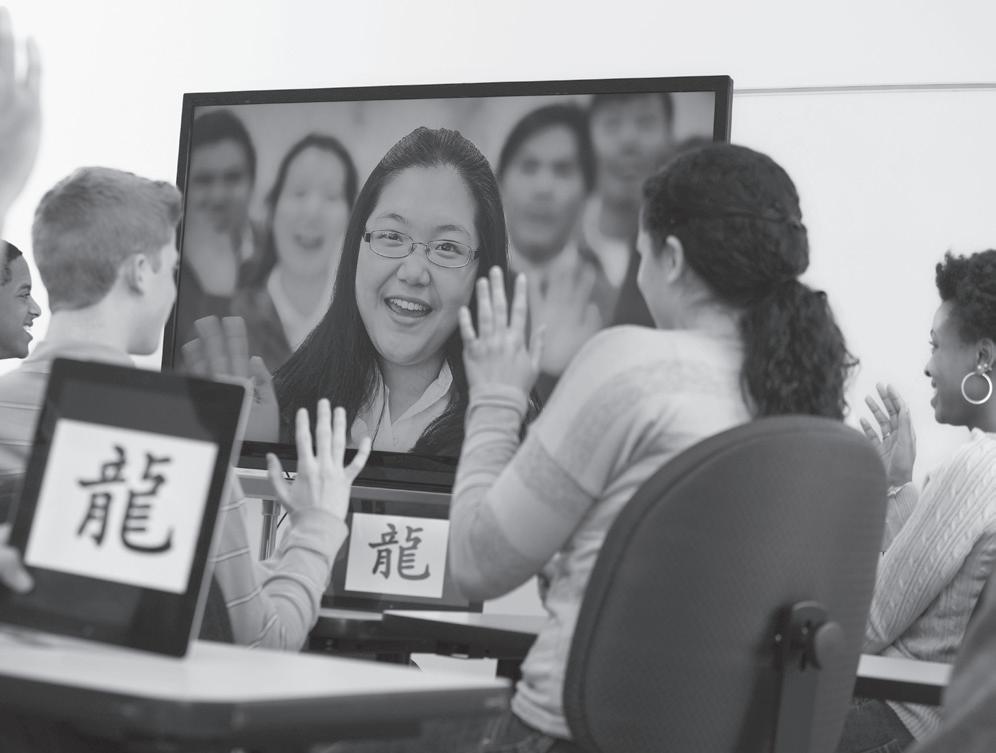
一、 看 kàn 图 tú 片 piàn : Look at the picture:

• 他 tā 们 men 在 zài 哪 nǎ 里 lǐ ?Where are they?

• 上 shànɡ 午 wǔ 看 kàn 见 jiàn 同 tónɡ 学 xué 的 de 时 shí 候 hòu ,你 nǐ 会 huì 跟 ɡēn 他 tā 们 men 说 shuō 什 shén 么 me ?

When you see your classmates in the morning, what can you say to them?

二、 看 kàn 视 shì 频 pín ,说 shuō yi 说 shuō : Watch the video and talk about:

• 怎 zěn 么 me 打 dǎ 招 zhāo 呼 hu how you greet each other

• 怎 zěn 么 me 说 shuō 自 zì 己 jǐ 是 shì 哪 nǎ 国 ɡuó 人 rén how to say which country you are from

• 怎 zěn 么 me 说 shuō 自 zì 己 jǐ 住 zhù 在 zài 哪 nǎ 里 lǐ how to say where you live.

三、 说 shuō yi 说 shuō : Talk about:

• 你 nǐ 叫 jiào 什 shén 么 me 名 mínɡ 字 zì ?What’s your name?

• 你 nǐ 是 shì 哪 nǎ 国 ɡuó 人 rén ?Where are you from?

词 cí 语 yǔ Vocabulary

小 xiǎo 贴 tiē 士 shì TOP TIP

If you have just started learning Mandarin, you can refer to the Welcome unit to learn the basic numbers from 1 to 99.

For numbers over 100, 1000 and 10,000, we use 百 (hundred), 千 (thousand) and 万 (ten thousand), respectively, as shown in the table. Breakdown

Match the characters with the numbers.

4

6

7 一万七千

词 cí 语 yǔ VOCABULARY

词 cí 语 yǔ VOCABULARY

中国 Zhōng guó China

英国 Yīng guó UK

美国 Měi guó USA

德国 Dé guó Germany

日本 Rì běn Japan

印度 Yìn dù India

新加坡 Xīn jiā pō Singapore

马来西亚 Mǎ lái xī yà Malaysia

法国 Fǎ guó France

印尼 Yìn ní Indonesia

Choose one of the following tasks to complete:

1 Write down the names of some countries that you’ve been to.

2 Write down the names of some countries that you would like to travel to in the future.

Choose the appropriate phrases to fill the gaps and complete the dialogues.

小明 (Xiaoming):

你好吗?

美美 (May): 1

大卫 (David): 2

丽丽 (Lily): 不用谢。

路斯 (Lucy):

你好,3 。

小红 (Xiaohong):

认识你我也很高兴。

小明 (Xiaoming):

对不起。

美美 (May): 4

丽丽 (Lily):

再见。

大卫 (David): 5

第一章:日常活动

词 cí 语 yǔ VOCABULARY

很 hěn very

好 hǎo good, well

认识 rèn shí to know

也 yě also

高兴 gāo xìng happy

对不起 duì bù qǐ sorry

不(用)谢 bú (yòng) xiè you’re welcome

没关系 méi guān xi it doesn’t matter

姓 Surname 王

名 Name 小云

年龄 Age15岁

国籍 Nationality 中国

城市 City 北京 一、 根

ɡēn 据 jù 上 shànɡ 面 miàn 的 de 表 biǎo 格 ɡé 内 nèi 容 rónɡ 填 tián 空 kònɡ ,为 wèi 王 Wánɡ 小 Xiǎo 云 yún 完 wán 成 chénɡ

对 duì 话 huà 。

Based on the content of the form above, fill in the gaps to complete the dialogue for Wang Xiaoyun.

问:你姓什么?

答:我姓 1 。

问:你叫什么名字?

答:我叫 2

问:你多大?

答:我 3 岁。

问:你是哪国人?

答:我是 4 人。

Original material © Cambridge University Press & Assessment 2026. This material is not final and is subject to further changes prior to publication.

问:你住在哪儿?

答:我住在 5 。

二、 根

ɡēn 据 jù 上 shànɡ 面 miàn

jiè 绍 shào 。

According to the form above, fill in the gaps and complete the self-introduction for 王小云。

cí 语 yǔ

VOCABULARY

问 wèn to ask

(回)答 (huí) dá to answer, respond

姓 xìng surname

叫 jiào to be called

什么 shén me what

名字 míng zì name

多大 duō dà how old?

岁 suì years old

是 shì to be (am, is, are)

哪 nǎ which

国 guó country

人 rén person, people

住 zhù to live

在 zài at, in, on; to be located, exist

年龄 nián líng age

国籍 guó jí nationality

城市 chéng shì city

在 zài be located at

哪儿/哪里 nǎr/nǎ li where

北京 Běi jīng Beijing

你好,我姓 1 ,我叫 2 。

我 3 岁。

我是 4 人。

我住在 5 。

Zhōnɡ 国 ɡuó 人 rén 的 de 姓 xìnɡ 名 mínɡ Chinese names

• When Chinese people introduce themselves, they give their family name first, followed by their given name. For example, 王小云 ’s family name is 王 and her given name is 小云 . In English, however, she would be called ‘Xiaoyun Wang’.

• The most commonly used family names are 王 Wáng , 李 Lǐ , 张 Zhāng , 刘 Liú and 陈 Chén , and most are only one character. There are usually 1–2 characters in given names, often with positive meanings. For example, 伟 Wěi (Great/Heroic), 芳 Fāng (Fragrant), 丽 Lì (Beautiful), 明 Míng (Bright).

• Use of 小 / 大 in names: 小 Xiǎo (little) is used affectionately or in childhood names. For example, 小 Xiǎo 云 yún (Little Cloud).

大 Dà (big) adds emphasis. For example, ( 大 Dà 伟 wěi Big Hero).

• Some general rules:

1 Never split a two-character given name.

2 Avoid using someone’s given name on its own. Use their full name, 王小云 , or family name + title, 王 wánɡ 老 lǎo 师 shī (Teacher Wang). Calling a senior by their full name is considered disrespectful in Chinese.

文 wén 化 huà CULTURE

Listen to the audio track and, based on the information, fill in the table using Chinese characters or pinyin.

姓名 xìnɡ mínɡ full name

介绍 jiè shào to introduce

自己 zì jǐ self

早上好 zǎo shàng hǎo good morning

上海 Shàng hǎi Shanghai

香港 Xiāng gǎng Hong Kong

东京 Dōng jīng Tokyo

第一章:日常活动 第一单元:问候与自我介绍

You will hear five sentences in Chinese.

You will hear each sentence twice. Choose the correct answer.

1A Room 402 B Room 906 C Room 609 D Room 204

2A 上海 B 香港 C 东京 D 北京

3A 五岁 B 十五岁 C 五十一岁 D 二十五岁

4A 中国人 B 英国人 C 日本人 D 印尼人

5A 6323 4566 B 2363 4556 C 6233 5564 D 2532 5456

语 yǔ 法 fǎ Grammar

men

一、Use of 们

As well as being used to make plural pronouns, 们 can sometimes be used as a plural marker for a few personal nouns:

SingularPlural

二、Describing identities, jobs and feelings

There are two basic sentence structures for us to use in daily life.

A subject + 是 shì + object

For example, 我是中国人 。I am Chinese.

lǎo 师 shī teacher 老 lǎo 师 shī / 老 lǎo 师 shī 们 men teachers

tónɡ 学 xué student 同 tónɡ 学 xué / 同 tónɡ 学 xué 们 men students

B subject + 很 hěn + stative verb

For example, 我很好 。I’m fine.

wǒ I 我 wǒ 们 men we

你 nǐ you 你 nǐ 们 men you (more than one person)

他 tā he 他 tā 们 men they (males, or mixed groups)

她 tā she 她 tā 们 men they (females only)

它 tā it 它 tā 们 men they (not for humans)

In Chinese, 您 nín is a polite and respectful way to say ‘you’, often used when speaking to elders, teachers or in formal situations.

However, there is no plural form of 您 . We do not say 您们 . Instead, when speaking to multiple people, just use 你 nǐ 们 men , even in formal contexts.

Don’t use 是 here! 很 is like a bridge between the person/thing and the description. It doesn’t always mean ‘very’!

练 liàn 习 xí Exercise

翻 fān 译 yì 句 jù 子 zi 。

Translate the sentences.

1 We are busy. ( 忙 )

2 You are smart. ( 聪明 )

3 She is tall. ( 高 )

4 He is happy. ( 高兴 )

5 She is fine. ( 好 )

忙 máng busy

高 gāo tall

聪明 cōng míng smart, clever

口 kǒu 语 yǔ Speaking

一、 说 shuō 出 chū 下 xià 面 miàn 这 zhè 些 xiē 国 ɡuó 家 jiā 在 zài 哪 nǎ 个 ɡè 洲 zhōu ?

Say which continent these countries are in.

For example:

Q: 美 Měi 国 ɡuó 在 zài 哪 nǎr 儿?

A: 美

Měi 国 ɡuó 在 zài 美 Měi 洲 zhōu 。

Q: 中

Zhōnɡ 国 ɡuó 在 zài 哪 nǎr 儿?

A: 中

Zhōnɡ 国 ɡuó 在 zài 1 。

Q: 马 Mǎ 来 lái 西 xī 亚 yà 在 zài 哪 nǎr 儿?

A: 2 二、 两 liǎnɡ 人 rén yī 组 zǔ ,做 zuò 角 jué 色 sè 扮 bàn 演 yǎn 。

A4: 你 nǐ 住 zhù 在 zài 哪 nǎr 儿?

B4:

A5: 你 nǐ 喜 xǐ 欢 huān 中 Zhōnɡ 国 ɡuó 吗 mɑ ?

B5:

洲 zhōu continent 亚洲 Yà zhōu Asia

欧洲 Ōu zhōu Europe

非洲 Fēi zhōu Africa

美洲 Měi zhōu America

Work in pairs and complete the role play.

情 qínɡ 景 jǐnɡ :你 nǐ 在 zài 中 Zhōnɡ 国 ɡuó ,和 hé 中 Zhōnɡ 国 ɡuó 人 rén 说 shuō 话 huà 。

Scenario: You are in China and talking to a Chinese person for the first time.

A: 中 Zhōnɡ 国 ɡuó 人 rén Chinese person

B: 你 nǐ 自 zì 己 jǐ yourself

A1: 你 nǐ 好 hǎo 吗 mɑ ?

B1:

A2: 你 nǐ 叫 jiào 什 shén 么 me 名 mínɡ 字 zi ?

B2:

B3: 1.3

A3: 你 nǐ 是 shì 哪 nǎ 国 ɡuó 人 rén ?

喜欢 xǐ huān to like 第一章:日常活动

大洋洲 Dà yáng zhōu Oceania

一、 写

写 xiě 作 zuò Writing

xiě 出 chū 下 xià 面 miàn 汉 Hàn 字 zì 的 de 第 dì yī 笔 bǐ 。

What are the first strokes of the following characters?

例 lì 子 zi Example :你 丿

1 五

2 六

3 中

4 我

5 四

xiǎo 贴 tiē 士 shì TOP TIP

二、 写 xiě 自 zì 我 wǒ 介 jiè 绍 shào ,填 tián 空 kònɡ 。

Fill in the gaps to write a self-introduction.

你好,我叫 。

我 岁。

我是 人。

我住在 。

我很 。

USEFUL EXPRESSIONS

• 你好。

Hàn 字 zì 的 de 笔 bǐ 画 huà Character strokes

Chinese characters are made up of strokes.

The basic strokes are:

horizontal 丨 vertical

丿 down to the left 丶 dot

㇏ down to the right ㇀ upward

亅 vertical with a hook ㇕ horizontal with a vertical turn

If you are unsure about the stroke order of a character, you can search online. Many websites provide detailed demonstrations.

• 早上好。

• 我姓王。

• 我十五岁。

第一章:日常活动

复 fù 习 xí Review

lǎo 师 shī 和 hé 同 tónɡ 学 xué 们 men 在 zài 网 wǎnɡ 课 kè 上 shànɡ 第 dì yī 次 cì 见 jiàn 面 miàn 。听 tīnɡ 下 xià 面 miàn 的 de 录 lù

2 老师住在哪里? A 北京 B 香港 C 东京 [1] 1.4

音 yīn ,你 nǐ 将 jiānɡ 听 tīnɡ 到 dào 两 liǎnɡ 遍 biàn 。选 xuǎn 择 zé 正 zhènɡ 确 què 答 dá 案 àn 回 huí 答 dá 问 wèn 题 tí 。

A teacher and students are meeting for the first time in an online class. Listen to the following audio track. You will hear it twice. Select the correct answer to each question.

1 老师姓什么?

A 李

B 陈 C 王

SAMPLE

3 李文是哪国人? A 日本人 B 印度人

4 田中住在哪儿? A 北京 B 香港

5 谁是日本人?

A 王老师

zì 我 wǒ 评 pínɡ 估 ɡū SELF-ASSESSMENT

I can use greeting phrases when meeting friends in Chinese.

I can talk about countries and continents in Chinese.

I can understand and use the basic numbers in Chinese.

I can ask questions using the question words 吗 , 什么 , 哪 and 哪儿 .

I know how to use pronouns in Chinese.

I can understand the use of 们

I can form basic sentences to introduce myself and describe my feelings in Chinese, for example 我很好

Mandarin Chinese for Cambridge IGCSETM

WORKBOOK

Second edition with Digital access

Martin Mak, Xixia Wang & Ivy So Ling Liu

1 问候与自我介绍 wèn hòu yǔ zì wǒ

C 周游世界 zhōu yóu shì jiè

The world around us 13 天气与气候 tiān qì yǔ qì hòu

and climate

14 交通工具 jiāo tōng gōng jù

lǚ yóu jīng lì

公共服务与海关 gōng gòng fú wù yǔ hǎi guān

D 工作与职业规划

shēn qǐng gōng zuò

Applying for a job 164

20 未来学业和职业规划 wèi lái xué yè hé zhí yè guī huà

Future education and career plans 172

E 国际视野 ɡuó jì shì yě

International world

采访名人 cǎi fǎng míng rén

Interviewing Chinese celebrities 182 22 科技与社交媒体 kē jì yǔ shè jiāo méi tǐ

Technology and social media

23 中国节日 Zhōng guó jié rì

日 rì 常 chánɡ

Everyday activities Part A

问候与自我介绍 wèn hòu yǔ zì wǒ jiè shào

1Greetings and self-introductions

词 cí 语 yǔ Vocabulary 重 zhònɡ 点 diǎn Focus

、 将 jiānɡ 左 zuǒ 边 biān 的 de 短 duǎn 语 yǔ 与 yǔ 右 yòu 边 biān 的 de 意 yì 思 si 连 lián 接 jiē 起 qǐ 来 lái 。

Match the Chinese on the left with the English on the right.

1 你好 A Nice to meet you

2 我叫 B Hello

3 哪国人 C Chinese person

4 中国人 D Japanese person

5 见到你很高兴 E Indian person

6 日本人 F My name is …

7 印度人 G Which nationality?

liàn 习 xí Practice 二 èr 、 按 àn 照 zhào 例 lì 子 zi ,填 tián 数 shù 字 zì 。

Follow the example and fill in the numbers. 例:十 + 二十三 = 1 十五+二十一= .............................................................................................

2 二十+一=

3 四十+六十=

4 十一+二=

5 三十+九=

战 zhàn Challenge

语 yǔ 法

Grammar

zhònɡ 点 diǎn Focus

sì 、 按 àn 照 zhào 例 lì 子 zi ,重 chónɡ 组 zǔ 句 jù 子 zi 。

Follow the example and rearrange the words to form correct sentences.

例:哪 / 国 / 人 / 是 / 你 ➜

1 忙 / 你 / 吗 / 很 ➜ .........................................................................................

2 不 / 客气 / 用 ➜ ............................................................................................

3 我 / 很 / 忙 / 今天 ➜

4 关系 / 没 ➜

5 忙 / 你 / 忙 / 不 ➜

liàn 习 xí Practice

五 wǔ 、 改 ɡǎi 正 zhènɡ 错 cuò 误 wù 。

Correct the mistakes.

1 你叫我什么名字?

2 我是中国。

3 对起不!

4 上早好! .........................................................................................................

5 你是忙吗? .....................................................................................................

挑 tiǎo 战 zhàn Challenge

六 liù 、 用 yònɡ 所 suǒ 给 ɡěi 的 de 提 tí 示 shì 翻 fān 译 yì 句 jù 子 zi 。

Translate the sentences using the prompts given.

1 I’m fine. ( 很好 ) ..............................................................................................

2 The students are very happy. ( 们,高兴 ) .......................................................

3 How are you? ( 吗 ) .........................................................................................

你是哪国人?

4 Are you Chinese? ( 你,吗 ) ............................................................................ 5 Where do you live? ( 你们,哪儿 ) .................................................................

tīnɡ 说 shuō 读 dú 写 xiě 练 liàn 习 xí Skills

Practice

Find

Fill in the blanks with the given phrases to complete the sentences. Each phrase can only be used once.

你好  哪国人  不用谢  没关系 你忙吗  我很忙  我很好

1 A: !你叫什么名字?

B: 你好,我叫李明。

2 A: 对不起!

B: 。 3 A: 谢谢你!

B: ...............................................................................................................

4 A: ............................................................................................................. ? B: ,今天有很多工作。 第一章:日常活动

5 A: 你好吗?

B: ,谢谢!

6 A: 你是 ?

B: 我是中国人。

挑 tiǎo 战

zhàn

Challenge

九 jiǔ 、 读 dú 下 xià 面 miàn “王 Wánɡ 明 Mínɡ 的 de 自 zì 我 wǒ 介 jiè 绍 shào ”,完 wán 成 chénɡ 情 qínɡ 景 jǐnɡ 对 duì 话 huà 。

Read Wang Ming’s self-introduction and complete the dialogue.

王明的自我介绍

你好,我叫王明 。我是中国人。我十五岁。我住在香港。

情 qínɡ 景 jǐnɡ :王 Wánɡ 明 Mínɡ 和 hé 老 lǎo 师 shī 第 dì yī 次 cì 见 jiàn 面 miàn ,他 tā 向 xiànɡ 老 lǎo 师 shī 介 jiè 绍 shào

Scenario: Wang Ming and his teacher meet for the first time, and he introduces himself to the teacher.

老师:你好!

王明:1

老师:你好吗?

王明:2 ..................................................................................................................

老师:我也不错。谢谢。你叫什么名字?

王明:3

老师:你多大?

王明:4 ..................................................................................................................

老师:你是哪国人?

王明:5

老师:你住在哪儿?

王明:6 ..................................................................................................................

第一章:日常活动 第一单元:问候与自我介绍

老师:认识你我很高兴。再见。

王明:7 ..................................................................................................................

十 shí 、 对 duì 话 huà 填 tián 空 kònɡ 。 Complete the dialogues.

1A: 你好!

B: ..................................................................................................................

2A: 你好吗?

B:

3A: 谢谢。

B:

4A: 再见。

B:

5A: 你叫什么名字?

B:

6A: 你是哪国人?

B: ..................................................................................................................

7A: 你多大?

B:

8A: 你住在哪儿?

B: ..................................................................................................................

Follow the example and write a paragraph for each of the students below to help them introduce themselves.

Practice writing short self-introductions using a template (for example, 你好 , 我叫 .......... , 我 是 人 , 我 岁 , 我住 在 ). Include all details (name, nationality, age, city) to avoid missing any information. Check the accuracy of your Chinese characters to ensure clear, errorfree responses.

十 shí 二 èr 、 再

zài 看 kàn 看 kan 本 běn 单 dān 元 yuán 视 shì 频 pín ,用 yònɡ 中 Zhōnɡ 文 wén 或 huò 拼 pīn 音 yīn 回 huí 答 dá 以 yǐ 下 xià 问 wèn 题 tí 。

Watch this unit’s video again and answer the following questions in Chinese characters or pinyin.

1 张 Zhānɡ 老 lǎo 师 shī 姓 xìnɡ 什 shén 么 me ? .......................................................................................

2 麦 Mài 可 kě 是 shì 哪 nǎ 国 ɡuó 人 rén ?

3 爱 Ài 丽 lì 是 shì 哪 nǎ 国 ɡuó 人 rén ? ........................................................................................

4 爱 Ài 丽 lì 住 zhù 在 zài 哪 nǎ 里 lǐ ?

5 麦 Mài 可 kě 多 duō 大 dà ?

6 爱 Ài 丽 lì 多 duō 大 dà ? ................................................................................................

xiǎo

shì 牛 niú 刀 dāo Ready? 十 shí 三 sān 、 角 jué 色 sè 扮 bàn 演 yǎn 。 Role play.

qínɡ 景 jǐnɡ :开 kāi 学 xué 第 dì yī 天 tiān ,你 nǐ 跟

Scenario: On the first day of school, you are introducing yourself to your new classmates.

问题 1 你好吗?

问题 2 你姓什么?

问题 3 你叫什么名字?

问题 4 你是哪国人?

问题 你住在哪里?

zì 我 wǒ 评 pínɡ 估 ɡū SELF-ASSESSMENT

第一章:日常活动

I can respond to 你好吗 and greet my classmates.

I can ask people their names and tell them mine.

I can ask and answer questions about nationality and where people live.

I used appropriate vocabulary and the sentence structures I’ve learnt in this unit.

I maintained good pronunciation and intonation while speaking.

Read the following texts, then choose the correct answer.

1 早上好,我叫麦可 ,我是美国人,我十六岁,住在北京。

麦可是哪国人?

A 北京  B 美国人  C 早上好  D 十六岁

2 同学们好,我是张老师。认识你们很高兴,我是中国人。我住在 美国。

张老师姓什么?

A 张  B 中  C 美  D 国

3 你们好,我叫李山 ,我是印度人,我住在上海。

李山住在哪里?

A 印度  B 上海  C 北京  D 美国

4 你好,我叫田中 ,我是日本人,我十五岁,我也住在上海。

田中多大?

A 日本人  B 田中  C 上海市  D 十五岁

Mandarin Chinese for Cambridge IGCSETM

CAMBRIDGE IGCSETM MANDARIN CHINESE: TEACHER’S RESOURCE

Contents

About the authors

How to use this series

Discover the School Support Hub

How to use this Teacher’s Resource

About the syllabus

About the Assessment

汉语欢迎你!Hàn yǔ huān yíng nǐ

Welcome to Mandarin Chinese!

A 日常活动 rì cháng huó dòng

Everyday activities

1 问候与自我介绍 wèn hòu yǔ zì wǒ jiè shào

Greetings and self-introductions

2 家庭和宠物 jiā tíng hé chǒng wù

Family and pets

3 我的每一天 wǒ de měi yì tiān

Everyday life

4 爱好 ài hào

Hobbies

5 饮食 yǐn shí

Eating and drinking

B 个人与社会 gè rén yǔ shè huì

Personal and social life

6 健康与运动 jiàn kāng yǔ yùn dòng

Health and fitness

7 家居生活 jiā jū shēng huó

Home life

8 衣服 yī fu Clothes

9 买东西 mǎi dōng xi

Shopping

10 居住环境 jū zhù huán jìng

Living environment

11 学校生活 xué xiào shēng huó

School routine

5 © Cambridge University Press & Assessment 2026

CAMBRIDGE IGCSETM MANDARIN CHINESE: TEACHER’S RESOURCE

12 学校设施 xué xiào shè shī

School facilities

C 周游世界 zhōu yóu shì jiè

The world around us

SAMPLE

13 天气与气候 tiān qì yǔ qì hòu

Weather and climate

14 交通工具 jiāo tōng gōng jù

Transportation

15 旅游经历 lǚ yóu jīng lì

Holidays: Travel experiences

16 旅游计划 lǚ yóu jì huà

Holiday plans

17 公共服务与海关 gōng gòng fú wù yǔ hǎi guān

Public services and customs

D 工作与职业规划 ɡōnɡ zuò yǔ zhí yè ɡuī huà

The world of work

18 实习 shí xí

Work experience

19 申请工作 shēn qǐng gōng zuò

Applying for a job

20 未来学业和职业规划 wèi lái xué yè hé zhí yè guī huà

Future education and career plans

E 国际视野 ɡuó jì shì yě

International world

21 采访名人 cǎi fǎng míng rén

Interviewing Chinese celebrities

22 科技与社交媒体 kē jì yǔ shè jiāo méi tǐ

Technology and social media

23 中国节日 Zhōng guó jié rì

Chinese festivals

24 学中文 xué Zhōng wén

Learning Chinese as a foreign language

25 救救地球 jiù jiù dì qiú

Saving the planet

Digital resources

The following items are available on Cambridge GO. For more information on how to access and use your digital resource, please see the inside front cover.

Syllabus correlation grid

Lesson plan template

Worksheets

Worksheet answers

Coursebook answers

Coursebook vocabulary list

Coursebook audio

Coursebook audio scripts

Coursebook videos

Workbook answers

Workbook audio

Workbook audio scripts

SAMPLE

CAMBRIDGE IGCSETM MANDARIN CHINESE: TEACHER’S RESOURCE

CAMBRIDGE IGCSETM MANDARIN CHINESE: TEACHER’S RESOURCE

How to use this Teacher’s Resource

学习目标

LEARNING INTENTIONS

This section outlines the key goals of each unit, helping students focus on essential skills such as vocabulary, sentence structures and grammatical rules.

学习成果

Success criteria

Clear benchmarks for listening, speaking, reading and writing are provided to help students measure their progress and achieve mastery of the unit objectives.

学习难点

Common misconceptions

This section addresses frequent misunderstandings, offering strategies to identify and correct errors.

温故知新

Starter ideas

Engage students by connecting prior knowledge with interactive activities such as discussions, quick questions or the video in ‘Watch This!’ to introduce the theme of the unit.

教学设计

Main teaching ideas

This section includes a variety of activities – reading, listening, speaking, writing and grammar exercises – to build language proficiency and ensure active learning.

因材施教 Differentiation ideas:

Tailored support and challenges are provided to meet the diverse needs of all students, ensuring engagement and progress for every learner.

巩固与反思

Plenary ideas

Summarise, review and reflect on key learning points through interactive tasks and worksheets, solidifying students’ understanding of the unit.

作业建议

Homework ideas

Practical homework suggestions reinforce classroom learning, encourage independent practice or prepare students for the next lesson.

评估建议 Assessment ideas:

Formative or summative assessment tasks, such as role plays and written exercises, help evaluate students’ understanding and application of the unit content.

句型 LANGUAGE

Help your students to master the highlighted sentence structures by using these tips and activities.

录音稿 Audio transcripts

The transcripts provide a detailed reference to support listening activities and comprehension tasks.

课堂练习题

Downloadable worksheets

Interactive worksheets complement the unit by providing structured activities for practice.
SAMPLE

Cambridge University Press & Assessment 2026

CAMBRIDGE IGCSETM MANDARIN CHINESE: TEACHER’S RESOURCE

Everyday activities Part A SAMPLE

IGCSETM MANDARIN CHINESE: TEACHER’S RESOURCE

1 问候与自我介绍

Greetings and self-introductions

学习计划

学习目标

通过第 1 单元的学习,学生将能够:

• 使用问候语并介绍自己,询问名字、国籍等个人信息。

• 理解中英文名字的不同特点。

• 掌握基本数字和人称代词(我、你、他 / 她)及复数标记“们”。

• 使用基本陈述句,例如:“我叫李明”“我很好”。

学习成果

课程评估目标

L1: 理解简单日常材料中的主要内容和关键 信息

L2: 理解关于一系列熟悉话题的语音文本

说 S1: 在一系列可预测的日常情境中清晰有效 地沟通

S4: 展现一定的维持互动的能力

读 R1: 理解简单日常材料中的主要内容和关键 信息

R2: 理解关于一系列熟悉话题的真实事实性 文本

学习成果

• 学生能听懂包含问候、自我介绍以及日 常对话常用语的简短对话内容。

• 学生能从听力材料中辨认数字(零到万) 以及姓名、国籍和居住城市等个人信息。

• 学生能自信地用中文与他人打招呼、自 我介绍,并交流简单的个人信息。

• 学生能提问并回答有关姓名、国籍和居 住地的问题,使用句型如:你叫什么名 字?你是哪国人?和你住在哪里?

• 学生能理解有关问候、自我介绍以及基 本个人信息(如姓名、国籍、年龄、居住 城市等)的简短文章。

• 学生能识别关键词汇,如“早上好” “同学”“高兴”“住”等,并理解语法 结构(如“很”“和”“们”)在语境中的 用法。

Cambridge University Press & Assessment 2026

CAMBRIDGE

课程评估目标

W1: 为日常目的清晰地传达简单的实际 信息

W2: 在熟悉话题上写出简单的短语和句子

学习成果

• 学生能用简单的句子写一篇自我介绍, 包括自己的姓名、年龄、国籍和居住城市, 使用句型如“我叫……”“我住在……” 和“我是……”。

• 学生能书写礼貌的回应,并在描述句中 正确地使用“很”,如“我很高兴认识 你”或“我很忙”。

学习难点

1 常见误区

• 学生常受英文 I am happy 句式的影响,直接翻译成“我是高兴”,而忽略中文需要用“很”连接 主语与形容词的语法规则。

• 学生常错误地将“们”用于表示动物或物品的复数形式,例如误用成“书们”“狗们”“桌子们” 等,未理解“们”只能用于人称代词和特定名词的复数表达。

• 学生常将中文数字单位“万”的概念与英文数字混淆,如将“一万”(10,000)误解为“一千” (1,000)或“十万”(100,000),导致口语及书写表达错误。

2 如何识别

• 学生口语或书写练习中频繁出现“他是高兴”“我是累”之类的错误表达。学生将英文 I am... 结构机械地翻译成中文时,倾向于直接使用“是”连接主语和形容词。

• 学生口语或写作中出现“书们”“狗们”“桌子们”等明显错误的表达。在复数表达的练习中, 学生对“们”的适用范围不能准确掌握,在动物、物品名词后随意添加“们”。

• 学生在阅读、口头表达或书写数字时常出错,如将“一万人”说成“一千人”或“十万人”。

3 解决方法

• 教师明确指出中文句子“主语 + 形容词”结构通常需用“很”连接,而非“是”,并用中英文 句式对比来加强理解。通过造句、小组情景对话等方式,强化学生掌握正确表达,如:“我很高 兴”“她很忙”等。

• 明确强调“们”仅用于人称代词(我们、你们、他们)和特定表示人的名词(朋友们、同学们), 而动物和物品名词不加“们”。提供针对性的正误对比练习,如“狗们 ✗ 狗 ✓”“书们 ✗ 书 ✓”, 并用课堂游戏和小组活动来反复巩固。

• 设计多种形式的数字练习,如口语表达练习、听写练习、数字宾果游戏,确保学生准确掌握中文 的数字表达。

温故知新

1 基础知识

本单元是本书的第一个单元,学生刚刚开始接触 IGCSE 中文课程。他们的语言背景各不相同,有些 学生可能之前有过一段时间的中文学习经历,而另一些学生可能是初次接触中文。为了帮助学生顺 利进入正式的学习内容,建议在开始本单元之前,教师指导学生认真学习《汉语欢迎你!》单元的内

3 © Cambridge University Press & Assessment 2026

Cambridge University Press & Assessment 2026. This material is not final and is subject to further changes prior to publication.

CAMBRIDGE IGCSETM MANDARIN CHINESE: TEACHER’S RESOURCE

容,以便他们对中文语言的特点、基本发音规则以及常用句型有一个初步而全面的了解,为后续的 学习奠定良好的基础。

2 导入

首先,教师可用中文向学生热情地打招呼,例如:“同学们,你们好!欢迎来到我们的中文课!”然 后,教师用简单而亲切的中文自我介绍,比如:“我是李老师,我是中国人,我来自北京。”介绍时可 适当配合手势、图片或地图,帮助学生理解表达的内容。紧接着,教师可以播放 Watch this! 的视频和 图片,呈现不同国家或地区学生互相问候、握手或挥手的场景,并用中文向学生提问:“他们在做什

么?”“他们可能在说什么?”“你们知道怎么用中文打招呼吗?”引导学生思考并初步了解本课的主 题和情境。

3 支持单元开篇的活动

A 看视频,学中文

• 在播放视频之前,向学生介绍视频的主题,例如基本问候语、自我介绍等内容,激发学生的兴 趣。通过提问,如“你知道用中文怎么说‘你好’吗?”或“你会用中文介绍自己吗?”来调动学 生的参与度,并为视频内容做好铺垫。

• 老师们可以将视频内容分段播放,每段后暂停,带领学生复述视频中的关键句式和词汇。例如, 播放介绍问候语部分时,暂停并让学生模仿视频中人物说“早上好”或“我叫……”。通过逐句 分析,帮助学生掌握句型结构,如“我住在……”和“你叫什么名字?”。

• 观看视频后,组织学生进行角色扮演,模仿视频中的情景对话。例如,一个学生扮演问候的人, 另一个学生扮演回答的人,练习使用视频中的语言点,如问候语和自我介绍。这种互动练习能帮 助学生将视频中的语言知识转化为实际应用能力。

• 结合视频中的内容,向学生补充相关的文化知识,如中国人姓名的构成和常见姓氏(如王、李、 张)。通过提问,如“你发现中文名字和英文名字有什么不同?”引导学生加深对中文姓名文化的 理解,从而增强对语言的兴趣和背景知识的积累。

• 最后,带领学生回顾视频中的重点内容,鼓励学生复述视频中出现的对话或句型。可以设计类似 视频场景的对话练习,让学生在小组活动中运用所学知识进行练习,进一步巩固学习效果。

B 词语

活动一

将全班分成小组,每组两人或多人,为每组提供数字和汉字的卡片(例如 450 和四百五十)。让学生 配对卡片,并解释他们的搭配理由。老师也可以将本活动作为一个听力练习,教师用中文读出数字, 让学生指出相应的汉字。此环节可以帮助学生提升听力理解和发音辨识能力。

因材施教: 教学支援:教师在活动前可复习关键数字,如“十”“百”“千”“万”,并展示数字和汉字的对应关 系。教师可先示范配对过程,清晰讲解配对的逻辑,帮助学生理解游戏规则。活动开始时,教师可提 供更简单、更常用的数字进行配对,以增加学生的自信心。

延伸活动:

教师可以增加更大的数字(如六千八百九十二),以挑战学生的理解能力。也可让学生自 行创作数字卡片,互相交换进行配对,以增加活动的互动性和趣味性。

活动二

在这个活动中,学生看国旗,说出每个国家的名字。老师可以结合词汇表,将这个活动变成一个搭配 题,增加活动的趣味性。

2026.

CAMBRIDGE

因材施教:

教学支援:采用支架式教学

• 将任务分解为小步骤,提供词汇表或提示来帮助学生逐步完成学习任务。

• 结合视觉辅助:使用图片、拼音、卡片等工具,促进学生更轻松地理解语言和含义。

另外,教师还可按照不同能力学生搭配的原则来分组,让较自信的学生辅助另一学生,也可以是两 个不同国籍的学生互补。学生们以小组形式制作和展示自己的世界地图,较自信的学生可以先示范 使用所学句型介绍不同国家、城市或其他地理信息。本活动有助强化学生对地图和地理名词的综合 理解和应用能力。

延伸活动:在学生熟悉国家名称后,设计简单的对话练习,例如:

• A: 你是哪国人?(Which country are you from?)

• B: 我是英国人。(I am British.)

教学设计

阅读

文章一

文章一旨在通过五个短小的日常对话,让学生掌握并练习几个常用的交际用语。虽然本题型设计为 阅读填空,但老师仍可将其灵活转换为口语互动练习,让学生反复进行对话操练。在活动开展之前, 教师应带领学生复习词汇表中的重要表达,尤其是“你好吗?”,“对不起”和“再见”等常用语。教 师可以借助卡片、动作或图片来帮助学生深入理解每个表达的意义和用法。教师须示范正确的发音 和语调,并带领全班跟读练习。教师可以朗读每段对话,并在空格处暂停,让学生猜测合适的答案; 必要时,教师可通过小组讨论选项,鼓励学生解释为什么某些选项更适合特定情境。

因材施教:

差异化教学:

差异化教学也称为分层次教学(differentiation)本书中的活动多采用分层次教学展开,以便根据不同 学生水平提供不同支持或挑战。

教学支援:

• 教师可以提供额外的视觉提示或图片,帮助学生更直观地理解对话内容及选项含义。

• 教师可以事先朗读并示范每个句子,让学生跟读或重复,帮助他们熟悉句式结构和发音。

• 将学生分成小组或配对练习,让不同能力的学生结对,以提供额外的帮助和支持。

延伸活动:

• 对于学有余力的学生,教师可以鼓励他们在完成基础练习后,尝试自行创作新的对话或扩展已 有对话,加入更多的日常用语。

• 教师可以进一步引导学生在现实情境中运用这些表达,比如进行角色扮演或即兴对话练习,以 巩固他们的口语表达能力。

• 教师可提供更有挑战性的任务,例如让学生用所学词汇创作一段简短的中文聊天记录或对话场 景,进一步提高他们的书面和口头表达能力。

5

Cambridge University Press & Assessment 2026

Original material © Cambridge University Press & Assessment 2026. This material is not final and is subject to further changes prior to publication.

CAMBRIDGE

文章二

这部分旨在培养学生捕捉表格信息的能力。学生先读一份个人信息表,再完成两个活动: 活动一

SAMPLE

活动一是回答问题。教学时,老师可以利用卡片、词汇学习软件等工具,让学生复习词汇表中的词 语,也可以做一些疑问词的复习(疑问词的系统复习将在第 2 单元中进行,因此本单元可以作为一个 热身活动,考察一下学生对疑问词的掌握程度)。

活动二

活动二是将表格信息变为一段“自我介绍”的填空。主要考查学生对信息表中的项目词,例如姓名、 国籍、年龄等的熟悉程度。

这一部分的文化小知识,主要是提醒学生注意中英文在姓名先后顺序上的不同。可以多给学生一些 例子,例如中文中,“李明 ”姓“ 李 ”,名叫“ 明”。但在英文中,“李明”可能会被叫成 Ming Li,因为 英文中姓(surname)是在名(given name)的后面。

为了照顾中文表达,本书中所有中文名字的英文翻译基本都按照中文姓名的规则,例如李明是 Li Ming。

作为文化常识,老师可以引导学生阅读课本中的“文化”部分的“中国人的姓名”。然后着重介绍一 下几个常用姓氏:黄、李、林、刘、马、王、赵、吴、张、田、金。

由于学生已对中国人的姓名顺序有一定了解,老师不妨举几个带有这些姓的名字作为例子,让学生 讨论姓和名。

需要特别指出的是,中国人没有固定的词语作为名字。但长辈给孩子取名的时候,一般会取用有特 别意思的汉字,组合在一起,寄托对孩子的期望。有一些汉字在取名时的使用频率较高,例如明、天、 丽、乐、美、红等等。老师也可以多举一些例子,作为延伸学习。此外,老师也可尝试让学生发挥创意, 写几个中文姓名,并解释原因。

听力

活动一

本活动要求学生听四个学生的自我介绍,然后填表以及回答问题。教学时,老师可以根据学生的情 况,强调对主要词语的复习,让他们自己完成练习。在本单元中,学生只需要了解一些主要城市,并 参考词汇表完成练习。

活动二

活动前,教师可带领学生复习数字 1 到 100 的发音和书写,尤其是容易混淆的数字(如十四与四十、 七十与十七等),并讲解这些数字的中文发音规律。播放录音前,可先复习短语中的关键词汇,如 “六零九”“伦敦 ”“

日本人”等,并让学生熟悉这些词汇的发音。强调句子中的重要信息点,例如房 间号、城市名称、年龄、国籍和电话号码。

因材施教: 教学支援:

• 听力开始前,老师需要提醒学生认真读题目,理解题目的意思。根据学生实际情况,可建议学生 在听力开始前,给一些词语标上拼音。

• 通过口头练习或播放录音,让学生熟悉数字的语调和发音差异。

延伸活动:在完成活动后,教师可设计类似的听力任务,例如提供新的房间号、城市、年龄等信息, 并要求学生听录音选择正确答案。让学生尝试用中文描述自己的房间号、城市或年龄,强化听说结 合的能力。

6

Cambridge University Press & Assessment 2026

Cambridge University Press & Assessment 2026. This material is not

and is subject to further changes prior to publication.

CAMBRIDGE

语法

语法一

在汉语中,“们”是用来表示复数的后缀,主要用于人称代词和某些特定的名词。例如,当我们谈论 一个老师时,我们使用单数形式“老师”(lǎo shī),而当提到多位老师时,则使用“老师们”(lǎo shī men)来表达复数。同样的规则也适用于“同学”,单数形式为“同学”(tóng xué),复数形式为“同 学们”(tóng xué men)。需要注意的是,并不是所有名词都可以加“们”来形成复数,这一用法主要 限于表示人的名词。因此,在教学中应强调“们”的正确使用场景,帮助学生理解并掌握这一复数形 式的特殊用法。通过适当的练习和例句,学生可以更准确地使用“们”来表达涉及多个人的情况。

语法二

陈述句有多种结构。首先是“主语 + 是 + 宾语”的结构,如“我是中国人”,用来表达主体的身份或 特征。此外,当涉及到状态类动词时,通常使用的结构是“主语 + 很 + 状态动词”。在汉语中,很多

形容词可以作为状态动词,用来描述状态而非动作,如“好”“忙”和“高兴”。使用状态动词时,不 应使用“是”,而是通常在状态动词前使用“很”,尽管在这里“很”并不一定表示“非常”。例如: “我很高兴”表示“我高兴”,“我很忙”表示“我忙”,“我很好”则是“我好”。这种用法有助于表 达一种状态或感受,是汉语中表达个人情感或状态的常用方式。教学中应强调这一结构的正确使用, 帮助学生理解并掌握如何有效地使用“很”与状态动词结合来表达自己的感受或状态。

口语

活动一

本活动旨在通过展示带有国家和洲名的世界地图,引导学生练习询问和表达国家所在位置的句型, 例如:“英国在哪儿?”“英国在欧洲。”学生需跟读并模仿教师示范的句子,熟悉地理名词和基本句 型。然后,两人一组进行角色扮演,分别以“自己”和“中国人”的身份展开对话,结合自身真实的 国家或地区信息进行互动交流,以增强练习的真实性和趣味性。教师须确保每位学生均有机会轮流 练习提问和回答,并在活动过程中观察记录学生常见的语言错误,在活动结束后统一进行讲解和 纠正。

因材施教: 教学支援:

• 教师在活动前,先用地图和图片清楚地教导并强化洲名与国家名的词汇,帮助学生熟悉和记忆 关键地理名词。

• 教师可为学生提供句型框架或对话示例卡片,降低口语表达难度,增强他们的信心。

• 在活动过程中,教师可先与学生进行示范练习,逐步引导学生独立开展对话,确保他们理解任务 要求并掌握正确的句型结构。

延伸活动:

• 鼓励学有余力的学生在对话中增加更多细节,比如询问国家的首都、特色食物或语言,拓展他们 的表达能力。

• 可以让学生尝试以第三人称方式进行对话练习,例如:“老师是哪国人?老师住在哪个洲?”提 升学生对不同人称表达的灵活运用能力。

• 教师还可组织学生以小组形式制作和展示自己的世界地图,并用所学句型介绍不同国家、城市 或其他地理信息,强化学生对地图和地理名词的综合理解和应用能力。

CAMBRIDGE

活动二

本活动旨在通过逐句引导学生练习基础对话,帮助他们掌握自我介绍和询问他人基本信息的表达 方式。教师可将对话分解成多个小部分,以提问的形式引导学生逐步完成,例如:“你叫什么名 字?”“你是哪国人?”。学生用自己的真实信息进行回答,强化句型的实际运用能力。

因材施教: 教学支援:

• 教师可以提供句型框架或对话示例卡片,帮助学生更好地理解句子结构和表达方式。

• 使用提问引导法,引导学生逐步完成对话,例如教师问:“你叫什么名字?”,学生只需填写自己 的名字即可,逐步建立学生的表达信心。

• 在课堂上反复练习基础句型,教师可带领全班一起大声朗读,确保所有学生熟悉句型结构和 发音。

延伸活动:

• 鼓励学有余力的学生在基础对话的基础上加入更多创造性句子,例如:“你有兄弟姐妹吗?”“你 的爱好是什么?”等,提升他们的口语表达能力。

• 教师可提供更多的常用疑问词,如“什么”“哪儿”“谁”“哪国”“几岁”等,引导学生尝试不 同的提问方式,扩展对话内容。

• 让学生以小组形式创作更丰富、更完整的对话,并组织小组间的对话表演或交流展示,进一步加 强语言的灵活运用能力。

写作

活动一

本书将在主题 A 和 B 中分别介绍汉字基本笔画以及常用偏旁部首。作为补充材料,老师也可以向学 生介绍一些常用的汉字书写规则,例如“从左到右,从上到下,先外后内,先中间后两边”等。介绍 汉字的书写,旨在帮助学生对汉字构成有更深的认识,从而强化汉字记忆,提高汉字识记量。

活动二

本活动旨在引导学生学习并练习中文自我介绍的基本表达方式。教师首先以自身为例,进行简单的 示范介绍,例如:“你好,我叫李小明,请叫我李老师,我三十岁。我是中国人,我住在北京。很高兴

认识你们!”接着,教师引导学生观察和分析给出的句型框,讲解常用结构和关键词的使用,例如: “我叫……”“我……岁”“我是……人”。学生通过头脑风暴讨论自己可以用到的信息,记录相关词 汇,以便接下来的写作活动。

因材施教:

教学支援:教师可以借助图片、卡片或板书等直观教具,清晰地展示句型结构和关键词,帮助学生更 容易理解并熟悉每个句型的具体用法。此外,教师也可以提供具体的句子示例和结构框架,让学生 先尝试在框架中填入自己的信息,循序渐进地完成自我介绍的写作任务。在写作过程中,教师还可 以鼓励学生互相讨论,分享自己的想法和信息,通过合作交流的方式加深对句型的掌握,并逐步建 立起表达的信心。

延伸活动:

• 鼓励学生在基础信息之外,增加更多个人喜好或家庭信息,例如兴趣爱好、最喜欢的科目或运动 特长等,丰富自我介绍的内容。

• 组织学生在小组内或全班范围内朗读并交流自己的作品,教师及时给予积极反馈并引导学生进 行相互点评,促进他们进一步提升表达技巧。

Cambridge University Press & Assessment 2026

Cambridge University Press & Assessment 2026. This material is not final and is subject to further changes prior to publication.

CAMBRIDGE

• 教师可以将学生的自我介绍作品进行收集和展示,制作班级展示栏或小册子;也鼓励学生在课 后向朋友或家人用中文进行自我介绍,加深对句型的印象,提高实际应用能力。

巩固与反思

1 总结

本单元主要学习基本问候用语和自我介绍。学生在这一单元中复习如何用中文打招呼,如何使用和 回复日常用语,及如何介绍自己的名字、年龄、国籍、居住城市等等。

语言方面,本单元主要介绍数字零到万的表达方法。学生们也会通过词汇学习了解“们”的用法。此 外,本单元还会重点介绍“很”在陈述句中的用法,以及这类句子在中英文中的区别及注意事项。文 化方面,本单元主要介绍中国人的姓名,旨在在通过这一文化介绍,能让学生对中国的常用姓氏有 一定认识,同时对于中国人的姓名构成有一定了解。

2 复习

活动为听力选择题练习。学生需要仔细听录音对话,理解老师和同学们初次见面时的自我介绍信息。

通过完成多项选择题,学生将练习并巩固与人物姓名、居住城市及国籍相关的基础词汇和表达方式。

此外,这项活动也有助于提高学生从简单对话中准确获取关键信息的听力技能,为后续的语言学习 奠定良好的基础。

3 课堂练习题

学生可以采访班上三位同学,用课堂练习题 1.1 上的问题提问,并记录下答案。

作业建议

1 学生用所学的句型,录制一段自我介绍。

2 改变听力活动一的内容,两人一组,录制一段对话。

评估建议:在“复习”中的听力活动完成后,让学生自己写几个数字的汉字表达,并让他们互相出题 检验对方的掌握情况。

Cambridge University Press & Assessment 2026

CAMBRIDGE

Turn static files into dynamic content formats.

Create a flipbook