March Issue 2026

Page 1


THE ENTERTAINERS

TESSA THOMPSON BITES BACK

Nourish your MIND and SOUL

with EXTRAORDINARY BEAUTY

Geometry of Life [Chapter 1]. A movie shot at Palazzo Molteni, Milan. moltenigroup.com / shop.molteni.it

Page 48 (clockwise): Portrait of Nicholas Aburn in his Paris apartment by Eduardo Cerruti and Stephanie Draime.

Portrait of Harmony Hammond by Grace Roselli.

Portrait of Dasha Zhukova by Anna Kozlenko.

Portrait of Cayetano Ferrer by Max Cleary. Portrait of Wolfgang Tillmans by Pat Martin.

Page 52 (clockwise): Portrait of Marie Watt and Nick Cave at the Chicago studio of sculptor Richard Hunt by Alexa Viscius.

Portrait of Tessa Thompson wearing Dior and Cartier jewelry by Shaniqwa Jarvis.

Portrait of Connor Storrie wearing Versace by Christian Coppola. Portrait of Sagar Radia wearing Wooyoungmi by Mary McCartney.

Page 54 (clockwise): Portrait of Eva Victor wearing Miu Miu by Kobe Wagstaff.

Amanda Precourt’s home with, left to right, Lauren Halsey, Untitled, 2021; Sterling Ruby, TURBINE. GABAPENTIN , 2022; and Otani Workshop, Standing rabbit , 2022. Photography by Yoshihiro Makino.

John W. Mosley, View of the Crowd as Dr. Martin Luther King Jr. Addresses Civil Rights Demonstrators at 40th Street and Lancaster Avenue, Philadelphia, August 3, 1965. Photography courtesy of the John W. Mosley Photograph Collection, Charles L. Blockson AfroAmerican Collection, and Temple University Libraries.

Portrait of Peaches by the Squirt Deluxe.

Portrait of Nia DaCosta wearing Gucci by Brad Torchia.

loropiana.com

LETTER FROM THE EDITOR

We developed CULTURED’s 2026 Entertainers issue as a tribute to—and interrogation of—screens. Whether in theaters or in our hands, our screens continue to shape the way we live, the way we engage with art, and the way we understand (or, sometimes, misunderstand) ourselves and one another.

In our fourth annual Young Hollywood portfolio, seven rising stars under 30 —including cover star Odessa A’zion of Marty Supreme and I Love LA —reflect on their dreams of making it. Almost every one of them saw grappling with hyper-visibility as the biggest struggle they contend with while honing their crafts. Cover star Tessa Thompson, who we photographed on a sunny January day in Topanga Canyon, sits down with her longtime friend Janicza Bravo to catch her breath after a banner year of projects that have tested her mettle in front of the camera and beyond. Connor Storrie, another of the issue’s cover stars and one half of the jaw-dropping Heated Rivalry duo, reveals how the allpowerful algorithm catapulted him from anonymous waiter to global heartthrob in a matter of weeks.

Elsewhere in the issue, we speak with five female writers about what it’s really like to enter the IP machine by having your book adapted for film and television. We also consider the perplexing oeuvre of the digital art pioneer Paul Chan, who turned his back on the genre in an attempt to avoid screens while still making art that matters, and sit down with curator Udo Kittelmann and collector Julia Stoschek, who are staging a screen-heavy artistic parcours in Los Angeles this spring. Brooklyn Center for Theatre Research founder Matthew Gasda considers the migration of A-list celebrities from the screen to the stage, while Johanna Fateman calls up her old friend Peaches to dig into her first album in a decade—an ode to the political potential of horniness. In a perma-male industry, we also spotlight three filmmakers— Nia DaCosta, Mona Fastvold, and Eva Victor—who are upending expectations and garnering heavy awards buzz while they’re at it.

These artists all invite us to get lost in their work—and then, even more generously, o er us the opportunity to take a little bit of the humanity they model back with us into real life. And it’s no accident that you’re reading about them here—in print. In such unprecedented times, it feels more urgent than ever to bracket out some time and space to take one another in.

Tessa Thompson photographed in Los Angeles by Shaniqwa Jarvis wearing a bralette by Versace and jewelry by Cartier.
Odessa A’zion photographed by Noua Unu Studo in Los Angeles wearing a full look by Gucci.
Connor Storrie photographed in Santa Monica by Christian Coppola wearing a swimsuit by Gucci.

CONTRIBUTORS

“Standing

with Dasha Zhukova on the empty floor of what will be the new space for the National Black Theatre was an incredible experience. I felt the power of the stage.”

THESSALY L a FORCE

“Over the

course

of a multi-day shoot, I got to know these young actors— very different from one another, I must say—and we dreamt up characters together.”

NOUA UNU STUDIO

“I

was interested in using our conversation as an entrypoint to explore Heated Rivalry ’s meteoric success—why it has hit a nerve for some viewers, raising questions around authenticity and representation.”

—ROB FRANKLIN

“As an admirer of Wolfgang Tillmans’s work and career, I hoped to make a memory he appreciated as well.”

—PAT MARTIN

THESSALY L a FORCE

There’s a new building going up in the New York neighborhood where Thessaly La Force spent her college years. In this issue, she speaks to the woman who built it. Ray Harlem, the latest project from developer and cultural mainstay Dasha Zhukova, contains a litany of luxury apartments and a reimagined National Black Theatre. “Standing with Dasha on the empty floor of what will eventually be the new space for the National Black Theatre was an incredible experience. I felt the power of the stage,” recalls La Force. Outside of CULTURED, the Iowa Writers’ Workshop alum has also contributed to publications including The New Yorker, The New York Times, and The Paris Review

NOUA UNU STUDIO

“It was LA’s answer to a Fellini-type daydream,” says Ian Markell of Noua Unu Studio, who shot a portfolio of rising actors for CULTURED’s fourth annual Young Hollywood portfolio. Following work with the likes of Calvin Klein, Rhode, and Vogue France, Markell teamed up with the magazine and Gucci to capture Odessa A’zion, Iris Apatow, Tyriq Withers, and more at an inflection point in their careers. “We created a red-carpet environment that was situated in the liminal space between a ’70s movie premiere and a night out at an Italian banquet hall in Napoli,” describes Markell. “Over the course of a multi-day shoot, I got to know these young actors—very different from one another, I must say—and we dreamt up characters together. It was a true collaboration.”

ROB FRANKLIN

Few phenomena have permeated the cultural sphere quite as thoroughly as Heated Rivalry, the rom-dram series about two NHL players. And few writers could capture the whirlwind quite as precisely as Rob Franklin, who spoke with leading man Connor Storrie for one of this issue‘s cover stories. “I was excited to chat with Connor about his creative process and the dizzying experience of becoming famous overnight,” says Franklin, the author of last year’s bestselling novel Great Black Hope and an Andrew Carnegie Medal for Excellence nominee, “but I was equally interested in using our conversation as an entrypoint to explore why the show has hit a nerve for some viewers, raising questions around authenticity and representation.”

PAT MARTIN Photographer

Werner Herzog, Nan Goldin, and Lenny Kravitz: Angeleno photographer Pat Martin’s documentarian lens has captured all three in a body of work that lines the walls of institutions like London’s National Portrait Gallery. For this issue, he caught Wolfgang Tillmans mid-install ahead of the German image-maker’s new exhibition at Regen Projects. “As an admirer of Tillmans’s work and career, I hoped to make a memory he appreciated as well. I brought us to the rooftop of the gallery, overlooking Hollywood on a warm afternoon. We shared stories about intimate portraits. I found he was as comfortable in front of the camera as behind, and had a refreshing sense of humor.”

Clockwise from top left: Photography courtesy of Thessaly La Force, by Emma Trim, courtesy of Pat Martin, and courtesy of Noua Unu Studio.

Luc Tuymans

CONTRIBUTORS

“We shot these photos in a small pocket of Santa Monica crawling with tourists, none of whom recognized Connor Storrie.”
CHRISTIAN COPPOLA
“When CULTURED assigned me to look at his legacy and influence on other artists, I borrowed a stack of very heavy books from the New York Public Library and got busy.”
HELEN STOILAS
“It’s the grand experiment of the modern art museum to keep up with new developments while also maintaining the canon.” —TRAVIS DIEHL
“Tessa Thompson and I have a connection that allows us to create beautiful, fearless imagery.”
SHANIQWA JARVIS

CHRISTIAN COPPOLA

“It’s rare to see a complete unknown shoot to stardom like this,” says Christian Coppola, “especially when nobody really sees it coming.” For this issue, the filmmaker and photographer joined Heated Rivalry star Connor Storrie at Santa Monica Pier for a sensual shoot by the water. “Before the cottage and the meteoric rise, we shot these in a small pocket of Santa Monica crawling with tourists, none of whom recognized him,” the photographer recalls. “If we did this all over today, that wouldn’t be the case. Shooting him felt like standing in a clean, bright waiting room right before someone calls your name and your life changes forever.” Coppola has shot Nicole Kidman, Javier Bardem, and Kyle MacLachlan for publications including Vogue and Interview

HELEN STOILAS

“‘Is that art?’ is a question I’ve asked and been asked a lot,” says Helen Stoilas, a writer for more than 20 years and former editor at The Art Newspaper. “But I’ve never had the chance to do a deep dive into the work of Marcel Duchamp, an artist who pushed people to think about just that for most of his career. So when CULTURED assigned me to look at his legacy and influence on other artists, I borrowed a stack of very heavy books from the New York Public Library and got busy. What has always surprised me is how people continue to cite an artist whose most famous works were made more than 100 years ago. Getting to interview the contemporary artists Jill Magid, Cory Arcangel, Darren Bader, and Maya Man about how their work further expands the definition of art was an art geek’s dream.”

TRAVIS DIEHL

Why are so many arts institutions showing work by dead artists? Travis Diehl examines an institutional trend toward the grave, sparked by retrospectives focused on Wifredo Lam, Roy Lichtenstein, and more, in this issue. “It’s the grand experiment of the modern art museum to keep up with new developments while also maintaining the canon,” says the writer. “That’s hard to do, on the level of math alone.” Outside of CULTURED, Diehl has covered the Joe Rogans of the art world, the industry’s onslaught of self-censorship, and the nostalgic potential of A.I. for publications including The New York Times, Frieze, and The Guardian

Shaniqwa Jarvis has shot projects across the world for clients including Jil Sander, Rolling Stone, and Louis Vuitton. For this issue, she met her friend Tessa Thompson in Topanga Canyon for a freewheeling (and quite muddy) cover shoot. “Tessa and I have a connection that allows us to create beautiful, fearless imagery,” says Jarvis. “I wanted to photograph her as she truly is: an artist, a gorgeous human with incredible personal style and deep care for all of us. There’s no one else I’d roll around in a manure-packed meadow with to get the shot.”

SHANIQWA JARVIS Photographer
Clockwise from top left: Photography by Emilia Staugaard, courtesy of Travis Diehl, Shaniqwa Jarvis, and Helen Stoilas.
Pitch, 2025, oil on canvas, 72 × 120" © Lauren Quin

CONTRIBUTORS

“In Nicholas Aburn’s 19th-century Parisian apartment, our conversations circled the intimacies of making a home with our partners.” —EDUARDO CERRUTI and STEPHANIE DRAIME
“The sun was shining for us, the Prince Albert pub in West London was our location. Sagar Radia had great energy and really performed well in front of the camera.”

—MARY

M c CARTNEY
“I hope to contribute in a modest yet meaningful way to the ongoing dialogue and vitality of their creative community.”

YOSHIHIRO

MAKINO
“We had 180 people in a room we’d set out 100 seats for.” MATTHEW GASDA

EDUARDO CERRUTI and STEPHANIE DRAIME

Photographers

When Balenciaga alum Nicholas Aburn was announced as Area’s new creative director last year, there was a rush to learn more about the low-profile designer. His first runway show offered a preview of what the line will look like under his tenure, and now, an intimate visit to his Paris home has given CULTURED insight into the rising designer’s inner world. The magazine enlisted photographer couple Eduardo Cerruti and Stephanie Draime, who have shot for the likes of Bode and Nike. “In Nicholas’s 19th-century Parisian apartment,” they recall, “our conversations circled the intimacies of making a home with our partners.”

MARY M c CARTNEY

Photographer

Industry has turned the adrenaline-fueled life of investment bankers into prime-time entertainment, and manning the desk in all four seasons of the hit show is Sagar Radia, photographed by Mary McCartney for this issue. It was, she notes, her “first portrait shoot of the year on Monday the 5th of January. The sun was shining for us, the Prince Albert pub in West London was our location. Sagar had great energy and really performed well in front of the camera.” A mainstay of the city’s art scene, McCartney’s work is held in collections at the Victoria and Albert Museum, National Portrait Gallery, and the Royal Academy. After spending the afternoon at the pub with Radia, McCartney admits she did what anyone would do: “I then went home and binge-watched the new season of Industry.”

YOSHIHIRO MAKINO

Photographer

Self-taught Tokyo photographer Yoshihiro Makino got his start by documenting his city’s underground street culture in his late teens, and held his first solo exhibition at 19. A jump to Los Angeles broadened his scope to encompass the West Coast’s contemporary art, architecture, and interior design creatives. For this issue, Makino joined arts patron Amanda Precourt in Denver to discover the local scene she’s helped foster just a few states over. “In photographing her and her partner Andrew’s project, Cookie Factory, a hybrid of gallery and private residence,” says Makino, “I hope to contribute in a modest yet meaningful way to the ongoing dialogue and vitality of their creative community.”

MATTHEW GASDA

Writer

Is the heyday of prestige television already over? Matthew Gasda makes a good case for calling time of death in this issue, turning his focus instead to the theater’s recent reinvigoration—and all the A-listers making the move to its stages. A playwright himself, Gasda is known for dialogue-sparking shows like Dimes Square and Doomers, and for founding the Brooklyn Center for Theatre Research. Between a flurry of opening nights, meetings with film studios, and interviews with the likes of Mark Ruffalo for this piece, he’s seen excitement swing from one pole to the other. “Closing night of Dimes Square (the 2024-25 reboot) at the Bench in Chinatown was one of the best nights of my life in the theater,” he recalls of the groundswell of support. “We had 180 people in a room we’d set out 100 seats for.”

Clockwise from top left: Photography courtesy of Eduardo Cerruti and Stephanie Draime, Yoshihiro Makino, by Marcus Maddox, and courtesy of Mary McCartney.

MAR 8–AUG 23

Kelly Akashi, Remnants (Constellations) 2026. Video animation, color; sound and duration unknown. Courtesy the artist

Founder & Editor-in-Chief SARAH G. HARRELSON

EDITORIAL

Executive Editor, MARA VEITCH

Senior Editor, ELLA MARTIN-GACHOT

Editor-at-Large, JULIA HALPERIN

Associate Digital Editor, SOPHIE LEE

Assistant Managing Editor, KARLY QUADROS

Assistant Editor, SAM FALB

Digital Coordinator and Junior Video Editor, PALOMA BAYGUAL

Copy Editors, EVELINE CHAO & MEGAN HULLANDER

Editorial Interns, EVE EISMANN, MILA DIAZ, DELANEY KIM, MOKSHAA SHIVLANI

The Critics’ Table

Co-Chief Art Critic and Commissioning Editor, JOHANNA FATEMAN

Co-Chief Art Critic and Consulting Editor, JOHN VINCLER

Critics’ Table Contributors

BLAKEY BESSIRE, PAIGE K. BRADLEY, BRIAN DROITCOUR, JARRETT EARNEST, JULIANA HALPERT, WILL HARRISON, SHIV KOTECHA, ZITO MADU, WHITNEY MALLETT, DAVID RIMANELLI, KATE ZAMBRENO

Editors-at-Large

Arts Editor-at-Large, SOPHIA COHEN

Fashion Directors-at-Large, ALEXANDRA CRONAN & KATE FOLEY

Style Editor-at-Large, JASON BOLDEN

Columnists & Contributors

Cultural Columnist, JAMIESON WEBSTER

Contributing Art Market Writer, RALPH D eLUCA

Contributing Architecture Editor, KAREN WONG

Food Editor, MINA STONE

Culinary Columnist, SAMAH DADA

Books Editor, EMMELINE CLEIN

New York Arts Editor, JACOBA URIST

Travel Columnist, ROBERT GOFF

European Contributor, GEORGINA COHEN

Contributing Fashion Editor, ALI PEW

Beauty Editor, EMILY DOUGHERTY

Vice President, Chief Revenue Officer, CARL KIESEL

Director of Brand, IAN MALONE

PUBLISHING

Vice President, Fashion, MICHAEL RIGGIO

Vice President, Sales, LORI WARRINER

Director of Brand Partnerships, DESMOND SMALLEY

Director of Marketing, SARA ZELKIND

Marketing and Sales Associate, HAILEY POWERS

Sales Consultant Home + Travel, PRIYA NAT

Prepress/Print Production, SHAPCO PRINTING INC.

STRATEGY

Public Relations, ETHAN ELKINS, DADA GOLDBERG

Strategic Consultant, CAROL SMITH

DESIGN

Art Direction, EVERYTHING STUDIO

Social Media Director, KRISTIN CORPUZ

Junior Graphic Designer, AHIMSA LLAMADO

Social Media Intern, LAYLA HUSSEIN

ADVERTISING

Advertising@culturedmag.com

SUBSCRIPTIONS

Hailey@culturedmag.com

THE ROOM IS THE STORY

DIRECTING THE DIRECTORS

Six filmmakers, whose latest projects dispatch from wildly different territories, share a work of art—from black-and-white photographs to explosive literary designs—that sparked a mood, moment, or motif onscreen.

You’re a down-on-your-luck comedian, it’s Christmas Eve, and you smack your head into a doorframe and need emergency dental surgery. This is where Jay Duplass’s latest film, The Baltimorons , begins, before descending into a hijinks-filled ride around town with the only dentist working. Between towing lots and wince-worthy holiday parties, Cliff (the injured) and Didi (the dentist) grapple with both addiction and midlife lethargy. Duplass followed the project with more comedian-focused fare—See You When I See You , which follows a comedy writer battling PTSD, premiered last month at Sundance. Seven features in, the indie veteran reveals one reference that never leads him astray: Greg Mottola’s 1996 family caper The Daytrippers

JAY DUPLASS THE BALTIMORONS

“I have so many influences, but everything kind of synthesized with The Daytrippers. It’s a family road movie. It’s tragically sad and very, very funny. It’s very homemade, charmingly so. The sweet spot for me is movies that are fun and funny, and that also break your heart. Those kinds of movies are rarely made, and The Daytrippers was just that. I laughed the whole way through; I don’t know what it is about laughing when you’re about to cry, but it makes you cry more. When I made The Puffy

Chair, my first feature film that actually was any good, people compared it to The Daytrippers. It’s a weird North Star to me, and a lot of people don’t even know it exists. I was graduating from college, not taking jobs, and starting to make movies in 1996; it was a really key moment for me. That movie was kind of my sign, like, You can do this, keep going.”

Film still from The Daytrippers, 1996, by Greg Mottola.
LOS ANGELES

CONSTANCE TSANG BLUE SUN PALACE

For her directorial debut, Constance Tsang went back to Queens, where she grew up. In Blue Sun Palace , three Chinese immigrants—two young women who work in a massage parlor and one of their older, hapless boyfriends—try to make it work Stateside for their own reasons. They circle each other and the city in quiet, extended scenes ushered onto the screen by Tsang’s minimalist touch. This study of collective grief pulled much of its pacing from the director’s

fascination with late filmmaker Andrei Tarkovsky’s process, immortalized in his book Sculpting in Time

“It’s so rare these days to watch a film where the commerciality isn’t inherent in the filmmaking process. I ask myself, How can I push the form? Tarkovsky’s films are a marker of what the form can be. He has one chapter in Sculpting in Time that changed the way I looked at cinema—his perspective on time, rhythm, and editing. When you’re in film

school, you’re taught a very Western way of filmmaking. How are you putting together shots? How is the editing creating rhythm? I love when films exist in a space that feels all their own, but I didn’t quite understand what that meant for making a film. When I read this book, it just clicked. Filmmaking is really about the individual artist’s sense of time—it’s not necessarily about time as it exists on the editing floor. I took that with me to Blue Sun Palace, and hopefully to the rest of my films.”

Andrei Tarkovsky on the set of Stalker in Moscow. © Gueorgui Pinkhassov/ Magnum Photos.

ALESHEA HARRIS IS GOD IS

Twin sisters covered in burn scars from a childhood accident are called to their mother’s deathbed. There, they learn it was their father who set the fire that disfigured them, and are instructed to seek revenge. This is the setup that underpins Is God Is , an award-winning 2016 play by Aleshea Harris, reimagined as her onscreen directorial debut this May.

Harris’s original script is as stirring to read as its performance is to behold: When a character is shy, the type gets very small. When a character feels emotionally distant, their lines likewise move farther apart. Harris drew this penchant for avant-garde typography from a 1964 edition of Eugène Ionesco’s The Bald Soprano, featuring layouts by Robert Massin that unspool the playwright’s words in delightfully unorthodox ways.

“How can you place lines so that it’s less about communicating a word and more about communicating the goosebumps on the skin or the sense of being adrift that the character is feeling? How can you make the word feel as lonely as this character feels? I didn’t want to lose the poetry of the script, the rhythm of the language, and everything that was quirky and weird and dark about the play. Ionesco and Massin gave me permission to go bonkers crazy in support of the story I wanted to tell. In the movie, the twins communicate in a way that no one else can hear, which we experience as subtitles. That felt like an organic way to bring that performative language to the fore and let it continue to be a part of the fabric of Is God Is Absurdism is a response to trauma. A lot of the things the twins do—the way that they are—is a response to trauma, so it makes sense to me that that texture should be played out visually.”

Layout from the 1964 edition of The Bald Soprano, written by Eugène Ionesco and designed by Robert Massin. © Editions Gallimard.

BACK AND BIGGER ON THE BOWERY

PHILIPPA LOWTHORPE H IS FOR HAWK

We all handle grief in our own ways, but few do so more singularly than Helen Macdonald, a writer and naturalist who found respite after the death of their father by devoting themself to the care and training of a goshawk. Last month, English director Philippa Lowthorpe released H is for Hawk , an adaptation of Macdonald’s memoir starring Claire Foy, Brendan Gleeson, and a stable of winged performers in the role of Mabel the hawk. When she’s not soaring through the woods in some of the most elegant animal footage in cinema, Mabel is holed up at her handler’s home in a codependent relationship that seems to alternately serve and hinder both parties’ growth.

This intimate, softly lit setting pulled its inspiration from the first installment of a ’90s trilogy prized by cinephiles: Three Colors by Polish director Krzysztof Kieślowski.

“When I read Emma [Donaghue]’s first draft of the script, I found it so overwhelmingly moving. My dad had died not long before I received the phone call [asking me to pitch myself as its director]. It spoke to me in such a deep way—not just about grief but about a very good father-daughter relationship. What attracted [cinematographer] Charlotte Bruus Christensen and me to Three Colors: Blue was the intimacy of the camera with Juliette Binoche.

The compassion of the camera for the female character was really important to us. Weirdly, we both collected that reference separately in our research. Claire is such a fine actress. Everything is on her face in such subtle detail. In the beginning, when she answers the phone and learns her dad has died, she goes over to the fireplace and puts her head down, and she’s just in silhouette. You see a little tear. That’s one of my favorite shots in the whole film; it says so much about using light and shadow to chart an emotional journey.

Still from director Krzysztof Kies´lowski’s Three Colors: Blue , 1993. Photography courtesy of MK2 Films.

JAMES SWEENEY

In his sophomore feature, director and lead James Sweeney locks eyes with Dylan O’Brien across a circle of folding chairs. A moment is had. They’re part of a bereavement support group for twins who have lost their other half. Last year’s Twinless , for all its idiosyncrasies, dives into the irrepressible human desire for companionship and belonging; Sweeney and O’Brien’s characters grow by turns codependent and distant. While working on the film, the director gleaned insight into how twins move through the world from photographer Mary Ellen Mark’s book Twins , an immersion in the world’s largest annual gathering of doppelgangers.

“Are you familiar with the cocktail party effect? It’s a psychological phenomenon where you’re in a really loud room, but if somebody all the way across the room says your name, you’ll be like, Oh, that’s me. My aunt Kathy and her husband have like 1,000 books in their New York apartment, and the word ‘twins’ leaped out at me from one of their spines. The book is full of photographs by Mary Ellen Mark as well as anecdotes from people attending the Twins Day Festival in Twinsburg, Ohio. This one really made me cry: John standing with a photo of his late brother. It says, ‘We slept in the same bed. It’s a good old-fashioned bed we have.’ In a test screening, we did get one reaction from someone who was incredulous that the film’s characters would sleep together. I had written that in the script already when I came across this. I was like, I’m vindicated, twins sleep together. I wrote a couple of other things down that I may or may not have stolen. [Another excerpt:] ‘We got so much attention when we were young, because if you’re a singleton, you don’t really stand out.’ I’m sure I’ve heard the word singleton in other places, but to hear them use it was so special. They’re all wearing matching outfits [in the photos]; I don’t know if that’s what everyone does at the Twins Day festival. We tried to do an event there, but they weren’t interested.”

John and Bill Reiff, Bill died November 5, 2000, John 72 years old, John older by 5 minutes , Twinsburg, Ohio, 2000. Photography by Mary Ellen Mark.

CAROL BOVE

March 5–August 2

Global Partners
Major support is provided by The Anna-Maria and Stephen Kellen Foundation, Barbara and Andrew Gundlach, Nancy and Steve Crown, Gagosian, and Sarah Simmons.
Support is provided by Barbara Bluhm-Kaul, Leslie Bluhm, Meredith Bluhm, The Deborah
Buck Foundation, The Kate Cassidy Foundation, Natasha and François-Xavier de Mallmann, Girlfriend Fund, The John & Amy Griffin Foundation, and Meryl and Andrew B. Rose.
Funding is provided by Deborah Beckmann and Jacob Kotzubei, Mr. and Mrs. Lee Broughton, Charlotte Feng Ford, Kaitlyn and Mike Krieger, Lebowitz-Aberly Family Foundation, The Robert Lehman Foundation, Melony and Adam Lewis, Steve Pulimood, Pete and Michelle Scantland, Fern and Lenard Tessler, and Wagner Foundation. Additional funding is provided by Bonnie and R.
Derek Bandeen, Ann Ames, Christy Ferer, Miyoung Lee and Neil Simpkins, Eric Michael and Craig Kruger, Dr. Frederico Wasserman, and the Guggenheim Constellation Council.
Exhibition paint is provided by Farrow & Ball. Exhibition fabric is provided by Kvadrat. Carol Bove, Cutting Corners , 2019 (detail). Stainless steel and urethane paint, 35 7/8 × 38 7/8  × 38
in. (91.1 × 98.7 × 98.1 cm). Private collection. © Carol Bove Studio LLC. Photo: Maris Hutchinson/EPW Studio

SIX DIRECTORS, ONE INFLUENCE

HARRY LIGHTON PILLION

A gangly man named Colin is singing in a barbershop quartet at a bar. When he steps to the counter, a smoldering biker sidles up alongside him to arrange a hardcore BDSM meetup. The pair are played to pitch perfection by Harry Melling (songbird) and Alexander Skarsgård (motorcyclist) in Pillion , a “dom-com” directed and adapted by debut filmmaker Harry Lighton from Adam Mars-Jones’s 2020 novel Box Hill , released Stateside earlier this month. Their first encounter—which sees Skarsgård arrive in full biker regalia with a Rottweiler in tow, and Melling scurry over in his dad’s leather jacket toting the family dachshund—is followed by a quick tumble into a startlingly poignant relationship rife with sex parties, boundary-testing, and assless

wrestling singlets. Lighton pulled its first laugh-out-loud moment, however, straight from a black-and-white still by the late Franco-American photographer Elliott Erwitt.

“I saw (dog legs) as the image in an obituary. I was well into the writing of Pillion at that stage, and it spoke to me. The motorbike is such a loud symbol that I was wary of having lots of other symbols that spoke to the stark division in power and physical stature between Ray and Colin, but then I saw that photo, and it made me smile. I wanted the audience to smile as much as they might be gasping or clutching their pearls. After seeing it, I added Rosie the Rottweiler and Hippo the dachshund into the film. The photo is of a chihuahua, but my

family had a sausage dog called Hippo, so it’s a testament to him. The Great Dane’s and the human’s eye levels are above the frame, and then the chihuahua’s is at the level of the camera; that really speaks to Colin’s perspective in the film, which is the camera’s perspective. He’s often, metaphorically, looking up at Ray. [But] the reason I admire Colin so much is that he resists the perception of himself as weak and passive. He has a fairly extreme first encounter with Ray, yet at the end of it, he’s grinning and skipping along, like, ‘When can we do this again?’ This is someone who’s not totally sure what they want, but they know it’s something more than what they have.”

Elliott Erwitt, New York City, 1974 (dog legs). © Elliott Erwitt/Magnum Photos.

Bruce Richards: Silent Sirens

52 Walker Street

February 20 - March 21, 2026

VISIT LIBRARY180 A NEW REFERENCE LIBRARY. BY APPOINTMENT. 180 MAIDEN LANE NEW YORK

Nicholas Aburn at his apartment in Paris with artwork by Jay Ramier.

AND THE PARTY NEVER ENDS

Nicholas Aburn’s unorthodox policy promises an interesting tenure for the designer at the helm of Area.

Photography by

Nicholas Aburn’s optimism has teeth. It’s a New York affect: practical, direct, and somehow still romantic. In the studio, it functions like policy. “I try to say yes to every idea,” he says, and he asks the people around him to start there, too. Then comes the real vetting: cost, time, whether it fits the business’s priorities. Yes, for Aburn, keeps “the creative tap flowing.” The point is the momentum. Nightlife staple Area tapped the designer as creative director in early 2025 after the downtown brand’s cofounder, Piotrek Panszczyk, stepped away following just over a decade at the helm. Area’s visual language is legible from across a room: glamour that flirts with overload. Aburn arrived fluent in that dialect, with a resume that reads like a checklist of the 21st century’s hard-edged darlings, from Tom Ford to Alexander Wang to Balenciaga’s couture studio under Demna. He speaks to me from his Paris apartment, which is a study in controlled romance: deep red velvet, white molding, parquet floors that catch the daylight, a high-

gloss table the color of dried red wine. Aburn grew up in rural Maryland, far from fashion’s easy access points. He made his own curriculum from the glossy magazine stacks at Barnes & Noble and weekly glimpses behind the curtain on Elsa Klensch’s Style. Those early images left him craving glamour on the street. So, decades later, his pitch to Area was simple: Keep the spectacle, add the day-to-day. A clearer quotidian dimension with no apology for shine.

Aburn’s Spring/Summer 2026 debut at New York Fashion Week last September made that case, adding nods to the pulse of daily life without sanding down Area’s edges. His most persuasive looks refused to choose sides: a satin hoodie paired with a long skirt—tuxedostyle and held together by an undone cummerbund.

Aburn’s vision for his Area debut is evinced by the show notes, written in the form of a screenplay. The single sheet of text chronicled the ritual of getting dressed for a night out, ending on a line that swings

“Fashion tells a story, but it’s only the story of a single day. One day, I want to feel strong. The next, I want to feel like summer.”

between thrill and dread: “What if the confetti never stops falling?” It gave the clothes a sense of psychology. “I wanted to get people feeling and not thinking,” Aburn says. He’s less interested in the performance than the private experience before it, when a person decides who they’re playing. “Fashion tells a story, but it’s only the story of a single day. One day, I want to feel strong. The next, I want to feel like summer.”

If the collection has a hero garment, it’s the cloud confetti mini dress. Confetti’s arc is short—from joy to debris once the music cuts out. Aburn turns that vanishing point into a site of intricate labor; the dress reportedly took several weeks to construct. “I like taking really simple things and treating them with a reverence,” he says. The gesture feels almost devotional.

Aburn’s gift is the edit. He designs for people in motion, for moods that shift, for confidence that needs a little structure. He doesn’t ask you to buy into the fantasy; he builds it until it’s within reach.

Artwork on wall by Alfhild Külper.

MY PLEASURE

After an almost 20 -year hiatus from fiction, Wayne Koestenbaum—who has chronicled his fixations on everything from humiliation to Harpo Marx—makes his return to the form by examining an anonymous protagonist’s infatuation with a rabbi.

“Hey, want to be in my movie?!” a man with curly hair, thick glasses, and a fluorescent coat yelled, half chasing me down West 26th Street as I exited Visual AIDS’s annual “Postcards from the Edge” show in 2023 . I’d heard many stories that began with that very question and ended poorly, so I said maybe and took his card. That’s how I learned that the man was Wayne Koestenbaum, a leading figure in New York’s queer and literary scenes since the ’80 s, synonymous with confessional prose, deliciously dissonant poetry, and genre-straddling criticism. His best-known book remains 1993’s The Queen’s Throat, which chronicles the timelessly homosexual obsession with opera.

This March, Koestenbaum re-enters the fictional fray with his first novel in almost two decades. And what a novel it is. My

Lover, the Rabbi centers on an unnamed narrator’s psychosexual affair with an aging rabbi. Its 464 pages, like their author’s visual art practice, pull no punches in their depiction of sexual obsession. I knew I had to talk to Koestenbaum before the rest of the world dives in, so I called him up to talk intellectual filth, bad gays, and writing to embarrass. (Oh, and we made the movie, by the way.)

A key element of the book is the conflation of desire and repulsion. It feels like the protagonist hates the Rabbi, yet he’s so sexually infatuated with him.

My earliest gleams of homosexual feeling were necessarily twinned with disgust. It was the 1960 s and 1970 s, and there was no language or idealization for what I was feeling. Gayness was a kind of filth location. That’s not unique to me, [but] many people don’t build an erotic home

around the filth portion of eroticism. I did—and maybe that’s because I’m such a deeply internal person. The deeper you go into your own consciousness, the filthier it gets.

Does it feel accurate to say that the narrator could be seen as a self-hating Jew in addition to experiencing internalized homophobia?

Inevitably, yes. But my hope with this book is to experience those vibes rather than take them as received wisdom. We all know about the self-hating Jew and internalized homophobia, but the actual experience of those things may be rich with desire and erotic potentiality. Built into the narrator’s love for the Rabbi is the knowledge that the Rabbi always has and always will refuse him. His overwhelming desire for the Rabbi will never be met: It’s an asymptote.

The book isn’t exactly an “easy read.” How do you think about legibility and opacity when you write?

In terms of fiction, my role models are Samuel R. Delany, Jean Genet, Hervé Guibert, Pierre Guyotat, and Dennis Cooper. I learned from them that you need to pay attention to the things that give you the creeps and that really turn you on—maybe even at the exact same moment. I’m constantly telling my students that if you don’t wake up in the middle of the night terrified and embarrassed about what you’ve written, then you’re probably not doing the right thing.

This book has so much sex—with people who aren’t 21 and don’t have washboard abs. There’s this quote I’m obsessed with about “a body allowing itself to not go to seed but relax in its own unfenced fruitfulness of contour.”

It’s about the gay male body that isn’t necessarily poorly taken care of, but isn’t at the gym every day either.

I’ve never been a good gay in terms of the way I look. I’ve never felt that I perfectly occupy a desired position, like “nerd twink.” I’ve always felt very ill at ease in places like Fire Island, at least when I went in the ’80 s. And as a writer, of course, I’m going to write about the experience of not belonging to gayness. You don’t ask that a rabbi or a poet look like an Abercrombie & Fitch model.

Do you care about how the audience receives the book?

My life as a writer has mostly been avoiding the reality that somebody might one day read my book. This novel in particular happened in the deepest privacy. When I started writing it, I was

sitting on a pink couch in my house in Germantown. It was a Friday night, and the first line of the book came to me. I am aware that it will fall somewhere, but I guess I don’t want to prognosticate lest anything I fear comes true.

Why a novel after 20 years away from the form?

I’ve always idealized the novel, without it necessarily being my first choice as a reader. A novel, at its best, is a Gesamtkunstwerk that captures the flow of time and an entire body of real experience. When I’m writing my other books, I always pretend that they’re novels; I never want my non-fiction to be pedestrian. When I write anything, I have in mind this torrid tunnel of language. When I wrote the first sentence of My Lover, the Rabbi, I thought, I want to continue this impulse until the end of time.

All photography by Jan Rattia.

Y��� M���&�’�

IT’S WHERE MUSEUMS SHOP AND COLLECTORS GET THEIR KICKS. TEFAF MAASTRICHT IS WELL WORTH THE TRIP.

Once a year, Maastricht, with its medieval basilicas rising above the banks of the Meuse, becomes a magnet for art collectors, museum curators, and antiquarians. The small Dutch city was put on the map back in 1992 as the official birthplace of the EU, so it’s no wonder that it’s also become the place where visual arts, antiques, jewelry, and design collide at The European Fine Art Fair (TEFAF).

This year’s edition, which will be held at the Maastricht Exhibition & Conference Centre from March 14 –19 , spans everything from Dutch Old Master paintings to contemporary textiles. The fair (which also boasts a New York counterpart) has become especially popular with museums and patrons looking to

expand their holdings. Last year, the Met acquired a post–French Revolution table stand by Joseph Chinard, while the Museum of Fine Arts, Boston secured a still life by Post-Impressionist Émile Bernard. The Art Institute of Chicago expanded its trove of works on paper with a self-portrait by Léon Spilliaert.

“These acquisitions are not only a testament to the breadth and expertise of our exhibiting galleries but also ensure that works of art enter public collections where they can be studied, preserved, and shared with audiences for generations to come,” notes TEFAF’s Head of Collectors and Museums, Paul van den Biesen.

TEFAF’s Focus section is playful and varied, putting the work of canonical figures in conversation with contemporary and emerging artists. Looking for

Scandinavian and De Stijl design? Galerie Van den Bruinhorst will present work by designer and architect Gerrit Rietveld. Perhaps midcentury French avant-garde is more your style? Ceysson & Bénétière will offer work by Patrick Saytour, a founding member of the Supports/Surfaces movement. If ceramics are on your shortlist, Tafeta will bring works by Ladi Kwali, a Nigerian maker who found renewed attention after last year’s Ford Foundation presentation.

With works ranging from the Renaissance to 21st-century Mexican design, TEFAF Maastricht draws an expansive crowd. Just be sure to snap up anything you’re eyeing before a museum does.

Galerie Marcilhac at TEFAF Maastricht in 2025.
Photography by Loraine Bodewes and courtesy of TEFAF.

PAULO NIMER PJOTA

NA BOCA DO SOL II

February 21 March 28, 2026

François Ghebaly Los Angeles

G������ O&& �� G������ O&&

Last November, Daniel Kolitz published a viral article that charted the rise of gooning, a radical new form of masturbation. Our in-house psychoanalyst quizzes him on its aftershocks— and his takeaways.

Freud called masturbation the “primal addiction” upon which all others are based, but refused to link it to pathology or illness. And yet—despite 50 years of sex-positive culture—when considering the consequences for a generation raised on infinite, frictionless pornography, we’re abruptly returned to the age-old fear that masturbation will ruin us.

Our culture wars circle hedonism and asceticism as they did at the turn of Freud’s century, with many trying to square the circle along political lines that blur as easily as the clientele lists of Jeffrey Epstein. Psychoanalysis, however, is neither hedonistic nor ascetic; it sees both as strategies to manage an intractable problem everyone fears and feels overwhelmed by. Namely, sexuality. If some patients reinforce problematic fantasies or pathological compromises through compulsive masturbation, who’s to say masturbation is the culprit rather than a symptom?

No recent article on contemporary sexuality has generated more cultural friction than Daniel Kolitz’s “The Goon Squad,” published in Harper’s last November. Suddenly, everyone knows what edging means, what a goon cave looks like, and what a pornographic music video might contain. Kolitz searches this world for a shred of redemption. He wonders if gooners are pursuing a limit through terrifying excess—dreams of self-ruination, mental annihilation, ecstatic dissolution, desires for authority and community, the wish to crawl back into the warm infinity of screens. In fact, all this sounds a lot like what every one of us

is struggling with. (Minus, perhaps, the industrial quantities of masturbation.) But Freud would say that masturbation merely discloses what’s already there, so I called up Kolitz to try to get to the bottom of what this brave new world can tell us about who we are—and where we are headed.

What is chronic porn masturbation a symptom of?

There are several factors at play. One is the sheer accessibility of it. As far as people looking at it to a self-punishing degree, in a way that interferes with their relationships, certain obvious social factors are at play. The pandemic sent people indoors. People are lonelier than they’ve ever been. People are less embedded in a community than they’ve ever been. And a lot of the people I spoke to had jobs that were punishing.

We’re all a bit messed up about what’s real these days. That’s why I liked the gooners as you depicted them—searching for reality more than escaping it, perhaps.

A lot of the porn they’re watching is actively telling them that they’re losers, that they have terrible lives. A lot of them told me they were unhappy and that this insulting entertainment was a way to eroticize and dig into the reality of the situation—to make it fun, in a way. The idea is that you can push through reality—or turn to fantasy—to engage with your life in a way that’s more appealing—or in this case, sexualized. What got me interested in the first place was the pornification of social media, everything being funneled into OnlyFans.

In psychoanalysis, some part of sexuality is always repressed. The more you try to make it a seamless part of your conscious life, the more you’re actually ignoring those repressed aspects. Pornography might even reinforce repression for some. This seems to make sense with the fact that pornography has led to a disengagement with sex IRL.

I spoke to someone who calls himself Alpha Gooner more than anyone else in the piece. He was a pornosexual; I found him to be a fascinating character. We went through the whole course of his sex life. He’d had a little bit of sex in high school and then stopped in his early 30s. He was against porn as self-degradation; he viewed it as a hygienic regimen and a form of selfcare—he would exercise, then watch porn to release his sexual desire. These were all distinct parts of his life that worked to keep him disengaged from sexuality.

We should bring back more classic fantasies, bring back the body, bring back limits to transgress.

I don’t know if we’re too far gone for that. I’m kind of a doomer—I don’t think anything about our relationship with technology is going to change anytime soon. The only hope I see is boredom: people reaching a point of disgust with the sheer amount of content they consume and deciding on their own to change, to leave their bedrooms. I think this has to come from us; it’s not going to come from corporations or the government, nor perhaps should it. At a certain point, it just has to be so numbing that some people will close their laptops, turn off their phones, and say, “I’m done with this.”

S���� W� D��&��

This spring, Van Cleef & Arpels transforms New York into the backdrop of a dance-world reunion for the ages. Expect canonical restagings and the finest choreography of our day.

The friendship of Claude Arpels and George Balanchine has gone down in history as one of the more fortuitous encounters between the worlds of fine jewelry and dance. The heir to the Van Cleef & Arpels empire and the choreographer met in 1961. Arpels had grown up frequenting the Paris Opera with his uncle Louis, a champion of ballet who helped make the ballerina clip a Van Cleef & Arpels signature; the Russian-born Balanchine was by then a renowned figure stateside, having established New York City Ballet in 1948 and given the postwar public a treasure trove of now-seminal works. Six years after meeting Arpels, Balanchine would cement their bond—and his reverence for his friend’s artistry—with Jewels, a plotless ballet divided into three acts: Emeralds, Rubies, and Diamonds.

Reflections: A Triptych, commissioned by the jewelry house from leading choreographer Benjamin Millepied and similarly inspired by precious stones, follows in these storied footsteps. The trio of works, set to scores by Philip Glass and David Lang and punctuated by visuals

from artists Liam Gillick and Barbara Kruger, is at the center of Van Cleef & Arpels’s second New York edition of Dance Reflections. (Reflections will be performed in its entirety in New York for the first time on the occasion.)

Running from Feb. 19 to March 21, the festival brings 15 other dances—both canonical and ultra-contemporary—to the city, as well as over 20 workshops for professionals and enthusiasts alike.

The festivities kick off with a one-two punch that bridges three decades of creation. On opening night, the Lyon Opera Ballet will perform Merce Cunningham’s 1999 Biped, which he once compared to “switching channels on the TV,” and rising Greek auteur Christos Papadopoulos’s 2023 Mycelium at New York City Center.

More Merce follows a week later, when the Trisha Brown Dance Company and Merce Cunningham Trust stage the late legend’s 1977 Travelogue alongside Brown’s 1983 Set and Reset Both dances pay homage to Robert Rauschenberg, whose centenary is being honored this year; watch out for the artist’s distinctive silkscreened

costumes in Set and Reset and his sculptural composition of wooden chairs, white platforms, and bike wheels in Travelogue. The global 21st century is also well represented at Dance Reflections.

Soa Ratsifandrihana mingles popping, the Madison, and dances from her native Madagascar at New York Live Arts, where the Franco-Algerian choreographer Nacera Belaza also stages her hypnotic La Nuée, inspired by attending a powwow outside of Minneapolis. Belgian mainstay Anne Teresa De Keersmaeker rallies 13 performers at NYU Skirball in an ode to walking, while Alessandro Sciarroni excavates the polka chinata, a 20th-century Italian courtship ritual that literally brings men to their knees. The offerings are sweeping, yet the program somehow maintains the intimate feeling of a young Arpels visiting the ballet or slinking around to the stage door to meet a rising choreographer.

Mycelium by Christos Papadopoulos, performed in 2023.
Photography by Agathe Poupeney and courtesy of Van Cleef & Arpels.

Los An g eles

IS THEATER THE NEW PRESTIGE TV?

The 2010s gave us Breaking Bad and Mad Men. The 2020s are giving slop. With television in decline, talent is migrating from the screen to the stage.

It was around 2010 that Boomer culture, dwarfed by the progressive optimism of the early Obama era, gave way to millennial culture. TV—not to mention music, food, movies, fashion, and politics—entered the era of intentionality. Americans wanted guilty pleasures in forms they didn’t have to feel bad about: Sweetgreen instead of McDonald’s, yoga instead of vegging out, Obama instead of Bush, Bon Iver instead of Creed.

Prestige TV—a 21st-century vestige of 20th-century American monoculture reflecting the millennial emphasis on ideological coherence, narrative heft, and novelistic dimension—was one of the organizing principles of the 2010s. Among the spoils of this ebullient period was a wave of great series: Game of Thrones, Girls, Boardwalk Empire, Breaking Bad, Mad Men, The Walking Dead, House of Cards, Orange Is the New Black, Downton Abbey, Homeland, True Detective. These dramas reflected a collective faith in TV as a culture-unifying apparatus and a pressure-release valve for our anxieties—about politics (House of Cards, Game of Thrones), terrorism and American dominance (Homeland ), modern romance (Girls), abject consumerism (Mad Men), the opioid epidemic (The Walking Dead, Breaking Bad ), and technological and spiritual dread (Westworld, True Detective). The richness of these worlds, and the writing and acting that ushered them to life, seemed to say, “America may be declining, but American culture is thriving.”

Now, just 15 years later, American

television has come to embody that decline more than its salvation. Some of the most-watched new series of 2024 were reboots, spinoffs, and IP extensions (Squid Game, Matlock), and the last genuinely era-defining drama, Succession, ended its run in 2023 without a clear heir apparent (the cultural impact of Severance and The White Lotus was muted by comparison). There are many reasons for the downfall of prestige TV. For one thing, a growing percentage of American viewers now watch partly on their phones (over six percent watch exclusively on their phones), and an even greater percentage are scrolling on an additional device while they do it. The visual and linguistic density of the programming we watch is shrinking to meet us where we are.

But perhaps the most damning reason—and I know this from experience, having pitched and sold shows

to studios over the last four years—is that the industry’s algorithm-choked, decision-by-committee approval structure promotes copycats and risk aversion, a pattern that’s hardened during the streaming wars. I’ve had several pitch meetings with creative executives where I’ve been told that the data doesn’t support the kind of show I’m envisioning. (In one, I was told that audiences these days were interested in lighter material; in another, I learned that they only wanted darker fare. In every meeting, I was informed that nobody wants shows set in Los Angeles or New York.) I got the sense that these executives sit down with me out of nostalgia for a time when they could just hire playwrights away from the stage because they had a gift for dialogue. Of course, the quality of the writing matters enough to get you into the room, but today, the industry is looking for writers who are ready to follow trends rather than spark them.

But all that prestige has to go somewhere. I would argue that, since the pandemic, it has migrated steadily onto the stage. Look at who wants in: Hugh Jackman started his own small theater company; A24 bought Cherry Lane; Robert Downey Jr. chose McNeal for his Broadway debut in 2024 (a play, ironically, about A.I.); Sarah Paulson and Jessica Lange earned Tony nods in thorny family dramas; Steve Carell attempted Uncle Vanya; Rachel

Previous spread: Closing night of Dimes Square, 2025. Photography courtesy of Matthew Gasda.
Above: Film still from Girls, 2014. Below: Film still from True Detective, 2014. Photography courtesy of HBO.

Writing for the theater is no longer a waystation on the path to a lucrative career in screenwriting but an end in itself—a meaningful outlet for writers, especially younger ones who recognize the inaccessibility of today’s film and TV industry.

Alex Winter and Keanu Reeves in Waiting For Godot, 2025. Photography courtesy of the Hudson Theatre.

McAdams starred in Mary Jane; Jeremy Strong took on Ibsen in An Enemy of the People; Kit Connor and Rachel Zegler appeared in a Zoomer Romeo and Juliet; and, in 2025, Keanu Reeves took a turn in Waiting for Godot. A list of heavyweights at their commercial peaks, who could land any multi-million-dollar deal under the sun, deliberately choosing eight shows a week.

Of course, the theater has always been a prestigious institution. It’s the crucible of the acting profession. But until recently, its renown had been largely emeritus—the entertainment-world equivalent of studying Latin. What is changing now is that writing for the theater is no longer a waystation on the path to a lucrative career in screenwriting but an end in itself—a meaningful outlet for writers, especially younger ones who recognize the inaccessibility of today’s film and TV industry.

“There’s a term you hear often now,” Mark Ruffalo, who attended a performance of my play Dimes Square in Greenpoint last winter, told me recently. “[TV audiences] want something ‘sticky.’ Stories that feel familiar are very easy to get stuck on. I’ve noticed [that studios are] steering away from things that are ‘issue’-based, overtly political, too

Above: Victoria Pedretti and Jeremy Strong in An Enemy of the People, 2024. Photography by Emilio Madrid, courtesy of Circle in the Square.
Below: Steve Carell and Alison Pill in Uncle Vanya, 2024. Photography by Marc J. Franklin, courtesy of Circle in the Square.
“I’ve noticed that studios are steering away from things that are ‘issue’-based, overtly political, too ‘challenging.’ Everyone is playing it safe.”
– MARK RUFFALO

‘challenging’ … Everyone is playing it safe.” The Emmy-winning and Tonynominated actor, who starred in HBO’s small-town thriller miniseries Task last fall, got his first big break in the 1996 Kenneth Lonergan play This Is Our Youth, and has kept a toe in the theater ever since. Ruffalo added that the success of unwieldy original scripts like Anora and The Brutalist is a sign that audiences—if not their studio gatekeepers—still thrill to the riskiness that prestige TV once offered.

Because of production costs and the sheer byzantine nature of the TV industry, there’s no real prospect of disruption from within. Television has no indie world, no festival circuit in which to nurture an Anora. Instead, it’s locked in a deadly battle with the most impactful cultural products of the decade: TikTok, YouTube, X, Reels, OnlyFans. There’s more talent bubbling on the Internet than in most writers’ rooms, and much of the talent that remains is shackled to preexisting intellectual property.

When I opened the Brooklyn Center for Theatre Research in Greenpoint in 2023, after years of doing theater in borrowed lofts and townhouses, I wanted to prove that a full-time DIY theater could sustain itself. And— though not without endless time and effort—it has. Theater’s rise to prominence can be traced to a few factors. For one thing, small-scale, intimate theater is cheap and repeatable and fun, assuming the material is grounded in text and not special effects, and actors are willing to perform with minimal rehearsal time. My most visible, most produced play, Doomers, had an original total overhead of around $10,000 for its New York production. I workshopped it over the course of six months, hosting weekly gatherings with the actors to listen to new drafts in front of live audiences, which subsidized the costs. Eventually, I was able to franchise the chamber theater model and bring

Doomers to San Francisco and London, where it also had sold-out runs. If I had written Doomers as a film, I would’ve been lucky to land even a few meetings; ironically, it has a far greater chance (indeed, there’s interest and investment) of becoming a film now that it’s seen multi-city success as a play.

Theater also has a cool factor. Despite their minuscule market share, the artistic allure of playwrights has remained relatively untainted compared to that of many other cultural practitioners; the term playwright still connotes auteur. And while the relatively clued-in urbanite is unlikely to know who penned Succession, many can name-drop the likes of Annie Baker, Jeremy O. Harris, or Suzan-Lori Parks.

There’s also the tech-resistant nature of the form. I have produced enough sub-100-seat plays, from San Francisco to Stockholm, to know that people are willing to pay real money for an encounter with language that’s existential, not sterilized. Because a play isn’t algorithmically constructed to trigger a dopamine response, there’s room for a broader range of reactions: unwieldy silences, odd turns of phrase, moments of reflection. You can’t open 12 tabs while watching it. “Any sort of challenging art feels somewhat religious … And a theater is a church-like setting,” says Sam Nivola. “You can’t just eat a bowl of pasta and go to bed. You’re forced to communicate, to share your reactions to the art you just saw with your peers.”

For Nivola—the 22-year-old actor who played the gangly emotional anchor of The White Lotus’s third season, who I also met after he attended a show at BCTR—and so many others his age group who grew digitally native amid a pandemic, theater is a means of discovering communal viewing, a promising antidote to the prevailing loneliness of the screen and screen culture. I remember watching

Lost with my friend Doreen every week during my senior year of college. Now, with series dropping in full and clips and memes circulating online almost immediately, there would be nothing worth waiting for.

But perhaps most importantly, the art form puts the power in the audience’s hands—sometimes brutally so. If you think people will respond to a certain text, you can prove it, or you can flop. A live audience provides an unmitigated authentication process for performers, too: I saw Kieran Culkin struggle to remember his lines at the opening night of Glengarry Glen Ross last spring. On the same night, I saw Bill Burr give a wooden, nervous performance. I found myself wishing that David Mamet and Patrick Marber had just cast veteran stage actors rather than celebrities. But at the same time, I had to respect those rich and famous guys for risking embarrassment. (I heard from a friend a few weeks later that their performances had gotten much better.)

In our era of slop, the ability to hold a room—as a playwright or performer—to command attention and warp it, feels like a form of magic. I’ve encountered many professional disappointments and have yet to see my work on screen—or a large stage. Running a small theater sucks sometimes. I’m constantly trying to raise money, and I’m lucky to have friends in PR who’ve essentially donated their time. I’ve dealt with stalkers, trolls, water main breaks, and, in our Greenpoint space, a rave venue upstairs. But there’s a reason that novelists, filmmakers, famous actors, up-and-comers, agents, and executives continue to show up, stick around, and enjoy themselves there. A show changes every night, so there’s something inherently private about the experience—unmediated and fleeting. If art isn’t about life, and doesn’t add to life as it’s lived, what does it actually do?

H A P P

Y C A M

PWolfgang Tillmans has spent the better part of 40 years as the poster child for a certain aesthetic of 21st-century image: simple, austere beauty mixed with a deceptive amateurishness. Now that the digital world has thoroughly caught up, the artist is working to coin the next lexicon of contemporary photography.

Portrait of Wolfgang Tillmans at Regen Projects in Los Angeles by Pat Martin.

It’s 2026 , and Wolfgang Tillmans enjoys the kind of status that could easily tip over into stasis. The 57-yearold German artist, whose photography career spans nearly four decades, is fresh off a major exhibition at Paris’s Centre Pompidou (which he is careful to remind me was not a retrospective) and a 2022 survey at the Museum of Modern Art. It’s fitting that his exhibition of new photographs, sculptures, and video works at Regen Projects in Los Angeles is titled “Keep Movin’.”

Tillmans has managed the rare feat of transcending the art world’s small, insider circles and their spillover into fashion and music. His name is shorthand for a certain aesthetic of the 21st-century photograph: simple, austere beauty mixed with a deceptive amateurishness. (There is always a whiff of humor around his occasionally banal subjects. Two of my favorite Tillmans photos include plastic water bottles.) Despite this esteemed position, the artist seems to be following his exhibition title’s imperative: to continue. For someone who has carved out an aesthetic that has reached maximum—if diluted—saturation online in the last 15 years, he insists on constantly reevaluating what makes a contemporary image. “What’s on the walls is a [the result of a] 40 -year practice,” he tells me, “of exploring what kinds of pictures are possible today.”

When we meet at the gallery in January, his show is mid-install—his assistant is in the midst of putting prints on the wall—but Tillmans is eagerly awaiting approval from the Mount Wilson Observatory to photograph through its telescope later that day. He’s animated, and as we begin talking, our tight 45 minutes turns into an hour.

The show feels like the result of someone sifting through recent material in search of connections, but without an endgame in mind. Tillmans seems to have formed “Keep Movin’” around a handful of general ideas or gestures—the social and political cycles and systems, as well as the processes that contribute to the construction of an image—and posits found and made materials to echo them. On the main gallery’s walls are large prints from various bodies of work, as well as unframed works on paper made with a photocopier, and a handful of ready-made sculptures. “The subject matter is potentially everything,” says Tillmans, “which doesn’t exactly make it easier.” Several works depict moments of integration and connection: rivers flowing, ropes hauling ships to shore. In Nautical Ropes and Concrete Lifting Loops, 2025, industrial-grade nautical rope, a synthetic shade of bright blue, rests on the floor of the gallery like a sea creature washed ashore. Nearby is a close-up photograph of offal. The mind links the coiled rope with the squidgy animal intestine: both appear soft but are functionally strong.

Tillmans is interested in these moments of confusion— when something unappealing is decontextualized into something beautiful, and vice versa. “I often work with our own expectations of beauty,” Tillmans tells me as we stand in the middle of the gallery looking down at Truth Study Center (LA03/04 Veiled Offal), which I at first mistook for a wool blanket. “Why do we think something is beautiful or not beautiful? Once you know what that is, why is it suddenly ugly?”

At the center of the gallery are a number of tables festooned with ephemera—from newspaper clippings of current events to stamps, drawings, and the brochure from the rope company that supplied the other sculptures. Tillmans titles these displays Truth Study Center, part of an ongoing practice he began in 2005 “I realized that most of the trouble in the world came from men claiming absolute truths.” Combining these materials reflects the artist’s effort to conjure the truth of our times, laying information and misinformation side by side, examining mechanisms of manipulation in the media. The material reveals the absurdity of the times in which we are living, but the artist’s political message does not reach beyond acknowledgment to indictment. “I am a positive person, an optimist— almost,” he says. “I enjoy my eyes. I enjoy waking up in the morning, being alive. The work that I do is about play, experimentation, and discovery. I don’t want to have that obliterated by what goes on in the world.”

One work, in particular, captures this merry observational precision. Tucked in one corner and playing on a loop is the video Wild Carrot, 2025, of a flower blowing in the wind. The blossom quivers, its concave structure containing what look like hundreds of smaller flowers tucked inside it. The film is accompanied by a tinkling soundtrack Tillmans made himself on the kalimba. “I had a moment—let’s not call it an epiphany, but a moment—and I was able to translate it, without having scripted it or without huge technical effort,” says Tillmans of the video work. “It’s just on the right side of amateur, and just technically satisfying enough that it really works. That’s what I want the photographs to do as well; they look like you could have seen them with your own eyes.” (Tillmans famously eschews any kind of digital manipulation or special effects in his work.) “I don’t want to set up a barrier that puts the audience down,” he continues. “I try to present the work with a low threshold. But behind that, of course, is an aim to master the medium to its greatest potential with the simplest of means.”

The almost naïve whimsy of the bobbing flower left me with the sense that this person knows how to look— really look.

Top: Wolfgang Tillmans, Test Cut of a Metal Saw, 2023. All artwork photography courtesy of the artist and Regen Projects.
Middle: Wolfgang Tillmans, Time Flows All Over 5 , 2025.
Bottom: Wolfgang Tillmans, The Body Is The Journey 2, 2018.
“It’s just on the right side of amateur, and just technically satisfying enough that it really works. That’s what I want the photographs to do: They look like you could have seen them with your own eyes.”
Below: Wolfgang Tillmans, “Keep Movin’” (Installation View), 2026.
Above: Wolfgang Tillmans, Work E for Blutsturz Party at Front, Hamburg , 1988.
“The subject matter is potentially everything, which doesn’t exactly make it easier.”
“I enjoy my eyes. I enjoy waking up in the morning, being alive. The work that I do is about play, experimentation, and discovery. I don’t want to have that obliterated by what goes on in the world.”
Top: Wolfgang Tillmans, Wild Carrot (Film Still), 2025.
Middle: Wolfgang Tillmans, Brotkorb, 2024.
Bottom: Wolfgang Tillmans, Truth Study Center (LA01/02 Unmoored), 2025.

HOUSE RULES

Carly Eck presides over a collection of thousands of Burberry pieces. Don’t look so jealous.

In August 1926 , Sir Alan Cobham became the first person to fly from London to Australia and back again. The 47-day, 13,000 -mile trip was long, arduous, and closely followed by the press and public. A crowd of thousands gathered at the aerodrome in Sydney to watch Cobham touch down and emerge from his plane, his smart tan trench coat flapping in the wind.

Burberry, the designer of that coat, recently released a new version, a century later. It’s reversible, wool on one side and gabardine on the other, making it ideal for the daring exploits of Cobham or those of the explorer Sir Ernest Shackleton, who wore Burberry gabardine on three Antarctic expeditions in the early 20 th century. But, over time, Burberry—along with the likes of popular brands Barbour, Filson, and more recently Salomon—has seen its functional and hardy gear transform into coveted objects of style worn by everyone from Queen Elizabeth II to Britpop stars.

How did that happen? Carly Eck knows. She boasts a 14 -year tenure in Burberry’s archival department, and became VP last year. “Items such as the Burberry trench coat have been culturally adopted and reinterpreted by successive generations who celebrate them not only for their function but for their timeless style, their humble backstory,” says Eck.

If anyone would know—about every beat of the house’s 170 -year history or its most iconic customers— it’s Eck. Her job is part detective, part preservationist, part storyteller. The extensive archive includes over 25,000 garments and accessories, as well as a trove of advertisements, fabric sample books, and sales catalogs, “some of which are works of art in and of themselves.” She’s traveled as far as Singapore and Australia to hunt down rare pieces to add to the collection.

Eck knows she’s lucky to have the kind of job that would have fashion geeks green with envy. (And yes, if you’re wondering, she does sometimes get her pick of vintage styles and runway samples in unreleased colors.) But her role as the archive’s steward comes with no small amount of responsibility. As a wave of new designers take the helm at historic fashion houses in recent years, there has been plenty of heated debate about what “is” or “isn’t” a house code.

“Continuity and change are not mutually exclusive, but interdependent,” Eck notes, “and both play a unique role when it comes to style and fashion.” But, in an industry as cyclical as hers, what Eck loves most are the hidden histories that can make something as simple as a tan trench coat feel new again and again. As she says, with fashion, “there is often more than meets the eye.”

Left page: The first Burberry store in London, which opened in Haymarket in 1891. All photography courtesy of Burberry.
This page, top: Burberry Campaign, 1980. Middle: Burberry runway show in Milan, 1965. Bottom: Burberry runway show in London, 2009.

KNOW YOUR ELDERS

Think of the women on the following pages as you would the great adventurers of another era. Like those (mostly male) trailblazers, Harmony Hammond, Maren Hassinger, Cynthia Hawkins, Michele Oka Doner, and Pat Oleszko have indefatigably charted new territory over the course of their careers in art. They did not settle for the status quo or trending movements their peers adopted, but looked inside and out to

uncover new realities and ways of expressing them, armed with humor, ambition, and no small dose of defiance. Some met acclaim early on; others have only recently benefited from gallery representation. All now over the age of 75, their work is being reexamined as the art world zeros in on the contributions the canon has overlooked, brushed aside, or actively excluded. This attention is well-deserved, but also beside the point: They were always going to be artists, no matter what.

Cynthia Hawkins tried paint-by-numbers as a child, but immediately knew it was not for her. It was Piet Mondrian’s tree series that gave her permission to leap toward abstraction as an undergrad at Queens College, a movement she’s been making her own ever since. At ��, Hawkins has also cemented her legacy as a scholar and curator, but it’s her compulsion for mark-making and pursuit of color that keep her coming back to the studio.

“It’s important that people understand that nothing comes easy. I didn’t give up [anything to be an artist], I fought to keep it. I had two kids, and there was a time where I struggled. I would occasionally just go mad, like, ‘I’m going to the art store. I’m buying this no matter what. I don’t care.’ I fought to keep [my practice] going, because I wouldn’t know who I was without it. The hardest thing is having a full-time job and making time. If you are not from a wealthy background, you have to have a job. But nobody said you had to paint eight hours a day; in a whole week, if you get 20 hours in there, that’s fine. When we all came up, we never thought about money. All we wanted was a group show to build our exhibition history. You have to be committed. Everybody has periods where they don’t work as much, but that doesn’t mean that you stop either. It’s interesting how much I think about my work; it pops into my head in the kitchen, when I’m falling asleep, or I wake up thinking about it. It’s as important a part of your life as your kids. You’re not the same if you stop doing it.”

Photography by Todd Fleming, courtesy of the artist and Paula Cooper Gallery.

“I think art, like language, can do anything. But everybody has to understand their particular limitations. I see my limitations, and I work with them. The limitation I adhere to for the most part is working with steel because I don’t have to worry about longevity. If I’m weaving out of fabric, there’s always going to be a huge sensitivity to the atmosphere around it. You have to watch out for mold, for insects. With steel, there’s none of that. Nobody’s gonna try to eat a piece of steel. And I like the way steel wire rope can mimic nature, like it’s blowing in the wind or capturing something. I’m very moved by nature; I’m not bewitched by the computer. I’m not moved by absolute abstraction either. These things that I’m making are, in my opinion, closer to reality than anything. By moving beyond flatness, they have presence and dimensionality, and that’s where we live and how we function: We walk through rooms, we run to catch a train, and we swing on swings. Steel is a metal you can get involved with.”

Steel is strong enough to reinforce a building, yet delicate enough to form a scalpel. In Maren Hassinger’s work, the material can adopt both of those qualities, but mostly it is alive. Over the years, her sculptural interventions have been activated by the elements, time, and bodies (namely her own and that of Senga Nengudi, her co-conspirator since the ’��s). The ��-year-old artist’s largest retrospective to date opens at the Berkeley Art Museum and Pacific Film Archive in June.

Photography by Stephanie Mei-Ling.

Hodges

O�, D-.)�

Growing up in Florida, Michele Oka Doner saw her father become a judge, then a mayor. If Miami gave her the civic gene, Detroit, where she moved in the late ’��s after studying at the University of Michigan, taught her how to put it to use. While there, Oka Doner, now ��, took her art off a pedestal (literally), giving viewers more direct contact with her sculptural relics inspired by the natural world. In the decades since, she’s brought her work even further into the public arena. Her mile-long floor installation at Miami’s airport is seen by over �� million travelers a year.

“It is a challenge to assume a singular voice as an artist, when the consensus is that there’s this trend, and you should maintain it. But it wasn’t a burden I couldn’t shoulder. I enjoyed the process of transforming thoughts and dreams into a visual so much that I just kept going. I stayed on my track. I was challenged even in graduate school; there were six men, but I knew I didn’t want to be them and I knew I didn’t want to paint stripes or targets or weld I-beams. I remember reading that there could be no Mozart today, because Mozart composed in a world that had silence, and today, there is too much static. So I have a quiet life. If you came to my studio, you would see it. I really do take time, and I don’t go on devices. I still don’t know how to turn on our TV screen. I’m not a big watcher, because by the time television came to our home, I was 6 or 7 and already outside whenever I had free time. The idea of sitting in the dark watching something… I’ve never been a spectator; I’ve been a participant.”

Photography by Gerald Forster.

February 13–August 16

DEVON TURNBULL

HIFI PURSUIT LISTENING ROOM DREAM NO. 3

On view through July 19

Art of Noise is organized by the San Francisco Museum of Modern Art. This exhibition is made possible by the August Heckscher Exhibition Fund, the Ehrenkranz Fund, the Barbara and Morton Mandel Design Gallery Endowment Fund, the Fisher Arts Impact Fund, and Jonathan Schroeder and Janet Borgerson. In-kind support provided by Kvadrat Inc. and USM Modular Furniture.
Photo by Mark Waldhauser

H�����(

H�����)

Harmony Hammond, ��, is the rare figure to both earn renown as a contemporary artist and have a hand in how the movements of her time are remembered in art history. Her sculptures and canvases have given textiles a new remit in the world of abstraction, while her texts—Lesbian Art in America and Wrappings among them— remain unparalleled in their juxtaposition of identity politics, art criticism, and feminism as a lived experience. A volume dedicated to her life in words, Still Dangerous! The Harmony Hammond Reader, will release this fall.

“I guess I work slowly compared to some other artists. I am always working, but the practice of making the work does take time, because it evolves out of the handling of the materials. I don’t really know where I’m going when I start, and that keeps me on my toes. I’m so focused on and physically engaged with what the materials can do; while I’m working, I’m not even thinking about what I’m doing means. I try to stay very present and not get outside of myself, because I don’t think that’s good for making art. I like to work maybe four or six hours at a time in the studio, and as I’m beginning to wind down, I might sit and look at what I’ve done. I’m just trying to see what’s there, what’s being suggested. Then, because I’m the artist, of course, I can choose to go in this or that direction to develop content. I can underscore, I can elaborate, I can eliminate. But it’s really looking at what the materials and I have done in collaboration, or at least in conversation. I should also say I rarely put the radio or music on. I like listening to the sound of my own thoughts going through my head as I’m working with materials, and I really like listening to the materials. I think part of that is having been a professor for so long and a single mother—there’s always somebody talking. So I like quiet.”

Photography by Grace Roselli.

P��

O�����(

Every industry needs its chaos agent, and thank God the art world has Pat Oleszko. The )�-year-old artist, who has lived in a Tribeca loft stu ffed to the brim with her creations since the ’),s, reflects the issues of our time back at us with wit and gravitas through performances that pull from burlesque, commedia dell’arte, and protest movements. Her rich archive of inflatables and costumes is the subject of her first New York solo show in -. years at SculptureCenter, on view through April.

“I knew I was going to be an artist in kindergarten because we had to do a self-portrait, and mine was so clearly the best in the class. When I got to college— going to the University of Michigan at that time, I believe, was like going to the Bauhaus or Black Mountain College— there was just a pervasive brilliance with the students and the teachers. I couldn’t learn how to weld—my things kept falling down—so I was working at home and sewing. Then I realized I was six feet tall, so I could hang the work on myself. That was my eureka moment because it was engaging with ideas and putting them out, not in a hallowed white cube. My whole life I’ve been exploring this gift that I discovered. Everything I’ve ever done that has been sort of more pedestrian; I have manipulated into my work. When I was a waitress, every night was a different kind of performance. When I was stripping, it wasn’t stripping like they were… I’m never happier than when I’m working, never, ever. And the thrill of putting the piece out in public—it’s better than any drug. I don’t have any fear about putting myself out there as a fool. I know how to handle the crowd. But I’m still fearful of what might happen to me in different situations, whether it’s on the stage or in the street, leading a crowd. I know much more, but it’s still terrifying the first time you do anything. It’s always hard, and it’s always easy, because it’s what I have to do.”

Pat Oleszko, Masked Mandate , 2023. Photography courtesy of the artist.
Dasha Zhukova at her development company’s new property, Ray Harlem, with with Amanda Jasnowski Pascual’s The Metropolitan Opera, 2020.

THE METAMORPHOSIS OF DASHA ZHUKOVA

The museum founder and arts patron is in the midst of a surprisingly unglamorous new chapter—as a real estate developer.

On a recent morning, Dasha Zhukova welcomes me into the lobby of Ray Harlem, a new residential property development on Fifth Avenue, just off 125th Street, where the National Black Theatre has been located for more than four decades. The lobby’s enormous windows look directly onto the street; inside, the room is layered in hues of dark green, mustard yellow, and pink. Opulence, a painting of a woman in a fur coat by the American artist Jurell Cayetano, hangs above the couch.

Zhukova—a former fashion designer, magazine publisher, and museum founder who is a Met Gala fixture and was twicenamed to Vanity Fair ’s Best Dressed List— is not your average real estate developer. But according to her, this new stage of her life makes complete sense. She first began work on her new company, Ray, in 2018. In 2021, it won a bid to replace the National Black Theatre’s original building. Her concept was innovative but simple: The 27,000 -square-foot theater would remain the corner property’s centerpiece, while 21 floors of residential space would be built above it. With site-specific commissioned artwork, theater workshops,

and event space, the building would be a place where culture, art, and community meet.

Zhukova gives me a tour of the building briskly. She is a mother of five—her youngest is 1, her oldest just turned 16 and time, she acknowledges, is often in short supply. But her demeanor is relaxed. Above the mailboxes hangs another painting, commissioned by Ray, by Dominican-born artist Freddy Carrasco. Upstairs, alongside a gym, is a library, a tea room, and artwork by emerging Black artists Nikko Washington and Ellon Gibbs. We step briefly out onto the roof terrace. All of Manhattan sprawls out before us, with the top of Central Park immediately below.

The red-brick building was designed by Frida Escobedo Studio with Handel Architects. Rents range from $3,000 for a studio to over $4 ,000 for a two-bedroom (a quarter of the 222 apartments were made available through a public affordable housing lottery last year; nearly all are now occupied). Small details like floating shelves of white oak add a soft but contemporary touch. A young man walks past us on the terrace as we settle

DASHA ZHUKOVA’S

onto a couch, his dog running ahead. All sorts of people live here, Zhukova tells me: doctors, lawyers, families, Columbia students.

The idea for Ray, she explains, came to her after observing how people gathered in the lobby of the Garage Museum for Contemporary Art in Moscow, a private art institution she established with her ex-husband, the Russian oligarch and art collector Roman Abramovich. Amy Winehouse performed at an early opening party in 2008 . The Dutch architect Rem Koolhaas designed Garage’s permanent building, which opened in 2015, to be a premier destination for the art world. Zhukova and Abramovich liked to fly in art-world stars such as Hans Ulrich Obrist and Larry Gagosian to celebrate worldclass shows for major artists like Yayoi Kusama, James Turrell, and Urs Fischer. Over the years, Zhukova observed, Garage also became a place where Muscovites came together to just, well, hang out. The art may have been the draw, but the architecture created the container. “Building Garage allowed me to really fall in love with architecture,” she tells me. “I understood how art and

“I literally thought, I want to keep working with architects. How can I do that?”

architecture and ideas, when in proximity to each other, can create something magical. And selfishly, I thought, How can I experience this every day? ”

From afar, Zhukova strikes a glamorous profile. She is now married to Stavros Niarchos, one of the many heirs to the Niarchos Greek shipping fortune. In New York, where she lives between winter holidays in Gstaad and summer jaunts on David Geffen’s yacht in the Mediterranean, she attends the U.S. Open and MoMA galas. She sits on the boards of major museums, including the Los Angeles County Museum of Art and the Metropolitan Museum of Art. During our interview, Zhukova’s phone rang, and as she reached to turn it face down, I saw Karlie Kloss’s name on the screen. Her mother, Elena Zhukova, became Rupert Murdoch’s fifth wife in 2024 (Zhukova remains friends with Wendi Deng, his third).

But she has also been scrutinized for her proximity to Abramovich, from whom she split in 2018 and who has been sanctioned by the European Union and the United Kingdom for his association with Putin’s government. After Russia invaded Ukraine in 2022 , Garage halted its exhibition program “until the human and political tragedy ceased”; the building remains open for events and tours, but has not presented shows since 2022 . A representative for Zhukova did not respond to a query about whether Garage plans to resume exhibitions after the war’s end.

I spent about a year working with Zhukova after Vice Media hired me as the editor-in-chief of her now-defunct Garage Magazine (an entity in which Vice had taken joint ownership after Zhukova met Shane Smith in LA). Her life was cosmopolitan, but she revealed herself—at least then—to be someone with taste, who was confident enough to surround herself with experts. She worked hard to be taken seriously in whatever realm she was in, whether art, fashion, or architecture. “I get a lot of my ideas from talking to smart people,” she tells me.

Despite her glittering life, though, she always struck me as a bit of a nerd.

For example, Ray takes its name from a mathematical symbol, she explains. “It’s a point of origin that goes to infinity. I was dreaming big. I thought, We’re going to build these everywhere. I want to build as many Ray buildings as possible.” Today, in addition to Ray Harlem, there is Ray Philadelphia. Early this year, Ray Phoenix will open, and there are plans to open Ray Nashville in 2027.

Zhukova is a mother of five—her youngest is 1, her oldest just turned 16 —and time, she acknowledges, is often in short supply.

Her first venture was a contemporary fashion line, Kova & T, which she launched in 2004 . Ever since, she has ambitiously pursued power, money, and cultural status—sometimes all at once. I wanted to know what accounted for her turn toward the unglamorous world of commercial real estate. Perhaps being happily married, with a full house, has meant she doesn’t have time for the nonsense, and she is finally settling into what she really loves to do. She didn’t disagree. “I just enjoyed building something. I literally thought, I want to keep working with architects. How can I do that? ” Zhukova rarely gives interviews. Though she is a public figure, she has expressed discomfort in the spotlight. When I asked if she felt that the way she was represented in articles didn’t quite

capture her, she nodded her head cautiously. “Everyone would say yes to this question, right? I can’t be objective to myself, but yes, of course, I feel that.”

A few days after we meet, Zhukova texts me, unprompted: “I was also thinking about the question you asked me about Stavros [and Zhukova’s turn to commercial real estate] during our interview, and since I’ve never really spoken about him publicly, I wanted to elaborate a bit more (hopefully in a more eloquent way). Stavros and I share a love of architecture, art, design, film, and other arts, and that naturally finds its way into my work. We spend a lot of our free time around those interests—seeing art, exploring architecture, watching films, so I often discover new ideas and materials through the things we experience together. I have no idea why this question stayed with me.”

Zhukova seems to have entered a new phase of life, one that is a little more pragmatic and a little less glamorous, but that requires actual building and problem-solving. She told me her days start early with kids and school drop-off and pick-up—most nights, she says, she doesn’t go out, preferring to fall down rabbit holes on Instagram or TikTok at home. “My whole TikTok feed right now is Japanese 7-Eleven,” she tells me.

At the end of our tour of Ray Harlem, Zhukova takes me down to the second story, where the National Black Theatre will eventually reopen in 2027. (Ray, which is for-profit, partnered with the NBT, a nonprofit, which remains running through partnerships and commissions as the building undergoes development.) Standing on the unfinished floors, Zhukova says, “I’m not sure if there’s a more modern term than feng shui, but I’m really sensitive to how something feels.” Looking around the still cavernous and raw space, it was already possible to imagine how the drama of live performance would change everything—how the hum of a living, breathing cultural institution will create a lasting sense of possibility.

“I’m not sure if there’s a more modern term than feng shui, but I’m really sensitive to how something feels.”
On back wall: Ellon Gibbs, Sun Valley , 2024.

STUDIO FREQUENCIES:

KENTURAH DAVIS

A LITTLE

OVER

WITHIN THESE WALLS

A

YEAR SINCE

THE EATON

FIRE

THAT DESTROYED KENTURAH DAVIS’S HOME AND WORK SPACE, THE ARTIST LET CULTURED INTO HER NEW STUDIO, WHERE SHE’S BUSY PLANNING PROJECTS WITH HER COMMUNITY IN MIND.

Kenturah Davis knows a thing or two about inscribing a body and place with meaning. The artist, based between Los Angeles and Accra, Ghana, creates largescale drawings and carbon pencil rubbings of bodies in motion that reveal debossed text below: Zora Neale Hurston excerpts, sheet music, or transcripts of Senate debates on the 13th Amendment. She’s no stranger to site-specific public works either; her 2019 mural capturing the faces of downtown Inglewood greets riders of the Crenshaw/LAX rail line every day.

Davis’s relationship to placemaking was disrupted when she lost her Altadena home and studio in the Eaton fire last year. In the aftermath of this devastation both personal and communal, she helped organize “Ode to ‘Dena,” a group show at the California African American Museum honoring the neighborhood, a longtime hub for Black creativity. (Her father and

mother, who are also artists, contributed pieces to the exhibition. Even her son, then 2 years old, made a watercolor.)

Since then, Davis has thrown herself into the task of preserving and repairing the scorched landscape caused by the Altadena fires. Her next undertaking?

Rest Stops, a restorative public art project and community garden. Her goal is to establish 10 green spaces in the neighborhood by 2027. And what does it look like to rebuild a studio practice after so much loss? Davis took CULTURED into her new Altadena sanctuary to show us.

What’s the first thing you do when you enter your studio?

I make tea and warm incense. Gyokoro is my favorite tea right now. I also shave up little pieces of palo santo wood and heat it up in my incense warmer.

What’s on your studio playlist?

The sonic rotation in the studio almost always includes Alice Smith, Little Dragon, James Blake, Santigold, Lauryn Hill, Kendrick Lamar, and Outkast… but yo, I’ve been revisiting some movie soundtracks and finding little gems.

“Lovers” from House of Flying Daggers; “Last Time (I Seen the Sun)” from Sinners The Love Jones soundtrack includes Coltrane’s “In a Sentimental Mood.”

What’s in your studio fridge?

Baking soda, pomegranate seeds, oat milk, batteries for my camera.

When do you do your best work?

I’m definitely a night owl and used to hit my stride around midnight, but now that I have a young child, I’m forced to achieve my best by 5 p.m., when I grab him from daycare.

What was the last time you completely lost track of time while working?

After the LA fires, where I lost my home, weaving studio, and woodshop, I started taking pottery classes. Lately I’ve been totally immersed and obsessed with getting good at it. I can easily be in there for five hours straight, with no breaks, just working at the wheel. The time just flies by.

On a scale of hoarder to Marie Kondo, where do you fall?

I’m kin with Marie Kondo, about two cousins removed. But my hoarding weakness is books and paper. (Perhaps you can’t tell because they are stored neatly.)

Is there a studio rule you live by?

Feel free. Within these walls, I can do whatever I want.

If you could change one thing about the art world, what would it be?

Artists often get paid last. That ought not to be the case.

Photography by Tito Molina / HRDWRKER, courtesy of Kenturah Davis.

‘THERE’S ONLY MAKE’

IN THE STUDIO, LAUREN HALSEY SWEARS BY CAMO PANTS, SYRUPY SOUL SONGS, AND THE POWER OF PRAYER.

For Lauren Halsey, the studio is a place to get lost—and to return home. Over the past five years, the artist’s work has traveled to the roof of the Metropolitan Museum of Art in New York, the shores of Venice for the Biennale, and Kensington Gardens for a show at the Serpentine in London. But the beating heart of her immersive, architectural projects remains her home, studio, and community in South Central Los Angeles, where her family has lived for generations.

This year, Halsey is continuing to bring her civic engagement and distinctive take

on the aesthetics of funk and commercial signage to new audiences. She has collaborated with the performance wear brand Rapha and the Miami Design District to create a limited-edition cycling jersey whose sale will raise money for cancer research. Back in Los Angeles, she is teaming up with the nonprofit LAND to unveil sister dreamer, a sprawling sculpture park in South Central that opens to the public in March.

What’s the first thing you do when you enter your studio? Pray.

What’s on your studio playlist?

P-Funk, rare Ms. Lauryn Hill stuff, the Delfonics, Steve Lacy, KNX [radio station], Meshell Ndegeocello, a ton of syrupy ’70 s soul songs, and speeches and interviews from my heroes.

What’s in your studio fridge?

Dis n’ dat.

If you could have a studio visit with one artist, dead or alive, who would it be?

Thomas Lanigan-Schmidt.

What’s the biggest studio mishap you’ve experienced?

Thinkin’ it’s all fun n’ games.

Is there a studio rule you live by?

Rule 6 from Sister Corita Kent: “Nothing is a mistake. There’s no win and no fail, there’s only make.”

What’s the best piece of advice you’ve ever received from another artist?

“It’s all just an experiment anyway…”

When do you do your best work?

Weekends—in hot weather.

What’s your studio uniform?

Camo pants with lots of pockets, a dingy T-shirt, and a hat.

If you had to choose, would you rather go to the studio drunk, high, or hungover?

None of the above, ever. Total setup.

Photography by Russell Hamilton and courtesy of Lauren Halsey.

Alice Riehl

Museum of Arts and Design, NYC

February 28 - October 12, 2026

Alice Riehl’s Porcelain Florilegium

Musée de la Toile de Jouy, Jouy-en-Josas, France

March 27 - May 24, 2026

Herbarium Interior - Alice Riehl. La nature est là où nous vivons

www.toddmerrillstudio.com

@toddmerrillstudio

STUDIO FREQUENCIES: CAYETANO FERRER

FOLLOW THE TRACES

THIS JANUARY, CAYETANO FERRER UNVEILED HIS LATEST TIMECOLLAPSING SCULPTURAL INTERVENTIONS IN LOS ANGELES. TO MARK THE OCCASION, THE ARTIST OFFERED A GLIMPSE INSIDE HIS STUDIO.

Many of Cayetano Ferrer’s projects begin in archives—an apt breeding ground for work that worries itself with time and how it’s annotated, warped, and reinterpreted.

The 44 -year-old artist was born in Honolulu; around 14 , his parents, originally from Argentina, moved the family to Las Vegas. It’s notable that one of Ferrer’s earliest pieces, a farrago of casino carpeting exhibited at the first “Made in L.A.” biennial in 2012 , was inspired by the experience of pulling at the seam of one such specimen in Vegas, and revealing the cement underneath. (His first institutional solo show, at the Santa Barbara Museum of Art in 2015–16 , paired a version of this work, Remnant Recomposition, with rarely exhibited artifacts and architectural remains dating from the 1st century C.E.)

His inquiry into the life cycle of objects both ancient and contemporary continued when Ferrer salvaged fragments of the original William Pereira–designed LACMA buildings, repurposing them in a suite of different projects, including his latest show, “Object Prosthetics,” on view through March 14 at Commonwealth and Council in Los Angeles. Ahead of the opening, the artist, who is embarking on a PhD in Historic Preservation at Columbia, gave CULTURED a studio visit.

What’s on your studio playlist?

Lately, I have Yasuaki Shimizu’s album

Kiren on heavy rotation. It has a perfect balance of mechanical rhythm and tonal experimentation, equally perfect for generating ideas and physical labor.

If you could have a studio visit with one artist, dead or alive, who would it be?

The painters of the caves of Lascaux.

What’s the weirdest instrument you can’t live without?

The Kool Glide Pro. It’s a hot iron seaming machine that allows me to construct works from odd-shaped remnants in a way that wouldn’t be possible with a traditional iron. It’s basically a handheld microwave with a ’90 s design that looks like it could be a prop from Star Trek.

When do you do your best work?

Walking through a new city for the first time or looking out of a train window.

On a scale of hoarder to Marie Kondo, where do you fall?

When I relocated to New York recently, any hoarder tendencies were mediated by necessity. I still never got rid of any books.

What book changed the way you think about art?

Caetano Veloso’s Tropical Truth is a powerful memoir of making art and music amid Brazil’s right-wing dictatorship. The concept that stuck with me is antropofagia, translated as “cultural cannibalism,” which describes a subversive strategy of ingesting and transforming dominant cultural forms.

Photography by Max Cleary and courtesy of Cayetano Ferrer.

BOX OFFICE BOYS

The future of film and television is being written in real time, but one thing remains bankable: dashing young men wearing their hearts on their sleeves.

Hollywood’s male ingenues are less preoccupied with mystique than momentum. Between high-profile premieres and sometimes even higher online presences, Jack Champion, 21, and Nicholas Duvernay, 26, are sussing out how to deepen and refine their crafts amid the cacophony of our nonstop digital age. “It’s been a learning curve for sure,” admits Champion. But for the two actors, balance is beginning to emerge thanks to the string of projects they’re securing: Champion is navigating the humbling scale of the Avatar superfranchise, while Duvernay is testing his emotional range in the upcoming rom-dram Reminders of Him and Mindy Kaling’s next-gen sitcom Not Suitable for Work. The inevitable is starting to happen—fans are remembering their faces, and the actors are settling into their newfound heartthrob status. We quizzed Champion and Duvernay on the influences, experiences, and people that got them there.

WHAT’S THE FIRST MOVIE YOU REMEMBER WATCHING?

jack champion: I remember watching a 3D documentary about the oceans when I was like 4 in the theater, but the first movie I remember watching at home was 3 Ninjas and Elf. I was obsessed.

nicholas duvernay: The first Transformers. It’s hard, as a 7-year-old, to beat being introduced to Megan Fox, giant robots, explosions, and fast cars all at once.

WHICH JOBS, IF ANY, DID YOU HAVE BEFORE BECOMING A FULL-TIME ACTOR?

champion: I started acting at 10 , so I never really had other jobs outside the industry. I think it would be fun to PA on a project and see the other side of the work.

duvernay: I worked at Chick-fil-A, I was a barista, drove UberEats, ran self-tape businesses, took headshots, assisted an acting teacher, worked at a gym, and did early morning shifts at a bakery making muffins. Whatever it took to pay rent and stay in Los Angeles—whatever kept the dream alive.

WHICH STAR, DEAD OR ALIVE, WOULD YOU WANT TO RUN LINES WITH?

champion: Heath Ledger. Hands down.

duvernay: Samuel L. Jackson. I’m always amazed by how loose and wild he can be, while also delivering performances that are incredibly still and controlled.

WHAT WAS ON YOUR PLAYLIST DURING YOUR LAST PROJECT?

champion: Show tunes!

duvernay: I listened to a lot of Mk.gee, Dijon, and Daniel Caesar. The show was filming in New York, so I also had jazz on constantly—Miles Davis, Sam Cooke, and Etta James.

and next page:

Here
Photography by Michael Dueñas.

WHAT’S YOUR FAVORITE AIRPLANE MOVIE AND WHY?

champion: I tend to rewatch Band of Brothers on planes with no WiFi because it’s downloaded to my phone.

duvernay: If I try to watch something too thought-provoking on a plane, I usually fall asleep. I’ve probably watched Bad Boys more than any other movie on planes. I also love vintage action movies like Rush Hour or Die Hard, and anything with Eddie Murphy.

WHICH FILM DO YOU REWATCH THE MOST?

champion: Elf. Not just at Christmas.

duvernay: The Banshees of Inisherin It’s a perfect film to me. It has stellar performances across the board, it’s visually stunning, and it’s a story that compels you to choose sides while questioning why you’re choosing one at all.

Here and opening spread: Photography by Morganne Boulden. Styling by Avo Yermagyan. Grooming by Camille Evans. Photography Assistance by Cooper Burton. Styling Assistance by Mary Yermagyan.
Photography courtesy of the John D. and Catherine T. MacArthur Foundation.

P��� C��� K���� T����, -. M ��� S�����-F��� A�-

Ahead of his latest exhibition at Greene Naftali, our critic presses the multimedia artist on whether he can ever fully quit making digital art, the medium that made him famous.

Paul Chan broke through in the early aughts as one of the most promising digital artists of the Internet age, yet he has never had a social media presence and hasn’t maintained a website since 2014. His practice, which has evolved to explore more analog modes, and its critical restlessness have cemented him as one of the most unclassifiable and fascinating figures working today.

Born in Hong Kong in 1973 and raised in the American Midwest, Chan is now based in Brooklyn, where he sat down with me late last year in a Sunset Park cafe near his studio. He was preparing for an exhibition at Greene Naftali—“Automa Mon Amour,” opening March 5—featuring a new set of “breathers,” the spectral windsock-like, fan-powered kinetic sculptures he has been developing for a decade. At the gallery, he’s debuting the smallest wall-mounted versions yet, alongside a bigger floor-based one. I wanted to unravel a contradiction I perceived in Chan’s recent output: After swearing off screens and devoting himself to sculpture, drawing, writing, and publishing, Chan then undertook one of the most technically sophisticated, code-intensive projects in contemporary art.

In addition to his work on the “breathers,” Chan began in 2018 to develop Paul’ (pronounced: Paul Prime), an experiment to create a digital version of himself through artificial intelligence. It is built on a corpus of personal data: his published writings, interviews, research notes, and marginalia. The project, which he has siloed off on his own servers to secure his privacy, began, in his telling, as an attempt to automate answering routine questions from museum registrars, art handlers, and even journalists. It has since morphed

into something much more complex—a computational self-portrait. What it isn’t, Chan insists—though I’m skeptical—is a work of art. When pressed, he described it as more like a rash or an affliction.

Chan found early success as a video artist through pieces that mashed together elements of subculture with philosophy or literature. In Happiness (finally) after 35 ,000 Years of Civilization, 1999 –2003 , he used imagery from the Chicago outsider artist Henry Darger to animate the utopian ideas of the philosopher Charles Fourier. His digital animated projection 1st Light, 2005, showed a quietly apocalyptic scene of common objects (cell phones, automobiles) in silhouette, floating upward as bodies slowly fell. When it was shown in the 2006 Whitney Biennial, its shadowy projection recalled moonlight filtering through a window in a darkened room, Plato’s allegory of the cave, and echoes of 9 /11.

During this time, Chan was often spending 14 hours a day in front of a monitor to produce works that were then shown on other screens. “I felt I was being embalmed by the screen image,” he says. “Art, around 2007, 2008 , became a job.” Chan anticipated that our collective reliance on screens was only going to accelerate. Instead of resigning himself to that inevitable future, he decided to act: He quit making art in 2009. He invented a “day job,” in his phrasing, by launching an indie publishing company, Badlands Unlimited. It produced an eclectic range of titles, from a book version of his 2007 production Waiting for Godot in New Orleans, to a series of erotica with distinctive purple covers, to the art critic Aruna D’Souza’s now-classic Whitewalling: Art, Race & Protest in 3 Acts. The press ran for nearly 10 years before he shut it down.

Paul Chan, Tokener Choros 1, 2024. Photography by Dan Bradica, courtesy of the artist and Greene Naftali.
“The whole reason I am in art is that I didn’t want a job. I wanted the greatest degree of freedom to pursue what it is I think is worthy of my time.”

While not publicly exhibiting his own art, Chan began experimenting with the “breathers.” They were a reaction against making work on a computer, but a continuation of the fascination with movement and gesture he explored in video. The series was inspired by the “sky dancers” used to advertise used car dealerships or new restaurants, as well as his experience of being nearsighted from a young age. Because he mostly refused to wear corrective lenses, Chan learned to recognize people through their movements and gestures, rather than their likenesses. With the series, he sought to build choreography using only cloth and wind. (Avantgarde dance great Yvonne Rainer was Chan’s teacher in art school.)

But if the “breathers” provided a refuge from life on screens, why does Chan keep building Paul’? Since 2015, he has seen the specter of A.I. (both real and imagined) descending on culture. Building a homegrown A.I. to

save yourself time on admin tasks is almost certain to backfire spectacularly. “It’s more important to me to look into what intelligence means as opposed to what it can do for me,” he notes. He’s critical of the fantasy that A.I. promises an infinite supply of labor, linking any claim of boundlessness with authority and authoritarianism. “The whole reason I am in art is that I didn’t want a job,” he says. “I wanted the greatest degree of freedom to pursue what it is I think is worthy of my time.” For now, he reconciles the seeming contradiction by explaining that he’s making portraits: cultivating the “repertoire of movement” of his “breathers” and honing his chatbot-mirror with Paul’. Chan may be wrangling code, but he’s mostly staying offline, like his double Paul’ who—if we’ll allow the personifying pronoun— needn’t be connected to the Internet to operate. Both Pauls are attempting in this late age to remain autonomously self-contained.

Paul Chan, Happiness (Finally) After 35,000 Years of Civilization (after Henry Darger and Charles Fourier) (Film Still), 2000–03.
Photography courtesy of the artist and Greene Naftali.

‘I’M TOO MANY THINGS TO BE A BOSS’

Meriem Bennani, the inaugural winner of the Boss Award for Outstanding Achievement, sits down with the brand’s creative director to talk about the support that keeps her intrepid practice going.

Whether she is staging a flip-flop opera or turning a heliport into the setting for a museum gala, Meriem Bennani relies on the power of fantasy to transport her audiences into mind-bending realms where both timely and timeless questions surface. This ethos earned the Moroccan-born, New York–based artist the inaugural Boss Award for Outstanding Achievement at Art Basel Miami Beach last December, honoring work with cultural resonance that extends beyond the market. Over the past decade, Bennani has made her mark with a multimedia practice that skewers and softens contemporary life in equal measure, from her 2018 –22 “Life on the CAPS” film series, a dystopian meditation on diaspora, to her kinetic exploration of public sculpture on the High Line with Windy, 2022 . Here, Bennani reflects on artistic responsibility and how she plans to allocate the $50 ,000 grant that is part of the award with Boss Creative Director Marco Falcioni.

What is this award’s significance to you?

I’ve been working for a while and have received a lot of support from fashion, which I really value, especially since my work isn’t very commercial. I tend to make a few large installations and films each year, and my real hope is simply to keep doing that. Support like this gives me time to go deep. That kind of space is rare in a market that pushes artists to constantly stay visible.

Which cause do you wish to personally support with the award?

I’m planning to support an organization founded by Palestinian artists, Bilna’es. They directly fund artists and cultural projects in Gaza and the West Bank, particularly where resources are scarce. The focus is on getting money straight to artists.

What advice would you give to emerging creatives looking to make their own path in this industry?

Resist the pressure to constantly produce. Saying yes at first is exciting, but slowing down—giving yourself years instead of months to make work—can be a real luxury, and a powerful one.

Finally, Meriem, I wanted to ask you—what makes someone a real boss?

I’m too many things to be a boss.

To me, being a boss is about standing by your own decisions. And for us, that’s exactly what you represent. I’ve always tried to break apart the social constraints of suiting and instead offer a sense of empowerment. When you wear a well-cut suit, you feel good—you feel stronger.

I’ll admit it—I have way too many suits.

“Slowing down— giving yourself years instead of months to make work—can be a real luxury, and a powerful one.”
—Meriem Bennani
Photography courtesy of Hugo Boss.

MADE FOR YOU AND ME

THIS SPRING, ADMIRERSTURNED-COLLABORATORS

NICK CAVE AND MARIE

WATT WILL INSTALL A MONUMENTAL COMMISSION AT THE OBAMA PRESIDENTIAL CENTER IN CHICAGO. BEFORE ITS UNVEILING, THE TWO ARTISTS SAT DOWN TO TALK MATERIALS, MOTHERS, AND MIGRATION.

It gets harder every day to imagine a United States with leadership that fosters inclusion and freedom of expression. Against this backdrop, the Obama Presidential Center, an expansive cultural and community hub set to open in Chicago’s Jackson Park this summer, stands out.

The site will encompass a museum, a library, a fruit and vegetable garden, and an athletic complex. But contemporary art, which will live at the Center as part of its permanent collection, is at the project’s heart. After all, few presidential libraries boast an original Jenny Holzer painting. The conceptual doyenne’s work will share space with a Jack Pierson sculpture, a monumental bronze by Kiki Smith, and an immersive installation by Idris Khan, among other artist commissions.

When Virginia Shore, an independent advisor and curator spearheading the Center’s commissions, reached out to Nick Cave to suggest a joint piece with Marie Watt, the sculptor was hesitant. Not because he was unfamiliar with Watt’s deeply textured pieces, which draw on cornhusks, neon, slate, and dangling tin jingles that nod to the material legacy of the Seneca artist’s culture. In fact, Cave’s own “Soundsuit” series—part wearable sculpture, part ornamental explosion—has often employed sound, movement, and form to reflect on race’s many guises in America. The reason for his hesitation was simple: Cave had never collaborated with another artist like this before, and certainly not on a piece so large and important.

But dialogues—between people, artworks, cultures, interpretations—are what spaces like the Obama Presidential Center are made to embody. “Each of these commissions is a meditation on civic life,” says Louise Bernard, the founding director of the Center’s museum. “From the intimacy of painting to the scale of public sculpture, these works speak to themes at the heart of the Center: resilience, memory, identity, and hope.”

Ahead of the Center’s unveiling, CULTURED sat down with Cave and Watt for an exclusive conversation about their multimedia textile installation—which they will meet to assemble in Chicago this February—and which will reign over the Center’s lobby. Here, the artists unpack what it means to work together in a time of deep division.

Marie Watt and Nick Cave at the Chicago studio of sculptor Richard Hunt.

“We both have a consciousness of how material is repurposed to elevate stories, to redefine how we understand and approach them.”

“It’s going to be a dance. We’re talking about maybe five or six days of installation. But in the end, I hope it looks effortless.”

How did this dual commission come about?

nick cave : Virginia Shore asked if I would be interested in collaborating on a project for the Obama Presidential Center. This is my first time collaborating in this capacity. We really didn’t know each other.

marie watt : Collaboration is a big part of my practice, but being paired up with another artist with a specific site is a very new challenge … I had the great fortune of seeing Nick’s show at the Denver Art Museum in 2013 , and I instantly fell in love with the tactility of that wall of buttons. I really admire his use of materials.

Nick, which elements of Marie’s work captured your attention?

cave : I’m crazy about your “Blanket Stories” [large-scale sculptures made from blankets Watt collects from community members, along with stories about the importance of each one]. How did you start making those?

watt : I’m interested in how blankets are storied objects. That’s something that connects our work—you work with storied materials, too.

cave : We both have a consciousness of how material is repurposed to elevate stories, to redefine how we understand and approach them. It all made sense in this extraordinary way.

Merging two time-honored practices is complicated. How did you develop a mutual vocabulary and build the trust required to do this?

cave : We met a number of times—on Zoom and in person.

watt : Nick is in Chicago, and I am in Portland, Oregon. So in the initial creative stages after meeting, we also shared drawings. The final piece is really going to come together in Chicago, and that’s a little nerve-wracking, but also super exciting.

cave : It’s all about chemistry. How do we create a sense of harmony and coexistence in a project that we will literally be collaborating on—and assembling—for the first time on-site?

How did those meetings go? How do you get inside one another’s brains?

cave : Understanding the location was really important, and understanding the scale. At the end of the day, this is not really for us; it’s for the community at large. It’s something that will live forever on the site. We know what must be done.

watt : We share the same fabricator, so that also has helped with conversations about how the work is going to come together on this 15-by-45-foot wall. Visiting Nick in Chicago and spending time together is also part of the process. Making a connection is about the act of making, but it’s also about being human and learning more about each other.

cave : How do you build upon a relationship that is new when you also have to depend on each other? That’s the reality here. I have to trust her 100 percent. She has to trust me 100 percent. I’m very much looking forward to install day. I know we are going to walk away with a spectacular project.

You two were photographed for this story in the studio of late Chicago sculptor Richard Hunt. How has he informed the project?

cave : I knew Richard for years and have spent lots of time in his studio. Just being in that space and feeling the magnitude of his impact in art history and in Chicago was an amazing moment to reflect on a person who paved the way for us both. To be in his workspace felt very sacred.

watt : Spending time in Richard’s studio emphasizes what the Center will be. It’s this dynamic space that exists to connect generations.

What do you want this work to say?

cave : With the title of the work, This Land, Shared Sky, I was thinking about Woody Guthrie’s song, “This Land Is Your Land.” I was thinking about how this land has been crossed by many—a place where migration happened, where you moved from the South to the North for a better life. This idea of a rite of passage. A land of opportunity.

I started to think about how our land tries continuously to bury our history.

It’s about the gaze, to enter the space and travel from the ground floor to the top floor, and take the work in with amazement and reflection.

watt : When I thought of our title, I knew I was going to use these tin jingles in the sculpture. At some point in our conversations about the piece, I started to think about these twinning gestures. I was thinking a lot at the time about the word “mother.” I come from a matrilineal society; I think of the word “mother” as it relates to earth and the planet, and I have a deep connection to my mother. The idea also stemmed from an interest in Marvin Gaye’s anthem “What’s Going On”—and the lyric “mother, mother” in that song. It’s connected to this history of call and response, acknowledging our ancestors and acting as a bridge connecting them to future generations.

The other thing for me is material. The tin jingle has a strong connection to the Midwest and Great Lakes region. The jingle dress originated with the Anishinaabe community. It came about during a pandemic, but that pandemic was influenza. There was a very sick girl, and her father had a dream that he was instructed to attach tin jingles to a dress, and that their sound would help heal this child. We know the medicine works because that dance was shared with other Indigenous communities. It’s still considered a healing dance today.

You will put your respective elements of this installation together for the first time on-site. What’s that process like? Are you worried?

cave : I’m not worried—it’s never about perfection, anyway. Imperfections are extraordinary. We’ve already secured my first beaded skin on the structure, so that will already be there when we arrive. Then, my first panel will go up, and we’ll turn it over to Marie to add the apparatus elements to support her work.

It’s going to be a quiet, attuned process. As Marie’s working on her portion of the piece, I may step out and allow her to have that space. I think she’ll do the same for me.

watt : It’s going to be a dance. We’re talking about maybe five or six days of installation. Things will probably have to be moved and judged. It will be a slow process, but in the end, I hope it looks effortless.

Toteme founders Elin Kling and Karl Lindman don’t follow trends. The brand has epitomized quiet luxury since before the term even existed—and will long after it fades.

THE ANTIALGORITHM OUTFITTER

Portraits and black and white photography in Paris boutique (previous spread and below) by Mikael Jansson. Voronoi Carrara marble shelf by Marc Newson. Liljevachls sofas by Josef Frank for Svenskt Tenn. In New York boutique, left: Rolf Hanson, Untitled, 1993. Right: Anders Krisár, Half Girl (left), 2016.

It comes as no surprise that semantics have always mattered to Elin Kling and Karl Lindman, who founded the womenswear brand Toteme in New York in 2014 , the same year they married. The Swedish couple’s aesthetic, after all, is synonymous with precision and restraint—of palette, silhouette, and materials alike. Their focus lies in the essence of a garment, the building blocks of an archetypal wardrobe.

Though trending terms such as “quiet luxury” could easily be applied to this calculated yet unostentatious approach to dressing, the duo has shrugged off that label, or any really—until now. “I have always struggled with others talking about Toteme as a minimalistic brand; I didn’t want us to use that word,” Kling, wearing a black knit and bare face, tells me when I meet the couple in Paris in November. “But 10 years later, I think that’s maybe exactly what we are.”

Kling had had this epiphany earlier in the week while visiting the brand’s new Paris flagship (their first outpost in mainland Europe) on the well-heeled Rue du Faubourg Saint-Honoré. As with most of their 26 boutiques or shop-in-shops globally, the 2,390 -square-foot, two-story space was designed by Stockholm-based architectural studio Halleroed. Its artgallery-white walls and Italian limestone floors are punctuated by precisely placed pieces: a Voronoi Carrara marble shelf by Marc Newson here, chalky Liljevalchs sofas there. Twelve large black-andwhite archival photographs by longtime Toteme collaborator Mikael Jansson and a stained-glass window by Lucie Gottlieb add a discreetly decorative touch. “We wanted it to feel serene and really remove everything that was unnecessary,” explains Kling. “We don’t scream,” Lindman chimes in. “It’s not the aesthetic of Toteme.”

Kling and Lindman have always been dogged in their vision. “In our first

“We don’t scream. It’s not the aesthetic of Toteme.”
—Karl Lindman

season, we were told by partners buying into Toteme that we needed more prints, more colors,” Kling says, of a time that was dominated by street style and loud, look-at-me fashion. “We almost did it, but we stayed in our space.” “We are these broken records, Elin and I,” Lindman adds with a smile.

The duo, introduced by mutual friends when they were both expats living in New York, shared a background as visual creatives with media experience. Before launching Toteme in their early 30 s, Kling successfully ran Style by Kling, the blog she started in 2007, along with the bimonthly magazine StyleBy. Lindman, a former model, cut his teeth as an art director before joining Interview as the magazine’s design director.

That shoe-leather work, combined with a clear-sighted vision of what was missing from the market (sharply edited clothing with a sense of purpose and a price point whose accessibility is more than an afterthought), helped them stand out from the crowd from the jump. Early success stories include their boxy scarf jacket, a mainstay that is updated each season. Today, every piece still has to speak to Kling personally. As Toteme has expanded its offerings— very successfully into leather goods (all hail the just-relaxed-enough T-Lock bag) and, most recently, jewelry—she maintains the same philosophy: “It’s all rooted in, Would that inspire me? ”

Twelve years in, Lindman says, “the challenge is to stay true to a kind of ‘anti-algorithm’ because everyone is looking at the same things, at the same

travel destinations, or if it’s some piece of furniture or trending art.” For that reason, he continues, “I’m very proud of our Paris store—it’s very much trying to resist the idea of, I don’t know, a round bubbly sofa.” (These storefronts are steadily becoming a focus for the brand’s image; they have three more cities in the U.S.—Miami, Chicago, and Dallas—in their sights.)

A trend-proof environment is one thing; women also have to want to wear the clothes and feel enough urgency to actually buy them. And they do: From 2022 to 2024 , the brand’s annual turnover increased from !100 million to !180 million. For the Spring/Summer 2026 collection revealed last September in New York, Kling’s vision evolved to reflect the exponential velocity of modern life (the couple is juggling 200 employees globally, not to mention two young children).

The lineup of slip dresses, tanks, and pajamas arrived deliberately (but only slightly) disheveled. Bags hung open, their clasps ignored. “I like the idea of our woman being quite speedy,” says Kling.

“The Toteme woman has direction, and she cares, but she also cares about other things in her life.”

And what of the Toteme man? Are they imagining who he might be? “Could be,” says Lindman, with a slow smile and a shrug. And venturing into furniture?

“What can we say, we’ll do it,” he jokes, before adding, “We’ve always been very intrigued by the idea of creating a successful brand, not just a successful collection.”

“I have always struggled with others talking about Toteme as a minimalistic brand; I didn’t want us to use that word. But 10 years later, I think that’s maybe exactly what we are.”
—Elin Kling

THE EDUCATION OF KOMAL SHAH

With a forum in Washington, DC, this spring, the tech executive-turned-collector somewhat reluctantly takes on a new role: activist.

Photography by Elle Pérez
“When we were planning this, Kamala Harris was going to be the president, so it was like, Oh my God, this is gonna be hugely celebratory. The circumstances changed.”
Previous spread: Joan Semmel, Connie Butler, Cecilia Alemani, Tschabalala Self, Komal Shah, Samia Halaby, and Adrienne Edwards in New York.

There’s a story that Komal Shah likes to tell. In 2023 , the former tech executive hosted an exhibition of her art collection in New York. All 84 artists featured in the show, titled “Making Their Mark,” happened to be women. During an event for students, a young boy raised his hand.

“He said, ‘I didn’t know women artists could be this good,’” Shah recounts to me, wide-eyed, over coffee at the 1 Hotel in Miami Beach in December. “How did our education system teach this boy that the only good artists are men?”

The moment was galvanizing, even radicalizing, for the Ahmedabad, Indiaborn, Silicon Valley–based collector. At that point, she was already a known quantity in the art world, having accrued an enviable trove of brawny, colorful, largely abstract paintings by women and artists of color in less than a decade—a remarkably short time frame to infiltrate a notoriously insular milieu.

She pulled it off with a strategy she describes as “soft seduction.” In interviews about her collection, she emphasized artistic excellence over identity politics. She organized conversations between artists and influential cultural figures at Stanford University, her alma mater. Surely, she thought, once people saw a luminous acrylic painting by Suzanne Jackson suspended in midair or heard Kara Walker speak about her confrontational, ambitious work deconstructing American history, they would recognize that women artists are as equally skilled and deserving of support as men.

But the young boy’s reaction to the show—and, later, the re-election of Donald Trump and his administration’s subsequent attack on diversity, equity, and inclusion efforts—emboldened her. The New York exhibition drew 50,000 visitors in four and a half months, but as it came to a close, she asked herself, What happens after?

Now, she has an answer. From March 5–7, Shah’s foundation will host the Making Their Mark Forum, a gathering of museum leaders, artists, market figures, educators, and students in Washington, DC. The event coincides with the latest presentation of Shah’s collection, which has been traveling to museums around the country since its New York debut, at the National Museum of Women in the Arts (until July 26).

The forum marks a more overtly activist chapter for Shah, who seems to still

be coming to terms with this new role. “When we were planning this, Kamala Harris was going to be the president, so it was like, Oh my God, this is gonna be hugely celebratory,” she says. “The circumstances changed.”

In addition to performances by and conversations with artists in the collection, Shah and her team decided to rework their plans to integrate panels exploring the systems that shape the way women navigate the art world. Kymberly Pinder, the dean of the Yale School of Art, will discuss the state of art education with Karen Rosner, the former director of visual arts for New York schools. Christophe Cherix, the director of the Museum of Modern Art, and Kaywin Feldman, the director of the National Gallery of Art, will discuss the responsibility of institutions to preserve and present the work of female artists. The journalist Charlotte Burns and I, who co-founded the equity-focused Burns Halperin Report in 2018, will present the latest data on how women artists are represented in museums and the art market.

“ We’ll be 100 feet from the White House celebrating female excellence and power,” Shah says. “People around me did get nervous, like, Are we poking the bear? And that’s never been my mode of operating. But being in DC now, I see it makes more sense than ever before.”

Of course, women artists faced structural challenges well before Trump took office. Between 2008 and mid-2022 , according to the Burns Halperin Report, more money was spent on work by Pablo Picasso at auction than on all art made by women—combined. “The powers that be—collectors, museums—always need to be pushed because they still control and are still largely discriminating without even understanding that that’s what they are doing,” says the 93-year-old artist Joan Semmel, who will speak at the forum.

Increasingly, however, women have emerged as a powerful force in collecting. According to the most recent Art Basel and UBS Art Market Report, women outspent men on art by 46 percent in 2024 . “A lot of the people who have championed my work are women,” Uman, a fellow forum participant whose polychrome canvases draw from her East African upbringing and Arabic calligraphy, notes.

As federal museums rush to conform to Trump administration directives and multibillion-dollar foundations focused on equity must navigate heightened scrutiny, Shah is embracing her influence— and her independence. The Making Their Mark Foundation is privately funded, as is the National Museum of Women in the Arts, which hosts the show’s DC chapter. “If I die fighting, so be it,” Shah says. “But we have to fight.”

This confrontational language is somewhat surprising to hear from Shah, who was initially drawn to abstraction because of its ability to subtly subvert the expectations of the viewer. “The engineer in me was saying, ‘I’m building a collection that’s focused on ungendered work, but made by women,’” she recalls.

As time went on, however, she began to question her own assumption of what exactly “ungendered work” looked like. She realized that “the rules that delineated fine art and craft were made by men. That freed me up as a collector, and I became more confident in what I was doing.”

Today, her constantly growing collection includes ambitious textile works by artists who have received relatively little institutional and market support, such as Françoise Grossen, Trude Guermonprez, and Kay Sekimachi. “What’s interesting about Komal is that she’s curious—she collects what she loves, but she’s also interested in going back in history and finding artists that have no market value or did not have any market value until recently,” says Cecilia Alemani, who organized the “Making Their Mark” exhibition and is curatorial director of the DC forum.

Alemani knows a thing or two about that approach, having orchestrated a wildly successful Venice Biennale in 2022 featuring 90 percent women artists, many of whom operated outside traditional systems. She did not foreground that fact in conversation about the show, although it dominated coverage anyway. The Financial Times described “The Milk of Dreams” as “absurdly gender-unbalanced”—without acknowledging the centuries of exhibitions preceding it, whose imbalance went the other way.

“Everyone has an opinion about these kinds of women artist shows,” Alemani adds. “But the fact that we’re still talking about it is the answer.”

The Mimi Box Bag. Photography courtesy of Carolina Herrera.

NO ADORNMENT WITHOUT PURPOSE

What’s in a bag? Wes Gordon’s latest for Carolina Herrera are laden with historic references and winking sophistication.

When designer Wes Gordon talks about a Carolina Herrera handbag, he works his way through the one detail at a time. “Every ornament serves a purpose: Tassels guide the zipper, jewel-like polka dots become a delicate clasp, straps give shape to the bag itself,” he explains. This philosophy—no adornment without intention—guides the house’s offering of accessories for Spring/Summer 2026.

Last season’s show saw Madrid transformed into Gordon’s personal runway, its historic boulevards and Plaza Mayor imbued with vivid color (hot pink, for starters). That collection was unmistakably Herrera, carrying the sharp elegance of New York, even as it bloomed in the Spanish capital.

For Gordon, this was a defining moment: There would be the Herrera from before Madrid, and the Herrera that came after. Over eight years as creative director, the American designer has expanded the house’s purview, and working in the Spanish city pushed it

further. If New York is Herrera’s DNA, Spain offers a new landscape upon which to express it. “When I started thinking about this collection, I knew where the show would take place. It really informed every decision I made as a point of inspiration—it’s there throughout this season,” Gordon noted pre-show.

The collection centers on three flowers—the carnation, rose, and violeta—in a nod to Spain’s history and specifically La Movida, a creative explosion in 1980s Madrid as the country blossomed into a democracy. Handbags act as a contemporary throughline between the heritage-inspired garments on display.

The Pia clutch, inspired by Carolina Herrera’s granddaughter Olimpia, carries her “infectious sense of youth.”

The milky-white, rounded Vega evokes the moonlight at Hacienda La Vega, retelling Mrs. Herrera’s own stories of time spent at the Venezuelan estate in leather and hardware. Meanwhile, the arc-shaped Consuelo calls back to a longtime friend of Mrs. Herrera, who

was known for carrying and whispering behind a folding fan. The impish secrecy is expressed by delicate straps and clasps and pops of bright hues.

“Herrera breathes color,” says Gordon.

“It was important to offer something for everyone, from classic red and graphic black to playful shades from the Madrid runway like violeta, saffron, and rioja.”

Collaborators further broadened Herrera’s legacy on the runway. Jeweler Mar del Hoyo of Levens translated the Herrera ethos into glass-blown jewels and pearl pieces while Andres Gallardo crafted carnation-inspired porcelain baubles. Heritage cape-maker Casa Seseña lent archival capes, a model of which Spanish painter Pablo Picasso was reportedly buried in.

That synthesis—of many hands working toward one vision—is captured quite eloquently by John Keats’s line from Endymion (which also happens to be in the designer’s Instagram bio): “A thing of beauty is a joy for ever.”

In Madrid, Herrera’s beauty not only endured; it evolved.

by

Styling by Holly White

‘HAVE I ALREADY PEAKED?’

Acting is a lot like investment banking. Both are a confidence man’s game, with the path to success lying in the faultless projection of self-certainty and sharptoothed ambition. Sagar Radia, an Industry breakout star, proves that there might be another way to the top.

How to encapsulate Industry in a sentence? Four seasons of premium television chronicling the Machiavellian antics of a group of young London financiers—sex, drug, and gambling addicts from various sides of the socioeconomic tracks—who are slaves to risk. The HBO show debuted in 2020 with a cast of, as Sagar Radia puts it, “nobodies” and has minted stars: Myha’la and Marisa Abela chief among them. But one of the most surprising rises of all happened within the confines of Industry itself.

London-born Sagar Radia had a recurring role in a U.K. medical soap, The Good Karma Hospital (“I was on the poster”), before he landed the role of Rishi Ramdani, a foul-mouthed mid-level trader with a penchant for roasting subordinates. In Industry’s first season, his impact is ambient at best—volleying the occasional hair-singeing jab across the trading floor. But Radia wanted more. By the time season three came around with a coveted HBO Sunday-night slot in 2024 , he had his chance.

“Mickey [Down, the show’s co-creator] said, ‘Hey, man, we’ve got some really cool ideas for Rishi. We’re thinking about a standalone episode,’” Radia tells his season four co-star Charlie Heaton. “Honestly, I didn’t believe him.” That promise came true, though: Over the course of a dedicated episode involving untold quantities of cocaine, brutal loan sharks, and a night at a low-grade casino so ill-fated that security breaks his nose, Radia laid his character—and himself—utterly bare. His performance of a tormented, narcissistic, and hopelessly in debt adrenaline junkie embracing the void was so stirring that it brought the entire cast (and a handful of HBO execs) to their feet during rehearsals. It also rewrote the future of Radia’s career.

This season, Industry is raunchier, more lavish, and more diabolical than ever. With the actor’s latest (and final) turn as Rishi now behind him, he sat down with Heaton—who recently bid farewell to his Stranger Things character after a decade—to recap the greatest hits of a wild, six-year ride.

Sagar Radia wears a suit by Wooyoungmi at the Prince Albert pub in London.
“I want something very left-field after Rishi—maybe a romantic comedy. People like me don’t always get to be the object of desire or be sexualized.”
–Sagar Radia

charlie heaton: Take me back to the beginning of Industry

sagar radia : Wow, Charlie, that was so professional. Industry has always been the little engine that could—low-budget in HBO terms. In season one—all due respect—nobody was a name. We all put our heads down, did the work, and just hoped for the best. Then Covid hit, and everyone watched the show because there was nothing else to do. With season two, something similar happened. Season three, HBO had an empty slot, so they bumped us up to the Sunday-night primetime position. By now, we’ve got a bit of confidence and a tiny bit of swagger. We’ve got Kiernan Shipka. We’ve got Stranger Things stars.

heaton: I was terrified to join this cast. I’ve been on Stranger Things for the better part of 10 years, but I was on that from the beginning. With this, I auditioned on a Wednesday, and I Skyped with the boys [creators Mickey Down and Konrad Kay] that Friday. I was on a plane on Sunday and filming on Tuesday. In season one, your character is more of a supporting role, but we like Rishi because he’s awful. He’s so cocky that we want to know more about him. Konrad and Mickey obviously saw that, too.

radia : On one of my last few days shooting season one, I remember trying to muster up the courage to talk to them. I was like, How do I stay on their minds so they don’t forget me for season two? At one point, we were all at the craft table, and I was like, “Hey, I’d love to discuss if there’s a Rishi in season two.” I tried to be really demure, because I felt like a nothing in the show.

At the time, I was on another show called The Good Karma Hospital. I’d done that for three seasons; I was on the poster. They wanted me to come back. Eventually, I had a meeting with Mickey and Konrad, and they were like, “Listen, we’ve seen the response to Rishi, and we want to write him up a bit.” Truthfully, I was a bit torn because we all know the industry. People say things, and they don’t always materialize.

heaton: It’s so tough. You’re like, If I say yes, I might be sitting around for months. I might come in for one day. And in that time, I can’t really do anything else.

radia : I nearly did say no. Thankfully, I came back, and we got to see a little bit more of Rishi.

heaton: Your big season three episode is basically standalone. It’s so intense, man. You’re such a mellow guy. Where did all that come from?

radia : I have no idea. Maybe it’s a secret admiration for the kinds of people who have that kind of chest-out type of personality. It was a great episode. We actors can go our whole careers and never get an experience like that. I was like, I’m going to grab it with both hands. I was actually more scared about the read-through than I was about anything else, because you’re sitting around a table, with all the big execs, you’ve got the entire cast around you. And you are speaking non-stop for 90 percent of that.

heaton: Did you get a heads-up about it?

radia : When it was confirmed, I was like, “Holy shit. Are you sure?” When the read-through finished, Myha’la—who is an amazing champion and leader for us on the show—got to her feet and started clapping. She was like, “Yeah, Sagar!” Everyone got up.

Later, I look out into the car park, and there’s Mickey, Konrad, Jane Tranter, Flynn MacDonnell, Kate Crowther standing outside. It was like a little mothers’ meeting between the top execs. I was like, They think I’m crap. They’re gonna write up some scenes with Marisa and Myha’la to water down the episode. That wasn’t the case. Did you have any fears during shooting?

heaton: Absolutely. I’d come from Stranger Things, where it’s all very large group scenes, or lots of action where you might have one or two lines. I got the Industry scripts and saw our scene alone at the end—the intensity in that dialogue! I was re-reading that for weeks before we shot it.

radia : It’s not one of those scenes you glance at in the makeup trailer the morning of?

heaton: I finished Stranger Things this year. Rishi’s done for you as well. How do you feel?

radia : I’m genuinely torn. Sometimes I feel sad about it, because I’ve enjoyed this character. There’s also that fear as an actor: Am I going to land cool characters like this again? Have I already peaked? On the other hand, I’ve showcased to the industry what I can do. The rest is up to the powers that be. Did you feel similarly with Stranger Things?

heaton: I’m still processing. It’s going to be one of those things that I’ll look back on as the years go by and be like, What was that? It was all of my 20s, first job, the people. Obviously, you can’t just be like, “This is the best thing in the world” for 10 years straight. You have days where you turn up, and it feels like a job. But it’s not often you get to have such closure, where you really close chapters in your life. I got to do that on that show. It was really emotional on set, our last day with everyone. We’re shooting a scene on a rooftop. Inside, we were all dying, and that night, we had dinner together, which was really beautiful. When I woke up the next day, I felt a deep loss, like a breakup. Did I tell them I love them enough day, that I’m gonna miss them? That is the beauty: It meant that much.

radia : I guess it’s the nature of what we do, right? We end up in such close proximity with people for months at a time. Then, suddenly, you don’t see them anymore. It does feel like you’ve just broken up.

heaton: Even saying goodbye to the character was like saying goodbye to a friend. Is there anything in this industry where you’re like, I really want to—boom—take a stab at that?

radia : I want something very left-field after Rishi. People who look like me don’t always get to be the object of desire or to be sexualized. I’m also a sports guy, so action is enticing—the chance to do stunts and play with your physicality. I’m trying to stay open.

heaton: I want to see that. Look, man, I’ll see you in London.

radia : Give me a shout when you’re here. I owe you a drink for sure.

ARMANI CASA MAKES A HOME ON THE FLORIDA COAST

The Italian brand’s most ambitious U.S. residential project yet takes root in Pompano Beach.

Since its founding in Milan in 1975, Giorgio Armani has become a global benchmark of Italian taste, rooted in disciplined elegance, understated luxury, and a deep understanding of proportion and atmosphere. Clothing, as it turned out, was just the first display of mettle. At the dawn of this century, Armani established Armani/ Casa, bringing the house’s sharp sensibility into the environments that people inhabit daily. By 2004 , the Armani/Casa Interior Design Studio was already fashioning a litany of interiors for private clients and major developments under the artistic direction of Giorgio himself. Today, Armani/Casa spans 40 outlets across 29 countries.

Before he died last September at the age of 91, Giorgio was closely involved in one of the team’s most ambitious American projects to date: the Armani/Casa Residences Pompano Beach, set to open in 2028 . The boutique oceanfront development is taking shape in a growing residential hub between Fort Lauderdale and Palm Beach at a moment when new waterfront property

in the region is particularly hard to come by. But Armani’s project boasts collaborations with a number of South Florida’s most prominent developers (Vertical Developments, WellDuo, GCF Development, and SP Developments), G3 Architecture, and the landscape architecture firm West 8 .

“We’re excited to partner with Armani as they expand their brand of luxury condos,” says Tomas Sinisterra of SP Developments. “Armani/Casa Residences Pompano Beach introduces a new standard of elegance to Pompano Beach, making it a premier destination for those seeking refined condominium living and exceptional design.”

The building—one of only a few projects in the U.S. with input from Giorgio—features 28 residences, offering 360 -degree views, finishings imported direct from Italy, and the privacy of one home per floor. On Ocean Boulevard, the enclave will exude the sophistication that has become emblematic of Giorgio Armani and, with wellness features and a sanctuary-like atmosphere, daily life will feel like an escape to the late founder’s own immaculate Italian home.

Rendering of the Armani/Casa Residences Pompano Beach, courtesy of Armani/Casa.

��� Star Power

��� Tessa Thompson’s Banner Year

��� First a Waiter. Then a Clown. Now, Connor Storrie Is a Hollywood Heartthrob.

��� Canon Fodder

��� Duchamp’s Descendents

��� It’s Midterms Season

��� Eva Victor Made the Breakout Indie of the Year. Now, They Have to Do It All Over Again.

� � � Welcome to the Nia DaCosta Cinematic Universe

��� Mona Fastvold’s Shakedown

��� Peaches Parties in the Lion’s Den

��� ‘I Feel It in My Gut’

��� Udo Kittelmann and Julia Stoschek’s Screen Test

�,� For Every Problem, a Moment of Beauty

�,� The Year in Mausoleums

��� The Golden Fleece

Odessa A’zion in Los Angeles.

SEVEN OF THE YEAR’S MOST PROMISING YOUNG ACTORS SHOW US WHAT THEY’RE MADE OF.

The actors on CULTURED’s fourth annual Young Hollywood list have no illusions about the industry they’ve ventured into. These seven talents, all under 30, grew up with the new normal: a Hollywood where volume—and the excessive market research that dictates so much of it—sometimes threatens quality. Crucial, too, is navigating the wilds of the social media jungle, where public opinion—and increasingly, entire careers—is born, blossoms, and, so often metastasizes.

But despite the changes roiling the industry, the actors on this list—who hail from Jacksonville, Florida, and small-town Pennsylvania, as well as Los Angeles and New York—have braved all manner of trials and travails to earn their places in the industry. One

managed the treacherous leap from the world of adult film, another left a Division I football team for the siren song of an on-campus Black Student Union theater production. One was born to Hollywood royalty and fought hard to distinguish herself; another made his acting debut last year as the lead of a $370 million blockbuster at the age of 20. Not one of them, when looking back on the last year and at the year ahead, can believe where they are.

The work, of course, is never done. Every audition, every new project, is an opportunity to prove their faith to the silver screen. In the following pages, these seven actors—donning Gucci’s La Famiglia collection and shot barely 10 miles from the Hollywood Sign—tell us how they got here, and where they want to go next.

Acting is “a weird job,” says Odessa A’zion, who grew up steeped in the industry. But since appearing in 2011’s Conception—part of a cast that included Connie Britton, Jason Mantzoukas, and her own mother, Pamela Adlon—the 25-year-old has turned the family trade into a calling. There was Am I OK? with Dakota Johnson, the Leslie Bibb co-led horror flick The Inhabitant, and the first season of Rachel Sennott’s sceney series I Love LA, which introduced A’zion to an unwieldy horde of chronically online fans. Then came Marty Supreme. The Josh Safdie project was a last-minute 2025 blockbuster, in part through sheer force of will from its leading man, Timothée Chalamet, who spent months spreading the gospel of his ping-pong protagonist. As A’zion went toe-to-toe with Chalamet in shoot-outs and murky back rooms, she also managed to hold her own alongside him in a project that’s already reigning over this year’s awards season. But the actor isn’t resting on any laurels just yet; she’s itching to play more “layered, interesting, dirty, gritty characters”—the kind of roles that made her want to act in the first place.

ODESSA A’ZION

When did you learn what it meant to be an actor? I’m not sure if anyone knows what it means to be an actor. What I love about it is having the chance to drop into these alternate realities. You get to have experiences that you might never have in your own life.

When was the last time you surprised yourself on set?

A lot with Marty Supreme. When that role came along, I’d just had a tremendous loss in my life. It felt like a gift from that person: It’s going to be okay. At that time, I also didn’t know where my career was going, if I was going to keep doing indies and horror movies. I’m so grateful to have been involved in those projects, but I really wanted more.

Then came Marty Supreme. It was an incredible experience to be on set with people I had always dreamed of working with—and getting such meaningful feedback from them. The struggle was just trying to strip away the fear of judgment while doing something super vulnerable on camera. It’s such a weird job.

How do you manage rejection?

No ritual. Just get on with your day, because you’re going to hear it a lot. I have lost so many jobs that I thought I would get. I’ve heard no so many more times than I’ve heard yes. What are you going to do—linger over it? I don’t know about you, but I ain’t got the funds for that. Move on. Prep for the next audition.

Name one film that got you through an important moment in your life. Why did you connect with it, and why does it stay with you?

Harold and Maude. It’s always been my go-to. The performances are incredible, and their relationship is

so beautiful. It deals with loss and death in a beautiful way—and I’ve returned to it a lot in the last two years as I’ve been dealing with that. That film reminds me that life isn’t so serious, that many of the rules that we have in place for ourselves are stupid. We’re here. We experience it. When we’re ready to let go, we don’t have to be afraid.

Whose career arc do you envy in the industry?

Jack Nicholson, just roles-wise. His characters always feel a little dangerous; they’re always on edge. I love that. I want to play characters with real depth and layers to them.

What’s the single greatest challenge of being a young actor today?

Criticism and assumptions. You don’t have to be a writer at Rolling Stone for people to listen to what you’re saying, which is what I think is really dangerous. People speaking about you when they don’t know you or what you’ve been through… that pisses me the fuck off. I’m like, Girl—what?

What’s one thing you regret about your career so far? I don’t know—everything is learning. I wouldn’t have been able to do any of the projects I’ve done if I hadn’t done the one before it. Even if I sucked in it or if I think the project was terrible, you’ve got to build. Hopefully, I’ve gotten better over time, because I definitely don’t think I was a good actor when I was younger.

What’s your on-set pet peeve?

Assholes. Big, big, big, big pet peeve. Get off the fucking set. What are you doing here? It’s just so easy to be nice.

“I’ve heard no so many more times than I’ve heard yes. What are you going to do—linger over it? I don’t know about you, but I ain’t got the funds for that. Move on. Prep for the next audition.”

Grace Van Patten’s first experiences on set rank among contemporary film and television canon—she slipped into The Sopranos and Noah Baumbach dram-coms, and cut her teeth in Andrew Garfield and Emma Stonefronted projects. Last year, the 29-year-old landed a lead role in the infamous limited series The Twisted Tale of Amanda Knox, a performance hailed by critics.

GRACE VAN PATTEN

What’s the single greatest challenge of being a young actor today?

The inconsistency and the unpredictability. Trying to balance the intense contrast of going from being really stimulated on a job to having totally open-ended time. Wondering when the next project is going to come, and maintaining a sense of purpose and productivity in the meantime.

Name one film that got you through an important moment in your life. Why does it stay with you?

It’s a Wonderful Life. My dad showed it to me when I was a kid. It’s probably one of the movies I’ve seen most. My dad and I still quote it, and it just reminds me of watching old movies with my family. As I’ve grown up, what I take away from it changes a little every time.

How do you manage rejection?

I don’t have a perfect system. When I get a no, it makes me think about things I really want.

When did you learn what it meant to be an actor?

I learn something new about acting every day from the characters I play and the people I’m working with.

Tell us one thing you regret about your career so far. Why?

I regret putting pressure on myself to have everything figured out early on. I wish I’d trusted that it’s okay to not know exactly where things are going, and accepted “the unknown” as an opportunity for growth and discovery as opposed to something scary and daunting.

When was the last time you surprised yourself on set?

“I regret putting pressure on myself to have everything figured out early on.”

In The Twisted Tale of Amanda Knox, I had to deliver a speech in Italian, and I honestly didn’t know if I could do it. I’ve never been more nervous for a scene. As we were getting ready to shoot, I imagined how nervous Amanda must’ve been, and all of a sudden, those nerves made me feel weirdly safe and connected to her, and everything just came out. Completely blacked out, but I did it!

Former adult star Chloe Cherry achieved instant fame alongside her fellow upstarts in Euphoria (as a drug dealer’s girlfriend—role she’s reprised in season three, out this April). A string of experimental indies followed, including the 28-year-old’s forthcoming The Napa Boys, executive produced by Jerrod Carmichael, and a still hush-hush comedy with Adam Sandler.

What was the biggest “pinch me” moment of your career so far?

Any time people noticed my character in Euphoria at all. I couldn’t believe that anyone even cared. For years, my mother would tell me that the film and fashion industries wanted nothing to do with people who’ve been in adult films, so when I started working with major fashion houses and acting in mainstream projects, I was shocked. I really never thought it would be possible.

What’s one thing that the characters you gravitate to have in common?

They grieve. They have a God complex while simultaneously hating themselves. They usually live in their own fantasy world, and they’re obsessed with what they look like.

What’s the single greatest challenge of being a young actor today?

For me, it might be the identity struggles that can come with immersing yourself in a role. I give so much of myself to the character that sometimes I have to take a step back and question my real self: Am I really a party girl? When the world sees you as this one character, it can be hard to separate. But then I remember that I am only 28 and there are so many versions of me I can still become, and it’s okay to be inspired by those characters.

Name one film that got you through an important moment in your life. Why did you connect with it, and why does it stay with you?

What Dreams May Come brought me a lot of peace and hope after my father died when I was very young. It deals with death and the afterlife in a sad but beautiful way.

When did you learn what it meant to be an actor?

I always thought that if I couldn’t just, like, cry on command, I was a bad actor. But more and more, I’m realizing that being easy to work with—knowing how to take direction gracefully and respecting everyone and their work on set—is a huge part of the job.

What’s one thing you regret about your career so far?

Saying yes to too many things. I used to say yes because I felt like I had to if someone asked nicely. Now, I only take work that makes sense for me, and make all my decisions in collaboration with my team.

When was the last time you surprised yourself on set?

When I was down to do everything that Sam [Levinson] wrote for me in the Euphoria season three script. I didn’t hold back—and it’s not all pretty.

CHLOE CHERRY

“For years, my mother would tell me that the film and fashion industries wanted nothing to do with people who’ve been in adult films, so when I started working with major fashion houses and acting in mainstream projects, I was shocked. I really never thought it would be possible.”

TYRIQ WITHERS

Plenty of actors find their first major role in horror films—few can say it was across from Marlon Wayans in a Jordan Peelebacked picture that spotlights the violence of America’s favorite bloodsport, as Tyriq Withers did with his breakout in Him last year. The Florida native, 27, returns next month as the heartthrob of the Colleen Hoover adaptation Reminders of Him, before appearing in the revenge flick Family Secrets alongside Eric Dane and Thomas Doherty.

Name one film that got you through an important moment in your life. Why does it stay with you?

One Direction: This Is Us. Watched it in 3D. 10 /10 , no notes.

How do you manage rejection?

Remembering it’s all already done; time just hasn’t caught up yet.

When did you learn what it meant to be an actor?

Building characters forced me to look within. After each project, I become a better version of myself. I think acting is a nuanced look at every layer of humanity.

Tell us one thing you regret about your career so far. Why?

No ragrets—not even a single letter.

What’s one part of the craft that you still struggle with?

The art of release. Learning how to let go and show up regardless of where I’m at mentally.

What’s your on-set pet peeve?

When I forget my headphones. That’s truly tragic.

When was the last time you surprised yourself on set?

Honestly, I surprise myself every time I manage to walk properly on camera.

Whose career arc do you envy in the industry?

Cory Baxter. If you know, you know.

“Honestly, I surprise myself every time I manage to walk properly on camera.”

Name one film that got you through an important moment in your life. Why did you connect with it, and why does it stay with you?

Scarface. I watched it for the first time when I was 18 and on tour. I connected with it then because I was in the mindset of wanting to make a name for myself and chasing my dreams. Watching it always reminds me of that time. Tony Montana may have taken a very different path in chasing his dreams, but his confidence in himself is what turned them into reality. We don’t have to talk about what happened after that.

When did you learn what it meant to be an actor?

On the set of Sinners. I’ve been a movie lover since I was a kid. I always wondered how they made these worlds feel so real. Working with actors like Delroy Lindo and Michael B. Jordan showed me the importance of process and preparation. Being an actor takes extreme discipline and focus in order to bring truth and honesty to the character.

What’s one part of the craft that you still struggle with?

The schedule. Nobody told me there would be days when I would have to sleep till 6 p.m. and act until 5 a.m. The next film I do, I’ll be way more prepared for those long shoots and crazy hours.

What’s your on-set pet peeve?

To wait. Once I’m in character, I’m ready to go, but there are so many things that have to happen before it’s time to shoot.

When was the last time you surprised yourself on set?

While filming Sinners. Learning how to improvise while in character was new for me, but I realized that’s also when we have the most fun.

Whose career arc do you envy in the industry?

I have so much respect for people who have known what they wanted to do since they were kids. It’s really challenging to keep a dream alive from such a young age, and the ones that continue to strive for it and succeed inspire me the most.

At 20, musician Miles Caton has just one acting credit to his name, but the role shot him to the epicenter of Hollywood. In last year’s Sinners, Caton played the sympathetic heart of Ryan Coogler’s vampire epic— earning him a Critics’ Choice Award and SAG nomination. In 2026, he’ll gear up to release new soul-inflected music and reveal his next foray into film.

MILES CATON

“I watched Scarface for the first time when I was 18 and on tour. I connected with it then because I was in the mindset of wanting to make a name for myself and chasing my dreams. Watching it always reminds me of that time.”

IRIS APATOW

Rivaled only by the Skarsgårds and StreepGummer dynasty in the bid for Hollywood’s favorite family, the Apatows have unleashed another performer onto the scene. Iris Apatow, 23, is following supporting roles on television with one of the year’s most anticipated films, The Hunger Games: Sunrise on the Reaping, and Ballerina Overdrive, a bloody escape film set on the way home from a dance competition.

Name one film that got you through an important moment in your life. Why does it stay with you?

Broadcast News has brought me joy and comfort during many hard times in my life. Holly Hunter’s performance in this film is what inspired me to pursue acting seriously.

How do you manage rejection?

When I self-tape for something, I try to commit as much as possible to the scene and character. Then, after I send it in, I attempt to forget it ever happened. I’ve learned it’s generally good to have low expectations.

When did you learn what it meant to be an actor?

When I saw my sister, Maude, do Cabaret at our high school.

Tell us one thing you regret about your career so far. Why?

I thought my acting in Knocked Up was weak and came off as an amateur performance. [Apatow was 4 at the time of release.]

What’s one part of the craft that you still struggle with?

I’ve always struggled to cry on cue. I’m impressed when I see the people I work with do it so effortlessly.

When was the last time you surprised yourself on set?

I had the stomach flu while shooting Ballerina Overdrive, which can take you down. I was surprised I made it through that day.

“I thought my acting in Knocked Up was weak and came off as an amateur performance.”

Hair by Takuya Sugawara
Makeup for Iris Apatow, Ariana Greenblatt, and Tyriq Withers by Hadia Kabir
Makeup for Grace Van Patten, Miles Caton, and Chloe Cherry by Yukari Obayashi Bush
Nails by Eri Ishizu
Production by Dionne Cochrane
Lighting Tech by Dom Ellis
Photography Assistance and Digitech by Sam Massey
Photography Assistance by Tyler Brooks
Styling Assistance by Wiona Siedler and Johnny Langan
Makeup Assistance by Alisa Yasuda
Production Assistance by Brittany Thompson and Obi Nzeribe

Younger viewers likely met Ariana Greenblatt on Disney Channel, but broader audiences will recognize the 18-year-old from a constellation of roles opposite Cate Blanchett, Bryan Cranston, and Adam Driver—not to mention a turn in the 2023 blockbuster Barbie. Last year, she appeared in the Fear Street and Now You See Me series, cementing her as a Gen Z favorite for camp-inflected fare.

ARIANA GREENBLATT

“There are interviews I did when I was younger that make me want to strangle myself because they’re so cringe. In those moments, I had no idea who I was or who I wanted to be.”

What’s the single greatest challenge of being a young actor today?

Growing up while being in the public eye—having almost every bad haircut and awkward phase documented.

How do you manage rejection?

I wish I had a ritual. I tend to cry, then make jokes to cope. I hang out with my friends and eat comfort food. I feel shitty about myself, then I move on.

Tell us one thing you regret about your career so far. Why?

There are interviews I did when I was younger that make me want to strangle myself because they’re so cringe. It’s odd to watch those videos and know that in those moments, I had no idea who I was or who I wanted to be. I kind of just see a lost puppy.

What’s one part of the craft that you still struggle with?

Recently, I’ve struggled with projection—I tend to talk too quietly.

What’s your on-set pet peeve?

People who complain all the time. Get a grip, we get to make movies!

Whose career arc do you envy in the industry?

I try not to envy anyone. Comparison used to kill me sometimes, but it’s a waste of energy. I just want to keep my head down and try my best. I’m in awe of others. It makes me insanely happy to see people win in life.

The actor took two years out of the spotlight to build out the production company she launched in 2020.

The last six months have seen Thompson re-enter the chat with a suite of conversation-starting projects—and something to say.

TESSA THOMPSON’S BANNER YEAR

Styling by Studio&
Tessa Thompson wears a full look by Dior with hoop earrings by Cartier in Los Angeles with Smog the bearded dragon.
Tessa wears a skirt by Bottega Veneta with hoop earrings by Cartier.

“Tessa Thompson is everywhere,” Janicza Bravo says when the pair sit down for a rare Zoom call in January. (Their friendship is typically experienced in person; Thompson can be spotted waiting for Bravo—who is known for running late—at restaurants around Los Angeles, where they both live.) The director’s not wrong: Though Thompson has been in Hollywood for over two decades, this is shaping up to be her busiest season yet. She’s hitting the award circuit for Hedda, Nia DaCosta’s reinvention of Henrik Ibsen’s ��th-century play about an aristocratic woman defying every norm imposed on her. (Her role as the titular Hedda Gabler has already won her a Critic’s Choice star and a Golden Globe nom.) His & Hers, the mystery thriller limited series she leads with Jon Bernthal, hit ��.� million views on Netflix within days of dropping in January. She’s brought her new production company, Viva Maude, roaring to life with both of those projects. Next, she’ll be making her Broadway debut opposite Adrien Brody in The Fear of 13. The production, which begins previews this March, tells the story of a man who spent more than two decades on death row before being exonerated with new DNA evidence. “I’m really in these streets and for the streets,” Thompson tells Bravo, when reminded of the deluge of projects set before her in ����.

Bravo—who has ventured further into television since her ���� film Zola with directing credits on episodes of The Bear, Poker Face, and Too Much —witnessed Thompson’s work ethic, and some of her newfound executive skills, firsthand when the two teamed up to produce Is God Is, this May’s debut from playwright Aleshea Harris, about a pair of twin sisters out for revenge against their father.

“The image for me is you’re in the garden,” says Bravo, noting the years Thompson, now &�, spent sowing the seeds that brought her to this moment. “You’re doing somewhat of a harvest right now, actually.” Here, the pair revel in the abundance.

janicza bravo: I’m going to jump in. Where are you?

tessa thompson: New York, my favorite city in the world. And I say that with some measure of embarrassment—

bravo: Worth noting that you do live in Los Angeles.

thompson: At the risk of sounding like Mary Tyler Moore, I feel really alive in this city. And at the risk of sounding saccharine, I feel most like myself. The things that I love to do, I do more here. Even last night, I flew in, and I was so tired. I’d been with you the night before, and then I went home and had to pack.

bravo: For the reader, you actually pack your own bags. Guys, the stars are just like us.

thompson: And I’m a terrible packer, so I really shouldn’t be in charge of packing.

bravo: You’re an over-packer.

thompson: Hugely. Don’t know an edit.

bravo: Can’t handle an edit.

thompson: So I was busy overpacking; I didn’t sleep. I arrived here so tired, but tempted to leave the hotel. To do what, I don’t know. I took a bath, I started Heated Rivalry because that’s what you do in these times. But I think what I like about being here is I feel, even if I’m not participating, that all the things that might bring me joy or excitement or curiosity are possible.

bravo: Since we are talking about New York, you’re going to—drumroll—debut on Broadway in just a few months.

thompson: That’s also maybe what I feel—a sense of this impending excitement. I’ll be here doing a thing that I have long dreamt of one day getting to do. It’s been a circuitous route to get there. And here I am. And Coltrane is here.

bravo: Coltrane the dog, not the musician. Just in case someone’s like, Is that his ghost she’s with? What was the last play you did?

thompson: The last play I did was called Smart People, by Lydia Diamond. And we did it here with Mahershala Ali.

bravo: Humblebrag. That was when?

Thompson: You know what, Janicza, I don’t know. What is your relationship with time? I think I know because I’m waiting for you sometimes for like 45 minutes when we have dinner, and I’m like, Wow, she never met time.

bravo: Time feels like a Western construct, and while I do inhabit the Western world in my day-to-day and in my business practice, I think that I actually am from another plane. My relationship to time is that I am there when it is the right time for us—

thompson: For you! I’ve known that about you for a long time. This is what it is to know and to love you. “It hasn’t reached my desk yet,” as Ayo [Edebiri] said on the Golden Globes red carpet. So many things never reach my desk. Everyone’s posting photographs from 2016 , for example.

bravo: Why is this happening?

thompson: I don’t know, it hasn’t reached my desk yet!

bravo: Sometimes I like not knowing. Is it a year of the horse? Was it a horse before? Are we horse again? It made me realize my relationship with time. When you asked me how long ago was that play, I thought it was seven years. Then I spoke to Mahershala Ali— humblebrag, name drop—and he was like, “Ten years ago we did this play.” So either seven or 10 years ago, according to Mahershala—and I hope his name appears three times in this article—this play happened. What does it mean to be returning to Broadway? I imagine Ms. Tessa Thompson is booked and busy. Many things do come across your desk.

thompson: Maybe it had to do with having done Hedda, which is an adaptation of a play. Making that piece felt like making a play, even though we were making this cinematic work. This real hunger emerged, though I’ve always been drawn to the stage. It was the first thing I imagined I would do—TV and film felt like, not even an afterthought. Even though I was born and raised in Los Angeles, I did not understand how people came to be in movies because no one in my world was in movies. When I would come to New York and visit my dad and my family here, I would see plays. When my father [a musician and singer-songwriter] would work in the theater, I would be on the stage. It was always something I dreamt about, because I understood how to dream

Tessa wears a jacket and skirt by Loewe, hat by Noel Stewart, and shoes by Jude.
Tessa wears a dress by Valentino, hoop earrings by Cartier, and shoes by Christen.
“I feel—a sense of this impending excitement. I’ll be here doing a thing that I have long dreamt of one day getting to do. It’s been a circuitous route to get there. And here I am.”
—Tessa Thompson

about it, I suppose. Soon, I started to think, Geez, it’s either been seven or 10 years, according to me, and Mahershala.

bravo: That’s the fourth Mahershala mention. On the sixth time, does he suddenly appear on Zoom?

thompson: I hope so… I started to think, Goodness, this is a muscle that might atrophy, and it’s the thing I want most deeply. This is a newer piece of work, and I’ve done so much classical work. I’ve done so many adaptations of things, and I’m really interested in new work too, cultivating a relationship with this generation’s writers who are making work that hopefully we’ll look back on. It’s also based on a real-life story. I think a lot about the utility of story—why do we tell the stories that we tell? This particular story takes place inside the carceral system, and I know that’s something that we need to talk about more in America.

bravo: One of the things I wanted to ask was essentially how you go about picking the work that you want to sink your teeth into. Also, from a producing standpoint, I want to make sure that we’re bringing up Viva Maude and what you’re building there.

thompson: Viva Maude is something so integral to the way I want to work. When you’re making films at any level, but particularly at the indie level, there’s so much work to get it there. I wanted to feel like I was a part of that work that. You and I have done that in the form of Is God Is. [Viva Maude] gets its name from a character in a film that I really love called Harold and Maude. I love that character so much, because it feels like she kind of created a trope—the manic pixie dream girl—but also upended it by being 80 and suicidal. Which is why I fucking love your work, Janicza, and was such a fan and admirer of yours before I became a dear friend, because I feel like you offer the kind of protagonists that feel both of their time and ahead of their time. They feel impossible to define, they feel singular, and they feel like they usher the audience into a new space and a new way of seeing. Viva Maude came as an experiment in creating architecture and infrastructure around doing that in real time.

bravo: This isn’t a company started by an actor basically to launch more of their own work that they’re in.

thompson: No. In some ways, I felt this anxiety around the first two projects, Hedda and His & Hers, coming out with me in the center. That felt like a real misdirect in terms of what the company wants to do and how it wants to establish itself. Never mind that. As an actor, personally, the thing that has always guided me is, Is there a spark? I still really am dying to be in one of your frames. I wanna say that here in the hopes it’ll be in print.

bravo: Do you find yourself thinking about the audience and the reception?

thompson: I would be lying to say I don’t, particularly with starting the company. I can never trust that the director I’m producing for is gonna know. I need to know, so I know how to protect them. I’ve read like the top line of stuff, for example, with His & Hers.

bravo: Are people sending you things, too?

thompson: Yeah, of course.

bravo: Why are we sending people anything? Have I told you that twice I’ve accidentally sent the wrong link? And it was like a link that was, like, emotionally damaging. It’s time to walk into traffic kind of link.

thompson: I sort of do that to myself, though, because I famously am like, Stay off the Internet, stay off the Internet, stay off the Internet. But then I’m like, Don’t click on that. Oh God, I just clicked on that. The fortress around you is interested in sending you the shit that’s good. And I go, Well, what about the bad, because it must exist? In creation now, I do think not about reception, but I think about the audience in ways that I didn’t use to.

bravo: Is this with age, or is this with producing?

thompson: Maybe it’s a function of both. Maybe it’s also a function of the times in which we live. I used to have a bottomless appetite for things being dark

“Even though I was born and raised in Los Angeles, I did not understand how people came to be in movies because no one in my world was in movies.”
—Tessa Thompson

or cynical. Maybe I will grow to appreciate that again in the things I watch and create. But I’ve always been interested in things that are audacious in some way, and to me, what’s most audacious in the times we live in now is to make something that is optimistic.

bravo: You’re looking to evoke more pleasure. thompson: I think so. I certainly felt that with His & Hers or Hedda. They are characters that might be unsavory, but ultimately, there’s something in it…

bravo: Both with great clothes, though. The most important thing about both those characters—the clothing is really fantastic.

thompson: Which is its own kind of optimism. Times are tough, but you can look fab.

bravo: Times are tough, but tailoring is key. I remember when we were at the beginning of the pandemic. There was this question of, What is the value? Somewhere inside the muck, there became some clarity around all these people at home watching. People need some form of escapism. Here we are six years later in this moment where things feel murkier than they’ve felt maybe in quite some time, and there’s a larger disparity between people and where they’re coming from and what they desire. The work feels, again, invaluable. You have a film that we are orbiting around in this conversation called Hedda. You’ve got His & Hers that just came out. And now you’re about to do Broadway. There isn’t a place that I can look where you’re not gonna be. How do you take care of yourself amid all of this making?

thompson: It’s coming off a period where I’ve been the least visible I’ve been in a really, really, really, really long time. It was a period of deciding intentionally not to be in spaces, not to be hyper-visible, because I didn’t have something to promote.

bravo: Not to be in these streets.

thompson: It’s interesting returning to the streets. Then also the hyper-visibility that comes from being on a

platform like Netflix, which is very different than the spaces I’ve been on before. I feel like I’m reengaging with my relationship to it. Just being on a carpet and feeling like you’re ready for consumption, I suppose, that I belong to an audience in a different kind of way. I think I have a better approach to being in these streets than I used to, having some break from it. Sometimes I have these sorts of out-of-body experiences, where I feel like I’m hovering slightly above or below myself, but I’m not in my skin. What I’ve experienced recently is feeling really in the room. Maybe it’s also a function of age, and also the culmination of so much thought and labor. Particularly with building this company, it’s felt for a long time now like things are kind of hypothetical. So now, to be able to bask in and live in the reality of it, good, bad, whatever, and for the reality to feel, by and large, pretty good, that people are watching, people are engaging, that does feel like the restoration.

bravo: I want to close with something that you started this conversation with, which was that you’re in New York and you feel most like yourself. And as someone talking to you from LA, I’ll try to not take it personally. Could you, in a handful of words, define what you are, especially right now?

thompson: In this current moment, I am ever reaching towards that which does not yet exist, you know? Continuously trying to wrestle myself into a kind of divine discontent, which is not to say that I don’t appreciate all of the fantastic things. But I’m striving in this world, in this little time, relatively speaking, that we all have, to try to make the spaces that we exist in more beautiful than they were when we arrived in them. Whatever that looks like, whatever that means.

Tessa wears a full look by Prada with hoop earrings by Cartier.
Tessa wears a full look by Balenciaga with hoop earrings by Cartier.
Hair by Lacy Redway
Makeup by Alex Babsky
Nails by Stephanie Stone
Set Design by Romain Goudinoux
Project Management by Chloe Kerins
Creative Production by Katie Binfield
Fashion Assistance by Cydney Moore and Chiara Giangola
Lighting Assistance by Phil Sanchez and Talisa Choi
Animal Handling by Benay’s Bird & Animal Rentals

FIRST A WAITER. THEN A CLOWN.

Before Heated Rivalry had audiences frothing at the mouth, the Texas-born actor made ends meet by serving tables and cut his teeth performing in Los Angeles’s underground theater scene. Now, he’s a sought-after leading man—and the patron saint of leg day.

NOW, CONNOR STORRIE IS A HOLLYWOOD HEARTTHROB.

Photography by Christian Coppola Styling by Jake Sammis
Connor Storrie wears a full look by Versace in Santa Monica.
Connor wears a shirt, shorts, tie, and shoes by Saint Laurent with sunglasses by Jacques Marie Mage. Socks are stylist’s own.

Trust the algorithm. I had yet to even watch the pilot of Heated Rivalry—the “gay hockey smut” that took the Internet by storm this winter—when I began to encounter clips online: fan edits set to Nelly Furtado, Beyoncé, and Troye Sivan; front-facing videos of viewers parsing the subtext of certain scenes; and charming interviews of the show’s chummy co-stars, actors Hudson Williams and Connor Storrie.

On screen, they play Shane Hollander (Williams) and Ilya Rozanov (Storrie)—professional hockey players whose years-long rivalry on the ice is complicated by their clandestine affair. The tension between them erupts, often several times per episode, in stairwells, bathrooms, and on rooftops—wherever and whenever they can steal a moment alone. In the scarcely more than three months since it premiered (on the Canadian streaming service Crave in late November and on HBO Max, where it was snatched up for U.S. distribution), the show has enjoyed the kind of ravenous word-of-mouth campaign that no marketing budget can buy, catapulting the actors into sudden fame and proving the Internet’s power to mint new celebrities overnight.

For 26-year-old Storrie, who was working 40 hours a week as a server in Los Angeles before booking Heated Rivalry, the month of December was “surreal.” In a congested media landscape, there was no reason to think that an MM romance, based on a steamy novel of the same name by Rachel Reid and produced for a non-American streamer, would break through back home. “The more that I get recognized, the more that people stop me and know me by name,” Storrie tells me over Zoom in late December, “the more I’m like, Okay, this is actually something.” Something, indeed. It would be impossible to distill the exact formula of Heated Rivalry ’s improbable success, though industry execs will inevitably try. It’s a gay show that speaks equally to young women—a romantic fantasy of bulging pecs, stolen glances, and lubeless anal sex that nonetheless captures, with startling clarity, the intoxication and breathless panic of first love.

While the sex appeal is crucial, part of the show’s genius also stems from form. These episodes are packed with

montage, quick cuts between Rozanov and Hollander (as they call each other, even in intimate moments) on ice and in bed, set to the propulsive beat of bangers like Feist’s “My Moon My Man” or t.A.T.u’s “All The Things She Said.” We jump through time and space, from ice rink to hotel bed, from lamplit room to lamplit room—pump, thrust, shoot, score. These cinematic flourishes are grounded, however, in the palpable chemistry of the pair onscreen. Storrie recalls the first time they met, in an audition over Zoom. “I remember being like, This is going to be good,” he recalls, noting that Jacob Tierney, the show’s creator, left the pair alone on the call. “He was like, ‘Alright, guys, whenever you’re ready.’ And then clicked off his screen. Hudson and I looked at each other for like five seconds and had this moment of taking each other in.”

As interviews with the duo began to surface, many fans were shocked to learn how much Storrie differs from his character, a brooding Russian bad boy who’s all cigarettes and smolder. As a child in Odessa, Texas, Storrie took an early interest in acting, watching The Wizard of Oz “at the littlest of ages” and thinking, “I want to do that.” He has a taste for horror—the dark, the uncanny—and cites Darren Aronofsky’s Black Swan and Stanley Kubrick’s The Shining as formative influences.

After moving to LA to pursue acting as a teen, Storrie grappled with an age-old predicament. “I was getting no traction at all,” he recalls of those pre-pandemic years, when he would do two or three auditions a week without booking a thing. “I realized that, given the numbers, it was almost certain that this career wasn’t going anywhere. I had to accept that and really be like, Okay, knowing that, what are you going to do? I chose film regardless.”

While he bided his time, Storrie threw himself into the city’s alternative theater and clowning scenes, which he credits with teaching him to be unflinching in the face of exposure, both emotional and physical. (He recalls a live performance in which he played a birthday stripper who gets hit by a car en route to a gig. “I come in trying to be all sexy, but all of my limbs are broken,” he remembers, laughing.) Though there is little “trying” in the actor’s portrayal

“The more that I get recognized, the more that people stop me and know me by name, the more I’m like, Okay, this is actually something.”
“Making things that are taboo comfortable—that’s very much a part of my personal artistic interest.”
Connor wears shorts by Prada.
Connor wears a cardigan and jeans by Dior.
“Ilya was such a departure from who I am that the role may as well have been, like, a hobbit or something.”

of the Russian sexpot Ilya—fans tend to agree, rather emphatically, that he’s succeeding—one sees echoes of this training in his embodied performance, an intuition for the character that guides everything from voice to gait to posture. “There are certain characters that are super easy to get into. Ilya is one of them,” he explains. “It was such a departure from who I am that the role may as well have been, like, a hobbit or something. I can’t help but be this totally altered thing.”

That isn’t to say that becoming Ilya didn’t require some study. As soon as he booked the role, Storrie began working with a dialect coach every day to master his Russian dialogue, which fans fluent in the language have noted is strikingly convincing (one tweet called him the “Meryl Streep of fake Russian accents and gay sex”). He also had to learn to skate, which he’d only done a few times growing up—though as a child, he displayed enough talent as a gymnast that a Russian figure skating coach once tried to “poach” him.

Online, much attention has been paid to Storrie’s physicality—his physique, really, with the canonically accurate “hockey butt” that’s spawned a million TikToks and made the actor patron saint of leg day.

Storrie appears nonchalant about the hunk label. “Playfulness” around sex and nudity was the norm in his alt theater scene; he gives the impression of seeing his body as more of a tool than an objet d’art. “Making things that are taboo comfortable—that’s very much a part of my personal artistic interest,” he says of the show’s steamy sex scenes.

As his Instagram following skyrockets by tens of thousands daily, Storrie is limiting his screen time. “You know how some people can’t drink because of their body chemistry?” he says. “When I’m online and the dopamine starts flowing, I’m like, This is a little too good. I need to get out.” He’s wary of consuming too many opinions about himself—even flattering ones. “It can be a really slippery slope for any creative, no matter what scale you’re being witnessed at.”

Of course, not all of that attention has been positive. In recent weeks, gay romance writers like Tobias Madden

have expressed frustration that many of the most successful MM romances of the past decade—from Love, Simon to Heartstopper to Red, White & Royal Blue—were adapted from novels not written by gay men. And when actor Jordan Firstman made headlines for his critique of the co-leads’ decision to remain tight-lipped about their own sexualities, François Arnaud, one of Heated Rivalry ’s out cast members, defended their choice, noting that Storrie and Williams “have been famous for nine days. Can we just give them a break?” These flare-ups have raised questions around ownership, authenticity, and who gets to tell gay stories.

But in the eye of this storm of attention, Storrie is trying his best to stay present. In fact, he tells me, it’s only in the last few days, as the show approaches its season finale, that any of it has begun to feel real. And with season two of Heated Rivalry recently confirmed, Storrie is proving himself adept at leveraging its success toward other creative pursuits. (The actor also writes, photographs, paints, and makes “bizarre, experimental” music that “will never see the light of day.”) Recently, he wrapped his directorial debut—an indie feature shot on an iPhone that follows an alien who takes on human form. A dizzying bout in the spotlight would make most artists risk-averse, careful to chart the most palatable path possible.

Not Storrie. Grinning, he tells me, “I’d rather swing big and miss the mark than try to please someone.”

Grooming by Ericka Verrett Production by Krista Worby Styling Assistance by Natalie O’Campo
Connor wears a full look by Tom Ford and sunglasses by Tom Ford Eyewear.
Connor wears a swimsuit by Gucci.

CANON FODDER

As Hollywood runs out of ways to cannibalize its own touchstones, the lit scene has emerged as a new frontier of fertile IP.

Hollywood, with its promise of sunlight and unfathomable sums, is forever auditioning for the role of financial fertile crescent in the lives of cash-strapped literary types.

Joan Didion and John Gregory Dunne famously funded their writerly pursuits with commercial screenwriting. In his memoir, Dunne recounts Didion’s indictment of the American public’s taste in movies— and her own willingness to pander to it for the right price. F. Scott Fitzgerald, during his down-on-his-luck days, signed a contract with MGM Studios (he lasted 18 months); John Steinbeck, Ray Bradbury, and William Faulkner all penned screenplays. In today’s troubled publishing industry, selling the IP of one’s novelistic work has become one of the only ways for an author to scrape together a survivable income. Meanwhile, Hollywood’s own financial troubles have made such IP, and the ostensibly built-in audiences that come with it, ever more covetable.

Cinema’s mimetic impulse seems to have reached its fever pitch: prequels, sequels, and spinoffs dominate the silver screen. Harry Potter is headed back to Hollywood once again, only this time Hogwarts is housed at HBO. Wuthering Heights, which has resolutely endured over 20 film and television adaptations, is one of this year’s biggest releases, courtesy of Emerald Fennell, whose last project was an amusing (if utterly lacking in eccentricity) Ripley rip-off. Production companies are cropping up to commission fiction intended for adaptation, more agencies than ever specialize in the greasy book-tofilm pipeline, and adaptation deals are increasingly inked before books hit shelves. Yet while Hollywood’s investment in IP has never been higher, the collision of overlapping cinematic universes with streaming services’ recommendation algorithms means that the most profitable IP is often also the most rote, or the easiest to slot into algorithm-friendly silos on Netflix and BookTok.

This profusion of tags and labels can blind us to the surprising contradictions stashed away in some of the most seemingly straightforward stories. But it can also, as novelist Katie Kitamura told me, be a “clarifying lens” that helps us to identify gaps in the canon, inciting us to write into them and patch up our tapestry of narratives—or better yet, pull at the loose threads and unravel it entirely, so we can braid the detritus into something genuinely unusual.

Kitamura’s fifth novel, Audition, is part of a raft of forthcoming adaptations that refuse facile categorization—books that play fast and loose with form and skip nimbly into uncharted psychological territory. Along with Kitamura, whose project will be directed by Lulu Wang and star Lucy Liu and Charles Melton, this cadre includes Coco Mellors, Virginia Feito, Julia May Jonas, and Samantha Leach—whose narratives warp tropes even as they wield them to their own ends. Antiheroines, agegap relationships, Victorian gothic revivals, and the poor-little-rich-girl gone awry are all plausible if desperately insufficient descriptors—not to mention potential tags—for these stories, and all are resolutely deconstructed as each one unfurls. Not all of these projects are adapted by the authors themselves, but each has a formidable creative team attached—Feito’s satirical horror story about a governess gone wild has Zachary Wigon directing and Maika Monroe as lead, Lena Dunham turns her astute eye for girlhood’s transcendent risks and bonds to Leach’s journalistic memoir about the troubled teen industry, and Rachel Weisz brings May Jonas’s repressed and obsessed middle-aged protagonist to life.

I spoke to Feito, Mellors, May Jonas, Leach, and Kitamura about the potential and the pitfalls of Hollywood’s IP machine, and what it might look like to loosen some of the screws, getting it whirring in strange and stirring new ways.

The playwright and novelist has adapted her debut novel, Vladimir —about a professor who nurtures an erotic obsession with her colleague—into a series for Netflix starring Rachel Weisz, John Slattery, and Leo Woodall. Her work includes the five-play cycle All Long True American Stories , a series of inventive narratives inspired by the work of five canonical male playwrights, and Evelyn , centering on a celebrity incarcerated in a mental institution.

How did this adaptation project come about? How does your screenwriting practice diverge from your approach to novels?

It was never my intention to stick closely to the book. Efforts to do that will often go astray. Vladimir is not Harry Potter; there’s not a legion of fans demanding to see the Goblet of Fire as it was described to them.

Speaking of Harry Potter —there’s a certain cinematic universe-ification occurring in Hollywood. What is it like to translate such an eccentric project for a machine that runs on IP?

Until practically the last day of shooting, it didn’t really register that we had gotten away with making this very literary book into a series for Netflix. It’s a bummer in general that original stories can’t really exist without some kind of pre-existing IP. It’s sad that writers write short stories so that they can sell a screenplay off them. That all feels rather grim. I would never write a book with the hope of adapting it—I have a problem with that from an artistic viewpoint.

Julia May Jonas Vladimir

This book has been called a campus novel, and the show is pitched as a thriller. How did thinking through those genres factor into your writing process?

Genres are for marketing and therefore readers, but I don’t feel like they’re for writers. If a writer tries to squeeze themselves into a genre, it often doesn’t feel authentic. The show has elements of erotic thrillers, but it’s also a comedy. Again, I’m so surprised I got to make it.

Your main character is incredibly nuanced and well-drawn—how did she change as you collaborated with an actress attempting to render her on screen?

Anyone you work with will come with an interpretation—the hope is that it surprises you. Rachel Weisz definitely surprised me. We were aligned on who the character was, and then Rachel did things that were completely surprising, even magical. You want someone who looks at your words and does something more. That’s what great actors do.

Was there anything in the critical discourse around your book that you felt misunderstood the project? Do you fear a repeat scenario with the show?

Some people saw my main character as a Phyllis Schlafly type. I think of her as a good liberal grappling with how her identity is challenged in shifting times. Some people found her much more atrocious or appalling than I intended her to be. Even when she does this terrible—or at the very least, questionable—thing, you’re kind of rooting for her to finally take what she wants.

What is missing from contemporary literature? What are you sick of seeing?

I’ll read anything if I feel like the voice is authentic and considered. I remember reading All Fours and thinking, Finally, someone who’s trying to entertain, who’s putting their fullness and uniqueness out there in a way that, sentence by sentence, is delighting me. I would like a break from reading about nuns for a while. We’re all fascinated with the idea of living a “pure” existence, and that leads us to fixate on people who don’t have sex.

That feels related to your writing on the ways our culture trains us to police our appetites—and the way critics condemned your character’s appetites even when she hadn’t even acted on them.

Yes, and we often cannot police our own appetites. We have tried for all of history.

“We were aligned on who the character was, and then Rachel Weisz did things that were completely surprising, even magical. You want someone who looks at your words and does something more. That’s what great actors do.”
Photography by Ashley McLean.
Photography by Caroline Tompkins.

Katie Kitamura Audition

Audition is an experiment in interpretation: A middle-aged actress is confronted by a stranger with a startling secret about her past that threatens her present. The book is the critic, novelist, and NYU creative writing professor’s final entry in a trilogy exploring translation, identity, and performance.

You’re not writing this adaptation yourself; Lulu Wang is writing it with playwright Martyna Majok. What is it like to cede control over a novel—really a universe—that you spent years building?

A carbon copy is absolutely not the right way of doing an adaptation. I’m hoping they’ll make big changes. I said, “Think of this as a relay race, and I’m handing you the baton.”

Your novel investigates the menagerie of roles we take on in our daily lives. What is it like to watch that existential question physically performed?

With most of my books, my reference points are other works of fiction. With Audition, it was films: David Lynch, Ingmar Bergman, Alfred Hitchcock. Lulu Wang is directing—she has an incredible intuition for pushing against the culture’s expectations of an actor. Think about casting Awkwafina in The Farewell—she changed the public’s sense of what she could do. She cast Lucy Liu as the lead, who has such an iconic quality to her. I’m excited to see how her cultural resonance transmutes onto the screen and into the story.

You’ve written about translation and interpretation— does adaptation function as a mode of translation?

It does. I’m not interested in complete authorial control at all, particularly not with Audition, which is a book that’s very open to the reader’s interpretation. To give free rein to artists I respect feels very true to the spirit of the book.

These days, are more novelists writing with adaptations in mind?

It would be naïve to say that’s not happening. Novels are incredibly porous; they’re open to the influences of mass culture.

If you could see a screenplay from any novelist, living or dead, who would it be?

I heard something heartbreaking recently: In the final years of his life, Denis Johnson was doing rewrites for HBO. I would love to know what that looked like, to have a bit more Johnson to read.

Books and films by women are often immediately labeled feminist, regardless of whether the art is intended politically. Do you hear your work described that way?

The trick to writing a novel is finding a world, premise, character, and voice that you want to live with for several years. I’ve become more interested in my writing since I started writing about female experience; it’s striking that so much is still underexplored there. In my novel, the character is 49. Even though the words “menopause” and “perimenopause” do not appear a lot of people have asked me if I consider it a menopause novel in the genre of Miranda July’s All Fours. The notion that you could still, in 2024 , pioneer a new genre is fascinating. Meanwhile, the male midlife crisis novel has moved from canon to trope. So the category feels potentially restricting, but also very clarifying. It shows you where the gaps are.

“I’m hoping they’ll make big changes. I said, ‘Think of this as a relay race, and I’m handing you the baton.’”

The cultural critic, reporter, and editor at Bustle has spent much of her career in entertainment journalism. Her debut book, The Elissas , is both a memoir and a journalistic account of an American tragedy that investigates the troubled teen industry through the stories of three young women who met at one of its institutions and all ended up dead within a decade. It is being adapted by Lena Dunham for Netflix.

You wrote a nonfiction book, but it’s being adapted as a fictional show. Tell me about that pivot.

It’s a personal book with a lot of heavy themes. When I was writing the book, people in their lives—friends, family members, former teachers—were extremely generous in speaking to me. I was eager for it to reach new audiences, but I didn’t want to put anybody through that again.

But even a fiction version could have been done in classic true-crime style, or intrepid-journalist-on-a-mission style. How did you land on your more complex storytelling approach?

There’s a real boom in adaptations about women looking back on fraught times in their lives. The longer we worked on it, the more Lena started pushing against that. If it were a really faithful adaptation, I would have had more anxieties about how we were depicting these women. I interviewed Patrick Radden Keefe after he adapted Say Nothing—he said he was essentially fact-checking the script. If this had been a more traditional adaptation, I would have felt compelled to do that.

Samantha Leach The Elissas

Is the intensified pace of option deals changing how people think about the life cycles of their books? Do Hollywood’s ideas around genre influence the literary world’s?

The days of hyper-preciousness are gone. There are so few ways for writers to make money now. The fantasy used to be to get a book published, but the massive onslaught of adaptations has probably moved the goalposts. One of the first things people ask when a book comes out is: ‘Is it getting optioned?’ I’m sure when there was more money in traditional publishing, it was: ‘Where are you going on book tour?’ But in terms of packaging, whether it’s “true crime” or “girl remembering her trauma,” subgenres can help us find form. [Lisa Taddeo’s] Three Women really opened a portal for how this book could be arranged.

Your writing highlights the tension between individuality and collectivity in adolescent friendships, which can inspire both solidarity and self-harm. Are you worried about that balance translating on screen?

I expected to have a lot of fears around that, but I’m spoiled because it’s Lena. There is no one whose writing has been more influential to me in terms of craft and, quite literally, how I see the world. When she texts me about the adaptation, my first thought is always, Wow, that’s a great idea, and my second thought is, I’m texting with Lena Dunham, and she’s calling me baby angel.

The troubled teen industry has almost become a trend in TV—there was Paris Hilton’s documentary, then Mae Martin’s show, and a shoutout in All’s Fair. Is that attention yielding activism?

It’s been really helpful. Before Paris came forward, nobody knew what the troubled teen industry even was. Now, so many violent institutions have closed.

What are you sick of seeing lately, in bookstores and on screens?

Divorce books. Miranda July really did that, and now I’m a bit tired of it. I categorically don’t want an adaptation of All Fours, despite having loved the book. I always say, “Some things are tweets, some things are articles.” When it comes to adaptations in general, I think some things are books, some things are movies. Not everything lends itself to the screen. If you’re going to adapt, be willing to make a different thing entirely. I bet Miranda July will make an amazing movie out of All Fours and I’ll eat my words.

“The fantasy used to be to get a book published, but the massive onslaught of adaptations has probably moved the goalposts. One of the first things people ask when a book comes out is: ‘Is it getting optioned?’”
Photography by Sara Messinger.
Photography by Dan McMahon.

Coco Mellors Cleopatra and Frankenstein

A Brit turned New Yorker, Mellors pens polyphonic odes to the city she’s chosen to call home. The author’s bestselling novels, Blue Sisters and Cleopatra and Frankenstein , are both being adapted for the screen—the first is in talks, the second by the novelist herself.

Both of your novels are being adapted. Did you always envision these stories on screen?

Cleopatra and Frankenstein was rejected by so many publishers that it was a miracle that it even became a novel. Thinking about an adaptation would have been like thinking about grad school before finishing high school. So when it went out to be optioned, I was prepared to face a lot of nos. But there was actually such an appetite to adapt that book. I remember saying to myself, Fuck, should I have been a screenwriter?

Multiple reviews call your prose “cinematic.” Were your references during the writing process filmic?

For better or for worse, I learned more about plot from television than I did from reading. When I’m reading, I’m trying to learn how to write a better sentence; I only read books I think are very strong on the language front. The first review I got for Cleopatra and Frankenstein was negative—I was accused of writing a book engineered for television. I remember thinking, right, I worked on this book for free every evening and weekend for five years. Then I sold it for remarkably little money. Then I waited two years for it to be published. It was a seven-year con to get a TV deal.

Has the adaptation process felt different with your second novel?

I’m not going to write this one. I was so involved in the process with Cleopatra and Frankenstein, but with Blue Sisters, my feeling was, if I’m going to put my

time and energy somewhere, I want it to be something I know is happening and that I have a lot of creative control over—another novel. Taylor Jenkins Reid once said that her books are her children, and having them adapted is like being a grandparent: You get to show up for the fun stuff without the daily rigmarole of raising the child. I have a literal child and the book I’m currently writing, so I want to pop in for a cheeky meeting now and then and let them take care of the rest.

Can you tell me the conceit of your new novel?

It’s about motherhood and the years before becoming a mother. That period of ambivalence—of longing for and fearing something when you don’t know what that thing is. I felt like that period hasn’t been given its due.

People complain about the increasing market demands that books and films be part of a niche microgenre. Do those paradigms actually impact writers, or just happen on the publicity end?

For me, there’s a separation between writer and author that is quite stark. As the writer, I don’t think about the outside world. When the book comes out, I’m an author. When my agent and I were thinking of how to pitch Blue Sisters to editors, I said, “It’s Little Women meets The Royal Tenenbaums.” I never think that way when I’m writing, but I understand the utility. It’s temporal: Once I’m in author mode, I want to make sure the right reader can find it. I come from a fashion and marketing background, so I don’t dislike the publicity gamesmanship; I find it quite satisfying. I understand that book covers need to look good on social media or carried like a little clutch.

“I remember thinking, right, I worked on this book for free every evening and weekend for five years. Then I sold it for remarkably little money. Then I waited two years for it to be published. It was a seven-year con to get a TV deal.”

Virginia Feito Victorian Psycho

The Spanish novelist’s work centers on women unraveling. Her debut, Mrs. March , followed an Upper East Side housewife through a series of paranoid spirals, and her second novel, Victorian Psycho, is a governess-gone-wild tale, both a work of gothic horror and a spry satire of the genre. She adapted the book, set for release with Bleecker Street this year.

In a world of Marvel Cinematic Universes, does adapting a literary novel feel like attempting to throw a wrench into the IP machine?

I don’t think it’s necessarily a bad thing to IP the hell out of the work, so to speak, but I would like, just once, to write a movie on my own and see if it’s an absolute fucking disaster.

How does the process compare to your fiction practice?

It’s like learning another language. I’m used to writing books by myself in a room. This sounds obvious, but every single line you write, you will later see performed on screen. The visual metaphors, the way the actors are positioned, what you’re conveying about the power dynamics between characters, all of that is communicated in a completely different way. With books, I feel free to break rules, but with scripts, I get the sense that I’m supposed to have studied this shit.

Both forms are being broken down into marketing silos lately—tags like “dark academia” and “weird girl fiction.” Is that changing how people write?

I come from advertising, so to an extent, I’m like, Whatever we need to do to read the market. Sometimes it’s weird—and sometimes funny—where a book is positioned in a bookstore. I feel prouder in certain cases than others. I think the BookTok stuff is kind of sweet—we’re specifying and sub-specifying until we dig so deep we reach the center of the Earth. If you’re making good shit, I don’t care what you want to call it.

Horror is a trope-heavy genre—are you aiming to subvert or embrace those? Or both?

This film has been branded as horror—fair enough. But I wonder if there’s a bit more to it than that. There’s other weird stuff, too. You couldn’t do Victorian Psycho without all the… psychosis, but it also wouldn’t be Victorian Psycho without the humor. I love horror movies that do all the tropes, and I love horror movies that are described as “elevated,” which is now its own genre. I don’t know what’s original anymore; we’re all copying someone else, which is the only way to make art.

What do you think the literary landscape is missing right now? What is it oversaturated with?

Too much body horror—cinematically and literarily, especially after The Substance. Undersaturated: international writing. Translation is on the up, but it’s historically under-celebrated.

“I don’t think it’s necessarily a bad thing to IP the hell out of the work, so to speak, but I would like, just once, to write a movie on my own and see if it’s an absolute fucking disaster.”
Photography by Dos Más En La Mesa.

100 YEARS AGO, MARCEL DUCHAMP OBLITERATED EXPECTATIONS OF WHAT ART COULD BE.

“The word ’art’ etymologically means to do—not even to make, but to do—and the minute you do something, you are an artist,” Marcel Duchamp said in his first (and last) live TV interview, with the BBC in 1968, the year he died. This sweeping view of who can be an artist, and what art can be, is one reason why Duchamp is among the most influential and enduring figures in contemporary practice. More than a century after he purchased everyday objects like a bicycle wheel or a snow shovel from a commercial shop and displayed them as works of art, he still manages to challenge, incense, and inspire.

“The whole idea, 100 years later, that something is just store-bought still has that shock value,” says Ann Temkin, MoMA’s chief curator of painting and sculpture, who is co-organizing the museum’s monumental retrospective on the artist, opening April 9. The artist’s impact has lasted so long because his work is “not about style. It’s about the underlying concepts and attitude,” she notes. “He identified the ways in which the systems around him, in fact, were very unstable,” adds Michelle Kuo, MoMA’s chief curator at large, who also worked on the exhibition.

The story begins with Duchamp’s

fateful submission—a plain white ceramic urinal under the title Fountain signed using the pseudonym R. Mutt— to the 1917 Society of Independent Artists exhibition in New York. Most of the board refused to display the object, calling it “obscene.”

Alfred Stieglitz photographed the original Fountain soon after, and his decisions regarding the urinal’s lighting and position cemented its status as art. Duchamp would continue to push boundaries in the following decades, embracing a drag alter ego known as Rrose Sélavy and developing his own portable retrospective in a box— complete with miniatures of his most famous pieces. He even abandoned art for a stretch to devote himself to chess, while secretly working on an ambitious installation, Étant donnés, which was publicly unveiled by the Philadelphia Museum of Art posthumously.

It is there that generations of artists—starting with celebrated figures like Robert Rauschenberg, Jasper Johns, Jean Tinguely, and John Cage— have discovered Duchamp’s work and ideas. Duchamp’s biographer, the longtime New Yorker writer Calvin Tomkins, called these artists the “children of Duchamp,” also noting that the artist was uncomfortable with the prospect of his own widespread influence. Today, a new generation—Duchamp’s grandchildren, if you will—is reinterpreting and advancing his ideas. Meet four artists who are, yet again, expanding our definition of what art can encompass.

NOW, A NEW GENERATION OF SUCCESSORS ARE CARRYING THE MANTLE.

CORY ARCANGEL

47, OSLO

A digital art pioneer, Cory Arcangel has brought the concept of the found object into the virtual space, with elements of video games and online culture as his preferred media. In one of his earliest and most famous pieces, Super Mario Clouds, 2002, Arcangel modified a Nintendo game cartridge to remove every animation from the side-scroller, leaving behind an endless series of floating clouds against a blue sky. Like Duchamp, who entertained himself in his studio by spinning Bicycle Wheel, 1913, the banality is the point.

Arcangel recalls, during a long-ago visit to the PMA’s Duchamp collection, being struck by the strangeness and playfulness of the work: “I couldn’t make heads or tails of most of it,” he says. But it was a 2022 exhibition at the MMK in Frankfurt, however, that made Arcangel think about how much Duchamp “really lived a life in the arts.”

In addition to Duchamp’s more wellknown readymades—which were hung as the artist often displayed them in his studio, dangling from the ceiling or leaning haphazardly on the floor or against a wall—the show featured archival materials from throughout his career. These included his illustrations and graphic designs, like the bond certificates he produced to finance his attempt to live as a professional gambler in Monte Carlo, or the “rotoreliefs” he tried hawking at an inventor’s fair in Paris, a series of patterned cardboard discs that would create dazzling effects when spun on a turntable. “I thought, This is a good model,” Arcangel recalls. “You don’t need to make a masterpiece every time, you just stay in the mix.”

Duchamp’s mutability is what continues to call to Arcangel, whose own varied practice includes electronic

“It’s like a game to convince other artists and other people in the know that what you’re doing is art.”

music composition, publishing, and a retail line of “surfware”—outfitting the chronically online with products like neckpillows and bedsheets. He has programmed A.I. bots to play chess by dictating their moves through Instagram comments, documenting the endeavor in a video installation.

In almost all he does, Arcangel reframes shards of digital ephemera as objects worth preserving, and brings immersive online experiences into the real world. “It’s like a game,” he says, “to convince other artists and other people in the know that what you’re doing is art.”

Portrait of Cory Arcangel in his studio, 2025, by Helle Navratil.

JILL MAGID

53, BROOKLYN

For years, Jill Magid has put herself into her work. She convinced the Liverpool police to capture her on CCTV and then requested the footage through legal forms in Evidence Locker, 2004. She devised a contract with a company to transform some of her cremated remains into a diamond after her death in the work Auto Portrait Pending, 2005.

Recently, she has adopted the term “Assisted Nonfiction” to describe her work. Coined by art historian Gilda Williams, the concept draws on Duchamp’s idea of assisted readymades, objects that involve some form of manipulation by the artist. For Williams, “Assisted Nonfiction” involves an artist who “selects, researches, observes, and/or inserts themselves in the first person into a real-life event, circumstance, institution, or system, to stress and expose its operations and purpose from within, usually with little preconception of the outcome.”

But Magid is just as circumspect as Duchamp was on the question of influence, asking: “Why saddle my work with this extra responsibility of carrying on his legacy?” She does see in her own practice a kind of “feminist approach” to Duchamp’s ideas. Rather than declaring an existing object art, she infiltrates an external system and develops a new relationship with it. The best-known example might be her exploration of the archives of Mexican Modernist architect Luis Barragán, and the thorny copyright issues surrounding it, which resulted in a number of exhibitions and a feature-length documentary, The Proposal, 2018. “I’m aware that I don’t have full control. That’s part of the work,” Magid says.

“I’m aware that I don’t have full control. That’s part of the work.”

MAYA MAN

29, NEW YORK

Maya Man uses the readymade material of the Internet to create art that probes the boundary between real life and performance. In her digital work, A Realistic Day In My Life Living In New York City, 2024–25, she culled thousands of TikTok videos for real-time “day in the life” content, which took over the Whitney’s website once every hour for a year.

Duchamp posited that “the role of an artist can be to put a frame around something that exists,” prompting

people to look at the everyday in a new light, Man notes. “A lot of my work is about zooming in on a subculture or niche of content online, collecting a large number of examples, and manipulating them into a work that asks its audience to look at that phenomenon in this new way.” This reframing, for Man, dovetails with the lifelong punster’s sense of humor—another quality she strives to emulate. Her 2022 “FAKE IT TILL YOU MAKE IT” series is a collection of pastel-hued Instagram-ready

graphics that parody the performative confidence of self-care influencers. (Each features a nonsensical proclamation: “I FILL MY MIND WITH NICE AND MAGNETIC ANXIETIES” or “GIRLS WILL SHOP.”) For Glitter Tubes (Waterproof ), 2025, she printed the names of makeup products found on Sephora’s website—like Aqua Resist® or Lights, Camera, Splashes™—onto a collection of inflatable pool floats. Silly on the surface, the installation highlights the pressures on women to maintain a flawless appearance, even in moments of leisure.

“My practice is very digitally native, which goes against the grain of a lot of structures that are set up for contemporary art,” she says. Man finds figures like Duchamp—who, ever since his painting Nude Descending a Staircase, No. 2 was rejected for display at the 1912 Salon des Indépendants in Paris, spent most of his life pushing against the authority of established art critics and institutions—to be useful guides. “Duchamp was so serious about his work, but there’s a built-in light-heartedness in everything he made that I find so desirable,” Man says. “It’s an attitude I want to adopt in how I make work and live my life around making work.”

“A lot of my work is about zooming in on a subculture or niche of content online, collecting a large number of examples, and manipulating them into a work that asks its audience to look at that phenomenon in this new way.”

“I’m a little nervous because I have an ambivalent relationship to him,” Bader admits at the start of our interview. It’s a sentiment Duchamp would likely understand. “My approach to found objects comes from a very different source,” Bader says. Duchamp made a point of rejecting aesthetic considerations when choosing his readymades. (He said, at a MoMA talk in 1961, that he chose his objects “based on a reaction of visual indifference, with at the same time a total absence of good or bad taste.”) Bader, dissimilarly, is drawn to what he describes as an object’s “aura, for lack of a better term.”

“That’s where I come from: this ultra-serious, almost metaphysical relationship to objects,” Bader says. His 2012 show “Images” at MoMA PS1, for example, featured a gallery of fruits and vegetables set on waist-high wooden plinths. The produce, rather than being allowed to rot, was regularly replaced; visitors were served salads made with the recently venerated harvest. “For me, everything’s about primary encounters,” Bader says. “When you walk up to a painting, it’s going to hit you or it’s not. That’s what makes art art, right?”

Bader’s exploration of an object’s “aura” was recently on display in the exhibition “Youth” at Matthew Brown, where many of his sculptural assemblages involved celebrity memorabilia or detritus. The undated work CS27 includes Clint Eastwood’s hat, Anne Heche’s sweater, Farrah Fawcett’s pants, Gregory Peck’s membership card, Sophia Bush’s sneakers, Paul Stanley’s mug, Tom Petty’s hockey puck, Jane Fonda’s doily, and Clark Gable’s grapefruit spoon. “I’m interested in capturing the moment where what already exists takes on a different guise for the purpose of an art audience,” Bader adds.

Duchamp’s insistence that whatever an artist chose to do could be considered art might be his greatest legacy for contemporary practitioners. “It’s extremely generous,” Bader says. “He opened up the field almost infinitely.”

DARREN BADER

47, NEW YORK

“It’s extremely generous. Duchamp opened up the field almost infinitely.”

IT’S MIDTERM SEASON

As they settle into their spring semesters, seven MFA students share recent work and what inspired it—from frozen pizza to China’s one-child policy.

MFA programs are a notorious (though thankfully not imperative) rite of passage for artists seeking time and space to challenge the scope of their practices, benefit from meaningful exchanges with their peers and elders in a structured setting, and earn an institutional stamp of approval. Tavares Strachan, Hugh Hayden, and Rose B. Simpson are just a few of the leading artists who cemented their perspectives on these

campuses in the last two decades. Despite federal spending cuts to higher education and an uncertain art market, young creatives are still flocking to universities in search of mentorship and a port in the storm from which to make work. With spring semesters in full swing around the country, we invited seven MFA students from CalArts, Columbia, RISD, the School of the Art Institute of Chicago, and Yale—specializing in painting, photography, and sculpture—to share a recent work and tell us what’s on their minds.

SASCHA HUTH

35, SAIC Sculpture

“My interventions confront the everexpanding world of commodities. My practice relies on repetition, rehearsal, and dedication as it oscillates between industrialism and vandalism.”

Sascha Huth, Imprint #21 (Evidence of contact with a system), 2025.
All photography courtesy of the artists.

MARTHA ESTRELLA

24 , CalArts Photography and Media MFA

“This work speaks to my identity as a Mexican American through a close focus on my family, honoring the sacrifices that shaped my life and o ering comfort to those who are far from their home, family, and culture.”

Martha Estrella, Almuerzo, 2024.

WENQING ZHAI

28, Yale Painting

“This nocturnal tableau stages a quiet confrontation between domestic mythologies and structural power. Rooted in the legacy of China’s one-child policy, this work examines how state power infiltrates the private sphere and normalizes gendered roles. Here, gender, fate, and survival are not chosen but allocated.”

Wenqing Zhai, Allocation, 2025.

YEHWAN SONG

30, Columbia Sculpture

“My work examines the hierarchical structure of the Internet, which presents itself as a fair and connective ‘World Wide Web’ while remaining deeply uneven depending on geography, access, and infrastructure. It questions how this utopian framing masks digital inequality and reinforces forms of global ignorance rather than genuine connection.”

Yehwan Song, Electrical Minorities, 2025.

RICKY VASAN

, RISD Painting

“Friends of Friends is one of two paintings based on a Thanksgiving party I organized with a close friend. It was for those of us who had nowhere else to be, commemorated by cheap beer, wine, and frozen pizza. I am constantly in a state of yearning, and this is the feeling at the core of my project.

Relationships end, friends move away, and the party you had been looking forward to all week comes to an end before you even know it. Recording these diaristic moments in paint is my way of allowing myself to sit and linger in my emotions.”

Ricky Vasan, Friends of Friends, 2025. Photography courtesy of the artist and Galerie ISA.

VIRGINIA HANUSIK

28, RISD Photography

“Right now, I’m working a lot with my father, a retired union sheet metal worker, to learn how meaning is embedded in a material central to my family’s history.

I’m wondering how I find my way

into the future—or even see myself there. I’m looking at the remnants of American industry and thinking about the spatial and spiritual qualities of moving through the world at a time of ecological collapse.”

Virginia Hanusik, Untitled, 2025.

KHIDR JOSEPH

30, SAIC Photo

“I am asking how grief can be processed outside of prescribed cultural structures. What might it mean for my family to reimagine those rituals for ourselves? I am also questioning how to create work in the absence of a complete archive. How do I construct portraits of ancestors I never knew? What materials or processes can stand in for missing images, objects, or records?”

Khidr Joseph, Untitled, 2025.
Eva Victor wears a jacket and tank top by Versace.

EVA VICTOR MADE THE BREAKOUT INDIE OF THE YEAR.

NOW, THEY HAVE TO DO IT ALL OVER AGAIN.

The 32-year-old’s directorial debut— which they also wrote and starred in—was a runaway sensation. After a whirlwind 2025, they’re learning how to start from scratch.

Photography by Kobe Wagstaff
Styling by Shawn Lakin

When Eva Victor started writing their debut film, Sorry, Baby, one piece of feedback cropped up more than any other: “You should not do that.” The story is an intimate look at the life of Agnes, a New England graduate student in the aftermath of an assault at the hands of her thesis advisor. The psychological aftermath of sexual violence blends with the kind of gentle, absurdist humor that finds Agnes rescuing a stray kitten then hiding it in her hoodie at the grocery store. With its nonlinear structure, Victor (who also plays the lead) casts trauma recovery as a fragmented, unsensational, and, sometimes, strangely funny journey.

The Paris-born, San Francisco–raised triple threat possesses a keen sense of life’s terrors and frivolities. They got their start writing deliciously caustic articles for Reductress (“I Never Thought I’d Find Love. And Then I Didn’t,” “Woman Who Finds ‘They’ Pronouns Confusing Has No Problem Calling Her Car ‘She,’” “Confident Woman, But How”) before becoming a cult favorite for their shortform video comedy on Twitter. In 2021, Barry Jenkins, the Academy Award–winning director of Moonlight, cold DM’d Victor, offering his production services in case they ever wanted to make a feature. He mentored Victor through the making of the film.

Sorry, Baby ’s Cannes and Golden Globe nominations thrust the 32 -year-old into an unfamiliar—and at times unsettling— world of press tours and publicity. But the semi-autobiographical project also caught the attention of Halina Reijn, the Dutch director behind 2024’s erotic thriller Babygirl, 2022’s Gen-Z murder-in-the-dark flick Bodies Bodies Bodies, and a fellow creative known for honest depictions of the thorniest aspects of human sexuality. As Victor gears up to begin writing their next project, they met up with Reijn for a therapeutic conversation about dark humor, panic attacks, and surviving test screenings.

halina reijn: I am so obsessed with your movie. What kind of wild ride have you been on?

eva victor : The year of releasing a film is a totally different beast. It’s cool that the movie is still being talked about. My god, you never, ever think that’s going to happen.

“At my first test screening, people were saying some of the meanest things I’ve ever heard. I wore an outfit with boots, and I kept thinking, This is so embarrassing. I’m in boots at the front of the room, writing down, ‘Did not like character.’”
—EVA VICTOR

reijn: I really agree: You have the baby, and then suddenly everybody’s taking the baby from you. That whole year of promoting and campaigning is very much outside of yourself. Are you tired?

victor : I’m so tired. I’m confused. What was the year like for you when you released [Babygirl ]?

reijn: I constantly had panic attacks. I thought I was gonna faint.

victor : I’m glad. Not that you were gonna faint, but that we both were gonna faint. I have questions for you about returning to your body after all of that and returning to your creative self, but I don’t have to ask you that on the record.

reijn: Oh, you can ask me anything on the record.

victor : Well, then how do you fucking… get back?

reijn: It was much harder than I expected. I would say to you: Take a real vacation. Tell yourself, These weeks, I’m not allowed to write anything. I’m just gonna go somewhere or be with friends. I did not do that. I just felt immediately I needed to be creative because my creativity gets me back into my body.

victor : When I’m not creative, I’m very unbalanced.

reijn: I get very scared and mad at everyone. But I’m supposed to ask you questions, Eva.

victor : That’s not fair because I am, honestly, so sick of myself.

reijn: I have a question that everybody already asked you, but I want to know. Everyone is praising Sorry, Baby for dealing with the darkest subject that we women experience in a way that is incredibly funny. How does it feel that everybody’s so touched by it?

victor : I decided I wanted to make a movie about this, and that it was going to be funny. It makes me feel like vengeance has been achieved. When you go through something that scares people—and they’re afraid of you and don’t know how to talk to you and are talking about you—the craziest defense mechanisms manifest. But also, the joy of friendship is its own, pure thing. That is the reason I made the movie. That is not necessarily what we see in movies about someone who’s gone through this. I wanted the film to start with this burst of laughter. These are full people. That’s the greatest rebellion against the kind of taking that the professor does in the film.

reijn: That’s why it’s such an important movie. I felt less alone watching it. It’s just like life is: completely absurd.

victor : The darker things you go through—or that I go through—reveal how fake everything else is. Maybe not fake, but fragile. You have no control over anything. You go through the worst day of your life, and you walk by someone who is having the best day of their life.

If we’re talking about the most personal wounds, the most scary-to-share things, your film, Babygirl, is a total uncovering.

reijn: I was so scared. Doing it on that world stage makes it even crazier: You

Eva wears a dress by Miu Miu.

HALINA REIJN: Are you tired?

cannot control all the reactions, good or bad. Nobody really prepares you for it.

victor : I am in the hellish zone of like, Who wrote this movie? What did I understand about writing then that I need to understand now? I’m a different person because so much time has passed.

reijn: I started writing again when I was really depressed. What helped me a lot was that I got to know a very small number of people, maybe three, who I trusted as readers. I would send them my dumbest ideas, and I would say, “Come to my house for a couple of hours and brainstorm about these.” That helped me to feel out where I wanted to go.

victor : My instinct when writing Sorry, Baby was to hide it away. Don’t share it ’til it’s done. Now I’m like, I’ll die if I do that again. I need people. The isolation doesn’t really work the second time because there’s so much pressure, and the pressure paralyzes you. Other people can, in a playful way, take you out of it.

The cool thing about experiencing a year like this is that you meet all these directors and writers. It is crazy how deep you go with someone when you’re on this ride together. They become sisters or brothers or mentors.

reijn: I was working on a script that I got really stuck in, because I was trying so hard. I started writing my new film on the side. I was like, I need something for myself that will never go anywhere. I never expected it to be the one I was actually going to do. How does it feel that this wild ride is winding down?

EVA VICTOR:

I’m so tired. I’m confused.

victor : As the director, you’re on the ride the longest, especially if you wrote the film. There are seasons of making a film, but you’ve been there for every single stage of it. It’s very difficult to explain to other people how emotional it is to say goodbye at the end.

The beautiful thing is that you start alone, and then people find their way to the film. Then you’re not alone. Then you’re in production, which is the most psychotic experience. I really enjoyed it, but once I got to post-production, I learned that those are more my people. I like a dark room. I like to cry. I like to make sick jokes. This is more my pace.

reijn: It is really lovely to create history with people. I was part of a theater group for basically all my life, and we were always together. As an actress, I love that. Working with people you care about is everything. Because in America, you have to make money as well. It’s not a joke. It’s not like Europe, where you can just get some amazing subsidy. Coming from my hardcore arthouse world and then entering America, it’s very exotic. The test screenings—I find those really interesting. You have to be a total masochist to get through it.

victor : At my first test screening, I sat at the front of the room because I didn’t know what it would be like. People were saying some of the meanest things I’ve ever heard.

reijn: They don’t know that you’re there. victor : I wore an outfit with boots, and I kept thinking, This is so embarrassing.

I’m in boots at the front of the room, writing down, “Did not like character.”

reijn: Spike Jonze is one of the people who has recently become very important in my life. We did a Gucci short film together, and he would just show it to people wherever he went. It’s called Let the Tiger Eat You, and that was his whole thing. Just let the reactions come. Just let it wash over you.

victor : You can feel when someone’s getting bored.

reijn: Or when they’re entertained. It’s like when you perform live. You can feel the audience losing you. In the beginning, it scared me to show a project before it came out—I worried I would get lost. But Spike taught me that there’s nothing to be scared of. “Let the tiger eat you” is my new motto. Would you star in your own film again? I’m asking this for myself, of course, as an actor.

victor : I would. I think you need to, too, as long as it’s the right thing. You know when you read something if your soul wants it.

reijn: I completely agree.

Eva wears a full look by Valentino. Hair by Hikaru Hirano Makeup by Hadia Kabir
Nia DaCosta wears a top and skirt by Issey Miyake in West Hollywood.

The director has given us not one but two epic films to sit with over the last six months.

Before she goes on brain rest, DACOSTA sat down with RYAN COOGLER to talk about upending expectations on-and off-screen.

WELCOME TO THE NIA DACOSTA CINEMATIC UNIVERSE

Styling by Kat Typaldos
Photography by Brad Torchia

The consequences of all-too-human cruelty amid a zombie apocalypse. A queer reawakening in the thick of a 1950 s rager. An urban legend summoned against the backdrop of a gentrifying Chicago. Over the last eight years, Nia DaCosta has amassed a filmography that ricochets from one high-octane setting to the next, without sacrificing the strikingly intimate character studies that anchor each feature. The breadth of her work as a director is matched only by the breakneck speed at which she’s moved between projects and genres. To develop the kind of career DaCosta has by the age of 36, you have to be, as she says, “a hustler.”

The Brooklyn native first landed in theaters in 2018 , with Little Woods, a crime thriller starring Tessa Thompson as a reluctant drug dealer attempting to pay off her mother’s mortgage before foreclosure. By 2021, she was under the mentorship of Jordan Peele, with whom she wrote Candyman (her sophomore feature) in tandem with Win Rosenfeld. The modern-day ghost story made her the first Black female director with a number one debut at the U.S. box office. DaCosta then fired off The Marvels for the MCU, the highest-grossing film by a Black female director; the Golden Globe-nominated Hedda, a wild adaptation of Henrik Ibsen’s 1890 play Hedda Gabler, also starring Thompson; and this January’s zombie epic 28 Years Later: The Bone Temple, the fourth installment in Danny Boyle’s cult series.

The string of high-profile projects caught the attention of fellow writer-director Ryan Coogler, who made headlines himself last year with Sinners, a character-driven vampire bloodfest that marks his fifth collaboration with actor Michael B. Jordan (following Fruitvale Station, Creed, and the Black Panther films). In the whiplash-inducing three-month interval between the release of Hedda and The Bone Temple—after which DaCosta swears she’ll be attempting some well-deserved time off—the pair sat down to discuss actor soulmates, crop-rotating genres, and how to scare your producers.

ryan coogler : First of all, congrats on the Golden Globes nominations.

nia dacosta: Oh, you mean nomination, babe. Congrats to you on the nominations, plural.

coogler : Do you remember how we met?

dacosta: I know it was through Tessa [Thompson], and I think it was when she was making Creed. I was her plus-one for five years, basically, so I would see you around. You were always so kind and lovely, and Zinzi [Coogler’s wife] is the best.

coogler : It’s been a joy to watch you rise and conquer, and also shift in and out of different genres. My big question is, how do you handle the volume? You work so consistently.

dacosta: After every job, I’m like, I’m never going to work again. There’s also that hustler mindset in my head of I need to say yes, say yes, say yes. I actually had to drop out of two other films to do Candyman and The Marvels. I have such a range of interests, and I was still exploring what I was passionate about enough to tell stories about.

Something like Candyman comes along, and it’s like, you can’t say no to that. I was also a big fan of the Marvel universe, including your films [Black Panther and Black Panther: Wakanda Forever], so I didn’t say no. It was a big learning curve, going into the studio system right after my first indie film, Little Woods. Last year, I shot two films, which was insane. The Bone Temple situation was another one I couldn’t pass up. I think the pace will slow down a bit now.

coogler : Your hustling mentality—did you learn it from somebody?

dacosta: I think it comes from watching my mom reinvent herself over and over again. When I was growing up, she was a touring musician in a reggae girl group. For a lot of my childhood, she was touring with her band in Japan or the Caribbean or Europe, or on music video sets, or in the studio. My mom’s still in music, but she’s transitioned. She teaches at a college and sings at her church. I also grew up in New York, and the energy there is very much ambition, ambition, ambition. This is part of why I moved away. I love New York, but also—

coogler : It’s too much, maybe.

dacosta: It’s a bit much. After a while, it doesn’t feed you; it starts to drain you.

I came to London for my master’s, and realized I really needed the balance thing.

coogler : I feel like you’re never in the same place twice. It’s Candyman, then it’s a superhero adaptation, a stage adaptation, and back to epic horror. Do you find it rejuvenating to dip into all these things that are so different?

dacosta: I do. At the beginning of my career, I had such a chip on my shoulder. I still always feel like I have to prove myself.

coogler : Did you come with the chip, or did it come from seeing how everybody else reacted to you?

dacosta: I came with it, for sure. It got bigger in film school, because those spaces are not made for Black women or our stories, at least in my experience. I had a good time, but it was a very white dude environment. I also knew going in that, for the stories I was interested in telling, the math would be different. As a filmmaker, I would be asked to do very specific projects. That ended up being true, especially after starting with an independent film.

I was very aware that I needed to prove that I could handle different genres and different-sized budgets. In a personal and not always healthy way, I also needed to prove this to myself. The chip never goes away, but it gets smaller, hopefully. Now, I’m in a place where I can do any kind of movie I’d like because I’ve made a huge movie and I’ve made small ones. That’s really what I wanted—freedom.

coogler : I don’t know if you know [filmmaker] Blitz Bazawule? His grandmother is a farmer in Ghana. He shared the term “crop rotation” with me, rotating between plants that eat different nutrients. If you only got a little bit of land, crop rotation is big in terms of keeping the soil healthy. I think about that quite a bit. After this run, nobody’s going to ask the question, Can you do something? You say the chip is getting smaller. How do you know?

dacosta: Because I feel less desperate to work. In fact, at the moment, I don’t want to work. I want to sleep. I don’t want to talk to anyone. I don’t want to do anything. But the thing that brings

At the beginning of my career, I had such a chip on my shoulder. I still always feel like I have to prove myself.

RYAN COOGLER: Did you come with the chip, or did it come from seeing how everybody else reacted to you?

DACOSTA:

I came with it, for sure. It got bigger in film school, because those spaces are not made for Black women or our stories, at least in my experience. I had a good time, but it was a very white dude environment. I also knew going in that, with the stories I was interested in telling, the math would be different. As a filmmaker, I would be asked to do very specific projects. That ended up being true.

“I’m in a place where I can do any kind of movie I’d like because I’ve made a huge movie and I’ve made small ones. That’s really what I wanted—freedom.”
—NIA DACOSTA

you back is how much you fucking love it. I had a Q&A today [for Hedda], and I was like, Oh, another Q&A. Am I going to show everyone this film personally? It was with Lindsay Pugh, my costume designer, and Sharon Martin, my hair and makeup designer. We were just talking about the film and their craft. I was like, Actually, I missed this. This is what I do it for. Being able to locate that love when I make something, as opposed to the terror, the fear, the needing to prove myself, that’s why I know the chip’s getting smaller.

coogler : What keeps you coming back to Tessa?

dacosta: Oh, God. I’m trying to work with her on every movie, basically. We really connect as a director-actor pair. I understand her, but I’m still always surprised by her. I know that I can trust her with my set, with my crew, with my cast.

coogler : That’s the thing with Mike [Michael B. Jordan], too. You know the movie’s going to be built on good bones—people will be respected and that it will be a democratic environment. Those qualities, they’re just not talked about. Acting is a hard job, and when somebody’s doing really difficult work, there’s more tolerance for things that shouldn’t be happening. It’s like, This dude had a tough day, so it’s okay if he yells at somebody, or if he’s a bit weird. You can do this job without making people feel less than.

With Mike, I feel like I can’t bring him the same type of thing—it has to be something new that will stretch us both. Do you feel like that with Tessa?

dacosta: We both share this desire to see Black people—Black women—in genres and spaces we’re not usually in. When I talk to her about an idea, it’s either because I’m like, You need to be doing something at this level, in terms of character work, or it’s like, I want to see you in this world. I was just telling her the other day, “I want to see you in a sci-fi movie. I want to see you on a spaceship. I don’t know what you’re doing there, but that’s where you need to be.”

coogler : Man, you and Tessa on a spaceship, I’m with that. How did you get into horror movies? You really fucking go for it. There were parts of Hedda where I was like, [screams].

dacosta: It’s something about the tension. You want to give the audience something they’re not expecting. When I watch something, I want to be like, Wait, what the fuck? Excuse me? In Sinners, when the guy comes in with the guitar, I was like, “Ryan, what’s happening?” At the end, I was literally teary-eyed when homebro was twerking. I was like, Oh my God, he sees us. Then Jack O’Connell, who I love so much and who I just worked with on The Bone Temple, is doing his little Irish jig.

There’s a scene at the end of The Bone Temple, also involving Jack, also involving music, and when you see it in the script, you’re like, “This is going to ruin careers. This is impossible.” I know that when your producers read that part of the [Sinners] script, they were like, “Ryan, you can’t do this.” I just know it. But how successful that scene is—how fucking iconic—that’s what I want when I go into a theater.

coogler : I’m blessed, man, because my producers know me real good. They know

how fucking crazy I am. One of them is Zinzi. She knows me better than anyone. They’re rarely surprised by something I write. I’m addicted to that, too, man— the what the fuck moment. It’s the best feeling to be watching a movie, especially when you’re in the theater, and you can’t pause it. You’re on the ride, on the big screen. What’s your favorite screening you’ve ever done?

dacosta: The TIFF premiere of Hedda. I couldn’t sit through the whole thing—I was feverish and shaking and had to leave. Everyone told me that TIFF audiences are great, but I was so nervous. This was my first time. When Little Woods came out, I was like, This is a small film. I’m begging people to watch it. I know it’s not going to do anything. With Candyman it was the pandemic. I was like, Who even knows what today or tomorrow brings. The Marvels—I knew what that was going to be. When that came out, I literally didn’t even turn on the Internet.

coogler : I know that feeling.

dacosta: Hedda is me saying I know how to make movies. That is what I want to say right now. I know what I’m doing, and I care a lot about filmmaking. I’ve always had this thing about the audience being with you when you get the first laugh. At the screening, it happened before there was even an image on the screen. I was like, Oh my God, this might be going well. It felt like being seen. That’s, I guess, what we’re doing, isn’t it?

Nia wears a jacket, shirt, skirt, and shoes by Loewe with socks by Falke and earrings by Mejuri.

Mona Fastvold sits down with Brady Corbet, her partner in work and love, to discuss the longest back-to-back shoot of their lives—one that culminated in Corbet’s 2024 masterpiece The Brutalist, and Fastvold’s recently released directorial triumph, The Testament of Ann Lee.

MONA FASTVOLD’S SHAKEDOWN

Photography by Yana Yatsuk
Styling by Rebecca Ramsey
Mona Fastvold wears an archival dress by Jil Sander in Los Angeles. Socks are stylist’s own.

The characters that fill Mona Fastvold’s The Testament of Ann Lee find ecstasy in stirring their bodies before the Lord. Breathe in, scream out. Hands shake, torsos thrash. The film, released in December, reimagines the “true legend” of the deified leader of the Shakers (played by Amanda Seyfried)—a radical religious sect whose rapturous dancing earned them their name in the 18th century. The community is famously celibate: Today, it counts just three members.

Fastvold shot the film mere moments after she wrapped her work on The Brutalist with director Brady Corbet, her husband and writing partner. The duo wrote the two projects back-to-back. They then flew to Hungary with their crew and shot The Brutalist with Corbet at the helm, before quickly reorienting the team to film The Testament of Ann Lee with Fastvold in position. “You’re a little nervous,” Fastvold, who turns 45 in March, recalls of the whiplash-inducing process. “Because we might not be able to pull it off.” But, of course, they did: The Brutalist earned three Academy Awards and seven additional nominations, while Ann Lee was up for the Golden Lion and a Golden Globe, among other nods.

After cutting her teeth acting in her native Norway and the U.S. (both Fastvold and Corbet were child actors), Fastvold flexed her muscles as a director with two intimate features: 2014’s The Sleepwalker and 2020’s The World to Come In contrast, Ann Lee bursts with both movement and flair as characters flit across the screen, periodically arranging themselves into painterly compositions. On the heels of what may well be the most pivotal two years of their careers, Fastvold and Corbet sat down for a conversation that spins almost as wildly as the Shakers themselves, covering everything from spiders to soap operas.

mona fastvold: How are we going to do this? We have no time to actually catch up. I don’t know how we’re going to keep this conversation on track.

brady corbet : Can you tell everyone how you first became interested in the Shakers?

fastvold: We were both always interested in the design aspect. I was looking for a hymn for The World to Come, and I had

this idea that [the characters] would be singing this song while doing the laundry. I came across “Pretty Mother’s Home,” and discovered it was written by a freed slave [and member of the community for 51 years], Patsy Roberts Williamson. That led me down the rabbit hole of the Shakers.

corbet : Describe your earliest relationship to faith, religion, and spirituality.

fastvold: I wasn’t raised religious at all. My parents are not religious. Kind of spiritual. There was some astrology, tarot cards, stuff like that.

corbet : Is that spiritual or mystical? They’re mystical atheists, which makes perfect sense.

fastvold: Totally. My grandmother would take me to church sometimes when I was little. Beyond that, I didn’t have much of a relationship with religion, though it always fascinated me. I would seek it out. I would go to my best friend’s Catholic Mass voluntarily because I loved the choir and the incense and the feeling of that room. It was so beautiful. I remember going to synagogue for the first time and having a really interesting conversation with the rabbi there. I was always seeking it out, but I could never join.

In the film, the only religious aspect that I could connect to myself was a devotion to work, or to art, or to the work one does as an artist. It’s mysterious at times to me. Why devote yourself so completely to something that doesn’t necessarily serve a concrete purpose?

corbet : Part of the reason I thought that you were so uniquely well-poised to make this movie is because of your background in dance. Can you speak about your time in Denmark?

fastvold: I was a child actor in Norway and worked in television. I was also a dancer for many years. I went on to study at a school in Møn outside of Copenhagen [Folkehøgskolen Møn]. We had an assignment where we were supposed to make examples of boundary-pushing performance art that was particularly popular in the ’60 s and ’70 s. Nudity and painting in pig’s blood, things like that. I chose my immense fear of spiders as the center of that assignment.

There was a boy at school who loved spiders, captured them all day. I got him involved, I invited the whole town in, and I bought them beers. I asked them to cheer me on, to yell at me, “Do it, do it, touch them, open up the jars.” I placed all the spiders in my hair and my body. After that, I was cured—exposure therapy. I thought about that when I was thinking about Ann Lee. Those moments—where they’re confessing their sins with everyone gathered around them, cheering them on, letting them scream and shout and shake—how cathartic, how powerful that experience must be.

corbet : You were only in Denmark for a year?

fastvold: Yes. Then I went back to Norway to do a year on a soap opera.

corbet : Would you like to elaborate on your year acting in a soap opera?

fastvold: No, but it paid for a lot of my time here in New York, so it was good.

corbet : I worked on a lot of trash, but I never did a soap opera.

fastvold: You’ve done a sitcom, though, haven’t you?

corbet : Yes, but I was 7. I don’t really remember. [Laughs] Regarding Amanda [Seyfried], you’ve known her for longer than you’ve known me, actually.

fastvold: Yes, we go way back. When we were directing her on [The Crowded Room in 2023], we just realized how versatile she is as a performer and how much dramatic depth she has. A lot of people see Amanda and immediately think of Mean Girls, Jennifer’s Body, or Mamma Mia! It was you who said that we should just send her this script. We wrote her like, “How are you with accents?” She was like, “I’m great.”

corbet : [Laughs] Sounds like Amanda.

fastvold: Later, she was like, “I’m terrified of this Mancunian accent, but I’ll do it.”

corbet : It’s a really challenging accent. Could you talk about how the rest of the cast came together? I wasn’t very involved with that process. I’m trying to think

����� ����():

You were only in Denmark for a year? ���� ,�-).���: Yes. Then I went back to Norway to do a year on a soap opera.

����():

Would you like to elaborate on your year acting in a soap opera? ,�-).���: No.

����(): I worked on

a lot of trash, but I never did

a soap opera.

Mona wears a coat by Prada and archival sweater by Marc Jacobs.

of things that I don’t already know the answers to.

fastvold: We invited Christopher Abbott and Hailey Benton Gates over for dinner and asked them to read the whole script out loud to us. Because we had so many bits and pieces that were musical and movement-based, it was really important to hear it out loud. Lewis [Pullman’s] character was the hardest. I think it was a scary role. It’s always scary to do all that amount of movement and dance if that’s not your background. He had this beautiful balance of feeling really confident and very pathetic and insecure at the same time. There was this duality in him that I just loved, and I thought was so right for the role of William. He’s the drummer in his band, Atta Boy. He hadn’t sung before, but he was definitely musical.

corbet : His mother was a dancer.

fastvold: She started working with him right away. They started practicing together. Our choreographer, Celia Rowlson-Hall, and I met almost two decades ago on Gossip Girl

corbet : I like that you just tried to slide that in. It was in what year?

fastvold: A really fucking long time ago. We were featured extras—as models. That’s how long ago it was. We became friends immediately because of our love of modern dance and music, and started collaborating. When I first had the idea of working on this film, I told Celia about it. I could see her choreography in the film. She comes from a background of faith. I knew that she would have a way into doing movement that could really portray deep faith, but in a respectful way—that she could find a really truthful way to access that movement of worship and ecstasy.

Do you want to talk about our writing process?

corbet : Sure, you can start asking me questions.

fastvold: People usually ask us this if we know who is going to direct the film when we’re writing it, and we always do. The project always originated with one of us, and that’s the person who’s directing

“The only religious aspect that I connect to was a devotion to work, or to art, or to the work one does as an artist. It’s mysterious at times to me. Why devote yourself so completely to something that doesn’t necessarily serve a concrete purpose?”
—Mona Fastvold

it. Knowing that I’m writing for your voice and imagining how you’re going to shoot it is helpful. Same when you’re writing with me. It usually starts with many long conversations. I remember Celia said recently, “You talked to me about this project a decade ago.” That’s usually how long it takes to find the path in.

corbet : Mostly, we talk about a project for a few years, and then when we finally sit down, we execute it—historically— pretty quickly. Are you just going to interview me for the rest of the time?

fastvold: It’s much more fun for me. Do I direct differently from you, do you think?

corbet : Yes, but I don’t think that I could distill it into any one detail. I don’t get how people co-direct projects because your mind’s eye, the decision to shoot over the right shoulder or the left shoulder—

fastvold: It’s just all intuitive.

corbet : Absolutely. That continuity of vision is the most important aspect of the job. It’s not that I think any one person is better-suited to call all the shots; it’s just that if all 150 collaborators were calling the shots, then they’d pull the whole thing apart.

fastvold: [Going from your film to mine], it was such an intense period because we wrote The Brutalist, then we wrote The Testament of Ann Lee. We were

getting through Covid, jumping into the production of The Brutalist, which was a beast. Then immediately, while in post-production, jumping into full gear on Ann Lee. There was really no break. I remember Daniel [Blumberg , the composer] had one day off before finishing the score on The Brutalist, and then starting with Ann Lee. I don’t think I had time to metabolize or to absorb any of the things that we learned.

corbet : It was one long production.

fastvold: Both films were shot in Hungary. There was a lot of crew there who just stayed. We had the trust of everybody. There were a lot of situations in The Brutalist where I think some of the crew were like, “You’re not going to be able to pull this off.” Really challenging days, just packed with so much text and then complicated, long sequences shot with tons of extras. We figured it out. Everyone had just watched us do that.

So I came into my film with a wonderful sense of confidence, which is important when you have days on your schedule that, even just on paper, seem impossible. The only way to make the film is by having those days—you just do the best you can with them. It’s a muscle. The more you get to be on set, the more confident you feel when you’re working.

Hair by Sydney Valentine
Makeup by Yasuko Shapiro Production by Leah Oliveria
Styling Assistance by Kat Cook

PEACHES PARTIES IN THE LION’S DEN

Our co-chief art critic catches up with the Berlin–based artist-musician—an old friend—whose first full-length release in more than a decade treats horniness as a vector for freedom.

Sex is still sex in Peaches’s world, but maybe now, more than 25 years after the arrival of “Fuck the Pain Away”— the dirty electro-indie club classic that announced her—it’s also the inexhaustible, throbbing metaphor for everything else she wants to talk about. The title track on her first album in a decade, No Lube So Rude, is as filthy as anything she’s written (“Dead heat / Complete / Slide it off your butt cheek,” she raps in her signature fast-rhyming deadpan), yet the song is less about literal fucking than “how fucking rude the world is,” she tells me. “With lube you can get from an uncomfortable situation—one that maybe you’re just trying to endure—to another, more interesting place, to a new level or deeper understanding,” she explains. “Lube is the grace we bring to each other in conversation. Or conflict.” The song might impart a message about care and connection, but its lyrics are set to the cold speed and laser-demon ambience of the hard-techno production she favors now: music for a harder time. When Peaches first appears on my screen in a Zoom window, a week before Christmas, I gush that she’s a sight for sore eyes. Somehow, the phrase is now my go-to greeting for old friends—to signal my own worldweariness, I guess, and to preempt the state-of-the-world caveats that otherwise preface every answer to “How are you?” But my eyes really do feel less sore—I feel relieved—seeing her face, her new music still ringing in my ears (I’d been playing it on repeat all morning).

In 2000, it was love at first listen for me. The opening salvo of groovebox handclaps and the feral, desultory entrance of her vocal on The Teaches of Peaches (“Sucking on my…”) was everything. But it might be even more thrilling now to witness her evolution, the expansive, imaginative world she’s built, across mediums, atop that blazing groundwork. Some things haven’t changed much: She has only drilled down harder on the wordplay, her dogged blurring of acts and anatomy in her lyrics. And in embracing slicker production (for No Lube she worked with the Squirt Deluxe), she hasn’t compromised her sense of formal economy (I hold an image of her

standing on stage in underwear, with just her Roland MC-505 and mic, in my heart).

“When I started doing what I was doing, there wasn’t the vocabulary to express a more fluid, non-binary way of being. The question was, how do I make that language? With my little bedroom ideas, I was trying to figure out who I was, and why me and the people around me weren’t represented,” Peaches reflects when I ask how the significance of her triple-X tropes has changed with—or against— shifts in culture. “That understanding of fluidity has been an exciting change. But all of that change has been cut short; we’re in the backlash now.”

Referencing the ban on genderaffirming care for minors in the U.S. (RFK Jr. and Dr. Oz announced new federal rules to this effect the day before our conversation), she brings up her track “Not In Your Mouth None of Your Business.” It’s a furious singalong with a ’90s Digital Hardcore vibe, driven by a floor-shaking, metronomic kick and tinny, distorted vocals shoutchanting the title’s defiant slogan. (In the brilliant psychedelic, strobing video for the Boys Noize remix, she struggles to sing as she squashes her face between two glass casseroles.)

I tell her she’s sick for starting her tour in Florida—but also, it’s perfect— and she nods, “Exactly. I’m taking the queer cavalcade of chaos straight into the lion’s den.” We’re joking but not laughing. The danger of being on stage or the road, the way her fans need her right now, the cultural stakes of our moment—it all goes without saying between us. Peaches and my own band, Le Tigre, though from different cities and scenes, came up together, releasing our debut albums within a year of each other. At the dawn of electroclash, we were both experimenting with a raw, post-indie rock, electronic sound; at the beginning of the end of the third wave, before social media changed the face of feminist performance and imagemaking, we pushed like-mindedly against the industry’s sneering sexism to expand the freedom we’d found. Peaches opened for Le Tigre when we played our first show in Berlin in 2000. And then we were friends.

So, when she confides, looking ahead to her February tour dates, that “somehow, it feels more surreal than any other time,” I think I know what she means. She doesn’t mean surreal as in working with a pop star (Peaches rapped—brilliantly—over the bridge of the awkward “My Girls,” which Le Tigre co-wrote with Christina Aguilera for the singer’s 2010 commercial flop Bionic), as in being tapped to perform Yoko Ono’s 1964 canonical feminist Fluxus Cut Piece (that also happened), or simply in the delirious, adrenalineintoxicated way that performing can be. It’s surreal because, this time, the cultural dissonance is dizzying. A Peaches show won’t be a celebration in the context of struggle and social progress, but a small stand against a fascist revanchism worse than we ever imagined. (“The joyful revolution—that’s important,” she says, “I’m keeping that in mind.”)

Peaches’s work has, over time, become more consciously oracular, explicitly liberationist, and campy in its kaleidoscopic vision of gender, sex, and bodies. But she’s always retained her edge—an air of prowling menace; a baiting, needling presence; a pleasure in being disgusting. In her album artwork, she’s absurdly armored against our rude world, drenched in lube. Glistening in black space, she seems reborn, just hatched, slippery with alien albumen, guarding her crotch with spread fingers. (It’s a closecropped shot recalling the cover of The Teaches, that below-the-waist image of her in pink hot pants that ushered in the camel-toe noughties.) On the verso, she appears with her mullet and Liquid Sky eye makeup, stretching a band of slime between her hands, observing the substance with beatific fascination.

“I think this album is a lot about desire,” she says, “but not all desires are sexual.” That’s true, but at a Peaches show, every fan knows and loves that the horny pursuit of catharsis has never been just about sex—it’s freedom in practice, an unrelenting political demand, a party in the lion’s den.

“The joyful revolution—that’s important. I’m keeping that in mind.”

Peaches’s work has, over time, become more consciously oracular, explicitly liberationist, and campy in its kaleidoscopic vision of gender, sex, and bodies. But she’s always retained her edge— an air of prowling menace; a baiting, needling presence; a pleasure in being disgusting.

‘I FEEL IT IN MY GUT’

AMANDA PRECOURT TURNED AN ABANDONED FORTUNE COOKIE FACTORY INTO DENVER’S MOST EXCITING NEW ARTS DESTINATION—AND MADE A HOME FOR HERSELF ON ITS ROOF.

Photography by Yoshihiro Makino
Amanda Precourt and her partner, Andrew Jensdotter, at home in Denver with Anselm Kiefer’s Engel der Geschichte , 2017.

Amanda Precourt spent the last nine years collecting contemporary art at a furious pace—while building a home tailored to showcase the trove. “I would find a piece then design a room around it, using art as an active participant in the conversation,” says the 52 -year-old philanthropist as she tours me around her recently completed 8,000 -square-foot residence.

The exterior conditions of Precourt’s new digs are as singular as what’s contained inside: The home is perched atop a former fortune cookie factory in Denver’s Baker neighborhood, which the real estate developer, who launched her own firm, AJP Realty and Design, in 2009 , repurposed into a non-commercial art space that opened to the public last May.

Precourt first came across the condemned factory in 2016 , shortly after she began collecting, and immediately imagined building a home on its roof. It was an ambitious plan: The ceiling was caving in, and paper fortune slips floated in puddles of standing water inside. “As a developer,

this was certainly the most complex project I’ve ever done but [also] the most rewarding,” says Precourt, who salvaged the original brick walls and wood-beamed ceiling from the 1941 structure to frame what she dubbed Cookie Factory—5,700 square feet of public gallery space that is entirely self-funded and free to access.

Inside, Precourt—along with her partner, Andrew Jensdotter, who serves as director of exhibitions, and curator Jérôme Sans, who has assumed the role of artistic director—invites artists to make site-specific work inspired by Colorado. Twenty-five hundred people attended the opening of Cookie Factory’s inaugural exhibition with Sam Falls this past May. The art space’s second exhibition, featuring works by Gary Simmons, is on view through May 9 .

“We wanted to create an art-forward life and share it with the community,” says Precourt, an outspoken mental health advocate who is open about her experiences with attempted suicide and

recovery. “I got a second chance at life, and I need to give back. It’s my karmic duty.”

The piece that sparked Precourt’s collecting trajectory was Jeffrey Gibson’s Know Your Magic, Baby, 2016 , a beaded punching bag that she encountered at New York’s Marc Straus Gallery that same year. Precourt worked with her close friend Kim Gould, the art advisor who died unexpectedly in 2023 , to acquire it. Today, Gibson’s sculpture hangs in Precourt’s home framed by a floor-to-ceiling window, a beacon drawing the attention of passersby.

These days, the stories that accompany the works in the couple’s collection fill the house as much as the works themselves: In the entertainment room, a Rashid Johnson mixed-media Untitled Escape Collage, 2019 , blankets an entire wall. Precourt bonded with the artist over their shared experiences with recovery. In an interior courtyard, an otherworldly totemic figure in a little pink dress by Huma Bhabha stands like a sentinel, presiding over Precourt while she reads or practices yoga. “We predicted it would scare the daylight out of my mother—and it did,” Jensdotter recalls. Covering an entire wall of the living room is Anselm Kiefer’s Engel der Geschichte, a monumental mixed-media painting completed and acquired in 2017. It weighs nearly 2,700 pounds and stretches 21 feet. “The whole building was engineered to support [it],” Precourt says. Jensdotter, an artist who counts the German painter among his influences, describes how Kiefer sprayed this densely layered landscape piece with molten lead, causing the surface of the canvas to peel and curl and creating two wing-shaped forms that suggest a phoenix rising from the ashes. “I’ve been through some tough times,” adds Precourt, “and that idea of resurrection and resilience really spoke to me.” By this point, the couple has amassed more than 140 works by artists including Lauren Halsey, Sterling Ruby, Mary Weatherford, Fred Eversley, Barbara Kruger, and El Anatsui. “I look at our collection, and there’s a lot of discussion about otherness, pain, struggle—and also reconciliation, hope. We’re not looking at values and buying based on [the] market,” Precourt concludes. “Every piece, I feel it in my gut.”

Left to right: Tracey Emin, The Closest I am to Love is You, 2019; Jeffrey Gibson, Know Your Magic, Baby, 2016.
“I got a second chance at life, and I need to give back. It’s my karmic duty.”
—AMANDA PRECOURT
Rashid Johnson, Untitled Escape Collage , 2019.

Precourt first came across the condemned factory in 2016, shortly after she began collecting, and immediately imagined building a home on its roof. It was an ambitious plan: The ceiling was caving in, and paper fortune slips floated in puddles of standing water inside.

Left to right: Lauren Halsey, Untitled, 2021; Sterling Ruby, TURBINE. GABAPENTIN, 2022; Otani Workshop, Standing rabbit , 2022.
El Anatsui, TKT, 2014.
Left to right: Barbara Kruger, Untitled (Love Hurts), 2012; Jeffrey Gibson, Save Me , 2018.
Lee Bae, Brushstroke A-2, 2024.

UDO KITTELMANN AND JULIA STOSCHEK’S SCREEN TEST

The German curator and time-based art collector are putting canonical early filmmakers (Buñuel, Disney, Méliès) in conversation with decidedly more contemporary fare in the movie capital of the world.

Photography by Peter Rigaud and courtesy of the Julia Stoschek Foundation.

“One of the very first goals I had in mind was that nobody leave the building happy.”

Udo Kittelmann is not organizing a funeral or directing an adaptation of King Lear. The German curator is describing his experience “editing an audiovisual poem” from a sampling of early film entries (think Alice GuyBlaché, Georges Méliès, Walt Disney) and a cross-section of contemporary video works from the repositories of Julia Stoschek, the leading collector of time-based art.

When on our Zoom in January, I repeatedly make the mistake of calling the resulting “What a Wonderful World” an exhibition, Stoschek and Kittelmann alternately and diligently correct me. Calling their project, which is on view at Los Angeles’s Variety Arts Theater through March 20, a poem is the pair’s way of signaling their will to question how we have come to ingest art, moving images, and where they intersect. They hope the dose of re-enchantment this nomenclature convention surfaces will reach the audiences that walk through the five-story parcours, too.

Although featured works from the likes of Lu Yang, Bunny Rogers, and Paul Chan feel particularly indissociable from the technological advances of our era, Kittelmann insists on their shared lineage with Disney’s earliest animations or Buñuel’s Un Chien Andalou; life, loss, love, and the persistent need to make meaning of it all, are evoked over and over again. In a peak screen-time time, Kittelmann asks viewers to reach beyond their desire for entertainment to access a more raw experience of these capsules of humanity. Here, he and Stoschek chart what the process of assembling “What a Wonderful World,” the Julia Stoschek Foundation’s first major appearance Stateside, has shown them.

We’re going to be talking a lot about moving images, so I wanted to ask, what was the last moving image that moved each of you?

julia stoschek : The image that’s stayed with me most recently is Dara Birnbaum’s work, Technology/Transformation: Wonder Woman, 1978 –79 , which is part of “What a Wonderful World.” It’s my screensaver. We are living in such a challenging world, and the only way we can survive is if we transform all the time. I love the idea of becoming Wonder Woman. [Laughs]

udo kittelmann: Just yesterday, my oldest son’s child turned a year old. His

mother took, by coincidence, [a video] of him walking on his own for the very first time. To see how proud he got, like, Wow, something is now totally different with my body. You could see him smiling. Then, of course, he fell again on the floor. It was quite touching; it’s a real artwork in a way.

Udo, you’ve been formally associated with the Julia Stoschek Foundation since 2021, when you joined the advisory board. Where did the conversation for “What a Wonderful World” begin?

stoschek : I’ve known Udo for nearly 20 years. I knew how he curated. My

connection to Los Angeles started when I became a member, from 2018 to 2022 , of MOCA’s Board of Trustees. The idea was born to show part of the collection in LA, and we started talking about this three or four years ago. Udo, you came up with the idea to connect contemporary video works from my collection with silent movies and early cinema classics.

kittelmann: For many years, I was working on the idea to put into dialogue not just contemporary time-based art but silent movies and so on—to bring up the idea that the topics have never changed. It’s always about how people behave with each other, how they fall in love, how they fight with each other—whether in a more private relationship or between nations. The first visionary moving images were already filmed by the beginning of the 20th century. What has changed? Only the aesthetics, and the different generations’ experiences of being in love or fighting.

Julia, were you familiar with silent film and early cinema before this? Did any make a particular impact on you?

stoschek : No, not before. But let’s talk about The Skeleton Dance from 1929 , one of the earliest animations. You see these skeletons emerge from their graves and start dancing. On the one hand, it seems a bit funny and ironic, but on the other, it’s also brutal and a bit shocking. We placed it at the entrance area, so it’s a welcome, but it’s also a gentle reminder of mortality.

kittelmann: I very much want to avoid that people—after they take this journey through the building and see these many, many, many thousands of images—leave in the mood to join a party. I’d want them to go home and find a comfortable place to reflect on what all these works were about.

The moving image recently has become almost purely about entertainment or distraction, so that’s an interesting intention.

kittelmann: Not to entertain, but to come up with something that’s quite provoking about where we are…

stoschek : … today. This show is holding up a mirror to the state of the world.

kittelmann: It’s obvious that the title

“A project like this, we will do once in a lifetime.”
—JULIA STOSCHEK
Above: The Skeleton Dance , 1929.
Below: Dara Birnbaum, Technology/Transformation: Wonder Woman, 1978-79. Photography courtesy of the artist and Electronic Arts Intermix.

“The first visionary moving images were already filmed by the beginning of the 20th century. What has changed? Only the aesthetics, and the different generations’ experiences of being in love or fighting.”

Marina Abramovic´, The Hero, 2001. Photography courtesy of the Marina Abramovic´ Archives.
Arthur Jafa, APEX , 2013. Photography courtesy of the artist and Gavin Brown’s Enterprise.

quotes Louis Armstrong’s “What a Wonderful World.” It was first released in 1967, a time when the whole world was quite chaotic. Demonstrations were all over the planet, especially around the Vietnam War. It was a tough, if not brutal, time. And Armstrong decided to come up with this song to give you the message, “Don’t give up dreaming.” This was the thread that led me through the whole collection to find these works. Julia’s collection is very much about these essential video-based artworks. There’s a tiny minority of them that entertain you.

stoschek : It’s not a massage. [Laughs]

kittelmann: But we were quite careful not to make it all in all too sad, too frustrating. There is hope, yeah?

Julia, this is the first time the Foundation is having a major showing in the U.S., in the capital of entertainment—Los Angeles. How did you take into account the American audience in organizing this?

stoschek : I definitely wanted to have it in LA, not in New York, because it’s the birthplace of visual modernity. My collection has this focus on the moving image, starting from the ’60 s until today, that speaks directly to this history. I’m sure that the LA visitors grew up with the film

industry and with movies. We’ll also have special opening hours from 5 p.m. until midnight. We’re all doing it for the first time; I’m very excited to see how people will react.

kittelmann: I really believe that the works we selected are quite emotional. I don’t see a big difference in where it will be presented. As long as we all have a heartbeat.

People are asked to feel very free in how they walk [through the space]. There is no sign that tells you where to go or what to see. Even with the text in the magazines we’ll give away, we try to avoid interpretation. It’s very much for everybody, not just the art-world elite or the discourse-dependent crowd. There is no moral behind it that we want to prove; you may take the moral out of it. [Calling it] an audiovisual poem hopefully already brings you into a different mood.

What has working on “What a Wonderful World” taught you about where audiovisual and time-based art is headed, or what’s missing?

kittelmann: What we completely left out is something that was built on A.I.

stoschek : But it’s also not really part of my collection. I never found the right

work. Content-wise, there was nothing that really touched me. I’m open to everything, but what I’ve seen until now, I’ve not been too into.

kittelmann: We really did take this challenge to experiment in times where, in the art world, fewer and fewer exhibitions are experimental. I’m personally very happy that “What a Wonderful World” will be on view at the same time as the “Monuments” show [at MOCA and the Brick]. To have those projects side by side is amazing.

stoschek : A project like this, we will do once in a lifetime. I hope that as many visitors as possible can see and join the show. It is a pop-up for six weeks with special opening hours, and we have an incredible side program as well. I really hope people enjoy the show.

kittelmann: What we also forgot to say—it’s banal but not banal—is that everybody is asked to take popcorn for free. They can walk around with popcorn. Why not? We are not a museum.

Jon Rafman, Oh the humanity, 2015. Photography courtesy of the artist and Daata.

FOR EVERY PROBLEM,

A MOMENT OF BEAUTY

An unfettered moment of glee at work, a young girl pining over a doll in a window display, a sign thrust into traffic reading “We Are TIRED OF WAITING.” Black midcentury photographers captured the agony, ecstasy, and banality of life lived in resistance, from the streets to the family dinner table, leaving behind a trove of work whose influence is deeply felt in today’s material culture. “The crucial decades of the mid-20th century continue to reverberate in contemporary politics,” notes Mazie Harris, the Getty Center’s associate curator in the Photographs Department, “as well as in the types of art and artistic communities that are thriving today.” The institution’s new show, “Photography and the Black Arts Movement, 1955–1985,” traveling from the National Gallery of Art and on view through June 14, makes this case in 150 images. Among them are works by Gordon Parks, Ming Smith, and Carrie Mae Weems that capture churchgoers, protesters, and couples leaning into each other on the bus. “I’m excited for visitors to find a piece that really resonates with their way of thinking about the world,” says Harris, “with all its problems and its moments of beauty.”

Previous spread: Ernest C. Withers, I Am a Man, Sanitation Workers Strike, Memphis, Tennessee , March 28, 1968. © Dr. Ernest C. Withers, Sr. courtesy of the Withers Family Trust.
Left: Adger Cowans, Roy DeCarava in Harlem on 125th, about 1970s. © Adger Cowans, courtesy Bruce Silverstein Gallery.
Right: Doris A. Derby, Member of Southern Media Photographing a Young Girl, Farish Street, Jackson, Mississippi, 1968. © Doris A. Derby.
Left: Harry Adams, Protest Car, Los Angeles , 1962. © Harry Adams.
Right: Leonard Freed, Harlem, New York , 1963. © Leonard Freed / Magnum Photos.
Left: Gordon Parks, Ethel Sharrieff in Chicago, 1963. © Gordon Parks Foundation.
Right: John Simmons, Love on the Bus , Chicago, IL, negative 1967, print 2021. © John Simmons.

THE YEAR IN MAUSOLEUMS

Richard Hunt, Opposed Forms , 1965. Photography courtesy of the Richard Hunt Trust; ARS, NY; DACS, London; and On White Wall.
Why are so many exhibitions at contemporary art museums dedicated to dead artists?
One writer examines a trend toward the grave.

Joyce Pensato, Untitled, 1980. Photography by Thomas Barrat, courtesy of Petzel.

The American Land Art pioneer Robert Smithson (1938–73) liked to say that museums are tombs. A glance at the slate of recent and upcoming programming at major institutions won’t convince you otherwise.

Many of last year’s biggest museum shows, even in institutions dedicated to contemporary art, were given over to ghosts. In 2019, by CULTURED’s count, 18 percent of solo exhibitions at New York museums that regularly feature modern and contemporary art focused on dead artists. Last year, that share more than doubled, to just under 50 percent. At the Museum of Modern Art in New York, the year ended with exhibitions of Wifredo Lam (1902–82), Helen Frankenthaler (1928–2011), and Ruth Asawa (1926–2013). Jack Whitten (1939–2018) was before that, and this spring brings Marcel Duchamp (1887–1968). The Jamaican-born abstract artist Mavis Pusey (1928–2019) received star treatment at Philadelphia’s Institute of Contemporary Art last year. The Broad in Los Angeles, known for late billionaire Eli Broad’s baubles by Jeff Koons, Barbara Kruger, and other surviving art stars of the 1980s, is currently going hard for Robert Therrien (1947–2019), a jokey sculptor of gigantic tables, chairs, and dishes. The ICA Miami’s two current exhibitions are postmortem surveys of Joyce Pensato (1941–2019) and Richard Hunt (1935–2023). The Pop artist Roy Lichtenstein (1923–97) headlines the Whitney this fall.

This trend in posthumous exhibitions comes at a time when contemporary art is self-conscious about being aimless. This isn’t necessarily to impugn the quality of these artists, or these shows, many of which are excellent. Clearly, too, there remains scholarship to be done, artists to discover, and movements to contextualize, especially through a postcolonial lens. (Mavis Pusey had never had a major museum survey, even though her career lasted about as long as Robert Rauschenberg’s.) But given the long lead time on museum shows, this noble revisionist project is cycling out of style. Exhibitions

In 2019, 18 percent of solo exhibitions at New York museums that regularly feature modern and contemporary art focused on dead artists. Last year, that share more than doubled, to just under 50 percent.
Ruth Asawa, Untitled (PF.293, Bouquet from Anni Albers), early 1990s. Photography courtesy of David Zwirner. © 2025 Ruth Asawa Lanier, Inc.
The modernists and the boomers are still on top, even from beyond the veil. Heaven, as they say, is getting full.
Wifredo Lam, La jungla (The Jungle), 1942–43. Photography courtesy of the Museum of Modern Art.
Robert Therrien, No title (blue switch), 1988. Photography by Joshua White/JWPictures.com, courtesy of the Robert Therrien Estate.

planned as part of a cultural swing toward equity during the Biden interregnum have landed in the vitriolic backlash of Trump II—where the overall tenor is outright nativism, and even some progressives and leftists in the arts have grown cynical about institutional diversity washing.

The bigger question remains: What is a museum for? It used to be rare to give a living artist a big museum survey. But the modern and contemporary art institution model changed that. The “encyclopedic museum” had been an aristocratic pursuit at its core, edifying a public by flaunting an empire’s or a baron’s reach and taste. By the early 20th century, traditionaverse scenes like the Impressionists carved out space for themselves outside of the academic salons, and the historic avant-garde took root. Arrivistes like heiress Peggy Guggenheim, who had seats on fledgling museum boards and a gallery called Art of This Century, duly made their mark by championing modern radicals who were mostly still alive.

As the likes of Jasper Johns, Marcel Duchamp, or Pablo Picasso (the first living artist to have a solo presentation at the Louvre) entered the canon in real time, it became necessary to periodically trot out their greatest hits. Today, a modern and contemporary collecting museum has the conflicting remit to both appraise the era’s most “daring” art while also stoking interest in the history that preceded it. Smithson’s quip underscores the funerary quality of being canonized. A museum retrospective (most artists don’t like the word) means you’ve made it, but also implies that you’re done growing.

Which isn’t to say that culture is frozen. The issue is that museums founded to showcase a certain movement don’t easily flex beyond that time frame. When MoMA tries to bring A.I. and crypto artists into the narrative of Modernism, for example, the results are awkward. In 2022, they gave NFT-maker Refik Anadol a months-long residency on a throbbing LED screen in their lobby, where a muted Frank Stella once presided, and tried mightily to frame his A.I. experiments as the biggest avantgarde advance since photography; the truth, however, is that most A.I. artists only care about the canon insofar as they can mine it for data—as Anadol literally did at MoMA. Meanwhile, generational lag favors the modernists—MoMA, the Whitney, and the Guggenheim (and with them the modern idea of a public-facing art museum) were all established roughly a century ago. Midcentury masters are well-known enough to draw crowds, and the styles they work(ed) in (think Jack Whitten’s arc through Expressionism, Abstraction, and Futurism) remain

broadly legible to an audience who grew up studying Jackson Pollock and Agnes Martin.

Simply because of the irregular growth of the art industry and the inevitable march to the grave, a mathematical scarcity has developed, with a finite number of exhibition slots going to established, rediscovered, and deceased artists. It’s similar to the inertia found in some MFA programs, where accomplished artists have locked up the tenured jobs and their former students can only hope to elbow their way into an adjunct gig or two. The modernists and the boomers are still on top, even from beyond the veil. Heaven, as they say, is getting full.

There’s also a conspiratorial angle. No one is going to unearth Pablo Picasso’s racist tweets or demand Frida Kahlo retract her support for Palestine. Sure, dead artists’ histories can be re-evaluated through contemporary eyes (as with Hannah Gadsby’s widely panned Brooklyn Museum show exploring Picasso’s treatment of women). But insofar as they are unable to respond to current events, a deceased artist is politically inert.

Add the unpredictable vectors of institutional critique, where first the Left demanded anti-racist curating, then the Right demonized DEI, and it makes sense that museums see the appeal of known quantities. You can instrumentalize an artist as evidence of your institution’s commitment to XYZ cause, but with little risk of the artist’s own comments complicating things. In this light, the fiasco of a Philip Guston retrospective, delayed in 2020 so that institutions might properly contextualize his paintings of Ku Klux Klansmen from the 1960s, is a study in how to self-own. Guston was a political guy—he would have had ideas about how his goofy and irreducible paintings of evil hoods resonate in the age of Black Lives Matter. As it happened, in the absence of the artist’s voice, institutions panicked and fumbled. The show opened with trigger warnings and got a muted response.

There’s some notion that a posthumous oeuvre can safely be held up to the light of current events, to produce sparkles of depth and reveal the work’s richness, within the bounds of an established art-historical framing. A living artist’s work, on the other hand, is potentially volatile, subversive, even corrosive. They could turn against the institution. But if museums are favoring dead artists out of a sense of risk-aversion, they’re mistaken. As the case of Philip Guston proves, a strong artist will find a way to haunt you, in this world or the next.

THE ROYAL TOUCH

Loro Piana crosses oceans to introduce Royal Lightness into its stable of Excellences, and reaches new heights of delicacy as it does so.

All photography courtesy of
Loro Piana.

There was once a golden fleece so fine and so soft, it denoted kings. It’s said to have adorned a ram that rescued two children destined to be sacrificed to the gods and ferried them on its back across the Black Sea to deliver them to safety. There, the ram’s fleece was hung in an olive grove until, one day, it was snatched up by Jason, a king-to-be from a distant land, who slipped away with his Argonauts to the sea. Since humans have clothed themselves, some fleece has been so fine that people will indeed cross the world twice over to have it. Loro Piana first made Jason’s mystical fleece a reality a decade ago when it introduced The Gift of Kings, an Excellence handcrafted for the discerning client.

A decade later, Loro Piana unveils Royal Lightness: both a yarn— combining silk and Merino wool—and a fabric—blending silk and cashmere—each developed in-house by the Maison’s team after two years of extensive research and meticulous craftsmanship.

Royal Lightness Yarn, a blend of precious silk and the finest Merino wool, is gossamer-thin and luminous, and begins in remote farms for a reason: The wool from their Merino sheep can be so delicate that, when looked at under a microscope, it’s thinner than a single droplet of water in a cloud of mist. In fact, the ultra-airy texture of this new textile presents just one problem—it’s almost too fine to knit together. The Maison’s craftspeople use legacy artisinal techniques to finish the garments entirely by hard, ensuring that each turns out perfectly smooth on its inner and outer faces.

The Royal Lightness Fabric owes its delicate feel to the mulberry silk at its core, expertly woven with cashmere. Produced by silkworms fed only with leaves from mulberry trees native to China’s furthest reaches, Mulberry silk has been coveted since ancient times and has a history of distinguishing kings. Like the Yarn, the Royal Lightness Fabric demands exceptional expertise, culminating in an intricate and time-consuming final stage of

fell stitching, also a rare and ancient artisanal technique performed entirely by hand with thread and needle, to ensure a smooth, immaculate finish on the both the inner and outer sides of the garment.

Loro Piana has made a name for itself by betting on provenance rather than conspicuous consumption. Perhaps that’s why its in-house Excellences are their own kind of renowned success. Before the Italian Maison made a name for itself as the outfitter of the in-the-know sartorial crowd, its fabrics were snapped up by midcentury designers looking to imbue their work with European savoir-faire.

These days, those looking to access the finest fabrics on the market look to the House’s own assortment of elevated staples and draped classics—woven with excellence and constructed for longevity. Hopefuls need not cross oceans to hunt these fabrics down, but if there were ever a textile to inspire a quest, Royal Lightness might just be it.

LORO PIANA’S ROYAL TOUCH

Turn static files into dynamic content formats.
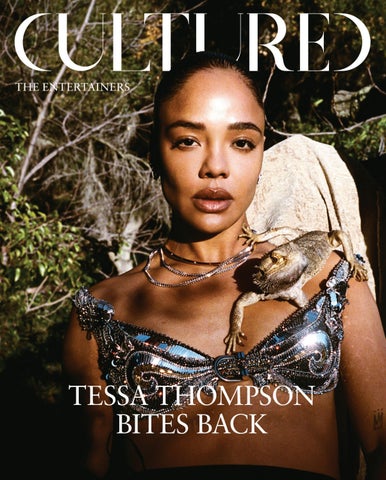
Create a flipbook
Issuu converts static files into: digital portfolios, online yearbooks, online catalogs, digital photo albums and more. Sign up and create your flipbook.