LEM
Integrated Mini Vacuum Pumps with ASR Selection Guide LEM: Versatile Series for all Applications The opposite page demonstrates the versatility of this series. In addition to a very wide range of complete, stand-alone, or island vacuum pumps, there are the options of no blow-off and/or no vacuum switch, and for specific applications.
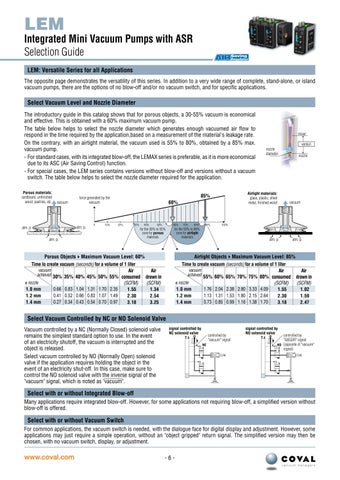
Select Vacuum Level and Nozzle Diameter The introductory guide in this catalog shows that for porous objects, a 30-55% vacuum is economical and effective. This is obtained with a 60% maximum vacuum pump. The table below helps to select the nozzle diameter which generates enough vacuumed air flow to respond in the time required by the application,based on a measurement of the material's leakage rate. On the contrary, with an airtight material, the vacuum used is 55% to 80%, obtained by a 85% max. vacuum pump. - For standard cases, with its integrated blow-off, the LEMAX series is preferable, as it is more economical due to its ASC (Air Saving Control) function. - For special cases, the LEM series contains versions without blow-off and versions without a vacuum switch. The table below helps to select the nozzle diameter required for the application. Porous materials: cardboard, unfinished wood, pastries, etc.
atm. p.
vacuum
vacuum
85%
force generated by the vacuum
mixer venturi nozzle diameter
nozzle
Airtight materials: glass, plastic, sheet metal, finished wood
vacuum
85%
atm. p.
for the 30% to 55% zone for porous materials
atm. p.
for the 55% to 80% zone for airtight materials
vacuum
atm. p.
atm. p.
Porous ObjectsMaximum Vacuum Level: 60% Time to create vacuum (seconds) for a volume of 1 liter vacuum Air Air achieved 30% 35% 40% 45% 50% 55% consumed drawn in ø nozzle (SCFM) (SCFM)
Airtight ObjectsMaximum Vacuum Level: 85% Time to create vacuum (seconds) for a volume of 1 liter vacuum Air Air achieved 55% 60% 65% 70% 75% 80% consumed drawn in ø nozzle (SCFM) (SCFM)
1.0 mm 1.2 mm 1.4 mm
1.0 mm 1.2 mm 1.4 mm
0.66 0.83 1.04 1.31 1.70 2.35 0.41 0.52 0.66 0.83 1.07 1.49 0.27 0.34 0.43 0.54 0.70 0.97
1.55 2.30 3.18
1.34 2.54 3.25
1.76 2.04 2.38 2.80 3.33 4.09 1.13 1.31 1.53 1.80 2.15 2.64 0.73 0.85 0.99 1.16 1.38 1.70
1.55 2.30 3.18
1.02 1.59 2.47
Select Vacuum Controlled by NC or NO Solenoid Valve Vacuum controlled by a NC (Normally Closed) solenoid valve remains the simplest standard option to use. In the event of an electricity shutoff, the vacuum is interrupted and the object is released. Select vacuum controlled by NO (Normally Open) solenoid valve if the application requires holding the object in the event of an electricity shut-off. In this case, make sure to control the NO solenoid valve with the inverse signal of the "vacuum" signal, which is noted as "vacuum".
signal controlled by NC solenoid valve
controlled by "vacuum" signal NC
signal controlled by NO solenoid valve
controlled by "vacuum" signal NO (opposite of "vacuum" signal)
Select with or without Integrated Blow-off Many applications require integrated blow-off. However, for some applications not requiring blow-off, a simplified version without blow-off is offered.
Select with or without Vacuum Switch For common applications, the vacuum switch is needed, with the dialogue face for digital display and adjustment. However, some applications may just require a simple operation, without an "object gripped" return signal. The simplified version may then be chosen, with no vacuum switch, display, or adjustment.
www.coval.com
-6-