


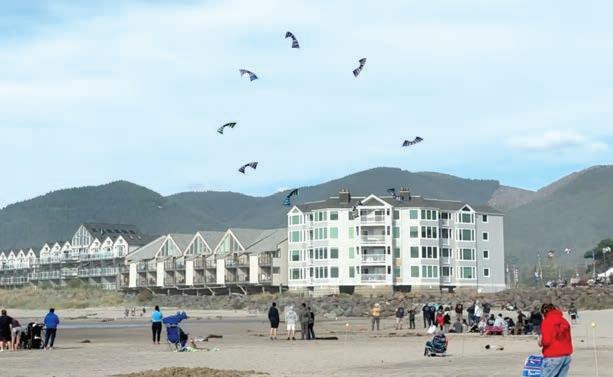
Rockaway Beach’s 49th annual Kite Festival returned this past weekend, with flyers entertaining crowds of onlookers from September 12 to 14.
The festival, sponsored by the American Kitefliers Association, welcomed both professional and amateur fliers for a weekend of friendly competition and exhibitions.
Throughout the weekend, participants took part in a variety of contests, including ones for the nicest kite, the kite that drags on the ground longest before becoming airborne and many more.
Vendors also set up at the city’s wayside, offering festivalgoers the chance to purchase kites of their own, with lessons also available for new fliers.
WILL CHAPPELL Citizen Editor
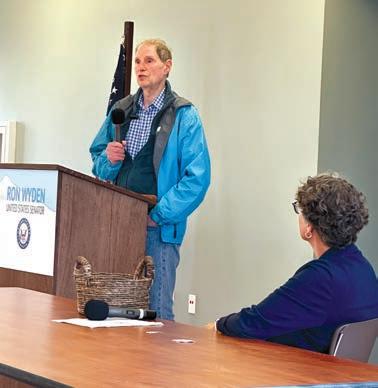
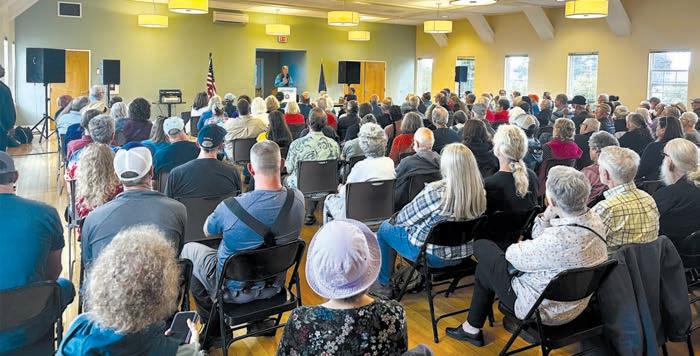
In his 1,135th town hall, held at the Officers’ Mess at the Port of Tillamook Bay on September 5, Senator Ron Wyden responded to questions posed by constituents concerned about a range of issues from federal intervention in Oregon to his stance on Israel. Focus returned repeatedly to healthcare policy, with questioners asking about cuts to Medicare funding passed in Republicans’ recent budget bill and Secretary of Health and Human Services Robert F. Kennedy Junior’s impacts on public health. Wyden pointed to a confrontation with Kennedy the previous day about vaccines as a model for pushing back against the secretary and said that he would continue to fight for Americans’ access to insurance.
“We’re not going to let him or anyone else, Democrat or Republican, turn back the clock on healthcare in America,” Wyden said.

The town hall drew a considerable crowd and most of the questions focused on Wyden and other congressional Democrats’ response to various policies being advanced by President Donald Trump.
Anxiety about healthcare bubbled to the top repeatedly, with Wyden reassuring attendees that he would do everything in his power to protect funding for Medicare and Medicaid and push to increase that funding with taxes on the wealthy. “I’m trying to make sure we’re doing everything we can to protect people to the greatest extent possible,” Wyden said, “and if I have my way, we’re going to start rolling some of the tax breaks back for the affluent and get that money for healthcare.”
Concerns about Kennedy’s impact on access to reproductive care for women and vaccine recommendations was another recurrent theme among the questioners. Wyden said that at a hearing the previous day he had pushed Kennedy on his anti-vaccine stances, with several Republican colleagues also expressing concern, and argued that this type of pointed questioning was a model for future interactions with Kennedy. “The whole idea is to use what happened yesterday as a kind of trampoline to get more
discussion about what we really want, which is a safe vaccine program,” Wyden said. Wyden pledged that he would also continue to support legislation promoting women’s right to make reproductive health choices and that he believed the Democratic party should focus on

WILL CHAPPELL Citizen Editor
Following growing frustration with his party’s lack of support, Oregon State Representative Cyrus Javadi switched his party affiliation from Republican to Democrat in the first week of September.
In an interview with the Headlight Herald, discussing the decision to change parties, Javadi said that Republicans’ steadfast opposition to working on a solution for transportation in the recent special legislative session was the deciding factor, confirming a feeling that the party was not interested in finding solutions.
“Well, I had enough, honestly,” Javadi said, “I was frustrated with what had been pretty consistent opposition from my own party to do things for the north coast or Oregon that I thought were reasonable solutions to problems we were having and it wasn’t just that they disagreed on principle, they disagreed for reasons I thought were bad, for politics.”
Javadi grew up in a home where politics were not discussed much, and he said that he admired Ronald Reagan as a child, was a fan of Bill Clinton aside from his personal indiscretions and thought, at the time, that George W. Bush did a good job of responding to the September 11 attacks.
As Mitt Romney became nationally prominent during his 2008 and 2012 campaigns, Javadi said that he was drawn to Romney’s willingness to work with people from both sides of the aisle to find solutions, citing his work on health insurance as Massachusetts Governor, leading him to join the Republican party around 2012. While Javadi was not excited about Donald Trump’s performance in his first
WILL CHAPPELL Citizen Editor
Following a remand from Oregon Land Use Board of Appeals, Rockaway Beach’s city council reversed a previous decision and overturned a planning commission approval of the second phase of the Nedonna Wave subdivision, denying the application on September 9.
A revised staff opinion that advised developers had not met a required timeline to improve infrastructure for the development and were requesting to build in a special area wetland zone after consulting county mapping data led to the decision.
The proposal for the 28-unit Nedonna Wave planned unit development was first brought to Rockaway Beach’s planning commission and city council for approval in 2008. After securing initial approval from the city for the project, developers later applied to break the development into two phases and completed eight phase-one houses by 2009.
Following the real estate market crash in 2008, the second phase of the project was put on the shelf until in 2024 when the developer returned to the city asking that the phase-two plans be amended to allow for two additional units. Planning commission approved the request last July, while rejecting a request to divide the second phase into two sub-phases. This decision triggered an appeal to the city from the Oregon Shores Conservation Coalition on several
and
JEREMY C. RUARK County Media, Inc.
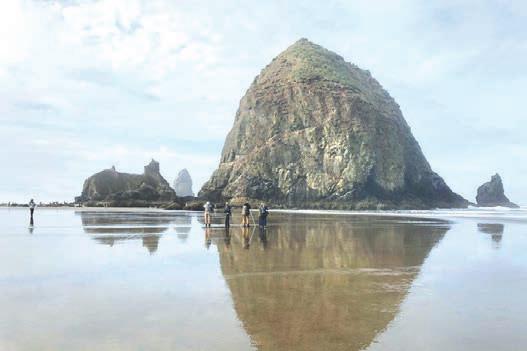
The travel website, Lonely Planet, illustrates a listing of what it describes as 10 of the Best Beaches along Oregon’s Pacific Coast.
Oregon’s coastline as 363 miles of rugged terrain “dotted with some incredibly beautiful stretches of sand, dramatic headlands and prime surfing. Not only that, this stretch of coastline has been protected from development and designated as “the People’s Coast,”’ Lonely Planet states. “Since the Beach Bill was passed in 1913, the state’s beaches, coves, and coastline have been reserved as public lands for the enjoyment of Oregonians.”
• Cannon Beach is number 1 on the list as the “best beach for bird watching.”
• Seaside is listed as number 2, described as the “best beach for a fun carnival atmosphere.”
• Yachats is number 3, described as “best beach for getting away from it all.”
• Gold Beach is listed as number 4, “best beach for wildlife watching.”
• Florence and the Or-
egon Dunes is number 5, as, “best beach for otherworldly landscapes.”
• Manzanita, described as the “best beach for an exclusive vibe.” is listed number 6.
• Brookings is number 7, listed as “best beaches for incredible views.”
• Bandon is number 8, “best beach for marine life.”
• Depoe Bay is listed number 9 for “best whale watching.”
• Number 10 on the list is Indian Beach in Ecola State Park, listed as “best beach for coastal hiking trails.”
The travel website lists Depoe Bay as a small city with “coastal charm.”
“Located 10 miles south of Lincoln City, little Depoe Bay is edged by modern timeshare condominiums but still retains some original coastal charm,” Lonely Planet notes. “It lays claim to having the world’s smallest navigable harbor and being the world’s whale-watching capital – pretty big talk for such a pint-sized town. Whale-watching and charter fishing are the main attractions in the area year-round.”
Lonely Planet also suggests Devils Punchbpwl as
a detour five miles south of Depoe Bay, calling it “an impressive collapsed sea cave that churns with waves and offers good tidepools nearby.”
The online magazine puts Florence and the Oregon Dunes at Number 5 on its list.
Stretching for nearly 50
miles between Florence and Coos Bay, the Oregon Dunes form the largest expanse of oceanfront sand dunes in the USA, according to Lonely Planet
“These sandy hills tower up to 500 feet and undulate inland for up to 3 miles to meet coastal forests, harboring curious ecosystems that
sustain an abundance of wildlife, especially birds.
The area inspired Frank Herbert to pen his epic sci-fi Dune novels,” the online site states. “The very northern and southern sections of the dunes are dominated by dune buggies and dirt bikes (off-highway vehicles, or OHVs); avoid hiking in these
Competitors and specta-
tors from across the western United States and Canada are set to descend on Pacific City this weekend for the 26th annual Cape Kiwanda Longboard Classic on September 20 and 21.
Jeff Mollencop, the owner of Moment Surf Company who has been hosting the event for the past 15 years, said that the contest has become a staple for the local and surfing communitas and that he is impressed by the turnout every year.
areas. The central section of the dunes is closed to OHVs and preserved for wildlife and more peaceful human activities such as hiking and canoeing.”
Lonely Plant also offers a planning tip: “Make time for Florence’s Old Town neighborhood to see the town’s most charming side – a quaint waterfront district nestled along the scenic Siuslaw River next to the Oregon Coast’s prettiest harbor,” it states.
Yachats, number 3 on the list, is described as a neat and friendly little town and one of the Oregon Coast’s bestkept secrets.
“Lying at the base of massive Cape Perpetua, Yachats offers the memorable scenery of a rugged and windswept land,” Lonely Planet states. “People come here to get away from it all, which isn’t hard to do along this relatively undeveloped stretch of coast. Not only is the beach close to town an ideal stretch of sand and sea stacks, but Cape Perpetua also gives you even more room to roam and take in the coast.”
See more at https://www. lonelyplanet.com/
“The Ledbetters created something really special, and it’s been carrying on for all these years,” Mollencop said, “and it always amazes me how much joy and fun people have at this event, and they make it their own.” The classic started in 1998, when local surf shop owners Bob and Michelle Ledbetter hosted the inaugural event in the waters off Pacific City. After the Ledbetters moved to Costa Rica in the mid-2000s, Brian Bates, who took over their surf shop also ran the classic for five years.
assumed leadership of the competition. Mollencop started surfing growing up in Virginia Beach and had long been coming to Pacific City since moving to Oregon and seized the opportunity to open a shop when Seven Surfboards shut.
“I’ve had a home hear for over 20 years, I was coming here really regularly and then saw when Brian was leaving and the opportunity to open up a shop was there, that’s when I was able to do it,” Mollencop said.
Following Bates’s departure, a group of locals hosted the event for a year before Mollencop opened Moment Surf Company in 2011 and

Each year, 240 surfers compete in the classic, which is run by more than 30 volunteers who take care of everything from registra-
tion to judging. There are eight divisions for men and women, ranging from those for small children who surf with their parents to those for surfers 60 and older.
Last year, a decade-long initiative to raise funds to build a skate park in Pacific City was completed, with the classic raising $180,000 in total to support the twophase project. Mollencop said that funds raised by the classic would still be donated to support maintenance at the park but that with the project complete, the contest would again take center stage.
“We’ve scaled back, we used to do a silent auction, and we did a coast craft brew fest, all these different



Our

things to raise money for the skate park,” Mollencop said. “But now that that goal is met, we’re switching just to focus in on the actual competition.”
With the county’s upgrades to the Cape Kiwanda parking lot also complete, this year the classic will be headquartered in Pelican Brewing’s banquet room, with registration and a welcome dinner, open to the public, on Friday evening. Competition will begin bright and early at 7 a.m. on Saturday and continue until 4 or 4:30 p.m. depending on light conditions, before resuming at 7:30 a.m. on Sunday and concluding by the same time.
First, second and third
place finishers in each division will receive trophies, while prizes from surf companies and local businesses will also be awarded.
Mollencop said that the weekend is always busy but also fun, as competitors, many of whom book their accommodations for the next year’s contest in the weeks following the current year’s, have made the competition a fixture in Pacific City.
“We just put the contest on,” Mollencop said, “it’s everybody doing their own thing that makes it so special, and we just try to do our best to put the bones together, so they have an opportunity to compete and have fun.”
WILL CHAPPELL CITIZEN EDITOR
After a period with no mediation services available locally, the Tillamook Office of Mediation began offering mediation and training services in February before being officially designated as the county’s community resolution center by the University of Oregon School of Law this month.
That unlocked state funding for the organization, which currently has five trained mediators who offer their services in neighbor-to-neighbor and familial disputes, and trainings at no cost, and private trainings for workplaces at a low cost.
The program’s reincarnation was driven by Elizabeth Bly, Founder and Chair of the office and a trained mediator, who went in search of a neutral mediator when she had a dispute with her homeowners’ association. Finding that there was no office offering the service in the county. Bly reached out to Yamhill County’s conflict resolution center but never received a response, prompting her to begin the process of forming the Til -
lamook Office of Mediation.
“When I found out we had no services that were actually being offered in a real way to our county, it really spurred the activist in me, and I was off to the races at that point,” Bly said.
Bly was able to find volunteers for a board and four other mediators and, by February, gain 501(c)3 status and begin offering services.
When a resident is interested in mediation services and reaches out to the office, one of the trained mediators will have a conversation with the person to determine if the situation is suited to mediation, which Bly said it usually is. The mediator will then reach out to the other party and ask them to participate in the process. If they agree, the mediator will hold a meeting with both parties with the goal of promoting a productive discussion.
“It’s really more of a facilitation process at that point,” Bly said, “just helping people get to the heart of the matter, maybe helping people see things from different perspectives, definitely asking lots
of questions to try to calm the matter and help people understand better different points of view.”
In addition to the mediation services, the center also offers trainings for those interested in improving their conflict-resolution skills or becoming a certified mediator themselves.
Conflict resolution courses are held quarterly, with the next scheduled for October with a focus on the difference between dialogue and debate, while mediation training, which takes 42 hours, is held twice a year. Both types of training are also free.
Most of the office’s offerings occur virtually, but both Tillamook Adventist Church and the NetartsOceanside Fire District offer meeting spaces for inperson conversations. Bly said the group is hoping to find more volunteers in north and south county to help better serve residents countywide.
Those interested in mediation services, trainings or supporting the organization can visit tillamookmediation.org, where they can find a form to initiate a mediation process, or call (503) 468-7103.
OREGON STATE POLICE
On Tuesday, September 9, 2025, at 8:25 a.m., the Oregon State Police responded to a single-vehicle fatal crash involving a pedestrian on Highway 6 near milepost 30 in Tillamook County. The preliminary investigation indicated a white Freightliner semi-truck, operated by Scott Lee Gotchall (64) of Portland, was traveling eastbound on Highway 6 near milepost 30 when a pedestrian, Jaime Cristobal Aguilar Herrera (25) of Beaverton, entered the lane of travel for an unknown reason and was struck by the semitruck. The pedestrian (Aguilar Herrera) was pronounced
deceased at the scene. The operator of the semi-truck (Gotchall) was not injured. The highway was impacted for approximately 3.5 hours during the onscene investigation. OSP was assisted by the Tillamook County Sheriff’s Office, Tillamook Fire and the Oregon Department of Transportation.
Town Hall
From Page A1
federal agencies and the United States military to cities after recent events in Washington D.C., saying that he thought there was no legal basis for the actions, which he argued were based on Trump’s personal distaste for certain cities. “Obviously, there is a legal foundation for when you can have federal facilities and federal operations in a place like Oregon; I don’t see any evidence that that legal foundation has been met,” Wyden said. “I think this is about provocation, this is not about posse comitatus, this is not something that is grounded in anything other than he has never cared for Portland.”
Several questioners asked Wyden about his stance on federal timber harvests considering Trump’s recent moves to increase logging on federal lands. In response, Wyden defended his record of helping to pass the Secure Rural Schools Act in 2000,
ber 2024, council denied the appeal, following the recommendation of then City Planner Mary Johnson. Oregon Shores Conservation Coalition subsequently appealed the decision to Oregon’s Land Use Board of Appeals (LUBA), which found that there were two errors in the council’s decision, asking for more information to decide on the appeal.
At the special meeting on September 9, City Planner Abram Tapia discussed the errors found by LUBA in a staff report and made an updated recommendation.
Tapia said that the first
From Page A1
term as president, when he decided to run for office in 2021, he stuck with the Republican Party, hoping it had been a blip.
“I honestly ran as a Republican because I identified with who Mitt Romney was,” Javadi said. “I didn’t think Donald Trump was coming back into office, I wasn’t super thrilled with the way his first four years went, and I wanted to see the Republican Party return to those ideals that I thought made for a nice balance in politics and they continued to just move further away ever since.”
Javadi said that his frustration with the Oregon Republican Party really started this year, with the biggest conflict arising over his proposed reform to the state’s transient lodging tax (TLT) split to allow counties to use more of the funds for non-tourist-related purposes. As he worked to advance the bill, which was staunchly opposed by the Oregon Restaurant and Lodging Association, Javadi said that party leaders asked him to withdraw it, even threatening him with a primary challenge or withdrawal of fundraising support.
Uncowed, Javadi pushed ahead, eventually pushing the bill through committee after a failed vote and out of the house before it eventually failed to pass out of a senate committee.
Through that process, Javadi said that he was consistently opposed by his party members, with only one eventually voting for the bill in the house, but pleasantly surprised to receive support from Democratic legislators, who believed in the policy. “They wanted to solve things; they didn’t care that I was in the opposite party and our values lined up,” Javadi said.
Friction was not limited to the transportation bill though, as Javadi said that throughout the session party leadership pressured him to oppose a series of bills that he believed would benefit his constituents.
From a bill supporting dialysis in rural communities to one extending a state program to support rural hospitals and another renewing a Medicaid
which has helped rural counties replace lost timber revenues but has not currently been renewed, threatening that funding.
On Israel, Wyden said that he believed Israeli Prime Minister Benjamin Netanyahu was the biggest issue
error identified by LUBA was that the city’s special area wetland zone, or SA zone, was a base zone that did not allow for residential development, and that the council subsequently needed to determine whether the subject properties were in that zone. Tapia said that this presented a problem, as the city’s zoning maps, created in 1992, were not adequate to determine a delineation as they needed to be warped to match the geographic facts on the ground.
Given this inadequacy, Tapia said that he had instead referenced the geographic information system (GIS) tool created by Tillamook County in 2015 to align zoning maps. Tapia said that he believed this was an appropriate way to determine the SA zone and that
provider tax, time and again Javadi said he found himself at odds with his party and asked to go against what he believed was the district’s best interest.
“It was frustrating to see the party not care about what the impacts and the consequences of the policy decisions would be, especially for our community,” Javadi said.
“I can’t look my community in the eyes thinking that I’m just playing politics with your lives, with your money, with your livelihoods because I’m interested in taking the safe route or protecting my seat for the long game.”
The tension also extended to misgivings about the direction of the Republican party on a national level since Donald Trump’s reelection, which alarmed Javadi. “I don’t like to use some of the stronger adjectives because I don’t want to get into fear mongering, but it feels authoritarian, it feels like something that could lead to tyranny if there weren’t the right checks and balances,” Javadi said. “We’re ignoring the constitution when it suits us in the Republican Party, and it’s like, no, I’m opposed to that.”
The disagreements on freespeech issues also extended to the Oregon Republican Party when Javadi, who has a homosexual son, was asked to oppose a bill making it harder to ban books in schools, which he went on to support, and another memorializing black drag performers in the state.
After the legislative session ended in June, Javadi began seriously mulling the possibility of switching parties, discussing it with family and friends, but the decision was finalized when the Republican Party’s stance on road infrastructure emerged in the leadup to the Labor Day special session.
Javadi said that he was opposed to the Republican proposal that would have gutted the Oregon Department of Transportation’s major road repair fund to pay for regular maintenance, slashed public transit funding and still left a hole in the department’s budget. While he is not a fan of raising taxes, Javadi said that he felt the impacts of a six-cent gas tax raise, which would cost average Oregon families between two and three dollars a month, would be less severe than major cuts to maintenance and repair funding.
“I was just picturing in my
and that seeing him removed from power was the most important step towards a twostate solution, which Wyden supports. Wyden said that he is in favor of sanctioning officials in Netanyahu’s government and the Israeli military who make it more
the GIS tool had shown that the proposed lots were in the zone, precluding development.
The second error identified by LUBA was the question of whether a one-year timeline established in 2008 for developers to add infrastructure improvements applied to both phases of the project or just the first. Tapia said that based on the plain language of the documents signed in 2008, which had not been altered when the development was phased, he did not believe the condition of approval had been met, meaning the second phase could not proceed under the initial approval.
difficult to deliver humanitarian aid to Gaza but said that he did not think withdrawing military aid was appropriate because of the danger of a potential Hamas resurgence.
“I believe the hardest part of this is separating out
Considering these two findings, Tapia recommended reversing the planning commission’s 2024 decision approving the second phase of the development and denying the application.
head, you’ve got this single mom or maybe it’s a young family starting to work a job, they need to get up to Tillamook to work at their job but now Highway 101’s blocked with the landslide,” Javadi said about a potential major storm impacting travel in the county. “So, now it’s not $2.50 they’re going to miss because gas costs more, they couldn’t get to their job and make hundreds of dollars of wages for the day.”
Ultimately, Javadi voted for the bill on Labor Day despite serious pressure from party leaders and negative feedback from some constituents and filed the paperwork to switch parties the next day.
Javadi repeatedly stressed that he did not view the switch as having any impact on his commitment to serving all his constituents, whether they be Republican, Democrat or unaffiliated. Javadi said that while he believes Republican voters wanted the same things he does in terms of health and prosperity for themselves, their families and communities, party leadership has become little more than an obstructionist force against Democrats.
“It felt as though it didn’t matter how good the idea is or what the problem was we were trying to solve, if the other party had blessed it, we were going to use it against them and we were going to fight it,” Javadi said. “We’d come up with whatever reason we could to make it look like it was a bad idea, all with the intention of just winning an election, maintaining power, controlling the news cycle, and I think that’s unfortunate because I don’t think Republicans are bad people.”
Javadi plans to run in the Democratic primary next May and said that so far feedback on his decision has been overwhelmingly positive and surprisingly voluminous, coming from across the nation and even several places abroad. Javadi said that while the move seemed to have resonated with people, for him, it had been as simple as seeing that Democrats aligned with his values and were working to get things done for Oregonians.
“The Democratic Party is not perfect, neither am I, neither is any of us, but that’s beside the point,” Javadi said. “They want to defend those institutional values and constitutional norms and get things done, and that’s why I got into politics, so it’s easy.”
Dean Alterman, a lawyer representing the developer, then spoke, saying that the applicant disagreed with the staff recommendation.
On the issue of zoning, Alterman pointed to a separate section of the city’s code that he argued made single family houses outright allowed uses in designated planned unit developments, such as Nedonna Wave, rendering the question moot. Alterman also contended that using the county’s GIS software was inappropriate and that doing so would place more than 20 existing homes in the SA zone, making them illegal.
As for the timeline for improvements, Alterman argued that the approval of the development’s phasing in 2008 had included a changing
Javadi said that he also expects he will be given more latitude to disagree with party positions in the Democratic caucus and that he intends to maintain his style of working
Benjamin Netanyahu from Israel,” Wyden said. “The vast majority of Israelis I know, and I know many, they disagree with Benjamin Netanyahu too, they want him out, but they also want to know that they aren’t going to be abandoned in the
of the requirements to reflect the smaller scope of initial development. Alterman said that it wouldn’t make sense for the developer to build improvements for the second phase, which had not even had a street layout approved by the city, when they had no immediate plans to pursue it.
world because if this is not done well and carefully, what will happen is the second it’s done, Hamas will go back and do what they did in October 2023.”
Wyden also said that he would continue to use his position on the Senate Finance Committee to push for the release of additional files on Jeffrey Epstein, saying that he hoped to follow the money through financial institutions to uncover the truth of Epstein’s human trafficking dealings with associates. Finally, Wyden pledged that he would fight for the continuation of vote by mail in Oregon after Trump has taken aim at the practice in recent weeks after a meeting with Russian President Vladimir Putin who criticized it. “I want everybody to know that as long as I am your senior United States senator, we aren’t going to give an inch, not an inch, in terms of abandoning our vote by mail,” Wyden said. “It’s a good thing, it’s the right thing, it’s worked and it’s made a difference, and we’re not giving it up to Vladimir Putin.”
with whoever is willing to address problems facing the north coast.
“I think every legislator needs to feel like they’ve got that type of authority and
Councilor Pat Ryan said that he did not see anything in the application that should allow for development in a wetland and that he believed a new delineation of the wetlands should be required if the developer wishes to proceed.
Councilors Mary McGinnis and Penny Cheek thanked the public for their input and emphasized that they would be deciding based on the evidence in front of them.
Council then voted unanimously to reverse the planning commission’s decision and deny the application.
After the presentations, public commenters weighed in, with 15 citizens voicing their opposition to the application’s approval, with most raising concerns about building in wetlands. A representative from the Oregon Shores Conservation Coalition spoke and said that the wetlands in the area were vital to the city’s water security, as its backup aquifer was beneath the area, and said that keeping the wetlands wild would have a positive impact on the community. After the comment period, councilors gave their opinions, with Mayor Charles McNeilly starting the discussion by saying that no one on the council wanted to build in wetlands.
autonomy to do what’s right based on how they see the problem,” Javadi said, “and the Democratic Party, in my opinion, gives their members more flexibility to do that.”

PAYING TOP $$DOLLAR$$ for sport card collections. Premuim paid for vintage pre-1980 Call Corey 541-838-0364






Serving North Tillamook County since 1996
Deadline: FRIDAYS at Noon for Advertising, News, Letters, Classifieds, Legals/Public Notices, Obituaries
Chief Executive/Operations: Joe Warren
Editor: Will Chappell, email headlighteditor@countrymedia.net
Advertising: Katherine Mace, email headlightads@countrymedia.net
Office Manager: Patty Archambault, email classifieds@orcoastnews.com
Classifieds & Legals/Public Notices:
Due by Noon on Fridays the week of publication, send Classifieds to classifieds@orcoastnews.com, send Legals/Public notices to legals@orcoastnews.com, or call 503-842-7535 for more information.
Graphic Design: Steph Baumgart Office Phone: 503-842-7535
Website: northcoastcitizen.com
The North Coast Citizen (15503909) is published biweekly by Country Media, Inc. 1906 Second Street, P.O. Box 444, Tillamook, OR 97141
SUBSCRIPTION RATES
$60.00 annually in-county; $72.00 annually out-of-county. $50.00 for online only. Periodicals Postage paid at Tillamook, OR. POSTMASTER
Send address changes to P.O. Box 444, Tillamook, OR 97141
Member Oregon Newspaper Publishers Association (ONPA)
© 2025 by the North Coast Citizen. All rights reserved. LETTER POLICY
The Citizen welcomes letters that express readers’ opinions on current topics. Letters may be submitted by email only, no longer than 300 words, and must be signed and include the writer’s full name, address (including city) and telephone number for verification of the writer’s identity. We will print the writer’s name and town of residence only. Letters without the requisite identifying information will not be published. Letters are published in the order received and may be edited for length, grammar, spelling, punctuation or clarity. We do not publish group emails, open letters, form letters, third-party letters, letters attacking private individuals or businesses, or letters containing advertising. Deadline for letters is noon Fridays. The date of publication will depend on space. Obituaries
The North Coast Citizen has several options for submitting obituaries.
• Basic Obituary: Includes the person’s name, age, town of residency, and information about any funeral services. No cost.
• Custom Obituary: You choose the length and wording of the announcement. The cost is $100 for the first 200 words, $75 for each additional 200 words. Includes a small photo at no additional cost.
• Premium Obituary: Often used by
include
The Oregon Coast Scenic Railroad McCloud Number 25 locomotive turns 100 this weekend, and OCSR has a full slate of activities scheduled to celebrate this historic milestone.
Sharp-eyed passengers and fans of the steam engine have likely noticed the plaque near the front of the boiler, showing that the locomotive was constructed in Schenectady, New York in September 1925, by the American Locomotive Company (ALCO). Number 25 was destined for the McCloud River Railroad, operating around Mt. Shasta in northern California, in towns like Weed and Redding, the Red River area and elsewhere.
In rail enthusiast terms, Number 25 is one of four 2-6-2 “Prairie” type steam locomotives built by ALCO, meaning there are two
Here we are again. Writing this piece hasn’t become a habit yet; what is it, three times to make a habit? Well, this is number 3. Still waiting on the sun for the tomatoes—their green skins glisten with morning dew, and the earthy scent of damp soil lingers in the air. At least I’m not watering as much as I was earlier in the season. Every morning, I peek out the window and check the weather app, fingers crossed for a stretch of sunlight, but so far, the clouds have had other plans. Maybe tomorrow the tomatoes will finally get their wish. While it’s been a quiet week for me, I understand that the city’s first street fee billing has gone out, taking many citizens by surprise. The problem is the street
SCOTT FISHER


sfisher71@yahoo.com
leading wheels, six drive wheels, and two trailing wheels. Along with locomotives number 22, 23 and 24, the total cost for these four steam engines was $90,000 (over $1.6 million today). Number 25 was the largest and final steam locomotive purchased by the McCloud River Railroad. After retiring from original service on July 3, 1955, the #25 was restored for excursion service in 1962.
The McCloud 25 then
fund has no direct funding source. The city gets grants for paving, such as the Small Cities Allotment from ODOT for a specific project, but otherwise funds have to be transferred from the general fund or from the transient room tax fund so street work can be done. Street work includes paving and repairing streets (think potholes), as well as mowing and other maintenance of rights-of-way. Originally, city management proposed a monthly street fee (transportation utility fee, or a TUF) of $19 to cover the cost of needed street maintenance. During the budget process, the Budget Committee reduced the proposed fee by transferring funds from the transient room tax fund to the street fund, resulting in
served the Mt. Shasta Alpine Scenic Railway in the Sixties and Seventies. In 1975, it played an important role in the film Bound for Glory, the Woody Guthrie biography. At the conclusion of filming, it went back into storage.
In 1982, Number 25 was rebuilt and leased to the Great Western Railroad Museum. It remained there through 1986, when Hollywood called again. Number 25 had a terrifying role in the Stephen King film Stand By Me, the tale of four adolescent boys hiking into the forest to see a dead body. At one point, they cross a high railroad trestle deep in the woods. When the trestle begins shaking, they look behind them to see a locomotive steaming towards them. In a panic, they rush to clear the trestle to avoid a gruesome death.
Our time with the Num-

lindabade2023@gmail.com
a “reduced” fee on your water/sewer/street bill for the current year. Otherwise, that fee would be $19 instead of $10. It was explained to me this way. In Oregon, property tax growth is limited to 3% per year. Has been that way for some time. Expenses, however, are not limited, so their growth has been 6, 8,10% over time. The city gets its money from prop-
DR. TIM BORMAN
Semi-Retired Local Physician
Q: What is Medicaid, and how does it work in Oregon?
A: Medicaid is a joint federal and state program that helps cover medical costs for people with limited income. In Oregon, it’s called the Oregon Health Plan (OHP). OHP serves children, pregnant women, people with disabilities, and elderly adults. Currently, the federal government pays about 76% of the cost, and Oregon pays about 24%.
Q: How does Medicaid differ from Medicare?
A: Medicare is a federal health insurance program for people age 65 and older, as well as some younger people with disabilities. Unlike OHP, Medicare has the same rules across all states and typically requires participants to pay premiums, deductibles, and coinsurance. Medicare generally does not cover longterm nursing home care. That gap is filled by OHP, which pays for services for about 60% of nursing home residents in Oregon.
Q: How many people rely on OHP in Oregon and here in Tillamook?
A: Across the state, 59% of children and 34% of adults are covered. Nearly half of all births in Or-
egon are paid for through OHP. Here in Tillamook County, about 8,000–8,500 people—roughly one-third of the population—are enrolled.
Q: Who qualifies for OHP?
A: Eligibility depends on income, family size, and health status. For example, a family of four with an annual income below about $43,000 may qualify. OHP is designed to help people who might not otherwise afford health insurance.
Q: What changes are coming to OHP?
A: Beginning January 2027, Oregon will receive less federal Medicaid funding. That means fewer services and fewer people eligible for OHP. Rural areas like Tillamook are expected to feel the cuts hardest. Without insurance, people often delay care until it becomes urgent, leading to worse outcomes and much higher costs. For example, an urgent care visit might cost $150–$250, while an ER visit for the same condition could be $1,500–$3,000. If small hospitals can’t keep up, some may close.
Eric Swanson, president of Adventist Health Tillamook, notes that 35% of the hospital’s patients rely on OHP. He warns that cuts will be “devastating to
ber 25 began in 2011, when OCSR purchased it, storing it in the Tillamook Air Museum’s blimp hangar. It began service with OCSR in July 2011. It recently underwent the federally mandated 1472day inspection, required whenever a steam engine completes 1472 days (four years) or 15 years of service, whichever comes first. This weekend, OCSR is celebrating this storied locomotive with a series of special activities, including discount pricing and unique excursions. On Saturday and Sunday, September 20-21, all roundtrip tickets are discounted to $25, and cab rides (where you ride in the cab with the engineers) are $100. The standard excursion is a 30-minute train ride followed by a 30-minute layover and concluding with a 30-minute return trip. (Tip: make sure you depart from and return to
erty taxes. So “revenue” is limited in growth potential. No amount of garage sales can help here. No bake sales. There are very few alternative options available. The League of Oregon Cities (LOC) is researching this topic in depth and has publications showing the various options a city can employ to fund basic activities, such as street maintenance. This TUF is it.
Oh, I am really in the city today and have more “city” things for you this week. First, related to watering. If the water portion of your bill has gone up because you are a watering fool like me, there is a reduction available to you from the city. When you water outdoors, that water, which you pay for, is not going down a sewer drain. So,
the location where your car is parked.)
On Saturday September 20 at 4 p.m., OCSR offers a 4-hour round-trip excursion from Garibaldi to Wheeler.
A 2.5-hour version departs from Rockaway Beach at 4:45 PM. As always, arrive 30 minutes early to ensure your place on board. Also, this weekend OCSR joins with the West Coast Railroaders Group to offer railroad speeder rides. If you were among the many a few weeks ago who wondered at the small, “golf cart”-like vehicles traveling between Wheeler and Rockaway, that was what you saw. Also called motorcars, speeders were developed for railroad maintenance crews to travel where needed.
Speeder rides will not take children under 2 or pets.
You can purchase walkup tickets from 10 a.m. to 4
the city is able to consider reducing the sewer portion of the bill for the increase in water used – check with the city to see if you are eligible for any reduction.
Second, as these utility costs go up, please consider your neighbors who may be facing increased hardships in paying bills. The city does still have a “sewer discount fund” that is used to assist city residents with their water and sewer bills. Even a small donation, or a rounding up every month, would be helpful.
I have one final pitch for you. Many of you might know that I wear a bunch of hats, one of which is the TaxAide program that provides tax services to individuals at no cost. It is a volunteer program that I have been involved with for
people on Medicaid.”
Q: What about the new work requirement?
A: Also in 2027, most OHP members ages 19–64 will have to document at least 80 hours of work per month (or prove exemption) to keep coverage. While 71% of OHP members already work, many who don’t are elderly or disabled. The online reporting system may create barriers, especially for rural residents with limited internet access.
Q: What can people do now?
A: If you think you may qualify for OHP, it’s best to apply before December 2026, when enrollment will likely become more complicated. Visit the Oregon Health Plan website or contact the Tillamook County Community Health Center for help applying.
Editor’s Note Let’s Talk Tillamook is a community series that shares how federal policies affect our lives in Tillamook County. This Q&A is based on an interview with Dr. Tim Borman, a semiretired local physician, on what changes to Medicaid mean for our community. Listen to the full interview at: https://www.youtube. com/watch?v=YM-B9Kbuh90
p.m. both days. On Saturday, September 20, you can also see a selection of vintage automobiles when the Beaver Chapter of the Model A Club of America presents a display of Ford Model A cars. A follow-up to Ford’s Model T, the Model A (1927-1931) offered improved comfort and utility. The Model As will be displayed in the parking lot between the OCSR boarding area, 306 American Avenue in Garibaldi, and Lumberman’s Memorial Park between 11 a.m. and 4 p.m. on the 20th. For details, call (503) 842-7972 or browse https:// oregoncoastscenic.org to purchase tickets. Be sure to select your initial departure carefully, noting whether you are leaving from Garibaldi or Rockaway, and arrive 30 minutes before your departure time.
over 15 years. It gets me out of the house, active in my community, stretches my mind and gives me social interaction. It carried me through many of my life journeys. I could depend on it. So, for those of you out there looking for something, think about volunteering. You can come play with me and the other volunteers at TaxAide, or pick up one of the many, many opportunities out there – Meals on Wheels, Care visiting, lunch Bunches, Food Bank, Fire Department, Senior Center, fraternal organizations like the Elks, Eagles, Lion’s – I can’t even name them all, but they are there for the picking. And they all need help. It does take a village and each one of us is a part of this village.
Louise V. Christianson Feb. 16, 1939 – Aug. 11, 2025
Louise Vitalis Christianson, Tillamook County’s whirlwind of compassion and enthusiasm for all things people, animals, good causes, and Mother Earth, was stilled by cancer the morning of Aug. 11, 2025, when she died at her home in Bayside Gardens. She was 86 years old.
Born Feb. 16, 1939, in Mishawaka, Ind., Louise worked at the family furniture store before heading west to San Francisco in the early 1960’s to work in the Finance and Investment field.
When not managing money she volunteered for a variety of local causes - whales, rescue dogs, the library, Big Sisters, recycling, and the San Francisco Opera. She also competed in ballroom dancing. She once spent two weeks with a group navigating the Colorado River. Mother Earth was her cathedral, and she was known to hug trees with the same spirit she did her dogs and her friends.
A camping trip to the Pacific Northwest sparked her interest in Oregon and prompted her move to Neahkahnie in 1994. In subsequent years she supported and got herself involved in a wide range of local causes -- all in bet -

terment to the community. Those included the North County Food and Clothing Bank, Lower Nehalem Community Trust, ManzaWhee-Lem Kiwanis, Columbia River Keepers, Tillamook Animal Shelter, Animal Haven by the Sea, Nature Conservancy, National Wildlife Federation, AARP, Salvation Army, Save The Redwoods, Doctors Without Borders, Environmental Defense Fund and any number of others.
Louise’s garden was a riot of colors and showed her tender attention to the needs of the plants. This wasn’t easy on her steep Neahkahnie lot, but she even started a business called “Garden Babies” in her greenhouse there. When not outside with her flowers she enjoyed watching professional sports - particularly football and baseball. And then there were her dogs: Katie
the Doberman; Mara the Malamute mix, and Zephyr the blue-eyed Husky. Louise purchased her spacious one-level Bayside Gardens home in 2015. Zephyr moved there too and loved the large, fenced yard. After Zephyr, Louise started adopting senior dogs that required extra attention: Gee Gee, Handsome Joe, and Cooper. She gave them all a good life. Louise was predeceased by her brothers John and Robert. She is survived by her sisters Sr. Roberta Christianson of Donaldson, Ind., and Sr. Jean Christianson of Coatzacoalcos, Veracruz, Mexico; sisterin-law Jan Christianson of Mishawaka, Ind.; nieces Amy Jacoby and Jean Richards; nephews Jack, Patrick and Steve Christianson, and 13 great nieces and nephews. She also leaves behind a lot of good friends who will miss her. Louise specifically did not want a memorial service to be held in her honor. Instead, she left instructions for a “Party.” In the coming months an appropriate time and place will be announced to mark the passing of a loving dynamo, who touched so many lives in her community.
WILL CHAPPELL
CITIZEN EDITOR
With the public comment period on the Federal Emergency Management Agency’s changes to its flood insurance plan open, Tillamook County commissioners and Community Development Director Sarah Absher are urging residents to submit comment in favor of a nochange alternative.
Absher appeared at the commissioners’ meeting on September 10, updating the board on progress on the decades-long process that threatens to stymie development in areas of special flood hazard across Oregon, with major potential impacts for Tillamook County.
Work on updating the requirements for participation in the Federal Emergency Management Agency’s (FEMA) flood insurance program has been ongoing since a 2009 lawsuit by the Audubon Society, which claimed that FEMA’s National Flood Insurance Program
(NFIP) was harming coho salmon in Oregon in violation of the National Environmental Policy Act (NEPA). FEMA commissioned the National Marine Fisheries Service to investigate the claim and in 2016, the fisheries service released a biological opinion saying that the flood insurance plan was causing an illegal take of coho, other anadromous fish species and orca whales. This meant that FEMA needed to update the requirements of partner governments in the flood insurance plan to comply with federal statute. But that work was delayed, first by a 2016 suit against FEMA by Oregonians for Floodplain Protection and then by a 2018 congressional delay of three years passed by former Congressman Peter Defazio. When the implementation stay expired in 2021, progress resumed on updating the program, with a proposal for updates released in 2023.
The biological opinion called for the program to
update the ordinances for building in flood plains to achieve zero net loss in three areas of floodplain functionality that help preserve fish habitat: flood storage, water quality and riparian vegetation.
Under the new rules, any projects proposed in the 100-year floodplain would have to include mitigation efforts that would lead to no loss in any of the three fish habitat functions to receive building permits. Since FEMA is a federal agency and not allowed to make land use laws, it falls on the localities it partners with in the flood insurance program to implement the new standards.
Localities in Oregon that do not come into compliance with those requirements will be excluded from the NFIP and could also risk FEMA funding in response to natural disasters.
among four paths to come into compliance with the no-net-loss standard put forward in the biological opinion, with one exempting projects that complete federal permitting from that requirement, and the other not.
The four pathways for coming into compliance under the latter two options are adopting FEMA’s model ordinance, showing that a jurisdiction’s current ordinances meet no-netloss standards, developing a customized community plan to meet the standards or pursuing an alternative means of compliance with the endangered species act outside of the FEMA process.
Absher said that in the current public comment period, FEMA is soliciting feedback on which of the three alternatives would be preferable and the impacts each would have on communities.
pier building, storage of equipment and building utility infrastructure in the floodplain, posing a serious threat to the ability to repair and improve infrastructure, businesses and homes across the county.
The updates would also include requirements that any trees removed from properties be replaced by between three and five trees on the same property or six to ten elsewhere and increase setback requirements for waterways from 15 to 50 feet to 170.
mation or data that would change the analysis.
Absher said that a large number of public comments could impact FEMA’s choice among the alternatives or garner the attention of members of Oregon’s congressional delegation who could intervene.
Commissioners Erin Skaar, Paul Fournier and Mary Faith Bell all thanked Absher for her presentation and said that they would share a link to her presentation and the commenting options on the main page of the county’s website to make it easier for residents to find. Each of the commissioners also said that they encouraged citizens to support alternative one, the no-change alternative that would leave the county’s current development codes in effect.










Implementing the changes would also be a costly process, with Absher estimating that it would cost between $100,000 and $200,000 for each city and county in the state to implement, with 30 of Oregon’s 36 counties impacted and no financial assistance offered by FEMA. There would also be ongoing monitoring costs for local governments as well as maintenance costs for property openers relating to mitigation efforts that could range from $2,500 annually for onsite mitigation projects to $7,400 for offsite.


Last December, under pressure from FEMA to update codes to comply with the biological opinion while NEPA reviews were ongoing, county commissioners instead chose to require proposed developments in areas of special flood hazard to submit a letter from a certified biologist saying that the proposed project would cause no take of endangered species.



March - October 2 p.m. to 6 p.m. November - February noon to 4 p.m.


Nehalem Senior Lunches Tuesday & Thursday served at noon email: nbumcnsl2020@gmail.com

To feature your spiritual organization on this panel:



Since then, Absher has continued representing the county in the ongoing NEPA review process being led by FEMA, which is gauging the social, environmental and economic impacts of the proposed changes to development codes. Public comment on three alternatives is now being accepted through October 6.

Contact Katherine at (503) 842-7535, headlightads@countrymedia.net


The three alternatives include a no-action alternative and two options that would allow counties and cities to choose from


As part of her presentation, Absher shared data showing that if no-net-loss standards were adopted, building a 1,500 square foot home with a 20-by40-foot driveway in an area of special flood hazard would require .26 acres for mitigation to offset the loss in floodplain storage capacity. Absher said that this would increase costs by around 10% if mitigation could be accomplished on the same property and around 30% if it had to be undertaken at another property, with similar cost impacts for agricultural and industrial development, but that with the average urban lot in Tillamook just .17 acres, she feared many properties would become undevelopable.
Absher stressed that by FEMA’s definition development includes road building, dredging, fencing, excavation, paving,
Following the public comment period, FEMA will conclude the NEPA process and send a letter informing jurisdictions of their decision, at which point governments will have 18 months to update their codes.
Absher said that given the drastic impact such changes would have across Tillamook County, she was urging residents to submit public comment, with online, mail and meeting options accessible through floodplainprotection.org. Per Absher, comments should focus on the potential impacts of the alternatives to residents, opinions on which alternative FEMA should select and why, and any new infor-
Skaar said that while this option would not meet the requirements of the endangered species act, supporting it would send the message to FEMA that the other two options presented were not feasible for the county and hopefully encourage them to look for an alternate path forward.
Finally, Absher gave an update on Oregonians for Floodplain Protection’s battle against the updates, which is unfolding simultaneously. Absher said that the group had been in touch with members of Oregon’s congressional delegation, who have been listening, and that she hopes to see movement on that front soon.
A lawsuit filed last year opposing the requirements is also still wending its way through the legal system, with Absher saying that she expected to see progress on that front this fall.
A lot has changed since the Tillamook County Pioneer Museum’s (TCPM) founding in 1935. New history, exhibits, and staff. But something remains the same: TCPM’s commitment to preserving the history of Tillamook County.
As TCPM looks to the future, they’re asking the community to be a part of the process.
“The Tillamook County Pioneer Museum Board is deeply committed to ensuring the museum grows alongside our community,” TCPM Board of Directors President Ryan Weber said. “We envision the museum as a vibrant gathering place where neighbors, families, and visitors can come together to connect with the history of our county in meaningful ways.”
TCPM is currently devel-
oping a five-year strategic plan to help guide the future of the museum.
“By embracing museum best practices and creating experiences that are both accessible and relevant to today, we aim to honor the past while inspiring the future,” Weber said. “These are the very reasons we are undertaking a five-year strategic planning process. We want to chart a thoughtful path forward that reflects our community’s voice and ensures the museum remains a place of pride for generations to come.”
The public is invited to participate in a community survey about TCPM. The survey can be found at: surveymonkey.com/r/TCPM2025 About the Tillamook County Pioneer Museum
Founded in 1935 by Til-
lamook Oregon pioneers, the Tillamook County Pioneer Museum offers 19 display areas that focus on the history of the North Oregon Coast. The museum’s mission is to preserve and interpret the Cultural Heritage of the North Oregon Coast and to foster appreciation and respect of the North Oregon Coast’s environment. The current collection includes 55,000 items and 20,000 photographs ranging from prehistoric specimens to modern-day.
The Tillamook County Pioneer Museum is open to the public TuesdaySaturday, 10 am - 4 pm. Admission is $7 for adults, $5 for seniors, and free for children under the age of 10. The research library can be accessed by appointment only.