Operation Candy Cane keeps spirits bright
Deb Atiyeh Reporter
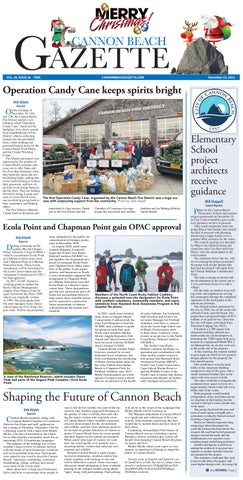
On the evenings of December 10, 11th, and 12th, the Cannon Beach Fire District started a new tradition called “Operation Candy Cane.” Santa and his firefighter elves drove around local neighborhoods in Fire District vehicles collecting canned and non-perishable food, winter clothing and personal hygiene items for the Cannon Beach Food Pantry and the County Warming Center.
Fire District personnel were impressed by the number of Cannon Beach residents who came out to offer Santa and his elves their donations when they heard the sirens and saw the flashing lights, adding that it was heartwarming to witness their generosity, and how all the kids loved seeing Santa on the fire truck. They are looking forward to doing it again next year, as it was fun for everyone involved in giving back to their community and helping others.
The Fire District collected 3 truck-loads of donations and
Ecola Point and Chapman Point gain OPAC approval
Deb Atiyeh Reporter
were submitted by the public for consideration of stronger protections in December 2020.
Elementary School project architects receive guidance
Will Chappell Gazette Reporter
Plans for the Cannon Beach Elementary School rejuvenation project progressed on December 14, as City Council members gave architects guidance on how to proceed.
After much trepidation from outgoing Mayor Sam Steidel, the council decided to proceed with planning, prioritizing a larger kitchen over a grander lobby entrance for the venue.
D
uring a meeting on December 9th, the Oregon Policy Advisory Council (OPAC) voted to recommend Ecola Point as a Marine Conservation Area and Chapman Point as a Marine Education Area. These recommendations will be forwarded to the Land Conservation and Development Commission (LCDC) for final approval.
In 2017, LCDC formed a working group to update the Rocky Shores Management chapter (Part Three) of the Oregon Territorial Sea Plan (TSP) which was originally written in 1994. The plan guides how the state manages rocky shores which make up 41% of the Oregon coast. Twelve site proposals
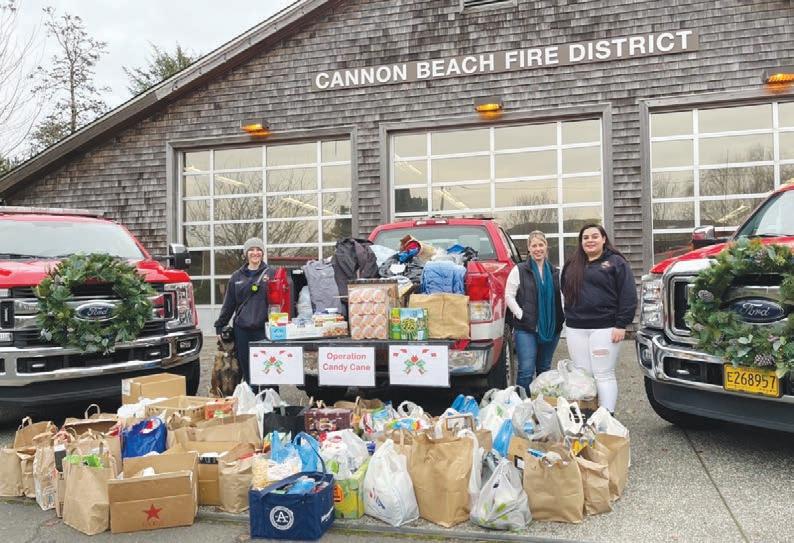
In August 2020, north coast resident Margaret Treadwell began the North Coast Rocky Habitat Coalition (NCRHC) to put together site designation proposals to nominate Ecola Point and Chapman Point. Many members of the public, local organizations, and businesses in North Coast communities supported the designation of Chapman Point as a Marine Education Area and Ecola Point as a Marine Conservation Area. These designations provide new protections and will foster site stewardship efforts to help ensure these beautiful places can be enjoyed by current and future generations in balance with protecting the marine environment.
In 2021, north coast resident Jesse Jones of Oregon Shores Conservation Coalition took the reins from Margaret to lead the NCRHC and continues to guide the group towards their goal. North coast residents Mickey Moritz, Angela Reynolds, Deb Atiyeh and Tabea Goossen have been involved with the NCRHC since it formed in 2020.
Cannon Beach resident Tabea Goossen, assisted by several dedicated local volunteers, has been coordinating the monitoring of Black Oystercatcher nests on the rocky habitat from Indian Beach to Chapman Point for Portland Audubon since 2015.
Black Oystercatchers are a bird species of conservation concern that are an indicator of the health
of rocky habitats. Joe Liebezeit, Staff Scientist and Avian Conservation Manager for Portland Audubon, said there is concern about the recent high failure rate of Black Oystercatcher nests in these areas. Liebezeit works closely as an advisor to the North Coast Rocky Habitat Coalition (NCRHC).
The North Coast Rocky Habitat Coalition facilitates cooperation and coordination with other nearby coastal conservation groups like Haystack Rock Awareness Program (HRAP), North Coast Land Conservancy, Cape Falcon Marine Reserve, and the Wildlife Center of the North Coast to ensure that marine resources and habitats are holistically managed and protected.
Shaping the Future of Cannon Beach
 Deb Atiyeh Reporter
Cannon Beach residents, along with Cannon Beach Chamber of Commerce Director Jim Paino and staff, gathered on the evening of Thursday, December 15th for a listening session with a team from Birdee Media, who have been hired by the Chamber to help identify community needs for an upcoming 2023-24 marketing campaign.
The purpose of the meeting was to hear resident’s ideas on how to balance tourism with the needs of local businesses, residents, and environmental protection. Participants were asked in one word to describe Cannon Beach: “sanctuary, enchanting, contained, breathtaking, refuge, sublime and sacred” were some of the words used.
Ideas about how to help local businesses thrive and how to encourage more people to
visit in the slower months was part of the discussion. One resident suggested focusing on the quality of what is already here and valuing the repeat visitors who regularly come to Cannon Beach. Other residents expressed concern about respect for the environment and wildlife, and feel more attention needs to be focused on greater education of visitors to protect Cannon Beach from too many people and their impact on the natural environment. When asked what type of visitors we want here, the word quality over quantity was a recurring theme; visitors that value the environment and wildlife.
Because Cannon Beach is such a popular tourist destination, residents realize that visitor numbers will continue to rise and will be difficult to control. There was some discussion about attempting to limit available parking in the summer months using phone “apps” along with paid parking. Paid parking
will not be in the scope of the campaign that Birdee Media will be working on.
The Hispanic population in Cannon Beach is a significant and valued part of the community, with residents expressing that they would like to include them and hear more of their ideas.
Continuing stewardship of the beauty of Cannon Beach was an overriding concern. Business owners, residents and visitors all benefit from keeping Cannon Beach the place we know and love.
Birdee Media values your input, as your opinion is important in helping to shape the future of Cannon Beach.
Google form in English and Spanish can be found here to take the survey: https://docs. google.com/forms/d/e/1FAIpQLSfrous2OYfnrgdRb41jTKyTnXL8zn8TZtJ0P4RqgnW0Ab4g/viewform
The council meeting was attended by Mayor elect Barbara Knop and councilors elect Lisa Kerr and Gary Hayes, who also participated in the conversation.
The architects from Cida Inc. who are overseeing the project presented the group with design options that they had developed with input from the Clatsop-Nehalem Confederated Tribe.
The tribe is deeply involved with the development at the school site as it was previously home to a native village.
For the tribe, an outdoor story-telling circle and emphasis on serving the community through the continued operation of the food pantry at the school are priorities.
The disused school, purchased by the city in 2020, sits on the south side of Ecola Creek, near the beach. The project has a projected budget of $5.5 million, to be paid for by a loan that the city will repay with funds from Transient Lodging Tax (TLT).
It features a 4,500 square foot classroom building situated on a north-south axis on the property intersecting the 7,000 square foot gym, housed in a repurposed World War 2 era Quonset hut, on an east-west axis at the south end of the property.
At this meeting, the council needed to give input on which of two general design options for the property the firm should pursue.
One would have seen the main lobby of the classroom building connected to that of the gym, with a small, separated kitchen also in the space with easy access to both.
The other would have foregone the connected entry space in favor of a larger kitchen which could still serve either side of the venue.
Both proposals would include refrigerators, sinks, hot plates and an ice machine in the kitchen, but the second would give more counter and work space.
The group discussed the pros and cons of each option at length and a consensus eventually formed around favoring a larger kitchen.
However, Steidel expressed deep misgivings about the project beyond the kitchen decision before the council. He said that he felt proposed designs missed the mark and the deliberations over specifics were masking larger underlying problems.
Steidel said that he would favor asking the architects to present new options as neither matched what he envisioned for the project.
The architects cautioned that such a step would delay the project and incur higher design costs, lowering the
VOL. 46, ISSUE 26 FREE CANNONBEACHGAZETTE.COM December 23, 2022
n See SCHOOL, Page 2
considered it a big success. Thank you to the Fire District and the Chamber of Commerce for organizing this successful new holiday tradition and for Making Holiday Spirits Bright.
The first Operation Candy Cane, organized by the Cannon Beach Fire District was a huge success with outpouring support from the community. Photo by Deb Atiyeh
Members of the North Coast Rocky Habitat Coalition, discusses a potential new site designation for Ecola Point with coalition volunteers, community members, and representatives from Haystack Rock Awareness Program in this Gazette file photo.
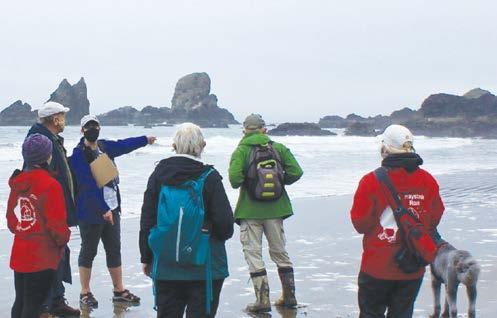
A view of the Rainforest Reserve—which includes Onion Peak and parts of the Angora Peak Complex—from Ecola Point.
Human Services Advisory Council announces vacancy


Clatsop County welcomes applications for open seats on the Human Services Advisory Council.


The Human Services Advisory Council advises the Board of County Commissioners on developmental disabilities, mental health and alcohol and drug abuse services. The council meets every month to identify needs, establish priorities for publicly funded services and
assist in selection of service providers, evaluate services and provide a link to the public through advocacy and education. The council meets the first Thursday of each month.
There are four open seats, with terms ending Feb. 28, 2024 (one seat), Feb. 28, 2025 (one seat), and Feb. 28, 2026 (two seats).
Application forms are available online at www.co.clatsop.or.us


preparing cost projections for the project.
The architects said that the council could expect a preliminary budget at their January meeting, with more detailed, itemized budgets to come near the end of the first quarter.

Please send any comments to headlightreporter@countrymedia.net.








Jazz Vocalist Lauren Kinhan brings Love Letters and Ornaments to the Coaster Theatre this Holiday Season

On Friday, Dec. 23 at 7:30 p.m. the Coaster Theatre welcomes Lauren Kinhan for an evening of “Love Letters and Ornaments in Blue.”

Admission is $25; tickets can be purchased at the theatre box office (503-4361242) or online at coastertheatre.com.
“Love Letters and Ornaments in Blue” features Oregon expat, Lauren Kinhan, in the place from which all her music and inspiration springs. Cannon Beach holds some of Lauren’s most precious “ornaments:” her family. So these sandy streets are tried and true muses for her genre merging music that celebrates her bicoastal love affair. Living in New York City since the late ’80s, Lauren became a hearty artist, singer / songwriter of numerous highly respected solo records
and a long-time bandmate of the New York Voices. Her career has taken her all over the world, allowing her to add songs to her bag, influenced by the times we are living and the people she is loving.
At this time, everyone must show proof of vaccination or a negative COVID test to enter the theatre on performance day. Face masks are optional but encouraged when attending a show at the Coaster Theatre. The theatre recommends visiting coastertheatre. com or contacting the box office closer to the performance for any possible changes to the theatre’s COVID policy.
Upcoming shows and events at the theatre: Suite Surrender auditions, Jan. 17 & 18 Guilty Conscience, Feb. 3-25.
Hemingway at the Beach: Writers Read celebration asks ‘What He Would Say’
Suppose novelist Ernest Hemingway arrived at Oregon’s North Coast and wanted to write about his experience in a maximum of 600 words. What would he write?

This year’s Writers Read Celebration, sponsored by the Cannon Beach Library, asks that question with the theme, “Hemingway at the beach: What Would He Say?”
Writers of all ages are invited to consider how or what Hemingway would say while at the beach. All written formats will be considered (essay, story, poetry, haiku, script, etc.) Authors are limited to three entries with a 600-word maximum per entry. The deadline for submissions is Jan. 20.
A panel of volunteer judges will select 10 to 12 works to be read by their authors either in person or online during the celebration March 10 in the library.
Hemingway wrote about his experiences using as few words as possible, and his novels and short stories have become classics. The Writers Read Celebration offers an opportunity to have fun with this writing style in any form; the piece can be serious, whimsical, tongue-in-cheek or thoughtful.
Submissions will be accepted by email (info@ cannonbeachlibrary.org) or by mail (P.O. Box 486 Cannon Beach, OR 97110), though email is preferred.

Submissions should be
in Word or PDF format and include a cover letter with the writer’s name, email and phone number. Please do not include the author’s name or contact information on the entry document so authors remain anonymous during the judging process.

The NW Authors Series Committee sponsors monthly author presentations and other events at the Cannon Beach Library. This is the fifth year of the Writers Read Celebration. Previous themes were: “Life on the North Coast,” “The View from the North Coast,” “Pandemic” and “Recovery?.” Writers Read Celebrations on Zoom from 2022 and 2021 are available for viewing on Cannon Beach Library’s website.
Since our beginning in 1990 we at Duane Johnson Real Estate have welcomed all of our clients into this community with respect, appreciation, and genuine interest in who you are.

With a collective experience of over 100 years no other firm has more experience in selling homes in Cannon Beach.


We are friendly, knowledgeable, approachable and committed to helping our clients fulfill their dreams of living at the beach.
We are thrilled to connect with you, share our passion for this place and help you find your coastal retreat.
December 23, 2022 2 CannonBeachGazette.com | Cannon Beach Gazette
Continued from Page 1 (503) 791-0853 www.arborcarenw.com Care for Your Trees CCB#171855 WA#ARBORCI909RW We wish to thank all of our south Clatsop County customers for their support this year and wish everyone in the community a safe & happy holiday season H21322 Comprehensive Service, Pruning/Removal, Stump Grinding/Hazard Evaluations Downtown Cannon Beach 256 N. Hemlock St • 503-436-2641 www.brucescandy.com H21348 Freshest Homemade: Saltwater Taffy Chocolates Caramel Corn Caramel Apples & MORE!! Wedding Treats & Gift Baskets Available! Happy New Year! Thank you for shopping local. We wish you sweet success in 2023! We’ll be closed January 2-13. Reopen Saturday, January 14! construction budget. They also reminded the group that the options they were presenting had been approved by the tribe and any modifications would need their input as well. Other councilmembers chided Steidel for his obstinance and said that they did not share his concerns. With a clear consensus for approving the option with the larger kitchen, Steidel relented, and the architects will now move into the next phase of design. This phase will focus on exterior elements and will occur at the same time as general contracting firm Bremik Construction begins
n School
Did you know the Cannon Beach Gazette is FREE to read online? Keep up on Cannon Beach news at www cannonbeachgazette.com MichaelManaging Principal Broker JeremyBroker What is RMLS? As the Northwest’s largest REALTOR®-owned Multiple Listing Service(MLS), RMLS serves approximately 10,000 Real Estate Professionals in over 2,200 offices licensed in Oregon and Washington. All brokers listed with firm are licensed in the state of Oregon 296 N. Spruce St. • Cannon Beach • (503) 436-0451 www.duanejohnson.com Active Members of & A VALUED AND TRUSTED RESOURCE WITHIN OUR COMMUNITY AND THE #1 OFFICE SINCE 1990.
Duane - Principal Broker JeffPrincipal Broker, GRI ChrisPrincipal Broker, GRI For a complimentary and confidential, market analysis on your home, please call us at 503-436-0451 or email duane@duanejohnson.com. www.DuaneJohnson.com Offic 296 N. Spruce · PO BOX 924 Cannon Beach, OR 97110 Sharing warmth for home, thankfulness for family, and respect for community this holiday season. We appreciate you! C M Y CM MY CY CMY K DuaneJohnson_HolidayPostCard_final.pdf 1 11/16/20 11:53 AM H21349
At the Library
Channeling Hemingway & reimagining Miss Marple
Phyllis Bernt Library Board President
If Ernest Hemingway had visited Oregon’s North Coast, what would he have written about his experience? That is the question this year’s Writers Read Celebration is inviting writers of all ages to explore.
The library’s Writers Read Celebration, now in its fifth year, asks writers to submit entries about a specific topic. Entries are judged by a panel of volunteer judges, who pick 10 to 12 works to be read by their authors at an evening celebration.
This year’s topic is “Hemingway at the Beach: What Would He Say?”
Writers are asked to experiment with Hemingway’s distinctive writing style while considering how or what Hemingway would say while at the beach. Entries can be serious, whimsical, tongue-in-cheek or humorous. All written formats will be considered (essay, short story, poetry, script, etc.).
Authors are limited to three entries, with a 600word limit per entry. Submissions can be emailed to info@cannonbeachlibrary. org, or mailed to P.O. Box 486, Cannon Beach, OR 97110. Email submissions are preferred and should be in Word or PDF format. A cover letter including the author’s name, email address and telephone number
should accompany each entry. The entry itself should not include the author’s name or contact information, so that judging remains anonymous.
The deadline for submissions is 5 p.m. on Friday, January 20; the Writers Read Celebration will take place at 7 p.m. in the library, 131 North Hemlock in Downtown Cannon Beach, on Friday, March 10.
The library will offer opportunities to not only write, but also to listen and discuss during the month of January.
The third meeting of the World of Haystack Rock Library Lecture Series, sponsored by the Friends of Haystack Rock, will begin at 7 p.m., Wednesday, January 11. This is both an in-person and virtual event.
Participants can participate in the program at the library or enjoy the talk virtually by accessing the Friends of Haystack Rock website at https://friendsofhaystackrock.org.
Oregon Department of Fish and Wildlife Marine Reserve Program staff will present “10th Anniversary of Oregon’s Marine Reserves: What We Have Learned.”
Oregon started its marine reserve program in 2012 with the establishment of the Otter Rock and Redfish Rocks Marine Reserve sites.
Three additional reserves, including the Cape Falcon site on the north coast, were added in 2014 and 2016.
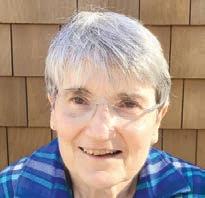
Phyllis Bernt
Now, after ten years of experience with the reserve program, the State is evaluating what has been learned so far and considering how to adapt the reserve program going forward.
This year’s World of Haystack Rock Library Lecture Series is dedicated to the memory of Sandi Lundy, a long-time member of both the Friends of Haystack Rock and the Cannon Beach Library.
The Cannon Beach Reads book club, which meets on the third Wednesday of each month, will meet at 7 p.m. on Wednesday, January 18, at the library, to discuss “The Wayward Bus,” by John Steinbeck.
“The Wayward Bus,” which was published in 1947, takes place in Rebel Corners, a fictional crossroads in a desolate area north of Los Angeles. The only inhabitants of the crossroads are Juan and Alice Chicoy and their two teenage employees.
Juan, who is a mechanic, and his discontented wife Alice supplement their income by providing a small lunch counter and maintaining a bus route connecting Rebel Corners with San Juan de la Cruz, a route ignored by the Greyhound Bus Company.
Steinbeck explores the experiences and characters of a novelty toy salesman, self-important businessman, world-weary stripper and other passengers who find themselves stranded during a bus trip made perilous by heavy rains and unsafe road conditions.
John Steinbeck is considered one of the preeminent American writers of the twentieth century. His novels are required reading in countless high school and college literature classes. Steinbeck was awarded a Pulitzer Prize in 1940 for his novel, “The Grapes of Wrath” and was awarded the Nobel Prize in Literature in 1962.
John Markham will lead the discussion at the library. A Zoom link will be provided for those who would rather participate from home. Contact Joe Bernt at berntj@ohio.edu to get the link. Cannon Beach Reads is open to everyone. New participants are always welcome.
The fourth installment of the library’s NW Author Speakers Series will feature Portland writer and editor
Like us on Facebook Facebook.com - cannonbeachgazette

Liz Prato for a talk beginning at 2 p.m. on Saturday, January 21. This will be a hybrid event; participants can join Prato at the library or enjoy her talk remotely by accessing the library’s website (www.cannonbeachlibrary.org),

Prato’s newest essay collection is “Kids in America: A Gen X Reckoning,” in which she examines the mores and experiences of Generation X, a relatively small cohort wedged between the much larger numbers of Baby Boomers and Millennials.
Looking through the lens of her own high school and family experiences, Prato asks hard questions about a generation that was affected by terrorism, racial inequality, rape culture and mental illness, even though those issues were not openly discussed at the time.
Prato’s earlier books include “Volcanoes, Palm Trees & Privilege: Essays on Hawai’i,” which was a finalist for the Oregon Book Award, and the short story collection “Baby’s on Fire.”
Her essays and short stories have appeared in literary journals and magazines.
She has taught writing in Portland, Boston, Denver and Washington State.
Authors trying to write like Hemingway for the Writers Read Celebration aren’t the only ones hoping to channel a famous author; a recent addition to the
library collection is an entertaining effort by 12 bestselling authors to replicate Agatha Christie’s winning formula for the indomitable amateur sleuth, Jane Marple. Christie introduced Jane Marple in a short story in 1927, and then featured her in 12 novels, from “Murder at the Vicarage” in 1930 to the posthumously published “Sleeping Murder” in 1976. With her tweeds, dowdy hats, sensible shoes, twin sets and twinkling blue eyes, the elderly spinster of the small English village of St. Mary Mead is one of Christie’s most beloved characters.
In “Marple,” 12 authors, from Naomi Alderman to Ruth Ware, try their hand at writing a Jane Marple mystery, all with gratifying success. In some of the stories, Jane is far from St. Mary Mead, solving mysteries in New York City, or on a cruise to Hong Kong or in an Italian villa.
36080 7th Street, Nehalem, OR (503) 858-0554 jmariesalonspa.com We now have tanning!
Some of the authors ascribe modern sensibilities to Jane, especially in her attitudes about race or women’s rights. But despite exotic settings or contemporary attitudes, these stories capture the qualities that make a Jane Marple story a success: an absorbing plot and a charming, fearless, self-effacing sleuth with a sharp mind and shrewd knowledge of human nature. Introducing our new stylist Myriah

December 23, 2022 Cannon Beach Gazette | CannonBeachGazette.com 3
20
experience Color
Mathews
Specializing in cuts
years
services available H21060
H21349
Clatsop State Forest delivers $19.1 million for county, local services along with social, environmental benefits
The Oregon Department of Forestry released a report to state forest trust land counties highlighting social, economic and environmental accomplishments in fiscal year 2022, including distributing $19.1 million in revenue to Clatsop County and local service providers.
The Clatsop State Forest consists of about 147,000 acres in Clatsop County, with small portions in Tillamook and Columbia counties. In addition to Clatsop County, other local service providers receiving revenue include the Clatsop Care Health District, Clatsop Community College, Jewell School District, Rural Law Enforcement District, Port of Astoria and numerous other providers of fire
protection, public transit and other services residents of Clatsop County use and value.


ODF recently released its Council of Forest Trust Land Counties annual report, which highlights the array of social, economic and environmental contributions from approximately 729,000 acres of actively managed state forestland. It includes a recap of timber sales and revenue distribution, conservation and forest health activities, and recreation use, including popularity and number of visitors, among other statistics.
Statewide, counties and local governments received revenues of $61.8 million in fiscal year 2022, collected from timber sales on state-owned for-












ests. Revenues are distributed based on timber sales within a particular jurisdiction. Other highlights include replanting more than 3.6 million trees, hosting more than 26,000 campers at ODF campgrounds, and maintaining hundreds of miles of motorized and non-motorized trails.


Counties and local service providers receive approximately 64 percent of net revenues from timber harvests on state forests. The remaining revenues finance most aspects of state forest management, including ODF’s recreational offerings, environmental enhancement projects, replanting after timber harvest, and forest road maintenance. The state’s share of revenue was approximately $35.5 million in
fiscal year 2022. The agency also receives a portion of all-terrain vehicle operating permit fees.




“Oregonians have a lot to be proud of when it comes to their state forestlands,” State Forester Cal Mukumoto said. “These working lands provide so much to so many, including funding for vital local services, places to connect with nature, clean water, and habitat for some of Oregon’s most rare and sensitive species.”
As part of ODF’s commitment to conservation, about 30 percent of the Clatsop State Forest is managed toward an older forest condition, supporting vulnerable species that flourish in these habitats. ODF protects some 373 miles of fish-bearing



streams and 959 miles of non-fish bearing streams. About 4,700 acres are protected as habitat for threatened and endangered species.
State forests managed by the Oregon Department of Forestry are distributed across 15 counties, with the largest being the Clatsop and Tillamook state forests on the north coast, the Santiam State Forest in the northern Cascade Range, and the Gilchrist and Sun Pass state forests in Klamath County. Other scattered tracts can be found throughout western Oregon. Many State Forests employees also are part of Oregon’s complete and coordinated fire protection system, providing critical resources and expertise during fire season.
Oregon Coast to hold whale watch week in person
For the first time since 2019, Oregon State Parks will host Whale Watch Week in person along the Oregon Coast Dec. 28 – Jan. 1.
Every year thousands of Gray whales migrate south through Oregon’s waters at the end of December, and Oregon Parks and Recreation
Pet meet and greets are by appointment, so if you’d like to meet Miloh, call the shelter at 503-861-7387 or stop by the lobby to set up a time. The shelter is open 9:30 to 4:00 Tuesday through Saturday, closed 12:30 to 1:30 for lunch. You can also fill out an application at the shelter’s Adopting a Pet page: https://www.co.clatsop.or.us/animalcontrol/page/Adoptingpet. Scroll to the bottom of the page for the application and email it to ac@co.clatsop.or.us

Department invites visitors to the coast to see their journey.
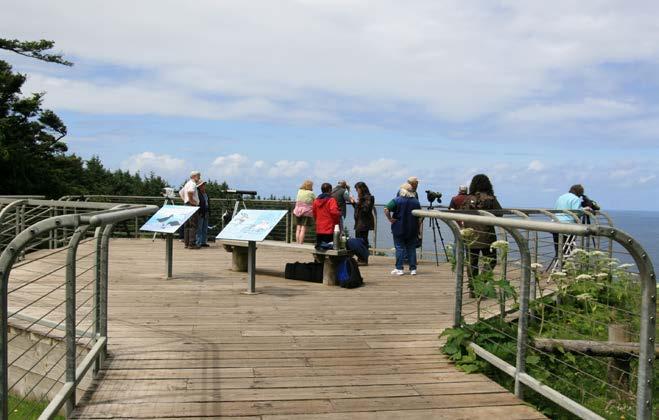
Trained volunteers will be stationed at most of the 17 sites to help visitors spot whales, share information and answer questions from 10 a.m. to 1 p.m. daily. The sites are some of the best places to watch for whales on the Oregon Coast.
“We really enjoy getting folks out to the coast for Whale Watch Week,” said Park Ranger Peter McBride.
“It’s something that Oregon State Parks has been doing for more than 40 years now, and we’re really glad to be able to bring it back in person,” he said.
A map of volunteer-staffed sites is available online on the official event webpage: https://oregonstateparks.org/ index.cfm?do=thingstodo. dsp_whaleWatching

An estimated 19,000 Gray whales are expected to swim past Oregon’s shores over the next several weeks as part of their annual migration south to the warm calving lagoons near Baja, Mexico.
The end of December is the peak time for their migration; roughly 30 whales pass by per hour.


The Whale Watching Center in Depoe Bay will be open 10 a.m. to 4 p.m. Wednesday through Sunday. Visitors to the center can enjoy interactive whale exhibits and take in the panoramic


H21352







ocean views. Binoculars are provided. Rangers from Oregon State Parks will also be on hand to answer questions about the whales.
All Whale Watch Week visitors are encouraged to dress for the weather, to bring binoculars and to follow beach safety guidelines such as remaining out








of fenced areas, knowing the tide schedule and keeping an eye on the surf at all times. Go to https://visittheoregoncoast.com/beach-safety/ for a list of safety tips.
For more information about coast parks and campgrounds, visit oregonstateparks.org.

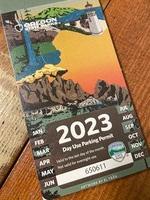
OSP offers $5 discount on annual parking permits in Dec.


Give the gift of the outdoors and save this season with the Oregon State Parks 12-month parking permit sale through December.
The permit hangtag once again features whimsical designs from Portland artist El Tran. Holiday shoppers
can buy the annual parking permits for only $25, which is a $5 savings starting Dec. 1 and running through Dec. 31. The pass is good for 12 months starting in the month of purchase.
Purchasing passes is easy. Buy them online at the



Oregon State Parks store. Parking permits are also sold at some state park friends’ group stores and select local businesses throughout the state. For a complete list of vendors, visit stateparks. oregon.gov. Parking costs $5 a day at
25 Oregon state parks unless you have a 12- or 24-month parking permit or a sameday camping receipt. The 24-month pass is $50 and is also available at store. oregonstateparks.org. The permits are transferable from vehicle to vehicle.
Did you know the Cannon Beach Gazette is free to read online?






























Keep up on Cannon Beach news at cannonbeachgazette.com Plus check





December 23, 2022 4 CannonBeachGazette.com | Cannon Beach Gazette BUSINESS DIRECTORY CONSTRUCTION LANDSCAPING BoB McEwan construction, inc. Excavation • undErground utiitiEs road work • Fill MatErial sitE PrEParation • rock owned and operated by Mike and Celine MCewan Serving the paCifiC northweSt SinCe 1956 • CC48302 503-738-3569 34154 Hwy 26, Seaside, OR P.O. Box 2845, Gearhart, OR ADVERTISE YOUR BUSINESS HERE TO CREATE TOP OF-MIND-AWARENESS CALL 503-842-7535 TODAY! Laurelwood Farm Laurelwood Compost • Mulch • Planting MacMix Soil Amendments 34154 HIGHWAY 26 SEASIDE, OR 503-717-1454 YARD DEBRIS DROP-OFF (no Scotch Broom) H49573 Church Services by the Sea Cannon Beach to Nehalem Nehalem Nehalem Bay United Methodist Church 36050 10th Street • PO Box 156 Nehalem 97131-0156 503-368-5612 nehalembayumc@gmail.com The Reverend Steve Wolff Worship Service: Sunday 11:00 Adult Sunday School: 9:30 A.M. Sunday Nehalem Senior Lunches: Noon Tuesday & Thursday Nursery Available ADA Accessible To feature your spiritual organization on this panel: Contact Katherine at (503) 842-7535,
ARBORIST - TREE CARE ISA Certified Arborists ISA Board-Certified Master Arborist ISA Tree Risk Assessment Qualified Comprehensive Service, Pruning/Removal, Stump Grinding/Hazard Evaluations (503)791-0853 www.arborcarenw.com Care for Your Trees H20157 CCB#171855 WA#ARBORCI909RW THERE’S STILL TIME TO AUDITION FOR RIVERBEND PLAYERS PRODUCTION OF NEIL SIMON’S “BRIGHTON BEACH MEMOIRS” NO PREPARATION IS NECESSARY. AUDITIONS WILL BE HELD AT THE NCRD PERFORMING ARTS CENTER 36115 9TH STREET, NEHALEM THURSDAY, DECEMBER
PM FRIDAY,
PM PERFORMANCE
Part one of Neil Simon’s autobiographical
of the writer as a young teen in
lower middle-class
captures the
states
you
For more information
please
H21350 Make Miloh’s holiday wish come true! Give him a human and home to call his own. Do your New Year’s resolutions include more love, nature and exercise? Miloh is an excellent companion on the trails, at the beach, or just chilling at your favorite outdoor dining spot. This husky shepherd mix craves freedom and adventure, but also wants to keep the pack together like a good shepherd. Miloh is playful and gets along with other dogs, but would do best with playmates closer in size to him. No cats for this boy. http://clatsopcounty.animalshelternet.com/adoption _animal_details.cfm?AnimalUID=277564
headlightads@countrymedia.net
29TH: 6:00 PM – 8:00
DECEMBER 30TH: 6:00 PM – 8:00
DATES: MARCH 17TH – APRIL 2ND
trilogy, the play is a portrait
1937 living with his family in a crowded,
Brooklyn walk-up. This bittersweet memoir evocatively
life of a struggling Jewish household where, as his father
“If
didn’t have a problem, you wouldn’t be living here”.
or if you can’t make these auditions times,
contact the director, Vicki Haker, at vickihaker@gmail.com to arrange an audition.
MILOH
us out on:
FT w/benefits
Monthly Range $3,707 to $5,566
Plus Sign-On Bonus Open Until Filled

ACCOUNTANT

FT w/benefits
Monthly Range $5,065 to $7,602 Plus Sign-On Bonus Open Until Filled
SUPPORTIVE EMPLOYMENT SUPERVISOR FT w/benefits
Monthly Range $4,118 to $6,173 Plus Sign-On Bonus Open Until Filled


SUPPORTED EMPLOYMENT SPECIALIST






FT w/benefits
Hourly Range $17.42 to $26.08 Plus Sign-On Bonus Open Until Filled
CERTIFIED PEER SUPPORT/RECOVERY MENTOR

FT w/benefits
Hourly Range $17.42 to $26.08 Plus Sign-On Bonus Open Until Filled

If you are interested in any of these positions, please apply online at http://tfcc.bamboohr.com/jobs. Be sure to submit an online application and upload your resume. Any questions, please visit us online at http://tfcc.org or contact us at jobs@tfcc.org TFCC is an equal opportunity employer
James Henry ‘Jim’ Webb Aug. 22, 1931 ~ Nov. 16, 2022

skills while enlisted and became an accomplished chef. He was proud to have served as a chef for General Omar Bradley.
While in Georgia, Jim met his wife Mary (Matthews) whom he was married to for 20 years prior to her passing in 1973.
Upon his discharge, the couple moved to Cannon Beach, Oregon. Jim opened the Two Sisters Café, which he later sold so he could join his father Harry in the family hotel businesses, Webb’s Cottages and Webb’s Scenic Surf Motel.


Born August 22, 1931 to Albert “Harry” and Hilda (King) Webb in Lebanon, Oregon, he moved with his family to Cannon Beach at the age of 12 and was a graduate of Seaside High School. The youngest of three, Jim was the first in his family to be born in America as his family immigrated from England to Canada in 1912 and then to the U.S. in the mid-1920s.
During his high school years Jim worked at the Crab Broiler restaurant as a cook and could often be found ‘cruising the gut’ in his Studebaker. Jim enjoyed fishing for salmon in Elk Creek and was even known to fish during recess while attending Cannon Beach Elementary. He was a regular at the Cannon Beach Roller Rink, now known as the Coaster Theater.
Jim enlisted in the Air Force in 1950 and was stationed at Robins Air Force Base in Georgia. He quickly advanced in his culinary
Jim and Mary raised their three children—Linda, Debbie, and Jimmy—at their oceanfront motel. Later retiring to Central Oregon, Jim spent many years enjoying the easy life, always with a beloved dog by his side. As he liked to say, “Lucky Jim.”
Preceded in death by his wife Mary, parents Harry and Hilda Webb, sister Audrey (Webb) Zerbe. He is survived by his sister Donna Lyon, his daughter Linda (David) Gustafson, daughter Debbie (John) Nelson and son Jimmy Webb.

His grandchildren include Jessica (Nelson) Dearinger, Joel Nelson, Julie (Nelson) Iannarone, Shiloah (Gustafson) Hopkins, Josh Gustafson, Trey & James Webb.
Great grandchildren include Taylor & Ryder Dearinger, Jaxon & Brooklyn Nelson, Noah & Caleb Iannarone and Quorra & Jeptha Hopkins, and many nieces and nephews.
A special thanks to his end-of-life caregivers Todd, JoAnn, and Jennifer.
A graveside service was November 22, 2022, at the Oceanview Cemetery in Warrenton, Oregon.
December 23, 2022 Cannon Beach Gazette | CannonBeachGazette.com 5
ABOUT US CANNON BEACH GAZETTE The Cannon Beach Gazette is published biweekly by Country Media, Inc. 1906 Second Street, P.O. Box 444, Tillamook OR 97141 PHONE 503-842-7535 • FAX 503-842-8842 cannonbeachgazette.com Member Oregon Newspaper Publishers Association (ONPA) © 2022 by the Cannon Beach Gazette. No portion of this newspaper may be reproduced in any manner without prior written permission from the publisher. All rights reserved. Katherine Mace Sales 503-842-7535 headlightads@countrymedia.net The Cannon Beach Gazette is part of the Country Media family of newspapers. Joe Warren General Manager jwarren@countrymedia.net LETTER POLICY The Cannon Beach Gazette welcomes letters that express readers’ opinions on current topics. Letters may be submitted by email only, no longer than 300 words, and must be signed and include the writer’s full name, address (including city) and telephone number for verification of the writer’s identity. We will print the writer’s name and town of residence only. Letters without the requisite identifying information will not be published. Letters are published in the order received and may be edited for length, grammar, spelling, punctuation or clarity. We do not publish group emails, open letters, form letters, third-party letters, letters attacking private individuals or businesses, or letters containing advertising. Deadline for letters is noon Thursdays. The date of publication will depend on space. Email letters to jwarren@countrymedia.net OBITUARIES The Cannon Beach Gazette has several options for submitting obituaries. • Basic Obituary: Includes the person’s name, age, town of residency, and information about any funeral services. No cost. • Custom Obituary: You choose the length and wording of the announcement. The cost is $75 for the first 200 words, $50 for each additional 200 words. Includes a small photo at no additional cost. • Premium Obituary: Often used by families who wish to include multiple photos with a longer announcement, or who wish to run a thank-you. Cost varies based on the length of the announcement. All obituary announcements are placed on the Cannon Beach Gazette website at no cost. Email obituaries to classifieds@orcoastnews.com Will Chappell Reporter headlightreporter@countrymedia.net Headlight Herald Saturday, April 7 10 am to 5 pm Sunday, April 8 11 am to 4 pm FREE ADMISSION at Tillamook County Fairgrounds Tillamook Beekeepers Association is Presenting Bee Day 2018 Sat. & Sun. April 29-30, 2023 Saturday 9 am to 4 pm Sunday 11 am to 4 pm at the Tillamook County Fairgrounds Meet hundreds of potential customers in just two days. Call to reserve your booth space today! Cosponsored by Tillamook County Solid Waste 503-842-7535 H21195 & BEE DAY 2023 Tillamook Beekeeper Assoc. ISA Certified Arborists ISA Board-Certified Master Arborist ISA Tree Risk Assessment Qualified Contact us at (503) 791-0853 www.arborcarenw.com Care for Your Trees CCB#171855 WA#ARBORCI909RW We are available year-round for your tree care needs, especially during our Winter Storm Season, our crews are available for any emergency tree response that you may have. H21321 H21294
Obituary
ACCOUNTING/PAYROLL SPECIALIST
James Henry “Jim” Webb passed away on November 16th, 2022 at his home in Seaside, Oregon.
Public Coast Brewing Co. introduces seasonal releases
Public Coast Brewing Co. has released three more of its “special release” beers, which are only available for a limited time: the Kölsch Scrump-tious Spruce Tip Ale, Salted Caramel Stout and Farm Honey Lager. The three beers are perfect for celebrating the holidays, storm watching at the Oregon Coast or settling in for cozy nights by the fire.
“We’re excited to release these three very different but complementary beers for the winter,” said Will Leroux, Public Coast’s head brewmaster. “The Kölsch is flavored with spruce tips that our Brewery Crew picked last spring from the forest overlooking Cannon Beach – a special and hyper-lo-
cally sourced ingredient.
The Salted Caramel Stout Milk Stout is decadent in all the best ways, tying in the Oregon Coast with a hint of Oregon’s own Jacobsen’s Sea Salt. And the Farm Honey Lager is a Mexican style lager that features German noble hops for a spiced, balancing bitterness.”
The Kölsch Scrump-tious Spruce Tip Ale, a 4.3% ABV, is made with locally forested spruce tips and Willamette hops, and is cold conditioned like a German style lager. It has hints of sweetness and yet is resinous and woodsy — definitely a cheerful and festive combination.
The Salted Caramel Stout is as luscious as it sounds — it’s a 5.7% ABV Milk Stout
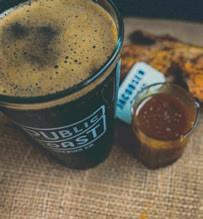
with Caramel and Sea Salt. Darker, thicker and on the sweeter side for a beer, this milk stout is lightly frothy in texture and the sweetness is matched with earthy notes of a stout’s usual essence.
The Farm Honey Lager, a 5% ABV, highlights the sweet, earthy notes of Public Coast Farm’s honey to offer a crushable crisp lager with aromas and flavors that unfold sip after sip. Straw colored and slightly opaque, the Farm Honey Lager offers a dry finish and high carbonation, making it an easy drinker.
All three releases are for sale on-tap and in cans at Public Coast’s brewpub in Cannon Beach. For a full list of beers on tap or order online for curbside pickup, visit: publiccoastbrewing. com/beer/.
Did you know
Keep up on Cannon Beach news at cannonbeachgazette.com

Plus check us out on:
When you’re feeling your best, it’s easy to find more reasons to celebrate. The providers and staff at Adventist Health are dedicated to helping you enjoy the important moments this holiday season. Staying healthy this winter is as easy as catching up on your annual wellness exam to help keep you healthy and ready for more. To protect yourself against the flu, COVID-19 and variants, schedule an appointment with your provider, or visit AdventistHealthTillamook.org to see a schedule of flu clinics near you.
Did you know? The CDC recommends that everyone stay up to date with COVID-19 vaccinations, including all primary series doses and boosters according to their age group. Learn more at CDC.gov/coronavirus
Scan this QR code and schedule an appointment with a primary care provider today

December 23, 2022 6 CannonBeachGazette.com | Cannon Beach Gazette
Crossword and Sudoku answers on page 5.
Salted Caramel Stout photo courtesy of Public Coast Brewing Co.
the Cannon Beach Gazette is free to read online?