State Supplement sponsored by:
UTAH STATE EDITION
A Supplement to:
THOUSANDS of units in service Shipment in 1-3 days
®
SAME DAY shipping on parts & tools FULLY SUPPORTED by a 75 YEAR FAMILY BUSINESS
May 13 2018
10% off 10,000 ft. lb. hammers
Vol. II • No. 10
“The Nation’s Best Read Construction Newspaper… Founded in 1957.”
Why pay more?
CALL 800-367-4937
Your Utah Connection – Debbie Hansen – 1-702-239-0348 – dhansen@cegltd.com
*On approved credit • Financing Available
Golden Spike Celebrates 149th Anniversary, Track Repair By Lori Tobias CEG CORRESPONDENT
Last summer, park rangers at the Golden Spike National Historic Site in northern Utah noticed that the replica steam locomotives used for demonstration runs were dipping at a certain point on the two miles of park railroad track. A quick investigation revealed the problem. “We pulled up the boards and found the railhead had rusted all the way through in the middle,” said Lucas Hugie, a Golden Spike park ranger who gives presentations on the railroad. “The locomotives weigh 60 tons when loaded. We had to get some of our rails replaced.” That gave observers a great opportunity to consider the perks of contemporary construction versus what the builders of the
Alfred A. Hart photo
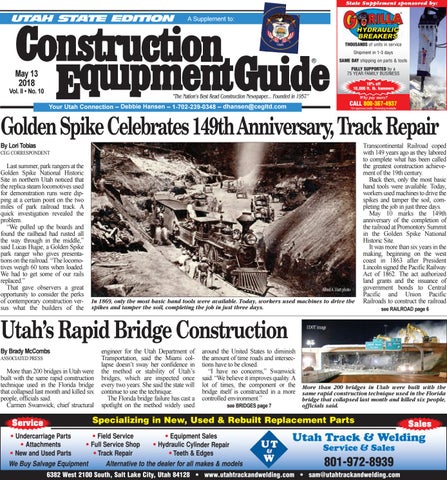
In 1869, only the most basic hand tools were available. Today, workers used machines to drive the spikes and tamper the soil, completing the job in just three days.
Utah’s Rapid Bridge Construction By Brady McCombs ASSOCIATED PRESS
More than 200 bridges in Utah were built with the same rapid construction technique used in the Florida bridge that collapsed last month and killed six people, officials said. Carmen Swanwick, chief structural
Service
engineer for the Utah Department of Transportation, said the Miami collapse doesn’t sway her confidence in the method or stability of Utah’s bridges, which are inspected once every two years. She said the state will continue to use the technique. The Florida bridge failure has cast a spotlight on the method widely used
Transcontinental Railroad coped with 149 years ago as they labored to complete what has been called the greatest construction achievement of the 19th century. Back then, only the most basic hand tools were available. Today, workers used machines to drive the spikes and tamper the soil, completing the job in just three days. May 10 marks the 149th anniversary of the completion of the railroad at Promontory Summit in the Golden Spike National Historic Site. It was more than six years in the making, beginning on the west coast in 1863 after President Lincoln signed the Pacific Railway Act of 1862. The act authorized land grants and the issuance of government bonds to Central Pacific and Union Pacific Railroads to construct the railroad see RAILROAD page 6
UDOT image
around the United States to diminish the amount of time roads and intersections have to be closed. “I have no concerns,” Swanwick said. “We believe it improves quality. A lot of times, the component or the More than 200 bridges in Utah were built with the bridge itself is constructed in a more same rapid construction technique used in the Florida controlled environment.” bridge that collapsed last month and killed six people, see BRIDGES page 7
officials said.
Specializing in New, Used & Rebuilt Replacement Parts
• Undercarriage Parts • Field Service • Equipment Sales • Attachments • Full Service Shop • Hydraulic Cylinder Repair • New and Used Parts • Track Repair • Teeth & Edges We Buy Salvage Equipment Alternative to the dealer for all makes & models
Utah Track & Welding Service & Sales
801-972-8939
6382 West 2100 South, Salt Lake City, Utah 84128 • www.utahtrackandwelding.com • sam@utahtrackandwelding.com
Sales
Page 2 • May 13, 2018 • www.constructionequipmentguide.com • Utah State Supplement • Construction Equipment Guide
MA AKE EVE E RY PASS P AS SS COUNT COUN C NT
With SMARTCONSTRUCTION from Komatsu, all of your op perators, machines and jobsites work rk more efficiently thaan you ever thought possible. High tech services like dig gital site surveying, modeling and setup, etup, and GNSS ma achine control will not only take your ur projects to the ne ext level, but to the next generation. Fo or more than 60 years, y , Komatsu Equipment quipment q p Company p y has been here to help with leading innovations nnovations for Utah’s construction owners. SMARTCONSTRUCTION is just one mo ore part of our continued commitment ment to your success.
Call, click, or sttop in today and learn hhow SMARTCONSTRUC CTION can make your ooperations more profitable able than everr..
UTTAH AH
Salt Lake City 801-972-3660
Myton 435-216-7777
St. George 435-986-1000
NEV VADA ADA
Las Vegas 702-399-1004
Elko 775-753-7557
Reno 775-356-1334
WYOMING
Casper 307-223-4660
Gillette 307-682-1445
Rock Springs 307-686-1300
Winnemucca 775-753-7557
Construction Equipment Guide • Utah State Supplement • www.constructionequipmentguide.com • May 13, 2018 • Page 3
Page 4 • May 13, 2018 • www.constructionequipmentguide.com • Utah State Supplement • Construction Equipment Guide
Construction Begins...
Continuing Service...
Wheeler Machinery Co. Announces $430M Project to Its New President, Vice President Add More Lanes to I-15 Under Way PROVO, UTAH (AP) Utah leaders said a project to add more lanes to I-15 and improve east-west connectivity has taken a big step forward. The Daily Herald reports that state and local leaders met April 25 as construction of the $430 million project to add more lanes officially began. Traffic cones and construction crews can already be seen along a stretch of Interstate 15 through the Lehi area. The plan is to add two lanes to I-15 in both directions from Lehi Main Street to State Route 92. Carlos Braceras, Utah Department of Transportation executive director, said the project is expected to be completed in 2020 and is currently the biggest transportation project in the state. Braceras said the construction will provide a foundation for future economic growth in the area. (This story also can be found on Construction Equipment Guide’s website at www.constructionequipmentguide.com.)
Bryan Campbell, Wheeler Machinery’s new president.
Jonathan Campbell Wheeler Machinery’s new executive vice president.
Wheeler Machinery Co. has appointed Bryan Campbell as president and Jonathan Campbell as executive vice president, effective April 16, 2018. Rob Campbell, former president, and Paul Campbell, former executive vice president, will assume the roles of chairman of the board and vice chairman of the board, respectively. In 2002, Bryan Campbell began his career at Wheeler in the warehouse pulling parts. Since then, he has held a variety of positions including sales rep, service manager, product support sales manager and most recently vice president of Product Support. Bryan received his bachelor’s degree from the University of Utah and his Master of Business Administration from the University of Phoenix. “Jonathan and I are excited and humbled by the opportunity to serve our employees and customers in our new roles. Our goal is to continue to make Wheeler Machinery a great place to work and to continue to provide superior service and support to our customers,” said Bryan Campbell. Prior to his position as executive vice president, Jonathan served as vice president of Sales and Rental. He has held numerous roles at the company including general manager of Sales and Rental, credit manager and crushing quarry supplies manager since beginning his career with Wheeler nine years ago. Jonathan received both his bachelor’s in Finance and Master of Business Administration from the University of Utah. In his new role, Jonathan is tasked to double the dealership’s annual revenue through the acquisition of complementary products, services and businesses. Both Utah natives, Bryan and Jonathan are members of
many local and national trade associations related to the industries Wheeler serves such as Associated General Contractors, Associated Equipment Distributors, Associated Builders and Contractors, Utah Mining Association, Utah Nursery and Landscape Association and more. With the movement of Bryan and Jonathan into their new roles, Steve Green now serves as vice president of Sales and Rental, and Ben Romney is now at the helm of Wheeler’s parts and service operations as vice president of Product Support. Jeff Ipsen, CFO and vice president of Corporate Services, completes Wheeler’s executive team. “We’ve diligently prepared for this transition, and we have great confidence in our next generation of leadership. Wheeler’s associates and customers are in good hands, and our best days lie ahead,” said Rob Campbell.
Landfill Withdraws Permit Request for Industrial Waste
SALT LAKE CITY (AP) Developers behind a landfill under construction near the shore of the Great Salt Lake have withdrawn an application for a permit that would have allowed the company to bring in out-of-state industrial waste. The Salt Lake Tribune reported officials with Promontory Point Resources LLC delivered a letter Feb. 23 to the Utah Department of Environmental Quality, requesting it to halt the permit review process. The company’s letter does not provide an explanation for its action. About Wheeler Machinery Co. Promontory spokesman Brett Snelgrove said the landfill Wheeler Machinery Co. is a full-service Caterpillar dealer will still be completed, and it expects to begin accepting inwith locations throughout Utah plus one in Nevada. It serves state municipal waste later this year. various industries, including construction; landscaping; minEnvironmental groups and state and federal agencies have ing; quarry & aggregate; agriculture; oil & gas and more. raised concerns about the project’s potential impact to migraProviding repair and maintenance services, parts, rental, tory birds. financing, consulting and training along with technology Promontory officials said they plan to work with stakesolutions, Wheeler is an innovative partner and a champion holders to address all concerns going forward. for its customers’ success. For more information, visit sltrib.com. For more information, visit www.wheelercat.com. (This story also can be found on Construction (This story also can be found on Construction Equipment Equipment Guide’s website at www.constructionequipmentguide.com.) Guide’s website at www.constructionequipmentguide.com.)
Construction Equipment Guide • Utah State Supplement • www.constructionequipmentguide.com • May 13, 2018 • Page 5
Truck Sales & Specialty Equipment The Mechanic’s Truck Leader!
1999 Peterbilt 330
2009 Peterbilt 388
Fuel & Lube truck. Cat 3126, 275 HP, Fuller 9 speed transmission, 1,000 gallon diesel tank, 4 product tanks, 4 air pumps. $37,500
Cummins ISX 400, 475 HP, Fuller 10 speed, air ride, dual stack, dual breathers, jake brake, inter-axle differential lock, tractor package, 45" sleeper. $43,900
2012 International DuraStar 4400 Durastar mechanic's truck International diesel engine, Allison automatic transmission, air ride driver's seat, A/C, air brakes, 14' Stellar body, Stellar 12625 hydraulic crane, welder's deck, 70 CFM air compressor, wireless remote. $82,750
2000 Peterbilt 379 Cummins N14 Plus, 475 HP, Fuller 10 speed manual transmission, full air "S" cam brakes, heated mirrors, tractor package, air slide 5th wheel, inter-axle differential lock, engine brake, engine fan. $43,500
www.mechanicstruck.com
3899 S Redwood Rd. West Valley City, UT 84119 24 Hour Emergency Service
ALL EQUIPMENT IS D SAFETY INSPECTE
• Ogden • Park City • Layton • Provo • Tooele • Salt Lake City
PROMPT DELIVERY L O C A L LY O W N E D A N D O P E R AT E D S I N C E 1 9 5 3
NEED EQUIPMENT?
FULL PAGE 10.125”x10.625”
• • • • • • • • • • • •
Forklifts Scissor & Boom Lifts Scaffolding Excavators Mixers Welders Sweepers & Scrubbers Compressors Compaction Equipment Skid Loaders Backhoes Dump Trucks
CALL TODAY!
801-463-7997
Open $615
13 Time $570
1/2 PAGE 10.125”x5.25” or 5”x10.625”
Open $510
13 Time $435
1/4 PAGE
UTAH PUBLISHING 2018 Issue#
Closing
Publishing
12
5/31/2018
6/10/2018
14
6/28/2018
7/8/2018
16
7/26/2018
8/5/2018
18
8/23/2018
9/2/2018
20
9/20/2018
9/30/2018
22
10/18/2018
10/28/2018
24
11/15/2018
11/25/2018
26
12/13/2018
12/23/2018
5”x5.25”
Open $345
w w w. h o w e r e n t a l s . c o m Toll Free 866-436-HOWE Fax: 801-463-7488 4235 South 500 West, Murray, UT 84123
13 Time $320
Page 6 • May 13, 2018 • www.constructionequipmentguide.com • Utah State Supplement • Construction Equipment Guide
Workers Use Hand Tools, Innovation to Build Railroad RAILROAD from page 1
to run between Omaha, Neb. and Sacramento, Calif. Discussion on building the railroad had been ongoing since the 1850s. But individual states couldn’t decide where to put it. Survey crews were sent out to scout the best routes, but Congressmen tended to favor their own states, Hugie said. It made sense to build in the south because there is generally no snow. But Congressmen from the northern states were not going to support a railroad in slave-holding states. “When the South states left the union, the North states could make up their mind,” he said. And getting it built seemed critical to the war effort. “Lincoln was looking at it from a military point of view. If the war spread out west, he wanted to be able to move troops from East to West in less than two weeks.” Central Pacific began work out of Sacramento in 1863 with laborers using the tried and true basic hand tools — shovels, pick axes and dump carts. “Really rudimentary dump carts,” noted Hugie. “One horse, two wheels.” Then they came to the Sierra Nevada mountain range, requiring them to blast their way through to build what would be 15 tunnels on the Central Pacific side. “When it came to the Central Pacific to blast through those mountains and to make those tunnels, the agent of choice was black
powder, Hugie said. “The Central Pacific had tried to use nitroglycerin, but found it too unstable, so they stopped using it.” Construction foreman James Strowbridge lost an eye to nitroglycerin after a piece became lodged in his eye. “Because of that they went to black powder, which was more predictable,” Hugie said. “It was slow. Because there was an emphasis on speed over efficiency, a lot of time they used more black powder than necessary.” The Union Pacific company began building out of Omaha in 1865. “They built with the same kind of tools as Central Pacific, but Union Pacific was open to newer technology. They used nitroglycerin and never really had an issue with it. But they didn’t have to blast as much as the Central Pacific did. They didn’t have to tunnel until Utah and the Wasatch Mountains.” Central Pacific built only four tunnels on its end. But the biggest difference between the two projects was in the railroad ties. Out west, Central Pacific had access to an abundance of tamarack and redwood trees, but there are not a lot of trees in Nebraska. “When they were trying to come up with wood, initially they looked at hardwood, oak,” Hugie said. “That was $4.15 per tie. That’s really, really expensive. I can’t imagine using oak in railroad ties. Since railroad ties are fairly dispos-
Alfred A. Hart photo
Central Pacific began work out of Sacramento in 1863 with laborers using the tried and true basic hand tools — shovels, pick axes and dump carts.
able. They decided to use cottonwood, which is very porous and it rots quickly. It would rot out in six months.” So workers built a machine called a Burnetizer, essentially a big cylindrical tube stretching 100ft. long. “They could put 200 ties in this machine and they would seal that tube and the tube would pull all the moisture out of the railroad ties. Then, they would flood it with
chloride and zinc, and the ties would come out of the machine looking metallic grey. They would last about two to three years. That’s an improvement over six months. These cost the railroad 17 cents a tie. That’s really, really cheap. When the crews for the two railroads met at Promontory Summit, Central Pacific had built 690 miles; Union Pacific, 1086 miles. “The fun history fact is if you add those numbers together you
get 1776,” Hugie noted. In 1938, the railroad abandoned all the track in northern Utah. In 1942, they pulled it all up for the war effort. When we became a site, they laid two miles of track for the two replica locomotives we have out here.” (This story also can be found on Construction Equipment Guide’s website at www.constructionequipmentguide.com.) CEG
Alfred A. Hart photo
Alfred A. Hart photo
Bloomer Cut was 800 ft. long and 63 ft. deep, an impressive feat for the time.
Discussion on building the railroad had been ongoing since the 1850s. But individual states couldn’t decide where to put it.
Construction Equipment Guide • Utah State Supplement • www.constructionequipmentguide.com • May 13, 2018 • Page 7
NO HA HASSLES SS ES. NO H HIDDE IDDEN COSTS O S. NO O KIDDIN KID NG.
UTAH SALT LT LAKE L CITY Y 4343 Century Dr. Salt Lake City, UTT 84123 Phone: 801-262-5761 Fax: 801-262-5780
SPRINGVILLE 1350 South 2000 West Springville, UT 84663 Phone: 801-794-1463 Fax: 801-794-1414
LOGAN 453 North 1000 West Logan, UT 84321 Phone: 435-752-1533 Fax: 435-752-5722
CED DAR CITY 4822 North N Main Street Ceddar City, UT 84720 Phoone: 435-586-4406 Faxx: 435-586-2362 Email: del.maxedon@centuryeq.com
All rights reserved. CASE is a trademark registered in the United States and many other countries, owned by or licensed to CNH Industrial N.V., its subsidiaries bsidiaries or affiliates.
200 Utah Bridges Built With Same Technique Used in Florida BRIDGES from page 1 support tower was puzzling. UDOT image Traditionally, the tower is conAccelerated bridge construction, or structed first, and the walkway or ABC, involves building sections of a roadway is anchored to it with span off site and then moving the cables. massive pieces into place in one step. “It’s odd,” said Henry Petroski, a When a bridge is constructed at the professor of civil engineering at site, it can result in weeks of highway Duke University and a leading closures, giving ABC the advantage authority on engineering failures. of avoiding traffic interruptions. “That’s probably why they used Utah started using the technique in this so-called ABC method, so they 2007, and it has since become the pricould get the span over the roadway mary way bridges are built, in one operation, because if you do Swanwick said, adding that the state it incrementally, you have to interis the nation’s biggest proponent and user of the method, followed by The Florida bridge failure has cast a spotlight on the rupt traffic.” method widely used around the United States to diminInvestigators also will be looking Pennsylvania and Vermont. Examples include the bridges on ish the amount of time roads and intersections have to at the companies building the project, a collaboration between MCM Interstate 215 in Salt Lake City at be closed. Construction, a Miami-based con3300 South and 4500 South. In the case of the Florida tragedy, engiSwanwick was at Florida International neering experts said the question is where tractor, and Figg Bridge Design, based in University last year to give trainings on the was the fatal mistake: in the design of the Tallahassee. Both companies have been technique but says she’s not familiar with the bridge, in the way its construction was car- involved in construction accidents before. Professor Amjad Aref, a researcher at the bridge that collapsed. ried out or in the materials used? The general approach for accelerated conCivil engineering experts who viewed University at Buffalo’s department of civil, struction has been around since the mid-19th photos of the planned structure and the col- structural and environmental engineering, century — and has been used safely and suc- lapse have raised questions about how FIU said it is unclear what the builders at FIU were using in lieu of a tower to support the cessfully for a long time — but interest in and its contractors approached the project. ABC has increased in recent years as states To some bridge engineers, the decision to segment that collapsed. The span had some kind of cables to help have looked for quicker, less expensive ways install the span’s main concrete segment to replace thousands of aging bridges. over a busy road before building its main support it, and the bridge section that col-
lapsed was attached to two smaller pylons at either end. But in ABC projects like the FIU span, the loss of the extra support from the main tower during construction is a risk, he said. “Until all the pieces are put together to transmit the loads safely to the foundations, these bridges may suffer disproportionate or full collapse due to instability,” Aref said. “Typically, this process requires a few weeks. During that time, they are often supported by another system to ensure stability because they are really vulnerable to collapsing.” “I am really puzzled that the tower does not exist,” Aref said. Engineers say the method has been used safely in other projects for years, and in general keeps the public safer. “What really bothers me is with ABC, the benefits are so substantial that I would hate to see this accident lead to its reduced use,” said Michael Culmo, a bridge engineer in Connecticut who has worked on accelerated construction projects for decades. “While this is a tragedy, the process itself is very safe.” (This story also can be found on Construction Equipment Guide’s website at www.constructionequipmentguide.com.)
Page 8 • May 13, 2018 • www.constructionequipmentguide.com • Utah State Supplement • Construction Equipment Guide
AT WHEELEER MACHINERY
MAINTENANCE TRACKING AUTOMATTED WITH PRODUCT CT LINK ENABLED MACHINES
LED LIGHTING FOR SERVICING NG DURING ALL HOURS CAT® QUALITY PARTS A AND SERVICE
FLUID SAMPLING & ANALYSIS Y
ELECTRONIC MACHINE CHINE INSPECTION REP PORT
‘READY TO O RUN’ TA AG IN CAB FOLLOWING SERVICE
SUPERIOR FLUID QUALITY VIA KIDNEY LOOPED FILTRA T TION T
MOBILE LUBE SERVICE, WE COME TO YOU!
HEATED T OIL FOR COLD WEATHER T SERVICE EFFICIENCY
Focus on n your core work while we handle the he maintenance Reduce your costts and liabilities: No need to worry about lube truck ownership wnership costs, tooling, truck maintenance, truck insurance, ppersonnel costs, DOT & MSHA compliance, time spent traveling to pick up filters, parts, disposal of oils, etc. Additional benefi fits Wheeler provides: Travel to machines up to 60 minutes utes from branch stores included in service. Further than 60 m minutes away—no away no problem! Hourly labor rates applyy, y, with w no additional mileage costs. No charge for topping off fluid compartments. No premium charge for after-hours services. Multi-year pricing available.
Call 801-978-1403 to schedule yyour Lube Service today or visit wheelercat.com/servicee/lube-service to learn more!