State Supplement sponsored by:
PACIFIC NORTHWEST EDITION
A Supplement to:
THOUSANDS of units in service Shipment in 1-3 days
®
SAME DAY shipping on parts & tools FULLY SUPPORTED by a 75 YEAR FAMILY BUSINESS
June 10 2018
10% off 10,000 ft. lb. hammers
Vol. II • No. 12
“The Nation’s Best Read Construction Newspaper… Founded in 1957.”
Your Pacific Northwest Connection – Patrick Kiel – 1-877-7CEGLTD – pkiel@cegltd.com
Why pay more?
CALL 800-367-4937 *On approved credit • Financing Available
$139M Mukilteo Multimodal Terminal Opens Next Year By Jennifer Rupp CEG CORRESPONDENT
Tribal leaders and elected officials joined Washington State Ferries (WFS) in August 2017 to celebrate construction of the new Mukilteo ferry terminal. The gathering represented a decade of planning and partnerships to deliver a project that respects tribal lands and artifacts and provides critical safety improvements at the state’s busiest car ferry terminal. “Investing in transportation infrastructure creates jobs and keeps our economy moving,” said U.S. Rep. Rick Larsen, a senior member of the House Transportation and Infrastructure Committee. “This new terminal is a critical investment in the region’s mobility network and will build upon the work of the city of Mukilteo and other stakeholders to increase the public’s access to the waterfront.” The Mukilteo Multimodal Project relocates the Mukilteo ferry terminal to a decommissioned U.S. Air Force tank farm site, one-third of a mile east of the existing terminal. The project includes a new passenger and maintenance building, a supervisor’s building, transit center and four new toll booths. Its location
WSDOT photo
WSDOT photo
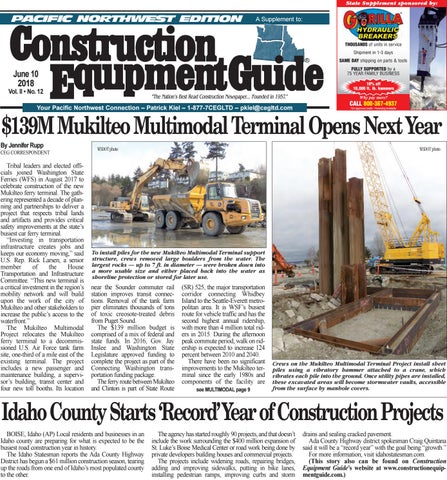
To install piles for the new Mukilteo Multimodal Terminal support structure, crews removed large boulders from the water. The largest rocks — up to 7 ft. in diameter — were broken down into a more usable size and either placed back into the water as shoreline protection or stored for later use.
near the Sounder commuter rail station improves transit connections. Removal of the tank farm pier eliminates thousands of tons of toxic creosote-treated debris from Puget Sound. The $139 million budget is comprised of a mix of federal and state funds. In 2016, Gov. Jay Inslee and Washington State Legislature approved funding to complete the project as part of the Connecting Washington transportation funding package. The ferry route between Mukilteo and Clinton is part of State Route
(SR) 525, the major transportation corridor connecting Whidbey Island to the Seattle-Everett metropolitan area. It is WSF’s busiest route for vehicle traffic and has the second highest annual ridership, with more than 4 million total riders in 2015. During the afternoon peak commute period, walk on ridership is expected to increase 124 percent between 2010 and 2040. There have been no significant improvements to the Mukilteo terminal since the early 1980s and components of the facility are see MULTIMODAL page 9
Crews on the Mukilteo Multimodal Terminal Project install sheet piles using a vibratory hammer attached to a crane, which vibrates each pile into the ground. Once utility pipes are installed, these excavated areas will become stormwater vaults, accessible from the surface by manhole covers.
Idaho County Starts ‘Record’ Year of Construction Projects BOISE, Idaho (AP) Local residents and businesses in an Idaho county are preparing for what is expected to be the busiest road construction year in history. The Idaho Statesman reports the Ada County Highway District has begun a $61 million construction season, tearing up the roads from one end of Idaho’s most populated county to the other.
The agency has started roughly 90 projects, and that doesn’t include the work surrounding the $400 million expansion of St. Luke’s Boise Medical Center or road work being done by private developers building houses and commercial projects. The projects include widening roads, repairing bridges, adding and improving sidewalks, putting in bike lanes, installing pedestrian ramps, improving curbs and storm
drains and sealing cracked pavement. Ada County Highway district spokesman Craig Quintana said it will be a “record year” with the goal being “growth.” For more information, visit idahostatesman.com. (This story also can be found on Construction Equipment Guide’s website at www.constructionequipmentguide.com.)
Page 2 • June 10, 2018 • www.constructionequipmentguide.com • Pacific Northwest Supplement • Construction Equipment Guide
WSDOT Selects Kiewit to Tear Down Alaskan Way Viaduct WSDOT photos
The temporary Alaskan Way surface street will move west of the viaduct with two lanes open in each direction along Seattle’s waterfront.
Thomas and John streets will be reconnected over three blocks of a rebuilt Aurora Avenue North.
The demolition of Seattle’s aging Alaskan Way Viaduct is finally in view. On May 16, the Washington State Department of Transportation selected Kiewit Infrastructure West Co. to demolish the viaduct, decommission the Battery Street Tunnel and reconnect city surface streets just north of the nearly complete State Route 99 tunnel. The design-build contract, which requires the contractor provide both design and construction
could open as soon as this fall. • By then, the temporary Alaskan Way surface street will move west of the viaduct with two lanes open in each direction along Seattle’s waterfront. • Before the tunnel opens, WSDOT must permanently close the Alaskan Way Viaduct to realign SR 99 and the ramps at the tunnel portals. • After the viaduct permanently closes, contractors could begin limited demolition work in late 2018.
services of the job, is valued at $93.7 million. Kiewit submitted the “apparent best value” bid — a combination of points received for its technical proposal and its price. “We are excited to be so close to removing the seismically vulnerable viaduct and ushering in a new era on Seattle’s waterfront,” said Brian Nielsen, WSDOT’s Alaskan Way Viaduct Replacement Program administrator. “It will be challenging to tear down a major highway in the heart of a booming city but we’re looking forward to getting it
done safely and as quickly as possible.” Timelines for the work will emerge after the contract is finalized and the contractor receives approval to begin design work. After that point, WSDOT will be able to share more specifics about how demolition and decommissioning will proceed. What’s Ahead This Year • Based on the tunnel contractor’s current schedule, WSDOT anticipates the new SR 99 tunnel
Future Work • The majority of viaduct demolition work will occur in 2019. • It will take up to two years to remove equipment and fill in the Battery Street Tunnel. During this time, there will also be utility improvements made along Battery Street. • Thomas and John streets will be reconnected over three blocks of a rebuilt Aurora Avenue North. (This story also can be found on Construction Equipment Guide’s website at www.constructionequipmentguide.com.)
Pocatello Water Department Lists ITD... 2018 Construction Season Projects I-15 Construction Between Spencer, Dubois Under Way
The city of Pocatello’s Water Department has announced its list of projects for the 2018 construction season. During the year, staff are scheduled to replace approximately 2 mi. of water main lines in areas that include Mahogany Drive, Chokecherry Drive, El Rancho Boulevard, South Johnson Avenue, West Clark Street and West Center Street. “Staff look at multiple factors when selecting an area for replacement,” stated Justin Armstrong, water superintendent. “Those factors include age, condition, serviceability, impact of a potential failure and necessity to meet fire-flow as well as future demands on the system.” First up will be the replacement of main lines in the neighborhood of Chokecherry Drive, Mohagany Drive, Pinyon Drive, Aspen Drive and Cedar
Lane. The project involves replacing old 4-in. and 6-in. cast iron water mains that are nearly 60 years old. Crews will work between the hours of 7 a.m. to approximately 5 p.m., Monday through Thursday. During the project, access to the construction area will be restricted and sections of the road will be completely closed while workers are digging. Parking will be restricted during construction hours in the work zone and residents are asked to park vehicles away from this area during the day. At the close of each day, access will be restored to all properties. The work may cause short-term disruptions to water service and individuals around the construction zone are encouraged to keep a supply of drinking water available. Construction is expected to last eleven weeks and due to unforeseen circum-
stances, the work schedule may change. The city of Pocatello Water Department serves more than 17,000 customers within the city limits and in portions of Bannock County. Water Department personnel are responsible for operating and maintaining 277 mi. of water pipe ranging in size from .5-in. diameter water services to 30-in. diameter water mains. Staff operate and maintain 21 water supply wells; 16 water storage tanks; 12 booster pumping stations; and 44 pressure reducing valves. These facilities are located throughout the department service area and supply over 5.5 billion gal. of water per year to customers. For more information, visit pocatello.us/water. (This story also can be found on Construction Equipment Guide’s website at www.constructionequipmentguide.com.)
The Idaho Transportation Department began construction work on Interstate 15 between Spencer and Dubois in early May. Work will continue through the fall. The new project will reconstruct 8 mi. of I-15 pavement that has deteriorated and replacing it with a new smooth surface, improved shoulders and drains and upgraded guardrails. I-15 motorists will be reduced to one lane in each direction while crews work in the median. Once initial work is complete, both north and southbound motorists on I-15 will travel on the same side. The speed limit will be reduced. Crews anticipate working six days a week. For more information, visit itd.idaho.gov/I15Construction. (This story also can be found on Construction Equipment Guide’s website at www.constructionequipmentguide.com.)
Construction Equipment Guide • Pacific Northwest Supplement • www.constructionequipmentguide.com • June 10, 2018 • Page 3
Contact your local dealer:
Dealer Name WASHINGTON: Seattle, WA 8207 South 216th Street City, ST Kent, Washington 98032 123.456.7890 206.762.5933 Manager: City, ST Brian Burke bburke@PacWestMachinery.com 123.456.7890 Spokane, WA 4030 East Trent Avenue City, ST Spokane, Washington 99202 123.456.7890 509.534.5933 Manager: City, ST Scott Upton supton@PacWestMachinery.com 123.456.7890
OREGON:
City, ST Portland, OR 123.456.7890 19255 NE Sandy Boulevard Portland, Oregon 97230 503.252.5933 City, ST 123.456.7890 Manager: Tim Hurst thurst@PacWestMachinery.com City, ST Eugene, OR 123.456.7890 1550 Irving Road Eugene, Oregon 97402 City, ST 541.302.3762 123.456.7890 Manager: Tim Hurst thurst@PacWestMachinery.com City, ST PacWestMachinery.com 123.456.7890
Some companies have you choose power or fuel efficiency. You chose both.
Volvo developed the industry’s first fuel efficiency guarantee so you never have to compromise on performance or productivity. And with CareTrack machine monitoring, you can focus your attention on more important things — like growing your business. Learn more at volvoce.com/na.
DEALER LOGO
Push Boundaries.
Page 4 • June 10, 2018 • www.constructionequipmentguide.com • Pacific Northwest Supplement • Construction Equipment Guide
Family Values, Quality Products Sustain Washington Mill
Log trucks deliver raw western red cedar logs from Oregon, Washington and Canada.
What started as a small shake operation for two men has flourished into a well-known, familyowned-and-operated cedar fencing mill. Wood products produced at the mill are used throughout North America for fencing projects. Tod Reichert and his business partner, Lee Day, were two young men in the mid-1970s, cutting shake bolts and performing rigorous manual labor. Eventually, Reichert started a small shake mill and grew the company to six employees. In 1982, he added a Pendu saw to produce fence boards and log home material. Over the years, the log home products were discontinued, and more saws were added to focus on cedar fencing, which is the company’s current primary focus. Thirty-six years after Reichert started the company, it has grown to more than 60 employees, including Reichert’s daughter, Kim, and her husband, Jamy Wallace. “I’m working in the mill, and I’m the log buyer,” Jamy Wallace said. “Kim sells the products and focuses on the day-to-day operations. We have a really good crew. We care about our employees, and we value their input. We all work together as a team to produce a consistent top-quality product.”
Eldon Graves, Reichert Shake and Fencing operator, puts the Doosan DX380LL-5 through its paces.
One of the biggest differentiators of the Doosan DX380LL-5 log loader from other models at the mill is its reach. The machine has a maximum reach of 44 ft. — 2 ft. more than the company’s next largest model.
Staying Focused While other mills in the area offer a variety of wood products, Reichert Shake and Fencing focuses on producing high-quality western red cedar fence boards. Employees at the mill cut the cedar logs into various lengths and widths — from 4 to 8 ft. in length — and 3 to 6 in. in width. “We cut a premium product, and we emphasize quality,” Wallace said. “We focus on our niche in the market, that’s our specialty, and we are known for our high quality and high grade.”
Log trucks deliver raw western red cedar logs from Oregon, Washington and Canada. Most wood comes from small private loggers and landowners; however, the company also buys from large timber companies such as Hancock and Weyerhaeuser, or bids on sales from the Department of Natural Resources in Washington. Cedar logs processed at the mill can vary in age, from as little as 20to 30-year-old cedars to as high as 80 to 100 years old. “You get better money out of the cedar when it gets older because it
scales better,” Wallace said. “If you wait that extra five or 10 years, you’ll get a lot better price out of them.” Scaling is determined by the log’s width. “Once a cedar gets to nine inches, it will almost double its board footage in the log,” he said. “Then, once it goes to 14 inches, it will double again.” Numbers Game The mill measures success by the number of logs processed at the mill. Trucks deliver logs to the mill
Monday through Friday, from 6:30 a.m. to 3:30 p.m., and the mill runs until 5 p.m. During busy times, the mill is open Saturdays, although they try to limit weekend work to allow employees to spend time with their families. “Some days we might only get five or six loads, and other days we might get 16 to 20,” Wallace said. “It depends on how good the weather is and how good our prices are.” To keep up with the volume of cedar logs being delivered to the mill, the company depends on reliable and well-trained employees, as well as durable logging equipment. The company has three log loaders at the mill, and sometimes they need all three machines running to avoid holding up the log trucks that deliver the raw material. The mill racks up hours and hours on its log loaders. see MILL page 10
Construction Equipment Guide • Pacific Northwest Supplement • www.constructionequipmentguide.com • June 10, 2018 • Page 5
Page 6 • June 10, 2018 • www.constructionequipmentguide.com • Pacific Northwest Supplement • Construction Equipment Guide
Dave Noggle Joins Telsmith as SW Regional Sales Manager Telsmith Inc. a manufacturer of mineral processing equipment, recently hired Dave Noggle as regional sales manager covering Utah, Nevada, Idaho, Arizona and Wyoming. “As part of our effort to increase our Southwest U.S. market presence, we are excited to have Dave on board,” said Jeff Gray, domestic sales manager of Telsmith Inc. “Dave brings with him many years of industry knowledge and sales expertise that will be very beneficial to our customers.” Noggle comes to Telsmith with a mechani- Dave Noggle cal engineering and sales background and years of experience in the aggregate and recycling industry. He spent the first 24 years of his career at Eagle Crusher Company and proceeded to own and operate his own business providing equipment, spare parts sales and consulting services to companies in the aggregate and
recycling industries. He then went on to working for companies in the same industries such as Midwest Equipment & Industrials, J.W. Jones Company, Hardrock Equipment & Rentals and Crusher Rental & Sales. “It is a great honor to be part of the legendary Telsmith organization and its great team of dedicated personnel,” said Noggle. “I am anxious to get in field and start working with our dealers and customers in promoting the Telsmith line of innovative and revolutionary crushing and vibrating equipment.” To reach Dave Noggle, call 435/522-9868 or email dnoggle@telsmith.com. For more information about Telsmith, call 262/242-6600 or visit www.telsmith.com. (This story also can be found on Construction Equipment Guide’s website at www.constructionequipmentguide.com.)
Work Begins on Oregon 99
Contact Triad Machinery Today for More Details!
OREGON Portland (503) 254-5100 • (800) 221-8512 Eugene (541) 342-7700 • (800) 342-6780 Prineville (541) 447-5293 • (888) 662-2940
www.triadmachinery.com
WASHINGTON Tacoma (253) 722-5560 • (800) 622-8876 Spokane (509) 534-1900 • (800) 945-9168 Mt. Vernon (360) 488-3948
Construction began on April 23 on a $5.4 planned from Creel Road south to the million project that will build numerous Ashland city limits. However, that stage of enhancements along a stretch of Oregon 99 work won’t begin until late summer. from Talent to Ashland. The city of Talent is Other project enhancements include a contributing $400,000 to the project. new bike lane along northbound Oregon 99 “This will be one of the pivotal projects from Jackson Road to South Valley View for Talent and its future,” said Talent Mayor Darby Ayers-Flood. “What makes this a particularly “What makes this a particularly great great project is the impact it presents across the project is the impact it presents across board. It’s not just safety but also livability and eco- the board. It’s not just safety but also nomic development livability and economic development potential for Talent.” Prime contractor Knife potential for Talent.” River Materials will begin excavation for storm Darby Ayers-Flood drains, curbs, gutters, sideMayor of Talent walks and bike lanes between Rapp Road and Creel Road. The contractor’s schedule is planned in Road. The new bike lane will help riders stages with work beginning on the east side connect to the Bear Creek Greenway near of Oregon 99 between Rapp Road and Creel South Valley View Road. Road. That work will be complete before the (This story also can be found on contractor switches to the west side of the Construction Equipment Guide’s website at highway. New pavement and striping is www.constructionequipmentguide.com.)
Construction Equipment Guide • Pacific Northwest Supplement • www.constructionequipmentguide.com • June 10, 2018 • Page 7
Kent, WA (800) 669-2425 Rochester, WA (800) 304-4421 Spokane, WA (800) 541-0754 Boise, ID (800) 221-5211 Pocatello, ID (800) 829-4450 Billings, MT (800) 735-2589 Kalispell, MT (800) 434-4190 Missoula, MT (800) 332-1617 Eugene, OR (800) 826-9811 Portland, OR (800) 950-7779 Magadan, Russia 011-7-41326-99298 Yuzhno-Sakhalinsk, Russia 011-7-42424-69051
Page 8 • June 10, 2018 • www.constructionequipmentguide.com • Pacific Northwest Supplement • Construction Equipment Guide
ODOT Begins ‘Vets’ Bridge Repairs
Oregon Department of Transportation photo Mark Stone/University of Washington photo
The Bill & Melinda Gates Center for Computer Science & Engineering is being funded through public investment and private donations, including $30 million raised by “Friends of Bill & Melinda,” and $15 million from the Gates themselves
Bill & Melinda Gates Center Under Way By Lori Tobias CEG CORRESPONDENT
Construction on the new Bill & Melinda Gates Center for Computer Science & Engineering at the University of Washington Seattle campus passed the halfway mark in March and is on target to be completed by the end of 2018. A dedication is planned for early 2019, according to UW News. The $110 million, 135,000-sq.-ft. facility will feature new instructional and collaborative spaces, expanded research labs, a 250-seat auditorium and a flexible event space, as well as a 3,000-sq.-ft. robotics Construction on the new Bill laboratory, wet lab & Melinda Gates Center for space to house the Computer Science & school’s “leading-edge Engineering at the University research in molecular of Washington Seattle campus information systems,” passed the halfway mark in and an undergraduate March. commons that will serve as a “home away from home for students.” It is being funded through public investment and private donations, including $30 million raised by “Friends of Bill & Melinda,” and $15 million from the Gates themselves. “The idea is that the new building [Bill & Melinda Gates Center] and our current building [Paul G. Allen Center] will complement each other and be part of one unified complex housing,” said Kristin Osborne, spokeswoman of the UW Seattle campus. The buildings face each other on either side of E Stevens Way NE on the University of Washington’s main campus. “There is wonderful symbolism in having the Bill & Melinda Gates Center for Computer Science & Engineering across the street from the Paul G. Allen Center for Computer Science & Engineering on the University of Washington campus,” said Brad Smith president of Microsoft. “As teenagers, Bill and Paul roamed UW computer labs. They
went on to change the face of Seattle and the world — first with Microsoft, and later with their philanthropy. I can’t think of a better way for those of us who have had the privilege of working alongside Bill and Melinda to express our gratitude and admiration than to name this building for them.” (This story also can be found on Construction Equipment Guide’s website at www.constructionequipmentguide.com.) CEG
A truck traveling south on Interstate 5 is seen crossing the South Umpqua River (Vets) Bridge in Roseburg, Ore., on April 27, 2018. The Oregon Department of Transportation will oversee repairs to the bridge from spring 2018 to fall 2019.
Pedestrians should watch for construction activity along the path between Roseburg High School and Gaddis Park as construction begins on the Interstate 5 “Vets” Bridge. The pedestrian path, including the walkway that spans the South Umpqua River, will remain open most of the time during the 18-month project. Construction may require brief closures of the walkway for less than 20 minutes at various times. Flaggers will guide pedestrians, bicyclists and disabled individuals as needed. The $9.6 million project will remove the old lead paint and recoat the steel truss, repair or replace the bridge bearings and joints, resurface the deck and seal cracks in the concrete. The bridge also will be strengthened to better withstand earthquakes. Prime contractor F.D. Thomas will install a work enclosure around the truss to prevent contamination of the river and surrounding area. A staging area is located under the north end of the bridge, next to Gaddis Park. Access to this area is restricted to the contractor and authorized staff. Construction is scheduled for weekdays. Nearby residents should expect noise consistent with bridge work. Vets Bridge was built in 1955. In the 1970s, the bridge was widened to accommodate more traffic lanes and provide a walkway below the main deck. For more information: www.RoseburgVetsBridge.com. (This story also can be found on Construction Equipment Guide’s website at www.constructionequipmentguide.com.)
Mark Stone/University of Washington photo
Oregon Department of Transportation photo
The $110 million, 135,000-sq.-ft. facility will feature new instructional and collaborative spaces, expanded research labs, a 250-seat auditorium and a flexible event space.
A popular bicycle and pedestrian path can be seen under the South Umpqua River (Vets) Bridge in Roseburg, Ore., on April 27, 2018. ODOT will oversee repairs to the bridge.
Construction Equipment Guide • Pacific Northwest Supplement • www.constructionequipmentguide.com • June 10, 2018 • Page 9
Multimodal Terminal Facility Will Meet Seismic Standards MULTIMODAL from page 1
aging and do not meet current seismic standards. The current terminal layout makes it difficult for passengers to get in and out of the terminal and contributes to traffic congestion, safety concerns and conflicts between vehicle and pedestrian traffic. The new terminal will improve operations and multimodal connections and safety. Plans for a new multimodal center were set in motion in 2004 with a National Environmental Policy Act (NEPA) Environmental Assessment and public scoping meetings. However, in 2007, Washington State Legislature put the Mukilteo Multimodal Project on hold. Through 2009, a cultural resource study and geotechnical investigations were conducted. Agencies revised concepts to address public comments, minimize effects to sensitive resources, and meet seismic standards. The Washington State Ferries (WSF) and Federal Transit Administration (FTA) resumed the NEPA process in February 2010. Once the environmental process was completed in 2014, final designs were under way. Phase 1 of the project began in June 2015 with the demolition of the tank farm pier and dredging. Pacific Pile & Marine LP of Seattle won the contract at $8.16 million. Work was completed in 2016. Three contracts were let in 2017. The first was in March for the trestle and bridge seat pile procurement/pipe pile fabrication. The $1.2 million project went to Massana Construction Inc. of
WSDOT photo
Surveying the new slope of the shoreline at Puget Sound.
Puget Sound. Contracts 2 and 3 of last year kicked off Phase 2, which will go through 2019. Orion Marine Contractors Inc. of Tacoma was hired in July for the trestle and bridge seat construction. This $4.6 million contract provides for the improvement of SR 525, Mukilteo Ferry Terminal and the MP 8.47 vicinity by constructing a trestle and bridge seat foundation,
including steel piling, concrete work, slope stabilization, pedestrian trail establishment and other work. The fall 2017 contract was celebrated with a groundbreaking ceremony as the deep storm water utility construction began. IMCO General Construction Inc. of Ferndale won the $2.3 million bid for construction of the deep storm water line, including outfall and WSDOT photo
Crews lay the groundwork for the Mukilteo Multimodal facility.
other work at the ferry terminal. Construction on the trestle and bridge seat is expected to be complete in June, around the time that construction of the main terminal building and holding lanes will begin. The current facility will remain open until the new terminal is complete in late 2019. “This project is the culmination of years of work to replace an
aging and seismically vulnerable terminal,” said Amy Scarton, WSF assistant secretary. “It’ll also make things easier for drivers and safer for people who walk on, all while freeing up Mukilteo’s waterfront.” (This story also can be found on Construction Equipment Guide’s website at www.constructionequipmentguide.com.) CEG
WSDOT photo
Orion Marine Contractors preparing for H-pile installation at the old Air Force tank farm site one-third mile from the existing ferry terminal.
Page 10 • June 10, 2018 • www.constructionequipmentguide.com • Pacific Northwest Supplement • Construction Equipment Guide
Cedar Mill Logs Success With Purchase of Doosan DX380LL-5
The precision of the DX380LL-5 boosts profits by helping get the best out of what is in the yard.
“The DX380LL-5 is really good on fuel efficiency, it’s fast and it’s strong. It’s heavy enough you can grab the loads, and it won’t jerk you around,” said Jamy Wallace, log buyer, Reichert Shake and Fencing. MILL from page 4
One model has more than 18,000 hours and is still performing at a high level. There is an inherent risk with machines with too many hours, which is what led the company to investigate new equipment, shopping around and looking at different machines. “If you don’t upgrade and your machine starts breaking down, of course you lose time, and time is money,” Wallace said. Prior to purchasing the new model, the company spoke to logging companies in the area, including Buck’s Logging, which owns multiple Doosan log loaders. That conversation led to more information and a demonstration from sales specialist Jim Wark at Cascade Trader — the Doosan equipment dealer in the area. “We were looking for a little bigger machine because in our yard, sometimes we will high deck logs, especially up front or in the back because of space issues,” Wallace said. “We wanted a bigger machine that could stack logs higher and move them around better.” Wark brought a DX380LL-5 log loader to Reichert Shake and Fencing to let their operators test it. Veteran log loader operator Eldon Graves was one of the operators who put the DX380LL-5 through the paces at the mill. “Eldon has been with the com-
pany from the beginning; he’s our oldest operator, and he does an awesome job,” Wallace said. Graves was sold on the machine from day one. He told Wallace and Wark that he preferred the DX380LL-5 log loader over another brand because of its performance. “We had a machine before that really beat him around, and when he got in the Doosan log loader, he really enjoyed it,” Wallace said. “The DX380LL-5 is really good on fuel efficiency, it’s fast and it’s strong. It’s heavy enough you can grab the loads, and it won’t jerk you around.” Two Feet Makes a Difference One of the biggest differentiators of the Doosan DX380LL-5 log loader from other models at the mill is its reach. The machine has a maximum reach of 44 ft. — 2 ft. more than the company’s next largest model. “You wouldn’t think two feet would make that much difference, but boy it really does,” Wallace said. This is particularly true when the company’s operators are high decking logs. When they are high decking, they are putting the logs up higher to take better advantage of the space at the mill. “If you don’t have a big yard or you need more room, high decking
(L-R): Jamy Wallace, log buyer, Reichert Shake and Fencing; Jim Wark, sales specialist of Cascade Trader; and Eldon Graves Reichert Shake and Fencing operator.
comes in play,” Wallace said. “Last year we had more than 600 loads of logs in the yard, so we were jammed up pretty tight. We did a lot of high decking.” In addition to high decking, operators use log loaders to unload the log trucks and feed the deck with logs. When trucks deliver the logs, operators use the log loaders with grapple attachments to sort them for efficiency. “We take the logs off the truck and put the shortest ones to the right and the longest ones to the left,” Wallace explained. “Sometimes logging companies will put the short logs on the front and the back. So, we must reach all the way up the log truck and grab the ones at the front without damaging the truck. The extra reach really helps to unload the trucks.” The traditional practice of scaling the logs is done as soon as they
are unloaded. “We measure the log’s width and we use a handheld scale, so we can take any deduction,” Wallace said. “After we’re done scaling the logs, we’ll put them on the deck where we’re going to run through the mill or we stack them to be used later.” Another key selling point of the DX380LL-5 is the smoothness of the controls, especially when using a grapple to grab a log. Right-hand joystick controls in Doosan log loaders have a switch to control when the grapple opens and closes. The grapple stops closing as soon as the operator lets go of the switch. This is sometimes referred to as feathering. “When you’re grabbing a log, you can lighten up on the trigger and it won’t squeeze the log to death,” Wallace said. “You can actually crush logs or break them if
they’re small. The Doosan log loader has a grapple trigger on it, so you can feather the trigger how tight you want to hold the log without busting it.” Trying to get the most wood out of the logs that the mill processes is the goal. Every time the company can get an extra board, it’s another couple dollars. The precision of the DX380LL-5 boosts profits by helping him get the best out of what he’s got in his yard. Standing Behind the Product The first Doosan log loader at Reichert Shake and Fencing was sold not only on machine features, but also dealer support. Jamy Wallace said the Reichert family has known sales specialist Jim Wark for quite a while. “Jim has a really good reputation; he’s kind, not pushy,” Wallace said. “Cascade Trader stands behind its products.” The dealership is located approximately 30 minutes from the mill. It’s close enough that dealership employees can come out to the mill to provide parts and service. “If I have any questions, I can always call the parts department and talk to the mechanics to find out what part we need,” he said. (This story also can be found on Construction Equipment Guide’s website at www.constructionequipmentguide.com.)
Construction Equipment Guide • Pacific Northwest Supplement • www.constructionequipmentguide.com • June 10, 2018 • Page 11
NORTHWESTERN PUBLISHING 2018 Issue
Closing
Publishing
14
June 28
July 8
16
July 26
August 5
18
August 23
September 2
20
September 20
September 30
22
October 18
October 28
24
November 15
November 25
26
December 13
December 23
Efficiency & High Performance.
Page 12 • June 10, 2018 • www.constructionequipmentguide.com • Pacific Northwest Supplement • Construction Equipment Guide
The LH50M Industry material handler represents efficiency and high performance. The standard Liebherr regenerative power system assures maximum handling while, at the same time, achieving lower fuel consumption. Quiet operation with the highest payload is guaranteed by the large, sturdy undercarriage. The attachment of the machine is available in a variety of versions and is thus always optimally matched to your respective application.
18060 Des Moines Memorial Dr. Seattle, WA 98148 3909 NW Fruit Valley Rd Vancouver, WA 98660